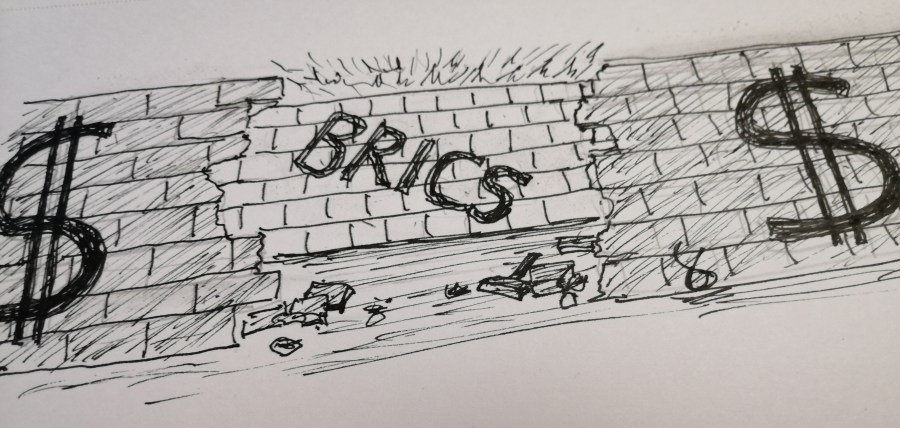
For decades the US Dollar has dominated financial transactions across the world – backed not only by the USA’s industrial and agricultural output but by its imperialist domination of many economies and its military power.
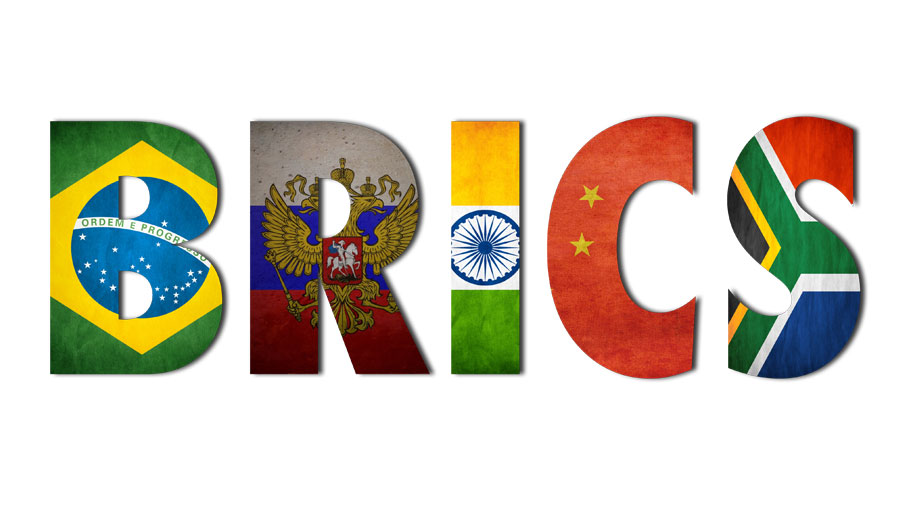
But perhaps no longer, for now there is a serious competitor in the field, one with the acronym BRICS, from the first letter of the states that created it (in order of no significance): Brazil, Russia, India, China, South Africa.
Apart from the backing of powerful economies with more applying to join, this currency standard is based on the price of precious and semi-precious metals. The UK’s Sterling (and the Irish state’s, for a while) was based on silver but the Dollar has for many years been backed by … debt.
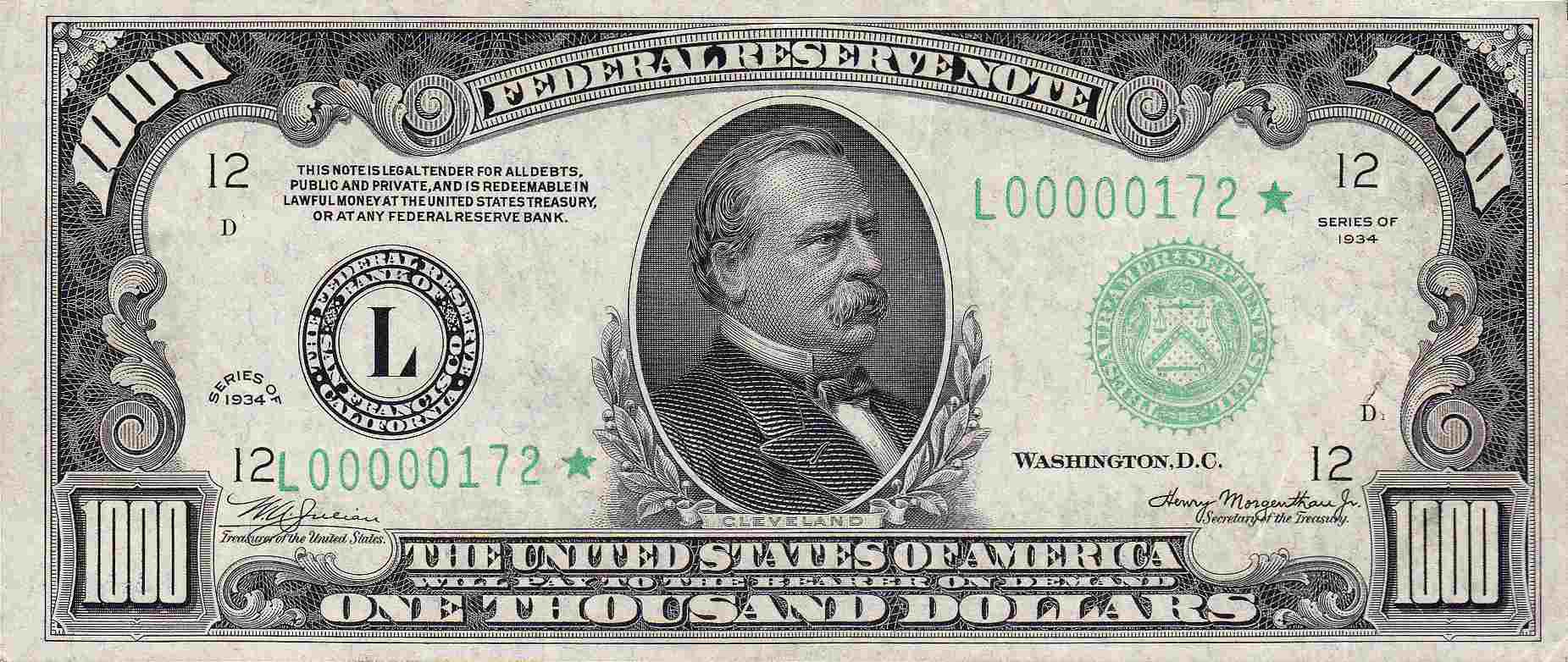
A currency is based on the assumption that every unit will be payable and backed by a unit (e.g. gold) of the declared value. But if the value unit markers of the US Dollar, in coins, notes, cheques and credit transfers were to be presented to the US Treasury, it could never pay them.1
In fact, it could not even pay a significant percentage of them and has been running a national defaulting on debt currency for many years, this year once again deciding to continue doing so to the tune of $31.5 trillion.
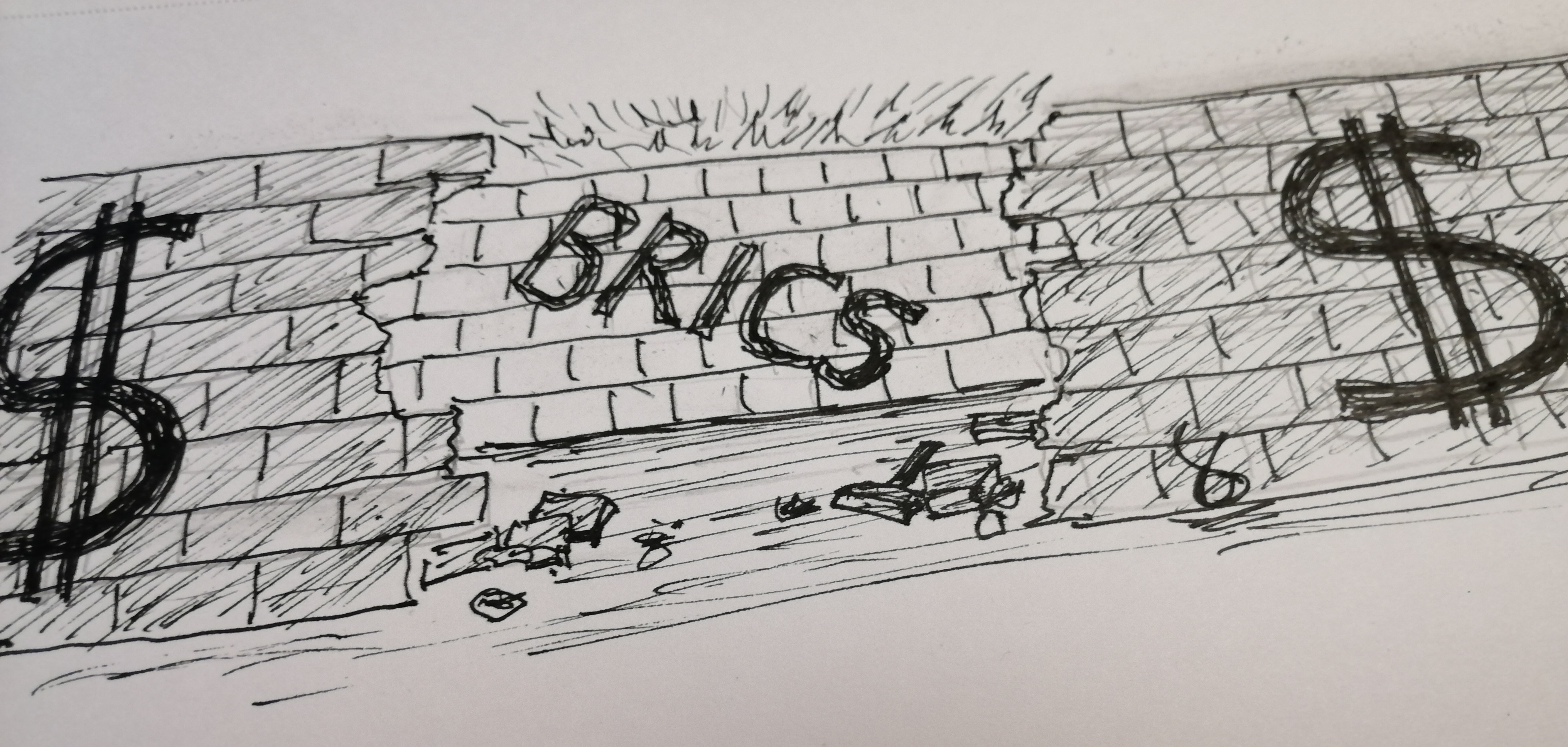
But is it really “redeemable” if all are presented? (Image sourced: Internet)
The USA has been able to continue doing this to date because so many of the world’s economies have been dominated by US Imperialism or in alliance with it; they fear that calling in the debt would lead to the collapse of the USA system and to their own interlinked financial structures.
BRICS consists of a financial alliance of economies of which their leaders for one reason or another feel in their interests to end the world dominance of the Dollar.
Previously, South Africa’s Foreign Minister Naledi Pandor said that there are 12 countries interested in joining the initiative.
Of the 12, she mentioned seven countries specifically, namely Saudi Arabia, United Arab Emirates, Egypt, Algeria, Argentina, Mexico and Nigeria. In March this year Russia announced its support for Algeria’s bid to join BRICS.
In April the expansion of that list interested in joining to 19 states was announced with formal applications from Algeria, Argentina, Bahrain, Egypt, Indonesia, Iran, Saudi Arabia and United Arab Emirates.
And with expressions of interest from Afghanistan, Bangladesh, Belarus, Kazakhstan, Mexico, Nicaragua, Nigeria, Pakistan, Senegal, Sudan, Syria, Thailand, Tunisia, Turkey, Uruguay, Venezuela and Zimbabwe.
(Image sourced: Internet)
COMMUNICATIONS, COMMON CURRENCY & LENDING BANK
Plans for an optical fibre submarine communications cable between BRIC members – partly motivated to avoid US National Security Agency spying on telecommunications in and out of the USA – have not advanced far since first discussed in 2012 but have not been abandoned.
Likewise, discussions of a common currency have not come to fruition yet either. However that may be more imminent.
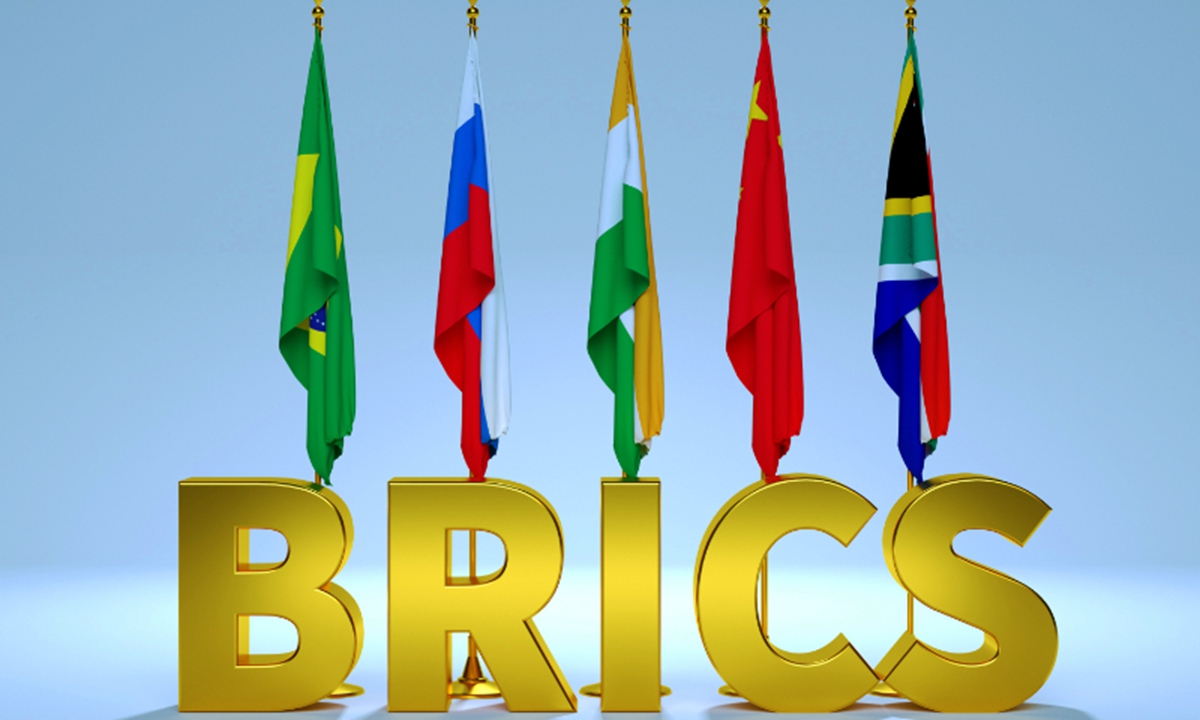
As challengers to Western-led international currency, BRICS “in the order of the scale of GDP, now collectively outweigh not only the reigning hegemon, the United States, but the entire G-7 weight class put together” (former White House senior advisor Joseph W. Sullivan).2
The same commentator believes that such a common currency has a much greater chance of stability than the Eurozone, because of the geographic diversity of its members, which enables a broader range of goods and services.
(Image sourced: Internet)
The biggest attraction for applicants to join is probably access to loans from the New Development Bank to members for infrastructure projects, which is the NDB’s main advertised purpose. Heretofore, the IMF and the World Bank have been the main external lenders.
Both the latter institutions have imposed harmful changes on borrowing economies, often driving them further and deeper into debt and into greater dependency on western imperialism. Those lending institutions have also supported corrupt and oppressive regimes.
The NDB has authorised lending up to $34 billion annually, with South Africa the HQ for the African continent with a starting capital of $50 billion ($10 billion from each of the five founders) and so far has 53 projects underway worth around $15 billion total.
Should the NDB prove its ability to issue loans to nationally-desired projects without the penurious and destructive conditions currently attached to IMF and World Bank funding, many, many regimes in the underdeveloped world are likely to apply to BRICS for membership.
And should client regimes currently dependent on western imperialism refuse to jump across to BRICS, they may well face coups from more nationally-ambitious sections of their elites or insurrections from below.
IS BRICS A GOOD OR A BAD THING?
Some anti-imperialists, including some socialists, have been celebrating the creation of BRICS, some even proclaiming it as the financial reflection of a new anti-imperialist order.
Of the five founding economies, only one claims to be socialist. Capitalist economies, we know, tend to develop into imperialist ones, sometimes but not always invading the countries of other economies but always exporting surplus capital there to exploit labour and natural resources.
So some or all of the capitalist economies in BRICS currently are likely to become imperialist also.
That apart, having much or even all of the world’s economies divided between two blocs may give weak economies opportunities they would not otherwise have or at least a choice and perhaps the opportunity to bargain for the conditions of their relationship to world finance.
In other words, a return in many fundamental ways to the division of the world before the collapse of the Soviet Union.
A breakthrough the current financial structure to a new one?
THREAT OF WAR?
But does this bring the threat of world war, arms race, etc, as seemed to be always present between the USA and the USSR?
Possibly but the threat of world war is already very much with us, as US/NATO uses the Ukrainian regime as a proxy in its decades-long threatening encirclement of Russia, and also in its posture (not unrelated) towards Iran and the USA’s world competitor China.
The working class in countries that are part of BRICS will still be exploited and will need to overthrow their respective national ruling classes if they are to end that exploitation and also save the environment from destruction.
Imperialism always means war whether direct or by proxy, small or large, against competing economies or people resisting domination and exploitation. Since the end of WW2 alone the USA has been involved in 201 military interventions in 51 regions.3
In the same period, the UK has carried out 28 military interventions in Asia, Africa, Middle East, Caribbean and Europe4 and France 32 in similar regions.5 Competition for world resources between Germany and the UK and with France led to WW1 and again to WW26.
BRICS has been created anyway, whatever our opinion and is set to grow significantly, causing some big changes in the world as a result. In the short term this development is likely to be to the advantage of the smaller economies and even nations struggling for independence.
6. Other states were of course involved, including the imperial competition for the Pacific and Asia between the USA/ UK and Japan in WW2 with the SE Asian peoples, in particular communist-led Chinese fighting Japanese imperialism and of course in Europe the mighty contribution and sacrifice of the USSR against the fascist powers. But the initiation of both world wars was competition and contention between Germany, France and the UK.
Pat Reynolds gave this oration in East London Cemetery on Sunday 21st May 2023 for Michael Barrett, the last man publicly hanged in Britain
A cháirde agus a chomrádaíthe,
Tá fáilte go leor romhaibh chun chruinnithe i gcuimhne Michael Barrett inniu. Welcome friends and comrades to this commemoration today for Michael Barret and Patrick O’Donnell. I have been asked to speak of Michael Barret and the movement he represented.
Michael was born in Ederney in the Maguire County of Fermanagh in 1841 and was judicially hanged though innocent by the British Government in 1868 at Newgate Prison, where the Old Bailey now stands.
Newgate prison was closed in 1903 and his remains with others were interred here in this cemetery. He was the last person to be publicly hanged in Britain.
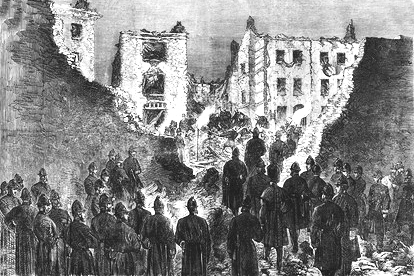
A Fenian bombing took place on 13th December 1867 to try and rescue O’Sullivan Burke the Fenian who planned the successful prison van escape in Manchester.
The bombing blew a huge hole in the wall and demolished nearby tenement buildings, killing 12 people and injuring many others. It led to a huge State-engineered backlash in Britain against the Fenians and put their cause back some 10 years.
Michael Barret, who had gone to Glasgow to work was an innocent man and was in Glasgow at the time of the incident.
False evidence given by a police informer Patrick Mullaly who was given a free passage to Australia implicated Barrett, but he had compelling evidence that he was in Glasgow at that time. After two hours the jury declared him guilty.
One of the trial lawyers Montagu Williams stated of Barrett:
‘On looking at the dock, one’s attention was attracted by the appearance of Barrett, for whom I must confess I felt great commiseration. He was a square built fellow, scarcely five feet eight in height and dressed like a well-to-do farmer.
This resemblance was increased by the frank, open, expression on his face. A less murderous countenance than Barrett’s I have not seen. Good humour was latent in his every feature and he took the greatest interest in the proceedings’.
Barrett ended his speech from the dock thus:
‘I am far from denying, nor will the force of circumstances compel me to deny my love of my native land. I love my country and if it is murderous to love Ireland dearer than I love my life, then it is true, I am a murderer.
If my life were ten times dearer than it is and if I could by any means, redress the wrongs of that persecuted land by the sacrifice of my life, I would willingly and gladly do so.’
The Daily Telegraph the next day stated that Barrett had:
‘Delivered a most remarkable speech, criticising with great acuteness evidence against him, protesting that he had been condemned on insufficient grounds, and eloquently asserting his innocence.’
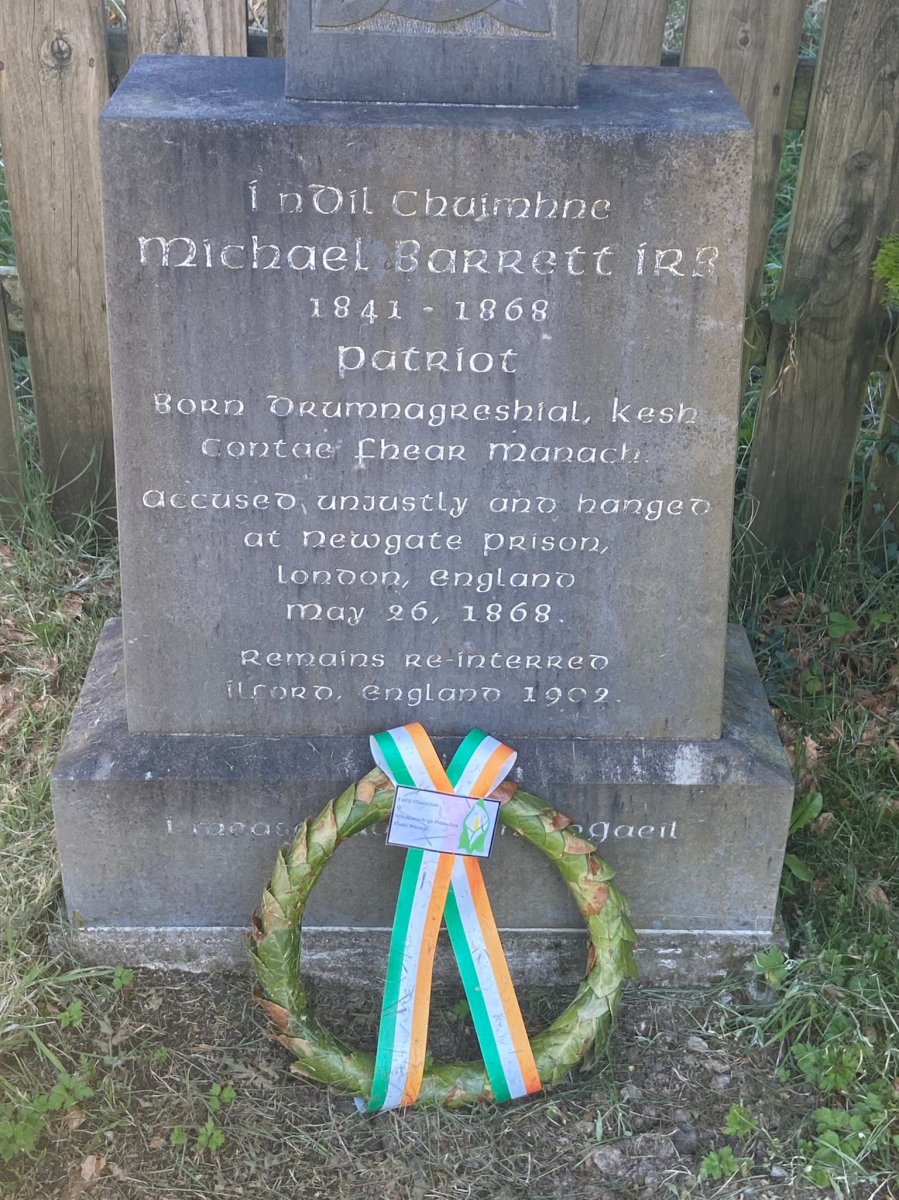
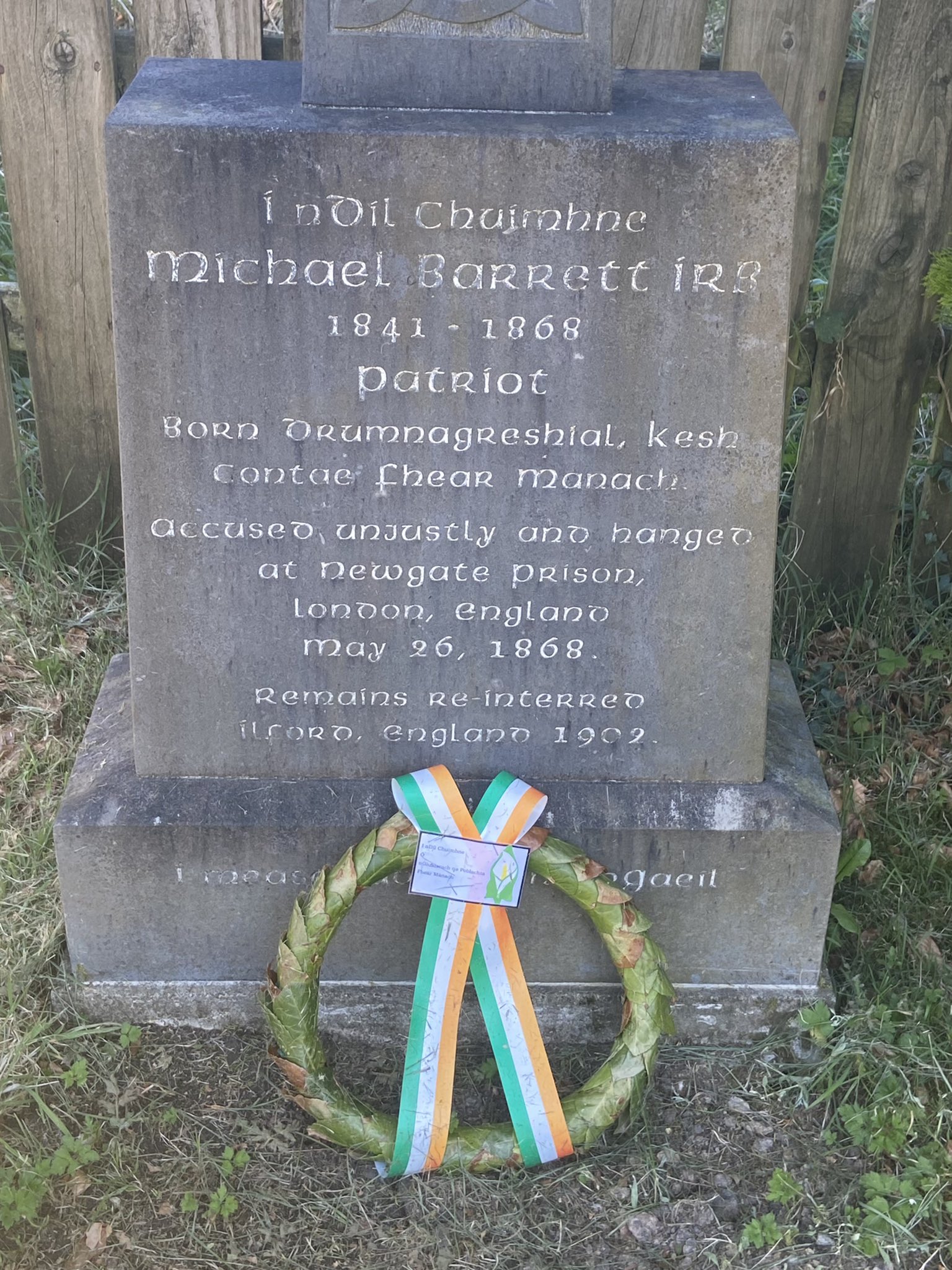
Michael Barrett monument detail, Co. Fermanagh (Sourced: Internet)
In Fermanagh his aged mother had walked many miles to appeal to the local Tory MP Captain Archdale, a noted Orangemen, who rejected her. Barrett was hanged in front of 2,000 jeering people singing Rule Britannia. The following day Reynolds’ News recorded that;
‘Millions will continue to doubt that a guilty man had been hanged at all; and the future historian of the Fenian panic may declare that Michael Barrett was sacrificed to the exigencies of the police, and the vindication of the good Tory principle, that there is nothing like blood.’
His hangman was the notorious Calcraft who had botched the hanging of the Manchester Martyrs, Allen, Larkin and O’Brien.
There is a huge difference between an accident leading to deaths by patriots fighting tyranny and the deliberate actions of the imperialists, which is why patriots have to be always careful to avoid civilian deaths.
There are many similarities between the Clerkenwell bombing and the Birmingham bombing of 1974.
In both cases they set back the cause of Irish freedom for many years, deeply harmed the Irish community in Britain and was used by the State for repressive measures against the community and to divide off the Irish community from the English working classes.
Disraeli brought in the Habeas Corpus Act and created the Special Branch. Of interest is that their first definition of Irishness was ‘Persons who were born in Ireland or whose recent forebears came from Ireland.” Back in the 1980s the GLC adopted the same definition.
We also had the Birmingham Six case with the ‘appalling vista’ of Lord Denning the Appeal Judge, who later regretted that the six innocent men were not hanged. For Gladstone it set him on his mission ‘to pacify Ireland’.
I ask you two questions today, what kind of people and community gave rise to patriots like Michael Barrett and the Manchester Martyrs, and the second question, what kind of regime or government would hang knowingly innocent men.
To understand the Fenians we have to understand the colonisation of Ireland and in particular the Great Starvation of Ireland An Gorta Mór. Over one and a half million people were starved to death by British imperialism and another two million forced to emigrate to Britain and the USA.
There was no famine in Ireland at this time, and it is imperialistic propaganda to call it such. It was clearly genocide in a land overflowing with food.
The potato crop made up under 25% of the agricultural produce of Ireland, but at this time Ireland was part of the UK where the potato crop was about 5% of the total produce of the UK. I know of no country where there was famine because of a 5% failure of the crops.
Michael Davitt back in 1904 called the Great Starvation a ‘Holocaust’ as did others. Ken Livingstone drew some comparison between the Great Starvation and the experience of the Jewish community during the Second World War.
Hitler named his strategy ‘The Hunger Plan’ where he starved Poles and Jews and others groups of food, and these victims are included in the Holocaust figures including also his starvation of the Warsaw Ghetto.
The shipment of food grown by the people of Ireland to Britain during the Great Starvation was a clear decision by the British government to starve the Irish people.
The Nazi Governor in Poland Hans Frank wrote of the starvation of Jews ‘that we sentence 1.2 million Jews to die of hunger should be noted only marginally’.
The economic theory of laissez-faire is a total invention, within years they could spend millions in Crimea, a place most English had never heard of.
I recall the great Irish writer Frank O’Connor stating ‘Famine is a useful word when you do not wish to use words like ‘genocide’ or ‘extermination’, and again ‘It was not that the people were too simple to realise the Dachau-like nightmare of their circumstances’.
He goes on ‘The word famine itself is a question begging for its meaning ‘an extreme and general shortage of food’, and to use it of a country with a vast surplus of food, cows, sheep, pigs, poultry, eggs and corn, is simply to debase a language’.
O’Connor went further: ‘Irish historians who are firmly convinced that the Famine was all a mistake in the office, explain it in terms of an economic theory called laissez-faire. This is another cock that won’t fight.
Anyone who can believe that the British government maintained a garrison of 100,00 men in Ireland for the purpose of not interfering in trade and industrial affairs attaches some meaning to the word history that escapes me’.
The Great Starvation of the Irish people was a daily planned strategic intervention by the English government which is borne out by the evictions and forced migrations which followed and by the white supremacist and racist beliefs held in England at that time, which has largely been ignored by the historians.
The failure of the Young Ireland movement in the 1848 rebellion led to the deportation of their leaders and a flight of others to France and the USA. From this came the Fenian movement and the Irish Republican Brotherhood set up in the USA and Ireland in 1858.
There was of course also the French Revolution of 1848 which inspired people all over the world and which also inspired the Fenians.
The American Civil War of 1861-65 was to inspire the Irish in the USA. Over 30,000 Irishmen were to lose their lives in War the vast majority fighting for the Union and for the abolition of Slavery.
Revisionists question whether the Irish were really fighting for the abolition of Slavery, yet the same historians in hindsight claim that the British and Irish who fought in the 2nd World war were fighting against fascism and the Nazis.
The Irish men who died firing against slavery are entitled to the same respect from history.
The 1867 rebellion in Ireland did not really take off. Frantz Fanon stated: ‘Each generation must, out of relative obscurity, discover its mission, fulfil it, or betray it’. The Fenians took a more measured road and passed it on to the next generation, but not without a fight.
In the USA they invaded the British Canadian Dominion twice in 1867 with about 700 Fenian soldiers, veterans of the American Civil War. They held a convention in in 1867 with 6,000 armed men present.
In Britain the Fenians massed near Chester Castle in an attempt to seize the guns there and get them to Ireland via Holyhead for the Fenian Rising. As in the USA they were betrayed by spies and with Chester Castle reinforced by soldiers, the raid was called off in February 1967.
In September Colonel Kelly was arrested in Manchester and was released when Fenians attacked the prison coach which later led to the Manchester Martyrs, Allen Larkin and O’Brien who were innocent men framed up by the English government.
The impact of the Manchester Martyrs in Ireland was huge with some 17 monuments put up in their honour and with the Catholic Church forced to backtrack on their anti-Fenian stance and allow masses and commemorations to be widely held in Ireland.
Michael Barrett is part of this sacrifice of the Irish abroad to Irish freedom made within a year of each other. My call is for Michael Barrett to be included within the Manchester Martyrs’ history and commemoration.
By the 1870s the Irish had moved to parliamentary means to move their fight for liberation onwards. You will notice that the fight for Irish freedom goes in flows, a rebellion often followed by political and parliamentary activity along with agitation. Both means were effective for their times.
In Ireland we had Michael Davitt and the Land League, again we have the huge contribution from Britain to this effort from Davitt. We also had the bombing campaign in Britain by O’Donovan Rossa and Tom Clarke from 1880-87, the Invincibles in Dublin and the execution of Lord Cavendish in 1882.
We have the great Irish Literary and Gaelic revival. Again, the Irish Literary Society was founded in Southwark, SE London in the 1880s which spread to Dublin, Belfast and Cork.
We had the Gaelic League and the GAA as part of this revival which led on to the 1916 Rising and the founding of the nation.
What kind of regime or government could knowingly judicially murder innocent men like Michael Barrett and the Manchester Martyrs? We know the history of British colonisation of Ireland and British Imperialism.
This is the same British Imperialism which would in 1919 lead to the Amritsar massacre in India. But let us stay in 1860s iwith this colonial Empire.
In 1865 the Jamaican people rose up against British colonial rule in Jamaica which left 400 dead in a colonial reign of state terrorism. They hung the leader Paul Bogle and 14 others and executed seven women and prosecuted George William Gordon who had nothing to do with the Rebellion.
They executed him. The Fenians at the time raised funds to help the survivors bring action against the English government. You see here a long history of hanging both Irish and Black people across their colonies.
Today I salute the Irish in Britain who marched in the 1980’s against apartheid in South Africa and who today march with the Palestinian people following a noble Fenian internationalist tradition.
British rule in Ireland was based on Imperialism, White Supremacy and Racism. This was first formulated by Gerald of Wales in 1187 some 700 years before they hanged Barrett and the Manchester Martyrs.
Gerald in his books Topography of Ireland and Conquest of Ireland used racism to justify the conquest of Ireland and portrayed the Irish as inferior, backward, inhuman, uncivilised, feckless and lazy.
This was a litany of manufactured racist lies when Ireland had been the ‘Island of Saints and Scholars’ and the seat of learning in Western Europe bringing enlightenment to Europe during the Dark Ages.
Gerald’s views were published across Europe and held sway until around 1650 for about 500 years. This first racialisation of the Irish did not require any religious framework.
When Henry 8th split with Rome in 1534 the racist code used for conquest in Ireland was then overlaid with a state-sponsored sectarian religious code.
Irish scholars were driven out of Oxford where they were a dominant force and Henry sought to build up his fleet to destroy Irish fleets on the south coast to control trading in Irish sea ports and towns.
There followed the Plantation of Elizabeth 1st who knighted Gilbert the mass murderer of Munster who later founded a British colony in Newfoundland.
Later on, we had the Cromwellian conquest of Ireland with large-scale massacres at Drogheda and Wexford, widespread smaller massacres and the forced transporting of Irish slaves to the Caribbean.
Revisionists deny this history and seem to wrongly believe that these people were on some kind of ‘Cromwell Tours of the Caribbean’. For the record these forced transported people were not indentured people.
It is of interest that Gerald of Wales’ views on the Irish were not held of African people from 1200 onwards but were lifted from the Irish situation and applied to African people on the advent of enslavement to justify what the European colonial powers were doing.
So now Africans can be perceived in the same way as the Irish, as backward, inferior, childlike and have their freedoms taken away.
Let us now look at racism and the White Supremacist views of British Imperialism in the 1800s which gave rise to the great Starvation, the Manchester and London hangings of innocent men.
Robert Knox in The Races in 1850 described the Celts as an inferior race which became part of the ‘scientific’ racism of the day, with Knox updating Gerald of Wales.
Even Engels came out with his racist views of the Irish ‘The race that live in these ruinous cottages in measureless filth, and stuck in this atmosphere penned in, as if on purpose, this race must have reached the lowest stages of humanity’, instead of seeing what British imperialism and racism had done to the Irish people at home and abroad.
John Bedoe in his Races of Britain in 1862 views the Irish as Africanoid and having African roots, and again as ‘European Negroes’. Punch portrayed the Irish as apes and monsters, even Parnell, and the Irish as Aboriginals and on the same level as gorillas.
Charles Kingsley on visits to Ireland in the 1860’s states ‘I am haunted by the human chimpanzees I saw’ and ‘to see white chimpanzees is dreadful’. A new Gorilla at London Zoo is called ‘Paddy’ and the ‘Irish Yahoo’ is seen as the missing link between man and gorilla.
The Irish are described ‘as half naked savages who retain a vast amount of their primitive savagery to this day’.
We can see how scientific racism is now applied equally to Black and Irish for the purpose of colonisation and oppression.
In this context we can see the mindset of the British establishment who committed genocide against the Irish people, and who over centuries had murdered Irish people at random. We can see how the same regime of government can hang innocent people at home and abroad.
Michael Barrett, a self-educated man emerges from this dunghill of White Supremacy and pure racism as a heroic figure, like the Manchester Martyrs a true patriot as shown in his speech from the dock. He should be remembered with the Manchester Martyrs and not separated from their heroic end.
Barrett, a Christlike figure and a Cúchulainn who died on behalf of his people and for his political beliefs.
He was part of an Irish tradition in Britain of being in the forefront of democratic rights for liberty justice and freedom, not just for the Irish but also the British people.
We see in the Chartist movement of the 1840s being led by Irishmen Fergal O’Connor and Bronterre O’Brien that fight for liberty and the rights of man.
Also the leadership of Donegal man Doherty leading the workers of Lancashire and the ongoing links in the trade union movement to today from leaders like Mick Lynch inspired by James Connolly to Pat Cullen of the RCN.
We see it in the gift of The Red Flag song from a County Meath man and The Ragged Trousered Philanthropists novel by Noonan to the British working class.
In honouring Michael Barrett today, we stand full square for a United Ireland as proclaimed in the Fenian and 1916 Proclamations and for working class liberty in Britain.
I will finish today by reading the Fenian Proclamation of 10th February 1867 from the Irish People to the World. In it we can see what the 1916 Proclamation borrowed and built on. It is also what Michael Barrett lived and in the end died for.
Fenian Proclamation, 1867
Proclamation of the Irish Republic, issued February 10th, 1867, by the Irish Republican Brotherhood.
I.R. — PROCLAMATION! —
THE IRISH PEOPLE TO THE WORLD
We have suffered centuries ofoutrage, enforced poverty, and bitter misery. Our rights and liberties have been trampled on by an alien aristocracy, who, treating us as foes, usurped our lands and drew away from our unfortunate country all material riches.
The real owners of the soil were removed to make room for cattle, and driven across the ocean to seek the means of living, and the political rights denied to them at home, while our men of thought and action were condemned to loss of life and liberty.
But we never lost the memory and hope of a national existence. We appealed in vain to the reason and sense of justice of the dominant powers. Our mildest remonstrances were met with sneers and contempt. Our appeals to arms were always unsuccessful.
Today, having no honourable alternative left, we again appeal to force as our last resource. We accept the conditions of appeal, manfully deeming it better to die in the struggle for freedom than to continue an existence of utter serfdom.
All men are born with equal rights, and in associating together to protect one another and share public burthens, justice demands that such associations should rest upon a basis which maintains equality instead of destroying it.
We therefore declare that, unable longer to endure the curse of Monarchical Government, we aim at founding a Republic based on universal suffrage, which shall secure to all the intrinsic value of their labour.
The soil of Ireland, at present in the possession of an oligarchy, belongs to us, the Irish people, and to us it must be restored.
We declare also in favour of absolute liberty of conscience, and the complete separation of Church and State.
We appeal to the Highest Tribunal for evidence of the justice of our cause. History bears testimony to the intensity of our sufferings, and we declare, in the face of our brethren, that we intend no war against the people of England —
our war is against the aristocratic locusts, whether English or Irish, who have eaten the verdure of our fields — against the aristocratic leeches who drain alike our blood and theirs.
Republicans of the entire world, our cause is your cause. Our enemy is your enemy. Let your hearts be with us. As for you, workmen of England, it is not only your hearts we wish, but your arms. Remember the starvation and degradation brought to your firesides by the oppression of labour.
Remember the past, look well to the future, and avenge yourselves by giving liberty to your children in the coming struggle for human freedom.
The media announces that “the population of Ireland has reached 5 million … for the first time in 170 years”. Interesting – and a barefaced lie! The population of Ireland passed 5 million some time ago and is actually around 6.5 million now.1
Ireland remained with negative population growth until near the end of the last century – mismanaged for most of the population first by the British occupiers of the whole of the island, then by a combination of the native neo-colonial bourgeoisie and of the settler colonial ruling class.
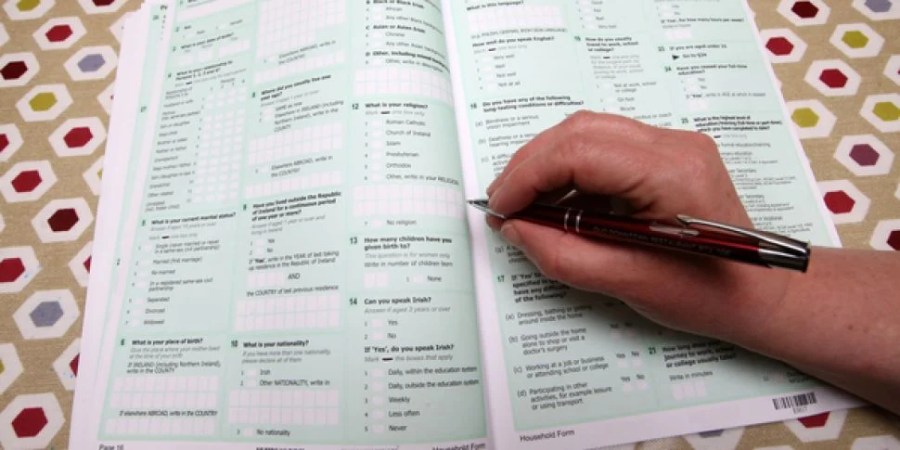
Filling in a census form from which population statistics can be extracted (Photo sourced: Internet)
For more than a century the population of Ireland stood at around 5 million, static despite a high birth rate. This was mathematically possible only through continual massive emigration – mostly to English-speaking regimes: Britain, USA, Australia, New Zealand and Canada.
But it is true that 170 years ago it was more than 5 million – in fact it was around 8.5 million. And it is worth reflecting on how they were able to produce enough food domestically to feed that entire population while now, with a smaller population, we import as much as 80% from abroad.2
It was the Great Hunger that wiped out much of the earlier population, statistics somewhat hiding the pain and sorrow of millions of Irish in death, disease and emigration — and the great transfer of land for cultivation (and rent) to pasturage, with its dangerous environmental impact.
It provided an opportunity for growth of the Catholic Irish capitalist class, the Gombeens, huckstering money-lenders buying up the lands of afflicted neighbours.
The kind of class that the British could depend on in 1921 to manage the neo-colony and to murder and jail those of national liberation3.
Emigration kept population stats steady and, combined with unemployment, ensured a low internal home market for development. An educated workforce and natural resources could be developed but the Gombeen class opened it all to foreign multinationals rather than develop it themselves.
Even with foreign exploitation of the workforce at home, the education system turned out mostly emigration fodder: the Irish tax-payers funded an education system to provide a literate and numerate English-speaking workforces for capitalist exploitation abroad.
No wonder the Irish political class declined to give the Irish abroad a vote in the Irish state – unlike for decades any other state in the European Market. Yet during the 1930s through to the 1960s, money sent home by Irish migrants accounted for an estimated 30% of the Irish State’s economy.4
The Irish state remains a neo-colony with low taxation and other incentives for foreign companies to take over our few industries5 and local and foreign property speculators to rake in profits out of the despair of homelessness or of struggling to meet rent or mortgage payments.
A neo-colonial market for produce of foreign companies and to plunder not only our labour force, not only our natural resources on land, sea and wind and but even our infrastructures in transport and communication, energy, health service, water supply and even our city sanitation.
TRUNCATED
The announced statistics were truncated, appropriate perhaps for a truncated country, with the history behind those statistics not so much truncated as obliterated.
That is our present and our past but not how the future has to be – we can write our own future but we won’t do it by putting a mark on a ballot paper.
3The Irish Civil War or Counterrevolution, 1922-1923.
4I have read this in the past but am unable now to find the reference; however I have posted some references on the figures of remittances from Irish emigrants.
5 For a few examples of foreign takeover: Irish stout, beer and lagers (Guinness, Smithwicks, Harp); Irish whiskey (Paddy, Jameson, Bushmills); cigarettes (Afton); preserved vegetables (Erin); aviation (Aer Lingus); public transport (Transport for Ireland; LUAS); sugar (Irish sugar beet replaced by subsidised cane sugar from the USA); woodlands (Coillte).
The Irish State recently commemorated the end of the Irish Civil War but what it was really doing was celebrating its victory over the democratic national liberation forces.
The Irish national bourgeoisie, the Gombeen ruling class, armed and supplied by British Imperialism and colonialism, in 1922 launched a war against the forces that had brought the British Occupiers to the negotiation table.
In that short war or counterrevolution, the Irish State formally executed over 80 Irish Republican Volunteers – many more than had the British during the War of Independence 1919-1921. It also shot dead and blew up surrendered Volunteers and kidnapped, tortured and murdered others.
The Irish government of the day put the financial cost of the Civil War at 50 million sterling which today would be near to 3 billion euro.
A curtain of repression settled over Ireland, in the Irish state and in the colony in the Six Counties (in particular from the RIC re-baptised as RUC and the State-armed Loyalists of the B-Specials). Many Republicans were in jail and if not, could not find work and so emigrated.
The political party allegedly representing the Republicans, Fianna Fáil, led by a former leader of the forces attacked by the State, joined the Gombeen system and became in fact the preferred party of the Irish ruling class.
Though the Republican forces recovered and returned to the struggle in the 1930s (with the Communists against the fascist Blackshirts), again in the 1940s and onwards, they never again came close to winning control over the State.
What the Irish State has given us since its inception, even after the Civil War, has been generations of underdevelopment; unemployment and emigration; a huge decline in the Irish-speaking areas; inequality and social repression of women and LGBT people.
The latter was due to Catholic Church domination in every sphere of life, resulting in institutional physical, mental and sexual abuse, along with censorship in printed, audio and visual media and in banning of contraception.
The ruling class of the Irish State, the Gombeens, tolerated the foreign occupation and control of more than one-fifth of the island’s land mass and abandoned the large Catholic minority in the colony to discrimination and pogroms.
It tolerated also institutional and media racism against the Irish diaspora in Britain, the repressive legislation of the Prevention of Terrorism Act and the jailing for long sentences of a score of innocent Irish people in five different cases in the 1970s.
The Irish State tolerated Loyalist/ British Intelligence bombing inside its territory, failed to protect its citizens from terrorist bombing in the 1970s and covered up its complicity, for example with regard to the Dublin and Monaghan Bombings.
In addition, it used a Loyalist bombing to disarm the opposition to repressive legislation, not against Loyalists but against Irish Republicans, sending Republican activists to jail on the unsupported word of a senior police officer.
More recently this Irish State that we inherited has given us a housing crisis while it makes the territory a rich hunting ground for property speculators, bankers, landlords and vulture funds and also sells off/ gives away our natural resources, public transport and other infrastructures.
The selling-off includes our health service which is also in crisis while the private companies chop off parts of it and sell service back to the State at a profit. And a country that was able to feed 8.5 million prior to 1845 (and export foodstuffs) cannot now feed 5 million without huge imports.
They have given us nothing to celebrate but as always, there is a choice. We can bemoan the situation or we can “take back the nation they’ve sold” (Soldiers of Twenty-Two). And that cannot be done through electing any party or parties into the system.
On the 49th anniversary of the Dublin and Monaghan Bombings a number of speakers criticised the Garda closure of its investigation a mere four months after the bombing with the highest number killed in any one day of the 30 years war.
The criticisms were made on 17th May at the annual commemoration of the atrocity in Talbot Street, Dublin, organised by the Justice For the Forgotten campaign, held at the location of the memorial on the site of one of the bombings of that day.
The annual commemoration has been organised for many years by the Justice For the Forgotten campaigning group at the Talbot Street monument to the bombing1. It usually comprises reminiscences, poetry and music and a call for the British State to release its secret papers.
As of rote, an Irish Government Minister is invited to speak who routinely says how hard the Irish Government has been trying to get the British State to release the secret papers revealing the latter’s connection to those who carried out the bombing.
Years after the bombings, a British TV company (!) pointed the finger at the Ulster Volunteer Force, a British Loyalist paramilitary group but believed acting under British Intelligence agency direction, named some of those involved and a week later the UVF claimed responsibility.
In addition to British Intelligence, the British colonial police2 and British Army3 had been widely known to be working in collusion with Loyalists.
But few would have suspected Irish State collusion.
THE BOMBINGS AND AFTERMATH
On 17th May 1974 three car bombs exploded without warning in crowded Dublin city centre streets and another in Monaghan town centre. Thirty-three people were killed along with a full-term baby and a miscarriage with around 300injured. No-one was ever even charged in relation to the atrocity.
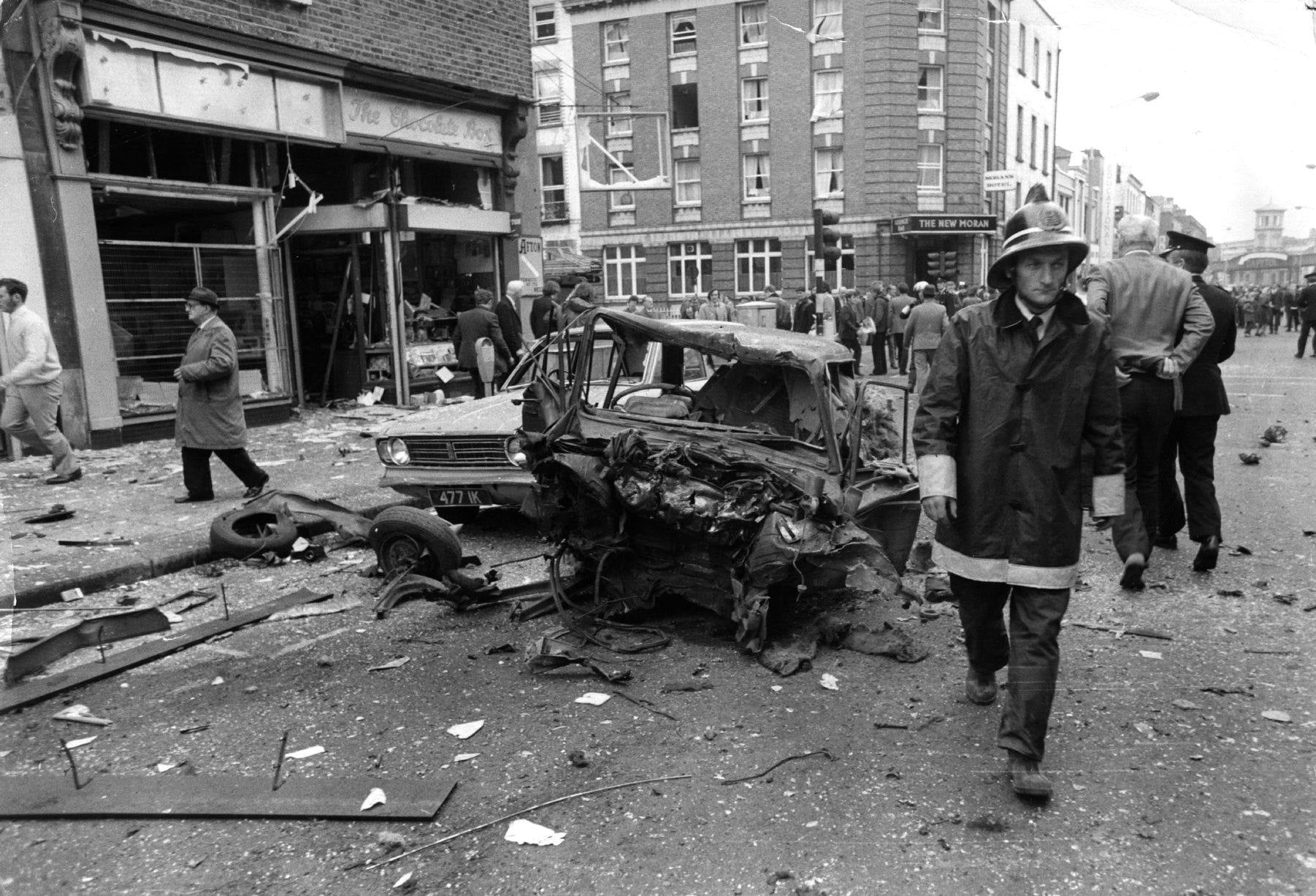
Scene post-bombing in Talbot Street, the site where the Monument was erected later is out of shot to the right. (Photo sourced: Internet)
The intention, unlike that of many other city car-bombings in the Six Counties and in England, was clearly to cause maximum death and injury to civilians. The areas chosen in Dublin were full of shops with bus stops and 5.30pm was going home time from shopping and work.
And no warning was given.
In the course of the short Garda4 investigation, in macabre irony the remains of the exploded cars were sent for forensic examination to their very source: the Six Counties, i.e to the colonial police force (at the time, the RUC5). Unsurprisingly, nothing useful came back.
In a war that was already five years old (six years, if the civil rights marches are included) the collusion between the British colonial police and Loyalist paramilitary murder gangs was well known and collusion with the British Army widely suspected.
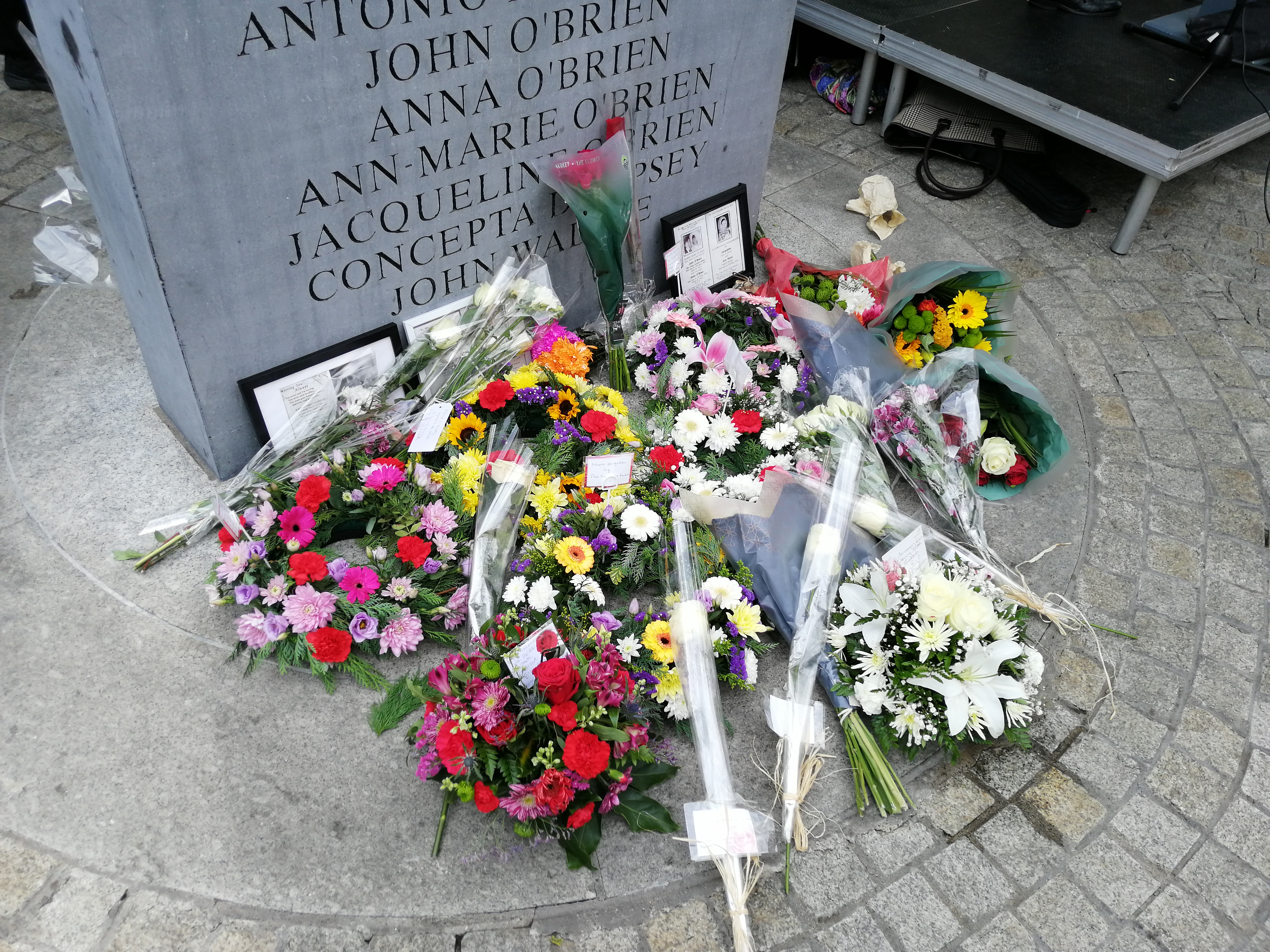
Floral tributes on the north face of the monument in Talbot Street. (Photo: D.Breatnach)Floral tributes on the south face of the monument in Talbot Street. (Photo: D.Breatnach)
CAMPAIGN OF BOMBING DUBLIN
The Loyalist bombing of two cities in the Irish state in 1974, although by far the worst of the whole period, were not the first in Ireland, not even the first fatal ones.
In 1973 a Loyalist bomb in Dublin city killed Tommy Douglas and the year before that another killed George Bradshaw and Tommy Duffy – all were employees of Irish public transport state company CIE.
Even after the horror of 1974, on 29th November 1975, another a bomb at Dublin Airport killed John Hayes, a worker there.
And there were other earlier ones where no-one was injured, such as the blowing up of the Wolfe Tone monument just outside Stephens Green on 8th February 19716 and the Daniel O’Connell Monument in Glasnevin Cemetery (the round tower) in December 1971.
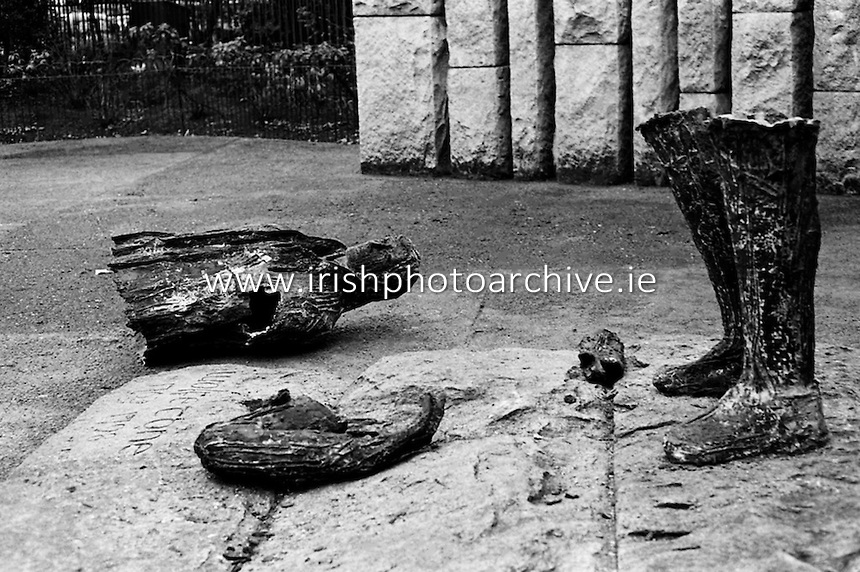
Pieces of the statue of Theobald Wolfe Tone on St Stephen’s Green. The statue was blown up by a loyalist bomb. A report at the time noted that ‘Huge slabs of the bronze sculpture were hurled 20 feet in the air’. 08/02/1971 (Photo sourced: Internet)The O’Connell Monument in Glasnevin (round tower) seen here at sunset from the Botanic Gardens was a target of Loyalist bombing in 1971. (Photo: D.Breatnach)
If the Irish State had pursued investigations and cross-Border links after the earliest of those bombings, they might have headed off the carnage that followed later.
Not only did they not do so but in fact used the 1972 bombing to blame Irish Republicans so as to get an unpopular piece of repressive legislation through parliament, the Amendment to the Offences Against the State Act, along with the establishment of the no-jury Special Criminal Court7.
The Garda Commissioner at the time of the 1974 bombings was Patrick Malone and Ed Garvey, his Assistant Commissioner, was later exposed as a British Secret Service asset run by Fred Holroyd, a disenchanted British agent who revealed he had visited the policeman in his Dublin HQ.
Garvey, by then Commissioner, denied being a British agent and claimed no memory of the visit.
The Barron Report (2003) concluded that visit had undoubtedly occurred and that he had not informed his superiors, contrary to all rules regarding contact with agents working for a foreign government.8 When Fianna Fáil came into Government again, they sacked Garvey.
Since FF had not subjected him to a regular disciplinary process, probably in order to avoid the sordid story going public, Garvey was able to sue the Irish Government, win damages and ensure he received his former pension entitlements.
THE COMMEMORATION EVENT
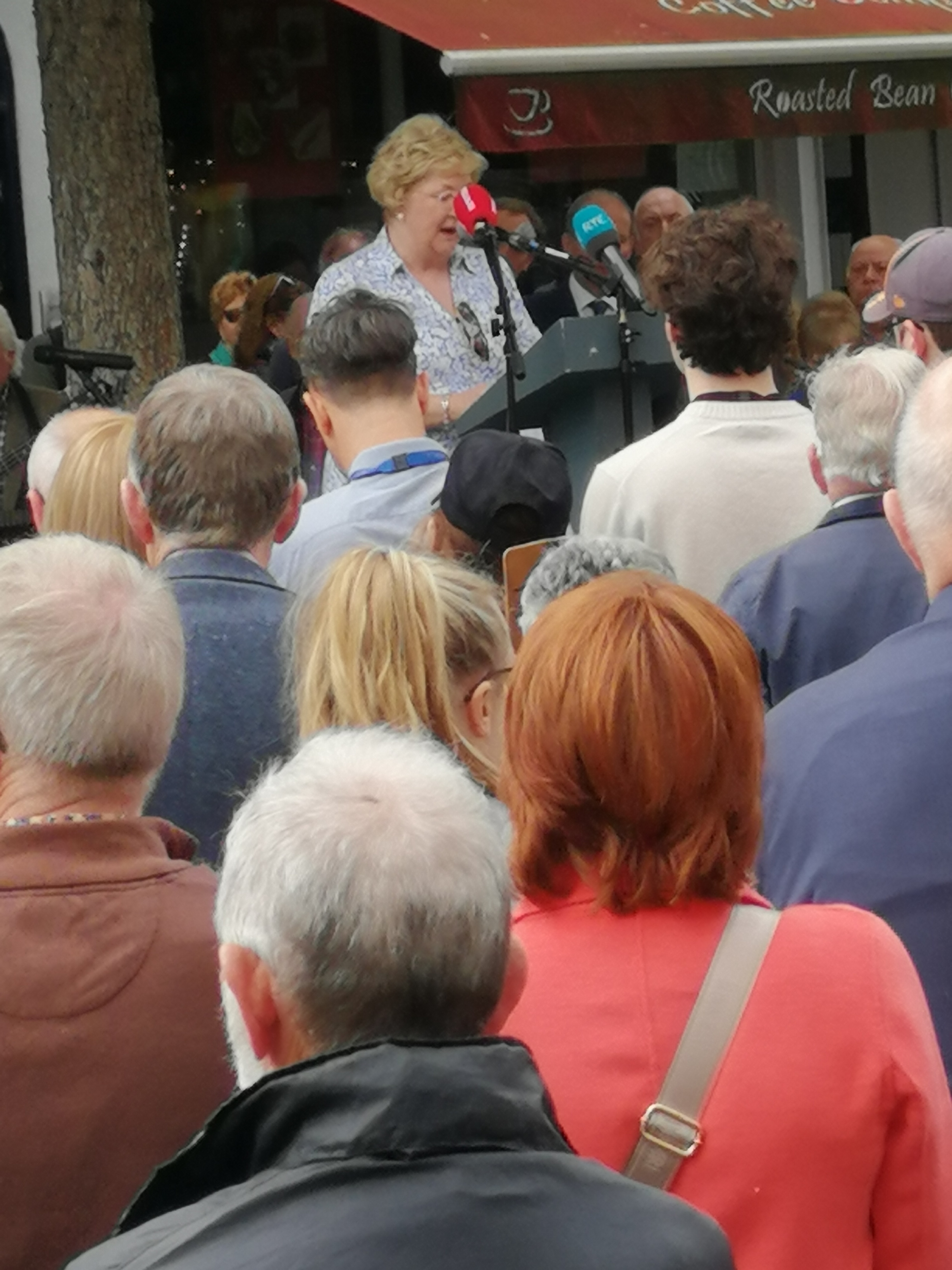
Aidan Shields, who lost his sister Maureen in the bombing, chaired the event for Justice for the Forgotten and introduced its Secretary Margaret Unwin who, as all speaking or performing at the event seemed conscious that next year would be the 50th anniversary of the atrocity.
(Photo: D.Breatnach)
The regular Government slot was occupied by the current Tánaiste (Dep. Prime Minister) Mícheál Martin who, as has every Government representative since the JFTF commemorations began, claimed energetic diplomatic discussions for release of the papers with their British counterparts.
Martin also criticised the British Government’s widely-criticised intended legislation to prevent official investigations and trials regarding past crimes committed by British forces, while he simultaneously praised the British pacification process.
A young Italian woman played the theme from the Schindler’s List film and another air on violin. A visiting Italian couple had been killed in the bombing also but that was not mentioned when she was introduced.
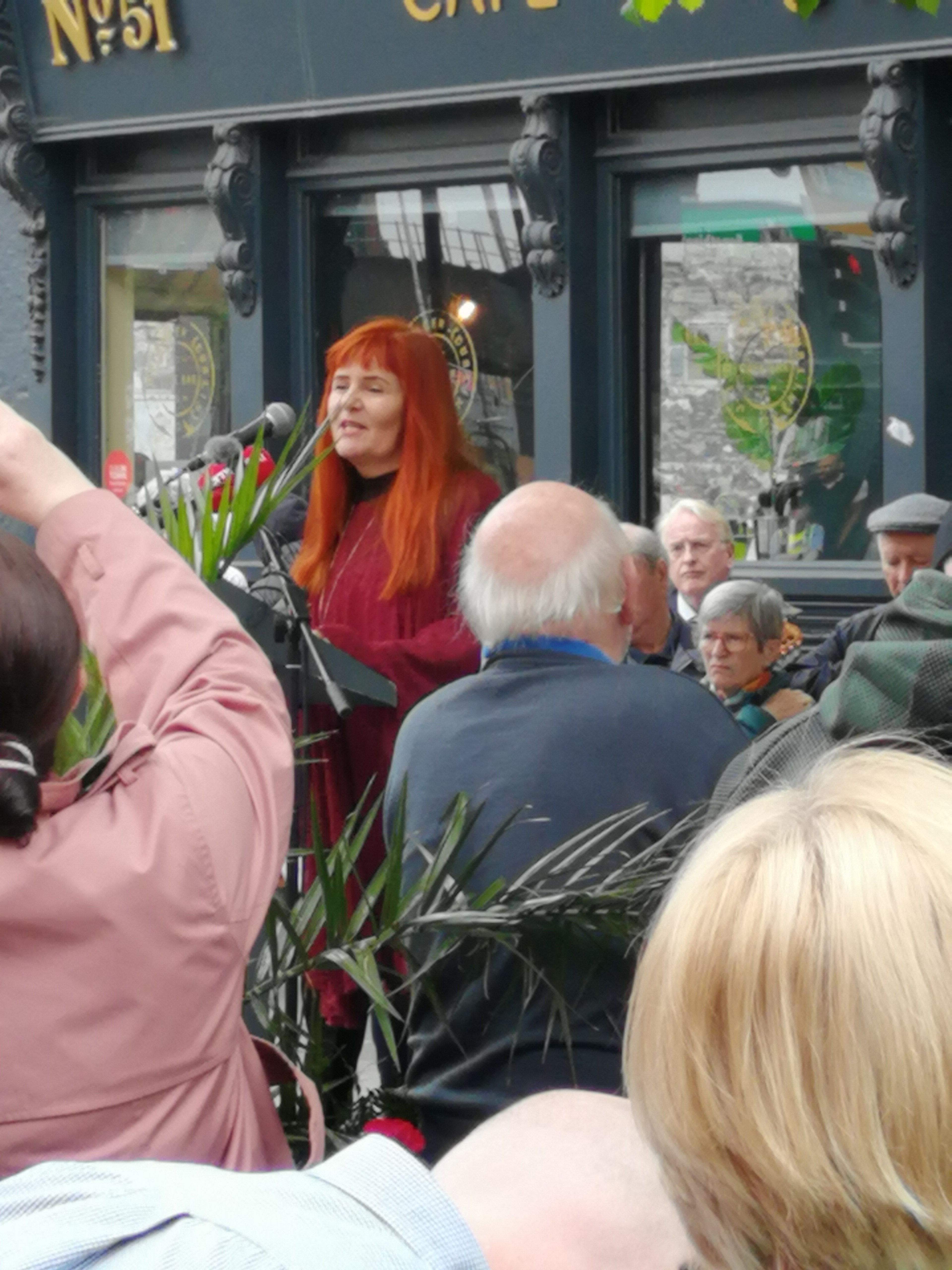
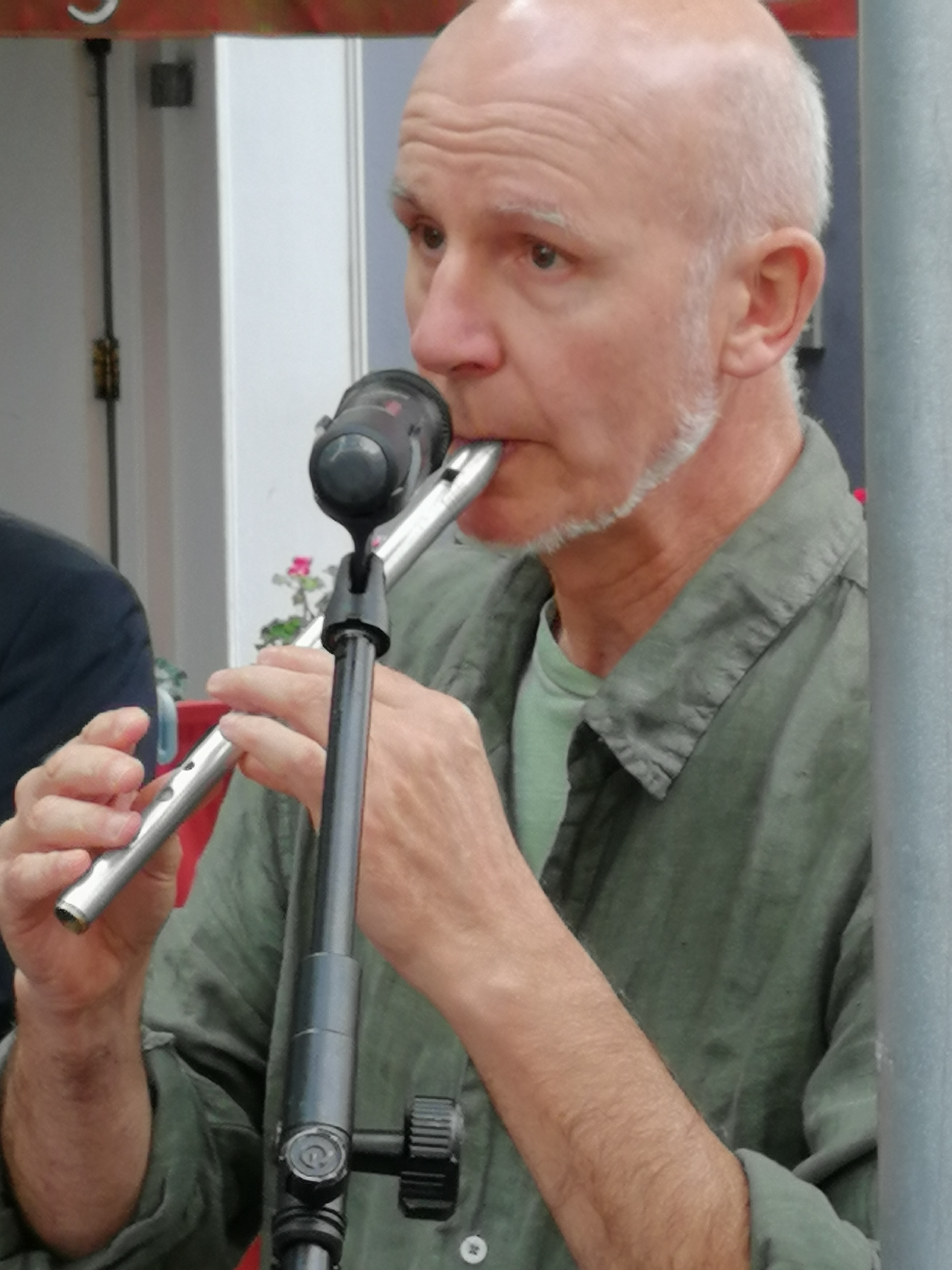
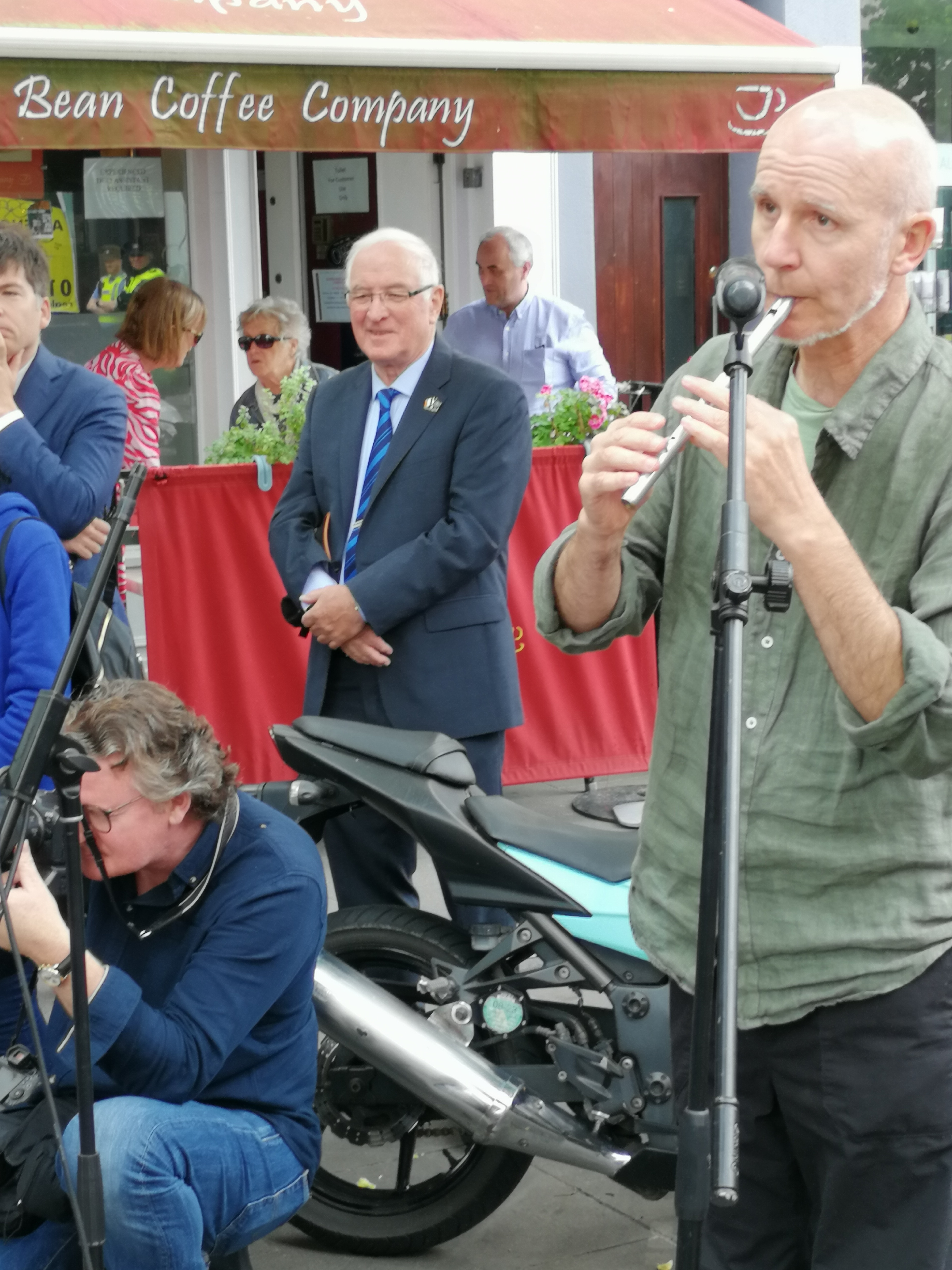
Rachel Hegarty read from her poetry compilation about the victims, based on testimonies by surviving relatives and friends. Cormac Breatnach on high D whistle and Eoin Dillon on uileann pipes played the Irish air Tabhair Dom Do Lámh (“Give Me Your Hand”).
Poet Rachel Hegarty reciting from her work on the bombing. (Photo: D.Breatnach)Closeup of Cormac Breatnach on high whistle playing at event. (Photo: D.Breatnach)Eoin Dillon playing uileann pipes at event. (Photo: D.Breatnach)Fuller shot of Cormac Breatnach playing at event with Eoin Dillon out of shot to the left. (Photo: D.Breatnach)
The Shillelagh North Ukulele Group played and sang The Sound of Silence and Things (we used to do), both appropriate in metaphorical context, the first for the official silence about the perpetrators and their British intelligence organisation, the second about the loss of the victims and to their loved ones.
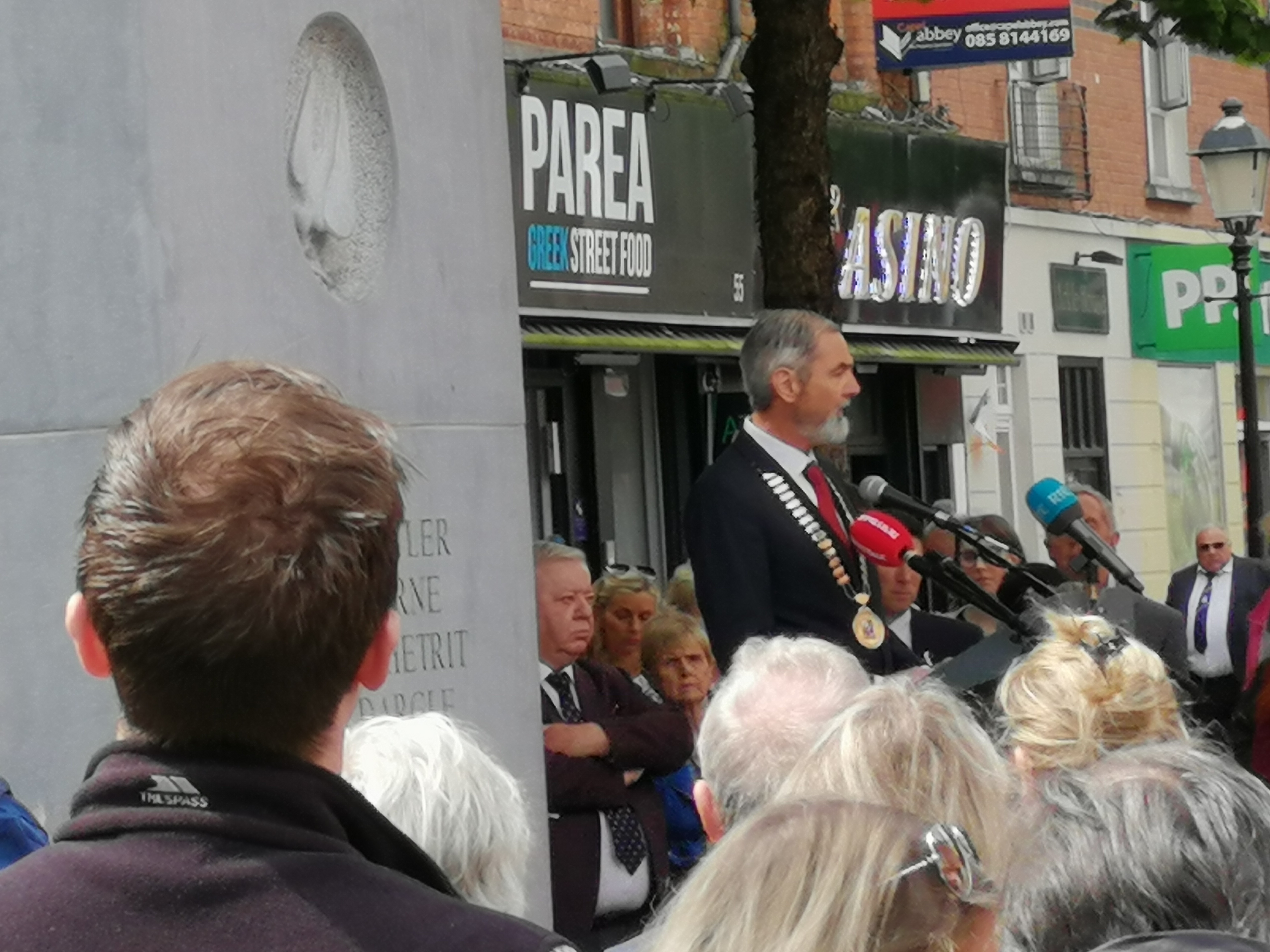
Dublin City Lord Mayor Caroline Conroy, of the Green Party, spoke about the atrocity and criticised the closing of the Garda investigation a mere four months after the bombing.9
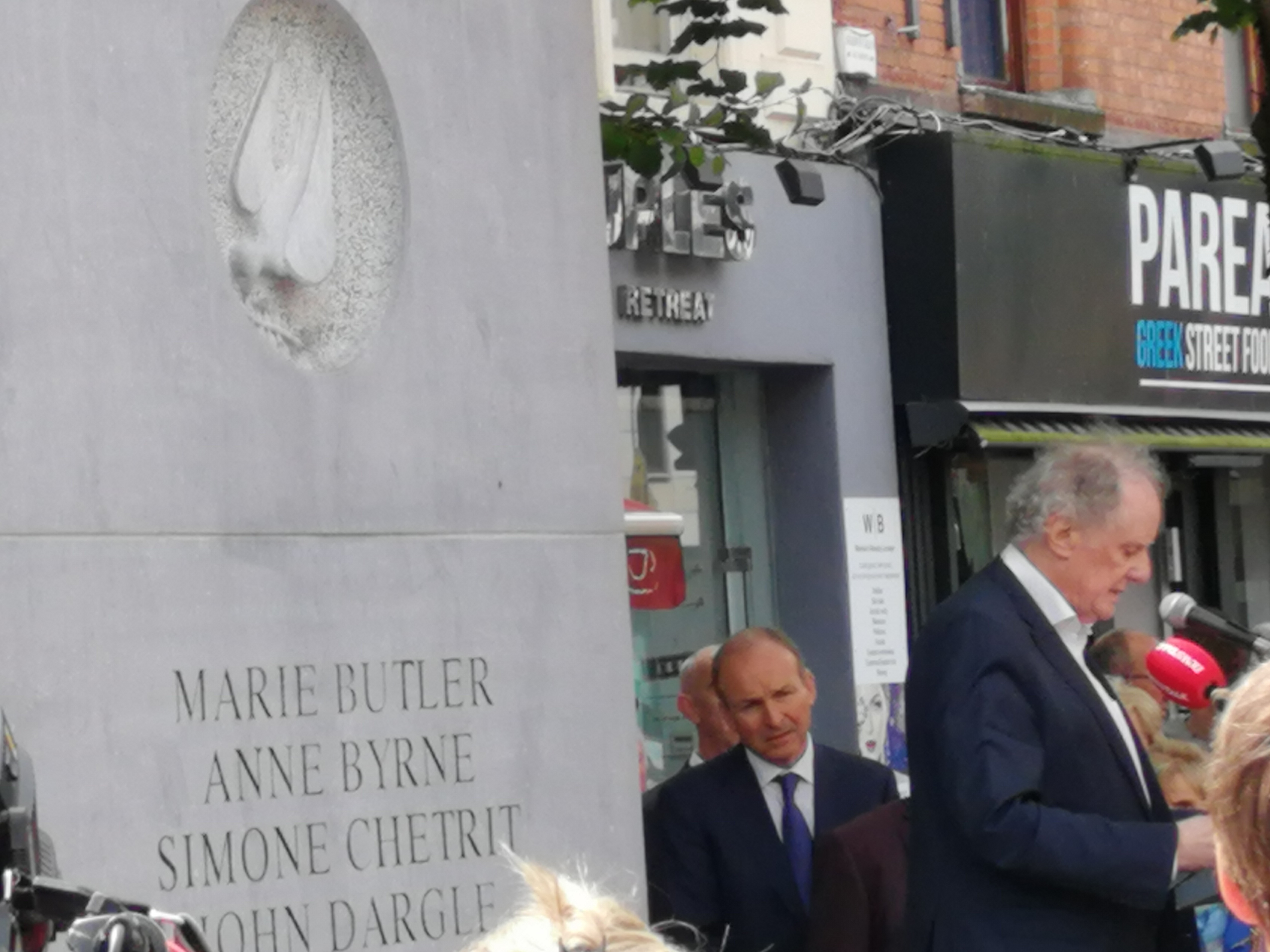
Vincent Browne giving his oration. (Photo: D.Breatnach)
Well-known journalist and former TV presenter Vincent Browne gave the oration at the event and went into horrific detail on some of the injuries he had witnessed as a journalist at the scene with his doctor brother as they struggled to help the victims still alive.
Browne departed from the subject of the bombing, as a few had done to speak of the long war and the Good Friday Agreement but in his case also to accuse the Provisional IRA of having killed most of the people during the 30 Years War which seemed not appropriate on this occasion.
Seán Conlon, Cathaoirleach (Chair) of Monaghan Council10 spoke of the bombing and focused on the effect on his town. He also condemned the early closing of the Garda investigation and the failure to pressurise the British State into releasing security papers relevant to the bombing.11
Seán Conlon, Cathaoirleach of Monaghan Council, speaking with part of monument visible to his left. Aidan Shields is standing right next to the Monument. (Photo: D.Breatnach)
A number of speakers referred optimistically to the investigation into the Glenanne Gang by former English police chief Jon Boucher, who was present in the crowd at the commemoration. Boucher is heading a number of other historical investigations, including that of Stakeknife.12
The older age profile of the attendance was noticeable with only two teenagers visible and this in itself must be of concern.
FATAL CONSEQUENCES OF STATE COLLUSION AND COVER-UP
The failure to investigate the earlier Loyalist bombings and apprehend the perpetrators made the planning and execution of the Dublin and Monaghan bombings much easier. The early closing of the Garda investigation of the 1974 bombings ensured the perpetrators would run free.
As well as failing relatives and friends of those murdered and injured in Dublin on the 17th May 1974, the lack of pursuit had repercussions for many other victims of Loyalist murder squads, in particular the over 120 victims of the Glenanne Gang, including the Miami Band Massacre in 1975.
An aspect not normally commented upon was the choice of predominantly working class areas for Dublin massacre victims. It was not the high-end Henry or Grafton Streets that were chosen but the more working-class shopping areas of Talbot Street and Parnell Street.
The fatal Dublin bombings of 1972 and 1973 had also been directed at workers by location: three public transport workers and an airport worker.
Section of the Shillelagh North Ukulele Group playing and singing at the event (Photo: D.Breatnach)
THE GOMBEENS: A CRAVEN CLIENT RULING CLASS
The whole chain of events from the first Loyalist bombing of Dublin points quite clearly to the client nature of the Irish national bourgeoisie, the ruling class of the Irish State. Even if it wanted to, it is too weak to make strong demands of the British State.
What self-respecting national ruling class would allow a foreign power to send terrorists to bomb its capital city? And then collude with that power in drawing silence and secrecy over the atrocity?
None, of course. But the Irish bourgeoisie came into being in a truncated client state and, armed and equipped by its master, went to war for two years (1922-1923) against the very national liberation forces that had brought the British State with offered concessions to the negotiation table.13
To talk of uniting Ireland under such a class, apart from being impractical nonsense, is a travesty. To expect any real change by electing a party or combination of parties to government in such a situation is a pipe-dream.
The 1974 bombing, the subsequent investigation and the record of Irish governments since in relation to the bombing are together a stark illustration of the spineless nature of the Irish bourgeoisie when dealing with their masters.
A client ruling class yes but more accurately, a servant.14
End.
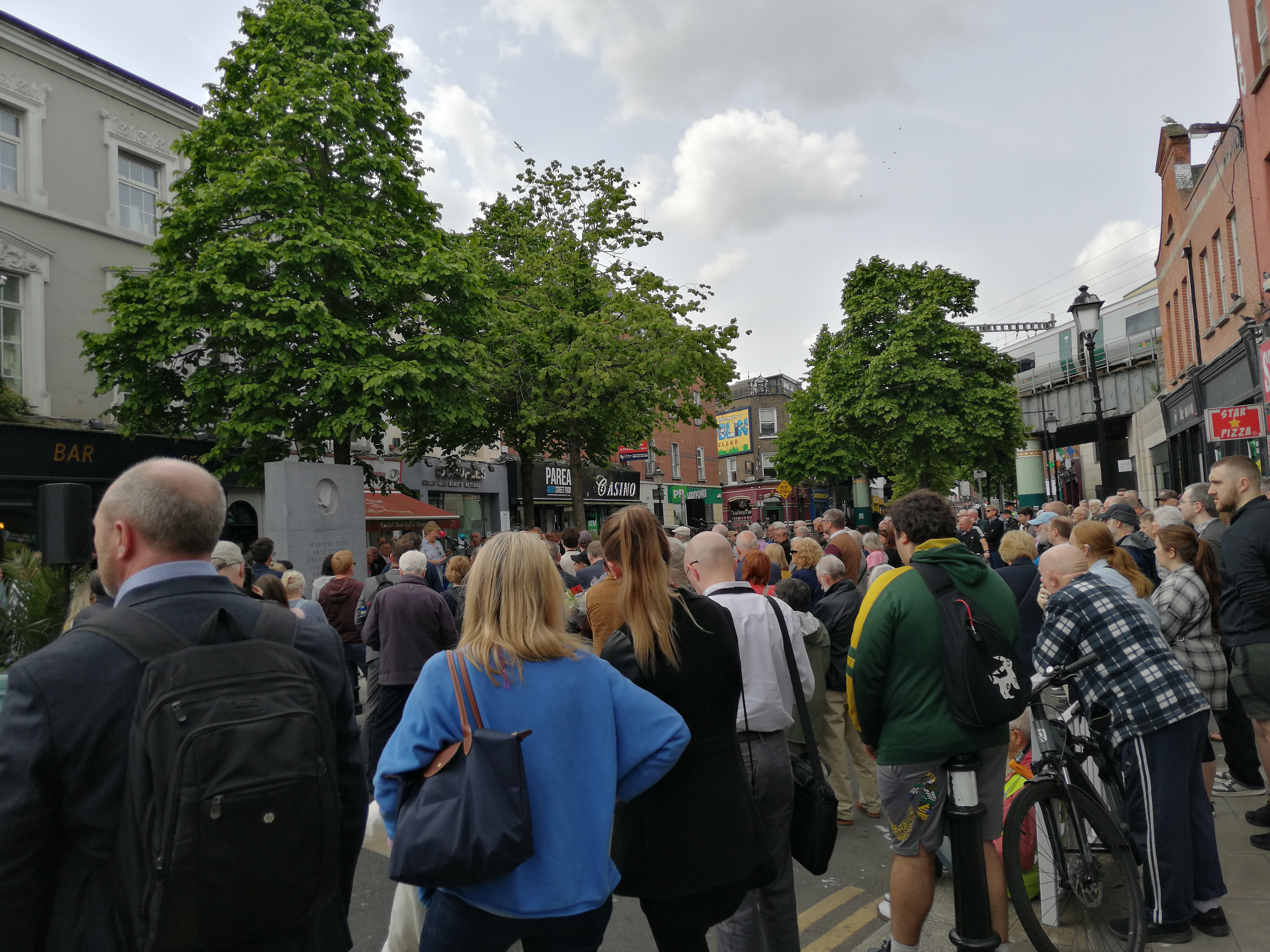
Section of the crowd in attendance viewed from the north-east of the location. (Photo: D.Breatnach)Section of the crowd with the tower of Connolly (formerly Amiens Street) Station in the background. During the British suppression of the 1916 Rising, British Army machine-gun fire was directed from there along Talbot Street towards the General Post Office garrison and North Earl and Henry Streets. (Photo: D.Breatnach)
FOOTNOTES
1There was originally a plaque at the Garden of Remembrance and the Talbot Street monument was erected in 1977 after campaigning by relatives and victims. There is also a monument in Monaghan Town. In Dublin there is also a plaque at the site of another explosion that killed people that day in Parnell Street.
2Now the Police Service of Northern Ireland, formerly the Royal Ulster Constabulary (and before that, up until 1921, the Royal Irish Constabulary, when the whole of Ireland was under direct British rule).
3In particular the Ulster Defence Regiment, which had recruited from the part-time RUC B-Specials when the latter were disbanded but also special units such as the MRF in special operations and more generally across the whole of the occupation forces.
5When the Irish State and colony statelet were created in 1921, the colonial gendarmerie of the Royal Irish Constabulary in the colony became the Royal Ulster Constabulary. In more recent years the force has change its name to the Police Force of Northern Ireland.
6The body of the monument to the Anglican leader of the United Irishmen was destroyed but the head was salvageable and rests on the re-cast body of the monument today.
7The Irish Council for Civil Liberties has dubbed that Court “a sentencing tribunal” but every party in government since has upheld those repressive provisions and Sinn Féin has abandoned its decades of opposition to them as it prepares to enter government in coalition with one party or another.
8Having a Garda Commissioner who was or became a British Intelligence agent might be shocking until we remind ourselves that the current Garda Commissioner, Drew Harris, coming from being Assistant Commissioner of the PSNI, was at least formerly part of MI5 operations in the colony and that must have been known to those who appointed him!
9Mayors of Dublin City are selected for one year from among the elected councillors. It is more of a ceremonial role than an executive one and the choice is usually negotiated in turn from among the represented political parties.
11A number commented that his contribution was so much better in every way than that of last year’s Monaghan Cathaoirleach. Conlon is a member of the Sinn Féin party and some may say his posture would therefore be expected. However, given changes in the party’s public position on many questions in recent years, a hard stand against the British administration no longer seems natural for this party’s public representatives.
13Irish Civil War (or as some see it, the Irish Counterrevolution) 1922-1923.
14It should be noted that the Gombeen class has also been a client in turn of US Imperialism and of EU Imperialism, with all of which it aligns itself on most questions of international policy and to which it opens up its markets, natural resources and infrastructure networks.
The May issue of this newspaper has been out for some weeks and the organisers did well to manage that in the midst of disruptive arrests of their housing activists and raids and arrests following their Easter Rising Commemoration1.
As before, this issue consists of sixteen A4 sides, therefore easy enough to handle and contains what seems the right mixture between short event reports and news items, along with a couple of analytical pieces, one on ‘workerism’ and a thought-provoking other on peat-cutting and energy.
A two-page spread on James Connolly and the Irish Republic quotes extensively from Connolly but without giving any references. This can be an issue since a number of statements commonly attributed to both Connolly and Lenin are lacking in substantial (or even any) verification2.
This edition discusses issues and events in Ireland but also internationally. Reports from the agrarian revolutionary movements in parts of India and in the Phillipines are featured – a list of attacks and casualties inflicted upon the oppressors’ forces.
Another piece marks the death of Palestinian activist Adnan Khader on the 76th day of his hunger strike protest against Israeli ‘administrative detention’ – internment in fact. The mass struggles in France against the raising of the retirement age are also featured.
For Ireland there are reports on the housing struggle, against police repression in the Six Counties, historical commemorations, poster and graffiti campaigns, a sectarian attack in Lurgan and another article deals with mental health issues and the shortage of services in Tipperary.
As commented in an earlier review of this newspaper, the Irish revolutionary movement has long needed a hard-copy revolutionary newspaper. As Lenin commented3, the revolutionary newspaper is an organiser as it requires production and distribution.
Of course, distribution networks for a newspaper can become action-organising networks also but in any case meeting a person to give them a newspaper is a personal contact, when questions and criticisms can be discussed and other information from the community collected to act upon.
This form of contact for the individual is superior to those available on the Internet and also less easy for the State to monitor. A newspaper can also go from hand to hand in a way that only short pieces or videos can compare with in electronic distribution.
Though of course, the latter also has its strengths.
Future editions of APA are to be welcomed and in the fullness of time perhaps we can even graduate to a weekly revolutionary Irish socialist newspaper, not seen here for decades.
End.
An Phoblacht Abú is available from personal contact with AIA or by post from Isrmedia@protonmail.com
FOOTNOTES:
1. See https://rebelbreeze.com/2023/05/07/gardai-arrest-republican-denouncing-the-monarchy-british-occupation/ Although the raid may well have been intended to disrupt plans for protests against US Imperialism’s chief, Joe Biden’s visit to Ireland, a socialist Republican still faces concocted charges relating to membership of an imaginary “illegal organisation”. Under special repressive legislation such a charge without credible evidence has been sufficient, in the no-jury Special Criminal Courts, to jail Republicans for two years.
2 For example, I have searched diligently for the description of the Irish Citizen Army attributed to Lenin, viz. “the first Red Army in Europe” but have thus far failed to find verification.
While the Gardaí face accusations of treating far-Right violence too lightly, the State plans to increase the maximum sentence for assault on members of the force to 12 years in jail, nearly double the current maximum of seven years.1
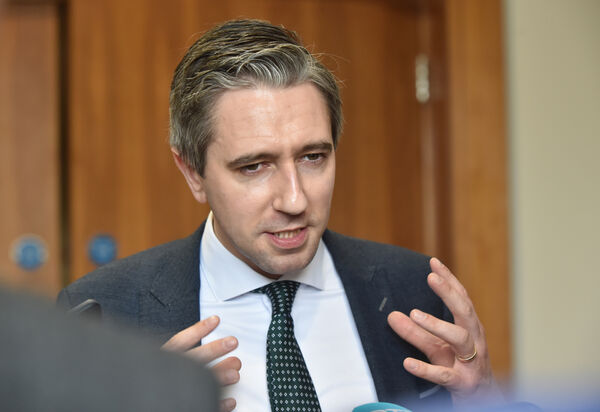
Minister for Justice Simon Harris was seeking approval today for the increase as amendments to the Criminal Justice (Miscelaneous Provisions) Bill which has passed all stages in the Irish Parliament and is now going through the Seanad.
Irish Government Minister for Justice, Simon Harris (Photo sourced: Internet)
The increase in maximum sentence lumps emergency services such as paramedics and firefighters with State repressive forces of police, prison officers and armed forces.
This is a disguising measure since forces of repression are not the same as those of emergency services, even if in the event of a disaster all may be employed together. The State expects increased resistance from working people and therefore feels a need for increased repression.
According to some media reports there have been complaints that the Gardaí have been failing to respond adequately to crimes committed by fascists and other far-Rightists, including threatening behaviour and arson.2
Garda Commissioner Drew Harris, former British colonial police (PSNI) Assistant Commissioner3 responded that getting tough with the far-Right would be playing into their hands and that the Garda response is measured appropriately.
One must wonder how permitting threats of violence, acts of assault and arson against refugees and their supporters can be considered appropriately measured from any viewpoint other than that of the perpetrators.
Much harder Garda responses have been seen through the years to striking workers, water-meter and housing protesters, Irish Republican events and – yes – antifascist counter-protests against fascists and other far-Rightists.
Not giving the fascists the confrontation they’re allegedly looking for might disappoint some of them but on the other hand many will be encouraged and get to feel that they can do more or less what they like without repercussions from the Gardaí.
According to Saturday’s Irish Times, some of the criticism of Garda tolerance of far-Right crimes comes from confidential sources within the force itself.
The discourse that policing these protests is ‘complex’ is a distraction from the fact that vulnerable people who are harming no-one are entitled to live without fear of violence to their person or to their meagre belongings, about which there is nothing ‘complex’ at all.
Having to live on the street due to the failings of the State is bad enough without being subjected to additional threats.
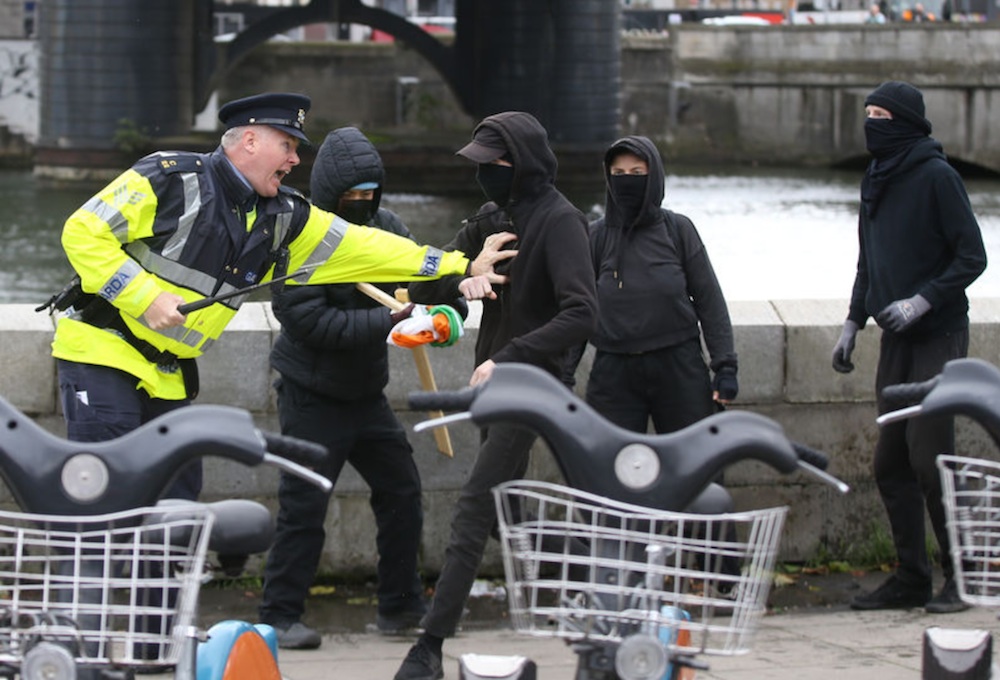
On a number of occasions Gardaí have attacked and threatened antifascists confronting the far-Right, revealing where the general sympathies of the State lie, despite condemnations of the far-Right by Government Ministers, politicians and the Garda Commissioner.
Garda not going lightly here but then it’s directed at ANTI-fascists counter-protesting Irish Yellow Vests on Custom House Quay, after they were attacked by fascists armed with metal and wooden clubs, many disguised as flags (note the captured Tricolour) 22 August 2020.(Photo: Rebel Breeze)Garda Commissioner Drew Harris (Photo sourced: Internet)
Historically, capitalism has turned to fascism to suppress the resistance of the working class to being made to pay for crises in the system. And fascists have often enough been found within the police force themselves.
Indeed, in Ireland it was the ex-Commissioner of the police, Eoin O’Duffy, who led the fascist Blueshirts, while the religous sectarian, racist and murderous nature of the colonial police in the Six Counties is a long established fact.
The police are the first physical force agency of the State and the armed forces its second. Increasing the penalty for assaults on these means the State is anticipating an increase of assault charges in days to come, quite probably as people defend themselves from police attack.
In fact, it is well known that if the police assault people, they regularly charge their victims with assault, so that the police can explain the injuries of their victims as inflicted in ‘self-defence’ or in measures taken against a person ‘resisting arrest’.
End.
FOOTNOTES
1Sentences for assaults on gardaí to rise, Irish Times, 23 May 2023.
I have been sent this article from The Morning Star, newspaper of the Communist Party of Great Britain, a reprint from The People’s World, like-minded newspaper from the USA.
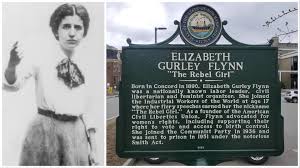
The article is about the removal by right-wingers in the USA of a marker commemorating worker organiser, women’s suffrage campaigner, anti-racist and anti-fascist Elizabeth Gurley Flynn in her home town of Concord, Massachusetts, USA.
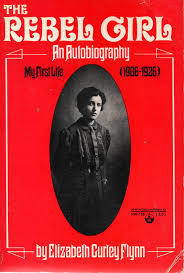
An omission in the article, which the Morning Star chose not to correct, is the Irish background of the article’s subject, class fighter Elizabeth Gurley Flynn. Is this important? It certainly was to the subject herself who, in her biography, emphasised her Irish background.
Cover of her biography (Source photo: Internet)
She wrote of the importance to her of claiming both Irish family names in her ancestry and always used them both: Gurley and Flynn. But in particular for the CPGB, operating in a state that is oppressing Ireland, it should be of importance how Irish people are represented.
Especially in a culture with a deep and long streak of anti-Irish racism.
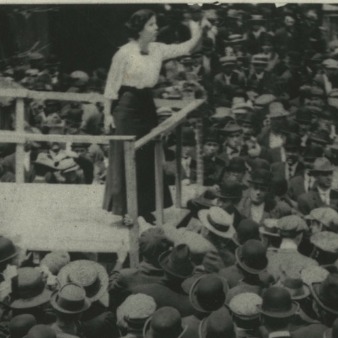
Elizabeth Gurley Flynn speaking at a mass meeting in the USA (Source photo: Internet)
The CPGB never supported the armed struggle by Irish people against its masters nor stood up for the defence of the Irish diaspora in Britain, subject to racism in the media, to police persecution and to judicial and legal racism in the 1970s, ’80s and ’90s.
This is despite the enormous contribution of the Irish diaspora to the trade union and socialist movement in Britain in shop stewards, activists and leaders.
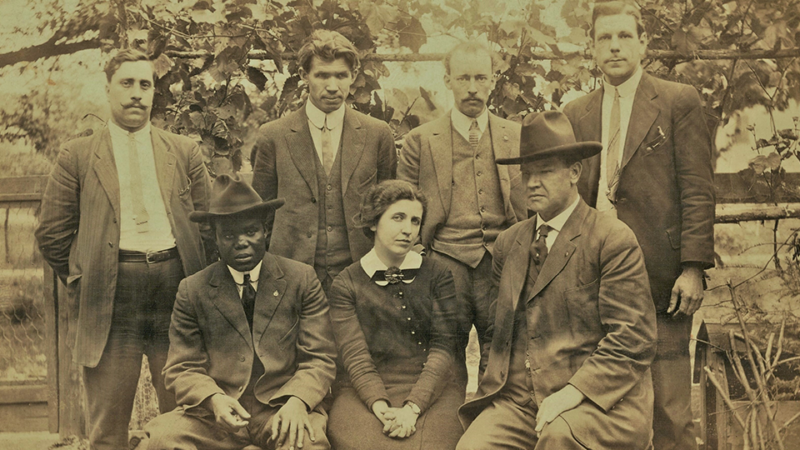
International Workers of the World (‘Wobblies) organisers: Elizabeth Gurley Flynn (centre) next to Big Bill Haywood (right). (Source photo: Internet)
With Bronterre O’Brien and Fergus O’Connor, the Irish diaspora gave the British working class two leaders of the first mass movement of workers in Britain, the Chartists. The anthem of the class, The Red Flag, was composed by Jim Connell from Co. Meath (though they used the wrong air).
And the classic novel of the class, The Ragged-Trousered Philanthropists, was penned by Robert Tressel, pen-name of Robert Noonan, born and reared in Dublin.
The CPGB in fact has a long association with British colonialism and its very title is an indication of that.
End.
Left: Famous photo of Gurley Flynn as a public speaker. Right: The marker in her hometown now removed by right-wingers there. (Photo sourced: Internet)
Norman Finkelstein has published a new book on cancel culture. It comes from a man who as he points out became a high-profile victim of one of the more modern iterations of cancel culture, that of Zionism.
The latter was unashamedly right wing and did not dress itself up in liberal or even bastardised Marxist tropes, peddled by people who should know better.
He is perhaps, one of those with a vantage point on the issue, who deserves to be listened to.
He opens the book with an epigraph from Bertrand Russell: “I feel a real and solid pleasure when anybody points out a fallacy in any of my views, because I care much less about my opinions than about their being true.”
A statement that should be basis of all discussion is now frowned upon in a world of unassailable truths, wicked witches who should be burned at the stake, dogmas that once enunciated can never be challenged.
And whether the statement is true, matters not as it is more important how many semi-literate university graduates are offended by it that counts. Of his own cancellation and the hypocrisy of some of those who signed the Harper’s Letter decrying cancellation he is not bothered.
This is because he contends that “Hypocrisy was rife, for sure. But the irrefragable fact remains that “woke” politics are intellectually vacuous and politically pernicious.” He forewarns us that the book is laced with vitriol… because so much of “woke” culture deserves contempt.”
But that “a large amount of space is devoted to dissecting this nonsense… because it’s not immediately obvious why it’s nonsense.” This Foreword alone entices the reader to delve deeper into its pages and the plea from Tariq Ali for him not to throw a tantrum makes it all the better.
Cancel culture as Finkelstein points out is not new.
He gives a short list of some of his heroes who were cancelled at one point or another, Pete Seeger, Paul Robeson, Lee Hayes and even Malcolm X and Martin Luther King and even Chomsky were cancelled and reviled in their day.
Pete Seeger, veteran folk singer, folk song collector and political activist, was among victims of cancel culture in his day. (Photo sourced: Internet)
Yes and by the same newspapers, journals and political quarters that are now to the fore in cancelling one and all and in some cases, those involved in the cancelling now decry the cancel culture that affects them.
He divides the book into two parts, one dealing with woke politics and the other with academic freedom, though they are not separate and there is some overlap, even in the book.
In the first part he looks at some of the figures of woke politics, those who make the case for identity politics in particular. Some of the people he looks at, such as Ta-Nehisi Coates and Ibram X Kendi, are well known in the US but not so much outside of it.
He eviscerates them rather well describing Kendi’s writing as being “as supple as a calcified femur and as subtle as an oversized mallet”. Obama is of course, well known, though his politics are modern in how they are sold.
Obama is all about style over substance, partly because the substance is not new, he represented no great change in US society, though that is not the image he sought to portray. His message was vacuous, Yes we can, and Finkelstein asks the question, can what?
And gives the very direct and truthful answer “Yes we can, elect me”. Obama is shredded in the book, his famed oratory derided for what it is, speeches that were written by an all-white team of writers, despite Obama’s identitarian claims.
A parsing of Obama’s public addresses reveals a relentless concatenation of the most vapid, sententious, shoeworn, fatuous, hollow, saccharine clichés—a cornucopia of the commonplace—without a single clever phrase, metaphor or aperçu to redeem or relieve them, interlarded with oleaginous homilies to humility before God.
That does not mean that his speeches and politics are devoid of consequences. Obama epitomises the reality of identity politics. It is another con job. For all his blackness Obama did very little for blacks in terms of socio-economic advancement.
Not even in terms of a relatively simple issue, police violence against blacks. In one of the first rows in his presidency on the issue, he backed down and instead of taking action invited the policeman and his victim for a beer.
Identity politics is waived about, not to solve any problems but to divide. Finkelstein asks whether it advances causes or provokes their retreat.
The objective of politics, Mao Tse-Tung famously exhorted, was to “unite the many to defeat the few.” Whereas, identity politics divides the many so as to, designedly or not, enable the few.
It conjures a hierarchy of oppressions, in which each group vies with the others for the position of most oppressed— Kimberlé Crenshaw says Black women are most oppressed, Angela Davis says it’s transgender people, Ibram X. Kendi says it’s poor transgender Black women.
The victors in this inverted Oppression Sweepstakes, where you win by being the biggest loser, get to leap to the head of the queue as most worthy of preferential treatment, while, simultaneously, fomenting new resentments among those shoved further and further behind…
This, in effect, performance politics has spawned a disgusting den of thieves who brand themselves with radical-sounding hashtags, churn out radical-sounding tweets, and insinuate themselves into positions of prominence, as they rake in corporate donations and cash corporate paychecks.
Theyhang out at the watering holes of the rich and famous, and thence can be safely relied upon not to bite the hand that feeds them. In a word, identity politics is a business—in the case of Black Lives Matter “leaders,” a most lucrative and dirty business.
Cancel culture is about silencing voices other than those sticking their snout in the trough and their grubby hands in the greasy till, a point he is right about, not just in the US but around the world.
Finkelstein found himself cancelled, though not silenced, as he points out, because his views go beyond the grimy quest for self-aggrandisement and enrichment. Identity politics is utterly reactionary.
He contrasts the fumbling for pennies and the endless categories of oppressions with an historical figure that our perpetually offended money grabbers in search of the latest shakedown could never match: Rosa Luxemburg.
My mind drifts back further still to Rosa Luxemburq, this exotic creation of a lost epoch: Polish, Jewish, bourgeois, handicapped, female—
Rosa didn’t wallow in or capitalize on her “intersectionality” but, on the contrary, triumphed over it as she became the brilliant, impassioned (and then martyred) revolutionary leader of the German workinq class;
A class which—be it noted as a robust class rejoinder to claustrophobic identity politics —fervently embraced this Polish-Jewish-bourgeois handicapped-female as one of their own.
And that is exactly the point. Luxemburg is a real hero, many of the heroes of the woke do not measure up to their own standards, not even Frederick Douglass, who had a very poor opinion of native Americans, a fact overlooked by modern day identitarians.
Though many don’t have a positive opinion of native American themselves. Douglass however, is despite this a towering admirable figure in history, not one that should be cancelled, a hobby now of every spoilt ignorant brat that mammy and daddy got into an overrated expensive university.
And though it is only a matter of time before some hippy in Berlin decides to reinvent Luxemburg as intersectional, she was not and had no time for the woke equivalents of the day.
Academic freedom is the other area of concern for Finkelstein, conformity, banal ideas and salivating over money is not limited to our woke warriors in the press, NGOs and politics but in academia. It is not new, but is more pronounced now than before.
Bertrand Russell summed it up nicely and Finkelstein agrees that “As a rule, by the time a man becomes a professor, he has been tamed, and has learnt the advantages of submission” the advantage being measured now in euros, dollars, yen and shekels, though many would deny this.
Again as he points out “For self-deception, you can hardly beat academics,”. There are of course exceptions, but in the current atmosphere, the younger new academics are bowed and beaten by those who went before them.
Given his own personal experience, he is obviously in favour of academic freedom which he describes as not just the freedom to teach but to enquire and travel the road less travelled.
He points out that in the US the idea went through various stages, freedom from churches, then from corporations and later the state (MacCarthy). Nowadays, all three encroach upon it, sometimes in unison and to the same end.
He goes again into some detail on the issue and chooses the thorny ground of Holocaust denial.
He is Jewish, so he is clearly not advocating that the Holocaust did not happen, but rather how it is dealt with on campus and links it up to other issues, giving examples when he himself has been uncomfortable teaching and the examples he relies on.
He makes an argument for challenging ideas. This section, like the Obama part is overly long and could also have done with a bit of editing. But he clearly comes out against censorship and new morality police that abound everywhere.
It’s easier to fight against codified speech restrictions than against “enlightened” campus opinion, which, in the name of its “special duty,” insinuates itself in campus life and throttles free speech with its asphyxiating pieties.
The situation now is that debate is being stifled on a whole range of issues, beyond the obvious ones and the high profile debates on Men’s Rights i.e. the right to id your way into women’s spaces. Due to his own experience, he does seem to think that it is more the case when an academic goes off campus that the trouble arises.
But actually, the baying mob throttling free speech are doing so on campus now to people who have never ventured off it, or at least have never been given much opportunity to do so. He cites a very interesting case, that of Bertrand Russell when he was appointed to City University.
His morals, his sex life and general outlook were brandished about as reasons for not hiring him. Russell defended himself, saying they were irrelevant, he was appointed as a lecturer in “modern concepts of logic,” “foundations of mathematics,” and “relations of pure to applied science.”
In the modern cancel culture that wouldn’t stand. People are sacked precisely because of their private lives or their opinions on matters wholly unrelated to the area in which they teach.
It didn’t stand back then either, Russell lost the case precisely because he argued in favour of homosexuality and premarital cohabitation, amongst other things. Our woke liberals on campus, those who hounded Kathleen Stock out of her job are as reactionary as the judge in the case.
He goes on to look at other cases before finishing off with the details of his own case and his unemployment and unemployability in academia.
The book is interesting, though far too long with too much detail about some cases and aspects which makes it difficult to see the wood from the trees at times. But it does offer arguments on issues that are current with reference to historical precedents and also to philosophy.
It is worth reading, as he is a rather high-profile victim of cancel culture. His book the Holocaust Industry was thrashed by the New York Times, which had positively reviewed the Bell Curve and even gave a better review of Mein Kampf than Finkelstein’s book.
They probably keep quiet about that aspect.
Cancel culture, identitarianism, intersectionalism are amongst the biggest intellectual challenges to the left.
They deny class and reduce politics to the acceptance of pre-ordained dogmas, that are espoused by the US Democratic Party, Facebook, Google and many major multinationals i.e. from the right of the political spectrum.
They are the wolf in sheep’s clothing, though the sheep is clearly showing the fangs for anyone who wants to see. History is unlikely to be kind to them.
Whilst Finkelstein has some illusions of his own in some liberals like Bernie Sanders, his point about freedom of speech, the search for the truth, discussion and debate are his main point in the book.
A point that cannot be overemphasised in its importance, nor of the need to persevere through the current darkness. As Finkelstein says.
Many of the heroes of my youth had been blacklisted, but also had, despite all, stayed true to their youthful convictions; not dogmatically, as almost all of them had left the Communist Party, but still unreconciled to the capitalist system, and committed, at any rate in theory, to its overthrow.
A picture of Robeson sits on my bookshelf beside a picture of Marxist economist Paul Sweezy.
The cancel culture advocates and wokerati have, unlike Finkelstein, reconciled themselves to fumbling in the till and harassing those who might speak out against the system in any meaningful way.
Gearóid Ó Loingsigh 12 April 2023 (first published in Socialist Democracy)
(Reading time: 5 mins.)
The president of Colombia, Gustavo Petro, announced in a National Peace, Reconciliation and Harmony Council (CNPRC) meeting that the state didn’t have sufficient funds to fulfil the Havana Accord signed with the FARC.(1)
The situation seems to be so serious that according to the President it will take 125 years to fulfil it. There are some points in which he is right, but only if we ignore the most obvious things: the nature of the Accord itself.
He alludes to this and asks some rhetorical questions, ones which he should really ask as proper questions, not as some gesture in his oratory, but rather as questions to the FARC, Santos and all those who promoted the Accord nationally and internationally.
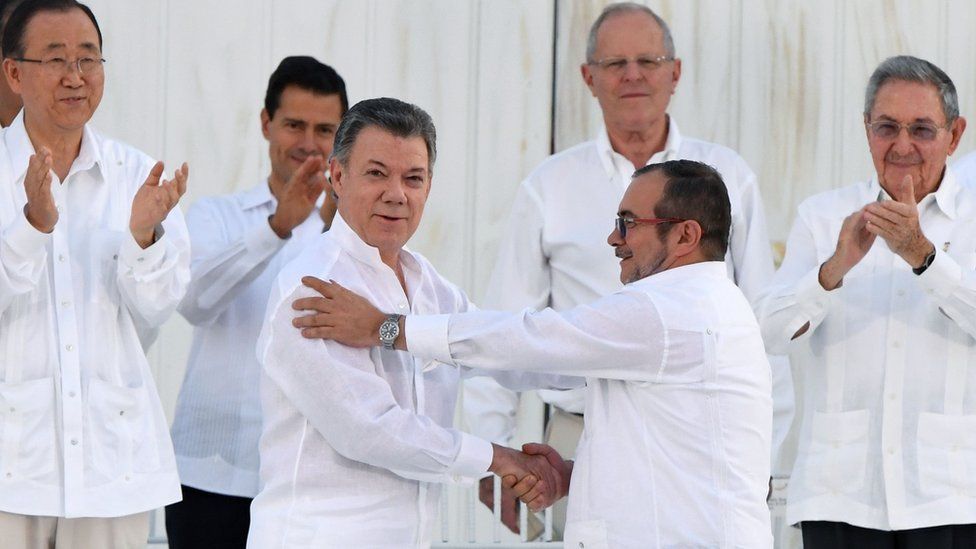
Among guarantors of the Colombian conflict pacification deal signed by, at the time, Colombian President Juan Manuel Santos, left, and leader of the Revolutionary Armed Forces of Colombia (FARC) Timoleón Jiménez, known as “Timochenko,” during a news conference announcing an agreement between the two parts in Havana on Sept. 23, 2015. Among those applauding, Cuban President Raul Castro at far right of picture. (Source photo: Internet)
Petro asks “was that Accord signed with the aim of applying it, or with the aim of disarming the FARC and later, Colombian style reworking everything?(2)
Well of course it was sonny boy. That much was clear. At the time you were told so and those of us who criticised the Accord were accused of wanting more war, ignoring that many of us had never participated in or supported the war. It was a debate they didn’t want to have.
During the not very open process negotiated behind closed doors, it was said, in the midst of the euphoria of the signing and the parties in public squares with huge screens in the streets so one would miss it, that criticisms were not welcome.
They were, as an old friend used to say, as welcome as a fart in a space suit.
Petro continued and stated something he certainly believes is very important.
I want to implement the Peace Accord, but it costs 30.5 billion Euros. If the Santos government signed this in the name of the state and society is represented in this, then, tell me where am I to get this 30.5 billion?(3)
There is an easy answer to that question. The money can be got from the same place that they, and in that I include Petro, thought it was when they signed the Accord in 2016. Don’t ask where they are going to get the money, but rather tell us where you expected to get it in 2016.
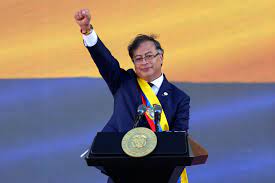
Petros giving a clenched fist salute after his inauguration as President of Colombia. (Source photo: Internet)
Senators such as Iván Cepeda who played an important role in the process can point to where. The cost of the Accord was obvious from day one, this problem is not new and it is just not credible thatPetro and his Congress benches have just realized how much money was needed.
But the truth is Petro, Cepeda wanted to bring the FARC to an end and rework things later. All of them without exceptions. Of if this is not the case, maybe they can tell us where they thought they would get the money.
The former FARC commander, Timochenko said that war against the FARC (he excludes all of the other guerrilla groups that have existed) cost 83.7 billion Euros and the 30.5 of Petro is a minimal cost for the chance of a country in peace.
He is partially right, except that the problem is not about money or amounts, but rather the Accord itself and their perspective that what is needed is money and not political changes. The Havana Accord reads like shopping list, like a list of demands and a not very precise list at that.
A Land Bank would be set up with three million hectares, but it doesn’t say where and left it to the whim of whichever government.
So Petro announced that he would fulfil that part by buying land off cattle ranchers. The same ranchers whose spokesperson José Felix Lafaurie accepted that Fedegan’s affiliates, rice growers and various multinationals financed the right-wing paramilitaries.(4)
Nothing happened to him, nor to the 10,000 cattle ranchers who had signed an open letter where they acknowledged their crime.(5) At the time it was argued that the Prosecutor was not in a position to process that many people.
It wasn’t true, the crime had been publicly vindicated and they also said that there was nowhere to put 10,000 criminals. This wasn’t true either.
According to the prison service’s own figures and the calculations of the Corporación Excelencia en Justicia, in 2006 the Colombian prison system had a capacity for 52,414 prisoners with 60,021 actually held in them.
In 2011, that figure had risen to a capacity of 75,260 with 100,451 people in them i.e. they managed to put 40,000 poor prisoners in overcrowded conditions, but they had no room for 10,000 paramilitaries and their lackies.
In 2006 there were 19,353 prisoners on remand.(6) A little bit of creativity with the judicial abuse of remand and they could have put the paramilitary funders in jail without any problems.
The prison population eventually reached the figure of 125,000 prisoners in overcrowded conditions whilst others rambled around their lands despite having acknowledged their crime.
What was missing was the will. But instead of spending money buying land from paramilitaries and their backers, Petro could confiscate the land of those 10,000, amongst others. It wouldn’t cost that much.
There are other measures he could take with a view to peace, justice and truth. Petro could ask for the extradition of the Board of Chiquita who paid a 25 million dollar fine in the US having accepted their responsibility in the crime of financing paramilitary groups.
It wouldn’t cost more than the price of posting the request. There are other measures that have some bureaucratic costs, like forcing public bodies to comply with land restitution findings, something which does not happen. It also only requires the will to do so.
Petro’s focus is the same one as the FARC and the Santos’ government and other peaceniks, who are now Congress reps: it is a question of money. But this is not the case. It is a question of returning stolen land, reviving organisations, guaranteeing the right to exercise one’s rights.
It is also the disbandment of the specialised riot squad, ESMAD. It is more expensive to change its name and give it a makeover, as Petro proposes, than abolishing it.
He wanted to buy fighter jets at a cost of 3,150 million dollars. Due to public reaction, he backtracked but he did buy the Barak MX air defence system from Israel at a cost of 131.2 million dollars.(7) He also bought 18 Howitzers from Israel at a cost of 101.7 million dollars.(8)
Such systems are for conventional wars between countries, they are of no use against insurgents, i.e. they are toys for the military. Maybe they will be used in the Coup that Petro’s followers announce all the time. It is what happened in Chile.
So, is there any money or not? And what will be done with the things that don’t cost much? Why don’t they reduce the extravagant salaries of the magistrates in the Special Jurisdiction for Peace who to date have produced little?
But then, at least he partly accepts what was always the case, that the peace process and the Havana Accord were a mockery of the victims of the Colombian conflict. Their only purpose was to remove the FARC from the field, particularly in areas with oil and other natural resources.
No one sought to solve any deep-seated problems in the country and here we are with the tale that there is a lack of money, when really what was lacking throughout the entire process were clear political positions.
(3) Ibíd., Euro figures were calculated at 4906 pesos to the Euro and the original figure of 150 billion in the article was taken using the Spanish definition of billion, which is a million, million.
(4) El Cambio No 704 diciembre 2006/enero 2007 Diez Preguntas (Entrevista con José Félix Lafaurie p. 48)
(5) El Espectador (17/12/2006) La hora de los ganaderos, p. 2A