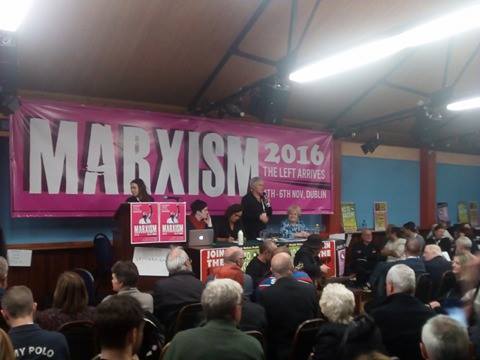
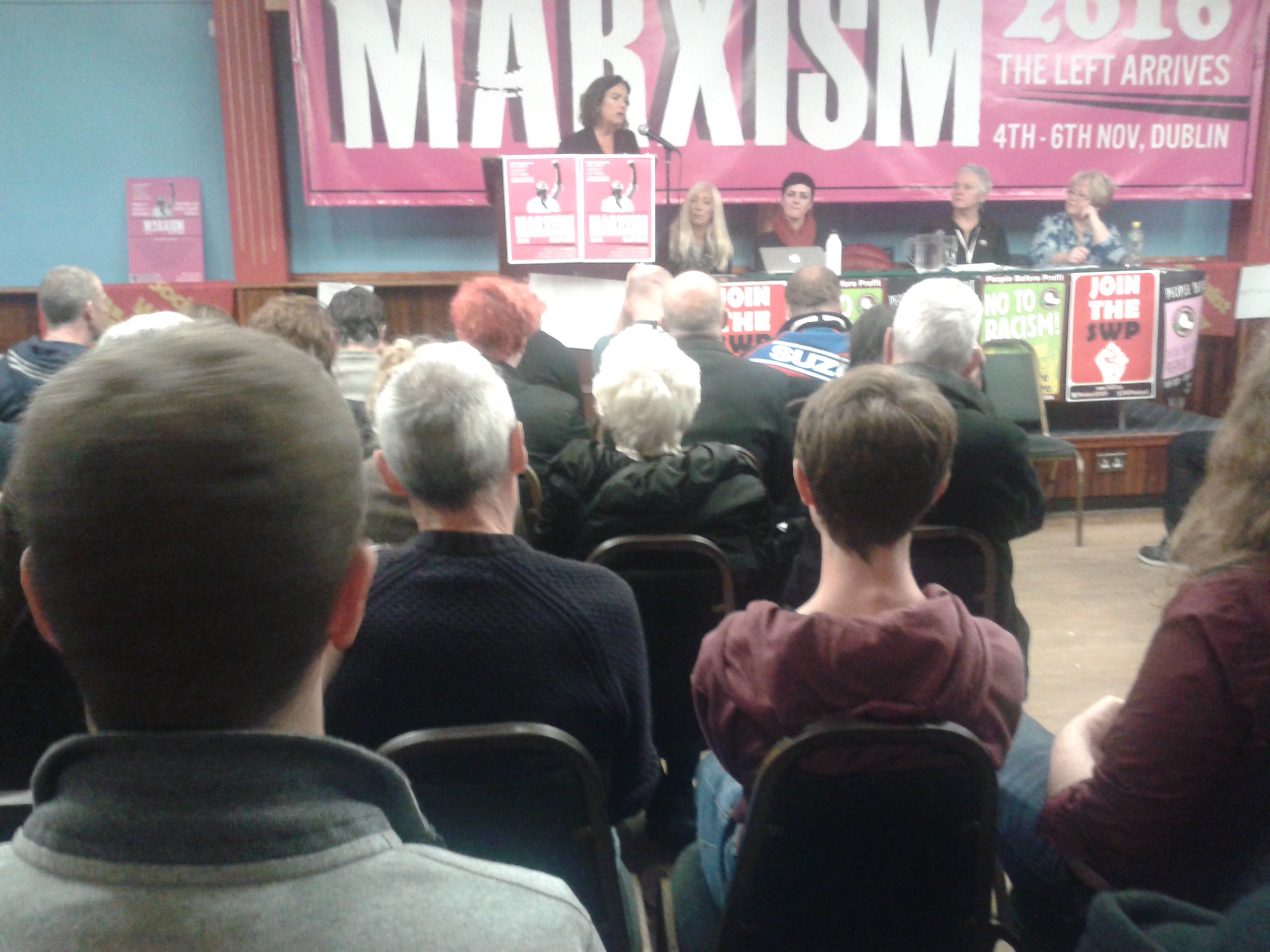
The Sunday November 6th meeting of Marxism 20161 on the theme “When Governments Lie” hosted as speakers four women campaigners and Eamon McCann, a male campaigner, addressing the packed downstairs hall of the Club na Múinteoirí. A number of cancellations of speakers had taken place, including Gareth Pierce who sent a message which was read out to the meeting.
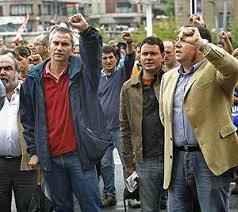
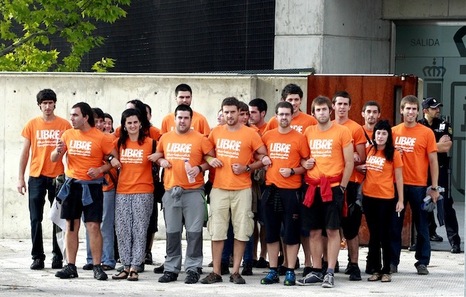
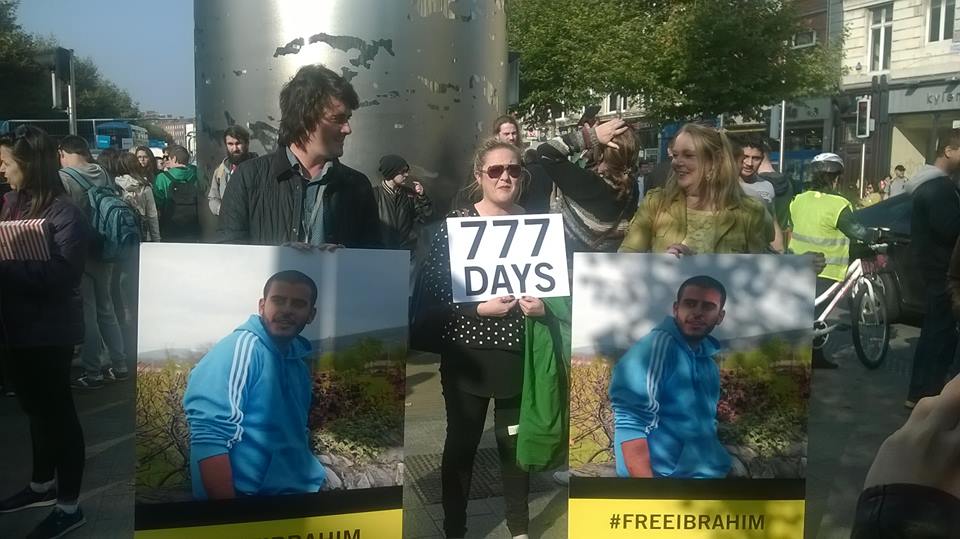
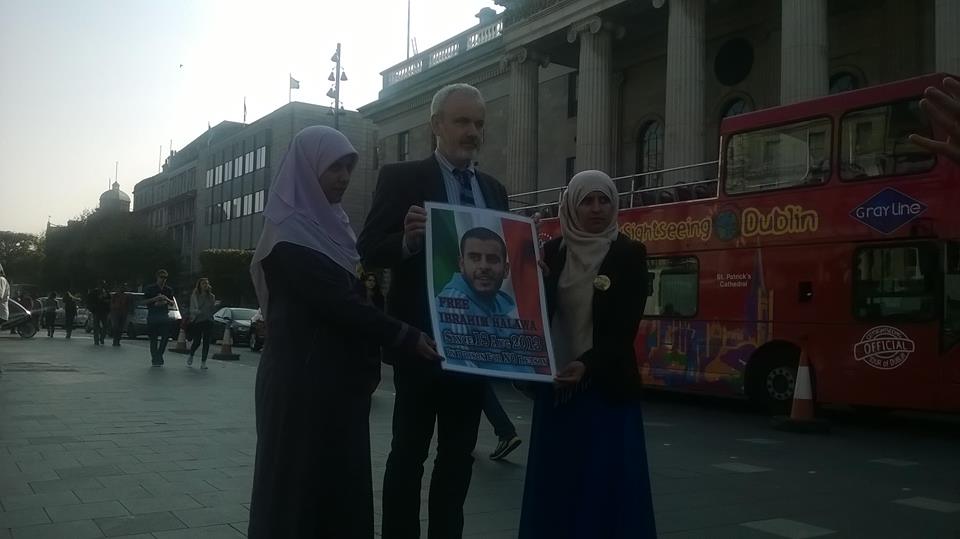
Brid Smith of the SWP (centre photo) chairing the meeting When Governments Lie public meeting at Marxism 2016 weekend (Photo: I.O’Kelly)
On the podium, taking turns to speak, were Sheila Coleman of the Hilsborough Justice Campaign, Kate Nash of the Bloody Sunday Justice Campaign, Joanne Donnelly of the Justice for the Craigavon Two Campaign, and Antoinette Keegan of the Justice for Stardust/ 48 Never Came Home Campaign (summary of these campaigns below).
After being introduced by Bríd Smith, chairing the event, Joe Black with guitar, accompanied wonderfully by a musician on bazouki (if I can get his name will insert it here), launched the evening with Black’s powerful song about Giuseppe Conlon, father of Gerry Conlon of the Guildford Four. The Guildford Four were wrongly convicted in 1975 of IRA bombings and served fourteen years before they were cleared. Giuseppe Conlon, who went to England to clear his son, was also jailed, as were his relatives the Maguire family. The Maguire1 Seven were cleared in 1991 but by that time Giuseppe had died in prison, an event that, along with his own imprisonment, devastated his son and affected him for his remaining years until he died in 2004 at the age of only sixty years.
All of the speakers emphasised that the State’s officials lied with regard to their respective cases and concealed evidence and most speakers also accused the media of complicity. In the cases of Bloody Sunday, the Craigavon Two and Hillsborough, the British state was placed in the dock by the speakers while the Stardust fire cover-up was laid at the feet of the Irish state.
Most of the speakers also warned people in similar circumstances to beware of establishment party politicians who try to flatter campaigners and decide which are the “reasonable” ones to deal with, always at the price of reducing the objectives being sought. The speakers for the Bloody Sunday and Hillsborough campaigns in particular warned against this element, Kate Nash singling out Sinn Féin as the party that acted that way with regard to Bloody Sunday (Kate Nash’s brother was killed that day and her father shot and injured) and how they tried to bring the campaign to an end with an apology from the then British Prime Minister, while no senior officer or government official was held to account and while one of the unarmed dead remained accused of carrying a nail bomb.
Sheila Coleman of the Hillsborough Justice Campaign addressing When Governments Lie public meeting at Marxism 2016 weekend (Photo D.Breatnach)
Eamon McCann, who was on the march in Derry on Bloody Sunday 1972, finished the evening with one of the rants for which he is famous, going beyond his allocated time by a fair bit and despite the Chairperson’s frequent reminders. McCann located the similarities of the cases within the class system – most of those injustices represented were about repression of working class communities, or ignoring the damage done to them and the lies were told to protect the system and its supporters – big businessmen, politicians, the police, the Army.
The meeting ended to sustained applause but without any opportunity to ask questions or to make contributions, to the regret certainly of a number of Republicans and campaigners against what they consider to be ongoing internment without trial. All however seemed agreed that the talks had been interesting and educating in at least some aspect of the issues and events covered.
WHY SO LONG?
It is good that this meeting about State injustice and lies was held by an Irish socialist organisation. It is the duty of socialist organisations to point out the injustice of the State even when the victims are not socialists – or not socialists in the way that socialist organisations think they should be. Prominent socialists Karl Marx and Frederick Engels were not Fenians but they campaigned for the release of Fenian prisoners being held in English jails (where, by the way, it said that one third of them died and one third went insane).
It is said that we learn more from our mistakes than we do from our successes and certainly, if we are to bring about a revolution and the society we want, we must learn from our failures. And in that spirit, I must ask: why has it taken so long for Irish socialist organisations, particularly in Dublin, to wake up to the repression being exercised against Irish Republicans?
Five years ago Marian Price, a former Republican prisoner released under licence as part of the Good Friday Agreement, had her licence revoked and was taken to Maghaberry jail, kept for months without charge or bail, eventually charged and kept in jail without bail, sick, until her mental and physical health was broken. In Dublin the socialist organisations sent a couple of representatives to one demonstration for her freedom and never attended a picket about her case afterwards.
After the Marian Price campaign ended with her release in 2013 on “compassionate (sic) grounds”, some of those involved in Dublin launched a campaign against “internment by other names”, a process by which ex-prisoners released on licence are returned to jail without even a trial in the no-jury courts of the Six Counties2 and other Republican political activists are harassed and arrested and refused bail on spurious charges which eventually collapse after the accused have been held for months or years in jail3.
I must ask again: why has it taken so long for Irish socialist organisations, particularly in Dublin where the major part of their organisation is located and most of their activities organised, to wake up to the repression being exercised against Irish Republicans?
Is it perhaps because the socialists feared to be painted with the nationalist brush? But did they not fear being daubed with complicity with imperialism instead? It is a strange kind of socialist organisation that can’t make common cause with Republicans against the tyranny of the colonial statelet and capitalist State! In that failure, it misses the opportunity to unite forces against its enemies’ state and also to disseminate its ideas among Republican activists. One might also remark that a failure of people who are prepared at times to unite with social democrats for reforms, to unite with Irish Republicans against a capitalist state is a strange indication of revolutionary socialism!
Or is it purely because they didn’t care – it wasn’t happening to them – that Irish socialist organisations haven’tt campaigned against State repression of Irish Republicans, or even protested in solidarity with them? If so, they will by the seed of their inactivity one day certainly reap a harvest of repression for themselves too. Solidarity against State attacks is not only a noble thing with a long tradition; it is a necessity for revolutionaries.
So now that this “Marxism” weekend is over, when its organisers are taking a deserved rest, or writing it up for the British and Irish version of their newspaper, or compiling their recruitment slips to see how many new members or at least mailing list contacts they have gained – will they do anything different?
Will we see the highlighting, from time to time, of the almost everyday harassment of Irish Republicans in the leaflets and newspaper of the SWP and PBP? Will their TDs in the Dáil raise these issues where they might get some bourgeois media coverage? Are we going to see PBP and SWP militants on the regular pickets organised by the Anti-Internment Group of Ireland anywhere and, in particular on those called by the Dublin Anti-Internment Committee?
We can hope, I suppose.
Diarmuid Breatnach
APPENDIX: THE CAMPAIGNS
Hillsborough Justice Campaign seeks vindication that the original disaster was due to crowd mismanagement by the South Yorkshire Police and that some of the subsequent deaths were also due to their mismanagement of some still-breathing victims and lack of coordination of the emergency services. The disaster took place at Hillsborough football stadium in Sheffield, England, UK, on 15 April 1989, during the 1988–89 FA Cup semi-final game between Liverpool and Nottingham Forest. With 96 fatalities and 766 injured it is the worst disaster in British sporting history. Originally, the Liverpool football fans were blamed for the disaster but subsequently it became clear that the blame lay elsewhere.
Bloody Sunday Justice Campaign seeks a proper accounting of the deaths of 14 and injury of at least 14 after British troops opened fire on unarmed people demonstrating in Derry on 30th January 1972 against Internment. Originally, the British Army and Government claimed that they had shot “terrorists” in “returning fire” after being first fired on and a British enquiry backed them on this and claimed to have evidence that some of the dead had been handling weapons.
Founded in 2012, a campaign to overturn the clearly unjust convictions in May 2012 of John Paul Wooton and Brendan McConville for the killing of a member of the British colonial police force, the PSNI, in March 2009.
The forensic evidence was contradictory and in a number of cases even pointed to the innocence of the accused, electronic surveillance equipment had been interfered with by the British Army; the State produced no witnesses to the incident and only one who placed one of the accused at the scene – this witness came forward a year after the arrests of the two, his account of his movements that evening were not supported by his wife; a close family relative called him a habitual liar and then this family member was arrested and subjected to intimidation by the colonial police after he had given a statement to the accused’s legal team..
In the early hours of 14 February 48 young people died in a fire at a disco at the Stardust nightclub in Artane, Dublin and 214 were injured.
The campaign seeks to shift the blame from alleged “arsonists” to a fault in the premises wiring and other factors within the responsibility of the club’s management and owners, including blocked emergency exits. The allegation is that there has been a cover-up connived at by the Irish Government to exonerate businessmen friends, who to add insult to injury, received substantial financial compensation for the loss of the building. An ongoing controversy over inquiry findings and ignoring of important pieces of evidence have lent increasing credence to the version of the campaigners.
1This is organised annually in Dublin, Ireland by the Socialist Workers’ Party
2A prominent example in the past has been Martin Corey of Republican Sinn Féin; a current example is Tony Taylor
3For example Stephen Murney of the éirigí political party and the independent activist Colin Duffy and members of his family
FIFTEEN YEARS PRISON THREATENED FOR BASQUE YOUTHS IN BAR ALTERCATION PROVOKED BY SPANISH POLICE – SIX ALREADY IN JAIL
Monday 15 November 2016
Diarmuid Breatnach
Six Basque youths are in jail without bail tonight and altogether twelve face fifteen years in prison, in a case arising out of an altercation in a bar in the southern Basque Country (i.e under Spanish occupation) involving two officers of the Guardia Civil (Spanish militarised police force) in Altsasu in the province of Nafarroa (Navarra).
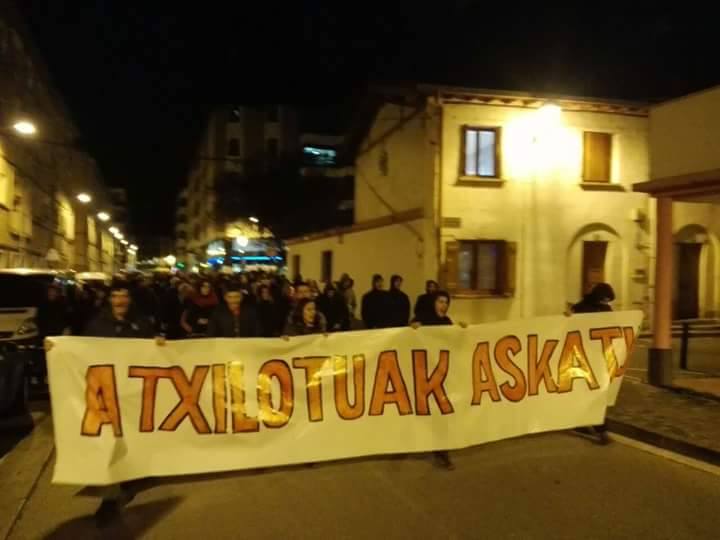
Protest demonstration in Altsasu tonight. The slogan says: “FREE THE DETAINED!” (Source: Basque contacts)
Altsasu is known as a town with a particularly strong history of Basque resistance and a continuing sympathy among the population. The town also has, by no means accidentally, one of the strongest barracks of the Guardia Civil.
On the night of 15th October, the two male Guardia Civil officers, off duty and with their female partners, went into Taberna Koxka, a well-known bar and night spot frequented by the Abertzale (pro-Basque Independence) Left, where they behaved provocatively. Inevitably the policemen were challenged by some of the patrons of the bar and a scuffle broke out.
No injuries were sustained by the police although one of them claimed an injury to his ankle, a story that fell flat when it was revealed that he was already on sick leave at the time of the incident due to an injury to his ankle. In addition, the Guardia Civil report itself, though claiming the officers’ behaviour was non-provocative and peaceful, did not claim police injuries and the province’s “autonomous” police force (but very hostile to the Abertzale Left), the Policía Foral, also denied there had been any injuries.
The pro-Spanish media not only spread police lies but added to them, one surreal story alleging that the quietly relaxing police officers and their partners had been attacked by 50 Abertzale Left youth throwing martial arts punches and kicks. Tragically, such lies will find a ready audience in much of the Spanish state outside the Basque and Catalan countries.
At first the police classified the incident as a “hate crime” but the State Prosecution upgraded its classification to “terrorism”.
The eight youths were detained in police raids this morning and taken to the National Court in Madrid although, upon learning that they had been namedby the Guardia Civil in a list of 12 people involved, they had already voluntarily presented themselves to testify before a judge in Irunea who, however, could not be found. Despite that earlier voluntary attendance, a “risk of fleeing” was given as the primary reason for refusing them bail. Two others were released under stringent reporting to police conditions and two others, who also presented themselves voluntarily to be tried with the others, were told to return to court tomorrow.
Guardia Civil provocatively driving through an Abertzale Left demonstration. The people in costume are Zapantzarak, traditional performers particularly in Spring festivals but often participating in Abertzale Left events also. (Source: Basque contacts).
“Terrorism”
The Prosecution has asked for the Basque youths to be tried under Article 573 of the new Penal Code, set aside for crimes of “terrorism”, the definition of which even the UN has declared to be “excessively imprecise and broad” and which “may criminalise behaviour which is not terrorist.” Conviction under Article 573 can carry a sentence of 15 years in jail.
Tonight in Altsasu, Basque youth took to the streets in peaceful but militant protest demonstration (see photo).
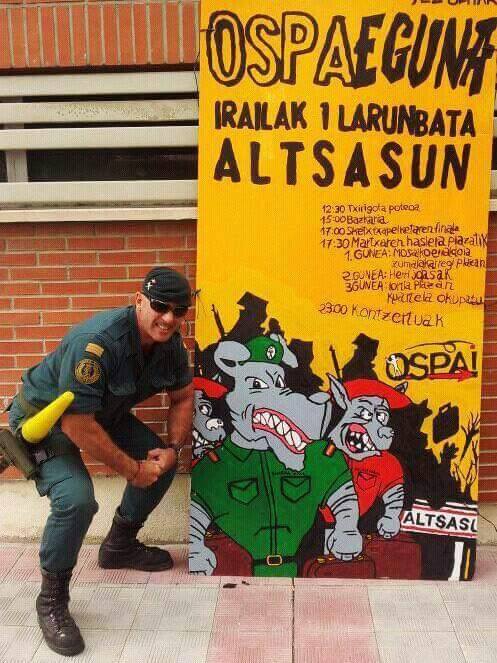
This incident is not without a context: in recent months the town has seen hundreds of Guardia Civil driving through the town at various times and a demonstration organised by Abertzale Left on 22ndOctober was penetrated by Guardia Civil vehicles (see photo). The strongest anti-repression organisation in the Basque Country, “Ospa Mugimendua”, has an active following in the town.
Guardia Civil has his photo taken mocking an event organised by the anti-repression organisation Ospa Mugimendua. (Source: Basque contacts).
The Guardia Civil, although established in the Spanish state in 1844, is a militarised police force (type of carabinieri) associated in the minds of most Basques, Catalans and progressive Spaniards with the Spanish Civil War and with General Franco, whom the force enthusiastically supported. The force has a long history of violent repression, torture, murder and even rape. After the “reform” of the State with the death of Franco, the force was neither abolished nor reformed. The Guardia Civil is also much loved by the Spanish Right and the “Association of Victims of Terrorism” (sic), which regularly demands increased repression against Basques and Basque political prisoners, is mostly composed of relatives of the Guardia.
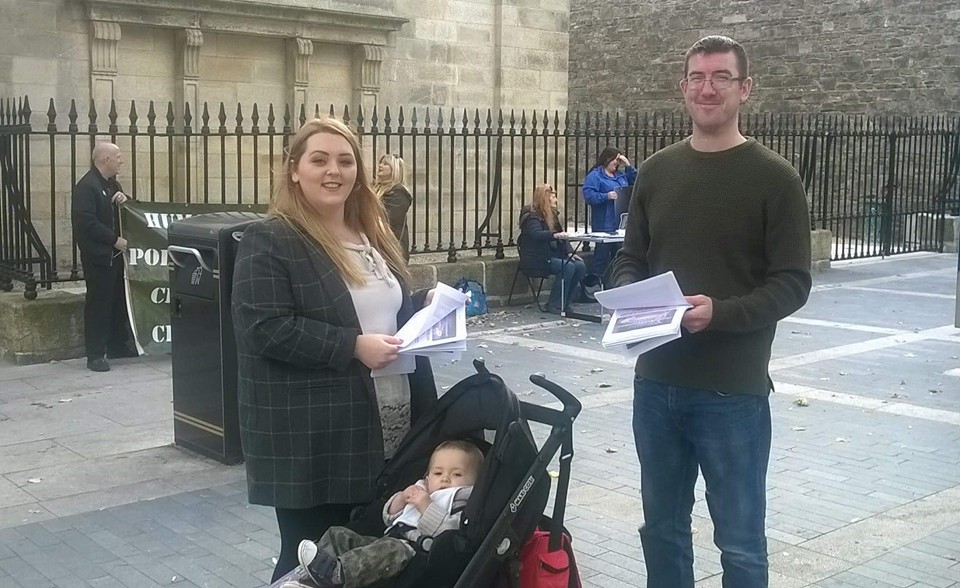
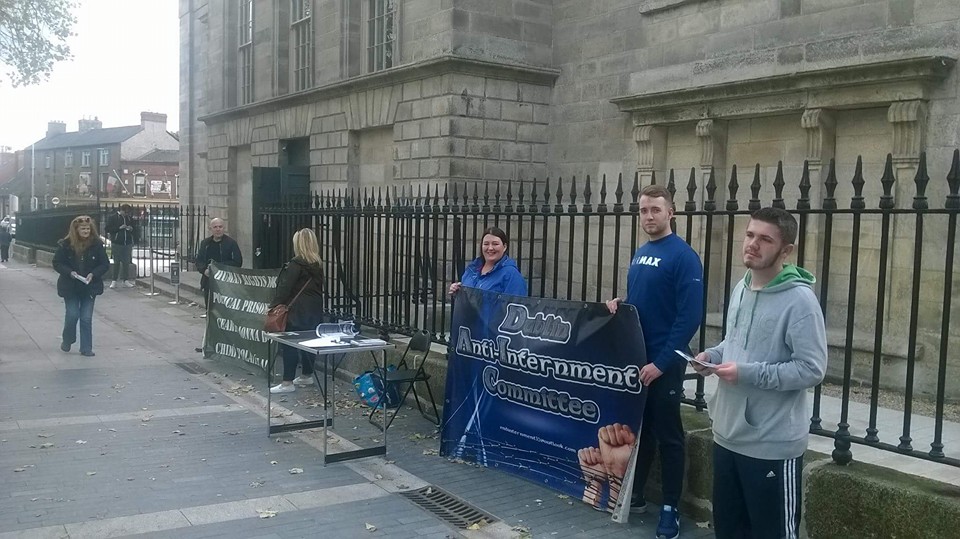
The Dublin Anti-Internment Committee organised an information table on Internment outside the Kilmainham Jail Museum on Sunday 11th September 2016. The purpose of the exercise was to make tourists and other visitors aware of the ongoing repression and civil rights abuse that is going on in Ireland which is internment by another name. As their leaflet points out, Republicans opposed to the British colonialism or to economic attacks on their communities and who organise against them are being targeted in a process that sees them arrested, charged with ‘terrorist’ offences, refused bail (or granted only attendant by ridiculous restrictions) and then, when the case against them collapses much later and they are freed, they will still have spent years in jail.
Anti-internment campaigners line up for a photo with clenched fists (Photo: Ian O’Kelly)
The Dublin Committee, affiliated to the Anti-Internment Group of Ireland, mobilised outside the former jail in the afternoon, displayed their banners and gave out leaflets to passers-by, tourists and visitors (not all who were from outside Ireland, by any means).
Kilmainham Jail is a Dublin prison with an important history. It was built before the Great Hunger and housed female and male prisoners, including children. Insurgents and political activists from the United Irishmen, they Young Irelanders, the Fenians, the 1916 Rising, the War of Independence and the Civil War had been kept here, including those being deported to Australia. Robert Emmet and Anne Devlin were kept prisoner here, as were Charles Stewart Parnell and most of the Irish Parliamentary Party’s leadership. All fourteen of the 1916 sixteen executed were judicially killed in this jail and women activists were jailed here after the 1916 Rising and during the Civil War.
Campaign information table (Photo: Ian O’Kelly)Plaza in front of old Kilmainham courthouse, which is the new entrance to the Jail Museum. (Photo: Ian O’Kelly)
The Jail closed in 1924 and was falling into disrepair; the State invited tenders for its demolition but felt that those they received were too expensive and so just left the building abandoned to ruin. However a local restoration committee got going, raised some money and began repair and restoration work with volunteer labour, skilled and unskilled.
In 1966, in time for the 50th anniversary of the Easter Rising, the restoration committee handed over the building to the State which, since then, has seen a huge attendance with nearly 330,000 visitors last year. Recent works moved the front entrance of the museum to the former courthouse building next door and a reported €5 is being spent on revamping the facility.
end.
Some of the campaigners were younger than others (Photo: Ian O’Kelly)The emblem of the Unitied Kingdom on the courthouse roof — this remains on a number of buildings in Dublin from the centuries of British occupation of the city. (Photo: D. Breatnach)(Photo: Ian O’Kelly)
Closer view of the emblem of the United Kingdom on the courthouse roof (Photo: Ian O’Kelly)Side view of the front of Kilmainham Jail and some of the campaigners (Photo: D.Breatnach)Some of the campaigners with the Courthouse building stretching away from behind them.
Jean-Ann Day, who has just died, visited Dublin in January 2012 to help push an international campaign to free Leonard Peltier, also a warrior of the First People and longest-serving prisoner in the US after a travesty of a trial in 1977.
Jean-Ann speaking at picket on the US Embassy in Dublin in solidarity with Leonard Peltier. The photographer’s back is to the Embassy.Jean-Ann Day — photo placed with her official obituary on funeral home site
Due to a family tragedy hitting her contact here I had to step in as Jean-Ann’s contact but it was an honour for me. I progressed arrangements and took her to see Joan Collins TD and arranged for a radio interview with a program on Near FM.
I remember that on our way across the Liffey, Jean-Ann took a pinch of tobacco and offered it to the river with a prayer. The Gaels also thought of their rivers as divine, most of them goddesses. Although an atheist, to my thinking such belief systems seem greatly superior to those that think it fine to convert a river into a sewer or a toxic waste outlet.
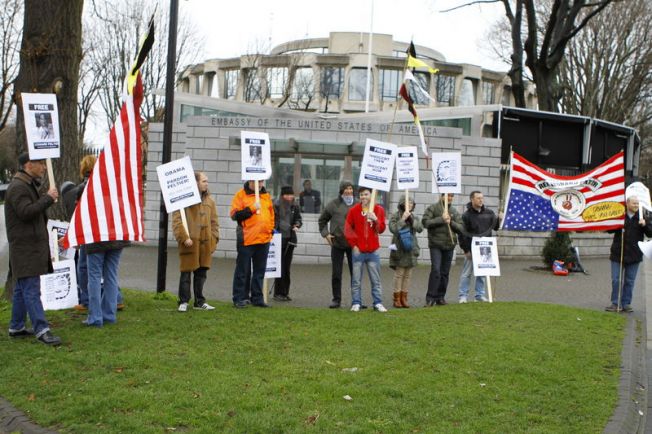
On Saturday 4th February 2012 a small crowd of varied political backgrounds, including a significant proportion of independents, staged a protest outside the US Embassy in Ballsbridge as part of a world-wide week of protests seeking Peltier’s release. Jean-Ann delivered a simple speech there that I believe reached into the heart of every one of the participants as it did into mine.
Poster produced for the Dublin solidarity picket of the US Embassy (regret the name of the artist does not come to mind at the moment)
A small musical evening in Dublin organised by supporters was another occasion at which she appeared and I understood she went to Belfast and Derry too.
Jean-Ann, warrior for justice has walked on and left us her memory. Her former comrade, another warrior, Leonard Peltier, remains in jail in serious ill-health.
Peltier is incarcerated at the United States Penitentiary of Coleman in Florida and given that he is 72 years of age and that his next scheduled parole hearing will be in July 2024, it is clear that the FBI and USA state want him leaving jail only in a coffin. Barring appeals, parole or presidential pardon, his projected release date is October 11, 2040.
Jean-Ann Day, Bear Clan of the Ho-Chunk Nation, age 65 of Stevens Point, Wisconsin walked on Sunday, September 4, 2016 at the University…
APPENDIX
Leonard Peltier Regarding the Passing of Jean-Ann Day
When I heard the news of Jean’s passing I was both saddened and surprised. I did not know she was ill. If I had known I would have reached out to her and tried to support her in any way I could.
Jean was a true friend to me for all the years I knew her. Her passing reminds me of so many things back in those days at Oglala so long ago.
She was a such a bright light and a young woman full of courage who came to Oglala without hesitation to join us in protecting the elders there. And she did so much work to free me from prison all these years. I am grateful to her for that.
Poster in the style of Jim Fitzpatrick’s famous Che Guevara poster (Regret artist unknown to me)
Over the years here I have thought of her often and in my dreams of freedom there were always a few faces I expected to see if I ever walked out of here. Jean’s was one of them.
I know she was doing wonderful work in the effort to bring healing and positive change to her Ho-Chunk people and I was always proud of her for that.
I regret that I could not be there for her ceremonies so I could offer comfort to her children and grandchildren, but I can only send these few heart-felt words.
You were a great woman and your life made a real difference to me… and to so many others.
Rest in peace, my dear friend. ‘Til I see you again.
Doksha,
Leonard Peltier
Part of the gathering at the Dublin US Embassy in solidarity with Peltier and seeking his urgent release in 2012
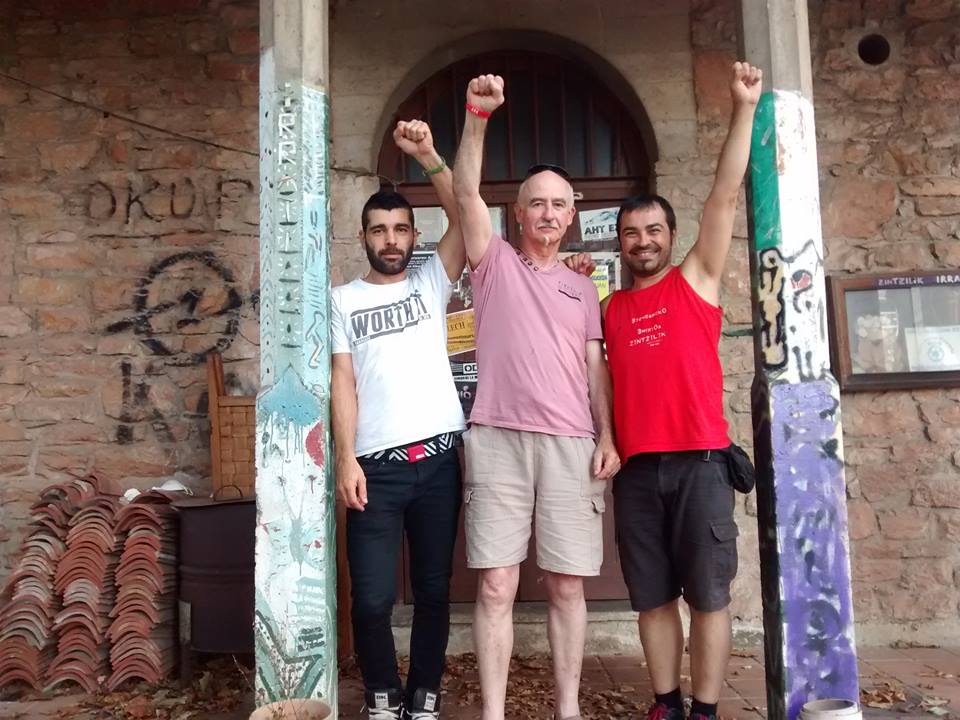
One of my appointments on a recent trip to Euskal Herria, the Basque Country, was with a “free radio station”, with a dual purpose: to learn about their operation and to give them an interview about my thinking on the political phenomena known to most people as “peace processes”. The radio station in question is Zintilik and located in the Orereta area of Errenteria town, not far north from Donosti/ San Sebastian, in the souther Basque province of Gipuzkoa and my hosts were Hektor Gartzia and Julen Etxegarai.
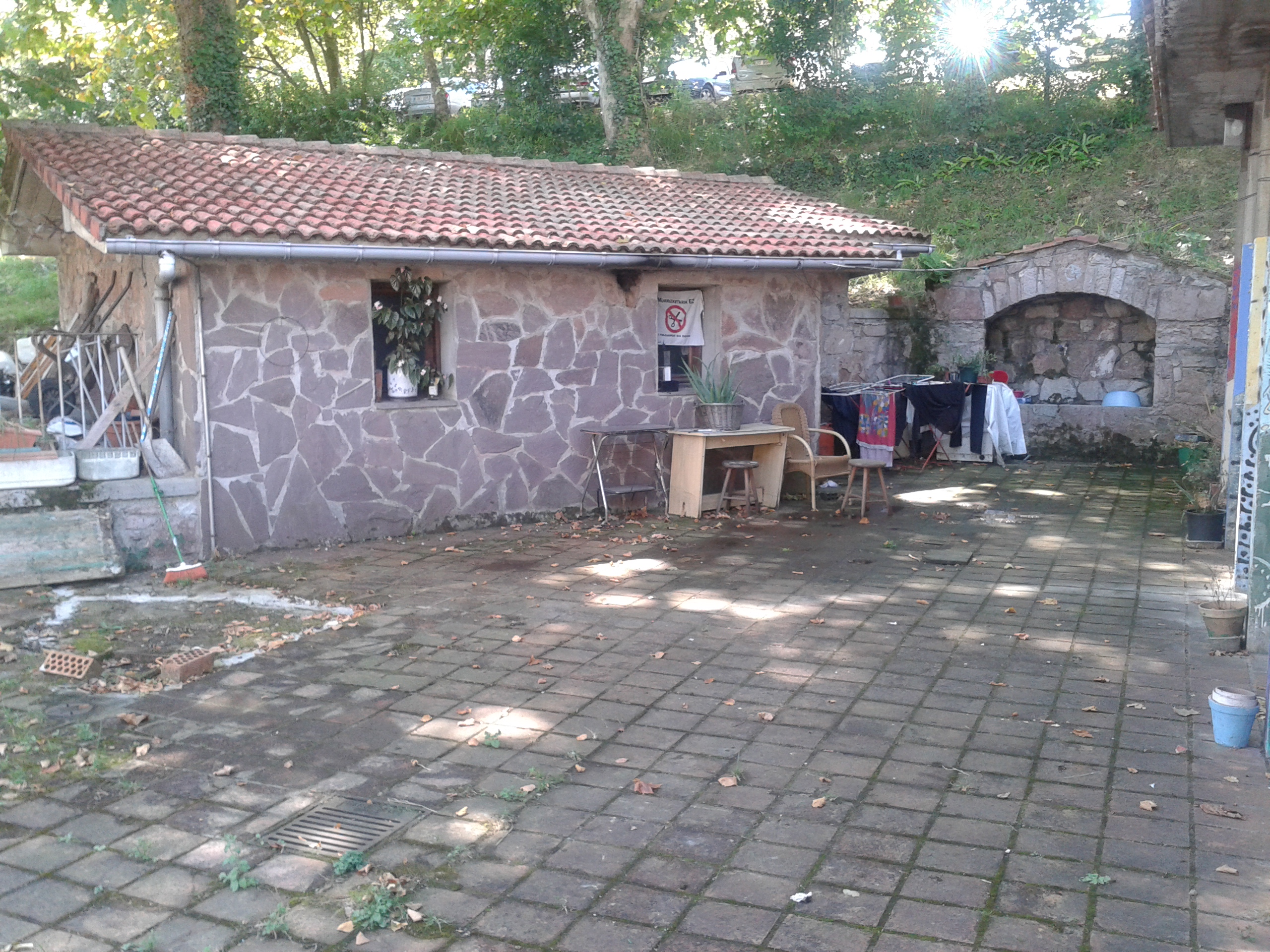
View of side of building which houses Zintilik. Photo D.BreatnachJulen and Hektor setting up for the interview Photo D.Breatnach
Not long after I arrived, one of my hosts related his memory of events in the area after a local ETA fighter had been killed. The Guardia Civil had swamped the area to prevent an “homenaje” (an event honouring the dead) taking place, guns pointing at men and women; the children, of which he had been one, gathered into their grandparents’ house ….. He showed me where the police vehicle had parked at the end of the street, his sweeping hand indicating the places where the armed police had stood.
THE “FREE RADIO”
The “free radio station”, also known as “pirate radio” has been broadcasting for 32 years, which I find amazing. It began broadcasting from an “okupa”, an occupation of a private empty building, turning it into an alternative social and political centre. Under popular pressure, the local authority, under the control at the time of the PSE, i.e. (Spanish unionist social democratic party), granted them the building they currently use.
Front of Zintilik building from the street. Photo D.Breatnach
Originally built to house a smithy, for some reason the building never saw service in that capacity. It is in my estimation an attractive building in a traditional-enough local style, of thick stone, compact without being squat. It has an attractive back yard, no doubt intended at one time to receive the horses with hooves in need of iron shoes, fitted and nailed. The roof is tiled in what seems the usual way for the Basque Country.
Zintilik broadcasts 24 hours a day, which it is able to do using repeats. The Zintilik collective owns its equipment and funds itself through fund-raising concerts, txosnak (stalls/ marquees) at festivals and occasional donations. They run advertisements for
Julen and Hektor again. Photo D.Breatnach
local community groups and announce events but accept no commercial sponsorship – nor does their wish for independence stop there. “We don’t receive any funding from the local authority or from the Basque Autonomous Government,” declares Julen, “nor do we wish to.”
“Funding from such sources comes with strings attached”, adds Hektor.
“Or one becomes dependent on it and unable to function without it”, further explains Julen.
Partial scenic view from the back of the building. A block of flats to right just out of shot does restrict it however. (Photo D.Breatnach}
As a further illustration of self-reliance, they tell me how they climbed on to the roof of their building to repair a leak, rather than ask the municipal authorities to do it. And it was the same when branches of a nearby plane tree needed cutting to prevent them knocking against the radio aerial on windy days.
“We know it’s work that the local authority owes us and that we and the rest of the community pay their salaries but we prefer not to depend on them,” they explain.
As an example of how dependency – although of a different sort – can undermine a community resource, they relate the story of building which was occupied in order to be used as a community resource. As time passed, many were using it as a social resource but less people were volunteering for the work involved in maintenance at any level. Appeals of the four or so committed people who ended up doing everything fell on the deaf ears of the clientele until one day the four locked the centre doors after the last user had left for the evening and, the next day, handed the keys over to the local authority.
The back yard to the building where we ate a meal after the interview. The structure there is an outhouse. (Photo D.Breatnach)
“As you imagine, this was a great shock to the clientele,” they tell me, “but it was the result of their own lack of commitment to the project.”
I reflect that many activists will identify in one way or another with that sad experience.
RECORDING THE INTERVIEW
Julen and Hektor discuss the format and general content of the interview with me and map it out, do sound checks and then we go to it. Hektor, who knows quite a bit about the more recent Irish history and about the current situation in the Six Counties, is my interviewer, while Julen monitors from the control room and occasionally joins in with comment or question.
Interview room. Photo D.Breatnach
For music in between sections of interview, Irish Ways and Irish Laws (John Gibbs) and Where Is Our James Connolly? (Patrick Galvin) have been chosen, both sung by Christy Moore and Joe McDonnell (Brian Warfield), by the Wolfe Tones.
They also invited me to sing Back Home in Derry, Christy Moore’s lyrics arrangement of Bobby Sands’ poem – but to the air I composed for it. I am happy to oblige – I enjoy singing but it is more than that: I want the air I composed to get a hearing. Christy Moore used Gordon Lightfoot’s air to The Wreck of the Edmund Fitzgerald for Sands’ poem and, excellent though that fit is, especially with Moore’s chorus, I think that the poem (and its author) deserves an air of its own.
Recording room. Photo D.Breatnach
Although the main focus of the interview was the phenomenon of “peace (sic) processes”, we discussed aspects of Irish, Spanish, Palestinian and South African recent history, including the 1916 Rising in Ireland, along with the backgrounds to the songs chosen. For the most part, I left it to my interviewers to draw conclusions relating to their experience of political processes in their own country.
FESTIVALS AND STORMS
Upstairs in the broadcasting/ recording and interview rooms, all is in good order: equipment and facilities. After the interview, I note that downstairs, in the main space, things are a in a bit of a mess, for which Julen apologises (he has never seen the state of my flat).
“Some of the community groups we support store their placards and banners here,” he says. “Besides, we’ve just finished our local festival and everyone relaxes, dumps their equipment and goes on holiday.” Throughout the Summer and early Autumn, each village, town, city and even area will have its own week-long festival for which the community groups and campaigns will organise and participate.
Down in Donostia (San Sebastian), to where Hektor and Julen accompanied me after we ate the food they had prepared, the city was in the midst of its own festival and was heaving with people – tourists from everywhere, it seemed, as well as Basques.
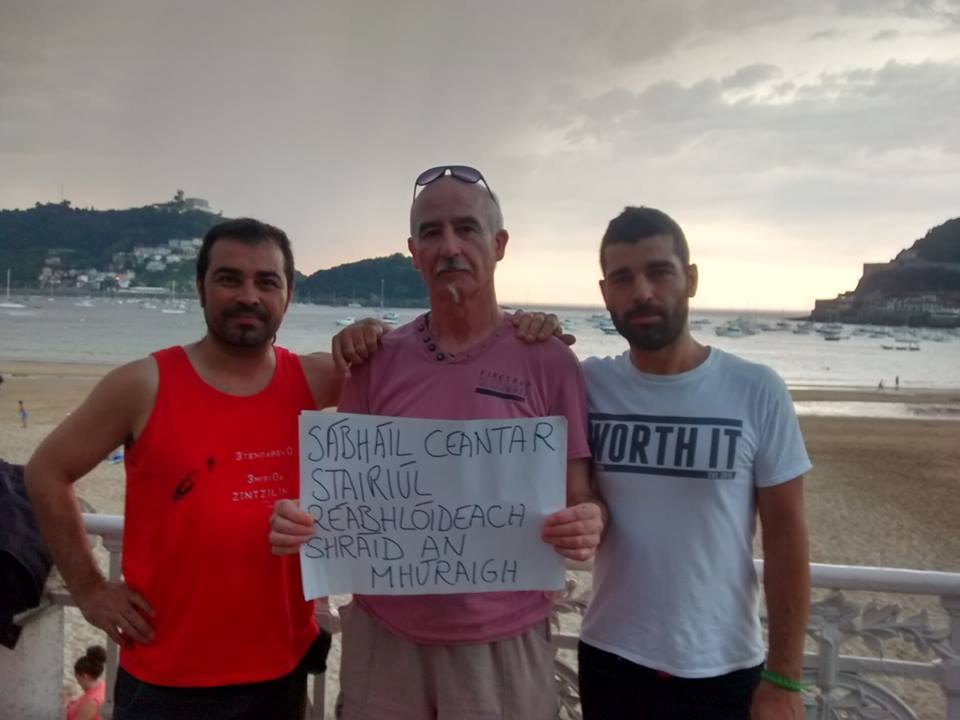
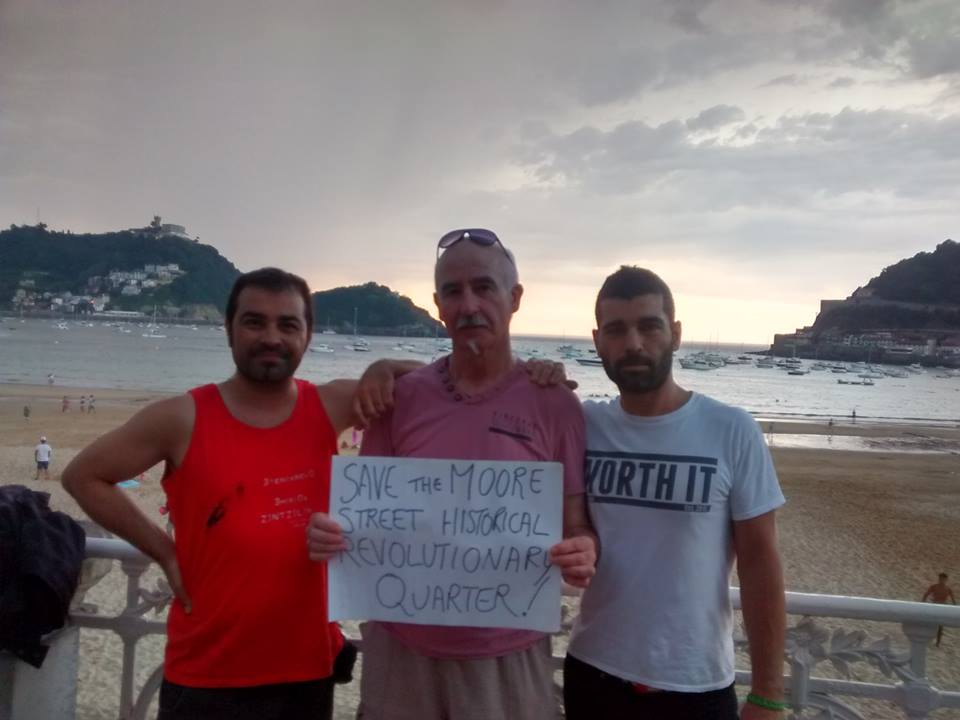
With that picturesque bay and its island in our background, they got a passing young woman to take our photo, the three of us – the conversation with her was in Euskara only. I held up the placards I had prepared for the photo in turn, one in Irish and another in English, supporting the Moore Street quarter in Dublin.
R-L: Julen, Diarmuid, Hektor. Donosti bay in the background with island partly visible. Storm building in the sky.
Dark clouds were gathering overhead and on the horizon the sky was a baleful orange. A storm or at least a downpour was being promised and, as we turned back towards the bus station, the first drops began to fall. In the humid heat, the light rain was welcome for awhile but for part of my solitary journey back to Bilbo, it formed a silvery curtain in the coach’s headlights and streamed down the windows.
I remembered being told that one can frequently witness a violent storm in the Donosti bay while not so far away in Bilbao, as a result of local conditions, all is calm. As for winter storms in Donosti, the waves hitting and surging over the seafront and piers have to be seen to be believed; occasionally the sea reaches inland, floods cellars and converts parked cars into boats or semi-submarines.
The rain eased off and stopped about half-way through my journey and when I got into San Mames station in Bilbo, the streets were not even wet.
Foreign tourists and Irish-based visitors looked on with curious interest at a gathering at the foot of the East Pier, Howth on Sunday 24th – the group contained a number in military-type uniform, some were carrying flags, each one of a different design and a number of people in ordinary civilian clothes were carrying floral wreaths.
The Asgard, Molly Childers and Mary Spring-Rice on board at Howth (photos from Internet)Participants, Tourists and Visitors (photo D.Breatnach)
Most onlookers at that point would not have known that those gathered there had a threefold purpose:
to commemorate the landing of Mauser rifles for the Irish Volunteers
to commemorate the massacre of civilians by enraged soldiers later that same day on Bachelors Walk and to
launch the Asgard 1916 Society.
The men and women in uniform formed up with the flags as a colour party and led the procession the full length of the pier to its end. There the procession came to a halt in front of a plaque on the wall commemorating the landing of 900 Mauser M1871 single-shot rifles and 29,000 rounds of ammunition in 1914 by a crew skippered by Erskine Childers with his wife Molly and friend Mary Spring Rice. The arms were taken ashore and whisked away in an operation planned by Bulmer Hobson of the IRB and carried out by the Irish Volunteers and Na Fianna Éireann.
Colour Party marching along the pier towards the ceremony (photo D.Breatnach)
The Dublin Metropolitan Police and British Army were mobilised by Dublin Castle authorities to seize the guns (unlike at the previous much larger operation by the Loyalist UVF at Larne) but only managed to get a few. As the disgruntled Scottish Borderers marched back into town, they were jeered by Dublin crowds and some cabbage stalks were thrown at them. On Bachelors Walk, very near the Ha’penny Bridge, an officer brought them to a halt and they faced the crowd with guns pointed, then opened fire. Three men and a woman were killed and 38 wounded, including the father of singer Luke Kelly of the Dubliners ballad group (also called Luke). One of the victims died of bayonet wounds.
Margaret McKearney speaking and chairing the occasion on the pier (photo D.Breatnach)
Margaret McKearney, who has had three brothers killed in the Six Counties during the 30-years war, stepped forward to address the crowd as tourists and visitors took photos or watched and listened. After giving a brief account of the Howth landing and of the massacre on the Dublin quays, also of the smaller landing at Kilcoole, McKearney called forward Pól Ó Scanaill of the 1916 Societies to read the 1916 Proclamation of Independence. After he had finished, McKearney called for the young bearers of two floral wreaths to make their presentations:
Ellen O’Neill, with a wreath in memory of those killed and injured by the British soldiers at Bachelors’ Walk;
Roibeard Drummond, whose uncle Michael Moore was a crew member of the Nugget, landing rifles at Kilcoole, laying a wreath for the Asgard 1916 Society to commemorate the landing of the rifles and those who carried them in battle in 1916.
Last of the wreath-layers was Denise Ní Chanain on behalf of the Anti-Internment Group of Ireland.
Ellie O’Neill after laying wreath in memory of the dead and injured in the Bachelors’ Walk massacre (photo D.Breatnach)
MOORE STREET SPEECH
Roibeard Drummond, after laying wreath on behalf of the Asgard 1916 Society (photo D.Breatnach)
Niamh McDonald gave a short speech on the current situation in the struggle to save the revolutionary quarter of Moore Street. She informed her audience that NAMA had sold the debt of the Irish speculator company Chartered Land (Joe O’Reilly) to Hammerson, a British-based vulture capitalist company, who are continuing with the plan to build a huge shopping centre over the whole historic quarter. Meanwhile, the Minister for Heritage, Heather Humphreys, is appealing the High Court judgement that the whole quarter is a national monument. McDonald asked people to keep an eye on the campaign’s
Denise Ní Chanain bringing forth the wreath from the Anti-Internment Group of Ireland (photo D.Breatnach)
Facebook page for updates and for calls to support actions.
McKearney then called on Diarmuid Breatnach to sing Me Old Howth Gun, pointing out that guns landed at Howth had been the first to fire on the Lancers in O’Connell Street on Easter Monday 1916. Breatnach introduced the song as having been written apparently in 1921, that is a year before the outbreak of the Civil War, by James Doherty, who also used the pseudonym Seamas Mac Gallogly.
Niamh McDonald speaking on behalf of the Moore Street 2016 campaign (photo D.Breatnach)
MAIN SPEAKER — JOHN CRAWLEY FROM THE MARITA ANN
The next speaker to be introduced by McKearney was John Crawley who was arrested on board the Marita Ann trawler, intercepted off the Kerry coast by the Irish Naval Service on September 29, 1984, when seven tonnes of arms were seized. The US heavy machine guns recovered on the Marita Ann had special mountings allowing them to be used as anti-aircraft weapons. Another of those detained on board – and later jailed for 10 years – was Martin Ferris who went on to become a Kerry TD for Sinn Fein, while John Crawley has taken a line of opposition to the Good Friday Agreement.
John Crawley giving his oration with the plaque commemorating the landing of the Howth guns behind him (photo D.Breatnach)
John Crawley gave the main speech at Howth, in which he traced the history of the struggle for the Irish Republic from the Volunteers onwards, pointing out that many who fought the British in 1916 had different aspirations for the country, which explained why they parted ways in 1921. Crawley stated that the British have always been able to pick out those whose primary intention was to survive the struggle from those whose intention was if necessary to give their lives for the objective of the Irish Republic.
Pól Ó Scanaill reading the 1916 Proclamation at the head of the East Pier, Howth (photo D.Breatnach)
Crawley pointed out that some people had led a section of the Republican movement in accepting the right of a foreign country to decide the future of a part of our country; they had joined in the colonial administration and had accepted the colonial police force.
After the applause for the speech died down, McKearney thanked those who had participated and asked Diarmuid Breatnach again to step forward to sing the national anthem. Breatnach sang it in Irish, first verse and chorus (and noticeably sang “Sinne Laochra Fáil” instead of “Sinne Fianna Fáil”). Participants joined in with the chorus and then all made their way along the pier towards a local pub where refreshments had been made available by the new 1916 Society.
Diarmuid Breatnach singing Amhrán na bhFiann at end of the ceremony. Earlier he had sung “Me Old Howth Gun”. (Photo: Des Keane from Sean Heuston 1916 Society page)
UP TO FOUR SCORE PROTESTERS LINED A MAIN STREET IN NEWRY ON SATURDAY 2nd JULY TO PROTEST THE CONTINUATION OF INTERNMENT WITHOUT TRIAL OF POLITICAL ACTIVISTS
Clive Sulish
This the event was organised for the third year running by the Anti-Internment Group of Ireland and was supported by a number of organisations, campaigns and independent activists. AIGI was formed some years ago to raise awareness of the reintroduction of internment without trial by the use of remand in custody and revoking of licences.
Republican activists are being arrested on trumped-up charges and then refused bail outright or sometimes offered it in exchange for acceptance of conditions limiting their freedom to live normally and, in particular, to be politically active. This in itself lays bare the real motivation behind the charges – one who was unable to support the event because of his bail conditions told this reporter that he has to sign at a police station every day including the middle of the afternoon on Saturdays, is not allowed to speak about political prisoners, to attend political meetings or to post or comment publicly on social media. If refused bail, activists may await trial for two years and, if then found ‘not guilty’ by the no-jury Diplock Courts, will already have spent two years in prison anyway.
Former political prisoners released on licence under the terms of the Good Friday Agreement may be arrested and detained without trial, without charge, without even a police interview as happened to Martin Corey (four years without trial and released under gagging conditions). Currently Tony Taylor is in jail without charge under this system.
AIGI was founded to raise public awareness about these serious violations of civil and political rights. The Dublin branch of AIGI, the Dublin Anti-Internment Commitee, holds regular public pickets and meetings in the Dublin area and has facilitated other public events for other campaigns, such for example the framed Craigavon Two. Recently the Munster Anti-Internment Committee was also founded as another branch of the AIGI (both committees were represented at the Newry event).
This slideshow requires JavaScript.
SPEAKERS DENOUNCE BAIL CONDITIONS, REFUSAL OF BAIL AND OPPRESSION INSIDE JAIL.
A number of speakers called attention to the repression of the Six County state in its arrests of political activists, refusal of bail or imposition of oppressive conditions if bail is granted, imprisonment on trumped-up charges and through revoking of licences. The case of the Craigavavon Two was mentioned by a number of speakers, as was the case of Tony Taylor. The Craigavon two are in jail convicted of the killing of a British soldier, even though the case against them is riddled with holes and depends on an eyewitness who came forward nearly a year after the event, whose evidence is contradictory, whose movements on the night in question are denied by his own family and who is described by his own father as “a Walter Mitty character”.
All the speakers called for continuous action and unity against repression and were vigorously applauded.
JOE CONLON WAS THE FIRST SPEAKER. HE SPOKE ON BEHALF OF THE DUBLIN ANARCHIST BLACK CROSS, a support group for political prisoners.
In the course of his speech he pointed out that the struggle of Republican prisoners in Maghaberry Prison has been going on for well over a decade. Commenting on a brutal prison regime, Conlon focused on the attacks on “prisoners‘ families and loved ones being refused visits without any warning and loved ones being banned for a couple of months at a time also without warning.”
Attacking the system of solitary confinement within the jail, Conlon picked out the case of “Gavin Coyle (who) has spent five years in isolation,” while, he pointed out, non-Republican prisoners usually spend at most up to three weeks in isolation, as a punishment. “The use of forced isolation is to try destroy the morale, spirit and mind of a prisoner. In Gavin Coyle‘s case the British state are trying to break him down physiologically and MI5 have made several approaches to him in the Isolation block.”
Conlon went to assert that “these exact same tactics are being used ……. acrossEurope to get Anarchist activists jailed and used against prisoners and their families to break them,” and recalled that the previous year several anarchist prisoner had gone on hunger strike.
Calling attention to the 39–day hunger strike by Tasos Theofilou, who was sentenced to 25 years jail in 2014, Conlon said that “he was convicted of manslaughter, carrying a firearm and armed robbery, which he has always denied. The only evidence against him was DNA that was found on a moveable object, none of the witnesses in trial could identify him,” Conlon pointed out.
PAUL CRAWFORD OF CÓGUS AND REPUBLICAN NETWORK FOR UNITY ADDRESSED THE CROWD ALSO.
Thanking the organisers for the invitation to speak and declaring it a privilege to address the gathering, Crawford addressed some remarks towards the terminology of “internment” and raised some questions regarding its accuracy with regard to some cases, the injustice of which however he went on to denounce.
The media and political class came in for denunciation too for ignoring the fact of framing of activists on flimsy evidence.
Crawford went on to speak of his comrade Carl Reilly who, he said “is another example of selective detention.” Reillly is arrested on a charge of directing terrorism and, Crawford informed the crowd, “this charge is based on secret recordings allegedly taken in the 26 counties yet passed to the state forces in the north to use as evidence to remand him there.”
Crawford told those assembled that he himself is Carl’s co-accused, released on bail. “I am forced to endure draconian and repressive bail conditions which are clearly designed to prevent me from carrying out my role within my political party in an effective manner. I am not allowed to send Carl a birthday card, to talk to him or even to have third–party contact with him.” Crawford said. “In essence,” he continued,“I’m not even allowed to ask his wife to tell him I was asking for him. Many activists north and south are effectively interned on bail, in prison outside of prison walls.”
STEPHEN MURNEY, FROM NEWRY AND IN ÉIRIGÍ was himself a fairly recent victim of internment through refusal of bail for nearly two years, after which he was cleared of all charges.
“When republicans are targeted by the British occupation forces, backed by their political mouth pieces in Stormont,” Murney told the crowd, “they can expect to be held for anything up to five years in a British prison.” “Many of these cases are built on sand and eventually collapse before trial,” he continued, “although the end result is that those republicans are held in prison for several years despite being innocent.”
In the course of his speech, Murney pointed out that the families,whosebattle is “largely unseen and unheard ……. are left to pick up the pieces”. Continuing, he stated: “I think it’s appropriate and important that today we acknowledge the struggle that women have to endure when their husbands and sons find themselves interned”.
Murney went to talk about the “living nightmare” that bail conditions impose on activists, making it “impossible to live anything that even remotely resembles a normal family life. Late night checks, daily bail signing, draconian curfews and being forced into exile are the order of the day.” He went on to say that those who are forced to wear an electronic tag “not only have to endure Crown force harassment, but they also find themselves being harassed by their lackeys In the G4S security company.”
Not even after completing there sentences are activists free from harassment, Murney declared, as “many find themselves with severe licence conditions being imposed and being unable to return to their homes to live.”
SPEAKER CALLS FOR SUPPORT FOR DEFENCE OF MOORE STREET AND HISTORY
Last to speak was Diarmuid Breatnach, introduced by the chair as representing the Save Moore Street From Demolition campaign. He began by quoting a saying, “Níl saoirse gan stair” (‘There is no freedom without history’). Breatnach spoke of the importance of history, of knowing it well and how it is interpreted; how those who hide or control history do so in order to control the people. He pointed out that history is not dead but is constantly being made, “as those of us here today are in a small way part of the history against the reintroduction of internment”.
Speaking about the last Headquarters of the 1916 Rising, the terrace of houses in Moore Street occupied by the GPO Garrison, Breatnach related how the long years of people campaigning for their conservation had resulted in an Irish High Court judgement that the whole of the Moore Street quarter is a National Monument.
However, Minister Humphreys is appealing the judgement, Breatnach told the crowd and the property speculators have applied for a seven-year extension on their planning permission for a giant shopping mall, which involves the demolition of the whole quarter with the exception of four buildings.
Focusing on the forthcoming march on Saturday 9th in Dublin (organised by the Save Moore Street 2016 campaign), Breatnach encouraged all to take leaflets, inform themselves and others about the issues and to march with the campaign and supporters in Dublin, “not just for the past, nor just for the present but for …. a future free from colonialism, imperialism and property speculators.”
“A VERY SUCCESSFUL EVENT …. HIGHLIGHTING THAT INTERNMENT WITHOUT TRIAL HAS NOT GONE AWAY”
Police vehicles passed along the street keeping the demonstrators under surveillance a number of times but did not stop, nor did police on foot appear. They also took a turn around the car park noting vehicle registration numbers.
People driving past in cars almost without exception accepted leaflets and some tooted their horns in solidarity. The presence of large numbers of cars of expensive make passing through the street drew an expression of surprise from one Dublin participant. “Green diesel prosperity,” replied his comrade laconically. Clearly there is more than one kind of ‘cross-border initiatives’!
“This was a very successful event,” stated a spokesperson for the organisers, a sentiment echoed by many, quite possibly all of those in attendance. “As in past events, people from different Republican organisations and Republican and socialist independent individuals participated. We also distributed in excess of one thousand leaflets here today and highlighted that internment without trial has not gone away.”
Newcomers to this event were in evidence this year also, with the banner of the Anarchist Black Cross (support group for political prisoners) clearly to be seen.
The presence of Munster and Dublin branches of the Anti-Internment Group of Ireland reflect the growth of the organisation and interest in its core principles of active committees, democratically run by participating activists, independent of any political organisations but open to members of all and of none.
As the votes in the General Election in the Spanish state result in huge gains for the Podemos party and the most fragmented Parliament since before the Spanish Civil War, the Abertzale Left’s party in the elections also loses massively to the newcomer. This occurs in the context of wide discontent within the Abertzale Left, especially among the youth, with a potential split emerging around the issue of political prisoners.
The Spanish state includes within its borders most of the Basque Country and the Catalan Countries, which have their distinct cultures and languages. Also with a significantly different culture are Asturias and Galicia, both of them considering themselves Celtic rather than Latin-Hispanic and also having their own languages. There are in fact small movements seeking independence or greater autonomy in all other regions of the state, including in the political centre itself, Castille.
Four of the Basque Country’s seven provinces are currently inside the Spanish state and they were included in the Spanish state’s General Election on 20th December. A number of financial scandals affecting the ruling Spanish right-wing Partido Popular in recent years no doubt made their leaders reluctant to go to the polls but holding off longer might have resulted in even worse outcomes.
On the other hand, the PP’s main parliamentary opposition, the social-democratic Partido Socialista Obrero Espaňol (PSOE) were also embroiled in some financial scandals during the same period, though not as many.
In the event, both main parties achieved disastrous results and neither can form a majority government. The new party of the social-democratic Left, Podemos (“We Can”), which did not even exist two years ago, has leapt into third place and a new party of the Right, Ciudadanos (“Citizens”), is in a poor fourth place. No two of the aforementioned parties can form a coalition government except in the case of a PP-PSOE coalition; however that would cause massive problems for each party and also dispel the political myth of a democratic choice between “Left and Right” in the Spanish state.
The Spanish state has long been the most unstable in the core European Union. Collusion between fascists, alleged social democrats and alleged communists internally, along with the support of the USA and the tolerance of its European partners has kept it afloat. Nevertheless, it represents the part of the EU most vulnerable to revolution, with immediate impact should that happen on the French and Portuguese states and further ripples throughout the EU. However the revolutionary and potentially revolutionary forces are weak, divided and riddled with opportunism. (see separate article focussing on the elections and the Spanish state in )
Despite the weaknesses in the Spanish state, the Basque Abertzale Left has made little headway against it and has been slipping electorally badly this year.
Election Results in the Basque Country
EH Bildu, party of the Abertzale Left in coalition with social-democratic Basque parties, presenting their program in Nafarroa in 2012 and seeking broader alliances
EH Bildu (“Basque Country Unite”), the social-democratic coalition party under the direction of the Basque Abertzale (Patriotic) Left, came out of the Spanish state-wide elections badly (as it did in the regional elections earlier this year in the Basque Country also, with the exception of in Nafarroa). With a drop of nearly two-thirds of its previous percentage of the vote, it lost five seats and now has only two in the Spanish Parliament (the Cortes). The christian-democrat PNV (Basque Nationalist Party), traditionally the dominant in the three southern provinces of Euskadi (i.e. excluding Nafarroa, the fourth), also took a drop in its percentage but a much smaller one and despite that, increased its numbers of seats from five to six. The Basque nationalist coalition in Nafarroa, Geroa Bai (“Yes to the Future”), lost its only seat.
The winner that swept up the ‘missing’ votes in the Basque Country was Podemos, a party that did not even exist until last year. Although gaining one seat less than the PNV in the “Euskadi” or CAV (three provinces region), Podemos actually won more votes and its share was 25.97%, against the PNV’s 24.75%. Shockingly, at 15.72%, EH Bildu has now been reduced to fourth place after the other two and the PSOE, with only the PP worse off but with the same amount of seats. Even in Gipuzkoa, the province most loyal to the Abertzale Left, their share fell to 20.89% and their coalition party EH Bildu lost two seats. In the same province Podemos topped the poll in votes and gained two seats.In the fourth province, Nafarroa, EH Bildu lost their only seat and took a 9.90% share against UPN-PP’s 28.93%, Podemos’s 22.9%, and PSOE’s 15.53%.
Podemos leader Pablo Iglesias after results of Spanish Election results December 2015
It seems clear that in the Basque Country, Podemos took votes both from the PSOE and from the Abertzale Left’s coalition party, EH Bildu and even some from the PNV. For the PSOE, a party in Government in the past and implicated in the GAL murders, also involved in a number of recent financial scandals across the state, to lose votes in the Basque Country to a radical-left coalition, would have come as no surprise to most people. It is a different matter altogether for EH Bildu, with a strongly patriotic Left following, never tainted with a financial scandal and never yet in Government, to lose votes to a newcomer like Podemos — and that needs some explanation.
The fact is that the AL leadership flirted with Podemos – even proposing a joint electoral platform — and thereby sent the message that voting for them would not be such a bad thing. But there were sufficient reasons for the AL to have done otherwise, even without the objective of safeguarding their own vote. It has been clear for some time that the leadership of Podemos is hostile to aspirations towards independence of nations within the State. Their leader recently criticised the decision of a Catalan pro-independence coalition to use the regional elections as a quasi-referendum on Catalunya’s independence. Also one of their ideologues, in the midst of an intervention in discussions within Colombia, likened ETA to Columbia’s fascist assassination squads (who murder trade unionists, human rights workers, socialists, even street children). In addition, Podemos has never come out against the repression in the Basque Country.
There were enough reasons for the AL leadership to draw a deep line between themselves and Podemos. But they did the opposite. This contrasts with the left-republican Catalan nationalists (Esquerra Republicana de Catalunya-Catalunya Sí) who engaged in a public battle with Podemos’ leadership. Incidentally, they increased their share of the vote by 1.33% and their representation from three seats to nine.
Another vulnerability of the AL movement to a party like Podemos is precisely the road of conciliation with and concession to the Spanish state taken by the AL over the recent five years and longer. If that road is seen to be OK then, some might say, why not vote for a radical reformist left party and one which, crucially, has a large following throughout the State? Such thinking combines a perception that revolution is not possible, implicit in the approach of the AL leadership, with a view that a solution can only be found outside the Basque Country, which although contrary to most of AL’s propaganda, does seem in part to be the case, based on population statistics alone (see discussion on this further on).
This view was seemingly endorsed by the post-election statement of Barrena, spokesperson for the Abertzale Left’s party Sortu, who characterised the vote for Podemos as “the right to decide” and held out his hand for electoral coalitions with them in the future. The irony — that precisely Podemos does not support “the right to decide” of nations within the Spanish state – was apparently lost on Barrena.
Around September there were whispers of the intention to hold a review of their trajectory within the Abertzale Left. This seemed an acceptance that their chosen path had, if not failed completely, then certainly fallen far short of their own expectations. I wondered how they would contain severe criticisms within such a review, a much more difficult process now than some years ago, when confusion combined with illusions and the soothing words of long-standing leaders.
Further confirmation of this review has since come out: called ABIAN (“Launch”), it’s a debate being organised by Sortu (“Create”), a social-democratic party of the AL. A recent article in a Gipuzkoa news media stated clearly that the review was a response to criticisms of Sortu, “for the first time within the Abertzale Left” (i.e. not only outside of it). The article went on to list a number of organisations within the AL who had published criticisms, including “Boltxe” and the revived “Eusko Ekintza” (http://m.noticiasdegipuzkoa.com/2015/09/01/politica/las-duras-criticas-internas-empujan-a-sortu-a-revisar-su-estrategia-politica-y-organizativa). This contradicts Barrena’s public statement in September that those who criticise the current path of the Abertzale Left and their policy on the prisoners could no longer be counted as within the movement.
Given the electoral showing of the AL’s coalition party EH Bildu and other issues, such a review may be a way of “managing” the dissent but must also hold much danger for the leadership’s line, despite the party positions of the Otegi/ Permach/ Barrena leadership seeming reasonably secure at the moment (Otegi is due for release very soon).
Aside from all this and going back for a moment to Podemos, it does seem unlikely that this party has a long-term future but its development will be interesting to observe.
The political prisoners – a fracture point for the movement?
Annual Basque political prisoner demonstration January 2014 in Bilbao
Whereas the Provisional Republican movement suffered a number of small splits and some defections as a result of its embarkation on the pacification road, it is a fact that they had something pretty significant to deliver – the release of political prisoners affiliated to them. Nearly every single one walked out of jail and their release was not only a result to “sell” the GFA to the movement but some of the prisoners themselves were used as advocates of the process. Although it is true the prisoners were only released “on licence” and a that number were sent back to jail without a trial again later, including new prisoners, that only happened to “dissidents”. For the moment that could be seen as helping the continuation of the Good Friday Agreement and hampering the mobilisation of Republican opposition to Sinn Féin and their chosen path.
The Abertzale Left has had no such gain and a split in the movement seems to be forming precisely around that issue.
There are 410 Basque political prisoners officially recognised by the Abertzale Left (there are some dissidents too outside that, apparently) and they, like their counterparts in the Irish Republican movement, have always been an important element in the struggle. Political prisoners are dispersed all over the Spanish state and the Basques are by far the most numerous component of these. Some are also serving very long sentences, as are their comrades who are jailed by the French and also dispersed throughout their state.
Around a dozen are suffering with very serious illnesses and the Spanish prison administration has admitted that it does not have appropriate treatment facilities for a number of them. However, mostly there they remain and a number have died in captivity in recent years. Twelve people have also died in automobile crashes on the long journeys to visit prisoners dispersed to hundreds or even a thousand kilometres from their homes and an average of one serious traffic accident a month for visitors was recorded last year.
Dispersal is a serious issue and for many years has been one of those upon which the movement concentrated, in particular Etxerat, the prisoners’ relatives’ and friends’ group, and the short-lived Herrira, a prisoners’ political campaigning group banned by the Spanish state and their leading organisers arrested. But that demand also stood alongside the demand for amnesty, the freeing of the prisoners as part of a political settlement.
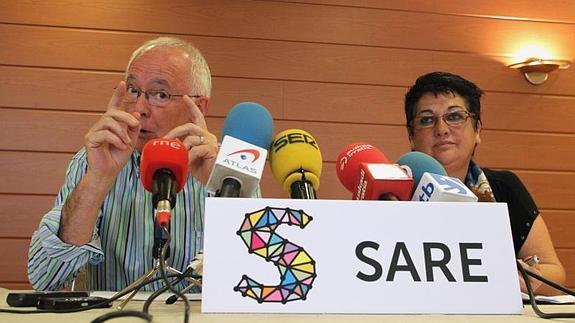
Joseba Azkarraga, spokesperson for Sare and lawyer Asun Landa, at a press conference
More recently, however, the Abertzale Left’s leadership has been placing the emphasis on combating the dispersal and, according to some of their critics within the movement, abandoning the demand for amnesty. Perhaps the leadership felt that dispersal was an issue they had the capacity to change (though it is difficult to see how), whereas without an armed struggle to use as a bargaining chip, a prisoners’ amnesty may have seemed out of reach.
Meanwhile, last year, Sare (“Network”) was created by the AL leadership to pick up the threads dropped by Herrira but little has been heard or seen of it. The organisation’s spokesperson is Joseba Azkarraga, who has a somewhat radically fragmented track record. During the 1960s and 1970s a member of ETA (a fact missing from his Wikipedia entry in Spanish), he left them and joined the christian democrat PNV (Basque Nationalist Party). Azkarra was elected to be member of the Alava province local government for the PNV in 1979, a role he fulfilled later for Bizkaia province 1982-1986 and in the latter year also for the province of Guipuzkoa — representing the PNV throughout.
In 1987 he was part of a split from the PNV that led to the formation of Eusko Alkartasuna (EA), for which party he was elected a member of local government for Bizkaia in 1989. He was a member of EA’s National Executive 1987-1993 and 1999-March 2009, in between which periods he had withdrawn to concentrate on his business in the banking sector. From September 2001 to May 2009, he had the responsibility of Councillor for Justice, Employment and Social Security for the Basque Government. He has been quoted as saying that the more prosecutions of Abertzale Left activists the better – this from a man with a law degree in a State where prosecutions of Basques are more often than not ensured by “confessions” extracted by torture and where the standard of “evidence” required to convict is derisory.
Grumbling, particularly among younger activists about the emphasis on the institutions and the “abandonment of the street”, has been growing over the years. “Our movement’s spokespersons no longer speak of ‘freedom’ and ‘socialism’ but use more ambiguous words like ‘right to decide’ and social justice’ ” is a growing complaint.
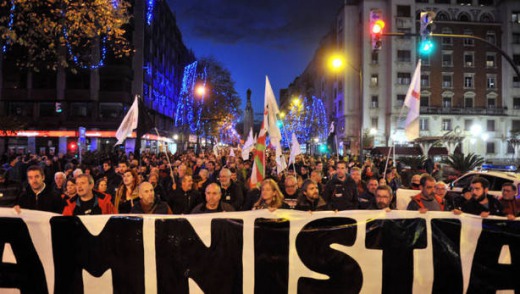
Recently an organisation called Amnistia Ta Askatasuna (“Amnesty and Freedom”) was launched to campaign not only against dispersal but for amnesty for the prisoners too. The movement also goes by the name of Amnistiaren Aldeko Mugimendua (“Amnesty Movement”). In August of this year ATA/AAM held a small but significant demonstration in Bilbao associated with the annual alternative festival there which is strongly patronised by youth. At the end of November they held another in the same city, this time attended by an estimated 9,000.
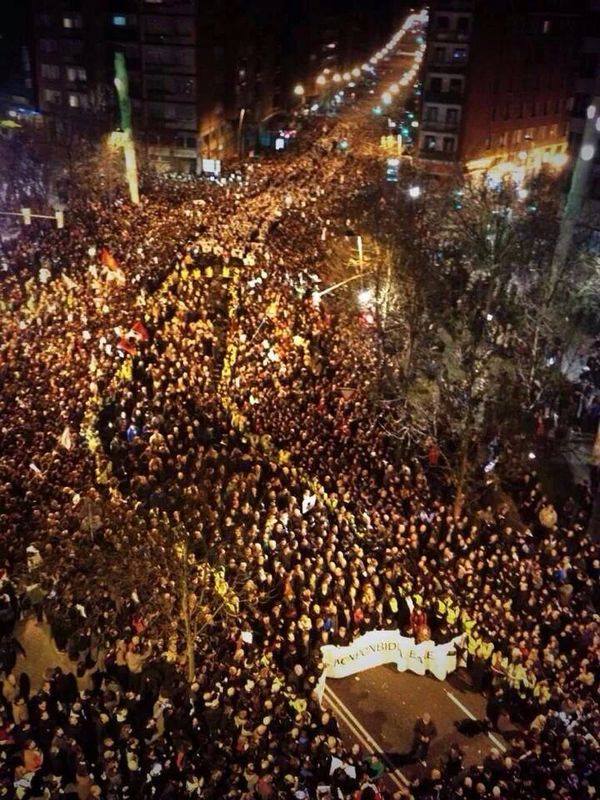
New solidarity campaign for for political prisoners raising demand of amnesty takes to the streets Bilbao 28 November 2015
In a Basque alternative radio station interview in August, some of ATA/AAM’s spokespersons complained of attempts to malign and isolate them but said they were overcoming these tactics and gaining support. The AL’s bilingual daily newspaper, GARA, did not publicise their demonstration in advance and their estimate of the attendance afterwards was about half of the real figure. The report also neglected to mention the messages of support from a number of political prisoners to the rally.
In December, the six alleged ETA prisoners awaiting trial in Paris on charges involving kidnapping, car and weapons theft and, for two of them, murder of a police officer, made a press statement denouncing the ATA/AAM group and claiming that they were using the prisoners as a Trojan horse in order to attack the whole recent direction of the Abertzale Left. They also accused them of trying to get Basque prisoners to leave the prisoners’ collective, the EEPK. No evidence was produced of this and the ATA/AAM were not asked to comment. GARA published the Paris statement under a headline containing the allegations without even putting them in quotation marks. It is rumoured that GARA lost many subscribers after that reporting.
It seems likely that this controversy will sharpen over the coming months with people, including prisoners, being obliged to take sides and it may be that it will be characterised by a similar bitterness to that which exists in the Republican movement in Ireland. But unlike the case of Ireland, the numbers of Basque prisoners in the jails remains very high. In addition, the Spanish state continues to jail people who are clearly political activists which adds to the political prisoner population. Without a change in that situation, the likelihood of very serious contention within the movement is high and on a much larger scale than has been the case in Ireland.
The recent dismal electoral showing of EH Bildu can only increase unhappiness within the movement and lead to judgements critical of the AL leadership and, inevitably, to one degree or another, of the path they openly set out upon a little over five years ago.
Background – the origins and trajectory of the Abertzale Left
Born during the Franco dictatorship, the Abertzale Left (Basque: Ezker Abertzalea; Spanish: Izquierda Abertzale) is a broad alliance of patriotic and Left elements with many aspects situated on the social, cultural-linguistic, trade union, media and of course political fronts. The movement was subject to heavy repression from the outset and after nearly a decade a section responded by taking up arms. The Basque Nationalists had done that against Franco in the Civil War – however, the Abertzale Left was doing so in a country occupied by the victors of that war.
Not many outside the Basque Country realise that ETA (“Basque Country and Freedom”) is more than “the armed wing of the Basque patriotic movement” — it is the origin of the Abertzale Left, operating solely politically and culturally (albeit clandestinely) for nine years, its activists spied upon, arrested, tortured, jailed. Eventually ETA took up the gun.
It was one of the main ideologues and organisers of ETA, José Miguel Beñaran Ordeñana (alias “Argala”, 1949 – murdered by GAL 21st December 1978) who pushed for the legal and semi-legal aspects of the work to form themselves into separate organisations from ETA while the parent organisation kept a relationship with them.
Although the old Basque Nationalist Party was legalised under the new form of the state after the death of Franco, repression of the Abertzale Left continued. Nevertheless the movement continued to grow, in particular its many non-military aspects, although they too were and are subjected to heavy repression.
Despite the adaptability of the movement and its significantly wide base (between 12%-20% on past electoral showings, despite banning and disqualifications of electoral platforms), it was difficult to see the validity of its strategy of combining armed struggle and popular political movement within the Basque Country, with regard to its long-term objectives of national independence and socialism.
The ruling classes of both the Spanish and French states have a long imperial history along with a strong traditional insistence on the unity of their “home” states, on which they have never shown a willingness to compromise. That is reflected not only within their main right-wing parties but also within the main social-democratic parties and the remains of the old Moscow-orientated Communist parties. In the Spanish state the situation is even more problematic, since the Basque Country and Catalunya are two of the most economically successful within the state, outperforming nearly every other region by a significant margin. Why would the Spanish ruling class wish to give those regions up?
The total Basque population is only around 3.5 million, some of which is within the borders of the French state. The Spanish state has a population of around 45 million outside the Basque Country and even with the subtraction of that of Catalunya (7.5 + million) and the Balearic Islands (just over one million), that still leaves a population of 36.5 million from which to draw soldiers and police.
According to Wikipedia, “the Spanish armed forces are a professional force with a strength in 2012 of 123,300 active personnel and 16,400 reserve personnel. The country also has the 80,000 strong Guardia Civil which falls under the control of the Ministry of Defence in times of a national emergency. The Spanish defence budget is 5.71 billion euros (7.2 Billion USD) a 1% increase for 2015.” The Wikipedia paragraph ends with the ominous sentence that “The increase comes due to security concerns in the country.”
Those figures of course do not include the other police forces, such as the National (Cuerpo de Policía Nacional or “los Grises”)), with a strength of nearly 88,000. This armed force, along with the Guardia Civíl (“los Verdes”), has been traditionally repressive of the Abertzale Left, a task now mostly left to their respective forces in the Basque Country, the Ertzaintza and Policía Forál, forces which, like their counterparts in Catalunya, the Mossos d’Escuadra, have been viciously engaged in repression of the patriotic movements. Then of course there are the municipal police forces inside the Basque Country and elsewhere which can be mobilised as backups to military operations.
Add to that the fact that Nafarroa (the fourth southern Basque province) contains significant Spanish unionist and right-wing elements (it has voted a PP majority for decades) and that much of the Basque Nationalist Party’s following is hostile to the Abertzale Left and it is difficult to see how the AL ever expected to win a straight contest of strength with either state.
Perhaps, like the Irish Republican Movement, with which it has traditionally had fraternal relations, the Abertzale Left thought to make itself such a nuisance to the power occupying it that the latter would get fed up and leave them to it. In both cases but even more obviously so in the case of the Basques, that would have been a serious misreading of the situation and an underestimation of the importance to the power in question of remaining in possession.
It seems clear that the only scenario in which the Basque Country could set up a truly independent state would be one in which the Spanish state at the very least (and probably the French one too) would be unable to send repressive forces in to deal with such an attempt. And what would be the nature of such a scenario? Why, nothing less than that the ruling class of the Spanish state (probably of the French state also) were facing a revolutionary situation across the rest of its territory. Not only would such a situation tie down much of its armed forces but it would have the potential for soldiers refusing to fire on workers, mutinies and defections to revolutionary forces.
Working from such an analysis, activists of the Abertzale Left, as well as organising their movement within the Basque Country, would have been busily building relationships with the revolutionary movements and organisations across the Spanish state. But apart from the electoral alliance for the European Parliamentary elections of 2009 (the creation of the Iniciativa Internacionalista platform, which was the victim of massive electoral fraud by the State), the Abertzale Left has never seriously set about such a project. On the other hand, the formerly-Moscow orientated communist party and left-social democrats across the state, as noted earlier, have also kept at a distance from the Abertzale Left and from their aims. The left coalition of mostly Trotskists, Communists and radical social democrats of Izquierda Unida has done likewise.
There are however small formations of revolutionary communists, anarchists and left-independentists, along with anti-centralist movements with revolutionary potential, as well as a number of anti-unionist and independent trade unions throughout the state. To be sure, the immediate prospects are not glowing – but what other option is there? And how else can one be placed to take advantage of a revolutionary upsurge across the state should one occur?
A significant deviation from the original route
During the 1980s, during an ETA truce, there were peace talks held between ETA and the Spanish Government which came to nothing. Similar overtures during the early 1990s had similar results.
It appears that at some point in the late 1990s, perhaps attracted by the development and apparent gains of the Irish pacification process, the leadership of the Abertzale Left began to look for a different way out of their difficulty. Arnaldo Otegi is widely seen as the architect of this trajectory.
Part of this new approach involved seeking alliances with the PNV and with social-democratic parties within the Basque Country. The PNV is the party of the Basque nationalist bourgeoisie, no longer prepared to fight the Spanish ruling class as it was in 1936. It has its capitalist interests and has a record of jobbery and corruption including its involvement in the TAV, the High-Speed Rail project. It even asked the Spanish state to make militant opposition to this project a terrorist offence. The PNV manages its police allocation, the Ertzaintza, a vicious force active against the Abertzale Left and against striking workers and responsible for the serious injury and death of several. The PNV also manages the Basque TV station EITB and therefore controls both the arms of repression and of propaganda. Although the AL criticises the PNV from time to time this is mostly for the lack of support for a broad front against the Spanish state – AL spokespersons rarely attack it for its capitalist exploitation or jobbery.
Otegi was apparently active with ETA in the French state for around ten years and served three years in a Spanish jail for an ETA kidnapping in 1987, after which he involved himself in political activism. Ten years later the jailing for seven years of senior members of Herri Batasuna left a vacuum in the leadership of the organisation which Otegi filled along with Joseba Permach (sentenced to three years jail in August 2014 – but halved on appeal — in the “social centres trial” which confiscated the assets of the centres) and Pernando Barrena.
Arnaldo Otegi, leading figure in the Abertzale Left and seen as architect of recent path of the movement, addressing a rally some years ago.Joseba Permach and Pernando Barrena giving the clenched fist salute at a political rally some years ago. Both have been close colleagues of Otegi’s in the Abertzale Left’s leadership and shift in strategy some years ago
Otegi led a number of initiatives for the Abertzale Left to embark on a different path, which combined ETA ceasefires, talks with other parties, and militant rhetoric. The latter landed him with a 15-month sentence of which he eventually served one year. Subsequently he has been arrested a number of times, convicted twice and exonerated twice. In 2011 he was charged with trying to rebuild Batasuna, the AL party banned by the Spanish state and was sentenced to ten years; this was reduced on appeal to 6.5 years so that he is due out soon. In 2013 he was elected General Secretary of the AL social-democratic political party Sortu.
Despite the relatively short prison sentence (compared to many other Basque prisoners) and the fact that he appears to be in good health, a campaign was started for Otegi’s release and a petition circulated around and outside the movement. This broke a long-standing rule in the movement that there would be no campaigning for individual Basque political prisoners, from which an exception was previously made only in the cases of seriously-ill prisoners. Nevertheless the campaign petition and Facebook page has been circulated through the movement without any official condemnation — or even distancing from — by the AL leadership. However the campaign has attracted some muted criticism across the movement.
The AL leadership proposed a “peace process” but the problem was that, unlike the case with the British, the Spanish ruling class had no interest in developing anything like that. Their aim was to crush the movement with an iron glove, not to “choke it with butter” as their British counterparts had done.
So the Abertzale Left took the road of unilateral ceasefire. This seemed to many of their friends a doomed tactic since it left the Basques with nothing to bargain. In September 2010, ETA announced a ceasefire, saying it wished to use “peaceful, democratic means” to realise the aspirations of the Basque people. The Spanish state’s reaction was not encouraging but nevertheless on 20th October the following year, the organisation announced a “cessation of armed activity”. This followed the conclusion of the “International Peace Conference” held in Donostia/San Sebastián.
The composition of the conference was clear indication of the AL leadership’s projected route and in particular the type of allies it sought internationally: former UN Secretary-General Kofi Annan, former Taoiseach of Ireland Bertie Ahern, former Prime Minister of Norway Gro Harlem Brundtland, former Interior Minister of France Pierre Joxe, President of Sinn Féin Gerry Adams and British diplomat Jonathan Powell, who had served as the first Downing Street Chief of Staff. To summarise, a collection of servants and executives of imperialism, colonialism, capitalism and even executives of repression and one exposed in a financial corruption scandal.
The declaration at the conclusion of the conference was also supported by former UK Prime Minister Tony Blair, former US President Jimmy Carter and the former US Senator and former US Special Envoy for Middle East Peace George J. Mitchell. In other words, former leaders of US and British Imperialism and one of their agents.
Despite the abandonment of armed struggle by the Abertzale Left leadership, the meeting did not include Spanish or French government representatives and the ruling classes of both states remained unreceptive to the overtures of the AL leadership. Not only that, but the Spanish state continues to arrest the movement’s activists, to torture and to jail them. No amount of criticism by committees for the prevention of torture working for the UN or for the EU, nor condemnation by Amnesty International and many human rights associations within the Spanish state, have had any visible impact on the operations of the Spanish state in recent years. And “confessions” obtained by torture continue to be used as admissible ‘evidence’ for the Prosecution even when withdrawn by the victim and the torturers denounced in court.
The ETA ceasefire continues to date and a number of other statements have been made by ETA including one in which they announced the destruction of a number of weapons, verified by a decommissioning expert. A number of “international conferences” have been held with further calls on the Spanish state to cooperate, also without significant result.
Xabat Moran, Bergoi Madernaz, Marina Sagastizabal, Aiala Zaldibar and Igarki Robles, five of the seven Basque youth sentenced to six years by the Audiencia Nacional (special Spanish Court) last Spring, have been freed this Wednesday.
Translation of press report NAIZ|from MADRID|2015/11/04|5 IRUZKINel juicio. (J. DANAE/ARGAZKI PRESS) and comment from https://www.facebook.com/dublinbasque/posts/1063431863690750
Xabat Moran, Bergoi Madernaz, Marina Sagastizabal, Igarki Robles and Aiala Zaldibar were sentenced to six years together with Ibon Esteban y Ainhoa Villaverde.
During the afternoon it emerged that the five would be freed, hours after the Supreme Court made held a public hearing in which the State Prosecutor left the possibility of reducing the sentences in the hands of the Tribunal, while the Defence asked for the accused to be cleared of all charges.
Most of the 28 youth accused of membership of SEGI outside the Court on the first day of their Madrid trial
The five have left prison and began the journey home.
The exact content of the Supreme Court’s decision is not yet known and whether this will affect the situation of Ibon Esteban and Ainhoa Villaverde is not yet known.
Twenty-eight youth were accused of membership of SEGI, the Basque Abertzale Left youth group and tried in the same trial, of which the Prosecutor withdrew charges against twelve. Later, others were discharged due to lack of evidence and in the end seven were sentenced to six years.
Villaverde, Moran, Sagastizabal and Madernaz were detained by the Ertzaintza (Basque police) before their sentences were announced, while Esteban, Robles y Zaldibar became fugitives, only to reappear in the “Human Wall” in Gastheiz/ Vitoria, where they were arrested.
End item.
Comment:
While friends and relatives will of course celebrate the decision, one commentator said: “The point for the Spanish state is to close down all legal political outlets in terms of campaigning around human, civil and political rights in the Basque Country. That leaves only the armed struggle, with which in recent decades ETA (Homeland and Freedom) has been clearly unsuccessful.”
A finding of guilt against these political activists needs to be seen in the context of the jailing of a number of political prisoners’ lawyers not so long ago and the currently ongoing trial of five political activists of Askapena, the organisation with responsibility for coordinating international solidarity work from and for the Basque Country.
For four years now ETA has been on the “permanent ceasefire” it announced at the time, yet Basque political activists continue to be charged with “assisting terrorism” or “glorifying” it.
“Human wall” in Navarra (Nafarroa), October 2013
Another point to bear in mind is that when the 28 youth, including those against whom the State later withdrew charge or the Court found “not guilty”, were originally arrested in October 2014, it was in a heavy military-style operation, they were taken from the Basque Country to Madrid, held incommunicado and a number were tortured. Then when bailed, they had to return to Madrid later to face trial, they and their supporters having to pay for travel and accommodation. The Spanish state does not have a record of paying compensation to those it has wrongfully accused or even imprisoned, not to speak of tortured, except on occasion under orders from the European Court of Human Justice in Strasbourg.
The “Human Wall” was a tactic developed and employed mostly by Basque Youth as a civil disobedience tactic, beginning in 2013 and lasting until 2014. Typically, the person wanted by the authorities appeared in the middle of a large crowd of supporters who linked arms. The police (in all those cases, the Ertzaintza) were obliged, in order to detain the fugitives, to spend a number of hours breaking up the “human wall” in order to obtain their objective and hand the fugitive over to the Guardia Civil, all the time being denounced by those forming part of the ‘wall’ and protesters standing by, the whole event being filmed and photographed, reaching an international audience. Variations on the “Wall” were practiced in Donosti/ San Sebastian, Gastheiz/ Vitoria, Pasaia, Navarra and Gernika. http://www.naiz.eus/eu/actualidad/noticia/20151104/queda-en-libertad-xabat-moran-uno-de-los-siete-condenados-por-la-an
With the Spire in the background, supporters calling for the release of Ibrahim Halawa display placards in Dublin’s main street. (Photo: Ian O Kelly)
People clustered around the Spire structure in Dublin’s O’Connell Street on Friday 2nd October, many of them displaying a placard with the digits “777”, sometimes nothing else. But some also held an enlarged photo taken of a Dublin youth of Arab extraction, Ibrahim Halawa. Members of his family and community were there too with a banner, as were a relatively small number of supporters, including some Left and Republicans.
Colm O’Gorman, CEO Amnesty Ireland, with two of Ibrahim Halawa’s family in O’Connell Street, Dublin’s main street. The columns of the iconic GPO are on the right as a Dublin Tour bus passes. (Photo: Ian O Kelly)
Colm O’Gorman, CEO of Amnesty Ireland gave interviews to media personnel present and so did Lynn Boylan, Sinn Féin MEP and of course some members of Ibrahim’s family. Curiously, no leaflets were handed out to explain to passers-by what the rally was about. Nor were there speeches to inform even those gathered there about the background to the case or progress or what people could do to help further.
Dublin Anti-Internment Committee activists support the picket, photographed here with members of the Halawa family. (Photo: D. Breatnach)
Ibrahim Halawa was 17 years of age and on holiday in Egypt nearly two and half years ago when arrested, apparently for participating in a demonstration banned by the Egyptian regime. He may have been a conscious participant or may merely have been swept up in it in passing. But now he faces a possible death sentence if found guilty. Another 420 are also charged, some of them with murder or attempted murder during an attack on a police station on the same day. Ibrahim was arrested with his three sisters but they were granted bail and permitted to return to Ireland after three months.
Friends and relatives were hopeful that the trial would proceed as scheduled at the weekend but on the day some of the defendants were said to be seriously ill and the state declined, despite Defence counsel requests, to proceed without all defendants being present. Defence counsel have now also submitted a motion for all to be released, since they have served two years without the State bringing them to trial – this motion is under consideration by the court at present.
Supporters of Ibrahim Halawa with placards in front of Dublin’s Spire, with Lynn Boylan furthest left in picture. (Photo: Ian O Kelly)
The reason for serious illness among prisoners may well be conditions in the jail (which are believed to be atrocious and were described as “trying” by the Irish Department of Foreign Affairs’ representative after an earlier visit to Halawa in jail), coupled with punishment beatings which, according to one of Ibrahim’s sisters as reported by a human rights campaigning website, the Dublin youth has also received.
The Department has taken up the Dubliner’s case with the Egyptian authorities and it is almost certainly its intervention that has gained Halawa’s transfer to a better cell. Three Al-Jazeera journalists were sharing that facility after conviction in Egyptian court but all those have now been released and left Egypt. Others, including former President Hosni Mubarak and members of his family have also been released.
Charlie Flanagan, the Minister for Foreign Affairs, stated that he was “disappointed and concerned” at the adjournment, which is diplomatic language for “really pissed off”. He claimed that his department is doing all that they can. Perhaps they are – but is the Government as a whole? Would the threat of expulsion of a few Egyptian diplomats not gain the release of Ibrahim Halawa? Or perhaps the threat of a tourist embargo?
The relatively small numbers at the Dublin rally were probably due to it being called for 3pm on a Friday afternoon, i.e within office working hours. But there may be more to it than that – this case has not been generally pushed in Left and Republican political circles, nor indeed in the liberal human rights sector. Very recently some of Ibrahim’s Dublin Arab community held a protest at the GPO against the Egyptian regime getting ready to streamline its trial and death sentence procedures in order to facilitate the hanging of more political dissidents. It was notable that every single one of those on the protest was Arab in appearance. The word ‘on the street’ is that Ibrahim and members of his family belong to a religiously fundamentalist group. Whether true or not, this does not of course diminish his human rights one iota – but unfortunately it may diminish the enthusiasm of some on the Left to support him.
Amnesty International Ireland was the body that organised the rally. Their website said that they were calling “again” for the release of Ibrahim but it seems that this is the first time they have organised a rally for him in nearly two and a half years.
Some of Ibrahim’s relatives and others of their community in protest at Egypt’s streamlining of conviction and execution processes some weeks earlier outside the GPO. (Photo: D. Breatnach)Poster of the Stop Egypt Executions campaign
Generally the states in the West support the current Egyptian regime and the USA very much so. In turn, the Egyptian regime is very pro-Western and its armed forces very dependent on the USA, its main arms supplier. This friendship towards or dependency on the USA has been demonstrated in a number of way over the years and one of the most significant has been its policy towards Gaza.
The besieged Palestinian enclave, which has been called “the biggest concentration camp in the world”, has two land border exits, one of which is controlled by Egypt and the other by Israel. But Egypt has for years, under different governments, been restricting what and how much can go through its Rafah Crossing, more or less in line with Israeli prohibitions or restrictions, which include forbidding cement much in demand to repair the huge damage of Israel’s bombardment to housing, hospitals, schools, roads, bridges, reservoir, sewage treatment facility ….. and fuel for heating, electricity generation …. The resourceful Palestinians dug tunnels under the border wire to circumvent Egyptian restrictions but the Egyptian regime has demolished these in the past and recently flooded them.
It is important for the Irish Left and all democratic people to show solidarity with Ibrahim and his family. It should not be ok for the Egyptian government to behave in the way it does and we should protect those that we are able to protect from them. That ability is strongest in cases where the citizenship of the victim is Irish. The Government needs to up the pressure on the Egyptian authorities and we need to up the pressure on our Government to achieve that. Those republicans, socialists and democrats who are tempted to pick and choose the recipients of their solidarity would do well to reflect on the oft-quoted words of Pastor Martin Niemoller.