HOW TO WIN THE WAR – GETTING INTO POSITION

(Reading time: Introduction, one minute; Part One: 5 mins; Part Two 2 mins: Part Three: 3 mins; Part Four: 2 mins; Total: 13 mins.)

Diarmuid Breatnach

INTRODUCTION:

Although I often think about the big questions – and am generally guided by my philosophy on them, my mind and energy are usually too occupied with specific struggles to focus on them for long. Recently however I had the opportunity and the need to think about the war, the one we have yet to win.

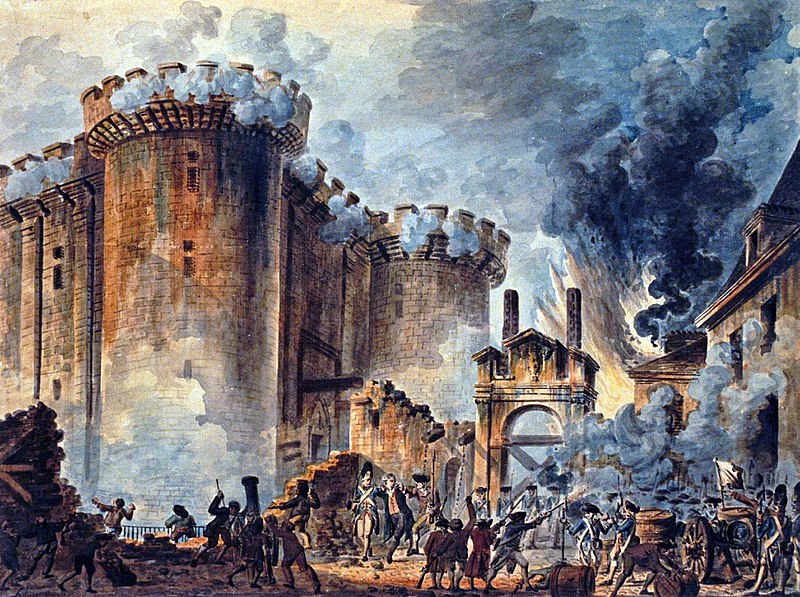
Storming Bastille Painting Jean-Pierre Houel
The Storming of the Bastille (translation), French Revolution, 1789 by Jean-Pierre Houel. (Image sourced: Internet)

But to which war am I referring? The Irish war of national liberation that has been flaring up for centuries, being lost each time before flaring up again? Or the class war, which has had a few sharp Irish episodes but has been, for the most part in Ireland, in abeyance? The answer is BOTH, though it may seem that my emphasis in the discussion, certainly in the early part, is on the national liberation war.

In order to imagine how we might win, it is helpful to examine past struggles and analyse what went wrong with them. Pessimists love to focus on those things I know – but in order to push us towards reformism or just surrender; my approach instead is from a revolutionary perspective.

Generally, Socialists analysing the class struggle don’t even ask themselves why we have not had a revolution yet. From week to week, month to month, they tend to focus on this or that particular trade union or social struggle but without going into the big picture. It seems as though they can’t even imagine a socialist uprising in Ireland, it’s just too far away to think about, apparently. But if one can’t even imagine such a revolution, how could one consider the necessary steps to get there?
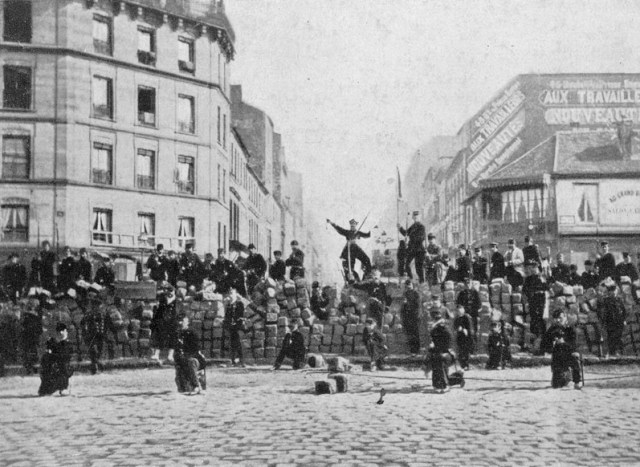
Communards Paris Barricade 1871
Communards at barricade, Paris Commune 1871. (Image source: Internet)

Irish Republicans on the other hand are often thinking in terms of revolution, usually including armed struggle. However it seems to me that Irish Republicans don’t like analysing past failures of the movement but when they do, their verdicts tend to be that the leaders betrayed the struggle or that taking part in public elections corrupted the movement; or that infiltration, spies and informers was the problem. And some other reasons. The thing is, although all those things played a particular part, they are not the fundamental reason.

Defeat Rebels Vinegar Hill Drawing George Cruikshank
“Defeat of the Rebels at Vinegar Hill” by George Cruikshanks, i.e United Irishmen last major position in Wexford overrun, 1798.

PART ONE: THE THIRTY-YEARS’ WAR – DOOMED TO LOSE

(Reading time this section: less than 5 minutes)

Free Derry Corner Gas Mask Images
Derry Monument and Mural of the Civil Rights struggle which preceded the armed struggle in the Six Counties. (Image sourced: Internet)

          The national liberation war that began in 1969 in the Six Counties and ended in 1998 (though some armed incidents continue from time to time) began as a civil rights struggle and changed into a war of communal defence and of national liberation. The military part of the struggle for the most part took place in the occupied Six Counties. The political element of the struggle was waged all over Ireland (and abroad) but in the main consisted of support for the struggle in the Six occupied Counties.

Fought in that way, the struggle was bound to lose. It could never win. How could anyone imagine that they could win a struggle fought against a world power in one-sixth of the country, where even the population there was divided against them? What could they have been thinking?

To my mind, there are only two possible sane replies to that question, which is that they believed: 1) that the British ruling class would get worn down by struggle and leave and/ or 2) that the Irish ruling class would intervene in some way to assist the struggle and make continued British occupation untenable.

1) ‘The British ruling class would get worn down and leave’: This theory must have depended on British repression being condemned abroad and being unpopular at home but had to rest fundamentally on the British having no great stake in continuing its possession of its colony there.

Anyone who thought that (and there were many who did and still many who do, not just Irish Republicans) made a fundamental error. Time and again the British ruling class has shown its determination to hang on to what might be considered its first colony, even as the ruling class’ composition changed from feudal-colonialist to capitalist-imperialist and as the world changed around it.

Collusion State Murder Mural
Mural in nationalist area in the Six Counties (Image sourced: Internet)

Even when the British ruling class, weakened by WW1 and facing an Irish guerrilla war which enjoyed the support of the vast majority of Irish people, with national liberation uprisings breaking out across its Empire and with its repression in Ireland increasingly unpopular at home, entered into negotiations with the Irish resistance, it held on to a foothold, the Six Counties.

Subsequently, it had that colony managed in a permanent state of emergency laws, with institutionalised sectarian discrimination at all official levels and outbreaks of pogroms in the street and workplace.

That became even more exposed during the civil rights struggle and the national liberation war that followed when the British State compromised whatever good international reputation remained to its Armed Forces, its judiciary, its legal establishment, its media and its very legal framework.

Even now, when many believe that the Good Friday Agreement means that a 50% plus-one-vote in favour in the Six Counties will be sufficient to end Partition, they do not realise that such a decision will have to also obtain a majority in the British Parliament and be endorsed by the British Monarch. They are also forgetting the broken promises that surrounded Partition in the first place.
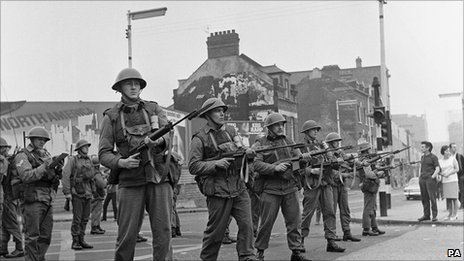
British Soldiers Helmeted Belfast 1969
British Army in Belfast 1969 (bayonets and guns pointed towards nationalist area). (Image sourced: Internet)

When analysing what holding on to the Six Counties has cost the British State in terms of reputation, military and financial contributions, one can only rationally assume that continuing to hold on to that foothold is of great importance to the British State. One may speculate as to the reasons underlying that but the central fact cannot be denied.

2) ‘The Irish ruling class would intervene in some way to assist the struggle and make continued British occupation untenable’:

There was some basis for this belief in that a section of Fianna Fáil, a party that had emerged from a split in Sinn Féin in the 1930s and had become one of the mainstream parties in the Irish state, had retained some traditional commitment to seeking a united Ireland. However it was a thin enough basis on which to depend in a national liberation struggle since that section had no majority within the party itself, to say nothing of the foreign-dependent nature of the Irish native capitalist class, the Gombeens, as a whole.

The question came to a trial of strength in the Arms Crisis of 1970, in which at least two Fianna Fáil Government Ministers were involved in secretly buying arms for the defence of nationalist areas in the Six Counties (since the IRA had insufficient weapons at the time) from rampaging Loyalist mobs and the Royal Ulster Constabulary (including the part-time B-Specials). The Ministers alleged that they had acted in the full knowledge of the rest of the Government. By the time the whole affair was over, two Ministers had been sacked and another two resigned in protest.

If it had not been clear before that the Gombeens, the native Irish capitalist class was no patriotic capitalist class but rather a neo-colonial one, it should have been clear after that. But the armed struggle in the Six Counties intensified, especially after the massacres of unarmed civilians carried out by British Paratroopers the following year, 1971 in Belfast and again in Derry in 1972. And the war lasted until 1998.

If, as had been demonstrated to be the case that the British ruling class were determined to hold on to the Six Counties and the Irish ruling class was not going to seriously challenge that possession, did the Republican movement have any other option than to fight on a war that they could not possibly win?

I am clear that it did.

Clearly, in order to have a chance of success, the war had to be extended to the other five-fifths of the country, which is to say into the territory under the control of the Irish native capitalist class. This class had seized power after the War of Independence (1919-1921) and had beaten and suppressed its opposition during and after the Civil War (1922-1923) and furthermore was supported by a powerful ally, the Irish Catholic Church. Since the founding of the first Irish Republican organisation, the United Irishmen of the late 1790s, the Catholic Church hierarchy had opposed Irish Republicanism; it had condemned four Irish priests who participated in the uprising of 1798, excommunicated the Fenians, had at first condemned the 1916 Rising and the War of Independence only to latch on to it at the end along with the Gombeen class.

The general Irish population likely would not have supported or sustained an armed struggle in the 1970s against the Gombeen class but that class could have been fought politically, through agitation and mobilisation, on many social, political and economic fronts. Without going into the specific details of each, these were:

  1. against the huge wastage of Irish youth through emigration

  2. to remedy the shortage of affordable housing (which in part contributed to the above)

  3. to end unemployment (also contributing hugely to emigration)

  4. to raise the level of wages and lower wage earners’ taxation

  5. for the right to divorce

  6. for equality for women in law

  7. for the right to contraception devices and medication for men and women

  8. against decriminalisation and for equal rights for gay and lesbians

  9. to halt the decline of the Irish language, in particular of the rural Irish-speaking areas

  10. to improve services for the rural areas

  11. to oppose the open-door policy for foreign multinationals to exploit Irish natural and human resources

  12. to secularise the education service

  13. and the health service.

  14. to remove the privileged status of the Catholic Church within the state.
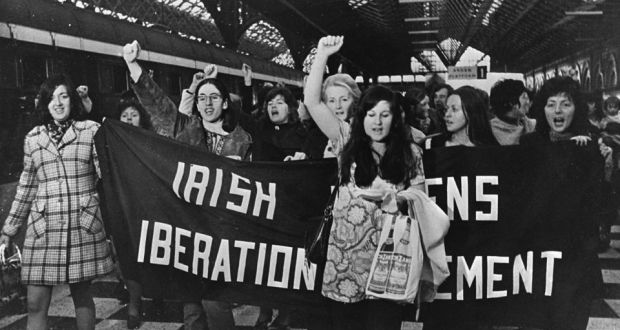
Irish Womens Liberation Connolly Station
Irish women photographed at Connolly Station 1971, about to board train to Belfast to purchase contraceptives to bring back to the Irish state, illegal at the time. There was no right to abortion either or divorce and a husband’s signed permission was necessary to take out a hire purchase agreement. (Image sourced: Internet)

The Republican movement in general, with some exceptions, declined to take on any of those struggles. They did not organise in the trade union movement, left the social struggles to others and most of all, declined to take on the Catholic Church on any issue except its opposition to the national liberation struggle. Even there, it was happy to publicly avail of the services of members of the Church clergy who supported them. Republicanism was, from its very beginning, as well as anti-monarchist, about separation of Church and State but it was difficult to see that in the Irish Republican movement, particularly after the War of Independence.

A full half of those fourteen points above (nos. 5,6, 7, 8, 12, 13 and 14) would have meant taking on the Church head-on and no doubt the hierarchy would have hindered the struggle over most of the others too, due to its strong links with the State and its ruling class.

Because of its tactical and no doubt ideological refusal to take up those struggles, the Republican movement could do little more in the 26-County state than to agitate for solidarity with the beleaguered nationalist population inside the British colony.

Though this could be effective for a time it could not become a mass movement, nor survive a long struggle, without any remedy being sought for the issues facing the population within the state.

The wonder is not that the majority leadership of the Republican Movement threw in the towel on the military struggle in 1998 but that they had waited so long to do it. Of course, they never admitted the true nature of what they were doing: abandoning the armed struggle and revolution in total and instead, using their negotiating position to advance themselves politically – not in the economic, social and political struggle envisioned above but rather in a political struggle to find themselves a place among the Gombeen political class in the Irish state and as accomplices in the governing of the colonial state.

PART 2: COLLECTING THE FORCES FOR REVOLUTION

(Reading time this section: 2 minutes)

          A successful revolution in Ireland, as in most places, would require the involvement of a mass movement. That mass movement would be unlikely to be one that had national self-determination as its only aim – certainly not in the 26 Counties (the Irish state). Mass movements arise at times around different issues and exist as long as the issue does or instead until the movement gets worn down or broken up. Such movements arose around the Household Tax and, later, around the additional Water Charges.

Water Protest Long View 29 Aug 2015
Section of protest against water charges, O’Connell Street, Dublin, 29 Aug. 2015 (Image source: Internet)

Even though the objectives of such movements are often not revolutionary, the participation in them by revolutionaries is necessary if, in the future, there is to be a revolution. Revolutionary activists can make contacts and prove themselves by the way they participate whilst at the same time pointing out that a revolution is necessary in order to resolve all these issues completely and permanently. Such activists can also influence the movement (or sections of it) to act in more revolutionary ways, so that the movement can be guided by – and imbued with — revolutionary spirit.

Working people in struggles come up against concrete problems which need to be resolved in order to move forward. Prior to 1913 in Ireland, workers learned the need for unity in struggle which was emphasised by the employers’ attempts to break the Irish Transport and General Workers’ Union in August 1913. The attacks on them by the Dublin Metropolitan Police illustrated the need for organised defence and Larkin and Connolly called for the formation of what became the Irish Citizen Army, which later also fought prominently in the 1916 Rising.

Packed Workers Liberty Hall 1913
Members and supporters of the Irish Transport & General Workers’ Union cheering outside the union’s HQ, Liberty Hall, August 1913. Later the union formed the ICA to defend themselves from the DMP; the ICA took a prominent part in the 1916 Rising. (Image source: Internet)

Trade unions are the only mass organisations of the working class in Ireland and it is necessary for revolutionaries to be active within them. Currently, other than social democrats, it is mainly members of both trotskyist parties and independent activists who engage politically with the trade unions. Those members are mostly in clerical work and their political work tends to concentrate on employment demands around wages and working conditions. When they introduce politics it is generally to get some motion passed by their branch. Also at times, they will campaign to get a perceived left-wing candidate elected to some position within the trade union bureaucracy.

None of the above are without value but they remain disjointed in terms of program and often confined to just one trade union. Not only that, but often the Left party involved will engage in order to recruit some new members and in order also to retain their own members by providing them with activity. When broad front trade union groups are formed, they tend to become an arena where the dominant trotskyist parties compete for dominance.

If we are to have a successful revolution – and in particular a socialist one – participation in the struggles of workers in the trade union movement is absolutely necessary. But participation should be primarily among the rank and file of the trade union and also across trade unions, focused on providing solidarity to members of whichever union is in struggle – in addition to encouraging unorganised workers to organise and become active. The objective is not to help make one trade union or one section more militant but rather to create a militant workers solidarity movement within the whole trade union movement. It is essential to have members in the ‘blue-collar’ work unions or departments as well as in the clerical unions or sections. And the cross-union organisation I advocated should be independent — the preserve of no political party.

Participation in such struggles provides an opportunity for revolutionaries to make contact with people who are activists but not yet revolutionaries and to give those people an opportunity to evaluate the revolutionaries in terms of their actual practice. Revolutionaries can support the people struggling for worthwhile reforms while at the same time pointing to their partial and temporary nature. Revolutionary activists can play an educational role in the mass movements while at the same time becoming educated themselves by the daily reality faced by the masses in this system.

PART 3: THE ABSOLUTE NEED FOR UNITY – BUT WHAT KIND?

(Reading time this section: 3 minutes)

          It is, most people would think, a ‘no-brainer’ (i.e an obvious truth) that unity is necessary in the struggle to overthrow the current system. It might be thought surprising, therefore, that disunity is more the rule among those who aspire to revolution.

Generally, those who claim to be revolutionary socialists will not unite with Irish Republicans. In addition, those socialists of one party will often fail to unite with those of a different party. The same dynamic is to be seen among Irish Republicans also.

There have been many attempts to overcome this problem. In the 1930s the Republican Congress sought to unite Irish Republicans with revolutionary socialists. In the face of hostility within the mainstream Republican movement and also with divisions among the communist element in Ireland at the time, faced in addition with anti-communist hysteria whipped up by the Catholic Church, the experiment failed. The leadership of the Sinn Féin and the IRA of the later 1960s tried to combine socialism and republicanism within one party and military organisation, an attempt that crashed when it was discovered that the arms necessary to defend ‘nationalist’ community areas in the Six Counties, particularly in Belfast, were unavailable, leading to an acrimonious split in the movement. A subsequent attempt to combine the socialist and republican elements in another organisation survived a little longer but also failed for a number of reasons, some internal and also due to Irish State repression.

Shankhill Rd Republican Congress WT Commemoration 1934
Socialist Republicans, members of Republican Congress from Shankhill Road, marching to annual Wolfe Tone commemoration, Bodenstown 1934. They were attacked by conservative Republicans. (Photo source: Internet)

There have been some attempts to unite the non-republican Left itself also, which usually failed due in part to ideological differences but also to political sectarianism and personality clashes. Currently both trotskyist parties have an uneasy working relationship, the small grouping of Independents for Change exists also, the Communist Party is very small too and the anarchists are scattered and unable for years now, for the most part, to mount united action.

Attempts to unite the various parts of the Irish Republican movement have, in general, focused on creating a new organisation or absorbing activists unhappy with one organisation into another.

A frequent approach has been for some people to sit down and produce what they consider solid policy and a constitution, then to propose this format to others around which to unite. Even when accepting amendments from the elements they seek to recruit, these attempts too have largely failed.

It seems a rational approach: if we want unity, surely first we have to agree on what for, how, etc, etc before we can go into action? I believe, contrary though it may seem, that actually we should unite in action first. Uniting in action tends to break down barriers of mistrust that are built on hearsay or suspicions fostered by sectarian elements. Action also tends to clarify certain questions that until then are theoretical only. Of course, at some point, action will need to be guided by worked out policy but initially the action itself can be sufficient guide, especially since approaching the question the other way around has been so generally unproductive.
Unity Is Strength Image copy

The question then arises: with whom to unite? In general, I would say that the answer is: with all with whom we can, in actual practice, unite: different types of revolutionary socialists (including anarchists), Irish Republicans, Left social democrats, human and civil rights activists.

There are some exceptions I think necessary to mention: fascists, racists, religious sectarians and parties that participate in Government. Fascists seek to impose an undemocratic regime completely hostile to the interests of working people and, far from our uniting with them, need to be defeated; racists and religious sectarians seek to divide the movement along lines of ethnicity or religious affiliation. Revolutionaries need to draw a clear line of distinction between the movements of resistance and those who participate in a native capitalist or colonial government, i.e the management organisations of the enemy.

Many issues lend themselves to united action but perhaps none more so, and none are more essential, than against repression.

PART FOUR: UNITY AGAINST REPRESSION

(Reading time this section: 3 minutes)

          All revolutionary movements – and many that are progressive but not revolutionary – face repression at some point in their existence. Not to recognise that fact and to have some kind of preparation for it, even if very basic, is indicative of a non-revolutionary attitude to the State. Nor have we any reason in Ireland to be complacent on this question.

The Irish State turned to military suppression in the first year of its existence as did also the colonial statelet. Detentions, torture, murders and official executions were carried out by Free State forces over a number of years, followed by censorship and arrests, all facilitated by emergency repressive legislation. In the Six Counties, in addition to similar even more repressive legislation, there were two sectarian militarised police forces and sectarian civilian organisations.

After a change of government, the Irish State introduced internment without trial during the Emergency (1939-1946), the Offences Against the State Act in 1939, Special Criminal (sic) Courts in 1972 and the Amendment to the OAS in that same year.
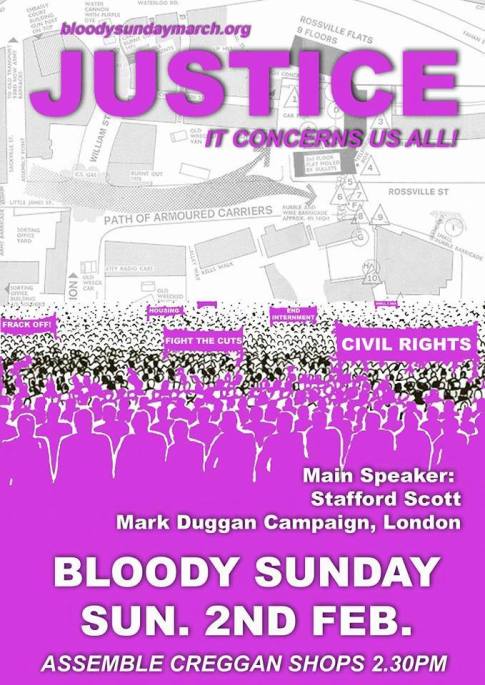
Bloody Sunday march Derry 2014
Poster for 2014 Commemoration of Bloody Sunday massacre, Derry 1972. The poster calls for unity. (Image source: Internet)

The Six County statelet had the Special Powers Act (1922) and brought in internment without trial in 1971 (the Ballymurphy Massacre that year and the Derry Massacre the following year, both by the Parachute Regiment, were of people protesting the introduction of internment). The statelet also introduced the Emergency Provisions Act and the no-jury Diplock Courts in 1973 and, though technically abolished in 2007, non-jury trials can and do take place up to today.

The British state targeted the Irish diaspora in Britain in 1974 with the Prevention of Terrorism (sic) Act and that same year and the following, framed and convicted nearly a score of innocent people of bombings in five different cases – had the death penalty not been previously abolished for murder, most of them would have been executed. It took the victims over 15 years to win their freedom, by which time one had died in jail. Brought in as a temporary measure, the PTA continued in force until 1989 but a general Terrorism Act was brought into British Law in 2000 and remains in force today.
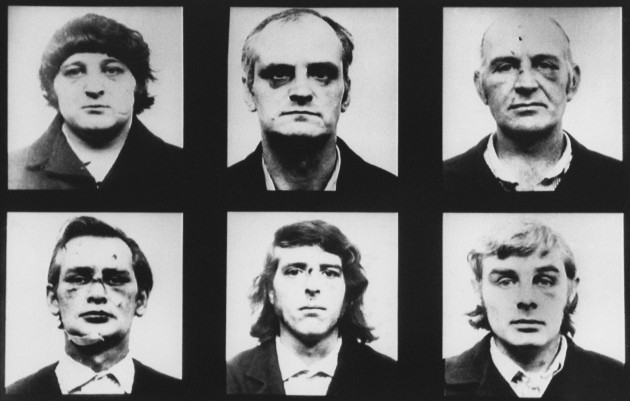
Birmingham Six Photos Bruises
Photos of the Birmingham Six, Irishmen resident in England, showing bruises from police beatings after their arrest in 1974; they were also beaten by jailers. Also arrested, brutalised, framed and convicted were the Guildford Four, Maguire Seven and Giuseppe Conlon and Judith Ward. (Photo source: Internet)

State repression rarely targets the whole population and, particularly in a capitalist “democracy” focuses on particular groups which it fears or feels it can safely persecute. However, we should also recall Pastor Niemoller’s words about the creeping repression which even the German Nazi state instituted, going after first one group, then another, and another …. Among the list of groups targeted eventually by the Nazis were Jews, Roma, Communists, Socialists, Anarchists, Social Democrats, Jehova’s Witnesses, Free Masons, Gays and Lesbians, Mentally Ill or challenged, physically challenged ….

It is in the interests of the vast majority of the population to oppose repression of different groups, whether those groups be based on ethnicity, gender, sexuality, citizenship status or democratic politics. Not everyone recognises this of course but one might expect that political activists challenging the status quo would do so. Sadly, experience shows that they do not in practice (though they may acknowledge it intellectually).
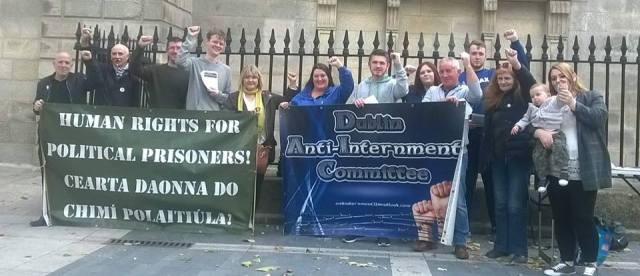
Lineup Clenched Fists & Banner
Anti-Internment and political prisoner solidarity picket September 2016 at Kilmainham Jail, Dublin (a former place of detention and execution for political prisoners under both the British occupation and the Irish State, now a museum). (Photo source: Rebel Breeze)

With some periodic exceptions, socialist groups in Ireland do not support protests against repression of republicans. Furthermore, some republican groups will not support others when the latter are subjected to repression. Yet at any time, Republicans of any group can be and are regularly harassed in public or raided at home; their employers may be warned about them by the political police; they may be detained on special repressive legislation, denied bail, effectively interned; they can be easily convicted in the non-jury Special Criminal Courts or Diplock Courts; ex-prisoners released on licence in the Six Counties can be returned to jail without any charge or possibility of defence.

The Irish State’s non-jury Special Criminal Court is a tempting facility for putting away people whom the State finds annoying and it is widely thought it was considered for the trials of the Jobstown protesters. The result of the trial, where the jury clearly took a different view to the presiding judge, may well have justified the opinion of those in the State who considered sending the defendants to the SCC.

solidarity woodcut

Unity against repression is a fundamental need of a healthy society and of movements that challenge the status quo. Practical unity in any kind of action also tends to break down barriers and assists general revolutionary broad unity. Unity against repression is so basic a need that agreement with this or that individual is unnecessary, nor with this or that organisation in order to defend them against repression. Basic democratic rights were fought for by generations and have to be defended; in addition they give activists some room to act without being jailed. On this basis, all must unite in practice and political sectarianism has no place in that.

Without some basic unity in practice across the sector challenging the status quo, there can be no revolution. But more than that: we stand together against repression ….. or we go to jail separately.

End.

Diarmuid Breatnach is a veteran independent revolutionary activist, currently particularly active in committees against repression, in some areas of internationalist solidarity and in defence of historical memory.

PART 3: THE ABSOLUTE NEED FOR UNITY – BUT WHAT KIND?

(Reading time this section: 3 minutes)

Diarmuid Breatnach

(Part of series “HOW TO WIN THE WAR  — GETTING INTO POSITION”.  See also INTRODUCTION; PART 1: THE THIRTY-YEARS’ WAR – DOOMED TO LOSE;                      PART 2: COLLECTING THE FORCES FOR REVOLUTION; PART 4: UNITY AGAINST REPRESSION)

It is, most people would think, a ‘no-brainer’ (i.e an obvious truth) that unity is necessary in the struggle to overthrow the current system. It might be thought surprising, therefore, that disunity is more the rule among those who aspire to revolution.

Generally, those who claim to be revolutionary socialists will not unite with Irish Republicans. In addition, those socialists of one party will often fail to unite with those of a different party. The same dynamic is to be seen among Irish Republicans also.

There have been many attempts to overcome this problem. In the 1930s the Republican Congress sought to unite Irish Republicans with revolutionary socialists. In the face of hostility within the mainstream Republican movement and also with divisions among the communist element in Ireland at the time, faced in addition with anti-communist hysteria whipped up by the Catholic Church, the experiment failed. The leadership of the Sinn Féin and the IRA of the later 1960s tried to combine socialism and republicanism within one party and military organisation, an attempt that crashed when it was discovered that the arms necessary to defend ‘nationalist’ community areas in the Six Counties, particularly in Belfast, were unavailable, leading to an acrimonious split in the movement. A subsequent attempt to combine the socialist and republican elements in another organisation survived a little longer but also failed for a number of reasons, some internal and also due to Irish State repression.

Shankhill Rd Republican Congress WT Commemoration 1934
Socialist Republicans, members of Republican Congress from Shankhill Road, marching to annual Wolfe Tone commemoration, Bodenstown 1934. They were attacked by conservative Republicans. (Photo source: Internet)

There have been some attempts to unite the non-republican Left itself also, which usually failed due in part to ideological differences but also to political sectarianism and personality clashes. Currently both trotskyist parties have an uneasy working relationship, the small grouping of Independents for Change exists also, the Communist Party is very small too and the anarchists are scattered and unable for years now, for the most part, to mount united action.

Attempts to unite the various parts of the Irish Republican movement have, in general, focused on creating a new organisation or absorbing activists unhappy with one organisation into another.

A frequent approach has been for some people to sit down and produce what they consider solid policy and a constitution, then to propose this format to others around which to unite. Even when accepting amendments from the elements they seek to recruit, these attempts too have largely failed.

It seems a rational approach: if we want unity, surely first we have to agree on what for, how, etc, etc before we can go into action? I believe, contrary though it may seem, that actually we should unite in action first. Uniting in action tends to break down barriers of mistrust that are built on hearsay or suspicions fostered by sectarian elements. Action also tends to clarify certain questions that until then are theoretical only. Of course, at some point, action will need to be guided by worked out policy but initially the action itself can be sufficient guide, especially since approaching the question the other way around has been so generally unproductive.

The question then arises: with whom to unite? In general, I would say that the answer is: with all with whom we can, in actual practice, unite: different types of revolutionary socialists (including anarchists), Irish Republicans, Left social democrats, human and civil rights activists.

Unity Is Strength Image copy

There are some exceptions I think necessary to mention: fascists, racists, religious sectarians and parties that participate in Government. Fascists seek to impose an undemocratic regime completely hostile to the interests of working people and, far from our uniting with them, need to be defeated; racists and religious sectarians seek to divide the movement along lines of ethnicity or religious affiliation. Revolutionaries need to draw a clear line of distinction between the movements of resistance and those who participate in a native capitalist or colonial government, i.e the management organisations of the enemy.

Many issues lend themselves to united action but perhaps none more so, and none are more essential, than against repression.

Diarmuid Breatnach is a veteran independent revolutionary activist, currently particularly active in committees against repression, in some areas of internationalist solidarity and in defence of historical memory.
HOW TO WIN THE WAR – GETTING INTO POSITION

(Reading time: Introduction, one minute; Part One: 5 mins; Part Two 2 mins: Part Three: 3 mins; Part Four: 2 mins; Total: 13 mins.)

Diarmuid Breatnach

INTRODUCTION:

Although I often think about the big questions – and am generally guided by my philosophy on them, my mind and energy are usually too occupied with specific struggles to focus on them for long. Recently however I had the opportunity and the need to think about the war, the one we have yet to win.

Storming Bastille Painting Jean-Pierre Houel
The Storming of the Bastille (translation), French Revolution, 1789 by Jean-Pierre Houel. (Image sourced: Internet)

But to which war am I referring? The Irish war of national liberation that has been flaring up for centuries, being lost each time before flaring up again? Or the class war, which has had a few sharp Irish episodes but has been, for the most part in Ireland, in abeyance? The answer is BOTH, though it may seem that my emphasis in the discussion, certainly in the early part, is on the national liberation war.

Communards Paris Barricade 1871
Communards at barricade, Paris Commune 1871. (Image source: Internet)

In order to imagine how we might win, it is helpful to examine past struggles and analyse what went wrong with them. Pessimists love to focus on those things I know – but in order to push us towards reformism or just surrender; my approach instead is from a revolutionary perspective.

Generally, Socialists analysing the class struggle don’t even ask themselves why we have not had a revolution yet.

From week to week, month to month, they tend to focus on this or that particular trade union or social struggle but without going into the big picture. It seems as though they can’t even imagine a socialist uprising in Ireland, it’s just too far away to think about, apparently. But if one can’t even imagine such a revolution, how could one consider the necessary steps to get there?

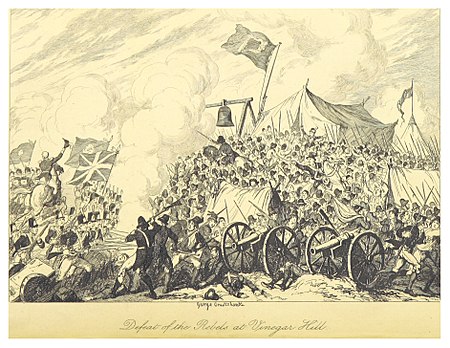
Defeat Rebels Vinegar Hill Drawing George Cruikshank
“Defeat of the Rebels at Vinegar Hill” by George Cruikshanks, i.e United Irishmen last major position in Wexdord overrun, 1798.

Irish Republicans on the other hand are often thinking in terms of revolutionary struggle, usually including armed struggle. However it seems to me that Irish Republicans don’t like analysing past failures of the movement but when they do, their verdicts tend to be that the leaders betrayed the struggle or that taking part in public elections corrupted the movement; or that infiltration, spies and informers was the problem. And some other reasons. The thing is, although all those things played a particular part, they are not the fundamental reason.

Sections to follow:

PART ONE: THE THIRTY-YEARS’ WAR – DOOMED TO LOSE 

PART TWO: COLLECTING THE FORCES FOR REVOLUTION 

PART THREE: THE ABSOLUTE NEED FOR UNITY – BUT HOW AND WHAT KIND? WITH WHOM?

PART FOUR: UNITY AGAINST REPRESSION

Diarmuid Breatnach is a veteran independent revolutionary activist, currently particularly active in committees against repression, in some areas of internationalist solidarity and in defence of historical memory.

INTERNATIONAL WORKERS’ DAY DUBLIN 2019

Clive Sulish

Two quite different celebrations of International Workers’ Day took place in Dublin on the afternoon of the appropriate date, 1st of May. One was small and of a decidely revolutionary flavour while the other, much larger, was of a more mixed nature and tending towards the reformist. In addition, a workers’ solidarity picket was mounted on a Dublin city centre eatery.

NOTHING TO LOSE BUT OUR CHAINS

          The first of the celebrations was organised by theAnti-Imperialist Action Ireland organisation and took place at the James Connolly Monument in Dublin’s Beresford Place. There a statue of James Connolly stands upon a plinth, behind the the design of the Irish Citizen Army flag, based upon the constellation that in Ireland is called the Starry Plough but in the USA is known as the Big Dipper. James Connolly was a revolutionary socialist and trade union organiser, historian, journalist and songwriter who was Commander of the Dublin insurrectionary forces in the 1916 Rising. The Irish Citizen Army, possibly the first formaly-organised army for and of the workers, had been formed during the Dublin Lockout as a defence force against the attacks of the Dublin Metropolitan Police.

The ICA took part in the 1916 Rising in Dublin and after the surrender of the insurrectionary forces, 16 participants, including two of the ICA, were executed by British firing squad: Michael Mallin on 8th May and James Connoly on 12th May.

In the here and now, on their way to the Connolly Monument, a number of participants were stopped by a man in plain clothes identifying himself as a police officer, i.e a member of the Garda Special Branch.  He wished to know their names, which they declined to give them.

At the Monument, both speakers for the Anti-Imperialist Action Ireland organisation were youths.

The first to speak gave his oration in Irish on behalf of Macra – Irish Socialist Republican Youth and said that they were there to celebrate socialism, trade unionism and workers oppressed throughout the world and, that although James Connolly had been murdered in Kilmainham Jail, his work was ongoing.

Stating that James Connolly and the Irish Citizen Army had gone out in 1916 to break with imperialism and found a socialist society, the youth went on to say that “Macra is a revolutionary organisation with socialism as one of our objectives and we also believe in the words of Pearse: ‘Ireland not only free but Gaelic, not only Gaelic but free.’ Free from the bankers, free from landlords, free from poverty.”

The speaker concluded in Irish and in English with the renowned sentence from the Communist Manifesto.: Bíodh critheagla ar aicmí cheannais roimh réabhlóid Chumannach. Níl tada le cailiúint ag na Prólatáirigh ach a slabhraí. Tá saol mór le gnóthú acu. Oibrithe an tSaoil Mhóir, cuirigí le chéile!”

Let the ruling classes tremble before a communist revolution. The Proletariat have nothing to lose but their chains, they have the whole world to gain. Workers of the world unite!”

The second speaker delivered his speech in English and linked the liberation of Ireland with the liberation of the working class and went on to praise Séamus Costello (1939-1977), which he said had embodied that aspiration. The youth praised the creation of the Irish Republican Socialist Party by Costello as well as the creation of the Irish National Liberation Army and Costello’s participation and membership in a number of democratic organisations — including his election to Bray District Council.

Condemning “the bankers and politicians” who bring deprivation to the workers, the speaker said that they try to point the finger instead at Muslims and migrants but it is not migrants who cause job losses, create homelessness etc but “the elite”. The speaker ended by saying he wished to remember all those who had given their lives for Irish freedom.

Assembled at the Connolly Monument, Beresford Place, Dublin (Photo: Anti-Imperialist Action Ireland)

WE WANT THE EARTH

          Diarmuid Breatnach was then introduced to sing Be Moderate, a song with an ironic title by James Connolly. “The Irish working class does not have a huge history in Ireland, apart from a short period in the early decades of the last century,” Breatnach said, giving as reasons the forced underdevelopment of Irish industry, the British-fostered sectarianism in the most industrialised north-east and the focus on the national struggle as a competing pole of attraction.

The Irish abroad, however, have made a huge contribution to the workers’ movement,” Breatnach said. “And in 1889, Jim Connell from near Cill Scíre in Co. Meath, composed lyrics of The Red Flag to the air of the White Cockade, starting it on the train to his home in South London from a demonstration in central London and apparently completing it in the home of another Irish man.

The song was later adopted by the International Workers of the World, a syndicalist organisation mostly active in the USA, Breatnach said and reminded them that James Connolly joined the IWW when he migrated to the USA. “In 1907, James Connolly published a songbook, Songs of Freedom, in which he included the lyrics of Be Moderate,” Breatnach stated and went on to say that no air had been published to which the words should be sung. As a result Be Moderate has been sung to a number of airs but in London Breatnach heard it sung by an avant-garde musical composer and Marxist-Leninist, Cornelius Cardew, to the air of A Nation Once Again. In Breatnach’s opinion the lyrics fit well to this air and it also provides a chorus, which he encouraged the participants to sing.

James Connolly’s lyrics were sung by Breatnach then, competing with sounds of passing traffic on the ground and the occasional trains rumbling by on the bridge overhead, participants joining in on the chorus:

We only want the Earth,

We only want the Earth

And our demands most moderate are:

We only want the Earth!

and the last line of the last verse “We want the Earth!” echoing across Beresford Place.

TRADE UNION AND POLITICAL ORGANISATION BANNERS

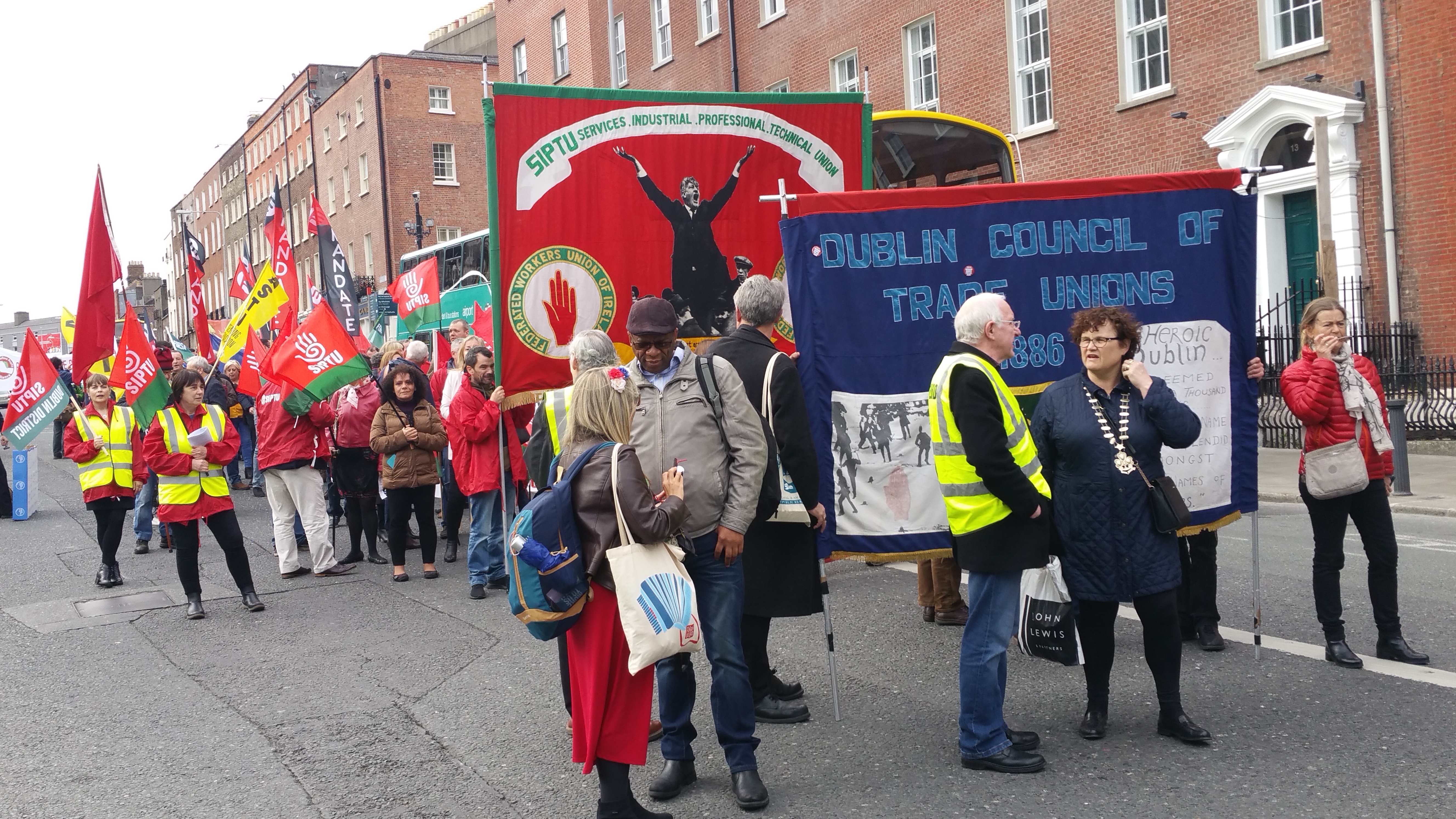
Section of the 1st May parade about to move off from outside the Garden of Remembrance, Parnell Square.
(Photo: D.Breatnach)

          Across the road, a stage and crowd barriers were being set up outside Liberty Hall, the multi-storeyed headquarters of SIPTU, the largest union in Ireland and which, by amalgamations, had grown from the Irish Transport & General Workers’ Union, originally formed early in the 20th Century by Jim Larkin, James Connolly and others (and the destruction of which had been the object of the 1913 Lockout). The stage was being prepared for speakers to address a rally which would follow a Mayday parade from Dublin’s Garden of Remembrance (a small park dedicated “to those who gave their lives for Irish freedom”).

Even the larger Mayday demonstrations in Dublin, although organised through the Dublin Council of Trade Unions, i.e with affiliation from most trade unions in the city, do not tend to be very big by comparison with other cities in many other parts of the world.

Anti-Pesco banner on 1st May parade (Photo: D.Breatnach)

Banners of some unions mixed with those of political organisations and campaign groups, including the Ireland Palestine Solidarity Campaign and another against Irish state participation in PESCO, which is seen by many as an embryonic EU Army and undermining the Irish state’s neutrality.

Section of the 1st May on the move down Parnell Square.
(Photo: D.Breatnach)

Led by a lone piper, the parade made its way past crowds of onlookers down Dublin city’s main thoroughfare, O’Connell Street, then left along Eden Quay to Liberty Hall where they were to be addressed by speakers on the temporary stage in Beresford Place, across from the Connolly Monument.

Anti-Pesco banner on 1st May parade (Photo: D.Breatnach)


Meanwhile, a small group had left, to form a picket line outside the Ivy Dawson Street restaurant, in solidarity with staff and in opposition to the management appropriating a portion of the tips left for staff, with more to join them there later from the Mayday parade.
(see
https://rebelbreeze.wordpress.com/2019/05/02/tipping-the-bosses/).

A NOTE ON THE HISTORICAL ORIGIN OF INTERNATIONAL WORKERS’ DAY

          The First of May has been celebrated as the international day for workers since 1892, to call for the 8-hour maximum working day, socialism and universal peace. Its inspiration was a train of events that began with a workers’ strike and demonstrations on May 1st 1886 in many parts of the USA but in Chicago ended in the State execution of four anarchists, with police and state militia massacres of workers along the way as well as with acts of workers’ resistance. The celebration and commemoration throughout the world was formally agreed at the Second Congress of the Second International Workers’ Association in Brussels in 1892 and at its Sixth Congress (Amsterdam, 1904) declared it mandatory for the proletarian organisations of all countries to stop work on that day, wherever that could be done without injury to the workers (bearing in mind violently repressive regimes).

Artwork depicting police attacking striking workers at McCormick’s factory who were agitating for the 8-hour working day.
(Image source: Internet)

In many states around the world now, the 1st of May is a public and bank holiday and has been so in Ireland since 1994. Its public celebration was banned under the fascist regimes in Spain and Portugal but is legal in both those states now; however it is still banned in some other states while in some areas, though not banned, may be subject to attack by police, army, state agents or by fascist elements.

End.

IRISH YELLOW VESTS AND QUESTIONS

Diarmuid Breatnach

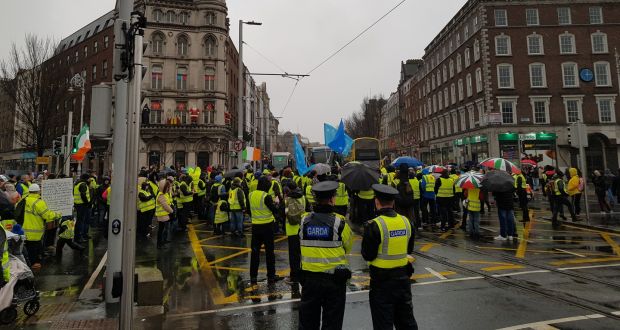
Recently a number of people have been marching in Dublin, saying that they are the Yellow Vests of Ireland. This is obviously inspired by the Gilets Jaunes (“Yellow Vests”) whose protests against the French Government began in November last year and swelled to huge numbers in Paris demonstrations and riots. Some smaller groups have announced their formation in different parts of Ireland too.  But there are questions concerning them.

Irish Yellow Vest protest crossing O’Connell Bridge 15 December 2019.
(Photo source: Internet)

          The Yellow Vests in Dublin have been meeting on Saturday afternoons at the Custom House and marching from there. I am busy on Saturdays and on the one day I made the time to join them, I did not find them and learned later from their posts that on that occasion they had gone to Dublin Port and apparently blocked the approach road for a period.

Originally the organisers stated that there would be no leaders but then two emerged, Glen Miller and Ben Gilroy. Until last week Gilroy was serving three months for contempt of court, a sentence imposed by a judge when he learned that Gilroy had not completed the community service sentence imposed for a previous contempt of court. Held in contempt of court a number of times Gilroy has always apologised afterwards and had his contempt considered “purged”, i.e cleared. It seems that the judge in this case decided that Gilroy was playing games with the court around the issue of contempt, which is probably a fair assumption (which is not at all to say that such actions are wrong).

Gilroy took a case to the High Court alleging failure to comply with certain legal requirement and on February 4th the Judge granted him liberty on bail in his own recognisance (i.e his own financial bond) while is case was discussed and decided. However this week the Judge ruled that his imprisonment was not unlawful and revoked Gilroy’s bail, which meant he had to return to jail.

In recent years a number of groups have sprung up which oppose a number of unpopular legal procedures, for example evictions, by a mixture of physical obstruction (by numbers of people) to bailiffs but also by appealing to what they claim are laws that take precedence over the legal procedures they are confronting. The “Land League” is one of these (no organic relationship to the 19th Century Irish organisation of Davitt and Parnell) and, not unrelated to the “League” in its reliance on arcane laws and procedures, real or imagined, is the Sovereign Movement, the “Irish Republican Brotherhood” (again, despite their claim of “inheritance”, no organic relationship to the 19th and 20th Century organisation) and the Fremen.

While some people are impressed by these arcane legalisms others are bewildered by or scornful of them and, despite their claims, these organisations seem unable to point to where their legalisms have actually been ultimately successful. They have certainly succeeded in slowing down such actions as repossessions and evictions by taking up court time and numbers turning up to block an eviction will often succeed in delaying the process, without any need to appeal to any kind of legalistic underpinning. Property rights reign supreme under capitalism and certainly the Irish state is no exception to that rule; on the other hand the authorities in the Irish state tend to prefer to carry out the normal business of capitalism with as little confrontation as possible.

Summoning numbers to block or delay an eviction and to support a victim of the system in court are of course tactics of struggle honoured by time and usage in Ireland, whether against the British administration or that of the Irish State. Such reliance on mobilisation of numbers can sometimes produce small or partial victories but they hint at something else – the mass mobilisation of insurrection and revolution. And that is part of the appeal of groups such as the “Land League” and probably in part of the Yellow Vests.

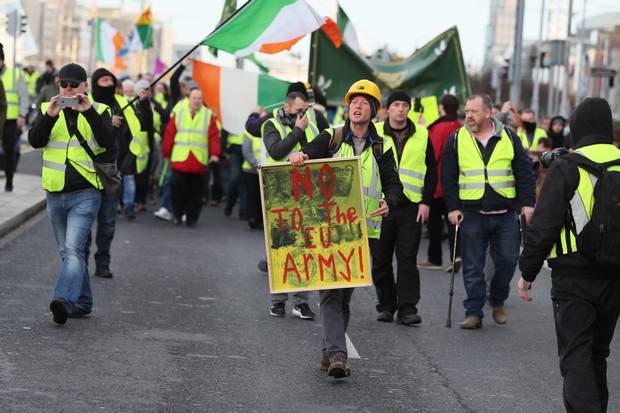
Section of Irish Vest protest Dublin 22 December 2019.
(Photo source: Internet)

But if insurrection and revolution are hinted at, we need to know whether the hints are in earnest. Calling for a general election, one of the demands of the Yellow Vests, hardly seems insurrectionary. How would that change anything? Calling for an end to a number of attacks on working people including evictions is good but how is it to be achieved? Is there an objective of overthrowing capitalism and imperialism in Ireland? We do not hear so if there is. If an insurrection is hinted at, by whom is it to be and for whom?

RACISM

          It is here that we run into a disturbing problem: racism, of which Gilroy and Miller have both been accused. Any movement or organisation led by racists is not going to be one for progressive change in society, let alone a socialist insurrection but worse – it is likely to be a breeding ground for fascism. And of late, fascist forces are gathering throughout most of the world and certainly in Europe. Capitalism is struggling and the workers must be made to pay the cost through keeping wages and social expenditure down and profits high. When persuasion and collaborationist workers’ leaderships are no longer effective, capitalism must fall back on naked force. Fascist movements are the frontline of that force, its leading edge and racism (or religious sectarianism, with which we in Ireland have more experience) is used to divide the lower classes, the ones that will be made to pay.

Of course not all the people supporting the Yellow Vests are racist but when an anti-immigration banner is tolerated on a march1 then it would be remarkable if racism were not being tolerated as well. And with regard to the leadership, Glen Miller’s racism is well established from his posts on social media. He has posted material against immigration, against Muslims, against Travellers and against lesbian, gay and transgender people – classical minority targets of fascism to split the working people. He also shares racist material by others including Tommy Robinson, a fascist public figure operating in England.

Gilroy is not usually so glaringly racist but he has certainly posted an islamophobic rant on social media.

One might argue that Islam is a religion and that being against it is not racism. Perhaps not, if one were against all religion, for example. But ethnicity and religious belief or organisation are often interconnected, at least in particular periods and societies. Most muslims are not white European. And the Irish certainly know from their own experience how easily anti-Catholicism became conflated with anti-Irishness, in Britain for example, in the USA (think of WASPS and the ‘Nativists’) and in Ireland under colonial rule.

Islamophobes fantasise about Moslems taking over the country, anti-immigrationists fantasise about immigrants taking over the country, racists fantasise about non-Europeans taking over the country. There are nuances between them but in the end do they matter that much? The effect is the same: society is portrayed as divided by ethnic origin rather than by class and the focus is diverted from the bankers, gombeen capitalists and their political servants an on to migrants instead.

It might be argued that “looking after our own first” is a natural outlook and not racist. But we need to look at where that comes from and where it leads. It starts from the false premise that there is a great shortage and that we should divide those scarce resources first among the Irish. But in fact there is sufficient wealth produced in Ireland to fund all the education, housing and healthcare needs of all the people, immigrants included. And this is because the wealth is produced by working people – including migrants. The problem for us all is that that huge portions of that wealth is being diverted to fund the market gambling, lifestyles and financial empires of Gombeen (Irish capitalists) and foreign capitalists and bankers. Those are the people who would be rubbing their hands with glee or happily exchanging bribes and payoffs if, instead of uniting to confront them, the workers began to fight amongst themselves, divided by race or religion.

When the 1916 Proclamation declared the objective of the insurgents to “pursue the happiness and prosperity of the whole nation ….oblivious of the differences carefully fostered by an alien government, which have divided the minority from the majority in the past”, it was addressing in part that religious sectarianism by which England had restrained the descendants of its colonists from overthrowing its colonial rule and also the pitting of Protestant against Catholic workers, a division which had been played out before 1916 and was to be enacted to even worse degree later. The “Protestants” were the “immigrants” of those years, along with their descendants2, albeit a privileged minority which migrants rarely are.

In making that statement, the insurgents of 1916 were drawing on an Irish revolutionary tradition stretching back to the United Irish of the 1790s and early 1800s, of the likes of Wolfe Tone, Henry Joy McCracken and Robert Emmett. It was a tradition that ran through every revolutionary movement in Ireland since that time, through the Young Irelanders, the Fenians, the Volunteers and the Irish Citizen Army, a tradition that called for overcoming differences to build unity against the common enemy. That is the unity that fascists and racists seek to shatter.

Fascists may and often do verbally castigate capitalist governments, politicians, industrialists and bankers. But they end up serving them. They split the mass of the working and lower middle classes on the basis of race, they attack the defence organisations of the working class, they target other groups such as gay and lesbians, push women into the most subservient roles possible. The Nazis were “National Socialists” and part of their movement talked about nationalising industry under workers’ control. But they were backed by big capitalists such as Thyssen, Krupp and IG Farben and many others in Germany. In the USA and in Britain they were backed by Henry Ford and promoted by Viscounts Northcliffe and Rothermere, owners of the Daily Mail (until England declared war on Germany and the US entered WWII on the Allied side). The Nazis in Germany took over the trade union offices on Mayday and closed them down, forcing workers instead to join fascist unions controlled from the top, part of the State.

WHAT KIND OF UNITY?

          It is interesting that while fascists divide the working people in order to facilitate their control and undermine the struggles against the capitalist class, they often cry for unity. German unity. Aryan unity. White unity. Spanish unity. British unity. Irish unity. And when people have criticised individual leading figures in these groups, in particular recently of the Yellow Vests in Ireland, they have been accused of dividing, of undermining the struggle and calls for “unity” have been raised.

Whether it is right that the court should consider it criminal for someone to hold it up to disrepute, as Gilroy and some others have done on occasion, is another question and whether three months is a reasonable punishment for “contempt of court” in another. The courts are instruments of the State which in turn is an instrument of the ruling class and as such all revolutionaries must perforce hold them in disrepute and, in my opinion, three months in jail is excessive by normal standards in this state. But cries raised by the Irish Yellow Vests against this seek to glorify Gilroy as some kind of “people’s leader” and in turn to promote the ‘Vests’ as a viable resistance movement.

Workers know that unity in struggle is necessary but have also learned over the years that calls for unity may also be used to allow collaborationist trade union leaders and politicians to continue misleading the workers. Such calls can be employed to silence questions about where the movement is going. And now they are being used, unwittingly by some no doubt, to the effect of trying to silence the challenges to such as Gilroy and Miller about their racism and where they are trying to lead the Yellow Vests.

Such calls are being used not only to stifle the criticism of the leaders’ racism but to undermine the criticism of racism itself, as though racism were some kind of Leftie concept or diversion from the real issues. In a post in defence of Gilroy on 18th January, Miller posted a long ‘plain folksy’ discourse in which he said that Gilroy and he have “no time for political correctness and the posh talk”. So according to that discourse we should ignore the accusations of racism, action is needed, and for that we need unity – we should stop bleating on about racism. But the action is often dubious, the destination vague, the unity based on lack of analysis and stifling of criticism and – ultimately – on the opposite of unity, the division of the working people and the undermining of their resistance to those who are the real source of their misery and discontent.

It is not because of the anti-racist or politically-correct posturing of anyone, whether middle class or not, that socialists stand against racism: it is not just because it is inhumane, either; it is primarily because it splits and weakens the working class and diverts anger and resentment from the real enemy.

The Yellow Vests in Ireland are by no means a fascist or even racist movement. But they tolerate racists, are led by racists and could provide a breeding ground for fascists – something for which fascists are always on the lookout.

WHAT TO DO?

          So what should be our response, as socialists of various kinds?

First, I think we need to step back and examine the situation a little. The Yellow Vests here copy the Yellow Vests in Paris. Awhile back, the Socialist parties (I do not count the Labour Party in this) wanted us to copy the Greek uprising and Syriza’s electoral success. Earlier than that, some people wanted us to emulate the Indignados of Spain. And further back still, others sought to copy the Occupation movement of the USA.

It seems to me that all that striving speaks of a desperate need felt by some elements in our society, a need that cries out that something must be done; something to cure the mess that our Gombeen system has made of our health and welfare systems, of the housing crisis, of cuts to other services; that some stand should be made against paying off the bankers’ gambling debts with our hard-earned money and trying to get us to pay a third tax on our water supply when the money collected already has not been used as it should. A feeling that something should be done about the corruption of that give-away of our natural resources, about the selling of our transport, postal, telecommunications systems, about the funding of private landlords, about renewed emigration of our young. About increased hours and travel time spent just trying to stay still economically but nevertheless slipping slowly back. About evictions of people who have paid the actual building cost of their homes a number of times over. About governments that oversee this rotten system, worrying chiefly about staying in government and pleasing native and foreign capitalists; about a police force in which we find an average of a scandal per year with no end in sight and yet happy to repress people’s resistance …. and with their Armed Response Unit cars to be seen everywhere around the city centre.

Those people are right, of course. Something should be done. Something must be done. But what? There’s the rub, as they say. The working class should rise and take power, is the classic revolutionary socialist answer; also of the socialist Republicans, who tie the question to getting rid of British colonialism. Whether our revolutionary socialists in Ireland are actually revolutionary is a good question however, and in any case they are small parties. Whether our socialist Republicans are actually socialists or Republicans first is another interesting question and in any case they are splintered in groups and independents.

All those movements abroad that various people tried to emulate or reproduce here in Ireland did not succeed in changing the situation in their own lands. The USA, the country with the most billionaires in the world (and in politics!), continues to slide towards eventual downfall, in huge debt as a result of funding its military-industrial-financial system, for which billions around the world and millions inside its own borders pay with misery ….. and still the debt cannot be paid. But a huge sub-class exists, often living in city wastelands of run-down housing estates.

The Spanish state continues to squeeze its citizens, prepares to go to war against a nation seeking independence and fascist groups organise openly. Suicides prior to, during or after evictions are no longer startling news.

The Greek Left-coalition government of Syriza collapsed and prostrated itself to the EU and the IMF and schools had to close in winter for lack of heating fuel.

The French Government has alternated repression with some concessions but ultimately nothing has changed.

The growing vacuum of resistance in Ireland will be filled by a revolutionary movement based on working people in militant resistance to – and directed at – the capitalist system. Or it will be filled by fascism.

To build a revolutionary resistance movement, unity in struggle is needed and for that unity, racism must be driven out of the people’s movements. That will not be done by condemnation of racists alone. It will not be achieved only by calling for unity against capitalism. The revolutionary movement must be built and it is by action that it will distinguish itself and attract support from the militant sections of the people.

It is by its revolutionary critical discussion on politics, history, science and culture that it will inform the mass of its potential and necessary objectives.

It will not be built by theoretical declarations or arguments alone, nor by actions that are either timid or cannot be maintained, or by actions of only a few far in advance of the mass. Some of the actions will, perforce be risky and the State will exert a price.

But it is either that or – fascism awaits.

End.

FOOTNOTES

1Reported on at least one of the marches and I have seen a photograph of it

2Some Protestants were descendants of Catholics who had changed their religion to avoid persecution or land confiscation and some Catholics were descendants of Protestants who had converted or who had married a Catholic who raised their children in that faith. But largely, Anglicans, Presbyterians and other Protestant sects in Ireland were descendants of waves of colonists in particular from the 15th Century onwards, while Catholics were largely descendants of the indigenous Irish and of the Norman invaders.

MISCONCEPTIONS

Diarmuid Breatnach


There are many misconceptions about Irish politics and history and the centenary of the inauguration of the First Dáil and of the first shots fired in the War of Independence (one of several of our “wars of independence”) seems like an appropriate occasion to try to tease some of them out.

The Irish Tricolour — national flag of the State but also quintessentially of Irish Republicans.
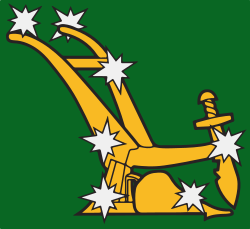
The “Starry Plough”, flag of the Irish Citizen Army. Today it is held to belong variously to socialist Republicans, Revolutionary Socialists and even sometimes social democrats.
The Red Flag, flown by Communists, Revolutionary Socialists and even sometimes by Social Democrats.
Flag colours of the Anarcho-Syndicalists.
A different version of the Starry Plough, usually but not only flown by social democrats. However, it was the flag of the Republican Congress in the 1930s.

For sure, many of those misconceptions belong to those viewing us from outside but here I’d like to deal with those from among our own. These misconceptions are spread equally among the Irish Republicans, Irish Socialists, Irish social-democrats and liberals – but each group believes different ones.


REPUBLICANS

To Irish Republicans (and I think I am objectively correct in not applying that to all who claim the title), the War in the Six Counties was lost because their political and military leadership, or most of it, abandoned the struggle or betrayed it. I think that is a fundamental misconception which leads to further misconceptions about what might be the way forward.

Please do not think for one minute that I am excusing the conduct of that leadership – I am not. Anybody is entitled to abandon the struggle but they are not entitled to claim their departure as a new way forward and to call on others to do the same – that is if they do not wish to be called “traitors”. Nor is anyone, least of all, entitled to take part in the colonial administration and if they do so, they have earned the titles not only of “traitors” but also of “collaborators”.

That judgement has nothing to do with peaceful versus armed struggle, parliamentary participation versus abstentionism or any such debate but is simply this: anyone who participates in colonial government is colluding with the colonist power, the invader, the appropriator. That is a truth understood by most people throughout the world.

It is a different point I am making entirely: the 30 Years War was lost because it could never have been won. To see this written or to hear it said will shock many Republicans and be seen as a kind of heresy – but that does not stop it from being true. Think about it: how could an armed struggle fought in one sixth of the country alone against a modern imperial army, possibly succeed? And that one-sixth further divided with at most 30% (and in reality a lot less) possibly sympathetic to the fighters? Who could sit down to ponder this and believe that struggle had a chance? The remarkable thing is not that it was lost or given up – but that it lasted as long as it did.

The only way that struggle could possibly win would be with the support of the 26-County State and it may well be that those who embarked upon it thought that at some point the Irish bourgeoisie would intervene in some way. They did — but to increase repression of Republicans.

A war might have been won if it had been extended across the whole state. Not necessarily an armed struggle across the whole country but certainly a social, economic, political one. It is not reasonable to expect the mass of people in the 26 Counties to fight year after year for those in only one part of the country, be it a colony or not, and have their own needs ignored. The people in the Six Counties would not do that either if the situation were reversed.

Certainly there was no shortage of issues going begging, from gender and sexuality-related civil rights, housing, unemployment, censorship, clerical domination, bleeding of the national language, sell-out to foreign capital, emigration, absentee landlords, private ownership of natural resources, sexual and other abuse by institutions. However, to take on the spread of issues oppressing or of concern to the people in Twenty-Six Counties would have meant taking on the Irish Gombeen class, its State and its supporting Church.  Whether because they still had hopes of the Irish State or did not want to clash with the Church which had the religious allegiance of the majority of their followers – or because they themselves did not want to challenge some or all of those institutions,It is clear that the leadership of the Republican movement then could not bring themselves to that confrontation.

If only a struggle across the whole “island of Ireland” (sic) could possibly have won then it seems logical that only such a struggle has a hope of winning today.

Some of the Republican groups perhaps have this awareness and certainly they have been seen in water and housing protests in the 26 Counties. But they are small groups, their activity patchy, lacking collaboration with one another (even in resisting State repression). More fundamentally there is no strategic plan for organising the working class. In a way, they can’t be blamed for that: they are not communists or anarchists; no matter how revolutionary or left-wing, they are primarily and always Irish Republicans.


REVOLUTIONARY SOCIALISTS

There is another sector whose members might well be nodding their heads in agreement with the above criticism but they too are beset by an important misconception – albeit a different one. They are the communists, socialists and anarchists who would consider themselves revolutionary, i.e who claim to believe in a revolutionary transformation of society.  A general disdain of the Republicans runs through this sector, considering Irish Republicans to be simple militarists, adventurist and even sectarian.

Their disdain – or perhaps their fear of being tarred by association – is such that they cheerfully allow all kinds of abuses against Republicans by the Irish State and the colonist statelet. By “allow” I mean that they do not protest against the abuses. Ethically, this is reprehensible but functionally it is dangerous. And in a country where the most numerous section ready to take on the State happens to be Irish Republican of one kind or another, such an attitude by the “revolutionary” Left is nothing short of counter-revolutionary.

This is, in a way, the sector to which I most belong but without that disdain or political apartheid.

Nor do our tiny cliques and small parties exhibit revolutionary spirit even in straight socialist issues, being in general concerned more with peaceful mobilisations and speeches or elections to public office than direct action.

One would think that trade unions would be of particular interest to the revolutionary Left – certainly the Republican movement has paid them little attention. However one finds only small struggles to appoint some Left-winger, usually not even a revolutionary, to the heights of union bureaucracy. When issues of industrial conflict arise, one does find revolutionary socialist shop stewards pushing for militant action.

But where is the education of workers? Where is the mobilisation of revolutionaries of different parties and none to support workers in industrial action? There is in fact no such “Broad Left” organisation in Ireland (not that its example in Britain is anything to emulate) and generally strike support is used for party building. When that particular conflict is over, nothing remains that was not there already.


SOCIAL DEMOCRATS AND LIBERALS

The third sector, shaking their heads at the “militarism” of the Republicans and the “impracticality” of the revolutionary socialists, are the social democrats and liberals. Their misconception is that capitalism and imperialism can be reformed so that they no longer be rapacious.

Maybe there was a time when such a belief was reasonable (though I find it hard to imagine it) but certainly that was long ago. Sincere reformers, benevolent capitalists and aristocrats and scheming reformists have all failed to reform the system of exploitation. Indeed, what historical experience has shown is that even if a capitalist or imperialist wished to subscribe to ownership in common, his or her class colleagues would not permit it.

The electoral path, so detested by some communists and many republicans, is where social democrats and liberals most place their hope and faith. And yet, despite an occasional individual exception, what has the history of those experiments shown us? Corruption of individual activists, wholesale corruption of party leaderships; diversion from the struggles on the ground to bureaucratic struggles in parliaments; careerist trade union leaders and bureaucratic officials; disempowerment of the working people; weakening of organs of real struggle; respect for the capitalists’ laws …..

Not one government of a socialist revolutionary kind has emerged by this process and, whenever it seemed to come close, it was overthrown by military coup or foreign imperialist intervention.

But still, it might work next time, eh? To the advocates of this ideology, of these methods, history does not matter – it can be ignored, denied or expected to cease its operation.


MOVING FORWARD

So where does all this leave us? Yes, I know, in the proverbial cac — but how can we move forward?

This is what I think:

The Revolutionary Left needs to a) organise in a revolutionary manner among the working class and b) to defend the civil right of Republicans;

The Republicans need to unite at least against State repression and take up social and economic issues of working people;

the Social-democrats and liberals should unite with the others on issues of civil rights and social issues;

but ultimately the Republicans and Socialists should ignore reformist illusions.


And what about me?

I do what I can where I think I can have a positive effect – criticise but participate; participate but criticise. And hope to learn not only from the mistakes of others but also from my own.

End.

“BOOKS – AND A MEETING-SPACE FOR SOCIAL AND POLITICAL GROUPS”.

Diarmuid Breatnach

Book-cases line the walls, filling up with biographies, histories, political and social theory from anarchist, marxist, feminist and Basque independentist perspective – and some classical literature. On the low central table are children’s illustrated stories and puzzles. One can see samples in the window too.

Maribel and Diarmuid outside the shop while it was being prepared for opening.

          An alternative Left bookshop has opened in the iconic town of Gernika (Guernica in Spanish and in the title of Picasso’s famous painting of the town’s

Maribel and Inigo outside the shop while it was being prepared for opening.

bombing and strafing by the Luftwaffe and Italian air force in 1937). Going by the title of Inuri Gorria (“Red Ant”), the bookshop is a medium-sized (as these things go) one-level shop situated on one of the town’s main streets, with passing one-way traffic of private and public transport. Virtually next door is one of those open-front fruit shops and further down the same street, past bars and other businesses, is the nearby Herriko Taberna (literally “Peoples’ Tavern”. That is one of the many such social centre-taverns run by the official Basque pro-independence Left1 but of which many were ordered closed by the Spanish state in recent years on unsubstantiated accusations that they were linked to the armed organisation ETA, which is now dissolved). Once the people running the ‘Herriko’ and the trend represented by the new bookshop were strongly united but no longer, due to the change in direction adopted by the leadership of the Abertzale (pro-national ndependence) Left in recent years. Of course both trends will still attend at some events, particularly demonstrations about Basque political prisoners.

The Inuri Gorria bookshop opened officially on 12th October, which is a bank holiday in the whole Spanish state; called el Dia de la Hispanidad, it celebrates the spreading of the Castillian language as a result of the conquest of much of the Americas by the Spanish Kingdom in the 15th and 16th Centuries. Not surprisingly, it is also the official day for celebrating the armed forces of the State. Also unsurprisingly, the celebrations are opposed by anti-imperialists throughout the territory of the Spanish state and in particular perhaps by those nations still seeking independence. 2 No doubt many in the Gernika area were glad to have something progressive to celebrate on that date, which they did by gathering at the opening to view the books and eat some pintxos, later repairing to a local bar which displays photos of political prisoners from the local area (as does the Herriko). On this occasion some who would still count themselves members of the “oficialistas”, though likely from an internal critical position, attended also.  There was also a Basque traditional festival in the town with many dressing in traditional clothing and taking part in cultural activities.

Closeup of evening of day of traditional Basque festival in Gernika.
(Photo: D.Breatnach)
Evening of day of traditional Basque festival in Gernika. The banner may have been attached by the ‘official’ independence movement leadership.
(Photo: D.Breatnach)

“The material I have here is of an alternative Left and feminist political kind”, said the owner, Maribel Egizabal, when I dropped in again some days later. “I have children’s books and games, of an educational kind about values, sections on feminism and about women, alternative philosophy, social movements, ethnic minorities and racism, city life, ecology, the history and culture of the Basque Country.”

One of the books she stocks is a local history of the nearby Busturia area dealing with the effects of the Anti-Fascist War (1936-1939), a substantial piece of work which she herself had a major part in researching and writing3, produced by one of the groups in which she is active, Laia, a local history group. The history of that period and of the executions and repression that followed the victory of the fascist troops is very much a sharp issue today and not only in the Basque Country but throughout the Spanish state.

Monument in Gernika to George Steer, English journalist and author who broke the Gernika bombing story for the London Times (and put the blame where it was earned).  (Photo: D.Breatnach)

The material in Inuri Gorria is mostly in the Euskera and Castillian (Spanish) languages but there are also some 2nd-hand books in French and English and Maribel hopes to add additional material in those languages. “With regard to political philosophy, I stock material in anarchist, marxist, feminist and independentist traditions. I don’t want to just sell books”, she told me “but to also provide a meeting-space for discussion and learning by social and political movements of the people.”

Maribel is a straight-talking woman with a long history in the feminist, Basque independentist and socialist movements, in different organisations, including the Basque internationalist solidarity organisation of Askapena, also Askagintza, an organisation working with people with drug addiction issues as well as the local history group alluded to above. “Inuri Gorria will be interested in material dealing with struggles around the world as well as in the Basque Country,” she tells me, “including of course struggles of other nations within this state such as Catalunya and of movements and organisations within the Spanish Left.”

The shop being prepared on the day I first called.  (Photo: D.Breatnach)

When I dropped by a third time, the day before my return to Dublin, Maribel was buoyant at the interest in the shop and its material being shown, especially by younger people.

“They are particularly interested in political theory,” she told me enthusiastically. It has long been remarked that the Abertzale Left movement was lacking in political education of its youthful following. No doubt the repression and banning of a succession of the movement’s youth organisations played a part in this but that does not explain the lack of educational materials, study and discussion groups, lecture series etc.4

View of front window display after shop up and running.
(Photo: D.Breatnach)

Gernika is worth a visit on its own and is connected by public train and bus services to Bilbao (also a longer-distance bus service to Bilbao and other areas). The town centre is attractive and hosts the Peace Museum (low charge and well-worth a visit) documenting life before the Anti-Fascist War, during it, including the town’s infamous bombing (which the Fascists tried to blame on the ‘Reds’5) and the ensuing occupation by fascist Spanish, colonial Moroccan and Italian fascist troops. Higher up, the ‘Gernika Tree’ and some of its offspring stand near the Gernika Assemby House (Gernikako Gazteen Etxebizitza/ Casa de Juntas de Gernika), built in 1826 to succeed several other buildings nearby. It was there the lords of Bizkaia (whose original member, according to Basque legend, was a Gael) from medieval times assembled to discuss issues and that the monarchs of the Spanish Kingdom affirmed the Basque rights or Fueros until abrogated in 1876. Entry is free and guided tours are offered by arrangement (but as generally the case with many buildings in the southern Basque Country, it will close between 2pm and 4pm.)

The Inurri Gorria bookshop will normally open 10am-12noon and 4.30-8pm on weekdays and 10-12noon on Saturdays, remaining closed on Sundays but of course may be in use on other occasions by some of the organisations and movements Maribel alluded to.

Contact details:

Inurri Goria,

Juan Kalzada 14,

48300 Gernika,

Basque Country,

The Spanish State.

FB page: https://www.facebook.com/maribel.egizabal.5

Tel: 9443 46988

end.

FOOTNOTES

1Their currrent political parties are Sortu (and the pro-independence social-democratic coalition EH Bildu).

2Ironically, migrants of Latin American origin may be seen celebrating the day also: it is the one day in Spanish calendar that they may feel specifically includes them.

3Busturia 1937-1977 – represión y resistencia de un pueblo (‘repression and resistance of a people’), Maribel Egizabal & Unai Serrano, Busturia (2018), IBSN 978-84-697-8677-2.

4The Abertzale Left is not the only movement one can accuse of such neglect of the political education of youth, one finds the same generally in the Irish Republican movement (both in the Provisionals and in the various splits since).

5Calling all the opponents of the military coup “Rojos” (‘Reds’) was a propaganda policy of the coupist military leaders and fascists (and copied elsewhere, as sometimes in The irish Independent); in fact their opposing broad movement included democratic anti-fascists and constitutionalists, trade unionists, Basque and Catalan nationalists and Republicans as well as Communists and Anarchists. It seems clear that without the intervention of Nazi Germany and Fascist Italy, aided by the “Non-Interventionist” policy of France and the UK, the popular forces would have defeated the military and fascist insurrection.

SPEAKING TRUTH TO POWER – REALLY?

Diarmuid Breatnach

Again and again we come across activists, journalists, musicians and other artists who are lauded for “speaking truth to power”. They are often praised for that, even idolised. “Speaking truth to power” seems to be brave thing to do. And an important thing. But is it really?

First of all, let us think of who are those usually thought of as “Power”: governments, big companies, military dictators, church leaders, powerful individuals in the media or in the arts …..

Why is it considered a good thing to speak truth to them? It may well be brave to do so and often is. People who spoke the truth in certain situations throughout history and currently have had their careers destroyed, been the subject of all kinds of horrible allegations, been marginalised, lost their families and friends, been framed on charges, jailed as a result or just automatically, tortured, killed and “disappeared”. Yes, we could hardly deny the courage of many of those who chose to take that step. But whether it’s an important thing to do is another thing completely.

What? A courageous act against power not important? What can I be suggesting!

Let’s look at those in power again, taking for examples a government, a military dictatorship and the CEO of a powerful company. In our example, we set out to “speak truth” to them.

For the government, we send them an email, or a letter because there are too many Ministers and Secretaries to address verbally – unless of course we are in some kind of privileged position. They in turn ignore us or send us a dismissive reply (possibly tailored to be quoted) or they have us subjected to surveillance, just in case we should turn out to be a real problem in future. And any government in the world is capable of putting citizens under surveillance.

(Cartoon strip source: Internet)

We send the military dictator a letter and he has us arrested, detained for torture and questioning. Or we accost him when he is somewhere in public …. and his security guards shoot us dead. Or arrest us for torture and questioning.

With regard to the CEO, we send him an email. He ignores it but may have us put under surveillance – just in case. And he’ll have our employment and tax records, families and friends checked out too. Like governments, the CEOs of big companies can easily put people under surveillance and run background checks on them. And CEOs likely last longer in the power position than most governments. Or he might reply dismissively. Or he might have his legal services people threaten us with legal action which, as well as shutting us up, would cost us a lot of money we don’t have, probably bankrupting us.

This is the illusion of liberals and social-democrats but the reality is very different.
(Image sourced: Internet)
(image source: Internet)

In the military dictator’s case, we are out of the picture. In the case of the other two, nothing further may happen if we shut up now. But if not, well …. there’s that list of bad outcomes I listed above. Brave? Certainly – but to what effect? Have we changed anything?

Some people think we can change the essence of the way those in Power think by Speaking the Truth to them. If only we can say it powerfully enough. Nonsense. Those in the Power have already chosen who they want to be, what side they are on and understood the basic dynamics or been taught them along the way. Many choices made have confirmed them in their roles and ideology.  Furthermore they know that to break ranks with their own is a dangerous thing to do which can result in bad outcomes for them too and also expose them to painful and even fatal thrusts from their competitors or rivals. Remember the 1983 film Trading Places? Remember how the main hero falls at first, is shunned, loses his privileges, friends and associates? Unlike the film’s ending, there is no coming back from there.

If those CEOs and company owners ever took a progressive step it was because they were shown it would increase their profitability or at very least were shown it wouldn’t hurt it ….. or they were forced to do so by people’s resistance. Not ever by having “Truth Spoken” to them. Unless it was the truth of resistance (and we’ll come back to that).

I don’t see the point of Speaking Truth to Power … except in very exceptional situations. For example, if we are being sentenced in court, even if the public gallery has been cleared or packed with cops (which has happened even in this state on occasion), we might wish to raise a clenched fist and yell “Death to Fascism!” before the guards jump on us and bundle us to the cells, giving us a few punches on the way.

Or being tortured, if we are capable of it (and while we are still capable) we might want to shout something similar or just plain “Fuck you!” Or in front of a firing squad, to shout “Long live the revolution!” before the order comes to “Fire!”

Will it do any good, make any difference? Without an audience apart from those in Power, almost certainly not. It might affect some soldiers or police in the firing squad or some jailers but such results are usually negligible. But in doing so, we assert our humanity, our spirit against them and it is for ourselves alone, at that moment, that we Speak Truth to Power. Otherwise, there is no point, none at all.

I don’t want to Speak Truth to Power and what’s more, question why anyone else would. Is he or she suffering from some kind of liberal illusion that such words make a difference, can convert or subvert Power? Or from an inflated ego that convinces him or her that they have the gift, the eloquence, the importance to make Power change? Or that somehow, by force of their excellent will, they can overcome history and change reality?

Or even worse, are they signaling to the Power that they are articulate, eloquent even with “alternative” credentials and that they are worth recruiting by the Power?

The Naked Emperor. In Hans Christian Andersen’s subversive tale, an undoctrinated child remarks that, contrary to royal propaganda, the Emperor is naked and the people can then admit this to themselves. The child spoke Truth — but to the People.
(image source: Internet)
Speaking truth among the people. (Cartoon source: Internet)

I repeat: I don’t want to Speak Truth to Power. I want to Speak Truth alright … but to the PowerLESS! I want to expose the Powerful to the people. I want to show them the long list of the crimes of the Power and that it is unreformable. But I don’t want to just read the people a horror story; I want to show them how I think the monster can be killed. I want to show the people that THEY CAN DO IT! The people can grasp power with which to overthrow the Power. I want to show the people what their forebears have done in rebellions, uprisings, revolution, creation of resistance organisations, art, discovery of science, production ….. I want to share what I think with them, argue with them, encourage them, criticise them. And the only time I want to Speak Truth to Power is when they, the People, are listening, or reading what I am saying. Because then, it’s not to Power, in reality, that I’ll be Speaking Truth; the important audience is not Power at all.

So, Speaking Truth to the People is the thing to do. And will those who do so be safe from painful outcomes, that list given earlier? Having careers destroyed, being the subject of all kinds of horrible allegations, being marginalised, losing families and friends, being framed on charges, jailed as a result or just automatically, tortured, killed and “disappeared”? Alas, no, each of those is a distinct possibility: all have happened even to the people of our small island and nearly all of them fairly recently. Some very recently and even ongoing.

There is no safe way to Speak Truth. But at least this way, there is a chance that Speaking Truth will have some effect, will make a difference. It might even make a big difference. We hope so.

And the final Truth is that words, for all their power on people’s minds, don’t change the real world. People do that, through action.

End

(image source: Internet)

THEY DON’T BELIEVE IN REVOLUTION

Diarmuid Breatnach

          Most people here in Ireland and probably in large parts of the world, don’t believe in revolution, i.e in the act of overthrowing the social class in control. It’s not so much that they are against it, although a minority might fear the consequences or others might think that whatever gains they’d make would be transitory; it’s that they don’t believe it’s possible. Or they think it might be but in some distant future.


This is not surprising because if they did, if the mass of ‘ordinary’ people believed that a revolution was not only necessary but possible, it would already be occurring or at least well on the way.

What is surprising is that so many revolutionaries, or individuals, parties and organisations who think of themselves as revolutionary, or who would, if pressed, claim that they were – they don’t believe in it either!

By that I mean that they don’t see revolution as somewhere down the road, within sight if not necessarily close now, something to be moving towards that could well be reachable within their lifetimes. They might argue that it is not so, that they study revolutionary theory, try to conduct themselves according to revolutionary principles, study revolutionary struggles in history, organise, propagate revolutionary ideas ….. In general, I would not refute those claims but I would still say: They don’t believe in revolution.

And what’s more, that applies equally but in different ways to Irish socialists and to Irish Republicans.

I remember attending a small discussion group once organised by one of the small Irish socialist parties (small are the only kind we have in Ireland) at which the topic being discussed was the H-Blocks campaign. At one point, a prominent member of the organisation declared that the Republicans believe in armed struggle and that their party did not believe in that. Of course I pointed out Lenin’s position on this and the person backtracked but still …..

That was but a small indication of the general malaise but significant all the same. Both socialists and Republicans declare that they are not merely for reform but for the overthrow of the Irish native and colonial ruling classes. Objectively they would acknowledge that this endeavour would require an enormous effort and sacrifice. They would also concede that the ruling classes would not go quietly and, if pressed, would admit (some more readily than others), that the ruling class would resort to imprisonment, repressive legislation and, ultimately, armed power in order to prevent their overthrow.

If they believed the above and also believed a revolution was not only necessary but possible, they’d be preparing for that – but they are not.

Clearly an understanding of the theory of class, history, economics, culture etc. are all necessary. Principles of personal conduct and of organisation are very important too. But the application of principles of revolutionary organisation, the organisational preparedness for conflict and repression, the bringing of the objective into view as attainable – where is that? In the socialist camp, it is generally nowhere to be seen. In the Republican camp, it is visible only in very limited and restricted forms.


ORGANISATION

          Socialists accept on a theoretical level that the revolutionary organisation of at least a large section of the working class is necessary in order to achieve a socialist revolution. Many Republicans would probably agree. But the overall practice of both camps is in clear contradiction to that principle.

We can see that clearly if we investigate a little how the working class needs to be organised as a fighting movement in which a large section can become revolutionised, conscious of itself as the leading class of the revolution and not only preparing for but engaging in struggle to that end.

Clearly, an actual mass workers’ organisation is required, a mass organisation based on workplaces, industries, communities where workers live. For the moment, I don’t wish to discuss whether that mass organisation be a party, a movement, a trade union, or a federation of collectives — nor do I think it necessary to specify type in order to develop the point I am making.

OK, so what are the Republicans or socialists doing to achieve that mass organisation of the working class?

In Ireland the most readily-understood and ready-to-hand mass organisations for workers are the trade unions. They are led for the most part by bureaucrats from the top down to shop steward and often even there, the dominant societal ideology is some level of reformist social democracy, the higher leadership is dominated by careerists and opportunists, often linked to a political party of the capitalist system and, as if that weren’t enough, all those tendencies brought them into two decades of formal social partnership (sic) with State and Employers which totally atrophied whatever fighting muscle they may once have had.

Yes, all that. And even so, it is the place to begin.

On the whole, except for some exceptional individuals and perhaps some very short historical periods, Irish Republicans have not bothered with trade unions. Certainly, the Republican movement as a whole has not considered it an important area of struggle for the movement.

Socialists, on the other hand, have generally rated the importance of struggle in the trade union movement very highly. They have participated in elections to become shop stewards, organised industrial resistance action, at times combined to try to elect more militant higher officials, produced leaflets for and about workers’ struggles, sold papers on picket lines and brought speakers from strikes to speak at public meetings. But all those efforts have not produced a revolutionary or even a militant workers’ movement.

A shop steward represents the members who elected her and, her personality apart, they will have a range of views about her political ideology. A more militant trade union higher official may push for more militant action with more or less success – or may increasingly become part of the problem. Some workers may find an interest in some of the ideas expressed in newspapers of the Left and may or may not join this or that party. None of that is organising a worker’s mass movement.

How about then, organising a broad worker’s movement, across many different workplaces?

Now, that has actually been done. Such organisations have been given titles like “Broad Left” or “Grassroots”. And in terms of building a workers’ organisation, they were a colossal failure, the experience of them probably enough to put most workers off socialist politics for a long time, if not forever. The main reason for their failure is that various socialist organisations or parties used them as forums to fight for the dominance within the broader organisation of their party, their organisation, over others.

In one kind of work or large organisation, one of those parties became dominant while another party claimed dominance in another. Sometimes control of one “grassroots” union organisation shifted backwards and forwards, year after year, between different political Left parties as the latter’s fortunes waxed and waned, as they suffered splits, as they formed different alliances.

Pickets outside the Dublin depot of the Greyhound waste collection company in a 14-week dispute in 2014. Community and political activists organised support but there was no workers’ grassroots movement do the same.
(Photo: D.Breatnach)

Still, it does seem to me, as one who has been a worker in both the manual and what might be called the clerical types of work, as a revolutionary and active trade unionist, that the grassroots model is the one to follow, in order to create the nucleus for the mass workers’ movement. It needs to be based not in one union, not organised around electing different officials (though it may do that from time), certainly not around parliamentary electoral politics in general and not to be the fief or plaything of any political party or parties of the Left. It needs to be based in general on active resistance, on struggle, on solidarity across unions, across workplaces and across industries. It can develop participative democratic forms of membership and representation, its own mass media and in time, cultural and education groups, mutual aid etc, extending into the whole life of the working class.

But who is undertaking that work? Nobody.

REPRESSION & UPRISING

          Moving on to another area of preparation for revolution, if we accept that the revolutionary path necessarily incurs repression from the class (or classes) that we seek to overthrow, then we’d need to know something about street fighting, about being interrogated in detention, and prison life, right? At least here we find quite a few Republicans nodding in agreement. But the socialists? Blank looks from them.

Deviating from the rich literature on the Irish Republican jail experience, this is about the prison struggles of John Barker, an English political prisoner jailed with social criminals in British jails in the 1970s. (Image source: Internet).

However, not all is well here among the Republicans, either. Not all will be having any kind of training in resisting interrogation and hardly any at all in discussion of theory and practice in street fighting. Due to traditions in particular from the 1970s onwards, prison for Republicans in Ireland usually means segregation from people convicted of social crimes and segregation from other Republicans too, according to organisational membership or alliance. Still, a lot of experience has been accumulated in that kind of environment and extensively written and talked about in the Republican movement. But next to nothing about street fighting, unless we include in that the use of firearms or at least the construction of a Molotov cocktail. The engagements envisaged in that respect are of a hit-and-run nature, skirmishes and small battles ….. and not at all a popular uprising in which extended conflicts will become the rule, at least until revolution occurs or the ruling class, at least temporarily, gains the upper hand.

Two sides of street fighting — the people and the forces of repression — the Battle of the Bogside, Derry 1969. (Image sourced: Internet)

CONCLUSION

          If the areas I have pointed out are crucial areas of revolutionary preparation, we can perhaps agree on some principles:
A revolution in a developed capitalist society is not possible without a mass, militant and socially-politicised workers’ movement.

A revolutionary struggle entails physical confrontation, including large-scale street fighting and must expect repression; therefore revolutionary preparation must include training revolutionaries in conducting the first and resisting the second.

Those who are not undertaking work around those principles above, or at least considering how to do so, no matter how energetic or militant they may be, cannot be said to really believe in revolution; at most they can only see it as some distant thing, which perhaps another generation will undertake, some kind of life after their death.

And if they don’t believe in it, how can they expect others to believe?

End.

DEMOCRACY AS A SAFE OPTION

Diarmuid Breatnach

In most of the World, most people would say that they are in favour of a system of democratic rule – whether their states embrace that system or not. The typical western European system of government is usually called a “democracy” or a “western democracy”, with political parties representing different interests competing for popular support in general elections, the victorious party or parties then forming a government.

Image source: Internet

Since these states are capitalist and, whatever about the victory of one political party or another are clearly run to protect and expand the interests of big business (monopoly capitalism), we must ask ourselves why for the most part the capitalists and their supporting parties support the “western democratic” system and why parties who make much of their support for social justice support this system too. And why the majority of people, who are of course not at all capitalists but are in fact exploited by them, participate in this system.

But first, let us note that there are those who don’t at all like the western democratic system: chief among these are the monarchists and the fascists. Monarchists aspire to a system where society is ruled by (usually) a single individual, whose entitlement to that office is through bloodline, through ancestry. Traditionally the rule of the monarch was influenced or moderated by advisors, whether officially appointed by the monarch or by interest groups, or unofficially as with the monarch’s personal friends or lovers.

Monarchy has a long history in human society, with inheritance mostly through male lines but by no means always. Usually it was supported by a social caste or two, an upper stratum in society, or aristocrats or priesthood and often the higher priests were themselves from the aristocratic caste. This system was called feudalism and the aristocrats and monarchy controlled land, taxing the various productive classes within society. Within the aristocracy there were frequent struggles for extension of their power and (taxable) lands and, at times, against the King also.

These struggles went backwards and forwards in societies and between states also until capitalism overthrew feudalism and put its own power in place. And since capitalists have always been in a minority and as capitalism was particularly weak in its early days, the bourgeoisie (capitalists) needed the support of small businessmen, artisans, labourers of town and country, small farmers …. to be successful, they had to give those masses a reason to support the capitalists. What they gave them was some variant of democracy. The capitalists (bourgeoisie) promoted “liberty” (freedom), as in freedom of thought and speech, of religious worship, of assembly, of writing, of movement but all within certain boundaries, the extent of these depending on the country and the times. Increasingly the bourgeoisie had to grant the right to elect a government not just to themselves but to other social groups also. Second-to-last to be granted after many struggles was universal male suffrage, which included workers without any property, but last of all was womanhood, also after fierce struggles.

Another view of western democracy
(Image source: Internet)

Fascists are neither monarchists nor feudalists and though often having a single figurehead who would seem to wield monarchical power, their source is clearly within capitalism. In Germany and in Italy, fascism was supported by big industrialists but in the latter also by big landlords (who still ruled in quite a feudal way in parts of the country). Even in countries where fascist movements did not succeed in coming to power (for example the Blueshirts in Ireland and the Blackshirts in Britain), fascism was supported by elements of the ruling classes.

“EVERYBODY’S A DEMOCRAT”

Aside from the exceptions then, of monarchists, feudalists and fascists, everybody’s for democracy, right? Well, not really. The capitalists who support western democracy today may support the fascists tomorrow, if they consider it necessary. And some of the principal opponents of the capitalists, the communists, don’t support it either. They call it “bourgeois democracy” and see it as a way in which the capitalists fool the people that they are making choices to make a real difference while whichever party or parties come to power are going to ensure that the measures they take will benefit the capitalists or at the very least not harm their interests. James Connolly, a Scottish-Irish Marxist without a party, declared that “governments in capitalist society are but committees of the rich to manage the affairs of the capitalist class”.1

In fact we may observe here that many people who are not communists believe something similar, which may account for the fact that routinely around 30% of those eligible in the Irish state do not vote.2 In Scotland, England and Wales the average turnout traditionally has been slightly higher, until the huge slump in 2001 which recorded an overall UK turnout of below 60% for the first time.3 Post-Nazi West German general election turnout climbed from over 70% to reach its highest point of over 90% in 1972 and has been falling steadily since to over 72% in 2017.4

From the highest-performing of the Nordic countries to big European powers, the average legislature election turnout varies from between just over 60% to just over 80%, while in the USA it is around 55%, which means that between 20% and 45% of people in the western democracies do not participate in their elections.5 Such ironic statements as “It doesn’t matter who you vote for, the Government gets in” are common enough and “all the parties are the same” is an even more commonly-expressed sentiment. The satirical comment from Britain that “Guy Fawkes6 was the only man to enter Parliament with honest intentions” finds a general acceptance, even often among people who do vote.

The trend towards small majorities in winning parties and of coalition governments (or governments ruling with the tolerance of an opposition party) also suggests that people can see less and less difference between the established political parties. The Irish state for example has had coalition governments of some kind since the 1981 General Election (and that itself was a very interesting year electorally, with the election and near-election of a number of Republican Hunger Strikers on both sides of the Border).

SOCIAL DEMOCRACY

People vote for all kinds of reasons apart from a belief in the party for which they are voting. Some vote according to local or family tradition, while others vote for one party in order to keep out another they consider worse. Voting for a popular individual is by no means rare. Some vote to exercise what was a hard-won right and also to try and get what they consider the best out of the system. But voting in general elections does not really reflect the fundamental social desires of the population. We can see this when for example polls show that most people do not want cuts in services, yet all the main parties either propose cuts in services or have refused to rule them out of their program when in government.

It might appear that people could put together a party campaigning for social justice, get the workers and a section of the lower middle class to vote for it and take power in that way. That is certainly the whole basis on which social democratic political parties with trade union backing have sold themselves for the past two centuries. But it seems possible only in the absence of examining history and the current realities.

Public opinion is formed not only by people’s experience but also by years of the system’s indoctrination and by the current mass media – the latter not only favour the system in place but often the newspapers, radio stations and TV programs are owned by one or two capitalists. When the mass media is owned instead by the State, it follows the interests of the ruling sections of society. Low confidence in the people’s own potential also plays a big part. There are in addition legal and financial constraints, domestic and foreign, on a party in government breaking with the capitalist norms. In the last analysis, there is always the Armed Forces and the coup.

The best that a worker’s party can do through the electoral system is to cause the capitalists some difficulties around particular initiatives or introduce a few reforms but without changing the system itself.

DEMOCRACY: THE SAFEST OPTION

Given the apparent potential, despite all its difficulties, for a party to hamper the designs of the capitalist class, why do capitalists continue to support this system and as a general rule to prefer it over others, even over fascism? It’s not just because in general, despite wide-scale cynicism and falling election participation, the system works well for them. And it’s not just because fascist societies are inherently unstable in the longer run. No, it’s because the democratic system is much better for capitalism than the other alternative, which is social revolution.

When enough people feel that they are suffering under a system and that that system cannot be changed through voting, what will be logical conclusion? Clearly that a new system is necessary, one that serves the people rather than the capitalists — but that system cannot be achieved through voting. Have enough of the people thinking that and becoming organised around imagined alternatives and social revolution will be the result. Western democracy perpetuates the illusion of potential to change the system to reflect the people’s needs and desires, while fascism clearly does not.

Therefore the capitalists, who in their daily dealings of expropriation of the labour power of billions and natural resources have no belief whatsoever in democracy, go to substantial lengths to promote parliamentary democracy as either the best system of government or at least the best possible system in an imperfect world. For the capitalists, parliamentary democracy is the safer option and it worries them that engagement with the process is falling. The capitalists promote parliamentary democracy through the history and principles taught in the educational system, through laws enacted, through the mass media, through novels and films and through promotion of political or philosophy commentators. And also through denigration of who they see as opponents of their system historically or in the present. The ideal of democracy, whatever about its actual practice, is high in our culture.

ORIGINS OF DEMOCRATIC SYSTEMS

The word “democracy” comes to us from the combination of two Greek words: “demos” and “kratos” The first word means “people” and the second “power”, literally “people’s power” or “rule by the people”. It is supposed to describe the Athenian city state system developed and practiced five centuries Before the Common Era (or 500 BC) and which waxed and waned for many years until the city came under Roman dominion. However this democracy of voting rights extended only to male freemen, a very small portion of the population. Around the same time, the city state of Rome also developed a kind of democracy, built around distinct voting colleges or social groups but ruled overall by the Senate, where most of the members were upper-class patricians. Women and slaves were again excluded from this democracy, as were immigrants.

The big slave-owning societies gave way to feudalism and much is made of the Magna Carta of 1215 in Britain when barons forced King John into a written agreement to respect laws and rights – but whose? Yes, in the main, the barons’, with some limited rights for serfs and ‘free men’ (whom the barons would have needed to fight for them against the king if necessary).

The first successful overthrow of monarchy by capitalism was in Britain in 1649, when a majority of Parliament, backed by commercial and financial interests in the City of London, rebelled against King Charles I (and eventually beheaded him). At the same time, movements such as the Levellers and the Diggers sought to impose their concepts of the rights of working people on to the Parliamentarians. Over the centuries there have been many struggles for rights to vote, to belong a trade union, for relief from heavy taxation and expropriation, for fair trial etc., including the Peasant’s Uprising of 1381 and the Chartist’s struggle of 1838 to 1857. People struggling for some measure of democracy and rights were dismissed from work, exiled, jailed, deported to penal colonies, tortured and executed. But universal suffrage, with the right to vote of every citizen at the age of majority (originally 21, then reduced to 18 in 1969) did not enter the British system until 1928. The Irish Free State beat that by five years, with voting rights in the 26 Counties for men and women over 21 years of age in 1923. Of course, this was also a time of considerable repression in the land.

Meeting of Chartists and supporters in 1845 at Kennington Common, SE London. Their movement has been described as the first mass working class movement in Britain. Two of their foremost leaders were Irish.   (Image source: Internet)


LOOKING TO THE FUTURE

The communists espouse a system they call “proletarian democracy” but it has not had a great record overall so far. In Soviet Russia the Bolsheviks turned quickly on their former political party allies and on movements that had supported them among workers, peasants and the armed forces and after that on many members of their own party.

Other revolutionary socialist trends such as Anarchists, Trotskists and some Marxist-Leninists say the problem was not proletarian democracy but the “bureaucratic”, “revisionist” or “Stalinist” way in which it was administered. But how did that proletarian democracy allow itself to be used in such a way? Might that not point to a serious flaw in that system?

On the other hand, Anarchism and Trotskyism have not managed to hold a society long enough for us to judge their own systems of democracy (although critics would say that their general behaviour in managing their own organisations does not give cause for optimism) and states run by people claiming to be marxist-leninists opposed to the USSR have not produced anything like democracy for the people either.

Clearly a way for people to have an equal say in decisions and to participate in their implementation is a necessity for any kind of egalitarian social or political system. Clearly also, if a fair and just society is to be achieved, power must be taken out of the hands of those who use it to exploit the labouring people and to steal natural resources. Perhaps, after a revolution and the expropriation of the rich, the broad outlines of the parliamentary democratic system can be used by the people, combined with checks prohibiting for example involvement in any profit-making schemes and the power of instant recall of a representative when a certain number of the electors demand it. Constituencies might be based on industrial and agricultural sectors and other social groups rather than as they are now, on area alone.

We might want to do away with political parties and have individuals stand on declared policies for election. We could restrict the amount of electoral literature and posters permitted per individual. Of course, we could not prevent such individuals belonging to a party but their election would be as individuals advocating certain policies and they could be elected even if disowned by their party. Such a system would help erode the practice of putting the party first before the needs of the people and encourage the election of individuals on policy advocated and on track record.

Some advocate a decentralised system of self-governing communities relating freely with one another but it is difficult to see what chance such a system would have of working initially, when the old is being overthrown but also possibly mobilising for a comeback and with other parts of the world still under capitalism.

Much more than voting will be required for a real democracy, such as means of engaging people in decision-making at all levels and in toleration of criticism. In this latter area the performance of certain political individuals and all socialist or Irish Republican parties does not give reason for optimism. Again and again we see critics expelled or silenced, or even maligned and threatened, the cult of the individual, cliques pushing for power, the promotion of the party above the interests of the masses, written words censored, untruths promoted, critical thinking discouraged. And sadly, we see many people willing to go along with these practices, whether out of physical fear, fear of isolation or simply not wishing to desert a comfortable path.

It is uncomfortable to be criticised and it is easy to lose patience with critics. However, criticism should be tolerated not only in order to encourage freedom of speech but because no matter how right we think we are and how much we’ve thought it through, we can’t always be right. At the very least, the critics oblige us to justify whatever programs we put forward and criticism can reveal faults, great or small that might otherwise have been overlooked. Toleration of criticism also helps us to relegate our egos to second place next to what is good for an egalitarian social system.

It seems clear that toleration of criticism must be an essential component of any genuine revolutionary democracy. And if that is to be practiced after the revolution, it must be practiced NOW, in our organisations of struggle whether political or social. That practice of toleration of criticism in pre-revolutionary society is one of the most important fronts of organisational struggle at this moment, in preparation for the revolution and the construction of a just society on the rubble of the old. If we fail in this, everything else we do, no matter how well, will come to naught.

end

LINKS AND SOURCES OTHER THAN IN FOOTNOTES

https://en.wikipedia.org/wiki/Athenian_democracy#Etymology

http://www.theirishstory.com/2013/04/08/democracy-in-ireland-a-short-history/#.WtYBgCMrJsM

FOOTNOTES

1  James Connolly (2008). “Socialism and the Irish Rebellion: Writings from James Connolly”, Red & Black Pub

6 Guido (Guy) Fawkes was an anti-English Reformation Catholic who was discovered in the Gunpowder Plot of 1605 to blow up the Houses of Parliament, for which he and others were executed in 1606.