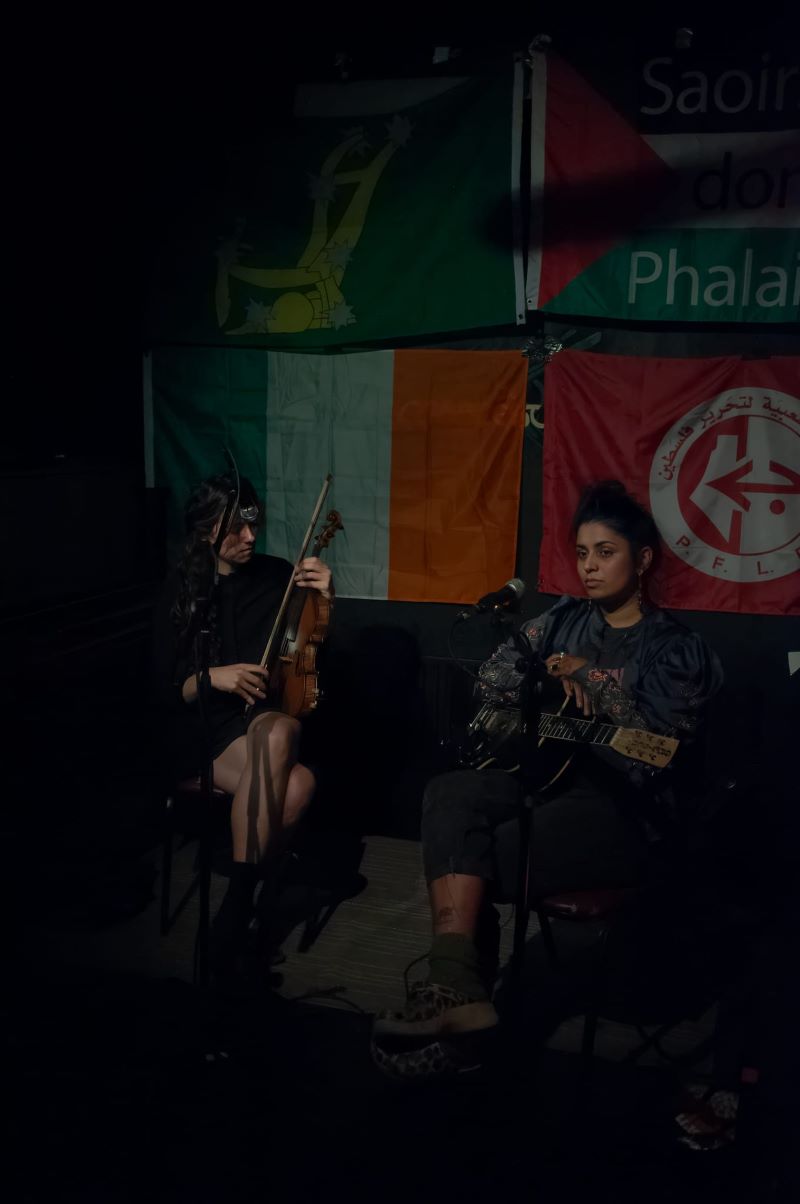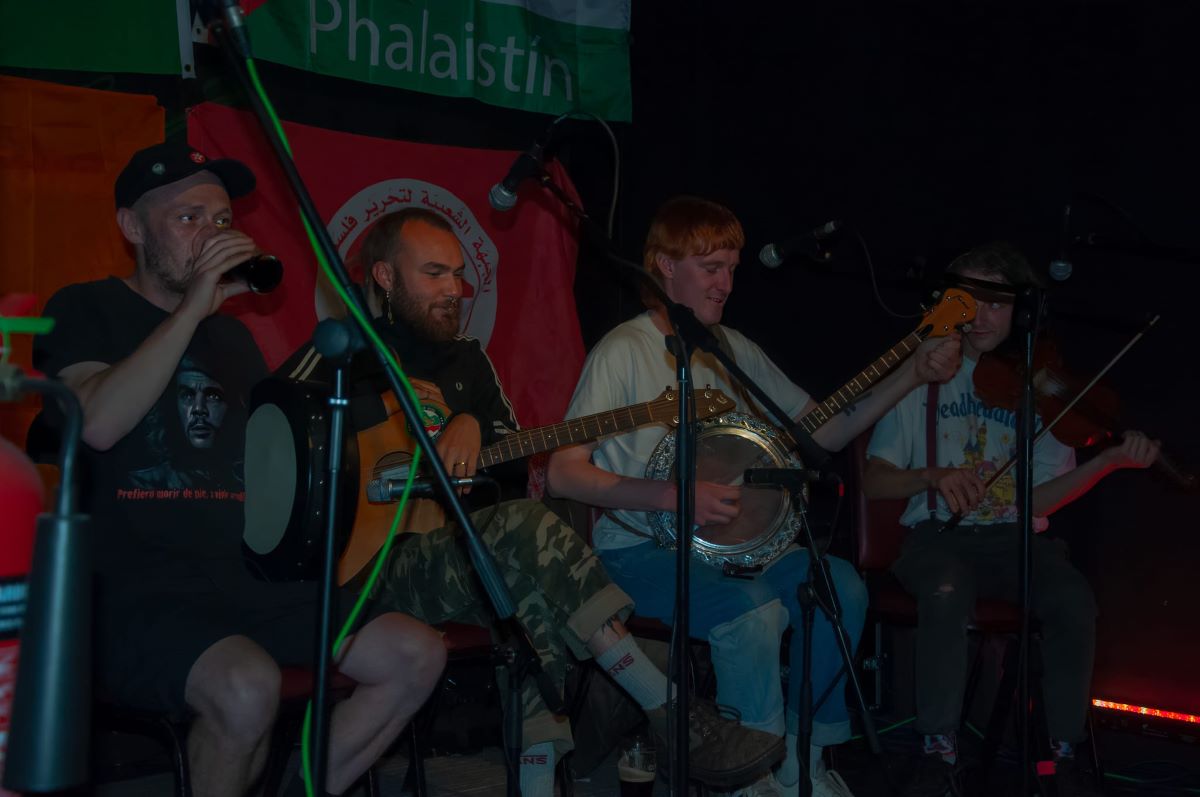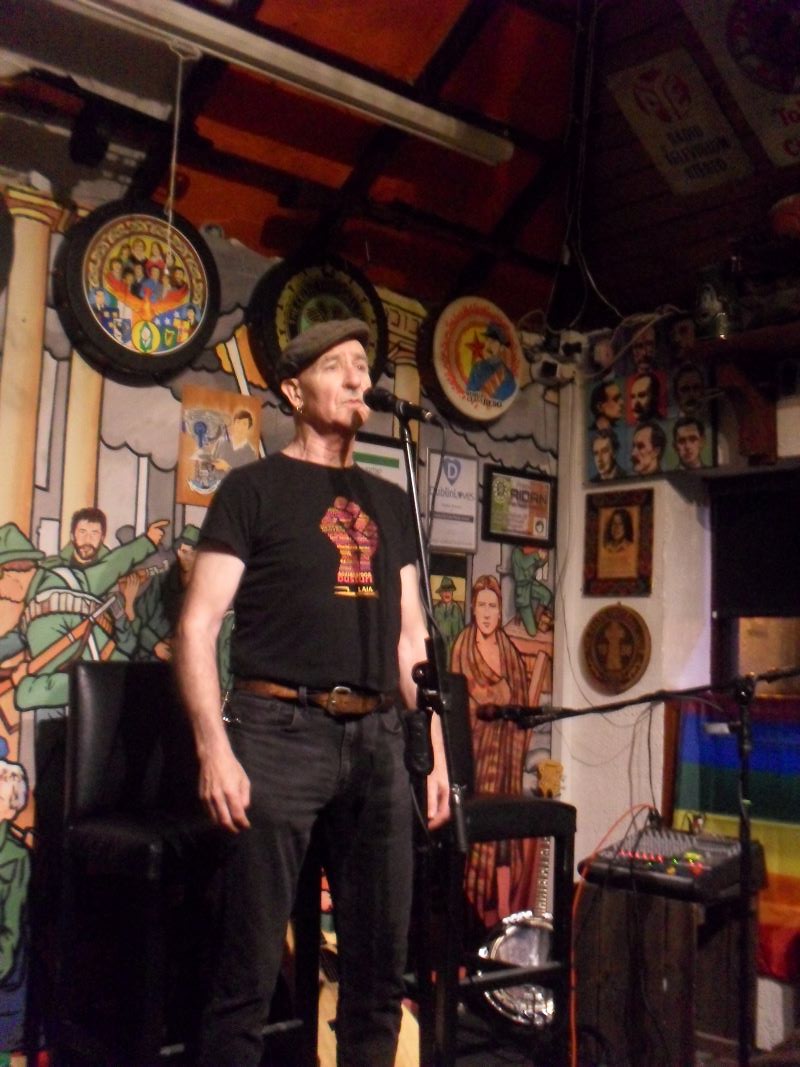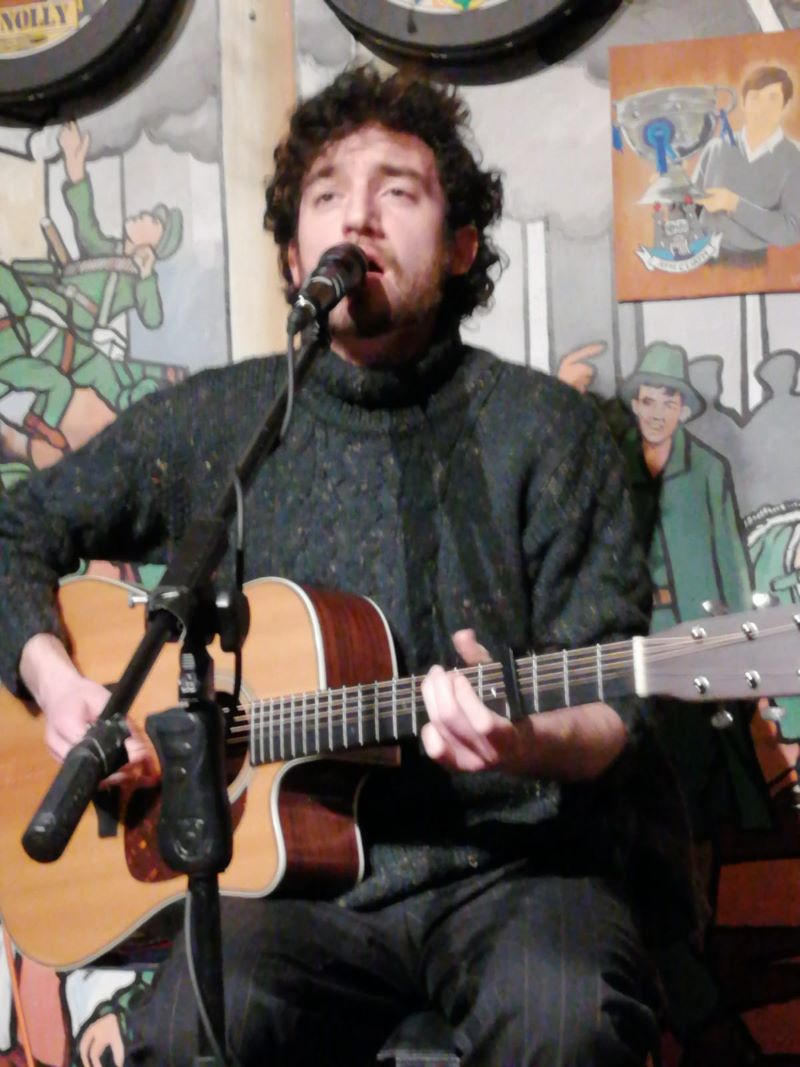
An Irish punk rock band, Mongolian throat-singers, a poet and Irish folk singers all performed at Solidarity Sessions No.2 to a good crowd in the International Bar, in in Dublin City centre Wicklow Street on Wednesday 17th..
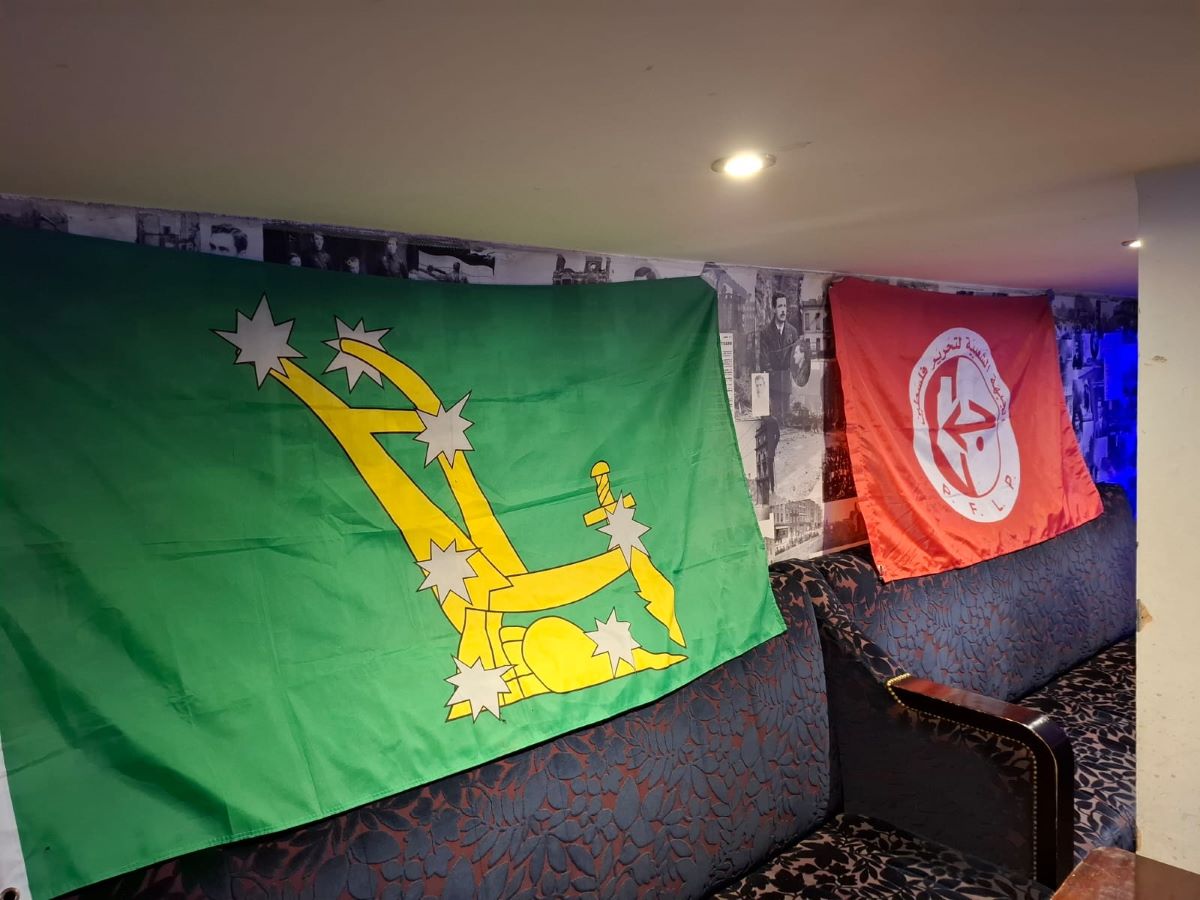
An Irish and international resistance theme in decor was presented by flags of the Starry Plough and Palestine with Saoirse don Phalaistín as stage backdrop, while flags respectively of Cumann na mBan and Basque Antifa concealed the original decor’s ubiquitous photos of Michael Collins.
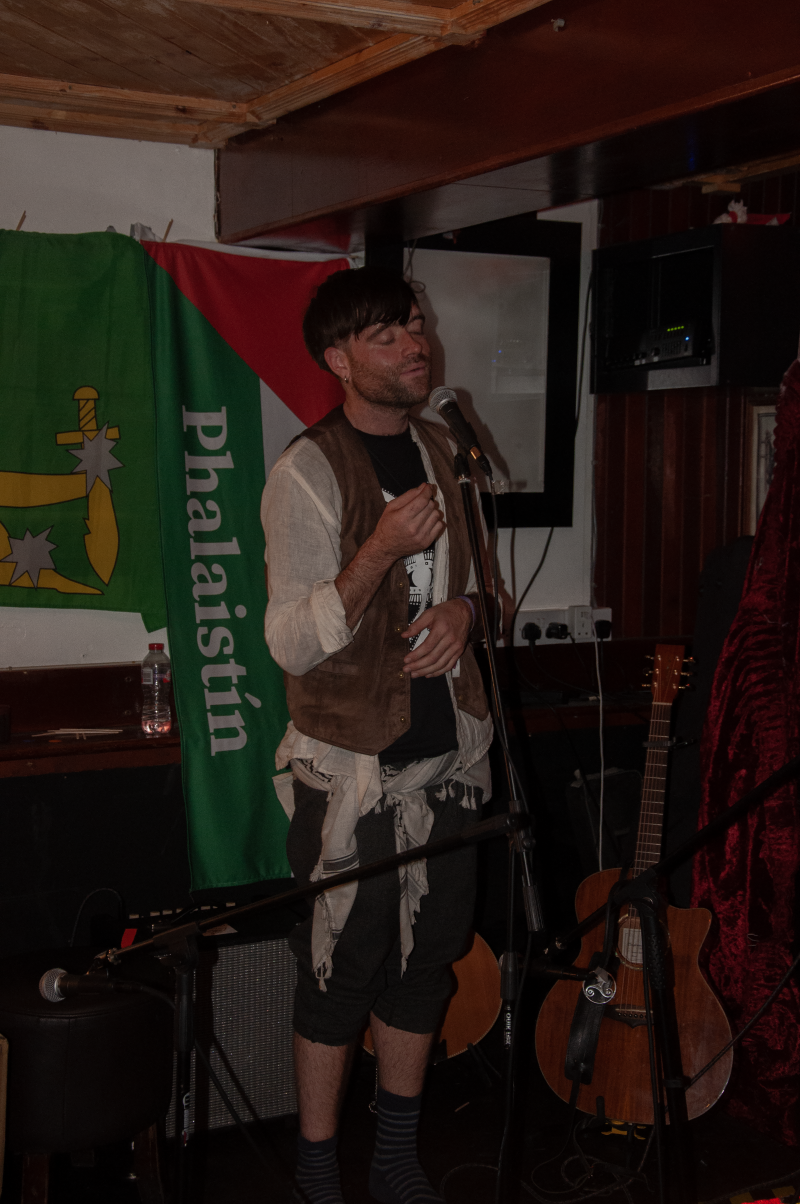
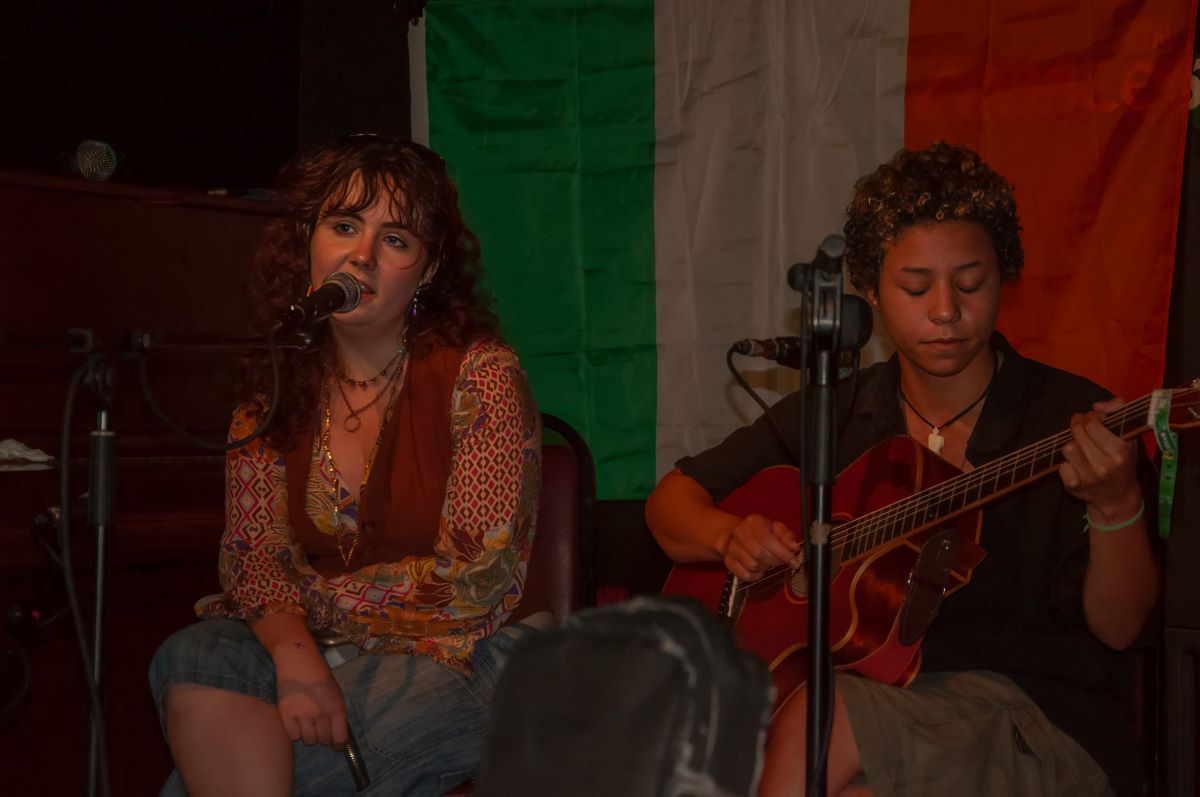
Flesh B. Bugged performing (Photo: Dermo Photography)
A PFLP1 flag was also taped to a wall. Hand-written signs on the stairs leading to the basement venue, alternatively in Irish and in English, asked for quiet/ ciúnas for the performance/ racaireacht. The Irish language was present too in some of the performances to follow.
MC for the night, Jimi Cullen, himself a singer-songwriter activist told the crowd the purpose of the organising collective was “to build a community of resistance and solidarity with our struggles and with struggles around the world” through culture in a social atmosphere.
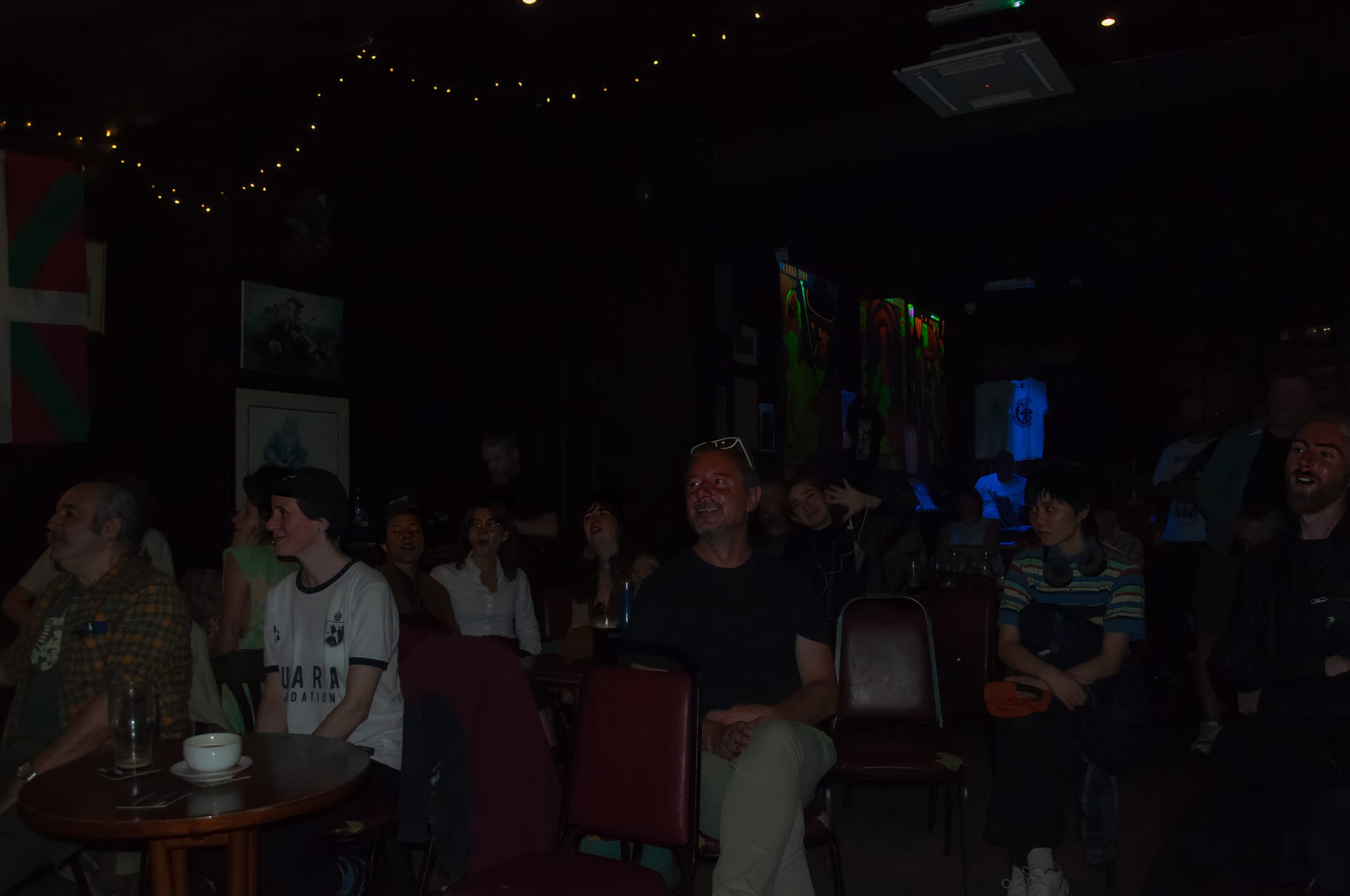
Before the crowd — a flag temporarily changing the decor. (Photo: R. Breeze)
Themes of love, nature and emigration were covered in song; however the dominant theme was resistance – to prison regimes, foreign occupation, fascism, class oppression, racial discrimination – and solidarity with the struggles of others, near and far.
Diarmuid Breatnach, singing acapella kicked off the night with a selection of songs from the Irish resistance tradition and a couple of short ones from the USA civil rights movement. Some of the melodies however, of particular interest perhaps to Back Home in Derry2, were his own originals.
Eoghan Ó Loingsigh, accompanying himself on guitar followed with more material from the same tradition, dedicating one to his late IRA father. A folk song Ó Loingsigh announced as ‘non-political’ performed acapella turned out to be very much political but on the issue of social class.
Áine Hayden followed with poems on a range of topics, from swimming in the Royal Canal during the Covid shut-down, deleting a personal relationship to a dedication to comedian and activist Mahmoud Sharab murdered with family in a “safe zone” tent by the Israeli Occupation Force.
Eoghan Ó Loingsigh performing (Photo: Dermo Photography)
The three performers were all introduced as activists as well as artists and the mostly-young crowd, apparently containing a strong representation of political and social activists, responded well to the performers with applause, yells of encouragement and often joining in on choruses.
More people arrived before, during and even after the break – including an elderly couple who had just arrived from the USA and could only pay in dollars but were admitted for free. Leaving later with thanks they promised a contribution to Palestine solidarity when they got home.
Before the crowd — a Cumann na mBan flag temporarily changing the decor. (Photo: Dermo Photography)
Also an activist, Ru O’Shea sang an Irish, Scottish, French and Italian selection, accompanied by bouzouki and guitar and performed a spoken word piece with a refrain of ‘Éire under attack’ before schooling the audience to sing the chorus of Robbie Burns’ Green Grow the Rushes Oh!
Áine Hayden performing (Photo: Dermo Photography)
Nomads were the next act. Composed of two Mongolian musicians playing violins in the style of the viola and a Dubliner modulating on a sound deck they were unusual enough but it was the amazing throat-singing of one of the Mongolians that had the audience enthralled.
It was amazing to learn that there are three different kinds of Mongolian throat-singing and then to hear them performed, one of which was a kind of whistling with a vibrating bass undertone wavering through it. The applause, particularly when they concluded, was rapturous and sustained.
Before the crowd — flags temporarily changing the decor. (Photo: R. Breeze)Ru O’Shea performing (Photo: Dermo Photography)
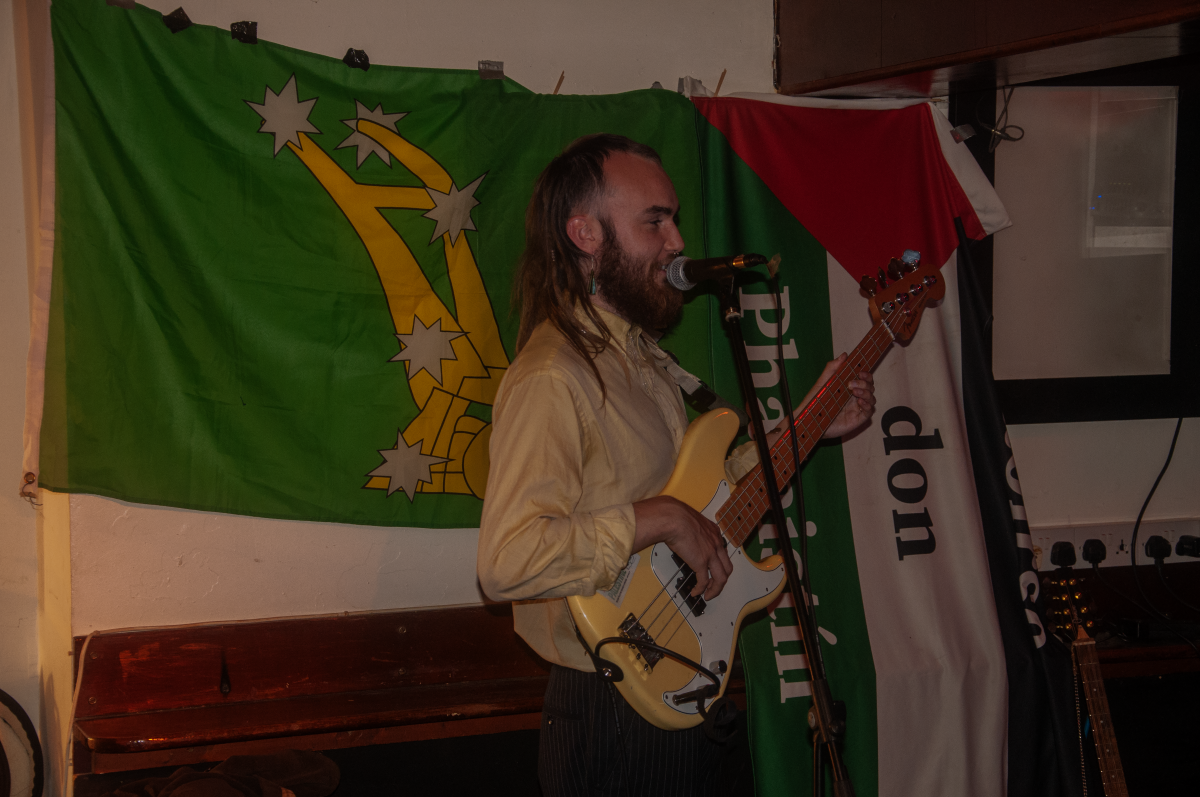
The evening’s entertainment concluded with Flesh B. Bugged, a punk rock Irish duo of bass guitar and drums with spoken voice pieces in Irish from the bass guitar player. Their volume and beat got some of the crowd up and dancing and the wider crowd responded well to them too.
MC Jimi Cullen went up on stage for the last time to thank venue, performers, audience, doorkeepers, poster designers Ríona and Azzy O’Connor, also Diarmuid for original artwork. At a prompt from the crowd Cullen also got a round of applause from the audience for his MCing.
The Mongolian musicians of Nomads performing (Photo: D.Breatnach)
Remarking they’d “had a great night” and encouraging his listeners to follow the organising collective on its Instagram page, Cullen told them that details of Solidarity Sessions No.3 and the collective’s decisions on recipients of donations from money raised would be posted on there.
Diarmuid Breatnach told the audience that each individual could help build a community of resistance through attending the Solidarity Sessions and encouraging others to attend. He welcomed any ‘competion’ from solidarity sessions around the country.
Bass guitarist of Flesh B. Bugged (Photo: Dermo Photography)
The downstairs area of the International Bar is not perhaps the best layout for this kind of event but it worked out well enough for the collective, audience and performers on the night. Their next event will be back at their launch venue,The Cobblestone, Smithfield on Thursday 30th October.
End.
Note: If you found this article of interest, why not register with Rebel Breeze for free, so that you will be notified by email of subsequent articles. You can de-register any time you wish.
The Mongolian throat-singer in Nomads (Photo: Dermo Photography)
FOOTNOTES
1People’s Front for the Liberation of Palestine, one of two specifically secular armed resistance organisations in Palestine.
2Irish mega folk singer Christy Moore had organised Bobby Sands’ poem into song to the melody of The Wreck of the Edmund Fitzgerald by Gordon Lightfoot.
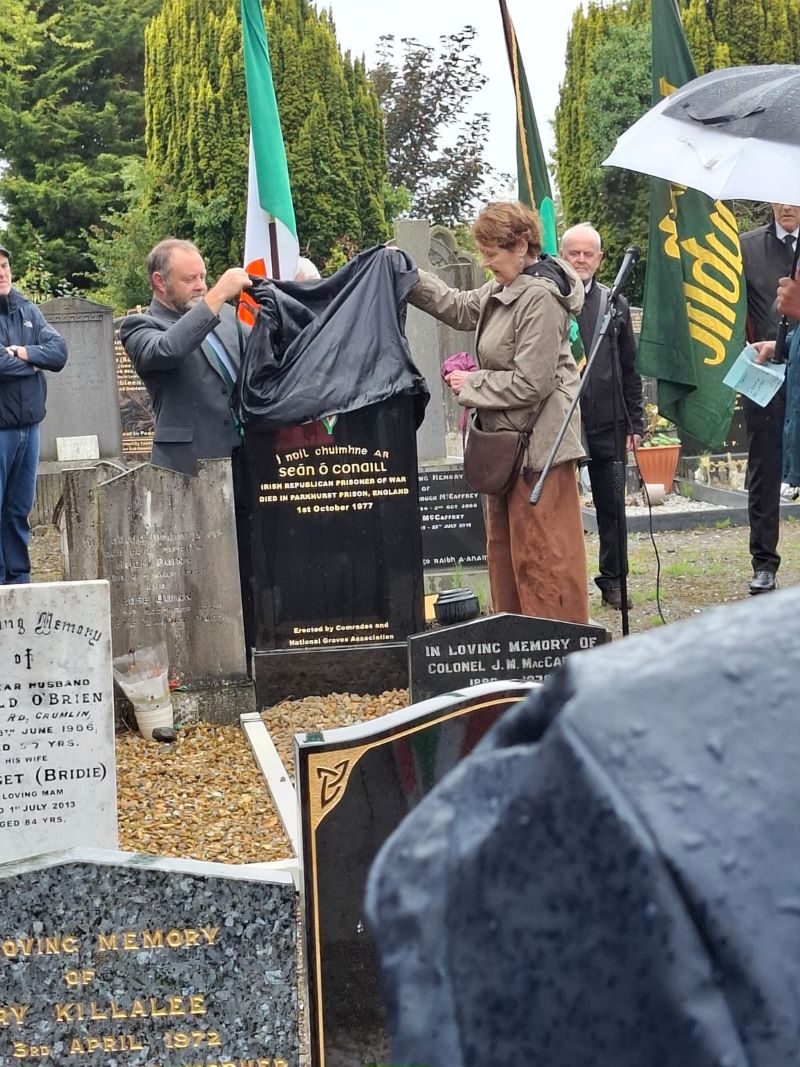
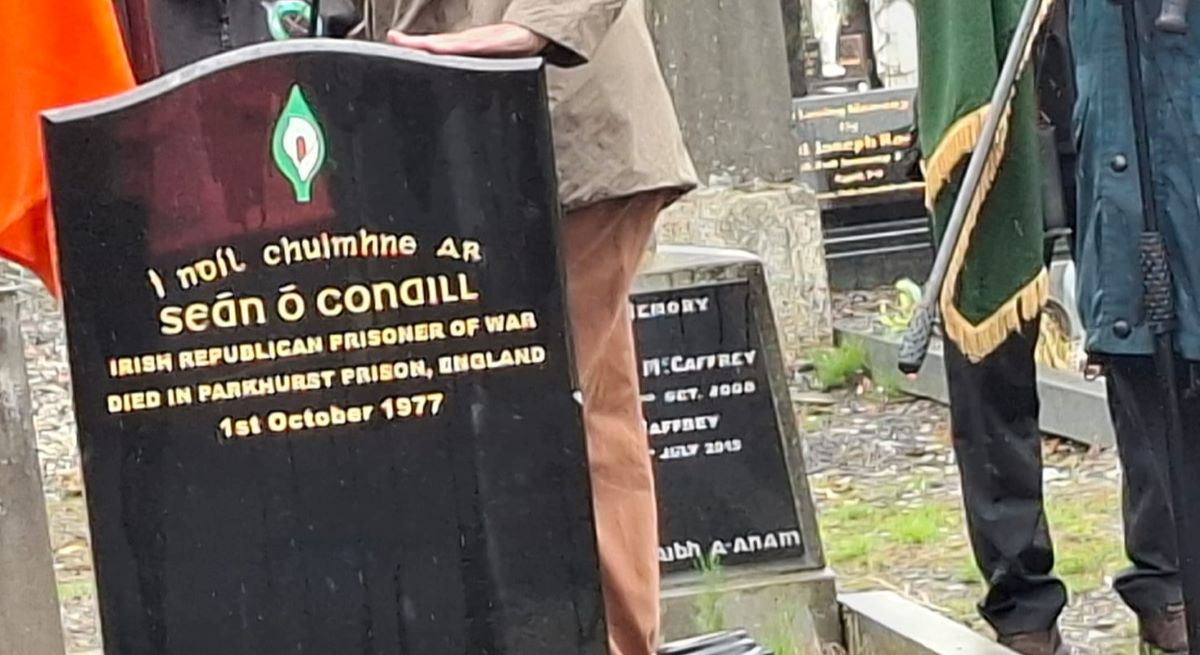
The grave of Irish Republican political prisoner Vol. Seán Ó Conaill received a headstone on Sunday (7th August) due to the efforts of the National Graves Association – nearly 50 years after his death in British custody.
Seán was born and brought up of Irish background in Birmingham and became interested in Irish history. After Bloody Sunday (1972) he tried to join the IRA but was not accepted and subsequently acted independently, assassinating a British Army Lieut. Colonel.
Tracked by British police, he wounded two of the group sent to arrest him, was captured and beaten up. His treatment in jail was bad also but after sentencing was accepted by the Irish Republican prisoners in British jails and, in time, sworn into the Provisional Irish Republican Army.
After his death his body was transferred for burial in Glasnevin. It seems that the NGA understood that his family wished to erect a headstone but for whatever reason the grave lay without one until last week.
The National Graves Association went ahead with commissioning a gravestone which they unveiled on Sunday in the St. Paul’s section of Glasnevin Cemetery1 with a colour party, speakers, music and a goodly attendance, though drenched during the ceremony.
The occasion was supported by members of Sinn Féin and Republican organisations in addition to independent Republicans and anti-imperialists. Seán Whelan, Chairperson of the NGA chaired the event and after some opening remarks introduced the speakers.
Section of the attendance at the event. (Photo: D. Breatnach)
SPEAKERS
Jacqui Kaye of the former Prisoners’ Aid Committee2 was introduced to speak and told her audience that Ó Conaill was diagnosed with terminal cancer and requested a visit from Kaye, permission for which was initially refused by the Home Office3 but granted after intervention by Lord Longford.
The visit was permitted for 10 minutes only for Parkhurst Jail but then changed to a hospice though when Kaye arrived it was to be told that he had just died there, leaving her with the suspicion that he had actually died in Parkhurst but that the Home Office did not wish that on their record.4
Jacqui Kaye, formerly of the Prisoners Aid Committee (no longer in existence), speaking at the event during a particularly heavy shower. (Photo: D. Breatnach)
Former Republican prisoner (21 years in British jails) Noel Gibson laid a wreath on behalf of the NGA and Paddy Lennon read The Rhythm of Time by hunger strike martyr Vol. Bobby Sands, after which a recording of uileann pipes filled the cemetery air with its haunting lament.
Liam Ó Culbáird of the NGA presented the main oration of the event, recounting details of Ó Conaill’s life and time in jail, information gathered from a number of sources, including that despite complaining of chest and stomach pains he did not receive medical investigation in jail.
It was only after coughing up blood that Ó Conaill received a medical visit, after which he was diagnosed with terminal cancer. His marriage had become estranged possibly as a result of his incarceration but official interference in personal relations of political prisoners was also known.5
Liam Ó Culbáird, giving the oration at the unveiling on Sunday. (Photo: D. Breatnach)
The speaker alluded to the practice of “ghosting” political prisoners, i.e. moving them to a different jail without notice, often as a scheduled visit by a family member was imminent, which occurred to Ó Conaill’s mother arriving at Wakefield Prison to be told he had been moved to Parkhurst Jail.6
Such practices imposed an additional punishment not only on the prisoner but in particular on family members7 who had often travelled long distances into sometimes hostile territory and had also the additional expense of paying for overnight accommodation.
The media at the time of his arrest had portrayed Ó Conaill as of unbalanced mind but his comrades in jail found him completely rational and dedicated to the cause. He began to learn Irish and encouraged the other Republican prisoners to expand their use of the language.
Liam Ó Cúlbáird and Jacqui Kay unveil the headstone to Vol. Seán Ó Conaill on Sunday. (Photo: D. Breatnach)
Commenting on Ó Conaill’s failure to be recruited by the IRA prior to his armed action, Ó Culbáird commented that disagreements between General Headquarters of the IRA and Volunteers were not unknown and related a GHQ approach to Brendan Behan after his release from jail.
Behan was informed that he had been been found guilty by GHQ court-martial8 in his absence and sentenced to be shot. Behan replied that since his court-martial had been in his absence, so equally could his execution and promptly departed!
Ó Culbáird commented also on the number of groups that had operated independently of the IRA’s GHQ and remarked upon the number of different groups that had participated in the 1916 Rising,9 all with their reasons for separate existence but all united in the struggle for independence.
The speaker ended his oration by pointing out in Irish and in English that Ó Conaill was an Irish Republican soldier who gave his life in the struggle for Irish freedom.
CONCLUDING
Bringing the ceremony to an end, Seán Whelan thanked the speakers for their contribution and audience for their attendance and added some words about the NGA, pointing out its political independence and refusal to accept donation from any governmental or other organisation.
Chairperson of the NGA, Seán Whelan, presiding over the unveiling on Sunday. (Photo: D. Breatnach)
Whelan also added that whereas the NGA acknowledges the right of anyone to commemorate their dead, their organisation prioritises the dead who participated in the Irish struggle for independence but also cannot agree to share their commemoration with those who fought against them.
He remarked that he did not know of any other country where that would be done. Whelan then called for attention to the playing of a recording of the the National Anthem.
End.
(Photo: D. Breatnach)
FOOTNOTES
1i.e the large section on the opposite side of the road from the main Glasnevin gates, also where stands the NGA memorial to the six uprisings mentioned in Pearse’s famous speech.
2The PAC was initially formed by Official Sinn Féin but within two years had left the Officials and operated independently.
3Irish Republican prisoners in British jails were listed as high-security Category A and were not permitted visitors other than immediate family.
7Though not mentioned in the oration, this was also a practice of the Spanish prison system against Basque political prisoners, in which case letters and parcels arriving for the prisoner, rather than be forwarded to the prisoner’s new location, would be returned to sender with a note that the prisoner was no longer at the posted address.
8Presumably for his solo unauthorised action in carrying a bomb to England.
9Irish Republican Brotherhood, Irish Volunteers, Cumann na nBan, Irish Citizen Army, Na Fianna Éireann, Hibernian Rifles. Some individuals not a member of any of those organisation also participated.
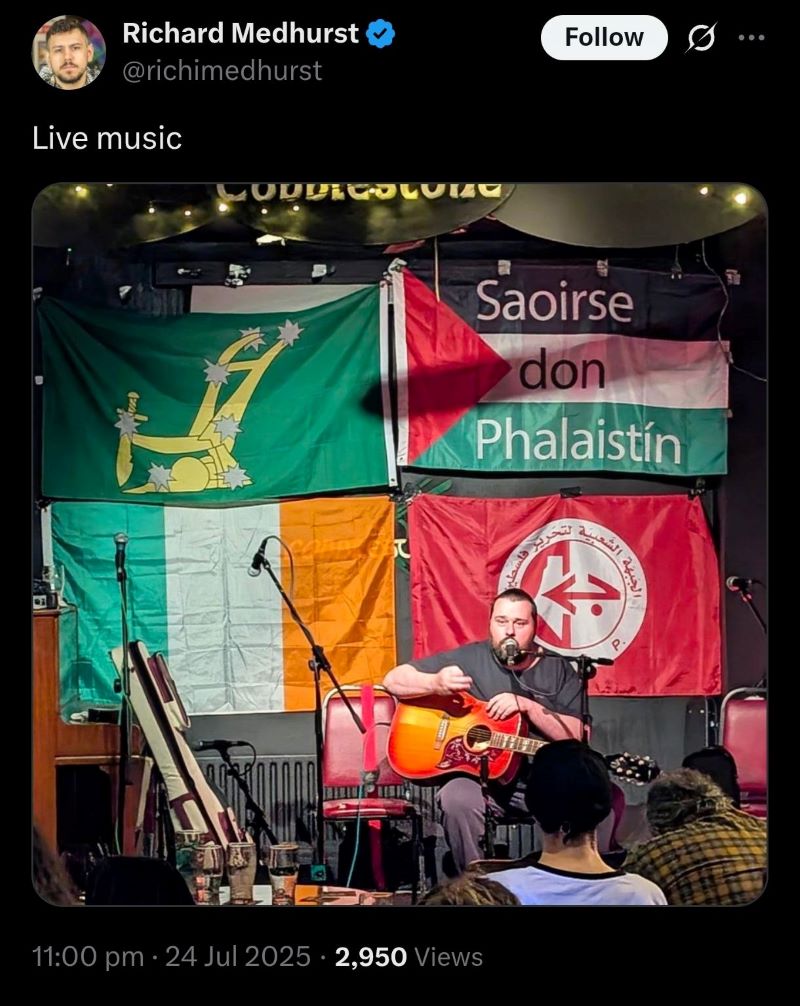
Around 80 people attended a concert in the back room of Dublin’s Cobblestone pub launching an initiative to “build a community of solidarity and resistance through culture”. Flags of Irish and other struggles around the world decorated the venue.
The evening’s entertainment consisted of five musical acts and one of poetry. The MC for the evening, Diarmuid Breatnach, told the audience that Irish struggles had always found an expression in culture and that culture itself encouraged further resistance.
He gave the example of Thomas Davis who founded with others the patriotic newspaper The Nation in the mid-1800s, publishing contributed songs and poems and his own, including The West’s Awake and A Nation Once Again, songs still sung in Ireland nearly two centuries later.
The first act of the evening was the folk duo The Yearners, specialising in harmonies around renditions of song covers and their own song about the Mary of the New Testament, as a woman pressured to bear a child because “How can you say no to God?
The audience joining in on Pearse’s Gráinne Mhaol was followed by some songs with hard satirical edges like the Kinky Boots song from the Irish Republican repertoire and their own Save A Landlord.
The Yearners during their performance. (Photo credit with thanks: Dermo Photography)Dúlamban during their performance. (Photo credit with thanks: Dermo Photography)
The MC introduced another all-female duo, Dúlamban, recently formed from two individual singer-musicians. Among their material, Sinéad on violin played two compositions of her own while Aisling sang her adaptation and translation of the Rising of the Moon: Ar Éirí na Geallaigh.
The one poet of the evening, Barry Currivan, performed a number of shorter and longer pieces of his repertoire. He was particularly applauded for his “anti-othering” piece Those People and his humorous concluding piece comparing himself to a good cup of tea or coffee.
After the break, the MC spent a few minutes outlining the Solidarity Sessions collective’s project and encouraging the audience to take part in it by spreading word of its events and supporting them in person, in addition to stepping forward to assist in organisation and in poster design.
Barry Currivan during his poetry performance at the Solidarity Sessions launch. (Photo credit with thanks: Dermo Photography)Section of the audience presumably during Currivan’s performance. (Photo credit with thanks: Dermo Photography)
Another female duo took the stage, Sage Against the Machine on guitar accompanied by Ríona on violin, performing a number of love pop covers and SAM’s own song against patriarchy.
Some remarks about Bob Dylan’s Zionism followed in Sage’s introduction of the former’s Masters of War which she performed with great feeling and followed with El Gallo Rojo, an anti-fascist song from the Spanish ‘Civil War’.
Sage Against the Marchine (right) and Ríona during their performance. (Photo credit with thanks: Dermo Photography)Jimi Cullen during his performance at the Solidarity Sessions launch. (Photo credit with thanks: Dermo Photography)
Breatnach then introduced Jimi Cullen who he said has been hosting a weekly musical protest picket for an hour on Wednesdays (2-3 pm) outside the US Embassy for a great many weeks, in which the MC had sometimes accompanied him amidst the solidarity beeping of passing traffic.
Jimi accompanied himself singing his Housing for All and Guthrie’s You Fascists Bound to Lose, then commenting on Bob Marley’s Zionism while introducing the latter’s One Love song, saying that love above all is what binds humanity together, a theme also of his We Are All Palestinians.
His monologue The Genocide Will Be Televised was much sharper and renewed an earlier Death, death to the IDF!1 chant from the audience.
Trad Sabbath during their performance. (Photo credit with thanks: Dermo Photography)
There was much irreverent comment about the name of the band to conclude the evening, Trad Sabbath, a four-piece band of guitars, banjo, bodhrán and fiddle, apparently in the context of the very recent death of the Black Sabbath band’s lead vocalist, Ozzie Osbourne.
Sardonic cries about “his poor widow”, Sharon Osbourne2 were also heard, a Zionist personality star in a ‘reality’ TV show about the late Ozzie’s family. To fill in the delay in their setting up with the sound engineer, Breatnach sang Kearney’s Down by the Glenside ballad.
The band concluded the evening with traditional melodies and some songs from Eoghan and Hat with others backing on choruses.
Poster advertising the event (Design: Ríona and D.Breatnach)
The MC thanked all for their attendance, performances and technical support before reiterating the Solidarity Sessions’ objective and encouraging participation. His comment that “Repression is here and more is coming down the road” was underlined by the presence there of a prominent victim.
In the audience was Richard Medhurst, the Britain-based journalist specialising in Middle Eastern coverage who was recently detained under anti-terror (sic) legislation and charged by British police as he returned from abroad and again later detained though not actually charged by Austrian police.
Richard Medhurst’s tweet during the evening at the event.
End.
FOOTNOTES
1Made famous by the Bob Vylan duo at Glastonbuy getting the audience chanting the slogan. The IDF is what the Israeli Occupation Forces call themselves.
2Who had called for the banning of the the Irish rap group Kneecap.
An Irish Republican Easter Rising commemoration conducted on Sunday 20th April followed tradition in some aspects but departed in others. The event in Glasnevin Cemetery was organised by the Anti-Imperialist Action group.
As the 1916 Rising commenced on Easter Monday it is traditionally commemorated on various days around the Easter weekend. The actual date however was 24th April which a now-deceased socialist Republican activist publicly celebrated every year as Republic Day in front of the GPO.1
Taken from near rear of the marching columns approaching Cross Guns Bridge. (Photo: R.Breeze)
Among the commemorations organised by Irish Republicans around the past weekend was that by the AIA group on Sunday, rallying by the Phibsboro shopping parade for 1pm, before marching out to Glasnevin cemetry along the Phibsboro Road in two parallel separate lines.
This gathering in the past has been marred by the Special Branch, the political plainclothes police, harassing and attempting to intimidate those present, demanding their names and addresses under anti-terrorist (sic) special legislation. This time they were there but did not approach.2
Just after passing Crossguns Bridge over the Royal Canal, a flare was lit and the march stopped in the street.3
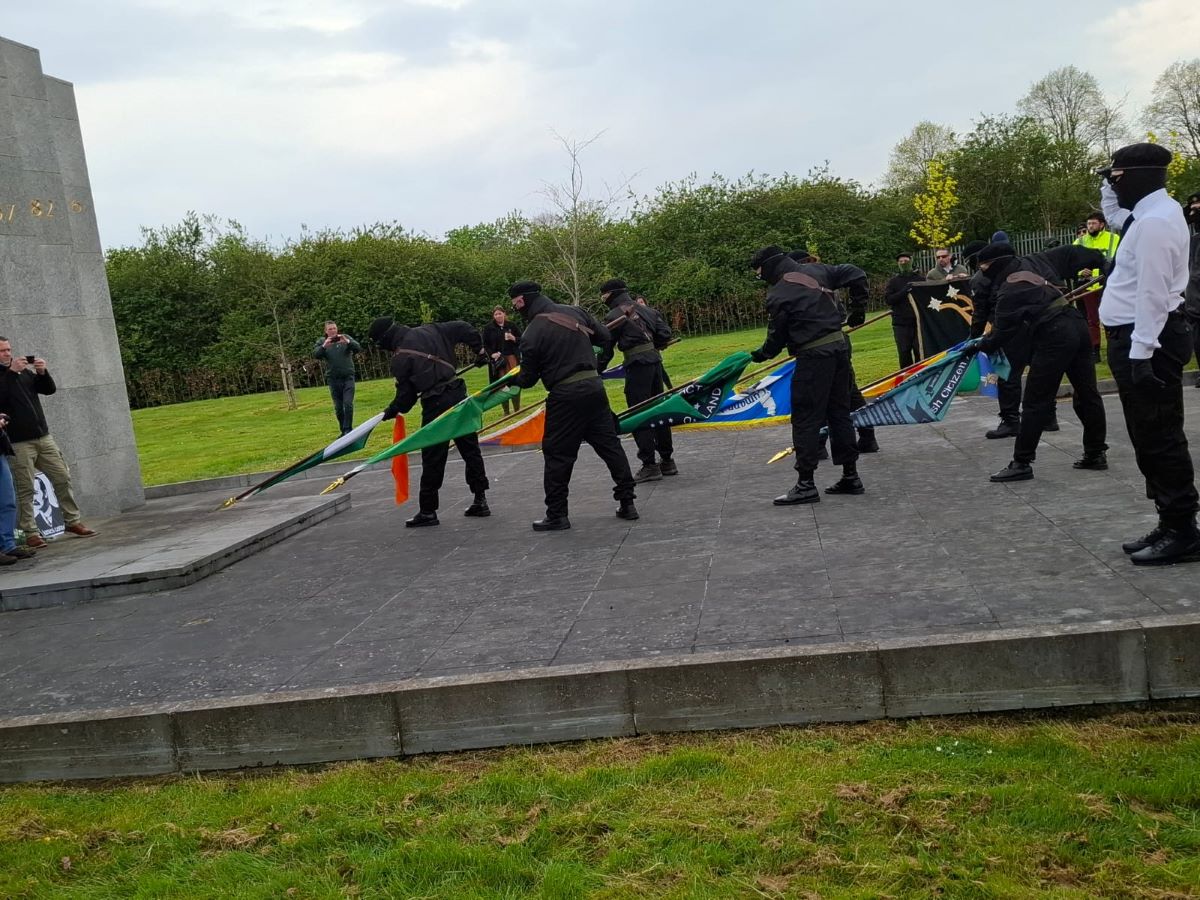
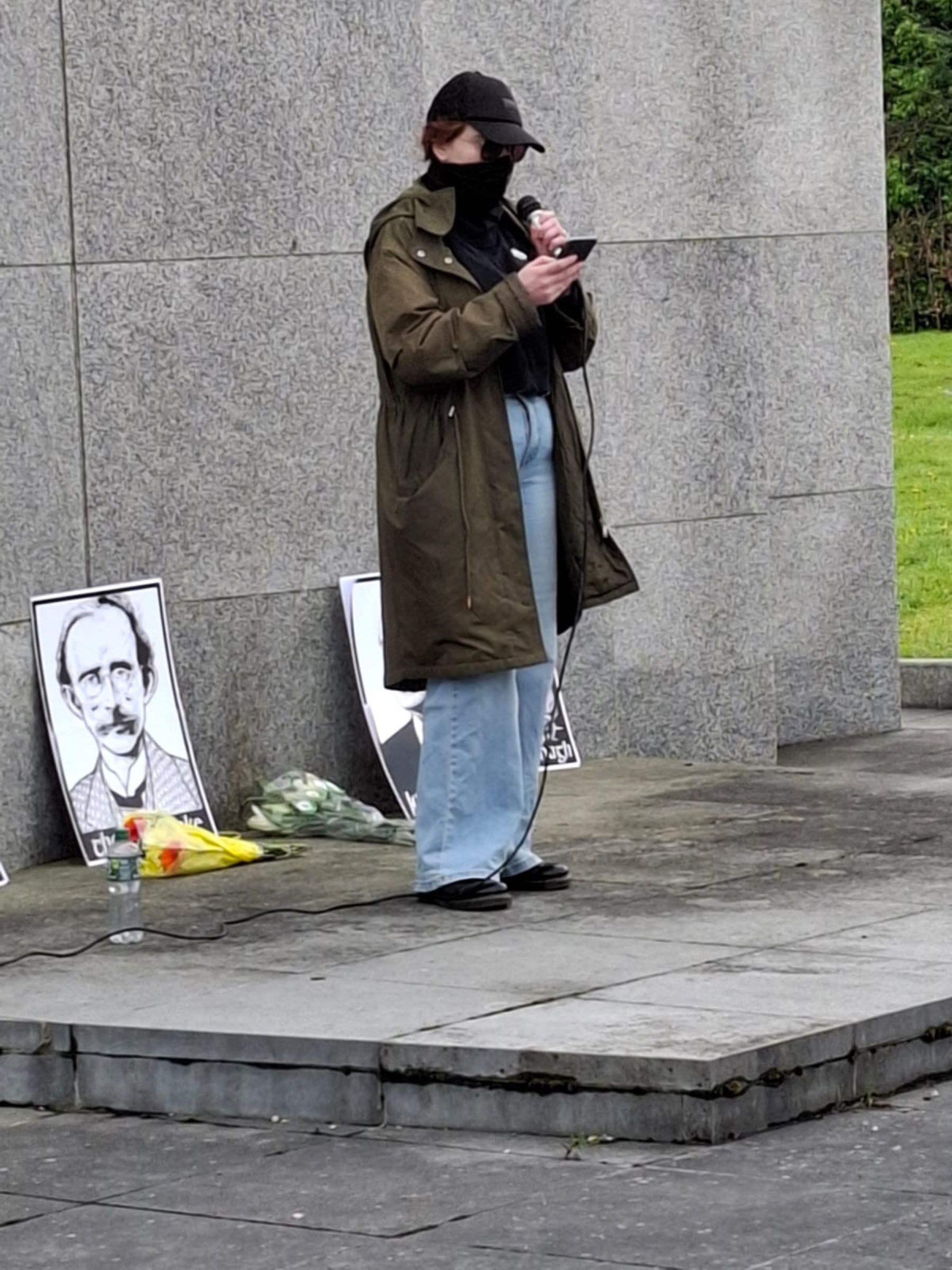
After a short pause the march resumed, led by the colour party,4 six men and women, each carrying a different flag with the Tricolour and Starry Plough in the lead, all dressed in black trousers, white shirts, black berets, sunglasses and lower face masked.
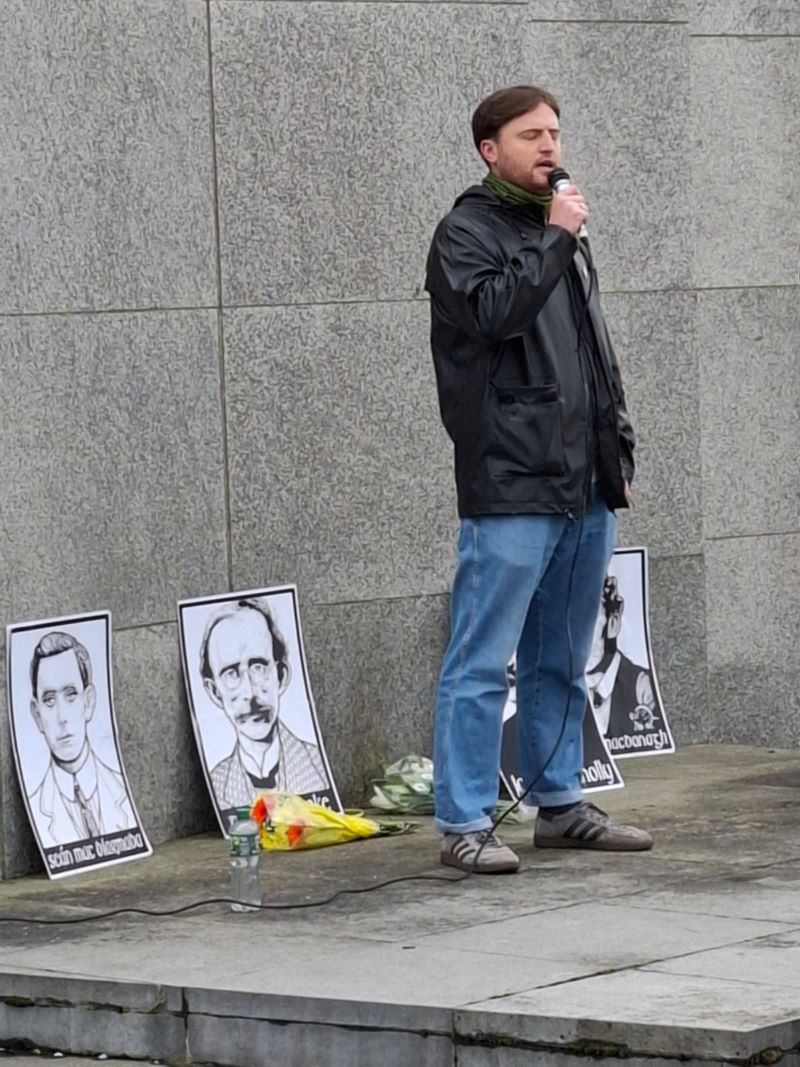
The images of each of the Seven Signatories of the 1916 Proclamation, all shot by British firing squads were on large placards were carried among the marchers: Tom Clarke, James Connolly, Patrick Pearse, Seán Mac Diarmada, Joseph Plunkett, Thomas McDonagh, Eamonn Ceannt.
(Photo: R.Breeze)
A variety of flags were also flown among the marchers, including the green and gold Starry Plough,5 Palestinian flag, Basque Ikurrina and red flags (with gold hammer and sickle emblem on at least one).6 The AIA banner carried at the front bore a quotation from Bobby Sands in Irish.
The march soon passed the main gates of Glasnevin Cemetery to their right but continued before turning leftward to then cross over the pedestrian railway bridge to the newer part of Glasnevin Cemetery and up to the monument to the Six armed struggles referred to in the Proclamation.7
Formed in two lines the attendance was welcomed in Irish and English by the event’s MC, calling also for the reading of the Proclamation of Independence, which a man stepped forward to do. The MC recommended a careful reading of the still-relevant document to attendees from abroad.
Section on the left of the attendance at the commemoration rally with another section to the right out of shot. (Photo: R.Breeze)
Following the reading, the MC commented on the important role of culture in the 1916 Rising8and called on an activist who he said has done much to promote traditional and folk Irish song, who proceed to sing Patrick Galvin’s Where Oh Where Is Our James Connolly? “with some changes”.
Next the call was given for those who wished to lay floral tributes while the colour party lowered their flags in homage to the fallen to commands in Irish, then slowly raised them again before responding to the command in Irish to stand ‘at ease’.
(Photo: R.Breeze)
Another activist was called to read the 1915 statement on the Irish Citizen Army by James Connolly in which the revolutionary leader outlined the police violence during the 1913 Lockout that created the need for the ICA and how it had gone beyond defence in assertiveness.
The statement declared its class allegiance and origins “Hitherto the workers of Ireland have fought as parts of the armies led by their masters, never as members of an army officered, trained, and inspired by men of their own class.”
Reading Connolly’s “To the Irish Citizen Army” (Photo: R.Breeze)
The PA amplification failed on the reader but she carried on in a strong voice reading Connolly’s words that the ICA sought alliance with all progressive forces but remained independent, not to be bound by the limits others set themselves and going further on their own if necessary.9
Another singer was called to perform Erin Go Bragh10 specifically about the 1916 Rising (by Dominic Behan, originally called A Row in the Town).
Singing Erin Go Bragh at the Monument (Photo: R.Breeze)
It is traditional for organisations to deliver a keynote message or statement of aims at 1916 commemorations and a statement was read on behalf of the Irish Socialist Republican Movement (of which the AIA is a part) restating the objectives of national independence and socialism.
In that context the struggles against the Irish ruling class putting the State into imperialist alliance and against the British occupation of the nation, also a NATO member, were greatly important and the Gardaí had broken a comrade’s foot in that struggle.
(Photo: R.Breeze)
Referring to the international context of the 1916 Rising and the international connections of the revolutionary movement in 1916, the MC read out a fraternal message to AIA from the People’s Front for the Liberation of Palestine,11 declaring that the struggles of both peoples are one.
The event concluded at around 2.45pm with a singer performing Amhrán na bhFiann12 (first verse and chorus) followed by an announcement or reminder of a public meeting organised by the AIA titled Rebuilding the Republic to take place at 4pm at a venue not very far distant.
End. Footnotes
1Easter is a religious festival and its date varies from year to year according to computations based on the lunar and solar calendars and cannot fall on the same date annually in the Gregorian calendar (or the Julian one). After the insurrectionary forces had taken possession of the building, Patrick Pearse with James Connolly by his side read the Proclamation outside the General Post Office (GPO) building on the first day of the Rising (after its rescheduling from the previous day, Sunday): 24 April 1916. Tom Stokes tried for years to have the date adopted as Republic Day and annually organised an event outside the GPO on that date. After his death others carried on commemorating the date but rather than outside the GPO, at Arbour Hill. The Republican movement continues to hold its 1916 commemoration events over the Easter weekend.
2Possibly because the dust has not yet settled on the Gardaí’s recent violent arrests on 23 peaceful activists in three different events over four days (See Rebel Breeze’s IrishState Ramps Up Repression) recently.
3This spot has a 1916 history: A group of Irish Volunteers walked from Maynooth on Easter Monday along the banks of the Royal Canal, meeting two Irish Volunteers guarding the bridge and that night slept in Glasnevin Cemetery. The following morning they continued their journey to the city centre. Later, as the Rising was being suppressed, the British soldiers placed a barrier on the Bridge and prevented most people from passing through. A local man who had been deaf from birth failed to heed the soldiers’ challenge and they shot him dead.
4The ‘colour party’ carries the ‘colours’, i.e the flags and usually marches at the front. The number and type of flags varies but Irish Republican colour parties always carry the Tricolour among them, usually followed by the Starry Plough of which for many years the white stars on a blue background version was the most common. Often a flag of each of the four provinces would also carried and the Gal Gréine (or Sunburst) of the Fianna and of the Fenians would be carried too. The Harp on a Green background was another flag that was often carried by Colour Parties.
5The original design of the flag of the first workers’ army in the world, the Irish Citizen Army, created in 1914. It is a plough following the form of the Ursa Mayor constellation with a sword replacing the ploughshare.
6This is usually considered a symbol inherited from the Bolsheviks, the sickle representing the agricultural workers and the hammer, the industrial workers, their conjunction symbolising unity of peasants and industrial proletariat.
71798 and 1803 (United Irishmen), 1848 (Young Irelanders), 1867 (Fenians), 1882 (Invincibles group within the Fenians), 1916 (IRB, Irish Volunteers, Irish Citizen Army, Cumann na mBan, Fianna Éireann)
8Irish language revival, national theatre groups, national sports, poetry, music and song all contributed to an atmosphere conducive to resistance and uprising.
9However it may be for others, for us of the Citizen Army there is but one ideal – an Ireland ruled, and owned, by Irish men and women, sovereign and independent from the centre to the sea, and flying its own flag outward over all the oceans. We cannot be swerved from our course by honeyed words, lulled into carelessness by freedom to parade and strut in uniforms, nor betrayed by high-sounding phrases.
The Irish Citizen Army will only co-operate in a forward movement. The moment that forward movement ceases it reserves to itself the right to step out of the alignment, and advance by itself if needs be, in an effort to plant the banner of freedom one reach further towards its goal. https://www.marxists.org/archive/connolly/1915/10/forca.htm
10The slogan Éirinn (or Éire) go brách (“Ireland for ever”) was rendered in English spelling as Erin go bragh.
11 A socialist and secular resistance Palestinian resistance organisation; its armed wing is Brigades of the Martyr Abu Ali Mustafa which has been part of the armed resistance throughout the period, often in coordination with other groups.
12In a reversal of the usual sequence, the lyrics of this song by Peadar Kearney and Patrick Heeney were first composed in English but later translated to Irish, that being the most popular version of the chorus today.
A night of resistance and other songs on Friday night in Peadar Browne’s Dublin pub raised funds to assist in fighting state repression of Palestine solidarity activists in Ireland, as Palestine solidarity activists face persecution across the Western world.
The evening’s performance consisted of a mix of political and other songs, a number of which were original material. However it was the political material that most drew interest, ranging from international struggles to the rich Irish Republican tradition.
Olive and Fynn in performance at the fund-raising event (Photo: R.Breeze)
To begin the event Diarmuid Breatnach explained the need to support Palestine solidarity activists against the repression of the Irish authorities, hence the fundraising event and announced that in addition to performing he would be standing in for the event’s MC who had been unable to attend.
Breatnach began his set combining two songs from the German antifascist tradition, three verses of Peat Bog Soldiers and three from the Hans Beimler ballad.1 Then from the Spanish Anti-Fascist War he sang Ay Carmela!, the air of which he said was from an anti-French occupation folk song.
Next the MC announced a performance by two performers, half of the four-strong Croí Óg ballad band. During their performance with voice, guitar and banjo there was an incident from a couple of unruly elements nearby who had substantial drink taken and had been very loud throughout.
Two members of the Croí Óg band performing at the fundraising event (Photo: R.Breeze)
A man who had been refused permission to sing solo began shouting that the songs were not Republican, ironically interrupting Grand Old Country, a song about the Fenian tradition. It became clear that what he wished was to perform the Grace ballad, which he began to sing loudly.
A male confronted the interrupter; the latter’s friend, a big elderly Glaswegian protested; others took to the floor … but the incident wound down, the interrupters and audience resuming their seats. However, the putative Grace singer threw threats at his earlier confronter across the room.
The big Glaswegian then crossed the room to confront the audience member, a female audience member intervened, he brushed her aside and the audience section erupted, only the quick arrival of the pub’s landlady preventing a fight … And the musicians resumed their performance.
Among the songs performed by Croí Óg were Crossmaglen and British Soldier Go on Home. The MC called for appreciation applause for them, made some barbed comments about the recent anti-social behaviour and welcomed the song-and-guitar duo Olive and Fyn to the stage.
Sage Against the Machine performing at the fundraiser event (Photo: R.Breeze)
The duo performed their own material in lovely harmonies, mostly non-political, also including their ironically titled Save the Landlord! After they had left the stage to applause Breatnach got up on stage again to announce a short break and to remind the audience to contribute to the funds.
His additional comment: “Remember when someone sang in a Dublin pub and everyone went quiet? Remember those days? Remember?” was followed by loud applause throughout the pub.
Breatnach restarted the second half, singing a capella again two songs celebrating Irish women’s resistance,2 ending with songs in Irish including the ballad of Rodaí Mac Corlaí. After concluding he introduced Sage Against the Machine to take to the stage, singing solo with guitar.
Sage’s material was mostly original, sung in English but went on to Masters of War in a spirited concluding verse, followed by Gallo Rojo, Gallo Negro3 in Spanish from the anti-fascist tradition in Spain. The MC then presented Eoin Ó Loingsigh, also with voice and guitar.
Eoghan Ó Loingsigh performing at the event (Photo: R.Breeze)
Although no further incidents occurred, the volume of ‘conversation’ between a number of people not far from the stage was high. Loingsigh’s material included Only Our Rivers Run Free, Viva La Quince Brigada4and a satirical song contrasting the fates of the rich and the poor after death.
The evening’s scheduled performances concluded with Seán Óg, also solo with voice and guitar, his selection including Ho Chi Minh, republican ballads Boys of the Old Brigade, The Patriot Game, Boolavogue and his own composition Boys of Gaza to air and structure of The Boys of Kilmichael.5
Breatnach thanked the attendance for their support, restating the context of the event and asked for another round of applause for all the performers, who gave their time and creativity for free, then called for people to stand for the Irish national anthem6 which he led with the first verse in Irish.
Diarmuid Breatnach in performance at the fundraiser event (Photo: R.Breeze)
At the concluding line of “seo libh, canaig …” the audience exploded to complete the words “Amhrán na bhFiann!” followed by launching into the chorus, also in Irish.
The event had been organised by two broad Palestine solidarity organisations, Saoirse Don Phalaistín and Palestine Action Ireland and among the attendance were a number of their activists, including some victims of state repression.
Most of the charges to date have been under the Public Order Act but also some around ‘criminal damage’ and the potential is there for more serious charges and possible jail sentences, as have been the case in some other European administrations.
In addition to actions of their own, including occupying and picketing the Israeli Embassy, Axa Insurance and picketing the Palestine Authority, Saoirse don Phalaistín and Palestine Solidarity Action organised Resistance Blocs to participate in mass demonstrations organised by the IPSC.
Seán Óg performing at the fundraiser event (Photo: R.Breeze)
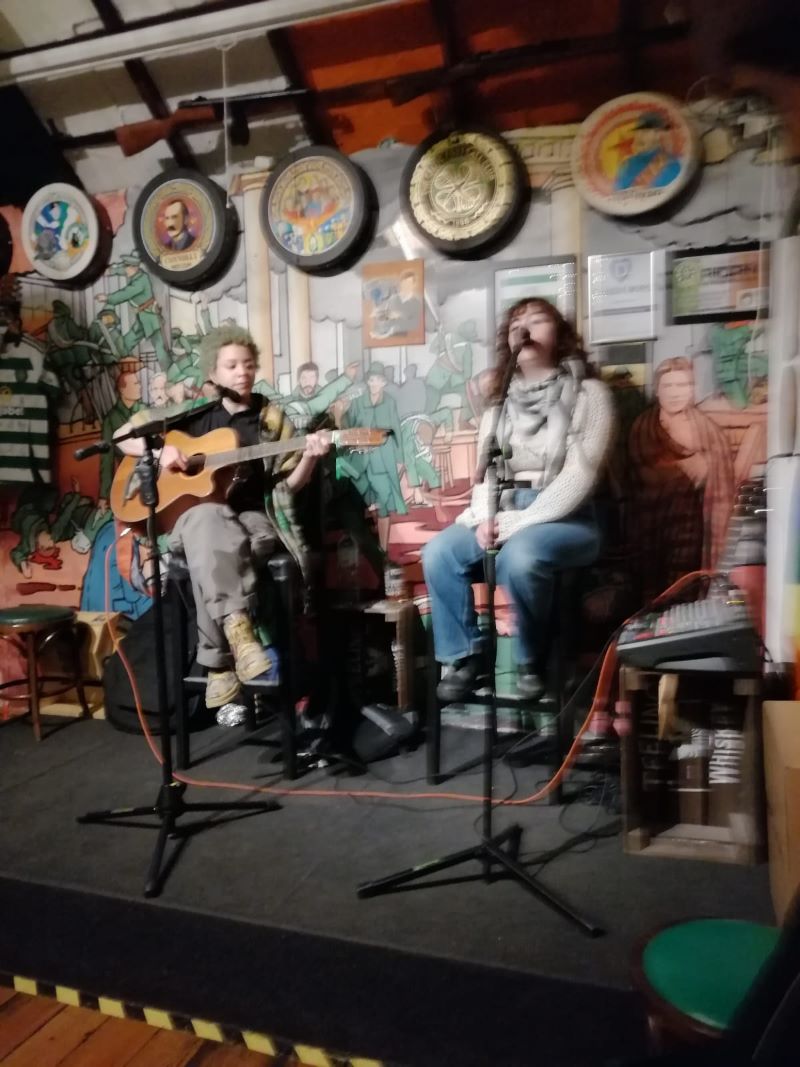
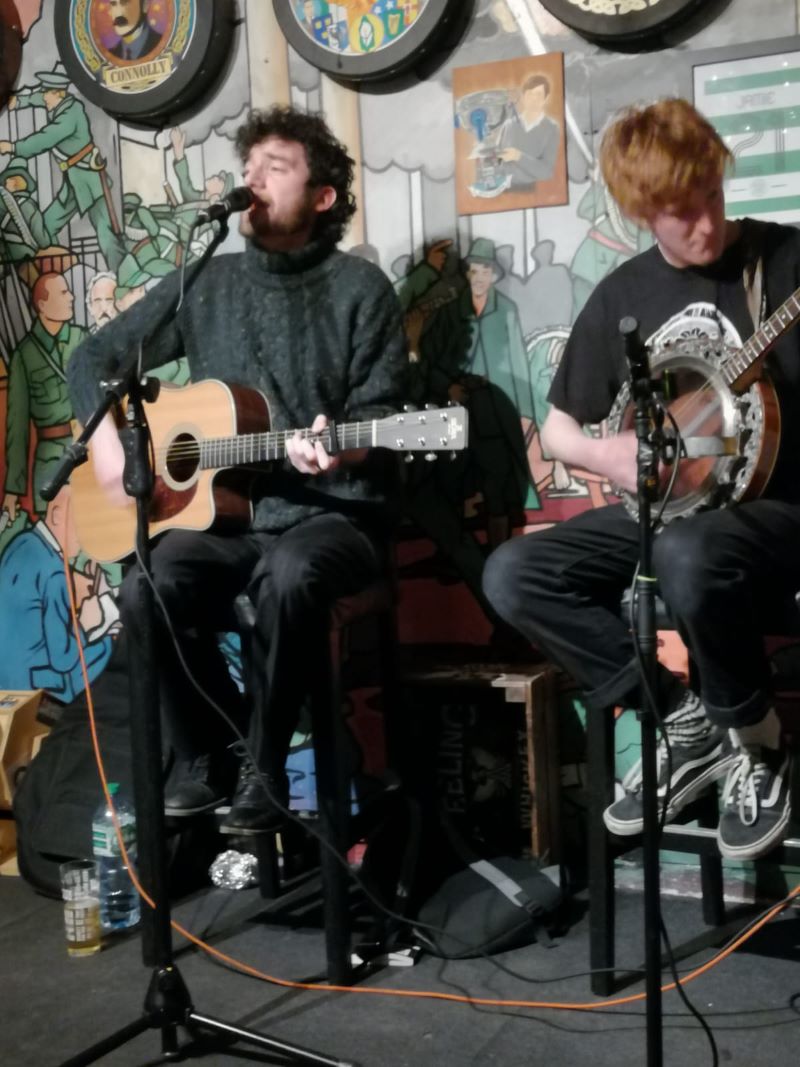
Peadar Browns pub has become increasingly known as an Irish Republican tavern on the south side of Dublin city. Its small stage area is decorated with Republican artwork on the walls and on many of the bodhráns7 hanging there, along with some Glasgow Celtic celebratory material.
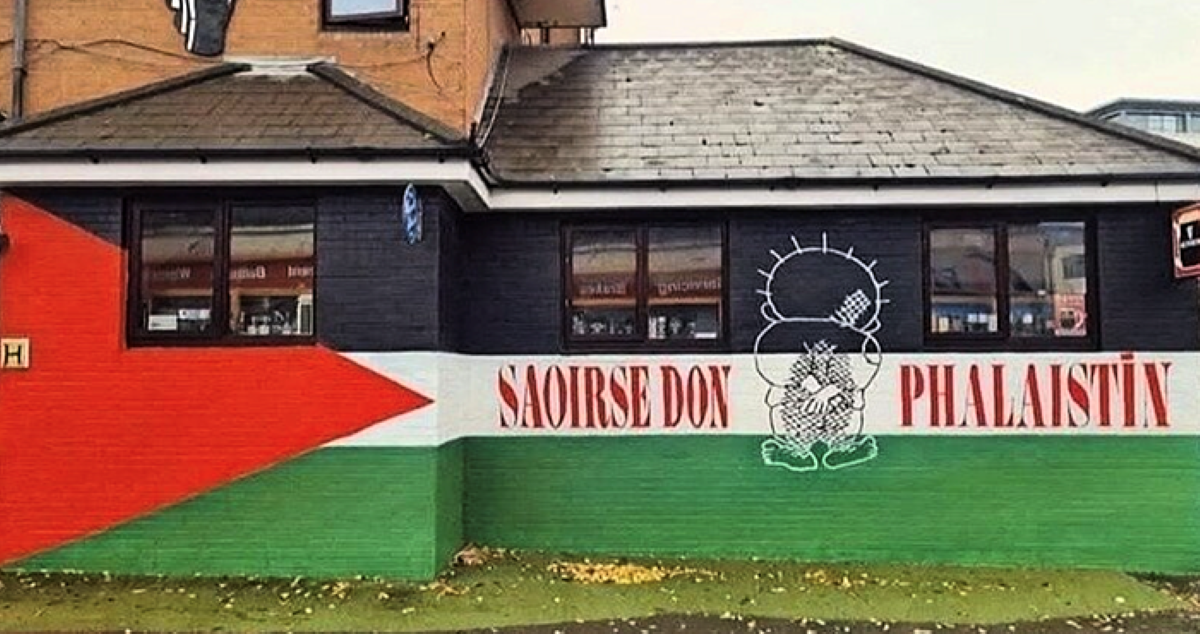
The side of the pub, on a minor street, carries a large mural representation of the Palestinian national flag, along with the slogan SAOIRSE DON PHALAISTÍN. However Dublin City Council have directed that it must be removed, to the anger of a great many people.
Mural on the side of the Peadar Brown pub (Photo sourced: Internet)
Historically cultural events of this type have a function other than to raise defence funds and to promote the cause: they are also occasions for replication of the cultural face of resistance and for expression of new cultural compositions but additionally for the creation of a community of resistance.
4About the Irish who went to fight against fascism in 1930s Spain.
5Also known as The Kilmichael Ambush, celebrating a famous event in West Cork during the War of Independence (1919-1921). However, the air of both songs is that of an older ballad about the 1798 Rising called Men of the West.
6The lyrics were originally written in English and later translated to Irish in which language it most usually sung today.
7A shallow one-sided Irish drum, same shape as a tambourine but much larger, played with a wooden striker on the outside with variation in tension achieved by hand pressure on the inside.
Republishing this now as we approach again the festival called Christmas. A Christian festival, apparently, celebrating the birth of Christ, the baby Jesus. But are there darker aspects in its references?
Away in a manger No crib for His bed The little Lord Jesus Lay down His sweet head
The stars in the sky Look down where He lay The little Lord Jesus Asleep on the hay
Such a sweet, holy image.
But actually, when we look around us, it seems more like a festival of the pagan gods: of Bacchus, the god of alcohol and of Mammon, the god of wealth. Bacchus, because in non-Moslem countries, drinking of alcohol will be for most a big component of the festival.
Whiskey, brandy, wine and beer will be bought to stock up the house. Alcohol will be drunk at Christmas parties (including office parties, where for months afterwards some people will regret what they did or said – or even what they didn’t do or say).
Alcohol will be not just drunk but also put into some of the traditional food and even poured over it.
Then Mammon. Well, you can see the retail businesses stocking up for weeks or even months ahead of the festival which, after all, was only supposed to be a one or at most a two-day event.
Giving and receiving gifts has now become part of the festival and in most cases, gifts have to be bought. Which is a really big gift to the retail businesses and thence, really a sacrifice to Mammon.
In the Christian gospels of both Matthew and Luke, it is written that one “cannot serve both Mammon and God” — which goes to show how little they understood capitalism, where Mammon IS God.
A theologian of the Fourth Century saw Mammon as a personification of Beelzebub, which in his time was another name for Satan or the Devil.
Interestingly, Protestant Christianity, which some credit as having invented capitalism, at the same time regarded Mammon, or said they did, as “one of the Seven Princes of Hell”.
Cartoon depiction of Mammon, God of Wealth (Image sourced: Internet)
Sculpture representation of Bacchus, God of Alcohol, in California winery, USA (Image sourced: Internet)
SANTA
Now, Santa Claus is also a big part of the Christmas festival, especially in western countries, a much more acceptable face than that of greedy Mammon and alcoholic Bacchus, right?
But originally, the Christians saw him as a representation of St. Nicholas, 4th Century Bishop of the Greek city of Myra, a location now in Turkey. He was the patron saint of archers, repentant thieves, sailors and prostitutes. The prostitutes probably had to be repentant ones too, of course!
The sailors, who probably had at least as much recourse to prostitutes as had any other calling, were apparently not required to be repentant – to be in danger on the sea was deemed enough.
But St. Nicholas was also the patron saint of children, pawnbrokers and brewers, so we can see how close he was getting there to the modern spirit of Christmas.
GERMAN TRAPPINGS
Now, the Christmas Tree, der tannenbaum, so much a part of the symbolism of modern western Christmas, came to us from Germany, as did the sled and the reindeer.
The reindeer are not autochthonous or endemic in historic times to Germany, so they must have been brought in their myths from Scandinavia from where originally, the Germanic tribes came.
In turn, the Christmas Tree, Yule Log, reindeer and sled were exported from Germany to England in the reign of Queen Victoria, by her consort Prince Albert, who was German.
And since the English ruled all of us in Victoria and Albert’s time, the Christmas Tree came to us too, to the cities first and then slowly spreading through the rural areas.
A representation of St. Nicholas (before he got the red suit makeover) looking more like a pagan god of the woods. (Image sourced: Internet)
***
When you think about it, this German-English worship of the tree was a bit ironic, since the English had wiped out most of our forests already and were still cutting down our remaining trees in Queen Victoria’s time.
***
And Victoria, through Albert, gave us the Santa Clause we know and love today. A jolly man, well fed, white beard, twinkly eyes, dressed all in red with white trim ….
IN RED?
Now, wait a minute! It turns out he wasn’t always dressed in red. Originally, he was dressed in a brown, or green cloak. He was, originally among the Germanic people, a god of the forests – hence the evergreen Christmas tree.
And like any sensible woodsman, he dressed in appropriate colours, brown or green. Neither Albert nor Victoria ever represented him as dressed in red. So how did it become so that we are incapable of seeing him today in any other colour than red?
Well, it turns out that Coca Cola is the responsible party.
Yes, although it was the cartoonist Thomas Nast in 1870s United States who first portrayed Santa in a red suit with a belt but it was Coca Cola, in their advertising campaign of 1931 and onwards who made his clothes red world-wide.
Coca Cola is a drink served cold and almost undrinkable when warm but who needs a cold drink in cold weather? I guess Coca Cola needed a warm image to make it still attractive in winter. So therefore the warm, jolly man dressed in red, with a bottle of Coca Cola in his hand.
1931, Santa Clause first appears in red, in Coca Cola advertisement, USA. (Image source: Internet)
Coca Cola brand is worth about $106.1 billion dollars today,1 far ahead of any other cold drinks product. Which I guess brings us back to …. yes, Mammon.
You can mix the drink with a number of alcoholic beverages too, so tipping a nod – and a glass – to Bacchus.
Now, the German Santa Claus, this originally woodland god, is also thought to have been something like Thor, a god of fire and lightning. So can it be any coincidence that two of his reindeer are called Donner und Blitzen, i.e “Thunder” and “Lightning”? Nein – of course not!
A starry night over desert hills, like the Nativity scene but without the Guiding Star. (Photo source: Internet)
INVISIBLE
Although we see the image of Santa Claus everywhere and even pretend Santa Clauses all over our city streets, everyone knows that nobody sees the real Santa Claus. Children have to be asleep when he arrives to distribute his presents and somehow adults don’t see him either.
Which I suppose is a good thing ….
I mean if you found an adult intruder in your house at night, not to mention near your children, you’d be liable to whack him with a hurley (that’s an Irish cultural reference) …. or a baseball bat (that’s a U S cultural reference) …. or stab him with a sharp kitchen knife (that’s an international cultural reference).
It was bad enough when somehow that portly – not to say fat – man could somehow come down your chimney and go up again, without waking anyone … but now he can get in your house or flat even when you don’t have a chimney.
Which is at least creepy, if not downright scary …
Oh, let’s lighten the mood and sing together:
You better watch out You better not cry You better not pout I’m telling you why
Santa Claus is comin’ to town Santa Claus is comin’ to town
He’s making a list He’s checking it twice He’s gonna find out Who’s naughty or nice
Santa Claus is comin’ to town Santa Claus is comin’ to town
He sees you when you’re sleeping He knows when you’re awake He knows if you’ve been bad or good So be good for goodness sake
Yes, lovely but wait …
“You better watch out, you better not cry …” — Is it just me, or is that not downright threatening? And he knows when we’re sleeping or awake? He has our children under surveillance? In some kind of list?
HO! HO! HO! IN MORALITY PLAYS
Morality Plays were a genre of theatrical performances of the medieval and Tudor eras in which a character was tempted by a personification of Vice.
Now Vice (not unlike a lot of police Vice Squads), was often seen as the epitome of evil, corruption and greed – in other words, the Devil. The playwrights tended to portray the Devil as somewhat of a comical character, perhaps to keep their audiences entertained (or to disarm them).
So the character who played the Devil would announce his arrival with a stage laugh: “Ho, Ho, Ho!”
You can probably see where I’m going with this.
Nowadays, we tend to see the Devil portrayed in black but in earlier times, he was more often seen as coloured in red. The colour in which Coca Cola just happens to have dressed Santa too.
The German or Nordic Santa was originally a god of fire also, while even the modern Santa drives a magical chariot pulled by horned beasts and he is portrayed all in red. Traditionally, the Devil is seen as horned and residing in Hell, a supposed place of eternal flames below ground.
What does Santa Claus give to children who have not been good? A lump of coal! In other words, a mineral from underground that can burn to make fire.
A Victorian England representation of St. Nicholas (Image sourced: Internet)
NICHOLAS
Santa Claus is supposed to be modelled on St. Nicholas …. and what is the popular abbreviated version of Nicholas, i.e the nickname? Yes, Nick.
And the common name for the Devil, Mammon, Beelzebub, Satan is ….. Old Nick!
Years ago we did not have the USA import of ‘trick or treat’ – but we did have Halloween. In fact, the UStaters got their Halloween originally from – us. Yes, us.
And it was based on the ancient Gaelic feast of Samhain (which is also the name of the month in Irish).
“Happy Halloween” as a wish would seem an oxymoron since it is a feast of the dead or at least for the dead and to propitiate pagan gods. It is recorded in Ireland as far back as the 9th Century, one of the four great feast days of the Gaelic year.
While the festival is often described as Celtic, a number of neolithic passage graves in Ireland and in Britain, predating the arrival of the Celts, are aligned to face sunrise at the time of Samhain.
In the Celtic world it seems to have been a particularly Gaelic festival, being also our name for November, with strong survivals in Ireland, parts of Scotland and Manx, though there are also some echoes of customs in Wales and Brittany.
However, some researchers believe that the word Samhain is related to the month of Samon, in an ancient calendar of the Gauls, the main body of Continental Celts.
No ancient feast of Samhain could have involved pumpkins, unless it was something thought up by a deviant among St. Brendan’s followers when they got to America in the mid-6th Century. Of which there are a number of sound reasons for believing they did.
But no plant we know of came back from that voyage.
Some varieties of pumpkin squash (Photo cred: The Garden Museum)
Pumpkins of course and many other squashes come from Turtle Island/ America, where they were cultivated by the indigenous people as an important source of food or dried to make containers, utensils and even musical instruments — and they taught the settlers how to cultivate them.
Pumpkin pie is a traditional USA settler culture dish, particularly in the annual Thanksgiving feast, where the arrival of the original English settlers is celebrated along with their survival (thanks to help from the Indigenous, against whom they later committed genocide in gratitude).
Although most people in the US will not be conscious of this aspect of the Thanksgiving celebration there is a pushback against it gathering in the US of late, as there is also in many parts of the world against the celebration of the ‘discovery’ of America for European colonisation by Columbus.
IN DUBLIN, IRELAND
The traditional Irish Halloween cake is the báirín (boyreen) breac, the báirín being Irish for a cake, according to Dineen’s Dictionary and breac meaning piebald or speckled (i.e. from the dried fruit), becoming mispronounced as ‘barmbrack’.
Quite when it became traditional Halloween fare I’m not sure but the basic ingredients would have been available centuries ago – except for the tea, which came from China originally and only became widespread in Ireland through our colonisers in the early 1800s.
Now of course, we’re marbh le tae agus marbh gan é (‘killed by tea but dead without it’) and still pronounce our name for the beverage in Irish as apparently they did in English in Shakespeare’s time. Many cultures call it ‘chai’ from which the English soldiers in India brought back ‘char’.
This one was apparently made with whiskey which is not the original. The one produced by a number of baker companies was round and more yellow inside.
Anyway, to get back to the báirín breac, it was soaking the dried fruits in tea that gave a yellow tint to the dough when it was baked. We children all looked forward to eating the báirín when we got back home after going from door to door collecting donations of apples or nuts or sweets.
Taste apart, it had a ring hidden in it and, though we had no interest in the prospect of marriage symbolism, we each wanted to be the lucky one to get the slice with the ring. Our Da cut up the slices carefully so we couldn’t tell which had the ring and we had to eat them in sequence.
Earlier on the Halloween evening we had been out in costumes knocking from door to door and of course, other children had knocked on our door too. Many of those would have been known to us but it was surprisingly difficult to identify them, even if only face-painted and without a mask.
It was for us a kind of thrill to knock at a neighbour’s door in costume and be unrecognised. All the houses except a very few welcomed callers at Halloween and kept a supply of fresh fruit, nuts and sweets on hand for the callers.
“Any apples or nuts?” we called as they opened the door or, later “Help the Halloween party?” None of that imported “trick or treat” nonsense!
Three types of nuts that were available and traditionally eaten in Ireland on Halloween at least from the 1950s: hazel nuts, walnuts and Brazil nuts (this one not so commonly seen more recently, apparently due to bad harvests attributed to El Nino). Also available would have been almonds, peanuts, and pieces of broken coconut.
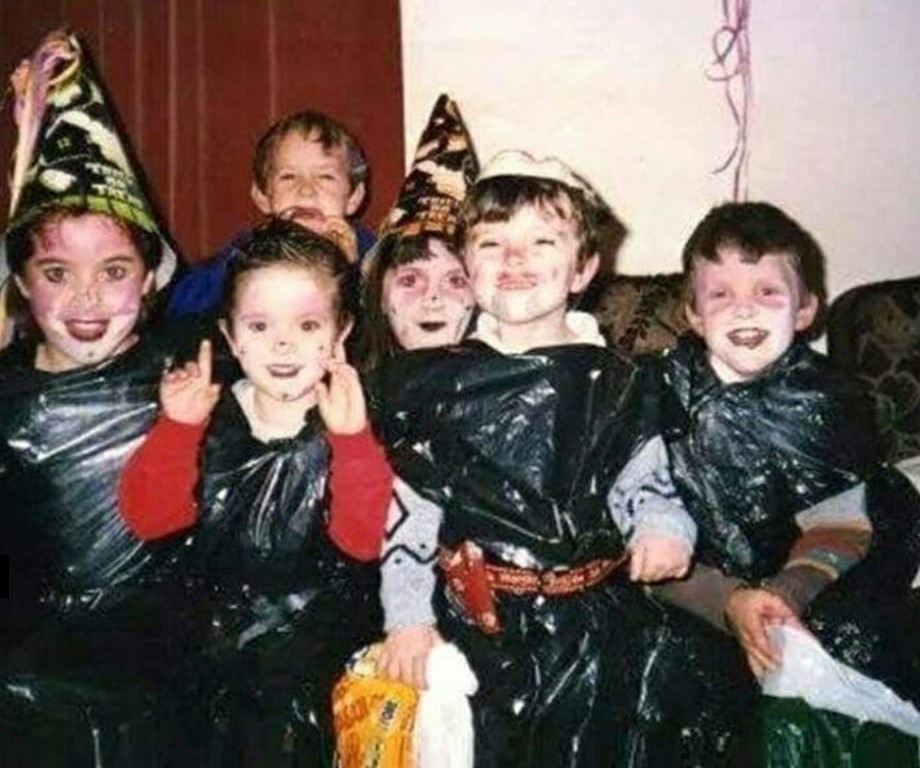
In an amusing piece about that contrast between earlier days and now, a social mores commentator in song at the monthly 1916 Performing Arts Club commented on how pleased he was to see children at his door in costumes made from ‘traditional’ black bin-liners.
Until they spoiled it all by chanting “trick or treat”. “Get outa the garden!” was his response.
Kids still go out (usually escorted by adults now) from door to door at Halloween in Ireland, often with elaborate costumes and chanting the UStater-borrowed “trick or treat”.
A gaggle of kids in what was for many in areas of Dublin a ‘traditional’ Halloween costume but some of course were more elaborate. (Photo sourced: Hill Sixteen FB page)
In clubs or pubs the festival seems to have been taken over by late teens and young (and not-so-young) adults in costumes depicting horror and death and, for mostly women it must be said, also sexual allure.
And strange though it might seem, the festival was originally primarily for adults and was an occasion of blessing of kine, divination and at least in recorded history, of “mummers” and “guising” going door to door, performing and begging for donations.
‘BARMBRACK’ IN LONDON
In SE London, I was for some years involved in organising an annual Irish Children’s Halloween Party as part of the annual activities of the Lewisham branch of the Irish in Britain Representation Group.
The event was primarily for the benefit of children of the Irish diaspora but children of any other background were welcome to attend.
A local shop selling fresh fruit and vegetables was approached for a donation of fruit and nuts to which they agreed and of course were thanked publicly by word and in print. The local print media were invited to take photos.
The program for the day included street games (but indoors), Halloween activities including apple-bobbing, face-painting and food that would have been traditional for Irish Halloween parties.
Funds raised by the branch through the year bought Irish brand biscuits, Cidona and red lemonade from a shop supplying Irish food items in South London and of course included the ‘barmbrack’.
The children on the day were largely from Irish, Caribbean or mixed background.
As I doled out slices of ‘barmbrack’ to children sitting at the long table, recommending it as traditionally Irish, one Caribbean-seeming child turned to the other and began: “It’s like …” “bun-and-cheese!” finished the other.
This turned out to be a traditional Jamaican food at the other end of the year, at Easter, two slices of a spiced moist ‘brack’ (the “bun”) with a slice of cheese between. They are not as fond of butter in the Caribbean as are the Irish (not many people are) and so that is absent.
One day I decided to try a slice of buttered (of course) ‘barmbrack’ with a slice of cheese on top. The sweetness and slightly spicy taste of the ‘brack’ contrasted with the tart taste of the cheese. And do you know? It’s not at all bad.
Diarmuid Breatnach – Talk given at 1916 Performing Arts Club, May 2024.
(Reading time: 6 mins.)
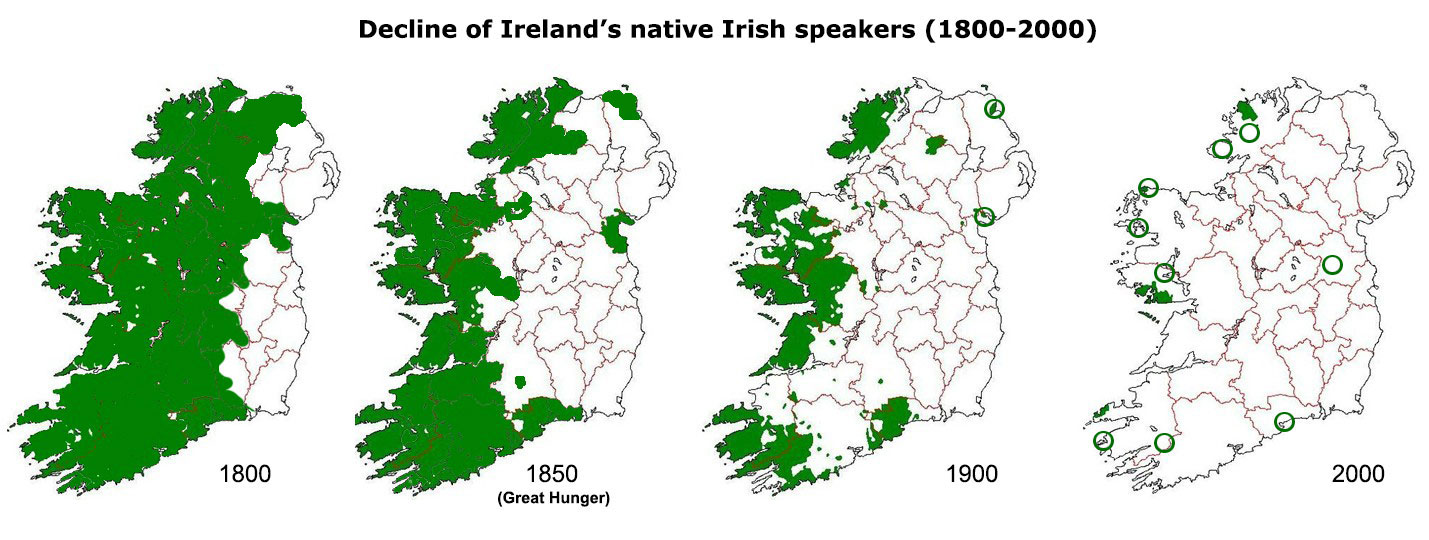
There was a time when from Dublin to Galway, from Kerry to Donegal, the dominant language was Irish. There was a time too when it was widespread in Scotland, in parts of Wales and the main language on the Isle of Man.
Now however one can travel through all of those places and not hear it.
Irish was the first vernacular language to be written down in Europe and though island people, its speakers were not “insular”. The educated spoke Greek and Latin too and when the Dark Ages fell upon Europe it was the Irish intellectuals, the monks who revived and spread literacy there.
But here we are, you and I, speaking English – which did not even exist until at least the 12th Century.
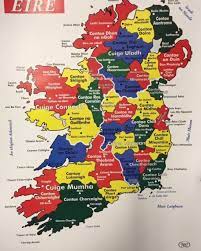
She (I say ‘she’ because language in Irish is a feminine noun and in many other languages too) – she is all around us in place names, though we may know them only through their corrupted forms into English.
Árd/ Ard, a height; Baile/ Bally, a town or village; Béal/ Bel, the mouth of; Bun, the bottom of; Carraig/ Carrig, a rock; Cnoc/ Knock, a hill; Cluain/ Clon, a meadow; Dún/ Dun, a fort or castle; Inis/ Inis or Ennis, an island or a raised mound surrounded by flat land; Loch/ a lake …
The English-language names of twenty-nine of our counties are corruptions of words in Irish: from Ciarraí to Dún na nGall, from Átha Cliath Duibhlinne to Gaillimh. This includes all six counties in the colony: Aontroim, Árd Mhacha, Doire Cholmcille, An Dún, Tír Eoghain, Fear Manach.
Just over half the States of Stáit Aontaithe Meiriceá on Turtle Island have names in the indigenous native languages, so we’re doing well with placenames and also of course have survived the colonial genocidal campaigns and wars much better.
By the way we also have Irish names for some places in Britain: Glaschú, Dún Éidin, Manchuin, Leabharpholl, Brom agus Lúndain. In fact probably none of the names of those cities are originally English anyway.
Irish has left only a small imprint on the general English language for example with “a pair of brogues, whiskey and slogan” (from slua-ghairm, a call to or by a multitude), banshee, carn and smithereeens. And shebeen, in parts of the USA, the Caribbean and in South Africa.
But its influence on the way we speak English in Ireland is clear.
We might say, instead of complaining that we are thirsty, that we have a thirst on us – a direct translation from Tá tart orainn. Or that the humour is on us – Tá fonn orainn. We might “have a head on us”, as in a headache. “The day that’s in it” – an lá atá ann.
We pronounce “film” with a vowel between the L and the M, as it would be in Irish – take the name for a dove and also a personal male name, Colm. We get that with R and M and R and N too, in some areas “a carun of stones” or “down at the farrum”.
We often indicate the absence of ‘Yes’ or ‘No’ in Irish by replying in English to the verb in the question: ‘Will you be there?’ ‘I will surely’ (Beidh, cinnte). ‘Will you do it?’ ‘I will not’ (Ní dhéanfad).
We have an extra tense in Irish, the very recent past tense, which we translate into English as spoken in Ireland: ‘I’m just after cleaning that floor!’ Táim díreach thréis an urlár sin a ghlanadh!
Renaissance of language and culture has often preceded periods of heightened national struggle: the Harp Festival of 1792 was followed soon by the uprising of the United Irish; the cultural work of The Nation newspaper was followed by the rising of the Young Irelanders.
The Nation newspaper of the Young Irelanders sought to create and encourage a nationalist republican culture and was followed by an unsuccessful rising in 1848, during the Great Hunger. (Source image: Internet)
LANGUAGE AND NATIONAL STRUGGLE
The Fenians too had their cultural precursors and the great revivals of the Irish language, Irish sport, speaking and writing in Irish and Irish theatre were not long in finding expression of another kind in the 1916 Rising and the War of Independence.
And campaigns of civil disobedience in the 1960s secured for us Irish-language broadcasting in Radió na Gaeltachta and TG4. Not to mention motor insurance documentation in Irish which Deasún Breatnach won only after going to jail for refusing to display the documentation in English.
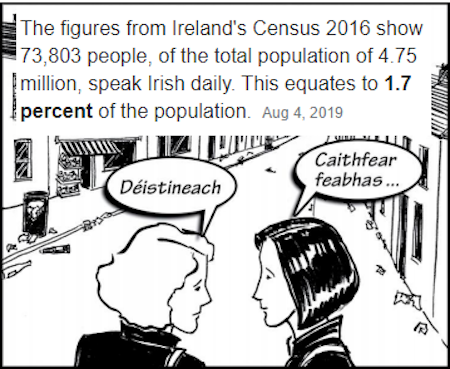
Though we can hear the influence of the indigenous language upon our speaking Sacs-Bhéarla, or English, the Irish language itself at this point is in retreat. In fact some might say that it’s in a rout.
Yes, the Gaelscoil movement is broader and deeper than ever before but outside the schools? The Gaeltacht areas are receding, receding … and where can the language be heard outside of those?
Though the Great Hunger caused the most impressive loss of Irish-speaking modern Ireland on the map, the percentage lost during the period of the Irish State is greater. (Image source: Internet)
I had an experience recently that illustrates the problem. In a pub with some friends, I observed a man wearing a silver fáinne, the ring that many people wore to show a proficiency in Irish. It identified the wearer to other Irish-language speakers (my father wore a gold one).
The man had overheard me bidding farewell to friends in Irish and asked me: “Are you an Irishman?” I thought the question strange and said so. Then he asked me was I an Irish speaker, to which I replied in Irish language.
Eventually he came over and said that he didn’t speak Irish himself.
The fáinne was a family heirloom and he had been wearing it, he said, for six months in Dublin, wanting to come across an Irish speaker to whom he would give the ring. Since I had been somewhat abrupt with him, he gave the ring to one in the company who can speak Irish.
Badge inviting people to speak Irish to the wearer (Image sourced: Internet)
LABHAIR Í
Six months in Dublin without hearing Irish spoken or recognition of the fáinne! That illustrates one aspect of the linguistic problem in Ireland. But it is one that we can resolve, fairly easily too. And that brings me to the kernel, the poinnte or point of this talk here today.
I am asking you to speak a cúpla focal, regularly, go rialta, so that she may be heard. Labhair í ionnas go gcloisfear í. Imagine if everywhere in Dublin, on every side, one heard just a few words in Irish – imagine the social and psychological effect over time!
Those who know some Irish would speak her more often. Many who don’t, would feel it worthwhile to learn at least some phrases and some responses. Some might take it further and learn Irish well. Public services might regularly facilitate services through Irish.
Dia dhuit. Dia’s Muire dhuit. Or the non-religious form: Sé do bheatha. Go mba hé duit.
Má sé do thoill é or le do thoill.
Go raibh maith agat in many situations, including to the driver of the bus.
Tá fáilte romhat.
Gabh mo leithscéil.
Would you like a bag? Ní bheidh, go raibh maith agat.
Cash or card? Íoch le cárta, le do thoill as you wave your bank card. Or Airgead thirm, as you take out your wallet or purse.
Go léir, as you indicate that you wish to pay the full amount.
Isteach, le do thoill, when returning a book to the library. Amach, le do thoill, when borrowing one.
Slán, as you leave.
Easy enough, yes? Yes? But though a part of the mind is willing, another part is afraid.
“What if I get a big load of Irish in response and not even understand it? Won’t I look like a right eejit!” Well, there are risks in anything worth doing as was demonstrated in a short play here some time back when two fellas were debating whether and when to chat up a certain woman.
She was not uninterested but they took so long about it she walked out and left them, like fish brought up by fishing line, gasping on the dry quay.
So you could prepare a small survival kit: “Gabh mo leithscéil. I only have a few words/ níl agam ach cúpla focal.”
“Níl agam ach beagán ach tá mé ag iarraidh í a úsáid/ I only have a little but I want to use it. Is foghlaimeor mé/ I am a learner.”
I am not asking for any of us to campaign, to agitate for services to be provided through Irish though that is certainly a linguistic civil right and, as far as state or semi-state services go, a constitutional one.
I am only asking that you contribute to the audibility of the language, to use a few standard greetings and responses and to use them not only to people you know to be Irish speakers, not only to friends and relations … but everywhere in public.
Everywhere
in public.
Go ye out among the people and spread the word – or rather the few words. Scapaigí an cúpla focal.
Although the 1916 Rising had been planned to take place on Easter Sunday, April 23rd, it was publicly cancelled by the titular head of the Irish Volunteers, Eoin Mac Néill and it went ahead instead on the 24th, the following day.
The 1916 Rising was unsuccessful but is considered the birth event of the Irish Republic and for some therefore Republic Day is on April 24th, the first day of that Rising and when Patrick Pearse, with James Connolly by his side, read out that remarkable Proclamation of Independence.
Banner of the Republic Day event organisers in Arbour Hill (Photo: R.Breeze)
Tom Stokes, an independent Irish Republican campaigned for some years for April 24th to be recognised as Ireland’s national day, replacing St. Patrick’s Day which is religious festival and now an excuse for excessive drinking and pseudo-Irishness.
Replacing too Easter Sunday and Monday, these being religious dates that move around on the calendar, never being on the same dates in any consecutive year.
Tom Stokes died in December 2018 and a small group of disparate independent Republicans have striven to keep his campaign going.
Stokes always held his Republic Day event at noon on the 24th in front of the GPO, the location of the first public reading of the Proclamation (as did also the Save Moore Street From Demolition one year) but this group carrying on his campaign have been holding their event in Arbour Hill.
This is the location of an old British prison containing the location of a mass grave into which had been put the bodies of 14 of those executed by British firing squads after the surrender of the leadership and majority of the fighters, their bodies covered in quicklime and earth.
The mass grave of 14 of the sixteen executed in 1916, with their names in Irish one side and in English on the other. (Photo: R.Breeze)
CEREMONY IN ‘ARBOUR HILL’
The name Arbour Hill is a corruption of the original Irish name for the location which meant something distinct from “arbour”: Cnoc (hill) an (of the) Arbhair (cereal crop). Today it is a quiet spot tastefully laid out, the names of the dead etched around the mass grave-site in both languages.
A little distance away is a tall flagpole bearing the Irish Tricolour in front of a high wall on which are chiselled the words of the Proclamation in their original English and also in Irish translation.
Dramatist Frank Allen welcomed those present, in particular members of Limerick Men’s Shed who had travelled a distance to be present at the event. He also referred to descendants who were present of martyrs of the struggle Cathal Brugha, Thomas McDonagh and Harry Boland.
Frank Allen as MC for the event (Photo: R.Breeze)
Allen also reviewed the history of Tom Stokes’ campaign for the marking of the date as Republic Day and a national holiday, outlining also the man’s background and his family connections to the struggle for Irish independence, along with his support for Palestine..
First to be called to perform was Pat Waters, professional musician and a regular contributor to the 1916 Performing Arts Club who accompanied himself singing his own composition Where Is Our Republic Day? composed at request from Tom Stokes.
Pat Waters performing his composition Where Is Our Republic? (Photo: R.Breeze)
Allen called on Glen Gannon also of the 1916 PAC to read the Proclamation and then on Shane Stokes to read one of his father’s articles which clearly outlined the man’s socialist Republican principles and their distance from the reality of the current national society and polity.
In succession Fergus Russell of the Goleen Singers organising committee was called to sing The Foggy Dew, a song about the 1916 Rising which he performs every year and Shannon Pritzel to read Patrick Pearse’s famous oration on the grave of Ó Donnabháin Rosa.
Aidan recited the eulogy poem to the 1916 fighters composed by an ex-British Army officer living in Ireland. Anne Waters of the 1916 PAC was asked to present red roses to a number of those present to lay on the named dead on the stonework surrounding the mass gravesite.
Larry Yorell (best known as a long-time activist of the National Graves Association)1, made an appeal for support for an initiative to build a monument to Patrick Pearse.
Aidan reciting a eulogy poem for the 1916 Rising fighters (Photo: R.Breeze)
Frank Allen declared total opposition to a trend seeking to eliminate Amhrán na bhFiann as the “National Anthem” for being thought too war-like.
The Anti-Imperialist Action group called a picket against imperialism to take place in the evening of the 24th outside the General Post Office, which had been the HQ of the Rising forces in 1916.
(Photo: R.Breeze)
While a number distributed leaflets, others lined out carrying a number of national flags of Palestine and one of the PFLP, in addition to a large Irish Tricolour, smaller Starry Plough and flags of the New Philippines Army.
Along with some of the standard Palestine solidarity slogans heard everywhere in Ireland on demonstrations, they called out “From Ireland to Palestine – Occupation is a crime!”; “There is only one solution – Intifada revolution!” and “Saoirse – don Phalaistín!”
Flag of the New People’s Army of the Phillippines displayed alongside other flags of anti-imperialist struggle. (Photo: R.Breeze)
A number of passers-by congratulated the picketers while some stopped to discuss. A representative of the organisers gave a short address regarding the background to Republic Day and the current situation in Ireland, commenting also on the zionist genocide in Palestine.
The event concluded with a youth reading the 1916 Proclamation out loud, followed by an acapella singer performing The Larkin Ballad which relates a compressed history of the 1913 Dublin Lockout but concludes with verses about the 1916 Rising.
A youth reads the text of the Proclamation of Independence near where Patrick Pearse read it out on 24th April 1916 (Photo: R.Breeze)
End.
Southward view of part of the group marking Republic Day with a statement against imperialism today. (Photo: R.Breeze)
FOOTNOTES
1The main organisation throughout Ireland maintaining and renovating and erecting monuments, graves, plaques in memory of Irish patriot men and women and battle sites; the NGA remains independent of political parties and declines to be in receipt of funding from government or political party.
2Kearney wrote the lyrics in 1907 in cooperation with musical composer Patrick Heeney. The music for the chorus was adopted by the Irish Free State as its national anthem. The lyrics were translated into Irish in the 1930s and unusually it is the Irish version that one most often hears, first verse and chorus. The opening sentence of the chorus “Sinne fianna fáil” (‘we are soldiers of destiny’) have been changed by some to “Sinne laochra fáil” (‘warriors of destiny) in order to avoid reference to a specific political party that called itself Fianna Fáil.
Beyoncé, Cowboy Carter (2024) (Image sourced: Internet)
Beyoncé was back in the news once again for a spot of cultural appropriation. It was not her first brush with cultural Neanderthals, she has been here before for apparently “stealing” Egyptian culture by dressing as Nefertiti.
Added into the mix was a lesser-known black artist, Kaitlyn Sardin, who excels at Irish dancing and dared produce some fusion dance routines.
I have dealt with Beyoncé and Rihanna wading into the murky cesspit of the cultural appropriation debate in the past when they were accused of appropriating Egyptian culture(1) and won’t deal with it here.
This time though, the debate is clearly about music, produced by people who are still around and not the attire of long dead Egyptians with little connection to the modern country.
The fact that white country music fans are still around to complain, doesn’t make the debate any less sterile or ridiculous.
Beyoncé’s faux pas was apparently to record a country & western album titled Cowboy Carter. Apparently, some were of the view that a black artist shouldn’t record a “white” song or perform in a “white” musical genre.
Her first release from the album was a song she composed, Texas Hold ‘Em.(2) And the hounds of hell were let loose to howl and drown out the music.
Some radio stations refused to play the song, though that didn’t stop it going to No.1 in the country music charts and the debate, though debate might be too fine a word to put on it, erupted.
She is not white, she is not part of the country music scene and she should stay in her lane, is a crude but accurate summary of most of those criticising her. She is actually from Houston, Texas, not that it matters.
One person interviewed by The Guardian responded that “It doesn’t matter that you came from Texas. It matters if you’re actually living a country lifestyle. It bothers me that her song is being called country.”(3) These words might be familiar to some.
They are normally advanced by identitarians when talking about whites playing genres considered “black” and in some cases other non-whites have levelled this accusation against a whole array of non-white artists including Beyoncé.
It is reactionary rubbish with the racism, in this case, hiding just under the surface, behind a veil of cultural purity. One even went as far as to say that he would bet that Beyoncé had never been in the country saloon he was being interviewed in.
Well, many black women would steer clear of such venues, for more than obvious reasons.
Cultures are not pure, ever. None. Not now, not ever, not even going back to the stone age.
I am very sure, no stone age hunter armed with a flintstone hatchet ever shouted “You’re appropriating my culture” when he realised some other village had come up with the same invention, or even just “stole” the idea.
Country music is not pure either and to the shock and horror of many a man yearning for the days he ran around in his white bedsheets, it isn’t even that white. Blacks have made significant contributions to country music, not least the musical instrument known as the Banjo.
What would country be without the banjo? Rhiannon Giddens, the black musician has dedicated her time to reviving the banjo as a black instrument and recording some excellent music, though unsurprisingly she doesn’t quite stick to genres either.(4)
Her site describes her thus: Singer, multi-instrumentalist, composer, and impresario, Rhiannon draws from many musical traditions including blues, jazz, folk, hiphop, African, Celtic, classical, and jug band. She bridges contemporary and traditional forms, and few musicians have done more to revitalize old-time influences in current music.(5)
Rhiannon Giddens with banjo (Image sourced: Extra.ie)
She composes her own songs, covers others, even ones such as Wayfaring Stranger, recorded by many white country artists, though actually written and composed by two Germans in the 1660s.
As far removed from her as from the whites who might like to claim the song as their own (Links below to Gidden’s version,(6) Johnny Cash’s(7) the Mormon Tabernacle Choir(8) and even Ed Sheeran’s(9) very uncountry version.
I have included links to all songs and routines mentioned in this article). The song belongs to whoever wants to sing it, however they wish to, though I personally think Sheeran murders the song with a flintstone hatchet, but each to their own.
So, Beyoncé is quite entitled to record in whatever style she wants. Part of what rankles some is that she went straight to No.1 and will make a fortune from the album and this is part of the ‘stay in your lane’ slogan applied to blacks and whites.
Elvis made a fortune singing what was essentially considered, at least initially, to be a black musical form and other white artists who have done this have been criticised by a black bourgeoisie who want that slice of the cake for themselves.
Some of the whites criticising Beyoncé are undoubtedly racist, some might just be musical purists, though music is one art form that just doesn’t lend itself to purity. Others, like identitarians everywhere, think that the money is theirs. Flip sides of the same coin.
Beyoncé is not the only black artist to venture into the world of country,(10) Charley Pride and Ray Charles did so back in the 1960s at times of heightened tensions in the midst of the racial violence meted out against those demanding civil rights for blacks.
When Charley Pride released his first country album, his image was not put on the record sleeve and they initially hid the fact he was black as part of their marketing strategy. He would eventually make it to the Grand Ole Opry in 1967.
He had a total of 52 top ten hits on the Billboard Hot Country Songs chart.(11) No mean feat and not a once-off foray into country music either, he was a country artist.
Linda Martell fared worse as she never hid that she was black and though she would also perform at the Grand Ole Opry in 1970, her album Color Me Country(12) never had the same success.
Ray Charles also dipped his fingers into the pond producing Modern Sounds in Country and Western Music(13) in 1962. It was a best seller, topping the charts. So, Beyoncé is by no means the only or even the first black artist to find success in the genre.
Black artists have always ventured into genres that were not considered to be black.
Others have gone the other way and identitarians tend to criticise white artists doing “black” music, though when Gene Autry, the white country and western singer, nicknamed The Singing Cowboy recorded a blues album, nobody accused him of cultural appropriation.
Though even non-whites get accused by the black bourgeoisie closely aligned to the US Democratic Party of cultural appropriation, Jews, Asians, even Africans get in the neck.
Samuel Jackson infamously accused black British actors of stealing their jobs because they were cheaper and questioned the cultural bonafides of British-Nigerian actor David Oyelowo when he was cast as Martin Luther King in the film Selma.(14)
He never criticised the decision to cast the black Yank, Morgan Freeman as Nelson Mandela in the film Invictus or Matt Damon as the white South African rugby captain in the same film.
Given the backlash against his comments he decided to keep his mouth shut when the British-Ugandan actor Daniel Kaluuya was chosen to play the black revolutionary leader of the Black Panther Party, Fred Hampton. No one is safe from the accusation.
It is a bit like the MacCarthy trials. “Are you now or have you ever been a homosexual? No, but I slept with a man who was. Have you ever appropriated a culture? No, but I hummed a tune by a man who had.”
Which brings us now to Kaitlyn Sardin, the US black Irish dancer. She has recently gone viral, though not for the first time, with her dance routines and not being as powerful as Beyoncé has come in for some vile racist abuse.(15)
She produced a new video which is what is now termed fusion i.e. Irish dance with some developments.
This is now quite common and there is a host of Irish groups producing fusion. My favourite is a routine called Freedom with the voice of Charles Chaplin and images from Belfast in the early seventies.(16)
Though the first person to do this was Michael Flatley with River Dance which not only broke many of the “rules” of Irish dancing, it even went as far as to incorporate the Lambeg War Drums in a much more positive sense than the annual announcement of Protestant supremacy for which they are used every July 12th.
Of course, Flatley, unlike Sardin is white and of Irish descent.
Kaitlyn Sardin (Image sourced: Internet)
As I said there are many fusion groups in Ireland, the one I previously mentioned and even one which is danced to classical music titled Fusion Fighters Perform Fusion Orchestra.(17) Again, all as white as the driven snow in Siberia.
There is even an all-female Fusion Fighters group from the USA that does a tap dance routine to William Tell.(18)
The particular group started off with Irish dance and moved into other styles over time, so much so that even their website acknowledges it has less to do with Irish dance than they used to.(19) It is what happens with culture. It evolves, all the time.
Again, they are white and no one said fusion is not Irish dancing and no one said anything about not being Irish, even though their Irish connections may be as tenuous as Darby O’Gill.
The term fusion is one of those designed to assuage musical purists more than racists. In reality there is no such thing as fusion music. ALL music and dance are fusion till it becomes accepted as the standard, when new deviations or fusions arrive.
Though dancing has existed in Ireland for centuries it has not been immune to outside influences such as French Quadrilles in the 1800s or other forms.
The clues are in the names, hornpipes and polkas for example are two types of music that you will find in other parts of Europe and indeed in the case of polkas they clearly originated in Eastern Europe, though most forms including reels and jigs are not exclusively Irish either.
All cultures borrow.
Most instruments used in Irish music are not Irish in origin. Some, like the flute have arisen in most cultures around the world and archaeological remains have thrown up examples everywhere of flutes and whistles made from everything, including animal bones.
Fiddles arose over a long process around the world and it is a bit difficult to pinpoint them to one country. Uillean pipes are Irish, though they too were part of a wider process in Europe with different types of pipes arising.
Though Scottish bag pipes are perhaps the most famous type of pipe, there are in fact lots of pipes throughout Europe and parts of Africa, Iran, Azerbaijan and even India.
Other instruments such as the banjo are African in origin, though the modern banjo has developed over time since it was first brought to the western world by slaves.
The piano accordion is a relatively recent European invention from the mid 1800s, a further development of the accordion, which was also a European instrument.
If we rejected all outside influences and demanded purity, we would have little in the way of Irish music or dance, were we to have any at all.
So, Kaitlyn Sardin should be celebrated. She is from the US, is black and more importantly is very good at what she does: dancing. The fact that she is not Irish or she recently produced a fusion routine is neither here nor there.
Any liberal who got lost on the internet and accidentally read this article will probably have nodded most of the way down: until now. The ridiculous statements made about Beyoncé and Sardin are generally rejected by liberals.
But when the cultural capitalists hiding behind identity politics make similar claims against white artists or indeed between other non-white artists this rubbish is taken seriously.
Culture does not belong to anyone, you don’t have to be white, black, Asian or Latin to perform in a particular style. Culture is a gently flowing river you bathe in, swimming ashore where you please along its route or letting it sweep you out into the sea.
It has always been thus and always will be, despite the attempts of cultural capitalists to appropriate culture for their own grubby money-making ends, or racists imagining some non-existent purity. It doesn’t mean that some of the commercial outings by Beyoncé and other artists do it well.
They don’t.
Beyoncé was criticised for her depiction of India as a white paradise and other artists such as Gwen Stefani, Nicki Minaj and Iggy Azalea have been accused of engaging in crass portrayals of the cultures they seek to borrow from(20) and in Ireland we know a thing or two about how crass Hollywood can be when it comes to depicting Irish music.
But that is another matter, many artists in particular genres have come up with really crass portrayals of their own cultures. The point is whether culture is pure, has lanes and you stick to them due to an accident or birth.
The legendary US folk singer Pete Seeger would joke that plagiarism was the basis of all culture and he was a wonderful plagiarist who introduced musical forms from around the world to a US audience at a time when there was no internet and it was not an easy feat.
He introduced the song Wimoweh to the world, which has gone through multiple adaptations,(21) some of them very good and others absolutely dire, such as that recorded by the English pop group Tight Fit in the 1980s.(22)
The original song however was quite different in style and written and recorded by the South African musician Solomon Linda(23) who was swindled out of the royalties on the song.
Had Seeger stayed in his lane, most of us would never have ever heard of Linda or the story behind his song.
Demands for cultural purity are inherently reactionary, as are demands to ‘stay in your lane’, be they levelled by whites, blacks or Asians. Culture is to be celebrated and expanded.
The accusation of appropriation would only make sense if someone like Seeger had said he wrote Wimoweh, that would be straightforward dishonesty, something he could never be accused of in his multiple adaptations of songs from Ireland, Japan, China, Indonesia, Scotland, Chile, Nicaragua amongst other places.
Beyoncé’s foray into country is perfectly fine, though personally, I don’t like her music, including her country. But that is my personal taste and has nothing to do with appropriation or other rubbish from cultural capitalists.
The Irish radio on Saturdays used to broadcast an Irish music show from the musical company Walton’s. It always finished off saying “If you do feel like singing a song, do sing an Irish one.” The exhortation was for all, not some; the point was to celebrate and enjoy music.
Let’s leave the cultural capitalists, purists, identitarians and racists to the handful of songs they mistakenly believe to be pure.