Reprinted from author’s substack 11 March 2026 and reformatted for Rebel Breeze
(Reading time: mins.)
Photo: US Military Base Qatar Under Iranian Attack 2026
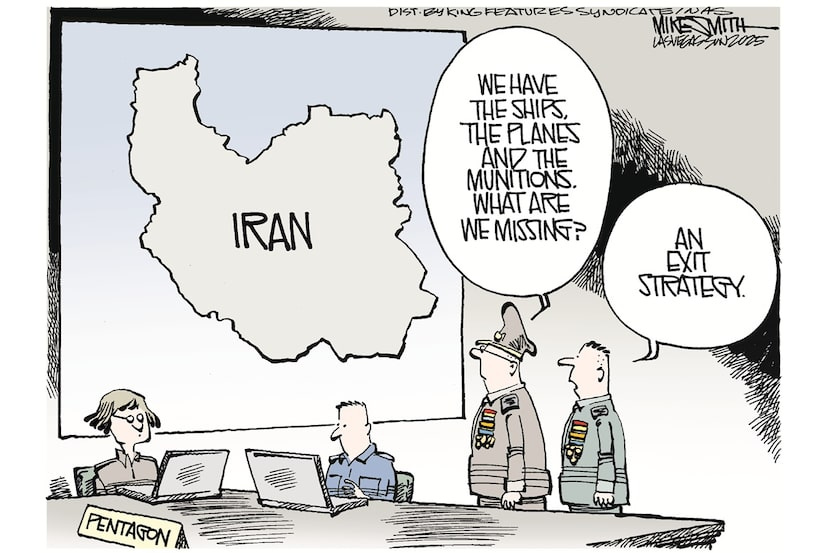
On February 28th the Zionist regime of Israel and the USA commenced a lethal bombing campaign against Iran, choosing as their first target a school where more than 168 girls were murdered.
The Western press took its time in questioning the attack and the western governments never really did.
The press “explains” that the school was near a centre of the Revolutionary Guard, but they don’t explain that it was a cultural centre and a clinic and pharmacy all of which enjoy protection under the Geneva Conditions.
They tell us that these places “perhaps explain the attack.”[1] Well no, they don’t. They remain war crimes.
Iran’s response was robust. So robust that the western press and politicians condemned it and asked Iran to not attack the other states of the region (calling the Emirates countries or nations is a bit much).
They never asked the US or its attack dog, Israel, to cease its attacks.
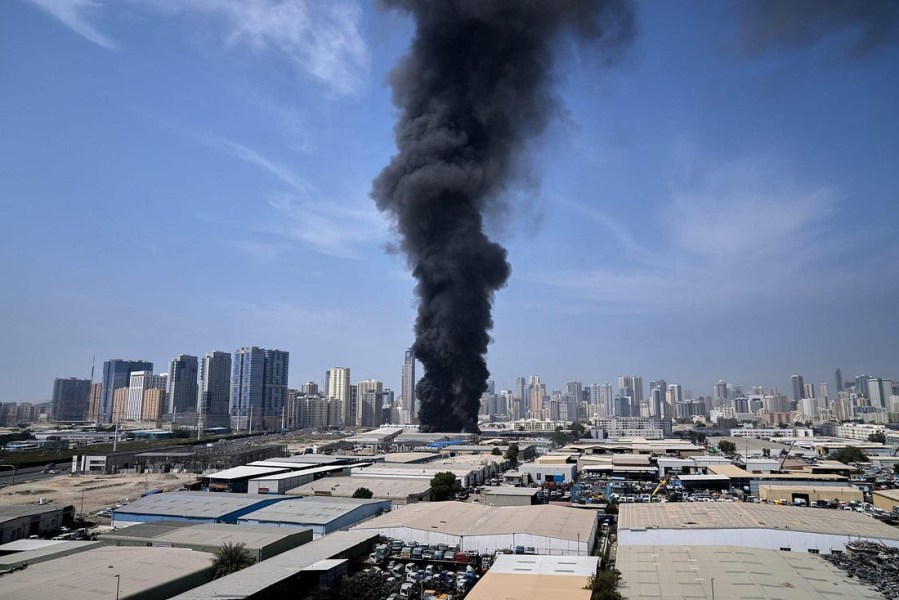
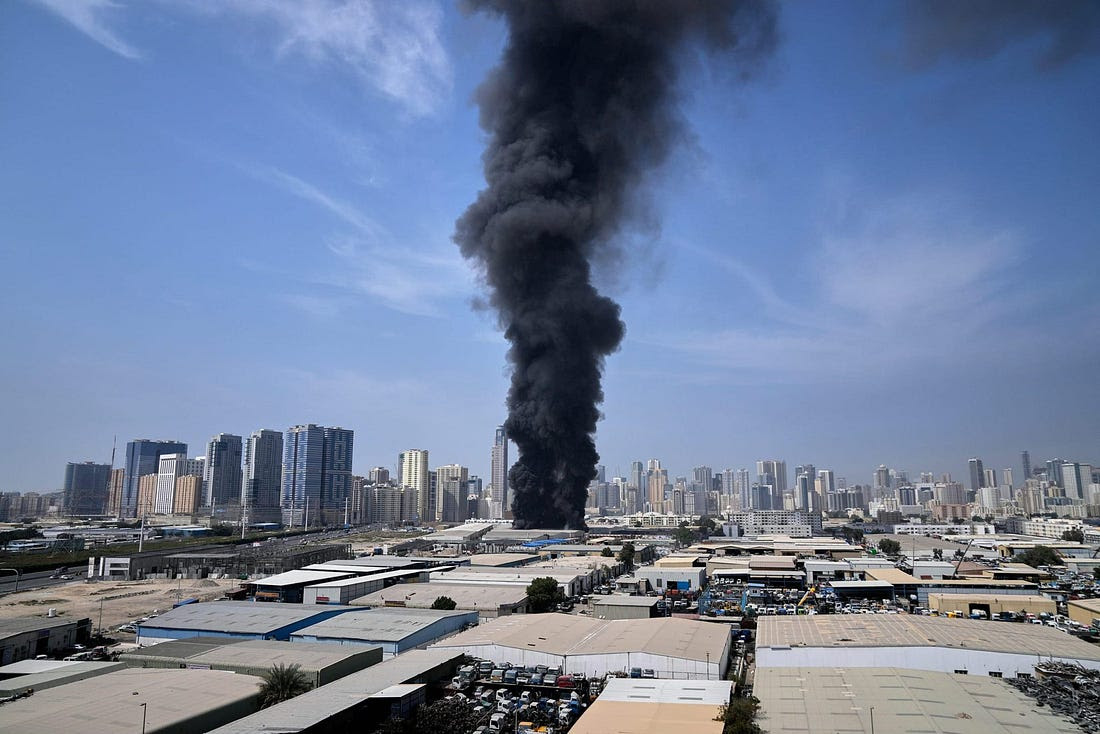
Iranian civilians are less important than investments in Dubai and other places. Iran attacked military bases, radar installations and hotels housing US soldiers who had transferred there given the possibility of an attack on their bases. The counterattacks uncovered some truths.
The first one is that the Arab monarchies of the region are nothing more than US lapdogs and the myths about their economies went up in smoke in seconds. They are not safe places to invest in and less so to live in as shown by the mass of tiktokers crying into the camera.
It is worth pointing out that many of them boasted about not paying taxes and one or other explicitly stated they had set up in the region in order not to pay taxes and now they want their respective governments to spend taxes that they not only didn’t pay but didn’t want to in order to rescue them.
It might be that Dubai and the other monarchies never fully recover.
Another truth that was revealed is the real role of US military bases. The Yanks like to say that it is to protect and defend the countries they are located in against attacks.
That myth also went up in smoke just like the myth of Dubai as a safe place for digital nomads, tiktokers, bankers and even drug traffickers like the Kinahans who have lived there openly for the last number of years.[2] They will all have to think of other places.
The military bases were not capable of defending the monarchies and moreover the US transferred a good part of its military capability to Israel and left them to their fate.
Recently the president of South Korea announced that the USA had transferred part of its defence system to Israel.[3] The presented lamented the situation but explained that there was little he could do, i.e. the USA decides everything.
In the case of Spain, President Sánchez said he would not allow the USA to use the shared military bases in the country to launch attacks on Iran. Trump’s response revealed the real role these bases play and the real authority over them.
He said they didn’t need them, but if they want to, no one is going to tell them no.[4] In many of the military bases, in law, it is the host country that commands and controls the base. The reality is otherwise and Trump showed it.
In others cases, particularly in Japan and some European countries it is the US that has formal control.
The bases are not there to defend the host countries but rather to defend US interests and to act as they see fit. The Arab monarchies have just learnt that lesson the hard way. Spain has yet to, but Trump has warned them that it is in practice he who decides what is done, where and how.
This brings us to the question of military bases in Colombia. Theoretically Colombia has authority over the bases and can limit what is done. In practice it is not so.
The supposedly progressive government of Gustavo Petro never did anything to expel the Yanks from the bases in the country. Nor is he going to do so in the few remaining months of his presidency.
The question is what will the new government that comes into office on August 7th do? For the moment it looks like the next president will be Iván Cepeda from the same political force as Gustavo Petro.
In the midst of tensions between Colombia and the USA Cepeda stated from Madrid that Colombia wasn’t a Yankee colony.[5] When he is president he will have ample time to prove it and can start on August 7th by ordering the north American troops out of the country.
The rest of the countries in the world should do the same.
It is clear that the bases are an extension of the USA and at all times serve it and nobody else.
Note: If you found this article of interest, why not register with Rebel Breeze for free, so that you will be notified by email of subsequent articles. You can de-register any time you wish.
Translated by R. Breeze from Spanish-language post in Bultza, Basque Marxist-Leninist Telegram channel, 2 March 2026
(Reading time:4 mins.)
The armed resistance of the Palestinian people—the vast majority of whom are Muslim—has stirred up a kind of “neither-nor” sentiment. The “progressive” left refuses to take sides.
They labelled the acts of armed resistance on October 7, 2023, as terrorism and equated them with the genocidal policies of the State of Israel. Was terrorism that which the Jews of the Warsaw Ghetto waged in their guerrilla operations against the Nazi occupation army?
This is not the first time we have heard the hackneyed rhetoric against the Muslim religion. A discourse cloaked in a “progressive” mantle, where they speak of human rights, freedoms, women’s rights, and so on.
Some even compare it to the Franco regime in a display of “intellectualism.” A comparison that cannot withstand the slightest scrutiny of logic. Did the Franco regime confront the greatest empire on the planet? Quite the contrary.
The fact that Francoism and its entire cultural and political apparatus existed was thanks, among other things, to the largest empire in the world today: the United States.
Trump has spoken, on several occasions, about how the Iranian government oppresses its people through Islam, that “the regime of the ayatollahs” must be overthrown, etc. This discourse has also been echoed by several European leaders, including the “progressive” Pedro Sánchez.
A few weeks ago, we heard Gabriel Rufián1—the future leader of the “re-establishment of the Left”—saying that the burka and the hijab should be banned. But there is one aspect they all have in common: they all say this from NATO countries.
Countries that exploit the wealth of every continent, including Muslim countries where religion is not conceived in the same way as it is in imperialist countries. Yet, they say absolutely nothing about the Atlanticist organization. They do not question its crimes.
In addition to discrimination based on religion, there are two more forms: discrimination based on belonging to a culture different from Western culture (imperialism and colonization) and class discrimination.
The “progressive” Left only mobilises when the oppressed are portrayed as victims, not when they gain strength and resist the assaults. In other words, if you are massacred by the empire, they will offer you alms. If you resist, you become the target of their criticism.
We’ve already seen this with the constant denunciations of the Palestinian armed resistance, or the scant impact the resistance of the Shiite armed movement Hezbollah, which has repeatedly halted Israeli Zionism, has had on the Spanish population.
We’ve also seen it when the Shiite movement Ansar Allah fired rockets at the US Sixth Fleet, cutting off the Red Sea and Israeli communications.
In other words, the “progressive” left supports you if you die, not when you fight.
It’s the practical application of putting money into the coffers of the missions. If you’re a sovereign country seeking liberation from imperialist yokes and you fight with all your might, you’re labelled a terrorist and an oppressor.
And the media plays a significant role in this, the same media on which progressives occasionally complain of not being given as much airtime as before.
In the words of the African American leader Malcolm X: Beware of the media; they will make you hate the oppressed and love the oppressor.
In the world of social media, we easily lose our memory. Therefore, it’s necessary to remember that the Algerian separatists of the National Liberation Front were Marxist-Leninists. And this didn’t prevent them from also being Muslim.
The People’s Republic of North Yemen—Muslim—along with the People’s Democratic Republic of Algeria, supported the anti-fascist armed movements in the Spanish state.
In other words, Islam and anti-imperialist (and anti-fascist) resistance are concepts that have gone hand in hand on numerous occasions.
The USSR itself not only maintained but also promoted madrasas, or Islamic schools, in Muslim-majority territories. Was the USSR—the world’s first secular state—the same as Francoist Spain? But perhaps this doesn’t mean much to the progressive, or the purist of the moment.
In the 1960s, there emerged in Latin America a concept called Liberation Theology. This movement led to the creation of armed groups of Catholic origin whose demands included socialism and social justice.
Movements like the Montoneros in Argentina and the Colombian National Liberation Army (ELN) emerged from this context. It is important to remember Father Carlos Mugica, the priest and guerrilla leader.
These armed movements caused considerable headaches for Washington’s Operation Condor and all the dictatorships imposed by the School of the Americas—dictatorships that, incidentally, sympathised with and admired Francoism.
Were these guerrilla priests the same as their enemies in the White House and their puppets?
These movements resonated in Spain. This theory spread throughout the Basque Country and the working-class neighbourhoods of major cities like Madrid and Barcelona, as well as regions like Andalusia.
The parishes of Vallecas, Carabanchel, Moratalazo, and Vicálvaro2 became meeting places for numerous anti-Francoist movements and groups, where these same worker-priests were active.
A very recent example is that of Father Diamantino García: one of the founders of the Andalusian Rural Workers’ Union (predecessor of the Andalusian Workers’ Union). Were these worker-priests the same as Francoism?
Fr. Diamentino Garcia Acosta (1943-1995) addressing a worker’s rally.
Let’s remove once and for all the veil that prevents us from seeing the reality of Third World countries. Who are we to tell oppressed countries what to do? Isn’t that just another form of imperialism? Do we fight in the same way they do?
We cannot view the processes of decolonization and liberation of those who are fighting with all their might against the West and its empire through Western eyes.
To paraphrase our Asturian comrades from La Clase Trabayadora:3 we must put an end to the left wing of imperialism and all that it entails. Even in the cultural sphere.
End.
FOOTNOTES
1MP and spokesperson of the Ezquerra Republicana de Catalunya (Catalan Republican Left) in the Spanish Congress, also active in left-social democratic coalition Súmate and the grassroots National Assembly of Catalunya. (R.Breeze)
2Particularly working-class areas of Madrid (R.Breeze)
3Anti-NATO and anti-rearming organisation based in Asturies. (R.Breeze)
The title paraphrases the concluding words of Jane Fonda, actress and veteran anti-war campaigner, speaking yesterday1 at a downtown Los Angeles rally against the USA’s current war against Iran, in reference to current US President Trump’s regime.2
It is slogan the oppressed and exploited around the world might well adopt for ourselves, though Fonda may have meant only the replacement of Trump with a milder representative of US Monopoly Capitalism.
Though a long-time campaigner against US Wars, it is unlikely that Fonda was advocating the overthrow of the capitalist-imperialist system currently in power in most of the states around the world. But we might well invest that meaning in the call amongst ourselves.
History shows us that capitalism exploits our labour power and the fruits of our toil, even as it evolves into monopoly capitalism, squeezing hundreds of its weaker competitors out of business before going to war with other monopoly capitalists and states that resist being dominated.
OUR REGIME DRAGGING US INTO WAR
This is the kind of system in power in Ireland, though our ruling class is, unlike the rest of the European states, a client state. Typically, client states have one master – ours has three: British colonial-imperialism; US imperialism; EU imperialism.
The dominant states of British imperialism and EU imperialism, viz. the UK, France and Germany, issued a joint statement at the outbreak of this war. Not to condemn the US and Israel assassinations and other bombing attacks on a non-aggressing country but instead, the victim of aggression!3
The same states the leaders of which justified Israel genocide against those it oppresed as Israel’s “right to self-defence”, failed to accord the right of the Iranian people to defend themselves through the action of their state against unprovoked Zionist and imperialist attack.
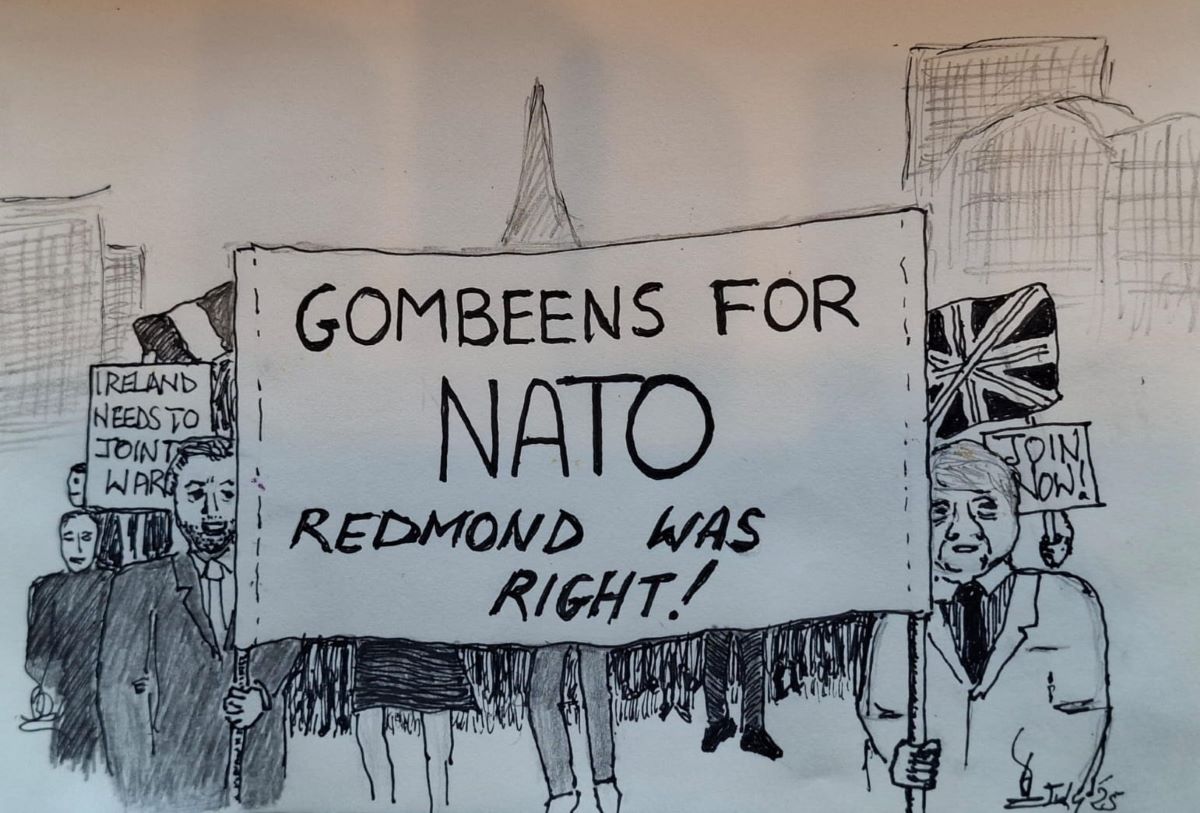
These are the powers to which the Irish ruling neo-colonial class wants Ireland subsumed, to join our exploiters and colonial occupiers, states with a long history of colonial occupation and genocide, including ours, against people who do not threaten us and have never done us any harm.
It is their alliance into which our neo-colonial rulers are attempting to drag us, by lies and deceit and by scaremongering about danger from other states that have never threatened us.
Cartoon by Paul Cobaugh
WHAT THIS WAR AGAINST IRAN IS ABOUT
There must be very few people on this Earth who believe that the aggression against Iran is about restricting the state from developing nuclear weapons. The religious leader of Iran, Khamenei (assassinated by the USA), has long opposed the development of weapons of mass destruction.4
In fact, according to the Omani intermediary at the US-Iran talks on nuclear energy, Iran volunteered not to amass enriched nuclear material, to convert its stock of highly-enriched uranium to fuel, putting it beyond any possible use of weaponisation and submitting to inspections.5
In addition, the intelligence services of the USA and the monitoring by the IAEA6 have never found any evidence of such development.7 But in any cases, who are the USA and Israel, both states with nuclear weapons, to dictate to anyone else what weapons they may or may not have?
The USA is actually the only state in the world that has used atomic weapons against people, not once but twice: Hiroshima and Nagasaki, with an estimated death toll through initial explosion of up to 140,000,8 with more dying of subsequent radiation.
Iran signed the nuclear Non-Proliferation Treaty and agreed to inspections by the IAEA, whereas Israel refused to sign it or agree to inspections (or indeed to even admit to the well-known fact it has nuclear weapons, the only state in West Asia to possess such).
France and the UK, endorsing the current USA and Israeli war, also have nuclear weapons and the only reason Germany does not have one of its own (though many of the US on its territory) is that its European partners can’t trust it after two wars against them within only four decades.
Israel, the most warlike and expansionist state in the region, also demanded that Iran scrap its ballistic missiles and end its support for resistance organisations. Yet Israel and the USA support subversive organisations around the world, wherever they find their wishes obstructed.
More than that, the resistance organisations are fighting for the freedom of their people and, where they have one, the sovereignty of their state, whereas the terrorist organisations supported by the US and Israel seek fragmentation,9 collapse of independence and sovereign national resistance.
There is too a longer-term purpose in the attack on Iran, as on Venezuela, also recently attacked by the USA, and on Russia, currently in a war as a result of NATO encirclement Eastern Europe. All three are suppliers of oil and gas to China, an opposite poll to the bloc dominated by the USA.
As to Iran’s ballistic missiles, the fate of Syria once the Assad regime was overthrown – and Lebanon currently — illustrates starkly what happens to West Asian states that do not possess strong weapon defences against Israel (and its backer, the USA).
SOLIDARITY AND RESISTANCE
In the face of such naked aggression against a state merely for insisting on its sovereignty, our clearest path is that of solidarity. But also against our own state enlisting us in imperialist wars, making us accomplices and our children burnt offerings to place on the pyres of those wars.
Cartoon by D.Breatnach
Initially that path involves resistance to neo-colonial propaganda and measures of the State to remove the triple-lock from State legislation. But more, we need to remove the RAF from our skies, US military from our airports, UK Navy from our seas and NATO from the Six Counties.
The US and Israel have shown us the future cost of neglecting to undertake these measures. The colonial and gombeen neo-colonial system in Ireland needs to be overthrown. It is over time for REGIME CHANGE HERE!
End.
Note: If you found this article of interest, why not register with Rebel Breeze for free, so that you will be notified by email of subsequent articles. You can de-register any time you wish.
(Transcribed in entirety but reformatted for Rebel Breeze by permission of the author from his 16 August 2025 article in Al Mayadeen titled Declassified: CIA’s covert Ukraine invasion plan.)
Introduction
We tend to see US Imperialism as the hidden hand behind the Zelensky regime and understandably so, as the US is the leader of NATO. But British Intelligence has played a major role there from many decades in the past right up to the present.
Kit Klarenberg’s article discussing plans of the CIA in earlier times to invade Ukraine also deals with the much-less understood role of the British secret services in similar objectives. British spy planes are supporting the genocide in Gaza and their spooks are active in Ukraine.
Many of the invasion assessments of these agencies in times past had to dispense with propaganda in the interests of accuracy and in fact bear out what many opponents of the NATO-proxy war and Ukrainian regime have been saying about the various sympathies of the people in Ukraine.
Expressing these realities had us, despite the track record of many, being labelled ‘Putinistas’ by elements of the electoral Left as well as by liberals. Klarenberg is an investigative journalist exploring the role of intelligence services in shaping politics and perceptions.
Diarmuid Breatnach
Kit Klareberg writes:
On August 7, US polling giant Gallup published the remarkable results of a survey of Ukrainians. Public support for Kiev “fighting until victory” has plummeted to a record low “across all segments” of the population, “regardless of region or demographic group.”
In a “nearly complete reversal from public opinion in 2022,” 69% of citizens “favour a negotiated end to the war as soon as possible.” Just 24% wish to keep fighting. However, vanishingly few believe the proxy war will end anytime soon.
The reasons for Ukrainian pessimism on this point are unstated, but an obvious explanation is the intransigence of President Volodymyr Zelensky, encouraged by his overseas backers – Britain in particular.
London’s reverie of breaking up Russia into readily exploitable chunks dates back centuries, and became turbocharged in the wake of the February 2014 Maidan coup.1
In July that year, a precise blueprint for the current proxy conflict was published by the Institute for Statecraft, a NATO/MI6 cut-out founded by veteran British military intelligence apparatchik Chris Donnelly.
In response to the Donbass “civil war“, Statecraft advocated targeting Moscow with a variety of “anti-subversive measures”. This included “economic boycott, breach of diplomatic relations,” as well as “propaganda and counter-propaganda, pressure on neutrals.”
The objective was to produce “armed conflict of the old-fashioned sort” with Russia, which “Britain and the West could win.”
While we are now witnessing in real-time the brutal unravelling of Donnelly’s monstrous plot, Anglo-American designs of using Ukraine as a beachhead for all-out war with Moscow date back far further.
In August 1957, the CIA secretly drew up elaborate plans for an invasion of Ukraine by US special forces. It was hoped that neighbourhood anti-Communist agitators would be mobilized as foot soldiers to assist in the effort.
A detailed 200-page report, Resistance Factors and Special Forces Areas, set out demographic, economic, geographical, historical, and political factors throughout the then-Soviet Socialist Republic that could facilitate or impede Washington’s quest to ignite local insurrection, and in turn the USSR’s ultimate collapse.
The mission was forecast to be a delicate and difficult balancing act, as much of Ukraine’s population held “few grievances” against Russians or Communist rule, which could be exploited to foment an armed uprising.
Just as problematically, “the long history of union between Russia and Ukraine, which stretches in an almost unbroken line from 1654 to the present day,” resulted in “many Ukrainians” having “adopted the Russian way of life”. 2
Problematically, there was thus a pronounced lack of “resistance to Soviet rule” among the population.
The “great influence” of Russian culture over Ukrainians, “many influential positions” in local government being held “by Russians or Ukrainians sympathetic to [Communist] rule, and “relative similarity” of their “languages, customs, and backgrounds,” meant there were “fewer points of conflict between the Ukrainians and Russians” than in Warsaw Pact nations.
Throughout those satellite states, the CIA had to varying success already recruited clandestine networks of “freedom fighters” as anti-Communist Fifth Columnists. Yet, the Agency remained keen to identify potential “resistance” actors in Ukraine:
“Some Ukrainians are apparently only slightly aware of the differences which set them apart from Russians and feel little national antagonism. Nevertheless, important grievances exist, and among other Ukrainians there is opposition to Soviet authority which often has assumed a nationalist form.
Under favorable conditions, these people might be expected to assist American Special Forces in fighting against the regime.”
‘Nationalist Activity’
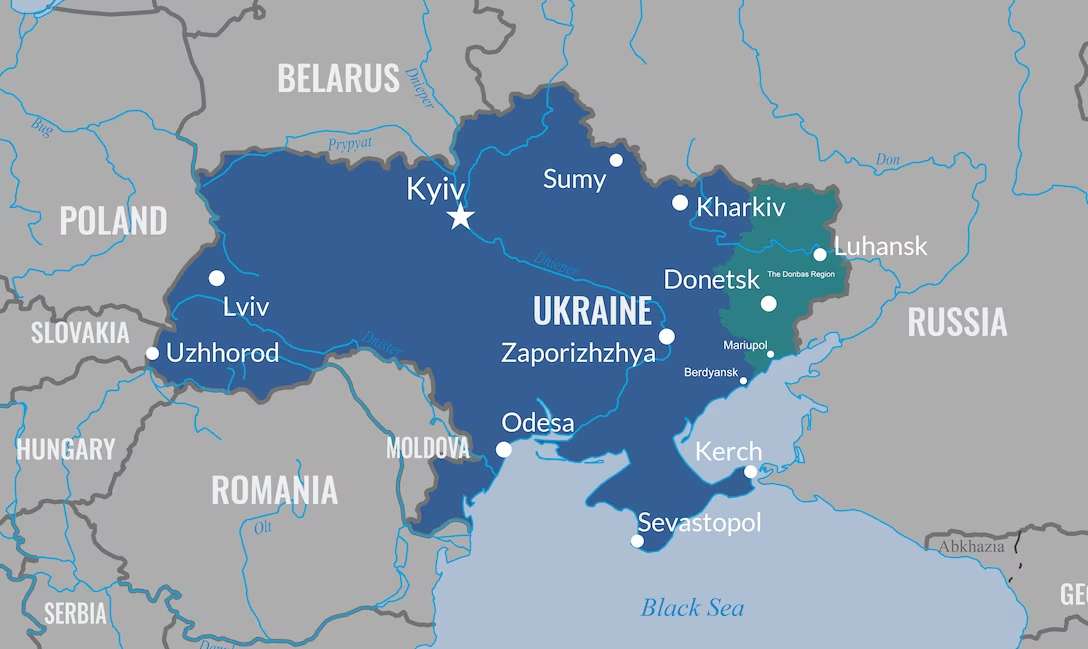
A CIA map split Ukraine into 12 separate zones, ranked on “resistance” potential, and how “favorable population attitudes [are] toward the Soviet regime.” South and eastern regions, particularly Crimea and Donbass, rated poorly.
Their populations were judged “strongly loyal” to Moscow, having never “displayed nationalist feelings or indicated any hostility to the regime,” while viewing themselves as “a Russian island in the Ukrainian sea.”
In fact, as the study recorded, during and after World War I, when Germany created a fascist puppet state in Ukraine:
“Inhabitants of Donbass strongly resisted Ukrainian nationalists and at one point created a separate republic, independent of the rest of Ukraine. 3
In the following years, they defended Soviet rule and Russian interests, often attacking the Ukrainian nationalists with more zeal than the Russian leaders themselves.
During the German occupation in the Second World War, there was not a single recorded case of support for the Ukrainian nationalists or Germans.”
Still, invading and occupying Crimea was considered of paramount importance. On top of its strategic significance, the peninsula’s landscape was forecast as ideal for guerrilla warfare. The terrain offered “excellent opportunities for concealment and evasion,” the CIA report noted.
While “troops operating in these sectors must be specially trained and equipped,” it was forecast that the local Tatar population, “which fought so fiercely” against the Soviets in World War II, “would probably be willing to help” invading US forces.
Areas of western Ukraine, including former regions of Poland such as Lviv, Rivne, Transcarpathia, and Volyn, which were heavily under control of “Ukrainian insurgents” – adherents of Stepan Bandera4 – during World War II, were judged most fruitful “resistance” launchpads.
There, “nationalist activity was extensive” during World War II, with armed militias opposing “pro-Soviet partisans with some success.”
Conveniently, too, the mass extermination of Jews, Poles, and Russians by Banderites in these regions meant there was virtually no non-ethnic Ukrainian population left.
Furthermore, in the post-war period, “resistance to Soviet rule” had been “expressed on a great scale” in western Ukraine. Despite “extensive deportations”, “many nationalists” remained in Lviv et al, and “nationalist cells” created by Bandera’s “task forces” remained dotted around the country.
For example, anti-Communist “partisan bands” had taken up residence in the Carpathian Mountains.
The review concluded, “It is in this region [US] Special Forces could expect considerable support from the local Ukrainian population, including active participation in measures directed against the Soviet regime.”
It was also determined that “Ukrainian nationalist, anti-Soviet sentiment” in Kiev was “apparently moderately strong,” and elements of the population “might be expected to provide active assistance to Special Forces.”
The capital’s “large Ukrainian population” was reportedly “little affected by Russian influence,” and during the Russian Revolution, “provided greater support than any other region for Ukrainian, nationalist, anti-Soviet forces.”
Resultantly, “uncertainty about the attitudes of the local population” prompted Moscow to designate the Ukrainian SSR’s capital, which it remained until 1934.
The CIA document further offered highly detailed assessments of Ukrainian territory, related to their utility for warfare.
For example, “generally forbidding” Polesia – near Belarus – was noted to be “almost impossible” to traverse during spring. Conversely, winter provided “most favorable to movement, depending on the depth to which the ground freezes.”
Overall, the area had “proved its worth as an excellent refuge and evasion area by supporting large-scale guerrilla activities in the past.” Meanwhile, “swampy valleys of the Dnieper and Desna rivers” were of particular interest:
“The area is densely forested in its north-western part, where there are excellent opportunities for concealment and maneuver…There are extensive swamps, interspersed with patches of forest, which also provide good hiding places for the Special Forces.
Conditions in the Volyno-Podolskaya Highlands are less suitable, although small groups may find temporary shelter in the sparse forests.”
‘Strongly Anti-Nationalist’
The CIA’s invasion plan never formally came to pass. Yet, areas of Ukraine forecast by the Agency to be most welcoming of US special forces were precisely where support for the Maidan coup was the highest.
Moreover, in a largely unknown chapter of the Maidan saga, fascist Right Sector militants were bused en masse to Crimea prior to Moscow’s seizure of the peninsula. Had they succeeded in overrunning the territory, Right Sector would’ve fulfilled the CIA’s objective, as outlined in Resistance Factors and Special Forces Areas.
Given what transpired elsewhere in Ukraine following February 2014, other sections of the CIA report took on a distinctly eerie character. For instance, despite its strategic position facing the Black Sea, the Agency warned against attempting to foment anti-Soviet rebellion in Odessa.
The agency noted the city is “the most cosmopolitan area in Ukraine, with a heterogeneous population including significant numbers of Greeks, Moldovans and Bulgarians, as well as Russians and Jews.”
As such: “Odessa…has developed a less nationalistic character. Historically, it has been considered more Russian than Ukrainian territory.5
There was little evidence of nationalist or anti-Russian sentiment here during the Second World War, and the city…was in fact controlled by a strongly anti-nationalist local administration [during the conflict].”
Odessa became a key battleground between pro- and anti-Maidan elements from the moment the Maidan protests erupted in November 2013.
By March the next year, Russophone Ukrainians had occupied the city’s historic Kulykove Pole Square, and were calling for a referendum on the establishment of an “Odessa Autonomous Republic”.
Tensions came to a head on May 2, when fascist football ultras – who subsequently formed the Azov Battalion – flooded Odessa and forced dozens of anti-Maidan activists into the Trade Unions House, before setting it ablaze.
In all, 42 people were killed and hundreds were injured, while Odessa’s anti-Maidan movement was comprehensively neutralized. In March this year, the European Court of Human Rights issued a damning ruling against Kiev over the massacre.
It concluded local police and fire services “deliberately” failed to respond appropriately to the inferno, and authorities insulated culpable officials and perpetrators from prosecution despite possessing incontrovertible evidence.
Lethal “negligence” by officials on the day, and ever after, was found to go far “beyond an error of judgment or carelessness.”
The ECHR was apparently unwilling to consider that the lethal incineration of anti-Maidan activists was an intentional and premeditated act of mass murder, conceived and directed by Kiev’s US-installed fascist government.
However, the findings of a Ukrainian parliamentary commission point ineluctably towards this conclusion.
Whether, in turn, the Odessa massacre was intended to trigger Russian intervention in Ukraine, thus precipitating “armed conflict of the old-fashioned sort” with Moscow that “Britain and the West could win” is a matter of speculation.
4A fascist and Nazi occupation collaborator which President Yuschenko (Yanukovych’s forerunner) tried to recognise a Ukrainian national hero in 2010 (while criticising ‘national heroes’ was also declared a crime), which only failed due the requirement for candidates to have been a Ukrainian citizen, which Bandera had never been. His birthday is nevertheless celebrated annually by the State and features a torchlit parade of far-Rightists and fascists.
There is an unfortunate trend in the socialist movement in Ireland to underplay or even to completely ignore the continuing colonial occupation of Ireland, while at the same time raising the other evils of imperialism and capitalism.
This harmful trend is epitomised by an article from Paul Murphy in the current issue of the ecosocialist Rupture magazine1 (of RISE, a network of the People Before Profit political party) – without conscious irony entitled THE MAIN ENEMY IS AT HOME – TODAY.
In the piece under discussion, Murphy discusses the blocs forming up in contention and for world war, with the US leading the western bloc and China-Russia the Eastern,2 with the ruling classes of the EU and Ireland lined up with the USA, though the Irish State is not yet a part of NATO.
Rupture Magazine generic image
This is a correct analysis by Murphy and he is right to call for defence of the Triple Lock3 as far as we can in order to prevent or at least impede the Irish ruling class from dragging the population of the Irish state into imperialist war.
Invoking the threat of NATO as a war-making alliance and danger to the limited neutrality of the Irish state is of course absolutely correct. But how can the actual NATO membership of the Occupied Six Counties be ignored in that analysis? Yet Murphy does so, completely.
Murphy is neither blind nor stupid and one must suspect that he does not mention Britain’s Irish colony because his former and current parties both fear to mix their ‘class politics’ with any kind of Irish nationalism – even anti-colonialism – or to find common cause with Irish Republicans.
Those parties took a sudden interest in the potential politics of a united Ireland only when discussion of that possibility was being thrown around in the media and by some political actors.4 But before and afterwards, they ignored them (except on occasion to castigate Irish Republicans).
The ‘enemy at home’ is indeed, as Murphy states, Irish capitalism – however not also British colonialism? But it cannot be ignored that Irish capitalism is subservient to British colonialism, US and EU imperialism. Well, can’t be ignored by revolutionaries that is, whether Marxist or not.
Ireland as treated in the Rupture analysis – but something’s missing! (Image sourced: Internet)
It was through analysis of the subservience of the Irish capitalist class that Connolly wrote that “Only the Irish working class remains as the only incorruptible inheritors of the fight for freedom in Ireland”5 – and that was even before the bourgeois counter-revolution/ Civil War of 1922-’23.
Murphy, PBP and the Socialist Party are all fond of quoting James Connolly but only selectively and never on the question of overthrowing British rule in Ireland.6
A TIMELY WARNING
Before ending let us note that Paul Murphy’s words are not those of some green novitiate; aside from being a TD,7 he is a long-standing member of the Irish Trotskyist movement, formerly a leading member of the Irish Socialist Party before he left it to join PBP-Solidarity.8
Furthermore he has been active at times in street events and was one of the Jobstown Five who were arrested in early-morning raids by the Gardaí and tried but found ‘not guilty’ on charges of ‘kidnapping’ Joan Burton, Tánaiste9 of the Fine Gael-Labour Party coalition government.10
We are entitled to assume, given his prominence and the article’s publication, that Murphy’s political position outlined here is one with which PBP-Solidarity and Rise find no serious disagreement, to the disgrace of any party claiming to be Marxist and revolutionary in Ireland.
Furthermore, their position gives activists timely warning once again that although we may well join with PBP on certain issues, including opposition to US imperialism, they will not be found to the serious side against British colonialism in Ireland or in any fully-committed struggle against NATO.
While upholding principles of a broad front, in any struggle we need to be fairly sure of which forces will stand with us to the end and which may drop us, perhaps even at the worst and most dangerous moment.
End.
Note: If you found this article of interest, why not register with Rebel Breeze for free, so that you will be notified by email of subsequent articles. You can de-register any time you wish.
2In the course of which Murphy states that Russia is an imperialist country but neglects to show any evidence of that. Capitalist and undemocratic does not equal imperialist, which Marxists today understand as the export of finance capital to extract super-profits from under-developed lands through exploitation of the labour there and plunder of their natural resources.
3Ireland’s “Triple Lock” is a policy requiring UN mandate, Government approval, and Parliamentary approval before more than 12 Irish troops may be deployed in overseas support operations.
4Though never taken seriously by some, including myself. I commented that British colonialism/imperialism had many opportunities to end their colonial rule in Ireland and on each occasion had dug their heels in harder, most recently by fighting a vicious war of three decades. In addition, if it were ever even half-considered, it is the British who would decide what the proper majority percentage would be, after which it would need to be agreed in Westminster and then approved by the British Monarch.
6Sadly it is also true that many Irish Republicans quote Connolly only in the reverse, i.e. only about Ireland’s national liberation struggle.
7Teachta Dála, elected member of the lower house of the parliament of the Irish State.
8People Before Profit is now what used to be called the Socialist Workers’ Party, an iteration of a British-based Trotskyist party, as is the Irish Socialist Party similarly of the British-based Socialist Party.
9The Tánaiste is equivalent to Deputy Prime Minister in the UK and many other parliamentary systems.
Thousands of ex-ISIL (ISIS) fighters and their families have been freed during the Syrian government forces assault on the SDF-guarded Al-Shaddadi jail. Both sides blame the other for the release although the Government forces admit their assault.
The SDF, mainly Kurdish forces supported by the US/ NATO coalition to oust the former Assad regime, have been guarding an estimated 10,000 prisoners in the jail since the collapse of the ISIS offensive in the region.1
Observers have feared the release of the ISIS fighters and their ‘radicalised’ families since the December 2024 collapse of the Assad regime in a Turkey-supported offensive.
That attack was led by Ahmed Hussein al-Sharaa, former Al Qaeda fighter and second-in-command of the ISIS-supported al-Nusra forces in Syria, a coalition of fundamental Islamist jihadists fighting under ISIS leadership though their leader claims to have fundamentally changed.
Ahmed Hussein al-Sharaa changed his name to al-Jolani and claims to have renounced ISIS, proclaimed himself President of Syria and filled his cabinet with ‘former’ ISIS commanders, since which Western imperialist leaders have accepted him and Trump praised him greatly.
Cartoon by Carlos Latuf depicting the Western imperialist makeover of the ISIS Ahmed al-Sharaa to al-Jolani, self-appointed President of Syria (Sourced: Internet)
The western powers cancelled his designation of ‘terrorist’, presented their compliments at his throne, some, including French and German envoys, travelling to meet him2 (even before the $10m bounty on his head3 had been removed). Or invited him to call, as Macron did for France.4
Al-Jolani offered friendship to ‘Israel’ even as the IOF occupied additional parts of Syria and bombed any remaining military installations of the Assad regime.5
THE KURDISH-LED SDF, TURKEY AND AL-JOLANI
The objective of the SDF had been to overthrow Assad so as to form a Kurdish state within Syria in order to link up with other Kurdish regions to create a federal Kurdish state. Turkey feared this project, having fought decades of bloody war against the PKK in its own Kurdish region.
Apologies for use of CIA map but difficult to get publishable image showing Kurdish-controlled areas within Syria. (Image sourced: Internet)
Consequently Turkey was at odds with US/NATO forces and the participation of the SDF within it, although Trump, as his previous Presidency drew to an end, publicly withdrew support for the Kurdish coalition. Turkey has welcomed the Damascus forces defeat of the SDF.
Since al-Jolani and his own coalition came to power, he attempted to integrate the SDF fighters within his own forces. The Kurds reluctantly agreed but insisted they be incorporated as a unit and not dispersed among al-Jolani’s forces, a proposal declined by the new President.
Since then there have been numerous clashes between the different forces, with the SDF holding their own, until the recent few days when they lost a number of strongholds, including that guarding the Al-Shaddadi prison, leading to thousands of former ISIS fighters being freed.
This prison breach, welcomed by Turkey,6 must be viewed with horror by many Syrians, in particular by the Yazidi, Alawite, Druze and Christian communities who have been subjected to home invasions, humiliation and massacres, along with rape and kidnapping of women.7
Neighbouring Iraq, Lebanon and even Jordan have cause to worry too.
Again, difficulty in getting publishable map showing Syria with its neighbours but also Iran. (Image sourced: Internet)
In sifting through the disputing claims, it is worth noting that the SDF claimed that the International Coalition base, only two kilometres away from the jail in Syria’s Hasakah province, did not respond to calls for assistance8 and the SDF denounced the failure of the USA’s forces to support them.9
It is relevant too that the SDF are not Islamist Jihadists and fought them many times in Syria, although it is true that the Western powers, while supporting the SDF, also supported and instigated ISIS to overthrow Assad, although bombing them too in periodic control operations.10
Events from the coming to power of Al-Jolani to the freeing of the Al-Shaddadi Prison may hold lessons of importance too for some strains of the Western Left and Liberals who supported the insurgent opposition to Assad in favour of ‘democracy’ while parroting mass media propaganda.11
It may also add a cautionary example to the dictum that ‘the enemy of my enemy is my friend’, often quoted by otherwise anti-imperialists who supported the IDF’s alliance with the US/NATO to overthrow the Assad regime.12
CUI BONO? WHO GAINS?
What now? (Cartoon by D.Breatnach)
One might think that the Western Powers, who have been in coalitions fighting ISIS and have suffered some attacks on themselves, including the Al Qaeda attack on New York’s Twin Towers, would be strongly opposed to this liberation of thousands of experienced Islamist jihadist fighters.
But if so, how are we to understand the refusal of the Coalition forces to intervene during the attack on the SDF forces guarding the jail? Or the Western Powers legitimising of the Al-Jolani regime running Syria, despite the al-Nusra background and religious sectarian massacres since?
It is difficult to avoid the conclusion that the imperialist powers wish to see those Islamic fundamentalist ex-fighters freed — but what could be their purpose? To instigate an internal conflict in Lebanon, perhaps, occupying Hezbollah away from ‘Israel’ and excusing foreign intervention?
Or keeping the Iraqi Government busy and deepening its reliance on US forces just as it seems to be asserting some independence. Or to sent north-eastwards against Iran. One thing is clear, the Western Powers allowed it and the reason nothing to do with concern about jail conditions.
End.
Note: If you found this article of interest, why not register with Rebel Breeze for free, so that you will be notified by email of subsequent articles. You can de-register any time you wish.
FOOTNOTES
1At the end of 2020, the U.S.-backed militia in northeast Syria held at least 10,000 ISIS prisoners, one of the largest populations of detained Islamists in the Middle East. Thousands of ISIS fighters were captured as the Islamic State collapsed in early 2019. The fighters were held in approximately 14 detention centers operated by the Syrian Democratic Forces (SDF), the U.S.-trained Kurdish and Arab militia that fought ISIS in Syria.https://www.wilsoncenter.org/article/islamists-imprisoned-across-middle-east
6From The Cradle, on Telegram: Omer Celik, spokesman for Turkish President Recep Tayyip Erdogan’s ruling AK Party, said that recent gains by Syrian government forces had “thwarted” attempts by Kurdish groups to obstruct Turkiye’s peace process. Feti Yildiz, deputy leader of the government-aligned Turkish nationalist MHP party, described Sunday’s agreement in Syria as having “a favorable impact.” “Things will become easier,” Yildiz told reporters in the Turkish parliament when asked how the Syrian deal affects the PKK process. “It had been standing like an obstacle, and for now it looks as though that obstacle has been removed.” Turkish security sources, speaking to Reuters on condition of anonymity, called the deal a historic turning point.
10The SDF contains female Kurdish and Yazidi fighters too which would be anathema to Islamist fundamentalists.
11It should not be understood from this that I was a supporter of the Assad regime; I attended demonstrations against imperialist invasion and regime change while also refusing to support the regime itself. I had arranged with Eva Bartlett, a much-publicised critic of the regime-change operations of the US/NATO forces, to organise a Dublin public meeting for her to address and had her stay at my home. After learning that I was also going to criticise the regime position against the Kurds she left without explanation and I had to cancel the meeting venue booking.
12In discussions with Anarchists of the WSM (organisation no longer in existence) and Irish Republicans of (Éirigí organisation much diminished since and now in coalition with another group) I refuted the correctness of application of this principle to the major imperialist power in the world, the USA. At a conference of the Éirigí group I spoke from the floor in criticism of that and some other aspects of the SDF and was heavily criticised from the floor also while the Chairperson reiterated support for the SDF. Though no-one spoke in my support, at least three Irish Republican activists approached me afterwards to express their support for my statements.
On Saturday morning, Dubliners checking messages or news on their phones or laptops, or listening to or watching news on TV or radio – or even reading a newspaper, learned that the USA had bombed Venezuela and abducted its President.
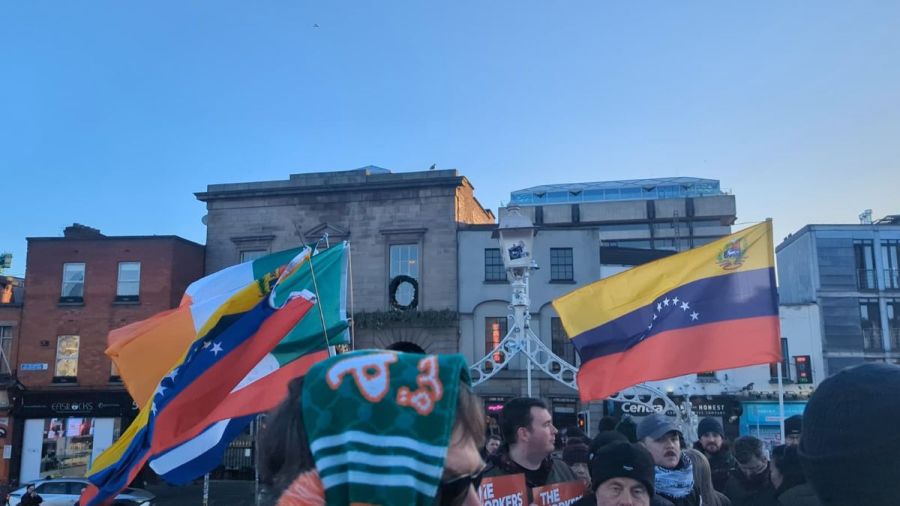
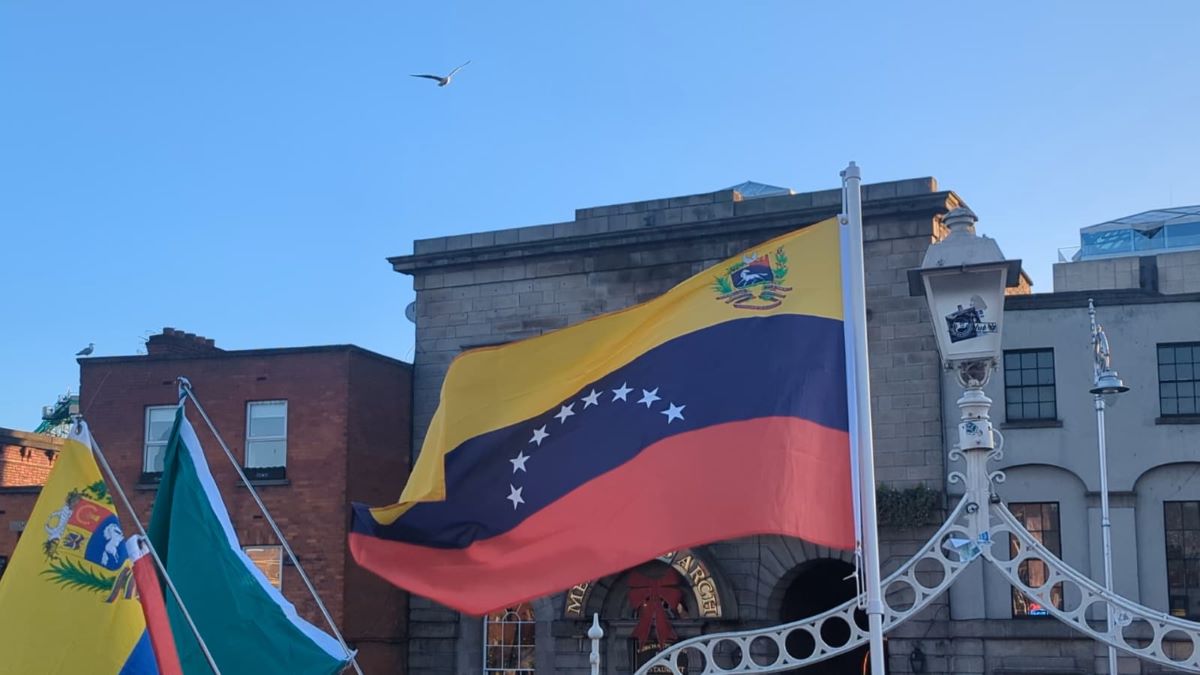
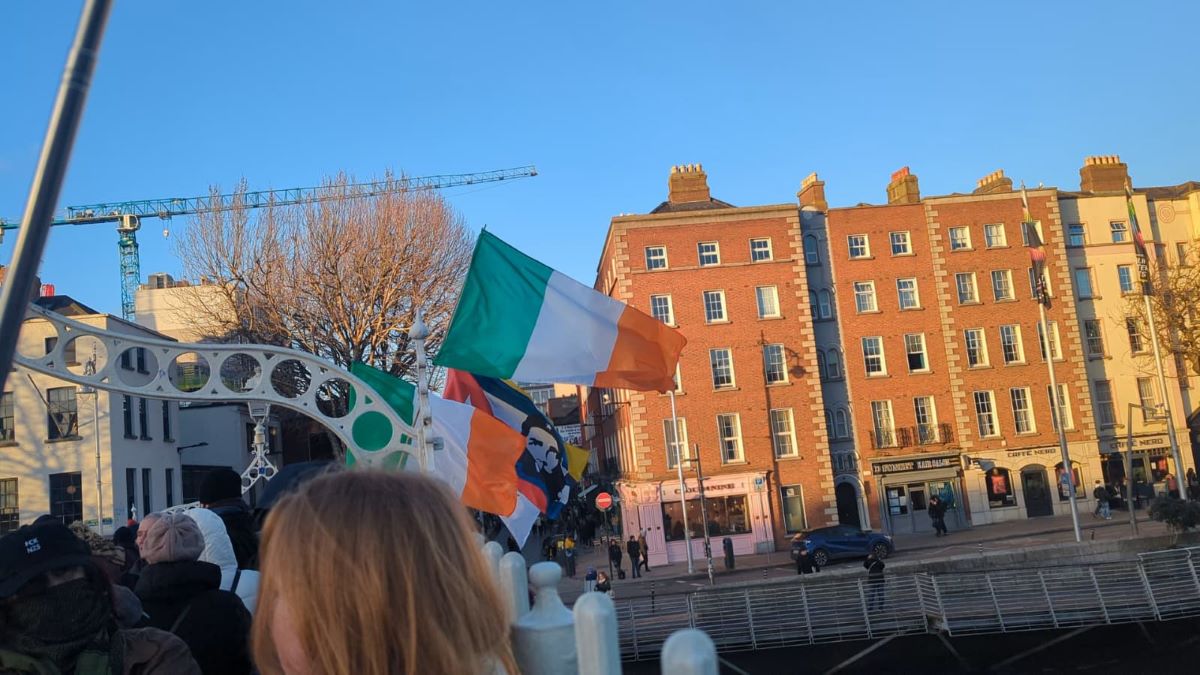
Venezuelan national flags on Ha’penny Bridge during Venezuela solidarity portrait, seen here against sky and south Liffey riverside buildings. (Photo cred: Participant)
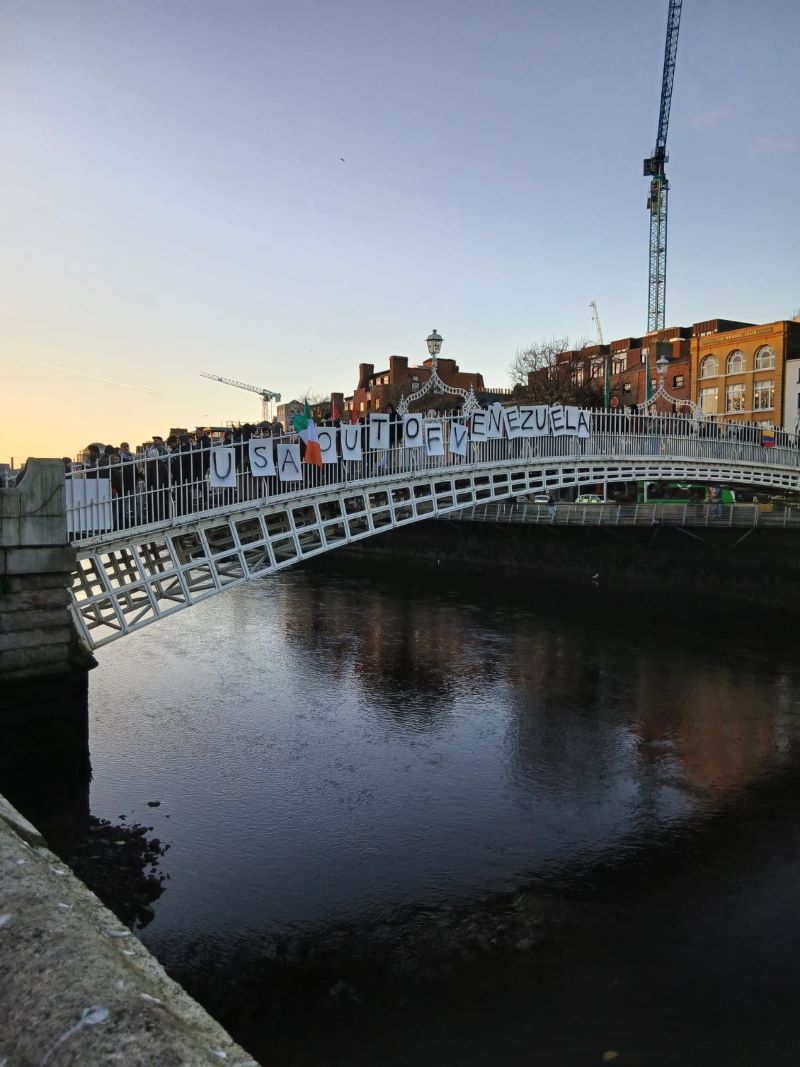
An emergency protest and solidarity demonstration was called for 3pm in the city centre and under a clear blue sky but in bitter cold, many attended to line the iconic Ha’penny Bridge, which only a week ago had hosted a New Year’s Eve demonstration in solidarity with Palestine.
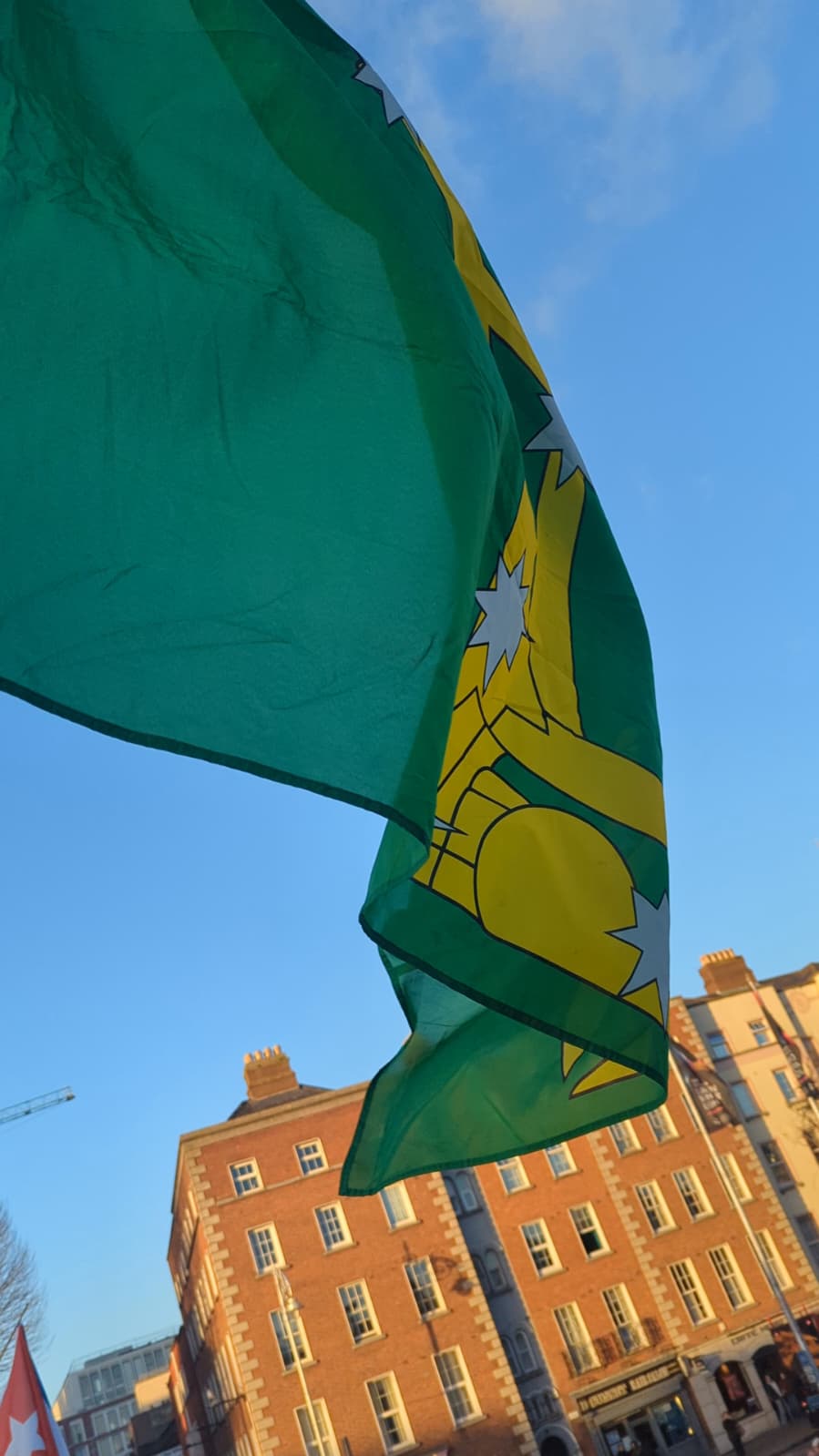
Among the crowd on the Bridge, a few Venezuelan national flags fluttered against the sky or the riverside buildings, along with a number of Irish Tricolours and one green and gold Starry Plough,1 while placards were attached to the railings along the sides of the Bridge.
The well-known slogan of US military – Out of Shannon! was among the call-and-answer chants of course, along with the easily-imagined Hands off Venezuela! But there were some innovative ones too, such as the Irish-language/ English mix of Deirimís go léir le chéile – Hands off Venezuela!
Starry Plough flag on Ha’penny Bridge during Venezuela solidarity protest, seen here against sky and north Liffey riverside buildings. (Photo cred: Participant)Irish Tricolour flags and probably Cuban national flag on Ha’penny Bridge during Venezuela solidarity protest, seen here against sky and north Liffey riverside buildings. (Photo cred: Participant)
Entirely in Castilian Spanish there was also Viva, viva – La Resistencia! Another was USA – Nothing but thieves! – a specific reference to Trump’s nakedly-declared wish to grab the country’s oilwells.
People from a number of different political parties participated as did a large number of independent activists, constituting an ad-hoc and informal anti-imperialist broad front.
Among the crowd were veteran activists but also too many of the younger ones, grown in political awareness and action in recent years of Palestine solidarity, a deep educational experience, including some facing charges from actions in Dublin or Shannon to be tried in the coming months.
It is to be hoped that their support and solidarity will also be broad.
The Ha’penny Bridge during Venezuela solidarity protest. (Photo cred: Eddie O’Reilly)
The latest news is that the kidnapped President Maduro has been charged in the US on counts including drug trafficking and possession of weapon. As the President of Venezuela and titular head of its armed forces, presumably he does indeed hold weapons.
The very existence of the drug cartel of which Trump and his cabal claim Maduro is head is very doubtful, including even to views leaked from US intelligence departments and of course, not one iota of evidence has been produced to date of the alleged drug trafficking.
Mixture of flags and people on Ha’penny Bridge during Venezuela solidarity portrait, seen here against sky and south Liffey riverside buildings. (Photo cred: Participant)
In the lead-up of months of bullying to this invasion, US forces sank many boats, killing at least 115, including one survivor of a bombing in the water. No evidence of their alleged drug-running has been produced in a single case and even so would not merit death penalty under US law.
Following the US attack on Venezuela, Defence Minister Vladimir Padrino López, reportedly from his control bunker, broadcast in military uniform to the nation condemning the imperialist attack and promising resolute resistance.
Diosdado Cabello, Venezuela’s Minister of Interior, Justice, and Peace, was videoed in the street wearing helmet and body protection equipment, calling on citizens to place their trust in the political and military leadership and to give no assistance to invading forces.
Vice-President Celcy, now Acting President made her first ever broadcast demanding the release of the Presidential couple, affirming that “there is only one president in this country, and his name is Nicolás Maduro,” and insisting that Venezuela “will never be a colony of any nation.”
Earlier, mainstream media had reported that Celcy had fled to Russia and that Lopez had been killed, such errors perhaps being caused by the ‘fog of war’ but recalling also the part played by the mainstream media in preparing the ground for the US-instigated Chilean coup of 1973.
The US attack and kidnapping was condemned today by Russia and by President Petro of Colombia. Kallas, on behalf of the EU, while condemning Maduro’s rule, voiced some weak platitudes about the EU Charter but voiced no condemnation of this attack upon a sovereign nation.
President of the USA Trump boasted publicly about how viewing the attack and kidnapping operation had been like watching a TV show and proclaiming that the US are now “going to run” Venezuela for a while “and get the oil flowing.”2
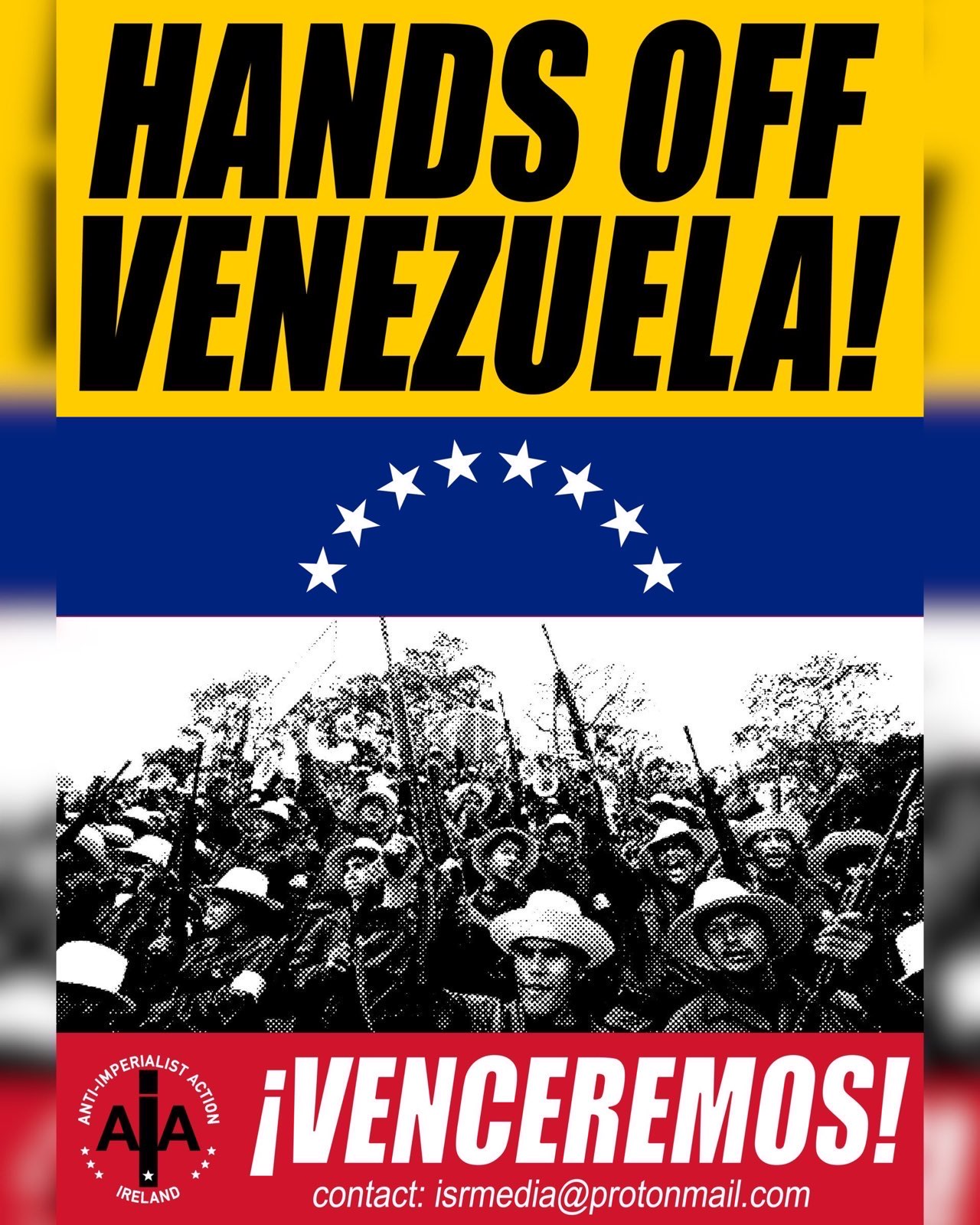
Tomorrow, Sunday, the Anti-Imperialist Action organisation has called a protest demonstration to take place at the US Embassy in Ballsbridge, Dublin for 1pm, in defence of sovereignty and in opposition to imperialism.
End.
Note: If you found this article of interest, why not register with Rebel Breeze for free, so that you will be notified by email of subsequent articles. You can de-register any time you wish. Footnotes:
1The design of the flag of the Irish Citizen Army, a workers’ defence militia against police during the Lockout/ Strike of 1913 and that also fought in the 1916 Rising.
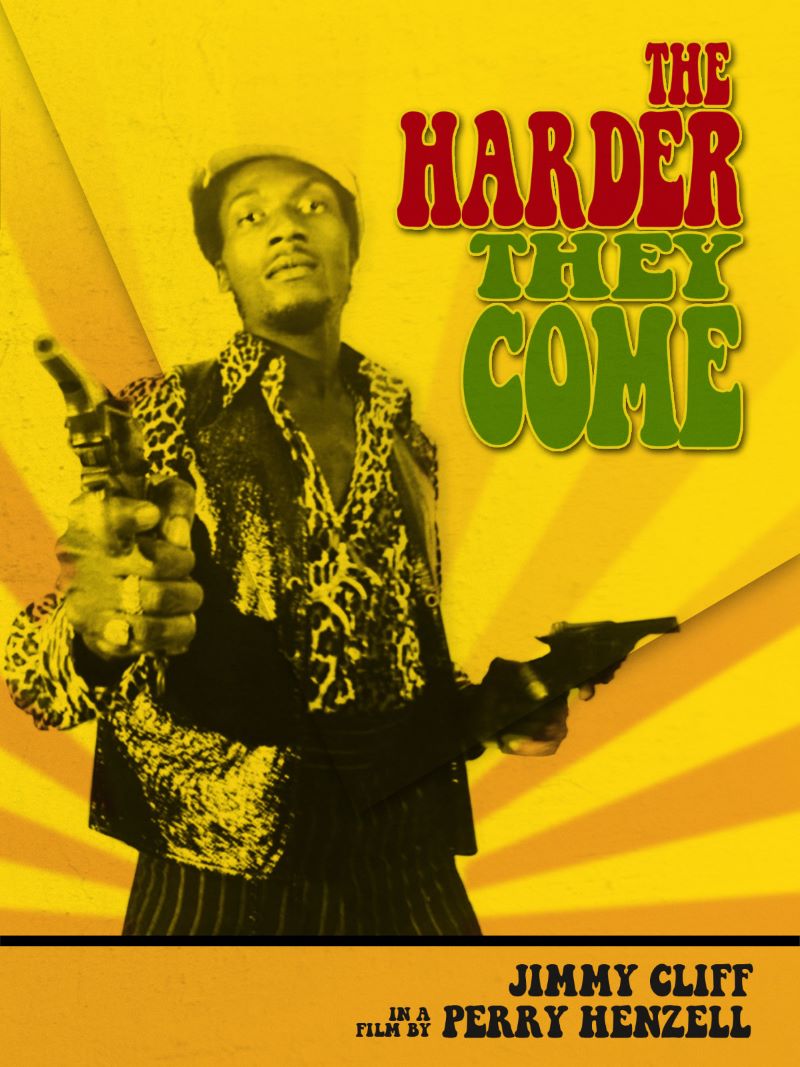
The death is announced on mass media today at 81 year of age of Jamaican reggae singer, songwriter and author Jimmy Cliff,1 famous for songs such as The Harder They Come and for his role in a film of the same title.
As is usual in such cases, tributes have been posted on social media and quoted in the western mass media, including by Ali Campbell of the UB 40 band who was reported to be ‘so sad’2 (which to be honest, seems a little strange as Jimmy Cliff lived to a good 81 years of age before he died).
I first heard a few of Jimmy Cliff’s nearly 30 recordings among the Caribbean community of SE London.
Jimmy Cliff grew up James Chambers in a family of nine in St. James in Jamaica, often mistakenly thought of as the largest Caribbean island (which it is not – that is in fact Cuba). Jamaica, like Trinidad & Tobago, another larger island and Barbados, were among the British colonies in the Caribbean.
The Caribbean islands and coastline3 were first European-colonised by the Spanish, then by the French, Dutch and British Empires, often in armed conflict against its indigenous people but also among themselves, also against slave uprisings and later against local struggles for independence.4
Since WWII the dominant imperialist power in the Caribbean is undoubtedly the United States of America, though France retains some colonial possessions and a few remain part of the British Commonwealth.
Today the Caribbean is in the news through a large force of US Naval forces posted there, along with nearby posting of bombers, along with the murder of over 80 small boat sailors, allegedly drug smugglers (without evidence and as though drug smuggling gets the death sentence).5
According to threats of President of the USA Trump, he intends to target Venezuela and its President Nicolás Maduro, whom he claims – without a shred of evidence — to be the leader of a drug cartel.
Migrant communities and the spread of Reggae
During the decades I spent in London I had a fair amount of contact with parts of the Caribbean immigrant and diaspora community, partly through working alongside some of its members, partly through socialising in SE London and through activity in resistance to fascism and racism.
I first came across Reggae music while living as a migrant in the SE London areas of Lewisham, New Cross and Peckham. There were large Irish and Caribbean communities there with some but not a great deal of interaction between both communities but little hostility between them either.
Both communities were subject to institutional racism and politicised communal racism as organised by the fascist National Front and British Movement, both of which had connections to British Loyalist paramilitary organisations in Scotland and in the Six Counties in Ireland.
I recall reading in a British 1950s sociological study on ‘deviant behaviour’ that ‘Teddy Boy’ gangs would target the post-War newly-arrived Caribbean immigrants (but also the ‘Micks’, i.e the Irish) and a Jamaican workmate told me about the gangs waiting for them on Childeric Rise.6
How he went out armed with a home-made knuckle-duster and how the police would come to the fighting, arresting mostly the Caribbean victims. “Them turn me away when dem see me,” a Caribbean migrant discussing racism told me, “but dem turn you away when dem hear you.”
In Caribbean shebeens7 or illegal ‘clubs’ in that SE London area, one could buy for a modest sum a plate of goat curry and rice, or a can of pale ale or Guinness, while listening to vinyl records of Bluebeat, Ska, Rock Steady, Reggae and, to a lesser extent, Calypso.8 And dance, perhaps.9
Jimmy Cliff composed songs and rode the rising Reggae tide, for a short while rivalling Bob Marley for most popular position. What launched him and the Reggae ship into wider seas was the film The Harder They Come based on the novel of the same name featuring Cliff’s own song.
The Harder They Come novel by Ekwueme Michael Thelwell charting the fictionalised career of a Jamaican who fails to succeed as a reggae singer and becomes a gangster is based on the real life of Jamaican folk hero and reggae star Rhygin.10
But the film’s hero was performed by Jimmy Cliff and his music played as soundtrack.
In Peckham I watched the film years later and enjoyed it but I also read the novel. The latter gives an interesting background of the hero growing up in his grandmother’s care in rural Jamaica, before he goes to Kingston, while the film opens only with the hero’s arrival in the city by bus.
Famous folk singer Bob Dylan is reported to have said that Jimmy Cliff’s 1969 song Vietnam was the best protest song he had ever heard. It is hard to credit that as a true statement; Pete Seeger, Dylan’s contemporary, many others and Dylan himself had composed many better.
Jimmy Cliff’s Vietnam song takes as its theme a US soldier in Vietnam writing about his impending return home at the end of his tour of military service in Vietnam and his desire for his girlfriend, followed by another missive to the soldier’s mother announcing her son’s death in Vietnam.
The tragic juxtaposition of youth, romantic love, violent death and parental bereavement is an inherent theme of war and of course works on our emotions. But the song says nothing about who sent the soldier there nor the reasons for the Vietnam War, though one line calls for its end.
The lyrics tell us nothing about the devastation of the US war upon the peoples of Vietnam, Laos and Cambodia, nor about the heroism of the people’s resistance.11 Not even about the huge protests of many people in the USA — particularly youth — and in much of the western world.
Jimmy Cliff in performance (Photo credit Alastair Wison/ PA)
However, Jimmy Cliff’s performance of the song 20 years ago in Jamaica brings the point of the anti-war movement much more into context as in his introduction to the song on stage he castigates Tony Blair and George Bush and names a number of other imperialist wars.
It was a great performance of Cliff’s at the end of his sixth decade of life and I hope you enjoy it here on video.
Note: If you found this article of interest, why not register with Rebel Breeze for free, so that you will be notified by email of subsequent articles. You can de-register any time you wish.
2Facebook · UB40 Featuring Ali CampbellSo sad James chambers has left a void in reggae music, his voice and influence was exemplary. He was a reggae pioneer, RlP Jimmy cliff.
6This rise gave on to the New Cross Road from terraced housing down below where a number of Caribbean families lived, in one house of which I shared a double room with another Irish migrant. Almost at the top of Childeric Rise itself was the entrance to The Harp Club Irish dance hall with an Irish pub on an opposite corner and another across the road.
7From the acknowledged Irish language word ‘síbín’, etymology uncertain but adopted as far away as the Caribbean and South Africa.
8Music mostly of Trinidad and Tobago, often accompanied by steel band instruments, based on folk dance music from a part of West Africa. https://en.wikipedia.org/wiki/Calypso_music
PALESTINE SOLIDARITY MARCHERS PEPPER-SPRAYED AND BATONED WITHOUT WARNING.
An action on Saturday in an attempt to stop the genocide of Palestinians was brutally repressed by Gardaí pepper-spraying the marchers without warning before beating many with truncheons and threatening others, then issuing a lying statement.
On Saturday (4th October) the Ireland Palestine Solidarity Campaign had organised another of their monthly National marches from the Garden of Remembrance through Dublin city centre to Leinster House1 but a much smaller section departed for Dublin Port.
View of a section of the Palestine solidarity march on Saturday proceeding along O’Connell Street. (Photo: D.Breatnach)
In the context of port protest shut-downs in various parts of the world, Italy in particular, the intention seemingly was to blockade traffic into and out of Dublin Port; also in the context of the Irish state being a huge importer of Israeli products, second only to the USA.
The shut-down marchers left the main march at O’Connell Bridge and proceeded along the Liffey quays heading for the Port as IPSC stewards tried to discourage anyone from joining them, stooping as low as to accuse them over a loudspeaker of splitting the march and of betraying Gaza.
There had been a number of Port traffic blockade actions recently, all of which had ended without violence. No doubt the Irish ruling class were worried that they might escalate and spread and gave orders to the Gardaí to attack the marchers and to terrorise any others from emulating them.
As the marchers reached the Public Order Unit police line and stopped, some of the police began to push marchers, almost immediately some Gardai standing in a second row starting to pepper-spray marchers over the heads of their colleagues but the wind pushed some of it back in their faces.
POU Gardaí to the right of the crowd then drew their truncheons and started to strike viciously at the marchers, who were now pushing into the Garda line. Eventually the marchers broke, people staggering off to the side, eyes streaming, unsteady on their feet. Even then, they were pursued.2
At least two marchers were arrested at the event and another in a solidarity demonstration outside the Criminal Court building that evening. The charges include Public Order charges and resisting arrest. Once again, marchers complained they were forcibly strip-searched in the police cells.3
CAPITALIST MEDIA
RTÉ online’s report was clearly totally based on a Garda statement without any attempt to investigate, although video footage was soon circulating on social media. Try to contact participants for their side of the story? See whether there were photos or video clips available? Don’t be silly!
The Garda account is totally at variance with what can be seen on the video, as has often been the case. One recalls the assault with a length of wood by a fascist on an LGBT campaigner who was observing a National Party rally outside Leinster House and a Garda told her to leave the area.
The Garda statement to the media on that occasion was that there had been no incidents but unfortunately for them there was ample video recording of the event, the assault, the victim’s head streaming with blood, the senior Garda ordering her away … and they had to change their story.
A few weeks prior to that, unarmed antifascists counter-protesting an anti-masking protest organised by fascists on Custom House Quay were attacked by fascists wielding clubs and metal bars. As the antifascists fought back, the POU charged in and attacked the antifascists!
On that occasion too their statement to the press completely omitted that event.
The media is doing a good job of exposing themselves as not only keeping to the imperialist pro-Zionist discourse about events in Gaza and the rest of West Asia, but keeping also to the home front discourse that big business and cops are good and protesters a problem.
We appear in the Irish state to be entering a period of Garda repression backed up by media acquiescence, similar to what was passed through in the 1980s, with Garda repression on the street but also operations by the ‘Heavy Gang’, raiding and beating up detainees to obtain a ‘confession’.
The liberal civil rights sector was quite active then calling out Garda violence, framing of innocent people and judicial collusion. There is much less of that liberal resistance to be seen these days.
A rare enough sight – an Irish-language placard on Saturday’s march in Dublin. (Photo: D.Breatnach)
THE IPSC MARCH
The IPSC went ahead on Saturday with many thousands on their march, demonstrating once again, as over the past two years, that the Irish public is overwhelmingly in support of the Palestinians and totally against the genocide and ethnic cleansing by the Zionist state.
Over the years, the IPSC’s activities have contributed to that awareness and sympathy in Irish society but so too have the actions of the Israeli governments and their armed forces, captured in photos and videos by journalists and ordinary Palestinians and posted on social media.
But Israel has not ceased its genocide; not one Palestinian life has been saved by the marches. The Irish Government has not ceased any of its concrete collusive actions with Israel. The imports continue, the armaments fly through Irish airspace, Shannon airport continues militarised.4
The IPSC’s Chairperson admitted as much, speaking at their rally near Leinster House: “Simon Harris has called Israel’s actions ‘genocide’, ‘unconscionable’ and ‘unacceptable’ — yet the Irish Government is barely lifting a finger to end Ireland’s deep complicity in this genocide.”
A section of the Palestine solidarity main march in Dawson Street, while thousands more are already in Molesworth Street (out of sight to the right of photo). (Photo: D.Breatnach)
Had the IPSC mobilised the thousands to march down to the docks, it would have been a very different story on Saturday. Something to make the Government really reconsider its collusion. The IPSC could still do that. But will it? We can hope but current practice tells us otherwise.
Then others will have to do the deed. Others like Mothers Against Genocide, Action for Palestine Ireland and Saoirse Don Phalaistín, for example. And they will continue to be assaulted and arrested, facing fines, restrictions on freedom of movement and … ultimately, no doubt … jail.
Apart from the baton and pepper-spraying injuries, one of the marchers is reported to have a broken arm. Two were arrested at the Port and one at the court solidarity protest Saturday evening. Today others attended court in solidarity with one of the arrested (who had abrasions on her cheek).
We should be part of these disruptive actions and if we are not, for whatever reason, the least we can do is to call out those who denounce them and to organise support for those who are, in and out of the courts.
End.
Note: If you found this article of interest, why not register with Rebel Breeze for free, so that you will be notified by email of subsequent articles. You can de-register any time you wish.
Gathering outside the Dublin Court in solidarity with one of the assaulted and arrested Port marchers. Her case was postponed. (Photo: D.Breatnach)
2All of that is evident from the video footage shot from that side of the event. Violent shoving by Gardaí sent some people to the ground, including a disabled woman.
3There was outrage expressed when Gardaí compelled detainees at a Mothers Against Genocide protest outside Leinster House to strip in the police cells. The Minister for Justice claimed that Garda CCTV footage refuted those claims but strangely, it appears that no CCTV footage was available when lawyers asked to view it. https://www.instagram.com/mothersagainstgenocide/p/DJ_nOewxQAp/
4And the Irish Central Bank intends, after a pause, to offer Israeli war bonds once more.
This is a partial dossier, documenting only some of the crimes of the Zionist entity. The dossier is largely in the form of cartoons some of which are as recent as the last few days and others a year old or more but sadly, are still valid comment today.
(Cartoon by D.Breatnach)
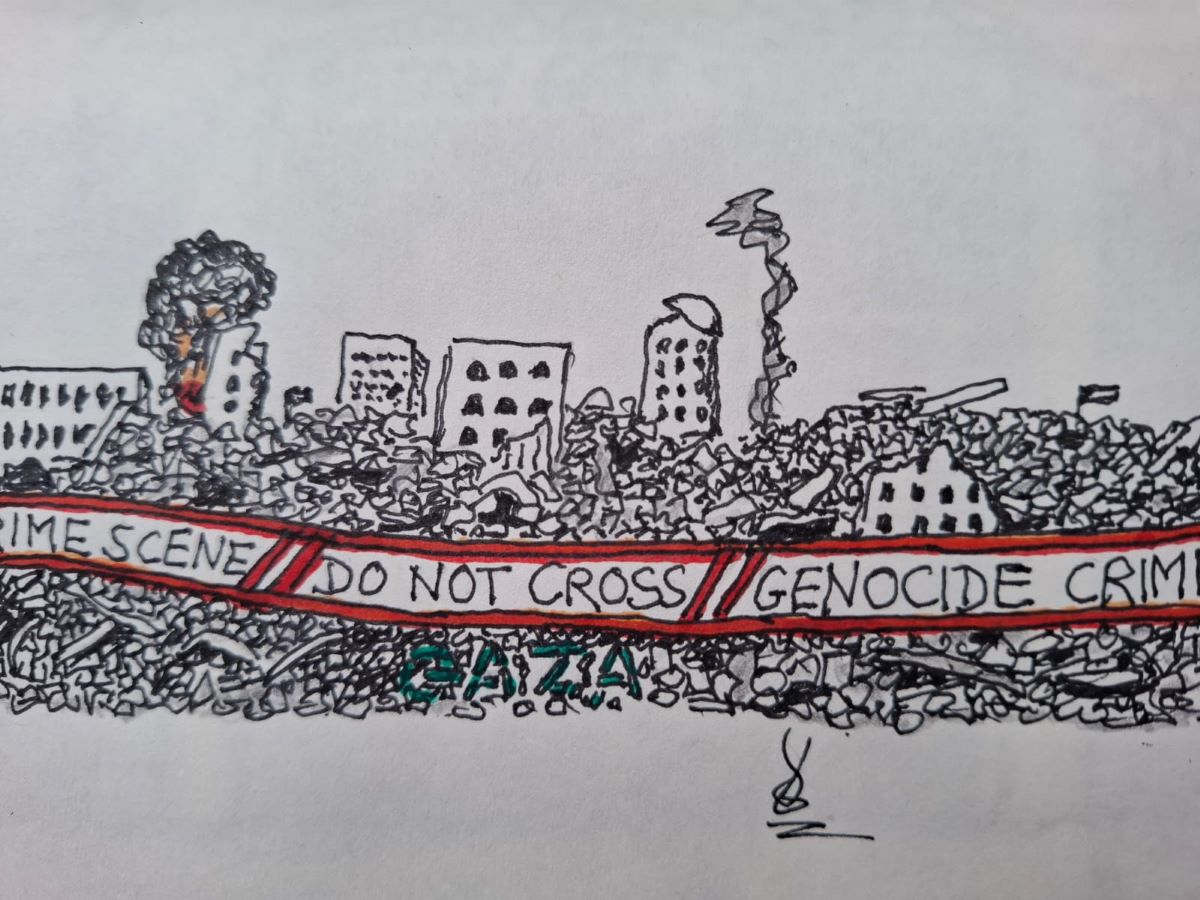
A great many crimes have been committed here: Ethnic cleansing, theft, murder, racial discrimination, apartheid, repression, bombing of civilians, shooting of civilians, destruction of water wells, tanks and desalination plants, power cutoffs, mass kidnappings, torture.
Bombing of residential blocks, bombing hospitals, bombing schools, bombing universities, bombing mosques and churches, starvation blockade, water cutoffs, assassinations, public humiliation of prisoners, using human shields, rape and other torture of prisoners, detention without trial.
The Israeli Zionists, a European colonial settler project, have had many criminal accomplices, both at the level of states, educational institutions public and private, and of private companies and corporations. The Irish State has permitted the transport of military cargo to Israel through Irish airspace.
(Cartoon by D.Breatnach)
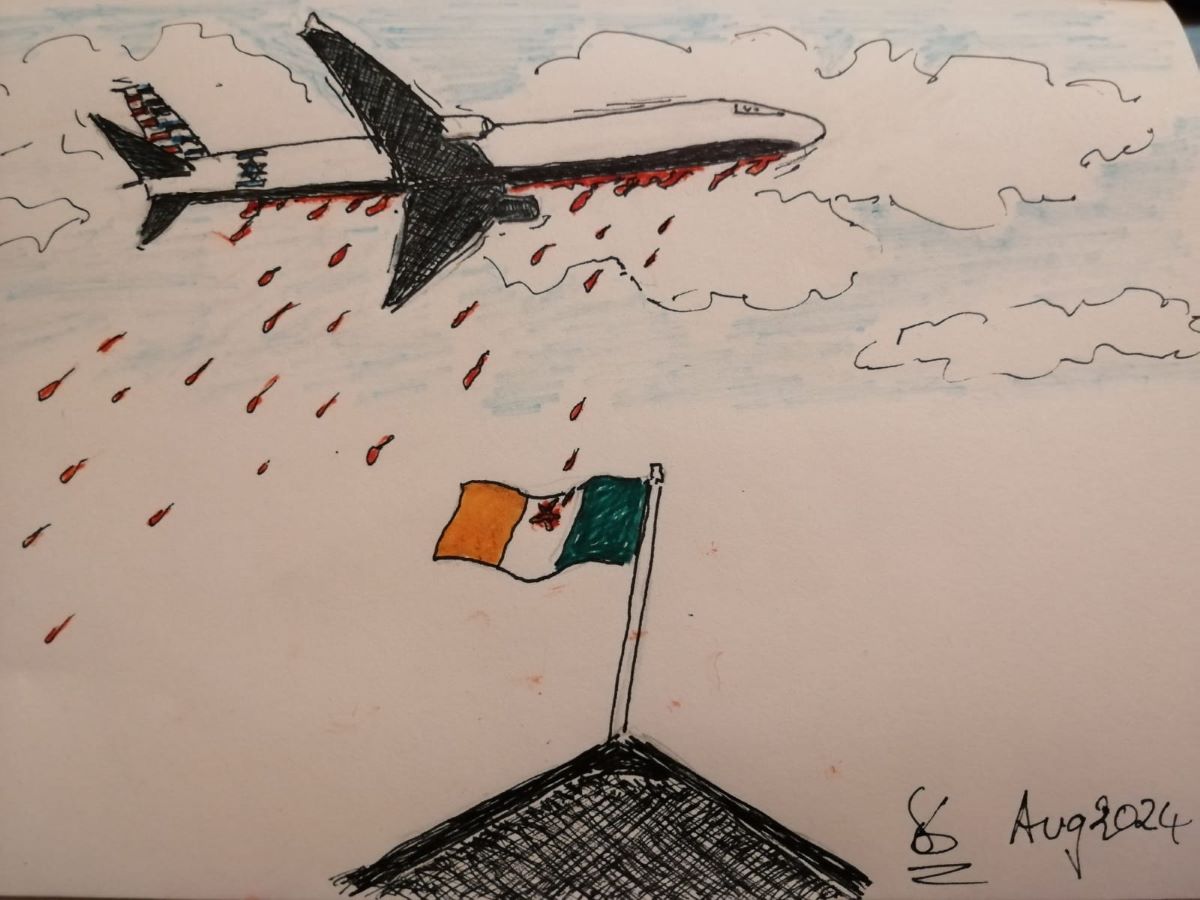
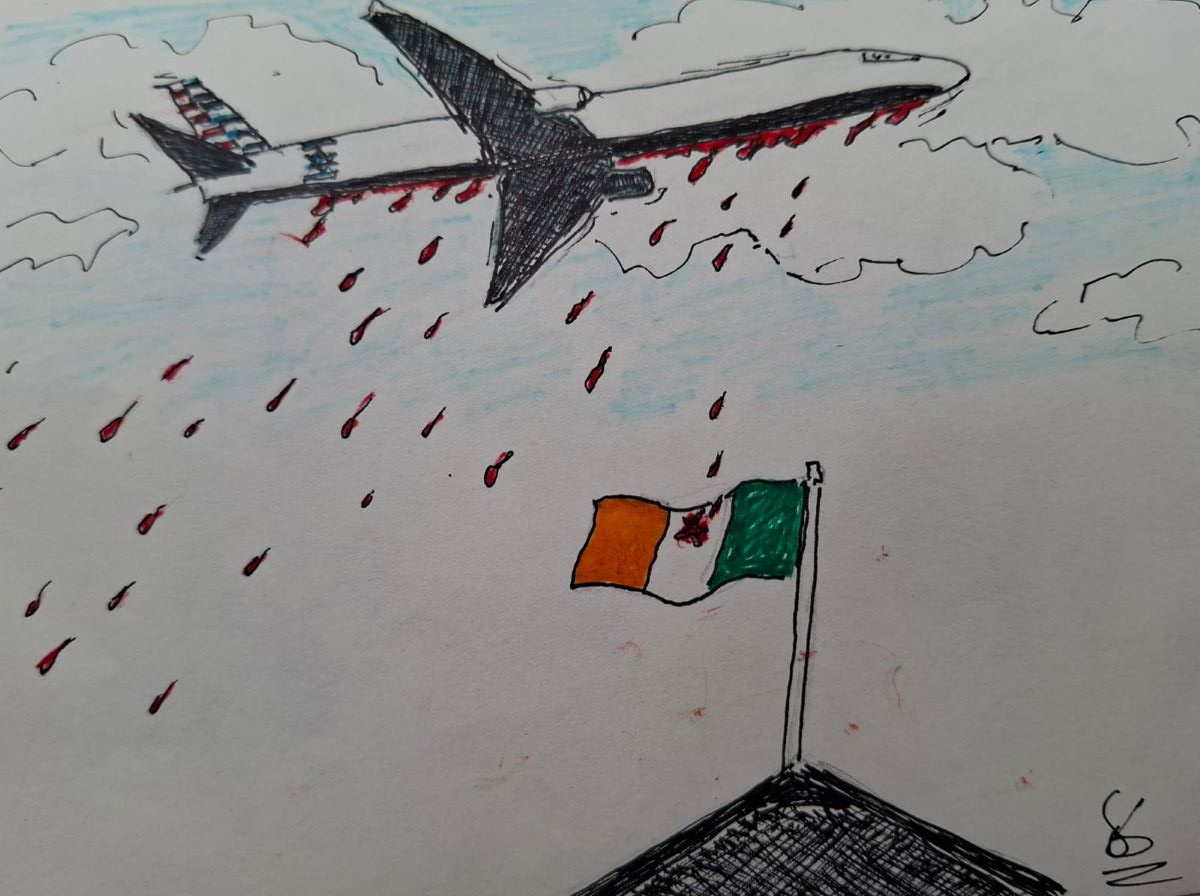
Despite the clearly-expressed desires of the vast majority of the Irish people, the ‘neutral’ Irish State has permitted arms material destined for the Israeli occupier of Palestine to fly through Irish airspace, in addition to permitting the militarisation of Shannon Airport.
As part of the genocide, the Zionist authorities turned off the water supply to Gaza, using water deprivation as a weapon, a war crime of collective punishment.
Shutting off water to the civilians in Gaza is a war crime, even if none of the other genocidal acts of the IOF had been carried out. (Cartoon by D.Breatnach)
But Palestinians have dug wells. And collected seawater in desalination plants. And stored water in rooftop tanks and barrels. So the IOF destroyed the wells, bombed the desalination plants and shot up the water tanks and barrels. Clearly acts of genocide.
(Cartoon by D.Breatnach)
In addition to shutting off the water supply and destroying Palestinian alternative sources, the Zionist authorities have sealed off Gaza from humanitarian aid of food, baby supplements, medicines, etc. The intention, declared in act and words, is to starve the Palestinian people into surrender and leaving.
The Rafah Gate, access Gaza-Egypt, by law operational only by those two agencies and main access of international humanitarian supplies to Gaza, closed by Israeli Occupation Forces tanks. (Cartoon by D.Breatnach)Israeli Occupation Forces threaten anyone trying to enter. (Cartoon by D.Breatnach)
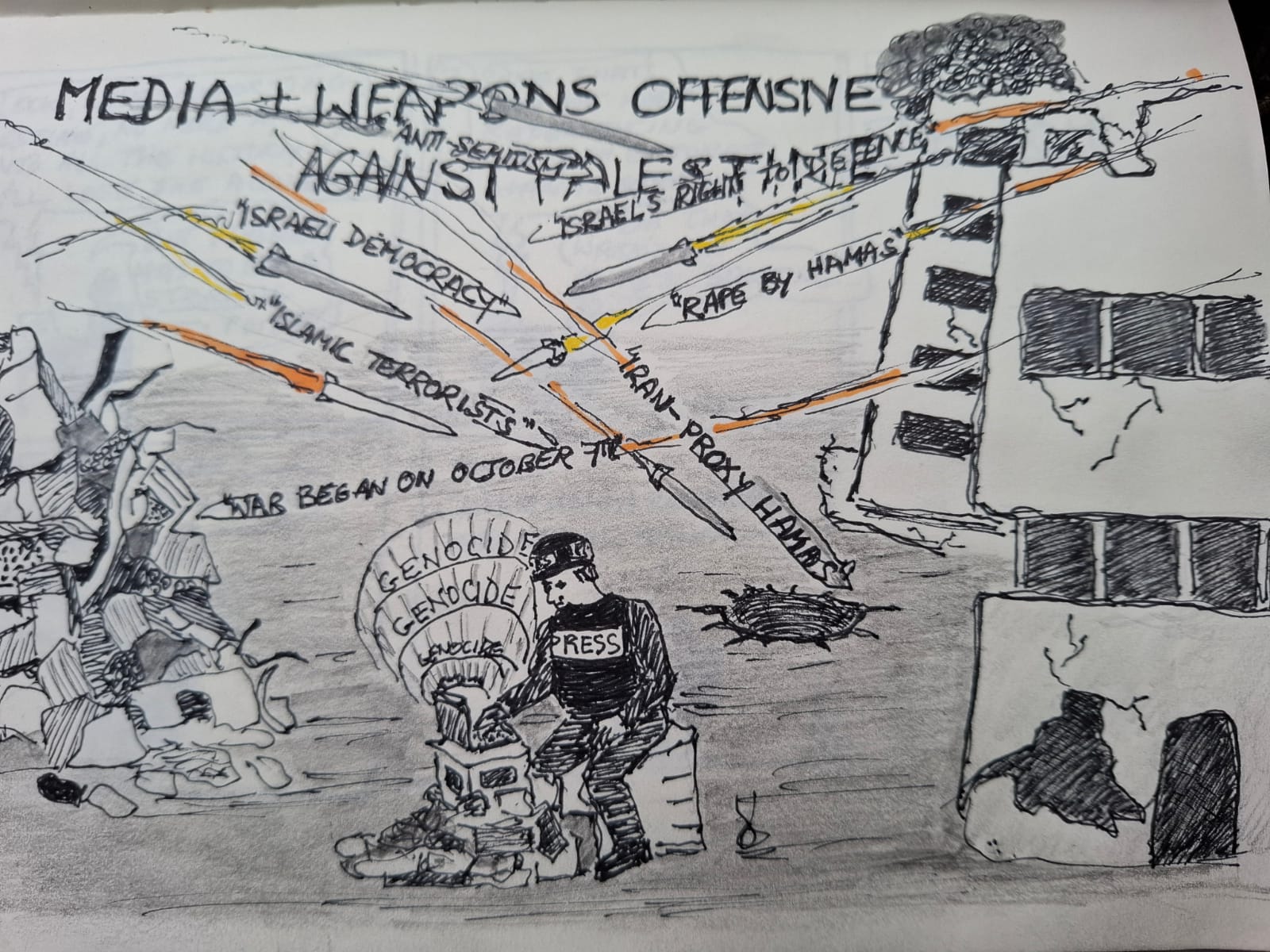
A major party colluding with the genocider Israeli authorities has been the Mainstream Western Media. They have adopted a mantra that posits the start of everything at the Resistance action on October 7, treat Resistance claims as dubious but those of Israeli, despite its record, as credible.
The western media corporations have taken no action to protect their journalists in Palestine, where 243, mostly Palestinian or from Arab nations, have been assassinated by the IOF. They circulated Zionist atrocity propaganda without proof and, when debunked, did not publish retractions.
(Cartoon by D.Breatnach)
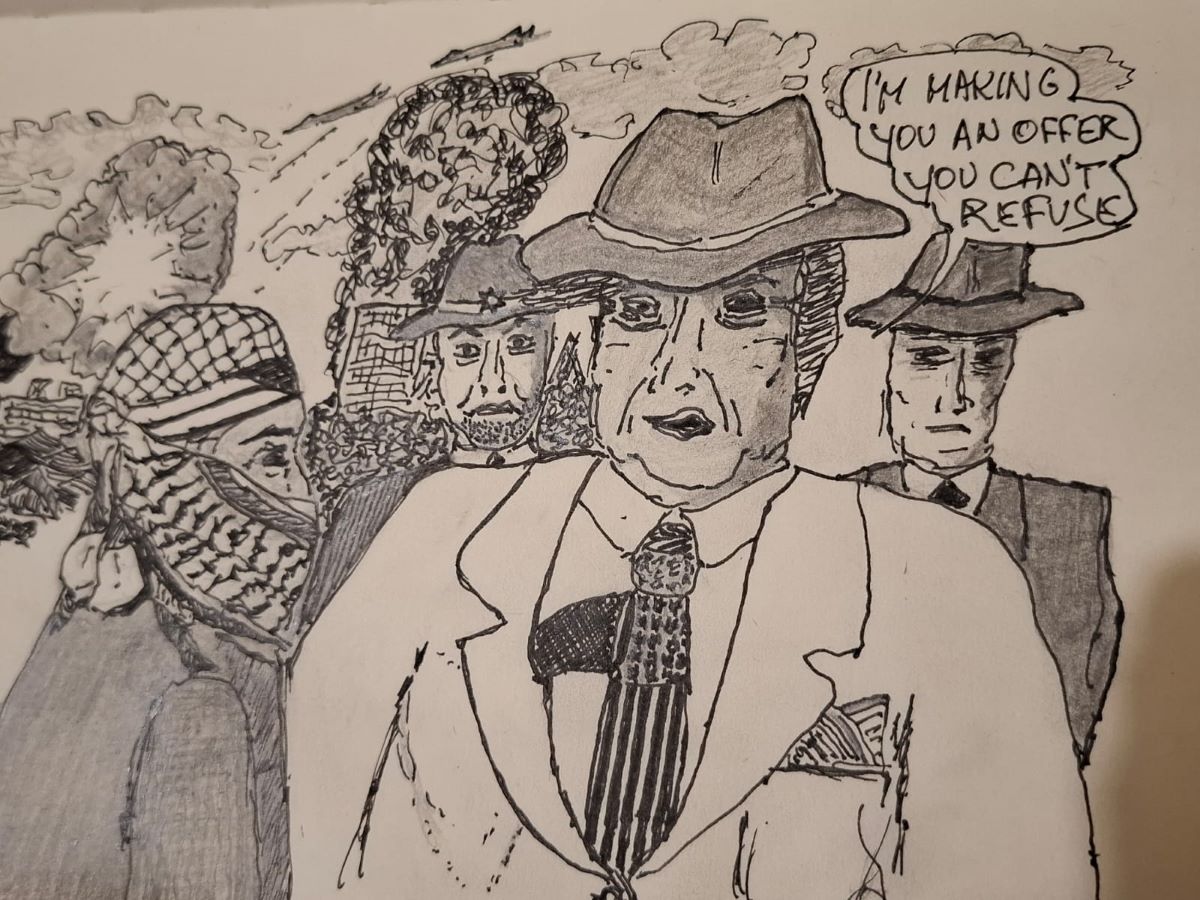
Reading the published 20 points of the recent Trump plan, what is clear is that Trump is demanding that the Palestinian Resistance surrender.
Not because they have been beaten and in fact there is an admission in there that they have not. The reality is that it’s the IOF and the Zionnazi administration that has failed in its declared objectives: to defeat the Resistance and release its captives by force.
NO. What is unspoken but clearly implied here is: ‘Surrender, give up your weapons or we will murder and starve thousands more Palestinian civilians.’
Trump for the USA making another threatening ‘offer’ in true gangster style. (Cartoon by D.Breatnach)
Those who advise the Resistance to agree should ponder what that means, not for Palestine alone but for the world: ‘If you can’t beat a popular resistance, just carry out ethnic cleansing and genocide until they give up. It’s perfectly acceptable and the world powers agree.’
We know about imperialist ‘peace’ plans. They only thing they deliver on is fragmentation of the resistance movement and more years of life for imperialist and colonial power. And elevation for some traitors and opportunists.
Based on history, whatever they decide, the Resistance should neither surrender their weapons or the tunnels. At the worst, there will be another day. The US and western empire is dying and with it will go this dependent zionazi European settler colony
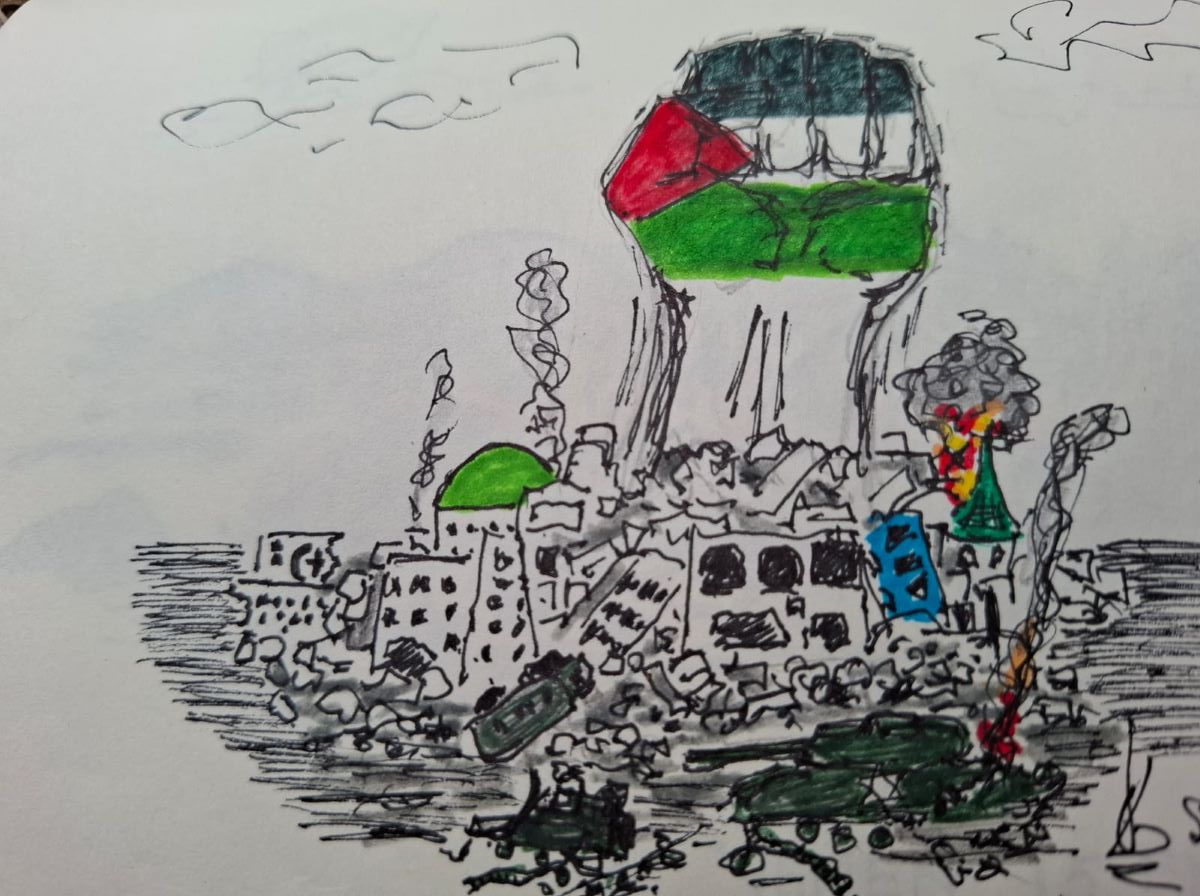
Despite all the crimes of the Zionist entity inflicted upon the Palestinian people and despite the backing of the western powers for ethnic cleansing and genocide, the Palestinian people continue to resist.
Despite all,Gaza resists and resists. (Cartoon by D.Breatnach)
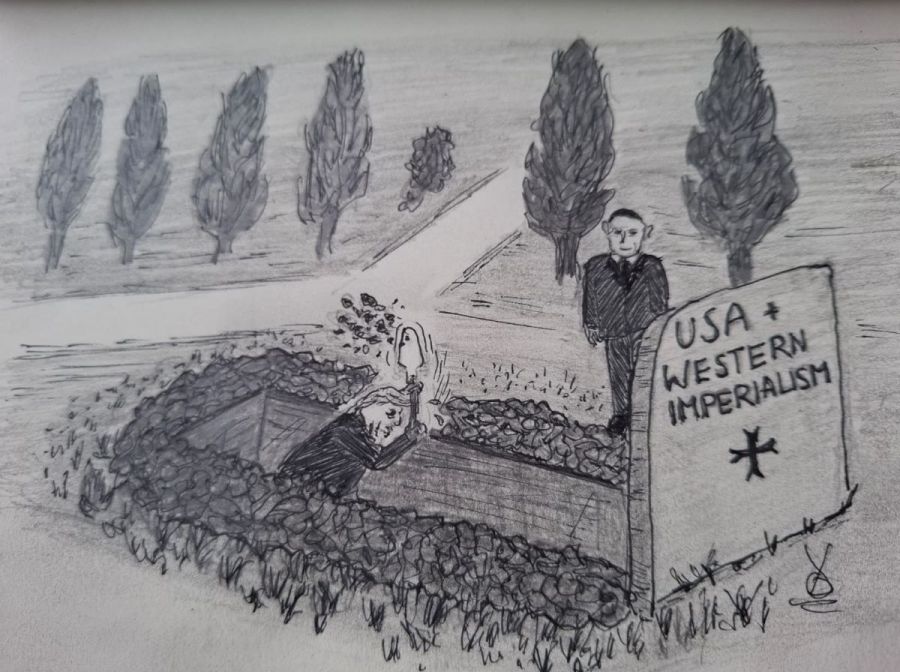
And despite the crimes of the Zionist entity in Western Asia/ Middle East, despite the crimes of its chief backer, US Imperialism – and the rest of western imperialism – their days around the world and at home are numbered. In effect these days they are digging their graves deeper, week by week.
War is the solution that the leaders of the US and Israel seek but that will not save them either.
(Cartoon by D.Breatnach)
Focal Scoir/ Postscript
After a long, long gap, I returned to drawing commentary cartoons a few years ago, increasing production with the current phase of the Zionist and imperialist genocide of Palestinians that began on 8th October 2023, though even so, the output has not been great.
Drawing a cartoon requires first having the idea, then time and head-space to concentrate on its execution. Often I find the latter stage disappointing, though sometimes I am pleased with the result. I’ve also undertaken a little study and practice to improve technique.
Most of the cartoons are published quite close to their actual size, instead of drawn large and then reduced for photographing which I understand to be the professional way. But that would require my carrying a large drawing pad around or putting in a lot more time on drawing at home.
It is a fact that anything in which we invest time and concentration will reduce the availability of those same ingredients for other things. Each of us makes choices and we must manage the options available as best we can. Meanwhile, a genocide is being committed daily by the Zionist entity.
End.
Note: If you found this article of interest, why not register with Rebel Breeze for free, so that you will be notified by email of subsequent articles. You can de-register any time you wish.













 rebelbreeze