ASKING FOR IT!


Diarmuid Breatnach

travelling-bag-womans-legs
(image from Internet)

It was nearly ten o’clock at night when she approached me on a badly-lit street near Dublin’s North Circular Road. I had paused my bicycle to send a text on my mobile and I saw her coming towards me. I had the impression that, just before she made for me, she had been looking around as though to determine where she was – perhaps I had seen her doing that in my peripheral vision.

She had a handbag and was dragging one of those suitcases with an extending handle and trundling on little wheels. As she reached me, I asked her could I help her with directions, which actually interrupted her asking me for help. But that was ok, it worked against her being totally dependent, the asker – after all, I had asked too.  She had a USA accent.

Yes, of course I would help if I could.

Did I know the whereabouts of a certain hotel? Well, the area in the hotel’s name I do know but I didn’t recall the hotel itself. And sometimes they give themselvess the name of somewhere known or popular even though their hotel is not near the place at all.

Did she have the street name? No.

The phone number? Somewhere in her bag (she meant her case).

I explained that I don’t have Internet on my mobile phone but she could look it up on Google map?  She doesn’t have Internet access on her phone either.

Can she afford a taxi? Yes, of course.

Well, why not hail one? She has done that but they tell her the hotel is just down the road.

Well, why not ask them to take her there? She has, but they tell her it’s just down the road.

Hmmmm – a sliver of doubt entered my brain. Taxi drivers refusing a short drive fare on a weekday night? To an address with which they are familiar? And leaving a woman, clearly a tourist, on her own in that area on foot ….. Something is wrong with this story.

Still … what to do?

OK, so I’ll ride around on the bike and find the place (even if I have to stop a taxi and ask the driver, I was thinking). Then I’ll come back and tell her (and accompany her there too, I think to myself).

She is very grateful but I think it is not safe for her to wait for me here. Perhaps the courtyard of a pub a little further back? A well-lit one.

OK.

I walk the bike, she trundles the case. Talks about her plans for her two-week stay, which appear to be to arrive in Dublin and then figure out where to go from there. Relates having been booked into a Dublin hostel which another passenger on a bus told her was in a bad district so she didn’t go there. Something seems wrong about this story too.

We reach the pub – it is still in business hours and the courtyard, though deserted, is brightly lit. There are tables and chairs and and I ask her to wait there for me and I’ll be back in a few minutes. She agrees.

Three minutes later I have found the hotel and in four, five at the most, I am back at the pub.

But the courtyard is empty.

Oh, no! She just got up and went?!

Wait. Maybe she asked someone where it was and set off there on her own. But then I would have passed her on the way back – I couldn’t have missed her.

Maybe …. oh God! Maybe whoever she asked volunteered to take her there. And she went with them. Got into a car ….

Ah, Jayzus! What now? Call the cops?

But now I see her ….. coming out of the pub, pulling the case, carrying her bag, all of it awkward as she manages the door….. Maybe she didn’t feel safe out there on her own and went inside …. but no, she has a pint of lager in her hand.

I remind her that I asked her to wait and that I’d be back in a few minutes. I have found the place and was ready to accompany her there but now she has bought a pint. (I am hoping she will leave the pint but no chance).

She is so grateful and would like to buy me a drink.

It’s an offer I might well have accepted when I had got her to her hotel and she had checked in. Now, though? I show her where her hotel is, a straight walk down the road I point out to her, wish her well and ride off.

Asking for it – bloody asking for it! It’s a phrase that doesn’t usually mean someone wants something bad to happen, rather that their conduct makes that a likely outcome. Unfortunately it is used too often with regard to the victims of rape, when wanting it to happen is occasionally precisely what is insinuated – smearing the victim and exonerating the attacker. But usually, conduct with predictable bad results is what is indicated; for example, leaving your bag or laptop inside your car, visible to passers-by, is asking to have your car broken into. Leaving your bike unlocked in the open out of your sight is asking to have it stolen.

Surely it is not a healthy situation for a person to be walking around in a badly-lit part of a strange city at ten at night? And looking like a tourist, whom a predator might therefore assume to have some money and perhaps a camera, Ipad, etc? And a woman alone, considered a defenceless potential victim?

Surely one would want to get into one’s hotel as soon as possible? OK, I understand the appeal of the pint, particularly if one has been stressed out by travel and then wandering around looking for one’s hotel. But hotels have bars, where the worst that will happen to one (or the best, depending on one’s point of view) is that it will lead to sharing one of the hotel beds with a stranger. OK, if you want local colour with your pint, find a “typical” local pub after you’ve checked in. And be sure you know your way back.

But there she had been, wandering around a badly-lit street at night looking for a hotel (and walking further away from it when I met her). And someone goes to find her hotel and asks her to wait and in less than five minutes she’s bought a pint, which means she won’t be able to go to the hotel when the guy returns. And she blithely offers to buy him a drink.

Conduct over all? Asking for it.

End.

COLOURS OF STRUGGLE

Diarmuid Breatnach

Information picket (with table across the road) organized by Anti-Internment Group of Ireland in September 2014 at Thomas St./ Meath St. junction, Dublin. They returned there in December and in January supported a picket in Cork, handing out leaflets on the Craigavon Two injustice.
Information picket (with table across the road) organized by Anti-Internment Group of Ireland in September 2014 at Thomas St./ Meath St. junction, Dublin.
MEP maybe Kobane Rally London
Palestinian and Kurdish flags at a Kobane solidarity rally in Trafalgar Square, London in 2014. (Photo: D.Breatnach)


The flag of the ICA, flown over Murphy's Imperial Hotel in 1916
The flag of the ICA, flown over Murphy’s Imperial Hotel in 1916


I’m no shade of green,

though neath such flags I’ve oft times been,

and ‘neath the Plough in Gold on Green,

and some years back

Also the black,

aye and the red-and-black;

or Palestinian red and black and white and green,

c-n-mb-irish-republic-tricolour-flags-crowd-gpo-copy
Cumann na mBan, “Irish Republic” and Tricolour flags displayed at Dublin’s GPO by Moore Street campaign supporters. (Phoro: D. Breatnach?)

Or the Basque crosses white and green upon red …..

In solidarity I have flown all those flags I’ve said

But when all’s said and done —

though hard to choose just one —

from my heart and from my head:

I choose the workers’ Red.

Sept 2016


A number of the Basque flag, the Ikurrina, flying in Dublin during a solidarity protest. (Photo: D.Breatnach)


Anarcho-Sindicalist and Anarchist black flags (Photo source: Internet)
Anarcho-Sindicalist and Anarchist black flags
(Photo source: Internet)
bagladeshi-women-men-red-flags-mayday
Bangladeshis on Mayday demonstration. (Photo source: Internet)

THE DIFFERENCES BETWEEN FIVE USA VISITORS IN ONE DAY

Diarmuid Breatnach

On Sunday in Dublin on my travels I conversed (about more than directions) on three different occasions with visitors from the United States and found a wide range of attitudes.

BOSTON, LARKIN AND THE COPS

The first of these was with an elderly couple outside Kilmainham Gaol Museum. The man had “Boston” displayed on his T-shirt and I started talking about Dennis Lehane’s novel “The Given Day”, which is set in Boston and which I had just finished reading. They had read it, really liked it and told me it was the first of a trilogy to which I responded that I would certainly be looking for the follow-ups.

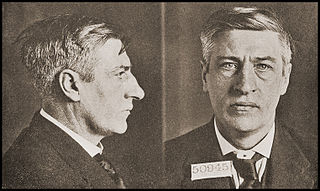
Jim Larkin's "mug shots" when charged with "criminal anarchism" in New York 1919 (he served time in Sing Sing penitentiary). (Photo sourced Internet)
Jim Larkin’s “mug shots” when charged with “criminal anarchism” in New York 1919 (he served time in Sing Sing penitentiary).
(Photo sourced Internet)

I talked about Lehane’s slant towards the cops as opposed to the revolutionaries and how of course my slant would be the other way but that in any case Lehane had not done his research on Larkin, who figures in the novel with other revolutionaries and radicals. Lehane refers to Larkin’s “gin-breath” but Big Jim was well known as a teetotaler, which I explained to them.

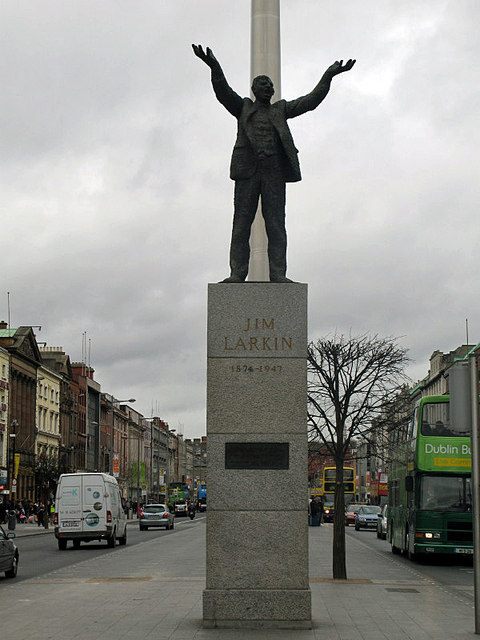
Then I talked a bit about the Irish Citizen Army that Larkin had founded with James Connolly and others, how they grew up out of the 1913 Lockout/ Strike and that Larkin had served time in Sing Sing prison later as a punishment for his revolutionary oratory in the USA.

I didn’t get the feeling that I and the two Bostonians were in agreement with my revolutionary sympathies but certainly did when it came to the workers fighting the Lockout in 1913. We parted amicably as they went off to enjoy some more of their holiday.

(Photo sourced Internet)
The Jim Larkin monument in O'Connell Street today/ El monumento de Jim Larkin in la Calle O'Connell hoy en día
The Jim Larkin monument in O’Connell Street today (Photo: D.Breatnach)

Encounter No.2 took place in Cornucopia, into which I had dropped for a cup of coffee.

I took my ‘Americano’ to a vacant table. The one next to me became vacant for awhile and was then occupied by an elderly lady who left her handbag open next to me. I advised her that was an unwise thing to do in Dublin and she remarked. in US accent upon the Leonard Peltier badge that I had been unconsciously wearing all day, so we talked about his case for awhile. She didn’t seem sympathetic to the FBI and expressed horror at the treatment of Peltier, now approaching his 40th year in prison for an act of which he was unjustly convicted.

The lady asked me for advice about literary events in Dublin and as she was, sadly, leaving the day before Culture Night, all I could suggest was a visit to Books Upstairs, where someone might be able to advise her. After I jotted down the address and a rough map for her, I left.

THE DEVIL AND THE TRUMPETTES

It was my intention to attend later that evening the Song Central session, on their first night back after their summer break. Song Central is a monthly gathering of singers and listeners upstairs in Chaplin’s pub, across from the Screen cinema. But I needed to eat first and so headed for a burrito in Pablo Picante, a small place serving Mexican food in Temple Bar (well, at the western end of Fleet Street).

Sitting eating my burrito and facing out into the street, I noticed passers-by pointing at the window and laughing. I could have become paranoid except it was clear that they were pointing to an image painted on the window further to my left. Then a late 30s or early 40s couple who in their style looked kind of to the Left maybe laughed at the image and took photos. The female whipped out a lipstick and wrote something over the painting, then had the man take a photo of her next to what she had written.

Curiosity had me now and after they wandered off, I went outside and saw that the painting on the window was a caricature of US Presidential candidate Donald Trump and underneath it the artist had written in big letters “DIABLO”. Of course, that would be because Trump wants to build a wall along the border with Mexico due to the negative impact he accuses Mexican migrants of having on the US, which Trump wants to “make great again”.  And he has also impugned a US Judge’s ability to rule impartially on his case, due to the judge’s Mexican heritage.

The painting in the window of the Pablo Picante burrito restaurant in Fleet St. (Photo: D.Breatnach)
The painting in the window of the Pablo Picante burrito restaurant in Fleet St.
(Photo: D.Breatnach)

The woman had scrawled something along the lines of “He’s not, we love him” with a heart sign on a part of the painting – clearly far from being Lefties!

I went back inside, got a serviette, came outside and rubbed off her comment, then back inside to continue my assault on the burrito.

Not long after, I was not a little surprised to see the woman and the man standing outside again. She noticed the removal of her comment and commenced to write again. I went to the counter to tell the staff what was going on and returned to find the woman inside, leaning on my jacket on the window shelf and working on rubbing out the painting from the inside!

My challenge on what did she think she was doing elicited the response that Donald Trump was going to be (or might be?) their next President and that the painting was disrespectful. I stood between her and the painting, telling her that we have free speech in this country (which is not strictly true but as the nearest weapon I could reach ….) and just kept repeating it. Then the guy came in and told me I had “no idea”. He kept repeating that and I kept repeating the “free speech” stuff, alert in case he took his case into the physical arena (and he looked fit, too). I also wondered what I would do if instead, it was the woman who attacked me. But they left soon afterwards.

Soon after, a member of staff (Mexican, presumably) went outside and rubbed off her comment, returning with a wry smile.

SINGING THE USA

At the Song Central session later that evening, post-burrito and post Trumpettes, the theme happened to be about the USA, songs from there or about travelling there etc, it being the anniversary of the “9/11” attack on the Twin Towers. If I’d remembered about the theme, I’d have learned the Allende song recorded by Moving Hearts, or brushed up on the lyrics of “Hey Ronnie Reagan” by Christie Moore. Because “9/11” ( in 1973) is also the anniversary of the CIA-instigated military coup in Chile, which over time claimed the lives of 32,000 people.

Interestingly, most of the song contributions during the night that referred to the USA (and most of them did, though people are not obliged to follow the theme), were critical of the US state, whether because of its endemic racism towards blacks and Latinos or its genocide towards the First People, or because of its wars. One song I felt pretty sure would be sung – and it was — was about the firemen on 9/11 running up the stairs of the doomed building while occupants ran down – a powerful song about the heroism of a section of public service emergency workers.

Luckily I could remember some US song material and sang “The Ludlow Massacre” and “How Can I Keep From Singing”, both composed in the US: one written by a revolutionary and the other adapted in the US by a progressive singer.

I had set out that day without remembering the significance of the date for the USA and yet throughout the day had a significant level of engagement with people from the US and, at the end of the day, with the terrible event itself.

End.
Postscript:

On Tuesday, while taking a photo of the Trump caricature in the window to accompany this piece, another US couple began to talk to me.  The man opened with: “The man IS a devil” (referring to Trump).  

I remarked that Trump was not going to get elected but his role would be to make Clinton look good, then she could carry on bombing and invading countries if she got elected, no problem.

The woman told me they didn’t like Clinton either.  They were from Boston and the man and his father before him had been union organisers.  He was complained about the weakness of the unions nowadays.  

We talked about cops breaking strikes in the USA in the 1930s and how the cops themselves went on strike in Boston during that period.  He talked about what the cops are like nowadays against pickets and demonstrations, militarised ….

ANTI-INTERNMENT CAMPAIGNERS AT FORMER JAIL

Diarmuid Breatnach

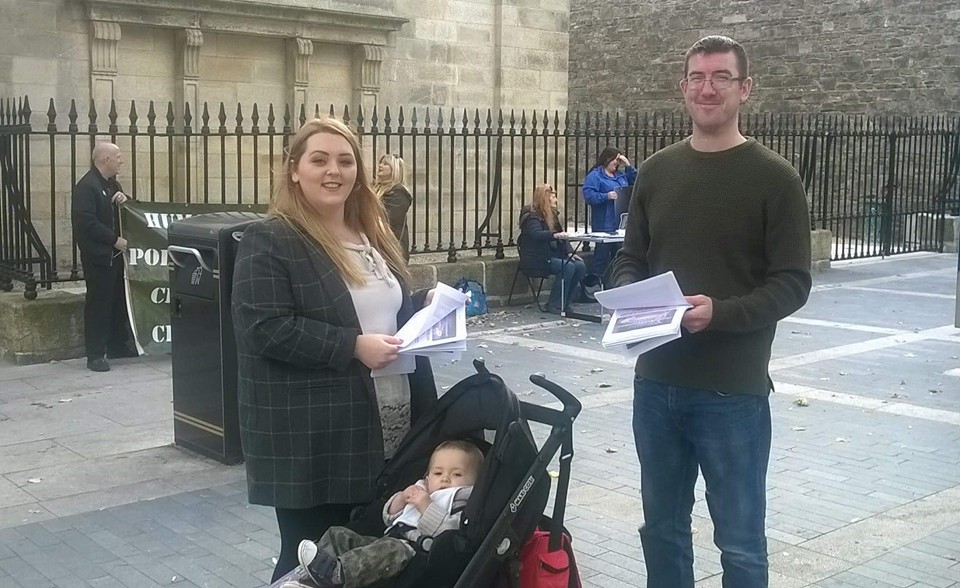
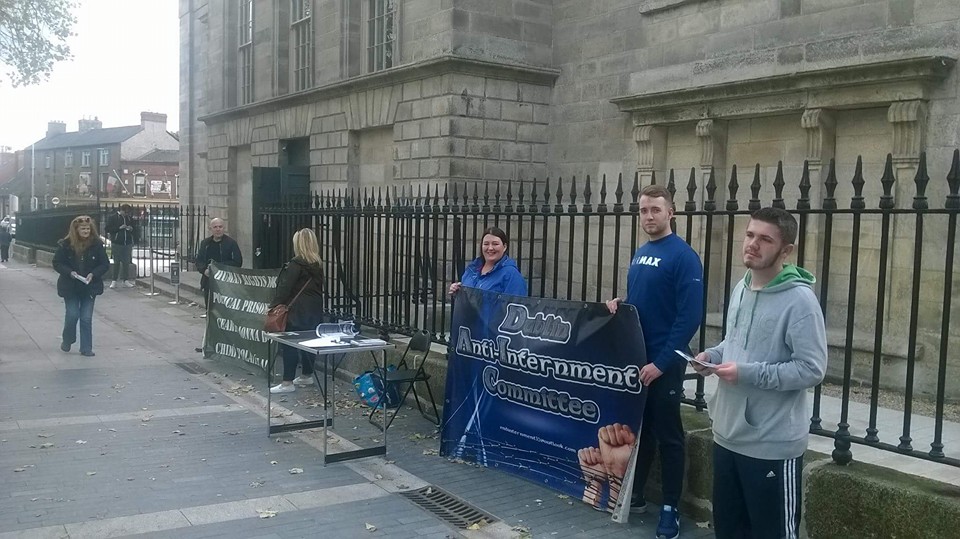
The Dublin Anti-Internment Committee organised an information table on Internment outside the Kilmainham Jail Museum on Sunday 11th September 2016.  The purpose of the exercise was to make tourists and other visitors aware of the ongoing repression and civil rights abuse that is going on in Ireland which is internment by another name.  As their leaflet points out, Republicans opposed to the British colonialism or to economic attacks on their communities and who organise against them are being targeted in a process that sees them arrested, charged with ‘terrorist’ offences, refused bail (or granted only attendant by ridiculous restrictions) and then, when the case against them collapses much later and they are freed, they will still have spent years in jail.

Anti-internment campaigners line up for a photo with clenched fists (Photo: Ian O'Kelly)
Anti-internment campaigners line up for a photo with clenched fists (Photo: Ian O’Kelly)

The Dublin Committee, affiliated to the Anti-Internment Group of Ireland, mobilised outside the former jail in the afternoon, displayed their banners and gave out leaflets to passers-by, tourists and visitors (not all who were from outside Ireland, by any means).

Kilmainham Jail is a Dublin prison with an important history.  It was built before the Great Hunger and housed female and male prisoners, including children.  Insurgents and political activists from the United Irishmen, they Young Irelanders, the Fenians, the 1916 Rising, the War of Independence and the Civil War had been kept here, including those being deported to Australia.  Robert Emmet and Anne Devlin were kept prisoner here, as were Charles Stewart Parnell and most of the Irish Parliamentary Party’s leadership.  All fourteen of the 1916 sixteen executed were judicially killed in this jail and women activists were jailed here after the 1916 Rising and during the Civil War.

Campaign information table (Photo: Ian O'Kelly)
Campaign information table (Photo: Ian O’Kelly)
Plaza in front of old Kilmainham courthouse, which is the new entrance to the Jail Museum. (Photo: Ian O'Kelly)
Plaza in front of old Kilmainham courthouse, which is the new entrance to the Jail Museum.
(Photo: Ian O’Kelly)

The Jail closed in 1924 and was falling into disrepair; the State invited tenders for its demolition but felt that those they received were too expensive and so just left the building abandoned to ruin.  However a local restoration committee got going, raised some money and began repair and restoration work with volunteer labour, skilled and unskilled.

In 1966, in time for the 50th anniversary of the Easter Rising, the restoration committee handed over the building to the State which, since then, has seen a huge attendance with nearly 330,000 visitors last year.  Recent works moved the front entrance of the museum to the former courthouse building next door and a reported €5 is being spent on revamping the facility.


end.

Some of the campaigners were younger than others (Photo: Ian O'Kelly)
Some of the campaigners were younger than others (Photo: Ian O’Kelly)
The emblem of the Unitied Kingdom on the courthouse roof -- this remains on a number of buildings in Dublin from the centuries of British occupation of the city. (Photo: D. Breatnach)
The emblem of the Unitied Kingdom on the courthouse roof — this remains on a number of buildings in Dublin from the centuries of British occupation of the city. (Photo: D. Breatnach)
(Photo: Ian O'Kelly)
(Photo: Ian O’Kelly)


Closer view of the emblem of the United Kingdom (Photo: Ian O'Kelly)
Closer view of the emblem of the United Kingdom on the courthouse roof
(Photo: Ian O’Kelly)
Side of the front of Kilmainham Jail (Photo: D.Breatnach)
Side view of the front of Kilmainham Jail and some of the campaigners
(Photo: D.Breatnach)
various-in-picket-line
Some of the campaigners with the Courthouse building stretching away from behind them.

The Ministry of Heritage is taking care of Moore Street


The irish state's Ministry of Arts, Heritage, Rural, Regional and Gaeltacht Affairs is facilitating speculators' plans to demolish the Moore Street 1916 Historical Quarte (with the exception of four houses) in order that they may build a giant shopping centre (mall). (Non-revenue copying welcome but acknowledgement expected)
The Irish state’s Ministry of Arts, Heritage, Rural, Regional and Gaeltacht Affairs is facilitating speculators’ plans to demolish the Moore Street 1916 Historical Quarte (with the exception of four houses) in order that they may build a giant shopping centre (mall).
(Non-revenue copying and distribution welcome but acknowledgement of source expected)

FIRST PEOPLE WARRIOR JEAN-ANN DAY WALKS ON

Diarmuid Breatnach

Jean-Ann Day, who has just died, visited Dublin in January 2012 to help push an international campaign to free Leonard Peltier, also a warrior of the First People and longest-serving prisoner in the US after a travesty of a trial in 1977.

Jean-Ann speaking at picket on the US Embassy in Dublin in solidarity with Leonard Peltier. The photographer's back is to the Embassy.
Jean-Ann speaking at picket on the US Embassy in Dublin in solidarity with Leonard Peltier. The photographer’s back is to the Embassy.
Jean-Ann Day — photo placed with her official obituary on funeral home site

Due to a family tragedy hitting her contact here I had to step in as Jean-Ann’s contact but it was an honour for me. I progressed arrangements and took her to see Joan Collins TD and arranged for a radio interview with a program on Near FM.

I remember that on our way across the Liffey, Jean-Ann took a pinch of tobacco and offered it to the river with a prayer. The Gaels also thought of their rivers as divine, most of them goddesses. Although an atheist, to my thinking such belief systems seem greatly superior to those that think it fine to convert a river into a sewer or a toxic waste outlet.

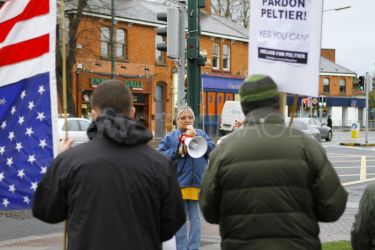
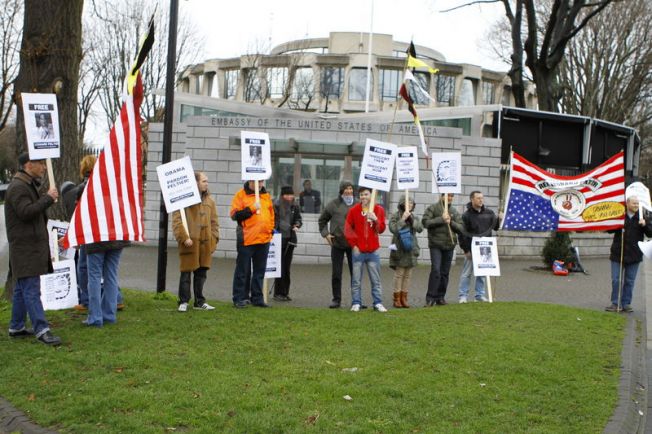
On Saturday 4th February 2012 a small crowd of varied political backgrounds, including a significant proportion of independents, staged a protest outside the US Embassy in Ballsbridge as part of a world-wide week of protests seeking Peltier’s release. Jean-Ann delivered a simple speech there that I believe reached into the heart of every one of the participants as it did into mine.obama-free-peltier-placard

Poster produced for the Dublin solidarity picket of the US Embassy (regret the name of the artist does not come to mind at the moment)

A small musical evening in Dublin organised by supporters was another occasion at which she appeared and I understood she went to Belfast and Derry too.

Jean-Ann, warrior for justice has walked on and left us her memory. Her former comrade, another warrior, Leonard Peltier, remains in jail in serious ill-health.

Peltier is incarcerated at the United States Penitentiary of Coleman in Florida and given that he is 72 years of age and that his next scheduled parole hearing will be in July 2024, it is clear that the FBI and USA state want him leaving jail only in a coffin. Barring appeals, parole or presidential pardon, his projected release date is October 11, 2040.


 End

Jean-Ann Day, Bear Clan of the Ho-Chunk Nation, age 65 of Stevens Point, Wisconsin walked on Sunday, September 4, 2016 at the University…

APPENDIX

Leonard Peltier Regarding the Passing of Jean-Ann Day

When I heard the news of Jean’s passing I was both saddened and surprised. I did not know she was ill. If I had known I would have reached out to her and tried to support her in any way I could.

Jean was a true friend to me for all the years I knew her. Her passing reminds me of so many things back in those days at Oglala so long ago.

She was a such a bright light and a young woman full of courage who came to Oglala without hesitation to join us in protecting the elders there. And she did so much work to free me from prison all these years. I am grateful to her for that.

Poster in the style of Jim Fitzpatrick's famous Che Guevara poster (Regret artist unknown to me)
Poster in the style of Jim Fitzpatrick’s famous Che Guevara poster (Regret artist unknown to me)

Over the years here I have thought of her often and in my dreams of freedom there were always a few faces I expected to see if I ever walked out of here. Jean’s was one of them.

I know she was doing wonderful work in the effort to bring healing and positive change to her Ho-Chunk people and I was always proud of her for that.

I regret that I could not be there for her ceremonies so I could offer comfort to her children and grandchildren, but I can only send these few heart-felt words.

You were a great woman and your life made a real difference to me… and to so many others.

Rest in peace, my dear friend. ‘Til I see you again.

Doksha,

Leonard Peltier


Part of the gathering at the US Embassy in solidarity with Peltier and seeking his urgent release in 2012
Part of the gathering at the Dublin US Embassy in solidarity with Peltier and seeking his urgent release in 2012

BASQUE PIRATES ON THE WAVES

Diarmuid Breatnach

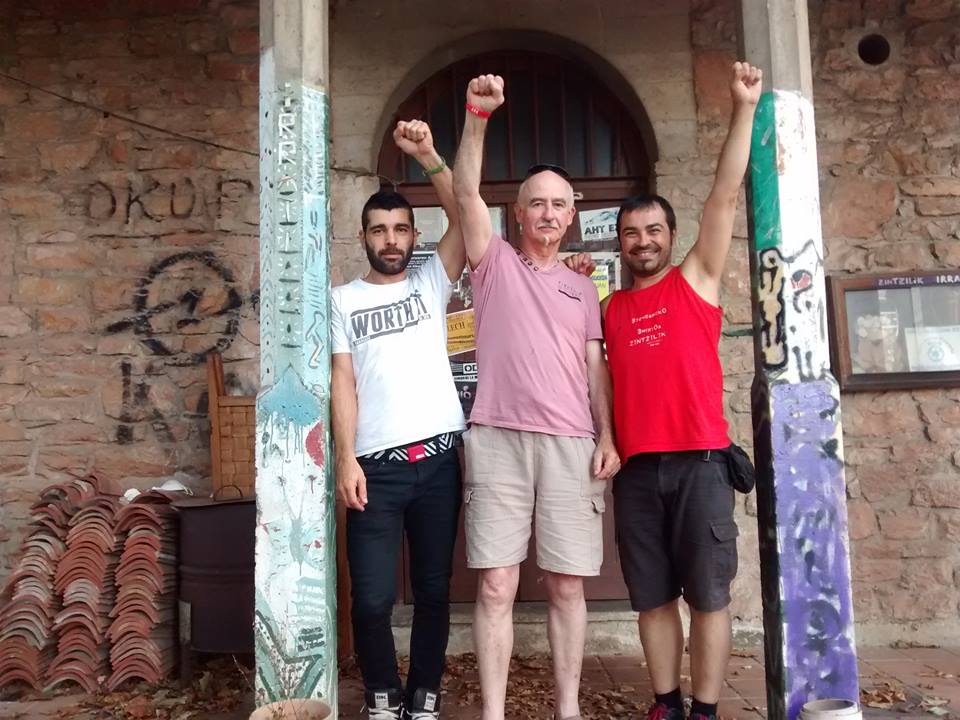
One of my appointments on a recent trip to Euskal Herria, the Basque Country, was with a “free radio station”, with a dual purpose: to learn about their operation and to give them an interview about my thinking on the political phenomena known to most people as “peace processes”. The radio station in question is Zintilik and located in the Orereta area of Errenteria town, not far north from Donosti/ San Sebastian, in the souther Basque province of Gipuzkoa and my hosts were Hektor Gartzia and Julen Etxegarai. 

View of side of building which houses Zintilik. Photo D.Breatnach
Julen and Hektor setting up for the interview Photo D.Breatnach
Julen and Hektor setting up for the interview
Photo D.Breatnach

Not long after I arrived, one of my hosts related his memory of events in the area after a local ETA fighter had been killed. The Guardia Civil had swamped the area to prevent an “homenaje” (an event honouring the dead) taking place, guns pointing at men and women; the children, of which he had been one, gathered into their grandparents’ house ….. He showed me where the police vehicle had parked at the end of the street, his sweeping hand indicating the places where the armed police had stood.

THE “FREE RADIO”

The “free radio station”, also known as “pirate radio” has been broadcasting for 32 years, which I find amazing. It began broadcasting from an “okupa”, an occupation of a private empty building, turning it into an alternative social and political centre. Under popular pressure, the local authority, under the control at the time of the PSE, i.e. (Spanish unionist social democratic party), granted them the building they currently use.

Front of Zintilik building. Photo D.Breatnach
Front of Zintilik building from the street.
Photo D.Breatnach

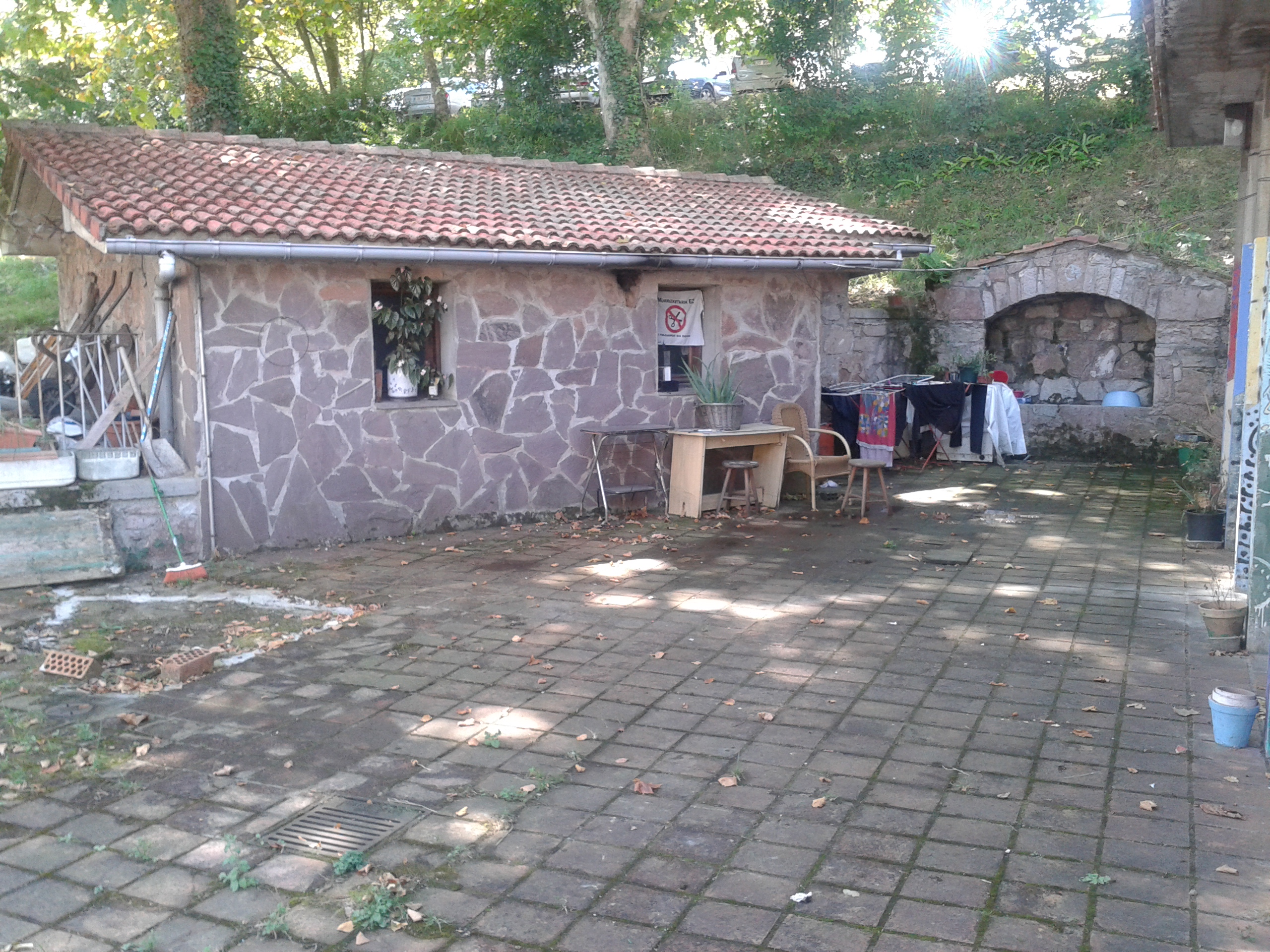
Originally built to house a smithy, for some reason the building never saw service in that capacity. It is in my estimation an attractive building in a traditional-enough local style, of thick stone, compact without being squat. It has an attractive back yard, no doubt intended at one time to receive the horses with hooves in need of iron shoes, fitted and nailed. The roof is tiled in what seems the usual way for the Basque Country.

Zintilik broadcasts 24 hours a day, which it is able to do using repeats.  The Zintilik collective owns its equipment and funds itself through fund-raising concerts, txosnak (stalls/ marquees) at festivals and occasional donations. They run advertisements for

Julen and Hektor again. Photo D.Breatnach
Julen and Hektor again.
Photo D.Breatnach

local community groups and announce events but accept no commercial sponsorship – nor does their wish for independence stop there. “We don’t receive any funding from the local authority or from the Basque Autonomous Government,” declares Julen, “nor do we wish to.”

Funding from such sources comes with strings attached”, adds Hektor.

Or one becomes dependent on it and unable to function without it”, further explains Julen.

Partial scenic view from the back of the building. A block of flats to right just out of shot does restrict it however. (Photo D.Breatnach}
Partial scenic view from the back of the building. A block of flats to right just out of shot does restrict it however.
(Photo D.Breatnach}

As a further illustration of self-reliance, they tell me how they climbed on to the roof of their building to repair a leak, rather than ask the municipal authorities to do it. And it was the same when branches of a nearby plane tree needed cutting to prevent them knocking against the radio aerial on windy days.

We know it’s work that the local authority owes us and that we and the rest of the community pay their salaries but we prefer not to depend on them,” they explain.

As an example of how dependency – although of a different sort – can undermine a community resource, they relate the story of building which was occupied in order to be used as a community resource. As time passed, many were using it as a social resource but less people were volunteering for the work involved in maintenance at any level. Appeals of the four or so committed people who ended up doing everything fell on the deaf ears of the clientele until one day the four locked the centre doors after the last user had left for the evening and, the next day, handed the keys over to the local authority.

The back yard to the building where we ate a meal after the interview. Photo D.Breatnach
The back yard to the building where we ate a meal after the interview.  The structure there is an outhouse.  (Photo D.Breatnach)

As you imagine, this was a great shock to the clientele,” they tell me, “but it was the result of their own lack of commitment to the project.”

I reflect that many activists will identify in one way or another with that sad experience.

RECORDING THE INTERVIEW

Julen and Hektor discuss the format and general content of the interview with me and map it out, do sound checks and then we go to it. Hektor, who knows quite a bit about the more recent Irish history and about the current situation in the Six Counties, is my interviewer, while Julen monitors from the control room and occasionally joins in with comment or question.

Interview room. Photo D.Breatnach
Interview room.
Photo D.Breatnach

For music in between sections of interview, Irish Ways and Irish Laws (John Gibbs) and Where Is Our James Connolly? (Patrick Galvin) have been chosen, both sung by Christy Moore and Joe McDonnell (Brian Warfield), by the Wolfe Tones.

They also invited me to sing Back Home in Derry, Christy Moore’s lyrics arrangement of Bobby Sands’ poem – but to the air I composed for it. I am happy to oblige – I enjoy singing but it is more than that: I want the air I composed to get a hearing. Christy Moore used Gordon Lightfoot’s air to The Wreck of the Edmund Fitzgerald for Sands’ poem and, excellent though that fit is, especially with Moore’s chorus, I think that the poem (and its author) deserves an air of its own.

Recording room. Photo D.Breatnach
Recording room.
Photo D.Breatnach

Although the main focus of the interview was the phenomenon of “peace (sic) processes”, we discussed aspects of Irish, Spanish, Palestinian and South African recent history, including the 1916 Rising in Ireland, along with the backgrounds to the songs chosen. For the most part, I left it to my interviewers to draw conclusions relating to their experience of political processes in their own country.

FESTIVALS AND STORMS

Upstairs in the broadcasting/ recording and interview rooms, all is in good order: equipment and facilities. After the interview, I note that downstairs, in the main space, things are a in a bit of a mess, for which Julen apologises (he has never seen the state of my flat).

Some of the community groups we support store their placards and banners here,” he says. “Besides, we’ve just finished our local festival and everyone relaxes, dumps their equipment and goes on holiday.” Throughout the Summer and early Autumn, each village, town, city and even area will have its own week-long festival for which the community groups and campaigns will organise and participate.

Down in Donostia (San Sebastian), to where Hektor and Julen accompanied me after we ate the food they had prepared, the city was in the midst of its own festival and was heaving with people – tourists from everywhere, it seemed, as well as Basques.

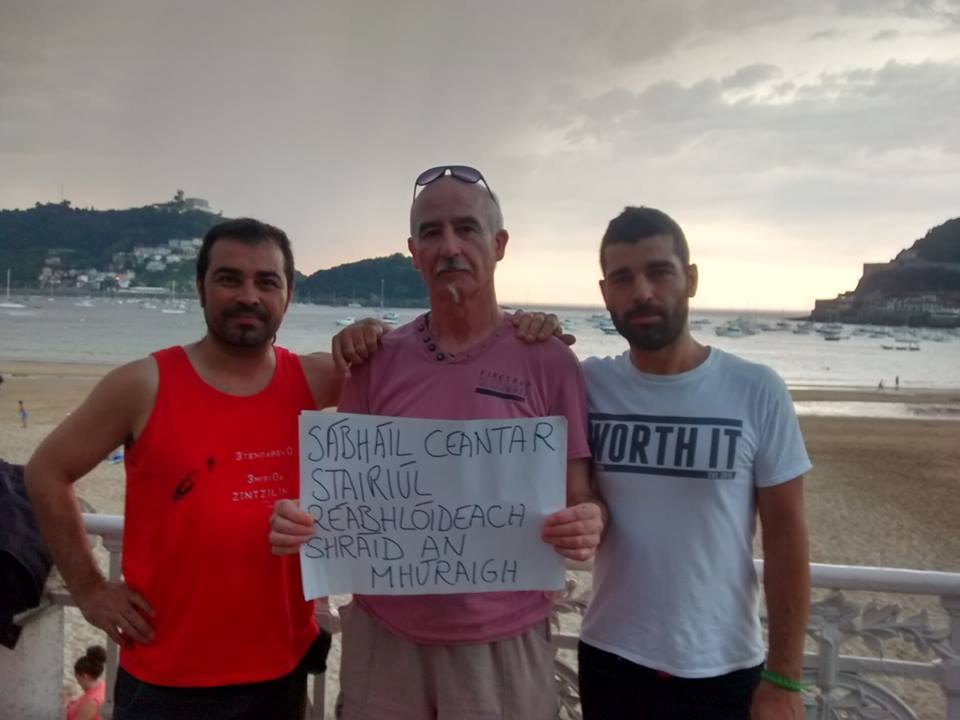
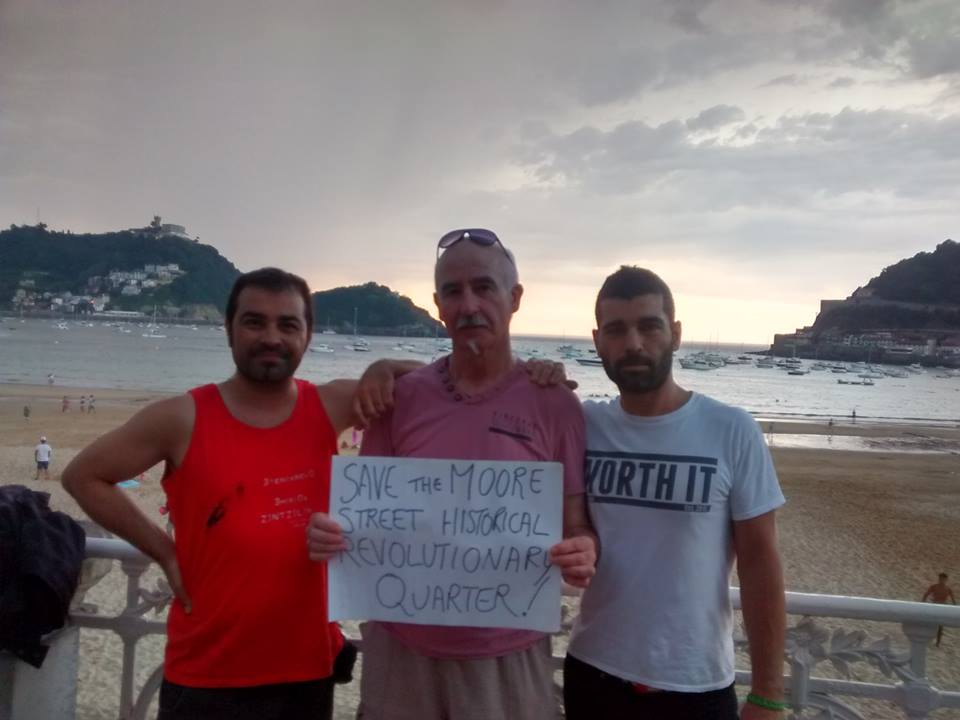
With that picturesque bay and its island in our background, they got a passing young woman to take our photo, the three of us – the conversation with her was in Euskara only. I held up the placards I had prepared for the photo in turn, one in Irish and another in English, supporting the Moore Street quarter in Dublin.

R-L: Julen, Diarmuid, Hektor. Donosti bay in the background with island partly visible. Storm building in the sky.

Save M St Quarter Donosti backgroundDark clouds were gathering overhead and on the horizon the sky was a baleful orange. A storm or at least a downpour was being promised and, as we turned back towards the bus station, the first drops began to fall. In the humid heat, the light rain was welcome for awhile but for part of my solitary journey back to Bilbo, it formed a silvery curtain in the coach’s headlights and streamed down the windows.

I remembered being told that one can frequently witness a violent storm in the Donosti bay while not so far away in Bilbao, as a result of local conditions, all is calm. As for winter storms in Donosti, the waves hitting and surging over the seafront and piers have to be seen to be believed; occasionally the sea reaches inland, floods cellars and converts parked cars into boats or semi-submarines.

The rain eased off and stopped about half-way through my journey and when I got into San Mames station in Bilbo, the streets were not even wet.

end

Clenched Fists 3 Tzintilik Irratia 2016

ON THE BASQUE LANGUAGE TRAIN

Diarmuid Breatnach


On the platform at Mundaka there are only a few to catch the 9.18 a.m. train to Bilbao. Mundaka is a popular coastal resort town in Bizkaia province, southern Basque Country.  “Egun on” (“good day”), I greet those on the platform in Euskara in passing, the Basque language, and they reply the same.

Bizkaia Train & Notice on Track
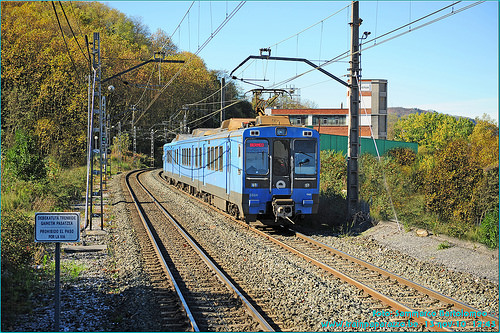
Train on the Atxuri (Bilbao)-Bermeo line. Note the warning sign to bottom left of image, in Euskera first and Castillian second. (Photo sourced on Internet).

A young couple with two little boys come on to the only platform (for both directions) and I think I hear the woman speaking to the boys in Euskara. But soon, I make out some Castillian (Spanish) words; however it is not unusual to hear some Castillian words and even phrases scattered through Euskara conversation, in the southern Basque Country, at any rate. But no, I can tell now that the conversation between mother and child is definitely all in Castillian – I must have been mistaken earlier, when I thought they were speaking in Euskara.

Mountains over Mundaka rooftop
A view from a Mundaka building a number of stories up. The port is out of sight to the left, the station behind. (Photo: D.Breatnach)
Casa de los Ingleses
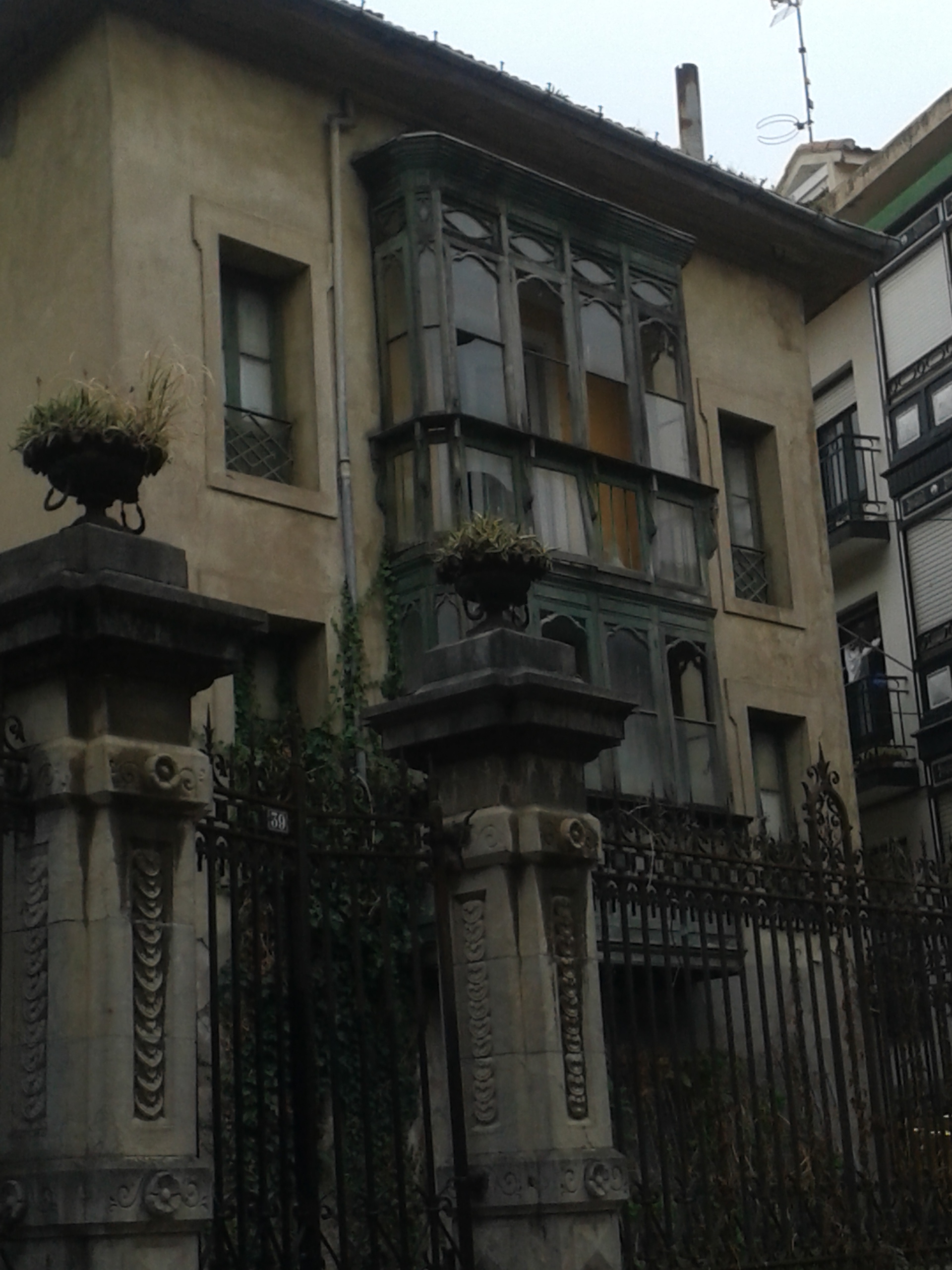
“Casa de Los Ingleses”, a beautiful if rather gothic-looking old house, residence of an English family with business interests locally many years ago. I passed it on the short walk from the town to the station. Behind it there were plots being worked for vegetables, all due to disappear beneath a new car park construction. (Photo: D.Breatnach)
The Servants House
The residence of the servants of the Casa de Los Ingleses, a lovely building in its own right.  Its demolition is planned to make way for a new construction (see design in next photo) — my guide encouraged me to write a letter of protest to the municipality.  (Photo: D.Breatnach)
The construction planned to replace the "servants' house" after the latter has been demolished. (Photo: D.Breatnach)
The construction planned to replace the “servants’ house” after the latter has been demolished. (Photo: D.Breatnach)

“Miao, miao” says the smallest boy, pointing at some feral cats dozing near the platform. “Bai, katua” replies the mother and a flood of Euskara follows, both boys and mother and occasionally father too conversing in Euskara. And so they continue until the southbound train arrives and everyone gets on, except one man, presumably waiting for a northbound train to Bermeo.

On our journey southwards, soon passing alongside salt marshlands, I note that the names of the stations are in Euskara only: Itsasbegi-Busturia, Axpe-Busturia (in the broad estuary of the Urdebai river), San Kristobal Busturia, Forua, Instituto Gernika, Gernika….

The Wikitravel entry for Gernika translates it to the Castillian “Guernica” and opens with this: Basque town which was the site of the first airborne bombing attack on a civilian town during the Spanish civil war. The bombing, by the Condor Legion of Germany’s Luftwaffe in 1937, inspired Picasso to paint the landmark cubist work Guernica, now on display at the Centro de Arte Reina Sofia in Madrid.”

Well, yes, but one might add for clarity that it was done as part of Franco’s fascist offensive and that the fascist press later blamed it on Asturian Anarchist “fire-bombers”. And one might update it by commenting that the Basques have asked for Picasso’s painting to be located in Gernika itself, a request which the Spanish state authorities, the political descendants of the fascist victors of that war, have refused.

Train tracks Axpe Busturia
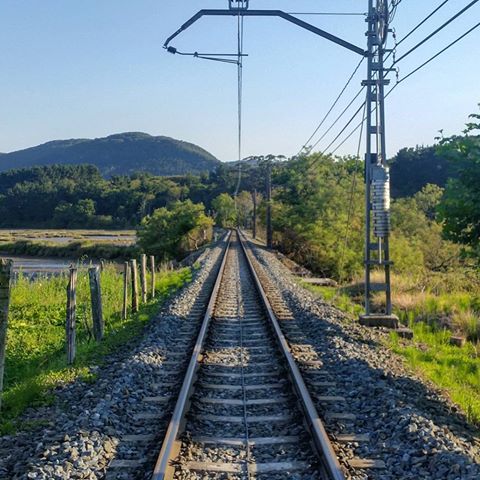
Train tracks from Axpe Busturia, the estuary to the left and salt marshes on both sides.  (Source: Internet).

Onwards again, the next stop is Lurgorri-Gernika. At the next after that, Zugast station, a middle-aged man gets on with Berria, the all-Euskara newspaper, under his arm. This periodical, being in many ways the replacement of another newspaper, Egunkaria, has a noteworthy connection with history.

Founded in 1990, Egunkaria was the first all-Euskera daily newspaper in the world; it had a left-nationalist editorial line and a journalistic outlook, which led it to report ETA statements alongside those from Spanish unionist political parties and from the State. The Basque language was no longer illegal or banned since the transición, post-General Franco, when the fascist Spanish oligarchy brought the leaderships of the social democratic party and the Communist Party on board, along with their respective trade union leaders — and called it “Democracy”.

But on 20th February 2003, the Spanish State’s militarised police, the Guardia Civil, raided the newspaper’s premises, seized records, machines and closed down the periodical. They also raided the homes or arrested at the building a total of ten people associated with the newspaper, at least four of which were tortured subsequently. For one of those, the manager, a gay man, the torture included sexual violation.

Massive protest demonstrations ensued from an outraged Basque population. The arrested were released on bail.

On 15 April 2010, seven years later, the defendants were finally acquitted on all charges relating to ‘terrorist’ connections and the judges added that there had been no justification for the closure of the newspaper in the first place.

By then, Egunkaria was beyond recovery and anyway Berria had stepped in to occupy the niche (apparently with the blessing of the Egunkaria team). The case against the State for compensation for the loss of the newspaper and also for torture remains open, sixteen years later. The Court of Human Rights at Strasbourg found the Spanish State guilty of not investigating the manager’s complaint of being tortured and ordered compensation paid. It did not, however, as it usually does not, find the State guilty of the torture itself. Of course, torture is difficult to prove, particularly when the State in question keeps political detainees for five days incommunicado, without access even to independent medical practitioners, while its police go about getting their “confessions”

On the train journey now, the next stop has the delightful-sounding name of Muxika. This causes some amusement to a teenage boy in a nearby seat, accompanied by an older woman – they have been talking in Castillian only since they got on. I wonder are they aware that in June 2013 José Mujica, President of Uruguay until last year, visited the townland that gave rise to his surname. Mujica was presented with a key to the town by the Mayor, who is of the Abertzale Left party Bildu.

The train pulls out of Muxika, then on to Zugastieta-Muxika station as we continue running southward through thick woodlands, occasional industrial parks and small allotments where an occasional middle-aged man tends to his large tomatoes, the small elongated sweet peppers of the region, courgettes, climbing beans …..

Onwards to Morebieta Geralekua before the line takes a sharp twist north-eastwards to more woodlands, rivers, streams and mountains at Lemoa, Bedia, Usansolo, Zuhatsu Galdakoa. Now the built-up areas of Ariz Basauri followed by the contrast of the picturesque Etxebarri before a southward curve to Bolueta and then eastward, to run along the Nervion river to Atxuri station in Bilbo (Bilbao), journey’s end.

All of the stations along this route were named in the Basque language – not one had a Castillian version showing (although there will be plenty of that in streets and squares in Bilbao). The public announcements on this train, as on their counterparts in the Irish 26 Counties, are bilingual but with this difference – on the Basque train, they are always in Euskara first, Castillian second. Likewise with the signage. One is never under any doubt about which language is being given primacy there, nor indeed here, where the English version comes first and, when in text, is in a more dominant type or more contrasting colour.

The Irish language is being derailed even as, to mix metaphors, it is being given lip service. Further down the tracks, unless some urgent repair work is undertaken, lies the final stop – the cemetery of our national language.

end

“SLASH AND BURN” IN MOORE STREET

Diarmuid Breatnach

“Almost slash and burn,” is how one of the people I am talking with describes the procedures they expect from Lisadell, the construction company employed by the Department of Heritage in Moore Street, to work on where the GPO Garrison retreated in the last days of the Easter Rising.

“The roof doesn’t need replacing,” says another. “It needs the hole in the roof fixed and the timbers carefully repaired, not replaced.” I remark that I’ve known people who’ve had water damage or dry rot and just had the timbers replaced. “Yes, of course, when conservation is not an issue. But when it is, the work is slow and painstaking, bit by bit, to conserve everything that can be conserved, putting in extra supports when needed.”

I am talking to people with expertise in the area of conservation of buildings of historical and/ or architectural value. They know what should be done to conserve the historic buildings in the Moore Street quarter and they feel certain that it will not be done. They feel impotent – they have the expertise, they care about conservation but they fear the combined powers of the State and big property speculators such as Hammerson, who plan to build a huge shopping centre over the whole Moore Street quarter. They will advise but if they go “too far”, they feel their professional lives will be seriously impaired. Perhaps they fear even more than that – who knows?

In 2007, just before Nos.14-17 Moore Street were made a national monument, TG4 in the their Iniúchadh Oidhreacht na Cásca program broadcast a remarkably in-depth exposure of the battle between Chartered Land and another firm of property speculators for control of the quarter and how Joe O’Reilly of Chartered Land, coming from behind, had been given an incredible advantage over his competitors with a preferential deal with the Planning Department of Dublin City Council.  This took place among more than a whiff of corruption and of complaints by elected Councillors who were excluded from a secret meeting and at another, threatened with financial penalties. Joe O’Reilly of Chartered Land (and also joint owner with Irish Life of the ILAC shopping centre) gobbled up most of Moore Street and only a fierce campaign in the autumn of 2014 prevented the Planning Department getting authorisation to swap him two Council properties in the Street, thereby clearing the way for him to begin demolition of the terrace.


“THESE TIMBERS HEARD …. MACHINE GUNS … SCREAMS … THE PAINFUL DECISION TO SURRENDER …”

Another of the experts intervenes. “These timbers they are going to rip out are the ones that heard the discussion around whether to surrender or to go on fighting,” she says. I am a little surprised at such poetic imagery from a person whose work is in bricks and mortar, plaster, timbers and slates – but there is no denying the passion and there is more to come.

“Those timbers heard the chatter of British machine guns, the crack of their rifles, screams in the street, the occasional crack of a Volunteers’ rifle, perhaps an occasional groan from the wounded Connolly. They heard Elizabeth O’Farrell volunteering to go out under a white flag although civilians had already been shot down under such a flag. They heard the discussions upon her return, the painful decision to surrender, Pearse’s decision to go out with O’Farrell, Seán Mac Lochlainn’s orders to march out in military order ….”

Can damaged timbers and bricks be conserved? I ask. “Oh yes, they do it in England on historic buildings, even genuine Tudor ones. All kinds of damaged timbers can be conserved. But if at all possible you do it in place, in situ – removing timbers causes further damage.”

And bricks? And slates? “Well,” breaks in another, “you’d photograph everything carefully in advance or as you uncovered sections. Anything to be temporarily removed would be numbered, slates or bricks. Then the supporting timbers or brickwork is slowly treated, then everything put back in the same order.”

What about missing or broken bricks or slates? “Broken bricks can sometimes be repaired but otherwise you’d source bricks from the same brickyard. Or if the brickyard is no longer in business, you’d look for other buildings of the same bricks being demolished and buy the material. The same with slates.” I think of the descriptions by campaigners occupying the buildings of how they found timbers just thrown into a set-aside room, and all kinds of objects left leaning against plasterwork that was probably in need of conservation.

A woman shows me on her Ipad a section on restoration procedures on the website of Historic England, a body sponsored by the British Department of Media, Culture and Sports. I quickly record three paragraphs (I will look up the rest later).
A conservative approach is fundamental to good conservation – so retaining as much of the significant historic fabric and keeping changes to a minimum are of key importance when carrying out repair work to historic buildings.

The unnecessary replacement of historic fabric, no matter how carefully the work is carried out, can in most situations have an adverse effect on character and significance.

“The detailed design of repairs should be preceded by a survey of the building’s structure and an investigation of the nature and condition of its materials and the causes and processes of decay.”

I remark that doesn’t seem to be what is going to happen to Nos.14-17 Moore Street. They nod – they agree.

“It’s just a building site to them,” says one. “What they have already done in defacing a national monument is criminal – but who will prosecute them?”

“They put more holes in the front of those buildings than British soldiers did in 1916,” says another man angrily. “Then they just ripped out their Hilti bolts and filled up the holes with an epoxy resin, instead of pointing material.”

This is a reference to the drilling of holes for the erection of a banner without planning permission, across Nos. 14-17 Moore Street, officially a national monument since 2007. Judge Barrett agreed it was illegal in the case taken by Colm Moore, the nominee of some 1916 fighters’ relatives. Although she is appealing that and other decisions of Barrett’s, the Minister had it taken down recently — but again using questionable methods.

“No wonder Humphreys doesn’t want independent inspection and monitoring”, says another, a reference to the Minister of Heritage’s consistent refusal to allow any independent conservation experts in, or indeed the Lord Mayor of last year, or a number of TDs and Councillors, always under the guise of “Health & Safety requirements” that no-one not of the workforce should enter. Yet when they had their media exercise after the Government’s purchase late last year, RTÉ camera crews were in there as was Caitriona Crowe of Trinity College, praising the purchase of the buildings and the Department’s alleged intentions. It later emerged that the demolition of three adjoining buildings was part of that plan but a five-day occupation of the building by concerned citizens put a stop to that, before an injunction was granted by Judge Barret preventing further demolition until the case taken against the State had been decided.

While the rest of the buildings in the quarter and the streets themselves, uncared for and subject to constant assault of weather and with broken drainpipes, heavy traffic and so on accelerate in deterioration, and the Minister’s appeal against the Barret Judgement will not even open until December next year, an assault is imminent on the roof and parapets of four of the buildings of the historic 1916 terrace, those with the best-preserved original frontages and among those with the highest specific historic importance within that terrace. If this were a case of some greedy or careless private owner or company, a complaint could be made to the National Monuments Service. Many such cases have ended in heavy fines for the perpetrators.

But Terry Allen, the Principal Officer of that very Service baldly said in his evidence to Judge Barrett that Moore Street was not a 1916 battlefield. His office comes under the Department of Arts, Heritage, Regional, Rural and Gaeltacht Affairs, of which Minister Heather Humphreys is the boss. And the Government’s Cabinet stands behind her, if not actually pushing her forward. We tend to look to the State to protect national monuments from people damaging them. But who can protect them from the State itself?


End.

NB: These conversations happened but not with all of the people present at the one time. I have put them together for the sake of a condensed narrative and for the protection of identities.
 

Further information:

Principles of Repair for Historic Buildings from Historic England website:

https://historicengland.org.uk/advice/technical-advice/buildings/maintenance-and-repair-of-older-buildings/principles-of-repair-for-historic-buildings/

The Facebook pages of the following campaigns:
Save Moore Street From Demolition

Save Moore Street 2016

Save Moore Street Dublin

The TG4 program Iniúchadh Oidhreacht na Cásca https://www.youtube.com/watch?v=Cx0Kah7dE80

And some of the Easter Rising Stories series of videos by Marcus Howard on Youtube

Description of Terry Allen’s responsibilities as Prinicpal Officer at the National Monuments Service http://whodoeswhat.gov.ie/branch/ahg/Monuments/terry-allen/641/