The final resting place of Patsy o’Connor at Plot UE 18 St.. Paul’s Glasnevin.
The following story and research is by local Dublin historian Jason Walsh-McLean. Thanks to Jason for sending in this excellent account of the life and death of Patsy O’Connor and his own journey in uncovering the remarkable tale of this brave Fianna scout. We have featured Patsy before on this page a number of times. Here is his story:
It was during the Lockout centenary year of 2013 that I finally got around to reading Pádraig Yeates’ seminal work on the subject Lockout – Dublin 1913. It had been purchased as a birthday present for me some years previously by my Mother. Being a bit of a “trivia buff” when it comes to these things, I noticed upon completing the book that there was no mention of Patsy O’Connor of Na Fianna Éireann, whose name…
Diarmuid Breatnach (with initial contribution from another Breatnach)
(Extracts from interviews reprinted variously by kind permission of The Palestinian Prophet, Judean Eye, Jerusalem Sentinel and The Samaritan Times)
The Shepherd’s story:
“Hey, man, we’d just settled the sheep down and were settling down ourselves, chilling out with a bong before sleep, you know? Then there was this light in the sky, and a bloody heavenly choir of angels, I swear to God!
“No, man, we weren’t tripping; the bloody sheep all woke and wouldn’t go back to sleep. So in the end, we couldn’t get any sleep either, what with strange light in the sky, angels singing, and sheep baa-ing. So we went down into town, and that’s where we found the Travellers, with their newborn baby.
“We didn’t have anything to give them except a draw or two and we didn’t know whether they were into that, so we brought along a lamb for the grown-ups’ dinner.
“They said the baby was a King, and him in a stable! Well we didn’t like to contradict them or anything, so we played along with it. And while we were there, didn’t this caravan come by with these three old geezers, who said they were looking for the baby King! Yeah, that was kind of strange, all right.”
Mary’s story:
“It was before my first wuz born. That Gaybriel, he came to tell me I was going to be pregnant – didn’t he Joseph?”
“Yes, dear, so you told me”.
“Yeah, he minces in out of nowhere, appears in my Mum’s living room, and tells me I’m going to have a baby! And I hadn’t even been with a man, had I Joseph?”
“No dear. So you …. No dear.”
“So when I was near my time – I was huge by then, you know – we had to go off to Jerusalem. It was a long journey and I was knackered and so was poor Joseph. I said to him, I said ‘Joseph, you’ve got to sit your arse down somewhere warm, and so have I.’ So Joseph went and asked in a few bed and breakfast places, but they was all full. Wasn’t they, Joseph?
I said, Joseph, they was all full, wasn’t they?
“Yes, Mary, they was all full”.
“So after a while, someone let us stay in his stable! Well, it was warmer than outside, and it was great to sit down, but the straw was scratchy, you know what I mean? Well we wasn’t there more than half an hour when me waters broke. I started to cry, and I said to Joseph: ‘Our first child is going to be born in a stable; what kind of a start is that in life for a child?’ I was really upset you know. So that was where he was born. And they called him names is school years later, like ‘Donkey’, and ‘Stable Boy” – didn’t they, Joseph?”
“Yes, Mary, they did”.
The Wise Men’s from the East story:
Balthazar: “We had met up, the three of us, at the previous year’s Annual Conference of the AWM … Oh, you don’t know? That’s our association, the Association for Wise Men! You’ve heard of us, of course? No? How peculiar! Where did you say you were from?
“Anyway, we had met up, and we’d had such a great time together, that we arranged to meet up again. And when we did, we were discussing this interesting prophesy, about a sign in the heavens, and the birth of a King, etc., and then what should we see but this strange star in the night sky. So we decided that could be it and we should at least go and see. So we packed up our camels and horses, hired some help, and set off.
“It was weeks later when we came to this little town, Bethlehem the locals called it, and eventually tracked the couple and newborn baby down, and there they were. Well they looked quite grubby, you know, and in a stable, too!”
Melchior: “It wasn’t the most hygienic place to have a baby, and hardly appropriate for the birth of a King. But that was where the star brought us to, and there was already a crowd of shepherds in there paying him homage. So we discussed it in private, and decided that this must be the King whose birth would be predicted by a sign in the heavens, and we gave him our presents.”
“What presents? Oh, frankiscence and myhrr, that kind of stuff.”
Gaspar: “And gold, of course – so they could pay for some proper lodgings.”
Balthazar: “Herod? King Herod Antipas? Yes of course we’ve heard of him. Met him? No, never.”
Melchior: “No, not on the way to Bethlehem nor anywhere else.”
Gaspar: “Sorry, but are you crazy? We didn’t meet him or any other kings – we try to stay well away from them … and from Roman Consuls too!”
Joseph’s story:
“Well, I was getting on and I’d missed out on all the eligible women except for Mary and she was out of my class, if you know what I mean. I didn’t have a chance with her.
“But then she got pregnant and whoever it was didn’t stay around. So I jumped at the chance, of course I did. I even made up a story about being visited by an angel and all that, so as to match hers. Well, I didn’t want them saying she was a slut, you know? Or later, that Jesus was a bastard. Yes, Jesus, that’s my boy. Bad enough them calling him ‘Donkey Boy’ or ‘Barn Boy’ or ‘Hayborn’ … People can be very cruel – even children.
“Well we had to go to my home town Bethlehem to register for the census since Caesar Augustus decreed it. It was bloody cold and the town was full, except for the luxury suites and I’m just a carpenter. I mean, it’s a good trade but doesn’t pay for luxuries.
“Anyway, we got the stable for what they call a “cut rate” (‘cut-throat rate’ would be more like it) and then her waters broke and she had the baby right there. Well from that moment on, there wasn’t a moment’s peace, what with an angelic choir somewhere, smelly shepherds crowding in, wise men, curious passers-by …. We were glad to get our registration over with and be back on the road, I can tell you.
“The baby? Jesus, my foster-son. He’s a good boy but a bit dreamy. I can’t seem to get him interested in my trade. I do worry about him – I don’t know what will become of him when he grows up, honest. His mother says he has her crucified.”
Herod’s story:
“Oh please! Not that old ridiculous slander and libel again! Slaughtering the babies, indeed. Wasn’t it Jehovah himself who did that to Pharaoh’s people? No, no I never – why would I?
“Because of a prediction he’d be King of the Jews? Oh, puleeeeze! Nearly every fucking village in Judea has someone in it they’re predicting will be a King. If I went around slaughtering the children in every village we’d soon have no population in Judea – and, more to the point, no taxes. Not for me OR for Rome.
“Wise men? I never meet any, not in my court anyway. Wily, cunning, even clever, yes …. but wise? No. Well, maybe that’s a definition of wise men: men who make sure not to meet me. Heh, heh, heh!”
The Donkey’s story:
“It got to be a very crowded in that stable.”
The Cow’s story:
“Mmmmmm! Yes, it did – but warmer too, except when the door kept being opened as more people arrived. Mmmmmm!”
The lamb’s story:
“I didn’t like leaving my maaaaammy. And I thought I heard one of the shepherds mention kish kebaaaaab.”
The dog’s story:
“I really objected to being turfed out of the manger”.
Reading Salvage The Bones, a well-written novel by Jesmyn Ward, all but the last chapters of which are set in Louisiana during days of the impending hurricane Katrina in 2005, I started thinking about looters.
“Looters” is the name usually given to those who sometimes operate in areas in the wake of a disaster, stealing items, occasionally also killing and/ or raping. They are generally reviled in discourses, characterized as savage opportunists taking advantage of misery and breakdown of law and order to prey on the weak and defenceless.
Alleged looters sit handcuffed under police guard in Oklahoma after storm May 2013. Nearby, neighbours whose homes were destroyed and who accused the men of looting.
Although “looting” is also used to describe many of the activities of advancing victorious troops on ground won in war (and on occasion too, activities of retreating troops), those troops themselves are never called “looters”.
Yet plunder of treasure and goods was in fact one of the main reasons for invading forays or war for centuries: the Irish word “creacht” (from which, according to one theory, the colloquial Hiberno-English word “crack” —as in “the crack was great” — is derived) means, among some other meanings, loot taken from the victims of a raid – in their case, usually from another clan and the loot or “booty” often cattle, the main measure of wealth for centuries in Ireland.
Many Native American tribes raided others for horses and women (and sometimes male slaves). Groups among the Vikings, Saxons and Celts frequently sailed to other lands from which they took away slaves (probably the main booty and external trade goods for the Vikings, who made Dublin one of their slave markets). The hordes of the Mongols, the Vandals, Huns and Goths all raided and looted. They were mainly non-Christian hordes of course and what could one expect of the like?
The Christian Crusades were fought for control over the eastern spice and silk caravan routes and for land but loot was the main prize for the individual soldiers and officers. The first city attacked by the Crusaders was Damascus, a mostly Christian city. Charlemagne, that great soldier of Christendom, invaded Arab Spain in 778 ostensibly to aid three rebellious Arab chiefs against their Arab overlord, the Caliph of Cordova (Córdoba), during which he would also strike a blow against the Muslims; however he took one of his allies hostage (the Arab Governor of Barcelona) and only gave him up to another, the Governor of Zaragoza, a city Charlemagne besieged for a while, for a huge ransom of treasure. Departing then, Charlemagne took what he considered his quickest and safest route with his loot into the lands of his Frankish kingdom and went over the Pyrenees.
But some of his forces had already been near there when they sacked the Basque city of Iruña (Pamplona); in revenge the Basques (possibly aided by Asturians and Occitanians) mauled Charlemagne’s rearguard and killed most of the nobles with them. One of these was Hroudland, military governor of the land bordering Brittany, who was later romanticised as the great warrior Roland who died fighting the Muslims of Spain who threatened the Christian Europe. Unfortunately for this story, the fact is that the Basques, Asturians and Occitanians were …. yes, Christians. They just happened to have good relations with Muslim Spain (the reverse of what they were to have later with its Christian rulers).
The Shooters
Modern warfare is also fought for loot but not usually by the soldiers in the army. Soldiers in modern armies are paid, as indeed they were in older times but looting is not usually encouraged. Their officers will no doubt turn a blind eye to a trophy, such as a Nazi luger or bayonet or some item of Saddam’s Iraqi Army equipment, but cart or jeep loads of such items would not be tolerated and even less so personal possessions of people in invaded countries.
The Nazi armed forces, despite their apparently rigid “morality”, were a famous exception, with senior officers looting famous paintings, sculptures, gold and diamonds and corruption extending downwards to concentration camp guards. The US and especially the ARVN (the South Vietnamese government forces) invading Cambodia and Laos in 1970 and 1971 respectively were well documented sending back lorry-loads of loot. And the war-band Kurds of Barzani and Talabani, the so-called “peshmergas”, in 2003 swept into Iraqi towns and looted whatever they could — even from hospitals — as the USA invaded. But these are exceptions among modern armies.
So modern wars are not usually fought for loot then, one might think – but one would be wrong. Modern wars were and are certainly fought for loot – rubber, oil, gas, coal, metals and minerals, wood, crops, water, markets – as well as for land, strategic bases and tactical supremacy. The main difference, apart from the loot being of a grander scale in modern warfare, is that it is not the soldiers who will be collecting the loot, nor even the officers, but the capitalists and politicians (often interchangeable terms) who ordered the war. In so far as senior officers may share in the loot, it will not be through their military rank as such but as members of the ruling elite from which they are often drawn or to which they have gained accession.
But these are not called “looters” either, except maybe by people in the occupied or invaded countries and they of course are biased, aren’t they? And maybe by some socialists and communists – but that’s the kind of propaganda statements you might expect from them, right? In fact, the soldiers in modern armies are often required to shoot looters!
A protester shouts at the National Guard standing on duty outside the Ferguson Police Department after the grand jury verdict in the Michael Brown shooting in Ferguson, Missouri, November 26, 2014. (photo: REUTERS/Jim Young)
In the USA, the soldiers shooting looters have usually been the National Guard, or State Troopers. But the police are armed there and they have also shot looters. When it comes to such a situation in Britain, it will probably be the British Army doing the shooting. If it were to occur in the Irish state, it would perhaps be firstly the Armed Response Unit of the Gardaí, who have a number of kills under their belts already (none of them in riot, looting or shootout situations, by the way) but in any large-scale looting scare, it would be the Irish Army. It is doubtful if the FCA would be trusted to do the shooting but they might be called out as guards on some centres and to staff roadblocks.
Shooting looters might be a bit extreme, especially in countries without a death penalty, but extreme situations require extreme responses, citizens might say. We need someone to stop looters breaking into our homes, stealing our money, laptops and television and maybe killing and raping us into the bargain.
The Looters
Let’s take a look at the looters, for a minute or two. They generally fall into one of two groups: the ones who are opportunistically stealing whatever is easily available without violence to person, on the one hand and those who are prepared to fight, to hurt and possibly even to kill, on the other. Sprinkled across both groups, there are two main motivations: 1) to take food, drink or smaller luxuries such as today would be TVs, Ipads and laptops or 2) to steal large amounts of money, valuable jewelry etc.
In the aftermath of Hurricane Katrina, people who were starving and dehyrating and therefore searching destroyed buildings for food and bottled water and soft drink cans were shot by police and National Guardsmen. In Haiti, after the 2010 earthquake, rioting and looting were reported in the western media but strangely, one might think, given the level of poverty of most of the Haitian population, it turned out that actually there had been very little. What there had been were demonstrations of protest against the authorities’ slow response and against opportunists appropriating freshwater sources and selling the water. However, the reports justified the first practical response of Haiti’s strongest neighbour and main backer of its political regime – the sending of US Marines to the island. They of course could shoot looters … and perhaps demonstrators too if they got too numerous and ambitious.
Hurricane Katrina victims in New Orleans signaling for help
In the wake of a national disaster, the hardest hit are usually those further down the economic scale. The poorer one is, the less possible it would be to get far away from the disaster area and yet be able to eat, drink, wash etc. The less likely too that one’s living quarters are going to be well-built to withstand hurricane, earthquake, flood; the less likely that one has access to alternative power sources, alternative transport, food and water stocks, medicine ….1
So where will people who are without shelter, warmth, food and drink go to find these things? If the emergency relief is sufficient and very quick, most of the disaster victims will go to relief camps and centres. If it is not, or in areas for which such emergency response is difficult to reach, the people are thrown on their own resources. There will be some communal mutual aid but let us not forget we have been discussing areas of poor people – most will have little beyond what they need for themselves and their own families. So what about shops, houses of the rich and those perceived as being better off ….? Of course, their owners will be in no danger if the armed police or troops turn up to shoot the cold, the hungry, the dehydrated, the ill.
But what about those marauding opportunists, the looters who mainly want money, jewelry, expensive electronic equipment, cars …..? And murderers and rapists? We won’t shed a tear to see them shot down as the wild dogs that they are. Nasty predators on the victims of disasters! And they are, no doubt about it. One of those comes through your door or window, don’t think twice about shooting him if you’re lucky enough to have a gun or stabbing him if you don’t. Although it might be difficult to differentiate them from the ones who just want a blanket, or clean drinking water, or some food …. Anyway, luckily, those violent predatory looters tend to exist in small numbers and their victims are likely to be numbered in dozens or at most in hundreds ….
There are people who actually make money – and lots of it – from disasters. These are speculators who flock to disaster areas but they are not called “looters” — they are instead referred to as “entrepreneurs”, “niche investors” or, at worst, as “disaster capitalists”. These are often already organised into corporations and, according to Naomi Klein, one of their major chroniclers (read “Shock Doctrine”), they are organised and waiting for natural disasters and major political changes, anything that leaves most of the population in shock, to move in, privatize state services and property, impose legal and political changes allowing them to make quick profits and strip whatever assets can so be stripped.
Milton Friedman, Professor Emeritus at University of Chicago, credited with the creation of the “Chicago School” of neo-conservative economists which legitmized disaster capitalism
They flocked to Haiti in 2010 as they had to Chile after the coup there in 1973, to the Soviet Bloc as it collapsed from 1989 onwards, to South Africa as apartheid was abolished in the early 1990s, to Indonesia and surrounding lands in the wake of the Java Earthquake and Tsunami of 2006. They are also circling Ireland in its current financial institutions collapse. They are new only in their level of reach and organisation – they flocked to the former Confederacy as it lost the American Civil War in 1885 but in those days they were known as “Carpetbaggers”.
These capitalists add to the disaster death toll by application of their doctrine of “the more and greater shocks the better”, by their dismantling of the safety nets of state health, welfare and education services, by their destruction of native industry and agricultures (except wherever it suits their plans to continue exploiting them), by the greater impoverishment of populations.
The looter who terrorized some people in your neighbourhood and killed a few who resisted will almost certainly be gone within the year. The disaster capitalist may well be gone in the same time or even sooner but he will have caused the deaths of hundreds or thousands in the short term and misery for millions for years to come.
We should shoot him first, surely? If you plan to do that, go well-armed, for standing guard for him and his kind are the Shooters: the police and the army.
Ends
Footnotes:
1 In 2004, I was taking advantage of a really cheap flight and hotel deal to a quiet resort in Trinidad & Tobago. During my short stay, Hurricane Ivan, classified in that area as Category 3 (winds 50-58 knots or 111-129 mph or 178-208 km/h) struck the island. It knocked down trees, downed power lines, caused flooding and landslides. In my hotel, the guests had to make do with a repeat menu served by low lighting and later sandwiches and bottled water delivered to rooms. We experienced a short break in power before the auxilliary generator came on. Television reception was terrible – not worth watching except for trying to make sense of the hurricane diagrams on CNN.
Outside the hotel, a number of poorer people’s houses were destroyed by falling trees, landslides and flooding but I think that thankfully, only one person was actually killed on the island (elsewhere, from the Windward Islands to Latin America, Cuba [where it reached Category 5] and southern and eastern United States, it killed 191 people directly and caused indirectly the deaths of another 32, according to Wikipedia).
As the temperatures climbed back again after the hurricane, power was not restored to many houses and small businesses for days, during which refrigerated and frozen food was destroyed. Most of those houses were without air-conditioning too but then most of them had never had it anyway.
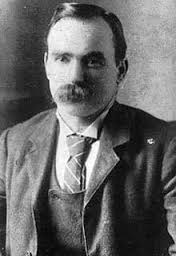
A younger James Connolly than we usually see. Connolly published his songbook in New York in 1907 — included among the songs was We Only Want the Earth.
Incredibly, I only discovered this recording a few days ago. I first heard this song sung by Cornelius Cardew whom I knew in London through political activism and interest in revolutionary culture. Years later I learned the lyrics and sing it now to the same tune, more or less, i.e. that of A Nation Once Again. Admittedly, it sounds great with a reggae or ska backbeat. I came across this recording while looking for a recording of me singing the song at a talk by Portuguese socialists given in Dublin last year.
The lyrics were composed by James Connolly and were published in the James Connolly Songbook in 1907 in New York with a foreword by Connolly:
“No revolutionary movement is complete without its poetical expression. If such a movement has caught hold of the imagination of the masses, they will seek a vent in song for the aspirations, the fears and hopes, the loves and hatreds engendered by the struggle. Until the movement is marked by the joyous, defiant, singing of revolutionary songs, it lacks one of the distinctive marks of a popular revolutionary movement; it is a dogma of a few, and not the faith of the multitude”.
Cornelius Cardew was a respected composer as well as a revolutionary, a central member of the English Communist Party (marxist-leninist). This small organization had a good track record on a number of fronts, including solidarity with the Irish struggle.
Cornelius Cardew, from a Guardian obituary photo
I remember the shock when hearing of his death 13 December 1981, the victim of a hit-and-run driver near his London home in Leyton. The driver was never found. It might have been an accident but he was not the only political activist to die in mysterious circumstances in Britain in those years, particularly if involved in Irish solidarity.
Today is the anniversary of the death of Pat O’Donnel, an Irish patriot or a murderer, depending on one’s point of view. There are memorials to him both in his native village and in Glasnevin Cemetery in Dublin, the latter paid for by US-Irish contributions.
Pat O’Donnel was a travelled man with an interesting life story (the little of it that is known). He was born in Gaoth Dobhair (which remains an Irish-speaking area today in Co. Donegal)in 1835 and emigrated to the USA where, among other things, he worked as a miner. He stayed with his cousins for a while, who were with the ‘Molly Maguires’ (a workers’ underground resistance organization), in the coal-mining area of the state of Pennsylvania.
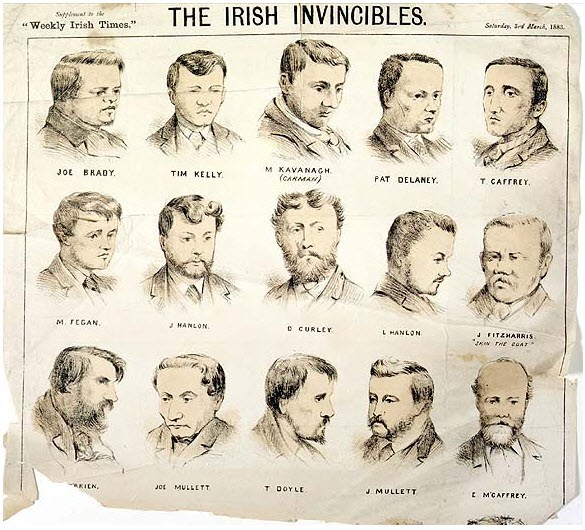
His greatest claim to fame however is that he killed James Carey, a man who informed on his “National Invincibles” comrades who in 1882 had assassinated Lord Cavendish, newly-appointed Chief Secretary of Ireland and Thomas Henry Burke, Permanent Under-Secretary – i.e. both chief representatives of British colonialism in Ireland — as they walked through Phoenix Park.
Sketch-portraits of the Invincibles
The British made arrangements for Carey which bear most of the features of the “witness protection program” of the FBI as presented in a number of fictional Hollywood films. Carey was given money in payment for his treachery, a new identity and passage for him and his family to begin a new life in South Africa.
There is no dispute that O’Donnell shot Carey a number of times and killed him in the latter’s cabin on board ship. The rest has been the subject of discussion and even argument but it does seem likely that although O’Donnell did intend to kill Carey, he provoked him and gave him a chance to go for his gun. Carey’s son probably concealed the weapon when O’Donnell was arrested in Carey’s quarters. Had Carey’s gun been produced in the cabin, instead of being found later on the son, it would have given O’Donnell some chance of being convicted of manslaughter instead of murder.
The biggest debate is about whether O’Donnell was sent to kill Carey or whether, after befriending him and his family, he learned of his identity and decided then to kill him. Evidence points in both directions although O’Donnell’s behaviour in the Carey family’s company tends towards the second interpretation, which is what most historians hold to. Most non-historians seem to prefer the story that O’Donnell was sent as an instrument of justice against informers and there is a Dublin folklore tradition to that effect. Curiously, the jury too preferred that theory — or that O’Donnell had shot an unarmed man — and found him guilty of “willful murder”.
Even most of those in Ireland who were horrified at the assassinations of the British colonial representatives despised Carey, who had been the one to actually give the signal for the fatal assaults and later seemed to delight in condemning six of his former colleagues to death — and others to prison sentences — by his evidence at their trials.
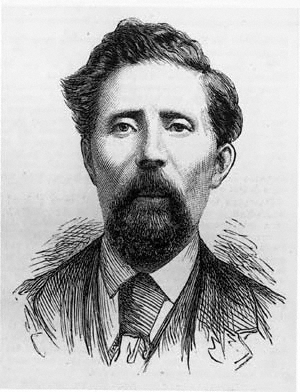
James Carey, National Invincible leading member who turned informer against his comrades. (Portrait by unknown engraver)
My great-grandfather J. J. Walsh was one of the legal team defending the Invincibles but my feelings about Carey would have been the same even had I not known that. It is recorded that eight great bonfires were lit in Ireland in celebration at the news of Carey’s death and that musicians led thousands in joyful processions.
The Judge refused to allow O’Donnell to speak after passing sentence upon him but the convicted man shouted “Three cheers for Ireland! Goodbye, United States! To hell with the British and the British Crown!“
The President of the USA intervened to try to save his life, since he had become a US citizen, but Pat O’Donnell was hung this day in Newgate prison, one hundred and thirty-one years ago and is numbered among the hundreds of thousands of men and women who fell in the fight for Irish Freedom.
(* “Skin the Goat” was the nickname of the assassination group’s getaway cart driver, whose real name was John Fitzharris; he served a long sentence for refusing to give information on anyone).
Further information and songs:
Pat O’Donnell, the Invincibles and Carey also get a mention in one verse of “Take Me up to Monto” by Irish Times journalist George Hodnett (a colleague of my father’s):
“When Carey told on ‘Skin the Goat’*,
O’Donnell caught him on the boat —
He wished he’d never been afloat,
The dirty skite!
It wasn’t very sensible
To tell on the Invincibles —
They stood up for their principles
Day and night.
And they all went up to Monto, Monto, Monto …” etc
There’s a good article here by historian Shane McKenna in which he calls the event in Phoenix Park “killings”, unlike their usual description as “murders” even in articles from Irish writers — evidence that the hand of colonialism still rests on our brains. Elsewhere one reads in history about the “assassination” of Arch-Duke Ferdinand, of Lincoln etc. They are not usually described as “murders”.
A version of the Pat O’Donnell Ballad sung by Diarmuid Breatnach (at19.40 minutes on the video), 23rd February 2013 as part of the Songs from the Docks event, preceded by Paul O’Brien, Seán O’Casey Centre, East Wall; video Rashers O’Reilly)
Lyrics: Traditional
Air: Traditional.
Another version of the Pat O’Donnell ballad, sung by Martin Collins, a Traveller who got it from his father Johnny Collins, sung here at the Celebration of Irish Traveller Music event at the Cobblestone pub, Smithfield, Dublin on 11th December 2014:
(The author is known as a traveller to many exotic places, including expeditions in search of mythical lands, most famously “The United Kingdom”, the “Republic”, “Norn Ireland” and “The Mainland.” Here he writes about the land of Dyslexia).
Dyslexia is, as the suffix “-ia” suggests, a country …. think of India, Mongolia, Russia, California [now relegated to a vassal state], Hibernia [also something of a vassal state], Narnia [er .. no, that is an imaginary land in a series of children’s tales]. The existence of Dyslexia strangely was not even suspected until 1881, when Oslawd Khanber claimed to have visited the land. His discovery was widely doubted until confirmed by Ludorf Linber in 1887. The people of this newly-discovered land were distinguished by all having a difficulty to varying degrees in spelling and/or in remembering sequences of numbers. Khanber and Linber both named this land (and the rest of the world agreed) “Dyslexia”, from the Greek root “dys” meaning “bad/ abnormal/ difficult” and “lex” meaning “word” (although in Latin it means “law”, understood as “written word”).
Dyslexia was, like many other lands and people, not named by the natives themselves, but by people from elsewhere. Such examples abound, for example “Australia”, “America”, “Scotland”, “Eskimo”, “Teddy Boys”, “Pagans”, “Celts”, “Saxons”, “Teagues”, “Gypsies”, “E.T.s” etc. Attempts to identify what the Dyslexics themselves called their land have so far collapsed in confusion, with different spellings and even pronunciations hotly argued for against others.
In fact, there have been accusations of racism aimed at those who named the land “Dyslexia” and the people “Dyslexics” — it seems particularly cruel to create a word itself so difficult to spell to name a people with a known disability in spelling. Previously, Dyslexics just called themselves “people” and the land “the land”, while those who came across migrants from there before Dyslexia was actually discovered called them other names such as “stupid”, “slow”, “thick” or “people with ADD or ADHD” (1) . However, most “Dyslexics” today have not only adopted the name and learned to spell it but are wont to proudly declare “I’m Dyslexic” (but rarely “I am a Dyslexic”).
When Dyslexia came to the attention of the rest of the World no-one seemed astonished that it should be discovered long after the North and South Poles, the Mariana Trench, the Matto Grosso Plateau and indeed a great number of planets. What did astonish the World was that Dyslexia had apparently independently within its borders invented television, radio, Ipads, microwave ovens, central heating and hot showers and of course the internal combustion engine and nuclear power.
This proliferation of technology would have been normally amazing (if anything normal can be said to be amazing, or vice versa) in a previously undiscovered country but what was really, really amazing was that everyone in Dyslexia had overcome a disability to climb to such industrial heights. The obstacles must have been tremendous. Imagine confusing, for example, sodium chloride, a common table salt, with sodium chlorate, which is used as a weedkiller (and also as an ingredient in making home-made bombs, a curious fact since nitrogenous fertiliser, with a directly opposite effect to sodium chlorate when spread on weeds, is also sometimes used in making home-made bombs). Anyway, shake sodium chloride in small quantities on your weeds and they probably won’t like it but most will survive – especially those that actually like a little of it, like relatives of the cabbages and such. Shake a little sodium chlorate on your food, however and …. well …. no, don’t try it – without urgent and skilled medical attention you will die quickly and painfully. For another example, imagine confusing “defuse” with “diffuse”: one goes to de-escalate a conflict and ends up spreading it around. Other confusions are possible between the noun or verb “ware”, the (usually) adverb “where” and the past tense verb “were”. And so on.
For physics, knowledge of and accuracy in mathematics is essential – algebra, logarithms, binary codes, sines and co-sines, square roots (these last are mathematical constructs, not mythical regulated-shape carrots as propagated by anti-EU campaigners). In calculating distances, heights and depths, spaces and circumferences, ability in geometry, trygonometry and ordinary mathematics is required. Somehow, the Dyslexics, the inhabitants of Dyslexia, had overcome their disability or compensated for it in some way, so that they had as flourishing and environment-poisoning an industrial society as the most developed parts of the world, such as the United States of America (most developed industrially, that is).
Dyslexics are said, despite this disability with letters and numbers, to be of above-average intelligence. They had to be, to develop all those complicated benefits of industrial society despite their handicap.
Strangely, one may think, many Dyslexics have become literary figures famous throughout the world, Hans Christian Andersen, Agatha Christie, F. Scott Fitzgerald and WB Yeats among them. Contrary to popular belief among non-natives, James Joyce was not from Dyslexia. This prevalence of Dyslexics among so many giants of literature and indeed of virtually every other field of human endeavour has given rise to a group of Dyslexians who call their disability “the gift of Dyslexia”.
The Dyslexics are often garrulous and sociable and this is especially true when in Dyslexia itself. The difficulty in remembering telephone numbers for example makes every telephone call an adventure. Say a native wished to phone another native called Cathy (also known as Cthy, or Ktay, Thyca etc), and the phone number was 731 1062 (pleasenote, this is an imaginary telephone number by which Cathy or no-one else can be reached). The Dyslexic might phone 371 1026 – all the correct digits but in a different order (note, this also is an imaginary telephone number by which no-one may be reached).
The conversation, somewhat simplified, might go like this: “Yes, hello?” (female voice, breathless with anticipation of another adventure).
Our caller: “Hi, is that Cathy?”
Recipient (giggling): “No, it’s not. There isn’t any Cathy here. I’m Wanda.”
Our caller: “Oh, hi Wanda, you sound very nice. How about going on a wanda with me?”
Wanda (with a little giggle but playing cautious): “Maybe …. What’s your name?”
Our caller: “Terry.”
Wanda: “Where were you thinking of wandering with me?” (A moment’s pause while both mentally translate the last part of that into “wandering on me”).
Terry (clearing his throat which has suddenly gone dry): “Well, there’s a nice new Indian restaurant opened up in town. Do you like Indian food, Wanda?”
“Ohhh, Terry, I love it. So spicy!” (Very slight pause as both translate “spicy” as a description for food flavouring into a metaphor instead). “When were you thinking of?”
“Er … tonight too soon?”
“No, I happen to be free tonight.”
“Shall I come and pick you up? Say …. seven pm?”
“That would be lovely, Terry. I live off the Trans City Road, tenth left, first right, eighth left, in Hopeful Street, the seventh house on the left-hand side if you’re coming from town, with a brown and white door and a hydrangea bush in the garden.”
“Got it – tenth left off the Trans City Road, tenth left, first right, eighth left, Hopeful Street, seventh house on the left-hand side, brown and white door and a hydrangea bush in the garden. At seven pm. I’m looking forward to meeting you.”
Most Dyslexics are always open to adventure, ‘going with the flow’. One never knows what a simple telephone call may bring or to what an appointment or written address may lead. But as a result, Dyslexics are also philosophic about missed appointments, forgotten birthdays and so on; they waste little time mourning something lost and instead look forward to something gained. Terry might or might not make it to Wanda’s but they both know the world is full of other possibilities. Cathy, for example, who failed to receive a call from Terry to congratulate her on her gaining a dystinction in her dyploma, received later that evening what non-natives would term “a wrong number” call from a Sofia who had meant to call a Geraldine. Sofia had intended trying to patch up a long-running difficult relationship with Geraldine and instead found herself making the aquaintance of Cathy, who seemed much nicer and more understanding than was Geraldine. Sofia soon put her problems with Geraldine aside and agreed to Cathy’s suggestion that they meet for a late coffee (which they both knew could lead to an early drink and who-knows-what from there). Cathy had by now forgotten that she was hoping Terry would call.
Dyslexia is not just another land, nor even just a strange one – it’s an entirely different way to live.
end
Footnotes:
1. A supposed disability the existence of which is hotly debated but has exonerated many teachers accused of bad teaching methods and states accused of having too large classes in their schools and which has been profitable for some educational psychologists and extremely so for some chemical companies.
What tactics should we use in political resistance struggle? Physical action or not? If we think physical action is valid, what type do we support and when should we employ it? On the other hand, the same questions arise with regard to non-physical action ….
For most people in this country, the closest they come to physical action in politics is to present themselves at the polling booth. One of the primary declared objectives of most political groups, in fact, is to deepen the involvement in political action of the majority of the population of the country (although what each means by this and to what degree they are serious about it differs greatly).
Something of an ideological struggle has been taking part in the movement against austerity measures as to how best to increase public involvement in effective resistance. Some advocate participation in demonstrations and pickets as their main activity, with perhaps a sprinkling of public meetings. Others advocate civil disobedience and/or disruption as the most effective tactics. Curiously, most agree with participation in on-line petitions and “liking” particular ideological Facebook pages. Many agree with voting for candidates perceived to be in opposition to austerity measures, while some do not. For some, membership of a political party is an important step while for others it is of no value at all. Faced with this lack of general agreement across the spectrum opposed to the status quo, how are we to make decisions, to make reasonable choices?
I’d like to attempt to answer this question but first I’d like to give an example from which to learn, a parable, if you will.
ONCE UPON A TIME ….
Let us imagine a country called Awtaegin. Across the world in the 1960s and 1970s, youth and students were in a ferment, disenchanted with the dominant system as they perceived it and in this Awtaegin was far from being an exception. This disenchantment with the dominant system also extended to many of the oppositional political parties, such as the main social democratic opposition party (which we can call the “Labour Party”) and the USSR-aligned Communist Party (which we can call the UCP).
A number of organisations arose which were opposed not only to the existing order but also to those aforementioned political parties which they considered to be no more than a slightly alternative way to manage the same system and order to which they were opposed, in the case of the Labour Party and a hindrance to mobilising for real change, in the case of the UCP.
One of the opposition organisations to arise was a communist group advocating revolution but which did not support the system in the USSR, which it considered oppressive and imperialist. This group in fact supported the system in China and the politics of its leader at the time, Mao Tse Tung. At that time this leader and his country were very popular among revolutionary communist and national liberation organisations around the world. Let us call this group the MCP.
In its early days, the MCP was something of an object of derision for most of the Left organisations including those advocating revolution in Awtaegin. It was very small and put a lot of store in the Red Book of Mao’s sayings. The MCP popularised Chinese posters. The leaflets and newspapers produced by the MCP tended to contain many quotations from “Chairman Mao” (but also from Lenin and Marx, which the other revolutionary organisations liked to quote too) and the party insisted on using revolutionary political terminology which had gone somewhat out of fashion in Awtaegin.
No-one could deny that the members and supporters of the MCP were hard-working. They went on to the streets and door to door in working class areas with their newspapers and leaflets, attended demonstrations and strike pickets, held internal discussion meetings, organised public meetings, put up posters. Nor could anyone deny that they had guts – their activists often vigorously resisted arrest, they carried their political struggle into the courts instead of, as had become the norm, just trying to be found “not guilty” or to receive the least possible punishment. It was not long before some of them found themselves being sent to jail by the State and there too they often continued their struggle.
If the members and supporters of the other revolutionary organisations had a sneaking respect for those of the MCP, they did not show it. The commitment to work and resistance exhibited by the MCP was explained as fanaticism.
The MCP had built links with a loose network of ethnic minorities in Awtaegin, most but not all students. Mao and China were very popular among many of these ethnic minorities, particularly among the students from Africa, Asia and Latin America, whether on grounds of the national liberation of their home countries from imperialism and colonialism or on the grounds of overthrowing capitalism and of building socialism. Many of these students were organised into a broad organisation which we can call the Progressive Afro-Asian Association (PAAA).
The MCP developed fraternal links with the PAA, which had quite a large network. Through reading, through internal discussions and discussions with the PAA, the MCP developed a theory on racism and its relation to fascism in application to conditions in Awtaegin. In that country at that time racist ideology was dominant and also a number of organisations with an openly racist agenda were on the rise.
The MCP theorised racism as a product of and justification for colonialism and imperialism and also as a method of dividing the working class to facilitate capitalist exploitation. They characterised the organisations with a racist agenda as fascist, as both a concentrated reflection of the dominant racist ideology in Awtaegin and as organisations encouraged to attack revolutionary and progressive people and to intimidate ethnic minority people, in particular settled and migrant ethnic minority workers. MCP articles also analysed and criticised racist writings and statements by politicians and authors.
Although some of these attitudes were to be found in the rest of the revolutionary organisations to some extent, there was a general agreement among them that the racist organisations could not be termed “fascist” and the MCP was criticised for adopting the position that they were. The opposition to the MCP however arose to fever pitch when the party put forward the political position that “Fascists have no right to speak” and advocated this with regard to authors and politicians. The rest of the Left at this time was largely split into two camps: those who thought the racists should be ignored and those who thought they should be defeated in public argument.
But the MCP and PAA applied this policy in action, refusing public debate with racists and those they considered fascists and disrupting lectures, book launches and public meetings that featured speakers they considered racist or otherwise fascist. These disruptions tended to take place mostly in institutions of higher education, where space was being provided for racist and fascist idealogues but also where the PAAA had many members and supporters. The disruptive actions of the PAAA and MCP were criticised by both pro-establishment figures and by most of the Left in Awtaegin. But many people began to consider seriously the arguments put forward by the MCP and the PAA. In time, the position of “Fascists have no right to speak” became popularised as “No platform for fascists” and gained widespread acceptance across the Left spectrum in Awtaegin – it was even adopted as official policy for a year or two by the Students’ Union in that country.
The MCP had been studying, as related earlier, and attempting to popularise the teachings of Mao Tse Tung but they had also studied and discussed other writings and had examined specific contemporary conditions in Awtaegin about which Mao had written nothing. The MCP also investigated the history of earlier struggles against fascism and racism. They uncovered and popularised the history of the resistance to fascism and racism (mostly anti-Jewish racism in those years) in Awtaegin, which had been led for a period by the UCP, the same party that in the more modern struggle was leading people away from confrontation with racist organisations. In the 1930s, the anti-fascists had fought fierce battles with the fascists and with their police protectors.
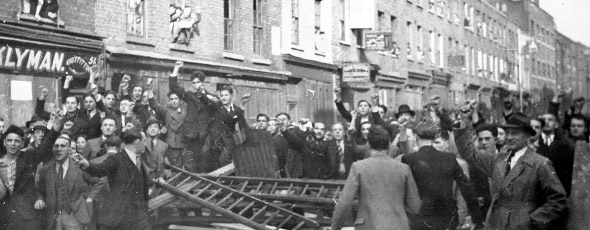
A barricade against a fascist march in Awtaegin in 1936. The alliance of ethnic minorities, communists and anarchists fought off thousands of police spearheading the intended fascist march. One main barricade was breached but no others were and the fascist march had to retreat (being harassed along the way).
The policy of “fascists have no right to speak” was applied by the MCP to the racist organisations organising outside the institutions of higher education. The public meetings of racist organisations were beginning to be picketed and their rallies met with counter-demonstrations. Such opposition now had to be taken into account by racist organisations planning public meetings and rallies, as well as by local authorities and other bodies considering hiring out venues to such organisations. By now the disruptive response was becoming popular among the revolutionary Left, with the exception of the UCP which generally tried to outnumber the racist organisations in counter-demonstrations but then lead a march away from them so as to avoid clashes. Another exception included some libertarians, who thought it wrong to deny even racists the right to free speech.
The policy of confrontation with racist organisations, now becoming widespread in the Awtaegin revolutionary movement and even among radical and democratic anti-racist sections of society, was largely confined in practice to peaceful demonstrations and pickets, with the exception of some ethnic minority youth taking actions into their own hands and opportunist physical attack by some members of the Awtaegin Left.
But the MCP took their policy to its logical conclusion and openly advocated physical attack on fascists in the street. When they could, the MCP also physically attacked members and supporters of the racist organisations, particularly during counter-demonstrations to fascist ones. Once again, the MCP appeared to be isolating itself from the rest of the revolutionary movement in Awtaegin. However, their position found favour with many in the PAAA and with ethnic minorities who were under attack by racist organisations, the racist state police force and by racist immigration legislation. In time, the MCP’s position was adopted by the fringes of some of the revolutionary organisations too (some of which were expelled or split from their parties as a result) and the broad anti-fascist and anti-racist ‘physical force’ organisations that arose at that time spent the next decade or so successfully beating the fascist organisations off the streets. The threat of fascist organisations gaining dominance in Awtaegin did not resurface for another two decades.
So what are we to make of this history of the MCP and of the revolutionary movement and the racist organisations at that time? First of all, is it true? Yes, it is, though a little simplified and with names of country and organisations changed.
WHY WERE THEY SUCCESSFUL?
Why and how did the MCP succeed in having their political line with regard to fascism and racism, at first so widely disparaged, adopted so widely later? It certainly was not due to the influence of numbers as the MCP was a very small party. Even with the support of the PAAA, their numbers were smaller than some other revolutionary Left organisations and the PAAA split and diminished after a few years anyway, leaving the MCP to depend totally upon itself.
The MCP had very few individuals within it who had fame as intellectuals or a personal following of any kind – any influence the MCP had came about as a result of their work. Revolutionary organisations opposed to the MCP’s line included in their membership well-known journalists, actors and public speakers.
I can see no reasonable alternative to the judgement that the MCP’s line of physical opposition to racist organisations and idealogues gained popularity because it was the correct one, at least for its time and that implementing it also proved effective, giving victories in the short term to the anti-fascist anti-racist movement.
OK, so if we can agree on that, how was it that the MCP came up with this correct line when so much of the rest of the revolutionary and radical Left in Awtaegin were in disagreement with it? Was it because the MCP’s political ideological position was so generally advanced that they could not help but be correct on the question of fascism and racism? Hardly – they were followers of Mao’s and his ideology has been rejected by most of the revolutionary Left today; China has become a state facilitating internal capitalist expansion and foreign imperialist penetration within a few years of the death of Mao. In Europe, the MCP supported Albania under Enver Hoxha’s leadership, a state the collapse of which took mere days with the bankruptcy of its political line exposed to the world. In fact, the MCP itself is no longer in existence and in real terms lasted little more than a decade after the death of Mao.
It seems to me that the MCP was correct on the question of fascism and racism in the 1970s in Awtaegin because they started from a position of ‘commitment to revolution, whatever it takes’. In that regard, their “fanaticism” worked in their favour. In addition, they studied not only the writings of Mao but also those of other writers on the topic and discussed their opinions internally and with other progressive people. Then they also studied the history of the world’s people in struggles against fascism and racism and that of Awtaegin in particular. Finally, they had the courage (or arrogance) to advocate their line publicly and to put it into practice when the opportunity presented. They used research, investigation and analysis to develop their theoretical position and they progressed it to practical application.
The MCP could have decided that the task of convincing the rest of the movement was too great and either abandoned it or thrown themselves into it in isolation. What they did was take on the task of convincing the rest of the movement with polemics and historical example and also putting it into practice themselves, seeking allies who agreed with that approach without necessarily agreeing with the rest of their ideology.
TODAY, IN IRELAND
So, in deciding what are correct tactics in struggles in Ireland today, I suggest that we should use the same overall approach as did the MCP in the example given. Study writings on revolutionary tactics, research and study our own class and national history, study current circumstances, discuss ….. then advocate publicly and, when appropriate, apply in practice.
If we look around us in Ireland at the moment, we see that the majority of the population, as observed earlier, is not engaged in political struggle. The sector in opposition to the status quo that has the most people in it, with however a wide spread in ideology, is the Republican movement. This sector has revolutionary and non-revolutionary parts; the major part of it has become non-revolutionary and the rest of it is struggling with fragmentation and ideological confusion. Traditionally, with some exceptions, the Republican movement has concentrated on the struggle against British colonialism and left the rest of the political, social and economic issues more or less alone. As a movement, the revolutionary rump of the Republican movement has given virtually no leadership to — and organised little participation in — the current and recent mass struggles against the Household and Property Taxes and the Water Charge (though its members are clearly in sympathy with the resistance).
In the historically small Socialist sector in Ireland, revolutionaries and radicals sometimes occupy the fringes of the social democratic Labour Party while the rest operate as independents or belong to a number of small revolutionary Left organisations. Chief in size of the latter, although comparatively still very small indeed, are the Socialist Party and Socialist Workers’ Party, with their respective front organisations, the Anti-Austerity Alliance and People Before Profit. While these organisations exhibit little interest in the Irish anti-colonial struggle (other than to condemn periodically those engaged in it) or in the struggle against the repression of the anti-colonial movement, they have concerned themselves very much with social and economic issues.
Both the SWP and the SP have concentrated their activities in opposition to the recent and current taxes and water charge in trying to build large protest mobilising organisations and in electoral campaigns. The mobilising organisations for mass demonstrations and pickets have also been seen as areas of contention between the SP and the SWP. The electoral campaigning is also intended to promote one party or the other, as well as promoting the resistance to the economic and financial attacks upon the working people.
The mass mobilisation has yielded numbers which at first surprised even the activists, growing in thousands succesively from the first demonstration in October to the next in November and many predict even larger numbers this week, on the 10th December. These numbers have forced some recognition of the level of public dissatisfaction by the mass media along with significant initial water charge reductions from the Government. The latter concessions are clearly intended to mollify public discontent and reduce the oppostion to the water charge while the State and the media concentrate on driving a wedge between the general opposition to the charge and some of its more active elements.
Meanwhile, some activists, mostly independent of any political party, have been organising physical opposition to the instalation of water meters. Let us remember that mass non-registration coupled with the threat of non-payment defeated the Household Tax but that the Property Tax replaced it, with the change in the law permitting the Revenue Department of the State to collect the tax through people’s salaries and pensions. In order to levy a charge on water consumption, however, in the absence of a blanket same-for-everyone charge, the State has to install water meters. Currently this work is being undertaken by a private company on behalf of the State with widespread speculation that capitalists involved in that company (such as Denis O’Brien) will eventually buy the water “industry” cheaply from the State.
The resistance to the instalation of the water meters has been taking the form of groups of people turning out in some communities where the meter instalation teams are in operation and physically impeding them in carrying out that work. The tactics have involved parading slowly in front of the company’s vehicles, slowing down their progress enormously and also by physically blocking with their own bodies access to the spots outside houses or estates where the meters are planned.
The Irish state has responded to these physical but peaceful tactics in some cases by postponement of instalation but mainly by a physical repression of the resistance with methods varying from deployment of sufficiently large numbers of police to force the resisters aside, to assaults on those resisting. In one area in Clonmel, even armed police were deployed for a while. In addition, the State issued court injunctions against a number of activists but for the moment has suspended them, for fear of giving the movement some martyrs in jail and augmenting the resistance. This fear is a realistic one, given that public condemnations of the water meter resisters by two Government Ministers, backed up by a compliant media, have resulted mainly in antagonizing public opinion against the Government and the police. Detecting political opportunity in the changing breeze, a number of political parliamentary representatives, notably Sinn Féin TDs, who previously announced they were going to pay the Water Charge but under protest, have now indicated they will not be paying (though however being careful not to advocate a general campaign of non-payment and thereby ruining their party’s chances of integration into the system).
To sum up: the SP and SWP, to varying degrees, are concentrating on two main approaches, building mass demonstrations and electoral campaigning. A group of non-aligned individuals are concentrating on physical opposition to the instalation of meters. Which should we support?
The mass demonstration mobilisation approach is already idealogically split between insistence on non-payment one the one hand and on the other, a broader church tolerating payment under protest by its numbers. Increasing numbers at the cost of an important tactic such as non-payment, particularly at a time when the opposition to the meters is growing, seems a particularly retrograde step. On the other hand it seems tactically unsound, in the absence of a convincingly large presence in the resistance movement, to split on this issue rather than to remain inside it fighting for the line of non-payment.
It is hard to avoid the suspicion that the SWP, through its front PBP, has agreed to tolerate in the ranks of the mobilising organisation those who refuse to advocate non-payment, like for example Sinn Féin and the Unite trade union, even to dropping or muting the SWP’s own line of non-payment, in order to be the left-wing of a larger campaign – i.e. political opportunism. Since the SP and the AAA do not have anything like the numbers or connections necessary to have a significant impact on the resistance movement from a lone position, it is also hard to avoid the suspicion that they have left the broader campaign in order to posture at being more revolutionary than the SWP and, perhaps, if the broad resistance movement continues to grow, to gain in recruitment from its more militant Left members.
However, the general strategy of both the SP and the SWP is in any case wrong. Large demonstrations have a morale-building effect, of course; they give the resistance a physical presence representing many who could not be present and they strengthen the hopes of the resistance – up to a point. But building successively larger demonstrations will not in itself change the ruling class’ determination to make the people pay for the financial crisis. And at some point, demonstrations may peak and then begin to reduce in numbers as people perceive that nothing will be changed through this tactic. This in fact occurred a couple of years ago when the SWP tried to organise a programme of escalating demonstrations against austerity measures. The demonstrations then have a demoralising effect as those who continue to attend see them getting smaller.
The “Pink Ladies” in Coolock protest Garda violence against water meter resisters November 2014. A similar demonstration took place in Tallaght. (Photo John Ayres, published in The Broadsheet – see link for the issue and more photos).
Those who advocate physical resistance with regard to the meter installation seem to me to be on the right track but they are too few in numbers to have a decisive impact. They need the support of the rest of the resistance movement. It is the meter resisters who have widely exposed the connection between the State and private company installing the meters and the degree to which the State is willing to go in order to push its program through. They have done this through their actions and through filming police violence and disseminating the videos through the Internet. It is they who have rattled the Ministers into making ill-considered statements which in turn have deepened the mood of resistance. The rest of the resistance movement needs to find ways to support the physical resistance, physically if possible and ‘morally’ when not, e.g. by statements of support, pickets of news media demonising physical resisters as for example recently against Independent Newspapers and protest pickets of the police, as the “pink ladies” did for example in Coolock and in Tallaght (photos: http://www.broadsheet.ie/2014/11/20/the-pink-ladies/)
In the long run, of course, the Irish capitalist class can content itself with installing meters where it can do so without difficulty, then later isolating each area of resistance in turn, swamping it with police and installing the meters. But if the meter installation resistance were to be combined with large demonstration mobilisations and identified with by the broader movement, then the State would risk the development of a situation that could threaten its very existence unless it abandoned its Water Charge plan and thinks again about how to finance its debt. That is far from being all that revolutionaries would want but that kind of victory, transitory though it may be in the longer term, would provide a welcome respite for the people. It would also give rise to a huge boost in confidence for the ordinary people and lessons in effective tactics of resistance, as well as a sorting through of who are worthy to lead future struggles and who are not.
Joan Burton, Labour Party TD, Minister for Social Protection in Fine Gael/ Labour coalition Irish Government.
Enda Kenny, Fine Gael, Taoiseach (Prime Minister) FG/ Labour coalition Irish Government.
“ ‘Parliamentary cretinism’ …. a lack of intellectual capacity, stupidity, in sections of the Left with regard to their attitude to the parliament in question ……also came to be associated with idealism, in the sense that Marxists understand that term, i.e. as wishful thinking ….of basing one’s actions on an ideal view rather than on the concrete reality and historical experience. ”
Increasingly, it seems, one hears calls for the resignation of the Government, or the leaders of the coalition in power, or a certain Government Minister. This kind of behaviour is honoured by practice over time, especially when weakness in the reigning party or parties is sensed or becomes obvious. The weakened government and its representatives are attacked on political, financial, economic and even personal grounds, hoping to make them lose confidence in themselves and the confidence of others, until they finally give in or their enemies become so many and united against them that they lose some apparently big battle and resign.
And then what? Well, in our political system, inevitably, a general election. Nearly every citizen in the state will get a vote and the chance to put into parliament an alternative government. This government will be composed of one of the main alternative parties or by a coalition of parties. So based on the disposition of forces around at the moment, that will mean a government of Fianna Fáil or a coalition of that party and of Sinn Féin. There is no other alternative, based on any predictable pattern.
And that can only mean that nothing will basically change. Fianna Fáil is a capitalist party marked by corruption and, like all Irish capitalist parties, by acting as a middleman in the sale of our country’s labour power and resources to foreign monopoly capitalists. It is the party which was in power at the start of the financial collapse and, in a move that even astounded capitalists of other states, bailed out the speculator banks Anglo Irish and Irish Nationwide and guaranteed the speculators against loss – decisions for which the Irish people are continuing to pay and without an end in sight.
Well, but Sinn Féin spoke against a number of the austerity measures imposed on the Irish people to make them pay for those decisions, didn’t they? Sure they did. There is a long tradition of parties in opposition attacking the government and then implementing, if not the exact same policies, at least very similar ones, as soon as they get into power themselves. In fact, Fine Gael and Labour politicians both did it with regard to the Fianna Fáil/ Green Party coalition which they replaced. To expect of that of Sinn Féin is a cynical view of the party, surely? Well, in the Six Counties they attacked the SDLP, their political rival party, for collaborating and colluding with the Unionist poltical elite and …. yes, now Sinn Féin are doing the exact same thing for which they criticised the SDLP, now that they have disposed of the other party as a viable rival.
Nor is there any reason to expect any different from Sinn Féin in the 26 Counties, particularly when they refused to condone, never mind encourage, significant acts of civil disobedience such as not registering and non-payment for the new Household and Property Taxes and the Water Charge. And their representative publicly condemns the actions of a few egg-throwers and car-thumpers against one of the Government Ministers most directly responsible for making the people pay for the finance crisis but can hardly find time to condemn the continuing violence of the state police, the Gardaí, against people resisting peacefully the instalation of water meters. This party wants one day to represent the Irish capitalist class in government and must, in the interim, present itself as “reasonable” — reasonable, that is, to the Irish capitalist class.
I said earlier that calling for the resignation of a government or Ministers is a long-standing practice with regard to parliamentary politics. But honoured by practice over time may mean nothing more than that this is, in fact, bourgeois democratic politics and standard parliamentary cretinism. “There he goes, using jargon again”, the reader may say. Well forgive me, but although jargon can be over-used and is too often used to exclude or to dominate, it has its uses too. If we were talking about motor engines, about which I know very little, I might object to such jargon as “internal combustion engine”, “camshafts”, “transmission” and the like. But it would take a lot longer to discuss if every one of those terms were broken down into sentences and if that collection of sentences had to be used every time we were referring to an object or to a collection of objects.
So, “bourgeois politics” means “the kind of politcs that the Bourgeoisie use among themselves or the kind of politics that the Bourgeoisie want the working class to follow”. “Bourgeois politics” is a much shorter term than that sentence, I feel you must agree. But “bourgeois”? “Bourgeoisie”? Well, Karl Marx and others saw society split into two main social classes, each with its own historical development, interests, ideology; they called these “the Bourgeoisie and the Proletariat”. We can, and often do, say instead “The capitalists and the workers” but in terms of ideology, I just feel “bourgeois” runs better. However, if every time I say “bourgeois” you prefer “capitalist”, say it under your breath by all means.
“Cretinism” is defined as the behaviour of a “cretin” which was usually defined in turn as a person of stunted mental and physical growth, a congenital condition and it later became a term of abuse, which is why the term is rarely used by health professional these days. It was used in its pejorative sense in political discourse around the end of the 19th Century and for many decades later and one of the political writers who tied it to the qualifying adjective “parliamentary” was the Russian revolutionary socialist V.I. Lenin. As his definitions and explanations came to dominance in the revolutionary socialist movement, the term “parliamentary cretinism” became a by-word among the Left up until the 1970s and one still hears it in some quarters today.
So, it was meant to convey a lack of intelectual capacity, stupidity, in sections of the Left with regard to their attitude to the parliament in question. Although it is a different thing, it also came to be associated with idealism, in the sense that Marxists understand that term, i.e. as wishful thinking, of basing one’s actions on an ideal view rather than on the concrete reality and historical experience. But although these things are different, lumping them together actually deepens the meaning of the term “parliamentary cretinism” and makes the term more complete.
Often, when one begins to speak in disparaging terms of parliament, listeners imagine the speaker is really saying something more, such as “I don’t believe in making any use of parliaments” or “having anything to do with parliaments is a waste of our time”. However, that is not necessarily the case. For most Anarchists, it is, probably. For most revolutionary Irish Republicans (as distinct from those that have capitulated and embraced parliamentarianism) it is too. However, many socialist revolutionaries are saying nothing of the kind and “parliamentary cretinism” does not refer to having some engagement with parliament or with parliamentary representatives. What it refers to is having the illusion that fundamental change — i.e. revolutionary change — can come about through parliament. The revolutionary socialist of the kind I have in mind is saying something like: “Have no illusions about parliament; put your main emphasis on building revolutionary organisation and dissemination of revolutionary ideology; use parliamentary avenues when it suits the needs of the movement.” Of course, there can be a big debate – and there often is – about just how one judges “when it suits the needs of the movement” and I will attempt later to answer this briefly because it is not the main thrust of this article, strange though that may seem at the moment.
So now, let us look again at calls for this government’s resignation. Should revolutionary socialists join in? I don’t think so. But surely it can’t hurt? And the confusion arising out of a change of government could be to our advantage? I think it can hurt and that any benefits arising out of change of government will be far outweighed by costs to the revolutionary and resistance movements. So, what — say nothing? Actually oppose resignations? Neither.
It is the task of revolutionary leadership to direct eyes to the ultimate goal and to point to the next steps to take at any moment – and also to take necessary steps themselves. We need to talk about all those things now with specific regard to the general issue under discussion – we need to talk about “revolutionary leadership”, “ultimate goal”, “the next steps” for the movement and the “necessary steps” we need to take ourselves.
“Revolutionary leadership” is the leadership that leads to revolution or the leadership given by revolutionaries. They are not always the same thing, since revolutionaries can and do make mistakes. Everyone and anyone who aspires to revolution and says “we should do this (or that) now” is potentially part of the revolutionary leadership. This includes individuals who are independent of any political party as well as those who are part of such parties. I say “potentially” because a number of other requirements need to be met to fulfill the promise of the title “revolutionary leadership”. Such leadership must tend towards revolution rather than reform, which is not to say standing aside from all reformist demands in every circumstance. As I hope we now agree, removing one set of representatives of the capitalist class to replace them with another, is not an objective worth the striving (we shall come later to how it can actually be harmful).
Such leadership also needs to have — or to build — the confidence of the movement in it as otherwise it cannot be effective, no matter how correct its analysis and calls may be. Confidence of that kind is built by working alongside the workers and other masses so that they see the mettle of those offering leadership in struggles and that they can also see that the analysis and the calls seem to correspond to the experience of the masses in those struggles. Therefore, such leadership needs to at least appear to be correct most of the time.
Unfortunately, as we know, leaderships claiming to be revolutionary have often turned out to be their opposite; also the concern of appearing to be correct most of the time has led to suppression of criticism and concealment of mistakes. Such a leadership may for the moment fulfill all the other requirements listed but it fails the test of “tending towards revolution”. I know of no formula that we can prepare that guarantees the movement protection against this kind of leadership but history and personal experience encourages me promote certain ingredients: permit criticism up until it threatens to paralyse necessary action; be open about admitting mistakes and learn from them; do not propagate ideas of infallibility (and make gods of no living persons); educate the participants in the movement and build their confidence in themselves.
What is this “ultimate goal” mentioned earlier? Nothing less than the complete overthrow of the capitalist class and the freeing of our people from imperialism, in order to build a totally different economy and society. I don’t propose to go much further here on this topic since the type of organisation of society we should aim for is a matter of hot debate among revolutionaries but we should focus for the moment on “complete overthrow”, “freeing our people” and “building a totally different society”. Each of those and all of them together imply certain kinds of organisation, certain ideology (or ideologies) and certain kinds of actions. And nailing my colours to the mass here, they imply empowering the working class to take control because it is the most numerous class, the most used to cooperative working and the only one which has no interest to be served by compromising with capitalism (some of its individual members may but that is not the class).
So what about “the next steps” for the movement? Nobody can prescribe these much in advance since the correct next steps depend upon the situation at the moment, the balance of forces, projections into future situations of the actions of the enemy and of our own forces, available alternatives, etc. Revolutionaries must analyse those elements in order to decide and there is no guarantee that they will not make a mistake. No book on theory and no leadership can provide us with a guarantee against that. So, mistakes will be made and they must be learned from. Let us hope that they are not major mistakes from which we will take generations to recover and let us take some precaustions against them and the cost to be paid for them but, at the same time, let us be bold and daring – the stakes are high but the prize is highest.
In any event, it does seem at the moment that the Irish government is in some disarrray. Demonstrations of dissatisfaction grow, as does civil disobedience, while the repressive measures of the State and declarations by some Ministers discredit them in the eyes of the broad masses of people. Then too, the Government has offered concessions on the Water Charge involving substantial reductions on the commencing charge it had projected. It seems clear that we should at least maintain the pressure and, if we can, increase it to the limits of which the movement is capable at this time. Again, analysis, judgement and call, guided by historical and recent experience – but no guarantees. However one thing a change of government will not do in this situation is maintain the pressure on the Irish capitalist class and may well have the opposite effect.
This is a time for revolutionary leadership to make it clear to the movement that a change of government will not do, will bring no fundamental change. We cannot make that clear if we jump on the “Enda Resign” or “Joan Burton Resign” or other similar bandwagons. We can however put forward some demands that people can pressure any new contenders for, such as abolition of the new taxes on working people and increased taxes on the capitalists, in order to make up the shortfall. And that funding for needed social and health services will be at least restored. But we should put forward those demands while, at the same time, making it clear we have no expectation that a new government will deliver or that, once having got past the current political crisis, will not reinstitute austerity measures once more. And we need to maintain the pressure on any new government and, if possible, increase it. We are not here to “give them a chance” but to overthow their masters and their system.
And now we come to the “necessary steps” we need to take ourselves. We do not put our trust in parliament, not even in putting more of our own in there. No, we put our trust in revolutionary organisation. This means building fighting organisations, not bureaucracies. And yet, we need some bureaucracy too – organisations need minutes of meetings to record who agreed to what, those minutes need to be distributed, events need to be organised, leaflets and posters put together, printing done, placards made, people have to be got to certain places, money collected, paid and accounted for, etc. etc. But the main requirement is that the organisations be fighting organisations – which means that they unite people on some demands, organise defensive or offensive actions, educate their members and supporters and build their numbers, neutralise their enemies or weaken their resistance, make allies, seek to achieve some victories.
Struggles take place in communities, work-places and institutions of mass education and the Irish Left has built extensive networks in none of them, nor is there any sign that it is trying to do so, save in isolated instances here and there.
The Irish Transport & General Workers’ Union as built and led by James Larkin and later by James Connolly and their associates, may not have been a revolutionary organisation. But it certainly was a genuine resistance organisation of the Irish working class, particularly in Dublin and it gave support to a revolutionary organisation, which the Irish Citizen Army proved to be. We have no such trade unions in Ireland now and SIPTU, that into which the ITGWU developed, has proved to be, whenever effective, more of a brake on the workers’ movement than an engine for it.
Well then, can we do without trade union organisation, especially since they are not usually revolutionary organisations? I don’t think so, since no other mass organisation of workers is conceivable in the near or middle-term future. Can we create a viable alternative trade union, then? A viable organisation that will win large numbers of other workers into a fighting trade union, large enough or at least concentrated enough in certain industries or work environments (e.g. local government, health services) to be able to take effective action there? Probably not, at the moment. But we could build a fighting and solidarity worker’s network inside and across trade unions and the Left has singularly failed to attempt that. Such a network would certainly enhance the fighting ability of the class and could, in time, provide the base to build a fighting alternative trade union.
The capitalist-owned mass media is a common cause of complaint among progressive people, in that it blacks out some news items and distorts others to the benefit of the ruling class. In the years leading up to the 1913 Lockout and even afterwards, leading up to 1916, “… the Irish Worker had ten to fifteen times the circulation of the Sinn Féin paper and of Irish Freedom, the revolutionary paper backed by the IRB”1. Circulation figures are often taken as being about one-third of actual readership as newpapers get handed around and, in a population with a low level of education, as in the working class at that time, the proportion of listeners may have been even higher, as those who could, read out to those who could not. The Irish Worker was a weekly newspaper but we don’t even have a monthly newspaper of revolutionary orientation that is widely read. If in the conditions of the early 1900s in Ireland such a periodical could exist and proliferate, how is that in Ireland in the early 2000s, with fast cheap printers, photocopiers and internet sites, we have not even come close to producing anything like that?
If we want to educate ourselves, as revolutionary activists, as well as others in the resistance movement, in revolutionary perspectives, then we need to create some institutions for facilitating the reflecting and learning process. Seminars and lectures once a year or on commemorative occasions are no substitute for this at all (apart from the fact that the mass of workers fail to attend such occasions). The Irish Left is not building this kind of process either.
The “necessary steps”, as I perceive them, are building fighting organisations and the resistance movement, building a mass resistance newspaper and building education institutions for revolutionaries and for the resistance movement. It is hard to escape the conclusion that the independent activists at the very least are not prioritising the building of these components or for some reason are failing to unite around the work and that on the other hand, the Left organisations and parties have no interest in doing so.
Coming back once again to the call for the resignation of the Government or of their Ministers, can it do any harm to join the call? Well yes, it most certainly can. This is because across society as a whole, including in the working class, there is an illusion that we live in a democracy, that in some way the people rule or, at least, could rule, if only we could get good representation. This often degenerates into trying to get slightly better representation than we had in the last government. Implicit in all this is the underlying assumption that we cannot substantially change things for the better and also that the changes we need can be effected by others representing us.
These notions fly in the face of historical experience but that is no bar to the wide acceptance of such ideas. Bourgeois democracy and in particular its ‘Left’ variant, social democracy (bourgeois democracy through a Labour party with trade union involvement), may be said to be the default position in western societies. It is the widely-accepted belief, the norm, the position most people start from. It is the position too from which, in the ordinary run of things, most people do not significantly depart — except into apathy. The job of revolutionaries is to give leadership away from that default position, to establish a new position and fight for it in the resistance movement, seeking to make it the main position, a new default position. That position is that revolution is made in the streets, workplaces, communities and education institutions and never in parliament. And that if we want real change, we have to build for revolution and nothing else will do. We need to use other struggles along the way, reformist ones for better wages, living conditions, less taxation of working people, changes in the law …. only in a revolutionary way, to strengthen the resistance movement and never the ruling class. And in those struggles, we should be putting forward revolutionary ideas and principles of organisation, getting our hands dirty with organising and participating in struggles and behaving as examples in line with the principles we put forward.
So, are parliamentary representatives of the Left of any use? Yes, they can get some statements into the media. They can expose certain acts of government and of agencies outside of parliament. They can also propose certain legislative changes. Their parliamentary allowances can be used to fund some revolutionary work. Parliamentary representatives can be useful — to the extent that they contribute in some manner to the work outlined in the preceding paragraphs. But no further.
Jonathan (“Johnny) Corrie, a homeless man of 43 years of age, was found dead early on Monday in Molesworth Street, very near to Dáil Éireann (the Irish Parliament), He was a drug and alcohol misuser and the cause of death has yet to be established.
MANY PEOPLE THINK THE WAY TO AVOID DEATHS LIKE THIS IS TO HAVE MORE HOSTEL BEDS FUNDED. THEY ARE WRONG.
More hostel beds might help but they might not. There are many types of hostels — I have worked in some of them and managed three at different times. A hostel that opens at a certain time (not one of the type I managed) and operates a first come, first served policy, often cannot be accessed regularly by a person with a chaotic lifestyle. A hostel that does not accept drug or alcohol misusers would have been no good to Jonathan Corrie — the hostels I managed did accept them. Behaviour in a hostel might be an issue — one of the hostels I managed was for street drinkers and they were permitted to drink in the hostel. We developed a system of short-term sanctions for managing problematic behaviour and managed to hold on to many who had been barred from many other hostels. But even so, we did occasionally have to evict and impose a ban for a period before we would consider re-admittance. At least one of those, readmitted a number of times, died months later on the street.
Some people are assuming that this person died of the cold; he may have done but he may have died from a number of other causes. Presumably there will be an autopsy. For drug misusers, the most common causes of accidental death in my experience have been overdose or liver failure through hepatitis. Overdose most often occurs when the drug strength is unpredictable and suddenly goes stronger than the person has been used to (for example, purer product or the person has just come out of prison), or when the drug is combined with others, which may include alcohol. Practically all cocaine overdoses have been in combination with alcohol. I understand that at the moment some drugs being injected are a mixture of previously-know drugs and other, newer ones, including some from other parts of the world that are usually chewed rather than injected.
Hepatitis C, though usually contracted through sharing needles, is survivable and drugs can continue to be taken; however, a compromised liver cannot survive alcohol consumption. I have known a number of people die that way after contracting the infection through sharing needles.
If drugs were available on prescription, the quality would be consistent. [By the way, that would also cut out the dealers and the need to collect high revenue to pay for the habit, whether through theft, prostitution or begging.] If needles and other equipment were provided, drug users could cut down on their chance of infection. If supervised premises for injecting, including hostels, were provided, they would hugely reduce the number of infected people. The first and third of these are illegal under the laws in this state (although in London I managed a hostel where drug users could inject in their own rooms) and very few politicians are prepared to stick their neck out and support it, EVEN THOUGH THEY KNOW THAT MOST PROFESSIONALS IN THE FIELD SUPPORT THESE MEASURES (well, most I have met anyway). Needle exchange projects are few and very far between, through lack of funding and “not-in-my-backyard” pressure. The prevalent attitude towards drug use and misuse in Irish society, including among many who have a revolutionary attitude towards the State, ensures that no change will come about yet with regard to adequate and effective provision for drug users.
Lastly, among all the discussion about “addictive personalities” and “gateway drugs”, one also has to look at environmental factors and early life experiences, if one wants to see the causes of addition and seek solutions. Perhaps there will always be a few who develop an addiction, now matter how good the society and family background, schooling etc. But it is a logical assumption that a society based on the greed of the few, alienation and cultural impoverishment of the many and economic impoverishment of a section is likely to increase the numbers of people who seek excitement or escape through alcohol or other drugs and leave themselves open to developing a substance addiction.
I recently went to London in order to visit my daughter and son, their partners and their children. My son and his wife Natalie had recently had a baby girl; and my daughter and her husband Irwin have a boy and a girl. It turned out for a number of reasons that I had more spare time than I expected, so with the help of a friend I got in some sight-seeing and with the help of another, attendance at quite few singing sessions. I also attended one political rally. The following is an account of those events with the least said about my family and friends since their lives are private, with the exception of my host, Jim Radford, who has a very public side with regard to political and community activism and singing.
Archictecture and Transport System
Visiting London, where I spent 30 years of my life was strange, in particular staying about ten minutes’ walk from where I had lived for about half of my time in that city. I had a sense of being an observer at a familiar place but of which I was no longer part, something like a ghost, perhaps.
Not only Kings Cross Station but the whole area around it has been redeveloped and changed so much. In the early ’90s I worked shifts as a Project Worker in a ‘wet hostel’ (one where street drinkers are permitted to continue drinking), very near to St. Pancras Hospital and about fifteen minutes’ walk from the station (if one walks very fast, which I often did to get in for my early shift). On a late shift, walking down St. Pancras Road, on my way to the Underground to head back to SE London, I would often pass a solitary sex worker or two hoping for custom. Displaying the goods on sale is a trade requirement and I felt especially sorry for them in cold or wet weather.
The area was well-known for a high level of sex work and illegal drugs – selling and buying. Four years later, after two years as a Deputy Manager in a number of hostels in other parts of London, I was back in the area again, with a different NGO, as Manager of a hostel for active drug users (most of them injecting). The area had been very familiar to me then but visiting now I could hardly recognise it. The train and Underground stations have been remodeled and an international train station connecting with the Channel Tunnel has been built. In addition the areas in front of them and to the side are unrecogniseable. A big plaza fronts the station and around the side and back is another plaza with the de rigueur converted warehouses and similar-type buildings also around the back of the station now hosting eateries and fashionable offices.
No doubt the area is much more heavily policed now in order to present a clean image for tourists and the middle class young eating and drinking there but I am sure that sex work and drug commerce continues. Perhaps much more cocaine rather than heroin or crack is sold now for the new client group. But though I was there on a weekend night, I observed many of the restaurants and winebars only half-full.
I went out to Stratford too to see the Olympic Stadium and surrounding area. I had worked in that area as a community development worker for six months and taught an adult education beginners’ class in Irish for some years there too — but again, would not have recognised the area now. Like King’s Cross, it had changed completely but unlike the former, in almost unbelievable ugliness. The shopping centre wasn’t too bad but very much of the UStater “mall” type. Apparently many people in the US spend much of their free time in such places and, indeed, there seemed little other choice in Stratford now, especially for teenagers, unless they were of the outdoor type and accessed the Lee Valley, Wanstead Flats etc.
The observation tower/ sculpture by London Olympic Stadium, near Stratford, East London. (Photo DB)
An observation tower which is also a sculpture or “installation”, apparently, stands outside the the Olympic Stadium. It was chosen in competition but aesthetics can hardly have been one of the required features. I once saw metal girders and joists twisted in the aftermath of a very hot fire – the sculpture instantly brought back the memory.
Unfortunately that was not the only ugly construction in the vecinity: almost in any direction one cared to look, other ugly and often grotesquely-shaped buildings came into view. It was in truth almost impossible to credit that not only was I in the same country but in the same city as the work that had been done around Kings Cross.
But sadly, it was not the only place for ugly buildings. Just by London Bridge I had seen a few others and indeed could see the same ones as part of the distant skyline from Stratford too. The “Shard” is one of them, looking like some kind of unsafe rocket about to take off. Another building reminds me of one of those free-standing electric fan heaters.
Some pieces of metal fell off the Shard recently – perhaps the beginning of a suicide attempt by the building, prompted by shame – and would have killed anyone they had struck. The various companies involved, both in its construction and in renting space in it, have said that there is no danger and everything is being checked again. I’m sure that is very reassuring to people working there and to passers-by.
A strange but not pleasing building near Stratford — in Dublin this would probably have earned a nickname like “The Handball Alley”. (Photo DB)
A barrack-looking building near Stratford. (Photo DB)
Another strange building near Stratford, East London. — Maybe it would have been called “The Cheesgrater” in Dubln? (Photo DB)
View from overpass, Stratford, looking south-westward (Photo DB)
London Olympic Stadium, Stratford, East London (Photo DB)
It occurred to me at some point that an Irishman taking photos of buildings around the Olympic arena could get into trouble, even these days — so took myself off inside the ‘mall’ to eat.
On a positive note about London other than the Kings Cross development, the new Overground system links up with much of the Underground and throws a public travel net around the city and outskirts, linking up a great many areas which were previously only accessible by using a combination of public transport systems often taking hours.
Irish tricolour in someone’s yard right next to an Overground station in NW London (Photo DB)
I was told about the Overground and even used it but it was some time before I noticed that both that system and the Underground use exactly the same logo design, the difference being the word written across the bar and perhaps the colour. Once one becomes used to a symbol, one no longer reads the words on it or notices anything except very different colours. That didn’t matter until the day I had to catch an Overground train at a station not organically connected to the Underground, on which I was travelling. My ticket was good for both and the Overground station was less than a minute’s walk away down the street. Seeing what looked like the same design and taking it for another entrance to the Underground station I had left earlier, I walked past it three times and once almost got on to the nearby British Rail (intercity trains) platform and wondered why everyone was giving me wrong directions!
It was going down to an Overground station in NW London that I saw a big Irish tricolour in someone’s yard, flying right next to the station.
Family
Kian, absorbed in an electronic game (Photo DB)
Although I had prepared myself, I was a little shocked at how tall my grandson Kian had become. He is (of course) a very bright lad and was doing tests and making applications for different secondary schools.
Caitlin Rose, his little sister, seemed very excited to see me and I only had to look at her to make her break out in laughter. Grandad is very funny, apparently. Sadly, they have only two living grandparents now – me and my ex-wife. Their other grandfather died shortly before Kian was born and their other grandmother only recently.
Caitlin Rose was born prematurely – I dashed to London at the time and remember holding her in the palm of my hand fpr a little while out of the incubator. She did well but was later diagnosed as suffering from cerebral palsy – the most obvious way it affected her was that her muscles spasmed and drew the tendons in her calves and feet tight, bending her legs and putting her on tiptoe so that she could hardly walk. The condition can be aleviated but so far is incurable. But she is very competitive and determined as well as being very bright (of course). In addition, she had the SDR operation in the USA, a relatively new surgical technique, after which she improved enormously. (See this incredible footage taken about a year after the operation https://www.youtube.com/watch?v=Q6SGhuYzng8, from the blog recording her progress and others in the family and promoting the SDR operation http://caitlinroseford.com)
Caitlin dancing (Photo DB)
Caitlin Rose on her daily exercise treadmill in her gym, paid for by fundraising (Photo DB)
I didn’t get to spend much time during the day with my son-in-law, Irwin, who was busy figuring out how to plumb their new washing machine in to the waste water disposal system. I am not familiar with the closed system so didn’t offer too much advice. But later we went out to eat so I could chat to him a bit more.
The “plumber”, my handsome son-in-law Irwin. (Photo DB)
Eating out
We went out to a tapas restaurant not too far from where they live and I ordered the fish skewers from the menu, imagining them to be the size of pintxos in the Basque Country or chicken satay skewers one sees over here. When the skewers arrived I was shocked to see each contained three large pieces, each one the size of an individual fish portion in many expensive and niggardly restaurants, with what looked like a dagger or bayonet pushed through them, mounted on a stand.
The most surprising thing for me however was that all the staff were actually from the Spanish state1 with the exception of one from Latin America. In Dublin, I had become used to these places being staffed by people from non-Castillian-speaking countries.
In a Latin American restaurant in Camden to which a friend took me, allegedly Patagonian and with some beautiful enlarged photographs of that area on the wall, I asked our table attendant whether he knew any Welsh. There had been a Welsh-speaking colony in Patagonia, founded in 1865 and there is still some Welsh spoken there today. “Que va, hombre!” he exclaimed. “De eso no sé nada. Yo soy de Andlalucia” he concluded, smiling. (“Not at all, man! I know nothing about that — I’m from Andalucia”).
I queried some of the wines I didn’t recognise, not sure whether I wanted a glass or not, so he brought some for us to try and …. left the bottle! Of course it would have been discourteous to refuse such good fortune and, the wine being fine, we had a few glasses before he remembered and returned for the bottle. We paid for some of it, of course. I had a feeling he might have left it that long deliberately.
In a Turkish restaurant in Dalston, I wondered whether I might have a taste of a Turkish lager, which I had never previously tasted, before deciding whether to have a pint. The attendant paused and then nodded, coming back with a half-pint. I looked at her perplexed — “It’s on the house,” she said with a little smile. She was half-Scottish and half Egyptian, it turned out. I did like it and ordered some more. Turkish food is nice enough but not one of the world’s more impressive cuisines, in my experience (and I have eaten it there too, including in Turkish-occupied Kurdistan).
Food from Everywhere, apparently on sale in this shop in Dalston. The smaller lettering along the bottom of the awning, lists that the shop caters for “English, Turkish, Polish, Italian, Spanish, Greek, French” food. (Photo DB)
Stoke Newington and Dalston are multi-ethnic areas but especially prominent are Kurdish and Turkish businesses. Without a doubt however the most visible ethnic minority are the Hassidic Jews, the men with their long black coats and homburgs, boys with skull caps and side-locks. This sect is anti-Zionist and they are known, on occasion, to demonstrate against the state of Israel. However, I was shocked to learn that the women shave their heads upon marriage and wear wigs when they go out.
Family again
Elora Mae — I forgot to take any other photos of her 😦
At the other end of London from my daughter and her family and also far from where I was staying, it was great to see my son Kevin and his wife Nat and the baby – Elora Mae. London is huge and a return ticket covering the zones on Underground and train cost nearly £10 each time. The Oyster Card they are introducing, like the Leap Card in Dublin, in an attempt to eliminate cash exchanges, makes the journeys a little cheaper but I hadn’t known about that.
I’m usually OK with babies but Elora Mae wouldn’t let me hold her for long before she started to cry. On my last visit, however, she seemed ok with me (or probably my smell) and even gave me a few lovely smiles. Smiling, by the way, as well as focusing on the face, are responses genetically built in to us. Babies do not “learn” to smile, which is instinctive programming but may learn different types of smiles, as well as appropriate times for smiling.
Songs and Singing in London
I was staying with a long-time folk and shanty singer, Jim Radford and he took me along with him to his weekly singing events. In one, an “open mic” event, I was not a little disturbed at the amount of noise in the bar in which it was held. Noise is distracting and I tend to sing louder to get over it, straining my voice and maybe also singing at the wrong pitch and key and therefore not at my best. I got more and more apprehensive as my turn to sing, indicated by the MC to me, approached and in trepidation when my turn came, went up to the microphone to sing two songs as expected. I sang Danny Farrell as an Irish (and Dublin) song unlikely to antagonise anyone there and to my relief the noise level dropped somewhat. My second song was the Pat O’Donnell Ballad, which although it involves the the “Invincibles” and the British administration in Ireland, was not too confrontational, I thought. Besides, it the story is interesting as it may be the first recorded “witness protection” operation in history, though one that went very badly wrong for the “witness” (or traitor) in question.
I was asked to sing a third song, as a courtesy to a visiting guest, I thought. Into the second line of Go and Leave Me, the silence around me became profound – so much that it scared me a bit. But I took confidence from it too. The lyrics are not bad and the air is lovely, especially in my opinion when it’s sung the US version way. It’s a reasonably well-known song about love and desertion in preference for someone richer and is one in my regular repertoire. “Regular”, by the way, might mean “sung two or three times a year”, since I don’t like to sing the same song too often and, like many other frequent singers, I have quite a few others. My host has about 250 …. I might have around a hundred, built up over years. And a few discarded along the way too.
The following week, back at the venue, I was asked to sing three songs and chose the Jim Larkin ballad by Donagh Mac Donagh (son of the executed 1916 Proclamation, Thomas Mac Donagh) and The Ludlow Massacre, by Woody Guthrie. A lot connects these two songs to one another and although in general I dislike song introductions (or “spoken sleeve notes”), I briefly explained a few of those connections before singing them.
Both the Southern Colorado Coal Strike and the Dublin Lockout/Strike began in the same year, only a month apart, although the Colorado strike didn’t end until December 1914. Both strikes involved attacks by state forces and scabs on the workers resisted, in Ireland forming the Irish Citizen Army, although many more were killed in Colorado (and in turn were killed by workers fighting back too). Evictions from company houses were a feature throughout both strikes as was general media and court hostility with open collusion between the forces of the ‘justice’ system and the employers. And, of course, both strikes essentially lost in the short term but, in the longer term, the trade unions involved, the ITGWU and the UMA, far from being broken, came out stronger.
For the third song my choice was Back Home in Derry, lyrics from a poem by Bobby Sands organised into a song by Christy Moore but to my own air. With this song I break my general rule about not singing the same song often, because I want to popularise my air with the lyrics. The lyrics are currently mostly sung to the tune of Gordon Lightfoot’s The Wreck of the Edmund Fitzgerald and I thought they deserved an air of their own.
At the various events, as one would in Dublin, I heard some good singers and some bad ones and some who were not particularly good but were interesting. However the general standard seemed noticeably lower than what I would encounter in the singing circles and sessions around Dublin – I have no idea why that should be but it can hardly be due to physiological differences. Also, many read from sheets while singing, a practice rarely seen in the Dublin singing circles (although prompts by mobile or IPad are not unknown).
On this trip I heard Jim sing a number of songs and a couple I remember in particular: The Shores of Normandy, Song for Stephen Lawrence and Home Boys Home. The last of those is about horses and English rural men in WWI and based on a poem, a lovely song which I have slowly started to learn. Jim wrote the other two himself.
Stephen Lawrence was a British Afro-Caribbean youth walking home in SE London with his friend in 1993 when they were both pursued by a gang of white racist young men. Stephen was mortally stabbed and left to bleed to death. Within a week the names of the murderers were on the lips of all the young people in the area. I can personally testify to that since the daughter of a friend was attending a school in that area at that time. First the police questioned Stephen’s surviving friend, treating him as a suspect. Then they couldn’t find the culprits, they said. But it turned out that the house in which some of the racists lived had been under police surveillance for some time and was actually being video-taped inside. It was a long time before that came to public knowledge.
Eventually five men were brought to trial but the incompetence (or sabotage) of police trial preparation allowed them to escape. In a long saga of the fight for justice by the Lawrence family and their supporters, two of the five racists were finally re-tried in 2012 and convicted, receiving long sentences. In the interim the McPherson Enquiry found the Metropolitan Police force to be “institutionally racist” (which Black, Asian and Irish people had been saying for decades) and later a former undercover police officer revealed that he had been tasked by his senior officers to find material with which to discredit the family and the campaign. The Lawrence family broke up under the strain and at least one of them left to go back to Jamaica. Jim’s song contains a powerful indictment of the racist murderers and of the police.
The Shores of Normandy was written by Jim when he visited the beach that he had last seen as a teenage seaman on D-Day on 6th June 1944. Jim was a merchant seaman on a tugboat, many of which were leased by the British Navy and their crews paid merchant seaman rates (which were higher than those of the Royal Navy). Over a few evenings sharing Jim’s whiskey and tea, he told me some things about the tugs’ role. They were of great importance to Britain in the War – they accompanied convoys and towed many torpedoed ships to safety, mainly merchant marine vessels (2. After some time the tugs themselves became targeted by submarines as they were saving so many tons of shipping to be repaired and re-outfitted to go to sea once more and 24 British naval rescue tugs were sunk.
Sherman tanks landing from transporting ship on to pier assembled at Normandy beach during D-Day, WWII. The sections were towed from Britain by tugboats across the sea then assembled under fire at the beaches. (photo sourced on the Internet)
In some of the photographs of the Normandy landings one can clearly see piers being used to disembark vehicles, equipment and men. As Jim says: “Those piers didn’t drop from the sky”. (No, but death was dropping from the sky and scything across the beaches too. I thought). The piers were made of concrete caisons, hollow cubes that could float and were towed across the Channel by the tugs. When they reached Normandy they were maneuvered into position at the correct depth and the sea allowed to enter them until they sank in a line on the seabed, making a pier. All this was done under fire at least some of the time. Over a year earlier, the battles of Stalingrad and Kursk had broken the Nazi advance and turned the war in East Europe, now the Sicily and Normandy Landings combined with the advances from the East towards the liberation of Western Europe and the final defeat of Nazi Germany. The air Jim chose for his lyrics is The Dawning of the Day.
Among the events at which Jim was to sing was the launch of Confronting a Culture of Militarism by David Gee, in Housmans Radical Bookshop. The shop, a little like Connolly Books in Dublin, stores a wide variety of radical and socialist book, pamphlets and periodicals. Looking at the many different British periodicals there, I reflected how much more impact they could have if many of them were to amalgamate.
The bookshop was soon crowded, with some late arrivals having to stand. First off was what I thought an impressive monologue performance by Steve Pratt, ex-SAS and now against war, also a painter. After that, David Gee, the author, spoke – a little too long but interestingly. Finally, Ben Griffin spoke, ex-Paratroopers and also SAS but now Secretary of Veterans for Peace. Ben referred to the vilification that soccer player James McClean had endured when playing for Sunderland and Wigan, for refusing to wear the Red Poppy. (3 He spoke about a visit Veterans for Peace had made to the Six Counties of Ireland in October and how people had spoken to them about harrassment, raids and shootings by the British Army during the recent 30 Years War; Ben asked how anyone could reasonably expect someone from one of those communities to wear the Poppy? (4
Jim was plugging the upcoming Cenotaph anti-war commemoration by Veterans for Peace and sang Where Have All the Flowers Gone?, inviting the audience to attend the ceremony and to sing the song with them. He also sang Eric Bogle’s famous anti-war song, No Man’s Land (better known to us as The Green Fields of France, thanks to the Fureys); he sang it in full to underline what a speaker had earlier said about the Joss Stone song promoted by the British Legion, a truncated version that sentimentalised the war and ripped the strong anti-war heart out of Bogle’s song.
Jim singing at the launch of David Gee’s book at Housemans Radical Bookshop. (Photo DB)
Although a veteran libertarian socialist activist who considers the Royal Family to be “spongers”, Jim had accepted an invitation to sing The Shores of Normandy at the Albert Hall as part of the annual “Remembrance” concert, with members of the Royal Family present. He was wearing a Red Poppy too. I argued with him about the latter but his line is that the militarists and Royals have usurped Remembrance, which was intended to mark the terrible sense of loss after WWI with so many men dead in every town and village4.
The day after the concert, on “Remembrance” Sunday, when processions march in Whitehall and lay wreaths at the Cenotaph, Jim marched with comrades of Veterans for Peace there, with a banner declaring “Never Again!” They and their supporters sang Where Have All the Flowers Gone, an anti-war song, one recited a poem strongly attacking war and its financial foundations and they laid a wreath made entirely of White Poppies with two Red Poppies inside it. (5 Their bugler played The Last Post. I’d have been there to support them and to add my voice to the song but I was already several days back home in Dublin.
Jim brought me to a music session in The Jolly Farmer pub, right next to Lewisham Hospital. I had attended sessions there when I lived in Catford, 20 minutes’ walk away, and the pub now had another name. In those years there had been three, sometimes four weekly Irish traditional music sessions in the Borough of Lewisham, none very far from one another, in which I had played percussion and sung. There had been a few in the next borough, Greenwich, too. None of those seemed to be currently functioning.
The core of the Jolly Farmer session is formed by “Flaky” Jake on accordion, Guillermo on guitar and Jim on percussion (spoons and bodhrán), with other musicians and listeners in attendance. Jake has a huge repertoire of songs from rock to cajun, including songs in French and in Spanish. Guillermo knows some of the French ones and is from Mexico. During the course of the session we heard – and often sang – Rolling Stones, Irish ballads, Cajun songs, English shanties and music-hall, Woody Guthrie ….
The core of the Jolly Farmer session: Flaky Jake on accordion, Jim Radford on bodhrán an spoons, both facing and Guillermo, guitar, seen from behind. Each also sings. (Photo DB)
Jim, Jake and violinist (whose name I can’t remember) at the weekly music session at the Jolly Farmer pub. (Photo DB)
Jolly Farmer session, looking down. (Photo DB)
A few strange incidents occurred around that time in that pub. The first week, there was a man there with an undiscliplined German Shepherd dog on a leash which his owner kept yanking to get the dog to stay by him. A man entered in a wheelchair and the dog went up to him and stuck his nose in the man’s crotch, whereopon the offended man slapped the dog across the muzzle (but not too hard – the dog did not yelp but just went back to his master). The dog’s owner, who I think had not seen where the dog had put his nose, was livid and began to swear and act out how if the man were not in a wheelchair he would do this … and that …. The man in the wheelchair turned and wheeled himself out of the pub. The atmosphere continued somewhat tense for a while but eventually the man and dog left.
Later that evening, I went to the toilet and saw legs sticking out of the cubicle next to the urinal. I pushed open the door to see a man lying in there on the floor, apparently very drunk. I informed the landlady and left her to it, as she requested. Later, at a music party, we heard that after we had left the pub, there had been some kind of disturbance with a drunk breaking glasses and furniture and that the police had been called!
Another night at the music session at the Jolly Farmer. The guy on guitar there sang some interesting songs and was a good guitar player. Leaning back, black cap on head at extreme right of photo is Guillermo. (Photo DB)
The house party invitation came through afficionados of the session. Attendance at the house felt strange at first since I didn’t know the people but then I realised I did know one of them, although not well, a fiddle player. And later another person recalled that she remembered me from music sessions over a decade previously. When the music and singing got going it was great and again we covered a wide range. We went through a huge range of songs and tunes with accordion, guitar, fiddle, banjo, spoons and bodhrán. In honour of our hosts, one of whom was German, I sang Mus I’ Den and The Peat Bog Soldiers combined with Hans Beimler.
The first is a German folk song of departure by one promising to return and to be true to the other in the meantime. Such songs are fairly common and we have more than our fair share of them in Ireland. Elvis Presley’s songwriters used the tune for Wooden Heart in one of his many badly-acted and badly-scripted films GI Blues. The first of the remaining two is a song that was sung by German political prisoners in Nazi concentration camps; somewhat allegorical, it was tolerated by the guards for awhile but eventually earned a death sentence for anyone heard to sing it. Hans Beimler was a German communist who was imprisoned by the Nazis but escaped and went to the Spanish state in 1936 to fight fascism there where, like many other International Brigaders, he was killed. Because of the history of each as well as because the Beimler song is a very short one, I like to precede it with two verses of the The Peat Bog Soldiers.
It happened that the “Return to Camden Festival” took place during my London visit, spread around a number of venues in the borough, including of course the Camden Irish Centre, which is where I went with a friend. I knew the Centre from a long time past, a social and welfare agency for Irish migrants run by the Catholic Church for many years and notable through much of my time in London for steering clear of politics. Of course one can never really do that and one ends up supporting one kind of politics or another. The Centre gradually secularised itself in a time of grants for ethnic minority support work but did not raise issues uncomfortable for the British state such as the unjust murder convictions of a score of Irish people in five different cases during the mid-1970s, the iniquities of the Prevention of Terrorism (sic) Act, nor the prevalence of anti-Irish racism in treatment by many state and local authority agencies and its wide acceptance in news and entertainment media.
Gradually during the late 1980s (or perhaps early 1990s) the Camden Irish Centre was pulled into some of those issues but in an NGO-type of way and within such parameters and re-branded itself as “The London Irish Centre” (there were by then another five Irish centres in different parts of London but none claiming to be The Irish Centre). By that time the Centre’s management was connecting itself to the Federation of Irish Societies, an organisation that infamously at its AGM in 1981, as news of the death of Bobby Sands reached delegates, failed to even table a vote of sympathy for the family of the deceased. (7
The “Return to Camden Festival” at the Camden Irish Centre seemed to be owned by Comhaltas Ceoltóirí Éireann (often mistakenly called “Ceoltas”), a huge largely volunteer organisation promoting Irish traditional music, song and dance. The Centre was heaving and service at the bar was quite slow. The bar staff were all young and someone told me that they were on job schemes, all employed by a contractor who manages the catering for the Centre. It was hardly suprising therefore that they understood not one word in Irish, not even go raibh maith agat.
We sat and listened to a large number of musicians playing together, some as young as eight or nine, then peeked in at the céilí, after which we set off for the singing session. It is run by a Connemara man who sings sean-nós style, who was very welcoming and encouraging; we sat in a circle and sang (or declined) in turn. Again I met people who remembered me from music sessions or from other Irish community activity. The singing was interesting and some singers were exceptional, especially a couple of young female musicians who had to leave early to play their instruments and a few others. I heard a couple of songs I had not heard before, which is always welcome, as well as some I had not heard in a long time. But after about two hours the session came to an end; time then to get something to eat and start the journey back across the city by Underground, changing to Overground at Canada Water station. Reaching Honor Oak Park and walking up to Jim’s house, I passed by foxes twice; the London ones probably became urbanised long before their Irish cousins did.
Solidarity with Kobane’s resistance to ISIS
I knew from an email notification that there was to be a Kobane solidarity demonstration scheduled for a Saturday in central London while I was there and, since this was not one of the days I was visiting grandchildren, I headed out to Charing Cross station, next to Trafalgar Square. Kobane is defended by a Kurdish guerrilla resistance organisation composed of the PKK, some Kurds within the Syrian state’s borders and the few Peshmergas who didn’t flee ISIS. There are probably some Assyrians and Yezidi involved in the defence too.
The Kurds are a huge nation of around 30 million people, spread over territory currently within the borders of Iraq, Turkey, Syria, Iran and Azerbaijan, with a sizable diaspora also in parts of the US and in some parts of Europe, notably in Germany and France. The politics of the Kurds within Turkish and Syrian borders tend to be secular and the PKK has always espoused some kind of socialism. Kobane, a town in the northern part of the Syrian state, is run mostly by Kurds from there and from the Kurdish resistance movement inside Turkey’s borders. Despite the hype about the Peshmergas (Iraqi Kurdish guerrillas), it was the PKK and Syrian Kurds who rescued the Yezidi and some other religious and ethnic minorities from ISIS in Sirjan and opened up a 100-Km long corridor to bring them to safety in Rojava (Kurdish northern “Syria”). A large proportion of these Kurdish guerrila fighters are women, perhaps as much as 30%, fighting inside their own units under the overall leadership of the PKK-affiliated organisation the YPG.
Kobane is under attack and surrounded on three sides by ISIS (“Islamic State”). The fourth side is the heavily-guarded Turkish border and the Turkish state is hostile to the Kurds, both within their own borders and within Syria. Based on ISIS behaviour to date, should Kobane fall, massacre of civilians and defenders will follow, along with enslavement of women as prostitutes or concubines.
Nelson looks down from his pedestal at the Kurdish solidarity rally in Trafalgar Square. (Photo DB) (A similar column and statue in Dublin was blown up in 1966 and the “Spire” now stands on the spot.)
Wide view of the Kobane solidarity rally in Trafalgar Square, London. (Photo DB)
While living in London I had been to Trafalgar Square many times for rallies on different causes that I supported (including of course Ireland, until that plaza was banned to Irish solidarity demonstrations). Nelson stands tall on a pillar there, reminiscent of the one we had in Dublin city centre until it was blown up in 1966, the 50th anniversary of the Rising. I wondered whether I would meet people I knew, either from the British Left or from Kurdish solidarity work, in which I had been pretty active during the early 1990s (8. The area was a-flutter with various Kurdish organisational flags and some from the Turkish left, also some banners and a number of placards were on display.
A speaker at the Kobane solidarity rally (identity unknown) (Photo DB)
Another speaker at Kobane solidarity rally, London (identity unknown to me). (Photo DB)
Most of the crowd looked like they came from the Kurdish part of the world. The stage seemed to be taking a long time to get set up but eventually the Kurdish MCs, a man and a woman, began to announce the reason for the rally and to introduce a list of speakers to the crowd. I was suprised to hear an Irish priest, an O’Brien, I think, introduced as having been a long time active in Kurdish solidarity, although in the 1990s I had never come across him nor heard his name mentioned. I had the same reaction to a few others introduced in similar terms.
A Kurdish traditional musician, seemingly well-known, played a short percussion piece on what looked like a slim but wide bodhrán. Looking for it on Google, I would say it was the Daf, which apparently is in wide use across a number of Near and Middle Eastern regions by a number of ethnic groups. There was no song sung throughout the rally before I left.
The Irish priest introduced as a good friend of the Kurds (Photo DB)
The speakers were from a number of British Left and ethnic minority organisations, one MEP and a number of elected representatives. There was also a report from Kobane itself broadcast through speakers. Mark Thomas, a left-wing comedian, spoke emotionally on the issue. Peter Thatchell spoke strongly as well. One Left-wing woman with an English accent, in the course of her speech, attacked the SWP for supporting Islamicism in the past. The next person to speak, also a woman with an English accent, declared that she was in the SWP and that her organisation is strongly in solidarity with Kobane and with the Kurds.
Comedian and political activist Mark Thomas speaking at the rally (Photo DB)
Another speaker at the rally (identity forgotten) (Photo DB). Images of the imprisoned PKK leader, Abdullah Ocalan, can be seen.
Some of the speakers praised the Kobane ‘government’, saying it was secular, egalitarian, socialistic …. The speakers all attacked ISIS and called for solidarity with Kobane. Some called for British Government intervention (to drop weapons and supplies to Kobane) while others called for military intervention against ISIS. Some called for the unbanning of the PKK and some for the release of Ocalan. The PKK was declared a “terrorist” organisation by the EU years ago, a totally unjustified action by any means of definition, since the organisation was engaged in armed resistance against the attacks of the Turkish state, which is still not a part of the EU; furthermore it was not engaged in any armed action outside its part of the world and nearly all of that within Turkey’s borders. (9
Me, holding a placard I borrowed from a Kurdish couple I had been talking to. The YPG is the Syrian Kurdish resistance, organised and led by Kurds but attracting some Arabs and Assyrians also. It contains large numbers of women fighters, organised in their separate units.
Another speaker whose identity I cannot confirm. (Photo DB)
Abdullah Ocalan (pronounced “otch-al-an”) was the leader of the PKK when he was kidnapped in Nairobi by the CIA in 1999, taken to Turkey, sentenced to death and, after Turkey abolished its death penalty to gain EU entry, sentenced to life in prison. He is kept on an island prison – the only prisoner there, at least for 10 years. Prior to his incarceration, Ocalan had a position within the PKK that arguably went considerably beyond recognised leadership. Nicknamed “Apo” (“uncle” in Kurdish), his image was carried on Kurdish solidarity demonstrations and pickets by many Kurds in London and in Dublin.
Abdullah Ocalan, imprisoned leader of the PKK (image sourced on Internet)
After Ocalan’s capture he declared that the Turkish government should engage in peace talks with the Kurds, that the PKK were not seeking immediate independence but some kind of regional autonomy. Furthermore, he declared that his own release was a necessary prerequisite to carry this process through. This is not too disimilar to the position of Arnaldo Otegi, of the Basque independence movement’s leadership, also of the Sortu party and of many of their new allies since they renounced armed struggle and ETA declared a “permanent and verifiable ceasefire”.
Ocalan’s change of tack surprised many on the Left; I don’t know how the PKK’s own followers reacted at first but soon they were issuing statements along the same lines, (although they have given no hint of intention to disarm). That position of the PKK and of Ocalan explains to me the relatively sudden interest in them within much of liberal and Left quarters. The other factor is the Left and liberal fear of ISIS and the fact that the only coherent and effective defence of Kobane and the rescue of the Yezidi in Sinjar is and was carried out by the PKK, not the “Peshmergas” loudly praised by the Western media (but only mentioned by one speaker at the rally) or by the US, imaginatively claimed by some media.
Another Anarchist banner at the Kobane solidarity rally in London, October 2014. (Photo DB)
Anarchist banner at Kobane solidarity rally, Trafalgar Square, October 2014 (Photo DB)
The “Peshmergas” are Kurds and guerrillas, but of the tribal factions of Bardani and Talibani within Iraq’s borders. On one occasion years ago, they cooperated with a huge Turkish military operation against the PKK by attacking them simultaneously from their side of the border. During the war of the Western states against Iraq around Kuwait, the Peshmergas followed the call of the West to rise against Sadam Hussein; the Western powers then left them to be slaughtered by the Iraq military. During the Western powers’ invasion of Iraq, the peshmergas formed war bands that as well as attacking the Iraq military, looted the Iraqi hospitals, museums, commercial enterprises and people’s homes. At times they even fought among themselves and there were many accusations of murder of military and civilian prisoners, kidnapping for ransom and even of rape. Among much hype, some moved to the rescue of the Yezidi in Sinjar but most quickly withdrew after armed contact with ISIS, totally abandoning the Yazidi, although Sinjar is within Iraq’s borders.
Placard accuses Turkey of directly assisting ISIS (Photo DB)
Many speakers at the London rally denounced Turkey for their indirect assistance to ISIS by harrasssing PKK guerilla reinforcements trying to get through to reinforce their Kurdish brothers and sisters in Kobane. Some alleged more direct assistance to ISIS and called for the NATO and the EU to pressure Turkey into ceasing their obstruction of reinforcements for Kobane. Some spoke against Assad and one for him but mostly neither he, his government nor the war there were discussed.
I recognised not one of those speakers present as having been active on the Kurdish issue in London back in the early 1990s. This would be understandable of younger people who had not yet become politically active then, perhaps – but the others? No, Thatchell and others like him had not been. Back then, the PKK had been in armed struggle against the Turkish regime and was being looked to by national liberation activists around the world. But Turkey was – as it is now – an ally of the West, a member of NATO, so the EU did not want to attack it for its widescale abuse of human right among the Kurds, although it considered Turkey too unstable to admit it to the EU. The Left organisations were campaigning on other issues and had no time – or perhaps tolerance – for Kurdish solidarity.
Not a nuclear explosion over London but an interesting effect of the declining sun. (Photo DB)
Contrasting flags seen from Trafalgar Square — and a spying eye in the sky (Photo DB)
But now that that the PKK has indicated a willingness to enter a “peace” process, they seem to have many friends in left and liberal quarters than they had before. They may even end up, like the Abertzale Left of the Basque Country and like Gerry Adams and Co. of Sinn Féin, having lots of capitalist and imperialist friends too. Some may say that is one important reason for entering a “peace process” but the problem seems to be that in order to keep those new friends on board one has to abandon so much of the goals about which one’s movement was that it becomes something very different, the goals hugely reduced and arguably bringing not peace but co-opting of resistance and a deferment of struggle, probably to another generation (as happened in Palestine, after Arafat’s and Al Fateh’s agreement at Oslo).
One or two of the speakers called for Western armed intervention to assist Kobane, most notably Peter Thatchell, who called for NATO intervention. It was noticeable that this call garnered hardly any applause from the crowd, as distinct from calls to pressurise Turkey to stop trying to block the PKK sending reinforcements to the beleaguered Kobane and for the EU to drop arms to the Kurdish resistance. The London Kurds seem to be quite politically sophisticated and know that NATO is far from being a friend of the Kurdish people. I expressed some of my opinions to a Kurdish couple in their 30s or early 40s and they indicated agreement, particularly the man, who confided many of his own opinions. After hearing about a dozen speakers, I shook hands with the Kurdish couple and bade them farewell, taking a similar journey back to my friend’s house as had Jim Connell, while writing The Red Flag in 1889.
The Red Flag, written by an Irishman in London
Although he had lived in the area for decades, Jim was not aware that Jim Connell, the author of the communist anthem The Red Flag, had been living nearby for many years and had in fact been on his way to his earlier address, also in SE London, by train from a Trafalgar Square demonstration, via Charing Cross, when he began to compose the song. Jim Connell was from Kells in Co. Meath and a member of the Socialist Democratic Federation and later of the Independent Labour Party. He put the lyrics to the Jacobite air The White Cockade. For some reason it began to be sung to the air of Tanenbaum, a German Christmas hymn, which upset Jim Connel: “Ye ruined me poem!” he stormed.
View of former address of Jim Connell, the house with the tall hedge, from across the road (Photo DB)
The plaque commemorating Jim Connell who lived in this house for many years. (Photo DB)
No. 22 Stondon Park, the house upon which outer wall the plaque to Jim Connell is affixed. (Photo DB)
Lewisham IBRG influenced the wording of the plaque but unknown to them the words “Labour Party” were inscribed on the plaque. (photo sourced on Internet)
I knew a good bit about this because the Lewisham branch of the IBRG, of which I was Secretary, had been in correspondence with a local history employee of the local authority about putting a plaque on the house. The plaque had been the council employee’s idea but we had influenced the wording (10) and in 1989, the centenary of the writing of the song, attended the small unveiling ceremony outside the house. A little-known MP called Gordon Brown had spoken and never once mentioned Jim’s wish for a free Ireland or the war then going on in the Six Counties, so I felt obliged to jump up on a garden wall and in a short speech, supply the missing information. There were no police present and I was not interfered with although the applause was scattered. The event and the fact of my speech was covered in the Irish Post soon afterwards. A half-hour before I was to catch the train to Gatwick Airport, Jim drove me to Stondon Park and I found the house and photographed it and the plaque (and also Jim in front of it, for his own album).
It would probably be another year before I would see my kids, their spouses and my grandchildren in the flesh. Of course, there is always Skype ….
Back home
Waiting for either the number 16 or 41 bus home from Dublin Airport, I noted the inadequate shelters from weather, the general lack of Dublin information and the tatty state of the one map of Dublin that someone had thoughtfully sticky-taped to one of the shelters. Even the Bus Átha Cliath timetable for the 16 route was tattered and flapping in the breeze. Ireland, I do love you but sometime you disgust me too.
Tattered Bus timetable in inadequate weather shelters at Dublin Airport, Nov. 3014. (Photo DB)
A tattered Dublin tourism map which someone had thoughtfully sticky-taped to the inside of one of the inadequate weather shelters at the No.s 16 and 41 route stops at Dublin Airport, Nov. 2014. (Photo DB)
I arrived home to find that in delaying paying my Eircom bill, they had without notice cut my ability to reply to emails but strangely the Facebook connection continued. I got some money together and paid my bill.
A chríoch/ Ends
Footnotes
1 I don’t like to say “Spain” as the term is objected to by people in a number of nations within the borders of that state, some of which want total independence and to create their own states.
2 Despite this, 2,426 ships of the British Merchant Marine were sunk with 25,070 men killed, including of course many Irish but also others from the British Commonwealth and many Chinese. In 1942 a special camp for merchant marine seamen prisoners was built at Westerimke ten miles north of the German port city of Hamburg. Around 5,000 men, including 2,985 from 211 British ships, were interned at this camp commonly known as ‘Milag Nord’.
4 One wonders whether the footballer is aware of John Maclean (24 August 1879 – 30 November 1923), Republican Communist from Glasgow who was jailed in 1918 for “sedition” due to his anti-war activities and force-fed while on hunger strike.
7 There had been many pickets and demonstrations in Britain to try to save Sands’ life and those of the nine hunger-strikers to die subsequently. The 1981 Hunger Strikes had a huge effect on the Irish community in Britain, breaking the terror stranglehold of the Prevention of Terrorism Act and the neglect of the Federation of Irish Societies was answered by the formation of the Irish in Britain Representation Group. See https://rebelbreeze.wordpress.com/2014/02/15/how-to-silence-an-ethnic-community/
8 Including a trip in a small delegation of trade unionists in the early 1990s across much of the Kurdistan lying within Turkey’s borders.
9 From Wikipedia: “…NATO has declared the PKK to be a terrorist group;[121] Turkey has been a member of NATO since 1952, and fields the group’s second-largest armed contingent. Closely tied to NATO,[122] the European Union—which Turkey aspires to join—officially lists the PKK as having “been involved in terrorist acts” and proscribes it as part of its Common Foreign and Security Policy.[123] First designated in 2002, the PKK was ordered to be removed from the EU terror list on 3 April 2008 by the European Court of First Instance on the grounds that the EU failed to give a proper justification for listing it in the first place.[124] However, EU officials dismissed the ruling, stating that the PKK would remain on the list regardless of the legal decision.[125] Most European Union member states have not individually listed the PKK as a terrorist group.” Three Permanent Members of the EU Security Council list it so but the remaining two, Russia and China, do not.
10 We had not been told that the words “Labour Party” would be affixed and only noticed it on the plaque much later.