Minister of the Interior for the PSOE-Podemos coalition, Fernando Grande-Marlaska, ex-judge of the National Court. (Photo source: Publico.es)
Newcomers to Spanish politics witnessing the recent sound and fury in the Spanish Parliament might conclude that there was a real battle going on between a reactionary Right and a progressive Left but they’d be right only about the existence of a reactionary Right. The same newcomers might then remark that well, the opponents of the reactionary Right must at least be liberals and they’d be wrong about that too.
Parliamentary delegates from the reactionary Right – and that is to call them much less than the reality – were sharply criticising the Spanish coalition Government. The senior partner in the coalition is the Partido Socialista Obrero which, as has on occasion been commented, is neither “socialista” nor “obrero” and while its junior partner Podemos has left-wing credentials coming from the mainly Trotskyist (and Communist Party-managed) Izquierda Unida, it has to keep up an accommodation with the PSOE.
The parties of the Right in this case were the Partido Popular, which was created to represent erstwhile supporters of the deceased fascist dictator General Franco, along with Ciudadanos, which was founded by former supporters of the PP. The fascist Vox party comes from the same stable but with less democratic pretence.
The criticisms of the Spanish coalition Government on this occasion were mostly with regard to the sacking on Monday of the chief of the Guardia Civil in Madrid, Colonel Diego Perez de los Cobos. The Guardia Civil is a paramilitary police force, which is to say it is organised along military lines and has been the main instrument of State repression during Franco’s dictatorship (1939-1975) and since. It was mainly they, for example that invaded Catalonia to beat up voters during the October 2017 Referendum on independence there and shot the banned rubber bullets at demonstrators and in fact the sacked officer led that operation.
The sacking occurred allegedly because on behalf of a Madrid magistrate, the Guardia Civil carried out an investigation of a number of political demonstrations in Madrid which it alleged had violated the pandemic restrictions and even contributed to the spread of virus, even though they had predated the Lockdown. The investigation, it is also being alleged, was in order to check whether the Health Minister’s actions regarding the pandemic had been appropriate or not.
In order to bolster their investigations, the Guardia Civil had claimed that the World Health Organisation had declared a pandemic in January whereas in fact it had only done so on March 11th (the Government ordered the lockdown on the 14th). The public events the Guardia Civil were investigating with a view to prosecution were mostly democratic or left-wing, including a march to celebrate International Women’s Day (March 8th) and to denounce male violence against women (and the State’s two-level crime of rape) but also included a cavalcade organised by the fascist Vox party.
The Right generally is no friend of women’s rights but more to the point feels duty-bound to defend the Guardia Civil, acting as though they own it (which is not that far from the truth). However the PSOE has had no difficulty in sending the Guardia Civil to attack the Basques or Catalans in the past. And while in government in the 1980s, the PSOE’s Minister of the Interior along with some senior police and Guardia Civil officers were exposed running the GAL terrorist group against the Basques and had to spend some time in jail. The person widely suspected of having set the whole thing up, the Prime Minister Felipe Gonzalez, was not even questioned by the investigators, no doubt for fear of what might come to light.
That Fernando Grande-Marlaska is the Minister of the Interior under current attack in Parliament for allegedly being unfair to the Guardia Civil points out in full the irony of the situation. This is one of the Judges of the Spanish National Court most denounced by Basques for attacking their democratic rights and of at least turning a blind eye to their torture, while sentencing them to long terms in prison on the basis of their “confessions” and Guardia Civil “evidence”. Another of those ex-judges considered infamous by many Basques is also of the PSOE, Baltazar Garzon, beloved of many left and liberal people because he agreed to process an international crimes against humanity accusation against Pinochet and also ordered the exhumation of a mass grave of victims of fascists and military (Spain has more mass graves than any other territory except Cambodia). Neither of those two cases came to fruition, unlike the violation of the civil and human rights of thousands of Basques and the torture of hundreds under his watch.
PUNCH AND JUDY PUPPET SHOW
In the Punch & Judy traditional dramas, Punch carries out a murder or two but, unlike some of the children watching it perhaps, we know that the puppet performance is not describing a real event. Of course, the Right in the Spanish state DID carry out murders – they have a list of 100,000-200,000 to their ‘credit’, most actually after the fighting of the Spanish Anti-Fascist War. And an additional number to force through the Transition to nominal democracy and more afterwards by ‘unofficial’ GAL and official Guardia Civil operations, mostly against Basques.
Punch & Judy puppets (Photo sourced: Internet)
The historic fact is that all left-wing organisations, even the social-democratic PSOE were banned during the Dictatorship. In order to stabilise the State and prevent its overthrow by the oppressed masses during the mid-1970s, it had to have the help of the Left. The Partido Comunista de España controlled a huge militant illegal trade union organisation, the Comisiones Obreras, while the PSOE controlled the smaller but substantial Unión General de Trabajadores (which it does still) – no setup would be safe unless they were brought on board. They were legalised and supported the new Constitution, even accepting the imposed monarchy and the “Pact of Amnesia”, under which all those guilty of tortures and murders under Franco walked free.
This is why there is some heat in the exchanges in the Spanish Parliament but no substance. The thinking of the Right goes something like this: “We had to legalise you and allow you into government but that doesn’t mean we have to even pretend to like you.” While the PSOE thinks: “You tortured and murdered our grandparents but we will share power with you and tolerate much of your antics. We all depend on one another. But sometimes you go too far and have to be restrained. For your own good as well as ours.”
And what does Podemos and Izquierda Unida think, while they share a government with the PSOE? And does any of this make any real difference to the situation of the mass of Spanish people or to those nations imprisoned within the state?
end.
Mariaon Rajoy, former Prime Minister and ex-leader of the right-wing PP, shakes hands with Sanchez of the PSOE in a pre-Pandemic Spanish Parliament. (Photo sourced: Internet)
The Basque pro-independence movement, the Abertzale Left, fought the Spanish State for over four decades. in 2012 its leadership renounced armed struggle without any reciprocal agreement with the Spanish State, declaring its faith in an imagined “Basque peace process”, sought alliances with social democratic and capitalist-nationalist parties and publicly apologised for its past actions of resistance. The movement sank into general inactivity except on the electoral front. But in recent weeks there have been signs of awakening, though under a different leadership – or is the giant merely muttering and twitching in its sleep?
Map of the Basque Country showing the provinces; the three to the north-east are inside the French state, while the other and larger four are in the Spanish state. (Image source: Internet)
THE GIANT
How does the description “Giant” fit a resistance movement in a total population of less than three million people? A nation divided between the Spanish and French states? Part of the answer is precisely in those features, also in its history during the Spanish Civil / Anti-Fascist War and “French” Maquis and earlier. Also in its long struggle in defence of its native language Euskera, almost certainly the oldest in Europe and perhaps the first to reach it in neolithic times.
This is a movement that carried out general strikes against the Franco dictatorship, ensured that three of its provinces rejected the 1978 Constitution of the Spanish State which, in atmosphere of fear and murderous repression and with the collusion of the newly-legalised social-democratic (PSOE) and communist (CPE) political parties, was voted in by a majority in every other region of the Spanish State (population another 35 million people).
The serpent of wisdom and the axe of armed struggle, symbol of ETA. (Image sourced: Internet)
Inspired by the examples of the Algerian independence struggle and socialist Cuba, the Abertzale Left movement rose from the defeat of the nation in the Spanish Civil/ Anti-Fascist War and the terrible repression under the fascist dictator General Franco and in 1959, formed the ETA (Land and Freedom) organisation. The youth wing of the conservative Basque Nationalist Party conceded the Left-inclination in order to join with them. Enduring arrests and torture of its supporters, it was not until 1968 that ETA took an armed action; halted at a police checkpoint and determined not to be arrested, Txabi Etxebarrieta shot a policeman dead and was in turn killed himself by pursuing police.
Mural honouring Txabi Etxebarrieta, first ETA martyr. (Image sourced: Internet)
The first planned armed action carried out was also that year when an ETA squad shot dead Meliton Manzanas, head of the political police in the Basque Country, a notorious torturer of prisoners and a Nazi sympathiser in the past.
A woman dressed in the Basque national colours dances the aurresku, ceremonial honour dance, in commemoration of ETA martyrs. Organising or participating in such an event could easily lead to torture and a prison sentence under the “anti-terrorism” laws of the Spanish State. (Image sourced: Internet)
A number of other actions were taken by ETA over the years, some of them spectacular but, like many armed resistance groups, some also questionable in value or even in justification from a revolutionary point of view. But in December 1973 an ETA squad in Madrid assassinated Admiral Carrero Blanco, General Franco’s nominated successor, an action which many credited with hastening the progress of the Transition of the Spanish State to nominal democracy. General Franco died without a strong agreed political replacement almost exactly two years later, in December 1975 and the Transition process ran from then until 1978.
Admiral Carrero Blanco, Franco’s intended replacement, assassinated by ETA in Madrid in December 1973. (Image sourced: Internet)
The struggle continued after the Transition, since the new Constitution declared any breakaway from the unity of the Spanish State a crime unless a majority in the Spanish Parliament voted in favour. The military and police repression in the Basque Country was huge. In the 1980s the social-democratic (PSOE) Spanish Government was exposed as heavily implicated in a number of terrorist groups operating against Basques through kidnapping, torture, gun and bomb attacks (see GAL) and eventually the Minister of the Interior and a number of high-ranking officers were given jail sentences.
In 1983 mass demonstrations and armed actions by ETA brought about the abandonment of the Spanish State’s nuclear reactor at the picturesque coastal spot at Lemoiz, followed by a new Spanish government declaring a moratorium on all building of nuclear reactors.
1975 mass demonstration against nuclear reactor being built by the Spanish State at Lemoiz. (Image sourced: Internet)
Another aspect of the struggle was against compulsory military service, which the Spanish State only ended in 2002. People not only evaded it but also protested publicly against it.
Many people in the Spanish state opposed being part of NATO in the 1986 referendum but the Basque Country was highly represented in the vote against, around double the vote of those in favour and along with Catalonia being the only regions with a majority voting “no”.1
Photo taken of me by my guide on my camera above the abandoned nuclear site at scenic Lemoiz, possiblt 2016. Not many people can claim to have halted a nuclear reactor building program.
The ideology of the movement which found expression in ETA was national liberationist and socialist and this was reflected to a greater or lesser degree in all its parts, whether military or civilian. The Abertzale Left during the period organised itself into one political party after another after each in turn was banned by the Spanish State and forbidden to field candidates in elections.
Women industrial workers in Basque anti-fascist armaments factory, Spanish Civil/ Anti-Fascist War, 1936. (Image sourced: Internet)
But the movement had a huge social following too, in youth movements, punk and heavy metal bands, social-cultural centres, pirate radio stations and promoters of Euskera as a spoken language (all leaders of the Abertzale Left were required to be able to speak the language and all public meetings were addressed in Euskera and Spanish or even Euskera alone). There was even a popular Abertzale style of haircut and dress. The Abertzale Left also had a sizeable trade union, LAB which, along with ELA, a union founded by the Basque Nationalist party, recruited the majority of unionised Basque workers2. Feminist, LBGT, linguistic, eco-friendly, anti-animal cruelty sectors all contained many people broadly in support of the Abertzale Left or at least of its stated objectives.
The movement also had newspapers, radio stations and internet sites and many of these were closed down by the Spanish State, alleging that they were “collaborating with terrorism”. Currently the Spanish State is moving towards the closure of the movement’s social-cultural centres, the Herriko Tabernak (People’s Taverns). This arises from a judgement by the National Court in 2011, a judgement corresponding to an infamous statement by Baltazar Garcón, at the time a prominent Judge of that Court, that “Everything is ETA”. The closures are to be carried out now although ETA ceased armed activity permanently in 2012 and disbanded itself a little later.
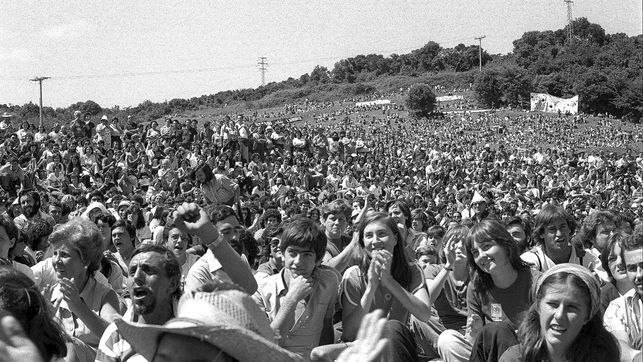
Annual January prisoners’ solidarity march, Bilbao, 2016. (Image sourced: Internet)
Repression by the Spanish State has included executions and clandestine assassinations and led to relatively huge numbers of Basque political prisoners, not all by any means military fighters and conviction with “confessions” extracted through torture during the five-day incommunicado period ensured a problem-free conveyor belt for the Spanish State. That conveyor belt delivered its victims to jails dispersed all over the Spanish state, nearly every one hundreds of kilometres and sometimes over a thousand from the prisoners’ homes. The financial, physical and mental strains on friends and relatives, including elderly and children having to travel such distances to visit their loved ones are hard to imagine, often facing abuse or harassment on the way or at their destination, apart from serious accidents on motorways (including fatalities). Many pickets and demonstrations are held in the Basque Country throughout the year and each January a monster march clogs the streets of Bilbao.
The issue of the prisoners has always been a big one for the Abertzale Left and despite dispersal the prisoners built an organisation within the jails, responding to their situation in a disciplined manner.
SLEEPING
During the first decade of this century it was clear that ETA was not doing well and the Abertzale Left in general was facing many more years of struggle against an unyielding state with repression everywhere and hundreds of political prisoners in jails.
The leadership was attracted to the much-advertised pacification/ peace processes of South Africa, Palestine and Ireland. By any estimation the Palestine process soon collapsed and its rejection by most of Palestinian society was clearly indicated first by the Intifada and secondly by the electoral gains of Hamas, pushing Al-Fatah into second place. To undiscerning eyes the Irish and South African3 processes seemed to be doing well and both the ANC and Sinn Féin lent strong support to the Abertzale Left’s imagined “peace process”. Despite that support and that of such prominent imperialist figures as Tony Blair and Kofi Annan, the Spanish ruling class was not interested in playing and eventually the Abertzale Left’s leadership was left with nowhere to go. However, they persisted in trying to build alliances with the majority Basque National Party and with smaller nationalist-social-democratic groups; they succeeded with the second sector but failed with the first and seem condemned to second-party status electorally in a Spanish colony, a nation divided by the French-Spanish border.
However, in their search for acceptance by the above-mentioned sectors, the Abertzale Left not only renounced armed struggle but apologised for past actions, ended street confrontations and called on the prisoners to negotiate their progress individually through prison system grades to eventual parole. Some of Abertzale Left public representatives even attended events commemorating Guardia Civil and Ertzaintza (Basque police) killed by ETA in the past.
EH Bildu Mayor of Errenteria participates in commemoration of a Guardia Civil killed by ETA. (Image sourced: Internet)
When the struggle for independence broke out again recently in Catalonia with the 2017 Referendum and the Spanish State responded with a violent Guardia Civil invasion and jailing of politicians and social activists, the Abertzale Left leadership noticeably declined to open up a second front of struggle.
STIRRING
There were early but sporadic signs that not all movement was happy with the Abertzale Left’s new path. Askapena, an organisation set up within the Abertzale Left to work on internationalist solidarity, which at one time could list affiliated groups in Ireland, Germany, Italy4, Paris, Brittany, Barcelona, Madrid, Switzerland, Denmark, Sweden and a number of Latin American countries, broke quietly with with the Abertzale Left over its change of policies5. Notably also, when four members of Askapena were accused of “assisting terrorism” in 2010, they refused to apologise for their work and fought the case, being eventually cleared of all charges in 2016.6
In addition, many Basques were critical of the process, feeling that even if they were prepared to go down the new road, it had been handled badly by the leadership.
A leading Marxist theoretician of the movement, Inaki Gil, resigned from the national leadership years ago, though not from the movement; however he may well be persona non-grata in it now due to a published interview in which he criticised the decision of the 47 on trial in September last year to apologise for past actions of the Basque liberation movement, even after 50,000 had marched through Bilbao streets in their support two days earlier.
When Arnaldo Otegi — generally seen as the architect of the new road for the Abertzale Left7 – was arrested with others in 2009 and, while on pre-trial detention began a hunger strike only to end it soon afterwards, it did not reflect well on him. While he beat a charge of “glorifying terrorism”, he was convicted in 2011 for allegedly reorganising Batasuna, banned political party of the Abertzale Left and sentenced to ten years, reduced on appeal to six and walked free in 2016. In the meantime a Free Otegi campaign (2015) attracted some notable foreign support (including Desmond Tutu) but was criticised in the Basque liberation movement for highlighting the case of one political prisoner above many others8 (including those who were serving much longer sentences).
Arnaldo Otegi, leader of the official Abertzale Left. (Image sourced: Internet)
Some years ago a new Basque political prisoner solidarity organisation came into being, calling itself ATA (Amnistia Eta Askatasuna – Amnesty and Freedom9). They enjoyed a good showing at their first demonstration but came under public attack not only by the Abertzale Left leadership but by a number of ETA members on trial in France. They were accused of using the prisoners as a stalking horse when what they really wanted was to attack the new line of the movement’s leadership. Censorship and condemnation in the Abertzale Left’s daily newspaper GARA followed.
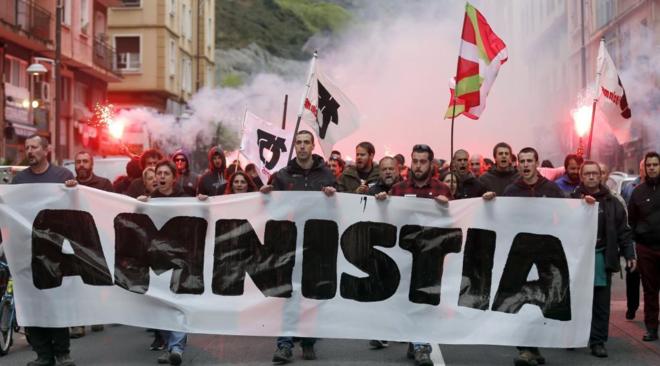
Amnistia Ta Askatasuna demonstration Bilbo 2016. (Image sourced: Internet)
Although their public support waned for awhile, in 2018 a youth group of the Abertzale Left was expelled after they had publicly denounced their annual conference managers for refusing to put their position paper forward for discussion; this youth organisation now collaborates with ATA. Last year, a new Basque revolutionary group called Jarki was formed and drew a sizable crowd to their commemoration of the annual Gudari Eguna (Basque Soldier Day)10.
ATA demonstration Donosti/ San Sebastian, September 2019. (Photo: D.Breatnach)
However the issue of development remained in doubt and no-one could predict with confidence that the movement would be rebuilt along revolutionary lines under a new leadership.
WAKING
The week before last, Basque political prisoner Patxi Ruiz embarked upon a hunger and thirst strike and although he abandoned the thirst component after 11 days he continues on the hunger strike. He took this action in protest against harassment and beatings by the prison administration and jailers and highlighted the fact that prisoners
Patxi Ruiz, Basque political prisoner, now on hunger strike. (Image sourced: Internet)
were being refused virus-protection clothing or testing and that the jailers were not being tested either. He also wanted visits from his family to be permitted and prisoners allowed to attend funerals of family members (he had been refused permission to attend his father’s funeral). More recently he has demanded that prisoners be relocated to jails near their homes, a long-standing demand of the movement and which is entirely in accordance with model rules for prisons in the EU and the UN. Despite the official leadership of the Abertzale Left firstly ignoring the situation and then condemning his supporters, Ruiz’s struggle galvanised the mostly dormant Abertzale movement.
Every day has seen small actions across the Basque Country, including protest pickets on bridges, beaches, town squares etc; solidarity fasts; slogans painted … Large solidarity marches have been held in Irunea/ Pamplona (Nafarroa province), Donosti/ San Sebastian (Guipuzkoa), Baiona (Bayonne), Bilbao and Durango (Bizkaia). ATA’s web page is full of developing news and the facebook page, which had fallen into silence, is active again. Last Sunday in Pamplona/ Irunea, police attacked demonstrators with batons and fired rubber bullets at close quarters.Patxi Ruiz solidarity demonstration 24 May 2020 attacked by police with batons and rubber bullets
Patxi Ruiz solidarity march in Bayonne, northern Basque Country. (Image source: Internet)
Some of the Basque prisoners who are part of the “official list” have begun taking solidarity action, refusing food or to leave their cells for periods in Almería, Brevia-Ávila, Castelló I, Córdoba, Huelva, Murcia (where Patxi is), Puerto III, Rennes, Sevilla II, Topas-Salamanca …. refusal to leave one’s cell also means forgoing family phone calls. Patxi had been expelled from the Abertzale prisoners’ collective in 2017 for speaking out against the new line of the official leadership which another four prisoners have repudiated also11.
However the mass of Basque political prisoners have so far remained quiet, “concentrating on moving through their grades while Patxi lies dying”, in a quotation from an ATA commentary which blamed this new lack of unity on the fragmentation engendered by the official leadership.
A group of ex-prisoners has now also called for solidarity with Ruiz.
“COULD NOT SINK LOWER”
According to a public statement by ATA denouncing political parties Sortu and EH Bildu, the official Abertzale leadership made no comment until Patxi Ruiz was into his fifth day of hunger and thirst strike and then it was to mention him only in passing, while denouncing the spray-painting of political parties’ buildings by protesters and the burning of an ATM. On the 10th day the official leadership again released a statement, saying they were trying to organise one of their elected politicians to visit the prisoner but condemning the mobilisations across the Basque Country and accusing them of endangering Patxi Ruiz’s life. “They could not sink lower”, commented ATA, who also pointed out how late the official leadership had come to comment and that without the public-space protests, neither the media nor the official leadership would have taken any notice whatsoever.
What the future holds for Patxi Ruiz in the short-term is hard to predict, already weakened by ten days of thirst strike and now into his 16th day of hunger strike. What the near and medium-term future holds for the Basque movement is also an open question, depending to some extent on how ATA is able to capitalise on this upsurge and build an organisation or a network of coherence and unity, at least in action.
Patxi Ruiz solidarity march Bilbo 23 May 2020. (Source image: Boltxe)
The official Abertzale leadership will do what they can to destroy any such movement but they have already yielded the streets, one of the main arenas of the movement in the past. Both groups are mutually exclusive and the advance of one in the wider Basque movement can only be at the expense of the other.
The Spanish State too will be watching developments and no doubt considering its own options of repression, although not so easily done as before, without even an ETA existence to justify their response to the public.
Meanwhile the Catalan independence struggle simmers on and if both should link up in mutual solidarity …..
2The main unions in the Spanish state, Unión General de Trabajadores and Comisiones Obreras were founded respectively by the PSOE and the CPE. Both are Spanish unionist and have the majority of unionised workers in every region of the Spanish state except the southern Basque Country and Galicia.
3While the people in South Africa have the vote and the ANC political party has done well out of the deal, going almost straight into Government, the mass of people struggle on low level income, high level violent crime, unemployment and badly-delivered services, while an ANC clique wallow in riches gained through corruption. Sinn Féin went first into the British colony’s government and now has the most elected parliamentary delegates from the February 2020 General Election in the Irish State; however over two decades after the Good Friday agreement the country is no nearer unification or nation-wide independence and is run by neo-liberal capitalist classes selling out the natural resources and services of the nation.
4Germany and Italy had a number of these; in Ireland the cities of Belfast, Dublin and Cork each had one.
5This organisation effectively ceased to exist due to the new line of the Abertzale Left. Although a number of foreign committee delegates did not disagree with the new line (some certainly did) nevertheless it began to fade away from then on.
6In marked contrast to the apology in September last year for previous actions of the movement by 47 members of a number of Abertzale Left organisations, including those against repression and in solidarity with prisoners, before they had even been tried by the court. This shameful action was taken two days after 50,000 had taken to the streets to support them and left deep hurt, bewilderment and shame throughout the movement. https://www.theguardian.com/world/2019/sep/16/mass-trial-of-basque-activists-in-spain-ends-with-plea-deal
7He had come into the political leadership with Joseba Permach of the Abertzale Left in 1997 after 23 members of the Batasuna leadership were jailed for seven years by the Spanish State. He was elected General Secretary of the political party Sortu in 2013.
8The Abertzale Left had never previously endorsed any campaign focusing on individual prisoners except in the case of terminally and seriously-ill prisoners, of which at one time there were as many as 15 who, even under Spain’s own prison regulations, should have been paroled home or to hospital.
9Though now it gives the translation as “Amnesty and Against Repression”. An Amnistia organisation had existed earlier but dissolved or reformed after banning by the Spanish State and one of the accusations of the Abertzale Left is that dissidents misappropriated the name.
What makes leaders good or bad ones? How much power should a leader have? How should they conduct themselves? How do we know when they are no longer leading us well and what can we do about it? The following piece discusses these questions and seeks to answer them.
Most people think human beings need leaders and revolutionaries and insurgents in general are no exception. There are some political-social groups who state that they are autonomous and do not need leaders but it has been my experience even in some of those groups that they do indeed have leaders and that in general they act under that leadership. It seems to be a human trait for groups to accept leadership and to follow leaders and indeed all social animals we may observe have leaders. Nevertheless, the question of leadership historically has been fraught and that is as much the case for human society in its various stages as well as for revolutionary organisations.
Statue in the Louvre, Paris, of Spartacus, leader of the great slave uprising against Rome 73-71 BCE. He is here represented as a thinker. (Photo sourced: Internet)
RESPONSES TO LEADERS – HEALTHY & UNHEALTHY
RESPECT
If our leaders have proved their worth to our endeavours then of course we should respect them. We should not respect them because of their class or family background. It is what one does that makes one worthy of respect, not the social class in which one was raised. And if that class background gave certain advantages in education, in leisure time to study and learn, then those are advantages we value and seek for all, which is far from respecting someone merely because they were raised with those advantages.
As to family background, it seems to me that we are haunted with an old way of looking at human society. It might have seemed natural in ancient times to give the offspring of a valued leader special respect and even to choose the successor from among his/her offspring. It does seem to be the case that some talents and traits are inherited through genes and it is also true that such a family background can familiarise one with some principles of leadership. However, history has provided us with many examples of ineptitude, malice and even madness in leaders who have greatness in their family background. It has also provided us with examples of people who rose from obscurity and from a family background of no particular note to lead masses in historic deeds.
Since we speak of respect, we should talk now about what that means. Of course, when leaders seeks to lead us, to advocate some action or policy, we should listen for if we do not, how can we benefit from what they have to say to us? We listen with respect.
But respect is not the same as servility, nor blind acceptance. We should consider what we are being told and feel free to ask questions and to challenge what we may perceive as assumptions. Further, we should accept that others also have that right, even if we ourselves are convinced in the leaders’ words. Our leaders are not infallible and nor are we.
We said earlier that it is upon what we do that we earn respect and that is so for leaders too. Every judgement on what we do must inevitably be based to some extent on an action in the past, even if it as recent a past as earlier that week, the day before or an hour ago. But one’s past does not grant infallibility and one who took correct decisions in the past can all too easily take wrong ones today or tomorrow. History has also shown us many such examples. Therefore the expectation of any leaders or of their followers that we should accept what they say mainly on the basis of their having been correct in the past is completely unjustified — however emotionally satisfying it may be to some people — and we should resolutely reject the premise.
If we are entitled to question and even challenge leaders there also comes a time when that right should be put aside for awhile. At some point it is necessary to act and endless debate does not lead to action. Nor is the entitlement to question and challenge a justification for ceaseless exercise of that right and it is also the case that such practice will in time devalue future criticism and challenge, perhaps when they are valid and should be most needed. The point at which debate needs to come to an end and a decision made, by the accepted procedures of the group, is ruled by the necessities of the situation and not by simple declaration.
CONDUCT OF LEADERSHIP
Firstly, led us observe that while it is an impossibility for everyone to lead simultaneously, everybody is capable of leadership at some time in some circumstance. Every time one of us suggests a course of action or expresses a criticism in a group, we are in effect offering leadership to others. The one who says “I think we should …” or “Why don’t we …..?” or “Maybe we could ….” are all offering leadership at that moment. Whether it would have been effective leadership or in any case is accepted or not is beside this point.
Spartacus statue in Sandinski, Bulgaria. Here his military leadership is emphasised. (Photo sourced: Internet)
RESPONSIBILITY
We all of us should take responsibility for our actions and their effect. In practice that means weighing up positive and negative aspects before action (should we have time to do so) and afterwards evaluating once again its negative and positive aspects. Should we be constantly hesitant or paralysed by fear of failure we cannot be effective in anything worthwhile, therefore it is necessary that we are prepared to risk making mistakes. Then we have a responsibility to learn from our mistakes which implies a responsibility to admit to them.
Leaders at any level must take responsibility not only for their own actions but for those of their followers also. The leader too must be prepared to make mistakes but should endeavour to ensure that they are not too serious, that the consequences are not too disastrous. This is a heavy responsibility which implies the need to think things through in advance and not to merely react or act mainly out of emotion. And yet, the leader must be prepared to be decisive when that is what the situation requires.
Too many individuals accept leaders as a means of abrogating their own responsibilities. All of us have responsibilities in any endeavour we join together: responsibility in sharing work, risk, and thought. If we leave consideration of the negative and positive aspects of a proposal to others, not only are we shirking our responsibilities but we are hardly justified in complaining later about the actions of our leaders.
SHARING LEADERSHIP
Some leaders are seen to take on multiple responsibilities and many tasks. In capitalist endeavours this has been judged to be wasteful and ineffective in the long run, leading to inflexibility, slowness to react and “micro management”, among other faults. An insecure leader does not trust others and seeks to keep all tasks and initiatives under his/ her control. And yet, shit happens, as they say. Nothing can be completely controlled.
Louise Michel, life-long anarchist revolutionary and one of the leaders of the Paris Commune 1871 and other revolutionary initiatives later. (Photo sourced: Wikipedia)
In revolutionary leadership this tendency to try to control everything by an individual or individuals has also been seen, with harmful consequences that include stifling initiative and learning among the group or organisation. Once this becomes established, the absence of the leader(s) mean the paralysis of the organisation and a similar effect occurs while waiting for them to make a decision. In addition, if they enemy subverts the leadership, the whole organisation and struggle becomes destroyed or at least greatly damaged.
Good leadership encourages the development of different areas by different individuals within the group and spreads participation in — and responsibility for — the decision-making. This model is often called collective leadership but within that itself there are different models too.
It would be very damaging if every individual were to act within an organisation according to how they might feel at different times and to represent the organisation externally without consulting the group. After matters are discussed and collective agreement has taken place, members of an organisation should not represent the organisation in a contrary way to what has been agreed. This is a difficult area with tensions between the right of expression of the individual and of responsibility to the organisation, one which I am unsure has ever been completely resolved.
Collective leadership is usually exercised through a committee or temporary working group and allows for different individuals taking a lead in different areas. One might note that person A regularly calls people to the overall task in hand and pushes for a monitoring of progress, while person B concentrates on developing a specific area, person C looks to the recording of decisions and person D to some external relations. There are of course formal positions in organisations and committees such as Chair, Secretary, Treasurer etc but even without formal elections one finds that successful groups develop areas of responsibility for separate individuals even without the existence of such elected offices. Furthermore, a particular responsibility may fluctuate between individuals at different times. A good argument exists for not entrenching anyone in specific roles over long periods of time. Rotation of roles and encouragement to take up new responsibilities can help broaden the experience and capabilities of members of the group or organisation and also prevent the growth of cliques and controlling leaderships.
Monument under continuing instruction to Crazy Horse, a chief of the Lakota Oglala, who with Sitting Bull led the struggle against the USA’s expansion and confiscation of his people’s traditional lands, including the great defeat of General Custer’s military invasion at the Battle of the Little Big Horn. He was murdered on 5th September 1877 in US Military custody. The statue is finished but the monument on land in Dakota includes the carving of the rock bluff seen in the distant background. (Photo sourced: Internet)
WHAT TO WATCH OUT FOR
Their are certain traits which may be observed repeated in unhealthy leadership and it is well to be aware of them, both for those who follow them and for people put in positions of leadership themselves. The following list does not include timidity, hesitation and prevarication, which are also bad traits of leadership.
The leaders
clearly enjoy issuing orders
direct others to do tasks they would not undertake themselves
monopolise speaking time
push for an end to debate without demonstrable necessity for the organisation
dismiss out of hand opinions opposed to theirs
expect agreement with whatever they say and resent question or challenge
regard question and challenge as treasonous, mutinous
hold grudges against those who have disagreed with them and seek to have them ignored, ostracised or demoted
seek or accept control over multiple areas of work
lie outright to their following
or do not tell their following the whole truth
call upon their past record in order to justify their actions or direction in the present
call upon their family background to justify their actions or decisions
surround themselves with a group who support them without question
accept flattery
flatter particular people (as distinct from commending when appropriate)
never commend any of their followers when deserved or choose only some to commend
criticise others unfairly or out of proportion to what is deserved
consider themselves entitled to special consideration above others in physical and emotional comforts
believe that rules that apply to the majority do not apply to them by virtue of their position or imagined personal superiority
Also, among the group or organisation, those who:
Always agree with the leaders or
Constantly disagree to no apparent concrete purpose
Constantly praise the leaders in private or in public
Praise a leader or leaders while ignoring or downplaying the contribution of others
Deny leaders have committed errors or wrongdoing in the face of evidence to the contrary
Make excuses for wrongdoing or errors of the leaders
Use the past record or family background of the leaders to justify actions in the present
or to imply that the leaders should be followed without weighing up their actions or what they advocate
criticise anyone who criticises the leadership rather than dealing with the point of that criticism
try to justify leaders having special consideration above others in terms of physical and emotional comfort
CONCLUSION
The exploitation of working masses and their resistance to that has been going on since ancient slave societies and has led to outbreaks of revolt down through the centuries. The Paris Commune of 1871 was the first time that the working class succeeded in taking a city and holding it for a period, developing its own instruments of making decisions and carrying them out. At little over two months it was a short-lived experiment and fell to the bloody suppression of Prussian armed forces at the invitation of deposed royalty and dispossessed bourgeoisie.
It was not until 1917 that the working class was able once again to overthrow its oppressors and this time it did so not just in a city but in an entire state, also defeating invasions to overthrow its power. But where is that today? The Soviet Union collapsed in 1991 but had been crumbling within from long before that and, some would say, the working class had lost control in the early years immediately following the Revolution.
The question of leadership and how to handle it by everyone is an important one in an organisation but, for revolutionaries, is essential. It is essential not only for the conduct of the struggle but perhaps even more so for managing society after a revolution. The seeds of that management in the future must be sown in the present.
End.
POSTSCRIPT
I base the above on my personal experience of decades, my reflection upon them and on reading of history. My personal experience has been mostly in unpaid social-political struggles in trade unionism, housing, political groups on a number of fronts,solidarity committees, community and education groups but also employed in few NGOs for a shorter period. I have been either a follower or part of leaderships and have erred in both on occasions while on others acted correctly. I hope that I have learned from them all — and certainly from my mistakes.
In order to concentrate thinking on the general principles I have refrained from giving particular examples of recent leadership, which might have tended to give rise to discussion about individual cases rather than the principles as a whole.
While the journalist and television presenter Piers Morgan has known no end of controversies and scandal in his long media career, of late garnering much criticism for his relationship with Donald Trump, future generations will probably judge him to have been on the right side of history in relation to the Covid-19 crisis in Britain. […]
According to news reports, the Government is considering a relaxation of restrictions and a return to work – but with people wearing masks1 and with monitoring of preventative measures. An obvious question is, if these measures are thought to be effective in future, why are they not being implemented now? And why not in the past? Will we be going back to work but also to contagion?
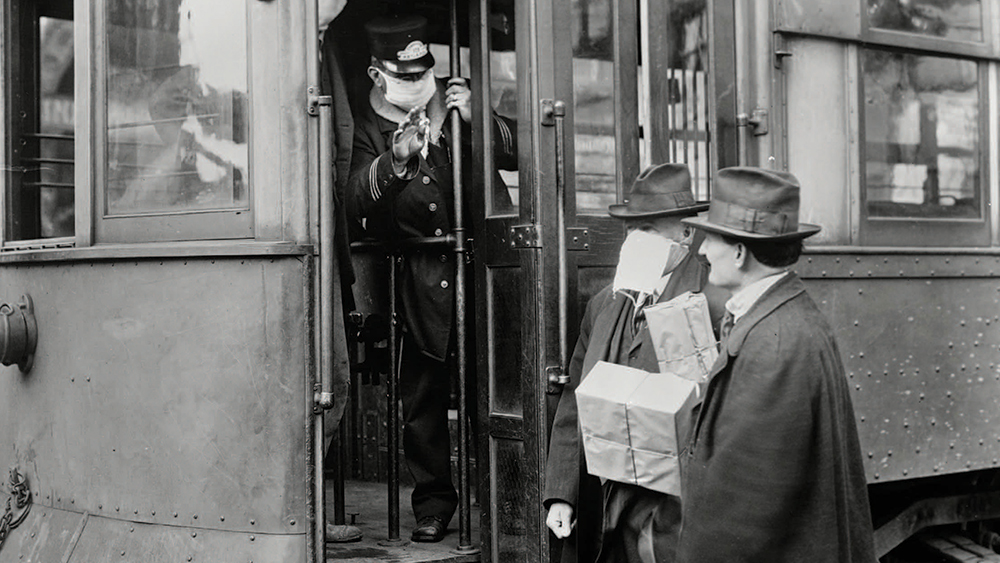
Conductor on Seattle trolley-bus, USA, masked against Spanish ‘Flu 1918. (Image sourced: Internet)
PRESSURE TO LIFT RESTRICTIONS
There is clearly some pressure to lift restrictions – many people want to be able to earn money and socialise as before. People want to go on holiday, get on with education and projects, visit relatives. Small businesses want to save themselves from bankruptcy or climb out of debt. And bankers and industrialists want to continue squeezing people for profits. The State too, in both its ‘national’2and municipal forms, wants to raise taxes to fund its essential services: power generation and supply, water purification and sewage treatment, health service, postal and electronic communications, public transport and road maintenance, fire-fighting, refuse collection and disposal …. To all of those pressures the Government seems to be bowing – but have they thought it through?
In Germany, which has lifted some restrictions, people have been obliged to wear masks in public but even so, the authorities are urging people to be cautious, that they “will have to live with the virus” for some time. In other words, “forget about going back to normal, probably for a long time”. Initial statistics show a rise in infection cases there after the lockdown easing. In Britain, especially England, trade unions have attacked the “mixed messages”from the Prime Minister, Boris Johnston, about returning to work as “potentially lethal”.3
Germany experienced a rise in numbers infected after relaxation of lockdown. (Image sourced: Internet)
So, about the pressure. Ordinary working people have bills, mortgages and rents to pay, small business people have the same and clearly a state needs to have money to fund essential services. Yes, and big companies and banks are pressurising too. And we all know how successful banks are at pressurising governments, don’t we? Especially our governments.
Apart from banks and building societies, the Government could ease the pressure on ordinary working people and small business people by declaring a moratorium on mortgages and rents for the duration of loss of earnings due to the pandemic. Yes, it would need to take powers to do that but wouldn’t most people support them in doing so?
The building societies, banks and big businesses wouldn’t support it however, all of which are interconnected. Well, when the banks and building societies messed up – and not for any reason like a pandemic, either – our governments forced US, the ordinary working people, to bail THEM out. In fact we’re still paying for that out of our national reserves and in cuts in all kinds of provision. A little bit of “comes around” would do them no real harm.
As to the finances to run the essential services of the State and of local authorities: end the tax write-offs, holidays and low taxation rates etc. And change the line on “We don’t want Apple to pay us the money which even the neo-liberal capitalist EU says they owe us!”. Yes, we DO want it – and we NEED it, ALL of it and NOW!
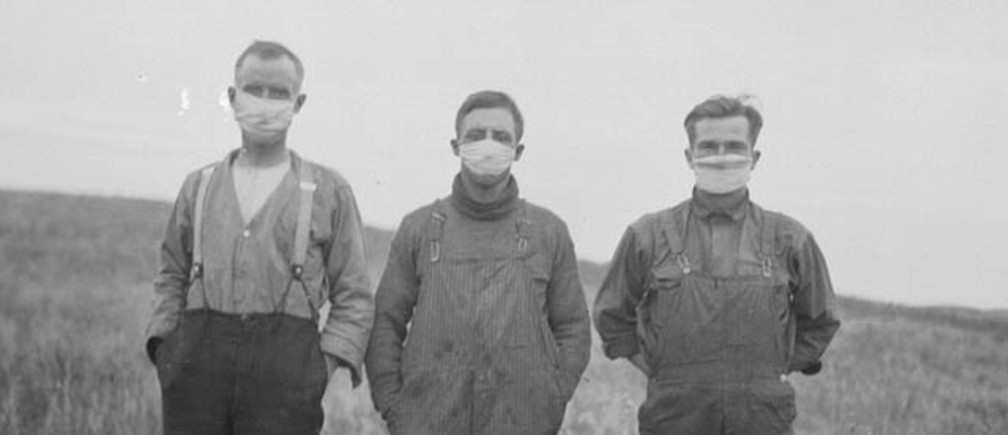
Industrial workers masked against the Spanish ‘Flu pandemic in Britain 1918. (Image sourced: Internet)
“FALSE CONFIDENCE”
The German authorities, with a much more efficient and better-funded health service and financial reserves, have been warning its public about false confidence. Now and again we see some indications of that here in Ireland too.
OK, so a section of the public is not properly educated or just willfully ignorant – stupid even. But if when you introduce a lockdown to deal with a pandemic you talk about it being for an initial two weeks ….. what kind of message are you giving out? And if you tell most people not to bother with masks or gloves? And if in the early days of the pandemic told them firstly that public events would not need canceling4 and then that to attend outdoor events of up to 500 and indoor events up to 100 people5 was basically safe? If the responsible authorities never seemed to be taking it all that seriously until late in the day and even then have managed it quite lightly – are some people to be blamed for having false confidence?
Another cluster of infections has just come to light, ten meat processing plants accounting for 566 cases so far. Prof. Catherine Motherway, President of the Intensive Care Society was reported as cautioning that a lot more needs to be done before restrictions are eased. “We need to know that our health system can cope … find and isolate the cases and treat them.”6
New York street cleaner masked against Spanish ‘Flu infection, 1918. (Photo sourced: Internet)
FACE-MASKS NOW – BUT NOT EARLIER
According to reports, the Government will want us to wear face-masks when they relax the restrictions. But ….. weren’t they telling us from the start that there was no point? Wasn’t even the World Health Organisation playing down their usefulness?
Well, either they know they don’t work, in which case they just want us to feel safe enough to start the wheels of industry turning and the money flowing into the big accounts …. Or they know they do work, and they’ve been advising us wrongly all along.
That’s where my bet is and I’ve written about this already, weeks ago7. It’s bloody obvious that face masks must help prevent spread the virus and depending on the type and procedures employed, would also help protect the wearer to some degree. Quite a number of countries made wearing them in public obligatory. And now the Government will be doing that here too.
Good. But I just wonder how many people got sick – or even died – because the authorities discouraged them from wearing them earlier?
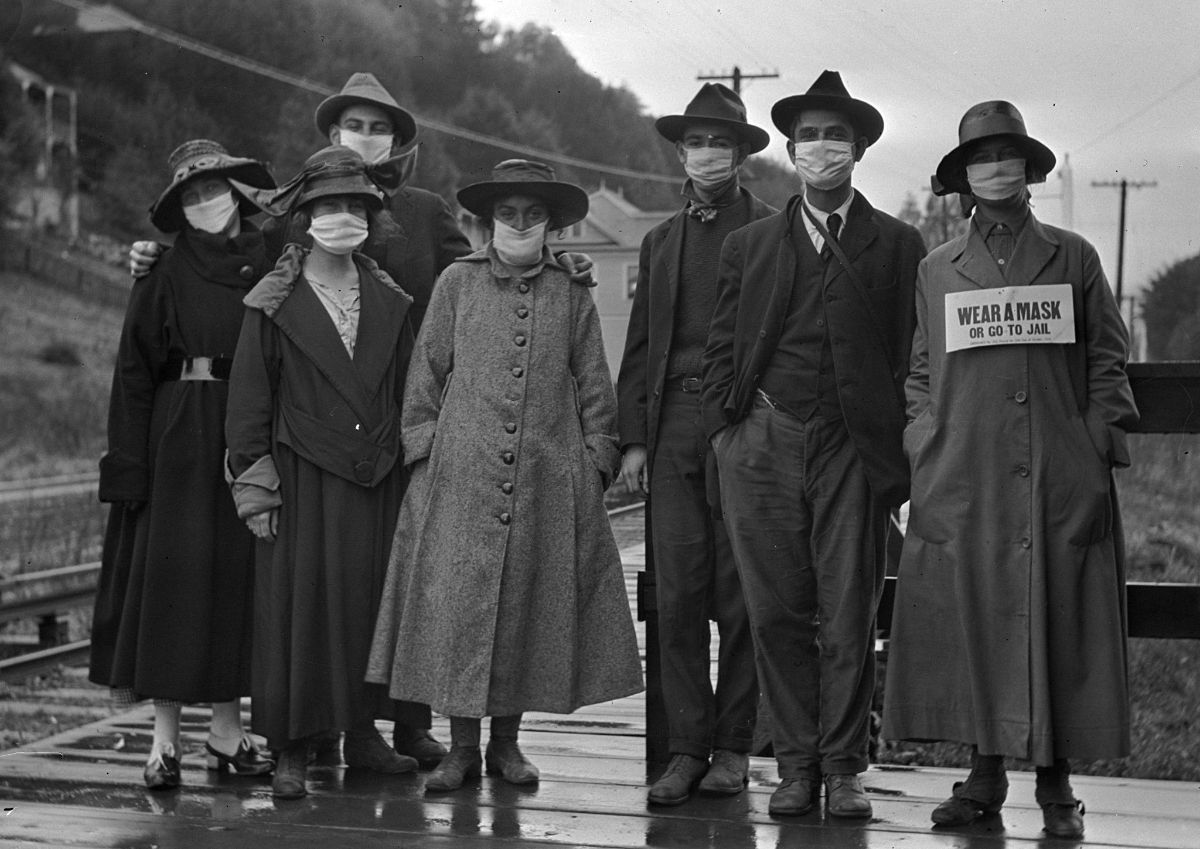
People wearing masks and “Wear a mask or go to jail” placard, 1918, during Spanish ‘Flu pandemic, probably USA. (Image sourced: Internet)
The Government has yet to specify where the masks are going to come from and, little respect as I have for any person prominent in the Labour Party, Alan Kelly TD is obviously correct when he says that the Government should be organising the production of those masks NOW!8
OTHER MEASURES AND MONITORING
Face-masks help you not to spread droplets on to other people – and you don’t know for sure whether you have the virus or not, because you can carry it for a few days before it starts to show. Good face-masks will help you not catch it from someone else too. But you really need gloves as well and a good procedure in removing the gloves and face-mask, combined with hand-washing. And of course, social distancing. To be honest, with all those being practiced, there should be no need for 2km distance from home limits on exercise or travel – or even for telling older people to stay indoors, vulnerable to depression and ill-health through lack of exercise and even to accidents in the home.
But, for effective measures, don’t they/ we need to know who is infected and who is not? And where the major infection points in society are to be found? Yes — and for that we need mass testing, which our Government has not been doing because of how the health service has been run down. Not even with sending test samples away (to Germany) for analysis!9
And then we need tracking, tracing where people think they may have got infected, who they may have infected in turn, testing them …. the proper pandemic scientific procedures. But our Government is hardly doing that either. We get the following estimates10 of infection sources based on people who tested positive: 34% close contact, 63% community contact, 3% travel abroad.11But what do these categories actually mean?
OK, “travel abroad” is reasonably clear. “Close contact” might mean family, close friends, lovers, elderly relatives in nursing homes (more about them further on). But “community contact”, which accounts for almost two-thirds of the total? Would these be neighbours, workmates? You know what I suspect? Shops and supermarkets – customers and staff – are a big section. Why? Because most people visit them at least weekly and the precautions taken there have been all along — and are still – inadequate. But the authorities don’t do the tracking to find out. Or if they have, they’re not telling us.
Customers in a supermarket (none seem to be taking any precautions other than perhaps social distancing). (Photo source: Internet)
The fact that it was only last week that a high cluster of infection around meat-processing plants was revealed shows the need for testing, tracking and testing again and how little work on that level is being done. Ten sites with 566 people infected12 so far is not something that should be coming to light over two months after the first case was identified in Ireland.
Who will carry out the monitoring, ensuring best practice and compliance? I’d like to believe that whichever body the Government sets up will do a good job but unfortunately I doubt it. It was left up to the supermarkets and shops to monitor their own provisions and they did it late and inadequately13. The Government at first even left it up to the pubs whether to remain open or not! Now this body appointed by them, aware of the lack of enthusiasm of the Government to interfere with the business of making money, will be supervising and monitoring every factory, shop, depot and farm? Really?
In this small relatively low-industry state of the 26 Counties, the Health & Safety Agency recorded 22,500 non-fatal workplace accidents reported to it for the year 2017-2018, along with 48 fatalities. Remember that all generic studies maintain that most and possibly all accidents at work are avoidable and result from lack of awareness or of appropriate training, or of fatigue as well as from bad practices, bad supervision and badly-maintained equipment.
The understaffed HSA is not adequate to the task of monitoring even a representative sample of workplaces and relies a lot on accidents and breaches of regulations being reported to it; the trade unions in general are not up to the job either, especially with the low percentage of union membership of recent decades.14 So whichever agency is set up for monitoring good working practices during the pandemic, even if such adequate practices have been identified and published, is not likely to be up to the job either.
Masked Clerical Female Workers during Spanish ‘Flu pandemic 1918, probably USA. (Image sourced: Internet)
But at the very least that agency should publish its general guidelines and insist each workplace publish the specific procedures in place along with the underlying rationale. Then at least employees and public can see what they are, complain if they are felt to be inadequate and report those that are not being practiced. And gloves and face-masks at least should be provided for all, with work practices adapted to allow for them.
THE DISPOSABLE PEOPLE
As soon as the pandemic took hold in other countries, a high percentage of infected people were known to be healthcare workers – around 10% as an average. Even if you didn’t realise straight away that nursing homes were going to have a high rate of infection, as soon as you thought about healthcare workers you’d be quick getting to that point (and one step away from thinking about homeless hostels and direct provision centres etc too). Once you thought of the high vulnerability of those facilities, you’d make special provisions for them, wouldn’t you?
But no. No provision at all until a few weeks ago. No special issuing of guidelines for staff and visitors, insufficient PPE (protective equipment etc), low admission rates to ICUs for the infected ….. According to stats published at the weekend, 855 coronavirus-19 deaths have been associated with care homes and 740 of those were residents. And since the total deaths recorded within the state at that point were 1,429, well over half the deaths have taken place in care homes.
A shocking rate of attrition out of ineptitude for which the Government and the National Public Health Emergency Team should be held responsible. Or …. was it even worse than that? These facilities contain, on the whole, people who are no longer economically active, people some might even consider a drain on society’s resources. And often low-paid migrant workers caring for them. Could it be that they were all just considered “disposable”?
2I use the term here to mean the whole of the State’s territory, well aware that a true national perspective would include not just the 26 Counties but also the Six County British colony.
11Yes and most intelligent people wonder why the Government allowed people to travel to an international rugby match in a country swamped with the virus and, even worse, not have them quarantined upon their return. And for heaven’s sake, why people can still leave and arrive at our air and marine ports and sit on planes next to one another with cabin crew having to bend close to attend to them during the flight, do a turnaround and bend close to another group of passengers on the flight back.
We wish to draw your attention to what we perceive as a serious bias in your series The Natural World, a bias which is as unjust as it is unproffessional and, indeed, unscientific.
In your otherwise excellent film documentary series The Natural World you depict the wonders of our world and the many levels of interaction and responses to different environments within it, of plant and animal, of eater and eaten, prey and predator.
However, when any of us appear upon the scene, your narrative voice drops in volume as if to indicate the arrival of something sinister, the evil presence in this otherwise natural world. We are neither sinister nor evil, Mr. Attenborough – we are an integral part of this natural world, the same as all the rest.
You seem to delight to show footage of us pursuing the young calves and fawns of grazers, thereby seeking the sympathy of your human audiences for their plight and, in turn, hostility towards us. No doubt the omnivores among your human audience are able to disassociate themselves mentally from the relative immaturity states of lamb, veal, piglet, pullet, egg and sprat in their diet. But much more to the point – do we not have young too? And how do you – or your sympathetic audiences – imagine that our young get fed? Or what do you or they imagine stands between our cubs and dying of starvation?
We note also that it is not all higher predators that you depict in this way – not of course humans but not the great cats either. We laugh when we see you depict the lion, “the king of the jungle” as some kind of majestic monarch. Those of us in the African veldt know well that most of what he eats is what our brethren have chased and brought down before he has bullied us off what is ours. And the rest of his food is killed only by the females in his group. Among us, on the contrary, males and females all take part in the planning, the chase and the kill.
As a naturalist you know that all predators play a part in the balance of nature and generally cull the weak and unwary, strengthening the overall health of the prey species. As a naturalist, we would not expect you to have this bias against us and can only wonder whether perhaps as a child you had an unpleasant experience with a domesticated canid. If so we hope that you can put it behind you.
We trust you will consider what we have to say and hope that you will change your depiction of us in any future series.
Sincerely,
Wolves, Dingoes, Wild Dogs, Jackals and Hyenas
on behalf of Canids of the Wild (CaW)
A Grey Wolf adult ‘cuddles’ a pup (Source: Internet).
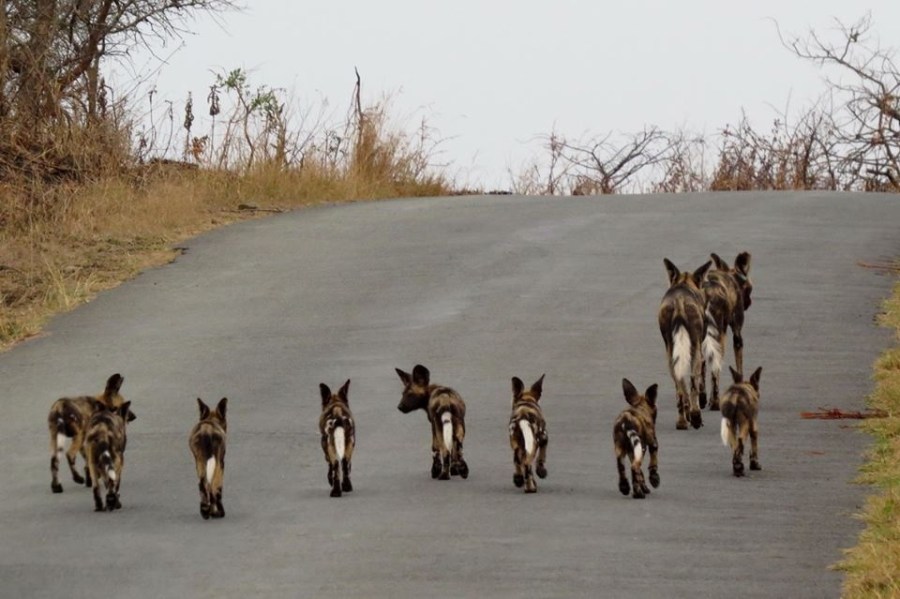
Three Dingo pups — one of them camera shy. (Source photo: Internet)“Parents have to work hard to feed a big family. We hope you’ll think about that, Mr. Attenborough. Goodbye for now ….. C’mon, kids.” (Photo source: Internet)
Can we hear the awkward movements of a ménage à trois between Fine Gael, Fianna Fáil and the Green Party shuffling hesitantly into view? Given yesterday’s Red C poll in the Business Post this may well be the last opportunity for Micheál Martin to consummate his desire to become Taoiseach as his party continues to […]
The Herriko Tabernak (People’s Taverns) are a feature of Basque Society, in particular in the Southern Basque Country, i.e the part under Spanish control. Founded by members of the Abertzale (pro-Independence) Left, run by supporters and frequented by sympathisers, they have been a place to have a drink and some pintxos, have a coffee and chat with friends, hold social events and large group meals, as well as occasional meetings. The Spanish State is now seizing their funds.
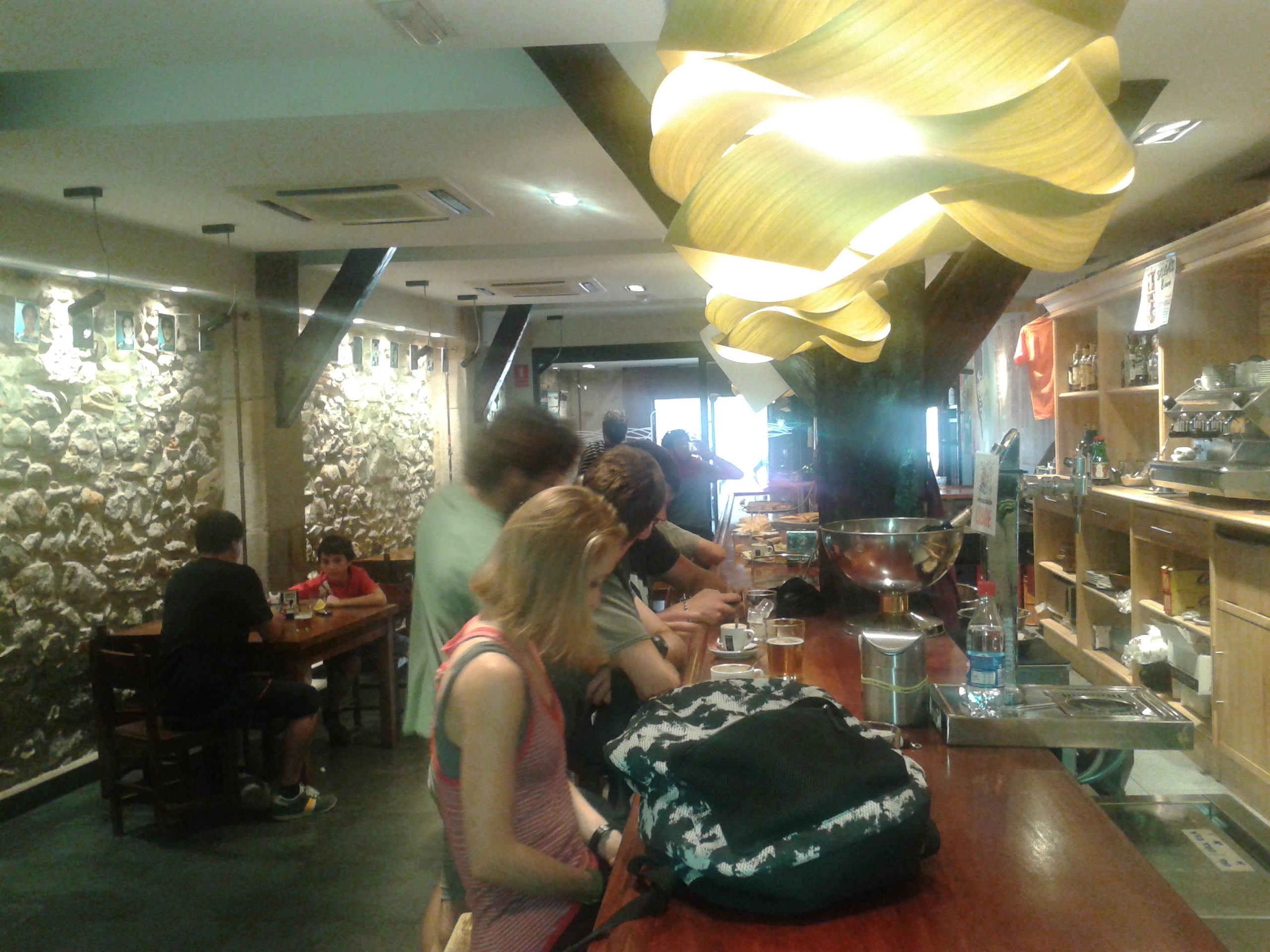
One of the Herriko Tabernak in Bilbo, this one in Errondabide, Casco Viejo; view from the back towards the entrance and street. Photo: D.Breatnach 2015)
In 2016 the Audencia Nacional, the Spanish National Court, handed down a judgement that the funds of these taverns are forfeit, in what the Abertzale Left party Sortu called “the greatest political and economic plunder since the Civil War”. This is a reference to the wide-scale misappropriation of funds, machinery and land of the losers of that war by the victors, General Franco and his supporters. The wealth of many individuals and families in the Spanish State today can be traced back to that theft.
They will not be served alcohol! Parents often meet at the Herriko for a while after collecting their children from the Basque-language pre-schools. (Photo: D.Breatnach 2015)
While a number of these taverns were closed down in the past, most kept going, supported by their loyal clientele and local communities. Although the punitive judgement of the Audiencia against the Herrikos was in 2016, its origin dates back further to the reign of one of the Audencia’s ex-judges, Baltazar Garzon, who infamously claimed that every aspect of Basque independent expression was linked to the armed organisation ETA. Baltazar, loved by liberals, claimed that “everything is ETA”, under which dictum homes were raided, activists tortured and jailed on their “confessions”, political organisations banned, social and cultural centres closed, along with newspapers, radio stations and social media.
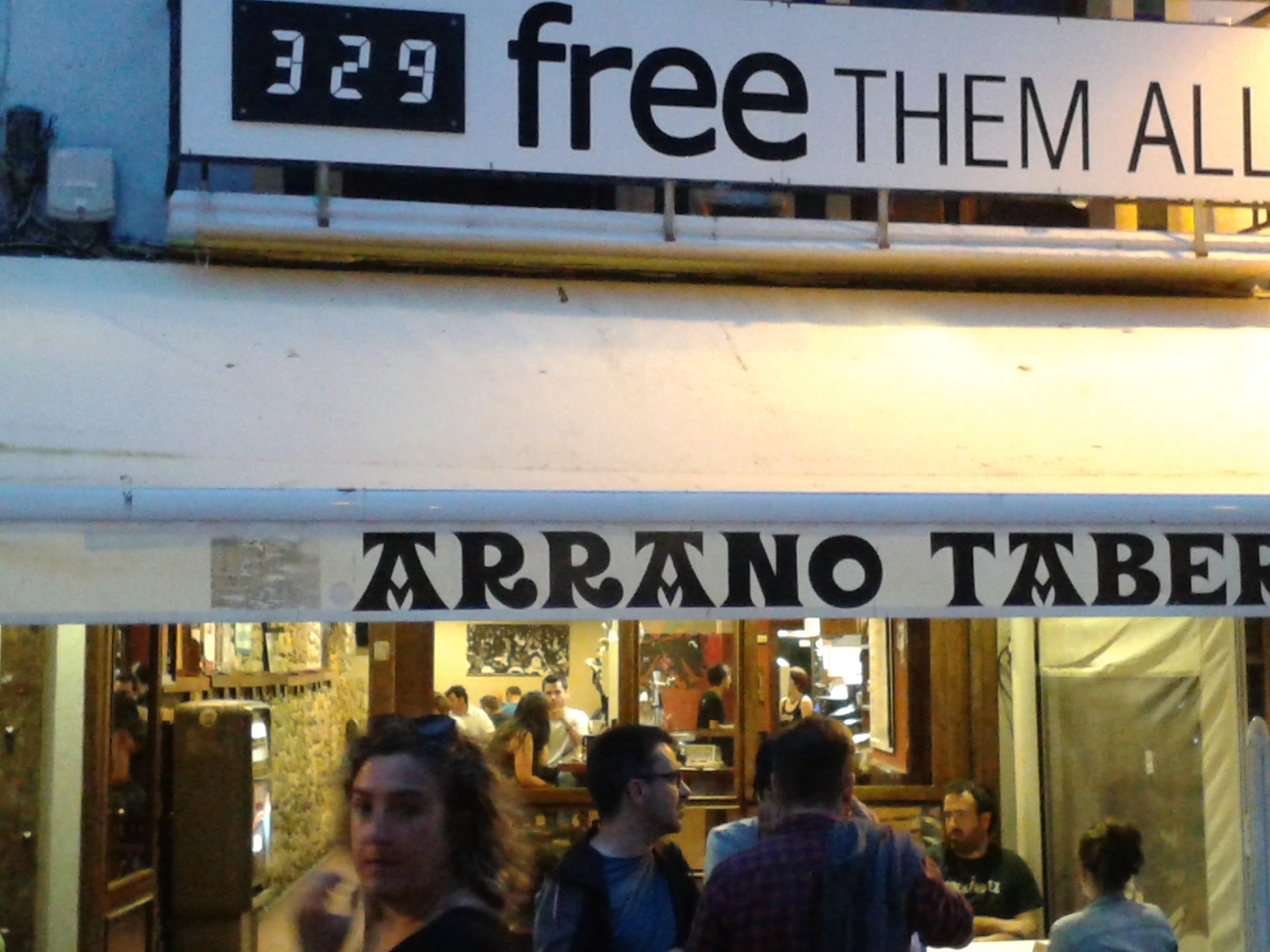
Arrano Herriko Taberna, Zarautz, Gipuzkoa province, southern Basque Country. Banner above it calls for freeing of the officially-recognised Abertzale Left political prisoners. (Photo: D.Breatnach, 2018)
Some modest afternoon pintxos available in the Errrondabide Herriko (Photo: D.Breatnach 2015)
EXPROPRIATION TAKES PLACE DURING A MILITARISED LOCKDOWN
This expropriation is taking place, as commented the left-wing media Izquierda Diario, in the midst of an emergency pandemic lockdown in which more than 7,000 sanctions in little over a month have been applied by the military and police who are in charge of and patrol the streets. (Unlike Ireland and many other countries, people in the Spanish State are not permitted to take exercise outside their homes, whether maintaining social distances or not).
“While the judicial apparatus cannot process the massive claims of illegal dismissals, unpaid wages, unpaid ERTEs” (temporary compensation for loss of earnings due to the pandemic) commented the Diario, “or thousands of resources for fines during these days for the restrictions of the pandemic, yes there is time to seize the money of more than 100 taverns.”
COMMENT
Cafe esnea and “Bring the prisoners home” serviettes, Herriko Taberna. (Photo: D.Breatnach 2015)
While it is true that in many areas there are privately-owned bars sympathetic to the movement and that also in many areas dissenters from the line of the Abertzale Left official leadership decline to use the Herrikos, nevertheless the disappearance of the latter must entail serious damage to the social and cultural base of the broad Basque independence movement.
end.
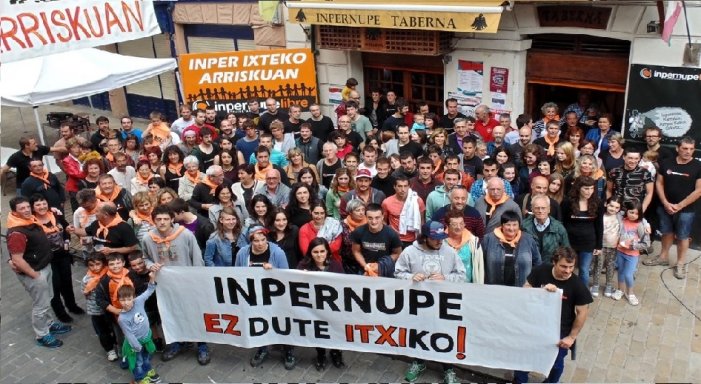
Protest against the original judgement by some supporters of the Herriko Taberna of Inpernupe, Zumaia (scene of some of the Game of Thrones footage), Guipuzkoa Province, Southern Basque Country. Banner declares “Ipernupe will not close!” while another in background declares it is in danger of closing. (Source photo: Izquierda Diario)
Gárdaí ‘can’t’ enforce social distancing on visitors from the Six Counties…!
Diarmuid Breatnach
(Reading time text: 5 minutes)
Irish Republicans looking at the sub-headline could be forgiven for bursting into laughter, for the Gárdaí, in particular the Special Branch, the political police, have never had any reluctance in harassing, arresting and even refusing bail to Republicans from the Six Counties.
And likewise with their counterparts on the other side of the British Border, who have never had much problem enforcing and even exceeding their laws with regard to Republicans from the Twenty-Six counties.
However, according to a news report in today’s breakingnews.ie, day-trippers from the Six Counties are flooding into the picturesque coastal areas of County Donegal and ignoring Coronavirus-19 legislation. The report says that the day-trippers are from “Northern Ireland” which is nonsense of course, since Donegal is the real Northern Ireland, i.e the northernmost geographical point of the country. And it is in Ulster too, though not under British occupation.
Anyway, back to the main issue in the report, which is that Donegal residents have been complaining that the Gardaí there are not enforcing social distancing on day-trippers from across the Border.
Garda Checkpoint Donegal (Photo source: Internet)
It appears that the Gárdaí were applying the Coronavirus-19 restrictions but were told that they could not. Why would this be? The laws against theft, assault and public disorder apply not only to residents in Ireland but also to visitors – why would laws intended to control a pandemic be any different? Indeed, one would think they’d be, if anything, more enforceable.
Meanwhile, “a Gárda statement” quoted in the report states that “anyone visiting the State even temporarily is amenable to such criminal laws of this State while visiting here.”
So it’s the law, applies to everyone including visitors, so … what’s the problem?
There is a saying that states that “where there’s a will, there’s a way” and it is difficult to see an explanation in this case other than that for some reason there is no political will to enforce the law on visitors from the Six Counties. Of course, if they were Republicans attending some Republican event, well in that case ……
“THE VIRUS DOESN’T RESPECT THE BORDER”
According to a number of Donegal public representatives, local people have been bombarding them with complaints about the incursions and the lack of Gárda action. Councillor Jack Murray, from the Inishowen area, saying he had been “inundated” with complaints about Gárda failure to apply the legislation to people from the Six Counties, said that “the virus does not respect the Border and tackling it should recognise that.” Pádraig Mac Lochlainn, a TD (member of the Irish Parliament, the Dáil) for Donegal, lives in Buncrana, a popular destination in the holiday season. “This error is unacceptable,” he said, “considering that all government legislation goes through the Attorney General’s office.”
Clearly, a rational response to the pandemic would require either an Ireland-wide approach or a strict closing of the Border between the two administrations. The authorities on each side have done neither.
At the end of February, the first person recorded positive for the virus arrived in Dublin from Italy aboard an Aer Lingus plane and was permitted to travel on to Belfast – she is/was a resident of the Six Counties. No quarantine was ordered for the rest of the passengers. And so on.
Ineptitude of Governments apart, it has never made sense to partition Ireland on economic, geographical or human rights grounds. Now we see that it doesn’t make sense on grounds of pandemic control either. How does it make sense? Well, on the wish of the rulers of Britain to keep a foothold in Ireland and of their loyal subjects in the Six Counties to remain in domination of that foothold.
Cartoon DB
GENERAL PROBLEMS WITH 2Km LIMITS
To be honest, I have never seen the point of the 2km limit. Is it the case that you can infect or be infected by someone outside the 2km limit but not inside? Of course that does not make sense but how does this limit make any sense otherwise?
I don’t drive a car but if I did and were to get in my car in my garage, drive out to a secluded spot on the mountains, get out and walk, then return to my car and drive home, how would I have endangered myself or anyone else? If I went to a park or beach outside the 2km limit from my home and, while there, kept my distance from other walkers, how would I be endangering anyone?
The danger in general, we are told, comes from physical contact with people or being within two metres of them, when droplets from an infected person may reach us. Would that danger be reduced if everyone were obliged to wear a face-mask of any kind? Clearly. Yet not only are we not obliged to wear such masks in public but we are being actuallydiscouraged from doing so by statements from the HSE (and also from the WHO). Would the danger be reduced if, in addition to wearing masks, we wore gloves in public and had a safe procedure for removing them at home? Obviously – yet we are not being informed, never mind encouraged, in this regard either.
When plants first “crept” out of the sea and freshwater on to land, it was a perilous undertaking. The shore and in particular the sea shore is a very hostile environment, subject to battering and scouring action of wave, wind and wind-driven sand, alternating between inundation and desiccation and even both in the same day. Those early plants were not just explorers but colonisers and innovators; many died but those that survived changed the world, its very earth and atmosphere.
There are about 320,000 known species of plants, a total that does not include most hybrids, sub-species or selectively-bred varieties. Botanists exclude from the term “plants” some of the green and all of the brown sea algae as well as the fungi and bacteria. The vast majority of plants are coloured some variety of green because of the action of photosynthesis inside them, which attracts the blue and red ends of the light spectrum but does not absorb green, which is why we see them in that colour. Some 260,000 to 290,000 species produce seeds but algae does not. Mosses and ferns, which are plants, produce spores instead, in common with fungi (which however are not plants).
We study life to place it in an order, to simplify understanding but life diversifies into a huge array.
Plants are pioneers, colonisers, innovators and builders at least comparable to the animal kingdom, to which they are related and, I would argue, with a superior record.
LAND HO!
Plants first “crept” out of the sea and freshwater during the Ordovician period, around 470 million years ago; they were non-vascular (without “veins”) and without roots, like mosses and liverworts. It was a perilous undertaking. The shore and in particular the sea shore is a very hostile environment, subject to battering and scouring action of wave, wind and wind-driven sand, alternating between inundation and desiccation and even both in the same day. Plants on land carry the genes of the early explorers, pioneers, survivors – high in endurance, adaptability and innovation.
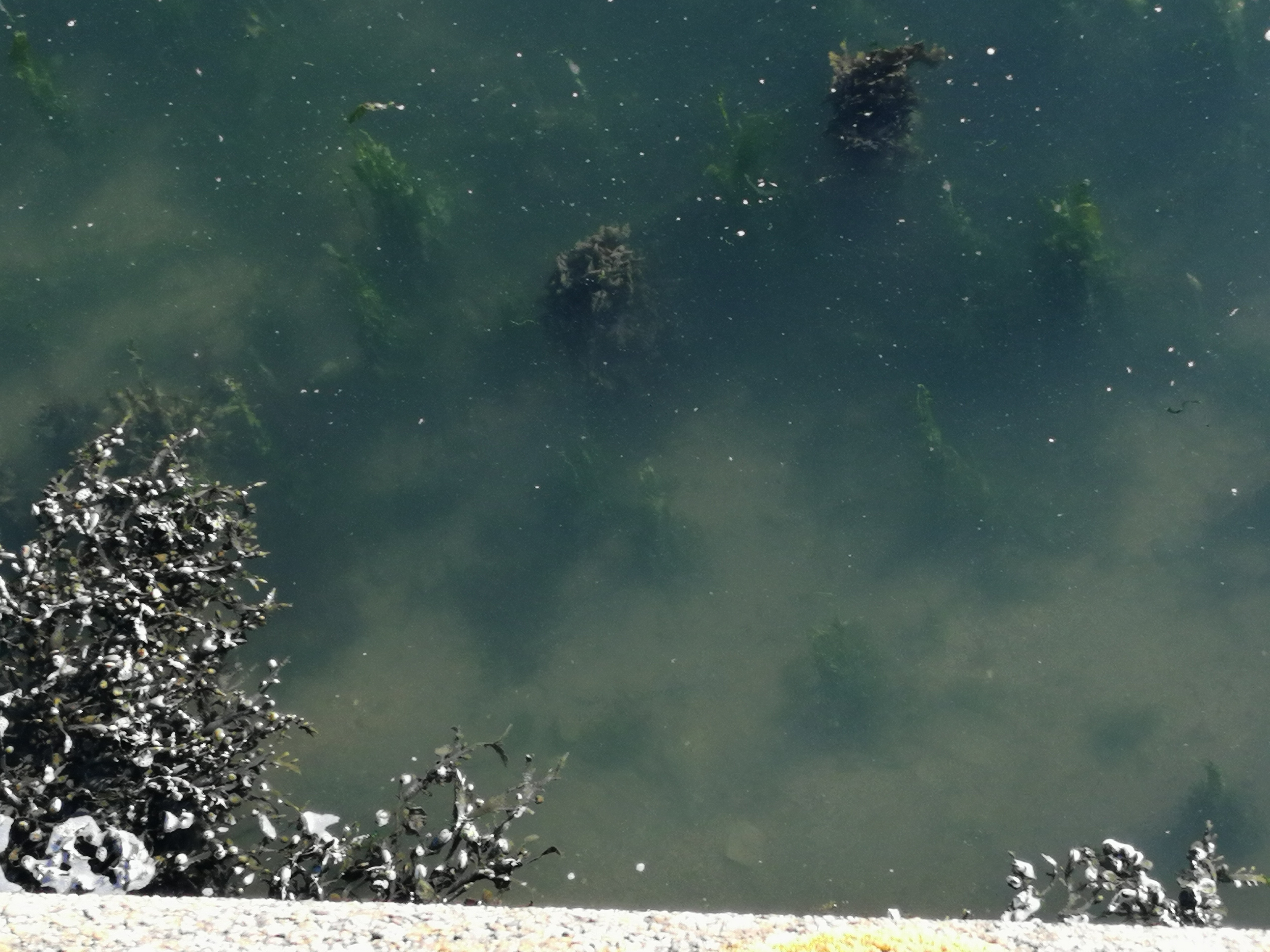
Brown & Green Algaes in shallow seawater (the brown uses floats to stay upright but the green doesn’t need it. Just almost out of view is a yellow lichen colonising the stone sea-wall. (Photo source: D.Breatnach)
But why abandon the seas, lakes and rivers in the first place? Presumably there is always a pressure in nature to explore niches and new territory, thereby escaping pressures of population, predation, competition and consumption of available nutrition … And while some life-forms specialise in particular environments and nature also pressures in that direction, ultimately that is a highly dangerous strategy, general adaptability to food sources and environments being the best bets for long-term survival and multiplying – as shown by homo sapiens, for example.
First ashore, establishing a literal (and littoral :-)) beachhead, might have been a kind of algal slime. Perhaps it survived only while wet, died, was replaced by other migrants …. but probably at some point some carried survival pockets within them, able to regenerate when moistened anew. Or it might have been some moss or liverwort, later a branched and trailing plant but dealing with the same problems and developing a similar strategy for survival.
We can imagine a conversation, in which one plant organism on the shore questions another:
“It gets so dry here I feel I am going to wither and blow away.”
“Just hang on there. We’ll get rain soon. And there’s always dew at night.”
“I can hardly wait. Remind me why we didn’t stay where were were, with all that lovely moisture.”
“Getting eaten by other life-forms. Competition for light.”
“Oh, yeah. Sometimes I forget.”
REACHING DOWN, STANDING UP
In lakes, plants could simply float upright in the water reaching towards the light (and avoiding being covered in sand or silt) as many water plants do today, or on the surface, as algal mats and bloom do, or for example the various types of “duckweed” that not only float but multiply to cover the whole pond surface. In the sea and in fast-flowing rivers however, fixed plants needed to grasp surfaces and developed means of doing so; but these were not roots as such – more like anchors. Later, as they colonised the land, most plants did indeed develop roots not only to anchor themselves in the ground or to cling to difficult surfaces but also to bring up water, the tap roots for this purpose often going quite deep. Roots also brought up nutrients.
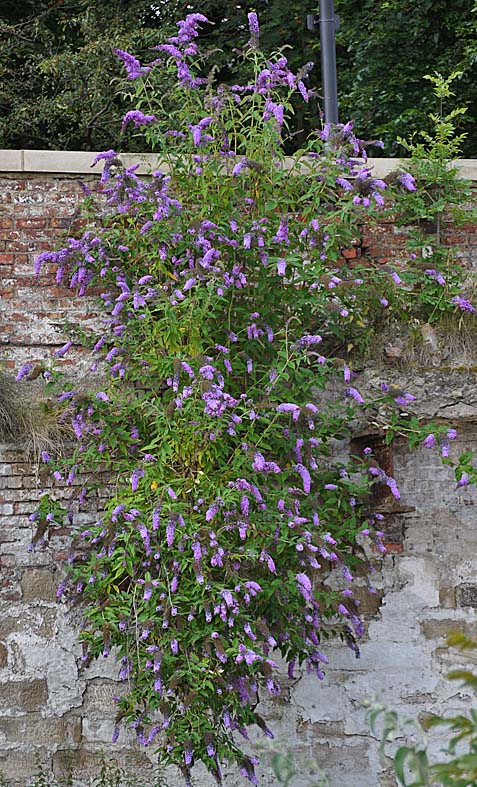
The roots also made it possible to cling to inhospitable surfaces, including even the perpendicular or overhanging and also to exploit cracks and fissures by tunneling into them. In the course of this activity, plants changed their immediate physical environment, by helping to break down stone and also by trapping material blowing in the wind.
Buddleia bush clinging to a wall in Dublin (Photo source: D.Breatnach)
But why set up home clinging to a cliff or today, a wall or a chimney stack? Well, plenty of sunshine, for one thing, no competition for another! Of course, not much soil there or even none at all for nutrition – but still, most things in life are a trade-off, right? How did the seeds get up there in the first place? Wind … or birdshit.
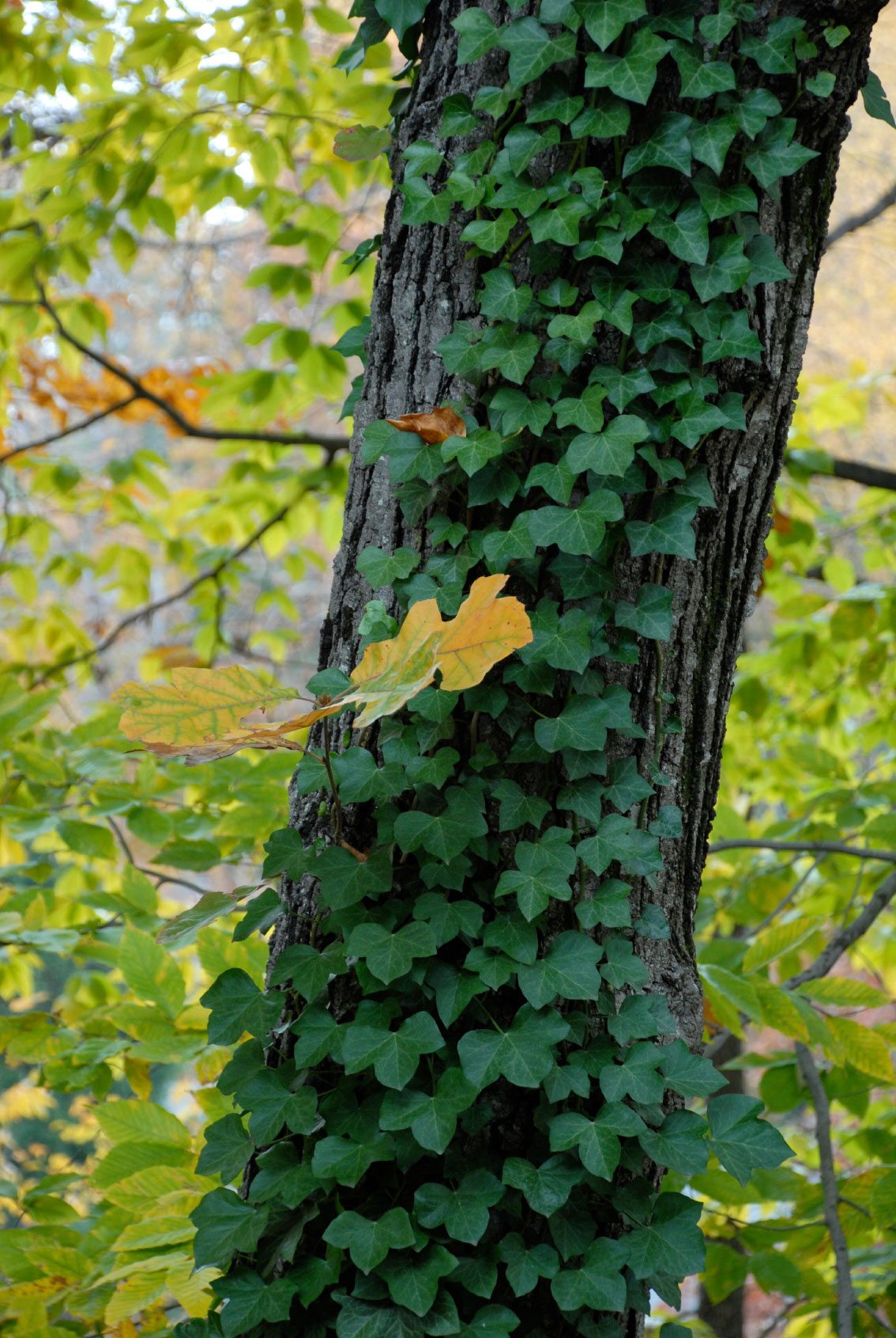
Ivy making its way up a tree trunk. (Photo source: Internet)
Of course, some of the colonisers developed other ways to cling to surfaces, as was the case with the mosses, lichens and liverworts. And they also trapped material and contributed their own to it as they died, regenerated, died …. But without roots that only works when you keep low and hug the ground. If you want to grow tall to reach for sunlight and if you want to exploit soil, you need roots.
Plants at first fed almost exclusively on sunlight it seems, broken down into sugars by chlorophyll in photosynthesis. But those that developed roots also, probably as anchors to prevent themselves being blown or washed away, or to help them grow tall and compete with other plants to catch the sun, learned to draw up water and to feed on nutrients in the soil – phosphates, nitrogen, potassium etc. Some, like the legumes, beans, peas and gorse for example, even learned to extract one of the gases that make up air, nitrogen and, with the help of a bacteria, to fix and store nodes of it around their roots.
Once you have roots, why not grow stems, branches, trunks, whereby you can reach higher and higher, for more unimpeded sunlight and outpacing the competition perhaps. Your building material will need to be tougher, especially for trees, bushes and shrubs, to bear the weight, withstand the winds …. but flexible enough to stretch as you grow. Having the ideal material already in cellulose, all that is necessary is some kind of hardening process. A plant might explain to puzzled humans: “Think of keratin and how the same basic substance has been used to make stuff as varied as feathers, fur, human hair and beetle carapaces.”
If you were a plant that had learned to spread fast over distances to catch the sun, covering ground and clambering over obstacles, you might find one day that there is another way to reach towards the sun – climb up the plants that are reaching up there! Don’t invest in slow build-up and hardening of cellulose – go for fast growth and gripping or winding ability instead, or turn some of your leaves into grasping tendrils. Some climbers such as lianas in the tropics and ivy and honeysuckle in Ireland, are perpetual climbers, remaining in position throughout the year (although the honeysuckle will lose most of its leaves in the Autumn) and extending during the growing seasons. Others climb only in the Spring and Summer and die afterwards, for example bindweed and runner-beans.
Runner Bean plants climbing a support structure (‘tower’) in a garden. (Photo source: Internet)
ENVIRONMENT-BUILDERS
Most plants have leaves, which is where the photosynthesis takes place; they are in fact sunlight collectors and the plants deploy them to best effect to catch the available sun. Quite a late development, they were flanges on the stems first before becoming appendages further out of the plant’s main body. Most leaves are intricately veined and contain many different layers and parts and it is within them that photosynthesis takes place but strangely, they are mostly short-lived and in cold seasons even in perennial plants, with a few exception, all but the conifers let them fall.
The greater the volume of material created by plants, the more there was to decompose with their deaths or seasonal decline. Bacteria, already long existent on the planet, evolved to feed on this detritus and break it down into soil, which the same plants or others could turn to their advantage as a medium in which to anchor but also from which to draw nutrients. Other organisms evolved to live on and break down cellulose too, the main building material of plants: fungi, gastropods like snails and slugs, woodlice, termites …..
The plants, with the help of bacteria and other organisms, were creating the environment below them!
But they were and are doing more than that: they are also creating an environment immediately around them. The most concentrated examples are perhaps rain forests, tropical, temperate and cold-climate, retaining a surrounding moisture-laden air, in which not only the local tree species thrive but also providing ideal environments for ferns, algae, orchids and epiphytes and, of course, mosses.
Away from forests, sphagnum moss creates a mini-atmosphere around itself and as generations die, their bodies create a spongy moisture-laden medium. This bog is quite capable of existing on an incline, with much of the water being retained by the vegetation and ‘soil’, as may be seen in a number of examples in Ireland, such as parts of the Dublin and Wicklow Mountains.
Close-up of sphagnum moss, creator of its own environment and changer of landscape. (Photo source: Internet)
Temperate Rainforest, Fraga do Eume park, Galicia, Spanish state. Despite the deforestation of Ireland during centuries of British occupation, areas such as parts of Wicklow arguably qualify for the description “rainforest”. (Photo source: Wikipedia)
Plants, especially trees, discharge oxygen into the air and consume carbon dioxide during the daytime, for which reason they are sometimes called “the lungs of the world”. They have not only created an environment for themselves, below, around and above but also for so many other life-forms – including ourselves.
LEARNING TO LIVE IN DIFFERENT CLIMES
Plants that adapted to grow in arid areas developed fleshy ‘leaves’ and often stalks, in which to store water and sometimes long tap roots to find that water. But extensive shallow root networks are good too, to collect the occasional rain water that is quickly absorbed into the soil or otherwise evaporates. The “pores” on leaves through which plants absorb carbon dioxide and allow the gas-exchange necessary for photosynthesis (stomates) also permit evaporation of water, hence many dry-condition plants have fewer of them. Some only open to collect carbon dioxide in the cool of the night and store it for use on the following day. Plants grow trichomes, tiny bristles, underneath their leaves but some arid-dwellers grow them also on top of their leaves; these ‘trap’ a layer of air that prevents or slows evaporation.
In very wet areas, plants learned to remain active by a number of strategies. Of course they originally came from aquatic environments but for some of them, returning there again after adapting to dry land, produced challenges (think of the changes necessary for land mammals to evolve into seals, otters, dolphins and whales). Nevertheless we have lilies growing in shallow water with wide floating leaves, rushes with upright blade-like leaves growing inside the water margins, thin spears of rushes in damp and water-logged land. That too is the preferred environment of some other plants and grasses, including the rice plant. And of the willows, alders and hazels growing on the banks and stabilising them. In the tropics and semi-tropics, mangroves do a similar job to willows but on a much grander scale – and they tolerate seawater too.
Selection of waterside plants, reeds and different types of willow tree, growing along the Royal Canal, Dublin, yesterday. (Photo source: D.Breatnach)Immature cones of the alder showing among leaves of the tree. (Photo source: Internet)
The alder, a tree with a high toleration of water around its roots, is thought to have been the major post-glacial coloniser of Ireland, following the retreating ice across the land. It is the only native tree which though not an evergreen produces cones, an indication of its early adaptation to cold climate. Cones, when closed, protect the seeds inside against continual freezing and thawing and, when the cones begin to dry and automatically open in spring and summer, allow the seeds inside to drop out to the ground, to be carried by river or on the wind. A closed cone collected and brought home will open as it dries; shake it then and the seeds will fall out. Alder timber, incidentally, remains waterproof for centuries, witness the wooden piles in Venice.
Adapting to cold seasons required protective materials, structures and timing. The deciduous trees (and it is worth noting that many trees have both a deciduous and an evergreen version for different climes) shed their leaves and close down for the winter, the sap retreating down to the roots. Were the sap to remain in the exposed branches it would freeze, expand and destroy them. The leaves drop because they no longer receive anything from the tree; it is going into a kind of hibernation, in preparation for the coming winter.
Many of the conifers have downward-sloping branches, to allow most of the snow to slide off, rather than break the branches with its weight. People who live in areas with heavy snowfall also tend to live under sharply sloping roofs. The “leaves” of the conifers are small, narrow and hard so that most snow falls through them and are also covered in a waxy polymer to withstand freezing. The plant cells can be emptied of water to prevent freezing but a dense waxy residue keeps them open for refilling. So, of course, they have to be tolerant of dehydration. Concentration of sugars also lowers the freezing point and small flexible conduits for water resist the formation of large ice bubbles that can burst those “pipes”.
AWARENESS
Seeds know which way is “up” and which is “down”, which is quite an amazing thing; the tap root of a seed, germinating in the dark, goes downwards while its shoot grows upward.
In fact, the plant seed also knows the right time to germinate – too early in many climes and it will be killed by frost, too late and it will have insufficient time to develop before the next cold period or will be unable to compete with other seeds that sprouted earlier, depriving the late-comer of sunlight and possibly nutrients. The decision is made by a number of factors feeding into a small cluster in the seed tip, consisting of preventative and initiator command centres. When the initiator section’s hormones exceed that of the preventative, it is time to germinate. Not very different from our brains’ decision-making process, is it?
Also, cut a living branch and often the plant will mobilise to produce one or more shoots at the cut-site. But should that cut be enclosed within soil, the tree or bush will produce roots instead – it ‘knows’ the difference. This knowledge the gardener takes advantage of when she “air-layers” a shrub or tree by nicking a branch, then covers the cut with soil wrapped in a plastic bag, waiting for a root to develop and then cutting the cloned sapling free, ready to plant.
Air-layering a branch, possibly from a a peach tree. The branch inside the wrapping has been cut, packed around with soil, to fool the plant into sending out a root. (Photo source: Internet)
Without eyes, plants are also capable of detecting where the light is; if one places a climbing plant seedling in a dark cellar with a small window high above, the plant will climb towards the window, striving to reach the light. The sunflower and the flowers of some other plants turn towards the sun, following its progress across the sky. Many flowers, including those of the dandelions and daisies all around us at this time of year, close when the day ends. A “Swiss Cheese Plant” I once had managed to slip one of its suckers — like a long surface root — down the back out of sight and when I eventually discovered it, the sucker had gone under the carpet and had extended around six feet towards the window.
Of course, it may have been searching for moisture.
Plants can sense moisture and do go looking for it, something at which eucalypts are particularly adept. Unfortunately, this can cause problems for other trees and shrubs growing in the same area, as the eucalypts suck up the water from greater depths (the eucalypt doesn’t care however nor do some of its planters). During the severe drought in parts of the USA last year, it was reported that trees were breaking open water pipes with their roots to get at the precious liquid. It appears that the reports were mistaken but instead the roots were extending towards the detected moisture from leaks in the pipework. Of course, then the roots might widen the gap ….
Some plants at least are also ‘aware’ of being attacked, for example by an infestation of caterpillars. Those that have reserves of a defensive poison at their disposal are not only able to deploy it but also to communicate to other nearby trees of the same species, so that they too deploy the poison – before the caterpillars have even reached them! It is thought that the trees communicate underground, through their roots.
Plants also know when their offspring have reached enough numbers and a sufficiently advanced stage so as to put their energy into maturing them, rather than producing more growth or even more seeds. Presumably they receive a chemical signal when enough roses have bloomed, been fertilised and the rose hips, the fruit containing the seeds, are swelling. Likewise when the beans inside a runner-bean pod have swollen and will shortly be ready to burst the pod and drop to earth. Gardeners know how to fool the plants into continuing to produce for a longer period by “dead-heading” dying flowers and picking runner-bean pods when they are still very young.
THORNS, SPINES, POISONS, GAS – AND HELPERS
Among the many features that plants have developed are an impressive array of defences. Filamentous algae, with low mass investment and constantly renewing, probably did not need defences nor perhaps did the plants that first came ashore. Defence against what, after all? But later, as soon as animal life began to develop on land …..
Here in the north-west of Europe we are familiar with thorns and spines on the trunks and branches of the rose and briar, blackberry, gooseberry, gorse, blackthorn and hawthorn. It is not always on the trunks and branches that the sharp spikes are to be found, as we are reminded by the prickly leaves of the thistles and holly. Thorny and spiny defences are repeated around the world on other plants from acacias to cacti and many others. Thorns stab, rip and tear but spines lodge in the skin and continue to irritate, some forming sites of infection.
Well at least you’re safe among grass, right? Not necessarily, for example the dune builder grasses, marram or beach grass, can cut the skin of mammals moving through it. In other parts of the world they have aptly-named ‘sword’ and ‘saw’ grasses. Some of these cut with a thin edge but many with tiny hair-like spines growing on the underside of grass blades, called trichomes, defend against herbivorous invertebrates but may also cause “grass itch” in some people.
Mostly, these are a defence against grazing animals or protection against the theft of the plants’ fruits. Other plants have developed poisons, which they employ not only against mammal and bird grazers but also against insects such as caterpillars (as commented earlier) and locusts; examples in Ireland are the foxglove and the deadly nightshade or belladonna, a relative of the tomato and potato. Another is the hemlock, a relative of the carrot, parsley and angelica plants – even its sap can burn your skin. An invasive shrub or small tree, the cherry laurel, carries arsenic within its wood, leaves and berries and can be seen in many gardens, parks and growing wild around much of Wicklow.
Belladonna or Deadly Nightshade plant in flower with some immature berries (ultimately rich purple colour). (Photo source: Internet)
But trees have also been observed to emit chemical compounds that attract the enemies of parasites or grazers feeding on the trees.
Poisons can be employed against competing plants too, as does the hydrangea, a shrub with lovely luxuriant flowers in your garden (or indeed in a public park in Howth) but a seriously invasive plant in the wild as it eliminates its competition and grows unchecked. It does this by a relationship with a bacteria around its roots that produces a poison to kill competing vegetation. However, the native pine also produces an allelopathy in its discarded needles, inhibiting the germination of other plant seeds and growth – it is not only the blocking of sunlight that keeps pine forests so free of undergrowth.
The onion carries an aroma warning that rough handling of the bulb will produce a gas attack on eyes and nasal passages, as known to any who have handled them in food preparation.
Plants employ some poisons continually but others selectively, as in ripening seeds (for example in the seed pods of the laburnum) or in sensitive growing tips (for example the fiddleheads or curled growing tips of bracken, toxic to grazers). The daffodil is a lovely plant and safe to handle but digging up the bulbs and mistaking them for wild onions can have fatal consequences for the eater. And as we have seen elsewhere, leaves can become poisonous as trees mobilise chemicals from tree to tree when under attack by caterpillars.
Growing tips of the bracken fern, known as “fiddleheads” – poisonous to grazers. (Photo source: Internet)
However, some plants welcome insects as protectors too, as for example with a species of ant that lives in some acacias and helps keep the tree free of pathogens.
When considering plant poisons we are reminded too of the stinging nettle, which introduces its defence to us in childhood, never to be forgotten. In North America, one would always remember a brush with its poison ivy. The Giant Hogweed, also a member of the carrot and parsley family but invasive to Ireland, causes a very painful rash following bare skin contact.
There are many localised wars going on out there.
FLAUNTING FLOWERS – AND FLIERS, SAILORS, ROLLERS AND HITCHHIKERS
Along with all their other innovations, plants evolved some very impressive ones in procreation, particularly in dispersing the next generation. Pollen, a fine powdery substance that is the equivalent of mammal sperm could be and was spread by the wind. The development of the flower and blossom brought in a partnership with animal pollinators to greater efficiency. Attracted by nectar and to some extent pollen, both insects and some birds visited male plants flaunting their flowers and unconsciously picked up pollen which they deposited at another flower they visited, thereby soon fertilising female flowers.
Flowers were developed in a huge variety of shapes and colours in order to attract pollinators — and then came smell. Some botanists speculate that scent was first used by some plants to discourage insects and grazers which, if true, is amazing enough. To then go on to develop scent to attract pollinators is a leap that staggers the imagination. Flowers and blossoms using smell are particularly noticeable at dusk and night, a time when flowers are hardly visible, when presumably they are visited by moths.
A hive honey-been, one of the most common pollinators, approaching a flower (perhaps a dandelion’s) intending to collect nectar and perhaps pollen but will certainly collect the latter inadvertently. Note the collection bag on its legs. (Photo source: Internet)
Early plants did not have seeds so the whole paraphernalia around them had to be developed from other existing parts with originally different functions (some of us could convert a bicycle, a machine for locomotion, into an electric power generator but still ….)
Behind the flowers of many species is a little node which when fertilised begins to swell and form a fruit, with the developing seeds inside — or single seed in the case of Prunus species, the plum family, for example. This is another amazing trick of the plant – it has produced attractive fruits, full of sugars when ripe, to attract animals (such as ourselves) to pick them and either discard the seeds as we eat the fruit or pass them through our gut to be deposited on earth — along with a handy dollop of manure. A botanist investigating the occurrence of isolated copses of trees on the grassy plains of the South American Pampas concluded that horses were eating the nuts of the parent trees some distance away then, as they travelled across the plains, at some point defecated with some intact nuts among their faeces: some years later – a grove of trees. Of course horses have only been in the Pampas for a few centuries and probably the other local grazers don’t eat saplings.
Nuts are also stored in different caches by some mammals and birds, for example here in Ireland by squirrels and magpies. They don’t always dig up all the stores later – perhaps they forget where some of them were – and in the spring, those nuts become saplings.
Well enough. But producing fruit and nuts is a lot of work and depends on the assistance of animals, especially mammals and birds, for dispersal. Some plants scorn to use them and instead employ the wind. Dandelions, thistles and many other plants send their seeds off on downy parachutes, often to land kilometres away. Some, like the sycamore, grow “wings” on their seeds which, when dry, spin away on the wind and not only that but when they strike mud are sometimes twisted by the wind on their “wing” to ‘screw’ the seed into the soil.
Many plants with pods, for example the legumes, will have their pods crack open when dry to “spill the beans” upon the soil. That is not good enough for the gorse or furze, the pods of which explode on a summer’s day, shooting the seeds away. One such day I sat among gorse bushes on Killiney Hill and was startled to hear what sounded like a weak pistol shot. Then another …. and another …. and all around me the bushes were shooting out their seeds, the lucky ones to create new bushlets (yes, I did just make up that word) the following year.
The casings of chestnuts, both edible and the ‘conker’ variety hit the ground, some cracking open as they do so and roll away from the tree. The casings of the edible ones are spiny, which no doubt afford the nuts inside some protection from being eaten (and trodden) until they are covered by fallen leaves or strike a root into the ground. Again, the lucky ones will become saplings and, enough sunlight (and goats) permitting, grow to become trees. The Mexican “jumping bean” rolls itself away from its parent, turning over and over, albeit slowly.
With fruit and nuts we saw plant offspring being cached or stowing away inside birds and mammals. But some hitch-hike on the outside too, like the burs that work their way into animal fur and into our woolen clothing. These are seed cases covered in tiny hooks, said to have been the inspiration for the invention of velcro fastenings in clothes. The cleaver or “sticky-back” may attach many of its small burs to a passing mammal, while the burdock, with its much larger burs, is more likely to hitch a ride in ones or twos. Tiny seeds of many grasses stick to wool, fur and hair too, especially when damp. But many other grasses with larger seeds, including cereals, grow “ears” with spikes attached to each seed and these too, when dry and ready to go, get picked up by the wool or fur of passing traffic.
Hitchhiker seeds — the ‘fruits’ of the burdock after flowering become a bur to attach to passing traffic. (Photo source: Internet)All aspects of the Cleaver plant (“Stickyback”), another hitchhiker for its seeds. (Photo source: Wikipedia)
The pines even use forest fires to spread seeds from inside their cones on the hot wind – each seed has a little vane around it to help it sail the wind. Sure, many will burn before they sail or blow into another fire – but some will survive. The alternative is just to burn.
The coconut, on the other hand, floats its fruit to distant shores – it is not for tourist brochures that the palms grew fringing tropical beaches. Falling coconuts roll away from the tree too – if they don’t hit some unfortunate large animal first. Many other plants use floods to populate different areas, often creating stronger banks or islands as their offspring grow, sometimes even changing the very course of a river or stream. The various willows and alders are adepts at this, as are many kinds of reeds and rushes.
The latter kind of colonisation may be by seeds but there are other methods too: severed branches or leaves that grow roots into water, uprooted saplings, tubers and bulbs. Bulbs, rhizomes and strings of tubers have been used by many plants to store food for offspring, nascent new plants hiding below or on the ground. Even when a field of potatoes is harvested, there are often tiny potatoes remaining that escaped the harvesting procedure – the following year, they may be seen, sprouting new plants.
Some plants are capable of employing all of the various methods of reproduction and distribution: seed, tuber, branch or leaf regeneration.
A somewhat similar method to strings of tubers – and possibly their actual origin – is the underground runner, like a root running just below and parallel to the surface, sending out shoots upwards and roots downwards at intervals, each of those becoming a new plant, a clone. Many grasses employ this procedure, some bunching close like the bamboo and others spreading away in different directions, as for example with the couch or scutch grass. The latter may be to the despair of the gardener, who however will use runners of the strawberry to grow new fruiting plants.
Grasses are a late and special kind of plant that can be grazed down to ground level and grow again, year after year. This provided a renewable food source for animals that could convert its leaves and seeds into sufficient energy – enter herds of goat and sheep, horse, donkey, zebra, deer, antelope, bison and cattle! And therefore enter their predators too, in particular the big cats, canines and – homo sapiens. She in turn would domesticate some of those species, including another predator as helper, the canine. That combination would change the world quite significantly and when homo sapiens learned to cultivate some of the grasses for their seeds, i.e cereals, well ……!
End.
NB:Thanks to Oisín Breatnach for editing work (all subsequent errors etc are mine) and Osgur Breatnach for reminding me of the onion in a separate discussion.