Yemeni Defense Minister Major General Mohammed Nasser Al-Atifi during a commemorative event held by the Ministry of Defence spoke a good lesson for the Irish ruling class:
Hesitation or retreat from Yemen’s supportive stance towards Gaza is impossible and not subject to negotiation or compromise.
Yemen’s powerful and resounding response to the Nazi entity is coming without hesitation or concern, and we will meet Zionist madness with Yemeni strength, which they have tasted in the seas.
We continue to develop our capabilities quantitatively and qualitatively, in accordance with the latest military building concepts we seek.
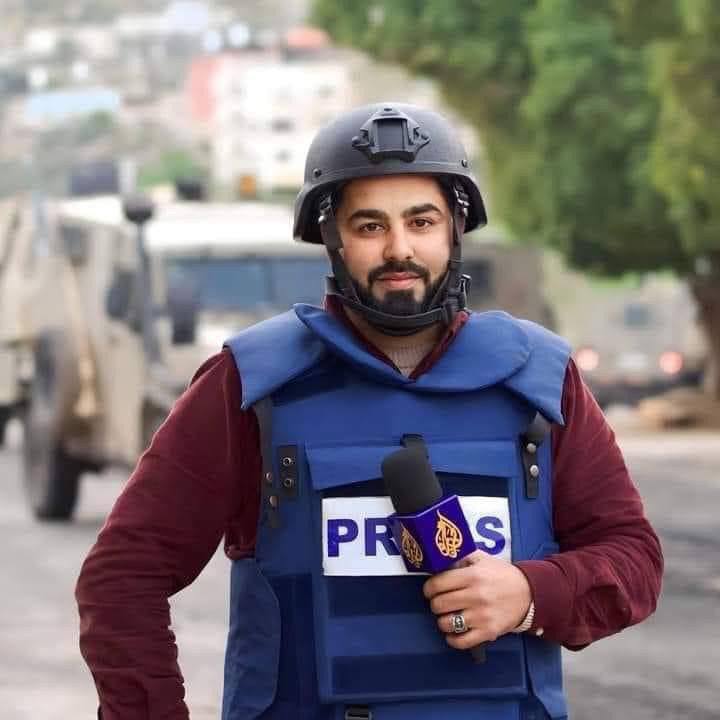
Major-General Mohamed Nasser Al-Atifi, Minister of Defence in Yemeni Government. (Photo sourced: Internet)
Yemen’s position is central in the Axis of jihad and resistance, in defense of the nation, its sanctities, values, lands, and our national security.
Yemen is on the path of liberation and independence, and will not accept any foreign subordination or domination. It will not be a backyard for any regional regime or subject to international guardianship.
National wealth is a sovereign resource, and we will not allow its waste, corruption, or neglect in its investment, in a way that serves the higher interests of all of Yemen.
We will not allow any threat to destabilize the security and stability of our country, and we will not accept the presence of any foreign forces on our land and islands.
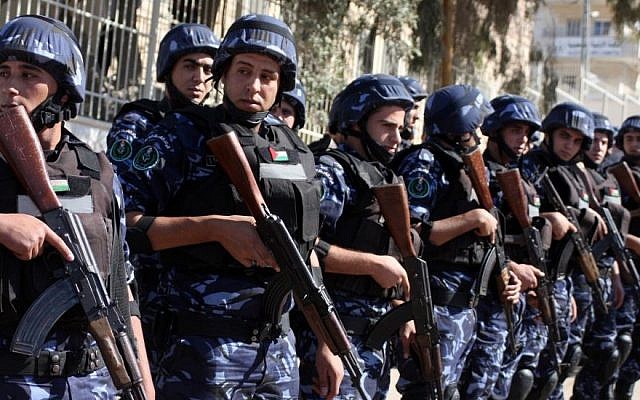
Major-General Mohamed Nasser Al-Atifi in planning conference with senior Yemeni military officers, August 2024. (Image sourced: Internet)
Thanks for those words as an example of national independence from Major-General Mohamed Nasser Al-Atifi. The Irish government on the other hand, as a management committee of the Irish ruling class:
Allows the partition of the country and occupation of six counties by an invader; also our air space and sea to be flown and sailed by UK and US warplanes and warships and our foreign policy dictated by NATO & EU.
And our natural resources and infrastructure sold to foreign companies and our educated labour force to be exploited by foreign companies.
Also, our produce taken by foreign companies and food we used to grow ourselves imported and sold to us in foreign-owned supermarkets, even our national airline sold to another country.
The photo of the massive antifascist rally in London on 28th July following a march from Russel Square shows the recapture of Trafalgar Square from Tommy Robinson and his sea of Union Jacks. Not for the first time, the Irish made their mark upon the place.
There the only two high flying flags were the Irish Tricolours and the Palestinian flags, the Irish contingent being one of the few on the day to see the fight in Britain against the fascists as part of the same fight against the fascist Zionist regime.
Irish and Palestinian flags in Trafalgar Square rally against racism, end July 2024 (Photo cred: PA)
We are mindful of the history of our occupied territories and our 1930s fight against the anti-Semitic Blackshirts1 in London (e.g. standing with the Jewish community at the Battle of Cable Street, 1936) and against the Bridgeton Billy Boys in Glasgow in the 1930s.2
On 28th July our flags sent out a message: We stand against all fascists, at home or abroad. That day we could not but remember all our brave men and women who marched past here from 1971 to 1998 carrying our fight to the heart of government3 in harder times.
We also know that the anti-racist movement now takes its new life from the strength of the Palestinian solidarity movement in Britain and needs to recognise this.
It was strange being in Trafalgar Square again with Tricolours given that we were barred from being there during the ‘Troubles’. Irish solidarity events were banned from using the Square under any circumstances from 1972 to 2001, well after the Good Friday Agreement.
The ban was lifted only once for an Irish event during that period and that was for the Peace Women4 (sic) calling for an ‘end to violence’ (mainly that of the Resistance) and famous US folk singer/ political activist Joan Baez displayed her ignorance of the Irish situation by speaking there.
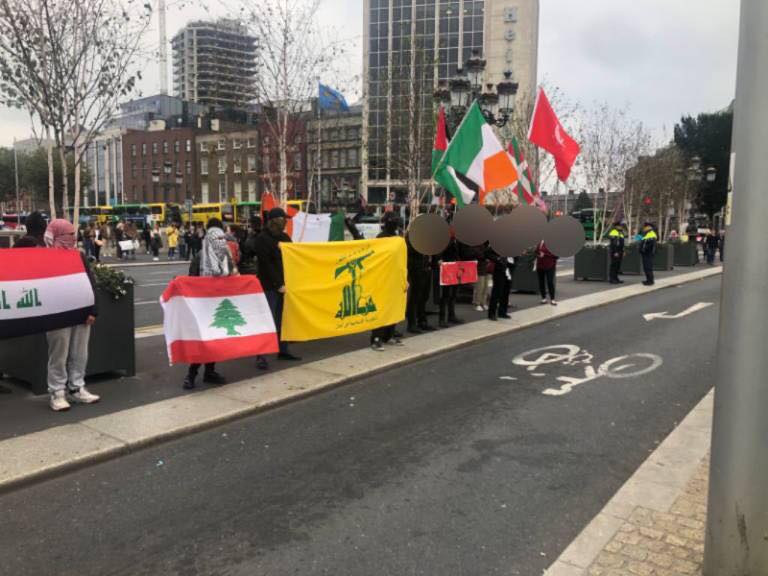
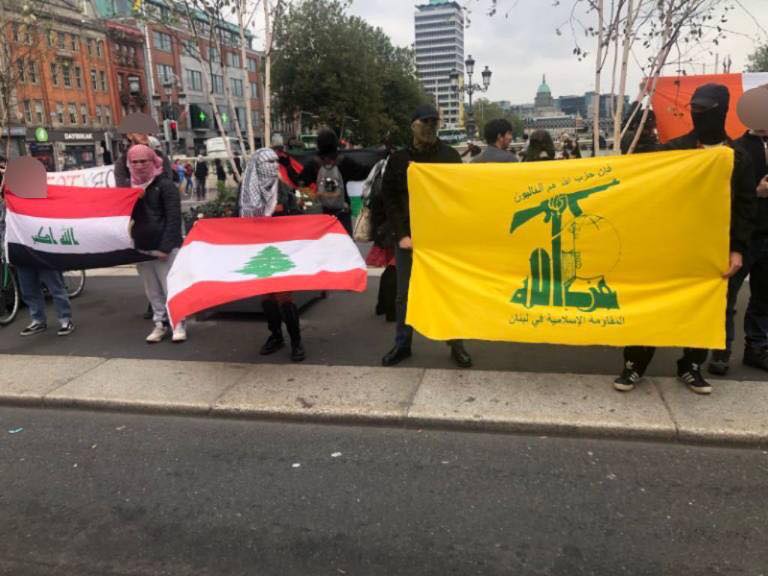
It was interesting that a reporter for GB News of the British mass media was aware that a picket had been held in Dublin in protest against the assassinations of Palestinian and other Arab resistance leaders. He tried to link the Irish contingent in Trafalgar Square with ‘support for Hamas’.
The linkage was hinted in his broadcast report though he was careful enough not to report a direct link as the Irish group in Trafalgar Square had in fact no connection with the Dublin group. The reporter asked how to pronounce ‘Saoirse Don Phalaistín’ — but still got it wrong in his report.
One of the Irish contingent spoke to the young GB News journalist: He had the stuff from Dublin on his phone and wanted to say that the Irish in the Square were part of the Dublin group.
“Next thing you’d know the Zionists would call for a ban on the Irish for ‘supporting Hamas’”,5 commented one of the veteran Irish activists. “We also get targeted because of the flag and our placards.”
The UK State and the police are all pro-Zionist and the Zionist press tries to trap the Irish into dangerous statements but “We know our history and are well able for them; we just say we support Palestinian resistance to Israeli occupation just as we did with the British in Ireland.”
Irish contingent with flags on Palestine solidarity march to Downing Street very recently (not sure whether the SW person is part of it). (Photo sourced from participant).
The Irish Tricolours, often in the company of the Palestinian national flag with Saoirse Don Phalaistín printed on it have been seen on Palestine solidarity marches in London since the current Zionist genocide began but also on anti-fascist rallies and in support of Julian Assange.
This is in keeping with the history and tradition of the Irish in Britain who helped found the republican United Englishmen6, the Chartists,7 many trade unions, a section of the First International8 and also gave the British working class their anthem9 and their classic novel.10
Classic novel of the working class in Britain was written by Robert Noonan, aka Robert Tressell, from Dublin. (Image sourced: Internet)
In later times they were prominent in organising solidarity with Vietnam and of course Ireland, against repressive legislation and fascist organisations, solidarity with Nicaragua, Palestine etc. and in struggles against state repression, including within the jails.
The Prevention of Terrorism Act (1974), forerunner of the current Terrorism Act (2000) specifically targeted the Irish community in Britain with suspension of habeas corpus for a period of up to five days, refusal of access to solicitor, as did also the framing of a score of people.
In the midst of the Irish Hunger Strikes of 1981, the Irish community broke out of the State terror stranglehold and formed the Irish in Britain Representation Group, among its objectives being the abolition of the Labour Government-introduced Prevention of Terrorism Act.
End.
Saoirse don Phalaistín and Irish Tricolour flags on Palestine solidarity march this year photographed against Westminster’s ‘Big Ben’. (Photo cred: being investigated)
NOTE ON AUTHORS
Pat Reynolds is a former trade unionist, social worker, a veteran anti-racist, anti-fascist activist, also for Irish independence and for rights for the Irish community in Britain. He was PRO for the Irish in Britain Representation Group for two decades, founding the Haringey Branch and the Green Ink Bookshop. Reynolds is from Granard in Co. Longford and lives in London.
Diarmuid Breatnach is a former trade unionist, worker with homeless/ substance misusers (manual worker before that), also a veteran anti-racist, anti-fascist activist and campaigner for Irish independence. For a decade he was on the Ard-Choiste of the IBRG, founder of the Lewisham Branch and of the Lewisham Irish Centre. Breatnach is from Dublin to which he has returned to settle.
FOOTNOTES
1The British Union of Fascists led by Sir Oswald Moseley which had substantial support in the British elite, including the publisher of the The Daily Mail with police attacks on anti-fascists.
2The Billy Boys were founded and led by Billy Fullerton, a former member of the British Fascists. Fullerton also later became a member of the British Union of Fascists in the 1930s. The Billy Boys adopted a militaristic style of behaviour, marching on parades, forming their own bands, composing their own songs and music, and all dressed in a similar manner.[3] The Billy Boys also formed a junior group whose members were teenagers called the Derry Boys. (Wikipedia)
3From Trafalgar Square to the Houses of Parliament in Westminster runs a broad thoroughfare, in the centre of which is the Cenotaph and a little further, the entrance to Downing Street.
4The organisation/ campaign was founded by Betty Williams and Mairead Corrigan in 1976 after a car driven by an IRA fighter mortally wounded by British soldiers in Belfast crashed into pedestrians and mortally wounded three children of Anne Maguire, sister of Mairead. Branding itself as against all violence the Peace Women in fact targeted primarily the Republican movement, secondarily the Loyalist paramilitaries and hardly ever the Occupation Army. Williams accused the IRA unit of having fired on the Army unit that killed the driver which was untrue (but is repeated on her Wikipedia entry). Both founders received the Nobel Peace Prize in 1976 and a substantial cash prize. Williams resigned from the group in 1980 and disappeared from Irish-related activities though prominent externally. Corrigan however remained politically active in Ireland and elsewhere against war and has campaigned among other things for the end of the ‘Israeli’ siege on Gaza, being arrested with crew and passengers on the Spirit of Humanity aid ship in 2009 by by the Zionist navy, taken to ‘Israel’ and subsequently deported.
5Hamas is proscribed organisation in the UK since March 2001 and a person promoting it would be liable to prosecution under the Terrorism Act.
6A spin-off from the United Irishmen in Ireland; the English chapter led the Spithead and Nore naval mutinies. The Irish also reformed the United Scotsmen when it was faltering.
7Karl Marx called the Chartists “the true mass movement of the working class” – two of its principal leaders, Bronterre O’Brien and Fergus O’Connor were Irish, as their surnames would suggest.
8The Fenians were accepted into the First International Workingmen’s Association.
9The lyrics of The Red Flag were composed by Jim Connell from near Kells, Co. Meath and set to the brisk air of The White Cockade, later changed to the mournful air of Tannebaum.
10The Ragged-Trousered Philanthropists was written by Robert Tressell (real name Robert Noonan) from Dublin.
April 2023: Leaked files reveal that British intel used local Yemeni NGOs and social media in a covert campaign to undermine the Sanaa government and influence the war-torn country’s peace process.
Kit Klarenberg
(Reading time: mins.)
The CradleEditor’s note:All Yemeni NGO employees, journalists, and other private individuals named in this article appear in the ARK documents seen by The Cradle.These Yemenis may be unaware of the UK’s role and/or intent in funding their activities.
Yemen’s civil war, considered the world’s gravest humanitarian crisis, appears to be nearing its end due to a China-brokered detente between Iran and Saudi Arabia, who support opposing sides in the bitter conflict.
Early signs suggest that the rapprochement between Tehran and Riyadh may not only end hostilities in Yemen, but across the wider region.
The US, Israel, and Britain have the most to lose from a sudden onset of peace in West Asia. In the Yemeni context, London may be the biggest loser of all.
For years, it provided the Saudi-led coalition with weaponry used to target civilians and civilian infrastructure, with receipts running into billions of pounds sterling.
During the entirety of the war, Yemen was struck by British-made bombs, dropped by British-made planes, flown by British-trained pilots, which then flew back to Riyadh to be repaired and serviced by British contractors.
In 2019, a nameless BAE Systems executive estimated that if London pulled its backing for the proxy war, “in seven to 14 days, there wouldn’t be a jet in the sky.”
A Typhoon at RAF Akrotiri, near Limassol in Cyprus, after striking Houthi targets in Yemen (Photo cred: Sgt. Lee Goddard/ AFP)
In addition to supplying weapons, the war also presented a golden opportunity for Britain to establish a military base in Yemen, fulfilling long-held fantasies of recovering the Empire’s long-lost glory days “East of Suez.”
Al-Ghaydah airport in al-Mahrah, Yemen’s far eastern governorate, has for some time quietly housed “a fully-fledged force” of British soldiers, providing “military training and logistical support” to coalition forces and Saudi-backed militias.
There are even indications that this involvement could extend to torture methods, which is a troubling reflection of one of London’s leading exports.
The Cradle has obtained exclusive information about a previously undisclosed aspect of London’s role in the proxy war against Yemen’s Ansarallah-led resistance.
It has been revealed that a multi-channel propaganda campaign, led by the intelligence cut-out ARK and its founder Alistair Harris, a veteran MI6 operative, has been operating in complete secrecy throughout the nine-year-long conflict – one that specifically targeted Yemen’s civilian population.
Anti-Ansarallah ops
Leaked Foreign Office documents have revealed that ARK’s “multimedia” information warfare campaign was designed to undermine public sympathy for the Ansarallah movement and ensure that the conflict would only end on terms that aligned with London’s financial, ideological, and geopolitical interests.
For instance, public acceptance of the UN’s widely unpopular peace proposal required propaganda support from local NGOs and media organizations that “support UK objectives” to “communicate effectively with Yemeni citizens” and change their minds.
It was also necessary to counter “new actors” in the information space that were critical of the Saudi-led coalition’s brutal bombing campaigns and the illegitimate, US-backed puppet government that the aerial assaults sought to protect.
Considering the high rate of illiteracy in the local population, ARK conceived the creation of a suite of “visually rich” products extolling the virtues of a Riyadh-dominated peace plan.
These products would be disseminated on and offline and would “deliberately include different demographics, sects, and locations to ensure inclusivity,” informed by focus groups and polling of Yemenis.
ARK’s campaign even extended to convening “gender-segregated poetry competitions using peace as a theme” and “plays and town hall meetings.”
Publicly, many of these propaganda products appeared to be the work of Tadafur – Arabic for “work collectively and unite” – an astroturf network of NGOs and journalists constructed by ARK.
Its overt mission was to “resolve local level conflicts” and “unite local communities in their conflict resolution efforts.”
The campaign began initially at a “hyper-local level” across six Yemeni governorates, “before being amplified at the national level.” Activities “[in] all areas and at both levels” had unified messaging across “common macro themes,” such as the slogan “Our Yemen, Our Future.”
In each governorate, a “credible” local NGO was identified as a messenger, along with “well-known” and “respected and influential” journalists who served as “dedicated field officers” across the sextet, managed by ARK.
In Hajjah – “a site of strong Houthi influence” – the Al-Mustaqbal Institute for Development was ARK’s NGO of choice; in Ansarallah-governed Sanaa, it was the Faces Institution for Rights and Media; in Marib, the Marib Social Generations Club.
In Lahij, ARK’s choice was the Rouwad Institution for Development and Human Rights; in Hadhramaut, Ahed Institute for Rights and Freedom; in Taiz, Generations Without Qat.
These local NGOs were instrumental in promoting ARK’s agenda and advancing the narrative that aligned with Britain’s objectives in Yemen.
The company’s roster of “field officers” comprised of individuals with various backgrounds, such as:
“Human rights abuse” specialist Mansour Hassan Mohammad Abu Ali, TV producer Thy Yazen Hussain, Public Organisation to Protect Human Rights press official and “experienced journalist” Waleed Abdul Mutlab Mohammed al-Rajihi,
Also producer from Alhadramiah Documentary Institute Abdullah Amr Ramdan Mas’id, editorial secretary of Family and Development magazine and the Yemen Times’ Taiz news manager Rania Abdullah Saif al-Shara’bi, as well as journalist and activist Waheeb Qa’id Saleh Thiban.
A Trojan Horse
Once ARK’s field officers and NGOs “successfully designed and implemented hyper-local campaigns,” coverage of “information around the related activities will then be amplified at the national level.”
A key platform for this amplification was a Facebook page called “Bab,” launched in 2016 with tens of thousands of followers who were unaware that the page was created by ARK as a British intelligence asset.
Under the guise of a popular grassroots online community, ARK used the Bab page to broadcast slick propaganda “promoting the peace process,” including videos and images of “local peacebuilding initiatives” organized by its NGO and field officer nexus.
“Campaign content will highlight tangible, real-life examples of compelling peacebuilding efforts that all Yemenis, regardless of their political affiliation, can relate to,” ARK stated.
“These will offer inspirational examples for others to emulate, demonstrating practical ways to engage with the peace process at a local level. Taken together, these individual stories form the broader campaign with a national message: Yemenis share a collective desire for a peaceful resolution to the conflict.”
When “high engagement levels” with this content were secured, Bab users were invited to submit their own, which demonstrated “support for the peace process.” They were explicitly asked “to mirror content ARK has produced, such as voxpops, short videos, or infographics.”
This was then “shared by the project and field teams through influential WhatsApp messaging groups, a key way of reaching Yemeni youth.”
ARK’s “well-connected communications team” would then “strategically share packaged stories with broadcast media or key social influencers, or offer selected journalists exclusive access to stories.”
Creating a constant flow of content was a deliberate ploy to “collectively be as ‘loud’ as partisan national political and military actors.” In other words, to create a parallel communications structure to Ansarallah’s own, which would drown out the resistance movement’s pronouncements.
ARK’s role in Yemen’s peace process
While one might argue that the non-consensual recruitment of private citizens as information warriors by British intelligence was justified by the moral urgency of ending the Yemen war quickly, the exploitation of these individuals was cynical in the extreme.
It amounted to a Trojan Horse operation aimed at compelling Yemenis to embrace a peace deal that was wildly inequitable and contrary to their own interests.
Multiple passages in the leaked files refer to the paramount need to ensure no linkage between these propaganda initiatives and the UN’s peace efforts. One passage refers to how campaign “themes and activities” would at no point “directly promote the UN or the formal peace process.”
Another passage says concealing the operation’s agenda behind ostensibly independent civil society voices “minimizes the risk” that “outputs are perceived as institutional communications stemming from or directly promoting the UN.”
Yet, once ARK’s campaigns began “performing successfully at the national level,” the company’s field officers planned to “build a bridge” between its local foot soldiers and national “stakeholders” – and, resultantly, the UN.
In other words, the entire ruse served to entrench ARK’s central role in peace negotiations via the backdoor.
Diminished western influence
At that time, the ceasefire deal proposed by the UN required Ansarallah and its allied forces to virtually surrender before Riyadh’s military assaults and economic blockade of the country could be partially lifted, along with other stringent requirements that the Saudis refused to compromise on.
Newly recruited Houthi fighters gathered for training outside Sana, the capital of Yemen – they became the Ansarrallah Army. (Photo credit: Yahya Arhab/EPA, via Shutterstock)
The US aggressively encouraged such intransigence, viewing any Ansarallah influence in Yemen as strengthening Iran’s regional position.
However, these perspectives are no longer relevant to Yemen’s peace process.
China has now encouraged Riyadh to offer significant concessions, and as a result, the end of the war is within sight, with critical supplies finally allowed to enter Yemen, prisoners returned, Sanaa’s airport reopened, and other positive developments.
Evidently, Washington’s offers of arms deals and security assurances are no longer sufficient to influence events overseas and convince its allies to carry out its agenda.
The failure of ARK’s anti-Ansarallah propaganda campaigns to coerce Yemenis to accept peace on the west’s terms also highlights Britain’s significantly reduced power in the modern era.
Whereas wars could once be won on the coat-tails of well-laid propaganda campaigns, the experiences of Yemen, Syria, Iraq, and Afghanistan show that the tide has turned. Subversive information campaigns can confuse and misdirect populations but, at best, can only prolong conflict – not win it.
The image of freedom of the press in Western society has been undermined by the biased reporting of the corporate media and yet further by the wave of censorship of social media in recent years, including blocking media platforms.
Time and again readers have seen that the version of events reported is that which favours the western powers and if and when the latter’s enemies are reported it is done perfunctorily and often with an air of doubt.
In war zones, the reporters for western media tend to be embedded among western military and rarely among their opponents.
Media censorship was already rife on reporting the war in Ukraine but has spread higher and wider during the current ‘Israeli’ genocide in Palestine, causing increasing numbers of people to resort to social media news and commentary platforms. But these alternatives too are targeted in turn.
The Western powers have attacked social media platforms such as Telegram, arresting its founder a few days ago1 and this week blocking to subscribers throughout the European Union the Resistance News Network, which reported throughout the day on events in the ‘Israeli’ genocide on Telegram.
Pavel Durov, founder of Telegram, currently under French State arrest. (Image sourced: Internet)
Earlier this month the FBI raided the homes of two US citizens, Scott Ritter and Dimitri K. Simes, journalists whose broadcasting has been hosted by Russian media,2 in alleged concern over possible Russian interference in the Presidential elections (!).
Both men have been critical of US foreign policy, which is likely the reason for intimidation through house searches, the same going for the UK police ‘welcome home’ upon Heathrow arrival of Richard Medhurst, an independent journalist and his arrest under ‘Anti-Terrorism’ law.3
Censorship in Reporting the War in Ukraine
Ukraine war news censorship has been running since 2014 but it really ramped up when Russia invaded in 2022. Any prominent individual or site, whether pro-Russia or just NATO-critical that challenged or did not follow the western imperialist line, was soon subjected to censorship.
Pablo González, a dual-nationality Basque reporter, was threatened by Ukrainian intelligence agents and then arrested and jailed in Poland, allegedly for spying for Russia. No evidence was produced during the 886 days he was jailed but now he’s released4 they claim they have a lot.
The Russia-based site RT America was closed down in the USA in 2022,5 as was RT UK in the UK.6
Oliver Stone’s documentary Ukraine On Fire was removed from YouTube7 and veteran conflict reporter and author Christopher Hedges, who left his post as Middle East reporter for the New York Times because of the paper’s censorship, was censored again by YouTube.8
Oliver Stone’s acclaimed documentary on Ukraine prior to Russian invasion was removed by Youtube.
The Grayzone electronic media outlet was characterised as a ‘pro-Russia’ site and veteran anti-imperialist and celebrated linguist Naom Chomsky was accused of being naive or also biased towards Russia.
To what would be their shame if they were capable of such a saving grace, much of the western Left and liberals, both reformist and revolutionary-claiming sections, rowed in behind the censors and labelled all who didn’t swallow their line, including Chomsky9 as “Putinistas”.
The reporting of the western mass media was accepted uncritically while any alternative reporting was attacked, some being characterised as Russian-backed media (in contrast with the corporate media, which of course is free of bias!).
Challenging journalists have also disappeared in Ukraine, where regime-critical journalist Gonzalo Lira died in Ukrainian jail,10 whereas in Palestine, the Israeli Occupation Force had killed at least 116 journalists as August drew to a close.11
In their acceptance of western censorship, those sections of the Left helped to ideologically prepare the ground for the wide-scale censorship around Palestine about which some of them complain bitterly now.
6‘The UK media regulator Ofcom has repeatedly found RT to have breached its rules on impartiality and on one occasion found it had broadcast “materially misleading” content.[3][4][5] On 18 March 2022, Ofcom cancelled RT’s UK broadcasting licence “with immediate effect” after concluding the outlet was not “fit and proper” or a “responsible broadcaster”’(Wikipedia). The unconscious irony is staggering.
Over recent months threats have been exchanged between ‘Israeli’ leaders and Hezbollah in Lebanon and also between leaders of Yemen and Saudi Arabia. The former reached its hottest pitch recently and seemed to be heralding open war.
Hezbollah and ‘Israel’
Hezbollah is an Islamist anti-imperialist resistance organisation of an estimated 50-100,000 trained fighters1 and has been characterised, in numbers and equipment, as “a medium-sized army”. Its artillery units have been firing into ‘Israeli’-occupied territory since October 8th last year.
The resistance organisation has taken action in solidarity with the Palestinians facing genocide and daily massacres and has vowed to continue it until the ‘Israeli’ Occupation Force ceases its attacks on the Palestinians.
Vast areas of Israeli settlements have been temporarily abandoned by settlers (or permanently by at least 60) as a result,2 the genocidal state accommodating former residents in camps and hotels, while the IOF occupies some buildings in the regions, enduring constant Hezbollah bombardments.
IOF base hit by Hezbollah strike during during the current conflict. (Photo source: Internet)
As the genocidal assault continues, Hezbolah has begun to shell settlements which it had previously excluded from its regular bombardment. In addition, the organisation has been repeatedly hitting IOF surveillance equipment and parts of the ‘Iron Dome’ air defence system.
One might say that the ‘Israeli’ army was responsible for the creation of Hezbollah; the organisation came into existence fighting the IOF’s occupation of Lebanon and its facilitation of the massacre at Sabra and Shatila Palestinian refugee camp by its Christian Phalangist allies.3
Hezbollah fought the IOF occupation of Lebanon in 2000 and the re-invasion in 2006, forcing the settler state to recall its army with substantial losses. They were the first campaign defeats inflicted on the IOF since its creation.
Hezbollah stages a military parade in Beirut, Lebanon in April 2024 (Image credit: AP Photo/Hussein Malla/Alamy)
Threats
Recently Yoav Gallant, the Occupation’s Minister of Defence (sic) threatened Hezbollah with war and claimed that it would be “quick, surprising and decisive”, also that they could shift the focus of their war from Gaza to Hezbollah in an instant.
Yoav Gallant, ‘Israeli’ Minister for Defence (sic), meeting some IOF personnel. The Purple beret is one of the signature uniforms of the Givati Brigade (84th), one of the five infantry brigades of the IOF and is one of the two infantry brigades under the Southern Command. (Photo sourced: Internet)
Certainly the most nazi part of Netanyahu’s fascist coalition threatens to resign unless the IOF attacks Hezbollah; it’s been speculated for some time that ‘Bibi’ himself would like that to draw the USA into it and as a distraction from his failed war against the Palestinian resistance.4
But it was almost certainly empty bluster from Gallant, to which Hezbollah replied, in case he were serious, that while the IOF could of course cause damage in Lebanon, that Hezbollah’s damage to the ‘Israeli’ state’s military bases and civilian infrastructure would be much greater.
Had Gallant been talking about aerial bombardment only there could have been some reality in his threat — but a land invasion? Having to cross the buffer zone they themselves created,5 meanwhile under fire from Hezbollah’s missiles? And how many undamaged tanks does the IOF have left?6
And then fighting Hezbollah on the ground? Gallant’s words might also have been bravado in the face of the shock settler society received with Hezbollah’s publication the day previously of the photographs of ‘Israeli’ military and civilian infrastructure taken by undetected drone.
Last Saturday evening, Hezbollah published more photos from a new undetected “flight of the hoopoe”7 which must have given the Israeli ruling class even more pause, this one picking out military targets including its “secure” air force base and naming commanding officers.
Indeed, Shin Bet8 was recently reported shocked to find that Hamas has an extensive database of IOF personnel at all ranks, including combat history and current addresses; they tracked the IOF commander of the Al Shifa Hospital massacre,9 field-executing him two months later.
Hezbollah published the material as a warning (and also to coincide with butcher Netanyahu’s visit to address the USA’s Congress in the Capitol, Washington DC). “If we can photograph it, we can hit it” Hezbollah said and it is known that their missiles can reach any part of the ‘Israeli’ state.
As this goes to publication we read that two Hezbollah M90 missiles were targeted at ‘Tel Aviv’. Though apparently intercepted it will be unsettling for the regime to say the least to learn that the missiles were launched from an area of proximity to a concentration of IOF vehicles invading the Gaza strip.
Recently, ‘Israeli’ threats escalated following an explosion which killed 12 children playing football in the ‘Israeli’-occupied Syrian Golan. In shocking hypocrisy considering the massacres of thousands of Palestinian children, Israeli and US representatives went into paroxysms of rage.
Aside from patently untrue claims that the victims were “Israeli children”,10 Hezbollah has also denied responsibility; it’s much more likely that the explosion was an accidental IOF Iron Dome missile strike, given the haste with which the missile remains were rushed off-site (and out of sight) by the IOF.11
But with the ‘casus belli’ established, real or not, on Tuesday the IOF sent an explosive drone on an apparently assassination attempt to a southern part of the Lebanese capital, Beirut, killing a woman and two children, injuring 68 and perhaps more inside the collapsed building.
The strike also killed Fuad Shukr, leader of Hezbollah military wing, veteran of the resistance in Lebanon to the IOF invasions and until now, sole survivor of the leadership of those days, all killed in battle or in assassination.
Hezbollah at the very least will continue its bombardment and may feel it necessary to hit some part of “Tel Aviv”. Then the USA and the UK may step in. Meanwhile the Islamist Resistance in Iraq has recommenced its attacks on US bases there, Yemen’s return serve is awaited …
And Iran is in the game, inevitably bound to respond after ‘Israel’s’ assassination in Tehran of Ismail Haniyeh, political leader of Hamas and chief ceasefire/ peace negotiator for the Palestinians, who was in Tehran to speak at the inauguration of the new President of Iran..
End.
FOOTNOTES
1Many with battle experience rather than killing civilians, like most of the IOF. Hezbollah’s leader claimed 100,000 fighters in Lebanon three years ago while a western agency puts the figure at 50,000. However the genocide in Palestine and the response of Hezbollah, combined with punitive ‘Israeli’ bombing and assassinations, is likely to have brought many more recruits to the organisation. It can also call on its fighters who are in Syria helping to defending the country from ISIS and US proxies.
3 16–18 September 1982, killing of between 1,300 and 3,500 civilians—mostly Palestinians and Lebanese Shias.
4Netanyahu has his personal reasons too; the minute the war is over he will face his postponed trial for corruption.
5By pulling back from their borders to make it more difficult for Hezbollah to hit them, ironically.
6From Israeli analysis sources it seems that not only does the IOF not have the necessary tanks (admitted to 500 damaged) or soldiers but even the munitions for a real war against an opposing army (see short discussion on this and the source in Electronic Intifada recently https://www.youtube.com/watch?v=loHMeAfmnxY)
7The name Hezbollah gave the drone – the hoopoe is the national bird of Palestine.
10All of the children were of Syrian Druze families in a community in which around 90% have refused to accept citizenship in the state of their armed occupiers, holding on instead to Druze and Arab Syrian identity.
11Israeli Ministers were denounced on their visits to the site with cries translating as “child-killers” and demands they “Get out! Leave!”, Netanyahu having to leave within 15 minutes of his arrival.
Prominent among the many words quoted from Theobald Wolfe Tone, ‘the father of Irish Republicanism’, are that ‘Our Strength shall come from that great and respectable class, the men of no property’.
The interpretation of those words has led to some confusion between socialism and republicanism.
Wolfe Tone, as he is normally known historically, co-founded the Society of United Irishmen in 1791, which led a mass armed uprising in 1798 against British Rule in Ireland, as a speaker said at the Anti-Imperialist Action’s oration at their annual commemoration at Tone’s grave last month.1
Tone himself was arrested on a French ship captured by the British Navy and despite his French Army officer rank, tried on treason charges and sentenced to death upon the gallows … but died instead in prison of a wound to his throat.
Wolfe Tone Monument, Stephens Green, Dublin (Photo cred: National Built Heritage Service)
An important part of the leadership of the United Irishmen, most of the Leinster Directorate was arrested in Dublin but the Rising went ahead in other parts of Ireland, notably Antrim, Wexford and Wicklow, and another with French troop reinforcements, too few and too late, in Mayo.
The Rising was crushed, the leaders executed or exiled, along with many of their followers. A large body of Irish traditional and folk song, mostly in English and much of it composed in its centenary, commemorates the struggle and sacrifice of the United Irishmen.
The AIA speaker: “Tone’s most important belief was that we must ‘break the connection with England’ by any means necessary – one of the most important teachings for the Revolutionary Republican Movement today,” to work “for National Liberation by any means we decide necessary”.
No-one who has even the most cursory acquaintance with the historic figure of Wolfe Tone can deny that he was determined to break away from English colonial rule and, once he became convinced there was no peaceful way to do so, was determined to do it by force or arms.
“Tone was also clear that the revolutionary struggle could only be successful,” continued the speaker, “if it was based on the masses of the Irish People, stating that, ‘Our Strength shall come from that great and respectable class, the men of no property’.”
From that, the speaker went on to claim that “we learn from Tone that the fight for our Republic is a class struggle and that the driving force of that struggle will be the working class fighting for their own liberation.”
I do not believe that the writings or recorded words of Wolfe Tone justify that interpretation. Indeed, it would have been strange if they had; the 1798 Rising was what Marxists describe as a “bourgeois revolution”, i.e. one led by a section of the capitalist class in its own class interests.2
Such also were the Revolutions in England of 1649 and 1688, of the French in 1789 and the American in 1765-1783, the Italian of 1848, the Chinese of the early Kuo Min Tang and the Latin American revolutions against the Spanish Empire, along with the Mexican 1910-1920.
Yes, the capitalist class, which is always telling us to employ only constitutional means to get what we need or want, tries to conceal that they themselves came to power by revolution.
Colorised illustration by unknown artist of the storming of the Bastille in July 1789 (Source: Wikipedia)
The leadership of the United Irishmen was almost totally of the established Anglican church or of Protestant sects – “Protestant and Dissenter”, in Tone’s words. They were descendants of settlers from Britain and they were of bourgeois social strata.
This section of the bourgeoisie and petit-bourgeoisie were fed up with restraints imposed from England on developing the colony’s potential, on a taxation system they considered unfair, on corruption in the Irish Parliament and in management by the Monarch’s representative in Ireland.
Being only a very small minority of the Irish population3 they were aware that they needed the mass behind them in order to build an independent national economy, for which they tried to gain Catholics admission to the Irish Parliament, which at the time only admitted Anglicans as MPs.
When Henry Grattan, who had earlier led quite a rebellious Irish Parliament,4 failed in the attempt to make Parliament more representative, Tone and many others became convinced that only revolution could progress society in Ireland and from then on he strove to bring that about.
Grattan
Statue of Henry Grattan, failed reformer of the Irish Parliament, situated in Dame Street junction with Grafton Street and facing Trinity College. (Photo cred: Trip Advisor)
A revolution against England, a great European naval power, even with the help of revolutionary France, would require mass participation and support, as the AIA speaker remarked at the commemoration. So Tone aspired to the unity of “Catholic, Protestant and Dissenter.”
The section of the religions that most fell into the category of the “men of no property” were of course the Catholics, dispossessed of their lands and under Penal Laws of the Occupation. Without the support of the Catholic majority there was no chance of a successful revolution.
Tone may well have been a most democratic Republican in favour of all kinds of progressive social reform but nowhere in his writing does he advocate the overthrow of the bourgeoisie, seizure of private property and the setting up of a socialist system to be run by the working class.
united men
Reenactment of the United Irishmen in battle, depicting the “men (and women) of no property. (Photo sourced: Internet)
Theobald Wolfe Tone was a courageous democratic revolutionary, anti-colonial and a martyred patriot but was not nor could have been a socialist leader. That which he was, was the best of his time and among the best we had to offer and there is no need to try to make him something else.
The United Irishmen represented a section of the Irish bourgeoisie that was truly Republican and revolutionary. That section of society was mostly of settler descent since the mass of the native and Catholic population had been ground down and oppressed.
Thereafter most of the native Irish bourgeoisie developed as a subservient client class, “Castle Catholics” ag sodar i ndiaidh na n-uaisle,5 up to whatever “cute hoor”6 and gombeen7 tricks they could get up to but without a fraction of the spine necessary to fight for real independence.
A successful Irish national revolution does indeed need to be led by the Irish working class as demonstrated by what James Connolly – rather than Wolfe Tone – observed: “Only the Irish working class remain as the incorruptible inheritors of the fight for freedom in Ireland.”
The reason for that, as outlined by Connolly, is quite simple: the working class is the only social class of any size that has nothing to gain from compromise and betrayal of the revolution.
Some other key points laid down by Tone, continued the speaker, include that Republicanism is Anti Imperialist and it is Internationalist. Our struggle in Ireland is part of a wider international struggle of oppressed people against occupation, colonialism and imperialism.
Tone understood this when he looked to Revolutionary France to support the 1798 uprising.
This was well understood by Irish Republicans of Tone’s time who celebrated the fall of the Bastille in 1789 and the defeat of the English by the settlers in America. The United Irishmen also helped the creation of the United Englishmen and led two of the British Navy’s most serious mutinies.8
Today, continued the speaker, Republicans must fight our struggle while also supporting Liberation struggles around the world in the belief that every blow struck against imperialism brings our victory closer.
So from Palestine to the Philippines and from India to the Basque Country, and everywhere people take a stand against NATO, the Revolutionary Republican movement must raise our cries in solidarity.
End.
Footnotes
1The event was organised by Anti-Imperialist Action, a socialist republican organisation, with the oration being given on behalf of the organisation. A pilgrimage to Wolfe Tone’s grave in Bodenstown is a fixture on the calendars of most Irish Republican organisations.
2This should not be taken as a criticism since Marxists agree that many bourgeois revolutions were progressive in their time.
3Tiny, in the case of the Anglicans in particular; the Presbyterians were much more numerous.
6An admiring description in Ireland for one who manages to benefit by dubious means.
7Corruption of an Irish language term for the ‘carpet bagger’ types who benefited amidst the disaster of the Great Hunger in the mid 19 Century, snapping up land in particular at the lowest of prices.
(Reading time:3 mins. Note: Apologies for delay in publishing this report)
On Saturday 20th June the Irish people, despite their Governments once again marched in a national demonstration to show the Irish majority solidarity with Palestine and horror at their continuing genocide by the ‘Israeli’ armed forces.
The march had been convened by the long-standing Ireland Palestine Solidarity Campaign which has branches across Ireland from Cork to Donegal, including in some parts of the British colony (where however the Loyalists are anti-Palestinian).1
Mothers Against Genocide group in Dawson St. (around corner from Molesworth St.) evoking individual children murdered by ‘Israel’. (Photo: D.Breatnach)Dublin community group that holds Thursday evening vigils in four areas of North Dublin. (Photo: D.Breatnach)(Photo: D.Breatnach)
The assassinations of resistance leaders were still to come2 but it had been business as usual in Palestine with daily massacres of civilians by the ‘Israeli’ Occupation forces, ongoing starvation, destroyed health service, impending epidemics, prisoners released as ghosts of their former selves.
Also IOF raids and kidnappings3 in the West Bank, at times with Palestinian Authority4 collusion in arrests of activists, confiscation or destruction of Resistance weapons …
To all this the Palestinians in general have responded by helping one another trying to survive, digging people out of bombed rubble, documenting atrocities, burying their dead, trying to feed their children and elderly …
And their Resistance in all factions (and none) threw stones, fired bullets, launched anti-tank rockets, mortars, missiles and blew up bombs against Occupation armour and soldiers. And of course, contributed new names to the long list of martyred resistance fighters and commanders.
The ECJ,5 to howls of protest from the regime had pronounced its verdict that Israel was indeed, as has long been evident, guilty of practising apartheid against the Palestinians. However not one state ceased giving political or financial cover to the Occupation or supplying it with arms as a result.
Irish Healthcare Workers for Palestine. (Photo: D.Breatnach) (Photo: D.Breatnach)(Photo: D.Breatnach)
IPSC Police?
Only a few Irish Tricolours were displayed on the march which is visually a political mistake, as I’ve observed earlier and the organisers should state that such are welcome. Not one Starry Plough flag, that of socialist Republicans, could be seen either, despite no doubt there being many such participating.
Irish language placards and banners have been getting rarer, despite a previous welcome upsurge upon which I’ve commented in the past. However there were some to be seen, including a number of Saoirse Don Phalaistín flags and the banner of a Newry group, from Co. Down, under British occupation.
As they filled Molesworth Street towards the IPSC stage and police barriers at the end, facing the Leinster House Irish Parliament building, some marchers already began to leave, having heard speeches before and perhaps heading for their transport back to their earlier points of departure.
The company that erects crowd barriers were ready to install them to cut off a section of Molesworth Street at the intersection of narrow lanes and the Gardaí wanted to cram the crowd in beyond the barriers. IPSC stewards began to usher marchers further into Molesworth street.
One approached a group of marchers telling them what the police wanted to which one of the group replied: “I don’t give a f..k what the police want!” and after the steward’s persistence, accused him of doing the job of the police.
The IPSC stewards have helped the police pack marchers into the stretch of Molesworth Street beyond the intersection (and incidentally leaving any demonstrating in Dawson Street cut off from the main group). (Photo: D.Breatnach)
Aside from the rough language, what were the IPSC stewards doing passing on police orders?
People in the group said that the IPSC stewards have done this before and that furthermore there was no important-through way being cleared,6 the exercise serving no real purpose other than getting the public used to being corralled and that at the least the police should do their own job.
(Photo: D.Breatnach)(Photo: D.Breatnach)
The main purpose of stewards is to keep the march moving and safely from traffic. The route has been agreed beforehand by the IPSC with the Gardaí which is not a legal requirement in Ireland. Even in that case the stewards should keep a strict separation in functions from the police.
The IPSC does an important job, publishing information and organising events, especially nationally but back in October delayed in even calling for the Zionist Ambassador’s expulsion. Some other groups also organise events and it appears that the IPSC supports some and not others.
Young Palestinian women leading the slogans call-out. (Photo: D.Breatnach)(Photo: D.Breatnach)
Going forward it seems that the solidarity movement, including of course the IPSC, will need to take into account their meagre effect on the Irish Government, not to speak of upon the genocidal state itself and on its supporting states in the West, in particular the USA, Germany, UK …
Such recognition will call for escalation, for direct action, for different kinds of solidarity action … whether some organisations want to participate or not.
(Photo: D.Breatnach)(Photo: D.Breatnach)Some trade union banners on the march (though the unions do little to mobilise support, much less take action against ‘Israeli’ products etc.). (Photo: D.Breatnach)Front of the march turning into College Street. (Photo: D.Breatnach)
FOOTNOTES
1This could be because they see themselves as ‘British’ settlers, while the ‘Israelis’ are European settlers too but is more likely a knee-jerk reaction to the Palestine solidarity exhibited by Irish nationalists (something like “If they’re for them, we must be against them”.
2Assassinations of leaders of Hamas, Hezbolah and senior officers of Islamic Resistance Iraq.
3The IOF and the Zionist State may call them “arrests” or “detentions” but typically they are random or working off a list without warrants or due process. Former prisoners are re-arrested constantly; family of ‘wanted’ individuals are detained in order to pressure the ‘wanted’ to give themselves up. Typically the detained are served ‘administrative detention’ orders, jailing them for months without trial or evidence. Prisoners are underfed, overcrowded, beaten by guards, have dogs set upon them and medically neglected.
4Unelected, undemocratic, corrupt and zionist-colluding body financed by some Western powers and some colluding Arab states.
6Furthermore, with no side-streets available in that section beyond the intersection, the police could close that west end of the street should they wish to, ‘kettling’ all the demonstrators between two Garda barriers.
A number of great leaders of Arab resistance to imperialism and zionism have fallen in the last few days. “Those who live by the sword …”, the wise will comment. But they did not die by the sword but rather by long-range missile assassination.
Still, we can take the comment as a metaphor, that those who live by violence die by violence. But do they? Has Genocide Joe Biden died by violence? Sunak? Von der Leyen? Scholz and Merkel? Macron? Netanyahu, Gallant, Smotrich? No, it is clearly not a general rule.
But revolutionary fighters, commanders and leaders – they are killed, again and again. Fighters who become commanders are particularly targeted and, in the Middle East for sure, so are their spouses, their children, their parents … This is the way of Mossad and the IOF but also of the US and UK.
The SAS and MRF units of the British Army did that in the 30 Years’ War in the occupied Six Counties too. Assassinations of leaders are intended to disrupt the revolutionary organisation and demoralise the Resistance.
Sometimes, the intention is to have a revolutionary leader replaced by a traitor or someone who is ideologically pliable but often too the fallen are replaced by others as dedicated and competent, if not more so.
The IOF are accomplished assassins of individuals, also killers of civilians, just not very good at combating armed resistance, particularly in the absence of air cover..
But why shouldn’t revolutionary leaders be felled – don’t they send others out to kill or be killed? Certainly they do and all Arab resistance movement commanders know that they risk assassination, many of the commanders and fighters writing their wills while in active service.
However, visit imperialist war memorials listing the names and ranks of the fallen in war and see how many names of their armies’ generals can be found there. Not many, that’s for sure.
Haniyeh was the chief Resistance representative in the Gaza ceasefire/ peace talks. Prime Minister Mohammed bin Abdulrahman al-Thani of Qatar, which is mediating the talks, tweeted: “How can mediation succeed when one party assassinates the negotiator on other side?”1
Two revolutionary leaders who fell to assassination so recently were Sayyed Fouad Shukr of Hezbollah in a suburb of Beirut and Ismail Haniye of Hamas in the Iranian capital, Tehran. Each organisation has issued statements that they will not be stopped and that they will claim revenge.
In another assassination strike on Tuesday in Iraq, admitted by the USA, Khateb Hezbollah suffered the loss of martyred leader Abu Hassan Al-Maliki and martyred fighters Ali Al-Moussawi, Hassan Al-Saadi and Hussein Karim Al-Daraji,2 bringing huge crowds out in protest there.
The Iraqi Islamic resistance had begun shelling US Army bases there recently, partly in frustration at the lack of any move to leave the country despite having indicated they would but partly also no doubt in frustration at not contributing to the united effort in solidarity with the Palestinians.
Iran declared furthermore that since the assassination of Ismail Haniyeh took place on their national territory that the obligation of response falls upon them. One imagines that another strike on somewhere in Israel will be considered necessary though the precise target is unknown.
Declarations of condolence, defiance and continuity were also issued by resistance factions in Palestine, Lebanon and Iraq, as well as by the leaderships of Yemen and Tunisia. A general strike was called in the West Bank and marches of defiance and solidarity held in a number of countries.
Confrontations with settlers and with the Occupation army have been taking place in towns across the West Bank and the war in Gaza continues, more or less as normal: daily massacres by the IOF, actions by the Resistance.
‘Collateral damage’
The strikes on the leaders also claimed other lives: six people including three women and two children, along with Iranian Revolutionary Guard Corps member Milad Bedi were killed in the Beirut assassination of Fuad Shukr and 78 injured in the collapsed building.3
Along with Haniyeh in Iran died his bodyguard and veteran Palestinian resistance fighter, Wassim Shabu, with no details of other ‘collateral damage’ from there or from Iraq so far.
According to the rules of war agreed among the imperialists, assassination of commanders, even civilian ones in times of war, is justified. ‘Collateral damage’ to a certain degree is also permitted by those rules but how can the bombing of journalists and killing two in Gaza be justified?
They were at the rubble site of Haniyeh’s former home, perhaps reporting on some kind of event marking the assassination, since they cannot attend the equivalent of a wake or a laying out of the body, the funeral to be held in Iran. How was their killing justifiable by any stretch of rules?
Ismail Al-Ghoul and Ramy Al-Reef were the two press men martyred there. Those two deaths bring the number of journalists killed in Palestine (always by the IOF), to 165, the highest number of journalists killed in any conflict since data began to be collected by the CPJ in 1992.4
Life of revolutionary leaders
The life stories of the martyred leaders are instructive in themselves. Ismail Haniyeh grew up in a refugee camp in Al-Shati in Gaza, son of a community driven out of their home in Jura in Askelan5 in 1948. He graduated with a degree in Arabic Literature from the Gaza University in 1981.
It was in university Haniyeh became politically active, joining the student section of Islamic Bloc (forerunner of Hamas), becoming arrested and detained three times, the final one for three years, after which he was deported to southern Lebanon with other leaders.
Ismail Haniye survived at least four assassination attempts, including in 2003 and in 2006.
Haniyeh led Hamas to victory in the 2006 elections for the legislature of the Palestinian Authority. The Fatah leadership refusing to hand over the administration in Gaza, Hamas removed them in a short struggle,6 then Abbas7 refused to recognise the election results there or in the West Bank.
The Zionist State followed, as did the Western powers and the siege of Gaza began.
Haniyeh’s granddaughter was killed last November in a bombing on a school. Three of his sons and three grandsons were assassinated in an IOF strike on their car in April and last month, 10 of his family, including his sister, were killed in an IOF bombing.
Sayeed Fuad Shukr 62, also known as Al-Hajj Mohsen, was born in the city of Nabatieh in Baalbek in eastern Lebanon, according to the US government’s Rewards for Justice website, which offered up to $5 million for information on Shukr.
He came to political struggle in the resistance to the IOF invasion and occupation of Lebanon which was the spur to the creation of Hezbollah. Fuad Shukr as a fighter rose through the political and military ranks to the Jihad Council fighting the IOF and its Lebanese proxy.
Sayeed also would have been party to the decision to send Hezbollah fighters to assist the Syrian state resist attacks by NATO forces and their proxies and probably also Turkish.
He was married with children; his daughter wrote pieces in particular about martyrs under a pseudonym but just published a piece about her father under her own name on Resistance News Network (on Telegram).
Dying Gaul statue, 1st Century CE, probably Roman sculpture. By his neck ornament, the Gaul appears to be a warrior of high rank. The Gauls were a Celtic culture inhabiting most of modern-day France, Switzerland and parts of Italy; after many wars they were crushed by the Roman Empire. (Source image: Internet)
Great leaders
I commented that they were great leaders. By all accounts they were. They were Muslim revolutionaries and I am an atheist but more to the point their religious belief was an important part of their politico-social ideology, to which my own secular revolutionary ideology is opposed.
But they were revolutionaries non the less, courageously leading their people in struggle against their oppressors, who are very powerful enemies. They had emotion, which they let out in speech. In planning and in response to events however, they thought things through before acting.
Ismail Haniye probably underestimated the extent – in length of time and numbers of dead, in starvation and destruction of all infrastructure — of the ‘Israeli’ genocidal war after October 7th.8 That does not mean however that the breakout and attack was not necessary.
But the resistance was led, day after day, using the tunnels that had been dug through the years of preparation and the weapons researched, developed and produced over that time. In the truce/ ceasefire negotiations, the leadership stuck to the necessary minimum, which must’ve been hard.
Great fighters of the rank and file fall and are constantly being replaced and multiplied. Thousands of civilians have been killed, disabled and traumatised, yet the Palestinian population will recover and rebuild. Great leaders have fallen – let us hope their replacements will be great too.
End.
Footnotes
1https://www.axios.com/2024/07/31/hamas-ismail-haniyeh-killed-iran Just one more proof, in addition to going back on agreements, adding new requirements etc showing that Netanyahu never had any intention of negotiating a genuine ceasefire, exchange of prisoners and withdrawal from Gaza and the Rafah Gate to allow humanitarian aid to enter. Indeed he often said that his chief aim was wiping out Hamas and would not permit self-governance in Gaza – it was only a few of his officials and the US administration which kept pretending otherwise.
6This is the reality usually disguised in the western mass media by phrases like “Hamas seized power in Gaza” or “Hamas took control in Gaza”.
7Mahmoud, Fatah’s boss of the PA, widely known for personal corruption and nepotism and also for collusion with the Zionist Occupation.
8Even the most pessimistic could hardly have expected the extent of the genocide or the extent of the collusion or forbearance of the West and most of the Arab states.
The historic exclusion from the Palestine Liberation Organisation of Islamist resistance organisation is ending. In a conference taking place currently in Beijing, two secular resistance organisations called for the Islamists’ inclusion in the PLO.
That news came earlier in the day from Resistance News Network (on Telegram) and much later, from the same source, the news of an agreement (see Appendix) of all on forming a consensus resistance government – but no mention of opening the PLO to the Islamist groups.
Participants in the Palestine Resistance Unity Conference in Beijing days ago. (Photo sourced: Internet)
The PLO has been internationally recognised as the sole legitimate representative of the Palestinian people but it was dominated by Arafat’s Fatah, which became a corrupt organisation colluding with the Occupation and with US Imperialism.
This morning some of the published contents of the agreement1 leaked to the media, were disputed in statements from Palestinian Islamic Jihad’s Ihsan Ataya2 and Hussam Badran of Hamas,3 in particular in reference to UN resolutions which contained a recognition of the state of ‘Israel’.
Reading between the lines one suspects an attempt to bring in false elements of agreement with elements of collusion with the entity and/or undermining and sabotaging any agreement at all. In any such manoeuvres, due to past behaviour first suspicion must fall on the Fatah leadership.4
If no agreement was reached on enlarged PLO membership, then given the statements of the PFLP and the DFLP, one must assume that the Fatah leadership vetoed that decision. In agreeing to a consensus government then one must also suspect the Fatah leadership of playing for time.
The Western Left and the Palestinian Resistance
A decision on opening the PLO has been coming for some time but will not be welcomed by some groups in the West. Islamist resistance organisations hold a number of socio-political ideological positions that are in opposition to the socialist or even secular positions held in Left circles.
Palestinian militants from the Popular Front for the Liberation of Palestine (PFLP) in parade in Khan Yunis in the southern Gaza Strip on April 29, 2014. (Photo cred: Abed Deb /Pacific Press Credit: PACIFIC PRESS/Alamy Live News)
In those sectors of the Western Left, most support was divided among Fatah, the leading faction in the PLO, or for the Peoples Front for the Liberation of Palestine, its second organisation in size there, with some supporting the Democratic Front for the Liberation of Palestine.
With regard to the first, the ability of organisations claiming to be revolutionary or even just democratically socialist to support a leadership founding the Palestine Authority as a Vichy-type government run by the corrupt Quisling Abbas has been astonishing and also revolting.
While the PA and Fatah leadership engage in active collusion, a military section of Fatah has broken away and is part of the active armed resistance to the Occupation,5 though overshadowed in quantity and effect by the operations of the Islamist groups.
Two Islamic Jihad fighters (Photo sourced: Internet)
Need for Unity but Not a Simple Thing to Achieve
There is clearly a need for a unified resistance in terms of military operations but also with regard to political position. How far is the resistance to go? What are to be its objectives beyond defeating the current genocidal campaign? Who will run the territory and how will that be decided?
And of course, what is the national territory to be claimed: historic Palestine? Or the territory as it stood prior to the 1967 War? Into that question comes the other: a unitary secular state of the whole of Palestine, or 20% of the national territory under sight and guns of the larger Occupation state?
According to reports from Resistance News Network two secular organisations, PFLP and DFLP have already laid out their initial positions and both called for the inclusion in the PLO of the Islamist organisations Hamas and ICJ, along with the formation of an interim unity government.
This is a demand made in the past by Hamas and the ICJ also. Should all 14 organisations participating agree, there will remain a long road ahead of them. The Fatah leadership is wedded to Western imperialism and is likely to face rejection in elections, even more than it did in 2006.
Western imperialism and of course the Israeli settler regime don’t want a united Palestinian national resistance.
The fact is that not only are the Islamist organisations doing most of the fighting against the ‘Israeli’ Occupation’s genocidal campaign but there are more of them and they generally acknowledge the leadership of Hamas and Islamic Jihad, who have also been careful to consult them.
It was the latter two that organised and led the October 7th breakout from the Gaza ‘concentration camp’ into Palestinian territory seized and occupied by the settler regime, though resistance operations immediately afterwards were coordinated by the Joint Operations Room.
Hamas is not only the major leader in terms of military resistance, it is also a political organisation and was the electoral choice of the Palestinian people in the 2006 elections, the result of which was repudiated by the Fatah leadership and by the Western powers.
In addition, while the Palestinian secular Leftists have few external allies, those of the Islamist Palestinian resistance are active and powerful: Hizbollah in Lebanon and Syria, Islamic Resistancein Iraq,6 Ansar Allah in Yemen7 and the leadership of the Islamic Republic of Iran.
All of those with the exception of Iran are in constant action against the ‘Israeli’ Occupation and Iran has shown its capacity to flood ‘Israel’s’ air defence systems and, despite Western allies’ air force operations, to strike three military bases of its choice in occupied territory.
Yemen, in addition to its effective interdiction in three seas of shipping allied to the genocidal entity, last week slipped an explosive drone into Tel Aviv without even setting off alarms. The IOF bombed its oil tanks and electricity generator in revenge but this contest is far from over.
Hizbollah developed missiles capable of striking anywhere inside territory occupied by ‘Israel’ and has displayed detailed footage captured by their undetected drone over ‘Israel’s’ claimed territory comprehensively detailing military, industrial and civilian infrastructure.
In the event of the creation of a genuine national independent Palestinian state, it will not be socialist, at least initially — but will it be secular or Islamic in law? In the case of the latter, what will be the fate of the secular resistance sector?
In 2007 Hamas dealt harshly with Fatah forces in Gaza but that was after months of the Fatah administration refusing to relinquish control in line with the 2006 election results and also, no doubt, in recognition of the PA’s collusion with imperialism and the Occupation.
And will Shia and Sunni sections of the Islamist sector find a long-lasting accommodation? Come to that, will the secular organisations agree with one another? Apart from the collusive role of Fatah, in their statement the DFLP supported a two-State solution which the PFLP does not.
Mass demonstration of unity of different Palestinian resistance organisations (Source photo: Internet)
These questions will be answered by events yet to come and of course the right to decide on them belongs to the Palestinians. The Left in Palestine and outside will need to find a way to accommodate themselves to the results and continue to oppose imperialism and Zionism.
The defeat of the genocidal state of ‘Israel’ will be a huge boon to humanity, a significant damage to western imperialism (in that also a huge great boon to the world) and a huge achievement of the heroic resistance, armed and unarmed, of the Palestinian people.
2Head of Arab and International Relations, statement to Al Mayadeen, summarised in Resistance News Network. Excerpt:
3Head of the National Relations Office in the Hamas movement and a member of its political bureau, in press statement summarised in Resistance News Network. Excerpt: Some points that implicitly and explicitly recognize the naming of UN resolutions that include recognition of “israel” have been amended. The Palestinian political leadership must realize that all negotiations with the occupation forces have failed. The guarantee of implementing the clauses of the “Beijing Declaration” lies in the hands of the Palestinians themselves. The dialogue in Beijing took place in two sessions, and after drafting the statement, there were objections to a number of its contents, and our position was clear. The final reading of the statement was supposed to take place before its approval, but due to the limited time, it was based on what the committee drafted. We passed the statement with our implicit reservations to thwart those who wanted to sabotage this meeting.
4The possibility of collusion in such manoeuvres by the DFLP cannot be excluded, given its position (reiterated in its opening statement to the Beijing Conference, as published by RNN) of claiming Palestinian land on the basis of pre-1967 War only, thereby accepting the State of Israel and its occupation of most of Palestine.
5I have not seen a full list of the represented organisations at the Beijing conference and therefore am unable to say whether they were there. They have been mostly fighting the Occupation in the West Bank and two of their field commanders were martyred yesterday in Tulkarem alongside a commander of Hamas forces by an IOF drone strike during the battle there.
6This coalition recently decided to end its truce in attack on US military bases in Iraq as a result of the long delay by the US in carrying out their agreed departure.
7In effect the government of Yemen, though the Western powers recognise only their proxy, a government in exile.
REFERENCES & SOURCES
Number of postings by Resistance News Network (on Telegram platform) yesterday and today.
🚨🇵🇸 “The Beijing Declaration to End Palestinian National Division: To unify national efforts to confront aggression and stop the genocide war.”
The following was agreed upon by 14 Palestinian factions at the end of the reconciliation meeting in Beijing, China (https://t.me/PalestineResist/49595) today, including Hamas, PIJ, PFLP, DFLP, and Fatah:
– The Palestinian factions welcome the opinion (https://t.me/PalestineResist/49245) of the International Court of Justice, which confirmed the illegality of presence, occupation, and settlement.
– Continuing to follow up on the implementation of the agreements to end the division that took place with the help of Egypt, Algeria, China, and Russia.
– Commitment to the establishment of an independent Palestinian state with its capital in Al-Quds in accordance with international resolutions, especially 181 and 2334, and ensuring the right of return.
– We affirm the right of the Palestinian people to resist occupation and end it in accordance with international laws, the UN Charter, and the right of peoples to self-determination.
– To form a temporary national unity government with the consensus of Palestinian factions and by a decision of the president based on the Palestinian Basic Law.
– The formed government exercises its powers and authorities over all Palestinian territories, confirming the unity of the West Bank, Al-Quds, and the Gaza Strip.
– To resist and thwart attempts to displace our people from their homeland, especially from the Gaza Strip, the West Bank, and Al-Quds.
– Working to lift the barbaric siege on our people in the Gaza Strip and the West Bank and deliver humanitarian and medial aid without restriction or condition.
Earlier this month there was an oration delivered at the grave of Wolfe Tone1 which contained some important elements which deserve inspection and discussion.
– The path to rebuild our struggle is the development of an Anti Imperialist Broad Front – said the speaker. – A United Front of Revolutionary republicans, working in cooperation to advance our common republican objectives and to achieve a common republican programme.
Looking around us at the parties and groups in the socialist and republican spectrum, the ostensibly revolutionary varieties, we see that for many of them, building up their own organisation takes precedence over anything else, including revolution – for them the revolution IS their party.
Speaker giving oration at Wolfe Tone’s grave in front of the monument, faced by colour party. (Photo: RSM)
The call given in this oration runs counter to that kind of thinking. “But we’ve heard all that about ‘unity’ before,” a reader might say. Yes we have and often “unity” meant only “unity” around that particular party or, even more often, around this or that leadership.
There is nothing of that to be found in this address “recognising and respectful of the autonomy and independence of the groups and independents involved”. “Hmmm,” the reader might say “but is it a genuine intention?” Given our experience, it’s a valid and important question.
The most dependable test is in the practice. The speaker of the oration at its annual Wolfe Town Commemoration2 was representing the Socialist Republican Movement organisation (more often manifested publicy in recent years in the form of the Anti-Imperialist Action broad group3)
As an independent revolutionary activist for many years I have often participated in AIA’s actions and at times they have supported actions of which I had been part of organising. I have found that their practice matches their words and there is no truer test.
The speaker followed with practical suggestions for the implementation of the broad front: Trust and co-operation must be developed … through activism and the development of National Republican Campaigns that can be taken up by all Republican groups and independents …
There are many campaigns that could be developed from support for POWs to opposing internment and extradition, environmental campaigns such as (overcoming) the unacceptable situation at Lough Neagh, to campaigns thatoppose the British and NATO presence in Ireland.
One of the banners in the crowd at the event in Bodenstown. (Photo: RSM)
Such a Republican Broad Front would be a fitting tribute to our Patriot Dead, the speaker added, to martyrs like Cathal Brugha,4 who gave his all in fighting for the sovereign, Independent Irish Republic and gave his life on this day in 1922 as a hero in the war in defence of the Republic.
In many of the pleas for unity of the fragmented resistance in Ireland, individuals have called for a conference to form a united front, others called for a unity document of principles around which to unite while in at least one case, two distinct organisations merged.
I have for years spoken out against such endeavours and advocated as a first step unity in practice. If organisations and individuals are not capable of that step, what kind of unity can they achieve around discussion of documents? Unity in practice also helps to break down distrust.
The speaker at the Wolfe Tone commemoration takes the same line, presumably speaking for the SRM when he does so and one supposes that this will continue to be the approach of the AIA in campaigns such as against internment, in solidarity with political prisoners5 or with Palestine.6
The above piece discussed two elements of the oration given by the SRM earlier this month which I believe to be of great revolutionary importance and in need of application in Ireland, one in advocating a principle and the other in suggesting avenues for practical application.
Later I will be taking a look at some other elements in that talk (the text of which, as published by the SRM, I attach as an appendix).
Beirimís bua.
(Image sourced: Internet)
End.
FOOTNOTES
1Wolfe Tone, born into settler stock and of the Establishment Anglican congregation, was a leading figure in the formation of the revolutionary republican organisation The Society of United Irishmen, seeking “to unite Catholic, Protestant (i.e Anglican) and Dissenter” (i.e the other sects, Presbyterian, Methodist, Unitarian, Quaker etc.) to “break the connection with England. In 1798, the year of the Unitedmen uprising, the first of many Irish Republican uprisings and campaigns, Tone was captured by the British Navy on a French warship and, despite his French officer rank, tried and sentenced to death.
Tone died in jail some months before his brother Matthew was taken prisoner during the surrender at Ballinamuck (Baile na Muc) in Co. Longford of another French expedition to Ireland, late and too small, at the tail end of the Rising that year. Also ignoring his officer POW status, he was hanged in Dublin and his body reputedly thrown into the mass grave at Croppies’ Acre in Dublin city.
2Since even earlier than Thomas Davis’ (1814-1845) song In Bodenstown Churchyard, Irish Republican organisations and individuals have been making the pilgrimage to that grave in County Meath, at times with thousands in attendance.
3Also for an intense time as the Revolutionary Housing League in its attempt to spark a movement of occupation of empty properties to overcome the widely-acknowledged housing crisis in Ireland.
4Cathal Brugha (nee Burgess), son of a mixed Catholic-Protestant marriage, was a leading figure in Irish nationalist movement and in Republican rebellion in the last decades of the 19th and early decades of the 20th Centuries, learned Irish as a member of the Gaelic League, member of the Irish Republican Brotherhood (which he later left, considering it undemocratic), officer in the Irish Volunteer, 2nd in command in the South Dublin Union in 1916 served as Minister for Defence in the revolutionary government from 1919 to 1922, Ceann Comhairle of Dáil Éireann in January 1919 and its first president from January 1to April 1919, Chief of Staff of the IRAfrom 1917 to 1918. He served as a TD (electe parliamentary representative) from 1918 to 1922. He was mortally wounded by Irish Government troops in the early days of the Irish Civil War.
5Both on their own and for example in support of the Ireland Anti-Internment Campaign.
6Both on their own and for example as part of the Saoirse Don Phalaistín broad front.
APPENDIX
The following is the text of the main oration of which some sections are discussed in the preceding article and more to be discussed anon. It was delivered at the annual Wolfe Tone Commemoration at Bodenstown, organised by the Revolutionary Irish Socialist Republican Movement on Sunday July 7, 2024 and published on its Telegram page.
A Chairde is a chomrádaithe,
Táimid anseo i relig bodenstown ag uaimh ár n-athair, Wolfe Tone agus táimid ag rá go bhfuil an gluaisteacht a bhunaigh sé fós beo, agus tá sé ag fás arís.
Wolfe Tone is the father of Irish Republicanism. We come here each year not just for commemoration, but like Pearse, Connolly, Mellows and Costello before us, we come because we believe that the ideas and the vision that Tone put forward of a free independent Ireland is as relevant today as they were in the 1790s and because we believe that by remaining true to the teachings of Wolfe Tone we can build a revolutionary movement that will successfully free our country. Maybe not today, but our freedom is inevitable.
Tone’s most important belief was that we must ‘break the connection with England’ by any means necessary. It is for this reason that he established revolutionary military-political organisation the United Irishmen in 1791 and led a mass armed uprising in 1798 against British Rule in Ireland.
Tone was also clear that the revolutionary struggle could only be successful if it was based on the masses of the Irish People, stating that, ‘Our Strength shall come from that great and respectable class, the men of no property’.
And in these two simple quotes from Wolfe Tone, we have two of the most important teachings for the Revolutionary Republican Movement today. Firstly, that Republicans must work as a priority for National Liberation by any means we decide necessary.
That we must break the connection with England and defeat all forms of Imperialism in Ireland to establish a sovereign, Independent, Irish Republic.
And secondly, we learn from Tone that the fight for our Republic is a class struggle and that the driving force of that struggle will be the working class fighting for their own liberation.
These are two key teachings that when deviated from lead to compromise and the selling out of our revolution.
It is the duty of all of us here today and of all Republicans across Ireland, to ensure that the struggle for national liberation is kept at the fore of our revolutionary republican objectives and that we work tirelessly to achieve it and to ensure that our movement remains centred on and driven by the working class.
Some other key points laid down by Tone include that Republicanism is Anti Imperialist and it is Internationalist. Our struggle in Ireland is part of a wider international struggle of oppressed people against occupation, colonialism and imperialism.
Tone understood this when he looked to Revolutionary France to support the 1798 uprising. Today, Republicans must fight our struggle while also supporting Liberation struggles around the world in the belief that every blow struck against imperialism brings our victory closer.
So from Palestine to the Philippines and from India to the Basque Country, and everywhere people take a stand against NATO, the Revolutionary Republican movement must raise our cries in solidarity. The tide of revolution is rising in the world and there is much to be optimistic about.
But as revolutionaries we also have to be realistic. Since the time of Wolfe Tone the tide of revolutionary Republicanism has ebbed and flowed.
After the days of Tone and Emmet and the final defeat of the United Irishmen in 1805, Republicanism was reduced to an ember, spoken about in quiet corners until the birth of Young Ireland and the uprisings of 1848 and 1849 when revolutionaries such as Thomas Davis, Fintan Lalor, James Stephens and John O’Mahony would carry forward the vision of Tone, take up the hard work of rebuilding the Republican Movement and become the spark that would renew the Revolutionary fire, giving birth to Fenianism and the struggle that has carried us until today.
And today, we are 26 years on from the surrender of 1998, a surrender that had a devastating effect on the movement. Later this month it will be 19 years since the Provisionals ended their armed campaign.
These two great betrayals have led to the situation where the movement is fractured and split.
The revolutionary forces, though active, are scattered and there is mistrust between Republicans, whether in different groups or independents across Ireland, and this mistrust and division is exploited by our enemies.
It is a situation that all Republicans want to reverse and one of the revolutionary priorities in this phase of our struggle to overcome.
Comrades, like the revolutionary republicans after the defeat of the United Irishmen and Young Ireland, we find ourselves with the hard and gruelling task of rebuilding and reasserting the revolutionary republican struggle.
And the path to rebuild our struggle is the development of an Anti Imperialist Broad Front. A United Front of Revolutionary republicans, recognising and respectful of the autonomy and independence of the groups and independents involved, working in cooperation to advance our common republican objectives and to achieve a common republican programme. This is what our enemies most fear.
But again, this will not just happen overnight.
Trust and co-operation must be developed and we assert that this will be best achieved through activism and the development of National Republican Campaigns that can be taken up by all Republican groups and independents in a unity of purpose, that shows the real and forgotten strength of the Republican Movement.
There are many campaigns that could be developed from support for POWs to opposing internment and extradition, environmental campaigns such as the unacceptable situation at Lough Neagh, to campaigns that oppose the British and NATO presence in Ireland.
Such a Republican Broad Front would be a fitting tribute to our Patriot Dead, to martyrs like Cathal Brugha, who gave his all in fighting for the sovereign, Independent Irish Republic and gave his life on this day in 1922 as a hero in the war in defence of the Republic.
Over the last seven years we have put down a solid foundation as a movement. We have reasserted Irish Socialist Republicanism as the driving force of Revolution in Ireland.
We have recruited a new generation of republicans not damaged by the 1998 surrender who are now working with more experienced republicans to drive the struggle on.
While we can be happy with these achievements, the Republic needs more from each and every one of us and we all need to ask what we as individuals can do to carry the struggle forward.
Now is the time to move to the next phase of development in our revolutionary struggle, unsurprisingly by taking it back to Tone. Now is the time to strengthen and embed ourselves in the people of no property and to engage in systematic Republican Community work across the country.
In doing so, we would do well to return to Seamus Costello and the oration that he delivered from this spot in 1966, signalling the rise of Socialist Republicanism within the Movement. Costello outlined how it was the duty of all republicans to be active in our community.
How we should be involved in community groups, trade unions, tenants and residents associations, sporting, cultural and educational organisations and how we must take and assert our revolutionary republican position within them.
This is a task for all revolutionary republicans. Look at the groups in your area and see which ones your involvement in would advance the strengthening of Socialist Republicanism in your community.
Where no such groups exist, establish them. Where help is needed reach out to us as we have experienced comrades who excel in this area that would be happy to help in this work.
To conclude the comrades, this is a brief outline of our tasks in the time ahead.
While these plans will be deepened with discussion and debate within the movement, no one should leave this graveyard thinking there is no work for them to do, and the responsibility is on you to come forward and volunteer instead of waiting for others to come and ask you.
Our work is to free Ireland and our people by any means necessary to establish the 32 county All Ireland Socialist Republic, sovereign, independent, Gaelic and free, and we will not be stopped.
Redouble your efforts comrades, onwards to the Republic of 1916.