The Herriko Tabernak (People’s Taverns) are a feature of Basque Society, in particular in the Southern Basque Country, i.e the part under Spanish control. Founded by members of the Abertzale (pro-Independence) Left, run by supporters and frequented by sympathisers, they have been a place to have a drink and some pintxos, have a coffee and chat with friends, hold social events and large group meals, as well as occasional meetings. The Spanish State is now seizing their funds.
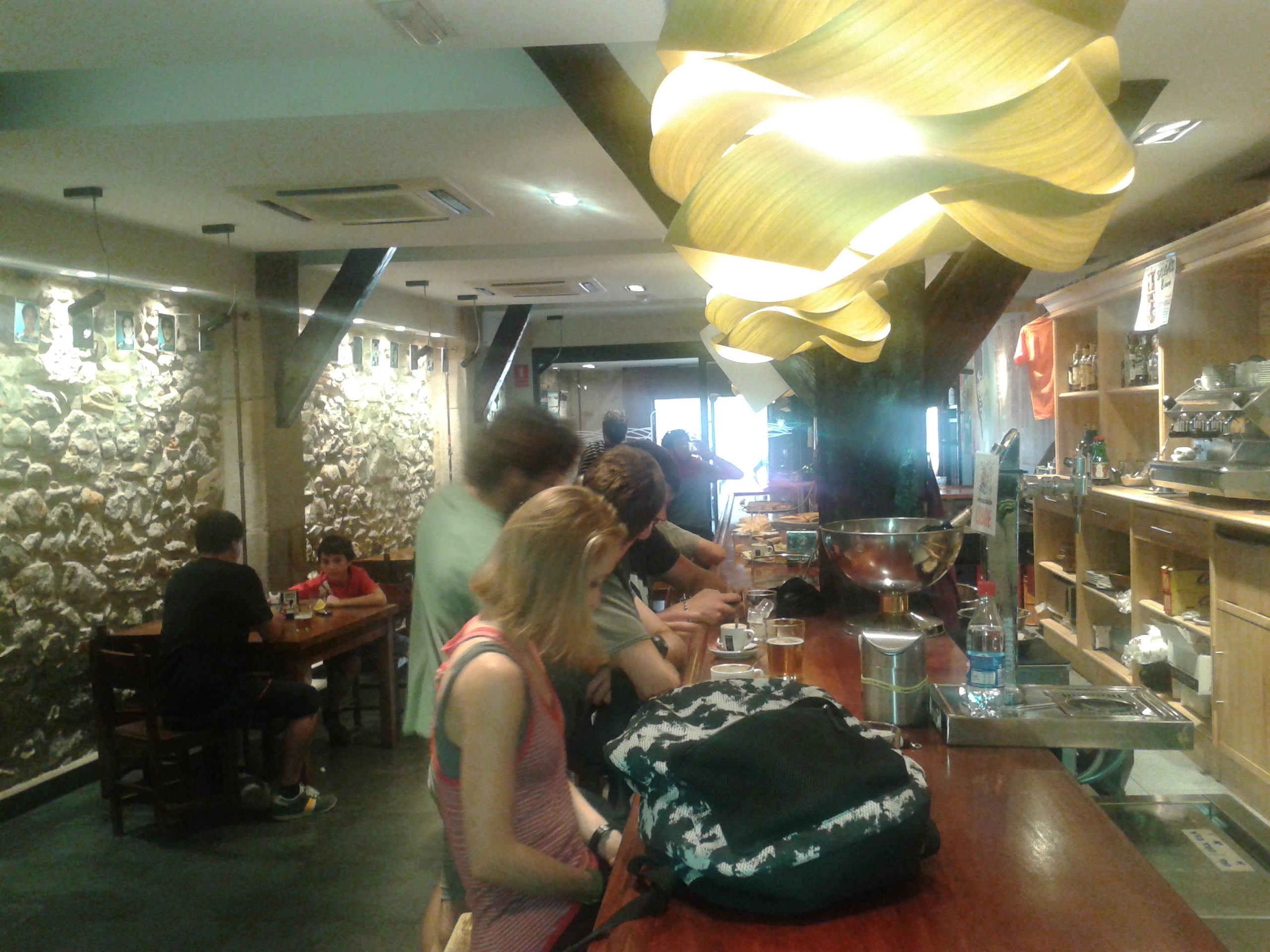
One of the Herriko Tabernak in Bilbo, this one in Errondabide, Casco Viejo; view from the back towards the entrance and street. Photo: D.Breatnach 2015)
In 2016 the Audencia Nacional, the Spanish National Court, handed down a judgement that the funds of these taverns are forfeit, in what the Abertzale Left party Sortu called “the greatest political and economic plunder since the Civil War”. This is a reference to the wide-scale misappropriation of funds, machinery and land of the losers of that war by the victors, General Franco and his supporters. The wealth of many individuals and families in the Spanish State today can be traced back to that theft.
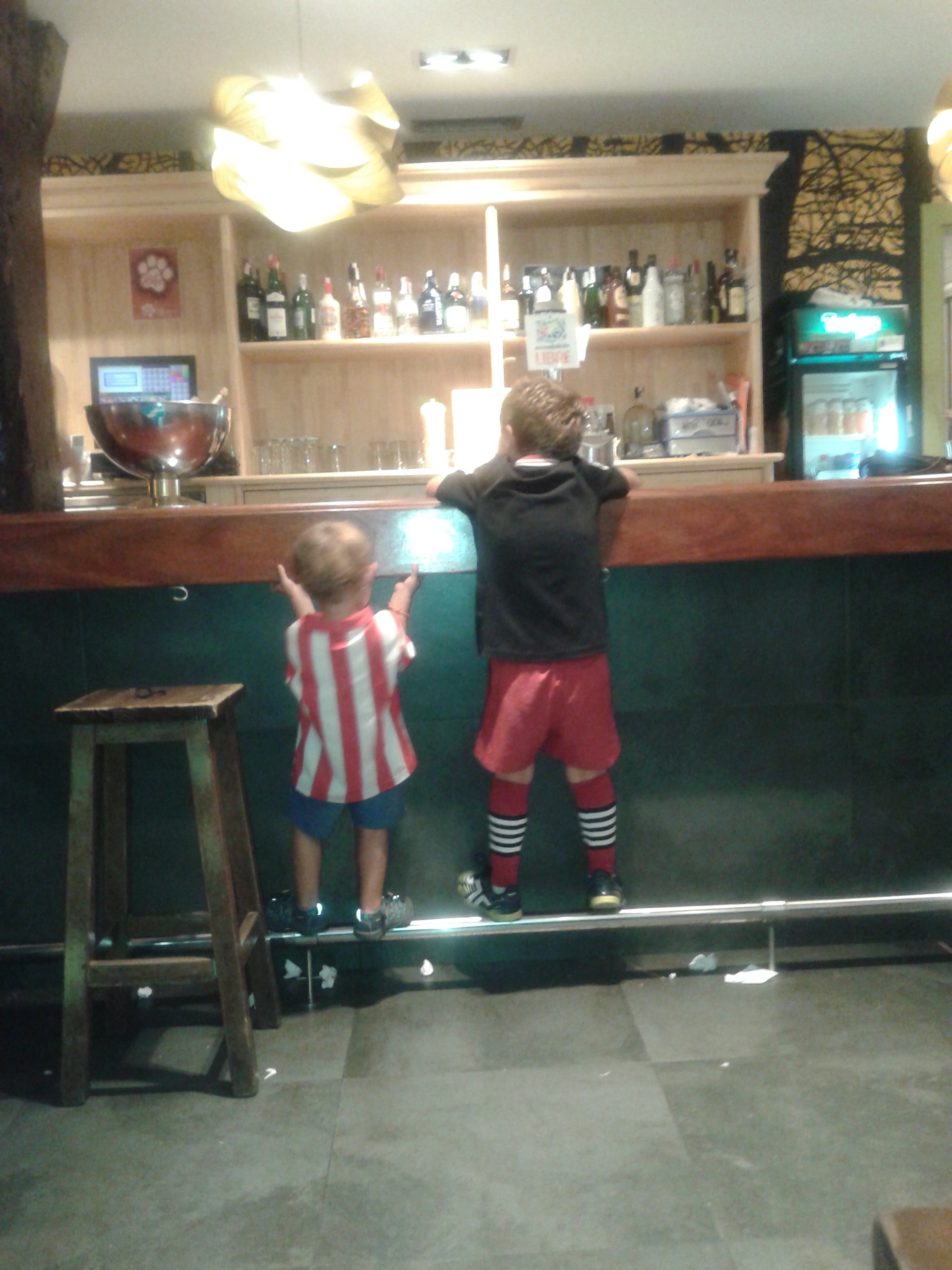
They will not be served alcohol! Parents often meet at the Herriko for a while after collecting their children from the Basque-language pre-schools. (Photo: D.Breatnach 2015)
While a number of these taverns were closed down in the past, most kept going, supported by their loyal clientele and local communities. Although the punitive judgement of the Audiencia against the Herrikos was in 2016, its origin dates back further to the reign of one of the Audencia’s ex-judges, Baltazar Garzon, who infamously claimed that every aspect of Basque independent expression was linked to the armed organisation ETA. Baltazar, loved by liberals, claimed that “everything is ETA”, under which dictum homes were raided, activists tortured and jailed on their “confessions”, political organisations banned, social and cultural centres closed, along with newspapers, radio stations and social media.
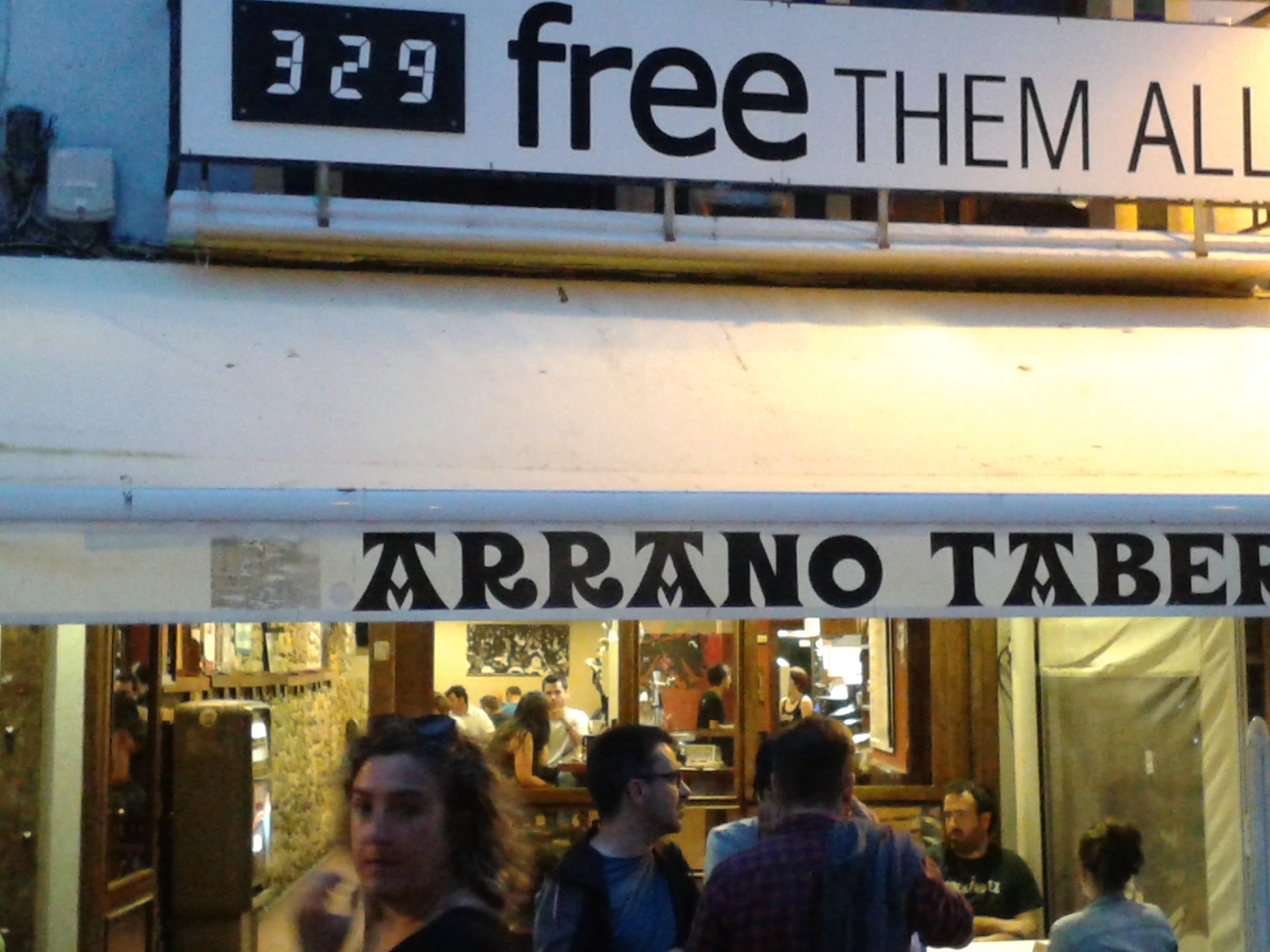
Arrano Herriko Taberna, Zarautz, Gipuzkoa province, southern Basque Country. Banner above it calls for freeing of the officially-recognised Abertzale Left political prisoners. (Photo: D.Breatnach, 2018)
Some modest afternoon pintxos available in the Errrondabide Herriko (Photo: D.Breatnach 2015)
EXPROPRIATION TAKES PLACE DURING A MILITARISED LOCKDOWN
This expropriation is taking place, as commented the left-wing media Izquierda Diario, in the midst of an emergency pandemic lockdown in which more than 7,000 sanctions in little over a month have been applied by the military and police who are in charge of and patrol the streets. (Unlike Ireland and many other countries, people in the Spanish State are not permitted to take exercise outside their homes, whether maintaining social distances or not).
“While the judicial apparatus cannot process the massive claims of illegal dismissals, unpaid wages, unpaid ERTEs” (temporary compensation for loss of earnings due to the pandemic) commented the Diario, “or thousands of resources for fines during these days for the restrictions of the pandemic, yes there is time to seize the money of more than 100 taverns.”
COMMENT
Cafe esnea and “Bring the prisoners home” serviettes, Herriko Taberna. (Photo: D.Breatnach 2015)
While it is true that in many areas there are privately-owned bars sympathetic to the movement and that also in many areas dissenters from the line of the Abertzale Left official leadership decline to use the Herrikos, nevertheless the disappearance of the latter must entail serious damage to the social and cultural base of the broad Basque independence movement.
end.
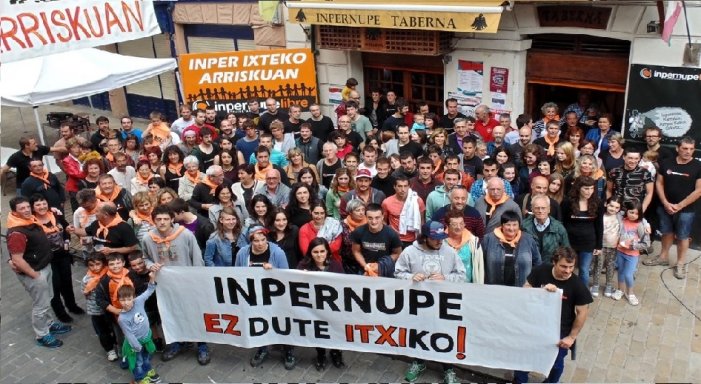
Protest against the original judgement by some supporters of the Herriko Taberna of Inpernupe, Zumaia (scene of some of the Game of Thrones footage), Guipuzkoa Province, Southern Basque Country. Banner declares “Ipernupe will not close!” while another in background declares it is in danger of closing. (Source photo: Izquierda Diario)
We hear talk from time to time about essential frontline workers, a discussion the origins of which can be traced to the call on the Government to shut down all non-essential work. That of course raised the issue of what is essential work and therefore, who are the essential workers. High among the category considered essential were health practitioners and their rate of infection, when statistics were published, was exceeding 25%. But there is another group of workers who are essential and vulnerable and although most members of the public are in contact with them on a weekly basis at least, nevertheless they are given little protection and rarely mentioned.
Essential workers include, apart from healthcare workers, those maintaining our supplies of clean water, electricity and gas, sanitation, agriculture, production of necessary equipment, public transport, transport of essential supplies, fire-fighting, telecommunication (but not commercial call centres), postal services …. All of these should be in the first rank of consideration for protection from the Coronavirus-19, because they are vulnerable and for the selfish reason that we need them. But much more exposed on a daily basis to a greater number of people are the shop and supermarket workers.
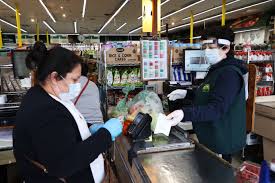
Customer and staff both wearing mask and gloves in a foreign supermarket (Photo source: Internet)
They are the most numerous of the essential workers in daily contact with the public, which puts them at risk and, if they become infected, puts the general public, the shopping customers at risk too. And yet, their levels of protection organised by their employers are very poor overall. Despite this, we rarely hear them mentioned in public discourse, they do not receive particular attention from the Left and even their own trade unions are inactive on the issue.
WHAT SHOULD HAVE BEEN DONE
Let us take a moment to consider what should have been the measures put in place for these workers and for the public coming into contact with them:
Immediate training program in prevention for all staff, with regular refresher or reinforcement measures
Immediate supply of protective clothing, disposed/ washed after each break and shift, this to include face-mask and gloves
Hand-sanitiser at every work station
Wrap-around screens at all checkout points
Disinfection routines for all work stations at shift changes
No shelf-filling during hours open to the public or non-essential interaction between public and staff inside of six feet distance
Staff in necessary close proximity to members of the public, including security staff, to be given special protection in clothing and in shift arrangements and testing
Safe social distances enforced by restrictions on numbers of customers in store at one time
Safe social distances marked for queues and enforced
Regular disinfection of automatic checkout machines
Supply of hand-sanitiser at all entrances/ exits and checkout machines for the public
Prevention informational visual and audio prompts for public and staff
All companies obliged by Government to publish their protocols so as to educate staff and public and also give a point of correction if either feel that the protocols are not being adhered to.
Some readers may protest that management had no previous experience of a pandemic, that some of these measures were implemented but a delay was inevitable and some measures are too extreme. I would respond that any group of reasonably intelligent people, knowing the danger and typical transmission routes, sitting down to think of precautions, would come up with a similar list. Companies are supposed to carry out risk assessments of their procedures. Trade union officials and representatives would be trained in how to assess levels of risk and how to employ measures to eliminate or reduce the level of risk as much as practicable.
Should anyone consider any of those measures excessive, they should be able to point out which and to say why. Or likewise justify the claim that late implementation was unavoidable.
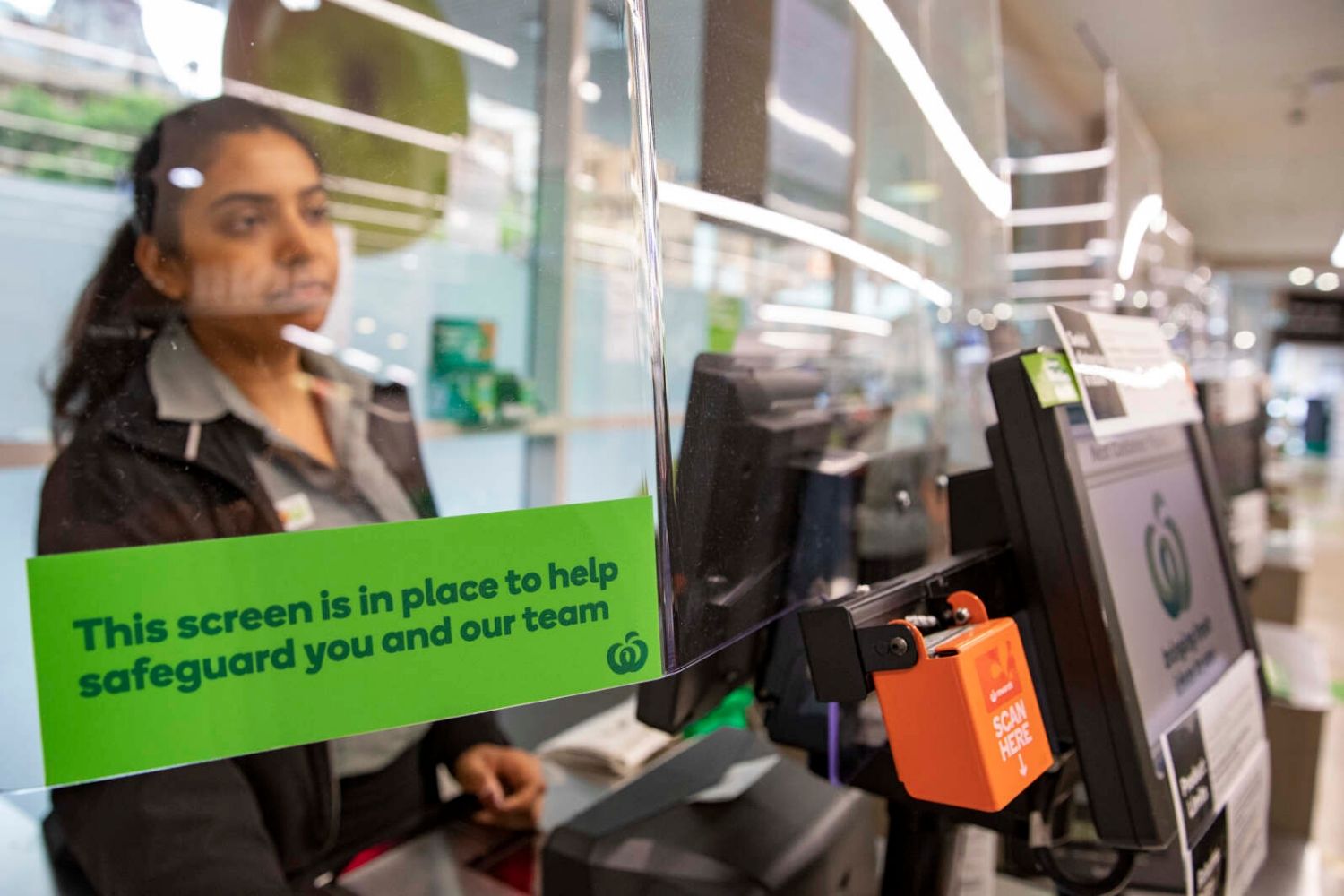
Notice on screen in one shopping chain. (Photo source: Internet)
WHAT WAS DONE
Let us now take a moment to review which of those measure have been implemented, how and when.
I am not in a position to give a definite answer on whether staff were given intensive training in avoiding infection or not but from my observation while shopping of staff in a number of supermarkets I would feel confident in saying that they had not or, if they had, that the required practice was not being monitored by management.
Even to the day of writing this piece, in only one workplace, Eurospar in Fairview, have I seen all the staff wearing face masks. Workers in a number of other companies have told me that they are not supplied with them.
Hand-sanitiser was supplied to work-stations in some supermarkets (possibly all) but weeks after the pandemic hit Ireland (though it had been raging abroad for many weeks before that and covered in news reports).
No screens were in place at work-stations until weeks after the arrival of the virus and even now are rudimentary in many places. Single screens with spaces between permit staff and customers to position themselves in the open spaces, which I have seen both do at times. A number of cashier screens with an open section for customers to receive and load their checked-out purchases are well inside six feet of the staff member.
Whether there are any such shift-change disinfection routines at any supermarket I cannot say but in some supermarkets I have seen staff leave or take up work at a station without any evidence of its disinfection.
I have seen frequent shelf-filling during-open-to the-public hours in Dunnes, Tesco, Centra and Aldi (I have not been in a Lidl since the virus arrived) and even without gloves; also unprotected staff moving among customers on other pieces of work, including stacking and removing empty baskets. Even this evening in a Tesco outlet, although at least they were wearing orange (?) gloves, staff were attending to shelves (and without face-masks, as was the staff member stationed near the automatic machines).
In addition to the above, staff maintaining queue lines, including security staff: every single one without masks and all being passed by customers at distances inside of six feet. The most shocking case was of a security guard in Tesco Drumcondra being passed by customers at distances of between one and three feet – he had no mask and only his company uniform, which he probably takes home to his family and puts on again next day. As to testing, given the long waiting times reported for testing and even longer for results, along with the general level of care for employees shown by the companies, how likely is any are being regularly tested?
Yes but in at least one case, I saw that the security guard on the door monitoring numbers was absent for awhile. Of course, there are calls of nature but shouldn’t the protocols require the temporary replacement of the person at this post? Would we wish to be the ones who were infected because this probability had not been foreseen and provided for?
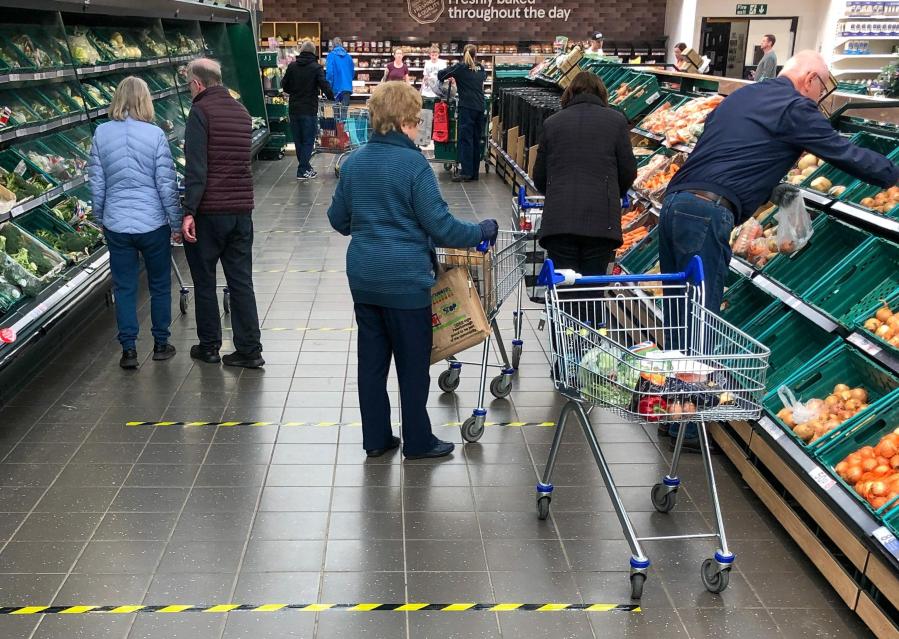
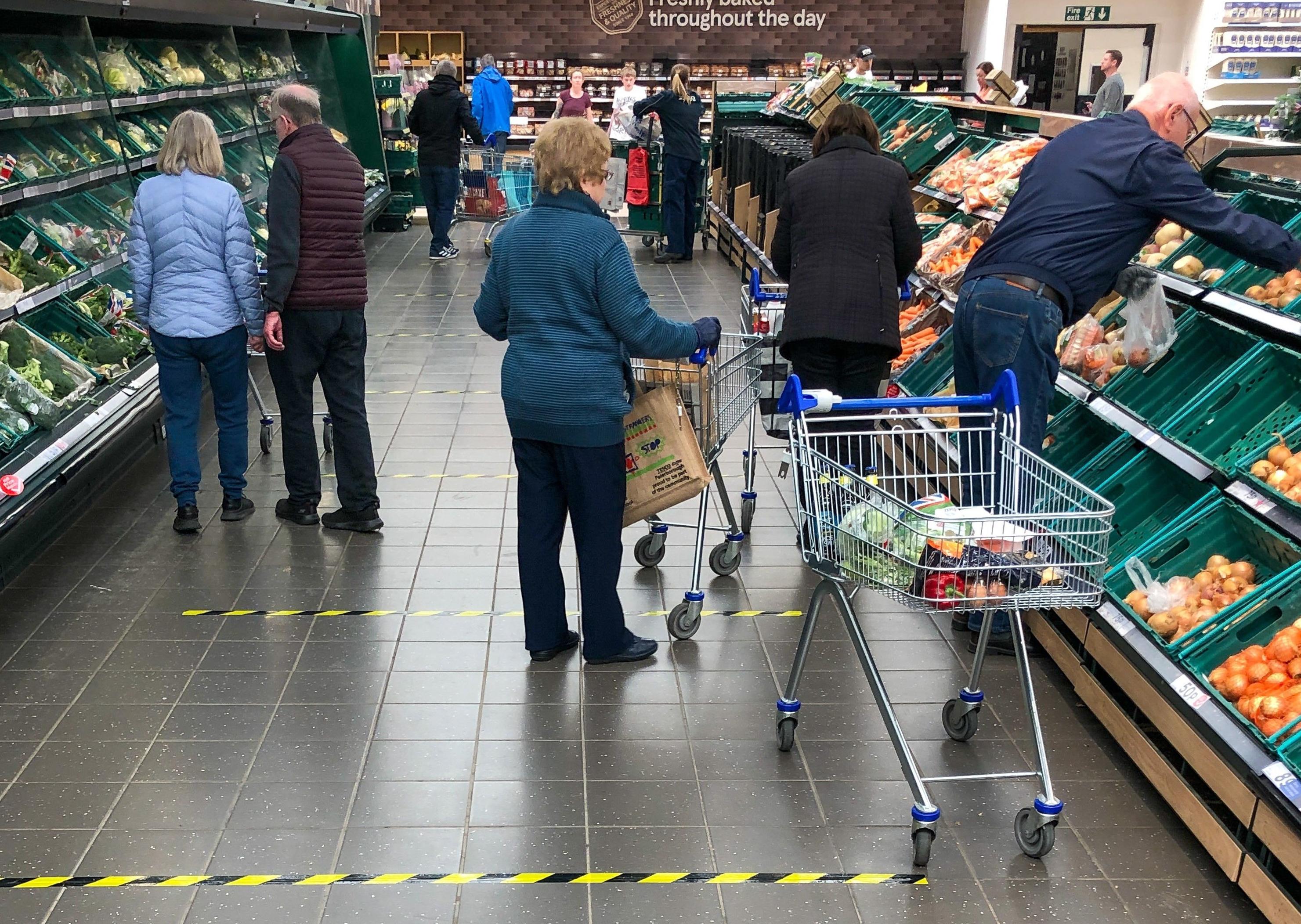
The safe social distances for queueing customers – but not among staff — are now being enforced in most supermarkets, weeks after the arrival of the virus (but I noticed today that the separation is actually less than the advertised two metres).
I have very rarely seen disinfection of automatic machines.
In a local Centra, the first I saw to erect perspex screens, there was a sanitiser dispenser at the entrance with instructions. On at least one occasion it was empty and I have seen customers pass it without using it or having it called to their attention. I saw none in any other chain supermarket, although in Aldi a spray was provided by the baskets with instructions to use it on the basket handles.
Prevention information posters may be seen but usually of the most generalised kind (like those from the HSE) and asking forstaff to be treated with patience; graphic posters very rarely, film and audio prompts never. In other words, the means supermarkets use when they really want something, like mood enhancement, customers aware of bargains or special promotions, urgent attention to a checkpoint machine or stores about to close – are precisely those that they are not using for promotion of infection prevention.
The Government has not obliged companies to publish their protocols (not even suggested that they should do so) and the companies have not done so themselves.
Customers in a supermarket (none seem to be taking any precautions other than perhaps social distancing. (Photo source: Internet)
CONCLUSION
This is a serious lack of care provision for a large section of essential workers and with a potential collateral effect on most of the public. First in line of responsibility for this failure must beof course the companies but their main motive has always been profit. Next in line must be the Government, which has the power to implement emergency measures (and used it recently with giving extra power to Gardaí an courts to employ against individuals) but our governments have always been primarily in the service of capital. Who do I personally blame most for this area of neglect? Those whose very publicised reason for existence is the protection of workers and the promotion of a just society – the trade unions and the Left.
Among the statistics that are published on rates of testing positive and deaths attributed to the virus, there are breakdowns into age and gender groups and, at least in the earlier days, of healthcare workers. We never see, among those statistics, any for shop workers. Or for those who might in turn have been infected by them. The largest statistic given for route of infection is that of “social contact” and presumably that’s where they are, hidden. We remain uninformed and the low level of protection continues, with no real effort being made to change the situation.
End.
PS: Readers may wonder at the absence of information directly from the workers themselves. The reason is that personally I am unaware of anyone in my acquaintance working in this sector and did not wish to cause the workers more stress than they have to deal with already.
ADDITIONAL INFORMATION:
For focus on steps trade unions and the Left failed to take, see article titled WHAT DID NOT HAPPEN in Rebel Breeze.
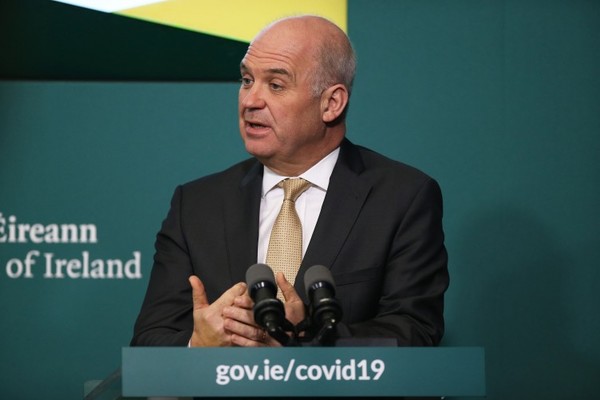
On a day when it is claimed the rate of infection is dropping (but with the highest number of infected and dead yet in Ireland), the social distancing and lockdown measures are said to be working. But Chief Medical Officer Dr. Tony Holohan denies that doing this earlier would have lowered the infection rate! And Eoghan Harris tweets a pat on the back for his Government that private health facilities are to be made available in the public health interest, a measure socialist TDs were calling for weeks ago. But Varadkar rushes to reassure that it’s not nationalisation – neo-liberalism will continue as before.
THE HOLOHAN PUBLIC FATIGUE SYNDROME
Tweeting, Professor Philip Nolan, Chair of National Public Health Emergency Team’s IEMAG: “The model reveals that before restrictions were in place, daily growth rate of confirmed cases was at 33%. This has fallen in recent days to around 15%. But it is still growing and needs to fall further.”
To a person of average intelligence, this means that had these measures been introduced earlier, the graph curve would have begun to flatten out much before now. But Chief medical officer Dr. Tony Holohan is much more intelligent than that – way beyond the rest of us. Because that would have risked “public fatigue” and now is “the right time.” Well it must be the “right time”, mustn’t it, because that’s when he ordered it. He couldn’t have recommended it late, could he?
If “public fatigue” is the danger, that can come in at any time once the restrictions are in place, getting worse as time goes on – one would think. So if introduced say at the beginning of March, we’d be “fatigued” by now, wouldn’t we? So is he telling us that in a number of week’s time, with restrictions still in place, we won’t be “fatigued”? The logic is that we will just as fatigued whenever the crisis is over as if the measures had been put in place earlier – just that it would have been over more quickly and with less fatalities.
Of course, it won’t be over anything like that quickly. They have not even closed the borders, airports or sea-ports! And it’s not that I am in favour of the British colony’s Border, by the way, but this State and Government have no control over the colony’s airports and seaports. And how did the virus arrive in Ireland in the first place? Yep, by plane. But it’s ok, Holohan is going to “discuss” those options. And if they do – finally – close those ports and Border, it will of course be exactly “the right time” to do it.
Let’s return to this “fatigue” notion. What we are experiencing is a pandemic, a national emergency. The people of Leningrad withstood a hard fascist siege, running out of supplies, constantly bombarded, for 852 days. And the battle in defence of Moscow for three months and five days.
But of course, they were Russians (mostly). Alright, the people in Britain (quite a few of them Irish) withstood the Battle of Britain — with almost daily air-raids — for three-and-a-half months!
But the Irish, in Ireland, cannot stand a few extra weeks without becoming “fatigued” and – what? Flood the streets in civil disobedience? Start running up to people and brushing against them? Go back to jobs the Government has closed?
Could it be, just possibly, nothing at all to do with early “fatigue” syndrome but rather late actions reluctantly taken by a Government? Reluctant because it would deplete the capitalist coffers? The thing is, reprehensible as that motivation would be, if action had been taken earlier, capitalism would have suffered less and recovered more quickly!
NEO-LIBERAL POLICY BUSINESS AS USUAL
Which brings us neatly on to Eoghan Harris patting the Government on the back for roping in the private healthcare facilities – weeks after being asked by Socialist TDs to do so. No, you’re right, he didn’t mention that bit. Well, you can’t get everything in a tweet, can you?
And Varadkar rushed to reassure the Gombeen capitalists he represents and the foreign capitalists his party facilitates – along with Fianna Fáil, Labour and the Greens – that this is not nationalisation.
“This is a public private partnership, expanding our public health service in response to this emergency but also cooperation with the private sector.”
“This is private and public sectors to (sic) learning and growing together and working together in the common good.”
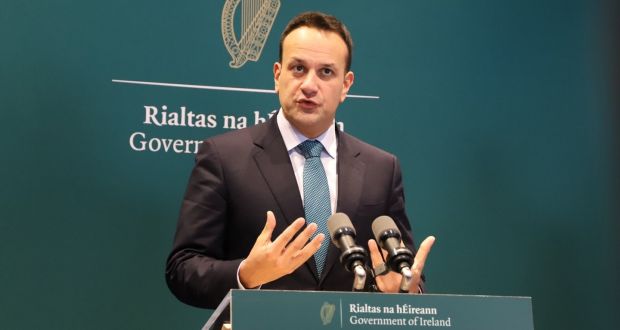
Leo Varadkar, Taoiseach (Irish Prime Minister) of a defeated Government but has yet to step down. (Photo sourced: Internet)
The private healthcare system has parasitised on the public health service, here and in Britain. It has used existing public structures, services, contracts, buildings, personnel, training facilities, government grants and tax cuts. It has no right to exist, least of all when the public body on which it has been feeding is staggering on its feet, in which state it has been long before this pandemic struck.
And Leo’s government, one of the leading proponents of the system that has caused this situation, let us not forget, was given a massive shove recently by the electorate! With the state of the public health service being one of the main issues on which they were shown the road.
You could never accuse Varadkar of not having a hard neck!
Staff wearing gloves (at last) but no masks. Distance instructions for shoppers at staffed checkouts but no masks — and what about floor staff, tending shelves, collecting empty baskets, ANSWERING QUERIES FROM CUSTOMERS AT CLOSE RANGE? !!
“Every little helps”? TOO LITTLE!
Criminal neglect by big employers of their staff and also, in the long run, of the wider public. And the unions?!!
Lots of empty spaces on shelves by the way. And I remembered the toilet paper!
I went shopping tonight. No, not a stock-up raid — actual shopping. Of course, I forgot the actual thing I went to get — toilet paper. No shit! (well, not until I buy some, anyway). So I got some other stuff I would need soon.
Irritated customer at self-checkout machine. (Source photo: Internet)
I was glad for once, especially for the safety of the staff, to see the self-checkout machines there and happy, for a change, to use them. Even though the machine could not understand why my bag was “too heavy” (a small-medium backpack!). So a member of staff had to keep approaching to tell the machine I was all right and to carry on, which kind of negated the whole safety aspect.
Of course safety has nothing to do with why these machines were installed, nor even customer satisfaction but to reduce the number of employed staff (who still have to keep attending to machines that misunderstand the shoppers or vice versa).
One of the many models of hand-sanitiser available commercially. (Source photo: Internet)
But NOT ONE OF THE STAFF WAS WEARING DISPOSABLE LATEX GLOVES OR FACE MASKS.
NOR DID I SEE A HAND SANITISER DISPENSER.
THEIR EMPLOYERS SHOULD BE OBLIGED TO PROVIDE THESE BY LAW IF THEY DO NOT DO SO VOLUNTARILY.
On 15 February Ferriter’s column in the Irish Times expressed the opinion that comparison of Sinn Féin with Fianna Fáil in the 1930s only takes us so far. After looking at less of the overall history of the main Irish parties than I had in my article of 11 February in Rebel Breeze but adding some pieces I had not, what was his conclusion that differed so widely from mine? Well, that the military past was too new with SF!
Diarmaid Ferriter in Thinker pose (Source: Internet)
But, actually, not true of Provisional SF with regard to FF, which came into government in 1932, less than two decades after the end of the Civil War and only six years after its split from Sinn Féin. De Valera, President of Fianna Fáil, had been a leader of the Republican side in the Civil War, from which side came the majority of Fianna Fáil’s supporters. By the time PSF gets into Government, it will be LONGER than two decades since Provisional IRA gave up its armed struggle!
On 11 February I posted an article of mine on Rebel Breeze and from there on to Facebook, making the point that, despite hostile media and politician claims to the contrary, Sinn Féin is very like the main Irish political parties – and that that is not a good thing. I traced the main elements of the parties’ history, how they had changed their positions and I elaborated the point that the main difference in their trajectories is that SF’s arrival on the neo-colonial capitalist political field was just more recent.
Meeting of Provisional Sinn Féin’s Ard-Choiste (national executive) in February 2020. (Source photo: Niall Carson, AP, Internet)
It is worth noting (a point I had omitted in my piece) that nearly the entire Fianna Fáil government Cabinet in 1932 was composed of Civil War IRA men and that most of the remainder had been in Free State prison during that war.
It is said that imitation is the sincerest form of flattery but I can easily avoid being pleased by Ferriter substantially following my line of historical analysis. This is the man who, during the 2016 High Court hearing about the Government and property speculator plans for Moore Street, wrote a nasty attack on the demonstrators who had occupied the buildings and subsequently blockaded them against demolition. If he had been hoping to influence the High Court’s decision he failed – and spectacularly, because the judgement was that not only the buildings but the whole quarter is a 1916 historical monument.
Frank McDonald had also written an opinion piece during the trial against conservation and the demonstrators in the same newspaper (what WAS the Irish Times up to?) but after the judgement, he had the grace to apologise (sort of: he wrote that he had been in error).
I observed in Language Is a Treasure Chest 1 that it is full of wonders but that it has some horrors in it too. And I found it to be so again.
I was reading a novel in which the word “Cimarron” appeared and, doing some quick research on the word, I came across a 2004 query in an email website or page called Word Wizard:
What is the etymology of the word cimarron? I’ve always been told that it means “runaway slave” in Mexican Spanish. Can anyone verify this?
The reply is dated the same day:
From Greek. It refers to people who live in perpetual mist and darkness, akin to the ‘land of the dead’. Latin ‘Cimmerius’, Greek ‘Kimmerios’, Assyrian ‘Gimirri’ even the bible ‘Gomer’ Gen.10:2 and Esk. 38:6. In Western United States it refers to a stretch of land that gets rainfall when other near by areas are desert year round.
Apart from the topographical reference, I thought the expert’s explanation highly dubious. And in fact I happen to know something about the Spanish-language origins of the word.
The searcher replied:
Thanks, Jim. I just wonder what connection this word has to Hispanics of Mexican origin because it shows up in their surnames (although not as common as Lopez or Vargas or Garcia). Is it just Mexican in origin or did that also come from Spain? So the “runaway slave” theory has no foundation then?
The expert’s reply did come back with a Spanish-language connection and he may be on to something with the topography, though I think he has it the wrong way around (as we shall see).
The “runaway slave” theory is not so obsolete.
Mexico did not have slaves (Outlawed in 1810)but
American slaves who fled to Mexico had to pass
through lands with water, or else parish (sic).
When relating their tales of woe to the locals
the word ‘cimmaron’ arose to describe their flight
through the South West desert.
Very curiously, there was no further contribution to the discussion. I tried to leave my own but had to register, which I have done (though wondering if worth the trouble) and am now awaiting confirmation1.
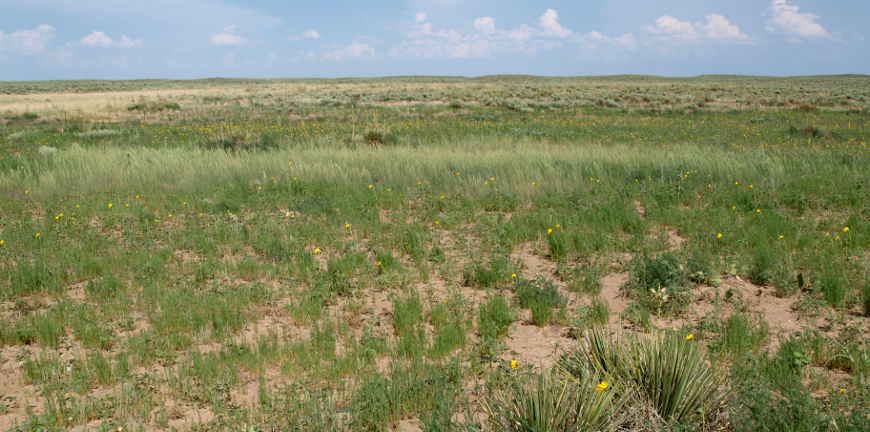
A view of the Cimarron National Grassland, the largest piece of public land in Kansas, a 108,175-acre property in the southwestern part of the state. It was recovered from the Dustbowl ecological devastation by soil recovery and management practices. (Photo source: The Armchair Explorer – Kansas)
THE FOLK MEMORY WAS TRUE
Continuing with a little light online research I find that the Castillian-language (Spanish) origin is the explanation most often given, with rarely a reference to Greek or other classical or archaic languages. For example, in yourdictionary.com:
American Spanish cimarrón, wild, unruly ( from Old Spanish cimarra, thicket): probably origin, originally referring to the wild sheep (bighorn) found along its banks
(Latin America, of animals) feral (having returned to the wild)
Synonyms: alzado, bagual, feral
(Latin America, of people) rural; campestral
(Latin America, of plants) of a wild cultivar.
But …. what about the “runaway slaves”? Under the title Cimarron People, Wikipedia has this to say: The Cimarrons in Panama were enslaved Africans who had escaped from their Spanish masters and lived together as outlaws. In the 1570s, they allied with Francis Drake of England to defeat the Spanish conquest. In Sir Francis Drake Revived (1572), Drake describes the Cimarrons as “a black people which about eighty years past fled from the Spaniards their masters, by reason of their cruelty, and are since grown to a nation, under two kings of their own. The one inhabiteth to the west, the other to the east of the way from Nombre de Dios”. (location in Panama — DB)
While we may indulge ourselves in a sardonic smile at commissioned pirate Francis Drake talking about the cruelty of others, or about slave-owning by a country other than England in 1570, we remember also that at the time Spain was the main competitor with England in the rush to plunder the Americas – and had got there well before them.2 Both colonial powers were already plundering Africa for raw materials and slaves.
The meanings of animals having gone “feral” or “returned to the wild” would easily have been applied by the society of the time to escaped African slaves, a society which, despite evidence to the contrary including agriculture in Africa, would have considered indigenous inhabitants of Africa as people living in the “wild”. Once escaped and no longer under European control, they would be seen as “returning to the wild”.
So what happened to the Cimarron People? Their settlements were subject to punitive raids by the Spanish, killing people and burning crops, so that in the end they came to a treaty with their old enemy. The Wikipedia entry says no more except that the “Cimarrons” and the English quarreled (not surprising, given that they were of no further use to the latter). I believe some of their settlements in Florida were raided and burned by US “pioneers” and soldiers and that the remainder became part of the Seminoles, a native American tribe that resisted the USA in the longest and most costly of the USA’s wars against the indigenous people, the Native (North) Americans. The Seminole had many tribe members of part-African origin in their midst.
And here – a surprise: The word “Seminole” is derived from the Muscogee word simanó-li, which may itself be derived from the Spanish word cimarrón, meaning “runaway” or “wild one”!
So, in line with what that on-line searcher back in 2004 had heard, no doubt a folk belief, the word cimarronis, in Mexico (and in the USA), of Castillian (Spanish) language origin and is connected to escaped slaves of African origin.
Some of the sources for “cimarron” also give us “marron” or “marrón” which is also related to escaped slaves and, in English, became “Maroons”. The Maroons, escaped slaves who inhabited mountainous regions of Jamaica and elsewhere became a great problem to the English settlers (after they took the island from the Spanish) which they failed totally to quell, the Maroons emerging victorious in many military engagements. In the Cockpits area of Jamaica, I have read, there is a place called Nanny Town, which is believed to be one of the settlements of the Maroons; their chief was said to be a woman called “Granny Nanny”3, whether because of her former slave occupation or for other reason4. In the end, like the Spanish with the Cimarron People, the English had to treat with them. Sadly the treaty required the Maroons to return newly-escaped slaves, which they did and for which they received payment.
Marroons in treaty with the British, shown here in a reversal of the actual power relations in the “Pacification with Maroons on the Island of Jamaica, by Agostino Runias (1728-96). (Source image: Internet)
However if instead of being a voluntary escapee to go to a wild place you were forced by people or circumstance, well then, like Alexander Selkirk’s “Crusoe”, you’d be “marooned”!
Well then, what about the “cimarron strips” in the southwest of the USA? Could the word refer to strips of land “gone wild”? Or could the expert replying to the question in 2004 have been on to something?
If the slaves escaping through the desert from the USA to Mexico did indeed make their way through strips of watered land (not just for the water, as the expert speculates but for vegetation to conceal them), then there is a connection between escaped slaves and these strips of land. But not as the expert sees it, rather the other way around: since the escaped slaves, the “cimarrones” were travelling the strips, they would be called by those who knew about it (escapee hunters, escapee helpers and just observers), “cimarron strips”, i.e “those strips through which the runaway slaves travel.”
CHRISTIAN ETHNIC PREJUDICE
However, if the word comes from Castillian (Spanish) what were the origins of the word in that language?
Perhaps a year ago, I was reading a book that described the Spanish State as having been characterised, contrary to many other European states, by mass expulsions and exiles on a number of occasions throughout its history5. Naturally enough, first on the list of expulsions was the well-known example of the Moors and the Jews. Those who were not slaughtered by the forces of the “Christian Monarchs” of Ferdinand and Isabella in the “reconquest” were obliged to convert to Christianity or to leave “with only the clothes on their backs”. This also occurred in Portugal.
Those Jews who left were the Sephardim or Sephardic Jews, who spoke Ladino, an archaic kind of Iberian Romance6language with Aramaic and Hebrew words, along with the Moors, who spoke an Iberian-Arabic mixture or Arabic. The key of their houses or gates have been handed down to this day in families of both groups.7
Many converted, often referred to by Christians as “conversos” (Jews) or “moriscos” (Arabs) but were constantly under suspicion of reverting to their old religion even with the threat and constant trials and torture of the Spanish Inquisition. According to what I have read they too were sometimes called “marronos”, i.e in the eyes of the Spanish Christian ruling class, those who had been “domesticated” (Christianised) but had “returned to the their wild way”, (Moslem) i.e “gone feral”.
Forced conversions that had to appear genuine: “The Moorish Proselytes of Archbishop Ximenes”, Granada, 1500 by Edwin Long (1829–1891). (Image source: Internet)
Wikipedia on Marrones in Iberia confirms:The (Spanish) Inquisition was aimed mostly at Jews and Muslims who had overtly converted to Christianity but were thought to be practicing their faiths secretly. They were respectively called marranos and moriscos. However, in 1567 King Phillip II directed Moriscos to give up their Arabic names and traditional dress, and prohibited the use of Arabic. In reaction, there was a Morisco uprising in the Alpujarras from 1568 to 1571. In the years from 1609 to 1614, the government expelled Moriscos.
THE BUSH FROM THE NUT?
And is “ci” or “cy” in “cimarron” then merely a prefix? The word “marrón” exists as a colour in Castilian and a number of Romance languages and came into English as the colour “maroon”. Its development is taken as originating from the colour of the large ripe chestnut, rather than given to it later. Of course there are a number of words for colours or tints which have a botanical origin, “orange” being an obvious one.
Castanea Silva, the edible or Sweet Chestnut. (Image source: Internet)
Alright, then the nut and tree might have been associated with uncultivated or “wild” areas, similar to those to which the “cimarrons” would escape. But where did the “ci” suffix come from? Somewhere in the midst of what I have been researching I came across an explanation, derived from Latin, meaning “towering”, “high” etc. But can I find it now?
The online sources are telling me that the relevant pages are up for deletion and I can join the discussion. No thanks, I do not have anything like sufficient knowledge to enter a debate on that, nor the patience of an academic to research it thoroughly.
But “high” and “wild” could easily correspond, given that valleys and plains lend themselves more easily to cultivation, as a rule, than mountainy areas, which might remain wooded or with with thick undergrowth. And that might also give us the “bush” or “thicket” referred to in a number of references for “cimarron”, which in turn might describe the “cimarron strips”. In parts of Latin America (and for all I know, in all of them) such as Chile, a “cimarra” is also a thicket or densely-grown area. The article in the Language Journal (see reference) comments that the “arra” cannot be a Romance language word-ending but even if true it seems to me that the author (or authors quoted) might be unaware that among those from Iberia who colonised or settled in the Americas, Romance language speakers were not alone. There were also Basques who spoke Euskera/ Euskara and for evidence, they applied a number of toponomics and left family names from the Basque Country (Basque descendants make up to 10% of the population of some Latin American countries). And “-arra” would be a common enough suffix or word-ending in Euskera.8
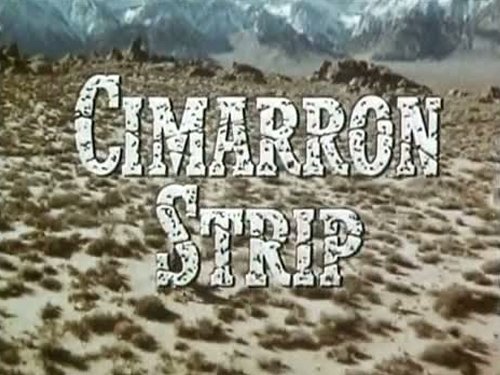
Opening title for the weekly TV Western series Cimarron Strip, starring Stuart Whitman, Judy Gleeson, Percy Herbert and Randy Boone. Though popular, only a years’ worth of episodes were screened. (Image source: Internet)
OKLAHOMA PANHANDLE AND THE CIMARRON STRIP
In the 19th Century wars between the Mexican Republic, the USA and the Native Americans in the area, it was carved up with less and less left to the Native Americans. Prior to the American Civil War, white Texas wanted to join the Union as a slave state and due to a US federal law prohibiting slavery north of 36°30′ parallel north, white Texas surrendered a strip of land north of that latitude. The settlement (temporary of course), left a strip as “Neutral Territory” (one can only imagine the temptation for African slaves in Texas to make for there). After the Civil War big cattle ranchers moved in, disregarding treaties and named the area the Cimarron Strip.
Map of Oklahoma territory and “Neutral Strip” before the American Civil War. Image source: Wikipedia, Texas Panhandle.
But that was because the word Cimarron was already in the area, from the “Cimarron Cutoff” leading to a crossing of the Cimarron river. And yes, there was a popular 1967-1968 TV series called “Cimarron Strip”, starring Stuart Whitman. But, though I used to watch it, that is only faintly related to the story of the word that set me out on this journey.
End.
FOOTNOTES
1Which days later had still not arrived – perhaps the site is no longer in operation, which would explain the silence after those two posters.
2Columbus voyage to America 1641 and Spain’s first colonial settlement 1565 (now Florida); Mayflower expedition to America with English settlers 1587 (now Virginia). However, Europeans had founded settlements much earlier, as with the Norse in the 10th Century and very likely Irish monks in the 6th Century. But it was the English and Spanish who conquered most, the Dutch, French and Portuguese less. The descendants of the English settlers after gaining independence from England completed the seizure and colonisation of most of the North American continent, while English colonists remaining loyal to the English Crown seized land to form what is now Canada.
4All the folk tradition, albeit conflicting on some points, declares that she had not been a slave which leaves one to wonder how she might have reached Jamaica from Africa without having been enslaved.
5 I borrowed the book from the public library and cannot remember its title at the moment.
6“Romance languages” is the name give to the group on Indo-European languages such as Castillian (Spanish), Catalan, Galician, Portuguese, Romanian, Italian and French. They are sometimes called “Latin-based” or “Latin Languages” but there is some dispute about the origins and developments of these languages.
7 Ironically, the door or gate “key” is also a symbol of return for Palestinian refugees driven from their homes by Zionist massacres, threats and fear during the founding of the State of Israel.
8 Among toponomics of North America’s southwest Durango (Colorado and Mexico), Navarro and Zavala Counties (Texas) are perhaps the best known; while Aguirre, Arana, Bolívar (Bolibar), Cortazar (Kortazar), Duhalde, Echevarria (Etxebarria), García, Guevara (Gebarra), Ibarra, Larrazábal, Mendiata, Muzika, Ortiz, Salazar, Ugarte, Urribe and Zabala are but some among a host of family names of Basque origin from the American south-west to Latin America. And of course the country of Bolivia, from Simon Bolívar, a Basque surname from a Basque toponomic.
Excerpt on-line from Language journal, Linguistic Society of America, Leo Spitzer, Vol. 14, No. 2 (Apr. – Jun., 1938), pp. 145-147: https://www.jstor.org/stable/408879?seq=1
“Sinn Féin is not like other Irish political parties” goes the propaganda campaign against the party by media commentators and rival mainstream politiciansduring the elections. What nonsense! It is exactly like the other main Irish political parties – and that’s the problem.
Their opponents’ main objection seems to be that Provisional Sinn Féin was widely seen as the political wing of the armed resistance group Provisional IRA and, although the IRA have dissolved and decommissioned their weapons, the party still carries that mark in the eyes of its detractors (and, it must be said, fondly in the eyes of some of its supporters).
This propaganda campaign is acutely unhistorical. A few short lessons in Irish history might be of use here.
The Irish Labour Party was founded by, among others, the revolutionary socialist James Connolly and anarcho-sindicalist Jim Larkin. In 1913 both advocated arming union workers to resist armed police attacks. In 1916, the Irish Citizen Army they founded was part of the armed Rising and two of their leaders were among the 16 executed by British firing squads.
The party stayed neutral during the Civil War and was an opposition party to the Cumann na nGaedheal government. Since then, the Labour Party has been in Government only as a coalition partner – most times with the right-wing Fine Gael party. Except for it links with trade unions, the party has little claim to having “Labour” in its name and has turned away from everything if which its founders believed.
Fine Gael was formedin 1933 when two smaller groups joined Cumann na nGaedheal, which had been the governing party of the partitioned Free State from 1923 up until the merger. Michael Collins and his followers were the kind of people The founders of Cumann na nGaedheal were among the pro-Treaty and Free State supporters, i.e people who until then had been active in leading or supporting a campaign of armed resistance to the occupying British forces, including assassinations, ambushes and robberies. The Free State began the Civil War in 1922 by an artillery bombardment of Republican positions in Dublinand over the next few years carried out repression on the civilian population, torture, summary executions of prisoners of war as well as State executions – and assassinations. The victors handed the reins over to Cumann na nGaedheal in 1923.
The parties that joined Cumann na nGaedheal in 1933 were 1) the National Centre Party, essentially a big farmers’ quasi-fascist party and 2) the Army Comrades Association (the fascist “Blueshirts”). Of the mainstream Irish political parties, Fine Gael has stayed truest to its founders and base.
Fianna Fáil emerged from a split from Sinn Féin in 1926; interestingly, much of what is being said against Sinn Féin by establishment political commentators now – and worse — was said then about Fianna Fáil: “murderers”, “revolutionaries” (and even “Communists”!). The party first entered power in 1932, its leader De Valera having been — little more than a decade previously — a leader of the Republicans during the Civil War, opponents of the Treaty and of the Irish Government of the time. It freed the Republican prisoners locked up by the Cumann na nGaedheal government, also having a special police force (“Broy’s Harriers”) to persecute the Blueshirts, who aspired to taking power as had Fascists in Europe.
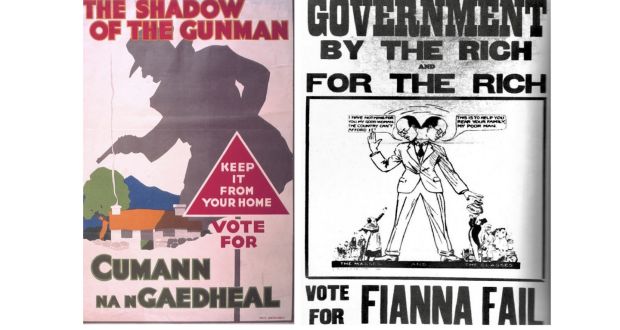
Cumann na nGaedheal (forerunner of Fine Gael) poster against Fianna Fáil during 1930s. (Image sourced: Internet)
By 1939, the Fianna Fáil government had introduced the savage repressive legislation of the Emergency Powers Act to intern republicans without trial and after a successful habeas corpus challenge by Seán McBride (one of the founders of Amnesty International), the Government brought in the Offences Against the State Act, was re-arresting Republicans and interning them without trial again (around 2,000). Two Republicans died on a hunger strike protest in Mountjoy Jail. Under Fianna Fáil the State executed six Republicans and some more are alleged to have died as a result of their treatment in the concentration camp.
In 1957, a Fianna Fáil government once again brought internment without trial into force, the colonial administration of the Six Counties having done the same the year previously. The last prisoner was released by FF in 1959.
Left: Cumann na nGaedheal poster urging votes against FF because of the party’s history. Right: Fianna Fáil poster appealing to the working class and small farmers. (Image sourced: Internet)
From having been seen as the main political party of Irish Republicanism, Fianna Fáil became in a short time the preferred party of the Irish capitalists (the “Gombeen” class) and has been in government more than any other party, more often indeed than the party that won the Civil War and set up the State.
JUST LIKE ANY OTHER IRISH PARTY
There is no historical basis for saying that Sinn Féin is very different from the other Irish mainstream political parties. It has traversed a similar path to all those others, perhaps most similarly to Fianna Fáil – it’s just a more recent arrival on the mainstream scene. It is already very like other main Irish political parties and is getting to be exactly like them.
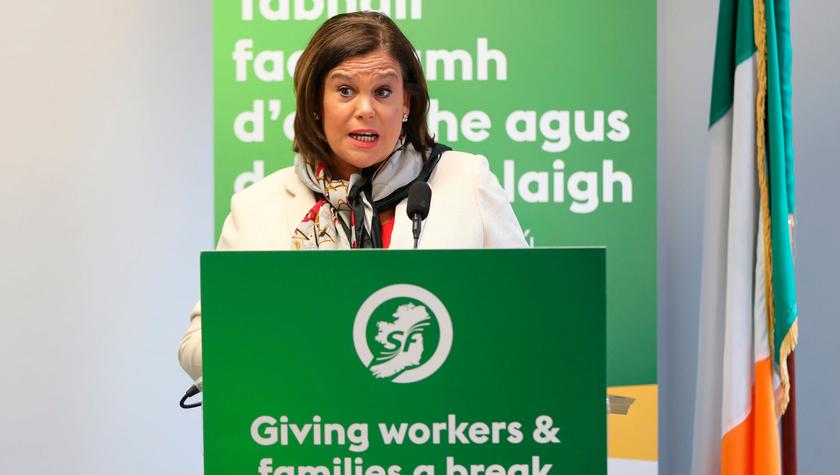
Leader of the Sinn Féin party, Mary Lou McDonald, at the launch of the party’s manifesto. With no intention of overthrowing capitalism it promised reforms for working people. (Photo source: Internet)
That is not a compliment.
This is a party that, in recent decades, had a revolutionary Irish republican – or at least nationalist – position. It strongly opposed the partition of the country and the colonial occupation of one-sixth of the nation’s territory. With the latter came — naturally enough — opposition to the colonial police force, the Royal Ulster Constabulary but this was much more than an ideological opposition: the RUC was an armed force created specifically for the repression of Irish Republicans and acted consistently against the Catholic minority in the Six Counties, which SF sought to represent and among which it organised.
The colonial Statelet itself, with its gerrymandering of electoral boundaries, sectarian allocation of housing and employment and its Special Powers Act, was the sworn enemy of the Sinn Féin party. And when British troops were sent in 1969 to repress the civil rights uprising, of course Provisional Sinn Féin and Provisional IRA fought them too.
The Provisional IRA gave up armed struggle against the British in 1998 and, although it maintained its armed force for control of its community for some time afterwards, eventually dissolved its organisation. By then it had already decommissioned its weapons.
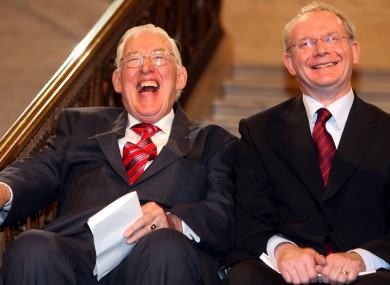
Martin McGuinness (right) of SF, formerly of the IRA, as Deputy Prime Minister of the British colony of the Six Counties. He partnered the Prime Minister Ian Paisley (left), a rabid religious sectarian, Christian fundamentalist and homophobe. They were dubbed “the Chuckle Brothers”. (Photo sourced: Internet)
In 2007 the SF party became part of the British colony’s administration in Stormont, with Martin McGuinness, former chief of the IRA in Derry, partnering Ian Paisley, notorious Loyalist religious sectarian and social bigot.
That same year the party agreed to support the armed and sectarian police force and in the reorganisation of the RUC had the name changed to “the Police Service of Northern Ireland”. The essence of the force, naturally, remains the same.
All the austerity measures inflicted on the working class by the administration since the party entered joint government of the colony have been approved by Sinn Féin MLAs.
Martin McGuinness publicly shaking hand of British colonial Queen when SF officially opposed the visit. However SF did not demonstrate against her visit and Gerry Adams later approved of it. (Photo sourced: Internet)
In 2011, despite an official SF policy of opposition to the visit of the Queen of England, Commander-in-Chief of the British Armed Forces, to the 26 Counties (the Irish state), leaders greeted her (one in person) and urged no protests be made against her visit.
In 2019, SF welcomed Prince Charles on a two-day visit to the colony and to the State; this man is not only son of the English Monarch but ceremonial commander-in-chief of the Parachute Regiment, authors of the massacres of Derry’s Bloody Sunday (14 dead) and Ballymurphy (11 dead) for which not a single soldier or commander has ever been tried. The SF Mayor of Derry, however, refused to meet him.
Gerry Adams shakes hands with Prince Phillip, titular head of the Parachute Regiment (the SF Mayor of Derry refused to meet him). (Photo sourced: Internet)
This year, 2020, the Six-County part of the leadership of Sinn Féin joined others in publicly seeking recruits for the PSNI, while the 26-County leadership withdrew from its previous position of seeking abolition of the repressive emergency powers of the Offences Against the State Act.
In the 26 Counties, SF long ago indicated its willingness to join in a governing coalition with some one of the other mainstream political parties: i.e capitalist, neo-colonial political parties.
On so many occasions, it has shown itself to be like the other parties and prepared to ditch formerly-declared principles for what it considered a political advantage, proving itself a “safe pair of hands” to the rulers of the system.
Yes, Sinn Féin is indeed a party like any other Irish mainstream political party: capitalist, neo-colonial, undemocratic and supporting State repression. As to the latter, why not? It won’t be SF that the State will be repressing — it’ll be Irish Republicans. And if SF ever get where they want to, into majority control of government – they’ll have plenty of opponents themselves to drag before those non-jury courts.
End.
L-R: PSNI Chief Constable Simon Byrne, Anne Connolly, Chairperson of the NI Policing Board, Gerry Kelly MLA, Deputy First Minister Michelle O’Neill and Deputy Chief Constable elect, Mark Hamilton at recruitment launch for the colonial police force.
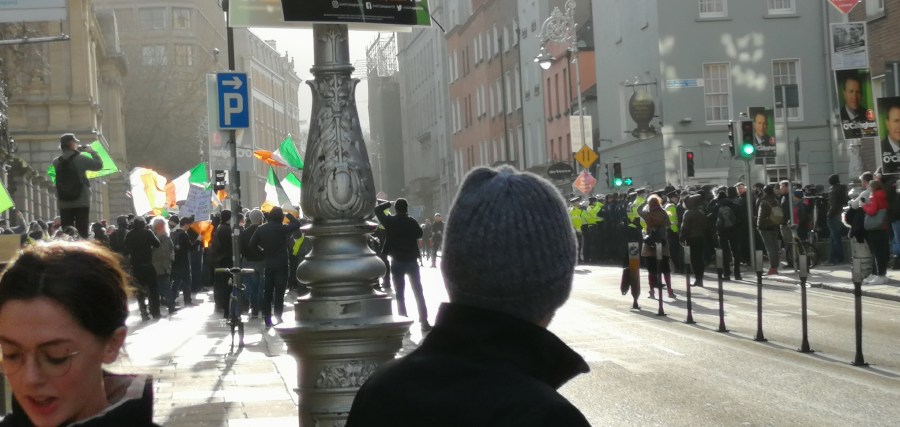
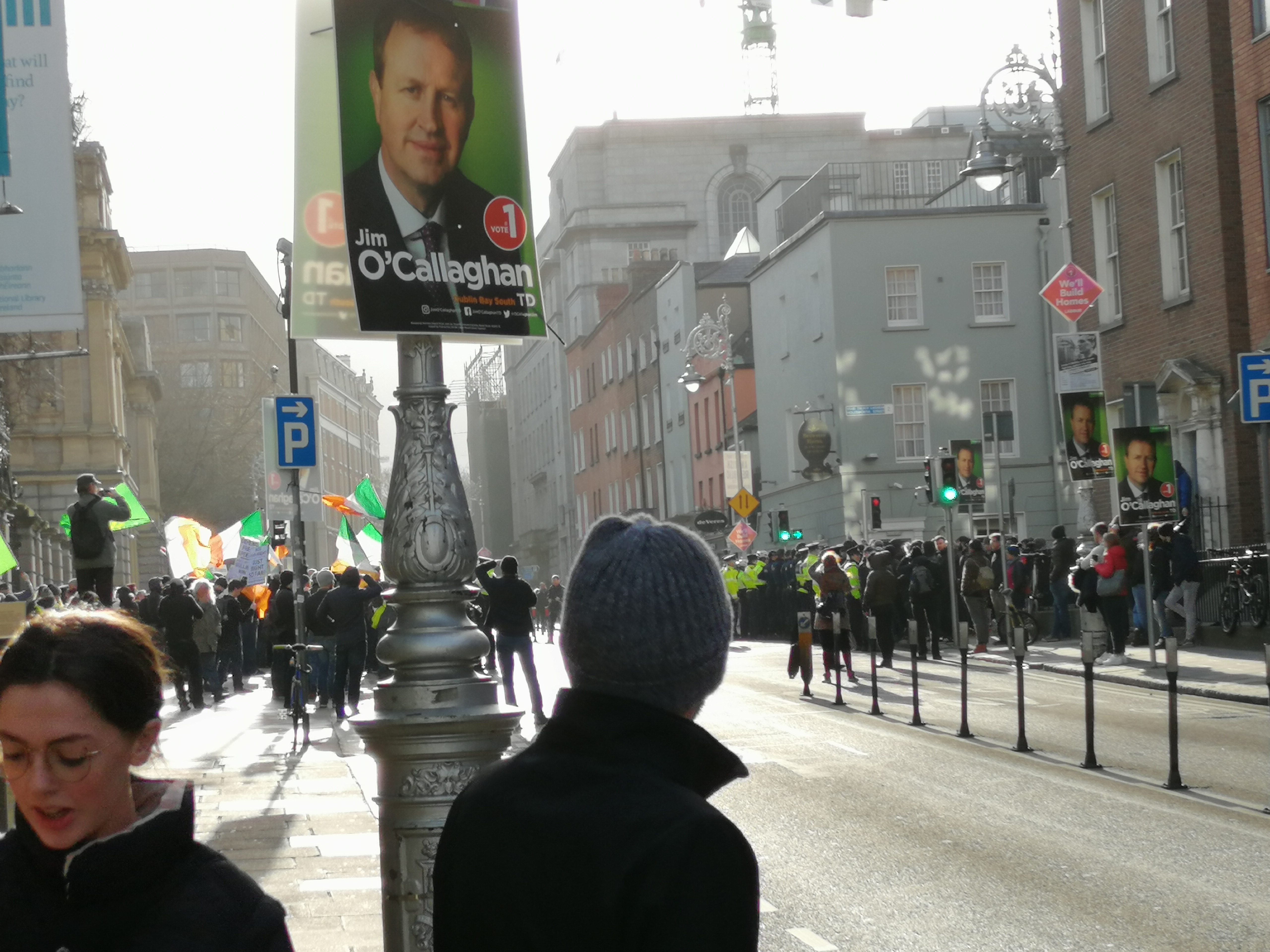
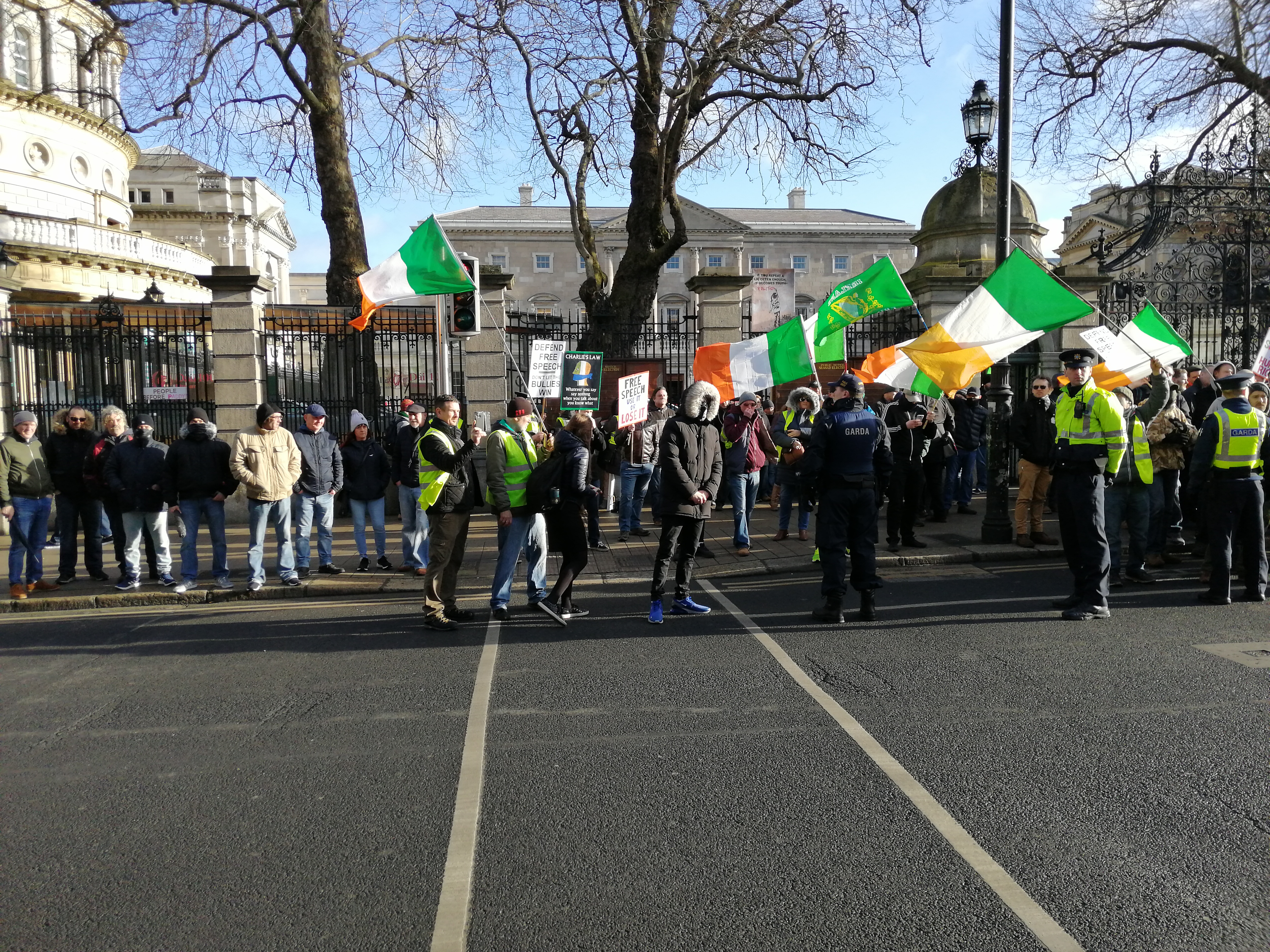
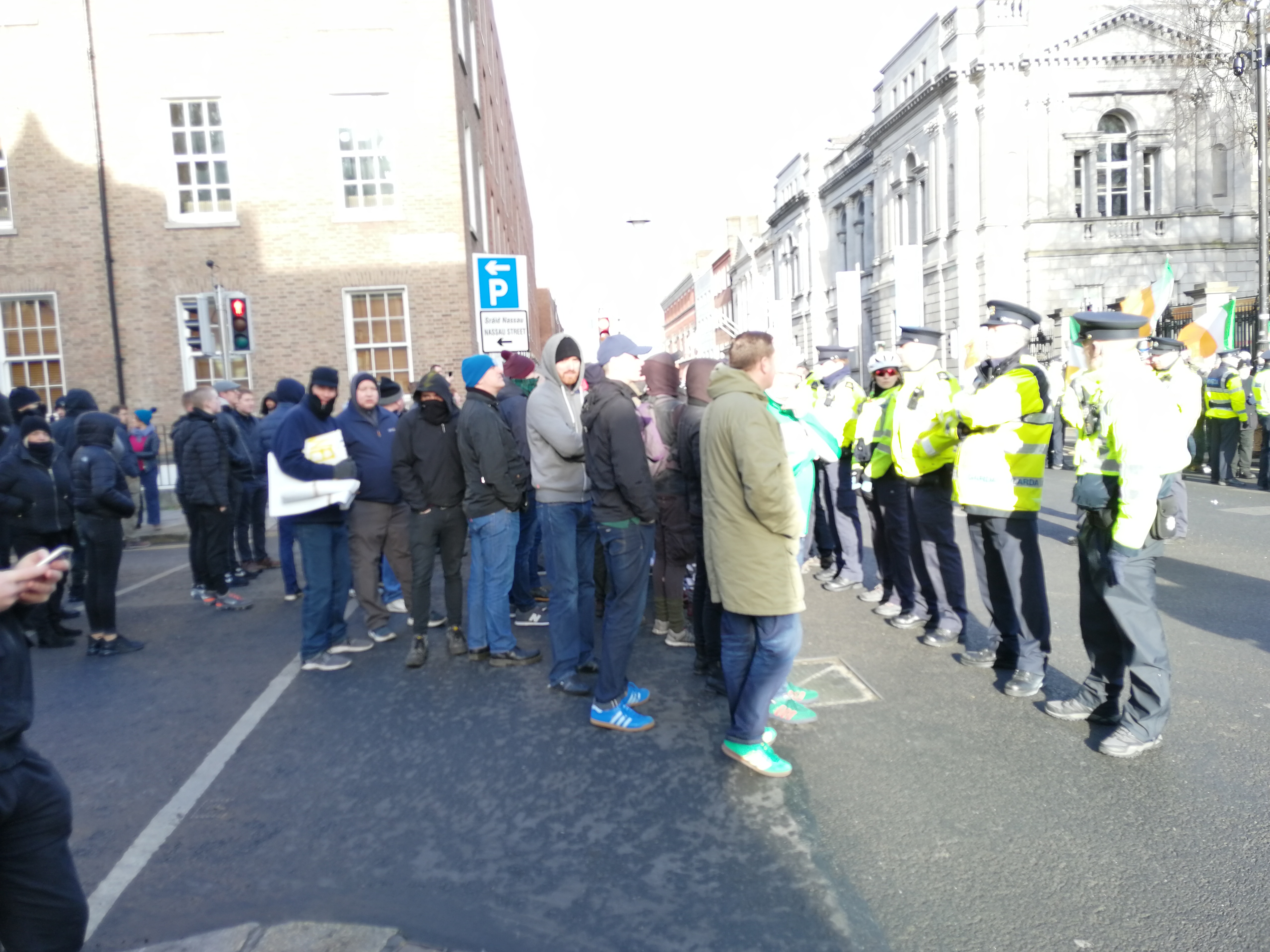
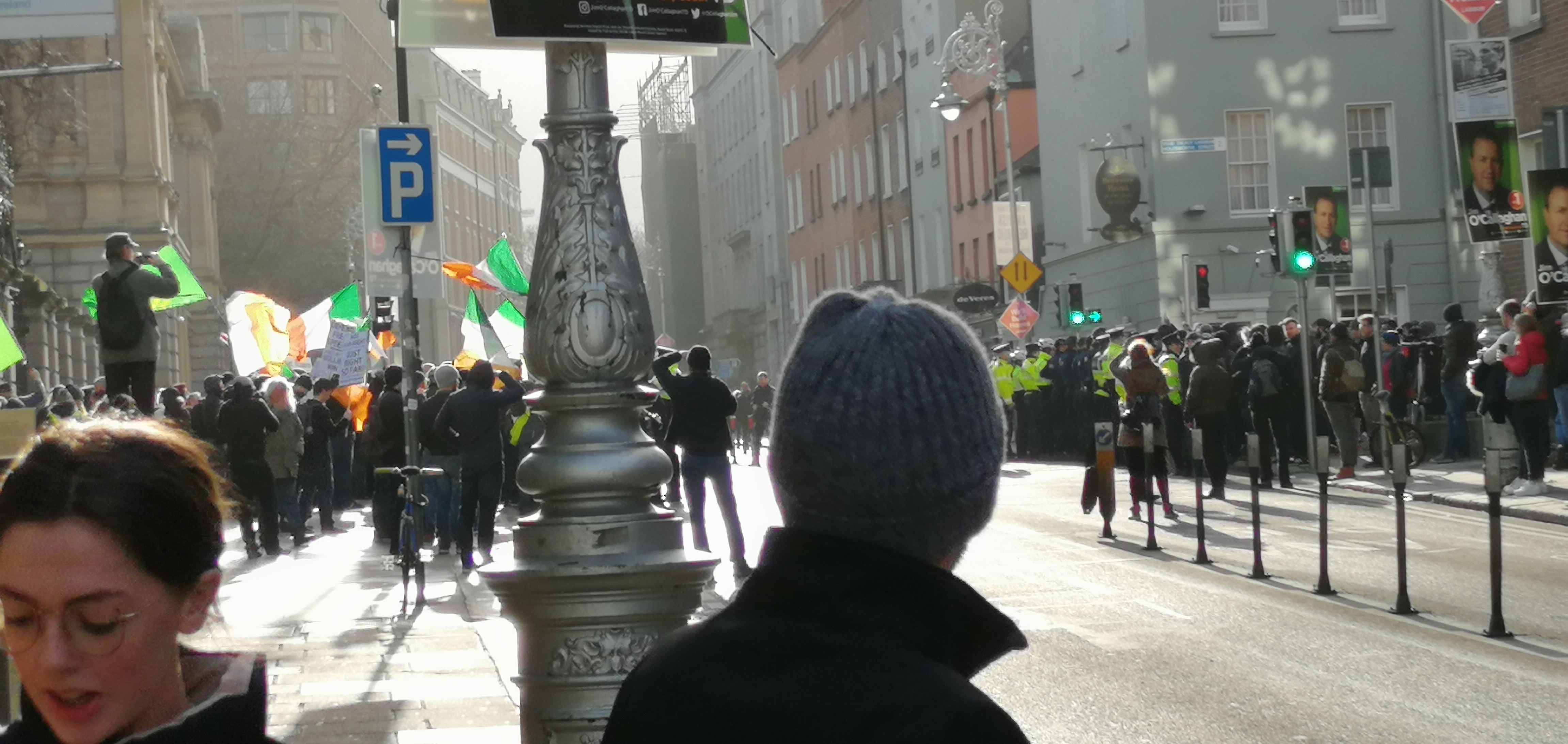
After weeks of propaganda and whipping up their support, a much-reduced turnout of the Irish far-Right lined up in front of Leinster House on Saturday 1st February and were confronted by an anti-fascist, anti-racist opposition a little smaller in size but which had been convened by word of mouth alone. There were some scuffles and a couple of arrests and the far-Rightists begged for a Garda escort to leave their protest after little more than one hour.
Confronting one another across Kildare St, far-Right and anti-fascists, seen from a little distance (Photo: D.Breatnach)
“FREE SPEECH”?
The far-Rightists had called the demonstration allegedly in defence of “free speech”, protesting legislation proposed recently by Fine Gael against “hate speech”. Apart from the fact that the detail of the legislation has not been published yet, most on the non-institutional Left in Ireland and perhaps especially Irish Republicans, would be extremely wary of such widely-framed legislation, known to have been used in other administrations primarily against people denouncing the police, political parties, politicians and even royalty.
However, most Republicans and the non-institutional Left would not agree with the “right to free speech” which the far-Right is seeking, which is the “right” to spout virulent and lying material in the course of their racism, islamophobia, LBGTphobia, attacks on women seeking pregnancy termination or campaigning for the right to choose. In fact, we can trace the public start of the far-Right concern with “free speech” in Ireland to July 2019 when Gemma O’Doherty had her Youtube account suspended and then closed by Google, due to complaints that her racist rants were violating Google’s own standards. A similar case occurred in January in Spain when the relatively new far-Right Spanish party Vox had their Twitter account suspended, after they had accused a municipal education program on equality of “using public funds to promote paedophilia”. (see also FAR RIGHT CHANTS OF “PAEDOS” below for more on this issue).
The far-Right demonstrators with Leinster House in the background. They fly a lot of Tricolour flags in an attempt to convey themselves as ‘patriotic’. (Photo: D.Breatnach)
Even thinking about the issue for a few seconds will make it clear that there is not and never has been an unfettered right to say whatever one wants in public. Long before there were modern laws against defamation of an individual based on lies, it was forbidden by the Brehon laws (the oldest surviving codified legal systemin Europe) which laid down punishment for the offence. Judaic and Christian traditions have it forbidden in the Ten Commandments as have those of many other cultures. The issue is not that all speech should be free but what kind of discourse should be permitted and which should not. And it is precisely that racist discourse, LBGTphobia, Islamophobia and attacks on the rights of women that the Republicans and non-institutional Left oppose, partly for its own sake and partly because it is along those lines that fascism seeks to build itself and split the working people in order to come to rule — in a dictatorship that will soon ban any criticism whatsoever of those in power.
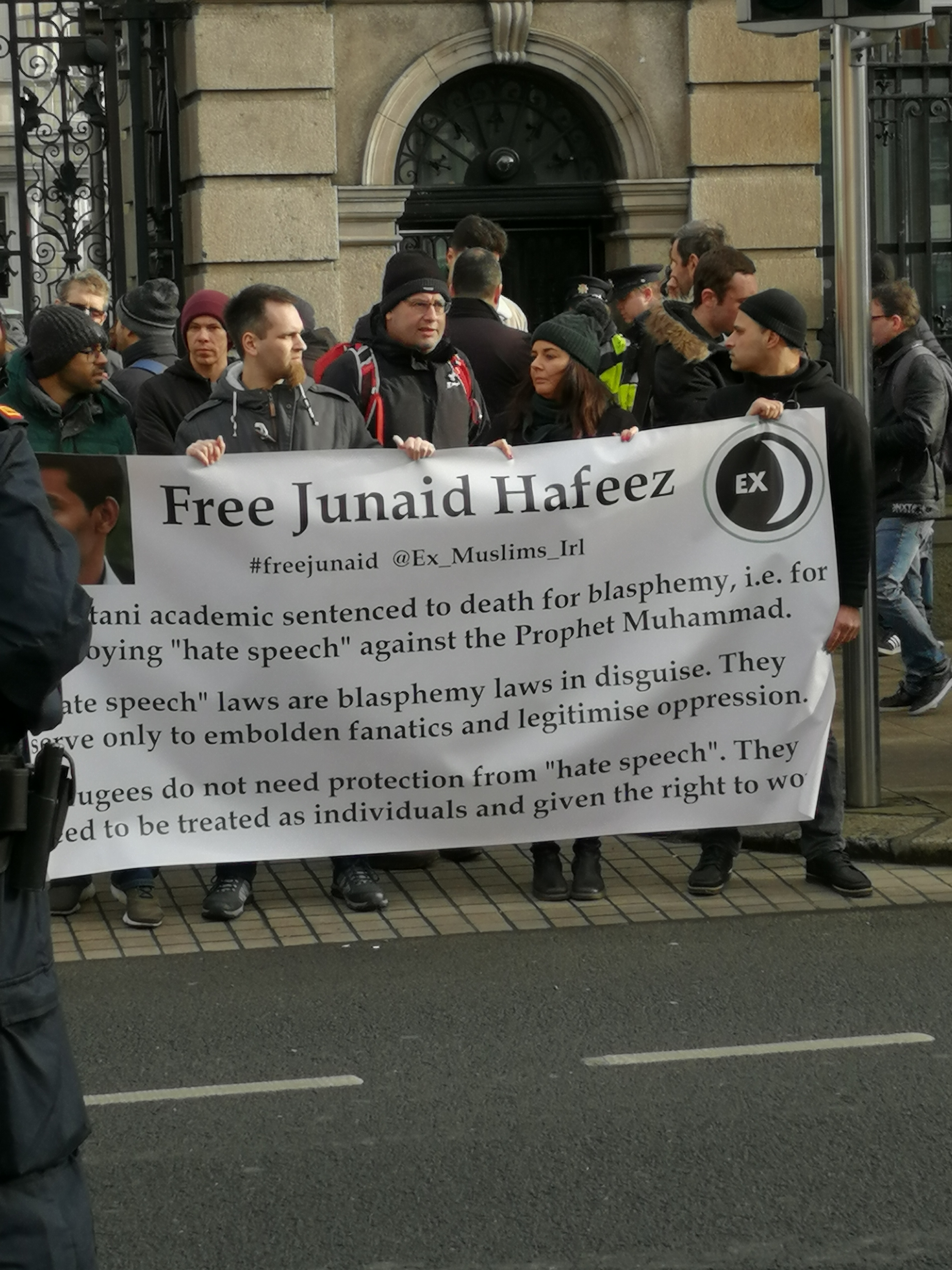
Some confused or misguided Asian anti-blasphemy laws protesters among the far-Rightists, despite the common anti-migration and racist discourse of the far-Right. (Photo: D.Breatnach)
FAR-RIGHT CHANTS OF “PAEDOS”
Among the exchange of insults between both sides, at one point the far-Rightists were heard to chant “paedos” at their opposition. The word is an abbreviation of the word “paedophiles”, which describes people who sexually abuse children for their own twisted gratification.
Imagine if some of these far-Rightists were in one’s neighbourhood and began to accuse an anti-fascist of being a paedophile! This is one of the ways in which they abuse any right to free speech.
But in any case, what is the basis for this chant? Do they really believe that their opponents are all paedophiles? No, like the Spanish far-Right party Vox referred to earlier, they count LGBT people as equal to paedophiles, i.e people who sexually abuse children. That is how sick their thinking is. Nor do they believe that all their opponents are LGBT themselves but according to the far-Right, the fact that we uphold the right of people to decide their own sexuality and for consenting adults to choose their relationships, makes us the equivalent of those who sexually abuse children!
View of the anti-fascist, anti-racist demonstrators, at the Molesworth St. intersection, viewed northward down Kildare St. (Photo: D.Breatnach)
SURGE, SCUFFLES AND ARRESTS
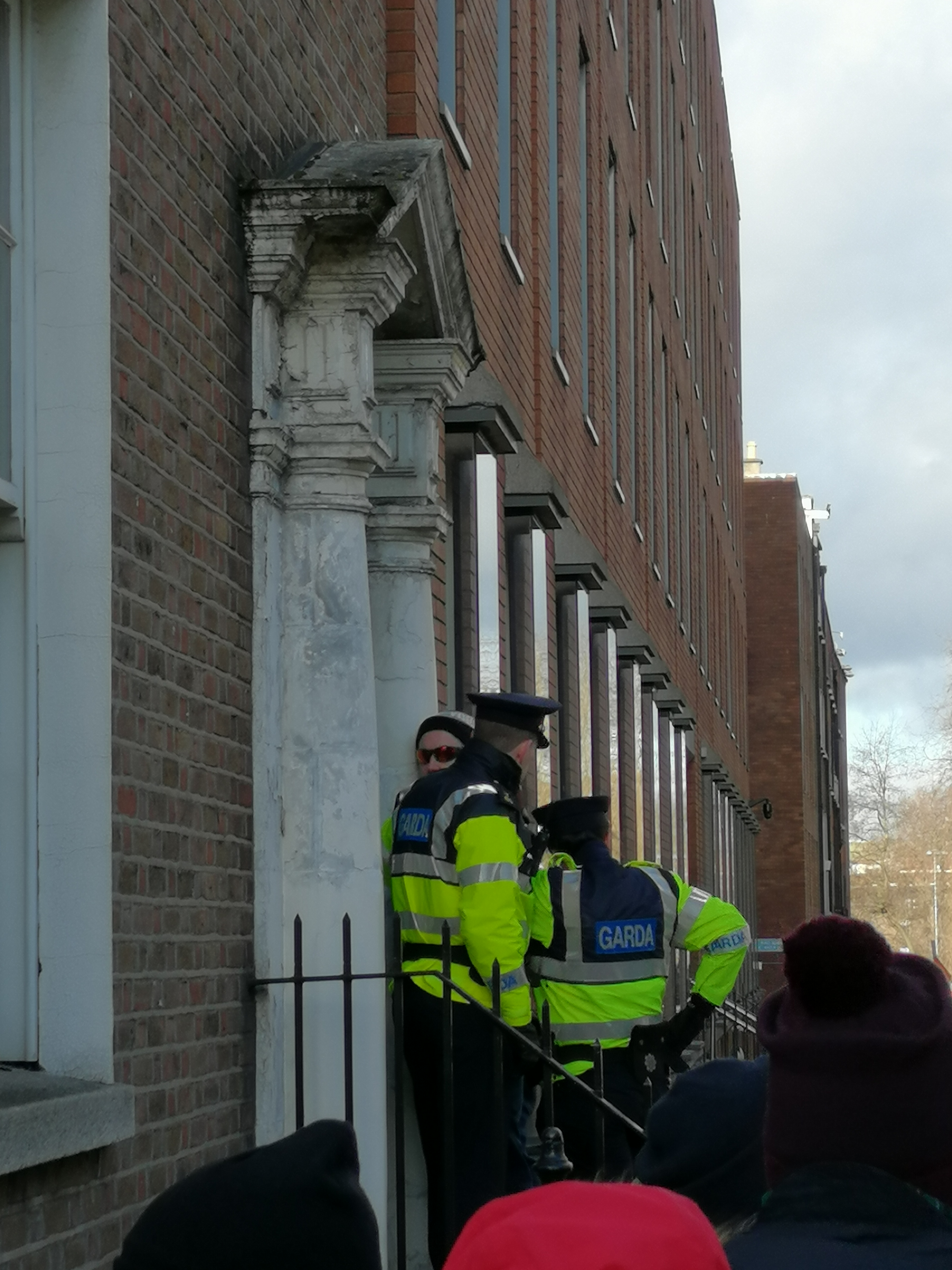
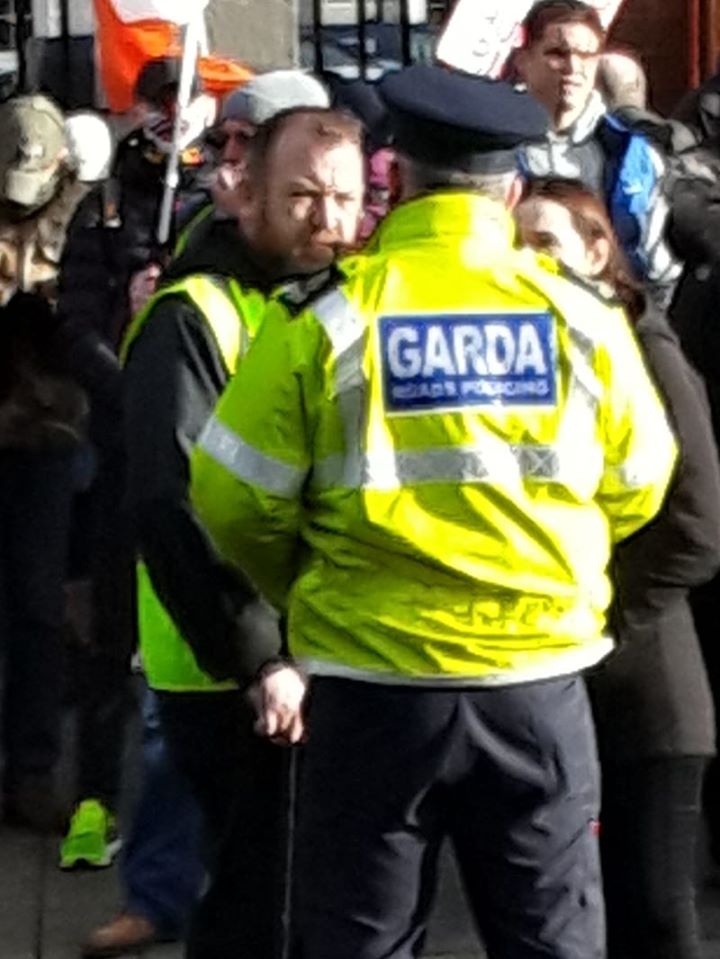
At one point, a surge developed among the anti-fascists towards the south of their numbers and the general Gardaí and Public Order unit (the Gardaí are the police force of the Irish state) charged the anti-fascists with batons drawn, with which they struck a number of antifascists. A man reported to be a fascist, on the steps outside a building on the same side of the street as the antifascists, was seen lashing out downwards, presumably at antifascists, with a pair of crutches. At that point the Gardaí restrained him and later it seems arrested him but apparently they had already arrested an anti-fascist. Most of the police dived at the anti-fascists during this brief episode and a few activists were rescued from police hands. However, a fascist who crossed the road from the Leinster House side with a stick, who took a number of swings at anti-fascists, was escorted back across the road by Gardaí, apparently without any attempt to arrest him.
The man seeing striking out at anti-fascists with crutches before being restrained by Gardaí. An antifascist was arrested during this incident. (Photo: D.Breatnach)
The far-Right rally had been scheduled for 1.00pm and at 2.15 pm they left, having begged the Gardaí for an escort, with which they were provided. Meanwhile, the riot police prevented the anti-fascists from following them.
However, a brief encounter on the quays a little later between small numbers of both groups necessitated the Gardaí once again to protect these “nationalist” warriors.
Yellow Vest Ireland fuhrer Glen Miller seeking escort from senior Garda officer. (Photo source: antifascist participant)
DIMINISHING AND DESERTED BY LEADERS?
Those who fancy themselves as the public leaders of the motley crew of the far-Rightists left their acolytes deserted, for apart from Yellow Vest leader and islamophobe Glen Miller, they did not attend. Neither Gemma O’Doherty nor Justin Barrett were to be seen there and the ex-British Army soldier Rowan Croft made only a brief appearance before vanishing.
As mentioned earlier, although extensively publicised in advance, the numbers of the far-Right were significantly down on previous events outside Leinster House, which may point to a limited reservoir of activists in the far-Right in Ireland, also to some inability to sustain an extended program of public events (after all, keyboard activism has been their main activity until recently).
On the other hand, their opponents, using personal contact only to mobilise from among Irish Republicans, Socialists, Anarchists and general Anti-Fascists of different organisations and none, were able to put together a counter-demonstration of a size approaching that of the far-Rightists.
However, it would be unwise to relax. The far-Right is on the rise across most of Europe; the capitalist system world-wide is heading for crisis and at such times turns to fascism to force the working people to pay for the crisis through austerity. In addition, in Ireland we are already in part of an austerity program with the bank bailout draining our taxes, our health service in crisis and no public housing program to counter spiraling homelessness and mortgage debt.
The Gombeens and foreign capitalists who feed on our sweat and blood will hesitate before taking on the working people in this country in an open fight. But with fascists and racists splitting the working people and diverting them from the cause of our woes, that would be a different matter. Continuing vigilance is required, along with mobilisation to counter their public events. But also, education of the people and giving genuine leadership in fighting for a decent life for working people of all ethnic backgrounds in Ireland.
Anti-Fascist Action Ireland (they published a report from which I took some of the information here, the rest being based on my observation): https://www.facebook.com/afaireland/?
Thank you for taking our Government satisfaction survey. Your opinion is important to us.
Please bear with us while we give you an opportunity to recheck your answers.
You indicated a satisfaction level of 0% with the current Government. Yes/ No
You indicated a satisfaction level of 0% with the previous Government. Yes/ No
To the question “Which past or current government did you approve of to a level of 50% or over?”
you entered “None.” Yes/ No
To the question “What, if any solution do you propose?” you entered “Revolution.” Yes/ No
In the event of having indicated “No” to any the questions above, please repeat the questionnaire again with more care.
In the event of instead having answered “Yes” to all, you need do nothing more. Our Satisfaction Team will shortly be with you to discuss matters further. Please do not leave the location at which you currently find yourself. Please do not switch off your phone or Satnav.
Thank you for taking the time to complete our questionnaire. Your opinion is important to us.















 rebelbreeze