THE FLAG, THE PEOPLE & THE PLACE: The ‘Irish Republic’ flag

Diarmuid Breatnach
(Reading time: 5 mins.)

It was an Irish Argentinian who erected the “Irish Republic” flag over Dublin’s General Post Office during the 1916 Easter rising: Eamon Bulfin, born in Buenos Aires on 22 September 1892.

The flag in question was painted by Theobald Wolfe Tone Fitzgerald in the home of Constance Markievicz (1868-1927)1 with the words “Irish Republic” in gold or yellow, edged with white on material of a green curtain or bed-covering.

This was the flag later triumphantly displayed upside down by the British in front of the Parnell Monument (of which photographs may be found by search of the Internet).
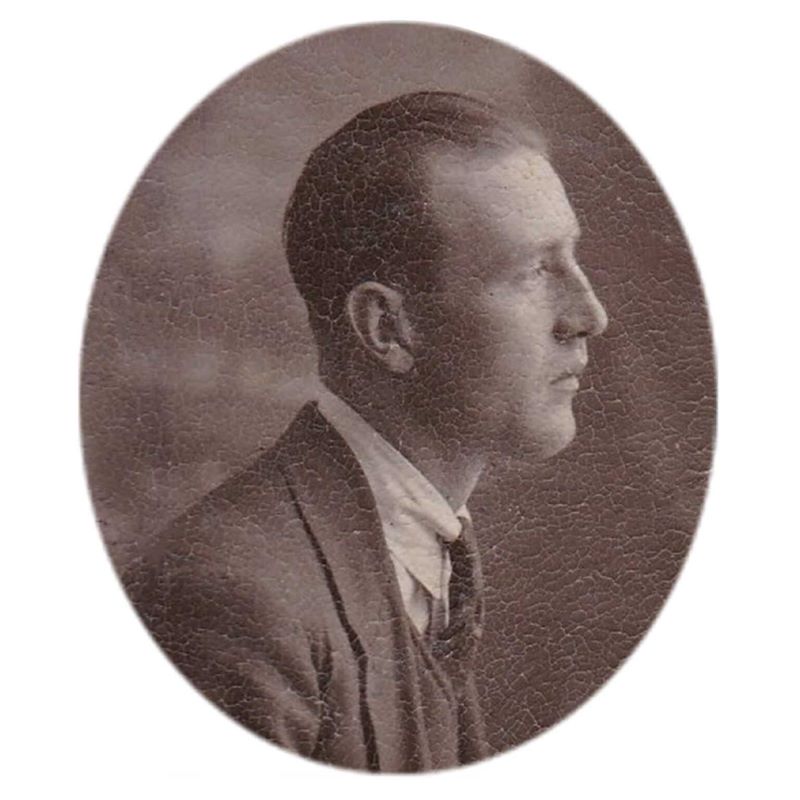
Eamon Bulfin
Colourised photo of Constance Markievicz in Irish Citizen Army uniform. The ‘Irish Republic’ flag was painted on material in her house and delivered by her to the GPO. The words declared to the world that the national liberation forces were fighting for an independent Republic. (Photo sourced: Internet)

Eamon was the son of William Bulfin (1864-1910) from Birr, King’s County (now Co. Offaly), who emigrated to Argentina at the age of 20 and was a writer and journalist who became editor and proprietor of ‘The Southern Cross’ newspaper. William also helped finance Pádraig Pearse’s Scoil Éanna (St. Enda’s School) which opened in September, 1908.

Bulfin returned to Ireland in 1909 with his wife, Anne O’Rourke, and their children Eamon and Catalina. William’s death in 1910 was a blow to his friend Arthur Griffith and the efforts to launch a Sinn Féin2 daily newspaper.

Eamon was enrolled in St Thomas Aquinas College, Newbridge, before attending St Enda’s School (Scoil Éanna) in Cullenswood, Rathmines, from September 1908 at the age of 17.

He impressed the headmaster and school founder, Patrick Pearse, who noted his aptitude for Irish, French and English,3 though also that he was weak at mathematics.

Bulfin enthusiastically engaged with the ethos of the school, acting in dramas, contributing short stories to the school review, An Macaomh, and captaining the St Enda’s football team in 1909–10.

He was enrolled as a student at St Enda’s until 1910 but remained as a boarder at its new location in Rathfarnham; he became close to the Pearse family. Eamon enrolled in the National University of Ireland in 1911 to study for a science degree.

While at university Bulfin won both Sigerson and Fitzgibbon cups (in football and hurling respectively) on a number of occasions, captaining the National University of Ireland (NUI) football team that won the Sigerson Cup in 1915.

In his 20th year Eamon joined the Irish Republican Brotherhood, being sworn in by Arthur O’Connor and, a year later, in 1913 joined E Company, Fourth Battalion (Rathfarnham) of the newly-formed Irish Volunteers

By 1915 he was involved in organising the volunteers in Dublin and Co. Meath, and in manufacturing munitions and explosives in St Enda’s, which activities continued up to the Easter rising, just prior to which he helped Kathleen Lynn  transport these weapons to Liberty Hall.

Bulfin was promoted to the headquarters staff of the volunteers and, mobilised for the 1916 Rising, was under Pearse’s personal command and stationed at the GPO, where he hoisted the “Irish Republic” flag on the roof at the corner with Princes Street.
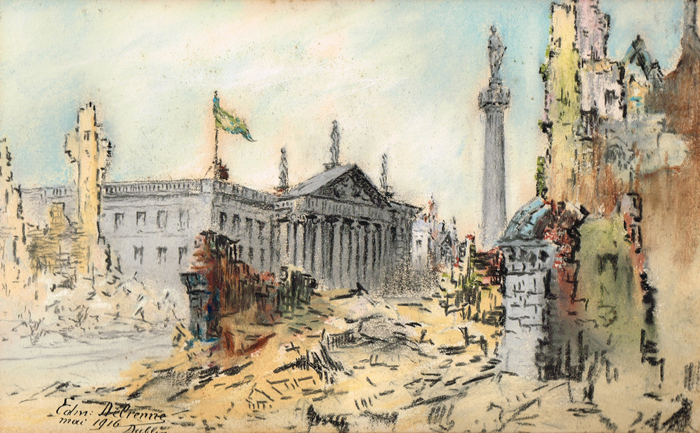
1916 Artwork in pastels by Edmond Delrenne, a Belgian refugee who had arrived in Ireland in 1914. drew and coloured the ‘Irish Republic’ flag on the GPO (centre picture). The painting also shows Nelson’s Column, which was blown up in 1966. (Artwork source: Whyte’s)

After the surrender in Moore Street, Eamon Bulfin, as with nearly 100 insurgents was sentenced to death by British military court martial but most sentences (excepting the 15 shot by firing squads in the following days)4 were commuted to periods of prison incarceration in England and Wales.

On March 21, 1917, Eamon Bulfin was deported from jail under Britain’s Aliens Restriction Act of 1914.

The Argentine Government did not want to anger the British Empire, with whom they were already having problems, not the least with their long-standing argument over the sovereignty of The Malvinas/Falklands.They therefore arrested Eamon Bulfin when he arrived in Buenos Aires and sentenced him to jail for leaving Argentina for the purpose of ‘deserting from military service’.

As Eamon had been a schoolboy when he and his family left for Ireland, the charge was an excuse for the authorities but suspicion of being a communist, which the British gave for his deportation might have been the real reason.

He was conscripted into the Argentine military and served in the army before transferring to the navy, being released after ten months as his mother was a widow, which qualified him for an exemption from military service.
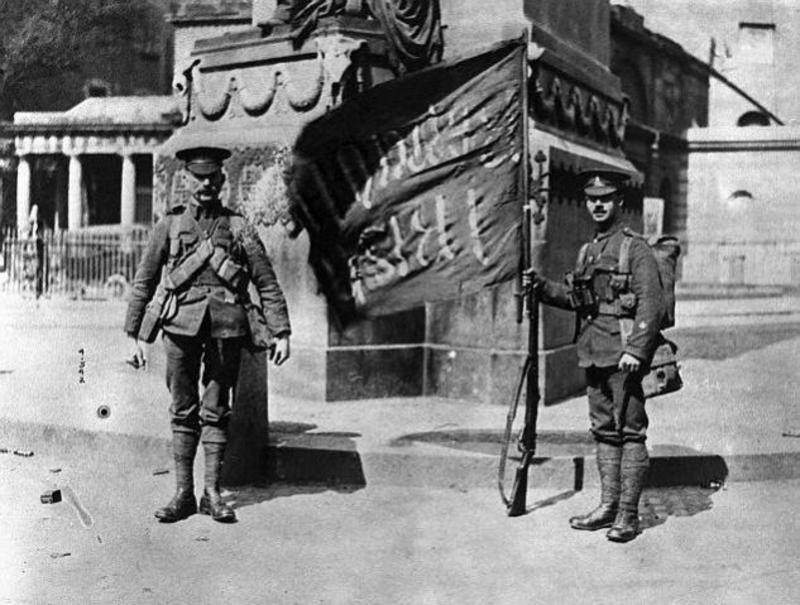
One of two photos of the ‘Irish Republic’ flag being displayed upside down by British soldiers, symbolising the defeat of those who flew it. The site is the base of Parnell’s Monument in Parnell Street with the Rotunda in the background. (Source: Internet)

When Eamon Bulfin was released in 1919, the General Election in Ireland had resulted in an overwhelming victory for Sinn Féin5 which, in accordance with their manifesto, made a Unilateral Declaration of Independence declaring Ireland a republic and set up a parliament in Dublin.

The President of the Irish Republic, Eamon de Valéra wrote to Bulfin in May appointing him the official representative to Argentina.As Irish Consul, Bulfin was to “inaugurate direct trade between Ireland and the Argentine Republic… to co-ordinate Irish opinion in the Argentine, and to bring it into the Irish demand for a republic.”6

Bulfin began work, establishing close contacts with Argentine government officials, Irish Argentine leaders and he launched an Irish Fund to help the cause.

In 1920, during the county council elections, Eamon Bulfin was nominated in his absence for a seat on King’s County Council. He was not only elected but appointed Chairman of the council.

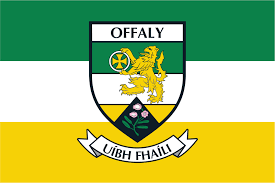
One of the first things the new Council did was to agree that the county’s name be returned to the region’s ancient Irish form of Co. Uí Fáille (anglicised as Offaly). Meetings were conducted with the Chairman’s seat in the council chamber left empty and with a Tricolour draped across it.
In 1922 Eamon Bulfin was finally allowed to return to Ireland where he set up home in his father’s native Derrinlough, Birr, Co. Offaly. He took the Anti-Treaty side in the Civil War and handed over 600 Stg from fund-raising in Argentina.

However the killing of Michael Collins affected him deeply and he stayed out of the Republican forces, telling them that he had refused an officer’s post in the Free State’s National (sic) Army.

On 16 February 1927 Eamon married Nora Brick (Nóra Ní Bríc) of Tralee, a former member of Cumann na mBan, in an Irish language ceremony in Drumcondra, Dublin (his occupation was recorded as a farmer). They had four children: Edward, Jeanne, Blanaid and Michael. 

Eamon Bulfin died of a cerebral haemorrhage in the Meath Hospital, Dublin, on 24 December 1968, and was buried in Eglish Cemetery, Co. Offaly.
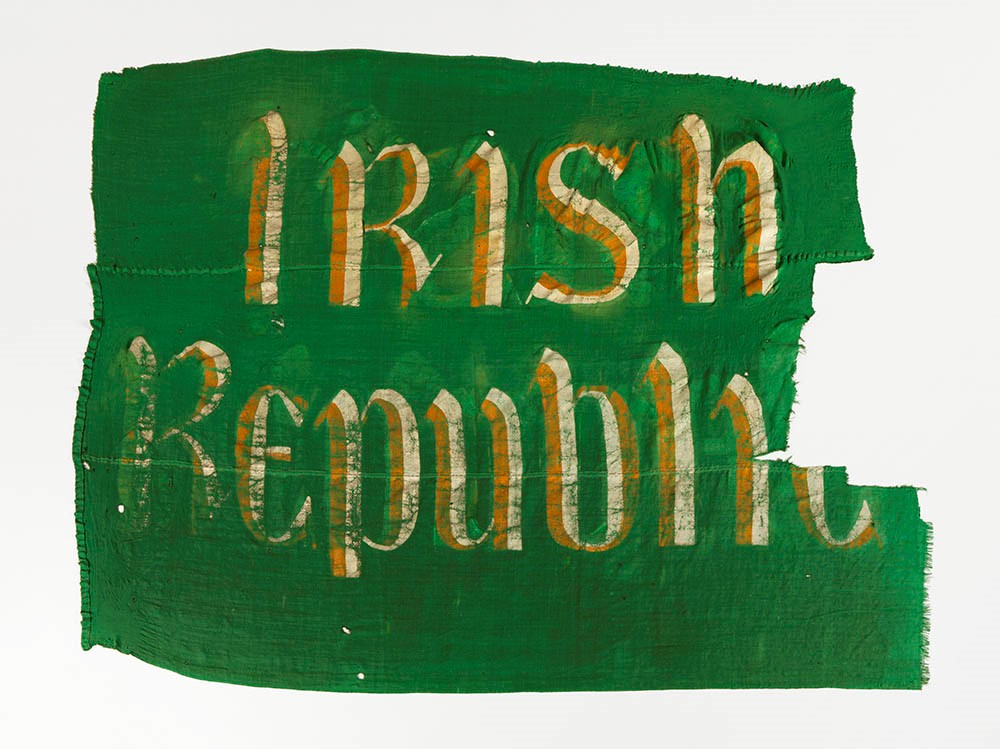
Remnant of the ‘Irish Republic’ flag in the National Museum of Ireland (Photo: NMI)

His sister, Catalina, also born in Buenos Aires in 1901, had become secretary to Austin Stack (1880-1929). Stack was elected to the Dáil (32-County Irish Parliament) in 1918 and became Minister for Home Affairs from 1920-22.Stack accompanied de Valéra to London for the initial Truce talks but became a leading opponent of the terms agreed by Collins.

Catalina Bulfin married Seán MacBride (1904-1988), born in Paris and his first language French. Sean was the son of John MacBride, executed by the British in 1916 and of Maude Gonne.

Seán McBride is the only Nobel Peace Laureate to have also won the Lenin Prize; he was former IRA Chief of Staff (1936-1937), Irish Minister for External Affairs (1948–‘52) and Secretary of the International Commission of Jurists.

MacBride was a founder member of Amnesty International and Assistant General Secretary of the United Nations. He survived Catalina MacBride by 12 years after she died in 1976, her remains being buried in Glasnevin Cemetery, Dublin.

End.

FOOTNOTES

SOURCES

https://www.dib.ie/biography/bulfin-eamonn-edmond-a10114

https://en.wikipedia.org/wiki/Eamon_Bulfin

The flag: https://www.museum.ie/en-IE/Collections-Research/Collection/Resilience/Artefact/Test-4/8961f46b-5885-4aea-af9d-63894e2b76b4

https://en.wikipedia.org/wiki/List_of_flags_of_Ireland

https://www.irishtimes.com/news/ireland/irish-news/rising-from-the-ashes-irish-republic-flag-on-display-1.2573071

1Irish politicianrevolutionarynationalistsuffragistsocialist, the first woman elected to the Westminster Parliament, Markievicz was elected Minister for Labour in the First Dáil, becoming the first female cabinet minister in Europe. She served as a Teachta Dála for the Dublin South constituency from 1921 to 1922 and 1923 to 1927. She was a Member of Parliament (MP) for Dublin St Patrick’s from 1918 to 1922.

A founding member of Fianna ÉireannCumann na mBan and the Irish Citizen Army, Markievicz took part in the 1916 Easter Rising in, when Irish republicans attempted to end British rule and establish an Irish Republic.

2The Sinn Féin party at the time was an Irish nationalist one advocating a dual monarchy, Irish and British.

3And no doubt Spanish too, having been reared in Argentina, a language acquisition that probably helped with the acquisition of Irish and French, which have a great number of similarities in structure.

4And the sixteenth execution was of Roger Casement, by hanging in London.

5Then a reformed and much-expanded party with a Republican constitution.

6  Kennedy, Michael and Joseph Morrison Skelly (eds). Irish Foreign Policy: 1919-1966 From Independence to Internationalism. Four Courts Press: England 2000, p.45. (Quoted in the Wikipedia entry on Eamon Bulfin)
MARCH TO MONUMENT, RALLY – INTERNATIONAL WORKING WOMEN’S DAY CELEBRATED IN DUBLIN

Diarmuid Breatnach

(Reading time: 5 mins.)

The recognised date known as International Working Women’s Day is March 8th and it was commemorated on that date with a march and revolutionary words and symbolism organised by Irish Socialist Republicans in Dublin.

The marchers gathered outside Wynn’s Hotel in Lower Abbey Street, to mark the founding there of the revolutionary Republican military women’s organisation, Cumann na mBan, on 2 April 1914. The organisation, with its own officers, was possibly the first of its kind for women in the world.1

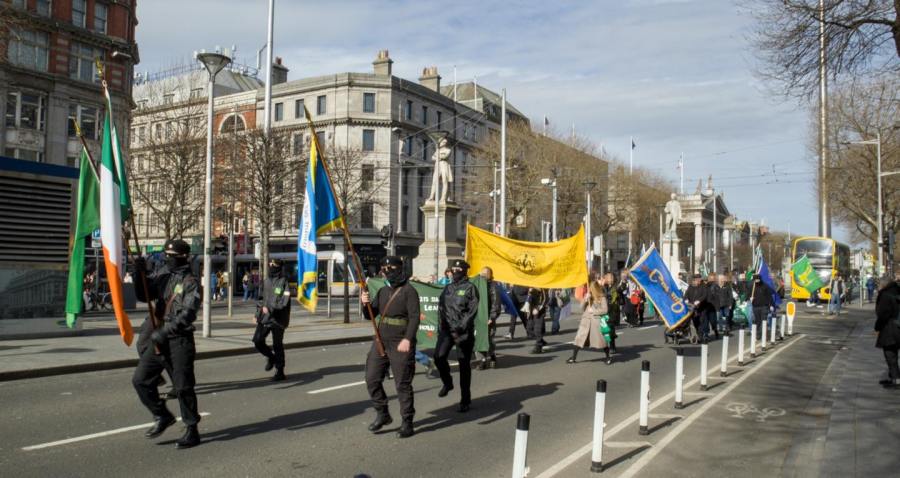
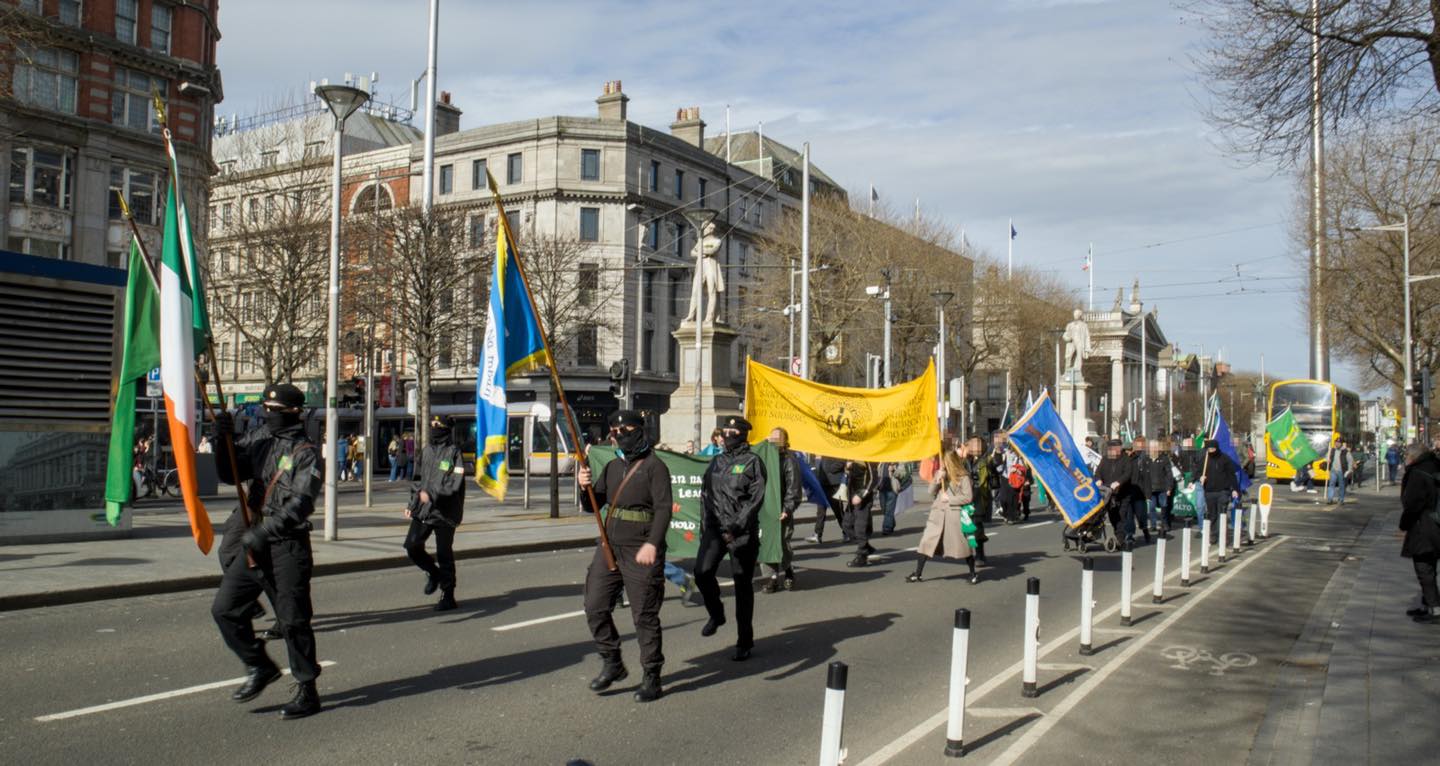
From there the march set off into O’Connell Street, then marching southward to cross the Liffey into D’Olier Street before turning left into Townsend Street, continuing to the statue of Constance Markievicz where the colour party’s flags were lowered in respect.

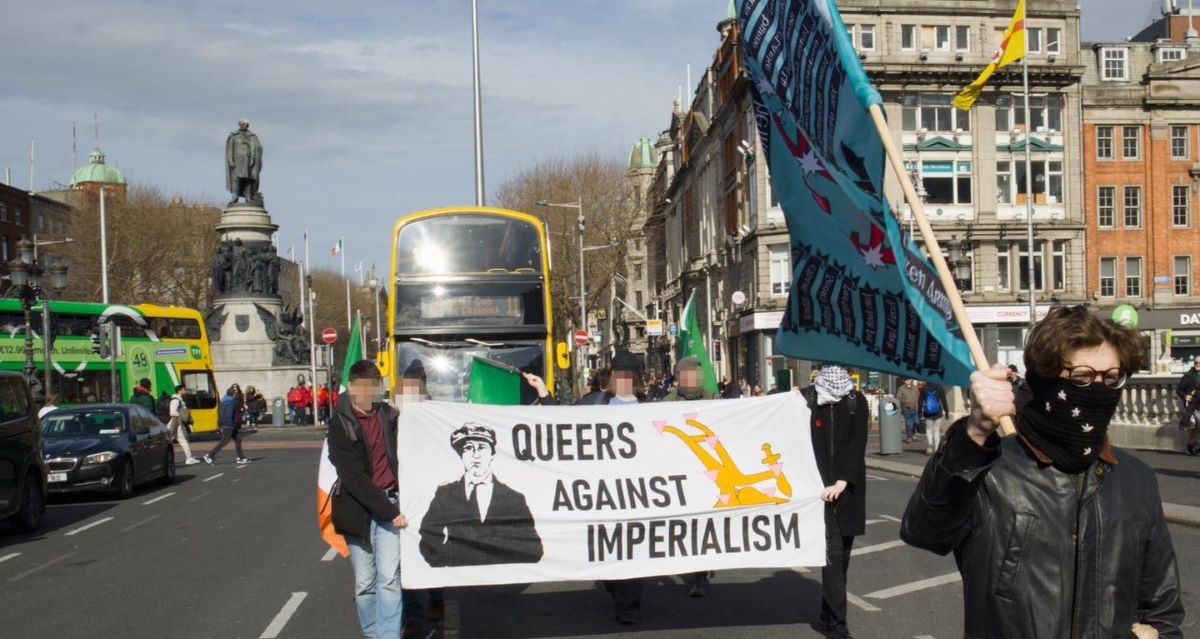
The march near the start in O’Connell St (photo credit: An Pobal Abú FB page)

Throughout, chants of “Ní Saoirse go Saoirse na mBan”2 and “Britain out of Ireland” reverberated through the streets of Dublin as banners displayed the slogans “coinníonn na mná suas leath na spéire / women hold up half the sky” and “Queers Against Imperialism”.

Markievicz was an active member of Iníní na hÉireann, the Irish Citizen Army and of Cumann na mBan. She was part of the command of the Stephens Green/ College of Surgeons garrison in 1916 and elected MP on an abstentionist ticket in 1918 and Minister of Labour in the First Dáil in 1919.

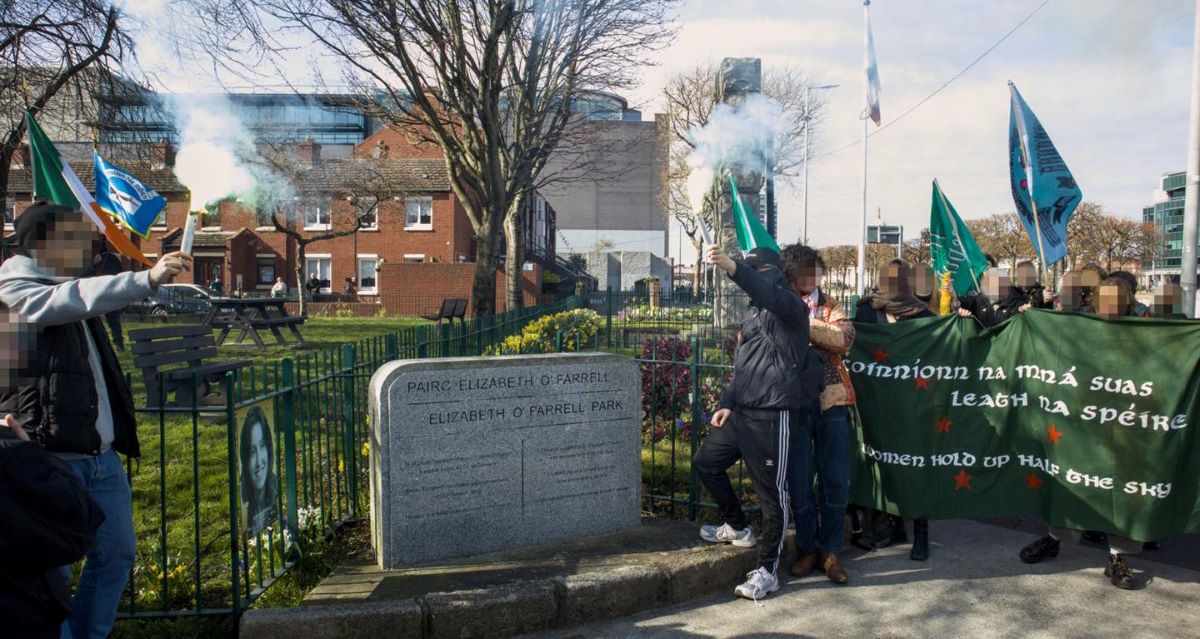
Continuing along Townsend Street and ending at Elizabeth O’Farrell park where a commemoration was held outside in honour of the role of women in the struggle for national liberation while the colour party took up position inside the park.

(Photo credit: An Pobal Abú FB page)

A woman read a speech on behalf of the AIA, tracing founding of International Women’s Day from when women in Russia in 1917 had led strikes and marches against the Tsar and WW1, later becoming known as the February Revolution, leading later to the October Socialist Revolution.

The speaker went on to speak of the role of women in the Republican struggle, from Cumann na mBan, the Irish Citizen Army and Armagh Gaol Republican prisoners, followed by a woman reading the 1916 Proclamation of Independence and the burning of two green flares.

(photo credit: An Pobal Abú FB page)

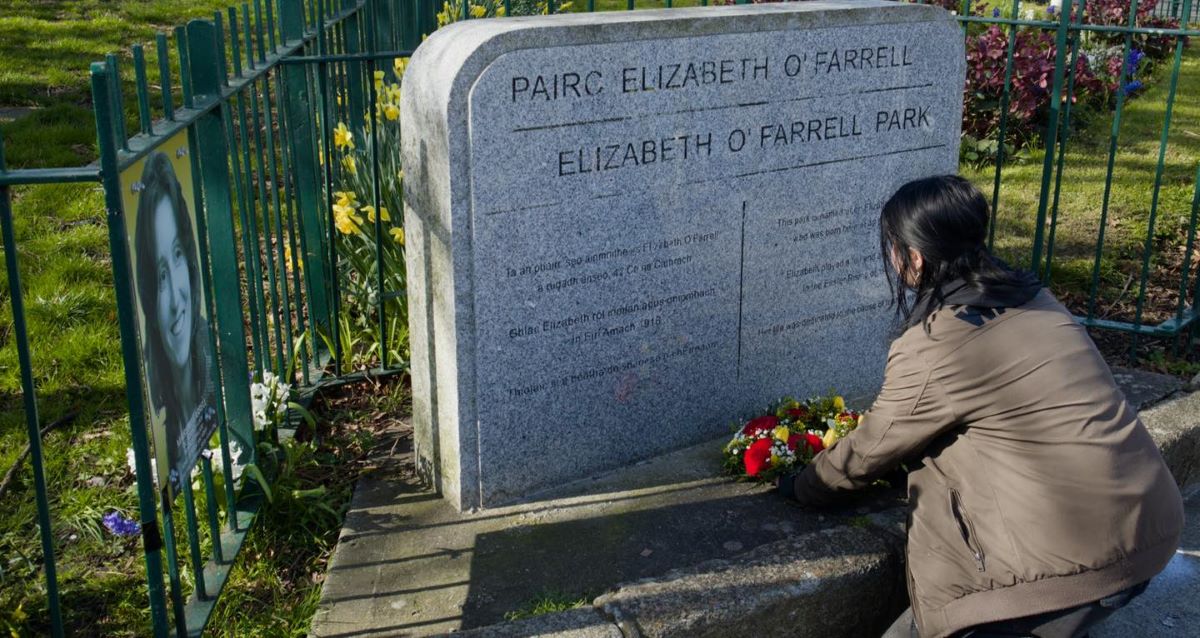
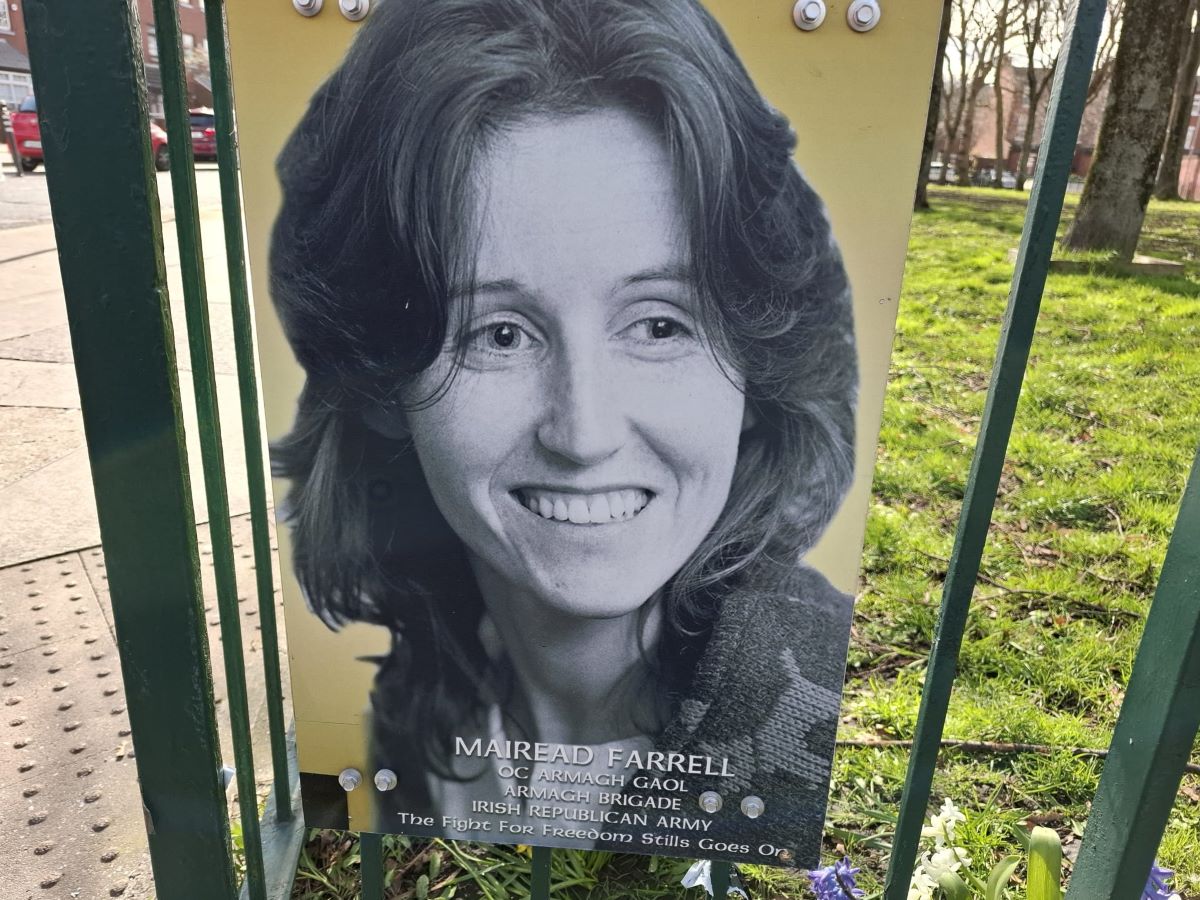
A new plaque of the Socialist Republican Mairéad Farrell was unveiled with the laying also of a commemorative wreath during a minute’s silence observed for all revolutionary women and gender oppressed people who gave their lives for national liberation and anti-imperialist struggle.

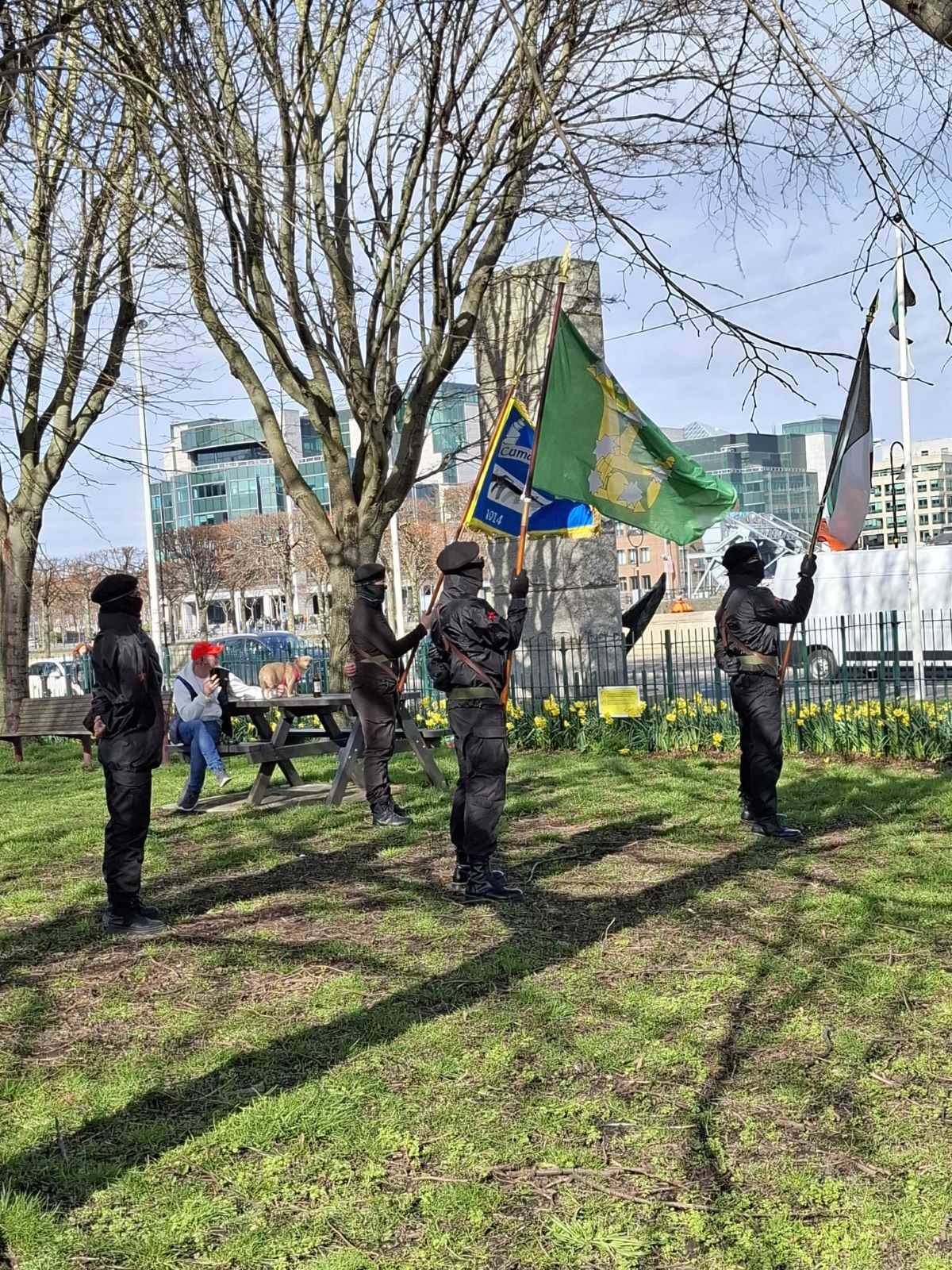
The Colour Party in Elizabeth O’Farrell Park (Photo: R.Breeze)

At the same time the colour party lowered their flags in respect, during which the command calls in Irish rang out in the area through the silence.

The area in which the Elizabeth O’Farrell and her life-long friend Julia Grenan3 grew up is a south Dublin docklands still largely working class area. It was in a yard in Lombard Street nearby, actually within sight of the park, that the IRB (Fenians) was founded on March 17th 1858.

Laying of the wreath (photo credit: An Pobal Abú FB page)

Elizabeth O’Farrell and Julia Grenan both participated in the 1916 Rising and, along with Winifred Carney, refused to join the earlier evacuation from the burning GPO building on the Friday, later participating in the final evacuation which ended in the central terrace in Moore Street.

When the leadership took the decision to surrender, O’Farrell went out to negotiate under a white flag even though a man had been killed under such a flag earlier in the very street. In 1922, along with almost the entirety of Cumann na mBan and the ICA, she rejected the Anglo-Irish Agreement.

(Photo: R.Breeze)

Many women were interned by the nascent neo-colonial Irish Government.

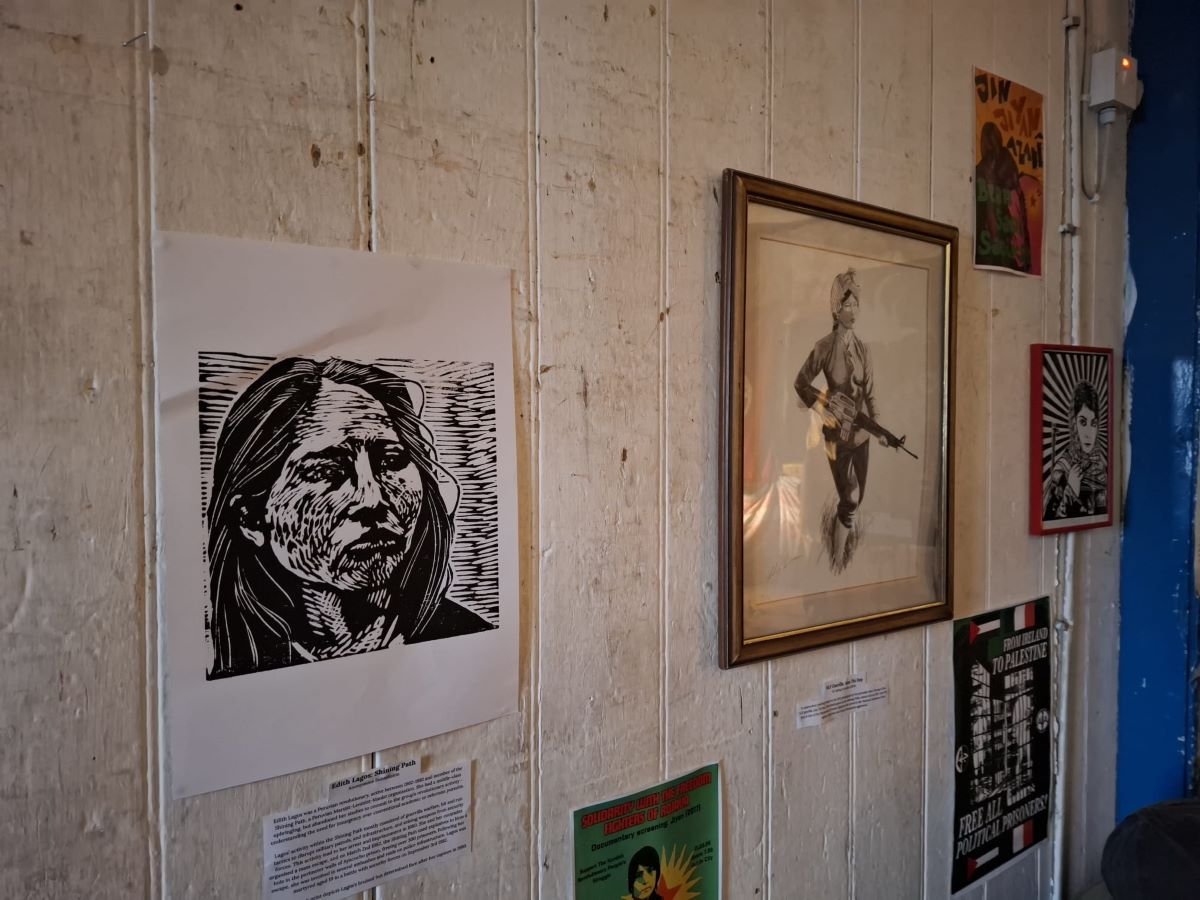
After the Elizabeth O’Farrell Park event, people gathered again at a recently-occupied social centre in Dublin, to view an exhibition of images in honour of the day and to watch an English-subtitled French-language film about women and the Omani Resistance, followed by a music session.4

Part of exhibition for International Working Women’s Day in the social centre (Photo: R.Breeze)

End.

Note: If you found this article of interest, why not register with Rebel Breeze for free, so that you will be notified by email of subsequent articles. You can de-register any time you wish.

Footnotes

1In its early years the organisation worked mainly as an auxiliary to the Irish Volunteers but asserted greater independence at a later stage. It coincided in time with the women in the Irish Citizen Army who shared equal status with male members and indeed in the case of some of them, such as Markievicz and Lynn, actually commanded men. Wynne’s Hotel was also where the decision to found the Irish Volunteers had been taken in 1913.

2Translated as ‘There can be no freedom until women are free.’

3And life partner, many have speculated – certainly they lived together until the end.

4The Hour of Liberation Has Arrived by Heiny Srour

Useful links

https://www.facebook.com/profile.php?id=61551946386300

https://en.wikipedia.org/wiki/The_Hour_of_Liberation_Has_Arrived

FOUNDING OF FIRST WORKERS’ ARMY IN THE WORLD COMMEMORATED IN DUBLIN

Clive Sulish

(Reading time: 8 mins.)

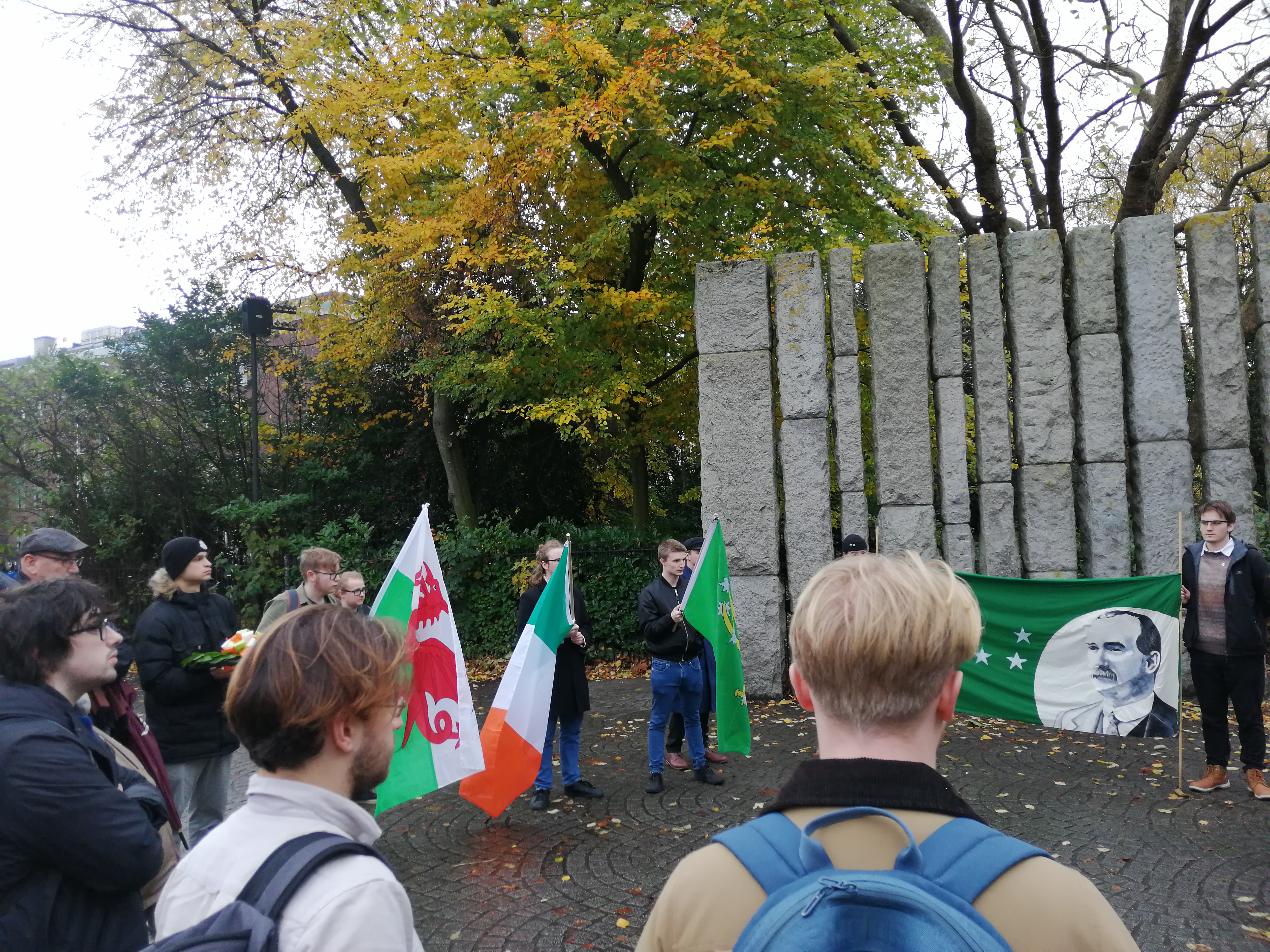
The founding of the Irish Citizen Army, the first workers’ army in the world1, was commemorated in Dublin at the site of Wolfe Tone monument in Stephens Greeen, in song and speech on 23rd November 2022.

Organised by the Connolly Youth Movement, the other participating organisations represented were the Irish Communist Party, Independent Workers Union, Lasair Dhearg2 and Welsh Socialist Republican Solidarity (Ireland) – the Irish branch of the Welsh Underground Network.

In addition, a number of independent activists were also present.

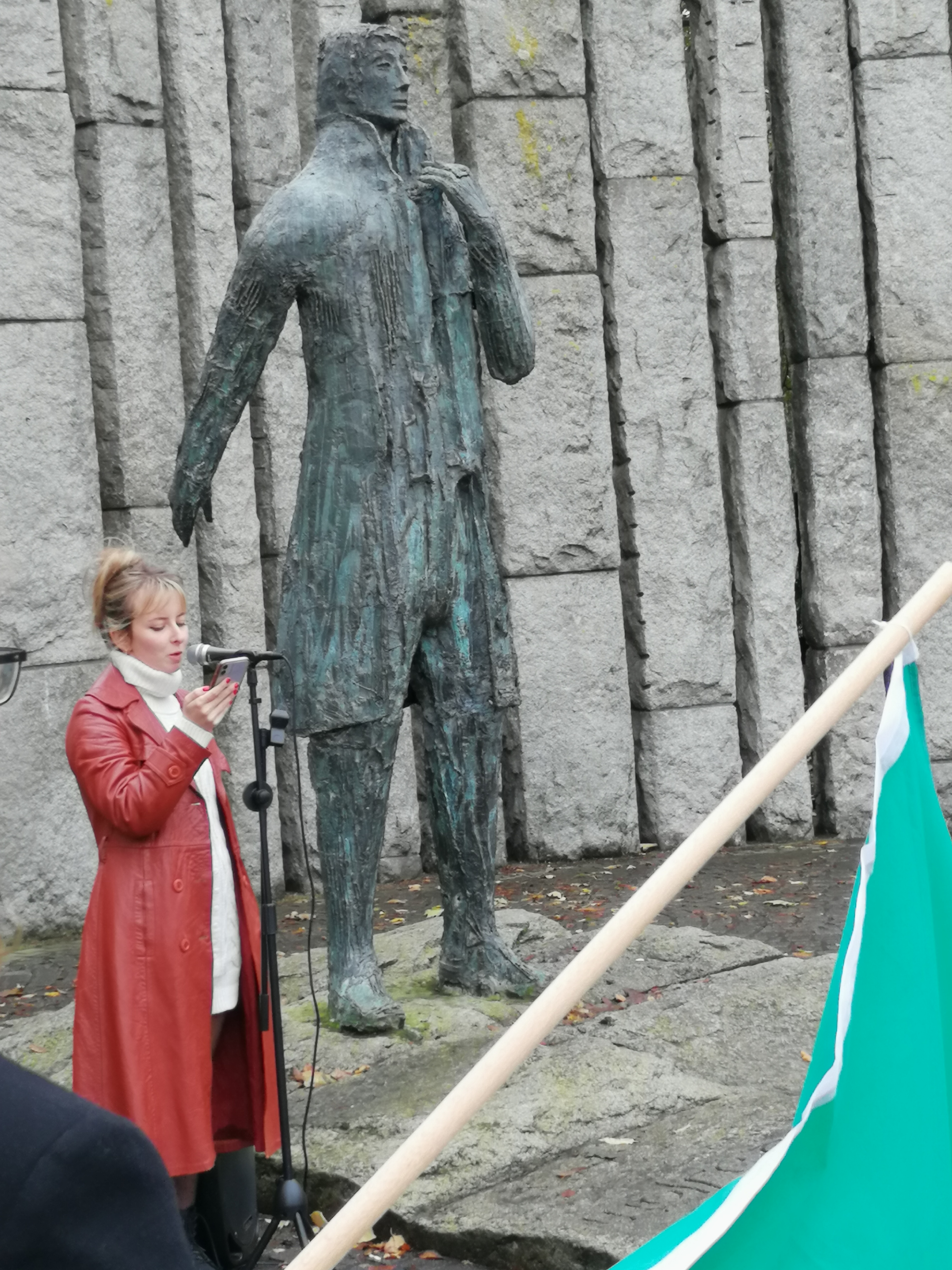
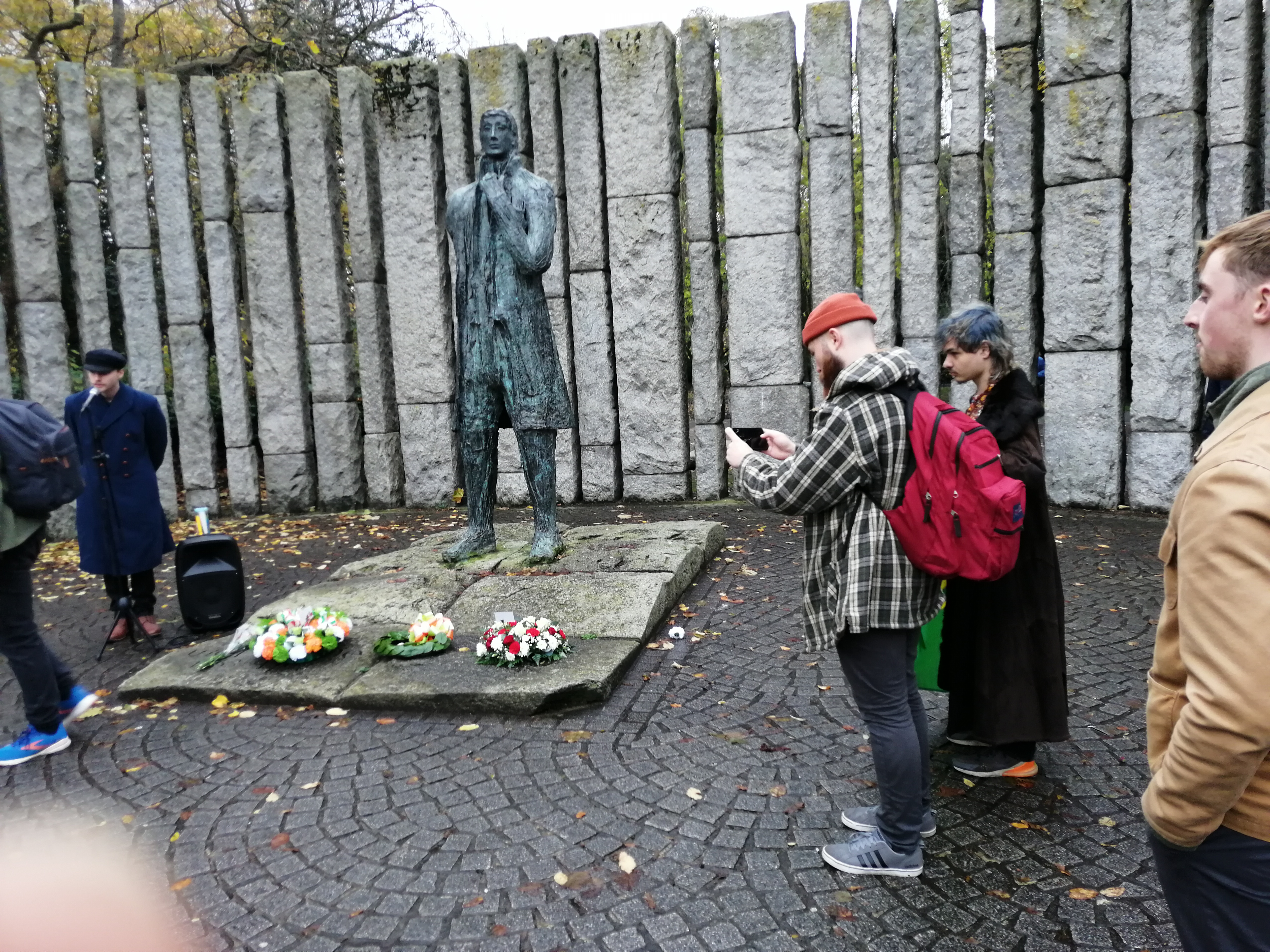
CYM speaker beside the Wolf Tone Monument (by Edward Delaney) which was blown up by Loyalists in 1969; it was recast and the surviving head incorporated. (Photo: Rebel Breeze)

THE IRISH CITIZEN ARMY

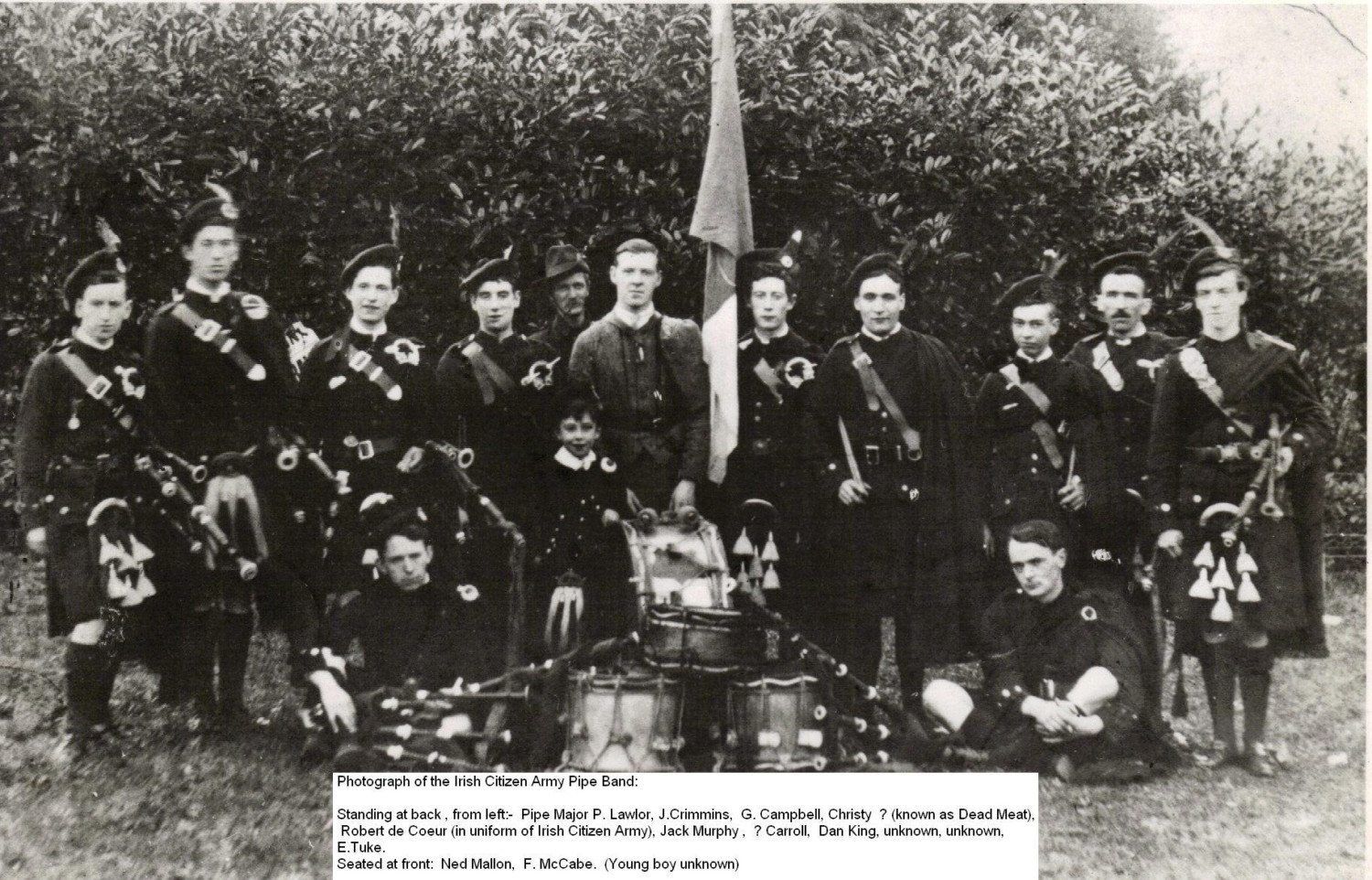
The Irish Citizen Army was founded on 23rd November 1913 on a call from Jim Larkin and James Connolly, both leading the Irish Transport and General Workers’ Union in its titanic struggle against the federation of Dublin Employers’ plan to break and disperse the union.

The call for the formation of the ICA arose due to the attacks of the Dublin Metropolitan Police on the workers and their supporters; already in August 1913 the DMP had killed two workers by truncheon blows and injured many, including a youth who would die later as a result.

The ICA’s initial organiser was the writer and dramatist Seán O’Casey, later succeeded by Boer War veteran Jack White.3 In addition to requiring its recruits to be union members, the ICA enrolled women as well as men and some of the former were officers commanding both genders4.

While the ITGWU was defeated in the eight months of the Lockout, it was not smashed and came back stronger in a relatively short period. The ICA faded away then but was reorganised over following years and approximately 120 took part as a unit in the 1916 Rising, alongside other units.5

SPEECHES AND SONG

A small crowd had gathered at the advertised location, the Wolfe Tone Monument in Stephen’s Green and the chairperson of the event called people to order.

Diarmuid Breatnach, an independent activist, was asked to sing one of Connolly’s compositions, ironically titled Be Moderate, often referred to instead by its refrain, “We only Want the Earth”.

An older man with a Dublin accent, Breatnach told his audience that Connolly published the lyrics in New York in 1907, going on to sing the five verses to the air of Thomas Davis’ A Nation Once Again6, using the chorus part to repeat the refrain that “ … we only want the Earth!”7

A representative of the Independent Workers’ Union, a young man with an Ulster accent, spoke about the need for workers to have a trade union and for that union not to align itself with employers or with the State.

In order to truly represent the interests of the workers, the union needs to be independent, he maintained and also democratic in its decision-making.

In conclusion, the speaker said that the IWU is the union that is needed and called on people present to join it and to support it.

“MAKE THE VISION A REALITY”

Amy Margaret, a young woman, also with an Ulster accent, delivered a speech on behalf of the organisers of the event, the Connolly Youth Movement.

“The Citizen Army was a direct response to the brutality carried out by the RIC and Dublin Metropolitan Police during the Dublin Lockout” she said; “the police killed two workers, injured hundreds more with baton charges, and frequently ransacked the tenements where strikers lived.”

“The Citizen Army fought back with some succes” she continued “and as one pointed out, a hurley has a longer reach than a baton. It was in the Citizen Army that the working-class stood up to the RIC and employers,” she continued.

“The same RIC that torched farmer’s homes during the Land war, the same employers who often owned the slums where workers lived; it was here at Stephen’s Green (and elsewhere in the city) that the Citizen Army stood up to the British Empire, alongside comrades in the Irish Volunteers.”

She told her audience that when, during a dockers’ strike in 1915, scabs were imported and police harassed picketers, Connolly sent a squad of the ICA with fixed bayonets to the scene, resulting in the dispute’s resolution with “a considerable increase in wages to the dockers concerned”.

“The Citizen Army was not simply workers armed with guns,” the speaker said, “but also armed with culture” and referred to weekly concerts in Liberty Hall (the ITGWU’s HQ) and to the dramatic acting history of Seán Connolly and whistle-playing of Michael Malin, both 1916 martyrs

“What the ICA stood and fought for in their own words, “… is but one ideal – an Ireland ruled and owned by Irish men and women, sovereign and independent, from the centre to the sea.”

“Connolly was clear however that such a Republic would have no place for the “rack-renting, slum-owning landlord” or the “profit-grinding capitalist”, but should rather be a “beacon-light to the oppressed of every land”.

“The most fitting tribute for the ICA then is to make that Republic a reality. To do so we must learn from the past and their examples. We can learn from them to never be cowed by the odds against us, we can learn from their comradeship to each other.

We can learn from how they combined political, economic and cultural methods to advance the cause of a worker’s republic. But more importantly we must be able to learn from their shortcomings.

After the Rising and the loss of its leadership the ICA began to devolve into a social club and whilst some members played an important role during the Tan War, the ICA was not the revolutionary workers’ army it once was.

Therefore we must build a truly mass movement – not just a committed core of activists, and we must build a movement not reliant upon key personalities so that it can function no matter what.

We all know that things must change in Ireland, and so we reaffirm the principle that the Citizen Army stood by; only the Irish working class is capable of waging the revolutionary struggle necessary to change things; not capitalists and landlords.

Helena Molony of the ICA, said, “We saw a vision of Ireland, free, pure and happy. We did not realise that vision. But we saw it.”

As the socialist-republican youth of today, we commit ourselves to make that vision a reality and to build a Republic that the men and women of the Citizen Army would gladly call their own.”

Some of the gathering at the Wolfe Tone Monument (out of shot to the right) to commemorate the creation of Irish Citizen Army (Photo: Rebel Breeze)


MARKIEVICZ: “RESOLUTION, COURAGE AND COMMITMENT

Breatnach was called back to the microphone and talked about the lessons to be learned from Constance Markievicz, co-founder of Na Fianna Éireann, the Irish Citizen Army and of Cumann na mBan, born in Britain “as were a number of our national and class heroes”, he said.

“Constance was born into a settler landlord family, the Gore-Booths”, he told the audience and her experience of witnessing deprivation, along with her sister Eva, during the Great Hunger, had a strong effect on both, inclining them to social reform and they became also suffragettes.

The speaker said that in that latter aspect and as a poet Eva became well-known particularly in England but Constance was better known as a revolutionary and for her allegiance to the working class and to the Irish nation.

He reminded his listeners that Markievicz was artistic and apt to strike poses; O’Casey, founder of the ICA had been hostile to her and co-founder of Cumann na mBan and wife of Tom Clarke of the IRB, Kathleen Clarke, had found her irritating.

Breatnach said that Markievicz was 3rd in 1916 garrison command at Stephen Green and had been accused not only shooting dead there a member of the DMP but of exulting in it; however according to witness accounts she had not even been present when the officer was killed.8

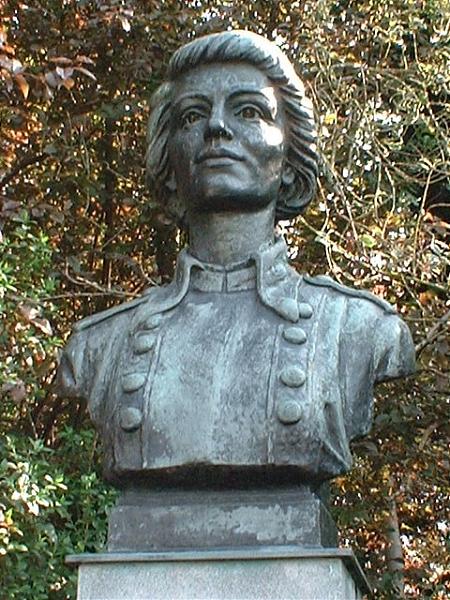
Bust of Volunteer Markievicz in Stephen’s Green (Photo: Rebel Breeze).

A British officer at her court-martial after the surrender of the 1916 Rising had claimed that she begged for her life at the court-martial but the official British records published later gave the lie to that and her own account that she demanded equal treatment with the executed leaders rings true.

“Her life as an example,” Breatnach continued, “teaches us not to judge people only by their background or indeed by their idiosyncrasies but primarily by their resolution, courage and commitment, all of which Constance Markievicz had by the bucket-load.”

The speaker also reminded those present that the very Wolfe Tone monument beside which he stood had been blown up in a number of British Loyalist bombings of the city during the 1970s, a number of which would soon be commemorated on the December anniversary of one of them.

The Irish State had prosecuted not a single one of the perpetrators, not even for the Dublin and Monaghan bombings, with the highest death toll9 of any one day during the recent 30 Years War. Instead, they had used the 1972 bombing to pass emergency legislation to attack Irish Republicans!10

Speaking briefly as a historical memory conservation activist, primarily active in the campaign to save the Moore Street market and 1916 battleground from speculators, Breatnach remarked that it was fortunate that the area behind him was a public park.

Otherwise it would all have been a prime target for property speculators. People sometimes express surprise that Irish governments do so little to protect areas of insurrectionary history. He stated however that this was natural since it was not their history but that of the struggling people.

“The history of the Irish ruling class is of a foreign-dependent one”, Breatnach stated, “rather than that of a national bourgeoisie willing to fight for independence. The last time Ireland had such a bourgeoisie was in 1798, mostly led by descendants of settlers and planters.”

“This is why Connolly pointed out that the Irish working class are the true inheritors of the Irish struggle for freedom. National independence and socialism are two different objectives but interdependent in Ireland and for the struggles to succeed they must be led by the working class.”

CONCLUDING

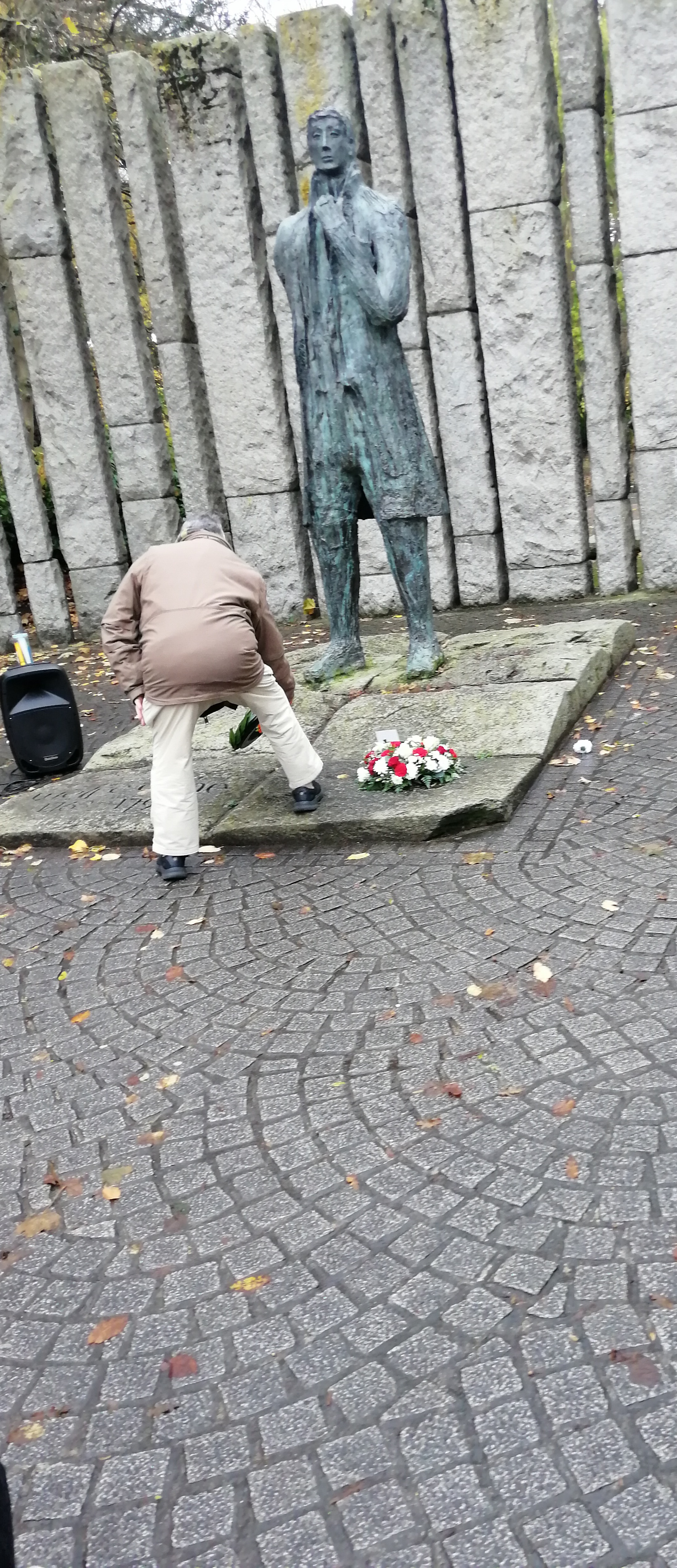
Wreaths were laid on behalf of a number of organisations, including Lasair Dhearg and the chairperson thanked all for their attendance, leaving people to their various ways into the mild autumn-like afternoon.

End.

(Cropped photo: Rebel Breeze)

(Photo: Rebel Breeze)

FOOTNOTES

SOURCES

1Clearly not the first army composed of workers, since these are the members of most armies; nor the first to fight for the workers, as did some for the Paris Commune in 18th March-28th May1871. However, the ICA was founded specifically for the defence of workers, the first in the world to be so, though its constitution was largely Irish nationalist.

2Socialist and anti-fascist Irish Republican organisation mostly represented in Belfast. The name means “Red Flame”.

3A number of Irish were veterans of the Boer War, the British against Dutch colonists in South Africa, most like White were on the British side but some fought for the Boers, to the extent of forming an Irish Brigade for the purpose. Later, a number from both groups ended up fighting alongside one another in the 1916 Rising (and no doubt against others who remained in the British Army).

4This too was a ‘first’ to the credit of the ICA.

5The Irish Volunteers, Cumann na mBan, Na Fianna Éireann, the Hibernian Rifles and of course the Irish Republican Brotherhood, the chief architects of the Rising, its members fighting as members of other units, chiefly the Volunteers and the Fianna (the membership of both those organisations was exclusively male though its couriers were often female but Tom Clarke’s wife, Kathleen Clarke, was the IRB’s liaison from Dublin with the sister organisation in the USA.

6James Connolly (1868-1916) did not prescribe any air for the lyrics and they have been sung to several. A Nation Once Again was composed by leading member of the Young Irelanders, Thomas Davis (1814–1845) and published in 1844, for many years considered a candidate for Irish national anthem.

7“For our demands most moderate are: we only want the Earth!”

8Breatnach also said that least two and probably three members of the DMP were killed during the Rising, each one in an area under the control of the ICA, who no doubt remembered well the force’s actions during the 1913 Lockout.

91974: 33 male and female civilians and a full-term unborn baby.

10The Amendment to the Offences Against the State Act, including the introduction of the no-jury Special Courts, essentially for trying Irish Republicans with a much lower quality of evidence required to convict, including the unsupported word of a senior Garda officer.