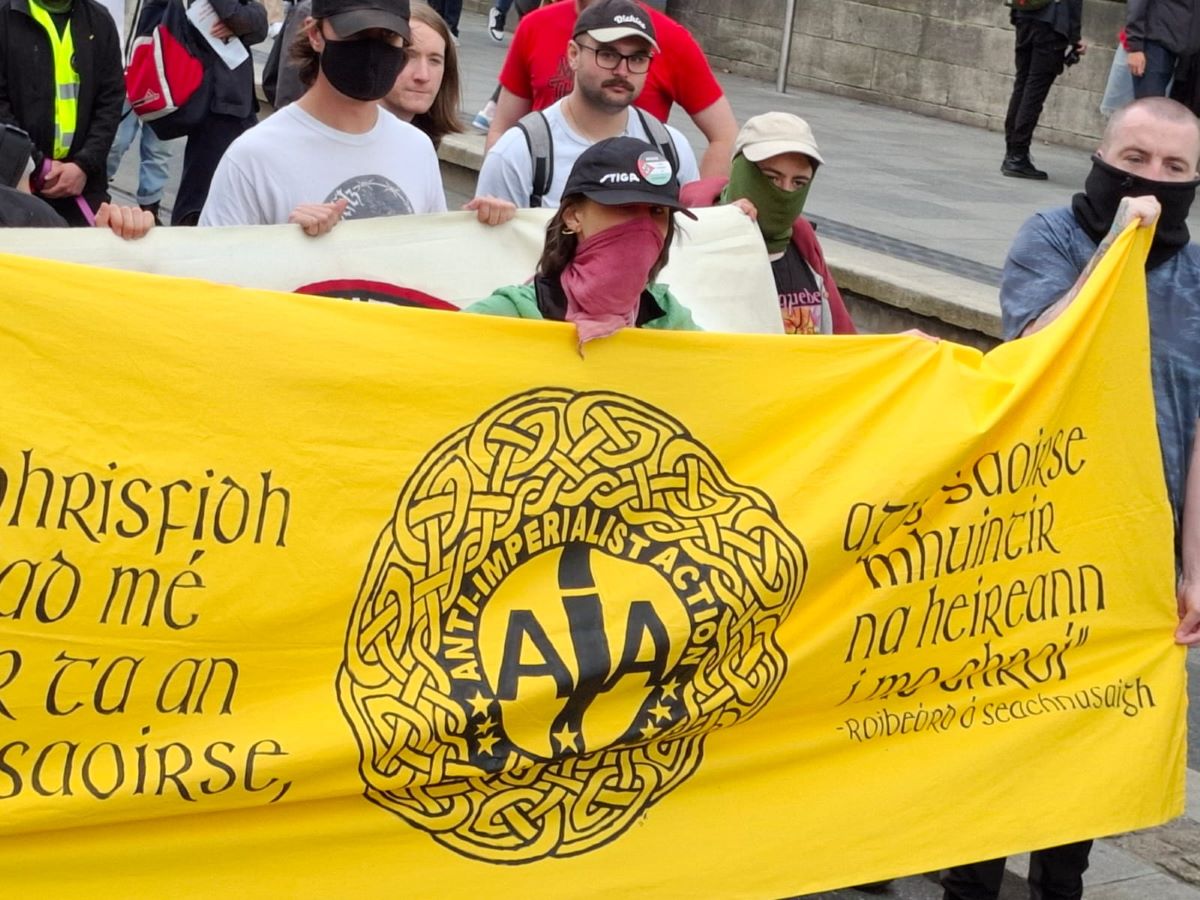
The recognised date known as International Working Women’s Day is March 8th and it was commemorated on that date with a march and revolutionary words and symbolism organised by Irish Socialist Republicans in Dublin.
The marchers gathered outside Wynn’s Hotel in Lower Abbey Street, to mark the founding there of the revolutionary Republican military women’s organisation, Cumann na mBan, on 2 April 1914. The organisation, with its own officers, was possibly the first of its kind for women in the world.1
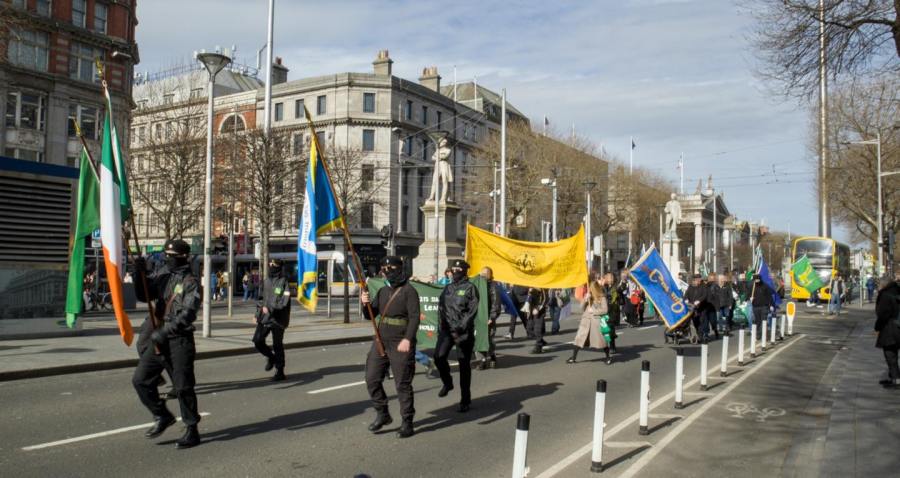
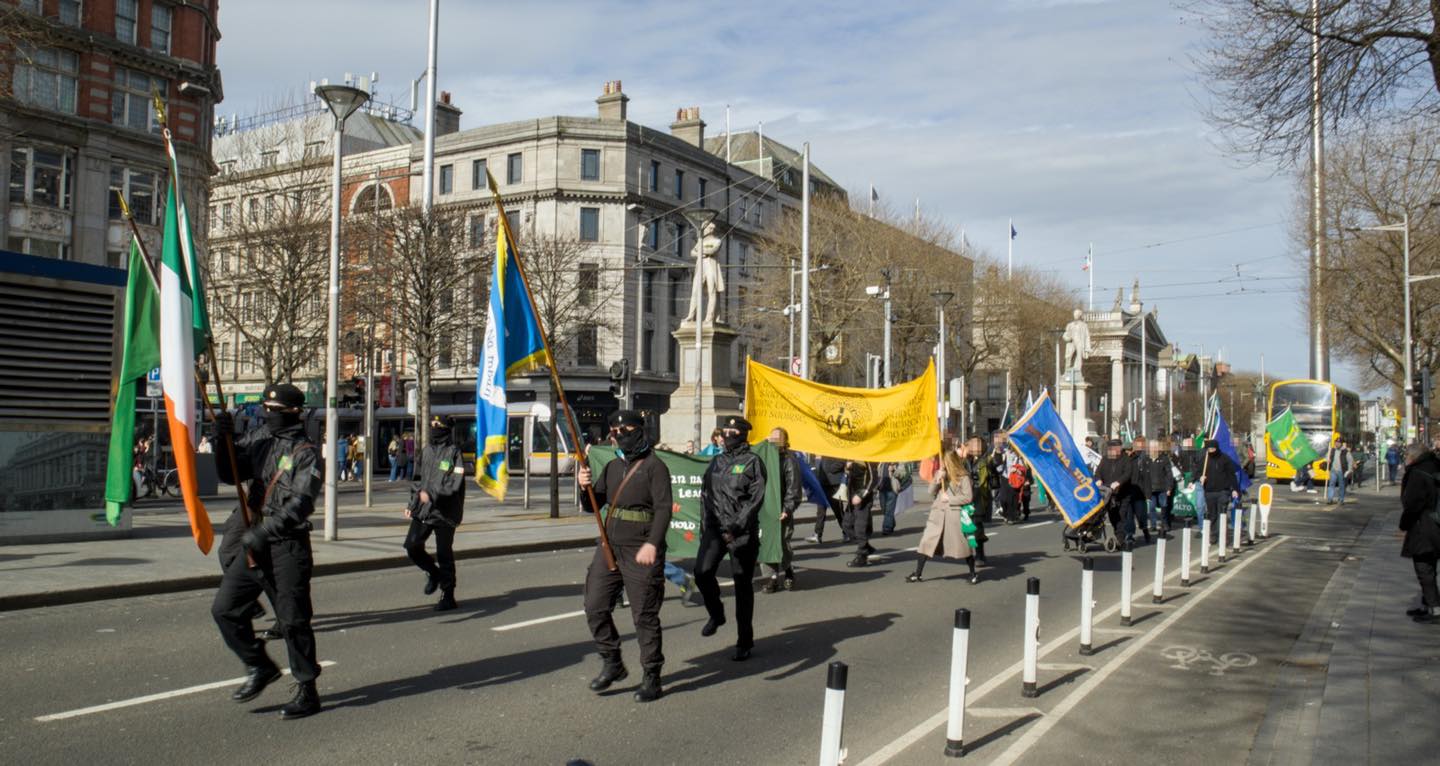
From there the march set off into O’Connell Street, then marching southward to cross the Liffey into D’Olier Street before turning left into Townsend Street, continuing to the statue of Constance Markievicz where the colour party’s flags were lowered in respect.
The march near the start in O’Connell St (photo credit: An Pobal Abú FB page)
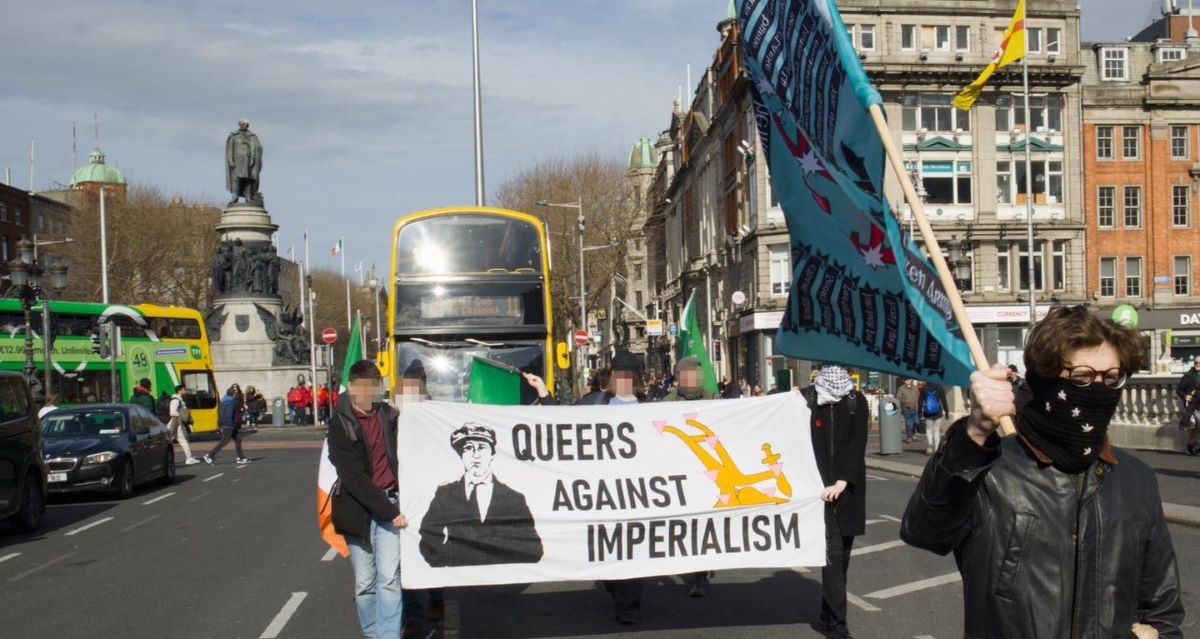
Throughout, chants of “Ní Saoirse go Saoirse na mBan”2 and “Britain out of Ireland” reverberated through the streets of Dublin as banners displayed the slogans “coinníonn na mná suas leath na spéire / women hold up half the sky” and “Queers Against Imperialism”.
Markievicz was an active member of Iníní na hÉireann, the Irish Citizen Army and of Cumann na mBan. She was part of the command of the Stephens Green/ College of Surgeons garrison in 1916 and elected MP on an abstentionist ticket in 1918 and Minister of Labour in the First Dáil in 1919.
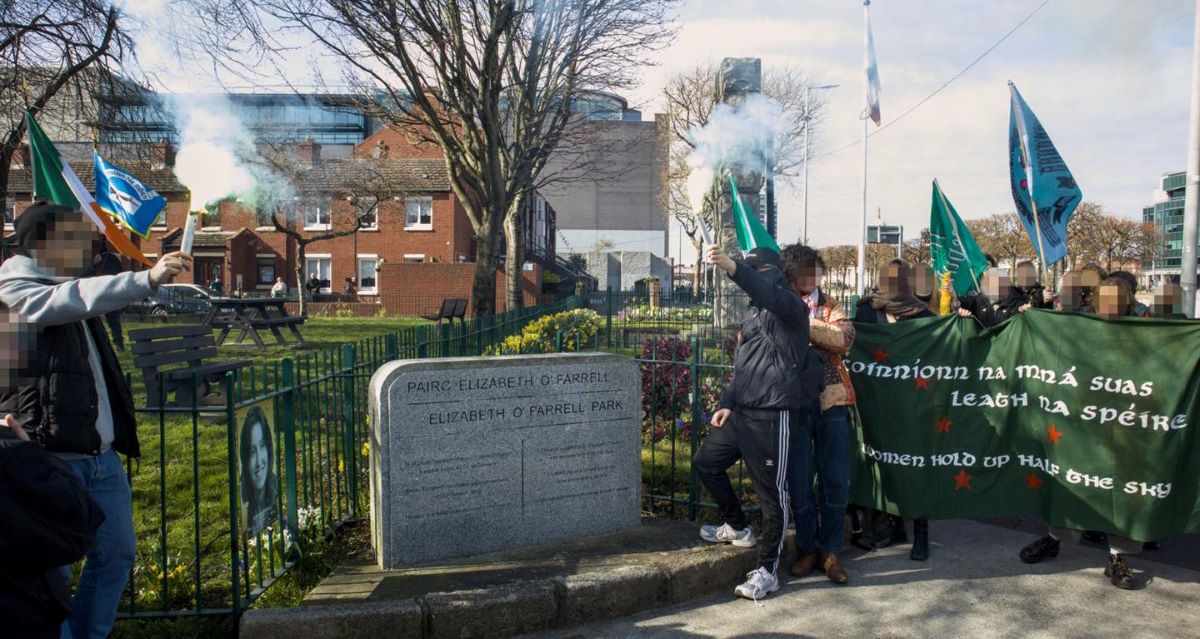
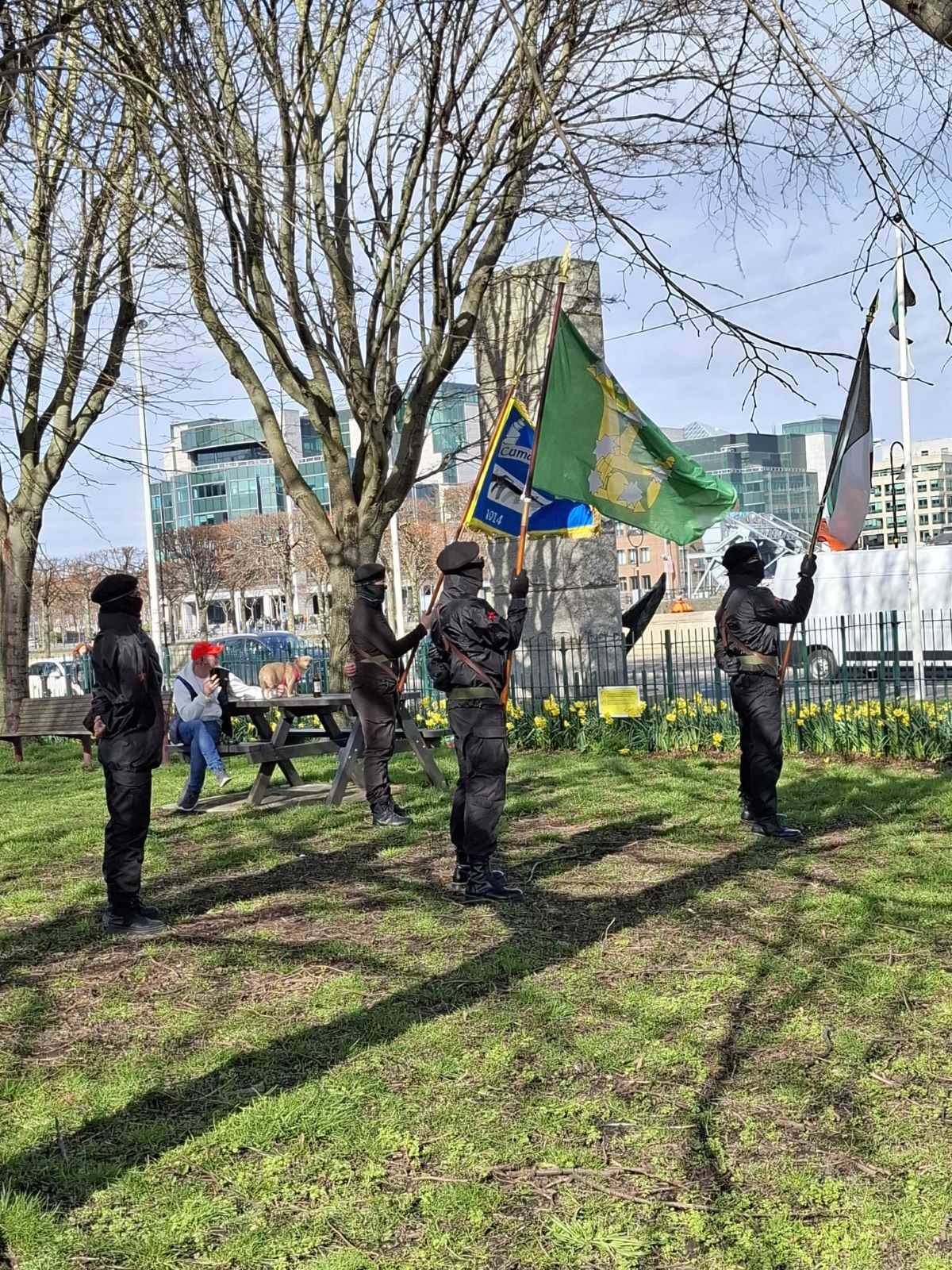
Continuing along Townsend Street and ending at Elizabeth O’Farrell park where a commemoration was held outside in honour of the role of women in the struggle for national liberation while the colour party took up position inside the park.
(Photo credit: An Pobal Abú FB page)
A woman read a speech on behalf of the AIA, tracing founding of International Women’s Day from when women in Russia in 1917 had led strikes and marches against the Tsar and WW1, later becoming known as the February Revolution, leading later to the October Socialist Revolution.
The speaker went on to speak of the role of women in the Republican struggle, from Cumann na mBan, the Irish Citizen Army and Armagh Gaol Republican prisoners, followed by a woman reading the 1916 Proclamation of Independence and the burning of two green flares.
(photo credit: An Pobal Abú FB page)
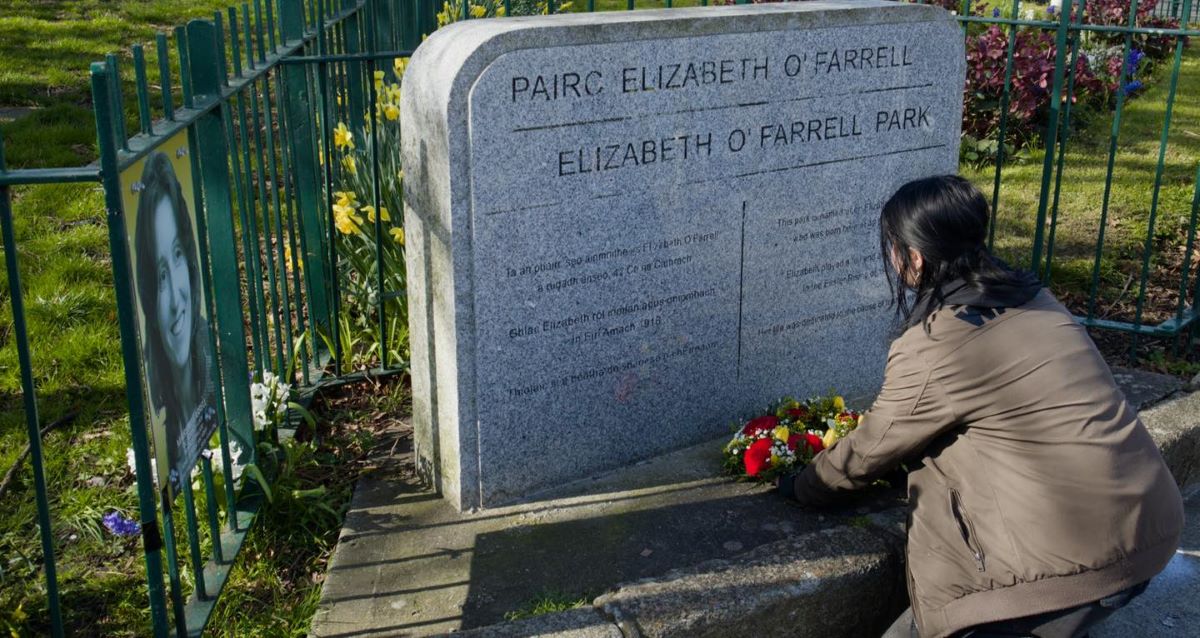
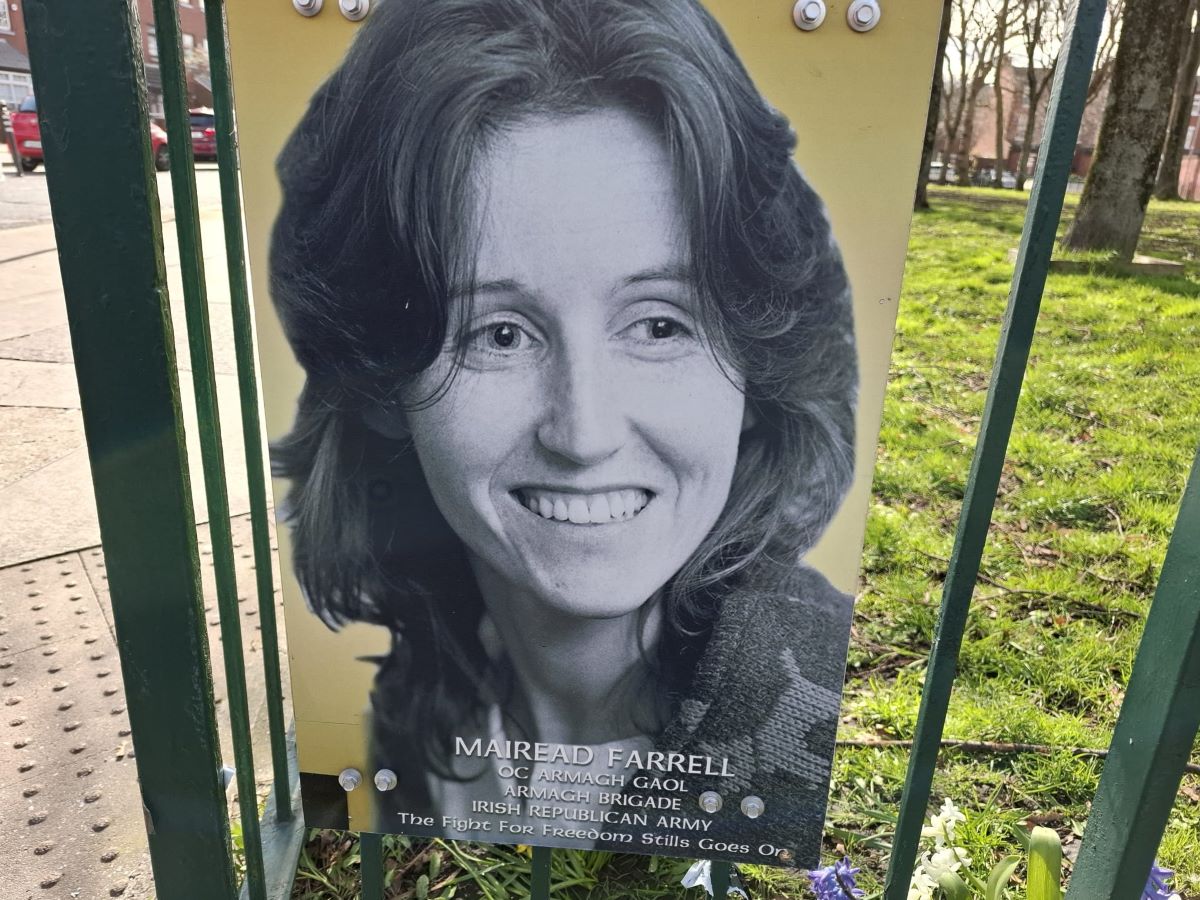
A new plaque of the Socialist Republican Mairéad Farrell was unveiled with the laying also of a commemorative wreath during a minute’s silence observed for all revolutionary women and gender oppressed people who gave their lives for national liberation and anti-imperialist struggle.
The Colour Party in Elizabeth O’Farrell Park (Photo: R.Breeze)
At the same time the colour party lowered their flags in respect, during which the command calls in Irish rang out in the area through the silence.
The area in which the Elizabeth O’Farrell and her life-long friend Julia Grenan3 grew up is a south Dublin docklands still largely working class area. It was in a yard in Lombard Street nearby, actually within sight of the park, that the IRB (Fenians) was founded on March 17th 1858.
Laying of the wreath (photo credit: An Pobal Abú FB page)
Elizabeth O’Farrell and Julia Grenan both participated in the 1916 Rising and, along with Winifred Carney, refused to join the earlier evacuation from the burning GPO building on the Friday, later participating in the final evacuation which ended in the central terrace in Moore Street.
When the leadership took the decision to surrender, O’Farrell went out to negotiate under a white flag even though a man had been killed under such a flag earlier in the very street. In 1922, along with almost the entirety of Cumann na mBan and the ICA, she rejected the Anglo-Irish Agreement.
(Photo: R.Breeze)
Many women were interned by the nascent neo-colonial Irish Government.
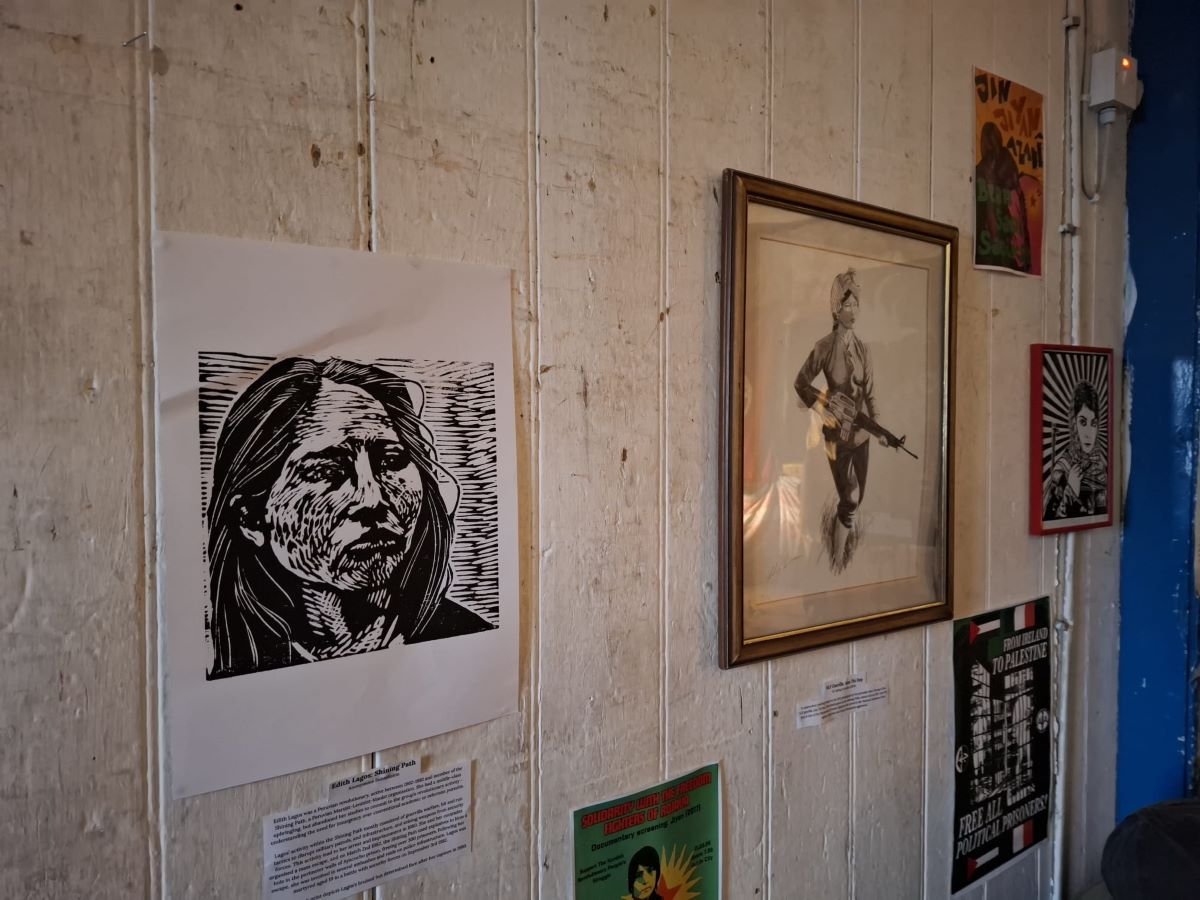
After the Elizabeth O’Farrell Park event, people gathered again at a recently-occupied social centre in Dublin, to view an exhibition of images in honour of the day and to watch an English-subtitled French-language film about women and the Omani Resistance, followed by a music session.4
Part of exhibition for International Working Women’s Day in the social centre (Photo: R.Breeze)
End.
Note: If you found this article of interest, why not register with Rebel Breeze for free, so that you will be notified by email of subsequent articles. You can de-register any time you wish.
Footnotes
1In its early years the organisation worked mainly as an auxiliary to the Irish Volunteers but asserted greater independence at a later stage. It coincided in time with the women in the Irish Citizen Army who shared equal status with male members and indeed in the case of some of them, such as Markievicz and Lynn, actually commanded men. Wynne’s Hotel was also where the decision to found the Irish Volunteers had been taken in 1913.
2Translated as ‘There can be no freedom until women are free.’
3And life partner, many have speculated – certainly they lived together until the end.
4The Hour of Liberation Has Arrived by Heiny Srour
Five people sitting down to a meal were surprised by a knock on the door of their residence. What followed amounted to an hours-long Garda siege ending in arrests and the residents and supporters gathering outside being pepper-sprayed and beaten.
A housing activist who has witnessed many evictions said it was the most violent eviction they had ever seen.
A house empty for many years in the Phibsboro area had been occupied by around four people who invited a fifth to share a meal on Monday 15 December. As they were about to sit down to eat the Gardaí arrived and told the occupants that they were criminally trespassing.
The occupants explained that they had been living in the building for some time and had keys, so any accusation of trespass would be of a civil kind requiring court orders and not at all a criminal one on which Gardaí are empowered to act. The Gardaí however remained and more arrived.
Local people responding to a call for support against an illegal eviction began to arrive as did more Gardaí until there were around 13 Garda vehicles present, including the Public Order Unit; a number of attempts to batter the door down were made which were however unsuccessful.
People protesting what appeared to be an illegal eviction were pushed and shoved by Gardaí and after a while also pepper-sprayed and batoned. After some hours had elapsed the police succeeded in smashing a back window and battering down an internal door, gaining access to the building.
The people inside raised their hands to indicate no resistance being offered (some were reportedly even sitting down) but allege that they were nevertheless pepper sprayed and beaten. Four were dragged out to Garda vehicles and the remaining person was violently assaulted again.
The road outside had by this time been cleared by the Gardaí. The five arrested were taken to a police station where at least some, male and female, allege they were stripped and cavity searched, measures totally inappropriate in this kind of arrest or similar.
It will be recalled that a number of Mothers Against Genocide group protesting outside Leinster House complained of the same during their detentions in Dublin in June although the Government’s spokesperson denied to some TDs that this had occurred.
That same week anti-NATO peaceful protesters had also been pepper-sprayed and the ankle of one broken by Gardaí while a Palestine solidarity activist at DCU was dragged to the ground, with allegations of strip-searching among those too.
Video by Anti-Imperialist Action outlining the source of Dublin’s housing crisis.
All five residents of the house were charged with offences including causing fear (!) and criminal damage, kept in custody overnight and brought to court, where they were released on bail to return to court at a date in the New Year.
GARDAÍ HELPING MAINTAIN HOMELESSNESS
This Garda operation and abuse of legal powers took place in the context of the highest recorded number of homeless to that date, with 16,600 people in emergency accommodation, including morethan 5,200 children and over 4,600 women,1not counting those sleeping on the street.
And with well over a hundred thousand buildings lying empty,2 a situation constituting a paradise for property speculators, vulture funds, banks and big landlords – but misery for thousands renting, struggling with a mortgage, in unsuitable accommodation, sofa-surfing or on the street.
Indeed, the property at which the Garda violent eviction took place was reportedly empty for many years before its occupation.
A couple of years ago a group called the Revolutionary Housing League occupied empty Dublin buildings and called for people across Ireland to do the same. Sadly, their call was not followed and Gardaí mobilised huge operations including helicopters to evict a handful of occupants.
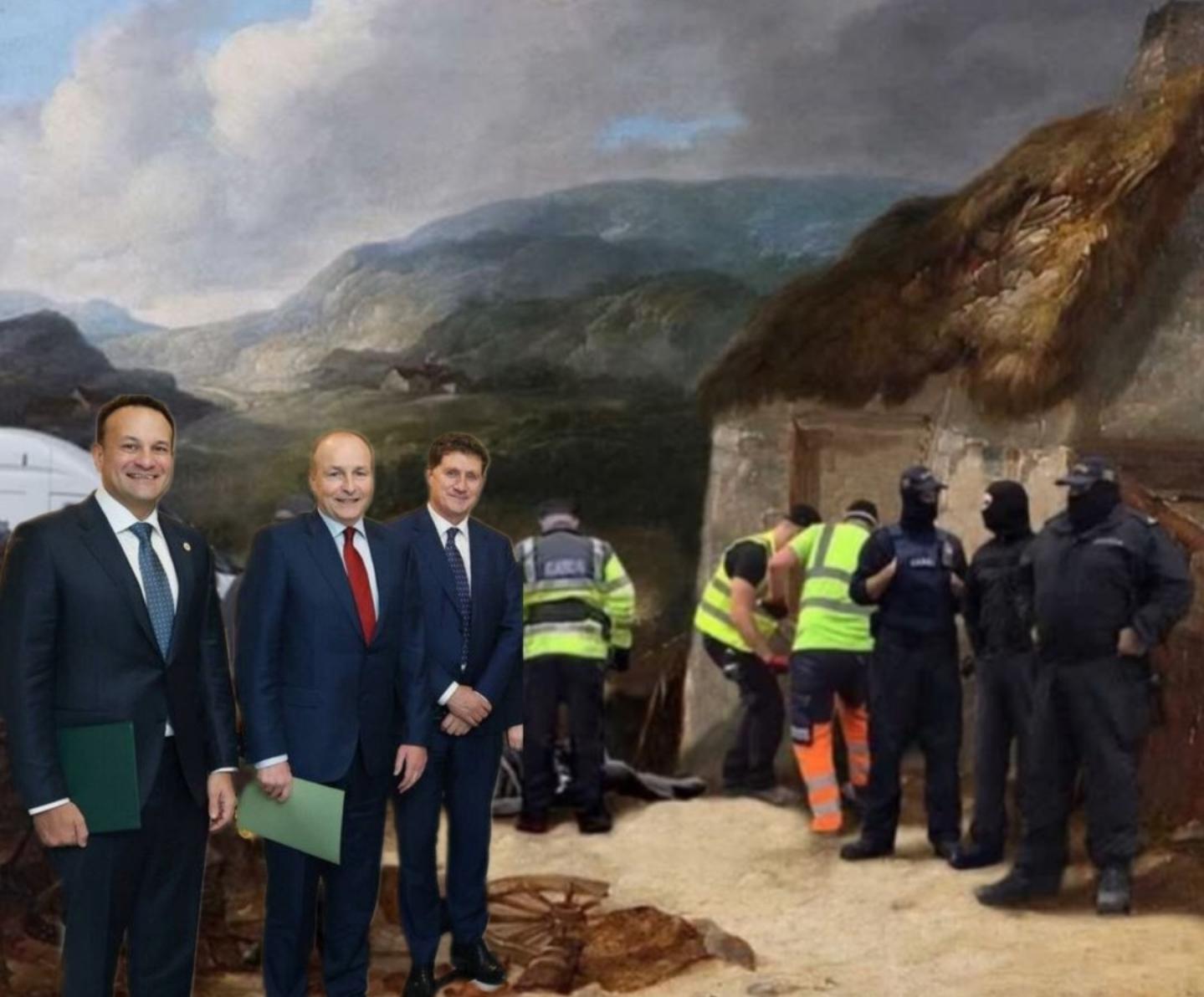
Three chief Irish Government Ministers some years past (one still in place) and Gardaí photoshopped on to 18th Century eviction scene in Ireland (original photoshopping of Gardaí by Spice Bag). (Image sourced: Internet)
HUMILIATION AND VIOLENCE
Strip and cavity-searching are demeaning psychological and physical invasions and should have no place in most policing actions. Even in jail, an x-ray chair is available. However strip-searching has been a constant over the years in use against political prisoners.
As violent and degrading actions become normalised in political repression they will be extended further, spreading to all kinds of policing operations.
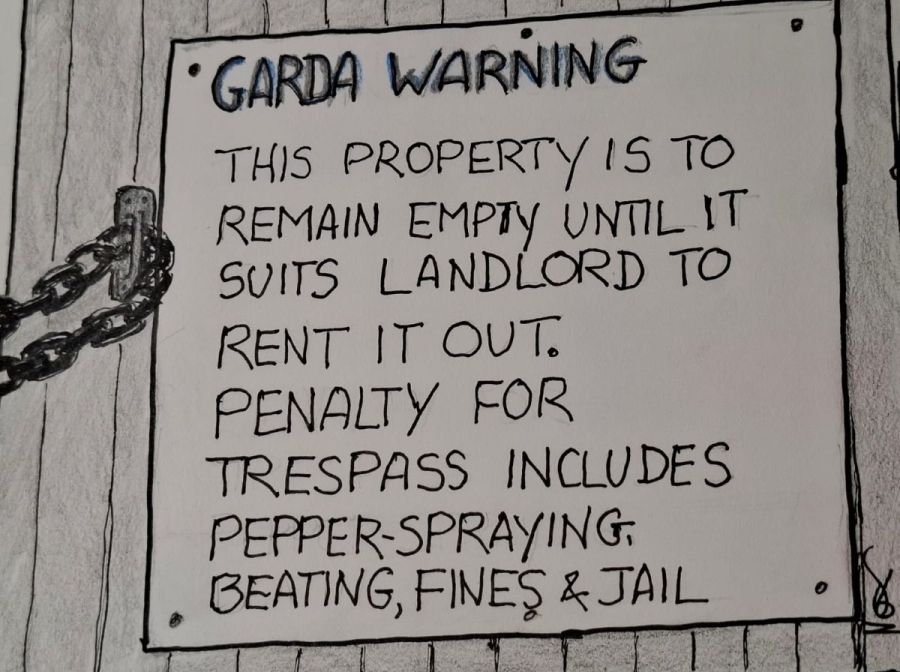
Cartoon by D.Breatnach
Gardaí normalising the use of pepper-spraying against Palestine solidarity and anti-NATO direct action activities are now extending this to other types of activities of which they disapprove, even those in the sphere of civil law and outside criminal law.
As the State increases its repression, the democratic and revolutionary movements will need to increase their resistance, calling also for the active solidarity of wider society with the victims and in condemnation of the State and its police force.
End.
Note: If you found this article of interest, why not register with Rebel Breeze for free, so that you will be notified by email of subsequent articles. You can de-register any time you wish.
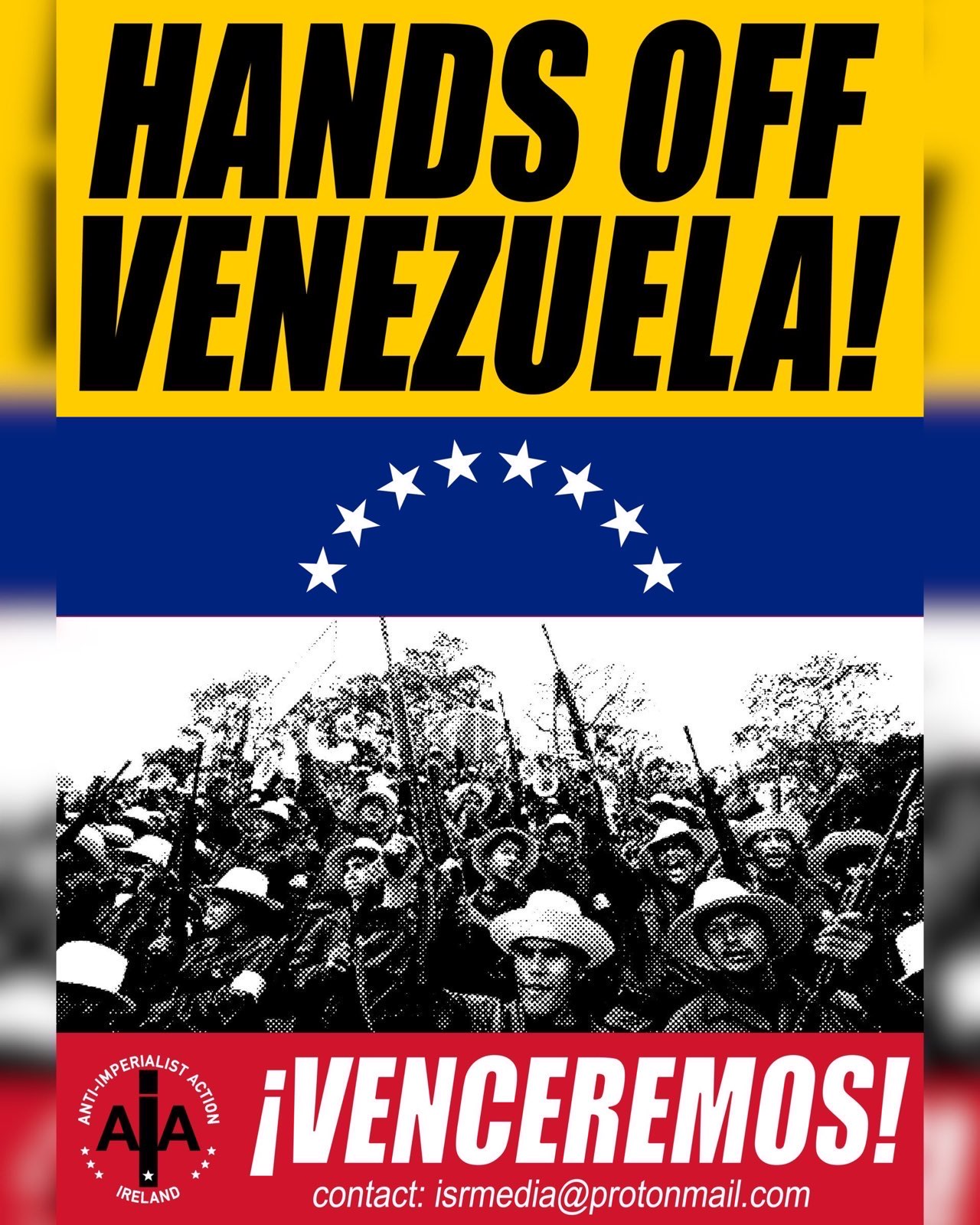
On Saturday morning, Dubliners checking messages or news on their phones or laptops, or listening to or watching news on TV or radio – or even reading a newspaper, learned that the USA had bombed Venezuela and abducted its President.
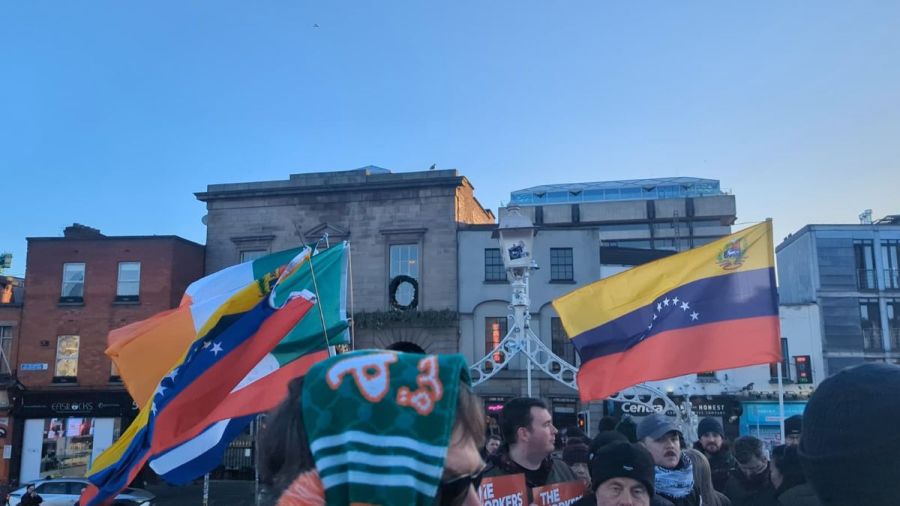
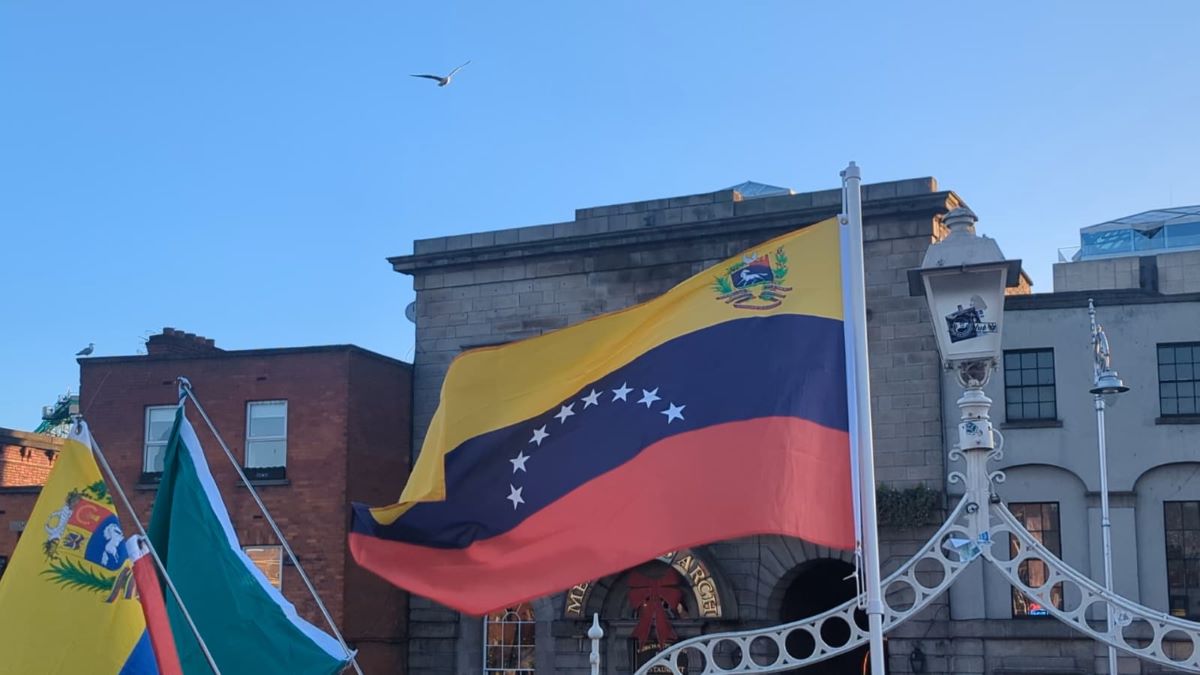
Venezuelan national flags on Ha’penny Bridge during Venezuela solidarity portrait, seen here against sky and south Liffey riverside buildings. (Photo cred: Participant)
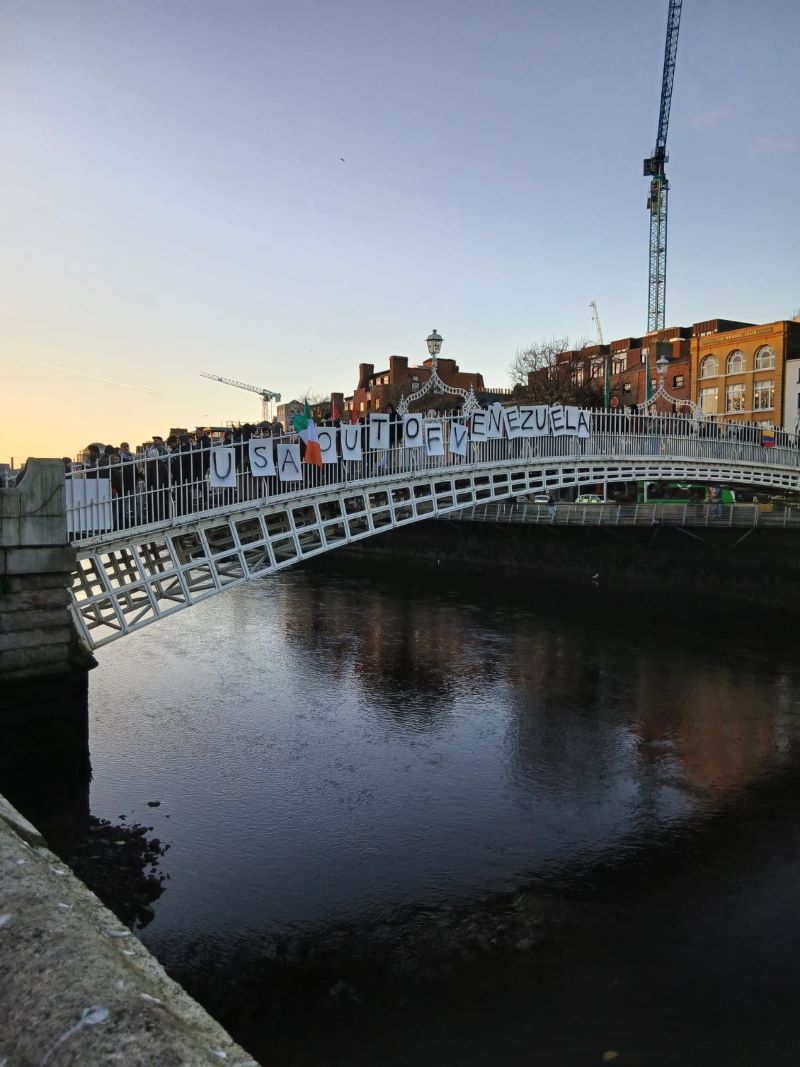
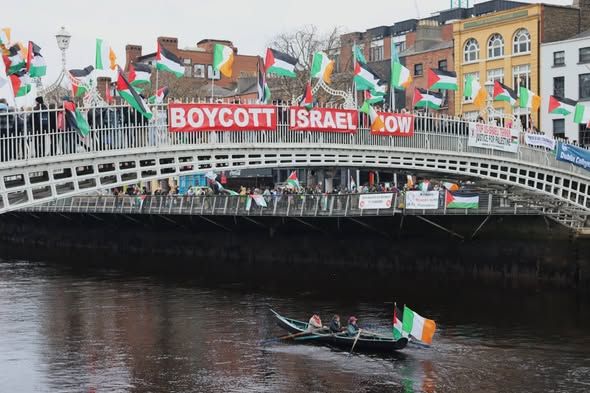
An emergency protest and solidarity demonstration was called for 3pm in the city centre and under a clear blue sky but in bitter cold, many attended to line the iconic Ha’penny Bridge, which only a week ago had hosted a New Year’s Eve demonstration in solidarity with Palestine.
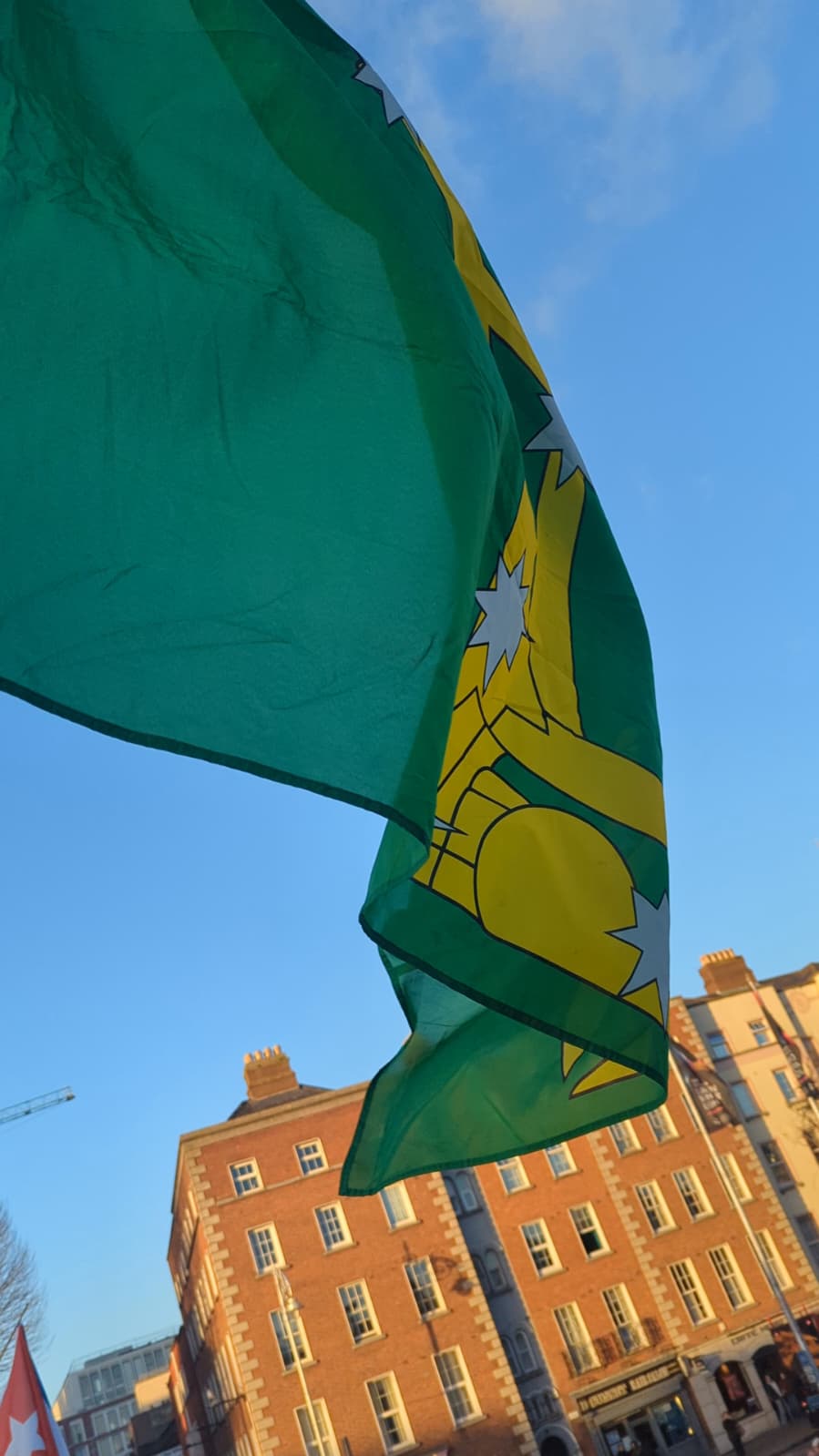
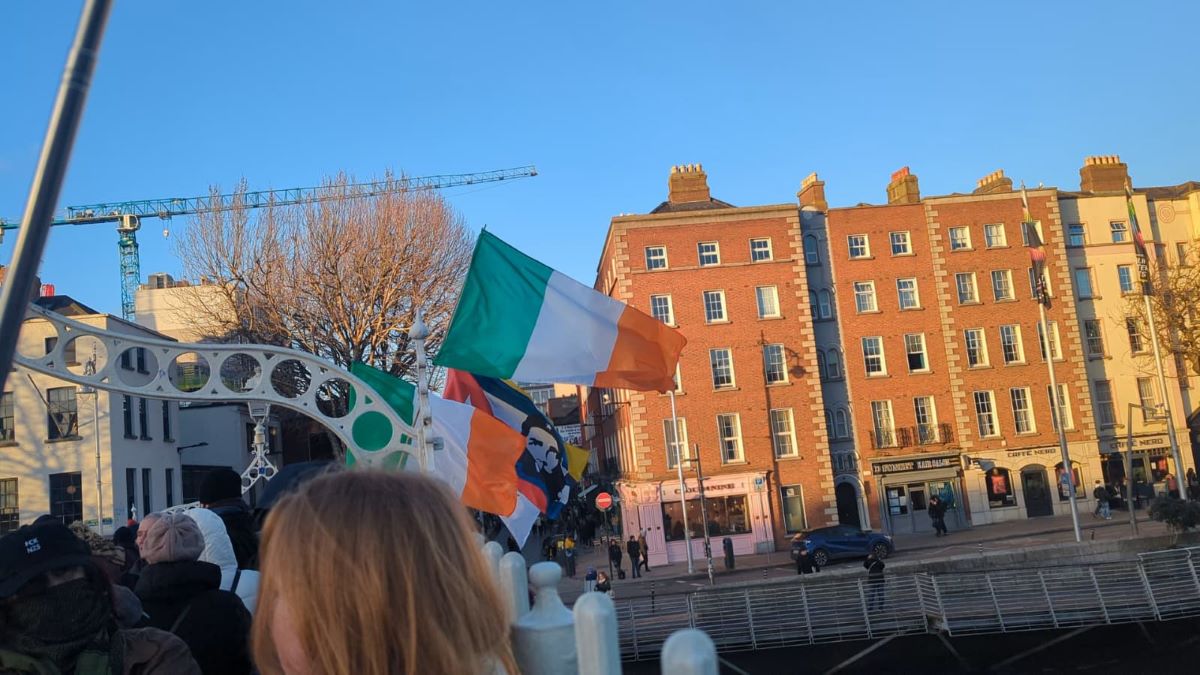
Among the crowd on the Bridge, a few Venezuelan national flags fluttered against the sky or the riverside buildings, along with a number of Irish Tricolours and one green and gold Starry Plough,1 while placards were attached to the railings along the sides of the Bridge.
The well-known slogan of US military – Out of Shannon! was among the call-and-answer chants of course, along with the easily-imagined Hands off Venezuela! But there were some innovative ones too, such as the Irish-language/ English mix of Deirimís go léir le chéile – Hands off Venezuela!
Starry Plough flag on Ha’penny Bridge during Venezuela solidarity protest, seen here against sky and north Liffey riverside buildings. (Photo cred: Participant)Irish Tricolour flags and probably Cuban national flag on Ha’penny Bridge during Venezuela solidarity protest, seen here against sky and north Liffey riverside buildings. (Photo cred: Participant)
Entirely in Castilian Spanish there was also Viva, viva – La Resistencia! Another was USA – Nothing but thieves! – a specific reference to Trump’s nakedly-declared wish to grab the country’s oilwells.
People from a number of different political parties participated as did a large number of independent activists, constituting an ad-hoc and informal anti-imperialist broad front.
Among the crowd were veteran activists but also too many of the younger ones, grown in political awareness and action in recent years of Palestine solidarity, a deep educational experience, including some facing charges from actions in Dublin or Shannon to be tried in the coming months.
It is to be hoped that their support and solidarity will also be broad.
The Ha’penny Bridge during Venezuela solidarity protest. (Photo cred: Eddie O’Reilly)
The latest news is that the kidnapped President Maduro has been charged in the US on counts including drug trafficking and possession of weapon. As the President of Venezuela and titular head of its armed forces, presumably he does indeed hold weapons.
The very existence of the drug cartel of which Trump and his cabal claim Maduro is head is very doubtful, including even to views leaked from US intelligence departments and of course, not one iota of evidence has been produced to date of the alleged drug trafficking.
Mixture of flags and people on Ha’penny Bridge during Venezuela solidarity portrait, seen here against sky and south Liffey riverside buildings. (Photo cred: Participant)
In the lead-up of months of bullying to this invasion, US forces sank many boats, killing at least 115, including one survivor of a bombing in the water. No evidence of their alleged drug-running has been produced in a single case and even so would not merit death penalty under US law.
Following the US attack on Venezuela, Defence Minister Vladimir Padrino López, reportedly from his control bunker, broadcast in military uniform to the nation condemning the imperialist attack and promising resolute resistance.
Diosdado Cabello, Venezuela’s Minister of Interior, Justice, and Peace, was videoed in the street wearing helmet and body protection equipment, calling on citizens to place their trust in the political and military leadership and to give no assistance to invading forces.
Vice-President Celcy, now Acting President made her first ever broadcast demanding the release of the Presidential couple, affirming that “there is only one president in this country, and his name is Nicolás Maduro,” and insisting that Venezuela “will never be a colony of any nation.”
Earlier, mainstream media had reported that Celcy had fled to Russia and that Lopez had been killed, such errors perhaps being caused by the ‘fog of war’ but recalling also the part played by the mainstream media in preparing the ground for the US-instigated Chilean coup of 1973.
The US attack and kidnapping was condemned today by Russia and by President Petro of Colombia. Kallas, on behalf of the EU, while condemning Maduro’s rule, voiced some weak platitudes about the EU Charter but voiced no condemnation of this attack upon a sovereign nation.
President of the USA Trump boasted publicly about how viewing the attack and kidnapping operation had been like watching a TV show and proclaiming that the US are now “going to run” Venezuela for a while “and get the oil flowing.”2
Tomorrow, Sunday, the Anti-Imperialist Action organisation has called a protest demonstration to take place at the US Embassy in Ballsbridge, Dublin for 1pm, in defence of sovereignty and in opposition to imperialism.
End.
Note: If you found this article of interest, why not register with Rebel Breeze for free, so that you will be notified by email of subsequent articles. You can de-register any time you wish. Footnotes:
1The design of the flag of the Irish Citizen Army, a workers’ defence militia against police during the Lockout/ Strike of 1913 and that also fought in the 1916 Rising.
Through three events on Saturday, New Year’s Eve in the city centre, Dublin sent a solidarity message to the Palestinian people and also to the solidarity activists on hunger strike in British jails, referencing also those of the Irish Resistance in 1981.
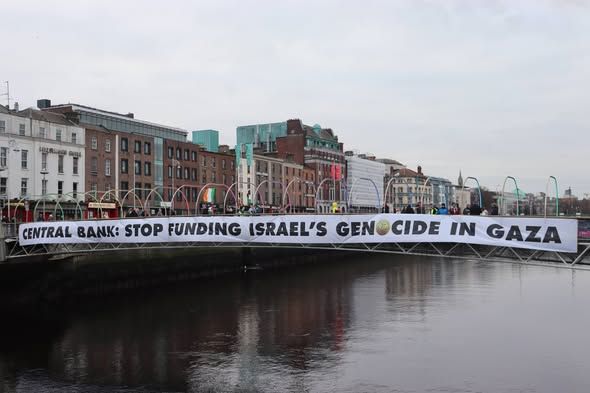
The Millennium Bridge on New Year’s Eve. (Photo: IPSC)
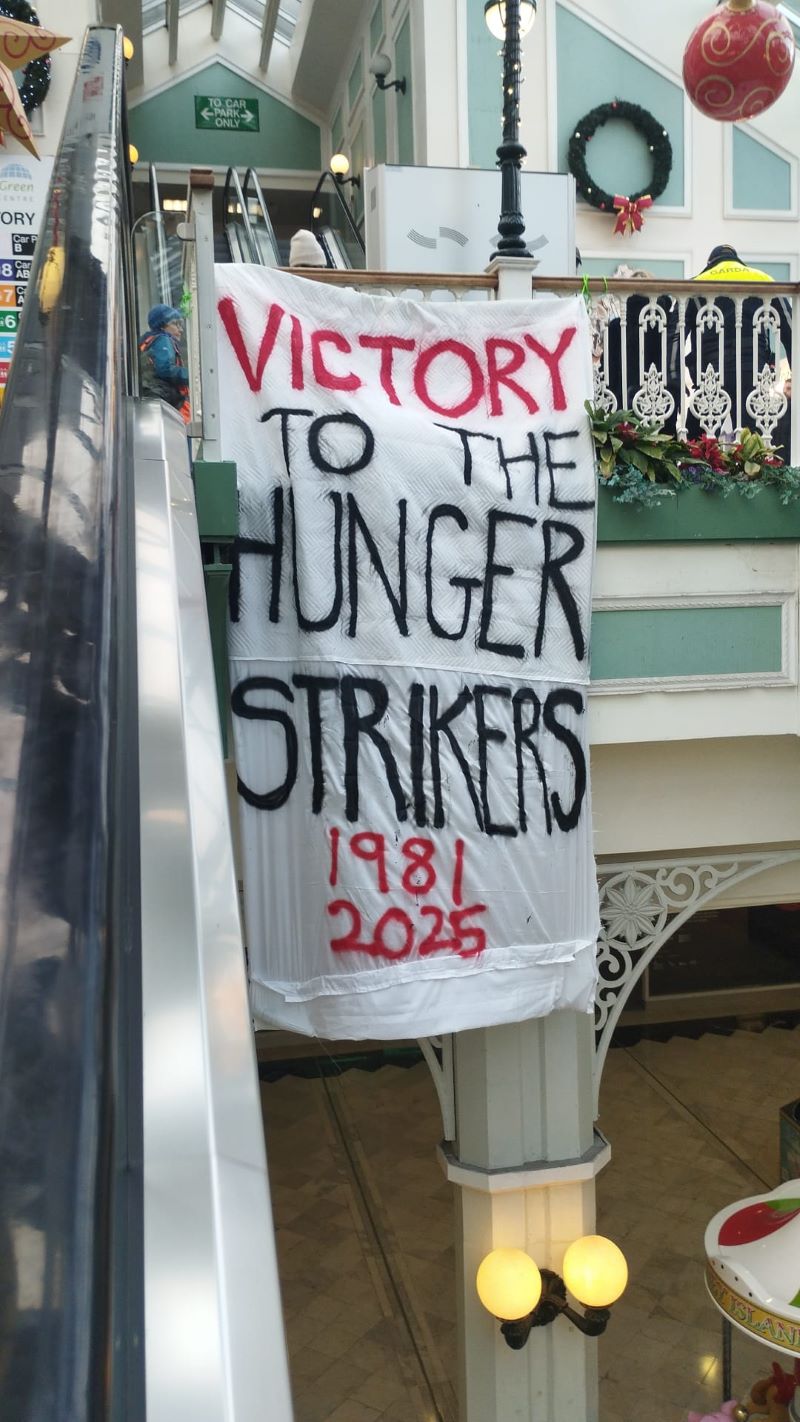
Chronologically first was a protest in the Starbucks café1 in Stephen’s Green Shopping Centre obliging the management to close for hours and a balcony walkway banner drop calling for solidarity with the Elbit accused on hunger strike, referencing also the Irish hunger-strikes of 1981.2
I had not read the poster carefully and arrived at the Starbucks at the north end of Grafton Street, where there were a few other confused people also. By the time I made my way up to the southern end of Grafton Street, the protest there was about to leave and I was about to head elsewhere.
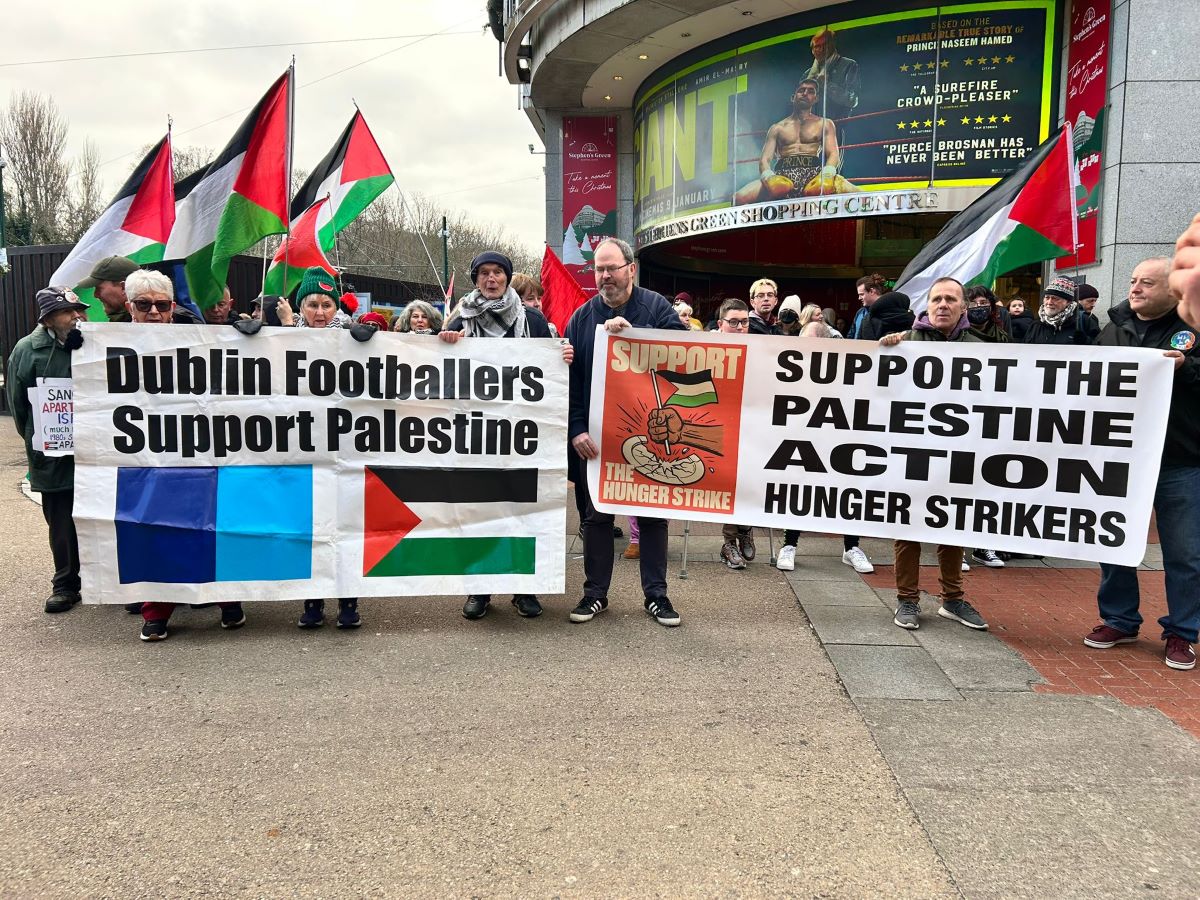
Two main banners present at protest outside the Stephen’s Green Centre on New Year’s Eve, after closing down the Starbucks café inside. (Photo: Bas)
The solidarity crowd continued to demonstrate in the shopping centre’s main doorway before marching away, then went into the Zara3 big shop and demonstrated there awhile before heading on to MacDonald’s in Grafton Street where the Gardaí began to let their nasty side show a little.
Palestine solidarity protesters leaving the Stephen’s Green Centre on New Year’s Eve, heading down to Zara to protest there (Photo: D.Breatnach)
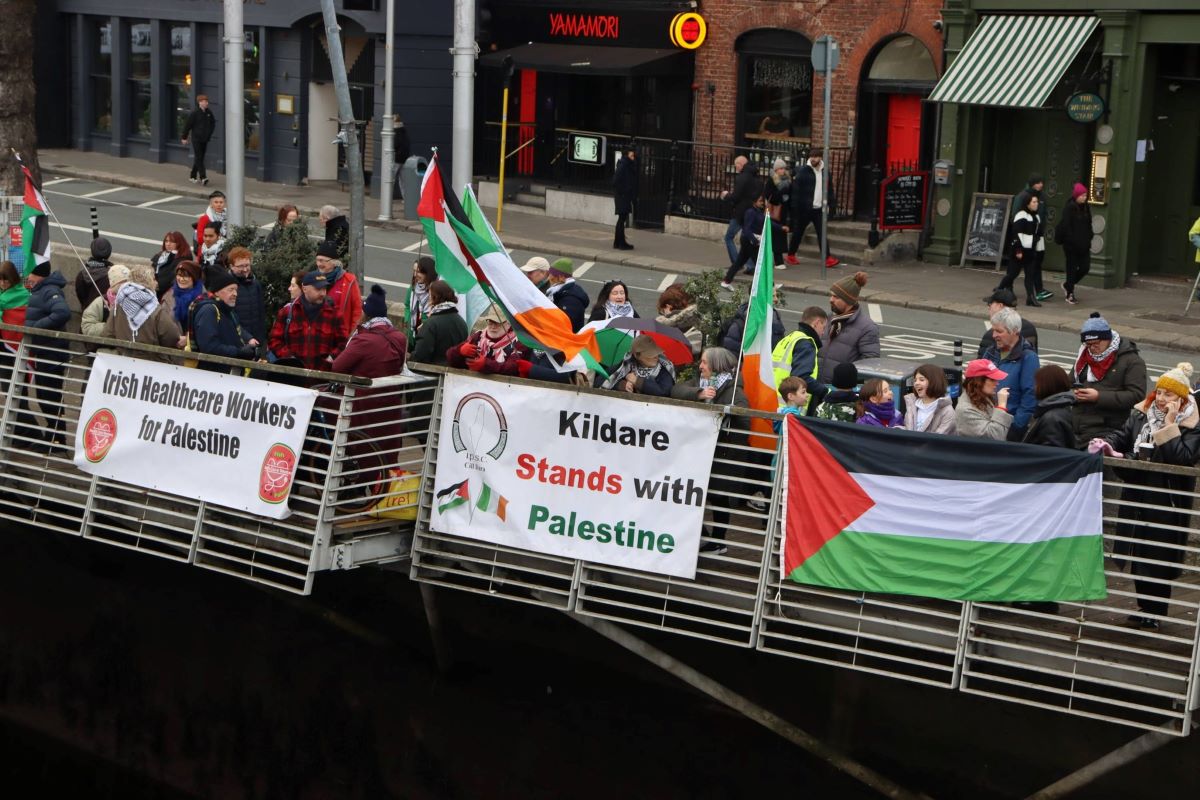
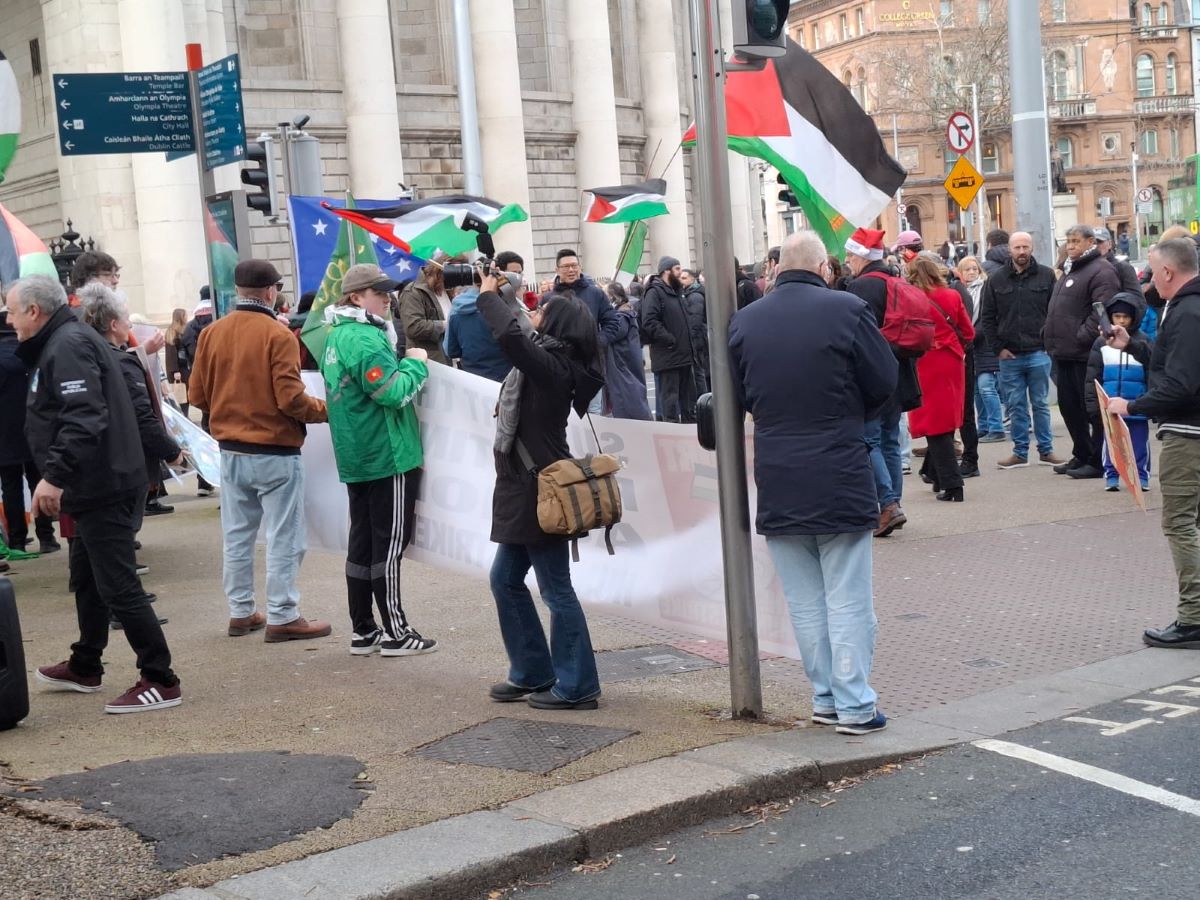
Then another Starbucks, this one on Dame Street got a Palestine solidarity visit before the demonstrators went on to the iconic pedestrian Ha’penny Bridge, where the Ireland Palestine Solidarity Campaign holds a Palestine solidarity protest every New Year’s Eve.
Closeup of banner-drop inside the Stephen’s Green Centre on New Year’s Eve, during protest after closing down the Starbucks café inside. (Photo: G.O.L)
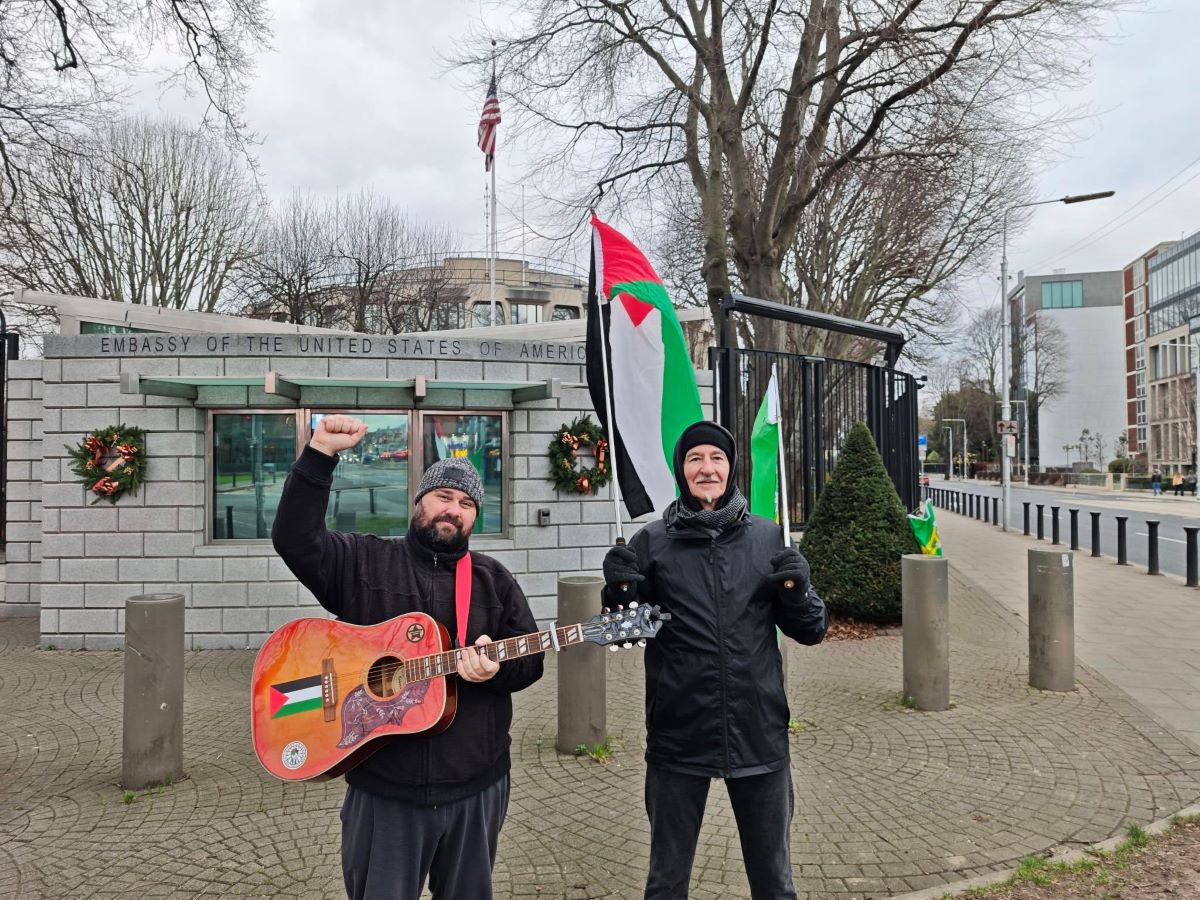
There the demonstrators thronged the Ha’penny and Millennium Bridges and spilled out along the quays. I was elsewherefor the first time in years as it was a Wednesday and therefore Jimi Cullen’s weekly protest with songs at the US Embassy in Ballsbridge, this one to be his 97th straight.
As usual there were police on guard there and one in uniform approached myself and Jimi as we were talking and asked Jimi how long the event would be, how many attending etc. Then she suggested I removed my bike which was leaning against a bollard.
Conducting the protest inside the Stephen’s Green Centre on New Year’s Eve which obliged management to close down for some hours the Starbucks café inside. (Photo: G.O.L)
I told her I was happy with where it was, thank you. Then she said that it might fall on someone (but not, of course, if across the road!), then that someone might steal it, all of which was nonsense of course then said: ‘I am asking you to remove it’ to which I replied ‘And I am declining.’
She was getting quite angry but decided to walk it off. I have attended supporting Jimi’s protest perhaps a score of times and in the early days had a similar approach from a Special Branch4 officer who accused me of causing ‘a security risk’ to the Embassy’s ‘curtilage’ (on a public footpath)!
The Ha’penny Bridge on New Year’s Eve. (Photo: IPSC)
Some police just like to throw their weight around even with regard to things that have nothing to do with the law or causing harm to anyone and over which they have no legal power.
Anyway we unfurled the flags, Jimi had a placard displayed, got out his guitar and we sang through week 97 to frequent waves, clapping, thumbs up, clenched fists, shouts and horn blowing of appreciation and solidarity from passing motorists, pedestrians and cyclists.
Section of northern quays/ Boardwalk on New Year’s Eve, during protest after closing down the Starbucks café inside. (Photo: IPSC)
Jimi began this weekly protest outside the Israeli Embassy but when they left Ireland he moved up the road to the nearby US Embassy, representative of the world leader in terrorism and biggest supporter, politically, financially and militarily of the world’s leading genocider entity.
Usually there are more supporters present. Jimi has a fine stock of protest and solidarity songs, some of which he composed himself and performs them well. Today we did mostly Irish songs of struggle but also one from the black civil rights struggle and Jimi’s own about Palestine.
Jimi Cullen and myself at Jimi’s weekly event outside the US Embassy on New Year’s Eve. (Photo: J.Cullen)
We had a number of Palestinian flags there but also two Starry Plough flags and there were some Irish Tricolours to be seen on the other protests among the many Palestinian ones. It is from our own struggle that we stand in solidarity with Palestine.
End.
Note: If you found this article of interest, why not register with Rebel Breeze for free, so that you will be notified by email of subsequent articles. You can de-register any time you wish.
2Ten Irish Republican prisoners, seven IRA and three INLA died on hunger-strike in a British jail in 1981 in a struggle against criminalisation and for political status
As two of the six hunger strikers awaiting trial on actions against the Israeli arms company Elbit approach 50 days fasting and concern for their survival rises, the Irish recall their own history and the 10 Republican deaths on hunger strike in 1981.
The 1981 hunger striker martyrs were jailed active service Volunteers of the Provisional IRA (7) and Irish National Liberation Army (3) demanding their treatment as political prisoners. On May 5th Bobby Sands died on hunger strike, followed in stages by another nine Irish Republicans.
The Palestine Action activists on hunger strike in jail face charges of criminal damage and alleged assault during actions targetting buildings belonging to Elbit Systems in Britain, involving destruction of manufacturing equipment and weapons and daubing with red paint.
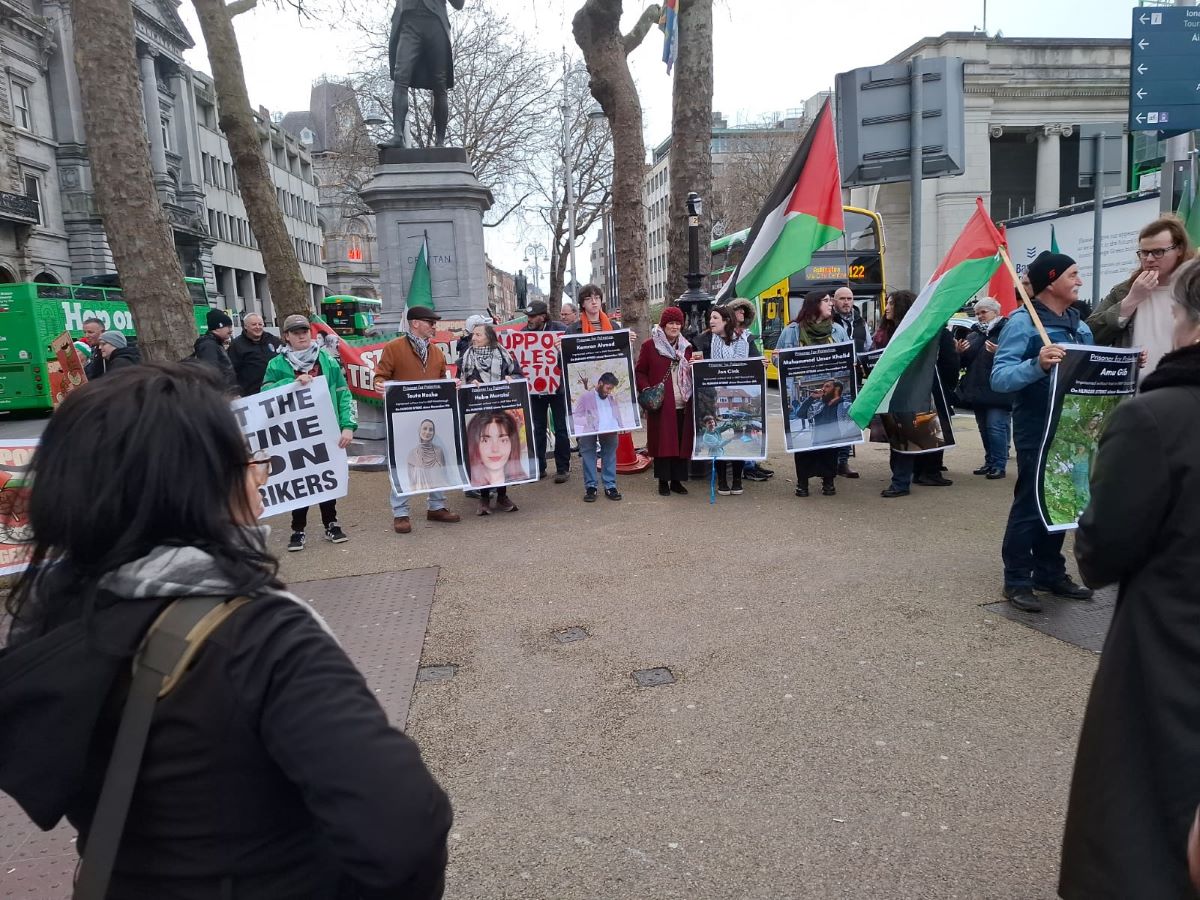
Placards representing the hunger-strikers and banners calling for solidarity with them on College Green, facing Trinity College, Dublin Saturday 13 June organised by Communities for Palestine. (Photo:Rebel Breeze)
The actions and charges predate the banning on 5 July of Palestine Action under the Terrorism Act 2000. That designation has since been protested across the UK1 with around 2,500 charged with “supporting terrorism” under the same Act (potential penalty 14 years prison or more).
The hunger-strikers have won strong support in Britain with solidarity pickets taking place now daily, along with demonstrations and marches. The protests have seen support from among the Irish diaspora, in particular in London led by the ad-hoc broad grouping of the Irish Brigade.2
Apart from humanitarian considerations, protests have also been directed at the UK’s mass media and its attempt to ignore the hunger-strikes and the solidarity actions.
MPs raised the issue too in the Westminster Parliament. Particularly shocking to many was not so much the video recording of the curt dismissal of Independent MP Jeremy Corbyn’s parliamentary question by a UK junior Minister but rather Labour MPs laughing at the put-down of Corbyn.3
On Thursday, more than 800 doctors, nurses, therapists and carers wrote to Justice Secretary David Lammy to warn that “without resolution, there is the real and increasingly likely potential that young British citizens will die in prison, having never even been convicted of an offence”.4
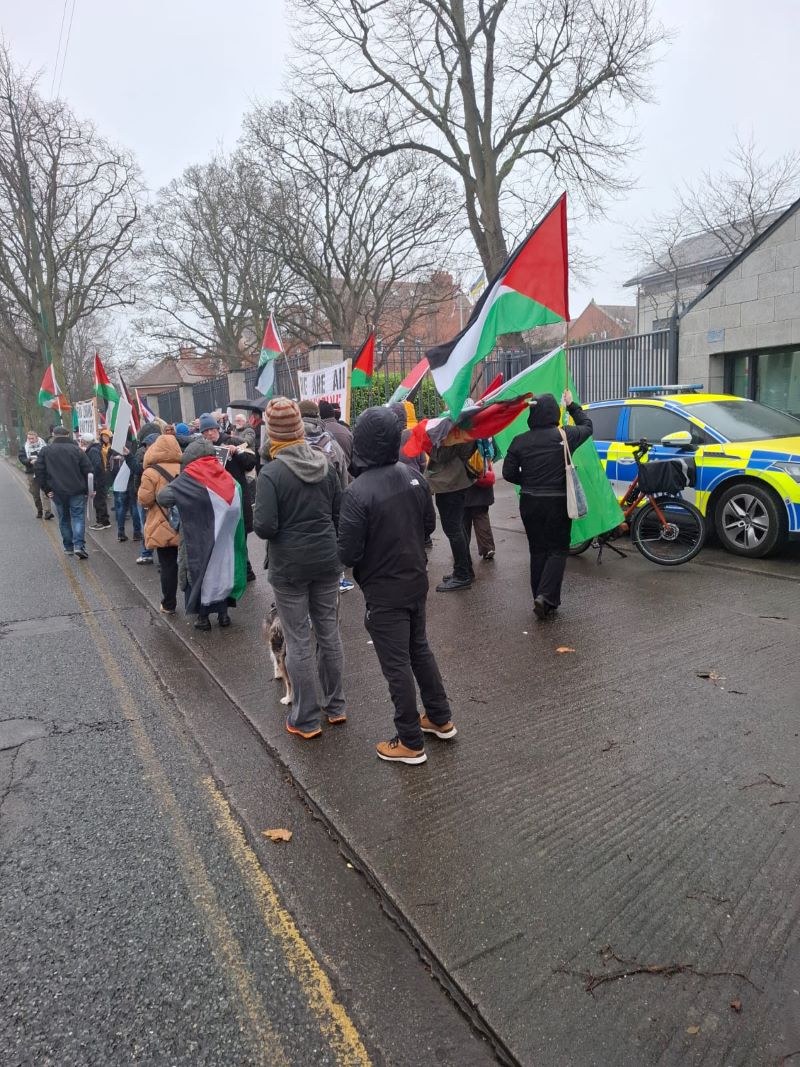
In Ireland itself, solidarity protests have taken place in Dublin city centre and at the British Embassy on the city’s outskirts, in addition to in Belfast and Derry within the British colony of the Six Counties. Again and again speakers referenced Irish history and in particular that of 1981.
Placard-holders facing westward traffic at College Green rally near Trinity College, Dublin Saturday 13 June. (Photo: Rebel Breeze)
In Dublin on Saturday 13 June, facing Trinity College, speakers at event organised by Communities for Palestine called for solidarity with the hunger strikers, denounced daily genocide in Palestine, the chairperson also leading the crowd in the now-famous chant led by the Bob Vylan band of “Death to the IDF!5”
Threatened Irish neutrality in the face of the growing threat of war by NATO was also raised by speakers, as was the continued British occupation of part of Ireland, the Irish State’s collusion with the Israeli genocide in Gaza and the US militarisation of Shannon Airport.
View of a section of the organised by Communities for Palestinerally from behind the main bannercalling for solidarity with the hunger-strikers on College Green, facing Trinity College Saturday 13 June. (Photo:Rebel Breeze)
On Wednesday afternoon, in almost incessant rain, a large crowd protesting outside the British Embassy in Dublin heard calls from a variety of speakers (independent Palestine solidarity, Irish Republican, Socialist TD Paul Murphy) to save the hunger-strikers’ lives.
The chairperson of the rally repeatedly referred to the building as “the colonial British Embassy” and led chants in solidarity with the hunger strikers, with Palestinian prisoners of Israel and with Irish Republican prisoners in both administrations.
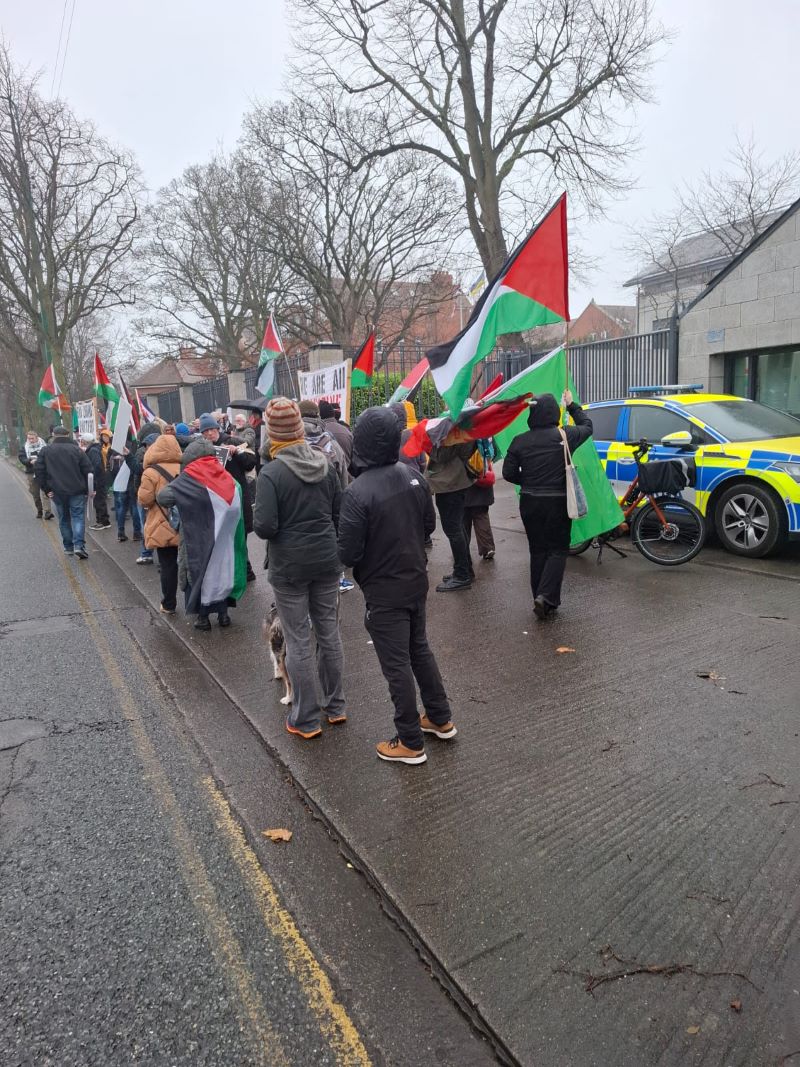
Section of protest rally at main entrance British Embassy (the actual building is set back from the road) on Wednesday 17 June. (Photo: Rebel Breeze)
Referring to the Labour Party MPs laughing at Jeremy Corbyn’s pleas for the hunger strikers, she reminded participants of their cheering the 1916 execution of Connolly6 and dubbed the police “Lackeys of imperialism” as they tried to prevent demonstrators climbing up along the railings.
The slogans were not only of humanitarian concern but also of solidarity, of rage at the genocide in Palestine, of memory of Irish struggle and continuing British occupation. Among chants of hunger striker solidarity at least two speakers voiced the Republican slogan Tiocfaidh ár lá.7
The hunger-strikers’ demands are release on bail, a fair trial, deproscription of their organisation and closure of Elbit factories. The State would claim fair trials and as their period in detention has far exceeded the normal length even for those refused bail, could easily at least release them on bail.
The problem at issue for the British State is that conceding at all risks undermining their according terrorist status to the organisation (which postdates the arrests), a status already in serious danger.
And they need that to stamp out resistance to their genocide collusion, which they perceive as essential to their imperialist system. In that sense a concession in Britain now would have more impact than would have had to the hunger strikers in the colony in 1980 and 1981.
On the other hand, the State’s repression has brought more and more people into the struggle and has exposed the roles of the media, police, judiciary and the Labour Party. Now, the hunger-strikes are helping to draw Palestine solidarity feeling alongside Irish anti-colonial sentiment.
After some time at protest rally some demonstrators mount the wall to display their flags over the railings towards the British Embassy building, set back from the road on Wednesday 17 June. (Photo: Rebel Breeze)
End.
Note: If you found this article of interest, why not register with Rebel Breeze for free, so that you will be notified by email of subsequent articles. You can de-register any time you wish.
FOOTNOTES
1Led by the Defend Our Juries civil rights organisation.
2A broad and growing section of the Palestine solidarity movement in London that has been leading the Kneecap court case music solidarity sessions and the hunger-strikers’ solidarity actions there.
5The famous occasion was in June at this year’s Glastonbury Festival with the irony that it was live-streamed by the BBC in order to avoid featuring the Kneecap band from Ireland and their unequivocal expressions of solidarity with the Palestinian struggle. ‘IDF’ is the acronym of the armed forces of the Israeli state, more often named “Israeli Occupation Forces” (IOF) by Palestinian supporters.
6It was actually worse than that: as has been pointed out on occasion in articles in Rebel Breeze, the Labour Party, being in the UK coalition war government, were part of actually agreeing the post-1916 death sentences.
(Reading time:3 mins.) (Reprinted with gratefully-received permission of author of article1 originally published in the Electronic Intifada, a non-profit online publication covering the Israeli-Palestinian conflictfrom a Palestinian perspective)
Nadav Zafrir – a guru in Tel Aviv’s tech scene – offers a textbook example of how spies can make a killing.
Zafrir has gone from commanding Unit 8200 – an elite division in Israel’s military focused on electronic espionage – to leading Check Point,2 a big success story in the business known as cybersecurity.
One element of his rise which has received scant attention is that he has been helped along the way by the European Union.
In 2020, the Brussels bureaucracy issued a research grant worth more than $2.5 million to Illusive Networks, a firm then chaired by Zafrir.
Illusive Networks had developed what it called a “solution that allows early detection of cyber attacks” and the grant was explicitly aimed at enabling the firm to “expand into the EU market.”
As “ethics checks” for EU-funded research projects involve little more than box-ticking, it is a safe bet that Brussels officials did not raise objections to Unit 8200’s activities before approving the grant.
The sinister nature of those activities was summarized in a 2014 letter signed by a few dozen of its veterans.
“The Palestinian population under military rule is completely exposed to espionage and surveillance by Israeli intelligence,” the letter reads. “While there are severe limitations on the surveillance of Israeli citizens, the Palestinians are not afforded this protection.”
A state which discriminates based on race or ethnicity is by definition an apartheid state. Although the 2014 letter did not use the word “apartheid,” the practices it described certainly fit the definition of apartheid.
Those practices did not materialize overnight. As Nadav Zafrir was head of Unit 8200 from 2009 to 2013, he had definitely practised apartheid – a crime against humanity, according to the International Criminal Court.
By issuing a research grant to his firm, the EU was rewarding a spy chief who had served an apartheid system.
Ireland’s dereliction of duty
Profiles of Zafrir in the mainstream press do not call out his crimes. Rather, they celebrate how he has an “X factor” and how he has been offered a “compensation” package worth more than $15 million for 2025.
Since he joined Check Point as CEO last year – a time when his old buddies in the Israeli military were busy inflicting a genocide on Gaza – he has garnered numerous favourable headlines.
Checkpoint leader Zafrir
Check Point is consolidating its position by either snatching rivals or teaming up with them.
A partnership accord has been inked, for example, between Check Point and another Tel Aviv firm Wiz. “Check Point’s cloud network security tools will be merged into Wiz’s cloud security platform,” The Times of Israelinformed its readers in February.
Technology reporters may get excited by what’s happening in the clouds. Back on the ground, activists are raising awareness about Check Point’s inextricable links to Israel’s military.
In Ireland, a protest against Check Point last month grabbed some media attention.
It involved a disruption of a promotional event organized by Check Point and featuring a speech from the former rugby international Brian O’Driscoll, who is regarded as a hero to many following that sport.3
The group behind the protest – Your Tech = Their Deaths – is rightly sounding the alarm about Irish companies and public authorities that use Check Point’s software.
I contacted the Office of the Director of Public Prosecutions (DPP) in Dublin following reports that it had renewed a contract relating to Check Point technology over the past few weeks. The DPP’s office replied that it “does not comment on any arrangements related to cybersecurity.”
Ireland is a country still grappling with the effects of colonization. Overcoming those effects requires not only the unification of the island but a willingness to stand up for oppressed peoples around the world.
The other kind of Israeli checkpoint, this a temporary one in the West Bank in April 2024. These are in addition to the fixed ones and Palestinians driving or walking may have to go through many in one journey. Israeli checkpoints are some of the areas of confrontation and arbitrary arrest of Palestinians. (Photo: Times Israel Jaafar ASHTIYEH/ AFP)
Defending Palestinian rights – through action, not just rhetoric – is surely a moral duty for Ireland. Handing over money to Check Point is a dereliction of that duty.
End.
Note: If you found this article of interest, why not register with Rebel Breeze for free, so that you will be notified by email of subsequent articles. You can de-register any time you wish.
2An ironic name, given that the IOF and even settlers set up checkpoints to harass Palestinians on towns’ entrances and exits and many points along the roads and that their checkpoints are where Palestinians are routinely arrested and sometimes killed. (Rebel Breeze editorial comment)
3According to reports the protest received rough handling by Gardaí and by security personnel and one participant was subsequently threatened by Driscoll’s lawyers but the promotional event nevertheless had to be abandoned (Rebel Breezeeditorial comment).
Thursday night (30th), with almost non-stop downpour of rain was a dreary and miserable one in Dublin. Not so however inside the Cobblestone’s back room where solidarity and resistance resounded in song, instrumental and spoken word.
The event organisers, Solidarity Sessions collective, an independent organisation founded late last year have declared a number of times that they wish to contribute to “creating a community of solidarity and resistance through culture.”
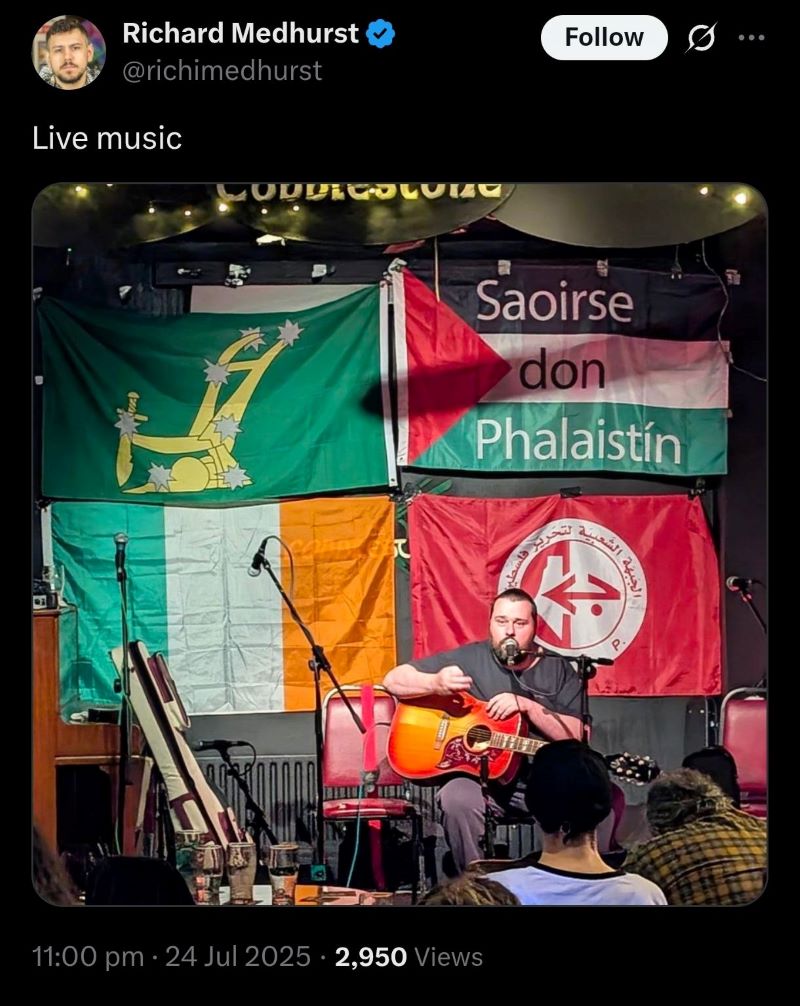
Certainly the flags on the stage of the Tricolour, Starry Plough and Palestine conveyed some of the context, as did posters of 1916 martyrs Connolly and Pearse with text pointing out that the first was a migrant and the second, son of a migrant.1
In addition a merchandise stall sold T-shirts figuring the Palestinian Resistance with funds raised going to Palestinian relief work on the ground. Solidarity Sessions have also donated to ‘buy’ a water truck from Uisce for Gaza and also donated to Streetlink Homeless Support in Dublin.
Mark Flynn performing at Solidarity Sessions No.3 in the Cobblestone. (Photo: R.Breeze)
The material performed on stage contributed much of solidarity and resistance also. This was the third event this year and the second at the Cobblestone pub, one other being at the International Bar and the fourth expected at the Peadar Brown pub on Southside’s Clanbrassil Street.
There was a lot of audience participation at times during the evening, with Alan Burke joined from the floor in the chorus of his spirited rendition of The Aul’ Triangle (to which he added a verse of his own) and Sive was accompanied on request by continuous refrain under her singing.
Mark Flynn was also backed by the audience in his adaptation of A Roving I’ll Go to a sailing to Portugal song he told his audience he had put together in minutes of a creative flash the like of which he ruefully admitted not having experienced since. Flynn also sang Bogle’s antiwar Waltzing Matilda.
Alan Burke performing at Solidarity Sessions No.3 in the Cobblestone. (Photo: R.Breeze)
The audience was extremely quiet during Dorothy Collin’s spoken word pieces about assassinations by the Zionist Occupation and Palestinian resistance, interrupting her performance with applause only after a haiku in Irish and at a point where she became visibly emotionally affected.
The Resistance Choir included in their performance an exuberant Bread and Roses, the lyrics originating in a speech at a mostly female textile workers’ strike in Massachusetts, USA in 1912 and Burke sang of an innocent miner framed on a murder charge and hanged – but pardoned posthumously.
Class struggle was also present in Burke’s singing My Name Is Dessie Warren, about a trade union activist with flying pickets2 during the 1970s construction workers’ strike in England. Some were tried under the Conspiracy Laws and jailed, including Ricky Tomlinson and Des Warren.3
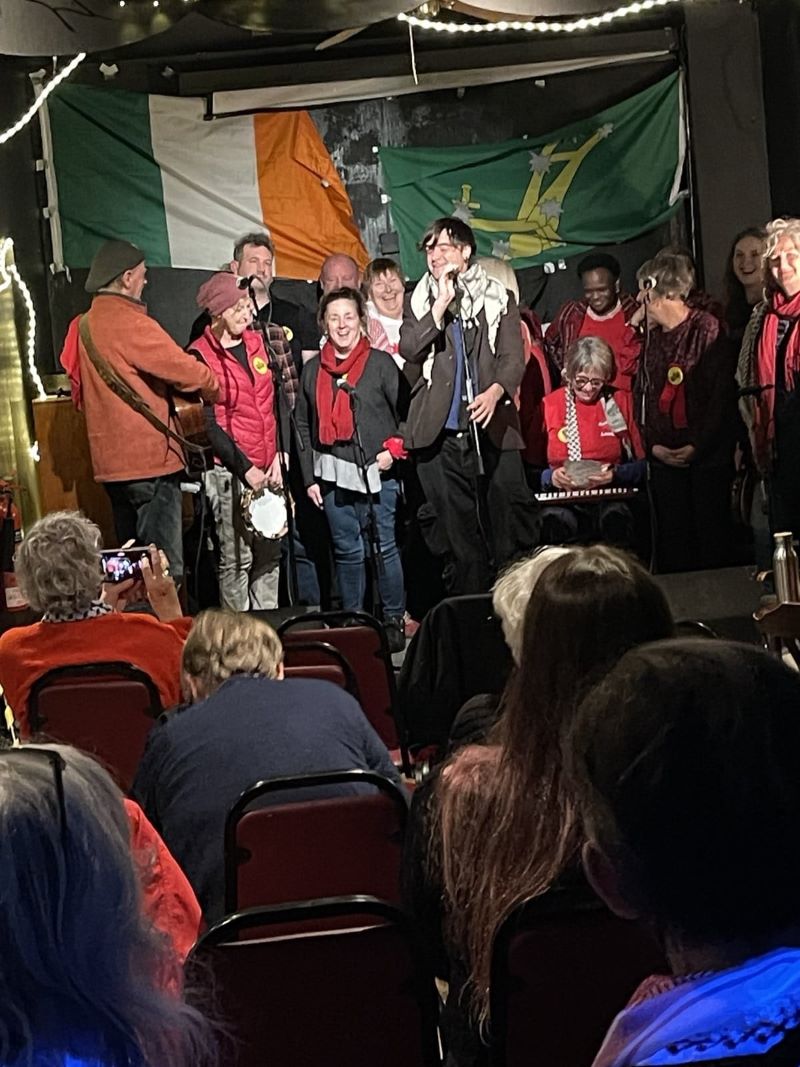
The Resistance Choir about to perform at Solidarity Sessions No.3 in the Cobblestone, being introduced by the MC, Ru O’Shea. (Photo: R.Breeze)
ANNOUNCEMENTS
Three imminent resistance events were announced from the stage: Friday morning, due to appear in court4 were two Palestine solidarity activists attacked by Gardaí at Dublin Port and a good show of numbers in solidarity was requested.5
On Saturday a picket in solidarity with Irish Republican prisoners would be held outside Kilmainham Jail6 and on Sunday a demonstration to blockade Dublin Port was announced, people being requested to gather at The Point on the north Liffey quays.
Sive, who performed at Solidarity Sessions No.3 in the Cobblestone. (Photo sourced: Internet)
The organising collective, volunteers on door duty and the performers all donated their services free of charge. Further donations will be made to causes considered worthy, the collective assured their guests and supporters.
Ru O’Shea, MC for the evening, thanked all the performers who gave their services for free, the audience for their attendance, supporters staffing the door, the Cobblestone and sound engineer. The next Solidarity Sessions night will be at Peadar Brown’s on Thursday 4th December.
Ongoing “contributing to building a community of solidarity and resistance.” And outside, it had stopped raining for awhile.
End. Note: If you found this article of interest, why not register with Rebel Breeze for free, so that you will be notified by email of subsequent articles. You can de-register any time you wish.
FOOTNOTES
1James Connolly was born into the Irish diaspora in the poor area of Cowgate in Edinburgh and first came to Ireland as an adult in response to an invitation to found the Irish Socialist Republican Party. Subsequently Connolly went to the USA for a period before returning to Ireland (therefore 3 times a migrant). Patrick Pearse was born and raised in Dublin but his father was English. Both Pearse and Connolly were executed in Kilmainham Jail with another twelve by British bullets after their surrender of the 1916 Rising.
2‘Flying pickets’ operate in principle like the guerrilla ‘flying columns’, sending a large number of union picketers to specific locations chosen in secret, thereby reducing the opportunities for the police etc to mobilise at the spot in advance
3Ricky Tomlinson after release became a famous actor, mostly in comic roles. Warren developed Parkinson’s from forcible injections with restraining drugs and long periods in isolation in jail, dying not long after release. I remember the case and campaigns when I was working in England and a period afterwards when I was briefly active in the Construction Safety Campaign and read statistics about on average a construction worker killed weekly and one seriously injured daily on British construction sites.
4Yes, the Gardaí charging with criminal offences people they pepper-sprayed and batoned without warning.
6Kilmainham Jail was a British colonial prison in Dublin, also used for a while by the Irish Free State to imprison the Resistance during the Civil War/ Counterrevolution. It is now a very popular museum and holds the execution site of 14 prominent Irish Republicans after their surrender in 1916.
Around 80 people attended a concert in the back room of Dublin’s Cobblestone pub launching an initiative to “build a community of solidarity and resistance through culture”. Flags of Irish and other struggles around the world decorated the venue.
The evening’s entertainment consisted of five musical acts and one of poetry. The MC for the evening, Diarmuid Breatnach, told the audience that Irish struggles had always found an expression in culture and that culture itself encouraged further resistance.
He gave the example of Thomas Davis who founded with others the patriotic newspaper The Nation in the mid-1800s, publishing contributed songs and poems and his own, including The West’s Awake and A Nation Once Again, songs still sung in Ireland nearly two centuries later.
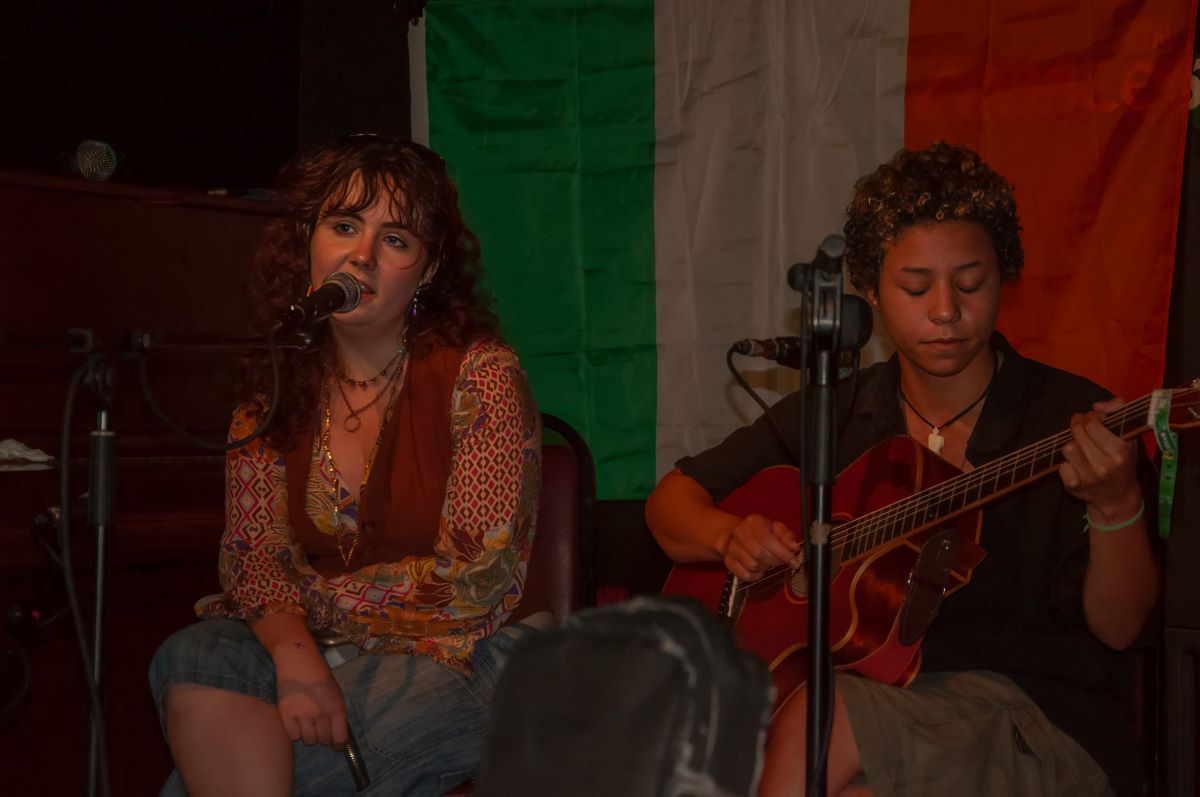
The first act of the evening was the folk duo The Yearners, specialising in harmonies around renditions of song covers and their own song about the Mary of the New Testament, as a woman pressured to bear a child because “How can you say no to God?
The audience joining in on Pearse’s Gráinne Mhaol was followed by some songs with hard satirical edges like the Kinky Boots song from the Irish Republican repertoire and their own Save A Landlord.
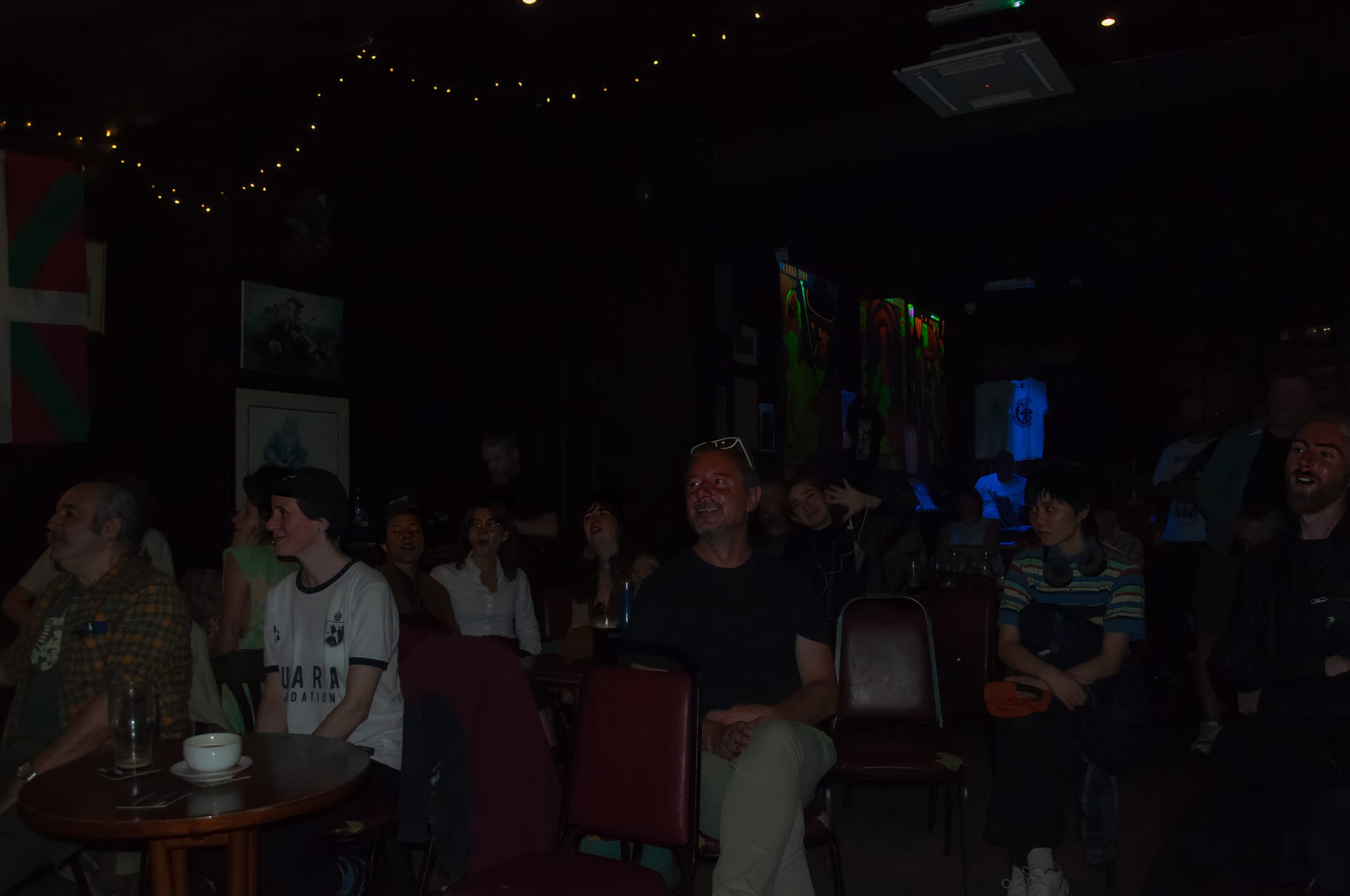
The Yearners during their performance. (Photo credit with thanks: Dermo Photography)Dúlamban during their performance. (Photo credit with thanks: Dermo Photography)
The MC introduced another all-female duo, Dúlamban, recently formed from two individual singer-musicians. Among their material, Sinéad on violin played two compositions of her own while Aisling sang her adaptation and translation of the Rising of the Moon: Ar Éirí na Geallaigh.
The one poet of the evening, Barry Currivan, performed a number of shorter and longer pieces of his repertoire. He was particularly applauded for his “anti-othering” piece Those People and his humorous concluding piece comparing himself to a good cup of tea or coffee.
After the break, the MC spent a few minutes outlining the Solidarity Sessions collective’s project and encouraging the audience to take part in it by spreading word of its events and supporting them in person, in addition to stepping forward to assist in organisation and in poster design.
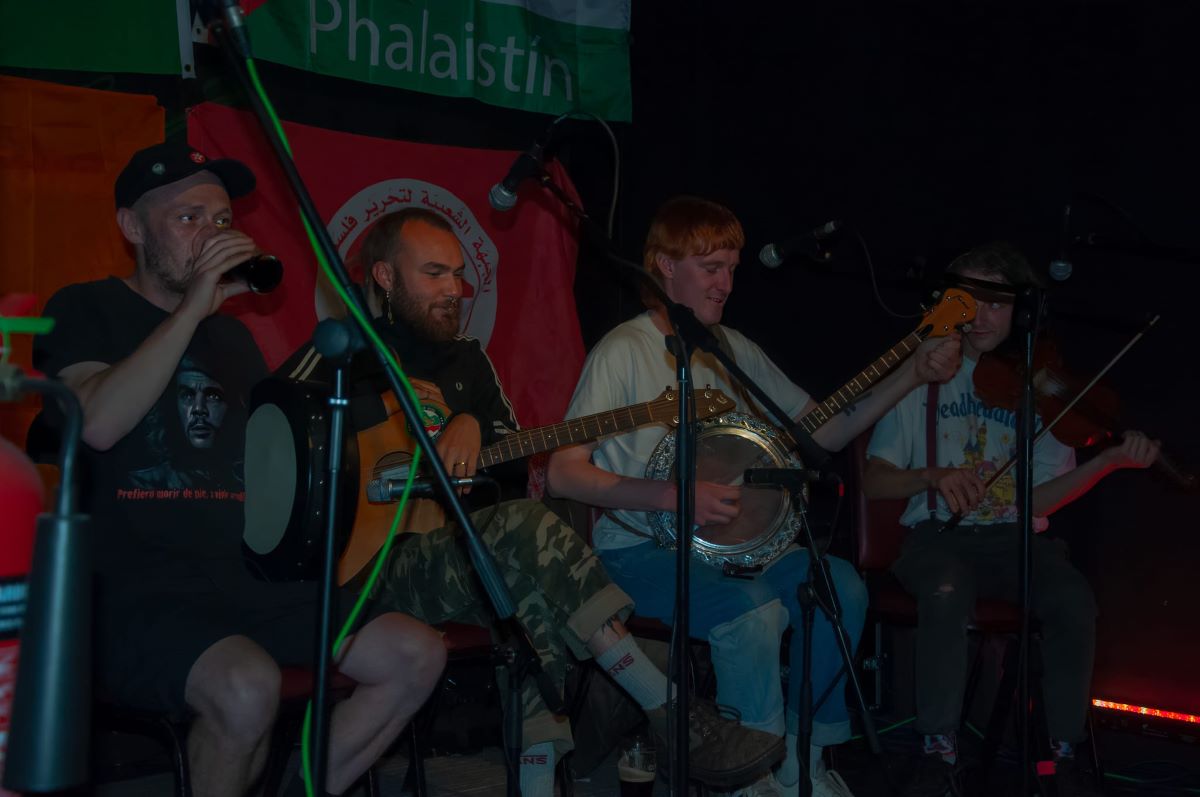
Barry Currivan during his poetry performance at the Solidarity Sessions launch. (Photo credit with thanks: Dermo Photography)Section of the audience presumably during Currivan’s performance. (Photo credit with thanks: Dermo Photography)
Another female duo took the stage, Sage Against the Machine on guitar accompanied by Ríona on violin, performing a number of love pop covers and SAM’s own song against patriarchy.
Some remarks about Bob Dylan’s Zionism followed in Sage’s introduction of the former’s Masters of War which she performed with great feeling and followed with El Gallo Rojo, an anti-fascist song from the Spanish ‘Civil War’.
Sage Against the Marchine (right) and Ríona during their performance. (Photo credit with thanks: Dermo Photography)Jimi Cullen during his performance at the Solidarity Sessions launch. (Photo credit with thanks: Dermo Photography)
Breatnach then introduced Jimi Cullen who he said has been hosting a weekly musical protest picket for an hour on Wednesdays (2-3 pm) outside the US Embassy for a great many weeks, in which the MC had sometimes accompanied him amidst the solidarity beeping of passing traffic.
Jimi accompanied himself singing his Housing for All and Guthrie’s You Fascists Bound to Lose, then commenting on Bob Marley’s Zionism while introducing the latter’s One Love song, saying that love above all is what binds humanity together, a theme also of his We Are All Palestinians.
His monologue The Genocide Will Be Televised was much sharper and renewed an earlier Death, death to the IDF!1 chant from the audience.
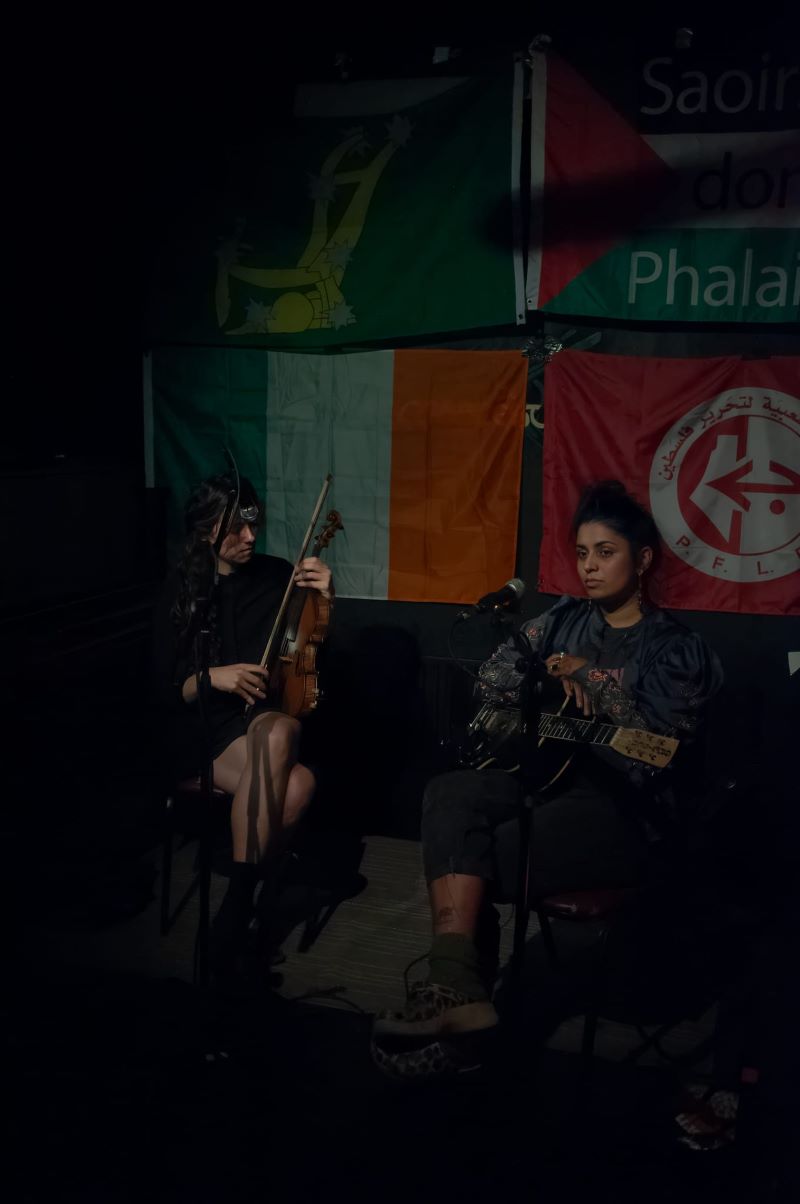
Trad Sabbath during their performance. (Photo credit with thanks: Dermo Photography)
There was much irreverent comment about the name of the band to conclude the evening, Trad Sabbath, a four-piece band of guitars, banjo, bodhrán and fiddle, apparently in the context of the very recent death of the Black Sabbath band’s lead vocalist, Ozzie Osbourne.
Sardonic cries about “his poor widow”, Sharon Osbourne2 were also heard, a Zionist personality star in a ‘reality’ TV show about the late Ozzie’s family. To fill in the delay in their setting up with the sound engineer, Breatnach sang Kearney’s Down by the Glenside ballad.
The band concluded the evening with traditional melodies and some songs from Eoghan and Hat with others backing on choruses.
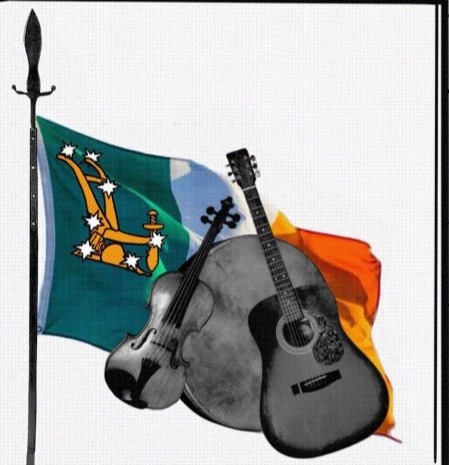
Poster advertising the event (Design: Ríona and D.Breatnach)
The MC thanked all for their attendance, performances and technical support before reiterating the Solidarity Sessions’ objective and encouraging participation. His comment that “Repression is here and more is coming down the road” was underlined by the presence there of a prominent victim.
In the audience was Richard Medhurst, the Britain-based journalist specialising in Middle Eastern coverage who was recently detained under anti-terror (sic) legislation and charged by British police as he returned from abroad and again later detained though not actually charged by Austrian police.
Richard Medhurst’s tweet during the evening at the event.
End.
FOOTNOTES
1Made famous by the Bob Vylan duo at Glastonbuy getting the audience chanting the slogan. The IDF is what the Israeli Occupation Forces call themselves.
2Who had called for the banning of the the Irish rap group Kneecap.
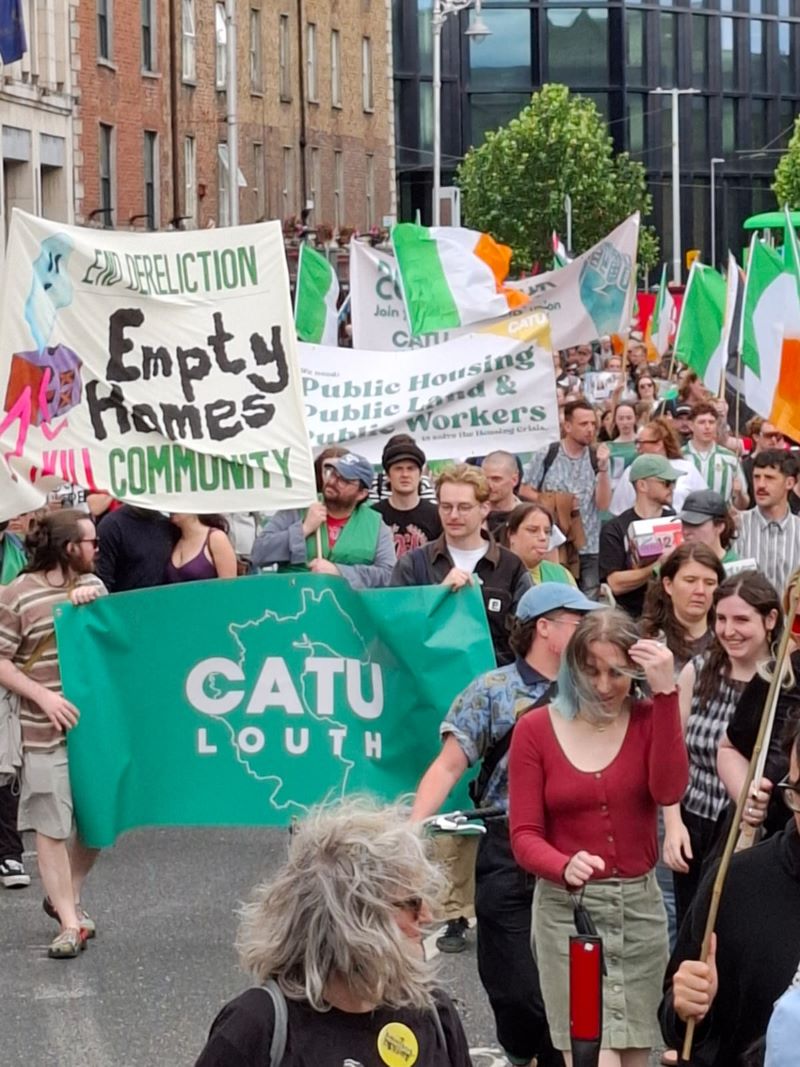
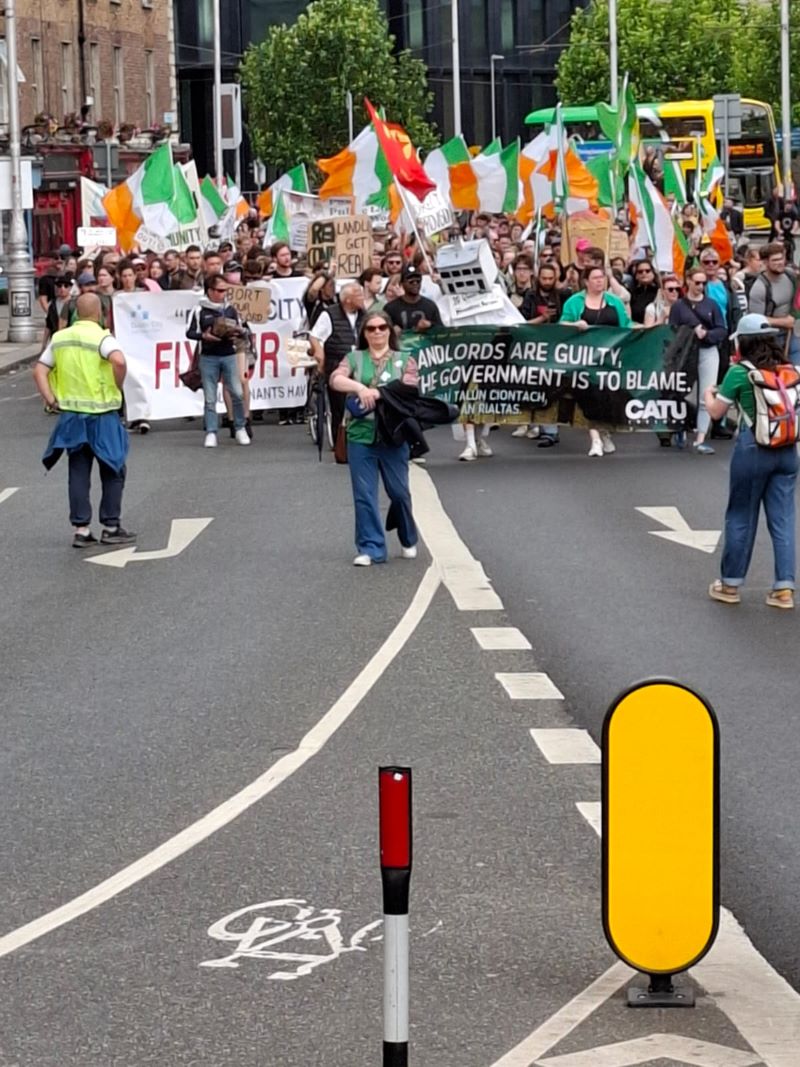
An estimated 10,000 people marched through Dublin city centre on Saturday in a national protest organised by CATU about homelessness, high rents, lack of public housing and the facilitation of property speculators by Irish Governments.
Groups from across Ireland attended the national march organised by the Community Action Tenants Union and without regard to the British Border around the Six-County occupied colony. They gathered at the Garden of Remembrance before marching towards Leinster House.
One of the housing groups that travelled to Dublin from the occupied Six Counties (Photo: D.Breatnach)
It was warm but not excessively so and the rain held off. The march ended with a rally in Molesworth Street, where Garda barricades prevent marchers from crossing the street to approach the gates of Leinster House, where the parliament of the Irish State sits.
In addition to drummers and also some singing, many chants could be heard: Homes for need – not for greed! What do we need? – Public housing; When do we need it? Now! When tenants are under attack? Stand up, fight back! (also something like: Get the landlords out of the Dáil!).
Among banners and flags of local area housing action groups and trade unions there were a great many Irish Tricolours in view; to see them being flown on a demonstration not of the Far-Right was a welcome sight. There were some Starry Ploughs and some red flags flying also.
It was good also to see the Irish language on some placards among the demonstrators. A notable feature was the high proportion of young people participating, many with their own home-made placards.
A certain species of vulture seems to have raised hostility in Ireland! (Photo: D.Breatnach)(Photo: D.Breatnach)Too Damn everything – except good! (Photo: D.Breatnach)
A lot of people were also in Dublin that afternoon for other events, including supporters of Gaelic Athletic Association county teams competing in Croke Park, in particular the Cork Vs Dublin teams in the Hurling Semi-Final. (Dublin getting that far surprised many but Cork beat them decisively).
A large anti-abortion demonstration also took place in the city centre, starting later than its advertised hours but immediately after the start of the CATU march. There are a range of attitudes on abortion but in general those campaigners like to project themselves as ‘pro-life’.
Some might comment that a pro-life cause would also include good housing for all – or to support the Palestinian people but generally the anti-abortion campaigners do not march in support of those, which is why they are often accused of being ‘pro-birth’ rather than ‘pro-life’.
Numbers of homeless single people and families with children rising annually passes 15,000 for the first time.
Out of 10,743 adults accessing emergency accommodation in March this year, 1,178 were under 24. In addition, 4,675 children were also using emergency accommodation.1 In January 134 individuals were counted sleeping on streets and in parks in the four Dublin areas, a 14% increase on 2024.2
In addition, the numbers of homeless does not include those sofa-surfing, awaiting eviction, in domestic violence refuges or unaccommodated refugees.
CATU’s list of demands points to the unfilled needs across a range of indicators and in itself is an indictment of the current state of affairs. In addition, the numbers of homeless has been rising annually and does not include those sofa-surfing, in violence refuges or unserviced refugees.
(Photo: D.Breatnach)
Prior to the march, CATU published a list of objectives and demands:
End child homelessness by 2026
Eviction ban North & South, Lower rents
Properly resource the Tenant In Situ scheme
End Direct Provision
Ban Vulture Funds
Build and maintain Public Housing – use public land
Build and resource culturally-appropriate Traveller Accommodation
Homes, not Holiday Lets
Build Communities of Care: education, community, addiction & mental health services now!
Front of the CATU march comes around from D’Olier Street while the rest of it is still coming down O’Connell St. (Photo: D.Breatnach)(Photo: D.Breatnach)
COMMENT – Housing Need and Action
It was an excellent turnout for CATU who are to be congratulated on their mobilisation and organisation around the country and in Dublin. The housing crisis is one of the great practical problems facing working people and a very big public housing program is the only solution.
However, the Irish neo-liberal ruling class are clearly wedded to housing provision by the private sector, with its soaring rents and mortgage payments resulting for many in sleeping on the street or living in hotels and hostels, not just single people but family groups with children too.
Housing marches and occasional symbolic occupations of buildings through the years have not changed the situation which worsens annually. The far-Right use the issue to target migrants who have not caused the crisis and even asylum seekers who cannot possibly have any effect on it.
Plentiful public housing is clearly the answer, rented according to the occupiers’ income. After the initial building cost, the rents will pay for maintenance, repairs, upgrades and even new buildings. And the construction program will provide much employment too.
Clearly a radical program of action will be needed to force the Irish ruling class to adopt a large public housing program. It does not require a revolution to achieve the change but it will almost certainly need the fear of one to move our rulers in the necessary direction.
In the 1960s and 1970s a number of housing schemes construction and renovation programs were won by the direct action of the Housing Action Committees of Dublin and Dún Laoghaire. The Committees included occupations in their program, alongside street rallies and marches.
Some years ago a small group called Revolutionary Housing League began a series of occupations of empty buildings, also refusing to give guarantees not to continue the actions when taken to court. They called for replication action on a wide scale along the same lines but that did not materialise.
Action of the kind up and down the country seems to be what is required and activists may be jailed before this ruling class is prepared to supply the basic human need of decent and affordable housing for the working people. It remains to be seen what role CATU will play in all of that.
The Far-Right mobilised a large number1 of people for a national protest march in Dublin on Saturday 26th April, pretending the main target was the Irish Government and the housing and health service crises but was purely racist, anti-immigration.
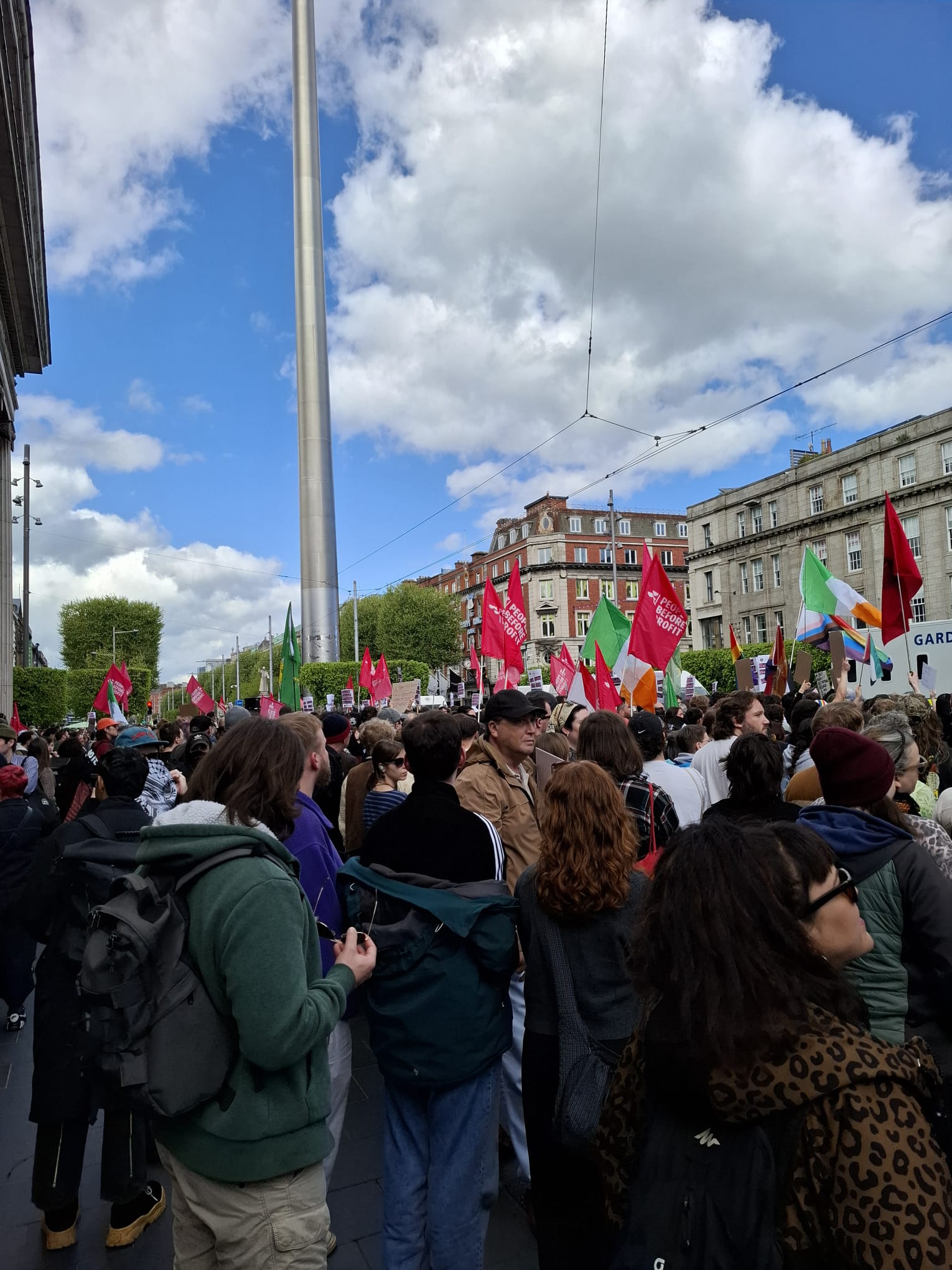
A counter-rally was organised from the Left in front of the GPO, past which the far-Right demonstration was scheduled to pass. They were kettled on three sides by crowd barriers with two Garda vans and Gardaí on foot in front of them.
A number of far-right elements gathered on the sides of the confined mass to throw insults at the anti-racist there, policed very lightly and gently by Gardaí, in stark contrast to how the latter have treated some anti-fascist and anti-racist activists in the recent past.
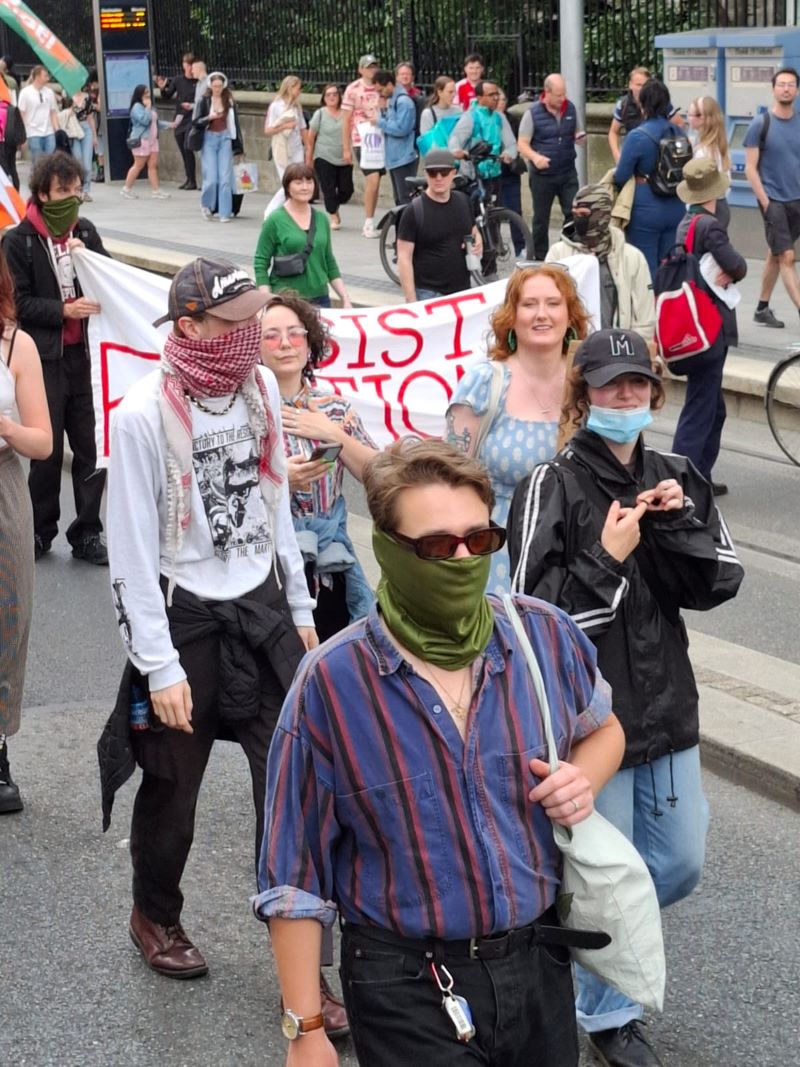
Among the anti-racist crowd there were many flags of the People Before Profit and Labour parties, an Irish Tricolour or two, two Starry Plough flags and a couple of Palestine flags.
Section of the counter-protest to the anti-immigration march in Dublin on 26th April (Photo: D.Breatnach)
When the Far-Right march came down O’Connell Street, as might be expected from past experience, they carried a flood of Irish Tricolours and some ‘Irish Republic’ flags.
It was not the first time the Left – and these are for the most part the electoral Left – had acted so stupidly from a visual point of view. Because they claim to represent the workers, they pretend to scorn nationalist flags – well then why not at least fly the Plough,2 flag of the Irish workers?
But no, flying red and pink party flags and leaving the national stage to be represented by the Far-Right. And why not fly the flags of national rebellion anyway, are they not honoured for their anti-colonialism and revolutionary spirit? Why neglect to confront the Far-Right with the contradiction?
I have been pointing that out over years without any seeming effect on the Left (or indeed on the Republican movement). However the Mála Spíosraí (Spice Bag) artist group posted a similar objection, making many of the same points and they may have better luck with it.3
The Far-Right when they arrived were met with jeers but the marchers were jeering the anti-racists also. It was interesting to hear the anti-racist crowd switch from shouting that “refugees are welcome here” to baiting the Far-Right with: “Where’s your Union Jack?”4
Confronting the pretend patriotism of the Far-Right with their leaders’ connections to British fascists and Loyalists is much more effective than some of the slogans that are regularly shouted by the Left on these occasions. Reminding people of McGregor’s wearing a Poppy5 might be useful.
Creating slogans to expose their role in distracting attention from property speculators, big landlords, bankers and foreign multinationals on to migrants, who don’t cause any of the problems, would be very useful but expecting creativity and initiative in the electoral Left …!
At least one of the FR leaders, Malachy Steenson and some marchers were seen wearing caps in Trump imitation with “Make Ireland Great Again” printed across them. Unless pre-invasion 1169, there was no hint as to when the ‘great’ period in Ireland’s history might have been.
The country was under total occupation by the 1800s. The Irish State was set up in 1922 on a partitioned land with continuing high emigration. Steenson is an ex-Republican so presumably he knows this. Can he be hearkening to the days of the Church domination of the neo-colony?
Among the banners and flags seen among the marchers were those of Irish fascist organisations, the National Party and Irish Freedom Party. Slogans of “Ireland for the Irish” and “Get them out” were frequently to be heard and “Ireland is full” was seen on a number of placards.
The first two slogans are shouted by people many of whom have no interest in freeing the Six Counties from British Occupation nor the whole country from foreign multinational companies; in fact these are issues which the fake “Patriots” of the Far-Right never address.
On population statistics alone it can be shown that Ireland is far from “full”, given that the population of the country now is lower than the 8 million plus which was recorded in 1845. But lies of the sinister repeated by the ignorant and credulous have long been the stock of fascism.
Homelessness is due to affordable housing shortage, in turn is due to construction, sale and rental being for profit alone. We’ve had a housing shortage for centuries and expelling immigrants will not cure it – a social housing construction program can but the Far-Right never agitate for that.
Expelling immigrants might seem to shorten health service queues but in fact would lengthen them as those members of staff in paramedical services, nursing, surgery, cleaning and security left the country. But none of the anti-immigrant propaganda is about logic – quite the contrary.
A position that it’s patriotic to allow only the Irish-born to live and work in Ireland would have meant lost us four of the Seven Signatories of the 1916 Proclamation James Connolly, Tom Clark, the father of Patrick (and Willy) Pearse and the mother of Thomas Mac Donagh.
The racists flying the “Irish Republic” flag may be unaware that it was painted on one of her curtains in the house of London-born Constance Markievicz, delivered by her during the 1916 Rising to the GPO and installed on the roof by Eamon Bulfin, born and reared in Argentina.
The Irish Tricolour was presented to Irish Republicans by French Republican women during the Paris Revolution of 1848. The Harp on a green background was the flag of the United Irish, nearly all of whose leaders’ antecedents had come from other countries.
IT’S OUR FAULT
We can expose the ‘patriotism’ of those who ignore the foreign occupation of one-sixth of our land but organise against foreign workers; we can laugh at the ‘patriotism’ and ‘anti-globalism’ that thinks it fine to follow “Poppy” McGregor cosying up to a US imperialist president.
But in the end, those contradictory positions and don’t-compute beliefs won’t matter. The fascists are out to mobilise the ill-informed and gullible who have been hurt by the capitalist system and, it must be said, who have been largely ignored by the Irish Left and by Irish Republicans.
At the very least, the progressive forces could have fought for a wide public housing program. A campaign of occupations could have forced that though people would have gone to jail for it. Attempts were made by the Revolutionary Housing League but they were not supported.
The speculators, big landlords and bankers would hate it but in the end could afford to let it happen. They would still be in charge and still making money. It was not a revolutionary demand.
But the campaign was not pressed and now the Far-Right are there with a simplistic but completely wrong answer: stop immigration.
The electoral Left is not interested in fighting fascism but instead in anti-racist posturing. The Irish Republican movement is in general more interested in getting the British out of their 6-County Irish colony. Even on causes with which they agree, they can rarely stand on the same ground.
The advance of the Far-Right is the fault of the spaces left empty by the Left.
end.
FOOTNOTES
SOURCES
1The numbers quoted varied hugely. The first report on Breaking News had them at twice the number of the counter-protest, which they estimated at 2,000, an under-estimate to my opinion by almost a thousand. The next B News report put the anti-immigration numbers at “hundreds of thousands”, i.e at least 200,000! A more realistic guess would be around 10,000.
2The Starry Plough, flag of the Irish Citizen Army, the first workers’ army in the world, formed to defend the workers from police attacks in the employers’ attempt to break the Irish Transport & General Workers Union with a Lockout of union members.
3The Tricolour will be a right-wing symbol soon if it’s not front and centre at counters. Being allergic to your own flag is moronic and damages your legitimacy as a national movement. A sea of red and pink flags without the hard won symbols of Irish nationalism plays into the right-wing narrative that left is inherently anti-Irish. Fly the tricolour if you don’t want it to end up like the St George’s flag in England.
The left have a tendency to abandon things that are being co-opted by political opponents. In a country where nationalism, socialism and patriotism go hand-in-hand, this would be extremely damaging. Look no further than the Provo/Stickie split in the 1970’s for an example of the left losing legitimacy by putting the red before the green during a crisis.
You’re not just fighting the domestic right, you’re fighting US and UK conservative media and Zionism. Ireland is unique in Europe as a post-colonial state and we can be unique in how we fight our culture war. Nationalism should not be given away, the ‘left’ should not become the generic caricature pushed by right wing media. Our national flag should vastly outnumber all other symbols — it is a symbol of resistance.
4Increasingly the Far-Right leaderships have been exposed in alliance with British fascists and racists such as Tommy Robinson and Nigel Farage and with British Loyalists such as James Dowson.
5In 2015 Conor McGregor wore the red Poppy, causing controversy in Ireland as the symbol is firmly associated with the British imperialist army. McGregor claimed it represented all soldiers in all wars, which is patently nonsense. The Poppy is trademarked and produced by the British Legion to commemorate the UK soldiers killed – not even those of the Commonwealth, to say nothing of the soldiers on the other side, nor the millions of civilians killed.

















 rebelbreeze