On Sunday in Dublin on my travels I conversed (about more than directions) on three different occasions with visitors from the United States and found a wide range of attitudes.
BOSTON, LARKIN AND THE COPS
The first of these was with an elderly couple outside Kilmainham Gaol Museum. The man had “Boston” displayed on his T-shirt and I started talking about Dennis Lehane’s novel “The Given Day”, which is set in Boston and which I had just finished reading. They had read it, really liked it and told me it was the first of a trilogy to which I responded that I would certainly be looking for the follow-ups.
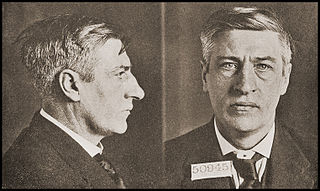
Jim Larkin’s “mug shots” when charged with “criminal anarchism” in New York 1919 (he served time in Sing Sing penitentiary). (Photo sourced Internet)
I talked about Lehane’s slant towards the cops as opposed to the revolutionaries and how of course my slant would be the other way but that in any case Lehane had not done his research on Larkin, who figures in the novel with other revolutionaries and radicals. Lehane refers to Larkin’s “gin-breath” but Big Jim was well known as a teetotaler, which I explained to them.
Then I talked a bit about the Irish Citizen Army that Larkin had founded with James Connolly and others, how they grew up out of the 1913 Lockout/ Strike and that Larkin had served time in Sing Sing prison later as a punishment for his revolutionary oratory in the USA.
I didn’t get the feeling that I and the two Bostonians were in agreement with my revolutionary sympathies but certainly did when it came to the workers fighting the Lockout in 1913. We parted amicably as they went off to enjoy some more of their holiday.
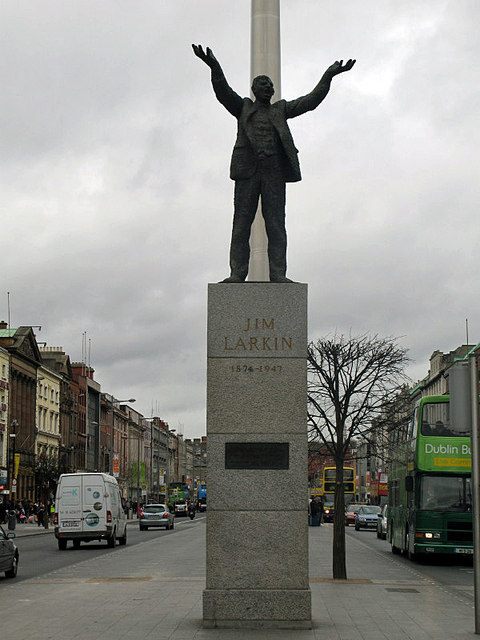
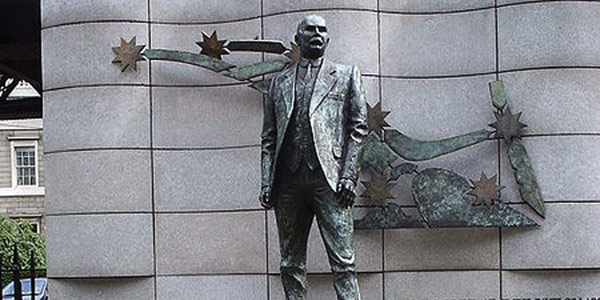
(Photo sourced Internet)The Jim Larkin monument in O’Connell Street today (Photo: D.Breatnach)
Encounter No.2 took place in Cornucopia, into which I had dropped for a cup of coffee.
I took my ‘Americano’ to a vacant table. The one next to me became vacant for awhile and was then occupied by an elderly lady who left her handbag open next to me. I advised her that was an unwise thing to do in Dublin and she remarked. in US accent upon the Leonard Peltier badge that I had been unconsciously wearing all day, so we talked about his case for awhile. She didn’t seem sympathetic to the FBI and expressed horror at the treatment of Peltier, now approaching his 40th year in prison for an act of which he was unjustly convicted.
The lady asked me for advice about literary events in Dublin and as she was, sadly, leaving the day before Culture Night, all I could suggest was a visit to Books Upstairs, where someone might be able to advise her. After I jotted down the address and a rough map for her, I left.
THE DEVIL AND THE TRUMPETTES
It was my intention to attend later that evening the Song Central session, on their first night back after their summer break. Song Central is a monthly gathering of singers and listeners upstairs in Chaplin’s pub, across from the Screen cinema. But I needed to eat first and so headed for a burrito in Pablo Picante, a small place serving Mexican food in Temple Bar (well, at the western end of Fleet Street).
Sitting eating my burrito and facing out into the street, I noticed passers-by pointing at the window and laughing. I could have become paranoid except it was clear that they were pointing to an image painted on the window further to my left. Then a late 30s or early 40s couple who in their style looked kind of to the Left maybe laughed at the image and took photos. The female whipped out a lipstick and wrote something over the painting, then had the man take a photo of her next to what she had written.
Curiosity had me now and after they wandered off, I went outside and saw that the painting on the window was a caricature of US Presidential candidate Donald Trump and underneath it the artist had written in big letters “DIABLO”. Of course, that would be because Trump wants to build a wall along the border with Mexico due to the negative impact he accuses Mexican migrants of having on the US, which Trump wants to “make great again”. And he has also impugned a US Judge’s ability to rule impartially on his case, due to the judge’s Mexican heritage.
The painting in the window of the Pablo Picante burrito restaurant in Fleet St. (Photo: D.Breatnach)
The woman had scrawled something along the lines of “He’s not, we love him” with a heart sign on a part of the painting – clearly far from being Lefties!
I went back inside, got a serviette, came outside and rubbed off her comment, then back inside to continue my assault on the burrito.
Not long after, I was not a little surprised to see the woman and the man standing outside again. She noticed the removal of her comment and commenced to write again. I went to the counter to tell the staff what was going on and returned to find the woman inside, leaning on my jacket on the window shelf and working on rubbing out the painting from the inside!
My challenge on what did she think she was doing elicited the response that Donald Trump was going to be (or might be?) their next President and that the painting was disrespectful. I stood between her and the painting, telling her that we have free speech in this country (which is not strictly true but as the nearest weapon I could reach ….) and just kept repeating it. Then the guy came in and told me I had “no idea”. He kept repeating that and I kept repeating the “free speech” stuff, alert in case he took his case into the physical arena (and he looked fit, too). I also wondered what I would do if instead, it was the woman who attacked me. But they left soon afterwards.
Soon after, a member of staff (Mexican, presumably) went outside and rubbed off her comment, returning with a wry smile.
SINGING THE USA
At the Song Central session later that evening, post-burrito and post Trumpettes, the theme happened to be about the USA, songs from there or about travelling there etc, it being the anniversary of the “9/11” attack on the Twin Towers. If I’d remembered about the theme, I’d have learned the Allende song recorded by Moving Hearts, or brushed up on the lyrics of “Hey Ronnie Reagan” by Christie Moore. Because “9/11” ( in 1973) is also the anniversary of the CIA-instigated military coup in Chile, which over time claimed the lives of 32,000 people.
Interestingly, most of the song contributions during the night that referred to the USA (and most of them did, though people are not obliged to follow the theme), were critical of the US state, whether because of its endemic racism towards blacks and Latinos or its genocide towards the First People, or because of its wars. One song I felt pretty sure would be sung – and it was — was about the firemen on 9/11 running up the stairs of the doomed building while occupants ran down – a powerful song about the heroism of a section of public service emergency workers.
Luckily I could remember some US song material and sang “The Ludlow Massacre” and “How Can I Keep From Singing”, both composed in the US: one written by a revolutionary and the other adapted in the US by a progressive singer.
I had set out that day without remembering the significance of the date for the USA and yet throughout the day had a significant level of engagement with people from the US and, at the end of the day, with the terrible event itself.
End.
Postscript:
On Tuesday, while taking a photo of the Trump caricature in the window to accompany this piece, another US couple began to talk to me. The man opened with: “The man IS a devil” (referring to Trump).
I remarked that Trump was not going to get elected but his role would be to make Clinton look good, then she could carry on bombing and invading countries if she got elected, no problem.
The woman told me they didn’t like Clinton either. They were from Boston and the man and his father before him had been union organisers. He was complained about the weakness of the unions nowadays.
We talked about cops breaking strikes in the USA in the 1930s and how the cops themselves went on strike in Boston during that period. He talked about what the cops are like nowadays against pickets and demonstrations, militarised ….
On the platform at Mundaka there are only a few to catch the 9.18 a.m. train to Bilbao. Mundaka is a popular coastal resort town in Bizkaia province, southern Basque Country. “Egun on” (“good day”), I greet those on the platform in Euskara in passing, the Basque language, and they reply the same.
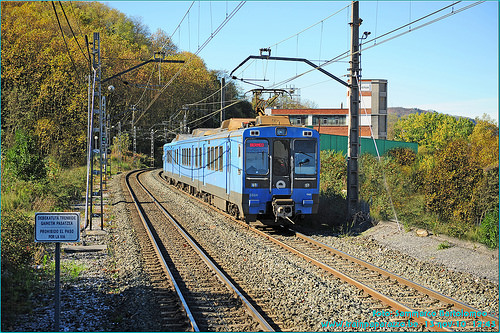
Train on the Atxuri (Bilbao)-Bermeo line. Note the warning sign to bottom left of image, in Euskera first and Castillian second. (Photo sourced on Internet).
A young couple with two little boys come on to the only platform (for both directions) and I think I hear the woman speaking to the boys in Euskara. But soon, I make out some Castillian (Spanish) words; however it is not unusual to hear some Castillian words and even phrases scattered through Euskara conversation, in the southern Basque Country, at any rate. But no, I can tell now that the conversation between mother and child is definitely all in Castillian – I must have been mistaken earlier, when I thought they were speaking in Euskara.
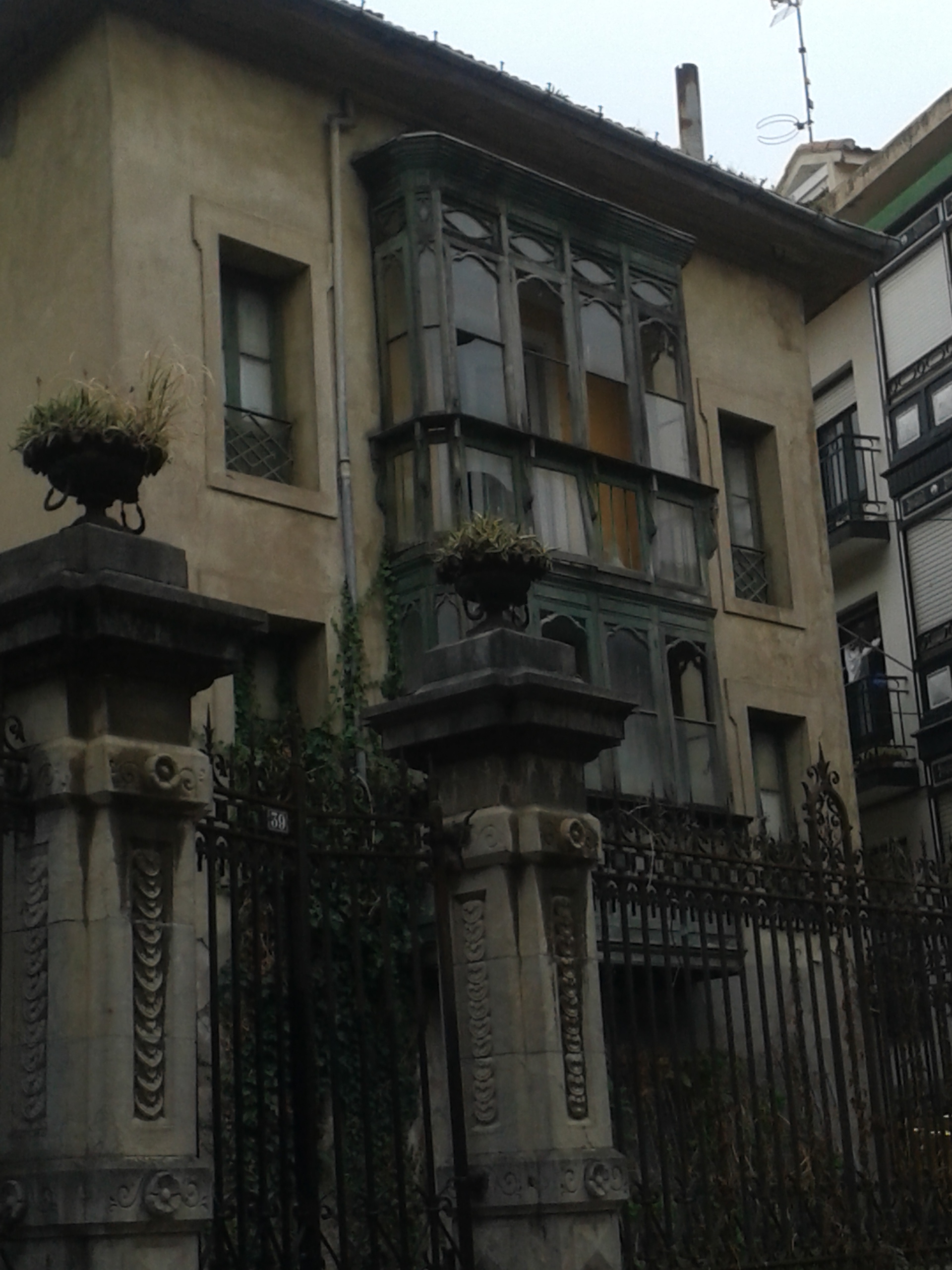
A view from a Mundaka building a number of stories up. The port is out of sight to the left, the station behind. (Photo: D.Breatnach)“Casa de Los Ingleses”, a beautiful if rather gothic-looking old house, residence of an English family with business interests locally many years ago. I passed it on the short walk from the town to the station. Behind it there were plots being worked for vegetables, all due to disappear beneath a new car park construction. (Photo: D.Breatnach)The residence of the servants of the Casa de Los Ingleses, a lovely building in its own right. Its demolition is planned to make way for a new construction (see design in next photo) — my guide encouraged me to write a letter of protest to the municipality. (Photo: D.Breatnach)The construction planned to replace the “servants’ house” after the latter has been demolished. (Photo: D.Breatnach)
“Miao, miao” says the smallest boy, pointing at some feral cats dozing near the platform. “Bai, katua” replies the mother and a flood of Euskara follows, both boys and mother and occasionally father too conversing in Euskara. And so they continue until the southbound train arrives and everyone gets on, except one man, presumably waiting for a northbound train to Bermeo.
On our journey southwards, soon passing alongside salt marshlands, I note that the names of the stations are in Euskara only: Itsasbegi-Busturia, Axpe-Busturia (in the broad estuary of the Urdebai river), San Kristobal Busturia, Forua, Instituto Gernika, Gernika….
The Wikitravel entry for Gernika translates it to the Castillian “Guernica” and opens with this: “Basque town which was the site of the first airborne bombing attack on a civilian town during the Spanish civil war. The bombing, by the Condor Legion of Germany’s Luftwaffe in 1937, inspired Picasso to paint the landmark cubist work Guernica, now on display at the Centro de Arte Reina Sofia in Madrid.”
Well, yes, but one might add for clarity that it was done as part of Franco’s fascist offensive and that the fascist press later blamed it on Asturian Anarchist “fire-bombers”. And one might update it by commenting that the Basques have asked for Picasso’s painting to be located in Gernika itself, a request which the Spanish state authorities, the political descendants of the fascist victors of that war, have refused.
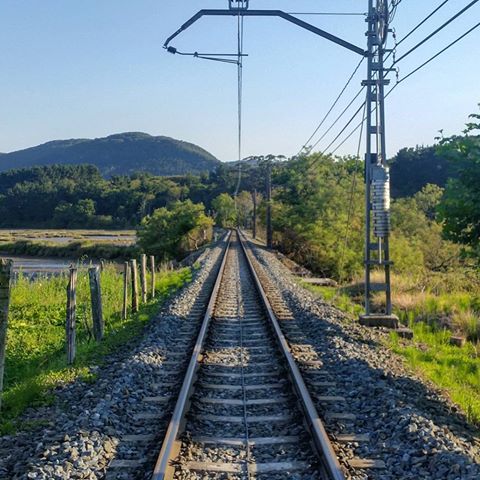
Train tracks from Axpe Busturia, the estuary to the left and salt marshes on both sides. (Source: Internet).
Onwards again, the next stop is Lurgorri-Gernika. At the next after that, Zugast station, a middle-aged man gets on with Berria, the all-Euskara newspaper, under his arm. This periodical, being in many ways the replacement of another newspaper, Egunkaria, has a noteworthy connection with history.
Founded in 1990, Egunkaria was the first all-Euskera daily newspaper in the world; it had a left-nationalist editorial line and a journalistic outlook, which led it to report ETA statements alongside those from Spanish unionist political parties and from the State. The Basque language was no longer illegal or banned since the transición, post-General Franco, when the fascist Spanish oligarchy brought the leaderships of the social democratic party and the Communist Party on board, along with their respective trade union leaders — and called it “Democracy”.
But on 20th February 2003, the Spanish State’s militarised police, the Guardia Civil, raided the newspaper’s premises, seized records, machines and closed down the periodical. They also raided the homes or arrested at the building a total of ten people associated with the newspaper, at least four of which were tortured subsequently. For one of those, the manager, a gay man, the torture included sexual violation.
Massive protest demonstrations ensued from an outraged Basque population. The arrested were released on bail.
On 15 April 2010, seven years later, the defendants were finally acquitted on all charges relating to ‘terrorist’ connections and the judges added that there had been no justification for the closure of the newspaper in the first place.
By then, Egunkaria was beyond recovery and anyway Berria had stepped in to occupy the niche (apparently with the blessing of the Egunkaria team). The case against the State for compensation for the loss of the newspaper and also for torture remains open, sixteen years later. The Court of Human Rights at Strasbourg found the Spanish State guilty of not investigating the manager’s complaint of being tortured and ordered compensation paid. It did not, however, as it usually does not, find the State guilty of the torture itself. Of course, torture is difficult to prove, particularly when the State in question keeps political detainees for five days incommunicado, without access even to independent medical practitioners, while its police go about getting their “confessions”
On the train journey now, the next stop has the delightful-sounding name of Muxika. This causes some amusement to a teenage boy in a nearby seat, accompanied by an older woman – they have been talking in Castillian only since they got on. I wonder are they aware that in June 2013 José Mujica, President of Uruguay until last year, visited the townland that gave rise to his surname. Mujica was presented with a key to the town by the Mayor, who is of the Abertzale Left party Bildu.
The train pulls out of Muxika, then on to Zugastieta-Muxika station as we continue running southward through thick woodlands, occasional industrial parks and small allotments where an occasional middle-aged man tends to his large tomatoes, the small elongated sweet peppers of the region, courgettes, climbing beans …..
Onwards to Morebieta Geralekua before the line takes a sharp twist north-eastwards to more woodlands, rivers, streams and mountains at Lemoa, Bedia, Usansolo, Zuhatsu Galdakoa. Now the built-up areas of Ariz Basauri followed by the contrast of the picturesque Etxebarri before a southward curve to Bolueta and then eastward, to run along the Nervion river to Atxuri station in Bilbo (Bilbao), journey’s end.
All of the stations along this route were named in the Basque language – not one had a Castillian version showing (although there will be plenty of that in streets and squares in Bilbao). The public announcements on this train, as on their counterparts in the Irish 26 Counties, are bilingual but with this difference – on the Basque train, they are always in Euskara first, Castillian second. Likewise with the signage. One is never under any doubt about which language is being given primacy there, nor indeed here, where the English version comes first and, when in text, is in a more dominant type or more contrasting colour.
The Irish language is being derailed even as, to mix metaphors, it is being given lip service. Further down the tracks, unless some urgent repair work is undertaken, lies the final stop – the cemetery of our national language.
Many people know about the Battle of Mount Street and how 15 men fought a force of Sherwood Forresters 1,600 strong and, with the support of some rifle fire from the coastal railway line (and at very long range, from Jacobs Factory), kept them from crossing the Grand Canal for five hours. But what if the British soldiers had been landed at the Dublin docks instead? In fact, why did the British prefer to land them in Dun Laoghaire, seven miles away?
British Soldiers on roof of the Customs House, almost certainly after the 1916 Rising (source Internet)
THE FIGHTING IN THE NORTHSIDE DOCKLANDS
It has been historian Hugo McGuinness’ contention for some time that it was the resistance that British troops encountered around the docks and at Ballybough at the beginning of the Rising, coupled with a history of the workers’ resistance of the 1913 Lockout, that convinced the British that it would be a very bad idea to attempt to land troops in the Dublin docks. Hence the choice of Dún Laoghaire and bringing them from there into Dublin along the coast road. From there, unless they took a considerably roundabout route, they would pass by either the Volunteers in Bolands’ Mill or their comrades at the Mount Street and Northumberland Road outposts. And so, the Battle of Mount Street Bridge.
At the start of the 1916 Rising on the outskirts of the northside Dublin area of Ballybough, the Volunteers and the Irish Citizen Army mobilised to prevent British troops approaching from the Musketry School in Fairview or from any other units approaching from that direction. For a number of recent years, the East Wall History Group and historian Hugo McGuinness have been working to acquaint people with the history of the 1916 resistance in this area. See map of Annesley Bridge area today here: https://www.google.ie/maps/place/Annesley+Bridge,+Dublin/@53.3609037,-6.2409037,17z/data=!3m1!4b1!4m2!3m1!1s0x48670e5ee8f4dad1:0x9d9ebc34b28e0aa4
In 2014, the “1916 Rising: Battle at Annesley Bridge” walking tour organised by the East Wall History Group was a huge success. Led by Hugo McGuinness as guide, it was estimated that almost 200 people took part.
As the East Wall History Group commented in an introduction to eight videos they have put up from the walking tour ( http://eastwallforall.ie/?p=2376 ):
‘The events at Annesley Bridge in 1916 generally receive only a small mention in the history of the Rising. In fact, there was fierce fighting at the time, not only at the bridge but throughout the surrounding areas. There were a great number of casualties, including civilians, though an exact figure has been difficult to compile. Our walking tour, for the first time, attempted to tell the whole story – from the radicalisation of the local residents in the years previous, to the events on Easter Week 1916 and how sporadic sniper battles continued after the Rising had ‘officially’ ended.‘
That there was a military engagement at Annesley Bridge was known but it has been generally thought of as a minor skirmish. Hugo McGuinness’s original research along with compilation and examination of references has uncovered a much more important story, one containing a number of armed engagements – and with far-reaching consequences.
THE RECENT PRESENTATION
On 28th April, a full hall in the Gibson Hotel of mostly North Wall residents received a presentation from historian Hugo McGuinness on “The 1916 Rising: The Fight in the Docklands”, a talk organised by the East Wall History Group. Using an electronic slideshow of photos and maps to illustrate his talk, Hugo took the audience through an amazing story of Irish resistance courage, tragedy, comedy, bungling and initiative, with lots of little vignettes.
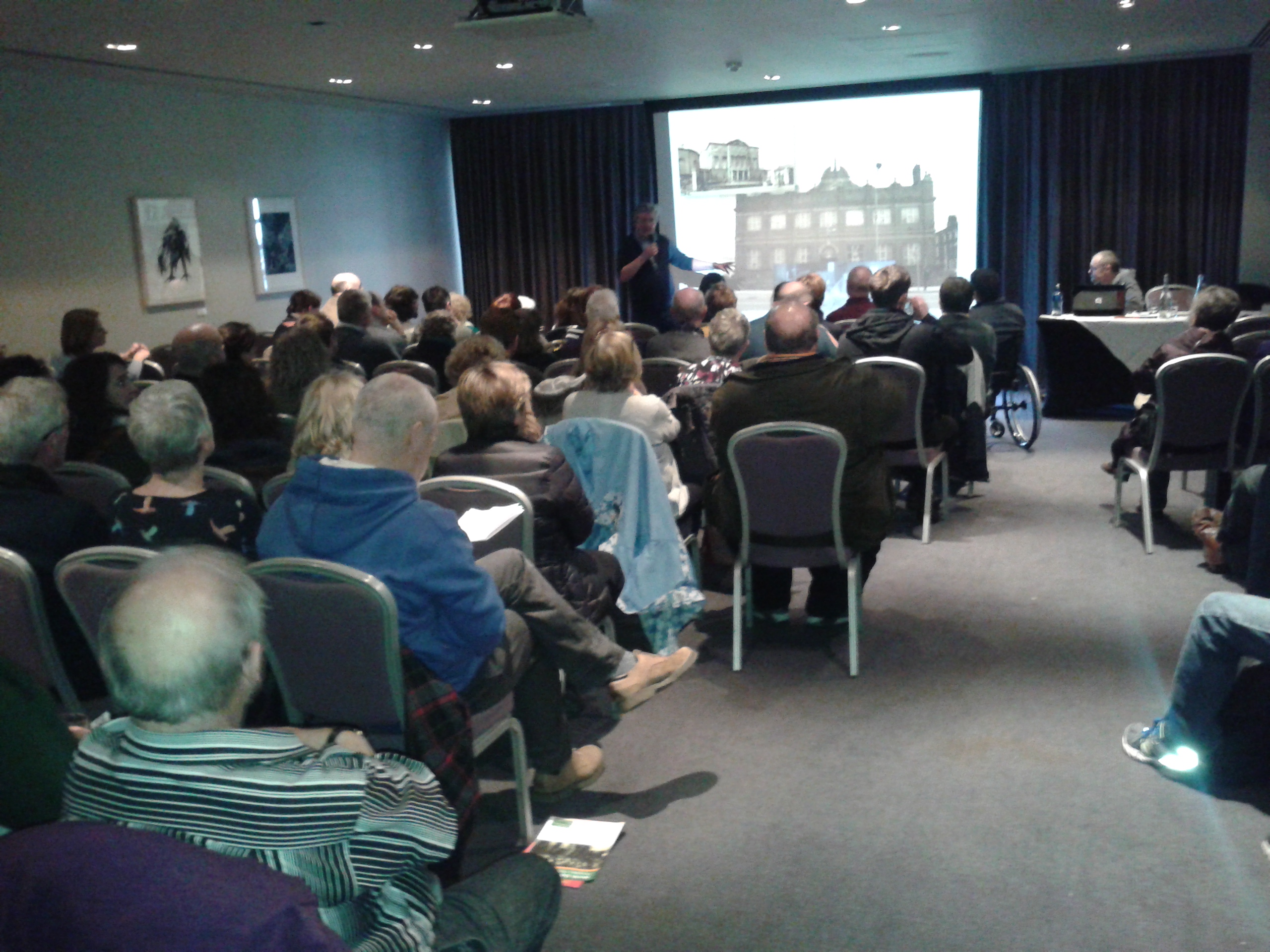
Front view of most of the audience at the talk (source D.Breatnach)
Of particular impressiveness was the group of Volunteers who ran down a street to engage a detachment of British soldiers from the Musketry School at Dollymount who were heading down East Wall Road towards the docks. The detachment of British soldiers had slipped out of an engagement with a blocking force facing Annesley Bridge. A small group of Volunteers ran down North Dock Road to cut them off and engaged them, stopping their progress. Then there was the Volunteer who put a British machine gun out of action with one shot when he hit the water-cooling mechanism.
Hugo McGuinness speaking beside screen (Photo: D.Breatnach)
(source Internet)
Hugo’s audience were told of the Irish sniper in the docks whom the British nicknamed the ‘trade unionist’ – he took up position around 8am and always finished at 5pm. There was the floating gun platform in the Liffey, not just the Helga. There were no feeding arrangements made for the soldiers sent into Dublin so they looted homes and warehouses.
Many local people were interned in a large goods shed. Many houses were strafed by machine guns and a number of civilians shot dead – one man later put an empty picture frame on the wall in his hall to surround a pattern of bullet-holes there. A member of the Dublin Metropolitan Police was killed by British troops and his colleague pallbearers were held up for hours at a checkpoint manned by the Dublin Fusiliers – some residual hostility from the Lockout perhaps? Martial law here meant that if you were seen in the area, you were warned and, if seen again, you were shot! If you did not respond to a military challenge you would also be shot. Nevertheless, children hung around the troops and gathered intelligence for the insurgents – but one was killed too.
Just before concluding, Hugo mentioned the research of another historian (whose name I did not catch), showing a rise later in 1916 and in subsequent years of names give to children following some of the better-known participants in the Rising and also a rise in personal names in Irish.
(source D.Breatnach)
As is often the case with those who are passionate about their subject, Hugo’s presentation was a little overlong, in my opinion and he had to rush the end. The projector threw the bottom part of the image frames, which often contained a separate photo or map, too low, so that one had to stand to see them over the heads of those in front. Those are the only two faults I felt in what was an engaging and engaged presentation of well-researched material about a fascinating but understated part of the history of the 1916 Rising, with a working class and lower middle class flavouring sprinkled throughout.
After the talk, a number of the audience joined the organisers in the bar of the Gibson Hotel where history continued to be discussed. In the foyer to the bar/restaurant, a small exhibition of panels entitled “Casualties and Prisoners” had been set up.
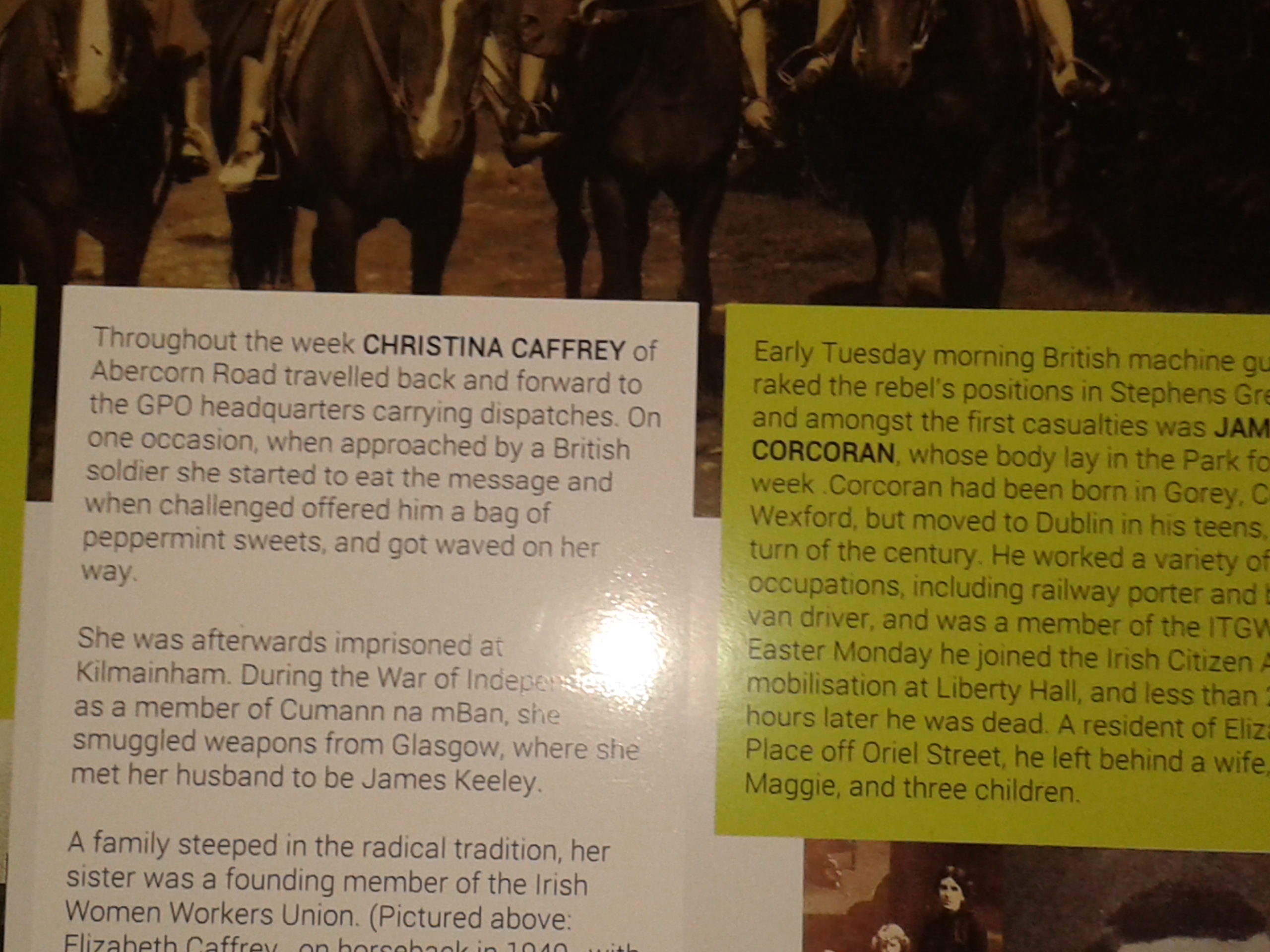
Part of the “Casualties and Prisoners” panel exhibition in the Gibson Hotel (source D.Breatnach)
(source D.Breatnach)
(source D.Breatnach)
Inside the bar, the surroundings were plush and out of synch with the area. Although the bar was only moderately busy, the service was very slow; later we were harassed to leave as the bar was closing, although we had been served pints only ten minutes earlier. There was no arguing from the group but a number remarked that they would not be drinking there again.
The refreshments element apart, for which no responsibility lies with the group, this was another very successful event among a number organised by the East Wall History Group. Rumour has it Hugo may have a book coming out soon – I can hardly wait.
The gallows being erected at the O’Connell Street approach to North Earl Street (Photo D.Breatnach)
(extract)………. As part of the Dublin State 1916 Commemoration a gallows has been erected at the approach to North Earl Street. It is understood that there will be ceremonial executions here over the weekend. Those listed to ‘take the drop’ over Easter (not at all to be confused with ‘taking A drop’) are believed to be a Water Charge Protester, a Minister Botherer, a Homeless Person and A Nother. Gardaí have refused to confirm the names prior to informing their families, “Out of humane considerations” said Garda Commissioner Battenum.
The gallows, constructed by Pierrepoint Solutions of London, can accommodate eight condemned people at once, according to the manufacturers, “with a little squeeze.” A number of Moore Street Blockaders had been in line to partake of the hanging also but a recent judicial decision has resulted in their surprise acquittal. Asked about the unexpected turn of events, Minister Humphreys said “chucky poor law” which is understood to be a Monghan Orange dialect variation of the Gaelic or Erse for “Our day will come”.
Rumours abound that Hillary Clinton and President Obama and other White House personnel are to have live footage of the executions beamed to them, in recognition of their interest in such events.
Other high points of the 1916 commemoration will be a reading out of the 1916 editorials of the Irish Times and Independent condemning the Rising and calling for stern punishment for the Rebels and, in the case of the Independent, calling not too subtly for the death penalty for Connolly and Mac Diarmada. Sir Bob Geldoff will read the Times editorial and Diarmaid Ferriter the Independent’s.
The full list of all British personnel killed during the Rising will also be read out and in a special addition which is sure to find favour with everyone, also the names of the Lancers’ horses, previously neglected and unrecognised but campaigned for by historian Ann Matthews for many years now, who makes the point that although they were military, they were working horses. Kevin Myers will read out the British Personnel’s names and Frank McDonald will perform the duty for the horses.
After ‘The Last Post’ has been played by an Irish Army bugler, the ceremony will conclude with the solemn “Je vous prie”, with all dignitaries present going down on one knee and, partly in Irish but wholly in English, begging Her Royal Majesty’s pardon for having risen against her predecessor and any and every vexation given since. Going down on both knees had been originally scheduled but was since ruled out as being too servile (and in view also of certain words on the nearby monument to Jim Larkin).
The ceremony will be televised in full and, in an exercise of civic involvement, people throughout the country will be encouraged to kneel at the same time and to repeat the words as they are pronounced.
Substantial security steps have been taken to prevent undesirable elements such as citizens attending the events.
Some of the physical security measures — view north along O’Connell St. from the Spire (Photo D.Breatnach)
In separate but related developments, Dublin City Council Executive Own Keegan and Jim Keoghan of the Planning Department have announced
Some of the physical security measures — view southwards along O’Connell St. from the Spire (Photo D.Breatnach)
plans for the changing of the North King Street name to “South Staffordshire Street” and the erection of a 1916 commemorative plaque with the words “Nothing happened here in 1916”.
Similarly, in Balbriggan the Development Association has unveiled plans to rename the main street “Auxiliary Boulevarde” in memory of the illuminations carried out by members of the Auxiliary Division on the night of 20th/ 21st September 1920. A street party will be held to mark the renaming with children’s face-painting (black or red, white and blue colours only, apparently) and dressing up in Auxilliary or RIC-type costumes for photos, ‘Knock-the-Volunteer Over’ ball-throwing etc. The candy floss and rock stick on sale will be in red, white and blue colours. All the cooked food will be char-grilled to commemorate the historic events in 1920.
I hope this finds you well — although how you could be, with the mob besetting you on all sides, is anyone’s guess. As if you wouldn’t have enough problems already with the economy! Who’d be a politician these days and especially in the year that’s in it? Well, yes, I do know that you get paid for your trouble. But what does the mob expect for their paltry €157,540 per annum? Sure one could never run a decent-sized house with servants and cars and kids going to university on that kind of money (not to mention the holidays you’d need, just to take a break from the mob).
Heather Humphreys, Minister for Arts, Heritage and the Gaeltacht
The truth is, Heather, that the mob have had it in for you from the beginning – they never gave you a chance. First it was that you are not an Irish-speaker. Well! Who needs to be able to speak that dead language anyway (well, nearly dead, and the sooner the better)! Well, yes, ok, the Irish-speaking areas are part of your special responsibility, it’s called “the Department of Arts, Heritage and Gaeltacht”, it is true, but everyone knows that the “Gaeltacht” just got added on to your Department’s responsibilities because it had to be put somewhere.
However, I do think it was unwise of you, if you don’t me saying this to you as a friend, to put that McHugh in the Gaeltacht job as Minister of State. I know he’s doing his best but darling it’s simply excruciating to listen to him stumbling over his koopla fukal (no, I’m not being rude) in public speeches. Surely there must a Blueshirt somewhere who can speak decent Irish?
Thankfully, with the Arts budget cut so thoroughly by this Government and the previous one, you didn’t have too much to worry about there. But Heritage? Oh dear! You’d think for that, one would just have to stick some cement on crumbling castles and pay some staff to look after some cromlechs or something, wouldn’t you? Or pay for the upkeep of some of those lovely Georgian or Victorian big houses (like the one you sorted out for Enda in his Mayo constituency – no, no, I don’t blame you one bit. Always look out for the boss, I say, if you want him to look after you.)
But a row of dilapidated houses in the city centre next to an untidy and smelly street market! Heritage! God give me strength – and you too, Heather, poor darling. That mob, Heather – fifteen years, going on for sixteen, they’ve been banging away about that. What a pity that Joe O’Reilly (bit of a boor really, but still ….) fell on hard times and couldn’t proceed with the demolition of that whole sorry terrace years ago and save you all this heartache!
Nothing is enough for that mob, nothing! Give them an inch and they’ll be screaming for a mile. First it was a clamour for Joe O’Reilly to put back the State’s 1916 50th anniversary plaque that had fallen off the front of No.16 Moore Street and ended up in his Chartered Land office. Honestly, the hullabaloo! Then it was one house the mob wanted made a monument, then it was four. Then the whole terrace — they’ll want the whole country next!
And just when you were going to have some of the houses demolished, that mob, the worst of them, occupied the buildings and stopped the demolition. What are we coming to? If it were me, Heather, I’ll tell you now, I’d have sent our own SWAT team in right away. You have to be tough with that kind of element, Heather, like your party was back in 1922 and ’23 — and sometimes you’re too soft. Yes, you know you are. Oh, sure, some liberals and Republicans would have kicked up a fuss but those vandals in occupation would have been dead or in jail and the terrace a demolished pile within hours. Let them try and get up a campaign over a pile of rubble!
I wonder whether it was wise to call yourself “a proud Irish republican”, when you were appointed, Heather. You had the job, after all, so why say things like that? It’s not as though your FG colleagues would be expecting it of you and it was, as they say, giving a hostage to fortune. Was it perhaps because you felt a bit insecure, as the only Presbyterian in the Government? Oh, Heather – you should know by now that there’s only one religion in Government, and it’s above even Christianity, never mind its various sects.
I despise the mob as much as you do, Heather but I think you could have thrown them a couple of bones a bit earlier. Buying the four houses from O’Reilly (a million each? Not bad, not bad at all for inner-city run down properties!) at the end of 2015 was obviously going to be too little, too late, with Easter 2016 just around the corner. That might have worked a few years ago but not now. You’d have been better off hanging tough, as our masters across the pond say, and giving them nothing except the back of your hand. Now they’ve got the bit between their teeth, collecting thousands of signatures, marching, picketing, blockading …. and even talking about what kind of a Republic they should have.
Heaven forbid they should ever get the Republic they want for if they do, I’ll be transferring whatever assets I can liquidate and getting out of the country as fast as I can.
But I digress …. What about the elections? Nobody expects the Government to survive, so no point worrying about that. Who will take their place? Well, remember when your party and Labour ousted Fianna Fáil? Election promises aside, it was business as usual afterwards, wasn’t it? It’ll probably be the same this time. Well, let’s hope so, anyway.
And your own Dáil seat? Is it safe? I do worry about that. We must have lunch soon and have a good gossip. The Radisson perhaps? Or better still a trip to Blarney, my treat? Anyway, one wouldn’t want to be around Dublin, of all places, at Easter …. with the year that’s in it.
The struggle for the preservation of Moore Street that is currently in the news (but has been going on for fifteen years) is one not only for nationalists and Republicans, but for socialists too. And for socialists of revolutionary ideology as well as for radical social democrats. But currently these sectors, apart from individuals independent of political party (and one or two belonging to parties), are keeping away from the issue. In this they are seriously mistaken and are doing the working class in Ireland and indeed internationally a disservice.
Aerial view of Moore Street in the days when the speculators and supermarkets had only just begun to reduce it (Photo from Internet)
BACKGROUND TO MOORE STREET STRUGGLE
For those who may not be aware of the historical background, roughly 300 men and women of the GPO garrison in 1916, having to evacuate the burning building, made their way to Moore Street and occupied the terrace from the junction with Henry Place to what is now O’Rahilly Parade, entering at No.10 and tunneling through up to No.25 at the end of the terrace. On the following day, the decision was taken to surrender. Despite its historical status, nothing was done by the State to protect the ‘1916 Terrace’ for decades, although a small commemorative plaque was put on No.16 in 1966, when a number of such plaques were erected at sites throughout the city.
Fifteen years ago a campaign was started, by the National Graves Association and mostly by descendants of people who participated in the 1916 Rising, to have an appropriate historical monument on the site. In 2007 the State named buildings No.14-17 as a ‘National Monument’ but would take no steps regarding the other twelve buildings in the Terrace. By that time the four buildings belonged to a property speculator who allowed them to deteriorate but compliance with maintenance and upkeep obligations to a national monument were not enforced by the State. Also, shortly afterwards, the speculator put in a planning application for a huge shopping centre entailing the demolition of 12 houses of the Terrace and the State approved it.
Paul O’Toole, who played a number of sets at an “Arms Around Moore Street event in June 2015, including singing some songs of his own composition. The event was organised by Save Moore Street From Demolition group.
Other threats emerged later, such as planning applications to extend the ILAC centre further into Moore Street and to build a tall budget hotel at the Moore Lane/ O’Rahilly Parade intersection; these were approved by Dublin City Council’s Planning Department although the majority of the Councillors have voted to preserve the 1916 Terrace and indeed the Historical Quarter.
Donna Cooney, great grandniece of Elizabeth O’Farrell, speaking on behalf of the 1916 Relatives’ Association, at an “Arms Around Moore Street, event in June 2015. To her left is Mel Mac Giobúin, one of the principal organisers of the SMSFD group.
At the end of 2015 the State bought the four houses of the ‘national monument’ from the speculator, paying him €1 million each for them and proposed to knock down houses either side of it. As soon as the intention to proceed with imminent demolitions became clear, emergency demonstrations were called in the street by a newer group, Save Moore Street From Demolition (founded in September 2014). A five-day occupation of the buildings ensued, ending only on foot of an order of the Court that no demolition take place while a High Court challenge to the Dept. of Heritage was awaited.
Section of the January march to save Moore Street, organised by the Save Moore Street 2016 umbrella group. In photo foreground, two of the principal organisers of the SMSFD group, (L-R) Mel Mac Giobúin and Diarmuid Breatnach. (Also in shot, Dave Swift, supporter of the campaign, in Irish Citizen Army uniform). (Photo source: Donal Higgins)
A number of protest actions have taken place since then including a street concert and a march from Liberty Hall to Moore Street ending in a rally at the GPO. The struggle continues at the time of writing with further events planned and the SMSFD group have joined with others, including people who occupied the buildings, to form the ‘Save Moore Street 2016’ group. It is a broad group containing activists from a number of Republican organisations and independents of community action, socialist and Republican background.
In a separate development, a High Court challenge against the process undertaken by the State to buy the properties and demolish others on either side opened on February 9th and has been adjourned a number of times since, apparently due to the State not having got its papers together.
NATIONAL HISTORY
Socialists may argue that the cause lying behind the struggle is one of preservation of Republican or even nationalist history. I would argue that is only partly true – but what if it were so? Who actually makes history? It is the masses of people that make history, even if individuals among all classes at certain times are thrust – or throw themselves – upon the stage. In that sense, ALL history of progressive social history belongs to the working class.
Furthermore, the underlying historical reason for which many are seeking to preserve the 1916 Terrace and, indeed, the Moore Street historical quarter, is because it related to a struggle against colonialism, against an immense colonial empire. Are socialists to say that they take no interest in anti-colonial struggles and their history? Or is it that they do, so long as they be in some other part of the world? And if the latter be their position, what possible political justification could they offer for it?
STREET MARKET – SOCIAL HISTORY
In the development of this city, Dublin, street traders have played a part – as indeed they have in the development of probably every city in the world. Working people and small-time entrepreneurs, working hard from dawn to dusk in all weathers to feed themselves and their families, a link between town and country or between coast and inner city. They brought fresh food to the city dwellers of all classes and brought colour to what was often a drab environment, colour to the eye and to the ear also.
Moore Street is the last remaining street of a traditional street market centuries old, the rest of which now lies buried under the ILAC centre and which even now threatens to extend further into Moore Street, squeezing the market street still further. This street market and its history as well as being physically threatened by the proposed extension of the ILAC, squeezed commercially by Dunne’s and Lidl, is threatened also by a planned budget hotel building of many floors and of course the giant shopping centre plan of Chartered Land/ Hammerson. Have the socialist groups nothing to say about this or, if they are against this monopoly capitalist assault, why do they distain to take their place in the ranks of the resistance?
AGAINST WORLD WAR
Some of the Volunteers undoubtedly planned the Rising to take place during the first imperialist World War purely on the basis of the maxim that ‘England’s difficulty is Ireland’s opportunity’. But others, including the revolutionary socialist leader James Connolly, also clearly wanted a rising against the slaughter of workers in a war between imperialists. Connolly wrote a number of articles denouncing this slaughter which socialists of his time had pledged themselves to fight but which few had actually done, when it came to the crunch. However, that position remains the correct one for the working class: in a situation where your masters wish to send you out to fight your class brothers abroad, turn your guns on your masters instead. The 1916 Rising stands as an example of this, the first of the 20th Century and world history would have to wait until the following year for another example in Europe.
WORKERS’ HISTORY
All the Irish socialist groups, as far as I’m aware, right across the spectrum from Anarchist to Communist, hold the memory of James Connolly and of the Irish Citizen Army in high esteem. And so do the radical social democrats.
James Connolly led the Irish Citizen Army into alliance with the Irish Volunteers, Cumann na mBan and na Fianna. The ICA, a trade union-based militia, had been formed to defend demonstrating and picketing workers against the attacks of the Dublin Metropolitan Police in 1913. When the ICA went out in the 1916 Rising, Ireland was the first country in the world that century for a workers’ armed unit to fight in its own uniforms and under its own leaders.
Irish Citizen Army on parade at the Irish Transport & General Workers’ Union building and grounds in Fairview, Dublin. (Photo source: Internet)
The ICA were allocated the Stephens Green and Dublin Castle areas but also had members in the GPO garrison. So when the GPO garrison retreated from the burning building, ICA members were part of that retreat. At least one died on that journey, struck down in Henry Place by British Army bullets at the intersection with what is now Moore Lane.
When the GPO garrison took possession of the 16 houses of the Terrace in Moore Street, tunneling from house to house, the ICA were part of that. And when the decision to surrender was taken, the ICA laid down their arms with the rest.
The 1916 Rising and the occupation of the Moore Street terrace and backyards is part of the ICA’s history and is therefore part of the history of the Irish working class and, indeed, of the international working class. If the socialist groups don’t wish to celebrate that episode in the history of the class, why? If, on the other hand, they do celebrate it, why then do they not join the struggle to have the place of their last stand preserved from demolition and to have the ICA’s place in history marked by a fitting monument?
The lack of engagement of most of the revolutionary and radical left with the Moore Street struggle has also meant no noticeable pressure within the trade unions, where the left have some influence, to even declare verbally for the preservation of the 1916 Terrace. To date, only one section of one trade union, the Construction Section of SIPTU, has declared in favour of saving the Terrace.
WOMEN
The struggle for gender equality is an important part of the struggle for the emancipation of the working class, i.e. for socialism: women represent slightly over one-half of the human race and this is true also for the working class. In addition, the oppression of one part of the class serves as a wedge into the solidarity of the class as a whole.
In 1916 women served as auxiliaries in Cumann na mBan and as equals in the Irish Citizen Army. That year was the first in the World in which women participated in an insurrection in a unit of their own, wearing a uniform of their own and under their own female officers, as was the case with Cumann na mBan. It was also the first time in the 20th Century in which women had formal equality with men in an armed workers’ organisation, as they did in the Irish Citizen Army.
Constance Markievicz, ICA officer, fighting in the Stephen’s Green area. She poses here with a gun prior to the Rising to underline her position that women can and should take part in armed revolutionary struggle, on a par with the men. (Photo source: Internet)
The Proclamation was the first insurrectionary call to arms to address itself specifically to women alongside men (“Irish men and Irish women …”, it begins) and had been signed in secret a little earlier by the seven male signatories (or by most of them) in the alternative cafe and agricultural product cooperative run by Jenny Wyse Power at No.21 Henry Street.
Women of Cumann na mBan and ICA who participated in the 1916 Rising in a group photo a year later (photo sourced Internet)
CAPITALISM & THE STATE
The campaign for the saving and appropriate renovation of the 1916 Terrace first of all confronted the capitalist property speculator Joe Reilly and his Chartered Land company, while it lobbied the State to take over the Terrace.
When in 2007 the State declared four houses in the Terrace to be a ‘national monument’, the campaign continued confronting the speculator but now calling, without success, on the State to oblige Mr. O’Reilly to comply with his maintenance obligations to a national monument. When the State granted, with some changes, planning permission for the speculator’s giant shopping centre, the campaign moved into confrontation with the State, a confrontation which intensified after the State purchased the four buildings and prepared to demolish the buildings on either side.
The whole saga was an object demonstration of the function of the State in facilitating capitalist property speculation and furthermore, of the neo-colonial nature of a capitalist class unable to consider saving such a national historical treasure even with the support of the vast majority of the population.
In such a struggle, with people with democratic objectives on one side and, on the other, rapacious property speculators and a capitalist State facilitating those speculators, where does the duty of socialists lie? It is clear on which side they should stand if they should stand on the issue at all. And they should take a stand on it – how can the development of that struggle do anything but strengthen the democratic movement in general, including the movement for socialism, and harm its opponents, the State and capitalism in Ireland? And surely in the course of that struggle, with socialists side by side with Republicans, alliances would be formed which could be built upon for more ambitious projects later?
Monument in Dublin to James Connolly, revolutionary sociailist writer, historian, theorist, union organiser, publisher — his last location of freedom was the Moore Street 1916 Terrace, before he was shot by British firing squad (Photo source: Internet)
IN CONCLUSION:
For all the reasons given above, its social history, its anti-colonial history, the history of the common people as well as that of intellectuals, the history of the working class to assert its independence and dominance of the movement for liberation, the history of women’s struggles, and the current struggle of people against property speculator capital and State, the place of socialists, revolutionary and radical, is right there with the Moore Street 1916 Terrace campaigners. But where are they?
With the exception of a few honourable exceptions, they are notable by their absence. Yet, they will wonder at times why the mass of people do not follow them; why, for the most part, they regard them and their organisations as an irrelevance.
In the last days of the 1916 Easter Rising, with the GPO in flames, the garrison had to evacuate and did so through Henry Place. When they came to Moore Street, it was being raked by machine-gun fire from a British Army barricade at the junction with Parnell Street. Consequently, the garrison entered the first house in the terrace to the their right, No.10 and tunneled from house to house until they reached the end of the terrace, No.25.
A struggle is taking place currently to have the whole terrace saved and declared a national monument, a battlefield site in the context of the Historic Quarter. In 2007, the State made only four houses a national monument, No.s 14 to 17 and at the very end of 2015, bought the four run-down houses from their speculator owner at a million Euro each. The Government plans to make them into a commemorative centre, in the course of which they wish to demolish buildings 13, 18 and 19. Speculators have planning permission for a giant shopping mall from O’Connell Street to Moore Street and from Parnell Street to Henry street, which envisages the demolition of the entire terrace except for No.s 14-17.
In reply to campaigners, Minister for Arts, Heritage & Gaeltacht, Heather Humphreys, has stated that some of the buildings are of post-1916 construction and therefore are of no historic value. In opinion pieces in the Irish Times, one week after the other, Frank McDonald and Diarmaid Ferriter wrote articles supporting the Government.
JUST FOUR HOUSES — a sketch for three actors
AT HENRY LANE/ MOORE STREET INTERSECTION
(Sounds of shells crashing, flames roaring, combustibles exploding, rifle fire, the chatter of machine-guns)
Irish Volunteer A: “Bloody hell, it was hot in the GPO!”
Irish Citizen Army Volunteer: “Hot as Hell. We were lucky to get out alive, with ammunition about to blow.”
Volunteer A: “We can’t stay here in this laneway in the open, though.”
ICA Volunteer: “No, let’s get under cover quick! Into that terrace there … Moore Street this is, right? Sixteen houses ….
Volunteer B: “No, we have to occupy just four houses in this street.”
Vol. A: “Only four? But there’s nearly 300 of us here!”
Vol. B: “I know. But orders …”
Vol. A: “Damnation! OK, best bash that door down, No. 10.”
Vol. B: “No, not that one.”
Vol. A: “Why not?”
Vol. B: “Only Numbers 14 to 17.”
ICA Vol: “But they’re in the middle of the terrace. We’d get shot to pieces by the British machine gun up at Parnell Street – and we have to carry Connolly’s stretcher so he’d get shot too!”
Vol. B: “Yeah, they’ve already shot up The O’Rahilly’s lads.”
Vol A: “Whose orders are these? Who says we should all pile in just four houses in the middle of the terrace?”
Vol. B: “Somebody called Humphreys …. and a Mac Donald …. and a man called Ferriter. Something about only those four houses being of historic significance.”
ICA man: “What? Bloody rubbish – look, go and ask Connolly what he thinks. He’s the Commandant of this garrison, not that lot, whoever they are.”
(A few minutes later)
Irish Volunteer B: “Well, what did Connolly say?”
Vol A: “His exact words? ‘Don’t be stupid lad – break down the door of No. 10 there and tunnel along the terrace, from house to house, aye, all the way to the end – No. 25, isn’t it?’ ”
ICA man: “That’s more like it – I knew we’d get some sense out of Jim – I mean, the Commandant.”
Vol A: “Thanks be to Jayzus for someone with sense in charge. Who the hell are that other lot and where did they come from, that Humphreys, MacDonald and Ferriter?”
Vol B: “I dunno. Give’s a hand with this door before we get shot out here, gabbing …”
Saturday was the day selected by Pegida for their Irish launch, which they had planned to do at the Dublin GPO at 3pm on Saturday (6th February). Anti-Racist Network Ireland called a demonstration for the same location from 1.30pm but from around noon bands of antifascists were on the street hunting fascists and met them at various locations with painful results for the fascists.
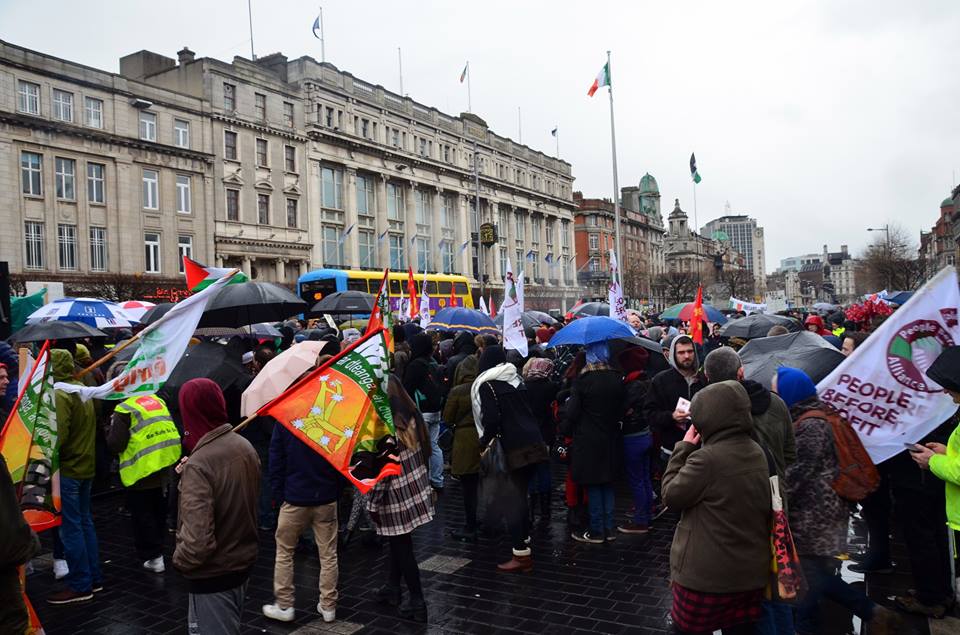
Section of anti-racist rally on central reservation O’Connell Street, looking southward. The GPO building is to the right out of frame. (Photo from ENAR Ireland) FB page).
BACKGROUND
Founded in Dresden, in eastern Germany in October 2014, Pegida (Patriotic Europeans against the Islamisation of the West) is a broad European network of loosely linked groups opposed to what they claim is the “Islamisation of Europe”. Although Dresden remains its stronghold, the organisation has spread to a number of European countries.
In January last year, marches in German cities reportedly attracted up to 25,000 people at their peak, before numbers began to drop severely, rising again however in October as politicians and media stoked fears of a massive influx of migrants and refugees arriving in Europe from war-torn countries (countries, incidentally, where some European powers have played a major role in instigating or directly carrying out those wars).
Pegida claims to be not fascist and ‘solely’ against Muslims as has been the case with so many fascist organisations in the past – they have been ‘only‘ against communism, or against Jews, or against blacks etc. The organisation has been frequently associated with general anti-immigration diatribes and in January last year derogatory descriptions of immigrants by its German leader, Lutz Bachman, in a closed Facebook discussion, were made public. He stepped down from the leadership after those revelations and the circulation of images appearing to show him posing as Adolf Hitler. The following month however he was reinstated with claims that the images were faked.
In Ireland the Blueshirts, popular name for the Army Comrades Association, mobilised and recruited in the 1930s. They were in part a response to the election of the new Fianna Fáil party, a split from Sinn Féin, in a popular national reaction to the hounding of socialists and republicans by the victors of the Civil War, 1922-1923. The Blueshirts presented themselves as Irish nationalists (even Republicans) with their targets being Communists, Jews and the IRA. Meanwhile elsewhere in Europe, fascist groups were organising, variously declaring their targets to be Jews, Communists, Socialists, Anarchists, trade unionists, Roma and Sinti, immigrants, gays and homosexuals and various religious groups.
The Blueshirts were fought on the streets by Republicans, Communists and some social democrats and, when they threatened a coup, their activities were banned by the De Valera government. It seemed that the majority of the Irish capitalist class had decided that Fianna Fáil were a safe pair of hands and would manage the country better and, besides Britain might go to war with some countries where fascists were in power. The Blueshirts lost active members after that and with other right-wing organisations, formed the Fine Gael political party which became the principal mainstream opposition party from then on, occasionally going into Government in coalition with other parties.
Blueshirts marching, 1930s (Photo sourced from Internet)
PRELUDE TO DEMONSTRATIONS AND ANTI-FASCIST ACTION
Saturday was chosen as “a day of action” for the groups that fall under the Pegida banner, with a number of anti-immigration and anti-Islam demonstrations planned to take place across Europe. The Irish far right anti-immigration organisation Identity Ireland supported Pegida on their Facebook discussions and claimed that Saturday would see the launch of the Irish branch of their organisation. According to a report by the Russian news agency RT, Identity Ireland’s leader addressed a Pegida rally in Dresden last month.
The ARN called for a large peaceful demonstration and even encouraged people to bring their children, advertising it as “a family affair”. Some debate between them and antifascists took place on the Internet and in person on what are the effective methods of resistance to fascism to employ. One of the anti-racist event organisers, Bulgarian Mariya Ivancheva, sociologist and anthropologist based at UCD, was reported in The Journal as calling for a “nice rally to celebrate diversity”. “When Pegida are there we are ready to face them but not to confront them,” she went on to say.
Anti-fascists referred to history to verify their case that fascism has always ultimately had to be stopped by physical force and that being the case, application of that approach at an early juncture was most effective and meant less suffering for working people, ethnic minorities and other targeted groups. The response of ARN to these antifascists was that the latter were not welcome on their rally.
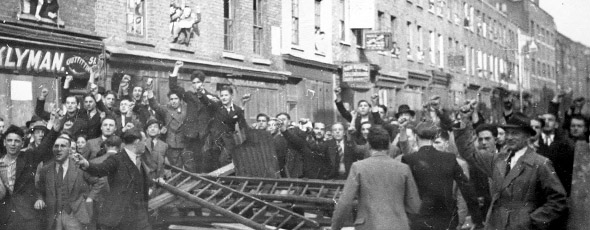
Barricade against a Blackshirt march at Cable Street, East London, 1936. The attack was spearheaded by the police but the antifascists were successful. (Photo from Internet)
Many Republicans and Socialists were also angered by reports that the ARN had applied for police permission to hold their rally. Unlike in Britain or in the Six Counties, this is not required by law in the Irish state and the police are required to facilitate with traffic restrictions the right to march or rally on the streets or pavement. The antifascists’ disapproval was based on what was perceived as giving the police more power than they already had and which they often abuse. One veteran of demonstrations in Britain recalled that permission had once not been required in London either but liberals, social democrats and officials of the Communist Party of Great Britain had made it a practice to ask the police in order to cultivate good relations with them. In time, prior police permission became a requirement which at times was withheld or granted with conditions on times and changes of route.
However, subsequent to the publication of this report, I ascertained that ARN had not asked permission of the police, one of them pointing out that such is not required. The misunderstanding may have arisen from one person stating that he had informed the police that the event would be taking place. This of course is quite some distance from asking permission.
The antifascists, composed of Irish Republicans from virtually all organisations and independents, along with a few socialist and anarchist independent activists, organised their own mobile forces.
ON THE DAY
The anti-racist rally at the GPO was attended by a couple of thousand, from the Spire almost to the Jim Larkin monument and covering the road from the GPO to the central pedestrian reservation. O’Connell Street was closed by the authorities to all northbound traffic and stewards were having difficulty in preventing the rally spilling into the southbound lanes. It was addressed by speakers from People Before Profit, the Anti-Austerity Alliance, Sinn Féin and a number of other speakers, including migrants.
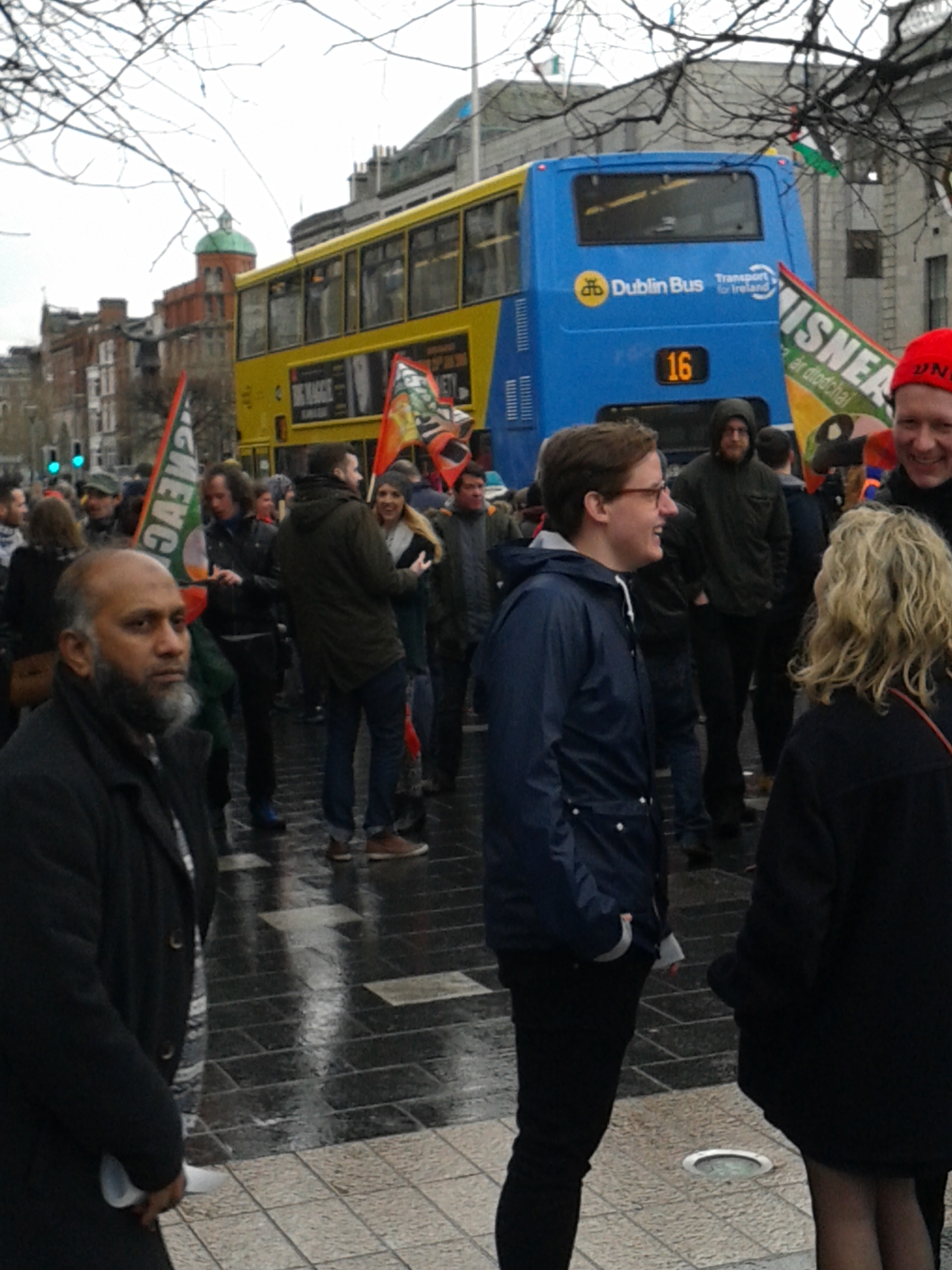
Small section of crowd on east pavement, O’Connell St, with Misneach organisation flags visible (Photo D. Breatnach)
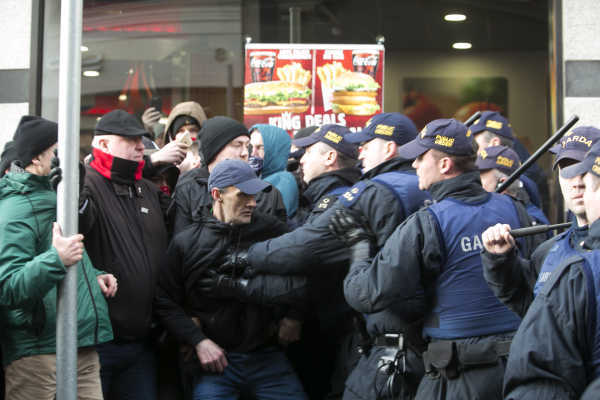
Clashes occurred at the pre-arranged Dublin meeting points of fascists on the Luas line with the handful of Irish fascists being attacked and some, including their leader Peter O’Loughlin and member Ian Noel Peeke being reportedly hospitalised. Clashes broke out again in the city centre at a number of points; one of the latter being at Earl Street North. It seems that some Pegida supporters had gathered at the junction with O’Connell Street and were watching the demonstration opposing them across the road and some were filming it. There were reports of some of them abusing women supporters of the antiracist rally who were near the junction with North Earl Street. The Rabble independent media group reported them shouting anti-communist insults at them (see their video link at end of article). In any case, although generally free of visible insignia and carrying no banners, they began to attract an antifascist crowd, scuffles quickly broke out and the fascists ran down North Earl Street and Talbot Street. A couple of the Pegida supporters ducked into a nearby ‘poundshop’ apparently for safety but they were followed and received a pounding.
Police stormed the shop and evicted the antifascists, lashing out at almost anyone close by, as can be seen in the Irish Times video (see link at end of article). RTÉ has lodged a complaint about one of their camera operators being deliberately struck by a police baton. The riot police with batons drawn then set up cordons with barking German Shepherd dogs behind them and cleared North Earl Street of all pedestrians, allowing no others to enter from either direction.
North Earl St. after incident (facing westward). (Photo D. Breatnach)
This cordon was maintained until a few more Pegida supporters were permitted to escape through Malborough and Talbot Streets. All of the fascists in this area at least were identified by a number of sources as being of East European background, both by their accents and appearance. Some posts on fascist sites later on seemed to confirm this (see AFA Ireland statement link at end). Earlier reports gathered by antifascist intelligence had indicated that Pegida supporters from fascist Polish organisations were planning to support the Pegida launch.
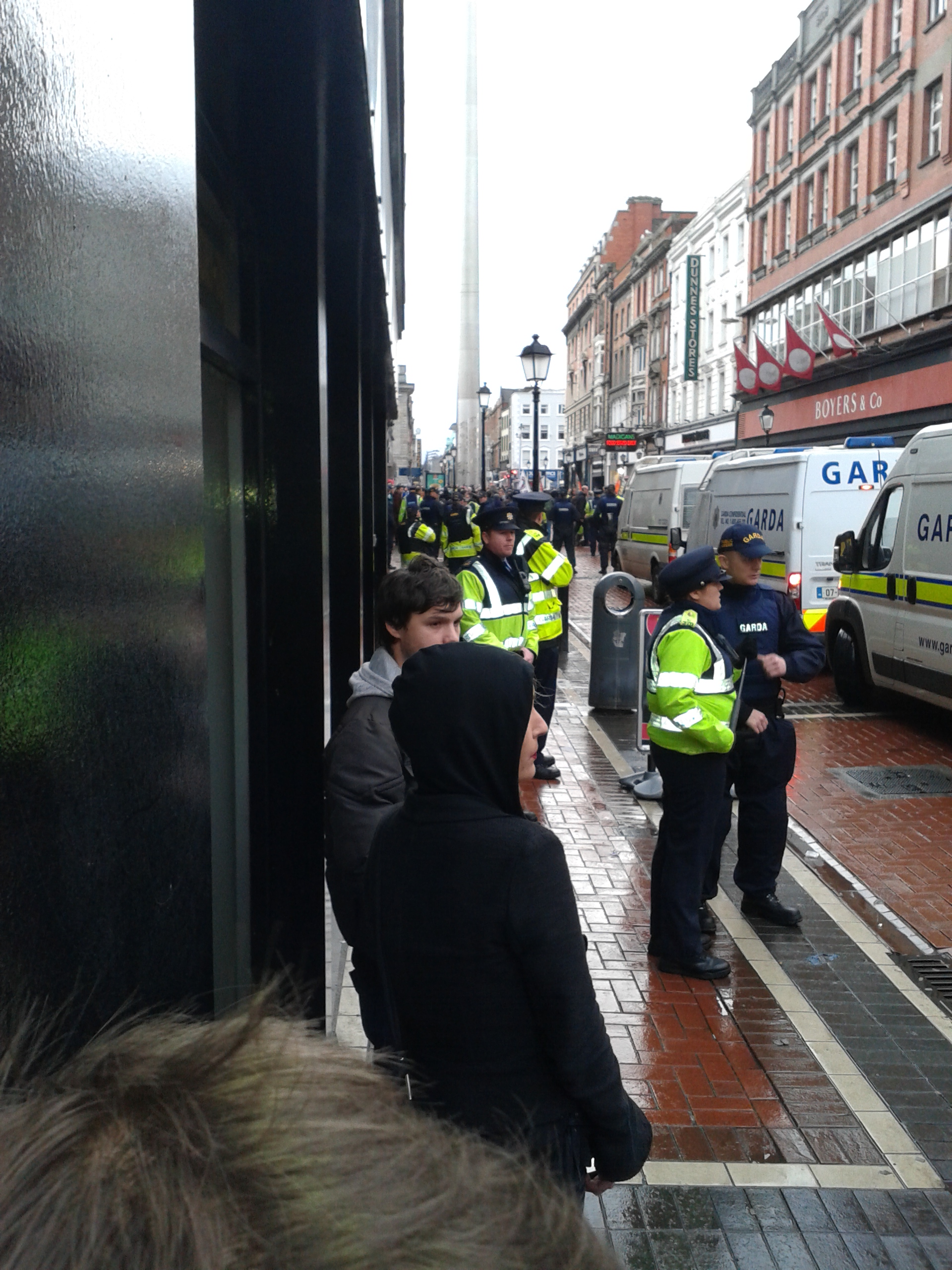
North Earl St. facing westward, Police and their vans (Photo D. Breatnach)
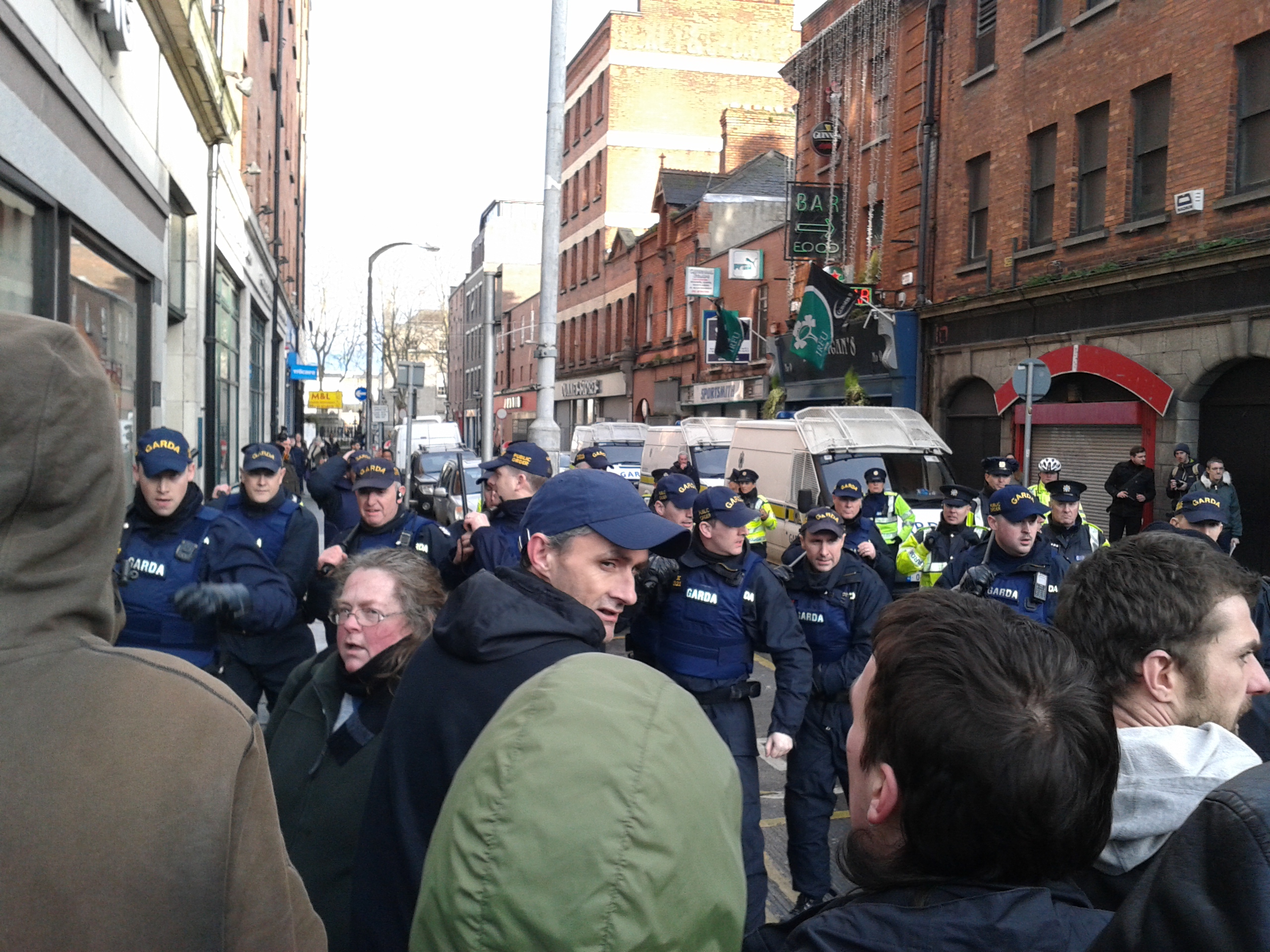
Subsequently, word reached antifascist patrols that 5-7 other Pegida supporters had gathered in a pub in Cathedral Street, again off O’Connell Street and scores of anti-fascists raced to arrive outside the pub almost at the same time as police. Another struggle with police took place outside the pub with riot police using their batons to jab and occasionally lash out, though with a degree more restraint than they had earlier at North Earl Street (perhaps due to an initial complaint from RTÉ having reached their senior officers by then). Police continued to violently push protesters and to jab with truncheons and one demonstrator showed a badly swollen and blue hand.
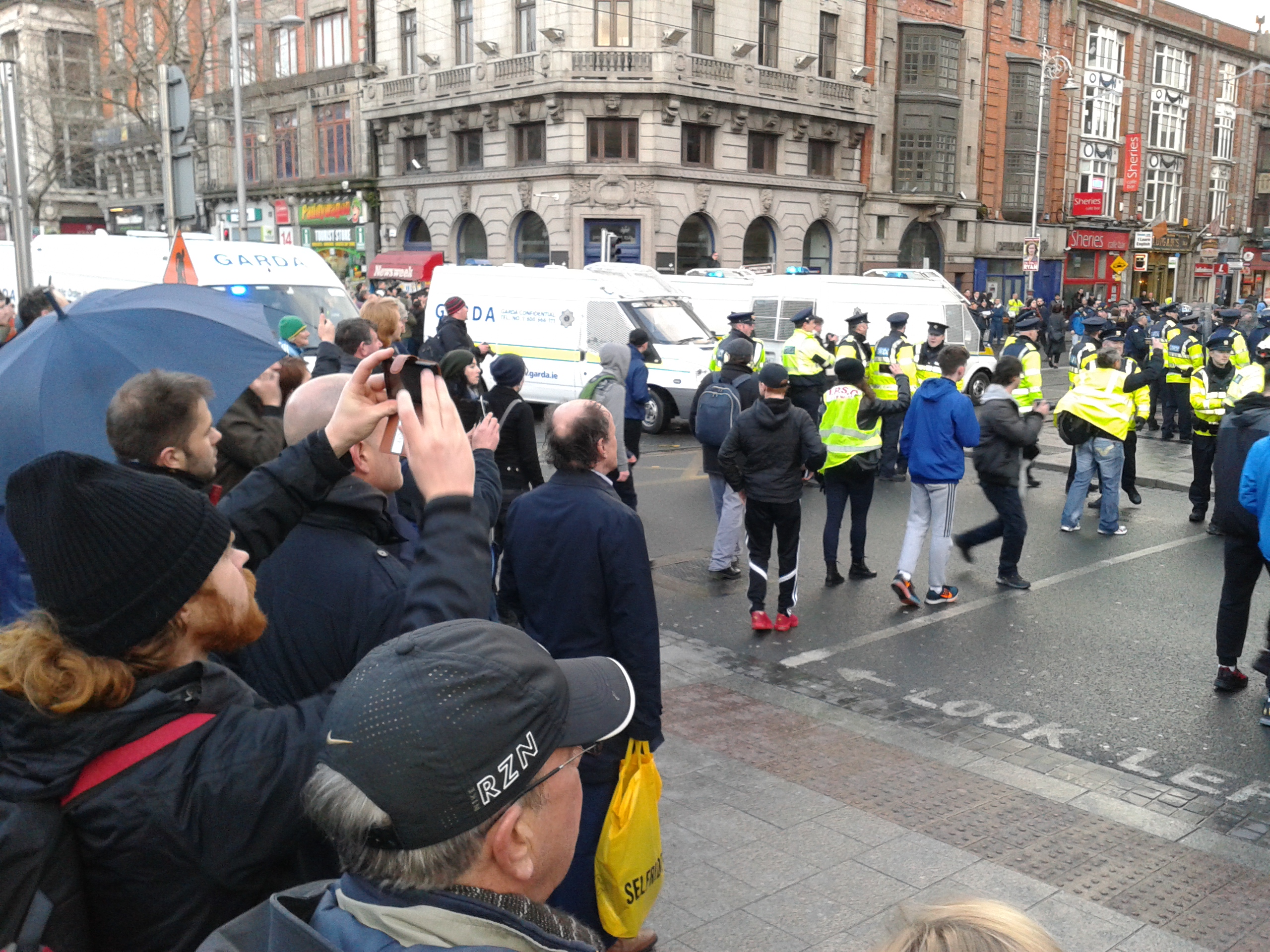
A standoff took place here for some time until the Pegida supporters appeared to be getting bussed out in police vans which sparked a rush of 50 or more antifascists southward down O’Connell Street. Riot police on foot and in vans followed them and at the intersection with Lower Abbey Street, drew up two cordons, one facing eastward down Lower Abbey Street and the other facing the Liffey, while crowds of antifascist gathered on the eastern pavements and Lower Abbey Street and mostly spectators gathered on the central pedestrian reservation. More police arrived and drew plastic shields out of their vans while a number of dogs were in evidence barking, one jumping up and straining on the leash towards antifascists.
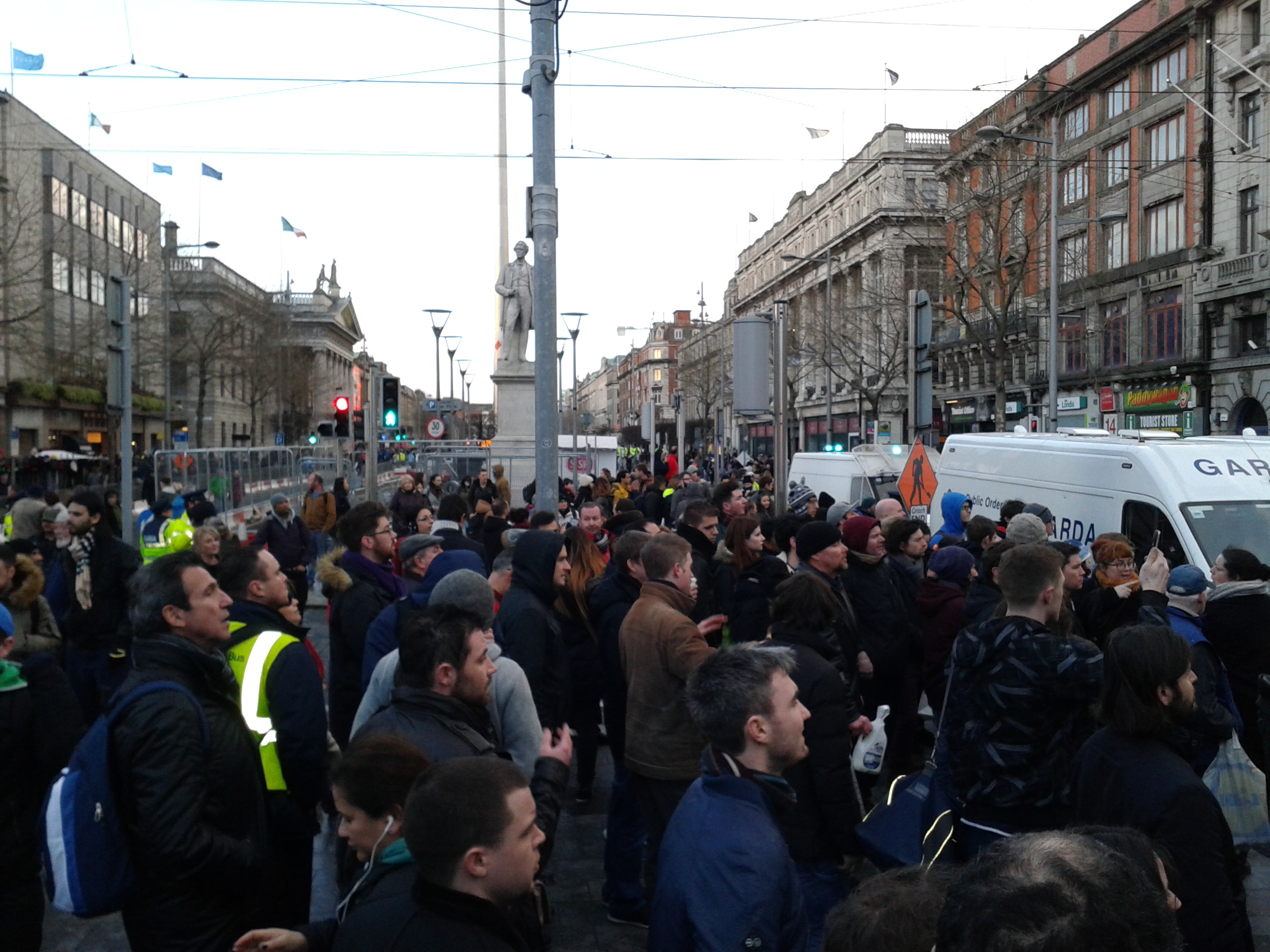
Many spectators, natives and others, expressed bemusement and asked people near them what was occurring, evidence of the low level of advance news coverage by the mainstream media. Alternative, liberal, socialist and Republican media and independent sites on the other hand had given extensive coverage and encouraged people to attend the anti-racist demonstration or the antifascist action. Some among the crowd who were ‘in the know’ explained the events to one or two in their immediate vicinity. The overall atmosphere in the crowd seemed opposed to the fascists with mixed attitudes to the police and antifascists. These crowds offered fertile ground for being publicly addressed by word of mouth or leaflets but none seemed available to fulfill that role.
After some time in apparently purposeless deployment, given that nothing was moving, the Gardaí simply returned most of their forces and riot shields to their vans and most drove off. This seemed to indicate that the police maneouvre had been in the manner of a decoy while the fascists were spirited away quietly from the vacated vicinity of the pub. The Rabble video seems to confirm this.
Melee in Cathedral Street as riot police force antifascists away from pub where fascists are in hiding (photo from Internet)
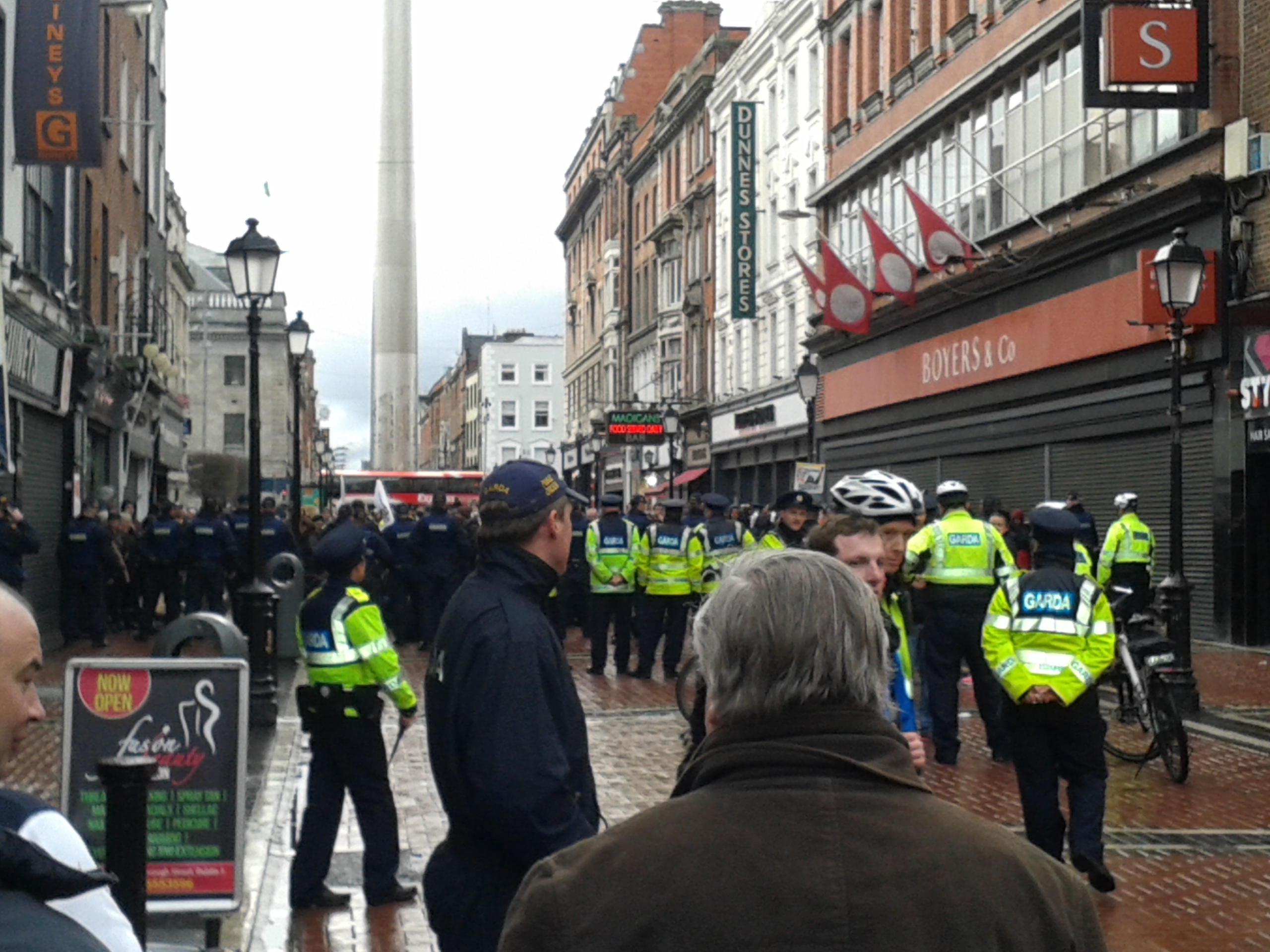
Riot Squad police in Cathedral Street facing off antifascists. (Photo D.Breatnach)
Standoff Abbey St. junction O’Connell St, facing westward (Photo D.Breatmach).
Many spectators — view northwards along O’Connell St. from the William O’Brien monument (Photo D.Breatmach)
SUMMARY ANALYSIS
The State, probably in anticipation of antifascist action, mobilised and deployed considerable forces. Garda vans moved through the city centre, sometimes in convoys, in addition to police on foot, mounted on horse and bicycle (though the horse police were often discreetly out of site in several locations around the demonstration area). Riot police waited in vans while other vans were stacked with plastic riot shields (which in the end were not needed, if a missile was thrown at the police it was a rare one).
In line with the general history of the relationship between capitalist states, their police forces and fascist movements, the police showed their determination to protect the fascists moving around the city centre. The eagerness of officers at times caused them some problems, including one of them striking a cameraman from the national broadcasting network, RTÉ, with a baton. On another occasion, a riot police officer can be heard calling “Hold the line!” at a time when the video shows the line is not under pressure – the only danger to the police line at that point is seen to be from over-eager officers breaking away to pursue and attack demonstrators.
A number of demonstrators and some spectators suffered bruises from police batons as well being violently shoved by police. In one video a police officer is briefly visible striking at a person lying on the ground – a visual echo of that famous photograph of Bloody Sunday during the 1913 Lockout, when the Dublin Metropolitan Police had run riot less than 100 yards away. In other footage police are seen shoving a man, apparently disorientated (perhaps by a blow to the head) to the ground at least three times although he is no threat to them and is not even resisting.
A feature of the antifascist active resistance was the unity in action across the Irish Republican spectrum, a feature that has been growing in solidarity work around Republican prisoners, in resistance to some features of repression and in the defence of the historical heritage represented by the struggle to save the 1916 Terrace in Moore Street. On this occasion however the unity in action included some SF activists. A sprinkling of independent socialists and anarchists were also among them. Some activists of the socialist, anarchist and communist organisations left the rally to join the antifascists blockading the fascists and their police protectors at Cathedral Street. There were a number of reports of football youth ‘casuals’, supporters of four Dublin soccer clubs, also cooperating in hunting for fascists. At least two of these were observed taking ‘selfies’ of themselves against a riot police background!
It is not known how many arrests were made nor what their outcome has been. Fascists were filmed being handcuffed as they were being put in police vans to take them to safety but it is unlikely they were charged. A number of fascists were reportedly hospitalised where no doubt their medical care teams will include a number of migrant background and perhaps even of Muslim religion.
The police and the Government will be considering their response but the ritual condemnations by their mouthpieces of antifascist force can be expected, as well as attempts to isolate the antifascists as some kind of hooligan or sinister element. The capitalist class will not be impressed with Pegida or Identity Ireland’s performance and, if considering building up a fascist movement in the future, will probably look elsewhere.
Both the ARN and the antifascists were pleased with the outcome of their respective efforts but liberal elements can be expected to condemn the antifascists for what the former perceive as marring the message of their demonstration. The ARN statement (see link at end of article) did so in fact albeit in muted tones, “regretting skirmishes”. In a parallel to some Jewish leaders in 1930s Europe during the rise of fascism, a Muslim religious leader was quoted criticising violent actions “by a minority” and called for defeating them by “dialogue”.
The fascists will be licking their wounds and trying to put a brave face on their defeat, also condemning the antifascists for using “undemocratic violence” or words to that effect. All fascist movements in history have been extremely violent while often, while in their growth period, presenting themselves in public as peaceful and condemning the violence of their opponents. This is a fact that liberal elements usually fail to appreciate, while other elements among the middle class are ultimately content to see their order being maintained, whether by the State or by fascists.
Whatever spin the fascists, the State, mass media or liberals may put on it, the fact remains that the fascists have been prevented from staging a publicity coup that would have raised the morale of their few recruits and encouraged more to join them. Fascist movements throughout history have required such morale-boosters and encouragement for potential recruits and, incidentally, intimidation of their opposition. What happened on Saturday in Dublin has been the reverse – the fascists and potential recruits have been intimidated and discouraged. Over 200 indicated intention to attend on the Pegida “Irish launch” Facebook event but reports on the ground in the city centre indicate a total of perhaps 30 fascists being chased around the city in small groups. The 170 or so, whether Irish or from elsewhere interested in supporting islamophobia, racism and fascism won’t be in a hurry to enlist now.
But should a new attempt be made to launch a mass fascist movement in Ireland, on whatever divisive basis, the antifascists are likely to turn out in even greater numbers.
“Supporting organisations (in alphabetical order):
Anti Austerity Alliance, Akidwa Ireland, Africa Centre Dublin Ireland, Anti Racism Network Ireland, Attac Ireland, Autistic Rights Together, Communist Party of Ireland, Conference of Religious in Ireland, Dialogue & Diversity, Dublin Calais Refugee Solidarity, Dublin City Centre Citizens Information Service, Doras Luimni, EDeNn, ENAR Ireland, Fighting for Humanity – Homelessness, Galway Anti Racism Network, Gaza Action Ireland, Gluaiseacht for Global Justice, Green Party of Ireland, Ireland Says Welcome, Ireland Palestine Solidarity Campaign (IPSC), Irish Anti-War Movement, Irish Housing Network, Irish Refugee Council, Irish Missionary Union, Irish Traveller Movement, Migrant Rights Centre Ireland, National Traveller Womens Forum, Shannonwatch, Show Racism the Red Card – Ireland, SARI – Sport Against Racism Ireland, SIPTU, Sinn Féin , The Platform, Pavee Point, People Before Profit, United Against Racism, The Workers Party, Workers Solidarity Movement, You Are Not Alone.” (From their statement published on European Network Against Racism Ireland’s site)
(Looking into the future, a couple of generations on)
Diarmuid Breatnach
THE GPO EVACUATION AND MOORE STREET LAST STAND
Our tour group gathered in the GPO for the Evacuation & Last Stand part of the tour; one can take this tour on its own or as part of longer tours. We said goodbye to Rónán, who handed us over to our Evacuation Guide, Pela.
Aerial view of Moore Street in the days when the speculators and supermarkets had only just begun to reduce it (Photo from Internet)
Our tickets were checked and we were handed audio earphones, receivers and issued with our instructions – stay with the group, obey the instructions of the guide, etc.
Our group had about thirty people in it and ours had the only young children, although there were a few in their late teens. About half or more looked like tourists and some asked for the foreign-language options of receivers. There was one man in a wheelchair.
As instructed by the guide in a number of languages, we tested our receivers to find the volume settings appropriate for each individual. This took a bit longer for our two younger girls. Then our guide motioned for us to listen to our earphones … and the narration began. Gradually, we were pulled back across the decades until we were in that amazing Rising, taking place in what had once been considered the second city of the British Empire, rising up against that very same Empire, one of the largest the World had ever seen.
It was the fourth day of the Rising and many of the buildings in the city centre were ablaze. Through our earphones, against a backdrop of booming cannon and crashing shell, chattering machine guns, rifles’ crack and whining ricochet, we could hear the crackle of flames. Irish Volunteers’ voices reported that the glass in Clery’s building opposite had melted and was running across the street like water. The ledgers the Volunteers had placed in the GPO windows to protect against bullets were smouldering. Other voices added that despite fire-fighting efforts the roof was on fire and the roof lead melting. We could almost smell the smoke. Then finally, the order to evacuate given in an Edinburgh accent – James Connolly, the socialist commandant of the HQ of the Rising, the General Post Office.
In the hubbub of people getting ready to evacuate some voices stood out: Elizabeth O’Farrell, giving instructions about the moving of the injured James Connolly; calls to evacuate by the side door and caution about crossing Henry Street, with machine-gun sniper fire coming all the way down Talbot Street from the tower of the train station at Amiens Street.
A man’s voice in our earphones says “It’s lucky we have oul’ Nelson there to shield us some of the way!” and we hear a few people laugh.
Then, The O’Rahilly’s voice, calling for volunteers to charge the barricade at the top of Moore Street and a chorus of voices answering, clamouring to be chosen.
Now we are out in a group and crossing Henry Street. The man in the wheelchair, having politely declined offers to push his chair, is propelling his wheels strongly along with his leather-covered hands. It is weird to see the pedestrian shoppers and sightseers of the Twenty-First Century as half our minds are back in the second decade of the Twentieth. Across this short stretch to Henry Place we went, the crack of rifles and chatter of machine guns louder now in our earphones. And explosions of shells and of combustibles. The garrison scurried across this gap carrying the wounded Connolly on a bed frame and Winifred Carney, carrying her typewriter and Webley pistol, interposed her body between Connolly and a possible bullet from the train station tower.
With the rest of our tour group, Sadhbh and I cross into into Henry Place, holding the kids’ hands, following the route of the evacuation. Immediately we stepped on the restored cobbles of the lane-way, the sounds of battle receded somewhat.
“No bullets can reach us here!” shouts a voice in our earphones.
“No, but bejaysus them artillery shells can!” replies another.
Other shouts a little ahead warn us that gunfire is being directed down what is now Moore Lane from a British barricade on the junction with Parnell Street.
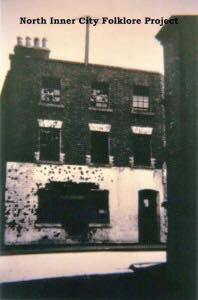
The bullet-pocked “white house” in Henry Place, facing up Moore Lane (Photo North Inner City Folklore Project)
A sudden shouted warning about a building ahead of us, to our left, facing Moore Lane.
“See the white house? The bastards are in there too,” shouts a strong Cork-accented voice, almost certainly the young Michael Collins. “Let’s root them out. Who’s with me?”
Another chorus of voices, a flurry of Mauser and Parabellum fire, then only the steady chatter of the machine gun up at the British barricade and the sound of bullets striking walls.
The Cork sing-song voice again. “I can’t believe it — The place was empty, like!”.
“Aye, it was so many bullet’s hoppin’ off the walls made us think the firing was coming from inside,” a voice says, in the accents of Ulster.
Then an unmistakably Dublin working class accent: “Would yez ever give us a hand with this!” followed by the creak and rattle of wheels on the cobblestones as the cart is dragged across the intersection. Now we can hear the machine gun bullets thudding into the cart.
“Quick now, cross the gap!” comes the order and the dash across the gap begins. Nearly 300 men and women? Someone is bound to get hit and yes, they do and we hear that one of them died here.
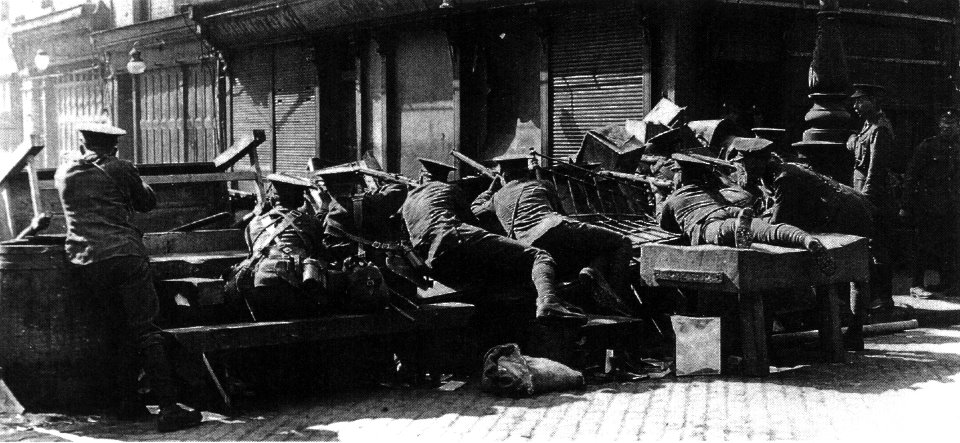
British barricade on Bachelors Walk Easter week, 1916 and widely thought (including by me until shown otherwise by another history enthusiast) to have been at junction of Parnell Street and Moore Street (photo from Internet). There were similar barricades at the junction with of Parnell Street with Moore Street and with what is now Moore Lane, fire from each from machine gun and rifles.
Across the gap, nowadays mercifully free of enemy fire but still feeling vulnerable, we follow Pela, our guide, to the corner with Moore Street. In character, she peers carefully around as we hear machine-gun and rifle here too, but Mausers and Parabellum as well as Lee-Enfields.
“Gor blimey!” exclaims a London accent, reminding us that some of the Volunteers had been brought up in England. “O’Rahilly’s lads are getting a pastin’. None of ’em made it as far as the barricade!”
An Irish voice: “Into these houses then – no other way! We have to get into cover to plan our next move.” This is followed by the sound of a door being hit and then splintering as they break into No.10, the first house on the famous 1916 Terrace.
“Careful now,” Elizabeth Farrell’s voice, followed by a groan of pain as Connolly is manoeuvred through the doorway.
Pela sends the man in the wheelchair up in the lift and leads us up the stairs. When the lift and the last of our group arrive we proceed across the restored upper floors from house to house, passing through holes in the walls, as the GPO Garrison did in 1916 – except that they had to break through the walls themselves, working in shifts. Through a few unshuttered windows, we can see the busy street market below us going about its business, apparently oblivious of our passage above them. But then, thousands of tour groups have gone through here over the decades. Through the double glazing one can just barely hear the street traders calling out their wares and prices.
We pass through those hallowed rooms, listening to ghosts. Here and there a hologram appears and speaks, echoes of the past. Dummies dressed in the uniforms of the Irish Citizen Army, the Irish Volunteers, Cumann na mBan, Na Fianna and Hibernian Rifles are on display here and there. Imitation Mausers and Parabellums and Martinis, each one carefully made and to the same weight as the original, are there. They are security-chained but we know people are free to pick them up and feel the weight, as Rory does, to imagine carrying and firing one. But not to be flash-photographed, which is not permitted here. Replica Cumann na mBan medical kits are on display, open so one could inspect the replica contents. The houses also have period furniture, fireplaces, beds …. chamber pots …. kitchens with utensils … bedrooms ….. There are dummies dressed too in civilian clothes of the time typical of that area — women, men, children (even the dog that the last Volunteer to leave Moore St. fed).
We see magnified historical newspaper headlines, photos, badges and medals. A map of Dublin with fighting locations flashing on them, some of them going out as they fall, the dates appearing above them to show when that happened.
Snatches of poetry, of song come to us as we cross from room to room, from house to house. And for our eyes, the holograms of the Proclamation, the portraits of the executed 16 and many others who fought and died or who survived, flags, the Tricolour, the Irish Republic, the green-and-gold Starry Plough, waving in the wind above Clery’s ….
Half-way along the terrace we come to the discussion between the leaders, creatively reconstructed on the basis of some witness statements. Pearse wishing to surrender to avoid further loss of civilian life, Clarke arguing, a sob in his voice, Connolly saying maybe they should wait for Sean McLoughlin to get back (he is out reconnoitering a breakthrough route) …. Then the arguments with some of the other Volunteers, Mac Diarmada having to use all his powers of persuasion. Oh, such emotion in such short discussions! Then the decision, and Elizabeth O’Farrell volunteering to go with the white flag to open negotiations with the enemy …. even though a couple and their child have already died beneath a white flag in that street.
Shortly afterwards, the faces of the sixteen executed come into view, suspended in the air in front and a little above us. We stand there while passages are read out from their trials, letters from their condemned cells, words to relatives …. Then the dates appear above them and we hear the fusillades as by one their faces blink out, until finally only Casement remains, the image of the gallows and then he too is gone. All is dark for a moment, then all sixteen faces appear again, over a background of the three flags of the Rising, to a swelling chorus of The Soldiers’ Song, in English and in Irish.
At the end of the Terrace, we descend again and here view the O’Rahilly monument plaque and in our earphones hear the words of his final letter to his wife read out – he wrote it as he lay dying from a number of bullet wounds. I found my eyes moistening again as they had several times during the tour and some of the others were visibly crying – including foreign tourists.
The O’Rahilly Plaque in O’Rahilly Parade, at the north end of the Moore Street 1916 Terrace. It bears the words and script of his dying letter to his wife. (Photo D.Breatnach)
The end of our tour lay ahead, through the underground tunnel under Parnell Street to the Rotunda. Here the Volunteers had been publicly launched and recruited in 1913 and here, in 1916, the GPO/ Moore Street garrison had been kept prisoners without food and water for two days, while G-Men of the DMP came down to identify whomsoever they could from among the prisoners.
Now the recordings in our earphones ask us to listen to the guide for a moment as she collects our earphones and receivers. Having gathered the sets and put them away in her bag, Pela asks us all to give a moment’s thoughts to the men and women and children of the centenary year of the Rising, 2016, who had fought to preserve this monument for future generations. Pela tells us that her own grandmother had been one of the activists.
Incredible though it may now seem, the whole terrace except for four houses had been about to be demolished to make way for a shopping centre, which would also have swallowed up the street market. It had taken a determined campaign and occupations of buildings with people prepared to face imprisonment to protect it for our generation and others to come. The State of those years had little interest in history and much in facilitating speculators. She invited us to applaud the campaigners, which we did, enthusiastically. She then asked us to turn around and view the building we had left. There was a plaque on the wall there “Dedicated to the memory of the men, women, girls and boys of 2016 ……” In bronze bas-relief, it depicts the 16 houses with activists on the scaffolding erected by those who intended demolition, with a chain of people of all ages holding hands around the site and in one corner, a campaign table surrounded by people apparently signing a petition.
Once through the underpass and inside the Rotunda, the tour officially over, we thanked our guide and made for the Republican Café. Sadhb and I found we couldn’t say much, as our minds were half back in 1916. Rory was quiet too but Eva and ‘Brigie’ seemed unaffected, brightly debating what to choose from the menu in the Rotunda café, or what souvenir they fancied from those on display.
The Rotunda in the past, before it became incorporated into the Moore St. Historical Quarter and the Parnell Square Cultural Quarter. (Photo D.Breatnach)
There’s a Moore Street and Dublin Street Traders’ Museum and there are films one can see all day in the Rotunda, often too lectures, reenactments, plays …. We’d had enough for one day, however – we were full. It was truly an unforgettable experience and I knew that for Sadhbh too and probably for Rory, it was something that would remain forever alive in our memories. The girls? Years from now, who knows ….. but they had certainly not been bored, anyway.