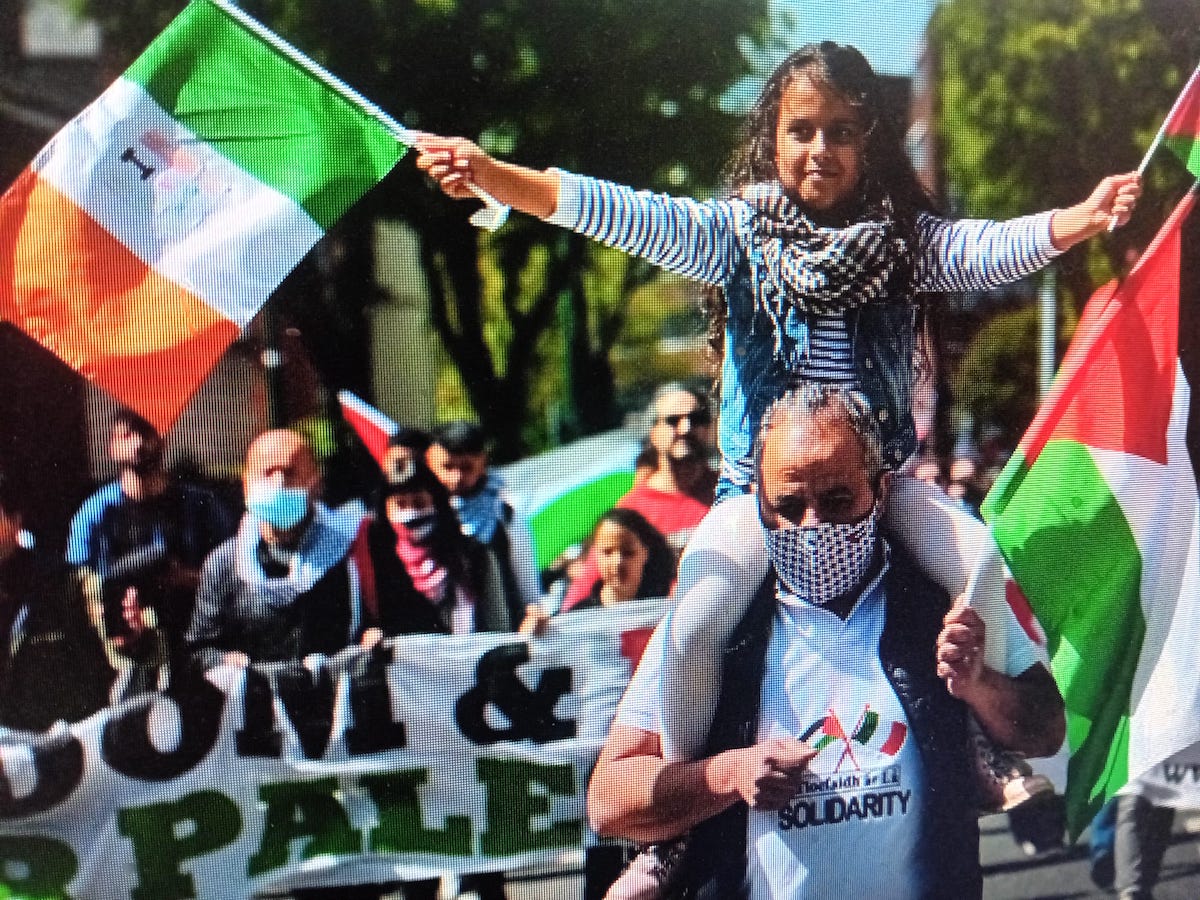
The national demonstration called by the Ireland Palestine Solidarity Campaign for 31st August began at the Garden of Remembrance and, traversing the city’s main boulevard, crossed the river to rally across from Leinster House, the Irish Parliament.
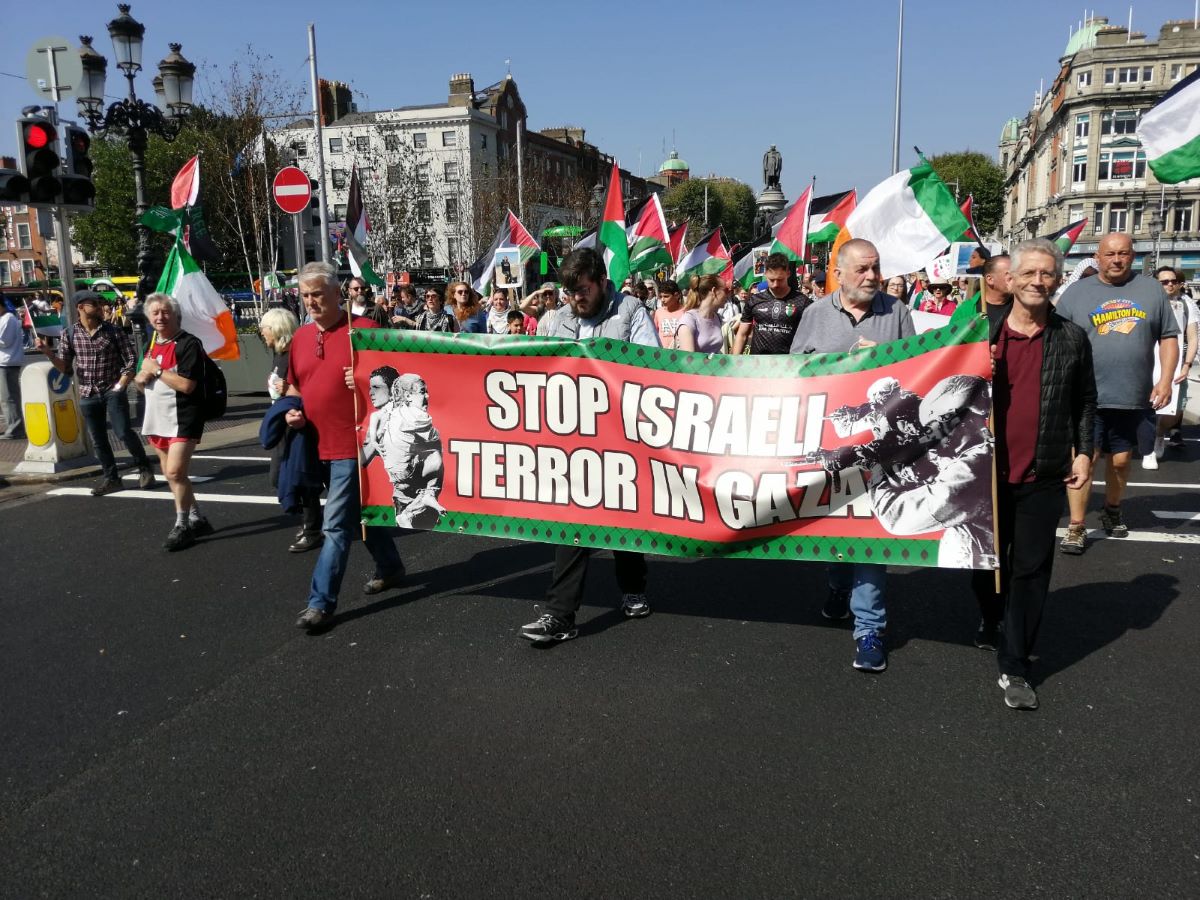
Having a weekly Saturday commitment until 1.30 and the IPSC march start advertised for 1pm, I had to run to catch it up as it marched away up O’Connell Street. I hurried alongside it to try to reach the front but failed to do so before I had to stop and fly the flag with comrades.
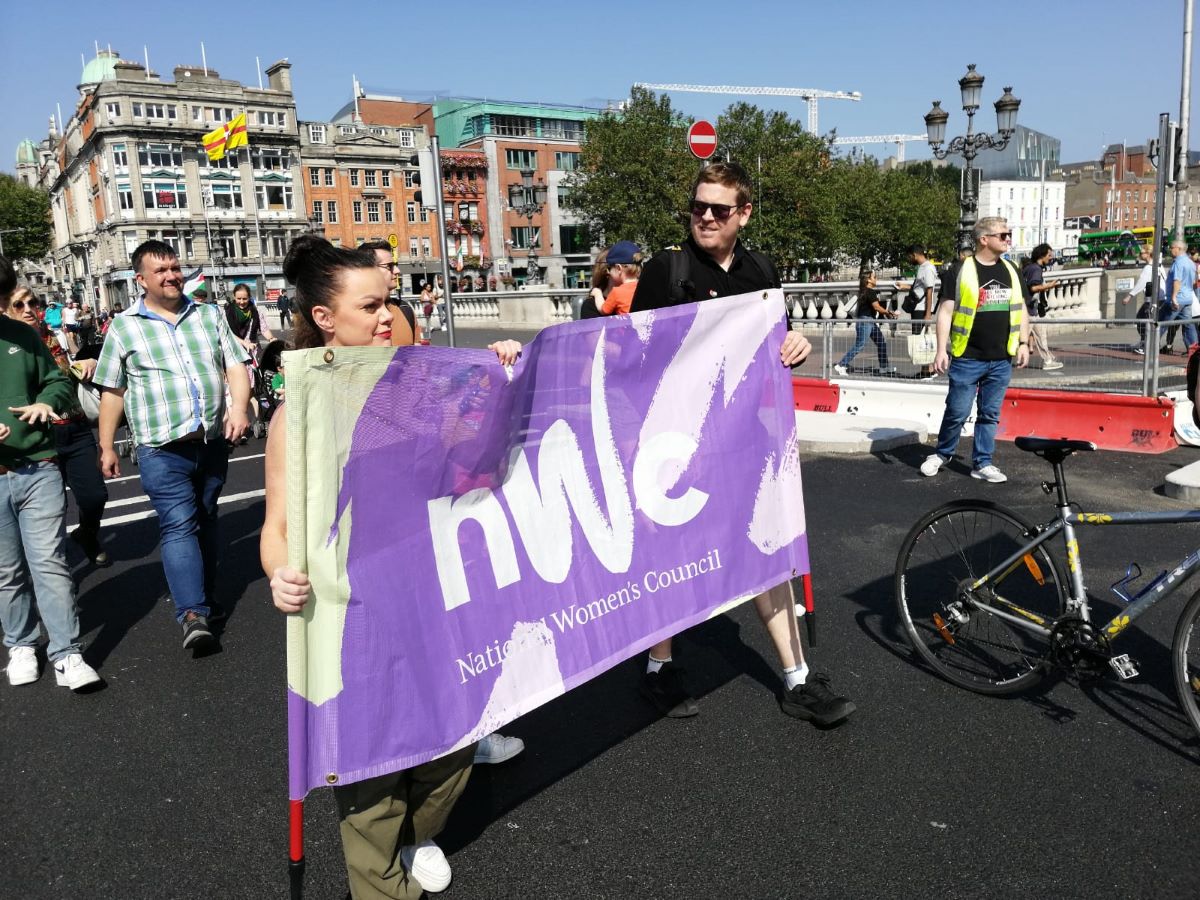
Having to run to catch up with the demonstration after an earlier weekly commitment. (Photo: D.Breatnach)
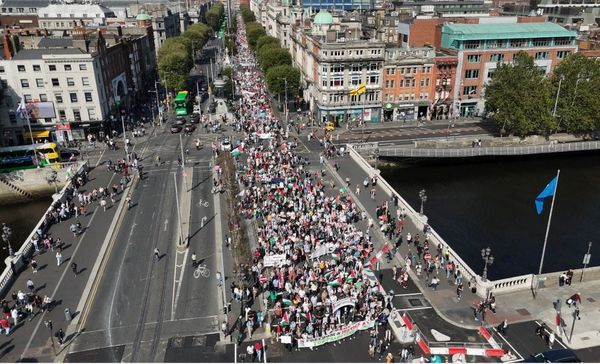
Looking back southward from O’Connell Bridge I could see the march stretching back along part of O’Connell Street while ahead I could see the front of the march winding along the outside of the Trinity College entrance.
Since early October last year, the IPSC and others have organised Palestine solidarity marches at least every second week through different parts of the city, mostly to Government offices and the Parliament. Similar events have also taken place across the land.
There have also been pickets of Zionist-friendly businesses and motorway bridge flag and banner drops, weekly roadside pickets in addition to building occupations and university protest/solidarity encampments.
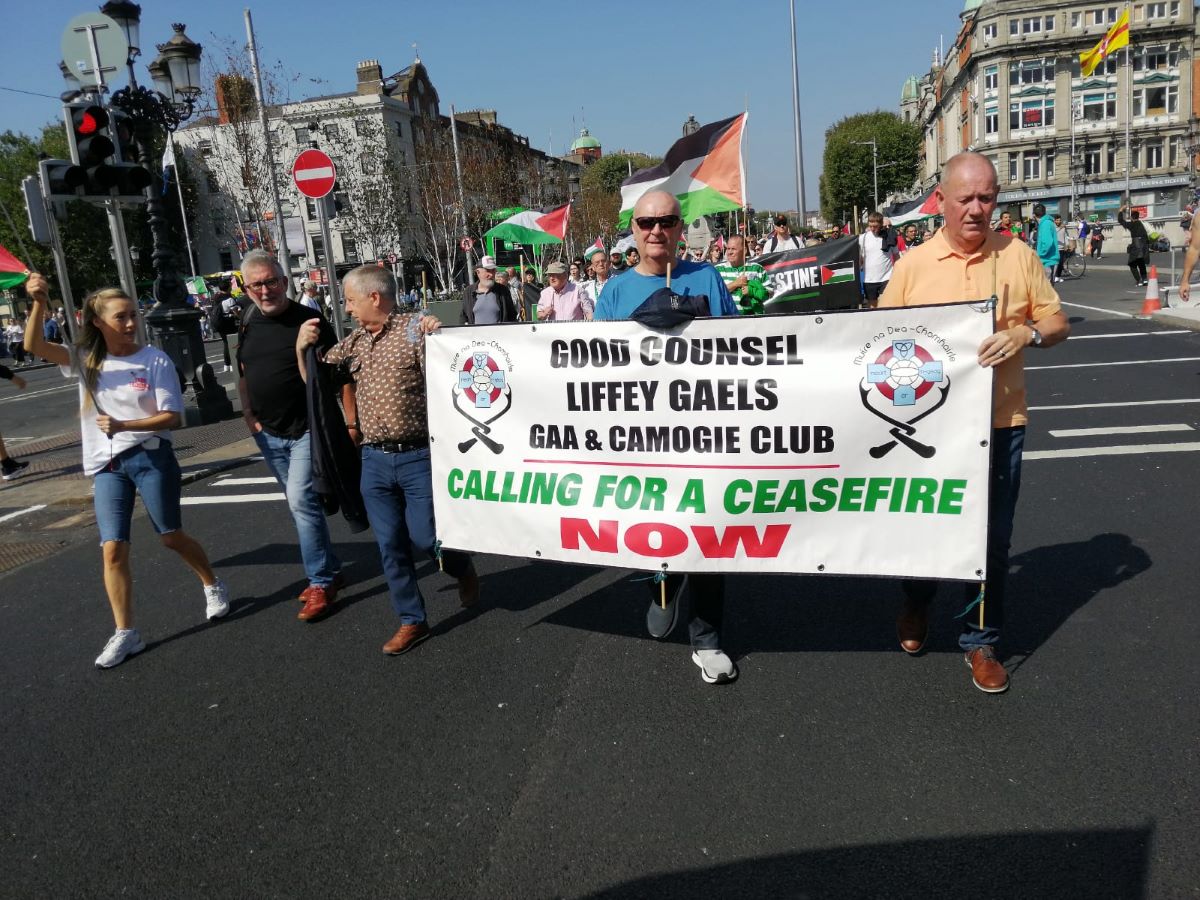
This community solidarity banner may be seen every Thursday evening in four different areas of North Dublin (but for some reason the IPSC does not include it in its weekly list of events). (Photo: D.Breatnach)
Meanwhile, in Palestine the Zionist genocide grinds on unabated through bombing, ground attack, starvation and disease, along with torture of prisoners, destruction of infrastructure, including buildings, while the Resistance fights back with their missile launchers, guns and explosives.
While the fluid tactics of the Resistance are appropriate to the genocidal and well-armoured enemy, we must ask ourselves whether ours are too. Marches are important in showing numbers and in increasing the feeling of wider participation among individuals and small groups of friends.
(Photo: D.Breatnach)(Photo: D.Breatnach)
However the demonstrations are not moving the Government, much less the State, not even to bring forward the agreed Occupied Territories Bill, much less keeping Irish state airspace free of genocidal collusion.
Targeted direct action seems more likely to exert the necessary pressure, as was the case with Axa Insurance, where regular pickets and some occupations resulted in its divestment from ‘Israeli’ banks. University protest encampments also scored some successes.
But where are their trade unions? (Photo: D.Breatnach)But where are their trade unions? (Photo: D.Breatnach)
There are other possibly suitable targets of protest in terms of assistance to the Resistance. Is the Irish Red Cross fulfilling its duty in seeking access to Palestinian prisoners being tortured and starved? Are ‘Israeli’ imports being blocked?
Quite possibly other kinds of organisation are necessary to discuss, plan and lead these kinds of processes and indeed it was such sprung-up organisations that led those direct action events. Perhaps it is wrong to expect and organisation like the IPSC to lead them.
But is it wrong to think that the IPSC should advertise or at the very least tolerate such actions and not discourage them? Or even more, not warn people off from supporting such groups?
(Photo: D.Breatnach) (Photo: D.Breatnach)
Watching IPSC stewards shepherding people to clear the Molesworth Street from Dawson Street to the junction, even when they are packed solid from there to the rally across the road from Leinster House sometimes looks as though they see themselves as policing the march — and the movement.
Those who want that road cleared are the police but a) that is their concern and b) the demonstration is on the road which it has a right to be and traffic will just have to avoid it.
(Photo: D.Breatnach)(Photo: D.Breatnach)
We don’t have to work against one another. If the IPSC doesn’t want to lead some kinds of actions, they don’t have to. And if others want to do things the IPSC doesn’t, then they can. But no-one has the right to be the police within the movement, much less restrict development.
End.
(Photo: D.Breatnach)Aerial view of the march crossing O’Connell Bridge and the numbers all the way back to the Garden of Remembrance. (Photo sourced: IPSC Facebook)
The Palestinian Authority had a small protest against it in Dublin on the afternoon of Friday 23rd August 2024. This seems to be the first protest that has taken place outside the Palestinian Embassy at 66 Lower Leeson Street.
It would perhaps have been the first protest against the PA in Ireland, were it not for the Palestinian solidarity activists who attempted to convey the Palestinian reality in contrast to the Ambassador’s speech at a public meeting in Belfast in February, before being evicted by Sinn Féin supporters.
Palestinian solidarity activists protesting the Palestinian Authority and Embassy?
At first sight that seems bizarre but as some solidarity activists and most people of Middle Eastern origin know, the PA is not only widely considered unrepresentative and corrupt – and in fact has not held elections since 2006 – but also represses protests in the West Bank against ‘Israel’.
However, the Ireland Anti-Internment Campaign says that its main purpose in calling the protest was to raise awareness of the harm the PA is doing to the Palestinian Resistance, in arresting Resistance fighters and disrupting resistance defence against ‘Israeli’ army incursions.
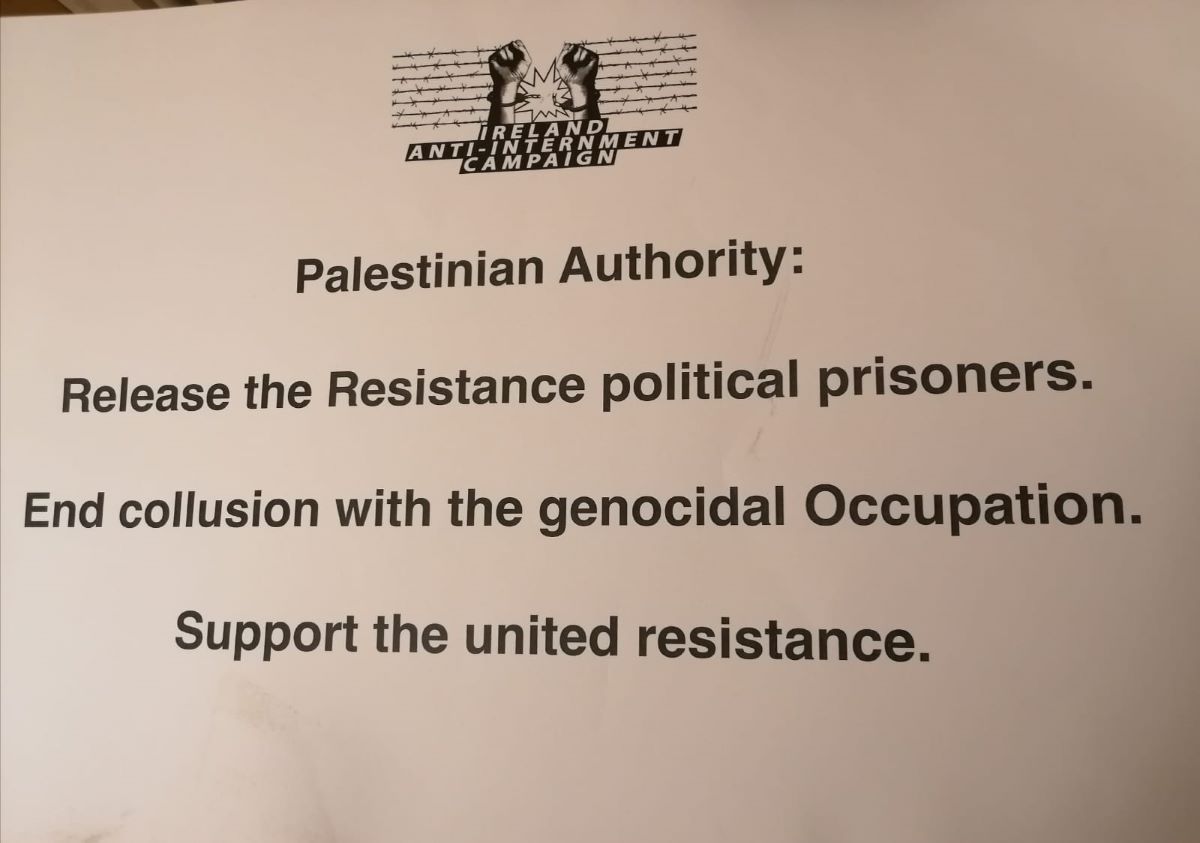
Photo of placard being displayed outside the Palestine Embassy today. (Photo: R.Breeze)
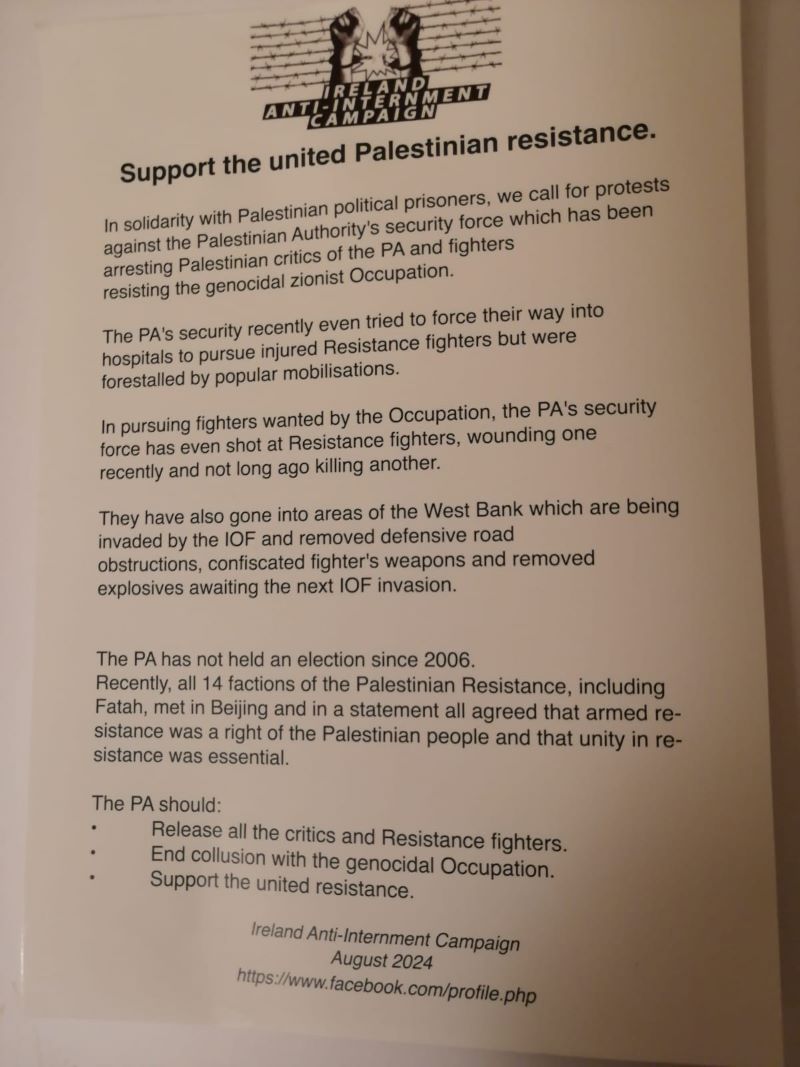
The IAIC’s leaflet handed out at the event points out that the PA’s security force shot and wounded and even killed Resistance fighters, also attempting to enter hospital in force to arrest fighters on two occasions recently, their attempts being frustrated by large mobilisations.
Could a picket on the Palestinian Authority and its Embassy be considered divisive? “Not with justification,” replied an IAIC spokesperson. “It’s the actions of the PA that are divisive. We are supporting the broad resistance there, not one faction or another.”
He points out – as did their leaflet – that 14 Resistance factions including Fatah met in Beijing recently and agreed that the Palestinians have a right to resist, including with weapons and called for unity of all the resistance organisations. “The PA is acting against that unity”, he said.
But why is it that the IAIC called this protest and not one of the Palestinian solidarity organisations? “You’d need to ask them that,” says the spokesperson. “We regularly fly a Palestinian flag on our anti-internment in Ireland pickets; the PA was overdue to be done but nobody else was doing it.”
(Photo: R.Breeze)
The IAIC was founded a decade ago to raise awareness about ongoing internment of Irish Republican activists by revoking ex-prisoners’ licence and through refusal of bail by special no-jury courts. In those cases it can take two years for a case to come to trial.
However the IAIC has organised or participated in other events also, such as those around framed prisoners like the Craigavon Two in the Six Counties and the Munir family in England. It has also called two of its pickets since October 2024 to specifically highlight Palestinian prisoners.
Will the group be regularly picketing the Palestinian Authority now? “Probably not. It’s not what we were set up for but we felt the ice needed breaking on this. Others need to step forward now,” replied their spokesperson, though signalling that they would support others in doing it.
Photo of copy of the leaflet being distributed outside the Palestine Embassy today. (Photo: R.Breeze)
It is probable that a representative of the PA will be welcomed soon by the Irish Government as part of its recognition of the ‘Palestinian State’. One wonders how this reception of a corrupt and Occupation-collusive organisation will be mediated in the Palestinian solidarity sector in Ireland.
The Governments of the EU, including Ireland’s, formally recognise the PA but not only that – so does Sinn Féin in Ireland, EH Bildu in the Basque Country and Esquerra Republicana in Catalonia. This corresponds across the board also to support for ‘the Two-State Solution’ (sic).
What that entails is allocating the Palestinians less than 20% of their homeland weaving around illegal zionist settlements, with least water and some of the worst land, under the permanent watchtowers and guns of their genocidal neighbour.
Organisations and individuals within the broad Palestinian solidarity movement will need to decide exactly what their solidarity with Palestine actually means, especially for the Palestinians themselves.
Like that similar-sounding ailment affecting some males, most of us are not rising, at least not to the expectations of the electoral commission. Furthermore the problem appears to be no respecter of gender.
The issue, according to the Independent Electoral Commission, is that not enough of us are voting in elections. Only 49% turned out to vote in the Irish local (municipal) and European Parliament elections which means that more than half of registered voting age didn’t bother.
Well, so what? Why is that is troubling the IEC? It seems that generally, the authorities like to see a good turnout because it appears to signify that people believe that they really have a democratic choice through the electoral system and are actually exercising it.
If they don’t believe that they have a choice – or if the appearance of choice is not matched by the reality they perceive, the people might turn to other methods of deciding how the country should be run. And that might result in an outcome unwelcome to the ruling elite.
THE TWEEDLES
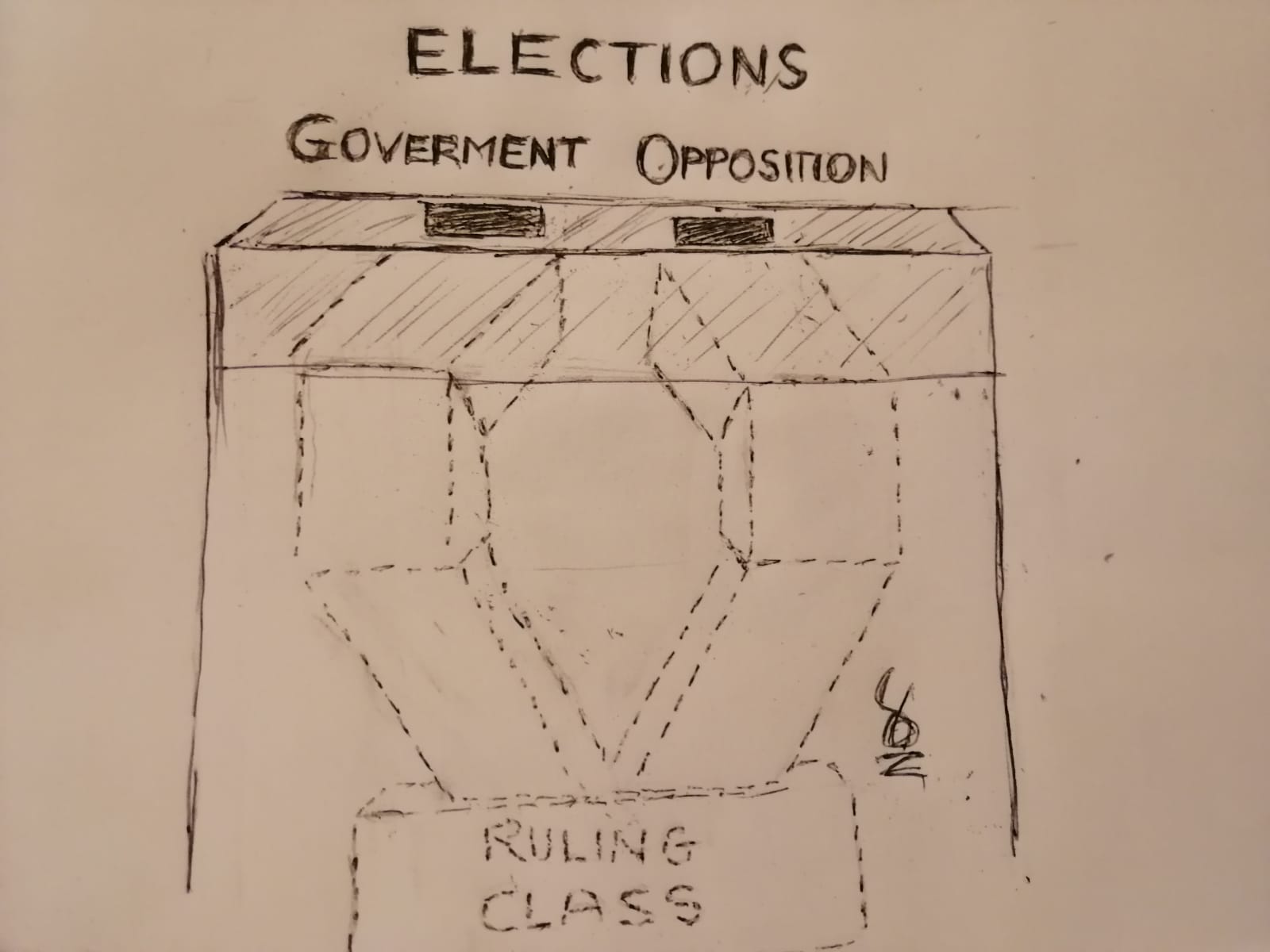
The Tweedledum and Tweedledee parties appear to give the electorate alternatives and though whichever party wins the capitalist system remains, it appears to give a choice – but a bet choosing between two horses of the same owner in a two-horse race.
Like both Tweedles in the folk nursery rhyme and in Lewis Carroll’s Alice Through the Looking Glass (1871), Tweedledum and Tweedledee are brothers and though they appear to be preparing for war with one another, they don’t actually fight, not in Western ‘democracies’.
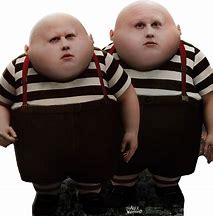
Tweedledum and Tweedledee (or is it the other way around?). (Image sourced: Internet)
There are, after all, plenty of spoils to share between their masters. The creators of that wealth need to be controlled, fooled and, if necessary from time to time, repressed. “Red” social democrats and “Blue” conservatives have alternated to share power in the Western world for over a century.
In Ireland, the only European state which is a neo-colony and part of its land a direct colony, its national liberation unfinished, the Tweedles have been blue or green.
But for decades now the illusion of choice has been crumbling. There has not been a majority party government in Ireland since 1981, when Irish Republicans were elected during the hunger-strike campaign. All Irish governments since have been a coalition of one kind or another.
The Irish Labour Party, founded by Connolly and Larkin and far from their thinking for many a long year, has been in government a number of times but always in coalition – usually with the conservative Fine Gael, itself the product of a coalition that included the fascist Blueshirts.
Those years of government participation for Labour have thoroughly rubbed off the red paint of socialist opposition from the party. The Green Party, mixing a brand of concerns for the environment with those for society, has met a similar fate in coalitions.
Since 2020 the Irish state has had what is essentially a ‘national government’, a coalition of opposing parties normally only seen in times of war or under a fascist regime. The alleged political poles have joined in order to run the system for the Gombeen ruling class.
Though this gives stability for the Gombeen’s system their problem is that it has removed the illusion of choice. They might restore that illusion through the promotion of a third major party in opposition and the formerly revolutionary Sinn Féin has worked hard to fill that space.
In the 2019 General Election SF got the most representatives elected but insufficient to form a majority government, after which the Tweedles united, along with the Greens to make up the numbers to manage the State. But the Gombeens will hold SF in reserve, I’m thinking.
Harris of Fine Gael and Taoiseach (equivalent of Prime Minister) of the Coalition Government, commented on the closeness of his party and former Opposition party Fianna Fáil in votes, predicting “a Government of equals”1– but it’s not just in votes that they resemble one another.
Yes, I know I misspelled Government but I want to get this article out of the way. I’ll redo the cartoon sometime later and replace it.
RESULTS
I don’t think there is a great deal to be said about the actual results of the recent local and EU Parliamentary elections in Ireland but no doubt some commentators will be saying it anyway.
Of unwelcome interest is that five fascists of different groups got elected, three of them to Dublin City Council. The electoral Left lost some and gained some without big changes.
Independent socialists (and couple) Clare Daly and Mick Wallace both lost their EU seats but perhaps they and in particular Daly in Ireland would be more of an asset to the Left. Luke ‘Ming’ Flanagan in Midlands North West, another left Independent, kept his EU seat comparatively easily.
Sinn Féin had what was for them a disappointing run but had some new people elected to local councils and two seats in the EU Parliament, losing an existing one. Many of their enemies in the Republican ambit, often former comrades, rejoiced in their misfortunes.
Understandable though that may be one wonders how those who have some faith in the party at the moment are to be disabused of their illusions without having seen them in government. On the other hand their twists and turns on the road there may have disenchanted many already.
IT’S NOT A CHANGE OF PARTIES IN GOVERNMENT WE NEED
For most of my life I have been aware that it is not a change between political parties but between socio-political systems that is the issue. But I do vote sometimes in order to help keep a useful and decent voice in a parliament or a local authority.
An Irish community activist pensioner years ago in London, Co. Galway Teresa Burke, was a member of the British Labour Party. After a General Election, she asked me had I voted. I replied that I hadn’t; I’d not seen a candidate that stood anywhere close to that in which I believed.
“Well then, you must take responsibility for everything the Tories do if they get in!” Teresa remarked angrily.
“I’ll do that, Teresa,” I replied, “if you’ll take responsibility for everything Labour does in Ireland if they get in!”
Teresa’s lips twitched slightly. She knew as well as did I that the British Labour Party had sent the troops into the Irish colony to quell the struggle for civil rights in 1969 and supported the Tories in introducing internment in 1971 and massacres that year and in 1972.
In 1974 police under a Labour Government had killed the first anti-fascist on a demonstration,2 framed a score of Irish people in four separate cases for heavy jail sentences3 and had passed the fascist Prevention of Terrorism (sic) Act.
Whichever party is in government, the social-political-economic system is run by the capitalist class which it benefits and they will fight tooth and nail to maintain that system.
The alternative-party-within-the-system idea, so dear to social democrats, has failed time and time again. It betrayed its supporters by becoming like what it opposed, or consistently failed to get elected or was undermined, betrayed and destroyed, like Syriza in Greece, for example.
But in the unlikely event that route should ever show signs of being successful, for the ruling class there remains the military coup.4
2Kevin Gately, son of Irish immigrants, a student at Leeds University, died from injuries received from a mounted police baton during an antifascist demonstration in Red Lion Square, London on 15th June 1974.
4The serialised for TV A Very British Coup (1988) with Irish actor Ray McAnally from the Chris Mullins novel (1982) is well worth watching for this scenario.
Around 30 people demonstrated outside Dublin’s Criminal Court on Thursday, many of them displaying Irish flags (Tricolour and Starry Plough) along with those of Palestine in solidarity with three activists before the court.
The activists were charged under Public Order legislation arising out of protesting a British war ship at Dublin docks in November last year, in solidarity with Palestine and against NATO’s support for the Israeli state’s slaughter in Gaza.
It was alleged that the activists (variously from Saoirse Don Phalaistín and Anti-Imperialist Action organisations) had entered a restricted part of the Dublin Docks and, holding a Palestine flag, had approached a British warship docked there and then occupied the gangway.
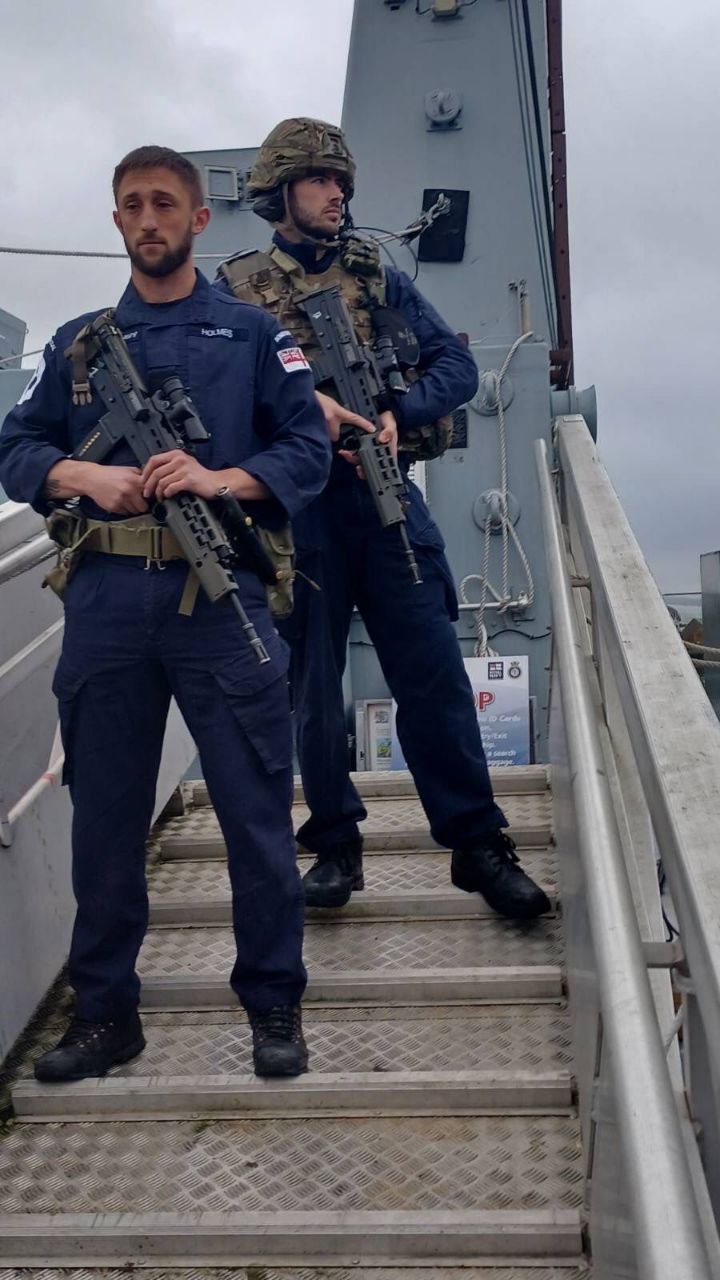
British military displaying firearms on Irish state soilin November last year. (Photo: Anti-Imperialist Action)
Gardaí had been called and the activists had refused their instruction to leave under the Public Order legislation and they had then been arrested. No act of violence, physical or verbal, took place on either side other than the refusal to leave and the arrests.
The activists appeared in the Parkgate Street building before Justice John Hughes and all three were defended by Damien Coffey of Sheehan Partners, a law firm which often handles political and human rights cases. Three Gardaí from Store Street acted in the role of the Prosecution.
The Garda in charge of the prosecution and his two colleagues gave evidence as to the arrests. Questioned by Coffey for the Defence, all confirmed that although the protesters had refused to leave, there had been no violence offered by them during their arrests.
Strangely, as shall become evident and relevant, one did not recall the British military presence on the gangway to be armed, whereas another did and confirmed that a photo of the armed men was of those who had been present.
One of the Garda offered his opinion that whereas the vessel was regarded in law as “British soil”, the gangplank was legally “Irish soil” and, if the protesters had actually set foot on the ship, they might have been charged with piracy. This piece of evidence also had unintended consequences.
One of the placards displayed by supporters outside the courthouse (Photo: Rebel Breeze)
According to this evidence, the British in a foreign military uniform had been present on Irish state soil and all replied to the defence lawyer that they were unaware of any Ministerial permission to do so — or that this could have constituted an offence under Section 317 of the Defence Act 1954.1
Furthermore, none were aware of any special permission granted to them to carry firearms on Irish state ground. The British military personnel themselves were not present as witnesses as their superiors had not replied to the Garda request to discuss giving evidence in the case.
Port security camera footage was shown as evidence by which protesters could be seen at the gates of a fenced-off section of the docks and some time later proceeding through a gate. A port security employee had been summoned by the Gardaí as a witness.
After he had been taken through his evidence (and failed to respond to what seemed an attempted prompt) by the Garda in charge the only relevance of his evidence was that a) the area was restricted and b) that he was worried for the safety of the protesters.
This (and the reason for the possible attempted prompt) was of importance when Coffey developed his defence summary on the legal grounds that Section 14 (1) of the Public Order Act required there to be an element of fear arising from the actions of those to be charged under the Act.
None of the evidence for the Prosecution had shown the presence of fear of anyone from the defendants and, furthermore, he submitted, any element of fear was much more likely to arise from the presence of two men holding firearms, to whit, the British military personnel.
The second part of the Defence summary dealt with right to protest, Coffey quoting a number of legal sources, also referencing the Irish Government’s recognition of a Palestinian state and statistics of people killed by the Israeli state against which the activists had been protesting.
Judge Hughes announced that a recess was due for lunch and that he wished to consult legal authority (case law etc) so they would recess and reconvene in an hours’ time.
A number of supporters who had taken time off from other commitments left at this point while a few arrived instead.
THE JUDGEMENT
After reconvening Judge Hughes began his long drawn out summing up and it gradually became clear that he intended to find the accused guilty. However people awaited with varying degrees of patience for the details of the sentence.
The Judge referred to the right to protest but also to the restrictions upon it (usually limiting its effectiveness) though he did not say that, nor that powers exist to abolish those rights when the State feels it necessary.
With regard to the ‘element of fear’ required for conviction under the Public Order Act Hughes quoted a judgement as a reference that seemed neither relevant nor reasonable, involving a woman experiencing fear of being broken into and even fear of children playing outside her home.
Despite repeating the standard claim of capitalist law that judges cannot adjudicate emotionally nor be swayed by what was occurring in Palestine, John Hughes revealed his own political bias when he bizarrely claimed that a British fleet had been welcomed into an Irish port in 1820.
He revealed his political naivety also when he expressed surprise that the British had not replied to the Garda communication regarding the incident.
On submission by Coffey regarding the lack of previous convictions and effect of criminal convictions on the lives of the three, Johnson, again drawing out the moment, gave them what amounts to a conditional discharge with a provisional forfeit of 500 euro.2
No doubt the desire not to create martyrs around whom solidarity campaigns might intensify played at least as much a part as any concern for the lives of the activists.
The defendants and their supporters left; outside the court they were embraced by a number of supporters before the gathering broke up, some attending to other solidarity activities elsewhere. The show of support was a good sign of solidarity against state repression.3
View of some of the people outside the courthouse on Thursday in solidarity with the three activists (Photo: Rebel Breeze)
SERIOUS ISSUES AMONG ELEMENTS OF COMEDY
The name of the British naval vessel being The Penzance and the mention of a possible piracy charge brings to mind of course the Gilbert & Sullivan opera The Pirates of Penzance (1879).
The focus of the Gardaí on arresting peaceful protesters in preference to unauthorised people in foreign military uniform carrying unlicensed firearms on Irish soil and also trying to suggest that not they but the protesters would give rise to fear is not without its comedic elements.
However overall the whole matter is extremely serious, with regard to the zionist genocide in Palestine, the active collusion of the UK/NATO, the active collusion of the Irish ruling class4despite its verbal positions – and the repression of its State on more active and directed solidarity actions.
End.
FOOTNOTES
1 317. — (1) No person shall, save with the consent in writing of a Minister of State, enter or land in the State while wearing any foreign uniform. (2) No person shall, save with the consent in writing of a Minister of State, go into any public place in the State while wearing any foreign uniform.
2 It will not appear as a criminal record but in the event of a subsequent conviction, the 500 euro can be levied as a fine in addition to any other punishment in court sentence.
3 Though the absence of a number of political organisations and trends was also marked.
4 “Dual-use”exports to the zionist state which can be adapted to military use; failure to press for any economic, academic or cultural sanctions against the zionist state; shelving of the Occupied Territories Bill; failure to impose diplomatic sanctions of any kind.
In the western world we observe the manifestation of solidarity with Palestine in giant marches and in college solidarity encampments and building occupations. But there are many other manifestations to be seen every week and on specific occasions.
These other smaller actions take place of special occasions or on a regular weekly, monthly or even daily basis. The Bridges of Solidarity event was organised as a specific one-off but others are organised weekly, for example in Dublin where one of them, by coincidence is also on a bridge.
These solidarity events are seen by passing people away from the routes of the big marches and locations of encampments and allow those people at minimums to express their approval and, for a few seconds at least, to be part of that solidarity expression.
This contributes to the popular public opinion. Smaller or special events sometimes also pull in people who might not normally participate in marches for a variety of reasons.
The Solidarity Bridges protest day was set for Friday 31st May and Palestine solidarity flags were waved and banners hung from bridges over motorways and rivers across the nation, disregarding the foreign-imposed border.
In Dublin, motorway and main road bridges, over river and stream showed the Palestinian colours and were greeted every few seconds by motor horns sounding in support.
One of the Bridges of Solidarity with Palestine events that took place across different parts of Ireland on 31 May 2024, this one on the Dublin Fairview pedestrian bridge across the road.
On the “RTÉ Bridge”1 the numbers were small with Palestinian flags and a drop banner bearing the message “RTÉ LIES”. However the horns of passing traffic blowing in approval sounded every ten seconds or so, sometimes individually and sometimes in a chorus, accompanied by thumbs up.
Irish and Arabic recorded resistance music sounded out from an amplifier. On the UCD Bridge, chanted slogans replaced recorded music with a couple of songs too, sung accapella; the numbers here were boosted with students from the ongoing solidarity encampment there.
A huge “Ireland Stands With Palestine” banner figuring the watermelon slice2 hung off the southern side of the bridge with flags and a text banner facing north.
According to media reports and its FB on 28th June, the IPSC called for those bridge protests but none of the Dublin ones were listed and today there were no photos of any such events on its FB page; however its website lists nineteen such protests for next Friday 7th June.
Every Thursday evening in Dublin a solidarity picket takes place from six to seven o’clock in four areas in prominent locations passed by much motorised traffic: Annesley Bridge Fairview/ East Wall (alternating between them weekly); Ballymun; Cabra and Donnycarney.
One of weekly Palestine solidarity picket every Thursday in four Dublin city areas – this one on Annesley Bridge, Fairview, 30 May 2024.
The Ireland Palestine Solidarity Committee does not for some unexplained reason promote these events. In its weekly list of activities for participants around the country, it does not list the Thursday events.
The IPSC is long-established and the main organisation promoting Palestine solidarity across Ireland but this kind of censorship, for that is what it amounts to, is harmful to that solidarity. These initiatives are not even radical3 nor organised by people hostile to Palestinian solidarity in any way.
Bernadette McAlliskey joined the weekly protest on Annesley Bridge on 22nd May.
Of course in themselves these actions do not stop the genocide but nor do big marches, while the college encampments may force some limited divestments and academic boycotts. But all together form part of the political ambience of the country upon which yet other actions may be based.
End.
FOOTNOTES
1So called because of its proximity to the headquarters of Radio Teilifís Éireann, the national broadcasting service.
2The Palestinian Flag is forbidden in “Israel” and wherever else they exercise control in Palestine and, because the colours of the watermelon slice are those of their flag, the Palestinians have used it as a “legal” substitute (green and white in the rind, red in the flesh and black in the seeds). An interested 6th Year student cycling past asking the reason for the design had it explained to him and told participants, whom he thanked, that he’ll be taking Politics as a subject in university.
3 Not that there is anything wrong with radical protests and in fact they are needed but one might think that the IPSC was not supporting certain types of protest because it was concerned that they might be perceived as being too radical.
Diarmuid Breatnach – Talk given at 1916 Performing Arts Club, May 2024.
(Reading time: 6 mins.)
There was a time when from Dublin to Galway, from Kerry to Donegal, the dominant language was Irish. There was a time too when it was widespread in Scotland, in parts of Wales and the main language on the Isle of Man.
Now however one can travel through all of those places and not hear it.
Irish was the first vernacular language to be written down in Europe and though island people, its speakers were not “insular”. The educated spoke Greek and Latin too and when the Dark Ages fell upon Europe it was the Irish intellectuals, the monks who revived and spread literacy there.
But here we are, you and I, speaking English – which did not even exist until at least the 12th Century.
She (I say ‘she’ because language in Irish is a feminine noun and in many other languages too) – she is all around us in place names, though we may know them only through their corrupted forms into English.
Árd/ Ard, a height; Baile/ Bally, a town or village; Béal/ Bel, the mouth of; Bun, the bottom of; Carraig/ Carrig, a rock; Cnoc/ Knock, a hill; Cluain/ Clon, a meadow; Dún/ Dun, a fort or castle; Inis/ Inis or Ennis, an island or a raised mound surrounded by flat land; Loch/ a lake …
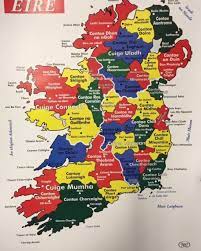
The English-language names of twenty-nine of our counties are corruptions of words in Irish: from Ciarraí to Dún na nGall, from Átha Cliath Duibhlinne to Gaillimh. This includes all six counties in the colony: Aontroim, Árd Mhacha, Doire Cholmcille, An Dún, Tír Eoghain, Fear Manach.
Just over half the States of Stáit Aontaithe Meiriceá on Turtle Island have names in the indigenous native languages, so we’re doing well with placenames and also of course have survived the colonial genocidal campaigns and wars much better.
By the way we also have Irish names for some places in Britain: Glaschú, Dún Éidin, Manchuin, Leabharpholl, Brom agus Lúndain. In fact probably none of the names of those cities are originally English anyway.
Irish has left only a small imprint on the general English language for example with “a pair of brogues, whiskey and slogan” (from slua-ghairm, a call to or by a multitude), banshee, carn and smithereeens. And shebeen, in parts of the USA, the Caribbean and in South Africa.
But its influence on the way we speak English in Ireland is clear.
We might say, instead of complaining that we are thirsty, that we have a thirst on us – a direct translation from Tá tart orainn. Or that the humour is on us – Tá fonn orainn. We might “have a head on us”, as in a headache. “The day that’s in it” – an lá atá ann.
We pronounce “film” with a vowel between the L and the M, as it would be in Irish – take the name for a dove and also a personal male name, Colm. We get that with R and M and R and N too, in some areas “a carun of stones” or “down at the farrum”.
We often indicate the absence of ‘Yes’ or ‘No’ in Irish by replying in English to the verb in the question: ‘Will you be there?’ ‘I will surely’ (Beidh, cinnte). ‘Will you do it?’ ‘I will not’ (Ní dhéanfad).
We have an extra tense in Irish, the very recent past tense, which we translate into English as spoken in Ireland: ‘I’m just after cleaning that floor!’ Táim díreach thréis an urlár sin a ghlanadh!
Renaissance of language and culture has often preceded periods of heightened national struggle: the Harp Festival of 1792 was followed soon by the uprising of the United Irish; the cultural work of The Nation newspaper was followed by the rising of the Young Irelanders.
The Nation newspaper of the Young Irelanders sought to create and encourage a nationalist republican culture and was followed by an unsuccessful rising in 1848, during the Great Hunger. (Source image: Internet)
LANGUAGE AND NATIONAL STRUGGLE
The Fenians too had their cultural precursors and the great revivals of the Irish language, Irish sport, speaking and writing in Irish and Irish theatre were not long in finding expression of another kind in the 1916 Rising and the War of Independence.
And campaigns of civil disobedience in the 1960s secured for us Irish-language broadcasting in Radió na Gaeltachta and TG4. Not to mention motor insurance documentation in Irish which Deasún Breatnach won only after going to jail for refusing to display the documentation in English.
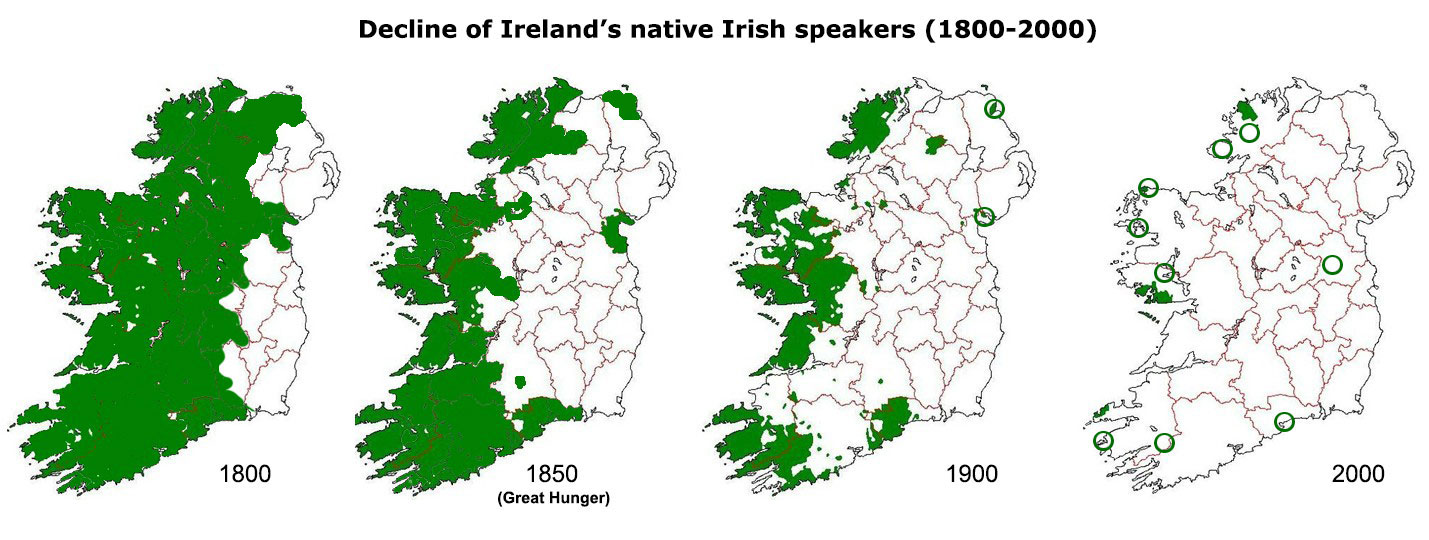
Though we can hear the influence of the indigenous language upon our speaking Sacs-Bhéarla, or English, the Irish language itself at this point is in retreat. In fact some might say that it’s in a rout.
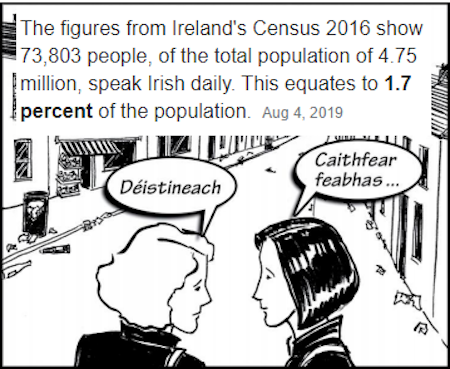
Yes, the Gaelscoil movement is broader and deeper than ever before but outside the schools? The Gaeltacht areas are receding, receding … and where can the language be heard outside of those?
Though the Great Hunger caused the most impressive loss of Irish-speaking modern Ireland on the map, the percentage lost during the period of the Irish State is greater. (Image source: Internet)
I had an experience recently that illustrates the problem. In a pub with some friends, I observed a man wearing a silver fáinne, the ring that many people wore to show a proficiency in Irish. It identified the wearer to other Irish-language speakers (my father wore a gold one).
The man had overheard me bidding farewell to friends in Irish and asked me: “Are you an Irishman?” I thought the question strange and said so. Then he asked me was I an Irish speaker, to which I replied in Irish language.
Eventually he came over and said that he didn’t speak Irish himself.
The fáinne was a family heirloom and he had been wearing it, he said, for six months in Dublin, wanting to come across an Irish speaker to whom he would give the ring. Since I had been somewhat abrupt with him, he gave the ring to one in the company who can speak Irish.
Badge inviting people to speak Irish to the wearer (Image sourced: Internet)
LABHAIR Í
Six months in Dublin without hearing Irish spoken or recognition of the fáinne! That illustrates one aspect of the linguistic problem in Ireland. But it is one that we can resolve, fairly easily too. And that brings me to the kernel, the poinnte or point of this talk here today.
I am asking you to speak a cúpla focal, regularly, go rialta, so that she may be heard. Labhair í ionnas go gcloisfear í. Imagine if everywhere in Dublin, on every side, one heard just a few words in Irish – imagine the social and psychological effect over time!
Those who know some Irish would speak her more often. Many who don’t, would feel it worthwhile to learn at least some phrases and some responses. Some might take it further and learn Irish well. Public services might regularly facilitate services through Irish.
Dia dhuit. Dia’s Muire dhuit. Or the non-religious form: Sé do bheatha. Go mba hé duit.
Má sé do thoill é or le do thoill.
Go raibh maith agat in many situations, including to the driver of the bus.
Tá fáilte romhat.
Gabh mo leithscéil.
Would you like a bag? Ní bheidh, go raibh maith agat.
Cash or card? Íoch le cárta, le do thoill as you wave your bank card. Or Airgead thirm, as you take out your wallet or purse.
Go léir, as you indicate that you wish to pay the full amount.
Isteach, le do thoill, when returning a book to the library. Amach, le do thoill, when borrowing one.
Slán, as you leave.
Easy enough, yes? Yes? But though a part of the mind is willing, another part is afraid.
“What if I get a big load of Irish in response and not even understand it? Won’t I look like a right eejit!” Well, there are risks in anything worth doing as was demonstrated in a short play here some time back when two fellas were debating whether and when to chat up a certain woman.
She was not uninterested but they took so long about it she walked out and left them, like fish brought up by fishing line, gasping on the dry quay.
So you could prepare a small survival kit: “Gabh mo leithscéil. I only have a few words/ níl agam ach cúpla focal.”
“Níl agam ach beagán ach tá mé ag iarraidh í a úsáid/ I only have a little but I want to use it. Is foghlaimeor mé/ I am a learner.”
I am not asking for any of us to campaign, to agitate for services to be provided through Irish though that is certainly a linguistic civil right and, as far as state or semi-state services go, a constitutional one.
I am only asking that you contribute to the audibility of the language, to use a few standard greetings and responses and to use them not only to people you know to be Irish speakers, not only to friends and relations … but everywhere in public.
Everywhere
in public.
Go ye out among the people and spread the word – or rather the few words. Scapaigí an cúpla focal.
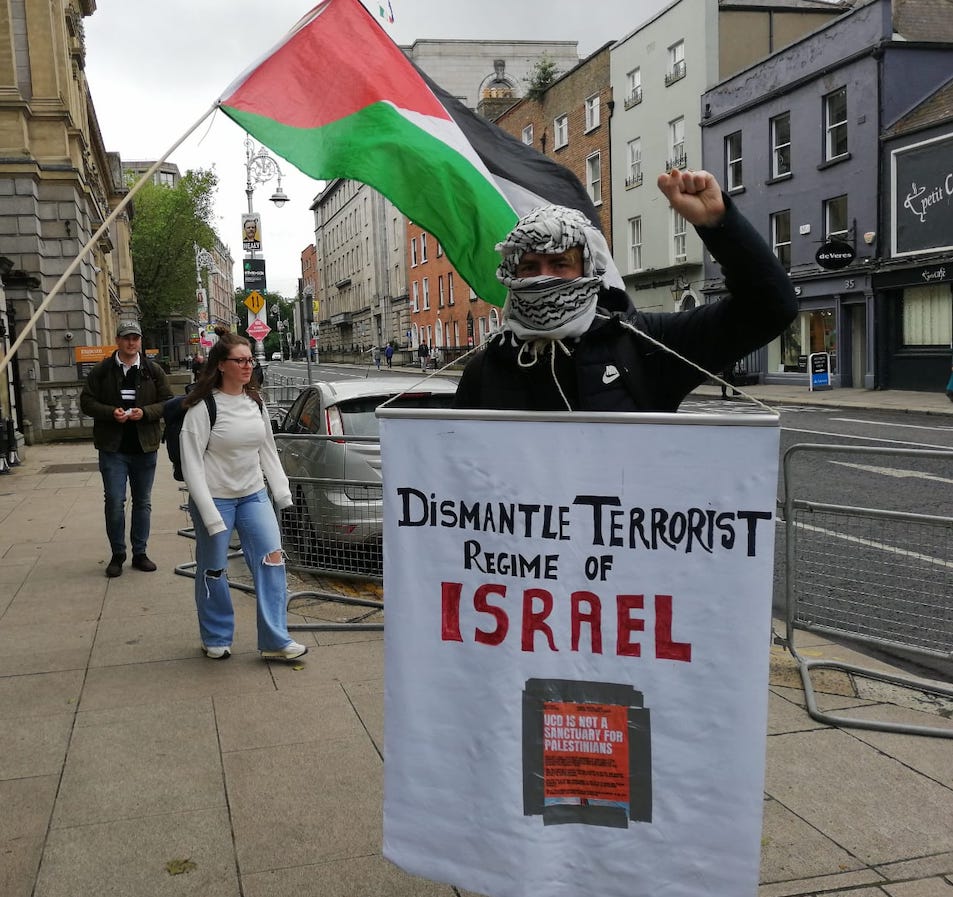
A Zionist march and rally was organised for Dublin today as an “Israel solidarity” event by the Ireland Israel Alliance. Despite prior publicity and drawing from around the country the attendance numbered only a few hundred.
Around a hundred anti-zionists with flags, banners, amplifier and loudhailer occupied the announced destination of the Zionist rally an hour prior to the scheduled arrival of the IIA march and had to wait even longer as the Zionist groups arrived at Stephens Green.
One of the banners displayed by among the anti-zionists outside Leinster House on Sunday (Photo: Rebel Breeze)(Photo: Rebel Breeze)
During the week the IIA issued a statement in line with the Israeli state’s Foreign Minister that “Ireland rewards Palestinian terrorism with a State”1 in response to the announcement by the Irish, Spanish and Norwegian states that they intended to formally recognise the Palestinian state.
Palestinian solidarity supporters in Dublin organised at short notice a counter-rally. “It’s a bit rich for Zionists who set up their settler state with terrorism”, said one in Dublin today, “claiming that Palestinian statehood rewards Palestinian ‘terrorism’!”2
One of the banners displayed by among the anti-zionists outside Leinster House on Sunday (Photo: Rebel Breeze)
Although Palestinian Christians are suppressed and killed by Israeli armed forces, the IIA were supported by right-wing Christian Zionists, among them the All Nations Church, the Irish branch of the International Christian Embassy Jerusalem and the TJCII.
According to advance releases to the press, the newly inaugurated Chief Rabbi of Ireland, Yoni Wieder was to speak at the zionist rally.3
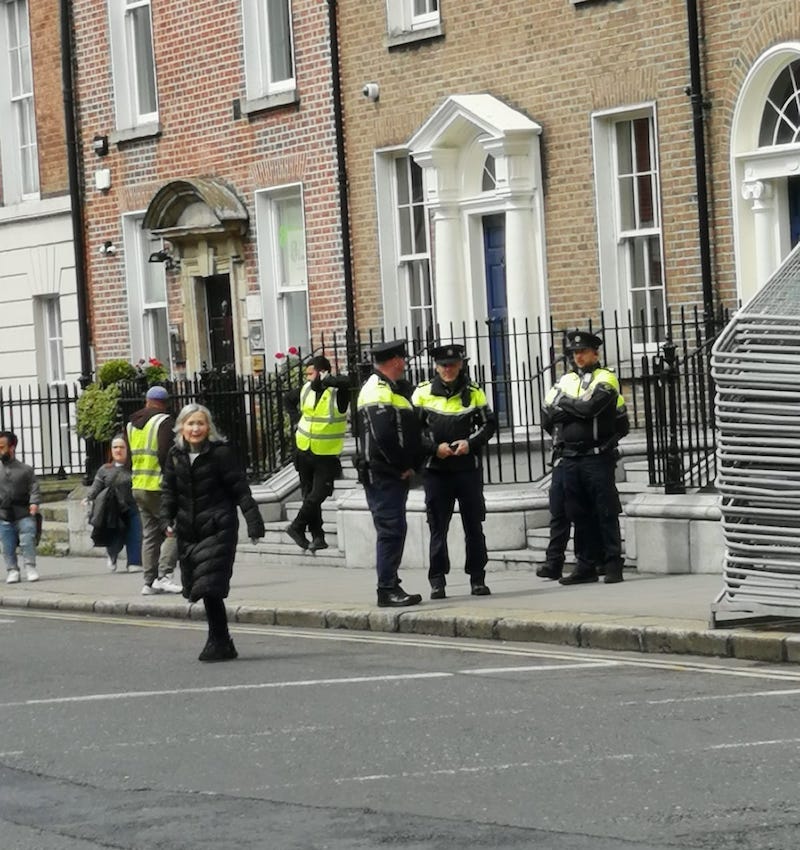
Some Gardaí in Molesworth Street, stacked crowd barriers not yet erected at that point and contractor staff awaiting instructions. (Photo: Rebel Breeze)
The anti-zionists organised their event at a day or two’s notice and according to some sources the IPSC4 had called on its branches not to counter protest the Zionist event but around a hundred Palestinian supporters attended, mainly Irish but also with Palestinians and a sprinkling of others.
In their prior publicity the Zionists trotted out their usual claims that Palestinian solidarity is based on anti-Semitism and that Jews are being victimised,5 ignoring the fact that zionism does not equal judaism and that in fact a substantial number of Jews have opposed zionism.6
The population of Ireland went from being largely supportive of ‘Israel’ in 1948 to being mostly pro-Palestinian from the 1970s onwards because of their observation of the genocidal and ethnic cleansing actions of the Israeli state.
Placard displayed among the Palestine supporters (Photo: Rebel Breeze)
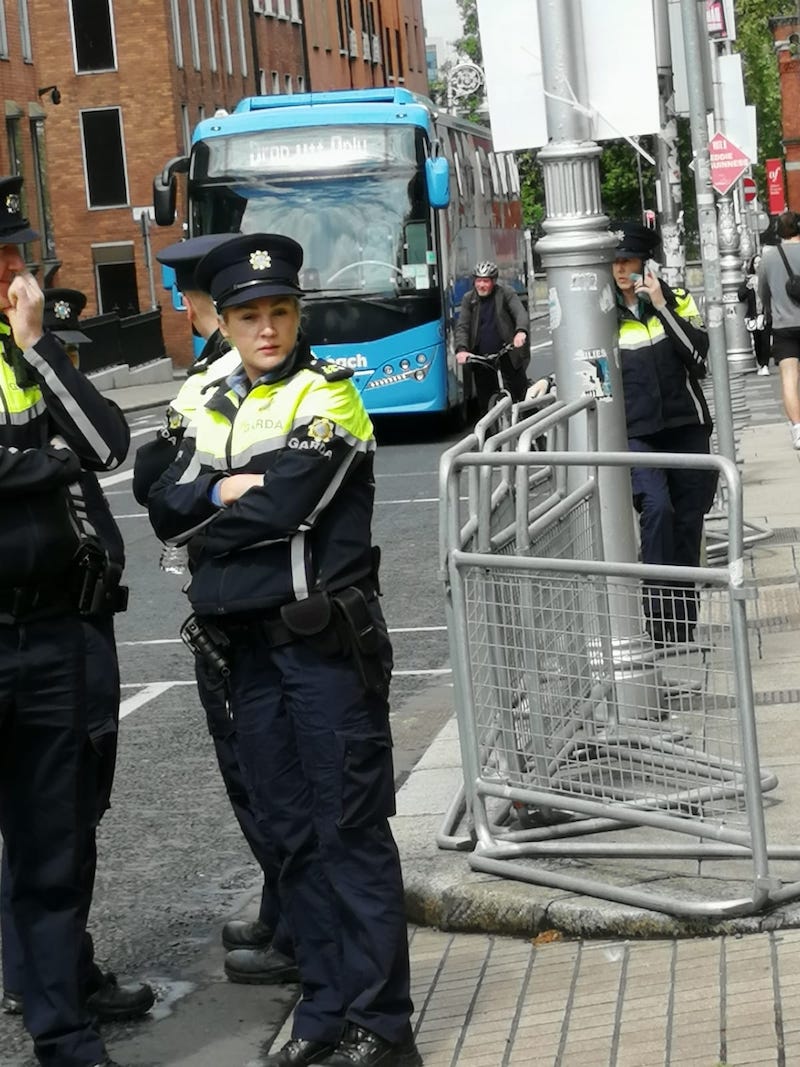
There was a fairly high Garda presence at the events and after some delay crowd barriers were erected across the east end of Molesworth Street with a second line of barriers a little further west beyond which the Zionists were setting up a stage.
The anti-Zionists in front of Leinster House awaited the arrival of the pro-Israel march which when it got going could be seen passing the Stephens Green end of Kildare Street, eventually coming down Dawson Street and turning into Molesworth Street.
View in distance of the zionist rally location before the arrival of their march from Stephens Green (Photo: Rebel Breeze)
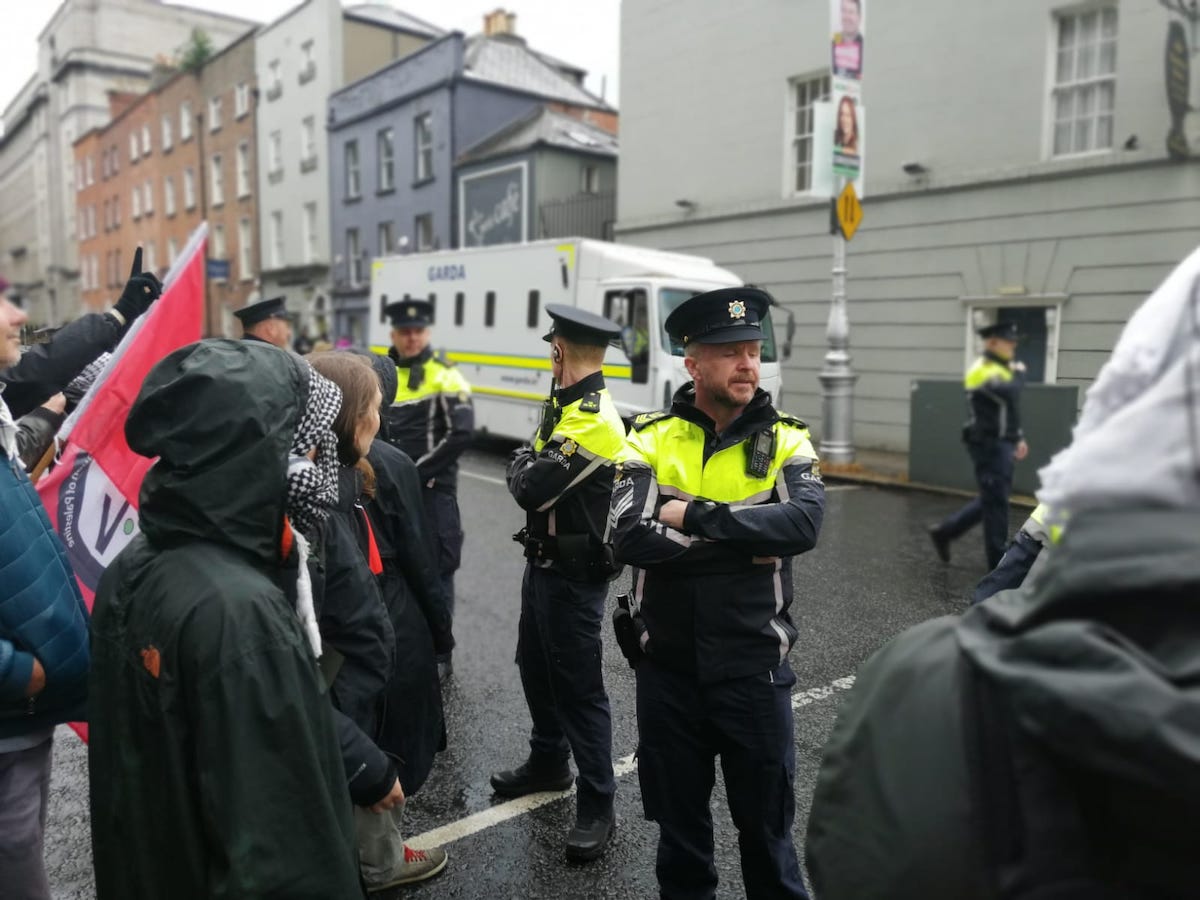
As they arrived the Palestinian solidarity people attempted to move across the road but the Gardaí pushed back, individual Gardaí at times viciously shoving and being resisted; here and there an arrest seemed threatened but was evaded by solidarity action around the targeted person.
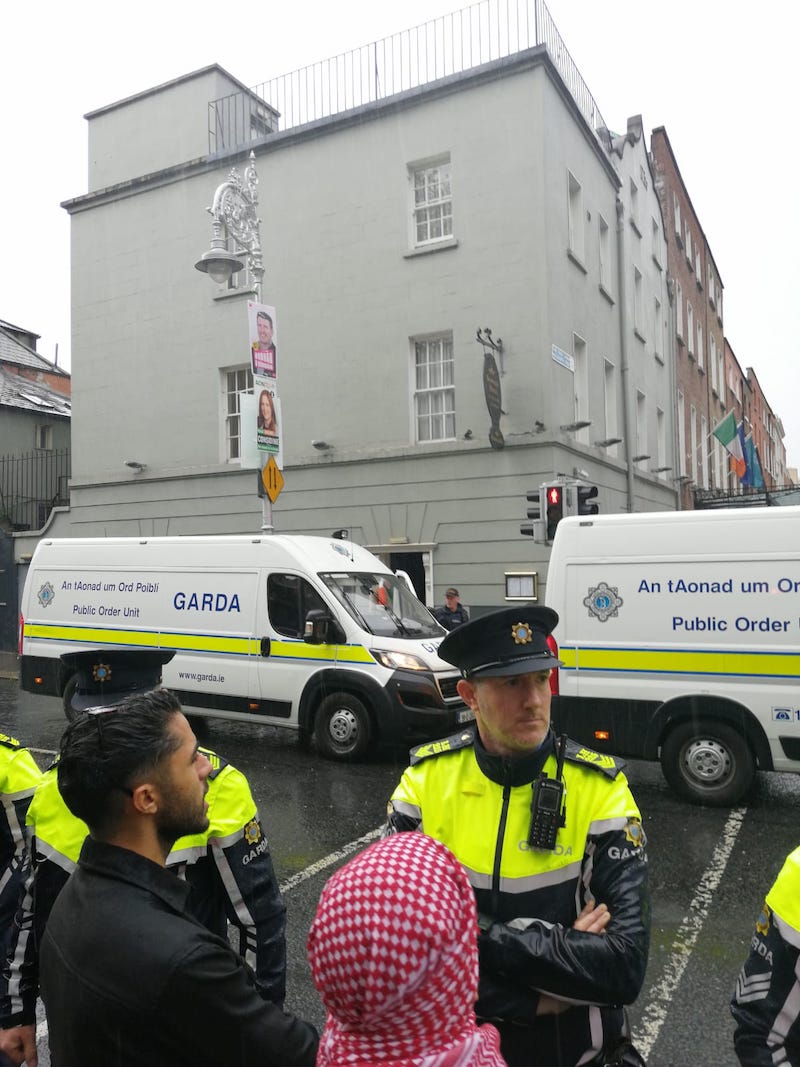
With the Palestinian supporters pushed to a couple of feet in front of the pedestrian pavement of Leinster House, the Gardaí stopped and by then two vans of the Public Order Unit had arrived and were deployed but some time later stood down, got in their vans and were driven off.
(Photo: Rebel Breeze)View northward in Kildare Street outside Leinster House on Sunday (Photo: Rebel Breeze)View southward in Kildare Street outside Leinster House on Sunday (Photo: Rebel Breeze)The arrival of a Garda prisoner transport van in Kildare Street outside Leinster House on Sunday raised tensions among some of the anti-zionist demonstrators (Photo: Rebel Breeze)
There could have been some confused impulses among the Gardaí given the public symbolic positions of the Government in recognition of the Palestinian state and the sharp and public diplomatic language flying between the Irish and Israeli states.
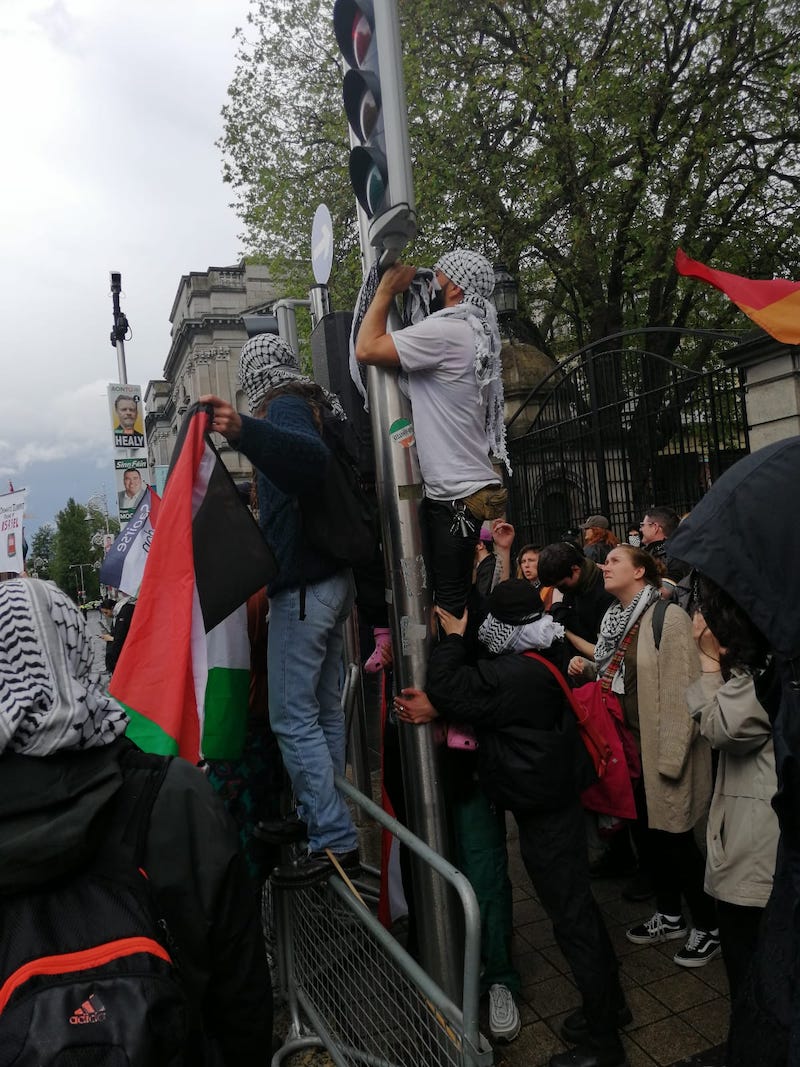
Two Garda vans were parked in front of the entrance to Molesworth St, partially blocking the views of the zionists and their opponents. The latter however stood with banners and flags on top of barriers and an amplifier was also strapped to a pole to better carry the message to the Zionists.
Palestinian supporters attaching an amplifier speaker to a pole outside Leinster House, directed at the Zionist rally in Molesworth Street (Photo: Rebel Breeze)
Despite the IIA having recommended its supporters to bring Israeli and Irish flags, only one Tricolour could be seen among their blue-and-white Israeli flags. One placard depicted the whole of Ireland covered with a menora, the traditional Jewish multi-candlestick.
Some of the Zionists’ placards repeated the debunked accusations of programmed mass rapes by the Palestinian resistance on October 7th last year, for which no evidence whatsoever or known victim exists despite Israeli state propaganda parroted by some of its western media supporters.
Zionist marchers arrive at their rally point in Molesworth Street, with two sets of barriers placed between them and the Palestine supporters (Photo: Rebel Breeze)
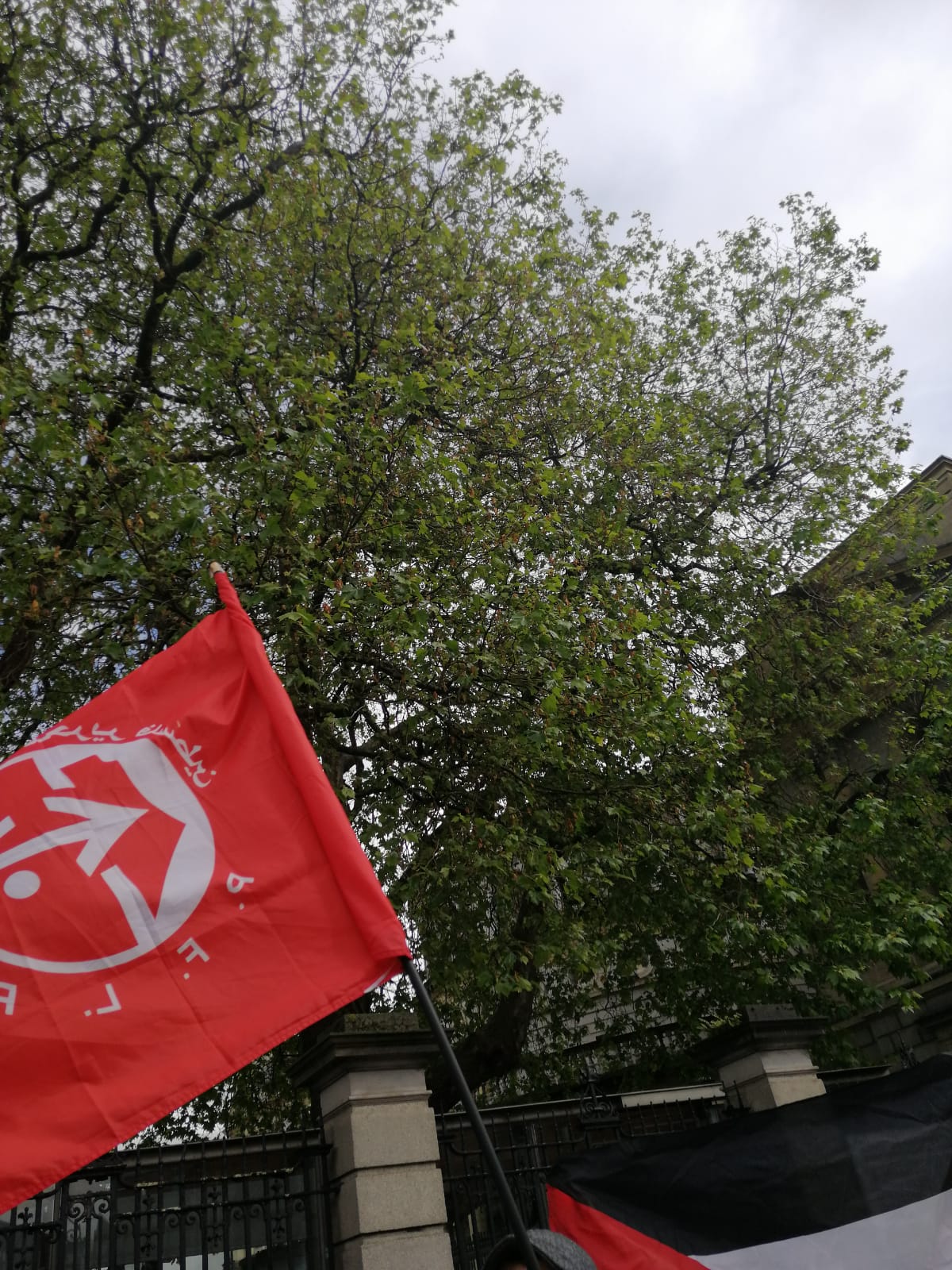
Among the Palestinian supporters the Palestine national flag was very much in evidence, also a couple of the PFLP7 and one in the colours of the anti-fascist Popular Front Government of 1930s Spain bearing the words “Connolly Column”, honouring the Irish who fought fascism there.
Here too there was only one Tricolour to be seen.
Flag of the PFLP seen against the trees (Photo: Rebel Breeze)
There were intermittent rain showers during the events, often persistent and somewhat heavy, streams running northwards along the road and pavement edge down Kildare Street but the demonstrators remained without shelter, many also without specific rain gear or umbrellas.
Women (mostly) speaking through amplification led the slogans that have become common on Palestine solidarity demonstrations in English, Irish and Arabic but with a few additions, including “Zionist scum – Off our streets!” Also “West-Brit Blueshirt scum – Off our streets!”
View of the rain’s ‘river’ running down between the Leinster House pedestrian pavement and the road. (Photo: Rebel Breeze)View of small section of Palestinian supporters’ line with police line in front and the rainwater swirling around their feet. The Zionist rally is taking place behind the police line and beyond two lines of metal crowd barriers. (Photo: Rebel Breeze)
At intervals Arabic resistance music was played and sections of the Palestine solidarity crowd began to sway or even dance, including one young woman from Gaza who seemed accomplished in traditional dance. Irish patriotic songs were played for a period also.
Among the Palestinian supporters the Zionist chants or speakers could not be heard, nor can one know how much of the Palestinian solidarity chants could be heard by the Zionists. Eventually the Zionists left to jeers from their opposition, a Garda helicopter watching over them in the sky.
The Gardaí left and the Palestinian supporters did too, mostly leaving together in a group.
(Photo: Rebel Breeze)
AFTERMATH – FIGHT IN PARNELL/ O’CONNELL STREET
That was not all however for perhaps an hour later a fight developed between what seemed to be a far-Right man against a group of Palestinian supporters in Parnell Street. According to some people, the man had approached them aggressively about their Palestine solidarity activism.
Disliking their response, he punched one of the Palestine solidarity demonstrators in the face and when the women in the group protested, struck a couple of them too. Another male in the group then launched at the Far-Right man and gave him a bloody face.
When observed by this reporter, the man was covered in tattoos, stripped to the waist and shouting about being “for the Irish” (which for some reason the Far-Right assume Palestinian supporters are not — though many have a far better track record in that respect than do Far-Right activists).
In Palestine that same day the zionist air force bombed a tent town of displaced people in northwest Gaza, which they had declared a safe area, murdering over 30 and injuring many more, some of whom will die. They also bombed 10 UNRWA displacement centres.
2The zionists had a number of terrorist organisation pushing the formation of the Israel State: Haganah, Irgun, Palmach … Haganah became the core of the Israeli armed forces.
University students in the USA protesting, setting up encampments, occupying university buildings; threats from administrators; police invasions, assaults on students, resistance, arrests …
Step forward, Youth and shake the towers
Those ivory towers stand on sweat and blood
Make those lies fall in showers —
Become the earthquake and the rushing flood.
Step forward youth
For solidarity and truth!
Academic freedom and investigation
and principles too of democracy
Have taken now academic vacation
Revealing true base in hypocrisy.
Step forward youth
For solidarity and truth!
Look down below your feet
Reach out to workplace and street
Stretch out solidarity’s hand
to the struggling in another land.
Step forward youth
For solidarity and truth!
only thus can you also be
in a better world, at peace and free.
(Dublin, May 2023)
It seems as though we’ve been here before, a sense of dejá vu … Ah, yes! During the Vietnam War (1955-1975). University students in the US were in conflict with the authorities about lifestyle, content and style of the curriculum, racism, sexism, sexuality and .. yes, the US’s war in Indochina.
Students lost their study and work plans, got hit by truncheons, were sickened by teargas and some were shot dead, as in Kent State University, Ohio by the National Guard and in Jackson, Mississippi 11 days later.1
Which is why the suggestion of House Speaker Mike Johnson to send that same body in against the students last week was a vicious act of intimidation.
In the 1960s Trinity College Dublin, the academic bastion of the British-unionist Ascendancy, was a hotbed of protest and even revolutionary organisation along many fronts – including gay rights, contraception rights, Irish socialism and national liberation.2
The Ulster University in Belfast, in the British Six-County colony saw protests for Catholic civil equality, a struggle that faced armed repression and developed into a responding armed struggle of three decades.
In the USA those years coincided too with marches for black civil rights and also the rise of militant revolutionary groups such as the Black Panthers, the Young Lords, Weathermen, SLA and later the American Indian Movement.
Women’s liberation and Gay & Lesbian liberation movements3 also moved more to the fore.
The responses of the US State to many of those movements were even more vicious than they had been against the students, with trials, jailings,4 shootings5 and downright unofficial executions.6 As the campus protests now draw in wider communities, are we heading for something similar?
In the USA, the authorities seem terrified of that conjunction — or how else can we understand the violence of their reaction which has even horrified some university senates?
DIFFERENCES BETWEEN THEN AND NOW
When the students in the USA fought the institutional authorities, it was partly in solidarity with the people of Vietnam (and later of Laos and Cambodia). Yes, but many also feared being sent to the Vietnamese War meat grinder and being airlifted home from there in body bags.
The draft had been introduced in 19647 and though middle-class students had a better chance of avoiding conscription, they were far from immune.8 Being an officer might make one safer from the enemy than being a grunt but not from the grunts themselves as “fragging” incidents soared.9
The students now protesting in US Universities are doing so in solidarity with Palestinians, in horror at their state’s support of Israeli genocide. They may have other issues with their universities’ management and society at large but in general we can rule out the motive of self-preservation.
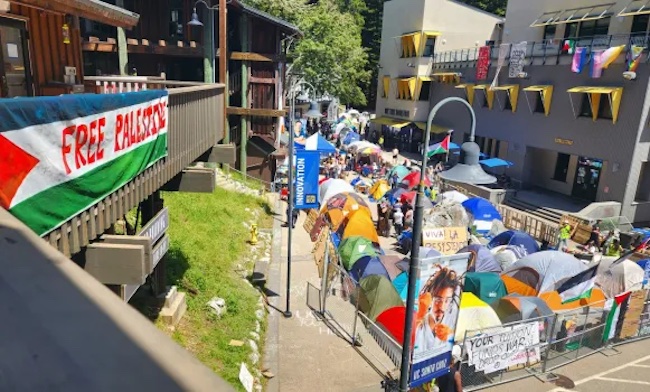
Encampment Palestine solidarity Vera Cruz University California Thursday (Photo cred: Aric Sleeper Santa Cruz Sentinel)
The drug culture was very much seen as part of the protest movement back then, though opposed by some such as Panthers and viewed with suspicion by other revolutionaries. Pacifist trends were strong and Timothy Leary’s “turn on, tune in and drop out” mantra attracted many.
Much of the revolutionary potential of the movement was lost under that influence, nowhere near as powerful now and revolutionaries who know their history will be aware that such arch-opponents of the system as Leary became an FBI informant to get out of jail.10
Many may argue as to degree but the power of patriarchy and oppression of LBG sexuality, though certainly present, are nowhere near as strong today in the “western world” as they were in the 1960s.
The power of the Catholic Church hierarchy in Irish society has been greatly weakened by struggles, Church scandals and society’s evolution. Discrimination against Catholics in the Six Counties is also less than it was in the previous era.
The armed struggle is not currently being waged.
However, Ireland remains divided between a 26-County neo-colony and a Six-County colonial statelet. The economies are hugely penetrated by foreign multinationals, the health services tottering and a huge housing crisis due to turning housing over to big landlords and property speculators.
The main parties of the ruling classes have been exposed to such degree that they no longer act in the charade of opposition: Sinn Féin and the DUP share political administration of the British colony while Fine Gael and Fianna Fáil share it for the neo-colony, prepared to admit SF there too.
Fascists gather some of the disenchanted, marginalised and disinherited to try to mould them into a fascist movement against migrants and refugees, against LGBT rights, against socialism. The State facilitates that development while it grows more repressive in both the administrations.
The ruling class will be aware of the potential of a rise in student protest coinciding with a feeling of Palestine solidarity and frustration at Irish state complicity very widely spread throughout Ireland. But then the Irish state is not imperialist, it’s just complicit in imperialism.
UNIVERSITY PROTESTS NOW
Students in universities across the USA have staged occupations or built encampments in explicit solidarity with Palestine against their own government and against the collusion of their academic institutions with zionist genocide of Palestinians and the destruction of every university in Gaza.
The response of the academic authorities has been denunciation, threat, eviction and false characterisation of the high motives of the students as “anti-semitism”.11
Municipal, county and state police forces have responded violently to peaceful protest, including bodily assault, pepper spray, tear gas, rubber bullets and arrests. The Government has drafted a change of the legal meaning of anti-semitism to include opposition to the Israeli zionist State.12
Rutgers students tents 29 April 2024 (Photo cred: Sophie Nieto-Munoz/ New Jersey Monitor)
The violence of the authorities has not been confined to the protesting youth but has been extended to staff who stood with them. During the week Dr. Steve Tamari, professor at the University of Southern Illinois got nine ribs fractured by cops – for filming what was going on.
Chair of Jewish Studies at Dartmouth University, New Hampshire, Annelise Orleck (senior citizen) was violently arrested and banned from campus for six months.
In some cases not only have the protesters resisted valiantly but actually drove the cops into retreat and in Portland, Oregon, police cars were set alight. Also a fascist who drove at protestors and pepper-sprayed them was, according to reports, identified and his car destroyed.
On the other hand, Zionists (and suspected fascists) have mobilised against the students in many universities, with the tired old propaganda of “anti-semitism” and in one case attacked an encampment with sticks and fireworks, also playing a “crying child” Israeli drone recording.13
Irish Republicans and other anti-fascists will not be surprised to learn that a) the police disappeared shortly before the violent attack and b) none of the attackers were arrested when the cops returned.
More than 2,100 people have been arrested at US campuses since April 1814 and students have been barred from their own campuses which, for many, means also their own accommodation.
Police Attack Palestine solidarity UCLA campus Thursday 2 May 2024 LA (Photo cred: Ethan Swope/ AP)
The university protests have spread beyond the USA and have broken out in Canada (McGill), Australia (Brisbane and Sydney) and even Humbold in Germany, main Israel arms supplying country after the US, where state repression of Palestine solidarity has been particularly heavy.15
In France, where there has also been much repression of Palestinian solidarity activity, there have been occupations at the Sorbonne and Sciences Po in Paris) and in England, Newcastle and London, while an encampment was set up in Edinburgh in front of the Scottish Parliament.16
“SHAMEFUL SILENCE”
In Ireland, the universities have been relatively quiet until now but the Trinity College Dublin administration fined their Students Union €214k for a one-day Palestine solidarity picket outside the building housing the Book of Kells exhibition, citing loss of visitor revenue in justification.
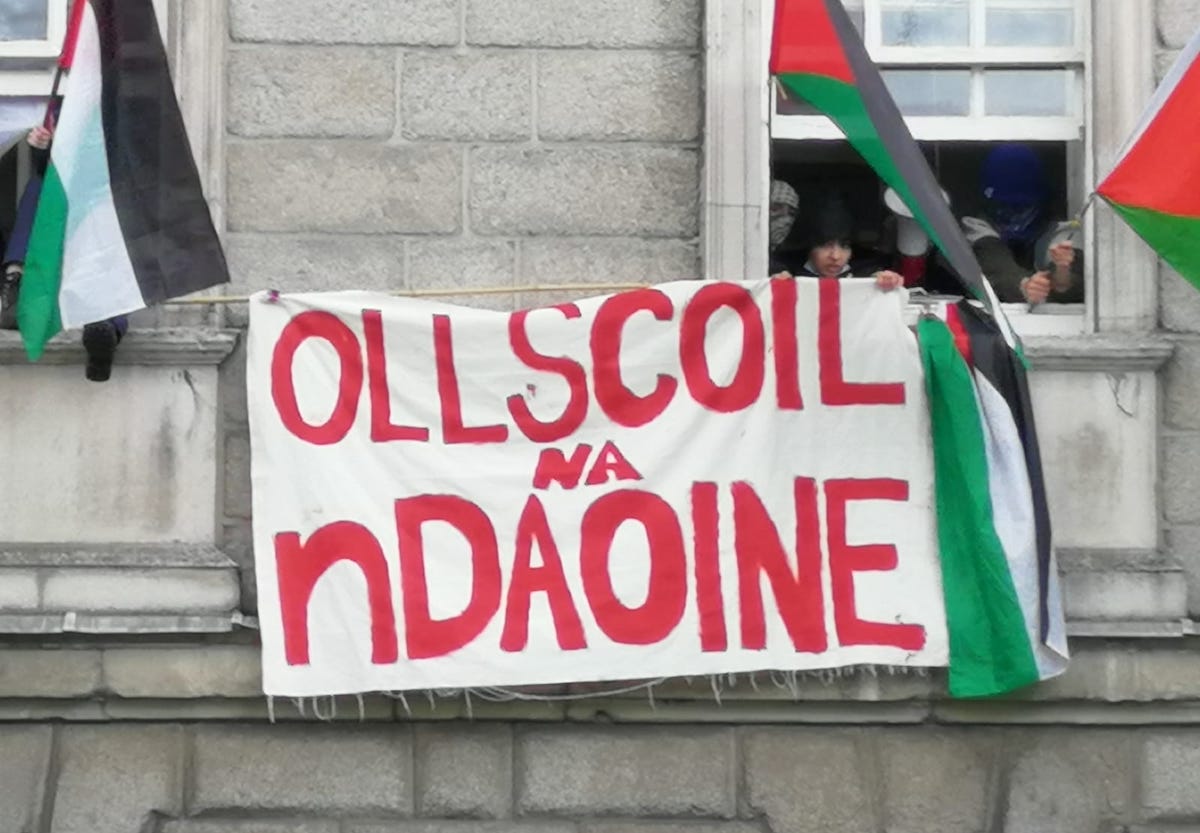
“The People’s University” banner hanging from windows in Trinity College Saturday (Photo: D.Breatnach)
But repression leads to resistance; now there is a Palestine solidarity encampment on the green in front of the Kells exhibition. People are mobilising to support the student resistance in Trinity and today saw a march there from the Spire with the administration locking the gates shut.
“We plan on staying here indefinitely, our message is there is no ‘business as usual’ during a genocide,” outgoing students’ union president Laszlo Molnarfi said.17
(Photo: Social Rights Ireland)
“When our academic institution, Trinity College Dublin, has ties to Israeli companies, entities and universities that are complicit in the war industry, we must speak up. That is why we are doing this.
“And we must speak up in this disruptive, powerful way. Because when we tried to engage with the authorities, with petitions and letters and meetings, we were met with shameful silence.”18
Inside Trinity College grounds Friday night/ Saturday morning (Photo: Social Rights Ireland)
In the wider ‘global South’, Palestine solidarity protests have been seen in India at Jawaharlal Nehru University in New Delhi against a visit from the US Ambassador to the country, Eric Garcett, which had to be cancelled.
More dangerous by far to the US ruling class and Israeli-colluding King of Lebanon, so geographically close to Palestine and with a strong Hizbollah guerrilla presence, are the student demonstrations at the university of Beirut.
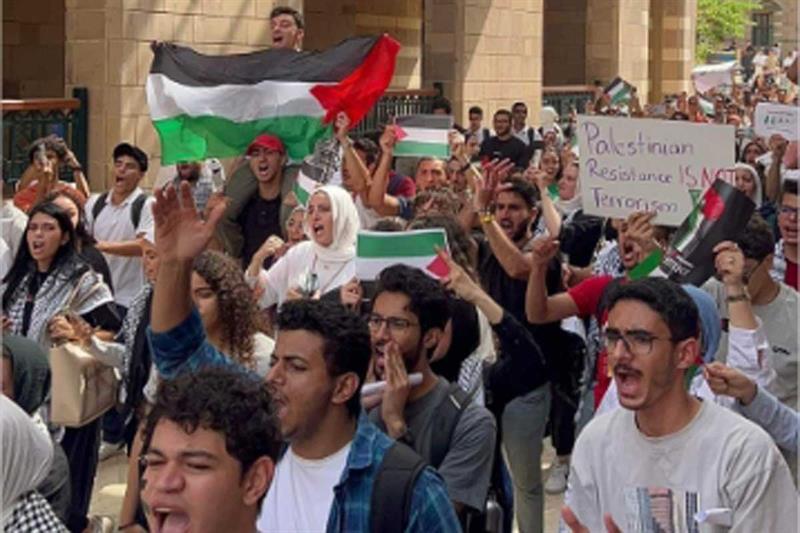
Students at American University in Cairo (AUC) Demonstrating Monday in Solidarity Palestinians (Photo source: X Twitter)
Whether overall these actions of students, who comprise a large and influential section of youth, will significantly deepen, widen and energise the growing Palestine solidarity movement, and simultaneously the wider anti-imperialist movement, remains to be seen.
End.
“Victory to the Palestinian Resistance” banner on Trinity College railings Saturday (Photo: D.Breatnach)
FOOTNOTES
14th May 1970, killed by the Ohio Kent National Guard during a protest against the Vietnam War. The Jackson killings occurred 11 days later on Friday, May 15, 1970, at Jackson State College (now Jackson State University) in Jackson, Mississippi. On May 14, 1970, city and state police confronted a group of students outside a campus dormitory. Shortly after midnight, the police opened fire, killing two students and injuring twelve.
2Ironically, precisely because it was free of the major socially controlling agency in Ireland at the time, the Catholic Church hierarchy.
3See the Stonewall Riots of 1969 in the US against homophobic police harassment.
4Including many frame-ups, some of which were only exposed decades later. Leonard Peltier was jailed on dubious evidence in 1977 which had already collapsed against a co-accused but is still in jail, 79 years of age with diabetes and other health problems.
11Thereby also devaluing the meaning of that particular form of racism which was a basic ideological aspect of Nazism and Fascism and continues to be a strong trend in European fascism today.
13One of the latest horrors from the Israeli Zionist cabinet, killer drones playing sounds of a crying baby or a woman needing help in order to bring would-be helpers out where they can then be shot dead, being played in this case mockingly.
Although the 1916 Rising had been planned to take place on Easter Sunday, April 23rd, it was publicly cancelled by the titular head of the Irish Volunteers, Eoin Mac Néill and it went ahead instead on the 24th, the following day.
The 1916 Rising was unsuccessful but is considered the birth event of the Irish Republic and for some therefore Republic Day is on April 24th, the first day of that Rising and when Patrick Pearse, with James Connolly by his side, read out that remarkable Proclamation of Independence.
Banner of the Republic Day event organisers in Arbour Hill (Photo: R.Breeze)
Tom Stokes, an independent Irish Republican campaigned for some years for April 24th to be recognised as Ireland’s national day, replacing St. Patrick’s Day which is religious festival and now an excuse for excessive drinking and pseudo-Irishness.
Replacing too Easter Sunday and Monday, these being religious dates that move around on the calendar, never being on the same dates in any consecutive year.
Tom Stokes died in December 2018 and a small group of disparate independent Republicans have striven to keep his campaign going.
Stokes always held his Republic Day event at noon on the 24th in front of the GPO, the location of the first public reading of the Proclamation (as did also the Save Moore Street From Demolition one year) but this group carrying on his campaign have been holding their event in Arbour Hill.
This is the location of an old British prison containing the location of a mass grave into which had been put the bodies of 14 of those executed by British firing squads after the surrender of the leadership and majority of the fighters, their bodies covered in quicklime and earth.
The mass grave of 14 of the sixteen executed in 1916, with their names in Irish one side and in English on the other. (Photo: R.Breeze)
CEREMONY IN ‘ARBOUR HILL’
The name Arbour Hill is a corruption of the original Irish name for the location which meant something distinct from “arbour”: Cnoc (hill) an (of the) Arbhair (cereal crop). Today it is a quiet spot tastefully laid out, the names of the dead etched around the mass grave-site in both languages.
A little distance away is a tall flagpole bearing the Irish Tricolour in front of a high wall on which are chiselled the words of the Proclamation in their original English and also in Irish translation.
Dramatist Frank Allen welcomed those present, in particular members of Limerick Men’s Shed who had travelled a distance to be present at the event. He also referred to descendants who were present of martyrs of the struggle Cathal Brugha, Thomas McDonagh and Harry Boland.
Frank Allen as MC for the event (Photo: R.Breeze)
Allen also reviewed the history of Tom Stokes’ campaign for the marking of the date as Republic Day and a national holiday, outlining also the man’s background and his family connections to the struggle for Irish independence, along with his support for Palestine..
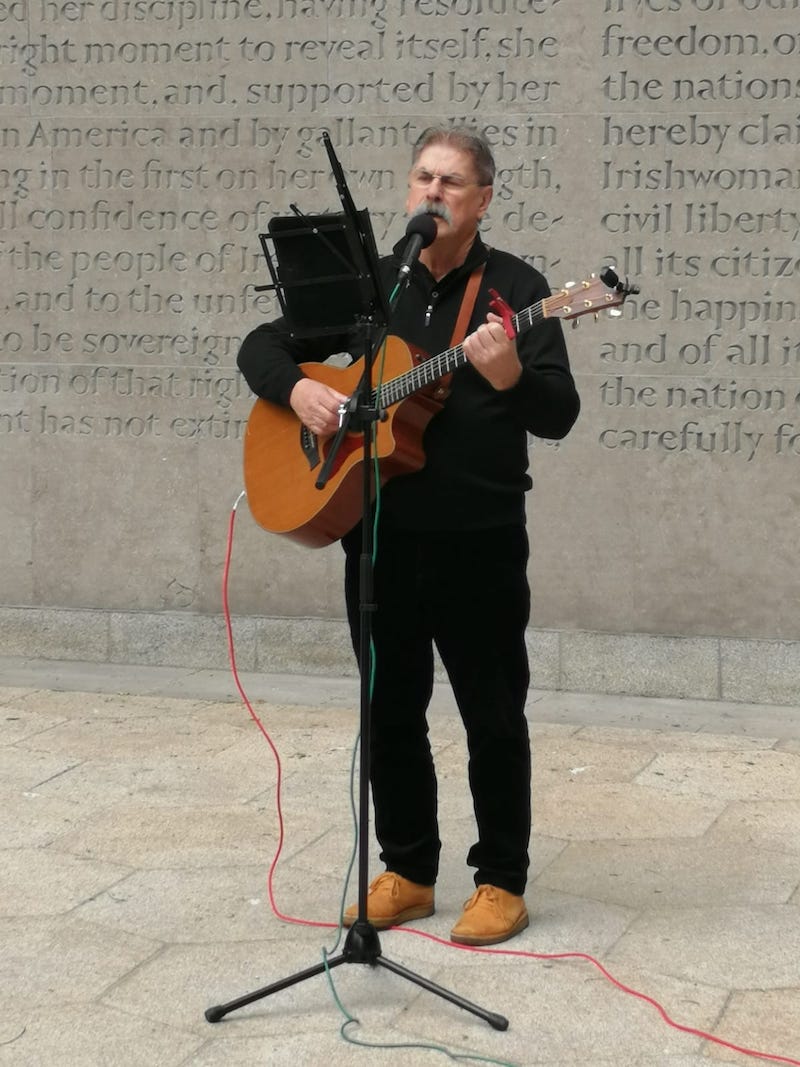
First to be called to perform was Pat Waters, professional musician and a regular contributor to the 1916 Performing Arts Club who accompanied himself singing his own composition Where Is Our Republic Day? composed at request from Tom Stokes.
Pat Waters performing his composition Where Is Our Republic? (Photo: R.Breeze)
Allen called on Glen Gannon also of the 1916 PAC to read the Proclamation and then on Shane Stokes to read one of his father’s articles which clearly outlined the man’s socialist Republican principles and their distance from the reality of the current national society and polity.
In succession Fergus Russell of the Goleen Singers organising committee was called to sing The Foggy Dew, a song about the 1916 Rising which he performs every year and Shannon Pritzel to read Patrick Pearse’s famous oration on the grave of Ó Donnabháin Rosa.
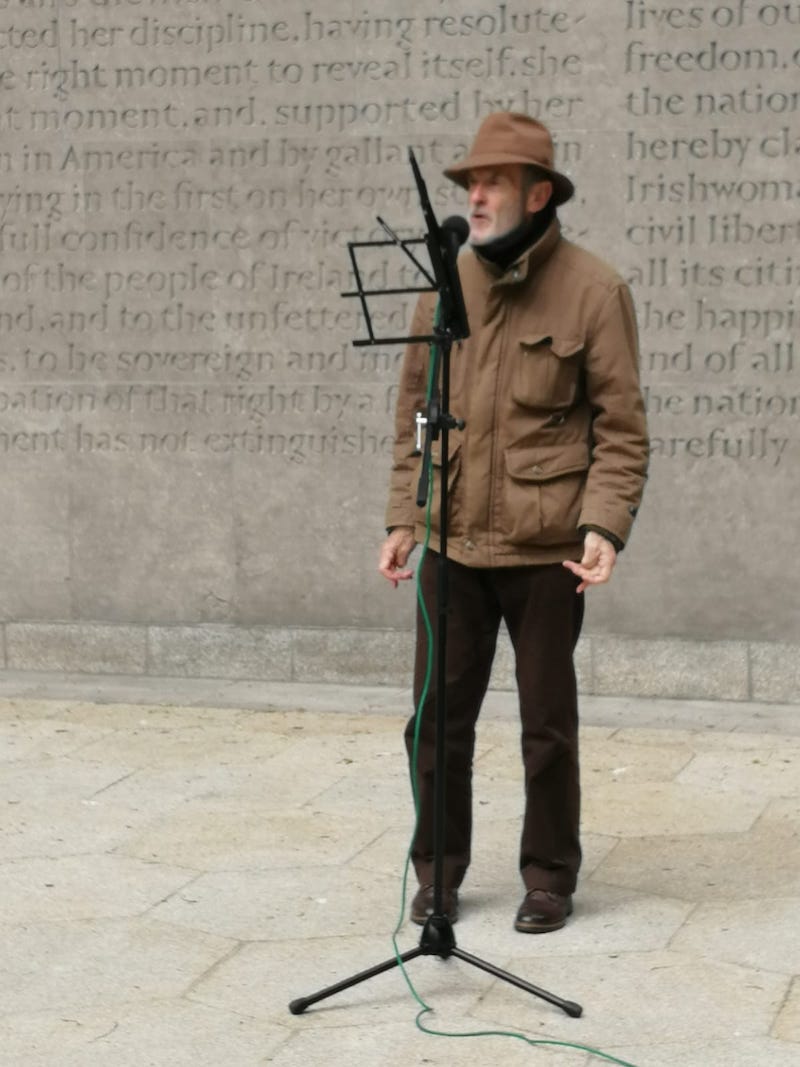
Aidan recited the eulogy poem to the 1916 fighters composed by an ex-British Army officer living in Ireland. Anne Waters of the 1916 PAC was asked to present red roses to a number of those present to lay on the named dead on the stonework surrounding the mass gravesite.
Larry Yorell (best known as a long-time activist of the National Graves Association)1, made an appeal for support for an initiative to build a monument to Patrick Pearse.
Aidan reciting a eulogy poem for the 1916 Rising fighters (Photo: R.Breeze)
Frank Allen declared total opposition to a trend seeking to eliminate Amhrán na bhFiann as the “National Anthem” for being thought too war-like.
The Anti-Imperialist Action group called a picket against imperialism to take place in the evening of the 24th outside the General Post Office, which had been the HQ of the Rising forces in 1916.
(Photo: R.Breeze)
While a number distributed leaflets, others lined out carrying a number of national flags of Palestine and one of the PFLP, in addition to a large Irish Tricolour, smaller Starry Plough and flags of the New Philippines Army.
Along with some of the standard Palestine solidarity slogans heard everywhere in Ireland on demonstrations, they called out “From Ireland to Palestine – Occupation is a crime!”; “There is only one solution – Intifada revolution!” and “Saoirse – don Phalaistín!”
Flag of the New People’s Army of the Phillippines displayed alongside other flags of anti-imperialist struggle. (Photo: R.Breeze)
A number of passers-by congratulated the picketers while some stopped to discuss. A representative of the organisers gave a short address regarding the background to Republic Day and the current situation in Ireland, commenting also on the zionist genocide in Palestine.
The event concluded with a youth reading the 1916 Proclamation out loud, followed by an acapella singer performing The Larkin Ballad which relates a compressed history of the 1913 Dublin Lockout but concludes with verses about the 1916 Rising.
A youth reads the text of the Proclamation of Independence near where Patrick Pearse read it out on 24th April 1916 (Photo: R.Breeze)
End.
Southward view of part of the group marking Republic Day with a statement against imperialism today. (Photo: R.Breeze)
FOOTNOTES
1The main organisation throughout Ireland maintaining and renovating and erecting monuments, graves, plaques in memory of Irish patriot men and women and battle sites; the NGA remains independent of political parties and declines to be in receipt of funding from government or political party.
2Kearney wrote the lyrics in 1907 in cooperation with musical composer Patrick Heeney. The music for the chorus was adopted by the Irish Free State as its national anthem. The lyrics were translated into Irish in the 1930s and unusually it is the Irish version that one most often hears, first verse and chorus. The opening sentence of the chorus “Sinne fianna fáil” (‘we are soldiers of destiny’) have been changed by some to “Sinne laochra fáil” (‘warriors of destiny) in order to avoid reference to a specific political party that called itself Fianna Fáil.
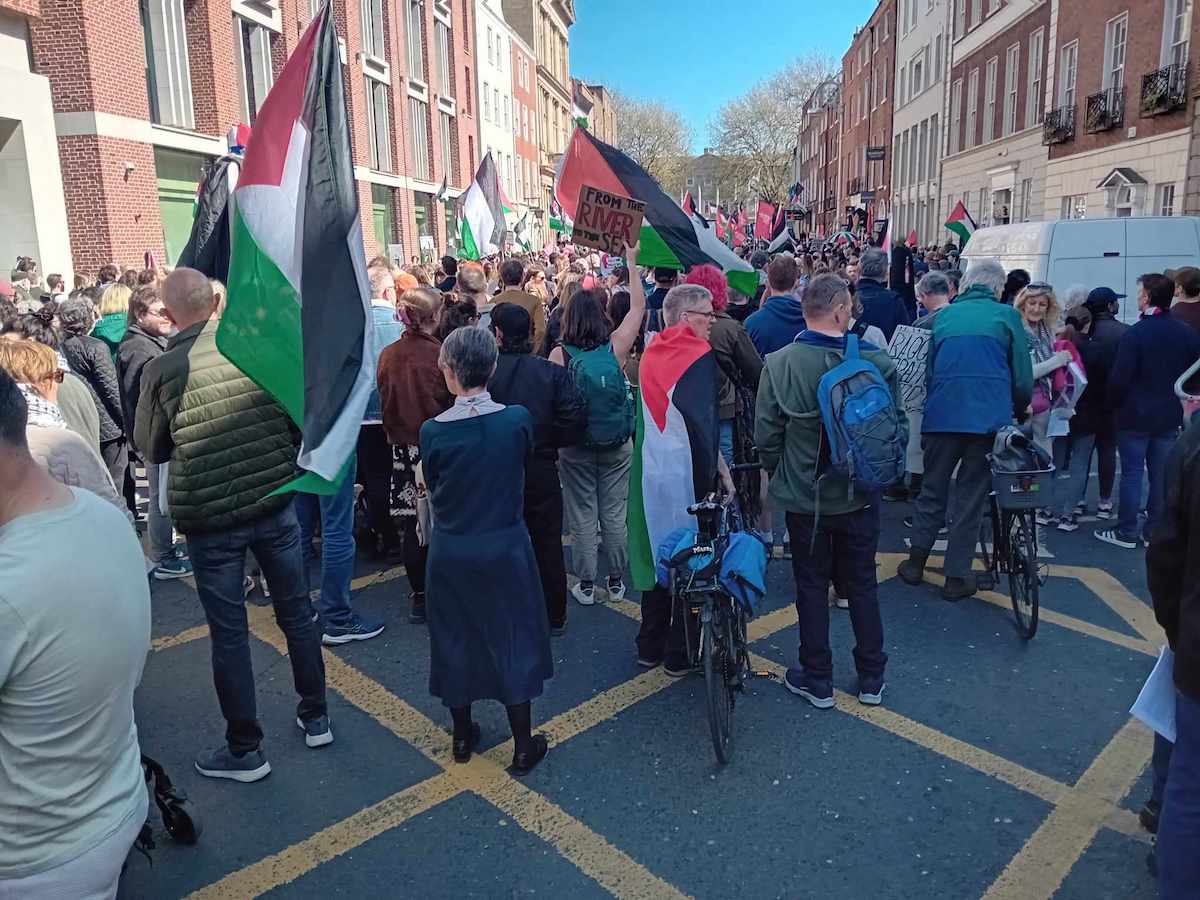
A huge Palestine solidarity march proceeded from the north Dublin city centre on Saturday 20th, passing down O’Connell Street, over the Bridge, around by Trinity College and on towards Leinster House, the parliament of the Irish State.
Detained by an earlier activity I hurried to join it, catching up with it near the Larkin Monument. From there I could see sections of the march across the river and another section wending around Trinity College in the distance, its leaders out of sight.
(Photo: D.Breatnach)
“Over a thousand”, reported our “newspaper of record”, the Irish Times. In other words, less than 2,000. Really?!
The march was organised by the Ireland Palestine Solidarity organisation, the main Irish nationwide Palestine solidarity organisation, sponsored by a multitude of organisations and was supported in marching by many organisations and individuals, the latter being the capacity or most participants.
The usual slogans could be heard as I hurried past marchers, such as “Free, Free – Palestine” and including the one that Suella Braverman tried to ban when she was a Minister in the UK Government: “From the river to the sea – Palestine will be free!”
I paused by the Thomas Moore monument waiting to meet up with friends in order to march with them. One group passed calling out that what is occurring in Palestine is “Not a conflict, not a war”. I understand them to mean it is genocide instead but I can’t agree with them.
It IS a conflict, the old one of the European colonial settler against the indigenous people, fought for centuries on all the continents of the world except in Antartica. And the zionist State IS waging a war, a genocidal war against the Palestinian people.
(Photo: D.Breatnach)
Another group went by with a chant leader calling out a list of categories of victims of the zionist genocide such as medical workers, journalists, ambulance crews, refugees etc, to which the group replied “Not a target”. Perhaps they meant “not a legitimate target” but targets they certainly are.
I was flying the Palestinian flag but also the Starry Plough, flag of the risen Irish working class in 1913 and 1916, the only one I saw on the march and which was how my friends found me. A woman I mistook for a visitor asked to take my photo, to which I agreed.
Near the rear of the march one could hear the usual call-and-response slogans drifting back towards us but people in our section marched silently or chatted with one another. Then a voice called out: “From the river to the sea!” and the reply was instantaneous: “PALESTINE WILL BE FREE!”
Chanting takes energy but also seems to supply it and from then our section joined in with gusto: “In our thousands, in our millions – We are all Palestinians!” “In our millions and our billions – We are all Palestinians!” “In our TRILLIONS and our billions – We are all Palestinians!”
“Netanyahu, what do you say? How many kids have you killed today?” “Joe Biden, what do you say? How many kids have you killed today?” “EU, you can’t hide – You’re supporting genocide!” “Irish Government, you can’t hide – You’re supporting genocide!”
“Saoirse – Don Phalaistín!” was the only slogan1 in Irish. There was no doubt about what people wanted for the Israeli Ambassador or the zionist Embassy, which was “Out, out, out!”
(Photo: D.Breatnach)
As we turned from Dawson into Molesworth Street, the rest of the march was packed ahead of us all the way up to the presumed police barriers at Kildare Street, across from the main gate of Leinster House. Here the IPSC stewards were urging us to move in still closer ahead.
What was the reason? Apparently the Gardaí wanted us past the intersections with South Frederick Street and with Molesworth Place. But for what purpose? Those were southward traffic only streets which should have been blocked anyway and Dawson Street was open in both directions.
(Photo: D.Breatnach)Molesworth Street from the Junction with Molesworth Place, already packed and with more arriving, yet we were expected to pack in closer and have barriers moved up against us! (Photo: D.Breatnach)
Then a private company began to erect barriers across the north-eastern section of Molesworth street which looked to me like kettling, a view which seemed born out as the barriers were moved once more further eastward with instructions to keep moving – with which I declined to cooperate.
This whole exercise seemed to me of dubious traffic easement validity and more about getting people used to obeying order and to being kettled by police if required by them. In the Irish state we do not have to gain police permission for a march or approval for its route.
There’s nothing fundamentally wrong with the IPSC leaders informing the police of their march routes for traffic easement. But our rights have to be protected and not easily surrendered, much less for no visible valid reason. It is not good for stewards to automatically comply with police wishes.
I have seen (and resisted) Garda attempts to push demonstrators from the front of the GPO into the pedestrian reservation in the middle of O’Connell Street, while they told people that “It’s what your organisers (IPSC) want.”
Declining to be kettled.
The police of a state are not neutral forces for the public good and have drawn and used their batons through the decades against people protesting partition of their nation, imperialist war, water privatisation, growth of fascist and racist attacks, against imperialism and colonialism …
Not to mention torturing and framing people to have them jailed.
CHRISTY MOORE AND REPRESSION
In the distance, we could hear that Ireland’s chief living balladeer, Christy Moore, had got on stage and was speaking, then singing, though I could make out only snatches of the lyrics. Moore gained fame both as a member of Moving Hearts band and Planxty but also as a solo performer.
Moore had been litigated against for his song about the young 48 Stardust Fire victims but was vindicated during the week by a long-delayed second inquest into the deaths.2 On the other hand he’s received no apology for the police raid on his H-Block album launch back in 1972.3
Pro-Palestinian demonstrators are facing repression throughout the western world, in some places much worse than others. The German State is behaving like Nazis in banning demonstrations and raiding a conference, apparently in twisted expiation of its sins under the Adolf Hitler regime.
This impacted also on an Irish language group in Berlin during the week while they attempted to have a small gathering speaking and singing in Irish in a park in front of the German Parliament. The police told them that only German and English languages were permitted in that area.4
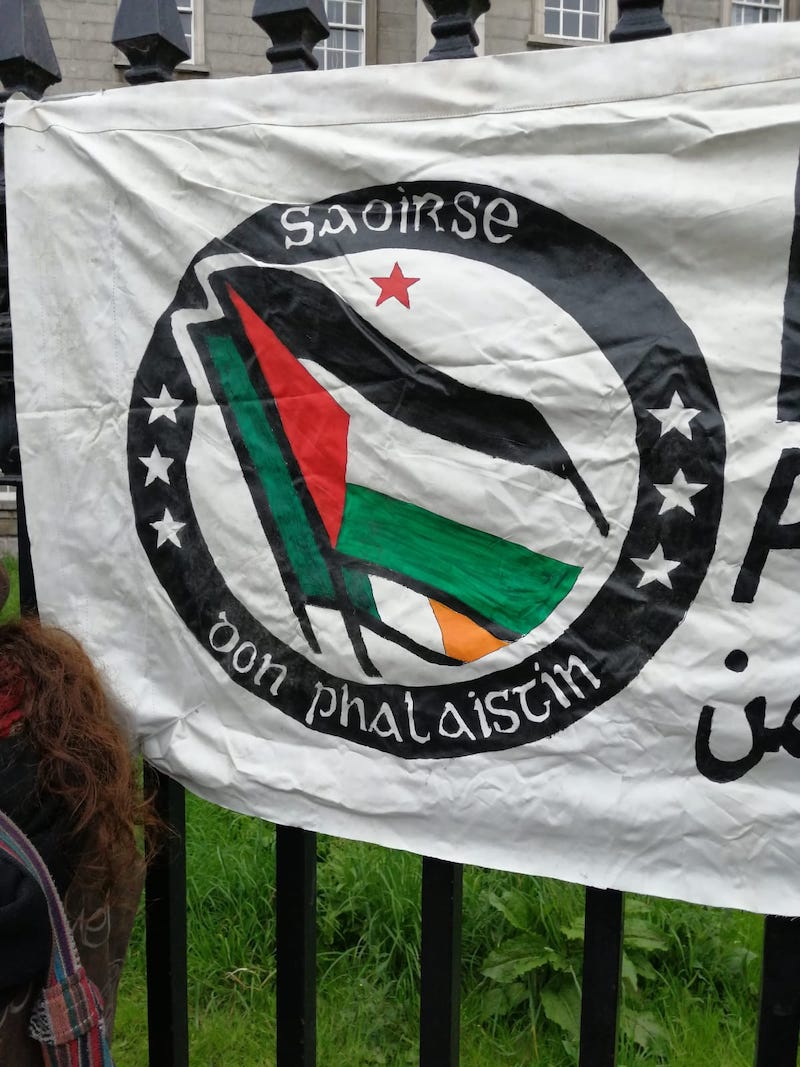
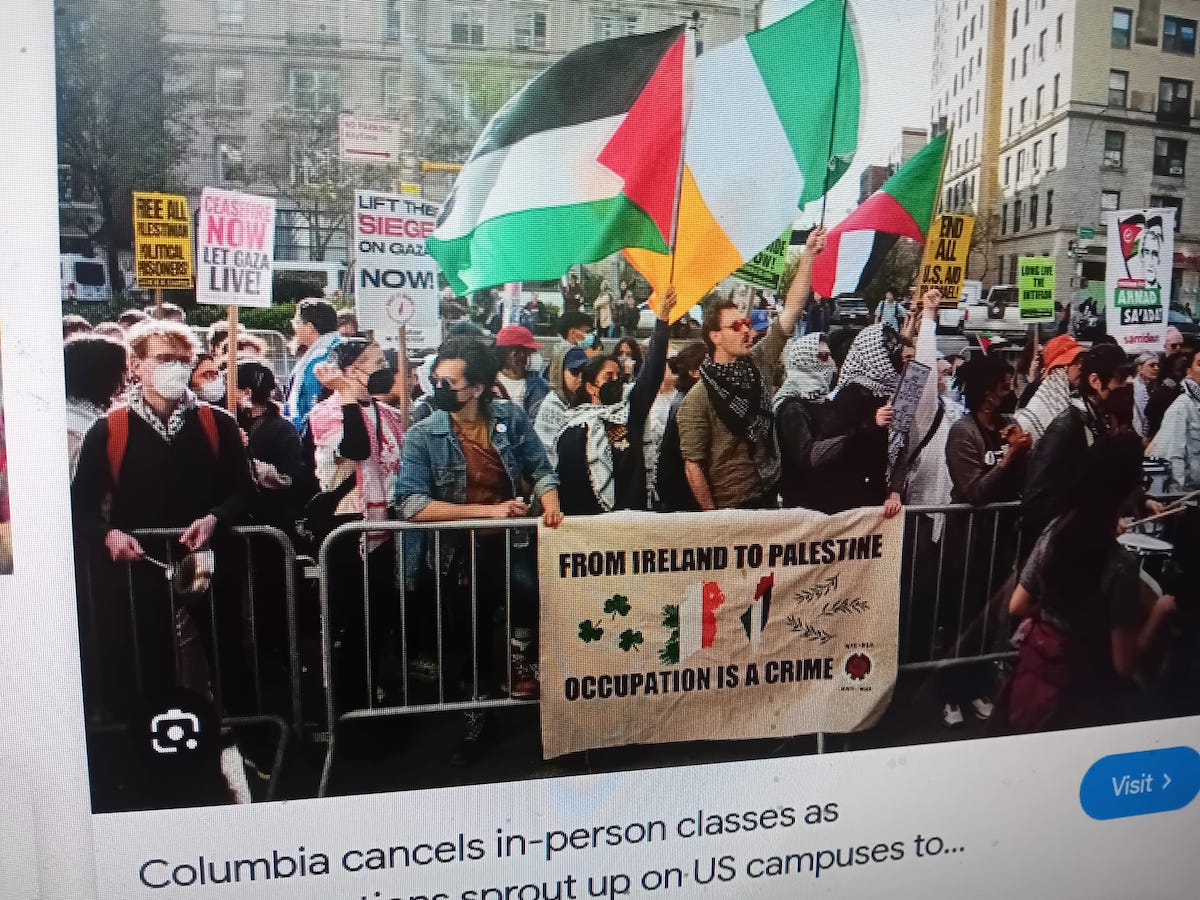
The Irish Tricolour has been seen on many London demonstrations in solidarity with the Palestinians, on its own or flying below the Palestinian flag inscribed with “Saoirse don Phalaistín”. The Tricolour turned up too as university students and staff faced down the New York Police.
Columbia University, New York, Monday.St. Patrick’s Day, New York, March 2024.London, November 2023.London, clearly.
In Palestine itself new horrors are being revealed with the recovery of bodies in mass graves in the areas of destroyed Gaza hospitals recently occupied by the Israeli military. Their remains testify to their being patients and medical staff in addition to refugees.5
A totally new horror are the Israeli killer drones emitting the wailing of a baby or a woman’s cry for help, waiting to gun down would-be rescuers. Palestinians in Gaza have been accustomed to responding to those cries in reality for months and often enough shot or bombed as they did so.6
This however is a new depth for the zionist military.
Under danger of Israeli bombardment, digging bodies out of a mass grave at the destroyed Nasser Hospital site April 2024. (Photo cred: Ramadan Abed/Reuters)
During the week also the independent investigation commissioned by the UN has found no basis to the Israeli claim that many staff of its aid agency for Palestinians, UNWRA, were members of Hamas or Islamic Jihad, much less involved in the October 7th Palestinian resistance operation.7
That investigation result has UNRWA vindicated of the false Israeli claims but also commended on its procedures to comply with the impartiality requirements of the UN and of its funders, many of which however now stand condemned for withdrawal of their funding from starving people.
But UNRWA chiefs should share the condemnation for appearing to give the accusations credibility in firing some of their Palestinian staff, not to mention sacking appallingly and reducing to poverty a number without hearing or appeal, on the basis of unsubstantiated accusations.
And from a source known for lying for decades and long hostile to the UNWRA organisation. True to type, the Israeli government has rejected the findings, despite having provided no verification of its accusations to date.
Few official actors of states or of the UN come out well in evaluation over the last six months of this daily broadcast genocide.
End.
FOOTNOTES
1Interestingly the word “slogan” is itself from the Irish language, or at least Scottish Gaedhlig, meaning a “call to/from the multitude/ troop”.



































 rebelbreeze