Original Breaking News article: DAVID YOUNG, PA (with commentary in italics by Diarmuid Breatnach)
The rededication of a memorial to the National Army soldiers killed in the Civil War enables their memory to be rehabilitated, a ceremony in Dublin has heard.
Defence Forces Chief of Staff Lieutenant General Sean Clancy paid tribute to the some 810 soldiers killed serving on the Free State side in the 1922-2023 conflict as he addressed the event at Glasnevin Cemetery on Sunday.
Descendants of some of those who died, representative of all four provinces, were invited guests at the ceremony, among them relatives of Michael Collins, the commander in chief of the National Army who under direction by Churchill, gave the orders that began the Irish Civil War and who was killed in 1922.
Taoiseach Leo Varadkar and Tánaiste Micheál Martin, the leaders of Fine Gael and Fianna Fáil, the two main parties forged from the divisions of the Civil War, also attended the rededication of the National Army Monument.
Sinn Féin TD Matt Carthy also attended the military commemoration, as did Dublin Lord Mayor Daithí de Róiste.
This neatly brought together political parties of the neo-colonial and neo-liberal Irish State with opposing histories: Varadkar to represent the pro-British and fascist neo-colonial origins of Fine Gael; Mícheál Martin and De Róiste representing Fianna Fáil, the allegedly Republican but in reality Irish Gombeen split from the previous iteration of Sinn Féin; Carthy for the current neo-colonial, neo-liberal and colonial servant Sinn Féin.
Taoiseach Varadkar (Fine Gael) and Tánaiste Martin (Fianna Fáil) unveiling monument to soldiers of the ‘Free State’ killed in the Civil War 1922-1923. (Photo cred: Brian Lawless/ PA)Matt Carthy TD, who represented his party Sinn Féin at the unveiling and dedication of the monument to soldiers of the Free State killed in the Civil War 1922-1923. (Photo sourced: Internet)
Prior to the ceremony, there was no monument in the country specifically dedicated to the soldiers of the National Army who fought against the anti-Treaty side in the Civil War.
Weeks after the war ended, on August 3rd, 1923, the Oireachtas passed legislation that led to the creation of the modern-day Defence Forces, Óglaigh na hÉireann. That is, the defence forces of the neo-colonial ruling class who created the Irish state.
The rededication event for the forgotten fallen of the National Army, which had already robbed the Irish language version name of the IRA, adopted the name Óglaigh na hÉireann during the Civil War, took place on the Sunday prior to the centenary of that date.
“It is appropriate then, in the spirit of real inclusiveness, of ethical remembering, and with a full desire to deal with some of the more uncomfortable aspects of our shared history, that we remember some of 810 uniformed members of Óglaigh na hÉireann who gave their lives in the service of the State during the tragic and critical period at the foundation of our democracy,” Lt Gen Clancy told the ceremony.
It is necessary, in order to bury any idea of achieving the Republic declared at the start of the 1916 Rising, that we honour some of the 810 men we recruited to bury that Republic in 1922, kitted out in uniforms, armed and transported by our ancient enemy. We wish to pass over quickly over not only the kidnappings, torture, murders, killing of disarmed prisoners and even sexual assaults by this fine body of men – the precursors to the current army of the Irish State – but also their terrorising of major part of the country with raids on homes and internment of men and women. Although this fine body of men were fighting to establish a neo-colony not even covering the whole of Ireland, we make no apology for calling them what they clearly were not, Óglaigh na hÉireann, i.e “Warriors of Ireland”.
The monument in Glasnevin to soldiers of the Free State killed during the Civil War – apart from the Free State Army having appropriated the name in Irish of the IRA, the legend claims they “died for their country”, a clearly inaccurate statement since at best they were fighting for the government and state of the 26 Counties, which excludes the UK colony of the Six Counties (‘Northern Ireland’ sic). (Photo cred: PA)
“For far too long there has been no memorial of any kind, nor any complete listing of the National Army war dead.” Understandably.
“Indeed, this year represents perhaps the last real opportunity to rectify that.”
As we prepare to commit this armed force to NATO at some point in the future and to PESCO in the nearer future, it is important to take a further step in legitimising this armed force of the neo-colonial state.
The remains of some 180 of the 810 soldiers who died serving in the National Army are buried at the plot in Glasnevin Cemetery. Uncomfortably close to graves of many of their victims.
“Sources at the archives show that the average soldier buried here was in his early 20s, was unmarried and from a working-class background,” said Lt Gen Clancy. In other words, the typical recruitment profile of lower-rank soldiers in capitalist and imperialist armies.
“Many had previously served in the IRA during the War of Independence, some even in the 1916 rising, many others had served in the British Army, underlying yet again how complex is the weave of Irish history.”
Actually, “many” is a questionable though vague estimate of the numbers who had “served in the IRA during the War of Independence”, though some had, including some of the most vicious, such as Major-General Paddy Daly, torturer and murderer.
The chief of staff highlighted the “poignant example” of two young Belfast-born Dublin-raised brothers – Frederick (18) and Gerald McKenna (16) – who were buried in Glasnevin after being killed together in action in Cork in August 1922 only a month after joining the National Army.
Aye, two men born in Belfast, a city which the Free State was fighting to ensure remained a direct colony of the United Kingdom.
“Whatever the often very legitimate reasons our forebears may have had for forgetting in the intervening 100 years, I think it’s appropriate now that I as the 32nd Chief of Staff of Oglaigh na h Eireann should finally take this opportunity to rehabilitate their memory,” said Lt Gen Clancy.
Especially as I try to establish a legitimate background to the armed force of an illegitimate State preparing to enter foreign imperialist wars and suppression of legitimate uprisings.
After all, we have great experience in all that, as the history behind this monument shows.
An event was held on a busy Saturday afternoon in Dublin’s city centre to commemorate IRA volunteer Patrick O’Brien, killed by soldiers of the Irish State.
The event included bagpipe airs, a colour party, speeches and a resistance song.
A colour party with Irish Tricolour and the flags of the four provinces, led by a lone piper marched into and a short distance westward up Talbot Street towards where a crowd waited beside a memorial sign that had been erected shortly earlier. The colour party took up station on the opposite side of the road.
Led by a piper playing Irish airs, the colour party (i.e carrying the flags – the Irish Tricolour and those of the four provinces of Ireland) approaches as the start of the commemoration. (Photo: D.Breatnach)
Among the airs being played on the short march were Thomas Moore’s Let Erin Remember and The Wearing of the Green or The Rising of the Moon, the same traditional air to both different songs referring to the 1798 Rising.
THE SHORT LIFE OF A LOYAL REPUBLICAN
Framed portrait photo of Vol. Patrick O’Brien on display at the commemoration (Photo: D.Breatnach)
Gina Nicoletti, chairing the event, recounted to the crowd a short history of Volunteer Patrick O’Brien who was born on 17 August 1898 in the townland of Woodlands near Castledermot in County Kildare to a local agricultural working couple.
The O’Brien family had 16 children, all of whom survived and ten of whom lived with Patrick and his parents in a three-room house at the time of the 1911 Census.
An obituary published in a Republican newspaper on the anniversary of his death suggests that Patrick moved to Dublin in 1915, joining the Irish Volunteers in December of that year aged 17. He took part in the 1916 Easter Rising under the command of Edward Daly.
Evading capture in 1916 and returning home, O’Brien joined the local Irish Volunteers company in Castledermot but returned to Dublin in May 1917 and became attached to E Company, 3 Battalion, Dublin Brigade, Irish Volunteers, which was based on the south side of the city.
Sean Óg sings The Foggy Dew while accompanying himself on guitar and centre of photo is Gina Nicoletti, who chaired the event. (Photo: D.Breatnach)
An active IRA member during the War of Independence, Vol. O’Brien took the anti-Treaty side in the IRA split in March 1922.
In a response to a renewal of executions of IRA men by the Free State government, Liam Lynch (IRA Chief of Staff) issued the ‘Amusements Order’ on 13 March 1923 banning all cinema, theatre and sports events “at a time of national mourning” with action threatened against non-compliance.
At midnight on 23 March 1923, Patrick took part in an operation to blow up the Carleton Picture House, O’Connell Street (then near the Parnell Monument opposite the Savoy Cinema). The cinema had closed an hour before a landmine at the front entrance shattered the glass of several windows.
There were no injuries but newspaper articles reported that the sound of the explosion was heard several miles away. Accounts of what happened afterwards were gathered from one of the IRA unit, Volunteer Joseph Doody in his pension application.
The unit unexpectedly encountered Free State soldiers coming from the Parnell Monument who opened fire on them and another patrol was approaching from the southern end of O’Connell Street and the unit retreated through Findlater Place and out to Marlborough Street.
In the running firefight in Talbot Street, O’Brien was hit by at least four bullets (three in his left leg and one in his right leg). He fell wounded on the pavement between Speidel’s pork butchers and the Masterpiece Picture Palace at 99 Talbot Street and died about 30 minutes after arrival at hospital.
The colour party lowers the flags in honour of a martyr as the piper plays a lament (Photo: D.Breatnach)
Patrick O’Brien was 24 and his death certificate listed his occupation as an employee of a railway company. His address was 28 Cadogan Road, Fairview which is a cul de sac of Victorian redbrick houses close to Annesley Bridge and opposite the Sean Russell statue.
Only three weeks before Patrick’s death, the Free State CID1 had raided no. 43 Cadogan Road and captured the press used to print the Sinn Féin2 paper An Phoblacht along with eight people who were on site. A number of prominent IRA families lived in the vicinity, including the Brughas.
Patrick O’Brien was buried in the Republican Plot, Glasnevin Cemetery and a volley was fired over his grave, presumably following the funeral in the cover of darkness as the IRA could not have risked such a public display during the burial, in a time of martial law.
The colour party raise the flags again in symbolism of the struggle carrying on after honouring a martyr (Photo: D.Breatnach)
Despite the hard repression by the Irish State on combatants, their relatives and friends, O’Brien’s family were proud of Patrick as displayed in an anniversary notice placed in The Nationalist & Leinster Times.
The Irish Independent reported on 27 March 1923 that at the inquest of Patrick’s death, his brother James told those present:
“[My brother] … belonged to the IRA since 1915 being then about 15 years of age. He had never changed his principles since then. He always intended to die as he did … rather than change his principles as he swore allegiance to the Republic in 1916.”
FLORAL WREATH, SONG AND SPEECH
A representative of Anti-Imperialist Action was called upon and stepped forward to attach a green, white and orange floral wreath to the pole beneath the commemorative sign.
The plaque/ placard commemorating Vol. Patrick O’Brien attached in Talbot Street by Independent Republicans with the floral wreath from Anti-Imperialist Action attached below it (Photo: D.Breatnach)
Seán Óg accompanied himself on guitar singing The Foggy Dew, a popular Republican ballad about the 1916 Rising composed by Fr. Charles O’Neill.
Dublin City Councillor Cieran Perry gave a fairly short speech stressing the importance of these acts of remembrance upholding traditions of resistance in the Dublin working class, also denouncing the fake patriots who stir up racist divisions and hostility in the community.
Perry’s speech also listed some of the crimes of the Irish state, facts underlined when Joe Mooney read out the list of 70 IRA Volunteers formally executed by the Irish state along with those killed in battle or after they surrendered, or were abducted, tortured and murdered in Dublin 1922-’23.
Cnclr. Cieran Perry speaking at the commemoration. (Photo: D.Breatnach)
TRAFFIC AND PEOPLE
Traffic was light along the narrow Talbot Street during the event and slowed down to ease past the crowd that had spilled from the pedestrian pavement into the street. A few minutes’ eastward of the spot is the plaque commemorating the killing of Sean Treacy by the British in November 1920.
There was a substantial number of people in support of the event on both pavements of the one-way street but others gathered too, whether out of curiosity or in sympathy. Some of those present consisted of visitors from other countries, whether as students, tourists or workers.
The crowd grew and spilled on to Talbot Street. [The plaque to Vol. Sean Treacy killed by British soldiers in 1920 is high on the front of a building just beyond the tree on the right of photo] (Photo: D.Breatnach).
Not for the first time I thought that having leaflets to distribute summarising the event and the reason for it would be useful. I spent a little time explaining some aspects of the event and its history to a couple of visitors from Sweden who seemed very interested.
The uniformed Gardaí kept away from the event, though no doubt the plain-clothed political Special Branch had a few of their own in the vicinity to collect faces and try to match names.
THE ORGANISERS: INDEPENDENT REPUBLICANS
The commemorative event was organised by a group by the name Independent Republicans which has been doing great work in conserving and promoting historical memory associated with events such as the 1916 Rising, the War of Independence and the Civil War.
The Irish Free State came to power as an instrument of British imperialism which clothed, armed and otherwise supplied the state’s National (sic) Army. Independent Republicans have collected the names of 70 Irish Republicans killed in Dublin by that Army.
The group has also devoted time and effort to researching the backgrounds and circumstances of death of many on that list, a substantial undertaking for which we owe them a great debt. Their erection of ‘plaque’ signs around the city at the spot where the fighters fell is also great work.
The commemorative plaque/ placard to Vol. Patrick O’Brien’s memory being erected shortly before the start of the event (Photo: D.Breatnach)
On Easter Saturday (8 April) Independent Republicans will be holding a 1916 Rising commemoration in Dublin city centre, details below.
Anti-Imperialist Action will be holding theirs on Easter Sunday (9 April), details below.
End.
FOOTNOTES:
1Criminal Investigation Department, based at Oriel House, where police detectives and some soldiers of the Free State organised operations against Republicans including raids, assassinations, abductions and torture.
2This is not the party of the same name today. Sinn Féin began as a dual-monarchy Irish nationalist party, adopting Republicanism later in 1918. Those who later supported the anti-Republican status of the country and partition by England left the party and another large number left to join the Fianna Fáil party upon the latter’s founding. Briefly in the 1960s the party espoused socialism but split at the end of the decade and Sinn Féin under the Provisionals briefly adopted socialism again during the 1970s. The party of that name today is neither socialist nor even Republican.
Speech by Pat Reynolds2 in Commemoration of Irish Civil Wars 1920-1923 on a sub-zero evening outside Camden Irish Centre, London on 8th Dec 2022
(Reading time: 15 mins.)
A Chairde Ghaeil agus a Chomrádaithe, tonight we are gathered here to remember and celebrate the lives of Liam Mellows, Rory O’Connor, Dick Barrett and Joe McKelvey, four great Irish patriots.
We also call out the neo-colonial Irish Free State for those unlawful murders and all other executions carried out by this British Imperialism-backed Dublin regime, acting on orders to attack the Irish Republic and its army and people.
In remembering this time and the setting up of the Irish Free State and the Northern Ireland government 1920 -1923 we take the Republican view of history in an All-Ireland context and avoid the narrow structures of the Free State 26-County centenaries.
These ignore the Six Counties and the heroic role played by the people there in defence of the Republic and a United Ireland.
In looking at this time in history we consider the two proxy wars waged in Ireland by British guns and on behalf of imperialistic interest to put down the Republican fight for a 32-county Irish Republic declared in Dublin at Easter 1916.
That was voted by a very large majority in 1918 for the same All-Ireland Republic, fought for in a war of independence from 1919 -1920 by an undefeated IRA.
The revisionists try to partition the Irish struggle to backdate some kind of imaginary Loyalist/Unionist state which never existed, was never fought for or voted on to create a colonial divide-and-rule in what was always even — under colonial rule — one country.
As Republicans we reject the 1948 Republic declared by the Blueshirts3 and fascist Franco ally Costello.
Those who want to read about this heroic struggle by the Irish people should read the two books by Ernie O’Malley TheSinging Flame on the War of Independence and On Another’s Man’s Wound on the Civil War.
In looking at the history of this time we see two wars being fought against the Republic, the first in what became Northern Ireland from June 1920 to June 1922, a two-year war to put down the Republican people in the North East of Ireland.
The second war was within the newly created 26 Counties Free State from November 1922 to May 1923, a nine-month war by British guns against the Republic.
It is sad to state here tonight that the only war ever fought by the Free State Army was to put down the Irish Republic and its own people.
James Joyce in the Dubliners short story collection has this wonderful story The Dead where at the end he looks out the window and sees it is snowing, in his words “it is snowing all over Ireland, snowing, on the living and the dead.”
At that time in history, we see British guns firing down all over Ireland, leaving us the heroic dead and the living nightmare that became the Irish Free State and the Six Counties, seen years earlier by James Connolly as “a carnival of reaction”.
What we see happening at this time of history is that Imperialism tried and won by negotiation what they had failed to do in war, to defeat the undefeatable IRA and the undefeated people.
The imposition of Partition upon the Irish people required the breaking up of the Republic declared in 1916 in rebellion, by democratic vote in 1918, and fought for in the War of Independence from 1919-1921.
The Imperialists moved first to break the Republicans and Nationalists in the North East of Ireland.
We see from Churchill’s father playing “the Orange card”4 to benefit the Tory party in the late 1800 to the Curragh Mutiny in 1913, and the arming of the Unionists their intentions on retaining the wealthiest part of Ireland and the Belfast manufacturing base of shipbuilding.
We see the hand of Sir Henry Wilson at play from the aftermath of the Curragh Mutiny, where he protected senior army officers, to his role in being political and military advisor to the emerging Northern Ireland government, and the arming of the new Unionist state.
We see his hand in diverting the body of Terence MacSwiney from Holyhead to Cork, the hanging of young Kevin Barry and the Orange led anti-Catholic pogroms of Belfast and Banbridge.
We see it in other links too with the Orange murder gangs which, led by Orangemen were involved in murders in Cork, and in the murder of Thomas MacCurtain Lord Major of Cork.
District Inspector Swanzy5 was believed to be responsible for the gang who murdered Thomas MacCurtain who was then moved to Lisburn, Co. Antrim. He was tracked there and executed by the IRA.
Sir Edward Carson in the House of Commons supported the Amritsar Massacre6 as did Churchill who falsely claimed that the protesters were armed and stated, ‘Men who take up arms against the State must expect at any moment to be fired on.
Men who take up arms unlawfully cannot expect that troops will wait until they are quite ready to begin the conflict. When asked What about Ireland?, Churchill stated, I agree and it is in regard to Ireland that I am specially making this remark.
We can see this in the murder of Thomas Mac Curtain7 and other Republicans
Also when another Orangeman from Banbridge, Colonel Smyth stated this policy that suspects could be shot on sight if the RUC had good reason to believe they might be carrying weapons or did not put up their hands.
Smyth’s new shoot-to-kill policy was published and he was recalled to London to meet Lloyd George. Michael Collins ordered that Smyth be executed before he could implement his shoot to kill policy.
Later on, Smyth’s brother,8 also in special forces was shot dead in a shoot-out with Dan Breen in Dublin. After Smyth’s funeral in Banbridge there was organised large scale anti-Catholic attacks on businesses and houses.
The anti-Catholic pogroms lasted for two years from June 1920-June 1922 in the North-East of Ireland in Belfast, Banbridge and other areas. There were over 500 deaths in these pogroms but only 13% (65) were army/police or IRA while the other 87% were civilians.
Here civilians are the main targets, with 58% of these being Catholic and 42% being Protestant. But based on the population of Belfast at the time, 76% Protestant and 24% Catholic, Catholics were four times more likely to be killed than Protestants.
The British government stood largely idly by while these pogroms went on and did absolutely nothing about it.
We see this clearly in how Catholic workers and Protestant socialists were driven out of the shipyards, some ten thousand Catholic workers driven out of their jobs for being Irish and Catholic and we see one thousand homes and business burned out.
Damaged buildings in Lisburn due to sectarian riots. Note parochial hall gutted on far right.
Some 80%of the places burned out were Catholic-occupied or owned and 80% of the refugees were Catholic. Considering Catholics only made up one quarter of the Belfast population we can see what happened here.
This was the putting down of the Republican nationalist community to enforce the partition in Ireland and to prepare for a one-party neo-fascist apartheid Protestant statelet.
The impact of the ten thousand job losses and the burning of houses and businesses led to large scale migration of Catholics from the North east to Britain and to Dublin.
We also see at this time the use of British death squads to murder Catholic as they did in Cork City with McCurtain and now in Belfast with the McMahon family and others. These death squads were operating within the RUC9.
In the 1970-1995 period we see the emergence again of these British death squads in Northern Ireland linked to British intelligence, army and police with often open collusion and sharing of agents and information.
Collins had asked a Catholic priest and a university professor to record and write up each of the deaths during the pogroms, but when it was at the printers the Free State government after Collins death decided to pulp the whole print run.
This was in order to cover up what had happened to the Republican/nationalist community around Belfast in the pogroms, probably because of their own shame with the own war crimes of executions of prisoners and atrocities during the war.
It was to add to their shameful record. The story of the Orange pogrom was not published until the 1990s. Those who want to can read it under the title Orange Terror. Equally The Orange State or Arming the Protestants by Michael Farrell cover this time.
The execution of Sir Henry Wilson in London in June 1922 put an end to these pogroms against Catholics in that the head of the serpent, the rabid anti-Catholic Orange Bigot was gone.
He was a political and military advisor to the new Northern Ireland government and was largely responsible for the arming of the new Protestant state, including the B Specials10.
Tonight, we honour those brave Irish volunteers and community activists who tried to stop the pogroms and defend isolated Catholic areas in Belfast where most of the killings took place, those who stood for an All-Ireland Republic and against the imposition of Partition.
We must never separate their fight from the fight in the rest of Ireland to defend the Republic. The partitionist mind has no place in Republican history.
The war in Ireland to smash the Republic now turned to the rest of Ireland when under Churchill’s orders and Churchill-supplied weapons, Collins attacked the Republican army in the Four Courts starting a second proxy war on behalf of British imperialism in Ireland.
The Truce between the undefeated IRA and the British government started on 6th July 1921 and ended with the Treaty of 5/6 December 1921. The Treaty was signed under threats by Lloyd George of immediate and terrible war.
The Treaty today would be seen as unconstitutional under international law given the violent threats made by Lloyd George. The Treaty was for the Partition of Ireland with a British Governor General in Dublin and an oath of loyalty to the English King.
Two of the big lies around the Treaty were when Collins stated it was a stepping stone towards a united Ireland, in fact it was a millstone around the necks of the Irish people since then.
The second lie to justify this surrender was that the IRA was weak and low in arms. This was nonsense as evidenced by the Civil war fight.
The Dáil on 7th January 1922 voted 64-57 in favour of the Treaty, once again the Dáil11 voted under the duress of immediate and terrible war.
All the women deputies voted against it, as did the female relatives of the 1916 leaders Pearse, Connolly, the MacSwineys and Cumann na mBan
The Catholic Bishops fully supported the Treaty as they did with the Act of Union in 1800, and every priest in Maynooth took an oath of loyalty to the English Crown on ordination.
The Press in Dublin, TheIrish Times, Independent and The Freema ns Journal all supported the Treaty as did big businesses, big farmers and the Unionist community which included four Unionist TDs.
From January to May 1922 Collins rebuilt the new Irish army up to some 58,000 men. These included some 30,000 ex-British Army men, some 3,000 deserters from the IRA and some 25,000 new recruits.
The British Army allowed any serving Irishman to transfer into the new Irish army without any loss of pay or rank.
Collins was running to London on a regular basis to see Churchill who wanted to see the new army attack the IRA. In May 1922 Churchill stated that ‘there is a general reluctance to kill each other’.
There was a General Election on 16th June 1922 when Pro-Treaty group won 58 seats with 35 going to anti-Treaty, four to Unionists, 17 Labour, seven to a Farmers’ party and 17 others.
Collins broke the Pact with De Valera under orders from Britain and by June 1922 there were two armies in Ireland, the IRA and the new army set up by Collins and Mulcahy.
The IRA held an Army Convention in Dublin with over 200 delegates representing about 75% of the IRA and they voted to stand by the Republic.
They took over the Four Courts under the leadership of Rory O’Connor and Liam Mellows with Liam Lynch as Chief of Staff.
After the execution of Sir Henry Wilson on Collins’ command, the British government blamed the Four Courts garrison and Lloyd George openly called for the Four Courts to be attacked or the Treaty would be declared void.
On 28th June 1922 Collins ordered the Four Courts to be attacked using borrowed British big guns, but even the uniforms boots and the Lee Enfield rifles had been supplied by Churchill.
A big explosion of ammunition inside the Four Courts led to their surrender, while fighting continued around O’Connell Stree and Cathal Burgha died emerging from one building. The IRA retreated from Dublin towards their new Munster Republic.
Griffiths and Collins were to die in August 1922 and the war against the Republic entered a new and ugly phase. Mulcahy set up a semi-dictatorship, fascist in outlook and in practise. On 15th October he introduced the new Bill labelled “the Murder Bill” into Dáil Éireann.
The new government’s links with fascists can be clearly seen later on in the 1930s with their linking up with Blueshirts, their support for Franco and we saw against in the 1970s, with their police Heavy Gangs, press censorship and emergency courts12.
The Emergency Powers Act aka the Murder Bill is a shameful chapter of history which that party and the people involved including the church by its silence needs to be held accountable.
In November 1922 Ernie O Malley was arrested lucky for him he was badly wounded so escaped being executed, but on 17th November 1922 four young Republicans were executed by their State to get the public ready for bigger executions.
The Mountjoy Four executions by the Irish Free State in 1922 of one IRA Volunteer from each province.
The later execution of Erskine Childers a patriotic Irish man was most shameful. Griffiths’ mocking of Childers was racist and shocking as all the Irish abroad and at home would be offended by Griffiths. Childers with an Irish mother was as Irish as De Valera, Pearse, Cathal Brugha or Terence MacSwiney.
The Free state was formally up on 6th December 1922, on 7th Sean Hayes TD was shot dead by the IRA and the following morning the Free state executed Rory O’Connor, Liam Mellows Dick Barrett and Joe McKelvey from Belfast one from each province.
While the Free State made a big issue of a TD being killed, they themselves killed in cold blood Cathal Brugha, Harry Boland and Liam Mellows, all TDs.
The song composed after the executions,
Take it down from the mast Irish traitors, It’s the flag we Republicans claim. You murdered brave Liam and Rory You have taken young Richard and Joe.13
The Free State went on to commit further war crimes against the Republic and Republicans; in all they murdered over 80 men without proper trial and in cold blood.
They executed four young IRA men in Donegal and Sean McKeown was responsible for the cold-blooded murder of the Noble Six Republican prisoners in Sligo.
Co Kerry was the worst for Free State atrocities, in one case nine IRA prisoners were tied to a land mine and blown to pieces, along with four more executed in Kerry and more again executed by land mine in Cahirciveen.
In total 17 were murdered in cold blood by the Free State army in Kerry. There had been over 400 sentenced to death over 80 state executions, but we must also add in the number of surrendered prisoners who were executed.
Tod Andrews in his Book Dublin Made Me suggested the total figure of State and army executions during this time to be 153.
After the death of Liam Lynch, the IRA decided to dump arms at the end of April 1922.
In a general election in August 1922 the Free State got 63 seats with Sinn Féin getting 44 despite the loss of the Civil War. In 1926 DeValera14 broke with Sinn Féin and in 1927 won 44 seats with Fianna Fáil, thus taking the Sinn Féin vote.
In 1932 De Valera came to power and he in turn after using the IRA in the 1930s to defeat the Blueshirts turned against them and was cruel in his jailing and treatment of Republicans.
To finish, we are here tonight in Camden to honour all those who stood with the Republic in the War of Independence and in the battle to prevent the Partition of Ireland.
Those who died in the pogroms in the North East as much as the young soldiers who died defending the Republic in the Civil War.
In the Republic too the Free State used the same tool as the Unionists in using a form of ethnic cleansing to push out their opponents out by emigration.
Just as the Catholics in the North East were driven out of Harland and Wolf and driven abroad, so too were the defeated Republicans in the rest of Ireland who could not get a job in the army, police or civil service, in teaching or in any other public service.
We see in Sean Sexton’s book of Irish Photos15 whole IRA battalions in New York and in Chicago at their annual dinner dances driven out of |Ireland by the new Free state.
By 1923 the Irish Republican Army had been defeated in the battle for the Republic but their spirit was still alive among the Irish people. In every generation the Republican movement would attempt to fight on towards that original dream of a United Irish republic.
More so the Spirit of the Republic came alive in the 30-year war in Northern Ireland from 1969 -1998, and it came alive in the 1981 Hunger strike of Bobby Sands MP and his nine comrades.
As we approach another crucial stage in Irish history, we need to be wary of the dying embers of British imperialism, they will again try and dilute that Republican dream with offers of NATO, Commonwealth, and a role for British monarchy.
We can see the Tory Right again use the Orange card with the Protocol where they are prepared to break an international agreement.
And we see in the Legacy Bill how the Tory Party has contempt for all the people of Northern Ireland, Unionist and Nationalist, when it comes to protecting British imperial interest there.
We see it in unionist Keir Starmer16 when he stated that he would campaign for Northern Ireland to stay in the Union, contrary to another agreed international treaty to remain neutral on this issue. Let us as Republicans remain eternally vigilant against British deceit.
Pat Reynolds (extreme left of photo) speaking outside the Camden Irish Centre on the Free State executions.
Tonight, as we honour the men and women who stood by the Republic and against the Partition of Ireland, we should stand by the same Republic declared by the 1916 Proclamation free from any British interference and the pledge to treat all our children equally17.
We stand here too in the spirit of Tone and Connolly.
We stand proudly in honour of four brave Irish patriots here tonight, in honour of the workers driven from the shipyards of Belfast, the people who perished in the pogroms, the men and women in the North East and in the whole of Ireland who stood with the Republic, all those who gave their lives for the Republic, and those who down the long years have fought and kept that flame alive.
The view of Joyce that it is snowing all over Ireland stays with me on this cold night, but it moves on to a vision of Ireland of Easter lilies growing in freedom all over Ireland and dancing freely in the breeze.
It is there in the struggle of those who fought and died for the Republic. That we remember tonight. It is there in the words of Bobby Sands in his Rhythm of Time18 when he shouts that they, the Republicans, were Right.
End.
FOOTNOTES
1The title was chosen be Rebel Breeze as this take on the Irish Civil War consisting of two wars (or campaigns?) is unusual and worthy of consideration. The editing for publication and footnotes are Rebel Breeze’s also. The text was supplied thanks to Pat Reynolds.
2Pat Reynolds, from Longford, is a long-time Irish community activist settled in London. He was co-founder of the campaigning Irish in Britain Representation Group and is co-founder of the Terence McSwiney Commemoration Committee.
3Irish fascist organisation of the 1930s led by former Free State Commissioner of Police and former IRA officer Eoin O’Duffy.
4A reference to the 1886 quotation of the senior Churchill with regard to whipping up members of the unionist Orange Order in Ireland to defeat British Government proposals on Ireland.
5Of the Royal Irish Constabulary, the British colonial gendarmerie in Ireland.
6In India, 1919 when over 1,000 unarmed people were shot dead by British Army soldiers.
7IRA Volunteer and elected Lord Mayor of Cork in January 1920, murdered by Royal Irish Constabulary in March 1920.
8Major George Osbert Smyth, one of the British Army killed during an escape from a raid on a house in Drumcondra, Dublin of IRA Volunteers Dan Breen and Sean Tracy during raid to capture them.
9Royal Ulster Constabulary, British colonial gendarmerie, currently renamed Police Service of Northern Ireland.
10A part-time reserve of the RUC which had weapons at home or at work, greatly detested and feared among the nationalist community. The reserve was disbanded in May 1970 with many members incorporated into the Ulster Defence Regiment of the British Army.
11Dáil Éireann, an all-Ireland Parliament prior to Partition, now of the Irish State and excluding the six counties of the British colony.
12Reference to a special political police force tasked with repression of Republicans and gaining confessions under torture (see for example framing of The Sallins accused and Joanne Hayes case), the censorship under Section 31 of the Broadcasting Act and the Special no-jury Courts set up under the Amendment to the Offences Against the State Act.
13Two couplets from different verses of the Soldiers of Twenty-Two Irish Republican song.
14Éamonn De Valera, a 1916 commandant, later anti-Treaty leader, later still founder of the Fianna Fáil party after splitting from Sinn Féin, Taoiseach (Prime Minister) and later President of the Irish State.
On the evening of 7th July, people passing on O’Connell Street, Dublin’s main street in the north city centre either stopped a while or passed with a glance at the crowd gather at the intersection with Cathedral Street, a narrow lane leading eastward.
The Irish Tricolour and the Starry Plough flags (both versions1) held aloft gave a strong indication of the purpose of the gathering, which was to honour an Irish patriot shot down at that spot by Free State soldiers on 5th July 1922 and dying on the 7th.
A poster from the period with drawings thought to be by Constance Markievicz (Photo: D.Breatnach)
CATHAL BRUGHA RESUMÉ
Cathal Brugha was an Irish Republican, an Irish language activist, a soldier and politician. For a period in the Irish Republican Brotherhood, he joined the Irish Volunteers at the outset2 and was a lieutenant in charge of twenty Volunteers to receive with others the arms delivered to Howth Harbour in 1914.
In the 1916 Rising Brugha was second-in-command under Eamonn Ceannt at the South Dublin Union, now covered by James’ Hospital, where he received in excess of 25 wounds from bullets and grenade shrapnell and was not expected to live.
Surviving, Brugha was elected a Teachta Dála (member of parliament) for the abstentionist Sinn Féin coalition party in the UK General Election of 1918, serving until his death, first President of Dáil Éireann (the Irish Parliament) from January to April 1919, Minister of Defence from 1919 to 1922 and Chief of Staff of the IRA from 1917 to 1919.
Cathal Brugha, along with most Republican activists, was strongly opposed to the Anglo-Irish Agreement of 1921 which was supported by Michael Collins, Arthur Griffiths and others and joined the Republican opposition in the Dáil, resigning his government posts to do so.
A poster from the period with drawings thought to be by Constance Markievicz (Photo: D.Breatnach)
However, he and Oscar Traynor of the IRA both opposed the occupation of the Four Courts by IRA under Rory O’Connor but when it was bombarded by the Free State with British artillery on 28th June, Traynor ordered occupation of O’Connell Street buildings to divert some of the heat from the Four Courts.
The Free State Army bombarded the Republican positions in O’Connell Street with artillery and machine guns (as the British Army had done in 1916). Eventually the Republicans retreated apart from a small holding group which Brugha ordered to surrender but did not do so himself.
Approaching Free State soldiers with pistol in hand, he was shot by them in the leg, severing a femoral artery and died two days later in hospital. His widow Kathleen continued the Republican line as an activist and TD.
Mags Glennon, Chairing the event (Photo: D.Breatnach)
THE HONOUR CEREMONY
Mags Glennon, chairing the event, thanked people for coming, stressing the importance of remembering our history and listed briefly the important actions of and positions held by Cathal Brugha, before calling on Sean Óg to perform The Soldiers of ‘22,3 the five verses of which he sang, accompanying himself on guitar.
At intervals between speakers Sean Óg performed another two songs, Cathal Brugha andA Soldier’s Life4.
Joe Mooney brought a series of three posters for distribution, which were quickly taken up. These were copies from the period, condemning the Free State Army for the murder of Cathal Brugha, with drawings believed to be by Constance Markievicz.
A poster from the period with drawings thought to be by Constance Markievicz (Photo: D.Breatnach
MAIN ORATION
The main speaker was historian and author Kerron Ó Luain, who began speaking in Irish and returned to it on occasion, though the content of his talk was by far in English.
Ó Luain initially paid his respects to recently-deceased Mícheál Ó Doibhlin, a Dublin historian who had done much historical research to bring further into the light of today the contributions two Republican women in two different periods.
These were Anne Devlin of the United Irishmen (uprisings in 1798 and 1803) and Josephine McGowan, killed in 1918, the first Cumann na mBan martyr5. Ó Doibhlin had also assisted Ó Luain in the latter’s research into the insurrectionary history of his own area, Rath Cúil (Rathcoole)6.
Kerron Ó Luain speaking, Joe Mooney holding the microphone. (Photo: D.Breatnach)
Continuing to relate some brief facts about Brugha’s early life, born into a mixed-religion household, Ó Luain emphasised Brugha’s interest in the Irish language and his membership of the Gaelic League (Conradh na Gaeilge)7 in the same decade as its founding.
The speaker contrasted that aspect with the militarist image of Brugha often projected by hostile commentators. Brugha met his future wife at meetings of the Connradh and had been a strong advocate of the proceedings of the First Dáil being conducted mostly in Irish and of the Democratic Programme being first read and agreed in Irish.
The setting up of Sinn Féin to contest the 1918 UK General Elections had involved a coalition of many different elements Ó Luain said, including dual monarchism advocates such as the original founder Griffiths and even white Dominion aspirants, alongside Republicans such as Cathal Brugha.
Section of the crowd at the event. (Photo: D.Breatnach
These had been the lines along with the alliance had fractured when the British proposed the terms of the Anglo-Irish Treaty. British influence on the Free State was seen not only in its war on the Republicans but in the legal system adopted based on common law without any thought given to any of the principles of the native Brehon Law.
The British influence was evident also in the form of dress with some Free State politicians such as Cosgrave wearing a top hat and research has shown over 90% of the civil servants of the Free State had been employed by the previous British colonial administration.
The Free State adopted a formal position of support for An Ghaeilge, the Irish language, while doing nothing to support the struggling rural Irish-speaking areas, which were being drained by emigration, leading the inhabitants to want to acquire English for their future locations.
Some of the attendance. (Photo: D.Breatnach)
Another small section shot (Photo: D.Breatnach)
The number of Irish-speakers within the territory of the State has declined drastically since it was founded.
Unusually for an oration honouring an Irish martyr but very important historically, the speaker pointed out that Brugha was not a socialist Republican and had advocated land ownership whereas other Republicans such as Liam Mellows (executed by the Free State in 1922), Peadar O’Donnell and Frank Ryan in the 1930s had proclaimed the need for a socialist Republic.
In conclusion, the speaker said that Cathal Brugha was an honest courageous Republican with a genuine love of the Irish language and a staunch upholder of the truly independent Republic proclaimed in 1916 but yet to be achieved. He had been killed as part of the counterrevolution.
It is important for future efforts, Ó Luain stated, to be aware of the different strands in the Republican opposition to the status quo and to be clear on the desired future shape of society in the Republic.
View of many in the attendance at the event. (Photo: Cabra 1916-1921 Rising Committee)
OTHER REPUBLICAN MARTYRS OF THE BATTLE FOR DUBLIN 1922
Damien Farrell spoke on behalf of Dublin South Central Remembers and representing the McMenamy family from the area. Frank McMenamy had been asked to introduce the Roll of Honour on behalf of relative Ciaran McMenamy of F Coy, 1st Batt, anti-Treaty IRA (Ambulance Corp) but was unable to attend.
Ciaran was one of four brothers — Fergus, Manus and Francis — who fought in the revolutionary period 1916-23. Ciaran was part of the crew that tended Cathal Brugha and rushed him to hospital on the 5th July. When Brugha succumbed to his wounds, Ciaran was a pall bearer at his funeral.
Damien said that this most likely identified him for arrest which happened later and he was interned in the infamous Newbridge Camp and participated in the mass hunger strike of prisoners in 1923 against conditions.
Ciaran McMenamy contracted a cold that developed into consumption which secured his release to convalesce in the County Home in Kildare but this proved ineffective and Ciaran was eventually released from internment around Christmas 1923.
On the 26th of April 1924 Ciaran McMenamy died in 55 Pearse Square, a house connected to the family. For the past two years Dublin South Central Remembers have held remembrance events at the house, with the full permission and support of the current occupants (no relations) with the intention of having a plaque erected in time for his centenary in 2024.
Finnuala Halpin reading the Roll of Honour of the The Battle of Dublin 1922, in which her grandfather fought. (Photo: D.Breatnach)
Fionnuala Halpin read the roll of honour of those killed in The Battle of Dublin 1922, a battle in which her grandfather fought.
John Monks
William Clarke
Joe Considine
William Doyle
Francis Jackson
John Mahoney
Sean Cusack
Matthew Tompkins
Jack McGowan
Thomas Markey
Thomas Wall
Charles O’Malley
Cathal Brugha
Veteran Republican, hunger-striker and author Tommy McKearney placed a wreath in honour of the fallen on behalf of Independent Republicans and a minute’s silence was observed in their honour also.
COMMEMORATE THE CIVIL WAR MARTYRS OF YOUR AREA?
A number of different Republican organisations were represented at the event, along with many independent Republicans and historical memory activists, including walking history tour guides.
Poster and dedication floral wreath in honour of Cathal Brugha, Cathedral Street, Dublin city centre 7 July 2022 (Photo: Cabra 1916-1921 Rising Committee)
Mags Glennon asked people to keep in touch with the organisers and also to be aware of other commemorative events, offering to make available the commemorative posters with the local martyrs’ names incorporated into the design for display for others around the country.
End.
FOOTNOTES
1The original, with the design of plough in gold following the outline of the Ursa Mayor constellation in white stars, on a green background and the later Republican Congress version of the white stars alone on a light blue field.
3Composed by Brian Ó hUigínn, sung to the air of The Foggy Dew.
4A Soldier’s Life was originally composed by Young Irelander Thomas Davis (1814-1945) and recorded by The Wolfe Tones band; the composer of Cathal Brugha’s lyrics appears unknown and it was recorded by Declan Hunt.
5A rally held by women just off Dame Street in 1918 was batoned by members of the Dublin Metropolitan Police and she died of her injuries shortly afterwards. I have heard Ó Doibhlin relate her story and saw him becoming emotional as he did so. The DMP’s batons in September 1913 were also responsible for the deaths of at least three others, although one died in 1915.
6For a number of recent years Ó Doiblin has been noted, along with historian Liz Gillis and others, for research and exposition of information regarding the Burning of the Customs House on 25th May 1921, which corrected a number of common misapprehensions about that event.
7Founded by Protestant Douglas Hyde/ Dubhghlas de hÍde this month in 1893.
USEFUL LINKS
The Independent Republicans group do not appear to have a website or FB page but may be contacted through the Cabra 1916-1921 Rising Committee: https://www.facebook.com/cabra1916
Historians and political activists gave talks in Dublin presenting a review of the conduct of what is more usually called the Irish Civil and its effect since on life in Ireland. All the speakers described that conflict as “a counterrevolution”, to overturn many of the gains made in the period of struggle immediately before it and to head off any possibility of yet further gains in Irish political, economical and social life, having a braking effect on such progress up to this very moment.
Liz Gillis speaking (Photo: D.Breatnach)
L-R: Fearghal Mac Bloscaidh, Mags Glennon, Ciaran Perry (Photo: D.Breatnach)
BACKGROUND
The event on 26th June, held in the function room of The Cobblestone, was organised by the Peadar O’Donnell Socialist Republican Forum, itself established in early 2013, the result of a number of meetings and seminars organised over the course of 2012. It combined communists and socialist Republicans to organise discussions on a number of issues, such as Irish state neutrality, Irish national independence, working-class programs in struggle etc.
(Photo: D.Breatnach)
SPEAKERS
Ciaran Perry, a socialist Republican and Independent Dublin City Councillor, also a local history activist, introduced the event. He talked about the importance of history and in particular local history, the traditions of struggle and how some of those had been weakened in the trade unions and communities over the years.
Reading the account of the Ballysheedy Massacre (Photo: D.Breatnach)
Perry introduced the MC for the meeting, Mags Glennon who is also a socialist Republican activist and history enthusiast.
Glennon introduced historian Fearghal MacBhloscaidh from Tyrone who began in Irish and then continued in English, his presentation laying out clearly his position that the Civil War was a planned counterrevolution, quoting Cabinet papers and correspondence and supplying figures on the arms and equipment supplied to the Free State ruling elite by the British. MacBhloscaidh also maintained that the De Valera Government, though supported by the wider Republican movement at the time, was also a counterrevolutionary measure when subjected to a class analysis.
Sorry, slightly out of focus Jimmy Doran (Photo: D.Breatnach)
A woman (whose name I did not catch) was called to stage. In a clear voice she read an account of of the horrific Ballyseedy Massacre. Free State soldiers, after torturing their Republican prisoners, brought nine of them out to a road barricade, in which they had placed a landmine which they exploded. One survived by some miracle but spent the rest of his life needing frequent medical intervention.
At intervals between speakers, Pól MacAdaim performed his music, singing accompanied by guitar. Among the songs he sang were Tipperary So Far Away and Take It Down From the Mast (in the chorus of which some members of the audience could be heard joining).
Pól Mac Adaim performing at the event (Photo: D.Breatnach)
Mags Glennon then introduced historian Liz Gillis from Dublin who talked about the reaction of women to the Treaty and to the Civil War. The vast majority of Cumann na mBan members rejected the Treaty and many actively supported the Republicans in the following conflict. Gillis also spoke about how the women, who had been active in the struggle in 1916 and briefly to the fore in public life with the elections of 1918 and the War of Independence, were driven back to almost invisibility by the Free State Government and also the De Valera government and the 1937 Constitution. Gillis lauded Kathleen Clarke whom she said continued to fight the struggle for the rights of women in representational politics and criticised the De Valera Constitution of 1937.
Mags next introduced Jimmy Doran, a communist and long-time trade union activist, who talked about the contribution of the organised Irish workers to the struggle against British colonialism and for the advance of the working class. Doran went on to comment on the trade unions’ history and current situation in the Irish state. I had to go to the toilet and when I returned stayed near the entrance so as not to distract the audience by retaking my seat near the front and unfortunately, due to the lack of a PA system and the acoustics of that location, I was unable to hear the rest of his presentation.
Poster for the event.Supporters and organisers (Photo: D.Breatnach)
Although the meeting was thrown open to questions or contributions, little was forthcoming although there was a short debate on whether the Irish bourgeoisie prepare well into the future and whether they prepare better than their opponents in the Republican movement.
The proceedings ended with announcements of forthcoming events, thanks from Mags to the speakers, audience and to Pol Mac Adaim who ended the day on a musical note.
In Irish history, which arquably is full of such wars, what is generally termed “The War of Independence” began with the Soloheadbeg Ambush on 21st January 1919 and ended with the Anglo-Irish Treaty on 11th July 1921 (which however, because of its limited measure of Irish independence led shortly afterwards to the Civil War 1922-1923). That ambush was one of many during the war by Irish guerrillas on the Royal Irish Constabulary, the British colonial police force and these attacks continued with a three-fold aim: to capture arms for the guerrillas, to eliminate much of the intelligence source for the Crown from rural districts and to open up areas of relative safety in the Irish countryside for the forces of independence.
In 1920 two different constabulary forces were recruited in Britain to bolster the Royal Irish Constabulary: the “normal” recruits in January and the Auxiliary Division RIC in July1. There were insufficient police uniforms for the “normal” constable recruits at first, leading to their being issued a mix of dark green RIC and khaki Army uniforms (usually Army trousers and RIC tunics) and Christopher O’Sullivan wrote in the Limerick Echo that they reminded him of the “Black and Tans”, from a well-known pack of Kerry beagles in the Scarteen Hunt. The nickname spread quickly and soon they were almost universally known (and thereafter in Irish history and folklore) by that name or shortened to “the ‘Tans”. The Irish translation is “na Dubhchrónaí” but it is likely that even in the Gaeltachtaí, the Irish-speaking areas, they were also known as “na ‘Tans”.
WW1 had ended in November 1918 and many of the ‘Tans were ex-British Army soldiers. Some were perhaps even demobbed (discharged) specifically in order to enlist in the new force. At the time there was ongoing agitation for discharge from the armed forces and even riots among thousands of British soldiers, many of whom had been conscripted but whom the British High Command was reluctant to allow to leave, knowing that many would be needed to suppress resistance to British colonial rule across the Empire, on the Indian sub-continent, in the Middle East, Africa and China.
The Tans quickly gained a reputation for brutality towards prisoners and the general civilian populace when conducting personal and home searches. They were also considered generally indisciplined, liable to intoxication on duty and to carrying out theft and harassment of women. Their behaviour towards civilians was so bad that even some British Army officers and loyalists in Ireland complained of it. The fighters of the Irish Republican Army, the new name for the reorganised Irish Volunteers, though they might fear being captured by the Tans, quickly enough gained their measure and were soon engaging them with arms.
The Auxiliaries, or “Auxies” as they became known, were a different matter. Their role was a rapid response motorised strike force and every single member was a War veteran and ex-officer, some indeed having been awarded battle decorations. Just as inclined to brutality and indiscipline in some respects, they gained a fearful reputation for their counter-guerrilla aptitude; though their commanding officer, Frank Crozier, sacked 21 of them in January 1921 because of their brutal raids in Trim, Co. Meath and murder of two Republicans in Drumcondra, Dublin, Chief of Police Henry Hugh Tudor reinstated them, so that Crozier resigned. One IRA officer commented that if the Tans were ambushed they would hide behind cover to return fire, whereas the Auxies would quickly be seeking to outflank their opposition and counter-attack.
The relaxed but warlike attitude of the Auxies is evident in this photograph of two of them with a Dublin Metropolitan Police officer (not sure what unit the fourth man represents).
(Source photo: Internet)
The Auxies could carry out operations against the IRA and the civilian population with impunity, it seemed. The Kilmichael Ambush was planned specifically to take on the Auxiliaries and smash the myth of their invincibility.
THE LEADER AND THE COLUMN
The operation was led by a 23 year-old ex-British soldier: Tom Barry, Commandant of the West Cork Flying Brigade was at the time only 23 years of age and only a little over three months active in the IRA. When news of the 1916 Easter Rising reached him and other British troops fighting the Ottoman Empire in Mesopotamia (now Iraq), he “had not a nationalist thought in my head”, he confessed in his book Guerrilla Days in Ireland (1949). Barry was discharged at the end of the War but did not join the IRA until the capture and torture of Republicans Tom Hales and Pat Harte by Arthur Percival of the Essex Rifles in July 19202 so appalled him that he joined the IRA’s 3rd Cork Brigade, operating in the West Cork area. Barry’s highest rank in the British Army had been Corporal, in which role the limit of his command would usually have been of seven to 14 men. By the end of 1920, Barry had quickly risen to command 310 men in the IRA, operating over large areas of West Cork and occasionally further afield.
Early print of Tom Barry’s memoir by Anvil in pulp fiction paperback cover style. (Image sourced: Internet)
Later reprint copy of Barry’s memoir showing Tom Barry at the age of 23 when he commanded the Flying Column (Image sourced: Internet)
One of the many innovations of the IRA at that time was the flying column, designed to maximise the effective striking force of a guerrilla army in rural Ireland. This had been advocated by Seán McLoughlin while organising in South Tipperary. McLoughlin had been a member of the Irish Volunteers during the 1916 Rising, employed on reconnaisance and communication work by Commandant James Connolly in Dublin. He was only 20 years of age when, impressed by his conduct up to that point and during the evacuation from the GPO to Moore Street, James Connolly3 promoted him to Dublin Commander. Later, McLoughlin had proposed the flying column tactic in discussion with guerrilla leaders from Tipperary, Limerick and North Cork4 and recommended it to IRA HQ in Dublin, where the idea found favour and was soon disseminated. In West Cork the flying column organisation reached perhaps its apogee.
Younger and mature men in a rural community are likely to be engaged in agriculture or servicing that economy. In the first they are needed intensively at particular times of the year and families may depend on their work. Servicing work is usually more evened out throughout the year but is also less likely to have long periods when those employed in it are not needed. This is one reason why maintaining a medium-sized permanent guerrilla force in the field was difficult.
Another restricting factor was the shortage of armament – the guerrilla movement was dependent on firearms and ammunition captured from the opposing armed forces, confiscated from loyalists or purchased in small amounts at home or abroad. Some explosive material could be home-made but was sometimes of unreliable effectiveness, especially so in the case of hand-grenades.
Supposing sufficient armament could be found, a force of around 50 fit men could be maintained in a flying column, trained in the field, flexible, able to travel fairly long distances, carry out an attack and then travel far enough out of the area to avoid enemy encirclement. They had to carry their equipment and their own food or be fed by civilians in the localities through which they passed.
But this arrangement left a larger potential force of men mostly untrained and inactive. Barry solved that problem by the rotation of men to the flying column in his brigade area. For a period of a number of weeks, a force of perhaps up to 100, fully armed, would be engaged in a training program in the field, in the course of which at least one attack operation would be planned and carried out. A small core of permanent officers and guards would be maintained to ensure continuity of command, intelligence, armament supply and security. After their training period, the majority of the column would be demobilised, leaving the command core and at some point a new batch taken on. The arms carried by the previous trainees would be distributed to the next batch. Smaller groups could be rotated in and out of the column too.
The highest number fielded by Barry at any one time was a little over 100 when, on the 19th March 1921, four motorised columns totaling 1,200 British Army and Auxiliaries, supported by spotter planes, set out to encircle the column at Crossbarry5, Co.Cork. In a fighting retreat, the column killed at least ten of the enemy but lost only two men (a third, senior officer Charlie Hurley, had been surprised by the encircling British just prior to the engagement at a local house some distance from the main body and shot dead).
Charlie Hurley, Adjutant to Tom Barry, was the first casualty of the Crossbarry Battle and his monument lies a little distance from the centre of the main fighting. (Photo sourced: Internet)
This development of the flying column proved effective and made the West Cork area a particular problem to the British occupation forces and it was not long before Cork was declared a “martial law area”, along with Limerick, Kerry and Tipperary (December 6th 1920). The military in these areas were empowered to execute anyone found carrying arms or ammunition and intern people without trial, also to carry hostages on their trucks to discourage attacks.
Auxies with prisoner explains the caption on this photo but the unfortunate passenger may have been a hostage against attack. (Image source: National Library Ireland)
In November 1920 local IRA intelligence had noted the regular travelling on Sundays of two British Army lorries, Crossley Tenders, from the Auxies’ base at Macroom Castle to Dunmanway and it was decided to attack them. The Crossleys normally carried up to three men in front and eight in the rear so the maximum force with which the IRA would need to contend would be 22, well-trained and armed. The flying column had only recently been given permanent status and three days’ training with only three rounds for firing practice (due to shortage of ammunition). Barry mobilised a force of 37 for the operation, barely sufficient to take on two lorries, no more.
On the 28th Day of November,the Auxies came out of Macroom;
They were seated in two Crossley Tendersthat were taking them straight to their doom.They were on the road to Kilmichael and never intending to stop .....
The spot chosen for the ambush was at Dus a’Bharraigh, on a stretch of the road between the village of Kilmichael and Gleann but it was remarkable in IRA ambush sites in having no obvious escape route for the attackers to use in case the operation were unsuccessful or only partially so.
The start of the ambush is fairly well represented in a scene from the Ken Loach-directed film The Wind That Shakes the Barley (2006). Barry, dressed in Irish Volunteer uniform on the assumption that most British soldiers had never seen one and would take it as being of an officer in some branch of their own armed services, flagged down the leading lorry, threw one of two Mills grenades at the driver, fired a pistol and the attack began (Loach has the ambush organiser in British officer uniform, standing by an apparently malfunctioning motorbike and shooting the driver when he slowed down).
Still from the film The Wind that Shakes the Barley, depicting Auxies approaching an ambush site.
(Image sourced: Internet)
The earliest full account of the ambush is Tom Barry’s (in Guerrilla Days etc) and that should be read but Conor Kostik put together an even fuller account, drawing on material that would not have been available to Barry in 1949.6
Those Auxies not killed outright quickly took cover and fought back. They were pinned down and surrounded and their position was hopeless without reinforcements, of which there was no reason to expect any soon. The Auxies called out they wanted to surrender and two IRA men stood up, whereupon the Auxies immediately shot them dead. Barry had signalled to cease firing but had also issued orders that none of the ambushing party were to reveal themselves until he gave the order to do so but the two Volunteers, flushed with the battle and success, had forgotten the order and left their cover.
Raging at the treachery of the Auxies and at the unnecessary loss of two of his men, Barry ordered the battle to continue, ignoring all further cries of “we surrender” until every single Auxie appeared dead or seriously injured. The ambush party then, with the exception of the lookouts, came down into the road, collected the enemy’s arms and, removing the bodies from the vicinity of the Crossley tenders, set fire to the vehicles. Two men of the Flying Column were dead and a third was seriously wounded: Vice-Commandant Michael McCarthy in the fighting and Volunteer James O’Sullivan and 15-years-old Signals Lieutenant Pat Deasy7 by the false surrender, the former dead and the teenager dying.
Then Barry did a truly remarkable thing. Amidst the bodies of the Auxies, near the burning lorries, he took his men suffering from reaction through parade drill, then in front of the rock where the bodies of Michael McCarthy and Jim O’Sullivan lay, they presented arms as a tribute to the dead Volunteers. It was half an hour after the opening of the ambush when Barry called down the lookouts and the column moved away southwards, intending to cross the Bandon River upstream from the British-held Manch Bridge. Eighteen men carried the captured enemy rifles8 slung across their backs. It started to rain again and the men were soon drenched. The rain continued as the IRA marched through Shanacashel, Coolnagow, Balteenbrack and arrived in the vicinity of dangerous Manch Bridge. The Bandon River was crossed without incident and Granure, eight miles south of Kilmichael, was reached by 11pm.
One severely wounded Auxie had survived and was rescued when the British arrived at the scene. The driver of the second lorry somehow got away and made it to a house when two local IRA sympathisers took him prisoner — he was executed the next day and his corpse hidden.
The lorries were ours before twilightAnd high over Dunmanway town
Our banner in triumph was waving
For the Auxies were beaten right down.So we gathered our rifles and bayonets
And soon left the glen so secure
And we never drew rein till we halted
At the faraway camp at Granure
In the first planned attack on the Auxiliaries, the IRA had defeated a platoon of 18 (the lorries were not travelling full to capacity), of which they had killed 16. The guerrillas’ casualties were two dead, one of whom had been victim of the false surrender and the second victim severely wounded; these were removed to safe houses by horse and cart. The column had all the weapons and remaining ammunition of the Auxies and had burned the two lorries. It was a hard slog after the battle and carrying all that equipment to their billet in an empty house at Granure, eight miles away, which they reached at eleven. There the wounded were treated, they were fed by local people and the Column’s support structure, with men and Cumann na mBan standing guard over them while they slept.
Pat Deasy died during the night and temporary graves had to be found for his and the other two bodies until the area had calmed down.and high over Dunmanway town
Pat Deasy died during the night and temporary graves had to be found for his and the other two bodies until the area had calmed down.
BATTLE TACTICS
BATTLE TACTICS
The topography along the Auxies’ route had made the choice of a good ambush site far enough away from quick enemy reinforcements impossible, which was what dictated the eventual choice of the site by Barry and Vice-Commandant McCarthy. Available cover for the ambush was in short supply and even more so along any possible route of evacuation; which would mean heavy casualties for the guerrillas in any retreat from an undefeated enemy at that site. This in turn meant that the battle had to be fought to a successful conclusion – the complete defeat of the Auxie column. In this respect the planning of the engagement violated the general practice of the IRA at that time as well as the general rules of guerrilla warfare, which are of heavily outnumbering the enemy at the point of attack9 and at least being able to withdraw quickly and safely from enemy reaction. Barry and McCarthy no doubt knew this and were opting for daring rather than caution, taking a calculated risk (which is not the same as being reckless).
Old but post-ambush photo showing the ambush location.
(Image sourced: Internet)
For a maximum enemy number of 22, Barry had mobilised a force of 37 but three of those and perhaps more would have to be scouts, to alert of the approaching Auxie lorries and to guard against being surprised by British reinforcements. Eventually, 34 including Barry were appointed to the actual fighting, his command post with three riflemen, another two sections of ten and a third section of twelve — but six of those would have to be prepared to hold off a third lorry if one appeared. The ratio of attackers to the target force was therefore just under two to one, which is far from ideal for an attacking force and less so when taking the topography into account. It would indeed have been wonderful for the Column had they the 100 in the ambush party group later claimed by the British!
The enemy could be expected to have the latest in Lee Enfield rifles, firing two clips of five bullets before needing to reload and also quickly re-loadable. In addition, they carried holstered revolvers. They would probably have some grenades and might well have at least one Lewis machine gun. Against that impressive potential and even certain firepower, the IRA column had a mix of rifles, shotguns, a few revolvers and two grenades10.
These considerations dictated the order of battle for the guerrilla force and plan of action: the battle could not be a long one and many of the enemy had to be eliminated at short range and in the first few minutes of the battle. This meant that after throwing one of their two British Army-issue Mills grenades, to disable the first lorry and front occupants, the attack on those in the rear of the lorry would have to be savage and almost hand-to-hand after discharge of shotguns at close range, followed by bayonet and rifle-butt.
Apart from Barry who had experience of combat in the British Army, few of the guerrillas had any military experience other than guerrilla training periods during earlier months and most had no combat experience whatsoever. The force they were intending to attack however were all ex-military, probably every single one with combat experience at least in WW1, which had ended only two years previously.
In terms of leadership, all of the Auxies had held officer rank and, if in the field, had commanded a minimum of 30 soldiers if at the rank of lieutenant and 120 if a captain. Barry would hardly have commanded more than 14 at a stretch and no more than seven normally. All the British officers other than those who had been appointed in the field during wartime perhaps, would have received training in officer school whereas Barry had had to train himself while also training their fighting force.
One hundred years ago this force of guerrillas in West Cork carried out a courageous and successful attack on a merciless enemy, in conditions both physically and emotionally difficult. The result was a huge boost in morale for the forces of Irish resistance at a time when it was needed, in particular in rural Ireland, while other responses were being developed to meet the changing tactics of the enemy in the cities, for example seven days earlier in Dublin with the wiping out of the “Cairo Gang” of British Intelligence. Both events shook the British occupation authorities but did not deter them and the war thereafter intensified further.
AFTERMATH
As was becoming standard behaviour of the British armed forces after an attack on them, they retaliated against the civilian population. All the houses near the ambush site were burned but they also went on to burn houses, shops and barns in Kilmichael, Johnstown and Inchigeelagh. And four days later, on 3rd December, three IRA Volunteers were arrested in Bandon, Cork County by soldiers of the Essex Rifles; after beating them, their dead bodies were dumped on the roadside.11
Barry wrote that some of the British media printed lies about the Kilmichael ambush, claiming that the dead Auxies had been mutilated but of course that could have been on the basis of information supplied by the British occupation forces; certainly there had been close quarter fighting which included bayonets and rifle-butts. He also recorded that after that War, the British State had written to him asking him to confirm details of the Auxies’ deaths for the sake of pensions to relatives and that he had declined to reply. However the body of Gutteridge, the driver of the second lorry, who had been killed after escaping the ambush site, was disinterred in 1926 by the IRA at the request of relations and buried in the Church of Ireland graveyard in Macroom.
The false surrender of the Auxies was an important issue to explain the wiping out of the column which otherwise might have been seen as execution of prisoners after the battle. The incident was described in a number of recorded accounts, of which the earliest was in 1937 by participant Stephen O’Neill. Tom Barry’s, although years later (1949), remains the fullest published account of the battle by a participant. The false surrender was mentioned in a number of British sources, including by the Auxies’ former commander, Crozier, who quoted an unnamed source in the area in his Ireland Forever (1932).
In The IRA And Its Enemies Professor Peter Hart (1963–22 July 2010) took issue with the false surrender account, focussing on Tom Barry’s recall in his book. Mistakenly believing Crozier’s to have been the first published account (and a concoction), Hart asserted that the false surrender claim was invented to conceal the killing of surviving Auxiliary officers after surrendering.
Most of Hart’s claimed sources in interviews in 1988 have been disproved in research by a number of historians, including Meda Ryan, Brian Murphy and Niall Meehan, among others (including by some of his supporters): one participant was already dead when supposedly interviewed by Hart, another was considered by his son incapable due to ravages of age and a stroke (he would have been 97 years of age) and some utterances quoted were matched to recorded interviews, including Fr. John Chisholm’s in 1970, taken long before Hart’s alleged interviews (and to which only Hart had been given access for over a decade).
It would seem that the issue has been long settled but the controversy continues albeit without any real substance. Hart was one of those people active around Irish history who have been called “revisionists” which, in the Irish context, means historians who wish to present an alternative discourse to the popular one of anti-colonialist Irish forces fighting a courageous war of resistance against a powerful and ruthless military occupying power.12 History is not just about the past but also about the present and the future, in which we all have a stake, which no doubt influences what some historians would like to believe (and to make others believe). Understandable though all that may be, to plagiarise and to falsify in order to achieve the desired result is inexcusable.
The Kilmichael Ambush modern monument (Image sourced: Independent Left)Information text and diagram display at the ambush site (Image sourced: Internet)
TOM BARRY
After the 28th of November 1920 the myth of Auxiliary invincibility had been well and truly shattered and there would be many further engagements between the IRA and the Auxies, with varying results. A figure of 12,500 British Army troops stationed in County Cork during the conflict has been quoted but it is not clear whether this includes the ‘Tans, Auxies and the regular RIC. The war would continue with assassinations by both sides, ambushes and attacks on barracks by the guerrillas, burning of homesteads and towns by Crown forces along with raids including murders, detentions, torture and executions. Barry stated that the West Cork Flying Column had suffered 34 fatalities but that his 310 men had killed over 100 enemy combatants and wounded another 93 during that conflict.
The Truce of 11th July 1921 was followed by the Anglo-Irish Agreement, signed in London by Michael Collins and the Irish negotiating party against the advice of their English adviser Erskine Childers13 and ratifed by a slim enough majority in the First Dáil, the separatist Irish Parliament. Its limited provisions would lead to a vicious Civil War in which the majority of the guerrilla fighters and their close support structures were opposed to the new Free State Government; the latter however had the support of British armament and transport and a hastily-recruited regular army of native personnel.
During the Truce, Tom Barry married Lesley Mary Price, a 1916 Rising veteran (and later Director of Cumann na mBan, the Republican women’s auxiliary military organisation) and survived the War of Independence. He took the Anti-Treaty side and was appointed to the IRA Executive (although he later wrote that the considered the struggle unwinnable once Dublin was lost to the Free State forces – he believed a decisive blow should have been struck at the outset against the Free State and to challenge the British). Barry was taken prisoner with most of the Republican garrison of the Four Courts in the Battle for Dublin in July 1922 and imprisoned in Mountjoy Jail, later transferred to the internment concentration camp at Gormanstown in Co. Meath.
In September Barry escaped from the concentration camp and headed south, where he was appointed to command the Southern Division of the Republican forces, which eventually defeated, ended their resistance in May 1923. However, Republicans continued to be liable to arrest (and murder) by Free State forces and had to remain on the run (or emigrate) at least until the Amnesty of November 1924.
Narrowly outnumbered in a leadership vote on whether to end the Civil War, Barry had resigned from the IRA leadership as the Republican resistance limped on for a short period before the order to cease hostilities. However he returned to the leadership in 1927 and during the 1930s, like Republicans elsewhere in the territory of the State and the Republican Congress in Dublin, he was engaged in fighting the “Blueshirts”, the Irish fascist movement led by former IRA officer and comrade Eoin O’Duffy.14 And in May 1934, under the De Valera government, Barry was convicted of arms possession and jailed until December of that year. In March 1936 Vice-Admiral Henry Somerville was shot dead in his home in Castletownshend, Cork for attempting to recruit men to join the Royal Navy and Barry, though not tried for the act was believed to have been involved. When Sean McBride resigned as IRA Chief of Staff, Barry was elected to the position but resigned in 1938 over a tactical dispute.
Otherwise Barry settled down to a civilian post as Superintendent of Cork Harbour Commission from 1927-1965, during which he published his book but was much in demand for interviews and led Cork Republicans in commemorations of the War of Independence and of the Civil War. In the 1970s he publicly declared his support for the Provisional IRA (while disagreeing with some of their actions).
Tom Barry in 1966 addressing a meeting at the site of the Kilmichael Ambush at the age of 69 (Image sourced: Internet)
Tom Barry died on 2nd July 1980 — despite a number of questions regarding his political trajectory,15 perhaps Ireland’s foremost guerrilla leader, certainly in modern times. He had led many engagements against the British enemy and had lost not one; although in those engagements his force suffered some casualties they were always relatively very low. There are monuments to two of those battles at the site of the initial engagements, the Kilmichael Ambush and the Crossbarry Retreat, and to him personally at Fitzgerald Park in Cork City, near the bank of the river Lee (which also holds a monument to fellow Corkman and Barry’s opponent during the Civil War, Michael Collins).
Tom Barry bust in park in Cork City, where there is also the bust of an urban guerrilla who became an adversary of his but who died long before Tom Barry.
THE BALLAD
In admittedly light research, I have been unable to find the date of the composition or publication of the Boys of Kilmichael ballad (which I presume to have been around the mid-1960s) and only a little about the author? (listed on a couple of sites), Declan Hunt himself, who played with groups Battering Ram and Marks Men. The musicians received enthusiastic reviews for the quality of their singing and playing, as well as for commitment impact of their lyrics.
From a historical point of view the Kilmichael song contained a surprisingly inaccurate theme in its depiction of the ‘Tans as being the targets of the ambush and perhaps this is a reflection of the also inaccurate description of that conflict as “the Tan War”. I amended the lyrics to figure the Auxies instead of the Tans and, in order to maintain the rhythm, had to change one line completely (see footnotes to lyrics).
The song has a number of slightly different versions both published and in the vernacular16 and has been recorded by a number of artists. The structure and even some of the lyrics are strongly based on an earlier song, Men of the West, by Michael Rooney (1873-1901)) and the air to which it is sung is the same as the other’s. Men of the West is about the 1798 United Irishmen rising in Mayo with some French military assistance and Conchúr Mag Uidhir won a prize for the translation of the lyrics into Irish as Fir and Iarthair at the 1903 Feis Ceoil (a traditional music convention held in different areas annually) in Mayo.
The video below (reproduced with kind permission of Anti-Imperialist Action) includes near the beginning a clip of the ballad being sung in Glasnevin Cemetery, Dublin at the end of last month. There are of course better renditions musically but this is the only one publicly available to date in which the lyrics record that it was the Auxiliaries who were defeated there.
LYRICS OF THE BALLAD (amended by me for historical accuracy)
BOYS OF KILMICHAEL
By Declan Hunt?
I
While we honor in song and story The memory of Pearse and McBride17 Whose names are illumined in glory With martyrs who long have since died; Forget not the boys of Kilmichael Who feared not the might of the foe: The day that they marched into battle They laid the Auxilliaries low.
Chorus
So here’s to the boys of Kilmichael Those brave lads so gallant and true — They fought ‘neath the green flag of Erin And conquered the red white and blue.18
II
On the 28th day of November The Auxies came out of Macroom; They were seated in two Crossley Tenders That were bringing them straight to their doom. They were all on the road to Kilmichael And never expecting to stop, They there met the boys from the Column Who made a clean sweep of the lot.
(chorus)
So here’s to the boys of Kilmichael …
III
The sun in the west it was sinking ‘Twas the eve of a cold winter’s day When the Auxies we were eagerly waiting Sailed into the spot where we lay And over the hill came the echo The peal of the rifle and gun And the flames from the lorries brought tidings That the boys of Kilmichael had won.
(chorus)
So here’s to the boys of Kilmichael …
IV
The lorries were ours before twilight And high over Dunmanway town Our banners in triumph were waving For the Auxies were beaten right down19. So we gathered our rifles and bayonets And soon left the glen so secure And we never drew rein till we halted At the faraway camp at Granure.20
(chorus)
So here’s to the boys of Kilmichael …
End.
FOOTNOTES
1At its height the Auxiliary Division RIC numbered 1,900.
2For whose capture Percival was awarded the Order of the British Empire.
3James Connolly, born to Irish migrants and reared in Edinburgh, developed into a revolutionary socialist and was Dublin Commandant of the Easter Rising but could not have known that McLoughlin would later himself become a communist.
4McLoughlin proposed the formation of bands of around 40 in which those for whom there were not enough firearms would be employed in roles such as first aid and demolition (scouting would have been another obvious role). Of course, as arms were seized those men could be armed. Interestingly, Liam Lynch had proposed the inclusion of Cumann na mBan and McLoughin had agreed; given the attitudes of the time one assumes their role would have been in an auxiliary one to that of the fighters.
5The location’s name is not directly related to Tom Barry but rather to the Norman family De Barry or, in Irish, De Barra; or possibly in West Cork of Ó Báire, an ancient Irish family name.
6I came across that account while searching for images for this article which by then was nearly completely written; had I come across it much earlier I doubt I would have written on the event at all but I hope I have added an additional something to the account, even if no more than about the ballad and about Barry himself.
7He had not been enlisted for the ambush party but followed them at a distance, his presence being discovered when nearing the site. He had begged to be allowed to stay and, unfortunately for him, had convinced them to do so.
8The Auxie who ran away had left his rifle behind so the Column had gained 18 modern rifles.
9Obviously this does not include the sniper or bomb attack.
10A number of accounts state that each of the attacking party had a rifle with 35 rounds which, if accurate, since accounts agree that shotguns were used, must mean some men carried a rifle in addition to a shotgun, which hardly makes sense. It is more likely that there were insufficient rifles for all and that some had shotguns, those in particular being assigned close-quarter fighting.
11Barry wrote that apart from the Auxies and Tans, who soon gained no mercy from the IRA, generally those who surrendered to the IRA were deprived of their weapons, told not to take up arms against the Irish people again and set free. Because of their treatment of civilians on raids and prisoners, an exception was made of soldiers of the Essex Regiment – but not until a note from Barry to their Commanding Officer warning him to have his men – and in particular his Intelligence Officer Arthur Percival — desist from torture and murder, was ignored. During WW2, to the disgust of many British, Dominion and Empire troops under his command, and civilians on the island, Lieut-General Percival surrendered Singapore to the Japanese Imperial Army along with 80,000 of his command, most of whom had not fired a shot. More than half of those POWs never returned home.
12Peter Hart rejected the term “revisionist historian”, saying it was pejorative, which in terms of Irish history it generally has been. In some other historical contexts however, for example the USA, revisionist historians have gone against the historical canon and have been concerned to tell the stories of the working class, women, indigenous people, slaves and ethnic minorities. Something similar has occurred in Britain. In Europe some revisionist historians have questioned the dominance of the post-Nazi discourse of a generally resisting population and researched the degree of collaboration among the occupied populations.
13Erskine Childers was an English sailor and author of the best-seller The Riddle of the Sands. He had brought his yacht The Aud, crewed by his wife and others, to Howth in 1914 to deliver Mauser rifles for the Irish Volunteers; these were in particular use during the 1916 Rising. He enlisted in the British Army for the duration of WW1 but, returning to Ireland, joined the reorganised Volunteers/ IRA, where he directed the insurrectionary war’s publicity department. Siding with the majority of the resistance military against the Anglo-Irish Treaty, he was captured during the Civil War, condemned to death by Free State military tribunal and executed. His son became fourth President of the Irish State.
14These were later incorporated into the Fine Gael political party, for generations one of the two main political parties in Governmentwhich, at the time of writing, is in coalition government with the Fianna Fáil and Green parties.
15He had advocated joining forces with Fianna Fáil during the 1930s and had also opened relations with Nazi Germany which he maintained up to 1939 while during WW2 he worked for the Irish State’s Army intelligence for the Southern Command with the rank of Commander and even wrote for its publication An Cosantóir.
16As for example in the lines
"For the boys of the Column were waiting
With hand grenades primed on the spot
And the Irish Republican Army
Made shit of the whole bloody lot."
17Two of the 14 executed by the British in Dublin after the 1916 Rising; Patrick Pearse was Commander-in-Chief and stationed at HQ (GPO and Moore Street) while Major John McBride joined the garrison at Jacobs at the last minute (he had his rank from the Irish Transvaal Brigade, in which he had fought the British in the 2nd Boer War).
18The Tricolour, not the green flag was the generally-accepted national flag at this time. The “red, white and blue” are the colours of the “Union Jack” the flag of the United Kingdom. The name of Ireland is “Éire” and “Erin”, although often used, does not exist (probably originally taken in error from the Genitive “na h-Éireann” or the dative, “in Éirinn”).
19My substituted line for “to show that the Tans had gone down”.
20The song lyrics I saw list “Glenure”; there are two places listed as “Glenure” in Cork County, both a long distance from Kilmichael, even without having fought a battle and being loaded down with captured equipment. However, in the military pension statement of Stephen O’Neill, one of the participants, I found the place listed as Granure which, at just over 8 miles away from the ambush site, was more reasonable, though still a heavy slog. They reached it about an hour before midnight.
SATURDAY NOVEMBER 12th AN ANTI-FASCIST ACTION CONFERENCE WAS HELD IN DUBLIN CITY CENTRE, TITLED “THEY SHALL NOT PASS – 80 YEARS OF FIGHTING FASCISM”
The speakers were Dr.Brian Hanley, Dr.Mark Hayes and Ciaran Crossey, with the event chaired by Helen Keane.
Poster for the event which used as its main image a section of the Battle of Cable Street mural.
I missed the beginning of the conference and unfortunately the whole of Ciaran Crossey’s presentation, arriving near the start of Brian Hanley’s to a packed conference room.
Brian Hanley gave a comprehensive history of the main components of the development of fascism in Ireland in the 26 Counties until the collapse of its impetus at the end of the 1930s. Hanley’s talk built on his Pamphlet: Ireland’s shame: the Blueshirts, the Christian Front and the far right in Ireland, (Belfast, 2016) by adding a review of Ailtirí na hAiséirghe, the minor but energetic organisation formed in 1942 under the leadership of Gearóid Ó Cuinneagáin, which aimed for an anti-semitic Catholic and corporatist state.
Hanley packed all that into 45 minutes with apparently occasional deviations from his notes, full of interesting observations. Locating the thrust towards fascism in the strongly Catholic and anti-communist atmosphere of the 1930s in Ireland (with elements of anti-semitism), it was surprising to hear excerpts from speeches and right-wing periodicals of the period referring to the Fianna Fáil Government as “communist” and “under orders from Moscow”. It was interesting too to hear brief accounts of pitched battles between fascists and Republicans around the country during the height of the Blueshirt era, how much of a social base and energy the latter gave to the Fine Gael party and to accounts of the Soldiers’ Song (the Irish National Anthem) being attended to with the fascist salute (which led to violence in one cinema at least). Another interesting if somewhat disappointing snippet was that the AT&G, a trade union with HQ in Britain, was the one that most prominently took a stand against Franco in the 1930s while many Irish union leaderships took the opposite side.
The Chair announced a short break immediately after Hanley’s contribution which sadly resulted in no questions on Hanley’s contribution when the conference reconvened with perhaps 80% of the earlier attendance.
The post-break session began with a talk by Mark Hayes, well-known in Britain in particular as a veteran anti-fascist activist and organiser.
Hayes began by seeking to establish a description of fascism and then went on to dissect and disprove a number of reasons given by commentators for its incidence – religion, psychology of the masses of certain countries, psychology of fascist leaders, the middle class — but concluded that fascism occurs when the ruling class of a country is ready to implement it and able to do so. During the 1930s and ’40s, the ruling classes of a number of European countries opted for fascism while others did not. Britain for example had leaders who admired fascism, including Churchill (and Hayes quoted some of the latter’s public statements) but could not tolerate a Europe under the control of one country, which explained, Hayes said, why Britain went to war with Hitler and Mussolini.
Some individuals apart, the profile of fascists and supporters was “depressingly normal”, Hayes maintained which demonstrates that a successful rise of fascism is potentially possible anywhere. There is no firewall between capitalist democracies and fascism and commentators who maintain that “it couldn’t happen here” or that its time has run out, as one prominent commentator claims, are sadly mistaken.
The growth of fascism is assisted by the capitalist State with increasing attacks on civil freedoms and on the rights of workers. Hayes saw this as being particularly initiated in Britain under the Prime Ministership of Margaret Thatcher and her Government, with attacks on the legal rights of trade unions and the use of massed ranks of police. He drew attention to the “prevent” strategy in Britain today as a state-introduced oppressive and repressive measure.
Mark Hayes during his presentation. (Photo: D.Breatnach)
Questions & Contributions
At the end of Hayes’ presentation the Chairperson Helen Keane opened up the floor to questions.
There were four contributions from the floor, only one of which was a question: it was about the content of the Prevent Strategy which Hayes’ had mentioned earlier. Hayes replied that managers of colleges in “the UK” now have a legal obligation to identify and report to the authorities anyone exhibiting “extremism” which is turning them into part of the police force, which was an aspect of fascist rule in society. “Extremism” is problematically identified as being in opposition to “British values” which are formulated as “moderation, fair play”, etc but those alleged values completely ignore the history of Britain’s colonial conquest and imperialism.
A contributor addressed the liberal dismay at the election of Trump, criticised the alleged feminist politics of Hilary Clinton with regard to the USA’s war policies and their effects on women elsewhere in the world; finally he expressed his belief in the necessity to stand by Russia and Syria.
Anothercontribution framed as a question but in reality more of a comment was made in relation to the history of the growth of state fascism in Britain, which the contributor ascribed to the Prevention of Terrorism Act, introduced by a Labour Government a year before Thatcher’s Conservative Party gained a majority. That year, 1974 was also the year of the killing by police of the first known anti-fascist martyr in modern times in Britain, Kevin Gately in Red Lion Square in London.
The contributor went on to express the view that although AFA had made a huge and the principal contribution to the defeat of modern fascism in Britain, the policy of “No Free Speech for Fascists” had been put forward by the Communist Party of England (Marxist-Leninist) in the very early 1970s1 before the formation of AFA2, a policy which no other political party on the Left would support at the time. That policy had been popularised through the action of the Afro-Asian Student Society, which had close links with the CPE (m-l) and which was influential in bringing about the “no platform for fascists” policy in the National Union of Students in Britain in 1974.
A section of the attendance after the break in the conference. (Photo: D.Breatnach)
Hayes agreed that of course there had been earlier organisations and also stated that the actions of the Labour Government in Ireland had been fascist but felt that in Britain, Thatcher had brought about the definitive introduction of State fascism and that “in 30 minutes it’s not possible to cover every detail.”
The issue of the attitude towards “our only native ethnic minority”, the Irish Travellers, was raised by another contributor, attacking the endemic wrongs in the treatment of this group within the country and defending their need to be recognised as an ethnic minority.
The event ended with a reading by Máirín Ní Fháinnín of the translation into English of a short poem by Flor Cernuda, who after a period of post-war imprisonment in a concentration camp, worked for many years for the underground resistance against Franco’s regime. The poem’s title is Las Brigadas Internacionales.
CONCLUSION
The conference was full of interesting information and the speakers I heard were of good quality in presentation, in knowledge of history and in analysis. There was undoubtedly a lack of discussion, which was a pity. In addition I was surprised that the Dublin anti-fascists’ victory in denying Pegida their Irish launch was not mentioned – small-scale though the battle was, Dublin was as far as I’m aware the only city in a European state which Pegida had targeted to launch their party and had failed to do so, being driven out of the city centre by vigorous action.
Máirín Ní Fháinnín reading Flor Cernuda’s poem. (Photo: D.Breatnach)
The Dublin Anti-Internment Committee organised an information table on Internment outside the Kilmainham Jail Museum on Sunday 11th September 2016. The purpose of the exercise was to make tourists and other visitors aware of the ongoing repression and civil rights abuse that is going on in Ireland which is internment by another name. As their leaflet points out, Republicans opposed to the British colonialism or to economic attacks on their communities and who organise against them are being targeted in a process that sees them arrested, charged with ‘terrorist’ offences, refused bail (or granted only attendant by ridiculous restrictions) and then, when the case against them collapses much later and they are freed, they will still have spent years in jail.
Anti-internment campaigners line up for a photo with clenched fists (Photo: Ian O’Kelly)
The Dublin Committee, affiliated to the Anti-Internment Group of Ireland, mobilised outside the former jail in the afternoon, displayed their banners and gave out leaflets to passers-by, tourists and visitors (not all who were from outside Ireland, by any means).
Kilmainham Jail is a Dublin prison with an important history. It was built before the Great Hunger and housed female and male prisoners, including children. Insurgents and political activists from the United Irishmen, they Young Irelanders, the Fenians, the 1916 Rising, the War of Independence and the Civil War had been kept here, including those being deported to Australia. Robert Emmet and Anne Devlin were kept prisoner here, as were Charles Stewart Parnell and most of the Irish Parliamentary Party’s leadership. All fourteen of the 1916 sixteen executed were judicially killed in this jail and women activists were jailed here after the 1916 Rising and during the Civil War.
Campaign information table (Photo: Ian O’Kelly)
Plaza in front of old Kilmainham courthouse, which is the new entrance to the Jail Museum. (Photo: Ian O’Kelly)
The Jail closed in 1924 and was falling into disrepair; the State invited tenders for its demolition but felt that those they received were too expensive and so just left the building abandoned to ruin. However a local restoration committee got going, raised some money and began repair and restoration work with volunteer labour, skilled and unskilled.
In 1966, in time for the 50th anniversary of the Easter Rising, the restoration committee handed over the building to the State which, since then, has seen a huge attendance with nearly 330,000 visitors last year. Recent works moved the front entrance of the museum to the former courthouse building next door and a reported €5 is being spent on revamping the facility.
end.
Some of the campaigners were younger than others (Photo: Ian O’Kelly)
The emblem of the Unitied Kingdom on the courthouse roof — this remains on a number of buildings in Dublin from the centuries of British occupation of the city. (Photo: D. Breatnach)
(Photo: Ian O’Kelly)
Closer view of the emblem of the United Kingdom on the courthouse roof (Photo: Ian O’Kelly)
Side view of the front of Kilmainham Jail and some of the campaigners (Photo: D.Breatnach)
Some of the campaigners with the Courthouse building stretching away from behind them.
Five families with a combined total of ten children are resisting eviction from a building on Dublin’s O’Connell Street where they have been placed in emergency accommodation by Dublin City Council. The building in question, Lynam’s Hotel, has been taken over from its owner by NAMA and the families have been told that they must leave so that it can be turned into temporary accommodation for tourists. Already there are many tourists renting the rest of the 43 suites.
Lynham’s Hotel, O’Connell Street, Dublin on Wednesday
The families however have decided that they are not going to leave and Irish Housing Network has organised support for them. Volunteers were outside on Wednesday as one of the parents had been told that day to leave with her child, which she was refusing to do. She was then given an extension until Friday but on Thursday, another family were told to move and they too were holding out with supporters nearby. Towards the end of the day that family too was given an extension.
Some of the families in question attended the Dáil late on Thursday afternoon, where Thomas Pringle, Independent TD, asked a question regarding the situation of a junior Government Minister for Housing. Clare Daly TD reportedly had been trying to get a question asked since Monday. Presumably this question has as part of its purpose to draw media attention to the issue and to put pressure on the landlord not to evict the families.
Some supporters of the five families on Wednesday
NAMA was set up allegedly to recoup money from speculators who had overextended their credit and could not clear their debts. The idea presented to the public was that, as the Government had bailed out with public money the banks who had lent out to speculators sums far in excess of what was commercially justifiable, the State would take the properties and sell them, putting the money gained back into the public purse. What has in fact been happening is that NAMA has been selling these properties off to vulture speculators, who are snapping them up at prices well below their market value. One of these vulture speculators is Hammerson, a British-based property speculator company, which is rumoured to be looking to buy the hotel. Hammerson also has bought Chartered Land’s (Joe Reilly) property empire and with it, planning permission to demolish all but four buildings of the Moore Street quarter and to build a huge shopping centre over the historic battleground and national monument.
Many acknowledge that there is a housing crisis currently in Ireland and in particular in Dublin. The Irish State that was created in 1922 has been since its inception in support of capitalists, including speculators, but against workers and lower-middle class people. Nevertheless in the past local authorities did build some social housing to rent but these days, Dublin City Council does not want the role of managing housing and has sold off most of its stock and not built any new houses for decades.
One of the people who fought against the State we have inherited was killed by Free State soldiers in O’Connell Street and a small plaque commemorates him on the corner of the building there now. Cathal Brugha had been wounded 25 times in the Easter Rising and beat the odds to survive, though he walked with a limp thereafter. In 1919 he organised the IRA from the Volunteers and Irish Citizen Army who were willing to join. In 1921 he voted against the Treaty and in 1922 led a force of IRA against the new Free State in order to ease the pressure on the Republican forces who were being shelled at the Four Courts. He was shot down in the street this month, 94 years ago, across the street from Lynam’s Hotel.
Cathal Brugha
The plaque to Cathal Brugha across from Lynam’s Hotel. Brugha was shot by Free State troops in the street there on 5th July1922 and died on the 7th.
On Friday 22nd, the IHN called a public protest outside the hotel. Although at short notice and called for 1pm, therefore during office hours, up to 30 people supported the protest. The event attracted considerable media and public attention.
Irish Housing Network is set to continue to support the families in resisting eviction and volunteers may wish to get in touch with the organisation to help maintain a support rota for the families https://www.facebook.com/irishhousingnetwork/.
IHN demonstration outside Lynam and the fundamental message on placard
On Sunday 8th May a working-class hero was commemorated in the East Wall area in which he lived. Walter Carpenter was a native of Kent, in SE England and came to Ireland to help found the Socialist Party of Ireland 1 with James Connolly in 1909 in Dublin. Among other activities a campaigner around housing issues for the Dublin working class, he reared his sons in socialist belief so that it was no surprise that both Wally (Walter jnr) and Peter joined the Irish Citizen Army and fought in the 1916 Rising. As a result of the repression of the Rising, one son ended up in Frongoch concentration camp in Wales, while the other was in hiding. Later, both brothers also fought against the Free State in the Irish Civil War; Wally was interned and went on hunger strike.
Assembling to march outside the Sean O’Casey Community Centre
Jailed for opposing British Royal visit to Dublin
Rising to be Secretary of the Dublin Branch of the SPI in 1911, Walter Carpenter was jailed for a month for the production while speaking on a public platform of Connolly’s leaflet attacking the Royal visit that same year. Soon afterwards he was an organiser for the newly-formed Irish & Transport Workers’ Union. During the Lockout, he was sent by Connolly to Britain to rally the support of trade unionists for the struggle of the Dublin workers and was apparently an effective speaker there. That same year Walter Carpenter was elected General Secretary of the Tailors, Machinists and Pressers’ trade union, generally known as “the Jewish Union” due to the preponderance of its members being from that background.
United in purpose but fragmented in marching
Walter also became active in municipal politics, striving to make Dublin City Council meet its housing regulation responsibilities in the terrible housing conditions of the city of that time. There were many other sides to this campaigner too, which a read of Ellen Galvin’s pamphlet will reveal.
The East Wall History Group had earlier had a plaque erected on the wall of the house where he had lived, No.8 Caledon Road and organised an event around its unveiling on Sunday. The event began with a gathering at the Sean O’Casey Community Centre in East Wall, where an introduction to the event and to Walter Carpenter’s importance in the revolutionary and radical social history of Ireland was given by Joe Mooney, one of the organisers of the event. As well as local historians, socialists and Republicans, the event was attended by his surviving grandson, great-grandchildren and partners and their children. Also present was Ellen Galvin, who wrote a booklet on his life which was launched after the unveiling, back in the Sean O’Casey Centre.
Joe Mooney with a few preliminary words about Walter Carpenter and the history of the area
Misfortune struck the event before it had even begun, with the news that Christy O’Brien, the piper who was to lead a march to the unveiling, had his pipes stolen from his car that very morning. Christy gives his service as a piper to many commemorative events, funerals etc. and, with the announcement of the misfortune, Joe Mooney also called for the spreading of the news in order to aid the recovery of the instrument. A set of bagpipes will cost thousands to buy or have made but it would be a rare musician or pawnshop that would negotiate for a stolen set (one which furthermore might be recognised at a musical event in the future).
(see also https://www.facebook.com/eastwallhistory/photos/a.593335330735681.1073741828.580261572043057/1042532349149308/?type=3&theater)
March to plaque past previous addresses of Irish resistance fighters
The march set off from the Sean O’Casey Centre without the piper, led by supporters carrying the banner of the East Wall History Group, a Tricolour and a Starry Plough (original green and gold version). Walking alongside were two Gárdaí and one wit commented that not only were descendants of the Irish Citizen Army present but also of the Dublin Metropolitan Police! 2
Caitríona Ní Casaidthe presiding over the plaque unveiling
Deputy Dublin Mayor Cieran Perry in the march — he also spoke at the unveiling.
Joe Mooney had told the crowd before the march began that they would pass a number of locations where fighters for Irish and working-class freedom had lived. These were: St Marys Road, Tim O’Neill at No.8 and father and daughter Patrick Kavanagh and May Kavanagh at No.24. Christy Byrne lived at No.45 and his brother Joseph Byrne was from Boland’s Cottages off Church Road, where also Christopher Carberry lived on Myrtle Terrace on Church Rd. All these were Irish Volunteers, while May was in Cumann na mBan. In Northcourt Avenue (now demolished, roughly where the Catholic Church stands), Patrick & William Chaney were in the Irish Citizen Army and in Hawthorn Terrace lived James Fox (Irish Volunteer) and Willie Halpin (ICA).
Joe added that at the junction of St. Mary’s Road and Church Street, the local Irish Volunteers had mustered to participate in the Rising, 100 years ago and also reminded the gathering that that very day, the 8th of May, was the centenary of the executions by British firing squad of Michael Mallin of the Irish Citizen Army and of Irish Volunteers Eamonn Ceannt, Sean Heuston and Con Colbert.
Eamon Carpenter, 94, grandson of Walter Carpenter (Photo D.Breatnach)
Upon reaching No. 8 Caledon Road, the former home of Walter Carpenter, Caitríona Ní Chasaide of the East Wall History Group introduced Eamon Carpenter, 94 years of age and a grandson of Walter Carpenter, who addressed the crowd in thanks and also about the life of his grandfather.
“The struggles of the past are not merely for commemoration”
Next Caitríona introduced the Deputy Mayor of Dublin, Cieran Perry, who pointed out the parallels between the dire housing situation in the early part of the last century, which Walter Carpenter had campaigned against, and the housing crisis in Dublin today. He castigated the officials of Dublin City Council who, despite the votes of elected Left Councillors, refused to use all the land available to them on a number of sites to build social housing and were instead preparing it for private development with a only fraction for social housing. For as little as 5% of the €4 billion of Minister Kelly’s oft-repeated proposed finance for social housing. i.e. €200 million, Dublin City Council could build over 1,300 homes. The struggles of the past are not merely for commemoration, Cieran went on to say, but are for celebration and for continuation, as he concluded to applause.
Caitríona then called on James Carpenter to unveil the plaque, which he did, to loud applause.
After relatives and others had taken photos and been photographed in turn by the plaque and/or beside James Carpenter, Joe Mooney called on Diarmuid Breatnach to sing The Felons Of Our Land. Joe explained that Walter Carpenter had been fond of singing that son, that in the course of their participation in the struggle he and his son had also been felons, as had Larkin and many others. Joe also informed the gathering that Sean O’Casey related that during his childhood, there had been a tram conductor who had been fond of singing patriotic songs, including the Felons Of Our Land, of which Casey’s mother had disapproved. It had been an revelation for O’Casey that one could be a Protestant and an Irish patriot too.
Diarmuid, dressed in approximation of period clothing, stepped forward and sang the four verses, of which the final lines are:
Diarmuid Breatnach singing “Felons of Our Land” outside former home of Walter Carpenter. (Photo East Wall History Group)
Let cowards sneer and tyrants frown O! little do we care– A felon’s cap’s the noblest crown An Irish head can wear. And every Gael in Innisfail (Who scorns the serf’s vile brand) From Lee to Boyne would gladly join The felons of our land.
The crowd then marched back to the Sean O’Casey Centre to attend the launch of the booklet on Carpenter’s life.
Launch of book on Walter Carpenter by his granddaughter and grandson of his comrade
On the stage in the Centre’s theatre, were seated the author of the booklet, Ellen Galvin, alongside Michael O’Brien of O’Brien Press.
Ellen Galvin on stage at the Sean O’Casey Community Centre theatre and Michael O’Brien launching the book about Walter Carpenter. (Photo D.Breatnach)
Michael O’Brien, addressing the audience, said he had wondered what qualification he might have to launch the book but on investigation discovered that he had not a few connections. His own grandfather, who was Jewish, had been a founder member of the Tailors, Machinists and Pressers’ Union, of which Carpenter had been the General Secretary until his retirement and so they must have known one another at least fairly well.
Also, Bill O’Brien’s father, Thomas, had been a communistand was active with Walter Carpenter in the Republican Congress in the 1930s. Walter Carpenter and Thomas O’Brien had both also been active in the Bacon Shops’ Strike of the early 1930s. Thomas O’Brien had been jailed during that strike along with Jack Nalty and Dinny Coady, both of whom had East Wall connections; subsequently Thomas went to fight Franco and fascism in Spain, where Nalty and Coady were both killed.
Tommy Seery singing “The Bold Labour Men” about the 1913 Lockout (Photo D.Breatnach)
Ellen Galvin spoke about Walter Carpenter’s life and his dedication to the advance of the working class and the struggle for justice. Walter had been a supporter of equality for all, including gender, a man who read much and widely, who apparently learned Irish and campaigned for allotments for rent on Council-owned land while it was unused for housing. He was against the consumption of alcohol but sympathised with people driven to its use by terrible housing conditions.
Joe then called on Diarmuid Breatnach to sing Be Moderate, written by James Connolly, to illustrate what it was that people like Connolly and those of the Irish Citizen Army fought for and for which some had given their lives. Diarmuid took the stage and explained that the song had been published in New York in 1910, the same year that he had returned to Ireland from the USA. There had been no indication of an air to accompany the lyrics, as a result of which it has been sung to a number of airs. Diarmuid heard it sung in London by an English communist to the air of a Nation Once Again 3 and at least one good thing about this is that it provides a chorus, with which he encouraged the audience to join in. He then sang the song, of which the final lines are:
For workers long, with sighs and tears, To their oppressors knelt. But never yet, to aught save fears, Did heart of tyrant melt. We need not kneel, our cause is high Of true hearts 4 there’s no dearth And our victorious rallying cry Shall be “We want the Earth!”
Many in the audience joined in on the chorus: We only want the Earth, We only want the Earth, And our demands most moderate are: We only want the Earth!
Eamon Carpenter delivered an impromptu tribute to Ellen Galvin, who he told the audience had lost her mother at the age of 13 years of age, from which time she had taken over the mother’s role for her younger siblings, ensuring the were fed, dressed and cared for. This tribute was warmly applauded while Ellen seemed embarrassed but also pleased.
This was another successful commemoration of the revolutionary history and, in particular, of the working class history of their area by the East Wall History Group. It is of great importance that the working class be appraised of their own history as distinct from the dominant historical narratives and that their revolutionary traditions be remembered, not as something dead and in the past but as part of a continuum of struggle for the emancipation of the class.
If there is a weakness in a number of such commemorations it is the lack of participation by local adolescent youth in these events – which may also imply a lack of engagement by this age-group. Nevertheless, should they go searching at some future date for the information and their connection to the history of place and class, they will find a treasure trove waiting for them in the work of this History Group.
1 There exists today an organisation called the Socialist Party of Ireland (which often organises under the banner of the Anti-Austerity Alliance) but it is not directly descended from the party founded in Ireland in 1909; rather it is closer to being an offshoot of the Socialist Party of England and Wales, with which it has close fraternal relations.
2 The Dublin Metropolitan Police gained particular notoriety for the violence against organised workers on behalf of Dublin employers, especially during the 1913 Lockout, during which they killed a number of workers with their truncheons. In later years, the force became a Dublin police force under the Free State, which was later subsumed into the Garda Síochána, a fact not generally known.
3 Written by Thomas Davis, first published in The Nation, Dublin, 1844.


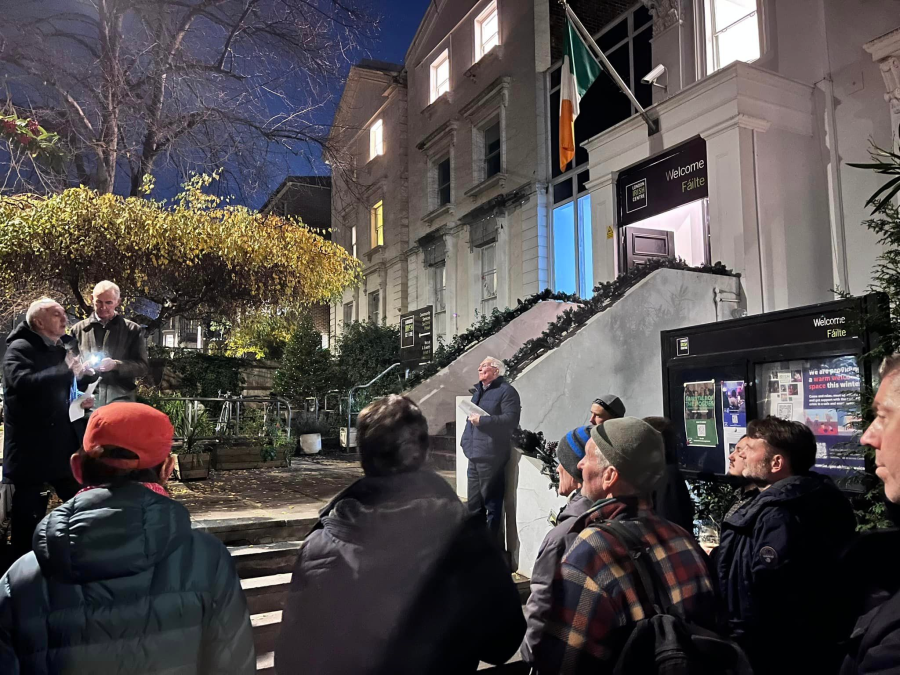
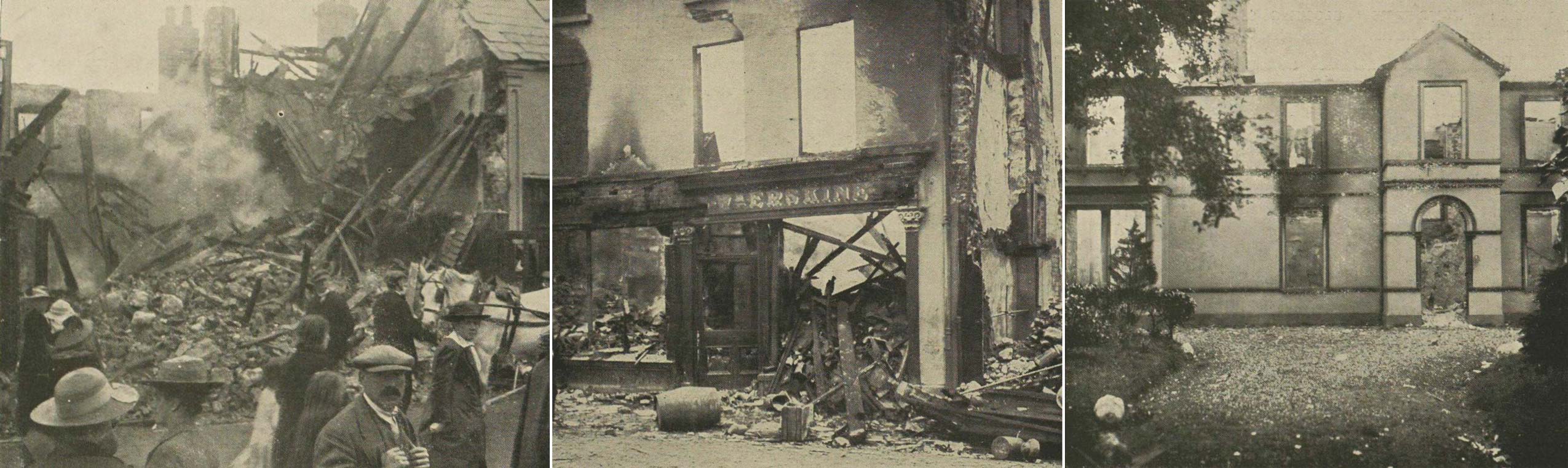
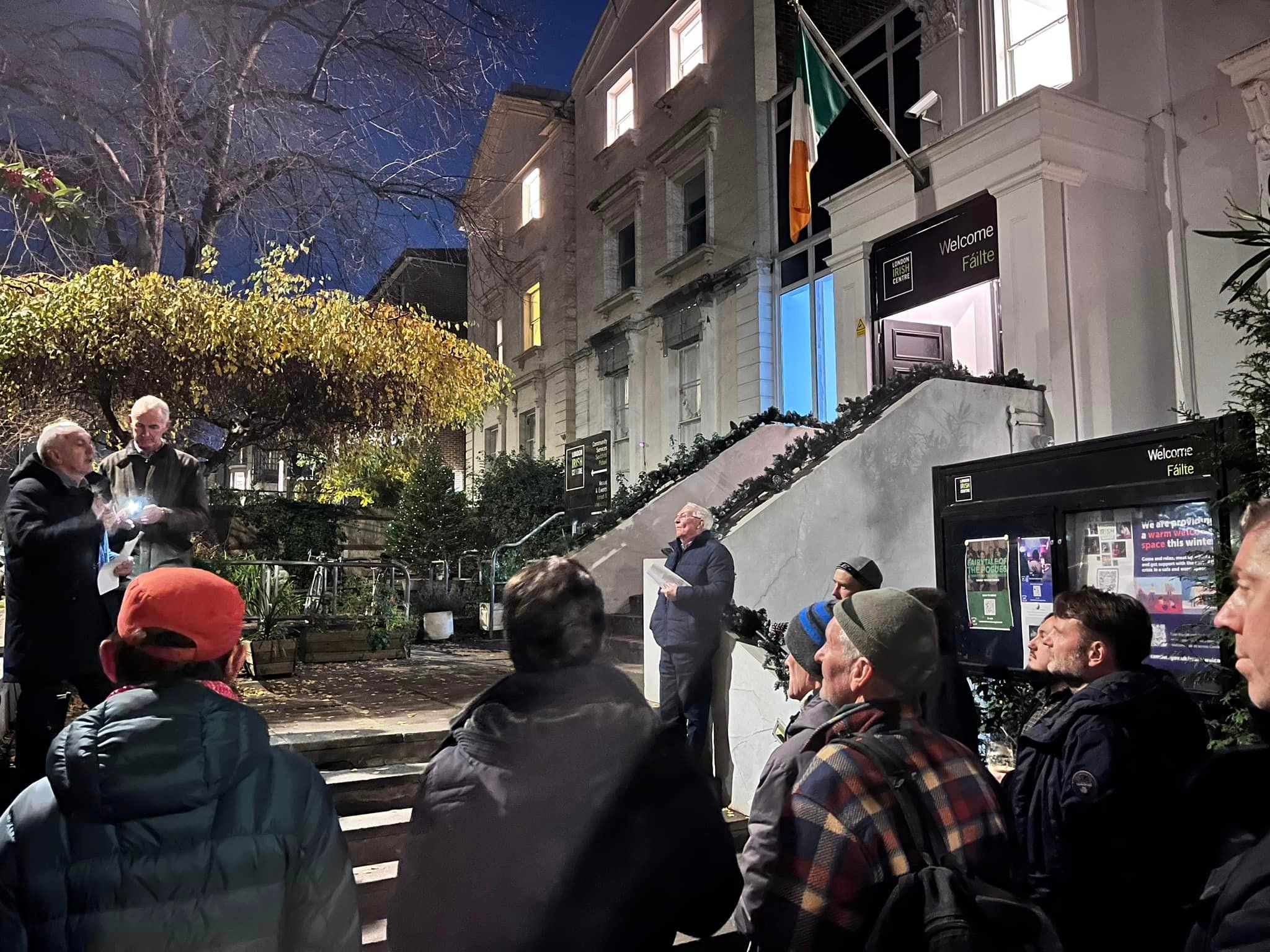
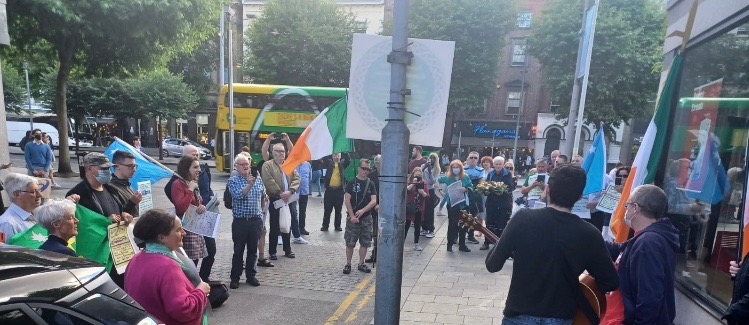


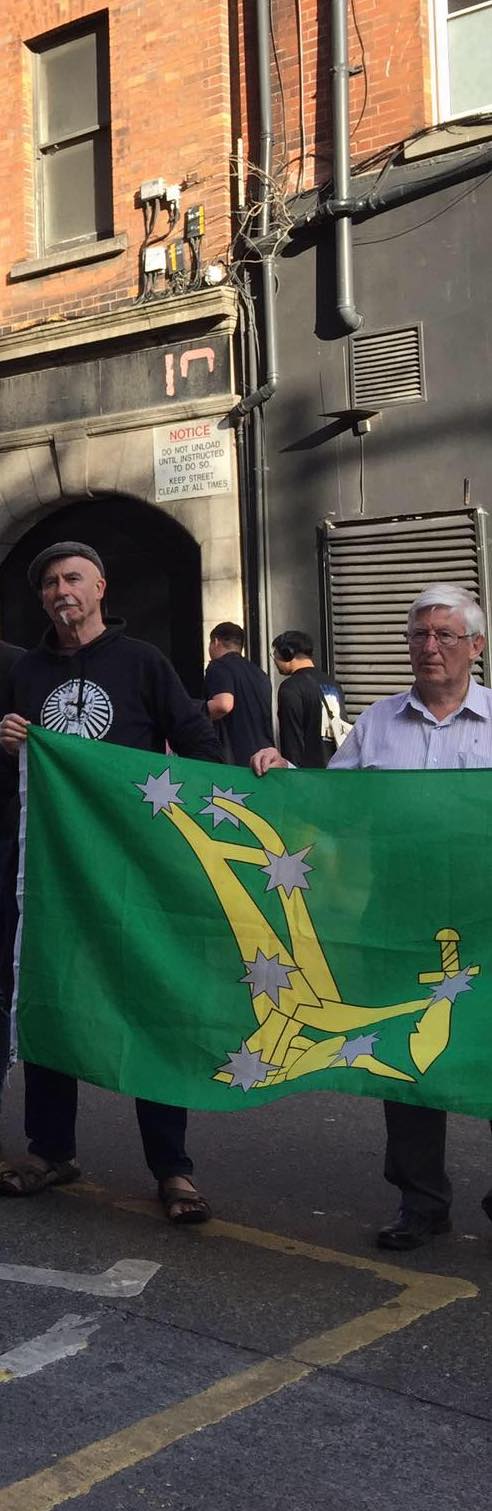
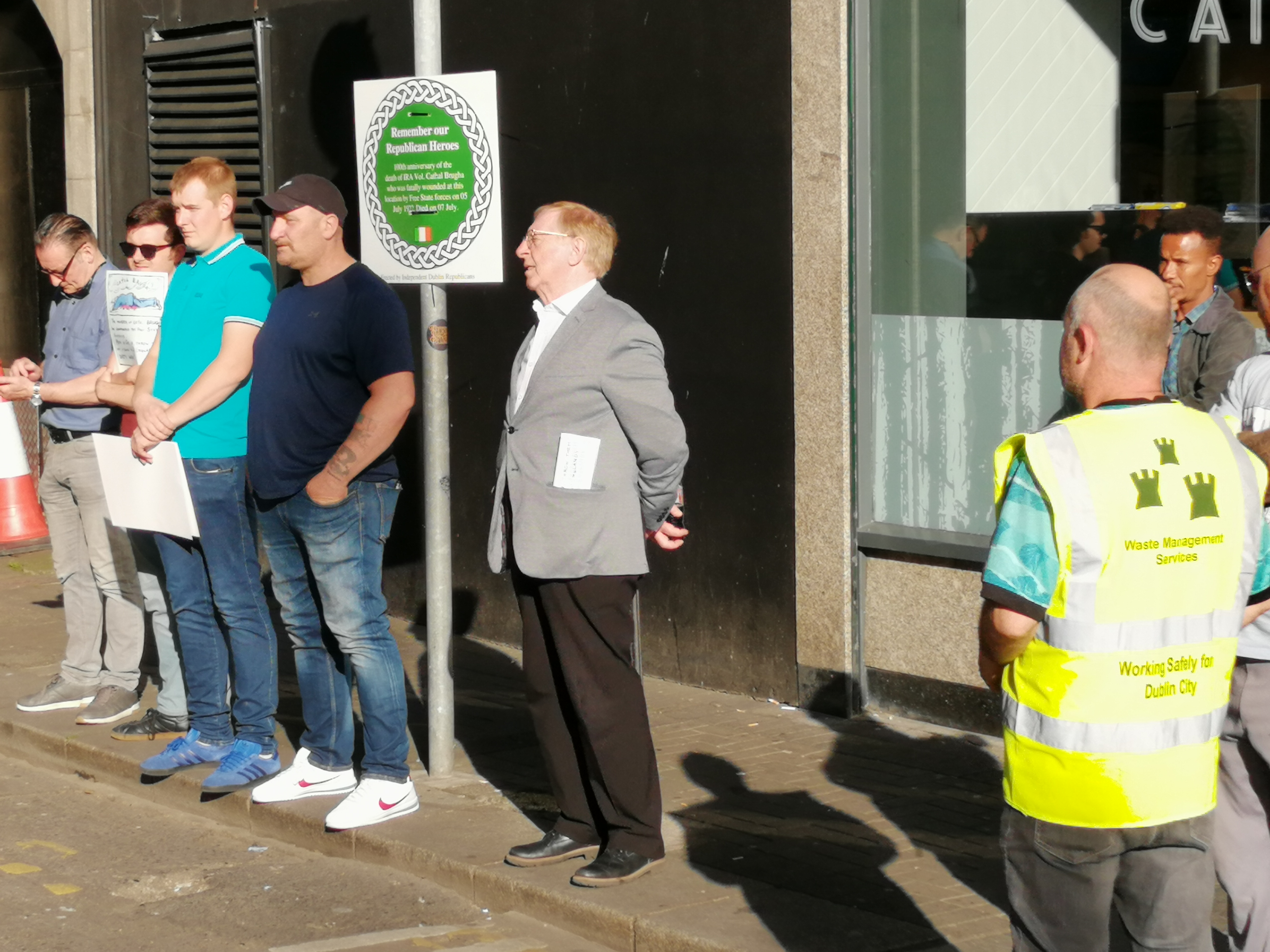


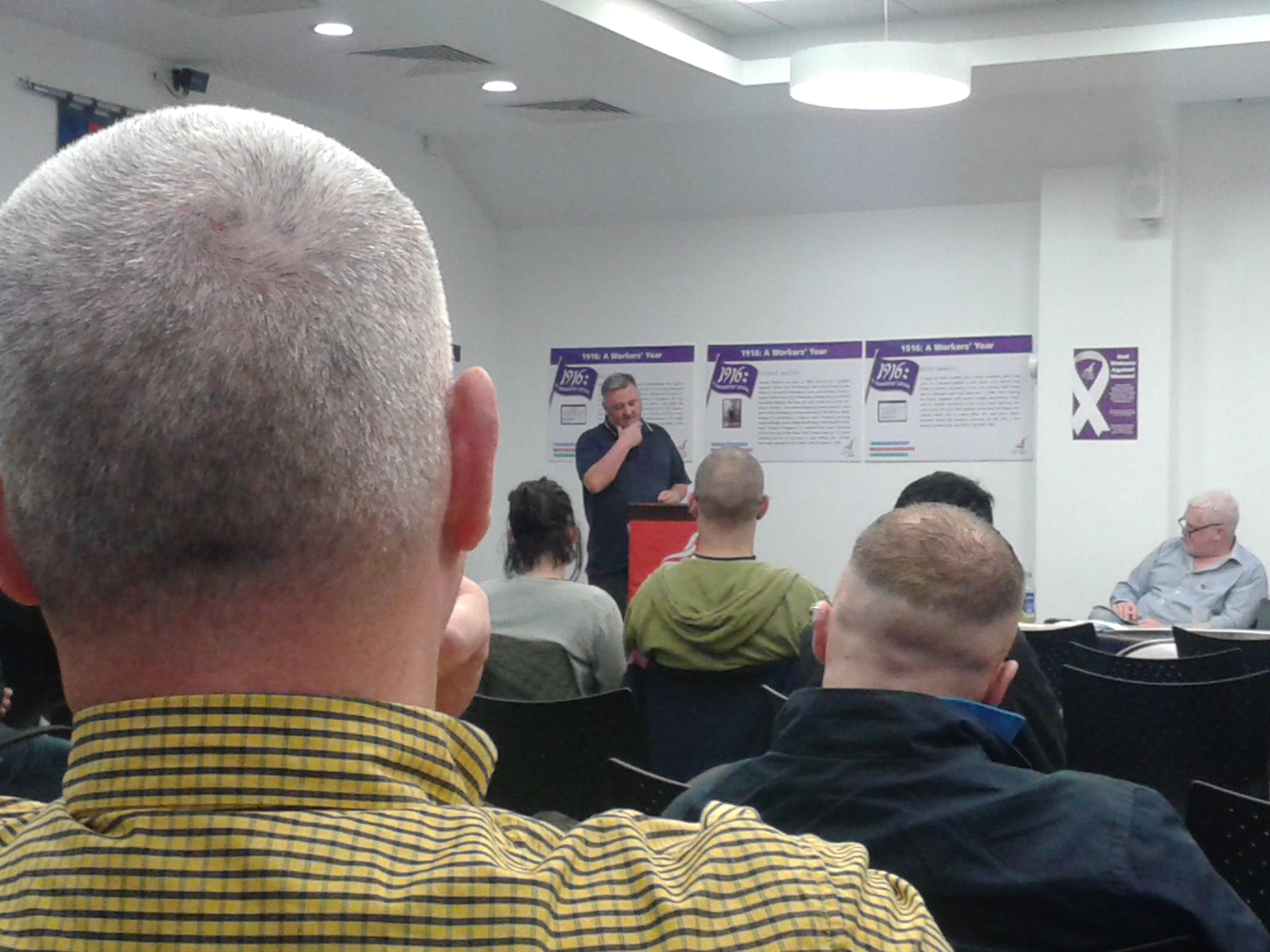

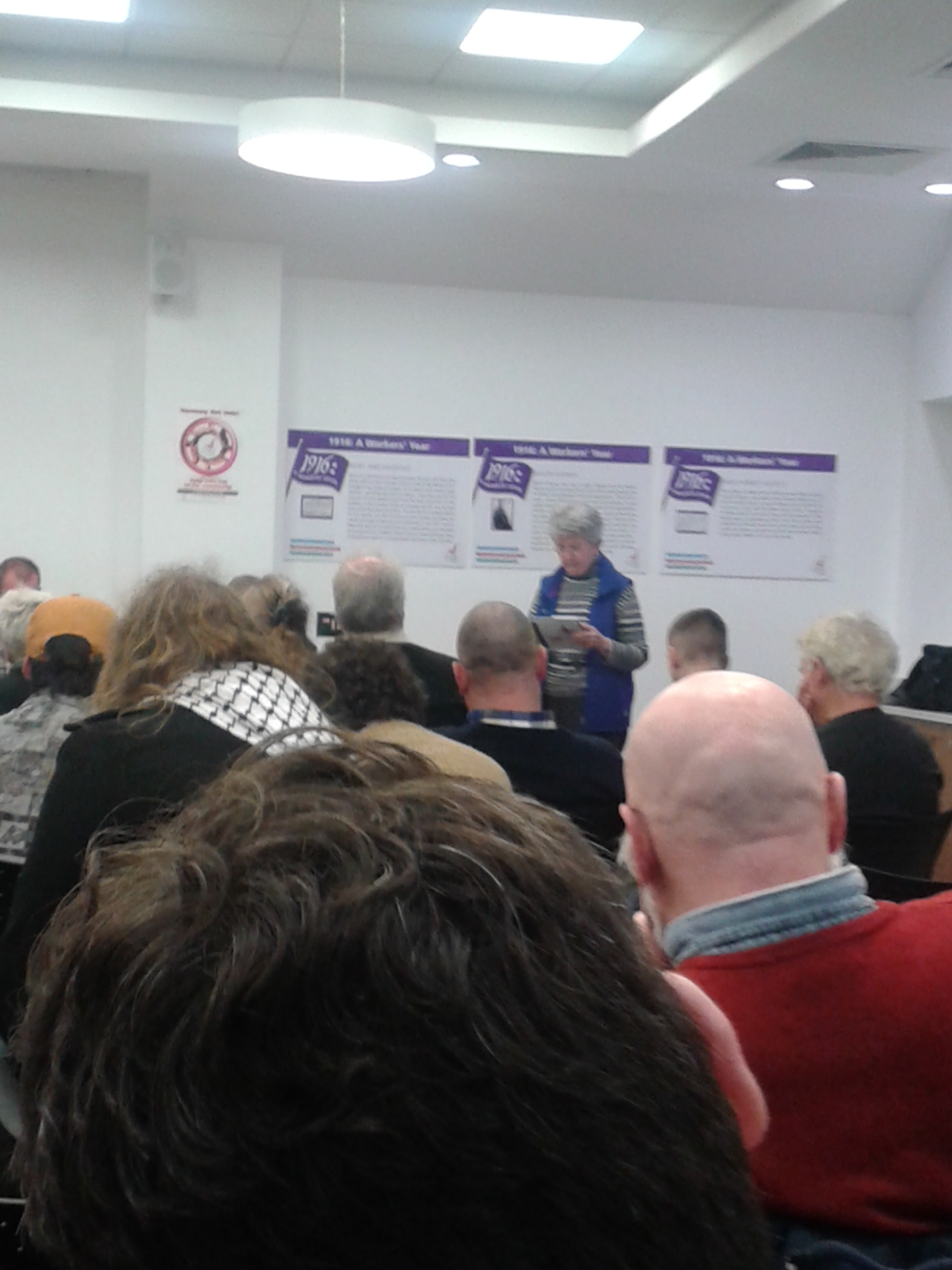












 rebelbreeze