On 13th September 1845 the widely-read British weekly publication The Gardener’s Chronicle apprehensively reported the appearance of the blight on potatoes in Ireland but doubtful if the full extent of the holocaust to follow was expected.
(Sourced: Internet)
True, no other national population in any other known part of the world was as heavily dependent on the potato as was Ireland’s. Other crops were grown but were mostly destined as feed for domestic animals1 or for export directly or indirectly as in the case of alcoholic drinks.2
A national diet is that of the mass of the population, which in Ireland was the peasantry. On the potato and a little milk the Irish peasantry grew strong enough to be recognised in Britain as healthy able workers, seasonally in agriculture or longer-term in manufacturing and construction.
They were reputed to be the tallest and most fecund in Europe, according to Frederick Engels writing in Britain a year before the piece in the Chronicle.3 In Ireland the peasantry were for the most part tenants-at-will or landless labourers for the settler big landowners and descendants.
The original Irish had been expropriated by sword, fire and pen (legal decrees) and their expropriators lived on the rents they extracted from their tenants in a mixture of crops, animals, cash and labour. After the abolition of the Irish Parliament,4 most big landowners found no reason to even live in Ireland.
The estates of the absentee landlords were then managed by agents, middlemen who forwarded the extracted wealth to their masters in Britain, or perhaps travelling ‘on the Continent’, or trying their hand in the American colony, minus the agents’ commission, of course.
As people went hungry, meat, dairy and grain continued to be exported.
The dependency of the Irish mass on the potato was known of course and even mocked in some ruling British quarters at times. But so were the Irish landlord aristocracy who seemed to have no interest in developing industry.
But could anyone predict that the blight would intensify each year and that the Government of the UK would tolerate such devastation in one of its parts? By the time it had run its course six years later, Ireland had lost at least 2.5 million of its original over eight million5 and more were emigrating.
Memorial to the Great Starvation on Dublin’s north side quays. (Sourced: Internet)
And both the Irish planter aristocracy and the cotter class of Irish peasantry had been wiped out, leaving the field to the Gombeen6 class of money-lenders and bigger farmers, the latter now expanding their holdings and who would farm meat instead of agricultural produce.
When the overall national population stabilised again it did so at five million,7 at which level, despite a high birth and survival rate, it remained until the early 1990s. The magic trick was achieved by constant annual emigration, giving the Irish one of the largest diasporas in the world.8
The Gardener’s Chronicle’s writer noting the arrival of Phytophthora infestans could not have imagined the extent of its devastation. But if he knew the history of Ireland as well as that of the blight, he would have concluded that it was not the worst blight upon the Irish nation.
No, that was the arrival of the Anglo-Normans in 1169, with the second-worst blight being the growth of the Gombeen class.
end.
Note: If you found this article of interest, why not register with Rebel Breeze for free, so that you will be notified by email of subsequent articles. You can de-register any time you wish.
FOOTNOTES
1Grazing animals live on forage in Ireland but in winter or if overgrazed must be given additional food, while draught animals need cereal feed, typically oats. Pigs and domestic fowl were fed on mixtures of potato, beet, pulses and domestic leftovers.
2Typically eorna (barley) for beer brewing and whiskey distilling. These products continued to be produced and exported during the years of famine. Hops are also used for brewing but much was imported from southern England where climatic conditions are more favourable.
3The Condition of the Working Class in England (1844).
41799, followed immediately in 1801by Ireland becoming part of the United Kingdom and Irish MPs being required to attend the Westminster Parliament.
5A historical and statistical riposte to the anti-immigration claim that today “Ireland is full”.
6Originally from the Irish word Gaimbín and applied to moneylenders and land speculators during and following the holocaust period it, came to be applied by many to the Irish neo-colonial national bourgeoisie.
7Of the whole nation, with over 3 million in the Irish state and under two million in the British colony, the Six Counties.
8The bleeding through emigration was constant but fluctuated in degree, with a high point in the 1950s when it amounted to 15% of the Irish state (i.e. of the 26 Counties) and another in the 1980s.
The photo of the massive antifascist rally in London on 28th July following a march from Russel Square shows the recapture of Trafalgar Square from Tommy Robinson and his sea of Union Jacks. Not for the first time, the Irish made their mark upon the place.
There the only two high flying flags were the Irish Tricolours and the Palestinian flags, the Irish contingent being one of the few on the day to see the fight in Britain against the fascists as part of the same fight against the fascist Zionist regime.
Irish and Palestinian flags in Trafalgar Square rally against racism, end July 2024 (Photo cred: PA)
We are mindful of the history of our occupied territories and our 1930s fight against the anti-Semitic Blackshirts1 in London (e.g. standing with the Jewish community at the Battle of Cable Street, 1936) and against the Bridgeton Billy Boys in Glasgow in the 1930s.2
On 28th July our flags sent out a message: We stand against all fascists, at home or abroad. That day we could not but remember all our brave men and women who marched past here from 1971 to 1998 carrying our fight to the heart of government3 in harder times.
We also know that the anti-racist movement now takes its new life from the strength of the Palestinian solidarity movement in Britain and needs to recognise this.
It was strange being in Trafalgar Square again with Tricolours given that we were barred from being there during the ‘Troubles’. Irish solidarity events were banned from using the Square under any circumstances from 1972 to 2001, well after the Good Friday Agreement.
The ban was lifted only once for an Irish event during that period and that was for the Peace Women4 (sic) calling for an ‘end to violence’ (mainly that of the Resistance) and famous US folk singer/ political activist Joan Baez displayed her ignorance of the Irish situation by speaking there.
It was interesting that a reporter for GB News of the British mass media was aware that a picket had been held in Dublin in protest against the assassinations of Palestinian and other Arab resistance leaders. He tried to link the Irish contingent in Trafalgar Square with ‘support for Hamas’.
The linkage was hinted in his broadcast report though he was careful enough not to report a direct link as the Irish group in Trafalgar Square had in fact no connection with the Dublin group. The reporter asked how to pronounce ‘Saoirse Don Phalaistín’ — but still got it wrong in his report.
One of the Irish contingent spoke to the young GB News journalist: He had the stuff from Dublin on his phone and wanted to say that the Irish in the Square were part of the Dublin group.
“Next thing you’d know the Zionists would call for a ban on the Irish for ‘supporting Hamas’”,5 commented one of the veteran Irish activists. “We also get targeted because of the flag and our placards.”
The UK State and the police are all pro-Zionist and the Zionist press tries to trap the Irish into dangerous statements but “We know our history and are well able for them; we just say we support Palestinian resistance to Israeli occupation just as we did with the British in Ireland.”
Irish contingent with flags on Palestine solidarity march to Downing Street very recently (not sure whether the SW person is part of it). (Photo sourced from participant).
The Irish Tricolours, often in the company of the Palestinian national flag with Saoirse Don Phalaistín printed on it have been seen on Palestine solidarity marches in London since the current Zionist genocide began but also on anti-fascist rallies and in support of Julian Assange.
This is in keeping with the history and tradition of the Irish in Britain who helped found the republican United Englishmen6, the Chartists,7 many trade unions, a section of the First International8 and also gave the British working class their anthem9 and their classic novel.10
Classic novel of the working class in Britain was written by Robert Noonan, aka Robert Tressell, from Dublin. (Image sourced: Internet)
In later times they were prominent in organising solidarity with Vietnam and of course Ireland, against repressive legislation and fascist organisations, solidarity with Nicaragua, Palestine etc. and in struggles against state repression, including within the jails.
The Prevention of Terrorism Act (1974), forerunner of the current Terrorism Act (2000) specifically targeted the Irish community in Britain with suspension of habeas corpus for a period of up to five days, refusal of access to solicitor, as did also the framing of a score of people.
In the midst of the Irish Hunger Strikes of 1981, the Irish community broke out of the State terror stranglehold and formed the Irish in Britain Representation Group, among its objectives being the abolition of the Labour Government-introduced Prevention of Terrorism Act.
End.
Saoirse don Phalaistín and Irish Tricolour flags on Palestine solidarity march this year photographed against Westminster’s ‘Big Ben’. (Photo cred: being investigated)
NOTE ON AUTHORS
Pat Reynolds is a former trade unionist, social worker, a veteran anti-racist, anti-fascist activist, also for Irish independence and for rights for the Irish community in Britain. He was PRO for the Irish in Britain Representation Group for two decades, founding the Haringey Branch and the Green Ink Bookshop. Reynolds is from Granard in Co. Longford and lives in London.
Diarmuid Breatnach is a former trade unionist, worker with homeless/ substance misusers (manual worker before that), also a veteran anti-racist, anti-fascist activist and campaigner for Irish independence. For a decade he was on the Ard-Choiste of the IBRG, founder of the Lewisham Branch and of the Lewisham Irish Centre. Breatnach is from Dublin to which he has returned to settle.
FOOTNOTES
1The British Union of Fascists led by Sir Oswald Moseley which had substantial support in the British elite, including the publisher of the The Daily Mail with police attacks on anti-fascists.
2The Billy Boys were founded and led by Billy Fullerton, a former member of the British Fascists. Fullerton also later became a member of the British Union of Fascists in the 1930s. The Billy Boys adopted a militaristic style of behaviour, marching on parades, forming their own bands, composing their own songs and music, and all dressed in a similar manner.[3] The Billy Boys also formed a junior group whose members were teenagers called the Derry Boys. (Wikipedia)
3From Trafalgar Square to the Houses of Parliament in Westminster runs a broad thoroughfare, in the centre of which is the Cenotaph and a little further, the entrance to Downing Street.
4The organisation/ campaign was founded by Betty Williams and Mairead Corrigan in 1976 after a car driven by an IRA fighter mortally wounded by British soldiers in Belfast crashed into pedestrians and mortally wounded three children of Anne Maguire, sister of Mairead. Branding itself as against all violence the Peace Women in fact targeted primarily the Republican movement, secondarily the Loyalist paramilitaries and hardly ever the Occupation Army. Williams accused the IRA unit of having fired on the Army unit that killed the driver which was untrue (but is repeated on her Wikipedia entry). Both founders received the Nobel Peace Prize in 1976 and a substantial cash prize. Williams resigned from the group in 1980 and disappeared from Irish-related activities though prominent externally. Corrigan however remained politically active in Ireland and elsewhere against war and has campaigned among other things for the end of the ‘Israeli’ siege on Gaza, being arrested with crew and passengers on the Spirit of Humanity aid ship in 2009 by by the Zionist navy, taken to ‘Israel’ and subsequently deported.
5Hamas is proscribed organisation in the UK since March 2001 and a person promoting it would be liable to prosecution under the Terrorism Act.
6A spin-off from the United Irishmen in Ireland; the English chapter led the Spithead and Nore naval mutinies. The Irish also reformed the United Scotsmen when it was faltering.
7Karl Marx called the Chartists “the true mass movement of the working class” – two of its principal leaders, Bronterre O’Brien and Fergus O’Connor were Irish, as their surnames would suggest.
8The Fenians were accepted into the First International Workingmen’s Association.
9The lyrics of The Red Flag were composed by Jim Connell from near Kells, Co. Meath and set to the brisk air of The White Cockade, later changed to the mournful air of Tannebaum.
10The Ragged-Trousered Philanthropists was written by Robert Tressell (real name Robert Noonan) from Dublin.
The anniversary on Sunday of the death on hunger strike of IRA Volunteer Bobby Sands was marked with a number of posts on social media. I would like to add an Irish migrant’s1 perspective and some analysis of his legacy.
The Irish diaspora was a powerful sector in solidarity for the Irish struggle not only because of their cultural background but also because of their numbers. Some British cities had an estimated diaspora population of 10% (Irish-born and 1st and 2nd generations).
Furthermore, the higher proportion of those in turn was of the working class, a section of society which, although they in no way had their hands on the standard levers of power, certainly had a strong potential of the kind the British ruling class had learned to fear.
Irish Republicans of course formed part of that sector and organised within it but on the other hand the IRA’s bombing campaign in Britain was of no help at all. The popular fear of being caught in an explosion greatly enabled the Government to tighten the screws under the guise of “security”.
Karl Marx, a strong supporter of Irish freedom had commented after the Clerkenwell prison bombing of 18672 that “One cannot expect the London proletarians to allow themselves to be blown up in honour of the Fenian emissaries” (i.e who they were trying to free from the jail).
In 1974 the Labour Government had repressive legislation ready and on 29 November, using hysteria arising from the Birmingham and Guildford pub-bombings they rushed through the Prevention of Terrorism Act (1974) which permitted the holding of suspects for two days without charge.
An underground cell in London’s Paddington Green police station – this is where Irish detainees under the Prevention of Terrorism Act might be kept and interrogated for seven days without visitors or access to solicitor. “The old cells were 12-foot square, contained no windows and were reportedly too hot in the summer and too cold in winter” (Wikipedia).(Photo: Posted in 2020 on Internet by Green Anti-Capitalist Front who occupied the empty building intending to turn it into community centre.)
That could be extended for another five days – and often enough was — by application to the Home Secretary. Access to solicitor was usually denied and though not lawful, the fact of the detention itself was often denied to concerned people making enquiries of the police station.
The prospect of disappearing for seven days into police custody somewhere was naturally terrifying and a ‘suspect’ could also be deported without trial to Ireland – even to the British colony of the Six Counties, which amounted according to their law to “internal exile”.
Snapshot of London police harassment and intimidation of Irish solidarity activists in 1981. (Photo sourced: Internet)
The framing of a score of innocent Irish people3 in five different trials4 with very heavy sentences added to the intended terrorising of the Irish community in Britain, the “suspect community”5, many of whom believed the victims to be not only innocent but most not even politically active.6
Irish solidarity activity in Britain diminished greatly after 1974 as state repression impacted across the Irish community. But the hunger strikes and concerns to save the lives of the strikers in 1981 broke the hold of state terror as people took to the streets in their thousands once again.
They were unsuccessful but never returned to that state of immobilising fear that had settled over the community.
The Irish in Britain Representation Group got its initial start in 1981 which happened as follows: the bourgeois Federation of Irish Societies had its AGM in May 1981 and one of the members proposed that a motion of sympathy to the Sands family be recorded when he died.
IBRG and Irish Republican POW Support Committee banners on march Birmingham 1984 (Source: Mullarkey Archive)
The meeting’s Chairperson ruled the proposal out of order and ‘the Fed’ continued with their ordinary business. The then Editor of the Irish Post7, writing in his “Dolan” column, found this disturbing and suggested there might be a need for a new type of Irish community association.
A number of individuals wrote in and the ball got rolling, though it took until 1983 to set up the branch-based organisation with a constitution and democratic safeguards in operational rules. The IBRG soon had a number of branches in London and others in the North and Midlands.
For the next two decades the organisation campaigned for the release of the framed prisoners, against the Prevention of Terrorism Act, strip-searching, all racism but in particular the anti-Irish and anti-Traveller varieties, for Irish representation in education, services, Census category, etc.
Lewisham Irish Centre Management Committee and Staff, possibly 1994. The Centre was campaigned for and won by the Lewisham Branch of the IRBG in conjunction with the Lewisham Irish Pensioners’ Association (which the IBRG had also founded).
The IBRG also called for British departure from Ireland and collaborated with other organisations in marches, demonstration, pickets, conferences, producing also a number of important report documents. The organisation’s officers were drawn from migrant Irish and those born in Britain.
Bobby Sands Mural on gable end of a house in Belfast (Photo cred: Brooklyn Street Art)
REPRESENTATION OF BOBBY SANDS
Bobby Sands was a man of great courage whose leadership qualities were recognised by his fellow political prisoners when they elected him as their Officer Commanding in the H-Blocks. He was also an accomplished writer and poet.
When the British reneged on the agreement that ended the 1980 hunger strike and a new one was planned, Sands insisted on being first on the list, which also meant that in the event of resulting deaths, his would be the earliest.
Most people will agree easily with all the above evaluation of the man but from that point onwards, his representation is manipulated to suit different agendas, in particular those of pacifists, social democrats, liberals and a variety of opportunists.
Some of them love above all his quotation that “Our revenge shall be the laughter of our children”. They forget many other things he wrote and seek to turn him into an angel or saint of pacifism.
Since they embraced the pacification process, Sinn Féin try to represent Sands as an advocate for and proof of the effectiveness of participating in the parliamentary electoral system, based on his success in a 1981 Westminster by-election with 30,492 votes, 51.2% of the total of valid votes.
What both these groups fail to recognise is that Sands was an IRA volunteer and was sentenced for possession of handguns in 1972 and again in 1976. If he was an angel, it was of the Archangel type, fighting against what he considered evil.
He was proposed in the Fermanagh-South Tyrone by-election mainly in order to support the campaign of the prisoners against criminalisation and for the political status recognition that they had previously. Saving the lives of the hunger strikers was of course part of the plan too.
Nine protesting Republican prisoners contested the general election in the Irish State in June. Kieran Doherty and Paddy Agnew (who was not on hunger strike) were elected in Cavan-Monaghan and Louth respectively, and Joe McDonnell narrowly missed election in Sligo-Leitrim.
But that is a long way from proving that the electoral process is a viable way of dislodging the ruling class and their system and, in fact, history has proven the opposite.
Nobody knows what position Sands and the other nine would have taken on the electoral process had they lived. Possibly some would have gone along with the SF leadership on that and some others would now be reviled as “dissidents” (as are indeed some H-Block survivors).
All we can say for certain is that they were men of courage in that all of them had joined the armed struggle for Irish national liberation. They had even higher courage of a level hard to imagine, to risk and then experience slow physical disintegration and death by the day and by the hour.
Long after their erstwhile prominent enemies are forgotten, their names will shine in our history and Bobby Sands’s, the brightest of them all.
2A bomb was planted against the prison wall to free a member of their group who was being held on remand awaiting trial at Clerkenwell Prison, London. The explosion damaged nearby houses, killed 12 civilians and wounded 120; no prisoners escaped and the attack was a failure. Michael Barrett was found guilty of the bombing despite his claim supported by witness testimony of having been in Glasgow during the bombing and was hanged on Tuesday 26 May 1868 outside Newgate Prison, the last man to be publicly hanged in England (the practice was ended from 29 May 1868 by the Capital Punishment Amendment Act 1868). https://en.wikipedia.org/wiki/Clerkenwell_explosion.
3Carole Richardson of the Guildford Four was not Irish but she was the girlfriend of one of three Irishmen.
4Birmingham Six, Guidford Four, Giuseppe Conlon, Maguire Seven and Judith Ward. They were not acquitted and released until decades later, by which time Giuseppe Conlon had died in jail.
5Suspect Community by Paddy Hillyard, Pluto Press (1993)
6Believing them innocent and not active worked even better to terrorise because if the likes of those could be framed and jailed, no-one was safe. But perhaps safest was to do absolutely nothing to draw the attention of the State.
7Brendán Mac Lua, co-founder of the Irish community newspaper in 1970 which is now a very different periodical.
8The lark is associated with Sands because he wrote a story about a man who had captured a skylark, a bird that unusually sings in flight. In the cage the bird would not sing so the man draped the cage with cloth and still the bird would not sing, nor would it do so when he refused it food and water until eventually, it died in the dark, silent to the last.
Today marks 184 years since the greatest armed rebellion in 19th-century Britain when Chartist workers fought bloody gun battles with the police and army in the heart of industrial Wales, writes STEPHEN ARNELL
A sketch of the huge crowd in Newport in 1839 as it surrounded the Westgate Hotel hoping to free captive Chartist comrades (via the People’s History Museum).
“Come hail brothers, hail the shrill sound of the horn For ages deep wrongs have been hopelessly borne Despair shall no longer our spirits dismay Nor wither the arms when upraised for the fray; The conflict for freedom is gathering nigh: We live to secure it, or gloriously die.” — Chartist song of the South Wales miners
UNLIKE our friends across the channel in France, the inhabitants of Britain appear a remarkably supine people in the main, usually preferring well-organised demonstrations to anything that whiffs of pre-planned armed revolt, no matter how righteous the cause.
Yes, there have been mass meetings, marches and spontaneous events that took a wrong turn and descended into riots, but we seem singularly ill-equipped by nature to contemplate anything more serious.
But this would be doing this island race a disservice; to paraphrase the emperor Tiberius, there was a time when the British were not a people “fit to be slaves.”
There’s a long and storied history of the working classes attempting to seek redress from a variety of wrongs, including poll taxes (the Peasants’ Revolt, 1381), government corruption (Jack Cade’s Rebellion, 1450), religion (the Pilgrimage of Grace, 1536) and the later Pentrich Rising in Derbyshire of 1817, a muddled affair which aimed to cancel the national debt and repeal the Corn Laws.
1839’s Newport Rising was a more coherent and dangerous challenge than Pentrich, in possessing both a specific democratic political manifesto and its unprecedented scale.
That’s not to say the revolt was a carefully co-ordinated business that worked to a timetable with a pre-planned outcome, but the numbers involved, the potential for encouraging similar risings and the essential justice of the Chartist cause gave Lord Melbourne’s Whig government a serious jolt.
Newport had its origins in both national and local events.
The House of Commons rejection of the People’s Charter of 1838 calling for universal male suffrage, secret ballots, salaries for MPs, equal constituencies, and the end of the property qualification for voting on July 12 1839, and the following conviction and imprisonment in Monmouth of the Chartist leader Henry Vincent for conspiracy and unlawful assembly, stoked the fires of rebellion in industrial southern Wales, a stronghold for the movement.
Combined with this were reasons that directly concerned the rising’s leader, John Frost (1784-1877), namely his six-month imprisonment resulting from a dispute regarding his uncle’s will with Newport town clerk Thomas Prothero, and the wealthy political enemies he made on the way to becoming mayor of the Monmouthshire burgh.
A sketch of Chartist leader John Frost on trial at Monmouth after the uprising.
Despite this, Frost was supposedly reluctant to lead a full-scale armed uprising, and doubtful of its prospects, but the zeal of his supporters forced his hand and preparations were made for the march on Newport.
On Monday November 4 1839, Frost led 4,000 followers to the town, his group including allied coalminers, who armed themselves with home-made pikes, bludgeons, and firearms.
The authorities in Newport got wind of the march and detained several known Chartists at the Westgate Hotel in the town centre. This added impetus to Frost’s mission which was presumably to take over the town in the hope of starting a nationwide insurgency.
At 9.30am, a crowd of anything from 8,000 to 20,000 Chartists (ironically including Allan Pinkerton, later founder of the infamous US strikebreaking detective agency known as “the Pinkertons”) filled the square in front of the hotel, demanding the release of their comrades.
The mayor had gathered a mixed force of around 60 soldiers of the 45th Regiment of Foot and 500 special constables to defend the Westgate, all equipped with weaponry superior to the relatively small number of Chartists possessing guns.
To this day no-one knows for sure who fired the first shot, but a heated exchange between the two sides began, with the engagement lasting approximately half an hour. The result was a total rout for the Chartists.
Up to 24 rebels were slain, with around 50 injured. Four of the defenders were wounded, as was the mayor of Newport Thomas Phillips (later knighted by Queen Victoria), when the attackers briefly succeeded in entering the building. So ended the greatest armed rebellion in 19th-century Britain.
In comparison, the better-known Peterloo Massacre of August 1819 saw 18 people killed and as many as 700 injured when army regulars, special constables and local yeomanry charged peaceful demonstrators calling for parliamentary reform.
Unlike the French, with the storming of the Bastille, the March on Versailles and the Paris Commune, the Newport Chartists appeared to lack the killer instinct of their Gallic counterparts, which may say something of the passive British national character relating to the ruling class.
The leaders of the rising were convicted of treason and were sentenced to be hanged, drawn and quartered, the last in England and Wales to be condemned with this ghoulish form of execution.
Their sentences were commuted by Queen Victoria to transportation for life to Tasmania. Frost was given an unconditional pardon in 1856 and returned briefly to Newport, where he received a rapturous welcome.
His two co-conspirators were also pardoned, but both opted to stay in Australia. Watchmaker William Price continued to ply his trade, but without success and died in poverty; in contrast, collier Zephaniah Williams (who at one point had planned to escape) discovered coal in Tasmania and became one of the richest men in the colony.
Note: the last people to be hanged, drawn, and quartered for treason in Britain are said to be David Tyrie in 1782, and in 1798, Father James Coigly; both were convicted of spying for the French (the Bourbon and revolutionary regimes respectively).
In 1977, John Frost Square, in Newport city centre, was named in the Chartist’s honour. But in 2013, Kenneth Budd’s mosaic in the square commemorating the Chartists was demolished at the behest of the Labour-run Newport council, prompting widespread outrage (from the likes of actor Michael Sheen and former Archbishop of Canterbury Rowan Williams) and public demonstrations.
Comedian Jack Whitehall is a descendant of Welsh lawyer Thomas Jones Phillips, one of the chief opponents of the Newport Rising. Taking no pride in this fact, in 2019 he commented on BBC1’s Who Do You Think You Are, “What’s next? I suppose probably go and visit a mine our ancestor shut down or maybe an orphanage he burned to the ground.”
The Newport Rising also features in a graphic novel published in 2019, Newport Rising, written and illustrated by local artist Josh Cranton; the book was launched at the Westgate Hotel, which unlike Budd’s original mural still stands, recently reincarnated as a “live music, performance, arts and heritage venue.”
Rebel Breeze is grateful for this article about an instance in the long history of workers’ resistance to various features of capitalism.
The article would not have been diminished and might even be thought to be enhanced by mentioning the Irish diaspora’s contribution to the Chartists, both in rank-and-file membership and in leadership, with Bronterre O’Brien and Fergus O’Connor in the latter category.
Or to mention that despite the spying for the French charge against Fr. Ó Coigligh, the last man hanged, drawn and quartered by the civilised British Establishment, the real reason was his membership of and participation in the United Irishmen, an Irish revolutionary Republican organisation.
That organisation had also ‘infected’ the short-lived United Scotsmen and even shorter-lived United English, though in the latter case contributing to the leadership and organisation of the Spithead Naval Mutiny.
Revolt of the English sailors, On each ship they went to tackle, vintage engraved illustration. Journal des Voyage, Travel Journal, (1880-81).
Of course, such references might have tempted the writer to compare revolutionary uprisings in Britain with those in Ireland, rather than in France.
But then, the Communist Party of Great Britain, which owns The Morning Star where the article was published, has never been too fond of the Irish struggle for independence or the means we felt justified in employing.
The media announces that “the population of Ireland has reached 5 million … for the first time in 170 years”. Interesting – and a barefaced lie! The population of Ireland passed 5 million some time ago and is actually around 6.5 million now.1
Ireland remained with negative population growth until near the end of the last century – mismanaged for most of the population first by the British occupiers of the whole of the island, then by a combination of the native neo-colonial bourgeoisie and of the settler colonial ruling class.
Filling in a census form from which population statistics can be extracted (Photo sourced: Internet)
For more than a century the population of Ireland stood at around 5 million, static despite a high birth rate. This was mathematically possible only through continual massive emigration – mostly to English-speaking regimes: Britain, USA, Australia, New Zealand and Canada.
But it is true that 170 years ago it was more than 5 million – in fact it was around 8.5 million. And it is worth reflecting on how they were able to produce enough food domestically to feed that entire population while now, with a smaller population, we import as much as 80% from abroad.2
It was the Great Hunger that wiped out much of the earlier population, statistics somewhat hiding the pain and sorrow of millions of Irish in death, disease and emigration — and the great transfer of land for cultivation (and rent) to pasturage, with its dangerous environmental impact.
It provided an opportunity for growth of the Catholic Irish capitalist class, the Gombeens, huckstering money-lenders buying up the lands of afflicted neighbours.
The kind of class that the British could depend on in 1921 to manage the neo-colony and to murder and jail those of national liberation3.
Emigration kept population stats steady and, combined with unemployment, ensured a low internal home market for development. An educated workforce and natural resources could be developed but the Gombeen class opened it all to foreign multinationals rather than develop it themselves.
Even with foreign exploitation of the workforce at home, the education system turned out mostly emigration fodder: the Irish tax-payers funded an education system to provide a literate and numerate English-speaking workforces for capitalist exploitation abroad.
No wonder the Irish political class declined to give the Irish abroad a vote in the Irish state – unlike for decades any other state in the European Market. Yet during the 1930s through to the 1960s, money sent home by Irish migrants accounted for an estimated 30% of the Irish State’s economy.4
The Irish state remains a neo-colony with low taxation and other incentives for foreign companies to take over our few industries5 and local and foreign property speculators to rake in profits out of the despair of homelessness or of struggling to meet rent or mortgage payments.
A neo-colonial market for produce of foreign companies and to plunder not only our labour force, not only our natural resources on land, sea and wind and but even our infrastructures in transport and communication, energy, health service, water supply and even our city sanitation.
TRUNCATED
The announced statistics were truncated, appropriate perhaps for a truncated country, with the history behind those statistics not so much truncated as obliterated.
That is our present and our past but not how the future has to be – we can write our own future but we won’t do it by putting a mark on a ballot paper.
3The Irish Civil War or Counterrevolution, 1922-1923.
4I have read this in the past but am unable now to find the reference; however I have posted some references on the figures of remittances from Irish emigrants.
5 For a few examples of foreign takeover: Irish stout, beer and lagers (Guinness, Smithwicks, Harp); Irish whiskey (Paddy, Jameson, Bushmills); cigarettes (Afton); preserved vegetables (Erin); aviation (Aer Lingus); public transport (Transport for Ireland; LUAS); sugar (Irish sugar beet replaced by subsidised cane sugar from the USA); woodlands (Coillte).
I have been sent this article from The Morning Star, newspaper of the Communist Party of Great Britain, a reprint from The People’s World, like-minded newspaper from the USA.
The article is about the removal by right-wingers in the USA of a marker commemorating worker organiser, women’s suffrage campaigner, anti-racist and anti-fascist Elizabeth Gurley Flynn in her home town of Concord, Massachusetts, USA.
An omission in the article, which the Morning Star chose not to correct, is the Irish background of the article’s subject, class fighter Elizabeth Gurley Flynn. Is this important? It certainly was to the subject herself who, in her biography, emphasised her Irish background.
Cover of her biography (Source photo: Internet)
She wrote of the importance to her of claiming both Irish family names in her ancestry and always used them both: Gurley and Flynn. But in particular for the CPGB, operating in a state that is oppressing Ireland, it should be of importance how Irish people are represented.
Especially in a culture with a deep and long streak of anti-Irish racism.
Elizabeth Gurley Flynn speaking at a mass meeting in the USA (Source photo: Internet)
The CPGB never supported the armed struggle by Irish people against its masters nor stood up for the defence of the Irish diaspora in Britain, subject to racism in the media, to police persecution and to judicial and legal racism in the 1970s, ’80s and ’90s.
This is despite the enormous contribution of the Irish diaspora to the trade union and socialist movement in Britain in shop stewards, activists and leaders.
International Workers of the World (‘Wobblies) organisers: Elizabeth Gurley Flynn (centre) next to Big Bill Haywood (right). (Source photo: Internet)
With Bronterre O’Brien and Fergus O’Connor, the Irish diaspora gave the British working class two leaders of the first mass movement of workers in Britain, the Chartists. The anthem of the class, The Red Flag, was composed by Jim Connell from Co. Meath (though they used the wrong air).
And the classic novel of the class, The Ragged-Trousered Philanthropists, was penned by Robert Tressel, pen-name of Robert Noonan, born and reared in Dublin.
The CPGB in fact has a long association with British colonialism and its very title is an indication of that.
End.
Left: Famous photo of Gurley Flynn as a public speaker. Right: The marker in her hometown now removed by right-wingers there. (Photo sourced: Internet)
Speech by Pat Reynolds2 in Commemoration of Irish Civil Wars 1920-1923 on a sub-zero evening outside Camden Irish Centre, London on 8th Dec 2022
(Reading time: 15 mins.)
A Chairde Ghaeil agus a Chomrádaithe, tonight we are gathered here to remember and celebrate the lives of Liam Mellows, Rory O’Connor, Dick Barrett and Joe McKelvey, four great Irish patriots.
We also call out the neo-colonial Irish Free State for those unlawful murders and all other executions carried out by this British Imperialism-backed Dublin regime, acting on orders to attack the Irish Republic and its army and people.
In remembering this time and the setting up of the Irish Free State and the Northern Ireland government 1920 -1923 we take the Republican view of history in an All-Ireland context and avoid the narrow structures of the Free State 26-County centenaries.
These ignore the Six Counties and the heroic role played by the people there in defence of the Republic and a United Ireland.
In looking at this time in history we consider the two proxy wars waged in Ireland by British guns and on behalf of imperialistic interest to put down the Republican fight for a 32-county Irish Republic declared in Dublin at Easter 1916.
That was voted by a very large majority in 1918 for the same All-Ireland Republic, fought for in a war of independence from 1919 -1920 by an undefeated IRA.
The revisionists try to partition the Irish struggle to backdate some kind of imaginary Loyalist/Unionist state which never existed, was never fought for or voted on to create a colonial divide-and-rule in what was always even — under colonial rule — one country.
As Republicans we reject the 1948 Republic declared by the Blueshirts3 and fascist Franco ally Costello.
Those who want to read about this heroic struggle by the Irish people should read the two books by Ernie O’Malley TheSinging Flame on the War of Independence and On Another’s Man’s Wound on the Civil War.
In looking at the history of this time we see two wars being fought against the Republic, the first in what became Northern Ireland from June 1920 to June 1922, a two-year war to put down the Republican people in the North East of Ireland.
The second war was within the newly created 26 Counties Free State from November 1922 to May 1923, a nine-month war by British guns against the Republic.
It is sad to state here tonight that the only war ever fought by the Free State Army was to put down the Irish Republic and its own people.
James Joyce in the Dubliners short story collection has this wonderful story The Dead where at the end he looks out the window and sees it is snowing, in his words “it is snowing all over Ireland, snowing, on the living and the dead.”
At that time in history, we see British guns firing down all over Ireland, leaving us the heroic dead and the living nightmare that became the Irish Free State and the Six Counties, seen years earlier by James Connolly as “a carnival of reaction”.
What we see happening at this time of history is that Imperialism tried and won by negotiation what they had failed to do in war, to defeat the undefeatable IRA and the undefeated people.
The imposition of Partition upon the Irish people required the breaking up of the Republic declared in 1916 in rebellion, by democratic vote in 1918, and fought for in the War of Independence from 1919-1921.
The Imperialists moved first to break the Republicans and Nationalists in the North East of Ireland.
We see from Churchill’s father playing “the Orange card”4 to benefit the Tory party in the late 1800 to the Curragh Mutiny in 1913, and the arming of the Unionists their intentions on retaining the wealthiest part of Ireland and the Belfast manufacturing base of shipbuilding.
We see the hand of Sir Henry Wilson at play from the aftermath of the Curragh Mutiny, where he protected senior army officers, to his role in being political and military advisor to the emerging Northern Ireland government, and the arming of the new Unionist state.
We see his hand in diverting the body of Terence MacSwiney from Holyhead to Cork, the hanging of young Kevin Barry and the Orange led anti-Catholic pogroms of Belfast and Banbridge.
We see it in other links too with the Orange murder gangs which, led by Orangemen were involved in murders in Cork, and in the murder of Thomas MacCurtain Lord Major of Cork.
District Inspector Swanzy5 was believed to be responsible for the gang who murdered Thomas MacCurtain who was then moved to Lisburn, Co. Antrim. He was tracked there and executed by the IRA.
Sir Edward Carson in the House of Commons supported the Amritsar Massacre6 as did Churchill who falsely claimed that the protesters were armed and stated, ‘Men who take up arms against the State must expect at any moment to be fired on.
Men who take up arms unlawfully cannot expect that troops will wait until they are quite ready to begin the conflict. When asked What about Ireland?, Churchill stated, I agree and it is in regard to Ireland that I am specially making this remark.
We can see this in the murder of Thomas Mac Curtain7 and other Republicans
Also when another Orangeman from Banbridge, Colonel Smyth stated this policy that suspects could be shot on sight if the RUC had good reason to believe they might be carrying weapons or did not put up their hands.
Smyth’s new shoot-to-kill policy was published and he was recalled to London to meet Lloyd George. Michael Collins ordered that Smyth be executed before he could implement his shoot to kill policy.
Later on, Smyth’s brother,8 also in special forces was shot dead in a shoot-out with Dan Breen in Dublin. After Smyth’s funeral in Banbridge there was organised large scale anti-Catholic attacks on businesses and houses.
The anti-Catholic pogroms lasted for two years from June 1920-June 1922 in the North-East of Ireland in Belfast, Banbridge and other areas. There were over 500 deaths in these pogroms but only 13% (65) were army/police or IRA while the other 87% were civilians.
Here civilians are the main targets, with 58% of these being Catholic and 42% being Protestant. But based on the population of Belfast at the time, 76% Protestant and 24% Catholic, Catholics were four times more likely to be killed than Protestants.
The British government stood largely idly by while these pogroms went on and did absolutely nothing about it.
We see this clearly in how Catholic workers and Protestant socialists were driven out of the shipyards, some ten thousand Catholic workers driven out of their jobs for being Irish and Catholic and we see one thousand homes and business burned out.
Damaged buildings in Lisburn due to sectarian riots. Note parochial hall gutted on far right.
Some 80%of the places burned out were Catholic-occupied or owned and 80% of the refugees were Catholic. Considering Catholics only made up one quarter of the Belfast population we can see what happened here.
This was the putting down of the Republican nationalist community to enforce the partition in Ireland and to prepare for a one-party neo-fascist apartheid Protestant statelet.
The impact of the ten thousand job losses and the burning of houses and businesses led to large scale migration of Catholics from the North east to Britain and to Dublin.
We also see at this time the use of British death squads to murder Catholic as they did in Cork City with McCurtain and now in Belfast with the McMahon family and others. These death squads were operating within the RUC9.
In the 1970-1995 period we see the emergence again of these British death squads in Northern Ireland linked to British intelligence, army and police with often open collusion and sharing of agents and information.
Collins had asked a Catholic priest and a university professor to record and write up each of the deaths during the pogroms, but when it was at the printers the Free State government after Collins death decided to pulp the whole print run.
This was in order to cover up what had happened to the Republican/nationalist community around Belfast in the pogroms, probably because of their own shame with the own war crimes of executions of prisoners and atrocities during the war.
It was to add to their shameful record. The story of the Orange pogrom was not published until the 1990s. Those who want to can read it under the title Orange Terror. Equally The Orange State or Arming the Protestants by Michael Farrell cover this time.
The execution of Sir Henry Wilson in London in June 1922 put an end to these pogroms against Catholics in that the head of the serpent, the rabid anti-Catholic Orange Bigot was gone.
He was a political and military advisor to the new Northern Ireland government and was largely responsible for the arming of the new Protestant state, including the B Specials10.
Tonight, we honour those brave Irish volunteers and community activists who tried to stop the pogroms and defend isolated Catholic areas in Belfast where most of the killings took place, those who stood for an All-Ireland Republic and against the imposition of Partition.
We must never separate their fight from the fight in the rest of Ireland to defend the Republic. The partitionist mind has no place in Republican history.
The war in Ireland to smash the Republic now turned to the rest of Ireland when under Churchill’s orders and Churchill-supplied weapons, Collins attacked the Republican army in the Four Courts starting a second proxy war on behalf of British imperialism in Ireland.
The Truce between the undefeated IRA and the British government started on 6th July 1921 and ended with the Treaty of 5/6 December 1921. The Treaty was signed under threats by Lloyd George of immediate and terrible war.
The Treaty today would be seen as unconstitutional under international law given the violent threats made by Lloyd George. The Treaty was for the Partition of Ireland with a British Governor General in Dublin and an oath of loyalty to the English King.
Two of the big lies around the Treaty were when Collins stated it was a stepping stone towards a united Ireland, in fact it was a millstone around the necks of the Irish people since then.
The second lie to justify this surrender was that the IRA was weak and low in arms. This was nonsense as evidenced by the Civil war fight.
The Dáil on 7th January 1922 voted 64-57 in favour of the Treaty, once again the Dáil11 voted under the duress of immediate and terrible war.
All the women deputies voted against it, as did the female relatives of the 1916 leaders Pearse, Connolly, the MacSwineys and Cumann na mBan
The Catholic Bishops fully supported the Treaty as they did with the Act of Union in 1800, and every priest in Maynooth took an oath of loyalty to the English Crown on ordination.
The Press in Dublin, TheIrish Times, Independent and The Freema ns Journal all supported the Treaty as did big businesses, big farmers and the Unionist community which included four Unionist TDs.
From January to May 1922 Collins rebuilt the new Irish army up to some 58,000 men. These included some 30,000 ex-British Army men, some 3,000 deserters from the IRA and some 25,000 new recruits.
The British Army allowed any serving Irishman to transfer into the new Irish army without any loss of pay or rank.
Collins was running to London on a regular basis to see Churchill who wanted to see the new army attack the IRA. In May 1922 Churchill stated that ‘there is a general reluctance to kill each other’.
There was a General Election on 16th June 1922 when Pro-Treaty group won 58 seats with 35 going to anti-Treaty, four to Unionists, 17 Labour, seven to a Farmers’ party and 17 others.
Collins broke the Pact with De Valera under orders from Britain and by June 1922 there were two armies in Ireland, the IRA and the new army set up by Collins and Mulcahy.
The IRA held an Army Convention in Dublin with over 200 delegates representing about 75% of the IRA and they voted to stand by the Republic.
They took over the Four Courts under the leadership of Rory O’Connor and Liam Mellows with Liam Lynch as Chief of Staff.
After the execution of Sir Henry Wilson on Collins’ command, the British government blamed the Four Courts garrison and Lloyd George openly called for the Four Courts to be attacked or the Treaty would be declared void.
On 28th June 1922 Collins ordered the Four Courts to be attacked using borrowed British big guns, but even the uniforms boots and the Lee Enfield rifles had been supplied by Churchill.
A big explosion of ammunition inside the Four Courts led to their surrender, while fighting continued around O’Connell Stree and Cathal Burgha died emerging from one building. The IRA retreated from Dublin towards their new Munster Republic.
Griffiths and Collins were to die in August 1922 and the war against the Republic entered a new and ugly phase. Mulcahy set up a semi-dictatorship, fascist in outlook and in practise. On 15th October he introduced the new Bill labelled “the Murder Bill” into Dáil Éireann.
The new government’s links with fascists can be clearly seen later on in the 1930s with their linking up with Blueshirts, their support for Franco and we saw against in the 1970s, with their police Heavy Gangs, press censorship and emergency courts12.
The Emergency Powers Act aka the Murder Bill is a shameful chapter of history which that party and the people involved including the church by its silence needs to be held accountable.
In November 1922 Ernie O Malley was arrested lucky for him he was badly wounded so escaped being executed, but on 17th November 1922 four young Republicans were executed by their State to get the public ready for bigger executions.
The Mountjoy Four executions by the Irish Free State in 1922 of one IRA Volunteer from each province.
The later execution of Erskine Childers a patriotic Irish man was most shameful. Griffiths’ mocking of Childers was racist and shocking as all the Irish abroad and at home would be offended by Griffiths. Childers with an Irish mother was as Irish as De Valera, Pearse, Cathal Brugha or Terence MacSwiney.
The Free state was formally up on 6th December 1922, on 7th Sean Hayes TD was shot dead by the IRA and the following morning the Free state executed Rory O’Connor, Liam Mellows Dick Barrett and Joe McKelvey from Belfast one from each province.
While the Free State made a big issue of a TD being killed, they themselves killed in cold blood Cathal Brugha, Harry Boland and Liam Mellows, all TDs.
The song composed after the executions,
Take it down from the mast Irish traitors, It’s the flag we Republicans claim. You murdered brave Liam and Rory You have taken young Richard and Joe.13
The Free State went on to commit further war crimes against the Republic and Republicans; in all they murdered over 80 men without proper trial and in cold blood.
They executed four young IRA men in Donegal and Sean McKeown was responsible for the cold-blooded murder of the Noble Six Republican prisoners in Sligo.
Co Kerry was the worst for Free State atrocities, in one case nine IRA prisoners were tied to a land mine and blown to pieces, along with four more executed in Kerry and more again executed by land mine in Cahirciveen.
In total 17 were murdered in cold blood by the Free State army in Kerry. There had been over 400 sentenced to death over 80 state executions, but we must also add in the number of surrendered prisoners who were executed.
Tod Andrews in his Book Dublin Made Me suggested the total figure of State and army executions during this time to be 153.
After the death of Liam Lynch, the IRA decided to dump arms at the end of April 1922.
In a general election in August 1922 the Free State got 63 seats with Sinn Féin getting 44 despite the loss of the Civil War. In 1926 DeValera14 broke with Sinn Féin and in 1927 won 44 seats with Fianna Fáil, thus taking the Sinn Féin vote.
In 1932 De Valera came to power and he in turn after using the IRA in the 1930s to defeat the Blueshirts turned against them and was cruel in his jailing and treatment of Republicans.
To finish, we are here tonight in Camden to honour all those who stood with the Republic in the War of Independence and in the battle to prevent the Partition of Ireland.
Those who died in the pogroms in the North East as much as the young soldiers who died defending the Republic in the Civil War.
In the Republic too the Free State used the same tool as the Unionists in using a form of ethnic cleansing to push out their opponents out by emigration.
Just as the Catholics in the North East were driven out of Harland and Wolf and driven abroad, so too were the defeated Republicans in the rest of Ireland who could not get a job in the army, police or civil service, in teaching or in any other public service.
We see in Sean Sexton’s book of Irish Photos15 whole IRA battalions in New York and in Chicago at their annual dinner dances driven out of |Ireland by the new Free state.
By 1923 the Irish Republican Army had been defeated in the battle for the Republic but their spirit was still alive among the Irish people. In every generation the Republican movement would attempt to fight on towards that original dream of a United Irish republic.
More so the Spirit of the Republic came alive in the 30-year war in Northern Ireland from 1969 -1998, and it came alive in the 1981 Hunger strike of Bobby Sands MP and his nine comrades.
As we approach another crucial stage in Irish history, we need to be wary of the dying embers of British imperialism, they will again try and dilute that Republican dream with offers of NATO, Commonwealth, and a role for British monarchy.
We can see the Tory Right again use the Orange card with the Protocol where they are prepared to break an international agreement.
And we see in the Legacy Bill how the Tory Party has contempt for all the people of Northern Ireland, Unionist and Nationalist, when it comes to protecting British imperial interest there.
We see it in unionist Keir Starmer16 when he stated that he would campaign for Northern Ireland to stay in the Union, contrary to another agreed international treaty to remain neutral on this issue. Let us as Republicans remain eternally vigilant against British deceit.
Pat Reynolds (extreme left of photo) speaking outside the Camden Irish Centre on the Free State executions.
Tonight, as we honour the men and women who stood by the Republic and against the Partition of Ireland, we should stand by the same Republic declared by the 1916 Proclamation free from any British interference and the pledge to treat all our children equally17.
We stand here too in the spirit of Tone and Connolly.
We stand proudly in honour of four brave Irish patriots here tonight, in honour of the workers driven from the shipyards of Belfast, the people who perished in the pogroms, the men and women in the North East and in the whole of Ireland who stood with the Republic, all those who gave their lives for the Republic, and those who down the long years have fought and kept that flame alive.
The view of Joyce that it is snowing all over Ireland stays with me on this cold night, but it moves on to a vision of Ireland of Easter lilies growing in freedom all over Ireland and dancing freely in the breeze.
It is there in the struggle of those who fought and died for the Republic. That we remember tonight. It is there in the words of Bobby Sands in his Rhythm of Time18 when he shouts that they, the Republicans, were Right.
End.
FOOTNOTES
1The title was chosen be Rebel Breeze as this take on the Irish Civil War consisting of two wars (or campaigns?) is unusual and worthy of consideration. The editing for publication and footnotes are Rebel Breeze’s also. The text was supplied thanks to Pat Reynolds.
2Pat Reynolds, from Longford, is a long-time Irish community activist settled in London. He was co-founder of the campaigning Irish in Britain Representation Group and is co-founder of the Terence McSwiney Commemoration Committee.
3Irish fascist organisation of the 1930s led by former Free State Commissioner of Police and former IRA officer Eoin O’Duffy.
4A reference to the 1886 quotation of the senior Churchill with regard to whipping up members of the unionist Orange Order in Ireland to defeat British Government proposals on Ireland.
5Of the Royal Irish Constabulary, the British colonial gendarmerie in Ireland.
6In India, 1919 when over 1,000 unarmed people were shot dead by British Army soldiers.
7IRA Volunteer and elected Lord Mayor of Cork in January 1920, murdered by Royal Irish Constabulary in March 1920.
8Major George Osbert Smyth, one of the British Army killed during an escape from a raid on a house in Drumcondra, Dublin of IRA Volunteers Dan Breen and Sean Tracy during raid to capture them.
9Royal Ulster Constabulary, British colonial gendarmerie, currently renamed Police Service of Northern Ireland.
10A part-time reserve of the RUC which had weapons at home or at work, greatly detested and feared among the nationalist community. The reserve was disbanded in May 1970 with many members incorporated into the Ulster Defence Regiment of the British Army.
11Dáil Éireann, an all-Ireland Parliament prior to Partition, now of the Irish State and excluding the six counties of the British colony.
12Reference to a special political police force tasked with repression of Republicans and gaining confessions under torture (see for example framing of The Sallins accused and Joanne Hayes case), the censorship under Section 31 of the Broadcasting Act and the Special no-jury Courts set up under the Amendment to the Offences Against the State Act.
13Two couplets from different verses of the Soldiers of Twenty-Two Irish Republican song.
14Éamonn De Valera, a 1916 commandant, later anti-Treaty leader, later still founder of the Fianna Fáil party after splitting from Sinn Féin, Taoiseach (Prime Minister) and later President of the Irish State.
Michael Quill forever changed labor relations in the USA. The founder of the powerful union representing New York City’s bus and subway workers, Quill’s numerous achievements helped transform the lives of millions of workers by his setting national standards for equal pay for women and minorities, health benefits and paid medical leave. However, it was his leadership of the 1966 Transit Strike that made “Red Mike Quill” a celebrity, famous for defying the Mayor and a jail sentence, when Quill shut down public transportation in the nation’s largest city.
Michael Quill photographed during mass meeting of the union. (Image source: Internet)
Born in 1905 into a humble, Gaelic-speaking family in rural Kilgarvan, Co. Kerry, which was restive under British rule, Quill inherited his desire to fight for justice from his father. “My father,” recalled Quill, “knew where every fight against an eviction had taken place in all the parishes around.”
During the War of Independence, the fifteen-year-old Quill fought in the 3rd Battalion, Kerry No. 2 Brigade of the Irish Republican Army. On a solo scouting mission, Quill stumbled on a patrol of Black and Tans asleep in a ditch. Instead of fleeing, he quietly stole all their ammunition, gleefully returning home with his stolen loot.
During the war, Quill fought bravely and met almost all the top military leaders, providing him the rare opportunity of personally knowing many of Ireland’s most famous patriots. The war also started in Quill a lifelong animosity towards the Catholic Church. While on the run, Mike and his brother were gutted when their parish priest refused their request for temporary amnesty to attend their mother’s funeral.
Opposed to the Treaty creating the Free State with a partitioned British colony, Quill fought against Michael Collins’ National Army and in the conflict Kerry Republicans suffered greatly, especially at Ballyseedy, where 23 anti-Treaty fighters were murdered with dynamite by Free State soldiers. That fight’s unbelievable brutality and injustice never left Quill.
EMIGRATION
Being on the wrong side of the Treaty, Quill, unable to find work, left for America, arriving in New York the day before St. Patrick’s Day in 1926 with just $3.42 in his pocket. Through his uncle who was a subway conductor, Quill got a job on the Interborough Rapid Transit company (which ran the original subway system in New York), first as a night gateman, then as a clerk or “ticket chopper”. The IRT quickly employed many of Quill’s comrades who were also ex- anti-Treaty fighters. Moving from station to station, Quill got to know many IRT employees. He learned they craved dignity and wanted to be treated like human beings, but Quill knew this meant fighting. He said, “You will get only what you are strong enough to take. You will have to fight for your rights—they will never be given to you. And you cannot win if you fight alone.”
James Connolly was a life-long inspiration to Michael Quill (Image source: Internet)
While working night shifts, Quill, who had only attended national school, used dead time to read labor history, especially the works of James Connolly. To fight the low pay, terrible working conditions and long hours of I.R.T workers, Quinn used Connolly, the leader of the Transport Workers Union in Dublin, executed by the British for his role in the 1916 Rising, as his inspiration, and Connolly’s ideas guided Quill throughout his life. Like Connolly, Quill believed that economic power precedes political power, and that the only effective means of satisfying the workers’ demands is the creation of an independent labor party, which creates and supports strong unions. He would honor Connolly by also calling his American union the Transportation Workers Union and years later, as president of the TWU, Quill only had two pictures on his office wall, Abraham Lincoln and James Connolly.
In his union-organizing activities, Quill got the cold shoulder from many established Irish-American organizations. “When we first started to organize the union, we asked for help from the Knight of Columbus and the Ancient Order of Hibernians”, he said. “We were booed and booted out. The Irish organizations did nothing for us, and the Church campaigned actively against us.”
Rejected by mainstream Irish Americans, Quill was embraced by the American Communist Party, which helped him obtain the money, the mimeograph machines and the manpower to launch the Transport Workers Union. Quill, though, merely used the Communists, while knowing he wanted no part of them. When they thought he should attend “Workers School” for indoctrination, Quill told them he needed no indoctrination and soon left the party.
Fearing anti-union informers, Quill organized the TWU, using the methods of the Irish Republican Brotherhood, a secret Fenian society dedicated to a violent rising against British rule. Employing cells of five so that no man knew the names of more than four other workers in the organization, messages were also sent in half-Gaelic and half-English to confuse company spies, known as “beakies.” One night, the “beakies” attacked Quill and five other activists in a tunnel as they were returning from picketing the IRT’s offices. Falsely arrested over the incident for incitement to riot, Quill gained huge notoriety amongst his fellow workers and the charges were eventually dismissed. On April 12, 1934, fighting back against 12 hour days, six days a week, at 66 cents an hour, Quill and six other men formed the T.W.U.
Quill soon became union President and succeeded in getting his union into the American Federation of Labor. He then began unionizing the other transportation companies of New York. In January 1937, the Brooklyn-Manhattan Transit Coorporation dismissed two boiler room engineers from their power plant in Brooklyn for their union activity. Quill immediately called a successful sit-down strike and the BMT had to reinstate the men, which further raised Quill’s standing amongst the rank and file.
ANTI-RACISM
At a time in American history when bigotry and discrimination were commonplace, Quill became famous for fighting prejudice. An ardent opponent of the pro-Fascist Fr. Coughlin, Quill said, “Anti-Semitism is not the problem of the Jewish people alone. It is an American problem, a number one American problem.” He also fought for African Americans against the prejudice of many in his own union. He explained, “The bosses hired you and the same bosses hired the blacks. You are on one payroll; you come to work and leave through the same gate; you punch the same time clock. Unless there is one union to protect all of you, the employer will train these men and use them to displace you—at half your wages.”
Quill became an early ally of Martin Luther King who referred to Quill as “a fighter for decent things all his life” who “spent his life ripping the chains of bondage off his fellow man.” Quill once asked, “Do you know what I’m most proud of? That in TWU we have eliminated racial discrimination in hiring and in promotions and within the union’s ranks. Blacks, Hispanics, Orientals, American Indians and women are holding appointive and elective office.”
STRIKE AND JAIL
Perhaps Quill’s finest hour was during the Transit Strike of 1966. Newly-elected patrician Mayor john Lindsay wanted to get tough with Quill and the TWU. Journalist Jimmy Breslin summarized the conflict succinctly: “…[Lindsay] was talking down to old Mike Quill, and when Quill looked up at John Lindsay he saw the Church of England. Within an hour, we had one hell of a transit strike.”
Quill attacked the Mayor just as if he were a British soldier, chiding Lindsay for his “abysmal lack of knowledge of the fundamentals of labor relations.” He castigated Lindsay as “a pipsqueak, a juvenile” and jested: “We explored his mind yesterday and found nothing there.” To add insult to injury Quill intentionally repeatedly mispronounced the mayor’s name as “Linsley,” proving that even in the heat of battle Quill never lost his sense of humor.
Then Lindsay made a fatal mistake, jailing Quill, who defiantly said, “The judge can drop dead in his black robes!” While in prison, Quill suffered another heart attack and was sent to the worst of city hospitals. The only person who called Mrs. Quill asking if he could help was Senator Robert F. Kennedy of New York. No other politician inquired about the stricken Quill. While Quill was in the hospital a deal was reached granting the TWU a 15% wage increase along with improvements in the health, welfare and pension systems. In all, it was a great victory. The strike over, he was released from police custody, but just three days later Quill died at age sixty with many claiming that the stress of the strike led to his premature passing.
Quill tearing up the court order banning the strike.
(Image source: Internet)
Mike Quill left an enduring legacy. Today the Transport Workers Union is composed of an estimated 60 percent minorities and Quill is still revered within it. He had an inclusive vision of labor, which minority workers respected, strengthening the movement. Pete Seeger dedicated a ballad to Quill and producers Macdara Vallely and Paul Miller have made a biographical film about Quill entitled Which side are you on?
(Image source: Internet)
(Image source: Internet)
Aerial view Mike Quill Centre with feature in the shape of Ireland. (Image source: Internet)
End.
POSTSCRIPT: Mike Quill and Vice-Admiral Nelson
In the Dublin City Centre, in the middle of its main street, is a curious steel erection which most people call “The Spire”. But from 1809 until 1966, something else stood there: a granite column with the English naval hero Nelson atop it, very much in the style of the one that stands in London’s Trafalgar Square today.
British soldier standing beside ruined GPO building (left) and Nelson’t pillar is visible (right), post-Rising 1916. Quill’s offer to Dublin City Council to demolish he Pillar and replace it with a monument to an Irish national hero was refused but the dissident group Saor Éire blew it up in 1966 in advance of the annual Easter Rising commemorations. (Image source: Internet)
About 50 metres away from what was colloquially called “The Pillar” stands the General Post Office building, which operated as the command HQ of the 1916 Easter Rising and is therefore a traditional gathering place for State and other commemorations of the Rising.
As the 50th Anniversary of the Rising drew near, Mike Quill contacted Dublin City Council and offered to have the statue removed for free and replaced with a more suitable monument. Quill’s first choice was a statue of Jim Larkin, who led his and Connolly’s Irish Transport and General Workers Union in resisting the 8-month Dublin Lockout – the tram crews had walked off their vehicles once they reached the Pillar and Dublin Metropolitan Police had run riot against the people in O’Connell Street shortly afterwards on Bloody Sunday 1913. But Quill offered the Council other options too. A private trust and not Dublin City Council owned Nelson’s Column, he was informed and there the matter rested. Until, on 8th March 1966, the Pillar was blown up by Saor Éire, a socialist split from the Irish Republican Movement, in advance of the 50th Anniversary commemorations.
The Jim Larkin monument in O’Connell Street today (Photo: D.Breatnach)
When the civil rights movement began in 1968 in the Six Counties, the general attitude in Britain, on the street and even in much of the media, was supportive of the campaigners. This was reinforced by the majority of the Irish community there, an estimated average of 10% of the population of most British main cities. The Irish were the largest ethnic minority in Britain and the longest-established, constantly renewed by high emigration since the Great Hunger of 1845-1849 (although seasonal and other migration had been a pattern long before that).
In the Six Counties, the sectarian police force were unable to vanquish the resistance and “liberated areas” emerged. The British imperialist ruling class could no longer tolerate this state of affairs and sent in its Army to “restore order” and also to “clear the no-go areas”. As the Provisional IRA (mostly), later also the INLA, entered the struggle against the British Army in the Six Counties, the mood in Britain began to shift somewhat. After all, a British soldier dead meant a British family mourning, whilst the same did not apply at all with an RUC or B-Special killed (however they might think of themselves as “British”). But still the Irish community in Britain held the line in solidarity with the support of large sections of the British Left (many of whom happened to be Irish or of Irish descent as well). Regular demonstrations were held, as well as pickets and public meetings. People wrote leaflets and letters. Solidarity delegations were sent. MPs were lobbied to ask questions in the House of Commons, which some did.
The introduction of Internment without trial in the Six Counties in 1971 was strongly protested, as was the Ballymurphy Massacre by the Paras that same year. The Bloody Sunday massacre in Derry in 1972 led to protests in many areas of Britain, including solidarity strikes on building sites and a huge demonstration in London — as the head of the wide packed march passed Trafalgar Square on its way to Downing Street, the end of it was still leaving Hyde Park Corner, where it had begun some time earlier, about 3 kilometres away. When the lines of police in Whitheall stopped those leading the march from presenting thirteen “coffins” to No.10 Downing Street, the residence of the Prime Minister, some of the “coffins” were thrown at the police and a riot began. Nor was it the only riot — an earlier march had tried to break through the heavy police cordon in front of Northern Ireland House at Green Park, a couple of mounted police had been knocked off their horses and the demonstration had ended with protesters being chased through Green Park by police on foot and in vehicles.
Protests even made it into the House of Commons as in 1970 when an Irishman called Roche threw a tear gas cannister in among MPs to make them aware of the tons of CS gas being pumped into the Bogside and other areas by the RUC (later by the British Army too), while in 1972, after Bloody Sunday, then People’s Democracy MP Bernadette Devlin (now McAlliskey and no longer an MP) walked up to the Home Secretary, Reginald Maudling, and slapped him in the face.
The IRA bombing campaign in Britain in particular impacted negatively to some extent on sympathy for the Irish struggle but solidarity from the Irish community, along with large elements in the British Left was still strong, despite some potentially lethal explosions such as postal pillar box bombs and the Post Office Tower bombing in 1971, which luckily did not cause any injuries. All that was to change in 1974.
The Birmingham Pub Bombing
In October and November 1974, the Guildford and Woolwich Pub Bombings killed six soldiers and two civilians whilst a further sixty-five people were injured (mostly in the Guildford explosion, where five of the dead had been). The pubs had been in regular use by personnel of the British Army but were also used by a number of civilians.
In between those two bombings, another two bombs exploded in completely civilian bars in Birmingham, killing 21 and injuring 182. It stunned the Irish community and the friendly British Left. The media of course went to town with “Bastards!” being used as a headline for the first time by a British tabloid, over a photograph of the atrocity. At first no-one claimed the Birmingham bombing and then it was denied by the IRA, who up to then had a very reliable record with regard to taking ownership of events (which could not be said of the Royal Ulster Constabulary or of the British Army). Some kind of “black operation” was the suspicion of many. As we know now and as some in the IRA admitted quite some time later, it had been an IRA bomb and the person whose responsibility it had been to telephone the warning, in a time long before mobile phones, had found a number of out-of-order public telephone kiosks and the warning had been too late.
Up to then, the Midlands IRA unit or units had been exploding bombs at targets without injury to civilians when one of their volunteers, James McDade, was killed in a premature explosion while planting a bomb at a telephone exchange in Coventry. His remains were prepared for return to Ireland and burial in his native Belfast. McDade had been well known in the Birmingham Irish community and through much of the Midlands as a talented GAA (Gaelic sports) player and was popular as a singer with a tenor voice. Eddie Caughey, of the Birmingham branch of Provisional Sinn Féin (later the party closed down all branches outside Ireland), was among others accompanying the coffin on McDade’s last journey. Another group of people set off from Britain to attend the funeral, including five Irishmen from the Six Counties resident in Birmingham, catching a train to connect with the ferry at Heysham.
Coincidentally, the Birmingham group arrived for the Heysham ferry the same evening as the Birmingham bombs exploded, although they were unaware of this. The five men were taken from the ferry at Heysham by police and interrogated, later beaten up by the West Midlands Serious Crime Squad and threatened with guns and dogs, four of them forced to confess to things they had not done; they were then were charged with multiple murder along with another Irishman from the Six Counties who had seen them off at the New Street Birmingham train station. They six men were taken to Winson Green prison where they received another savage beating from screws so that when they turned up in court all were bruised and battered. One screw witness many years later was reported to have said that he had not participated and found the brutality sickening (he may have been the inspiration for the scene in the H-Blocks 2008 film “Hunger” directed by McQueen, where a screw hides away from the other screws in riot gear as they go in to beat the “blanket men”).
The six Birmingham Irish were found guilty in a travesty of a trial and became “the Birmingham Six”. Another three, at least one of whom was an IRA volunteer and probably the organiser of the bombings, were convicted on charges relating to explosives and received nine years’ jail.
The Birmingham Six in 1974 — innocent but Irish in Britain — sixteen years in prison, twenty-six before compensated. No state employee has ever been convicted for this deliberate injustice.
Subsequent appeals and prosecutions by the Birmingham Six of officers for assault etc. were all dismissed or ruled out of order by the state judicial system. Individuals in the Irish community, such as Sr. Sarah Clarke, began to campaign for them. In 1976, Fr.s Raymond Murray and Denis Faul in the Six Counties published their booklet The Birmingham Framework: Six innocent men framed for the Birmingham Bombings. In 1981 the newly-formed Irish in Britain Representation Group became the first wide Irish community organisation in Britain to take up their case and made representations on behalf of the Six, including to the Irish Embassy in London (“The Birmingham who?” asked the Ambassador at the time, according to some IBRG who participated in the delegation).
In 1985 after repeated lobbying by the Birmingham Six Campaign, the IBRG and individuals, World In Action (Granada, ITV) made the first programme throwing doubt on the guilt of the Six. A year later, Chris Mullins (a researcher for the World in Action programme and later an MP and a Government Minister) published his book declaring their innocence. Campaigning continued in Britain and in Ireland.
But it was not until 1991, SIXTEEN YEARS after their unjust conviction, that they were finally released, their convictions quashed. The lives of many of them were ruined — marriages had broken up, livelihoods were gone, some never recovered from the trauma. It was not until ANOTHER TEN YEARS before they were awarded financial compensation.
Not one judge, one police officer or one prison officer was ever convicted of assault or perversion of the cause of justice. The British forensic scientist whose “evidence” and “expertise” were used to sway the jury to convict the Birmingham Six, Frank Skuse, suffered a blow to his professional reputation but that was all.
The impression is often given that the Birmingham Six jury was blinded by expert forensic evidence and/or that it could not be known then that the evidence was wrong. But it is also often forgotten that Skuse’s “evidence” contained contradictions suggesting interference and that his forensic conclusions were contested at the trial by those of another forensic practitioner, Dr Hugh Kenneth Black FRIC, the former HM Chief Inspector of Explosives, Home Office. The judge chose to believe Skuse and to sway the jury in that direction. Part of the judgement of the Court of Appeal that freed them in 1991 was that “Dr. Skuse’s conclusion was wrong, and demonstrably wrong, judged even by the state of forensic science in 1974.”
The Guildford and Woolwich Pub Bombings
In 1977, the “Balcolme Street” IRA unit (so named because of the address where they were trapped and besieged before capture) informed the authorities through their trial lawyers that they were responsible for the Guildford and Woolwich bombings. This was an unprecedented step for the IRA but their claim was denied by the State. The Home Office accepted in a memorandum at some point later that the Guildford Four were “probably not terrorists” but thought there was not enough to justify their release. Eventually falsified police notes were found by an investigating police detective and they were used as a reason to throw doubt on the whole case against the Four and they walked free in 1989. They had spent fifteen years in British jails and the father of one, Gerry Conlon, had died in prison.
The Guildford Four around the time of their arrest in 1974. Three of them were Irish in Britain but although obviously not anything like IRA, were framed and jailed. No state employee has ever paid for this crime against them or the other Irish framed prisoners.
Giuseppe Conlon, who came to London to help his son Gerry when he heard of his wrongful arrest for the Guildford Pub Bombings. Incredibly, he was also convicted, along with the Maguire Seven — all innocent, but Irish in Britain. Giuseppe Conlon died in prison before the Maguire Seven were finally found “not guilty” on appeal.
The Maguire Seven had to wait another two years before their convictions were quashed in 1991, so that they spent 17 years in British jails. The court accepted that members of the London Metropolitan Police beat some of them into confessing to the crimes as well as withholding information that would have cleared them (this last was also a feature of the Guildford Four case).
In 2005, Tony Blair, then British Prime Minister, apologised to the surviving ten and to relatives of all the eleven for their “ordeal and injustice”. The British media, which had played a key role in creating the public atmosphere in which huge injustices could be and were done, never apologised nor even reviewed their procedures and guidelines and in fact even after their release, one British tabloid had to pay out libel compensation for suggesting that some of the framed prisoners were guilty but had got off on some kind of technicality. And again, not one forensic expert, not one Judge or state Minister was ever charged; some detectives were eventually charged with perjury but were never tried, nor were they ever charged with assault — not to mention torture.
The Prevention of Terrorism (sic) Act 1974
Back at the time when those bombings occurred, a legal measure of huge importance was being planned: at the end of November 1974, the Prevention of Terrorism Act was rushed through British Parliament. The PTA superseded the regulations requiring the police to charge a suspect within 48 hours and to bring them before a judge as early as possible or to release them on bail. The PTA legislation permitted holding of “suspects” for 5 days without charge and without access to lawyers, visitors or their own doctor; it also permitted stopping and questioning and searching without need to establish a reason and house raids and searches. Later this power was extended to seven days.
Finally, it permitted exclusion from Britain and deportation to the Six Counties (even though that was classed as part of the United Kingdom and therefore constituted internal exile), without any need to charge or show evidence of wrongdoing. One victim of such banning for a number of years was Brendan McGill, Provisional Sinn Féin organiser in Britain at the time (but who joined Republican Sinn Féin in 1986; deceased in 2011); he was banned from Britain despite having been a resident for 21 years and had his home, family and a shop in London.
Inside the Mulberry Bush, one of two target pubs in Birmingham in which 21 people were killed and 182 injured by two failed-warning IRA bombs in 1974. The horror helped disarm people ideologically and prepared the public, including the Irish diaspora, for the introduction of the Prevention of Terrorism Act and a campaign of terror against the Irish community in Britain.
It was clear to observers that the Act had been already in preparation; the shocking Birmingham explosion a few weeks earlier provided the right atmosphere for its introduction. Eddie Caughey, the Birmingham-based Irish Republican who had accompanied the remains of IRA volunteer James Mc Dade to Belfast, became the first person to be detained and questioned under the PTA but that was to happen to thousands in the decades to follow, nearly every one of them Irish. According to the West Midlands PTA Research & Welfare Association (set up by Midlands activists of the IBRG), 7,192 people were detained under the PTA between 1974 and 1992. Only 629 of these (8.7%) were subsequently charged with any offence and most of those were totally unrelated to any “terrorist” acts. Even when charges came under the Act they were only such charges as being a member of a proscribed organisation, assisting a proscribed organisation etc; one such conviction was of a young man for having pro-IRA posters and a badge in his possession.
Again according to the West Midlands organisation, 86,000 people each year between 1987 and 1990 were ‘examined’ for more than an hour at British ports and airports under the PTA. The watchdog organisation admits that these are only recorded stops and also did not include anyone stopped at a port or airport for less than an hour.
It only happened to me once: travelling alone from London home to Dublin on holiday with my daughter of seven years, I was taken aside by Special Branch at Heathrow and questioned as to my London address, occupation, destination in Ireland, length of stay and purpose in travelling to Dublin. The questioning was not heavy and probably lasted less than ten or fifteen minutes and, unlike many others, I was not made to miss my plane. But it was really frightening to know that I could be taken in for up to seven days and the overarching apprehension was about what would happen to my daughter. Those days it was not unusual for people, as did I, to make arrangements if they were not going to be met upon arrival, to telephone a friend or family each side, so that in the absence of such, enquiries could be initiated with the police.
“PTA Telephone Trees” were established and those who volunteered for service on them might receive a phone call in the early hours of the morning to say that this or that person had been arrested, or was missing, and to begin making phone calls to other people on the “tree” and/or to a named police station. The purpose of the calls was not only to gather possible information (the police often denied the presence of someone known to be in their cells) but also to make the police aware that their detainees had friends outside who were making enquiries.
It was a testament perhaps to the level of fear engendered that although Irish solidarity pickets were taking place in various places, including of course London, it was not until the early 1990s that a picket was first placed on Paddington Green Police station, the usual destination of people detained under the PTA in London. “The Lubyanka of the Irish Community”, with its sixteen windowless underground cells, too hot in summer and too cold in winter, with a 7-day incommunicado detention period, was frightening enough but had developed a terror mystique.
It was a Kilburn-based British Left group (but with high Irish membership and which had been expelled from the Troops Out Movement) which placed the first pickets on Paddington Green and some time later the Saoirse campaign and the Wolfe Tone Society (Provisional SF support group in London) did so too. These symbolic acts helped to somewhat erode the terror of the place but the overall atmosphere had been dispelled by the mobilisations in solidarity with the Hunger Strikers a decade earlier.
Spokespersons of the Irish community and some others repeatedly warned the British Left, social-democratic and liberal sections of society that if they allowed the PTA to be used temporarily against the Irish community, it would become permanent; and if they allowed it against the Irish community it would be used against others later. In 1991, an article published by conservative British newspaper The Telegraph complained that the police were using “anti-terror” legislation against people who were clearly political protesters; the article cited 1,000 anti-war demonstrators including an 11-year-old child at Aldermaston and 600 protesters at a Labour Party Conference, including an 84-year-old man, all of whom had been questioned under “anti-terror” legislation (http://www.telegraph.co.uk/comment/personal-view/3620110/The-police-must-end-their-abuse-of-anti-terror-legislation.html?fb). Since then, Muslim communities have also complained about the way in which “anti-terror” is used against them, in violation of their civil and human rights.
Repressive legislation labelled “anti-terror” in Britain since the 1970s began with the PTA and detention for five days, then for seven; subsequent legislation authorised it for 14 days; an attempt was made to extend it to three months on police recommendation but failed in Parliament; however the Terrorism Act 2006 authorises 28 days detention without charge.
Not “miscarriages of justice” but exercise in mass intimidation
The convictions and jailing of innocent Irish people were not “miscarriages of justice” but rather an exercise in the mass intimidation and coercion of the Irish community in Britain by the British state. The jailing of six innocent men for murder in 1975, who would have been hung were the death sentence for murder still on the statutes, was part of a campaign of terror against the Irish community in Britain which included the Prevention of Terrorism (sic) Act in 1974 and the convictions of Judith Ward (1974), the Maguire Seven (1975) and Guildford Four (1975).
As remarked earlier, the Irish community in Britain was the largest and longest-established ethnic minority in Britain; it was and had long been a source of solidarity to the struggle in Ireland. It had also contributed significantly to the British Left and the struggle for socialism in the past: Bronterre O’Brien and Feargus O’Connor were renowned leaders of the Chartists in the 1840s and 1850s, TheRed Flag was written by Jim Connell in 1889, The Ragged-Trousered Philanthropists was written by Robert Tressell (real name Noonan) in 1914, the Irish were to the fore in the Battle of Cable Street in 1936 and so on.
Artist’s illustration of Chartist demonstration in Britain. The largest-ever popular political movement of the working class in Britain, two of its leaders were Irish.
The British police had a long hostile relationship with the Irish diaspora, both because of the social position and conditions of the majority of the Irish community but also due to the Irish diaspora’s support for the struggle “back home”. Scotland Yard set up “The Irish Special Branch” to gather intelligence on pro-Fenian activity in the Irish communities in the cities in British cities during the later 19th Century — it was later renamed simply “the Special Branch”, as they are (politely) known today in Britain, the Six Counties and in the Twenty-Six.
Irish communities could be insular in some places and Irish “ghettos” existed: among “The Rookeries” in London (several areas around the city centre) and Wapping, “Little Ireland” in Manchester and so on. But the community also had a high impact on the British working class, particularly in England and in Scotland but also in Wales (the SW Miners’ Federation originally featured Connolly’s image on their banner, alongside those of Lenin and Kier Hardie). The Irish community were ideally placed to call for solidarity for the anti-imperialist struggle in the Six Counties and to counter British media disinformation and censorship. In most places, Irish worked alongside British workers, married among them, followed sports teams and also played sports with them. In many places they also lived in the same streets or housing blocks.
The British ruling class realised the potential of the Irish diaspora in Britain even if the Provisionals seemed not to. When ordinary repression — surveillance, questioning, agents provocateurs, spies and informers, arrests and occasional police charges into demonstrations, along with a hostile media campaign — did not work, something stronger was needed. Very repressive legislation, a high level of arrests, thousands of detentions and jailing of 18 (there were a few other cases too) innocent people in four different high-visibility trials might work instead. Especially if allied to some atrocity with which most Irish people could not agree, so that they felt morally undermined too. For a while, with the combination of the Birmingham Pub Bombing, the framing for murder of innocents and the Prevention of Terrorism, largely this approach did work, with most of the Left running for cover and most of the Irish community keeping their heads down.
Many, many people in the Irish community in Britain knew for certain that the Maguire Seven, Guildford Four and Judith Ward were not IRA and could not be: the Guildford Four were living in a squat, taking drugs and engaging in petty crime and Judith Ward had been mentally ill and had accosted police to claim responsibility for a bombing. The Maguire Seven were a family including two minors, a family friend and a relative, Giuseppe, who had travelled over from the Six Counties to support his son Gerry of the Guildford Four. The feeling that the Birmingham Six were innocent too quickly gained momentum. But for the British authorities, it was actually GOOD that the Irish community knew they were innocent because, if innocent people can go to jail for murder, everyone is vulnerable and the only possible way to safety would be to keep one’s head down and one’s mouth shut.
This was the period in which the Troops Out Movement (TOM), initially founded to bring Irish solidarity into the broad British society, the Left and trade unions, largely abandoned that task and began instead to concentrate on the Irish community. In that pool were now swimming Irish Republican political activists, the IBRG, TOM, some British Left and, in some places the Connolly Association.
One of many Hunger Strikers solidarity march in Britain 1981. The effort to save the ten brought the Irish and some of the British Left out on to the streets, effectively breaking the terror grip of the Prevention of Terrorism (sic) Act and the jailing in separate murder trials of an innocent score of Irish people.
It was the Hunger Strikes of 1981 that broke the stranglehold of repression and fear on the Irish community and brought them out on to the streets again, in solidarity with prisoners and trying to save the Hunger Strikers’ lives. And after a columnist in The Irish Post noted that Bobby Sands had died during the AGM of the Federation of Irish Societies in Britain and not one word from the top table had marked his passing, not even in condolences to Sands’ family, it also led to the founding of the Irish in Britain Representation Group, a broad organisation campaigning on a wide range of issues, from anti-Irish racism in the media to framed Irish prisoners, from a fair share of resources from local authorities to self-determination for the Irish people in Ireland.
Irish solidarity work enjoyed a resurgence for the next decade and longer but external influences began to affect the work and divisions arose as the long road to the Good Friday Agreement in Ireland began to pull and push against different elements in the solidarity movement in Britain. But that’s another story.


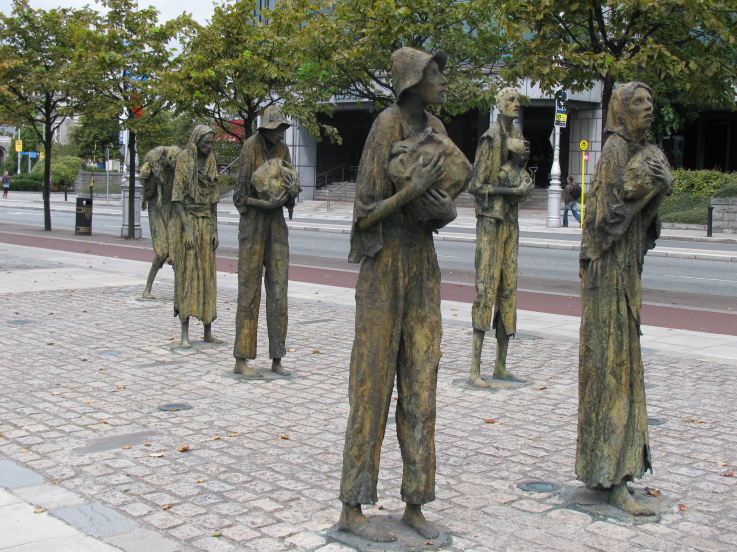


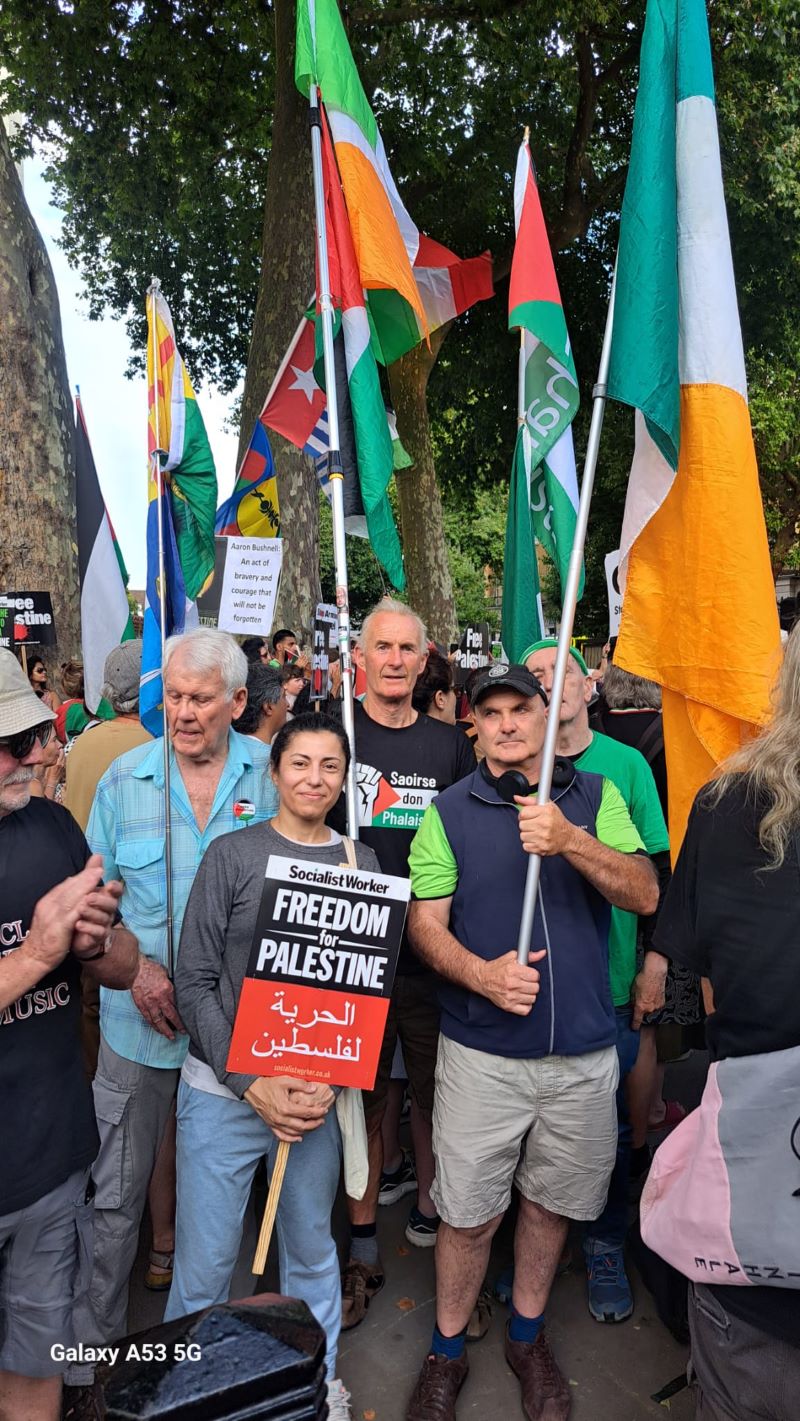

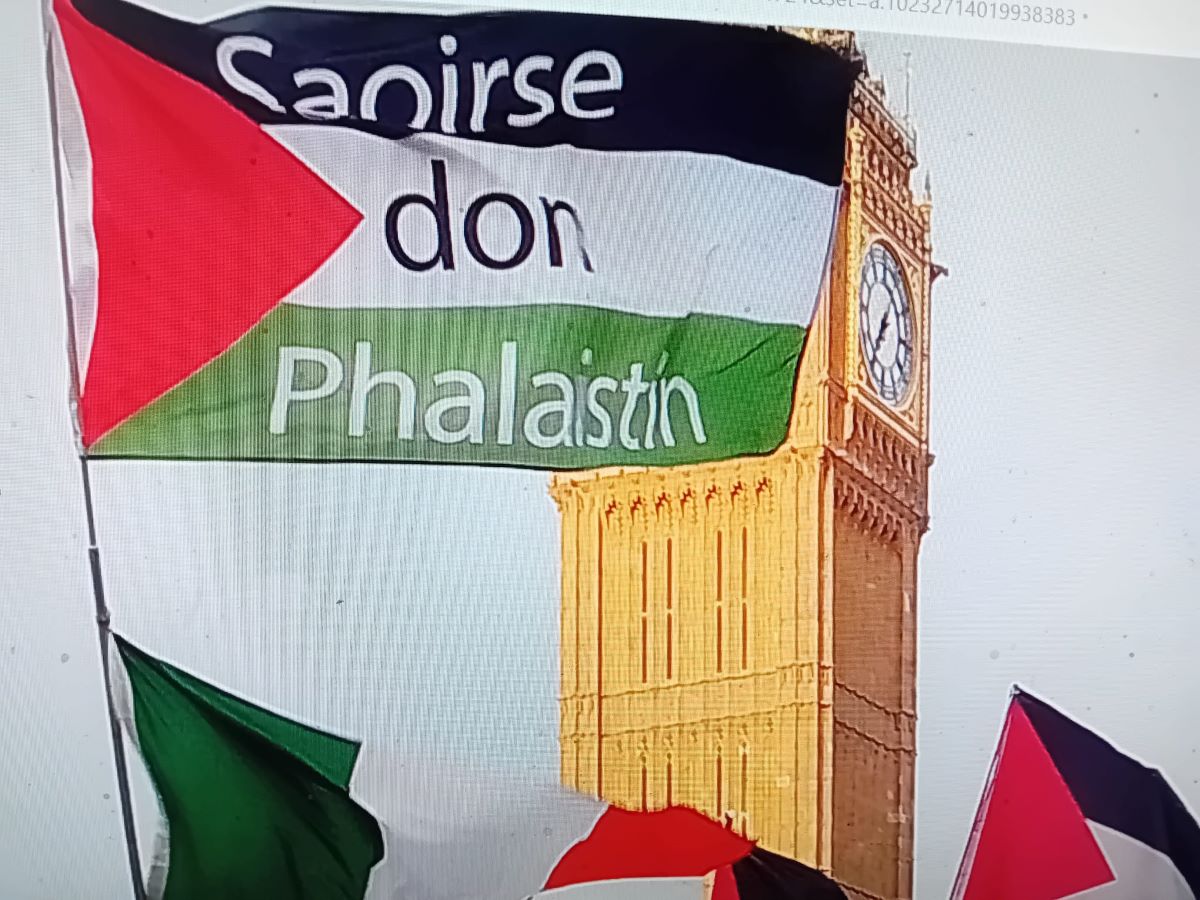

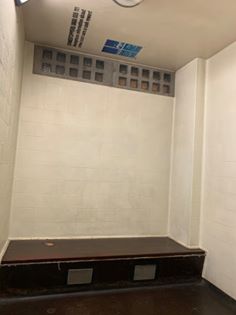


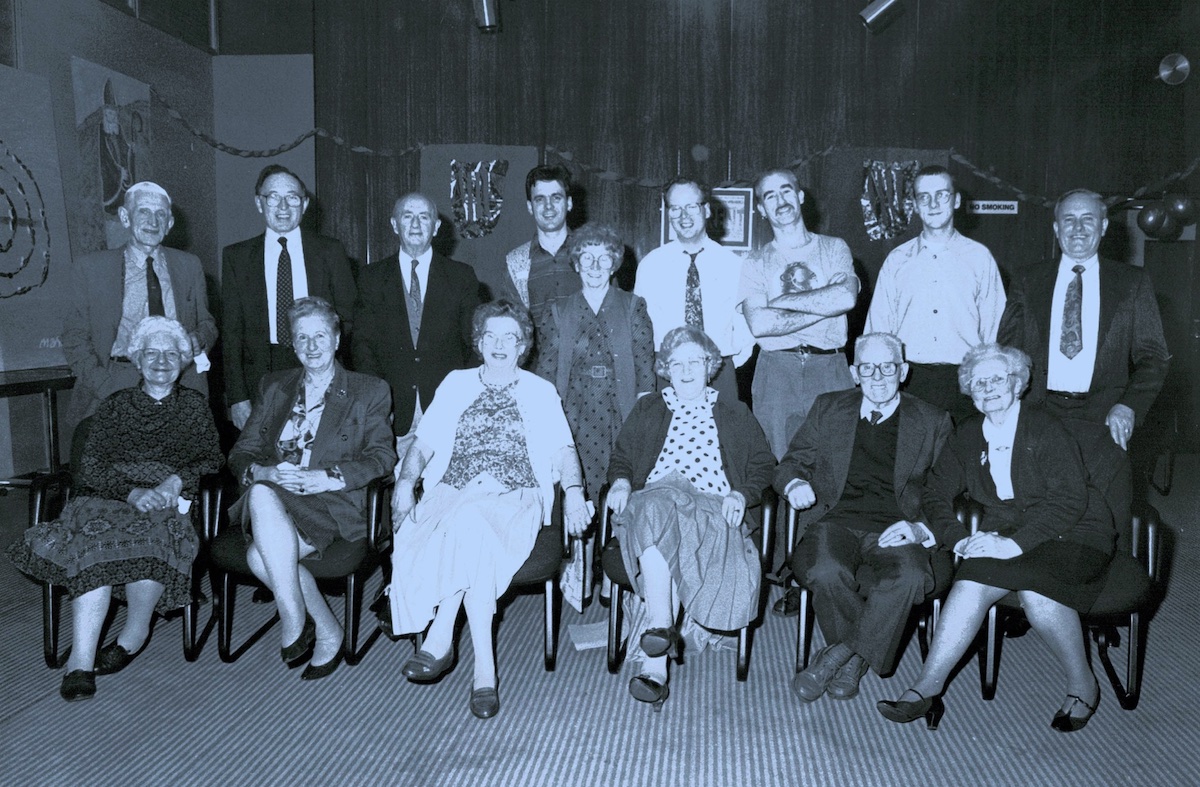

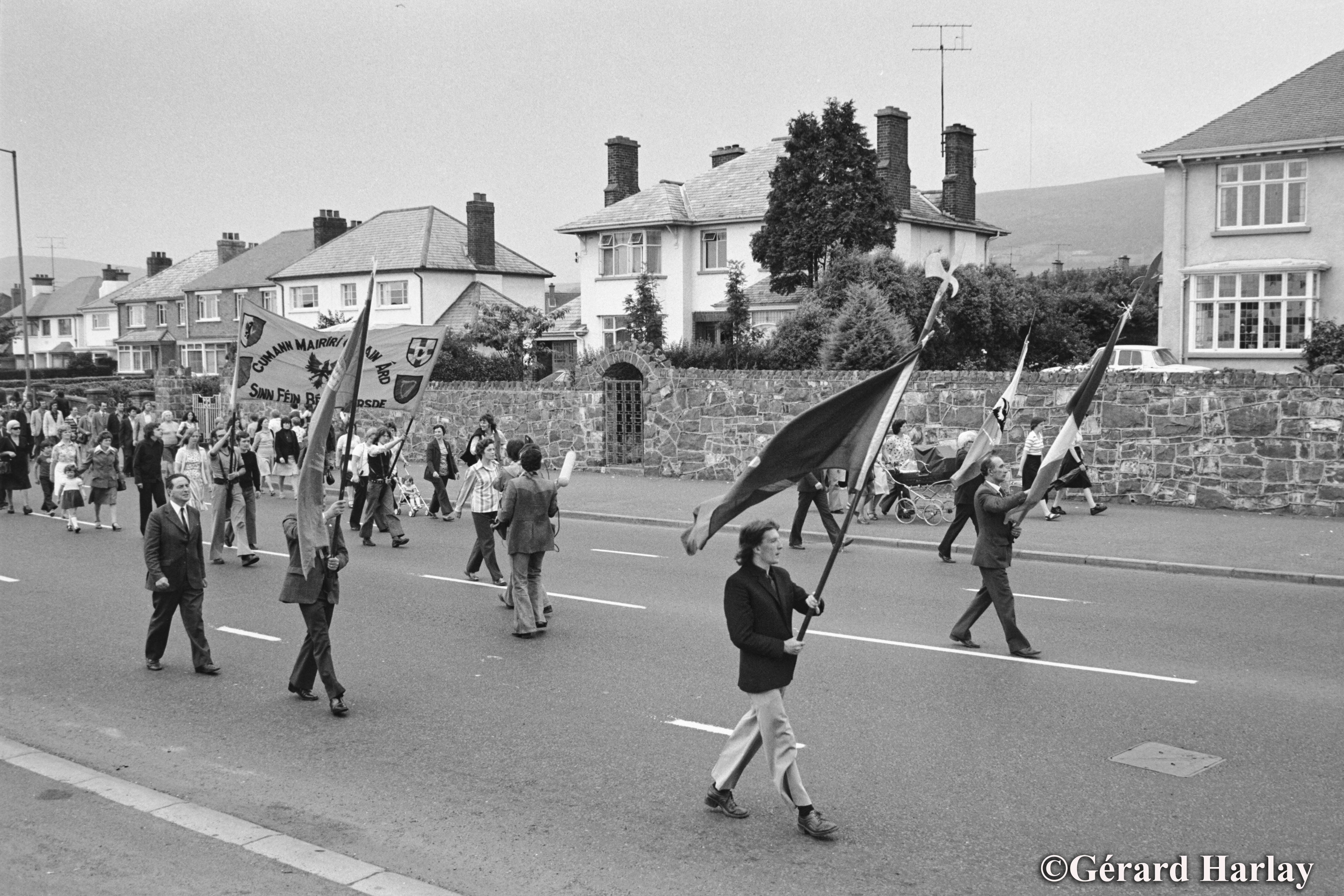


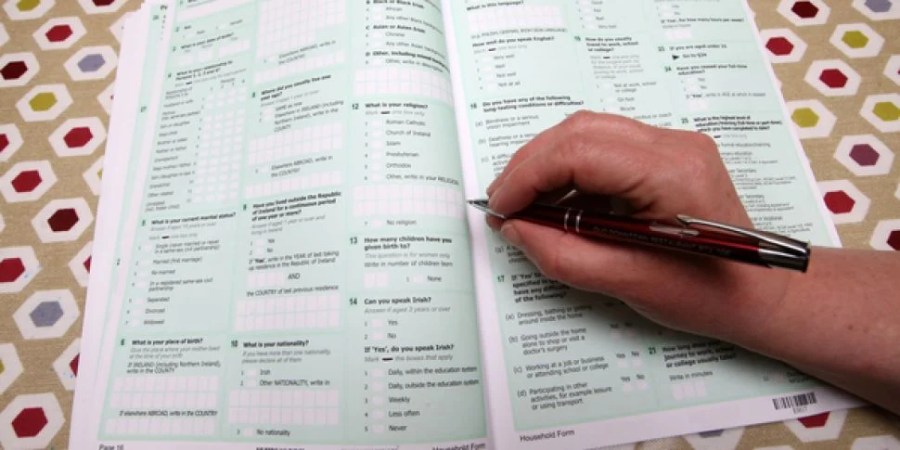
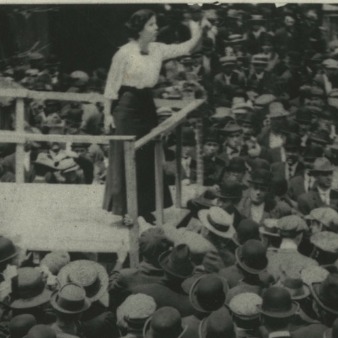
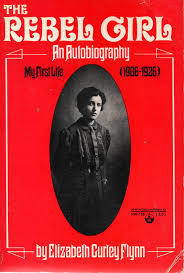
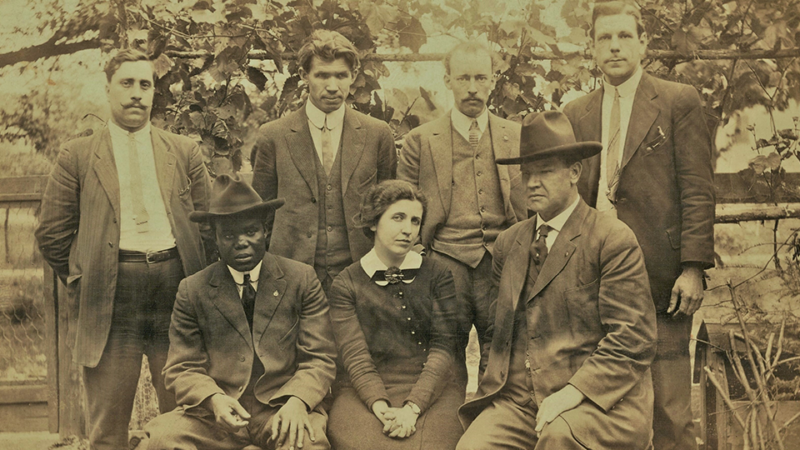
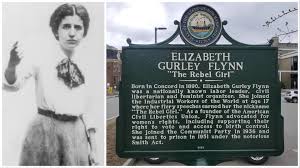
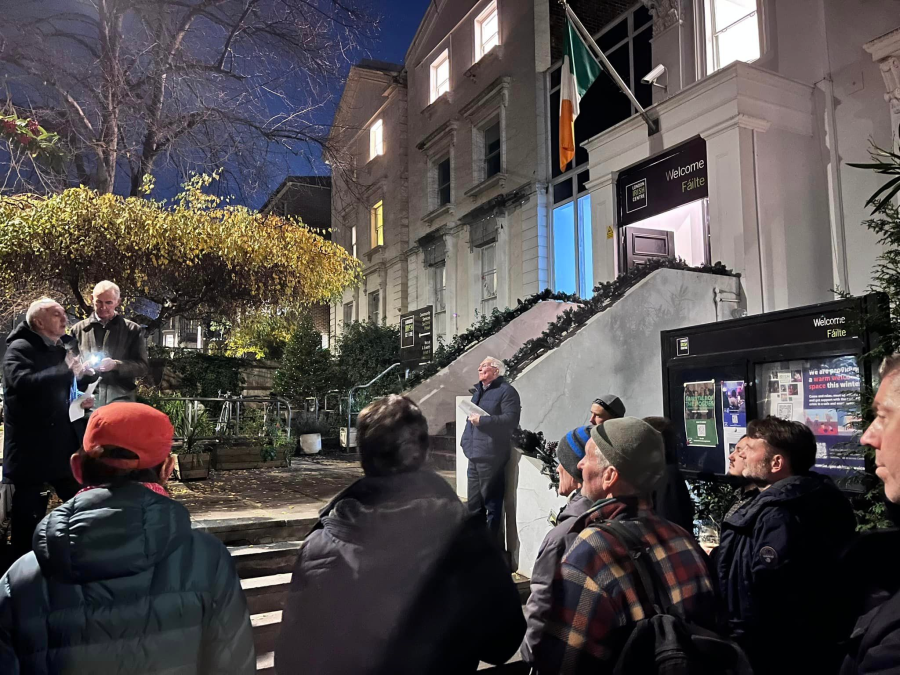
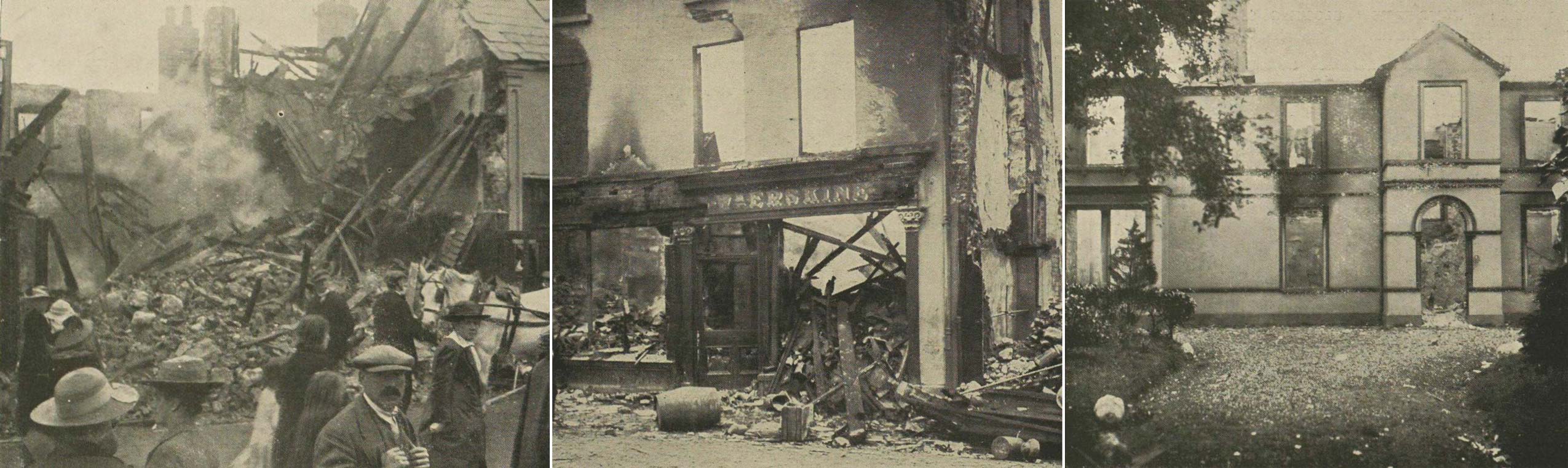
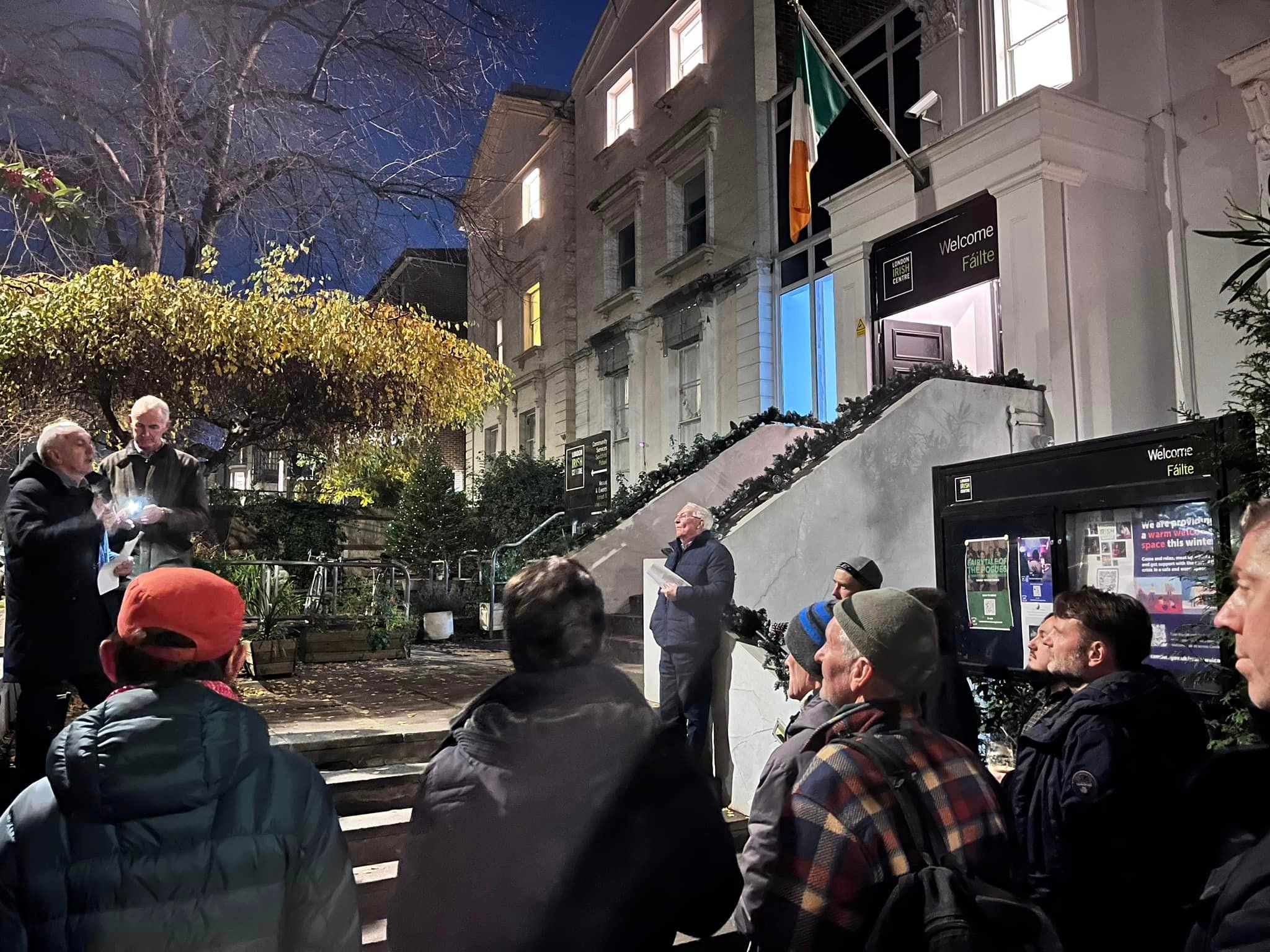
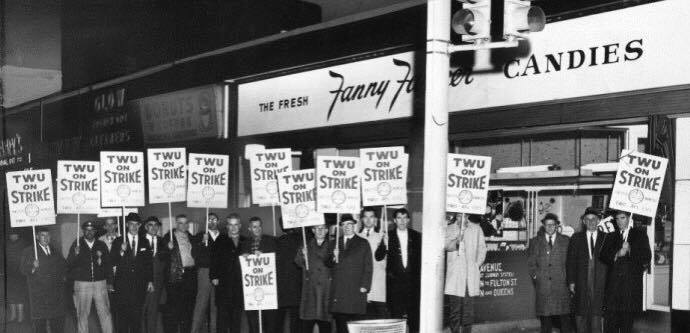
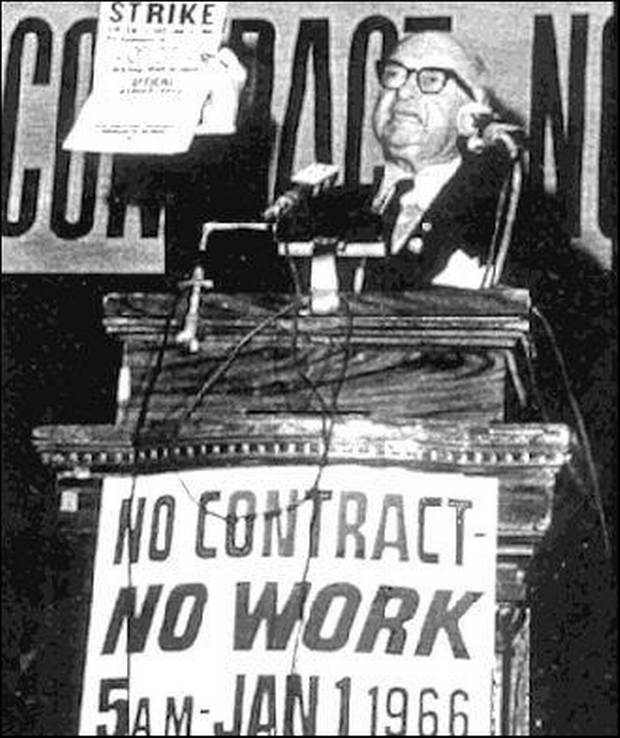
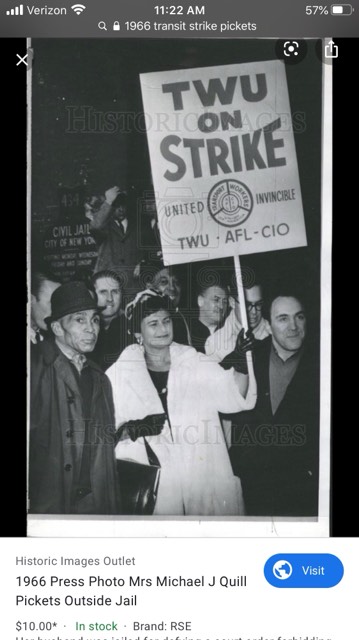
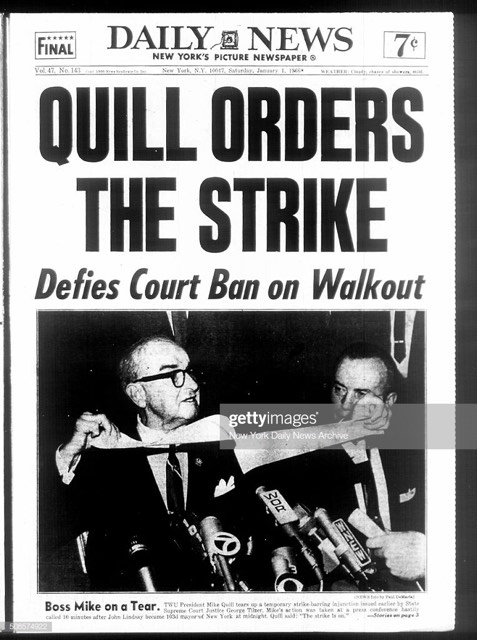
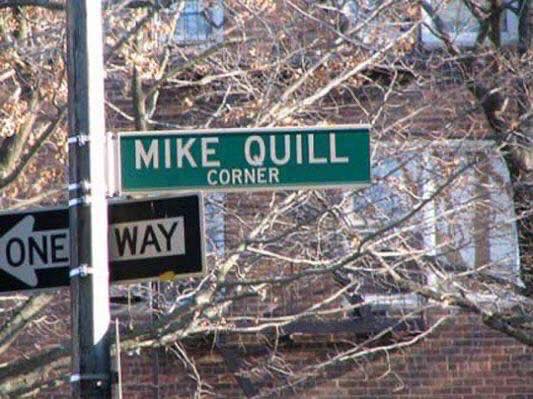
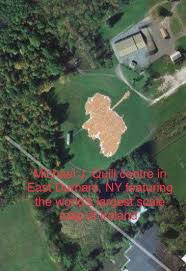
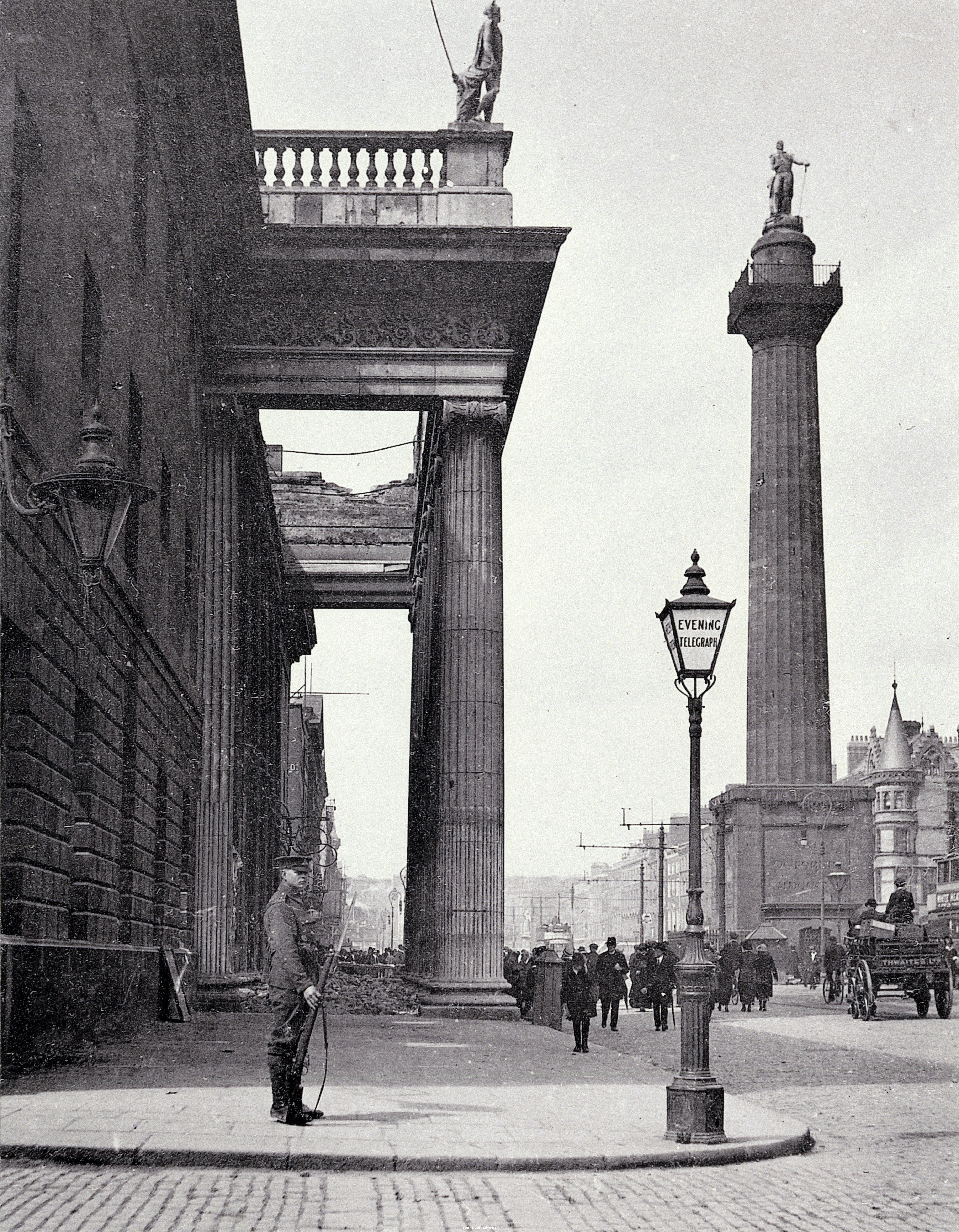
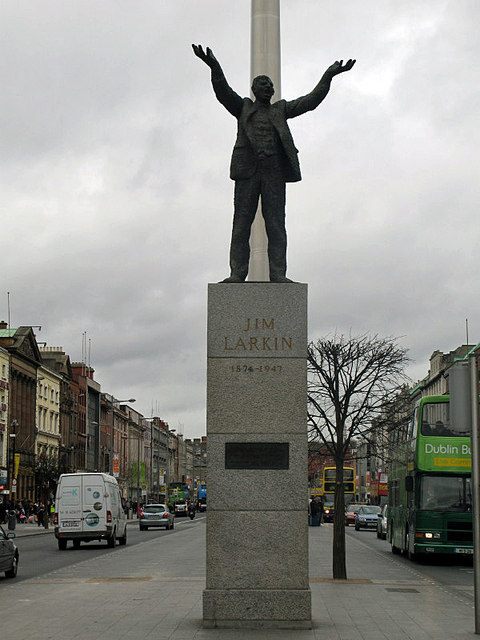


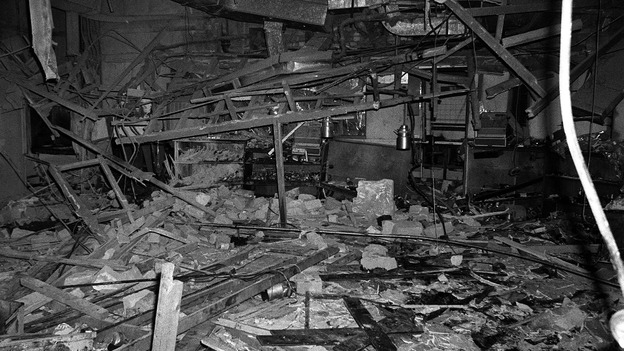
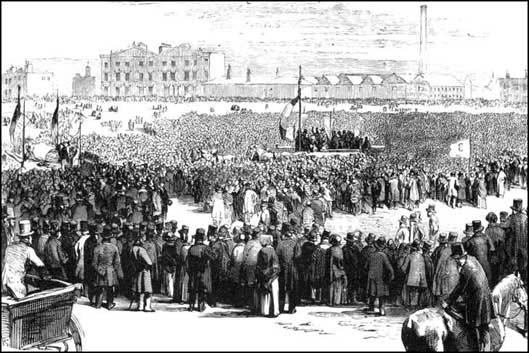

 rebelbreeze