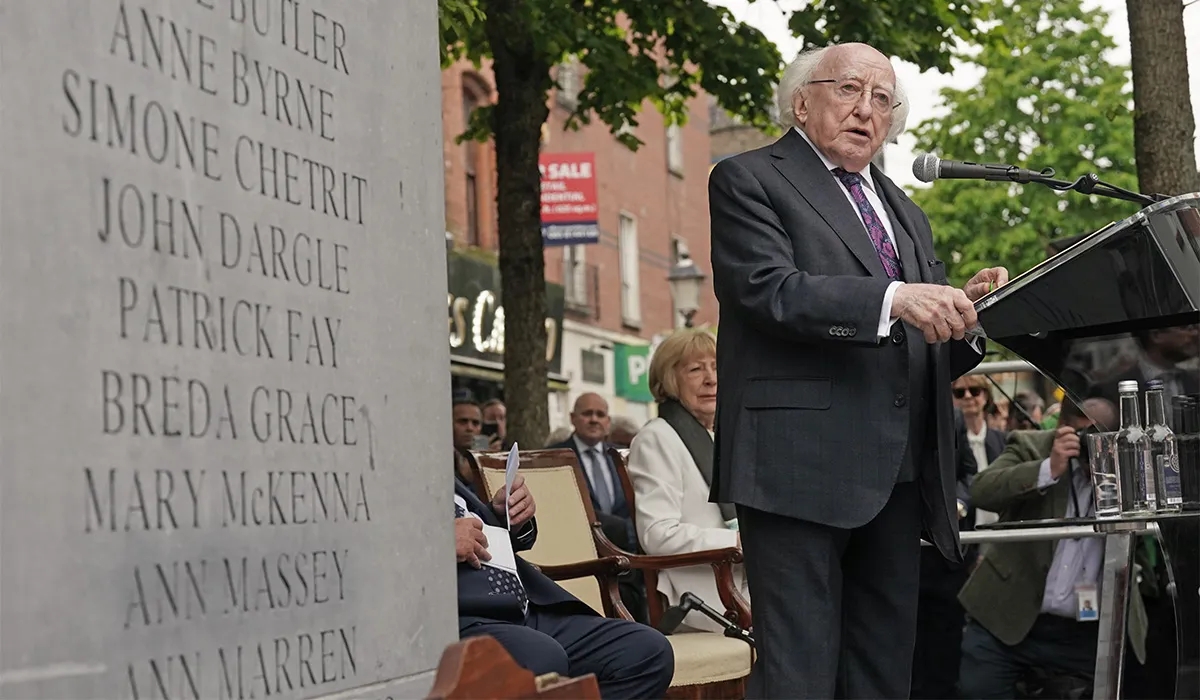
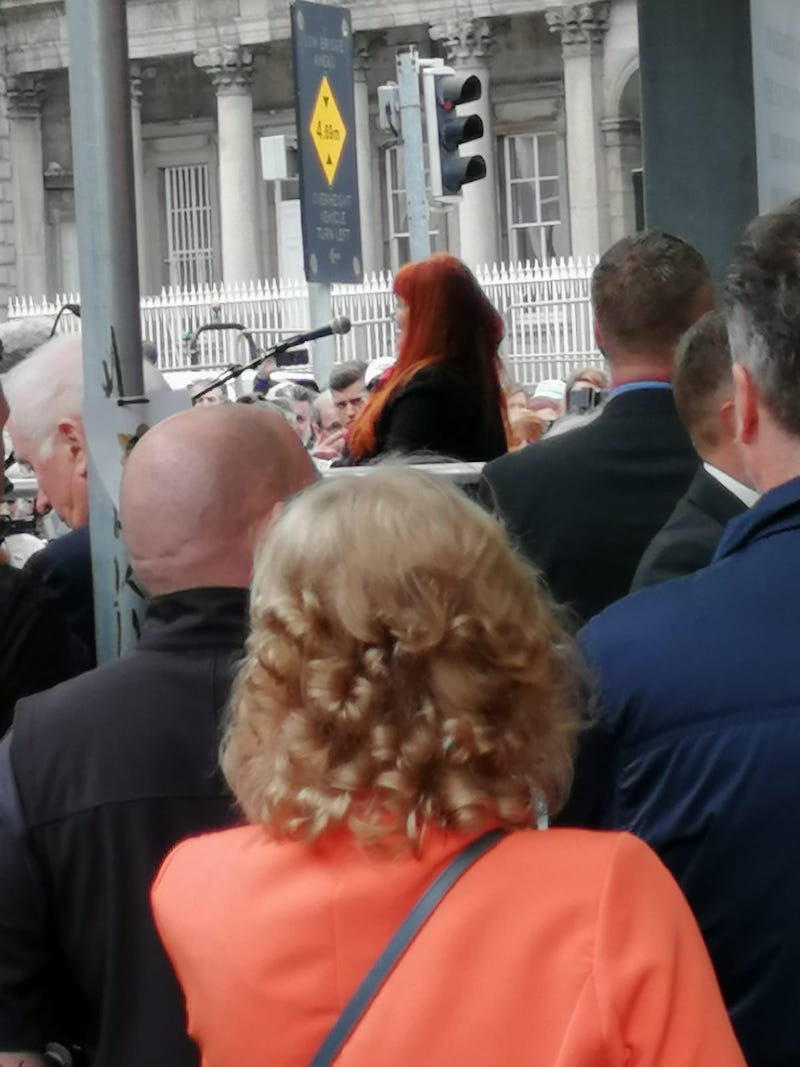
President Michael D Higgins speaks during a wreath-laying ceremony at the Memorial to the victims of the Dublin and Monaghan bombings on Talbot Street in Dublin, to mark the 50th anniversary of the Dublin and Monaghan bombings. (Photo cred: Brian Lawless/PA Wire)
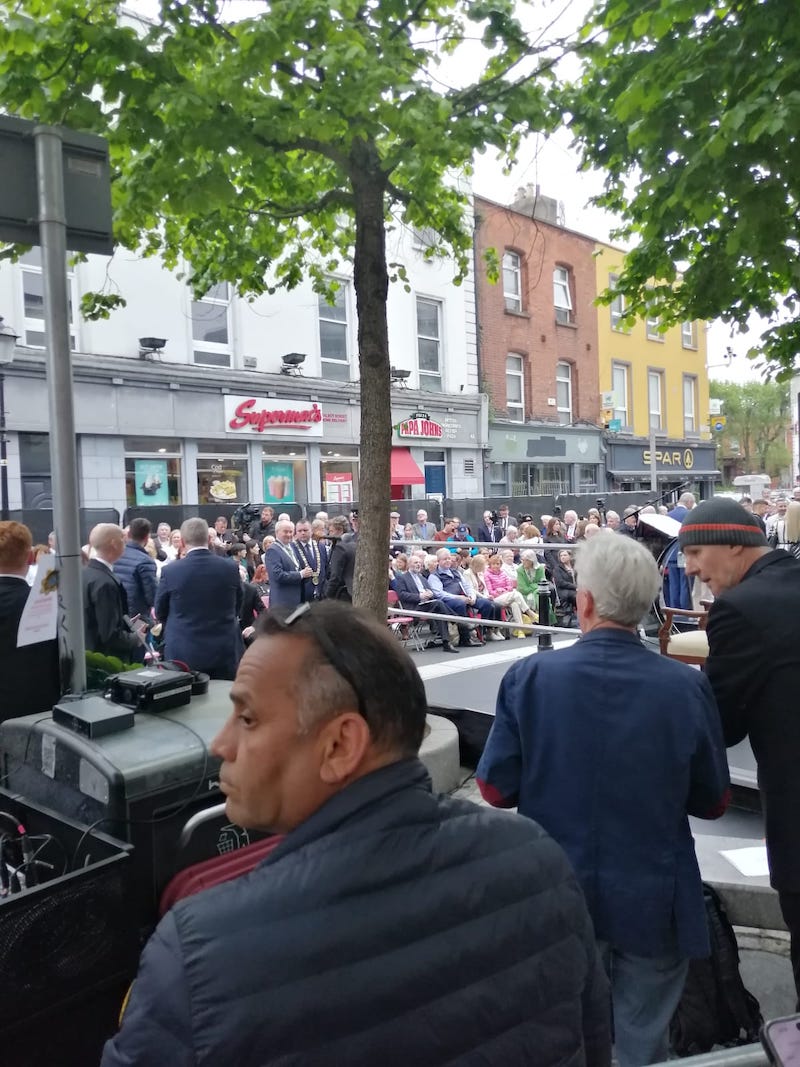
Fifty years ago, on May 17th bombs exploded in Dublin and Monaghan killing 34 people. The anniversary was marked in Talbot St. Dublin beside the monument erected in memory of those murdered on that day.
The attendance at the anniversary was addressed by Michael D. Higgins, the southern president.(1)
He made a number of points in his speech, mixing his praise for the Good Friday Agreement and Elizabeth Windsor’s visit to Ireland with calls for the rights of the victims to know the full truth, oblivious to the inherent contradictions in his statement.
He did acknowledge that there were huge problems with the subsequent investigations and cited the Barron Report.
The report compiled by the late Judge Henry Barron, published 10th December 2003, provided some of the answers, pointing as it did to systemic failures at State level, one that included possible collusion between the security forces and loyalist paramilitaries.
Also featured was the disappearance of important forensic evidence and files, the slow-motion conduct of the investigation, a reluctance to make original documents available, and the refusal to supply other information on security grounds.(2)
There is nothing surprising about this. The dust had barely settled in Dublin and Monaghan and the Irish Government and the Opposition rushed out to deflect and suppress any debate.
Both the Taoiseach at the time, Cosgrave (Fine Gael) and the Opposition leader Jack Lynch (Fianna Fáil) both issued statements that were remarkably similar.
In them they broadened out responsibility for the attacks to anyone who had been involved in any violent act; i.e. they blamed the IRA by implication and failed to mention loyalists at all. This was not accidental. It was deliberate.
The nature of the bombings, the coordination, technology used all indicated the involvement of the British secret services, coupled with the fact that the loyalists never again showed the same capability ever.
Under no circumstances was the southern establishment going to accuse the British of anything.
Just over two years earlier, following the murder of 14 people on the streets of Derry by the Parachute Regiment in full view of TV cameras, an angry nation protested and burned the British Embassy in Dublin to the ground. Cosgrave and Lynch sought to avoid a repetition of that.
As the Barron Report pointed out the Garda investigation was poor, forensic evidence was destroyed, the team set up to investigate it was wound down after just two months and the murder inquiry itself was closed after seven months.
All of this shows clearly that they had no interest in getting to the bottom of it. So much so, when the RUC informed them that they had arrested some suspects in relation to the bombing, the Gardaí did not follow it up.
Years later when Judge Barron carried out his investigation, it was not just the British who were uncooperative. The Gardaí and the Department of Justice didn’t provide him with any information, their files were “missing”.
So, any call for truth means demanding the southern government reveal what it knows and also who shut down the inquiry, why, what happened to the files etc.
It was ironic that the Taoiseach, Simon Harris, the former Taoisigh, Micheál Martin (Fianna Fáil) and Leo Varadkar (Fine Gael) who were present and laid wreaths represent those who covered up the bombings.
If we are going to talk about truth, then a starting point should be that Fine Gael and Fianna Fáil covered it up and bear part of the blame for the failure to prosecute anyone.
But when Higgins and others demand the British hand over files and information, including the information offered at the time but not sought by the Gardaí, a question arises. Why would you ask the British government for information and files on a bombing that took place in Dublin?
There is only one possible answer: the British were involved in the bombing.
So, a good starting point would be not so much to talk euphemistically of full disclosure, but rather for them to admit their guilt and tell us all what they did and how and provide all the documentation relevant to their admission of guilt.
No Irish politician has ever demanded that the British own up for it. The demand is they give over information on those who carried it out, as if they were not serving members, at the time, of the British security forces.
The Irish state deliberately failed the victims of the bombings and continues to do so, to this day.
It is telling that the Barron Report on the bombings in not available on Irish government sites but rather on a site set up by victims of the bombings, Justice for the Forgotten (http://www.dublinmonaghanbombings.org/home/).
The Irish state has little interest in talking about the issue or of informing the Irish public, most of whom were born after the bombings.
Though Higgins criticised the Legacy Act, which puts a time limit on prosecutions, the Good Friday Agreement was always about drawing a line under what had happened. The GFA rewrote history to portray the British as honest brokers in a tribal sectarian conflict and not as an imperial power.
Acknowledging their role in the Dublin and Monaghan bombings would undermine that carefully crafted and now universally accepted lie about the British role in Ireland. The British will not release the files as to do so would be an admission of what their role in Ireland is.
The southern establishment despite its occasional calls for clarity and truth, dreads the British even considering such a move, as again it would undermine their role in the conflict as well and their responsibility for the ensuing cover up.
Resistance to colonialism and imperialism takes many forms but there are those who try to downgrade, deny or even condemn its armed aspect and this has been happening recently in the case of the Palestinian struggle.
Historically, resistance has taken the form of strikes, sabotage, protest pickets, marches, rallies, placards, hunger strikes, songs, poetry, visual arts, arson, petitions, articles, books, leaflets, speeches, graffiti, clothing, language promotion, riots … and armed action up to and including revolution.
All have proved useful and the question of whether the prevailing circumstance favour some more than others is a tactical one, never one of principle. Those who seek to forbid some tactics to the movement in all circumstances are they who cannot be trusted in leadership of the struggle.
The facet of resistance that temporisers and outright opponents of the resistance movement most often seek to outlaw and remove from the struggle is the armed one, presumably because it is one of the least amenable to sidetracking into cosmetic reform.
Ruling classes of states regularly outlaw armed resistance activity including the organisations that espouse that, usually dubbing them “terrorists”, while of course ensuring they themselves have military forces which, even when aggressive invaders, they dub “defence forces”.
Indeed, those elites usually arm even their civil security forces, i.e their police. But arms and their use in the hands of working people or the invaded populations? No, that would be terrorism!
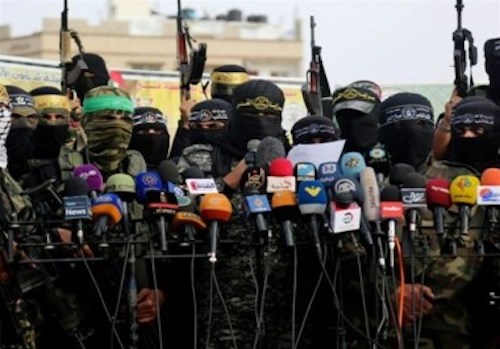
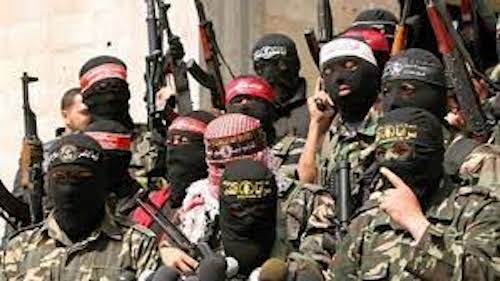
Joint press conference with representatives of different resistance organisations. (Photo sourced: Internet)
THREE-PRONGED ATTACK ON ARMED RESISTANCE
Recently a three-pronged ideological and propaganda attack was carried out on the Palestinian armed resistance from sources that are seen by some as friends of the Palestinian people: The Palestine BDS National Committee, the President of the Palestinian Authority and the Arab League.
The National Committee made their attack through a document advising on tactics and principles in presentation of BDS demands, in particular of the student campus encampments or occupations, advising activists that upholding the armed resistance was not advisable.1
Around the same time, the Arab League was having its summit meeting and, though not stupid enough to advocate giving up the armed struggle, long upheld by the Palestinian people, recommended the resistance to place themselves under the leadership of the PLO2 and the PA.
The PLO is controlled by the leadership of Fatah; their nominee, President of the PA Mahmoud Abbas, who was also at the Arab League summit, accused the October 7th attack by the Palestinian resistance of providing the Israelis the excuse for their genocidal war on Palestine.
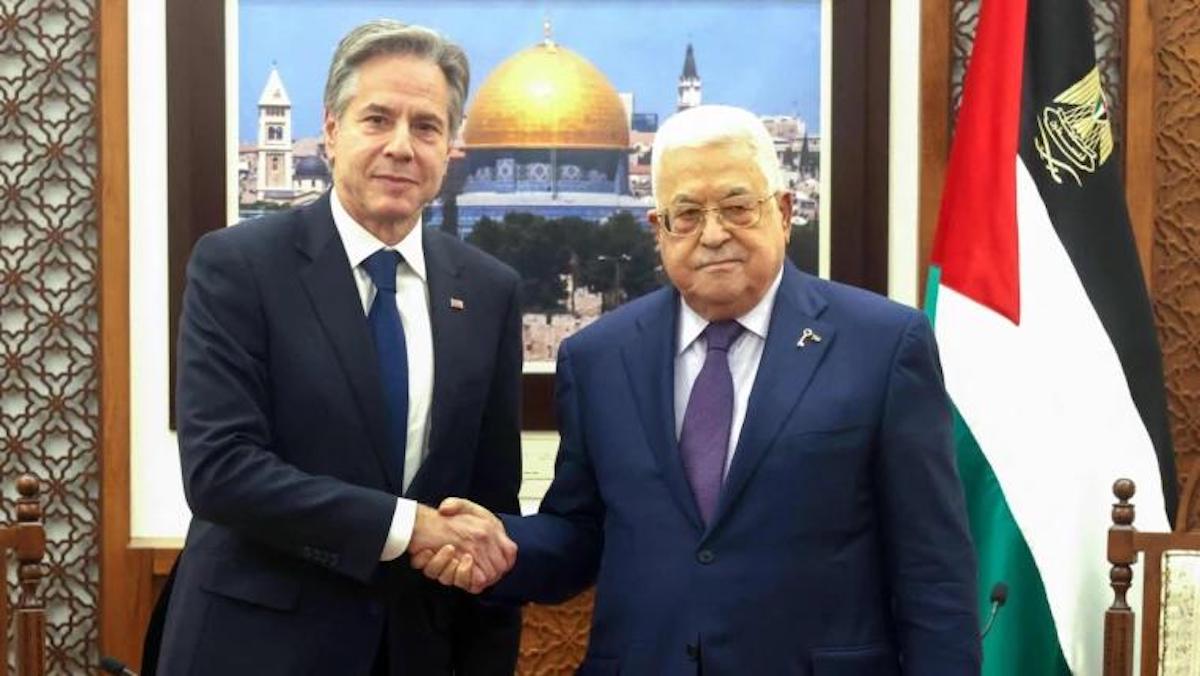
In October 2023, during the genocidal war by “Israel”, Anthony Blinken, US Secretary of State and envoy to the Middle East, shakes hands with Mahmoud Abbas, “President” of the Palestinian Authority, who remains in office despite his term having concluded in 2009. (Photo sourced: Internet)
The Arab League is composed of the current 22 Arab states, i.e those for which the dominant language is Arabic.3 But the elites of the majority of those states are clients of imperialism, chiefly of the United States. In the case of Yemen, it is the overthrown ‘government’ that is a member.4
Apart from their weakness against imperialism, one must wonder at their impertinence in telling the Palestinian armed resistance, which they do not at all assist, who should be their leadership5 and that the “two-state solution” (sic) is the only option available and recommended.6
The leadership of Fatah under Arafat betrayed the struggle for an independent Palestine and the right of return of the millions of Palestinian refugees when they agreed to the Oslo Accords in 1993/’95, for which they received limited autonomy through a “Palestine Authority”.
The corruption of Fatah in the PA and their betrayal of fundamental objectives of the Palestinian struggle led to their ousting in the elections of 2006, which were won instead by Hamas, who then had to fight Fatah who were refusing to hand over administration in Gaza.
Fatah refused to recognise the electorally-expressed wish of the people in the West Bank too but Hamas chose not to enter into a civil war with them there. From that point onwards, Gaza was besieged by the zionist authorities and periodically bombarded.
Meanwhile the PA continued in their corruption, Abbas continued to be unelected President, occupying the office and sharing the funds coming in among his clique but using their security force primarily to control and repress the Palestinians of the West Bank.
During this week alone, Resistance News Network reported that the PA’s forces dismantled explosives prepared by the resistance in the home of Tamer Fugaha which was planned for demolition by the Israeli occupation forces, where the explosives would target them.
The zionist forces regularly demolish the homes of Palestinian fighters and Tamer Fugaha was killed, along with another four Palestinian comrades, in an epic 15-hour battle with the IOF early this month in Tulkarem.
The PA has Palestinian political prisoners and also identifies these for the IOF to arrest later. Naturally (as even admitted by western mass media) the PA is hated by Palestinians, yet the Arab League wants the armed resistance to place themselves under its rule!
The armed resistance movement, which is composed of a number of distinct organisations7 fighting in unity, has of course rejected any such move and instead continued its calls for the support of the Arab people and to break the zionist blockade at the Rafah gate of desperately-needed aid convoys.
Palestinian fighters from different resistance organisations. (Photo sourced: Internet)
The Palestine BDS National Committee headquarters is also, like that of the PA, in Ramallah (West Bank). A recent statement of theirs also advised organisations working for Boycott, Divestment and Sanctions with regard to the Israeli State to drop mention of armed resistance.
Furthermore, they did so in the name of a host of organisations that sponsor Palestine BDS but the Boycott and Anti-Normalization Campaign, condemning the advice given,8 established that those organisations had not been consulted at all and if they had, would not have given approval.
The BANC criticised the offending committee not only for the original statement but also for acting as though they commanded the BDS movement.9 The statement in question was quickly withdrawn and replaced with another with the offending section on armed struggle removed.
Among the Palestinian groups that criticised the statement was the PFLP’s Haitham Abdo, head of the organisation in Lebanon, at the Popular Women’s Committees festival in Beirut on the occasion of Nakba Day, celebrating also the memory of a group of women fighters:
“Holding the resistance responsible for what happened after October 7 serves the zionist narrative and harms our people’s struggle and national fight. This statement is rejected, regardless of who says it.”10
In Yemen, the weekly “million-men march”11 sent a solidarity message to the Palestinians12 but also rebuked the participants in the Arab League summit with a non-too subtle hint as to where lie their allegiances:
“to the rulers of the Arab regimes meeting in Manama, near the embassy of the enemy entity: We regret to inform you that the enemy has committed more than 3,000 massacres to date, and even one massacre should have stirred your consciences.”13
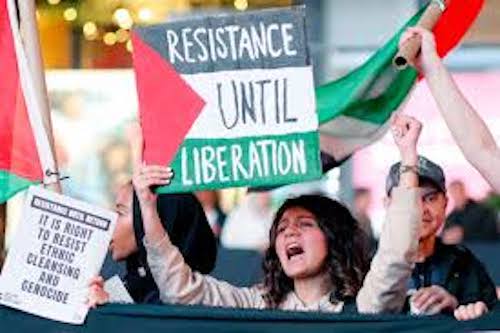
Scene from Palestine solidarity demonstration in Vancouver, Canada. (Photo sourced: Internet)
OPPOSITION TO ARMED RESISTANCE IN IRELAND
The dislike of or even hostility to promoting the armed Palestinian resistance can be seen in Ireland. A Garda confiscated a demonstrator’s a flag of one of the resistance groups, the secular Peoples Front for the Liberation of Palestine, while another was asked by IPSC stewards not to fly it.
In one of the student encampments, the PFLP flag was taken down too. The PFLP is a secular resistance organisation while others are Islamist but all are fighting in unity.
In some cases this opposition could be seen as a reluctance to have the solidarity movement associated with one specific liberation organisation which would be understandable but then a compromise would allow the flags of all groups — or one non-specific one of armed resistance.
To restrict the solidarity movement to the Palestinian national flag only is the imposition of an undemocratic “unity” and removes one of the most salient features of the Palestinian resistance – its armed aspect, fighting now amid the ruins and alleys of Gaza and in the West Bank.
Every week RNN posts photos of fighter martyrs of different resistance organisations, killed as they fought tanks, IOF bulldozers and, more rarely, IOF troops on the ground. The fighters too have been killed by aerial bombardment as of course there is no Palestinian air force or air defences.
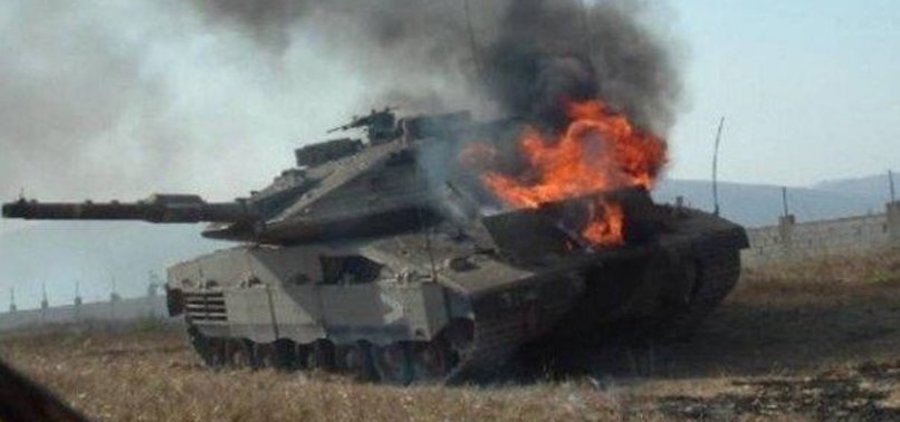
Yet every week RNN also lists IOF tanks, bulldozers, troop carriers and IOF ground troops hit by the resistance at close quarters or at remove by mortars and rockets. The IOF dead and wounded are evacuated by helicopters which – unlike Palestinian ambulances – are never fired on.
The western mass media is not reporting these engagements and Al Jazeera reports only some of them.14
Our internationalist duty to support the Palestinians means also supporting their right to resist and that means in effect to support the armed resistance, whether we elevate one organisation or more, or just the broad principle of the right to armed resistance.
An Israeli tank hit by Palestinian fire. (Photo sourced: Internet)
THE IRISH EXPERIENCE
In the struggle for Irish liberation we have used – in different combinations – all the forms of resistance listed in the second paragraph at the beginning of this article ; indeed one of those forms during the Land War gave the word “boycott’ to the world!15
But the armed aspect has been a part of that struggle from the time of the clans right down through eight hundred centuries, against even internal opposition. In July 1846, John O’Connell’s proposal to have the Union Repeal Association renounce the use of armed force split the organisation.16
At the meeting, Thomas Meagher, said that “There are times when arms will alone suffice, and when political ameliorations call for a drop of blood, and many thousand drops of blood. Opinion, I admit, will operate against opinion. But … force must be used against force.
“The soldier is proof against an argument, but he is not proof against a bullet. The man that will listen to reason, let him be reasoned with; but it is the weaponed arm of the patriot that can alone avail against battalioned despotism.”17
LONG LIVE THE RESISTANCE – IN ALL ITS FORMS!
End.
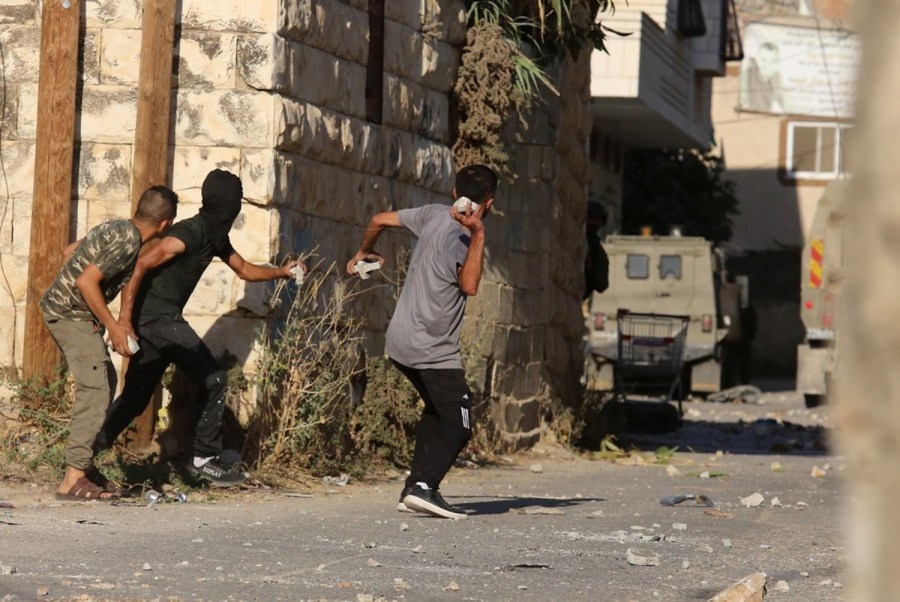
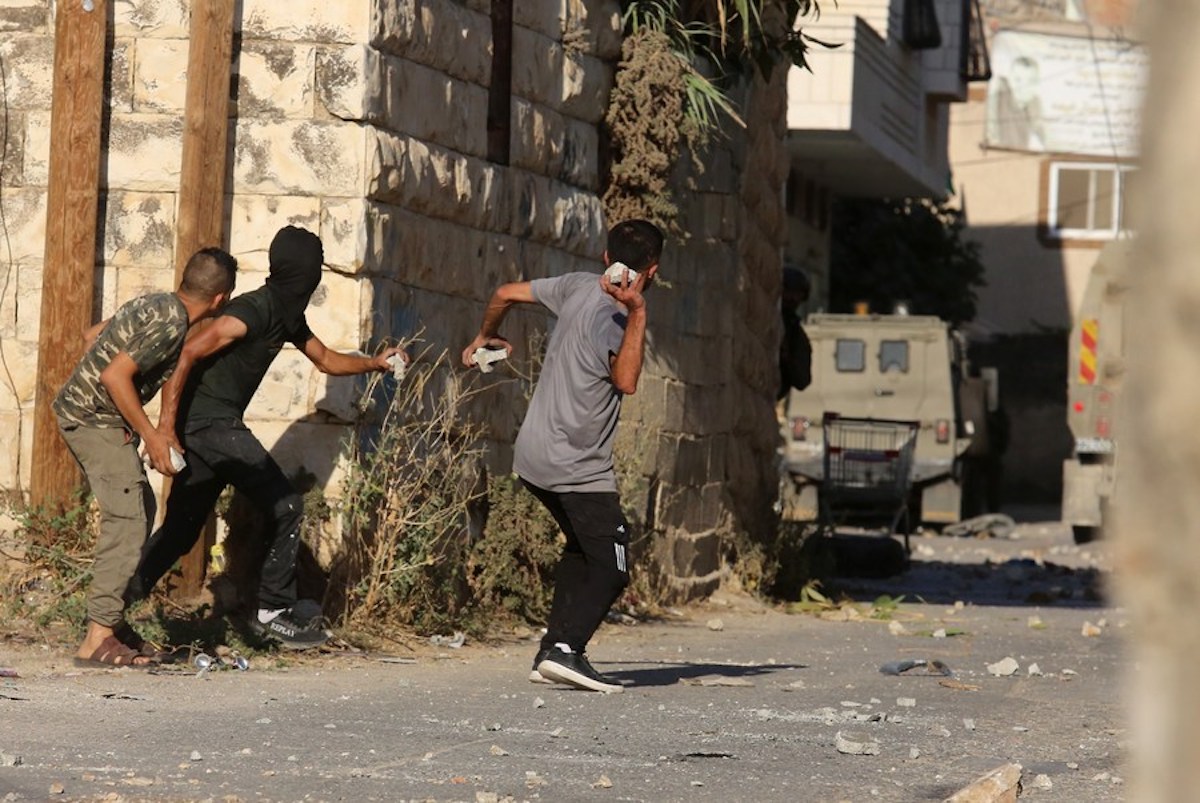
Palestinian youth respond to an Israeli raid on Beita in the West Bank Aug 2023 (Photo cred: Nidal Esthayeh/ Xinhua)
FOOTNOTES
1 We reiterate our firm position and call for a just and comprehensive peaceful settlement of the Palestinian issue, and we support the call of His Excellency President Mahmoud Abbas, President of the State of Palestine, to convene an international peace conference and to take irreversible steps to implement the two-state solution in accordance with the Arab Peace Initiative and resolutions of international legitimacy to establish an independent and sovereign Palestinian state on the lines of 4 June 1967 with East Jerusalem as its capital, and to accept its membership in the United Nations as an independent and fully sovereign state in common with other countries in the world, and to ensure the restoration of all legitimate rights of the Palestinian people, in particular, the right to return and self-determination, empowerment and support.
2At its first summit meeting in Cairo in 1964, the Arab League initiated the creation of an organization representing the Palestinian people. The Palestinian National Council convened in Jerusalem on 28 May 1964. After concluding the meeting, the PLO was founded on 2 June 1964. Its stated “complementary goals” were Arab unity and the liberation of Palestine. (Wikipedia) Under Fatah domination it banned Islamist groups from membership.
3 Algeria, Bahrain, Comoros, Djibouti, Egypt, Iraq, Jordon, Kuwait, Lebanon, Libya, Mauritania, Morocco, Oman, Palestinian Authority, Qatar, Saudi Arabia, Somalia, Sudan, Syria, Tunisia, United Arab Emirates and Yemen.
4 Rather than those in power, the Ansar Allah (“Houthis”) government, preferred by the vast majority of Yemenis to the western-recognised exiled government.
5We call on all Palestinian factions to join together under the umbrella of the Palestine Liberation Organization (PLO), the sole legitimate representative of the Palestinian people, and to agree on a comprehensive national project and a unified strategic vision to focus efforts towards achieving the aspirations of the Palestinian people to achieve their legitimate rights and establish their independent national State on their national soil, on the basis of the two state solution, and in accordance with the resolutions of international legitimacy and established references.
6 The 2-state option, supported by the imperialist powers, is of a much smaller Palestine state alongside an Israeli state at least the size of its current dimensions. However even this has arguably been made impossible by the spread of Israeli settlements and is rejected by most Palestinians and many Israelis. The 1-state option envisages the whole of historic Palestine under a democratic regime.
7 Iz al-Din al-Qassam Brigades (QQB) – Hamas; Al-Quds Brigades (AQB) – Islamic Jihad; Abu Ali Mustafa Brigades (PFLP) – People’s Front for the Liberation of Palestine; National Resistance Brigades (DFLB) – Democratic Front for the Liberation of Palestine; Al Aqsa Martyrs Brigade – Fatah (not under Fatah political control); Al-Nasser Salah al-Deen Brigades (PRC) – Popular Resistance Committees; Lion’s Den; Mujahideen Brigades.
8The Boycott Campaign – Palestine condemns the statement issued by the Boycott National Committee, in Ramallah, which asserts the danger of supporting the Palestinian resistance on their work and the necessity to distance themselves from any positions that support the resistance, especially armed resistance.
This disgraceful stance comes at a time when the zionist enemy is committing the crime of genocide against our people in the Gaza Strip for over seven months, resulting in the killing and injury of more than 120,000 innocent Palestinians and the destruction of 70% of Gaza’s buildings.
Such dangerous statements provide cover and legitimacy for the enemy to continue its aggression.
What is more dangerous is that the BNC claims it issued the statement in consultation with a large number of national entities and organizations.
However, through our communications with several entities mentioned in the statement, it is certain that they were not presented with this statement nor consulted about it, and they would certainly refuse to sign such statements that promote non-national positions.
All struggles for freedom around the world have seen various forms of struggle side by side, with armed resistance at their core. Therefore, our Palestinian struggle strategy should reinforce different forms towards the major goal of dismantling this zionist project on our land.
Accordingly, we call on the BNC to revise its position and align with the authentic national stance that glorifies resistance in all its forms.
We also urge it to stop this approach that attempts to monopolize the legitimacy of international work for Palestine and issue top-down orders to everyone. Palestine is greater than all, and the global revolution today to support our people is greater than something that can be monopolized by anyone.
Boycott Committee — Palestine / Boycott and Anti-Normalization Campaign
11 For the 31st week, the Yemeni people turned out in massive crowds across various cities in Yemen in support of Gaza under the slogan: “With Gaza: Holy Jihad and No Red Lines.” A million-man flood took place in the capital Sana’a, a massive rally occurred in the city of Ibb, and marches were reported across 23 locations in Rima, among other cities. (RNN)
12 “The statement at the weekly turn out reiterated the legendary steadfastness of the fighting Palestinian people and the perseverance of its fighters in this critical phase. The people assured the American and British enemies that they will not be deterred from maintaining a steadfast stance.” (RNN)
14Electronic Intifada updates reports a number with analysis and RNN posts the reports of the groups themselves.
15 The word comes from the National Land League successful campaign of withdrawal of labour along with isolation of services (or even social contact) with Captain Charles Boycott, the agent of an absentee settler landlord who was planning to evict some tenants in 1886. https://en.wikipedia.org/wiki/Boycott Boycott is a non-violent tactic but the fact of the use of violence during the Land War by the Occupation and in response by the peasantry is often overlooked. The Fenians supported the campaign and landlord’s agents were shot at, police and bailiffs stoned and scab labour attacked.
16 The Repeal organisation’s leadership became dominated by the rising Catholic Irish bourgeoisie of which John and his father Daniel were leading members. The “split” became known as the Young Irelanders and contributed nationalist culture and journalism, in particular through The Nation newspaper and some long-lasting songs such as A Nation Once Again. The Irish Tricolour was first presented to Meagher by French women during the revolution in Paris in 1848; the Young Irelanders also staged an ill-fated uprising that same year.
Thirty-five people were killed by bombings on 17th May 1974, the most in one day during the recent 30 Years War but outside of Ireland and even within it, most people are unaware of that fact. That’s because the perpetrators were not the IRA.
And probably also because the victims were killed not just in Ireland but within the Irish state. Also no doubt because the perpetrators were Loyalists led by British Intelligence.
Section of westward end of attendance at event as President Michael D Higgins approaches (just out of view)(Photo: D.Breatnach)
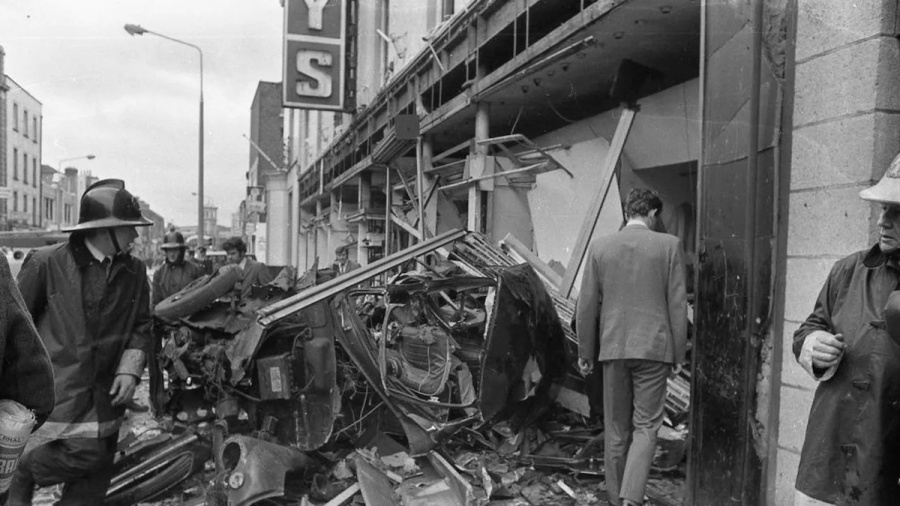
Three bombs exploded on that day in the middle of a rush hour in Dublin City Centre: Talbot Street, Parnell Street and South Leinster Street. Somewhat later, a bomb exploded also in Monaghan Town. Altogether 35 were killed1 and “about 300”2 injured, some permanently.
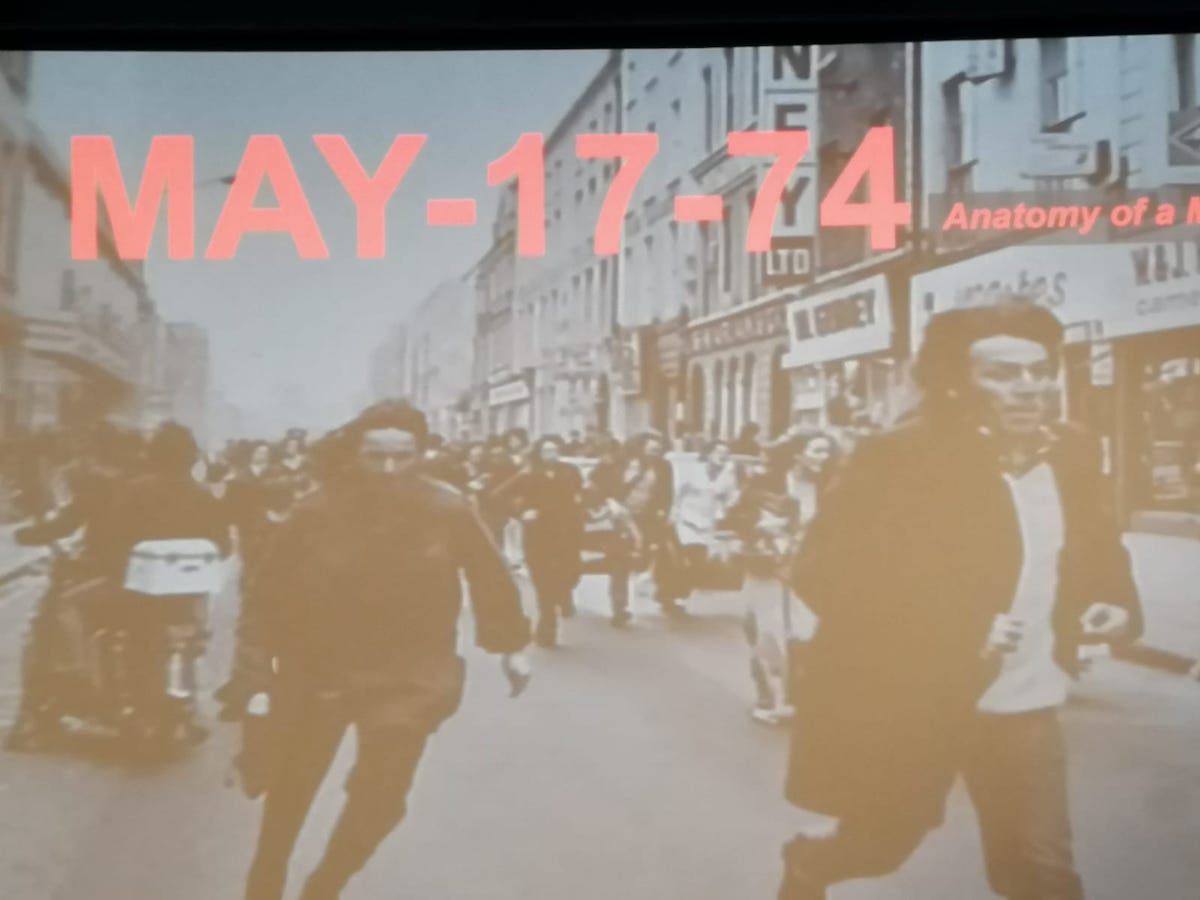
The names of some of the victims being displayed at the premiere of the Anatomy of a Massacre documentary. (Photo: D.Breatnach)
Within days and perhaps hours a number of suspects among Loyalist murder gangs had been identified but they were not arrested or even questioned about the atrocity – no-one ever was. Despite that, the Gardaí closed the case investigation seven months afterwards that same year.
A new documentary on the atrocities by Fergus Dowd was premiered in Dublin on Friday to two full screen auditoria in the Lighthouse Cinema, Smithfield, featuring interviews with witnesses, victims and relatives of victims, a former Taoiseach and a former State forensic scientist.
May-17-74 Anatomy of a Massacre is directed by Joe Lee and produced by Fergus Dowd.
The forensic expert had been given very little of the remains of cars containing the bombs since most had been sent to the RUC (colonial police) for their analysis (!) from which nothing useful emerged but he was able to determine that a high amount of amatol had been used.
At that time only the IRA among “paramilitary organisations” had the expertise to develop that explosive material which leads commentators to believe that the Loyalists received the necessary quantities from those seized from the IRA and held by the British armed forces.3
Given that many of the Loyalists involved were members of the Ulster Defence Regiment, a British Army unit, on the face of it the explosives could have been directly supplied by the British Army or indirectly obtained through the UDR as members of the British Army.
Nothing adverse is known about the Garda Commissioner who sent the exploded car remains to the colonial police but his Deputy and successor was Ned Garvey and whistle-blowing British spook Fred Holroyd claimed Garvey was a British Intelligence “asset” and to have met him in Dublin.
Confronted with this exposé years later Garvey admitted having met Holroyd but not to being a British spy – though he had not informed his superiors of his meeting with a foreign secret service agent. 4 Sadly this is not alluded to in the documentary.
As documented in Anatomy there had been a Loyalist bombing campaign of Dublin since 1969,5 with those in 1972 and 1973 killing between them three transport workers and no-one had been arrested by Gardaí or extradition sought in connection with even those fatal explosions.
No documentary about the bombing was made by RTÉ, the Irish broadcaster until 2004, thirty years after the atrocity.
However a much earlier documentary was by British company Yorkshire Television on ITV in 19936. RTÉ had declined the offer of joint screening and many people in Ireland who did not have access to ITV at the time missed it or had to go to a friend or relative to view it.
The British documentary was mentioned only in passing by one of the interviewees in Anatomy but without reference to RTÉ’s declining of the offer of joint screening.
British spook whistleblower Colin Wallace states that he was obliged to report on every meeting he had with Loyalists or others and his erstwhile bosses would have kept those papers, as they would have for the MI5 operatives who steered the bombing gang for Dublin and Monaghan.
The existence of MI5 documents that would throw much light on the bombings was referred to a number of times in Anatomy and the Justice for the Forgotten campaign keeps seeking them. Irish Government ministers regularly state that they have requested them but are always refused.
Missing from the documentary was what is now known of the secret contemporary memos of Arthur Galsworthy, British Ambassador to the Irish state: It is only now that the South has experienced violence that they are reacting in the way that the North has sought for so long …
… I think the Irish have taken the point.
Galsworthy also noted that the Irish Foreign Affairs Minister Garret FitzGerald told him that “the government’s view was that popular hostility appeared to be directed more against the IRA“.
In the immediate aftermath of the bombing, both Liam Cosgrave for the Government and Jack Lynch for the Opposition sought to widen the blame to include Irish Republicans.7
VIEWING THE DOCUMENTARY
Two screens at the Lighthouse cinema were fully booked to view the premiere.
The documentary is fascinating and some of the witnesses and relatives really excellent in their descriptions and commentary. Others interviewed pulled no punches in castigating successive Irish governments for closing the investigation and allowing it to remain closed.
Some, too, alleged a conjunction of interests between the Irish and UK states in ensuring the truth about the perpetrators and the Irish State’s reaction never surfaced.
Many people prominent in Irish political circles at different ends were present to see the premiere and after a few words from Margaret Unwin, Coordinator of the Justice for the Forgotten campaign, along with filmaker Dowd, the Resistance Choir sang their song composed about the bombing.
The Resistance Choir performing their song about the bombing massacre (Photo: D.Breatnach)Section of crowd from the Monument eastward (Photo: D.Breatnach)
Justice for the Forgotten organise a commemoration of the atrocity every year at which some music and poetry is performed, along with speeches by politicians representing the Irish State, and the local authority Councils of Dublin City and Monaghan and another individual or two.
Some of what is said there I have welcomed and some disliked but most of all I detest Ministers in the Irish Government coming there to tell us how they want the British State to release their secret documents regarding the event but never have any action to pressurise its Ministers in mind.
Cormac Breatnach playing low whistle at event (Photo: D.Breatnach)
This year, the 50th anniversary, the event took place after noon on Friday 17th May with a large crowd but only one speaker listed, President of the Irish State Michael D. Higgins, with traditional Irish music from Cormac Breatnach and Eoin Ó Dillon, a duo performing at the event for years.
Eoin Ó Ceannabháin sang The Parting Glass and poet Rachel Hegarty performed her poem about the bombing. But there was a surprise speaker also, an Italian from Breschia who also referred to state collusion in a bombing against an anti-fascist rally in his home town the same year, a few weeks later.
Poet Rachel Hegarty performing her poem about the event (Photo: D.Breatnach)
The MC of the event, Aidan Shields, son of fatal victim Maureen, told the audience to applause that Justice for the Forgotten would be sending a delegation to Breschia for the 50th commemoration of the atrocity in their town.
At left, Aidan Shields, son of fatal victim and MC at event, with Monument to the victims centre (Photo: D.Breatnach)
WHY THE BOMBING?
Trainee journalists are told to answer the ‘Five Ws’ in their reports: who, what, where, when and why.
The answers to four of those questions have been known for decades: Dublin and Monaghan is where; 17 May 1974 was the when; the bombing atrocity was the what. The who were the Loyalists and British Intelligence. But nobody seems to attempt to answer the why – or even to ask that question.
For the earlier 1972 bombing, the “why” is clear: to get the Irish parliament to vote for the Amendment to the Offences Against the State Act.
And they were successful in that since, all logic to the contrary, some of the Opposition decided to believe that the bombing was the work of Irish Republicans. So we now have that no-jury political court and senior Gardaí can give ‘evidence’ unseen by the accused from Garda “secret files”.
Apart from the guidelines of journalism, there are also those with regard to criminal investigations, which outline the importance of motive and opportunity. The British secret service certainly had opportunity – but what was their motive?
A bombing such as that in Dublin on 1974, in the Irish State’s capital city, is a message to the Irish ruling class (though the victims be different) were the. And from the British state through their intelligence service, which would hardly dare to carry out such an attack without at least the endorsement of their masters.
So the message was … what? “We will bomb your capital city if you don’t do what we want or if you do what we don’t want”? But the Irish ruling class was already cooperating about as fully as possible with the occupation in the Six Counties and repressing resistance in the Twenty-Six.
A similar campaign occurred in the 1980s, in the Basque Country within the French state (mostly). The Spanish Government waged a terrorist campaign8 of bombings, kidnappings and assassinations against suspected activists of the armed Basque liberation group ETA.
It seemed that what the Spanish authorities wanted was for the French to turn over Basque activists who were on the “French” side of the Border to the Spanish authorities, something the French had been unhappy to do, the Guardia Civil believed to be torturers even after Franco’s death.
After some of those bombings, the social-democratic French Government led by Mitterand began to hand over Basque activists to the authorities across the border, sometimes without even going through the official extradition procedures.
The Irish State did also permit extradition of Irish Republicans to the Six Counties (and later to Britain too) after the Dublin and Monaghan bombings, but not until ten years later, with Dominic McGlinchy, which hardly looks like the effect following its cause.
The Sunningdale Agreement had been signed in December 1973 which proposed some kind of power-sharing between nationalists and unionists with a role for the Government of the Irish state against which the Loyalists of the Ulster Workers’ Council had organised a general strike.
A British whistleblower, Colin Wallace claims that the bombing was a warning to the Irish ruling class to keep their fingers out of the colony.
VICTIMS AND RULING CLASS
Apart from not answering or even seeking the motivation for MI5 to arrange and oversee the bombing, I have not seen any discussion of the class nature of the locations. The bombings of 1972 and 1973 targeted transport workers.
But the bombings on the north side of the river in areas to the east of O’Connell Street also took place in areas where working and lower middle-class people worked, shopped and got on to the public transport buses. This hardly seems accidental.
Aftermath in Talbot Street facing westward with Connolly Station tower in far background (Photo: PA)
A part of MI5’s message could have been: “This time it was mostly the kind of people nobody (who are in power) cares about, so be thankful. Next time we might hit the north-east centre around Henry Street, or areas around Trinity College, Dame Street and Grafton Street on the south side.”
One other point that is rarely made is that the bombing and the State’s reaction to it showed the totally craven and foreign-dependent nature of the Irish ruling class, to allow their capital city to be bombed by another state without seeking revenge or even restitution.
The French state made a deal with the Spanish after some bombs exploded in territory to which it laid claim but does anyone believe the result would have been the same if the Spanish terrorist groups had bombed Paris?
End.
FOOTNOTES
1 Some accounts give a total of 34 or 35 dead from the four bombings: 34 by including the full-term unborn child of victim Colette Doherty, who was nine months pregnant; and 35 by including the later still-born child of Edward and Martha O’Neill. Edward was killed outright in Parnell Street.
4 When Fianna Fáil came into government, they sacked Garvey but presumably not wanting to expose British Intelligence penetration of the Irish State’s management upper echelons, gave as a reason only that they had no confidence in him. This opened the way for Garvey to claim wrongful dismissal and win, giving him a payout and retaining his pension. Garvey was also important in running the notorious “Heavy Gang” within the Special Branch.
5 The Wolfe Tone Monument in Stephens Green had been blown up and the O’Connell monument, the Glasnevin ‘Round Tower’ had also been bombed.
6 “Yorkshire Television broadcast a documentary entitled ‘Hidden Hand – the Forgotten Massacre‘ made as part of its ‘First Tuesday‘ series. The programme dealt with the Dublin and Monaghan bombings of 17 May 1974. [The programme came to the conclusion that the Ulster Volunteer Force (UVF) would have required assistance to carry out the bomb attacks. There was speculation as to where such assistance might have come from. While no firm conclusions were reached, it was suggested that the security forces in Northern Ireland were the most likely source of help. Allegations concerning the existence of a covert British Army unit based at Castledillon were considered; as well as alleged links between that unit and Loyalist paramilitaries. It was shown that Merlyn Rees, the former Secretary of Sate, had known of the unit’s existence. On 15 July 1993 the UVF issued a statement in which it claimed sole responsibility for the Dublin and Monaghan Bombings.]” https://cain.ulster.ac.uk/events/dublin/chron.htm
The anniversary on Sunday of the death on hunger strike of IRA Volunteer Bobby Sands was marked with a number of posts on social media. I would like to add an Irish migrant’s1 perspective and some analysis of his legacy.
The Irish diaspora was a powerful sector in solidarity for the Irish struggle not only because of their cultural background but also because of their numbers. Some British cities had an estimated diaspora population of 10% (Irish-born and 1st and 2nd generations).
Furthermore, the higher proportion of those in turn was of the working class, a section of society which, although they in no way had their hands on the standard levers of power, certainly had a strong potential of the kind the British ruling class had learned to fear.
Irish Republicans of course formed part of that sector and organised within it but on the other hand the IRA’s bombing campaign in Britain was of no help at all. The popular fear of being caught in an explosion greatly enabled the Government to tighten the screws under the guise of “security”.
Karl Marx, a strong supporter of Irish freedom had commented after the Clerkenwell prison bombing of 18672 that “One cannot expect the London proletarians to allow themselves to be blown up in honour of the Fenian emissaries” (i.e who they were trying to free from the jail).
In 1974 the Labour Government had repressive legislation ready and on 29 November, using hysteria arising from the Birmingham and Guildford pub-bombings they rushed through the Prevention of Terrorism Act (1974) which permitted the holding of suspects for two days without charge.
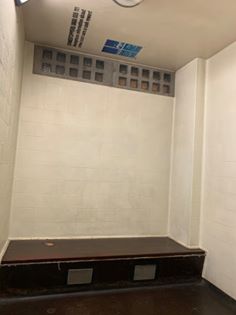
An underground cell in London’s Paddington Green police station – this is where Irish detainees under the Prevention of Terrorism Act might be kept and interrogated for seven days without visitors or access to solicitor. “The old cells were 12-foot square, contained no windows and were reportedly too hot in the summer and too cold in winter” (Wikipedia).(Photo: Posted in 2020 on Internet by Green Anti-Capitalist Front who occupied the empty building intending to turn it into community centre.)
That could be extended for another five days – and often enough was — by application to the Home Secretary. Access to solicitor was usually denied and though not lawful, the fact of the detention itself was often denied to concerned people making enquiries of the police station.
The prospect of disappearing for seven days into police custody somewhere was naturally terrifying and a ‘suspect’ could also be deported without trial to Ireland – even to the British colony of the Six Counties, which amounted according to their law to “internal exile”.
Snapshot of London police harassment and intimidation of Irish solidarity activists in 1981. (Photo sourced: Internet)
The framing of a score of innocent Irish people3 in five different trials4 with very heavy sentences added to the intended terrorising of the Irish community in Britain, the “suspect community”5, many of whom believed the victims to be not only innocent but most not even politically active.6
Irish solidarity activity in Britain diminished greatly after 1974 as state repression impacted across the Irish community. But the hunger strikes and concerns to save the lives of the strikers in 1981 broke the hold of state terror as people took to the streets in their thousands once again.
They were unsuccessful but never returned to that state of immobilising fear that had settled over the community.
The Irish in Britain Representation Group got its initial start in 1981 which happened as follows: the bourgeois Federation of Irish Societies had its AGM in May 1981 and one of the members proposed that a motion of sympathy to the Sands family be recorded when he died.
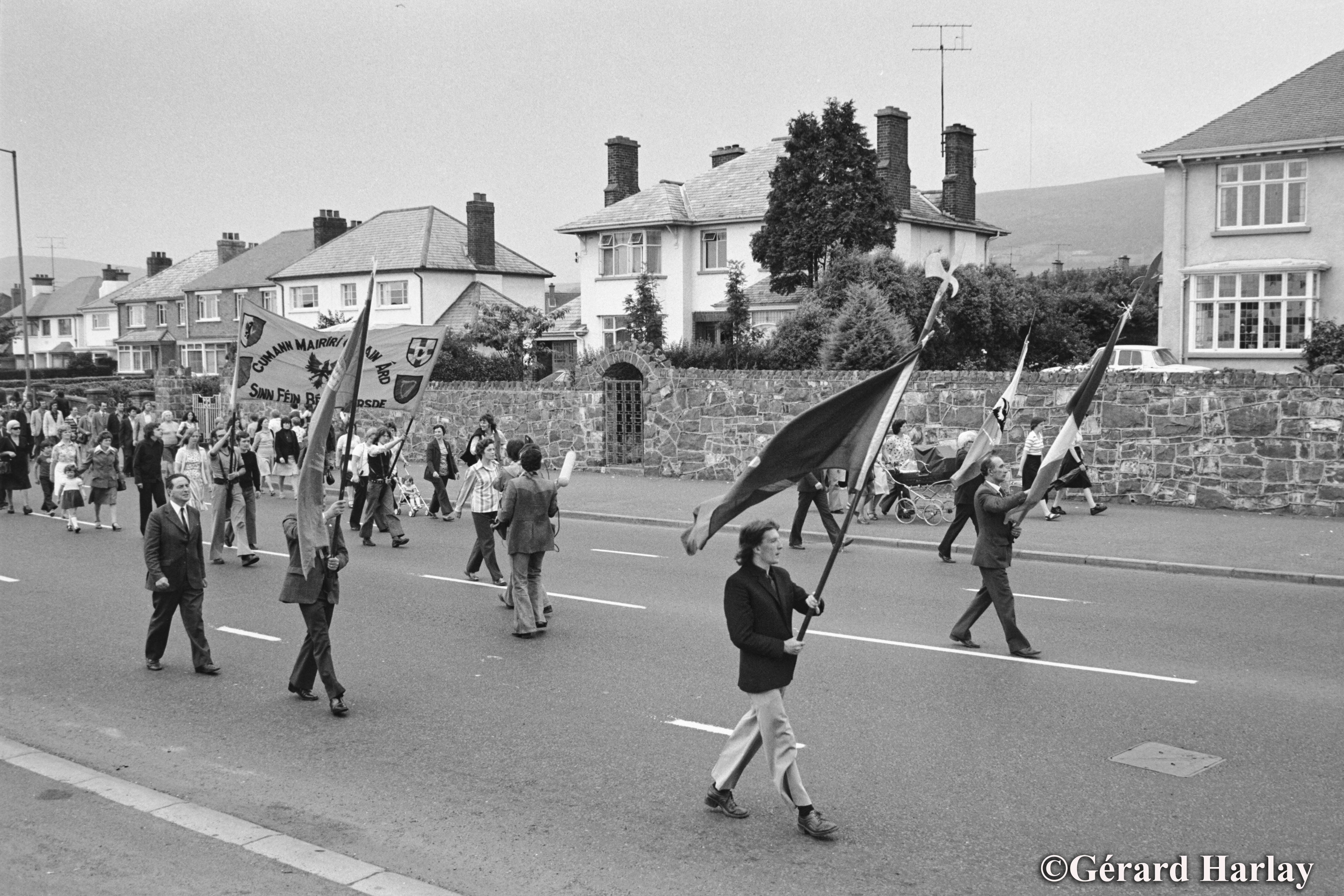
IBRG and Irish Republican POW Support Committee banners on march Birmingham 1984 (Source: Mullarkey Archive)
The meeting’s Chairperson ruled the proposal out of order and ‘the Fed’ continued with their ordinary business. The then Editor of the Irish Post7, writing in his “Dolan” column, found this disturbing and suggested there might be a need for a new type of Irish community association.
A number of individuals wrote in and the ball got rolling, though it took until 1983 to set up the branch-based organisation with a constitution and democratic safeguards in operational rules. The IBRG soon had a number of branches in London and others in the North and Midlands.
For the next two decades the organisation campaigned for the release of the framed prisoners, against the Prevention of Terrorism Act, strip-searching, all racism but in particular the anti-Irish and anti-Traveller varieties, for Irish representation in education, services, Census category, etc.
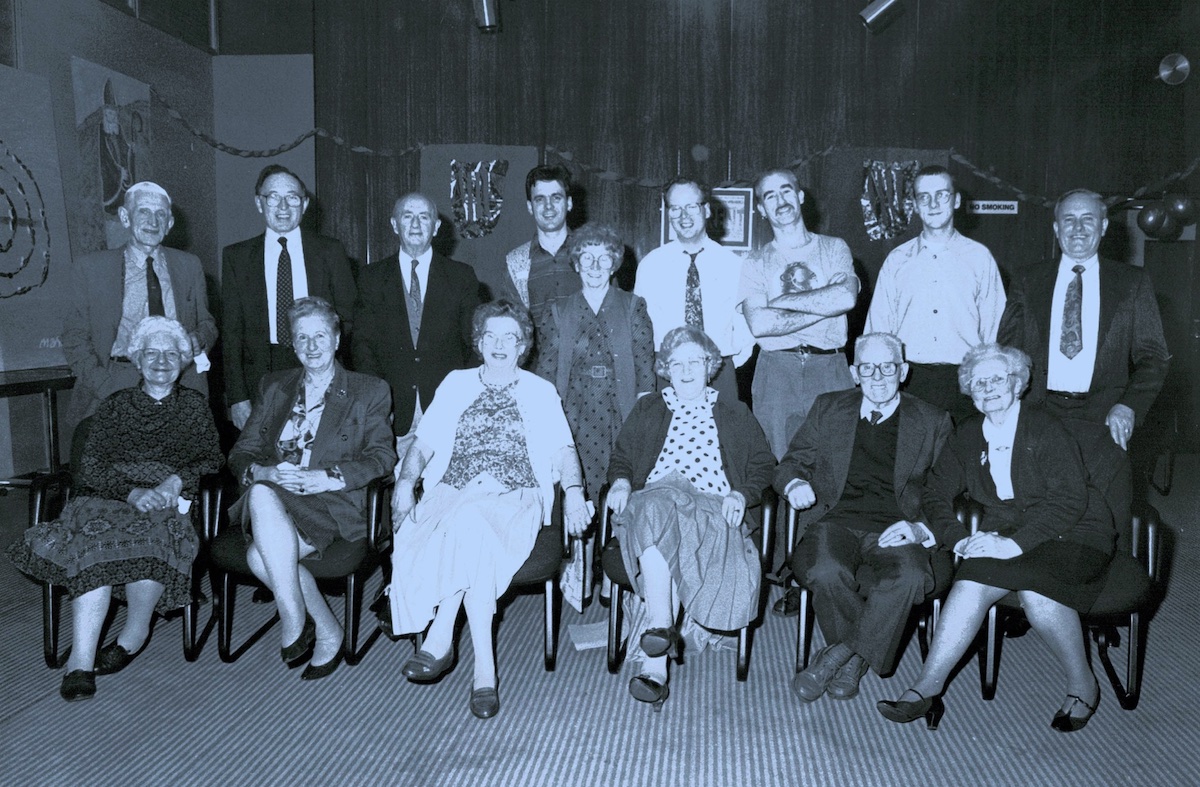
Lewisham Irish Centre Management Committee and Staff, possibly 1994. The Centre was campaigned for and won by the Lewisham Branch of the IRBG in conjunction with the Lewisham Irish Pensioners’ Association (which the IBRG had also founded).
The IBRG also called for British departure from Ireland and collaborated with other organisations in marches, demonstration, pickets, conferences, producing also a number of important report documents. The organisation’s officers were drawn from migrant Irish and those born in Britain.
Bobby Sands Mural on gable end of a house in Belfast (Photo cred: Brooklyn Street Art)
REPRESENTATION OF BOBBY SANDS
Bobby Sands was a man of great courage whose leadership qualities were recognised by his fellow political prisoners when they elected him as their Officer Commanding in the H-Blocks. He was also an accomplished writer and poet.
When the British reneged on the agreement that ended the 1980 hunger strike and a new one was planned, Sands insisted on being first on the list, which also meant that in the event of resulting deaths, his would be the earliest.
Most people will agree easily with all the above evaluation of the man but from that point onwards, his representation is manipulated to suit different agendas, in particular those of pacifists, social democrats, liberals and a variety of opportunists.
Some of them love above all his quotation that “Our revenge shall be the laughter of our children”. They forget many other things he wrote and seek to turn him into an angel or saint of pacifism.
Since they embraced the pacification process, Sinn Féin try to represent Sands as an advocate for and proof of the effectiveness of participating in the parliamentary electoral system, based on his success in a 1981 Westminster by-election with 30,492 votes, 51.2% of the total of valid votes.
What both these groups fail to recognise is that Sands was an IRA volunteer and was sentenced for possession of handguns in 1972 and again in 1976. If he was an angel, it was of the Archangel type, fighting against what he considered evil.
He was proposed in the Fermanagh-South Tyrone by-election mainly in order to support the campaign of the prisoners against criminalisation and for the political status recognition that they had previously. Saving the lives of the hunger strikers was of course part of the plan too.
Nine protesting Republican prisoners contested the general election in the Irish State in June. Kieran Doherty and Paddy Agnew (who was not on hunger strike) were elected in Cavan-Monaghan and Louth respectively, and Joe McDonnell narrowly missed election in Sligo-Leitrim.
But that is a long way from proving that the electoral process is a viable way of dislodging the ruling class and their system and, in fact, history has proven the opposite.
Nobody knows what position Sands and the other nine would have taken on the electoral process had they lived. Possibly some would have gone along with the SF leadership on that and some others would now be reviled as “dissidents” (as are indeed some H-Block survivors).
All we can say for certain is that they were men of courage in that all of them had joined the armed struggle for Irish national liberation. They had even higher courage of a level hard to imagine, to risk and then experience slow physical disintegration and death by the day and by the hour.
Long after their erstwhile prominent enemies are forgotten, their names will shine in our history and Bobby Sands’s, the brightest of them all.
2A bomb was planted against the prison wall to free a member of their group who was being held on remand awaiting trial at Clerkenwell Prison, London. The explosion damaged nearby houses, killed 12 civilians and wounded 120; no prisoners escaped and the attack was a failure. Michael Barrett was found guilty of the bombing despite his claim supported by witness testimony of having been in Glasgow during the bombing and was hanged on Tuesday 26 May 1868 outside Newgate Prison, the last man to be publicly hanged in England (the practice was ended from 29 May 1868 by the Capital Punishment Amendment Act 1868). https://en.wikipedia.org/wiki/Clerkenwell_explosion.
3Carole Richardson of the Guildford Four was not Irish but she was the girlfriend of one of three Irishmen.
4Birmingham Six, Guidford Four, Giuseppe Conlon, Maguire Seven and Judith Ward. They were not acquitted and released until decades later, by which time Giuseppe Conlon had died in jail.
5Suspect Community by Paddy Hillyard, Pluto Press (1993)
6Believing them innocent and not active worked even better to terrorise because if the likes of those could be framed and jailed, no-one was safe. But perhaps safest was to do absolutely nothing to draw the attention of the State.
7Brendán Mac Lua, co-founder of the Irish community newspaper in 1970 which is now a very different periodical.
8The lark is associated with Sands because he wrote a story about a man who had captured a skylark, a bird that unusually sings in flight. In the cage the bird would not sing so the man draped the cage with cloth and still the bird would not sing, nor would it do so when he refused it food and water until eventually, it died in the dark, silent to the last.
Although the 1916 Rising had been planned to take place on Easter Sunday, April 23rd, it was publicly cancelled by the titular head of the Irish Volunteers, Eoin Mac Néill and it went ahead instead on the 24th, the following day.
The 1916 Rising was unsuccessful but is considered the birth event of the Irish Republic and for some therefore Republic Day is on April 24th, the first day of that Rising and when Patrick Pearse, with James Connolly by his side, read out that remarkable Proclamation of Independence.
Banner of the Republic Day event organisers in Arbour Hill (Photo: R.Breeze)
Tom Stokes, an independent Irish Republican campaigned for some years for April 24th to be recognised as Ireland’s national day, replacing St. Patrick’s Day which is religious festival and now an excuse for excessive drinking and pseudo-Irishness.
Replacing too Easter Sunday and Monday, these being religious dates that move around on the calendar, never being on the same dates in any consecutive year.
Tom Stokes died in December 2018 and a small group of disparate independent Republicans have striven to keep his campaign going.
Stokes always held his Republic Day event at noon on the 24th in front of the GPO, the location of the first public reading of the Proclamation (as did also the Save Moore Street From Demolition one year) but this group carrying on his campaign have been holding their event in Arbour Hill.
This is the location of an old British prison containing the location of a mass grave into which had been put the bodies of 14 of those executed by British firing squads after the surrender of the leadership and majority of the fighters, their bodies covered in quicklime and earth.
The mass grave of 14 of the sixteen executed in 1916, with their names in Irish one side and in English on the other. (Photo: R.Breeze)
CEREMONY IN ‘ARBOUR HILL’
The name Arbour Hill is a corruption of the original Irish name for the location which meant something distinct from “arbour”: Cnoc (hill) an (of the) Arbhair (cereal crop). Today it is a quiet spot tastefully laid out, the names of the dead etched around the mass grave-site in both languages.
A little distance away is a tall flagpole bearing the Irish Tricolour in front of a high wall on which are chiselled the words of the Proclamation in their original English and also in Irish translation.
Dramatist Frank Allen welcomed those present, in particular members of Limerick Men’s Shed who had travelled a distance to be present at the event. He also referred to descendants who were present of martyrs of the struggle Cathal Brugha, Thomas McDonagh and Harry Boland.
Frank Allen as MC for the event (Photo: R.Breeze)
Allen also reviewed the history of Tom Stokes’ campaign for the marking of the date as Republic Day and a national holiday, outlining also the man’s background and his family connections to the struggle for Irish independence, along with his support for Palestine..
First to be called to perform was Pat Waters, professional musician and a regular contributor to the 1916 Performing Arts Club who accompanied himself singing his own composition Where Is Our Republic Day? composed at request from Tom Stokes.
Pat Waters performing his composition Where Is Our Republic? (Photo: R.Breeze)
Allen called on Glen Gannon also of the 1916 PAC to read the Proclamation and then on Shane Stokes to read one of his father’s articles which clearly outlined the man’s socialist Republican principles and their distance from the reality of the current national society and polity.
In succession Fergus Russell of the Goleen Singers organising committee was called to sing The Foggy Dew, a song about the 1916 Rising which he performs every year and Shannon Pritzel to read Patrick Pearse’s famous oration on the grave of Ó Donnabháin Rosa.
Aidan recited the eulogy poem to the 1916 fighters composed by an ex-British Army officer living in Ireland. Anne Waters of the 1916 PAC was asked to present red roses to a number of those present to lay on the named dead on the stonework surrounding the mass gravesite.
Larry Yorell (best known as a long-time activist of the National Graves Association)1, made an appeal for support for an initiative to build a monument to Patrick Pearse.
Aidan reciting a eulogy poem for the 1916 Rising fighters (Photo: R.Breeze)
Frank Allen declared total opposition to a trend seeking to eliminate Amhrán na bhFiann as the “National Anthem” for being thought too war-like.
The Anti-Imperialist Action group called a picket against imperialism to take place in the evening of the 24th outside the General Post Office, which had been the HQ of the Rising forces in 1916.
(Photo: R.Breeze)
While a number distributed leaflets, others lined out carrying a number of national flags of Palestine and one of the PFLP, in addition to a large Irish Tricolour, smaller Starry Plough and flags of the New Philippines Army.
Along with some of the standard Palestine solidarity slogans heard everywhere in Ireland on demonstrations, they called out “From Ireland to Palestine – Occupation is a crime!”; “There is only one solution – Intifada revolution!” and “Saoirse – don Phalaistín!”
Flag of the New People’s Army of the Phillippines displayed alongside other flags of anti-imperialist struggle. (Photo: R.Breeze)
A number of passers-by congratulated the picketers while some stopped to discuss. A representative of the organisers gave a short address regarding the background to Republic Day and the current situation in Ireland, commenting also on the zionist genocide in Palestine.
The event concluded with a youth reading the 1916 Proclamation out loud, followed by an acapella singer performing The Larkin Ballad which relates a compressed history of the 1913 Dublin Lockout but concludes with verses about the 1916 Rising.
A youth reads the text of the Proclamation of Independence near where Patrick Pearse read it out on 24th April 1916 (Photo: R.Breeze)
End.
Southward view of part of the group marking Republic Day with a statement against imperialism today. (Photo: R.Breeze)
FOOTNOTES
1The main organisation throughout Ireland maintaining and renovating and erecting monuments, graves, plaques in memory of Irish patriot men and women and battle sites; the NGA remains independent of political parties and declines to be in receipt of funding from government or political party.
2Kearney wrote the lyrics in 1907 in cooperation with musical composer Patrick Heeney. The music for the chorus was adopted by the Irish Free State as its national anthem. The lyrics were translated into Irish in the 1930s and unusually it is the Irish version that one most often hears, first verse and chorus. The opening sentence of the chorus “Sinne fianna fáil” (‘we are soldiers of destiny’) have been changed by some to “Sinne laochra fáil” (‘warriors of destiny) in order to avoid reference to a specific political party that called itself Fianna Fáil.
The 1916 Rising is usually seen as a nationalist Rising of Irish Republicans with perhaps some socialist involvement. Even Connolly is often portrayed as a patriot only (see the song James Connolly the Irish Rebel) with socialist views.
Of the six organisations that participated actively in the 1916 Rising1 only one of them was specifically of the Irish working class. Perhaps that’s why the great influence of the working class on the Rising tends to be generally overlooked.
As is well-known, James Connolly is one of the Seven Signatories2 of that wonderful and progressive document, the 1916 Proclamation of Independence. However, Connolly only became part of the planning committee for the Rising a very short time before the scheduled date.3
That is true but we should ask ourselves why they included him at all. The Irish Volunteers had a nationwide organisation with the also nationwide Cumann na mBan as auxiliaries, whereas Connolly could perhaps mobilise a couple of hundred fighters.
(Photo sourced: Internet)
It is said he was brought on board because the IRB believed that his constant demand for a Rising during WWI and the military exercises of the Irish Citizen Army indicated that Connolly was likely to lead the ICA to rise on their own and would spoil their schedule.
How likely was he to do that? It’s true that as a socialist Connolly was horrified by the slaughter of war, where workers of one state are sent to kill and be killed by workers4 of another and perusal of his writings do show that he thought an uprising to sabotage war was desperately needed.
Would he have gone ahead alone with the roughly 250 men and women of the Irish Citizen Army, hoping perhaps to inspire a popular upsurge and to encourage the Irish Volunteers to join it, in spite of even their leaders?5 It’s hard to believe so but of course it’s possible.
However, from the moment the Republican planners of the Rising took Connolly on board, we can see a significant organisational shift towards the working class in Dublin and nowhere more so than around Liberty Hall, where the first flag for an uprising was hoisted and the Proclamation printed.
Liberty Hall was of course the headquarters of the Irish Transport & General Workers’ union,of which James Connolly was the leader at that time and also editor of its newspaper,The Irish Worker.
And for a person brought in to the planning so recently, how extraordinary that Connolly was given the rank of Commandant General! A responsibility he took seriously, sending couriers around the country and attempting to direct defence preparations around the various Dublin garrisons.
The first battle flag of the Rising
A week before the Rising Connolly and the Irish Citizen Army had an Irish Republican flag raised above Liberty Hall as a flag of war and the one chosen to do the raising was a girl of 16 years, Molly O’Reilly.6
The associated circumstances are worth retelling, if only to illustrate the difference between the Liberty Hall of then and today. Adults took classes in Irish language and cultural activities there while their children and those of union activists waited for their parents, took dancing classes or played.
In playing, Molly O’Reilly accidentally broke a window and in terror and shame, ran home.
When Connolly sent a message to her home that he wanted to see her, she went to Liberty Hall expecting a severe telling off. Instead he told her not to worry and what he was asking of her. She was proud to do it but so small she had to stand on a chair to pull the cord raising the flag.
Remnant of the flag raised on Liberty Hall (Image sourced: National Museum)Commemoration ceremony “Women of 1916” with relatives of Molly O’Reilly in place of honour (note the uniforms are of Irish Volunteers rather than Irish Citizen Army).(Photo: D.Breatnach)
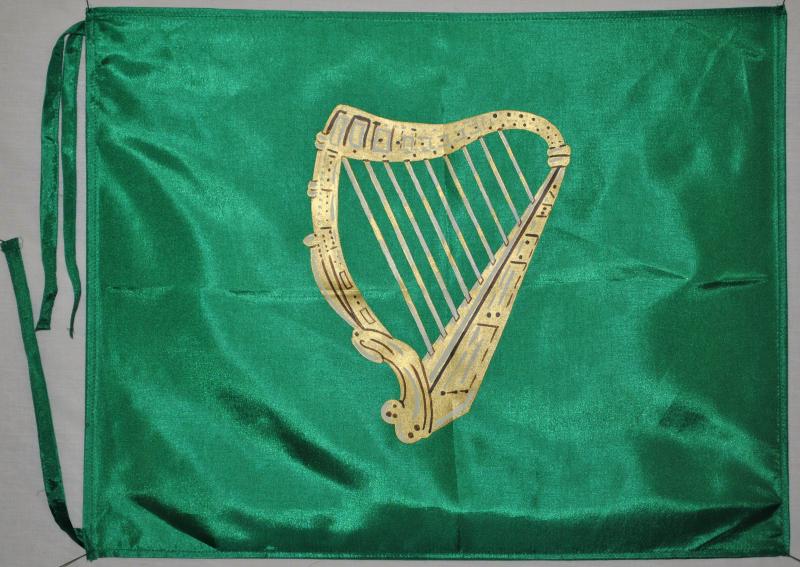
Of course we know that flag was not of the revolutionary workers but instead the harp on green which was that of the early Fenians and was very similar to that of the United Irishmen, the first revolutionary Irish Republican organisation.7
Those early Fenians were mostly composed of working class members and their 1867 proclamation to the world was largely proletarian in outlook. In Britain, the Fenians formed part of the First International Workingmen’s Association which was led by Marx and Engels.
Their flag was flown over at least one of the 1916 Rising garrisons, I believe at theJameson Distillery in Marrowbone Lane.
Similar flag to that hoisted over Liberty Hall (Photo sourced: Internet)
The other flags of the Rising included the Tricolour, presented to the Irish Republicans of the ‘Young Irelanders’ by women in revolutionary Paris in 1848, which was one of two flown on the roof of the GPO, the headquarters of the Rising.
Sharing the GPO roof with the Tricolour was the flag made only days before from domestic material and painted with the words “Irish Republic” in the house of Constance Markievicz, an officer in the Irish Citizen Army, shortly before the Rising.
The Irish Citizen Army’s own flag, the Starry Plough, flew over the Clery’s building facing the GPO. Sadly today most Irish people do not know that flag, though awareness of it and its background is growing among the indigenous Irish and the migrant community.
The design of the Starry Plough, flag of the ICA as it was in 1916 (Image sourced: Internet)
The Irish Citizen Army was formed as a workers’ militia during the great Lockout and strike of 1913-1914, to defend against the attacks of the police, the physical repressive front line of the capitalist class; the ICA’s flag was placed above Murphy’s Imperial Hotel in Clery’s.9
The Irish Citizen Army on exercises at their grounds near what is Fairview today (Photo sourced: Internet)
Though its constitution was more nationalist than socialist, the ICA was in its membership and purpose the first workers’ army in the world and when reorganised a few years later, represented also working class feminism, recruiting women, some of whom were officers commanding men.
Once the preparations for the Rising were in tatters with MacNeil’s countermanding order, where did organisers gather to discuss what to do? In Liberty Hall, the building of the Irish Transport and General Workers Union and it was there that the decision to rise on Monday instead was taken.
It is hard to overstate the importance of the fact that the decision to go ahead with insurrection was taken in the building which had become de facto the HQ of the revolutionary working class in Dublin, with an illegal flag of rebellion flying and where the Proclamation was to be printed.
The writing and text of the Proclamation
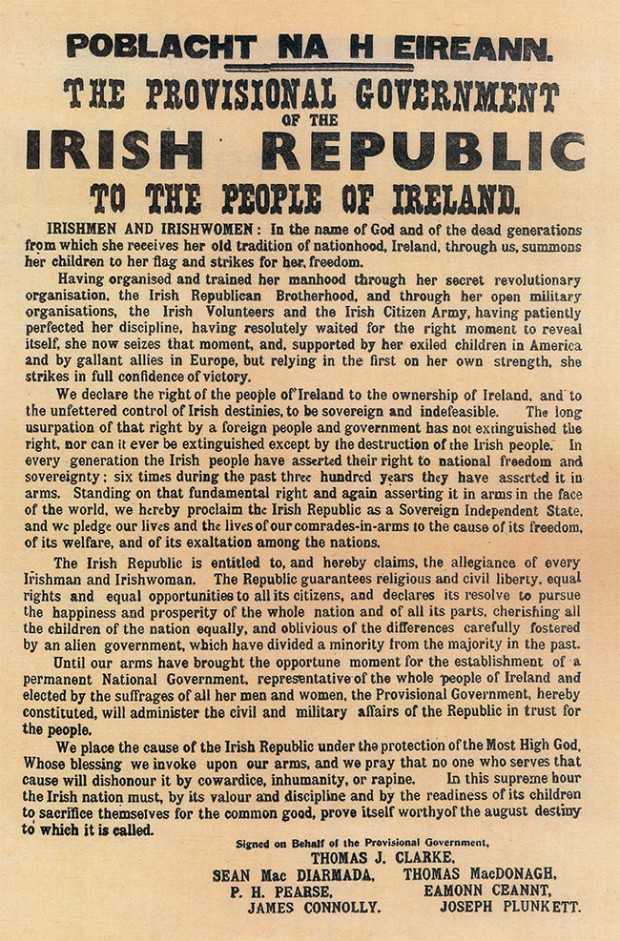
The wording of the Proclamation is thought largely composed by Pearse but influenced by Connolly, including its address to “Irish men and Irish women” and perhaps “We declare the right of the people of Ireland to the ownership of Ireland, and to the unfettered control of Irish destinies”.
Another section which could bear Connolly’s fingerprint reads: The Republic guarantees religious and civil liberty, equal rights and equal opportunities to all its citizens, and declares its resolve to pursue the happiness and prosperity of the whole nation and of all its parts, cherishing all the children of the nation equally.
(Image sourced: Internet)
But, whoever composed or influenced the Proclamation text, it was printed in Liberty Hall. An Irish Citizen Army member went to Stafford Street (Wolfe Tone St. today) to borrow the print type from a printer there to bring back to Liberty Hall, which was under daily 24-hour armed guard.
Having printed the Proclamation in Liberty Hall under armed guard and having decided there to rise on Easter Monday, where did the assault groups for Stephens Green, Castle and the GPO, including the Headquarters Battalion, meet on the morning of the Rising? …. Again, at Liberty Hall.
An early non-combatant casualty of the Rising was Ernest Kavanagh,10 who drew cartoons for the newspaper of the ITGWU, The Irish Worker. For some reason he went to Liberty Hall on Tuesday and was shot dead on the steps of the union building, presumably by a British Army sniper.
The working class in armed resistance
Once the Rising was in motion, the Irish Citizen Army had primary responsibility for two areas, the Stephens Green/ College of Surgeons garrison and the Dublin Castle/ City Hall garrison but also fought in other areas, for example on Annesley Bridge and in the GPO/ Moore Street area.
All who fought alongside them commented on their courage and discipline. After the surrender, many, along with Irish Volunteers were sentenced to death, most being commuted to life imprisonment. But two leaders of the Irish Citizen Army were shot by firing squad.
One of the areas from which the British forces were sniped at for days after the Rising was the docks area, then predominantly surrounded by working class residential areas.
A question we should ask ourselves is why the forces coming from Britain to suppress the Rising landed at Dún Laoghaire, from where they had to march nearly 12 km (approaching eight miles) to Dublin city centre, instead of at the excellent Dublin docks on the Liffey.
Hugo McGuinness, who specialises in history of the North Wall area, believes that the British expected Dublin to be in the hands of the working class resistance and that it was simply too dangerous to land British troops there, though gunboats could fire from the Liffey.
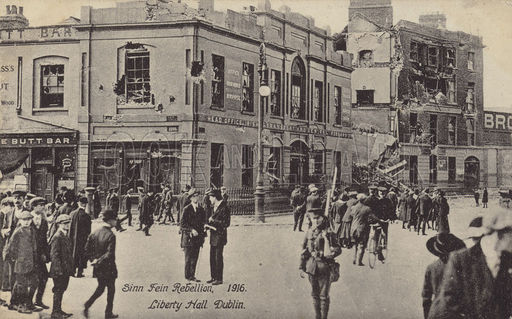
Certainly, the British believed Liberty Hall and buildings along Eden Quay were occupied as fighting posts by the Irish Citizen Army and they fired artillery at the union building from Tara Street, as photos of shell holes in that building and right through to the next testify.
Photo shell-damage Liberty Hall (first building with corner towards the camera, viewed northwards from Butt Bridge) as one of a set of commemorative postcards. (Photo sourced: Internet)Another postcard with closeup of shelling damage to Liberty Hall and to the building next to it. Interestingly, in this one Liberty Hall is labeled “the Rebel Headquarters”. (Photo sourced: Internet)
Much is made in some historical accounts of the opposition to the Rising from sections of the Dublin population, during and immediately after the Rising. The city was the capital of a British colony, only just over a century earlier spoken of as “the second city of the British Empire”.
A substantial proportion of the wealthy and middle classes were Loyalist, including some Catholics; even ‘nationalist’ sections were committed to supporting the UK in WWI and John Redmond, leader of the ‘nationalist’ political party had openly recruited for the British Army.
Also, among the working class and the lumpen elements, many were depending on “Separation Allowances” with regard to males serving in the British Army. It is true that the insurgents in some places had to threaten, club or even shoot some civilians who tried to obstruct the Rising.11
These incidents during the Rising were not many but afterwards there were insults and other things thrown at prisoners being marched to imprisonment (or firing squad). The city was under martial law but even so a Canadian journalist reported the insurgents being cheered in working class areas.
There were also other individual witness accounts, such as a man on a tram saluting prisoners in Parnell Street until threatened by soldier escorts and a firefighter in the GPO doing likewise. A year later most of even the earlier hostility had changed to admiration and pride in the fighters.
Leadership of the working class
James Connolly wrote and said many things of importance but surely, with regard to the struggle for Irish national independence, the greatest of these was: “Only the Irish working class remains as the incorruptible inheritors of the fight for freedom in Ireland.”
By that he meant — and I agree — that all other social classes can gain something from selling out the interests and resources of Irish nationhood but that the working class can gain nothing from that.
The Irish working class staked their claim on the struggle for Irish independence in 1916 but have not succeeded in leading it and because of that, that struggle remains to be won.
Today and in other days, remembering that long struggle and the class whose leadership revolutionary socialists seek to represent and to uphold, we declare the need for that leadership over a broad front of all others who wish to struggle to advance.
In doing so, we declare that far from the working class having to wait for socialism, in the course of national struggle it must also shapeits own demands around the economy, natural resources, infrastructure, social services, social questions, culture and, above all, to the fruits of its labour.
End.
FOOTNOTES
1Irish Republican Brotherhood, Irish Volunteers, Irish Citizen Army, Cumann na mBan, Na Fianna Éireann, Hibernian Rifles.
2All of which were executed by British firing squad, along with another seven in Dublin and yet another in Cork. The 16th execution was by hanging in London.
3(See Sources: Cooption of James Connolly etc) Connolly was a lifelong socialist and a revolutionary throughout his adult life, author, historian, journalist, song-writer, trade union organiser; active politically in Scotland, Ireland, New York and back in Ireland.
4The international socialist movement viewed the imperialists’ movement towards war with horror and in international conferences vowed to oppose it with all their might, including turning war resistance into revolution (“War against war”). However, once imperialist war was declared that resolve collapsed in most states, Russia, Germany and Ireland being notable exceptions and each saw a rising against war, in Ireland’s being the first.
5Joseph E.A. O’Connell (Jnr.) suggests a possible intention of goading of the State into attacking him and the ICA which might spark the general rising.
9It was a good central location but more than that – the Hotel was one of the businesses of William Martin Murphy, chief organiser of the employers’ bloc to break the Irish Transport & General Workers’ Union.
10Kavanagh was a supporter of the workers, of votes for women and against participation in the imperialist war, contributing cartoons also to the Irish Citizen, Fianna and Irish Freedom publications, also to accompany poems of his sister, Maeve Cavanagh McDowell.
11I do not include in this the three members of the Dublin Metropolitan Police who were a force for the British occupation and also for the Dublin capitalists. The Irish Citizen Army in particular had good reason to settle accounts with them for attacks on them including inflicting mortal baton injuries on two workers during a charge on a union meeting on 30th September 1913 on Eden Quay and beating people and smashing up furniture in Corporation Street a little later.
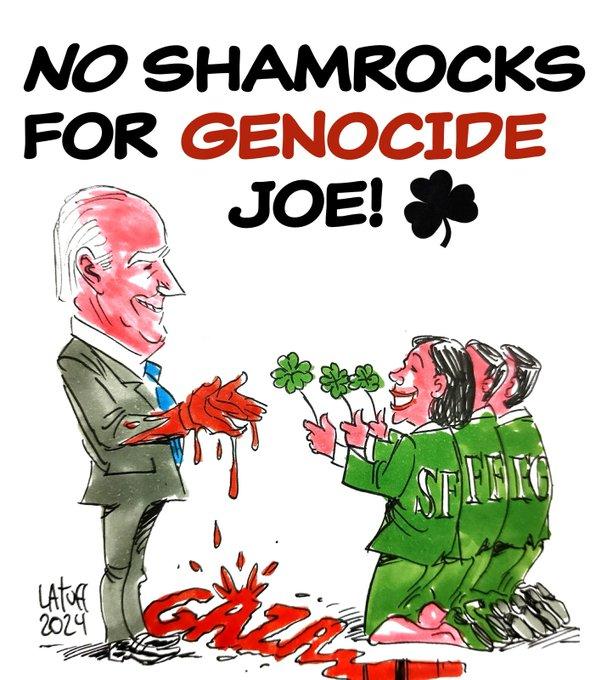
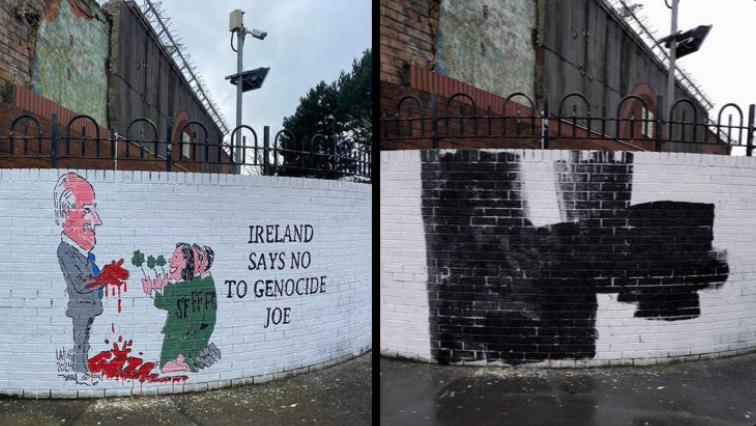
Original Latuff cartoon. West Belfast mural. Mural blacked out.
Once upon a time, Belfast was famed for its murals, so much so that even now a part of the tourist industry depends on a plastic paddy tour of the current murals on display in nationalist areas of Belfast.
It was the 1981 hunger strike and its aftermath that saw an explosion in political murals in nationalist areas. As the 1980s went on, the technical and artistic quality of them improved dramatically and the politics they sought to represent expanded.
Some of them were very militaristic, others much more political in content. On international issues, murals sprang up on South Africa, Palestine and figures from revolutionary struggles around the world were to be found on gable ends all over the city and indeed in other cities throughout the North.
Nelson Mandela, Steve Biko, Camilo Torres, Che amongst others looked down at the wandering revolutionary tourists who would come over in August. The message was clear: Ireland was part of an international struggle against imperialism.(1)
After the peace process the quality continued to improve, but the politics went for a walk. Twee Celtic murals abounded, young girls dancing a jig displaced images of women holding an armalite aloft for International Women’s Day.
about Imperialism were softened, when not blunted entirely or removed. So, it comes as no surprise to see what has happened to recent murals.
Sinn Féin supporters recently unveiled murals in solidarity with Palestine. They are of good quality and try to capture the suffering of the Palestinians through the images and poignant quotes.
However, they say nothing about who is causing the suffering: the US and Israel, though there are silhouette ghostly like images of soldiers standing over dead children.
There was once a mural on the White Rock Road which pictured a US Indian superimposed over a US flag saying Your struggle, Our struggle. No references are to be made now to the US role in exterminating a people. That is strictly Verboten.
However, someone decided to reproduce a cartoon from the artist Carlos Latuff in mural form in Belfast. It depicts Joe Biden, standing with bloodied hands in front of Mary Lou, who is clearly identifiable in the image, and the leaders of FG and FF, who can be identified from the initials FG and FF on their backs.
The British Army and the RUC used to deface republican murals, not any more. Very quickly, Sinn Féin, officially or unofficially (no pun intended, though it is apt) painted over the mural. It was quickly restored by others, who the artist Latuff described as real republicans.(2)
Sinn Féin are clearly uncomfortable about the issue in the run up their fest in Washington with Biden and not only are they content to throw Palestinians out of public meetings, they will now supress any public artistic attempts to draw people’s attention to the Slaughter Soirée they will have in the White House.
Many Palestinian voices such as the Electronic Intifada have called on Sinn Féin not to go to Washington, the calls in Ireland have been much more muted and tamer on the issue. However, it is a clear issue, what is colloquially called a no-brainer.
You don’t have to think very deeply to understand that Sinn Féin shouldn’t go to Washington DC, that they should tell Genocide Joe they don’t want to meet him. They will go and they will say nothing about Palestine.
Their erasure of a mural criticising them, tells you everything you need to know about their real attitude to Palestine.
Whatever you say, say nothing used to be a catchphrase about loose talk and informers, now it means never to mention Joe Biden and the Palestinians in the same breath, unless you are green washing genocide.
Meanwhile Sinn Féin does its part, emulating the British army and vandalising political murals.
Notes
(1) A selection of images can be seen on Bill Rolston’s website. Rolston has chronicled and photographed murals going right back to the 1970s. See https://billrolston.weebly.com
On Tuesday evening in one of Dublin city centre’s high-end shopping street picketers refuted colonial Minister for ‘Justice’ Naomi Long’s lie that “There are no political prisoners in Northern Ireland” (sic – she means the Six-County colony).
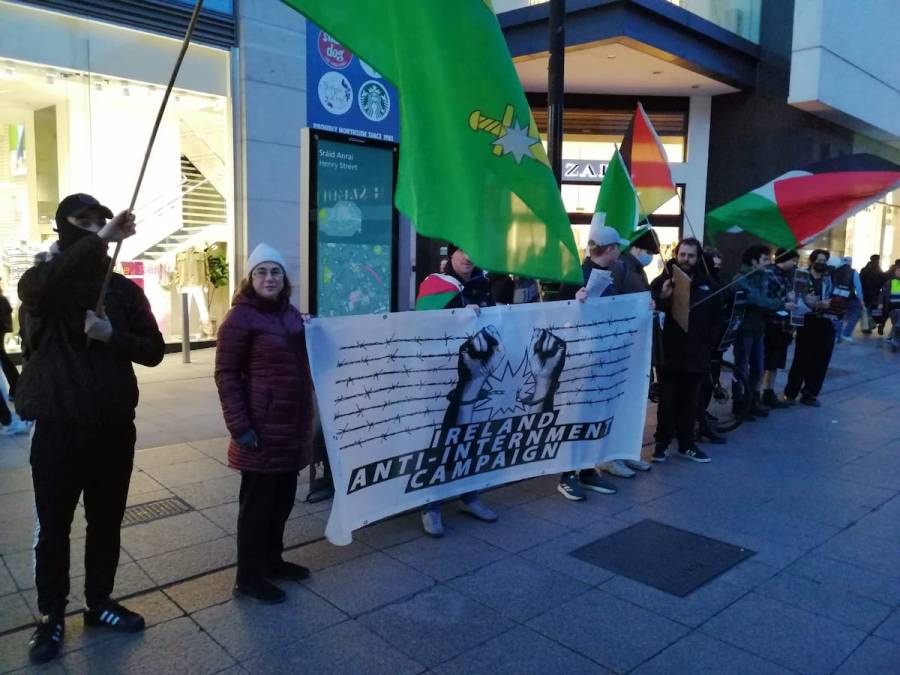
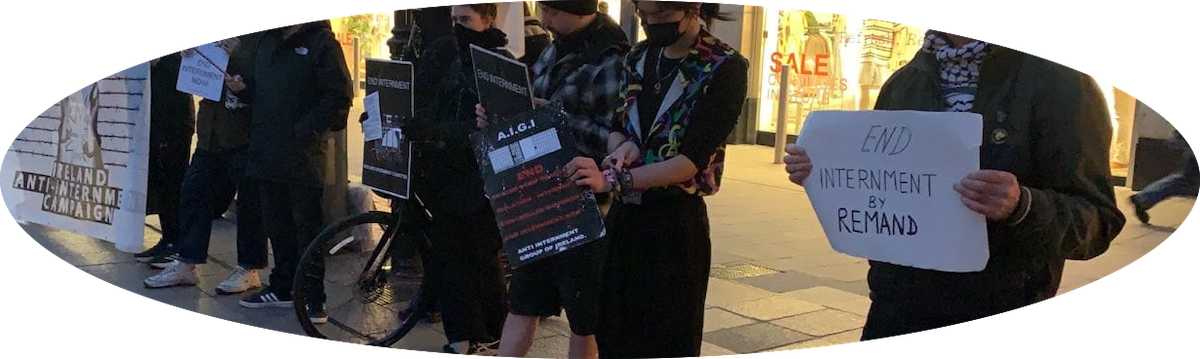
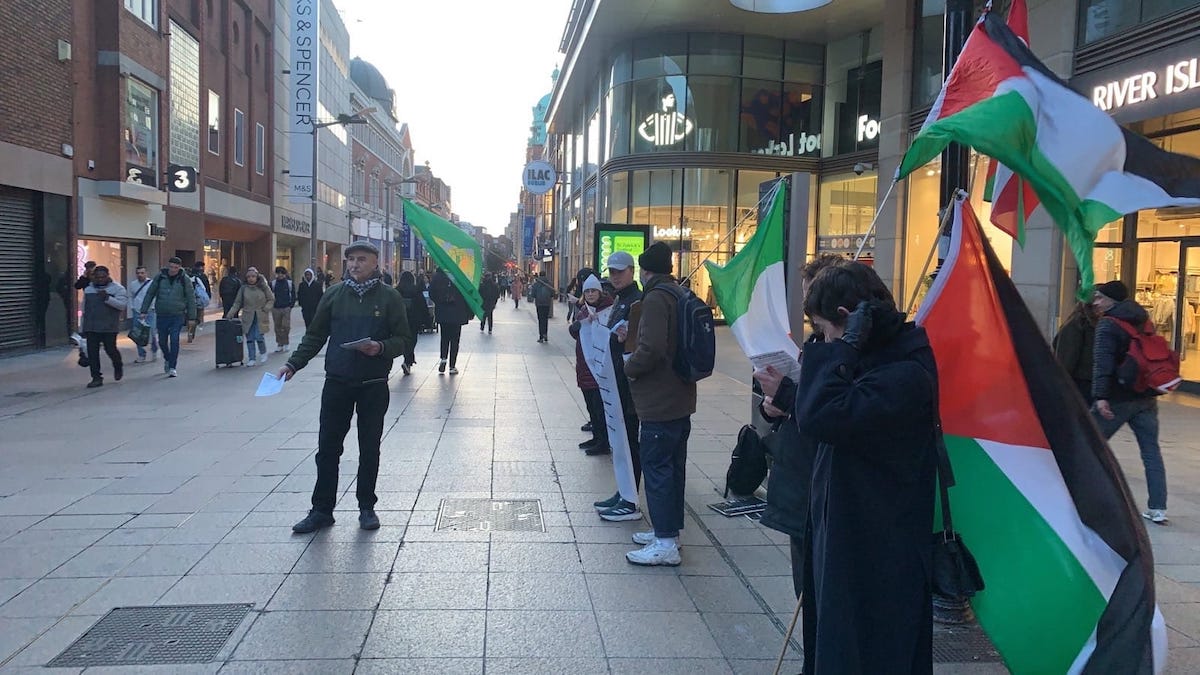
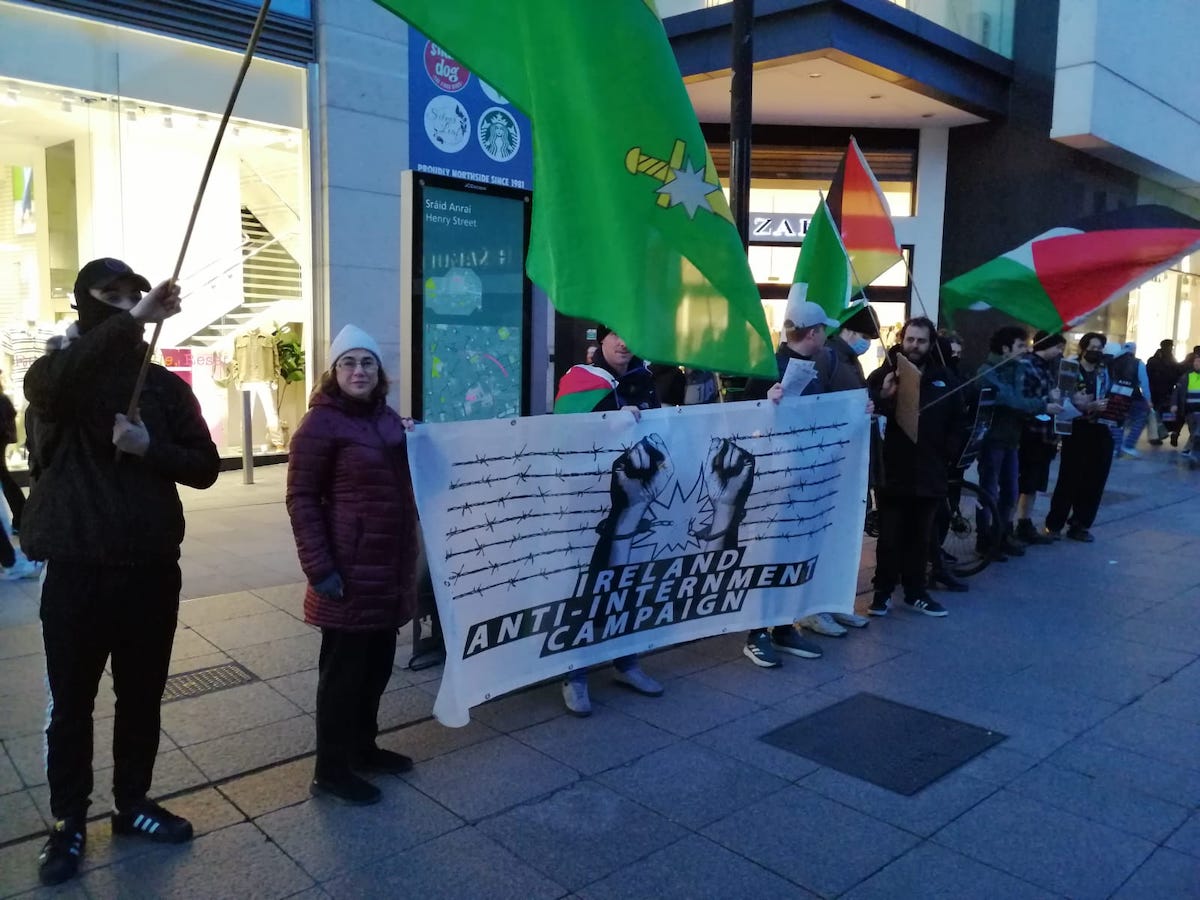
The Ireland Anti-Internment Campaign came on to the street to highlight that yes indeed, there ARE political prisoners in Ireland – over two score between both sides of the Border. And that furthermore, they are convicted in special political no-jury judicial processes.
View of the picket and the IAIC banner in Henry Street on Tuesday (Photo: Rebel Breeze)
The IAIC states that these judicial processes are called the “Diplock Court” in the occupied Six Counties and the “Special Criminal Courts” in the Irish state and were “specifically created in both cases for the easy conviction and jailing of Irish Republicans.”
The SCC has been labelled “a sentencing tribunal” rather than a court of law by human rights campaigners. IAIC states that the Diplock Court is “now being administered by former Republicans while the SCCs have now, after years of opposition, been approved by those same people.”
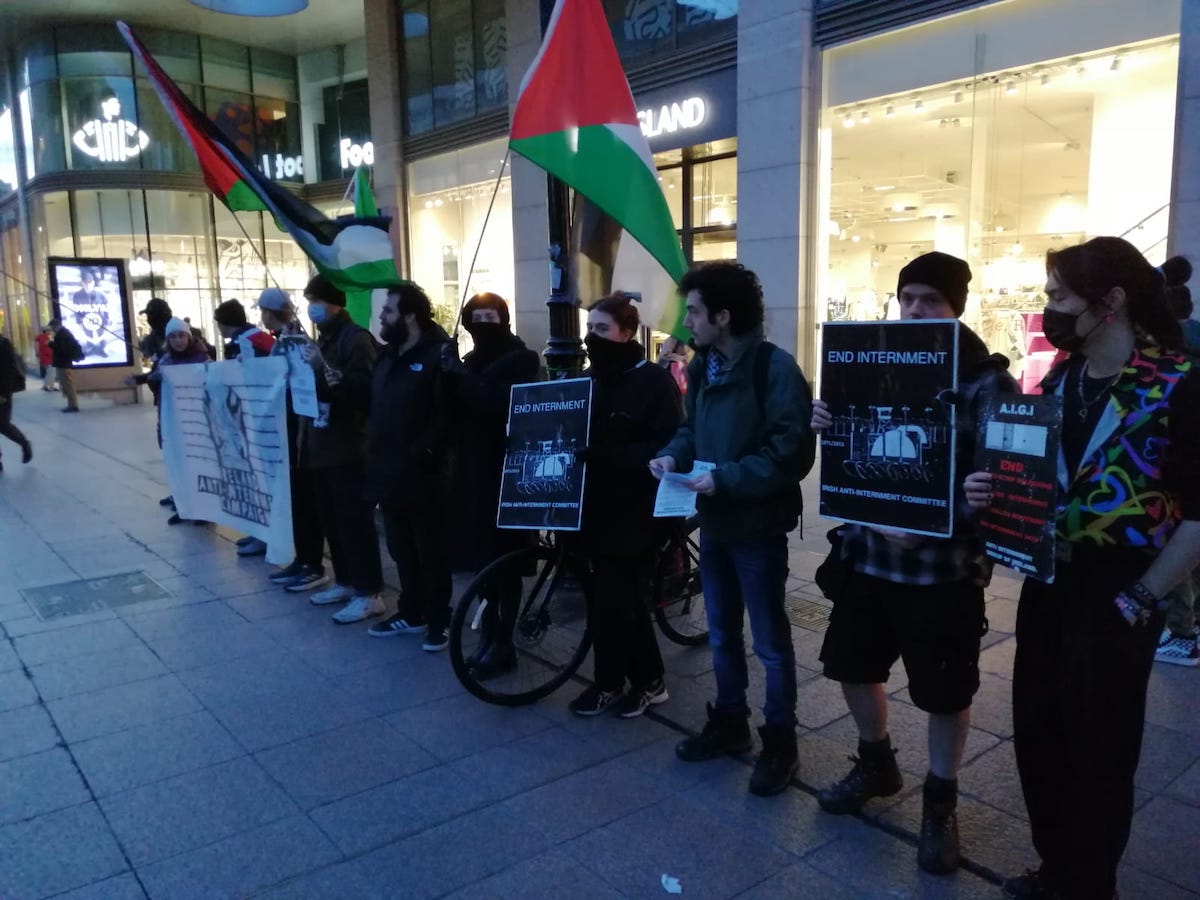
View of placards on the IAIC banner in Henry Street on Tuesday (Photo: Rebel Breeze)
However, as accused before these courts are also regularly refused bail, IAIC points out they are also effectively administrators of internment without trial, jailing activists for around two years before judicial process. If bail is granted, it is always under severe conditions preventing political activity.
The IAIC, an independent group campaigning for ten years, was supported in their picket yesterday by Irish Republicans and Socialists including from the Anti-Imperialist Action and Saoirse Don Phalaistín groups, in addition to some independent activists.
Although Henry Street is a high-end shopping street of Dublin city centre, lots of working class people use it also.
A member distributes leaflets to passers-by near the picket in Henry Street on Tuesday (Photo: Rebel Breeze)
Over 100 leaflets were distributed and a number of people stopped to discuss the issues. Some queried the mix of flags flown (Irish Starry Plough, Palestinian and Basque) and participants explained that these represented some of the struggles where repression has taken prisoners.
“We thought it particularly important to refute the colonial Minister’s lie today,” commented a spokesperson for the IAIC “and we’re glad for the support we received on the picket line and from interested people on the street. We hope to do it more often this year.”
“Internment continues in Ireland, just on a different scale and more selectively than for example in the Six Counties in the 1980s”, continued the spokesperson.
View of the picket and the IAIC banner in Henry Street on Tuesday (Photo: Rebel Breeze)
The IAIC states that it is “an independent campaigning group run on a participative democratic basis” and that it “welcomes democratic people” on their pickets. The Facebook page https://www.facebook.com/profile.php?id=100063166633467 is their usual public outlet for notification of events and highlighting of related issues.
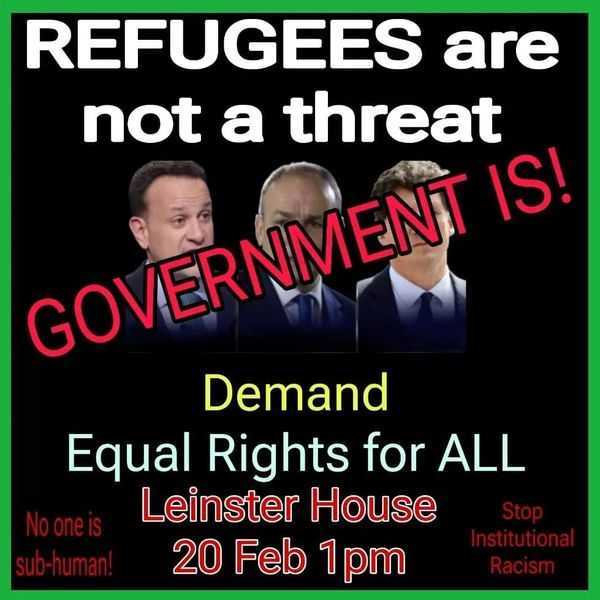
A group of asylum seekers and refugees held a small protest earlier today in front of Leinster House (home of the Irish Parliament). They were supported by a couple of people from Social Rights Ireland1 and some independent activists.
A photographer and reporter from the Irish Times and a freelance news photographer were in attendance. Speakers addressed passing pedestrians and people going into and coming out of the building and 4th Year schoolchildren on a social awareness course gathered nearby.
Event poster advertising the protest. (Image sourced: Social Rights Ireland)
The purpose of the protest was to highlight the plight of a large number of asylum seekers and other refugees who are not receiving the minimum provision of State services required by law: food, a safe place to stay, toilet and washing facilities.
Instead, many (up to 60) are living in tents, around 40 near the offices of the International Protection Agency, the agency which should be meeting their basic needs by law and where the refugees are sometimes threatened by far-Right and anti-social elements.
Last May, people in a spillover of this encampment to a lane in nearby Sandwith Street were threatened by non-local fascist activist Phillip Dwyer and some thugs. After the latter were resisted antifascists mobilised to resist a mob whipped up by the usual far-Right scaremongering and lies.
On that occasion the refugees in question were temporarily rehoused in an empty property by Revolutionary Housing League activists and their belongings transported by a street homeless outreach team who were threatened and their vehicle for a while blocked by hostile racists.
(Photo: Rebel Breeze)
In Kildare Street this afternoon, President for 2024-’25 of the Trinity College branch of the National Union of Students in Ireland gave an impromptu address, decrying the illegal inaction of the Government and urging university professors to speak out against the injustice.
Another impromptu speaker, with an Irish accent, reminded listeners of the history of the Irish people who had over centuries been refugees, asylum seekers and economic migrants to many parts of the world.
Quite apart from the legal requirements of the Government, he said, Irish people should extend solidarity and support on a human basis and in recognition of our history.
One of those who was noticed passing the protesters during speeches was Chris Andrews, Sinn Féin TD (parliamentary representative) for the area in which the IPO is located and around 40 refugees are living in tents.
A statement “words from an asylum seeker”2 was read out by a Social Rights Ireland activist with an Irish accent, pointing out that their arrival in Ireland involved a difficult journey across many parts of the world, leaving partners and children behind, a journey many had not survived.
They were not seeking to take anything from the Irish people and had been appalled to see Irish people also living on the street. The statement pointed out the large number of empty properties within the Irish state and declared that no-one should be having to sleep on the street in Ireland.
The organiser thanked people for their attendance and promised to return at a future date with a larger attendance.
End.
Current President of the Trinity College branch of the USI giving impromptu address (Photo: Social Rightis Ireland)
Led by four Republican marching bands and containing a number of organisations, around 6,000 people supported the annual march in Derry on Sunday commemorating the 1972 massacre by the British Parachute Regiment in the city.
This year a special focus on solidarity with Palestine had been called for by the organisers of the Bloody Sunday massacre commemoration and Palestinian flags mixed with ones of Irish Republican organisations decorated the march route.
The march begins at the Creggan Heights, overlooking Derry, a steep walk up from the Bogside, the city’s centre near the river and winds its way down (with a great view of the Foyle river and surrounding area) but then up Westland Street again and along Marlborough Terrace.
Rear banner of the AIA contingent on the Bloody Sunday commemoration march Sunday. (Photo source: AIA)
For a number of years this commemoration has taken place in heavy rain and high winds, or snow, or sleet but it was dry this year – until the march started! However after a short period of strong gusts driving rain it stopped for the rest of the march.
Down Creggan Road to the Bogside once more and past the Bloody Sunday and H-Block memorials to the rally at Free Derry Corner where Kate Nash, one of the main organisers of the march for years and a sister of one of those murdered in the massacre, welcomed the marchers.
The Bloody Sunday 52nd commemoration march makes it way along Lone Moor Road towards the Brandywell on Sunday afternoon. (Photo: George Sweeney via Derry News.)
RALLY AND SPEAKERS
Nash condemned the punitive EU/ UK/ USA cutting of funds to the UNRWA organisation carrying out relief and educational work in Gaza following an Israeli State intelligence allegation1 and also called for no Irish politicians to attend the annual US Presidential St. Patrick’s Day event.2
Kate Nash’s brother Willie was murdered by the Parachute Regiment during the massacre and her father was wounded by fire while trying to reach his fallen son. Kate called for a minute’s silence for the dead and wounded that day but also for those in Gaza, in particular the children.
Kate Nash also mentioned the Noah Donohoe case as being close to everyone’s heart.
The names of the dead and wounded by the Parachute Regiment were read out by Damian Donaghy,3 son of Damian Donaghy one of the survivors on that day. Paddy Nash performed the civil rights anthem “We Shall Overcome” which was popular among marchers of the time.
Section of the rally to the right as facing Free Derry Corner with a mural based on an iconic photograph from the massacre. (Photo: D.Breatnach)
Kate Nash introduced Huda Ammori, a Manchester-based Palestinian activist and one of the Elbit Eight,4 who said she felt at home in Derry because of the people’s solidarity with Palestine.5 The State in Britain failed to convict all but one of any charges arising out of direct action against the arms company.
Ammori drew parallels between the Irish and Palestinian struggles against colonialism and stated that her grandfather had been assassinated for rising up against the British colonisation of Palestine in 1936, when it was a British “Mandate”.
Mural on a wall in the Bogside, Derry; the words “don Phalaistín” are obscured by a vehicle. (Photo: D.Breatnach)
AIA Short Video with Music Bloody Sunday Derry 2024 AIA Video.MP4 (viewable on FaceBook)
“The British signed away the land of Palestine in 1917,” Amori told the rally, “they colonised our lands and then they armed and trained the Zionist militia to commit a Nakba, to displace over 750,000 Palestinians in 1948, over half the indigenous population.”
Huda Ammori said weapons were used on Palestinians in Gaza and then marketed as ‘battle-tested’. She also praised those who had taken direct action in Derry against arms firms (e.g Raytheon).
Section of crowd gathering in front of the stage for the rally. (Photo: D.Breatnach)
Geraldine Doherty, niece of Gerard Donaghy, youngest of the Bloody Sunday victims, also spoke from the platform, saying it was ‘sad’ but ‘heartwarming’ to see so many people attending the march.
“More than half a century since British troops committed this massacre on these streets, innocent children like my murdered uncle Gerard and hundreds of others as well are still being denied justice”, she said and denounced the British State attempting to prevent the trial of legacy cases being tried.
Doherty spoke of the remaining “trauma for Derry and for Ireland” from which many families have never recovered, with long-term post-traumatic damage such as depression, addiction and divided families.
“But while the people of Derry were battered and imprisoned, we were never broken,” she said to cheers from the rally participants. “Derry has rediscovered its … voice and we are using that voice to oppose the murder of children and women and men, and we stand with the people of Palestine.”
Section of crowd to the left of the stage at the rally.(Photo:D.Breatnach)
ON THE MARCH
Over the years since I returned to Ireland, I have marched in that commemoration many times, either as an individual or as a member of a solidarity committee and this year was glad to be welcomed as part of the Socialist Republican contingent, with Anti-Imperialist Action.
The bloc carried two banners: the one at the front was a new one in which the AIA called for anti-imperialist revolution and socialism, while at the rear the banner celebrated the Palestinian resistance. In between the banners marchers carried flags and placards.
New banner of the AIA in the organisation’s contingent on the march on Sunday. (Photo: D.Breatnach)
In the bloc men and women marched with a flags of the AIA, the Starry Plough, Palestine and Cumann na mBan. From the contingent on many occasions could be heard slogans of solidarity with Palestine and some equally applicable to that nation’s resistance or to Ireland’s.
“In the face of occupation – Resistance is an obligation!” and “No justice – No peace!” were in the latter category while “From the River to the Sea – Palestine will be free!”, “Free, free – Palestine!” and “Saoirse don – Phalaistín!” were specifically supporting the Palestinian struggle.
Most Republican organisations and some Irish socialist organisations attend the annual event, along with campaign groups and on occasion solidarity groups from abroad or Irish ones in solidarity with struggles abroad. Sinn Féin no longer attends but some supporters would as individuals.
Giant Palestinian flag displayed below the Derry Walls above the rally below. (Photo: D.Breatnach)
THE MARCH ROUTE AND HISTORY
The Bloody Sunday march covers the same route as the anti-internment march in January 1972 when the British Paratroopers murdered 14 unarmed marchers and injured so many others. Preceded by the Ballymurphy Massacre in August 1971, it was followed by another in Springhill in July ‘72.
The British military claimed that the Derry victims had been armed and fired first and an inquiry tribunal headed by Lord Justice Widgery exonerated the Army and blamed the victims although the Derry Coroner, an ex-British Army officer had called it “sheer unadulterated murder”.
In 1998, presumably as part of the Good Friday Agreement deal, the British State began a new inquiry which however did not deliver a published verdict until 2010,6 stopping short of accusing the Army of murder but exonerating all the victims except one about which it was equivocal.
At that point, Sinn Féin’s Martin McGuinness said that the march should not be continued; however not one British soldier had even been charged, to say nothing of the commanders and Government Ministers who had either given the orders or arranged the cover-up – or both.
Banner of the organisation combining representation of trade unions in Derry. (Photo: D.Breatnach)
A small group of veterans of the original march and relatives, Kate Nash prominent among them, however decided to keep the march going and have done so every year, often in the face of accusations and disparaging remarks from supporters of Sinn Féin and others.
In 2022, the Massacre’s 50th anniversary, 20,000marched in it while the Bloody Sunday Trust, an institution and museum supported by the colonial state and Sinn Féin, organised a small “memorial walk” and indoors event in the Guild Hall – the only one reported by the mass media.7
An independent group, badly needed since the Coiste na nIarchimí is controlled by the Provisionals. (Photo: D.Breatnach)Display below Derry Walls created by the Saoradh Irish Republican organisation, according to their social media. (Photo: D.Breatnach)
Although veterans of the massacre and of the annual commemoration often meet one another only once a year at the commemoration, some having come from abroad, there are always new young people to be seen among them and hundreds come out to watch the march.
The march is an important commemoration of a massacre by British colonialism which still holds the colony of the Six Counties, a reminder no doubt inconvenient to unionists, neo-colonialists and those who have left the struggle, either through lack of will or for personal advancement.
In its championing and giving voice to other conflicts too, the commemoration march and other related events during the week are a strong expression of internationalist solidarity.
Wreath of the Bloody Sunday Commemoration Committee among others at the Bloody Sunday Monument. (Photo source:Bloody Sunday Commemoration Committee)
End.
FOOTNOTES
1The Israeli state intelligence agency reported that 12 out of 13,000 employees of UNRWA in Gaza had been implicated in the 7th October Palestinian raid following which at least some, possibly all, were sacked by UNRWA, apparently without any hearing or appeal process. The US, UK, Germany, Italy followed this up by suspending all funding to the relief organisation catering for 2 million people in dire circumstances.
2Traditionally, leading politicians of the main Irish political parties, both mainstream and Sinn Féin, have sent representatives to celebrate St. Patrick’s Day with US Presidents, many of whom are of Irish descent. This year a campaign has arisen calling on them not to do so but spokespersons of Fine Gael, Fianna Fáil and Sinn Féin have insisted they will attend, which the SDLP has declared it will not.
3Not to be confused with the family of Gerard V. Donaghy (20 February 1954 – 30 January 1972), sometimes transcribed as Gerald Donaghey, a native of the Bogside, Derry who was murdered by members of the 1st Battalion, Parachute Regiment on Bloody Sunday.
4Eight activists of British-based Palestine Action, a direct action organisation, who as a result of their actions against the Israeli-based military technology company Elbit in Britain, were charged with a total of 12 charges which included criminal damage, burglary and encouraging criminal damage. The trial, which commenced on November 13th, related to a series of actions taken during the first 6 months of Palestine Action’s existence from July 2020 to January 2021. In December last year, one activist was convicted on one charge by 10-2 majority, two were completely cleared and jury failed to reach a majority verdict on the rest of the charges on six remaining activists.
5That would be true of the majority ‘nationalist’ population of the city but not so much of the unionist minority, where support for Israel is more dominant, due in part to susceptibility to British propaganda and also simply out of sectarian hostility to anything favoured by the ‘nationalist’ community.
6At a cost of nearly £200m (€227.7m), half of which went in legal fees, a lawyer’s bonanza, to arrive at a decision that just about everyone in Ireland knew and many abroad knew already and which established no safeguards against a similar massacre being carried out by British military in future.
7Browser searches throw up report after media report, including Al Jazeera’s, of “hundreds” attending the early event, without a mention of the many THOUSANDS who marched later in the day.