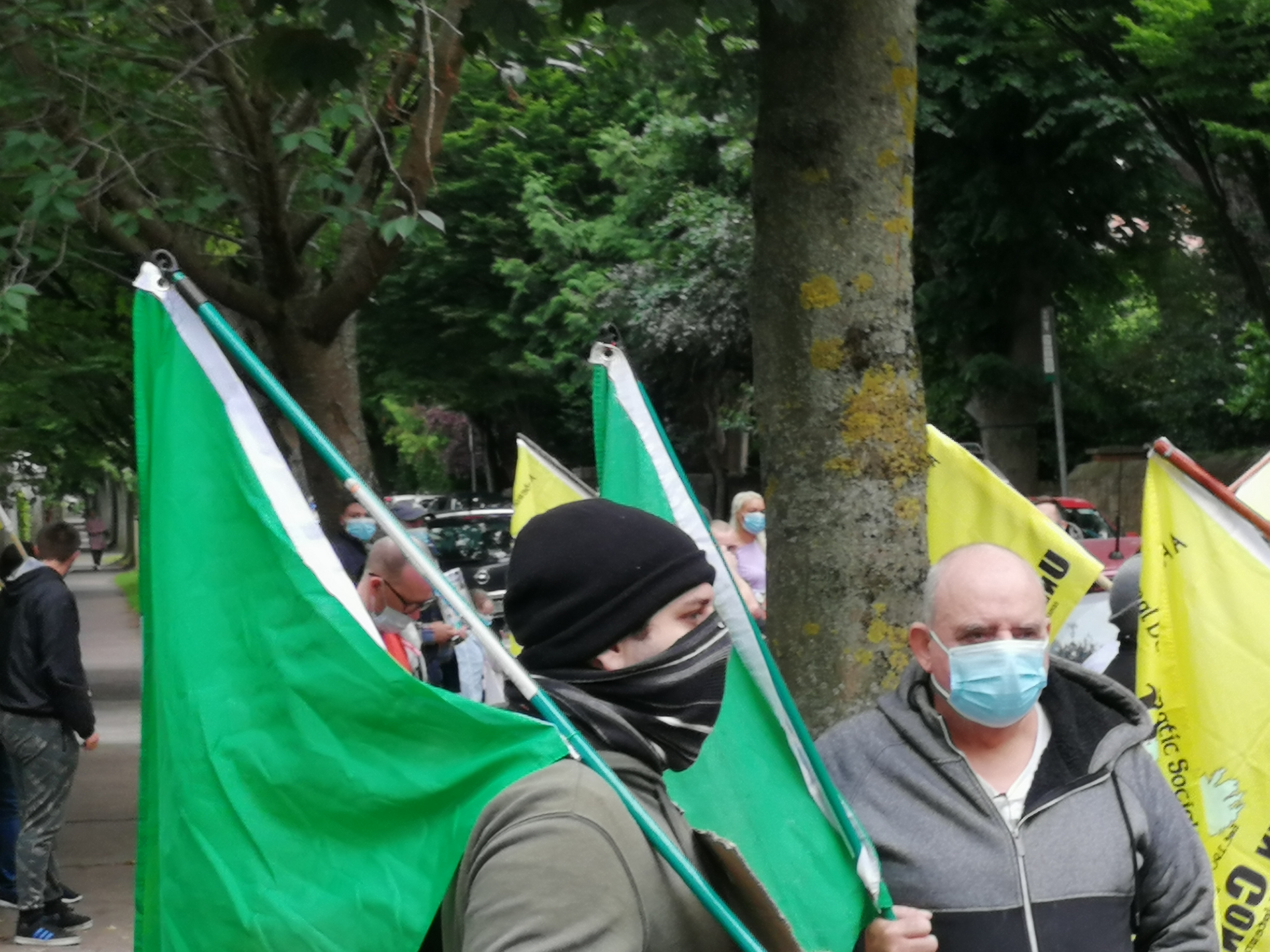
The Far-Right, including racists like Gemma O’Doherty and fascists like Niall McConnell, have called for a protest against the hire of Croke Park for a celebration of the Muslim festival of Eid on Friday. These clowns posing as “patriots” who strut around waving the Tricolour and “Irish Republic” flags seem to have forgotten the words of the 1916 Proclamation of Independence (if indeed they ever bothered to read it): “The Republic guarantees religious and civil liberty, equal rights and equal opportunities to all …”.
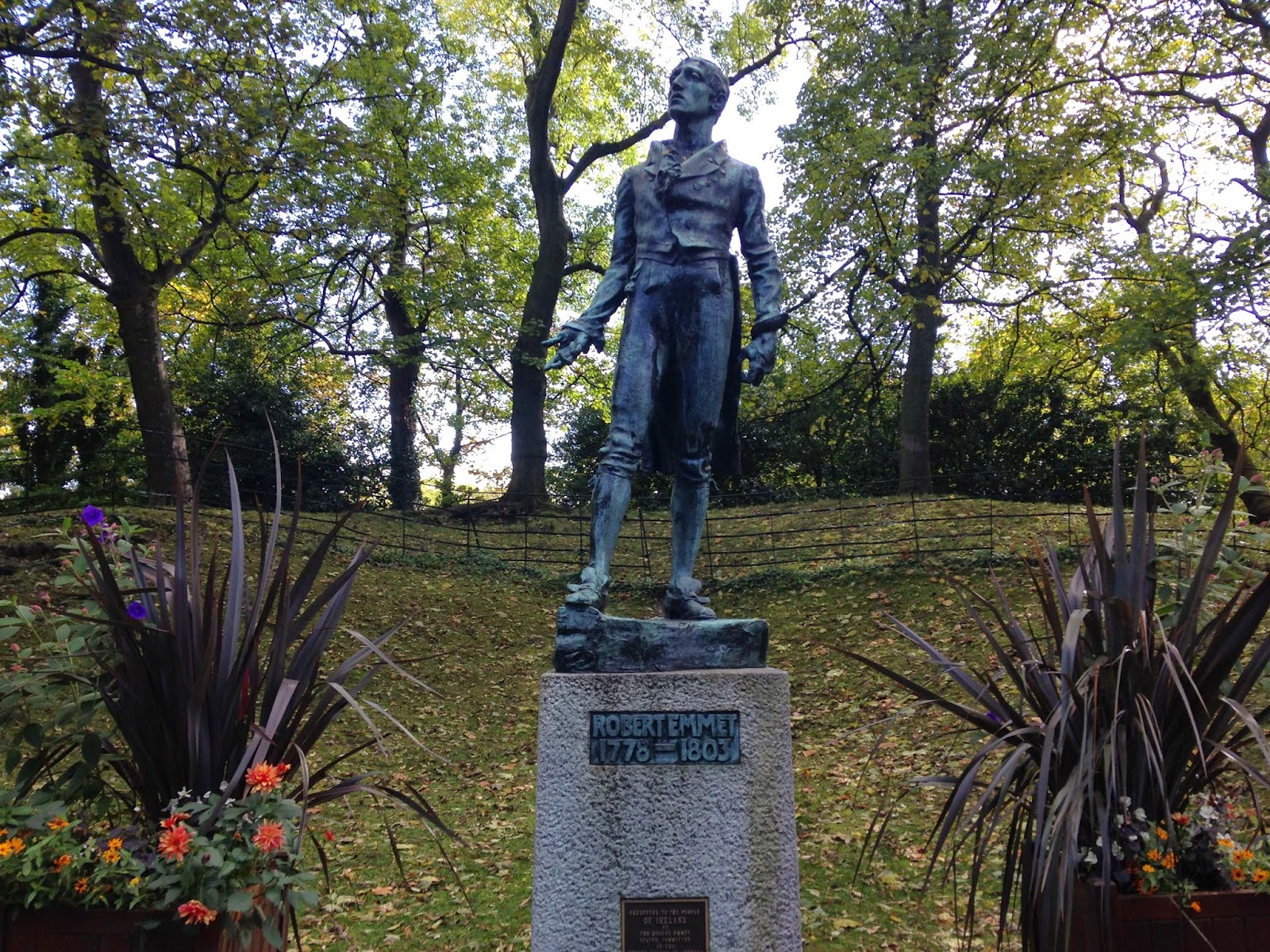
Monument Robert Emmett in Stephens Green (copy of another in Washington DC). Emmett gave his life not only for an independent ireland but for a republic, with separation of Church and State. (Photo source: D.Breatnach)
SEPARATION OF CHURCH AND STATE – A FUNDAMENTAL REPUBLICAN PRINCIPLE
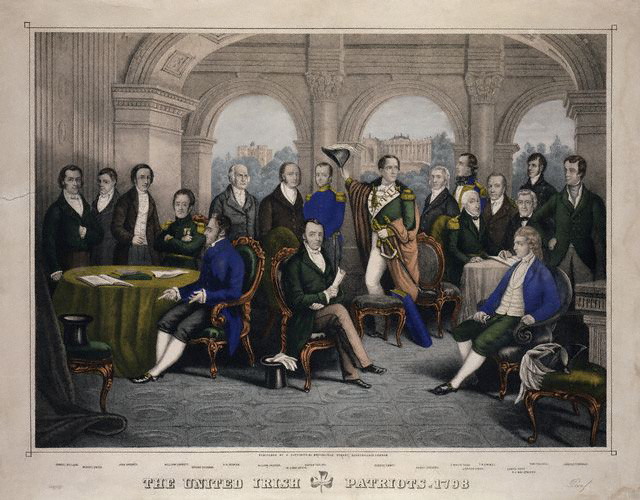
A fundamental principle of republicanism is the separation of church and state – it is as fundamental as the elimination of monarchic rule. It is what the Anglicans Wolfe Tone, Edward Fitzgerald and Robert Emmet believed in, along with the Presbyterians Anne and Henry Joy McCracken – and what they died for, along with independence from England. Anne Devlin and Michael Dwyer were typical of the Catholics who supported the republican ideal. No government should be telling its people what religion they must or must not follow — nor indeed that they have to be religious at all.
A far-Right Lineup for meeting at the EU Parliament: Irish “patriot” Niall McConnell at the far right of photo (and in politics) with, among others, fascist Nick Griffin of the British National Party (fourth from left). (Photo source: Internet)
Gemma O’Doherty is calling for “a Christian prayer circle” at Croke Park at 9am as a protest against the muslim celebration. Christian prayers for intolerance, racism and fascism? These “patriots” think they have the right to decide which religion is acceptable and which not. That they dislike Muslim religion is their privilege but what is outrageous is that they think they have the right to dictate to people what their religion should be. These are the same people, let us not forget, who have been so stridently shouting about the “right to free speech”!
They say that they are doing this to “prevent Sharia law in Ireland”. Apart from the fact that the only religious domination we’ve had in Ireland has been various forms of Christianity, what kind of paranoia makes them think that there are enough Moslems in Ireland to get a Sharia party elected, even if Moslems wanted that, which many of them don’t? Not all Moslems are supporters of Sharia law any more than all Christians are fundamentalists — or all Catholics support the right of religious orders and clerics to abuse people over which they have control.
It was the Christian Pope Adrian IV in the 12th Century who, with the Laudabiliter document ‘authorised’ the invasion of Ireland by King Henry II of England. From the 15th Century we had Protestantism forced on us by the English Crown by the sword and plantation. In the second half of the 18th Century, Irish Republicanism sought to separate Church and State and to unite Catholic, Protestant (i.e the dominant Anglicans) and Dissenter (i.e Presbyterians, Methodists, Unitarians, Quakers). They failed but gradually Presbyterians and then Catholics won their rights (although Catholics continued to suffer discrimination in the Six Counties). In the 1930s the Blueshirts in the 26 Counties scapegoated Jews in order to divert the people from their real enemies and to build a fascist state, until they were beaten off the streets by Irish Republicans and socialists.
None of that religious persecution or strife was inflicted on us by Muslims.
Gemma O’Doherty supporters demonstrating for “free speech” outside the Dept. of Justice in November. (Photo source: D.Breatnach)
TELLING US HOW TO LIVE OUR LIVES
In the 26 Counties from 1921 we had a Catholic State and the Church dominated public and secular life, dictating laws and social rules about marriage, birth control, sex and sexuality, dance and socialisation, controlling also the education, welfare and health system. That would have been unhealthy enough but they abused their trust, not only physically, mentally and sexually abusing children, adolescents and adults, and exporting orphans abroad – but denying the victims and covering up for the abusers.
They told us what books and newspapers we could read, what films we could watch and what political parties we must not support. This is the kind of “free speech” sought by the fascists.
A fascist tweeter called Rionach has threatened to burn Croke Park down with the Muslims inside it!
All democratic forces need to oppose these reactionary gatherings, whatever the cover story under which they are calling them but under which the fascists are trying to organise their future stormtroopers. Already there have been a number of attacks on antifascist individuals and small groups.
If you disagree with what this collection of the bad, mad and sad are doing, with what they want to do to our country, you know where to be early on Friday morning. Bailligí le chéile!
End.
Prominent members of the United Irishmen, by unknown artist, print, 1798 or after (Image sourced on Internet)
Mick Healy of the Irish Marxist History Project was kind enough to interview me about some of the issues about which I have been active. Parts I and II were published together a couple of months ago and here’s Part III now.
Mostly its snippets about the founding of the Irish in Britain Representation Group, my involvement in the foundation of the Lewisham branch of IBRG in SE London and from there, the Lewisham Irish Centre. Also my participation in Kurdish solidarity and a trade union delegation to Turkish-occupied Kurdistan (the YPG placard photo is of me in Trafalgar Square, London a couple of years ago when I was over visiting kids & grandkids) and the anti-water charge campaign in Ireland.
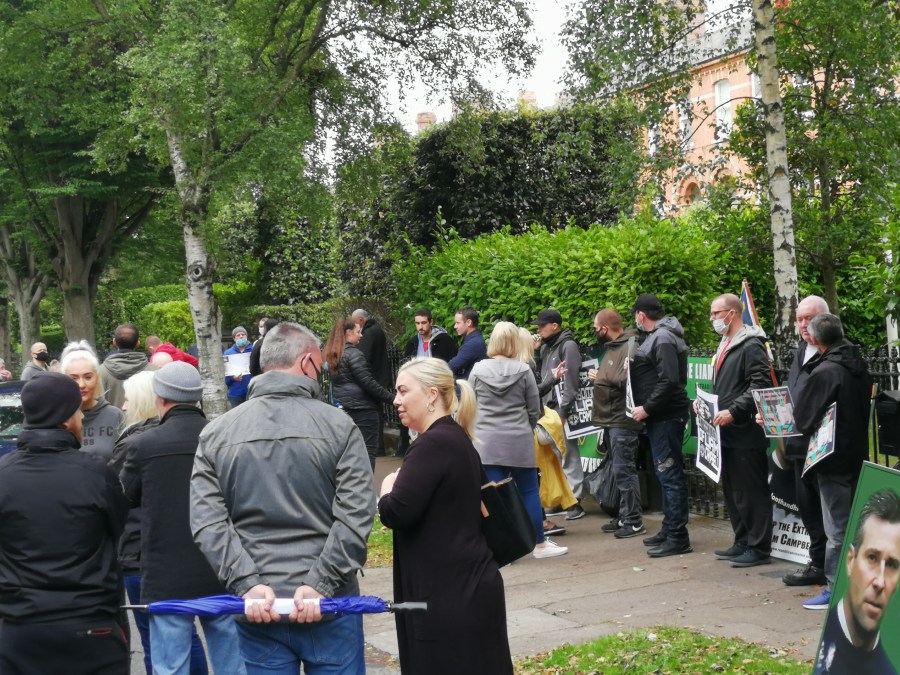
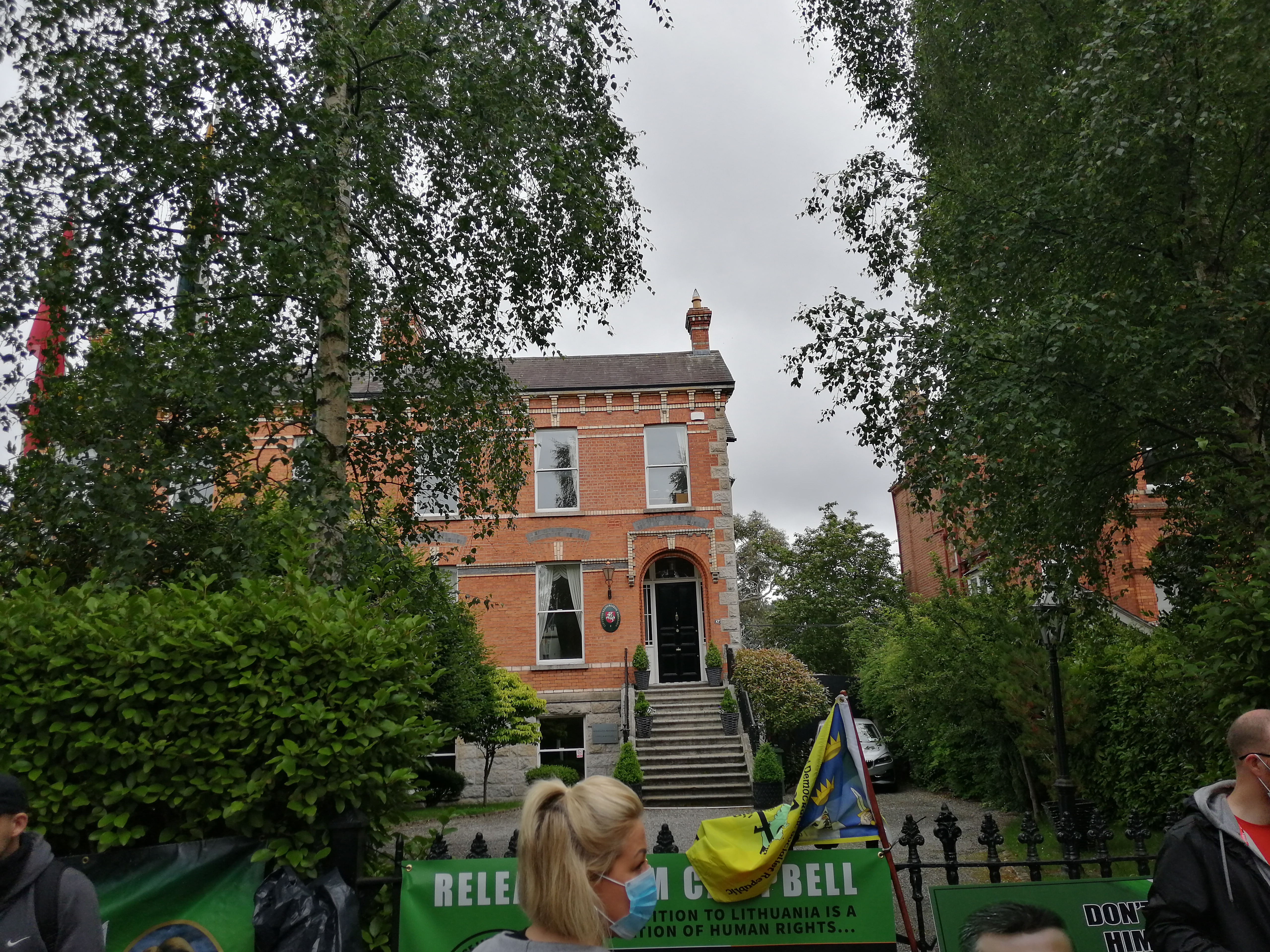
The occasional driver or occupants of a car passing through the quiet leafy and very expensive area of Dublin 4 might have been very surprised to see a large gathering outside one of the houses in Ailsbury Road with a number of flags and placards in evidence. Then again perhaps not, for this area is sometimes known as “Embassy Land” and embassies often attract protests when people object to the actions of the states they represent. The protest was outside the Lithuanian Embassy and just a few doors westward is the French Embassy.
Lithuanian Embassy building. (Photo: C.Sulish)
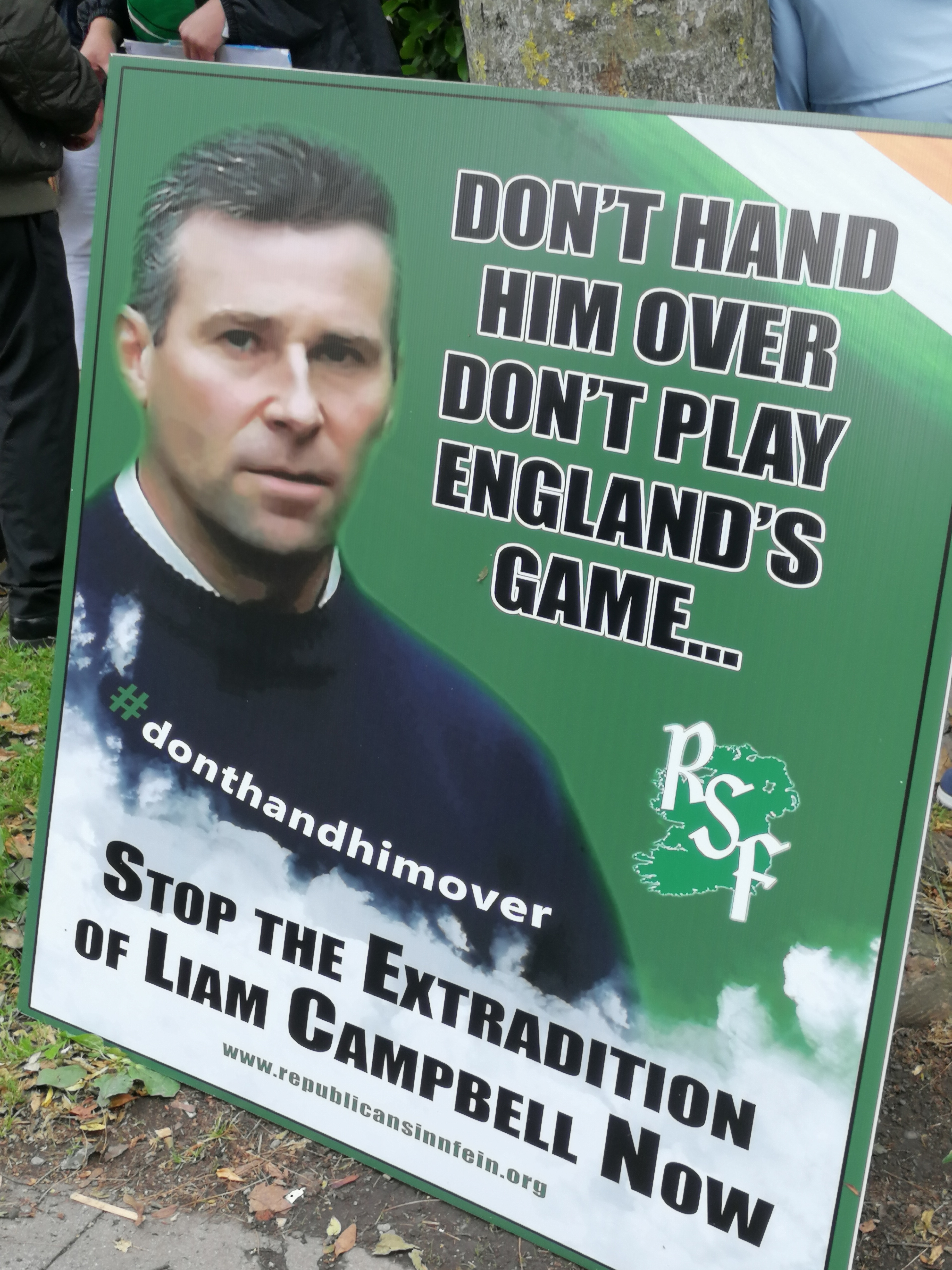
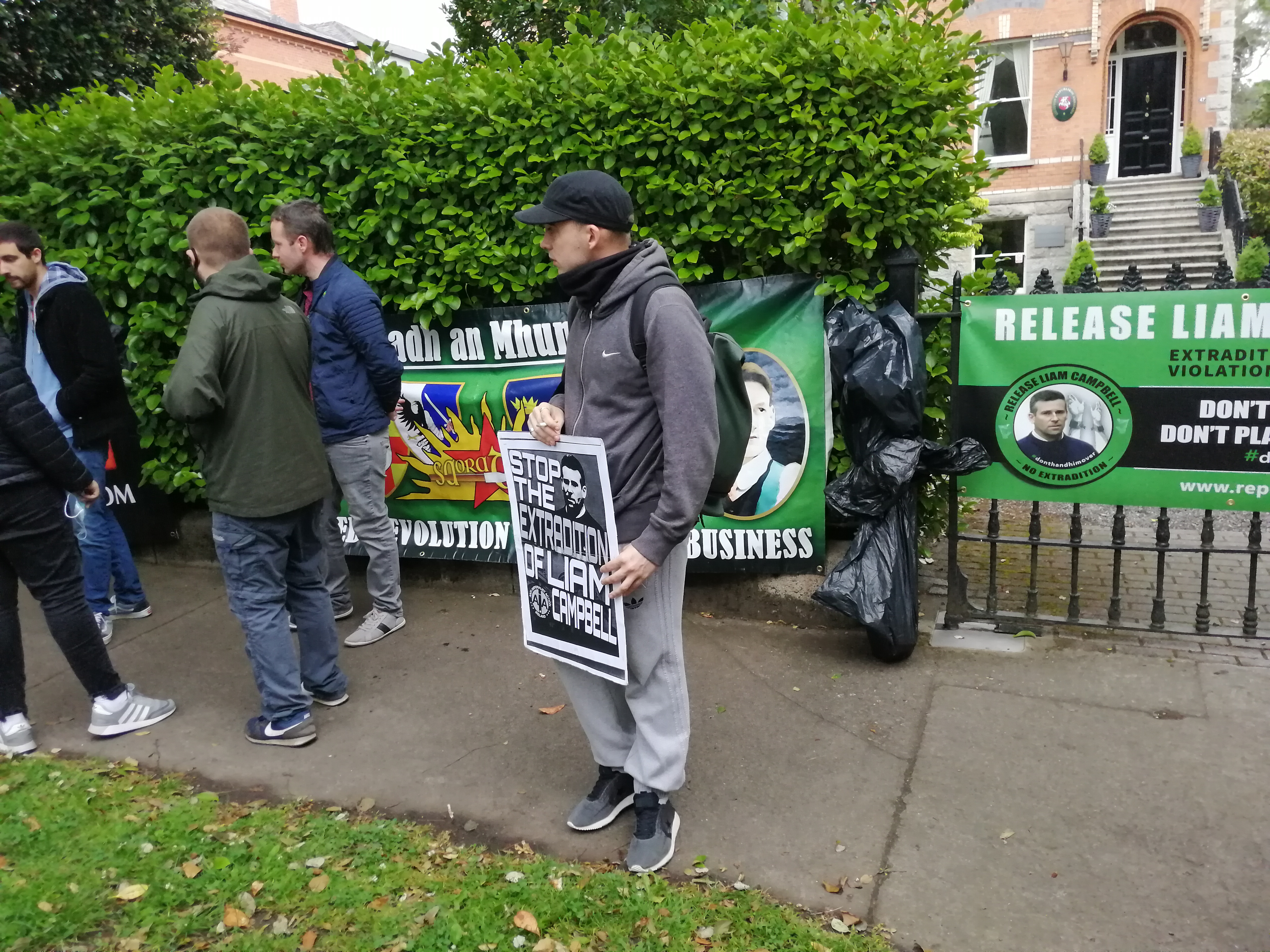
The targeting of the Lithuanian Embassy on Saturday 4th July was because the State of Lithuania has issued a European Extradition Warrant for Liam Campbell, a long-time Irish Republican activist and the protest had been jointly convened by Anti-Imperialist Action and the Anti-Internment Group of Ireland at the request of Liam Campbell’s family. Last month the Irish State’s High Court opened the way to the extradition, Justice Aileen Donnelly waving aside all objections about the state of the justice system within Lithuania and accepting only the terrible conditions in Lukiskes remand jail in Vilnius as an impediment but considering this removed with news of the closing of that jail. Thus ended a 12-year legal battle, with only the formality of producing Liam Campbell in court on the 13th to hear the judgement remaining, after which he will have one week to seek leave to appeal the order.
Chairing the event for the Anti-Imperialist Action group (he had a recent cycling accident). (Photo: C.Sulish)
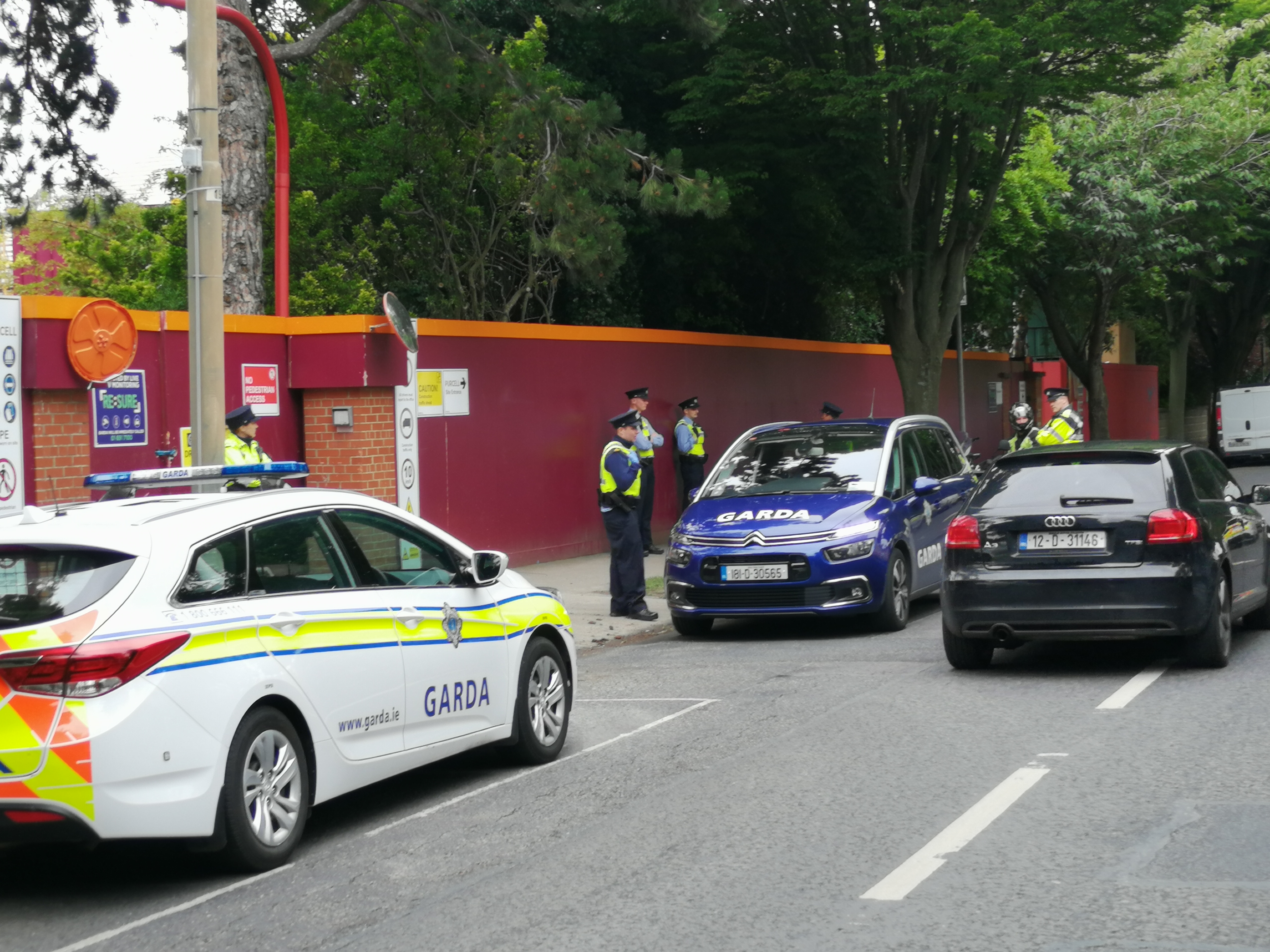
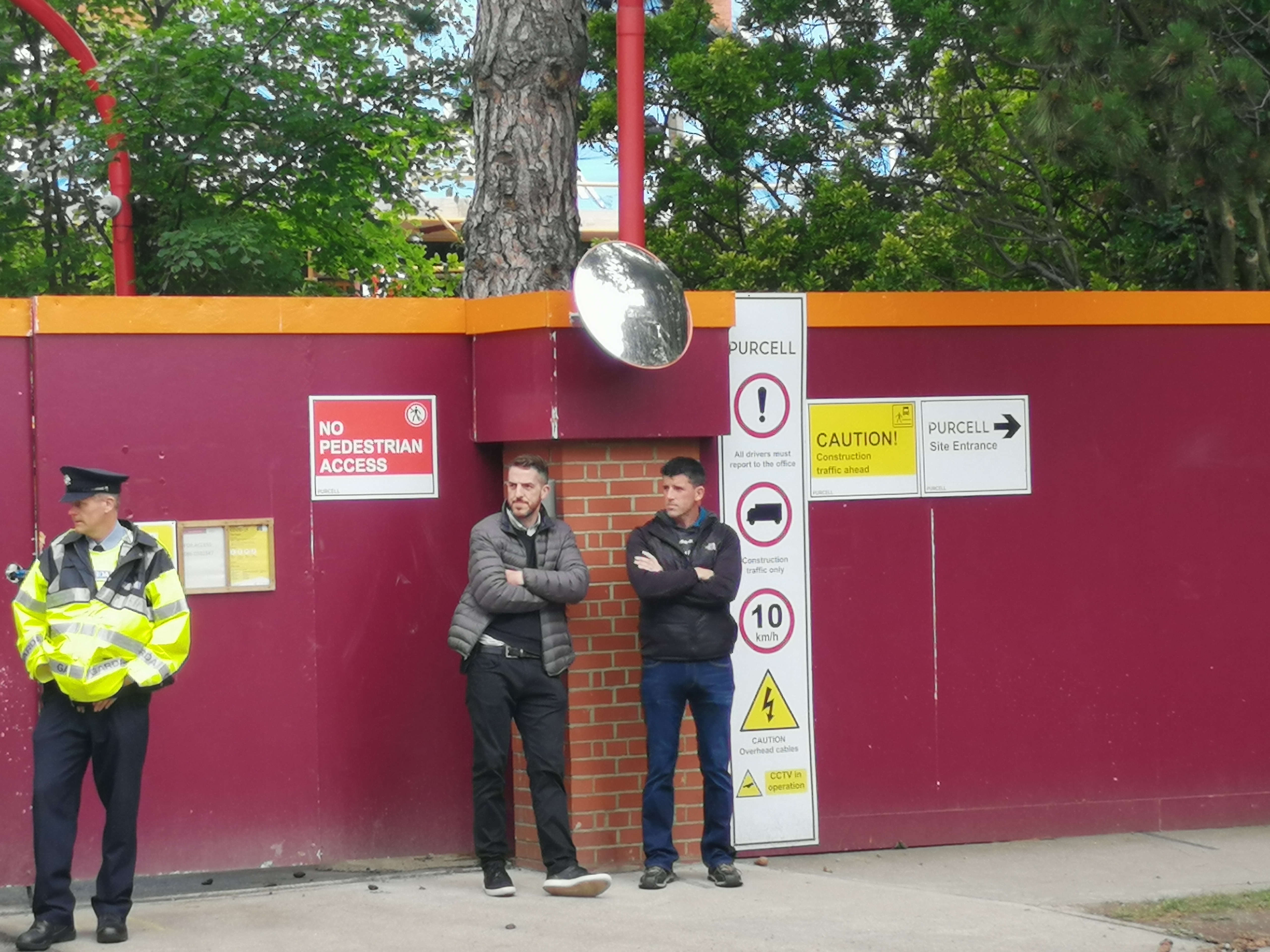
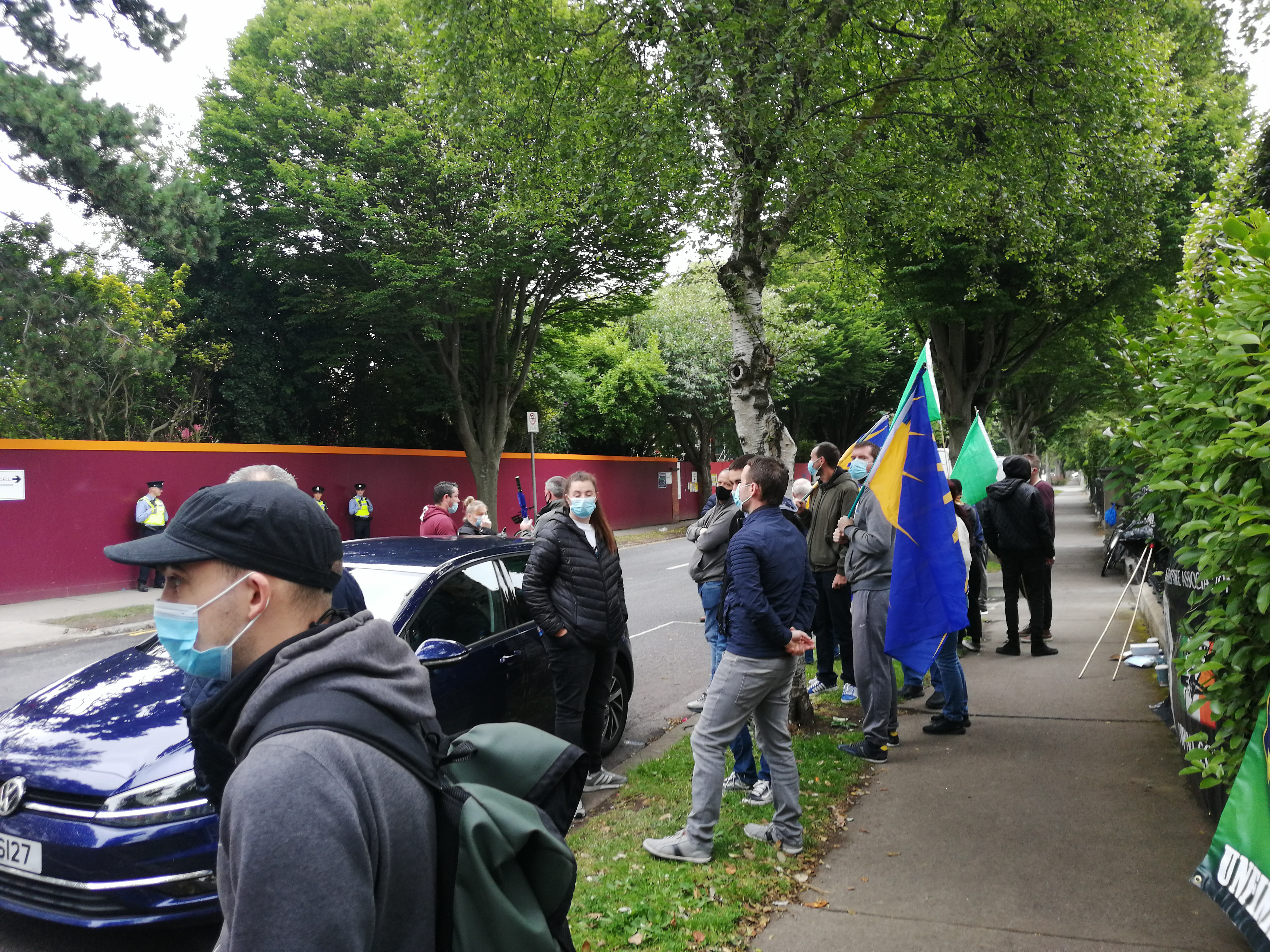
On the footpath opposite the Lithuanian Embassy, a number of Gardaí in uniform were in attendance, along with two men in plainclothes, clearly members of the Irish secret political police, known colloquially by their former name, the Special Branch.
Some of the Gardaí at the event. (Photo: C.Sulish)Two members of the Garda Special Detective Unit, otherwise known as “the Special Branch”. (Photo: C.Sulish)
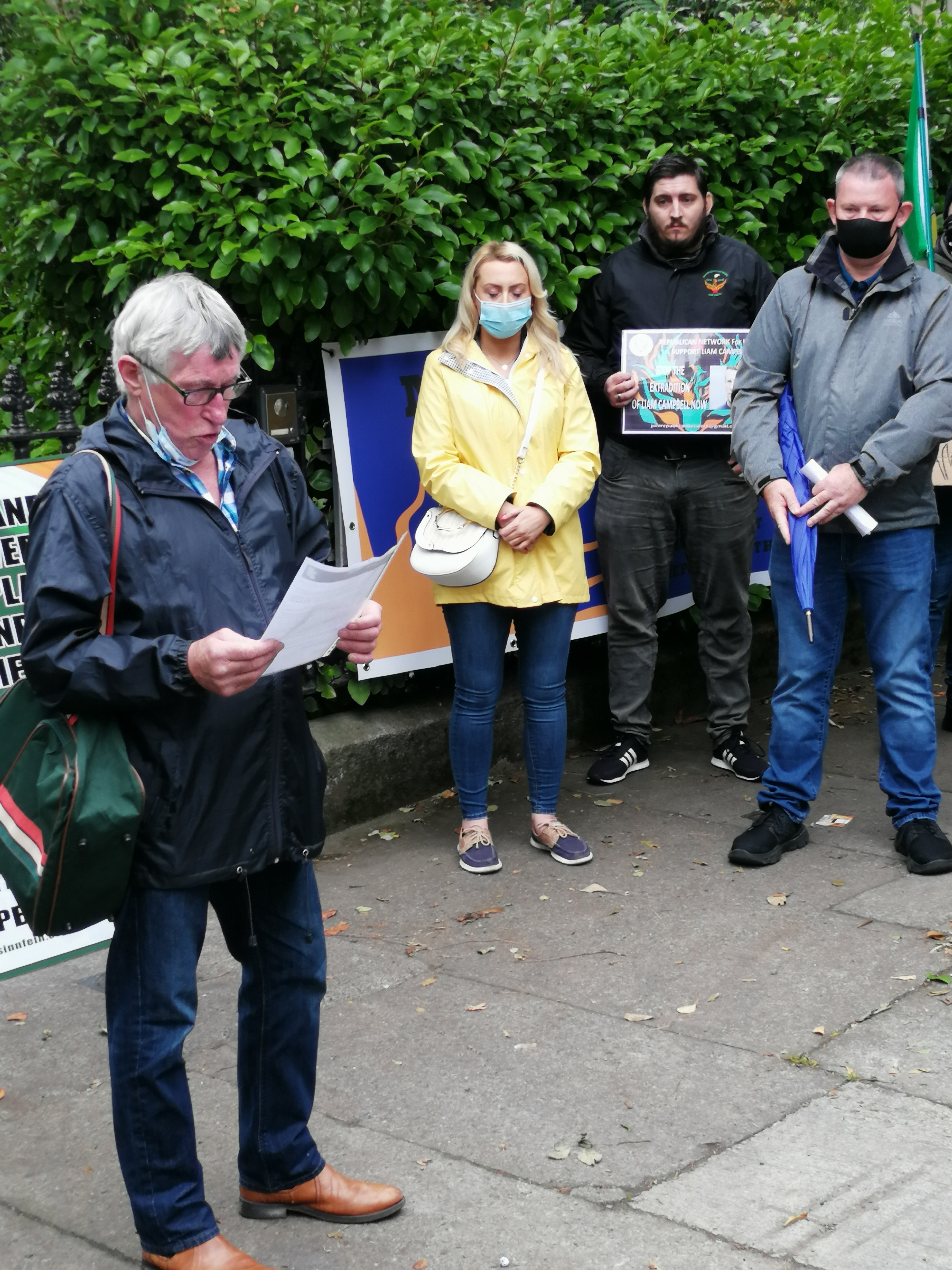
Outside the Embassy itself, the representative of AIA chairing the event thanked the large crowd for attending to oppose the extradition of an Irish Republican and introduced Diarmuid Breatnach to speak on behalf of the Anti-Internment Group. Speaking first in Irish and then repeating some of what he had said in English, Breatnach pointed out that Michael Campbell, Liam’s brother, had been held in Lithuania for four years on charges of which he had then been cleared. Subsequently, after he had returned home, another warrant had been issued for his arrest and he had been tried in absentia, with his legal representation excluded from the trial. Pointing out that no-one should be extradited to an administration so careless of justice and even of basic legal procedures, Breatnach concluded by calling: “No extradition for Liam Campbell!”
REPEATED CALLS FOR UNITY
Cáit Trainor, an independent Republican from Armagh was introduced next and she pointed out that a state was seeking the extradition of a man who had never even been in its territory and so could not have committed any crimes there. Referring as Breatnach had done to the previous treatment of Michael Campbell, Trainor outlined the lack of justice in Lithuania but also how the Irish state was facilitating this process by holding Liam Campbell in jail awaiting judgement on the European Warrant.
Trainor pointed out that this is a political persecution “because Liam Campbell is a well-known unrepentant Irish Republican” and, praising the unity shown in the diversity of political allegiances in evidence among the attendance, declared that this is not a party political issue and that the campaign is an independent one. She stated that this case was setting a terrible precedent and that all Republican activists were in danger of it being used against them in future. “It is not just a political issue,” Trainor continued, “but one of basic human rights”, adding that it should be of concern to all who care about those rights, whether they are Republicans or not.
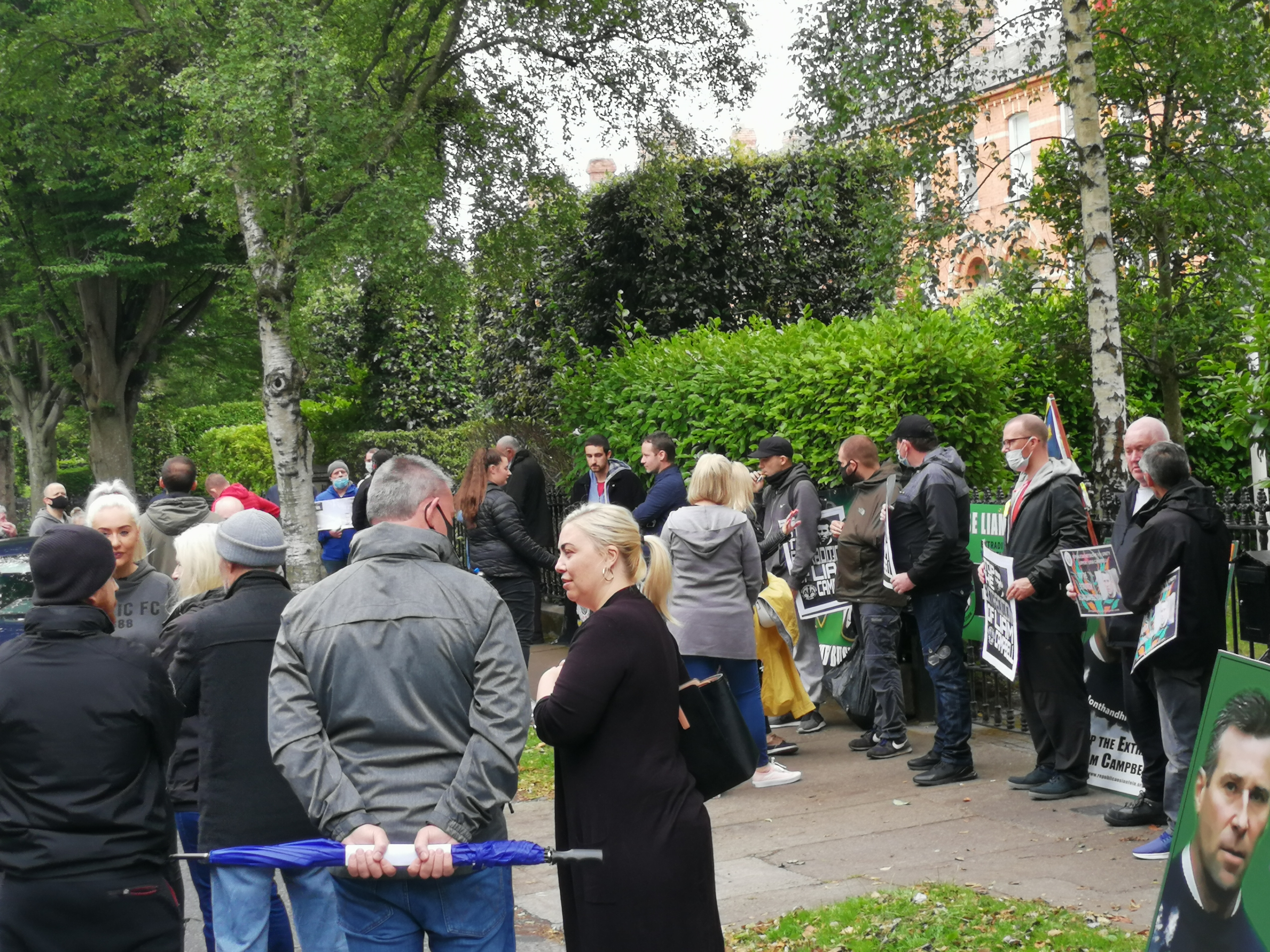
Closeup section of the crowd at the event. (Photo: C.Sulish)
The Chair then called Diarmuid Mac Dubhghlais from Dublin to say a few words on behalf of Republican Sinn Féin. Beginning with a few words in Irish, the speaker continued with a short speech in English, reiterating the necessity of unity and the human rights aspect of the issue beyond the political targeting.
Liam Scullion from Belfast, called by the Chair, spoke briefly on behalf of RNU along similar lines, as did Mick Finlay, a former prisoner from Dublin, speaking after him on behalf of the Saoradh organisation. Finlay also pointed to the extradition procedures to the colonial administration of the Six Counties against two of their members, Ciarán Maguire currently in Portlaoise jail and Seán Farrell, arrested in Scotland and taken straight to Maghaberry Jail.
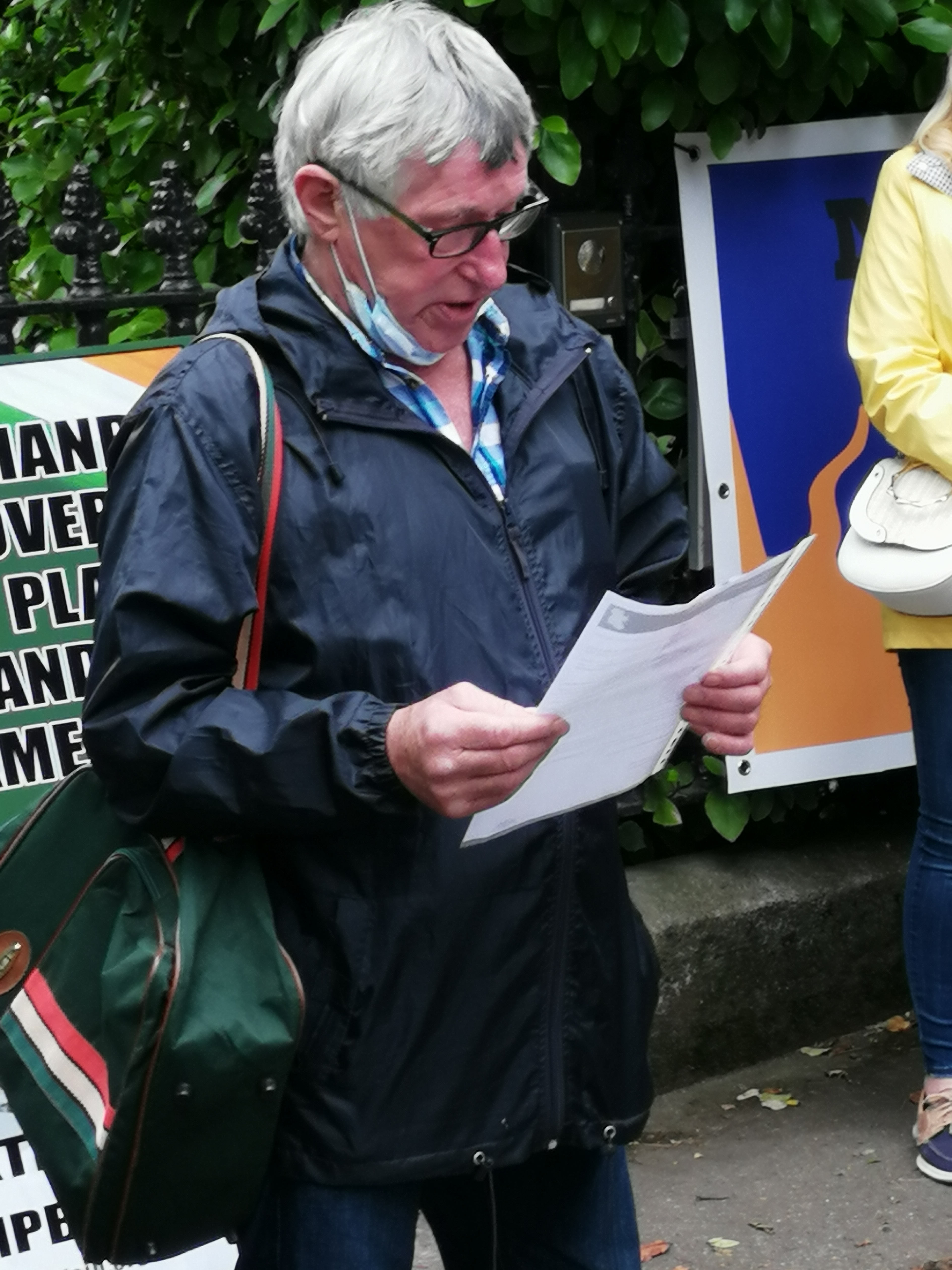
Pat Campbell reading family’s statement (Cáit Trainor, Liam Scullion and Michael Campbell in the background). (Photo: C.Sulish)
FOUR YEARS IN SOLITARY CONFINEMENT WITHOUT A TRIAL
The Chair then asked was there any other group represented there who had not been called and wished to speak. Nobody spoke up and after a pause the Chair called on Pat Campbell, a brother of Liam, to read a statement on behalf of the family. Before reading, Pat Campbell thanked all those present for their support, on his own behalf and that of the family.
The speaker reminded his audience that the Lithuanian episode of the persecution of Liam Campbell stretched asfar back as January 2009 when hehad been arrested and issued with his first extradition warrant. Four months later, whilst on bail, he was wrongfully re-arrested by the British, who processed a second extradition warrant by the Lithuanian State, in May 2009.
Some of the banners and placards at the event. (Photo: C.Sulish)
Liam had then been held in solitary confinement in Belfast‘s Maghaberry Prison for four years1, during which time he had never been convicted of any crime, nor even questioned! Liam won his case in the High Court in March 2013; it was appealed by the British State in the supreme Court in London, who ruled in August 2013 that there was no case to answer.
However a third extradition warrant was issued by the Lithuanian state, also in August 2013 and kept quiet for three years before being sent on to Dublin. In December 2016, Liam Campbell was arrested for a third time which began his most recent struggle against extradition.
Section of the crowd, looking eastward. (Photo: C.Sulish)
Pointing to the state of the prison regime in Lithuania, Pat Campbell spoke of reports from the Committee for the Prevention of Torture “which detail to us the extreme prisoner-on-prisoner gang violence (foreign prisoners in particular are targeted), accounts of sexual assault, inhumane treatment and intimidation perpetrated by ‘special intervention units‘, notorious within the Lithuanian prison regime of today.”
Proceeding to speak of the standard of the legal system and human rights in Lithuania, the speaker said: “In May 2018 a European Court delivered a damning guilty verdict against the Lithuanian state, otherwise known as “Camp Violet” by CIA military, for their involvement in operating “black sites” used as torture chambers; and a litany of successive abuses which resulted in hefty convictions from the European courts and testament to their ingrained flagrant denial of fair trial rights and failure to safeguard the right of citizens”.
(Photo: C.Sulish)
“Lithuania,” said Pat Campbell just before concluding, “we call you out on your state’s abuse of process that would prevent repatriation to Ireland for Liam Campbell, in your denial of rights as set out in the United nations declaration on human rights act (UDHR) in the charter of fundamental rights (1998). They are not rights for good behaviour but alienable entitlements to all people.”
The contributions of all the speakers were applauded but before conclusion of the formal part of the event, Áine Daly from Crossmaglen stepped forward “to thank the Anti-Internment group and the Anti Imperialist Action who organised this event at very short notice” and also noted the presence of John McCluskey, who had stepped down as Independent councillor for Fermanagh earlier this year.
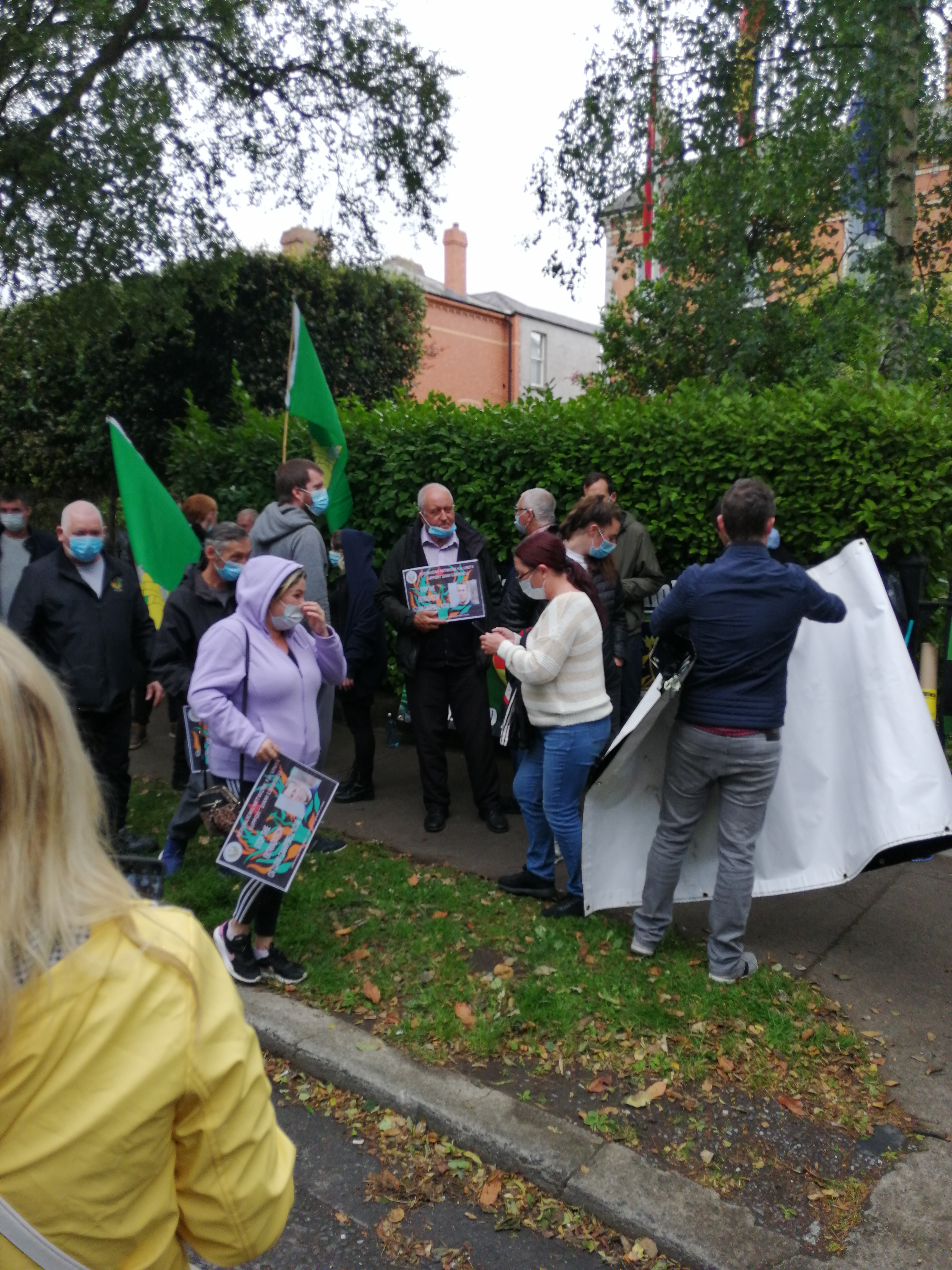
Protesters packing up, also showing (centre) John McClusky, recently councillor in Fermanagh who travelled down to attend. (Photo: C.Sulish)
Shortly afterwards people began to disperse without any actions from the Gardaí.
The event and the statements combined to create an impressive show of unity in a badly fractured Irish Republican movement and time will tell whether this unity can be maintained in the face of State repression, where it is badly needed. Aside from the Republican organisations represented, the organisers of the event are known as independent of any political party and there were independent individual activists there too, not just Republicans but some Anarchists as well.
End.
General shot of part of the crowd looking eastward. (Photo: C.Sulish)
FOOTNOTES
1Human rights organisations have quoted psychologists’ evidence that solitary confinement should be a last resort and that in any case longer than three weeks in isolation is likely to prove injurious to the prisoner’s mental health.
After repeated claims from from a woman speaking through a loudhailer that their right-wing rally at the GPO was “peaceful” and would “not respond to your violence” (this addressed to their peaceful opponents on the other side of the road!), right-wingers crossed the road a number of times to insult and threaten their opponents, eventually assaulting one well-known Republican who defended himself vigorously. Gardaí separated assailant and victim but declined to take any action against the fascist.
BACKGROUND, BUILD-UP AND ATTACK
The above took place on Saturday 4th July. Earlier, at 1pm, the Ireland Palestine Solidarity Campaign had hosted at the Spire a very well-attended rally in solidarity with Palestine and against the recently-announced plans of Israel to annex the Palestinian West Bank.
Section of Palestine solidarity rally (Photo: D.Breatnach)View of crowd supporting Palestine southward (Photo: D.Breatnach)View of the Palestine supporters northwards towards the Spire (Photo: D.Breatnach)
Many of the Palestine supporters were still on the pedestrian reservation when the far-Rightists arrived to set up their weekly protest against social distancing, with claims that Covid19 is not real (or, a variation, that it is exaggerated) and that the restrictions are being used to bring in a “New World Order”.
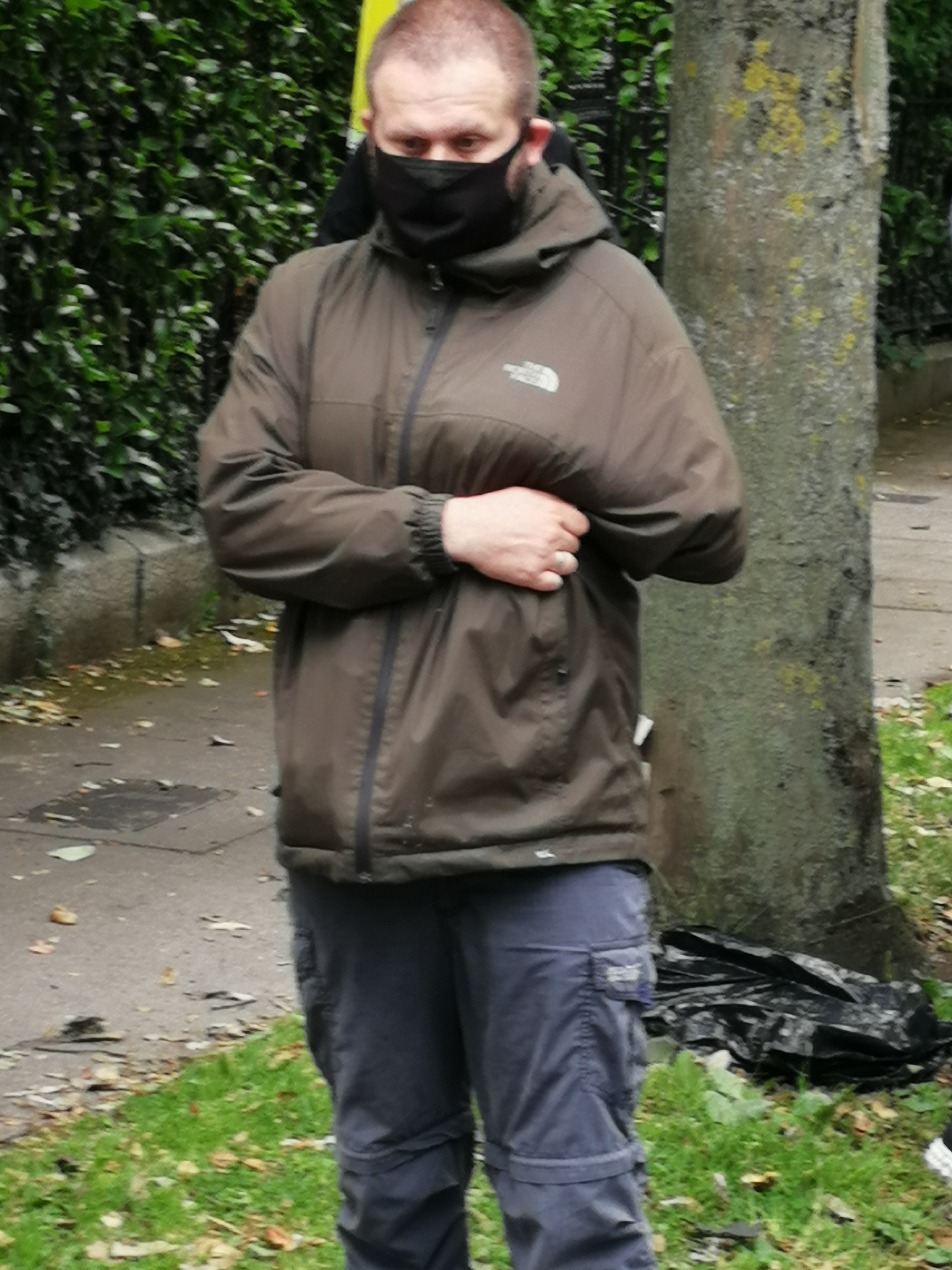
As the Far-Right were setting up, two members of the Special Detective Unit (in the past called the “Special Branch” as they remain known by many, along with less kind names) were seen chatting to them. These political Gardaí in plainclothes were easily identified since some who had attended the earlier demonstration at the Lithuanian Embassy against the threatened extradition of Liam Campbell (see separate report by Clive Sulish on Rebel Breeze) had seen them there, standing near the uniformed Gardaí, watching the protesters. The nature of the conversation of these undercover political police with the Far-Rightists is not known but appeared cordial and certainly they were not asking them for their names and addresses as they had done recently to people protesting in solidarity with political prisoners.
Soon jeers and cat-calls were crossing the street in each direction. The Right-wingers had a loudspeaker advantage for awhile but then one appeared among their opponents too. Even before that, the speaker for the Far-Rightists was accusing their opponents, not one of whom had crossed the road towards them, of being “violent” and claiming that the Rightists were peaceful and were “not going to respond to the violence” of the other side.
It was not long however before some of the Far-Right militants were crossing the road to throw insults and threats at their opponents at closer quarters who of course responded verbally. Gardaí then arrived and gently asked the Far-Rightists to return to the GPO side and one of the Rightists, pointing at the their opponents, who were still on the pedestrian reservation, actually demanded of the cops “Why don’t youse tell them to go back?”
GPO distance: Early arrivals of the Far-Right group portraying themselves as “patriots” (Photo: D.Breatnach)
This went on a number of times with the Gardaí intervening less and less. At one point I had one unmasked ginger-haired thug a few inches from my face photographing me, repeatedly calling me a “scumbag” and a “terrorist” (interesting) but when he told me I was destroying his country (!) I couldn’t resist asking “How am I destroying the country?” He declined to reply to my repeated question, moving on to express his aggression to someone else.
At this point I had become distracted by one of their supporters who was trying to have a conversation with me. I obliged and it was quite revealing on the disparate nature of many of the elements in these right-wing rallies. She told me that she was not racist and was bisexual and not right-wing and her friend (also present) was half-German, so why were we calling them racists and fascists? I was engaging her on some of the things that have been said by some of the group she was with and pointing out some individuals I had seen in support of Gemma Doherty, explaining to her that if she attends rallies of those people, she is going to be subjected to calls against fascists and racists.
Shortly I became aware of a disturbance behind me which, on turning I could see was a fight that was moving towards the east side of O’Connell St. (southbound traffic) where both ended up fighting fiercely on the ground. Before I could see who they were, five or six Gardaí then intervened and separated them, at which point I could identify both combatants: one was a Republican whom I had seen a little earlier sitting on the base of the flagpole in the middle of the pedestrian reservation (apparently where he was when attacked) and his assailant was the very one who had earlier been venting aggression at me and trying to provoke me into physical retaliation.
Once they had separated them the Gardaí were treating this matter as one of equal blame on both sides and saying things like “Don’t be silly now” whereas it was clearly the case that a fascist had crossed the road with aggressive intent and had then taken that further into physical aggression.
Later, when I remonstrated with some of the Gardaí that if we had crossed the road and behaved in that way, they would have at least pulled us out, “Go over there if you want,” said one of them, “I can’t stop you.” I pointed out to him that an antifascist who had approached Gemma Doherty supporters at the Dept. of Justice some months earlier had been threatened by a Garda Sergeant with arrest under the Public Order Act. (On that occasion too, the Gardaí had allowed the Far-Rightists to walk among the counter-protesters).
It seems from recent cases that the line the Gardaí are following is that if it looks like being a serious all-out fight they will police it hard and keep the two sides apart but, if smaller scattered fights break out they will break them up without arrests, especially if Republicans are being attacked and possibly, in future, use these occasions to arrest antifascists who defend themselves or respond to provocation.
It is historically true that police forces in capitalist states favour fascist movements, a fact seen throughout Europe. In London, in the Battle of Cable Street in 1936, fought to prevent a march of the fascist “Blackshirts” through a largely Jewish East End, the main confrontation was between the antifascists on the barricades and the escort for the 2,000-3,000 fascists: 7,000 Metropolitan Police, along with the whole of the London mounted police force.
“WE ARE NOT RACISTS AND WE ARE FOR THE PALESTINIANS”
The above was one of the claims of the speaker of the Far-Rightists, made repeatedly. This is a new development in their rhetoric and they claimed to have some Polish and also a Palestinian among their number. This last at least appeared to be true and a big man of Middle-Eastern appearance was among them and was seen later chatting to some Gardaí. A man I know informed me that this man is a Palestinian but a member of the Muslim Brotherhood (right-wing Islamic fundamentalist group).
Gemma Doherty has posted much racist material (and outright lies), as has Justin Barrett of the National Party, both of them objecting to the election of Councillor Hazel Chu as Lord Mayor, Barrett going so far as to say that he would remove Ms.Chu’s nationality if he were in power, even though she was born in the Mater Hospital and raised and educated in Dublin.
The Far-Right, which is a mixed bag in any case, were happy to use O’Doherty’s notoriety to push their movement further but perhaps they are finding her a bit of a liability now and are remodeling themselves as some kind of inclusive alternative movement for civil freedoms etc. They are still promoting their opposition to the idea of legislation against “hate speech” discussed by the previous Government and demanding their right to “free speech”. This actually does hearken back to O’Doherty’s campaign against Google, who closed down her Youtube channels because of alleged racist abuse.
If they are going to drop the racist rhetoric and claim multi-culturalism, presumably they will have to abandon the “Replacement” conspiracy theory, whereby the EU allegedly has a plan to replace all the Irish with migrants! However the challenge with which their militants first approached their opponents on Sunday of “Are you Irish?”, just as they did at the O’Doherty rallies, hardly exudes multi-culturalism.
The other elements of Far-Right rhetoric and propaganda remain, however: that they are “Patriots” (sic – hence the strutting around with the Tricolour and “Irish Republic” flags); they are Christians (“walking in the steps of God” according to their speaker that day); that their opponents areall in an organisation called “Antifa” and funded by the millionaire Soros (also according to their speaker); and that governments are assisting in a coming to power of a “New World Order”.
CANNOT BE TOLERATED
It is not acceptable that Republicans or any kind of antifascist can be attacked on our streets and it must not be tolerated. Apart from anything else fascists will use incidents like that to promote themselves as some kind of “warriors” to build up their fascist thug forces while at the same time part of their movement will be playing the victim and proclaiming their “peacefulness”, as was amply demonstrated today. This is exactly the dual road of the advance of fascism historically.
The drop-down poster displays their paranoid vista. The woman to the right was their speaker, proclaiming their “peaceful demonstration” a little before participants in their rally crossed the road to insult, provoke, threaten and ultimately assault a Republican. (Photo: D.Breatnach)
There is something wrong with our organisation in the broad sense too, it seems to me, if our opponents, at least some of whom wish us harm, can walk among our ranks with impunity. In some places today they were blocked and one youth was even pursued until he returned to his group but in many places they just walked in and it was one of those who assaulted the Republican today.
On another issue, as I have pointed out in the past, these confrontations may tend to have the Far-Right appear as patriotic to onlookers, since it is they who are waving the Tricolour and “Irish Republic” flags and some wearing green tops too. For the sake of educating the public, the antifascists need to fly their flags too, whether these be tricolours as well and/or Starry Ploughs, Red, Red-and-Black or Black flags, including those with the Antifascist symbol, or that of the LGBT movement or indeed others. Placards countering the fascist and racist propaganda and exposing fake patriotism should also be visible.
The most crucial thing is that the Far-Right movement with its fascist core be not permitted to appear a viable option for the Irish ruling class to choose. We have had some successes, for example in preventing Pegida launching in Dublin in 2016 and some confrontations with the Far-Right – but it is clear that there remains a deal of work to be done.
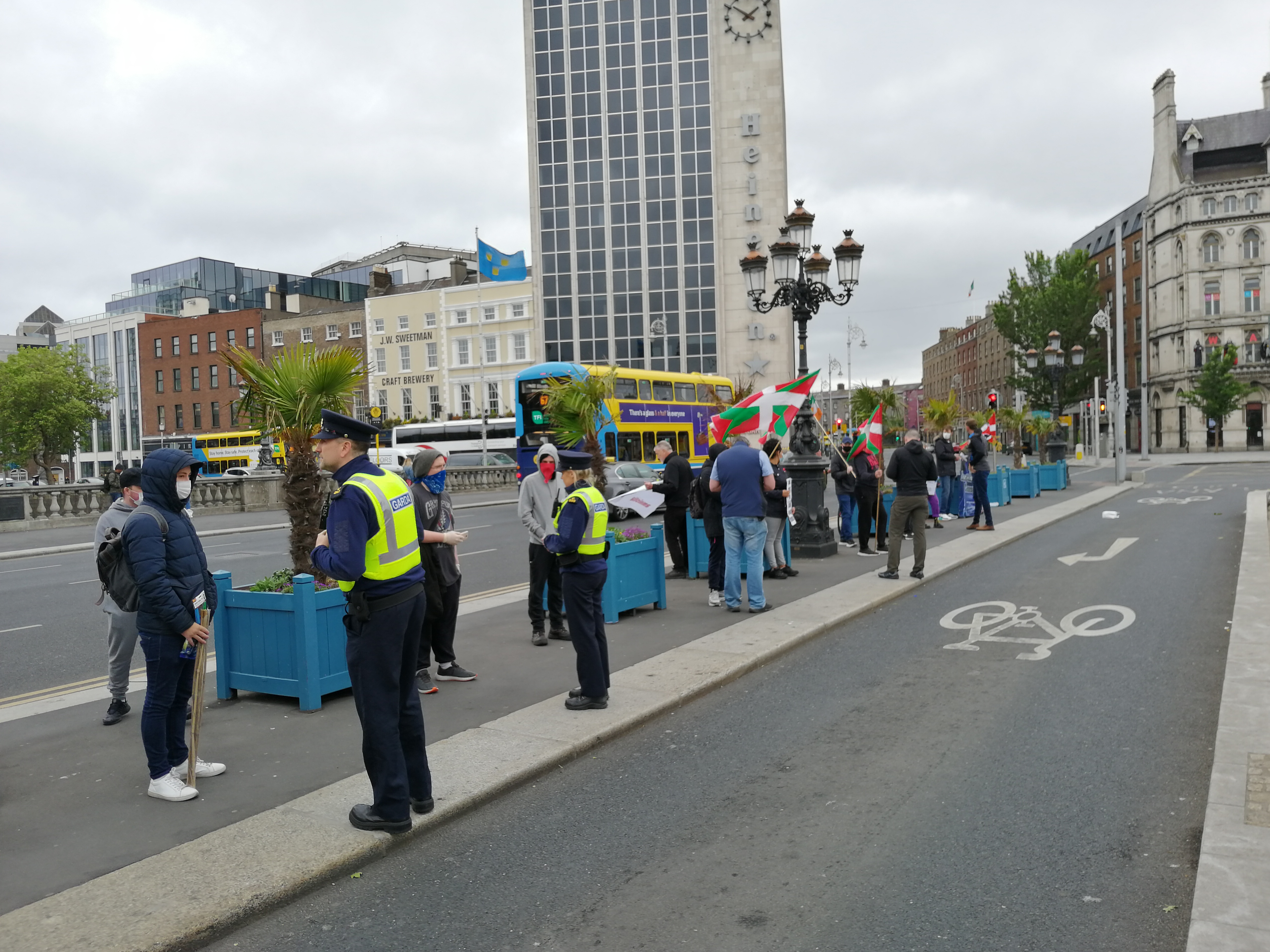
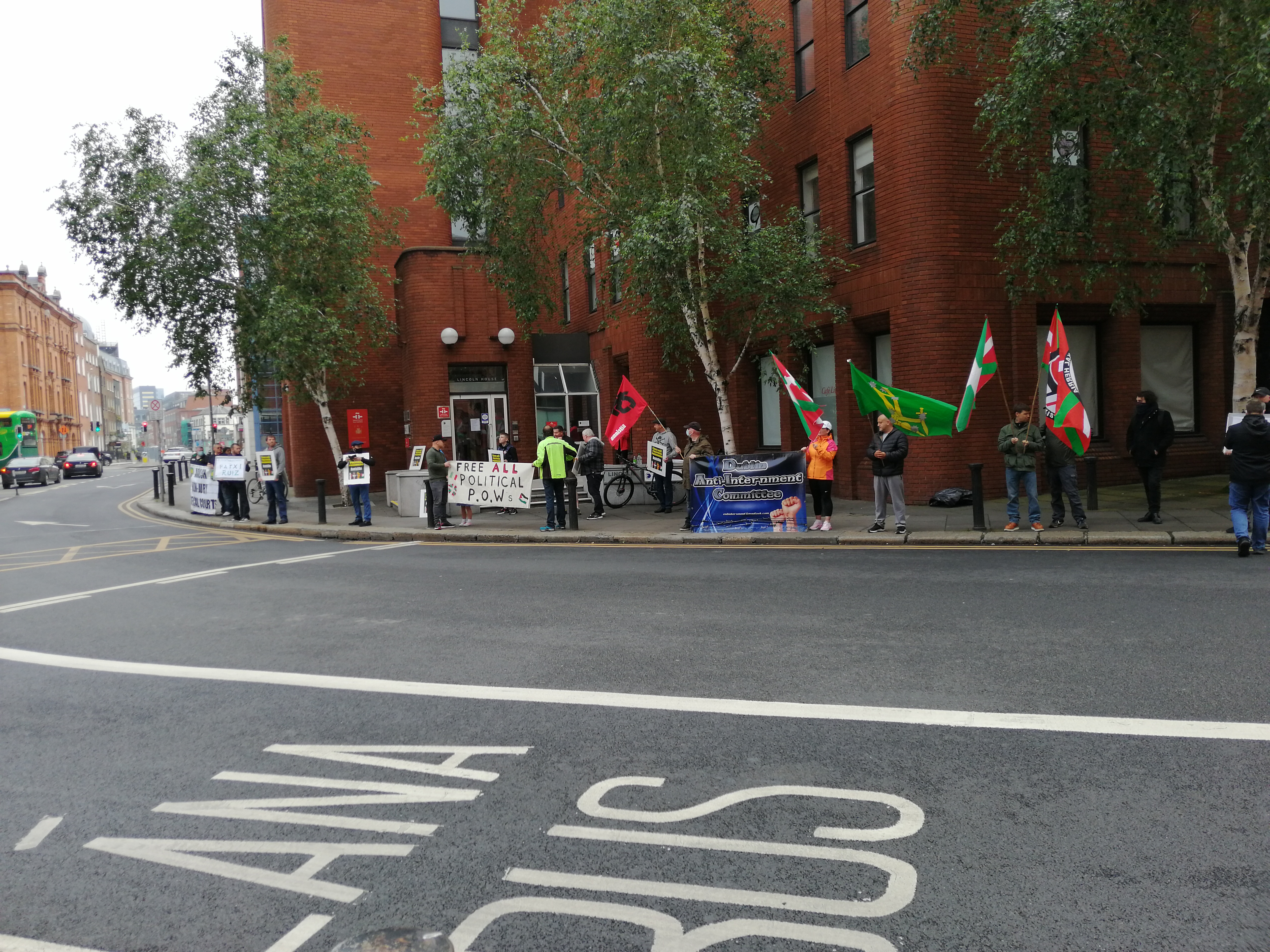
Two separate political prisoner solidarity pickets took place Saturday 13th in Dublin City centre, one on O’Connell Bridge and the other at the Instituto Cervantes, the cultural arm of the Spanish Embassy, on the one-way traffic system at Lincoln Place, linking Nassau Street and Westland Row.
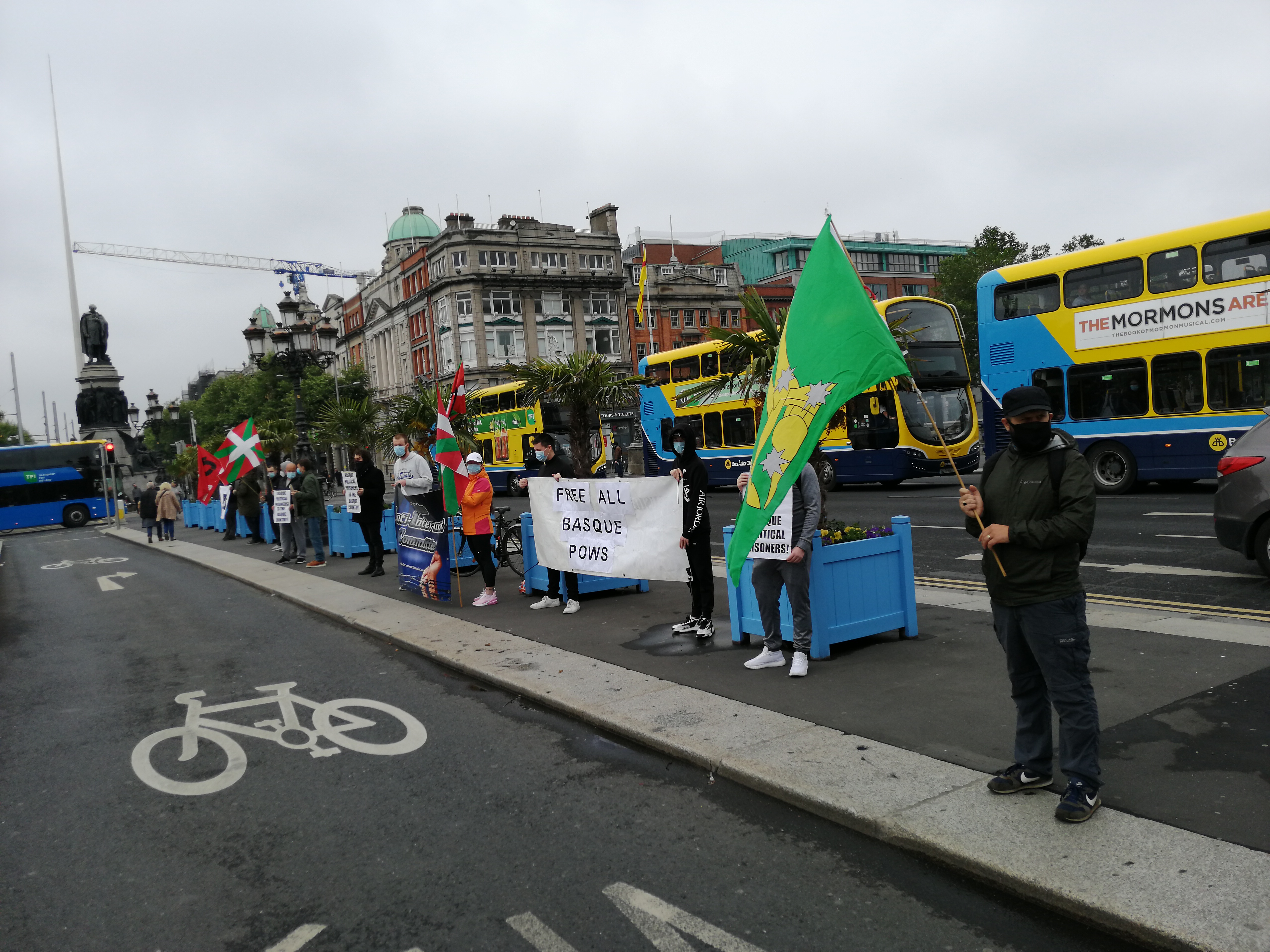
The Basque political prisoner solidarity protest on O’Connell Street last Saturday, looking northward (Photo: C.Sulish)
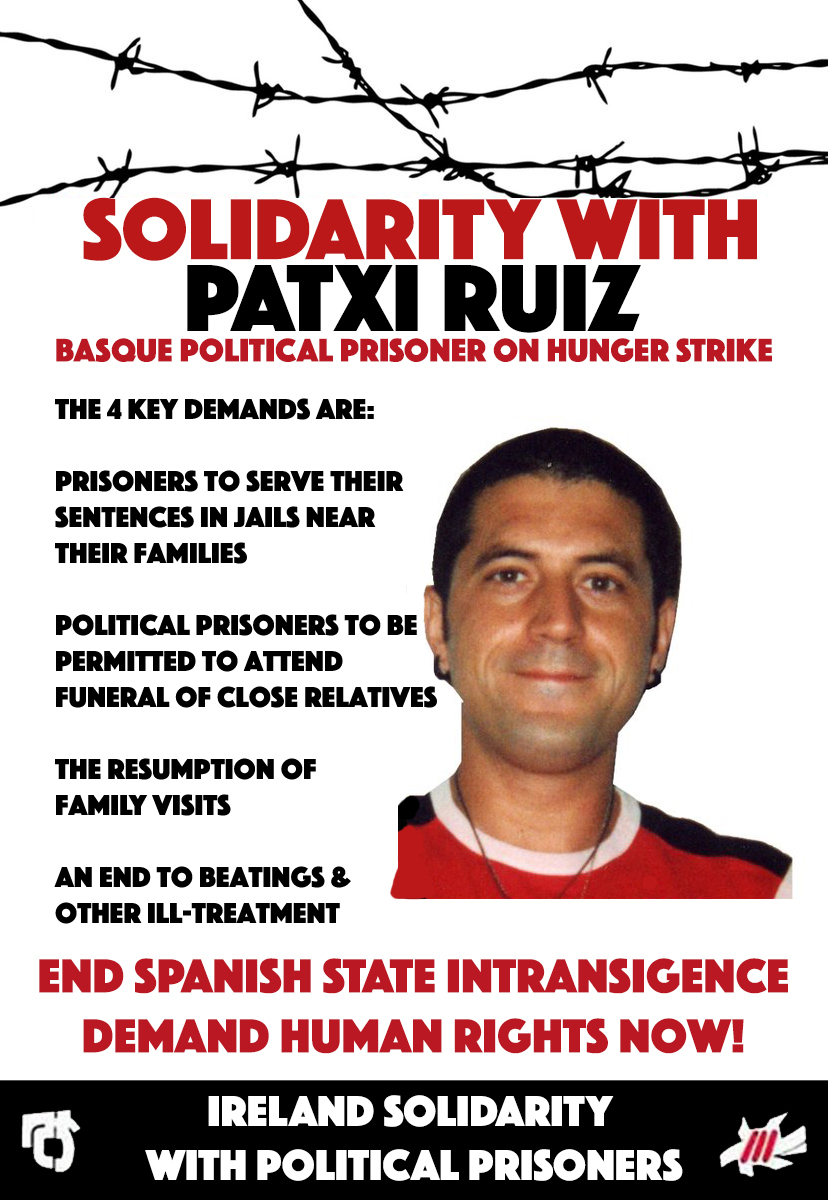
The first, at 2pm on the pedestrian reservation on O’Connell Bridge, was the fourth weekly one organised by a broad coalition in solidarity with Patxi Ruiz, who had ended his hunger strike in a Spanish jail on its 31st day earlier in the week. The second picket, outside the Instituto Cervantes at 3pm, was organised by the Irish Republican group Saoradh, not only in solidarity with Basque prisoners but with all political prisoners, although Patxi’s struggle had given the original impulse for a picket at this time. In addition, Irish Republican prisoners in Port Laoise had on Friday embarked on a 72-hour solidarity fast.
Patxi Ruiz is one of around 200 Basque political prisoners serving sentences in the Spanish and French states, almost invariably, in jails far from their homes, their families and friends, if not too sick, elderly or too young, having to travel long distances to visit them. Ending the dispersal policy was one of Ruiz’s demands, the end of beatings by warders another. He also called for the automatic right to attend funerals of close family (he had been denied permission to attend his father’s funeral) and the resumption of family visits. It is not known whether any of those demands have been conceded but thought unlikely.
Poster produced in Derry for Patxi Ruiz solidarity mobilisation (Image source: Internet)
Although Ruiz is one of five prisoners who have publicly rejected the new path of their movement’s official leadership announced in 2012, his struggle was supported during the hunger-strike by protest mobilisations across the Basque Country, involving pickets, solidarity fasts and sit-ins, protest marches and car-cavalcades. After ten days the official leadership criticised his following through statements by the political parties Sortu and EH Bildu (the latter may be seen as a successor to Herri Batasuna). More recently, the leader of EH Bildu Arnaldo Otegi, generally seen as the main architect of the shift in 2012, publicly attacked the hunger-striker and his support movement, including the Amnistia group, accusing them of directing the whole thing against his party. Amnistia, whose full name translates as “Movement for Amnesty and Against Repression”, replied that they had more important things to focus on than damaging that party’s electoral chances, such as conditions in the prisons, the liberation of their nation and of the working class.
INTERNATIONAL SUPPORT
Plainclothes political police and uniformed Gardaí harassing protesters on O’Connell Bridge on June 6th.
Patxi Ruiz’s struggle found support internationally: a monster petition in Argentina, a rally in Italy, a mass picket in Barcelona and a number of public expressions of solidarity in Ireland. An ad-hoc coalition of four groups composed of Anti-Internment Group of Ireland, Dublin Basque Solidarity Committee and Anti-Imperialist Flying Column, all in Dublin, along with Derry Anarchists mobilised to support the prisoner’s hunger and thirst strike. A hunger strike can be sustained by a healthy individual for a number of weeks without irreparable harm, however going without fluids is not only painful but hastens collapse of a number of bodily organs. Fortunately Patxi Ruiz decided to end the thirst part of his strike on the 18th of May.
A Patxi Ruiz solidarity picket in Derry (Photo: Derry Anarchists)
“The method political prisoners choose to protest is their choice, not ours,” one of the organisers said in Dublin on Saturday; “our role is to support them and publicise their situation. We don’t have access to the mass media, so if we need to highlight something, what we have is our social media along with whoever shares our posts — and our presence on the street.”
Their first picket was on O’Connell Street in front of the GPO on May 23, the second by the Jim Larkin monument in the same street on the 30th and the last two on O’Connell Bridge in June, while in Derry people gathered at the Free Derry Corner monument every Saturday. Each week photos were taken, some sent to the Basque Country and some published on social media, with an update on the situation.
SECRET POLICE HARASSMENT IN DUBLIN
One of the secret policemen who was harassing the protesters on Saturday. (Photo credit: Clive Sulish)
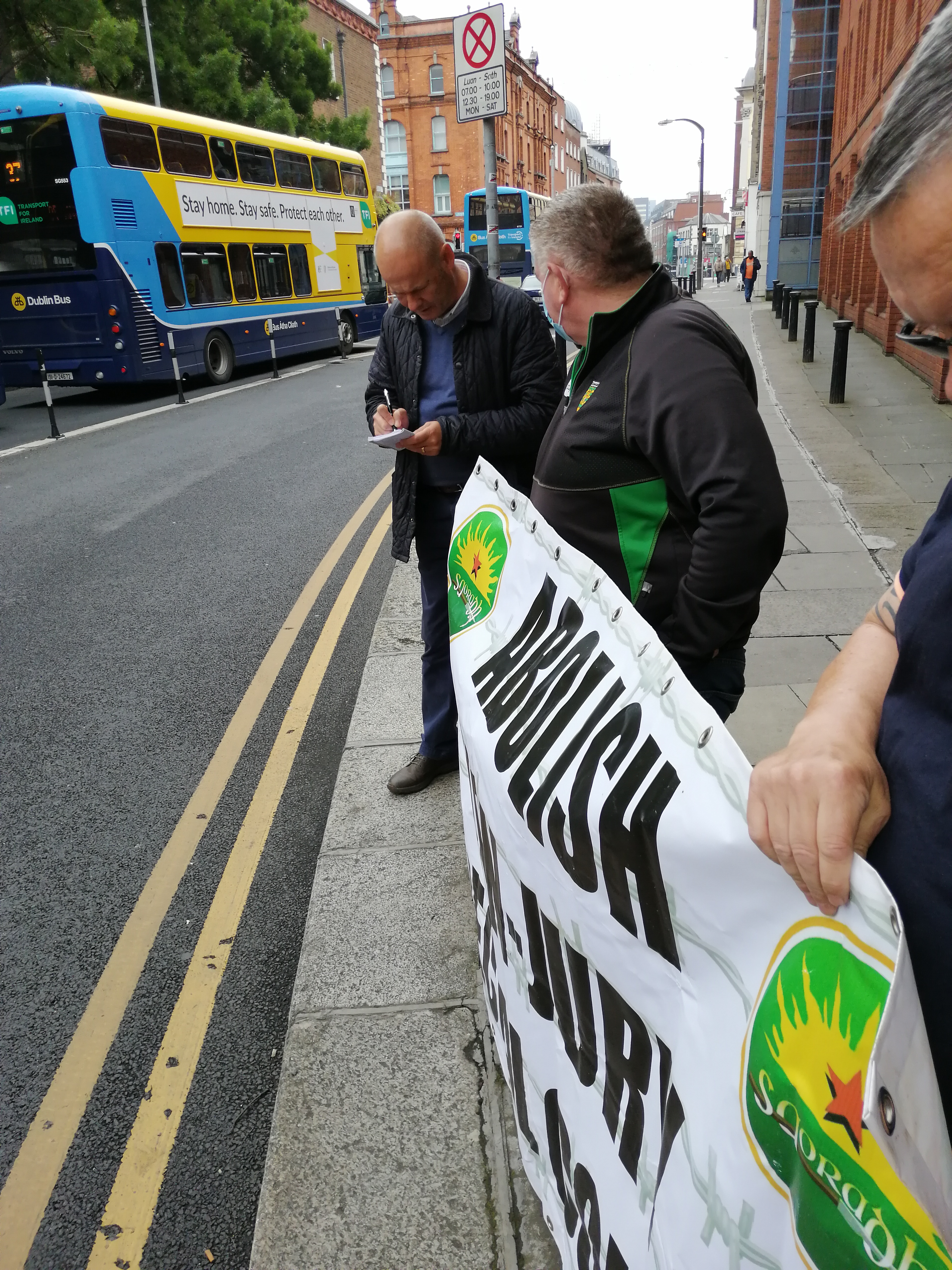
During a number of those pickets, participants were approached by plainclothes Gardaí, of the political surveillance section colloquially known as “the Special Branch” and required to give their names and addresses. Although the Special Powers Act does give the Gardaí quite extensive powers to question and even detain suspects, they are supposed to have a reasonable suspicion that the suspects are committing – or about to commit — a crime. It is hard to imagine in this case that such reasonable suspicion existed in the minds of these Gardaí and much easier to believe that the purpose is a cross between intimidation and amassing files on people who are carrying out a peaceful protest and breaking no law. Meanwhile a vocal group of far-Right people demonstrating against pandemic restrictions have been staging protests in front of the GPO, reportedly without any interference by the Special Branch. A number of participants commented that the Irish Council for Civil Liberty should be doing something about this abuse of Garda powers.
One of the Special Branch officers questioning a protester who is holding a placard (Photo credit: Clive Sulish)
The secret political police were again very much in evidence at the second political prisoner solidarity picket on Saturday. Organised by the Irish Republican organisation Saoradh, it began at 3pm and soon collected a half-dozen of these gentlemen who proceeded to demand names and addresses from all present. Unable or unwilling to state which crime they suspected the picketers were committing or about to commit ensured that in the case of a couple of strong-willed individuals who understood the provisions of the quoted Act, the ‘Branch officer was unsuccessful. In a couple of other cases their inability to question in the Irish language left them also without success when confronted with some who were fluent and insisted upon their Constitutional right to have the whole exchange conducted “i nGaeilge”. Some of those problems the ‘Branch had encountered before with the picketers in O’Connell Street and on O’Connell Bridge.
Another view of one of the secret police at his harassment work. The building centre middle distance is Oriel House, interrogation, torture and murder-planning centre of the Irish Free State during the Civil War. (Photo credit: Clive Sulish)
Neither Gardaí nor protesters remarked upon the irony of the presence of Oriel House less than 100 metres away on the corner of Westland Row. The building, which operated as a police station during the Irish Civil War, was notorious for the torture inflicted on detainees within, as well as being used as an operations base for kidnapping and murder by the Free State Army and Gardaí.
IRISH REPUBLICAN PRISONERS IN PORTLAOISE ON 72-HOUR FAST
The protesters, who included some from the earlier protest on O’Connell Street, were spread following the curve of the pavement outside the Instituto, which was closed. A number of Basque flags were in evidence, along with a Palestinian one and a number of Irish ones too. Banners and placards completed the display.
One of the banners on the second picket. The non-jury special courts both sides of the Border are where Republicans are convicted on palry or non-existent evidence and sentenced to terms of imprisonment. (Photo credit: Clive Sulish)
Some time into the protest, the picketers gathered to hear a statement read out on behalf of the Irish Republican prisoners in Portlaoise prison, Co.Laois, Ireland. The statement had been published on social media earlier in the week as part of an announcement of a 72-hour fast of Republican prisoners en Portlaoise, commencing on Friday and expressed solidarity with Patxi Ruiz and other political prisoners arising from the struggles of the Basques, Catalans, Palestinians, Kurds and socialists in Turkey.
One of the banners on the Saoradh picket (Photo credit: Clive Sulish)
The Portlaoise prisoners’ statement went on to point out that they too are political prisoners as are those in Maghaberry and to denounce the strip-searching and sectarian abuse in the latter, along with the antiquated conditions in Portlaoise, as well as the special courts that are used to jail them on both sides of the Border. It also criticised people who campaign about faraway struggles without seeing those at home, along with some ex-prisoners who had signed a recent appeal in solidarity with Patxi Ruiz but who, according to the statement, did nothing about the current Irish political prisoners. (The End Internment Facebook page of the Anti-Internment Group of Ireland lists around 70 Irish Republican prisoners, mostly in Portlaoise or in Maghaberry).
View of the protest outside the Instituto Cervantes, cultural centre of the Spanish Embassy, Dublin. (Photo: C.Sulish)Solidarity with Patxi Ruiz placard in Irish on the 2nd picket last Saturday. (Photo credit: Clive Sulish).
A statement from the Saoradh group was read out too which, though shorter, covered much of the same ground. Both statements were applauded by those present and the protesters dispersed soon afterwards.
What makes leaders good or bad ones? How much power should a leader have? How should they conduct themselves? How do we know when they are no longer leading us well and what can we do about it? The following piece discusses these questions and seeks to answer them.
Most people think human beings need leaders and revolutionaries and insurgents in general are no exception. There are some political-social groups who state that they are autonomous and do not need leaders but it has been my experience even in some of those groups that they do indeed have leaders and that in general they act under that leadership. It seems to be a human trait for groups to accept leadership and to follow leaders and indeed all social animals we may observe have leaders. Nevertheless, the question of leadership historically has been fraught and that is as much the case for human society in its various stages as well as for revolutionary organisations.
Statue in the Louvre, Paris, of Spartacus, leader of the great slave uprising against Rome 73-71 BCE. He is here represented as a thinker. (Photo sourced: Internet)
RESPONSES TO LEADERS – HEALTHY & UNHEALTHY
RESPECT
If our leaders have proved their worth to our endeavours then of course we should respect them. We should not respect them because of their class or family background. It is what one does that makes one worthy of respect, not the social class in which one was raised. And if that class background gave certain advantages in education, in leisure time to study and learn, then those are advantages we value and seek for all, which is far from respecting someone merely because they were raised with those advantages.
As to family background, it seems to me that we are haunted with an old way of looking at human society. It might have seemed natural in ancient times to give the offspring of a valued leader special respect and even to choose the successor from among his/her offspring. It does seem to be the case that some talents and traits are inherited through genes and it is also true that such a family background can familiarise one with some principles of leadership. However, history has provided us with many examples of ineptitude, malice and even madness in leaders who have greatness in their family background. It has also provided us with examples of people who rose from obscurity and from a family background of no particular note to lead masses in historic deeds.
Since we speak of respect, we should talk now about what that means. Of course, when leaders seeks to lead us, to advocate some action or policy, we should listen for if we do not, how can we benefit from what they have to say to us? We listen with respect.
But respect is not the same as servility, nor blind acceptance. We should consider what we are being told and feel free to ask questions and to challenge what we may perceive as assumptions. Further, we should accept that others also have that right, even if we ourselves are convinced in the leaders’ words. Our leaders are not infallible and nor are we.
We said earlier that it is upon what we do that we earn respect and that is so for leaders too. Every judgement on what we do must inevitably be based to some extent on an action in the past, even if it as recent a past as earlier that week, the day before or an hour ago. But one’s past does not grant infallibility and one who took correct decisions in the past can all too easily take wrong ones today or tomorrow. History has also shown us many such examples. Therefore the expectation of any leaders or of their followers that we should accept what they say mainly on the basis of their having been correct in the past is completely unjustified — however emotionally satisfying it may be to some people — and we should resolutely reject the premise.
If we are entitled to question and even challenge leaders there also comes a time when that right should be put aside for awhile. At some point it is necessary to act and endless debate does not lead to action. Nor is the entitlement to question and challenge a justification for ceaseless exercise of that right and it is also the case that such practice will in time devalue future criticism and challenge, perhaps when they are valid and should be most needed. The point at which debate needs to come to an end and a decision made, by the accepted procedures of the group, is ruled by the necessities of the situation and not by simple declaration.
CONDUCT OF LEADERSHIP
Firstly, led us observe that while it is an impossibility for everyone to lead simultaneously, everybody is capable of leadership at some time in some circumstance. Every time one of us suggests a course of action or expresses a criticism in a group, we are in effect offering leadership to others. The one who says “I think we should …” or “Why don’t we …..?” or “Maybe we could ….” are all offering leadership at that moment. Whether it would have been effective leadership or in any case is accepted or not is beside this point.
Spartacus statue in Sandinski, Bulgaria. Here his military leadership is emphasised. (Photo sourced: Internet)
RESPONSIBILITY
We all of us should take responsibility for our actions and their effect. In practice that means weighing up positive and negative aspects before action (should we have time to do so) and afterwards evaluating once again its negative and positive aspects. Should we be constantly hesitant or paralysed by fear of failure we cannot be effective in anything worthwhile, therefore it is necessary that we are prepared to risk making mistakes. Then we have a responsibility to learn from our mistakes which implies a responsibility to admit to them.
Leaders at any level must take responsibility not only for their own actions but for those of their followers also. The leader too must be prepared to make mistakes but should endeavour to ensure that they are not too serious, that the consequences are not too disastrous. This is a heavy responsibility which implies the need to think things through in advance and not to merely react or act mainly out of emotion. And yet, the leader must be prepared to be decisive when that is what the situation requires.
Too many individuals accept leaders as a means of abrogating their own responsibilities. All of us have responsibilities in any endeavour we join together: responsibility in sharing work, risk, and thought. If we leave consideration of the negative and positive aspects of a proposal to others, not only are we shirking our responsibilities but we are hardly justified in complaining later about the actions of our leaders.
SHARING LEADERSHIP
Some leaders are seen to take on multiple responsibilities and many tasks. In capitalist endeavours this has been judged to be wasteful and ineffective in the long run, leading to inflexibility, slowness to react and “micro management”, among other faults. An insecure leader does not trust others and seeks to keep all tasks and initiatives under his/ her control. And yet, shit happens, as they say. Nothing can be completely controlled.
Louise Michel, life-long anarchist revolutionary and one of the leaders of the Paris Commune 1871 and other revolutionary initiatives later. (Photo sourced: Wikipedia)
In revolutionary leadership this tendency to try to control everything by an individual or individuals has also been seen, with harmful consequences that include stifling initiative and learning among the group or organisation. Once this becomes established, the absence of the leader(s) mean the paralysis of the organisation and a similar effect occurs while waiting for them to make a decision. In addition, if they enemy subverts the leadership, the whole organisation and struggle becomes destroyed or at least greatly damaged.
Good leadership encourages the development of different areas by different individuals within the group and spreads participation in — and responsibility for — the decision-making. This model is often called collective leadership but within that itself there are different models too.
It would be very damaging if every individual were to act within an organisation according to how they might feel at different times and to represent the organisation externally without consulting the group. After matters are discussed and collective agreement has taken place, members of an organisation should not represent the organisation in a contrary way to what has been agreed. This is a difficult area with tensions between the right of expression of the individual and of responsibility to the organisation, one which I am unsure has ever been completely resolved.
Collective leadership is usually exercised through a committee or temporary working group and allows for different individuals taking a lead in different areas. One might note that person A regularly calls people to the overall task in hand and pushes for a monitoring of progress, while person B concentrates on developing a specific area, person C looks to the recording of decisions and person D to some external relations. There are of course formal positions in organisations and committees such as Chair, Secretary, Treasurer etc but even without formal elections one finds that successful groups develop areas of responsibility for separate individuals even without the existence of such elected offices. Furthermore, a particular responsibility may fluctuate between individuals at different times. A good argument exists for not entrenching anyone in specific roles over long periods of time. Rotation of roles and encouragement to take up new responsibilities can help broaden the experience and capabilities of members of the group or organisation and also prevent the growth of cliques and controlling leaderships.
Monument under continuing instruction to Crazy Horse, a chief of the Lakota Oglala, who with Sitting Bull led the struggle against the USA’s expansion and confiscation of his people’s traditional lands, including the great defeat of General Custer’s military invasion at the Battle of the Little Big Horn. He was murdered on 5th September 1877 in US Military custody. The statue is finished but the monument on land in Dakota includes the carving of the rock bluff seen in the distant background. (Photo sourced: Internet)
WHAT TO WATCH OUT FOR
Their are certain traits which may be observed repeated in unhealthy leadership and it is well to be aware of them, both for those who follow them and for people put in positions of leadership themselves. The following list does not include timidity, hesitation and prevarication, which are also bad traits of leadership.
The leaders
clearly enjoy issuing orders
direct others to do tasks they would not undertake themselves
monopolise speaking time
push for an end to debate without demonstrable necessity for the organisation
dismiss out of hand opinions opposed to theirs
expect agreement with whatever they say and resent question or challenge
regard question and challenge as treasonous, mutinous
hold grudges against those who have disagreed with them and seek to have them ignored, ostracised or demoted
seek or accept control over multiple areas of work
lie outright to their following
or do not tell their following the whole truth
call upon their past record in order to justify their actions or direction in the present
call upon their family background to justify their actions or decisions
surround themselves with a group who support them without question
accept flattery
flatter particular people (as distinct from commending when appropriate)
never commend any of their followers when deserved or choose only some to commend
criticise others unfairly or out of proportion to what is deserved
consider themselves entitled to special consideration above others in physical and emotional comforts
believe that rules that apply to the majority do not apply to them by virtue of their position or imagined personal superiority
Also, among the group or organisation, those who:
Always agree with the leaders or
Constantly disagree to no apparent concrete purpose
Constantly praise the leaders in private or in public
Praise a leader or leaders while ignoring or downplaying the contribution of others
Deny leaders have committed errors or wrongdoing in the face of evidence to the contrary
Make excuses for wrongdoing or errors of the leaders
Use the past record or family background of the leaders to justify actions in the present
or to imply that the leaders should be followed without weighing up their actions or what they advocate
criticise anyone who criticises the leadership rather than dealing with the point of that criticism
try to justify leaders having special consideration above others in terms of physical and emotional comfort
CONCLUSION
The exploitation of working masses and their resistance to that has been going on since ancient slave societies and has led to outbreaks of revolt down through the centuries. The Paris Commune of 1871 was the first time that the working class succeeded in taking a city and holding it for a period, developing its own instruments of making decisions and carrying them out. At little over two months it was a short-lived experiment and fell to the bloody suppression of Prussian armed forces at the invitation of deposed royalty and dispossessed bourgeoisie.
It was not until 1917 that the working class was able once again to overthrow its oppressors and this time it did so not just in a city but in an entire state, also defeating invasions to overthrow its power. But where is that today? The Soviet Union collapsed in 1991 but had been crumbling within from long before that and, some would say, the working class had lost control in the early years immediately following the Revolution.
The question of leadership and how to handle it by everyone is an important one in an organisation but, for revolutionaries, is essential. It is essential not only for the conduct of the struggle but perhaps even more so for managing society after a revolution. The seeds of that management in the future must be sown in the present.
End.
POSTSCRIPT
I base the above on my personal experience of decades, my reflection upon them and on reading of history. My personal experience has been mostly in unpaid social-political struggles in trade unionism, housing, political groups on a number of fronts,solidarity committees, community and education groups but also employed in few NGOs for a shorter period. I have been either a follower or part of leaderships and have erred in both on occasions while on others acted correctly. I hope that I have learned from them all — and certainly from my mistakes.
In order to concentrate thinking on the general principles I have refrained from giving particular examples of recent leadership, which might have tended to give rise to discussion about individual cases rather than the principles as a whole.
We hear talk from time to time about essential frontline workers, a discussion the origins of which can be traced to the call on the Government to shut down all non-essential work. That of course raised the issue of what is essential work and therefore, who are the essential workers. High among the category considered essential were health practitioners and their rate of infection, when statistics were published, was exceeding 25%. But there is another group of workers who are essential and vulnerable and although most members of the public are in contact with them on a weekly basis at least, nevertheless they are given little protection and rarely mentioned.
Essential workers include, apart from healthcare workers, those maintaining our supplies of clean water, electricity and gas, sanitation, agriculture, production of necessary equipment, public transport, transport of essential supplies, fire-fighting, telecommunication (but not commercial call centres), postal services …. All of these should be in the first rank of consideration for protection from the Coronavirus-19, because they are vulnerable and for the selfish reason that we need them. But much more exposed on a daily basis to a greater number of people are the shop and supermarket workers.
Customer and staff both wearing mask and gloves in a foreign supermarket (Photo source: Internet)
They are the most numerous of the essential workers in daily contact with the public, which puts them at risk and, if they become infected, puts the general public, the shopping customers at risk too. And yet, their levels of protection organised by their employers are very poor overall. Despite this, we rarely hear them mentioned in public discourse, they do not receive particular attention from the Left and even their own trade unions are inactive on the issue.
WHAT SHOULD HAVE BEEN DONE
Let us take a moment to consider what should have been the measures put in place for these workers and for the public coming into contact with them:
Immediate training program in prevention for all staff, with regular refresher or reinforcement measures
Immediate supply of protective clothing, disposed/ washed after each break and shift, this to include face-mask and gloves
Hand-sanitiser at every work station
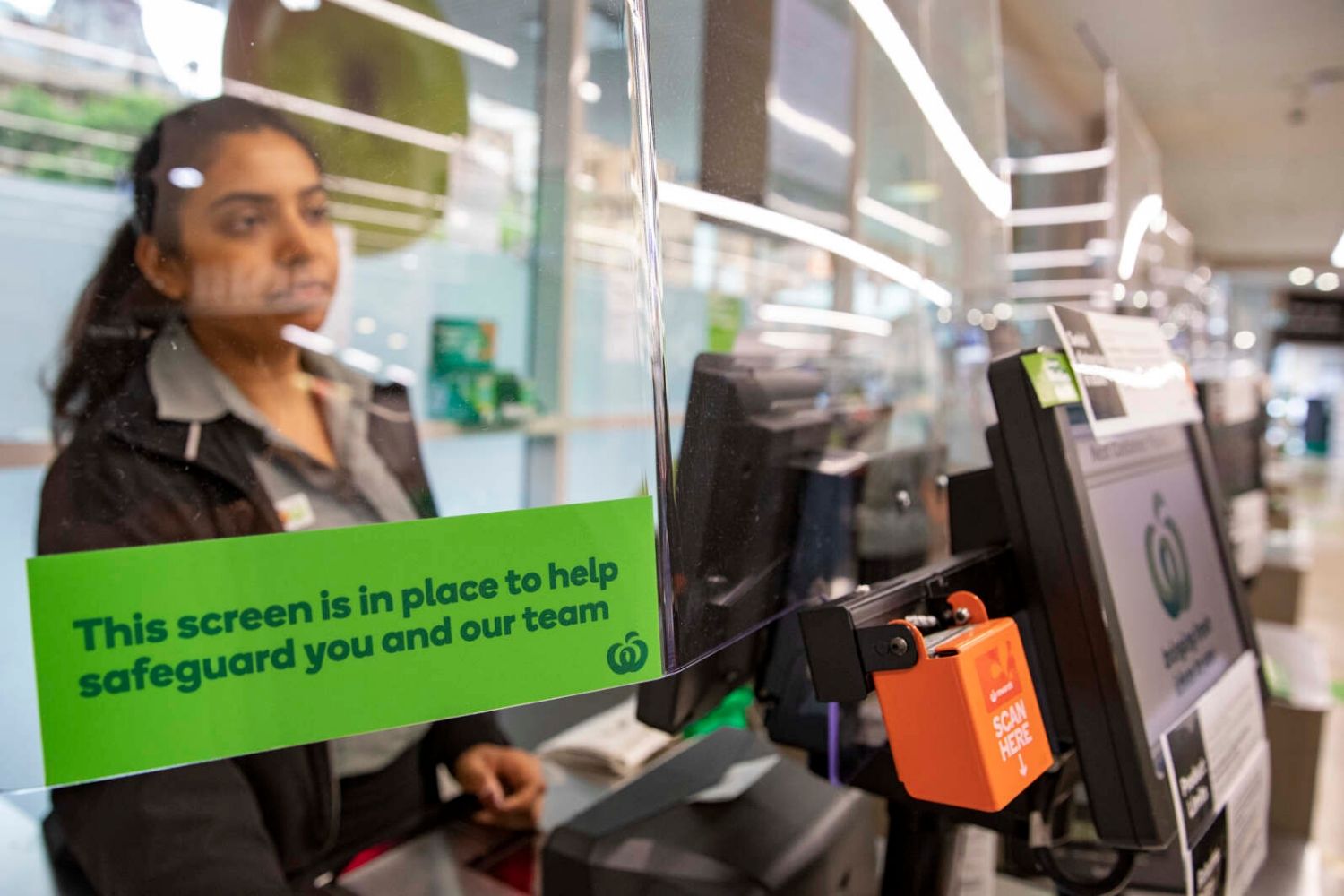
Wrap-around screens at all checkout points
Disinfection routines for all work stations at shift changes
No shelf-filling during hours open to the public or non-essential interaction between public and staff inside of six feet distance
Staff in necessary close proximity to members of the public, including security staff, to be given special protection in clothing and in shift arrangements and testing
Safe social distances enforced by restrictions on numbers of customers in store at one time
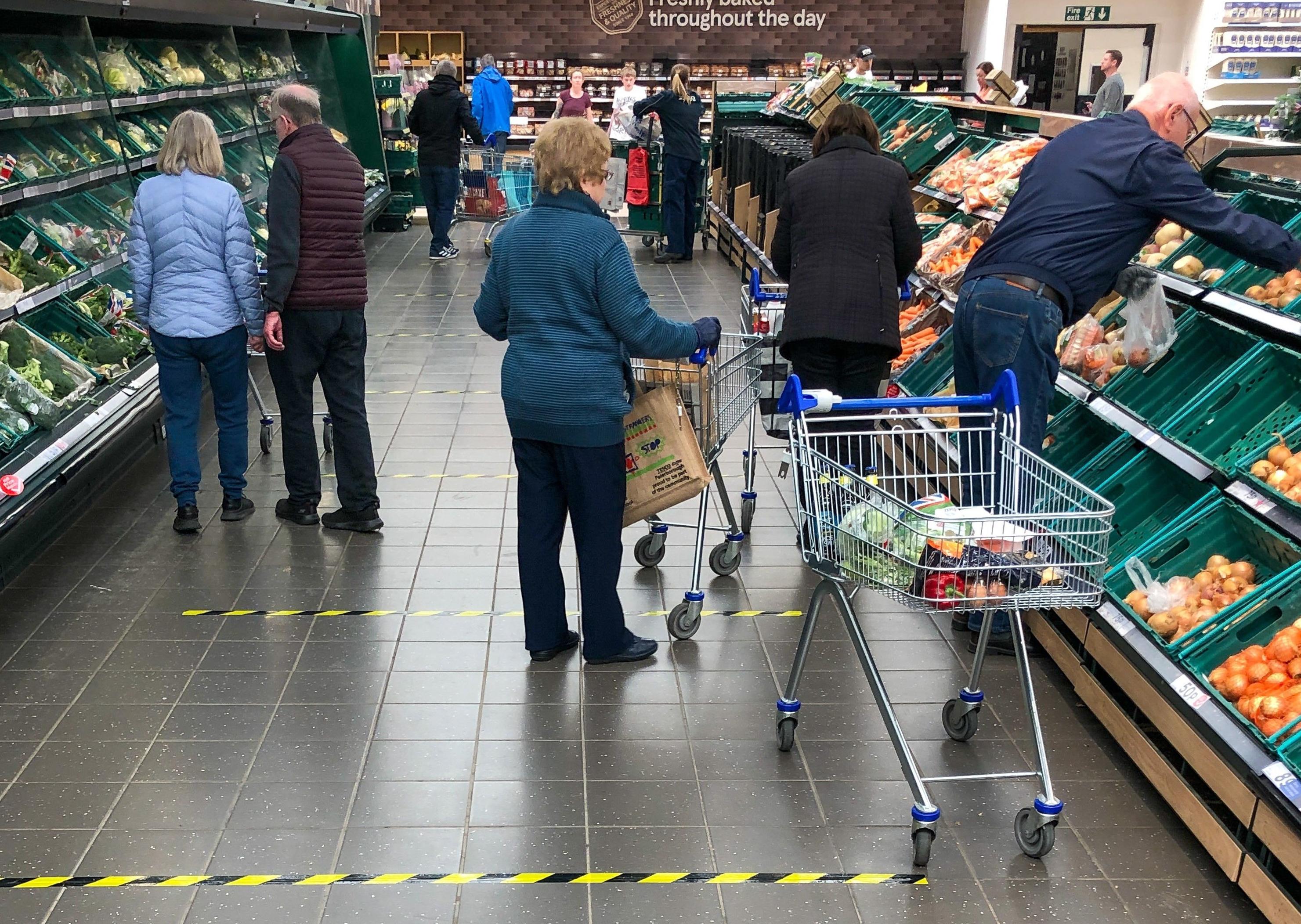
Safe social distances marked for queues and enforced
Regular disinfection of automatic checkout machines
Supply of hand-sanitiser at all entrances/ exits and checkout machines for the public
Prevention informational visual and audio prompts for public and staff
All companies obliged by Government to publish their protocols so as to educate staff and public and also give a point of correction if either feel that the protocols are not being adhered to.
Some readers may protest that management had no previous experience of a pandemic, that some of these measures were implemented but a delay was inevitable and some measures are too extreme. I would respond that any group of reasonably intelligent people, knowing the danger and typical transmission routes, sitting down to think of precautions, would come up with a similar list. Companies are supposed to carry out risk assessments of their procedures. Trade union officials and representatives would be trained in how to assess levels of risk and how to employ measures to eliminate or reduce the level of risk as much as practicable.
Should anyone consider any of those measures excessive, they should be able to point out which and to say why. Or likewise justify the claim that late implementation was unavoidable.
Notice on screen in one shopping chain. (Photo source: Internet)
WHAT WAS DONE
Let us now take a moment to review which of those measure have been implemented, how and when.
I am not in a position to give a definite answer on whether staff were given intensive training in avoiding infection or not but from my observation while shopping of staff in a number of supermarkets I would feel confident in saying that they had not or, if they had, that the required practice was not being monitored by management.
Even to the day of writing this piece, in only one workplace, Eurospar in Fairview, have I seen all the staff wearing face masks. Workers in a number of other companies have told me that they are not supplied with them.
Hand-sanitiser was supplied to work-stations in some supermarkets (possibly all) but weeks after the pandemic hit Ireland (though it had been raging abroad for many weeks before that and covered in news reports).
No screens were in place at work-stations until weeks after the arrival of the virus and even now are rudimentary in many places. Single screens with spaces between permit staff and customers to position themselves in the open spaces, which I have seen both do at times. A number of cashier screens with an open section for customers to receive and load their checked-out purchases are well inside six feet of the staff member.
Whether there are any such shift-change disinfection routines at any supermarket I cannot say but in some supermarkets I have seen staff leave or take up work at a station without any evidence of its disinfection.
I have seen frequent shelf-filling during-open-to the-public hours in Dunnes, Tesco, Centra and Aldi (I have not been in a Lidl since the virus arrived) and even without gloves; also unprotected staff moving among customers on other pieces of work, including stacking and removing empty baskets. Even this evening in a Tesco outlet, although at least they were wearing orange (?) gloves, staff were attending to shelves (and without face-masks, as was the staff member stationed near the automatic machines).
In addition to the above, staff maintaining queue lines, including security staff: every single one without masks and all being passed by customers at distances inside of six feet. The most shocking case was of a security guard in Tesco Drumcondra being passed by customers at distances of between one and three feet – he had no mask and only his company uniform, which he probably takes home to his family and puts on again next day. As to testing, given the long waiting times reported for testing and even longer for results, along with the general level of care for employees shown by the companies, how likely is any are being regularly tested?
Yes but in at least one case, I saw that the security guard on the door monitoring numbers was absent for awhile. Of course, there are calls of nature but shouldn’t the protocols require the temporary replacement of the person at this post? Would we wish to be the ones who were infected because this probability had not been foreseen and provided for?
The safe social distances for queueing customers – but not among staff — are now being enforced in most supermarkets, weeks after the arrival of the virus (but I noticed today that the separation is actually less than the advertised two metres).
I have very rarely seen disinfection of automatic machines.
In a local Centra, the first I saw to erect perspex screens, there was a sanitiser dispenser at the entrance with instructions. On at least one occasion it was empty and I have seen customers pass it without using it or having it called to their attention. I saw none in any other chain supermarket, although in Aldi a spray was provided by the baskets with instructions to use it on the basket handles.
Prevention information posters may be seen but usually of the most generalised kind (like those from the HSE) and asking forstaff to be treated with patience; graphic posters very rarely, film and audio prompts never. In other words, the means supermarkets use when they really want something, like mood enhancement, customers aware of bargains or special promotions, urgent attention to a checkpoint machine or stores about to close – are precisely those that they are not using for promotion of infection prevention.
The Government has not obliged companies to publish their protocols (not even suggested that they should do so) and the companies have not done so themselves.
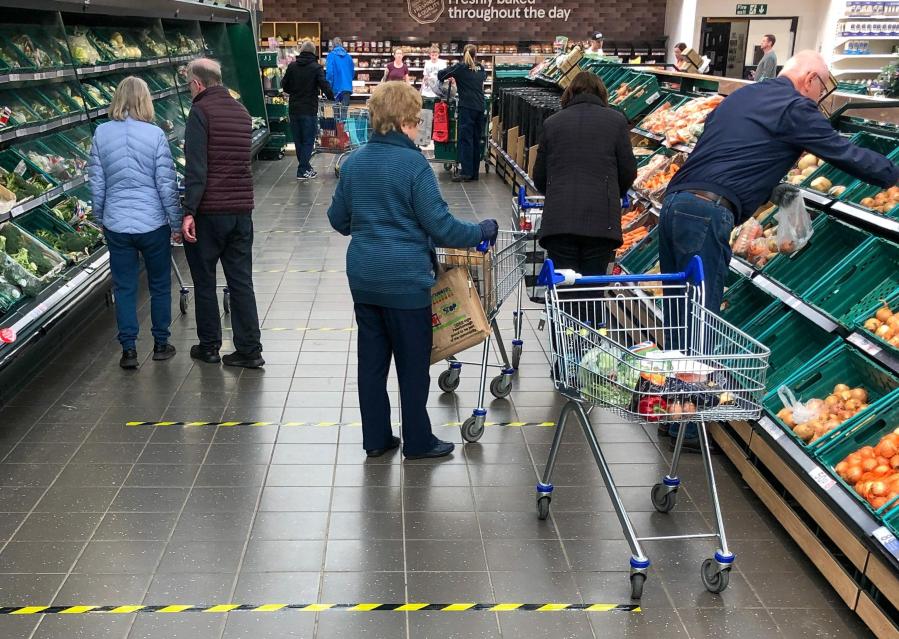
Customers in a supermarket (none seem to be taking any precautions other than perhaps social distancing. (Photo source: Internet)
CONCLUSION
This is a serious lack of care provision for a large section of essential workers and with a potential collateral effect on most of the public. First in line of responsibility for this failure must beof course the companies but their main motive has always been profit. Next in line must be the Government, which has the power to implement emergency measures (and used it recently with giving extra power to Gardaí an courts to employ against individuals) but our governments have always been primarily in the service of capital. Who do I personally blame most for this area of neglect? Those whose very publicised reason for existence is the protection of workers and the promotion of a just society – the trade unions and the Left.
Among the statistics that are published on rates of testing positive and deaths attributed to the virus, there are breakdowns into age and gender groups and, at least in the earlier days, of healthcare workers. We never see, among those statistics, any for shop workers. Or for those who might in turn have been infected by them. The largest statistic given for route of infection is that of “social contact” and presumably that’s where they are, hidden. We remain uninformed and the low level of protection continues, with no real effort being made to change the situation.
End.
PS: Readers may wonder at the absence of information directly from the workers themselves. The reason is that personally I am unaware of anyone in my acquaintance working in this sector and did not wish to cause the workers more stress than they have to deal with already.
ADDITIONAL INFORMATION:
For focus on steps trade unions and the Left failed to take, see article titled WHAT DID NOT HAPPEN in Rebel Breeze.
Mick Healy interviewed me about a number of my experiences in revolutionary work over the years and this is Part 1 (Part 2 will shortly be published), nearly all about some of my three decades in London. It contains a number of errors by me, for example the apartheid rugby team was South Africa’s one which were not called the “All Blacks”, that being New Zealand’s. Also I believe the giant Hunger Strikers solidarity march in London was to Michael Foot’s home, not Tony Benn’s. Still, here it is for what it’s worth with many thanks to Mick.
Diarmuid a long time political agitator was active in London from 1967, in interview part one, he talks about his involvement with Marxism-Leninism-Anarchism. His involvement in the Vietnam and Rhodesia solidarity campaigns, Anti-fascist mobilisation, solidarity Ireland, family squatting. In addition the campaign against the Prevention of Terrorism Act and the 1969 Peoples Democracy march from Belfast-Dublin.
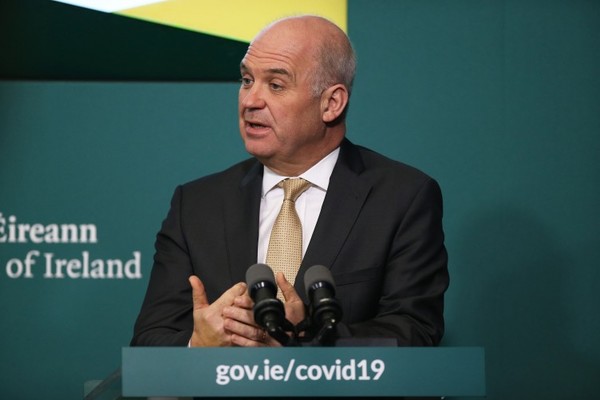
On a day when it is claimed the rate of infection is dropping (but with the highest number of infected and dead yet in Ireland), the social distancing and lockdown measures are said to be working. But Chief Medical Officer Dr. Tony Holohan denies that doing this earlier would have lowered the infection rate! And Eoghan Harris tweets a pat on the back for his Government that private health facilities are to be made available in the public health interest, a measure socialist TDs were calling for weeks ago. But Varadkar rushes to reassure that it’s not nationalisation – neo-liberalism will continue as before.
THE HOLOHAN PUBLIC FATIGUE SYNDROME
Tweeting, Professor Philip Nolan, Chair of National Public Health Emergency Team’s IEMAG: “The model reveals that before restrictions were in place, daily growth rate of confirmed cases was at 33%. This has fallen in recent days to around 15%. But it is still growing and needs to fall further.”
To a person of average intelligence, this means that had these measures been introduced earlier, the graph curve would have begun to flatten out much before now. But Chief medical officer Dr. Tony Holohan is much more intelligent than that – way beyond the rest of us. Because that would have risked “public fatigue” and now is “the right time.” Well it must be the “right time”, mustn’t it, because that’s when he ordered it. He couldn’t have recommended it late, could he?
If “public fatigue” is the danger, that can come in at any time once the restrictions are in place, getting worse as time goes on – one would think. So if introduced say at the beginning of March, we’d be “fatigued” by now, wouldn’t we? So is he telling us that in a number of week’s time, with restrictions still in place, we won’t be “fatigued”? The logic is that we will just as fatigued whenever the crisis is over as if the measures had been put in place earlier – just that it would have been over more quickly and with less fatalities.
Of course, it won’t be over anything like that quickly. They have not even closed the borders, airports or sea-ports! And it’s not that I am in favour of the British colony’s Border, by the way, but this State and Government have no control over the colony’s airports and seaports. And how did the virus arrive in Ireland in the first place? Yep, by plane. But it’s ok, Holohan is going to “discuss” those options. And if they do – finally – close those ports and Border, it will of course be exactly “the right time” to do it.
Let’s return to this “fatigue” notion. What we are experiencing is a pandemic, a national emergency. The people of Leningrad withstood a hard fascist siege, running out of supplies, constantly bombarded, for 852 days. And the battle in defence of Moscow for three months and five days.
But of course, they were Russians (mostly). Alright, the people in Britain (quite a few of them Irish) withstood the Battle of Britain — with almost daily air-raids — for three-and-a-half months!
But the Irish, in Ireland, cannot stand a few extra weeks without becoming “fatigued” and – what? Flood the streets in civil disobedience? Start running up to people and brushing against them? Go back to jobs the Government has closed?
Could it be, just possibly, nothing at all to do with early “fatigue” syndrome but rather late actions reluctantly taken by a Government? Reluctant because it would deplete the capitalist coffers? The thing is, reprehensible as that motivation would be, if action had been taken earlier, capitalism would have suffered less and recovered more quickly!
NEO-LIBERAL POLICY BUSINESS AS USUAL
Which brings us neatly on to Eoghan Harris patting the Government on the back for roping in the private healthcare facilities – weeks after being asked by Socialist TDs to do so. No, you’re right, he didn’t mention that bit. Well, you can’t get everything in a tweet, can you?
And Varadkar rushed to reassure the Gombeen capitalists he represents and the foreign capitalists his party facilitates – along with Fianna Fáil, Labour and the Greens – that this is not nationalisation.
“This is a public private partnership, expanding our public health service in response to this emergency but also cooperation with the private sector.”
“This is private and public sectors to (sic) learning and growing together and working together in the common good.”
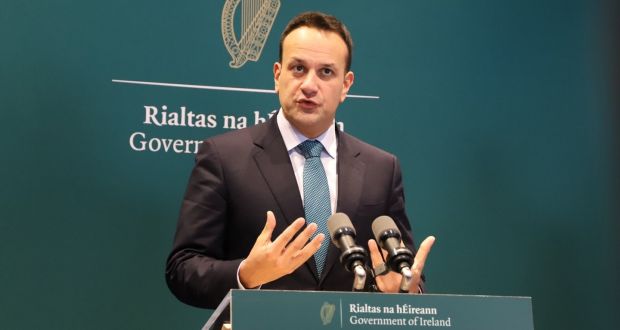
Leo Varadkar, Taoiseach (Irish Prime Minister) of a defeated Government but has yet to step down. (Photo sourced: Internet)
The private healthcare system has parasitised on the public health service, here and in Britain. It has used existing public structures, services, contracts, buildings, personnel, training facilities, government grants and tax cuts. It has no right to exist, least of all when the public body on which it has been feeding is staggering on its feet, in which state it has been long before this pandemic struck.
And Leo’s government, one of the leading proponents of the system that has caused this situation, let us not forget, was given a massive shove recently by the electorate! With the state of the public health service being one of the main issues on which they were shown the road.
You could never accuse Varadkar of not having a hard neck!
From Workers’ Republic, 18 March 1916.
Transcribed by The James Connolly Society in 1997.
Proofread by Chris Clayton, August 2007.
James Connolly poster by Jim Fitzpatrick. (Image sourced: Internet)
The question often arises: Why do Irishmen celebrate the festival of their national saint, in view of the recently re-discovered truth that he was by no means the first missionary to preach Christianity to the people of Ireland? It is known now beyond the shadow of a doubt that the Christian religion had been preached and practised in Ireland long before St. Patrick, that Christian churches had been established, and it is probable that the legend about the shamrock was invented in some later generation than that of the saint. Certainly the shamrock bears no place of any importance in early Celtic literature, and the first time we read of it as having any reference to or bearing on religion in Ireland occurs in the work of a foreigner – an English monk.
But all that notwithstanding there is good reason why Irish men and women should celebrate St. Patrick’s Day. They should celebrate it for the same reason as they should honour the green flag of Ireland, despite the fact that there is no historical proof that the Irish, in the days of Ireland’s freedom from foreign rule, ever had a green flag as a national standard, or indeed ever had a national flag at all
Shamrock for sale in Moore Street last year, one of the few times in the year they are permitted to sell something outside the vegetable-fruit permit. They were not finding many buyers during the past week. Photo: D.Breatnach
The claim of the 17th of March to be Ireland’s national festival, the claim of St. Patrick to be Ireland’s national saint, the claim of the shamrock to be Ireland’s national plant, the claim of the green flag to be Ireland’s national flag rests not on the musty pages of half-forgotten history but on the affections and will of the Irish people.
Sentiment it may be. But the man or woman who scoffs at sentiment is a fool. We on this paper respect facts, and have a holy hatred of all movements and causes not built upon truth. But sentiment is often greater than facts, because it is an idealised expression of fact – a mind picture of truth as it is seen by the soul, unhampered by the grosser dirt of the world and the flesh.
The Irish people, denied comfort in the present, seek solace in the past of their country; the Irish mind, unable because of the serfdom or bondage of the Irish race to give body and material existence to its noblest thoughts, creates an emblem to typify that spiritual conception for which the Irish race laboured in vain. If that spiritual conception of religion, of freedom, of nationality exists or existed nowhere save in the Irish mind, it is nevertheless as much a great historical reality as if it were embodied in a statute book, or had a material existence vouched for by all the pages of history.
It is not the will of the majority which ultimately prevails; that which ultimately prevails is the ideal of the noblest of each generation. Happy indeed that race and generation in which the ideal of the noblest and the will of the majority unite.
In this hour of her trial Ireland cannot afford to sacrifice any one of the things the world has accepted as peculiarly Irish. She must hold to her highest thoughts, and cleave to her noblest sentiments. Her sons and daughters must hold life itself as of little value when weighed against the preservation of even the least important work of her separate individuality as a nation.
Therefore we honour St. Patrick’s Day (and its allied legend of the shamrock) because in it we see the spiritual conception of the separate identity of the Irish race – an ideal of unity in diversity, of diversity not conflicting with unity.
Magnificent must have been the intellect that conceived such a thought; great must have been the genius of the people that received such a conception and made it their own.
On this Festival then our prayer is: Honour to St. Patrick the Irish Apostle, and Freedom to his people.
James Connolly monument, Beresford Place, Dublin.
COMMENT:
I seem to recall that Connolly wrote something else about celebrating St. Patrick’s Day, perhaps when he was living and working in the USA but can’t find it now. For similar reasons to what he lays out here, I supported and indeed organised public celebration of the feast day in London.
And I might have agreed with Connolly in the case of Ireland at the time he wrote it: the whole country under British occupation, in the middle of the First World War with thousands of Irish casualties in the British armed forces and coming up to the 1916 Rising.
But now? I don’t think so, neither with what it celebrates nor how it is celebrated, which always makes me want to get out of Dublin. Republic Day, which Connolly was party to creating but could perhaps not have anticipated being a national festival day, is what we should be focusing on now, I think.















 rebelbreeze