DUBLIN HOSTS TURKISH REVOLUTIONARY MUSIC GROUP

Clive Sulish

(Reading time: 3 mins.)

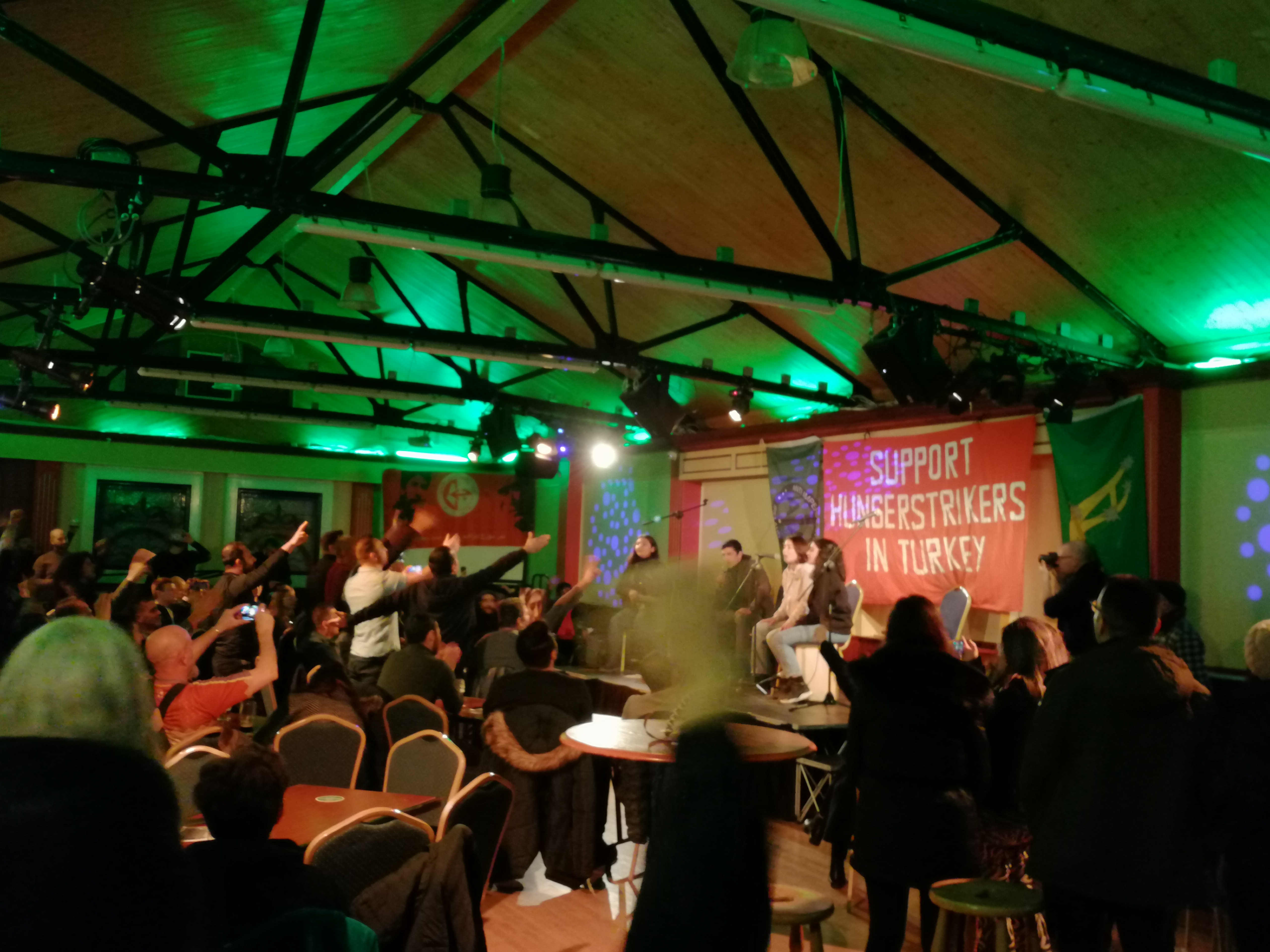
Last Saturday in the Teachers’ Club in Dublin (26/11/21), the revolutionary music Grup Yorum from Turkey, with some Irish musician input, played to an audience of up to two hundred. In between performing different numbers from their repertoire, band members spoke to the audience of the history of the struggles of their people and of the band.

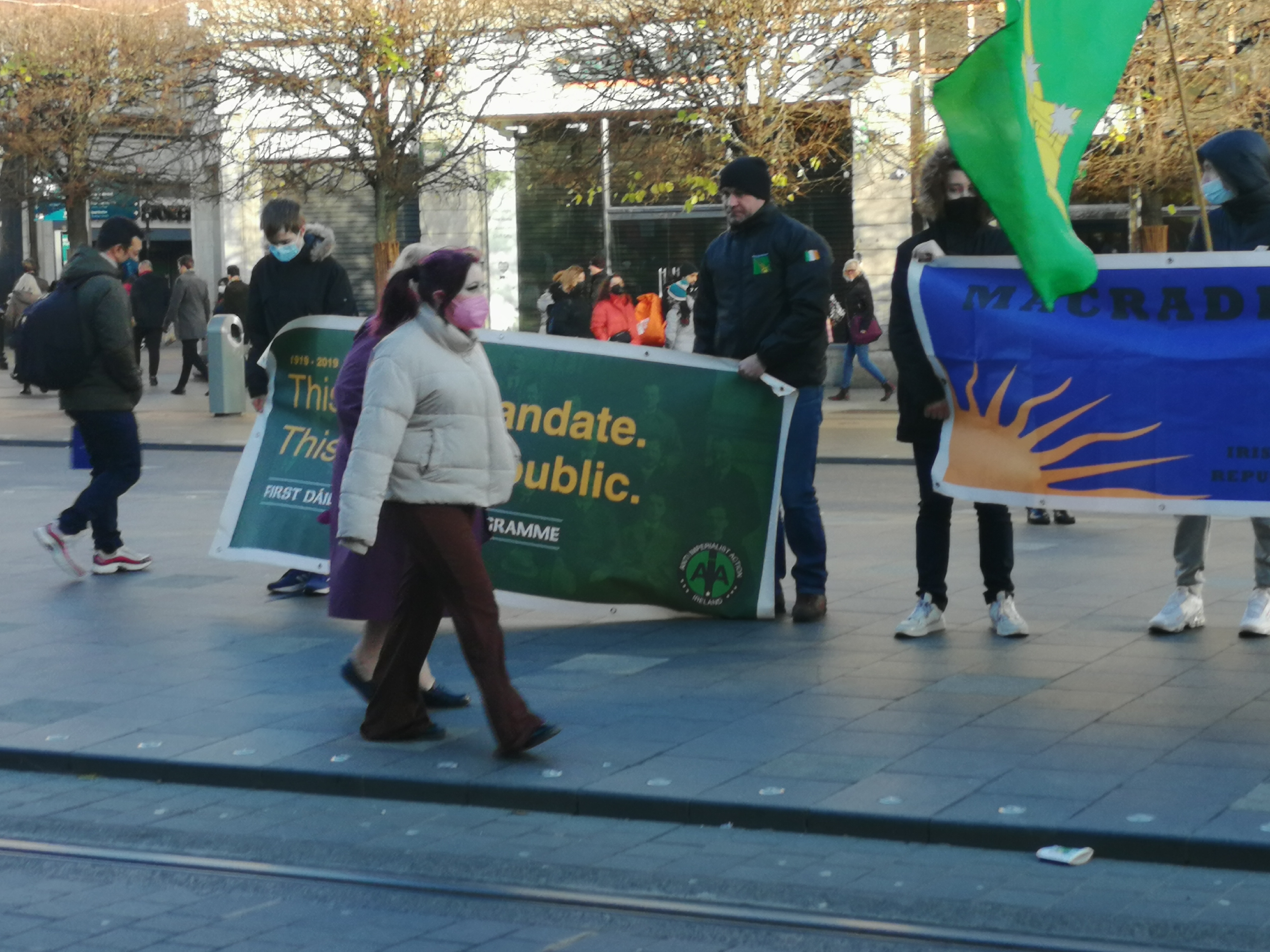
The Irish tour of the band was organised by the Anti-Imperialist Action Ireland organisation; earlier that week Yorum played in a small music venue in Belfast to around 40 people. The attendance in Dublin was so large that the location had to be changed from a large room on the first floor to the much larger hall down below.

Grup Yorum performing in Dublin (Photo: Rebel Breeze)

BELFAST

In Belfast in the Sunflower Lounge, Bobby Fields from Armagh and Séan Óg from Dublin entertained those in attendance with songs of Irish resistance followed by Grup Yorum coming on afterwards. The Grup’s performance was enthusiastically received and was followed by a questions-and-answers session to learn more about the situation in Turkey.

The Grup members toured some of the area and visited the famous international solidarity wall along with the grave of Bobby Sands, where paying their respects included singing a song at the graveside.

DUBLIN

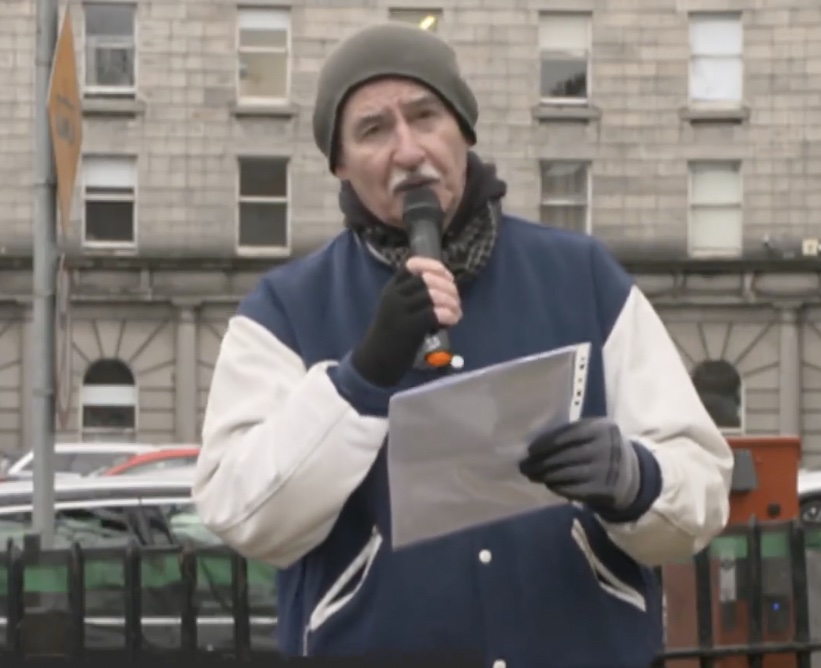
In the large hall in the Teachers’ Club, Dublin, Séan Óg took to the stage first, playing guitar to accompany himself on guitar to sing The Killmichael Ambush, Viva la Quinze Brigada, Back Home in Derry1 and The Internationale. Veteran activist and traditional singer Diarmuid Breatnach followed, singing unaccompanied the Anne Devlin Ballad, I’ll Wear No Convict’s Uniform2 and James Connolly’s satirical song Be Moderate3. Some of the audience sang along with some of the lyrics sung by each singer.

Be Moderate, satirical song by James Connolly, sung by Diarmuid Breatnach at the event (the link can be played on Facebook).

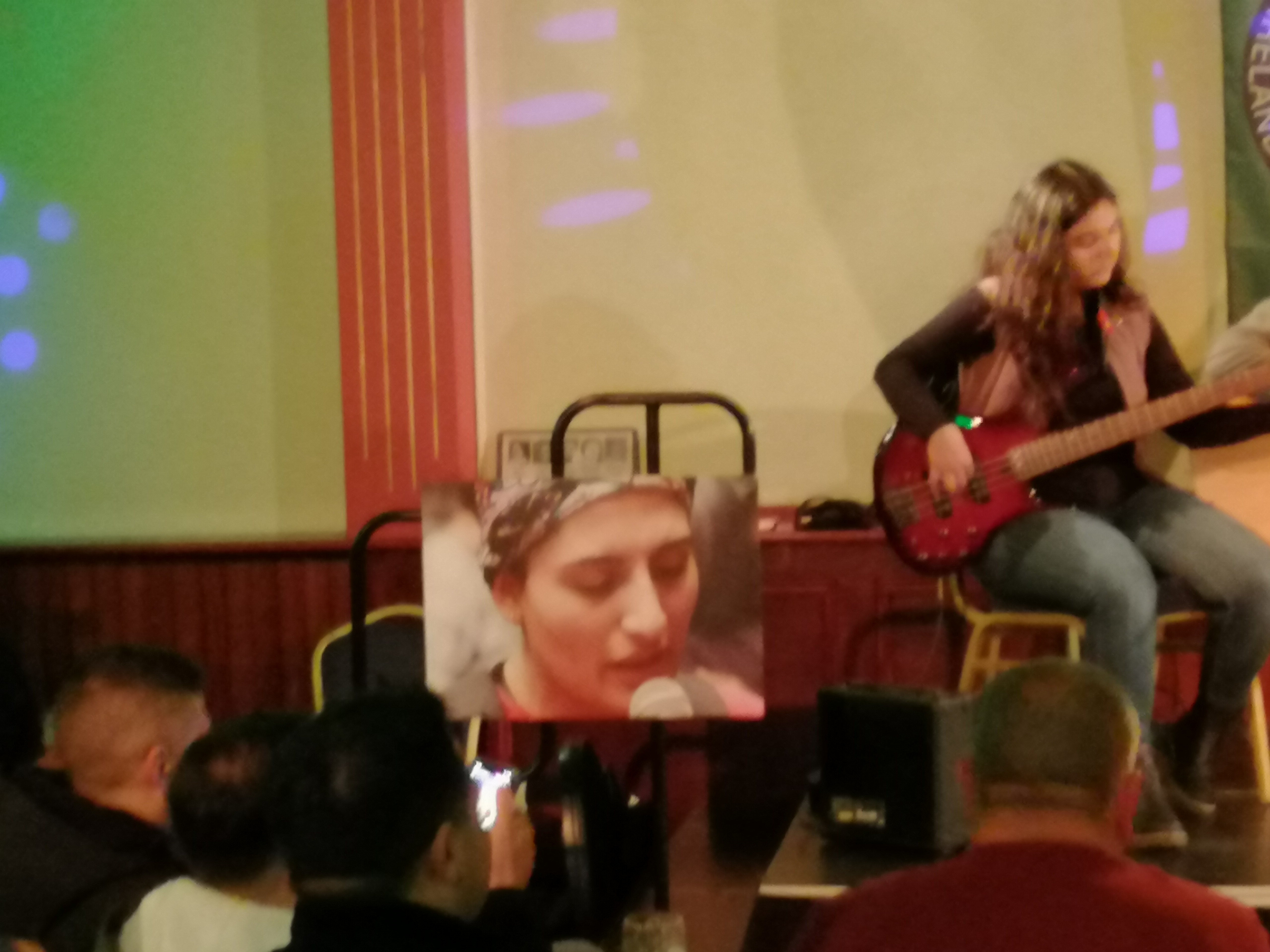
The four members of Grup Yorum present then took to the stage to huge applause and addressed the audience in Turkish, their words being translated into English by a member of their entourage. In the performance that followed, two guitars, flute and cajón were the instruments with a male and female leading voices. Each song was preceded by an explanation placing the piece in historical and political context.

Some of the songs in particular were clearly known to Turkish and Kurdish people in the audience and at some points they sang along, often waving an arm in the air. Towards the end of their performance the crowd got more and more excited and then Seán Óg joined them for a couple of numbers.

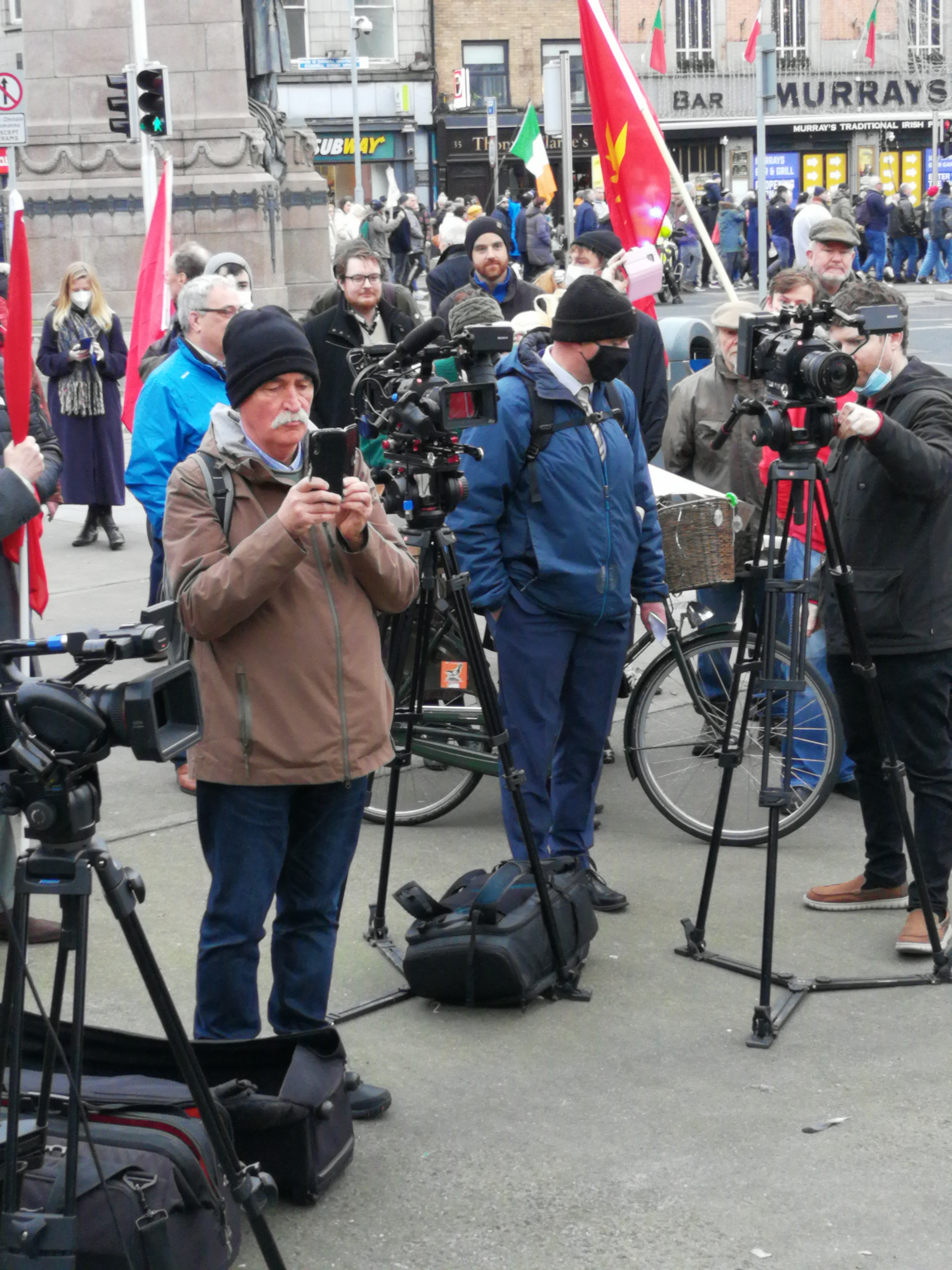
(Photo: Rebel Breeze)
oznor

The Grup’s interpreter made a special appeal for help from those in attendance to pressurise the Turkish authorities to release political prisoner Ali Osman Köse who has been in solitary confinement for 20 years and has multiple health issues. There are fears for the man’s life as he has had a cancerous kidney removed in May of this year without any follow-up treatment and despite everything has been pronounced “fit” to continue in jail.

This was followed by members of the Resistance Choir taking to the stage to join Grup Yorum in a rendition of the Italian antifascist Bella Ciao! Song before Diarmuid Breatnach returned to the stage to bring the evening to a close with the first verse and chorus of Amhrán na bhFiann4 with members of the audience joining in (including some from Anatolia)

The Resistance Choir from Dublin on stage with Grup Yorum to perform the Bella Ciao song (Photo: Rebel Breeze)

THE GRUP YORUM BAND

A revolutionary music band from Turkey, Grup Yorum members compose their own material and the band has has released twenty-three albums and one film since 1985. The band has suffered repression with some concerts and albums banned and members have been arrested, jailed and tortured, two members also dying on hunger strike. The band is popular in Turkey and as well as their albums selling well in Turkey and internationally, it has also given concerts in Germany, Austria, Australia, France, Italy, the Netherlands, Belgium, Denmark, United Kingdom, Greece and Syria.

Grup Yorum publishes an art, culture, literature, and music magazine entitled Tavir, and several group members manage a cultural centre called İdil Kültür Merkez in the Okmeydani neighbourhood of Istanbul.

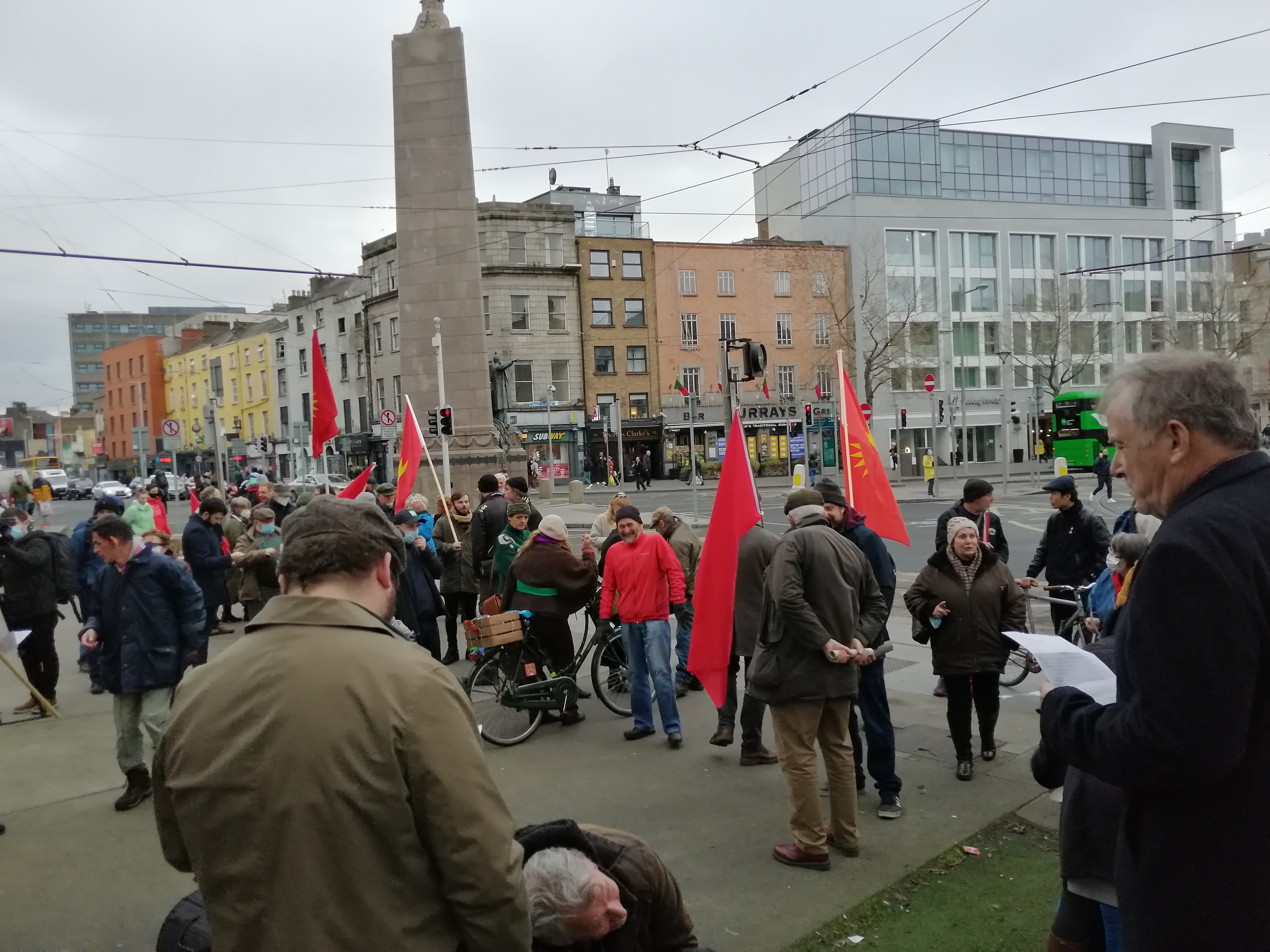
Section of the crowd in Dublin saluting the Grup Yorum performers (Photo: Rebel Breeze)

FOOTNOTES:

1The lyrics and air of Viva la Quinze Brigada are by famous Irish folk musician Christy Moore, who also arranged Bobby Sands’ poem to the air of the Wreck of the Edmund Fitzgerald (by Gordon Lightfoot) as Back Home in Derry.

2Diarmuid sings this song to an air he composed himself.

3Diarmuid sings this to the air of A Nation Once Again (by Thomas Davis).

4Written by Peadar Kearney originally under the title The Soldiers’ Song and sung by insurgents during the 1916 Rising, its chorus is the official national anthem of the Irish State. However, it is also sung by many who are opposed to the State, particularly by Irish Republicans. Normally only the chorus is heard, sung in Irish (translation).

USEFUL LINKS:

https://www.facebook.com/grupyorum1985

https://www.facebook.com/Anti-Imperialist-Action-Dublin-North-City-110852710835826

https://www.facebook.com/socialistrepublicanballyfermot

https://freealiosmankose.wordpress.com/

PROTESTS GREET PRESENTATION OF CHANCELORSHIP TO HILLARY CLINTON

Diarmuid Breatnach

(Reading time: mins.)

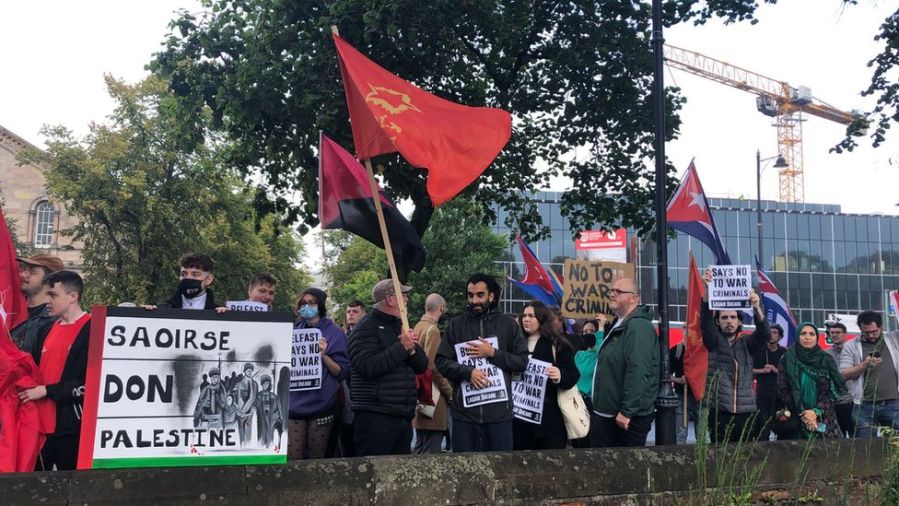
Queen’s University Belfast appointed Hillary Clinton as the institution’s Chancellor1. On 24th September 2021 the University authorities organised an event to mark her formal inauguration; however a large and voluble crowd gathered to protest the inauguration and the authorities’ choosing her as Chancellor of the University. Among the shouts of protesters were “War criminal!” and “Hillary, Hillary, Hillary – Out, out, out!” (This story is now “old”, apologies but nevertheless worth posting for those who might not be aware of it as media coverage was muted)

Although the Belfast Telegraph’s coverage of the event made no mention whatsoever of protests, they were reported in a number of other media. The protest saw Irish Republican and Left socialist groups come together to carry out the protest, with a number of them taking turns to speak.

The speakers at the protest included Pól Torbóid of Lasair Dhearg; Aidan Moran, a former ISM activist in Occupied Palestine, on behalf of Cairde Palestine; Conal MacMathúna on behalf of the Connolly Youth Movement; Local Councillor Michael Collins from People Before Profit; and Dr. Azadeh Sobout, Scholar of Transitional Justice and Peace building and Member of Academics for Palestine.

In addition to Irish organisations’ banners and flags, the national flags of Palestine and Cuba were also in evidence.

Hillary Clinton has been a member of the USA Congress from 2001 to 2009, followed by Secretary of State from 2009 to 2013, having also held the ceremonial position of First Lady during her husband Bill Clinton’s tenure as President of the USA 1993-2001. The Secretary of State of the USA, appointed by the President with the advice and consent of the Senate, is the President’s chief foreign affairs adviser. The Secretary carries out the President’s foreign policies through the State Department and the Foreign Service of the United States.

Lasair Dhearg’s Pól Torbóid, who helped organise and also spoke at the event, said, “Queen’s University’s complicity in the whitewashing of Hillary Clinton and her war crimes further epitomises the university’s role in an international framework of imperialism that sees it not only glorify warmongers like Clinton, but have immense financial investment in military contracts and companies guilty of immense environmental destruction.”

“Queen’s has facilitated the visitation of many war criminals and parasites over the years, but arguably none as big as the visit of Hillary Clinton as its chancellor. A proud Zionist and imperialist; with a war record as long as your arm, Clinton has helped oversee US bombing campaigns in over 9 countries.”

“As US secretary for war, she authorised over 400 drone strikes across multiple nations, which overwhelmingly killed civilians and even children at a proportion of almost 90%.”

“She labelled black men ‘super-predators’ when she helped lobby for the 1994 US Clinton Crime Bill, which was immensely important in creating the mass incarceration levels that exists today in the US to benefit the prison-industrial complex – which is a system of slavery by new means.”

Section of the protest as seen from the inside of the University (Photo sourced: Internet)

“A Zionist, Hillary Clinton has shown herself to be an enemy of Palestinian liberation, siding with the oppressor every time it mattered, like during the 2014 Israeli bombing campaign of Gaza. She increased annual US funding to Israel from 2.5billion, to 3.1 billion US dollars whilst she was US Secretary of State, and she stated that countering the BDS movement globally should be a priority for Israel’s defence.”

“All this – and Queen’s award her chancellor for her Peace and Reconciliation efforts. For all the books Queen’s have at its disposal, I don’t think their management have ever read one! PEACE IS SOMETHING HILLARY CLINTON CAN’T EVEN SPELL, NEVER MIND DISPENSE!”

Full video below (with thanks to Lasair Dhearg organisation):

(Photo sourced: Internet)

FOOTNOTES

  1. In the UK university system, the office of Chancellor is held by a distinguished individual, from academia or public life, who is not usually resident and does not hold any other University office.

SOURCES

https://www.thejournal.ie/hillary-clinton-installed-chancellor-queens-university-belfast-5557234-Sep2021/

https://www.v-c.admin.cam.ac.uk/chancellors-role

Ella Young, California’s Beloved Irish Druid

By Geoff Cobb

California has long been home to the eccentric and free spirits, so naturally the highly eccentric Irish mystic, poet and Celtic mythologist Ella Young found a home there. The first woman to hold an endowed lectureship in the English Department at the University of California at Berkley, Young left several enduring legacies on the Golden State’s literature, counterculture, and environmental movement.

Nearing old age in Ireland, Young helped spark a new age consciousness in the Bay Area. Young lived the first fifty-eight years of her life in her native land, but even before leaving for America, she traveled far from her conservative Ulster roots. Born in December 1867, in Fenagh, a townland near Ballymena, Co. Antrim, Ella was eldest of five daughters of a Presbyterian minister. The family moved to Dublin at an early age and Young graduated with a BA in History, Political Economy and Law from the Royal University of Ireland. Abandoning Christianity, Ella’s interest in the spirit world led her to join the Hermetic Society, the Dublin branch of the Theosophical Society, which sought to awaken the power and presence of Ireland’s ancient spirits. Young was greatly influenced by fellow Ulster mystical poet AE Russell, and she soon became one of his select group of protégés known as the “singing birds.”

Ella Young in Oceano, California, image in Princeton University of Art Museum.

She found her muse and published her first volume of verse in 1906, and her first work of Irish folklore, The Coming of Lugh, appeared in 1909. Young mixed with luminaries of the Celtic revival including J.M. Synge, W.B. Yeats and Maud Gonne, with whom she might have had a romantic relationship. Like other writers of her day, Ella found great spiritual riches in the West of Ireland, where Irish was still the spoken language of the locals and where she was also able to hear what she called the Music of the Faerie, the ceol sídhe.

Ella completed a master’s degree at Trinity, but she would be drawn into the revolutionary fervor then sweeping Ireland. Young’s immersion in Celtic mythology and theosophy led her to promote a spiritually inflected Irish nationalism. A friend of Patrick Pearse, Ella became a member of Sinn Féin in 1912 and a founding member of Cumann na mBan in 1914. Ella witnessed the 1916 Rising in Dublin and is alleged to have hidden ammunition under the floorboards of her home and helped two fugitive Republican prisoners to escape Dublin. An anti-Treaty Republican, she strongly opposed the Anglo–Irish Treaty and, after supporting different sides, she and her mentor Æ Russell never spoke again. Because of her anti-Treaty stance, Young was interned by the Free State in Mountjoy jail and in the North Dublin Union.

An ardent cultural Nationalist, Young fervently believed the revitalization of Irish culture could be realized through a reconnection with its Celtic mythological roots. She taught in Dublin, but she came of age as an anti-Treaty woman at a time and in a state where her gender, politics and Protestant background severely limited her career opportunities. Young left Ireland for the US In the mid-1920s, where she would spend the rest of her life. Her emigration, she claimed, had been foretold in 1914 by a Romani fortune teller.

Ella Young 1930, Edward Weston Centre for Photography

Fortunately for Ella, Celtic studies scholar William Whittingham Lyman Jr. left his Berkley lectureship in 1922 and Young was hired to fill the vacancy in 1924. Ella, however, was almost forbidden entry into the United States. During an interview in Ellis Island, Young was detained as a probable mental case when the authorities learned that she believed in the existence of fairies, elves, and pixies. However, outrage by her American readers at the ban helped her finally gain entry.

Young fell in love with Berkley, California and Berkley loved her back. Young adored the college town, especially its exotic flora, breathtaking views, and its student culture. She quickly inspired a cult-like following in California. A striking woman, Young cut a dramatic figure with a noble forehead and face that seemed to shine with an inner light. She lectured in what she considered the traditional purple robes of a Druid bard, which she called her “reciting robes,” to visually portray an authentic Irish identity. She let her shoulder-length silver hair hang free and instead of shaking hands when introduced, she raised her hands high in the ancient druid greeting. Poet Padraic Colum compared her to the ancient “women who knew the sacred places and their traditions, who knew the incantations and the cycles of stories about the Divine Powers, and who could relate them with authority and interpret them wisely. . . She speaks of Celtic times as if she were recalling them.” A gifted speaker, Ella held her listeners spellbound with the heroic myths and sagas told in her lilting Irish voice – the voice of the bard, a keeper of the ancient teachings of her ancestors.

Young was above all a gifted storyteller and children’s author. She published The Wonder-Smith and his Son (1925), The Tangle-Coated Horse (1929), and The Unicorn with Silver Shoes (1932), stories for children, inspired by themes from Celtic myth, with beautiful illustrations and written in her delicate, carefully cadenced prose. The Unicorn with Silver Shoes was nominated for the American Newbery Prize for children’s literature in 1932; all her children’s stories were repeatedly reprinted until the 1990s.

(Image sourced: Internet)

Young was a frequent guest at the home of the celebrated California poet Robinson Jeffers, who was also deeply influenced by the Celtic revival. Jeffers and Young both identified the physical and spiritual similarities between California’s Big Sur and the West of Ireland. Ella considered dramatic Point Lobos in Marin County, where she communed with the dryads of the pine trees, the sea spirits, and the great guardian Deva who hovered over the sea with shining wings, to be the center of psychic power for the entire Pacific Coast. Young also became a close friend of Virginia and Ansel Adams, the renowned photographer of California’s wilderness, who made Yosemite Valley a symbol of the state. Adams took several dramatic portraits of Young in her “reciting robes.”

Ella Young lectured that an awareness of the supernatural world in Celtic folklore and literature could bring her listeners into a closer relationship with the natural world around them. Her love for the beauty of California made her an environmentalist long before it became fashionable, and also she saw the Earth as a great living being. She forged a close friendship with Dorothy Erskine, an early California environmentalist and advocate for limiting growth. Young also founded The Fellowship of Shasta, which became involved in environmental activism, working successfully to prevent developers from building on Point Lobos and also with the Save the Redwoods League, which preserved the remaining old-growth forests of California.

An enemy of materialism and egotism, Young espoused “the natural world and our relationship to it” as an alternative to consumerism. Ella moved to a Theosophic commune in Oceano, near San Luis Obispo in the early 1930s, and became part of a community of artists and writers living on the sand dunes, known as the Dunites. Thanks to her friendship with Ansel Adams, Ella stayed with the community of artists in Taos, New Mexico, where she met Georgia O’Keeffe and Frieda Lawrence and studied Native American and Mexican myths.

Back in California, Young assembled around herself a fascinating circle of artists, writers and freethinkers. She became close friends with the Irish-born landscape painter John O’Shea and other West Coast painters. Ella also became intimate with composer Harry Partch, who set several of her poems to music. Perhaps a lesbian herself, Young befriended California pioneers of sexual liberation, such as Elsa Gidlow, the British-born lesbian poet, and Gavin Arthur, a bisexual astrologer and sexologist whom Young first met in 1920s Dublin.

Young developed cancer. In the last year of her life, she claimed that she had been in communication with the occupants of a thimble-sized spaceship which came and hovered in her garden. Ella died in her cottage on July 23rd, 1956, aged eighty-eight. She was cremated, and her ashes were scattered in a redwood grove. She left the royalties from her books to a society that protected those redwoods.

End.

(Image sourced: Internet)

PRE-DEATH WISHES OF BOBBY SANDS NOT FOLLOWED

Comment by Anthony McIntyre

He also asked not to be wrapped in a shroud but a blanket. The idea of a shroud he found humiliating.
His remains being wrapped in a blanket was not a shock. The blanket had defined the prison protest and he identified as a blanketman, even telling British secretary of state Roy Mason “bury me in my blanket.” 

https://www.thepensivequill.com/2021/05/just-full-uncensored-words-of-bobby.html?

SWORD, PIKE, GUN – STRUGGLE FOR IRISH INDEPENDENCE

Diarmuid Breatnach

(Reading time: 8 mins.)

A debate is currently taking place about whether armed struggle is appropriate in the context of achieving national liberation in Ireland. The debate is hardly new — traditionally some sections of the polity have opposed armed struggle and some have advocated, even embraced it. However tiresome it may be for some, revolutionaries need to address questions as they emerge and re-emerge but there is another reason to enter this debate, which is that in my opinion both sections in the main are basing themselves on a false premise.

The composition of the sections opposed to or in favour of armed struggle has varied but in general and hardly surprisingly, the social democratic and liberal sections have opposed its use, while the revolutionary Republicans have defended it. But sections of the Republican movement at various times have also moved out of the armed struggle camp and into the ‘constitutionalist’ quarter. As to the revolutionary Left (or that claiming to be revolutionary), the main parties1 have opposed it not only in terms of Irish national liberation (with which they hardly concern themselves as a rule2) but also in the class struggle, while smaller parties and groups have at different times endorsed it as a legitimate or even necessary mode of struggle.

Before going deeper into this question it would be as well to look at the current situation in general and also to review the usual relevant scientific rules, which is to say those tested in the laboratory of Irish and world history.

OVERVIEW OF IRISH ANTI-COLONIAL HISTORY

Ireland is a small country in size and population but historically has had an effect on the history of large parts of the world out of all proportion to its size. Currently this is not the case which is perhaps not surprising since it is partitioned with one-sixth of its land mass under British colonial rule and the rest ruled by a neo-colonial capitalist class that came from under direct colonial domination a little over a century ago. The process of that colonial domination began eight and a half centuries ago3 and the decades and centuries since that time have seen Ireland colonised, most of its land appropriated, cultural, economic and political domination, famines and mass emigration, all of which the Irish have resisted and against which they and sections of the settler population have risen time and time again. The resistance has taken many forms but in general has always included armed struggle: sword, pike or gun.

Monument in Dublin to the 1798 Rising but equally so to the repression suffered before, after and during it — the site is Croppies’ Acre, the location of a mass grave of insurgents. The grey stone buildings in the background are part of the former British Army barracks in Dublin, subsequently barracks of the army of the Irish State, now a military history and clothing state museum. (Photo: D.Breatnach)

The phase of the national liberation struggle in the early decades of the last century resulted in the granting of nominal independence to five-sixths of the country and the retention of the remaining portion as a direct British colony, formally part of the United Kingdom but with a number of administrative and legislative elements peculiar to itself4. This was followed almost immediately by a civil war in which the Republican movement was defeated and all governments of the Irish state since then, regardless of their political party composition, have been of the “Gombeen” neo-colonialist class.

Elements of the Irish Republican movement have never reconciled themselves to this situation and surges of armed struggle took place in the 1930s and 1940s, after that usually restricted to the Six County colony in the mid 1950s to early 1960s and again from the beginning of the 1970s to the end of the 1990s, since when there have been what could best be described as sporadic armed incidents.

During the course of those years sections of the Irish Republican movement have abandoned armed struggle for national liberation, denouncing their erstwhile comrades and even participating in repression against them, whilst those who continue to support armed struggle accuse those who have left the fold of treason.

HISTORICAL EXPERIENCE

The history of Irish resistance to colonial domination and expropriation has been replete with armed instances which should surprise no-one, since that colonial domination was achieved in the first place by force of arms, a force employed again and again in repression also. Whenever other means of repressing Irish resistance were employed, e.g by legislation or cultural imposition, the arms of the conqueror were never far from view. “Dieu et mon droit” is the historical motto of the English monarch5, meaning “God and my right”; however “my right” in English at least has the other meaning of “my right hand”, which can also be understood as the hand used to strike a blow, whether as a fist or holding a weapon. And neither monarchs, feudal or capitalist classes of England have been historically reticent in employing force, including armed violence, in pursuit of their “right” to rule – their own country or others’.

Some of the damage to Dublin city centre from British artillery and subsequent fires in order to suppress the 1916 Rising. The shell to the right of photo is that of the GPO which was the HQ of the insurgents. To the left is the corner of Moore Street, an old market street still in existence today, to which most of the GPO garrison relocated. Centre background is “Nelson’s Pillar” which survived the Rising almost intact but was later demolished by dissident Republican explosion. (Photo source: Internet)

Indeed, it took an armed rising in 1916 followed by three years of guerrilla war (1919-1921) to convince the rulers of Britain that they should grant even limited autonomy to Ireland, albeit with partition as part of the deal. The intervening peaceful gain of 73 out a total of 105 Irish seats in the 1918 British General Election, every seat won on a public commitment to Irish independence and a rejection of the British Parliament, did not at all sway the British ruling class.

Furthermore, around the world the history of nations that have liberated themselves from colonial occupation or incorporation has been, almost without exception, that of armed repression overcome eventually by armed resistance.

AGAINST ARMED STRUGGLE IN IRELAND

Those who oppose the right and indeed necessity to resist armed occupation with armed resistance are opposing a law of history. Granted that in theory, Ireland may be an exception or that the historical rule may no longer apply in this historical period and if that is the claim, then it is incumbent on those who oppose armed struggle to explain why they believe one of those to be the case.

In general, they do not even try to do so but rely instead on emotional appeal and moral argument. These are irrelevant in this context: yes, people get killed and otherwise suffer in armed struggle but the deaths and suffering imposed by imperialism and colonialism world-wide are hundreds of times greater. If we want to apply emotional and moral rules to the question then logically we should support the most widescale and energetic struggle everywhere to overthrow imperialism in the shortest possible time.

Those who argue that the current historical situation provides an exception to the general rule of history usually rely on two issues:

1) The gaining of the most seats in the parliament of the Irish state by the Sinn Féin political party in the 2020 General Election6 and 2) the discussion current in society about the holding of a “Border poll” at some point in the near future.

Neither of these is valid for positing that Ireland is currently — or about to enter – a historical phase that will nullify the general historical rule.

1) The Sinn Féin political party has done much more than abandon armed struggle – it has accepted the partition of the country and joined the administration of the British colony, accepting its legal system and repressive apparatus, in particular its police force. Its party within the Irish state is striving to become the dominant party of the Gombeen capitalist class, as first step towards which it seeks to join a coalition government of one or more of the parties of that class, manoeuvring to appeal to the Gombeen class while at the same time keeping its popular base. Nor is this the first time this has happened in Ireland, for what became the foremost party of the Gombeen class, Fianna Fáil, followed that trajectory after splitting from Sinn Féin in 1926.

2) The question of a “Border poll” does not change the historical rule because it is not the expression of the desire of the colonised that governs the decisions of the coloniser, as evidenced from 1918 to 1921 in Ireland for example. Indeed, even during the most recent war in Ireland, opinion polls repeatedly showed a majority of the British population wishing to have their governments pull out of the colony, those wishes never acted upon or even tested in referendum. On a purely legalistic level, even if (and it is by no means certain) a majority of the population of the colony should favour formal unification with the rest of Ireland, the question of how large that majority should be remains uncertain, as does whether – despite the words of some politicians of the British State – the wishes of such a majority would find a majority in the British Parliament and, in the final analysis, the endorsement of the British monarch.

Nor is there any guarantee that such a poll would even be held. And in the final analysis the right to self-determination of a nation in its entirety is not to be decided by a minority made into an artificial majority by colonialism and backed up by its repressive apparatus.

THOSE IN FAVOUR OF ARMED STRUGGLE

The section of our polity supporting the right to armed struggle therefore has a well-established international historical rule and the nation’s historical experience to vindicate its position. But neither factor necessarily dictates the form or the timing for such struggle. And our history has had many occasions when armed struggle was not the most appropriate form of resistance, either because the subjective or objective conditions did not favour it or because we had suffered a recent crushing defeat in arms.

Taking up the option of armed struggle usually occurs in a revolutionary situation but can also be in others, for example against a fascist takeover or other repression, or in defence of some gains (both were present in the case of the Popular Front Government of Spain in 1936 and the second in the case of the Civil War in Ireland). It does not seem to me that any of the periods of armed struggle in Ireland since 1922 fit into any of those categories except perhaps in the recent war in the Six Counties which in part might be categorised as defensive armed struggle against repression.

To wage war against a superior armed and experienced enemy is a serious undertaking. To do so with the struggle largely confined to one-sixth of one’s country and in a part in which almost two-thirds of the population is ideologically opposed to one’s forces has to be considered madness. Extremely courageous but madness nevertheless. How could those leading that armed struggle ever expect to win? Only by basing themselves on a flawed analysis or a reformist one – never on a revolutionary one.

The flawed analysis was that the British ruling class had no great interest in holding on to the colony and could therefore be encouraged to leave if only they could be made to suffer enough. The theory that the British ruling class places no great importance in maintaining its grip on the Six Counties has been amply debunked by its actions since 1921 and even more so since 1968. Of course, that does not prevent liberals, social democrats, unionists and other defenders of British imperialism from peddling that theory but revolutionaries at the very least should be able to see through it.

The reformist analysis was that if only the struggle became serious enough then sections of the Irish capitalist class would oppose British colonial rule in Ireland and move towards the reunification of the country. This analysis is deeply mistaken in that it fails to take account of the nature of the native Irish capitalist class, which is weak and foreign-dependent and has never been anything else. The last time the Irish capitalist class or a substantial section of it was revolutionary was in the time of the United Irishmen and they were led and in some areas largely constituted by descendants of planters and settlers. The development of the native Irish capitalist class under British colonialism was hampered by Penal anti-Catholic laws, destruction of native industry and the influence of a large section of its intelligencia, viz. the conservative Catholic Church hierarchy and much of the priesthood. In 1921, this native capitalist class, raised in huckstering, clientism and corruption, preferred to murder and jail its own national fighters than to carry the struggle for independence through to the end. Since then it has largely allowed foreign capitalists to exploit its labour force and other natural resources on land and sea, along with large parts of its infrastructure. It was never going to take a serious stand for independence and national reunification.

Irish Free State Army firing cannon loaned by the British at Republican resistance centre in the Four Courts, SW Dublin city centre. This action was the beginning of the Civil War (1922-1923). (Photo source: Internet)

If both those analyses are mistaken, what other rational basis can there be for waging an armed struggle confined to the Six Counties? And if there be no such rational basis, how can the sacrificing of idealistic and courageous young people to years of prison and negligible employment prospects be justified, to say nothing of loss of life and serious injury?

IN CONCLUSION: THE URGENT TASKS OF REVOLUTIONARY STRUGGLE

If an armed struggle confined to the Six Counties is unwinnable, it does not follow that the time is therefore right for armed struggle across the whole of Ireland.

The task for revolutionaries in Ireland, i.e people who are determined to work for a revolution, is to analyse objective and subjective conditions and work in accordance with them in order to advance the struggle to the point of insurrection, at which point there will be no choice but to take up arms, since foreign imperialism and native capitalism will both send their armed forces against us. While it is true that an effective resistance to armed attack requires certain preparations in advance of that crisis, concentration on armed struggle at this stage will not bring us to that point. The mass of the population, including our potential mass base, does not require armed struggle at this point and therefore would not support it. In these conditions and at this time, different forms of struggle are called for.

Nevertheless there are many struggles which working people undertake now and will do in future and revolutionaries need to participate in them and also to use them to help the working people to see their potential. If people must go to jail — and historical experience tells us that they must — would it not be better for them and even more so for the overall struggle, if they did so for taking part in a social or economic struggle of wide sympathy, for example around housing, rather than for “membership of an illegal organisation” or possession of firearms? This would be so even if the immediate objective were the reformist one of forcing the Irish Government to release funds to the local authorities for a construction program of public housing for rent.7

While at times we fight for reforms, we should not advocate any faith in a reform of the system, nor in organisations or leaders who advocate such faith but we rather use the struggles to educate the working people in struggle, showing their strengths and of what they are capable but also the need to go further, to take power into their own hands. It also means that we have to organise against oppression and repression in all their forms – political, economic, religious/cultural, sexual, intellectual ….. And that we have to find ways to participate in all those struggles, putting forward a revolutionary analysis.

This approach calls for both temporary and long-term alliances, both of which have to be managed with care and never by surrendering our revolutionary direction.

We need to build fighting organisations and revolutionary media. We lack broad fighting organisations of any size on any one of the fronts on which we have to fight, including (crucially) fighting trade unions or grassroots trade union organisations. We do not even have a mass revolutionary weekly newspaper.8 Nor a wide political education program. Without those things, it does not seem a realistic proposition to overthrow the ruling classes in Ireland. Towards the building of those elements is where the energies of revolutionaries in Ireland should be directed, whether they be Irish Republicans, Socialists, Communists, Anarchists (or any combination of the above).

In the face of such tasks, does it really matter much why at this time this or that individual speaks out for or against armed actions by relatively small organisations?

End

Gaelic society pattern sword with ring pommel of a type wielded against the Norman invaders of the 12th Century and later (Photo source: Internet)
Typical pike head with hook, popular in the 1798 United Irish uprising in Wexford (Photo source: Internet)
Armalite semi-automatic rifle popular with the IRA in the war in the Six Counties 1970s to 1990s. (Photo source: Internet)

FOOTNOTES

1These are two, both of Trotskyist ideology: the Socialist Party and the Socialist Workers Party (both now part of the Anti-Austerity Alliance — People Before Profit parliamentary coalition).

2While usually supporting it in areas of the underdeveloped world.

3The British occupation of Ireland is normally dated from 1169.

4These included permanent emergency repressive powers and a number of blatantly sectarian discriminatory provisions.

5It is also displayed on the coat of arms above and behind judges in British courts, which should alert people to the nature of the justice dispensed there.

6However they fell short of the absolute majority required to form a government and would have needed others to form a coalition government which instead, was formed by parties (of previous governments) that had won less support: Fianna Fáil, Fine Gael and the Green Party.

7The housing crisis within the territory of the Irish State is acute but no local authority is building housing for rent — they do not have the funds to do so. Successive governments are starving local authorities of that funding in order to benefit the property speculators and private landlords, which in turn the State funds through a number of measures including social welfare payment for the homeless converted to rent. Funding construction of public housing could also be used to expand public employment and training in construction, thereby pulling away from neo-liberal domination of the capitalist economy and strengthening workers’ rights. Meanwhile some fascists are using the housing need to push their “house the Irish first” propaganda against migrants and asylum-seekers.

8Ireland has two ruling classes: the native Irish neo-colonial one and the colonial unionist class ruling in the colony.

APRIL 2nd – ANNIVERSARY FOUNDING OF CUMANN NA MBAN

Diarmuid Breatnach

(Reading time: 4 mins.)

Cumann na mBan (“Women’s Association”), a female military auxiliary and counterpart to the Irish Volunteers, was founded on this day in 1914, one hundred and seven years ago. Its members took part in the 1916 Rising and perhaps even more importantly in keeping up the momentum of the militant movement for independence during martial law after the defeat of the Rising and for years afterwards. They were part of the War of Independence and the Civil War in military and political activities. Many were jailed. The Easter Lily emblem, which many will wear to commemorate the Rising, is their invention. The role of Cumann na mBan, along with that of other women in Irish history, is to this day still not sufficiently highlighted or valued.

Wynne’s Hotel, Lwr. Abbey Street, viewed almost from the junction with O’Connell Street, looking eastward. (Photo sourced: Internet)

Cumann na mBan was formed as a female counterpart and auxiliary to the Irish Volunteers, which had been formed the previous year (as had, separately, the Irish Citizen Army). The inaugural public meeting was held in Wynn’s Hotel, Thursday, 2 April 1914. It was presided over by Agnes O’Farrelly, who was elected President. The provisional executive unveiled at the meeting included Jennie Wyse Power, Nancy O’Rahilly, Agnes MacNeill, Margaret Dobbs, Mary Colum, Nurse McCoy, Louise Gavan Duffy and Elizabeth Bloxham. A constitution was adopted which stated that Cumann na mBan aimed: 1. To advance the cause of Irish liberty 2. To organise Irishwomen in the furtherance of this object 3. To assist in arming and equipping a body of Irishmen for the defence of Ireland 4. To form a fund for these purposes to be called the ‘Defence of Ireland Fund’.

Plaque constructed to be located in Wynne’s Hotel on the centenary of the founding of Cumann na mBan (Photo sourced: Internet)

It was not the first organisation of women to stand for Irish independence that century – Inghinidhe na hÉireann had been formed in 1900 as a cultural organisation and had developed a militant Irish independentist political outlook along with a suffragettist one. Inghinidhe formally dissolved itself and joined Cumann na mBan in 1914 but in effect formed one of its branches and continued to represent a trend for greater activism and female independence within Cumann.

Unlike the Volunteers, membership of the socialist Irish Citizen Army, founded in 1913, was open to both genders and the women who joined that tended to disdain the membership of Cumann na mBan because not only did they not have a social program but were, at that time, under the overall authority of the all-male Irish Volunteers.

Prior to 1916, Cumann na mBan took part in agitation and publicity actions, a number of which they organised themselves. Their marching in the procession to the grave of O’Donavan Rosa’s grave in 1915 was apparently what most impressed other women, in particular young women; they had never witnessed a self-organised women’s organisation on the streets before and the Cumann’s membership swelled thereafter. When Redmond promised Irish men to the rulers of Britain to fight in WW1 the minority part of the movement but the most active split in order to fight for independence from the UK. Cumann na mBan split also but in their case, the majority went for fighting against Britain.

The flag of Cumann na mBan, flying in Dublin (Photo sourced: Internet)

In preparation for the 1916 Rising all members of the main female organisation learned First Aid and prepared field dressings for wounds, which perhaps brought them to face the physical dangers of insurrection more than did the training schedules of the Volunteers. They also engaged in anti-British Army recruitment activities which, after Britain declared War in 1914, increasingly meant being assaulted and arrested by the Dublin Metropolitan Police and the Royal Irish Constabulary. Many also transported secret messages and weapons, often storing the latter. In an informal way, they also provided intelligence they were able to gather. Through their cultural and social activities they provided diversion for male activists as well as a cover for clandestine meetings and other activities. During the Rising, Cumann na mBan members helped deliver arms, ammunition and equipment, construct barricades, set up field hospitals, provided food and water/ tea to combatants, acted as messengers. ICA women did most of that but a number of them were snipers also and one of those, Vol. Margaret Skinnider was gunshot-wounded three times while sniping and in other military activity in the Stephen’s Green/ College of Surgeons garrison area. Most of the Dublin garrisons had Cumann na mBan in them and those in the GPO garrison were asked to leave with some wounded when the building was in danger of collapse. Three women refused to leave with them and were there at the final surrender in Moore Street: Vols. Elizabeth O’Farrell, Winifred Carney and Julia Grenan.

Around 300 women are known to have taken part in the Rising and from the relative numbers of women in CnmB and the ICA, most of those had to be Cumann members; only 157 womens’ names appear on the Roll of Honour for the Rising.

Cumann na mBan was the first organisation of its kind in the world, a point that is often lost sight of: an insurrectionary female military organisation with its own uniform and officers.

Highly decorative and artistic logo of Cumann na mBan — note the rifle fitted into the acronym in the centre. (Photo sourced: Internet)

The greater role of the women in general and in particular of members of Cumann na mBan however was after the Rising when, even under martial law, they organised fund-raising for relief for families who had lost a breadwinner to death or prison; organised also public commemorations, defying arrest to keep the flame and memories alive, helping to create the sea-change in attitude to the Rising and giving a fertile ground for them to plant the seeds of resistance, along with the male and female prisoners released under amnesty.

In 1918 members of the Cumann worked to help the landslide victory for Sinn Féin in the British General Election in Ireland and then helped in the War of Independence, this time greatly organised into intelligence work but also as before as couriers, carrying and hiding weapons, caring for the wounded, running safe houses and other actions, as well as in public demonstrations and pickets, for example outside prisons. They were assaulted on occasion and jailed, sometimes replying with a hunger strike. They could not easily go “on the run” and were subjected by British Army and colonial Police to invasions of their homes and ill-treatment which included shearing their hair.

In 1921, Cumann na mBan again split over the Treaty but once more with the majority against it and in 1922 took the Republican side in the Civil War, for which they suffered repression, home invasions and imprisonment anew, this time by the forces of the Free State.

In 1926 Cumann na mBan invented the Easter Lily emblem in order to raise funds for the dependents of prisoners and killed in action fighters, in addition to those officially and unofficially executed, abducted an murdered. It is purely as a result of their efforts at this time that the emblem is so widely worn and appreciated in the wide Irish Republican movement, especially around this time of year.

Easter lily emblems printed on paper, attached with a pin. (Photo credit: Bryan O’Brien, Irish Times)
Two Cumann na mBan members as part of a Republican commemoration in 1944 (Photo sourced: Internet)

Cumann na mBan ceased to exist soon after the split between the “Officials” and “Provisionals” in 1969 but women continued to be active in the political organisations and also to be recruited into the various military ones.

End.

REFERENCES & FURTHER INFORMATION

https://www.rte.ie/news/2014/0328/605079-cumann-na-mban-centenary/

https://www.rte.ie/history/the-ban/2020/0109/1105376-cumann-na-mban/

(note the omission of the Moore Street battlefield at the end, with a Winifred Carney, Elizabeth O’Farrell and Julia Grenan noted as staying on in the GPO but omitting to mention where they went soon afterwards, or Farrell’s important roles thereafter): https://www.richmondbarracks.ie/women-1916/cumann-na-mban/

https://www.irishtimes.com/culture/heritage/women-of-1916-1.2535291

157 women who took part in the Rising: https://microsites.museum.ie/rollofhonour1916/roleofwomen.aspx

The creation and popularisation of the Easter Lily by Cumann na mBan: https://rebelbreeze.com/2018/04/20/a-resistance-symbol-sown-and-grown-by-irish-republican-women/

A BLIND EYE TO OPPRESSION IN IRELAND

Diarmuid Breatnach

(Reading time text: 8 mins.)

There is a blind eye being turned to oppression in Ireland – and I use the expression in its usual meaning of “deliberately not seeing”. And it is not the Irish ruling circles I am accusing of that deliberate act, for one could hardly expect anything else of them. No, it is the Irish socialist and liberal sectors I am accusing, along with a section of the Republican movement.

All of these are in Ireland; each of these sectors either knows of this oppression or has chosen not to know. In that respect, in so far as they cry out about injustice or inequality in other areas, they are being hypocritical. And in how much hypocritical activity can one indulge and how long, before one is really and totally a hypocrite, not to be trusted on anything they say they believe?

For years, before the Good Friday Agreement, wide areas in the Six Counties suffered oppression from the colonial statelet, its police force and the imperial armed forces. Those were the working and lower middle-class “nationalist/ Catholic” areas. Prior to the signing of the Good Friday Agreement, sections of the Irish Left and liberal consensus were actively ignoring this oppression and in that respect, nothing has changed. But what has happened since is that while smaller areas, neighbourhoods, are continuing to be oppressed, sections of the Republican movement have joined in that blindness and resultant silence.

Raid by armd British colonial police Belfast and arrest of two Republicans, including pregnant woman, 4th March 2021. (Photo sourced: Republic Media)
British Colonial Police invading the Bone area, Belfast, 4th March (Photo sourced: Republic Media)


HOUSE RAIDS, HUMILIATION, HOSPITALISATION & DEATH THREATS


From Republic Media: A statement released by the Republican party Saoradh quoted Cliodhna McCool, daughter of Kieran McCool who was arrested last week in Derry following a heavy house raid, reading a statement on behalf of the McCool family. Describing the ongoing and escalated harassment she said:

“As a family who hold strong traditional Republican views we have become accustomed to many forms of harassment and intimidation, in fact we have almost come to expect it. However, in recent months the occupiers have escalated this harassment by constantly following every member of our family during almost every aspect of our lives. Something that is somewhat creepy and very distressing is the fact they seem to have prior knowledge of where we are going to or coming from and will be there to mete out their harassment. “

Detailing incidents over the last year she continued: “In the last year alone we have been attacked resulting in my mother, father and younger brother being hospitalised and we have received death threats from British soldiers dressed in Crown Force uniforms.”

Describing the events of last week she said: “Once my father was removed from the house, what can only be described as a nightmare for our family began. My family were shouted at aggressively, verbally abused and threatened with arrest by masked gunmen.”

“My younger brother Fionn, who is autistic, was again manhandled and removed from his bed, searched and evicted from his home; as was my mother and other brother.”

Giving the public details of some of the more grim details of what a search entails for Republicans she explained: “While they were forced to leave our house they were refused access to a toilet, food or water. My mother was also denied her medication. My entire family was searched in an intimate manner of which I prefer not to go into detail; I will let you use your own imagination“

Concluding the family statement she said: “No matter what you think of our family’s politics, no family should ever be treated like this. If it was wrong in the 1970’s, 1980’s and 1990’s then it’s wrong now. Our family have feelings too and refuse to be treated as lesser human beings because politicians say it’s acceptable. It’s not!”

Cliodhna McCool’s statement was read out at a protest press conference of which the purpose was, according to Saoradh “to highlight the continued profiling and targeting of Creggan residents, community activists and those who hold traditional Republican beliefs.”

British colonial police raid and arrest Ardoyne, Belfast, 9th March 2021 (Photo sourced: Republic Media)

“THUGS IN UNIFORM CLIMBING OVER EACH OTHER TO GET TO ME”

Pete Cavanagh, who suffered injuries during the raid, spoke next, describing sectarian jibes and threats handed out to residents. “It was here they began to trade in sectarian and snide remarks, calling Creggan and the people in it ‘dirty and unwashed.’ Some of them began mentioning personal details of individuals gathered there. Some raised and showed off their weapons in an attempt to intimidate us. Many of the cops gathered there were very shaky and nervous. “

Describing his attack by armed police he explained:

“After trying to push us further down the street, these thugs in uniform drew their batons and launched what can only be described as a frenzied attack. It is here I was beat between two cars with my head busted open by a British baton. So reckless was this attack that these thugs in uniform were fighting with each other to get at me. They were climbing over each other to get at me again as I lay on the ground busted open. The cop who hit me called me a “Fenian prick.”

Pete also told how the police lied about how he received the injuries: “When I was in the back of an armoured car I seen and heard the inspector who attacked me tell his superior that I had fell and busted by head. But when asked at the hospital the doctor said there is no way I could have sustained this injury by either falling backwards or forwards given the severity and location of the strike. I received eight stitches.”

Despite Pete being on the receiving end of the physical attacks from Crown forces, he and another member of Saoradh were detained overnight and given bail with restrictive and oppressive measures.

A local resident Clare Friel also gave testimony at the conference:

“The actions and behaviour of the PSNI witnessed on Thursday 18th March were reminiscent of our past. These attacks, as described by our neighbours and community activists, were supposed to be of a bygone era, again that is not the case.

“What happened to the McCool family, residents of Ballymagowan and the wider Creggan community along with political and community activists has only served in raising further tensions between our young people, residents and the police.

“Our young people are sick and tired of being targeted by police; they are sick and tired of watching community and political activist being stopped and searched; they are sick and tired of seeing their school friends being stopped and searched while attempting to get an education; they are sick and tired of the fake community policing being rolled out in Creggan as the PSNI cycle around streets with armoured jeeps on every entry and exit of the estate. This behaviour can’t continue without our youth saying enough is enough! Is it any wonder they react!”

Saoradh National executive member Stephen Murney wrapped up proceedings by giving Saoradh’s analysis of recent events and in reference to other world events he said:

“Whilst this raid was taking place two women were forced to the ground outside and knelt on by several members of the British Forces. This bears all the hallmarks of George Floyd and the recent disturbing images in England. Are all members of the British Forces trained in how to attack women?

Criticising P Sinn Féin’s false promises, Murney pointed out that after such incidents the party regularly promises to complain to the authorities and have the attacks stopped which, however, continue and that the SF party’s support for “the oppressing force” is “unwavering”1.

Continuing, Murney asserted:

“On the other hand the Republican position is clear as day. These raids and attacks are the outworking of British occupation, they were wrong and unjust in previous years and decades and are wrong today. The Crown forces responsible are not welcome or wanted in Creggan, or indeed in any Republican community in the Six Counties.”

Murney called on people to support those being subjected to this harassment and violence and pledged his party to do so too.

HARASSMENT AND INTIMIDATION OF COMMUNITIES AFTER THE GOOD FRIDAY AGREEMENT

This harassment of activists and oppression of neighbourhoods has been ongoing since the signing of the Good Friday Agreement but has intensified in recent years. The colonial statelet wishes to normalise its situation, which means gaining acceptance of the population. But colonial status is not a natural or even desirable state of affairs and human history, in particular perhaps its Irish component, demonstrates that it will always be resisted. When that is so, the State moves in to harass, provoke, disrupt and intimidate the sectors that continue to resist.

Those who expect the resistance to die down and wish for acceptance of the Good Friday Agreement are being unrealistic and flying in the face of human and in particular Irish history. Whatever their wishes, when they turn a blind eye to the continuing oppression of sections of the Irish nation, they are helping it to continue. And when, instead, they support the oppressors or condemn those who continue to resist, they are in active collusion with the oppressor, the colonial invader and occupier. From a different but similar historical experience, history has given a name for such collaborators: Quisling.

One needs to ask what can account for this willful ‘blindness’ and resultant silence? Since those afflicted with the condition do not usually explain it, one must speculate and it seems to me that the following are the likely reasons:

For the socialists:

  • they do not wish to even seem to be endorsing armed resistance to the statelet
  • they wish to give no assistance to what is their biggest competition in the opposition to the status quo, along with the one with the largest working class base: the Republican movement,

For a section of the Republicans:

  • They do not wish to give any support to their competition inside the Republican movement

The Left and Liberals never had any difficulty in supporting the ANC despite the fact that had an armed wing, membership of which was the main charge of which Mandela was convicted. Or if they did, they kept quiet about them. They kept quiet too about the horrific practice of “Pirelli-necklacing”, when alleged informers or spies had tyres doused in petrol placed around their necks which were then set on fire.

And in a sense, that was mostly right, because the main target had to be the South African racist white minority regime and its foreign imperialist backers. Similar positions were taken with regard to the Vietnamese liberation forces and to the Palestinian resistance.

“YOU DON’T HAVE TO BE A REPUBLICAN TO KNOW THAT THIS IS WRONG”

But even if one did not agree with the objectives of the ANC, the NLF in southern Vietnam and NVA, the PLO etc, that should not prevent one from speaking out against oppression of the people. Pastor Niedermeyer put it well in his famous quotation about the oppression of different groups under the Nazis. Anti-Imperialist Action Ireland put it well too when their post stated:

“Last week following a violent attack by a British Police force on women in London there was international media coverage, justified anger and protests in a number of countries including Ireland, as people rightly expressed their outrage at such disgraceful events.

“This week, as Britain’s Colonial militia in Ireland once again attacks women in Derry, some of those same Irish voices so loudly speaking out against police violence in London have said absolutely nothing. These voices remain silent because to speak out would be to raise and condemn Britain’s ongoing illegal occupation of Ireland, something they are ideologically opposed to doing. Are the women of the Creggan to be left fighting alone?

“Police violence is wrong against women in London and it is wrong in Derry. The RUC/PSNI are attempting to provoke the community in Creggan and are invading homes and attacking women and children with impunity.

“It is not acceptable for so called Socialist and progressive forces to stay silent on this. It’s not acceptable to look the other way. You don’t have to be a Republican to know that this is wrong.

“Anyone who is really an advocate for women’s liberation would be calling British Imperialism out for the violence its imperialist militia regularly perpetuates against Republican women in occupied Ireland.

“Ní Saoirse go Saoirse na mBan.”

The point about provocation is well made. It was during one such raid in Creggan on 18th April in advance of a planned Republican commemoration of the 1916 Easter Rising that a Republican youth fired at the colonial police, a bullet of which tragically killed Lyra McKee, a journalist who was standing near an armoured police Land Rover2.

Those who are afflicted with the blind eye need to turn the other eye on the situation in the Six Counties and speak out. Or give up forever any credibility when speaking about injustice towards anyone.

End.

British Colonial police raiding Republicans August 2020 (Photo sourced: Saoradh)

FOOTNOTES:

1The Sinn Féin leadership has formerly accepted the colonial police force in the Six Counties, doing so publicly a number of times.

2Numerous politicians, State figures and mass and social media at the time called her killing “murder”, a clearly inaccurate statement and prejudicial to the trial outcome of anyone who might be charged as a result of her killing.

REFERENCES & FURTHER INFORMATION:

https://www.facebook.com/RepublicMediaIreland – post 24th March at 11.49

Anti-Imperialist Action post: https://fb.watch/4u6dE50hg6/

Video of part of the raid and colonial police assaults referred to: https://www.facebook.com/AIAIRELAND32/videos/773656903266947

IRELAND’S POLICE CHIEF TRIES TO BLAME THE IRISH LEFT FOR FAR-RIGHT DISTURBANCES

Diarmuid Breatnach

(Reading time main text: 15 mins)

The fascist far-Right in Ireland organised a protest in Dublin on Saturday 27th February against the Government-ordered restrictions on travel and entertainment, pubs etc. In a departure from the usual submissive conduct of these “rebels” with the Gardaí, some of the participants were aggressive towards the police to the extent of throwing fireworks at them. Following the event, Drew Harris, the Commissioner of the Irish State’s police force, the Garda Síochána, outrageously claimed that the far-Right and the far-Left and Republicans had jointly organised the event but soon had to withdraw the claim. Irish Republicans were also blamed by the State’s television broadcaster on-line report which was also subsequently edited to remove the allegation but the Minister for Justice repeated them. Opinion is divided about the significance of these claims.

27 February 2021: Gardaí clash with participants in anti-Lockdown protest organised by the Far-Right in Dublin’s Grafton Street after fireworks were thrown at the police (Photo sourced: Internet)

The event was attended by a number varying, according to reports, from 300 to 1,000 and undoubtedly attracted participation from some people who would not normally be regarded as of the far-Right. However it was organised from the Far-Right with the fascist National Party taking a prominent role and not only would the socialist Left and Republicans not have any kind of association with the fascists and other far-Rightists but they had actively opposed the latter and sections of the former had clashed with them on a number of occasions.

Drew Harris, Garda Commissioner (most senior post in the police force of the Irish state) — he was forced to withdraw his claim that the “far Left” had organised the anti-Lockdown march jointly with the far-Right, the actual organisers (Photo sourced: Internet)

After the uproar over his claim, including by some TDs in the Dáil), Drew Harris withdrew the allegation but pretended that there had been “initial indications” to give rise to his accusation. Subsequently, Minister for Justice Helen McEntee tried to obscure the issue, claiming that some people who had previously been Republicans had subsequently become far-Rightists. Regardless of the alleged isolated case of an individual here and there, their claims had neither Irish nor world history to suggest what Harris had said. From the moment fascism appeared in history, communists and socialists have fought it, right around the world. As Hitler, Mussolini and later Franco clawed their way to power in Germany, Italy and Spain, communists and socialists and anarchists – i.e the so-called “far left” — fought them fiercely and when they lost there, paid with their lives. The turning points of WW2 came outside Moscow, even inside Stalingrad and in the Battle of Kursk. Overall it cost twenty million Soviet Union lives to turn the war.

In the rest of the world, during the 1930s the “far Left” fought fascism and this was the case in Ireland too, although here, where the Left was small, Irish Republicans led the struggle and drove the Blueshirts off the streets, some of their number also going on to fight the fascists in the Spanish state. It was De Valera’s pseudo-Republican government, installed in particular on Republican votes, that banned the Blueshirts but was soon to ban the IRA too.

So nothing in World or Irish history exists to give rise to Drew Harris’ outrageous and outlandish early claims.

PARTIAL RECENT HISTORY OF SOCIALIST AND REPUBLICAN OPPOSITION TO THE FAR-RIGHT

But further – in more recent history in Ireland, Republicans and Socialists have mobilised against racism, fascism, and populist groups of the far-Right. In 2016 the European Islamophobic organisation Pegida planned to launch itself in a major city in every European state and planned a Dublin GPO rally on 6th February. A massive mobilisation took place against them and Republicans and Socialists1 confronted them physically, so that an Irish fascist required A&E treatment and the East European fascists needed to be taken out of the area in a police van with another acting as a diversion. Three Republicans still face serious charges2 arising from those events.

One of a number of struggles as Gardaí attacked Republicans and Socialists actively opposing the fascists attempting to launch the Pegida islamophobic organisation in Dublin in February 2016. An RTÉ photographer was batoned by one of those Gardaí (who was eventually fined but never disciplined within the force). This scene was photographed in Cathedral Street, just off O’Connell Street, with the fascists hiding out in a nearby pub until rescued and driven from the area in a police van. (Photo credit: The Journal)

More recently, since the fascists and other far-Rightists have begun to organise again, Socialists and Republicans have confronted them time and time again. And the Gardaí and their intelligence service know this from monitoring social media traffic and from policing those events, without needing even their other facilities such as phone tapping and informers. They know also that the Far-Right have been threatening Republican and Socialist activists with violence and accusing them of being paedophiles, drug merchants, child kidnappers, paid agents of a certain Greek Millionaire etc.

Far-Right racist, fundamentalist Catholic and crazy conspiracy theorist Gemma O’Doherty has often been confronted by Socialists and Republicans at her public protests, as have others such as Niall McConnell and his handfull of Síol na hÉireann fascists, or other fascists such as Herman Kelly of the Irish Freedom Party, Justin Barrett of the National Party, along with the likes of QAnon and other small far-Right groups and the larger populist Irish Yellow Vests, led by the Islamophobe Glen Miller.
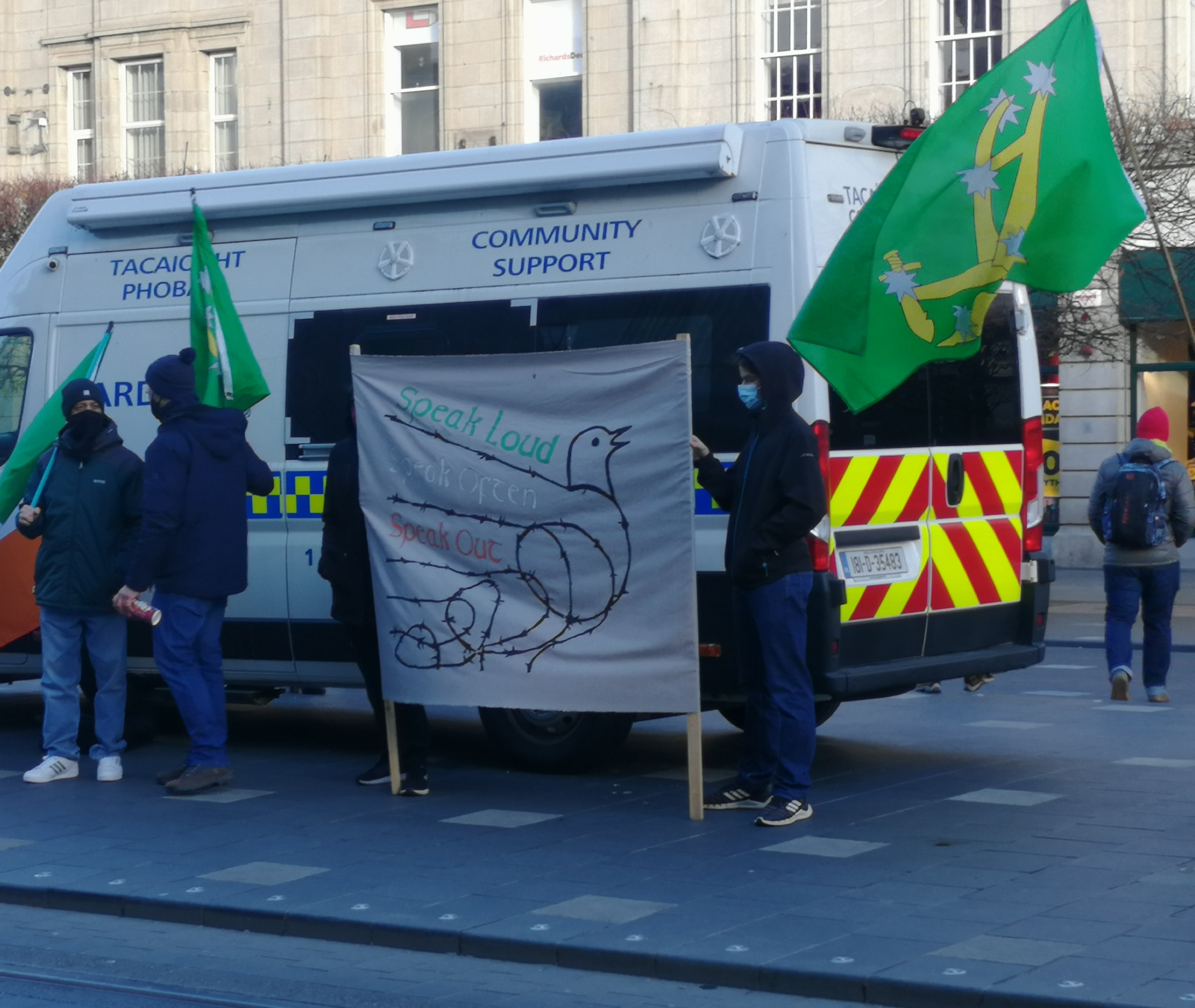
The Gardaí have attended all the public events of the far-Right in Ireland and whenever they have seen the Left and/or Republicans attend also, it was clear to the police that it was to counter-protest. On some occasions the Gardaí have been content to keep the two sides apart but on others have actively sided with the Right. A few Dublin examples will suffice:

  • A number of those countering a Gemma O’Doherty “free speech” protest in Dublin in November 2019 were threatened with arrest for getting ‘too close’ to the far-Rightists while on the other hand some of the latter were permitted to walk among their opponents and challenge them, all the while under police protection.
  • On 14th December 2019, a broad gathering of anti-fascists and anti-racists occupied the planned protest ground of the far-Right in a counter “Rally for Peace” outside Leinster House, outnumbering the latter by order of at least two to one. Republicans and Socialists were, of course, with the antifascists.
Anti-Racist Rally for Peace outside Leinster House 14 Dec 2019 — the Socialists and Republicans are among the anti-racists on the right of photo, confronting the Far-Right rally opposite who are pretending to be patriots flying the Republican tricolour (also official flag of the State). (Photo: D.Breatnach)
  • In January 2020 a smallish Irish Yellow Vest protest on Custom House quay was confronted by much smaller group of antifascists from the Irish Left. The unfurling of the Antifa flag was sufficient to attract instant hostility and threatening behaviour from the far-Rightists.
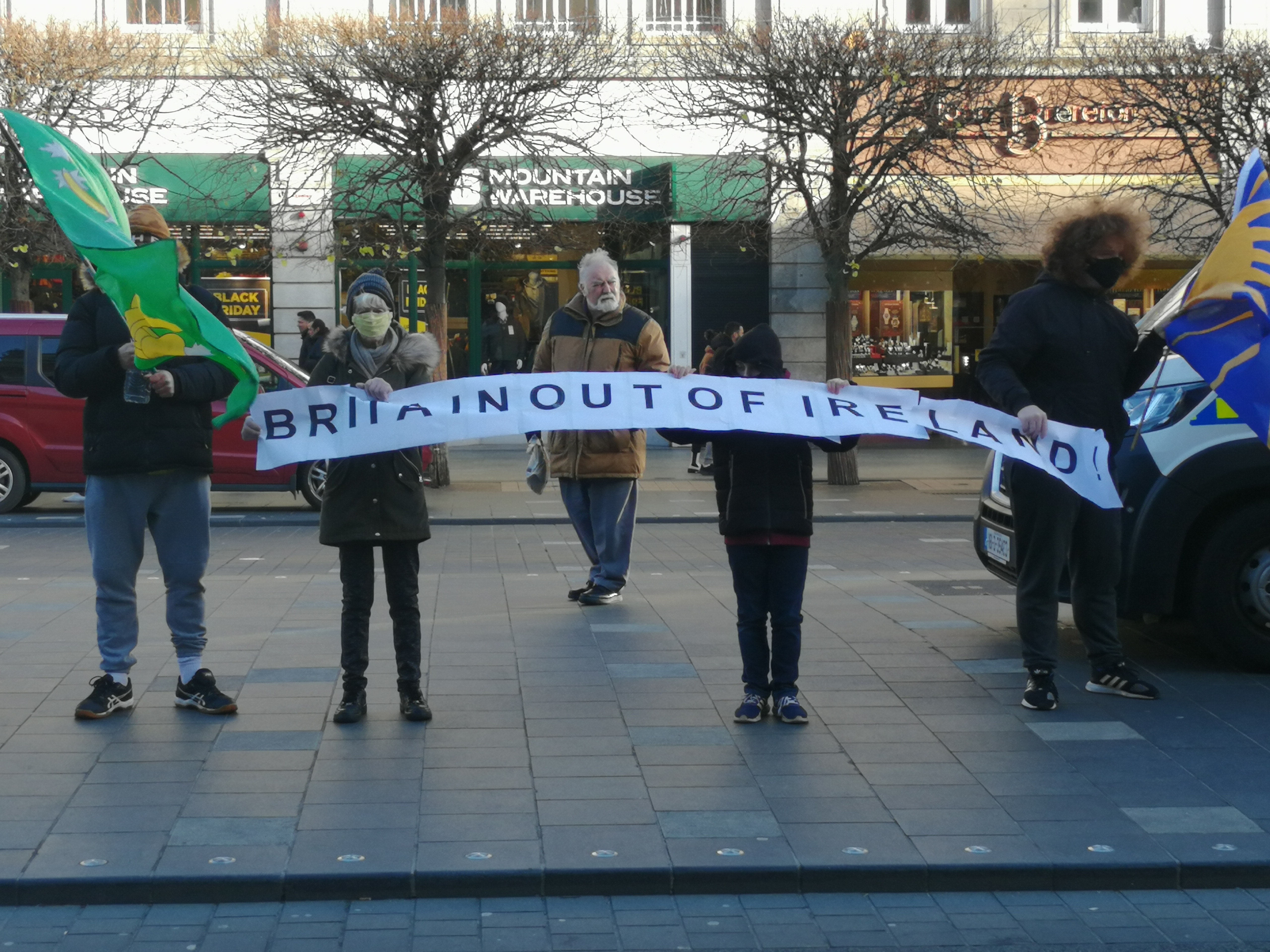
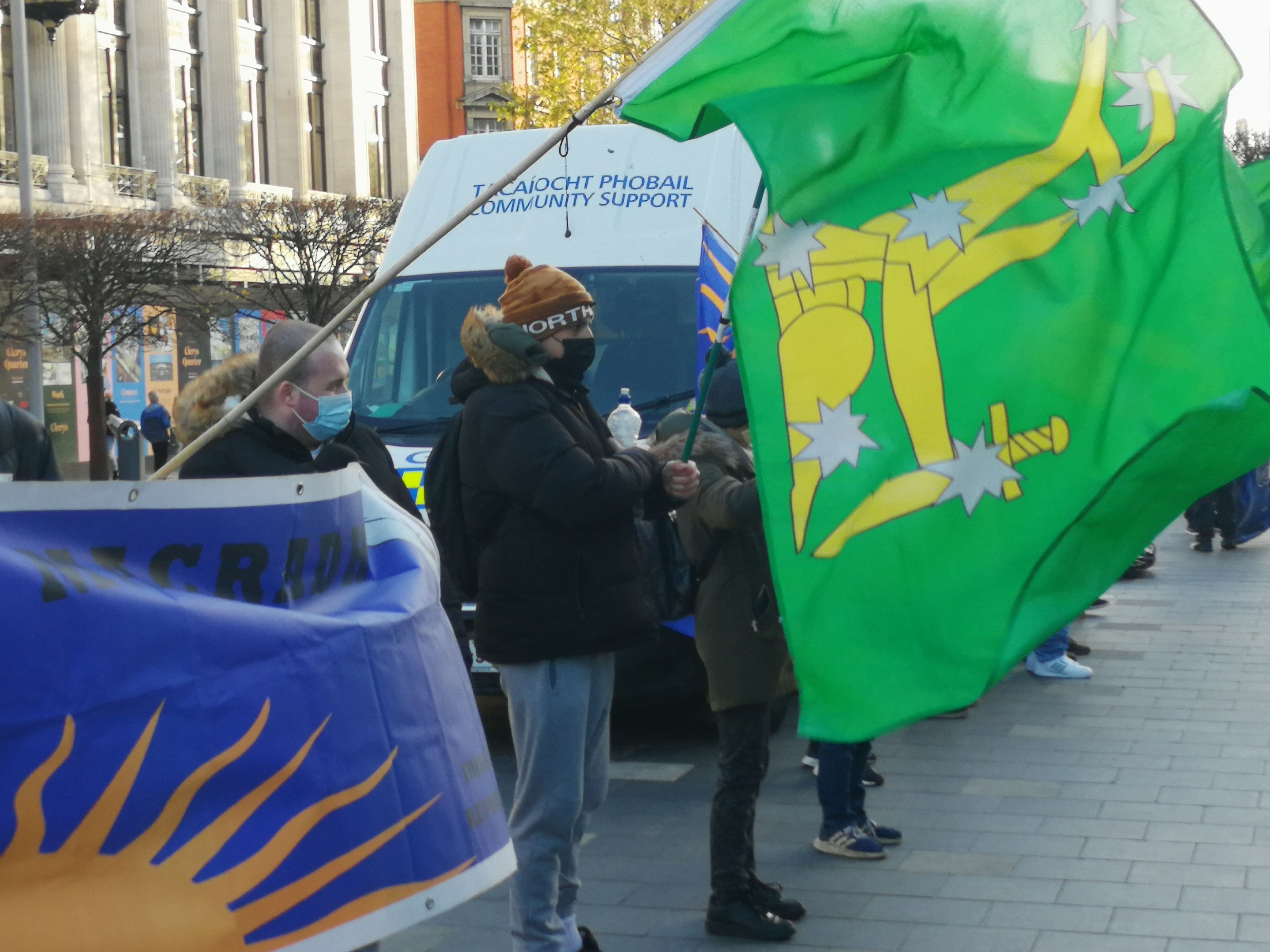
  • Early in the year Gardaí permitted some of the far-Right QAnon protesters at the GPO to cross the street to insult counter protesters on the central pedestrian reservation, often at one-foot distances without wearing masks (despite the pandemic); then rescued one of them who had entered among the counter-protesters to punch a Republican, escorting the fascist safely out and refusing to arrest him.
  • A few weeks later, the Gardaí removed a counter-protester who had approached the QAnon and been assaulted by one of the latter, not even cautioning the assailant.
  • Gardaí harassed masked and social-distancing Debenhams pickets under pandemic restrictions in Henry St. while not bothering QAnon around the corner at the GPO who were neither wearing masks nor social distancing.
  • On a number of those Saturdays the Special Branch police also harassed Republicans picketing in solidarity with political prisoners.
  • On 11th July 2019 during a homophobic rally (under the pretence of “protecting children from paedophilia’) of the Far-Right outside Leinster House, the Gardaí permitted thugs to attack a tiny counterprotest, beating them and grabbing their banner before the police chose to intervene, arrested none of the assailants and ushered the counter-protesters away.
  • On 31st July 2020 a Far-Right and fascist islamophobic protest outside Croke Park was opposed by anti-racist anti-fascists, including Socialists and Republicans.
  • On 8th August 2020 antifascists including Socialists and Republicans opposed a Far-Right march (towards RTÉ) and clashed with them on O’Connell Bridge, on D’Olier Street and again later at the GPO.
  • On 18th October 2020 a mixed-gender group of Socialists, Republicans and LGBT campaigners counterprotesting an Irish Yellow Vest rally on Custom House Quay were attacked by a larger male group, mostly masked (although at an anti-mask protest!) and armed with metal bars and wooden clubs. The Gardaí allowed the unequal fighting to continue for a while before intervening, a few police gently ushering the assailants back while the rest, including the riot police, violently pushed the counter-protesters out of the area, threatening them with drawn batons and forcing them to leave one of their number unconscious on the ground. The Gardaí’s statement later was that there had been no serious incidents and that they had arrested four people (which occurred in an unrelated incident at the other end of the Quay).
Antifascists (centre of photo) resist attack by fascists (mostly left of photo) on Dublin’s Custom House Quay; one antifascist is fending off a flagpole wielded by a fascist 22 August 2020. Many of the fascists were armed and also masked to avoid identification at the anti-masking rally called by Irish Yellow Vests. The Gardaí permitted the attack for a while before gently ushering the fascists back a little but driving the antifascists with threats and violent pushes all the way back on to Butt Bridge (Source photo: Internet)
  • Three weeks later, at a National Party rally outside Leinster House in Kildare St, a tiny oppositional group of women were attacked and an LGBT campaigner clubbed to the ground. Streaming blood from a head wound, the Gardaí pushed her out of the area. Later their statement claimed that nothing had happened but due to social media videos in circulation and protests had to change their story but claimed the victim had to make a complaint!3
  • On 1st February and again on 10th October 2020 in Kildare Street, socialist and republican counter-protesters were attacked by Gardaí. They also sealed off a section of Nasseau Street to prevent the National Party from being pursued by their opponents as they left.
Far-Right rally outside Leinster House 1st February 2020 opposed by Republicans and Socialists (that is where most of the Gardaí are).  (Photo: D.Breatnach)
Far-Right rally (left of photo) outside Leinster House 1st February 2020 opposed by Republicans and Socialists (right of photo, where most of the Gardaí are). (Photo: D.Breatnach)
The Gardaí are in no doubt about the allegiances of the Republicans and Socialists: after driving them (foreground) back with batons from the National Party (seen in the distance, with very few police there) on 10th October 2020, the riot police kept pushing them into Molesworth St. until they had established a safe distance, then escorted the NP supporters out of Kildare St.
  • On 22nd October 2020 for the first time (that time in Grafton Street also), the police attacked some of the Far-Right at a protest organised by the Yellow Vests. However that was because not only were they violating all the restrictions but they were jamming Grafton Street and refusing to move and some even getting aggressive with the Gardaí, which led to a few baton blows and 11 arrests (no ‘far-Left’ there that time either). Drew Harris claimed afterwards that they were investigating the organisers and perhaps they did finally warn them off as the Yellow Vests organised nothing officially since – but as we can see, their place has been taken by other far-Right groups.
Republicans and Socialists after clashing with supporters of the fascist National Party outside Leinster House, then chasing them on to Nasseau Street, where the Gardaí not only provided the fascists with an escort but also blocked off the eastern end of the street, 10th October 2020. (Photo source: possibly D.Breatnach or AFA?)

WHAT GAVE RISE TO HARRIS’ EARLY STATEMENT?

Some have explained Harris’ early statement as coming from the liberal complaint that “extreme Right and extreme Left are essentially the same”. Certainly this travesty of analysis exists and it is a fact that we have seen some of that view expressed by some media pundits. Such liberal claims serve as excuses for the liberals not to take action in defence of the vaunted democratic rights when the fascists organise. Then the liberals criticise those who go out to fight the fascists and to try to prevent them taking power. Sometimes the State uses these liberals to justify the banning of “far left” organisations, sometimes at the same time as those of the far right. Of course, the capitalist system remains to do the work of pushing austerity on to the working people and in such situations the State knows who the real enemies of the capitalist system are and hardly needs the fascists any more.

Drew Harris in his former role as Deputy Chief of the PSNI (formerly the RUC), the British colonial police force in Ireland (Photo sourced: Internet)

However, Drew Harris is no liberal. In 2014 he was deputy head of the Police Service of Northern Ireland, the successor of the Royal Ulster Constabulary, an armed colonial police force with a long history of suppression of anti-colonial resistance and democratic rights and, in fact, riven with anti-Catholic and anti-republican sectarianism. It is a force with a long history of brutality, torture and murder.

One of the many scenes of the RUC colonial police, forerunner of the PSNI, attacking unarmed civil rights marchers, this one in Duke Street, Derry, 1968. (Photo sourced: Internet)

Many people outside the Six Counties mistakenly view the British Army as the main repressive force of British colonialism there; however that role belongs to the armed colonial police. From the partition of Ireland in 1921, it was they who raided the nationalist areas, arrested people, beat them up, sometimes murdered them, enforced the sectarian and fascist Flags and Emblems Act, used their Special Powers Act, attacked the Civil Rights marches from 1968 onwards, oversaw Loyalist attacks on marchers, machine-gunned the Derry Bogside and were the cause of the barricades barring them from entry and the subsequent Battle of the Bogside, where colonial police fought side by side with Loyalist sectarian thugs (when they were not actually the one and the same). Only then did the British ruling class send in the Army but even then the repressive role of the colonial police did not end – they just shared it with the imperialist army.

Drew Harris served in that colonial police force for 21 years and led it for four. His father was in the RUC for 33 years and had reached the rank of Superintendent before he was killed by the IRA during the 30 Years War.

PSNI attacking sit-down peaceful protest objecting to Loyalist marches through the Garvaghy Road, Beflast in 2007. (Photo sourced: Internet)
PSNI raid on Republican centre in August 2020.
PSNI raid on Republican centre in August 2020 (Photo credit: Saoradh)

During that long war, intelligence played a major role on both sides and the MI5 and MI6 departments of British Intelligence were both active with RUC Special Branch there, with MI5 eventually gaining overall control. People who find it easy to disbelieve Gerry Adams’ claims that he was never in the IRA somehow find it reasonable to deny that Drew Harris is an MI5 asset. Actually, both claims are at least as likely to be true. And now he is head of the police force of the Irish neo-colonial State – nor would it be the first time British Intelligence has penetrated the upper echelons of the State’s police force. Ned Garvey, who was Garda Commissioner and formed the “Heavy Gang”, was exposed as a British agent; when they got back into government in 1975 Fianna Fáil sacked him but without exposing him publicly, which would have exposed also the Irish ruling class4.

Harris is long accustomed to handling and using intelligence collected by his agents in both police forces in Ireland from surveillance, touts, tapping phones, pressurising and blackmailing people, raids and searches etc. He would know very well that Socialists and Republicans have been to the forefront in opposition to the far-Right in Ireland. And that even those Socialists and Republicans who have not fought the Right actively have at least condemned them in print and spoken word.

Given all the history of socialists and republicans in Ireland, given the world history of fascists and their opposition by socialists, given also Drew Harris’ long policing background and the Gardaí’s knowledge of events over the years in Ireland in addition to their ongoing intelligence-gathering, what can be behind his extraordinary original statement and McEntees’s attempted justification? Preparation for the repression of the Socialists and Republicans, perhaps to assist in the imposition of austerity measures upon the working class? A planting of the seed in the public’s psyche to allow for restrictions on “both sides” — while in reality concentrating on the socialists and republicans?

One thing is for sure: Neither ignorance nor liberal confusion is behind this “mistake”.

End.

FOOTNOTES

1From now on I will be using this word to describe any or all of the various groups covered by the term: communists, trotskyists, anarchists, left social-democrats but not Irish Republicans, though some of them may be as committed to socialism as any of the others or even more so than some.

2“Violent disorder”, carrying a maximum jail penalty of 10 years, unlimited fine – or both! These are the first political demonstrators to be charged under that Act.

3She did and an individual has been charged.

4 And this in turn facilitated Garvey in suing for wrongful dismissal and to win damages

SOURCES & REFERENCES

Drew Harris original statement: https://www.irishexaminer.com/news/arid-40235270.html?fbclid=IwAR14cmU5XLR6Y2oVLoFO08ldtQbfB8Tp_acTRtFaB0MgLt9_37dyMu5DRVE

16th November 2019, Left counterprotest Far-Right rally at Leinster House: https://www.onebigunion.ie/post/antifascists-moblise-against-hate-gathering-dublin?fbclid=IwAR1glf3uZvW5zblDyp-ktHzhlpakHV1OT6pjTYQtRdOHDGus35y8_iVXaKk

14 December 2019, outside Leinster House: https://www.thejournal.ie/rally-peace-4933697-Dec2019/

January 2019, Custom House Quay: https://www.thejournal.ie/yellow-vest-ireland-4440420-Jan2019/

11th July 2019, Far-Right homophobic rally and attack on tiny counter-protesting group (misreported by Belfast Telegraph): https://www.belfasttelegraph.co.uk/news/republic-of-ireland/gardai-break-up-scuffles-between-protesters-in-dublin-39359650.html

February 1st 2020, outside Leinster House, “free speech” rally by Far-Rightists (against proposed ‘hate speech’ ban), opposed by Socialists and Republicans: https://headtopics.com/ie/rival-protesters-clash-at-d-il-rally-against-hate-speech-law-11036076

July 7th 2020, Croke Park, Far-Right and Fascist Islamophobic protest at opposed by Socialist and Republicans: https://the-beacon.ie/2020/07/31/tensions-at-croke-park-as-far-right-gathered-to-protest-against-eid-celebration/

August 8th 2020 clash with Far-Right marchers and picketers: https://www.bitchute.com/video/SKgyFkDsGLAB/

August 22nd 2020, Custom House Quay Irish Yellow Vest rally, armed fascist attack, hugely misreported by RTÉ: https://www.rte.ie/news/2020/0822/1160698-anti-lockdown-protest/

Much more accurate report: https://rebelbreeze.com/2020/08/31/there-will-be-another-day/

September 2020, Clubbing of LGTB campaigner and Garda collusion: https://the-beacon.ie/2020/09/14/editorial-the-far-right-descends-deeper-into-violence-as-the-gardai-and-media-look-on/

10th October 2020 clash outside Leinster House: https://www.irishtimes.com/news/ireland/irish-news/hundreds-clash-in-violent-exchanges-at-dublin-protest-1.4377808

October 22nd 2020, Grafton Street: https://www.thejournal.ie/drew-harris-protests-5242880-Oct2020/

Garda tolerance of Far-Right protests (while also saying not favouring them!) while telling Debenham picketers to disperse: https://www.irishexaminer.com/opinion/columnists/arid-31003703.html

DECEMBER DUBLIN SOLIDARITY PICKET FOR REPUBLICAN PRISONERS

Clive Sulish

(Reading time: 3 mins.)

Around 30 Republicans and Socialists gathered on a very wet O’Connell Street in the Dublin City centre on Friday evening in solidarity with Irish Republican prisoners. Despite the rain and darkness, many passers-by took an interest in the banners and placards and some stopped to converse with the picketers. Behind the picket line other events were illustrating the sad state of a section of Irish society: one voluntary free meals service finished and another began, a Muslim one, with a queue along half the length of the General Post Office.

View of picket line from across the road (Photo: C. Sulish)

The December prisoner solidarity event is organised annually by the Anti-Internment Group of Ireland, an independent collective of activists which also organises other awareness-raising pickets during the year; this evening it was supported by Irish Republicans and Socialists of different organisations and by independent activists.

(Photo: C. Sulish)

As the picket drew near to its scheduled end, placards were gathered, banners rolled up and picketers gathered (though some had already left) to hear a few words from the organisers.

The man speaking on behalf of the AIGI spoke a little in Irish welcoming those present before doing so again in English.

(Photo: C. Sulish)

60 POLITICAL PRISONERS IN IRELAND BETWEEN BOTH ADMINISTRATIONS”

“We send solidarity greetings from here to the political prisoners in jail,” he said. “We do this every year at a particularly difficult time for the prisoners and their families and friends.”

He went on to say that they also did it to remind people, “those who would like to be reminded and those who would not” of the existence of “60 political prisoners in Ireland between both administrations.”

In reference to the pandemic, the speaker noted that it had been a difficult year for ordinary people but even more so for the prisoners, their families and friends, with restrictions and reduced visits and that in some cases the authorities had used the health restrictions “as a stick to beat the prisoners with.”

“It’s been a hard year too for Republicans, for some more than others”, he continued, alluding to house raids, arrests, incarcerations, cars stopped and searched, intimidation and harassment of pickets by the police.

On the other hand, the AIGI spokesperson stated, “anti-vaxers, racists and fascists” had been “strutting around” pretending to be patriots and “desecrating our national monuments”, without any attempt being made to compel them to adhere to the pandemic regulations.

(Photo: C. Sulish)
Closeup Saoirse Banner (Photo: C. Sulish)

The speaker said that when Republicans and socialists had confronted with approaching or equal numbers those elements, they had “seen them off” clinging to “the protection of the British colonial police or of the Gardaí.” He pointed out that “They scream about ‘freedom’” but “they don’t know what freedom is”, pointing out that they are not being jailed for being active for the freedom of their country (implying that such is what is happening to Irish Republicans).

View of section solidarity picket line looking southward (Photo: C. Sulish)

“We are here today,” said the spokesperson, “for those who cannot be, who would be here for us if we, in turn, could not.”

He thanked all who had attended the event that evening, “go raibh maith agaibh, particularly those who have supported our picket during the year.” On behalf of Anti-Internment Group of Ireland he thanked those present again and wished them and the prisoners, along with their friends and families all the best for the festive season.

The AIGI spokesperson concluded by saying. “Feicfimíd sibh arís ar an tsráid. We will see you again on the street.”

end.

NB: An updated list of political prisoners and the addresses of the prisons may be found on the End Interment FB page.

View of section of solidarity picket line looking northward (Photo: C. Sulish)

Terence MacSwiney – Heroism, Pacificism, Internationalist Solidarity

Diarmuid Breatnach

(Note: It was intended to post this on the anniversary of MacSwiney’s death but technical problems prevented that.)

(Reading time text: 15 mins.)

Terence MacSwiney, Lord Mayor of Cork died in Brixton Prison, London, on October 25th 1920: it was the 74th day of his hunger strike. His struggle brought international attention not only to his sacrifice but also to an Ireland in the second year of its War of Independence, a political and guerrilla war against the occupying power, the British State.

Between 1917 and 1981, twenty-two Irish people died on hunger strike against the injustice of British occupation of Ireland.1

HEROISM AND SELF-SACRIFICE

MacSwiney exhibited heroism and self-sacrifice in a number of steps he took before he embarked on his fatal hunger-strike. He did so first of all in putting his liberty and very life in jeopardy in opposing the colonial occupation and domination of his land. He took a second step towards endangering his liberty and life by joining the Irish Republican Brotherhood, an organisation dedicated at the time to the overthrow of British rule in Ireland.

Thirdly, he took the trend further still by not only joining the Irish Volunteers in 1913 but by being one of the founders of the Cork Brigade. Fourthly, MacSwiney opposed Redmond’s offer of the Volunteers to the British imperialist Army and stood with the dedicated minority in the subsequent split.

Fifthly, he joined the IRA after the 1916 Rising.

His sixth step was to take the Lord Mayor position in which his predecessor, Tomás Mac Curtain, had recently been murdered by Crown forces. Seventh, he embarked on his hunger-strike to the end.

Tomás Mac Curtain and family; he was murdered by British agents two months after his election to Lord Mayor of Cork City. (Photo sourced: Internet)

That trajectory reminds us all that the path of revolution is a dangerous one, requiring courage and sacrifice, though not necessarily always to that same degree.

PACIFICISM

Because he chose in the end to offer up his life in a hunger-strike to the death, Terence MacSwiney is often held up as the ideal example of pacifism and especially so when a particular phrase of his is quoted: It is not those who can inflict the most but those who can endure the most who will conquer.

Of course, the reality is that both are absolutely necessary. No struggle can be won by endurance alone, no more than a struggle can be won merely by inflicting damage upon the enemy.

There are genuine pacifists and fake ones. I don’t agree with either but I have some respect for those who put their liberty and even their lives at risk in a pacifist struggle. For the others, the social democrats and liberals who enjoin us to have all our resistance be peaceful, while they support the violence of the ruling class and their states at home and abroad, we should have nothing but contempt. It would indeed suit our enemies if we set out to endure every attack and made them pay nothing in return!

Those who remind us only of that quotation from MacSwiney, or of the one from that other hunger-striker and poet Bobby Sands, that “Our revenge will be the laughter of our children”, choose to forget – and try to make us forget – a very important fact about Sands and MacSwiney: each was a revolutionary soldier. Each was arrested because he was known to be a member of an armed force of resistance – the IRA.

INTERNATIONALIST SOLIDARITY

For some people, internationalist solidarity is almost all, ensuring that they don’t become any danger to the State in which they live or to its ruling class.

For some others, internationalist solidarity is something kind of extra, to be indulged in now and again.

I think both those tendencies are wrong. We need to confront our own ruling class and State, not only for the benefit of our own working class but also as a contribution to the world. But at the same time we need to pay attention to questions of solidarity with other struggles around the world.

And that can serve as a barometer too – for I have noticed in a number of organisations that when the leadership was heading towards giving up on revolution, inconvenient internationalist solidarity was one of the first things they threw out the window.

MacSwiney’s hunger strike drew the eyes of much of the world to his struggle and to that of his people. In India, the Nehru and Gandhi families made contact with MacSwineys and those connections were maintained for decades afterwards. It is said that Ho Chi Minh was working in a hotel in London when he heard of MacSwiney’s death and remarked that with such people as that, Ireland would surely win her freedom. In Catalonia, people fought daily battles with the Spanish police outside the British Legation in Barcelona. The story reached the Basque Country too and the example of Cumann na mBan was taken a little later to create the female section of the Basque Nationalist Party.

Photo Ho Chi Minh

A young Ho Chi Minh (not his name then) at Marseilles conference in 1919 (Sourced on Internet)
Some of AIA front Hunger Strike Memorial Glasnevin MacSwiney Commemoration Oct 2020
Spanish police fought Catalans sometimes daily outside the British Consulate there during MacSwiney’s hunger strike as they protested in solidarity with the Irish patriot. (Photo sourced: Internet)
Photo shows the Emakume Abertzale Batza, the women’s section of the Basque Nationalist Party, parading in celebration of Aberri Eguna, Basque national day, in 1932. Their formation was inspired by learning of Cumann na mBan. (Photo sourced: Internet)

In Britain too, there was great solidarity, a fact not often spoken about; 30,000 people walked in his funeral procession from the jail to St. George’s Cathedral in Southwark. Who were these people? Certainly many were of the Irish diaspora, the longest-established and largest ethnic minority throughout most of Britain’s history. But there were English socialists too.

At that time, the London Borough of Poplar – not far from the area where the anti-fascist Battle of Cable Street was fought, the anniversary of which we celebrated recently — was in dispute with the Government, who were expecting the rates to be collected there to be on the rental value, which meant the poor East London borough had to pay more than rich boroughs of West London.

The Councillors were planning to refuse to set the expected rates and were threatened with jail, whereupon their leader, George Lansbury said they would be proud to go to the same jail where MacSwiney was being kept. British socialists of that kind marched in the funeral procession (besides, at least two of the Poplar Councillors bore Irish surnames: Kelly and O’Callaghan).

In my opinion, it is a great pity that the leaders of the Irish struggle for independence did not work on building links with the British working class. In 1920 the British ruling class was in serious trouble – it had thousands of military conscripts wanting demobilisation after WWI but the British didn’t want to let them go as they felt they would need them to suppress risings in many parts of the British Empire. The working class in industry was building a strike movement and in 1919 the Government had sent soldiers to shoot strikers in Liverpool and to threaten strikers in Glasgow. The great coal strike of 1925 was not far off, nor was the General Strike of 1926.

If the leaders of the Irish independence struggle had made those connections, not only might the history of Ireland have turned out differently but that of the very world.

The preceding is a very close approximation to the speech I gave on the 25th October 2020 by the Hunger Strike Memorial in Glasnevin Cemetery at the Terence MacSwiney commemoration organised by Anti-Imperialism Action Ireland.

Hunger Strike Martyrs’ Memorial, Republican Plot, Glasnevin Cemetery. (Photo D.Breatnach)
Some of Anti-Imperialist Action in front of the Hunger Strike Memorial, Glasnevin Cemetery, after their MacSwiney Commemoration Oct 2020 (Photo: D.Breatnach).

FUNERALS AND FUNERAL PROCESSIONS IN DIFFERENT COUNTRIES

The working class Irish, who had had some scuffles with the police during vigils at the jail, were there in their thousands at the funeral procession in London in their Sunday best, with the middle class represented too. Some of the Irish women could be identified at a distance, wearing their traditional shawls of Irish city and countryside. The Mayor of Poplar was not the only town mayor to walk in the procession. British socialists took part as did visitors from abroad and the world media was well represented. Aside from the procession, huge crowds lined the South London streets as the cortege passed.

World media interest was intense. The funeral procession, the vast majority walking, travelled the 3.5 miles (nearly 6 kilometres) from Brixton jail northwards to the cathedral where McSwiney’s body was to be received for requiem service the following day.

London Funeral Terence MacSwiney St.George’s Cathedral, Painting by John Lavery

The church where Terence Mc Swiney’s body was laid out under IRA guard of honour, with 30,000 filing past was St. George’s, on the south side of the river, near Southwark Bridge. It had been formally opened in 1848, known as “the year of revolution” in Europe and Ireland had its own contribution with the Young Irelanders’ brief rising. St. George’s was the first Catholic Cathedral of London until the Catholic Westminster Cathedral opened up in 1903. The English Catholics, who were a very small minority in their country had not dared challenge the anti-Catholic restrictions for generations but under the influence of large Irish Catholic congregations became more assertive; however that did not mean that the mostly aristocratic English Catholics were eager to rub shoulders with their largely plebeian Irish brethren and also, north of the river were the main desirable areas. So in 1903 they built the Catholic Cathedral in Westminster and left St. George’s to the Irish plebs on the south side of the Thames.

The Bishop of Westminster in 1920, Cardinal Francis Bourne, head of the Catholic Church of England and Wales, did not comment publicly on the hunger-strike but let it be known in private that he considered it suicide. The London inquest however, at the insistence of his widow Muriel and the evidence of the Governor of Brixton Jail, had recorded the cause of death as heart failure. A week after MacSwiney’s funeral mass in Southwark, Bourne conducted a mass in Westminster for Catholic British Army officers killed in Ireland.

Front view Westminster Catholic Cathedral (Photo sourced: Internet)
Muriel McSwiney before here widowhood (Photo sourced: Internet)

The next day after the removal of the body from Brixton Jail, Bishop William Cotter of Portsmouth gave the Solemn Requiem with Bishop Amigo, Archbishop Daniel Mannix of Melbourne, and Archbishop Anselm Kennealy of Simla, India, in attendanc. It was a ticket-only even; six of those who had tickets were a close group of men, all wearing long coats – once inside they stripped these off and revealed their IRA uniforms. After the previous Republican guardians departed, McSwiney’s body was guarded by six men in the uniform of the army to which he had belonged and of which he had co-founded its Cork element. The Bishop of Southwark might or might not have been pleased but it would not be for long.2 Certainly Peter Emmanuel Amigo, originally from Gibraltar, Bishop of Southwark from 1904 to 1949, had pleaded publicly for MacSwiney’s release before he should die, writing to politicians at Westminster petitioning his release. In a telegram to prime minister David Lloyd George on September 5th, Bishop Amigo warned: “Resentment will be very bitter if he is allowed to die.”

After the service a large entourage accompanied the body in its coffin to Euston Station for the train journey to Hollyhead. From there it was to go on to Dublin, to be received by the people of the Irish capital and then onwards to his home city and final resting place. But it was not to be.

The train left Euston station early with many police on board. At Hollyhead the grieving relatives and friends were informed that the boat they had engaged would take them and the body instead to Cork. The funeral party protested, produced their contract of shipment — to no avail. Porters were called to remove the coffin but were resisted and left. The police were summoned and, manhandling the protesting mourners, seized the coffin (sadly it was not the only kidnapping of an Irish rebel’s body in history, one of the other occasions being by the Irish State with Vol. Michael Gaughan’s body in 1974).

The British authorities feared fueling the fire of patriotic fervour already burning in Dublin at the news of MacSwiney’s death and the impending execution by hanging of Volunteer Kevin Barry. The funeral party were determined to travel to Dublin as arranged and had to engage another ship, which they finally succeeded in doing. While McSwiney’s body travelled on to Cork, the reception was held in Dublin, a city in official mourning declared by the First Dáil and in the midst of an urban guerrilla war against a foreign military occupation.

Mourners in Boston, Chicago, Melbourne, Newcastle upon Tyne, and Manchester held symbolic funerals with empty caskets.

When the Rathmore dropped anchor in Cobh harbour, the coffin containing MacSwiney’s body was transferred to the Mary Tave tug to travel on to Cork to deliver the body to a waiting funeral party. The deck was packed with Auxies, murderers of his predecessor, the final indignity.

Arrival MacSwiney’s Coffin tug surrounded by Auxies Custom House Quay Cork. (Photo sourced: Internet)

A special meeting of Cork Corporation was convened where councillors (those not “on the run”) expressed their condolences and raw emotion at losing the City’s Lord Mayor.

The Deputy Lord Mayor Councillor Donal Óg O’Callaghan, revealing that he had received death threats, issue a defiant statement, decrying that despite Terence’s death, the merit of Republicanism would still linger and pass on:

The only message that I on behalf of the Republicans of Cork give today over the corpse of the late Lord Mayor is that Cork has definitely yielded its allegiance to the Republic, that the people of Cork will continue that allegiance unswervingly and that those of us who man the Municipal Council will attempt as far as in us lies to follow the noble and glorious lead of the two martyred Republican Magistrates.

The Republican hold on the Municipal Chair of Cork ceases only when the last Republican in Cork has followed Tomás MacCurtain and Terence MacSwiney into the Grave. Death will not terrorise us”.

After a funeral service in Cork Cathedral a massive crowd accompanied his coffin to the cemetery, with Republican organisations and ordinary citizens in the procession. The occupation authorities had banned marching in uniform or even in military fashion, or display of flags.

Nationalists under colonial occupation of European powers (including nations within Europe) would be taking inspiration from the Irish struggle for decades. The war of resistance in Ireland would continue, with Cork County and City seeing more than its share. The special terrorist units of the British and their regular army would burn the City on the night of 11th-12th December of that same year. Irish Republicans in Britain would concentrate on supplying intelligence and arms to the struggle at home, in addition to organising some prison escapes. Some British socialists would continue solidarity activities on a publicity level and liberals and social democrats would protest the British reprisals on the Irish civilian population.

But the body of Terence McSwiney had come home.

End.

MacSwiney’s Free, composed and performed by Pat Waters, with video footage:

Footage London & Cork funeral processions Terence MacSwiney:

Terence MacSwiney Cork funeral only footage:

FOOTNOTES

1Some, like MacSwiney and the ten in 1981, died of the depletion of the body through the hunger-strike while some were killed by force-feeding, like Thomas Ashe in 1917, Michael Gaughan in 1974 and Frank Stagg in 1976. Others survived hunger strike and force-feeding but their bodies (and sometime their minds) suffered for the rest of their lives, such as the Price sisters (1973-1974).

2Part of that journey was marked in reverse by the Terence MacSwiney Commemoration Committee with a march in 1989. The idea as far as I can recall had been Brendan O’Rourke’s, an Irish solidarity activist and at that time Manager of the Lewisham Irish Community Centre, the Management Committee of which I was Chairperson and with a few others, Brendan and I led that Commemoration Committee.

The march, supported by Irish Republicans and some English socialists, rallied at Kennington Park, on the lookout for National Front or police attack but knowing that in Brixton itself, an area of high Afro-Caribbean settlement, both those misfortunes were unlikely. We were led by a Republican Flute Band from Scotland and applauded by people as we marched past the police station (the State garrison of the area) and through the centre of Brixton. The march proceeded without incident up Brixton Hill to the entrance of the road leading in to the Jail, held a moment’s silence there and marched down to the centre of Brixton Town, ending there for people to proceed to a reception at Fr. Matthew Hall.

It was the last such march as we could not get another band from Scotland to lead us. We were independent of Provisional Sinn Féin and Scottish RFB members told us that the bands had been told, unofficially of course, that participating in our events would adversely affect their chances of being invited to play at annual events in the Six Counties, which for those bands was the high point of their annual calendar.

SOURCES:

https://www.irishtimes.com/culture/heritage/the-three-funerals-of-terence-macswiney-1.4387267

https://www.stgeorgescathedral.org.uk/about/history/

https://www.irishexaminer.com/news/spotlight/arid-40070420.html