In the last days of the 1916 Easter Rising, with the GPO in flames, the garrison had to evacuate and did so through Henry Place. When they came to Moore Street, it was being raked by machine-gun fire from a British Army barricade at the junction with Parnell Street. Consequently, the garrison entered the first house in the terrace to the their right, No.10 and tunneled from house to house until they reached the end of the terrace, No.25.
A struggle is taking place currently to have the whole terrace saved and declared a national monument, a battlefield site in the context of the Historic Quarter. In 2007, the State made only four houses a national monument, No.s 14 to 17 and at the very end of 2015, bought the four run-down houses from their speculator owner at a million Euro each. The Government plans to make them into a commemorative centre, in the course of which they wish to demolish buildings 13, 18 and 19. Speculators have planning permission for a giant shopping mall from O’Connell Street to Moore Street and from Parnell Street to Henry street, which envisages the demolition of the entire terrace except for No.s 14-17.
In reply to campaigners, Minister for Arts, Heritage & Gaeltacht, Heather Humphreys, has stated that some of the buildings are of post-1916 construction and therefore are of no historic value. In opinion pieces in the Irish Times, one week after the other, Frank McDonald and Diarmaid Ferriter wrote articles supporting the Government.
JUST FOUR HOUSES — a sketch for three actors
AT HENRY LANE/ MOORE STREET INTERSECTION
(Sounds of shells crashing, flames roaring, combustibles exploding, rifle fire, the chatter of machine-guns)
Irish Volunteer A: “Bloody hell, it was hot in the GPO!”
Irish Citizen Army Volunteer: “Hot as Hell. We were lucky to get out alive, with ammunition about to blow.”
Volunteer A: “We can’t stay here in this laneway in the open, though.”
ICA Volunteer: “No, let’s get under cover quick! Into that terrace there … Moore Street this is, right? Sixteen houses ….
Volunteer B: “No, we have to occupy just four houses in this street.”
Vol. A: “Only four? But there’s nearly 300 of us here!”
Vol. B: “I know. But orders …”
Vol. A: “Damnation! OK, best bash that door down, No. 10.”
Vol. B: “No, not that one.”
Vol. A: “Why not?”
Vol. B: “Only Numbers 14 to 17.”
ICA Vol: “But they’re in the middle of the terrace. We’d get shot to pieces by the British machine gun up at Parnell Street – and we have to carry Connolly’s stretcher so he’d get shot too!”
Vol. B: “Yeah, they’ve already shot up The O’Rahilly’s lads.”
Vol A: “Whose orders are these? Who says we should all pile in just four houses in the middle of the terrace?”
Vol. B: “Somebody called Humphreys …. and a Mac Donald …. and a man called Ferriter. Something about only those four houses being of historic significance.”
ICA man: “What? Bloody rubbish – look, go and ask Connolly what he thinks. He’s the Commandant of this garrison, not that lot, whoever they are.”
(A few minutes later)
Irish Volunteer B: “Well, what did Connolly say?”
Vol A: “His exact words? ‘Don’t be stupid lad – break down the door of No. 10 there and tunnel along the terrace, from house to house, aye, all the way to the end – No. 25, isn’t it?’ ”
ICA man: “That’s more like it – I knew we’d get some sense out of Jim – I mean, the Commandant.”
Vol A: “Thanks be to Jayzus for someone with sense in charge. Who the hell are that other lot and where did they come from, that Humphreys, MacDonald and Ferriter?”
Vol B: “I dunno. Give’s a hand with this door before we get shot out here, gabbing …”
There are occasions in life when time that can never be retrieved is expended on something that is worthless. So far, three valuable hours of my life has been wasted on what RTE describes as a ‘commemorative drama’ to herald the beginning of the Centenary year of the 1916 revolution. Wasted, other than in terms of understanding the propaganda value to the political class even of badly constructed ‘historical’ costume drama – although describing ‘Rebellion’ as coherent drama is stretching it.
I quibbled after the first episode about the use of the term ‘Rebellion’ instead of the more accurate term ‘Revolution’, but it finally dawned on me with Episode 3 that what the writer, director and producers really mean is that this is about rebelliousness within the featured families, to which the 1916 Revolution is just a backdrop.
It would be a useful exercise after the series comes to an end to put a stopwatch to good use to work out the proportion of the five hours of screen-time that is devoted to an exceedingly poor and skewed telling of the story of the 1916 Revolution, and what proportion was used to tell the confusing, intertwined, and fairly inconsequential stories of domestic disagreement. There is of course a market for the latter, and for its setting in a sort of ‘upstairs-downstairs’ genre, but this series, more soap than serious drama, should not be its vehicle.
The 1916 Revolution – what was it really about, who made up the rank-and-file – essential to the creation of a revolution, what scale of operation was in play, what impediments to success existed? Nobody can be any the wiser by relying on this series.
The leaders – who were they, what were they like, what did they believe in, was there a plan, had they some endgame, some vision? Nobody can be any the wiser by relying on this series.
Where is Tom Clarke, or Seán MacDiarmada, or Joe Plunkett, three iconic signatories of the Proclamation, all present in the GPO – but not so far in this sorry series? No clue as to their characters, and precious little of James Connolly’s – relegated to a bit part, or of Patrick Pearse’s – other than his addiction to prayer, his deference to the clergy, his obsession with blood sacrifice, and a capacity for rhetorical exaggeration – as RTE would have us believe.
Where is the evidence of strong public support particularly in the impoverished inner city tenements, without which the revolution could not have lasted almost a week? We know it was there, we who have bothered to acquaint ourselves with the true narrative. Instead, that hoary old myth of widespread public disaffection with the revolution is hammered home at every opportunity.
Episode 3 begins with some bearded chap being put up against a wall and shot by firing squad. Who was he? We are none the wiser by the end of Episode 3. Why might it be important to know that he was Francis Sheehy-Skeffington, a journalist, an advanced-feminist, a pacifist who had played no part in the revolution itself? Because, perhaps, that it is true, and that he was murdered on the command of a crazed, out-of-control British army officer – an essential detail of the 1916 narrative – but not as the masses are supposed to know it since it would upset the entirely revisionist slant of this television disaster, a revisionism that is deliberately applied. And so it goes on.
Against fleeting scenes of chaos, created as we are led to believe by violent anti-democratic nutcases hell-bent on creating a Catholic state, we are encouraged to note the stabilising influence and the manners and the etiquette of both the Irish ‘Castle Catholics’ and their British masters in Dublin Castle. Fast-forward by 100 years and we see the same spurious choice being presented to the people by the political class – ‘stability’ or ‘chaos’, white or black, good or bad. No need to tease out what each side really stood for back then, or what each side stands for now.
There are those who ask ‘what matter – it is only TV drama?’. Propaganda is at its most effective when it is inserted subtly into the thought-processes of its target audience, and repeated through various forms from news and current affairs, commentary, and yes, entertainment. That works, as Joseph Goebbels knew all too well.
RTE claims an audience of 600,000 for its first episode of ‘Rebellion’. A large proportion of these will vote in the upcoming general election in which the main choice will be between, the political class tells us, stability or chaos. And that audience is also entering into the centenary year of the 1916 revolution with its competing interpretations, one of which champions the Redmondite parliamentarian Home Rule option over the other – the right of a people to self-determination and self-government, to be established through revolution where no other viable option was available. Presenting a partisan and therefore skewed version of the 1916 revolution primes at least a part of that audience to adopt a negative view of the legitimacy of that revolution and of its leaders, and that represents a highly political intervention in the popular history of 1916 on the part of the State broadcaster, RTE. It is not, presented in that way, just TV drama.
‘Rebellion’ looks like a cheap production, but cost as much as Ken Loach spent making The Wind That Shakes The Barley – an excellent production for the big screen, which grossed three times its production costs at the international box-office. Why wasn’t Loach asked to make this series? It is not as if he lacks experience. But then, he could be relied on to create a credible narrative around the main story of revolution and to consign the less consequential sub-plots to their rightful places. That would not suit the political class, including its RTE functionaries.
The 1916 revolution is an intriguing, exciting and rich human story, as rich in dramatic potential – characters, incidents and plot-lines – as was the highly successful and accurate 1913 Lockout TV drama ‘Strumpet City’, produced by RTE in 1980. ‘Rebellion’ on the other hand is dross. Some people, their names figuring prominently on the credits of each episode, opted for dross, and each received a considerable reward tor taking that option.
The foundational narrative of modern Ireland – in which the 1916 Revolution is the inciting incident – deserves to be treated with a modicum of respect. That is entirely absent in this spurious version.
There are times when we remark that ‘you couldn’t make it up’. The series writer did, with input from others.
And there are times when we remark that ‘it couldn’t get any worse’. Oh yes it can, and it will.
As the votes in the General Election in the Spanish state result in huge gains for the Podemos party and the most fragmented Parliament since before the Spanish Civil War, the Abertzale Left’s party in the elections also loses massively to the newcomer. This occurs in the context of wide discontent within the Abertzale Left, especially among the youth, with a potential split emerging around the issue of political prisoners.
The Spanish state includes within its borders most of the Basque Country and the Catalan Countries, which have their distinct cultures and languages. Also with a significantly different culture are Asturias and Galicia, both of them considering themselves Celtic rather than Latin-Hispanic and also having their own languages. There are in fact small movements seeking independence or greater autonomy in all other regions of the state, including in the political centre itself, Castille.
Four of the Basque Country’s seven provinces are currently inside the Spanish state and they were included in the Spanish state’s General Election on 20th December. A number of financial scandals affecting the ruling Spanish right-wing Partido Popular in recent years no doubt made their leaders reluctant to go to the polls but holding off longer might have resulted in even worse outcomes.
On the other hand, the PP’s main parliamentary opposition, the social-democratic Partido Socialista Obrero Espaňol (PSOE) were also embroiled in some financial scandals during the same period, though not as many.
In the event, both main parties achieved disastrous results and neither can form a majority government. The new party of the social-democratic Left, Podemos (“We Can”), which did not even exist two years ago, has leapt into third place and a new party of the Right, Ciudadanos (“Citizens”), is in a poor fourth place. No two of the aforementioned parties can form a coalition government except in the case of a PP-PSOE coalition; however that would cause massive problems for each party and also dispel the political myth of a democratic choice between “Left and Right” in the Spanish state.
The Spanish state has long been the most unstable in the core European Union. Collusion between fascists, alleged social democrats and alleged communists internally, along with the support of the USA and the tolerance of its European partners has kept it afloat. Nevertheless, it represents the part of the EU most vulnerable to revolution, with immediate impact should that happen on the French and Portuguese states and further ripples throughout the EU. However the revolutionary and potentially revolutionary forces are weak, divided and riddled with opportunism. (see separate article focussing on the elections and the Spanish state in )
Despite the weaknesses in the Spanish state, the Basque Abertzale Left has made little headway against it and has been slipping electorally badly this year.
Election Results in the Basque Country
EH Bildu, party of the Abertzale Left in coalition with social-democratic Basque parties, presenting their program in Nafarroa in 2012 and seeking broader alliances
EH Bildu (“Basque Country Unite”), the social-democratic coalition party under the direction of the Basque Abertzale (Patriotic) Left, came out of the Spanish state-wide elections badly (as it did in the regional elections earlier this year in the Basque Country also, with the exception of in Nafarroa). With a drop of nearly two-thirds of its previous percentage of the vote, it lost five seats and now has only two in the Spanish Parliament (the Cortes). The christian-democrat PNV (Basque Nationalist Party), traditionally the dominant in the three southern provinces of Euskadi (i.e. excluding Nafarroa, the fourth), also took a drop in its percentage but a much smaller one and despite that, increased its numbers of seats from five to six. The Basque nationalist coalition in Nafarroa, Geroa Bai (“Yes to the Future”), lost its only seat.
The winner that swept up the ‘missing’ votes in the Basque Country was Podemos, a party that did not even exist until last year. Although gaining one seat less than the PNV in the “Euskadi” or CAV (three provinces region), Podemos actually won more votes and its share was 25.97%, against the PNV’s 24.75%. Shockingly, at 15.72%, EH Bildu has now been reduced to fourth place after the other two and the PSOE, with only the PP worse off but with the same amount of seats. Even in Gipuzkoa, the province most loyal to the Abertzale Left, their share fell to 20.89% and their coalition party EH Bildu lost two seats. In the same province Podemos topped the poll in votes and gained two seats.In the fourth province, Nafarroa, EH Bildu lost their only seat and took a 9.90% share against UPN-PP’s 28.93%, Podemos’s 22.9%, and PSOE’s 15.53%.
Podemos leader Pablo Iglesias after results of Spanish Election results December 2015
It seems clear that in the Basque Country, Podemos took votes both from the PSOE and from the Abertzale Left’s coalition party, EH Bildu and even some from the PNV. For the PSOE, a party in Government in the past and implicated in the GAL murders, also involved in a number of recent financial scandals across the state, to lose votes in the Basque Country to a radical-left coalition, would have come as no surprise to most people. It is a different matter altogether for EH Bildu, with a strongly patriotic Left following, never tainted with a financial scandal and never yet in Government, to lose votes to a newcomer like Podemos — and that needs some explanation.
The fact is that the AL leadership flirted with Podemos – even proposing a joint electoral platform — and thereby sent the message that voting for them would not be such a bad thing. But there were sufficient reasons for the AL to have done otherwise, even without the objective of safeguarding their own vote. It has been clear for some time that the leadership of Podemos is hostile to aspirations towards independence of nations within the State. Their leader recently criticised the decision of a Catalan pro-independence coalition to use the regional elections as a quasi-referendum on Catalunya’s independence. Also one of their ideologues, in the midst of an intervention in discussions within Colombia, likened ETA to Columbia’s fascist assassination squads (who murder trade unionists, human rights workers, socialists, even street children). In addition, Podemos has never come out against the repression in the Basque Country.
There were enough reasons for the AL leadership to draw a deep line between themselves and Podemos. But they did the opposite. This contrasts with the left-republican Catalan nationalists (Esquerra Republicana de Catalunya-Catalunya Sí) who engaged in a public battle with Podemos’ leadership. Incidentally, they increased their share of the vote by 1.33% and their representation from three seats to nine.
Another vulnerability of the AL movement to a party like Podemos is precisely the road of conciliation with and concession to the Spanish state taken by the AL over the recent five years and longer. If that road is seen to be OK then, some might say, why not vote for a radical reformist left party and one which, crucially, has a large following throughout the State? Such thinking combines a perception that revolution is not possible, implicit in the approach of the AL leadership, with a view that a solution can only be found outside the Basque Country, which although contrary to most of AL’s propaganda, does seem in part to be the case, based on population statistics alone (see discussion on this further on).
This view was seemingly endorsed by the post-election statement of Barrena, spokesperson for the Abertzale Left’s party Sortu, who characterised the vote for Podemos as “the right to decide” and held out his hand for electoral coalitions with them in the future. The irony — that precisely Podemos does not support “the right to decide” of nations within the Spanish state – was apparently lost on Barrena.
Around September there were whispers of the intention to hold a review of their trajectory within the Abertzale Left. This seemed an acceptance that their chosen path had, if not failed completely, then certainly fallen far short of their own expectations. I wondered how they would contain severe criticisms within such a review, a much more difficult process now than some years ago, when confusion combined with illusions and the soothing words of long-standing leaders.
Further confirmation of this review has since come out: called ABIAN (“Launch”), it’s a debate being organised by Sortu (“Create”), a social-democratic party of the AL. A recent article in a Gipuzkoa news media stated clearly that the review was a response to criticisms of Sortu, “for the first time within the Abertzale Left” (i.e. not only outside of it). The article went on to list a number of organisations within the AL who had published criticisms, including “Boltxe” and the revived “Eusko Ekintza” (http://m.noticiasdegipuzkoa.com/2015/09/01/politica/las-duras-criticas-internas-empujan-a-sortu-a-revisar-su-estrategia-politica-y-organizativa). This contradicts Barrena’s public statement in September that those who criticise the current path of the Abertzale Left and their policy on the prisoners could no longer be counted as within the movement.
Given the electoral showing of the AL’s coalition party EH Bildu and other issues, such a review may be a way of “managing” the dissent but must also hold much danger for the leadership’s line, despite the party positions of the Otegi/ Permach/ Barrena leadership seeming reasonably secure at the moment (Otegi is due for release very soon).
Aside from all this and going back for a moment to Podemos, it does seem unlikely that this party has a long-term future but its development will be interesting to observe.
The political prisoners – a fracture point for the movement?
Annual Basque political prisoner demonstration January 2014 in Bilbao
Whereas the Provisional Republican movement suffered a number of small splits and some defections as a result of its embarkation on the pacification road, it is a fact that they had something pretty significant to deliver – the release of political prisoners affiliated to them. Nearly every single one walked out of jail and their release was not only a result to “sell” the GFA to the movement but some of the prisoners themselves were used as advocates of the process. Although it is true the prisoners were only released “on licence” and a that number were sent back to jail without a trial again later, including new prisoners, that only happened to “dissidents”. For the moment that could be seen as helping the continuation of the Good Friday Agreement and hampering the mobilisation of Republican opposition to Sinn Féin and their chosen path.
The Abertzale Left has had no such gain and a split in the movement seems to be forming precisely around that issue.
There are 410 Basque political prisoners officially recognised by the Abertzale Left (there are some dissidents too outside that, apparently) and they, like their counterparts in the Irish Republican movement, have always been an important element in the struggle. Political prisoners are dispersed all over the Spanish state and the Basques are by far the most numerous component of these. Some are also serving very long sentences, as are their comrades who are jailed by the French and also dispersed throughout their state.
Around a dozen are suffering with very serious illnesses and the Spanish prison administration has admitted that it does not have appropriate treatment facilities for a number of them. However, mostly there they remain and a number have died in captivity in recent years. Twelve people have also died in automobile crashes on the long journeys to visit prisoners dispersed to hundreds or even a thousand kilometres from their homes and an average of one serious traffic accident a month for visitors was recorded last year.
Dispersal is a serious issue and for many years has been one of those upon which the movement concentrated, in particular Etxerat, the prisoners’ relatives’ and friends’ group, and the short-lived Herrira, a prisoners’ political campaigning group banned by the Spanish state and their leading organisers arrested. But that demand also stood alongside the demand for amnesty, the freeing of the prisoners as part of a political settlement.
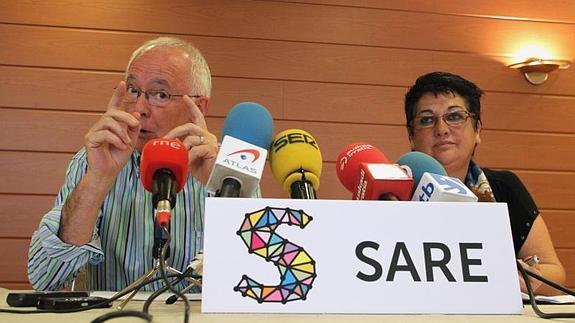
Joseba Azkarraga, spokesperson for Sare and lawyer Asun Landa, at a press conference
More recently, however, the Abertzale Left’s leadership has been placing the emphasis on combating the dispersal and, according to some of their critics within the movement, abandoning the demand for amnesty. Perhaps the leadership felt that dispersal was an issue they had the capacity to change (though it is difficult to see how), whereas without an armed struggle to use as a bargaining chip, a prisoners’ amnesty may have seemed out of reach.
Meanwhile, last year, Sare (“Network”) was created by the AL leadership to pick up the threads dropped by Herrira but little has been heard or seen of it. The organisation’s spokesperson is Joseba Azkarraga, who has a somewhat radically fragmented track record. During the 1960s and 1970s a member of ETA (a fact missing from his Wikipedia entry in Spanish), he left them and joined the christian democrat PNV (Basque Nationalist Party). Azkarra was elected to be member of the Alava province local government for the PNV in 1979, a role he fulfilled later for Bizkaia province 1982-1986 and in the latter year also for the province of Guipuzkoa — representing the PNV throughout.
In 1987 he was part of a split from the PNV that led to the formation of Eusko Alkartasuna (EA), for which party he was elected a member of local government for Bizkaia in 1989. He was a member of EA’s National Executive 1987-1993 and 1999-March 2009, in between which periods he had withdrawn to concentrate on his business in the banking sector. From September 2001 to May 2009, he had the responsibility of Councillor for Justice, Employment and Social Security for the Basque Government. He has been quoted as saying that the more prosecutions of Abertzale Left activists the better – this from a man with a law degree in a State where prosecutions of Basques are more often than not ensured by “confessions” extracted by torture and where the standard of “evidence” required to convict is derisory.
Grumbling, particularly among younger activists about the emphasis on the institutions and the “abandonment of the street”, has been growing over the years. “Our movement’s spokespersons no longer speak of ‘freedom’ and ‘socialism’ but use more ambiguous words like ‘right to decide’ and social justice’ ” is a growing complaint.
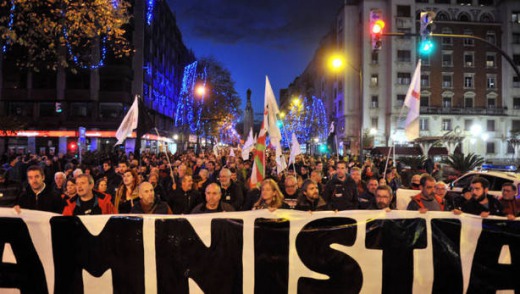
Recently an organisation called Amnistia Ta Askatasuna (“Amnesty and Freedom”) was launched to campaign not only against dispersal but for amnesty for the prisoners too. The movement also goes by the name of Amnistiaren Aldeko Mugimendua (“Amnesty Movement”). In August of this year ATA/AAM held a small but significant demonstration in Bilbao associated with the annual alternative festival there which is strongly patronised by youth. At the end of November they held another in the same city, this time attended by an estimated 9,000.
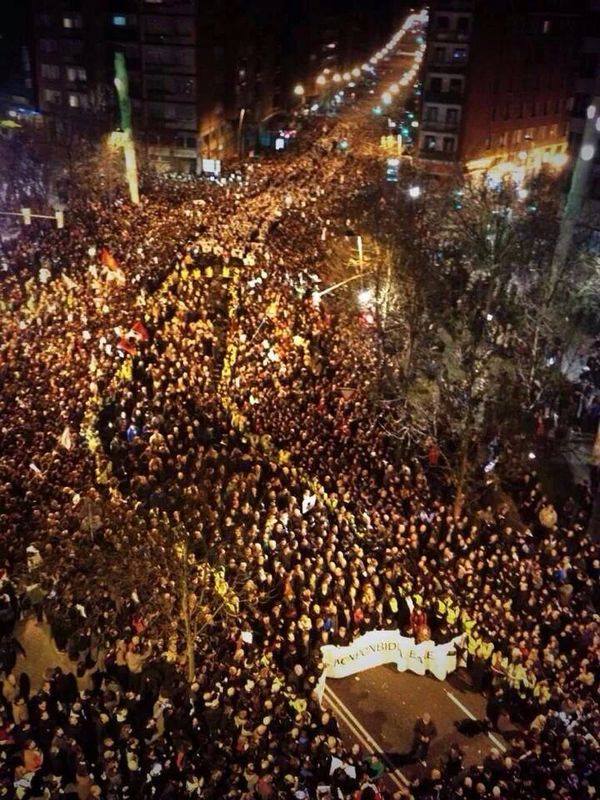
New solidarity campaign for for political prisoners raising demand of amnesty takes to the streets Bilbao 28 November 2015
In a Basque alternative radio station interview in August, some of ATA/AAM’s spokespersons complained of attempts to malign and isolate them but said they were overcoming these tactics and gaining support. The AL’s bilingual daily newspaper, GARA, did not publicise their demonstration in advance and their estimate of the attendance afterwards was about half of the real figure. The report also neglected to mention the messages of support from a number of political prisoners to the rally.
In December, the six alleged ETA prisoners awaiting trial in Paris on charges involving kidnapping, car and weapons theft and, for two of them, murder of a police officer, made a press statement denouncing the ATA/AAM group and claiming that they were using the prisoners as a Trojan horse in order to attack the whole recent direction of the Abertzale Left. They also accused them of trying to get Basque prisoners to leave the prisoners’ collective, the EEPK. No evidence was produced of this and the ATA/AAM were not asked to comment. GARA published the Paris statement under a headline containing the allegations without even putting them in quotation marks. It is rumoured that GARA lost many subscribers after that reporting.
It seems likely that this controversy will sharpen over the coming months with people, including prisoners, being obliged to take sides and it may be that it will be characterised by a similar bitterness to that which exists in the Republican movement in Ireland. But unlike the case of Ireland, the numbers of Basque prisoners in the jails remains very high. In addition, the Spanish state continues to jail people who are clearly political activists which adds to the political prisoner population. Without a change in that situation, the likelihood of very serious contention within the movement is high and on a much larger scale than has been the case in Ireland.
The recent dismal electoral showing of EH Bildu can only increase unhappiness within the movement and lead to judgements critical of the AL leadership and, inevitably, to one degree or another, of the path they openly set out upon a little over five years ago.
Background – the origins and trajectory of the Abertzale Left
Born during the Franco dictatorship, the Abertzale Left (Basque: Ezker Abertzalea; Spanish: Izquierda Abertzale) is a broad alliance of patriotic and Left elements with many aspects situated on the social, cultural-linguistic, trade union, media and of course political fronts. The movement was subject to heavy repression from the outset and after nearly a decade a section responded by taking up arms. The Basque Nationalists had done that against Franco in the Civil War – however, the Abertzale Left was doing so in a country occupied by the victors of that war.
Not many outside the Basque Country realise that ETA (“Basque Country and Freedom”) is more than “the armed wing of the Basque patriotic movement” — it is the origin of the Abertzale Left, operating solely politically and culturally (albeit clandestinely) for nine years, its activists spied upon, arrested, tortured, jailed. Eventually ETA took up the gun.
It was one of the main ideologues and organisers of ETA, José Miguel Beñaran Ordeñana (alias “Argala”, 1949 – murdered by GAL 21st December 1978) who pushed for the legal and semi-legal aspects of the work to form themselves into separate organisations from ETA while the parent organisation kept a relationship with them.
Although the old Basque Nationalist Party was legalised under the new form of the state after the death of Franco, repression of the Abertzale Left continued. Nevertheless the movement continued to grow, in particular its many non-military aspects, although they too were and are subjected to heavy repression.
Despite the adaptability of the movement and its significantly wide base (between 12%-20% on past electoral showings, despite banning and disqualifications of electoral platforms), it was difficult to see the validity of its strategy of combining armed struggle and popular political movement within the Basque Country, with regard to its long-term objectives of national independence and socialism.
The ruling classes of both the Spanish and French states have a long imperial history along with a strong traditional insistence on the unity of their “home” states, on which they have never shown a willingness to compromise. That is reflected not only within their main right-wing parties but also within the main social-democratic parties and the remains of the old Moscow-orientated Communist parties. In the Spanish state the situation is even more problematic, since the Basque Country and Catalunya are two of the most economically successful within the state, outperforming nearly every other region by a significant margin. Why would the Spanish ruling class wish to give those regions up?
The total Basque population is only around 3.5 million, some of which is within the borders of the French state. The Spanish state has a population of around 45 million outside the Basque Country and even with the subtraction of that of Catalunya (7.5 + million) and the Balearic Islands (just over one million), that still leaves a population of 36.5 million from which to draw soldiers and police.
According to Wikipedia, “the Spanish armed forces are a professional force with a strength in 2012 of 123,300 active personnel and 16,400 reserve personnel. The country also has the 80,000 strong Guardia Civil which falls under the control of the Ministry of Defence in times of a national emergency. The Spanish defence budget is 5.71 billion euros (7.2 Billion USD) a 1% increase for 2015.” The Wikipedia paragraph ends with the ominous sentence that “The increase comes due to security concerns in the country.”
Those figures of course do not include the other police forces, such as the National (Cuerpo de Policía Nacional or “los Grises”)), with a strength of nearly 88,000. This armed force, along with the Guardia Civíl (“los Verdes”), has been traditionally repressive of the Abertzale Left, a task now mostly left to their respective forces in the Basque Country, the Ertzaintza and Policía Forál, forces which, like their counterparts in Catalunya, the Mossos d’Escuadra, have been viciously engaged in repression of the patriotic movements. Then of course there are the municipal police forces inside the Basque Country and elsewhere which can be mobilised as backups to military operations.
Add to that the fact that Nafarroa (the fourth southern Basque province) contains significant Spanish unionist and right-wing elements (it has voted a PP majority for decades) and that much of the Basque Nationalist Party’s following is hostile to the Abertzale Left and it is difficult to see how the AL ever expected to win a straight contest of strength with either state.
Perhaps, like the Irish Republican Movement, with which it has traditionally had fraternal relations, the Abertzale Left thought to make itself such a nuisance to the power occupying it that the latter would get fed up and leave them to it. In both cases but even more obviously so in the case of the Basques, that would have been a serious misreading of the situation and an underestimation of the importance to the power in question of remaining in possession.
It seems clear that the only scenario in which the Basque Country could set up a truly independent state would be one in which the Spanish state at the very least (and probably the French one too) would be unable to send repressive forces in to deal with such an attempt. And what would be the nature of such a scenario? Why, nothing less than that the ruling class of the Spanish state (probably of the French state also) were facing a revolutionary situation across the rest of its territory. Not only would such a situation tie down much of its armed forces but it would have the potential for soldiers refusing to fire on workers, mutinies and defections to revolutionary forces.
Working from such an analysis, activists of the Abertzale Left, as well as organising their movement within the Basque Country, would have been busily building relationships with the revolutionary movements and organisations across the Spanish state. But apart from the electoral alliance for the European Parliamentary elections of 2009 (the creation of the Iniciativa Internacionalista platform, which was the victim of massive electoral fraud by the State), the Abertzale Left has never seriously set about such a project. On the other hand, the formerly-Moscow orientated communist party and left-social democrats across the state, as noted earlier, have also kept at a distance from the Abertzale Left and from their aims. The left coalition of mostly Trotskists, Communists and radical social democrats of Izquierda Unida has done likewise.
There are however small formations of revolutionary communists, anarchists and left-independentists, along with anti-centralist movements with revolutionary potential, as well as a number of anti-unionist and independent trade unions throughout the state. To be sure, the immediate prospects are not glowing – but what other option is there? And how else can one be placed to take advantage of a revolutionary upsurge across the state should one occur?
A significant deviation from the original route
During the 1980s, during an ETA truce, there were peace talks held between ETA and the Spanish Government which came to nothing. Similar overtures during the early 1990s had similar results.
It appears that at some point in the late 1990s, perhaps attracted by the development and apparent gains of the Irish pacification process, the leadership of the Abertzale Left began to look for a different way out of their difficulty. Arnaldo Otegi is widely seen as the architect of this trajectory.
Part of this new approach involved seeking alliances with the PNV and with social-democratic parties within the Basque Country. The PNV is the party of the Basque nationalist bourgeoisie, no longer prepared to fight the Spanish ruling class as it was in 1936. It has its capitalist interests and has a record of jobbery and corruption including its involvement in the TAV, the High-Speed Rail project. It even asked the Spanish state to make militant opposition to this project a terrorist offence. The PNV manages its police allocation, the Ertzaintza, a vicious force active against the Abertzale Left and against striking workers and responsible for the serious injury and death of several. The PNV also manages the Basque TV station EITB and therefore controls both the arms of repression and of propaganda. Although the AL criticises the PNV from time to time this is mostly for the lack of support for a broad front against the Spanish state – AL spokespersons rarely attack it for its capitalist exploitation or jobbery.
Otegi was apparently active with ETA in the French state for around ten years and served three years in a Spanish jail for an ETA kidnapping in 1987, after which he involved himself in political activism. Ten years later the jailing for seven years of senior members of Herri Batasuna left a vacuum in the leadership of the organisation which Otegi filled along with Joseba Permach (sentenced to three years jail in August 2014 – but halved on appeal — in the “social centres trial” which confiscated the assets of the centres) and Pernando Barrena.
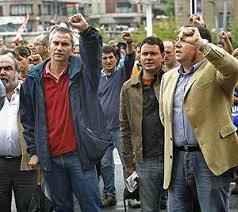
Arnaldo Otegi, leading figure in the Abertzale Left and seen as architect of recent path of the movement, addressing a rally some years ago.Joseba Permach and Pernando Barrena giving the clenched fist salute at a political rally some years ago. Both have been close colleagues of Otegi’s in the Abertzale Left’s leadership and shift in strategy some years ago
Otegi led a number of initiatives for the Abertzale Left to embark on a different path, which combined ETA ceasefires, talks with other parties, and militant rhetoric. The latter landed him with a 15-month sentence of which he eventually served one year. Subsequently he has been arrested a number of times, convicted twice and exonerated twice. In 2011 he was charged with trying to rebuild Batasuna, the AL party banned by the Spanish state and was sentenced to ten years; this was reduced on appeal to 6.5 years so that he is due out soon. In 2013 he was elected General Secretary of the AL social-democratic political party Sortu.
Despite the relatively short prison sentence (compared to many other Basque prisoners) and the fact that he appears to be in good health, a campaign was started for Otegi’s release and a petition circulated around and outside the movement. This broke a long-standing rule in the movement that there would be no campaigning for individual Basque political prisoners, from which an exception was previously made only in the cases of seriously-ill prisoners. Nevertheless the campaign petition and Facebook page has been circulated through the movement without any official condemnation — or even distancing from — by the AL leadership. However the campaign has attracted some muted criticism across the movement.
The AL leadership proposed a “peace process” but the problem was that, unlike the case with the British, the Spanish ruling class had no interest in developing anything like that. Their aim was to crush the movement with an iron glove, not to “choke it with butter” as their British counterparts had done.
So the Abertzale Left took the road of unilateral ceasefire. This seemed to many of their friends a doomed tactic since it left the Basques with nothing to bargain. In September 2010, ETA announced a ceasefire, saying it wished to use “peaceful, democratic means” to realise the aspirations of the Basque people. The Spanish state’s reaction was not encouraging but nevertheless on 20th October the following year, the organisation announced a “cessation of armed activity”. This followed the conclusion of the “International Peace Conference” held in Donostia/San Sebastián.
The composition of the conference was clear indication of the AL leadership’s projected route and in particular the type of allies it sought internationally: former UN Secretary-General Kofi Annan, former Taoiseach of Ireland Bertie Ahern, former Prime Minister of Norway Gro Harlem Brundtland, former Interior Minister of France Pierre Joxe, President of Sinn Féin Gerry Adams and British diplomat Jonathan Powell, who had served as the first Downing Street Chief of Staff. To summarise, a collection of servants and executives of imperialism, colonialism, capitalism and even executives of repression and one exposed in a financial corruption scandal.
The declaration at the conclusion of the conference was also supported by former UK Prime Minister Tony Blair, former US President Jimmy Carter and the former US Senator and former US Special Envoy for Middle East Peace George J. Mitchell. In other words, former leaders of US and British Imperialism and one of their agents.
Despite the abandonment of armed struggle by the Abertzale Left leadership, the meeting did not include Spanish or French government representatives and the ruling classes of both states remained unreceptive to the overtures of the AL leadership. Not only that, but the Spanish state continues to arrest the movement’s activists, to torture and to jail them. No amount of criticism by committees for the prevention of torture working for the UN or for the EU, nor condemnation by Amnesty International and many human rights associations within the Spanish state, have had any visible impact on the operations of the Spanish state in recent years. And “confessions” obtained by torture continue to be used as admissible ‘evidence’ for the Prosecution even when withdrawn by the victim and the torturers denounced in court.
The ETA ceasefire continues to date and a number of other statements have been made by ETA including one in which they announced the destruction of a number of weapons, verified by a decommissioning expert. A number of “international conferences” have been held with further calls on the Spanish state to cooperate, also without significant result.
Any hope that the Irish capitalist ruling class and their current government had that people had given up — or even had just got tired of marching — were dashed on Sunday 29th August 2015.
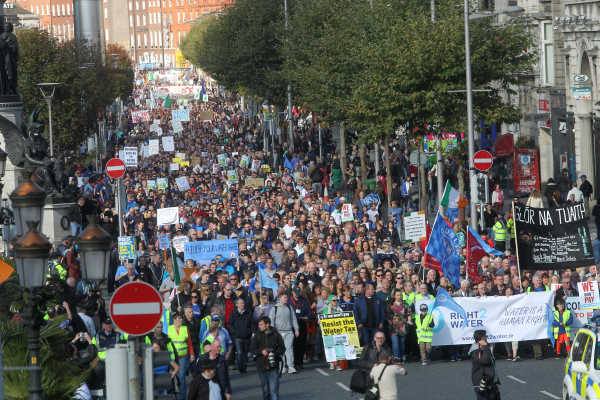
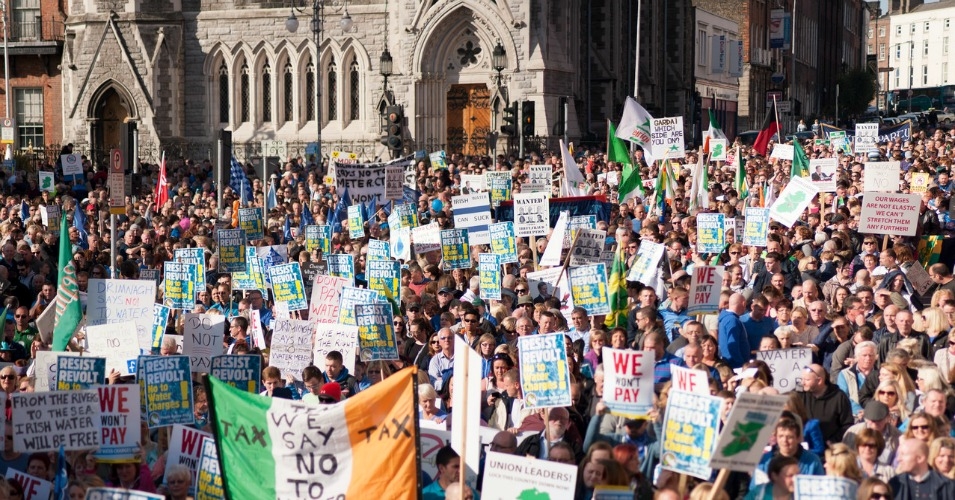
Hundreds of thousands gathered again from far and near; banners were on display from the West, South, North-East and North-West, Midlands, and of course many parts of Dublin and the East coast.
The main march columns started off from two train stations: Connolly Station, to the east of the city and Heuston, to the west. The latter contingent crossed the river at the station then marched eastward towards the city centre along the southern quays while the other marched westward along the northern quays and then crossed the river to the north side further upriver (Essex Bridge) and turned towards the city centre. Both columns had contingents and individuals joining them en route while others went straight towards O’Connell Street, they were greeted by a musical performance from the main stage by Don Baker and other musicians, also a performance by a rapper.
Aerial shot of rally in O’Connell Street (photo: Communities Against the Water Charge)
STATE REPRESSION
State repression was focused on at times: the Jobstown 23 banner got strong applause from bystanders at various points along the route, another banner denounced Garda violence including pepper-spraying and a number of speakers spoke about Garda repression, including one who talked about the Special Branch opening files on anti-water tax resisters.
This banner got strong applause from bystanders at various points along the route
As usual on large demonstrations of this kind, the Gardai refrained from violence or bullying and in fact were in very low profile, in stark contrast to their behaviour and numbers when dealing with smaller numbers in local resistance to water tax and the installation of water meters.
ELECTIONS, TRADE UNIONS
Among the speakers there was of course much mention of elections and getting rid of the current capiltalist government and also statements about the fight for the Republic in history, compared bleakly to the situation in Ireland today with unemployement, emigration, cuts to services, homelessness, privatisation. John Douglas, Gen. Secretary of Mandate and President of Mandate covered many of those issues, including the Dunne’s Stores dispute and the sudden closure of Clery’s in a rousing speech. However, those two are cases in point illustrating the weakness of the Irish trade union movement today: Mandate had one day’s strike in Dunnes’ many weeks ago and have won no gains as yet, while Clery’s managed to sack their workers without the union leading even a sit-in to hold the building and stock as a bargaining chip
Belfast Trades Council banner on the demonstration — they also had a speaker on the platform
A new presence on this demonstration was Belfast Trade Council, who were made very welcome and who had a speaker on the platform. He said that there was no EU directive to tax the water and that in the Six Counties they had defeated the water tax. He was not long speaking when the heavens opened and rain poured down on demonstrators and bystanders alike.
SUMMARY
What today showed is a strong will to resist across the country and across a great age spread, but with noticeably lower numbers across the teenage and young adult band, as well as a relatively weak leadership of the movement.
It remains to be seen whether RTÉ and newspapers will give a reasonable estimate of the numbers and coverage or instead do the usual of quoting ridiculously low figures or remain vague about them while giving minimal space to what was a large event, with participation from around the nation, as part of the biggest civil disobedience campaign in the history of this State.
End
Video of unaccompanied rapper Stephen Murphy at rally
At the Mayo v. Dublin GAA football game in Croke Park the following day, on Hill 16 (Photo from Right to Water FB page)
(Postcript: In their on-line report, RTÉ showed a photo of a packed O’Connell St. and said the organisers were claiming around 80,000. Also, at the Dublin GAA football match of Mayo v. Dublin the following day in Croke Park, attended by Enda Kenny, whose seat is in that county, Dublin supporters unfurled a giant banner of Right to Water).
NB: This article was written about the 11th October 2014 demonstration but arrived too late to use. Normally that would mean it just getting binned or at best getting mined for useful bits to put in a future article. However, the decision is to use this now in the run-up to the forthcoming demonstration at the end of this month against the water tax.
The size of the turnout for the anti-water charges demonstration in Dublin on Saturday 11th of October must have been something of a shock for the Irish ruling class and for their current government, the Fine Gael-Labour coalition. The implementation of water charges forms an important part of their programme to make the ordinary people pay for the crisis caused by financial and property speculators. Other parts of this programme that people have been experiencing to date over the last few years (and including the Fianna Fáil government preceding this one) have been bailing out the banks and their bondholders, financed first through the Household Charge and, after that was defeated by massive resistance, the Household Charge taxed through the Revenue Department; then the pension levy on public service workers; followed by the extensive cuts in social spending at the same time as implementing the “Social Charge”.
Marchers heading southward after leaving the Garden of Remembrance/ Parnell Square area (RTÉ tried to play down the figures to 30,000
The ruling class and their government are of course well aware that the water charge is unpopular among the vast majority of the population – supporters of the tax have failed to convince the people that it is anything but another way of “paying the bankers”. But the unpopularity of a measure is no guarantee whatsoever of wide-scale mobilisation against it and the Government was probably expecting the resistance to meter installation to remain local, marginal and uncoordinated. Clearly this was one case where “Ní mar a shíltear a bhítear”.
But the size of the demonstration surprised not only the ruling class and their government but also anti-water charge campaigners themselves. “I thought we’d be doing well to get 15,000” said one long-time community activist and “If we got 50,000, we thought it would be brilliant” according to an activist from one of the political groups active on this issue. A realistic estimate of the attendance at the demonstration on Saturday puts it at between 100,000 (as quoted by an unnamed Garda source to an Irish Times reporter) and 150,000. The march from the Garden of Remembrance heading across the river before turning again towards the GPO took over one-and-a-half hours to pass a fixed spot in O’Connell Street while another large number reportedly marched from another direction also toward the GPO.
So how was it that so many mobilised?
Any attempt to answer the first question must be speculative but there are a number of indications other than the widescale unpopularity of the water charge and any measure seen as “bailing out the bankers”. One of these is the highly-publicised police repression of local protests against meter installations in a number of Dublin areas, where the population is overwhelmingly working-class and lower-middle class. These protests and the police repression, completely ignored by the national mass media, however received widescale publicity through social media, with videos posted on Youtube, Facebook and Twitter. And the people sharing and sometimes posting these reports and images were for the most part not political or even community or trade union activists. Another source tapped was that of past mobilisations against the Household and Property Taxes. Much of the mobilisation took place in small to medium-sized communities where for the most part, unusually but according to my sources, the activists promoted the resistance and the demonstration rather than their own political party or organisation.
“Apart from a few political activists, only the middle-class mobilise through Facebook”, said long-time political activist to us about a year ago. “Who cares how many ‘Likes” on Facebook an event or campaign gets – it doesn’t mean anything!” said another. Rebel Breeze would have agreed with them too, knowing that the way to mobilise working class people was mostly through personal contact, door-to-door and workplace leafleting. But it seems that is no longer true and that working people, who previously used Facebook only socially, have now begun to use it politically too.
An aerial view down towards the rally after the march at GPO/ O’Connell St
Why did it surprise even the campaigners?
So much for how such a large number came to protest. But how is it that the campaigners themselves were taken by surprise? Of course there may have been unexpected mobilisations in some areas where campaigners had not been active but the main reason for their surprise is almost certainly their lack of coordination. Their are a number of Left organisation and “dissident” Republican organisations campaigning against the water charges, along with a large number of independent activists of a mainly political or community background. In some areas Sinn Féin activist have been out too, although the party does not advocate non-payment or prevention of meter installation.
In a united campaign where all the activists worked towards a united mass resistance, sharing information, the numbers would not have caught them so much by surprise. Of course, their expectations might have been exceeded but each group would have been aware of the actions in other groups’ areas along with the massive rise in Facebook hits, “Likes” and “Shares” to postings of resistance and police repression. Such a united campaign against the water charge does not yet exist. A previous attempt to float such a united campaign on the Household and Water Charges foundered on a number of rocks – political party opportunism, social democratic illusions and the failure of the traditional Left to engage with the independent activist constituency and the “dissident” Republican movement probably being the main ones.
There are a number of attempts to portray the active resistance to the Water Charge as spontaneous but it is likely that where there have been no campaigners active locally, the people have responded to what they have seen elsewhere, both through anger and encouragement. On the other hand, any attempt by any group or individual to take the credit for the growing resistance or for the mass attendance at the demonstration would have to be laughable.
The “passive Irish” jibe refuted once again
Rebel Breeze has long been tired of the wailing often heard to the effect that “the Irish are not like the Greeks”, or that the Irish are passive, accept all kinds of shit without resistance, etc. etc. With the history of class and national struggle of the people of this island it is extraordinary that such an notion ever gained wide acceptance among commentators – but it did. The Irish working class has generally responded militantly and enthusiastically when they have been called to battle by what they consider a credible leadership. In Ireland, that leadership was the trade union movement and no other. In 1913 a fighting trade union was forged in Ireland and, when the employers tried to break it, the workers of Dublin (mostly) fought that attempt for up to eight months, in a city of wide-spread poverty and with most charity services discriminating against strikers and their families. In that struggle, the workers faced also the hostility of the media and state (not much has changed there) and of the main churches. Although defeated in that struggle, the union did not break and came back years later stronger than ever.
Deprived of revolutionary and militant leadership, the movement nevertheless maintained a fighting front for workers through decades of high unemployment and emigration. But in the mid-1980s the trade union leadership opted for what they called “social partnership”, an arrangement in which employers, trade union leadership and the State (which is also a huge employer) sat down and agreed the salary levels for the next period. This had a disastrous impact on the trade union movement. “Use it or lose it” is a general physiological rule about muscle : the trade union leadership became unused to strike action and, when strikes did occur, to instructing members of unions not directly involved to pass the pickets. Recruitment fell dramatically and, when in 2010 the employers and State no longer saw any point in negotiating with the trade union leadership, as they believed the leadership to be no longer capable of resistance, the latter lacked the spirit and confidence to take them on. After a demonstration called by ICTU with a threat of a general strike days away, which received a massive response from trade union members, the leadership instead opted for more negotiations, in which they agree to the pension levy on public servant workers and industrial peace in the private sector: Croke Park I (June 2010). So the workers no longer have a leadership they consider credible and the revolutionary and radical socialist organisations are too small to be thought credible and also have not generally built bases within the trade union movement from which to offer a leadership for struggle.
Nevertheless, the working people of Ireland turned out in huge numbers once again on Saturday to protest an unjust tax which is being used for an unjustifiable purpose. The class is still there, it never lost its fighting spirit – what it needs is a viable leadership. It remains to be seen whether this will be built and whether it can lead a broad militant movement against this tax and other attacks on the working class, without repeating the errors of the recent ‘broad movements’.
A Derry schoolboy has been subjected to emotional blackmail and pressure by his school to sign a “peace scroll” and, arising out of an altercation over his refusal in which it was alleged he was being “sectarian”, was sentenced to two after-school detentions. Why is he being treated in this way, what is this “peace scroll” about and who is promoting it?
According to Pauline Mellon, writing about it in her blog, a boy in her Derry community in September last year was pressured by a teacher in his school to sign a “Peace scroll” with which a Reverend David Latimer is trying to create a world record with the number of signatures. “The child was told by a teacher that he would be ‘the only child in the North not to have signed’ and was further questioned as to whether his refusal was sectarian in nature.” Not surprisingly, the child reacted to this suggestion and used a word for which the school seeks to discipline him.
“The school has a policy (on “abusive language”) which makes no provision for contributing factors,” says Pauline Mellon. However, although the school Board is sticking to the letter of their policy in this regard, they seem not quite so rigorous in upholding their own procedures in other respects.
“When the parents questioned the School Principal over his decision to impose two detentions and what circumstances if any he had taken into consideration, the Principal immediately cut off communication with them and escalated the issue to stage 4 of the school’s complaints procedure. Stage 4 of the school’s complaints procedure requires a written submission to the Chair of the school board from parents.”
Although the parents at this stage had made no such written submission, a sub-committee of the School Board declared that they had investigated the complaint (from whom?!) and upheld the Principal’s decision.The sub-committee had decided to use as “a written submission” some letters written by the parents to the Principal after he refused meet them, thereby violating the parents’ rights to prepare their own submission if they wished to go to Stage 4 of the Complaints Procedure and, indeed, violating the terms of the Procedure itself.
As if to underline their casual attitude to their own procedures, the School Board wrote to the parents to outline their “findings” without even using the school’s headed paper. When this was pointed out to them, the Board apologised for sending the decision on plain paper and said it would not happen again. However, there was a much more significant breach of their procedures, in that the sub-committee had kept no minutes of their meeting, about which the parents have learned only recently. Then when the parents did actually submit a level 4 submission, it was totally ignored.
As Pauline Mellon observed, the Chairman of the Board was in breach of his duties according to “Department of Education guidelines which state that the chairperson has responsibility for all meetings and must ensure that minutes of ALL meetings are retained.”
One can imagine the impact of a comparable chain of events on any individual, let alone a child studying for his GCEs. The parents took him to a counsellor, after which they wished to discuss the counsellors’ report with the boy’s form teacher. The Board prevented this meeting, confusing the counsellors’ report with the parents’ “ongoing issues with the Board”.
Nine months after the first incident in this chain of events, the Board invited the parents to meet with them. The parents brought along an observer and the Board refused to allow the meeting to go ahead with the observer present and when the parents protested, they were escorted off the premises, witnessed by an Independent local authority councillor. The Board in this case is the authority and has the power and the school is also their territory. There are a number of people on the Board. In summary, they held the advantages of power, territory and numbers – yet they refused to allow two parents to be accompanied by an observer to support them (and at a later date to bear witness to what went on, should that become necessary). One must wonder what they had to fear in allowing this one additional person …. and why.
The School Board has a Parent’s Representative on it – the parents of the child sought a meeting with this person, not once but a number of times, but the person concerned has so far failed to meet with them. This is indeed extraordinary – how can anybodfy discharge their duties as a Parents’ Representative to the Board if they refuse to meet with parents who are in dispute with the Board?
There is a body which governs Catholic schools, of which the school in question is one – the Catholic Council for Maintained Schools (CCMS). This is an organisation of the Catholic Church but receives public funding through the Northern Ireland Executive. The parents took the issue to that Council. The CCMS admitted that headed paper should have been used in writing to the parents and commented that the school’s Board had not fulfilled their role; they also noted the parents’ attempt to discuss their child’s counsellor’s report with his form teacher but would not comment on whether the refusal would be normal practice. All in all, the CCMS considered that the Board’s actions of using a letter to the Principal as a submission and refusing the parents the right to submit their own Level 4 submission were “reasonable” and “in accordance with School policy”.
Presumably in their deliberations, the CCMS had discovered that the Board’s sub-committee had failed to keep any minutes but left the parents to discover this through other means at a later date. At a later complaint to the CCMS, the Council refused to acknowledge the failure of the School Board’s Chairperson in ensuring minutes were kept, as laid out in the Department of Education’s guidelines. Finally, the CCMS denied that any breach of the child’s rights took place.
The Chairperson of the CCMS is Bishop John McAreavey, who according to Pauline Mellon, has not even had the decency to acknowledge or respond to two separate letters the parents of the child in question sent to him. This was in contrast to the Bishop of Derry, Rev. McKeown who replied to the parents after they wrote to him. “Bishop McKeown who has knowledge in these matters agreed with the parents that a common sense approach should have been taken and expressed concern that such a small matter had used up so much time and energy.”
Pauline Mellon takes a similar line in concluding her article: “… a matter that should have never made it outside of the school assembly hall from the outset has exposed the School Board in question as being ineffective, unprofessional, non-transparent and unaccountable. It has exposed CCMS, a group acting under the wing of the Catholic Church, as not having learned from previous incidents when the Church has closed ranks and has attempted to silence people.”
As to the Rev. Latimer himself, the promoter of the “Scroll” signatures, although he promised the parents to look into the matter, they have heard nothing from him since.
Who is the Rev. David Latimer?
According to the Department of Education of Northern Ireland, Rev. Latimer is “a visionary”, for which term they offer no explanation apart from his Guinness Book of Records bid for “most signatures on a scroll” and his promotion of it in the schools. http://www.welbni.org/index.cfm/go/news/date/0/key/922:1 Indeed, it is amazing that 84 schools have signed up to the project, as the article says on their website – even more so if none of those saw any wording to endorse and to which to encourage their children to subscribe (see further below).
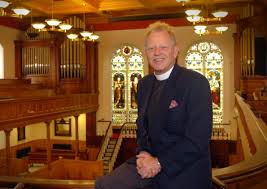
The Rev. David Latimer, photographed in church
David Latimer was a systems analyst with the Northern Ireland Electricity Board and married before he decided to become a cleric. He did so in 1988 and is now Minister of two churches, the First Presbyterian in Derry’s Magazine Street and the Monreagh Presbyterian, established in 1644 across what is now the British Border in Donegal.
In 2011, David Latimer was invited to address Sinn Féin’s Ard-Fheis and did so. On that occasion he said, referring to Martin McGuinness, that they had “… been journeying together for the last five years and during that time we have become very firm friends, able to easily relax in each other’s company.”
Rev. Latimer went on to say that “The seeds of division and enmity that have long characterised Catholic and Protestant relations were neither sown in 1968 or 1921 but during the 1609 Settlement of Ulster. Mistrust and bad feelings resulting from the colonisation of Ireland by Protestant settlers were followed by centuries of political and social segregation. Partitioning Ireland did little to ease sectarian mistrust and separateness between Protestants and Catholics left in the 6 counties as each community continued to be defined by its particular religious affiliation with little mixture between the two groups.”
The impression given there is of some peaceful colony of Protestants arriving in Ireland around 1609 which led to “bad feelings” and “mistrust”. No mention of the seizure of land from the Irish and their expulsion to the hills or abroad. No mention of the suppression of the religious faith of the majority and the imposition of that of the minority, centuries of discrimination, theft of land, genocide. One can see that this might quite rationally give rise to “bad feelings” and “mistrust”. No mention of the actual promotion by the British of sectarianism and the creation of the Orange order, with the intention of breaking up the unity between “Protestant, Catholic and Dissenter” of the United Irishmen at the end of the 18th Century.
It was again reasons of “little mixture between the two groups” which Rev. Latimer went on to blame for the recent 30 Years War:
“Little wonder this part of Ireland descended into a spiral of communal disorder and violence that was to last for decades. Victims of differences, extending back across trackless centuries that have isolated us from one another it is, with the benefit of historical hindsight, not surprising that our two communities should view each other with suspicion and regard one another as ‘the enemy.’”
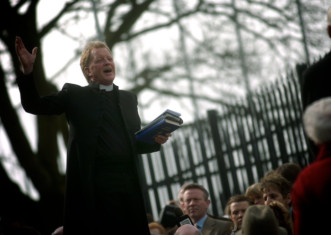
Dr David Latimer, First Derry Presbyterian Church, conducts a redediication ceremony on the City’s fortifications, “Derry’s Walls”. Photo: Stephen Latimer
Did the Catholics and Protestants go to war with one another in the late 1960s or at any time during the 30 Years War? No, what happened was that Catholics demanded civil and human rights of which they had been denied in that British colony-statelet since 1921; the state forces tried to suppress their peaceful campaign with batons, tear gas and bullets; right wing and sectarian forces among the Loyalists were mobilised and burned Catholics out of their homes and murdered some. The British Army were sent in to support the “Northern Ireland” sectarian police and the IRA came into limited action to counter them, after which hundreds of “nationalists” were interned without trial, followed by escalation of IRA action, the Paratroopers’ massacres in Derry and in Ballymurphy, and so on.
In fact, Latimer’s false account of history has been the standard British ruling class’ version to justify their war in Ireland for foreign consumption and to the British population throughout those years: the reasonable British with the thankless task of keeping the two tribes apart.
I found the content of the Latimer’s speech on SF’s website without an account of the audience’s reaction but according to the Irish Echo, an Australian on-line newspaper, it “received a rapturous reception from the republican audience”.
Reverend David Latimer and the British Army
Pauline Mellon says that according to the parents, “the child based his decision not to sign the scroll on Rev Latimer’s service in the British Army and with him being stationed in Afghanistan. The child also raised concerns over what he views as Reverend Latimer’s “selective” approach to local human rights issues.”
Surely the boy is mistaken? At least about him having served with the British Army? Well, actually no. In June 2008 Rev. Latimer gave an interview to the Derry Journal to explain why he felt justified in going with the British Army to Afghanistan although he had to “wrestle with his conscience”. Presumably he is an accomplished conscience-wrestler by now since he also admitted to having participated in other British Army missions for more than 20 years.
“It would be against my nature to be part of something that is creating destruction or generating pain or grief within any community”, he was quoted as saying. “The only way I can reassure myself in being part of this is that I am involved with a unit that is going out to provide resources to people who have no choice but to be there because they are under orders.”
Who are they “who have no choice …. because they are under orders”? Ah, yes, the soldiers, pilots and drone technicians who have invaded another country, killing those who resist and generally intimidating the population. Leaving aside the spurious question of “choice”, does one help justice by administering spiritual comfort to an invading army? To whom does one have a greater moral duty? The answer is clear I think and if one lacks the courage to stand up for the population the least one could do is not to offer comfort to their invaders.
Put perhaps Rev. Latimer intends to be some kind of Camillo Torres, preaching for the poor and castigating the wrongdoer? No, of course not. Well then, perhaps subtly undermining Army propaganda? He invites us to think so: “In the quieter times, I will be around for people who will have questions about what they are doing there and about God. I might not have all the answers but I am there to give a view different to the Army view.”
In what way his view might be different to that of the Army he once again fails to explain, or to inform us whether his views were also different on the other more than twenty occasions in which he served with the British Army previously. Surely if he were intending to undermine Army propaganda, he’d hardly be telling us and the Army in a newspaper interview!
He tells us the hospital he’ll be working in over there will be treating Afghanis as well as British servicemen. Hopefully, they will be treating Afghani victims of torture in British and US Army prisons as well as children given a beating in the barracks. He won’t be trying to convert the Muslims to Christianity, he tells us. And I think we can believe that, since abusing people’s religion, their culture, customs, raiding their houses and generally intimidating them is hardly likely to incline them towards one’s religion.
Going on to discuss the possible dangers he would face, Rev. Latimer informs the readers of the Derry Journal that “We know the (military) base is likely to be attacked and we will undergo training in how to deal with chemical, biological and nuclear attacks.” He need not worry, the Afghans don’t have any of those weapons. However, he should exercise caution should he ever have cause to pass through the special arms stores of the British or US military, who do indeed have precisely those weapons and, furthermore, have used most of them in warfare at some point.
“I will receive some weapons training, although this will be limited on how to disable a gun and make it safe.” Useful, just in case any member of the Afghani resistance accidentally drops a gun …. perhaps when calling on the Reverend to make enquiries about the philosophy of the Christian religion.
“Peace” and “Peace” Treaties and Agreements
The vast majority of people would say that Peace is a good thing; despite that, “peace” remains a problematic concept and not one upon everyone can agree. And “peace” is also frequently being promoted in some part of the world by some of the most warlike states with the most horrifying armaments. For those in power, the invoking of the word “Peace” can be a powerful way of invalidating resistance, silencing dissent and of justifying the status quo which has been achieved through vanquishing the enemy in battle or by the recruitment of collaborators in the enemy’s leadership.
During WWI, the British and the French concluded the secret Asia Minor Agreement (also known as the Sykes-Picot Agreement), with the endorsement of Imperial Russia; the Agreement divided the Arab world between the French and the British should they succeed in beating the Ottoman Empire. To the shock and embarrassment of the imperialists, the Bolsheviks published the terms when they took power in 1917. Although this Agreement was intended to bring “peace” between the competing British, French and Russians, it has been in part the source of many wars with others, as well as coups and uprisings in the Middle East since then.
“Peace” does not mean the same to all: many of the British and French public during WWI would have said that “peace” meant defeating the Germans and Turks, conversely many Germans and Turks would have thought the direct opposite. The Russians mostly wanted an end to the War so “Peace” was one of the most popular of the Bolsheviks’ slogans for their October Revolution, after which they pulled Russian troops out of the War; it was one of the reasons so many soldiers and sailors sided with them.
The end of the First World War brought “peace” and “peace treaties”; among these was the Treaty of Versailles between Britain and France on one side and Germany on the other. In effect, the principal victors screwed Germany for war reparations, occupying the industrial Ruhr Valley. Many historians agree that the Versailles Treaty was a contributory factor to the later rise of the National Socialist Party (the “Nazis”) in Germany and also to the Second World War.
After WWII, the “peace” treaties divided the world largely between the USA, the British, the French and the USSR. Some aspects of that division led to two big wars — the Korean and Vietnam Wars – and a host of smaller ones. The USA has fought 20 military engagements since WWII; the British have fought 28 and the French have been directly involved in 15 military actions or wars (these figures do not of course include the wars and coups fought by the many proxies of these powers). Furthermore, not one of those wars was fought on the territories of those states and, in most cases, took place far from them.
To look for a moment further than the three world powers above, Sri Lanka had a war going on inside it since 1983 and had peace talks a number of times. The origin of the war was the communal differences and inequalities promoted by the British when they ruled Ceylon as a colony and continued by the Sinhalese majority Government afterwards. In 2008, the ruling Sinhalese Government decided on all-out war and, abandoning the mutually-agreed ceasefire, surrounded the Tamil Tigers’ “liberated areas” with a ring of steel through which no-one could pass. They then subjected the areas to indiscriminate continuous shelling and air bombardment before sending in their troops, wiping out most of the opposing guerrillas but also thousands of civilians. According to UN estimates, 6,500 civilians were killed and another 14,000 injured between mid-January 2009. The Times, the British daily, estimates the death toll for the final four months of the war (from mid-January to mid-May) at 20,000.
There’s peace in Sri Lanka now, all right — the peace of the grave.
Sri Lanka’s “peace” is similar to the one that followed the 1798 Rebellion in Ireland – that was “peace” after a defeat of the Irish Republican forces by bloody suppression and rabid sectarianism. Of course that “peace” was temporary only (as Sri Lanka’s will no doubt prove to be too) and was followed by other brief uprisings in 1803, 1848, 1867, the Land War 1879-’82, 1916 Rising, the War of Independence 1919-1921, the Civil War 1922-’23, the IRA campaign during WWII …. The partition of Ireland as part of the 1921 Agreement was supposed to bring peace to both parts of the country but again it proved to be a temporary one.
Despite the sectarian riots burning Catholics out of their homes and the wave of terror and repression by the Six Counties statelet in the early 1920s, conflict broke out again with the IRA’s Border Campaign of 1956-’62. In 1967 the Civil Rights campaign in the Six Counties began; the repression with which it was met by State and Loyalists caused the uprising of the Catholic ghettoes of Derry and Belfast afterwards. Then more repression, more resistance, then troops, then 30 years of war with the British Army and colonial police against the Republican guerrilla forces. The Good Friday Agreement claims to be bringing peace but history – and the ongoing repression of dissent by the statelet’s forces — indicates otherwise.
One of the reasons that peace is not necessarily brought by treaties and agreements is that they are themselves intended as temporary measures: by both parties, as in agreements between competing imperialist and colonialist powers, or by one of the parties, for example by the US Government in the case of the Native American Indians. Or they are violated by succeeding governments, as in the case of William of Orange’s promises in the Treaty of Limerick. Or they don’t deal comprehensively with the underlying causes of conflict, as with treaties and agreements between Britain and Ireland in general.
In fact, when a colonial or imperialist power seeks an agreement or treaty with a people or a weaker nation, what it is seeking is not usually peace but pacification – it wants an absence of conflict, or of resistance, so that it can continue extracting the benefits which it was doing before the people began to resist.
Or sometimes, the stronger power wants merely to delay things, to “buy time” until it is expects to be in a better position (and its opponent perhaps in a weaker one) than that which it was at the time. In 1925 the British Government intervened in a conflict between the mine-owners and the miners in Britain, paying a subsidy for nine months to prevent the miners’ pay from dropping. During that period, the Government laid in stocks of coal and bought up newsprint to prepare for a big battle with the miners’ union in particular. In 1926 they took on the British trade union movement and succeeded in forcing the TUC to call it off the General Strike within nine days of its beginning, leaving the miners to fight on alone for eight months until they were defeated.
So what kind of “peace” is being promoted by the Reverend Latimer? Some detailed plan, or some wishy-washy generalisation? That is not an easy question to answer. It is known to be an attempt to get into the Guinness Book of Records by having the most schoolchildren sign it which many have done, including in Donegal and Derry. Is it just a publicity stunt, where people sign up to some vague notion of “peace” which can mean one thing to one person and something completely different to another? What is the context for this “scroll”? “Peace” between whom and on what terms? Or is there a political agenda, as there was in the campaign around the Good Friday Agreement?
The Scroll’s FB page does not explain and the parents have not managed to find out; in addition a number of Google searches of mine failed to turn it up either. What is known about its origins, perhaps the only thing apart from it aiming at a world record, is that it is being energetically promoted by Rev. David Latimer. And as we have seen, he goes on British Army missions and his role in all this is far from clear.
Schools in our society
Coming back to where we began, the pressure and attempted intimidation of a schoolboy is wrong and should not have been inflicted on this boy (and on who knows on how many others). It should not have been but it was and, when the parents objected, the agents of that blackmail, intimidation and repression should have backed down. And if they refused to back down, the managing agents, the School Board should have upheld the parents’ objections. And if they did not, the Catholic Council for Maintained Schools should have done so. All of them failed to do what was right.
As adults, we tend to see schools as neutral institutions, some with good standards, some not so good, with a continuum of teachers ranging from great to abysmal. Schools however do play a role in socialising children to accept authority and discipline outside the home and also into accepting ideas dominant in the society in which the school is located. Seen in that light, we should perhaps be less shocked at this treatment of a boy and his parents.
However this Guinness Book of Records project is not even part of the school’s official program nor of the State’s curriculum and it was the boy’s resistance to the undue pressure brought to bear on him that sparked the verbal response for which he is now being ‘disciplined’ and which he and his parents are resisting.
If the school were an institution dedicated to real learning, it would encourage questioning, even though its teachers and managers might find that uncomfortable at times. It would value courage and principle and instead of persecuting this boy, would encourage him and value his principled stand, his courage and his persistence. But instead it does the opposite and because the boy’s parents do value their child’s principles and courage and want to support him, they also find themselves in conflict with the school.
Such small-scale battles go on constantly everywhere in our society, in institutes of education, in workplaces, in other organisations and associations, in communities. People fight those battles, often on their own or in little groups, or they fail to resist; whichever they do will affect their individual character and their social and political attitudes thereafter, one way or the other. Drawing on those lessons can lead to understanding more general truths about society and can also help to develop the strength of character to withstand psychological and other bullying and pressure at other times in life. Fair play to the boy for his principles and the courage to stand up for them against authority figures and fair play too to his parents who are supporting him.
COURT HEARS OF INTIMIDATION OF FAMILIES OF ACTIVISTS BY GARDAÍ AND SHELL SECURITY MEN WEARING BALACLAVAS
By Pat Cannon
I was present in Castlebar court house for most of the ten-days of the trial of Gerry Bourke and Liam Heffernan who are Shell To Sea supporters and activists. I witnessed at firsthand how tax-payers’ money can be wasted at will by the agents of the state i.e. Gárdaí (the Irish police), State solicitors, the Dept. Of Public Prosecution, the Judge, court officials, State barristers and other hangers-on.
Numbers involved:
( 1 ) Judge ( 1 ) courtroom user ( 2 ) Stenographers ( 1 ) Prison officer; ( 1 ) Gárda on video evidence ( 2 ) State Solicitors ( 1 ) Senior Counsel for the State ( 1 ) Junior Counsel for the State; ( 2 ) Solicitors for the Defence ( 2 ) Senior Counsel for the Defense ( 2 ) Junior Counsel for the Defence; ( 12 ) Jurors ( 12 ) witnesses at least. Also the secretarial staff of all parties, including the DPP Office staff working on the case, also the cleaners and the other Court staff.
First of all if the State and the oil companies had initially negotiated with the locals, probably there would have been no need for these quiet citizens to have to rise up in protest against this project. A much safer and easier route for the pipe line would have been found as the locals have an extensive knowledge of this area. If the state (and its Government) had negotiated a reasonable deal with oil companies then there would be much less protestors. If proper health and safety regulations backed up by staff and equipment were in place from the start, people would feel much safer and secure in their homes. BUT NO! THE SHARKS DON’T NEGOTIATE — there is no room for compromise in a shark’s make-up.
SHARKS
Right from the start, the Government, the oil companies, the Environmental Protection Agency, County Council, media, Judiciary, Gárdaí and every other arm of the State treated the local people with disregard, contempt and as a complete irrelevance. As far as all the above-mentioned were concerned there was big money to be had and no small fry was going to get in the way. THERE WAS BLOOD IN THE WATER AND THE SHARKS WERE IN FOR THE KILL.
Thankfully there were 2,500 years of tradition and history still alive and well in this area, there was a quiet shy population but of people with a strong backbone that were well hardened into hardship, neglect and resistance to outside dictatorship and who were not going to be bullied or pushed about by anybody.
The rural area chosen by Shell for the pipe-laying (planned to run between shed on the left of photo and house on the right)
It was this stern backbone that caused a middle-aged primary school Principal teacher and her two daughters, backed up by less than a half-dozen other locals to take a stand and start protesting against the potential desecration of this EU Environmentally Protected Area and their local pristine environment. Of course they were ignored, the media never mentioned them; the oil company’s employees and officials looked the other way and probably had a good laugh as they passed, the Council and all the other arms of the State treated them as non-entities. As far as all these groups were concerned the local people were of no significance.
However, the time came when these officials had to get into closer proximity with the local people; they had to enter the local people’s land and they thought they could do this without permission, by bullying and using threats but soon discovered how mistaken they were. They learned that they were not just dealing with a few individuals or a few head cases but instead that there was a whole community in this locality and that this community was close-knit and resolute in their opposition to outside intimidation and coercion.
With little or no advance warning the oil companies’ employees entered the farmland of six local farmers without the owners’ consent and proceeded to dig trial holes, knock down boundary fences and block access to and from the land in question. Naturally enough the farmers contacted their legal advocates and very quickly they were in court for the first time in their lives.
Of course the Courts and Judiciary are also an arm of the State and are also commercial enterprises just like the oil companyies and they ruled in favour of the foreign multi-national companies. After all small local marshland farmers can’t afford to give big financial enticements to Court judges, politicians and Government officials but on the other hand the oil company will be very generous as has transpired since.
JAILING OF THE ROSSPORT FIVE
The six farmers, five men and one woman were found in “contempt of court” and the five men were jailed until they “purged their contempt”. This lead to an outcry all over the country and hundreds of thousands of people came to the assistance of what became known as “the Rossport Five”. Ninety-four days later the Courts had to capitulate and release all of the five innocent men.
However the scene was set for what would become a marathon David and Goliath battle between a small close-knit indigenous rural Irish community and three foreign multinational oil companies, one of which had a larger turnover than that of the whole Irish State even though the latter was experiencing an unprecedented economic boom.
Gardai defending Shell confront protesters
Thirteen years after the middle-aged school teacher and a handful of supporters stood outside the local council offices in protest the struggle is still going on and the oil companies and Irish Government are still trying to bully their way through the Irish people.
However, the Government’s economic boom has disappeared and the people now realize that if they still had their oil and gas that was fraudulently misappropriated by the Irish Government and the oil companies, we would have NO EVICTIONS, NO CENTENARIANS ON HOSPITAL TROLLIES, NO EMIGRATION, NO UNEMPLOYMENT AND NO STEALTH TAXES.
IN THE COURT RECENTLY
So in these last two weeks I witnessed the State trying to criminalise two more supporters of the struggle; we saw video evidence showing that the men had to use considerable force to gain entry to Shell’s site and when confronted by Shell’s private army (security force) the protestors had to stand firm and use a variety of tactics to get past them. We heard State witness after State witness tell lie after lie or refuse to answer or evade answering questions when they were put in the witness box, then the Defence were not allowed show their video evidence and some of their witness were not allowed on the stand.
Shell security team manhandle a protester.
I heard how Shell’s private army drive around the villages at night in two jeeps with blacked-out windows and shine their lights through the windows of activists’ homes, whilst if anybody comes out of the houses then four men wearing balaclavas step out of each jeep in an act of intimidation. We heard how the Gárdaí constantly drive past the people’s homes very slowly and then turn around a mile or two up the road just to drive past again five minutes later and hjow each time they pass, they stare into activists’ homes.
I heard how the Gárdaí punched, pushed, kicked and beat with steel batons men, women and children, how many activists spent long terms in prison on trumped-up charges while Shell plied the Gárdaí with over €35,000 worth of alcohol. I also heard how a Gárda made derogatory remarks of a sexual nature about a protestor’s wife to the protestor and how five Gárda were unwittingly recorded on a female prisoner’s video camera planning how they would interrogate her when they got her to the Garda station by threatening to rape her and laughing at the different ways they would word the threat. ALL of them got away with ALL these misconduct events.
Gardai caught on camera in action at Rossport
I heard how while car tyre contains on average 2 bars of air pressure per square inch, that this gas pipe had 345 bars of highly inflammable gas pressure per square inch, that the seas and sea bed are highly vulnerable to currents (the second most volatile currents in the World).
I also heard the accused man’s wife state how for 13 years while she was rearing her family she could think of nothing from once she got up in the morning till she fell asleep at night but this dangerous gas pipe line that would be practically going by their front door and over which she had to take her children to school every day.
In a statement to the Court, one of the Rossport 5 gave evidence that Michael D. Higgins (now Uachtarán of the Irish state) had been on the protest and had addressed the other protesters, also participated had the father of the State Solicitor prosecuting this case. He also said that Enda Kenny had visited the Five in prison and had told them that life was “very cheap in Ireland now” and that “you can get a man in Dublin to do a ‘hit’ on someone for €500.”
Protesters against Shell in Dublin
In his summing–up the Defence counsel stated that the State agencies had rubbished themselves in the eyes of the world in their dealing with the situation, that the terms that our oil was given away were the second best in the world for the oil companies, that they stated that there were no emergency plan in place if an accident or act of terror did happen and that the protestors had rendered a magnificent service to their fellow citizens at much expense and hardship to themselves by standing up for what is right and correct.
Protest at Shell HQ in Leeson St, Dublin in solidarity with Ogoni people in Nigeria and people at Rossport. The Nigerian Government, to protect Shell’s profits although the company was causing great environmental damage, hanged the nine leaders of the peaceful environmental movement
The Jury of eight women and four men was out for just about one hour when they returned with a unanimous verdict of “NOT GUILTY of violent disorder” on both Liam Heffernan and Gerry Bourke. A further malicious charge of “criminal damage” was dropped by the State because despite there having been 28 cameras on site and up to 30 security men and later a number of Gárdaí, there was no evidence to support the charge.
Just more waste of tax-payers’ money. I have reckoned the tab that the tax-payer will pick up will be in the region of €150,000 and Shell won’t be paying a penny of it.
Maps showing the decline in the Irish-speaking areas, the Gaeltacht, during the life of the Irish state
“Irish is nearly dead as a spoken language.” A shock ran through the Irish-speaking community at the news…. but although the after-shocks reached linguists afar …. the news caused but a small ripple in Irish society at large.
It should have been big news. In only nine decades of the existence of the Irish state, the Irish-speaking areas had shrunk by 90%. This seemed to herald the imminent death of Irish as a spoken language – a language that, albeit shrunk to being the mother-tongue of small minority of the Irish population, had survived almost a millennium of colonial occupation and a consistent policy to replace it with English.
The loss would be greater than Ireland’s alone – this is an early Indo-European Celtic language of more than four thousand years of development, the language of the earliest vernacular literature of Western Europe, an extremely rich literature of pagan mythology and folklore containing epics which did not suffer the extent of moralistic destruction which either the Reformation or the Inquisition visited upon so many others across Europe. The language is probably unique on the Continent in being that of a state and which is also that of the first recorded settlers of the land. It was (perhaps still is) the Celtic language with the largest number of speakers. It is the mother of Scots Gaelic and Manx Gaelic too.
It seemed almost too difficult to grasp that this had occurred in a state that claims to be independent, which also claimed the language as the first in status in the State, according to its Constitution. And this has, seemingly contradictorily, occurred at a time when there are more Irish-medium schools, Gaelscoileanna, than ever before in the history of the State.
How did it come to pass? Emigration, some might say. Certainly emigration on a large scale has been a feature of Ireland’s demographics since at least the Great Hunger (although it was in the years after that disaster that the outlying western areas began to hemorrhage). Even so, although emigration has been a constant, so also has been the population – in other words, the birth-and-survival-rate kept up with the emigration. Did the Gaeltacht areas experience higher emigration rates than elsewhere then? Certainly – not just to go overseas but also to Irish cities, especially to Dublin. Industry was scarce in the Irish-speaking areas, despite the efforts of cooperatives and Gael-Linn and the land in most places is rocky and poor.
The Gaeltacht Death or Life (image downloaded from the Internet)
Yet, the reality appears to be that the Gaeltacht population reached a level at which it stayed – so how can there be a continual reduction reaching 90% in the Irish-speaking areas? If the population has not decreased, certainly not to that extent – then the Irish-speakers must have. Have many ceased to speak the language then, losing it over a generation, or two, or three? Or has an inward migration of English-language-only speakers replaced Irish-speakers? Yes to the first and yes, to an extent, to the second.
The Basques have a saying: “No language was ever lost because people didn’t learn it but rather because those who had it, stopped speaking it.” (As an aside, I find myself wanting to say “her”, because in Irish the word “language” is of feminine gender: “Beatha teanga í a labhairt” — literally “the life of a language is to speak her”). Observers speak of children raised in Irish-speaking families, or in a mixed-language household, even in the Gaeltacht, speaking English with their peers as they leave the primary school where the subjects are taught through Irish.
So, the people make a choice and some people of other mother-tongues move in – that’s democracy, isn’t it? Freedom to move, freedom to speak the language you want. But is it really so? Certainly one can assume that the people moving in are making a free choice (unless one takes into account dearer house prices in the cities). But are the ones moving out making a free choice? If the absence of industry and therefore employment is a constant in the Gaeltacht then it is not an entirely free choice to leave. If the work were there, one can assume many of the people would stay.
Ok, but the ones who stop speaking Irish – surely that is a free choice? One suspects cultural factors at play there. The attractive world for pre-teenager – which is what most childhood years have become — and teenager, is a world dominated by and represented through the English language. It is transmitted in English through so many media …. all with very little competition in Irish. The Irish-language TV channel, TG4 is in practice a bilingual one. Publishers find only a small market for books aimed at children and young adults in Irish, whereas the English-language market stretches not only throughout Ireland but abroad — Britain, the USA, Canada, Australia, New Zealand … All of this without mentioning TV, pop-song lyrics, video games, Internet, films ….
But one must also take into account the fact that when those Gaeltacht children visit their nearby towns and cities – Letterkenny, Dublin, Waterford, Cork, Tralee, Galway, Ballina – they hear English all around them. Worse … they hear only English around them – unless they hear other languages from tourists or perhaps an Eastern European language from migrants. What they are practically guaranteed NOT to hear is Irish.
So, hardly anyone speaks her – sorry, it – and it’s not cool and most people of your age around the country don’t speak the language and what do you need it for anyway? It’s not surprising Irish-speaking is in decline.
“You can’t blame the State – they tried their best, didn’t they? Sure Irish is still a compulsory subject in the schools.” “The national broadcaster has provided a radio station and TV channel for Irish-language use, too! And they give some grants to families speaking Irish in the Gaeltacht, right?”
Ní mar a shíltear a bhítear (loosely translated as “not all is as it seems”. Yes, Irish is taught in the schools but no attempt has ever been made to make it a language of daily use – for work, public transport, banking, shopping, post office, health service, education … Radió na Gaeltachta was won through a civil rights campaign – Feachtas Cearta Sibhialta Muintir na Gaeltachta – and people refused to pay their radio and TV licenses, were dragged to court, fined, refused and some even went to jail before TG4’s precursor, Teilifís na Gaeilge, was supplied. The Irish-speaking grants were a help to households but were not properly administered so that houses that were not Irish-speaking, or had lapsed, continued to receive them. This gave rise to false statistics that helped to conceal the decline in the Irish-speaking areas.
The Gaelscoileanna outside the Gaeltacht, at 143 in the 26 Counties, though an impressive success story, are not State initiatives — they were started by local groups who then battled for state support. Many are still in temporary buildings or in need of repair while others are awaiting the funding that will allow them to employ teachers. As for the other services – nothing. Oh, yes, some of them are supposed to have one designated member of staff who can provide a service in Irish – you can avail of him or her if she or he is not off sick, on holiday, on training or relocated. And if you can wait ….. and put up with the embarrassment while you hold up the queue. Even having one’s address used in the Irish form requires a battle, sometimes drawn out and one still finds one’s letters, from time to time, forwarded from someone else’s address or disappearing somewhere forever. Or discovering that one’s address, which one gave in Irish, has been converted back to English in some office.
A couple of years ago a Dublin court ruled that a man did not have a right to have the case against him heard through Irish. Gardaí are not subject to even the notional obligations to carry out their tasks through Irish or answerable to the Language Ombudsman and, although citizens have a right to have any legally-required procedure in Irish, cases regularly arise of people detained and threatened for insisting on being dealt with through Irish by the Gardaí (police).
Ó Glíosáin showed in research published in the 1980s the decline in Irish-speaking competency among people who had learned Irish at school and who had considered themselves competent speakers upon leaving secondary education. The rate of decline was in the order of a third for every decade passing since they left school. For all its faults, the blame cannot be placed on the educational system, the usual scapegoat. Ó Glíosáin spoke about the absence of “domains of language” for Irish outside the Gaeltacht. In Dublin, with a population of over a million, there is only one social space where everything should happen through Irish. One social space, in the capital of the State, to serve a population of over a million, more than one-fifth of the entire population of the State!
The lack of Irish services obtains even in the Gaeltacht, believe it or not. A man wrote recently of a bank branch in Connemara unable to deal with him making a withdrawal through Irish that asked him to make an appointment. Some years ago, I went to an AIB branch in the Donegal Gaeltacht area and, among a staff of five who were serving customers, could find not one able to give me a service in Irish. People in the Gaeltacht cannot get a decent service in Irish from their local authority, their health service nor, in many cases, their GP. This was so even when, decades ago, many Gaeltacht people hardly knew English.
Anyway, it’s all over now ….
So beat the drum slowly and play the fife lowly ….
Cnag go mall ar an druma is séid ar an fhíf go híseal …
Or is it? Irish has been in difficult situations before and still managed to survive. But this may be its greatest emergency. Can Irish-speaking survive if the Gaeltacht dies? Some say not, some say yes. But it will be without a doubt another great blow to the language and a great fall in its status. We should say NO — we will not suffer that to happen! We will not bequeath a headstone to future generations.
But what can we do?
What can be done – what must be done – must be done by us, each an every one of us, and also by the State. We must accustom the public to hear Irish spoken. Some will respond and some will not. Some will be hostile. But it must be done and WE must do it. And the more it is heard, the more it will be acknowledged, the more people will think it worthwhile to speak what they know, to learn more, to demand services through Irish, to keep speaking the Irish they know. Spreagan Gaeilge Gaeilge – “Irish inspires/ generates Irish”.
We can greet the bus or taxi driver or shop assistant or post office official in Irish and thank them, saying goodbye in the same language. In pubs and cafes we can ask for our drinks, tea, coffee in Irish (we can repeat the request in English if the response seems uncertain; our purpose here is not to embarrass or shame or be superior, only to have the language heard). I know all of this can be done because a few people have been doing it for years. We can ensure our greetings are always in Irish – “the first word in Irish” is a transposition of a slogan from the Basque Country. We can ensure wherever signs, slogans and banners may be, that we provide these in Irish too. Sure, this is the cúpla focal, tokenistic …. but tokens are not to be disparaged; we do not disparage tokens of love and affection. Of course the tokens must be followed by the real practice, just as needs be the case with tokens of love.
Part of a recent lunchtime demonstration outside the office of the Department responsible for the Gaeltacht. It was called by a new incarnation of Misneach, an organisation active in the mid-1960s. (Photo D. Breatnach)
Deasún Breatnach (1921-2007), a founder member of the language-campaigning organisation Misneach, who went to jail in the 1960s to win the right to have his car insurance documentation in Irish or bilingual.
And there are battles that must be fought with the State, with local authorities, with utilities and service providers including private companies. Both logic and history make it clear that this is so. I have already alluded to the civil rights campaign in the Gaeltacht areas and the refusals to pay radio and TV licenses. In the 1960s a Dublin man asked Norwich Union to supply him a bilingual vehicle insurance document or one in Irish. The company declined. The man bought the insurance but refused to display an English-only document on his car. The State’s laws require that every driver display a document showing that they had insurance but no law required a private company to provide that documentation in Irish. The Gardaí regularly stopped the man who explained his stance and they noted his details and allowed him to proceed. For about a year nothing else happened until one day he was summoned to go to court and, despite his explanation and his reference to his right under the Constitution, he was fined. He refused to pay the fine and went to prison. Demonstrations followed with a friend of his playing the bagpipes outside Mountjoy Jail. In less than a fortnight, “an anonymous cleric paid the fine” and subsequently the law was changed. Every vehicle insurance company wishing to practice in Ireland subsequently has to provide Irish documentation or a bilingual version.
Some policies will have to be put in place in the Gaeltacht and closely followed. Policies relating to housing, employment and service delivery will be among them. Some will be welcome and some controversial … but needs must.
The State has already shown by its attitude and by the sad statistics that it does not wish to save Irish as a spoken language. Nor is it only the record of the Gaeltacht decline which speaks volumes. Recently this Government showcased in a video its plan for the centenary commemoration of the 1916 Rising. Among the many criticisms the video attracted was that the Irish in it was of a terrible quality – the Government had employed a translator who had used Google Translate. The video was withdrawn.
Small section of crowd in large “Dearg le Fearg” (Red with Rage) demonstration March 2014 about lack of support for the irish language. (image downloaded from the Internet)
Towards the end of 2013, the Irish Language Commissioner, a public servant, accusing the State of “lip-service” towards Irish and actual obstruction, announced that he would not seek reappointment at the end of his term – an announcement that led to a number of big demonstrations in 2014 under the slogan “Dearg le Fearg” (Red with Rage). In July 2014, the Government appointed a Minister for the Department of Arts, Heritage and Gaeltacht who does not speak Irish – Heather Humphreys. She has, in turn, a Minister of State with specific responsibility for the Gaeltacht, Joe McHugh, appointed in the same month … and, although apparently he is learning it, he does not speak Irish either. And note that responsibility for “Culture” is longer in the same Department as Irish – it has been moved to the much more prestigious Department of Tourism, Culture and Sport.
The State is being challenged from many diverse directions – on issues of services, state finances, centennial commemoration of the fight for independence, conservation, social housing, social welfare, employment and employment rights, health service, gender and sexuality equality, natural resources, Traveller rights, migrant rights … Irish must be seen and heard in these battles and the civil rights of Irish speakers inside and outside the Gaeltacht must also be presented separately, as an issue in itself. These are battles to be fought in campaigns to be planned and time is short. But we can start today, with ourselves. Beatha teanga í a labhairt.
British colonial police in Ireland, Auxilliaries and RIC in Dublin raid during War of Independence 1920 or 1921.Drawing depicting Cromwellian troops massacre at Drogheda 1649
A little bit rough in places but think I should get it out now and hopefully get people singing it ASAP. I am surprised no-one seems to have used this tune, The Sea Around Us, and the mention of “water”, already. Thanks to Ruairi O’Broin at the February session of Song Central for suggesting the “bank guarantee” line in the chorus, much better than what I had there originally.
Amended a little again since I wrote the above but still not sat down and really consistently worked at it. Amended yet again slightly in 2020.
THEY’RE STEALING OUR WATER
Diarmuid Breatnach (To the air of “The Sea Around Us”, also known as “The sea, Oh the sea”)
Chorus:
The sea, oh the sea, a ghrá gheal mo chroí,
‘though long it may roll between England and me,
We’ve still got our gombeens* with a bank guarantee
and they’re trying to steal our own water!
(The chorus can go in after each verse, or each second, as people prefer).
1.
The Norse came to Ireland right outa’ the blue,
took us as slaves and plundered and slew;
But their days were all numbered from Clontarf they knew
— they never troubled us much for the after.
2.
Then the English came over our patience to try,
our land for to steal and our culture deny
And they took all that we had … I tell you no lie —
but at least they left us our water!
3.
‘Twas many a hard battle with the English we fought,
as used be our wont and indeed so we ought;
but as time went by, it all came to naught
and they put poor aul’ Éire in a halter.
4.
But we rose up once more and again and again —
we had stalwart youth and women and men;
We fought them in city and mountain and glen
and forced them their plans for to alter.
5.
Then those who at our struggle took fright
stepped in and took over the fruits of our fight;
The Gombeens and Church turned our dawn into night
and in a wink we were back under the halter!
6.
The parasites live off our sweat and our blood —
they’d tax the very air that we breathe if they could;
But our media says to resist is not good …
and compliance would get us much further.
7.
Our resources are for the people to share in —
is linne ar fad é, uisce na hÉireann;
and it’s now the baton and prison we’re darin’ —
they’ll not steal from our sons and our daughters!
8.
The people are standing firm and steady —
they know that we’ve paid for the water already!
Our banners unfurled and more things ready:
You can be sure this time we won’t falter!
February 2015.
Denis O’Brien, a billionaire widely believed to have plans to buy Irish Water if/when it becomes privatised. He is a major shareholder in Sierra Construction, the company installing water meters and also in Independent Newspapers. The Moriarty Tribunal found that he had benefited from information from the Irish Minister for telecommunications whom O’Brien had paid €50,000 through circuitous channels. The information had assisted him in bidding for the mobile phone contract, which he later sold at a personal profit of €317 a few years later.Brian Cowen, former Taoiseach (equivalent to Prime Minister) in the Fianna Fáil-Green Party coalition Government 2011, which began the bank bailout.Joan Burton (Labour), Minister for Social Protection in the Labour-Fine Gael coalition Government at time of writing
Enda Kenny (Fine Gael), Taoiseach (equivalent to Prime Minister) in the Labour-Fine Gael coalition Government at time of writing
!
* “Gombeen”, from the Irish “Gaimbíneach” is a profiteer, a venal person, a moneylender, a capitalist.
By José Antonio Gutiérrez Dantón / Friday 9 January 2015 (translated from the original in Castillian)
To begin with, let me make it clear from the outset that I consider the attack on the satirical magazine Charlie Hebdo to be an atrocity and that I do not believe that it is justifiable under any circumstances to make a military target of a journalist, no matter what our opinion on the quality of his journalism may be. The same is valid in France, as it is in Colombia or in Palestine.
Also, nor do I identify with any fundamentalism, whether it be Christian, Jewish or Muslim, nor indeed with Frenchified mock-secularism either, which makes a goddess of the “République”.
I present these necessary explanations since no matter how much the high priests of politics insist that we live under an “exemplary democracy” with “great liberties”, we all know that Big Brother is watching us and that any speech outside the script is severely punished. But I believe that to condemn the attack on Charlie Hebdo is not the same as celebrating a magazine that is, fundamentally, a monument to intolerance, racism and colonial arrogance.
I cannot view with equanimity the constant symbolic aggression that has as its counterpart a physical and real aggression, which is the bombing and military occupation of countries belonging to this cultural horizon. Nor can I happily these cartoons and their offensive texts with a light heart, when Arabs are one of the most marginalized, impoverished and exploited sectors of French society which has historically been brutally treated.
I do not forget that in the early 1960s, in the Paris Metro, the police massacred 200 Algerians by clubbing, just because the latter were demanding an end to the French occupation of their country, which had already led to a total of a million dead “uncivilized” Arabs.
This is not about innocent cartoons drawn by free thinkers but rather about messages produced by mass media (yes, though in an alternative posture, Chalie Hebdo is part of the mass media), loaded with hatred and stereotypes reinforcing a discourse that considers the Arabs as barbarians to be contained, uprooted, controlled, represed, oppressed and exterminated. These are messages the implicit purpose of which is to justify the invasions of Middle Eastern countries as well as the many interventions and bombings orchestrated in the West in defence of the new imperial map. The Spanish film actor Willy Toledo controversially commented, no more than was obvious, that “The West kills every day. Silently.” And that is what Charlie and his black humour hides under the cover of satire.
I do not forget the front cover of Charlie Hebdo issue N°1099, in which it trivialized the massacre of more than a thousand Egyptians by a brutal military dictatorship which has the approval of the USA and of France, carrying a cartoon with a text declaring “Slaughter in Egypt. The Koran is shit: it doesnt stop bullets.” The cartoon showed a Muslim man riddled with bullets that had passed through a copy of the Koran, with which he had been trying to protect himself. Perhaps some find this funny. In their time too, the English colonists in Tierra del Fuego, Argentinia, thought it funny to have photographs of themselves taken, with wide smiles and rifle in hand, a foot on the corpses of the still-warm and bleeding bodies of the native people they had hunted.
Charlie Hebdo cartoon referring to the attack on Egyptian protesters in which 1,000 were killed. Juxtaposed, an imaginary cartoon treating the attack on Charlie Hepdo in a similar manner.
Rather than funny, that cartoon to me seems violent and colonialist, an abuse of the fictitious and manipulated western freedom of the press. How would people react if I were to design a magazine cover bearing the following text: “Slaughter in Paris. Charlie Hebdo is shit: it doesn’t stop bullets” and made a cartoon of the deceased and gunned-down Jean Cabut holding a copy of the magazine in his hands? Clearly that would be outrageous: the life of a Frenchman is sacred. The life of an Egyptian (or Palestinian, Iraqi, a Syrian, etc.) is “humoristic” material. For that reason I am not Charlie, because for me, the life of each one of those Egyptians pestered is as sacred as is any of those caricaturists assassinated today.
We already know what to expect now: there will be speeches defending press freedom from countries which in 1999 gave their blessing to the NATO bombing of the Serbian public TV station in Belgrade, calling it “the Ministry of Lies”; countries that remained silent while Israel bombed the Al-Manar TV station in Beirut in 2006; those that respond with silence to the murders of Colombian and Palestinian critical journalists.
After the beautiful pro-freedom rhetoric will come the liberticide action: more McCarthyism, disguised colonial “anti-terrorism”, more colonial interventions, more restrictions of those “democratic guarantees” threatened with extinction and, of course, more racism.
Europe is consumed in a spiral of xenophobic hatred, islamophobia, anti-semitism (in fact, the Palestinians are Semitic) and this atmosphere has reached unbearable levels. The Muslims are already the Jews of 21st Century Europe and neo-Nazi parties are becoming respectable again, 80 years later, thanks to this detestable feeling.
Because of all this, in spite of the feelings of repulsion engendered in me by the Paris attack, Je ne suis pas Charlie.
Note on author: José Antonio Gutiérrez D. is a libertarian political activist living in Ireland, where he participates in the movements of solidarity with Latin America and with Colombia, a contributor to the CEPA (Colombia) magazine and to El Ciudadano (Chile), and also to the international web page www.anarkismo.net. He is author of “Problemas e Possibilidades do Anarquismo” (in Portuguese, Faisca ed., 2011) and coordinator of the book “Orígenes Libertarios del Primero de Mayo en América Latina” (Quimantú ed. 2010).