THE TRUMP GAZA PLAN AND IRELAND PACIFICATION

Diarmuid Breatnach

(Reading time main text: 4mins.)

It was great to see the Irish pacification process being referenced with regard to the Trump plan for Gaza1 because that is exactly what the latter is: a plan to pacify the Resistance while ensuring it gets none of what it fought for.2

In other words, exactly like the Irish pacification process.
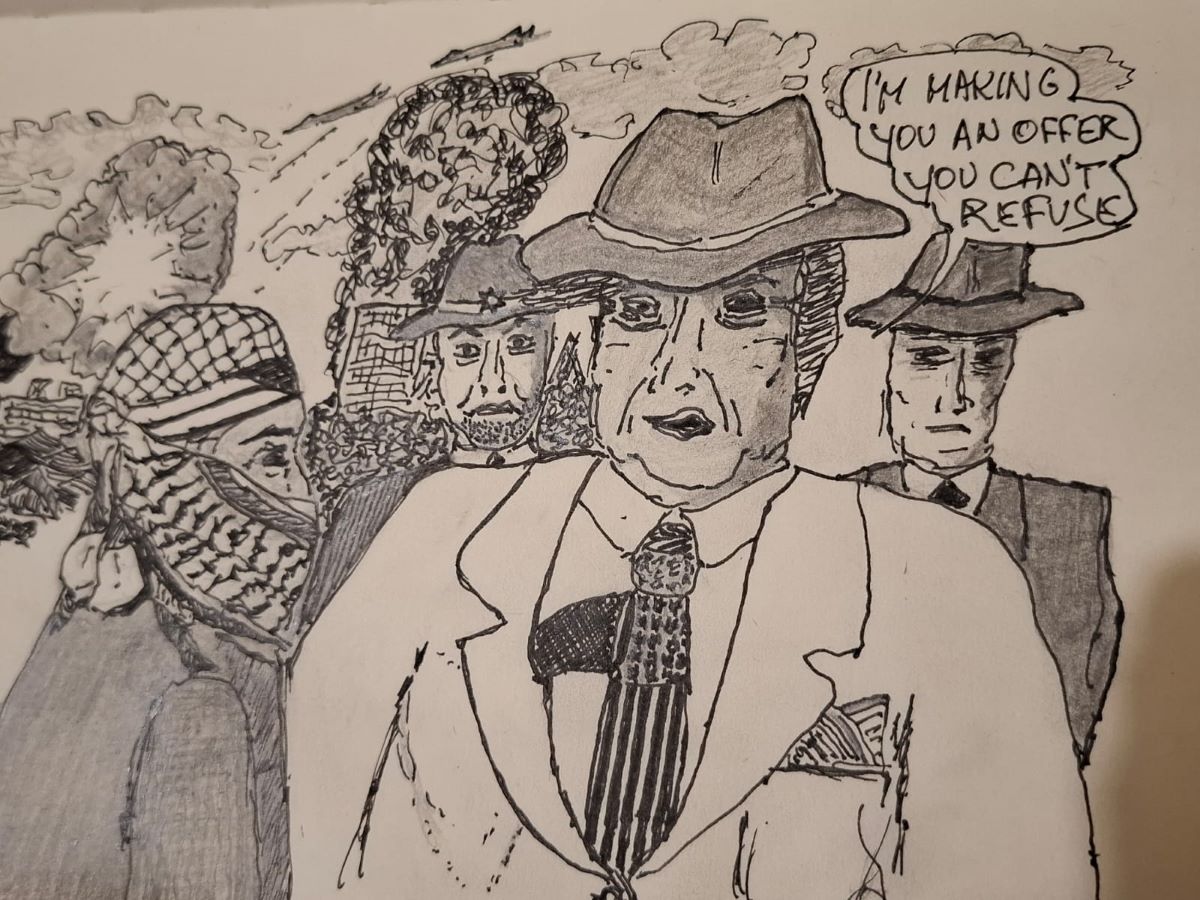
(Cartoon by D.Breatnach)

Hamas and Palestine Islamic Jihad grew out of previous Palestinian pacification processes. The Madrid Conference (1991) and the Oslo Agreement (1993) were imperialist/ Zionist attempts to pacify the wide-scale militant Palestinian resistance period of the First Intifada.3

Fatah at that time was the leading group in numbers and influence in the Palestine Liberation Organisation (from which Islamic groups were excluded) but also in Palestinian society in general. But Fatah had agreed to recognise ‘Israel’ and also the two-state solution (sic).

In the Oslo Agreement, furthermore, the question of the return to their homeland of the refugees was left aside. It appears that the Fatah leadership had lost faith in the eventual victory of their people’s struggle and had decided to get what they could by using the struggle to bargain.
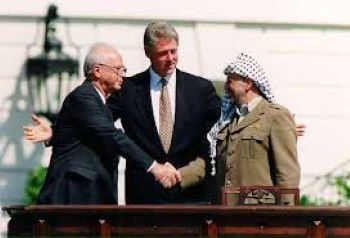
The Oslo Agreement: US Imperialism’s President Clinton oversees Yitzak Rabin, Premier of Zionist state of ‘Israel’ shaking hands with Yasser Arafat of Fatah, then leader of the PLO.

What Fatah got was Palestinian Authority control in the first elections (1996), with internal control over/ management of the Palestinian population of the West Bank and Gaza, but not of the Palestinians in Jerusalem (captured by ‘Israel’ in 1967): a far cry from a free Palestine.4

In the Algiers conference of 1988 Fatah had won majority agreement to recognise ‘Israel’ and to accept the two-state solution5 (sic), i.e. embodying a Palestinian state on 20% of Palestinian land, under the eyes and guns of their Zionist neighbour).

Fatah’s rule became known for corruption and nepotism, which then had to be protected and defended from the Palestinian masses, leading to authoritarian, repressive and often arbitrary rule. And repression of the Resistance, along with direct collusion with the ‘Israeli’ State.

Continuing ‘Israeli’ repression and settlement expansion in turn led to the Second Intifada; Fatah lost to Hamas in the Palestinian parliamentary elections of 2006 followed by defeat of Fatah’s attempted coup in Gaza in 2007 (but the West Bank remaining under unelected Fatah control).

Mahmoud Abbas of Fatah has refused to announce elections since, sitting in unelected control of the PA’s office in the West Bank, collecting the various international grants, presiding over corruption,6 repressing Palestinian resistance of deed or word and colluding with the ‘Israeli’ Occupation.
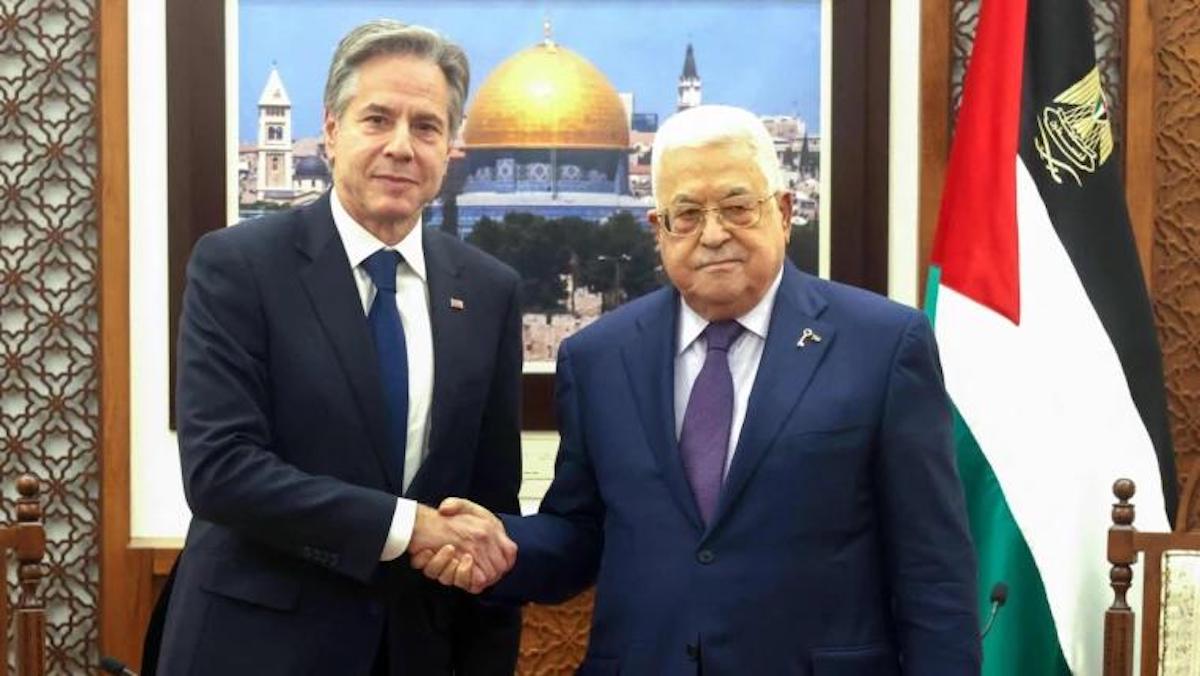
US Imperialism’s then Secretary of State Anthony Blinken and the PA’s Mahmoud Abbas in Palestine, soon after the start of the accelerated Zionist genocide in Gaza, December 2023

BUT WHAT ABOUT THE IRISH CONNECTION?

Starting with Palestine and South Africa in 1991, an imperialist pacification process spread to Ireland, Basque Country, Kurdish Turkey, Colombia, India, Philippines, Sri Lanka. With some variations the drive has been the same: to give up revolution and join the system.

One of the features of this process was the apparent need of a recognised leader to sell it to the resistance support base and to front it for the world: Arafat (Palestine), Mandela (S. Africa), Adams/McGuinness (Ireland), Ocalan (Turkish Kurdistan), Otegi (Basque Country).

The Provisional IRA was by far the major organisation in the Irish Republican resistance; it gave up armed struggle in return for vague promises and the release of its prisoners under licence.7 Another organisation complied also even as new ‘dissident’ fighters were being jailed.

Nearly 30 years after the signing of the Good Friday Agreement, Ireland is no nearer the Provisional IRA’s declared aims Irish reunification, independence and sovereignty. The Sinn Féin party helps run the colony8 and is attempting to become part of the neo-colony’s government.

Sinn Féin representatives Tina Black (Mayor of Belfast) and Michelle O’Neill, First Minister of the British colony, laying a wreath at the British War Memorial in Belfast, July 2022 (Cred: Liam McBurney/ PA Wire)

Neither the Spanish, French nor Turkish states were interested in other than crushing the Basque and Kurdish resistance and the corresponding movements disabled themselves without getting anything in exchange other than continued repression.9

The resistance movements in parts of India and Philippines continue to resist but in Sri Lanka was wiped out.10

One feature of the spread was the contagion-like way in which leaders of one infected resistance sought to entice others to follow suit: S. Africa and Palestine to Ireland; S. Africa and Ireland to Basque Country; Ireland to Colombia (where only the FARC but not the ELN accepted it).

In only one iteration of the pacification processes was there a partial achievement of the stated aims of the resistance: South Africa got national enfranchisement but the economy remained under imperialist extractive control and its working people under repression.11

In the course of giving up armed struggle, allegedly just changing the methods, the leaders gave up what they had fought for, the very reason for which they had first come into the struggle. Of course, they could still shout the slogans, just not make them real in any way.

The Irish version (and the Basque one) decommissioned their weapons, which makes it very relevant to the Trump Plan for the Palestinian Resistance, particularly Hamas and PIJ. No resistance movement should even discuss giving up their weapons until the defeat of the enemy.

(Image sourced: Internet)

It will be interesting to see what positions the former parties of Irish and Basque resistance, Sinn Féin and EH Bildu12 and their supporters take on this US/ ‘Israeli’ plan for the Palestinian Resistance.

One of the features of the pacification process was the apparent need of a recognised leader to sell it to the resistance support base and to front it to the world: Arafat (Palestine), Mandela (S. Africa), Adams/McGuinness (Ireland), Ocalan (Turkish Kurdistan), Otegi (Basque Country).

Who will the imperialists find to play this role in Palestine?13

End.

NB: If you found this article of interest, why not register with Rebel Breeze for free, so that you will be notified by email of subsequent articles. You can de-register any time you wish.

FOOTNOTES

SOURCES

Referencing the Irish pacification process in Gaza context: https://apnews.com/article/gaza-northern-ireland-peace-process

The Palestinian Authority: https://www.aljazeera.com/news/2023/10/11/what-is-the-palestinian-authority-and-how-is-it-viewed-by-palestinians

https://www.washingtoninstitute.org/policy-analysis/how-palestinian-authority-failed-its-people

1https://apnews.com/article/gaza-northern-ireland-peace-process

2Trump 20-point plan: https://www.bbc.com/news/articles

3https://en.wikipedia.org/wiki/First_Intifada

4“This mirrors Israel’s post-Oslo approach to the occupied West Bank in pacifying the population through economic incentives, avoiding political concessions, and entrenching structural dependence. This model, often dubbed “economic peace,” has transformed the Palestinian Authority (PA) into a subcontractor of occupation – flush with foreign funds, but powerless to deliver sovereignty.” https://thecradle.co/articles-id/34757

5https://ejil.org/pdfs/1/1/1136.pdf

6Which is why the imperialists and their servants keep alluding to the need for a “reformed Palestinian Authority” e.g. https://israelpolicyforum.org/blueprint-for-reforming-the-palestinian-authority

7Those released under licence could be returned to jail (and a number were) at the decision of the Secretary of State for Northern Ireland without trial, hearing or details of why the individual was considered to be ‘a threat to public safety.’

8Its representative, Michelle O’Neill, is currently First Minister of the colony’s government. In the Irish State, the party has 33 TDs (MPs), only two behind the party with next largest representation, Fianna Fáil. They Party has abandoned its opposition to the repressive legislation of the State, welcomed British Royal visits to both parts of Ireland, supports recruitment to the colonial gendarmerie and its leader refused to rule out coalition with the neo-colonial political parties of membership of the British Commonwealth. https://www.thejournal.ie/mar-lou-mcdonald-commonwealth-4561600-Mar2019/

9The Basque leadership abandoned armed struggle unilaterally at the time without gaining even the end of dispersal of their jailed fighters throughout the state. The Turkish Kurdish PKK tried to make progress through political electoral means only under continuing repression. But their Syrian version of armed Kurdish forces got a new lease of life with the vulnerability of the Assad regime in Syria but ended up as a NATO proxy in the latter’s war for regime change. The PKK in Turkey very recently agreed to disarm while their Syrian part remains in difficult relationship with the new (formerly ISIS) regime in Syria and some other ISIS elements under Turkish influence.

10https://www.vice.com/en/article/death-of-a-tiger-0000710-v22n8/

11See The Marikana Massacre of striking miners by the ANC Government’s police.

12Both parties support the Two-State proposal for Palestine.

13Some liberal and social-democratic sections seem to have fixed on Marwan Marghouti in this role, which of course is no reason not to support his release on human rights grounds. https://www.youtube.com/watch?v=q6IgjlHaaIs

Don’t Change the System – Just the Parties in Government

Diarmuid Breatnach

(Reading time: 2 mins.)

I was relieved by my attendance at the Raise the Roof housing demonstration in Molesworth Street in Dublin City Centre. That was because I learned from speakers that just by voting in ‘a Left Government’ we could receive the housing we need.

Raise the Roof is a coalition of trade unions with its address at the Labour Party-orientated ICTU and a number of housing NGOs. The coalition also contains political parties: Sinn Féin; Labour Party; People Before Profit/ Solidarity; Social Democrats; Independents4Change.1

A view of the protest in Molesworth St. Leinster House is in the background across Kildare Street with access prevented by police barriers at the end of Molesworth St with a special gate to allow entry and exit for customers of the hotel on the corner. (Photo: D.Breatnach)

Previously I’d thought that either we’d need a revolution or a country-wide campaign of direct action occupying empty properties. This is because the housing crisis is deliberately constructed for the benefit of profits for big landlords, vulture funds and the banks that finance them.

And since they keep making massive profits out of the situation, they won’t want it to change as it would if, for example, were the State to seize empty properties2 for conversion to housing along with a massive public housing for rent construction campaign.

And if the profiteers don’t want that, naturally their (sorry, ‘our’) government will make sure not to do anything of the sort.

So it was great to learn that we won’t have to really fight and break the law, going to jail and all that. Phew! Just change the parties in the Government at the next election! Elect a Left Government!

Visual accidental irony comment in the same street. (Photo: D.Breatnach)

But… lately I have to admit I’ve been having doubts about this solution. First of all, there’s the question of numbers of TDs available to form this aspired-to government. There are overall 174 TDs in Leinster House (the Parliament of the Irish State) and a fragile majority requires 88.

The Sinn Féin party has 39 TDs and People Before Profit/ Rise/ Solidarity five in total, a combination of 44 still needing another 44 to reach the 88 minimum. FG and FF, formerly opposition parties but now in government have 86 votes between them and needed some extras to run the Government.

But I’ve got a much bigger doubt really, and that’s whether SF will stand up to the bankers and property magnates.

SF has for decades being setting out its stall that it is safe pair of hands to run the system, in other words that the profiteers have nothing to worry about. And to tell the truth, I believe them. Though some of their followers think SF is fooling the system, I think it’s the followers being fooled.

View of the Raise the Roof protest in Molesworth street. (Photo: D.Breatnach)

So … after further consideration, it really does look like a revolution will be required to end the housing crisis — or at least something so near as to make the managers of the system believe that unless they resolve the housing crisis, there will be a revolution. So I’m worried again.

Anyway, it was interesting seeing the amount of Tricolours in what was predominantly a left-wing rally of hundreds (despite a small contingent holding an Aontú banner) and there was some nice music with singers including Lisa O’Neill and Jimi Cullen (with his Homes for All composition).

I still left early, however.

End.

Footnotes

1https://www.raisetheroof.ie/about-raise-the-roof

2https://www.socialjustice.ie/article/vacancy-and-dereliction-ireland

The St. Patrick’s Day Blood Fest Comes Round Again

Gearóid Ó Loingsigh Feb. 23
NB: Edited by Rebel Breeze for formatting purposes

(Reading time: 5 mins.)

When the genocide in Gaza began, no one thought it would go on for so long.

But it has, and along the road many challenges have come up for governments, social movements, Arab countries and political parties and nearly all of them have been found wanting on the issue.

In Ireland the annual cringe fest that is St. Patrick’s Day in Washington threw up a problem for Sinn Féin last year. Should they go or not go?

Last year the Irish Palestinian Solidarity Campaign issued a call for all political parties, including government parties, not to go.

Sinn Féin broke that call for a boycott and were swiftly pardoned by the IPSC which swiftly invited them to address a Palestinian solidarity rally in Belfast one day before Mary Lou McDonald and Michelle O’Neill First Minister of Northern Ireland set off for the USA.

There they swanned around with Biden, imbibing of whatever liquor was on offer on the day. Supping the devil’s buttermilk as some of their unionist colleagues might put it.

At the time Sinn Féin said it was going, as it was important and that they would raise the issue of Palestine with Biden. One month before flying out to Washington a Sinn Féin spokesperson stated:

We will use every political and diplomatic opportunity and influence that we have to be a voice for Palestine, to demand an end to the occupation of the West Bank and Gaza, for Palestinian statehood and for a permanent ceasefire now.[1]

In the end they did no such thing. In fact, the then Irish Taoiseach (Prime Minister) Leo Varadkar was more forceful than Mary Lou or Michelle who made even more tepid statements and quaffed what was put in front of them and enjoyed the jollies.

They could have been forgiven for thinking that it would be all over by 2025 and this situation would not arise again. Well, we should be gentle on them, many of us underestimated the Israeli bloodlust. But here we are again.

Trump continues with Biden’s genocide and announces his intention to commit two war crimes e.g. the mass expulsion of Palestinians from Gaza, a war crime under Article 49 of the Fourth Geneva Convention and profit from the looting of their assets a further war crime under Article 33 of the same convention.[2]

The SDLP was the first out of the hatches saying it would not go, reaffirming their position of the previous year.

It is ironic that Sinn Féin supporters used to refer to the SDLP as the Stoops, a play on their initials, Stoop Down Low Party, which probably means Sinn Féin (SF) should now be known as the Stoop Further.

As is common with the Stoop Further, they are fond of speaking out both sides of their mouths. They announced that they would not go this year, though not official invite has been issued to them, and at the same time urged the Irish government to go.

A case of wanting to have their cake and eat it too.

Mary Lou McDonald stated Trump’s plan “represents a marked escalation in the very complex conflict situation for the Palestinian people.”[3] Really? Expulsion is an escalation from genocide?

To be very clear, there is a specific genocide convention and genocide is a Crime Against Humanity, under that convention, and is so at all times and in all circumstances.[4] There are no ifs or buts to that.

Expulsion and profiteering are war crimes. In legal terms, they are egregious crimes but less so than genocide. There is no escalation here. Both Biden and Trump have been complicit in the genocide, Trump however has put the blood-soaked icing on the cake with his proposal.

Donald Trump US President in what is no doubt one of his favourite photos (Photo sourced: Internet)

Except it is not his proposal. It has been official US and Israeli policy since 2007.[5] 

In other words, a plan that began under Bush and continued during the eight years of Obama’s presidency when Biden was the Vice-President, Trump’s first presidency and of course Biden’s four demented years as President.

Mary Lou McDonald seeks to draw a line under her support for the US. There is some mythical line in the sand between the Democrats support for murder, genocide, torture and Trump’s.

In refusing to go to the Blood Fest in Washington she stated that Sinn Féin would not be in a position to challenge Trump’s statements at the Blood Fest (she doesn’t describe it as such, to be clear that is my accurate description).

This is surprising as last year, she said that they would challenge Biden on his support for Israel.

Before they went off on their junket last year, two days before the St Patrick’s Blood Fest they issued a tame communiqué asking Biden to play a more “constructive role” in Palestine,[6] whatever that is supposed to mean.

In fact, part of their public rationale for going was that they could influence US government policy. So, what is different now? Have they concluded that their junket last year did not produce the results they hoped for?

Well, they had no expectations that Biden would end US complicity in the genocide and as I already pointed out, when they went their statements were way weaker than the Irish government’s official statements. So, the answer is no.

This year they have said they won’t go, but have said the Taoiseach should go.

We absolutely believe that he needs to go and, furthermore, when there, set out unambiguously the Irish position in respect to all of these matters and to push back directly against any threat or goal for the mass expulsion of Palestinians from the Gaza Strip, the annexation of that land.[7]

If, as last year under Biden, they believed they could influence policy in the same way they now expect the southern Irish government to do, why don’t they go? The answer is one of political expediency.

They have calculated that this time round there is no political cost amongst their reactionary base in the USA to boycotting a Trump event and by calling on the Irish government to go, they continue to signal that they are a “reasonable partner” that the Irish state and Trump can do business with.

Michelle O’Neill stated that she couldn’t go this year because

I couldn’t in all conscience make that trip at this time. I just think that there are times whenever we’ll all reflect, and certainly whenever my grandchildren ask me, what did I do whenever the Palestinian people were suffering, I could say that I stood on the side of humanity.[8]

Except of course, she didn’t. Whilst Biden gladly and gaily supplied Israel with all the military hardware required to carry out a genocide, she did not nothing.

In the waning days of Biden’s support for genocide, on January 4th of this year he notified Congress of an additional US $8 billion arms sale to Israel.[9] Yeah, Michelle can tell her grandchildren what she likes, but she supped with the Devil.

She took part in a genocide through her endorsement of Biden. Her sudden hypocritical distancing from the same policies under Trump is meaningless.

It is not an ethical position; it is not one based on some internationalist concept of solidarity with the oppressed or even a liberal opposition to genocide and war crimes as they have previously shown no such solidarity or real opposition to such acts when Biden was the war criminal in charge.

No matter how low you think Sinn Féin can stoop, they will always surprise you and Stoop Further.

End.

NB: For more articles by Gearóid see https://gearoidloingsigh.substack.com

NOTES

[1] The Irish News (23/02/2024) Protests at east Belfast arms manufacturer as city council’s largest parties accused of ‘vetoing’ PBP Gaza ceasefire motion. John Manley. https://www.irishnews.com/news/northern-ireland/protests-at-east-belfast-arms-manufacturer-as-city-councils-largest-parties-accused-of-vetoing-pbp-gaza-ceasefire-motion-BO4VAMQCYVF37BOSCHVPPNLACY/

[2] The Geneva Conventions can be consulted at https://ihl-databases.icrc.org/en/ihl-treaties

[3] Irish Independent (22/02/2025) Sinn Féin may be boycotting White House for St Patrick’s Day, but Mary Lou McDonald is imploring Taoiseach to attend and confront Trump. Tabitha Monahan and Senan Molony. https://www.independent.ie/irish-news/sinn-fein-may-be-boycotting-white-house-for-st-patricks-day-but-mary-lou-mcdonald-is-imploring-taoiseach-to-attend-and-confront-trump/a52621936.html

[4] To consult the Genocide Convention see https://ihl-databases.icrc.org/en/ihl-treaties/genocide-conv-1948

[5] Jonathan Cook (14/02/2025) Trump didn’t invent the Gaza ethnic cleansing plan. It’s been US policy since 2007.

Jonathan Cook

Trump didn’t invent the Gaza ethnic cleansing plan. It’s been US policy since 2007

BOBBY SANDS – FREEDOM FIGHTER AND BEACON FOR THE DIASPORA

Diarmuid Breatnach

(Reading time: 6 mins.)

The anniversary on Sunday of the death on hunger strike of IRA Volunteer Bobby Sands was marked with a number of posts on social media. I would like to add an Irish migrant’s1 perspective and some analysis of his legacy.

The Irish diaspora was a powerful sector in solidarity for the Irish struggle not only because of their cultural background but also because of their numbers. Some British cities had an estimated diaspora population of 10% (Irish-born and 1st and 2nd generations).

Furthermore, the higher proportion of those in turn was of the working class, a section of society which, although they in no way had their hands on the standard levers of power, certainly had a strong potential of the kind the British ruling class had learned to fear.

Irish Republicans of course formed part of that sector and organised within it but on the other hand the IRA’s bombing campaign in Britain was of no help at all. The popular fear of being caught in an explosion greatly enabled the Government to tighten the screws under the guise of “security”.

Karl Marx, a strong supporter of Irish freedom had commented after the Clerkenwell prison bombing of 18672 that “One cannot expect the London proletarians to allow themselves to be blown up in honour of the Fenian emissaries” (i.e who they were trying to free from the jail).

In 1974 the Labour Government had repressive legislation ready and on 29 November, using hysteria arising from the Birmingham and Guildford pub-bombings they rushed through the Prevention of Terrorism Act (1974) which permitted the holding of suspects for two days without charge.

An underground cell in London’s Paddington Green police station – this is where Irish detainees under the Prevention of Terrorism Act might be kept and interrogated for seven days without visitors or access to solicitor. “The old cells were 12-foot square, contained no windows and were reportedly too hot in the summer and too cold in winter(Wikipedia).(Photo: Posted in 2020 on Internet by Green Anti-Capitalist Front who occupied the empty building intending to turn it into community centre.)

That could be extended for another five days – and often enough was — by application to the Home Secretary. Access to solicitor was usually denied and though not lawful, the fact of the detention itself was often denied to concerned people making enquiries of the police station.

The prospect of disappearing for seven days into police custody somewhere was naturally terrifying and a ‘suspect’ could also be deported without trial to Ireland – even to the British colony of the Six Counties, which amounted according to their law to “internal exile”.

Snapshot of London police harassment and intimidation of Irish solidarity activists in 1981. (Photo sourced: Internet)

The framing of a score of innocent Irish people3 in five different trials4 with very heavy sentences added to the intended terrorising of the Irish community in Britain, the “suspect community”5, many of whom believed the victims to be not only innocent but most not even politically active.6

Irish solidarity activity in Britain diminished greatly after 1974 as state repression impacted across the Irish community. But the hunger strikes and concerns to save the lives of the strikers in 1981 broke the hold of state terror as people took to the streets in their thousands once again.

They were unsuccessful but never returned to that state of immobilising fear that had settled over the community.

The Irish in Britain Representation Group got its initial start in 1981 which happened as follows: the bourgeois Federation of Irish Societies had its AGM in May 1981 and one of the members proposed that a motion of sympathy to the Sands family be recorded when he died.

IBRG and Irish Republican POW Support Committee banners on march Birmingham 1984 (Source: Mullarkey Archive)

The meeting’s Chairperson ruled the proposal out of order and ‘the Fed’ continued with their ordinary business. The then Editor of the Irish Post7, writing in his “Dolan” column, found this disturbing and suggested there might be a need for a new type of Irish community association.

A number of individuals wrote in and the ball got rolling, though it took until 1983 to set up the branch-based organisation with a constitution and democratic safeguards in operational rules. The IBRG soon had a number of branches in London and others in the North and Midlands.

For the next two decades the organisation campaigned for the release of the framed prisoners, against the Prevention of Terrorism Act, strip-searching, all racism but in particular the anti-Irish and anti-Traveller varieties, for Irish representation in education, services, Census category, etc.

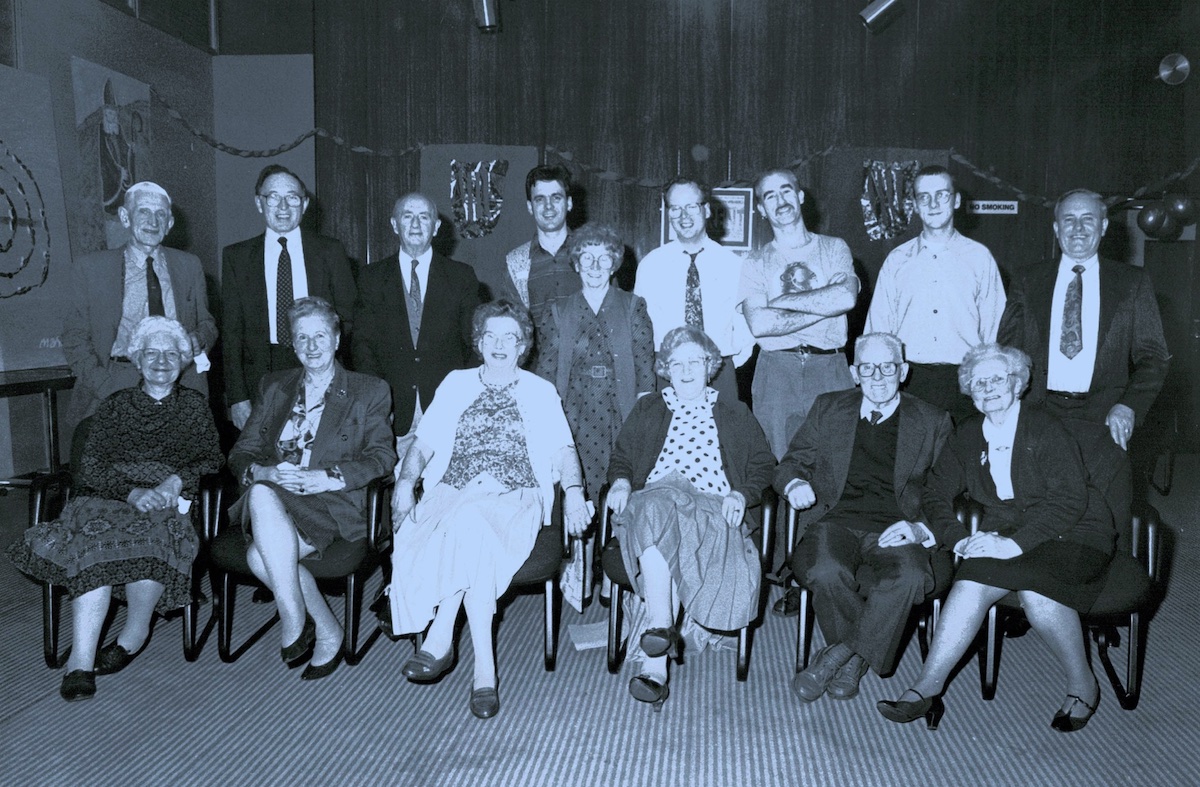
Lewisham Irish Centre Management Committee and Staff, possibly 1994. The Centre was campaigned for and won by the Lewisham Branch of the IRBG in conjunction with the Lewisham Irish Pensioners’ Association (which the IBRG had also founded).

The IBRG also called for British departure from Ireland and collaborated with other organisations in marches, demonstration, pickets, conferences, producing also a number of important report documents. The organisation’s officers were drawn from migrant Irish and those born in Britain.

THE LARK8 – a poem

Last night, from afar, I watched the Lark die

and inside me, began to cry,

and outside, a little too.

There’s nothing more that can now be done,

to save the life of this toilers’ son;

another martyr – Bobby, adieu.

Imperialism takes once more its toll,

another name joins the martyrs’ roll

and a knife of sadness runs us through.

But sorrow we must watch,

for it can still,

yes, it can kill

the song that Bobby listened to.

And if his death be not in vain,

let’s fuel our anger with the pain

and raise the fallen sword anew;

and this sword to us bequeathed:

let its blade be never sheathed

’till all our foes be ground to dust

and their machines naught but rust ….

Then will the servant be the master

and our widening horizons ever-vaster

and our debt

to Bobby

paid

as due.

(D.Breatnach, May 1981, London)

Bobby Sands Mural on gable end of a house in Belfast (Photo cred: Brooklyn Street Art)

REPRESENTATION OF BOBBY SANDS

Bobby Sands was a man of great courage whose leadership qualities were recognised by his fellow political prisoners when they elected him as their Officer Commanding in the H-Blocks. He was also an accomplished writer and poet.

When the British reneged on the agreement that ended the 1980 hunger strike and a new one was planned, Sands insisted on being first on the list, which also meant that in the event of resulting deaths, his would be the earliest.

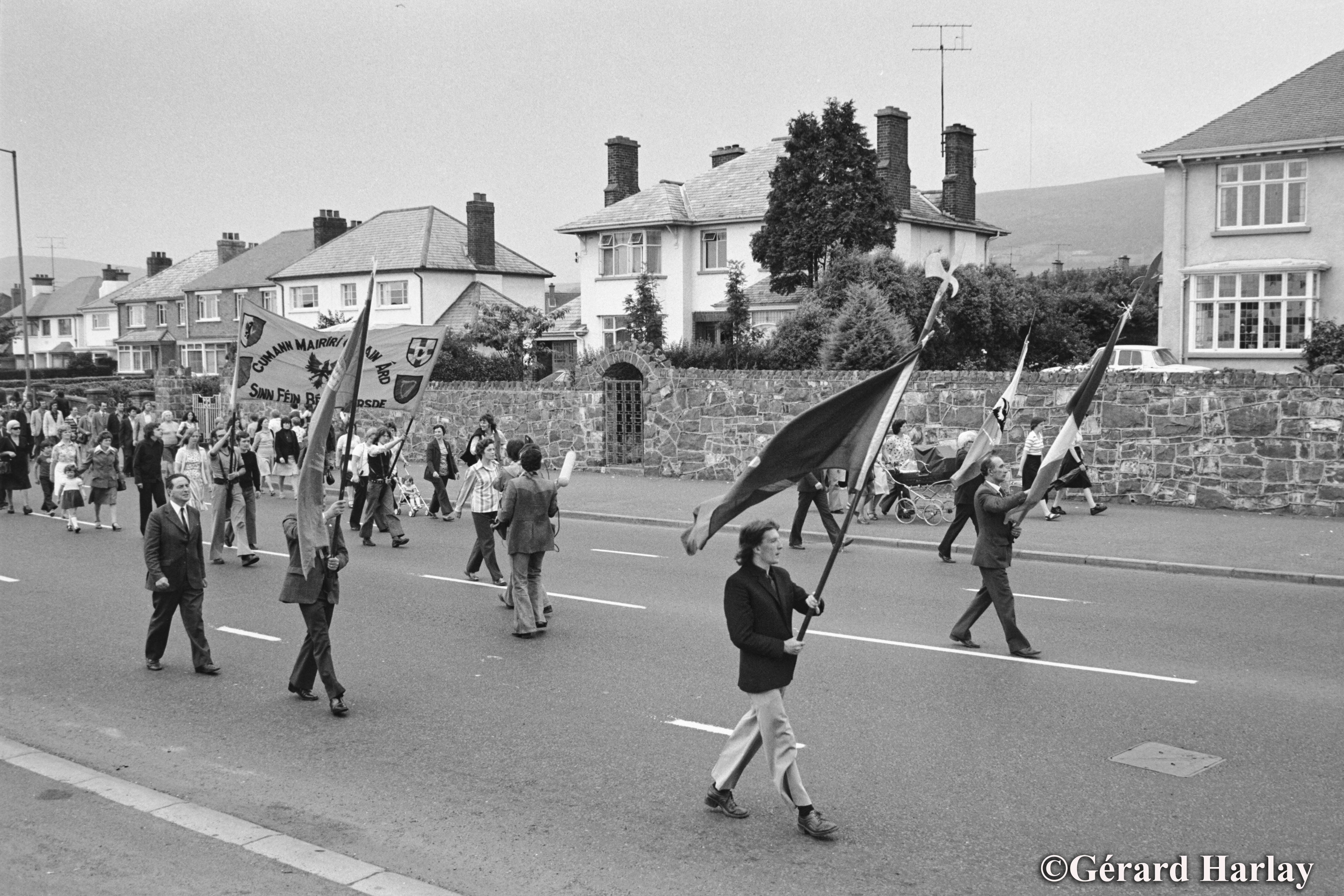
Bobby Sands (front left, colour party), Andersonstown Road,1976. (Photo: Gérard Harlay Archive)

Most people will agree easily with all the above evaluation of the man but from that point onwards, his representation is manipulated to suit different agendas, in particular those of pacifists, social democrats, liberals and a variety of opportunists.

Some of them love above all his quotation that “Our revenge shall be the laughter of our children”. They forget many other things he wrote and seek to turn him into an angel or saint of pacifism.

Since they embraced the pacification process, Sinn Féin try to represent Sands as an advocate for and proof of the effectiveness of participating in the parliamentary electoral system, based on his success in a 1981 Westminster by-election with 30,492 votes, 51.2% of the total of valid votes.

What both these groups fail to recognise is that Sands was an IRA volunteer and was sentenced for possession of handguns in 1972 and again in 1976. If he was an angel, it was of the Archangel type, fighting against what he considered evil.

He was proposed in the Fermanagh-South Tyrone by-election mainly in order to support the campaign of the prisoners against criminalisation and for the political status recognition that they had previously. Saving the lives of the hunger strikers was of course part of the plan too.

Nine protesting Republican prisoners contested the general election in the Irish State in June. Kieran Doherty and Paddy Agnew (who was not on hunger strike) were elected in Cavan-Monaghan and Louth respectively, and Joe McDonnell narrowly missed election in Sligo-Leitrim.

But that is a long way from proving that the electoral process is a viable way of dislodging the ruling class and their system and, in fact, history has proven the opposite.

Nobody knows what position Sands and the other nine would have taken on the electoral process had they lived. Possibly some would have gone along with the SF leadership on that and some others would now be reviled as “dissidents” (as are indeed some H-Block survivors).

All we can say for certain is that they were men of courage in that all of them had joined the armed struggle for Irish national liberation. They had even higher courage of a level hard to imagine, to risk and then experience slow physical disintegration and death by the day and by the hour.

Long after their erstwhile prominent enemies are forgotten, their names will shine in our history and Bobby Sands’s, the brightest of them all.

End.

FOOTNOTES

1At the time I was living and working in England.

2A bomb was planted against the prison wall to free a member of their group who was being held on remand awaiting trial at Clerkenwell Prison, London. The explosion damaged nearby houses, killed 12 civilians and wounded 120; no prisoners escaped and the attack was a failure. Michael Barrett was found guilty of the bombing despite his claim supported by witness testimony of having been in Glasgow during the bombing and was hanged on Tuesday 26 May 1868 outside Newgate Prison, the last man to be publicly hanged in England (the practice was ended from 29 May 1868 by the Capital Punishment Amendment Act 1868). https://en.wikipedia.org/wiki/Clerkenwell_explosion.

3Carole Richardson of the Guildford Four was not Irish but she was the girlfriend of one of three Irishmen.

4Birmingham Six, Guidford Four, Giuseppe Conlon, Maguire Seven and Judith Ward. They were not acquitted and released until decades later, by which time Giuseppe Conlon had died in jail.

5Suspect Community by Paddy Hillyard, Pluto Press (1993)

6Believing them innocent and not active worked even better to terrorise because if the likes of those could be framed and jailed, no-one was safe. But perhaps safest was to do absolutely nothing to draw the attention of the State.

7Brendán Mac Lua, co-founder of the Irish community newspaper in 1970 which is now a very different periodical.

8The lark is associated with Sands because he wrote a story about a man who had captured a skylark, a bird that unusually sings in flight. In the cage the bird would not sing so the man draped the cage with cloth and still the bird would not sing, nor would it do so when he refused it food and water until eventually, it died in the dark, silent to the last.

REFERENCES

Powers under the Prevention of Terrorism Act: https://cain.ulster.ac.uk/hmso/pta1974.htm

6,000 March to Commemorate Derry’s Bloody Sunday and in Solidarity with Palestine

Diarmuid Breatnach

(Reading time: 7 mins.)

Led by four Republican marching bands and containing a number of organisations, around 6,000 people supported the annual march in Derry on Sunday commemorating the 1972 massacre by the British Parachute Regiment in the city.

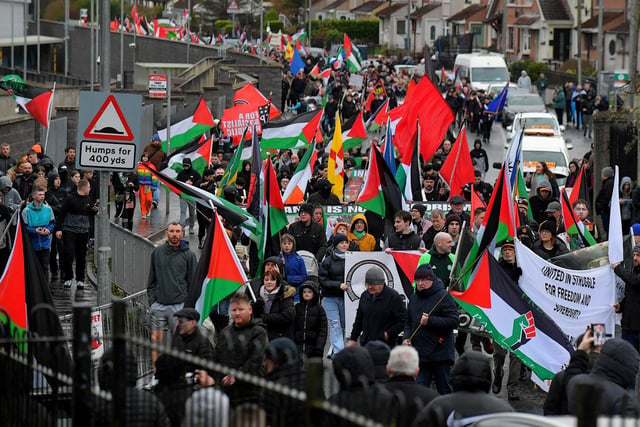
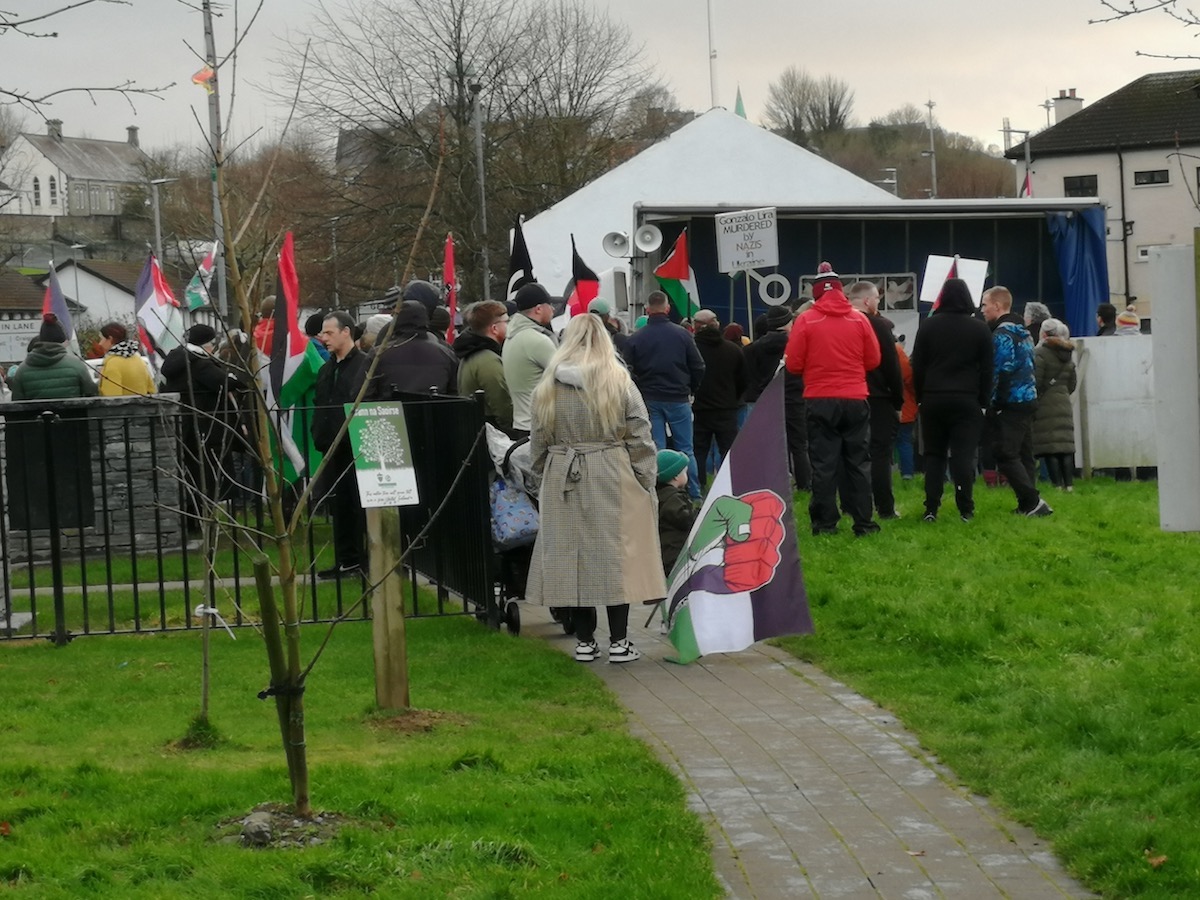
This year a special focus on solidarity with Palestine had been called for by the organisers of the Bloody Sunday massacre commemoration and Palestinian flags mixed with ones of Irish Republican organisations decorated the march route.

The march begins at the Creggan Heights, overlooking Derry, a steep walk up from the Bogside, the city’s centre near the river and winds its way down (with a great view of the Foyle river and surrounding area) but then up Westland Street again and along Marlborough Terrace.

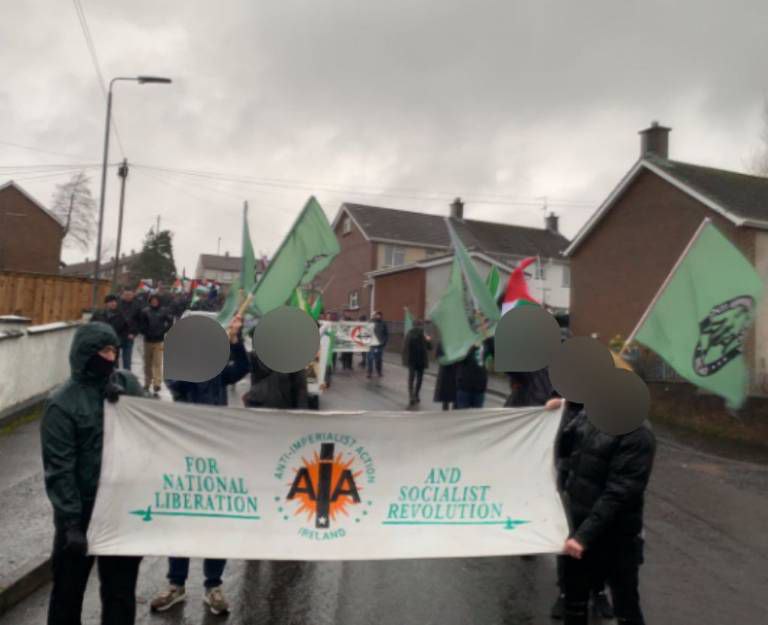
Rear banner of the AIA contingent on the Bloody Sunday commemoration march Sunday. (Photo source: AIA)

For a number of years this commemoration has taken place in heavy rain and high winds, or snow, or sleet but it was dry this year – until the march started! However after a short period of strong gusts driving rain it stopped for the rest of the march.

Down Creggan Road to the Bogside once more and past the Bloody Sunday and H-Block memorials to the rally at Free Derry Corner where Kate Nash, one of the main organisers of the march for years and a sister of one of those murdered in the massacre, welcomed the marchers.

The Bloody Sunday 52nd commemoration march makes it way along Lone Moor Road towards the Brandywell on Sunday afternoon. (Photo: George Sweeney via Derry News.)

RALLY AND SPEAKERS

Nash condemned the punitive EU/ UK/ USA cutting of funds to the UNRWA organisation carrying out relief and educational work in Gaza following an Israeli State intelligence allegation1 and also called for no Irish politicians to attend the annual US Presidential St. Patrick’s Day event.2

Kate Nash’s brother Willie was murdered by the Parachute Regiment during the massacre and her father was wounded by fire while trying to reach his fallen son. Kate called for a minute’s silence for the dead and wounded that day but also for those in Gaza, in particular the children.

Kate Nash also mentioned the Noah Donohoe case as being close to everyone’s heart.

The names of the dead and wounded by the Parachute Regiment were read out by Damian Donaghy,3 son of Damian Donaghy one of the survivors on that day. Paddy Nash performed the civil rights anthem “We Shall Overcome” which was popular among marchers of the time.

Section of the rally to the right as facing Free Derry Corner with a mural based on an iconic photograph from the massacre. (Photo: D.Breatnach)

Kate Nash introduced Huda Ammori, a Manchester-based Palestinian activist and one of the Elbit Eight,4 who said she felt at home in Derry because of the people’s solidarity with Palestine.5 The State in Britain failed to convict all but one of any charges arising out of direct action against the arms company.

Ammori drew parallels between the Irish and Palestinian struggles against colonialism and stated that her grandfather had been assassinated for rising up against the British colonisation of Palestine in 1936, when it was a British “Mandate”.

Mural on a wall in the Bogside, Derry; the words “don Phalaistín” are obscured by a vehicle. (Photo: D.Breatnach)

AIA Short Video with Music Bloody Sunday Derry 2024 AIA Video.MP4 (viewable on FaceBook)

“The British signed away the land of Palestine in 1917,” Amori told the rally, “they colonised our lands and then they armed and trained the Zionist militia to commit a Nakba, to displace over 750,000 Palestinians in 1948, over half the indigenous population.”

Huda Ammori said weapons were used on Palestinians in Gaza and then marketed as ‘battle-tested’. She also praised those who had taken direct action in Derry against arms firms (e.g Raytheon).

Section of crowd gathering in front of the stage for the rally. (Photo: D.Breatnach)

Geraldine Doherty, niece of Gerard Donaghy, youngest of the Bloody Sunday victims, also spoke from the platform, saying it was ‘sad’ but ‘heartwarming’ to see so many people attending the march.

“More than half a century since British troops committed this massacre on these streets, innocent children like my murdered uncle Gerard and hundreds of others as well are still being denied justice”, she said and denounced the British State attempting to prevent the trial of legacy cases being tried.

Doherty spoke of the remaining “trauma for Derry and for Ireland” from which many families have never recovered, with long-term post-traumatic damage such as depression, addiction and divided families.

“But while the people of Derry were battered and imprisoned, we were never broken,” she said to cheers from the rally participants. “Derry has rediscovered its … voice and we are using that voice to oppose the murder of children and women and men, and we stand with the people of Palestine.”

Section of crowd to the left of the stage at the rally. (Photo: D.Breatnach)

ON THE MARCH

Over the years since I returned to Ireland, I have marched in that commemoration many times, either as an individual or as a member of a solidarity committee and this year was glad to be welcomed as part of the Socialist Republican contingent, with Anti-Imperialist Action.

The bloc carried two banners: the one at the front was a new one in which the AIA called for anti-imperialist revolution and socialism, while at the rear the banner celebrated the Palestinian resistance. In between the banners marchers carried flags and placards.

New banner of the AIA in the organisation’s contingent on the march on Sunday. (Photo: D.Breatnach)

In the bloc men and women marched with a flags of the AIA, the Starry Plough, Palestine and Cumann na mBan. From the contingent on many occasions could be heard slogans of solidarity with Palestine and some equally applicable to that nation’s resistance or to Ireland’s.

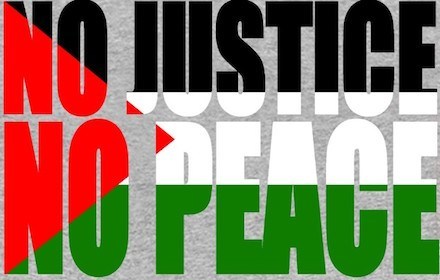
In the face of occupation – Resistance is an obligation!” and “No justice – No peace!” were in the latter category while “From the River to the Sea – Palestine will be free!”, “Free, free – Palestine!” and “Saoirse don – Phalaistín!” were specifically supporting the Palestinian struggle.

Most Republican organisations and some Irish socialist organisations attend the annual event, along with campaign groups and on occasion solidarity groups from abroad or Irish ones in solidarity with struggles abroad. Sinn Féin no longer attends but some supporters would as individuals.

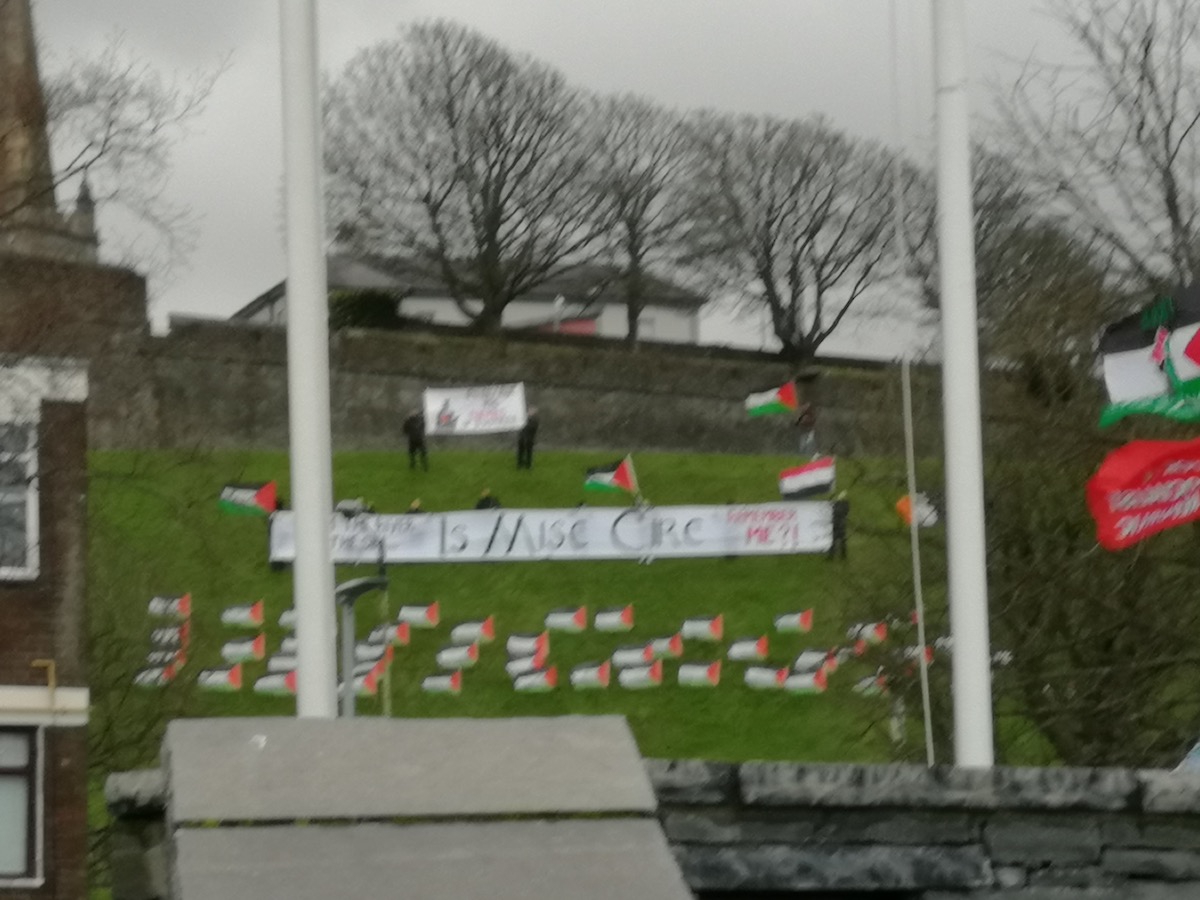
Giant Palestinian flag displayed below the Derry Walls above the rally below. (Photo: D.Breatnach)

THE MARCH ROUTE AND HISTORY

The Bloody Sunday march covers the same route as the anti-internment march in January 1972 when the British Paratroopers murdered 14 unarmed marchers and injured so many others. Preceded by the Ballymurphy Massacre in August 1971, it was followed by another in Springhill in July ‘72.

The British military claimed that the Derry victims had been armed and fired first and an inquiry tribunal headed by Lord Justice Widgery exonerated the Army and blamed the victims although the Derry Coroner, an ex-British Army officer had called it “sheer unadulterated murder”.

In 1998, presumably as part of the Good Friday Agreement deal, the British State began a new inquiry which however did not deliver a published verdict until 2010,6 stopping short of accusing the Army of murder but exonerating all the victims except one about which it was equivocal.

At that point, Sinn Féin’s Martin McGuinness said that the march should not be continued; however not one British soldier had even been charged, to say nothing of the commanders and Government Ministers who had either given the orders or arranged the cover-up – or both.

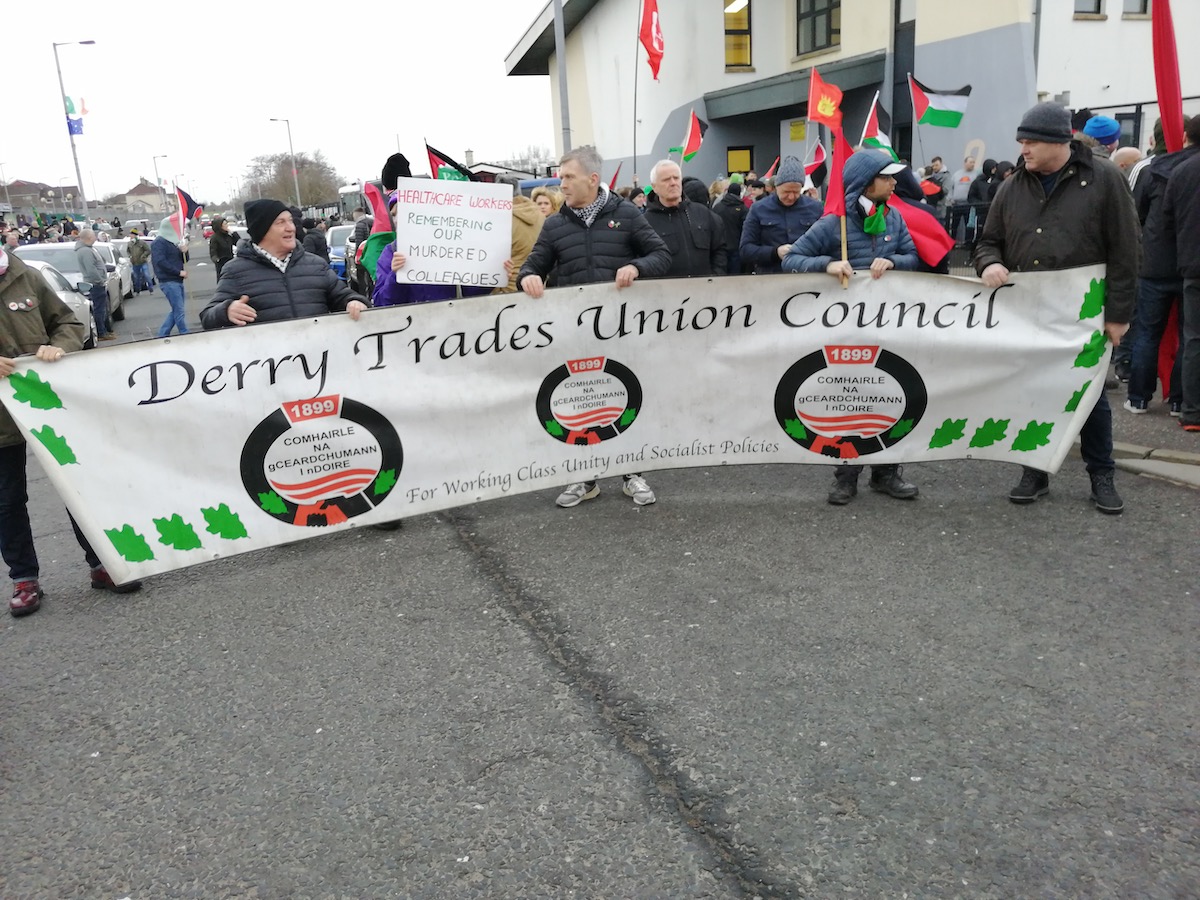
Banner of the organisation combining representation of trade unions in Derry. (Photo: D.Breatnach)

A small group of veterans of the original march and relatives, Kate Nash prominent among them, however decided to keep the march going and have done so every year, often in the face of accusations and disparaging remarks from supporters of Sinn Féin and others.

In 2022, the Massacre’s 50th anniversary, 20,000 marched in it while the Bloody Sunday Trust, an institution and museum supported by the colonial state and Sinn Féin, organised a small “memorial walk” and indoors event in the Guild Hall – the only one reported by the mass media.7

An independent group, badly needed since the Coiste na nIarchimí is controlled by the Provisionals. (Photo: D.Breatnach)
Display below Derry Walls created by the Saoradh Irish Republican organisation, according to their social media. (Photo: D.Breatnach)

Although veterans of the massacre and of the annual commemoration often meet one another only once a year at the commemoration, some having come from abroad, there are always new young people to be seen among them and hundreds come out to watch the march.

The march is an important commemoration of a massacre by British colonialism which still holds the colony of the Six Counties, a reminder no doubt inconvenient to unionists, neo-colonialists and those who have left the struggle, either through lack of will or for personal advancement.

In its championing and giving voice to other conflicts too, the commemoration march and other related events during the week are a strong expression of internationalist solidarity.

Wreath of the Bloody Sunday Commemoration Committee among others at the Bloody Sunday Monument. (Photo source: Bloody Sunday Commemoration Committee)

End.

FOOTNOTES

1The Israeli state intelligence agency reported that 12 out of 13,000 employees of UNRWA in Gaza had been implicated in the 7th October Palestinian raid following which at least some, possibly all, were sacked by UNRWA, apparently without any hearing or appeal process. The US, UK, Germany, Italy followed this up by suspending all funding to the relief organisation catering for 2 million people in dire circumstances. 

2Traditionally, leading politicians of the main Irish political parties, both mainstream and Sinn Féin, have sent representatives to celebrate St. Patrick’s Day with US Presidents, many of whom are of Irish descent. This year a campaign has arisen calling on them not to do so but spokespersons of Fine Gael, Fianna Fáil and Sinn Féin have insisted they will attend, which the SDLP has declared it will not. 

3Not to be confused with the family of Gerard V. Donaghy (20 February 1954 – 30 January 1972), sometimes transcribed as Gerald Donaghey, a native of the Bogside, Derry who was murdered by members of the 1st Battalion, Parachute Regiment on Bloody Sunday.

4Eight activists of British-based Palestine Action, a direct action organisation, who as a result of their actions against the Israeli-based military technology company Elbit in Britain, were charged with a total of 12 charges which included criminal damage, burglary and encouraging criminal damage. The trial, which commenced on November 13th, related to a series of actions taken during the first 6 months of Palestine Action’s existence from July 2020 to January 2021. In December last year, one activist was convicted on one charge by 10-2 majority, two were completely cleared and jury failed to reach a majority verdict on the rest of the charges on six remaining activists.

5That would be true of the majority ‘nationalist’ population of the city but not so much of the unionist minority, where support for Israel is more dominant, due in part to susceptibility to British propaganda and also simply out of sectarian hostility to anything favoured by the ‘nationalist’ community.

6At a cost of nearly £200m (€227.7m), half of which went in legal fees, a lawyer’s bonanza, to arrive at a decision that just about everyone in Ireland knew and many abroad knew already and which established no safeguards against a similar massacre being carried out by British military in future.

7Browser searches throw up report after media report, including Al Jazeera’s, of “hundreds” attending the early event, without a mention of the many THOUSANDS who marched later in the day.

SOURCES

https://www.derryjournal.com/news/people/when-im-in-derry-i-feel-like-i-am-home-palestinian-activist-tells-bloody-sunday-rally-4496030

Elbit Eight trial and verdict: https://www.palestineaction.org/elbit-eight-verdicts/

The Saville Bloody Sunday Inquiry: https://en.wikipedia.org/wiki/Bloody_Sunday_Inquiry

Cost of: https://www.irishexaminer.com/news/arid-30477561.html

SINN FÉIN: BECOMING WHAT THEY IMITATE

Diarmuid Breatnach

(Reading time: 5 mins.)

Quite a few animals have developed a skill to imitate something else in order to extend their life and procreation options. However, they remain in essence what they are, just disguised or camouflaged.

Human beings and their political parties, on the other hand, are quite capable of becoming what they imitate and thus transforming themselves, as we can see with Sinn Féin, for example.

In fact, when humans imitate something different to what they are, they often can’t help the process of becoming what they mimicked, even should they want to. This is often not understood by the party’s followers, who think the act’s only a temporary tactic.

One of the many species of Hover Fly in Ireland, mimicking a wasp but harmless to humans. (Image sourced: Internet)

Hovering over shrubbery or flowers at this time of year, we might see a small fly, its black-banded yellow body evoking the bee or wasp. The hover-fly however has no sting at all, having developed the “keep away, I’m dangerous” colours for its protection.

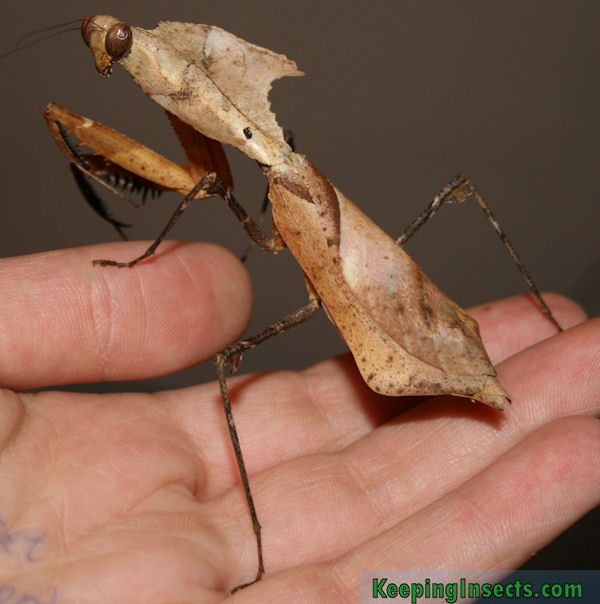
The stick insect imitates stems of foliage not only in colour but in shape, in order to hide itself from predators. The praying mantis also imitates foliage but mainly in order to remain concealed in ambush before grabbing its prey.

Stick insect (Image sourced: Internet)

There’s a spider that imitates an ant, holding two of its eight legs over its head to resemble the antennae of the six-legged insect and has been known even to imitate the ant’s halting scurrying gait. A stonefish imitates a stone on the sea bed while it lies in wait for its prey.

But for all their amazing expertise, they have not – nor can they – become the actual thing they imitate. The stick insect remains an insect, a mantis a mantid, the spider an arachnid, the stonefish a fish.

On the other hand, Sinn Féin, which some years ago began to imitate a political party of the neo-liberal, neo-colonial Irish ruling class, the Gombeens, is becoming what it imitated, transcending what it was into what it wants to be.

People who say that the SF party doesn’t stand for or believe in anything, do it an injustice. The party leaders do indeed stand for something – they stand for getting into government. And they believe in that very strongly indeed, dropping more and more of their old form to do so.

But what do they want to get into government for? Well, just to be the governmentthat’s it. And if not the current government at any point in time, to be in the wings to replace it soon afterwards.

This, of course, entails adopting the dominant colouration and shape of the Irish ruling class environment: neo-liberal capitalist and neo-colonial, i.e foreign-dependent.

FROM NATIONAL LIBERATION TO GOMBEEN PARTY

If we were able to look back through the evolutionary history of animal mimics, we might be able to see stages, a time for example when the mantis and stick insects were beginning to be green and brown but didn’t quite look the part yet.

Dead Leaf Mantis (Image sourced: Internet)

Perhaps the stonefish, though it had not quite got there yet, was beginning to look kind of lumpy. The hover-fly might have been developing dark bands but was not yet showing bright yellow in between them.

With Sinn Féin we can however look back over its evolution from a national liberation organisation to an aspiring gombeen party. I would disagree with those who pinpoint the start of the change with the party deciding in 1986 to stand candidates in Irish state parliamentary elections.

Whether to stand in bourgeois parliamentary elections or not isn’t, in my opinion, a question of principle but rather of tactics. The important issues are the reasons for doing so, the hoped-for objectives and how one goes about the election campaign and after election, if successful.

Certainly however taking part in a government, i.e the executive or management board of the ruling class, is a different question completely.

And when that government is a colonial one, the party cannot even claim to be of a nationalist bourgeois type – it is managing the colony for the colonialist, the highest political level of collusion.

That then for me was the defining shift in Sinn Féin. To be sure, there were many signs along the journey to that point, but that was a step about which there could be no equivocation. And from which there could be no turning back.

One of number of species of Stone Fish (Image sourced: Internet)

A JOURNEY OF MANY SIGNIFICANT STEPS

That step was followed by many others: first calling on people not to oppose and then actually welcoming to both administrations of Ireland the British Queen, the commander-in-chief of the occupying forces; then also supporting recruitment to the colonial gendarmerie.

Abandoning the annual Bloody Sunday commemoration in Derry was an earlier stage, when Martin McGuinness claimed that the results of the Saville Inquiry, establishing that the victims were unarmed (a fact already known to all of Ireland and probably most of the world) were sufficient.1

Refusing to preclude going in to coalition government with gombeen parties was another step on that journey, as was abandoning its annual opposition to the no-jury Special Criminal Courts2 in the Irish state – whether because it wants to show its loyalty to the Gombeens or plans to use it against its dissidents in future is not clear.

Another step was the honouring in Belfast of those who were killed in the British armed forces in WWI, a straightforward imperialist war during which the Provos’ political ancestors, far from supporting the British State, rose up in arms against it in 1916.

The stand taken by the SF leadership towards the British Monarch and Royal Family is another significant change of the party’s position and was marked publicly by statements of sympathy for the death of the Royal Consort, Prince Phillip last year.

At the same time, the leadership apologised for the assassination in 1979 of leading member of the Royal Family and life-long colonialist and imperialist, Lord Mountbatten.

Just recently, another step was taken when condolences were sent to England on the death of the Monarch, Elizabeth Windsor, and Irish people were instructed to be “respectful” to the institution while the media was awash with monarchist propaganda and servile nonsense.

One might wonder why an erstwhile Irish Republican party would seek to accommodate itself with another state’s Royal Family, never mind one which also includes the head of the State which is in armed occupation of a sixth of Irish territory. But SF’s purpose is entirely logical.

In this, the SF party leadership is adapting itself to the nature of the class it seeks to join and represent. The Irish bourgeoisie has been foreign-dependent since its independent nationalist aspirations were smashed in 1798 and 1803.

The Irish capitalist class confirmed its client nature in the process of the creation of the Irish State through 1921 to 1922, in its civil war 1922-1923, armed by the colonial power against the forces for independence ….. and forever since.

The foreign master was first British capitalism and colonialism, later US imperialism and more recently EU capitalism and imperialism. That is the loyal club that SF is preparing to join by imitating its existing members.

End.

Sinn Féin party leadership photographed at funeral in Belfast of ex-IRA political prisoner Bobby Storey in 2020 (Photo sourced: Internet)

FOOTNOTES

1The Bloody Sunday Massacre, one of a series of British Army massacres in the Six Counties (Ballymurphy, Springhill and Derry), was always claimed as the result of a battle with armed insurgents. The timing of the Saville Inquiry (established in 1998) suggests that it was a part of the Good Friday Agreement (also 1988) deal with the Provos: in exchange for their giving up armed struggle, their members in the jails would be released and, for the wider nationalist population of the Six Counties, the British would end up admitting the Derry victims were unarmed. Provisional SF abandoned the annual march on the strength of that verdict but no-one was ever prosecuted for the murders, even when Lord Saville stated that some of the soldiers had lied in their evidence.

2The special political trial courts in both administrations have no juries; in the Six Counties the Diplock Court and in the Irish State, the Special Criminal Courts.

SOURCES

Mimicry: https://www.sciencedirect.com/topics/earth-and-planetary-sciences/mimicry#:~:text=Mimicry%20occurs%20when%20one%20species,otherwise%20capture%20and%20eat%20it.
https://a-z-animals.com/blog/10-animals-that-use-mimicry-to-survive/

Stonefish: https://en.wikipedia.org/wiki/Synanceia

Spider mimicking ant: https://en.wikipedia.org/wiki/Ant_mimicry
https://www.antwiki.org/wiki/Ant-Mimicking_Spiders

SF welcoming British Queen to Ireland: https://www.bbc.com/news/uk-northern-ireland-59489930
https://www.irishtimes.com/news/politics/sinn-fein-and-a-tale-of-two-state-visits-1.1599356

SF supporting recruitment to colonial police force: https://www.irishtimes.com/news/crime-and-law/sinn-fein-presence-at-psni-recruitment-event-seismic-and-historic-1.4161267

SF condolences on death of Royal Constort, Prince Phillip: https://www.newsletter.co.uk/news/politics/top-sinn-fein-figures-lead-effusive-tributes-to-prince-philip-praising-his-public-service-and-support-for-the-queen-3198149
https://www.independent.ie/news/sinn-fein-leader-mary-lou-mcdonald-has-written-to-queen-elizabeth-to-formally-express-condolences-over-death-ofprince-philip-40336994.html

SF no longer opposing the the no-jury Special Criminal Court: https://www.thejournal.ie/special-criminal-court-review-2-5803404-Jun2022/
https://www.irishtimes.com/news/politics/sinn-fein-drops-opposition-to-special-criminal-court-1.4715275

SF on British Army dead of WWI: https://www.bbc.com/news/uk-northern-ireland-62008152

SF on death of British Queen: https://www.sinnfein.ie/contents/64262

BRITISH QUEEN’S LONG SERVICE TO COLONIAL & IMPERIALIST WAR

Diarmuid Breatnach

(Reading time main text: 5 mins)

Recently the Queen of the UK and Commonwealth regions reached the 70th year of her reign, called by convention the “platinum jubilee” and has received congratulations from the heads of imperialist, colonial and neo-colonial states around the world. In Ireland, she has also received the congratulations of the head of a formerly Republican party now aspiring to neo-colonial government. When Mary Lou MacDonald, President of Sinn Féin praised Elizabeth II for her “long service” we should ask: service to whom and to what? We are also entitled to compare her words to those of James Connolly, Irish revolutionary socialist and republican, in reference to the British Monarchy.

WHAT THE PRESIDENT OF SINN FÉIN SAID

Mary Lou McDonald, President of Sinn Féin was widely reported reacting to the news that a tree is to be planted in the grounds of Parliament Buildings at Stormont to mark the anniversary.

“I think it is important that we are respectful of the identity of our citizens who are British,” she said on Thursday.

“I think that is entirely appropriate and I welcome that decision.

She was reported wishing well to those who will celebrate the jubilee, and said she believes those who won’t “are now big enough, bold enough, generous enough to acknowledge the identity of others.”

“Can I also extend to the British Queen a word of congratulations because 70 years is quite some record,” she added.

“That is what you call a lifetime of service.”

Any logical consideration of those words should quickly find some problems with them. What does “respecting the identity of our (Irish) citizens who are British” or “acknowledging the identity of others” actually mean? One would imagine that respecting the identity of others would involve primarily not subjecting them to discrimination, racism or religious sectarianism. Does respecting the national identity of any people give them the right to seize with armed force and occupy a part of the nation? Because that is what constitutes the basis for the British colony of the Six Counties in Ireland and the administration of that colony is the purpose of the Stormont Parliament and Executive. Furthermore, discrimination and sectarianism is precisely what is suffered by a huge part of the population of that colony – from the very institutions being upheld by SF and by its President.

Stripped down to its essentials, we are only “big enough, bold enough, generous enough” if we accept the partition of our small nation, the forcible retention of a colony and pay our respects to the Head of that state and the Commander-in-Chief of its armed forces.

This is a monarch who has presided over her armed forces’ participation in at least 24 wars or interventions since her inauguration, two of them in our national territory. Her armed forces invaded foreign lands, bombed and shot down those who resisted, carried out massacres, tortured prisoners and she has personally decorated the leaders of those armed forces, including those who murdered Irish people. The very least one could expect from an Irish politician with any dignity would have been silence or “no comment” on the occasion.

A poster calling for retired Army officer General Sir Mike Jackson to be jailed and advertising a march commemorating Bloody Sunday, on display in the Bogside area of Derry, Six Counties. Jackson was one of many military murderers to be decorated by the British Queen. (Photo by Niall Carson/PA Images via Getty Images).

This is far from the worst thing that the Sinn Féin leadership has done with regard to the British Monarch, for in May 2011 they called for no protests against her while she desecrated the Garden of Remembrance in Dublin and while the Gardaí attacked “dissident” Republican protesters nearby and outside her state reception in Dublin Castle, the old seat of her royal enforcers in Ireland. The following year, Martin McGuinness, prominent in the leaderships of both the IRA and Sinn Féin, welcomed her to her colony and shook her hand.

Martin McGuinness, in leadership of Sinn Féin and the IRA, welcomes the British Queen to visit her colony in 2012 (Photo sourced: Internet)

WHAT JAMES CONNOLLY SAID

James Connolly on occasions too referred to contemporary British monarchs – but in markedly different terms to those from the leadership of Sinn Féin in recent decades.

“What is monarchy? From whence does it derive its sanction? What has been its gift to humanity? Monarchy is a survival of the tyranny imposed by the hand of greed and treachery upon the human race in the darkest and most ignorant days of our history. It derives its only sanction from the sword of the marauder, and the helplessness of the producer, and its gifts to humanity are unknown, save as they can be measured in the pernicious examples of triumphant and shameless iniquities.

“Every class in society save royalty, and especially British royalty, has through some of its members contributed something to the elevation of the race. But neither in science, nor in art, nor in literature, nor in exploration, nor in mechanical invention, nor in humanising of laws, nor in any sphere of human activity has a representative of British royalty helped forward the moral, intellectual or material improvement of mankind. But that royal family has opposed every forward move, fought every reform, persecuted every patriot, and intrigued against every good cause. Slandering every friend of the people, it has befriended every oppressor. Eulogised today by misguided clerics, it has been notorious in history for the revolting nature of its crimes. Murder, treachery, adultery, incest, theft, perjury – every crime known to man has been committed by some one or other of the race of monarchs from whom King George is proud to trace his descent.

…………………….

Two completely opposite attitudes to British Monarchy: Mary Lou McDonald (L) and James Connolly (R)

“Fellow-workers, stand by the dignity of your class. All these parading royalties, all this insolent aristocracy, all these grovelling, dirt-eating capitalist traitors, all these are but signs of disease in any social state – diseases which a royal visit brings to a head and spews in all its nastiness before our horrified eyes. But as the recognition of the disease is the first stage towards its cure, so that we may rid our social state of its political and social diseases, we must recognise the elements of corruption. Hence, in bringing them all together and exposing their unity, even a royal visit may help us to understand and understanding, help us to know how to destroy the royal, aristocratic and capitalistic classes who live upon our labour. Their workshops, their lands, their mills, their factories, their ships, their railways must be voted into our hands who alone use them, public ownership must take the place of capitalist ownership, social democracy1 replace political and social inequality, the sovereignty of labour must supersede and destroy the sovereignty of birth and the monarchy of capitalism.

“Ours be the task to enlighten the ignorant among our class, to dissipate and destroy the political and social superstitions of the enslaved masses and to hasten the coming day when, in the words of Joseph Brenan, the fearless patriot of ’48, all the world will maintain

The Right Divine of Labour
To be first of earthly things;
That the Thinker and the Worker
Are Manhood’s only Kings.”2

SUPPORT FOR SINN FÉIN

Most followers of the Sinn Féin party, who are by long tradition anti-monarchist and desire a reunified and independent Ireland, tend to regard those kinds of heretical statements by the party leaders as no more than some kind of camouflage to get them into power. Once there, they imagine, their party will lead them to the hallowed objectives of Irish independence and unity. In fact, the same kind of attitude that was that of the early followers of Fianna Fáil, “the Republican party”3.

The blindness, or more accurately the ability of self-deception exhibited by these followers is amazing. The majority continued to believe the leadership when it publicly abandoned armed struggle against British colonialism and declared it would never return to that (believing that to be a fake position) and even when it had most of its arms decommissioned. Then the party not only fielded candidates in elections in the partitioned Irish state but also in the colonial one and, in arguably its greatest betrayal of its previous position, participated in the running of the colonial state which it continues to do. Since then its leaders have sought support for and even assisted in recruitment for the sectarian and colonial gendarmerie4 and, more recently, declared its acceptance of non-jury special courts, a clear reference in particular to the no-jury Special Criminal Courts of the Irish state5, condemned by a number of civil rights organisations6 and of which the party’s own supporters have been frequent victims.

The attitude of the larger mass of instinctively pro-independence people, mostly working-class or lower middle-class is that they might as well give Sinn Féin a turn in government – after all they can hardly treat them worse than the other gombeen7 parties that have been in government since the creation of the Irish State. Such attitudes account for the rapid growth in the party’s electoral base in recent years when it became the first party in terms of elected representatives so that two other neo-colonial parties, with a long history of hatred for one another, were obliged to join and form a coalition with a third8 in order to form a government excluding the new kid on the block.

General Jackson with Prince Charles, heir apparent to the throne of England and Commander-in-Chief of the Paratroop Regiment (Photo sourced: Internet)

The attitude expressed by the President of the SF party runs not only completely contrary to the traditions of Irish Republicanism but even to its own history. It is more than that, it is an expression of the lack of dignity and craven forelock-tugging attitude of the neo-colonial Gombeen class that has ruled the Irish state since its inception.

While socialists and republicans rightly condemn that mentality and its practical applications, we should place our hopes in another outlook, as outlined by Connolly over a century earlier, and in the practical expression of that outlook today and in the near future. It is surely appropriate then to end this commentary with Connolly’s own words on another British royal jubilee, Queen Victoria’s in 1897:

“….. It is time then that some organised party in Ireland — other than those in whose mouths Patriotism means Compromise, and Freedom, High Dividends — should speak out bravely and honestly the sentiments awakened in the breast of every lover of freedom by this ghastly farce now being played out before our eyes. Hence the Irish Socialist Republican Party — which, from its inception, has never hesitated to proclaim its unswerving hostility to the British Crown, and to the political and social order of which in these islands that Crown is but the symbol — takes this opportunity of hurling at the heads of all the courtly mummers who grovel at the shrine of royalty the contempt and hatred of the Irish Revolutionary Democracy. We, at least, are not loyal men; we confess to having more respect and honour for the raggedest child of the poorest labourer in Ireland to-day than for any, even the most virtuous, descendant of the long array of murderers, adulterers and madmen who have sat upon the throne of England ….

“The working class alone have nothing to hope for save in a revolutionary reconstruction of society; they, and they alone, are capable of that revolutionary initiative which, with all the political and economic development of the time to aid it, can carry us forward into the promised land of perfect Freedom, the reward of the age-long travail of the people.”9

End.

APPENDIX:

List of armed interventions and wars by British Armed forces under Queen Elizabeth II:

Mau Mau Uprising(1952–1960)

Jebel Akhdar War
(1954–1959)

Cyprus Emergency
(1955–1959)

Suez Crisis(1956–1957)

Border Campaign
(1956–1962)

First Cod War
(1958–1961)

Upper Yafa disturbances[22](1959)

Dhofar Rebellion
(1962–1975)

Indonesia–Malaysia confrontation
(1963–1966)

Aden Emergency(1963–1967)

The Troubles(1968–1998)

Invasion of Anguila, Caribbean
(1969)

Second Cod War
(1972–1973)

Third Cod War
(1975–1976)

Falklands War
(1982)

Multinational Force in Lebanon
(1982–1984)

Gulf War
(1990–1991)

Bosnian War
(1992–1995)

Operation Desert Fox
(1998)

Kosovo War
(1998–1999)

Sierra Leone Civil War(2000–2002)

War in Afghanistan
(2001–2021)

Iraq War
(2003–2009)

First Libyan Civil War(2011)

2019–2021 Persian Gulf crisis(2019–present)

FOOTNOTES:

1In Connolly’s time, the term “social democrats” covered most revolutionaries in Europe in addition to reformists whereas today it is confined to describing only the latter.

2Commenting in 1910 on the announced visit of King George V to Ireland https://www.marxists.org/archive/connolly/1911/xx/visitkng.htm

3Fianna Fáil was a 1926 split from Sinn Féin led be De Valera, based on participating in elections within the Irish State, initially supported by many Irish Republicans in elections and when voted into Government in 1932 released Republican political prisoners jailed by the Government of pro-Treaty forces. Subsequently however a FF Government banned the IRA and jailed and even executed some Republicans.

4A gendarmerie is an armed state-wide military-like police force, such as for example the ones in the Spanish, Italian and Turkish states, typical of a State endeavouring to impose central rule on subject nations or regions where recurrent resistance may be expected. In Ireland the English occupation had the Royal Irish Constabulary which after 1922 in the colonial statelet became the Royal Ulster Constabulary, later changing its name to the Police Force of Northern Ireland. It has always been a sectarian (anti-Catholic) and repressive force.

5Both the Irish State and the colonial statelet have no-jury courts to jail political dissidents on low evidential requirements and under emergency legislation. The position SF’s elected representatives since 1972 has been to vote against the existence of the Special Criminal Court until two years ago, when it began to abstain and finally this year at its Ard-Fheis (annual general meeting), after an extremely poor debate, the party voted to accept such a court.

6Including the Irish Council for Civil Liberties and Amnesty International.

7A term of contempt dating from the years of the Great Hunger to describe capitalists who are happy to use the colonial system to amass personal wealth at the expense of their compatriots; its source is in the Irish language (an gaimbín/ gaimbíneachas — https://www.dictionary.com/browse/gombeen)

8Fianna Fáil, Fine Gael and the Green Party. The first two have been the major parties of the State almost since its inception, with the Greens being a smaller and more recent phenomenon. Fine Gael are the political representatives of the neo-colonial class that supported the partition of the country in the Anglo-Irish Agreement of 1921 for which they fought a Civil War (1922-1923) against the Irish Republicans (chiefly the IRA and Sinn Féin). Fianna Fáil led a major split in the Republican movement to form an Irish Government and soon attracted support (and later domination) by a section of native capitalists, soon becoming the favoured choice of the neo-colonial Irish capitalist class, alternating in government from time to time with Fine Gael (the latter in coalition, several times with the social-democratic Labour Party). However, since 1981 no Irish political party has commanded an absolute majority in elected representatives and all governments of the State since then have been coalitions of one kind or another.

9https://www.marxists.org/archive/connolly/1897/xx/qundimnd.htm Queen Victoria’s Jubilee Day, 22 June 1897, was marked by Connolly and Maud Gonne with protests on the streets of Dublin. Connolly dumped a symbolic coffin into the River Liffey and shouted “to hell with the British Empire”, for which ‘crime’ he spent the night in jail.

SOURCES:

James Connolly on visit of King George in 1911: https://www.marxists.org/archive/connolly/1911/xx/visitkng.htm

and on Queen Victoria’s Diamond Jubilee: https://www.marxists.org/archive/connolly/1897/xx/qundimnd.htm

For list of armed conflicts in which the UK has led or participated since coronation date of Elizabeth Windsor in 1953: https://en.wikipedia.org/wiki/List_of_wars_involving_the_United_Kingdom

Invasion of Anguila (missing from above list): https://en.wikipedia.org/wiki/Operation_Sheepskin#:~:text=Operation%20Sheepskin%20was%20a%20British,itself%20as%20an%20independent%20Republic.

UK Armed forces officially recorded in the Middle East: https://commonslibrary.parliament.uk/research-briefings/cbp-8794/

British military bases around the world: https://en.wikipedia.org/wiki/Overseas_military_bases_of_the_United_Kingdom