I WAS INVITED TO SING A COUPLE OF SONGS AT THE LAUNCH OF “OUR RISING – CABRA AND PHIBSBOROUGH IN 1916″. Of course I was honoured to accept; the songs I chose to sing were “Sergeant William Bailey” and “Where Is Our James Connolly?” I chose them as important to the events around the Irish Volunteers and hoped they would be considered appropriate to the book launch event also.
These years are the centenaries of many things in our history and it is right that we should remember them. Among those things we are told that we should remember the First World War. I think the people who say that are right – we should, but not in the way most of those people mean. We should remember that in a dispute about what markets of the world should be dominated by which World powers and which resources they should have a monopoly on stealing, they sent millions to their deaths and millions more to injury and tragedy. And of course, the capitalists, the class that controlled those Powers were not among those dead and injured millions.
When those people tell us that we should commemorate the First World War and collect songs and memorabilia they don’t mean that we should sing songs against the War, collect anti-War leaflets and honour those brave few who dared speak out publicly against the war stampede of their countries. And who paid the price for doing so. And yet those things too are the history of the War and to my mind the parts of that history that, among all the wars of the past and the present, hold out a hope for the future.
Peadar Kearney, author of “The Soldiers’ Song”, “Sgt. William Bailey” and many other songs
Peadar Kearney was an Irish Republican of a Dublin skilled working class background born not far from Phibsborough – in Dorset Street, around the corner from Inisfallen Parade, where Sean O’Casey was reared. When Kearney taught night classes in Irish, O’Casey would be one of his pupils.
Kearney wrote many songs that are still sung today, the most famous of which is the Soldiers’ Song, on which he cooperated with Patrick Heeney, from Railway Street, off Gardiner Street. When the Irish Volunteers was formed in 1913, Kearney was a co-founder and his song was one of a number sung by other Volunteers during the 1916 Rising, in which Kearney also fought.
Peadar Kearney also wrote a three-verse song mocking a recruiting sergeant for the British Army, who apparently had a pitch at Dunphy’s Corner. According to a local historian, that was outside what is now Doyle’s pub, at the Phibsboro crossroads. I added two verses to that song, in order to give Sergeant William Bailey a bit of a background story.
Of course, the 1916 Rising is a part of the history of the First World War too – and not only because it took place during that War. For some, undoubtedly, it was a case of “England’s difficulty is Ireland’s opportunity”. But for some others, including Connolly, as he made clear a number of times in writing, the Rising was necessary to interrupt the War, to stop the bloodshed of class brother killing class brother across Europe.
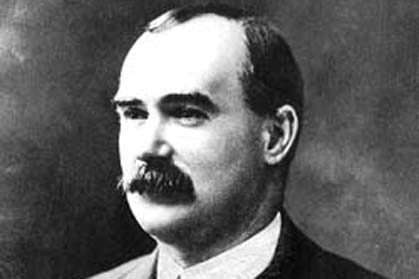
James Connolly, a revolutionary socialist, wanted revolution against world war
Connolly was a revolutionary socialist. At the end of the 19th and very early 20th Centuries, the standard position of the international socialist movement had been against imperialist or colonialist war. In 1912, on November 24–25, the congress of world socialist parties at Basel in Switzerland, including revolutionaries and reformists, had come out clearly against imperialist war. Their manifesto was unanimously adopted at the congress. In the context of the situation created by the war in the Balkans that had begun in October 1912 and the increasing threat of world war, the Basel Manifesto called called for an unrelenting struggle against war and those responsible for it, the ruling classes of the capitalist countries. It stated that that war, if it began, “would create an economic and political crisis,” which should be utilized to “hasten the downfall of the rule of capital.”
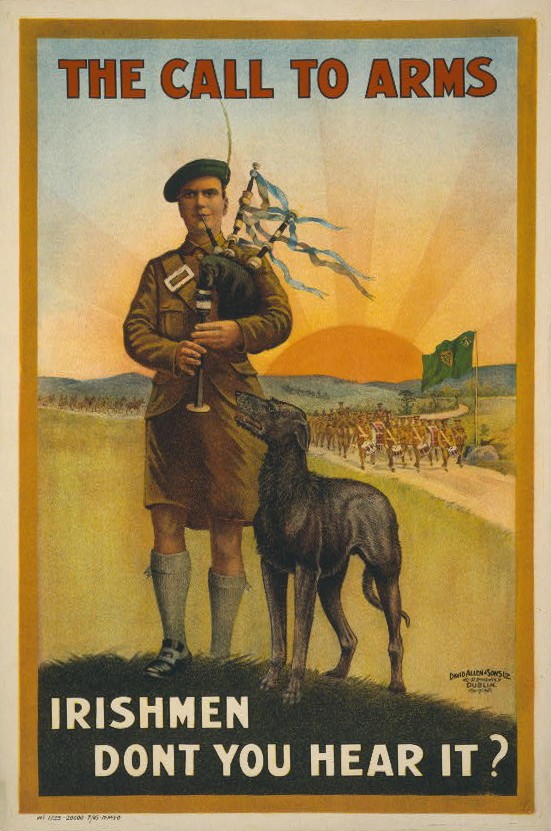
British Army recruitment poster aimed at Irish men
As we know, the leadership of those parties that we now call the social democrats abandoned this position completely and championed their own ruling classes two years later as WWI broke out, cheering the workers of their countries on into uniform, to kill and be killed. There were some uprisings against the capitalists and against war but the first of any significance — and indeed of great significance — was the 1916 Rising in Ireland. The next revolutionary blow to war would not be until be a year later, with revolution in the Russian Empire.
Of the two better-knowns songs about James Connolly, the song “Where Is Our James Connolly?” is I think the best and truer to Connolly’s ideology. It was written by Patrick Galvin who was, among other things a writer, playwright, screen writer and singer. Galvin died only four years ago. Christy Moore remembers learning the song around 1970 which is probably not long after it was written – or at least published.
Patrick Galvin, author of “Where Is Our James Connolly?”
The 28th of June was not a normal Sunday in Moore Street. On a normal Sunday, Moore Street is not a busy street, although it is not quiet either. The stallholders are on a day off to come back on Monday but a number of small shops are open as are the supermarkets and the ILAC shopping centre, one of which doors opens up on to Moore Street. But on this Sunday, crowds packed a part of the street for the event organised by the Save Moore Street from Demolition group.
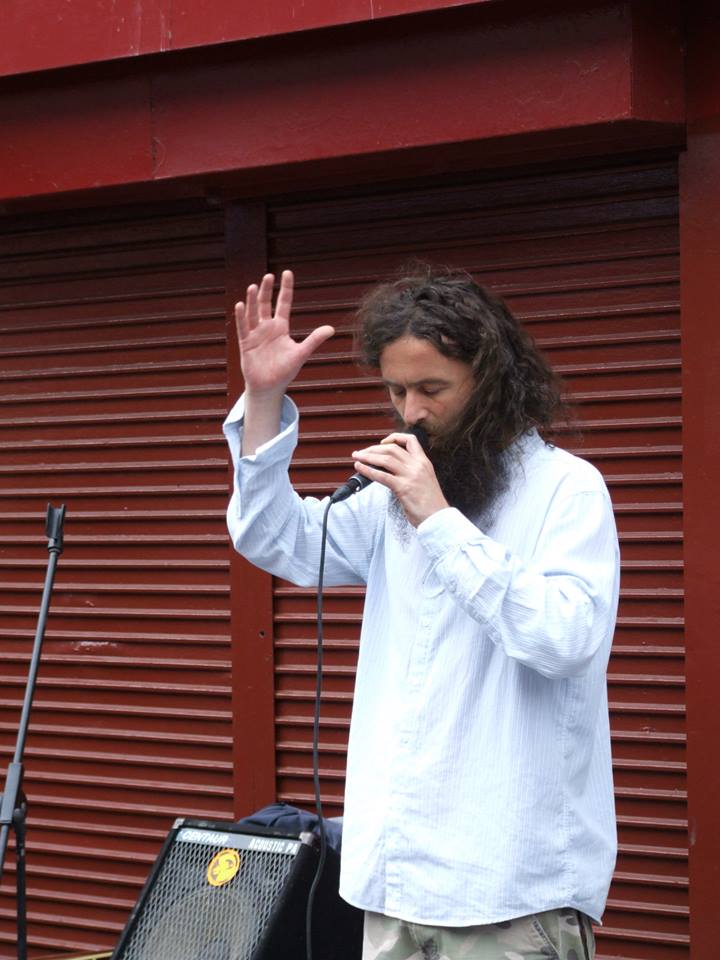
Part of the crowd lining up around the 1916 Terrace in Moore StreetPaul O’Toole, who played a number of sets, including singing some songs of his own composition
As a crowd had gathered already by 1.30pm, a half an hour early, singer-musician Paul O’Toole responded to his performing instincts and started playing a set of compositions of his own and of others. A song against the Water Charges opened his set, to be followed by another of his own, We Shall Not Lie Down.
Meanwhile the Save Moore Street from Demolition (non-political party) group, had set up their stall as they had done the previous day there and on another 41 Saturday afternoons in Moore Street. The folding table, covered in a Cumann na mBan flag donated by a diaspora supporter, was staffed by Bróna Uí Loing, a relation of 1916 veterans and of Fenians involved in the famous Manchester prison van escape, and Vivienne Lee, another early activist in the campaign. On the table was a petition to save the street and leaflets were being handed out by helpers. Nearby, some Irish tricolours, the Starry Plough and the Irish Republic flag fluttered and a number of placards indicated the concerns of the campaign: “NÍL SAOIRSE GAN STAIR (“There is no freedom without history”) stated one, while another said “NO TO SPECULATORS”.
MOORE STREET IN HISTORY
Moore Street is the sole remaining street of a market quarter going back hundreds of years comprising three parallel streets with many lane-ways in between, all the rest of which are now buried underneath the ILAC shopping centre and a Dunne’s Stores; people lived in those streets and laneways and clothes and shoes, meat and fish, fruit and vegetables and furniture were sold there.
But in 1916, Moore Street, its back yards and its surrounding streets were host to history of a different kind: in the last days of the 1916 Rising, the GPO roof burning and the ceiling unsafe, around 300 Irish Citizen Army and Irish Volunteers evacuated the building and made their way through a side door, across a Henry Street made hazardous by flying bullets, and into Henry Place. It was probably here that the English revolutionary socialist, Weekes (also variously Weeks, Wicks) who had joined the Rising, fell dead.
The insurgents’ evacuation group included three women: Elizabeth O’Farrell, her life-long friend Julia Grennan and Winifred Carney, James Connolly’s secretary who, on leaving Liberty Hall on Easter Monday, had packed a Webley pistol along with her typewriter. All three had refused to leave as the other Cumann na mBan women made their own earlier hazardous way helping the wounded fighters to Jervis Street hospital.
As the evacuees made their way hurriedly through the Henry Place laneway, they encountered a storm of machine-gun and rifle fire at the intersection of the lane and another, now named Moore Lane. The fire was coming from a British Army barricade at the top, in what is now Parnell Street. Here Michael Mulvihill fell, mortally wounded; he was also fresh over from England but originally from Kerry. Volunteers broke into a yard and dragged a car out, placing it across the gap and taking a breath, they ran across, mostly one by one. Connolly was being carried on a makeshift stretcher, his ankle shattered earlier by a ricocheting bullet in Williams Lane, ironically just next to Independent House, owned by leader of Dublin “nationalist” capitalists, William Martin Murphy and also ironically, across the road from the former office of the Irish Socialist Republican Party, founded by Connolly in 1896, sixteen years earlier.
Shortly before the evacuating group were making their way across that murderous gap, Michael The O’Rahilly had led a dozen fighters who had volunteered for the task in a charge at another British barricade and machine-gun a the top of Moore Street, also in what is now Parnell Street. Since the GPO was being evacuated, there was no covering fire from the top of that building and the fire coming down the street must have been terrific. None made it as far as the barricade. The O’Rahilly was apparently unharmed and got quite close; he sheltered in a doorway on the west side of the street and then ran across to a lane on the other side. A burst of machine-gun fire caught him and in the laneway, now named O’Rahilly Parade, he died, after having penned a note to his wife. The note is reproduced now on a bronze plaque in that street.
The other group, having made it through Henry Lane and prevented from further progress by the firing of that same machine-gun, broke into the first house of a Moore St. Terrace on the north side of the terrace and began to tunnel northwards from house to house, occupying in time the whole terrace by the time their leaders gave up their plan of breakout and, in an attempt to save further loss of civilian life, surrendered themselves and all the garrisons of the Rising on both sides of the Liffey on Saturday of Easter Week.
The surrender party of Pearse and O’Flaherty met General Lowe in what is now Parnell Street (exactly where is disputed but from the photo of the event it would appear to be outside of where In Cahoots café is now). The GPO/ Moore Street garrison marched up O’Connell Street and surrendered their arms outside the Gresham Hotel and were kept prisoner in the garden of the Rotunda, the building where the first public meeting to found the Irish Volunteers had been held in 1913. A British soldier posed later for a photo with the Irish Republic flag held upside down in front of the Parnell Monument and at some point a whole group of British officers posed for another photo, also holding the flag upside-down to signify the defeat of the rebels.
From that tunneled-through terrace in Moore Street, six were among the 14 shot by firing squad, including five of the signatories of the Proclamation: Tom Clarke (whose tobacconist shop was where the Centra shop is now, across from the Parnell Monument), Patrick Pearse, James Connolly, Seán Mac Diarmada and Joseph Plunkett. Another, William Pearse, was also executed.
MOORE STREET ON THE 28th JUNE 2015
Jumping forward to June 28th 2015, while Paul O’Toole was playing and singing to keep the audience interested, shouted slogans from the Henry Street end of Moore Street announced the arrival of the Dublin Says No weekly march, come to support the campaign.
Paul O’Toole’s place was taken later by Kev and Dwayne, who played and sang a set of Dublin and 1916 ballads, to be followed by a performance of two of his pieces by John Cummins, Poetician, champion of the Slam Poetry competition. His piece on Moore Street was particularly well received.
John Cummins, poetician, performing his Moore Street pieceKev and Dwaine, who also provided entertainment with a set of Dublin and 1916 songs
Diarmuid Breatnach of the Save Moore Street from Demolition group, who had been MCing the entertainment part of the event, then called on the crowd to line up on the street and stretch arms in a symbolic act of: “Love for Moore Street and our heritage and resistance to the plans of property speculators to destroy it”. Paul O’Toole came back on and played as the crowd eventually stretched around all four sides of the “1916 terrace”, areas where in 1916 bullets flew and people died as a relatively small group of women and men took on the British Empire. Cries could be heard of “Save Moore Street, save it all, Save the Terrace and the stalls!”
When the ‘Arms Around’ exercise had been completed, photographed and filmed, Breatnach called the participants to gather back around to the Moor Street terrace and introduced Mel Mac Giobúin, to speak on behalf of the SMSFD group and to MC the final part of the event.
Mel thanked the crowd for encircling the 1916 terrace in defence of “ ‘me jewel and darlin’ Dublin’ as Éamon Mac Thomáis would say”. Mel explained that the small group of which he was part had run an information and petition stall “every Saturday for over 40 weeks in Moore Street, in rain, cold and now sunshine” and paid tribute to all those who had campaigned over the years. He spoke of the support of ordinary people who shop in the street, who come up to the stall not only to sign the petition but to tell us their memories of shopping or working in Moore Street, of relatives who were involved in the 1916 Rising and/ or in the War of Independence.
The line stretching around from Moore St, to the corner of Moore Lane with Henry Place, then (out of frame) up Moore Lane to O’Rahilly Parade and back into Moore St.Mel Mac Giobúin, speaking on behalf of the Save Moore Street from Demolition group
Enumerating some of the advances that had been made over the years, Mel denounced the Chartered Land giant “shopping mall” proposal and the NAMA process through which property speculator Joe O’Reilly was now going and Moore Street along with him. (Joe O’Reilly was, at €12.8 billion, top of the list of NAMA debtors not long ago but is now at No.6 of the Top Ten. He is still in business and being paid €120,000 annually by the State to manage his debts; also was recently involved in bidding for another big property site — DB). Dublin City Council had received a large number of submissions, Mel said, and was now beginning to think that another shopping mall might not be the best idea for Moore Street.
Bróna Uí Loing and Vivienne Lee, members of the campaigning group with the campaign table displaying petition and leaflets
“We should continue to recognise the important significance of the 1916 Rising and the long tradition of the street market” Mel said and, in concluding, he thanked the crowd but asked them to be ready to be called out again in defence of the Moore Street historic quarter.
Next to speak was Donna Cooney, representing the 1916 Relatives Association, who spoke of the Cumann na mBan women in Moore Street in 1916, one of them being her great grand-aunt, Elizabeth O’Farrell. Donna recounted how O’Farrell had tripped in Moore Lane during the evacuation but had been caught and saved by Sean McGarry. On entering No.10, the first thing O’Farrell remembered seeing was Connolly on a stretcher and went to tend to him (she was a nurse by profession).
Donna spoke of the perilous journey O’Farrell had to take twice in the negotiations with General Lowe and then later, more danger in the unhappy task of taking the surrender instructions from Pearse and Connolly to insurgent strongholds in various parts of Dublin. “The Government needs to do much more”, said Donna, referring to Government plans to commemorate the centenary of the Rising in 2016 and was warmly applauded by the crowd.
Donna Cooney, great-grandniece of Elizabeth O’Farrell, speaking on behalf of the 1916 Relatives’ Assocation
Proinnsias Ó Rathaille, called up next by Mel, is also a 1916 hero’s relative – his grandfather was The O’Rahilly, who died in the lane that now bears his name. Proinnsias spoke briefly of the international importance of the 1916 Rising, which had given such inspiration and encouragement for their own revolutions to nations around the world, particularly those under the British Empire. Turning to the importance of the Irish diaspora to the struggles, Proinnsias singled out Maeve O’Leary who continues to promote the cause from Australia where her home is now and who had recently returned to her native Dublin for a short while (and worked with the Save Moore Street from Demolition group — DB).
Proinnsias concluded by reading the moving poem written by Yeats to the memory of The O’Rahilly to great applause.
Proinnsias Ó Raithille, grandson of The O’Rahilly and a campaigner for Moore Street
The final speaker introduced by Mel was Jim Connolly Heron, great-grandson of James Connolly, a long-time campaigner for the appropriate preservation of Moore Street. Jim spoke about how the Chartered Land plan to destroy Moore Street had been agreed by a Minister in the current government and how a land-swap deal, which would have facilitated the destruction of much of the 1916 terrace, had been voted down by elected councillors of a number of political parties and independents.
Jim Connolly Heron, great grandson of James Connolly and a long-time campaigner about Moore St.
Jim went on to speak of the NAMA sell-off of assets due for the following day, when among other properties, Chartered Land’s stake in the ILAC and Moore Street was to be sold off to the highest bidder. “Moore Street is not for sale”, he said, to cheers. Jim went on to speak of “the golden generation” who had risen in 1916 and the need to honour their memory and to commemorate the event properly and how conserving the historic Moore Street quarter, the only surviving 1916 battle-site, is very important part of that. Jim concluded to loud cheering and applause by saying that “Moore Street will not be sold on our watch!”
Paul O’Toole then played and sang again his “We Will Not Lie Down”, with the crowd joining in on the chorus, after which he accompanied Diarmuid Breatnach singing “Amhrán na bhFiann”, the first verse solo and everyone joining in on the chorus.
And so the third Arms Around Moore Street event in six years (along with other types of campaign events) came to a close. Next Saturday, the Save Moore Street from Demolition information and petition table will be there again, for people to sign, to read, to share their memories, their anger, their hope that the market, the terrace, the quarter are saved. In the meantime, people will sign the petition on line and post supportive comments on the SMSFD Facebook pages and others. It is not just their past – it is their future too.
End
Section of the crowd of supporters in Moore Street
Viyan Peyman, famous fighter-singer of the YPJ, fell in battle against Islamic State in Serekaniye (Yazira canton) on Monday 6th April 2015, according to news agency Hawar News.
Viyan Peyman, famosa luchadora y cantante del YPJ cayó én lucha contra el Estado Islamico el lunes 6 de Abril 2015, según la agencia de noticias Hawar News (miren enlace al fondo de este corto trozo para las noticias en castellano).
When Eagles Sing
(I ndil chuimhne Viyan Peyman/Gulistan Tali Cingalo)
A bird fell from the sky —
the birdsong now has died.
A songbird but also a fighter —
When eagles sing
our struggle is made lighter.
She flies now in different skies,
skies of our memory,
of our heart, spirt and mind
where her song cannot be silenced
for Kurds or for humankind.
Diarmuid Breatnach April 2013
Viyan’s real name was Gulistan Tali Cingalo (Gulistan means “garden”) and she was from Mako city in the part of Kurdistan located within the Iranian state’s territory.
The song she sings in the video was composed by her; the lyrics say:
“Oh, mother, woe to me!
My heart cries today — what disaster has fallen upon us!
I will sing today of the resistance of Kobane,
that it may be a poem recited for the world and humanity, oh mother!
Today again our Kurdish boys and girls have made their chests into shields
against the tanks and bombs … Oh, mother, woe to me!
Today I imagine the mothers of Kobane crying in the streets;
I imagine the boys, the girls, the elderly screaming in pain and rage.
I see the tears of the children of Kobane as if they were the Euphrates river,
We celebrate International Women’s Day on March 8th but are we aware that on that day in 1917, women started the Russian revolution? It was one of the many contributions of women the world over to the struggles of humanity.
BACKGROUND
There were many causes of discontent with the ruling regime in Russia in 1917: it was monarchic, autocratic, repressive, incompetent. It had put the country into a war with Germany and Austria, which was in its third year. People were very hungry with food shortages for a number of reasons including the trains being used to transport war materials and soldiers rather than to bring food into the city. Nationalities within Russia and Greater Russia were denied self-determination.
Peasants were serfs to the aristocracy, who could beat, imprison and even hang them. Officers, always from the aristocracy or — to a lesser degree — from the professional classes regularly struck ordinary soldiers or had them whipped. The officers were also for the most part grossly incompetent.
The Christian Church (Russian Orthodox) was allied to the regime and corrupt. Free speech was suppressed and the secret police could be anywhere; the regular police were brutal and could not be challenged by ordinary people. Wages were often barely enough to live on.
START OF THE REVOLUTION
Petrograd was the Imperial capital city of Russia (the name had been changed in 1914 from St. Petersburg, which sounded too German) and in February and March 1917 a number of factories there were on strike for better wages. In particular, on March 7th (February 22 according to the calendar in use in Russia then), workers in the large Putilov works went on strike. The factory owners sacked the workers but not had not yet replaced them; there were some clashes with police.
The following day, March 8th (by our calendar), International Women’s Day, women in Petrograd organised a number of meetings and rallies. Led by no political party but in an atmosphere of deep discontent throughout the city, the women’s activities became increasingly energetic and militant. Demonstrations began to march, demanding bread and the women went to factories not yet on strike, calling on the workers to down tools and join the demonstrations. As as many as 50,000 did.
Two days later, a general strike had seized Petrograd’s manufacturing industries, much of the city’s services and even some commercial business, bringing clerks, teachers and students to swell the numbers in protests. Everywhere there were street meetings, marches; red flags and banners began to appear among the crowds. Slogans hardly considered before were shouted and became current, including calling for the monarch, the Tsar, to abdicate or to be deposed.
Demonstration during the “February Revolution” 1917
The Petrograd police were powerless to control the demonstrators who would have turned on them had they intervened. On the 11th, three days after the women’s mobilisation, the Tsar called on the Russian Army to intervene and to shoot demonstrators.
Russia had the largest single army in the world and despite the war, thousands were still in Petrograd. They had been used in the past against the workers and in 1905 had massacred people on a demonstration to petition the Tsar. But now, after three years of war and shortages, they were not keen to do so and particularly reluctant to open fire on women. Soldiers began to mutiny and, when threatened by officers, often shot them instead.
On that day, the Chairman of the Duma, the parliament which the Tsar Nicholas had kept powerless, sent an emergency telegram to the Tsar, who was at the Headquarters of the Russian Army, asking him for urgent action. The Tsar’s reply was dismissive – his wife, the Empress Consort Alexandra, had written to him that the problems in Petrograd were being exaggerated.
A Russian Army barricade during the “February Revolution” — the soldiers refused the orders of their officers to shoot demonstrators.
But the garrison of Petrograd, including elite units, had mutinied by the 12th, four days after the women’s marches and demonstrations. In addition the Cossack troops, usually reliable in shooting and sabring demonstrators and rioters, were disobeying the orders of their officers to attack the people (although they had not joined the mutiny). Officers began to go into hiding as more of them were being shot by soldiers from their own units. Symbols of Tsarist rule were being torn down in public places.
Two days later, on the 14th, the socialist parties and organisations established the Petrograd Soviet, last seen there twelve years previously, in 1905, before it was crushed by the Russian army. The Petrograd bourgeoisie were frightened but were unused to ruling except as permitted to by the Tsar, who himself now seemed unable to control events. Their powerless Duma (parliament), although ordered closed down by the Tsar that morning, set up a temporary committee to restore law and order and later, their Military Commission as part of the Provisional Government they created.
Thus began a period of dual authority in the city – the revolutionary workers, soldiers (and later, sailors) through the Soviet on the one hand and the bourgeoisie through their Military Committee on the other.
The Petrograd Soviet set the tone for what was to come by approving a number of points in Order No.1, effectively the first law drawn up by the Soviet, point 4 of which stated:
“The orders of the Military Commission of the State Duma shall be executed only in such cases as do not conflict with the orders and resolution of the Soviet of Workers’ and Soldiers’ Deputies.”
The Soviet was making sure it could not be overruled by the new unelected body which the bourgeoisie had set up, the Provisional Government, or by its Military Commission.
Senior Army and political appointees advised the Tsar to do what just over a week previously would have been unthinkable – to abdicate. On the 15th, the Tsar abdicated on his own behalf and of his son, nominating instead his brother, the Grand Duke Alexandrovich, to be Tsar. But he in turn knew he had no support as things stood and refused the “crown”.
Demonstrating workers shot down by Army units in the Russian “July Days”, 1917
The Russian monarchy of centuries had been overthrown — only seven days after the women’s mobilisation in Petrograd.
Maneouvers by the different sides continued during May and June, including an attempted military coup by senior officers commanding army units away from Petrograd. The fortunes of the revolution swayed back and forth across the country until demonstrations in July supported by the Anarchists and the Bolsheviks were suppressed by army units loyal to the Mensheviks and Socialist Revolutionaries political parties in power.
Workers were being disarmed, soldiers re-submitted to the old discipline and revolutionary leaders were being hunted; the War was also ongoing.
In October, the Bolsheviks seized power, ended Russia’s involvement in the War and began to construct a socialist state.
Two years later the people had to fight to defend it against a right-wing military uprising supported by eight states, including the Allies but were successful in the end.
But it was the women who had started the ball rolling seven months earlier on March 8th, with their rallies and demonstrations and calling the workers out from the factories. Henceforth too, they played their part in government, in building the country and in the armed forces, particularly during the war against fascism and in defence of the USSR from June 1941 to the fall of Berlin and Nazi Germany in 1945.
Nearly 200,000 women were decorated and 89 eventually received the Soviet Union’s highest award, the Hero of the Soviet Union. Some served as pilots,snipers (some of the ace snipers at the famous battle (or siege) of Stalingrad were women), machine gunners, tank crew members and partisans, as well as in auxiliary roles of nursing, construction, administration, factory work and of course food production.
end.
Soviet female combat pilots in WW2. The USSR was the only belligerent state to have female combat pilots during WW2.
An 18-year old woman of the Kurdish diaspora in London, Silhan Ozcelik, has been sent for trial at London’s Central Criminal Court (the “Old Bailey”) accused of trying to join the Kurdish-led resistance against ISIS (“Islamic State”). A British journalist called the trial “disgusting” and said it left him “almost without words” to describe the travesty of justice. (article below)
A different kind of face paint: female fighter of the Kurdish guerrilla YPG checks another female comrade as they prepare to go into action with their male comrades on the front line against ISIS in Syria.
This post contains:
An article about the trial by J0nathan Owen in yesterday’s British newsaper The Independent (see above)
A short article from pro-Kurdish PUK Media containing a discussion on the role of Kurdish women fighters in Syria, with quotes from a wide variety of sources (right at end of this post)
A video of an Australian documentary, “60 Minutes”, from the war zone, with war footage, interviews with women fighters and commanders, victims of ISIS (see further down)
Background comment or introduction from me (immediately below)
Background Comment:
The Kurds in the region, numbering around 28 million, have the right to self-determination. They are divided by borders of states set up in the past by the colonial imperialists of Britain, France and the Ottoman Empire and also by ambitions of the states subsequently created: Turkey, Syria, Iraq, Iran and Azerbaijan (there is also a huge Kurdish diaspora in parts of Europe, the USA, Canada). The Kurds in the region also face differences in political leadership, dialect and religious influence as well as containing among them other ethnic groups (many of these also oppressed): Arabs, Armenians, Azeris, Turkmen, Yazidis …. The whole Kurdish region extends across an area of great strategic importance (the gateway to Europe and to the East) and also of considerable natural resources, including water. It is envisaged that an oil pipeline will cross this area and a number of dams have already been built there.
The Kurds in Turkey (the largest population of Kurds) has been mostly led by the PKK (and various political organisations friendly to it), a communist-type national liberation organisation, largely secular (though some of their areas can be religiously conservative) and with a very large guerrilla force which has included many women fighters. They have fought the Turkish armed forces for decades and remain undefeated. Turkey’s nationalism under Kemal Attaturk declared that Kurds did not exist — they were just “mountain Turks”. Kurdish has been forbidden, the flying of Kurdish national colours a crime, and state repression has included bannings of parties and newspapers, jailings of political and human rights activists, kidnapping, torture, assassination squads, creation of strategic villages, aerial bombardment, etc. The imprisoned leader of the PKK, Abdullah Ocalan, last week from prison called on his followers to lay down their arms and to engage in a “peace process” in which however the Turkish Government shows no interest. Ocalan enjoys an adulation among the PKK and its supporters somewhat as Chairman Mao did among Chinese communists and his portrait can be seen on demonstrations, in pickets and in their secure areas.
The Kurds in Iraq have mostly come under the political dominance of two political leaders with tribal following, Barzani and Talibani. Iraqi Kurds are mostly Sunni Muslim with a minority Shia population (Fayli) in central and and SE Iraq. The Kurds were oppressed by the Iraq regime and rose up against them a number of times only to be massacred, including when the US called on them to rise during the Kuwait war but left them on their own. Their fighters, “peshmergas” are mostly male and during the Iraq Invasion by the US-led coalition, they fought the Iraqi Armed forces but entered Baghdad like bandits and set up various areas of control under different war lords, occasionally fighting even one another. In the past on one occasion the peshmergas were also deployed against the PKK in conjunction with a Turkish attack on them.
The Syrian Kurds have their own fighters but have not been as prominent in the past as those of the Kurds in Turkey and Iraq. The Syrian regime does not favour declarations of different ethnicity coupled to aspirations of self-determination and has suppressed expressions of Kurdish nationalism, including jailing singers and musicians whose work includes those expressions. In recent months, the Syrian Kurds and their fighting organisation, the YPG, have had the most success in halting and in places forcing back ISIS — the “Islamic State”. The YPG rescued a large population of mostly Yazidis (including also some other ethnic groups) after ISIS swept aside the army of the NATO-client Iraqi regime, massacred tens of hundreds of civilians and kidnapped tens of hundreds more, including women which they took or sold as concubines.
The Kurds in Iran have been in recent times the most suppressed perhaps of all the Kurdish populations. Under the Islamic clerical regime a number of Kurdish political activists have been executed for “crimes against God” (i.e. being atheists and socialists and sharing their political beliefs). Under the Shah the repression was also heavy and Savak, the secret police, along with their informers, were almost everywhere. Torture was endemic under the Shah and almost certainly continues under the present regime.
Although the NATO powers fear ISIS, they have also had a hand in its creation in the drive to overthrow regimes resisting NATO’s penetration of the area (and encirclement of Russia) by direct assault or by proxy: Libya and Iraq (already overthrown), Syria (under attack), Iran (constantly being threatened). They are trying to bring the YPG into the fold but Turkey, an important member of NATO, would rather see the Kurdish fighters wiped out and seals its border to prevent fighters and supplies reaching the YPG. The USA therefore confined itself to some bombings of ISIS positions around Rojava and diplomatic overtures to the Kurds. They have not committed ground troops (which the YPG have not asked for) or supplied arms (which the YPG have asked for — repeatedly) and continue to support forces attempting to overthrow the Syrian state. The YPG rarely fight alongside the state’s Syrian Army but at times both forces are simultaneously in action against ISIS, though seemingly not in coordination
.
The Kurds, as the largest force in their region of Syria and one of the largest ethnic group in the whole region, form a focus of resistance to assimilation and to repressive regimes of states but may be seen by other ethnic groups as themselves posing a threat of assimilating them.
Video documentary “60 Minutes” by Australian television containing Syrian war area footage of Kurdish women fighters and commanders and interviews (and also occasionally irritating comment by the interviewer)
Less photogenic perhaps than the images we are currently being shown of Kurdish female guerrilla fighters, this photo is probably of a female guerrilla unit of the PKK in Turkish Kurdistan taken perhaps a couple of decades ago. In order to counter accusations by the Turkish state of female guerrilla “immoral” behaviour, the PKK kept the genders in separate fighting units.
Two female guerrillas of the YPG resting but ready to go into action. They are on the front line against ISIS in Syria.
A discussion on women in Kurdistan and Kurdish women fighters (note that there are two parts of Kurdistan under discussion here – Iraqi and Syrian; however there is also Turkey, where the majority of the Kurds live and Iran):
Female fighters of the guerrilla YPG with a heavy machine gun (light cannon?) in the front line against ISIS
Kurdish female guerrilla fighters opposing the Free Syrian Army, sponsored by NATO against the Syrian state, in 2011. The FSA has since been overcome or incorporated into ISIS.
British colonial police in Ireland, Auxilliaries and RIC in Dublin raid during War of Independence 1920 or 1921.
Drawing depicting Cromwellian troops massacre at Drogheda 1649
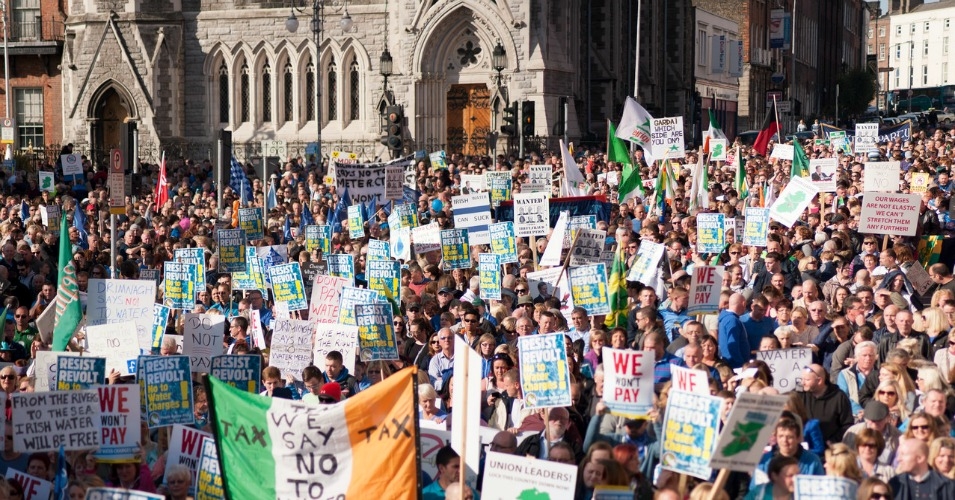
A little bit rough in places but think I should get it out now and hopefully get people singing it ASAP. I am surprised no-one seems to have used this tune, The Sea Around Us, and the mention of “water”, already. Thanks to Ruairi O’Broin at the February session of Song Central for suggesting the “bank guarantee” line in the chorus, much better than what I had there originally.
Amended a little again since I wrote the above but still not sat down and really consistently worked at it. Amended yet again slightly in 2020.
THEY’RE STEALING OUR WATER
Diarmuid Breatnach (To the air of “The Sea Around Us”, also known as “The sea, Oh the sea”)
Chorus:
The sea, oh the sea, a ghrá gheal mo chroí,
‘though long it may roll between England and me,
We’ve still got our gombeens* with a bank guarantee
and they’re trying to steal our own water!
(The chorus can go in after each verse, or each second, as people prefer).
1.
The Norse came to Ireland right outa’ the blue,
took us as slaves and plundered and slew;
But their days were all numbered from Clontarf they knew
— they never troubled us much for the after.
2.
Then the English came over our patience to try,
our land for to steal and our culture deny
And they took all that we had … I tell you no lie —
but at least they left us our water!
3.
‘Twas many a hard battle with the English we fought,
as used be our wont and indeed so we ought;
but as time went by, it all came to naught
and they put poor aul’ Éire in a halter.
4.
But we rose up once more and again and again —
we had stalwart youth and women and men;
We fought them in city and mountain and glen
and forced them their plans for to alter.
5.
Then those who at our struggle took fright
stepped in and took over the fruits of our fight;
The Gombeens and Church turned our dawn into night
and in a wink we were back under the halter!
6.
The parasites live off our sweat and our blood —
they’d tax the very air that we breathe if they could;
But our media says to resist is not good …
and compliance would get us much further.
7.
Our resources are for the people to share in —
is linne ar fad é, uisce na hÉireann;
and it’s now the baton and prison we’re darin’ —
they’ll not steal from our sons and our daughters!
8.
The people are standing firm and steady —
they know that we’ve paid for the water already!
Our banners unfurled and more things ready:
You can be sure this time we won’t falter!
February 2015.
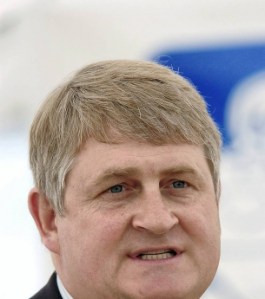
Denis O’Brien, a billionaire widely believed to have plans to buy Irish Water if/when it becomes privatised. He is a major shareholder in Sierra Construction, the company installing water meters and also in Independent Newspapers. The Moriarty Tribunal found that he had benefited from information from the Irish Minister for telecommunications whom O’Brien had paid €50,000 through circuitous channels. The information had assisted him in bidding for the mobile phone contract, which he later sold at a personal profit of €317 a few years later.
Brian Cowen, former Taoiseach (equivalent to Prime Minister) in the Fianna Fáil-Green Party coalition Government 2011, which began the bank bailout.
Joan Burton (Labour), Minister for Social Protection in the Labour-Fine Gael coalition Government at time of writing
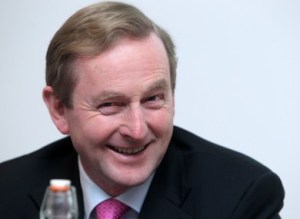
Enda Kenny (Fine Gael), Taoiseach (equivalent to Prime Minister) in the Labour-Fine Gael coalition Government at time of writing
!
* “Gombeen”, from the Irish “Gaimbíneach” is a profiteer, a venal person, a moneylender, a capitalist.
Today is the anniversary of the death of Pat O’Donnel, an Irish patriot or a murderer, depending on one’s point of view. There are memorials to him both in his native village and in Glasnevin Cemetery in Dublin, the latter paid for by US-Irish contributions.
Pat O’Donnel was a travelled man with an interesting life story (the little of it that is known). He was born in Gaoth Dobhair (which remains an Irish-speaking area today in Co. Donegal)in 1835 and emigrated to the USA where, among other things, he worked as a miner. He stayed with his cousins for a while, who were with the ‘Molly Maguires’ (a workers’ underground resistance organization), in the coal-mining area of the state of Pennsylvania.
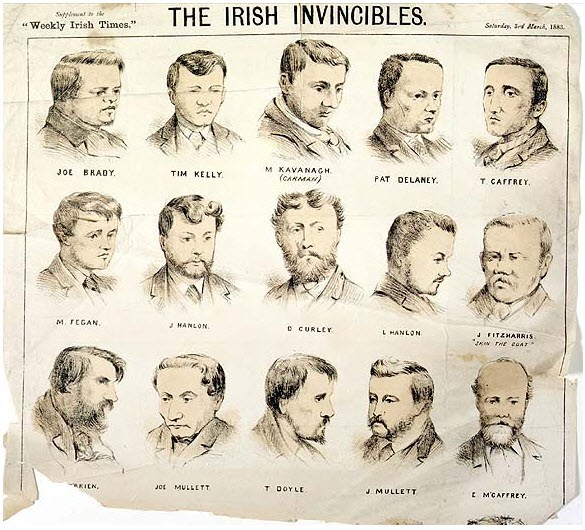
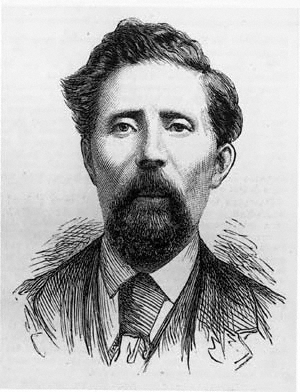
His greatest claim to fame however is that he killed James Carey, a man who informed on his “National Invincibles” comrades who in 1882 had assassinated Lord Cavendish, newly-appointed Chief Secretary of Ireland and Thomas Henry Burke, Permanent Under-Secretary – i.e. both chief representatives of British colonialism in Ireland — as they walked through Phoenix Park.
Sketch-portraits of the Invincibles
The British made arrangements for Carey which bear most of the features of the “witness protection program” of the FBI as presented in a number of fictional Hollywood films. Carey was given money in payment for his treachery, a new identity and passage for him and his family to begin a new life in South Africa.
There is no dispute that O’Donnell shot Carey a number of times and killed him in the latter’s cabin on board ship. The rest has been the subject of discussion and even argument but it does seem likely that although O’Donnell did intend to kill Carey, he provoked him and gave him a chance to go for his gun. Carey’s son probably concealed the weapon when O’Donnell was arrested in Carey’s quarters. Had Carey’s gun been produced in the cabin, instead of being found later on the son, it would have given O’Donnell some chance of being convicted of manslaughter instead of murder.
The biggest debate is about whether O’Donnell was sent to kill Carey or whether, after befriending him and his family, he learned of his identity and decided then to kill him. Evidence points in both directions although O’Donnell’s behaviour in the Carey family’s company tends towards the second interpretation, which is what most historians hold to. Most non-historians seem to prefer the story that O’Donnell was sent as an instrument of justice against informers and there is a Dublin folklore tradition to that effect. Curiously, the jury too preferred that theory — or that O’Donnell had shot an unarmed man — and found him guilty of “willful murder”.
Even most of those in Ireland who were horrified at the assassinations of the British colonial representatives despised Carey, who had been the one to actually give the signal for the fatal assaults and later seemed to delight in condemning six of his former colleagues to death — and others to prison sentences — by his evidence at their trials.
James Carey, National Invincible leading member who turned informer against his comrades. (Portrait by unknown engraver)
My great-grandfather J. J. Walsh was one of the legal team defending the Invincibles but my feelings about Carey would have been the same even had I not known that. It is recorded that eight great bonfires were lit in Ireland in celebration at the news of Carey’s death and that musicians led thousands in joyful processions.
The Judge refused to allow O’Donnell to speak after passing sentence upon him but the convicted man shouted “Three cheers for Ireland! Goodbye, United States! To hell with the British and the British Crown!“
The President of the USA intervened to try to save his life, since he had become a US citizen, but Pat O’Donnell was hung this day in Newgate prison, one hundred and thirty-one years ago and is numbered among the hundreds of thousands of men and women who fell in the fight for Irish Freedom.
(* “Skin the Goat” was the nickname of the assassination group’s getaway cart driver, whose real name was John Fitzharris; he served a long sentence for refusing to give information on anyone).
Further information and songs:
Pat O’Donnell, the Invincibles and Carey also get a mention in one verse of “Take Me up to Monto” by Irish Times journalist George Hodnett (a colleague of my father’s):
“When Carey told on ‘Skin the Goat’*,
O’Donnell caught him on the boat —
He wished he’d never been afloat,
The dirty skite!
It wasn’t very sensible
To tell on the Invincibles —
They stood up for their principles
Day and night.
And they all went up to Monto, Monto, Monto …” etc
There’s a good article here by historian Shane McKenna in which he calls the event in Phoenix Park “killings”, unlike their usual description as “murders” even in articles from Irish writers — evidence that the hand of colonialism still rests on our brains. Elsewhere one reads in history about the “assassination” of Arch-Duke Ferdinand, of Lincoln etc. They are not usually described as “murders”.
A version of the Pat O’Donnell Ballad sung by Diarmuid Breatnach (at19.40 minutes on the video), 23rd February 2013 as part of the Songs from the Docks event, preceded by Paul O’Brien, Seán O’Casey Centre, East Wall; video Rashers O’Reilly)
Lyrics: Traditional
Air: Traditional.
Another version of the Pat O’Donnell ballad, sung by Martin Collins, a Traveller who got it from his father Johnny Collins, sung here at the Celebration of Irish Traveller Music event at the Cobblestone pub, Smithfield, Dublin on 11th December 2014:
DID YOU KNOW IT WAS A ‘RED’ WHO WROTE “BROTHER CAN YOU SPARE ME A DIME?” WELL, NOT SO SUPRISING, MAYBE. BUT HOW ABOUT THE SONGS FOR “THE WIZARD OF OZ” and “FINIAN’S RAINBOW”?
Yip Harburg, author of lyrics of many songs, including those in The Wizard of Oz musical.
Yip Harburg, born in the poor Lower East Side Manhattan to Russian Ashkenazi Jew migrants, was a socialist and the writer of the lyrics of the songs in The Wizard of Oz and worked on the music too.
In fact, a lot of the production team and actors were “pinkos” of some kind, including Judy Garland. The “Brother Can You ..” melody was based on a Russian lullaby. In this Amy Goodman interview on Democracy Now TV (see link bottom of piece), Yip’s son Ernie Harburg talks about his father and included is quite a bit of footage of Yip himself, talking and singing, as well as footage of the first Wizard of Oz film.
When some people think it appropriate, while supporting the Palestinians, to synonymise the words “Jew” and “Israeli”, confusing the ethnic grouping of Jews with the fascist, racist and colonist ideology of Zionism, they are ignorant of or forget not only those Jews who combat Zionism today like Finkelstein and Chomsky but also the public criticisms of Zionism and the creation or actions of the state of Israel expressed by Albert Einstein, authors Erich Fromm, Howard Zinn, Isaac Asimov, Philip Roth, I.F. Stone; violinist Yehudi Menuhin; journalists Joe Klein (Time magazine), Roger Cohen (NY Times); Richard Falk (UN Special Rapporteur), historian Gabriel Kolko and many, many others. Those Jews are following a tradition: political and religious dissidence was endemic in Western Jewry and Jews have been to the forefront in socialist movements in Europe and in the USA, as well as in the struggles against racism and for civil rights in the latter.
“Music makes you feel; words make you think; songs make you feel the thoughts,” said Yip Warburg. At the time of the Depression in the USA (caused by the financiers, surprise, surprise), with massive unemployment and poverty, the authorities and some of the public wanted songs like “Happy Times Are Here Again” and no-one was writing songs about the suffering except for his father, says Yip’s son Ernie Harburg. Not on Broadway, maybe, but in some speakeasies, in some bars and on some radio shows, the blues and folk singers were composing and singing those songs, some writers like Steinbeck were writing their stories and photographers like Dorothea Lange, Jack Delano, Gordon Parks and others were recording their faces.
People were out on the streets and picket lines too, shouting, marching, holding placards, getting their heads busted by cops and sherrifs and goons and breaking some of their heads back too. Sometimes the protesters and campaigners were shot and sometimes even executed. As the financiers swing us around to those times again, we celebrate the victories and learn from the defeats, take pride in the courage of all those who fought and mourn those who fell, whether they fought against the police and municipal authorities, the witch-hunters like McCarthy and the ignorant red-haters, the National Guard, the FBI …
Scene from the Musical Theatre production of Americana, which featured Warburg’s song “Brother Can You Lend Me a Dime?”
And we singers, singing the lyrics and melodies of others and of our own, written in the past or in the present, give honour to the fighters in whole periods of struggle even as, in the book of history, the first lines in the next chapter are being written.
(click on the title immediately above to access the video)
(A mobile-friendly version is also available, click on the author’s name below the video and the other version should show).
RAP POEM, VIDEO IMAGES WITH MUSIC IN PROTEST AT THE 3-MONTH INCARCERATION OF MARGARETTA D’ARCY, 79 YEAR-OLD ACTIVIST AND DRAMATIST, BECAUSE OF HER PROTESTS AGAINST THE CONTINUING USE OF SHANNON AIRPORT BY THE US MILITARY IN COLLUSION WITH SUCCESSIVE IRISH GOVERNMENT IN VIOLATION OF OUR NEUTRAL STATUS.