LESSONS THE PALESTINIANS AND THE ISRAELI ZIONISTS HAVE TAUGHT US (Part 2)

The past six months of an almost incredible level of Israeli genocide and Palestinian resistance have taught the world some valuable lessons but particularly perhaps those of us living among the Western powers.

PART TWO: LESSONS FROM THE ISRAELI ZIONISTS

Diarmuid Breatnach

(Reading time: 5 mins.)

  • The Nature of Zionism

The Zionists have taught us the nature of Zionism as an ideology upholding a people allegedly chosen by religion to occupy a land and to repress or expel the indigenous occupants of that land.

  • Nature of settler states

As Zionism is a variant of occupier-settler ideology we have, by extension, learned to recognise the nature of all settler states. To be fair, the evidence of that nature was clearly before us but we had perhaps learned to push it to the backs of our minds.

The European settler states of USA and Canada practiced genocide against their native indigenous peoples, of which only discriminated fractions remain from “California” to “Newfoundland”, from Pacific to Atlantic coasts. Both those states have diligently supported the Zionist settler project.

Lithograph image of aftermath of the Wounded Knee massacre of Indigenous people, USA, 29 December 1890 (Image sourced: Internet)

Those Northern American territories were primarily English colonies1 as were Australia and New Zealand, both also practicing genocide and discrimination against their indigenous populations and both those states too have supported the Zionist settler project.

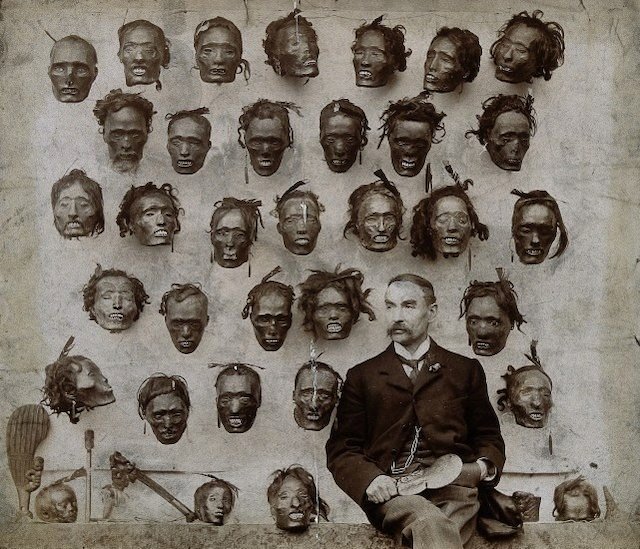
European coloniser collection of New Zealand Indigenous heads 1895 (Photo source: Khamen.ir)

Less unanimous have been the mainly Spanish and Portuguese settler colonies of what is now called “Latin America”, from Brazil to Argentina to Mexico. Their indigenous populations too were ethnically cleansed and subjected to genocide, although to varying degrees of intensity.2

The Caribbean islands have all been settler and imported slave colonies of the states of England, Spain and France3, all now having nominal independence but, with the exception of Cuba,4 remaining within the imperial ambit of the USA (mostly) and France and have responded accordingly.

  • Nature of the zionist state

The Zionist State has demonstrated to us the true outcome of the Israeli zionist ideology, expansionist and prepared to inflict any horror upon the indigenous people in order to achieve its aims, descending to depths of inhumanity unimaginable only if Nazism were forgotten history.

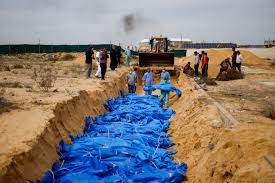
An early mass grave of Palestinians killed by the Israeli military in Gaza back in November 2023 as the cemeteries were already full (Photo cred: Mohammed Salem/ Reuters)

Currently the Israelis’ toll of Palestinians is at least 34,049 dead and 76,901 wounded, with an estimated further 8,000 under rubble in Gaza, nearly 2 million displaced (many several times), all medical, educational and social facilities and infrastructure degraded if not totally destroyed.5

And with at least 9,500 prisoners (i.e hostages) reportedly ill-treated, humiliated and even tortured, of which an Israeli-admitted 27 have died during these six months alone and 3,660 are held without trial or release date in “administrative detention”.6

  • Brazen Truth and Lies

We have also learned from the Zionist state its brazen genocidal intentions towards the Palestinians, expressed for internal Israeli consumption, alongside its outlandish lies for the international public about October 7th: beheaded babies, mass rapes, disfigurements, burning alive, etc.

All of those have been debunked and the recorded statistics alone (but also backed by evidence of other agencies) expose the lies that the Israeli army is attacking only7 the Palestinian resistance, that it is not applying collective punishment and using starvation as a weapon.

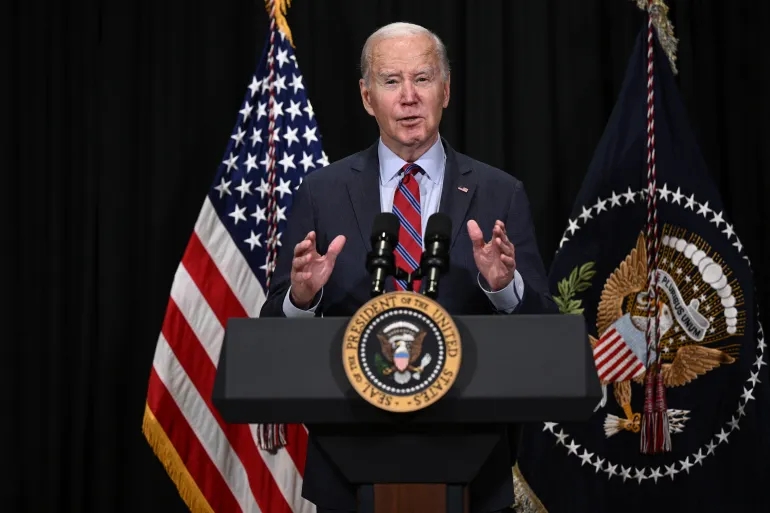
False Israeli Zionist propaganda about the Palestinian resistance “beheading babies” repeated by US President Joe Biden in press statement, claiming he had seen photos. His aides later ‘clarified’ that he was relying on reports from the Israeli state and had not seen actual photos. (Photo sourced: Internet)

Not bothering to give excuses for its demolition of universities and museums, schools and places of Muslim and Christian worship, ‘Israel’ has claimed the existence of tunnel entrances in them as excuses for the total elimination of Palestine’s main hospitals and degradation of all others.

It has done this despite its lack of evidence of such use of the hospitals, despite denials of hospital staff and organisations and without having to explain how such claims, even if they were true, could justify siege of hospitals, killing patients and staff and their destruction as functioning hospitals.

(Three before-and-after images of Israeli military destruction of Al Shifa Hospital, internally and externally)
https://www.instagram.com/reel/C5XQ2YQIQwP/
  • Impunity from world legal order

What Israel and the western imperialist states have shown us to date is that Israel has impunity to carry on its genocide. Not only will it not be boycotted, much less blockaded, not to even mention invaded, it will continue to be supplied with weapons, money and political support.

Even after the ICJ judgement in favour of S. Africa that Israel was “plausibly committing genocide” and restrictions imposed on Israel by the court, the genocide continued without pause and without any serious international repercussions by any western state.

Israel has given us a clear demonstration in practice of the hollowness of western institutional democracy and liberalism, not only in its continued support for the genocidal state but in the repression by western states of those who have supported the Palestinians in word or deed.

Demonstrations and pickets have been forbidden8, protesters threatened and arrested9, academics hounded and sacked,10 artists and public speakers cancelled, social media profiles hampered or blocked. In fact, all the kinds of undemocratic actions of which some other states are often accused.

  • Exposure of the world order of legal democratic institutions

The exposure of these institutions was almost complete. The United Nations of 193 states was shown powerless to act without the authorisation of the five Permanent Members11 of the Security Council — which itself was shown nullified by a veto of even one Member.12

United nations

United Nations building with approach flanked by national flags of member states(Photo sourced: Internet)

The International Court of Justice, a sub-institution of the UN itself, with a history of never even trying a western power, though judging Israel plausibly guilty of genocide,13 failed in its judgement on 26th January to order an immediate cease to the state’s attacks on the Gaza population.

The ICJ failed even to take action on Israel’s non-compliance with the interim measures it ordered, viz: “to take all measures to prevent any acts that could be considered genocidal according to the 1948 Genocide Convention”, other than to issue another non-complied order on 28th March.14

The United Nations failed to defend its own aid organisation for the relief of Palestinians (both in Palestine and as refugees in other parts) from unsupported Israeli allegations of the participation of 0.04% of its staff in the Palestinian resistance operation of October 7th 2023.

The UNWRA chiefs responded by failing to stand up to Israeli bullying and by sacking nine of their own workers without any evidence presented against them and without a right to a hearing or appeal. It also for a time failed to denounce Israel for reported torture of the agency’s employees.15

The UN failed to defend the staff of UNWRA from unproven allegations, unfair internal treatment and Israeli intimidation and murder or to maintain the essential funding of UNWRA essential for the Palestinians, or to insist on the regular and protected entry of aid trucks safe from Israeli attack.

The European Union refused to even call for a ceasefire; continued to act as Israel’s biggest export market; some of its members withdrew UNRWA funding and continued to supply the genocidal state with arms, while many states repressed their own citizens acting in solidarity with Palestine.

  • The need for revolutionary resistance

The Zionist state and its imperialist backers and, to be fair to it, our own Irish state too, have demonstrated to us the fragile and temporary nature of western liberalism and democracy on the one hand and the need, by implication, of revolutionary resistance and organisation on the other.

IN CONCLUSION

It remains to us to learn those hard-earned lessons, to internalise them and to apply them externally. We owe that to the Palestinians and to ourselves.

End.

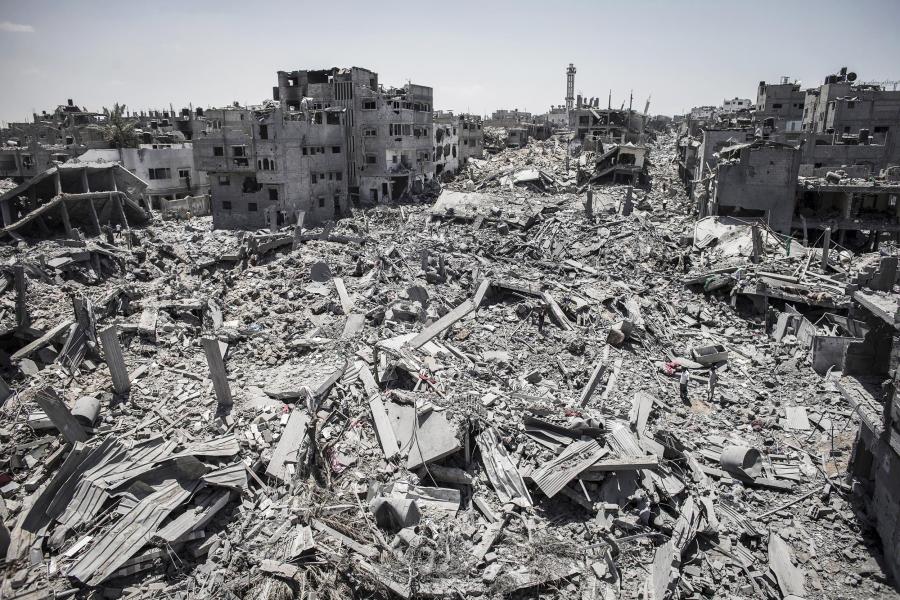
Part of Gaza after Israeli bombardment back July 2014; now of course it is much, much worse. (Image sourced: Internet)

FOOTNOTES

SOURCES

https://www.voanews.com/a/7577969.html

https://www.addameer.org/statistics

https://en.wikipedia.org/wiki/South_Africa_v._Israel_(Genocide_Convention)

https://www.unrwa.org

https://en.wikipedia.org/wiki/Israeli_allegations_against_UNRWA

1The Dutch also colonised the north-east of what is now the USA and the French particularly Louisiana, in what is now the USA and Quebec in what is now Canada. What is now SW USA was part of the Spanish colonial empire, subsequently part of the Mexican Empire and gained by the USA in two wars with Mexico.

2The disparity in approach of these states is underlined by for example on the one hand El Salvador unreservedly supporting the zionist state and by Nicaragua on the other hand taking Germany to the International Court of Justice in accusation of being complicit in the Israeli genocide by supporting the state with weapons and finance.

3Without overlooking the fact that each of those states (England now as the United Kingdom) contains other dominated nations within it.

4During the existence of the USSR Cuba was often described as being under Soviet colonial influence but remains today the only truly independent (though part-occupied) state in the whole of the Caribbean.

5https://www.voanews.com/a/7577969.html, a pro-Israeli source.

6 At the time of writing Adameer, the Palestinian prisoner and human rights organisation reports 9,500 Palestinian prisoners of which 3,660 are “administrative detainees”, 200 children and 80 women. Seventeen of the prisoners are elected Legislative Council members (similar to MPs or TDs) https://www.addameer.org/statistics. These figures have changed regularly during the 6 months of zionist genocide and the trend is always upward except for a brief period during the truce and exchange of hostages.

7In fact, not even mainly.

8Particularly in Germany and France

9Particularly in Britain

10Particularly in the USA

11UK, France, USA, Russia, China

12Most often and recently in the case of Israel/ Palestine several time by the USA but at times also by the UK and France.

13In a case taken by South Africa lodged at the end of December 2023. https://en.wikipedia.org/wiki/South_Africa_v._Israel_(Genocide_Convention)

14In response to application of South Africa again. https://en.wikipedia.org/wiki/South_Africa_v._Israel_(Genocide_Convention)

15https://en.wikipedia.org/wiki/Israeli_allegations_against_UNRWA

IRELAND ANTI-INTERNMENT CAMPAIGN SUPPORTS PALESTINIAN PRISONERS’ DAY RALLY

Clive Sulish

(Reading time: 7 mins.)

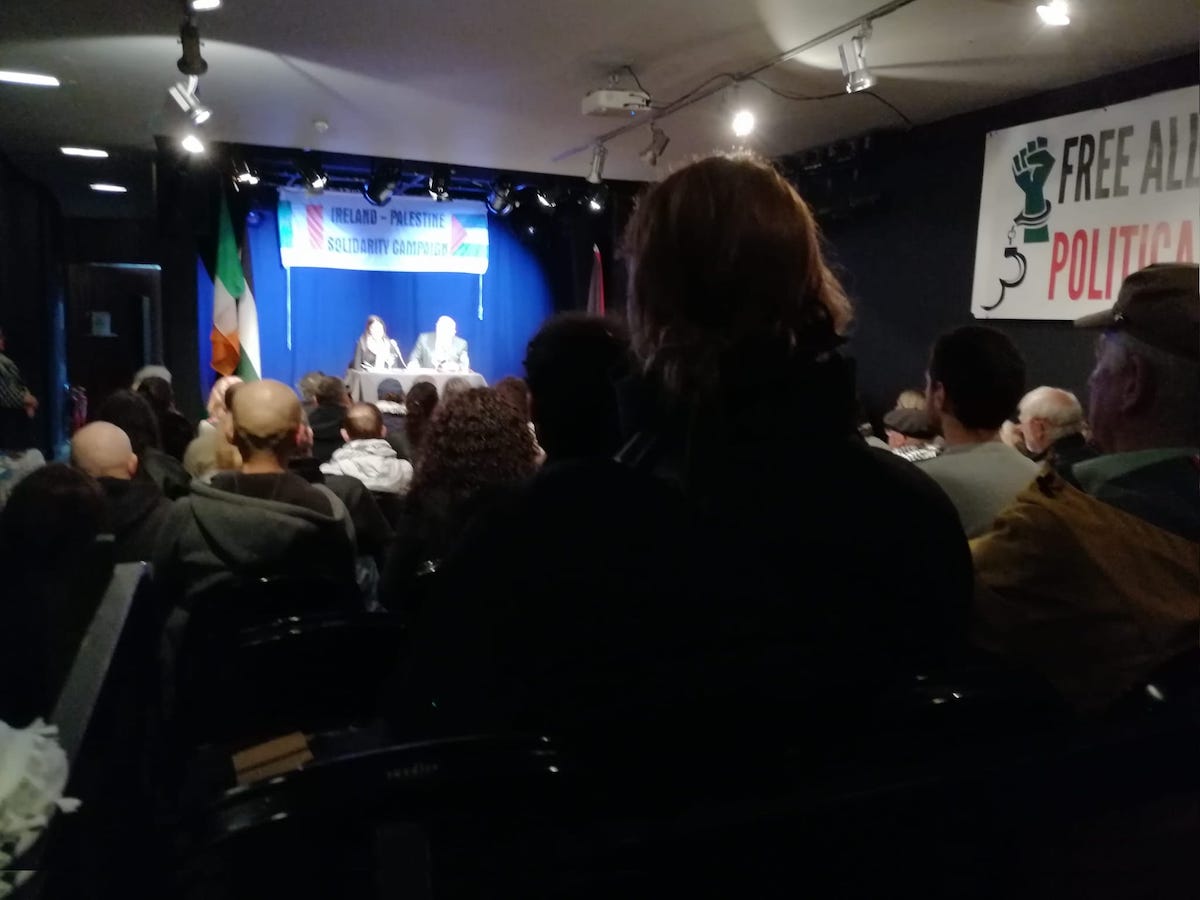
A solidarity rally in Dublin to mark 17th April Palestinian Prisoners’ Day was staged by the IPSC outside the iconic General Post Office building on Dublin’s main street and was supported by the Ireland Anti-Internment Campaign.

At a public meeting about Palestinian prisoners after the event Tala Nasir, a lawyer working with the prisoner support group Adameer, stated that there are 8,000 Palestinians currently held by the zionist state of which 275 are women and 500 are children.

Ms. Nasir was on a round-Ireland speaking tour organised by the Ireland Palestine Solidarity Campaign, the main Palestine solidarity organisation in Ireland but which has not been prominent in highlighting the situation of the Palestinian political prisoners.

On the other hand, at its street information pickets, although primarily working for Irish political prisoners, the Ireland Anti-Internment Campaign has regularly flown a Palestinian flag in support of political prisoners from that nation also.

An IAIC spokesperson recalled that at their traditional annual prisoner solidarity rally in December, their speaker stated: “Wherever there is oppression, there will be resistance; but also wherever there is resistance there will be political prisoners and in Ireland we have centuries of that experience.”

The organisation maintains that although large-scale official internment last used in the occupied Six Counties ended in 1795, it continues on a smaller scale under another name: “Remand in custody”, in which Republicans regularly wait two years before their case comes to court.

The decision to deny bail is taken by the special no-jury political courts: Diplock Court in the Six Counties and Special Criminal Courts within the Irish state, all of which have been condemned by civil liberties organisations in Ireland and abroad.

Israel also has a form of internment without trial which they call “administrative detention”, under which Palestinians can be detained for up to six months at a time as a preventive measure without any kind of trial or evidence shown against them.

PALESTINIAN POLITICAL PRISONERS

Tala Nasir, a lawyer of the Adameer organisation was introduced by Gary Daly (of Lawyers for Palestine group) to the audience in the theatre of Pearse House, formerly the home of Patrick and Willie Pearse and sculpture business address of their English father (and of Willie).

Ms. Nasir informed the packed audience that Israel has declared her organisation of Palestinian prisoner support and advocacy to be a “terrorist” on “evidence” they declare “secret” but the absence of which results in no other state accepting that designation in the case of Adameer.

“Once you’re a prisoner you will always be a prisoner,” stated Ms. Nasir, illustrating that in raids the Israeli military frequently detain former prisoners, often repeatedly. “Crimes” can include a comment on social media, “Liking” or sharing a comment against Israel.

Even the posting of a “green heart” symbol may be interpreted as a sign of support for Hamas and may become the reason for a person’s arrest. Children are most often accused of throwing stones, statements written for them in Hebrew, told to sign them, sufficient “evidence” for jail.

Ms Nasir said that 80% of the prisoners are held under “Administrative Detention” without trial and no defence is possible since the “reason” for it is secret and neither the accused nor their lawyer may see the allegations. The six months detention is automatic and can renewed repeatedly.

Prisoners must buy their own food from the canteen but after October 7th it was closed for periods. Child prisoners told Adameer: “We wake up hungry and go to sleep hungry”. Typically adult prisoners have lost 15-20 kg from their previous weight when released.

The prisoners were prevented from going out of their cells which also meant they were unable to shower for many days and also had to wear the same clothes every day. They were also humiliated through being blindfolded and strip-searching, sometimes by male, sometimes female soldiers.

Beatings are common and prisoners have commented on their transport vehicles not only smelling awful but seeing the floor covered in blood. Sixteen prisoners have been killed in the last 6 months and though autopsies have recorded bruises and broken bones, Israeli investigations are closed.

All but one of the Israeli prisons are in the “Israel” area and the lawyer is not permitted to visit the prisoners there without special permission, which is why, she said, so many of the Palestinians are transferred to those prisons, which she maintains is a war crime.

Declaring her greater trust in and dependence on the solidarity of the people of the world, “in particular the global South” who have had similar experiences to those of the Palestinians, the Palestinian lawyer nevertheless said that she has to practice diplomacy at times.

Tala Nasir called for the widest possible support for Adameer’s Call For Action, which is the simple task of sending text supplied emails to two specified officials responsible for prisons and prisoners telling them they will be held answerable for war crimes.

(text and addresses here: https://www.addameer.org/news/5323)

IPSC AND IAIC ON DUBLIN STREETS AGAIN SOON

The Ireland Palestine Solidarity Campaign have a march booked in Dublin for this coming Saturday 23rd April, commencing at the Garden of Remembrance at 1pm.

A spokesperson for IAIC stated they would be on the streets again in order to proclaim the continue existence of political prisoners in Ireland and that Republican activists are essentially being interned without trial from no-jury political courts to spend two years or more in jail awaiting trial.

“The IAIC is a democratic non-sectarian independent organisation,” the spokesperson said “and welcomes support from concerned democratic people and we’ll continue to fly the Palestinian flag. If people follow our page they should receive adequate advance notice in order to attend.”

end.

USEFUL LINKS AND FURTHER INFORMATION

Adameer: https://www.addameer.org/

Ireland Palestine Solidarity Campaign: https://www.facebook.com/groups/20826333992

Ireland Anti-Internment Committee: https://www.facebook.com/profile.php?id=100063166633467

LESSONS THE PALESTINIANS AND THE ISRAELI ZIONISTS HAVE TAUGHT US

Diarmuid Breatnach

The past six months of an almost incredible level of Israeli genocide and Palestinian resistance have taught the world some valuable lessons but particularly perhaps to those of us living among the Western powers.

PART ONE: LESSONS FROM THE PALESTINIANS

Diarmuid Breatnach

(Reading time: 11 mins.)

  • Resistance – ongoing, preparation, striking, unity

The Palestinians have taught us the strength and value to an occupied and oppressed people of resistance, from generation to generation, maintaining and developing culture and nurturing historical memory while the occupier tried to erase it all and make the endeavour seem hopeless.

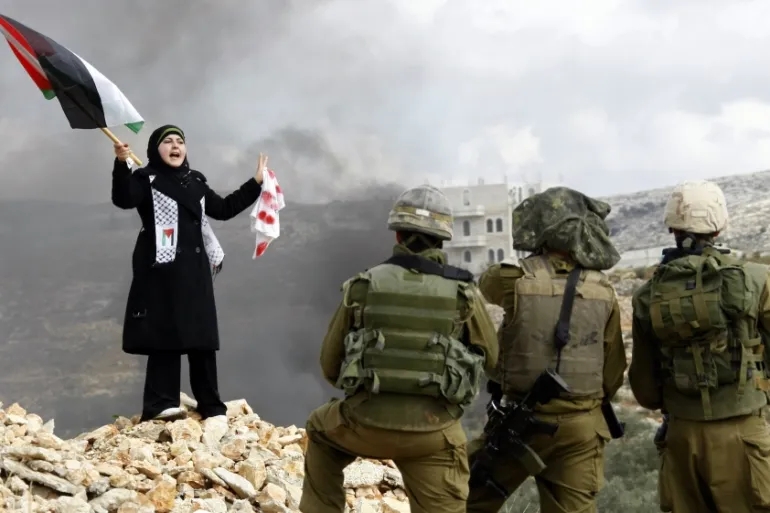
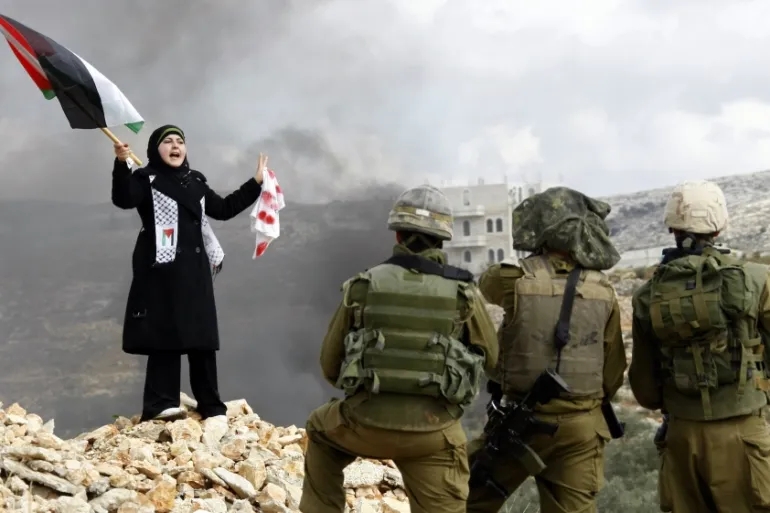
Palestinian woman in Gaza defiant, January 8, 2009 (Photo cred: Eric Gaillard/Reuters)

Without a navy, air force, tanks, armoured vehicles or standard artillery (apart from home-made rockets and missiles), they faced what is often called the “strongest military power in the Middle east”. Despite periodic massacres they have regularly risen against the oppressor.

In truth, it was a lesson that at one time we hardly needed in Ireland, learned even earlier than the Palestinians. But we needed reminding of it.

It is also important for the morale and dignity of the resistance that it shows itself capable of striking at the enemy.

We’ve been reminded of the importance of long-term preparation. The Palestinian resistance built kilometres of tunnels underground in which they also set weapon production factories, developing their own weapons and repurposing existing weapons, including unexploded Israeli Army bombs.

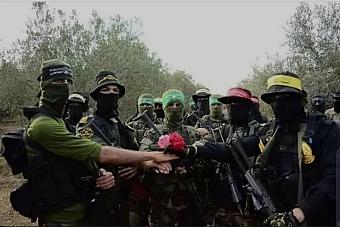
In their Al Aqsa Flood attack on October 7th and fighting since, the Palestinians taught us the value of not only of daring and prior preparation but of coordination and unity, as a number of resistance organisations cooperated in struggle, some secular and some Islamic fundamentalist.1

Palestinian resistance fighters from different organisations displaying their unity in struggle in this photo (Photo sourced: Internet)

In meeting the subsequent genocidal rage of the occupier, the Palestinian resistance have taught us that all the technological might and expertise of the enemy was incapable of crushing a prepared, courageous, united and determined resistance.

The Israeli domination of the air from which it rained down genocidal bombing on civilians and civilian infrastructure, or targeted assassinations of the families of resistance fighters, was not sufficient to defend its ground troops from attack and is itself under attack from GTA missiles.2

The occupier was effective only in genocidal actions against the civilian population and civilian infrastructure for which it will forever be reviled in historical memory. It achieved neither of the objectives it declared as it unleashed its war against Gaza: the wiping out of the resistance and release of captives.

  • Imperialism

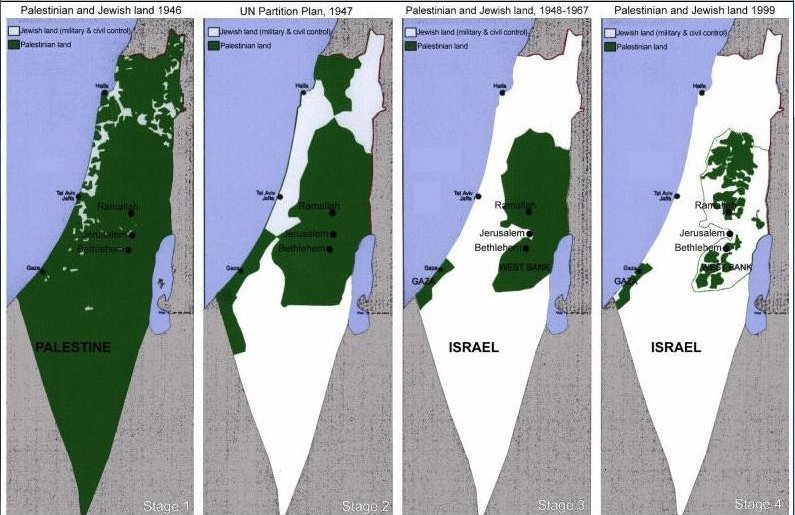
We been shown – if we were willing to see it – the unity of western imperialism in supporting the ‘right ‘of a European settler group to establish itself on the land of the indigenous, creating an ethnocentric and theocratic state founded with an act of ‘ethnic cleansing’.3

We have been taught the willingness of the western imperialist states to tolerate the proliferation of acts and policies which it claims go against its fundamental liberal values: oppression, apartheid, discrimination and repression, while lauding the ‘European liberal values’ of the occupier state.

  • Betrayal

Another lesson which we should have learned too within the necessity of unity in a broad front is that it needs to be on a principled basis and the dangers in unity without such safeguards, leading to treachery, betrayal and collusion with the occupier.

The secular left-wing Fatah4 organisation may have seemed at one time the ideal one to follow though some would have favoured the further-left People’s Front for the Liberation of Palestine.5 But it was Fatah, as leading element in the PLO alliance, that signed up to the Oslo accords.6

In return for limited autonomy in a fraction of Palestinian land and without consideration of the right of return to the expelled Palestinians, the Fatah leadership with Yasser Arafat at its head agreed to this “peace process” while its officials scrambled for the gains of official corruption.

Hence the Palestinian Authority, corrupt, unrepresentative, undemocratic and repressive, working in collusion with the occupying authority. Again, our own history should have taught us that lesson but again, it is good to be reminded.

The Palestinians taught us how to deal with such a poisonous fungal growth with the Second Intifada and their last elections, those of 20067 and the carrying through of the electorate’s wishes in 2007, along with the ongoing resistance since.

  • Western Mass Media and alternatives

In reporting the events in Palestine over the decades but in particular over the last six months, we have learned the heavy anti-Palestinian and pro-Israeli bias of the WMM, that accepted without question the transparent lies of the Israeli regime and even questioned the massacre statistics.

Never once has the unjust claim of the occupiers to their stolen gains been questioned, never once the fundamentally just claim of the indigenous even mentioned. The Palestinian resistance has been reduced to one organisation in reporting, to be held up as a bogeyman monster.

(Image sourced: Internet)

If atrocities from across the Palestinian people were reported in the media, they were framed as of dubious provenance, while the most outlandish and illogical claims of the occupier were reported as reasonable fact.

We have, in fact, been taught not to trust the western mass media when reporting on international events and, by extension, not to trust it on domestic issues either. Conversely we have learned to rely more on alternative Internet media but also on the need to navigate those with some caution.

We have also learned that some of the most prominent alternative sources on the war between NATO/Ukraine and Russia, attacked by liberals and sections of the Left as “Russian-controlled” or “Putinistas” turned out to be the most reliable in reporting the realities of the Israeli genocide.

  • Internationalist solidarity

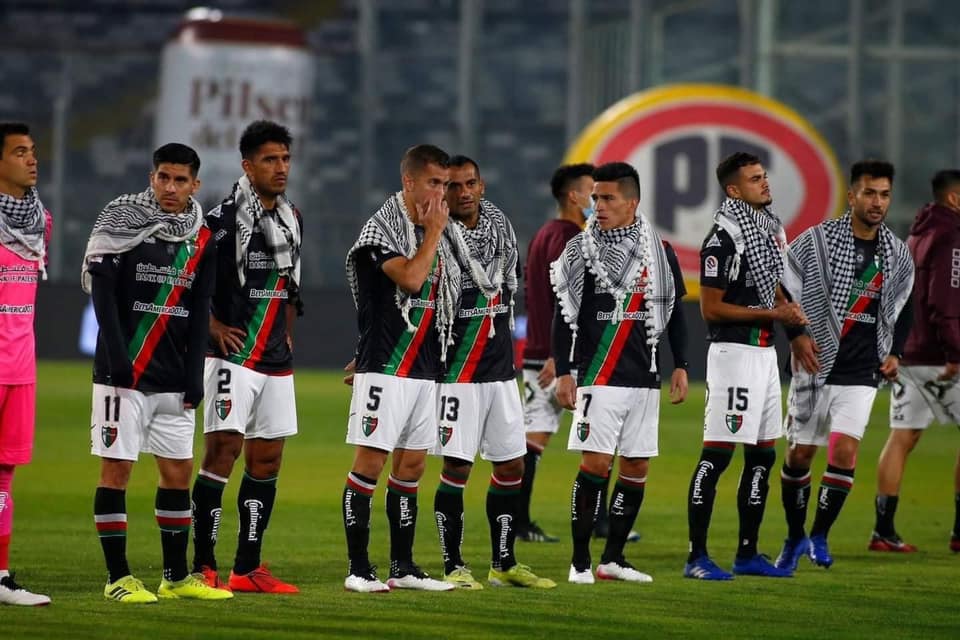
We have relearned the importance of international solidarity, both as we expressed it ourselves and saw its outpouring across the globe. We have been taught the existence of an alternative world of human solidarity in opposition to one based on expropriation, exploitation and competition.

We saw Hizbolah in Jordan and Syria come to the assistance of the Palestinians and pay the price for doing so, as did Ansar Allah (“Houthis”) in Yemen and as has also Iran — what the Electronic Intifada has called “the Axis of Resistance”.

Chilean football team players May 2021 (Photo sourced: Internet)
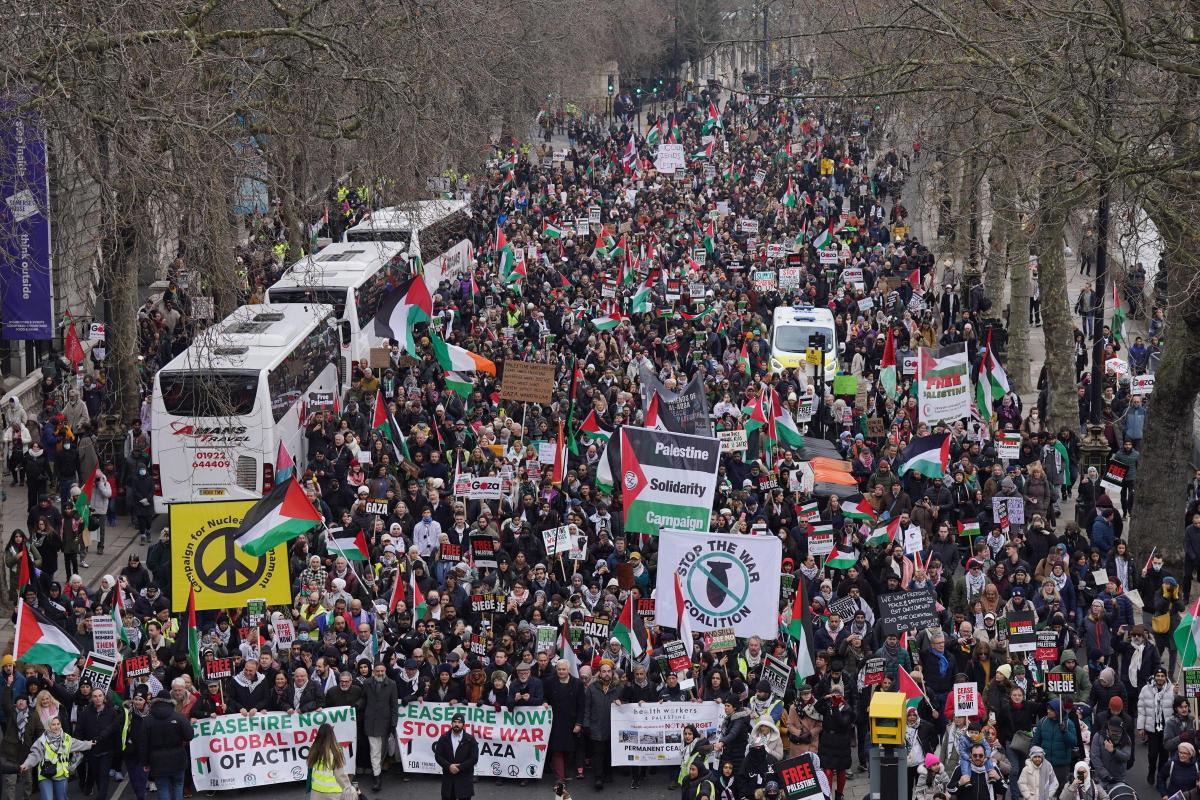
London, January 2024 (Photo cred: PA)

And we have learned to use internationalism as a measuring stick also in evaluating institutions, political parties and politicians in our own countries. We have seen the meaning of anti-semitism twisted and employed in repression with a stifling censorship across public life – academic, political and social.

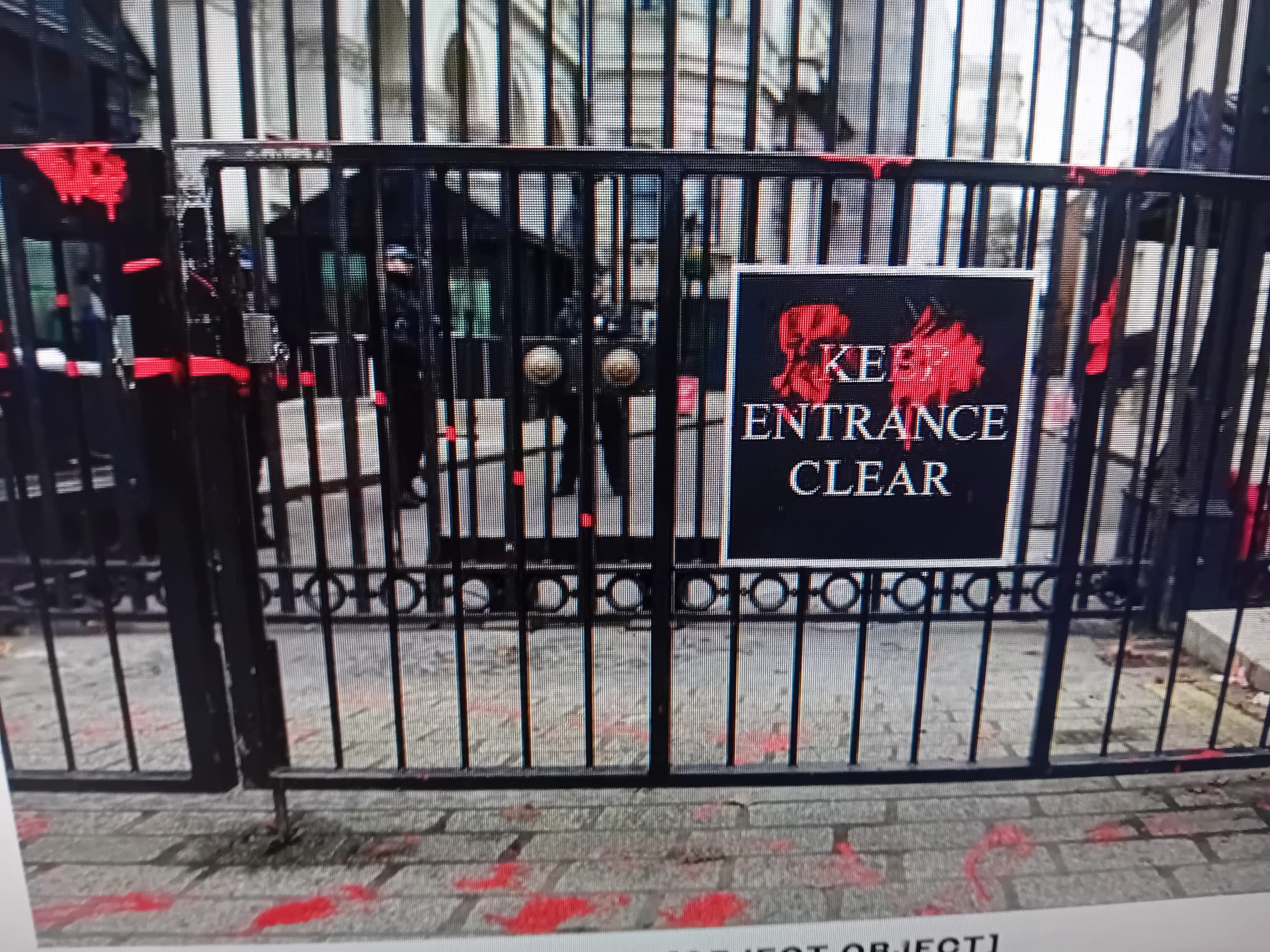
Downing Street (containing home of the UK Prime Minister) 29 December 2023 (Photo sourced: Internet)

Political parties and politicians have revealed either their complicity in and collusion with the criminal Israeli genocide or alternatively their inability to resist and effectively oppose it. That has exposed their lack of fitness to lead us in our domestic struggles too.

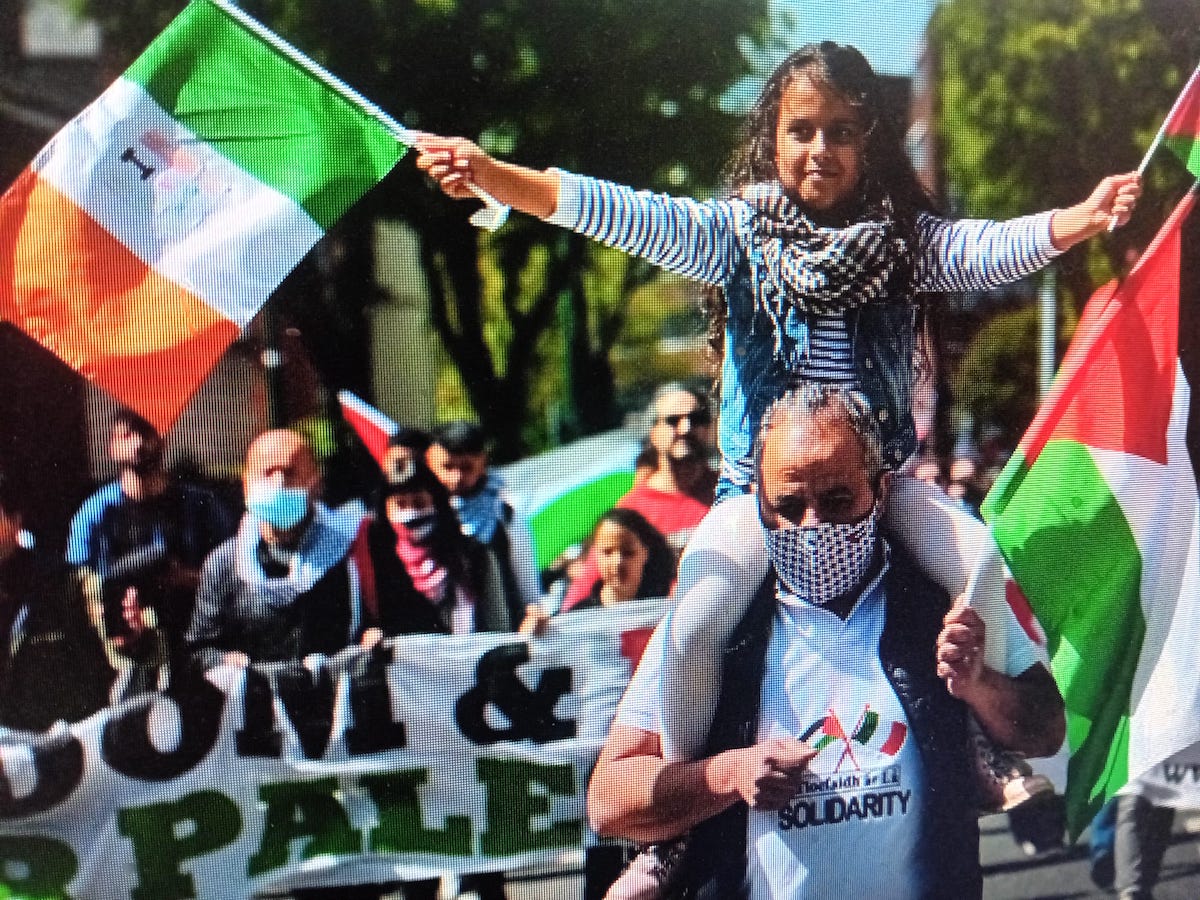
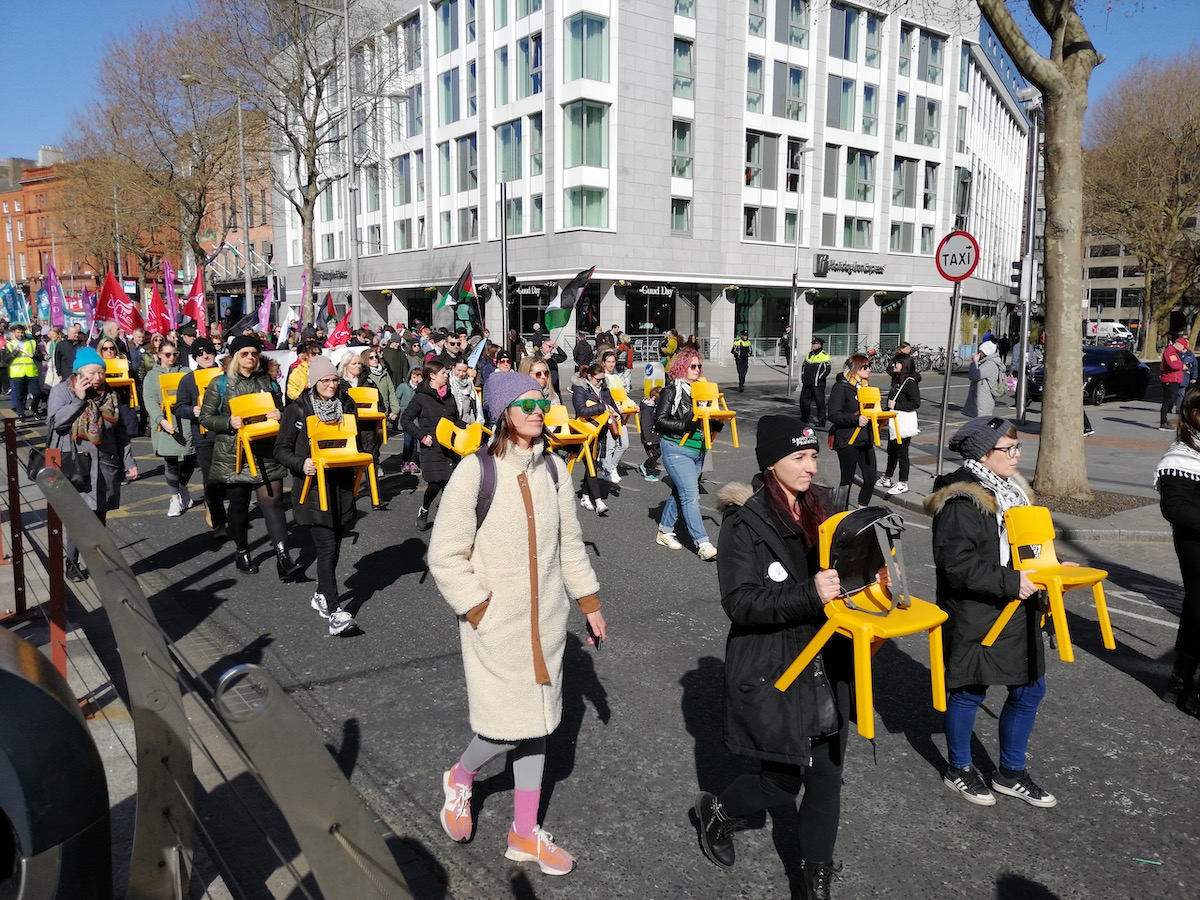
Teachers and others in Palestine solidarity demonstration in Dublin, March 2024 symbolically carrying infant school chairs in protest against the Palestinian children murdered by the Israeli armed forces. (Photo: D.Breatnach)

IN CONCLUSION

  • The need for revolutionary resistance

The Palestinian resistance has taught us important lessons, including the need of revolutionary resistance in addition to revolutionary organisation and preparation.

It remains to us to learn those hard-earned lessons, to internalise them and to apply them externally. We owe that to the Palestinians and to ourselves.

End.
(Read also Part B What the Israeli Zionists have taught us follows.)

FOOTNOTES

1Hamas – Izz ad-Din al-Qassam Brigades; Palestinian Islamic Jihad – Al-Quds Brigades; Popular Resistance Committees Al-Nasser Salah ad-Din Brigades; Popular Front for the Liberation of Palestine’s Abu Ali Mustafa Brigades; Popular Front for the Liberation of Palestine – General Command Jihad Jibril Brigades; Democratic Front for the Liberation of Palestine (DFLP) – National Resistance Brigades, Al-Aqsa Martyrs’ Brigades; Palestinian Mujahideen Movement and its Mujahideen Brigades.

https://www.newsweek.com/not-only-hamas-eight-factions-war-israel-gaza-1841292

2Ground To Air missiles.

3The expulsion of 700,000 Palestinians and massacres such as the one in the village of Dir Yassin.

4Fatah wasfounded in 1957 and was the majority party in the Palestine Liberation Organisation.

5The PLO was founded in 1964 and the PFLP in 1967, next in size of organisation in the PLO to Fatah (Islamic organisations were excluded from the PLO; Hamas recently proposed the reconstruction of the PLO open to all resistance organisations).

6The Oslo Accords were the result of a number of conferences, overseen by the USA and was part of the second of the current“peace processes” which include Ireland, the Basque Country and Colombia.

7Hamas won the elections throughout the accepted Palestinian territories but Fatah tried to continue to keep control, being dislodged from Gaza in 2007 by Hamas, which held back from doing the same thing in the West Bank which has remained under the undemocratic, repressive and colluder control of the Palestine Authority.

SOURCES

https://www.addameer.org/statistics

https://en.wikipedia.org/wiki/South_Africa_v._Israel_(Genocide_Convention)

https://www.unrwa.org

https://en.wikipedia.org/wiki/Israeli_allegations_against_UNRWA

LA INFLUENCIA DE LA CLASE TRABAJADORA EN EL LEVANTAMIENTO DE 1916

Diarmuid Breatnach

(Tiempo leyendo: 11 minutos)

El Levantamiento de 1916 suele considerarse un levantamiento nacionalista de los republicanos irlandeses, quizás con alguna participación socialista.

Incluso Connolly suele ser retratado únicamente como un patriota (véase la canción James Connolly the Irish Rebel) con ideas socialistas.

De las seis organizaciones que participaron activamente en el Alzamiento de 1916 (1) sólo una de ellas pertenecía específicamente a la clase obrera irlandesa. Quizá por eso se suele pasar por alto la gran influencia de la clase obrera en el Alzamiento.

Como es bien sabido, James Connolly es uno de los Siete Firmantes (2) de ese maravilloso y progresista documento, la Proclamación de Independencia de 1916.

Sin embargo, Connolly sólo entró a formar parte del comité de planificación del Alzamiento muy poco antes de la fecha prevista (3) Siendo esto así, deberíamos preguntarnos por qué lo incluyeron.

Los Voluntarios Irlandeses tenían una organización a escala nacional con el movimiento -también nacional- Cumann na mBan como auxiliar, mientras que Connolly quizá podía movilizar quizás tres cientos de combatientes.

Monumento a James Connolly en Chicago, EEUU.

Se dice que lo incluyeron porque el IRB (“Irish Republican Brotherhood”, es decir, “Hermandad Republicana Irlandesa”) creía que su constante demanda de un Alzamiento durante la Primera Guerra Mundial y los ejercicios militares del Ejército Ciudadano Irlandés (ECI) indicaban que Connolly probablemente llevaría al ECI a levantarse por su cuenta y les arruinaría el calendario.

¿Qué probabilidades había de que lo hiciera? Es cierto que, como socialista, Connolly estaba horrorizado por la masacre de la guerra, en la que los trabajadores de un Estado son enviados a matar y ser asesinados por los trabajadores (4) de otro, y la lectura de sus escritos muestra que pensaba que era desesperadamente necesario un levantamiento para sabotear la guerra.

¿Habría seguido adelante sólo con los aproximadamente 300 hombres y mujeres del Ejército Ciudadano Irlandés, esperando quizás inspirar un levantamiento popular y animar a los Voluntarios Irlandeses a unirse a él, a pesar incluso de sus líderes (5)?

Es difícil creerlo pero, por supuesto, es posible.

Sin embargo, desde el momento en que los planificadores republicanos del Alzamiento aceptaron a Connolly, podemos ver un cambio organizativo significativo hacia la clase obrera en Dublín y especialmente alrededor del Liberty Hall, donde se izó la primera bandera para un levantamiento y se imprimió la Proclamación.

Liberty Hall era, por supuesto, la sede del sindicato Irish Transport & General Workers’ Union, del que James Connolly era líder en aquella época y también editor de su periódico, The Irish Worker.

Es asombroso que Connolly recibiera el rango de Comandante General siendo una persona incorporada tan recientemente a la organización.

Una responsabilidad que se tomó en serio, enviando mensajeros por todo el país e intentando dirigir los preparativos de defensa en torno a las distintas guarniciones de Dublín.

La Primera Bandera de Combate del Alzamiento

Una semana antes del Alzamiento, Connolly y el Ejército Ciudadano Irlandés habían izado una bandera republicana irlandesa sobre Liberty Hall como bandera de guerra y la elegida para izarla fue una chica de 16 años, Molly O’Reilly (6).

Merece la pena recordar las circunstancias asociadas, aunque sólo sea para ilustrar la diferencia entre el Liberty Hall de entonces y el de hoy.

Los adultos asistían allí a clases de lengua irlandesa y a actividades culturales, mientras sus hijos y los de los activistas sindicales esperaban a sus padres, asistían a clases de baile o jugaban.

Jugando, Molly O’Reilly rompió accidentalmente una ventana y, aterrorizada y avergonzada, corrió a casa.

Cuando Connolly le envió un mensaje a casa diciéndole que quería verla, ella fue al Liberty Hall esperando una severa reprimenda.

En lugar de eso, le dijo que no se preocupara, y le explicó lo que él esperaba de ella. Estaba orgullosa de hacerlo, pero era tan pequeña que tuvo que subirse a una silla para tirar de la cuerda que izaba la bandera.

Resto de la bandera izada en Liberty Hall (Imagen procedente de: Museo Nacional)
Ceremonia de conmemoración “Mujeres de 1916” con familiares de Molly O’Reilly en lugar de honor (tenga en cuenta que los uniformes son de voluntarios irlandeses en lugar de ejército ciudadano irlandés). (Foto: D.Breatnach)

Por supuesto, sabemos que esa bandera no era la de los trabajadores revolucionarios, sino la del arpa sobre verde, que era la de los primeros fenianos y se parecía mucho a la de los United Irishmen, la primera organización republicana revolucionaria irlandesa (7).

Aquellos primeros fenianos estaban compuestos en su mayoría por miembros de la clase obrera y su proclama de 1867 al mundo tenía en gran medida una perspectiva proletaria.

En Gran Bretaña, los fenianos formaron parte de la Primera Asociación Internacional de Trabajadores, dirigida por Marx y Engels.

Su bandera ondeó al menos en una de las guarniciones del Alzamiento de 1916, creo recordar que en la destilería Jameson de Marrowbone Lane.

Bandera similar a la izada sobre Liberty Hall (Foto obtenida: Internet)

Las otras banderas del Alzamiento incluían la Tricolor, regalada a los republicanos de los “Jóvenes Irlandeses” por las mujeres del París revolucionario de 1848, que era una de las dos que ondeaban en el tejado del GPO (General Post Office, es decir, el edificio de Correos), cuartel general del Alzamiento.

Compartiendo el tejado de la GPO con la Tricolor estaba la bandera confeccionada pocos días antes del Alzamiento con material doméstico y pintada con las palabras “República Irlandesa” en casa de Constance Markievicz, oficial del Ejército Ciudadano Irlandés.

La bandera del Ejército Ciudadano Irlandés, el Starry Plough, ondeaba sobre el edificio de Clery’s, frente a la GPO.

Desgraciadamente, hoy en día la mayoría de los irlandeses no conocen esa bandera, aunque la conciencia sobre ella y sus antecedentes están aumentando entre los irlandeses autóctonos y la comunidad inmigrante.

El diseño del Starry Plough (El Arado de Estrellas), bandera del ICI tal como era en 1916 (Imagen obtenida: Internet)

El primer ejército obrero del mundo (8)

El Ejército Ciudadano Irlandés (ECI) se formó como milicia obrera durante el gran cierre patronal y la huelga de 1913-1914, para defenderse de los ataques de la policía, la primera línea física represiva de la clase capitalista; la bandera de la ECI se colocó sobre el Hotel Imperial de Murphy en Clery’s (9).

El Ejército Ciudadano Irlandés en ejercicios en sus terrenos cerca de lo que hoy es Fairview (Foto obtenida: Internet)

Aunque su constitución era más nacionalista que socialista, el ECI fue, por su composición y su finalidad, el primer ejército obrero del mundo y, cuando se reorganizó unos años más tarde, representó también el feminismo de la clase obrera, reclutando a mujeres, algunas de las cuales eran oficiales al mando de hombres.

Una vez que los preparativos para el Levantamiento se fueron a pique por la orden de anulación de MacNeil, ¿dónde se reunieron los organizadores para discutir qué hacer?

En Liberty Hall, el edificio del Sindicato Irlandés de Trabajadores Generales y del Transporte; fue allí donde se tomó la decisión de levantarse el lunes.

No es exagerado remarcar la importancia del hecho de que la decisión de seguir adelante con la insurrección se tomara en el edificio que se había convertido de facto en el cuartel general de la clase obrera revolucionaria de Dublín, con una bandera ilegal de rebelión ondeando y donde se iba a imprimir la Proclamación.

Redacción y texto de la Proclamación

Se cree que la redacción de la Proclamación fue hecha en gran parte por Pearse, pero influenciada por Connolly, incluyendo su destino a “los hombres y mujeres irlandeses” y quizás también “Declaramos el derecho del pueblo irlandés a la propiedad de Irlanda, y al control sin restricciones de los destinos irlandeses”.

Otro fragmento que podría llevar la huella de Connolly reza así: “La República garantiza la libertad religiosa y civil, la igualdad de derechos y la igualdad de oportunidades a todos sus ciudadanos, y declara su resolución de perseguir la felicidad y la prosperidad de toda la nación y de todas sus partes, apreciando por igual a todos los hijos de la nación.

Copia de la Proclamación de Independencia de 1916 (Imagen procedente de Internet)

Pero, quienquiera que compusiera o influyera en el texto de la Proclamación, ésta fue impresa en Liberty Hall. Un miembro del Ejército Ciudadano Irlandés fue a Stafford Street (hoy Wolfe Tone St.) a pedir a un impresor de allí las letras de imprenta para llevarlas a Liberty Hall, que estaba bajo guardia armada las 24 horas del día.

Habiendo impreso la Proclamación en Liberty Hall bajo guardia armada y habiendo decidido allí sublevarse el Lunes de Pascua, ¿dónde se reunieron los grupos de asalto a Stephens Green, Castillo y la GPO (General Post Office, es decir, edificio de Correos)?

Incluido el Batallón del Cuartel General, la mañana del Alzamiento? …. De nuevo, en Liberty Hall.

Una de las primeras víctimas no combatientes del Alzamiento fue Ernest Kavanagh (10) que dibujaba caricaturas para el periódico del ITGWU, The Irish Worker.

Por alguna razón acudió el martes al Liberty Hall y fue asesinado a tiros en la escalinata del edificio del sindicato, presumiblemente por un francotirador del ejército británico.

La resistencia armada de la clase obrera:

Una vez puesto en marcha el Alzamiento, el Ejército Ciudadano Irlandés era el principal responsable de dos zonas, la guarnición de Stephens Green/Colegio de Cirujanos y la guarnición del Castillo de Dublín/Ayuntamiento, pero también luchó en otras zonas, por ejemplo en Annesley Bridge y en la zona de GPO/Moore Street.

Todos los que lucharon junto a ellos comentaron su valor y disciplina. Tras la rendición, muchos de ellos, junto con los Voluntarios Irlandeses, fueron condenados a muerte, la mayoría conmutada por cadena perpetua.

Pero dos líderes del Ejército Ciudadano Irlandés fueron fusilados.

Una de las zonas desde las que las fuerzas británicas fueron tiroteadas durante días después del Alzamiento fue la de los muelles del Liffey, entonces rodeada predominantemente por zonas residenciales de clase trabajadora.

Una pregunta que deberíamos hacernos es por qué las fuerzas procedentes de Gran Bretaña para reprimir el Alzamiento desembarcaron en Dún Laoghaire, desde donde tuvieron que marchar casi 12 km hasta el centro de Dublín, en lugar de hacerlo en los excelentes muelles dublineses del Liffey.

Hugo McGuinness, especializado en la historia de la zona del Muro Norte, cree que los británicos esperaban que Dublín estuviera en manos de la resistencia obrera y que, sencillamente, era demasiado peligroso desembarcar allí tropas británicas, aunque las cañoneras podían disparar desde el Liffey.

Ciertamente, los británicos creían que Liberty Hall y los edificios a lo largo de Eden Quay estaban ocupados como puestos de combate por el Ejército Ciudadano Irlandés y dispararon artillería contra el edificio del sindicato desde la calle Tara, como atestiguan las fotos de agujeros de proyectiles en ese edificio y en el siguiente.

Foto del Liberty Hall dañado por los proyectiles (primer edificio con la esquina hacia la cámara, visto hacia el norte desde Butt Bridge) como parte de un conjunto de postales conmemorativas. (Foto obtenida: Internet)
Otra postal con un primer plano de los daños causados por los bombardeos al Liberty Hall y al edificio contiguo. Curiosamente, en este, Liberty Hall está etiquetado como “el Cuartel General Rebelde”. (Foto obtenida: Internet)

En algunos relatos históricos se habla mucho de la oposición al Alzamiento por parte de algunos sectores de la población de Dublín, durante e inmediatamente después del Alzamiento.

La ciudad era la capital de una colonia británica, y poco más de un siglo antes se hablaba de ella como “la segunda ciudad del Imperio Británico”.

Una parte sustancial de las clases media y acomodada era lealista, incluidos algunos católicos; incluso los sectores “nacionalistas” estaban comprometidos a apoyar al Reino Unido en la Primera Guerra Mundial y John Redmond, líder del partido político “nacionalista”, había reclutado abiertamente para el ejército británico.

Además, entre la clase obrera y el lumpenproletariado, muchos dependían de las “indemnizaciones por separación”, por los varones que servían en el ejército británico.

Es cierto que en algunos lugares los insurgentes tuvieron que amenazar, apalear o incluso disparar a algunos civiles que intentaron obstruir el Alzamiento (11).

Estos incidentes durante el Alzamiento no fueron muchos, pero posteriormente hubo insultos y se lanzaron objetos a los prisioneros que marchaban a la cárcel (o al pelotón de fusilamiento).

La ciudad estaba bajo la ley marcial, pero aun así un periodista canadiense informó de que los insurgentes eran vitoreados en los barrios obreros.

También hubo otros relatos de testigos individuales, como el de un hombre en un tranvía que saludó a los prisioneros en Parnell Street hasta que fue amenazado por los soldados de escolta, y el de un bombero en la GPO que hizo lo mismo.

Un año después, la mayor parte de la hostilidad anterior se había transformado en admiración y orgullo por los combatientes.

El liderazgo de la clase obrera:

James Connolly escribió y dijo muchas cosas de importancia, pero seguramente, con respecto a la lucha por la independencia nacional irlandesa, la más importante fue: “Sólo la clase obrera irlandesa permanece como heredera incorruptible de la lucha por la libertad en Irlanda”.

Con ello quería decir -y estoy de acuerdo- que todas las demás clases sociales pueden ganar algo vendiendo los intereses y recursos de la nación irlandesa, pero que la clase trabajadora no puede ganar nada con ello.

La clase obrera irlandesa se jugó la lucha por la independencia de Irlanda en 1916, pero no tuvo éxito en dirigirla y, por eso, esa lucha está aún por ganar.

Hoy en día, recordando esa larga lucha y a la clase cuyo liderazgo los socialistas revolucionarios pretenden representar y defender, declaramos la necesidad de ese liderazgo sobre un amplio frente de todos los que desean luchar para avanzar.

Al hacerlo, declaramos que lejos de que la clase obrera tenga que esperar al socialismo, en el curso de la lucha nacional también debe dar forma a sus propias reivindicaciones en torno a la economía, los recursos naturales, las infraestructuras, los servicios sociales, las cuestiones sociales, la cultura y, sobre todo, a los frutos de su trabajo.

FIN.

NOTAS A PIE DE PÁGINA:

  1. Hermandad Republicana Irlandesa, Voluntarios Irlandeses, Ejército Ciudadano Irlandés, Cumann na mBan, Na Fianna Éireann, Hibernian Rifles.
  2. Todos ellos fueron ejecutados por un pelotón de fusilamiento británico, junto con otros siete en Dublín y uno más en Cork. La decimosexta ejecución fue en la horca en Londres.
  3. (Véase Fuentes: Cooption of James Connolly etc) Connolly fue un socialista de toda la vida y un revolucionario durante toda su vida adulta, autor, historiador, periodista, compositor de canciones, activista sindical; activo políticamente en Escocia, Irlanda, Nueva York y de vuelta en Irlanda.
  4. El movimiento socialista internacional vio con horror la inclinación de los imperialistas hacia la guerra y en conferencias internacionales prometió oponerse a ella con todas sus fuerzas, incluso convirtiendo la resistencia a la guerra en revolución (“Guerra contra la guerra”). Sin embargo, una vez declarada la guerra imperialista, esa determinación se derrumbó en la mayoría de los Estados, siendo Rusia, Alemania e Irlanda notables excepciones, y en cada una de ellas se produjo un levantamiento contra la guerra, siendo el de Irlanda el primero.
  5. Joseph E.A. O’Connell (Jnr.) sugiere una posible intención de azuzar al Estado para que le ataque a él y al ECI, lo que podría desencadenar el levantamiento general.
  6. (Ver fuentes)
  7. El arpa de la bandera de los Irlandeses Unidos estaba más adornada y llevaba inscritas las palabras “Está recién encordada y se oirá”
  8. http:// www.connollybooks.org/product/irishcitizenarmy
  9. Tenía una buena ubicación, céntrica, pero más que eso: el hotel era uno de los negocios de William Martin Murphy, principal organizador del bloque patronal para romper el sindicato Irish Transport & General Workers’ Union.
  10. Kavanagh era partidario de los trabajadores, del voto femenino y contrario a la participación en la guerra imperialista, contribuyendo también con caricaturas a las publicaciones Irish Citizen, Fianna e Irish Freedom, y acompañando poemas de su hermana, Maeve Cavanagh McDowell.
  11. No incluyo en esto a los tres miembros de la Policía Metropolitana de Dublín, que eran una fuerza al servicio de la ocupación británica y también de los capitalistas dublineses. El Ejército Ciudadano Irlandés, en particular, tenía buenas razones para ajustar cuentas con ellos por los ataques que les habían infligido, entre ellos las heridas mortales causadas con porras a dos trabajadores durante una carga contra una reunión sindical el 30 de septiembre de 1913 en Eden Quay y las palizas y destrozos de mobiliario en domicilios en Corporation Street un poco más tarde.

FUENTES:

Cooptación de James Connolly al Consejo Militar que planeaba el Alzamiento:

Izado de la bandera en Liberty Hall:

https://microsites.museum.ie/1916objectstories/ObjectDetail/remains-of-irish-flag

Incidente de Molly O’Reilly rompiendo una ventana:

https://www.independent.ie/irish-news/ladies-day-for-1916-heroines/26528456.html

Impresión de la Proclamación de Independencia:

https://libguides.ucc.ie/1916Proclamation

https://www.dublincity.ie/library/blog/printing-1916-proclamation-transcript

Decisión de continuar con el Alzamiento el Lunes de Pascua:

https://www.irishtimes.com/culture/heritage/easter-rising-uneasy-calm-before-the-storm-1.2575638

https://www.nli.ie/1916/exhibition/en/content/risingsites/libertyhall

“Sólo la clase obrera irlandesa sigue siendo la heredera incorruptible…” (fin de la penúltima frase):

https://www.marxists.org/archive/connolly/1910/lih/foreword.htm

SPIES AND INFORMERS REVELATIONS DON’T REVEAL THE FUNDAMENTAL PROBLEMS IN THE REPUBLICAN MOVEMENT

Diarmuid Breatnach

(Reading time: 6 mins.)

Recent revelations about British intelligence services being in possession of film evidence of Martin McGuinness being a leading member of the IRA but choosing not to prosecute adds to many suspicious incidents over the years regarding this man.

Indeed this is but one additional item to add to many things that have raised suspicions over the years. He had been arrested in the Irish State in 1972 but his sentence from the Special Criminal Court was only six months; however in 1974 he received the more usual 12 months’ jail.

However, over the years in the Six Counties he received a string of convictions for assault on police and for obstruction, for which fines were his only punishment, despite the State being aware of his position within Derry’s Provisional IRA, failing even to convict him of membership in 1976.

McGuinness leaving Belfast Court 1976 after charges of IRA membership dismissed (Photo cred: Paul Lewis)

Nor was there ever an attempt on his life though he moved around openly in Derry; how he was awarded £2,000 damages for an incident with British soldiers at a checkpoint – a practically daily occurrence for nationalists in the Six Counties – and that he had made the claim!

Most damning of all was the very low level of armed resistance actions in the area over which he was commander of the Provisional IRA.

McGuinness went from crude militaristic outlook to belief in electoral politics and the pacification process without a clear track of his progress (unlike that of Adams). No evidence of gradual change or of Road to Damascus conversion though he was reported favourable to a truce in 1972.

McGuinness (furthest right) in the clip of The Secret Army (1972) filmed beside a car being loaded with a bomb which is later filmed destroying a building and killing people. MI5 had access to the film.

The suspicions about McGuinness can be added to the known cases of agents and informers in top levels of the military and political leadership of the Provisionals: Freddie Scappaticci, Denis Donaldson, Martin Gartland. Derry in particular had Raymond Gilmour and Frank Hegarty.

“Spies and informers” have been quoted by many over the years as the reason for failure thus far to achieve Irish independence; indeed these complaints go back at least as far as the United Irishmen and as recently as July 2020, Denis McFadden bugged meetings of the New IRA for his handlers.

McGuinness announcing his replacement by Michelle O’Neill as SF leader in the British colony in 2017.

THE REALLY FUNDAMENTAL PROBLEMS

The fundamental problems in the Republican movement go far beyond the serious enough ones of faulty security permitting influx of agents and recruitment of informers. The very strategic concept of the 30 Years War was at fault which facilitated the subsequent sellout in the Pacification Process.

If one were planning a campaign to break Ireland from colonial occupation and control by the British ruling class, a major military power, why would one largely confine it to one-sixth of the nation? And worse still, one-sixth divided between nationalist and unionist communities?

One might say in its favour as the choice of main zone that the contradictions in the British colony were the most acute there, the Catholic population being discriminated against socially, politically, economically and culturally. And they were already in struggle for civil rights.

And that might be an important reason for diverting a certain amount of resources there. But the bald fact remains that logically the struggle against the British ruling class could not succeed if it were largely confined to that area.

Yet that is what the Provisionals did as they split from the organisation that then became known as “the Officials” in 1970. Nevertheless by 1972 they were proclaiming on their newspaper’s front page that Blian an Bhua, “the Year of Victory” was at hand.

In fact they appeared so sure of the impending victory that it seems they were attracted by the film company’s plans to record them – they would have a film for general release at the same time as their victory parade, star-studded (well, McGuinness-studded anyway).

What could have induced them to think that victory was imminent? Only two possible imaginary scenarios:

  • That the British didn’t really want to remain and by 1972 were beginning to get a good taste of what hanging on to the colony was going to cost them, or
  • That the Irish national ruling class were going to step in and help ease the British out in the cause of national unification.

If they believed the first, which a lot of people believe even today, they were not carrying out a historical analysis. At every possible juncture when they could have left, the British colonialists dug in deeper.1 Which is what they were doing in 1972, the bloodiest year of the War.

If the Provisionals considered the second a real possibility, they would have had to ignore the history and current reality of the Irish Gombeen2 ruling class, a totally foreign-dependent neo-colonial class.

Of course, to fight the war to win, they would have had to extend the struggle to the whole of the country and also build alliances with movements of nations within Britain and with the British working class, in particular through the mostly working-class Irish diaspora there.

Extending the struggle to the whole nation would have meant taking on the State, its social police the Catholic Church, equality for women, right to divorce, decriminalisation of contraception and pregnancy termination, of LGB, secularisation of education, full state health care …3

No. While Adams and later McGuinness recognised the fallacy of a quick victory in the occupied Six Counties, instead of extending the struggle to the whole 32 Counties, they opted instead for “the long war” – long and unwinnable (which made it ripe for a pacification process in a few decades).4

But this too had to be based on one or both of the same two presumptions:

  • The British didn’t really want to remain and by 1972 were beginning to get a good taste of what hanging on to the colony was going to cost them, or
  • The Irish national ruling class were going to step in and help ease the British out in the cause of national unification.

And those presumptions were just as fallacious for a long war as they had been for a short victorious one.

The other fundamental weakness in the Republican movement that made victory impossible in this scenario and by no means confined to the Republican movement’s leadership, is that of: “the leadership is right, they know best and only trouble-makers (or cowards) question them.”

Clearly an organisation must have discipline and at certain times decisions arrived at democratically or otherwise in emergency situations have to be carried out without a debate. But they should be open to discussion beforehand if possible and certainly to review afterwards.

That was not the style of the Provisionals and people disagreeing with the leadership’s line were labelled as “troublemakers”, censored from the letters page of their newspaper and isolated by warning others not to associate with the critics – for fear they’d be considered dissenters also.

And since the leadership was ‘always correct’ it followed that the organisation was always correct too. Critics had to shut up or face the fact of exile to the cold outside the movement. And why unite with other groups in a broad front when your leadership is the only correct one`?

All this happened in the past and the Provisionals are no more, just the SF electoral party now.

However, the majority of the current movement of ‘dissidents’, far from carrying out a critical review of past operational principles, seems to have to have learned nothing and to be happily replicating the style and content of the organisation from which many split.

End.

FOOTNOTES

1Even after the 1916 Rising, the electoral massacre of their client ‘nationalist’ party in the 1918 General Elections and the War of Independence 1991-1921, the British ruling class still insisted on retaining Ireland within the Commonwealth structure and even then, just in case, retaining six counties in a direct colony.

2From “gaimbín” in the Irish language, used to describe the opportunist creditors and land-buyers during and in the aftermath of The Great Hunger, now describing an Irish foreign-dependent capitalist class.

3Provisional Sinn Féin not only did not lead those struggles but in some cases opposed them.

4A long armed resistance war entails a heavy toll on the fighters (in deaths and jailings) and their community and, as the decades go by without any sign of victory, war-weariness sets in creating fertile ground for growing a pacification process.

SOURCES

https://www.sundayworld.com/crime/courts/barristers-to-call-for-withdrawal-of-charges-against-dissident-republicans-arrested-in-mi5-sting/a1541598168.html

https://www.sundayworld.com/crime/courts/barristers-to-call-for-withdrawal-of-charges-against-dissident-republicans-arrested-in-mi5-sting/a1541598168.html

PALESTINE CHILDREN’S DAY

Diarmuid Breatnach

In Ireland, at this time small children will be in playgroups or nursery schools (if their parents can afford them), or in primary schools fearing or looking forward to assessments and turning in homework. In Palestine there are no longer any playgroups, nurseries or functioning schools.

Post-primary students in Ireland will be preparing for the Junior or Leaving Certificates, a high-stress situation for many. Palestinian children in Gaza don’t have to work about any of that, only about whether, their parents, friends, neighbours will survive the Israeli bombings and sniper attacks.

Or get enough to eat every day and dry warmth protection from the weather. There wouldn’t be much point in sitting the final post-primary exams in Gaza anyway, even if there were somewhere safe to hold them. The Israelis have demolished all their universities.

Even before last year, what would the young do with a degree in besieged enclave of Gaza? Yes, some could get out to other countries in the West or in the Arab world but, if they did, they knew there was never any guarantee of being allowed back.

Over all, there is a horrific statistic to add to all the others of Israel’s genocide in the past six months: the zionist state has killed 13,800 Palestinian children in Gaza and injured over 12,000, which is why some people carry bloodstained white bundles or empty nursery chairs on Palestine solidarity marches.

end.

SOURCES

https://www.cso.ie/en/csolatestnews/pressreleases/2023pressreleases/pressstatementcensusofpopulation2022-summaryresultsdublin

https://www.savethechildren.org.uk/news/media-centre/press-releases/one-in-50-of-gaza-s-children-killed-or-injured-in-six-months-of-

TRUTH AND LIES: REPORT ON SEVEN AID WORKERS KILLED BY ISRAELI STRIKES

Diarmuid Breatnach

(Reading time: 4 mins.)

Despite how distasteful the task it is nevertheless useful to subject media reports to a truth-and-lies analysis, which what I have done to this Reuters report in Breaking News ie.

Israel’s allies demand answers after airstrike kills aid workers in Gaza.

It is true that 1) the Israeli military killed (seven) aid workers in Gaza and 2) that allies of the zionist state have been obliged to protest strongly.

But the first lie appears in the first sentence of the report: “Israeli prime minister Binyamin Netanyahu confirmed Israel mistakenly killed seven people …” How can it be a ‘mistake’ when THREE VEHICLES ARE EACH HIT, ONE AFTER THE OTHER?

And how can Reuters report “confirmed” as though it were true?

One of the aid agencies’ vehicles showing the missile penetration hole actually through part of the logo and text identifying the agency. (Photo cred: Reuters)

WCK… said its staff were travelling in two armoured cars emblazoned with the charity’s logo and another vehicle, and had coordinated their movements with the Israeli military. Not much chance of accident then, was there?

“Unfortunately, in the past day there was a tragic event in which our forces unintentionally harmed non-combatants in the Gaza Strip,” Mr Netanyahu said in a video statement. Unintentionally? See previous paragraph.

The Israeli military pledged an investigation by “an independent, professional and expert body”. What body could that possibly be? The Israeli government has refused to cooperate with the EU investigation of events on October 7th and instructed medical staff not to talk to them.

In fact Israel does not facilitate external investigations and accuses any organisation that does not agree with the conduct of the state of bias and even of ‘anti-semitism’.

At least 196 humanitarian workers have been killed in Gaza since October, according to the United Nations, and Hamas has previously accused Israel of targeting aid distribution sites. True – but not only Hamas has accused the Israeli state of that but many aid organisations and other states.

So report the list of accusers? Nope!

And they weren’t just “killed” as though by unknown persons – they were all killed by the Israeli military. Reporting commentators have noted that when it’s victims of Israel they are reported as just ‘being killed’ while if killed by Palestinians then it’s ‘Hamas has killed’ etc.

In a call on Tuesday, UK prime minister Rishi Sunak told Mr Netanyahu that UK was appalled by the deaths, which included three Britons, and demanded a thorough and transparent independent investigation, Mr Sunak’s office said.

Again, what body could possibly carry out such an investigation in Israel? If it were truly independent and intending to be “thorough and transparent”, Israel would not cooperate with it. All its own investigations conclude with a ‘not guilty’ or at best ‘inconclusive’ verdict.

The United States, Israel’s closest ally, said there was no evidence Israel deliberately targeted the aid workers but that it was outraged … etc. From any logical assessment, three strikes on three vehicles seems pretty conclusive evidence of “deliberately targeting.”

Israel has long denied accusations that it is hindering the distribution of urgently needed food aid in Gaza, which it has besieged in a war since October, saying the problem is caused by international aid groups’ inability to get it to those in need.

This would seem an appropriate spot to report on the few times the Israeli authorities allow supplies to pass from the long, long line of parked aid lorries outside the Rafah crossing gates, which Israeli protesters are impeding with no action by Israel police or army and. But no mention.

Or the times the Israeli military has opened fire on deliveries or on civilians approaching aid supplies that have gone through, or Israel’s execution of the Chief and Deputy of Gaza Police who organised a recent delivery of flour without food riots or Israeli gunfire. But no mention.

The aid convoy was hit as it was leaving its Deir al-Balah warehouse after unloading more than 100 tons of food aid brought to Gaza by sea, WCK said. So it was clearly identified by logo, by prior announcement to the Israelis and by its departure point.

“This is not only an attack against WCK, this is an attack on humanitarian organisations showing up in the most dire of situations where food is being used as a weapon of war,” WCK’s chief executive Erin Gore said. A rare and very true statement but not by the media.

The US-based charity said it would pause its work in Gaza, and the United Arab Emirates, which has financed the seaborne food deliveries to Gaza that WCK distributed, said it was putting the shipments on hold pending safety guarantees from Israel and a full investigation.

Anera, a US-based aid group that works in part with WCK, said it too was pausing operations in Gaza because of safety concerns.

In other words, another step in the starvation of Gaza achieved by the Israeli state.

The conflict began after Hamas attacks on southern Israel on October 7th that killed 1,200 people, according to Israeli figures. An outright lie which does not become truth no matter how often repeated by the western mass media (which it is in every single report).

The conflict began many decades before October 7th with the zionist settler program which intended and proceeded to carry out a program of ethnic cleansing and, from the moment of the creation of the State in 1948, an expansionist and genocidal program.

Nor was it just Hamas that attacked, nor were all the 1,200 killed by the Palestinians but that is a different discussion.

Conditions in Gaza remain extremely precarious with fighting going on in several areas on Tuesday and 71 people killed in Israeli strikes over the past 24 hours, according to Gaza health authorities.

Yes, the Palestinian resistance continues to resist heroically, with innovation and in principled manner (for example not targeting Israeli Army medical evacuation helicopters) and the Israel military continues to kill civilians, even in hospitals.

But you have to go to other sources to get that kind of information, never in the western mass media.

A final thought: If the victims had been seven Palestinians, would we be even reading about it in the western mass media?

END.

SOURCES:

https://www.breakingnews.ie/israel-hamas/israels-allies-demand-answers-after-airstrike-kills-aid-workers-in-gaza-1608933.html

Also: https://www.aljazeera.com/news/2024/4/3/outrage-grows-over-israels-deadly-attack-on-gaza-aid-convoy

Beyoncé, Irish Dancing and the Nonsense of Cultural Appropriation

Gearóid Ó Loingsigh

2 April 2024 (Reading time: 11 mins.)

Beyoncé, Cowboy Carter (2024) (Image sourced: Internet)

Beyoncé was back in the news once again for a spot of cultural appropriation. It was not her first brush with cultural Neanderthals, she has been here before for apparently “stealing” Egyptian culture by dressing as Nefertiti.

Added into the mix was a lesser-known black artist, Kaitlyn Sardin, who excels at Irish dancing and dared produce some fusion dance routines.

I have dealt with Beyoncé and Rihanna wading into the murky cesspit of the cultural appropriation debate in the past when they were accused of appropriating Egyptian culture(1) and won’t deal with it here.

This time though, the debate is clearly about music, produced by people who are still around and not the attire of long dead Egyptians with little connection to the modern country.

The fact that white country music fans are still around to complain, doesn’t make the debate any less sterile or ridiculous.

Beyoncé’s faux pas was apparently to record a country & western album titled Cowboy Carter. Apparently, some were of the view that a black artist shouldn’t record a “white” song or perform in a “white” musical genre.

Her first release from the album was a song she composed, Texas Hold ‘Em.(2) And the hounds of hell were let loose to howl and drown out the music.

Some radio stations refused to play the song, though that didn’t stop it going to No.1 in the country music charts and the debate, though debate might be too fine a word to put on it, erupted.

She is not white, she is not part of the country music scene and she should stay in her lane, is a crude but accurate summary of most of those criticising her. She is actually from Houston, Texas, not that it matters.

One person interviewed by The Guardian responded that “It doesn’t matter that you came from Texas. It matters if you’re actually living a country lifestyle. It bothers me that her song is being called country.”(3) These words might be familiar to some.

They are normally advanced by identitarians when talking about whites playing genres considered “black” and in some cases other non-whites have levelled this accusation against a whole array of non-white artists including Beyoncé.

It is reactionary rubbish with the racism, in this case, hiding just under the surface, behind a veil of cultural purity. One even went as far as to say that he would bet that Beyoncé had never been in the country saloon he was being interviewed in.

Well, many black women would steer clear of such venues, for more than obvious reasons.

Cultures are not pure, ever. None. Not now, not ever, not even going back to the stone age.

I am very sure, no stone age hunter armed with a flintstone hatchet ever shouted “You’re appropriating my culture” when he realised some other village had come up with the same invention, or even just “stole” the idea.

Country music is not pure either and to the shock and horror of many a man yearning for the days he ran around in his white bedsheets, it isn’t even that white. Blacks have made significant contributions to country music, not least the musical instrument known as the Banjo.

What would country be without the banjo? Rhiannon Giddens, the black musician has dedicated her time to reviving the banjo as a black instrument and recording some excellent music, though unsurprisingly she doesn’t quite stick to genres either.(4)

Her site describes her thus:
Singer, multi-instrumentalist, composer, and impresario, Rhiannon draws from many musical traditions including blues, jazz, folk, hiphop, African, Celtic, classical, and jug band. She bridges contemporary and traditional forms, and few musicians have done more to revitalize old-time influences in current music.(5)

Rhiannon Giddens with banjo (Image sourced: Extra.ie)

She composes her own songs, covers others, even ones such as Wayfaring Stranger, recorded by many white country artists, though actually written and composed by two Germans in the 1660s.

As far removed from her as from the whites who might like to claim the song as their own (Links below to Gidden’s version,(6) Johnny Cash’s(7) the Mormon Tabernacle Choir(8) and even Ed Sheeran’s(9) very uncountry version.

I have included links to all songs and routines mentioned in this article). The song belongs to whoever wants to sing it, however they wish to, though I personally think Sheeran murders the song with a flintstone hatchet, but each to their own.

So, Beyoncé is quite entitled to record in whatever style she wants. Part of what rankles some is that she went straight to No.1 and will make a fortune from the album and this is part of the ‘stay in your lane’ slogan applied to blacks and whites.

Elvis made a fortune singing what was essentially considered, at least initially, to be a black musical form and other white artists who have done this have been criticised by a black bourgeoisie who want that slice of the cake for themselves.

Some of the whites criticising Beyoncé are undoubtedly racist, some might just be musical purists, though music is one art form that just doesn’t lend itself to purity. Others, like identitarians everywhere, think that the money is theirs. Flip sides of the same coin.

Beyoncé is not the only black artist to venture into the world of country,(10) Charley Pride and Ray Charles did so back in the 1960s at times of heightened tensions in the midst of the racial violence meted out against those demanding civil rights for blacks.

When Charley Pride released his first country album, his image was not put on the record sleeve and they initially hid the fact he was black as part of their marketing strategy. He would eventually make it to the Grand Ole Opry in 1967.

He had a total of 52 top ten hits on the Billboard Hot Country Songs chart.(11) No mean feat and not a once-off foray into country music either, he was a country artist.

Linda Martell fared worse as she never hid that she was black and though she would also perform at the Grand Ole Opry in 1970, her album Color Me Country(12) never had the same success.

Ray Charles also dipped his fingers into the pond producing Modern Sounds in Country and Western Music(13) in 1962. It was a best seller, topping the charts. So, Beyoncé is by no means the only or even the first black artist to find success in the genre.

Black artists have always ventured into genres that were not considered to be black.

Others have gone the other way and identitarians tend to criticise white artists doing “black” music, though when Gene Autry, the white country and western singer, nicknamed The Singing Cowboy recorded a blues album, nobody accused him of cultural appropriation.

Though even non-whites get accused by the black bourgeoisie closely aligned to the US Democratic Party of cultural appropriation, Jews, Asians, even Africans get in the neck.

Samuel Jackson infamously accused black British actors of stealing their jobs because they were cheaper and questioned the cultural bonafides of British-Nigerian actor David Oyelowo when he was cast as Martin Luther King in the film Selma.(14)

He never criticised the decision to cast the black Yank, Morgan Freeman as Nelson Mandela in the film Invictus or Matt Damon as the white South African rugby captain in the same film.

Given the backlash against his comments he decided to keep his mouth shut when the British-Ugandan actor Daniel Kaluuya was chosen to play the black revolutionary leader of the Black Panther Party, Fred Hampton. No one is safe from the accusation.

It is a bit like the MacCarthy trials. “Are you now or have you ever been a homosexual? No, but I slept with a man who was. Have you ever appropriated a culture? No, but I hummed a tune by a man who had.”

Which brings us now to Kaitlyn Sardin, the US black Irish dancer. She has recently gone viral, though not for the first time, with her dance routines and not being as powerful as Beyoncé has come in for some vile racist abuse.(15)

She produced a new video which is what is now termed fusion i.e. Irish dance with some developments.

This is now quite common and there is a host of Irish groups producing fusion.  My favourite is a routine called Freedom with the voice of Charles Chaplin and images from Belfast in the early seventies.(16)

Though the first person to do this was Michael Flatley with River Dance which not only broke many of the “rules” of Irish dancing, it even went as far as to incorporate the Lambeg War Drums in a much more positive sense than the annual announcement of Protestant supremacy for which they are used every July 12th.

Of course, Flatley, unlike Sardin is white and of Irish descent.

Kaitlyn Sardin (Image sourced: Internet)

As I said there are many fusion groups in Ireland, the one I previously mentioned and even one which is danced to classical music titled Fusion Fighters Perform Fusion Orchestra.(17) Again, all as white as the driven snow in Siberia.

There is even an all-female Fusion Fighters group from the USA that does a tap dance routine to William Tell.(18)

The particular group started off with Irish dance and moved into other styles over time, so much so that even their website acknowledges it has less to do with Irish dance than they used to.(19) It is what happens with culture. It evolves, all the time.

Again, they are white and no one said fusion is not Irish dancing and no one said anything about not being Irish, even though their Irish connections may be as tenuous as Darby O’Gill.

The term fusion is one of those designed to assuage musical purists more than racists. In reality there is no such thing as fusion music. ALL music and dance are fusion till it becomes accepted as the standard, when new deviations or fusions arrive. 

Though dancing has existed in Ireland for centuries it has not been immune to outside influences such as French Quadrilles in the 1800s or other forms.

The clues are in the names, hornpipes and polkas for example are two types of music that you will find in other parts of Europe and indeed in the case of polkas they clearly originated in Eastern Europe, though most forms including reels and jigs are not exclusively Irish either.

All cultures borrow.

Most instruments used in Irish music are not Irish in origin. Some, like the flute have arisen in most cultures around the world and archaeological remains have thrown up examples everywhere of flutes and whistles made from everything, including animal bones.

Fiddles arose over a long process around the world and it is a bit difficult to pinpoint them to one country. Uillean pipes are Irish, though they too were part of a wider process in Europe with different types of pipes arising.

Though Scottish bag pipes are perhaps the most famous type of pipe, there are in fact lots of pipes throughout Europe and parts of Africa, Iran, Azerbaijan and even India.

Other instruments such as the banjo are African in origin, though the modern banjo has developed over time since it was first brought to the western world by slaves.

The piano accordion is a relatively recent European invention from the mid 1800s, a further development of the accordion, which was also a European instrument.

If we rejected all outside influences and demanded purity, we would have little in the way of Irish music or dance, were we to have any at all.

So, Kaitlyn Sardin should be celebrated. She is from the US, is black and more importantly is very good at what she does: dancing. The fact that she is not Irish or she recently produced a fusion routine is neither here nor there.

Any liberal who got lost on the internet and accidentally read this article will probably have nodded most of the way down: until now. The ridiculous statements made about Beyoncé and Sardin are generally rejected by liberals.

But when the cultural capitalists hiding behind identity politics make similar claims against white artists or indeed between other non-white artists this rubbish is taken seriously.

Culture does not belong to anyone, you don’t have to be white, black, Asian or Latin to perform in a particular style. Culture is a gently flowing river you bathe in, swimming ashore where you please along its route or letting it sweep you out into the sea.

It has always been thus and always will be, despite the attempts of cultural capitalists to appropriate culture for their own grubby money-making ends, or racists imagining some non-existent purity. It doesn’t mean that some of the commercial outings by Beyoncé and other artists do it well.

They don’t.

Beyoncé was criticised for her depiction of India as a white paradise and other artists such as Gwen Stefani, Nicki Minaj and Iggy Azalea have been accused of engaging in crass portrayals of the cultures they seek to borrow from(20) and in Ireland we know a thing or two about how crass Hollywood can be when it comes to depicting Irish music.

But that is another matter, many artists in particular genres have come up with really crass portrayals of their own cultures. The point is whether culture is pure, has lanes and you stick to them due to an accident or birth.

The legendary US folk singer Pete Seeger would joke that plagiarism was the basis of all culture and he was a wonderful plagiarist who introduced musical forms from around the world to a US audience at a time when there was no internet and it was not an easy feat.

He introduced the song Wimoweh to the world, which has gone through multiple adaptations,(21) some of them very good and others absolutely dire, such as that recorded by the English pop group Tight Fit in the 1980s.(22)

The original song however was quite different in style and written and recorded by the South African musician Solomon Linda(23) who was swindled out of the royalties on the song.

Had Seeger stayed in his lane, most of us would never have ever heard of Linda or the story behind his song.

Demands for cultural purity are inherently reactionary, as are demands to ‘stay in your lane’, be they levelled by whites, blacks or Asians. Culture is to be celebrated and expanded.

The accusation of appropriation would only make sense if someone like Seeger had said he wrote Wimoweh, that would be straightforward dishonesty, something he could never be accused of in his multiple adaptations of songs from Ireland, Japan, China, Indonesia, Scotland, Chile, Nicaragua amongst other places.

Beyoncé’s foray into country is perfectly fine, though personally, I don’t like her music, including her country. But that is my personal taste and has nothing to do with appropriation or other rubbish from cultural capitalists.

The Irish radio on Saturdays used to broadcast an Irish music show from the musical company Walton’s. It always finished off saying “If you do feel like singing a song, do sing an Irish one.” The exhortation was for all, not some; the point was to celebrate and enjoy music.

Let’s leave the cultural capitalists, purists, identitarians and racists to the handful of songs they mistakenly believe to be pure.

Notes

(1) See Ó Loingsigh, G. (02/05/2020) Cultural Appropriation: A Reactionary Debate.  https://socialistdemocracy.org/RecentArticles/RecentCulturalAppropriationAReactionaryDebate.html

(2) See Beyoncé’s version here https://www.youtube.com/watch?v=238Z4YaAr1g

(3) The Guardian (04/03/2024) I can guarantee Beyoncé has never stepped foot in here: Houston’s country saloons review Texas Hold ‘Em. Diana Gachman https://www.theguardian.com/music/2024/mar/04/beyonce-houston-country-saloons-review-texas-hold-em

(4) See for example Another Wasted Life https://www.youtube.com/watch?v=FQ2_2A4vP4I

(5) See https://www.mymusicrg.org/about

(6) Rhiannon Giddens Wayfaring stranger https://www.youtube.com/watch?v=b1Z4PAZX9Bs

(7) Johnny Cash Wayfaring Stranger https://www.youtube.com/watch?v=gIlbZAP8ASQ

(8) Tabernacle Choir Wayfaring Stranger https://www.youtube.com/watch?v=LtgKoJ5hoZw

(9) Ed Sheeran Wayfaring Stranger https://www.youtube.com/watch?v=buAzVkcH4YI

(10)  Vox (26/05/2024) Beyoncé’s country roots. Avishay Artsy.  https://www.youtube.com/watch?v=r2uWqRZpt50&list=OLAK5uy_nOFFn9idV9uhYSC9__4r4FNW_xNb-aZK0

(11)  See https://www.youtube.com/watch?v=nJQdR0ciwYg

(12)  See https://www.youtube.com/watch?v=r2uWqRZpt50&list=OLAK5uy_nOFFn9idV9uhYSC9__4r4FNW_xNb-aZK0

(13)  See https://www.youtube.com/watch?v=TbrvtGta1lk&list=PLgWmP-F0RTPOl1OjguwDkKwjFFiMmQZs5

(14)  The Guardian (08/03/2017) Samuel L Jackson criticises casting of black British actors in American films. Gwilym Mumford. https://www.theguardian.com/film/2017/mar/08/samuel-l-jackson-criticises-casting-of-black-british-actors-in-american-films

(15)  Irish Central (25/03/2024) Irish dancer’s fusion choreography goes viral, triggers racists. Kerry O’Shea https://www.irishcentral.com/culture/kaitlyn-sardin-irish-dance

(16)  See https://www.youtube.com/watch?v=thjctEd7O_Y

(17)  See https://www.youtube.com/watch?v=sQ85iotuEso

(18)  See https://www.youtube.com/watch?v=PK77a_XVzJY

(19)  See http://www.fusionfightersdance.com

(20)  Business Insider (14/01/2023) Gwen Stefani is only the latest glaring example of cultural appropriation in pop music. Callie Ahlgrim. https://www.businessinsider.com/gwen-stefani-cultural-appropriation-pop-music-problem-2023-1#:

(21)  See https://www.youtube.com/watch?v=2Y_TJ6Oht8k

(22)  See https://www.youtube.com/watch?v=hRv4cdZxTdQ

(23)  See https://www.youtube.com/watch?v=mrrQT4WkbNE

ANTI-IMPERIALIST ACTION HOLDS DUBLIN 1916 RISING COMMEMORATION

Clive Sulish

(Reading time: 6 mins.)

Easter is the time of year in Ireland for Easter Egg hunts and/or for attendance at religious services but for the Republican movement it is one of commemoration of the Easter Rising and its martyrs, with parades and speeches.

The commemoration parade proceeding along Phibsboro and approaching the Cross Guns canal bridge. (Photo: Rebel Breeze)

Easter Monday in Dublin saw one of those commemorations organised by the Socialist Republican organisation Anti-Imperialist Action at the Citizen Army plot in the St. Paul’s section of the famous Glasnevin Cemetery at the Republican Struggle Monument1.

Participants rallied near the Phibsboro Shopping Centre to march from there to the Cemetery, a distance of around two kilometres, over the “Cross Guns” bridge over the Royal Canal, then passing the main entrance to the Glasnevin Cemetery on the right before turning left for St. Paul’s.

Garda POU van parked extremely dangerously, hiding left turn from view of eastbound traffic, as they chat with other Gardaí and a ‘Branch man. As is said, one rule for the people …!”
In the laneway between houses visible in the background, a cameraman lurked taking photos. (Photo: Rebel Breeze)

In a marked departure from the previous year, the State’s political police, plainclothes Gardaí of the “Special Branch”2 did not approach the participants to attempt to intimidate them and gather intelligence, demanding their names and addresses under the Offences Against the State Act.3

That had been followed up by a raid on the home of one of the leading activists. Sunday’s police behaviour was an even greater difference from Saturday’s, when a different Republican group, Saoradh, had their Easter Rising commemoration in Dublin’s city centre.

Around 300 police, including many in riot cop uniform (Public Order Unit) had harassed the participants demanding names, addresses and other information, attempting to intimidate them. At least seven police vans had been in attendance also to the bemusement of onlookers.4

(Photo: Rebel Breeze)

LOCAL 1916 HISTORY

The Phibsboro/ Glasnevin area also figured in the 1916 Rising, with an insurgent barricade in Phibsboro and a Fianna youth, Sean Healy, mortally wounded at the crossroads by a British artillery shell fragment (a plaque on the ground at the SW corner commemorates his death.

Earlier, Irish Volunteers had guarded the canal bridge briefly; these were seen by the dozen Volunteers that marched along the canal from Maynooth, slept in Glasnevin Cemetery and got into the headquarters garrison at the General Post Office on Tuesday.

Later British soldiers set up a barricade on the Bridge preventing even foot traffic across and shooting dead a deaf and dumb man who could not hear their challenge.

EYE IN THE SKY? (Photo: Rebel Breeze)

PARADE THROUGH STREETS TO CEMETERY

The parade from Phibsboro on Sunday was led by the Glasgow Republican Flute band (formerly the Garngad RFB, which is where most of them are based) playing the airs of known Republican ballads, muted to regular tocks on their drums as they entered the housing estate.

(Photo: Rebel Breeze)

Also leading was the colour party dressed in white shirts, black trousers, jackets, berets and sunglasses, carrying the traditional flags for Republican colour parties: the Tricolour, Starry Plough, Sunburst, followed by the flags of the four provinces of Ireland: Connacht, Leinster, Munster and Ulster.

Over the marchers the flags of the Tricolour and the Starry Plough, flag of the Irish Citizen Army flew in the breeze while those of the Basque nation, Palestine and of the People’s Front for the Liberation of Palestine lent an international flavour to the commemoration of the Irish Rising.

There was some beeping of passing traffic and cheering from bystanders at the entrance to the laneway that leads to the bridge across the railway tracks to the St. Paul’s section of the graveyard. The marchers filed in and proceeded to the monument.

The Chair of the proceedings welcomed the attendance before reading from the 1916 Proclamation of Independence and calling a singer to step forward. Revolutionary activist Diarmuid Breatnach introduced the two songs he was going to sing as emphasising the role of the working class in the Rising.

(Photo: Rebel Breeze)

“The decision to go ahead with the Rising on Easter Monday was taken in Liberty Hall, the headquarters of the working class at the time,” he reminded the gathering, “which is also where the Proclamation of Independence was printed.”

He sang the “Jim Larkin Ballad”:
In Dublin City in 1913,
the boss was rich and the poor were slaves;
The women working, the children hungry,
till on came Larkin like a might wave …

Diarmuid Breatnach singing (Photo: Donated by participant)

Pausing to focus on a different key, the singer followed the ballad with Patrick Galvin’s Where Is Our James Connolly?

After applause, floral tributes were laid on behalf of Anti-Imperialism Action Ireland and of Dublin Republicans Against Fascism.

(Photo: Rebel Breeze)
(Photo: Donated by participant)

The chairperson asked for a minute’s silence in honour of those men and women who had given their lives in the struggle for freedom in Ireland. The colour party lowered their flags slowly in homage to the fallen, raising them again slowly to signify the continuation of the struggle.

(Photo: Rebel Breeze)

John Heaney, Republican ex-prisoner from Armagh was called to give the oration for the event, which he dedicated to all those men and women who had opened their doors and their homes to fighters in the struggle, whether the latter were in hiding or just resting – his audience applauded.

The speaker also congratulated on those who came forward to carry on the struggle, youth, women and stated he was proud to see the traditions of struggle being upheld in the process to achieve the Republic for which so many gave their lives.

The speaker, John Heaney delivering his oration. (Photo: Rebel Breeze)

The marching band then played the air of Amhrán na bhFiann/ The Soldiers’ Song, verse and chorus and the formal part of the event came to an end. Band members lined up in front of the Monument for photos and a little later played the air of “Black Is the Colour” on whistles, to general applause.

SECOND 1916 COMMEMORATION FOR AIA THIS EASTER

This was the second 1916 Rising Commemoration to be attended by Anti-Imperialist Action as they had also participated in another organised by the Seamus Costello Memorial Committee in Bray on the previous day.

AIA is a young organisation, founded by socialist Republicans unhappy with the direction of the Republican organisation of which they had been members but now containing many young people.

AIA gave rise to the Revolutionary Housing League that occupied empty buildings in a campaign against homelessness and called for a general occupation campaign across the state. A number of court cases against them followed but sadly their lead was not followed.

(Photo: Rebel Breeze)

AIA have also been very active against NATO, picketing promotional meetings and a number have been charged following a demonstration against a visiting British Navy ship in Dublin last November.5 They have also been active as part of the Saoirse don Phalaistín activist group.

Following the event in Glasnevin, many of the participants relaxed at a social evening in a different part of the city where many songs of struggle were sung.

(Photo: Rebel Breeze)

OTHER EASTER COMMEMORATIONS

Other Easter Rising commemorations have been held around this time, for example: Lasair Dhearg held one in Belfast on Easter Monday, while Independent Dublin Republicans held theirs in the capital, marching from Liberty Hall to the GPO, then to Moore Street to lay a floral tribute.

On Monday too the Derry 1916 Memorial Committee held an event in its city.6

Former revolutionary Republican party Sinn Féin held theirs in Arbour Hill7 cemetery on Sunday; a large part of their President’s address was devoted to justification of support for the EU and a plea to support the party whenever the state’s general elections are held (this year or next)8.

End.

(Photo: Rebel Breeze)

FOOTNOTES

SOURCES & FURTHER READING

Anti-Imperialist Action: https://t.me/aiaireland

Lasair Dhearg commemoration: https://www.facebook.com/LasairDhearg/

Derry commemoration: https://www.belfasttelegraph.co.uk/news/northern-ireland/petrol-bombs-thrown-at-media-during-dissident-parade-in-derry/a1835461558.html?

Sinn Féin commemoration: https://www.breakingnews.ie/ireland/mary-lou-mcdonald-makes-election-plea-at-1916-event-1608211.html

1My name for the Monument in the St. Paul’s part of Glasnevin Cemetery which stands in recognition of six periods of Irish Republican-led insurrectionary activity in Ireland: 1798-1916.

2Now officially the Special Detective Unit, they were previously known as the “Special Branch”, a name they inherited from the British occupation which had set up a political intelligence unit, the Irish Special Branch, to spy on and disrupt the Fenian movement among the Irish diaspora in British cities. Most political activists in Ireland continue to call them “the Special Branch” or simply “the Branch”. Their equivalent in Britain today and in a number of its colonies and former colonies continues to officially bear the name “Special Branch”.

3As amended in 1972 after a British Intelligence bombing killing two public transport workers in Dublin but blamed on the IRA; the amendment also permitted the setting up of no-jury Special Courts which are in existence to this day.

4In the context of assaults on persons in the city centre there have been regular complaints in the media and in the Parliament about the lack of Gardaí visibly patrolling the area.

5 https://ukdefencejournal.org.uk/irish-activists-shout-at-british-naval-vessel-in-dublin

6https://www.belfasttelegraph.co.uk/news/northern-ireland/petrol-bombs-thrown-at-media-during-dissident-parade-in-derry/a1835461558.html?

7Where the 14 Dublin 1916 executed were buried, now a national monument in a former prison and church graveyard around the back of the former military barracks and now National Museum of Collins Barracks

8https://www.breakingnews.ie/ireland/mary-lou-mcdonald-makes-election-plea-at-1916-event-1608211.html

IT’S NOT BECAUSE OF THEIR SKIN COLOUR BUT ABOUT WHERE THEY ARE

Diarmuid Breatnach

(Reading time: 8 mins.)

There is a belief around that the reason that Israel is being supported by the US and getting away with genocide as far as the Western powers are concerned, is because the Palestinians are dark-skinned and that it wouldn’t happen to ‘whites’.

Those who believe that are mistaken: it would and it did. It is only marginally about skin colour but rather about where the Palestinians are.

Palestine sits in a strategic spot in the heart of the Middle East, with borders to Egypt, Lebanon and Syria, with the Red Sea to the South-east and a Mediterranean coastline to the west, connecting by sea to Europe, Africa and Asia. That made it important to old and to new empires.

The historic land known as “Palestine” in the 19th and early 20th Century was that which up until 1917 was ruled by the Ottoman Empire, now occupied by the zionist Israeli State and those areas recognised as Palestinian by international law including Gaza, the West Bank and Jerusalem.

After WWI, during which the Ottoman Empire, along with Germany had been on the losing side, in the divvying up of the colonial spoils, Palestine (occupied by the British since 1917) was given by the League of Nations in 1922 to one of the War’s victors, the UK.

The UK began to invite Ashkenazi Jews to settle there as part of a European colonial and partly anti-semitic1 project. Of course in those days “semitic” was understood to apply to the Arabs as well as to the Jews and the latter were often referred to by Europeans as “oriental”.

The British, as is the wont of colonisers in general and of them in particular, played the settlers off against the Arab majority.

And of course broke promises about restricting the number of settlers. But after WWII, a high influx of Holocaust survivors organised by Zionists began to head for Palestine and the British, fearing the destabilisation of their colony, tried to prevent unapproved Jews from landing.

The zionist terrorist militias (Irgun, Haganah, Stern Gang) began to attack the British colonial forces and Arab villages. In July 1946, Zionist group Irgun killed 91 people and injured 46 in an explosion at the King David Hotel, location of the British administrative and occupation army HQ.

Damage to the King David Hotel after bomb planted by Zionist terrorist group Irgun in 1946. (Photo sourced: Wikipedia)

The British pulled out in 1947, reneging on all their promises to the native Palestinians. The Zionists began their genocidal settler project with threats to and massacres of Palestinians and the expulsion of 700,000, mostly Muslims — and declared a Jewish State in 1948.

Thereafter the Israeli State began a program of repression and oppression of Palestinians and of colonial expansion. Naturally, this project required ethnic cleansing and genocide of the Palestinians and aggression against Israel’s neighbours.

The USA and the USSR quickly recognised the Zionist State, the USA increasingly funding the state and supplying it with weapons while the USSR permitted its Ashkenazi Jewish citizens to emigrate to the settler colony.

In October 1956, eight years after the founding of the Zionist state, in response to Egyptian nationalisation of the Suez Canal, the Israeli air force attacked Egyptian airfields without warning while British and French Army and Naval forces invaded the country.

The invaders were forced to retreat and the USA admonished France and the UK for, in effect, not realising that the USA and not the old European colonial powers was now the boss of most of the world.

The zionist lobby (both Jewish and Christian) in the USA is often blamed for that imperialist state’s continual support for Israel’s genocidal attacks on the Palestinians.

But the US imperialists have their own reasons for supporting the only state in the Middle East that is susceptible to neither internal national liberation struggle or muslim fundamentalist uprising. It gives the US a safe foothold and also a guard dog to watch the neighbours (e.g Syria and Iran).

RACISM

The Nazis had a racist view of the Ashkenazi Jews, who were mostly fair-skinned. But they also considered the Slavic people (the majority European and light-skinned) as “untermenschen” (i.e ‘subhuman’). It’s estimated they killed at least 1.9 million Polish non-Jewish civilians.2

The Nazis also murdered millions of Russian non-Jewish civilians in genocidal ethnic cleansing of territory, in labour concentration camps, near sensitive battle formations and in reprisals for partisan resistance.

Fair-skinned and even blonde children victims of Nazi racism and genocide. (Source: New Zealand Holocaust Centre “Button project”)

The South African settler racist regime discriminated against all non-European people, in their official categories of “Native”, “Coloured” (mixed race) and “Asian” (mostly from the Indian sub-continent). Nevertheless, they also made some groups “honorary whites”.3

Racism isn’t primarily about skin colour anyway: It is a discriminatory social ideology based on ethnicity and the marker for ‘difference’ can be ‘racial’, national or religious. The Anglo-Norman invaders of Ireland in the mid-12th Century racialised the Irish, who were generally fair-skinned.4

The rational reason behind the racism is to unite in opposition to the targeted groups, whether in order to wage war against them or so as to repress their resistance as slaves or as occupied people. The racists colonise their own minds and attempt to colonise the minds of their targets also.

Not quite two centuries after the initial invasion and part-occupation of Ireland, the British-based Anglo-Normans, now describing themselves as “English”, criticised most of their people settled in Ireland for ‘going native’ and passed laws against their social acclimatisation.

The Statutes of Kilkenny in 1366 attempted to prevent “the degenerate English” from speaking Irish, adopting Irish customs and laws, dressing in Irish style, patronising Irish cultural performance, intermarrying with the Irish and becoming “more Irish than the Irish themselves.”

The main purpose for the Anglo-Norman invasion of Ireland had been occupation by feudal lords to gather rents from the natives but it soon became a question of replacing the natives with settlers. This was not always successful since the Irish people and many clan chiefs resisted.

The cities became fortified centres of colonial occupation, administration and garrison, the colonial city of Dublin known as “the Pale” in reference to the original earthworks surmounted by a palisade; hence “beyond the Pale” signified the native Irish and barbarism to the colonists.

The earlier occupation settlements were in or around fortified constructions, castles and ‘keeps’. Later, town and villages were established with a central square or diamond, i.e in a good defensive shape and entry by natives forbidden. Settler churches were also built as defensive structures5.

Pseudo-scientific racism from white Anglo-Saxon Harper’s Weekly magazine 1899 in the USA. (Sourced: Nothing But the Same Old Story, Liz Curtis).

With the creation of Irish Republican Brotherhood (or the ‘Fenians’) in the 19th Century and their activities in Ireland, the USA and in Britain, the British elite combined anti-Irish racism with pseudo-evolutionary ‘science’ representing the Irish as not quite human or childlike – but violent.

Cartoons in some British popular periodicals, in particular Punch, Fun, Judy(and Puck in the USA) represented the Fenians as monsters, in particular ape-like creatures and racist jibes and ‘humour’ were popularised, a practice which sprouted new variants during the recent 30 Years War.

Updated British anti-Irish racism by cartoonist Cummings, Daily Express, London, 12 August 1970, depicting the colonial British Army as “keeping the peace” between the colonised Catholic/ Nationalist population and the British Loyalists. (Sourced: CAIN)

ETHNIC CLEANSING AND GENOCIDE

All European settler projects imply ethnic cleansing accompanied by genocide to one degree or another: in Africa, Latin America, North America, Australia, New Zealand … but this was practiced by a European power against a European nation also: Ireland.

The British elite used atrocity stories from the 1641 uprising of the Irish to justify and encourage the genocide by Oliver Cromwell’s campaign in Ireland in 1649. Through ethnic cleansing, battle and starvation, Cromwell killed nearing 40% of the Irish population.6

British atrocity propaganda image about the Irish uprising of 1641 to justify Cromwell’s campaign of ethnic cleansing, genocide and enslavement. (Sourced: online).

These figures do not include those he had sent to British colonies in the Americas as slaves.7

The Great Hunger (1845-1848) wiped out, through starvation, well over 2 million of the Irish population of around 8 million and during that and the following decade, probably another 2 million emigrated (many of those too dying on the way or on arrival8).

Monument on the Liffey quays in Dublin to the Great Hunger (1845-1852) genocide of the Irish by the British ruling class. (Photo: D.Breatnach)

DOES IT MATTER WHETHER IT’S DRIVEN BY RACISM OR BY COLONIAL EXPANSION?

Yes, it does. The difference between the two does not change the situation of the Palestinians but it does affect how the genocide may be understood and what the targets of our actions may be.

Liberals would probably prefer the issue to be primarily of racism. If that were the source of the problem we could still be pushing for economic and isolation pressure as was the focus with the anti-apartheid campaign against the South African racist regime.

That is being done now and that’s fine. But the assumption would be that with enough pressure, Israel would be obliged to change its ways and the US leaders would feel pressured to advise it to end its racist discrimination (as they did in the case of white South Africa).

But if the project is colonial expansion, presupposing ethnic clearing and genocide, it is a different situation completely.

No arguing with Israeli zionists, boycott or isolation culturally and in sport is going to change that or get ‘liberal’ Zionism to act against their Right; as Finkelstein recently pointed out, the Nakba and all the settler expansions were carried out under ruling periods of the ‘Left’ side of zionism.

Also, if this settler expansion (or supporting such at least) is part of a US imperialism project, then no amount of campaigning to expose the behaviour of the Zionists is going to be effective in persuading the ruling class of the USA to apply corrective pressure to the zionist regime.

The fact that the basic source of the problem is zionist settler expansion means that genocide and ethnic cleansing will continue as long as the Israeli zionist state exists. And US and Western imperialism will continue to support that as long as they believe it benefits their regional interests.

This makes it clear that the long-term solutions can only consist of ending the zionist project or the ending of imperialism which supports it. The former is of course a smaller objective but at the moment western imperialism is energetically defending the zionists.

A whole neighbourhood in Gaza wiped out by Israeli bombardment months ago (Photo cred: WAFA agency)

It is doings so politically and culturally, with armaments, also with propaganda from its mass media, by repression of its own populations where these are protesting in solidarity with the Palestinians – and in the course of that it is endangering all its facades of justice and objectivity.

In the longer term that is probably a good thing, helping to create the subjective conditions for the overthrow of imperialism and monopoly capitalism.

But we need to help that process along in our own struggles while also making their continued support for zionist genocide of Palestinians as costly for them as we possibly can. While we act in solidarity with the Palestinians we are acting also against our own immediate enemies.

End.

FOOTNOTES

1This may surprise some but the British ruling class was deeply anti-semitic even before Shakespeare wrote his Merchant of Venice script. Not only that, but Balfour, infamous for his eponymous Declaration that Palestine was suitable for Jewish settlement, was personally strongly anti-semitic (I am thankful to Ali Abunimah for pointing that out in one of the youtube discussions of the Electronic Intifada)

2https://www.hmd.org.uk/learn-about-the-holocaust-and-genocides/nazi-persecution/non-jewish-poles-and-slavic-pows/

3For example, east Asians such as Japanese and Koreans with whom they wished to have good commercial and financial relations https://en.wikipedia.org/wiki/Honorary_whites

4I keep telling people struggling against colonialism and imperialism that they should study Irish history. It’s practically all there: racism, invasion, division, settlers, plantations and ethnic cleansing, recruitment of native enforcers, undermining of native culture, religious oppression, genocide (twice), partition, recruitment of sections of the elite and nationalist political parties.

5Though this also had a history in medieval Europe. The administrators of the Ulster Plantation at the start of the 17th Century allocating grants of land specified that those who got parcels of land had to be English-speaking, be Protestant, build defensive structures and not employ Catholics.

6https://www.historyireland.com/how-many-died-during-cromwells-campaign/

7This has become something of a controversy, with racists of Irish diaspora background claiming parity with the slavery experience of Africans in the southern USA and some anti-racists denying it, saying the Irish were indentured servants. Both are mistaken: Irish were sent in slavery by Cromwell but subsequent Irish were sent in indentured servitude which, bad as it is, is not chattel slavery and the historical slavery period of the Irish in the USA was nowhere near as long as it was for the Africans.

8Over 3,000 are buried on Grosse Isle alone, an island in the St. Lawrence River in Quebec, Canada.

SOURCES

https://www.hmd.org.uk/learn-about-the-holocaust-and-genocides/nazi-persecution/non-jewish-poles-and-slavic-pows/

https://www.historyireland.com/how-many-died-during-cromwells-campaign/

https://www.thriftbooks.com/w/nothing-but-the-same-old-story-the-roots-of-anti-irish-racism_liz-curtis/