On July Tuesday evening, a number of uniformed police officers watch the people in the road outside their police station on Via Laietana in Barcelona, the Catalan capital, many in the crowd holding placards protesting torture and impunity and a number carrying a banner.
The MC, a slim elderly woman, approaches the microphone stand, her back to the police station. Speaking in Catalan she reviews the reason for their rally which is to renew the historical memory of the Spanish State’s repression of dissent through torture with impunity.
The MC at the event speaking briefly (Photo cred: D.Breatnach)
A number of torture survivors address the crowd, sometimes experiencing difficulty in reading some passages of their notes. The crowd, mostly middle-aged or elderly, listen in silence. Some of them were victims too, many knew victims personally, many of the latter now dead.
For the past three years, the campaigners have been coming here every two weeks, renewing the historical memory and campaigning for a change of use in this building on one of the main roads of their city.
One of the torture survivors displaying the Vermella, the socialist version of the Catalan independence flag. (Photo cred: Albert Bergadá Corso)Torture survivor speaking (Photo cred: Albert Bergadá Corso)Another torture survivor speaking, Catalan independence flag visible in the crowd. (Photo cred: D.Breatnach)
REPRESSION AND TORTURE HEADQUARTERS
During the Franco fascist Dictatorship (1936-1975), this police station was the Barcelona HQ of repression and torture, its victims ranging from democrats to anarchists, republicans and communists. The Resistance methods were also varied: unarmed, industrial or armed.
The crowd takes to the street in front of the police station
After Franco’s death, repression continued through the period known as the Transition with torture as a standard police practice continuing for decades afterwards. Claims of torture were routinely ignored by judges who sentenced activists on the basis of their retracted admissions.1
On the few occasions when torture claims were investigated, it was done cursorily and on the much rarer occasions of trial and conviction for torture, the perpetrators as a rule saw no jail time.
The police station with a history of torture on Via Laietana, Barcelona, as demonstrators begin to gather in front. (Photo cred: D.Breatnach)Commemorative plaque near the police station, regularly defaced and regularly repaired. (Photo cred: D.Breatnach)
The methods are known by police and military torturers across the world: punches, slaps and baton blows through towels (causing pain but leaving no marks), forced stress positions, electrical shocks of particularly sensitive areas, simulated asphyxiation through plastic bags, simulated drowning …
In the past these included suspending victims upside down by their ankles or upright balanced on toes. Of course all tortures are also accompanied by threats to the victims and their families, humiliation (including nakedness), sometimes sexual threats and even actual penetrations.2
Crowd gathering to begin their event. (Photo cred: D.Breatnach)
IRISH SONG IN THE STREET
The MC returns to the microphone at the conclusion of the witness testimonies and asks the crowd to welcome an activist, writer and singer from Ireland. The Irishman says he is honoured to speak at a location of struggle and even more so to bring solidarity from one nation’s struggle to another.
Though the fact is routinely overlooked or even denied, he says there are political prisoners in Ireland and because of the recent mistreatment of one of those in a prison in the British colony, all his comrades protested and were in turn supported by political prisoners in the Irish state jail.
Wearing a Palestinian scarf, speaking in Spanish, having apologised for his lack of anything but a few words in Catalan, the Irishman highlights the role of police stations as local centres of repression on behalf of the bourgeoisie, the repression all too often including torture.
The Irishman applauds the protesters’ upholding of historical memory and also their campaign to have the building reappointed as a social centre, before continuing to introduce his choice of two short songs of resistance from his homeland, one in English and the other in Irish.
The Irishman singing (Photo cred: Albert Bergadá Corso)
The first song he sings is Four Green Fields,3 which he has explained symbolises the four provinces of Ireland, the nation represented by an elderly woman. This is followed by Gráinne Mhaol,4 the nation again represented by a woman but younger, a warrior and pirate clan chieftain.
Following the applause, the MC returns and begins to read out a long list of known police and military individuals, after each one the crowd roaring “Torturadors!”
Crowd singing L’Estaca (Photo cred: Albert Bergadá Corso)
The event concludes with the singing of L’Estaca (The Stake – a song of resistance composed by Catalan Lluis Llach during the Franco dictatorship), many doing so with clenched fists raised. Soon afterwards, the crowd begins to break up, the road open to traffic once more, shoppers and tourists going by.
Section of the crowd at the anti-police-torture event with the Cathedral of Barcelona, destination of many tourists, visible in the background. (Photo cred: Albert Bergadá Corso)(Photo cred: Albert Bergadá Corso)
End.
FOOTNOTES 1A number of cases alleging torture found their way to the European Court of Human Rights but the Spanish State has never been found guilty of torture there (although in the case of one Basque woman, awarding her damages payment for failure of the State to investigate her allegations, the judges concluded almost in an aside that she had probably been tortured). It seems that the Strasbourg Court required the kind of evidence that could not reasonably be produced by the alleged victims. A number of judgements and payments have been recorded against the Spanish State on failure to investigate allegations of torture against political activists.
2 In the latter category two cases are well known, each suffered by Basques, one a woman and the other a man.
3 Composed by Tommy Makem who regularly performed with the Clancy Brothers folk group.
4 Composed by Pádraig Mac Piarais/ Patrick Pearse but structurally based on a much older Irish traditional song welcoming a bride to her new home. The heroine of his song is Gráinne Ní Mháille, a 17C clan chief in Co. Mayo.
SOURCES AND USEFUL LINKS
The campaigners may be followed on X (Twitter) @comissdignitat @p_represaliades
Thousands of people gathered this Saturday in Barcelona to defend the rights of the Palestinian people and to condemn the bombings and attacks by the State of Israel in the Gaza Strip.
The demonstration was sponsored by the Palestinian Community of Catalonia and the Prou Complicitat amb Israel (Enough of Complicity with Israel – trans.) coalition and supported by more than 100 entities and social movements in Catalonia.
The event began at six in the afternoon at the crossroads between Avinguda Diagonal and Passeig de Gràcia of the Catalan capital.
Demonstration in support of Palestine in Barcelona, October 21, 2023. — Lorena Sopêna / EUROPA PRESS
All organisations signed the manifesto “Let’s stop the genocide in Palestine. Stop the arms trade with Israel” with a clear desire to condemn the historical repression of the Palestinian people and calling on governments “to stop being complicit in this televised massacre.”
The participating entities declare what is being done is “not in our name.”
The call brought together a cross-section in attendance, from young people to seniors and entire families.
Shouting “Long live the Palestinian struggle” or “Israel murders, Europe sponsors”, the protesters proceeded to Plaça de Catalunya, waving Palestinian flags and posters with slogans in Catalan, Spanish, English and Arabic and images of the crimes committed in Gaza by the Israeli army.
Explanatory leaflets were also distributed directing use of correct terminology when talking about Palestine, encouraging protesters to change expressions such as “conflict between Israel and Palestine” to “Israeli colonisation of Palestine” or “IDF (Israel Defense Forces)” by “FOI (Israel Occupation Forces).
In this same vein, banners could be read expressing “if you are the occupying force, you are not defending yourself”, “Collective punishment is a war crime. Stop the genocide in Palestine” or “Apartheid was wrong in South Africa and is wrong in Palestine.”
EUROPE AND USA DENOUNCED
Given the latest visits by the President of the United States, Joe Biden, and of the European Commission, Ursula von der Leyen, to Israeli President Benjamin Netanyahu, the protesters also accused the European and American institutions of “complicity” and ” sponsorship of genocide.”
The manifesto signed by the more than 100 entities stated: “The EU continues to consider Israel, despite being an extremely racist and far-right government, as a strategic partner, and the United States provides $1 billion in military aid.”
The Spanish Government is not free from reproach either, since, as the manifesto describes, “they have authorised the export of weapons to Israel worth 137 million euros since 2000.”
Faced with the recent Israeli forces’ attacks on Gaza, protesters demanded that the Spanish Government and the EU force Israel to declare an immediate ceasefire and the establishment of humanitarian corridors.
They also called for the suspension of the arms trade and the sanctioning of Israel to end the “occupation, colonialism and apartheid of the Palestinian people” and to “allow the return of the eight million Palestinian refugees.”
(Photo sourced: Prou Complicitat amb Israel)
Finally, they also demanded that the Generalitat of Catalonia “stop considering Israel as a strategic region in the Agency for Business Competitiveness” and have required the breaking of the friendship association between Barcelona and Tel Aviv.
The current Mayor, Jaume Collboni, reinstated that relationship after taking office, overturning its suspension by the former mayor Ada Colau.
COMMENTby D.Breatnach
Despite the overall majority for Catalan independence in Catalonia, there are sharp divisions within the movement on how to proceed and respond to Spanish State repression and these differences find expression also in attitudes to the Israeli State.
In the Basque Country too there have been demonstrations in towns across the southern country (i.e in the Spanish state) by different organisations which have been very clear in their condemnation of the current Israeli bombing but also of the entire Zionist project and Israel’s history.
On the other hand, the only demonstration organised by the “officialistas” of EH Bildu and social democratic allies, which took place in Donosti/ San Sebastian on 20th September confined itself to calls for “peace”, “negotiation” and equal treatment by the Israeli state.
Publicity poster for Palestine solidarity and defending the right to resistance demonstration scheduled for Saturday 28th in Bilbao.
This sharp divergence in what might be called “the Palestinian solidarity movement” has been observed in other parts of Europe too, including Ireland as some elements seek not to stray too far from their state’s consensus while others are determined to break from it.
Text from ONA FALCO@ONA_FALCO in Publico.es (translator D.Breatnach note: CUP = United People’s Candidature)
(Reading time: 4 mins.)
The head of the CUP-Alternativa candidate list for Barcelona, Basha Changue, declared this Saturday that, after “four years out of the City Council”, but “fighting from the streets”, they will return to the assembly on May 28.
They intend to “retake their place” and to “combat the lukewarm policies” developed, in her opinion, by the (regional Catalan) government of Colau.
Once inside, says Changue, anyone who seeks their support (trans. note: e.g for a coalition) will have to be in favour of “a Barcelona committed to national and linguistic rights”, for the “decrease in tourism” and the “radical defence of housing”.
“Gentlemen and Ladies Maragall, Trias, Colau and Collboni, there are no half measures: it is the capital or the neighboring ones”, she declared.
Her voice was heard by dozens of people in Barcelona’s Can Fabra square, in the Sant Andreu district, in the central act of the campaign for the municipal elections on the 28th.
Carles Riera, the Deputy in the Catalan Regional Parliament has indicated that “the only candidature for independence in the Catalan Countries is the CUP” and that “they will return to the Barcelona City Council to combat big capital and the bosses’ agenda”.
“Junts (trans. note: Puigdemont’s party) has renounced the independence movement in its program: it wants to go back to being Convergència i Unió” (Convergence and Unity,right-wing Catalan nationalist party preceding formation of Junts – trans. note) — Carles Riera.
Riera was combative, encouraging the public to mobilize for a “vote to confront the State, the vote that does them the most damage.”
He also accused the parties Junts per Catalunya and ERC, “which are the construction force”, those behind the “macro-projects that carve up the territory” – citing the Winter Olympic Games, the Quart Cinturó, the expansion of the airport and the tourist complex of the Hard Rock.
04/2023 – The leader of the CUP for Barcelona, Basha Changue.
Basha Changue: “Barcelona is designed to be projected as set for Instagram, not for those who live in it.”
She added that they already understood “why Junts has renounced the independence movement in its program: it wants to go back to being Convergència i Unió and wants to put the town halls at the service of big capital in exchange for power.”
28th MARCH AS A “TURNING POINT”
Deputy in Congress Mireia Vehí pointed out that they are “the alternative to the model that replaces the public with the private, that stands up to the Trias of the red carpet and the Collboni of the shop window”.
Referring to the voters who are dissatisfied with the pro-independence parties, she assured that “free Catalan Countries are also made from municipalism” and that “voting for the CUP is a vote of pride and revolt”.
The CUP wants to guarantee its presence in plenary session and reverse the results of most of the polls that leave them out of the assembly.
CUP ELECTORAL CAMPAIGN
The CUP candidate in Barcelona, Basha Changue; Member of Congress Mireia Vehí and Member of Parliament Carles Riera, Barcelona, 05/20/2023— Jordi Pujolar / Marta Vidal / ACN
Changue stated that the CUP are made “invisible” because those in power are “afraid”.
The candidate added that the transformation of Barcelona “will not be possible as long as those in power continue to open the doors of the institutions to fascism and whitewash their speeches in the town halls and in the parliaments”.
Along the same lines, the number two on the list in Barcelona, Jordi Estivill, has emphasised that there is “a strategy” to silence them, but that they will respond “with more determination and a vote of punishment, which will bring miseries to the centre”.
04/25/2023 – The Deputy in Catalan regional Parliament Laia Estrada and the mayor of Sant Boi, Jordi Barbero, in the presentation of the CUP campaign for the municipal elections.
The event in the Can Fabra square, where the number three in Barcelona, Adriana Llena, and the mayor of the CUP in Sant Cugat del Vallès, Marco Simarro, have also appeared, took place simultaneously to another act of the CUP in Palma.
Parliamentary Deputy Eulàlia Reguant made it clear: “We are at a turning point. We are going all out. We are in San Andreu and Palma because the CUP has faith and we are Països Catalans.” (the Catalan Countries’, which includes Valencia, Balearic Islands along with Pau in the French state – trans. note).
BACKGROUND
Translator: The nominally pro-independence Catalan parties in the regional part-autonomous Catalan Parliament include ERC (Republican Left of Catalonia) which is currently in government; Junts per Catalunya (Together for Catalonia), a varied coalition to which Puigdemont belongs, formerly more militant than the ERC); along with the CUP, a more left-wing coalition which has voted for independence motions but declined to join with ERC in coalition or with the previous Junts/ ERC ruling coalition.
After the vote for independence in the 2017 Referendum and Spanish police attack on the voters, it was Puigdemont as previous President of the Parliament that declared Catalan independence but almost immediately suspended it, to great Catalan confusion.
Apparently this was on a promise of support from within the EU which was reneged upon and Puigdemont has since declared his regret for the suspension.
Subsequently the Spanish State tried and jailed a number of ERC and Junts Members of Parliament and officials of the Catalan Government while others, including Puigdemont and a CUP leader, went into exile in the EU and UK.
The Spanish State unsuccessfully tried to extradite them to face charges of “rebellion and fraud”.
Hundreds of Catalans, including municipal officials, elected representatives and protesters face Spanish state charges and possible jail arising from those days of mobilising for independence and in protest at police repression.
Women’s football will become universal in Catalonia starting from the 2022-2023 season. Both field and indoor soccer players may participate in any male category within the territory, whether amateur or grassroots. This has been determined by vote of the Ordinary General Assembly of the Catalan Football Federation (FCF), held at the Ciudad Deportiva de Blanes, where the Catalan clubs have voted in favour of this new step for full equality between men’s and women’s football.
Barca women’s soccer team were in the teams of five different nations in the international championship in France in 2019.
The regulatory change will enable any female soccer player to process a federative license in a male team, starting this Friday, July 1, coinciding with the official start of the new soccer year. Consequently the cap for mixed football, now set in the cadet category, is eliminated, also incorporating players of youth and amateur age, who will be able to compete up to the Men’s Youth Preferred, in the first case, and up to the First Catalan, 2022-2023 season, and the Super League, 2023-2024 season, in the second.
Barcelona women’s team beat Espanyol (despite name, another Catalan team) to become Catalan champions in 2018. (Image processed by CodeCarvings Piczard ### FREE Community Edition)
Likewise the FCF will give a new impulse to women’s football through the development of the Women’s Football and Indoors Committee, which will be in charge of setting out the main lines for action in this area throughout the entire mandate.
In Dublin on Friday, prominent Catalan journalist Vicent Partal departed from the advertised subject of his Irish tour to talk specifically about the struggle for Catalan1 independence and to propound a new tactical departure for the nation in conflict with the Spanish state. In three-night speaking tour organised by ANC Ireland, Partal spoke also in Belfast and Cork, in which venues he stuck reportedly more closely to the advertised subject.
ANC Ireland is an Irish-based iteration of Asamblea Nacional de Catalonia, a mass grassroots pro-independence Catalan organisation which has been primarily responsible for the massive demonstrations on the Diada, the Catalan national Day and for the organisation and promotion of the Referendum on 1st October 2017, when scenes of Spanish police attacking voters shocked many around the world. The President of the ANC at the time, Jordi Sanchez, was later jailed by a Spanish court along with Jordi Cuixart, the President of another Catalan grassroots organisation, Omnium Cultural2.
Carles Pujol of ANC Ireland (right) introducing Vicent Partal (left)
Vicent Partal, who began his tour in Queen’s University in Belfast on the 9th continuing on to Cork University on the 10th, spoke in Dublin on the 11th in the Teachers’ Club in the City centre. Partal has been a journalist since the early 1980s, in which career he has covered the Balkan War, the Demolition of the Berlin Wall, the Beijing Students’ Protests and other events of international prominence. His publishing ventures in Catalonia progressed to the founding in 1995 of the electronic newspaper Infopista catalana that later became VilaWeb, publishing mainly in Catalan but from time to time in English also. In 2007 VilaWeb TV opened as a web TV initiative and nowadays is available as a YouTube channel and on iTunes. Partal is also Chairperson of the European Journalism Centre.
THE NEW TACTIC
In Dublin, Carles Pujol, of ANC Ireland, introduced Vicent Partal to the 50 or so of mostly Catalans in attendance at the talk on Friday in the Teachers’ Club.
Vicent Partal addressing the audience in Dublin
Partal came out from behind the speakers’ table covered in Esteladas, independentist flags, and leaning informally against it behind him, faced his audience. Instead of covering the advertised subject of “minoritised languages” and their promotion through the Internet, he addressed recent features of the struggle for independence of the Catalan nation and proposed tactics which he believed would lead to success. His audience was no doubt surprised but seemed engaged and no-one objected. Partal remarked that he had a somewhat blunt habit of stating what he believed but wished to encourage debate. He stated that the “monster” that is “the real Spain” needed to be exposed to the Catalan people and, now that has been done, needs to be exposed to the EU. Catalonia had the credit of having exposed the Spanish State as none else had done, he maintained and had stood up to the regime as none else after the fake Transition from the fascist dictatorship of General Franco.
In essence, Partal stated, a further exposure would come when the exiled Catalan Members of the European Parliament returned to Catalonia and were arrested by the Spanish State. This violation of their immunity as MEPs under the laws of the EU would be condemned by the European Court of Justice which would order their release. The exposure of the true fascist nature of the Spanish State, in addition to mobilisations on the streets would bring about irresistible pressures for the independence of Catalonia.
After the applause for his presentation had died down, Carles Pujol called for questions or statements and approximately ten members of the audience obliged, with Partal replying to each. The first question related to censorship and pressures against publication which Partal may have faced, to which he replied that pressures only work if one gives in to them. With regard to State threats he had disobeyed an instruction to the media from the Spanish State and time would tell what would be the outcome in that regard.
Another question was whether it would not be better to keep building up the numbers of votes for pro-independence parties, currently represented by 52%, in order to win independence? Partal replied that once the Spanish State had attacked a Referendum, the question of numbers for validation ceased to exist – “after that, even 5,000 people on the street for independence would be enough!” Besides, the Catalans need to return to the position they had when Puigdemont declared a Republic on 10th October (but suspended it) and to follow it through.
A scenario of increasing repression and no advance towards independence was what another person saw and Vicent replied that freedom was not without cost and that the repression needed to be faced and defeated. The Catalan journalist also denied there was anything to be gained by participation in talks with the Spanish state when independence was ruled out in advance.
Another member of the audience disagreed with the statement that Catalonia was the first to stand up in rupture from the Spanish State since the Transition, pointing out that the only region to reject the monarchist and unitary state Constitution forced on to the people in Spanish State after the death of Franco had been the Basques3, to which Partal conceded. The man also asked whether with the two main trade unions in Catalonia4 being being in favour of union with the Spanish State, effective general strikes could be organised in Catalonia. Vicent replied that he did not see the traditional approach favouring trade union organisation and action in popular protests as useful any longer. The youth in the Battle of Urquinaona5 had proved that they were able to drive the Spanish Police out and they had done so without trade union organisation, perhaps even without ever having employment to become union members.
An Irishman asked how Partal would define or describe democracy. The Catalan journalist said that there are a number of ways of looking at that question but his most basic one would be that no-one lived in fear.
To the question of what the Catalan journalist saw as an effective organisational political approach to take the struggle for independence forward, he said that all three pro-independence parties6 are now in a position of not struggling for independence and a new formation is necessary. At a recent conference, the pro-independence party with most elected members of the Catalan Government was talking about progressing to independence in 40 years! It was unclear whether the new approach should be just a platform for independence or a new fourth party but he did not at present support the latter option. It was clear that the independence movement needs to be in opposition to the Catalan Government, Partal said.
One section of the crowd in the bar area before the talk
The meeting ended with thanks to the campaigning Catalan journalist and to the meeting’s participants, along with some notifications and a request for people to get involved in Catalan solidarity work. However discussions continued informally for hours afterwards in the bar area.
End.
A small section of the crowd in the bar area before the meeting
FOOTNOTES
1Catalonia is usually understood to comprise the territory of the autonomous region of that name (Catalunya in their own language) within the Spanish state. However the region of Pau within the French state territory is often included and the term Paisos Catalans (Catalan Countries) includes not only Paul but also the autonomous region of Valencia and the Balearic Islands.
2Tried after two years in jail without bail, they were convicted of the crime of sedition and in October 2019 sentenced to nine years in jail, arising out of their efforts to manage peacefully a large spontaneous protest at Spanish police invasion of Catalan Government offices. They were pardoned in June 2021 and released.
3He might also have mentioned the decades of struggle of the southern Basque Country on military and political levels, with a huge number of Basques as political prisoners.
4Comisiones Obreras formed by the Communist Party during the Franco dictatorship but no longer under the party’s control and UGT, very much allied to the social-democratic Partido Socialista Obrero, by far the main trade unions in the Spanish state. Far behind in membership in Catalonia but growing is Intersindical CSC, a class trade union.
6Esquerra Republicana (Republican Left), Junts per Cat (Together for Cat(alonia) and CUP (Popular Unity Candidacy); the first two made up the pro-independence majority in the Catalan parliament, with CUP in opposition but supporting them with their delegates votes in clashes with the Spanish unionist parties.
Viktor Babariko, leading political opposition leader until he was arrested on corruption charges just before the Presidential election last August, has been sentenced in Belarus to 14 years in jail and a fine equivalent to a little over €47,990. Viktor Babariko was the head of a bank owned by the gas company Gazprom.
Viktor Babariko in Minsk courtroom cage July 2021 (Photocredit Rami Nasibulin BelTA Pool/ AP)
The news has already drawn condemnation of the Lukashenko regime in Belarus from the USA’s Embassy and howls of protest are sure to be heard across the EU also. The hypocrisy there on this kind of treatment of political opponents is stark – the Spanish state jailed nine political leaders for their involvement in an independence referendum in 2017, sentencing them to up to 13 years in prison (the State Prosecution asked for around 50 years), while leaders of most EU states and main political parties remained silent.
To be sure, European regimes, even the Spanish one, are more liberal than the one in Belarus. After four years in jail, the Spanish regime recently released those Catalan political activists on conditional pardons, a move unlikely to be equalled in Belarus. But those Catalans are barred from standing in elections and face a return to jail for “any repetition of their crimes” – i.e organising politically for Catalan independence. And some others are in jail for activities during the protest general strikes and over 3,000 are threatened with judicial process for involvement in the 2017 Referendum. Other Catalan political leaders are in exile, including the former President of Catalonia’s autonomous region, who is a Member of the European Parliament.
And European regimes wouldn’t use financial wrongdoing charges against political opponents, would they? Or try to cripple them financially? Actually, right at this moment, the Spanish State, through its audit court, is pursuing former Catalan Government ministers and officials on charges of misusing their Government’s funds, demanding a total of €50.4 million from them (sums of over €2m each). Furthermore, they must put those amounts up as bonds — without being convicted of financial wrongdoing in any criminal court — and have only weeks to do so.
Oriol Junqueras, former Deputy Leader of Catalonia (also elected an MEP while in jail), has been ordered to “repay” €1.9m. Carles Puigdemont, former Catalan President now in exile in Belgium, has also been ordered to pay €1.9m. On Tuesday Puigdemont commented on Twitter that his lawyer had been given only three hours to read 500 pages of court documents and 10 minutes to put his case.
What if those being targeted refuse to pay or simply can’t pay? Their property, including house and car can be seized along with a portion of their income, quite possibly deducted for the rest of their lives.
Andreu Mas-Colell, 76, a former Catalan finance minister, also faces a court demand for a large repayment. A former Harvard economics professor, he has received the support of 53 economists, including 33 Nobel laureates, who last week wrote a letter urging the Spanish state not to impose a large fine on him. His son, Gabriel Mas, told the Financial Times: “In the next 15 days, Andreu will have to deposit a guarantee of €670,000-€2.8m as the result of an administrative decision in which not a single judge has participated.”
With regard to the Babariko sentence, the stink of hypocrisy rising from the Spanish State is appalling — but it covers most of the EU too.
(Translation D.Breatnach from Publico report 12 May 2021)
ERC, JxCat and the CUP parties reached a “minimum” agreement this Wednesday to unravel the investiture negotiations to avoid an electoral repetition after the results of the elections on February 14th in Catalonia. The deadline for investing the President of the Generalitat is May 26 (after that new elections would need to be called — DB).
After two hours of meeting in the Parliament, the three organisations issued a joint statement that to promote an “overall National Agreement for Self-determination” and a “space for the debate on the independence strategy beyond governance.”
After the meeting, the Deputy General Secretary and ERC spokesperson, Marta Vilalta, the JxCat Deputy Francesc Dalmases and the leading spokesperson of the CUP in the Catalan Chamber, Eulàlia Reguant, came out together.
In the lobby of the Catalan Parlament after agreement was reached, front row L-R: Eulàlia Reguant, leading parliamentary spokesperson of the CUP; Deputy General Secretary and ERC spokesperson, Marta Vilalta; the JxCat Deputy Francesc Dalmases (Photo credit: Toni Albin, EFE)
Formation of a new Government
The act of separating the debate on the independence strategy from the formation of a new Government was one of the obstacles that prevented the agreement, JxCat until now requiring ERC to link both items.
Although the wording of the statement is ambiguous on this point, it already aims to unlink the creation of a unitary strategic direction of independence from the negotiation for governance, which was threatened recently by the disagreements between ERC and JxCat.
Relations were very strained last Saturday, when the ERC candidate for the investiture, Pere Aragonès, announced that he would no longer continue negotiating a coalition government with JxCat, which he accusef of delaying the negotiation, and that from now on only he would contemplate ruling alone.
In the joint communiqué, entitled “Commitment to a National Agreement for Self-determination”, the three formations emphasize that the results of the 14 February elections “offer the independence movement the possibility of opening a new cycle for national liberation.”
Four “minimum points”
The negotiators have agreed on four “minimum points” based on a proposal that the CUP, convener of the summit in Parliament, had put on the table, in which it has become a mediator to facilitate a rapprochement of positions between ERC and JxCat.
In the first point, they undertake to “provide a response to the social and economic crisis” that Catalonia is experiencing, while in the second they commit to “build a wall to defend fundamental and basic rights that have broad support from Catalan society and which do not fit within the framework of the State “.
Third, they commit to convening a first working meeting to configure “an Overall National Agreement for Self-determination, to go beyond political parties and to bring together the broad social majority of the country in favour” of a referendum.
“With the unequivocal commitment that through dialogue and democratic struggle in the (Spanish) State the exercise of self-determination and amnesty can be achieved during the next legislature,” they added.
Finally, they are committed to “reaching a space for the debate on the independence strategy beyond the framework of governance.” This last paragraph modifies – and adds ambiguity – the fourth point proposed by the draft of the CUP, which suggested “placing the debate on the independence strategy outside the framework of the government pact.”
Unraveling the negotiations
Sources with inside knowledge of the meeting indicated to Efe (news agency) that the meeting was positive in moving forward, although it is too early to say if it will be enough for ERC and JxCat to get back on track to an agreement that in recent days had been difficult.
For his part, the leader of the PSC in Parliament, Salvador Illa, asked ERC to “lift the cordon sanitaire” that he raised against the social democrats before the 14 February elections and to facilitate a left-wing majority led by the PSC. “I challenge them: with the failed independence path not working, at least let a left-wing government be constructed and lift the cordon sanitaire that they signed against the PSC,” he said on a visit to Mataró (Barcelona).
The leader of En Comú Podem in Parliament, Jéssica Albiach, insisted in TV3 that for them “they continue to” attempt to form a Government with ERC, although she also declared the possibility of facilitating Esquerra to govern alone.
The president of Citizens in Parliament, Carlos Carrizosa, rejected the idea of new elections if the Government is not formed because he believes that it would reflect a “lack of respect” for citizens.
For her part, the president of the Catalan National Assembly, Elisenda Paluzie, demanded an agreement from ERC, JxCat and the CUP to form the Government and called a demonstration for this Sunday in Plaça Sant Jaume in Barcelona to demand a pact between them.
Map of Catalunya including the part inside the French state (in dark olive green) and showing position within the Spanish state and comparing size with other countries including Ireland. (Source: Wikipedia)
COMMENT
Diarmuid Breatnach
THE PARTICIPANTS
ERC (Esquerra Republicana de Catalunya – Republican Left of Catalonia), republican party of a left outlook varying from radical to social-democratic. Its leader, MEP Oriol Junqueras, is in jail arising out the Spanish State’s opposition to the holding of the Referendum of October 2017. The party has 32 seats in the Parlament.
JuntsXCat (Junts per Catalunya – Together for Catalunya), a coalition of forces originally brought together by liberal conservatives but pushing hard for independence and more lately adopting many socially progressive policies. It leader, MEP Carles Puigdemont, is en exile in Brussels to avoid Spanish jail, along with others. The party has 33 seats in the Parlament.
CUP (Canditatura d’Unitad Popular – People’s United Candidature) is a more radically left-wing coalition of groups that until recently focused on local democracy than on national politics but is completely in favour of independence from the Spanish State. One of its leading activists, Anna Gabriel, is also in exile to avoid Spanish jail. CUP now has nine seats in the Parlament
ERC and JuntsXCat have 65 seats between them which give them a comfortable enough parliamentary working majority in the 135-seat Parlament and with CUP’s nine seats, could defeat a vote of no confidence even if the social-democratic (but unionist) PCE (33) and Comu Podems (8 — a local version of Podemos) supported a vote of no confidence by the right-wing parties of Ciutadans (6), Vox (11) and PP (3).
ANC (Asamblea Nacional de Catalunya – National Assembly of Catalonia) is a huge grass-roots pro-independence organisation which pushed for the Referendum in the 2017, organised massive demonstrations for independence and participated in organising a number of one-day general strikes of protest in and since 2017. Its former leader Jordi Sanchez is an MP but is also in jail along with another grass-roots movement leader, Jordi Cuixart of Omnium Cultural.
DIFFERENCES
What is at stake here is not merely a power struggle between one independentist political party and its leader and another party and its leader, but also a division over tactics and perhaps even strategy. Puigdemont of JuntsXCat led all the independentist parties and, in a sense, the whole united t movement through the Referendum, Spanish police invasion and violence and as far as declaring a republic – but then blinked and a few minutes later suspended that declaration.
Apparently he had been promised by ‘friends’ in the EU that if he suspended the declaration, they would come in and put pressure on the Spanish State. Predictably, I would say, they didn’t come through on that, Spanish State repression followed and Puigdemont went into exile.
Since the repression, ERC has been insisting they need to sit down and talk with the Spanish Government, which is a coalition of the social democratic PSOE and the radical social-democratic and trotskyist alliance of Unidas Podemos. However, the Prime Minister, Pedro Sanchez, has stated unequivocally that although he wants to talk, he will not be discussing holding a government-authorised referendum on independence for Catalonia nor the freeing of the political prisoners arising out of the last Referendum. They also voted in the Spanish Parliament to support the Government getting its budget approved, thereby helping to keep it in power.
Naturally enough, much of this has raised suspicions that ERC was preparing a sellout and even those who did not necessarily suspect that were exclaiming, since independence referendum and prisoner freedom is ruled out: “Talks with the Spanish Government about what?”
Despite Puigdemont’s faulty judgement at the time of declaring the Republic, he continues to have a lot of support in the independentist movement. However his insistence and therefore that of JuntsXCat that the forum for discussing and deciding independence strategy has to be the Consell per la República (Council for tge Republic) has caused a lot of trouble within the movement for Catalan independence. The Consell was formed as a private organisation by Puigdemont in Barcelona and in Brussels and, while in the latter sense it is out of the reach of the Spanish State, it is also out of any democratic control from within Catalonia, which ERC has pointed out as its reason for not agreeing to that measure.
The current agreement has bridged the gap temporarily and avoided the parties having to go into other elections for the second time this year, purely for the reason that the two main parties of the movement cannot agree with one another on the way forward. And momentum, the loss of which can be fatal for revolutionary movements, can hopefully start gathering force again. But there are likely to be further disagreements ahead. Which must be pretty depressing for the ordinary activists and supporters in a movement that has come so far so quickly and then stalled, while a number of people went to jail and over 700 town mayors are awaiting processing by the Spanish courts.
On the other hand, the role of mediator played by the CUP has no doubt enhanced their standing in the eyes of pro-independence Catalonia.
DESPITE LOW TURNOUT DUE TO PANDEMIC FEARS, THE THREE CATALAN INDEPENDENTIST PARTIES TOGETHER HAVE A COMFORTABLE ABSOLUTE MAJORITY
Despite the Covid19 pandemic and bad weather causing a low turnout for the elections to the Government (Govern) of the Catalan Autonomous Region, elected representatives of political parties for Catalan independence won a comfortable absolute majority of their Parlament and, for the first time in recent history, won more than 50% of the total votes cast.
It is worth noting that although most of the Spanish and much of the European media (including shamefully the Irish) is referring to the victors in this election as “separatists” this is not the correct term and implies or at least leaves open to interpretation that there is some basis for their campaign other than a historic nation seeking independence. The Irish over centuries were not “separatists” with regard to England and the United Kingdom, they were independentists. And those Irish parties that wanted to remain with the UK were — and are – unionists, with a parallel too in the elections in Catalonia.
In a Parlament of 135 seats (absolute majority 68 minimum), the results are:
INDEPENDENTISTS
Total seats: 74
ERC (Esquerra Republicana de Catalunya, traditional left-republican party of various trends)
33 seats (up one) 21.4% votes cast
JxCat (Junsts per Catalunya, independentist party consisting of various trends with origins in alliance with right-wing Catalan nationalist party PdeCat but split from them last year)
32 seats (up 12) 20.0% votes cast
CUP (Convergencia Unida Popular, a confederation of left-wing groups mostly active on a community and municipal level)
9 seats (up 5) 6.67% votes cast
UNIONISTS
Total seats: 53
PSC (Catalan branch of the Partido Socialista Obrero de Espana, social-democratic main government party in the Spanish State)
33seats (up 16) 13.9 % of votes cast
PP (Partido Popular, formed by Franco supporters after the Dictator’s death, main government party in the Spanish State after PSOE)
3 seats (down one) 3.8 % of votes cast
Cs (Ciutadans, Spanish unionist party formed by split from the PP)
6 seats (down 30) 5.6 % of votes cast
Vox (Spanish fascist and unionist party formed by split from PP and Ciutadans)
11 seats, 7.7 % of votes cast
OTHER
Total seats: 8 seats (no change) 6.87 % of votes cast
ECP (En Comú Podem [“Communs”], coalition of Podemos, Izquierda Unida etc, left-social democrats and trotskyists, in theory supporting the right to independence but in practice rarely supporting the independentists).
Results of February 2021 elections to the Catalonian Parliament. (Source image: Internet)
CONTEXT
Most of Catalonia is currently part of the Spanish state, with a small part around Pau, in the southern French state. Catalonia has its own political history and national language, Catalan but its autonomy was ended in conquest by the Bourbons of the Spanish Kingdom in 1741 and its language discriminated against. In 1936 the workers of Barcelona, the capital city, rose and defeated the forces of the Spanish military-fascist coup against the elected Popular Front Government of Spain. But after the victory of the military-fascist forces in 1939 in the Spanish Antifascist War, Catalonia, which had sided with the Government on a promise of autonomy, suffered repression, its leaders and supporters executed and language banned.
Map showing Catalonia in the iberian peninsula and part of southern France (without Pau picked out)
Catalonia is also considered by many to be part of the Paisos Catalans (Catalan Countries), which include the regions such of Valencia and the Balearic islands, where dialects of Catalan are spoken.
Although a small part of the Spanish State in terms of land and population, Catalonia is one of the most economically successful regions of the Spanish State. A wish for national independence gained renewed political support during the recent decade, growing apace when the Spanish State greatly reduced Catalan autonomy in a reinterpretation of the Statute of Autonomy in respect of Catalonia. Grassroots movements in favour of independence grew hugely, in particular the ANC and Omnium; they organised a referendum on independence to take place on 1st October 2017. The Spanish State sent its militarised police to seize ballot boxes and attack voters and protesters. Subsequently the Spanish State jailed the leaders of the Independentist party ERC, the grassroots organisations ANC and Omnium, along with politicians. It issued arrest warrants for a number of others, including the President of the Government and leader of JuntsXCat party and a leading activist of CUP, all of whom are currently in exile. 700 Town Mayors are under investigation for their role in the referendum and activists are in jail or on trial for their activities in protests and one-day general strikes (of which there have been three since 2017).
Man and woman celebrating and displaying the Vermelha, the socialist version of the Catalan independentist flag.
(Source image: Internet)
ELECTION TIMING AND RESULTS
Quim Torra, Puigdemont’s replacement, who had been stripped of his position as President of the Catalan Parliament by a Spanish Court for displaying a banner in support of the political prisoners on a Government building during Catalan municipal elections, had threatened to call snap regional elections; these were expected around October last year but the Covid19 pandemic prevented that plan going ahead.
However, when the Catalan Govern because of the pandemic decided to postpone their elections until this summer,, it was forced by a Spanish State court (at the behest of unionists) to call them for 14th February. That of course led to a low turnout, which usually favours the Right and Unionists, thus making the results even more remarkable.
Catalans queuing to vote in the rain in the midst of a pandemic; the Spanish State did not permit them to postpone for couple of months. (Source image: Internet)
With the independentist parties achieving more than 50% of the vote for the first time and an overall majority in the Parlament, Catalans favouring independence regard the election results as positive overall. But their pleasure is tempered by the unwelcome gains of the Spanish social democrats of the PSC and the ten seats won for the first time in Catalonia by the fascist Vox party.
The PSC is the Catalan branch of the PSOE, the Spanish social-democratic party currently in government in coalition with Podemos-Izquierda Unida, the latter a kind of trotskyist coalition (of which the Catalan version is “En Comú Podems”) and both parties are essentially Spanish unionist, the PSOE bluntly so and the junior partner in practice.
Although the PSC were no doubt aided by having as a candidate Salvador Illa, the former Minister for Health of the current Government of the Spanish State, it seems that some of the votes to elect the PSC came from pro-Spanish unionist Catalans on the Right, deserting their more natural allegiances in order to achieve a strong unionist and Spanish government presence in the Catalan Parlament. The Catalan traditional unionist Right wing took a hammering, losing 31 seats as the PP went down from four to three seats and their upcoming replacement Ciutadants from 36 to just six. But newcomers and more clearly fascist Vox gained eleven seats. In terms of seats alone, as a crude measure, the PSC and Vox gained seats totalled 44, while PP and Cs together lost 31. Looked at that way, it seems clear that the increase of seats for the social-democratic PSC and the fascist Vox came from right-wing unionists, with a gain of another 13 seats unexplained.
The PSC and Vox successes have been of concern to many Catalan independentists. However those parties reflect existing realities in Catalonia with which the independentist republicans will need to grapple. The vote for Vox illustrates quite starkly that much of the base of the allegedly democratic right-wing conservative Ciutadans was in fact fascist, as suspected by more than a few and it is as well to be aware of it and to have that exposed.
The support for the PSC is a wider problem and, while some of it will remain irreconcilably Spanish Unionist for the foreseeable future, there are probably elements among its voters that are capable of being won over to the independentist position.
GOING FORWARD
As noted earlier, the three republican independentist parties have won a comfortable overall majority, in that they have 74 seats between them, six more than the 68 needed for an absolute majority in the 135-seat Parlament. Even if all the Spanish unionist parties vote together, social democrats voting with Right and Far-Right, they can only outvote the Catalan independentists, in the normal course of events, should one of the latter parties join their vote or abstain, which is hard to imagine occurring.
In the last Parlament, the CUP became a left-opposition to the coalition Govern of ERC and JxCat but never joined the unionist parties in voting against the Govern.
Immediately following the announcement of the results, the Communs leader in effect admitted she would try and split the independentist alliance by asking ERC to join with them and with PSC to form “a left-wing government” which is a shameful use of words since the independentist alliance has put forward more proposals of a socialist nature for Catalonia than have been presented by the PSOE in the state, most of them blocked by the Spanish Constitutional Court and the PSOE is in fact now about to renege on the rent controls it had agreed with its coalition partner. However neither its supporters nor the electorate would be likely to forgive ERC’s leadership should they take such a step and whether tempted or not, they will not go there.
Of course, the Spanish State could reduce the Independentist majority by finding some pretext to jail some of their elected members and such a scenario is far from inconceivable, given the nature of the Spanish State and its recent history in Catalunya. But that would be a very high-risk avenue, even for the Spanish State.
The very likely development is for ERC and JxCat to join in a coalition government, with or without CUP (who might choose to remain in opposition but in “confidence and supply” with the Govern, meaning that they would vote for them if necessary to defeat a vote of the unionist opposition). ERC and JxCat are quite deeply divided on how to proceed in relation to the Spanish State. Although ERC has a longer history of Republican opposition and even some armed struggle through the Terra Lliure resistance, and thinks of itself as “Left”, it is JxCat that has been most resolute in its attitude to the Spanish State. ERC wanted to sit down for talks with Sanchez, Prime Minister and leader of the PSOE, even though Sanchez has stated categorically that independence is not up for negotiation; JvCat ridiculed the very idea. When Sanchez needed other party votes to get his Government’s budget through the Cortes (the Spanish Parliament), ERC gave their votes along with the PNV, the Basque Nationalist Party. And now ERC has asked the Spanish Government to authorise a referendum on Catalan independence which, on past performance, can only be denied. In the absence of getting something substantial in return, JxCat refused to give their votes to support the Spanish Government’s budget (as did the Basque independentist members).
Going into the mid-term future, not only will Catalan independence be forbidden by the Spanish ruling class through its State but many of the measures the Catalan Government has agreed to take around social justice, for equality, against bullfighting and so on, will be frustrated by the Spanish State through its upper courts, as before.
There seems no way forward for the Catalan independentists other than at the very least a sustained campaign of civil disobedience to make Catalonia ungovernable by the Spanish State. In such a situation, it is difficult to imagine the Spanish State not sending its military to occupy the nation and repress the resistance. With whatever response that would arouse among Catalans.
End.
POSTSCRIPT:
Clerk in court, Pablo Hasél trial: “Do you swear to tell the whole truth?”
Hasél: “I am here because of telling the whole truth.”
The jailing by the Spanish State of Catalan revolutionary socialist poet-rapper Pablo Hasél on 16th February has led to demonstrations and rioting in Barcelona in which both the Guardia Civil of the Spanish State and the Catalunya police, the Mossos d’Escuadra, have been engaged. The Spanish police have fired rubber bullets which are banned in Catalunya while the Mossos have baton-charged ferociously and, firing foam projectiles, took the eye of a 19-year-old woman. The protests are ongoing.
Over 400 visual artists, also of words and music, have signed a demand for the release of Hasél whose jailing has also been condemned by Amnesty International. Pickets in his support have been organised across the southern Basque Country and Navarran regional police, the Forales, fired rubber bullets at a march in Hasél’s support in Iruna (Pamplona). Other places including Madrid have also seen demonstrations protesting the jailing of the rapper.
Riot police and people protesting jailing of Pablo Hasél. (Source image: Internet)
(Note: It was intended to post this on the anniversary of MacSwiney’s death but technical problems prevented that.)
(Reading time text: 15 mins.)
Terence MacSwiney, Lord Mayor of Cork died in Brixton Prison, London, on October 25th 1920: it was the 74th day of his hunger strike. His struggle brought international attention not only to his sacrifice but also to an Ireland in the second year of its War of Independence, a political and guerrilla war against the occupying power, the British State.
Between 1917 and 1981, twenty-two Irish people died on hunger strike against the injustice of British occupation of Ireland.1
HEROISM AND SELF-SACRIFICE
MacSwiney exhibited heroism and self-sacrifice in a number of steps he took before he embarked on his fatal hunger-strike. He did so first of all in putting his liberty and very life in jeopardy in opposing the colonial occupation and domination of his land. He took a second step towards endangering his liberty and life by joining the Irish Republican Brotherhood, an organisation dedicated at the time to the overthrow of British rule in Ireland.
Thirdly, he took the trend further still by not only joining the Irish Volunteers in 1913 but by being one of the founders of the Cork Brigade. Fourthly, MacSwiney opposed Redmond’s offer of the Volunteers to the British imperialist Army and stood with the dedicated minority in the subsequent split.
Fifthly, he joined the IRA after the 1916 Rising.
His sixth step was to take the Lord Mayor position in which his predecessor, Tomás Mac Curtain, had recently been murdered by Crown forces. Seventh, he embarked on his hunger-strike to the end.
Tomás Mac Curtain and family; he was murdered by British agents two months after his election to Lord Mayor of Cork City.
(Photo sourced: Internet)
That trajectory reminds us all that the path of revolution is a dangerous one, requiring courage and sacrifice, though not necessarily always to that same degree.
PACIFICISM
Because he chose in the end to offer up his life in a hunger-strike to the death, Terence MacSwiney is often held up as the ideal example of pacifism and especially so when a particular phrase of his is quoted: It is not those who can inflict the most but those who can endure the most who will conquer.
Of course, the reality is that both are absolutely necessary. No struggle can be won by endurance alone, no more than a struggle can be won merely by inflicting damage upon the enemy.
There are genuine pacifists and fake ones. I don’t agree with either but I have some respect for those who put their liberty and even their lives at risk in a pacifist struggle. For the others, the social democrats and liberals who enjoin us to have all our resistance be peaceful, while they support the violence of the ruling class and their states at home and abroad, we should have nothing but contempt. It would indeed suit our enemies if we set out to endure every attack and made them pay nothing in return!
Those who remind us only of that quotation from MacSwiney, or of the one from that other hunger-striker and poet Bobby Sands, that “Our revenge will be the laughter of our children”, choose to forget – and try to make us forget – a very important fact about Sands and MacSwiney: each was a revolutionary soldier. Each was arrested because he was known to be a member of an armed force of resistance – the IRA.
INTERNATIONALIST SOLIDARITY
For some people, internationalist solidarity is almost all, ensuring that they don’t become any danger to the State in which they live or to its ruling class.
For some others, internationalist solidarity is something kind of extra, to be indulged in now and again.
I think both those tendencies are wrong. We need to confront our own ruling class and State, not only for the benefit of our own working class but also as a contribution to the world. But at the same time we need to pay attention to questions of solidarity with other struggles around the world.
And that can serve as a barometer too – for I have noticed in a number of organisations that when the leadership was heading towards giving up on revolution, inconvenient internationalist solidarity was one of the first things they threw out the window.
MacSwiney’s hunger strike drew the eyes of much of the world to his struggle and to that of his people. In India, the Nehru and Gandhi families made contact with MacSwineys and those connections were maintained for decades afterwards. It is said that Ho Chi Minh was working in a hotel in London when he heard of MacSwiney’s death and remarked that with such people as that, Ireland would surely win her freedom. In Catalonia, people fought daily battles with the Spanish police outside the British Legation in Barcelona. The story reached the Basque Country too and the example of Cumann na mBan was taken a little later to create the female section of the Basque Nationalist Party.
Photo Ho Chi Minh
A young Ho Chi Minh (not his name then) at Marseilles conference in 1919
(Sourced on Internet)
Some of AIA front Hunger Strike Memorial Glasnevin MacSwiney Commemoration Oct 2020Spanish police fought Catalans sometimes daily outside the British Consulate there during MacSwiney’s hunger strike as they protested in solidarity with the Irish patriot.
(Photo sourced: Internet)
Photo shows the Emakume Abertzale Batza, the women’s section of the Basque Nationalist Party, parading in celebration of Aberri Eguna, Basque national day, in 1932. Their formation was inspired by learning of Cumann na mBan. (Photo sourced: Internet)
In Britain too, there was great solidarity, a fact not often spoken about; 30,000 people walked in his funeral procession from the jail to St. George’s Cathedral in Southwark. Who were these people? Certainly many were of the Irish diaspora, the longest-established and largest ethnic minority throughout most of Britain’s history. But there were English socialists too.
At that time, the London Borough of Poplar – not far from the area where the anti-fascist Battle of Cable Street was fought, the anniversary of which we celebrated recently — was in dispute with the Government, who were expecting the rates to be collected there to be on the rental value, which meant the poor East London borough had to pay more than rich boroughs of West London.
The Councillors were planning to refuse to set the expected rates and were threatened with jail, whereupon their leader, George Lansbury said they would be proud to go to the same jail where MacSwiney was being kept. British socialists of that kind marched in the funeral procession (besides, at least two of the Poplar Councillors bore Irish surnames: Kelly and O’Callaghan).
In my opinion, it is a great pity that the leaders of the Irish struggle for independence did not work on building links with the British working class. In 1920 the British ruling class was in serious trouble – it had thousands of military conscripts wanting demobilisation after WWI but the British didn’t want to let them go as they felt they would need them to suppress risings in many parts of the British Empire. The working class in industry was building a strike movement and in 1919 the Government had sent soldiers to shoot strikers in Liverpool and to threaten strikers in Glasgow. The great coal strike of 1925 was not far off, nor was the General Strike of 1926.
If the leaders of the Irish independence struggle had made those connections, not only might the history of Ireland have turned out differently but that of the very world.
The preceding is a very close approximation to the speech I gave on the 25th October 2020 by the Hunger Strike Memorial in Glasnevin Cemetery at the Terence MacSwiney commemoration organised by Anti-Imperialism Action Ireland.
Hunger Strike Martyrs’ Memorial, Republican Plot, Glasnevin Cemetery.
(Photo D.Breatnach)Some of Anti-Imperialist Action in front of the Hunger Strike Memorial, Glasnevin Cemetery, after their MacSwiney Commemoration Oct 2020 (Photo: D.Breatnach).
FUNERALS AND FUNERAL PROCESSIONS IN DIFFERENT COUNTRIES
The working class Irish, who had had some scuffles with the police during vigils at the jail, were there in their thousands at the funeral procession in London in their Sunday best, with the middle class represented too. Some of the Irish women could be identified at a distance, wearing their traditional shawls of Irish city and countryside. The Mayor of Poplar was not the only town mayor to walk in the procession. British socialists took part as did visitors from abroad and the world media was well represented. Aside from the procession, huge crowds lined the South London streets as the cortege passed.
World media interest was intense. The funeral procession, the vast majority walking, travelled the 3.5 miles (nearly 6 kilometres) from Brixton jail northwards to the cathedral where McSwiney’s body was to be received for requiem service the following day.
London Funeral Terence MacSwiney St.George’s Cathedral, Painting by John Lavery
The church where Terence Mc Swiney’s body was laid out under IRA guard of honour, with 30,000 filing past was St. George’s, on the south side of the river, near Southwark Bridge. It had been formally opened in 1848, known as “the year of revolution” in Europe and Ireland had its own contribution with the Young Irelanders’ brief rising. St. George’s was the first Catholic Cathedral of London until the Catholic Westminster Cathedral opened up in 1903. The English Catholics, who were a very small minority in their country had not dared challenge the anti-Catholic restrictions for generations but under the influence of large Irish Catholic congregations became more assertive; however that did not mean that the mostly aristocratic English Catholics were eager to rub shoulders with their largely plebeian Irish brethren and also, north of the river were the main desirable areas. So in 1903 they built the Catholic Cathedral in Westminster and left St. George’s to the Irish plebs on the south side of the Thames.
The Bishop of Westminster in 1920, Cardinal Francis Bourne, head of the Catholic Church of England and Wales, did not comment publicly on the hunger-strike but let it be known in private that he considered it suicide. The London inquest however, at the insistence of his widow Muriel and the evidence of the Governor of Brixton Jail, had recorded the cause of death as heart failure. A week after MacSwiney’s funeral mass in Southwark, Bourne conducted a mass in Westminster for Catholic British Army officers killed in Ireland.
Front view Westminster Catholic Cathedral (Photo sourced: Internet)
Muriel McSwiney before here widowhood (Photo sourced: Internet)
The next day after the removal of the body from Brixton Jail, Bishop William Cotter of Portsmouth gave the Solemn Requiem with Bishop Amigo, Archbishop Daniel Mannix of Melbourne, and Archbishop Anselm Kennealy of Simla, India, in attendanc. It was a ticket-only even; six of those who had tickets were a close group of men, all wearing long coats – once inside they stripped these off and revealed their IRA uniforms. After the previous Republican guardians departed, McSwiney’s body was guarded by six men in the uniform of the army to which he had belonged and of which he had co-founded its Cork element. The Bishop of Southwark might or might not have been pleased but it would not be for long.2 Certainly Peter Emmanuel Amigo, originally from Gibraltar, Bishop of Southwark from 1904 to 1949, had pleaded publicly for MacSwiney’s release before he should die, writing to politicians at Westminster petitioning his release. In a telegram to prime minister David Lloyd George on September 5th, Bishop Amigo warned: “Resentment will be very bitter if he is allowed to die.”
After the service a large entourage accompanied the body in its coffin to Euston Station for the train journey to Hollyhead. From there it was to go on to Dublin, to be received by the people of the Irish capital and then onwards to his home city and final resting place. But it was not to be.
The train left Euston station early with many police on board. At Hollyhead the grieving relatives and friends were informed that the boat they had engaged would take them and the body instead to Cork. The funeral party protested, produced their contract of shipment — to no avail. Porters were called to remove the coffin but were resisted and left. The police were summoned and, manhandling the protesting mourners, seized the coffin (sadly it was not the only kidnapping of an Irish rebel’s body in history, one of the other occasions being by the Irish State with Vol. Michael Gaughan’s body in 1974).
The British authorities feared fueling the fire of patriotic fervour already burning in Dublin at the news of MacSwiney’s death and the impending execution by hanging of Volunteer Kevin Barry. The funeral party were determined to travel to Dublin as arranged and had to engage another ship, which they finally succeeded in doing. While McSwiney’s body travelled on to Cork, the reception was held in Dublin, a city in official mourning declared by the First Dáil and in the midst of an urban guerrilla war against a foreign military occupation.
Mourners in Boston, Chicago, Melbourne, Newcastle upon Tyne, and Manchester held symbolic funerals with empty caskets.
When the Rathmore dropped anchor in Cobh harbour, the coffin containing MacSwiney’s body was transferred to the Mary Tave tug to travel on to Cork to deliver the body to a waiting funeral party. The deck was packed with Auxies, murderers of his predecessor, the final indignity.
Arrival MacSwiney’s Coffin tug surrounded by Auxies Custom House Quay Cork. (Photo sourced: Internet)
A special meeting of Cork Corporation was convened where councillors (those not “on the run”) expressed their condolences and raw emotion at losing the City’s Lord Mayor.
The Deputy Lord Mayor Councillor Donal Óg O’Callaghan, revealing that he had received death threats, issue a defiant statement, decrying that despite Terence’s death, the merit of Republicanism would still linger and pass on:
“The only message that I on behalf of the Republicans of Cork give today over the corpse of the late Lord Mayor is that Cork has definitely yielded its allegiance to the Republic, that the people of Cork will continue that allegiance unswervingly and that those of us who man the Municipal Council will attempt as far as in us lies to follow the noble and glorious lead of the two martyred Republican Magistrates.
“The Republican hold on the Municipal Chair of Cork ceases only when the last Republican in Cork has followed Tomás MacCurtain and Terence MacSwiney into the Grave. Death will not terrorise us”.
After a funeral service in Cork Cathedral a massive crowd accompanied his coffin to the cemetery, with Republican organisations and ordinary citizens in the procession. The occupation authorities had banned marching in uniform or even in military fashion, or display of flags.
Nationalists under colonial occupation of European powers (including nations within Europe) would be taking inspiration from the Irish struggle for decades. The war of resistance in Ireland would continue, with Cork County and City seeing more than its share. The special terrorist units of the British and their regular army would burn the City on the night of 11th-12th December of that same year. Irish Republicans in Britain would concentrate on supplying intelligence and arms to the struggle at home, in addition to organising some prison escapes. Some British socialists would continue solidarity activities on a publicity level and liberals and social democrats would protest the British reprisals on the Irish civilian population.
But the body of Terence McSwiney had come home.
End.
MacSwiney’s Free, composed and performed by Pat Waters, with video footage:
Footage London & Cork funeral processions Terence MacSwiney:
Terence MacSwiney Cork funeral only footage:
FOOTNOTES
1Some, like MacSwiney and the ten in 1981, died of the depletion of the body through the hunger-strike while some were killed by force-feeding, like Thomas Ashe in 1917, Michael Gaughan in 1974 and Frank Stagg in 1976. Others survived hunger strike and force-feeding but their bodies (and sometime their minds) suffered for the rest of their lives, such as the Price sisters (1973-1974).
2Part of that journey was marked in reverse by the Terence MacSwiney Commemoration Committee with a march in 1989. The idea as far as I can recall had been Brendan O’Rourke’s, an Irish solidarity activist and at that time Manager of the Lewisham Irish Community Centre, the Management Committee of which I was Chairperson and with a few others, Brendan and I led that Commemoration Committee.
The march, supported by Irish Republicans and some English socialists, rallied at Kennington Park, on the lookout for National Front or police attack but knowing that in Brixton itself, an area of high Afro-Caribbean settlement, both those misfortunes were unlikely. We were led by a Republican Flute Band from Scotland and applauded by people as we marched past the police station (the State garrison of the area) and through the centre of Brixton. The march proceeded without incident up Brixton Hill to the entrance of the road leading in to the Jail, held a moment’s silence there and marched down to the centre of Brixton Town, ending there for people to proceed to a reception at Fr. Matthew Hall.
It was the last such march as we could not get another band from Scotland to lead us. We were independent of Provisional Sinn Féin and Scottish RFB members told us that the bands had been told, unofficially of course, that participating in our events would adversely affect their chances of being invited to play at annual events in the Six Counties, which for those bands was the high point of their annual calendar.
In the midst of an arrest operation on Wednesday of 21 people for alleged misuse of public funds to assist the Catalan independence movement, the Spanish State issued a statement alleging that Russia had offered the movement 10,000 Russian soldiers to aid their struggle. It wasn’t the only Russian connection to the Spanish police operation, which they had named Operación Volkhov.
The arrests this week form part of measures by the State against Catalan independence activists since 2017. That year, a coalition of pro-independence political parties and a huge grassroots movement in Catalonia pushed for a referendum to vote for or against an independent Catalan republic, which the pro-Spanish union opposition called on people to boycott. The Spanish State sent its police to raid Catalan regional government offices, confiscate ballot papers, search for ballot boxes (unsuccessfully) and, on the day of the Referendum itself on October 1st, to storm polling stations and beat up voters.
Since then, the Spanish State has jailed seven Catalan politicians and two leaders of grassroots movements on charges of sedition, charged senior Catalan police officers with disobedience (recently acquitted), charged activists with possession of explosives (turned out to be fireworks), other Catalan politicians – including the former President — are in exile, the current President of the regional government has been banned from holding office, 700 local town mayors are under investigation and others are facing charges arising out of strikes and acts of civil disobedience such as blocking streets and a motorway (for which one activist was charged with terrorism). The raid this week comes in addition to all those legal processes.
Members of the Guardia Civil (spanish militarized police) arrested pro Catalonia independence activists.
(Photo source: Internet)
There is something of an irony in charging Catalan activists with misuse of public funds in pursuance of independence, given that independence is what many of the Catalan public desire but even more ironic considering the rampant corruption endemic in Spanish political circles and the Monarchy itself, the former King Juan Carlos resigning amidst allegations of financial corruption and being allowed to flee the country ahead of an investigation.
Whatever about the charges of misuse of public funds it is unlikely that most political observers will take the allegations of an offer of Russian military intervention seriously and not only because it comes from Guardia Civil intelligence, a police force maintaining the fascist Franco dictatorship for four decades and, according to many, especially Basques and Catalans, not much changed since. The notion that Russia would risk a war with the EU and the US-dominated NATO, in order to help free a nation of 7.5 million people nowhere near its own territory, must be laughable.
For those facing charges, under investigation, in exile or already in jail, the situation is not humorous. And then there is the sinister name of the police operation. During WW2, General Franco, dictator of a neutral Spain sent fascist volunteers to aid the Axis in Europe, many of them fighting on the Russian front. Franco had quite recently led a successful military-fascist uprising against the Spanish left-wing Popular Front Government, for which he had been aided by Nazi German and Fascist Italian armament and men. His victory was followed by a repression that left Spain with more mass graves than anywhere else other than Cambodia. The Spanish volunteers to fight Soviet communism formed the Blue Division – blue, from the colour of the Falangist shirts and uniforms.
SPANISH FASCISTS ON THE VOLKHOV FRONT
Among the Nazi German forces in the Volkhov region were the men of the Blue Division and it seems they carried out a successful night crossing of the Volkhov River on 18th October 1941. A subsequent Red Army advance in January 1942 failed ultimately because not all the components of the operation had advanced according to plan. In August 1942 the Blue Division was transferred north to take part in the Siege of Leningrad, on the south-eastern flank of the German Army.
However in February of that 1943, operations on the Volkhov Front formed Part of the Red Army plan to first break the siege of Leningrad and then trap Nazi forces in encirclement. According to what seems a Spanish-sympathetic Wikipedia account of the battle at Krasny Bor, in the vicinity of Volkov, the Blue Division fought stubbornly from 10-13 February 1943. On February 15, the Blue Division reported casualties of 3,645 killed or wounded and 300 missing or taken prisoner, which amounted to a 70–75% casualty rate of the troops engaged in the battle. The remnants were relieved and moved back towards the rear.
Red Army casualties were much higher and, although forces attacking well-fortified positions backed by good artillery and tanks, all of which the Nazis had, can expect to lose three attackers for every one defender, Russian analysis later blamed bad leadership, ineffective use of artillery and clumsy use of tanks for their losses.
A Spanish police force evoking today the memory of Spain’s fascist troops in WW2 might seem ominous but to those who believe that the Spanish ruling class and their police force have never ceased to be fascist, the only surprise will be its effrontery. To the Guardia Civil, the fighting in the vicinity of Volkhov in October 1941 might seem the finest hour of the Blue Division but they might do well to remember that effectively it also met its end there in 1943: the Division ceased to exist and was reformed as the Blue Legion, soon afterwards to be disbanded, some soldiers absorbed into the Waffen SS and others withdrawn home.
RUSSIAN TROOPS FOR CATALONIA?
Fast forwarding to the present, the Russians, at least in their Embassy in Madrid, treated the allegation of their offering troops to support Catalan independence as a joke. The following post in Spanish appeared on their electronic notice and comment board (translated):
Note: The information that appeared in the Spanish media about the arrival of 10,000 Russian soldiers in Catalonia is incomplete. It is necessary to add a further two zeros to the number of soldiers and the most shocking thing of all this conspiracy: the troops were to be transported by “Mosca” and “Chato” planes assembled in Catalonia during the Civil War and hidden in a safe place in the Catalan Sierra (mountain range) until they received the encrypted order to act through these publications.
Russian Embassy Madrid, Main entrance (Photo source: Internet)


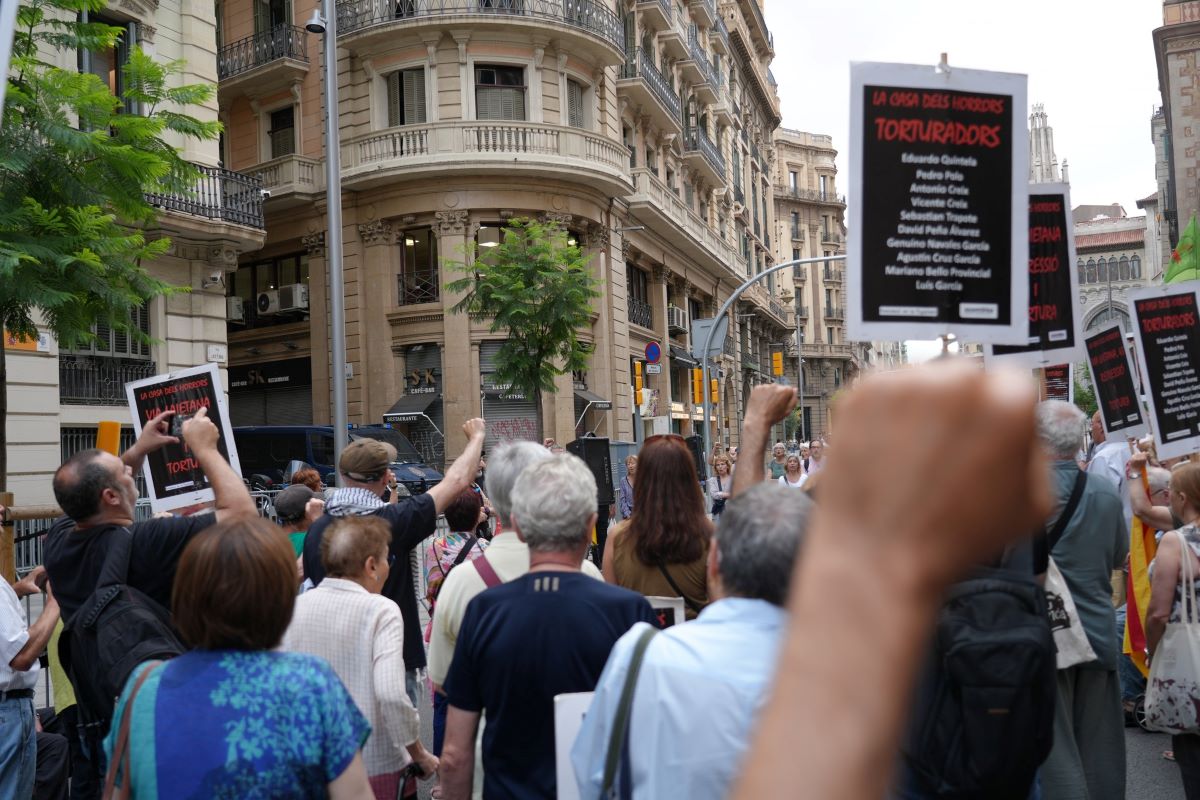


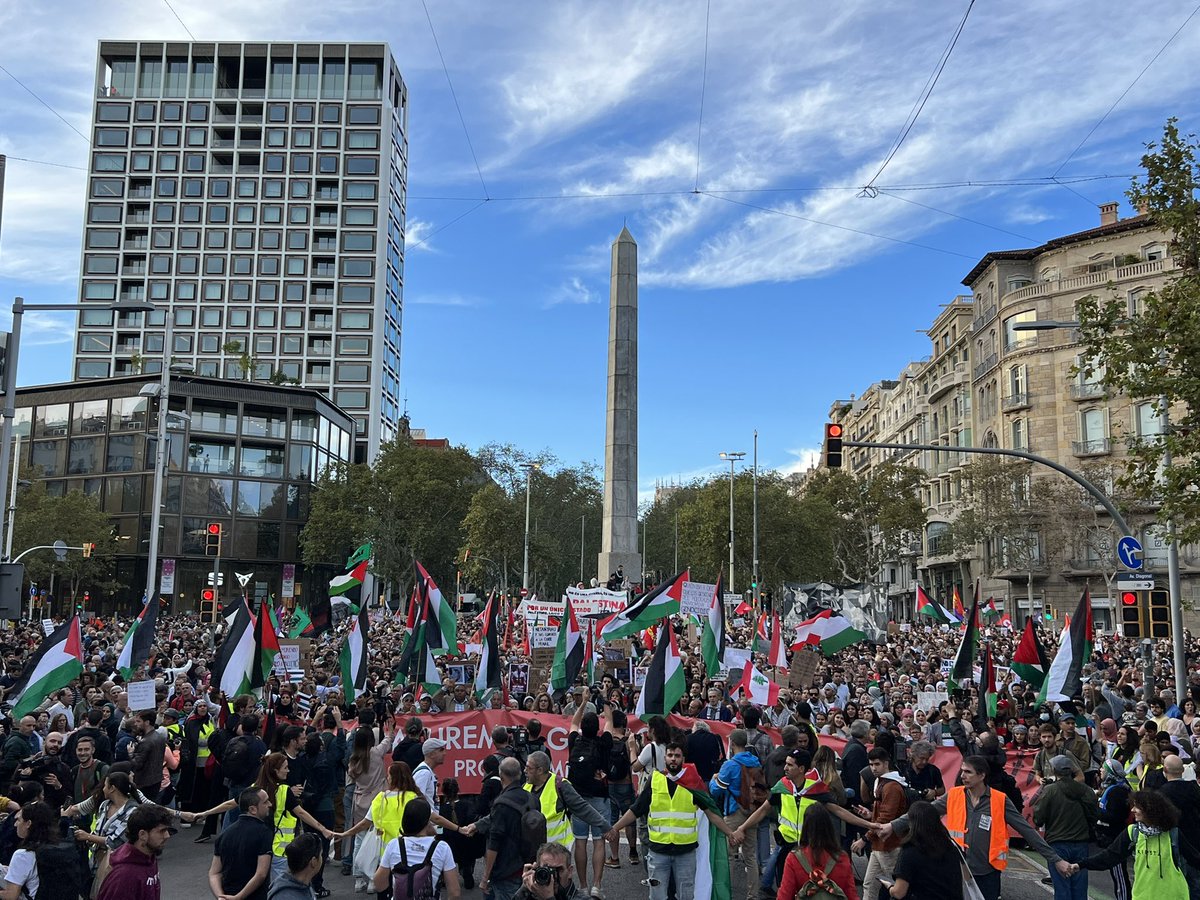


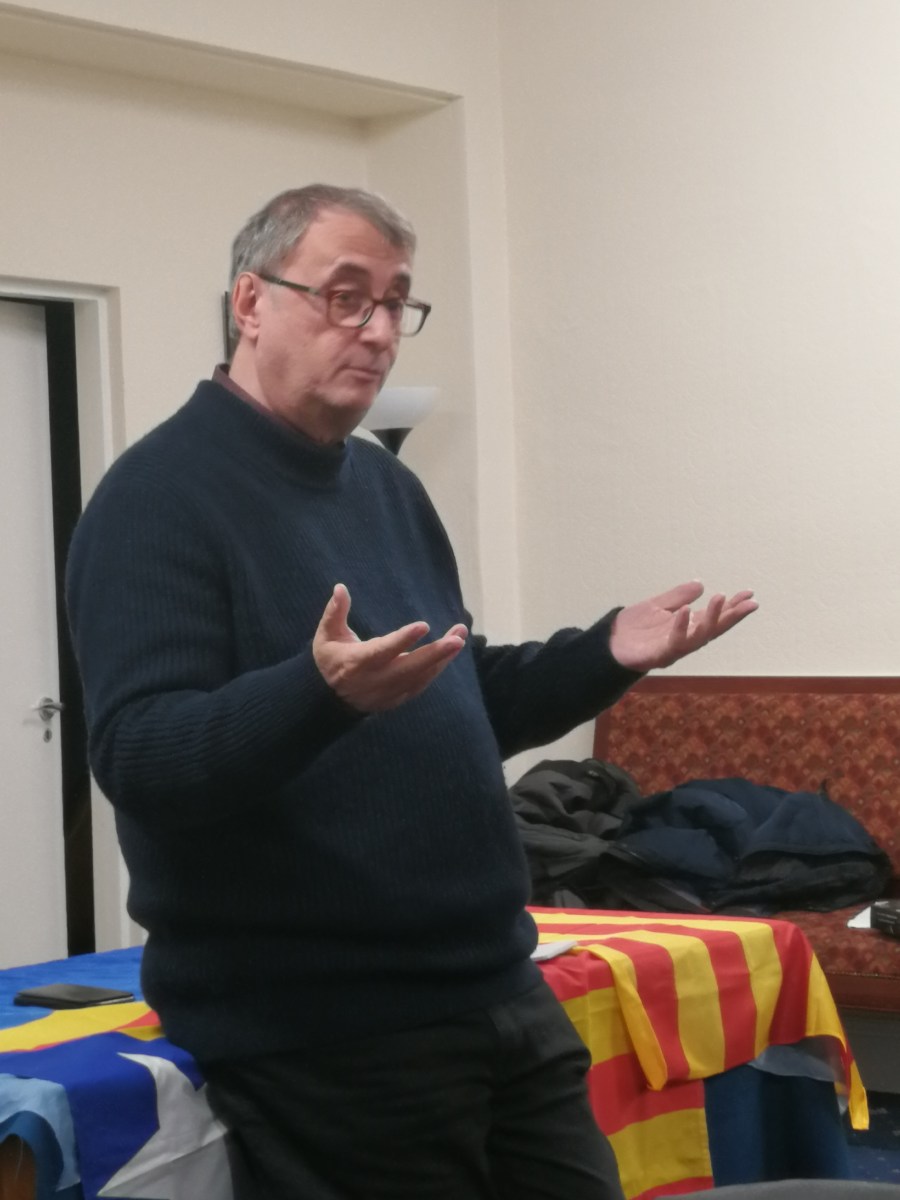


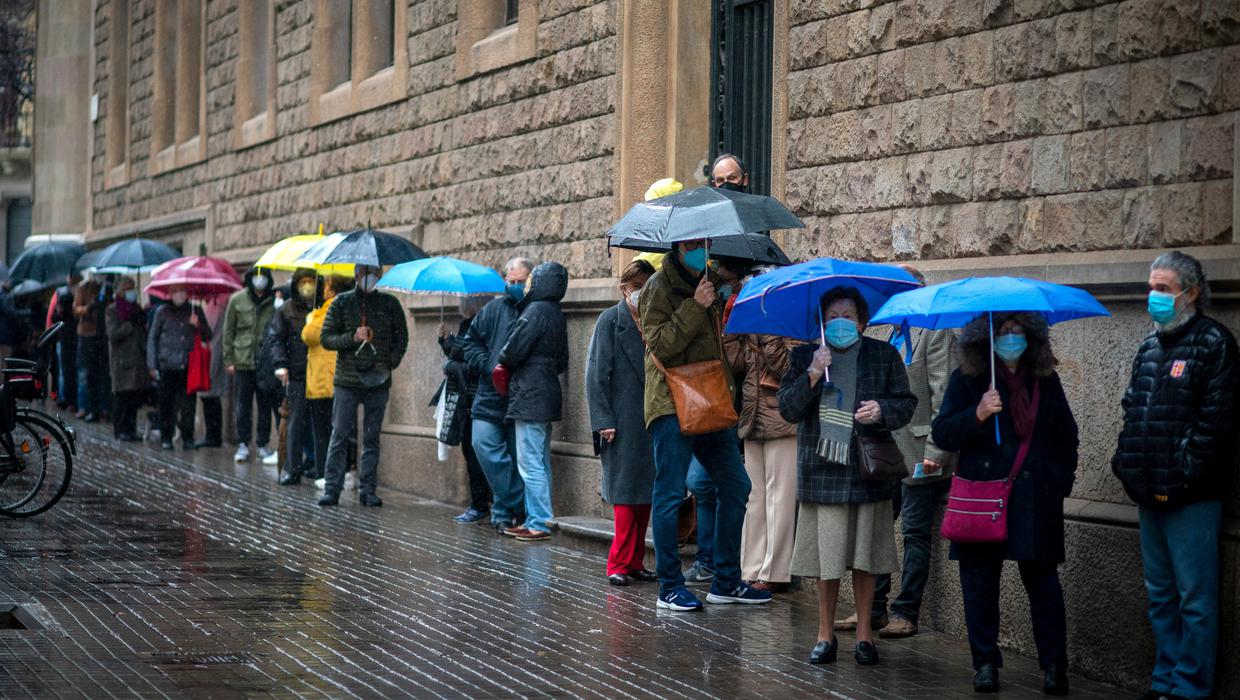


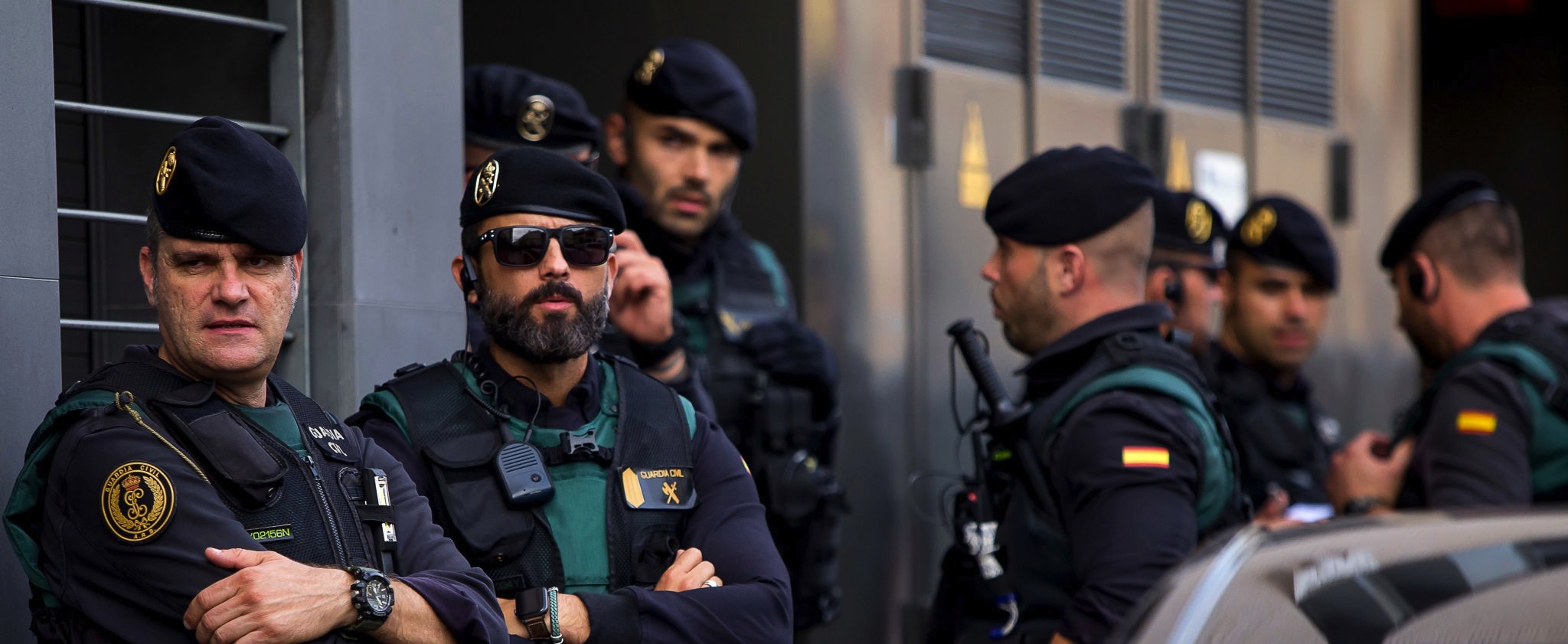

 rebelbreeze