The Catalan Parlament went ahead recently with its house management work, electing a Speaker and Deputy Speaker and four Secretaries (see fly-on-the-wall report below).
After that, they had 10 days to elect a President of the Government. The choice of the Independists seems to be unanimously for Carles Puigdemont, the previous Government’s President; however, the Spanish State wants to arrest him (as it has done with other independist parliamentarians, without granting bail and threatened to others, including the previous Speaker of the Parlament, which is one reason why Puigdemont has been living in Brussels in recent months). The President of the Catalan Parlament, Roger Torrent, despite a threat by the Spanish State to arrest him also, announced that Puigdemont was the only choice for President of the Government. Naturally the Spanish unionists in the Parlament objected vociferously but the independists have the majority.
Roger Torrent, the newly-elected Speaker of the Catalan Parlament (Photo source: Internet)
Could Puigdemont be sworn in as President by proxy? This was a question to which contrary replies were given. The Spanish State said not but a number of others said it was a possibility. The Spanish State is not preventing the jailed Catalan politicians from having proxies vote on their behalves and presumably, even if they jail Puigdemont, though it would disrupt the Parlament considerably, he would still be able to vote through a proxy. The Spanish National Court in Madrid seems to have had this in mind when it rejected an application by the state’s Attorney General to renew the European Warrant for the arrest of Puigdemont when he arrived in Denmark. Puigdemont was there to take part in a debate organised by the University of Copenhagen titled “Catalonia and Europe at a Crossroads for Democracy? Debate with Carles Puigdemont.”
In a statement which clearly revealed the political nature of the Spanish Court, Judge Pablo Llarena declared Mr Puigdemont was seeking to “provoke” his own detention in order to “force the context” in which he could delegate his vote, and therefore he refused to renew the EAW which the state had withdrawn on 5th December (apparently on advice that the Belgian court was not going to grant it — the “crimes” with which the Spanish court charged Puigdemont a) do not have criminal status in Brussels or b) are not those covered by the convention on the EAWs).
Puigdemont has asked the Spanish State whether it is going to arrest him if he returns to Catalunya in order to be inaugurated as President of the Parlament. Torrent has asked for dialogue to discuss the matter with the Spanish Prime Minister, Rajoy, who has refused. Rajoy’s party, the Partido Popular, lost heavily in the recent elections in Catalunya and had only one member elected to the Parlament (it also has only one elected town mayor in the whole of Catalunya). The Spanish Government has also threatened to continue its direct rule under Article 155, which it imposed after the Catalan Government declared for independence, on foot of the referendum on October 1st.
Carles Puigdemont in Copenhagen in the company of young local supporters (Photo source: Internet)
ELECTIONS OF HOUSE COMMITTEE POSITIONS IN CATALAN PARLAMENT
The Catalan Parlament pressed ahead with some necessary internal work on 17th January. They needed to elect the President del Parlament (not of the Government – this position is like the Ceann Comhairle in the Dáil or the Speaker in Westminster), a Vice-President and four Secretaries. As they were doing this in the public eye, Alan King, of the FB page Support Catalonia, translated and posted as it was happening. The summary below is taken from that commentary with his permission and our thanks.
Voting is taking place for the “speaker” (president del Parlament – not the same as the President of the Goverment). The name of each MP is called out and they walk up and hand over their ballot at the front of the chamber. Loud applause accompanies the names of those who are imprisoned or in exile. Those who are political prisoners have delegated their votes except for Carles Puigdemont, who has refused to do so.
The seats in the chamber have been decorated with large yellow ribbons. (This is to remember the members of the Parlament jailed by the Spanish State while awaiting trial for carrying out the wishes of their electorate and defying the Spanish Government; also for a leader of a Catalan independist organisation).
The new candidate for speaker is Roger Torrent, who will be the youngest person to occupy the position. Voting has ended and the names on each ballot are being read out.Hundreds of people are standing outside, surrounded by many Catalan flags, to follow the proceedings live from the street.
The candidate of the independence parties, Roger Torrent, was born in 1979. Here is a piece about him (in Catalan):
The “now you see me now you don’t” Podemos group decided to abstain in the vote. As a result, with the votes counted, no candidate has the absolute majority which means that now there will be a second vote, which is taking place. In this second round a simple majority will suffice.
The Podemos group which represents a Spanish so-called “left” movement go under the name of “Catalunya En Comú” (Catalonia in Common). They suffered heavy losses in the latest elections and only have eight Mps.
The people outside are chanting: “PUIGDEMONT! FREEDOM!”
Loud applause in the chamber as Puigdemont’s name is called out as the second round of voting continues.
Comment from another observer at this point: “I’ve been watching live reporting on the Al-Jazeera TV news programme. Nothing on BBC ….”
The count for the first round of votes was:
Torrent (the independence candidate): 65 Espejo (the unionist candidate): 56
Abstentions; 9
The voting is over for the second round and the ballots are now being counted.
Roger Torrent is 38 years old and a member of the Esquerra Republicana (Republican Left) party. He is described as a perfectionist and a good communicator.
Torrent has replaced Carme Forcadell as speaker of the Catalan Parliament. Forcadell announced she wanted to step down on account of the many legal issues she must face because of persecution by the Spanish courts.
One of Torrent’s well-known quotes: “We will build the Republic without asking permission” (Farem República sense demanar permís).
The session now continues with the election of the Deputy Speaker (vice-president de la Mesa). There are two candidates again, put forward by Junts Per Si and Ciudadanos respectively.
The election of Deputy Speakers has concluded. The First Deputy Speaker will be Costa (the independence candidate), while Espejo (Ciudadanos’ unionist candidate) will be the Second Deputy.
Finally, votes are now being counted for the four secretaries of the Mesa del Parlament. It is expected that there will be one secretary each proposed by Junts Per Catalunya, Esquerra Republicana and the unionist parties Ciudadanos and PSC.
It has been pointed out that the presence of more men than women in the Mesa fails to reflect the fact that women are in the majority in the parliament as a whole.
Roger Torrent is beginning his first speech as Speaker of the Catalan Parliament.
Torrent promises to try to win the confidence of all the members of parliament.
He is going on to draw attention to the intolerable situation with political prisoners and cabinet members in Brussels who cannot return to their country.
It is his job to represent the voices of all the elected members of parliament including those who cannot be present today.
There is an unprecedented situation where the Catalan institutions are under attack, and the first task must be to stop that.He calls on everyone to join forces to retrieve the institutions and put them at the service of the whole country.
The polls are the maximum expression of the will of the people and must be respected.The country’s civil and social rights depend on it.
Social progress is one of parliament’s essential goals.
It is their responsibility to forge agreements and understandings even among groups who don’t see eye to eye.He has worked for that as Mayor and will now do it in his new position.
But he demands one thing: respect. For the institutions, for each other, and for will of the people.
Democracy and coexistence are the two basic principles.
Catalonia is a diverse country and that diversity is reflected in the composition of parliament.
He has referred to his two female predecessors and says that he personally espouses the feminist vision, which is still unachieved in Catalan society and its institutions, but which he promises to do his best to advance.
After his speech, all stand for the Catalan national anthem, Els Segadors.
The anthem is followed by shouts of “Visca Catalunya” (Long live Catalunya!) and “Lliure!” (Free!), and of “Llibertat!” (freedom).
The session is over. The President of the Government remains to be elected, which needs to be done tend days from now.
After the Spanish police attack on voters in a referendum on independence in Catalunya1 on October 1st, People Before Profit2 Councillor Tina McVeigh put forward a motion condemning the attack and calling for the Catalan Flag to be flown over Dublin City Hall as a mark of solidarity with the Catalan people and their right to determine their future.
Front view of Dublin City Hall showing the Ensaya flying next to the Irish Tricolour (Photo: Casal Catala Irlanda)
This was not such a wild step for the Council to take as it may seem: the Palestinian flag had been flown from City Hall in May, to the delight of most Dubliners but to the disgust of the Israeli Ambassador and to Zionist sympathiser and former Government Minister Alan Shatter. And Dublin city has been ‘twinned’ with Barcelona since 1998.
Nevertheless, in November the Protocol Committee agreed to recommend flying it by majority only, seven votes for and five against. It still had to be voted on by the whole Council and so went forward on to the agenda for the monthly meeting in December. Councillors began receiving emails from Spanish unionists asking them to vote against, which at first substantially outnumbered those in favour. As the first Monday in December drew nearer, the correspondence equalised between those in favour and those against. But the meeting ran over time before the motion was reached on the agenda and another date was set to discuss it. When the councillors reconvened, the motion was proposed, discussed and voted on. Unlike the decision on the Palestinian flag earlier this year, the vote was very close but the motion passed by three votes.
Section of the attendance at the event (Photo: D.Breatnach)
In January this year the Catalan flag was hoisted – the regional ensaya and not either of the independence esteladas3 – on top of City Hall, where it will fly for a month. City Hall is itself a historic site, having been part of a battleground during the 1916 Rising. On January 6th, Catalans and some supporters gathered outside City Hall to celebrate the show of solidarity in the flying of the Catalan flag.
Joan Pau of Casal Catala of Ireland4 welcomed the attendance and thanked the Councillors for flying the flag and introduced the Lord Mayor, Mícheál Mac Donncha, telling those present how he had approached the Catalans to help them. Mac Donncha (SF)5 thanked the Catalans for the invitation to attend and said that he was proud of the Council for the decision they had taken. He remarked also that in the past Ireland had political prisoners just like those now in Spanish jails for supporting the Catalan referendum and deplored elected officials of Catalunya being jailed for following the mandate of the people. He spoke also about Ireland’s fight for freedom and how in the 1916 Rising, Volunteers had taken over City Hall itself.
Another view of a section of the attendance Front view of Dublin City Hall showing the Ensaya flying next to the Irish Tricolour (Photo: Casal Catala Irlanda)
Joan Pau then expressed his regret that Cnclr. Tina McVeigh could not be present due to a family bereavement, since she had been very active in solidarity with the Catalan people. He introduced Cnclr. John Lyons (also PBP) who also expressed his pride on the result of the vote, as well as his condemnation of the Spanish Government, as distinct from the Spanish people, for their undemocratic and violent behaviour in the October 1st attacks and subsequently in the jailing of Catalan public representatives. He also condemned the Irish Government for not supporting the right of the Catalan people to self-determination.
Front view of Dublin City Hall showing the Ensaya flying next to the Irish Tricolour (Photo: D.Breatnach)
Although a Spanish unionist had contacted the Council to threaten a counter-demonstration, there was no sign of any such presence throughout the ceremony. A number of passing tourists took photos (some even having themselves photographed with the group) and a number of passing motorists tooted their horns in solidarity.
Section of the attendance with flags (including the “Sí” ones used campaigning for the referendum) & placards calling for the release of the political prisoners. (Photo: D.Breatnach)
After the formal part of the meeting was over, Dublin walking history tour guide Diarmuid Breatnach invited Catalans to gather around DCC’s plaque to the garrison of City Hall and surrounding buildings in 1916. The guide explained the origin of the Irish Citizen Army in the Dublin Lockout of 1913 as a workers’ defence militia against brutal attacks by the Dublin Metropolitan Police Force. It has been called “the first workers’ army” Breatnach told them and drew attention also to it being the only one of the various organisations taking part in the Rising that formally gave equal status to men and women. There were women officers in the ICA and after the killing of the commandant of this garrison Seán Connolly, it was a woman who took over as commandant. The fighting here had been fierce as Dublin Castle is just next door and that had been the HQ of the British Occupation of Ireland since 1169.
Plaque (located to the right side of the front of City Hall) listing the names of men and women of the Irish Citizen Army who fought at that location in 1916. Four ICA Volunteers died there.
After receiving answers to a few questions, many of those present retired to a local pub to warm up and to carry on conversation on a number of topics, in the best Irish – and Catalan – manner. Up above, the Catalan flag on the east side of City Hall’s roof waved in the breeze, with the Irish tricolour next to it, in the centre, waving too.
End.
FOOTNOTES:
1Catalunya is considered part of wider nation called Paisos Catalans (Catalan Countries) which includes Valencia, the Balearic Islands and parts of Aragon and Murcia; most of it lies within the current territory of the Spanish state, with a small part within the French state. Catalunya (capital Barcelona) is one of the regions within the Spanish state with limited autonomy and it is there that the referendum was held, the result mandating its Parlament to create and independent republic. The Spanish Government and Constitutional Court ruled the referendum illegal, confiscated ballot boxes, assaulted hundreds of voters, declared the referendum result non-valid, jailed a number of elected members and activists, threatened others with jail, ruled Catalunya directly Spain and called for new elections, which confirmed the situation more or less as before. The struggle is ongoing.
2People Before Profit was launched as a broad front by the Trotskyist organisation the Socialist Workers’ Party Ireland, formerly the Socialist Workers’ Movement, founded in 1971 and close to the SWP of Britain.
3There are two Catalan independence flags or estelladas: the Republican one with red stripes on a yellow background, with a small blue triangle to the left, containing a white star; the Socialist (or Communist) one, also with red stripes on a yellow background but with a red star to the left and no triangle. The regional ensaya, without any star, was proposed as the one least likely to cause division.
4Casal Catala are Catalan cultural associations that have been founded in a number of countries outside Catalunya.
5SF or Sinn Féin – the party is represented on Dublin City Council and tradition has it that the Lord Mayor is elected yearly in rotation from among the elected representatives; this Council year it was SF’s turn again.
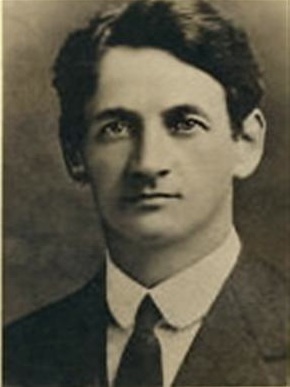
Estuve recientemente leyendo sobre el apoyo en Cataluña a la lucha para la independencia de Irlanda en el 1920, inspirado especialmente por la huelga de hambre del Traolach Mac Suibhne (Terence McSwiney), Gran Alcade de Cork y oficial del grupo armado republicano el IRA. Sabemos también que las huelgas de hambre de parte de presos republicanos irlandeses en el Long Kesh en el 1981, simbolizadas en el personaje del Bobby Sands, también habían impresionados a gente por todo el mundo.
Me encanta leer de las conexiones de la lucha del independismo irlandés con las luchas de resistencia de otros pueblos. El Alzamiento de 1916 en Dublín y la Guerra de la Independencia por todo Irlanda dio inspiración a nacionalistas, republicanos y socialistas revolucionarios por grandes partes del Mundo, influyendo al vietnames Ho Chi Minh, a Nehru (y a Indios mas revolucionarios que el) y a gente en todas las colonias de los estados coloniales como la Gran Bretaña, Francia, España, Portugal, Bélgica, Holanda, Alemania ….. Llegó a tener impacto en cada continente del mundo menos en el de Antartica. Y que lástima que terminó en tan vergüenza sórdida!
Me gustaría comentar sobre la frase del McSwiney “no es él quien puede infligir más, sino quién puede soportar más que vencerá”. Y al mismo tiempo referir a la de otro huelguista de hambre hasta la muerte, 61 años después de la muerte del McSwiney: “Nuestra venganza será la risa de nuestros niños.”
Esas frases de los mártires McSwiney y Sands son interesantes pero hay que leer los en el contexto de sus vidas y de la lucha para la independencia de Irlanda. Demasiadas veces son esas palabras apropiadas por pacifistas o peor, para los que quieren rendir o diluir o desviar la resistencia.
Foto del Traolach Mac Suibhne (Terence McSwiney) (Fuente de foto: el Internet)
Las historias de ambos hombres lo dejan claro que se habían comprometido a lucha armada contra el imperio británico, McSwiney en el IRA y Sands en el Provisional IRA. Los dos se consideraban soldados de la resistencia nacionalista o republicana. Si no hubieron muertos en la cárcel, estarían por ahí pegando tiros a la policía colonial y al Ejercitó Británico, tratando de matar les y tratando de evitar que les maten a ellos.
La lucha para la independencia de Irlanda1916-1921 quedó en gran parte derrumbada, tras el Trato de 1921 y la Guerra Civil del 1922-1923. El nuevo Estado Irlandés fusiló a 81 republicanos durante esos últimos años y mató al rededor de 120 ejecutados tras haber les hecho preso en lucha, o secuestrados y asesinados. Muchos tuvieron que huir del país.
Se volvió a lucha en seria en el 1971, pero esta vez casi totalmente confinada a la quinta parte del país, la colonia británica de Los Seis Condados. Y claro, quedó sin éxito, a pesar de enorme bravura y sacrificio por el pueblo a través de casi tres décadas.
Bobby Sands, foto tomado durante su encarcelamiento. (Fuente de la foto: el Internet)
A los que les dan miedo o les disgusta la resistencia armada, les gustan muchísimo esas frases de Sands y de McSwiney, sacadas de sus contextos.
Guste o no guste, la historia nos repite a enseñar que la resistencia a las fuerzas del imperialismo (y aún, del capitalismo), si va a tener éxito, tiene que pasar a la fase armada en algún momento. Y no es por que les guste la violencia a los de la resistencia si no por que el enemigo no le dará ningún otro remedio. Vendrá con armas, juicios, cárcel para aplastar la resistencia. Así que la única cuestión no es a ver si la resistencia exitosa aquí o ahí le hace falta pasar a la fase armada, si no cual es el momento en que se necesita hacer. Eso es lo que nos dice la historia, creemos lo que nos guste.
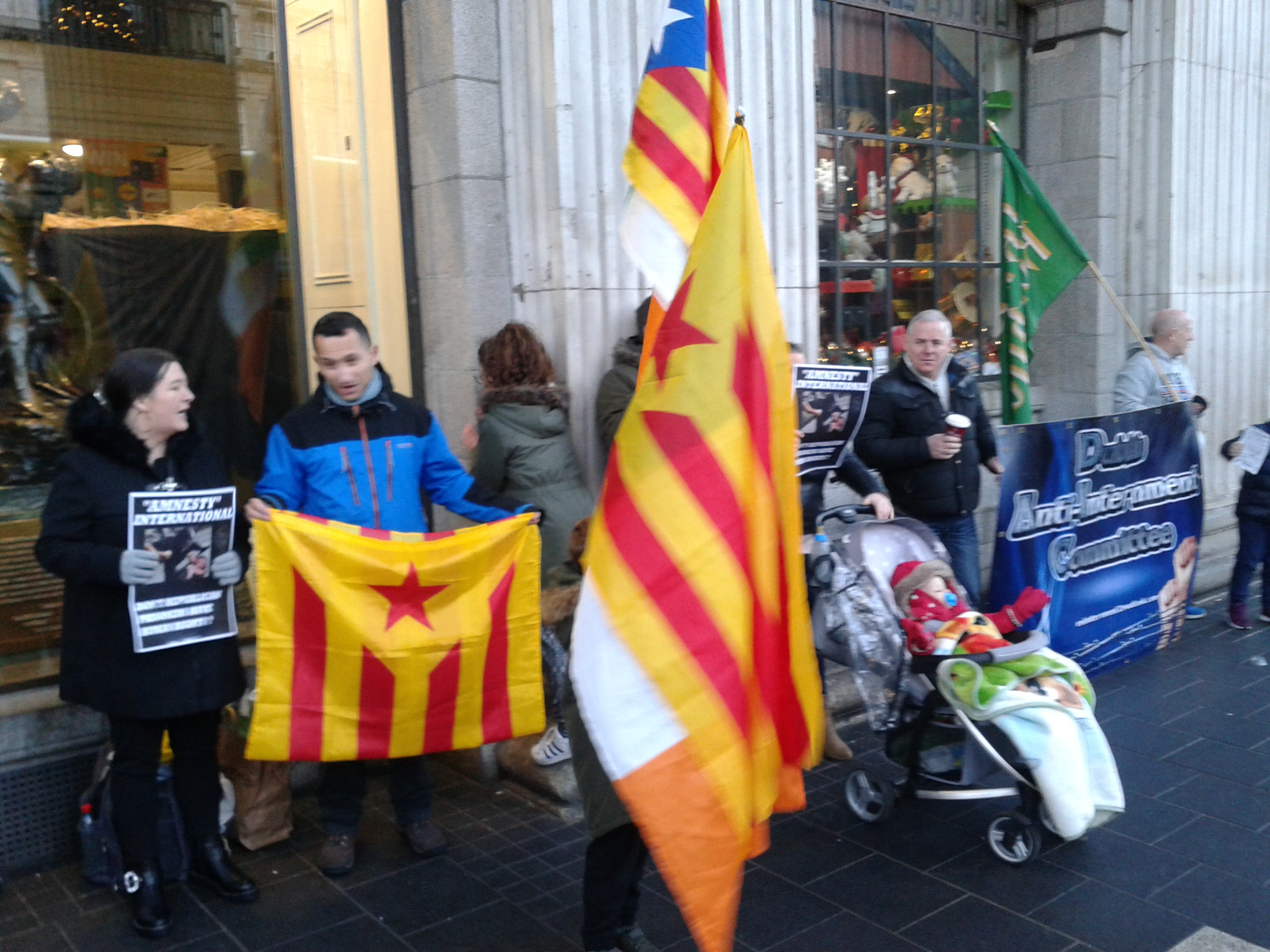
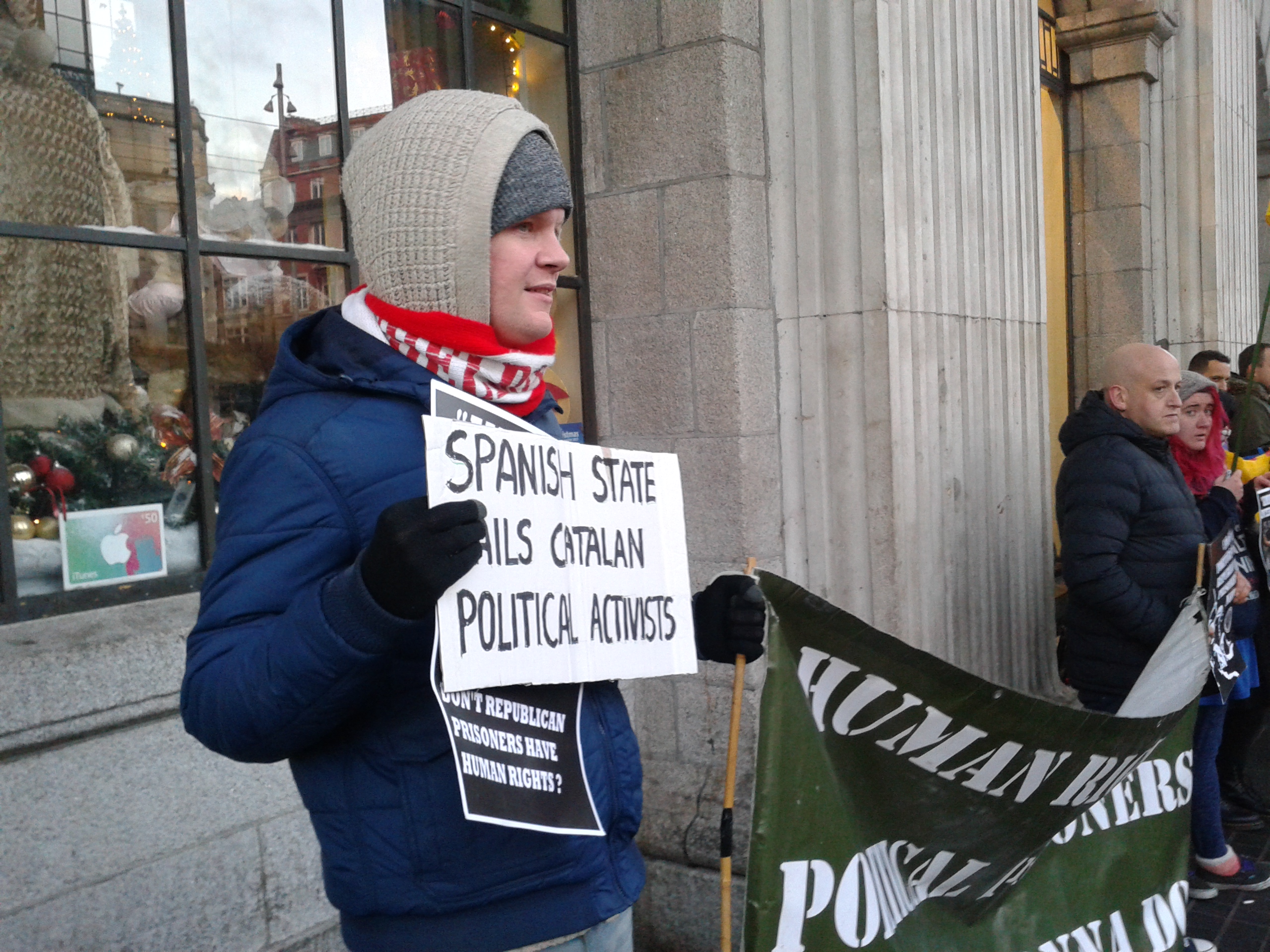
Catalan Esteladas flew next to Irish Tricolours at the GPO in Dublin on Saturday afternoon (25 November 2017). The occasion was a picket organised by the Dublin Anti-Internment Committee to protest the internment without trial of Irish Republicans and also of Catalan political activists for independence. Placards raised the issue of internment of Irish Republicans and their treatment once in jail, as well as criticising the lack of action of Amnesty International on this question. Some placards also declared that the “Spanish State jails Catalan political activists”.
Mix of Irish and Catalan flags outside the GPO building, O’Connell Street, Dublin (Photo: D.Breatnach)
Despite the seriousness of the issue and the bitter cold, the mood was upbeat, assisted by a music player broadcasting a range of songs, from Sifre’s “Something Inside So Strong”, through Warshaw’s “The Cry of the Morning” (sung by Christy Moore) to “Els Segadors”. Some protesters sang along to the songs and passers-by could be heard joining in too.
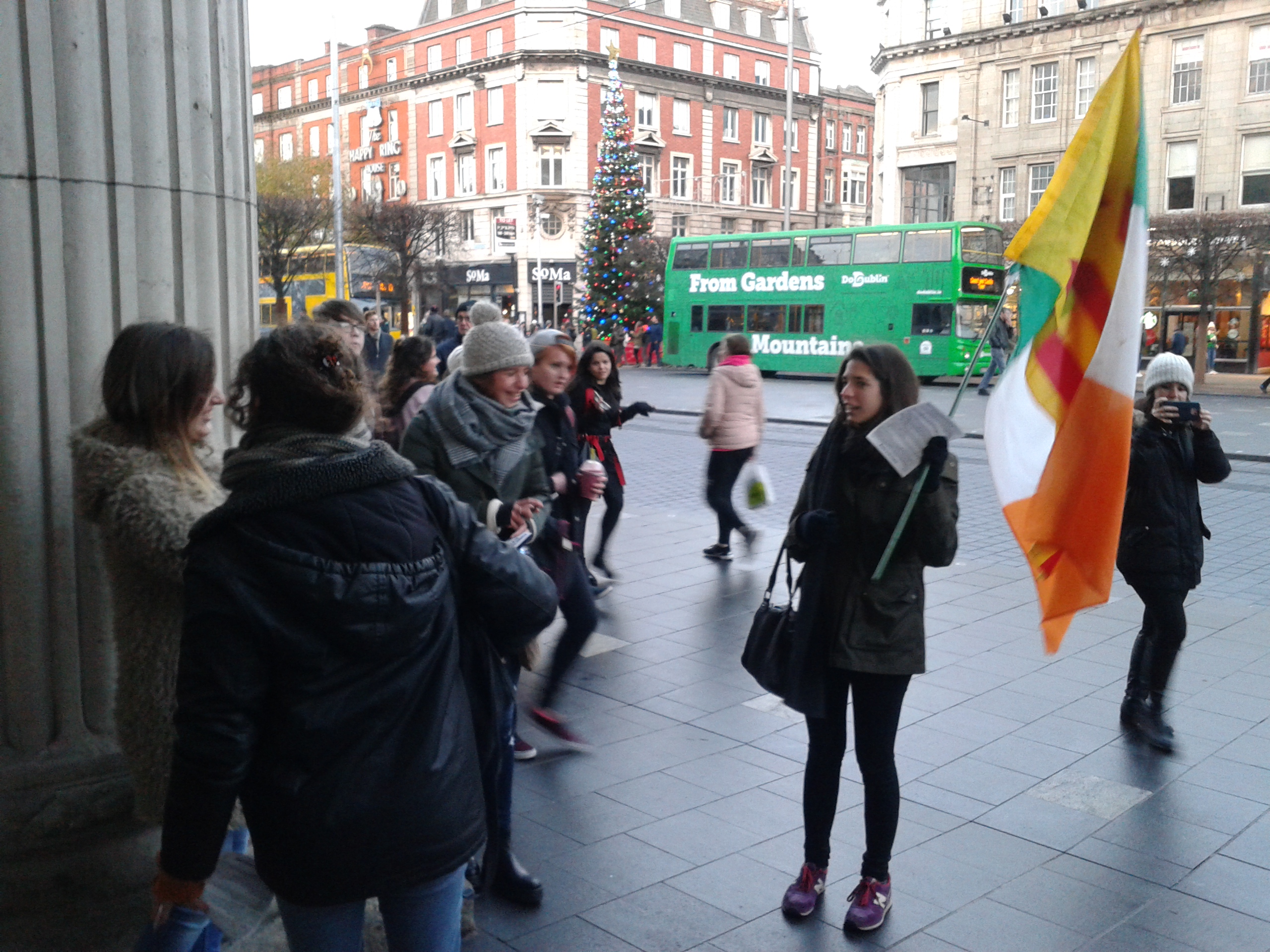
Many leaflets were distributed. A number of Catalan young women passers-by were excited to see the Estelada flags and were ecstatic when “Els Segadors” (“The Reapers”), the Catalan national anthem, was played.
Catalan and other young women passers-by reacting to the protest excitedly borrowed some joint flags to take photos of one another. (Photo: D.Breatnach)
Some people passing occasionally shouted “Viva Espaňa!” in hostility which gave rise to the response of “Viva la democracía! Viva la libertad!” On the other hand, other visitors passing by were very supportive, for example a young woman from Asturias (northern Spanish state) and an older man from Andalusia (southern Spanish state).
A spokesperson for the Committee briefly addressed the attendance at the end of the event, thanking them for attending to support Irish and Catalan political activists being jailed without trial. Referring to the few passers-by who shouted “Viva Espaňa!”, the spokesperson said that there is nothing wrong with pride in one’s country but queried why the sight of a Catalan flag brought that response and why the definition of Spanish nationhood for these people is bound up with the denial of the rights of another nation to determine its own future. The spokesperson declared that every nation has a right to determine its own future and to do so without threats and repression, pointing out that the Spanish State is attempting to jail the whole Catalan Government for carrying out their election promises and has jailed the leaders of two independence organisations without trial.
The spokesperson thanking the attendance once more, the event came to a close, flags were furled, banners rolled and placards put away for another occasion.
The Dublin Anti-Internment Committee was launched in 2013 and is independent of all political parties and organisations, holds regular pickets and people who support the civil and human rights of Irish Republican prisoners are welcome to attend.
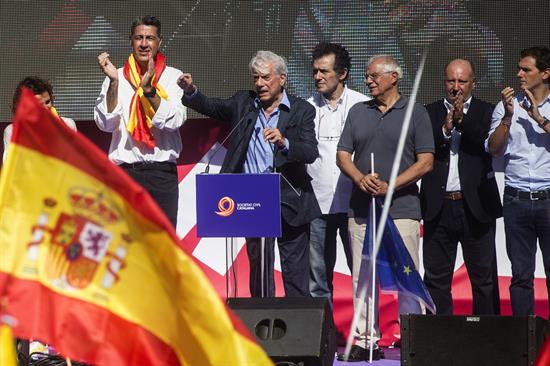
Mario Vargas Llhosa was in Barcelona on Sunday as part of a number of people speaking at a pro-Spanish union rally which received coaches from various parts of the Spanish state. HE DENOUNCED NATIONALISM (Democratic, Catalan) WHILE SURROUNDED BY SPANISH NATIONALISTS AND FASCISTS AND THEIR SYMBOLS (the Spanish unionists were demanding that Spain remain united, insulted Catalan officials, waved Spanish unionist flags and called for a Catalan-elected President to be jailed; Spanish fascists openly displayed fascist Franco-era flags and symbols and gave the fascist salute).
Nobel Literature Prize-winner Mario Vargas Llhosa addressing Spanish unionists and fascists bussed into Barcelona for rally against Catalan independence and self-determination (Photo source: Internet)
TALKING ABOUT THE IMPORTANCE OF DEMOCRACY WHILE DEFENDING AN UNDEMOCRATIC AUTHORITARIAN SYSTEM REPRESSING AND DISRUPTING A PLEBISCITE (State police violence leading to nearly 900 civilians injured; ballot boxes and ballot forms seized; elected officials arrested and/ or threatened with jail).
TALKING ABOUT THE IMPORTANCE OF THE RULE OF LAW WHILE IGNORING ILLEGAL ASSAULTS BY STATE POLICE RESULTING IN NEARLY 900 INJURIES (without a single State police officer being even charged or senior officers even reprimanded).
A NOBEL PRIZE WINNER IN LITERATURE IS UNABLE TO DETECT AN IMPORTANT ELEMENT IN WORLD LITERATURE — IRONY (Llhosa was awarded the Nobel Prize for Literature in 2010 for his work examining the corruption of political power and struggle against it — in Latin America).
Yes, it has its own language (Catalan), its own national anthem and its own national cultural customs. Furthermore it has been independent a number of times in its history, as a Republic. And its official autonomous status in the Spanish state even includes the word “national”. Catalan is an official language in Catalunya (along with Castillian — Spanish) and most people there speak Catalan daily.
The Esteladas flying in a Catalan demonstration for Independence. (Photo source: Internet)
DO NATIONS HAVE THE RIGHT TO SELF-DETERMINATION?
Yes, according to most legal authorities and most people’s sense of right and wrong. It is recognised in the UN Charter of Human Rights.
IS THERE A LIMIT ON THE RIGHT OF A NATION TO SELF-DETERMINATION – i.e CASES IN WHICH THE RIGHT DOES NOT EXIST OR CAN JUSTIFIABLY BE OVERRULED?
Perhaps. For example, if a nation were somehow to determine to wipe out an ethnic minority, the right to decide to do so and to carry it out can be overidden by the more basic right of the targeted ethnic minority to exist. If one considered South Africa as a nation, it had minority racial government ruling over a majority disenfranchised black population and one could not endorse their right to continue in that way since they were negating the rights of the majority of their state’s population to self-determination.
CAN CATALUNYA’S CASE BE ONE OF THE JUSTIFIABLE EXCEPTIONS THAT WOULD NOT ENTITLE IT TO SELF-DETERMINATION?
Not at all. The only claim against her right to self-determination (other than the Spanish state’s claim that it violates the Spanish state’s constitution) is that it is one of the richest regions of the Spanish state and a large one. If that were considered a viable argument against Catalunya’s right, it would mean that no nation which has good natural resources or a successful economy has the right to self-determination and must stay within a union to benefit its invader and coloniser state.
HAS CATALUNYA’S RIGHT TO SELF-DETERMINATION BEEN VIOLATED BY THE SPANISH STATE?
Cartoon comment on October 1st referendum by DB
Unquestionably Yes. She has been prevented a number of times by Spanish court legal judgements and by threats of the use of force from carrying out a referendum on the question of independence as a republic. Her attempt to carry out the referendum in spite of all threats was met this month with actual violence (nearly 900 injured people), police invasion of Catalan Government offices and polling booths, seizure of ballot boxes and ballot papers and in a number of areas, aggression against and disrespect for Catalans and their culture.
Furthermore many measures sought by the Catalan Parlament on grounds of increasing rights of migrants, protecting the environment and animal rights, restriction of the legal rights of the banks, have been declared illegal by the Spanish national courts, thereby violating the rights of Catalans to determine for themselves how they shall manage these matters.
WAS THE OCTOBER 2017 CATALAN INDEPENDENCE REFERENDUM ILLEGAL?
Here we have to ask – by whose law? The Catalan Parlament approved the holding of the referendum by majority. The Government approved and organised it.
According to the constitution of the Spanish State, no part of the State’s territory is permitted to enact independence without the permission of the Spanish Parliament. The Catalans will always be outnumbered in the Spanish Parliament (a similar situation to members elected in Ireland to the Westminster Parliament in Britain from 1801 to 1921; or Scottish MPs from 1707 to the present; Wales was annexed by England 1535 – 1542). They can never expect to gain a majority vote in their favour at Westminster.
By the Constitution a declaration of independence (though not perhaps a referendum on a wish) is illegal. But when has an occupying state given the right of secession to nations and peoples it occupies?
WAS THE SPANISH CONSTITUTION OF 1977 (WHICH THE SPANISH STATE CLAIMS MAKES CATALUNYA REFERENDUM ILLEGAL) APPROVED BY MAJORITY?
In most of the Spanish state, it was.
But does that mean that it overrules the right to self-determination of a nation currently within the Spanish state? No, clearly that cannot be.
Also, that Constitution was rejected in the Basque region of Euskadi but the Spanish state nevertheless refused it too the right to referendum on the question of Basque independence.
In addition, the Constitution was proposed three years after the death of a dictator who had crushed Catalan (and Basque) resistance in 1939, repressed the Catalan (and Basque) language and civil rights for 36 years, with fascists still in power managing the transition to the new form of the State and with the collusion of the leaderships of some crucial former resistance organisations of the people, i.e the Communist Party and the social-democratic Socialist Workers Party, along with their respective trade unions.
Self-determination must mean the right to enter into a union or to remain outside it but it must also mean the right to leave a union, nullifying any previous agreements.
The Constitution is constructed so that it places many hurdles in the way of any nation seeking to leave the union even in the unlikely event of getting a majority to vote with it in the Spanish Parliament. “Title X of the Constitution establishes that the approval of a new constitution or the approval of any constitutional amendment affecting the Preliminary Title, or Section I of Chapter II of Title I (on Fundamental Rights and Public Liberties) or Title II (on the Crown), the so-called “protected provisions”, are subject to a special process that requires (1) that two-thirds of each House approve the amendment, (2) that elections are called immediately thereafter, (3) that two-thirds of each new House approves the amendment, and (4) that the amendment is approved by the people (i.e the people of the whole Spanish state – DB) in a referendum.” (Wikipedia)
WAS THE RECENT CATALAN REFERENDUM A FAULTLESS TEST OF THE WILL OF THE PEOPLE OF CATALUNYA?
Clearly not – not because participation was limited to 48% of the Catalan population but because the Spanish Government had declared in advance that it would not respect the decision and would prevent the referendum taking place. Also because voters were prevented by Spanish police from entering a number of polling stations and because Spanish police seized many ballots and ballot boxes.
But should the Spanish state be permitted therefore to claim therefore that the votes which were registered and counted are of no avail? Are we to endorse a view that an occupying or colonising state can nullify any nation’s vote for self-determination simply by banning the election or referendum and by disrupting the process? Clearly not.
The Irish uprising in 1798 and in 1803 was not the result of a referendum, nor was that of 1916 nor the War of Independence 1919-1921. Clearly, if we are to uphold the right to self-determination of nations we must support the right of the occupied or colonised nations and to decide their own means of breaking away.
ARE THERE CATALANS WHO WANT TO REMAIN WITHIN THE SPANISH STATE?
Clearly there are. As many as there are who wish to break with it? The evidence suggests not. Very recently the media claimed a hundred thousand rallied in Catalunya against independence. But around a million gathered there last month to support the right to hold the referendum, with most of them clearly for independence. Clearly, even if everyone attending a rally against Catalan independence were actual Catalans and had not been bussed in, they are outvoted by those Catalan residents who demonstrated despite threats and who voted despite police violent repression. And if the Spanish state thought the vote would go in favour of remaining in the union, why did they forbid the referendum and disrupt the process?
Another spectre is haunting Europe – the spectre of an EU state’s fragmentation and the possible disintegration of the EU itself. It may begin with the breakup of a European state but could ultimately affect most of southern, south-eastern and south-western Europe.
Huge pro-Catalan Independence demonstration fills the streets of Barcelona on Catalunya’s national day. (Photo source: Guardian, on line).
A street demonstration in Barcelona on Catalunya’s national day filled the streets with an incredible number (over one million according even to the police) and awash with the “Estelades”, the Catalan revolutionary flag of the Senyeraestelada from the 1930s with the blue triangle enclosing a white star, in homage to Cuba and Puerto Rico (see video link below). From above, apart from the flags, the demonstration appeared lime-green as participants wore T-shirts of that colour with the Sí (“yes”) for independence printed on them.
The demonstrators formed a huge “X” in the city to signify a “yes” vote for independence and somewhere near the middle, three human towers put their topmost members displaying a clenched fist in the universal sign of resistance to oppression.
The political crisis surrounding the current bid for a referendum on independence for Catalunya (their nation in Catalan) serious consequences for the Spanish state but as the crisis matures may also deeply affect two other European states: France and Italy.
As the Parlement of Catalunya has now declared by majority that it will defy the Spanish State and hold a referendum on independence from the Spanish state on October 1st, the Spanish ruling class grows increasingly desperate and
Had its Constitutional Court declare the referendum unconstitutional and illegal,
Has the paramilitary police force, the Guardia Civil, searching for ballot boxes with the intention of confiscating them,
Summoned 700 town Mayors to answer to charges of facilitating an illegal referendum by allowing their council buildings to be used as polling stations
Threatened to charge Parlament pro-independendists with disobedience and abuse of power
Closed down the official Catalan referendum website
It also demanded weekly accounts on expenditure from the Parlament to try and ensure it was not funding the referendum.
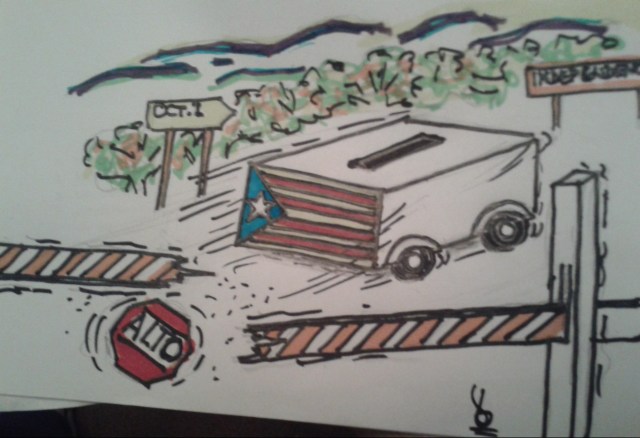
ALTO! HALT! (Cartoon by DB)
In response, the leader of the Parlement says the Spanish can arrest him if they want but he is going ahead with the referendum. Many among the 700 town Mayors of Catalunya have said they will not attend court while others have said they will as they believe they have done nothing wrong. Many organisations and institutions have offered their premises as polling stations if necessary. Hundreds of Catalans have volunteered to help organise the referendum and to staff the polling stations.
To many observers, it will seem that the actions of the Spanish state are hysterical and excessive. On the other hand, to those who understand the history and nature of the Spanish state, it is hard to see how the Spanish ruling class can concede Catalan independence. That is on ideological and political grounds alone; and if those grounds were not enough, there are also the financial, economic and territorial ones.
“SPAIN: UNITARY, GREAT AND FREE”
The fascist Spanish slogan: “Espaňa – Una, Grande y Libre”, the claim that their state is unitary as well as “Great and Free”, explains in part the problem for the Spanish ruling class in a Catalonian secession. The creation of the Spanish kingdom was based on alliances for war against the Moorish Iberian kingdom of El Andalus, that religiously-tolerant kingdom of great learning and culture and it brought all other Iberian kingdoms under its rule. Subsequently, the Spanish Kingdom forced Christianity on the Jews or expelled them (creating the Sephardic Jewish refugees) as they did also not only to the defeated Moors of El Andalus but also to those other Arabs who had fought as allies of the Christian Royals. In later years the Spanish Empire lost conquered territory abroad but never gave any up on the Iberian Peninsula since the breakaway of the Kingdom of Portugal in 1143.
Unlike most of Europe, there was no successful revolution against the feudal system in the Spanish state, which retarded its economic and political development. However, the revenue from the kingdom’s exploitation of its vast territories in America kept the State powerful (while also acting as a negative counterbalance against the development of its industry).
SPANISH CIVIL WAR AND INVASION
Modernising and liberalising movements did struggle for change within the State but the First Spanish Republic only lasted under two years (11 February to 29 December 1874). The Second Republic (1931-1939) went through a right-wing repressive phase but then turned to a liberal-socialist phase, at which point the Army mutinied under the leadership of the Four Generals, of which Franco became the best-known.
The Second Republic conceded autonomy to Catalunya and Galicia and later, perhaps reluctantly, to the southern Basque Country (excluding Nafarroa/ Navarra, where the reactionary Christian-monarchist Carlists seized control and sided with the military insurgency). Aided by German Nazi and Italian fascist air transport, war material and troops, as well as by the complicity of Britain and France, the military defeated the Second Spanish Republic after a fierce struggle and a Christian-fascist dictatorship under General Franco took over the country.1
The Esteladas flying in a Catalan demonstration for Independence. (Photo source: Internet)
All claims to separate nationhoods were suppressed, all the nations being considered merely “regions” of the Spanish state, with picturesque traditional costumes and feasts. Castillian (Spanish) was to be the only language permitted in use, with particular repression inflicted on those of the strongest and most widely-used tongues, Catalan and Euskera (Basque).
Adolf Hitler and General Franco reviewing German occupation troops in Hendaye, Northern Basque Country, 1942 (Photo source: Internet)
Armed resistance of a guerrilla-type continued for awhile after the end of the Civil War/ Anti-Fascist War, and in the 1960s the Basque left-nationalist group ETA commenced armed struggle after nearly a decade of persecution by the Spanish State. For a while too there was an armed group in Catalunya.
After the death of Franco in 1975, the Spanish ruling class, under internal pressure from the Christian technocrat movement Opus Dei and external pressure from the USA, attempted a modernising and liberalising change of regime which is now widely referred to as the “transition to democracy” (sic) or just plainly as La Transición.
As part of this process, the Monarchy was re-imposed on the people when Juan Carlos de Borbón, who had been groomed by Franco, was declared King of Spain in 1975 and also named as Franco’s successor. No vote was held on the reimposition of a King on the Spanish state which had been without a reigning monarch for 34 years. A Constitution was drawn up which included the Spanish state being a constitutional monarchy and with much talk of democracy and changes, including regional autonomy, the Constitution gained 88% votes in favour. Among the 22% negative votes were the majority of the southern Basque Country.
General Franco in his declining years with his protege, Juan Carlos, later crowned King of Spain. (Photo source: Internet)
After Juan Carlos’ abdication in June 2014, Juan Carlos’ son Felipe VI was declared King, a majority of the representatives in the Cortes (Spanish Parliament) voting to approve — which included not only the hard right-wing Partido Popular (PP) but also the helpful abstention of the social-democratic Partido Socialista Obrero (PSOE).
THAT WAS THEN – BUT NOW?
After Franco’s death, Catalunya was created an “autonomous region” and was ruled by a right-wing majority in the Parlament2; nevertheless struggles with the Spanish State have broken out from time to time, in particular about the use of the Catalan language and the primacy which Catalans, both right and left-wing, wish it have in Catalunya.
Another bone of contention has been the disparity between the tax revenue the Spanish state gains from Catalunya, on the one hand, and the funding the Spanish state gives to the autonomous region.
Some years ago the Parlement declared their intention of holding a referendum on independence but the Government and the Spanish National Court declared that this would be illegal, going against the Constitution (the same thing happened in the Basque Country). In addition, an Army General declared that the Constitution could be enforced with tanks, if necessary. The Spanish Government, although distancing itself from the General’s comments, did not have him disciplined.
Every year since then has seen large national demonstrations for Catalan independence, including a huge human chain in 2003.
The historic ideological and political grounds, as noted earlier in passing, are not the only ones which make the surrender of Catalonia unthinkable for the Spanish ruling class. In terms of population (2016 figures), Catalunya’s 7,522,596 is 2nd in size for a region within the State and 16% of the State’s total. Catalunya’s land area of 32,108 km (12,397sq.mi) is 6.5% of the Spanish State’s Iberian land mass. But even worse, from the Spanish ruling class’ perspective, is that 23% of the state’s industry is in Catalunya, and in 2013 the region’s product was 203.62 billion euros (¢228 billion), according to the Public Diplomacy Council of Catalonia — about 20 percent of the Spanish state’s 2013 GDP of 1.04 trillion euros (¢1.17 trillion) and 25% of its exports.
And should the regions of the wider Paisos Catalans (“Catalan Countries), i.e Valencia, Balearic Islands, Rosello and Andorra, join Catalunya in independence, the Spanish state stands to lose 13% of its land mass and a huge part of its coastline and islands, along with 28% of its population.
THE SIGNS BLOWING IN THE WIND
It is not today or yesterday that this crisis began maturing – it’s been coming for a long time. The Spanish ruling class, for the most part, knows only one way to respond to pressure – and that’s to push back. If they can. And since they run the State ….
The much vaunted Transición after Franco was merely a change of clothes for the State and the ruling class. They hated the change but felt forced into it. First they had to legalise the hated social-democratic party, the PSOE and its trade unions, the Comisiones Obreras. Then they had to legalise the Partido Communista and their union, the UGT (over some objections, including that of the PSOE). But if those elements continued to oppose them, they couldn’t carry through their conjuring trick of becoming a “democracy”. So they ruling class legalised them and they were not let down by their new partners: collusion and collaboration was the order of the day, by both parties and their associated trade unions, right up to the present.
Then they had to gain the complicity of the local capitalist and middle classes of the imprisoned nations and in particular of the Basques and the Catalans. Regional autonomy was the obvious answer (and they took the precaution of splitting the southern Basque Country into two autonomous regions, under different political control) and, with the former opposition leaders of the PSOE and PCE batting for them, they passed the new Constitution with a majority (everywhere but in the Basque Country).
But enough! What is the matter with those Basques and Catalans? Will they never be happy to just be part of the “united, Christian and free” State? Apparently not. So no more concessions. Time to squeeze now, as their fathers mothers and grandfathers had done before them!
Last year they Spanish state tried to push the primacy of the Spanish language on to the Catalan education curriculum. Much of the Catalan political class and the teaching professions resisted – they already included Spanish as an official language along with Catalan (and Occitan and Catalan sign-language); what is it with those espaňolistas?
In 2015 the Catalans put together a right-left nationalist coalition for the elections, asking the electorate to vote on the issue of independence and, despite the opposition of the new Spanish populist party Podemos and the Izquierda Unida3, took 48% of the vote. In the Spanish State as a whole, the election results gave no party an overall majority and in fact resulted in the most fragmented results since 1977 during the Transición.
The 2016 elections made the PP the winners but without an overall majority (and later subject to corruption charges), saw a fall in the vote of the Podemos-Izquierda Unida vote and a crisis within the PSOE, which took the lowest vote of its existence. And the IMF demanded further austerity measures in the economy.
But Catalonia was simmering. After the 2015 elections, the financial services company JP Morgan predicted, in a research note following the vote, that the “conflict between Catalonia and the central government will not lose intensity. … In our view, a material offer to reframe the role of Catalonia within the national state … is needed to soften the rising radicalism in the pro-secession camp and restore the premises for a more constructive approach.”(see link below).
The ruling class in the Spanish state does not do “reframing” or “softening” very well. Unreformed and slightly-altered fascists who have corrupted their possible moderate partners4, they feel more at ease with the iron fist than the velvet glove.
Its threats and other measures cannot be carried out in time to prevent the referendum going ahead on October first. The town Mayors cannot be put on trial in time, much less convicted. The referendum site the State closed down has now shifted to a server outside the control of the Government. The Guardia Civil can disrupt the voting and seize ballot boxes but that will escalate the crisis even further, not to mention present a terrible picture of Spanish “democracy” to the world. The ballot box, after all, is the Holy Grail of the bourgeois democratic system.
BREAKUP OF THE SPANISH STATE?
The Spanish state has long been the one in Europe most vulnerable to fragmentation. It includes regions which are actually distinct nations, of which Catalunya is only one, with their separate cultures and languages.
Regions/ nations of the Spanish state (image source: Internet). Note the northern band of possible independist nations from Galicia in the west to Catalonia in the east. Note also the Paisos Catalans regions taking up most of the western coast of the Peninsula from North to South. (Image source: Internet)
Euskal Herria, the Basque Country, has four provinces within the State’s borders and the native language is not even close to Castillian (Spanish) – in fact, unlike most others in Europe, it does not even belong to the Indo-European group of languages. A long struggle for independence has been taking place there too, with hundreds of political prisoners as a result serving time in jails across the the State. We can be sure that the Basques are watching developments in Catalunya with bated breath. The combined population of the two Basque autonomous regions exceed 2.83 million.
The nearly 1.5 million people of the Asturies region (Asturias in Castillian) consider themselves Celts and although their native vernacular is a Latin-based language, it is different from Castillian Spanish. More significant perhaps than the linguistic and musical difference with the “Spanish” is the history of resistance: their mining communities rose up against employers and the Spanish State during the early days of the Second Spanish Republic, the then Government of which sent General Franco to repress them (including shaving the hair of women supporters of the strike). In the Spanish Civil War the Asturians fought against the military-fascist uprising, rose up again in resistance against the victorious Franco regime and in very recent times fought against the closure of mines and miners’ unemployment.
Galicia is also a region of Celtic ancestry within the State with a well-developed traditional culture of music and dance and also has its own language, Gallego (56% speaking it as their first language) as well of course as Castillian. There is a movement for independence in Galicia which, although not major, is significant nevertheless and has its own trade union. The population is over 2,718,000.
Other regions with distinct languages and movements for independence from the Spanish state to one degree or another include Cantabria, Leon, Cadiz, Murcia, Andalucía and even Aragon and Castille, the two medieval kingdoms that led the defeat of the Moorish kingdom of El Andalus and went on to form the heart of the Kingdom of Spain. In addition, many of these regions or nations are contiguous to one another.
POSSIBLE EFFECTS ON EUROPE OUTSIDE THE SPANISH STATE
A rash of state break-ups followed the fall of the Soviet Union and it is not impossible that Catalonian independence could have a similar effect.
France:
A part of the Catalan nation is inside French territory, although it holds only 1% of the population of the French state. More seriously for the French state are the other nationalities which might also take into their heads to secede.
The three Basque provinces, for example, are connected by culture, ethnicity and to an extent ideology with the other four Basque provinces on the southern side of the Spanish border. Biarritz and Bayonne are the main towns and the total area of the three provinces is 2,869 km², with a low-density population of 295,970.
Brittany,with 4.23% of the total territory of the French state (excluding its colonies), is a Celtic nation within the state, with a national language of Breton (related to Welsh). The population of the nation is 4,550,400. Brest, Saint-Nazaire, Nant
The Langue D’Oc area has a population of 3,650,000 people (as of 1999 census), 52% of these in the Languedoc-Roussillonrégion, 35% in the Mid-Pyrénées région, 8% in the Rhone-Alpesrégion, and 5% in theAuvergnerégion. Although this area is no longer administered as a province, it has a historical and cultural (including linguistic) identity, with Toulouse widely recognised as its capital.
Then there is Corsica, speaking Corse and never entirely reconciled to being a part of France. The Mediterranean island is not strong economically nor large in population (330,000) but it does occupy a position of strategic importance between France and Italy and near both the larger islands of the Italian state.
What makes the scenario of a wide range of independence-seeking of nations within the French state more painful to contemplate for that State is that many of those nations are contiguous to one another, forming a wide swathe from east to west across the southern bart of the present state and taking in much of its seaboard on the Atlantic and the Mediterranean. It also potentially wipes out its border with the Spanish state, forcing all land traffic to pass through a number of other states before reaching either Spain or France.
Italy:
What we know today as Italy was a mass of provinces and city states that were united finally only in 1871 (some date it to 1918), after a period of many uprisings and wars. Already in Italy today there is a huge difference between the industrial north and the agricultural south with its unemployment and poverty, a difference so great that some have described the regions as two different countries.
And there is Sicily, the largest island in the Mediterranean, whose people have long thought of themselves as different to the rest of Italy and in particular the north. The population of Sicily is 5,048,553 (8.3% of the total of the Italian state), the majority of them speaking Siciliano, a separate language to Italian. Sicily also has a huge diaspora.
The second-largest Mediterranean island is Sardinia, where languages different to Italian are spoken and whose people have always considered themselves distinct from Italy. The population there is 1,650,003. a relatively low figure out of a total for the State of 60.5 million; nevertheless this island too is of strategic importance.
The United Kingdom cannot be left out of consideration either. Scotland already has its own Parliament and a somewhat different legal system to that of England & Wales but that has not totally satisfied Scottish nationalist aspirations. Other Celtic nations within the UK include Wales and Cornwall and of course the 6-County colony in Ireland, the scene of a 30-year war against British rule less than two decades ago.
Of course, the effects will not be felt only on European multi-nation states. An ongoing conflict with Catalunya, with the addition of perhaps other national struggles within the state, allied to internal struggles against evictions and austerity, in an atmosphere of financial scandals, could bring the state down. The Spanish State is an important NATO ally in terms of bases and strategic location. Even if it did not collapse, the instability arising out of a state of siege in two significant areas of the statewould be great and ripples – or perhaps giant waves — would reach throughout Europe.
WILL IT COME TO THAT?
No-one can answer that question for sure. The Spanish state is determined to prevent Catalonian independence and the majority Catalan political class have already gone beyond where many expected them to in resistance. They have stated that if the necessary majority votes “Sí” to independence, that they will move immediately to give effect to that decision. In addition, the political class for independence is acting with huge popular support and there are signs of independent popular mobilisation – the last time that happened on a major scale in Catalunya was during the 2nd Spanish Republic when there was popular socialist and anarchist workers’ uprising.
Cartoon by DB
If the people push the issue against Spanish intransigence, it is hard to see how it can end in any way but in armed conflict – street resistance against Spanish repression with tanks, soldiers and the paramilitary Guardia Civil. The Mossos d’Escuadra, the 16,800-plus repressive police under the Catalan autonomous region’s council, the Generalitat, might split. Urban and rural municipal Catalunyan police are likely to retire from the conflict or to side with the Catalan resistance.
The population of the rest of the Spanish state might then stand back and watch …. or uprisings could break out in other areas, including left-wing working class areas of Madrid suffering austerity and where the Spanish ruling parties are seen as corrupt and in league with the bankers against the people.
Could the rulers of the EU afford to stand back in such a scenario? Would their own populations allow them a free hand to intervene, or not?
We live in interesting times that might, contrary to the Chinese curse, have very beneficial outcomes.
3 A Communist Party-Trotskyist alliance, often fragmenting and shifting; it is generally despised by the rest of the Left within the State and by the pro-independence parties, the latter because the IU is always against national independence, calling instead for “the unity of the Spanish working class.”
4 It was the social-democratic PSOE government that ran the GAL assassination squads against the Basque pro-independence movement, carrying out operations of both sides of the French border. Carrillo, leader of the Communist Party who took it through the Transición, was expelled from his party after his collusion with Spanish fascists and coup plotters was exposed.








 rebelbreeze