MARXISM 2016 AND STATE REPRESSION OF IRISH REPUBLICANS


Diarmuid Breatnach

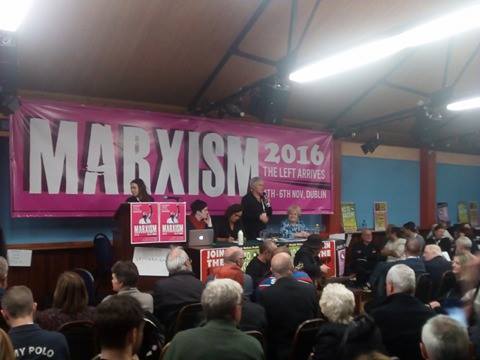
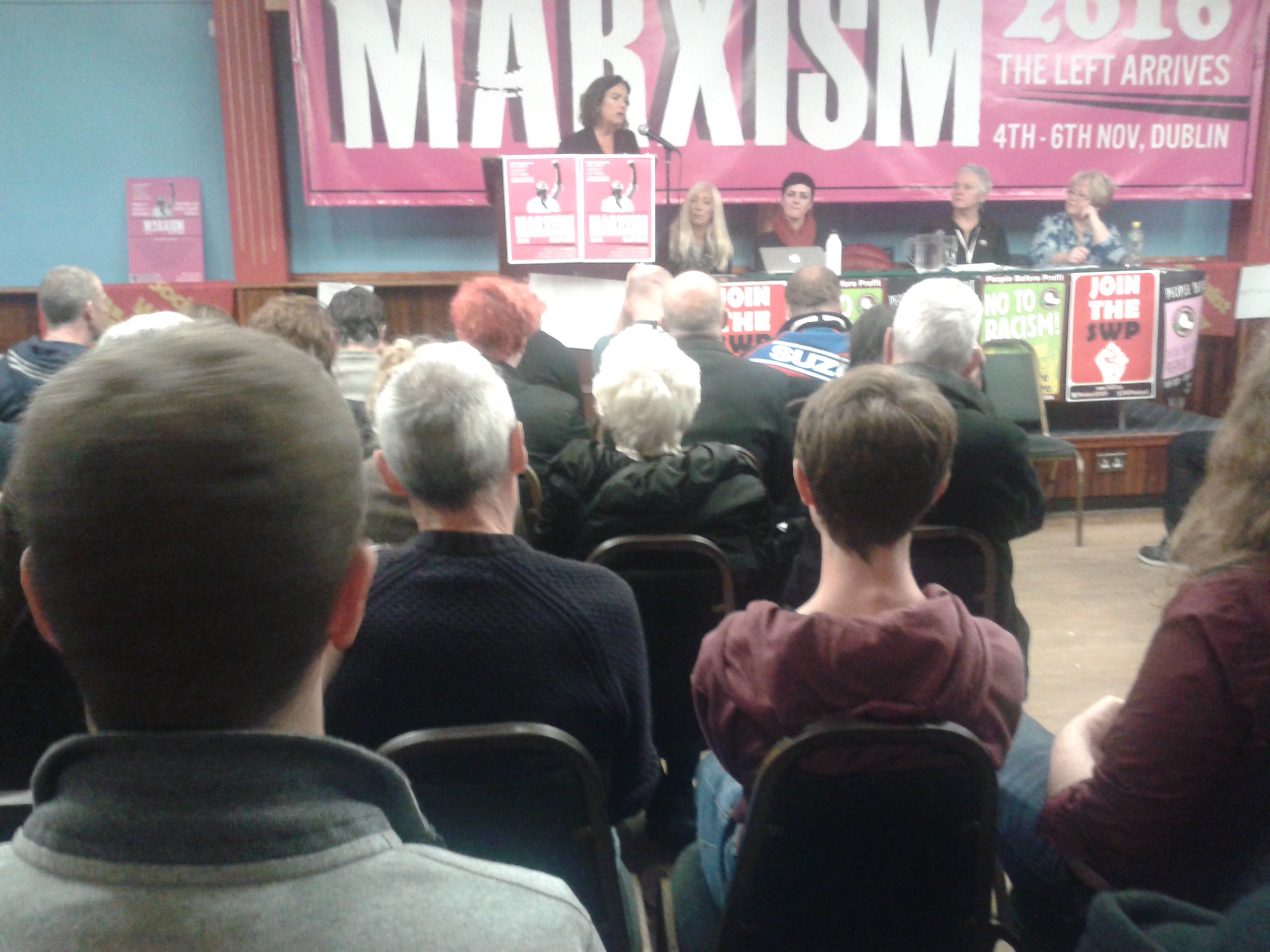
The Sunday November 6th meeting of Marxism 20161 on the theme “When Governments Lie” hosted as speakers four women campaigners and Eamon McCann, a male campaigner, addressing the packed downstairs hall of the Club na Múinteoirí. A number of cancellations of speakers had taken place, including Gareth Pierce who sent a message which was read out to the meeting.
hillsborough-speaker-when-gvts-lie-marxism-2016
Brid Smith of the SWP (centre photo) chairing the meeting When Governments Lie public meeting at Marxism 2016 weekend (Photo: I.O’Kelly)

On the podium, taking turns to speak, were Sheila Coleman of the Hilsborough Justice Campaign, Kate Nash of the Bloody Sunday Justice Campaign, Joanne Donnelly of the Justice for the Craigavon Two Campaign, and Antoinette Keegan of the Justice for Stardust/ 48 Never Came Home Campaign (summary of these campaigns below).

After being introduced by Bríd Smith, chairing the event, Joe Black with guitar, accompanied wonderfully by a musician on bazouki (if I can get his name will insert it here), launched the evening with Black’s powerful song about Giuseppe Conlon, father of Gerry Conlon of the Guildford Four. The Guildford Four were wrongly convicted in 1975 of IRA bombings and served fourteen years before they were cleared. Giuseppe Conlon, who went to England to clear his son, was also jailed, as were his relatives the Maguire family. The Maguire1 Seven were cleared in 1991 but by that time Giuseppe had died in prison, an event that, along with his own imprisonment, devastated his son and affected him for his remaining years until he died in 2004 at the age of only sixty years.

All of the speakers emphasised that the State’s officials lied with regard to their respective cases and concealed evidence and most speakers also accused the media of complicity. In the cases of Bloody Sunday, the Craigavon Two and Hillsborough, the British state was placed in the dock by the speakers while the Stardust fire cover-up was laid at the feet of the Irish state.

Most of the speakers also warned people in similar circumstances to beware of establishment party politicians who try to flatter campaigners and decide which are the “reasonable” ones to deal with, always at the price of reducing the objectives being sought. The speakers for the Bloody Sunday and Hillsborough campaigns in particular warned against this element, Kate Nash singling out Sinn Féin as the party that acted that way with regard to Bloody Sunday (Kate Nash’s brother was killed that day and her father shot and injured) and how they tried to bring the campaign to an end with an apology from the then British Prime Minister, while no senior officer or government official was held to account and while one of the unarmed dead remained accused of carrying a nail bomb.

Brid Smith of the SWP (also SWP/AAA) addressing When Governments Lie public meeting at Marxism 2016 weekend (Photo D.Breatnach)
Sheila Coleman of the Hillsborough Justice Campaign addressing When Governments Lie public meeting at Marxism 2016 weekend (Photo D.Breatnach)

Eamon McCann, who was on the march in Derry on Bloody Sunday 1972, finished the evening with one of the rants for which he is famous, going beyond his allocated time by a fair bit and despite the Chairperson’s frequent reminders. McCann located the similarities of the cases within the class system – most of those injustices represented were about repression of working class communities, or ignoring the damage done to them and the lies were told to protect the system and its supporters – big businessmen, politicians, the police, the Army.

The meeting ended to sustained applause but without any opportunity to ask questions or to make contributions, to the regret certainly of a number of Republicans and campaigners against what they consider to be ongoing internment without trial. All however seemed agreed that the talks had been interesting and educating in at least some aspect of the issues and events covered.

WHY SO LONG?

It is good that this meeting about State injustice and lies was held by an Irish socialist organisation. It is the duty of socialist organisations to point out the injustice of the State even when the victims are not socialists – or not socialists in the way that socialist organisations think they should be. Prominent socialists Karl Marx and Frederick Engels were not Fenians but they campaigned for the release of Fenian prisoners being held in English jails (where, by the way, it said that one third of them died and one third went insane).

It is said that we learn more from our mistakes than we do from our successes and certainly, if we are to bring about a revolution and the society we want, we must learn from our failures. And in that spirit, I must ask: why has it taken so long for Irish socialist organisations, particularly in Dublin, to wake up to the repression being exercised against Irish Republicans?

Five years ago Marian Price, a former Republican prisoner released under licence as part of the Good Friday Agreement, had her licence revoked and was taken to Maghaberry jail, kept for months without charge or bail, eventually charged and kept in jail without bail, sick, until her mental and physical health was broken. In Dublin the socialist organisations sent a couple of representatives to one demonstration for her freedom and never attended a picket about her case afterwards.

After the Marian Price campaign ended with her release in 2013 on “compassionate (sic) grounds”, some of those involved in Dublin launched a campaign against “internment by other names”, a process by which ex-prisoners released on licence are returned to jail without even a trial in the no-jury courts of the Six Counties2 and other Republican political activists are harassed and arrested and refused bail on spurious charges which eventually collapse after the accused have been held for months or years in jail3.

I must ask again: why has it taken so long for Irish socialist organisations, particularly in Dublin where the major part of their organisation is located and most of their activities organised, to wake up to the repression being exercised against Irish Republicans?

Is it perhaps because the socialists feared to be painted with the nationalist brush? But did they not fear being daubed with complicity with imperialism instead? It is a strange kind of socialist organisation that can’t make common cause with Republicans against the tyranny of the colonial statelet and capitalist State! In that failure, it misses the opportunity to unite forces against its enemies’ state and also to disseminate its ideas among Republican activists. One might also remark that a failure of people who are prepared at times to unite with social democrats for reforms, to unite with Irish Republicans against a capitalist state is a strange indication of revolutionary socialism!

Or is it purely because they didn’t care – it wasn’t happening to them – that Irish socialist organisations haven’tt campaigned against State repression of Irish Republicans, or even protested in solidarity with them? If so, they will by the seed of their inactivity one day certainly reap a harvest of repression for themselves too. Solidarity against State attacks is not only a noble thing with a long tradition; it is a necessity for revolutionaries.

So now that this “Marxism” weekend is over, when its organisers are taking a deserved rest, or writing it up for the British and Irish version of their newspaper, or compiling their recruitment slips to see how many new members or at least mailing list contacts they have gained – will they do anything different?

Will we see the highlighting, from time to time, of the almost everyday harassment of Irish Republicans in the leaflets and newspaper of the SWP and PBP? Will their TDs in the Dáil raise these issues where they might get some bourgeois media coverage? Are we going to see PBP and SWP militants on the regular pickets organised by the Anti-Internment Group of Ireland anywhere and, in particular on those called by the Dublin Anti-Internment Committee?

We can hope, I suppose.

Diarmuid Breatnach

APPENDIX: THE CAMPAIGNS

Hillsborough Justice Campaign seeks vindication that the original disaster was due to crowd mismanagement by the South Yorkshire Police and that some of the subsequent deaths were also due to their mismanagement of some still-breathing victims and lack of coordination of the emergency services. The disaster took place at Hillsborough football stadium in Sheffield, England, UK, on 15 April 1989, during the 1988–89 FA Cup semi-final game between Liverpool and Nottingham Forest. With 96 fatalities and 766 injured it is the worst disaster in British sporting history. Originally, the Liverpool football fans were blamed for the disaster but subsequently it became clear that the blame lay elsewhere.

Bloody Sunday Justice Campaign seeks a proper accounting of the deaths of 14 and injury of at least 14 after British troops opened fire on unarmed people demonstrating in Derry on 30th January 1972 against Internment. Originally, the British Army and Government claimed that they had shot “terrorists” in “returning fire” after being first fired on and a British enquiry backed them on this and claimed to have evidence that some of the dead had been handling weapons.

The campaign organises a march every year on the Sunday nearest to the date of the massacre https://www.facebook.com/BloodySundayMarch/?fref=ts.

Justice for the Craigavon Two Campaign https://www.facebook.com/JFTC2

Founded in 2012, a campaign to overturn the clearly unjust convictions in May 2012 of John Paul Wooton and Brendan McConville for the killing of a member of the British colonial police force, the PSNI, in March 2009.

The forensic evidence was contradictory and in a number of cases even pointed to the innocence of the accused, electronic surveillance equipment had been interfered with by the British Army; the State produced no witnesses to the incident and only one who placed one of the accused at the scene – this witness came forward a year after the arrests of the two, his account of his movements that evening were not supported by his wife; a close family relative called him a habitual liar and then this family member was arrested and subjected to intimidation by the colonial police after he had given a statement to the accused’s legal team..

(see also forthcoming fundraiser in Dublin https://www.facebook.com/events/705695282938993/)

Justice for Stardust/ 48 Never Came Home Campaign https://www.facebook.com/JusticefortheStardust48/?fref=ts

In the early hours of 14 February 48 young people died in a fire at a disco at the Stardust nightclub in Artane, Dublin and 214 were injured.

The campaign seeks to shift the blame from alleged “arsonists” to a fault in the premises wiring and other factors within the responsibility of the club’s management and owners, including blocked emergency exits. The allegation is that there has been a cover-up connived at by the Irish Government to exonerate businessmen friends, who to add insult to injury, received substantial financial compensation for the loss of the building. An ongoing controversy over inquiry findings and ignoring of important pieces of evidence have lent increasing credence to the version of the campaigners.

1This is organised annually in Dublin, Ireland by the Socialist Workers’ Party

2A prominent example in the past has been Martin Corey of Republican Sinn Féin; a current example is Tony Taylor

3For example Stephen Murney of the éirigí political party and the independent activist Colin Duffy and members of his family

FIRST PEOPLE WARRIOR JEAN-ANN DAY WALKS ON

Diarmuid Breatnach

Jean-Ann Day, who has just died, visited Dublin in January 2012 to help push an international campaign to free Leonard Peltier, also a warrior of the First People and longest-serving prisoner in the US after a travesty of a trial in 1977.

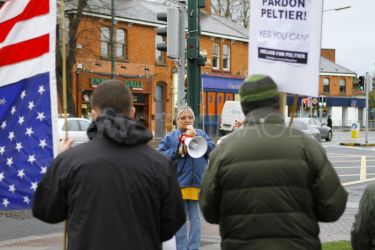
Jean-Ann speaking at picket on the US Embassy in Dublin in solidarity with Leonard Peltier. The photographer's back is to the Embassy.
Jean-Ann speaking at picket on the US Embassy in Dublin in solidarity with Leonard Peltier. The photographer’s back is to the Embassy.
Jean-Ann Day — photo placed with her official obituary on funeral home site

Due to a family tragedy hitting her contact here I had to step in as Jean-Ann’s contact but it was an honour for me. I progressed arrangements and took her to see Joan Collins TD and arranged for a radio interview with a program on Near FM.

I remember that on our way across the Liffey, Jean-Ann took a pinch of tobacco and offered it to the river with a prayer. The Gaels also thought of their rivers as divine, most of them goddesses. Although an atheist, to my thinking such belief systems seem greatly superior to those that think it fine to convert a river into a sewer or a toxic waste outlet.

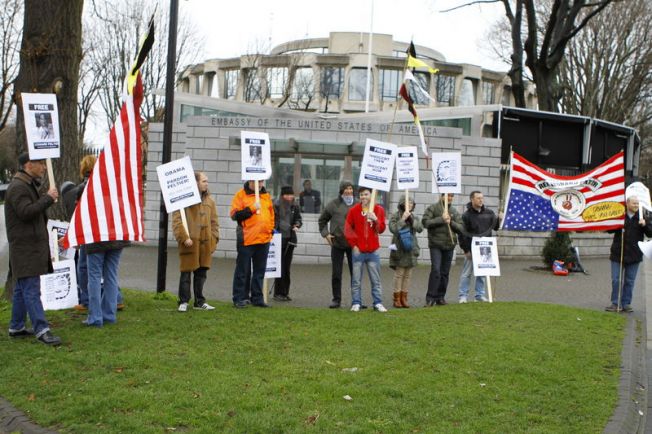
On Saturday 4th February 2012 a small crowd of varied political backgrounds, including a significant proportion of independents, staged a protest outside the US Embassy in Ballsbridge as part of a world-wide week of protests seeking Peltier’s release. Jean-Ann delivered a simple speech there that I believe reached into the heart of every one of the participants as it did into mine.obama-free-peltier-placard

Poster produced for the Dublin solidarity picket of the US Embassy (regret the name of the artist does not come to mind at the moment)

A small musical evening in Dublin organised by supporters was another occasion at which she appeared and I understood she went to Belfast and Derry too.

Jean-Ann, warrior for justice has walked on and left us her memory. Her former comrade, another warrior, Leonard Peltier, remains in jail in serious ill-health.

Peltier is incarcerated at the United States Penitentiary of Coleman in Florida and given that he is 72 years of age and that his next scheduled parole hearing will be in July 2024, it is clear that the FBI and USA state want him leaving jail only in a coffin. Barring appeals, parole or presidential pardon, his projected release date is October 11, 2040.


 End

Jean-Ann Day, Bear Clan of the Ho-Chunk Nation, age 65 of Stevens Point, Wisconsin walked on Sunday, September 4, 2016 at the University…

APPENDIX

Leonard Peltier Regarding the Passing of Jean-Ann Day

When I heard the news of Jean’s passing I was both saddened and surprised. I did not know she was ill. If I had known I would have reached out to her and tried to support her in any way I could.

Jean was a true friend to me for all the years I knew her. Her passing reminds me of so many things back in those days at Oglala so long ago.

She was a such a bright light and a young woman full of courage who came to Oglala without hesitation to join us in protecting the elders there. And she did so much work to free me from prison all these years. I am grateful to her for that.

Poster in the style of Jim Fitzpatrick's famous Che Guevara poster (Regret artist unknown to me)
Poster in the style of Jim Fitzpatrick’s famous Che Guevara poster (Regret artist unknown to me)

Over the years here I have thought of her often and in my dreams of freedom there were always a few faces I expected to see if I ever walked out of here. Jean’s was one of them.

I know she was doing wonderful work in the effort to bring healing and positive change to her Ho-Chunk people and I was always proud of her for that.

I regret that I could not be there for her ceremonies so I could offer comfort to her children and grandchildren, but I can only send these few heart-felt words.

You were a great woman and your life made a real difference to me… and to so many others.

Rest in peace, my dear friend. ‘Til I see you again.

Doksha,

Leonard Peltier


Part of the gathering at the US Embassy in solidarity with Peltier and seeking his urgent release in 2012
Part of the gathering at the Dublin US Embassy in solidarity with Peltier and seeking his urgent release in 2012

JOBSTOWN EIGHTEEN TO BE SENT FOR TRIAL IN THREE BATCHES

Diarmuid Breatnach


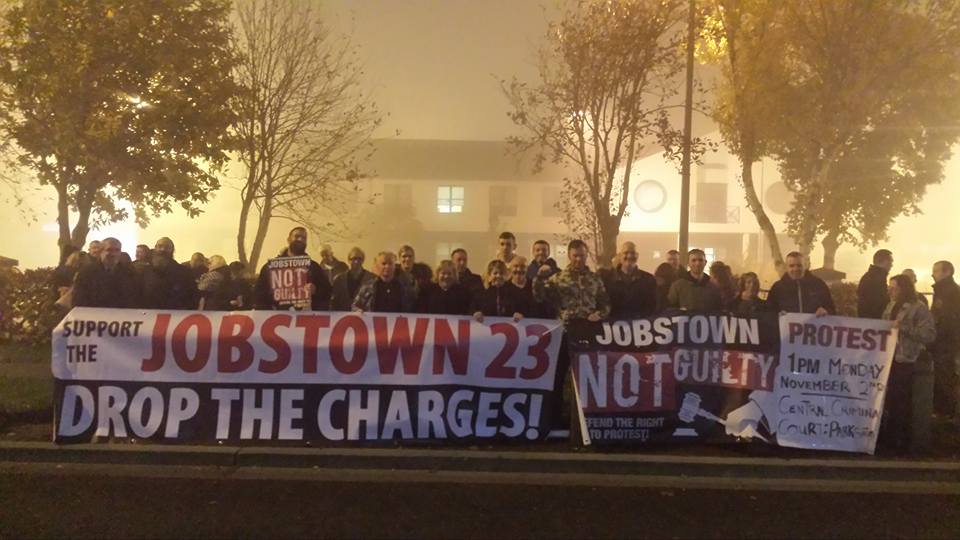
 The Jobstown Eighteen are charged with offences carrying maximum penalties of 10 years and life imprisonment: sixteen with “false imprisonment”, nine with “violent disorder” and some with both, arising out of a demonstration against the policies of the then Minister for Social Protection Joan Burton, when she was attending a function in the area. The demonstration blocked her car allegedly for two hours. They were on their ninth appearance in court this week and had until very recently been the Jobstown Nineteen but co-accused Philip Preston died tragically at the age of only 36).

Jobstown Not Guilty Banner Crowd
(Photo from Jobstown Not Guilty FB page)
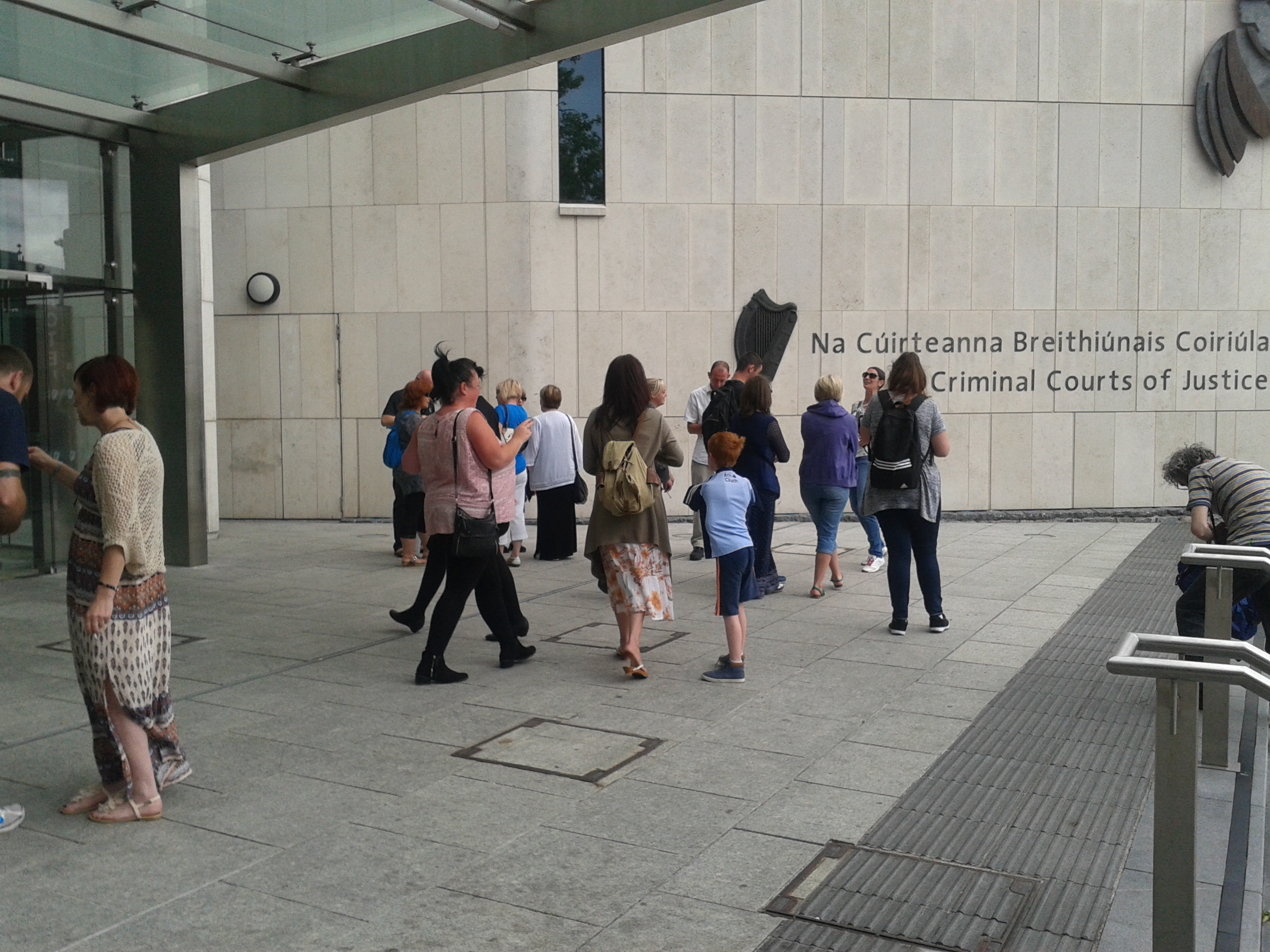
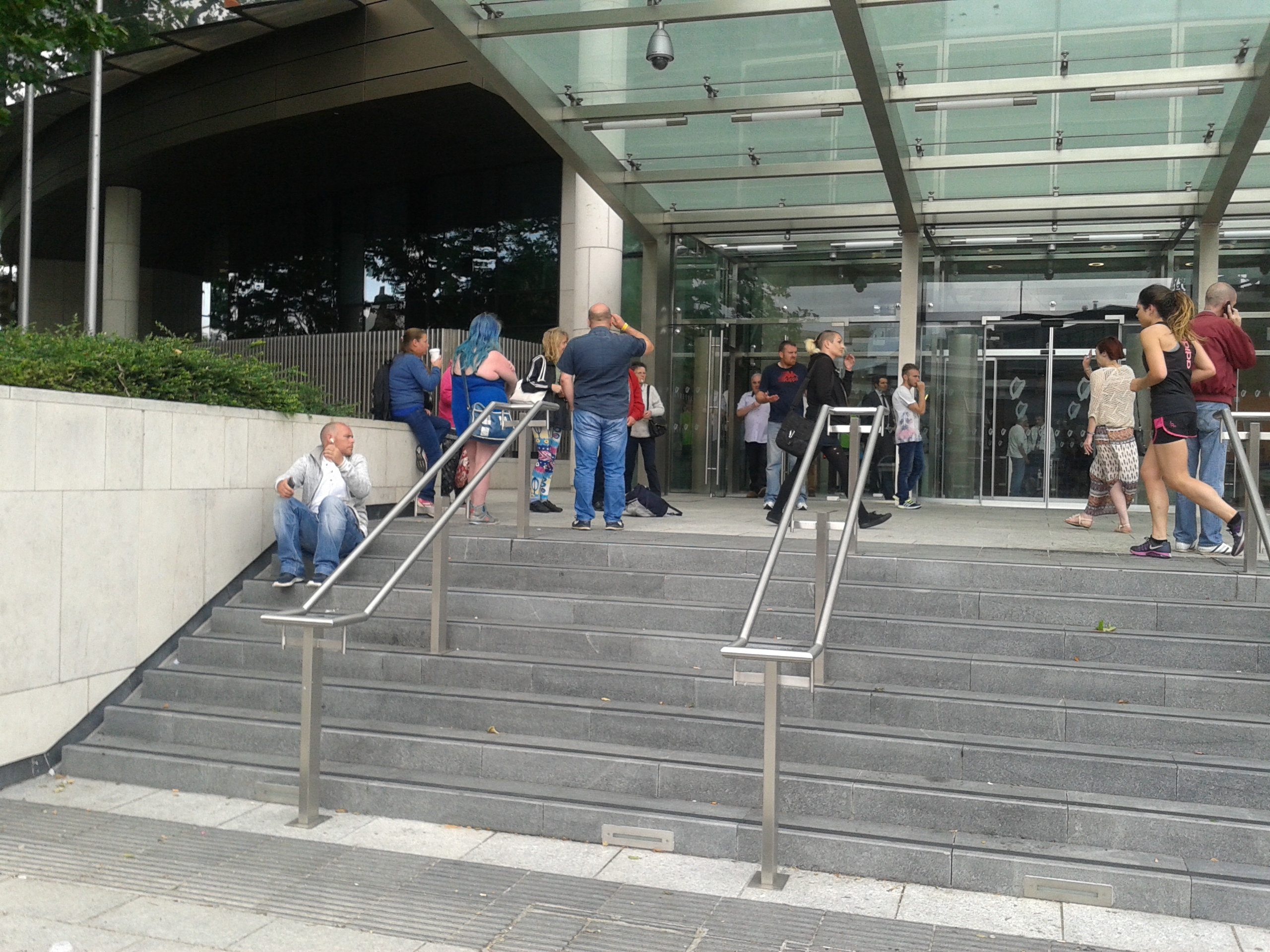
Some defendants and some supporters outside the court on the 13th
One of the Jobstown 19 in conversation and supporters of another unrelated case outside the court after the appearance on the 13th (Photo: D. Breatnach)

(Photo from Jobstown Not Guilty FB page)

The Jobstown Eighteen, with the exception of a few, including Paul Murphy TD who had been excused appearance for a number of reasons, appeared before Judge Melanie Greally in the CCJ building on Wednesday 21st July, their ninth court appearance since the Jobstown protest on 15th November 2014. Jobstown is a recent kind of suburb of Tallaght, itself a fairly recent population centre to the southwest of Dublin City. A few juveniles charged in connection with the protest are being dealt with separately in the Children’s Court and one was recently sentenced to six months imprisonment.

20160720_122308
A Jobstown Eighteen accused leaving the court as supporters of another unrelated case congregate outside (Photo: D. Breatnach)

Most of the morning was spent by arguments of the battery of defence lawyers against the State’s prosecutor, Mr. McGillicuddy, on the issue of separate trials. The State contends that those on separate charges have to be tried separately but that such a simple division alone would mean eleven on trial at once and that would be too many, according to the State, for the jurors to be able to follow the evidence and decide on the guilt or otherwise of each defendant. The numbers had to be broken down into three or four groups, the State contended.

The defence lawyers argued that some Prosecution witnesses would, in such a process, be called to testify in a number of separate trials and would become too used to their evidence as the element of surprise was removed. Mr Peadar Ó Maolain BL stated that “Prosecution witnesses will be very polished at this stage.”

Another defence argument was that those in last group would not face trial until possibly four years after the original incident. The whole morning was spent with these types of arguments and some lawyers also opposed the putting of their client into a particular group.


PICKING OUT “LEADERS”

The State also made it clear that it sought to try four of the defendants — Paul Murphy, Tommy Kelly, Mick Murphy, Declan Kane — in one separate group, alleging that they had been “in organising mode”, a clear attempt to put some in a leadership category with, presumably, heavier punishment for them should they be convicted.


NO RECORDING ON SMART PHONES”

Before the submissions began, Judge Greally told the packed courtroom that at the last hearing in May “persons were observed recording these proceedings” on mobile “smart phones”. She said that anybody seen doing this from now on would, at the least, be removed from the courtroom and would be in danger of being found in contempt of court. She did not explain why she objected to recording proceedings nor whether it was only video or including only audio recording to which she was objecting.

At midday Judge Greally said that she would allocate people to the groups and ordered those charged to return to court on October 3rd when presumably they will be committed for the different trials and a jury sworn in. Bail was continued under existing conditions.


DANGEROUS PRECEDENT – SOLIDARITY MOBILISATION NEEDED

These charges are in themselves repressive, seeking to free representatives of the Government and others from serious inconvenience in cases where the population feels that they have been acting unjustly and mobilises to show their dissatisfaction. Joan Burton was one of the most disliked Ministers of an unpopular government, partly for her abrasive manner but much more so for her policy of cuts to funding for social provision. She was also disliked for a controversial exchange in the Dáil when she seemed to be suggesting both that violent behaviour of police on demonstrations and anti-water charge pickets should not be videoed and that ordinary people having Ipads or phone cameras capable of filming those videos was a luxury that would not or should not be within the purchasing range of those protesting.

In addition, the maximum punishments possible on conviction of those charges are ten years and life imprisonment.

If the State succeeds in gaining convictions in these trials, even if the sentencing were fairly lenient within what is possible, it will be a serious setback for the right to protest effectively, to cause disruption to the schedules of Government Ministers and to confront them with strong demonstrations of the people’s anger at the measures being inflicted on the people by the policies of said Ministers.

It is therefore important for people to demonstrate their support for those charged in a number of ways but in particular by attending the trials and other public demonstrations of support.


LEGAL DEFINITIONS AND PUNISHMENT

The charge of “false imprisonment” is akin to kidnapping and has in the past been applied to cases where a person does not permit another to leave a building or an area, usually also preventing them communicating with others. Minister Burton’s car was surrounded by Gardaí as well as demonstrators, she had mobile phones to hand, had changed vehicles during the incident and never attempted to leave the vehicle at the end.

“False Imprisonment”, under the provisions of the Non-Fatal Offences Against the Person Act, 1997, can result upon conviction ‘on indictment’, i.e. which is what the court is doing here, to imprisonment for life.

The charge of “violent disorder” is similar to “riot” and came into Irish law as part of the Public Order Act of 1994; its provisions and explanation are identical to the British Public Order Act 1886 and it carries a maximum jail sentence of ten years.

End


Violent Disorder

Where—

(a) three or more persons who are present together at any place (whether that place is a public place or a private place or both) use or threaten to use unlawful violence, and

(b) the conduct of those persons, taken together, is such as would cause a person of reasonable firmness present at that place to fear for his or another person’s safety,

then, each of the persons using or threatening to use unlawful violence shall be guilty of the offence of violent disorder.

(2) For the purposes of this section—

(a) it shall be immaterial whether or not the three or more persons use or threaten to use unlawful violence simultaneously;

(b) no person of reasonable firmness need actually be, or be likely to be, present at that place.

(3) A person shall not be convicted of the offence of violent disorder unless the person intends to use or threaten to use violence or is aware that his conduct may be violent or threaten violence.

(4) A person guilty of an offence of violent disorder shall be liable on conviction on indictment to a fine or to imprisonment for a term not exceeding 10 years or to both.”

THIRD ANNUAL ANTI-INTERNMENT WHITE-LINE PICKET IN NEWRY DRAWS WIDE SUPPORT


Line from river end

UP TO FOUR SCORE PROTESTERS LINED A MAIN STREET IN NEWRY ON SATURDAY 2nd JULY TO PROTEST THE CONTINUATION OF INTERNMENT WITHOUT TRIAL OF POLITICAL ACTIVISTS

Clive Sulish

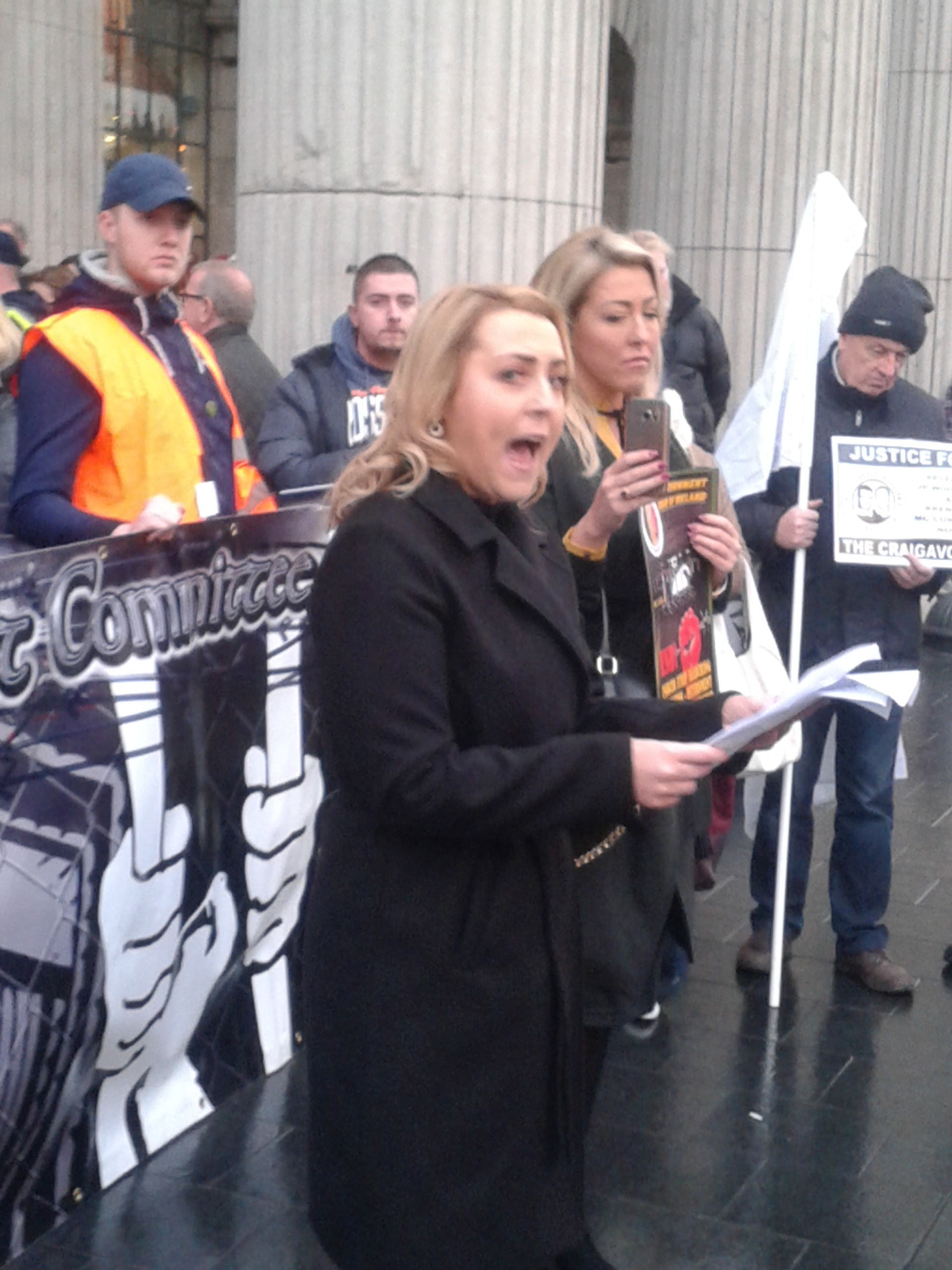
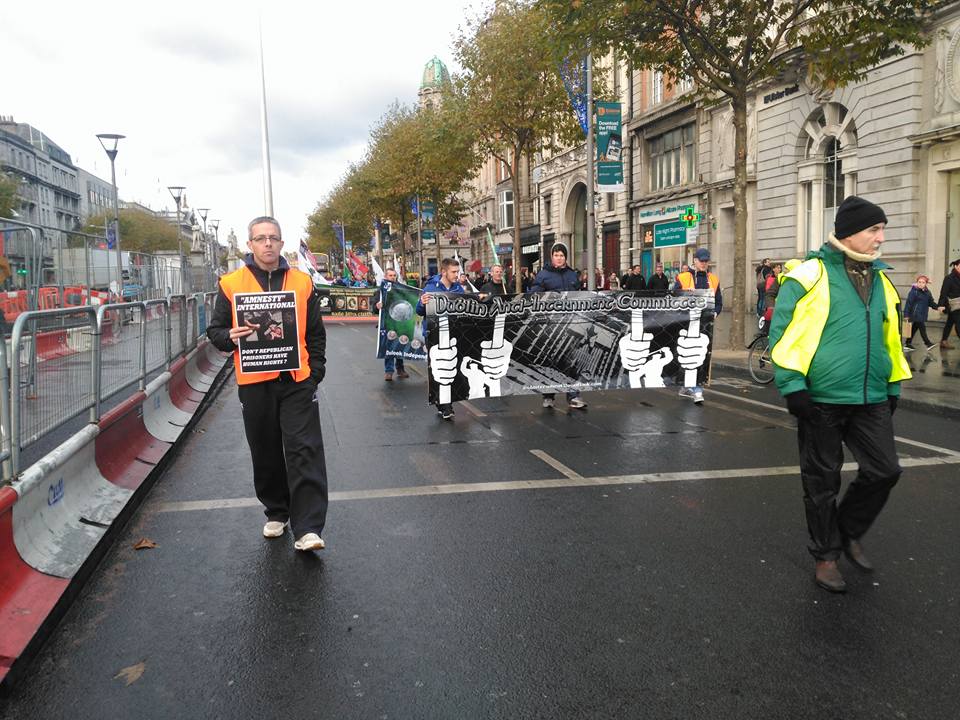
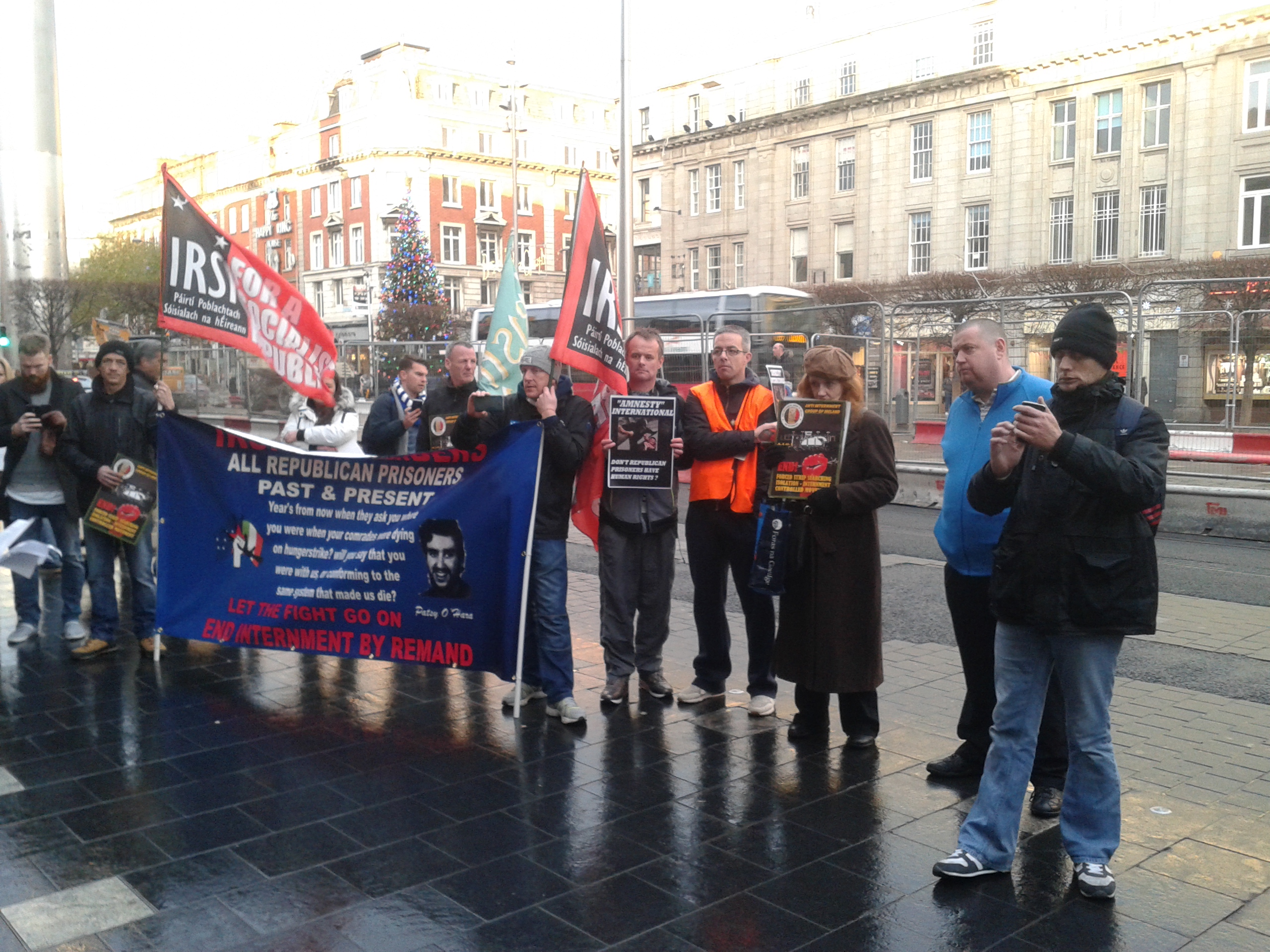
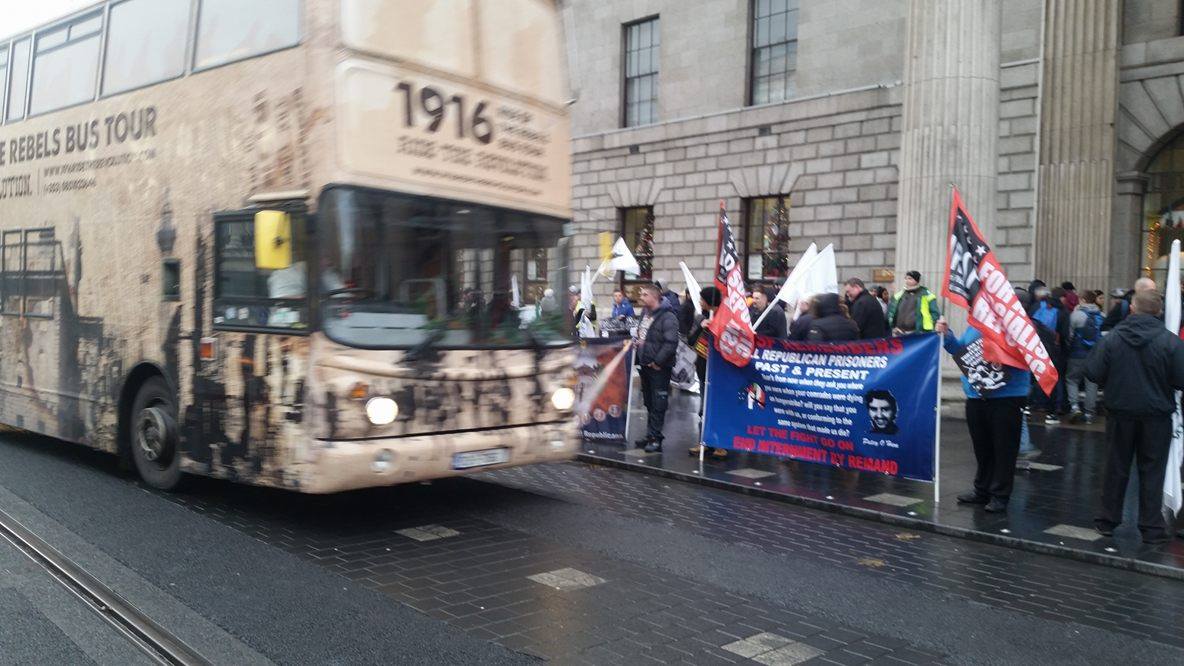
This the event was organised for the third year running by the Anti-Internment Group of Ireland and was supported by a number of organisations, campaigns and independent activists. AIGI was formed some years ago to raise awareness of the reintroduction of internment without trial by the use of remand in custody and revoking of licences.

Republican activists are being arrested on trumped-up charges and then refused bail outright or sometimes offered it in exchange for acceptance of conditions limiting their freedom to live normally and, in particular, to be politically active. This in itself lays bare the real motivation behind the charges – one who was unable to support the event because of his bail conditions told this reporter that he has to sign at a police station every day including the middle of the afternoon on Saturdays, is not allowed to speak about political prisoners, to attend political meetings or to post or comment publicly on social media. If refused bail, activists may await trial for two years and, if then found ‘not guilty’ by the no-jury Diplock Courts, will already have spent two years in prison anyway.

Former political prisoners released on licence under the terms of the Good Friday Agreement may be arrested and detained without trial, without charge, without even a police interview as happened to Martin Corey (four years without trial and released under gagging conditions). Currently Tony Taylor is in jail without charge under this system.

AIGI was founded to raise public awareness about these serious violations of civil and political rights. The Dublin branch of AIGI, the Dublin Anti-Internment Commitee, holds regular public pickets and meetings in the Dublin area and has facilitated other public events for other campaigns, such for example the framed Craigavon Two. Recently the Munster Anti-Internment Committee was also founded as another branch of the AIGI (both committees were represented at the Newry event).

This slideshow requires JavaScript.

SPEAKERS DENOUNCE BAIL CONDITIONS, REFUSAL OF BAIL AND OPPRESSION INSIDE JAIL.

A number of speakers called attention to the repression of the Six County state in its arrests of political activists, refusal of bail or imposition of oppressive conditions if bail is granted, imprisonment on trumped-up charges and through revoking of licences. The case of the Craigavavon Two was mentioned by a number of speakers, as was the case of Tony Taylor. The Craigavon two are in jail convicted of the killing of a British soldier, even though the case against them is riddled with holes and depends on an eyewitness who came forward nearly a year after the event, whose evidence is contradictory, whose movements on the night in question are denied by his own family and who is described by his own father as “a Walter Mitty character”.

All the speakers called for continuous action and unity against repression and were vigorously applauded.

JOE CONLON WAS THE FIRST SPEAKER. HE SPOKE ON BEHALF OF THE DUBLIN ANARCHIST BLACK CROSS, a support group for political prisoners.

Joe Conlon speaking

In the course of his speech he pointed out that the struggle of Republican prisoners in Maghaberry Prison has been going on for well over a decade. Commenting on a brutal prison regime, Conlon focused on the attacks onprisoners families and loved ones being refused visits without any warning and loved ones being banned for a couple of months at a time also without warning.”

Attacking the system of solitary confinement within the jail, Conlon picked out the case of “Gavin Coyle (who) has spent five years in isolation,” while, he pointed out, non-Republican prisoners usually spend at most up to three weeks in isolation, as a punishment. “The use of forced isolation is to try destroy the morale, spirit and mind of a prisoner. In Gavin Coyles case the British state are trying to break him down physiologically and MI5 have made several approaches to him in the Isolation block.”

Conlon went to assert that these exact same tactics are being used ……. across Europe to get Anarchist activists jailed and used against prisoners and their families to break them,” and recalled that the previous year several anarchist prisoner had gone on hunger strike.

Calling attention to the 39day hunger strike by Tasos Theofilou, who was sentenced to 25 years jail in 2014, Conlon said thathe was convicted of manslaughter, carrying a firearm and armed robbery, which he has always denied. The only evidence against him was DNA that was found on a moveable object, none of the witnesses in trial could identify him,” Conlon pointed out.

PAUL CRAWFORD OF CÓGUS AND REPUBLICAN NETWORK FOR UNITY ADDRESSED THE CROWD ALSO.

Paul Crawford RNU Cogus

Thanking the organisers for the invitation to speak and declaring it a privilege to address the gathering, Crawford addressed some remarks towards the terminology of “internment” and raised some questions regarding its accuracy with regard to some cases, the injustice of which however he went on to denounce.

The media and political class came in for denunciation too for ignoring the fact of framing of activists on flimsy evidence.

Crawford went on to speak of his comrade Carl Reilly who, he said “is another example of selective detention.” Reillly is arrested on a charge of directing terrorism and, Crawford informed the crowd, “this charge is based on secret recordings allegedly taken in the 26 counties yet passed to the state forces in the north to use as evidence to remand him there.”

Crawford told those assembled that he himself is Carl’s co-accused, released on bail. “I am forced to endure draconian and repressive bail conditions which are clearly designed to prevent me from carrying out my role within my political party in an effective manner. I am not allowed to send Carl a birthday card, to talk to him or even to have thirdparty contact with him.” Crawford said. “In essence,” he continued, I’m not even allowed to ask his wife to tell him I was asking for him. Many activists north and south are effectively interned on bail, in prison outside of prison walls.”

STEPHEN MURNEY, FROM NEWRY AND IN ÉIRIGÍ was himself a fairly recent victim of internment through refusal of bail for nearly two years, after which he was cleared of all charges.

Stephen Murney speaking Cabs

When republicans are targeted by the British occupation forces, backed by their political mouth pieces in Stormont,” Murney told the crowd, “they can expect to be held for anything up to five years in a British prison.” “Many of these cases are built on sand and eventually collapse before trial,” he continued, “although the end result is that those republicans are held in prison for several years despite being innocent.”

In the course of his speech, Murney pointed out that the families, whose battle is “largely unseen and unheard ……. are left to pick up the pieces”. Continuing, he stated: “I think it’s appropriate and important that today we acknowledge the struggle that women have to endure when their husbands and sons find themselves interned”.

Murney went to talk about the “living nightmare” that bail conditions impose on activists, making it “impossible to live anything that even remotely resembles a normal family life. Late night checks, daily bail signing, draconian curfews and being forced into exile are the order of the day.” He went on to say that those who are forced to wear an electronic tag “not only have to endure Crown force harassment, but they also find themselves being harassed by their lackeys In the G4S security company.”

Not even after completing there sentences are activists free from harassment, Murney declared, as “many find themselves with severe licence conditions being imposed and being unable to return to their homes to live.”

SPEAKER CALLS FOR SUPPORT FOR DEFENCE OF MOORE STREET AND HISTORY

DB speaking at Newry Annual AI 2016

Last to speak was Diarmuid Breatnach, introduced by the chair as representing the Save Moore Street From Demolition campaign. He began by quoting a saying, “Níl saoirse gan stair” (‘There is no freedom without history’). Breatnach spoke of the importance of history, of knowing it well and how it is interpreted; how those who hide or control history do so in order to control the people. He pointed out that history is not dead but is constantly being made, “as those of us here today are in a small way part of the history against the reintroduction of internment”.

Speaking about the last Headquarters of the 1916 Rising, the terrace of houses in Moore Street occupied by the GPO Garrison, Breatnach related how the long years of people campaigning for their conservation had resulted in an Irish High Court judgement that the whole of the Moore Street quarter is a National Monument.

However, Minister Humphreys is appealing the judgement, Breatnach told the crowd and the property speculators have applied for a seven-year extension on their planning permission for a giant shopping mall, which involves the demolition of the whole quarter with the exception of four buildings.

Focusing on the forthcoming march on Saturday 9th in Dublin (organised by the Save Moore Street 2016 campaign), Breatnach encouraged all to take leaflets, inform themselves and others about the issues and to march with the campaign and supporters in Dublin, “not just for the past, nor just for the present but for …. a future free from colonialism, imperialism and property speculators.”

“A VERY SUCCESSFUL EVENT …. HIGHLIGHTING THAT INTERNMENT WITHOUT TRIAL HAS NOT GONE AWAY”

Police vehicles passed along the street keeping the demonstrators under surveillance a number of times but did not stop, nor did police on foot appear. They also took a turn around the car park noting vehicle registration numbers.

People driving past in cars almost without exception accepted leaflets and some tooted their horns in solidarity. The presence of large numbers of cars of expensive make passing through the street drew an expression of surprise from one Dublin participant. “Green diesel prosperity,” replied his comrade laconically. Clearly there is more than one kind of ‘cross-border initiatives’!

“This was a very successful event,” stated a spokesperson for the organisers, a sentiment echoed by many, quite possibly all of those in attendance. “As in past events, people from different Republican organisations and Republican and socialist independent individuals participated. We also distributed in excess of one thousand leaflets here today and highlighted that internment without trial has not gone away.”

Newcomers to this event were in evidence this year also, with the banner of the Anarchist Black Cross (support group for political prisoners) clearly to be seen.

The presence of Munster and Dublin branches of the Anti-Internment Group of Ireland reflect the growth of the organisation and interest in its core principles of active committees, democratically run by participating activists, independent of any political organisations but open to members of all and of none.

END

Two Water Meter Protesters Charged and Remanded in Custody

D. Breatnach

From Irish Collonic News:

Two Water-Privatisation protester activists were charged this week with criminal activities — refused bail as being a danger to the public, they were sent to Mountjoy Jail.

Sean Doyle head crop
Sean Doyle, one of the protesters charged and refused bail

The two, Eamon McGrath and Sean Doyle, both resident at addresses in Wicklow, were part of a group picketing the land of Mr. ‘Rowdy’ Nolan, who is renting his Rathcoole land out to GM Sierra to use as a local depot for the installation of Irish Water meters in the Wicklow area.  Both men are suffering from medical conditions and are reported to be pensioners.

Eamonn McGrath, one of the protesters charged and refused bail

On Monday 9th May, Mr. Nolan was incensed to find some protesters picketing outside his Rathcoole property and that some GM Sierra contractors were not driving through them. In order to demonstrate how things should be done, he backed his four-wheel drive vehicle into one of the protesters, Eamon McGrath, and left him limping away.

According to videos and photos taken at the scene, Mr. Nolan then quickly got out of his vehicle and approached a woman who was videoing him, and appeared to knock her and her phone camera to the ground. Not wasting a second, Mr. Nolan then turned on one of the demonstrators — Mr. Doyle — and seizing him around the head and neck, proceeded to bang his head against the rear of his vehicle.

A number of other protesters then intervened to restrain Mr. Rowdy Nolan, as did a number of Gardaí.

Subsequently, Messrs. McGrath and Doyle were arrested by Gardaí and charged under the BLIPP legislation (“Behaviour Likely to Interfere with Profits and Privatisation”) with “Failing sufficiently quickly to get out of the way of a reversing vehicle” (Mr. McGrath) and “Malicious damage with head to a vehicle” (Mr. Doyle).  They were refused bail and kept overnight in police cells.

Mr. 'Rowdy' Nolan leaving his car after backing into Mr. McGrath and just before his foray into the protesters.
Mr. ‘Rowdy’ Nolan leaving his car after backing into Mr. McGrath and just before his foray into the protesters.

The following day both men were taken to court by Gardaí, where Mr. Doyle had the effrontery to claim that he was not guilty and to make use of the opportunity to make derogatory statements about bankers, property speculators, the Government and to cast aspersions on their management of the country and to suggest it is all being done for the benefit of the rich.

The judge presiding considered the two to be too dangerous to release into the community and remanded them in custody in Mountjoy Jail until Thursday morning, when they were due to appear at Bray Magistrate’s Court.

Protesters claimed that the proceedings at Bray Magistrates’ were barred to members of the public which led to some controversy outside.  Speaking from behind a line of Public Order Unit Gardaí, a Court official, who declined to be named, addressed some people who had been refused admittance: “There is no barring of members of the public”, he said.  “It’s just that after we admitted the 25 members of the Gardaí, there was no room left for anyone else.”  Challenged to deny that refusal of admittance was abusing the civil rights of the accused and of the public, a Garda was heard to say: “You lot and your bloody civil rights!  Where do you think yez are?”  Another Court official responded: “We can’t be letting every Tom, Dick and Harry into court buildings.  We have work to be getting on with.”  A woman in the crowd was heard to respond: “Forget about Tom, Dick and Harry, it’s Joseph and Mary Public you should be letting in!”  The court official did not deign to reply.

Ms. Eva Blushyrt, Secretary of the lobbying group SLOBB (Speculators, Land Owners, Businessmen and Bankers), which has been supporting Mr. Nolan, said that it was outrageous that “decent, business people” are being “harried just for making profits any way they can.” Ms. Blushyrt added that “perhaps it is time to consider bringing back hanging for such dangerous enemies of the status quo”. In the meantime she called for “stiff, exemplary prison sentences” for both men.

Another member of SLOBB, who has interests in a central area of north Dublin inner city, alleged that both arrested men had also been campaigning for the preservation of a number of historical buildings there and blocking the development of a badly-needed quarter-mile square shopping mall in the city centre.

Mr. Nolan, with the backing of SLOBB’s legal representation, is reported to be considering legal action against the Gardaí for alleged assault. “They laid hands upon him,” said a representative of SLOBB, “and technically that’s an assault.” Mr. Nolan is said to be furious with the Gardaí and one of his SLOBB supporters was heard to say that “If the Gardaí can’t put manners on the mob with their truncheons, then at least they shouldn’t interfere when members of the public like him do so.”

One of Mr. Nolan’s neighbours commented about him that “He’s just a gentle giant.”  She appeared puzzled as to how he gained the nickname “Rowdy”.

Supporters of the men stated that a number of protests would take place at different locations at 6pm on Thursday evening.  A number of left-wing Councillors and 13 TDs, including a number representing Wicklow constituencies, have signed a statement calling for the release of Messrs. McGrath and Doyle. Ms. Blushyrt became quite angry when informed of this development and called for the public representatives’ disbarment from their elected positions for what she alleged was “blatant interference in the legal system and in its time-honoured role of defending the status quo”.

PROTEST OUTSIDE LEINSTER HOUSE IN SOLIDARITY WITH DUBLIN THREE

Diarmuid Breatnach

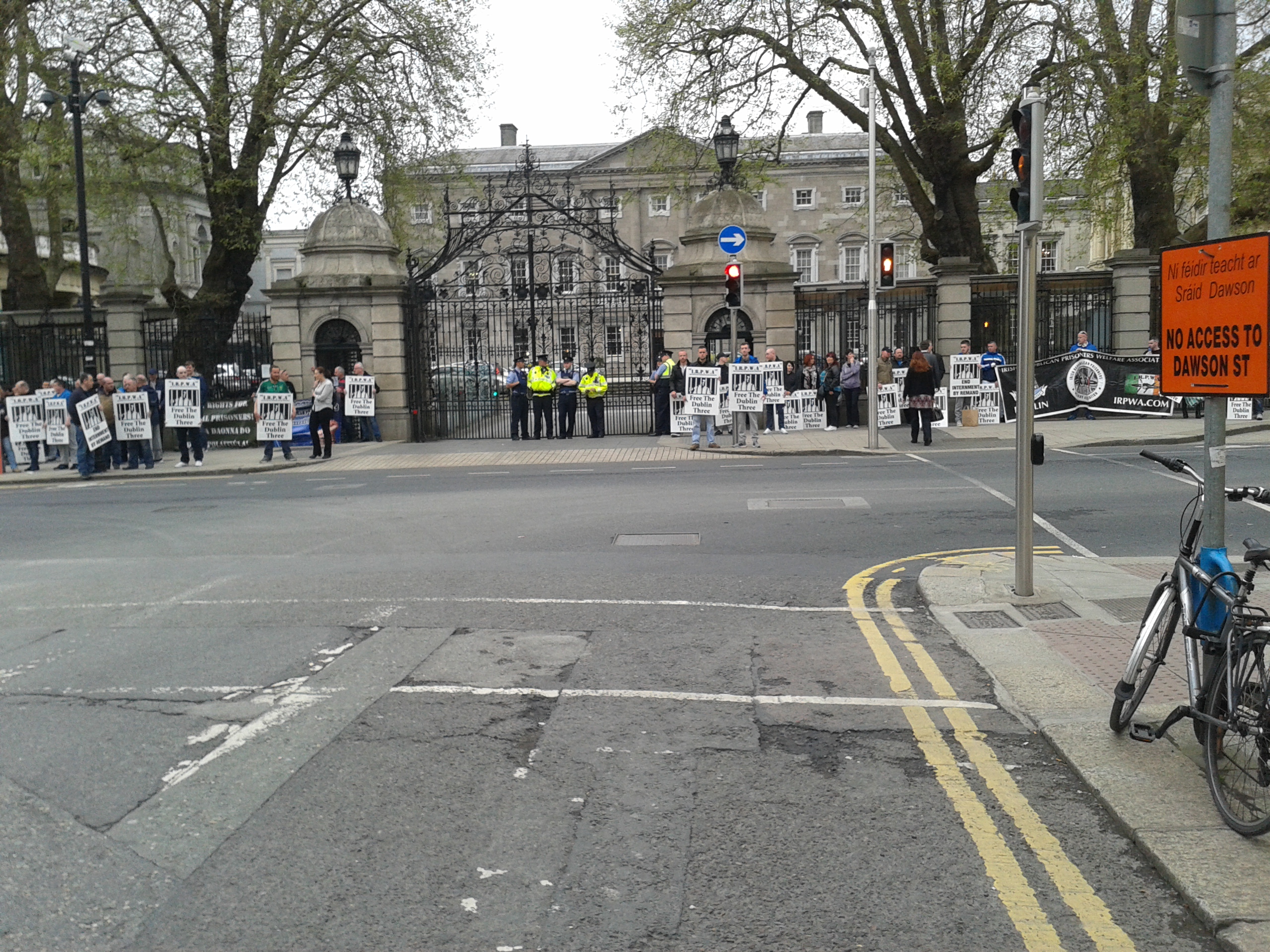
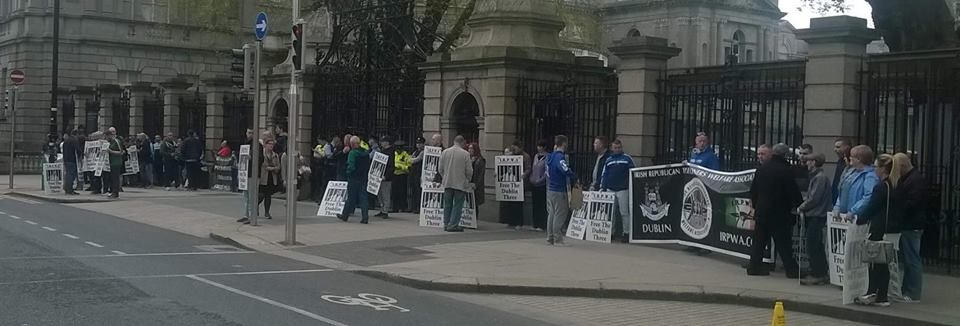
On Tuesday 10th May a large crowd picketed Leinster House, the Irish Parliament, at short notice to protest the denial of civil rights to three irish Republicans by the Police Service of Northern Ireland who detained, arrested and charged them and by the judiciary who remanded them in custody, denying them bail.

Line of protesters outside Leinster House (Photo from Dublin Anti-Internment Committee)
Section of protesters outside Leinster House (Photo from Dublin Anti-Internment Committee)
Fifteen had been detained by the Police Service of Northern Ireland in harassment of a Republican funeral. Twelve are from the Six Counties and were released after some hours without charge. Three are from Dublin and were
a) charged and
b) refused bail.

The protesters at Leinster House chanted slogans such as “Free, free, the Dublin Three” and “End internment by remand”. A couple of songs were also sung: The Felons of Our Land” and “Take It Down From the Mast”.Long View Dail Picket Dublin 3

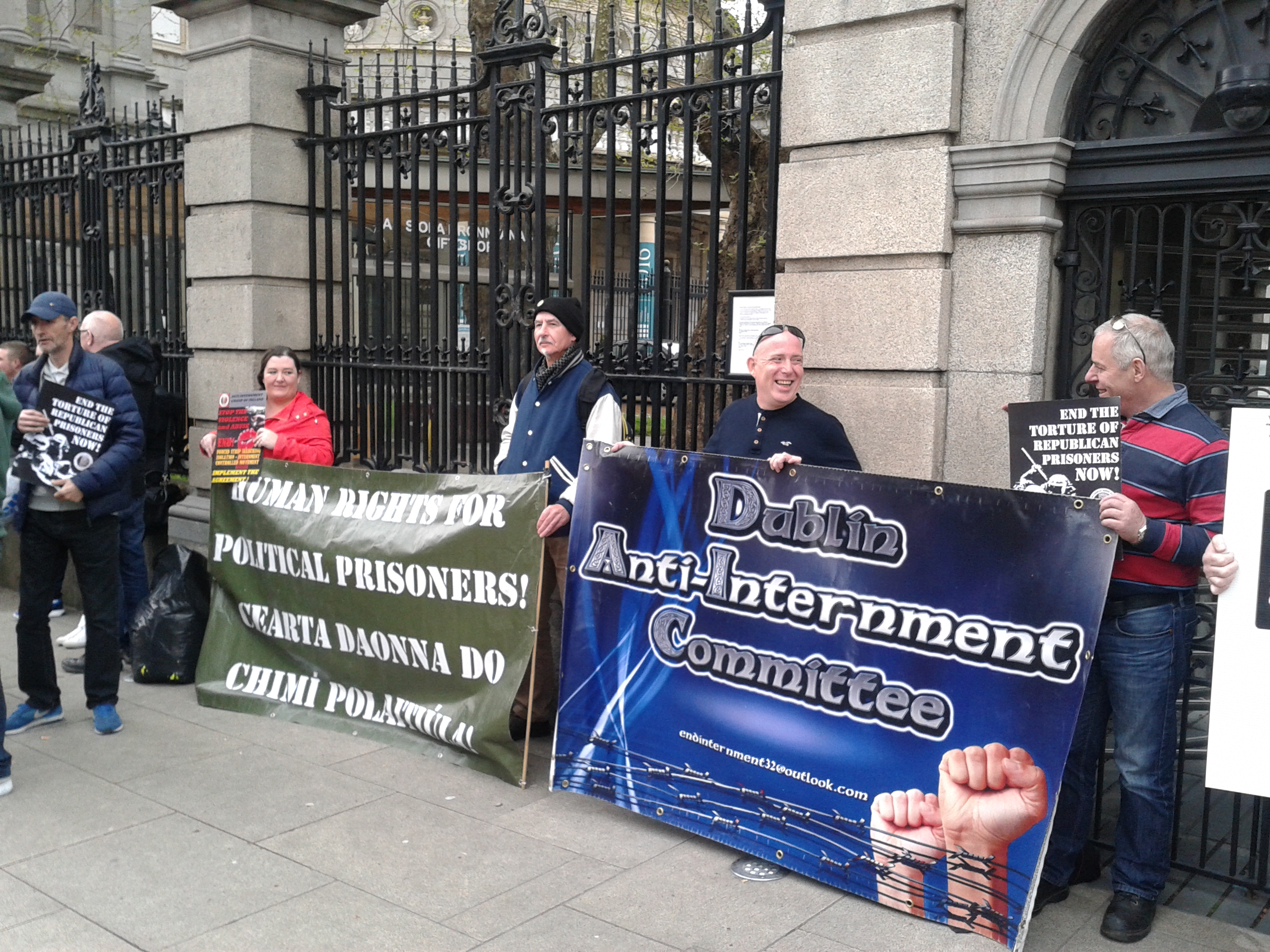
The protest was organised by the Irish Prisoners’ Welfare Association and was attended by other Republicans and by members of the Dublin Anti-Internment Committee, as well as by family members of the three men from Dublin.

Shortly after they convened, most of the protesters were approached by the Gardaí Special Branch and had their names and addresses taken by them in what was a clear case of politically-motivated intimidation and abuse of the rights to hold political beliefs, to organise politically and to peacefully demonstrate.  In fact, a similar harassment to that practiced by their brethren in the Six Counties.

Banner of the Dublin Anti-Internment Committee alongside another outside Leinster House

Statement by IRPWA DEMANDS END TO POLITICAL POLICING

“On Thursday 5th May the 35th anniversary of the death of hunger striker Bobby Sands Republicans peacefully laid Republican Michael Barr to rest.

“After the funeral the PSNI arrested 15 IRPWA activists and released 12 of them with no charge after being held for a number of hours.
Three of those arrested were charged and refused bail for the sole reason of that they were from the 26 counties.

“Only a few short weeks after the Irish Government commemorated the 1916 rising we now have the situation were British courts in Ireland are locking up Irish citizens for no other reason that they live in the 26 counties.

Car of Special Branch (Irish plainclothes political police) who were watching and filming the protesters from across the road

“The IRPWA calls on the Irish Government to lobby for their immediate release and to make sure those responsible for this blatant abuse of power are held accountable for their actions.
We take this opportunity to remind you of the protest that takes place outside of Leinster House today at 6pm and call for all Republicans to support.

“We would also encourage everyone who is available tomorrow to attend the Belfast High courts at 9.30am and support the 3 men and their families.”


POSTSCRIPT

The three Dublin men were finally granted bail Wednesday morning but face further inconvenience, worry and expense in having to attend future court dates in the Six Counties.

SIX BASQUE YOUTH EARLIER SENTENCED TO SIX YEARS IN MADRID ARE FREED

Xabat Moran, Bergoi Madernaz, Marina Sagastizabal, Aiala Zaldibar and Igarki Robles, five of the seven Basque youth sentenced to six years by the Audiencia Nacional (special Spanish Court) last Spring, have been freed this Wednesday.

Translation of press report NAIZ|from MADRID|2015/11/04|5 IRUZKINel juicio. (J. DANAE/ARGAZKI PRESS) and comment from https://www.facebook.com/dublinbasque/posts/1063431863690750

Xabat Moran, Bergoi Madernaz, Marina Sagastizabal, Igarki Robles and Aiala Zaldibar were sentenced to six years together with Ibon Esteban y Ainhoa Villaverde.

During the afternoon it emerged that the five would be freed, hours after the Supreme Court made held a public hearing in which the State Prosecutor left the possibility of reducing the sentences in the hands of the Tribunal, while the Defence asked for the accused to be cleared of all charges.

2014-09-22, Madril. Segiko militante izatearen akusaziopean 28 euskal gazteren aurkako epaiketa Madrilgo Entzutegi Nazionalean. Epaituriko 5 gazte ez dira aurkeztu epaitegira eta herri harresia antolatu dute. Argazkian, gazteak epaitegiko atean. 22-9-2014, Madrid. Juicio en la Audiencia Nacional a 28 jÛvenes acusados de pertenecer a Segi, 5 de ellos no se han presentado en el juzgado y han organizado un muro popular. En la imagen, los jÛvenes en la puerta del juzgado.
Most of the 28 youth accused of membership of SEGI outside the Court on the first day of their Madrid trial

The five have left prison and began the journey home.

The exact content of the Supreme Court’s decision is not yet known and whether this will affect the situation of Ibon Esteban and Ainhoa Villaverde is not yet known.

Twenty-eight youth were accused of membership of SEGI, the Basque Abertzale Left youth group and tried in the same trial, of which the Prosecutor withdrew charges against twelve. Later, others were discharged due to lack of evidence and in the end seven were sentenced to six years.

Villaverde, Moran, Sagastizabal and Madernaz were detained by the Ertzaintza (Basque police) before their sentences were announced, while Esteban, Robles y Zaldibar became fugitives, only to reappear in the “Human Wall” in Gastheiz/ Vitoria, where they were arrested.
End item.

Comment:
While friends and relatives will of course celebrate the decision, one commentator said: “The point for the Spanish state is to close down all legal political outlets in terms of campaigning around human, civil and political rights in the Basque Country. That leaves only the armed struggle, with which in recent decades ETA (Homeland and Freedom) has been clearly unsuccessful.”

A finding of guilt against these political activists needs to be seen in the context of the jailing of a number of political prisoners’ lawyers not so long ago and the currently ongoing trial of five political activists of Askapena, the organisation with responsibility for coordinating international solidarity work from and for the Basque Country.

For four years now ETA has been on the “permanent ceasefire” it announced at the time, yet Basque political activists continue to be charged with “assisting terrorism” or “glorifying” it.

Human wall Navarra Oct 2013
“Human wall” in Navarra (Nafarroa), October 2013

Another point to bear in mind is that when the 28 youth, including those against whom the State later withdrew charge or the Court found “not guilty”, were originally arrested in October 2014, it was in a heavy military-style operation, they were taken from the Basque Country to Madrid, held incommunicado and a number were tortured. Then when bailed, they had to return to Madrid later to face trial, they and their supporters having to pay for travel and accommodation. The Spanish state does not have a record of paying compensation to those it has wrongfully accused or even imprisoned, not to speak of tortured, except on occasion under orders from the European Court of Human Justice in Strasbourg.

The “Human Wall” was a tactic developed and employed mostly by Basque Youth as a civil disobedience tactic, beginning in 2013 and lasting until 2014. Typically, the person wanted by the authorities appeared in the middle of a large crowd of supporters who linked arms. The police (in all those cases, the Ertzaintza) were obliged, in order to detain the fugitives, to spend a number of hours breaking up the “human wall” in order to obtain their objective and hand the fugitive over to the Guardia Civil, all the time being denounced by those forming part of the ‘wall’ and protesters standing by, the whole event being filmed and photographed, reaching an international audience. Variations on the “Wall” were practiced in Donosti/ San Sebastian, Gastheiz/ Vitoria, Pasaia, Navarra and Gernika.
http://www.naiz.eus/eu/actualidad/noticia/20151104/queda-en-libertad-xabat-moran-uno-de-los-siete-condenados-por-la-an


DUBLIN YOUTH 777 DAYS IN EGYPTIAN PRISON

Diarmuid Breatnach

777 Days & Photos Ibrahim
With the Spire in the background, supporters calling for the release of Ibrahim Halawa display placards in Dublin’s main street. (Photo: Ian O Kelly)

People clustered around the Spire structure in Dublin’s O’Connell Street on Friday 2nd October, many of them displaying a placard with the digits “777”, sometimes nothing else. But some also held an enlarged photo taken of a Dublin youth of Arab extraction, Ibrahim Halawa. Members of his family and community were there too with a banner, as were a relatively small number of supporters, including some Left and Republicans.

Colm O Gorman & Two Sisters
Colm O’Gorman, CEO Amnesty Ireland, with two of Ibrahim Halawa’s family in O’Connell Street, Dublin’s main street. The columns of the iconic GPO are on the right as a Dublin Tour bus passes. (Photo: Ian O Kelly)

Colm O’Gorman, CEO of Amnesty Ireland gave interviews to media personnel present and so did Lynn Boylan, Sinn Féin MEP and of course some members of Ibrahim’s family. Curiously, no leaflets were handed out to explain to passers-by what the rally was about. Nor were there speeches to inform even those gathered there about the background to the case or progress or what people could do to help further.

DAIC Political Prisoners banner Ian
Dublin Anti-Internment Committee activists support the picket, photographed here with members of the Halawa family. (Photo: D. Breatnach)

Ibrahim Halawa was 17 years of age and on holiday in Egypt nearly two and half years ago when arrested, apparently for participating in a demonstration banned by the Egyptian regime. He may have been a conscious participant or may merely have been swept up in it in passing. But now he faces a possible death sentence if found guilty. Another 420 are also charged, some of them with murder or attempted murder during an attack on a police station on the same day. Ibrahim was arrested with his three sisters but they were granted bail and permitted to return to Ireland after three months.

Friends and relatives were hopeful that the trial would proceed as scheduled at the weekend but on the day some of the defendants were said to be seriously ill and the state declined, despite Defence counsel requests, to proceed without all defendants being present. Defence counsel have now also submitted a motion for all to be released, since they have served two years without the State bringing them to trial – this motion is under consideration by the court at present.

Spire lineup photos CBoylan
Supporters of Ibrahim Halawa with placards in front of Dublin’s Spire, with Lynn Boylan furthest left in picture.  (Photo: Ian O Kelly)

The reason for serious illness among prisoners may well be conditions in the jail (which are believed to be atrocious and were described as “trying” by the Irish Department of Foreign Affairs’ representative after an earlier visit to Halawa in jail), coupled with punishment beatings which, according to one of Ibrahim’s sisters as reported by a human rights campaigning website, the Dublin youth has also received.

The Department has taken up the Dubliner’s case with the Egyptian authorities and it is almost certainly its intervention that has gained Halawa’s transfer to a better cell. Three Al-Jazeera journalists were sharing that facility after conviction in Egyptian court but all those have now been released and left Egypt. Others, including former President Hosni Mubarak and members of his family have also been released.

Charlie Flanagan, the Minister for Foreign Affairs, stated that he was “disappointed and concerned” at the adjournment, which is diplomatic language for “really pissed off”. He claimed that his department is doing all that they can. Perhaps they are – but is the Government as a whole? Would the threat of expulsion of a few Egyptian diplomats not gain the release of Ibrahim Halawa? Or perhaps the threat of a tourist embargo?

The relatively small numbers at the Dublin rally were probably due to it being called for 3pm on a Friday afternoon, i.e within office working hours. But there may be more to it than that – this case has not been generally pushed in Left and Republican political circles, nor indeed in the liberal human rights sector. Very recently some of Ibrahim’s Dublin Arab community held a protest at the GPO against the Egyptian regime getting ready to streamline its trial and death sentence procedures in order to facilitate the hanging of more political dissidents. It was notable that every single one of those on the protest was Arab in appearance. The word ‘on the street’ is that Ibrahim and members of his family belong to a religiously fundamentalist group. Whether true or not, this does not of course diminish his human rights one iota – but unfortunately it may diminish the enthusiasm of some on the Left to support him.

Amnesty International Ireland was the body that organised the rally. Their website said that they were calling “again” for the release of Ibrahim but it seems that this is the first time they have organised a rally for him in nearly two and a half years.

Some of Ibrahim's relatives and others of their community in protest at Egypt's streamlining of conviction and execution processes some weeks earlier outside the GPO.
Some of Ibrahim’s relatives and others of their community in protest at Egypt’s streamlining of conviction and execution processes some weeks earlier outside the GPO. (Photo: D. Breatnach)
Executions Egypt image
Poster of the Stop Egypt Executions campaign

Generally the states in the West support the current Egyptian regime and the USA very much so. In turn, the Egyptian regime is very pro-Western and its armed forces very dependent on the USA, its main arms supplier. This friendship towards or dependency on the USA has been demonstrated in a number of way over the years and one of the most significant has been its policy towards Gaza.

The besieged Palestinian enclave, which has been called “the biggest concentration camp in the world”, has two land border exits, one of which is controlled by Egypt and the other by Israel. But Egypt has for years, under different governments, been restricting what and how much can go through its Rafah Crossing, more or less in line with Israeli prohibitions or restrictions, which include forbidding cement much in demand to repair the huge damage of Israel’s bombardment to housing, hospitals, schools, roads, bridges, reservoir, sewage treatment facility ….. and fuel for heating, electricity generation ….  The resourceful Palestinians dug tunnels under the border wire to circumvent Egyptian restrictions but the Egyptian regime has demolished these in the past and recently flooded them.

It is important for the Irish Left and all democratic people to show solidarity with Ibrahim and his family. It should not be ok for the Egyptian government to behave in the way it does and we should protect those that we are able to protect from them. That ability is strongest in cases where the citizenship of the victim is Irish. The Government needs to up the pressure on the Egyptian authorities and we need to up the pressure on our Government to achieve that. Those republicans, socialists and democrats who are tempted to pick and choose the recipients of their solidarity would do well to reflect on the oft-quoted words of Pastor Martin Niemoller.

Emd

LÉIRSIÚ AR SON AN 8ú LEASÚCHÁN A CHUR AR CEAL/ DEMONSTRATION FOR THE REPEAL OF THE 8th AMENDMENT

Plodaithe
Ag Cearnóg Pharneil, Gáirdín Cuimneacháin

Bhí léirsiú ollmhór ar son ceart na mban  roghnaithe ginnmhilleadh agus go baileach ar son Leasúchan Bunreachta a hOcht a chur ar ceal.  Thosaigh an mórshiúil ag Gáirdín Cuimhneacháin, Baile Átha Cliath, agus chríochnaigh ag Cearnóg Mhuirfean, in aice le cúl doras na Dála.

Ba dheacair an líon a thomhais ach bhí sé an-mhór. Ní raibh mórán Gardaí i láthair agus ní raibh aon chíréib ná rud ar bith mar é go dtí gur sroicheadh ceann scríbe (d’fhágas go luath ina dhiaidh sin).

Trasnu droichead
Part of the march is on the north quay while another section crosses Talbot Memorial Bridge and the remaining section has turned left and is marching along the north side.

Ach b’ait an bealach a thógadar: Sr. Uí Chonaill, Cé Éidin, trasna Droichead Cuimhneacháin an Talbóidigh, ar aghaidh ar an dtaobh ó dheas ar Cé na Cathrach, suas Sráid Lombaird agus Rae an Iarthair go Cearnóg Mhuirfeann ag an gcúinne agus thart trí thaobh na Cearnóige — faoi mar go rabhadar ag iarraidh an bac ba lú a chur ar an dtrácht.

Repeal of the 8th Amendment to the Constitution was a central demand of the demonstration.

In 1983, the 8th Amendment inserted a new sub-section after section 3 of Article 40 of the Bunreacht (Constitution) of the State.  As a result Article 40.3.3° reads:

“The State acknowledges the right to life of the unborn and, with due regard to the equal right to life of the mother, guarantees in its laws to respect, and, as far as practicable, by its laws to defend and vindicate that right.”

Ag teacht isteach ar thaobh dheis Chearnóg Mhuirfeann (tabhair faoi deara an placárd i nGaeilge sa lár taobh láimhe deise)

The amendment had been proposed by the Haughey Fianna Fáil Government but actually brought into law by the subsequent Fine Gael/Labour Party Government in 1983.  As it was a Constitutional change, a referendum was required and it was passed by a majority of close to two to one.

Over the years since then a number of changes have taken place in Irish public opinion and the Irish Catholic Church has lost much of its influence.  In addition, a number of scandals relating to women refused abortion have also received prominent media coverage, particularly in recent years, including one fatality.  Opinion polls on abortion in Ireland now show a majority in favour of greater access and a fast-growing minority in favour of unfettered right to abortion.  However, none of the major political parties. i.e. those with elected representatives in double figures, currently proposes to recommend the repealing of the 8th Amendment.

Mná ó Asturias ag tacú leis an léirsiú

Statistics showed that 4,149 Irish women had abortions in Britain in 2011 and other statistics show that 7,000 women travelled abroad that year in order to obtain an abortion.


a chríoch