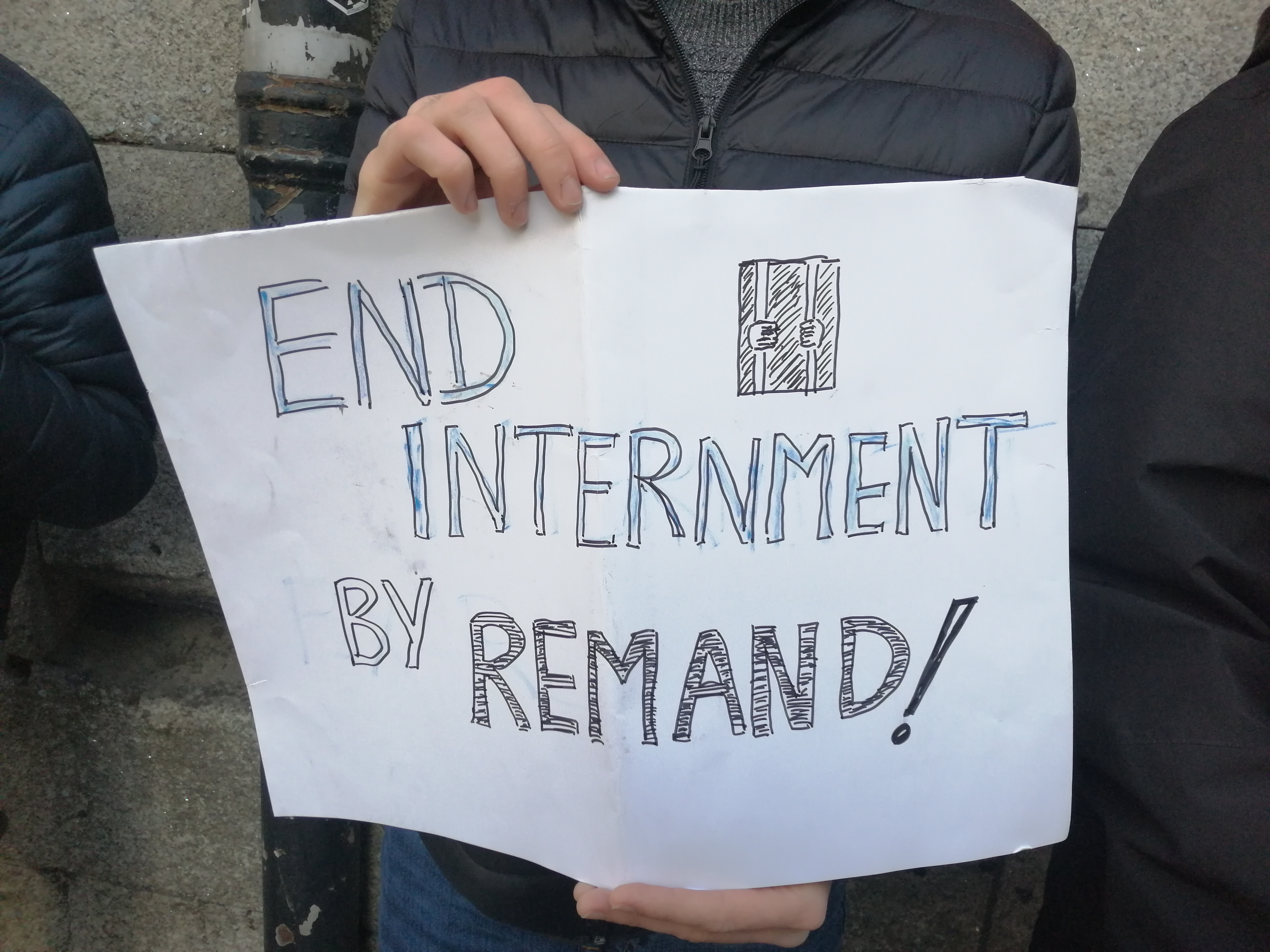
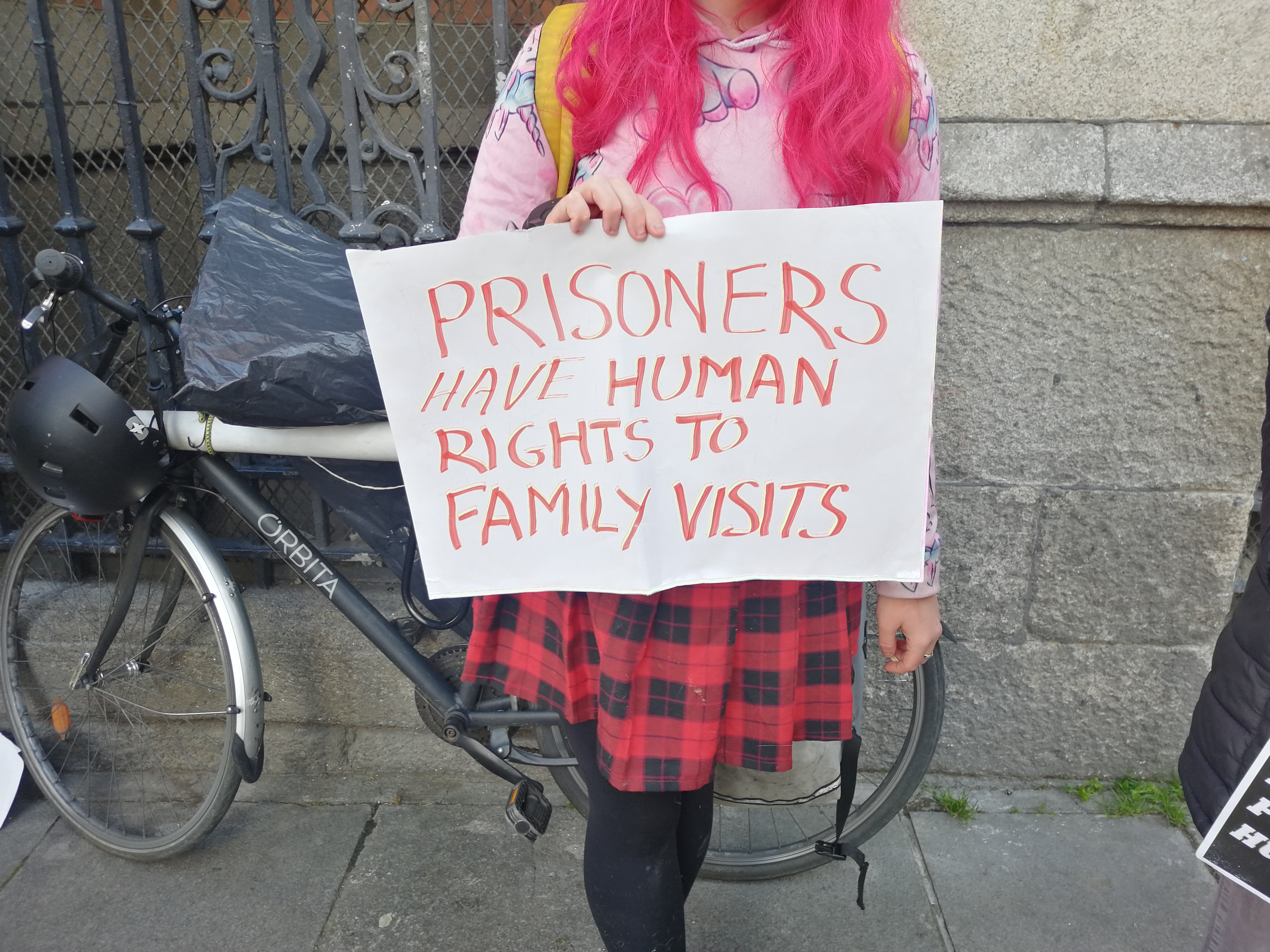
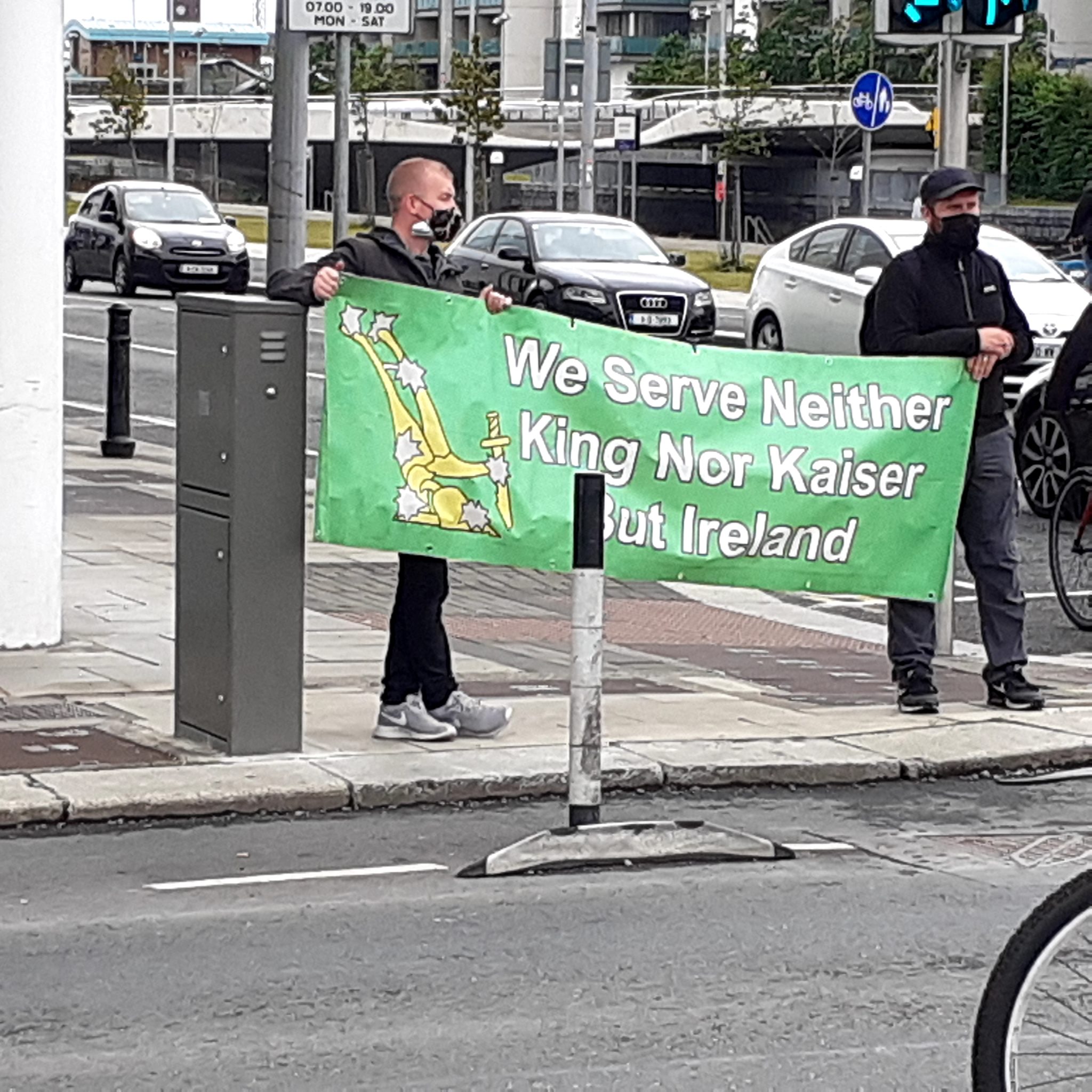
On 9th April, the Dublin Anti-Internment Committee held another of its regular awareness-rising events in the city, this time on on the northside, at the junction of the busy shopping Henry Street and Liffey Street.
Section of the anti-internment picket in Dublin last week (Photo: Rebel Breeze)
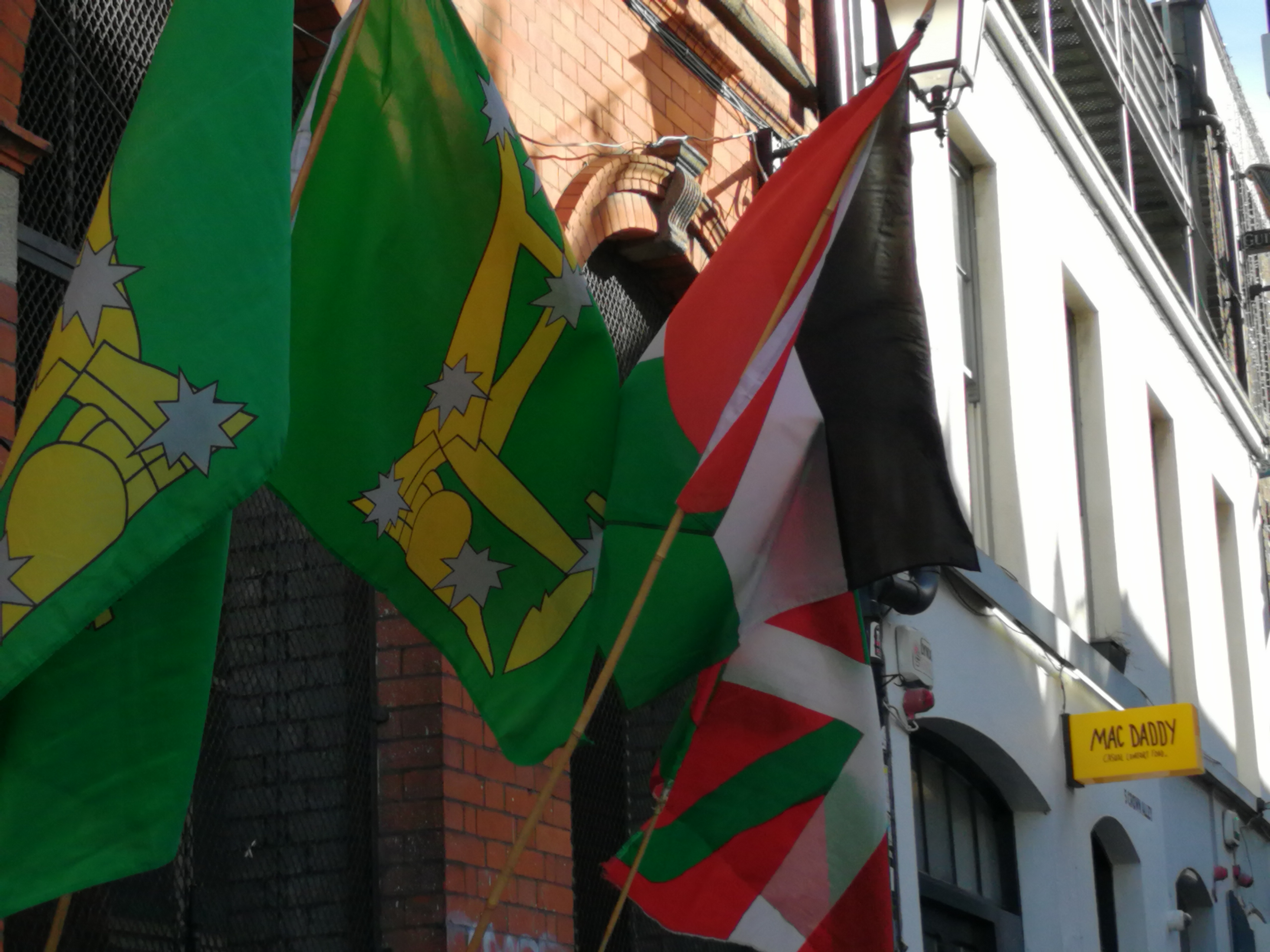
Supporters lined up with the Anti-Internment Committee of Ireland banner and placards. In addition to the Starry Plough of the Irish working class, the Palestinian and the Basque flags were flown in symbols of solidarity and also as a demonstration that political prisoners are held in many countries around the world.
Going on for 200 of the AIGI’s leaflets were distributed, explaining that Irish Republicans continue to be held in custody without trial through the practice of refusal of bail and through revocation of licence. This practice by administrations on both sides of the British Border are anti-democratic suppression of the right to hold political opinions and to organise in their furtherance.
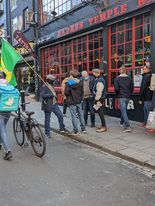
Plainclothes political policeman (in blue top, far left of photo) stood a little distance away facing the picketers but they were not intimidated (Photo: Rebel Breeze)
Recordings of relevant songs were played on a portable PA, such as The Roll of Honour, Viva la Quinze Brigada and Something Inside So Strong. Throughout the period of the event, two Special Branch (plainclothes political police) kept up an obvious surveillance which however did not deter the picketers.
The Anti-Internment Committee of Ireland is an independent broad and democratic committee, endeavouring to hold regular awareness-raising events and all democratic people are welcome to attend its public events, always advertised in advance on its Facebook page.
The Dublin Anti-Internment Committee held a well-attended picket on Saturday (5th March) against the continuing practice of interning Irish Republicans without trial and also in support of human rights for political prisoners. At one point the picket was subjected to the unwelcome attention of the Irish political police.
(Photo: C.Sulish)
The event was in furtherance of the Committee’s advertised intention to hold monthly public events to highlight the deprivation of civil rights from Irish Republicans — on both sides of the British border — through the operation of special legislation and in particular of the no-jury political courts (Special Criminal Courts in the Irish state and Diplock Court in the British colony). The Committee has admitted that it does not always succeed in holding a public event every month and in fact its most recent public appearance was during the December festive season, in solidarity with Irish Republican prisoners, when it was supported by a number of organisations and independent activists.
(Photo: C.Sulish)
WHY THESE PUBLIC EVENTS?
The Dublin Committee holds these public events because it believes that most people are unaware of the abuse of civil rights in Ireland, the civil right to belong to an organisation that criticises the State and seeks profound change. The reaction of people receiving a leaflet at their public events would seem to bear this out.
(Photo: C.Sulish)
Choosing a couple of extracts from their current leaflet: ‘At various times in Ireland’s history, people have been rounded up and jailed without bothering with a trial – people whom the government found troublesome and wished removed. Today the same process carries on although they don’t call it “internment” now – other names such as “due process”, “remanded in custody” are used ….”
‘Even when Republican activists are granted bail, it is on outrageous conditions such as not being permitted to reside in their own home, having to observe a curfew and wear an electronic tag, not being permitted to attend meetings and demonstrations …..’
The leaflet text makes the point that one doesn’t have to agree with the politics of Irish Republicans to see that these injustices are profoundly undemocratic abuses of civil rights — and “are ultimately a danger to all oppositional movements, whether Republican or not”. One aspect of their protest was against the denial of open family visits to Republican prisoners in the jails of the British colony in the north-east of Ireland — a violation of human rights.
The surprise in learning the facts is not confined to Irish people because often it is expressed by tourists or migrants, even if they have encountered such practices in their own countries of origin.
INTERNATIONALIST DIMENSION
An example of the interest from abroad on Saturday was of a Basque man and, separately, of two young Basque women, reacting warmly to seeing the Basque flag among the picketers. The Dublin Committee objects not only to the incarceration of Irish Republicans but also of people seeking freedom in many other parts of the world, for which reason the Palestinian and Basque flags are frequently flown on their pickets, next to the revolutionary Irish workers’ flag of the Starry Plough.
A person who expressed support for the right to campaign without state repression was, interestingly, from Barcelona. However he did not wish for Catalan independence, wanting instead a unitary but democratic Spanish state – a position held by some communists and the main socia-democratic parties there. Although his position did not concur with that of the picketers, who tend to support the struggles for self-determination, the conversation was conducted without hostility.
Not so with another individual, who approached some picketers to argue for their support for the Ukrainian state in the current armed conflict there, a question that has deeply divided the Irish Left and Republican movements. He went further and announced his support for the Azov Battalion, an East European fascist organisation integrated into the Ukrainian state’s military, at which point the tolerance of the picketers for his intervention ended and he was urged to depart.
Starry Plough flags next to Palestinian and Basque Ikurrina flags at the picket in Temple Bar. (Photo: C.Sulish)
POLITICAL POLICE INTIMIDATION
Another temporary presence unwelcome to the picketers was of three members of the Irish State’s political police. These are members of what used to be called the Special Branch but are now officially called the Special Detective Unit, formerly C3 and successor to the CID when the Irish State was created. This type of political police force is modelled on the Irish Special Branch of Scotland Yard, the HQ of the British police, founded to spy on the influence and activities of the “Fenians” (i.e the Irish Republican Brotherhood) in the cities of Victorian-era Britain. However, in Dublin under British occupation, their parallel force was the G Division of the Dublin Metropolitan Police, known as “G-men”; it was they who identified many Republican and other prisoners of the British military after the 1916 Rising, ensuring death sentences for many (though most commuted to life imprisonment) and jail sentence for many others. During the War of Independence (1919-1921 they were identified as the intelligence service of the British occupation and many were selectively assassinated by the IRA of the time.
The Garda “Branch” (as they are known colloquially) of the Irish State have a long history of harassment of and spying on Irish Republicans, sometimes associated with violence and often with perjury in court. Their unsupported observations through the mouth of a Garda officer at the rank of Superintendent has been enough “evidence”, in the no-jury Special Criminal Court, to send many Irish Republicans to jail on a charge of “membership of an illegal organisation.”
Two picketers confront the plainclothes political police officer harassing a young leafletter on Saturday (Photo: C.Sulish)
One of these gentlemen on Saturday approached the youngest supporter of the picket, who was distributing leaflets to passers-by, identified himself as a Gárda officer in plain-clothes and demanded the young activist’s name. His accosting of the leafletter attracted the attention of others on the picket and two went quickly to support the subject of State harassment. The Branchman demanded no further information and sone moved away. However, when he had reached about half-way along the picketters, he stopped and began filming them.
At that point one of the picketers began to call out to passers-by, many of whom were tourists, that this man was a member of the secret political police, who was filming and attempting to intimidate people on a legal political protest, that this is the kind of ‘democracy’ that exists in the Irish state, etc, etc. Shortly thereafter, the Branchman departed, along with another two of his colleagues that had been observed further down towards Temple Bar.
A picketer loudly denounces the political policeman’s filming of the picketers. (Photo: C.Sulish)
According to picket participants this intervention of the political police represented an escalation of their attentions in recent times, though not in the least unusual in the past, when every picketer might have their name (and even their address) demanded and jotted down.
A spokesperson of the Dublin Anti-Internment Committee stated that it is independent of any political party or organisation and that it welcomes the participation at its public events of democratic individuals, whether independent activists or members of organisations and had distributed many of its leaflets. It regrets that a number of political activists — who should have an interest, even if only in self-preservation – in defending the democratic rights to organise and to protest, decline to support their events.
Amidst festive season lights, passing Santa Clauses on horse-drawn carriages and hungry people being fed by volunteers in the Dublin city centre, Irish Republicans and Socialists gathered to send a public message of solidarity to political prisoners in Ireland and elsewhere.
Photo: Rebel Breeze
The event is an annual one organised by the Anti-Internment Group of Ireland, an independent non-aligned group raising awareness that internment without trial continues in Ireland, through revoking of licence of ex-prisoners and through refusal of bail in the no-jury courts both sides of the British Border. The Dublin committee of the AIGI holds monthly public awareness-raising pickets in the city centre.
The annual picket on Thursday early evening was supported by activists of the Irish Republican Prisoners’ Welfare Association and of the Anti-Imperialist Action organisation, along with some independents and took place in front of the iconic GPO building, on Dublin’s main street.
Photo: Rebel Breeze
The picketers and passers-by were addressed by a representative of the Anti-Internment Group outlining the participants’ presence to send solidarity greeting to political prisoners in Ireland and around the world. The speaker drew particular attention to three prisoners: Leonard Peltier, Native American, 45 years in jail and Black American Mumia Al Jamaal, 40 years in prison, both framed by police in the USA. Also highlighted was the case of Ali Osman Kose, 37 years in jail, 21 of which he has spent in solitary confinement. The speaker informed the audience that those three political prisoners, apart from their very long years of incarceration, have multiple health issues and should be released, he said on humanitarian grounds alone. “But no ….. they want them to die in jail”, he said.
Photo: Rebel Breeze
Going on to speak about political prisoners in Ireland, the speaker said that they and hostages had existed almost from the moment Ireland had been invaded by its neighbour and from the defeated United Irishmen up to the Fenians, had included not only dungeons and prison cells but also penal colonies on the other side of the world, after which they had been confined in special prisons and concentrations camps.
The creation of the Irish State on a partitioned Irish country a century ago this month had not brought freedom nor an end to the struggle, the speaker said and pointed out that the Irish State had executed 80 Irish Republicans during the years of the Civil War, which was more than the British had done during the War of Independence preceding it.
Photo: Rebel Breeze
“Whether we are religious or not ….. in our culture at this time of year we expect to be with our families, our partner, children and friends,” the AIGI representative said but pointed out that this opportunity is not available to the prisoners, which makes this a particularly difficult time of year for them, which is why the Group and others hold this event every year.
The speaker then called a young boy forward “to send a message to the prisoners from this younger generation who hopefully will see a free and united Ireland with social justice and equality. The young boy stepped forward and through the PA, asked all at this time of year to think of the Republican prisoners.
Photo: AIGI
The Starry Plough, the Palestinian flag and the Basque Ikurrina were flown by participants and among the banners of the IRPWA and Dublin Committee of the AIGI there was also one displaying the Carlos Latuff graphic of Palestinian and Irish Republican prisoner solidarity. The centrepiece in the picket line was the word Saoirse (‘freedom’ in Irish) picked out by lights on a dark background. Appropriate music was also played during the picket from a PA system, except while being addressed by the speaker.
The event concluded with thanks to all the attendance and the singing the first verse and chorus of the battle-song Amhrán na bhFiann (The Soldiers’ Song in Irish, which is also the National Anthem).
It is understood that seasonal greeting cards have also been sent by AIGI to political prisoners in prisons in the Irish state and in the colonial statelet.
End.
Photo: Rebel BreezeSigning Christmas cards for the prisoners. (Photo: AIGI)Photo: Rebel Breeze
There is a long tradition amongst NGOs, sectors of the reformist left, trade unionists and others in Colombia that someone outside the country will save us. The saviours are the North Americans (despite their role in the conflict), the European Union (despite their role as well and that of their companies), and international institutions such as the International Criminal Court, or the mechanisms set up in the peace accord (national ones but financed internationally). So, the decision by the ICC to shut down its preliminary investigation of Colombia was like a bucket of cold water to them. But it was to be expected.
Banner carrying faces and names of youth from Soacha and Bogotá murdered by the Colombian National Army. The banner was displayed in a march in Bogatá on the 6th March, the Day of Victims of State Violence. (Photo credit: GOL)
When Obama was elected as US president, various journalists and representatives of the left and NGOs announced that he would solve Colombia’s problems and now they have come back to say the same about Biden. A constant feature of this discourse of seeking a foreign saviour is the possibility of taking Uribe (not his Defence Minister, Juan Manuel Santos) to the ICC. They sold a false hope to the victims of the state that there they could obtain justice. They knew it was unlikely, as they knew what the ICC was like and its not very encouraging record in the matter.
To date the ICC has only convicted African leaders. It is not the case that these African leaders are saints or innocent, but rather that the ICC does not go after other criminals. It has procrastinated for many years on its case against Israel and has no authority to investigate the USA. The Court’s website currently indicates that it has 15 ongoing preliminary investigations, ten of them in African countries and five others in Georgia, Afghanistan, the Philippines, Bangladesh and the State of Palestine. This last case will not succeed, of that we can be certain. It has pursued a total of 30 individuals, resulting in 4 convictions.1 The ICC is the opium of the people, it has a soporific effect on people in the midst of their struggles and the NGOs promise Heaven and Divine Justice in a coming future.
A boy carries photos of victims in a march in Bogatá on the 6th March, the Day of Victims of State Violence. (Photo credit: GOL)
There were diverse reactions to the decision to shut down the preliminary investigation. Whilst the victims of the False Positives2 criticised the decision, others such as Senator Iván Cepeda and Eamon Gilmore, the EU envoy to the peace process celebrated it. The Movement of Victims of State Crimes (MOVICE) lamented the decision, though in a very confusing manner. It continued to praise the Special Jurisdiction for Peace (JEP), when it is precisely the existence of the JEP that the ICC used as an excuse to shut down the case.3
Iván Cepeda stated that:
A direct consequence of the agreement signed by Duque’s government with the International Criminal Court’s prosecutor is that once and for all the possibility of reforming the JEP has been discarded. It puts an end to that obsessive aim of the Uribistas. A victory for the peace process.4
A few years ago, he would have denounced the closure of the case as an act of impunity and now he claims it is a victory. As the Greek philosopher Plutarch put it, Another victory like this and all will be lost. Many of us denounced the impunity of the JEP, little did we think that not only would it guarantee impunity in the trials it deals with or excludes from its remit, but that its very existence would be the perfect excuse to shut down international cases against the regime. But the peace acolytes are determined to announce their defeat as a victory.
Protestors holding aloft photos of those murdered and disappeared in a march in Bogatá on the 6th March, the Day of Victims of State Violence. (Photo credit: GOL).
It seems that Senator Gustavo Petro didn’t have much to say about the matter and neither did Senator Alexander López. Piedad Córdoba, however, echoed the statements of Iván Cepeda and said:
They took issue with the JEP and tried to cut its budget, discredit it, dirty propaganda and all in order to cover their own backs. Today the ICC forced the government to strengthen it.5
A young woman carries photos of victims in a march in Bogatá on the 6th March, the Day of Victims of State Violence. (Photo credit: GOL)
It is clear that there are those who in the name of peace would justify any defeat, including a defeat of a proposal they themselves promoted. So, the ICC will not proceed against Colombia, but relax, we have the JEP where the military who, unlike the guerrillas, do not have to tell the whole truth about their crimes and where the businesspeople are excluded.
Of course, the president of the JEP, who once upon a time was the NGOs’ favourite said that he was very pleased with the ICC decision. According to Cifuentes the closure of the investigation against Colombia is a victory won by the JEP,6 i.e. those who for many years talked about how the ICC was going to put the Colombian State in its place, now tell us that the fact the ICC will not proceed against Colombia is a victory.
I really find it difficult to understand their logic, or better still I can’t understand their shamelessness. In the name of their pathetic peace accord, they justify everything and describe it as a victory. Poor Plutarch. If he had to deal with the leaders of the supposed left in Colombia today he would have been more vulgar, but he died many centuries ago, so allow me Plutarch: Another victory like this and the turncoats will be making money like never before.
So, to answer the question posed by this article, who will save us? The answer is no one, or rather, the Colombian people will save themselves, there are no international institutions, nor presidents in other countries who are going to fix the crisis that country has suffered for decades. The only ones who will put Uribe, Santos, Pastrana, Samper and the others in jail are the Colombian people.
“Forget them? That would be a crime against conscience” with images and names of the “disappeared” since 1998. The banner was carried on a march in Bogatá on the 6th March, the Day of Victims of State Violence. (Photo credit: GOL)
Next year is an electoral one and some of those who told us the ICC would do miracles and now celebrate the slap in the face it gave to the victims, will be candidates. They will promise a thousand miracles and when some foreign institution or president says no, they will celebrate it and try to convince us that the defeat was a victory. Changing the saying by Mao, they go from victory to victory to final defeat. Plutarch is as relevant today as ever.
End.
“NOT FORGOTTEN” banner carried on a march in Bogatá on the 6th March, the Day of Victims of State Violence. (Photo credit: GOL)
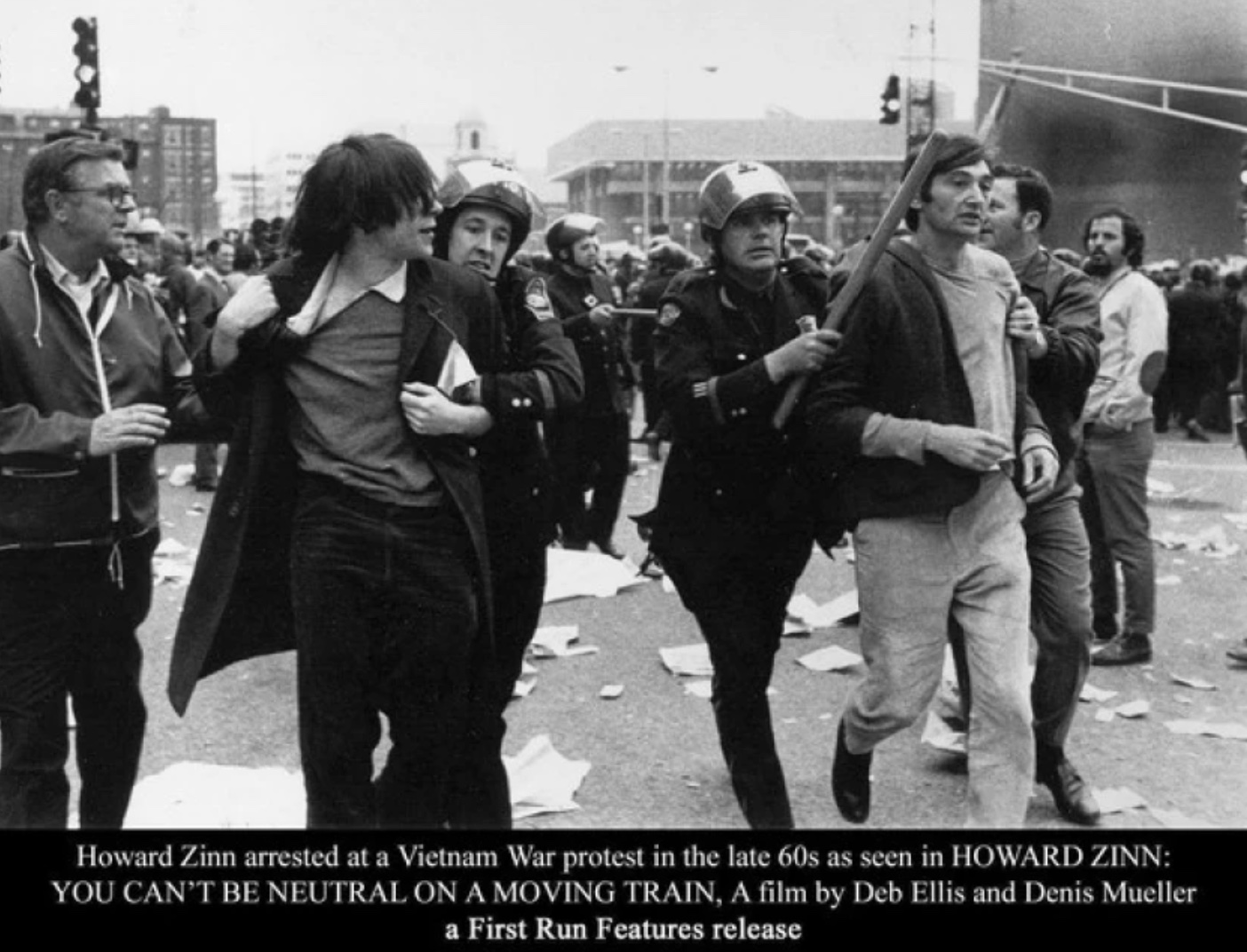
Like many Brooklyn Jews of his generation, Howard Zinn, an icon of the American left, questioned laissez fair American capitalism and American nationalist glorification of country. He was the author of “A People’s History of the United States,” a best seller which sold more than two million copies and inspired a generation of high school and college students to rethink American history. He was also a strong supporter of the civil rights movement and an opponent of the Vietnam war, as well as being a much-loved professor. Proudly, unabashedly radical, Zinn delighted in debating ideological foes, including his own college president, and in attacking conventional ideas, not the least that American history was a heroic march toward democracy.
One of the many different jacket covers for reprints of Zinn’s most famous book — this one abridged for teaching purposes (Image sourced: Internet)
Born Aug. 24, 1922, Howard Zinn grew up in Bedford Stuyvesant. His parents were Jewish immigrants who met in a factory. His father worked as a ditch digger and window cleaner during the Depression. His father and mother ran a neighborhood candy store for a brief time, barely getting by. For many years his father was in the waiter’s union and worked as a waiter for weddings and bar mitzvahs. “We moved a lot, one step ahead of the landlord,” Zinn recalled. “I lived in all of Brooklyn’s best slums.”
“NO LONGER A LIBERAL”
His parents were not intellectuals and Zinn recalled that there were no books in his home growing up. At some point his parents, knowing his interest in books, and never having heard of Charles Dickens, sent in a coupon with a dime each month to the New York Post and received one of ultimately twenty volumes of Dickens’ complete works. He became interested in fascism and began to read about its rise in Europe and to engage in political discussions and debates with some young Communists in his neighborhood. Zinn was radicalized thanks to a peaceful political rally in Times Square, where mounted police charged the marchers, hit Zinn knocked him unconscious. Zinn explained, “From that moment on, I was no longer a liberal, a believer in the self-correcting character of American democracy. . . The situation required not just a new president or new laws, but an uprooting of the old order, the introduction of a new kind of society—cooperative, peaceful, egalitarian.”
After graduating from Thomas Jefferson High School, Zinn became an apprentice shipfitter in the Brooklyn Navy Yard, where he and a few other apprentices began to discuss books and strategize about how to improve their dangerous working conditions. Excluded from the craft unions of skilled workers, they formed their own Apprentice Association. On an overnight boat trip he organized to raise money for the association, he met his future wife, Roslyn Shechter, who shared Howard’s progressive views and was also a Jewish child of immigrants. Zinn joined the Army Air Corps in 1943, eager to fight the fascists, and became a bombardier in a B-17. While in the Air Force he was disturbed by the race and class inequality among the servicemen. It wasn’t until years after the war that he questioned the necessity of the bombs that he dropped. But at the end of the war, back in New York, he deposited his medals in an envelope and wrote: “Never Again.”
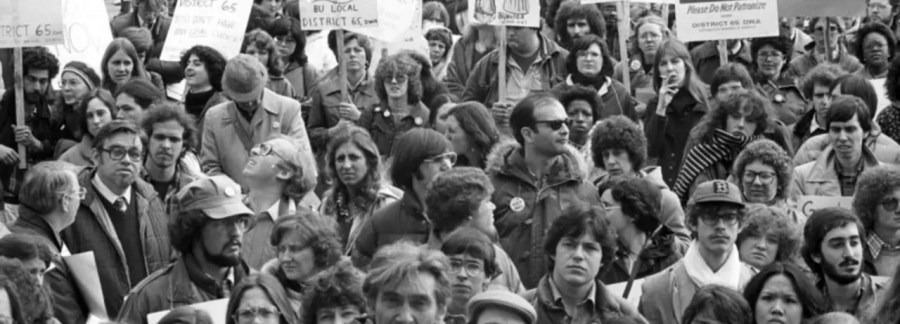
View of students and faculty carrying signs during a strike by faculty and staff of Boston University, on Commonwealth Avenue, Boston, 1979. Historian Howard Zinn, then a professor at BU, is just visible in the centre foreground. (Photo by Spencer Grant/Getty Images)
“I would not deny that [WWII] had a certain moral core, but that made it easier for Americans to treat all subsequent wars with a kind of glow,” Zinn said. “Every enemy becomes Hitler.”
After the war, he went back to interview victims of the bombing, and later wrote about it in two books. His own experience and his subsequent interviews led him to conclude that the bombing had been ordered more to enhance the careers of senior officers than for any military imperative, and he later wrote about the ethics of bombing in the context of Hiroshima and Nagasaki, Tokyo and Dresden, as well as Iraq.
Zinn and Roz married in 1944. While Zinn worked various jobs after the war, they lived on meager income in a rat-infested basement apartment in Brooklyn. Their daughter Myla was born in 1947 and Jeff in 1949. They moved to new public housing in 1949 and Zinn went to New York University for his B.A in history.
Thanks to the GI Bill, which paid the tuition of veterans, Zinn went to Columbia, where he earned an MA in 1952 with a thesis about a famous coalminers’ strike in Colorado, then obtained his PhD with a dissertation about the career in Congress of Fiorello LaGuardia, the reforming mayor of New York. He studied at Columbia under Richard Hofstadter who taught Zinn that American liberals were not as liberal as they thought they were, and that the two common threads in all American history were nationalism and capitalism.
PROFESSOR ZINN
In 1956, Zinn accepted a professorship at Spelman College, a traditionally black college for women in Atlanta, Georgia. Among his students were Maria Wright Edelman, the campaigner for children’s rights, and the future novelist Alice Walker, author of The Color Purple. At Spelman, he was a mentor to and later the historian of the Student Non-Violent Co-ordinating Committee (SNCC), the radical student wing of the civil rights movement. Zinn took part in many civil rights protests, and he encouraged his students to join him in these marches, which angered Spelman’s president. Zinn angered the authorities at Spelman over his insistence that its students should not be trained to be ladies, but should be actively involved in politics. “I was fired for insubordination,” he recalled. “Which happened to be true.” Zinn moved to Boston University in 1964, where he quickly became an outspoken critic of the Vietnam War. He angered many Americans, including Boston University’s president, by traveling with the Rev. Daniel Berrigan to Hanoi to receive prisoners released by the North Vietnamese, and produced the antiwar books “Vietnam: The Logic of Withdrawal” (1967) and “Disobedience and Democracy” (1968). When Daniel Ellsberg, a previously gung-ho John F Kennedy and Lyndon B Johnson administration official, came out against the war, he gave one copy of the Pentagon Papers (officially titled United States-Vietnam Relations, 1945–1967: A Study Prepared by the Department of Defense, the government’s secret history of the war) to Zinn and his wife, Roslyn. Zinn and Noam Chomsky edited what became known as the Mike Gravel edition, published in Boston in 1971-72 by the Beacon Press.
In 1980, he published his most successful work, A People’s History of the United States, which was a highly controversial revision of American history. Instead of the usual congratulatory tone of most American history textbooks, his work concentrated on what he saw as the genocidal depredations of Christopher Columbus, the blood lust of Theodore Roosevelt and the racial failings of Abraham Lincoln. He also highlighted the revolutionary struggles of impoverished farmers, feminists, laborers and resisters of slavery and war. Bruce Springsteen said the starkest of his many albums, “Nebraska,” drew inspiration in part from Mr. Zinn’s writings.
For decades, he poured out articles attacking war and government secrecy.
When President Ronald Reagan bombed Tripoli in 1986, Zinn wrote: “There is no flag large enough to cover the shame of killing innocent people for a purpose which is unattainable.” He denounced the invasion of Iraq and also criticized President Barack Obama’s intensification of the war in Afghanistan. He was sharply attacked in Israel and by many of his fellow American Jews for saying that war was morally the equivalent of terrorism.
Howard Zinn (Photo sourced: Internet)
Mr. Zinn retired in 1988, concluding his last class early so he could join a picket line. He invited his students to join him. Zinn also wrote three plays: “Daughter of Venus,” “Marx in Soho” and “Emma,” about the life of the anarchist Emma Goldman. All have been produced. Zinn died in 2010.
Zinn always believed in standing up to injustice and fighting for oppression. He said near the end of his life, “Where progress has been made, wherever any kind of injustice has been overturned, it’s been because people acted as citizens, and not as politicians. They didn’t just moan. They worked, they acted, they organized, they rioted if necessary to bring their situation to the attention of people in power. And that’s what we have to do today.”
End.
POSTSCRIPT from Rebel Breeze:
TRUMP ATTACKS ZINN AFTER LATTER’S DEATH
“If you want to read a real history book,” Matt Damon’s character tells his therapist, played by Robin Williams, in the 1997 film “Good Will Hunting,” “read Howard Zinn’s ‘A People’s History of the United States.’ That book will knock you on your ass.”
It is very unlikely that President Donald Trump knew who Howard Zinn was before he saw the name on his teleprompter. And it is even less likely that he’s read “A People’s History of the United States.” But that didn’t stop him from saying — at the White House Conference on American History on Thursday — that today’s “left-wing rioting and mayhem are the direct result of decades of left-wing indoctrination in our schools. It’s gone on far too long. Our children are instructed from propaganda tracts, like those of Howard Zinn, that try to make students ashamed of their own history.”
As Limerick and Waterford county teams prepared to face one another in the GAA hurling semi-final at Croke Park stadium, anti-internment protesters and campaigners lined up outside Dublin’s General Post Office, in the city centre, to mark the 50th Anniversary on the introduction of internment without trial in the British colony of the Six Counties. Their placards, leaflets and speakers denounced the continuing practice of interning political activists in Ireland today.
Seen at the anti-internment event in Dublin today (Photo crdt: Sean Hogan)
The event was organised by the Anti-Internment Group of Ireland, an independent and non-affiliated campaigning organisation and the supporters included a mixture of socialist Irish Republicans and anarchists. The heavy and persistent rain of the morning held off and Dublin city centre was thronged as GAA hurling supporters added to the usual shoppers. The banners and placards of the picketers drew considerable interest from those passing and here and there people stopped to discuss with them.
Some young Basque girls were curious but also delighted to see their nation’s flag, the ikurrina, being flown at the event and stopped to engage one of the picketers in discussion. Also in evidence was the flag of Amnistia, Basque organisation around solidarity with its political prisoners and against repression, along with the flag of Palestine.
Flag of the Amnistia organisation (solidarity with their political prisoners) in the Basque Country seen on the anti-internment event in Dublin today (Photo crdt: Sean Hogan)
Around 200 leaflets were distributed to passers-by, discussions were held and contacts were made with people interested in supporting the work of the Anti-Internment Group Ireland.
After some time in a picket line and distributing leaflets, a representative of the organisers, speaking in Irish and in English, welcomed the attendance and introduced a speaker from the Anti-Imperialist Action organisation.
One of the leafleters outside the GPO at the anti-internment event in Dublin today (Photo: C.Sulish)
SPEAKERS
Speaking in Irish as some passers-by stopped to listen, the young man said they were there to commemorate the introduction of internment and mindful of the existence of political prisoners all over the world. The were also protesting the extradition to Lithuania of Liam Campbell to face trial in a country in which he had never previously set foot.
The organisers’ representative then spoke in English about the history of repression in the Six Counties colony, how from the moment the nationalist community there stood up to demand equal rights and justice the State had responded with violence. Since the people raised the level of their resistance in response, the State in turn raised the level of its violence higher again, in a rising spiral of violence.
The nationalist community in the Six Counties had marched for civil rights and had been met with the violence of the colonial police and of the Loyalists — the speaker said — but they had continued to resist. Internment without trial was introduced to break that resistance but, knowing that would also lead to increased resistance, the State had prepared the Paratroopers to shoot unarmed civilians dead. They had done that in Ballymurphy on the very day that internment had been introduced1, he reminded his audience and later had shot dead two unarmed Cumann na mBan Volunteers (Republican women’s organisation) who were alerting people to the raiding parties of the British Army. At the start of the following year, the British Army murdered unarmed civilians again, this time in Derry2.
That year 1972, the speaker stated, had the highest death toll of any year during the three decades of the war3 and Loyalists were also bombing streets nearby in Dublin, again in 1973, killing workers. In 1974 Loyalists and British intelligence bombed the Dublin city centre again and Monaghan, killing the highest number of people killed in one day during the war4. That year too, the IRA bombed pubs in England and killed people and the State brought in the repressive Prevention of Terrorism Act against the Irish community. They jailed a score of innocent people on extremely serious charges5 and one of them, Giuseppe Conlon, died in jail6.
The speaker went on to say that although there had been hard repression before, the introduction of internment without trial and the follow-up massacres by the British Army had lit a fuse to a chain-reaction of violence for decades to follow.
Pointing out that internment consists of jailing people without trial, the speaker stated that the practice continues today, by refusing bail to political activists awaiting trial in the non-jury courts on both sides of the British Border. The Anti-Internment Group of Ireland will continue striving to expose this reality and he called on people to support the monthly pickets in the city centre and to follow the End Internment page on Facebook.
ONGOING AGITATING AGAINST INTERNMENT
As the applause died down people began to pack away flags, banners, placards and leaflets and to catch up socially among themselves or to engage with passers-by who had stopped to listen and/ or to ask questions.
Organisers of the event said they hope to hold another picket at some venue in the city centre in a month’s time – when scheduled, the event will be announced on the End Internment FB page.
End.
Leafleter right foreground, person reading leaflet left foreground, picket line of the anti-internment event in Dublin today. (Photo: C.Sulish)
(Photo: S.Hogan)
(Photo: S.Hogan)View of the picket with a passer-by expressing solidarity with the picketers (far right of photo). (Photo: C.Sulish)
FOOTNOTES
1Between 9-11 August, British paratroopers caused the deaths of 11 unarmed civilians in Ballymurphy.
213 people were shot dead by British paratroopers on Bloody Sunday in Derry as they protested against internment and a 14th died later of his wounds.
3The period from August 1971 to the end of the year saw a huge jump to 136 violent deaths (including British and colonial armed forces) and the following year, 1972 is counted the most violent year of the conflict overall with 479 people killed (including 130 British soldiers) and 4,876 injured.
5The Birmingham Six, Guildford Four, Maguire Seven, Giuseppe Conlon and Judith Ward. All were eventually cleared after long years of campaigning around them and failed court appeals.
6Giuseppe Conlon, hearing that his son Gerry had been arrested for the Guildford Pub Bombings, came to London to help him in 1974 and was swept up into the police net to become one of the innocent framed victims. Giuseppe Conlon was not a healthy man and died in his 7th year in jail, before the verdicts on the other framed prisoners were finally overturned. His son Gerry, also an innocent man in jail, was not permitted to attend his father’s funeral.
The undemocratic non-jury Special Criminal Court was renewed for another year in the Dáil yesterday evening with the lowest abstentions or vote against it ever. All Sinn Féin’s TDs (members of the Irish parliament) absented themselves and FG, FF, Greens and Labour all voted for another year’s renewal, with the Social Democrats abstaining. Seven votes were cast against it, the lowest ever since it was brought in as part of the Offences Against the State Act in 1972.
Voting against renewal were the five PBP/Solidarity TDs (Bríd Smith, Richard Boyd Barrett, Gino Kenny, Mick Barry, Paul Murphy) and the two left-wing Independent TDs: Joan Collins and Thomas Pringle. Sinn Féin, who abstained in 1920 for the first time after decades of opposition, just didn’t attend at all this time. In 1920 they said that they were awaiting a review of the Act promised by the Justice Minister – but without any explanation of what in the review could possibly convince them to keep the Act in place. The Social Democrats, whose amendment to bring the Special Court to an end by a deadline of June 29th next year was rejected, abstained in the vote.
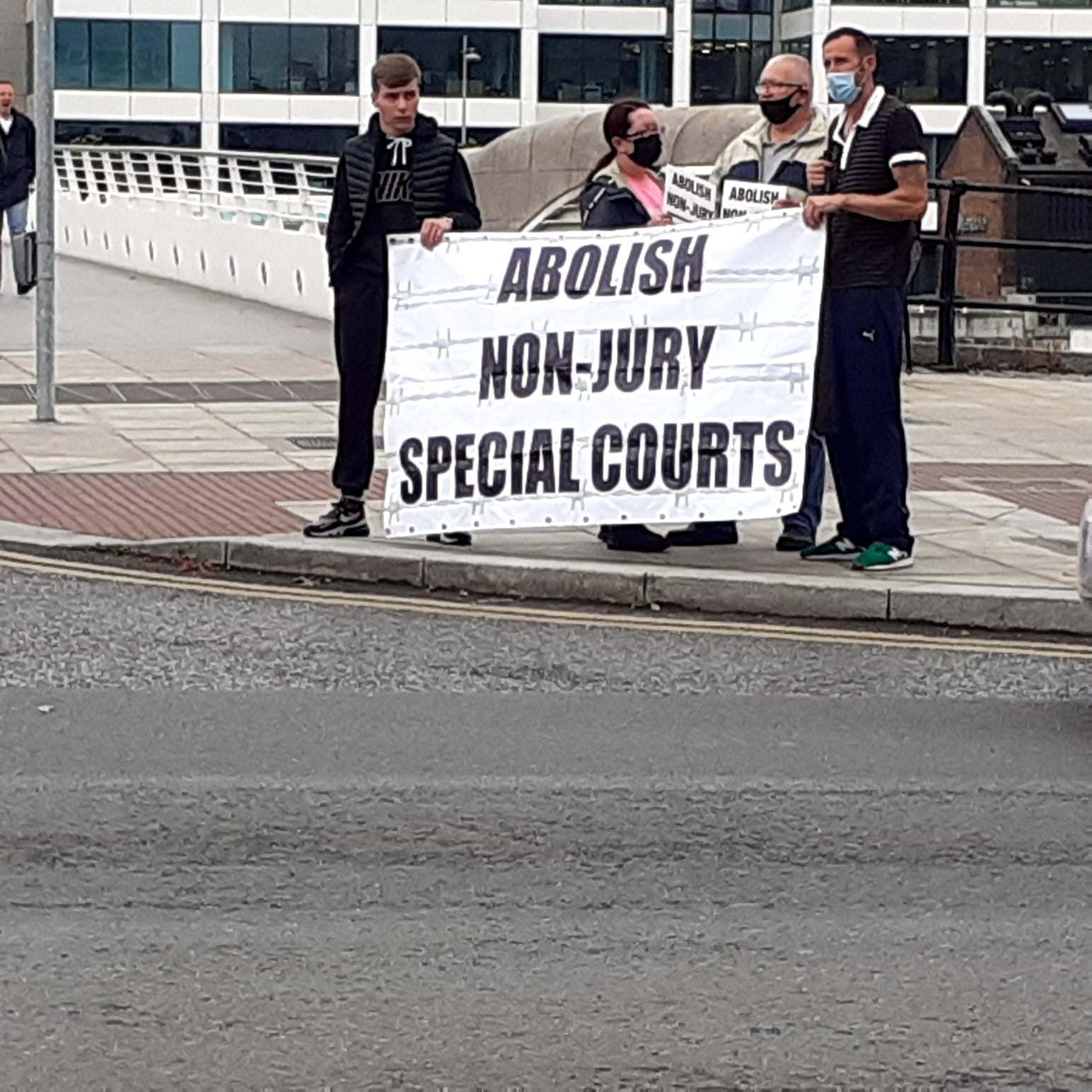
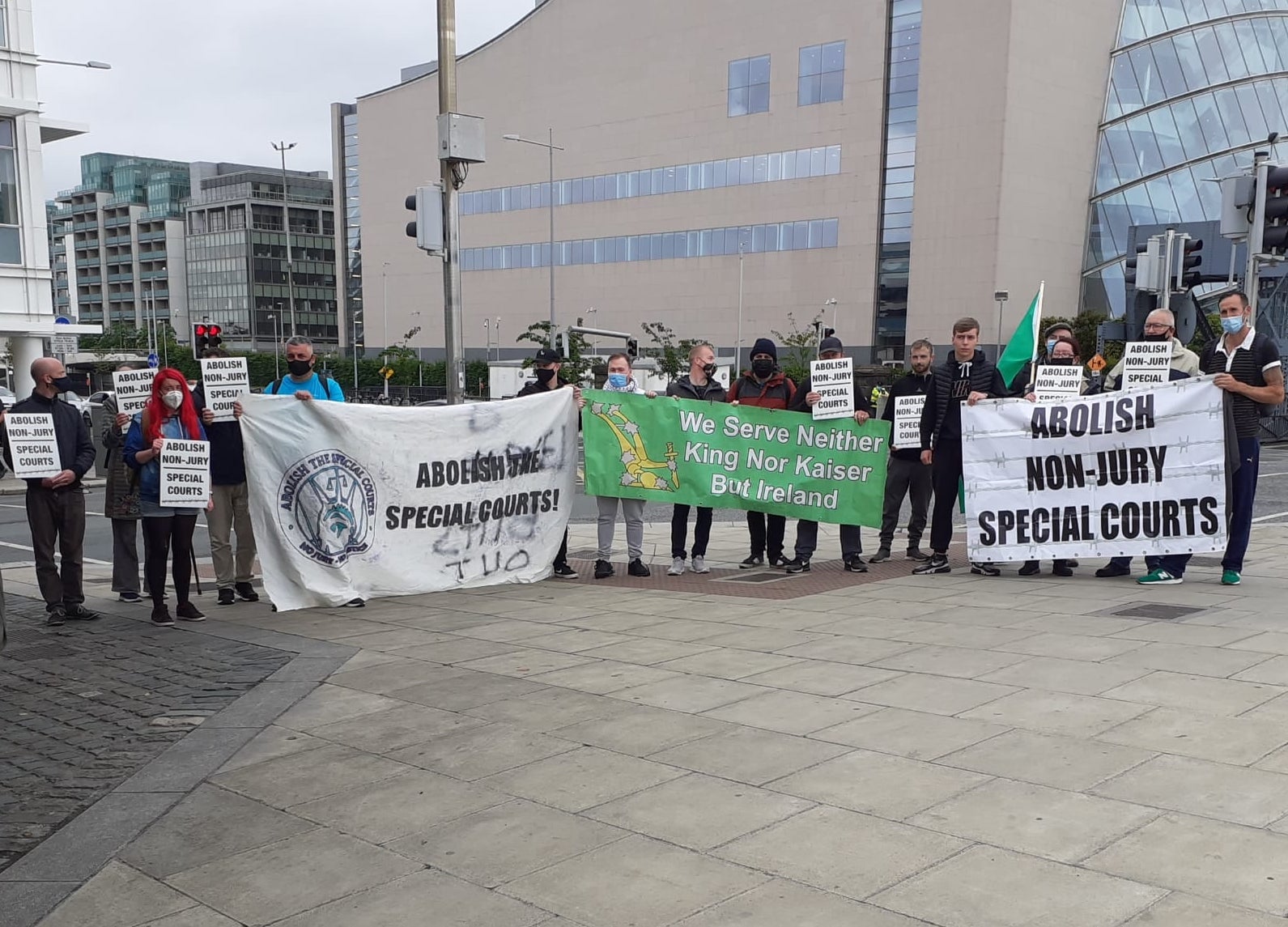
Section of picketers with banner (Photo: Abolish the Special Courts)
SINNFÉIN ABANDONS DECADES OF OPPOSITION TO THE SPECIAL CRIMINALCOURT
Since the Acts’ inception, Sinn Féin has voted against the annual renewal – until last year, when they abstained and this year, absented themselves from the Dáil before the vote. For some years now, the party has been reshaping itself to take part in a coalition government with one of the government parties. Supporters of the party who believe this a necessary disguise to enter the corridors of power and that the party will then return to its Republican past will find that for whatever principle the party gives up voluntarily, a further one will be extracted by pressure. Those who crawl into government will never be able to stand up in it later.
James Geoghegan, FG’s candidate for the forthcoming by-election in Dublin Bay East, taking a swipe at SF’s candidate Lynn Boylan, said “When it comes before both the Dáil and Seanad, what will Sinn Féin and Senator Lynn Boylan do? Will they abstain yet again, which undermines the laws in place to keep our citizens and democratic institutions safe?
“If Senator Boylan wishes to be a senior legislator and member of Dáil Eireann, she must show her support for the institutions of the State and do all in her power to protect the public from criminality and the threat of terrorism.”
Note that Geoghegan has no difficulty in equating support for “democratic institutions” with supporting their very negation, such as jury-less trials.
Voting display in the Dáil (sourced from Abolish the Special Courts)
Sinn Féin party leaders may think that in not opposing the SCC’s renewal, they are abandoning only some Republican principles, as Republicans have been the main victims of the Special Criminal Court to date but in fact they are also colluding in a major attack on civil and human rights, as pointed to by the opposition of civil and human rights organisations to the SCC.
OPPOSITION OUTSIDE THE DÁIL
Picket group at intersection just before Garda barrier. (Photo: Anti-Imperialist Action)
Outside the Dáil, which has been held in the Convention Building on the Dublin quays since the Covid 19 measures, a protest picket took place before the vote. The demonstration was organised by the Abolish the Special Courts campaign and supported by a mixed attendance of Republicans, Socialists and Anarchists.
A number of passing motorists, particularly in company vans and lorries, blew their car horns in solidarity in passing, some also extending a clenched fist or “thumbs up” sign out of their window.
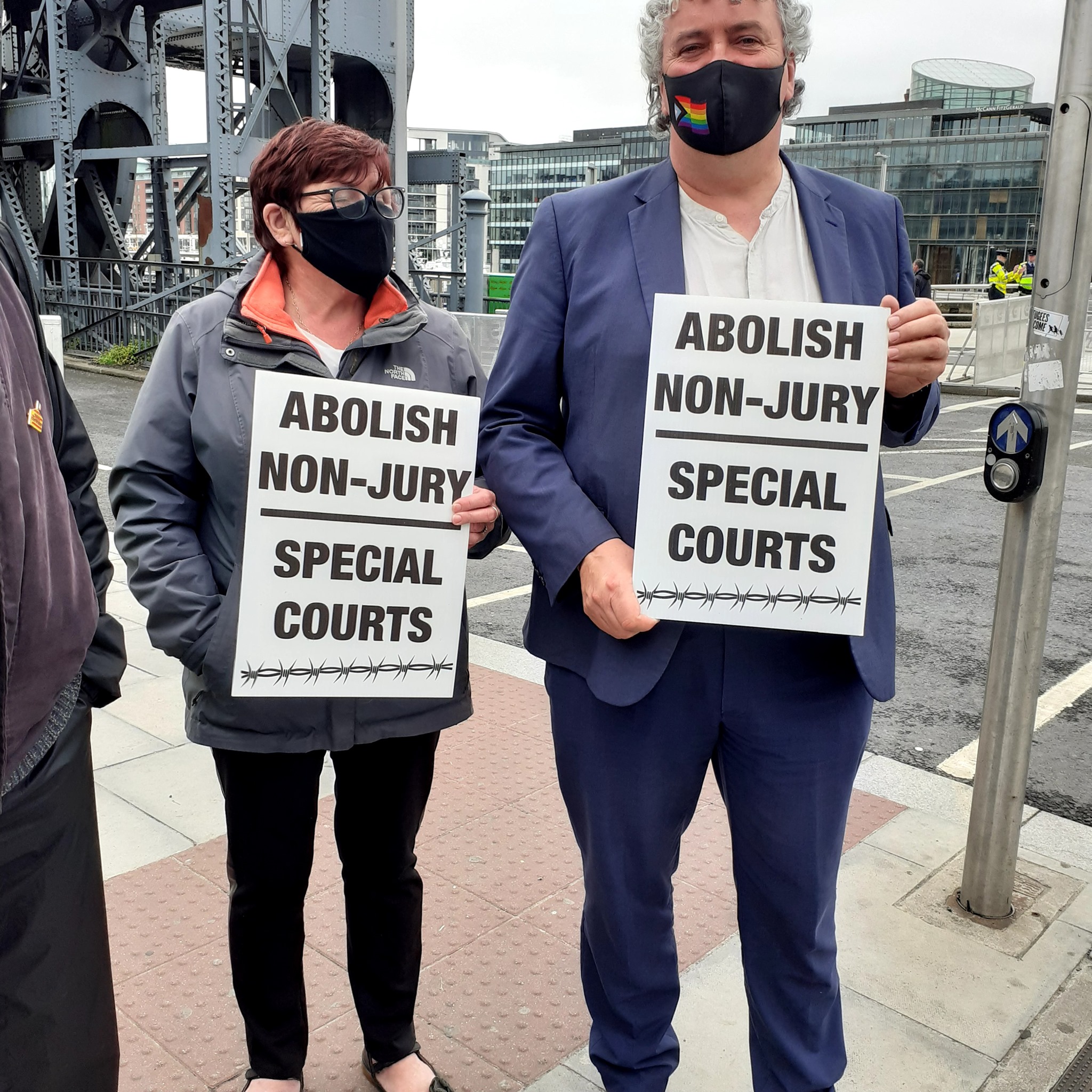
Left Independent TDs Thomas Pringle and Joan Collins joined the picketers for a while and Richard Boyd Barrett chatted with them in passing too; all three posed for a photo while holding a placard against the SCC before returning to the Dáil to speak and vote against the juryless court.
Independent left TDs (Irish MPs) Joan Collins and Thomas Pringle joined the picket for a while. (Photo: Abolish the Special Courts)
The Abolish the Special Courts campaign was launched in 2017 and a public meeting the campaign group organised in Dublin in 2018 heard about a number of then recent cases of unjust convictions in the non-jury courts. Since then the campaign group has organised protests against the SCC.
Group of picketers near the Samuel Beckett Bridge (Photo: Anti-Imperialist Action)
IRISH STATE TERRORIST LEGISLATION ASSISTED BY BRITISH TERRORISM
The Special Criminal Court, as stated earlier, is part of the Offences Against the State Act (OAS) 1939, which is sometimes described as the Irish State’s anti-terror legislation. However, the setting up of the Special Criminal Court and the infamous Amendment to the OAS which allows convictions of “membership of an illegal organisation” solely on the unsupported word of a Garda at superintendent rank or higher, was in fact passed on a wave of hysteria after a terrorist bombing in 1972 by British Intelligence terrorists.
Aftermath of the 1972 car bomb explosion by British agents to have the Dáil vote in favour of the SCC and the Amendment to the Offences Against the State Act. Two public transport workers were killed here. (Photo sourced: Internet)
On the evening of December 1st, 1972, a car bomb exploded near Liberty Hall in Dublin and although there were no fatalities in that explosion, many were injured. A second bomb a short time later at Sackville Place, off O’Connell Street, killed Mr George Bradshaw (29), a bus driver, and Mr Duffy (24), a bus conductor.
The indications had been that Fine Gael and Labour were both going to vote against the Fianna Fáil proposals but in the panic after the the explosions, which were blamed against all logic on the IRA, the opposition to the Acts collapsed and they passed.
THE PRETENCE OF “TEMPORARY PROVISIONS”
The Acts must be voted upon annually because, as with much emergency legislation across the world, the myth is propagated that the provisions are temporary; however these “temporary measures” have now been in place for 82 years! To give another example, the specifically anti-Irish emergency legislation introduced to Britain in 1974, the annually-renewable Prevention of Terrorism Act, was only abolished 15 years later to be replaced by the Prevention of Terrorism Act 1989 (again “Temporary Provisions”) which in turn was replaced by the Terrorism Act 2000.
The powers this Act provide the police have been controversial, leading to noted cases of alleged abuse, and to legal challenges in British and European courts. The stop-and-search powers under section 44 of the Act have been ruled illegal by the European Court of Human Rights.
That Act was strengthened by the Prevention of Terrorism Act 2005, which was then replaced by Section 1 of the Terrorism Prevention and Investigation Measures 2011. All repressive legislation in Britain has now ceased even the pretence of being temporary.
A similar trajectory has been followed by “emergency” legislation in the Six Counties statelet, from the very creation of the administration in 1921 (with the Emergency Powers Act of 1920), a new Act in 1926, amended in 1964 and replaced by the Civil Contingencies Act 2004, providing unlimited powers of harassment for the colonial police along with refusal of bail, undemocratic bail conditions and easy convictions for the non-jury Diplock Courts.
Section of picketers with banner proclaiming a slogan of the Irish Transport & General Workers Union during WW1 (Photo: Abolish the Special Courts)
NON-JURY COURTS
Historically, on occasion juries have been misled and have also been complicit in unjust verdicts, convicting innocent people (there are infamous cases such as the Irish-related ones in Britain in the 1970s, the Birmingham Six, Guildford Four, Maguire Seven, Giuseppe Conlon and Judith Ward). But much less so than non-jury courts. The right to be tried by a jury empaneled by random selection is considered across the world a fundamental democratic right and, furthermore, is one that has been fought for across the centuries, first to win the actual right, then to apply it across classes and finally to apply it to women and ethnic minorities.
The Six County colony has the Diplock non-jury courts and the Irish State has the SCC, both emergency and undemocratic measures in two states that are supposed to be democracies. Both courts regularly remand accused in custody without bail or impose undemocratic restrictions on the few occasions when bail is granted, such as having to be indoors by a specific time daily, prohibition from attending political meetings, etc. At trial, the required burden of proof on the Prosecution is very light indeed, ensuring an unnaturally high rate of convictions.
Richard Boyd Barrett TD of PBP/Solidarity, holding placard, supporting the picket. (Photo: D.Breatnach)
The Irish Council of Civil Liberties, which was founded in 1976 by people concerned about the increase in repressive powers of the Irish State, has stated that the court “continues to represent the single biggest denial of fair trial rights in our legal system”. The SCC has also been condemned by Amnesty International and the Human Rights Commission of the United Nations.
Whereas apologists for these undemocratic and repressive measures argue that non-jury courts are necessary because jurors might be intimidated, they fail to produce evidence of this having happened. However, there is hard evidence of unjust convictions by the Special Criminal Court.
In 2017 Michael Connolly, who had already spent 14 months in prison had his SCC conviction for alleged membership of the IRA overturned and a retrial ordered, during which he was found “not guilty”. Assistant Commissioner of the Gardaí Michael O’Sullivan was judged to have been “careless” in producing a single piece of “evidence” twice as the basis of his belief of the man’s guilt, which made it appear that there were two pieces of evidence, which the SCC considered sufficient to convict.
In 1986 the Special Criminal Court found Osgur Breatnach, Brian McNally and Nicky Kelly guilty of robbing a mail train near Sallins, Co. Kildare. They were innocent but had “confessed” after beatings in Garda custody, which the Prosecution claimed they had inflicted upon themselves and which the SCC accepted despite vigorous denials and the fact that Breatnach had been in a cell on his own. The three were sentenced to between nine and 12 years but their convictions were later overturned and they were paid compensation by the State in acknowledgement of their innocence. “Whistleblower”, a multi-media work on the unjust convictions organised by musician Cormac Breatnach, a brother of one of the victims of the SCC, has won Irish and international awards –but the SCC continues in operation and to be supported by TDs year after year.
SHAME!
This year and last were the worst years in the existence of the undemocratic court, with lowest votes ever recorded against it. As the Abolish Special Courts campaign succinctly summarised the vote in the Dáil: “Shame on those who used to support the abolition of non-jury special courts who now vote in favour of it, abstain or don’t show up to vote at all.”
End.
Line-up of protesters for a photo as picket draws to a close (Photo : Anti-Imperialist Action)
A black American traveling entertainer, boxer and trainer, soldier in two world wars for two different countries, awarded 14 French military medals, airplane pilot, nightclub owner, musician, civil rights activist, associate of famous writers and musicians.
Bullard’s biography is so amazing I cannot believe it has never been made into a movie. Like the lives of many African Americans, it is also a tale full of suffering and pain that highlights the horrible racism that pervaded America in his day. He is such a remarkable person that more people should know about the achievements of this unique figure.
Bullard was born in 1895 in Columbus, Georgia, the seventh of 10 children born to William (Octave) Bullard, a black Caribbean and Josephine (“Yokalee”) Thomas, a Native American Creek woman. Georgia at the time of his birth was a dangerous place for “uppity” African Americans and tragically lynchings were common. His father’s people were Haitians who revolted against French slavery and following the revolution, Bullard’s ancestors left the Caribbean for the United States and took refuge with the Native American Creek people.
As a young boy, he was traumatized by the sight of a white mob attempting to lynch his father over a workplace dispute. A proud man, his father imbued his son with the conviction that African Americans had to maintain their dignity and self-respect, despite all the indignities heaped upon them. Bullard fell in love with his father’s stories of France where slavery had been abolished and blacks were treated equally. At age eleven, Bullard ran away from home hoping to reach France. In Atlanta, he joined a family of English gypsies and traveled throughout Georgia with them, tending their horses and learning to be a horse jockey. The gypsies told him that there was also racial equality in England and Bullard determined to go there instead of to France.
Bullard found work with the Turner family in Dawson, Georgia. Because he was hard-working as a stable boy, young Bullard won the Turners’ affection and was asked to ride as their jockey in the 1911 County Fair races, where he was victorious. Eventually, he made his way to Norfolk, Virginia where he stowed away on a ship to England.
In 1912, Bullard arrived in Scotland and soon went on to London where he boxed and performed in humiliating racist pieces for the Freedman Pickaninnies, an African American troupe. While in London, he trained under the then-famous boxer Dixie Kid who arranged a bout for Bullard in Paris. Bullard fell in love with the “city of light” and decided to settle there. He continued to box in Paris and worked in a music hall until the start of the First World War.
Eugene Bullard showcase (Photo source: Internet)
A SOLDIER IN WWI
When the War broke out Bullard enlisted in the French Foreign Legion and by 1915 had become a machine gunner, seeing combat on the Somme front in Picardy. He served in a regiment known as the “hirondelles de la mort” (“swallows of death”) and saw combat at Verdun where he was severely wounded on March 5, 1916. During his convalescence, Bullard was cited for acts of valor at the orders of the regiment on July 3rd 1917 and was awarded the Croix de Guerre.
After recovering, he volunteered on October 2nd 1916 for the French Air Service and became a machine gunner. He joined a group of American aviators fighting for France on November 15, 1916, called the Lafayette Flying Corps and became the first African American aviator in World War I. He took part in over twenty French combat missions, and is sometimes credited with shooting down one or two German aircraft.
When the USA entered the war, The United States Air Service created a medical board to recruit Americans serving in the Lafayette Flying Corps to fly for the United States. Bullard went through the medical examination but he was not accepted, because in the segregated American military only white pilots were chosen. Sometime later, while off duty in Paris, Bullard allegedly got into an argument with a French officer and was punished by being transferred out of his combat unit and into a service battalion. Before he left the French military, the French government awarded him three different medals for his heroism in battle.
NIGHT CLUB OWNER
After his discharge, Bullard went back to Paris, where he started to play drums in a jazz band at a nightclub named “Zelli’s”, which was owned by Joe Zelli. Bullard worked with Robert Henri, a lawyer and friend, to get Zelli’s a club license, which allowed it to stay open past midnight. Zelli’s soon became the most celebrated nightclub in Montmartre because few other clubs could stay open so late. With the money he saved from playing at Zellis, Bullard traveled to Egypt, where he played with a jazz ensemble at Hotel Claridge and fought two prize fights.
Missing Paris, Bullard returned to the City of Lights where his career was about to take off. He became an entrepreneur hiring jazz musicians for private parties with Paris’ social elites, worked as a masseur and exercise trainer. Bullard then got a job managing the nightclub “Le Grand Duc”, where he hired the famous American poet, Langston Hughes. Around 1928, Bullard had saved enough money to enable him to purchase “Le Grand Duc.” Thanks to being the owner of a hot Parisian club, Bullard made many famous friends, including the dancer-actress Josephine Baker, poet Langston Hughes and jazz musician Louis Armstrong. He eventually became the owner of another nightclub, “L’Escadrille” where he got to know writer Ernest Hemingway, who based a minor character on Bullard in his novel “The Sun Also Rises.” Bullard also opened his own gym and gave boxing lessons, training successful fighters such as “Panama” AL Brown and “Young” Perez. In 1923, he married Marcelle Straumann, a striking French woman from a wealthy family. The marriage ended in divorce in 1935, with Bullard gaining custody of their two surviving children, Jacqueline and Lolita.
A SOLDIER IN WWII
When World War II began in September 1939, Bullard, who also spoke German, agreed to a request from the French government to spy on the German citizens who still frequented his nightclub. When the Germans attacked France, Bullard volunteered and served with the 51st Infantry Regiment and was severely wounded in the battle for Orleans. When the Nazis took over Paris, he slipped over the border into Spain and then headed back to the United States.
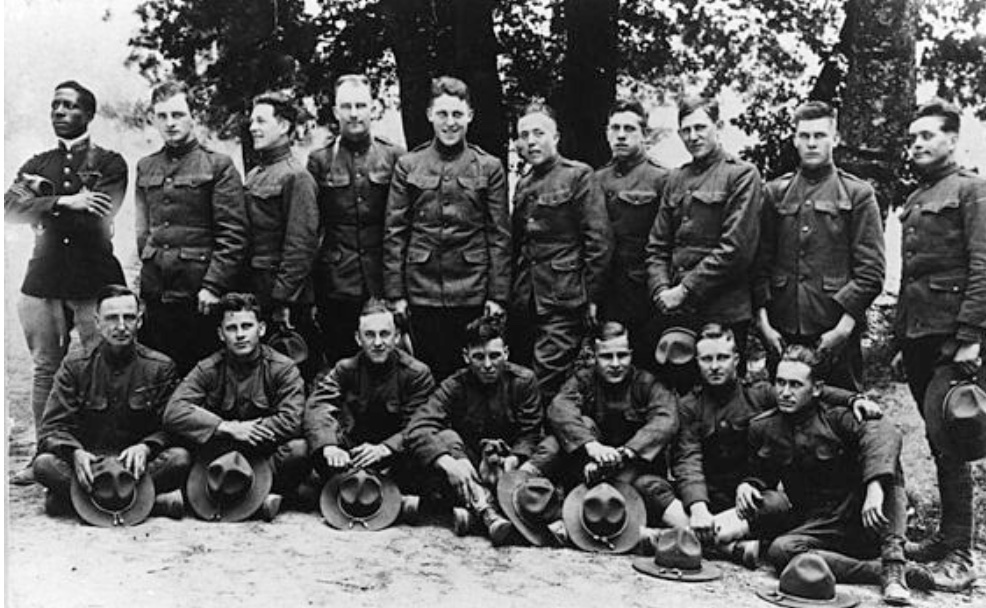
Eugene Bullard with US Army comrades, WW2 (Photo source: Internet)
Bullard spent some time in a New York hospital and never fully recovered from his wound. He missed Paris and his minor celebrity there. In New York, he had no celebrity and had to work menial jobs. He longed to return to Paris but learned that his nightclub had become a casualty of the battle for Paris. The French government gave him a financial settlement with which he purchased an apartment in Harlem.
CIVIL RIGHTS
Returning to America after World War II, Bullard was active in the civil rights movement. During one confrontation, a bus driver ordered him to sit in the back of the bus. In 1949, Bullard was a victim of one of the most notorious incidents in New York State history, the Peekskill riots. Bullard was a fan of African American communist entertainer Paul Robeson who was scheduled to sing at a Civil Rights benefit. Before Robeson arrived, however, a mob attacked the concertgoers with baseball bats and stones. Thirteen people were seriously injured including Bullard who was knocked to the ground and beaten by an angry mob, which included members of the state and local law enforcement. The attack was captured on film in the 1970s documentary The Tallest Tree in Our Forest and the Oscar-winning narrated documentary Paul Robeson: Tribute to an Artist. Despite photographic evidence, none of his attackers were prosecuted. Graphic pictures of Bullard being beaten by two policemen, a state trooper, and a concert-goer were later published in Susan Robeson’s biography of her grandfather, The Whole World in His Hands: a Pictorial Biography of Paul Robeson.
Eugene Bullard clubbed to the ground by rioter and cops during the racist Peekskill Riots in 1949; captured on film and photograph but no-one was arrested for this and other assaults. (Photo source: Internet)
The 1950s were difficult years for Bullard whose daughters had married and he lived alone in his apartment, which was decorated with pictures of his famous friends and a framed case containing his 14 French war medals. His final job was as an elevator operator at Rockefeller Center, where no one suspected he had once been the “Black Swallow of Death.” In 1954, the French government invited Bullard to Paris to be one of the three men chosen to rekindle the everlasting flame at the Tomb of the Unknown Soldier under the Arc de Triomphe and in 1959 he was made a Chevalier (Knight) of the Legion De Honeur by President Charles De Gaulle, who called Bullard a “véritable héros français” (“true French hero”). He also was awarded the Medaille Militaire, another high military distinction. On December 22, 1959, he was interviewed on NBC’s Today Show presenting his amazing biography and received hundreds of fan letters.
Eugene Bullard in military uniform (Photo source: Internet)
Bullard died in New York City of stomach cancer on October 12, 1961, at the age of 66. He was buried in the French Veteran’s section of Flushing Cemetery, where nine years later his good friend Louis Armstrong would also be interred. On August 23rd 1994, 33 years after his death and 77 years to the day after the physical that should have allowed him to fly for his own country, Bullard was posthumously commissioned a Second Lieutenant in the United States Airforce.
End.
Unveiling of Eugene Bullard statue monument in Georgia near the USAF base that refused to enlist him as a pilot for WW2 because he was black, even though he had already flown in France.
The oppression of the Palestinians led to an outbreak of active resistance recently in Jerusalem, to which the Israeli Army reacted with increased repression, timed to harass Palestinian Muslims during the period of Ramadan.
At the height of devotees attending the Al-Aqsa mosque, this escalated into attacks on worshippers within the temple itself. At the same time, Israeli Zionist settlers threatened dozens of Palestinian families with eviction from their homes in East Jerusalem.
Reacting to these events, one of the Palestinian organisations fired home-made rockets into officially Israeli territory, to which the Israeli armed forces responded in turn with drone missiles and missiles from its air force jets on Gaza.
The Zionist military fired on protesting Palestinians in the West Bank with live ammunition. The death toll has climbed to 200 Palestinians, according to Gaza’s Health Ministry, including 59 children and 35 women, with 1,305 people wounded. Ten Israelis have been killed, two of them children.
The casualty figures once again show the gross disproportion between what the Palestinians and their Zionist masters experience: in civil and human rights, citizenship, in land ownership, electricity and clean water supply, heating, fishing, education facilities, building materials …
… in freedom to travel inside and outside the state, in depth and breadth of surveillance, in arms and defence capability, in states that support them.
And in city structural damage: despite the many home-made rockets launched against the zionists, there has yet been no significant damage in Israeli towns, while their armed forces have effected large-scale structural damage in Gaza and bodies are still being pulled from the rubble.
In only one area perhaps do the Palestinians have the advantage over the Israeli Zionists: in support among the people around the world.
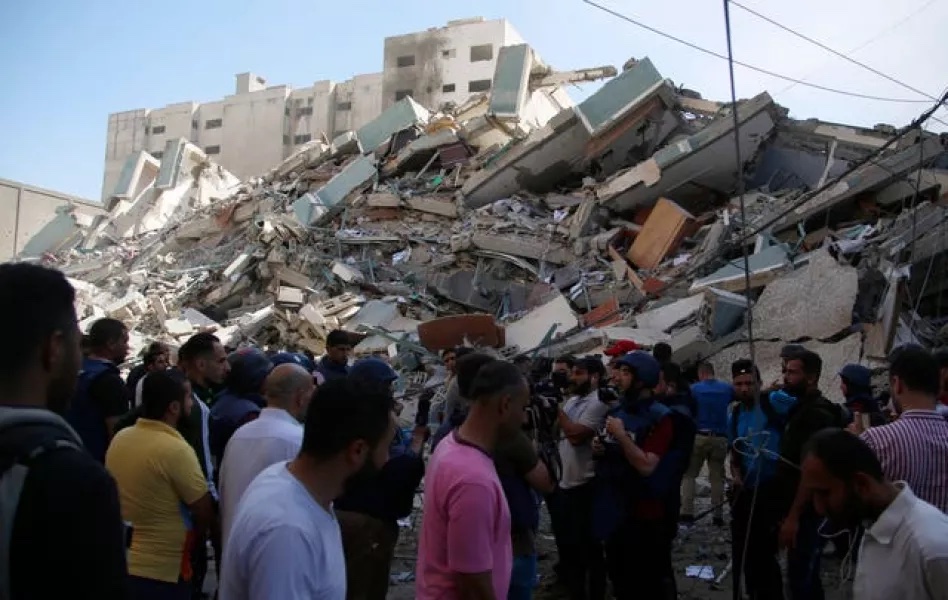
Israeli Zionist missiles strike the tower housing many media services, including Associated Press and Al Jazeera, which drew broad criticism from the mass media for a change. But families also lived here. Everyone was given ten minutes to get out. The Israeli Occupation Force has not yet bothered to explain its rationale for targeting this building. (Photo source: Internet)
PALESTINIAN SOLIDARITY MARCH DEFIES POLICE THREATS
Responding to these attacks on Palestinians, the Ireland Palestine Solidarity Campaign, the main organiser of Palestinian solidarity action in Ireland, called for solidarity demonstrations and in particular advertised a solidarity rally to take place in Dublin’s city centre for 2pm on Saturday 15th May.
The organisation asked those in attendance to comply with measures against Covid19 infection, to wear masks, maintain social distancing and comply with stewards’ instructions.
However the IPSC was contacted by the Irish police force, the Gardaí, who told them not to go ahead with the event, that if they did they would intervene to stop it and also made threats of €5,000 fines and prison against the organisers.
In a later public statement the Gardaí declared that they “have no role in permitting or authorising marches or gatherings. There is no permit/ authorisation required for such events”!
But there is apparently an ability and power to intimidate and threaten progressive organisations to deter them from organising solidarity events.
Or to kettle socialist and socialist republican Mayday marchers and demand all their names, addresses and dates of birth before threatening them with arrest if they did not disperse.
Or to threaten Debenham workers and their supporters, assaulting some of them while escorting KPMG forces in to evaluate stocks during pandemic restrictions.
A Palestinian policeman stands among the rubble of the tower in Gaza recently occupied by families and media agencies. (Photo source: Internet)
The predicament of the IPSC exposed the vulnerability to this kind of intimidation of a broad organisation that seeks to win friends in ruling circles. The leaders and organisers are placed in a position of not only personal but also of organisational vulnerability.
Even should they be prepared to defy the State to fine and/or imprison them, would they also be prepared to damage their organisation or to lose some friends they are cultivating in the circles of political influence?
What was one of the strengths of a broad organisation thus becomes a weakness; a more radical or even revolutionary organisation, with less influence in influential circles can decide on defiance, risk fines and jail with however perhaps less possibility of influencing official opinion and ultimately, action.
Fortunately in this case one such organisation did step forward and took up the baton: the Trinity College BDS group expressed its solidarity with the IPSC on its treatment by the Gardaí and called their own rally for the exact same place and time as the original one called by the IPSC.
Video of rally at end of demonstration, near Israeli Embassy
Despite concern over Covid19 transmission and Garda threats – and the extremely short notice and much smaller circle of contacts of the TC BDS group — the response was magnificent, both in internationalist solidarity and in maintenance of the right to organise such progressive events.
Before the appointed hour, people began to gather in large numbers at the Spire in O’Connell Street, Dublin’s main street and north city centre.
After being addressed by a number of speakers, they set off in a march towards the Israeli Zionist Embassy near Ballsbridge, beyond the south city centre. As they marched their numbers grew until, approaching the Embassy, they numbered several thousand.
Along the way, bystanders applauded the marchers and passing vehicles blew their horns in solidarity.
A section of the Dublin rally in solidarity with Palestine photographed outside the GPO in the city’s main street before they set off on the 5.5km march to the Israeli Embassy (Photo credit: PA, Breaking News)
Marchers shouted slogans of solidarity with the Palestinians, calling for the freedom of Palestine and the expulsion of the Israeli Ambassador as a mark of the Irish people’s objection to what is being done to the Palestinians.
Near the Embassy, a number of speakers addressed the crowd and after dispersing, a number of demonstrators boarding public transport to return home were congratulated by the drivers.
LESSONS FOR US
The situation regarding calling and holding the demonstration in Dublin outlined some of the weaknesses of a broad organisation when it faces repression from the State and the greater resilience of a smaller organisation in being able to defy the State.
It may be necessary in future to maintain support for both types of organisation, each being appropriate for particular situations.
Also demonstrated was the necessity to openly defy unjust laws and prohibitions at times and particularly around the right to organise, to protest and to show solidarity, which the demonstrators did so well on Saturday.
Such situations also reveal the difficulty for the Gardaí in carrying out repressive actions and they are reduced to threatening individuals.
THE FAR-RIGHT MARCHES TOO – FOR WHAT?
Meanwhile, a couple of hundred of the far-Right also marched in Dublin, allegedly in defence of civil liberty. Not in solidarity with the Palestinians’ civil liberties and not in defence of our civil liberty to organise to show solidarity with people in other struggles.
No, they marched in defence of the right to defy health protection regulations, in proclaiming the Covid19 pandemic to be a) a hoax or b) greatly exaggerated and in claiming that wearing masks damages one’s health and even intelligence(!).
They were insisting that vaccinations are a) dangerous to one’s health or b) means of injecting nano-machines into people’s bloodstream in order to control them.
A clip posted by Ireland Against Fascism showed one of the QAnon Saturday screechers for months outside the GPO, Dolores Webster, aka Dee Wall, lately self-declared “digital journalist” (don’t laugh) posting her reactionary propaganda.
In apparent total ignorance of the actual reality (but when has that mattered?), she broadcasted a claim by video from her studio (her car), accompanied by the strains of Abba from the headphones of her head-bobbing passenger.
She claimed that the “scum in the Dawl” had allowed the Palestinian solidarity march to go ahead to distract from the alleged general removal of freedom and in particular from the far-Right group Irish Yellow Vests to hold their rally on May 1st!
When all the Covid19 precautionary restrictions are removed, what will these elements have to march about? The will need to return to the topics that engaged many of them in the recent past: racism, anti-immigrants, islamophobia, homophobia and anti-socialism, along with their false patriotism.
None of that is welcome of course but at least it will be without this false concern for “civil rights and freedom” and closer to the reality of what the far-Right in general – and fascists in particular — stand for.
SUPERPOWER BACKING AND IMPUNITY
The current atrocities of the Zionist State, which it carries out with impunity, along with its history, starkly reveals the effect of its main backing power, the USA, and the imperialist alliance dominated by that Power.
The USA backs Israel with military aid to the tune of $10 Million daily, which is aside from other direct and indirect aid. Israel is the only state in the Middle East which is not only very friendly to the USA but totally dependent on the support of that superpower.
For the ruling class of the USA, Israel is the only state in the Middle East which is totally safe forever from fundamentalist Muslim revolution or from left-wing anti-imperialist revolution and is therefore an extremely important factor in the USA’s plans to totally dominate the Middle East.
Solidarity marcher in Dublin on Friday with a home-made placard (Photo Credit: PA, Breaking News.ie)
This imperialist alliance finds reflection not only in the action/ inaction of governments in Europe, for example but also in the reporting of the mass media.
One of the latter’s tropes is the constant emphasis on the numbers of Palestinian missiles fired, without revealing their general ineffectiveness in delivering destruction, in total contrast to the Israeli missiles. Another is their constant repetition of a lie, that “Hamas seized power in Gaza”.
The truth is that Hamas swept the board in the 2006 elections for the Palestinian Authority. The “seizing” that was done was by Al Fatah, which usurped the results in the West Bank and installed themselves there; they tried to do the same in Gaza and, in a short fierce struggle, were beaten.
But the Western powers decided that Hamas was illegitimately in power, seized funds due to it and supported its blockading – by both Israel and Egypt.
No explanation is offered in the general mass media as to how a generally politically-secular Palestinian public would turn from its decades of allegiance to Fatah to vote for the fundamentalist Muslim Hamas.
The main reason was Fatah’s surrender of the goals of Palestinian independence and freedom and the return of the refugees, in exchange for running a colonial administration with opportunities for living off bribery and corruption and Fatah’s settling down to that status quo.
CASTING A GIANT DARK SHADOW
It was not only in Dublin and in towns across Ireland that Palestine solidarity demonstrations were held on May 15th but by people across much of the world, generally in opposition to the wishes of their governments and ruling elites.
It is worth thinking about how this has come about, in particular in contradiction to a mass media hostile to the Palestinians.
Palestinians come to view the remains of the tower block that was home to families and that housed a number of media agencies. (Photo source: Internet)
The Zionist state of Israel was declared in 1948, its anniversary actually only three days ago – May 14th, the first states to recognise it being the USA and the USSR. In Ireland at the time, there was general support for the new state which continued to the “June War” of 1967 and somewhat beyond.
The general Irish population were horrified by the history of the Nazi-organised Holocaust and sympathised with the Jewish survivors.
Irish nationalists and even Republicans empathised with the Zionist civil and armed struggle against the British (who, ironically, had begun the process of Zionisisation of Palestine).
The 1966 film Cast a Giant Shadow purporting to show that struggle, starring Kirk Douglas and a cameo appearance by Frank Sinatra, was widely enjoyed and cheered in cinemas across Ireland.
Though some of the film’s characters were based on real-life counterparts, the general narrative was a grotesque distortion, hiding the massacres of Palestinians and the expulsion of thousands as the Zionist state was created.
Many Irish language supporters admired how the new state had brought the Hebrew language, for centuries only spoken in religious contexts, back into everyday usage.
Solidarity marcher in Dublin on Friday with a home-made placard and a thought-provoking message (Photo Credit: Sam Boal, The Journal)
Yet, by a few years ago, general pro-Palestinian sympathy across Ireland had become so strong that Israel’s Ambassador to Ireland declared the country “the most anti-semitic in Europe”. That of course is the Zionists term for anyone who supports the Palestinians or criticises the Israeli state harshly.
Only a few days ago, the current Ambassador accused some politicians of spewing hate towards Israel. He was responding not only to Left and Sinn Féin TDs who criticised the actions of Israel towards the Palestinians, but also to the Tánaiste (Deputy Prime Minister equivalent) Leo Varadkar!
Varadkar had commented that Israel’s actions are “indefensible” and Government Minister for Foreign Affairs Simon Coveney said at an EU conference that the EU had “fallen short” and failed to project its influence in agreeing a position in against illegal activity by the Israelis against Palestinians.
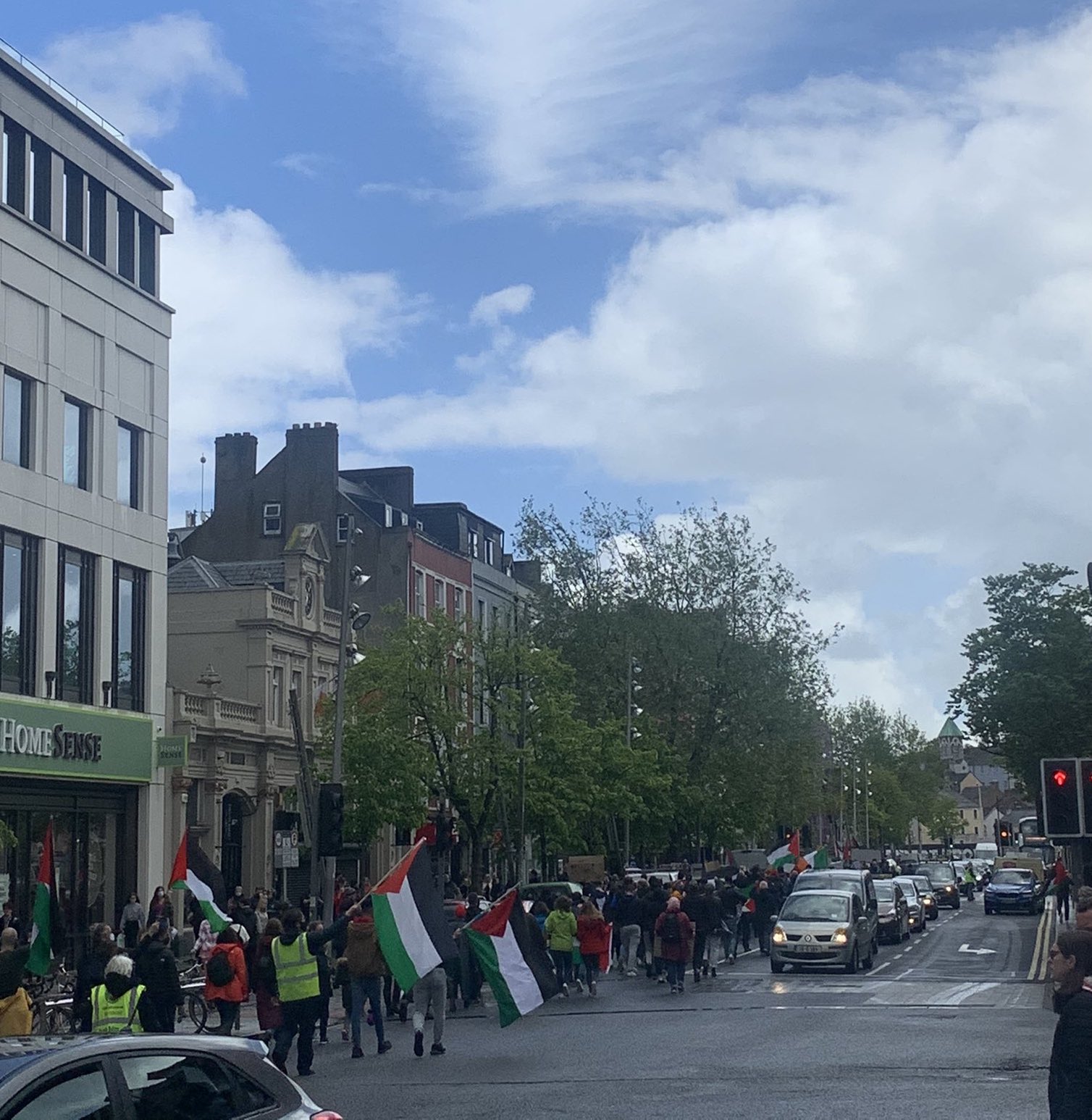
Palestinian solidarity march in Cork on Saturday (Photo source: Internet)
The fact that establishment right-wing/ conservative politicians feel obliged to take a public stand, however ineffectively, against actions of the Israeli Zionists is a strong indication of how much Irish public opinion has changed over decades.
Implicitly such stands reflect against the Zionists’ biggest international backer and world superpower, the USA. Since the Cast a Giant Shadow film, the state’s shadow of which we are aware now is indeed frighteningly giant and very dark.
In response, the natural cultural and historical feelings of the Irish people have stirred in sympathy with the oppressed Palestinians – and in defiance of threatened police repression at home.
For months the Duque government in Colombia has been unleashing violent repression on its people, in particular those who organise or participate in protests. The statistics are frightening, which is what they are intended to be: 40 dead, hundreds injured (some with loss of an eye), nearly 170 “disappeared”. Yet the people continue to protest.
What all this has exposed is that Colombia, despite its support by western states, has no democracy and that its vaunted “peace process”, like all others elsewhere before it or since, has had nothing to do with peace but everything to do with pacification. Unlike many in other parts of the world however, its acceptance by the FARC was the prelude to intensified State repression, with assassinations of leaders and activists of popular democratic movements. Also exposed is the lie that Colombia and the USA are truly involved in a “War on Drugs”, a commodity the sale of in which most of the political class of Colombia are involved and the profits in which the financial institutions in Colombia and much of the world are active in laundering.
Meanwhile, the people are subjected to economic squeeze, they protest, they are shot, beaten, tortured, raped, disappear ….
This police victim survived but many did not (Photo source: Gearóid Ó Loingsigh)
In two weeks of protests, statistics from the Defensoria del Pueblo (a kind of Ombudsman), listed 42 dead and 168 reported “disappeared”; of the dead, 41 were civilians and one was a member of the State security forces. A 17-year-old female demonstrator was reportedly sexually abused by four police officers and took her own life afterwards. Protesters burned the station where it happened but the officers themselves remain at large.
Protestors burning the station where police officers sexually violated a 17-year-old demonstrator who took her own life afterwards.
WHO KILLED VILLA?
Lucas Villa Vasquez, an iconic figure in the peaceful demonstrations, dancing and carrying out acrobatic acts, was shot during the General Strike, was declared brain dead in hospital and had his life-support system turned off, his heart stopping finally on 11th of May. Andrés Felipe Castaño, a 17-year-old youth shot on the same day underwent two operations before he could come off the critical list.
Who killed Villa? Not Duque, the President wanted people to believe as he sent a message of condolence to Villa’s family, the first personal condolence he has offered since the demonstrations – and the killing – began, except for the one police officer killed so far. Not the Police, their Director General, Major General Jorge Luis Vargas Valencia insisted, insisting his force is working hard to find the culprits and that a reward for information has risen to 100 million pesos1 for information. But people who know how these things work are only in doubt about one question: was it the police themselves who killed Villa and nearly killed Andrés Felipe, or was it one of the State-sponsored fascist gangs (which have strong links with the police and army)?
Dilan Cruz, murdered by police two years ago, is remembered on demonstrations where people are still being killed. (Photo source: Gearóid Ó Loingsigh)
Villa has joined over 40 martyrs known to have been killed by the forces of the State; since their names are known only to their families or smaller political and social circles, Villa’s name stands for them all. As did Dilan Cruz before him, shot at close range to the head by a “non-lethal” beanbag in October 2019. And what of the nearly 170 disappeared? Are some of them already dumped into pits or rivers? Others in prison cells, awaiting their next session with the torturers? Or in the case of female prisoners, awaiting their next incident of violation?
Man in blue top and white trousers dancing in some clips was Lucas Villa Vasquez
Two Latin American league soccer matches in Colombia were affected on Wednesday: Visitors from Argentina’s River Plate team had their warm-up in Barranquilla abandoned for awhile due to the volume of police tear gas drifting in from outside and loud bangs could be heard also. That was a Copa Libertadores game and another, between Atletico Nacional and Nacional of Uruguay in Pereira was delayed by an hour due to protests there.
The South American Football Confederation (CONMEBOL) moved matches from Colombia to Paraguay and Ecuador last week to ensure the protests did not affect games but the Copa America is due to be held in Colombia and Argentina next month with Colombia hosting 15 games including the final of the world’s oldest international tournament. The title match is due to be held in Barranquilla on July 10.
“SUSTAINABLE SOLIDARITY” WITH WHOM?
Part of the reason for the protests in the first place was the proposed tax reform by another name: Sustainable Solidarity Law. The Duque Government plans by this system to collect 23 billions in Colombian pesos (US$ 6,300 millions) by extending its tax base, to avoid any further increase in the country’s international risk qualification, to institutionalise the basic income level and build a fund to comply with its environmental protection targets.
Well, ok, but who is going to pay this tax-by-another name? According to the Minister of Finance himself, Alberto Carrasquilla, 73% is to be contributed by ordinary citizens and the rest by the companies.
Art in active resistance
In addition, the law proposes to apply the collection of Value Added Tax, which in Colombia is up to 19%, to basic consumer products such as public services (water, electricity and gas), funeral services, electronic items such as computers and other services that have been exempt until now.
Add to that ongoing State repression in the countryside, the number of unemployed nationally rising to 4.1 million as a result of the pandemic and the country was ready to take to the streets. But not ready for the repression of the demonstrators that followed.
Riot Policeman aims weapon at point-blank range at unarmed demonstrators in Colombia. Whether tear-gas canister or stun grenade launcher, at this range it would almost certainly kill but if not, partial or full blindness would be likely along with permanent brain damage. (Photo source: Internet)
President Duque asked the Colombian Parliament to withdraw the new tax reform which they did but the people are on their feet now, as they say there; now they have martyrs too on top of the issues they already had.
WHAT CAN BE DONE?
It is up to the people of Colombia, the workers, civil servants, small business people, indigenous – to free themselves. None else can do it. But we owe them solidarity, just as we in turn have claimed solidarity (and will claim again) from others. It is difficult at the moment to see how our solidarity can express itself in much more than symbolic form, such as pickets, demonstrations, articles and memes on social media. But even those have more than a moral effect, for the Colombian Embassy staff here have as part of their duties to collect information on how the regime in Colombia is viewed in Ireland and to report that to their bosses at home. And since the Colombian ruling class needs to do business around the world ….
Recent small Colombian solidarity picket protest outside the Colombian Embassy in Dublin.
The Colombian masses also need to know that they do not stand alone, that others are watching, applauding them, cursing their enemies, mourning their martyrs.
We can also assist by continuing our efforts against another faraway enemy of democracy, the main instigator and protector of reaction, repression and oppression around the world, and main external supporter of the Colombian regime, trainer of its repressive forces – the ruling class of the United States of America.
Solidaridad con el pueblo Colombiano! Dlúthpháirtíocht le poball na Colóime!
Banner slogan: “The Tax Reform means Hunger and Misery for the people.” (Photo source: Gearóid Ó Loingsigh)
TV news report on the general strike, general protests against killing by government forces; mothers and grandmothers of murdered protesters demonstrate against “Public Order” forces; Duque tries to present concern and gives a concession to students at a certain level: https://www.youtube.com/watch?v=Xz8ed0hS6OQ