A BASQUE SELECTION

Diarmuid Breatnach

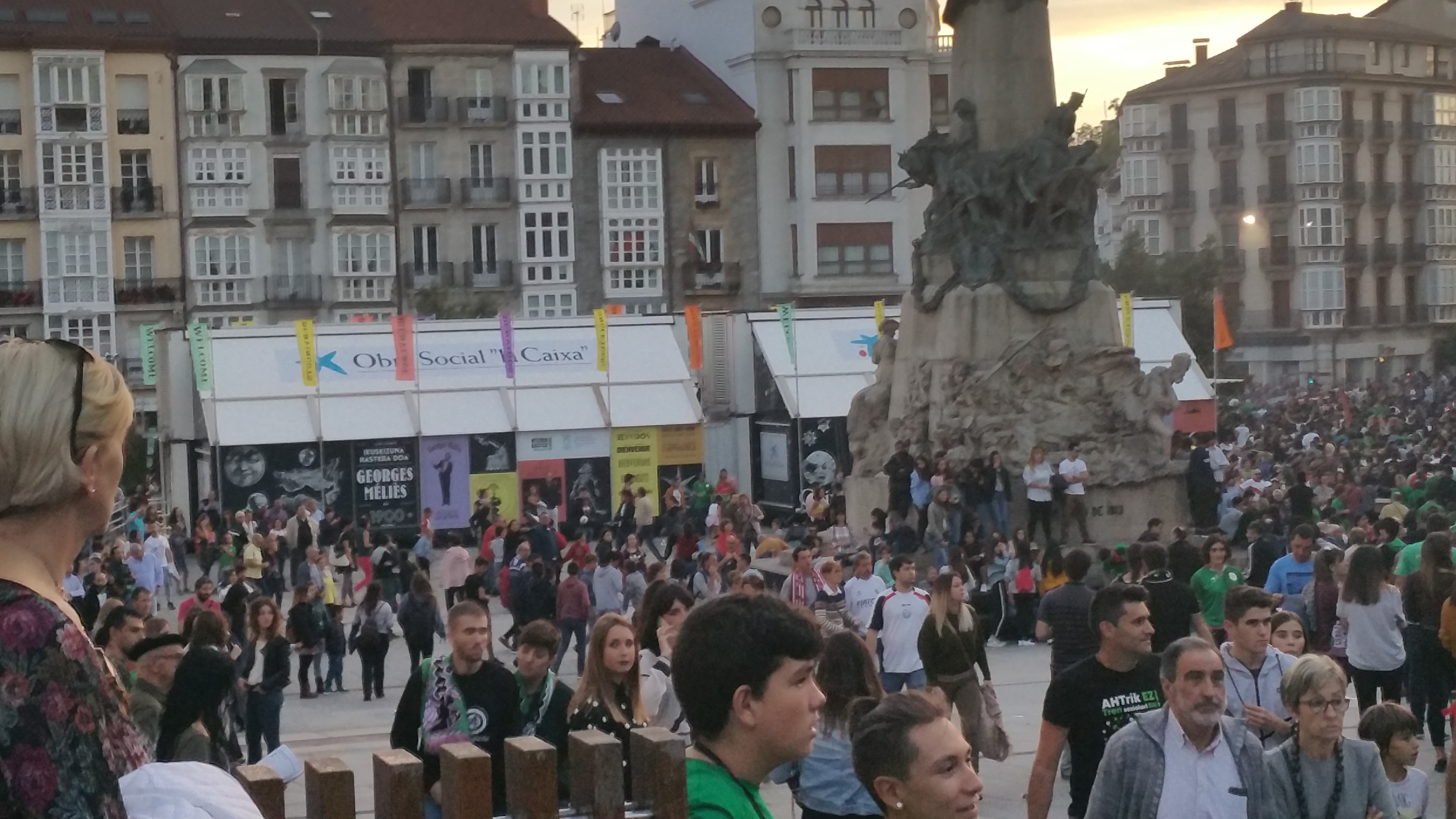
October 12th: The old town was heaving, full of people, mostly but not all on the younger end of the adult spectrum, standing, sitting, mostly in groups, talking, laughing, drinking, eating …. Some kind of festival? Not really …. a football match. Ah, that explains the shirts in football team colours. There’s the red stripes on white colours of Athletic Bilbao (and this isn’t Bilbao, not even Biskaia province), there’s the blue-on-white Real Sociedad colours (and this isn’t Donosti/ San Sebastian, or even the Guipuzkoa province). But wait a minute – there’s a lot of Deportivo Alaves shirts too (also blue-and-white) …. well, this is Vitoria/ Gastheiz, capital city of the the Alava province.

But there’s some red shirts too – CA Osasuna, from Naffaroa, the fourth province of the Southern (i.e within the Spanish state) Basque Country1. Over there’s a few CD (Club Deportivo) Vitoria, and a couple of women (not surprisingly — it’s an all-female team playing in the women’s league) wearing SD (Sociedad Deportiva) Lagunak yellow shirts. They can’t all be playing today, can they?

In a way, they are.

This occasion is a friendly match between Venezuela and the Basque Country (i.e not part of any official competition as otherwise it would be forbidden by FIFA, the international regulatory body for soccer)y and it is promoted by Euskadiko Futbol Federarkundea, the Basque Football Federation. FIFA, although it recognises Scotland, Wales and ‘Northern Ireland’ as having ‘national teams’, does not recognise either the Basque Country or Catalonia as having them. Where is the logic in that? Well, since FIFA only recognised Palestine with the creation of the Palestine Authority controlled by Israel and agreed by the Western powers2, one can hardly avoid coming to the conclusion that FIFA decides its policies on what area or nation can have their own selection and participate in FIFA championships in accordance with the relevant occupying state – no matter how right or wrong that decision might be.

Many shirts being worn here are green and bear the words Euskal Selekzioa (Basque Selection), the campaign for which in football is the cutting edge of the broader campaign for Basque national teams in many other sports, including surfing. It is of course not just about sport but is also political.

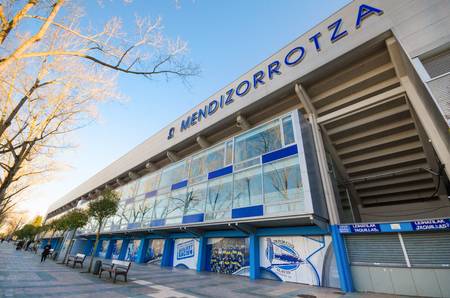
The Basque-Venezuelan game was to be played in Alaves’ Mendizorrotza stadium in Vitoria-Gasteiz and my friends talked casually about attending, though no hard arrangements seemed to have been made. I didn’t press the matter.

View of left of the crowd in the large square in the old town, showing a part of the monument.
(Photo: D.Breatnach)

Venezuela is rated 32nd in world soccer by FIFA, which is actually quite high and only two points behind the Ireland team, currently at 30th. So the opposing team is a big deal. The whole of the Basque Country, including Nafarroa and the parts held by the French State, is only around three million and they will play only players born in the Basque Country, unlike Ireland which features players from its diaspora. Ireland has had high emigration but so has the Basque Country, particularly to Latin America, the USA and Canada. Venezuela, by the way, has a population of nearly 32 million.

View of centre of the crowd in the large square.
(Photo: D.Breatnach)

In 2016, their last international, the Basque country beat Tunisia 3-1 in Bilbao and before that have beaten Peru 6-0 and Bolivia 6-1. They lost 1-0 to Wales in 2006 but beat Uruguay 2-1 in 2003.

View of section of the crowd on the balcony overlooking the large square in the old town.
(Photo: D.Breatnach)

The main square of the lower old town, the Casco Viejo3, was full of people, some chanting and red flares burning with an occasional firework going off. The ikurrina, the Basque flag, waving in many places, draped over balconies etc. The square is called alternatively Plaza de la Virgen Blanca or simply La Plaza Vieja. We met up with an ex-prisoner (political) who was complaining about the impressive monument in the main square which commemorates the Battle of Vitoria, fought on June 21, 1813, between the retreating French forces of Jose Bonaparte and the English forces under the Duke of Wellington. The English won the battle. I gathered the ex-prisoner’s objection was not so much that it commemorated the defeat of the French but rather that it celebrated the ‘independence’ of the Spanish monarchy, which had done the Basques no favours since the battle and much to the contrary. We drank lager here in plastic containers and street cleaners were already out sweeping up discarded and cracked containers.

Another view of the crowd, this one more to the right of the large square in the old town.
(Photo: D.Breatnach)

The captain of the Basque team, Aritz Aduriz, is the Spainish team’s oldest goalscorer, which might seem an irony but if he wants to play international world football, he has to play for a team recognised by FIFA. His home team is Athletic Bilbao, and his team-mates Inaki Williams and Inigo Martinez were also lined up to play, as was Real Sociedad’s Asier Illarramendi. And all of those have in the past played for the Spanish ‘national’ team.

Some political demonstrators moving through the crowd. The small flag held up is of the political prisoners’ relatives organisation Etxerat, the design showing the outline of the Basque country with two arrows indicating movement inwards from the French and Spanish states, i.e calling for the ending of the dispersal of prisoners throughout the states, far from their homes. (Photo: D.Breatnach)

Walking through the upper old town, we mingled and stopped here and there for a small serving of lager serving (zurito) or wine (txupito). The ex-prisoner got talking about language, philosophy, politics, religion, ancient civilization. I lasted longer than the others in discussion and debate with him4 but his intensity was wearing me down a little in the end. He apologised for that but then had another appointment and took off. By this time we had eaten and were relaxing in the high part of the Casco, on a slope down from the level of the fortress. Attending the game seemed somehow to have disappeared off the agenda and a little later we headed down through areas mostly quiet now to the parked car and drove off.

View of stairs leading from the large square to the upper part of the old town.
(Photo: D.Breatnach)

A crowd of 53,000 however attended the stadium to watch the game and who knows how many others saw it televised. It had been a friendly match in official status and in fact, with one yellow card earned, no reds and no injuries. The goals scored by the Venezuelans might have been the most elegant but Euskal Herria, the Basque Country, were the victors, the score of 4-2 in their favour, with Aduriz having been one of the scorers.

View of Gastheiz/ Vitoria’s football stadium
(Photo source: Internet)

End.

FURTHER INFORMATION

List extant Basque soccer clubs (each one also a link to its own history): https://en.wikipedia.org/wiki/Category:Football_clubs_in_the_Basque_Country

Ditto list of defunct Basque soccer clubs: https://en.wikipedia.org/wiki/Category:Defunct_football_clubs_in_the_Basque_Country

CA Osasuna, not listed in Wikipedia as a Basque club, presumably due to divisions fostered between Nafarroa and the other three southern Basque Country provinces: https://en.wikipedia.org/wiki/CA_Osasuna

Basque selection information: https://en.wikipedia.org/wiki/Basque_Country_national_football_team

Article about Basque and Catalan national selections:

http://theinsideleft.com/basque-catalonia-national-football-teams-catalan-barcelona-athletic-bilbao/

Match highlights (commentary in Euskera; Basque Country in green shirts, Venezuela in maroon) https://www.ngolos.com/videos/2018-10-12-basquecountry-venezuela

Background on Basque soccer in an international context, including some of them playing for “la Roja”, the Spanish State’s “national” team: https://www.bbc.com/sport/football/45834955

FOOTNOTES

1There are divisions fostered between Nafarroa (Navarra/ Navarre) and the other three southern Basque provinces of Bizkaia, Guipuzkoa and Alava. Nafarroa has its own ‘autonomous’ regional government in the post-Franco arrangement, while the other three are jointly in the other ‘autonomous’ region of Euskadi. Iruña/ Pamplona, capital city of Naffaroa, was the seat of the medieval kingdom of Nafarroa (Navarra), the royal family of which once laid claim to the monarchies of both the French and Spanish kingdoms (the latter being a source of three wars, the Carlist Wars). During the emergency caused by the military coup-insurrection of Generals Franco, Mola and others against the democratically-elected Republican Government of the Spanish state, the Catholic ultra-conservative Carlists seceded Nafarroa and massacred three thousand dissidents (Republicans, Basque Nationalists, Leftists) and fought on the fascist side.

After the “Civil War”, the Partido Popular (extremely right-wing main Spanish party) controlled Nafarroa but was recently ousted by Nafarroa Bai, a coalition of pro-independence Basque parties. The Basque Nationalist Party (PNV) has been the main power in the other three southern Basque provinces.

At one time Euskera was the main language of the whole of the current Basque Country (southern and northern, i.e in the French state), was banned under Franco and is now the majority first and second-level educational medium in Euskadi, where it is given at least nominal equal status in civic administration with Castillian/ Spanish. This is not the case in Nafarroa, which has three different linguistic-rights zones: Castillian, Castillian-Euskera and Euskera. ñ

2Palestine has yet to qualify for the World Cup in soccer. With Israeli restrictions on travel in and out of the territory for Palestinians, along with internal restrictions and repression, the odds are stacked against them ever qualifying, unless they field a team raised exclusively from their huge diaspora, including the refugee population.

3All the southern Basque main cities and many towns have these and their name is always the same, even though it is in Castillian. Typically they have narrow streets winding through four-to-eight-storey houses in which shop windows mix with bars and apartment entrances, often with balconies overhead. They are usually the most lively areas of the city with many places serving coffee, beer, wine and pintxos (good Basque ready-prepared food) and sometimes restaurants, often in the rear or upstairs room of a tavern.

4In Castillian, which I sometimes feel guilty about – I only know a few words in Euskera. Sometimes I encourage the company to speak “euskeraz”, i.e in Basque, leaving me out for a while.

SEX AND THE NOVEL DETECTIVE

Diarmuid Breatnach

Most modern criminal detectives have sex – I know this from reading, thankfully not from personal experience.


          The older set, Holmes, Inspector Maigret, Nero Wolfe, Miss Marple – they didn’t. Holmes was into a barely-concealed opium habit and Wolfe had an obsession with orchids; Poirot was obsessive-compulsive and probably fetish-obsessed with his patent-leather shoes. Miss Marple, who first appeared in a novel published in 1930, reflected her times even when the times passed her (Nemesis was published as late as 1971) and as to a suggestion of sex: “Good God! What kind of a degenerate are you? A woman detective having sex? And a pensioner?”

In modern times we might reflect that “of course there was her live-in maid … and that succession of young women she trained as maids ….”

Not only did they not have sex on paper, they were all single except for Maigret, so there was an absence of potential sexual activity to distract one. Maigret of course was French so like many middle-class men of his time would have had not only a wife but a mistress too but …. we don’t talk about that.

Yet sex is one of the most basic driving instincts – it governs procreation of species and, working in tandem with natural selection, rules on evolution of all species. How come it was left out?

The characters reflect their times and their class, of course, as well as what was expected of their class, sometimes with a little added taste of the unexpected – but not in sex. Yes, we know that DH Lawrence’s sexually-explicity (and trans-class) Lady Chatterly’s Lover was published two years before Agatha Christie Miss Marple’s first appearance in a novel, in Murder at the Vicarage (1930) – but Lawrence was published in Italy. Sniff! — those Continentals! A year later Chatterly was published again in France and – interestingly – in Australia. But all that publishing was done privately. In 1960, when an unexpurgated edition was finally published in the “United Kingdom”1, Penguin, the publishers, were subjected to a famous obscenity trial but, when they won, sold three million copies. It was still banned in the Irish State, of course but we weren’t alone – the USA, Canada, Australia, India and Japan all banned it too.

Romantic and gothic novels of the time didn’t have sex either, except in the mention of a child born out of wedlock, though the suggestion of or even history of rape was there at times. Sexual feelings of the heroine (and sometimes of the hero) were conveyed through descriptions of a blushing cheek, longing looks, palpitating heart and breast (but no mention of nipples!), feeling faint in the head …. all above-board and more importantly, all above the waist (though still allowing the reader’s imagination to eroticise, of course).

The most important point to grasp here I think is that something being published does not necessarily reflect the dominant social mores – it is its acceptance by society and its popularity that tells us most. There has always been material around that transgressed socially-dominant sexual standards but those standards were still dominant – and the material may even have worked as a pressure-release valve, as for example with the huge numbers of sex-workers, female and male, that walked the streets or entertained in special houses in sexually-repressed Victorian Britain, particularly in London.

The 1960s brought about a huge jump in tolerance of explicit sexuality, partly fueled by a decade of expanding consumerism and a push for more of the same and partly by the rise of the youth and student movement and its challenge to hierarchical values and control.

THE NEW DETECTIVES

          But for decades already, the new criminal detectives had arrived – or at least their advance skirmishers. One of the most influential, beating the later pack of the 1960s by a good three decades, Dashiel Hammett was hugely influential with the creation of what became known as the “hard-boiled” genre of detective stories and also in the “talking detective” style, in which the central character is also the narrator.

Hammett, a left-wing activist who got blacklisted as well as a popular crime fiction writer, had been employed by the Pinkerton Detective Agency2 and wrote many published stories but only five novels, all between 1929 and 1934 (even though he lived to 1961): Red Harvest, The Dain Curse, The Maltese Falcon, The Glass Key and the The Thin Man3.

Paperback cover for a Dashiel Hammmett novel, Red Harvest (pub. 1952), this one showing the dangerous gun-toting males (detectives? gangsters?) but also typically the heterosexual male erotic object of the female, dressed in bodily-revealing attire.
(Source: Internet)

Raymond Chandler, who acknowledged his debt to Hammett, had The Big Sleep published in 1939, based on a couple of short stories (he’d been writing those for decades). He banged them out pretty regularly after that: Farewell My Lovely (1940), The High Window (1941), The Lady in the Lake (1942); then a break until The Little Sister (1949), another gap until The Long Goodbye (1953) and Playback in 1958, a year before he died.4 at the age of 71.

Cover for Raymond Chandller’s paperback novel, The Big Sleep (pub. 1939), this one showing only part of the presumed detective, the ‘femme fatale’ prominently portrayed, holding a gun but dressed in bodily-revealing attire and ‘already’ in bed.
(Source: Internet)

The gap in the 1940s is easily explained by the film scripts for Double Indemnity along with And Now Tomorrow (both 1944), The Unseen (1945), The Blue Dahlia (1946). Strangers On A Train was produced in 1951.

James M. Cain (1892-1977) published The Postman Always Rings Twice in 1934 and, as well as short stories, another fourteen novels during his lifetime. Among those was Double Indemnity which, like Postman etc, was made into a film.

Mickey Spillane published his first novel, I, the Jury in 1947 and went on to publish another twelve before he died in 20065.

Cover for a Mickey Spillane novel, Kiss Me Deadly (pub. 1952), this one showing the iconic ‘femme fatale’, holding a gun but dressed in bodily-revealing attire.
(Source: Internet)

The new private detectives novels between the 1920s and the 1960s introduced detectives who had or were tempted by hetero sex but, however graphically the allure might be described, the sex was never described in detail. These novels also featured the femme fatale, the attractive and sexy woman who was also dangerous – capable of murder and treacherous. The detective was more likely to have the sex-interest woman jailed or even killed, or walk out on her, than claim her as the prize. And yes, the detectives in this genre were all male.

These novels featured violence – not just the violence to the homicide victim but regular knockouts with a pistol butt across the head, graphic physical fights with fists and feet (and even teeth!), shootouts … the detective characters not only suffered violence but engaged in it too (particularly Mickey Spillane’s Mike Hammer).

During the 1940s and ’50s the novels were paperbacks, low-priced, produced on cheap paper to a size that could fit into a man’s jacket or coat pocket (and some handbags or, in the USA, “purses”). This form of private detective and some other kind of publishing came to be called “pulp fiction”, from cheap magazines of short stories, i.e destined to be turned back into paper pulp soon after reading).6

The covers (or “jackets”) of “pulp fiction” novels were often lurid, portraying violence and heterosexual sex. Women dressed in revealing deshabille, often with seductive expression and posture, tended to share the cover with a “hunky” type of man, with a gun visible in the hand of either. Sometimes a dead body, male or female, lay on the ground too.

This kind of writing was baptised “Noir”, i.e “black”, mainly reflecting the dark sides of the detective’s character and especially of his clients and of surrounding society, cynical, corrupt, characters often morally-flawed, doomed, dogged by ill-luck and bad choices.7 Production in film of that writing came to be called “film noir”, the content reflected in low-light shots in black & white filming, which later transferred (with some difficulty) even to colour film. But still, the sex was never graphic in the writing and was more pruriently hinted at than witnessed by the reader.

Film ‘Noir’: Still photo from opening sequence of the film production (1941) of Chandler’s novel The Maltese Falcon. Typically, the ‘hard-boiled’ private detective is in his pokey office and the heterosexual male’s ‘sex interest’ has already arrived to ask for his help.  (Image sourced: Internet)

The writing could be elegant in descriptions and it could also be tight; dialogue was very important, with the detective and his adversaries dueling in verbal repartee, which the detective usually won in the verbal category but for which he often paid physically.

Of course, some cities in the United States had seen a lot of violence in reality, in particular during the ill-fated years of alcohol Prohibition (1920-1933) and the attendant rise of crime syndicates seeded in the working class immigrant communities of Irish, Jews, Italians, Sicilians …. Reading about such events as arrests, trials and mobster shoot-outs in newspaper reports provided also an audience for the material in the form of short stories, novels and later films. That audience grew during the succeeding decades and is still a wide one today, with a diversification of sub-genres and detectives in countries other than the USA or Britain, usually also in translation from their native languages.

But … back to sex and the detective. As the years rolled on past the 1960s towards the end of that millennium, the sexual activity of the private detectives became not only implicit but often explicit (with the possible exception of the Nordic detective novels). And we now had some female protagonists too: police detectives, uniformed police officers, private detectives and forensic pathologists. And if none of the main characters were ever gay, lesbian, transgender or transvestite, such characters did appear, usually treated more gently than in the past and at times actual second-line “good guy” actors in the stories.

It appeared that all previous sexual taboos in the detective story – all legal ones at any rate – had been broken.

Well, not all. Not masturbation.

Not even modern private detectives masturbate. Which is truly remarkable, when one considers, according to all research, how common that activity is in the non-detective population.

End.

REFERENCES & SOURCES:


For dates of authors’ birth and deaths, also of bibliography, Wikipedia entries on the authors.

Also: https://en.wikipedia.org/wiki/Pulp_magazine

Other:

Particularly for the footnote on Rebel Frontier: https://subjectguides.library.american.edu/dashiellhammett

FOOTNOTES

1I somehow doubt it would have got far in the Six Counties (“Northern Ireland”)

2 See Rebel frontier [electronic resource (video)] : organized labor vs. the Anaconda Copper Company / Network Ireland Television. New York, N.Y. : Films Media Group, [2006], c2004.1 streaming video file (66 min.) : Martin Sheen – impersonating the voice of author Dashiell Hammett – narrates this compelling docudrama on immigrant labor and anti-war politics in 1917. As a young employee of the Pinkerton Detective Agency, Hammett spied for the Anaconda Copper Mining Company in Butte, Montana, during the height of labour struggles there. AU STREAMING MEDIA http://digital.films.com/PortalViewVideo.aspx?xtid=35494.

3 The Maltese Falcon, The Glass Key and the The Thin Man were made into films.

4All based on earlier short stories, except the last, which was based on an unpublished screenplay.

5A number of others, based on previously-unpublished material or short stories, were published posthumously.

6Even after the pulp fiction heyday ended in the 1950s, paperback novels are still being produced in roughly the same size, albeit with somewhat better quality paper pages and covers.

7“Noir” also came to be a literary descriptive term and is often used to describe a certain kind of writing today.

“Another martyr for old Ireland …”

Clive Sulish

          Socialists and Socialist Republicans gathered outside the General Post Office in Dublin on Thursday (Nov 1st) to honour the memory of Volunteer Kevin Barry on the 98th anniversary of his execution. Copies of his portrait were on display with candles lit and the ballad honouring his memory was sung.

Display of images of Kevin Barry and lit candles outside the GPO at the event. (Photo: D.Breatnach)

          The event was organised by the Irish Socialist Republicans organisation. Asked about the reason for the commemoration and speaking on behalf of the organisation, Pádraig Drummond said “It is important to honour people in our history who have played an important role, who have displayed characteristics worthy of emulation such as resolution, courage and loyalty. People like Kevin Barry are more worthy of interest for the youth of today than clothing brands or pop idols.”`

Gathering to beign the vigil outside the GPO (Photo: D.Breatnach)


Some members of the public stopped in passing to listen to the song or to engage picketers in conversation.

People carrying out the vigil (Photo: D.Breatnach)


At the time of Kevin Barry’s execution the whole of Ireland was under a centuries-old British occupation and the defeat of the Easter Rising was three years in the past, most of its leaders executed and prisoners released. The first World War had ended. But the Irish Volunteers had reorganised and the War of Independence had begun in January of 1919. The ICA had seen a partial reorganisation and Cumann na mBan had never disbanded and, though it had suffered a few notable resignations, had experienced no split. The UK General Election of December 1918 had delivered a huge majority in Ireland to the newly-organised nationalist-republican coalition of Sinn Féin and in January of 2019 the successful SF delegates set up the Dáil, the first independent Irish Parliament, in defiance of the rule that all delegates elected in a UK election attended the Westminster Parliament in London.

On the same day in a separate development, the War of Irish Independence had begun. To wage war against the British occupation, the Irish Volunteers needed arms so some of its operations were carried out in order to seize arms from the occupiers. Kevin Barry joined the IRA at 15 in Dublin and not much later the IRB and had been on a number of successful raids to seize weapons.

Kevin Barry portrait graffiti of some years on wall in Dublin city centre.
(Photo: D.Breatnach)

On 20th September 1920 his unit was to ambush a British unit collecting bread from a bakery and relieve them of their weapons. Collecting bread rations from Patrick Monk’s Bakery at 79-80, Upper Church Street, near the corner of North King Street, Dublin.

Barry was a medical student and had an examination scheduled for that day which he expected to attend after the operation. Having attended mass that morning, he joined the unit in nearby Bolton Street and when the British Army lorry arrived the volunteers, armed with pistols, ordered the soldiers in the back to drop their rifles, which they did. However a shot rang out, possibly from the front of the lorry and the volunteers opened fire but Barry’s gun jammed twice and he jumped under the truck, being left behind when his comrades retreated. He was discovered and arrested. All five of the British soldiers in the rear of the lorry had been hit and one, 15 years of age, was dead – another two died later.

Kevin Barry attested that he had been beaten up when captured and tortured for information later in Army custody. On 20th October he was tried by military tribunal under the provisions of the Restoration of Order Act of August that year. Brigadier-General Onslow presided on the tribunal and Barry had legal representation who, after Barry announced he would not recognise the court, withdrew. The sentence of the court, given to the Volunteer in his Mountjoy Prison cell that evening, was death by hanging. The sentence became publicly known on the 28th and a fierce campaign began to save his life, not only in Ireland. Terence McSwiney, author, playwright, Lord Mayor of Cork and IRA Volunteer, had died after a hunger strike of 74 days on 25th October and public opinion, especially in Ireland, was highly excited. Nonetheless, Kevin Barry was hanged on November 1st 1920, eighteen years of age. According the priest who accompanied him the gallows, who was not a republican, he went calmly to his death.

On 14 October 2001, the remains of Barry’s body and others were given an Irish state funeral and moved from Mountjoy Prison to be re-interred at Glasnevin Cemetery in Dublin. A stained glass window in his honour was unveiled in 1934 at the Earlsford Terrace address of University College Dublin and was later moved to their new address in the Belfield Camput and restored in 2007.

The Ballad of Kevin Barry, which was sung at the commemoration by Diarmuid Breatnach, was composed around the time of the Volunteer’s execution and has been very popular in Ireland and among the Irish diaspora abroad. The author is unknown despite efforts by his family and others to trace him or her but there were some indications that it had been composed in Glasgow. The song has been recorded by many performers, including non-Irish singers Paul Robeson and Leonard Cohen.

End 

“GET OUT OF HERE!” MESSAGE FROM MARCHERS IN IRUNA/ PAMPLONA

Diarmuid Breatnach

Marchers in Iruňa (Spanish: Pamplona) called “Alde Hemendik!” for the Spanish occupation forces to get out of their country and also called the Nafarroan police “murderers”, in addition to calling for the liberation of Basque political prisoners.

Posters for the march seen in a number of locations in the town
(Photo: D.Breatnach)

The marchers were obliged to seek permission from the authorities for the demonstration and route as otherwise, from past experience, a police attack would have been certain. Even when approved, marchers in the past had to pass by ranks of police in full riot gear, which earned the latter the nickname “Romanos”, from their superficial resemblance to Roman Legionaires. Of course the police are given many other names too. On this occasion, the police presence was not as intimidatory as is normally the case.

The event took place on October12th which is national Spanish holiday, the Día de la Hispanidad, in which the State celebrates the spread of the Castillian language through conquest of the Canaries, Americas and part of North Africa. Naturally enough, forces that are opposed to the character of the Spanish State or to its presence in their country tend to hold counter-demonstrations on that day.

The marchers form up and begin (Photo: D.Breatnach)
View from almost rear of march (Photo: D.Breatnach)

Although I did see one poster of the ‘official’ Basque Abertzale (pro-Independence) Left in the town I saw no other sign of them except banners on their local HQ (at least that’s what I was told it was). There seemed to be no intention of their holding a demonstration on that day.

The size of the march was perhaps somewhat less than had been hoped for but it made a good show going through the old town. Curiously, the march seemed much reduced by the time it reached the end square.

Front banner and march turning back into the old town after passing the police twice. (Photo: D.Breatnach)

The marchers set the tone from the start with their banner and slogans and did not hesitate to call out “Policia asesina!” (‘police murderers’ in Castillian) as they approached and passed the police. Later people within the march began to lead chants also, some in Castillian and many in Catalan. The march did not pass by the nearby local HQ of the ‘official’ leadership of the Basque Abertzale Left. A marcher told me the were not permitted to do so but I was unsure whether that was an assumption taken for granted or whether they had been refused. However, the march leaders took people on a winding route through the old town, passing by residences, bars, businesses and many tourists.

March wending its way through streets of the old town (Photo: D.Breatnach)
In the Plaza de San Francisco singing Basque song ((Photo: D.Breatnach)

Concluding in the Plaza de San Francisco (St. Francis [of Assisi1] square) opposite the Municipal School, to the security bars of which the banner was secured, no speech was given but the marchers sang “Eusko Gudariak” (‘Basque Soldiers’), a Basque song of resistance (and anthem) with clenched fists, at the end of which a woman let out a long irrintzi.

IRUŇA AND NAFFAROA

Iruňa is the capital of the ‘autonomous’ southern Basque province of Nafarroa/ Navarra (and according to some, to be the capital of an independent Basque Country though by no means agreed by all). The Basque Kingdom of the Middle Ages was called the Kingdom of Nafarroa (Navarra in Castillian, Navarre in French). The present-day province is located at the north end of the Spanish state, on the border with the French state, much of that border area in the Pyrenees mountain range. The province has the other southern Basque ‘autonomous’ region of Euskadi (three provinces) to its west and the Aragon region to its east (with Basque provinces on the other side of the French Border too).

“ALDE HEMENDIK!  (GET OUT OF HERE!)  “Indar okupatzaileak kanpora!  (Occupying forces out!)                                          The march banner is left hanging on the security bars of the Municipal School (staff will probably remove it on their first shift after the holiday). (Photo: D.Breatnach)


Until recently, the majority political party there was the mainstream Spanish unionist party, the Partido Popular, now outnumbered and ousted by a coalition of pro-independence Basque parties.

The legal linguistic provision of Nafarroa is unique in the Basque Country as its territory is divided into three distinct linguistic regions: all Castillian-speaking; Castillian and Euskera bilingual; Euskera-speaking. Access to services, education and facilities through Euskera depends on in which area one lives or works, which might seem fair until one remembers that official services through Castillian are available always, no matter the region – it is the official language of the Spanish state. Euskera speakers also complain that in the bilingual region they are not getting the provision which they need and to which their numbers entitle them.

Monument statue of St. Francis of Assisi in the square named after him. (Photo: D.Breatnach)

Nafarroa was the only part of the Basque Country which can be said to have experienced what is called “the Spanish Civil War” (i.e an internal war) since the right-wing Carlists there slaughtered the 3,000 or so active Republicans, Communists and Anarchists — or just anti-fascists — before any of Franco’s troops or the Falange arrived there. As a result, the province was treated more lightly by the Franco dictatorship than the other three southern Basque provinces. This did not prevent repression of the Basque language in Nafarroa nor the armed attack on the more progressive Carlist movement of the 1980s during the “Transition” after Franco’s death.

The Town Hall. All such municipal buidlings throughout the Spanish state are required by law to fly the Spanish State flag which must be at equal or higher elevation than all others. (Photo: D.Breatnach)

Many political and physical battles have been fought by pro-independence Basques since the 1930s, even around bringing a giant Basque flag into the main square for the ceremony to begin the San Fermines festival in Iruna/ Pamplona and at this festival too, many women have been molested and one gang-raped in 20162. The shocking nine-years jail sentence over a barroom brawl with Guardia Civil was imposed some months ago on youth from Altsasu, a town in Nafarroa.

Area through which the bulls run as part of the San Fermines festival. (Photo: D.Breatnach)

FOOTNOTES

1St. Francis Xavier (1506-1562), born in Nafarroa, is the more common St. Francis to find referred to in the Spanish state and many Basques are called Xavier. St. Francis of Assisi (1881/2-1226) was Italian. There’s a story that an airman is falling out of the sky, his parachute having failed and he calls desperately for St. Francis to help him. A giant hand appears under him and as he comes to rest on it, a voice booms from the sky: “Which St. Francis did you mean, my son?” “Of Assisi”, gasps the airman. “I was named after him. Thank you!” “Alas,” the voice replies, “I am St. Francis Xavier.” And the hand is removed ….

2See the ongoing “Manada” case.

APPROPRIATE MEMORIAL FOR MAGDALENE LAUNDRIES VICTIMS: CAMPAIGN WINS IMPORTANT BATTLE IN DUBLIN CITY COUNCIL

Diarmuid Breatnach

Dublin City Councillors at their meeting on Thursday (13th September) voted by huge majority not to sell the former Magdalene Laundry building in Seán McDermott Street in the city centre. Deputy City Manager Brendan Kenny had earlier announced the possibility of the Council selling the building at an expected price of €14.5 million to a Japanese company that planned and hotel and supermarket on the site.

A campaign group called Separate Church & State had lobbied for the building to become a memorial to the suffering of the inmates of the Magdalene Laundries. The group called people to support an event outside City Hall to coincide with a motion being put forward to prevent the sale of the building.  A range of people attended, seeming mostly Left social and political activists independent of any party and a sprinkling of People Before Profit activists.

The motion was propose by Gary Gannon, a Councilor of a very small political party (with only one member on the Council), the Social Democrats. However the motion was supported by the overwhelming majority of a Independent councillors (i.e of no party) and those belonging to a number of other parties and was passed with 37 voting in favour, eight against and two abstentions.

Campaigners and supporters in front of Dublin City Hall from across the street
(Photo: D.Breatnach)

The successful motion called on the Council not to sell the building and land and that instead those who suffered abuse there should be commemorated with a memorial. Other than preventing the sale, exactly how the memorialising might be put into effect remains to be outlined and agreed. There is talk of the State taking it over but whether by donation of the Council or sale has not been clarified. There are very few memorials to the Magdalene Laundry victims and all but one of them are small

The Sean McDermott building appears to have been the last of the Magdalene Laundries in Ireland and was closed in 1996. It is also the last of those buildings in the possession of Dublin City Council.

(Photo: D.Breatnach)

The significance of the victory is greater than that of elected representatives versus unelected City Managers, the former being more responsive to public pressure than to the demands of high-ranking officials who seem happy to hand over much of the city centre to property speculators, shopping centres, hotels and large student accommodation complexes.

The terms in which the issue was raised are an attack on the legacy of the Catholic Church’s grip on secular society and its relationship with the State.  The campaigners clearly see the Council vote as a victory, though a moral one, against that legacy.  And they are planning to press ahead with the offensive in the terms indicated by the title of their campaign, indicating further targets such as the national health and education services, along with legislation to follow on the national referendum’s rejection of Amendment 8 of the Constitution outlawing abortion.

The Magdalene Laundries – some brief background

       The Magdalene Laundries were a major institution of the Irish Catholic Church from the 18th to the late 20th Century. There were some Protestant parallels too in the Six Counties (“Northern Ireland”) run by the Anglican and Presbyterian churches but the vast majority of the Irish population were of the Catholic faith. The Laundries took in and accommodated women who were considered “fallen women” which at first meant sex workers but later included unmarried women who had a child or children or even women whose behaviour was considered immoral or flirtatious (or even whose beauty attracted male attention) and they were put to work in the laundries for no pay. Ostensibly at first a charitable initiative, their title drew on the New Testament story of Mary Magdalene who, from being a “morally loose” woman, after meeting him became one of the most ardent supporters of Testament’s Jesus.

But if the name was associated with the alleged mercy and lack of judgementalism of the Christ, it also implied moral sin and judgement. In the extremely conservative Catholic Church that it became after the Great Hunger, the main element was likely to be punishment and, when allied to an also socially reactionary political class, the Laundries became an institution of social control of the Catholic Church in Ireland and of the new Irish State.

The Magdalene laundries soon became known to their inmates as places of hard work and ill-treatment, mostly of a psychological nature but also physical. If women left them without permission, they were pursued by the police and brought back. Continuous escapes could lead to jail sentences.

(Photo: D.Breatnach)

During their time in operation an estimated 30,000 Irish women were kept in these institutions in Ireland, approximately 11,000 after the State was created in 1922.

The horrors of these “charitable institutions” began to be revealed to the public during the last decade of the 20th Century, notably in 1993 after a mass grave of 155 corpses was uncovered in the north Dublin convent grounds which housed one of the laundries and the last Laundry was finally closed down in 1996. The Church never accepted any financial responsibility for reparations.

The Irish State set aside a sum of up to €58 million (about half of which has been paid out – see Links) but the religious institutes concerned, the Sisters of Mercy, Sisters of Our Lady of Charity of the Good Shepherd and Sisters of Charity refused demands from the Irish Government, the UN Committee on the Rights of the Child and the UN Committee against Torture, along with other groups in Irish society, to contribute to the compensation fund for the the surviving victims, an estimated 600 of whom were still alive in March 2014 (see Wikipedia in Links).

(Photo: D.Breatnach)

The Taoiseach (Prime Minister) of the Irish State apologised publicly and emotionally in the Dáil (Parliament) in February 2013 but the State never accepted any legal responsibility, its representatives saying that they did not control the Church. When they were reminded that the victims had washed not only clothes and vestments of priests and nuns but had also done laundry service for such state institutions as Aer Lingus, the Irish Army, the Gárdai, the State’s representatives declared that the Laundries were like any other contractor in that regard and that the State could could not accept responsibility for how contractors treated their “employees”. But it is known that State courts sent a number of women to the Magdalene Laundries. And it was the State that allowed the Catholic Church to dominate social care, health care and education, areas which are usually considered the responsibility of the State.

The general story of the Laundries is fairly well-known in Ireland now through media coverage and the testimonies of victims and even abroad in some countries through the 1992 Peter Mullan film Magdalene Sisters (see Links) and a number of documentaries for TV. Mary Coughlan sang a fierce attack on them too the same year as the film, composed by J.Mulhern (see Links for a Youtube video).

View of the protesters outside the meeting (some were inside) looking eastward.
(Photo: D.Breatnach)

There are very few monuments to the suffering of the victims of the Magdalene Laundries and they are all of a small size except the statue in Ennis which aroused some local controversy.

The monument at Forster Street, Ennis, Co. Clare, dedicated to the Magdalen women and a subject of some controversy.
(Photo: Mike Shaughnessy)

Despite the duration of their existence and numbers involved and the international coverage, the Pope claimed when tackled by some survivors on his recent visit to Dublin that he had no knowledge of the existence of the institutions.


Sale of Council buildings and land – the legal position and some background

Due to a legislative change some years ago, Dublin Council Executives such as the City Manager and Senior Planning Officer can make major decisions without consulting elected Councillors and even against their expressed wishes. In this way, for example, the planning permission for the Shopping Centre Plan over the Moore Street Battleground and Market quarter was firstly agreed and secondly, even after the High Court judgement that it is a national monument, was renewed in 2016 by the Chief Planning officer of the time, Jim Keogan.

Many feel and have felt since such decisions that this is an unhealthy state of affairs, with no democratic controls and leaving key officials open to suspicion of bribery from developers influencing their decisions.

Fortunately however when it comes to the disposal of Council assets, the Councillors must agree by majority. This prevented the “land swap” proposed in 2014 by Joe O’Reilly of buildings in Moore Street, which if successful would have enabled his company to demolish half the 1916 Terrace: responding to campaigners and interested elected Councillors, the Council voted the proposal down against senior officials’ recommendations in November of that year.

Links:

Separate Church & State campaign group: https://www.facebook.com/separatechurchandstate/

Short article on the Dublin Council lobby and vote in Look Left: https://www.lookleftonline.org/2018/09/dcc-votes-not-to-sell-off-ex-magdalene-laundry-site/

Closing of the Magdalene Laundry on Sean McDermott Street: https://www.irishtimes.com/culture/last-days-of-a-laundry-1.89388

Proposed sale of the Sean McDermott Street building: http://www.thejournal.ie/sean-mcdermott-magdalene-laundry-3941031-Apr2018/

State compensation package: https://www.rte.ie/news/2013/0626/458868-magdalene-report/ and https://www.irishexaminer.com/ireland/flanagan-257m-paid-out-to-682-magdalene-laundry-survivors-462711.html

The Magdalene Laundries on Wikipedia: https://en.wikipedia.org/wiki/Magdalene_Laundries_in_Ireland

The Pope “had no knowledge”: https://www.buzz.ie/latest/pope-magdalene-laundries-297205

Film The Magdalene Sisters, Peter Mullan (1992): https://en.wikipedia.org/wiki/The_Magdalene_Sisters

Song Magdalene Laundry by Mulhern and sung by Mary Coughlan (Sentimental Killer album (1992)): https://www.youtube.com/watch?v=GHWsLYtxzz0


(Photo: G.Guilfoyle)
Irish TV (RTÉ) cameraman filming the protest (Photo: D.Breatnach)


Section of protest (Photo: D.Breatnach)

DRUMMING SOLIDARITY FOR BASQUE POLITICAL PRISONERS

Diarmuid Breatnach


On July 7th (the San Fermin feast day) 1985 two Basque political prisoners escaped from the Spanish prison of Martutene during a concert. The escape was received joyfully in the Basque Country and in other places and celebrated also in song composed by the Basque ska-punk band Kortatu (1984-1988). The song is called Sarri, Sarri, a nickname made from Sarrionandia, the paternal surname of one of the escapees, who was serving 22 years form membership of ETA, the Basque left-independentist armed organisation.


The song is performed annually (see video) in the Orereta/ Errenteria area to the accompaniment of massed drummers, a denborrada or tamborrada(“a drumming”), in the province of Gipuzkoa, near the French State border and not very far from Donosti/ San Sebastian and was done as a gesture of solidarity with the Basque political prisoners. In its report on the first quarter of 2018, Etxerat, the association of political prisoners’ families and friends, recognised 287 prisoners but over the years a number of Basque prisoners have left the collective but are still serving time, a few doing so since the changes in policy of ETA and of the Abertzale Left leadership. Of the 287 recognised by Etxerat,twenty-two were terminally or seriously ill and should have been paroled under Spanish and French laws, only three were serving sentences in the Basque Country and four seriously-ill on parole, 280 being dispersed in jails throughout the French and Spanish states. Relatives and friends able for the long journeys have to travel distances of between 100 to 1,100 kilometers from the Basque Country and many traffic accidents, some fatal, have occurred on those journeys.

ETA (Euskadi1 Ta Askatasuna = Basque Nation and Freedom) was formed in the late 1960s and for almost a decade did not engage in armed activity, though its members and supporters were hounded, tortured and jailed by the Spanish State, after which it turned to armed actions. The organisation called a “permanent truce” some years ago and recently dissolved itself in what seems to have been a bid by the pro-independence left’s political leadership to enter some kind of peace process with the Spanish State, in which the latter is clearly uninterested or perhaps as a move to ease the conditions and possibly sentences of Basque political prisoners.

Amnistia Ta Askatasuna (“Amnesty & Freedom”), an organisation campaigning for prisoners which does not recognise the official movement’s leadership exists, and though small, is active in many parts of the nation.


THE ESCAPEES

Iñaki “Pitti” Pikabea continued active in ETA and was sadly recaptured in 1987; he was paroled in 2000. Joseba Sarrionandia Uribelarrea kept low and avoided the authorities, although publishing writings and earning awards, until he surfaced in Cuba, where he lives to this day, as a writer and also a lecturer at the University of Havana.

Joseba Sarrionandia through the ages (images sourced: Internet)

Among Sarrionandai’s many writings (articles, poems, novels), on 3rd October 2011, the Basque Government and Spanish State were embarrassed to learn that Sarrionada had received a prestigious literary awarded, the Euskadi Prize for Essay in Basque for his work Moroak gara behelaino artean? (Are we Moors in the fog?) on the miseries of colonialism.2

End.


LINKS:

Joseba Sarrionandia Uribelarrea: https://en.wikipedia.org/wiki/Joseba_Sarrionandia

Etxerat report January-March 2018: http://www.etxerat.eus/index.php/es/informes/mensual

Amnistia Ta Askatasuna: https://www.facebook.com/amnistiataaskatasuna/ and http://amnistiaaskatasuna.blogspot.com/

Video of this year’s Denborrada: https://www.facebook.com/KatiuskakArgazkiEstudioa/videos/1879014595499250/?t=6


FOOTNOTES

1“Euskadi” nowadays normally means three of the southern (i.e under Spanish rule) Basque provinces combined in the “Basque Autonomous (sic) Region” and therefore excludes the other southern province, Nafarroa and the three northern provinces (i.e under French rule); “Euskal Herria” (the H is silent), i.e “the land where the people speak Basque” is the widely-accepted name for the Basque nation now.

2From Wikipedia (see Links): “On 3rd October 2011, Sarrionandia was awarded the Euskadi Prize for Essay in Basque for his work Moroak gara behelaino artean? (Are we Moors in the fog?) on the miseries of colonialism; however, the Basque Government withheld the prize sum of 18,000 euros until the author’s status was resolved. On the same day, judges and lawyers interviewed by media confirmed that Sarrionandia could not be prosecuted by Spanish law, as more than 20 years had passed since his original prison sentence and his escape. While terrorist acts have no time limit, the provision applies only if there was at least one victim. After a month and a half, the Spanish High Court confirmed to the Basque government that Sarrionandia was ‘clean’, with no criminal or civil liability. The prize amount was handed over to his family”.

Trad for Catalonia Fundraiser in Dublin a Success

TRAD FOR CATALONIA SEES MIX OF INSTRUMENTS, LANGUAGE AND MUSIC STYLES

Clive Sulish

Ukelele, fiddle, guitars, cajón, gralla, flutes and uileann pipes, along with different voices in various styles filled performances at the Trad for Catalonia night in the Back Room, at the Cobblestone pub, Smithfield Dublin on 14th June (2018). Despite the wide variety, the quality of sound production was excellent and much appreciated by the audience.

“Sí” bunting from the October Referendum on Catalan Independence (Photo: D.Breatnach)

Eight different acts took to the stage in a crowded function room at the Cobblestone, which was decorated in the three varieties of the Catalan national flags (Senyera, Estelada and Vermella), and flags from the Referendum period declaring Sí, along with the Basque Ikurrina and the Irish Starry Plough.

The Basque Ikurrina, the Catalan Vermella and the Yellow Ribbon for the prisoners.
(Photo: D.Breatnach)

Diarmuid Breatnach, on behalf of With Catalonia/ Leis an Chatalóin welcomed the people attending in Irish and in English. A group called Whistle went first, playing lively Old-Time American songs, followed by Eoghan Ó Ceannabháin and John Flynn playing Irish tunes on flutes and also singing sean-nós songs in Irish, including Sadhbh Ní Bhruinneallaigh.

The band “Whistle” playing (Photo: D.Breatnach)

Ó Ceannabháin then introduced Berta Freixas Ylla-catalá, who played some Catalan tunes on the Gralla, a traditional Catalan instrument after which Paul O’Toole followed with some of his own songs, including the quasi-satirical “I Saw Jesus on a Bus”.

Breatnach, accompanied on guitar by O’Toole, sang two songs relating to prisoners, both from the latter half of the 19th Century, one from Ireland and another from the USA. The

John Flynn & Eoghan Ó Ceannabháin playing flutes (Photo: D.Breatnach)

Felons of Our Land was almost certainly written with regard to the suppression of the Fenians (Irish Republican Brotherhood) he said, while How Can I Keep from Singing began life as a Christian hymn but was worked over somewhat in the 1960s to make it a song of political resistance. The two emotions which the repressive forces seek to employ by taking political prisoners as hostages, said Breatnach, are shame and fear; these songs counter those with the emotions of pride and courage. Breatnach invited the attendance to support a picket in solidarity with Catalan political prisoners the following Thursday, 6pm at the GPO building in the city centre.

Visitors from the USA and Canada enjoying the evening
(Photo: D.Breatnach)
Paul O’Toole performing (Photo: D.Breatnach)

After the break and the holding of the raffle, which raised further funds in addition to the low entrance fee of 5 euro, Síomha Nic Aonghusa sang voice-only the sean-nós song Dónal Óg in Irish, then, all in English and accompanying herself on guitar, sang in turn an Irish Republican ballad and different songs, on themes of love, loss and addiction. Fionn Ó hAllmhain brought his uileann pipes on to the stage and, after explaining something of how they work, played a number of tunes, including a polka which had a couple up dancing set-dance polka moves. Ó hAllmhain also sang an Irish sean-nós song.

(Photo: D.Breatnach)
Síomha Nic Aonghusa performing (Photo: D.Breatnach)

Oncle Pau of Casal Catalan, accompanying himself on ukelele, performed some Catalan songs which had many Catalans in the audience singing along, finishing his set with Somewhere Over the Rainbow.

Oncle Pau performing (Photo: D.Breatnach)

Concluding the evening, Ó Ceannabháin thanked all for attending, also the singers and musicians who performed free of charge, the Cobblestone for providing the venue, Shane the sound engineer and Aoife behind the bar.

Aoife, Cobblestone staff and very helpful
(Photo: D.Breatnach)

The event was organised by With Catalonia/ Leis an Chatalóin, with strong support from the cultural Catalan organisation, Casal Catalana d’Irlanda and promoted also by CDR (Comité de Defensa de la República) Dublin.

Tina McVeigh, busy on the night (Photo: D.Breatnach)
Michael Grange, active during the night.
(Photo: D.Breatnach)
Berta Freixas playing the Gralla, traditional Cataln instrument.
(Photo: D.Breatnach)

With Catalonia/ Leis an Chatalóin 


Links

Catalan solidarity in Ireland:

https://www.facebook.com/WithCataloniaIreland/

Casal Catalan d’Irlanda https://www.facebook.com/casalcatalairlanda/

CDR Dublin https://www.facebook.com/CDRDublin/

Engish-language news and information pages:

Catalan News http://www.catalannews.com/

Support Catalonia https://www.facebook.com/groups/506863443039295/

A RESISTANCE SYMBOL SOWN AND GROWN BY IRISH REPUBLICAN WOMEN

(approximate reading time 10 mins.)

Diarmuid Breatnach

Women’s Day and the approach of Easter again might be appropriate times to remind ourselves of the great role women in Ireland have played in the nation’s struggles.  Most Irish people, including sadly some of those who wear it, will be unaware that the idea to create the Easter Lily was that of Republican women and that they were the first to produce and sell them.

          The Easter Lily emblem, although in close relationship to the Easter Rising of 1916, represents to some all of those who have died for Irish freedom.  Traditionally, some people will wear the emblem at Easter, whether in the paper form or enamelled metal, at Easter, while some wear the latter all year around.

THE WOMEN CONCEIVE OF THE EMBLEM IDEA

          In 1926, three years after the defeat of the Republican forces by those of the Irish Free State (sic), the Republican women’s organisation Cumann na mBan1 produced the Lily badges and sold them. They used them to raise funds for the Republican prisoners of the Free State and for their dependents but it was also a way for them and others to declare visibly their support for the Republicans at a time when the new State had an iron grip on its opposition, many of its enemies in jails or in concentration camps, in hiding or had left the country. The formal executions of prisoners by the State had ceased in 1923 but the assassinations carried out by CID and Irish Army murder squads had continued afterwards (overall 80 formal executions and up to as many as 153 shooting of captured fighters and assassinations).

It may also have been intended as a visible counterpoint to the British Legion’s “Poppy”, which was worn by thousands in Ireland in those years (tens of thousands of Irish had been killed in the British Army and a great many maimed) .

The 12,000 Republican prisoners of the Free State included around 400 women, members of Cumann na mBan, Sinn Féin or of the Irish Citizen Army but towards the end of 1923 most of these were released. However, it was a brave person who publicly declared their support for the defeated Republic — the banned Cumann na mBan, most of whose members had opposed the Treaty, stepped forward to occupy that dangerous public space.

 A SPLIT IN THE REPUBLICAN MOVEMENT

          The same year that Cumann na mBan developed the Easter Lilly, De Valera and Aiken, formerly of the Republican forces, formed the Fianna Fáil (“Soldiers of Destiny”) political party to campaign within the Dáil (the Irish Parliament) for a Republic, their elected public representatives entering in 1927, having taken the Oath of Allegiance to the Free State and of fidelity to the English monarch in Ireland.

Meanwhile, the rest of the Republican movement, IRA, most of Cumann na mBan and Sinn Féin, remained opposed to participation in what they considered to be an endorsement of the partition of Ireland. During the early period thereafter Fianna Fáil continued to grow while Sinn Féin and the IRA declined in numbers and electoral votes but largely supported Fianna Fáil electorally at first, though the IRA prohibited its members from joining the party.

While Fianna Fáil was heading towards Constitutional methods, the IRA in November 1926 captured 11 Garda Síochána barracks, in the course of which they shot dead two Gardaí. The Free State reacted immediately, interning 110 IRA men without trial the following day. The following year IRA Volunteers assassinated Free State minister Kevin O’Higgins for his responsibility in executions of Republican prisoners during the Civil War.

FROM PAPER FLOWER TO BADGE

          Originally the Easter Lily was actually a three-dimensional paper flower rather than a badge.  The flower on which it was modeled was the Easter Lily but now is more imagined as the Calla Lily (Zandeteschia aethiopica).  Anne Matthews, who wrote a rather hostile history of Cumann na mBan, also wrote in her blog a good account of the origins of the Easter Lily emblem within the organisation.2

In early 1926 the reformed (fourth) Sinn Féin party3 instigated the first Day of National Commemoration, to commemorate the tenth anniversary of the 1916 Easter Rebellion at Glasnevin Cemetery on Easter Sunday. Cumann na mBan planned to take part in this event, and early in February the Executive saw an opportunity to use the event to raise some funds and perhaps increase membership and they decided to hold a flag day at the cemetery.

Over a series of meetings of the executive committee the women discussed the idea of the flag day, and decided instead to make it a ‘Flower Day’. Sighle Humphreys said they had considered flowers that bloomed in spring such as the crocus and the pansy, but eventually decided on a flower known generically as the Easter lily (botanical name is Lilium longiforum).

Within weeks Fiona Plunkett sent a circular letter to all branches of Cumann na mBan to explain the purpose of the Flower Day.

The flower we have decided upon is a lily (enclosed find sample) as we consider this would be the most suitable for Easter and it has also the Republican colours…You ought to call a meeting of all Republican women and young girls… and arrange for the collection at masses and at Commemoration Parades, football matches or fairs during the preceding week.

The Easter Lily flower, Lilium Longiflorum — this was reproduced as a paper flower, the first Easter Lily symbol by Cumann na mBan (Photo sourced: Internet)

The first Republican Easter lily was a paper flower. Cumann na mBan ordered 45,000 and asked the IRA for support by issuing a joint proclamation and assisting them in selling the flower. The men refused the invitation. The first Easter lily ‘Flower Day’ made a profit of £34 (£1,453 at today’s rates — DB4) but despite their disappointment with lack of support from the IRA, they gave them half the profits. Undaunted, the women continued with the Flower Day campaign every Easter. In 1929 and Cumann na mBan in its circular proclaimed:

Funds are needed to create an atmosphere favourable to our army… Funds are needed to educate people to resist the Free State and Northern “governments” …When you buy an Easter lily you are directly helping to overthrow foreign rule in Ireland.”

By the early 1930s the membership of Cumann na mBan had shrunk to such small numbers they could not do it alone and an Easter lily committee was formed comprising members of Cumann na mBan, the IRA, and Sinn Féin, consequently Cumann an mBan lost control of the venture.

In 1933, there was difficulty in sourcing Irish-made paper for the artificial flowers, and as Cumann na mBan were spearheading a ‘buy Irish’ campaign, a decision was taken to stop making the flowers and instead create a paper flag/badge, which could be worn on the lapel. However, the Lilium longiforum/ Easter Lily did not transfer well to the flag and the resulting image is more like the Calla Lily. The design they chose is the same design that is sold to this day.

The design of a typical (pinned) paper Easter Lily badge nowadays.
(Image sourced: Internet)

In 1937 Cumann na mBan made a statement about the money raised by the Easter lily campaign:

The men of Easter Week laid down a very definite road for the Irish people to travel towards freedom… All those who support the lily campaign can rest assured that the money raised is devoted to no other purpose than the propagation of these ideals and the securing of the necessary materials for their realisation.‘”

The Calla Lily (Zantedeschia aethiopica), which the paper badge image came mostly closely to represent.
(Image sourced: Internet)

THE LILY EXTINGUISHES THE TORCH

Fianna Fáil continued its policy of participation in the Dáil in opposition until it was able to form the Government in 1932, abolished the Oath of Allegiance and brought in a new Constitution in 1937, and soon became the political party most often in Government of the Irish State. On coming into power in 1932 Fianna Fáil unbanned the IRA, released interned Republican prisoners and during the early years Republicans largely supported the party even if they didn’t join it.

Another version of the Easter Lily enamelled badge.
(Image source: Internet)

Cumann na mBan continued to sell the Easter Lily and not only they, Sinn Féin and IRA wore and sold it but many supporters of Fianna Fáil also. But in the mid-1930s the differences between Fianna Fáil and Republicans who contested the legitimacy of the Dáil sharpened and during this period too the IRA grew considerably in numbers. Agitation around social conditions within the new state was attracting more people to the IRA as was the struggle against the “Blueshirt” fascist movement and their supporters among the original Free Staters’ political party, Cumann na nGaedheal. In 1935 the Fianna Fáil Government again banned the IRA, along with the Blueshirts.

In February 1935, after the IRA killed Richard More O’Ferrall (due to his eviction of 11 families from his lands in 1934), the Fianna Fáil Government cracked down hard including introducing trial without jury in the Special Criminal Courts and Military Courts, against the sentences of which no appeal was permitted.

The FF party’s leadership instructed its members to stop selling the Lily. However, as many would no doubt at least continue to purchase and wear the emblem, the party attempted to introduce a replacement badge, the “Easter Torch”.

Advert for FF’s “Easter Torch” or “An Lóchrann” badge (supplied by Méabh O’Leary, grma)

It was abandoned after a number of years having failed to gain popularity and many FF members and supporters continuing to wear the Lily.

An Easter Lily enamelled pin — there are a number of versions, some with a legend inscribed and some without.
(Image source: Internet)

‘STICKIES’

          In 1967 Sinn Féin produced a version of the Easter Lily paper badge with a gummed surface on the reverse. This seemed an interesting innovation, doing away with the need for a pin but as the day wearing it progressed, the badge had a tendency to become unstuck at one end or another – and sometimes both – and to curl unattractively.

Sinn Féin and the IRA both experienced an acrimonious split over a number of issues in 1969 from which emerged “Official SF” (and OIRA) and Provisional Sinn Féin (and PIRA). For the annual traditional commemoration of the Easter Rising in 1970, the ‘Officials’ continued with the new gummed version while the “Provos”, less for aesthetical than for symbolic reasons perhaps, reverted to the older pin-secured version of the badge.

Whoever baptised the Official SF and OIRA “Stickies” as a result is unknown but the use of the term became so widespread as to gain almost official (forgive the pun) status. The party continued to be known by that nickname through a number of splits and incarnations and today, the Workers’ Party have not quite shaken it off.

An attempt to baptise the other Republicans as “Pinnies” or “Pinheads”never really gained ground.

Easter Lily cloth badge — rarely seen.
(Image source: Internet)

SELLING THEN – WEARING TODAY

          Those who sold the Easter Lily in the Six Counties or who wore it were liable to arrest under the colonial statelet’s Flags and Emblems (Display) Act (1954-1987). It was not formally illegal in the Twenty-Six Counties (the Irish State) but sellers were subject to Garda Special Branch harassment under the excuse that the sellers did not have a license to sell (they declined to ask the partitioned State for permission and perhaps they would not have been be granted one). Flags and donations were seized by Gardaí and sellers at times arrested.

“Whenever they tried grabbing the Lilies and money from me, I slung it all on the ground. Let them go picking it all up if they wanted it!” commented a veteran Republican to me a couple of years ago. One can imagine that in such a situation, onlookers might pick the money and badges up, some to return to the victim or his comrades and some perhaps to keep for themselves. In either case, the Special Branch would be presented with the difficulty of badges blowing in the wind and coins rolling in all directions.

Placard parade defending right to sell and wear the Easter Lily — late 1950s/ early 1960s?
(Image source: Internet)

Today, the Easter Lily is visible much less than it was up to perhaps the 1980s. It is viewed by most people who know what it represents (many do not) largely as a Republican emblem (either SF or “dissident”). That is a pity. It should be viewed, I would submit, as a badge of national resistance, of anti-imperialism and as a commemoration honouring generations of men and women who have fought the colonial occupation and exploitation of their land. But let us also remember that it was the women who created the emblem and braved non-cooperation and repression to popularise it.

End.

References and further information:

https://en.wikipedia.org/wiki/Easter_Lily_(badge)

http://annmatthews.ie/blog-post/622/

FOOTNOTES

Cumann na mBan (“The Women’s Association”) was an Irish Republican organisation formed in 1914 in Wynne’s Hotel in response to the formation of the Irish Volunteers in 1913. It was organised, as were the Volunteers, along military lines and although set up originally as an auxiliary to the men’s organisation, it had its own uniform, structures and commanders. In that respect and in its insurrectionary intentions, it was the first women’s organisation of its kind in the world. Other revolutionary women at the time joined the Irish Citizen Army, also the first of its kind in the world, where women and men were accorded equal status. Both organisations played prominent roles in the 1916 Rising along with a number of other organisations. Cumann na mBan survived the ICA by a number of decades.

See url in References and Further Information at end of article

The word “fourth” is a reference by Matthews to the various incarnations of the party which started off as a nationalist one seeking a dual Irish and English monarchy for Ireland, with limited autonomy. The current party to which people normally refer when they say “Sinn Féin” may be seen as the party’s fifth or even sixth version, although the current party claims its origin in the first incarnation.

“The Occupation of the American Mind”

Narrated by Roger Waters of the Pink Floyd band, a useful documented discussion on how the population of the USA, the main political and financial supporter of the Israeli Zionist State, is conned into supporting Israel.

NB: “The US mind” is the subject, not “the American mind” — there is no reference to Latin American or Canadian thinking on the issue.

The film exposes the use of the US media combined with Israeli propaganda, pressure on politicians and media figures and demonisation of opponents.

Interestingly, at least one prominent commentator argues that the USA agrees with Israeli policy largely because it agrees with its own — but doesn’t tell us what that US policy is, much less explain it.  Perhaps that’s beyond the film’s scope or the film is aimed at liberal opinion and exposing naked imperialism would be going too far — but in places, the narrative does hint at it.

Interestingly too that line of argument undermines the narrative that the Israel lobby (incorrectly termed “the Jewish lobby”) is the dominant factor is US policy towards Israel.  A USA Jew also points out that most of his co-religionists in the US do not agree with the hard, right-wing, neo-liberal politics of the Israeli leaders.

Worryingly, in reference to a strand of fundamentalist Christianity in the US which supports Israeli policy, a commentator tells us that one in three US citizens believes that the Bible is factual.

But very encouragingly, the film argues that Israel is at last — finally — losing its propaganda grip on US youth in the colleges and in black communities.

Worth watching to understand the history of US public support for Israel but also to learn how untruthful propaganda works with regard to words.


http://therealnews.com/t2/index.php?option=com_content&task=view&id=31&Itemid=74&jumival=21527

FOREIGNERS!

Diarmuid Breatnach

I’m sick of seeing foreigners everywhere. I mean, don’t get me wrong, I’m not racist or anything …. but they’re just everywhere. And as for Muslims building mosques! Here, in Ireland!

What’s wrong with that? We’ve got hundreds, maybe thousands of churches in Ireland.

Yeah, but we’re a Catholic country.

Do you object to Presbyterian, Anglican, Methodist and Unitarian churches too?

Er … no, they’re Christian religions. Muslim is completely different. We’re a Christian country – always have been.

Actually, no.

What do you mean?

We were pagans once. Before Christian missionaries came in.

OK, before St. Patrick. And yes, I do know he was a foreigner. But since then, we’ve been a Christian country, right?

Yes, I grant you that.

That’s what we need to go back to – Christian Gaelic Ireland.

An bhfuil Gaeilge agat?

No, I don’t speak it. No need to be smart. That’s another thing that was taken from us!

They teach it at school, though.

Not very well. And they force it, which turns people off.

They force maths on people too. And other subjects.

Yes …. well. Anyway, this is getting away from the subject. I was talking about … Getting back to the old Christian Ireland. The Ireland we fought against the British for. Which so many people died for.

James Connolly Monument, across from Liberty Hall, Beresford Place.
(Photo: D.Breatnach)

Like James Connolly, Patrick Pearse, Tom Clarke ….

Yes, exactly!

James Connolly was born in Scotland, Tom Clarke in England.

Well I knew about Connolly, but Clarke … are you sure?

Yep, Isle of Wight, SE England.

OK …. but …. they were still Irish, weren’t they …. like our soccer team?

Yes, I agree with you there.  And about Constance Markievicz ….

Listen, don’t try that one on me! She married a Polish count – but she was Irish.

She was born in England too.

Was she? Well ok, but of Irish stock too.

Gore-Booth – not exactly a Gaelic name, is it?

Look, let’s go back to Pearse – he was Irish through and through. He wrote in Irish – articles, stories and poems, didn’t he?

He most certainly did.

Well then!

His father was English, though.

What? You’re codding me!

No, seriously. James Pearse was English. And had married previously in England.

Now you’re telling me Patrick Pearse’s father was a BIGAMIST?

No, no, calm down. She died – he was a widower. Thomas Davis’ father was Welsh, by the way.

Thomas Davis Statue monument and fountain, Dame Street, Dublin, Irealand
(Photo: D.Breatnach)

Who wrote A Nation Once Again? That Thomas Davis?

Yes. And The West’s Awake.

OK, OK but Thomas himself was born in Ireland, wasn’t he?

Yes. Eamon Bulfin wasn’t though.

Bulfin? Who was he?

He hoisted the tricolour up on the GPO on Easter Monday 1916.

Did he? Was he born in England too?

No – in Argentina.

WHAT?

Yep. And De Valera’s da was apparently Cuban. Dev was born in the USA.

OK, OK, OK – but they were all part-Irish or wholly Irish …. in blood, I mean. Part of what they call the Irish diaspora.

True. But Erskine Childers wasn’t.  Totally English.

Ah now you’re trying to wind me up. He was President of Ireland – of course he was born here.

That Erskine Childers was but his Da wasn’t.

OK, so what?

Well, he’s the one who brought the Mausers into Howth. In his yacht. And he was murdered by the Free Staters in the Civil War.

That was him?

The Irish tricolour flag — presented to the ‘Young Irelanders’ by Parisian revolutionary women in 1848. (Image source: Internet)

Yeah, and part of the crew were two women – one born in England and one in the USA. By the way, the Tricolour that Bulfin hoisted on the GPO? You know what it signifies?

Yes. Peace between the original Irish, the Catholics and the descendants of the planters, the Protestants.

OK. Well, that’s not originally Irish either.

What? The Tricolour? Not Irish?

Not originally, no.

Where is it from then? Please don’t say England!

No – Paris. During the Paris uprising of 1848, French female revolutionaries presented it to an Irish Republican delegation.

So the Irish flag before that was …. just Green?

Well, Green yes, often with a harp in gold ….

Yes, Green, forever green, always the Irish colour …

Well, I hate to tell you this but …………..

End.