AN SEAMRÓG — THE THREE-LEAVED PLANT

Diarmuid Breatnach


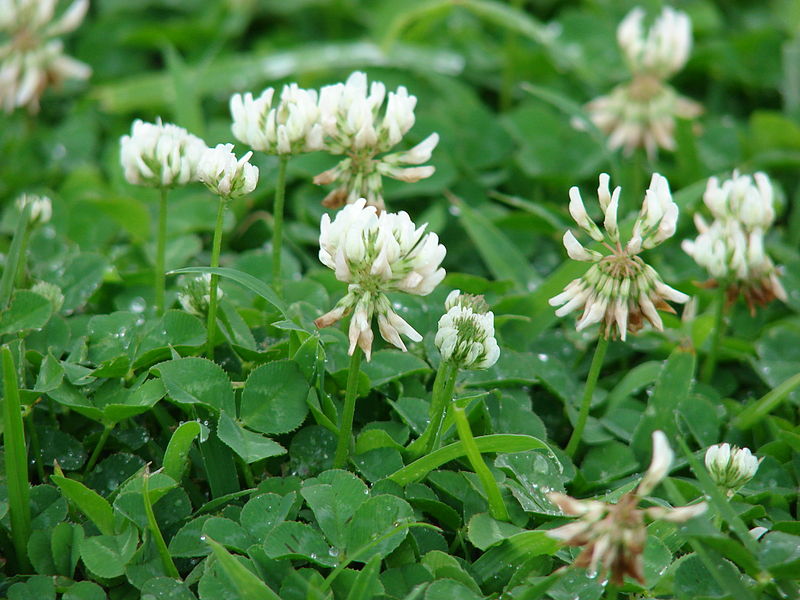
The Shamrock, contrary to expectations, cannot be said to be a specific plant. It is of course a kind of clover but which one? People writing about it frequently state that it is generally accepted that the most likely candidates are the species Trifolium dubium (variously called Lesser Trefoil, Suckling Clover, Little Hop Clover and Lesser Hop Trefoil; Irish: Seamair bhuí), with yellow flowers or the white-flowered Trifolium repens (White Clover; Irish: Seamair bhán).  But which one?  Well, excuse the pun but take your pick.

Trifolium dubium, the lesser clover, an seamair bhuí, top of the candidate list for the “shamrock” title.
(Photo: Internet)


Generally accepted by whom? One supposes by botanists and Irish folklorists but those sites rarely supply a reference. However, amateur botanist and zoologist Nathaniel Colgan (1851-1919) asked people from around Ireland send him specimens of what they believed to be an Irish shamrock and identified the five most common plant species, of which the two most common were the yellow clover followed by the white. A hundred years later, Dr Charles Nelson repeated the experiment in 1988 and found that yellow clover was still the most commonly chosen. According to Wikipeida, yellow clover is also the species cultivated for sale in Ireland on Saint Patrick’s Day and is the one nominated by the Department of Agriculture as the “official” shamrock of Ireland.

The word “shamrock” is an Anglic corruption of the Irish seamróg, itself a contraction of seamair óg, meaning a sprig of young clover. The Irish shamrock is usually the species Trifolium dubium (lesser clover; Irish: seamair bhuí), with yellow flowers or the white-flowered Trifolium repens (white clover; Irish: seamair bhán).

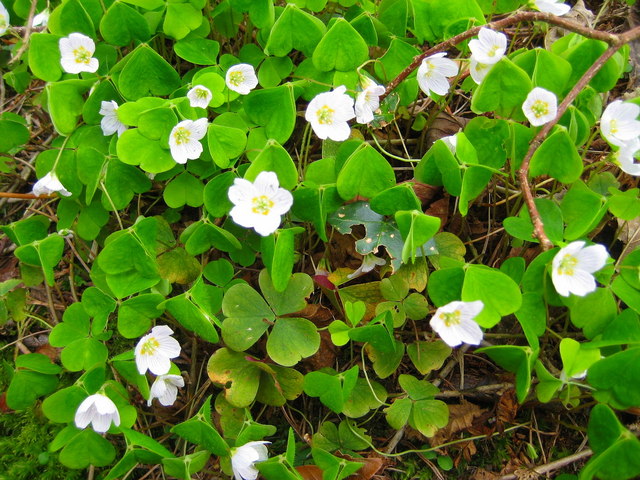
A trawl through the internet looking for images of shamrock plants throws up a bewildering multiplicity of images of trefoil plants, the only thing they have in common being that they are (mostly) green. It soon becomes apparent that many of the images are taken from a different genus, that of oxalis, usually the one named wood-sorrel (Oxalis acetosella) in English-speaking Europe1.

People today should know better. Edmund Spenser, an anti-Irish colonist and commentator on Irish culture, also poet and ancestor of the late Princess Diana, reported the Irish eating shamrock and so have some other colonial observers but almost certainly what they observed was the Irish eating the wood-sorrel – in Ireland it has some common names associated with eating. Spenser and other colonists can be blamed for many things but not that confusion – they were not botanists and did not have access to the Internet. Also, seamsóg, the Irish name for wood-sorrel, does sound a bit like seamróg, especially if one is not listening carefully. The confusion can be continued in English, where the common sorrel (Rumex acetosa) is a completely different plant and a common enough culinary one.

Many species of the genus oxalis close their leave sand flowers at night – a handy trick which the trifolii do not have; indeed, try as they may, trifolii could not possibly close their flowers since each one is in the form of a cluster, while those of oxalis tend to be trumpet-shaped.

Wood Sorrel — defintely not the shamrock, despite numerous claims since Edmund Spenser, the Elizabethan poet.
(Photo: Internet)

The wood-sorrel grows typically in woods which are shady but not too dark and is characterised, as with many other oxalis, by an acidic taste in the stems. As children in the area in which I grew up in south Co. Dublin we chewed the stems of a cultivated species with large green leaves and pink flowers, commonly grown in window-boxes and gardens and known to us by the name of “Sour Sallies”.

The shamrock (both varieties of trifulium) grows best in meadows receiving a fair amount of sunlight, in among grasses. It belongs to the clovers, a different family completely from oxalis, belonging in turn to a very large group of plants as different in appearance from one another as peas and beans on the one hand and furze (also known as gorse) on the other (but many bearing fruit pods). They are the legume group, plants that concentrate nitrogen in nodules around their roots, making many of them good crops with which to precede plants that require a lot of nitrogen, such as the cabbage family or cereals.

The expression “in the clover” as an idiom for being successful or having a good time alludes to the alleged fondness of grazing animals for the plants but this is much more likely to be the white clover, Trifolium repens (Irish: seamair bhán) than dubium, as the former grows bigger and thicker. Clovers are important plants not only for grazing animals and nitrogen-fixing but also for bee-keepers, being rich in nectar and pollen.

End


FURTHER READING

https://en.wikipedia.org/wiki/Trifolium_repens

https://en.wikipedia.org/wiki/Trifolium_dubium

http://slowfoodireland.com/food/foraging/wild-sorrels/

https://en.wikipedia.org/wiki/Oxalis

https://en.wikipedia.org/wiki/Nathaniel_Colgan


FOOTNOTES

1 In North America, Oxalis montana is also called “common wood sorrel”.

THE SHAMROCK AND THE COLOUR GREEN – NATIVE OR FOREIGN IMPORTS INTO IRISH ICONOGRAPHY?

Diarmuid Breatnach

We are long accustomed to the association of these two symbols with Irish ethnicity and nationalism, the shamrock and the colour green — but historically can they be shown to be authentically Irish?

Shamrock closeup
(Photo sourced at Internet)


The shamrock symbol has been used by a number of products and services, including Aer Lingus, formerly the Irish national airline and now a subsidiary of the International Airways Group1. Both as a plant and a living symbol it is now being sold on the streets and in shops in preparation for the celebration of the male patron saint of Ireland, St. Patrick on March 17th.

St. Patrick himself was a foreign import, albeit one seized unwillingly by Irish raiders. The son of a Romanised Celt it seems and probably from Wales, Patricius was kept as slave labour herding sheep until his escape but he returned as a Christian missionary and became one of the founders of the Celtic Christian Church in Ireland. 

We may view this as an amazing feat in itself – Ireland was one of the few European countries which went from the old multi-gods religion to the monotheism of Judeo-Christianity in a largely peaceful transition. However the Celtic Church at least tolerated and many would say condoned many of the laws and customs of the old culture, including marriage of priests, the right to divorce by men or women and a higher status for women than was common in an increasingly feudal Europe.

The word “shamrock” is an Anglic corruption of the Irish seamróg, itself a contraction of seamair óg, meaning a sprig of young — or more likely small –clover. The Irish shamrock is usually the species Trifolium dubium (lesser clover; Irish: seamair bhuí), with yellow flowers or the white-flowered Trifolium repens (white clover; Irish: seamair bhán) with the bias towards the yellow-flowered.

Children at schools influenced by the Catholic clergy in Ireland (which was and still is in control of the vast majority of the schools within the Irish state) were taught that St. Patrick used the shamrock to illustrate the existence of the Christian Holy Trinity of the Father, Jesus Christ and the Holy Ghost, i.e. explaining how there may be three different aspects in one entity, as in the three leaves on the one stem of the shamrock.

A charming story but clearly without any foundation whatsoever – not only is it not mentioned in what is believed by historians to be Patrick’s autobiography but the story only emerged much later. However, the crucial case against the veracity of the story is that neither the Gaels nor the Celts in general2 had any need to be convinced of the existence of trinities of gods: in Ireland we already had the Morrigan, a female trinity of Badhb, Macha and Anand and of course the Celts had the ubiquitous triskele symbol (surviving as the national symbol of Manx) to illustrate a trinity, religious or otherwise. 

The first clear association of the shamrock with St. Patrick in Ireland comes in an account by an English traveller to occupied Ireland, Thomas Dineley, who described in 1681 Irish people on St. Patrick’s Day wearing green on their clothes, including the shamrock. But the first account of St. Patrick’s use of the shamrock is not seen until 1726, when it appears in a work by Caleb Threlkeld, a botanist.

But what of the colour green? Surely that at least is authentically Irish? Well, it certainly has a longer pedigree. Dineley’s account in 1681 associates wearing green with the celebration of the feast day of St. Patrick’s, one of the three patron saints of Ireland3 (yet another trinity?). But the Catholic Confederacy of 1642-1652, an alliance of Gaelic chieftains with Norman-Irish aristocracy against the Reformation being imposed upon them, also flew a green flag, with a gold harp upon it.

The symbol of Ulster was the Red Hand from an ancient Irish myth of arrival but what was the background? Both the O’Neills and O’Donnells, dominant clans of Ulster, have designs in red and blue against a white background. Only Leinster province has a design in green and yellow.

BLUE?

The colour of an old design for Meath is blue. There is an old heraldic design for Ireland of three crowns on a blue background and although this was the arms granted by Richard II of England to Robert de Vere as Lord of Ireland in 13864, over two centuries after the Norman invasion, it may have drawn on the colour of an existing Irish flag or design.

The Wikipedia page on the Coat of arms of Ireland, although commenting that heraldry is a feudal practice suggests an older inspiration:

The colour of the field is sometimes called ‘St. Patrick’s blue’, a name applied to shades of blue associated with Ireland. In current designs, used by the UK and Irish states (sic), the field is invariably a deep blue. The use of blue in the arms has been associated with Gormfhlaith, a Gaelic mythological personification of Ireland. The word Gormfhlaith is a compound of the Irish words gorm (“blue”) and flaith (“sovereign”); it is noted in early Irish texts as the name of several queens closely connected with dynastic politics in the 10th and 11th century Ireland. The National Library of Ireland, in describing the blue background of the arms, notes that in early Irish mythology the sovereignty of Ireland (Irish: Flaitheas Éireann) was represented by a woman often dressed in a blue robe.”

The designers of the Cumann na mBan flag may have been aware of the ancient claim of the colour blue when they made that the background colour of their own flag.  Markievicz and Hobson would even more likely have been aware of it as well as the blue with an orange, golden or silver sunburst, alleged flag of the legendary band of warriors na Fianna, when they made that the flag of the Republican youth organisation they founded, Na Fianna Éireann.

THE GREEN FLAG

But what about the United Irishmen’s flag of green, with a golden harp? When talking about the United Irishmen we need to remember from where they received their ideological influences. These were mostly from radical and republican thinkers and agitators in Britain, the USA and France. The United Irishmen organisation was founded by Anglicans and Presbyterians, mostly colonists and settlers or their descendants and most of their leadership in the uprisings of 1798 and 18035 came from from among that section of Irish society. That goes a long way to explaining why most of the revolutionary texts of the time are in the English language, in a country where the majority even then still spoke Irish and with a rich literary and oral tradition in the Irish language.

United Irishmen harp motif with motto.
(Photo sourced at Internet)

There is a historical trend among colonists to feel disadvantaged with regard to their compatriots back in “the mother country”, to resent levels of taxation, to complain of inadequate representation and of corrupt or inefficient government. This occurred in English-speaking America and led to the American Revolution and the creation of the United States. It also occurred in the other America, where the Spanish-speaking colones developed conflicts with the Spanish Kingdom and eventually rose in rebellion against it across South and Central America, eventually gaining independence for a number of states.

A similar process was taking place in Ireland, where the disaffected who belonged to the established church, the Anglican or Church of Ireland, understood that to create a strong autonomous nation, even as part of the English-ruled unity of nations, they would need to bring into government the greater majority, the Presbyterians 6 and even the overwhelming majority, the Catholics (i.e the native Irish).

Henry Grattan attempted this by trying to get the excluded denominations admitted to the Irish Parliament but Crown bribery, sectarianism or fear of having to return lands grabbed by their grandparents or others, combined to have a majority vote the proposals down. That ensured that the organisers of the United Irishmen would realise that no progress to their objectives was possible without revolution.

Irish nationalists among the descendants of colonists often adopted Irish symbols and some other Irish identifiers as a sign of difference from the English. There was some interest in the Irish language but it does not appear to have been widely studied by most Irish Republicans of the time as witnessed by the incorrect appellation of “Erin” for Ireland – any Irish-speaker would know that Éire is the nominative form for the country and ‘Éireann’ is employed in the genitive and dative cases. United Irishmen were involved in organising the Belfast Harp Festival of 1792, while folk-song collectors and antiquarians dug among the people and archives for survivals of an older Irish culture.

The Harp, an ancient Irish musical instrument employed also to accompany poetry recitation was employed as a symbol by the Unitedmen — often with the motto “ ‘Tis new-strung and shall be heard”. In addition, the English had long recognised the instrument as a symbol for Ireland, albeit under the Crown.

THE COLOUR GREEN

But where did the colour green come from to be associated with Irish nationalism? This question could do with more research than I have the time or other facilities to devote to it but one may comment what green is not: it is neither the Red of Royal England nor the Blue of Royal France. Nor is it the red with a white saltire of the Order of St. Patrick, another colonial creation and clearly of Royal and colonial origin and patronage, created at the time of a bubbling of the nationalist pot in Ireland and only sixteen years before the 1798 Uprising.

Interestingly, the Irish Brigade (1688–1791) of the French Army did include the colour green in its flag design, four quarters alternately green and red, with a crown in each. And the standard of Napoleon’s La Légion Irlandaise in 1841 is described as of “emerald green”.

Regimental colours of one of the irish Regiments of the French Royal Amy, De Berwick, until 1791. (Photo sourced at Flags of Ireland — see Further Reading for link)


William Drennan (1754–5 February 1820), United Irishman, is credited with first use of the description “Emerald Isle” in his poem When Erin First Rose and it was much later re-used in the ballad Bold Robert Emmet. John Sheils, a Drogheda Presbyterian and United Irishman, employed the harp, the colour green, St. Patrick, Erin (sic) and the shamrock all in his song The Rights of Man, which he composed some years prior to the 1798 Rising. The “three-leaved plant” which is “three in one” is used in Sheils’ song:

to prove its unity in that community

that holds with impunity to the Rights of Man”

The trinity there is clearly the political one desired by the Unitedmen of Protestant (Anglican), Catholic and Dissenter (Presbyterian and other sects).

Green was widely worn by people with United Irish sympathies and particularly during repression by Orange militia, people wearing green were targeted. However, if one wanted to wear a suspect nationalist colour, how safer than to do so than on the feast day of the alleged founder of Christianity in Ireland and acknowledged by Protestant, Sects and Catholics alike?

From the United Irishmen onwards, green has been unarguably associated with Irish nationalism and Irish Republicanism, in the flags of the Fenians, the Irish Volunteers and even of the Irish Citizen Army, also part of the tricolour flag awarded by Parisian revolutionary women to the Young Irelanders which is now the national flag of the Irish state. Green was also the colour of the flag of the St. Patrick’s Battalion that fought for Mexico against the invasion by the USA (1846-’48) and of ceremonial uniforms of some Irish formations during the American Civil War along with the main colour of some of their regimental flags, also of the flags of the Fenian veterans of that war invading Canada in 1866.

Flag of the Irish Brigade (later the Fighting 69th) in the Union Army, American Civil War.
(Photo sourced at Internet)

Does it matter whether green is authentically an ancient Irish colour or not? Would Irish Republicanism or nationalism be de-legitimised if it could be proven the colour they are using was of dubious origin or of comparatively recent political significance for Ireland? I don’t think so. But it is good to be aware of the different origins of symbols and to question and even challenge what is handed to us as unquestionably authentic.

However, enough people have now fought under the green in eight uprisings in Ireland and struggles abroad; enough people have laid down their lives under the colour and indeed, once it became a symbol of Irishness, enough Irish have been persecuted, prosecuted and even executed for wearing it, to ensure that “wherever green is worn” can be Irish. And in that representation, the shamrock too, which of course happens to be green, and could be passed off as a devotional symbol to suspicious authorities and murderously insecure and sectarian minorities of colonial origin, has its place.

Painting depicting the Battle of Ridgeway, Fenian invasion of Canada, 1866. (Photo sourced at Wikipedia)
The Wearing o’ the Green

(by John Keegan “Leo” Casey (1846 – March 17, 1870). Keegan, known as the Poet of the Fenians, was an Irish poet, orator and republican who was famous for authorship of this song, apparently written when he was 15 and also as the writer of the song “The Rising of the Moon” (to the same air), also as one of the central figures in the Fenian Rising of 1867. He was imprisoned by the English and by a huge irony died on St. Patrick’s Day in 1870 at the age of 24).

O Paddy dear, and did ye hear the news that’s goin’ round?

The shamrock is by law forbid to grow on Irish ground!

No more Saint Patrick’s Day we’ll keep, his colour can’t be seen

For there’s a cruel law ag’in the Wearin’ o’ the Green.”

I met with Napper Tandy7, and he took me by the hand

And he said, “How’s poor old Ireland, and how does she stand?”

“She’s the most distressful country that ever yet was seen

For they’re hanging men and women there for the Wearin’ o’ the Green.”

So if the colour we must wear be England’s cruel red

Let it remind us of the blood that Irishmen have shed

And pull the shamrock from your hat, and throw it on the sod

But never fear, ’twill take root there, though underfoot ’tis trod.

When laws can stop the blades of grass from growin’ as they grow

And when the leaves in summer-time their colour dare not show

Then I will change the colour too I wear in my caubeen

But till that day, please God, I’ll stick to the Wearin’ o’ the Green.

But if, at last, her colours should be torn from Ireland’s heart

Her sons, with shame and sorrow, from the dear old soil will part;

I’ve heard whispers of a Country that lies far beyond the sea,

Where rich and poor stand equal, in the light of Freedom’s day!

O Erin! must we leave you driven by the tyrant’s hand!

Must we ask a Mother’s blessing, in a strange but happy land,

Where the cruel Cross of England’s thralldom’s never to be seen:

But where, thank God! we’ll live and die, still Wearing of the Green!

End.

John ‘Leo’ Keegan Casey monument, Glasnevin Cemetery, Dublin (Photo sourced at Wikipedia)

FURTHER READING

An undated interesting article about the origins of Irish national symbols (also giving a list of additional reading) http://www.gov.ie/en/essays/symbols.html

https://en.wikipedia.org/wiki/List_of_flags_of_Ireland

https://en.wikipedia.org/wiki/Coat_of_arms_of_Ireland

Reference to colour green in the standard of Napoleon’s Irish unit La Légion Irlandaise http://www.irishtimes.com/culture/heritage/enlisting-for-my-enemy-s-enemy-1.1779145

and in some uniforms and flags of Irish formations in the Union Army in the American Civil War https://www.abebooks.com/book-search/title/new-yorks-fighting-sixty-ninth-regimental/author/john-mahon/ and

https://www.amazon.com/Rising-Moon-Peter-Berresford-Ellis/dp/0312006764

https://en.wikipedia.org/wiki/Shamrock

About Leo Casey http://www.irishidentity.com/extras/gaels/stories/leocasey.htm

FOOTNOTES

1A consortium of Iberia, Vueling and ironically, British Airways.

2Nor indeed other cultures such as the Hindi or the classical Greeks

3Sts. Patrick, Bridget and Columcille

4It continued in use until 1541

5 And even many of the leaders, journalists and poets of the Young Irelanders and of the Fenians.

6And other “Dissenters” such as Unitarians, Methodists, Society of Friends (Quakers) etc.

7Napper Tandy was a United Irishman who lived in Dublin; his home is mentioned in the most common versions of the well-known Dublin song, The Spanish Lady.

A VERBAL HANGING IN DUBLIN’S THOMAS STREET

Clive Sulish

While eastbound drivers in Thomas Street on Friday 3rd March gawped, traffic slowed in the westbound lane to allow az small procession pushing a gallows, trundling along on wheels. There were surprisingly few witty comments, even the notoriously quick Dubliners too surprised to come up with a witty bon mot (or even a focal maith).

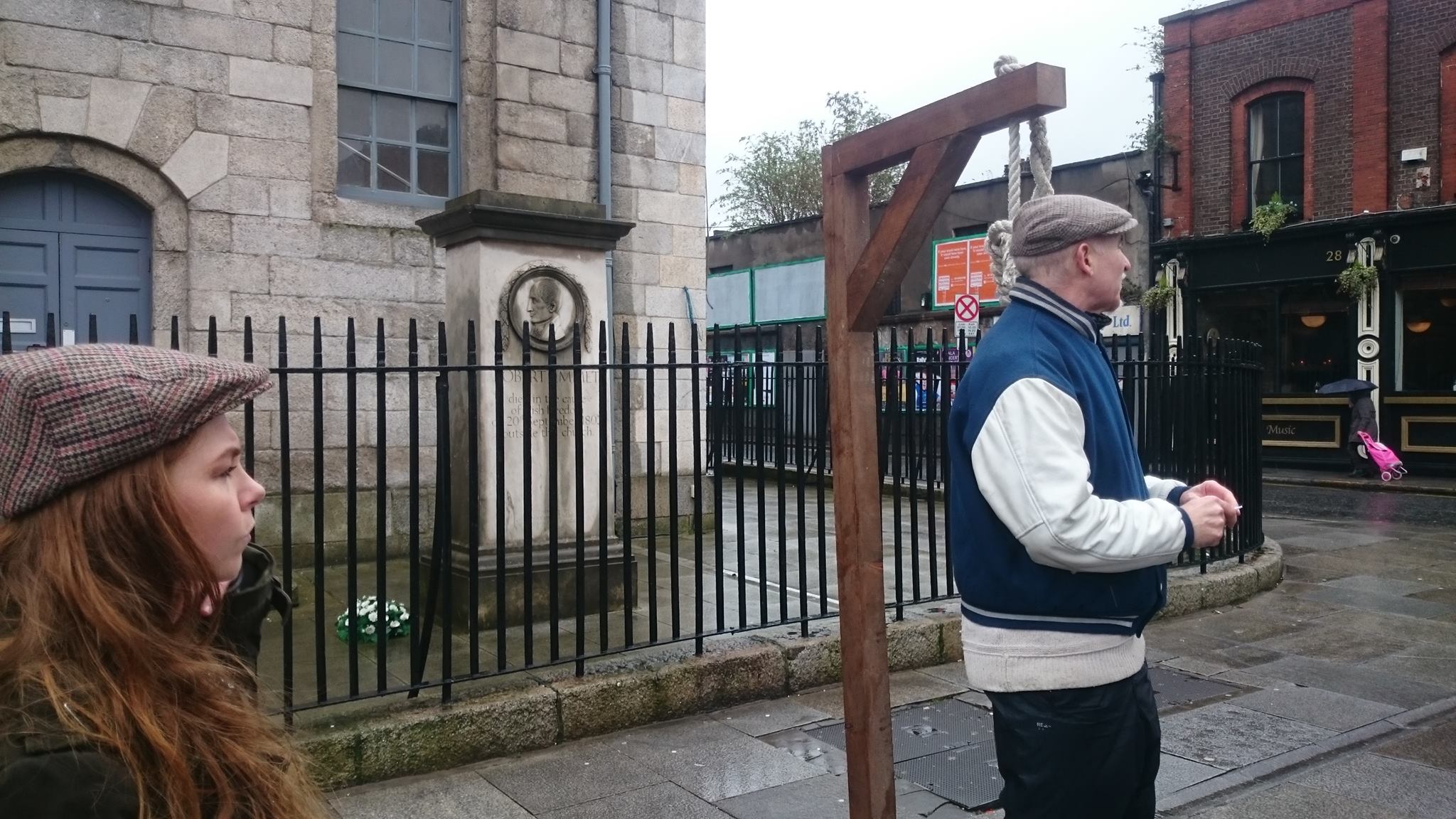
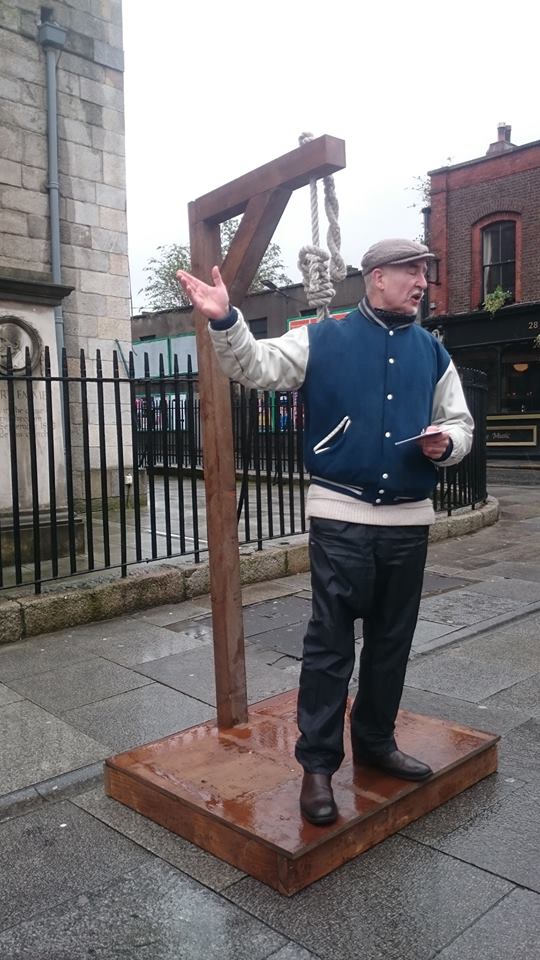
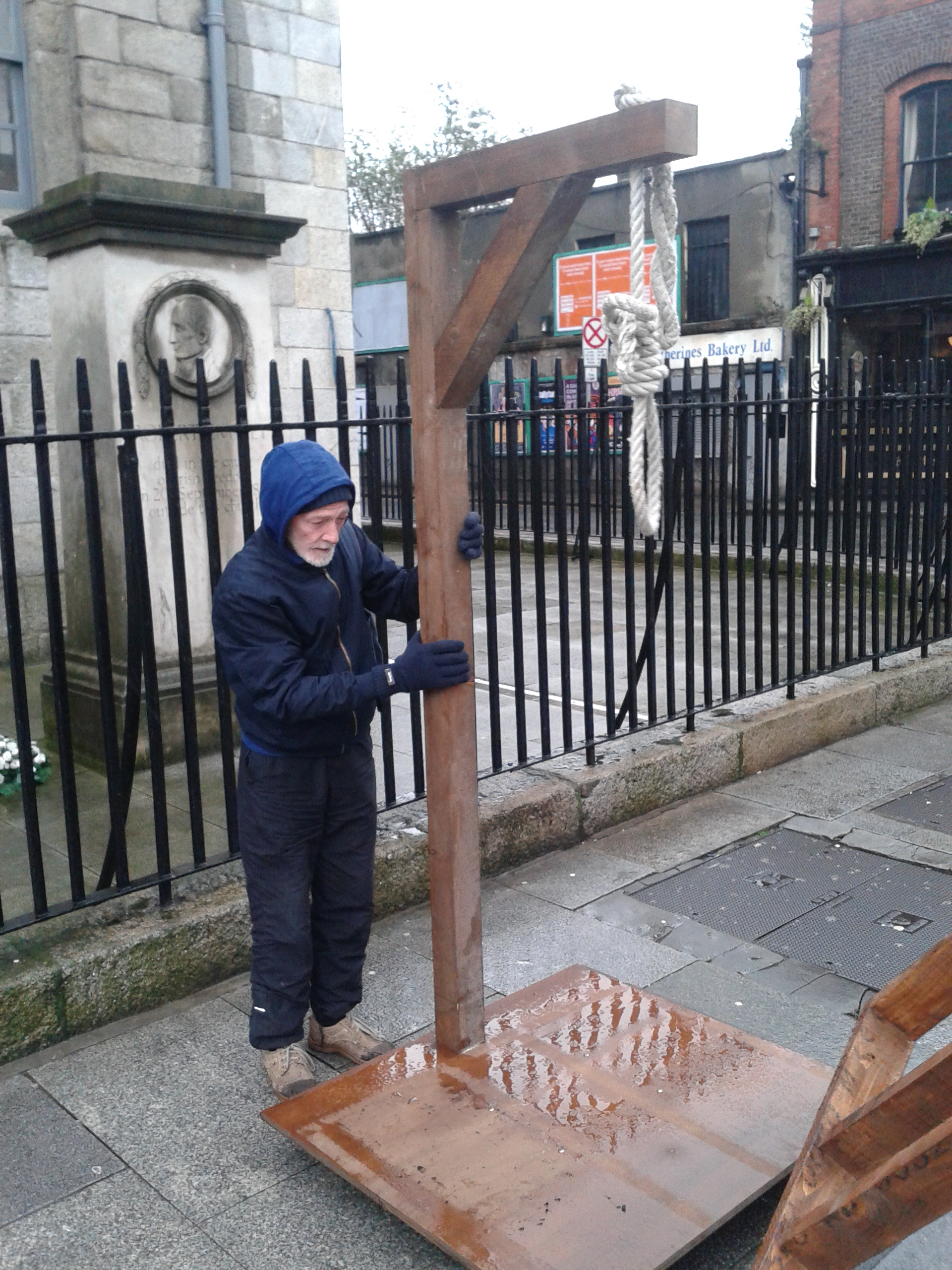
Diarmuid Breatnach outside St. Catherine’s Church, Thomas Street.
(Photo: /////)

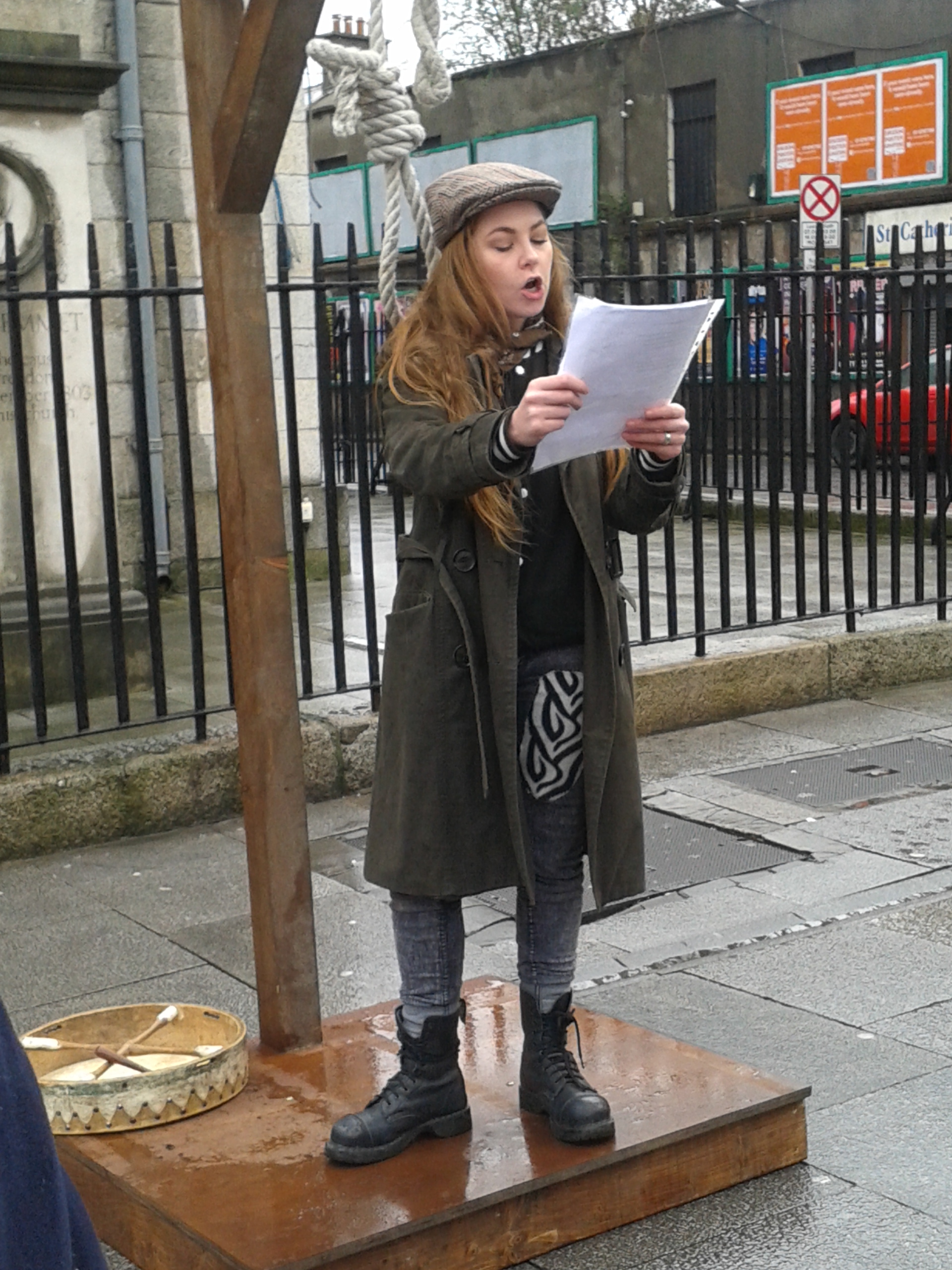
The procession stopped at the Robert Emmet plaque, in the railing wall of the former Protestant St. Catherine’s Church, approximate place of execution of Robert Emmet on 20th December 1803.

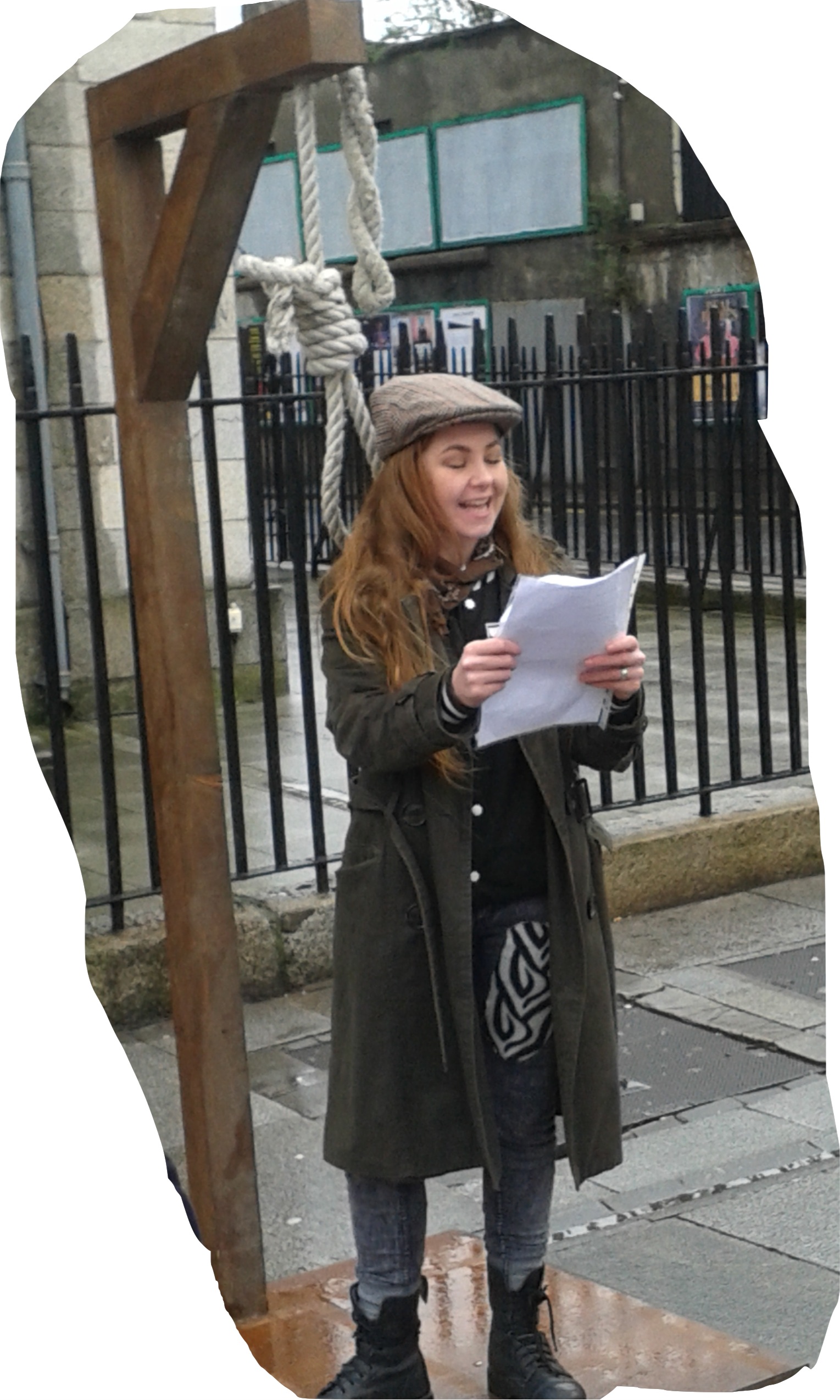
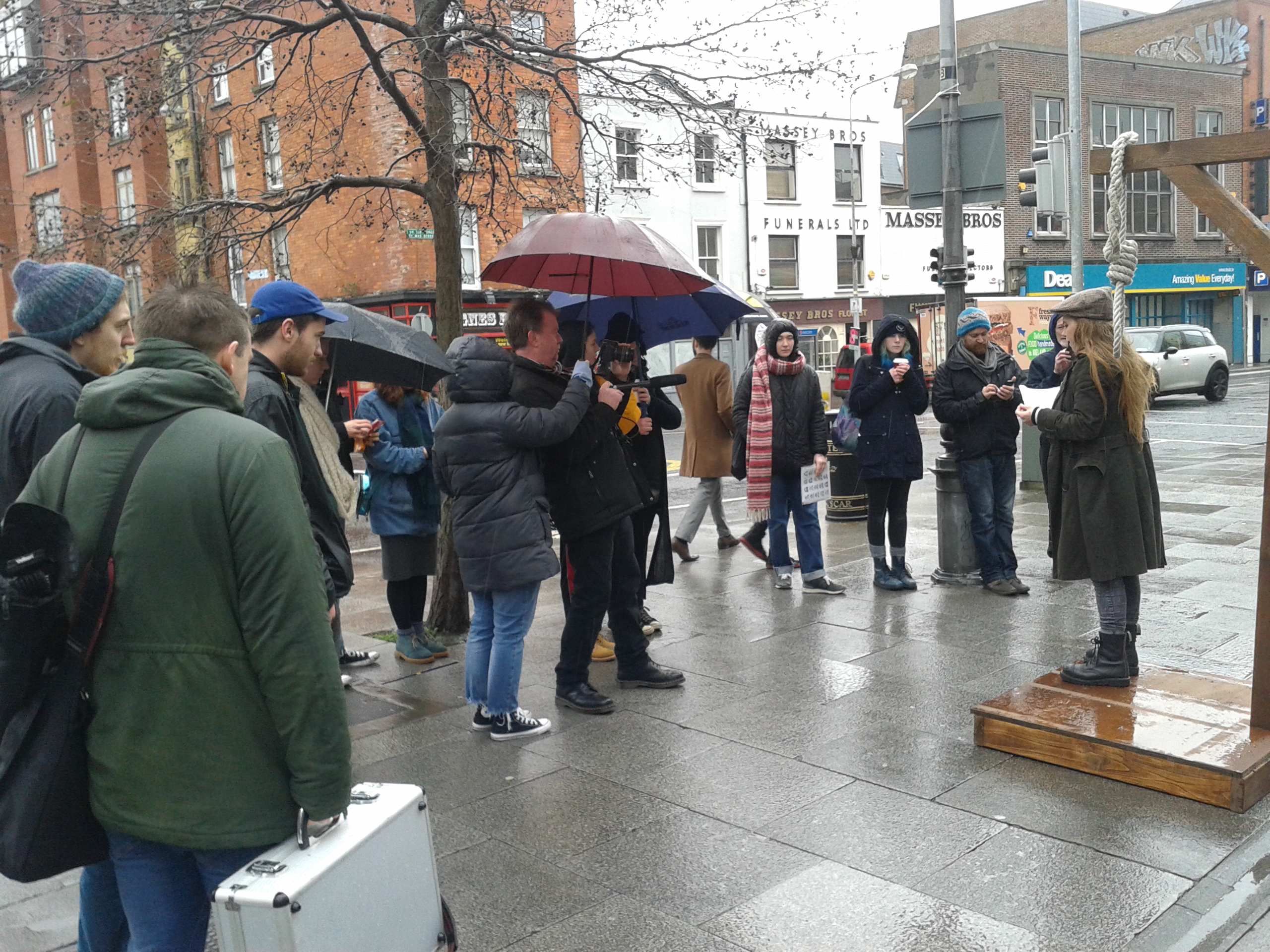
Elayne Harrington, aka Temperamental MiscElaynous performing her piece outside St. Catherine’s Church, Thomas Street.
(Photo: D.Breatnach)

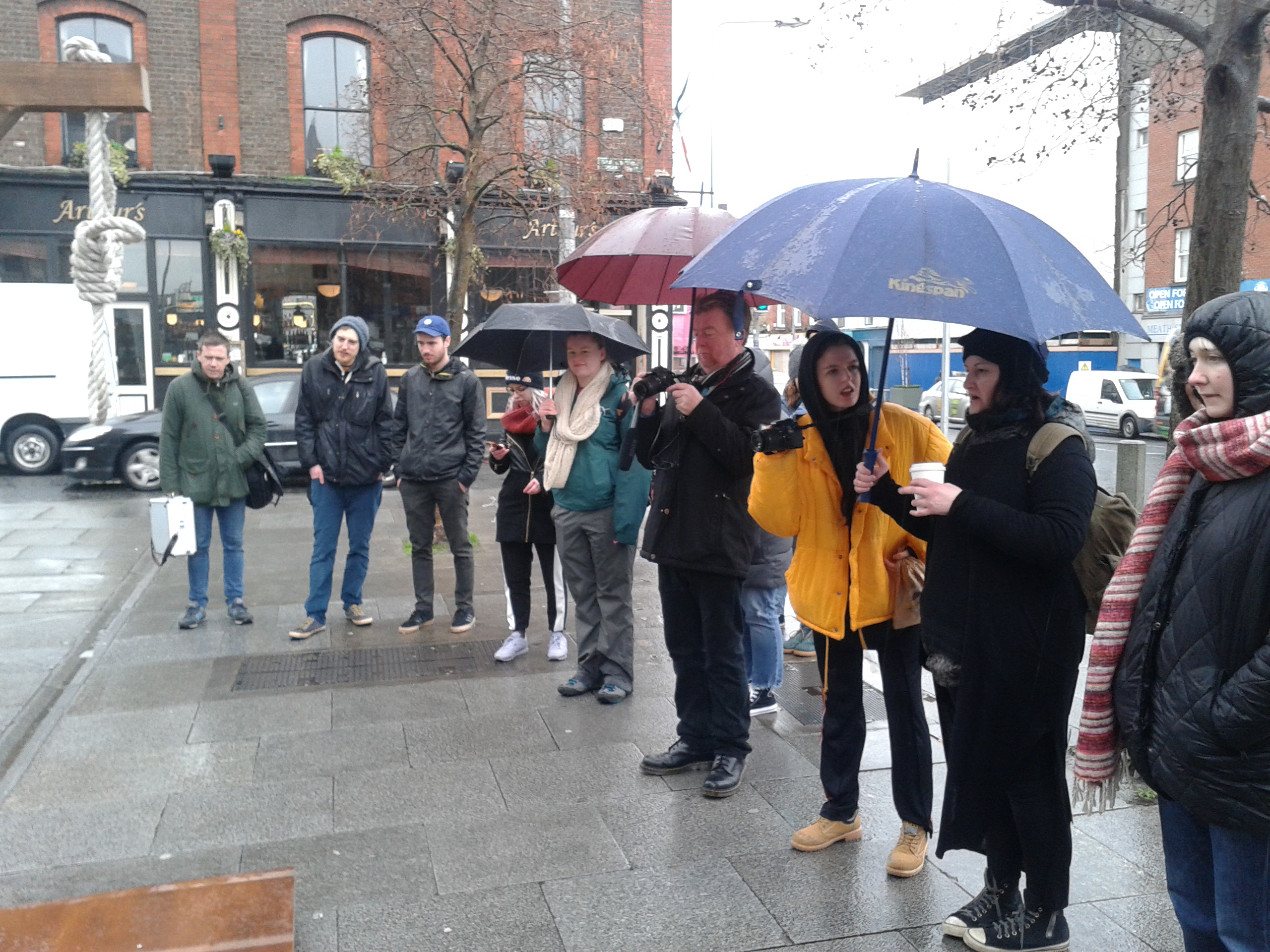
Despite continuous rain a small crowd had gathered on the pavement in front of the monument and the gallows, with a small platform less than a foot high, was placed facing them. Dublin artist Elayne Harrington, also known as the well-established street poet/ rapper artist from Finglas, Temperamental MiscElayneous, stood on the platform to announce that the event was to honour Robert Emmet and was a project as part of the Liberties Street Project, a continuation of the IPIP (In Public In Particular) program at the National College of Art and Design, Thomas Street, Dublin 8.

Harrington thanked people for attending despite the weather and, after outlining the program for the event, announced Diarmuid Breatnach, who took up position with the gallows and hanging noose just behind him.

Breatnach is best known as a co-founder of the Save Moore Street From Demolition campaign, maintaining a campaign table with a petition and leaflets on the market street for a few hours every Saturday but is also known as an acapella singer, particularly in Dublin traditional-folk circles.

Section of the crowd at the event outside St. Catherine’s Church, Thomas Street.
(Photo: D.Breatnach)

After thanking MiscElayneous for the invitation and the crowd for attendance, Breatnach proceeded to reiterate that the event was taking place very near the spot where, at the age of 25, Robert Emmet had been hung and then decapitated by the British colonial administration in 1803.

Harrington reminded him to stand on the low platform which Breatnach did, drawing a laugh from the crowd when he indicated the hanging noose and commented: “Me Ma always said I’d end up like this.”

Breatnach asked the audience to imagine the scene of the execution in 1803 and referred them to a painting of the scene available on the Internet, showing a huge crowd, with people looking out of windows in nearby buildings and mounted redcoats keeping the crowd back from the gallows. Many of in the crowd would have been supporters but the better-known would not have been there – they were in jail or in hiding.

The execution was carried out there, Breatnach said, because the whole Thomas Street and Liberties was known as a revolutionary area, which Breatnach went on to describe (see video below).

Elayne Harrington, aka Temperamental MiscElaynous performing her piece outside Stl Catherine’s Church, Thomas Street.
(Photo: D.Breatnach)

Executions, said Breatnach, have been carried out down through the ages on Irish people resisting invasion, colonialism and imperialism and fighting for social justice. The gallows have become an enduring image in Irish history and a number of songs (Breatnach mentioned ten from the 19th century up to the present) refer to it.

The state we have now, said Breatnach, set up in 1922, preferred shooting, which was the method by which it eliminated its opponents at the time, 81 of them in official executions. Hanging remained however in this state but the last execution was in 1954.

Breatnach stated that we are often taught history as a dead subject, something in the past to which we are largely unrelated but he believed history to be a living thing, in the stones of walls and streets, in the air and in the words people have left us. And in our songs.

Breatnach selected three songs that mentioned Robert Emmet: The Three Flowers, written early last Century by Norman G. Reddin (two verses); Bold Robert Emmet perhaps by Tom Maguire around 1916 but certainly published in 1934; and Anne Devlin in recent decades by Pete St. John. Breatnach sang the three songs one after the other with MiscElayneous accompanying on her bodhrán.

Diarmuid Breatnach outside St. Catherine’s Church, Thomas Street, talking about the radical revolutionary history of the area.
(Photo: ////)

During the applause which greeted the end of Breatnach’s performance, Elayne Harrington replaced him on the stage, thanked him and introduced herself as Temperamental Miscellaneous and spoke about her contribution, which was to be an extract of Emmet’s famous speech from the dock in the Green Street Courthouse, but re-worked into more modern Dublin idiom. Harrington then launched into a spirited rendition of her piece (see video below for the full performance).

No matter what words I utter, it’ll fail to change your mind and I wouldn’t have it any other way. You’ve made me a bed and I’ll lie in it. ………….

There’s plenty I could tell why my reputation should be kept clean from the utter lies and slander which’ve been lashed upon it. ……………

I wouldn’t dream that I could impress upon a court as trapped in its own self and corrupted, a fair impression of my character. …………………….

If merely dying was the case, after being deemed in the wrong and you in the right I’d take it on the chin and I wouldn’t breathe a word but that same law that not only wants to get rid of me also aims at filthying my name and sullying the memory of me. ……………..

In the hope that my memory won’t fade and that it might retain its honour among my brothers and sisters, I’ll stand up for myself and my integrity and weaken those charges against me. ……………

…. our cloths are entwined, mine and the martyred heroes of the gallows and battlefield, consecrated by sacrifice … for protection and guardianship of their homestead and their righteousness. ………..

This is what I hope: for my memory and name to serve those who live on by it being a source of empowerment …. witness the malignant malicious government that gains its false riches through sin alone, that treats a people as wolves to be domesticated and blooded to the taste of their fellows, to dance to their tune and to the death knell ……………..

Concluding the event, Harrington thanked the attendance and invited them to place small pots of growing flowers she had provided in front of the monument, which they did.

Stablising the scaffold outside St. Catherine’s Church, Thomas Street.
(Photo: D.Breatnach)

WHY THE EVENT?

What had led Elayne Harrington to choose this act as part of her course?

“I was interested in Robert Emmet and his uprising ever since I heard a Dublin tour guide dismiss Robert Emmet while briefly mentioning his uprising”, explained the rapper from Finglas.

“I came to think that although Emmet failed in his objective, he had attempted a brave and good thing and his speech was really impressive. His uprising attempt took place in the area where my college is and he was executed just down the road, so that’s how I came to think of this event.

“I’m thankful to my course tutor and fellow students for supporting me in this act and to another tutor who helped me with the construction of the gallows. I am grateful to Diarmuid Breatnach also, who has been very supportive and contributed to the performance and I was really glad that my Da was able to be here and help today too.”

Why did Harrington call this “the first of the verbal execution series”?

“I see this as an event that can be brought to other places – like the gallows I built, it is transportable” she says with a grin but then turns serious. “The performances can be adapted also to other occasions of which Irish history is full.”

We’ll be watching this space!

Elayne Harrington and section of audience outside St. Catherine’s Church, Thomas Street, looking eastward (in the direction of Dublin Castle, ten minute’s walk away).
(Photo: D.Breatnach)

VIDEO OF EVENT

(complete event outside St. Catherine’s)

https://www.youtube.com/watch?v=wJmb553yKf8


UNSCIENTIFIC MYTH AND IGNORANCE ABOUT THE IRISH LANGUAGE

Clive Sulish

A most interesting and stimulating lecture was held on Wednesday night at Pearse House in Dublin. Hosted by Misneach, an Irish language campaigning organisation, the lecture was titled “Miotas agus Aineolas faoin nGaeilge” (“Myth and Ignorance about the Irish Language”).


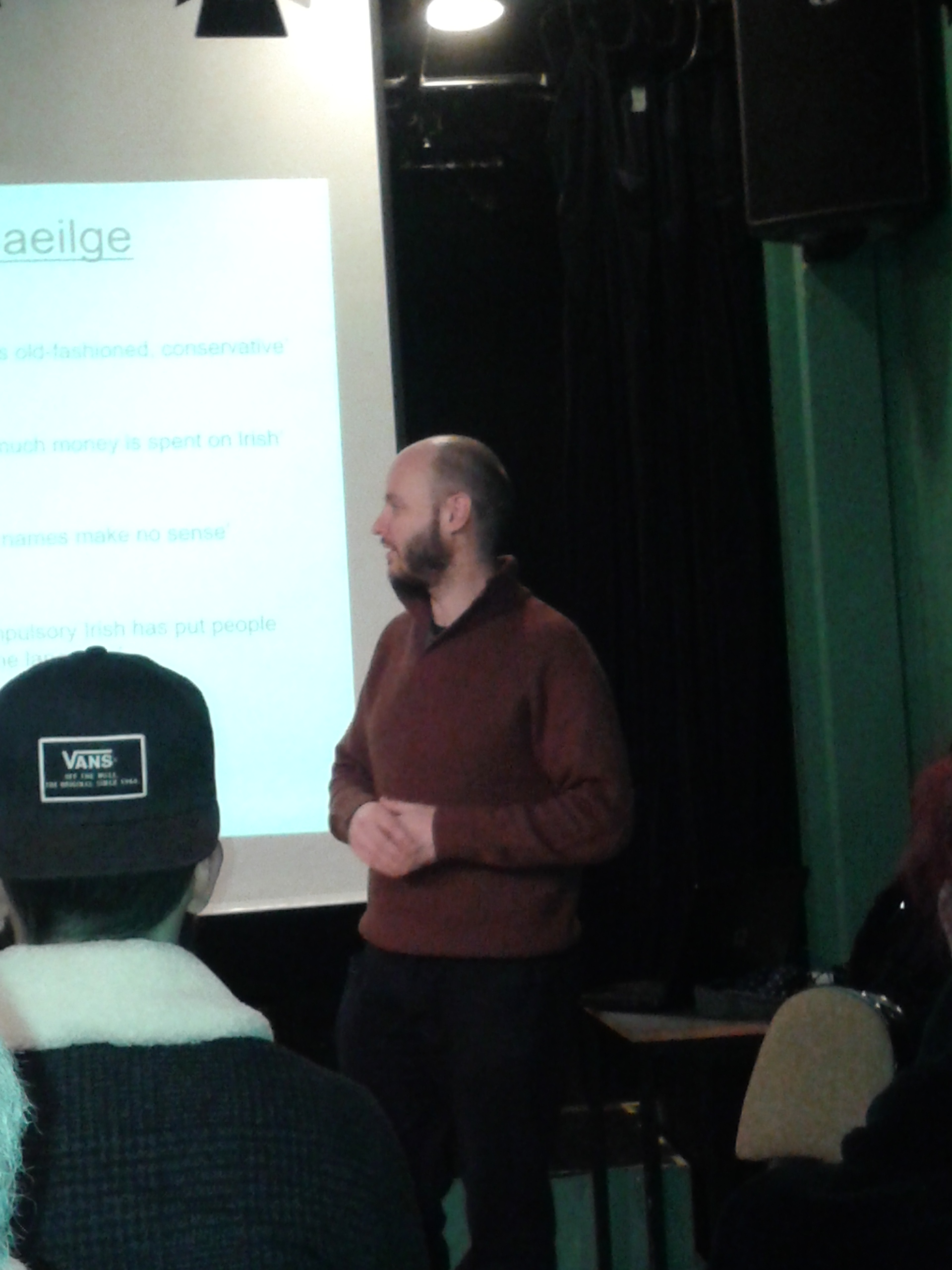
What Colm Ó Broin, who described himself as an Irish language activist, has done is to take a number of frequently-expressed ideas hostile to or dismissive of the Irish language and to deconstruct them, analyse them and compare them with other languages and social situations. For the purpose of the lecture, he took around ten of those ideas, encapsulated in stock phrases well known to Irish speakers and campaigners – and probably to many others not within those categories.

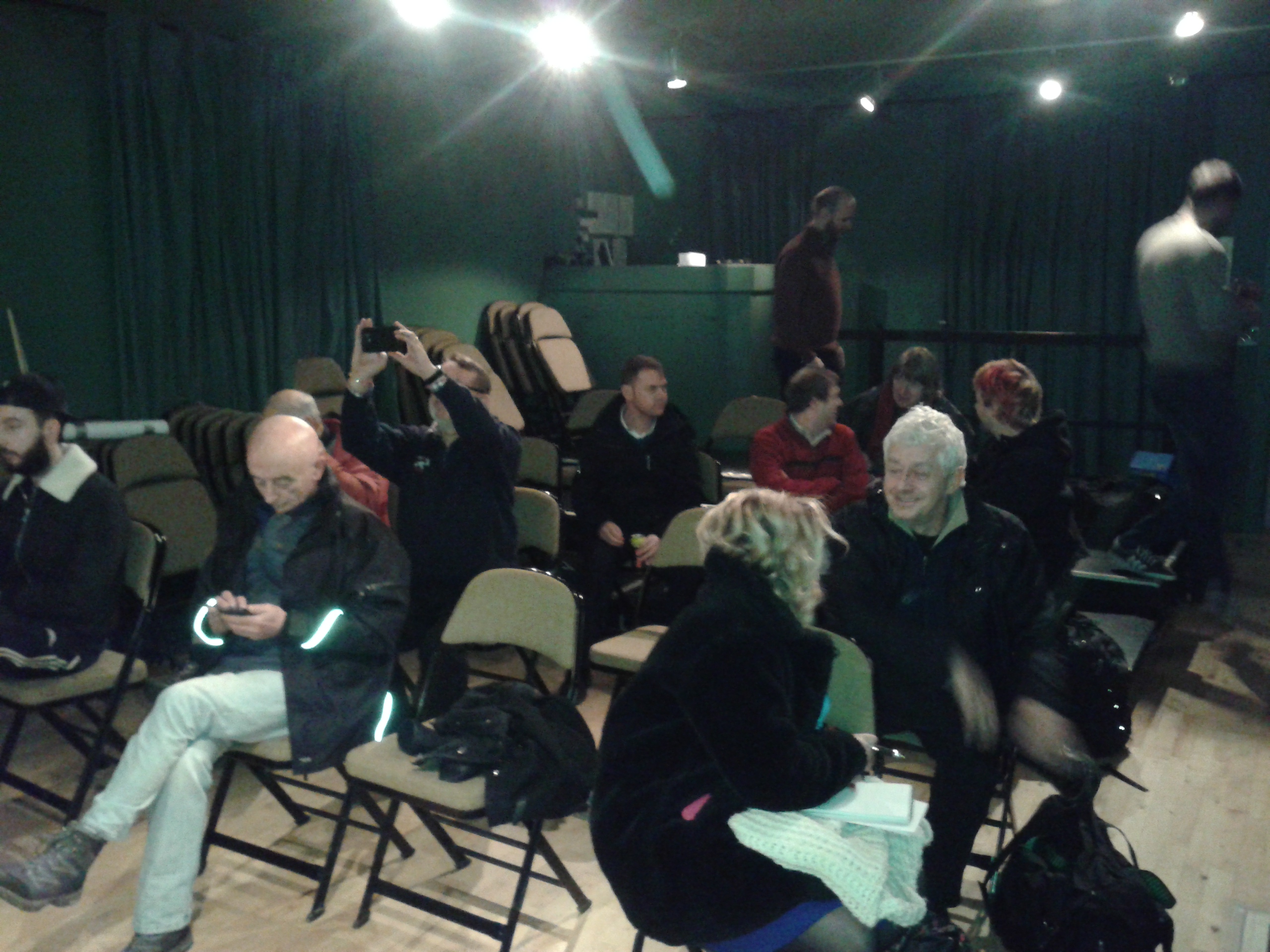
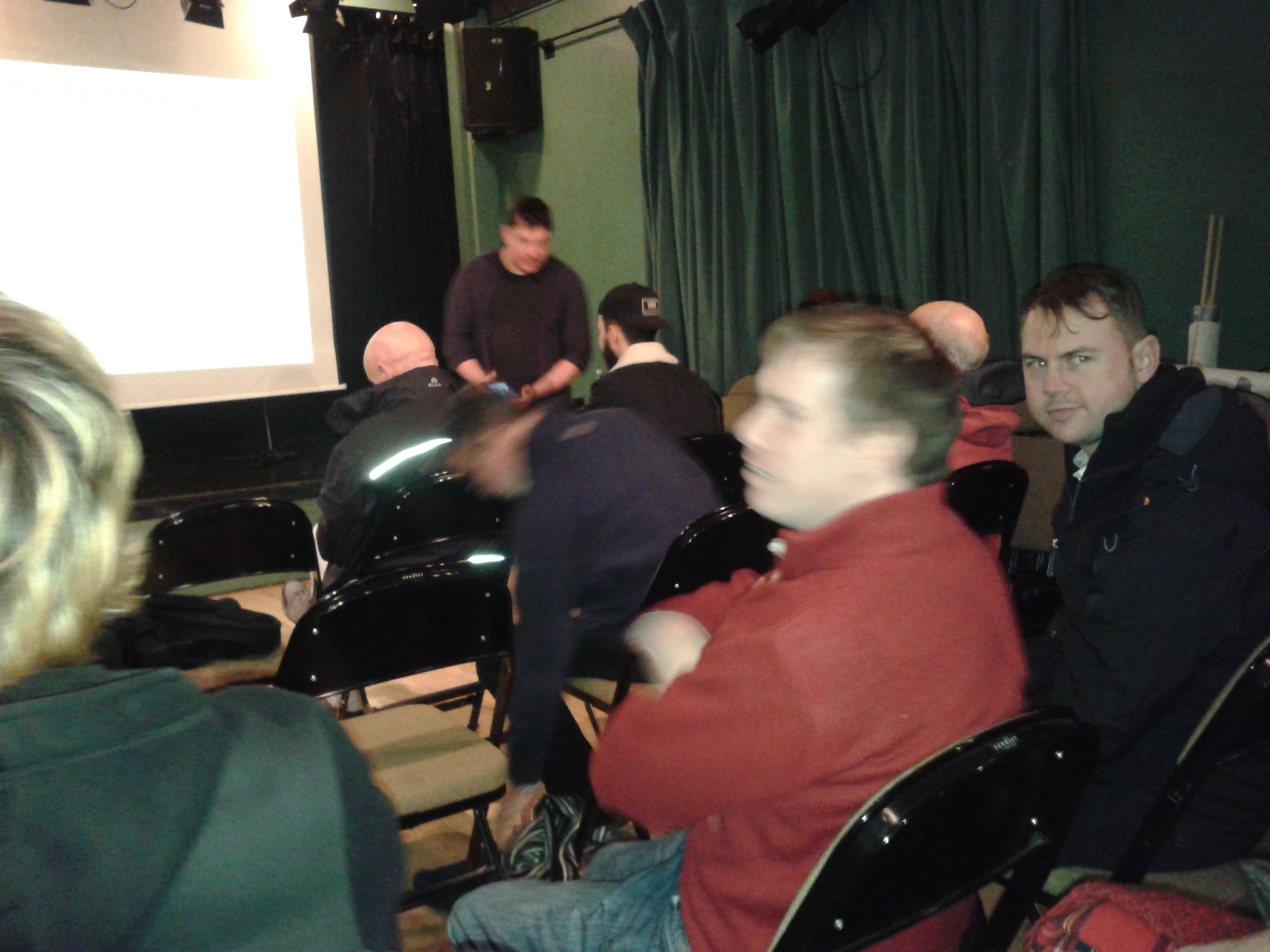
Some of the attendance at the lecture before its start

Over the years, we have heard and read these stock phrases and ideas expressed with tedious regularity, for example that the language is archaic or dead, is full of English words, that it is an expensive commodity, that Irish language schools are elitist, that the language is or was badly taught or that it was “beat into” people. Over the years, many speakers and activists have of course countered these ideas, sometimes by reasoned argument and sometimes by a trenchant phrase, such as: “What, was it only Irish that was bet into you then?” or “Was it only Irish that was taught with an overwhelming concentration on grammar to the exclusion of conversation?”

But Ó Broin has gone about this work scientifically, methodically. For the purpose of his lecture he took around ten of these propositions, deconstructed and exploded them, revealing their underlying lack of logic and scientific fact. For example, dealing with the proposition that the language is dead, Ó Broin produced a long list of living languages around the world – the vast majority, actually – that have less speakers than does Irish. On the allegation that Irish is full of English words, he produced pages of English-language words that are of French origin (leaving aside the easier and also huge list of words or Greek or Roman origin).

Colm Ó Broin, Irish language activist and presenter of the lecture

Having revealed the lack of scientific truth or logic as a basis for hostility or contempt towards the Irish language, Ó Broin turned to psychology as an explanation, finding fear and/or shame as the motivating factor. Turning back to history, he reminded his audience of the Statutes of Kilkenny of 1366, when the England-based descendants of the Norman Conquest of England dating from 1066, attacked the ‘gone native’ customs of the Irish-based descendants of the Norman Conquest of Ireland beginning in 1169 (though Ó Broin did not say so, the English Normans had gone quite ‘native’ themselves by then, integrating with the Saxon nobility and the Statutes were written in English, not French).

The Statutes forbade the Irish Normans (“the degenerate English” who had become “more Irish than the Irish themselves”) from playing Irish games and music, speaking Irish, submitting themselves to Irish law, adopting Irish cultural and social customs including marriage. It was the coloniser’s fear, fear of the Irish-Normans losing their allegiance to the English Crown, that was at the heart of that hostility.

Since the Irish who oppose the Irish language cannot be said to be “the coloniser”, something else must be at work there. Ó Broin twice in his lecture called on the state-funded or supported Irish-language organisations Foras na Gaeilge and Connradh na Gaeilge to undertake social research into what is behind this attitude among large sections of the public (according to opinion polls).

Some of the attendance at the lecture

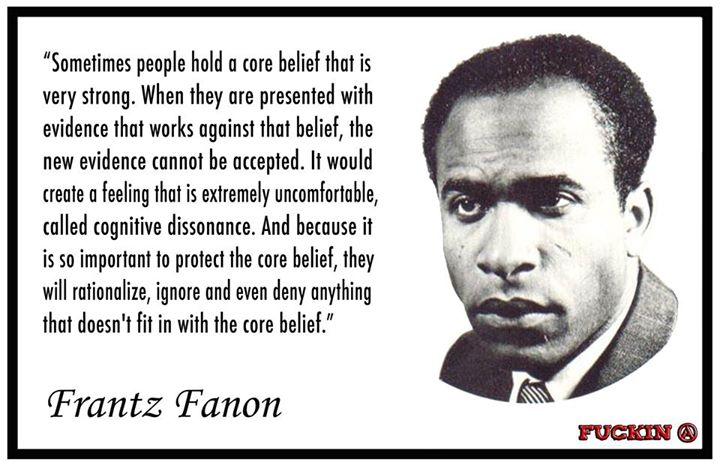
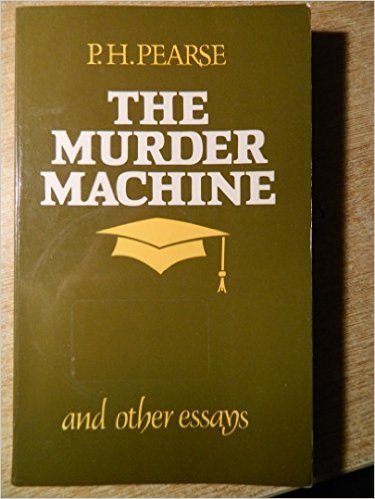
This would of course be useful work, especially if it led to the production of measures to counter such myths and ignorance. It is likely however that the answer has already been supplied, by for example the work Patrick Pearse (1879-1916) and Franz Fanon (1925-1961), though it would be useful to have more up-to-date validation. Fanon’s work focused on the coloniser’s view being culturally and psychologically internalised by the colonised individual and society and Pearse focused more on the mechanisms by which that was done through the educational system run by the coloniser. The idea is expressed succinctly, though in a different context, in the words of a popular nationalist song, Memory of the Dead by John Kells Ingram (1823 – 1907):

“He’s all a knave or half a slave

who slights his country thus …”.


franz-fanon-cognitive-dissonancecover-the-murder-marchine

The lecture was delivered by Ó Broin in Irish to an audience that contained Irish speakers and presumably all present could at least understand the language. My feeling was that this research and deconstruction needs to go out to the non-Irish-speaking public in this country. In response to a question, Ó Broin replied that he had in fact written some of it in English some years ago and that material had been posted on a website that no longer exists. Currently, his work exists only in Irish. It is to be hoped that he returns to putting this work out there among the people who perhaps most need it.

End.
THE SCREAM ON A DECEMBER NIGHT


Diarmuid Breatnach


A high-pitched but hoarse scream cuts through the night. Again and again it is heard, then is silent. A frightening sound, perhaps of a person being attacked …. But no, it is a vixen, a female red fox (Vulpes vulpes). Why is she screaming? Is she in pain?  Not exactly — she is informing dog-foxes in the area that she is ready to mate and where they can find her.

Vixen screaming (sourced on Internet)


But this is December and, according to Internet site after site dealing with foxes in Britain and in Ireland, she is at least a month early1. Perhaps she is a rare exception, this vixen in the Drumcondra area but it seems to me more likely that the sites have it wrong: either urban foxes breed earlier or the breeding pattern of foxes is changing. Actually, a combination of both is likely.

A vixen breeding in January would give birth to her cubs just over 50 days later, when in rural areas the earth is warming up in the Spring and when lambs are born, hares are boxing, eggs are being laid, greens are growing and being eaten by rabbits – in other words, food is becoming available for the vixen. Obviously vixens breeding in February or March will have yet more food available in April or May but may also find greater competition, in food and for a mate.

Say this rural vixen conceived on 1st January, then she would give birth on or around 22nd February. She will need feeding just before that and probably up to 24th March, a task falling to the dog fox and to unmated young females who may be part of the community. The cubs need the warmth of the mother’s body for up to three weeks after birth and she cannot leave the den. One month after giving birth the mother vixen may go hunting while the “aunts” look after the cubs, who are now venturing out of the den or “earth” (but staying very close to it).

The food brought to the young is carried inside the hunters’ bellies and regurgitated for the young to consume along with their mother’s milk which they will suckle until six weeks of age. After weaning, the cubs will eat solid food but cannot yet hunt for it themselves until perhaps mid-late Summer and, if males, will leave to establish their own territories in the Autumn.2 Males become sexually mature at one year of age.

A vixen breeding in December in an Irish rural area might have difficulty receiving enough sustenance in January or even early February, especially in decades past when winters were usually harder. However, with changing seasonal weather patterns tending to warmer winters – and in urban areas where a lot of food tends to be available for scavenging all year round – these problems are substantially reduced and so breeding in December should present little difficulties. So the thinking goes among the vixens in Drumcondra, anyway and, I suspect, in many other Irish and British urban areas.

The male or ‘dog’ fox can be heard sometimes too in a staccato bark, normally three (but occasionally four) rapid barks: bak, bak, bak!


THE URBAN FOX

The urban fox is a relatively new phenomenon in Ireland3, as far as we know, although in Bristol, for example, they have been recorded since the 1930s. Up to fairly recently, a number of experts maintained that the fox populations of city and countryside had little contact with one another. But in January 2014 “it was reported that “Fleet”, a relatively tame urban fox tracked as part of a wider study by the University of Brighton in partnership with the BBC’s Winterwatch, had travelled 195 miles in 21 days from his neighbourhood in Hove, at the western edge of East Sussex, across rural countryside as far as Rye, at the eastern edge of the county. He was still continuing his journey when the GPS collar stopped transmitting, due to suspected water damage.”4


and the Country Foxes

Decades before I heard of this I often fancifully imagined a conversation between a fox, now settled in the “big city”, and his country relations when he returned on a visit. After the initial customary welcoming, sniffing, licking etc are over, the conversation might go like this:

So, Darkie, tell us, what is life like in the big city?”

Ah, it was scary at first, with cars and buses and lorries going all day. You wouldn’t believe the noise.”

(Sympathetic whine from the audience).

But I’m used to it now, Redthree, I have to say. And the food! You could not imagine!”

Good, is it?”

Lovely, Whitepatch, absolutely delicious.”

(Sounds of salivating all around).

Chicken, beef, lamb, fish, potatoes, bread, rice, vegetables, fruit – just left out there to be eaten!”

Ah, you’re havin’ us on, Darkie. We might be “Culchies” but we’re not stupid! You expect us to believe the humans feed you like they do their dogs, do you?”

No, of course not, Greymuzzle. Well, actually a few do leave out food on purpose for us but no, this is mostly food that humans are throwing away. We find it in plastic bags and metal containers.”

They throw away food?”

They do and huge amounts of it too. Then big lorries come and take away what we have not eaten ourselves.”

Where do they take it?”

I am not sure. I’ve never troubled to find out because, to be honest, I have all the food I need nearby.”

(Silence while country foxes imagine a huge mountain of food somewhere).

Er …. Darkie, so you never hunt now?”

Oh, yes, some – the city rats and mice eat the discarded food too and they grow plump and big. Yes, I catch and eat them too.”

Well now, what about all the humans?”

What about them, Lighteyes? They don’t bother us.”

Don’t the humans have guns in the city?”

Some of them do, Lighteyes. But they don’t shoot foxes with them.”

Really? What do they shoot with their guns then?”

Other humans, Lighteyes, just other humans.”

(Noises of amazement and disbelief)


THE INNER CITY FOX

The Internet sites all agree that foxes are more likely in suburbia than in the inner city but I think they ignore some important features of the inner city which foxes can frequent in relative safety and around which they are likely to find sufficient food: railroad lines and their banks, canal and river banks, parks, allotments, cemeteries and derelict sites. One can’t get much closer to Dublin’s inner city than Parnell Square, yet I have seen foxes in a laneway off there and also squeezing through the railings to enter the Garden of Remembrance. They have been photographed near the Irish Parliament, the Dáil (though some people might say that’s less surprising with the number of scavengers nearby :). I’d be surprised if they are not to be found along the banks of the Dodder, the Liffey, the Tolka and both canals, also along the railway lines and in Glasnevin and other cemeteries.

Fox in Leinster House car park in the winter of 2013 (Source: Sasko Lazarov via Photocall Ireland, reproduced in Journal.ie)
Fox in Leinster House (Irish Parliament building) car park in the winter of 2013 (Source: Sasko Lazarov via Photocall Ireland, reproduced in Journal.ie)


According to one Internet site5, the urban fox population in Dublin may be growing too big for its own health, as the ready availability of food allows unhealthy individuals to exist, diseased and covered in mange infestation (mites that denude patches of fur). I would need to explore this argument before I could accept it.

I am familiar with the overpopulation argument in the case of grazing animals or rodents, where too many individuals consume the available resources and the whole population suffers – a fate usually occurring when natural predators are not present to thin out the weaker individuals and thereby unconsciously preserve the general population in a healthier state.

But how would this work with regard to Dublin foxes? It seems unlikely that the food available is being reduced yet and if and when it is, one presumes healthier foxes will outcompete their sicker species members. Also, sick and undernourished foxes are less likely to come into oestrous and should they do so and conceive, to be able to raise their young. It seems to me most likely that what is occurring is that foxes that would normally have been winnowed out in the struggle of survival are now able to sustain themselves, which might be distressing to see but which will not necessarily have any effect on the healthy population.6 And will healthy individuals necessarily succumb to mange infection from infested individuals? And if they do now, might they not in time learn to chase infected individuals away?

Theories of overpopulation and scare stories about foxes attacking babies, cats and so on seem prompted by the intention to cull foxes, as Boris Johnson, Mayor of London, proposed. Johnson seems unwilling to learn from history, as “there was a large and expensive effort to reduce the number of urban foxes across the UK in the 1970s, but the population subsequently bounced right back.”7 The average litter now may be four cubs but vixens have been known to bear up to a dozen and with a low population-to-high-food-sources ratio, are likely to bear a greater number of cubs. And a recent National Health Service survey in the UK indicated that nearly 60% of all stings and bites admitted to emergency rooms were inflicted by dogs8 but anyone suggesting a cull of urban dogs would probably find a gathering bearing pitchforks and burning torches outside their home.

Boris Johnson, Mayor of London, was proposing a cull of London foxes (source photo: Internet)

There have been claims that foxes kill and eat lambs, cats, other domestic pets and poultry. Most experts have concluded that if indeed a fox killed a lamb, such incidents are very rare. A ewe is capable of protecting a lamb from a fox, an animal not much larger than a cat. However, foxes have been found to eat the afterbirths of lambs and would of course eat a stillborn lamb or one that died soon after birth, after which its mother would leave and the opportunist would move in; such incidents may have convinced some people in rural areas that the fox was the cause of the lamb’s death.

The Foxwatch study program in Bristol city filmed a number of confrontations between urban foxes and cats and found that in all cases, it was the fox that backed down. This makes sense, for a predator does not usually take on another predator of similar size except in defence of its young, its own life or, at times, its kill.

Yes of course foxes will kill poultry if they can get at them and are often accused in such situations of going on a killing spree. Foxes do kill and gather more food than they need at times and, like many other animals, hide it for recovery later, marking the spot with their scent. But when a fox breaks into a poultry pen and kills its inhabitants, it usually has to leave with what it can carry and will not be permitted to return for the rest. The answer for humans is to build secure pens into which to bring the poultry at night – and that applies also to rabbits kept as pets or for the table, etc. — or keep a dog outside, unleashed.

Scare stories and unscientific suggestions to one side, wild animal populations living alongside humans frequently do need management. All species of bats are protected in Ireland and Britain and should you find them in your attic you are not permitted to remove them but must instead notify the appropriate authorities. Some people have suggested that the red fox should be granted protected species status but it is difficult to see the rationale for this, since it is on the species of “least concern” list of the International Union for the Conservation of Nature. Pigeons receive no protection and, though often fed by people who consider them cute or pretty, do have a negative effect on our urban environment and, in the case of seagulls, who are protected, may be responsible for the disappearance of the many species of ducks that once were common in Stephens’ Green. Rats and mice are not deliberately fed or considered cute by most people (though I have kept both myself and found the individuals tame and harmless and, in the case of rats, quite intelligent) and humanity wages war upon them with traps and poison.

Do urban foxes require management? Zoologist Dave Wall9, who has studied Dublin’s urban foxes for some years, thinks not. In his opinion, the fox population in Dublin has remained constant since the 1980s. According to statistics regularly quoted but never referenced that I can find, Dublin fox families occupy on average 1.04 Km². 10 Given a rough and probably low estimate of six individuals per fox family (a mated pair and two unmated females and two cubs) and a Dublin City area of 115 km² would give us a fox population of 663 in the city. That might seem a lot, until one hears that London holds an estimated 10,000.

Given statistics of that sort, and information that the average litter is of four cubs, one may wonder why most urban dwellers see them but rarely and also why urban foxes are not a massively growing population. There are a number of controlling influences, ranging from the need to establish territory and fight to hold it, which may cost in injuries or even death, to deaths by traffic, the most common cause of fox death according to Internet sites (although how often do we see a dead fox on the road?). A common non-captive life-span of from two to four years and a fertility “window” of only three days for a vixen would be population-controlling factors and yet the allegedly stable population is puzzling, to me at least.

The rural fox tends to inhabit, widening when necessary, burrows already excavated by rabbits and badgers. In urban areas, the fox may have to excavate its own – under buildings and sheds and into railroad banks, for example – but will also use and expand other holes and gaps.

Many urban human dwellers, probably most, never see urban foxes, although they are becoming increasingly visible. They are active mostly at dusk and shortly before dawn and are mostly likely to be seen by people who rise very early for work, or who work at night or who are returning from late night socialising on foot, by bicycle or on foot.

In the Lewisham area of South-East London where I lived for some decades, I regularly saw them on the roads while cycling home from a late music session or a friend’s house. Lewisham would be considered midway between being city and suburban in nature and contained parks, cemeteries, allotments, streams or rivers and railway lines, houses with gardens but also high-rise blocks of local authority housing and very busy roads. I once passed about three yards near to an adult fox on the housing estate I lived on for awhile between Grove Park and Eltham (also in SE London). On my allotment in Catford, if I worked until dusk (which I did often enough when I managed to find the time), they would come out and play and dig for food less than ten yards away from me. And I frequently found trainers (running shoes) and balls they had taken from outside local houses and gardens, discarded on my allotment.

A number of theories have been forwarded for the penetration of urban areas by the fox, including the shameful wiping out of rabbit populations by state-inflicted plagues of myxomatosis but the real reasons are probably the same as those of the pigeon, rat and mouse – availability of food and home provided by humans and the adaptability of the species themselves.


THE MOST WIDESPREAD CARNIVORE ON EARTH

Indeed, the red fox has proved an adaptable animal – much like ourselves. She is an omnivore, as are we and can take her prey from animals as large as a goose to those as small as beetles or earthworms, also frequently eating wild fruit, especially in the Autumn. Studies in the former Soviet Union found that up to 300 animal and a few dozen plant species were known to be consumed by her11. Mice and rats are frequently on her menu and her ancestors are thought to have developed as specialist rodent hunters in Eurasia five million years ago but her kind is now the most widespread carnivore on Earth, with 46 recognised subspecies.

The fox has binocular vision which is particularly effective at night, excellent hearing over distance, including the ability to detect the squeaking of mice at about 100 metres (330 ft) and capable of locating sounds to within one degree at 700–3,000 Hz, though less accurately at higher frequencies12, compensated for by an ability to hear at very low frequencies, including a rustle in grass or leaves and the burrowing of rodents underground. It has evolved many tactics for hunting, including tracking, ambush, stalking, leaping, pouncing and digging.

The fox can also run at a speed of 42 km/ hour, climb some trees, leap high and swim well. Considering the latter, its absence from many islands near to mainlands may come as a surprise but I think that is easy to explain through eradication by human agency.

The red fox is to be found everywhere in Europe (where she is thought to have reached 400,000 years ago) and in North America, Canada, China, Japan and Indochina. Sadly, in the mid-19th Century her species was introduced to Australia by European settlers (at first for sport and later perhaps to control the rabbit, also introduced there by Europeans), where a population of 7.2 million red foxes now is wreaking damage among rarer indigenous wildlife and is considered responsible for the extinction of a number of species. It is classified as the most harmful invasive species in Australia and eradication and population control measures are adopted against it there, as are also against feral domestic cats and dogs, also imported by Europeans.

The dingo is regarded as a controlling agent on red fox population growth in Australia though not totally effective due to the fox’s habit of burrowing; this is interesting for a number of reasons: firstly, the dingo (Canis lupus dingo) is itself a wild dog most likely imported from Asia by Aborigine settlers somewhere between 4,500 and 10,000 years ago and secondly, the red fox in Ireland and Britain does not tend to excavate its own burrows but rather to enlarge existing ones and then generally only for mating and rearing cubs. The Red Fox is currently absent from Iceland, Greenland, South America and sub-Saharan Africa.

The fox has been hunted by humans primarily for its fur, especially in winter when it is thicker and from foxes in the far north its silkiness is considered very valuable.

Reynard (one of the names traditionally given to the fox) has also been hunted for sport, usually by the aristocracy or country gentry, on horseback with hounds, an activity which gave rise to one of Oscar Wilde’s many memorable phrases: The English country gentleman galloping after a fox – the unspeakable in pursuit of the inedible.” Of course, it was not only the English who did this but also the Anglo-Irish Ascendancy (from which Wilde’s father himself came) and the upwardly-climbing Irish who aped them, ag sodar i ndiaidh na nuaisle.13 There have been numerous attempts to get fox-hunting banned and direct action such as protests and sabotage of hunts but it is still legal in Ireland and in Britain, though substantially reduced from a century ago.

Gamekeepers have also hunted the fox in order to keep it from killing ground-nesting birds such as wild pheasants, grouse and partridge, so that the landowner and his friends could shoot these birds down later14. Finally, the farmer has taken his toll, sending specially-bred dogs such as cairn terriers down earths to kill a hiding fox and in particular the cubs. The farmer wishes to protect his poultry but avoid the cost of building secure pens and so hunts foxes down; he could let his dogs roam his poultry area which would keep foxes away but dogs do often go chasing sheep too, which will also represent a loss to the farmer, either because the sheep are his or because his neighbours will claim compensation from him.


AN MAIDRÍN RUA and tradition

In Ireland, the fox was known as Sionnach, Madagh Rua (“red dog”) or Maidrín Rua (“little red dog”) and has given its name to a number of places, eg Cnoc an tSionnaigh (Fox Hill, Co. Mayo; another as a street name in Co. Laois); Oileán an tSionnaigh (Fox Island, Co. Galway); Carraig an tSionnaigh (Foxrock, Co. Dublin); possibly Léim an Mhadaigh, (Limavady, Co. Derry) and Lag an Mhadaigh (Legamaddy, Co. Down); possibly Ráth Sionnaigh (Rashenny, Co. Donegal), etc.15

Fox is also a family name and the Irish language version of it is Mac an tSionnaigh (literally “Fox’s son”).  The Maidrín Rua or Sionnach features in a number of songs in Irish and in English and here is one from the Irish language tradition of song but in a non-traditional choral arrangement: https://www.youtube.com/watch?v=6bJyqbPxTwU.

Widely represented in folklore from China to Ireland, the fox is also mentioned in the Old Testament Bible and in Greek stories such as the fables of Aesop as well as among the Indigenous people of the Northern Americas. He is never stupid but his intelligence or cunning is also often portrayed as devious, tricky and even malicious. On the other hand, let us not forget that the anti-feudal Mexican hero created by USA writer Johnston McCulley (February 2, 1883 – November 23, 1958), who fights for the downtrodden and indigenous people and mocks the Mexican aristocracy and large landowners, always escaping them, used the nom-de-guerre of “El Zorro”, the fox.

There is a sexual connection too in the representation for the fox: for example in English a “foxy lady” is one with a high level of sexual attraction and in Castillian (Spanish) a “zorra” (vixen) is a pejorative term for a woman trading in sexual favours or “of low morals”16. Have we come around in a circle to where we began, to the vixen’s scream? I think so, but loaded now with a patriarchal outlook. Men can openly want and enjoy sex, of course, that is natural – but a woman? Surely not … or, if she does, she must be bad!


End.


Internet Sources:

http://www.thejournal.ie/fox-urban-dublin-1537602-Jun2014/

http://www.newforestexplorersguide.co.uk/wildlife/mammals/foxes/family-life.html

http://www.wildlifemanagement.ie/dublins-urban-foxes/

http://www.irishtimes.com/life-and-style/people/our-confused-relationship-with-foxes-cull-them-feed-them-hunt-them-kill-them-1.1251806

http://www.newsfour.ie/2013/04/city-fox-controversy/

http://www.noticenature.ie/files/enfo/factsheet/en/WL33%20Foxes.pdf

http://www.conserveireland.com/mammals/red_fox.php

https://en.wikipedia.org/wiki/Red_fox

https://books.google.ie/books?id=GjK93IUdAX4C&pg=PA96&lpg=PA96&dq=fox+can+hear+low+frequencies&source=bl&ots=BdWCosvgXg&sig=z76bvVOGnUjEQMnGTf4w44mqTyU&hl=en&sa=X&ved=0ahUKEwjN-dOm7v7QAhXoKsAKHQtsCGcQ6AEILTAD#v=onepage&q=fox%20can%20hear%20low%20frequencies&f=false


Footnotes:

1This is one of the very few sites to state that breeding may start in December http://www.newforestexplorersguide.co.uk/wildlife/mammals/foxes/family-life.html and Wikipedia also gave December as the start of the mating season and also as the month when the dog-fox’s testes are heaviest.

2Young females may remain another season and help care for the next litter of cubs.

3Although one article, without giving a reference, stated that foxes have been in Dublin since Victorian times.

6Other feature which makes this claim suspect are a number of scare items in the article: a) the sensationalist reference to the alleged danger to a baby from a fox in a bedroom and a link to the article reporting this event. Such an event, supposing it occurred, must be on a level of likelihood way below the danger to babies from, for example, pet cats and dogs. Also b) the reference to the danger of contracting roundworm (Toxocara canis), which can cause toxocariasis in children, while not however mentioning how low that risk is and that infection for children is most likely to be encountered from dogs and cats.

9Dave Wall B.A. is a postgraduate researcher in zoology at UCD. He has studied otters, marine mammals and Alpine badgers as well as studying Dublin’s urban foxes for the past few years. He is a Director of the Irish Whale and Dolphin Group.

12Ibid

13“Trotting after the nobles”, a derogatory phrase in Irish.

14Gamekeepers in Ireland and Britain also shot, poisoned or trapped badgers, otters, pine martens, stoats, escaped mink, eagles, hawks, buzzards, crows and magpies and often hung their carcasses in near their lodges to display their diligence in their tasks

16Often the condemnation of “low morals” is applied to a sexually active female but not to a sexually active male.

IRISH LANGUAGE CAMPAIGNERS CALL FOR URGENT ACTION — “10 years remaining for Irish as a living language in the Gaeltacht”

(English-language version below)

De réir ráiteas a d’eisigh craobh BÁC den dream Misneach inné (15/12/2016) d’éirigh go maith le hagóid Misneach  ar son Cearta Teanga lasmuigh de Theach Laighean. Bhailigh daoine i rith am lóin chun seasamh i gcoinne cur i gcéill na hairí Humphreys agus Kyne. Bhí neart tacaíochta don agóid ó dhaoine a d’imigh thar bráid, cuid mhaith acu a d’iarr leithscéil nach raibh mórán Gaeilge acu féin agus cúpla daoine ó thíortha i gcéin ina measc.


Map on Misneach banner illustrates the decline of areas where Irish is a living community language under the Irish state's administration. (Photo D.Breatnach)
Map on Misneach banner illustrates the decline of areas where Irish is a living community language under the Irish state’s administration. (Photo D.Breatnach)

D’ardaigh urlabhraí Misneach, Kerron Ó Luain, ceist an buiséad a pléadh i measc an chomhchoiste inniu:

Gheall Sean Kyne go dtabharfaí 1,000,000 euro breise don Ghaeilge ar Adhmhaidin ar RnaG níos luaithe. Is ardú 1% atá i gceist le sin. Ach, is méid suarach é 1% nuair a smaoinítear go gearradh 75% de bhuiséad Údarás na Gaeltachta agus 35% ó bhuiséad Foras na Gaeilge ó 2008.

D’fhógair an tAire McHugh i rith 2015 go mbeadh 1,000,000 euro breise do bhuiséad caipitil na Gaeilge chomh maith. Tá sé soiléir gur cleas atá sna fógraí seo. Gearrtar na deicheannaí de mhilliún ó bhuiséad ach, ar an láimh eile, fógraítear “airgead breise” de mhéid an-bheag amhail is gur dul chun cinn é. Is cleas é leis an bpobal Gaeilge a cheannach agus faraor tá an cuma ar an scéal go n-oibríonn an chleasaíocht seo.’

Chríochnaigh Ó Luain:

Arís tá Misneach ag glaoch ar na ceanneagraíochtaí Gaeilge gníomhú agus Lá Mór eile a eagrú. Tá sé feicthe ón ngluaiseacht a d’fhás i gcoinne príobháidiú a dhéanamh ar ár n-uisce, gurb é an t-aon chineáil cumhacht a dtugann na polaiteoirí aird ar bith air ná cumhacht na sluaite amuigh ar na sráideannaí.

Section of protest demonstration outside the Dáil (Photo D.Breatnach)

Má leantar ar aghaidh mar atá agus an pobal Gaeilge ina dtost caithfear milliúin euro chugainn anseo is ansiúd i mbealach soiniciúil ach ní dhéanfar aon dul chun cinn i ndáiríre. Agus gan ach 10 mbliain fágthaí ag an nGaeilge mar theanga pobal laethúil sa Ghaeltacht tá gníomh raidiciúil de dhíth láithreach.’

———————————————————————-

According to a statement of the Dublin branch of the Misneach organisation yesterday (15/12/2106),  a successful demonstration for Language Rights was held outside Leinster House. People gathered during lunchtime to highlight the hypocrisy of the government ministers charged with overseeing the language, Heather Humphreys and Sean Kyne. There was plenty of support from passers-by, including people who apologised for their own lack of Irish and a few people from abroad.

Spokesperson for Misneach, Kerron Ó Luain, alluded to the budget being discussed by the committee today:

Tongue-in cheek use of road traffic sign (Photo D.Breatnach)
Tongue-in cheek use of road traffic sign
(Photo D.Breatnach)

Sean Kyne apparently promised an additional million euro for the Irish language on RnaG’s Adhmhaidin programme this morning. That amounts to a 1% rise. Realistically, 1% is a pitiful amount when it is considered that 75% has been cut from the budget of Údarás na Gaeltachta agus 35% from that of Foras na Gaeilge since 2008.

Then Minister for the Gaeltacht, Joe McHugh, made a similar announcement in 2015 when he said that one million additional euros would go to the capital budget for the Irish language. It is patently obvious to all that this is a cynical ploy. Tens of millions are cut from the budget only for grand announcements of “additional funding” of pitiful amounts to be made afterwards as if this were progress. It is a ploy being adopted to buy off the Irish language community, and unfortunately it appears to be working.’

Ó Luain finished:

Misneach is once more calling on the chief Irish language organisations to mobilise towards another Lá Mór. It is evident from the movement which opposed the privatisation of our water that the only type of power politicians pay any heed to is the power of the people marching on the streets.

If the situation persists and the Irish language community remains silent, and accepting of token gestures of one million euro here and there, then no real progress will be made. With only 10 years left for Irish as a living community language in the Gaeltacht now is the time for radical action.’

(Photo D.Breatnach)
(Photo D.Breatnach)
Section of protest after some people had left (Photo D.Breatnach)

VARIATIONS ON A NAME

Diarmuid Breatnach

(Gaelic football team Sheares Brothers has been doing very well for a change. A reporter from the Irish Times is about to conclude his interview of the club’s Bainisteoir).

gaa-empty-field-changing-rooms
(Photo sourced: Internet)

Your club’s local nickname is “the Pats”, I’m told.

Yes, I’ve heard that too.

Is it true – what I’ve been told – that all your players, in your entire team, are called Patrick?

Well, now, many are named Patrick, right enough, but they are not all called Patrick.

[Reporter jots down in his notebook: ‘named not called – wtf???’]    Does that not cause problems, though, on the field? I mean, it must be difficult at times for your players to know to which of them the Captain is referring when he shouts out: “Patrick”.

[The interviewer smiles. He has shown the ridiculousness of this situation].   (Fucking unbelievable that this team got as far as its current position in the League! he thinks)

No, not all. Sure if the Captain called out “Patrick”, he’d be referring to himself! That would be a strange thing to do, for sure, to be talking to himself! Well, when with the team, anyway.

(This man is an idiot. An idiot managing a ridiculous team. Still, get the interview done, file the story. Then the pub ….)   Ok …. what if he wants to say, to indicate to a player, to pass the ball to the left midfielder? Would he just call the position – as in “Pass the ball to Left Midfield”?

Well, he might …. but he’d more likely say “Give Paudie the ball”. That’s Paudie’s usual position, you see.

Oh, right.

No, left.

(What a thicko!)     I meant “ok”. Your left Midfielder’s nickname is “Paudie”?

Well, it’s the name he goes by anyhow. Paudie Whelan.

So are all your players called a variation on Patrick?

Pretty much, yes.

Fifteen variations on Patrick?  And no repetitions?  That’s not possible, is it?

It seems to be.

OK, all right …. what about say, your Centre Forward?

Pa. Pa Walsh.

Hmm. Left Forward?

Packy Ó Braonáin.

Right Forward?

Emm …

(Got you now!)

Sorry, he’s just back from an injury. Patchy …. Patchy Stokes.

Left Half-Forward?

Patchik Mulhearn.

Centre Half-Forward?

Paddy plays that position – Paddy McGuinness.

Right Half-Forward?

Patch Hennessy.

(Has to run out of them soon).    Left Mid-Field?

You had his name already – Paudie Whelan.

(Smartass!)    Yes, of course. Right Mid-Field?

That’d be Pád Óg Trainor.

That’s P, a, u, d ……

No. P, á, d; Ó, g.

Right.

Right Half-Back?

No, I meant just “Right” , as in “OK’.

Right.

(Is he taking the piss?)    Well ….. where was I?

Midfield.

Yes …. thanks …. Right Half-Back?

I thought you said ….? Never mind …Paudeen Sullivan.

Centre Half-Back?

Pád …. Pád Carney.

P, a, u ….

No, P, á, d; C, a, r ….

I know how to spell Carney, thanks.

Oh, ok.

Left Half-Back?

That’s Patrick … our Captain. Patrick Burke.

Left Corner-Back?

Ah ….

(Have I got him?)

Ah, sorry ….

(Aha! At last!)

Pat Sheehan. His name slipped me mind there for a minute, sorry.

Oh …. Ah. Good. Full Back?

Páraic Ó Flaithearta. Will I spell it for you?

(Fucking smart-ass! I’ll get it from their website. Just let me run him out of Patrick variants first.)    No, it’s ok, I know my koopla fokol, gurra mah hugut.

Muise, tá fáilte romhat. Bail ó Dhia ort.

Well …. let’s carry on. Right Corner-Back?

Pádraig. Pádraig Lehane.

(Got you now!)  Pádraig. The same as the man next to him, the Full Back.

No, that’s Páraic. P, á, r, a, i, c.

Oh!  Ok, yes, I see. My mistake. Goalie?

Patsy O’Farrell.

Yes. Well, thanks. Yes …. I don’t suppose your substitutes are called Patrick?

No, neither is.

Oh, good.

Sorry?

Good … good story, thanks. I must be going ….

Don’t you want to know their names?

The subs?

Yes.

OK, yes I suppose. Yes, please.

PJ Hanley and Packer Dunne.

I …. see …. ‘PJ’ as in ….. Patrick Joseph?

Dead on!

Um … Well …. Thanks for your time. All the best for your next game in the League. I don’t suppose, heh, heh, your Junior team are all variants of Patrick too?

Ah, not at all! Of course not. Sure, that would be awful confusing. No, there’s Michael Fitzgerald, Mick Smith, Mickey Doyle, Mícheál Connors, Micilín Seoighe, Mikhail ….

End.
 

Appendix:


The Sheares Brothers GAA team.

Packy Ó Braonáin, Pa Walsh, Patchy Stokes.

Patchik Mulhearn, Paddy McGuinness, Patch Hennessy.

Paudie Whelan,                         Pád Óg Trainor.

Patrick Burke, Pád Carney, Paudeen Sullivan.

Pat Sheehan, Páraic Ó Flaithearta, Pádraig Lehane.

                       Patsy O’Farrell.

Subs: PJ Hanley, Packer Dunne

WHEN DUBLIN WANTED MAYO TO WIN — MEN OF THE WEST AND THE MAN FROM DUBLIN

Diarmuid Breatnach

As Mayo began to prepare for a replay of the 2016 championship Gaelic Football final against Dublin, I stood with others on a very wet day in Dublin’s Croppies’ Acre to commemorate and honour Robert Emmet and the United Irishmen – an event replete with Mayo connections.

line-enniscorthy-group-at-monument
Eniscorthy Historical Reenactment Society inside the monument during the ceremony. (Photo: Paddy Reilly)

The event, organised by the Asgard Howth 1916 Society, was graced by the presence of the Enniscorthy Historical Reenactment Society, men and women in 1798 costume bearing pikes, including officer uniforms – they had travelled up from Wexford that morning to attend the event. Donal Fallon, historian, blogger, tour guide and broadcaster was to give the oration. Padraig Drummond, the organising persona, had asked me to sing two songs at the event, one near the start and the other near the end.
For the first song, I had chosen the Bold Robert Emmet ballad1 (originally known as The Last Moments of Robert Emmet2), a song that commonly sung more often a few decades ago but still reasonably well remembered. For the second, I was spoiled for choice of relevant songs: Anne Devlin, Boolavogue, The Croppy Boy, Henry Joy, The Irish Soldier Laddie. Kelly the Boy from Killane, The Rising of the Moon, Rodaí Mac Corlaí, Sliabh na mBan, the Three Flowers, The West’s Awake, The Wind That Shakes the Barley …… or I could finish learning some of which I knew bits, like the Sean Bhean Bhocht, General Munroe, Memory of the Dead (Who Fears to Speak of ’98?) or the Mayo version of An Spailpín Fánach.

Drawing depicting the trial of Robert Emmet in Green Street Courthouse, Dublin
Drawing depicting the trial of Robert Emmet in Green Street Courthouse, Dublin. (Photo source: Internet)

Though a beautiful song in lyrics and air, I felt Sliabh na mBan was too long for the event and cutting it would also feel wrong. Anne Devlin remembers an extremely brave comrade of the United Irishmen and gives rare acknowledgement to the role of women in the struggle for Irish freedom, which had me veering towards that choice. However, I eventually settled on Men of the West, celebrating the 1798 uprising in Mayo when a small French force under General Humbert landed to support them.

Diarmuid Breatnach singing "Men of the West/ Fir an Iarthair". (Photo: Paddy Reilly)
Diarmuid Breatnach singing “Men of the West/ Fir an Iarthair”.
(Photo: Paddy Reilly)

MEN OF THE WEST

The Mayo connection in the forthcoming GAA final was one reason for the choice, another was that this time of year is that which witnessed the repression in Mayo after the defeat of the last rising of that year (and the last forever, the British and their Orange supporters may have thought, until Emmet came out five years later). And other reasons were that I could sing it as a macaronic song (with some of the verses in Irish and some in English), the song was not too long and it has a chorus in which participants could join.

Bartholomew Teeling, with the French who landed at Mayo, captured when they surrendered at Baile na Muc. Hung in Dublin and his body thrown into the "Croppy Hole".
Bartholomew Teeling, with the French who landed at Mayo, captured when they surrendered at Baile na Muc. Hung in Dublin and his body thrown into the “Croppy Hole”. (Photo source: Internet)

There were yet other reasons for the choice too – not in our culture of song and game, nor in the calendar, but in the ground under our feet, for somewhere under there in what was first called “The Croppies’ Hole” and later “Croppies’ Acre”, the mass grave of many United Irish, lie the bodies of the executed Matthew Tone — younger brother of Theobald Wolfe Tone (who was soon after to give his own life to the Rising) – and Bartholomew Teeling. The younger Tone and Teeling had landed with the French in Mayo, been taken prisoner after the surrender of the French at Baile na Muc, in Co.Longford, brought to Dublin and, despite their French Republican Army officer rank, tried as rebels and hung there.

And in researching background for this article, I came across even further Mayo connections.

The lyrics of Men of the West were written by William Rooney and put to the air of an Irish song called Eoghan Chóir written in turn — and also air apparently composed — by a Mayo United Irishman and songwriter, Riocard Bairéad (Richard Barrett3), who composed the even better-known Preab San Ól4.

The lyrics of Men of the West were later translated into Irish by Conchúr Mag Uidhir, who won a prize for that work at a Feis Ceoil in 1903 – again in Mayo. It was the lyrics of both these versions that I combined to make the macaronic version I chose to sing at the commemoration at Croppies’ Acre5.

THE DUBLIN SONGWRITER — BACKGROUND

While I need to do some research to find out more about this Mag Uidhir, quite a lot is known about William Rooney (Liam Ó Maolruanaigh). Born in the Dublin former red-light district known as “The Monto”6 in 1873, Rooney grew up in a what had been considered the second city of the British Empire but had declined in status with the abolition of the Irish (colonial) Parliament in 1800. The city contained the residence of the Crown’s representative in Ireland, a number of British army barracks and the administration apparatus of the colony, the latter in Dublin Castle. Dublin also contained a substantial loyalist population of the Ascendancy, in addition to “Castle Catholics”7. However, Dublin was also a focal point in Irish nationalist and separatist politics. Relatives and descendants of members and sympathisers of the United Irishmen of 1798 and 1803 lived in the city and the events were in the living memories of some.

William Rooney, journalist, organiser, Irish language revivalist and author of songs.
William Rooney, journalist, organiser, Irish language revivalist and author of songs. (Photo source: Internet)

Irish Republicanism had seen a resurgence with the Young Irelanders of 1848 and some of their supporters were easily alive when William Rooney was born in 1873 and during his childhood. The founding of the Irish Republican Brotherhood in 1858 preceded Rooney’s birth by only 15 years and although the raid on the The Irish People newspaper took place in 1865, followed by the trial and conviction to penal servitude of Ó Donnobháin Rosa, Thomas Clarke Luby and John O’Leary, they would have been still talked about during Rooney’s childhood.

The following year, 1866 saw the failed rising of the Fenians in Ireland and also their shock invasion of Canada and, in 1867, the stirring freeing of the American Fenian prisoners in Manchester and the subsequent hanging of the three martyrs, Allen, Larkin and O’Brien. The spectacular rescue of escaping Fenian prisoners from Australia by the Catalpa and their celebrated delivery to the freedom in the United States took place in 1876.

Although these events were all over (or just occurring, in the case of the Catalpa) by the date of Rooney’s birth, their echoes remained – in living memory, in the cause of prisoners serving sentences in English jails or penal colonies and in agitation for a political prisoners’ amnesty. And God Save Ireland8, written to commemorate the Manchester Martyrs in 1866 by Timothy Daniel Sullivan would have been an extremely popular song among a wide section of the Dublin population during Rooney’s childhood, along with patriotic verses and songs by Thomas Moore (1779-1852), Thomas Davis (1814-1845) and James Clarence Mangan (1803-1849). Verse and songs by these poets were learned by ear and recited or sung but were also available in printed form, in songbooks, song sheets and nationalist publications.

Sullivan was a journalist, owning and editing the publications The Nation, Dublin Weekly News and Young Ireland. As a journalist, Sullivan published reports of meetings of the banned National League in December 1887, for which he was convicted and imprisoned for two months by the British administration. William Rooney was in his late teens at that time and Sullivan lived until 1914.

At the age of around thirteen William Rooney became acquainted with a leading Irish nationalist of his times, Arthur Griffith, through Rooney’s membership of The Irish Fireside Club, a literary discussion group. Both of them joined the Leinster Debating Society (which later became the Leinster Literary Society) which they soon led, Griffith as presidents and Rooney as Secretary. The early 1890s controversy surrounding Parnell’s relationship with Catherine O’Shea caused a serious disruption in the nationalist movement of the time and caused a serious split in the Irish Parliamentary Party of which the Leinster Literary Society became a casualty.

Rooney then formed the Celtic Literary Society in 1893, of which he became president; he also edited An Seanachuidhe (old spelling of “Seanchaí”, a story-teller, a relater of things past), the Society’s journal. The Society’s aims were the study of the Irish language, history, literature and music; it had branches in different parts of the country and its members included John O’Leary, Frank Hugh O’Donnell and Arthur Griffith.

AN GHAEILGE

William Rooney was fluent enough in the Irish language to write and to give orations in it and journalists of his times, after summarising a speech in English from the same platform, generally wrote only that he had spoken in Irish9. When he learned his Irish is not clear but he was teaching it in the offices of the Celtic Society. Then Eoin MacNeill got him to join the Gaelic League/ Connradh na Gaeilge after it was formed in 1893.

The Connradh was mainly concerned with promoting the Irish language and literature but also became a social focus in later years, hosting céilidhe (dances and occasion for songs, recitations). Patrick Pearse advocated a more political approach to promoting Irish culture and this accorded with Rooney’s opinion. On the other hand Rooney regarded Irish independence without the revival of the language and culture as meaningless and he castigated the Irish Parliamentary Party for its inaction on the Irish language.

Rooney gave an alternative example, traveling the country speaking publicly in Irish and in English on the need for Irish independence and for the revival of the Irish language.

JOURNALISM AND POLITICAL ORGANISATION

Building on his earlier writing in An Seanachuidhe, Rooney founded with Griffith The United Irishman newspaper in 1899 and his articles and other writings were published in a number of publications of his times:United Ireland, The Shamrock, Weekly Freeman, The Evening Herald, Shan Van Vocht and Northern Patriot (the latter two in Belfast).

Near the end of 1900, again in conjunction with Griffith, William Rooney helped found Cumann na nGaedheal.  The former Fenian John O’Leary was president and the Cumann was intended as an umbrella organisation to co-ordinate the activities of a number of nationalist groups (it was merged with others in 1907 to form the original Sinn Féin).

As the centenary of the 1798 Uprising approached, there was something of a fever of preparation with many indicating an interest in participation. Rooney would see his 25th birthday during centenary year and became of the most prominent organisers for the National Commemoration committee, if not, indeed, the main one.

The year 1898, somewhat similarly to the current centenary of the the 1916 Rising, saw commemorative plaques and monuments being erected, along with talks, meetings, lectures, articles and songs being written. According to historian Ruan O’Donnell, a feeling that the 1889 events had not reached an appropriate level led in 1903 to substantial commemorative events of Emmet’s rising in 1803. Many political working relationships were made during those years which were to survive into much more active days less than two decades since. Many of the songs we have today about the 1798 Rising were written during this period too and Rooney’s Men of the West was presumably also.

In the year of the 1798 centenary commemoration, one of the main centenary commemorations was held in Croppies’ Acre, attended by a reported 100,00010. Rooney was one of the main organisers and a stone was laid on the site which is there to this day.

Stone laid (or unveilled) during commemoration event in Croppies' Acre in 1898, the first centenary of the Rising. (Photo: Paddy Reilly)
Stone laid (or unveilled) during commemoration event in Croppies’ Acre in 1898, the first centenary of the Rising. The stone is on the ground near the north-west gate and corner of the park. (Photo: Paddy Reilly)

WILLIAM ROONEY IN MAYO

(The following text is taken from an article by Brian Hoban in the on-line edition of the Castlebar News for 22, Apr 2011)

William Rooney had visited Castlebar with Maud Gonne in 1898 for the centenary celebrations of ‘The Year of the French’. He gave a passionate speech in Irish in which he exhorted people to think for themselves, to educate themselves, and not to take their teachings from others.

He founded Castlebar’s first Public Library at the Town Hall, to which he dedicated his books. Three years later, at the early age of twenty-eight, William Rooney was dead, but the esteem in which he was held in Castlebar continued to grow. In 1911, a new Hurling Club in the town was named the ‘William Rooney’ in his honour. The following year “The Rooney Hall” was opened in Tucker Street. It became a local landmark for several generations, much used by various civic and voluntary organisations, including the PTAA.

The one surviving connection is in ‘Poems and Ballads’, a collection of Rooney’s poetry edited by Arthur Griffith and published in 1902, a year after his death. An original of this title is held by Mayo County Library where it can be consulted.

1798 Centennial Celebrations

William Rooney was one of the main protagonists in establishing the National Commemoration to celebrate the centennial of the 1798 rebellion. Only one month after its inception nationalists in Mayo formed the “Castlebar Central and Barony of Carra ’98 Centenary Association with James Daly appointed as president of the Connaught ’98 Centenary Council. On the 9th January 1898 a commemoration, which was presided over by James Daly, was held at Frenchill, near Castlebar. This was attended by Maud Gonne Mac Bride and addressed by James Rooney. ……………….

James Daly pointed out that the event was both about remembering dead patriots and undertaking “to abide by the principles of the men of ’98 until their country was free again and took its place among the nations of the earth.”

EARLY DEATH AND MEMORY

William Rooney died of TB in 1901 at the age of 27, shortly before he was due to marry. He is buried in Glasnevin Cemetery.

In 1902 the United Irishman published a collection of his writings and in 1908 a collection of his work edited by Griffith, Poems and Ballads of William Rooney, was published. The publication was reviewed disparagingly in the Daily Express that year by James Joyce but Yeats dedicated the 1908 edition of Cathleen Ni Houlihan “To the Memory of William Rooney”. A collection of his lectures and articles, from the United Irishman was published by M.H. Gill the following year.

Griffith described William Rooney as “the Thomas Davis of the new movement”. Brian Ó hUigín (“Brian na Banban1882–1963), editor for many years of The Wolfe Tonne Annual and himself no slouch as a writer of songs and verse, said of Rooney that “he blazed the trail to 1916 and gave his life for Ireland”.

And many of William Rooney’s songs are still being sung.

End.

Wreath being laid by Pól Ó Scannaill inside the monument on behalf of a number of groups. (Photo: Paddy Reilly)
Wreath being laid by Pól Ó Scannaill inside the monument on behalf of a number of groups.  Padraig Drummond of Asgard 1916 Society MC of event.
(Photo: Paddy Reilly)


APPENDIX

THE MACARONIC VERSION OF MEN OF THE WEST/ FIR AN IARTHAIR

(Arranged by D.Breatnach)

1.

Má mholtar le dán is le h-amhrán,

Na fir a bhi tréan agus fíor,

Donal Fallon, historian, blogger, tour guide and broadcaster who gave the main oration

Chuir clú agus cáil lena ndánacht

Ar shruthán ‘s gleann agus sliabh:

1798-panel-monument-wall
One of the panels inside the circular monument. (Photo: Paddy Reilly)

Ná fágaidh ar deire na tréan-fhir

Do chruinnigh ar phlánai Mhuigheo –

Nuair a ghnóthaí na Gail I Loch gCarman,

Said muinntir an Iarthair ‘bhí beo.

Chorus

I give you the gallant old West, boys,

Where rallied our bravest and best;

When Ireland lay broken and bleeding:

Hurrah boys, hurrah for the West!

enniscorthy-marching-to-gat
(Photo: Paddy Reilly)

2.

The hilltops with glory were glowing

‘twas the eve of a bright harvest day,

And the ships we’d been wearily awaiting

Sailed into Killalla’s broad bay.

And over the hills went the slogan

To awaken in everyone’s breast

That spirit that’s never been broke’ boys

Among the true hearts of the West.

Curfá

Seo sláinte muinntir an Iarthair daoibh,

Section of Croppies Acre showing circular 1798 monument in middle distance and Collins Barracks Museum in the far background. View is from NE gate on Wolfe Tone Quay. (Photo: D.Breatnach)
Section of Croppies Acre on a drier day, showing open circular 1798 monument in middle distance and Collins Barracks Museum in the far background. View is from SE gate on Wolfe Tone Quay. (Photo: D.Breatnach)

Do chruinnigh le cunamh san áir,

Mar sheas siad in aimsir an ghéar-chaill:

Seo sláinte fear Chonnacht go brách!

3.

Níor bhuail sé an dó dhéag san oíche

Gur ghlan’mar Cill Ala go breá:

‘S ní dheachaidh an ghrian síos ‘na dhiadh sin

Go raibh brat glas ar chúirt Bhéal an Átha.

Chruinnigh na céadta le cúnamh,

Agus mairfidh an scéal sin go buan;

An chaoi inar ruaigeadh na redcoats

As Caisleán an Bharraigh go Tuaim!

Chorus

I give you the gallant old West, boys,

Where rallied our bravest and best;

When Ireland lay broken and bleeding:

Hurrah boys, hurrah for the West!

4.

Agus gairim na Franncaigh breá láidre

Do tháining le Humbert anall,

Mar thug siad dúinn croí agus misneach

Nuair a bhíomar go brónach sa ngabháil.

Agus trócaire Dé ar na céadta

Do thuit is do leagadh san áir;

Tá a gcnámha faoi fhód ghlas na hÉireann

‘s cuimhneoidh muid orthu go brách.

Curfá

Seo sláinte muinntir an Iarthair daoibh,

Do chruinnigh le cúnamh san áir,

Mar sheas siad in aimsir an ghéar-chaill:

Seo sláinte fear Chonnacht go brách!

5.

Though all the bright dreamings we cherished

Went down in disaster and woe,

That spirit of old is still with us

That never will yield to the foe;

And Connacht is ready and awaiting

When the loud rolling tuck of the drum

Rings out to awaken the echoes

to tell us the morning has come.

Chorus.

I give you the gallant old West, boys,

Where rallied our bravest and best;

When Ireland lay broken and bleeding:

And looked for revenge to the West!

THE VERSES OMITTED IN THE MACARONIC VERSION

IN THE TRANSLATION INTO IRISH

2.

Tháinig na longa lá Fómhair,

Go cuan Chill Ala ag snámh,

‘S bhíomar chomh fada ag súil leo

Gur shíleamar nach dtiocfadh go brách.

Agus thosaigh na hadharca ag séideadh,

Ag fógairt go raibh siad ar fáil,

Agus corraíodh spreagadh in Éirinn

Nach múchfar i gConnacht go brách!

5,

Má caitheadh le fána ár smaointe,

S ár ndóchas faoi scrios agus léan,

Tá an fíor-spiorad beo inár gcroíthe

Nach ngéillfidh don námhaid go héag!

Agus féach: Táimid réidh ar an nóiméad

A chluinfimid torann an áir

Ag fógairt ar chlanna na hÉireann

Go bhfuail saoirse ár n-oileáin ar fáil!

Also, the final chorus in the Irish version:

Seo sláinte na gConnachtach fíora

Do chruinnigh le cúnamh san ár!

Siad togha agus rogha na tíre:

Seo sláinte sean-Chonnacht go bráth!

IN THE ENGLISH ORIGINAL

1.

While you honour in song and in story

the names of the patriot men,

Whose valour has covered with glory

full many a mountain and glen,

Forget not the boys of the heather,

who marshalled their bravest and best,

When Éire was broken in Wexford,

and looked for revenge to the West.

4.

And pledge we “The stout sons of France”, boys,

bold Humbert and all his brave men,

Whose tramp, like the trumpet of battle,

brought hope to the drooping again.

Since Éire has caught to her bosom

on many a mountain and hill

The gallants who fell so they’re here, boys,

to cheer us to victory still.

MODERN LAST VERSE ADDITION TO “BOLD ROBERT EMMET”

11Erin, mo mhuirnín, my love and my country!

Ireland, my Ireland, though dead I shall be,

Hear now the words of my final oration:

Write me no epitaph ‘til my country is free!

FOOTNOTES

1

Unknown author but sometimes credited to Tom Maguire (1892– 1993, famed leader of the Mayo Flying Column [yet another Mayo connection!] in the War of Independence, who later took the Republican side in the Civil War). On the other hand Zimmermann (1967) gives the song its earliest appearance as c.1900, when Maguire would have been around only eight years of age. For Tom Maguire credit see http://thewildgeese.irish/profiles/blogs/robert-emmet and a number of other references, some of which state inaccurately that Emmet was “hung, drawn and quartered”; that was indeed his sentence but the British practice of cutting the body of “traitors and rebels”open while still alive to access the entrails had been discontinued for decades although the decapitation part was still practiced and was carried out on Emmet.

2Bottom p.159, Remember Emmet, Ruan O’Donnell

3In the very brief research I carried out on the Mayo songwriter, I came across another songwriter by the name of Richard “Richie” Barrett (1933– 2006), an Afro-American who was also a singer, musician and band promoter, involved with such famous rythm ‘n blues groups as the Chantels and Three Degrees. One might hope for a family connection ….

4Translated later into English, recorded by the Dubliners folk and ballad group under the title Another Round.

5For lyrics, see the Appendix after article body and Sources.

6No.39 Mabbot Street, D1

7A pejorative term to describe Catholics who cooperated with the colonial Ascedancy regime in Ireland and sought admission to their social circles (for example, to balls and receptions held at the Castle in the 19th Century). An even more contemptuous description for the behaviour of this stratum was the Irish “ag sodar i ndiaidh na h-uaisle” (‘trotting after the nobles’, i.e. like dogs or perhaps servants)

8He also wrote the All for Ireland! anthem, Song from the Backwoods and the Michael Dwyer ballad.

11This last verse was written in 2014 by Alan P. Barrett

INFORMATION SOURCES:

http://www.castlebar.ie/Nostalgia/HISTORIC-PAINTING-RETRIEVED.shtml

http://www.anphoblacht.com/contents/4034

http://www.ricorso.net/rx/az-data/authors/r/Rooney_W/life.htm

http://www.iol.com/~fagann/1798/songs.htm

http://www.ainm.ie/Bio.aspx?ID=1038 (NB: I am not the Diarmuid Breathnach, joint author of this piece — please note the slightly different spelling of his family name)

http://www.historyireland.com/20th-century-contemporary-history/and-william-rooney-spoke-in-irish/

https://rebelbreeze.wordpress.com/2016/08/01/mass-croppies-burial-ground-open-to-the-public-once-again/

https://rebelbreeze.wordpress.com/2014/03/23/captain-bartholomew-teeling-united-irishmen-hero-believed-to-be-buried-in-croppies-acre/

O’Donnell, Ruan: Remember Emmet: Images of the Life and Legacy of the Irish Revolutionary Robert Emmet, National Library of Ireland (2003)

Zimmermann, Georges-Denis, Songs of Irish Rebellion: Political Street Ballads and Rebel Songs 1780-1900 (1967), Allen Figgis, Dublin; reprinted (2012) by Four Courts Press.

ASKING FOR IT!


Diarmuid Breatnach

travelling-bag-womans-legs
(image from Internet)

It was nearly ten o’clock at night when she approached me on a badly-lit street near Dublin’s North Circular Road. I had paused my bicycle to send a text on my mobile and I saw her coming towards me. I had the impression that, just before she made for me, she had been looking around as though to determine where she was – perhaps I had seen her doing that in my peripheral vision.

She had a handbag and was dragging one of those suitcases with an extending handle and trundling on little wheels. As she reached me, I asked her could I help her with directions, which actually interrupted her asking me for help. But that was ok, it worked against her being totally dependent, the asker – after all, I had asked too.  She had a USA accent.

Yes, of course I would help if I could.

Did I know the whereabouts of a certain hotel? Well, the area in the hotel’s name I do know but I didn’t recall the hotel itself. And sometimes they give themselvess the name of somewhere known or popular even though their hotel is not near the place at all.

Did she have the street name? No.

The phone number? Somewhere in her bag (she meant her case).

I explained that I don’t have Internet on my mobile phone but she could look it up on Google map?  She doesn’t have Internet access on her phone either.

Can she afford a taxi? Yes, of course.

Well, why not hail one? She has done that but they tell her the hotel is just down the road.

Well, why not ask them to take her there? She has, but they tell her it’s just down the road.

Hmmmm – a sliver of doubt entered my brain. Taxi drivers refusing a short drive fare on a weekday night? To an address with which they are familiar? And leaving a woman, clearly a tourist, on her own in that area on foot ….. Something is wrong with this story.

Still … what to do?

OK, so I’ll ride around on the bike and find the place (even if I have to stop a taxi and ask the driver, I was thinking). Then I’ll come back and tell her (and accompany her there too, I think to myself).

She is very grateful but I think it is not safe for her to wait for me here. Perhaps the courtyard of a pub a little further back? A well-lit one.

OK.

I walk the bike, she trundles the case. Talks about her plans for her two-week stay, which appear to be to arrive in Dublin and then figure out where to go from there. Relates having been booked into a Dublin hostel which another passenger on a bus told her was in a bad district so she didn’t go there. Something seems wrong about this story too.

We reach the pub – it is still in business hours and the courtyard, though deserted, is brightly lit. There are tables and chairs and and I ask her to wait there for me and I’ll be back in a few minutes. She agrees.

Three minutes later I have found the hotel and in four, five at the most, I am back at the pub.

But the courtyard is empty.

Oh, no! She just got up and went?!

Wait. Maybe she asked someone where it was and set off there on her own. But then I would have passed her on the way back – I couldn’t have missed her.

Maybe …. oh God! Maybe whoever she asked volunteered to take her there. And she went with them. Got into a car ….

Ah, Jayzus! What now? Call the cops?

But now I see her ….. coming out of the pub, pulling the case, carrying her bag, all of it awkward as she manages the door….. Maybe she didn’t feel safe out there on her own and went inside …. but no, she has a pint of lager in her hand.

I remind her that I asked her to wait and that I’d be back in a few minutes. I have found the place and was ready to accompany her there but now she has bought a pint. (I am hoping she will leave the pint but no chance).

She is so grateful and would like to buy me a drink.

It’s an offer I might well have accepted when I had got her to her hotel and she had checked in. Now, though? I show her where her hotel is, a straight walk down the road I point out to her, wish her well and ride off.

Asking for it – bloody asking for it! It’s a phrase that doesn’t usually mean someone wants something bad to happen, rather that their conduct makes that a likely outcome. Unfortunately it is used too often with regard to the victims of rape, when wanting it to happen is occasionally precisely what is insinuated – smearing the victim and exonerating the attacker. But usually, conduct with predictable bad results is what is indicated; for example, leaving your bag or laptop inside your car, visible to passers-by, is asking to have your car broken into. Leaving your bike unlocked in the open out of your sight is asking to have it stolen.

Surely it is not a healthy situation for a person to be walking around in a badly-lit part of a strange city at ten at night? And looking like a tourist, whom a predator might therefore assume to have some money and perhaps a camera, Ipad, etc? And a woman alone, considered a defenceless potential victim?

Surely one would want to get into one’s hotel as soon as possible? OK, I understand the appeal of the pint, particularly if one has been stressed out by travel and then wandering around looking for one’s hotel. But hotels have bars, where the worst that will happen to one (or the best, depending on one’s point of view) is that it will lead to sharing one of the hotel beds with a stranger. OK, if you want local colour with your pint, find a “typical” local pub after you’ve checked in. And be sure you know your way back.

But there she had been, wandering around a badly-lit street at night looking for a hotel (and walking further away from it when I met her). And someone goes to find her hotel and asks her to wait and in less than five minutes she’s bought a pint, which means she won’t be able to go to the hotel when the guy returns. And she blithely offers to buy him a drink.

Conduct over all? Asking for it.

End.