ON THE BASQUE LANGUAGE TRAIN

Diarmuid Breatnach


On the platform at Mundaka there are only a few to catch the 9.18 a.m. train to Bilbao. Mundaka is a popular coastal resort town in Bizkaia province, southern Basque Country.  “Egun on” (“good day”), I greet those on the platform in Euskara in passing, the Basque language, and they reply the same.
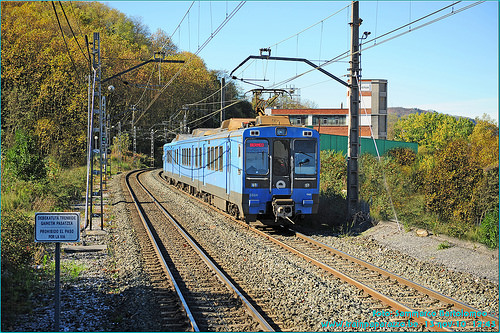
Bizkaia Train & Notice on Track
Train on the Atxuri (Bilbao)-Bermeo line. Note the warning sign to bottom left of image, in Euskera first and Castillian second. (Photo sourced on Internet).

A young couple with two little boys come on to the only platform (for both directions) and I think I hear the woman speaking to the boys in Euskara. But soon, I make out some Castillian (Spanish) words; however it is not unusual to hear some Castillian words and even phrases scattered through Euskara conversation, in the southern Basque Country, at any rate. But no, I can tell now that the conversation between mother and child is definitely all in Castillian – I must have been mistaken earlier, when I thought they were speaking in Euskara.

Mountains over Mundaka rooftop
A view from a Mundaka building a number of stories up. The port is out of sight to the left, the station behind. (Photo: D.Breatnach)
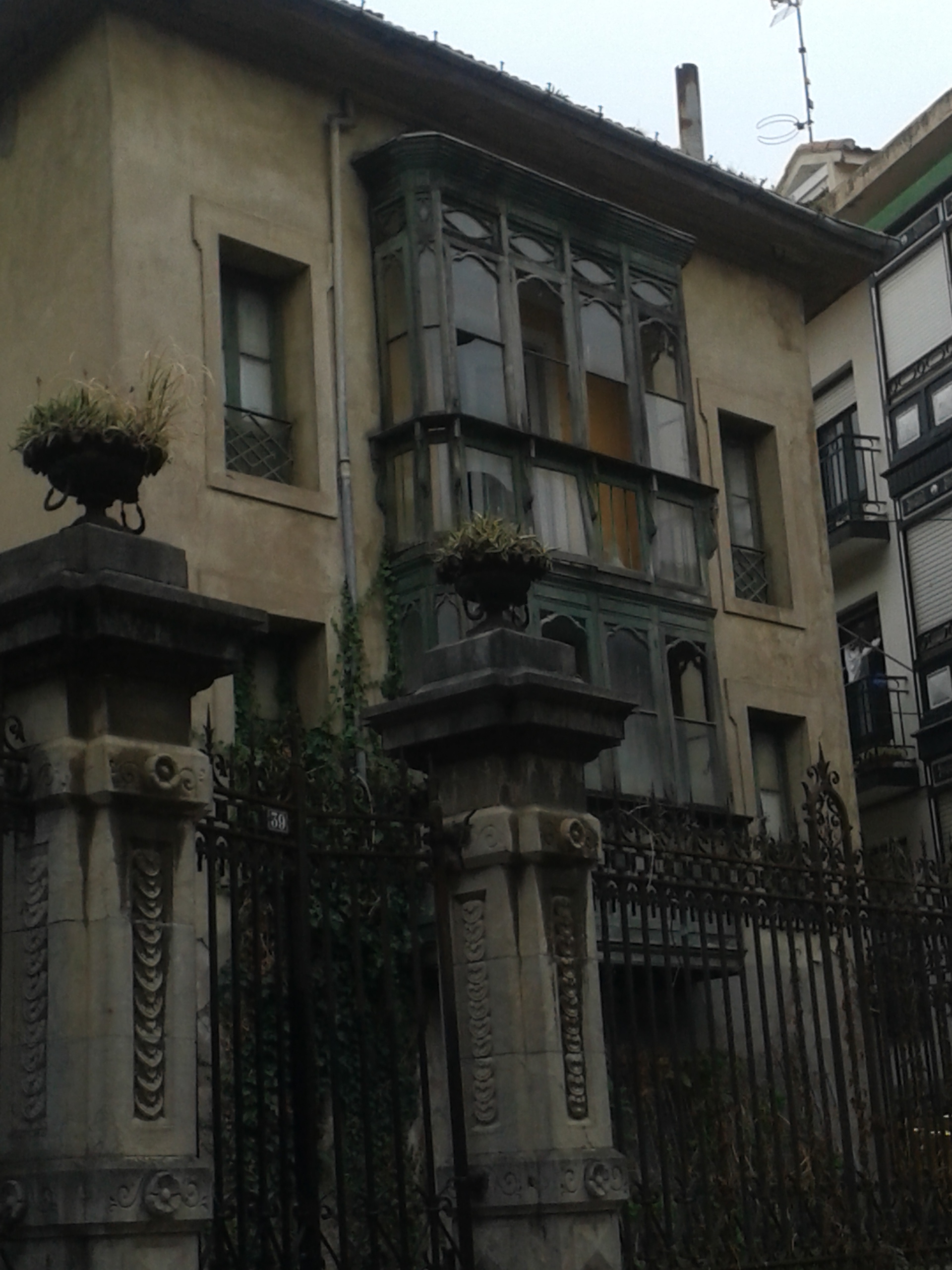
Casa de los Ingleses
“Casa de Los Ingleses”, a beautiful if rather gothic-looking old house, residence of an English family with business interests locally many years ago. I passed it on the short walk from the town to the station. Behind it there were plots being worked for vegetables, all due to disappear beneath a new car park construction. (Photo: D.Breatnach)
The Servants House
The residence of the servants of the Casa de Los Ingleses, a lovely building in its own right.  Its demolition is planned to make way for a new construction (see design in next photo) — my guide encouraged me to write a letter of protest to the municipality.  (Photo: D.Breatnach)
The construction planned to replace the "servants' house" after the latter has been demolished. (Photo: D.Breatnach)
The construction planned to replace the “servants’ house” after the latter has been demolished. (Photo: D.Breatnach)

“Miao, miao” says the smallest boy, pointing at some feral cats dozing near the platform. “Bai, katua” replies the mother and a flood of Euskara follows, both boys and mother and occasionally father too conversing in Euskara. And so they continue until the southbound train arrives and everyone gets on, except one man, presumably waiting for a northbound train to Bermeo.

On our journey southwards, soon passing alongside salt marshlands, I note that the names of the stations are in Euskara only: Itsasbegi-Busturia, Axpe-Busturia (in the broad estuary of the Urdebai river), San Kristobal Busturia, Forua, Instituto Gernika, Gernika….

The Wikitravel entry for Gernika translates it to the Castillian “Guernica” and opens with this: Basque town which was the site of the first airborne bombing attack on a civilian town during the Spanish civil war. The bombing, by the Condor Legion of Germany’s Luftwaffe in 1937, inspired Picasso to paint the landmark cubist work Guernica, now on display at the Centro de Arte Reina Sofia in Madrid.”

Well, yes, but one might add for clarity that it was done as part of Franco’s fascist offensive and that the fascist press later blamed it on Asturian Anarchist “fire-bombers”. And one might update it by commenting that the Basques have asked for Picasso’s painting to be located in Gernika itself, a request which the Spanish state authorities, the political descendants of the fascist victors of that war, have refused.
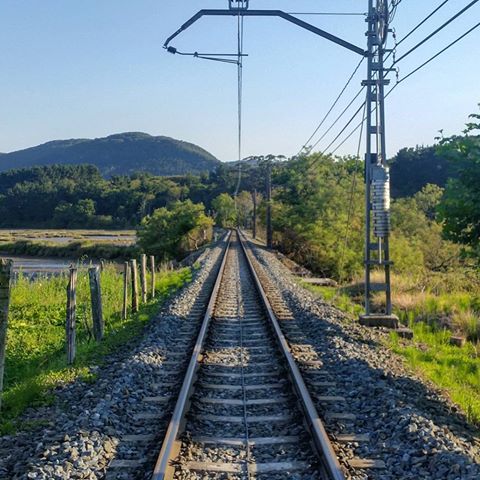
Train tracks Axpe Busturia
Train tracks from Axpe Busturia, the estuary to the left and salt marshes on both sides.  (Source: Internet).

Onwards again, the next stop is Lurgorri-Gernika. At the next after that, Zugast station, a middle-aged man gets on with Berria, the all-Euskara newspaper, under his arm. This periodical, being in many ways the replacement of another newspaper, Egunkaria, has a noteworthy connection with history.

Founded in 1990, Egunkaria was the first all-Euskera daily newspaper in the world; it had a left-nationalist editorial line and a journalistic outlook, which led it to report ETA statements alongside those from Spanish unionist political parties and from the State. The Basque language was no longer illegal or banned since the transición, post-General Franco, when the fascist Spanish oligarchy brought the leaderships of the social democratic party and the Communist Party on board, along with their respective trade union leaders — and called it “Democracy”.

But on 20th February 2003, the Spanish State’s militarised police, the Guardia Civil, raided the newspaper’s premises, seized records, machines and closed down the periodical. They also raided the homes or arrested at the building a total of ten people associated with the newspaper, at least four of which were tortured subsequently. For one of those, the manager, a gay man, the torture included sexual violation.

Massive protest demonstrations ensued from an outraged Basque population. The arrested were released on bail.

On 15 April 2010, seven years later, the defendants were finally acquitted on all charges relating to ‘terrorist’ connections and the judges added that there had been no justification for the closure of the newspaper in the first place.

By then, Egunkaria was beyond recovery and anyway Berria had stepped in to occupy the niche (apparently with the blessing of the Egunkaria team). The case against the State for compensation for the loss of the newspaper and also for torture remains open, sixteen years later. The Court of Human Rights at Strasbourg found the Spanish State guilty of not investigating the manager’s complaint of being tortured and ordered compensation paid. It did not, however, as it usually does not, find the State guilty of the torture itself. Of course, torture is difficult to prove, particularly when the State in question keeps political detainees for five days incommunicado, without access even to independent medical practitioners, while its police go about getting their “confessions”

On the train journey now, the next stop has the delightful-sounding name of Muxika. This causes some amusement to a teenage boy in a nearby seat, accompanied by an older woman – they have been talking in Castillian only since they got on. I wonder are they aware that in June 2013 José Mujica, President of Uruguay until last year, visited the townland that gave rise to his surname. Mujica was presented with a key to the town by the Mayor, who is of the Abertzale Left party Bildu.

The train pulls out of Muxika, then on to Zugastieta-Muxika station as we continue running southward through thick woodlands, occasional industrial parks and small allotments where an occasional middle-aged man tends to his large tomatoes, the small elongated sweet peppers of the region, courgettes, climbing beans …..

Onwards to Morebieta Geralekua before the line takes a sharp twist north-eastwards to more woodlands, rivers, streams and mountains at Lemoa, Bedia, Usansolo, Zuhatsu Galdakoa. Now the built-up areas of Ariz Basauri followed by the contrast of the picturesque Etxebarri before a southward curve to Bolueta and then eastward, to run along the Nervion river to Atxuri station in Bilbo (Bilbao), journey’s end.

All of the stations along this route were named in the Basque language – not one had a Castillian version showing (although there will be plenty of that in streets and squares in Bilbao). The public announcements on this train, as on their counterparts in the Irish 26 Counties, are bilingual but with this difference – on the Basque train, they are always in Euskara first, Castillian second. Likewise with the signage. One is never under any doubt about which language is being given primacy there, nor indeed here, where the English version comes first and, when in text, is in a more dominant type or more contrasting colour.

The Irish language is being derailed even as, to mix metaphors, it is being given lip service. Further down the tracks, unless some urgent repair work is undertaken, lies the final stop – the cemetery of our national language.

end

MASS CROPPIES’ BURIAL GROUND OPEN TO THE PUBLIC ONCE AGAIN

Clive Sulish

Croppies’* Acre, a piece of parkland believed to the site of a mass grave of United Irishmen insurgents and non-combatant victims, situated between the Liffey’s Wolfe Tone Quay and the Collins Barracks complex of the Irish National Museum, was some weeks ago reopened to the public for the first time in four years. Few if any of the campaigners for its saving or its reopening were invited to the event or given credit in the short newspaper report about the occasion.

This report seeks to correct that omission, to give a brief account of efforts made over the years and to comment on the care of the park today.

(* “Croppy” was a name given to supporters of the United Irishmen, apparently because of the males wearing their hair cut short and close to the scalp, in the style of the revolutionary French of the time.  “Crapaí” and “Cnapaí” were the versions of the word in the Irish language).

The Pedestrian Gate on Wolfe Tone Quay, Liffey side, open to the public again after four years (Photo C. Sulish)

HISTORY OF THE SITE AND OF THE CAMPAIGNS AROUND IT

In 2012, after the site had been closed for some time allegedly due to health and safety concerns for visitors due to drug-injecting paraphernalia left there by people using the site at night-time, Pádraig Drummond and Diarmuid Breatnach set up the Croppies Acre Rejuvenation project with a Facebook page to promote the importance of the site and to gather forces to pressure the authorities into reopening the site and maintaining it properly.

Prior to this, a number of visits had been made by Irish Republicans (the 1916 Societies on some occasions, independent Republicans on others) to the closed site to collect and dispose safely of drug-injecting paraphernalia and other waste and it was felt that a public campaign was needed.

Memorial stone about halfway along the the Liffeyside of the park. In the distance, the heaped earth of works in October last year which had caused concern (Photo: D. Breatnach)
Memorial stone about halfway along the the Liffeyside of the park. In the distance, the heaped earth and earth-moving machine in October last year which had caused concern (Photo: D. Breatnach)

As part of the campaign a letter to the media was composed by Drummond and Breatnach in consultation with the National Graves Association (a voluntary independent organisation that marks and maintains the graves of those who fought for Irish freedom and which also erects plaques to commemorate people and events). Although none of the main media published the letter it is reproduced here not only as a document of the history of campaigning for the site in its own right but also because it summarises well what had gone before.

Croppies Acre is remembered in Dublin folklore as the site of a mass grave in which the bodies of dead insurgents were thrown in 1798. Among those lying in Croppies’ Acre are reputedly the bones of Bartholomew Teeling and Matthew Tone (brother of Wolfe Tone — CS), both hanged at the Provost Prison on Arbour Hill after the Battle of Ballinamuck on 8 September 1798.


In 1898, the centenary of the United Irish uprisings, 100,000 marched to the site and placed a plaque there. As many people will be aware, the centenary commemoration of the United Irish played a significant part in the creation of a national pro-independence culture which fed into the Easter 1916 Rising, less than twenty years later, and which in turn fed into the War of Independence 1919-’21 and the creation of an Irish state.

Memorial stone placed during 1798 centenary commemoration which was attended by 100,000 (Photo: D. Breatnach)

Although a 1798 rising commemoration plaque was laid at the site by “soldiers of the Eastern Command” of the Irish Army in 1985, soldiers were sometimes to be seen playing football on the field until the mid-1990s, while Collins Barracks was still in use by the Irish Army. This practice ceased after a number of complaints from members of the public who felt the practice was not respectful to the dead insurgents. The Irish Army vacated Collins Barracks in 1996 or thereabouts and the National Museum moved into the buildings in 1997.

In 1997 a proposal to turn the graves of the Patriot Dead into a car and bus park was all the more stunning as the bi-centenary of the United Irishmen’s Rising of 1798 was imminent and groups everywhere were renovating monuments and graves, organising seminars and lectures and planning pike marches.

The then secretary of the National Graves Association, Tess Kearney (since deceased — SC), was in poor health, but decided that such an occasion required action regardless of her personal circumstances. Tess turned in a magnificent effort for the television cameras and organised a campaign to “Save the Croppies Acre”. Within days, various interested parties came together and, under the leadership of the NGA, the plan to build a coach park on the site was defeated and the Croppie’s Acre site was developed two years ago (i.e in 2010 — CS) as a national monument with an expenditure of some €35,000. The field layout is simple with `(some individual) flagstones throughout the site presumably symbolising the bodies lying below and a small open circular stone structure on which are reproduced parts of the text and facsimile typeface of the Droites del Homme (Rights of Man) document from the French Revolution (1789). Also featured is the text of Seamus Heaney’s poem “Croppies” and the motif of the barley seed head is reproduced on the stone in reference to the poem and Irish folk memory.

The enclosure monument, with National Museum, Collins Barracks in the background. (Photo: D.Breatnach)
The enclosure monument in Croppies’ Acre, with National Museum, Collins Barracks in the background.
(Photo: D.Breatnach)

The Drummond/ Breatnach letter, signed by a number of historians, history tour guides, authors and history enthusiasts, also noted that:

The Office of Public Works has closed the site because it considers it unsafe to permit public access due to some night-time activities there. Recently some of us went to inspect the site and were shocked at the condition into which it has sunk. Used syringes, discarded needles, bottles, cans and other rubbish were found at a number of locations but especially inside the stone structure.

Rubbish bags were filled and disposed of, with the hazardous waste disposed of in bio hazard containers that were then handed into the local authorities. A return visit found almost as much rubbish as had been disposed of previously. A third visit found even more. This is not acceptable and must change.

The letter concluded by stating that
“It may be that some will say that the expense, even though relatively small, of looking after a national monument, cannot be justified in the current climate of austerity. To those we would say that possibly, had we valued sufficiently our independence and the sacrifices made for it in the past, we would not have allowed foreign finance speculators to bring us to sad straits in which we find ourselves now. The image of our past locked away while we are plundered as a nation in the present is a stark contrast.

However about that, the Office of Public Works must take the appropriate action to look after this site properly and offer safe access to the park during the hours of daylight seven days a week. At night, the site needs to be well-lit and protected. Mr. Brian Hayes, TD, Minister of State responsible for the OPW since 2011, must take urgent action.”

At the time, the OPW probably seemed a much safer bet as custodians than Dublin City Council, especially with the Council’s Planning Department having granted property speculators planning permission to construct a giant shopping centre over the Moore Street battleground and market. However, it was eventually Dublin City Council that took responsibility for the maintenance and reopening of the site to the public.

But throughout the years after the setting up of that campaign, from 2012 to 2014, nothing seemed to be happening to put matters right. Groups of Republican volunteers paid visits from time to time to clean up the site, collecting horrifying amounts of used hypodermic needles and other paraphernalia and waste but the authorities appeared unmoved.

Twice in February 2014, questions were asked in the Dáil, the Irish Parliament, of Minister for Public Expenditure and Reform Brian Hayes. Pádraig Drummond had written to TDs (elected representatives) Clary Daly and Maureen O’Sullivan, who received replies to their questions, the former written and the latter an oral reply. Daly’s reply from Minister of State Hayes was that The Office of Public Works and Dublin City Council have agreed in principle that the management and maintenance of the Croppies Acre Memorial Park will be undertaken by the Council. OPW and Dublin City Council are reviewing the Council’s proposals regarding improved access to the park prior to formalising a licence arrangement, following which the park is expected to re-open to the public.”

The oral reply was much longer but the nub of it was the same.

We weren’t getting people signing up to form a campaigning group and we were running out of energy”, said one of the campaigners about those years.

In September 2015, soon after DCC staff were seen to have been cleaning up the site and cutting the grass, concerned Republicans visited the site and posted photos on the campaign FB page of drug paraphernalia and mess which had quickly accumulated again on the site.

In October of that year, Dublin City Council staff began work inside the park with earth removers. In the absence of any notice of what was intended and no public consultation, protesters including Éirigí mobilised and halted work. Dublin City Council gave a written guarantee (see photo) that the work was only to create or upgrade a circular pathway. The protests ceased but an eye was kept on proceedings.

However photographs taken during a visit by other concerned people that same month showed drug paraphernalia again accumulating at the site.

View from the west pedestrian gate to the east since the Acre opened (Photo: C. Sulish)

The letter guarantee which led to calling off the protests in October 2014

THE SITE REOPENS TO THE PUBLIC

By June this year, the site had been cleaned up, planted, a path put through part of it and finally reopened to the public, four years after the campaign to reopen it had begun. The Daily Herald reported on the opening ceremony (see link for their report below) on the 15th, presided over by Lord Mayor Críona Ní Dhálaigh in one of her last acts before her year as Mayor was up.

The Herald report alluded to the years of closure and “problems with drug users” but not once did it mention the National Graves Association, the Republican groups that repeatedly visited the site and those that mobilised to protect it in October last year, or the campaign set up in 2012 and the letter to the media of that year and TDs questions in the Dáil

A sleeping bag, perhaps, against the wall within the monument park weeks after reopening. (Photo: C.Sulish)
A sleeping bag, perhaps, against the wall within the monument park weeks after reopening.
(Photo: C.Sulish)

The report did mention Councillor Mannix Flynn who, it said, had been campaigning over the years for the site’s reopening. “Councillor Mannix Flynn, for all I know, may have been campaigning hard for the site’s reopening,” said Diarmuid Breatnach. “I can’t say he has and I can’t say he hasn’t. But I can say that not once in those years of agitation, campaigning and trying to raise the profile of the issue, did we ever hear from or about him in connection with Croppies’ Acre.”

This month, I visited the site again and found it open and being used by the public, reasonably clean and with some attractive plantings of flowers and grasses. But inside the circular monument, there was a small pile of excreta in one spot and, on the way out, I noted what seemed to be a sleeping bag against the eastern wall. The site will need continual watching.

End.

White Purple Flowers Grass close
(Photo: C. Sulish)

White Purple Grass
(Photo: C. Sulish)

Grass Blue Flowers Close
View southwards across the park (Photo: C. Sulish)

The Tricolour in this case would have been better replaced by the green flag of the United Irish with the harp in gold.
The Tricolour in this case would have been better replaced by the green flag of the United Irish with the harp in gold. (Photo: C. Sulish)

APPENDIX

LINKS TO QUOTED AND RELATED MATERIAL

Letter sent to mass media in 2012, after DCC had locked up the site:
http://www.politics.ie/…/221010-croppies-acre-rejuvenation.…

Daily Herald report on the reopening of Croppies’ Acre

http://www.herald.ie/news/drughit-city-park-is-reopened-after-120k-cleanup-34801856.html

Article about Bartholomew Teeling and Matthew Tone https://rebelbreeze.wordpress.com/2014/03/23/captain-bartholomew-teeling-united-irishmen-hero-believed-to-be-buried-in-croppies-acre/

DEAR HEATHER HUMPHREYS

Dear Heather,

I hope this finds you well — although how you could be, with the mob besetting you on all sides, is anyone’s guess. As if you wouldn’t have enough problems already with the economy! Who’d be a politician these days and especially in the year that’s in it? Well, yes, I do know that you get paid for your trouble. But what does the mob expect for their paltry €157,540 per annum? Sure one could never run a decent-sized house with servants and cars and kids going to university on that kind of money (not to mention the holidays you’d need, just to take a break from the mob).

Heather Humhpreys, Minister for Arts, Heritage and the Gaeltacht
Heather Humphreys, Minister for Arts, Heritage and the Gaeltacht

The truth is, Heather, that the mob have had it in for you from the beginning – they never gave you a chance. First it was that you are not an Irish-speaker. Well! Who needs to be able to speak that dead language anyway (well, nearly dead, and the sooner the better)! Well, yes, ok, the Irish-speaking areas are part of your special responsibility, it’s called “the Department of Arts, Heritage and Gaeltacht”, it is true, but everyone knows that the “Gaeltacht” just got added on to your Department’s responsibilities because it had to be put somewhere.

However, I do think it was unwise of you, if you don’t me saying this to you as a friend, to put that McHugh in the Gaeltacht job as Minister of State. I know he’s doing his best but darling it’s simply excruciating to listen to him stumbling over his koopla fukal (no, I’m not being rude) in public speeches. Surely there must a Blueshirt somewhere who can speak decent Irish?

Thankfully, with the Arts budget cut so thoroughly by this Government and the previous one, you didn’t have too much to worry about there. But Heritage? Oh dear! You’d think for that, one would just have to stick some cement on crumbling castles and pay some staff to look after some cromlechs or something, wouldn’t you? Or pay for the upkeep of some of those lovely Georgian or Victorian big houses (like the one you sorted out for Enda in his Mayo constituency – no, no, I don’t blame you one bit. Always look out for the boss, I say, if you want him to look after you.)

But a row of dilapidated houses in the city centre next to an untidy and smelly street market! Heritage! God give me strength – and you too, Heather, poor darling. That mob, Heather – fifteen years, going on for sixteen, they’ve been banging away about that. What a pity that Joe O’Reilly (bit of a boor really, but still ….) fell on hard times and couldn’t proceed with the demolition of that whole sorry terrace years ago and save you all this heartache!

Nothing is enough for that mob, nothing! Give them an inch and they’ll be screaming for a mile. First it was a clamour for Joe O’Reilly to put back the State’s 1916 50th anniversary plaque that had fallen off the front of No.16 Moore Street and ended up in his Chartered Land office. Honestly, the hullabaloo! Then it was one house the mob wanted made a monument, then it was four. Then the whole terrace — they’ll want the whole country next!

And just when you were going to have some of the houses demolished, that mob, the worst of them, occupied the buildings and stopped the demolition. What are we coming to? If it were me, Heather, I’ll tell you now, I’d have sent our own SWAT team in right away. You have to be tough with that kind of element, Heather, like your party was back in 1922 and ’23 — and sometimes you’re too soft. Yes, you know you are. Oh, sure, some liberals and Republicans would have kicked up a fuss but those vandals in occupation would have been dead or in jail and the terrace a demolished pile within hours. Let them try and get up a campaign over a pile of rubble!

I wonder whether it was wise to call yourself “a proud Irish republican”, when you were appointed, Heather. You had the job, after all, so why say things like that? It’s not as though your FG colleagues would be expecting it of you and it was, as they say, giving a hostage to fortune. Was it perhaps because you felt a bit insecure, as the only Presbyterian in the Government? Oh, Heather – you should know by now that there’s only one religion in Government, and it’s above even Christianity, never mind its various sects.

I despise the mob as much as you do, Heather but I think you could have thrown them a couple of bones a bit earlier. Buying the four houses from O’Reilly (a million each? Not bad, not bad at all for inner-city run down properties!) at the end of 2015 was obviously going to be too little, too late, with Easter 2016 just around the corner. That might have worked a few years ago but not now. You’d have been better off hanging tough, as our masters across the pond say, and giving them nothing except the back of your hand. Now they’ve got the bit between their teeth, collecting thousands of signatures, marching, picketing, blockading …. and even talking about what kind of a Republic they should have.

Heaven forbid they should ever get the Republic they want for if they do, I’ll be transferring whatever assets I can liquidate and getting out of the country as fast as I can.

But I digress …. What about the elections? Nobody expects the Government to survive, so no point worrying about that. Who will take their place? Well, remember when your party and Labour ousted Fianna Fáil? Election promises aside, it was business as usual afterwards, wasn’t it? It’ll probably be the same this time. Well, let’s hope so, anyway.

And your own Dáil seat? Is it safe? I do worry about that. We must have lunch soon and have a good gossip. The Radisson perhaps? Or better still a trip to Blarney, my treat? Anyway, one wouldn’t want to be around Dublin, of all places, at Easter …. with the year that’s in it.

That’s all for now, best wishes,

Phyllis Stein

RTE’s ‘Rebellion’ series, and its propaganda value

Source: RTE’s ‘Rebellion’ series, and its propaganda value

By Tom Stokes, from his Irish Republic blog


There are occasions in life when time that can never be retrieved is expended on something that is worthless. So far, three valuable hours of my life has been wasted on what RTE describes as a ‘commemorative drama’ to herald the beginning of the Centenary year of the 1916 revolution. Wasted, other than in terms of understanding the propaganda value to the political class even of badly constructed ‘historical’ costume drama – although describing ‘Rebellion’ as coherent drama is stretching it.

I quibbled after the first episode about the use of the term ‘Rebellion’ instead of the more accurate term ‘Revolution’, but it finally dawned on me with Episode 3 that what the writer, director and producers really mean is that this is about rebelliousness within the featured families, to which the 1916 Revolution is just a backdrop.

It would be a useful exercise after the series comes to an end to put a stopwatch to good use to work out the proportion of the five hours of screen-time that is devoted to an exceedingly poor and skewed telling of the story of the 1916 Revolution, and what proportion was used to tell the confusing, intertwined, and fairly inconsequential stories of domestic disagreement. There is of course a market for the latter, and for its setting in a sort of ‘upstairs-downstairs’ genre, but this series, more soap than serious drama, should not be its vehicle.

The 1916 Revolution – what was it really about, who made up the rank-and-file – essential to the creation of a revolution, what scale of operation was in play, what impediments to success existed? Nobody can be any the wiser by relying on this series.

The leaders – who were they, what were they like, what did they believe in, was there a plan, had they some endgame, some vision? Nobody can be any the wiser by relying on this series.

Where is Tom Clarke, or Seán MacDiarmada, or Joe Plunkett, three iconic signatories of the Proclamation, all present in the GPO – but not so far in this sorry series? No clue as to their characters, and precious little of James Connolly’s – relegated to a bit part, or of Patrick Pearse’s – other than his addiction to prayer, his deference to the clergy, his obsession with blood sacrifice, and a capacity for rhetorical exaggeration – as RTE would have us believe.

Where is the evidence of strong public support particularly in the impoverished inner city tenements, without which the revolution could not have lasted almost a week? We know it was there, we who have bothered to acquaint ourselves with the true narrative. Instead, that hoary old myth of widespread public disaffection with the revolution is hammered home at every opportunity.

Episode 3 begins with some bearded chap being put up against a wall and shot by firing squad. Who was he? We are none the wiser by the end of Episode 3. Why might it be important to know that he was Francis Sheehy-Skeffington, a journalist, an advanced-feminist, a pacifist who had played no part in the revolution itself? Because, perhaps, that it is true, and that he was murdered on the command of a crazed, out-of-control British army officer – an essential detail of the 1916 narrative – but not as the masses are supposed to know it since it would upset the entirely revisionist slant of this television disaster, a revisionism that is deliberately applied. And so it goes on.

Against fleeting scenes of chaos, created as we are led to believe by violent anti-democratic nutcases hell-bent on creating a Catholic state, we are encouraged to note the stabilising influence and the manners and the etiquette of both the Irish ‘Castle Catholics’ and their British masters in Dublin Castle. Fast-forward by 100 years and we see the same spurious choice being presented to the people by the political class – ‘stability’ or ‘chaos’, white or black, good or bad. No need to tease out what each side really stood for back then, or what each side stands for now.

There are those who ask ‘what matter – it is only TV drama?’. Propaganda is at its most effective when it is inserted subtly into the thought-processes of its target audience, and repeated through various forms from news and current affairs, commentary, and yes, entertainment. That works, as Joseph Goebbels knew all too well.

RTE claims an audience of 600,000 for its first episode of ‘Rebellion’. A large proportion of these will vote in the upcoming general election in which the main choice will be between, the political class tells us, stability or chaos. And that audience is also entering into the centenary year of the 1916 revolution with its competing interpretations, one of which champions the Redmondite parliamentarian Home Rule option over the other – the right of a people to self-determination and self-government, to be established through revolution where no other viable option was available. Presenting a partisan and therefore skewed version of the 1916 revolution primes at least a part of that audience to adopt a negative view of the legitimacy of that revolution and of its leaders, and that represents a highly political intervention in the popular history of 1916 on the part of the State broadcaster, RTE. It is not, presented in that way, just TV drama.

‘Rebellion’ looks like a cheap production, but cost as much as Ken Loach spent making The Wind That Shakes The Barley – an excellent production for the big screen, which grossed three times its production costs at the international box-office. Why wasn’t Loach asked to make this series? It is not as if he lacks experience. But then, he could be relied on to create a credible narrative around the main story of revolution and to consign the less consequential sub-plots to their rightful places. That would not suit the political class, including its RTE functionaries.

The 1916 revolution is an intriguing, exciting and rich human story, as rich in dramatic potential – characters, incidents and plot-lines – as was the highly successful and accurate 1913 Lockout TV drama ‘Strumpet City’, produced by RTE in 1980. ‘Rebellion’ on the other hand is dross. Some people, their names figuring prominently on the credits of each episode, opted for dross, and each received a considerable reward tor taking that option.

The foundational narrative of modern Ireland – in which the 1916 Revolution is the inciting incident – deserves to be treated with a modicum of respect. That is entirely absent in this spurious version.

There are times when we remark that ‘you couldn’t make it up’. The series writer did, with input from others.

And there are times when we remark that ‘it couldn’t get any worse’. Oh yes it can, and it will.

Of that I am certain.

THE DESIGN OF THE NEW €2 COIN — AN INAPPROPRIATE IMAGE REVEALING A NOSTALGIA FOR THE EMPIRE?

Diarmuid Breatnach

The new €2 coin design is now published and the coins will themselves be put into circulation in the New Year. Designs were submitted and the winning design for the ordinary currency coin is by Emmet Mullin, while the design for the gold and silver special editions is by Michael Guilfoyle. Both designs incorporate the statue of “Hibernia” and that name is prominently displayed on one of side of the coin and although Guilfoyle’s design incorporates some words from the 1916 Proclamation, they are in the background to the representation of “Hibernia”. The image is taken from a the centre one of a trio of statues erected on the GPO in 1814, while still under British occupation.

Hibernia €2 coin 2016
One side of the new Irish coin

“Hibernia” was regularly used as an image to represent Ireland by “Punch”, a satirical racist British publication and she was always

OLYMPUS DIGITAL CAMERA
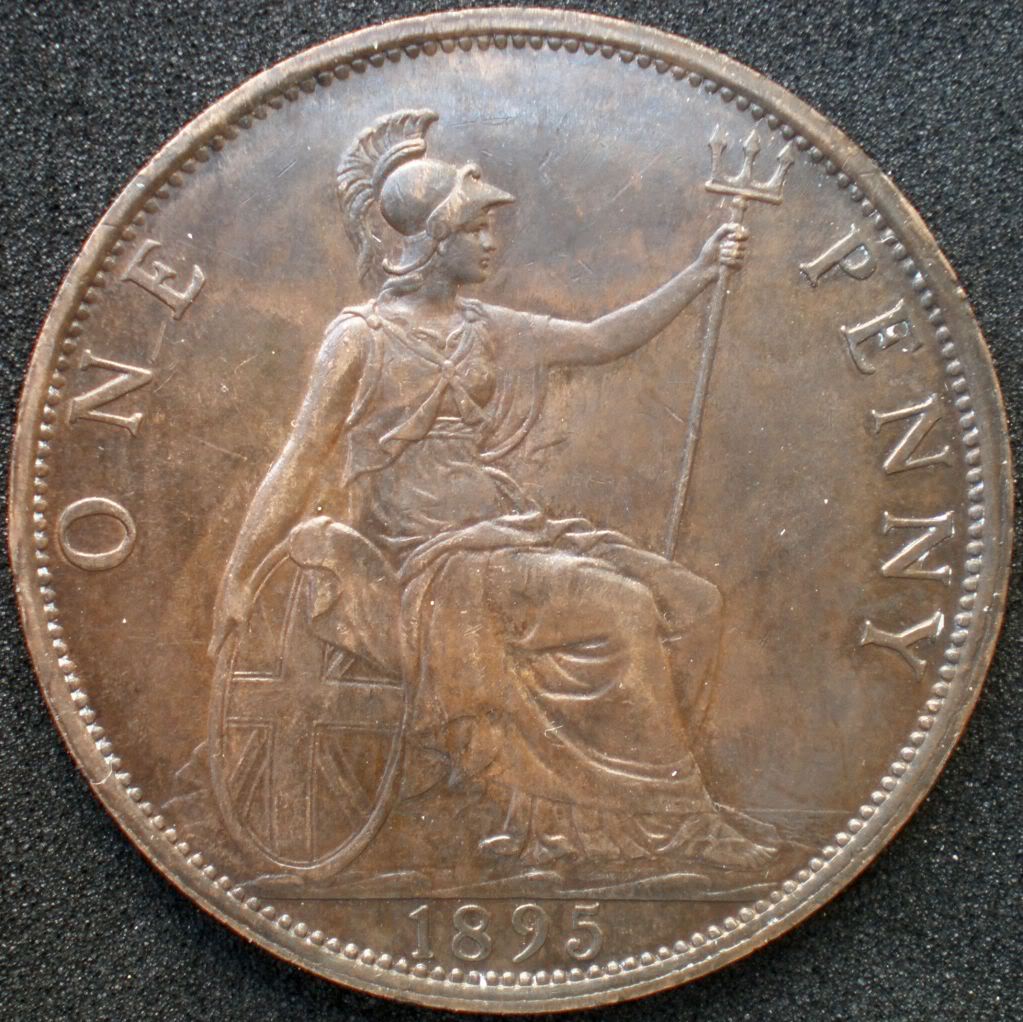
(British penny showing the image of “Britannia” — a martial female wearing a crested war helmet, carrying a shield and holding a trident (perhaps to indicate domination of the seas).

shown as a pretty younger sister of “Britannia”, in need of her older sister’s protection (usually from the rebellious Irish, the despair of poor “Hibernia”). She was never in martial garb, unlike Britannia herself who was usually represented as a majestic and martial figure, with a crested war-helmet and shield and sometimes carrying a trident (perhaps to indicate domination of the seas).

That representation of Britannia appeared not only in the cartoons of “Punch” and other publications but also in sculpture — for example at the top of Somerset House, in the Strand, London – and also on many mints of British penny coins.

Of course, in British history the most likely model for the representation of a female fighter was Boudicca (“Boudicea”) who, after her humiliation and the rape of her daughters by Roman Legionnaires, raised her formerly pacified tribe of the Icenii against the Roman occupation and came close to driving them out of Britain. The irony is that the whole of Britain at that time was Celtic, as were Boudicca and the Icenii. But the English ruling class appropriated Boudicca into their English iconography as they did also with King Arthur and the Round Table knights.

Romanised and civilised

Ireland had many names among the Gael but “Hibernia” was not one of them. “Hibernia” was a late Latin name for Ireland, which the Romans had previously called “Scotia” (yes, “Scotland” originally meant something like “the land the Gael have invaded and settled and defend”).

The Roman linguistic connection is interesting – Irish Anglophiles and some English lovers of Ireland have been wont to bemoan the fact that Ireland was never conquered by the Romans. These commentators have tended to see Romanisation as civilising, forgetting perhaps the words of Rome’s own greatest historian, Publius Tacitus (or Gaius Cornelius Tacitus; c. 56–after 117 AD) who said that “they have created a desert and call it peace.” Calling Ireland “Hibernia” might be a way to bring that Roman conquest belatedly to the unquiet isle, to make her more “civilized” — in fact more like her neighbour and therefore more accepting of her neighbour’s domination and of her ways.

When John Smyth designed the statues to go on top of the General Post Office building in Dublin’s main street, then Sackville (but now O’Connell) Street, Dublin was widely considered the second city of the British Empire, next to London. The building opened to the public in 1818 but Dublin’s slow decline in status had already begun. Since the abolition of the Irish Parliament by the Act of Union in 1801, following the suppression of the United Irish uprising three years earlier, the Irish Members of Parliament had to go to London to take their seats, taking a great deal of political, commercial and social life with them. Irish landlords deserted their Irish estates in greater numbers, leaving them in the hands of their often rack-renting agents as the owners demanded more and more rents to keep them in their homes in Britain and their lifestyle there and in Europe. Throughout the 19th Century the social focus slowly followed the political to England – except where a militant nationalist one arose.

Hibernia only GPO
Statue representing “Hibernia” on top of the GPO, a martial female wearing a crested helmet, holding a spear and a harp.

Britannia Statue, Somerset House, Strand
Sculpture representing Britannia on top of Somerset House, The Strand, London city centre. She is a martial female wearing a crested war helmet, carrying a shield and holding a trident.

Submission or subversion?

Perhaps the representation of Hibernia by John Smyth, reflecting that of Britannia, was meant to show Ireland as equal in grandeur to her dominant neighbour. The Society of the United Irish had been part of a wider cultural movement that sought to explore and appropriate an older Gaelic culture for the colonists, many of them settled for generations on Irish land. Assertions of autonomy and complaints about English political and commercial restrictions had been part of that movement too and had found sharpest expression in the republican and separatist ideas of the United Irish. Some aspirations remained, severely modified. Perhaps it was John Smyth’s intention to show Hibernia as grand but there was no mistake about who was really in charge in Ireland, Hibernia or Britannia.

As if to underline the relationship, Smyth placed a statue representing “Fidelity” on Hibernia’s left on top of the GPO. What could that fidelity be, except to the Empire? Some suggest that because Fidelity holds the Key and is with the Dog, that she really represents Hecate. I know nothing about Smyth nor have I the time to research him at the moment but it is possible he was being somewhat subversive in that representation. Hecate had a number of earlier and later interpretations and the key seems to have appeared later – the key to the household perhaps but also to Hades, the Underworld.

On Hibernia’s right, John Smyth erected the statue of Hermes, known to us as the messenger of the gods but also representing commerce. Commerce, then as now, was the backer of military and political initiatives, indeed often the driver. Of course, many of the Irish bourgeoisie, both native and colonist in origin, wanted a successful commercial Ireland. But after 1798 and 1801, they were not going to get it. From then on, most progress for Irish finance would be made through investing in the Empire rather than in Irish industry and trade.

Whether the representation of Hibernia was intended as some kind of subject of Britannia with pretensions to something grander or was in fact just aping her better, dressing in her mistresses’ clothes when the lady was away, is a moot point. What is certain is that neither the image nor the name itself is of native origin.

The names for Ireland

As noted earlier, among the many names of the Gael for Ireland, “Hibernia” does not appear. The clan-based resistance had used Irish names to describe the land and this continued in the wars against Cromwell and William, with “Ireland” being the most common name when speaking in English by both sides of the wars.

The United Irishmen, a late 18th Century republican movement for independence led mostly by descendants of colonists and largely English-speaking, called the land “Ireland”1 or “Erin” (a phonetic representation of the Irish-language “Éirinn”, the dative case of “Éire”). These names, along with the genitive “Éireann” later, continued to be those most often used by nationalists of the 19th Century, the Young Irelanders, the Fenians, the Land League, as well as by the various advanced nationalist and revolutionary organisations in the early years of the 20th Century2.

"Ireland" is named in a banner of the Irish Transport & General Workers' Union in October 1914, with the Irish Citizen Army parading outside.
“Ireland” is named in a banner of the Irish Transport & General Workers’ Union in October 1914, with the Irish Citizen Army parading outside.

This continued to be the case during the War of Independence and by both sides in the Civil War and was the case with the setting up of the 26-County state and with the various national resistance movements to that state of affairs since then. One finds “Hibernia” in the Ancient Order of Hibernians, of course and in the Hibernian Bank but they are exceptions – it is “Éire”, “Erin” or “Ireland” over all – and has been so for many centuries.

“Hibernia” is a foreign colonial import, both in terminology and in concept. She is poor image of her big sister on “the mainland”, the real boss. The use of her image and of her name is inappropriate to commemorate the 1916 Rising but their use may signify much more than an error – they may reveal a subliminal desire to return to the Empire, or at least the Commonwealth, in the psyche of those who were never all that sure they should have left it.

End

Links for sources:

The design of the new €2 commemorative coin: http://www.joe.ie/news/pic-take-a-look-at-the-winning-designs-for-irelands-new-2016-coins/511479

The GPO building and the statues: http://archiseek.com/2010/1814-general-post-office-oconnell-street-dublin/ among other on-line sources

Hecate: https://archetypicalwitchcraft.wordpress.com/2014/01/24/understanding-hekate-part-5-the-meaning-of-her-ancient-symbols/

About origin and personification of Hibernia: https://en.wikipedia.org/wiki/Hibernia_(personification) http://victorianvisualculture.com/2010/10/13/hibernia-as-the-other-ireland/ and despite perhaps its name and appearance a good concise but short summary in http://www.proud2beirish.com/Irelands-Name-Origin.htm

1“From my earliest youth I have regarded the connection between Ireland and Great Britain as the curse of the Irish nation …” Theobald Wolfe Tone

2Inghinidhe na hÉireann, Na Fianna Éireann, The Irish Citizen Army, The Irish Transport & General Worker’s Union, The Irish Volunteers, Óglaigh na hÉireann. Also, when the Abbey Theatre was founded by W.B. Yeats and Lady Gregory in 1904, they declared it was “to bring upon the stage the deeper emotions of Ireland”.

THE WOMEN STARTED IT

(Reading time: 5 mins)

Diarmuid Breatnach

We celebrate International Women’s Day on March 8th but are we aware that on that day in 1917, women started the Russian revolution?  It was one of the many contributions of women the world over to the struggles of humanity.

BACKGROUND

          There were many causes of discontent with the ruling regime in Russia in 1917: it was monarchic, autocratic, repressive, incompetent. It had put the country into a war with Germany and Austria, which was in its third year. People were very hungry with food shortages for a number of reasons including the trains being used to transport war materials and soldiers rather than to bring food into the city. Nationalities within Russia and Greater Russia were denied self-determination.

Peasants were serfs to the aristocracy, who could beat, imprison and even hang them. Officers, always from the aristocracy or — to a lesser degree — from the professional classes regularly struck ordinary soldiers or had them whipped. The officers were also for the most part grossly incompetent.

The Christian Church (Russian Orthodox) was allied to the regime and corrupt. Free speech was suppressed and the secret police could be anywhere; the regular police were brutal and could not be challenged by ordinary people. Wages were often barely enough to live on.

START OF THE REVOLUTION

          Petrograd was the Imperial capital city of Russia (the name had been changed in 1914 from St. Petersburg, which sounded too German) and in February and March 1917 a number of factories there were on strike for better wages.   In particular, on March 7th (February 22 according to the calendar in use in Russia then), workers in the large Putilov works went on strike. The factory owners sacked the workers but not had not yet replaced them; there were some clashes with police.

The following day, March 8th (by our calendar), International Women’s Day, women in Petrograd organised a number of meetings and rallies. Led by no political party but in an atmosphere of deep discontent throughout the city, the women’s activities became increasingly energetic and militant. Demonstrations began to march, demanding bread and the women went to factories not yet on strike, calling on the workers to down tools and join the demonstrations. As as many as 50,000 did.

Two days later, a general strike had seized Petrograd’s manufacturing industries, much of the city’s services and even some commercial business, bringing clerks, teachers and students to swell the numbers in protests. Everywhere there were street meetings, marches; red flags and banners began to appear among the crowds. Slogans hardly considered before were shouted and became current, including calling for the monarch, the Tsar, to abdicate or to be deposed.

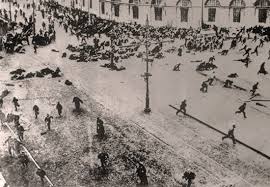
Demonstration during the "February Revolution" 1917. Note the prominence of women in the demonstration.
Demonstration during the “February Revolution” 1917

The Petrograd police were powerless to control the demonstrators who would have turned on them had they intervened. On the 11th, three days after the women’s mobilisation, the Tsar called on the Russian Army to intervene and to shoot demonstrators.

Russia had the largest single army in the world and despite the war, thousands were still in Petrograd. They had been used in the past against the workers and in 1905 had massacred people on a demonstration to petition the Tsar. But now, after three years of war and shortages, they were not keen to do so and particularly reluctant to open fire on women. Soldiers began to mutiny and, when threatened by officers, often shot them instead.

On that day, the Chairman of the Duma, the parliament which the Tsar Nicholas had kept powerless, sent an emergency telegram to the Tsar, who was at the Headquarters of the Russian Army, asking him for urgent action. The Tsar’s reply was dismissive – his wife, the Empress Consort Alexandra, had written to him that the problems in Petrograd were being exaggerated.

A Russian Army barricade during the "February Revolution" -- the soldiers refused the orders of their officers to shoot demonstrators.
A Russian Army barricade during the “February Revolution” — the soldiers refused the orders of their officers to shoot demonstrators.

But the garrison of Petrograd, including elite units, had mutinied by the 12th, four days after the women’s marches and demonstrations. In addition the Cossack troops, usually reliable in shooting and sabring demonstrators and rioters, were disobeying the orders of their officers to attack the people (although they had not joined the mutiny). Officers began to go into hiding as more of them were being shot by soldiers from their own units. Symbols of Tsarist rule were being torn down in public places.

Two days later, on the 14th, the socialist parties and organisations established the Petrograd Soviet, last seen there twelve years previously, in 1905, before it was crushed by the Russian army. The Petrograd bourgeoisie were frightened but were unused to ruling except as permitted to by the Tsar, who himself now seemed unable to control events. Their powerless Duma (parliament), although ordered closed down by the Tsar that morning, set up a temporary committee to restore law and order and later, their Military Commission as part of the Provisional Government they created.

Thus began a period of dual authority in the city – the revolutionary workers, soldiers (and later, sailors) through the Soviet on the one hand and the bourgeoisie through their Military Committee on the other.

The Petrograd Soviet set the tone for what was to come by approving a number of points in Order No.1, effectively the first law drawn up by the Soviet, point 4 of which stated:

The orders of the Military Commission of the State Duma shall be executed only in such cases as do not conflict with the orders and resolution of the Soviet of Workers’ and Soldiers’ Deputies.”

The Soviet was making sure it could not be overruled by the new unelected body which the bourgeoisie had set up, the Provisional Government, or by its Military Commission.  

Senior Army and political appointees advised the Tsar to do what just over a week previously would have been unthinkable – to abdicate. On the 15th, the Tsar abdicated on his own behalf and of his son, nominating instead his brother, the Grand Duke Alexandrovich, to be Tsar. But he in turn knew he had no support as things stood and refused the “crown”.

July Days Russia 1917
Demonstrating workers shot down by Army units in the Russian “July Days”, 1917

The Russian monarchy of centuries had been overthrown — only seven days after the women’s mobilisation in Petrograd.

Maneouvers by the different sides continued during May and June, including an attempted military coup by senior officers commanding army units away from Petrograd. The fortunes of the revolution swayed back and forth across the country until demonstrations in July supported by the Anarchists and the Bolsheviks were suppressed by army units loyal to the Mensheviks and Socialist Revolutionaries political parties in power.

Workers were being disarmed, soldiers re-submitted to the old discipline and revolutionary leaders were being hunted; the War was also ongoing.

In October, the Bolsheviks seized power, ended Russia’s involvement in the War and began to construct a socialist state.

Two years later the people had to fight to defend it against a right-wing military uprising supported by eight states, including the Allies but were successful in the end.

But it was the women who had started the ball rolling seven months earlier on March 8th, with their rallies and demonstrations and calling the workers out from the factories. Henceforth too, they played their part in government, in building the country and in the armed forces, particularly during the war against fascism and in defence of the USSR from June 1941 to the fall of Berlin and Nazi Germany in 1945.

Nearly 200,000 women were decorated and 89 eventually received the Soviet Union’s highest award, the Hero of the Soviet Union. Some served as pilots, snipers (some of the ace snipers at the famous battle (or siege) of Stalingrad were women), machine gunners, tank crew members and partisans, as well as in auxiliary roles of nursing, construction, administration, factory work and of course food production.

end.

Soviet female combat pilots in WW2. The USSR was the only state to have female combat pilots.
Soviet female combat pilots in WW2. The USSR was the only belligerent state to have female combat pilots during WW2.

LÁ FHÉILE STIOFÁIN/ ST. STEPHENS’ DAY

Diarmuid  Breatnach
(Traducido al castellano al fondo)

Singing Wren 46 (Michael Finn)

(Reading time: 5 minutes)

  ” We made it!  We made it!  Safe for another year!”

Wren on rock


“Shut up, you idiot!  The day’s not over yet!”


Meanwhile, not far away ….

Wren Boys Sligo
Mummers Sligo maybe

THE WREN-BOY TRADITION IN IRELAND

In England it is called “Boxing Day” but in Ireland the 26th of December is “St. Stephen’s Day”.  Despite the Christian designation it has long been the occasion in Ireland for customs much closer to paganism.

It was common for a group of boys (usually) to gather and hunt down a wren.  The wren can fly but tends to do so in short bursts from bush to bush and so can be hunted down by determined boys.  The bird might be killed or kept alive, tied to a staff or in a miniature bower constructed for the occasion.

The Wren Boys would then parade it from house to house while they themselves appeared dressed in costume and/or with painted faces.  In some areas they might only carry staff or wands decorated with colourful ribbons and metallic paper while they might in other areas dress in elaborate costumes, some of them made of straw (Straw Boys) and these were sometimes also known as Mummers although a distinction should be drawn between these two groups.  The Mummers in particular would have involved acting repertoires with traditional character roles and costumes, music and dance routines while the simpler Wren Boys might each just contribute a short dance, piece of music or song.  In all cases traditional phrases were used upon arrival, the Mummers having the largest repertoire for in fact they were producing a kind of mini-play.

The origins of the customs are the subject of debate but a number of Irish folk tales surround the wren.  The bird is said in one story to have betrayed the Gaels to the Vikings, leading to the defeat of the former.  There is a Traveller tradition that accuses the wren of betraying Jesus Christ to soldiers while another tradition has the bird supplying the nails (its claws) for the crucifixion of Jesus Christ.  Yet another tradition has the wren as King of the Birds, having used its cunning in a competition to determine who would be the avian King, hiding itself under the Eagle’s wind and flying out above the exhausted bird when it seemed to have won, having left all others behind and could fly no higher.

By the 1960s the Wren Boy custom was beginning to die out even in areas where it had held fast but it slowly began to be revived by some enthusiasts.  Nowadays fake wrens are used.  Christmas Day in Ireland was traditionally a day to go to religious service and to spend at home with family or to go visiting neighbours.  It was not a day of presents or of lights or Christmas Trees, customs brought in by the English colonizers in particular from Prince Albert, the British Queen Victoria’s royal consort, who was German.  St. Stephen’s Day may have celebrated the Winter Solstice (the wren being a bird that on occasion sings even in winter) but moved to a Christian feast day; in any case it produced colour and excitement at a time which did not have the religious and commercial Christmas season to which, in decades, we have become accustomed.

The lovely song The Boys of Barr na Sráide from a poem by Sigerson Clifford takes as its binding thread the boys in his childhood with whom Sigurson went “hunting the wren”.  It is sung here by Muhammed Al-Hussaini (currently resident in London and part of the singing circle of Comhaltas Ceoltóirí na hÉireann, meeting in the Camden Irish Centre).  There are recordings of others performing this song well but the unusual origin of this one as well as its quality persuaded me to choose this one.  In addition, I had the pleasure of participating in a singing circle with this lovely and modest singer in London in October this year (see The London Visit on the blog), who greeted me in Irish.  Muhammed also plays the violin on this, accompanied by Mark Patterson on mandolin and Paul Sims on guitar.

ends.

LA TRADICIÓN DE “CHICOS DEL REYEZUELO” EN IRLANDA

Diarmuid Breatnach


En Inglaterra se llama “Boxing Day”, pero en Irlanda el 26 de diciembre es “
la fiesta de San Esteban“. A pesar de la designación cristiana, ha sido durante mucho tiempo la ocasión en Irlanda de costumbres mucho más cercanas al paganismo.

          Para eso era común que un grupo de niños (generalmente) o chavales se reuniera y cazara a un reyezuelo. Ese pájaro es capaz de volar pero tiende a hacerlo en ráfagas cortas de arbusto a arbusto y, por lo tanto, puede ser cazado por niños determinados. El pájaro podía ser asesinado o mantenido vivo, atado a un bastón o en una glorieta en miniatura construida para la ocasión.

Los “Wren Boys” (Chicos del Reyezuelo) lo desfilarían de casa en casa mientras ellos mismos aparecían vestidos con disfraces y / o con caras pintadas. En algunas áreas, solo pueden llevar bastos o varitas decoradas con cintas de colores y papel metálico, mientras que en otras áreas pueden vestirse con trajes elaborados, algunos de ellos hechos de paja (Straw Boys/ Buachaillí TuI = Chicos de la Paja) y a veces también se los conoce como Mummers, aunque se debe hacer una distinción entre estos dos grupos. Los Mummers en particular tenían repertorios involucrados de actuación con roles y disfraces de personajes tradicionales, música y rutinas de baile, mientras que los Wren Boys más simples podrían contribuir con un baile corto, una pieza musical o una canción. En todos los casos se usaron frases tradicionales a la llegada, los Mummers tenían el mayor repertorio porque de hecho estaban produciendo una especie de pequeño teatro. Se les daba dinero , pastel o caramelos.

Los orígenes de las costumbres son objeto de debate, pero una serie de cuentos populares irlandeses rodean al reyezuelo. En una historia se dice que el pájaro traicionó a los Gaels a los Vikingos, lo que llevó a la derrota de los primeros. Hay una tradición de los Travellers (gente étnica nómada de Irlanda) que acusa al reyezuelo de traicionar a Jesucristo a los soldados, mientras que otra tradición dice que el pájaro suministra los tornillos (sus garras) para la crucifixión de Jesucristo. Sin embargo, otra tradición le tiene al reyezuelo como el Rey de los Pájaros, después de haber usado su astucia en una competencia para determinar quién sería el Rey de las aves, escondiéndose bajo el viento del Águila y volando por encima del pájaro agotado cuando parecía haber ganado, todos los demás detrás y no poder volar más alto.

En la década de 1960, la costumbre de Wren Boy comenzaba a desaparecer incluso en áreas donde se había mantenido firme, pero algunos entusiastas comenzaron a revivirla lentamente. Hoy en día se usan reyezuelos falsos. El día de Navidad en Irlanda era tradicionalmente un día para ir al servicio religioso y para pasarlo en casa con la familia o para visitar a los vecinos. No fue un día de regalos ni de luces ni de árboles de Navidad, costumbres traídas por los colonizadores ingleses en particular del alemán Príncipe Alberto, el consorte real de la Reina Victoria británica. El día de San Esteban puede haber celebrado el solsticio de invierno (el reyezuelo es un pájaro que en ocasiones canta incluso en invierno) pero se mudó a una fiesta cristiana; en cualquier caso, produjo color y emoción en un momento que no tenía la temporada de Navidad religiosa ni entonces la comercial a la que, en décadas, nos hemos acostumbrado.

La encantadora canción The Boys of Barr na Sráide (mezcla del inglés con el gaélico: “Los Chicos de la Altura de la Calle” [toponómico de puebo en el Condado de Kerry]) de un poema por Sigerson Clifford toma como hilo conductor a los chicos de su infancia con quienes Sigurson fue “cazando al reyezuelo”. Aquí lo canta Muhammed Al-Hussaini (actualmente residente en Londres y parte del círculo de canto de Comhaltas Ceoltóirí na hÉireann, reunido en el Centro Irlandés de Camden). Hay grabaciones de otros interpretando bien esta canción, pero el origen inusual de esta, así como su calidad, me convenció para elegir esta. Además, tuve el placer de participar en un círculo de canto con este encantador y modesto cantante en Londres en octubre de este año (ver The London Visit en el blog), que me recibió en irlandés. Muhammed también toca el violín en esto, acompañado por Mark Patterson con mandolina y Paul Sims con guitarra.

Fin.

“SOMEWHERE OVER THE RAINBOW” WAS WRITTEN BY A ‘RED’

Diarmuid Breatnach


DID YOU KNOW IT WAS A ‘RED’ WHO WROTE “BROTHER CAN YOU SPARE ME A DIME?” WELL, NOT SO SUPRISING, MAYBE. BUT HOW ABOUT THE SONGS FOR “THE WIZARD OF OZ” and “FINIAN’S RAINBOW”?


Yip Warburg, author of lyrics of many songs, including those in the Wizard of Oz.
Yip Harburg, author of lyrics of many songs, including those in The Wizard of Oz musical.

Yip Harburg, born in the poor Lower East Side Manhattan to Russian Ashkenazi Jew migrants, was a socialist and the writer of the lyrics of the songs in The Wizard of Oz and worked on the music too.

In fact, a lot of the production team and actors were “pinkos” of some kind, including Judy Garland.  The “Brother Can You ..” melody was based on a Russian lullaby. In this Amy Goodman interview on Democracy Now TV (see link bottom of piece), Yip’s son Ernie Harburg talks about his father and included is quite a bit of footage of Yip himself, talking and singing, as well as footage of the first Wizard of Oz film.

When some people think it appropriate, while supporting the Palestinians, to synonymise the words “Jew” and “Israeli”, confusing the ethnic grouping of Jews with the fascist, racist and colonist ideology of Zionism, they are ignorant of or forget not only those Jews who combat Zionism today like Finkelstein and Chomsky but also the public criticisms of Zionism and the creation or actions of the state of Israel expressed by Albert Einstein, authors Erich Fromm, Howard Zinn, Isaac Asimov, Philip Roth, I.F. Stone; violinist Yehudi Menuhin; journalists Joe Klein (Time magazine), Roger Cohen (NY Times); Richard Falk (UN Special Rapporteur), historian Gabriel Kolko and many, many others. Those Jews are following a tradition: political and religious dissidence was endemic in Western Jewry and Jews have been to the forefront in socialist movements in Europe and in the USA, as well as in the struggles against racism and for civil rights in the latter.

“Music makes you feel; words make you think; songs make you feel the thoughts,”  said Yip Warburg.  At the time of the Depression in the USA (caused by the financiers, surprise, surprise), with massive unemployment and poverty, the authorities and some of the public wanted songs like “Happy Times Are Here Again” and no-one was writing songs about the suffering except for his father, says Yip’s son Ernie Harburg. Not on Broadway, maybe, but in some speakeasies, in some bars and on some radio shows, the blues and folk singers were composing and singing those songs, some writers like Steinbeck were writing their stories and photographers like Dorothea Lange, Jack Delano, Gordon Parks and others were recording their faces.

People were out on the streets and picket lines too, shouting, marching, holding placards, getting their heads busted by cops and sherrifs and goons and breaking some of their heads back too. Sometimes the protesters and campaigners were shot and sometimes even executed. As the financiers swing us around to those times again, we celebrate the victories and learn from the defeats, take pride in the courage of all those who fought and mourn those who fell, whether they fought against the police and municipal authorities, the witch-hunters like McCarthy and the ignorant red-haters, the National Guard, the FBI …

Scene from the Musical Theatre production of Americana, which featured Warburg's song "Brother Can You Lend Me a Dime?"
Scene from the Musical Theatre production of Americana, which featured Warburg’s song “Brother Can You Lend Me a Dime?”

And we singers, singing the lyrics and melodies of others and of our own, written in the past or in the present, give honour to the fighters in whole periods of struggle even as, in the book of history, the first lines in the next chapter are being written.