SOLIDARITY AND RESISTANCE IN MUSIC AND SPOKEN WORD IN DUBLIN

Clive Sulish

(Reading time: 3 mins.)

Thursday night (30th), with almost non-stop downpour of rain was a dreary and miserable one in Dublin. Not so however inside the Cobblestone’s back room where solidarity and resistance resounded in song, instrumental and spoken word.

The event organisers, Solidarity Sessions collective, an independent organisation founded late last year have declared a number of times that they wish to contribute to “creating a community of solidarity and resistance through culture.”

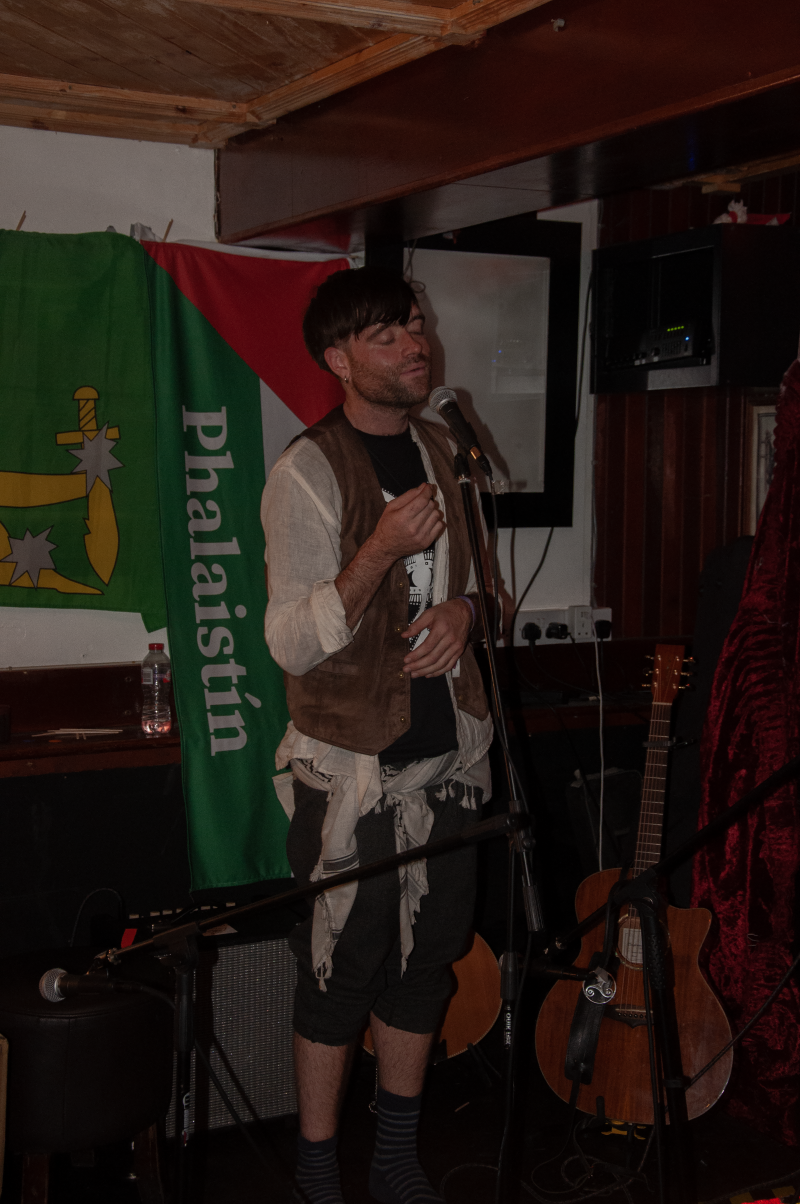
Certainly the flags on the stage of the Tricolour, Starry Plough and Palestine conveyed some of the context, as did posters of 1916 martyrs Connolly and Pearse with text pointing out that the first was a migrant and the second, son of a migrant.1

In addition a merchandise stall sold T-shirts figuring the Palestinian Resistance with funds raised going to Palestinian relief work on the ground. Solidarity Sessions have also donated to ‘buy’ a water truck from Uisce for Gaza and also donated to Streetlink Homeless Support in Dublin.

Mark Flynn performing at Solidarity Sessions No.3 in the Cobblestone. (Photo: R.Breeze)

The material performed on stage contributed much of solidarity and resistance also. This was the third event this year and the second at the Cobblestone pub, one other being at the International Bar and the fourth expected at the Peadar Brown pub on Southside’s Clanbrassil Street.

There was a lot of audience participation at times during the evening, with Alan Burke joined from the floor in the chorus of his spirited rendition of The Aul’ Triangle (to which he added a verse of his own) and Sive was accompanied on request by continuous refrain under her singing.

Mark Flynn was also backed by the audience in his adaptation of A Roving I’ll Go to a sailing to Portugal song he told his audience he had put together in minutes of a creative flash the like of which he ruefully admitted not having experienced since. Flynn also sang Bogle’s antiwar Waltzing Matilda.

Alan Burke performing at Solidarity Sessions No.3 in the Cobblestone. (Photo: R.Breeze)

The audience was extremely quiet during Dorothy Collin’s spoken word pieces about assassinations by the Zionist Occupation and Palestinian resistance, interrupting her performance with applause only after a haiku in Irish and at a point where she became visibly emotionally affected.

The Resistance Choir included in their performance an exuberant Bread and Roses, the lyrics originating in a speech at a mostly female textile workers’ strike in Massachusetts, USA in 1912 and Burke sang of an innocent miner framed on a murder charge and hanged – but pardoned posthumously.

Class struggle was also present in Burke’s singing My Name Is Dessie Warren, about a trade union activist with flying pickets2 during the 1970s construction workers’ strike in England. Some were tried under the Conspiracy Laws and jailed, including Ricky Tomlinson and Des Warren.3
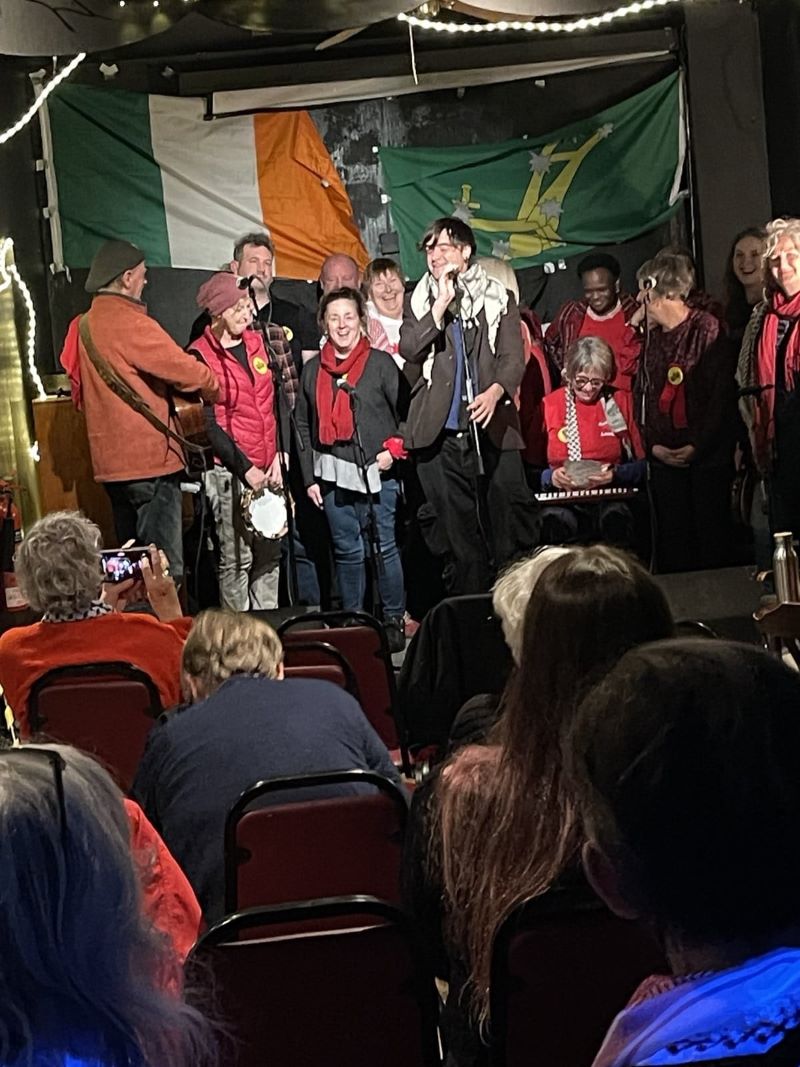
The Resistance Choir about to perform at Solidarity Sessions No.3 in the Cobblestone, being introduced by the MC, Ru O’Shea. (Photo: R.Breeze)

ANNOUNCEMENTS

Three imminent resistance events were announced from the stage: Friday morning, due to appear in court4 were two Palestine solidarity activists attacked by Gardaí at Dublin Port and a good show of numbers in solidarity was requested.5

On Saturday a picket in solidarity with Irish Republican prisoners would be held outside Kilmainham Jail6 and on Sunday a demonstration to blockade Dublin Port was announced, people being requested to gather at The Point on the north Liffey quays.
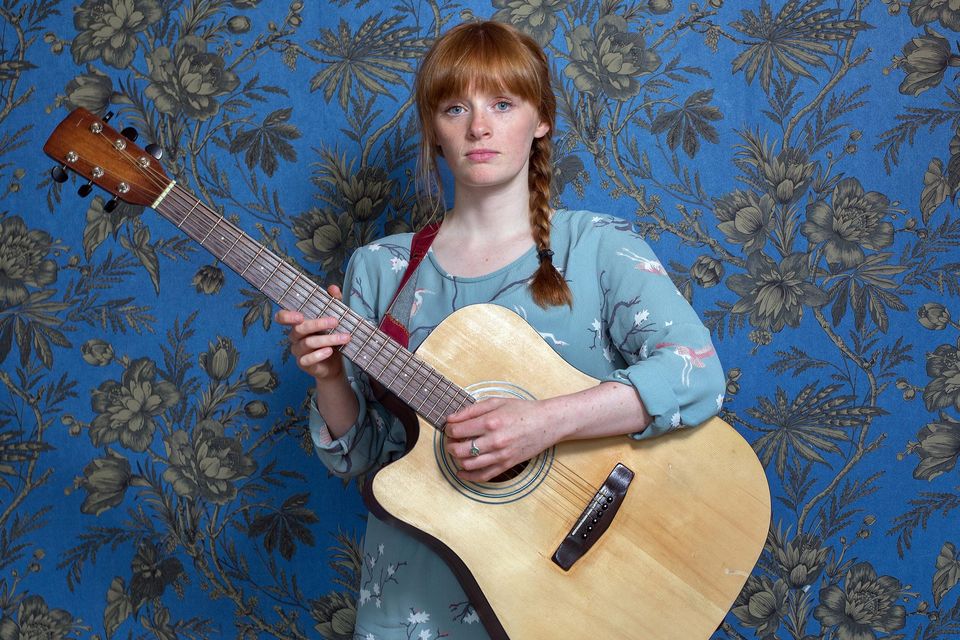
Sive, who performed at Solidarity Sessions No.3 in the Cobblestone. (Photo sourced: Internet)

The organising collective, volunteers on door duty and the performers all donated their services free of charge. Further donations will be made to causes considered worthy, the collective assured their guests and supporters.

Ru O’Shea, MC for the evening, thanked all the performers who gave their services for free, the audience for their attendance, supporters staffing the door, the Cobblestone and sound engineer. The next Solidarity Sessions night will be at Peadar Brown’s on Thursday 4th December.

Ongoing “contributing to building a community of solidarity and resistance.” And outside, it had stopped raining for awhile.

End.
Note: If you found this article of interest, why not register with Rebel Breeze for free, so that you will be notified by email of subsequent articles. You can de-register any time you wish.

FOOTNOTES

1James Connolly was born into the Irish diaspora in the poor area of Cowgate in Edinburgh and first came to Ireland as an adult in response to an invitation to found the Irish Socialist Republican Party. Subsequently Connolly went to the USA for a period before returning to Ireland (therefore 3 times a migrant). Patrick Pearse was born and raised in Dublin but his father was English. Both Pearse and Connolly were executed in Kilmainham Jail with another twelve by British bullets after their surrender of the 1916 Rising.

2‘Flying pickets’ operate in principle like the guerrilla ‘flying columns’, sending a large number of union picketers to specific locations chosen in secret, thereby reducing the opportunities for the police etc to mobilise at the spot in advance

3Ricky Tomlinson after release became a famous actor, mostly in comic roles. Warren developed Parkinson’s from forcible injections with restraining drugs and long periods in isolation in jail, dying not long after release. I remember the case and campaigns when I was working in England and a period afterwards when I was briefly active in the Construction Safety Campaign and read statistics about on average a construction worker killed weekly and one seriously injured daily on British construction sites.

4Yes, the Gardaí charging with criminal offences people they pepper-sprayed and batoned without warning.

5For report on that, see https://rebelbreeze.com/2025/10/31/strong-solidarity-support-for-arrested-port-blockade-activists/

6Kilmainham Jail was a British colonial prison in Dublin, also used for a while by the Irish Free State to imprison the Resistance during the Civil War/ Counterrevolution. It is now a very popular museum and holds the execution site of 14 prominent Irish Republicans after their surrender in 1916.

Dear Minister Humphreys,

(Another one from the Rebel Breeze archives, this one from 2015)

I write to express my admiration for your work and my sympathies with regard to the criticisms with which you are currently being bombarded.

I hope you will forgive my ignorance of much of the work you have been doing in the area of Heritage, which is not really where my strengths lie. But I love the way you talk, the way you shoot down those critics, especially those TDs who ask those nasty questions.

And I’m sure you had something to do with removing Westport House from the NAMA sell-off, even if it is in Enda’s constituency. Such a fine example of our colonial architectural heritage!

Heather Humhpreys, Minister for Arts, Heritage and the Gaeltacht

But as we know, Minister, that wouldn’t be the kind of thing that would be appreciated by your critics. They’d rather you devoted your talents to a shabby row of Dublin houses of dubious architectural importance in a grubby street market.

A street which they say is “pre-Famine” — as if that were something to boast about! Laid down earlier than Sackville Street (now O’Connell Street) they say ….

Sure why would we want to keep a street that old …. or remember that embarrassing episode in our history either, when we lost a third of our population to over-reliance on one crop! We learned from that, though, didn’t we? Sure we grow hardly any crops at all now and get them all in from abroad. 

And we live in cities now — who wants to be getting up at 6 a.m. in all kinds of weather and plodding through muck? If people like growing things that much, get a house with a garden, I say. And a gardener to do the donkey work.

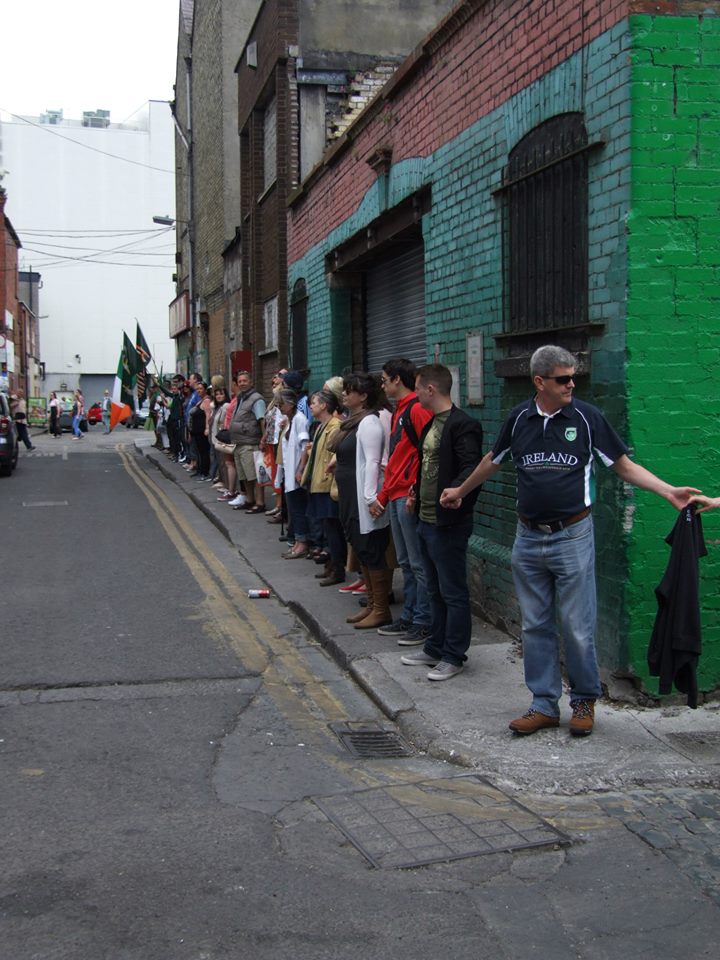
Supporters at the symbolic Arms Around Moore Street event organised by the Save Moore Street From Demolition campaign in June this year.
Supporters at the symbolic Arms Around Moore Street event organised by the Save Moore Street From Demolition campaign in June 2016. This is the corner of Moore Lane and Henry Place, across which Volunteers had to run under machine-gun and rifle fire from Parnell Street (at the end of Moore Lane, to the right of the photo) and at least one Volunteer died here.

But I’m digressing, Minister, my apologies. Apparently the reason they want to save that shabby terrace, that “pre-Famine street” — and the backyards and surrounding lane-ways, if you please! — is for HISTORICAL reasons. Historical!

Sure have we not had enough of history – Brehon Laws, Golden Age, Clontarf, Normans, 800 years of British occupation, blah, blah, blah! Weren’t we sick of it at school?

I’ve never liked Labour too much (somehow even the word sounds sweaty) but I have to admire their Education Ministry’s efforts to remove history as a subject from the compulsory school curriculum.

I’m sure they’re doing it for their own reasons – after all, wasn’t their party founded by that communist James Connolly? Sorry, revealing my own knowledge of history there, ha, ha! But whatever their reasons, they are on the right track.

Who wants to know where we are coming from? It’s where we ARE and where we are GOING TO, that matters!

But some people just can’t let it go, can they? They trail history around like something unpleasant stuck to a shoe. So what if 300 of the GPO garrison occupied that terrace in 1916?

The Rising, if you ask me, was a big mistake and I know plenty of people agree with me, even if most don’t have the courage to say so. Wouldn’t we be much better off if we’d stayed in the UK? And kept the Sterling currency? And as for the War of Independence …. don’t get me started!

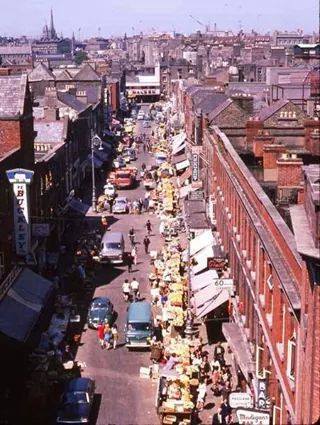
Aerial View Moore St. 60s
Aerial view Moore Street, looking northwards, 1960s, before the building of the ILAC and the running down of the street market.

And then there’s all that communist-sounding stuff about treating “all the children of the nation equally” — what kind of rubbish is that? Some are born to big houses with swimming pools and some are born to flats, or even rooms. That’s just the way of life.

And some will claw their way up to get to own big houses and if they are a bit uncouth, well that can’t be helped, they still deserve where they get to. And their children at least will be taught how to fit into their new station. That’s democracy! But everyone equal? Please!

Sorry, back to the Moore Street controversy. OK, after the mob pressured the Government, four houses in the street were made a national monument. But was that enough for the mob? Oh, no, not at all — eight years later the State had to buy the four houses to satisfy them.

Thankfully the specul ….. sorry, the developer, got back a good return on his investment – four million, wasn’t it? That’s the kind of thing that makes one proud to be Irish – buying run-down buildings and letting them run down more, then selling them for a million each.

That’s your entrepreneur! If only we had more like that, to lift this country up!

I must say I really liked that developer’s plan to build a big shopping centre from O’Connell Street into the ILAC, knocking those old houses in Moore Street down (although I know he had to leave those “national monument” four houses still standing in the plans).

I do hope whoever has bought the debt off NAMA and now owns those houses will carry on with that plan. Actually, I’d like the whole of O’Connell Street under glass if it were possible.

Wouldn’t it be great to do your shopping from the north end of the street to the south and from left to right, without ever having to come out into the weather? Of course, not much shopping there now, with Clery’s closed …. still ….

And then they’re going on about the market ….. traditional street market …. blah, blah. What’s wrong with getting your veg and fruit from the supermarket? Or getting them to deliver it your house, come to that? “Traditional street market” my ar….. excuse me, I got carried away there.

Those street markets are all very well for your Continentals, your Africans, Asians, Latin Americans and so on. Or for us to go wandering around in when we’re abroad on holiday, maybe.  But back home?  It’s the nice clean supermarkets for me any day.

Well now, if the mob insists on saving the street market, here’s an idea: why not provide a showcase stall or barrow, stacked with clean vegetables and polished fruit, right in the middle of the new shopping centre. After all, that’s heritage, isn’t it? And aren’t yourself the Minister for Heritage?

Most sincerely,

Phillis Tine-Fumblytil

Note: If you found this article of interest, why not register with Rebel Breeze for free, so that you will be notified by email of subsequent articles. You can de-register any time you wish.

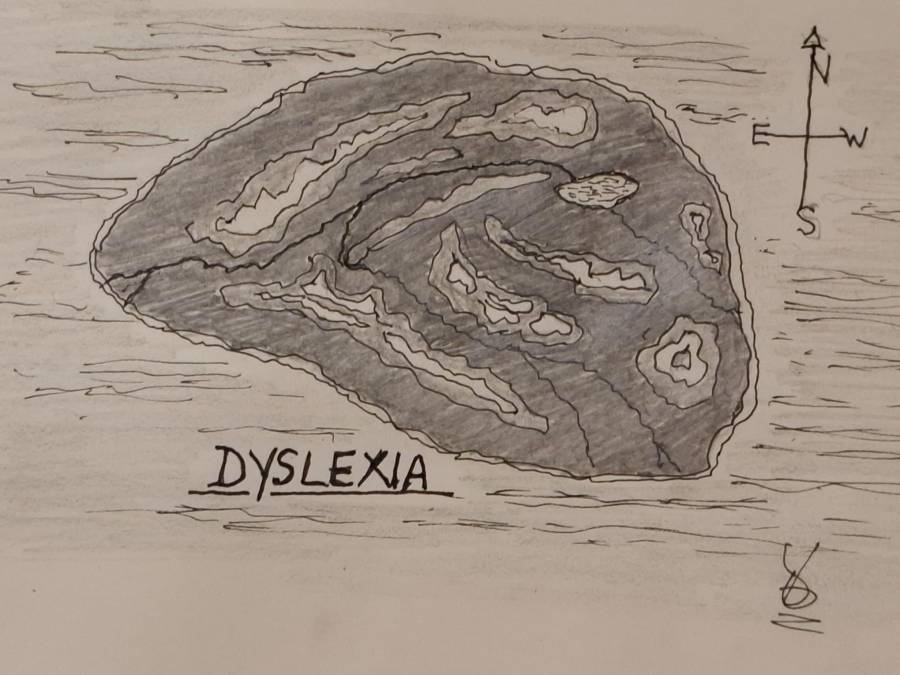
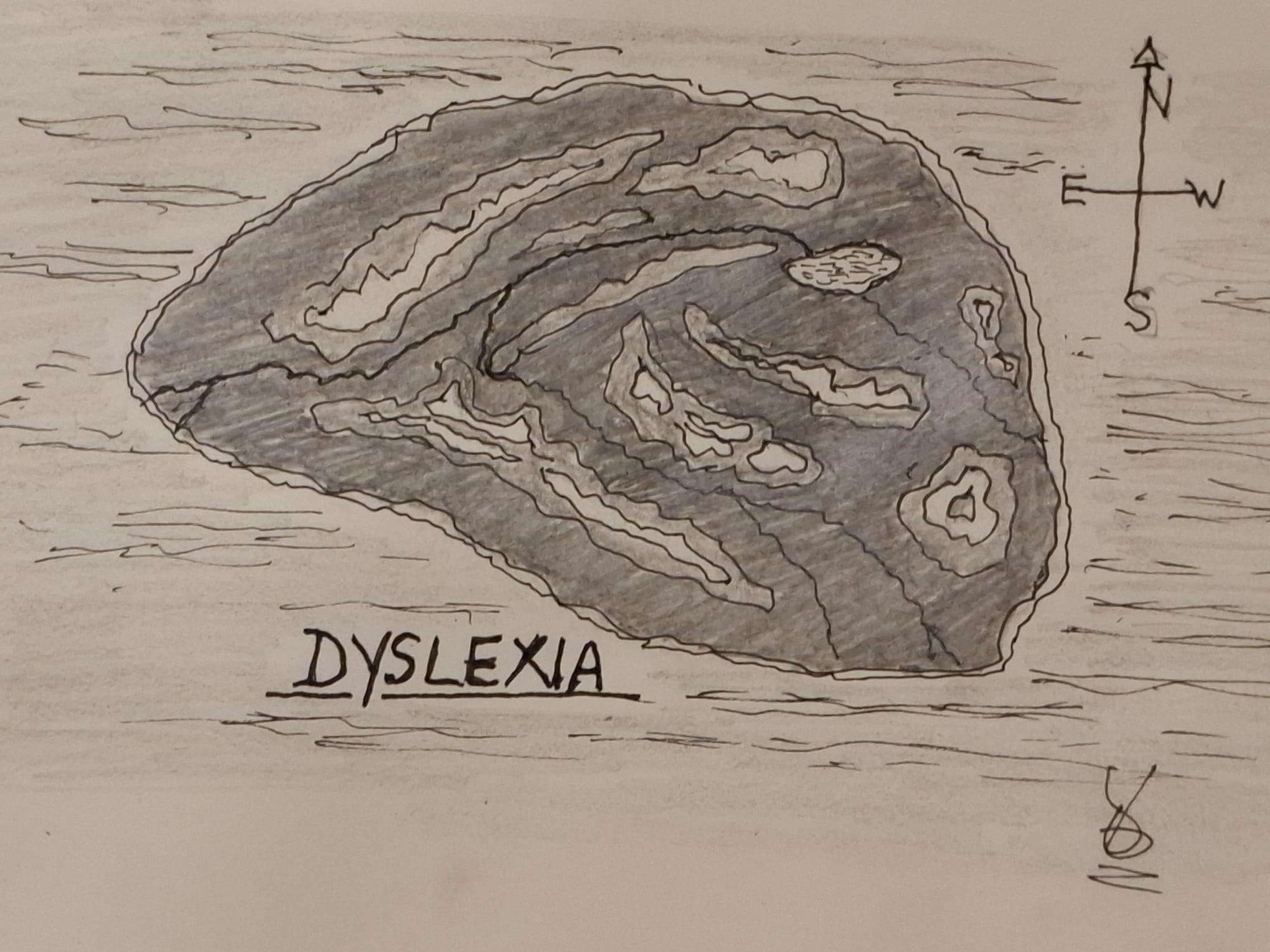
DYSLEXIA – A COUNTRY WHERE SURPRISE IS EXPECTED

Diarmuid Breatnach

(Reading time: 6 mins.)

(The author is known as a traveller to many exotic places, including expeditions in search of mythical lands, most famously “The United Kingdom”, the “Republic”, “Norn Ireland” and “The Mainland.” Here he writes about the land of Dyslexia).

Dyslexia is, as the suffix “-ia” suggests, a country …. think of India, Mongolia, Russia, California [now relegated to a vassal state], Hibernia [also something of a vassal state], Narnia [er .. no, that is an imaginary land in a series of children’s tales].

Strangely the existence of Dyslexia was not even suspected until 1881, when Oslawd Khanber1 claimed to have visited the land. His discovery was widely doubted until confirmed by Ludorf Linber2 in 1887.

The people of this newly-discovered land were distinguished by all having a difficulty to varying degrees in spelling and/or in remembering sequences of numbers.

Khanber and Linber both named this land (and the rest of the world agreed) “Dyslexia”, from the Greek root “dys” meaning “bad/ abnormal/ difficult” and “lex” meaning “word” (although in Latin it means “law”, understood as “written word”).

Dyslexia was, like many other lands and people, not named by the natives themselves, but by people from elsewhere. Such examples abound, for example “Australia”, “America”, “Scotland”, “Eskimo”, “Teddy Boys”, “Pagans”, “Celts”, “Saxons”, “Teagues”, “Gypsies”, “E.T.s” etc.

Attempts to identify what the Dyslexics themselves called their land have so far collapsed in confusion, with different spellings and even pronunciations hotly argued for against others.

In fact, there have been accusations of racism aimed at those who named the land “Dyslexia” and the people “Dyslexics” — it seems particularly cruel to create a word itself so difficult to spell to name a people with a known disability in spelling.

Previously, Dyslexics just called themselves “people” and the land “the land”, while those who came across migrants from there before Dyslexia was actually discovered called them other names: such as “stupid”, “slow”, “thick” or “people with ADD or ADHD”.3

However, most “Dyslexics” today have not only adopted the name and learned to spell it but are wont to proudly declare “I’m Dyslexic” (but rarely “I am a Dyslexic”).

When Dyslexia came to the attention of the rest of the World no-one seemed astonished that it should be discovered long after the North and South Poles, the Mariana Trench, the Matto Grosso Plateau and indeed a great number of planets.

What did astonish the World was that Dyslexia had apparently independently within its borders invented television, radio, Ipads, microwave ovens, central heating and hot showers and of course the internal combustion engine and nuclear power.

This proliferation of technology would have been normally amazing (if anything normal can be said to be amazing, or vice versa) in a previously undiscovered country.

But what was really, really amazing was that everyone in Dyslexia had overcome a disability to climb to such industrial heights. The obstacles must have been tremendous.

Imagine confusing, for example, sodium chloride, a common table salt, with sodium chlorate, which is used as a weedkiller.

Also by the way, as an ingredient in making home-made bombs, a curious fact since nitrogenous fertiliser, with a directly opposite effect to sodium chlorate when spread on weeds, is also sometimes used in making home-made bombs).

Anyway, shake sodium chloride in small quantities on your weeds and they probably won’t like it but most will survive – especially those that actually like a little of it, like relatives of the cabbages and such. Shake a little sodium chlorate on your food, however and ….

well …. no, don’t try it – without urgent and skilled medical attention you will die quickly and painfully.

For another example, imagine confusing “defuse” with “diffuse”: one goes to de-escalate a conflict and ends up spreading it around. Other confusions are possible between the noun or verb “ware”, the (usually) adverb “where” and the past tense verb “were”. And so on.

For physics, knowledge of and accuracy in mathematics is essential – algebra, logarithms, binary codes, sines and co-sines, square roots (these last are mathematical constructs, not mythical regulated-shape carrots as propagated by anti-EU campaigners).

In calculating distances, heights and depths, spaces and circumferences, ability in geometry, trigonometry and ordinary mathematics is required. Somehow, the Dyslexics, the inhabitants of Dyslexia, had overcome their disability or compensated for it in some way.

They had developed as flourishing and environment-poisoning an industrial society as the most developed parts of the world, such as the United States of America (most developed industrially, that is).

Dyslexics are said, despite this disability with letters and numbers, to be of above-average intelligence. They had to be, to develop all those complicated benefits of industrial society despite their handicap.

Strangely, one may think, many Dyslexics have become literary figures famous throughout the world, Hans Christian Andersen, Agatha Christie, F. Scott Fitzgerald and WB Yeats among them. Contrary to popular belief among non-natives, James Joyce was not from Dyslexia.

This prevalence of Dyslexics among so many giants of literature and indeed of virtually every other field of human endeavour has given rise to a group of Dyslexians who call their disability “the gift of Dyslexia”.

The Dyslexics are often garrulous and sociable and this is especially true when in Dyslexia itself. The difficulty in remembering telephone numbers for example makes every telephone call an adventure.

Say a native wished to phone another native called Cathy (also known as Cthy, or Ktay, Thyca etc), and the phone number was 731 1062 (please note, this is an imaginary telephone number by which neither Cathy nor anyone else can be reached).

The Dyslexic might phone 371 1026 – all the correct digits but in a different order (note, this also is an imaginary telephone number by which no-one may be reached).

The conversation, somewhat simplified, might go like this:

“Yes, hello?” (female voice, breathless with anticipation of another adventure).

Our caller: “Hi, is that Cathy?”

Recipient (giggling): “No, it’s not. There isn’t any Cathy here. I’m Wanda.”

Our caller: “Oh, hi Wanda, you sound very nice. How about going on a wanda with me?”

Wanda (with a little giggle but playing cautious): “Maybe …. What’s your name?”

Our caller: “Terry.”

Wanda: “Where were you thinking of wandering with me?” (A moment’s pause while both mentally translate the last part of that into “wandering on me”).

Terry (clearing his throat which has suddenly gone dry): “Well, there’s a nice new Indian restaurant opened up in town. Do you like Indian food, Wanda?”

“Ohhh, Terry, I love it. So spicy!” (Very slight pause as both translate “spicy” as a description for food flavouring into a metaphor instead). “When were you thinking of?”

“Er … tonight too soon?”

“No, I happen to be free tonight.”

“Shall I come and pick you up? Say …. seven pm?”

“That would be lovely, Terry. I live off the Trans City Road, tenth left, first right, eighth left, in Hopeful Street, the seventh house on the left-hand side if you’re coming from town, with a brown and white door and a hydrangea bush in the garden.”

“Got it – off the Trans City Road, tenth left, first right, eighth left, Hopeful Street, seventh house on the left-hand side, brown and white door and a hydrangea bush in the garden. At seven pm. I’m looking forward to meeting you.”

Most Dyslexics are always open to adventure, ‘going with the flow’. One never knows what a simple telephone call may bring or to what an appointment or written address may lead.

But as a result, Dyslexics are also philosophic about missed appointments, forgotten birthdays and so on; they waste little time mourning something lost and instead look forward to something gained.

Terry might or might not make it to Wanda’s but they both know the world is full of other possibilities.

Cathy, for example, who failed to receive a call from Terry to congratulate her on her gaining a dystinction in her dyploma, received later that evening what non-natives would term “a wrong number” call from a Sofia who had meant to call a Geraldine.

Sofia had intended trying to patch up a long-running difficult relationship with Geraldine and instead found herself making the acquaintance of Cathy, who seemed much nicer and more understanding than was Geraldine.

Putting her problems with Geraldine aside, Sofia agreed to Cathy’s suggestion to meet for a late coffee (which they both knew could lead to an early drink and who-knows-what from there). Cathy had by now forgotten that she was hoping Terry would call.

Dyslexia is not just another land, nor even just a strange one – it’s an entirely different way to live.

End.

Note: If you found this article of interest, why not register with Rebel Breeze for free, so that you will be notified by email of subsequent articles. You can de-register any time you wish.

Footnotes:

1Adolph Kussmaul, to non-dyslexics.

2Rudolf Berlin, to non-dyslexics.

3A supposed disability the existence of which is hotly debated but has exonerated many teachers accused of bad teaching methods and states accused of having too large classes in their schools and which has been profitable for some educational psychologists and extremely so for some chemical companies.

AMERICAN FOOTBALL INVASION MEETS PALESTINE SOLIDARITY RESISTANCE

Diarmuid Breatnach

(Reading time: 6 mins.)

For a few days it has seemed a little like an invasion around Dublin city centre by Vikings and Steelers. Not Scandinavians as of old with some others1 but fans of two competing teams of the American National Football League.

One of the banners at the Drumcondra/ Clonliffe junction around 2.45pm. (Photo: D.Breatnach)

There is little social following for the game called ‘American Football’ in Ireland, where we have a massive following for Gaelic football and soccer through their respective associations, the Gaelic Athletic Association and the League of Ireland (the latter in particular much underfunded).

Years ago, in his capacity as Minister of Arts at the time, Michael D. Higgins, presiding at an event, criticised what he called “US imperialist cultural penetration” of Europe. This has been ongoing for decades mainly through cultural products of films and soap operas, cartoon films and comics.

Prior to that, we were subjected mainly to British cultural products in magazines, comics, films and soap operas. And of course the Irish state only set up its own TV broadcaster in the 1960s.

For years these products have been impacting on our consciousness and subconsciousness, including on some of our speech patterns in English. But attempts to promote NFL have failed; however, never before has such a big effort been made and with such financial backing.

The small group at the Drumcondra/ Dorset St junction and Canal/ Railway bridge as I approached it just after 1pm. (Photo: D.Breatnach)

For this one game, the Irish Government has awarded just short of 10 million euro in funding – i.e. one third of their funding for the entire sports sector in Ireland last year. While of course this is being promoted as a revenue opportunity for business, there are stronger reasons.

The NFL is a strong supporter of the imperialist US military and the US itself shows signs of gearing up for another war – against whom is unclear but Venezuela, Iran or China are likely targets. In addition, the US is the main supplier of arms and political backing to Israel.

One of the banners at the Drumcondra/ Clonliffe junction around 2.45pm. (Photo: D.Breatnach)

And where does the Irish ruling class want us? Why, with the USA of course! No more of this skulking around! Make Shannon officially a US military airport, have the RAF and UK Navy officially patrolling our seas and airspace, where arms for Israel can also fly through officially!

The often discussed ‘Triple Lock’ is all that appears to be holding back the Irish ruling class from dumping the state’s tattered neutrality2 — and they are working on that. But meanwhile, they seek to orientate us towards the leader of the western imperialist pack – through US sport.

The NFL will be doing their part, apparently going to make sure every child in the Irish school system will receive an NFL pack. Hey! USA! Leave our kids alone!

This weekend, the Irish Gombeen3 ruling class, through their State, supplied extra police to keep the US visitors safe around the city and on Saturday around Croke Park, while police helicopters kept eyes in the skies. And there was extra Garda tolerance also for UStater illegal street-drinking.4

At the Clonliffe/ Drumcondra Road junction at 1.00pm, announced rallying time. (Photo: D.Breatnach)

THE PROTESTERS

Many – including I – only learned on Saturday of the protest called by the IPSC5-allied Sports for Palestine campaign group against the NFL game programmed for Croke Park on Sunday between the Vikings and Steelers teams. A call-out to attend with flags and placards.

That seems a bit unfriendly towards visitors, sports enthusiasts, right? Fans just happy to support their teams and visit lovely Ireland at the same time, right?

Apart from the considerations of imperialism and war-orientation listed earlier, the USA is openly backing politically and supplying militarily a daily genocide against Palestinians. NFL is a significant cultural representation of the US and as such must be prepared to suffer for it.

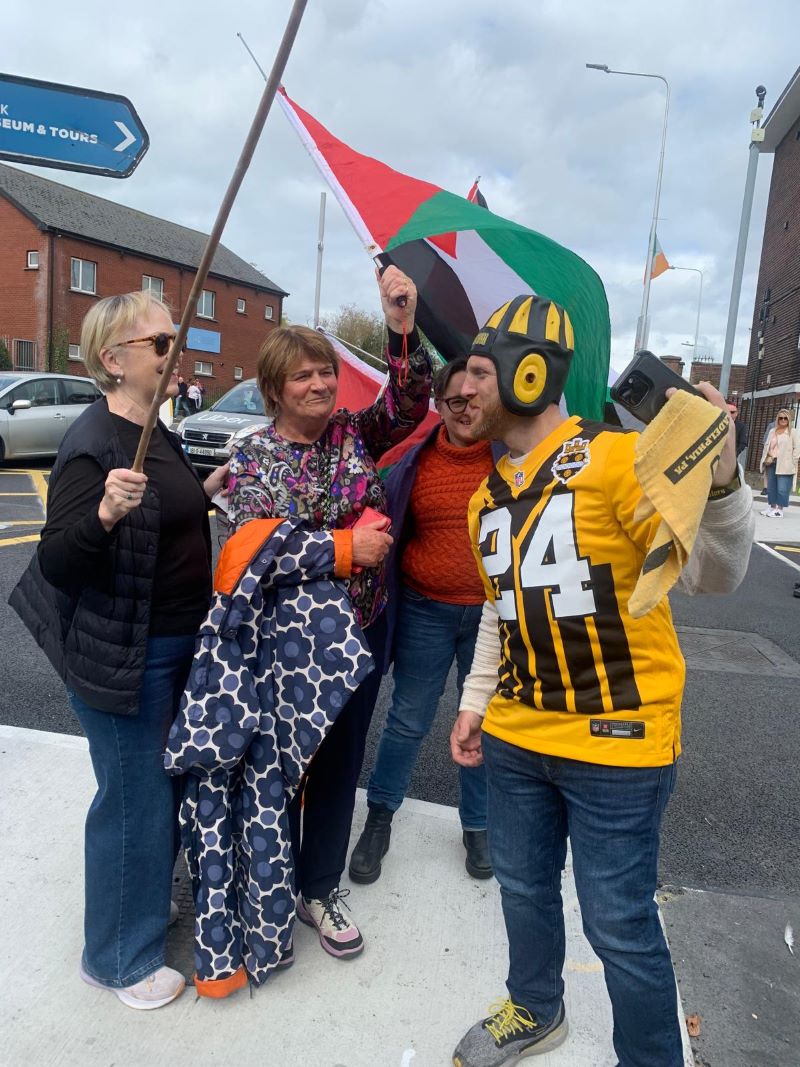
Small group of protesters further down Clonliffe Road at junction of road leading up to Croke Park entrance, approached by an NFL fan (Steelers?) who wants his photograph taken with them. (Photo source: Participant)

While most of the Palestine solidarity protesters, maybe 60 at its highest point congregated at the junction of Clonliffe and Drumcondra roads, a small group of four took up position at the road leading to the Croke Park Stadium entrance and stood there with Palestine flags.

I headed for the railway and canal bridge at the Dorset Street junction, where I could see a Palestinian national flag and a placard calling to “Free America from AIPAC control.”6 On the way I passed NFL merchandise sales and young women handing out free canned energy drinks.

Greeting the other two at the Bridge, I extended my flagpole bearing the Starry Plough flag and took up station with them. Some passing traffic beeped our flags in solidarity.7 My standard litany to the passing NFL fans was: “Shame on the USA, supporting genocide! Shame, shame, shame!”

A comrade near me denounced “The United States of Israel”, alternating with attacking US responsibility for and complicity with genocide, while the other shouted about how wrong it is to be killing children. After awhile another comrade joined us but we never had more than four there.

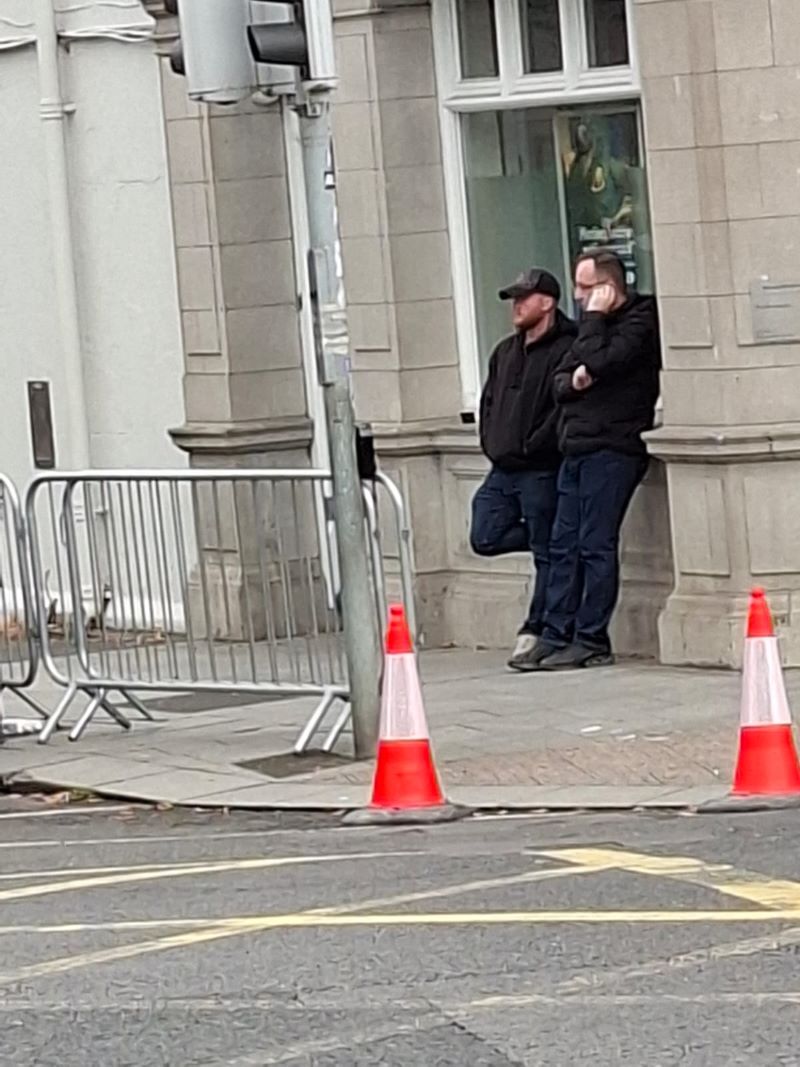
Two of the Special Branch of the Gardaí, ‘spotting’ for the State. (Photo: D.Breatnach)

REACTIONS OF NFL FANS

The reactions of the passing fans to what we were saying varied considerably.

By far the majority of them attempted to ignore us while some looked at us with seeming curiosity but no other reaction. Some seemed embarrassed, covering the feeling with a smile. A small minority said they agreed with us, some even saying they were ashamed of the USA.

A tinier minority still exhibited hostility and outrage towards us, as in waving us away or giving the hand gesture for “blah, blah” (which a few verbalised also). A few laughed but that was their mistake, as I then shouted “Laughing about genocide? LAUGHING about GENOCIDE!”

One big man insulted us in an Irish accent but received as good from us, while an NFL fan who spoke in support of ‘Israel’ wilted under a barrage of “Genocider!” shouts. Another who mentioned “the hostages” was asked whether he was referring to “the 9,000 Palestinian prisoners?”8

Yet another accused us of generalising but received a response about arming Israel, to which he responded that we (Ireland, presumably) are feeding Israel. Another still wanted to avoid responsibility by saying that he’s “a Democrat” but was asked what that had to do with anything.

One other said he was from Belfast and yet another from England but the latter in particular got nowhere with that, considering Starmer’s support for the Zionazis. An older US man supported by two women claimed that we were being fooled by Hamas propaganda – there is no genocide!!!

It seems likely that those UStaters who encountered protesters and who are already opposed to what the US leadership is doing will return home at least a little strengthened in their position but also with some stories to tell people there about how the US is being viewed in a part of Europe.

Those who are unsure about what they think will probably doubt the leaders of the USA and dominant rhetoric even more. Some will be mostly unaffected and some may even harden their hostility to all critics of the USA. On the whole, I think the effects will be of a positive nature.

But even if so, of course nothing we did will be stopping the genocide for even one minute. Only states have the power to do that and were the Irish Government to ban all imports from ‘Israel’ outright, that would have a huge and immediate impact on the genocider’s economy.9

Another of the banners at the Drumcondra/ Clonliffe junction around 2.45pm. (Photo: D.Breatnach)

Sunday’s was a useful but minor action in the propaganda part of the liberation war – Palestinian national liberation, of course but also part of our own. However it could have had much greater visual impact. Drumcondra Road is on a much-travelled road including for Airport traffic.

The road also carries bus public transport routes from and to various Dublin destinations. There are three possible routes off it for access to Croke Park. We only covered two, one with a minimum presence. The size of the concentration at Clonliffe junction was understandable but unnecessary.

The source of much of this weakness appears to be the very late call-out to the protest – only the day prior for many, possibly most. Yet the NFL game must have been planned for many months.

end.

Note: If you found this article of interest, why not register with Rebel Breeze for free, so that you will be notified by email of subsequent articles. You can de-register any time you wish.

Footnotes

Sources & Useful Links:

https://www.rte.ie/news/analysis-and-comment/2025/0928/1535663-is-it-good-economics-to-pay-10-million-for-an-nfl-match

https://www.gameoverisrael.com/en

https://www.facebook.com/IrishSportForPalestine/

1Ireland was raided by Vikings from Scandinavia from 795 CE, they later establishing settlements in Dublin and along the south-east coast, also along the Shannon river and in Cork. Viking power in Ireland was broken by the 1040 CE victory of Brian Boru’s coalition (which included some Vikings, probably Norse) over the Leinster-Dublin coalition of mostly Dublin Danes, Leinster Irish and Viking mercenaries from Manx and Orkneys. The battle lasted 12 hours not far from the Croke Park stadium and part of the Viking mercenaries were caught and killed on their retreat to their ships nearby.

2Three requirements to be met before the Irish Government can send a military mission consisting of more than 12 personnel from Ireland to any part of the world.

3A pejorative term from the Irish language Gaimbín equivalent in meaning to ‘carpet-bagger’, huckster, etc. applied to the Irish neo-colonial (and neo-liberal) capitalist ruling class.

4City regulations forbid drinking of alcohol in any public place.

5Ireland Palestine Solidarity Campaign.

6The mostly Christian Zionist alliance that plays a heavy financial role in promotion of candidates for election in the USA.

7Yet in one hour outside the US Embassy or standing at Annesley Bridge the normal count of solidarity car-horn sounds would be in the fifties – among the tide of NFL fans, we just weren’t that visible to approaching traffic.

8There may be more but of those, around a third are now held under ‘administrative detention’ orders, without even the farce of an Israeli military court trial.

9The Irish state, at $3,263.345m is the second-biggest single importer of Israeli goods with only the USA exceeding it. See https://www.aljazeera.com/news/2025/5/22/which-countries-trade-the-most-with-israel-and-what-do-they-buy-and-sell

“WHEN MY COUNTRY TAKES ITS PLACE AMONG THE NATIONS OF THE EARTH”

Diarmuid Breatnach

(Reading time: 3 mins.)

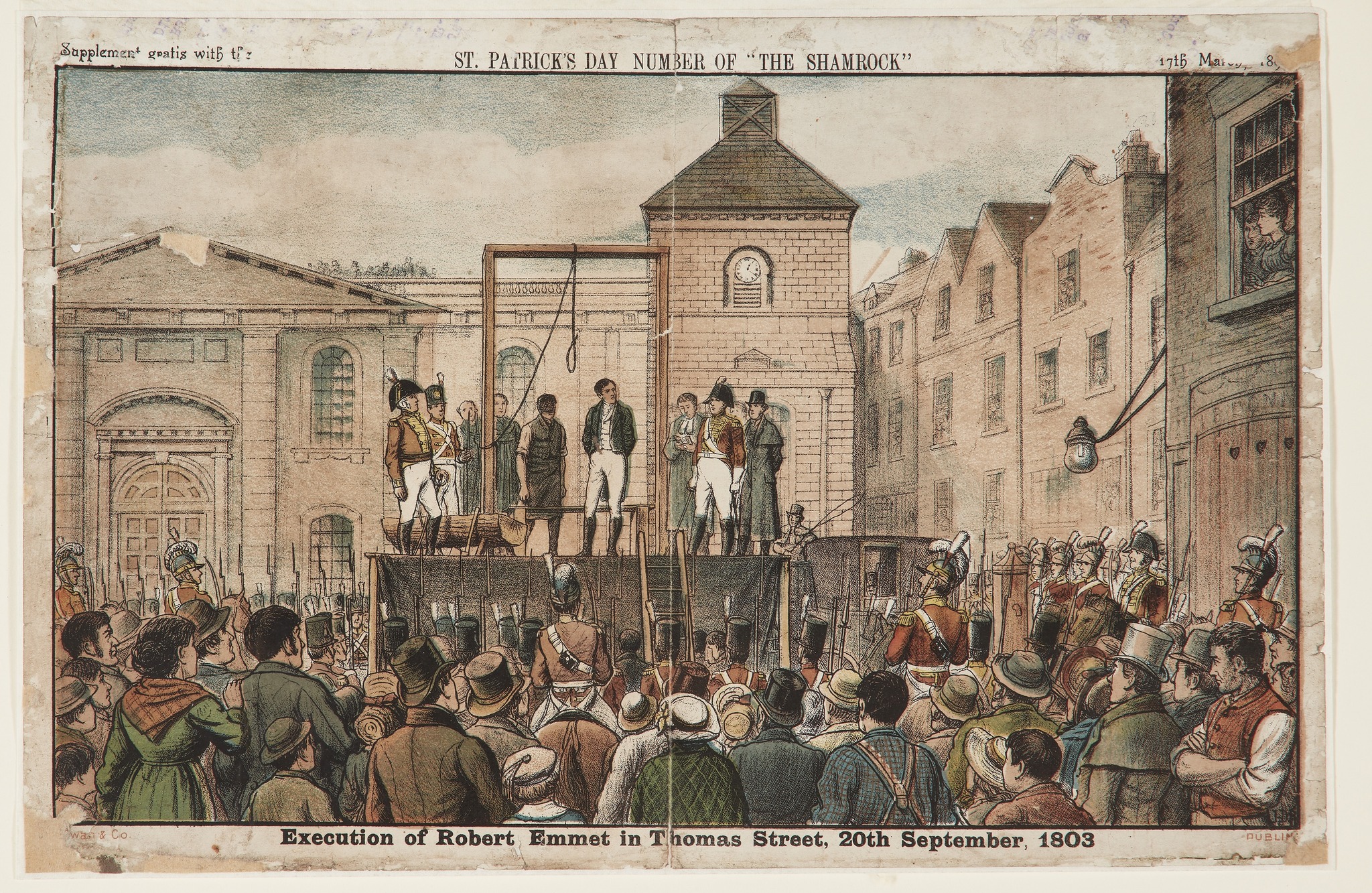
Dublin Political History Tours Facebook page reminds us of the 20th September anniversary of the public execution on of “Bold Robert Emmet, the darling of Erin”, leader of the unsuccessful Republican insurrection in Dublin on 23rd July 1803.

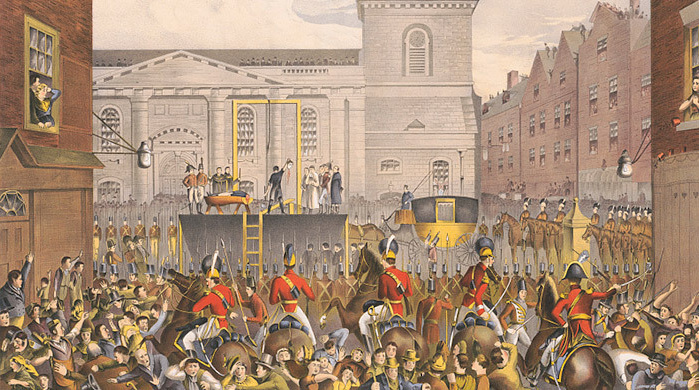
Coloured drawing: The executioner holds up Robert Emmet’s head to the crowd, sections of which demonstrate their repugnance of the act and are repressed English soldiers on horseback. (Sourced: Internet)

I reproduce the Dublin Political History Tours text (reformatted for R. Breeze):

On Saturday we passed by the anniversary of the execution by the English occupation forces of Robert Emmet, United Irishman. Emmet had been condemned to death for planning an insurrection for Irish self-determination which the English Occupation called ‘treason’.

Leaving behind in Kilmainham Gaol his comrade Anne Devlin, who had endured torture and death of family members without giving the authorities any information, Emmet was taken to the front of St. Catherine’s Church.2

(This building is) on Thomas Street in Dublin’s Liberties area on the west side of the city centre. The site chosen was sending a message to the populace of the area that had nationalist and republican sympathies.

There, in front of a huge crowd and many soldiers, Emmet was hanged and then beheaded, the executioner holding up the dripping head to the crowd. His body was later returned to the Gaol before being later buried in Bully’s Acres in the grounds of the Royal Hospital Kilmainham.

Emmet’s corpse was later disinterred in secret and reburied elsewhere by friends or family and, despite a number of sites being speculated, its current location is unknown.

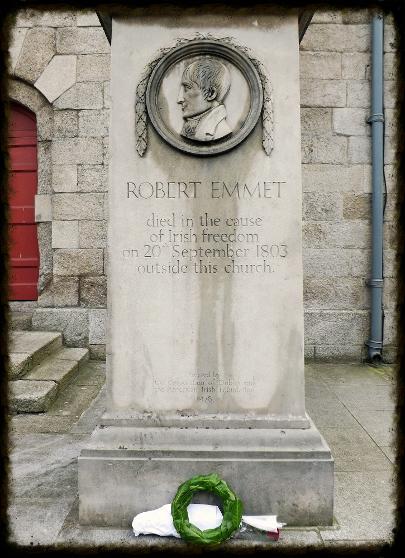
There is a monument to the execution inside the grounds of the St. Catherine’s building and a stone plaque on the wall outside it.

The monument inside the ground at the front of St. Catherine’s Church, Thomas Street, Dublin. (Source: Kilmainham Tales)

Robert Emmet was very popular in Ireland at the time and his memory is still. A statue in his honour stands in Dublin’s Stephens Green, a replica of another two at locations in the United States.

Anne Devlin endured three years in Kilmainham Gaol and according to Richard Madden (1798 – 5 February 1886), chronicler of the United Irishmen who sought her out, was followed everywhere in public by police.

(who were) observing anyone who she spoke to, as a result of which many were afraid to speak to her. Her body lies in Glasnevin Cemetery.

“Bold Robert Emmet” is a traditional ballad in the martyr’s honour and “Anne Devlin” also has a much more recent song in hers by Pete St.John.

(quoted passages end)

In the 1916 Proclamation of Independence, “the right of the people of Ireland to the ownership of Ireland” is proclaimed and that “six times in the past 300 years they have asserted it in arms”, probably referring to insurrections of 1641, 1689, 1798, 1803, 1848 and 1867.3

Historians have mostly dismissed the 1803 uprising as never likely to succeed but a minority have rated the preparations highly, including the innovations of signal rockets and folding pike handle for concealed personal carrying.

RH Madden, the first historian of the United Irishmen was of the opinion that the insurrection attempt was engineered by the English Occupation’s administration in Dublin Castle in order to justify continued repression of Irish republicanism and to eliminate some leaders.

Generally historians have tended not to give much credence to Madden on that issue but it is certain that the Occupation had a network of spies in operation in Ireland and that some had penetrated Emmet’s conspiracy.

Emmet on the scaffold with St. Catherine’s Church behind, the executioner beside him, the crowd in the street and many English soldiers, on foot and on horseback. The illustration was employed by Dublin Political History Tours but easily sourced on the Internet.

However it is not for the manner of the 1803 insurrection that Emmett has been fondly remembered in Ireland to this day 123 years later – and abroad for decades after his death4 – but for the calm manner in which he faced his enemies, including his executioner and for his eloquence at his trial.

Past insurrections contain lessons for us today and a serious evaluation should be attempted, perhaps with a number of submissions from historians of different opinions on the matter, to deal with questions around Emmet’s return from France and the planning of the insurrection in Ireland,.

For us today however, whether Republicans or more generally anti-colonialists and anti-imperialists, it is also necessary to revere the memory of revolutionary action for a democratic Irish Republican and to uphold his and Anne Devlin’s spirit of defiance in resistance.

End.

Note: If you found this article of interest, why not register with Rebel Breeze for free, so that you will be notified by email of subsequent articles. You can de-register any time you wish.

Statue monument of Robert Emmet in Washington DC, a copy of which stands in St. Stephens Green, looking across the road to his erstwhile home and other copies stand in Emmetsburg, Iowa and Golden Gate Park, San Francisco, California. Those in the USA were all cast by the artist Jerome Connor between 1916 and 1919. (Photo sourced: Internet)
Statue monument in Rathfarnham dedicated to Anne Devlin from Wicklow, a member of the United Irishmen conspiracy, tortured and jailed but never gave her captors any information. Sculptor: Clodagh Emoe (Gracies, Maria, for bringing this to my attention).

FOOTNOTES

1From Emmet’s famous speech from the dock of the courthouse in Green Street that not until then should his epitaph be written. I have no doubt that Emmet meant “nation-states of the world” because Ireland was in his time more than what we would understand today from the vague term of “country” – it was clearly, though under foreign occupation, already a nation with its own unique culture and a long history. She has yet to take that place to which Emmet referred and aspired for her.

2Note that was the Anglican St. Catherine’s Church, as a Catholic St. Catherine’s is also located not far away on Meath St. The Anglican church was closed in the 1960s but later reopened and reconsecrated as an Anglican Church. The interior seems very untypical of Anglican churches. Emmet was raised in the Anglican faith.

3Believed to refer to, in sequence: the Irish and Norman Irish clans in the Confederation’s uprising, the Williamite War’s, United Irishmen’s, Robert Emmets’, Young Irelanders’, the Fenians’. Coincidentally, the large monument to uprisings in Ireland erected by the National Graves Association in the St. Paul’s section of Glasnevin Cemetery also includes only six dates but they are of Republican risings only, beginning with 1798 and ending with 1916.

4I read somewhere that even in England Radicals would read Emmet’s speech as a high point of their events including formal dinners.

SOURCES

https://www.facebook.com/profile.php

“A GREAT NIGHT” AT SECOND SOLIDARITY SESSIONS

Clive Sulish

(Reading time: 3 mins.)

An Irish punk rock band, Mongolian throat-singers, a poet and Irish folk singers all performed at Solidarity Sessions No.2 to a good crowd in the International Bar, in in Dublin City centre Wicklow Street on Wednesday 17th..

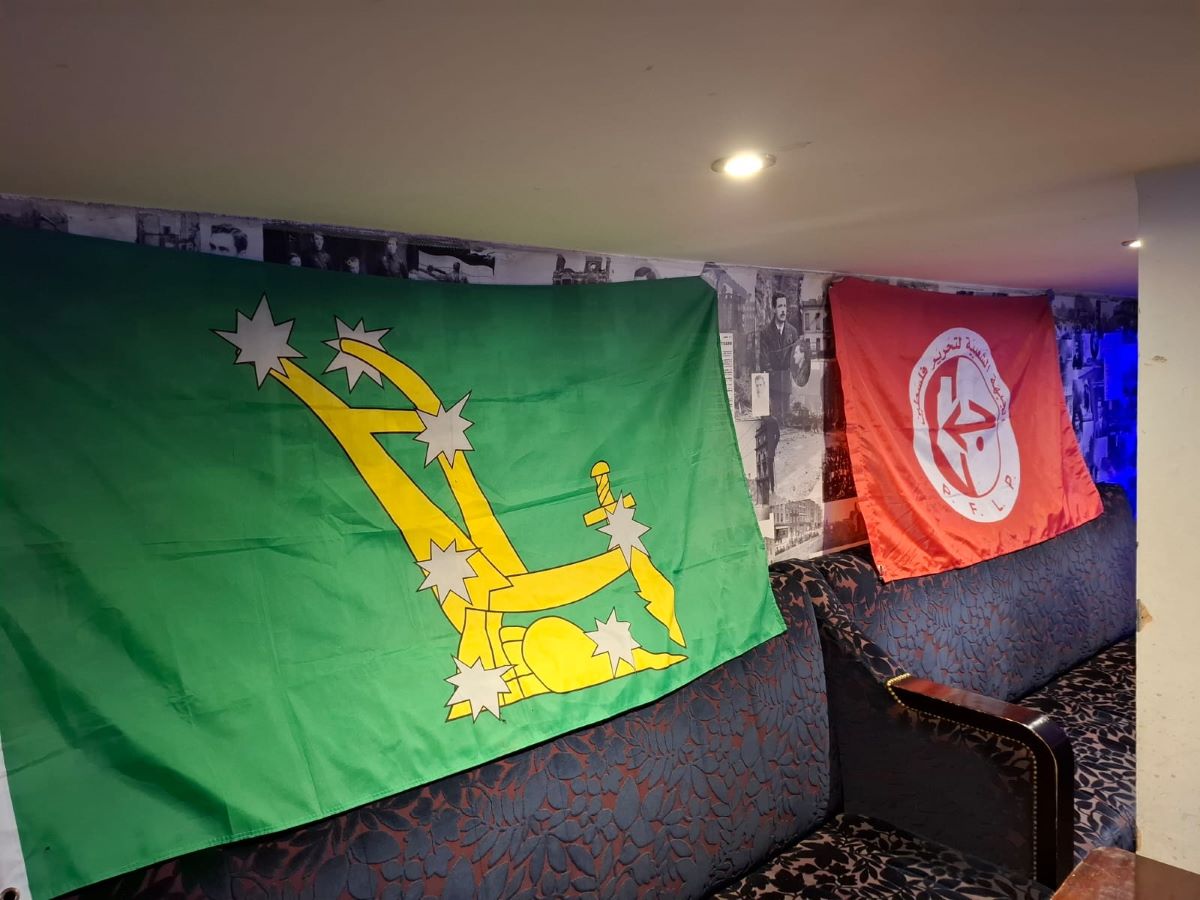
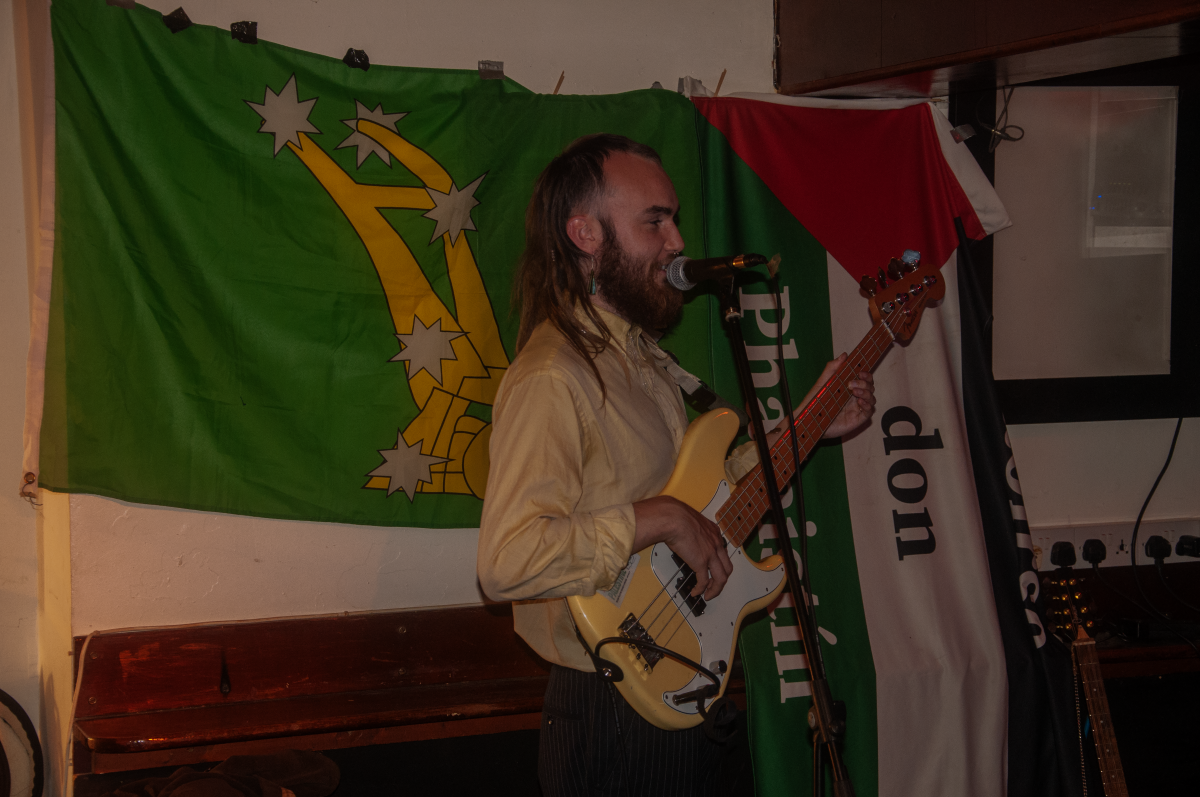
An Irish and international resistance theme in decor was presented by flags of the Starry Plough and Palestine with Saoirse don Phalaistín as stage backdrop, while flags respectively of Cumann na mBan and Basque Antifa concealed the original decor’s ubiquitous photos of Michael Collins.

Flesh B. Bugged performing (Photo: Dermo Photography)

A PFLP1 flag was also taped to a wall. Hand-written signs on the stairs leading to the basement venue, alternatively in Irish and in English, asked for quiet/ ciúnas for the performance/ racaireacht. The Irish language was present too in some of the performances to follow.

MC for the night, Jimi Cullen, himself a singer-songwriter activist told the crowd the purpose of the organising collective was “to build a community of resistance and solidarity with our struggles and with struggles around the world” through culture in a social atmosphere.

Before the crowd — a flag temporarily changing the decor. (Photo: R. Breeze)

Themes of love, nature and emigration were covered in song; however the dominant theme was resistance – to prison regimes, foreign occupation, fascism, class oppression, racial discrimination – and solidarity with the struggles of others, near and far.

Diarmuid Breatnach, singing acapella kicked off the night with a selection of songs from the Irish resistance tradition and a couple of short ones from the USA civil rights movement. Some of the melodies however, of particular interest perhaps to Back Home in Derry2, were his own originals.

Diarmuid Breatnach performing (Photo: Dermo Photography)

Eoghan Ó Loingsigh, accompanying himself on guitar followed with more material from the same tradition, dedicating one to his late IRA father. A folk song Ó Loingsigh announced as ‘non-political’ performed acapella turned out to be very much political but on the issue of social class.

Áine Hayden followed with poems on a range of topics, from swimming in the Royal Canal during the Covid shut-down, deleting a personal relationship to a dedication to comedian and activist Mahmoud Sharab murdered with family in a “safe zone” tent by the Israeli Occupation Force.

Eoghan Ó Loingsigh performing (Photo: Dermo Photography)

The three performers were all introduced as activists as well as artists and the mostly-young crowd, apparently containing a strong representation of political and social activists, responded well to the performers with applause, yells of encouragement and often joining in on choruses.

More people arrived before, during and even after the break – including an elderly couple who had just arrived from the USA and could only pay in dollars but were admitted for free. Leaving later with thanks they promised a contribution to Palestine solidarity when they got home.

Before the crowd — a Cumann na mBan flag temporarily changing the decor. (Photo: Dermo Photography)

Also an activist, Ru O’Shea sang an Irish, Scottish, French and Italian selection, accompanied by bouzouki and guitar and performed a spoken word piece with a refrain of ‘Éire under attack’ before schooling the audience to sing the chorus of Robbie Burns’ Green Grow the Rushes Oh!

Áine Hayden performing (Photo: Dermo Photography)

Nomads were the next act. Composed of two Mongolian musicians playing violins in the style of the viola and a Dubliner modulating on a sound deck they were unusual enough but it was the amazing throat-singing of one of the Mongolians that had the audience enthralled.

It was amazing to learn that there are three different kinds of Mongolian throat-singing and then to hear them performed, one of which was a kind of whistling with a vibrating bass undertone wavering through it. The applause, particularly when they concluded, was rapturous and sustained.

Before the crowd — flags temporarily changing the decor. (Photo: R. Breeze)
Ru O’Shea performing (Photo: Dermo Photography)

The evening’s entertainment concluded with Flesh B. Bugged, a punk rock Irish duo of bass guitar and drums with spoken voice pieces in Irish from the bass guitar player. Their volume and beat got some of the crowd up and dancing and the wider crowd responded well to them too.

MC Jimi Cullen went up on stage for the last time to thank venue, performers, audience, doorkeepers, poster designers Ríona and Azzy O’Connor, also Diarmuid for original artwork. At a prompt from the crowd Cullen also got a round of applause from the audience for his MCing.

The Mongolian musicians of Nomads performing (Photo: D.Breatnach)

Remarking they’d “had a great night” and encouraging his listeners to follow the organising collective on its Instagram page, Cullen told them that details of Solidarity Sessions No.3 and the collective’s decisions on recipients of donations from money raised would be posted on there.

Diarmuid Breatnach told the audience that each individual could help build a community of resistance through attending the Solidarity Sessions and encouraging others to attend. He welcomed any ‘competion’ from solidarity sessions around the country.

Bass guitarist of Flesh B. Bugged (Photo: Dermo Photography)

The downstairs area of the International Bar is not perhaps the best layout for this kind of event but it worked out well enough for the collective, audience and performers on the night. Their next event will be back at their launch venue,The Cobblestone, Smithfield on Thursday 30th October.

End.

Note: If you found this article of interest, why not register with Rebel Breeze for free, so that you will be notified by email of subsequent articles. You can de-register any time you wish.

The Mongolian throat-singer in Nomads (Photo: Dermo Photography)

FOOTNOTES

1People’s Front for the Liberation of Palestine, one of two specifically secular armed resistance organisations in Palestine.

2Irish mega folk singer Christy Moore had organised Bobby Sands’ poem into song to the melody of The Wreck of the Edmund Fitzgerald by Gordon Lightfoot.

USEFUL LINKS

@solidaritysessionseire

SNAIL SEX IS AGAINST GOD’S PLAN

Diarmuid Breatnach

(Reading time: One minute)

Dear Editor,

Your Breaking News edition of 4 September 2025 featured a news item about a freak snail, with a left-spiralling shell, for which a freak mate was being sought.

This was disgusting use of public media light-heartedly flaunting disregard for Christian morality.

Ireland is a Christian country and public reference to the sexual act in general is bad enough but writing about snails and their sexual acts is much, much worse.

Quite apart from left-spiralling shells, snails are already freaks. It is well known that snails are hermaphrodite, that is they carry both male and female sexual organs and when one wishes to mate with another, apparently one decides whether to act the male while the other decides to act the female.

This is clearly unnatural and against God’s Plan, who created every animal as functioning male or female and the same with human beings. Snails in fact, apart from being a pest in the garden are clearly one part of Satan’s spawn. They are an abomination.

That any snail, whether with a right or a left-spiralling shell should fail to find a mate is a good thing and your publication should not be encouraging people to find it a partner. Your newspaper could be considered to be in effect pimping for it.

Publications of stories about snails and their sexual habits can only encourage the latest trend in human deviation known as ‘trans’ where some people choose to consider themselves and to be considered as a gender other than that with which they were born. This too is an abomination.

Please return to God’s plan and cease printing such dangerous and disgusting reports.

Sincerely,

A Sinestra variant (left-spiralling) snail, Cepaea Nemoralis photographed in Galicia, Spanish state. (Photo cred: Raymond JC Cannon)

SOURCE REFERENCE

https://www.breakingnews.ie/world/hunt-is-on-to-find-a-mate-for-ned-the-snail-with-a-rare-left-coiled-shell-1799818.html

OASIS, MANCHESTER & THE FENIANS

Diarmuid Breatnach

(Reading time: 4 mins.)


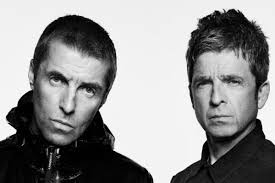
The Oasis rock band are performing on 16 and 17 August in Croke Park, the Gaelic sports stadium in Dublin, to a sold out capacity of 82,300. Brothers Liam and Noel Gallagher are the two leading members of the band.

Oasis-marked t-shirts and caps are being sold from stalls in the city and posters announcing the forthcoming concerts adorned shop windows and lampposts but how many fans know the Gallaghers’ background?

Liam and Noel Gallagher of Oasis (Source imag: Internet)

Liam and Noel were born in Manchester to Irish migrant parents but their mother Peggy split from her abusive husband and moved elsewhere in Manchester, taking the kids with her. Liam dedicated Stand by Me to her on Saturday night and gave a shout-out to her her birthplace in Co. Mayo.1

Ireland fed the British ‘industrial revolution’ and the Irish have a long association with Manchester. In 1845 the city’s factories were already attracting Irish workers and its farms probably also agricultural workers to replace English labourers deserting the farms for the factories.

Friedrich Engels wrote The Condition of the Working Class in England,2 published in 1845 (the first year of the Great Hunger) and mentioned the Irish migrants not too favourably. He was writing mostly about Salford, the subject of Ewan McColl’s Dirty Old Town,3 just outside the city then.

By the time Engels’ book was published, the Great Starvation was gearing up. Uncomplimentary references to the Jews can also be found in that work but whatever about that ethnic minority,4 Engels changed his mind radically about the Irish in Britain and came to admire them greatly.

Instrumental in learning about the Irish for Engels were two Irish sisters living in Manchester, Lizzie and Mary Burns, illiterate but intelligent and militant mill workers. Mary and Friedrich became life partners and, after her death, Friedrich became Lizzie’s partner thereafter.

The Irish, as the natives and diaspora of what is often referred to as “England’s first colony” were of considerable interest to the revolutionary partnership of Engels and Karl Marx and more so still as the Fenian movement, the Irish Republican Brotherhood, spread throughout Britain.5

Karl Marx and Frederick Engels, leading theoreticians and activists of the revolutionary socialist movement. (Source: Workers Liberty)

A largely proletarian movement, the Fenians were admitted to the First International Workingmen’s Association6; no doubt the Irish struggle against British domination greatly influenced the political opinions of Marx and Engels in relation to nations under colonialist rule by capitalist states.

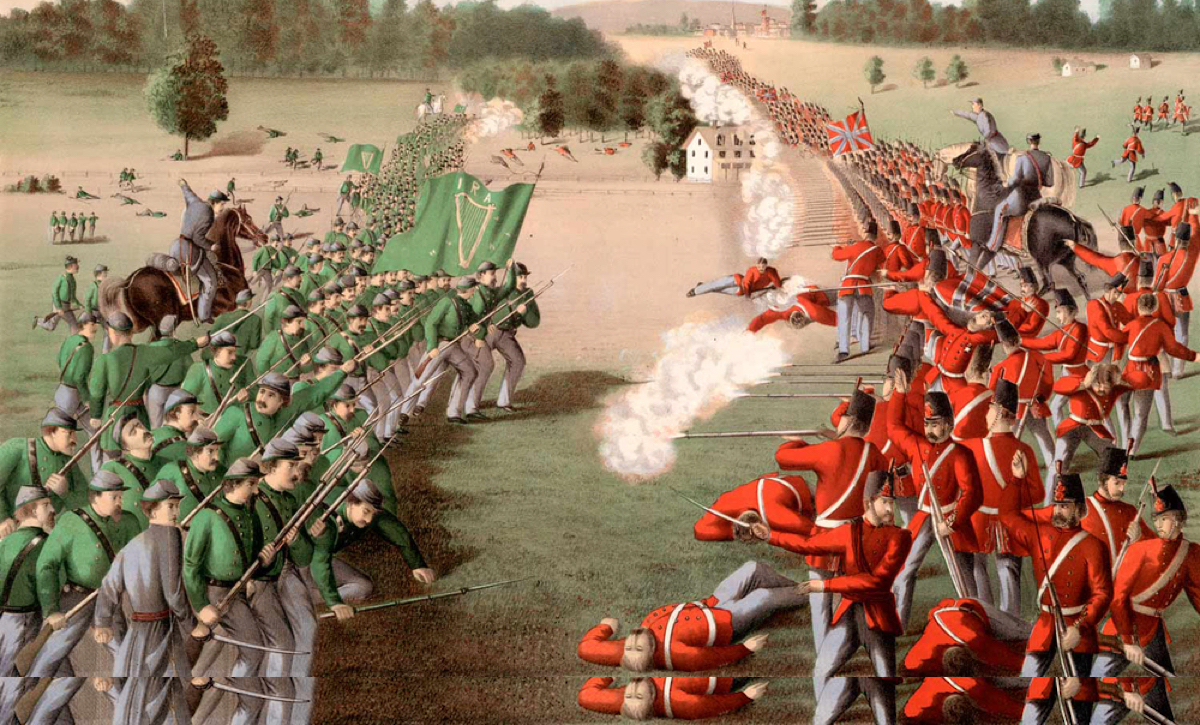
The struggle spilled over from Ireland into the Irish diaspora, particularly that in North America, Australia and Britain. In Australia the Fenians’ role seems to have been mostly in facilitating and escaping British jails there7 while in America, they invaded the British colony of Canada.8

The charge of the Fenians (wearing green uniforms) under Colonel John O’Neill at the Battle of Ridgeway, near Niagara, Canada West, on June 2, 1866. In reality, the Fenians had their own green flags but wore a very mixed bag of Union and Confederate uniforms (if they still had them, or parts of them left over from the Civil War), or civilian garb, with strips of green as arm or hat bands to distinguish themselves. (library and archives canada, c-18737)

In Britain itself, the Fenians went to war against the ruling class with dynamite. To spy on them, Scotland Yard created the Irish Special Branch which evolved into the Special Branch, the political police in Britain and in any colony the British had since then.9

The activities of the US Fenians intersected with those of Britain-based Fenians when two of the former, Thomas J. Kelly and Timothy Deasy, American Civil War veterans, were arrested in England. On their prison van’s journey to jail it was ambushed10 and both officers spirited away.

Artists’ impression of the rescue of the Fenian prisoners.
(Image source: Internet)

Unfortunately and entirely unintentionally, Constable Brett was killed during the breakout. Refusing to hand over the keys from inside the wagon, he was bending to look through the keyhole when in order to release the prisoners one of the Fenians fired at the lock, the bullet entering Brett’s brain.11

The British police swept vengefully through the Irish quarters of Manchester and Salford arresting at least 28 people but eventually sending five for trial on ‘murder’ charges. Three were hanged, all innocent of intentional killing and at least two probably not even present at the scene.

As sentence of death was passed upon them, all five cried “God save Ireland!” Although the sentences on two were commuted, Timothy Sullivan used those words for his ballad about The Manchester Martyrs, as the executed three became known among the Irish at home and abroad.

The song travelled quickly and became an unofficial national anthem of Ireland and the Irish until it was decisively supplantedafter the 1916 Rising by Peadar Kearney’s The Soldiers Song (latertranslated: Amhrán na bhFiann).12 A memorial to the three was erected in Mostyn Cemetery.

Artist’s impression of the trial of the five convicted including the three Manchester Martyrs.
(Image source: Internet)

Manchester continued to be a destination for Irish migrants, for factories still, including motor car production but also post-WW2 reconstruction and motorway building.

Manchester United FC, along with a number of other British soccer teams, recruited Irish players and Irishman Liam Whelan was one of the eight players killed in the Munich air crash of 1958. Another 30 Irish have played for the club at one time or another, some quite famous.13

The city is one of a number of British cities that has a name in the Irish language; Mancunians would probably be delighted to know that their city’s name in Irish is Manchuin.

From the late 1960s to late 1990s the city was host to an active branch of the Troops Out Movement in solidarity with Ireland, also from 1980s to an active branch of the Irish in Britain Representation Group; the Special Branch was active in monitoring and, from time to time, harassing their activists.

The Provisional IRA bombed the city in 1996 as part of its campaign against the British State and — despite a 90-minute warning — 212 were injured.

Today Manchester, alongside South Asian ethnic influences, continues its Irish ethnic presence with Irish traditional cultural activities14 and no doubt the sons and daughters of Manchester’s Irish diaspora will continue to contribute to other sport and artistic culture in Britain and in the world.

Footnotes

1https://www.breakingnews.ie/ireland/oasis-review-the-band-were-great-the-service-was-not-1793012.html

2https://en.wikipedia.org/wiki/The_Condition_of_the_Working_Class_in_England

3https://www.youtube.com/watch?v=s11BuatTuXk here performed by The Pogues

4Given that Marx, a German Jew, became his closest political comrade and writing partner, it’s likely he changed his bias against Jews also.

5https://www.marxists.org/history/international/iwma/documents/1867/fenians.htm and Introduction to https://journals.sagepub.com/doi/10.1177/030639688202400204

6https://en.wikipedia.org/wiki/International_Workingmen%27s_Association

7For example, the escape on board The Catalpa https://www.irishtimes.com/opinion/an-irish-diary/2023/11/01/the-greatest-escape-frank-mcnally-on-one-mans-mission-to-make-a-movie-about-the-catalpa-rescue/

8https://www.irishcentral.com/roots/history/irish-fenian-invasion-canada Unlike many other accounts easily available this one gives a reasonable assessment of the rationale for the invasion, including its potential and the reasons of its ultimate failure, the interests of the ruling class of the USA, which the Irish Republican movement should have learned from forever afterwards – but failed to do.

9Often referred to simply as ‘the Branch’ or ‘Branchmen’ (though the organisation of course also recruits women).

10The location, by an arch under a railway bridge, is still unofficially known as “Fenian Arch.”

11https://en.wikipedia.org/wiki/God_Save_Ireland

12https://en.wikipedia.org/wiki/God_Save_Ireland

13For example, George Best and Roy Keane.

14Manchester has a Comhaltas Ceoltóirí Éireann club (for Irish traditional music) and informal music sessions, also an Irish dancing school https://www.facebook.com/profile.php; Gaelic Athletic Association clubs  including St Brendan’s, St Peter’s, Oisín, and St. Lawrence’s.

Sources

The Fenian Ambush: https://ballymacoda.ie

The ballad: https://en.wikipedia.org/wiki/God_Save_Ireland

The First International and Fenians: https://www.marxists.org/history/international/iwma/documents/1867/fenians.htm

The Saturday concert in Croke Park: https://www.breakingnews.ie/ireland/oasis-review-the-band-were-great-the-service-was-not-1793012.html

A MOTHER’S HEART – A Review.

Diarmuid Breatnach

(Reading time:4 mins.)

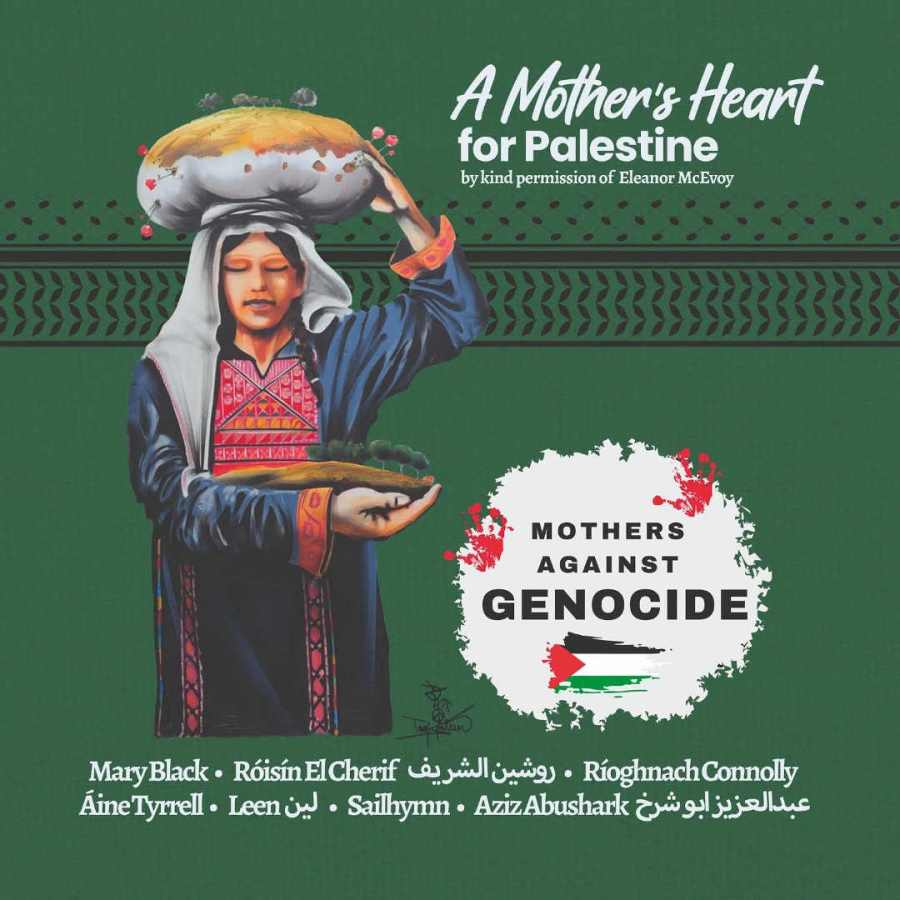
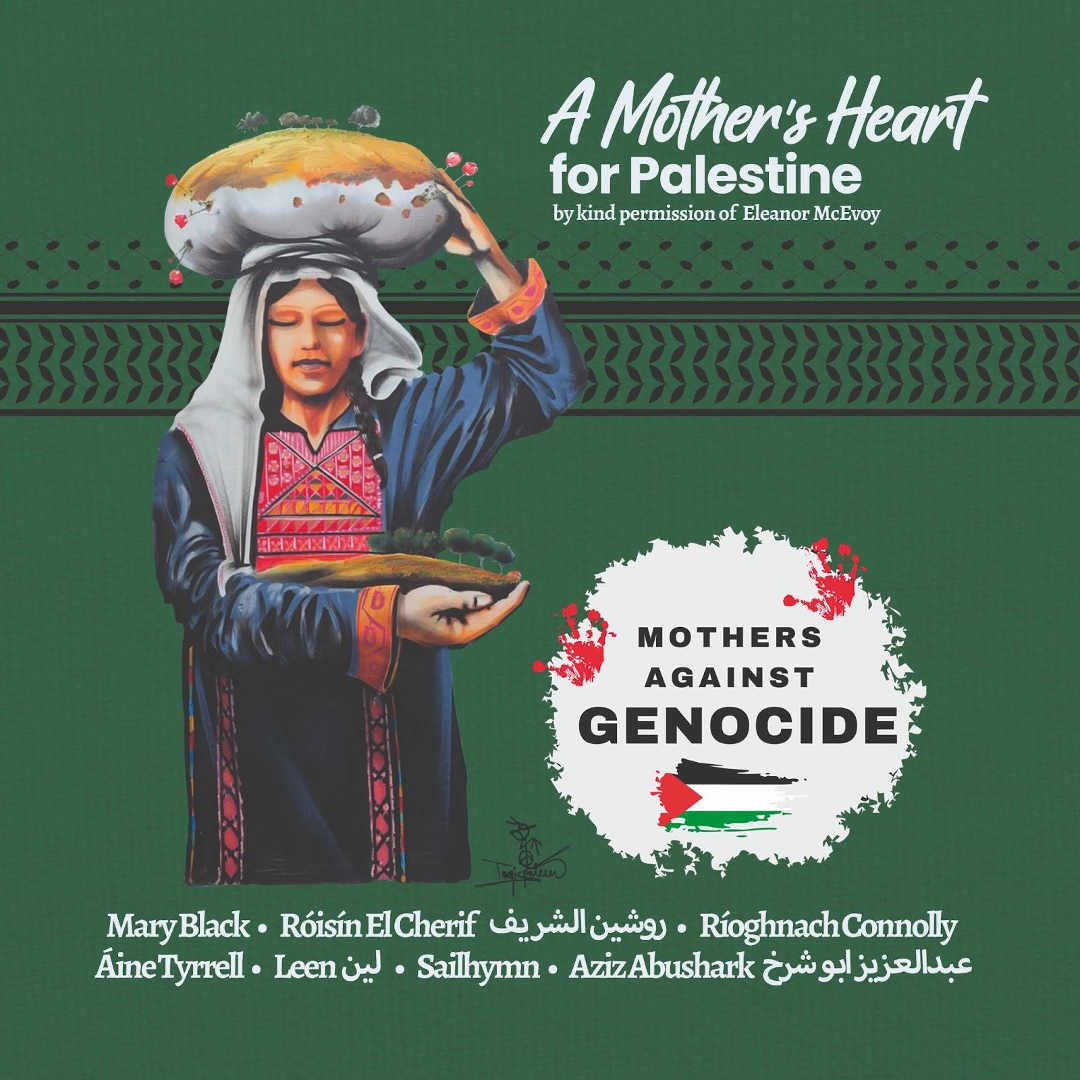
On August 1st singer Mary Black released A Mother’s Heart for Palestine, a soundtrack and video.1 The title and music built on the 1992 track by Mary Black and Eleanor McEvoy, A Woman’s Heart (title of album also).2

The voices are beautiful and the adaptations of the Arab women particularly so. Or at least, they affected me even more deeply.

Like actions by Mothers Against Genocide,3 the recording seeks to transverse borders in the mind, to represent Palestinians as humans, as human as ourselves, through the image of the mother, which almost all of us have had and which many women are or have been.

It is worth thinking about this a bit further. The image of the mother is a powerful one in all cultures for at least biological evolutionary reasons. The future of the human species depends on productive motherhood and in all cultures, in that capacity at least, pregnant women are protected.

The image is also overlain by personal affect, of ourselves nurtured (in most cases) by a mother or ourselves as a mother, nurturing in turn.

The image of the mother is also manipulated by all degrees of the Right, whether to uphold clerical control, to counter assertion of reproductive rights, or to deny the right of lesbian (and gay) sexuality. And ‘to protect ‘our women’’ from imagined migrant assault (or indeed intermarriage).

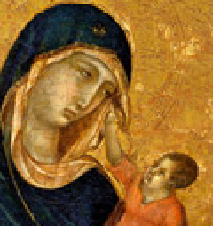
In Christian religious iconography, the Mother as Madonna is particularly prevalent and she is always passive, whether depicted serene or suffering.

A detail from the Madonna and child painting by Duccio, late 13th Century (Image sourced: on line)

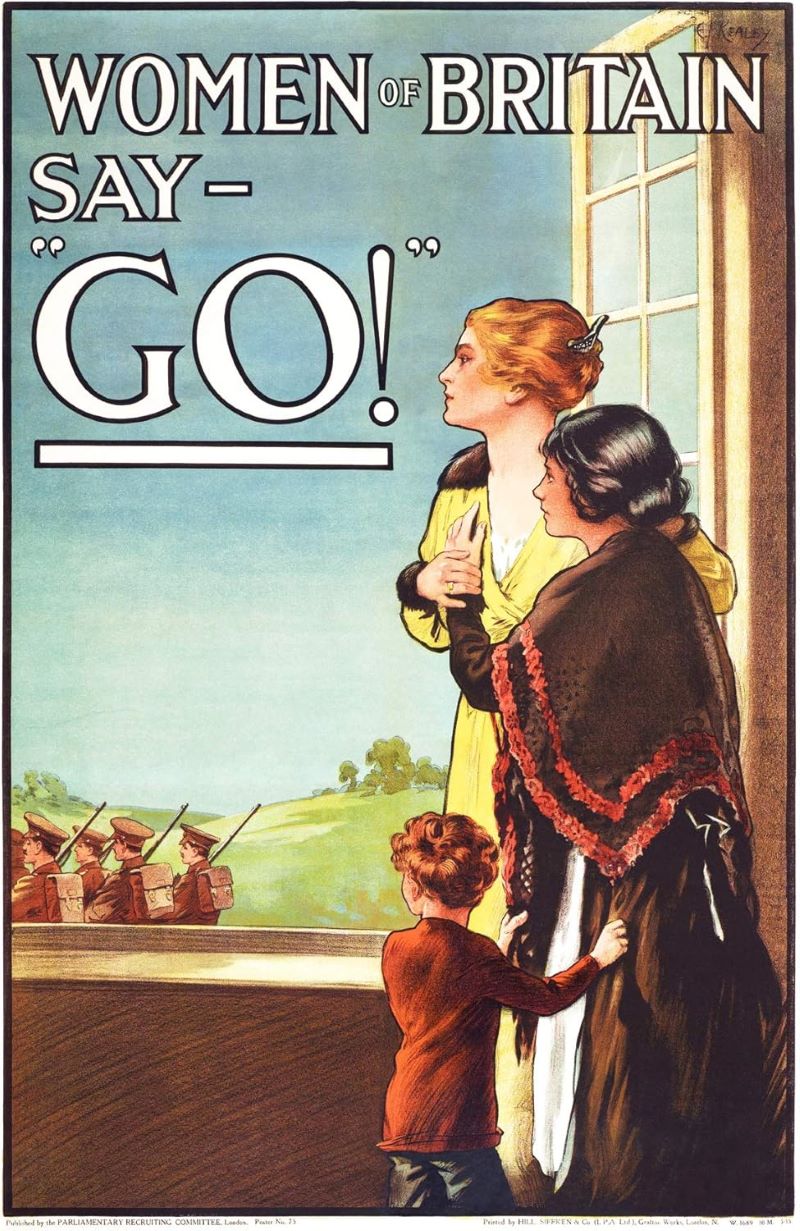
The mother image is also employed by imperialists to send us to war and was crudely used for example in the UK (of which Ireland was then a part) in a WWI poster depicting a mother and child telling the man to go and fight (for them, of course – not for the imperialists, mar dhea!).

WW1 recruitment poster for Britain (Image sourced: on line)
A particularly offensive recruitment poster for the British Army in WW1 given that Ireland was under British occupation and only six decades after a British genocide of Irish people through starvation. (Image sourced: on line)

But in nearly all cases it is a passive representation of womanhood and is combined in the Mothers Heart video with images of sorrow – naturally, about all the children killed or starving, soon to die — which is also a passive emotion.

Many of the visual representations of Palestinian women are in domestic roles assigned to women around the world: food preparation, washing and drying clothes and of course child care.

Mothers are uniquely women but women are also more than mothers. Slightly more than one-half the human race, they are also workers,4 cultural producers, thinkers, leaders — and fighters. Even in revolutionary iconography we rarely see the woman, never mind mother, represented armed.

This is despite the 1970s images of a Mozambican or Vietnamese woman carrying a gun and a child. Or the famous staged INLA photo of a skirted woman in the Six Counties aiming an automatic rifle. Such images are very much exceptions to the rule.5

Poster promoting the Mozambique People’s Liberation Army. (Image sourced: on line)
Poster from the Vietnam War. (Image sourced: on line)

The music video shows Palestinian women, among their domestic roles, lamenting, speaking on mobile phones, presumably worried about relatives, carrying belongings, on the move, displaced. The lyrics also are of lament.

As complete counterpoint in the Arab world we have only one image that I know of, which is Leila Khaled with an automatic rifle, because her society too insists on a largely passive role for women, even though their position in that society otherwise seems very influential.

The women shown in the video accompanying the music and lyrics are apparently Arab, Arab-Irish and mostly Irish. On the Palestine solidarity marches here my impression is that born women are the majority over born males and many have taken militant action, for which some are facing prosecution.

Women, in particular Arab women, often lead these marches, calling out the chants for others to respond.

Newsreels show Palestinian and other Arab women abroad marching, shouting slogans, clenched fists in the air. I have seen them denouncing ‘Israeli’ soldiers for invasion and occupation, for mistreatment of children, for demolition of houses, one slapping an armed Israeli soldier in the face.

In our own history (as distinct from mythology and legend) we had few female figures of armed action and Pearse mythologised Gráinne Ní Mháille6 in song to epitomise resistance when he had her represent the nation. But compare that to his poem The Mother!

In recent years Markievicz, Skinnider7 and to a degree Farrell8 have part-emerged from history’s shadows bearing weapons but there is still a long way to go in changing the image of women (through all their biological phases) in the struggle.

This song for all that it affects me emotionally does not do that nor is it expected to and, more to the point, I fear will be used to reinforce passivity in the assigned role of women in struggles — fortitude and solidarity in suffering no doubt, but passivity none the less.

It seems to me that social democrats and liberals perpetuate the mother aspect of the woman manipulatively in order to promote pacifism and much as I appreciate this cultural production, it will be used in that way.

While enjoying cultural productions visually, in sound or in print, we need also to be aware of the social packages they carry and their effects upon us, intended or otherwise.

End.

(Image sourced: The Beat.ie)

FOOTNOTES

1https://www.mary-black.net/

2https://en.wikipedia.org/wiki/A_Woman%27s_Heart_(compilation_album)

3Whose official stamp is also on the video.

4Industrial, agricultural, municipal, health services, technical and scientific services.

5There was some coverage of armed Kurdish women in Syria fighting ISIS (I wrote about some myself) but it is now clear that was in the context of NATO coordination in the war to overthrow the non-western aligned regime.

6A 17th Century female chief of the Uí Máille clan in Mayo who led attacks on her enemies by land and sea. Pearse adapted the ancient bride-welcoming song to bid her welcome with armed warriors to reclaim her land and disperse the English occupiers.

7Both Markievicz (nee Gore-Booth) and Skinnider were members of the Irish Citizen Army and both carried and fired weapons in the 1916 Rising.

8Though unarmed, she was part of an Active Service Unit of the IRA when she and her two comrades were gunned down in the British colony of Gibraltar on 6th March 1988.

SOURCE

https://www.mary-black.net/

1https://www.mary-black.net/

2https://en.wikipedia.org/wiki/A_Woman%27s_Heart_(compilation_album)

3Whose official stamp is also on the video.

4Industrial, agricultural, municipal, health services, technical and scientific services.

5There was some coverage of armed Kurdish women in Syria fighting ISIS (I wrote about some myself) but it is now clear that was in the context of NATO coordination in the war to overthrow the non-western aligned regime.

6A 17th Century female chief of the Uí Máille clan in Mayo who led attacks on her enemies by land and sea. Pearse adapted the ancient bride-welcoming song to bid her welcome with armed warriors to reclaim her land and disperse the English occupiers.

7Both Markievicz (nee Gore-Booth) and Skinnider were members of the Irish Citizen Army and both carried and fired weapons in the 1916 Rising.

8Though unarmed, she was part of an Active Service Unit of the IRA when she and her two comrades were gunned down in the British colony of Gibraltar on 6th March 1988.

“Building resistance through culture”: successful Solidarity Sessions launch in Dublin

Clive Sulish

(Reading time: 3 mins.)

Around 80 people attended a concert in the back room of Dublin’s Cobblestone pub launching an initiative to “build a community of solidarity and resistance through culture”. Flags of Irish and other struggles around the world decorated the venue.

The evening’s entertainment consisted of five musical acts and one of poetry. The MC for the evening, Diarmuid Breatnach, told the audience that Irish struggles had always found an expression in culture and that culture itself encouraged further resistance.

He gave the example of Thomas Davis who founded with others the patriotic newspaper The Nation in the mid-1800s, publishing contributed songs and poems and his own, including The West’s Awake and A Nation Once Again, songs still sung in Ireland nearly two centuries later.

The first act of the evening was the folk duo The Yearners, specialising in harmonies around renditions of song covers and their own song about the Mary of the New Testament, as a woman pressured to bear a child because “How can you say no to God?

The audience joining in on Pearse’s Gráinne Mhaol was followed by some songs with hard satirical edges like the Kinky Boots song from the Irish Republican repertoire and their own Save A Landlord.

The Yearners during their performance. (Photo credit with thanks: Dermo Photography)
Dúlamban during their performance. (Photo credit with thanks: Dermo Photography)

The MC introduced another all-female duo, Dúlamban, recently formed from two individual singer-musicians. Among their material, Sinéad on violin played two compositions of her own while Aisling sang her adaptation and translation of the Rising of the Moon: Ar Éirí na Geallaigh.

The one poet of the evening, Barry Currivan, performed a number of shorter and longer pieces of his repertoire. He was particularly applauded for his “anti-othering” piece Those People and his humorous concluding piece comparing himself to a good cup of tea or coffee.

After the break, the MC spent a few minutes outlining the Solidarity Sessions collective’s project and encouraging the audience to take part in it by spreading word of its events and supporting them in person, in addition to stepping forward to assist in organisation and in poster design.

Barry Currivan during his poetry performance at the Solidarity Sessions launch. (Photo credit with thanks: Dermo Photography)
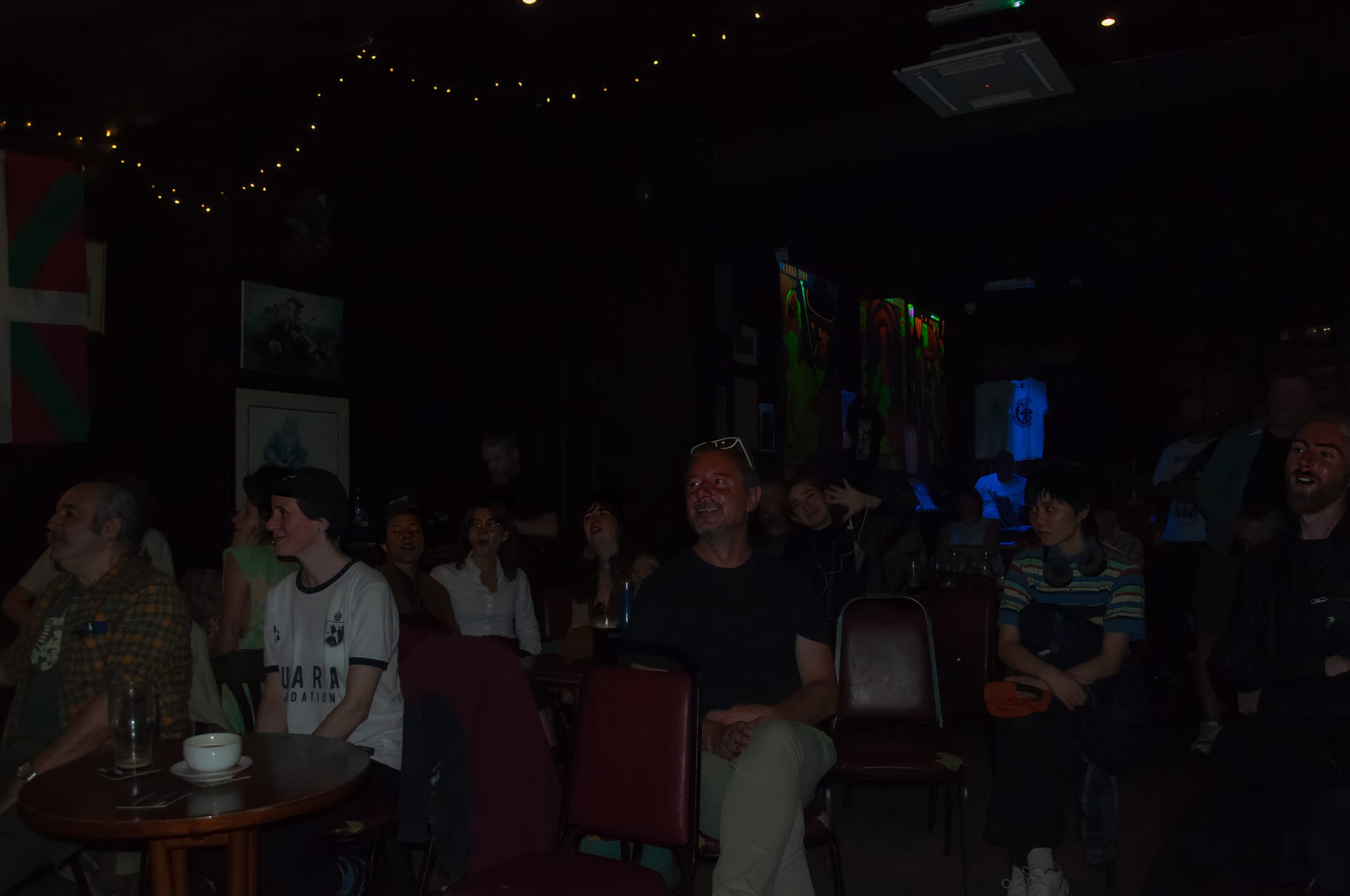
Section of the audience presumably during Currivan’s performance. (Photo credit with thanks: Dermo Photography)

Another female duo took the stage, Sage Against the Machine on guitar accompanied by Ríona on violin, performing a number of love pop covers and SAM’s own song against patriarchy.

Some remarks about Bob Dylan’s Zionism followed in Sage’s introduction of the former’s Masters of War which she performed with great feeling and followed with El Gallo Rojo, an anti-fascist song from the Spanish ‘Civil War’.

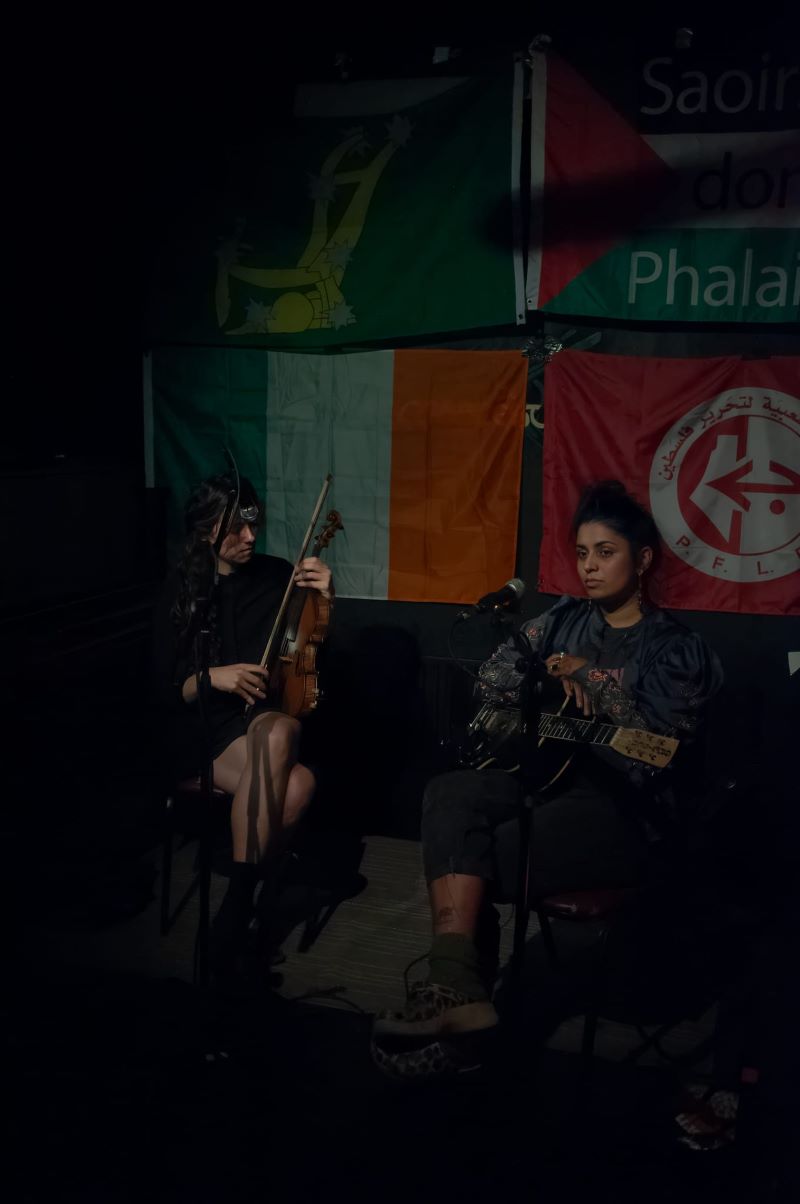
Sage Against the Marchine (right) and Ríona during their performance. (Photo credit with thanks: Dermo Photography)
Jimi Cullen during his performance at the Solidarity Sessions launch. (Photo credit with thanks: Dermo Photography)

Breatnach then introduced Jimi Cullen who he said has been hosting a weekly musical protest picket for an hour on Wednesdays (2-3 pm) outside the US Embassy for a great many weeks, in which the MC had sometimes accompanied him amidst the solidarity beeping of passing traffic.

Jimi accompanied himself singing his Housing for All and Guthrie’s You Fascists Bound to Lose, then commenting on Bob Marley’s Zionism while introducing the latter’s One Love song, saying that love above all is what binds humanity together, a theme also of his We Are All Palestinians.

His monologue The Genocide Will Be Televised was much sharper and renewed an earlier Death, death to the IDF!1 chant from the audience.

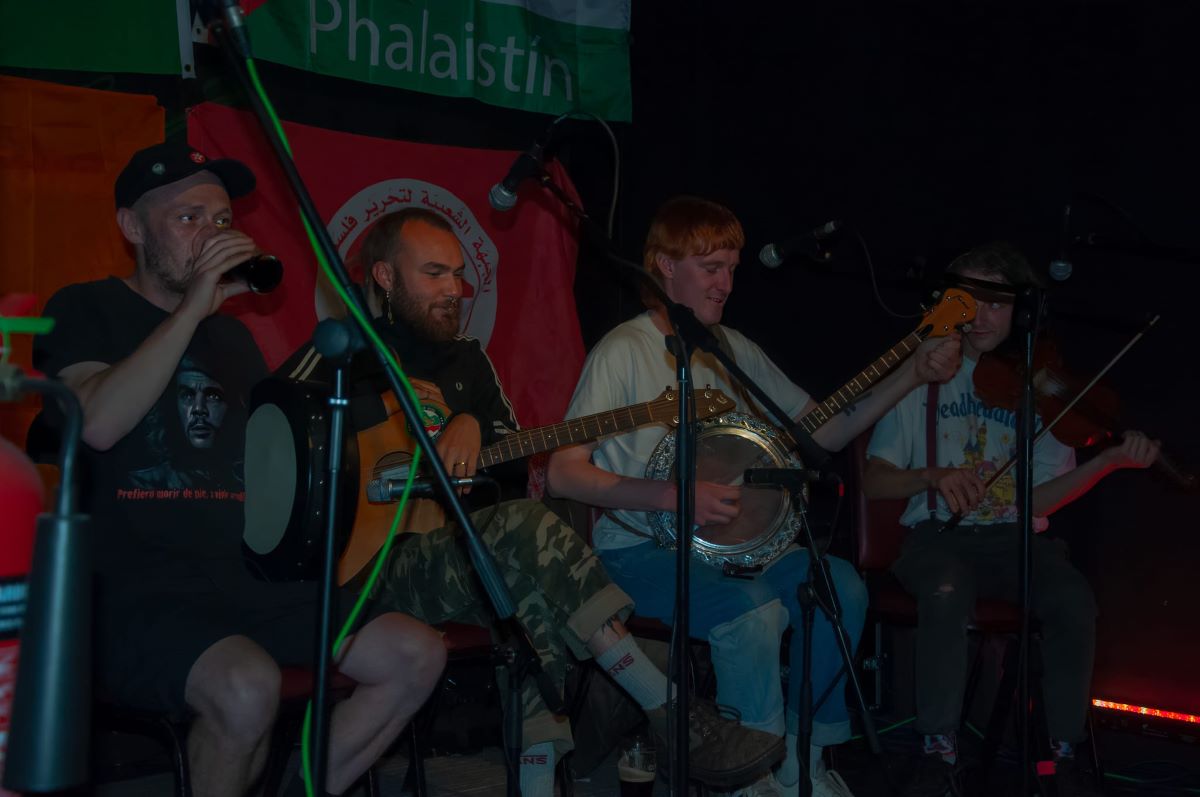
Trad Sabbath during their performance. (Photo credit with thanks: Dermo Photography)

There was much irreverent comment about the name of the band to conclude the evening, Trad Sabbath, a four-piece band of guitars, banjo, bodhrán and fiddle, apparently in the context of the very recent death of the Black Sabbath band’s lead vocalist, Ozzie Osbourne.

Sardonic cries about “his poor widow”, Sharon Osbourne2 were also heard, a Zionist personality star in a ‘reality’ TV show about the late Ozzie’s family. To fill in the delay in their setting up with the sound engineer, Breatnach sang Kearney’s Down by the Glenside ballad.

The band concluded the evening with traditional melodies and some songs from Eoghan and Hat with others backing on choruses.

Poster advertising the event (Design: Ríona and D.Breatnach)

The MC thanked all for their attendance, performances and technical support before reiterating the Solidarity Sessions’ objective and encouraging participation. His comment that “Repression is here and more is coming down the road” was underlined by the presence there of a prominent victim.

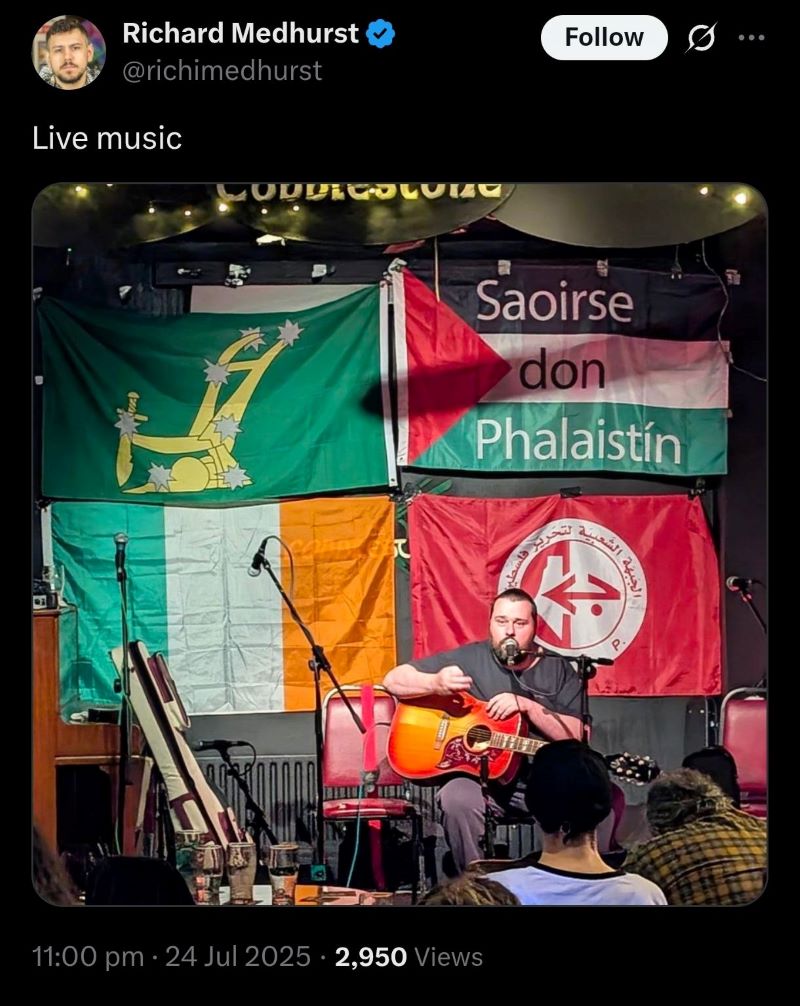
In the audience was Richard Medhurst, the Britain-based journalist specialising in Middle Eastern coverage who was recently detained under anti-terror (sic) legislation and charged by British police as he returned from abroad and again later detained though not actually charged by Austrian police.

Richard Medhurst’s tweet during the evening at the event.

End.

FOOTNOTES

1Made famous by the Bob Vylan duo at Glastonbuy getting the audience chanting the slogan. The IDF is what the Israeli Occupation Forces call themselves.

2Who had called for the banning of the the Irish rap group Kneecap.