NO NATIONS, NO BORDERS?

Diarmuid Breatnach

(Reading time main text: 4 mins.)

No Nations No Borders was the title of a meeting I saw advertised recently and also a slogan I had heard chanted some years ago1 on a counter protest to fascists and other racists. I wondered then and wonder now: Have they thought this through?

Clearly the utterers and followers of such a slogan see many negative things emanating from nations, probably war, oppression, repression, racism, even genocide. But are those things fundamentally attributes of nations – or even of states that are founded upon nations?

The definition of a nation is not universally shared among historians, philosophers and sociologists but they are generally agreed that it is applied to a people who share a territory and common history, along with a language and culture, incorporating customs and law.

Some argue that nations only came into existence historically in the 18th century, others maintain that they existed long before that, in the Middle Ages and even further back. In Ireland, Thomas Davis published the lyrics of A Nation Once Again in 1844, nearly half-way into the 19th Century.2

Davis, whose father was Welsh, drew on the classical Romano-Greek education of the British ruling class as inspiring his awakening nationalism:

When boyhood’s fire was in my blood/ I read of ancient freemen/ Of Greece and Rome who bravely stood/ Three hundred men and three men3/ And then I hoped I yet might see/ Her fetters rent in twain/ And Ireland long a province be/ A nation once again!

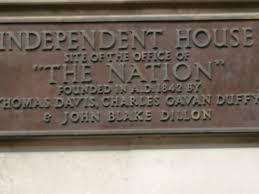
Plaque in Middle Abbey Street to mark the site of The Nation, a patriotic newspaper founded in Dublin in 1842 by leaders of a group that became known as The Young Irelanders. (Photo sourced: Internet)

However, the United Irishmen who rose in revolt in 1798,4 the first Republican uprising in Ireland, certainly conceived of their nation, the French too in their 17895 revolution and the 13 Colonies, the precursor of the United States of America, in the American Revolution 1765–1783.6

The leaders of the United Irishmen were mostly English-speaking while the majority of the population, indigenous clans and Gaelicised descendants of Normans and Vikings, were all Irish-speaking and they had earlier appealed to Rome in terms of an oppressed nation.7

It can be argued that in passing the Statutes of Kilkenny in 13668 the English occupation recognised Irish nationhood, albeit in the form of a malignant influence upon the Norman invaders who were ‘going native’, “the degenerate English” having become “more Irish than the Irish themselves”.

An Irish nation-building process may be perceived over three centuries earlier, with Brian Boróimhe trying to unify Ireland under his kingship and defeat the Dublin Viking colony. As Brian was killed9 at the Battle of Clontarf (sic),10 this remains unproven.

All the attempts to achieve national independence starting with the United Irishmen until at least 1923 were built upon democratic formulations according to their time and – in the case of the 1916 Proclamation – in actual advance of it in terms equality of women and of civil and religious liberty.

Monument to Thomas Davis (1814-1845), writer, publisher (founder of The Nation newspaper) and composer, erected in Dublin’s Dame Street 1966. (Photo sourced: Internet)

NO NATIONS?

If nations are to be abolished, how might this be achieved? Presumably their languages, cultures and customs would need to be eradicated … and replaced with what? Actually, there have been ongoing attempts at that eradication for centuries – by colonialism and imperialism!

In those cases, the conquering power would seek to replace the language, culture and history of the conquered with their own – or with an allegedly ‘cosmopolitan’ culture (i.e allegedly independent of any national culture). It might be unpleasant for the “no nations” people to reflect upon that.

It was fashionable in the 1980s among certain intellectuals to claim that nationalism was moribund (and history too), quickly refuted even in Europe by the Balkan wars, not to mention by the Irish and Basque anti-colonial struggles.

A German movement among the Left known as anti-nationalismus in opposition to the nationalism of the German State, because of fears of return to nazism, extended its application of that to opposing national liberation struggles (e.g in Ireland, Basque, Palestine) and to support for Zionism.

I have heard John Hume quoted as saying that “We are all Europeans now”, understood to indicate the end of the various national entities in Europe – or at least their importance as nations.

I failed to find that quotation but he said something similar in his acceptance speech for the 1998 Nobel Peace Prize (shared with Loyalist leader Trimble)11 — a speech either hugely naive or reflective of imperialism at a time of its rampant reign and proxy wars across the world.

The eradication of nationalism, even were it possible, would entail the elimination of a huge reservoir of different languages and cultures around the world, the different ways of expressing being human as we understand that concept.

The replacement, if achievable, would be a sterile mono-culture. Or possibly even that culture might fragment over time into different forms of expression in parts of the world.

NO BORDERS?

Let us suppose that the people of a nation are not to be removed nor their culture eliminated but that it’s merely proposed that its borders be removed. If we do not agree – or it should prove impossible to – eliminate the nation as a political-cultural construct, what about just removing borders?

It would be wonderful to be able to travel around the world without ever encountering customs posts or border guards – wouldn’t it?

The monument to Charles Stewart Parnell (184 -1891), political party and Land League campaign leader, erected in Dublin at the junction of Sackville (now O’Connell) and Parnell Street in 1911. An inscription on the monument opposes borders or boundaries but in another sense, as a limit to the nation’s independence: “No man has a right to fix the boundary to the march of a nation. No man has a right to say to his country thus far shalt thou go and no further.” (Source photo: Wikipedia)

Of course it would and hopefully one day that will be a reality, without having eliminated nations. But in the era of imperialism and colonialism, nations that free themselves will need to maintain borders as part of the defences against their invasion by their former masters or prospective ones.

During that period, those borders will need to be defended and monitored in terms of financial, scientific and commercial exchanges, imports and exports and – yes — passport control. Not very libertarian, for sure but some idea of entrances and exits will be needed for a number of reasons.

This is the era of imperialism and colonialism on the one hand and national liberation on the other. To attack the idea of the nation at this time is to objectively side with the projects of those reactionary forces and progressive forces need to oppose projects against nationalism.

However, inside the nations, there are also necessary struggles to be fought: of class, of democratic rights and freedoms and these can and should be fought, while at the same time defending the rights of nations to exist and develop.

End.

FOOTNOTES

1This was by a small politically sectarian group which seems to have left the active stage for some years now.

2https://en.wikipedia.org/wiki/A_Nation_Once_Again

3The ‘three hundred men’ men refers to the Spartans (who actually had other allies there too) led by Leonidas I at the battle at the Pass of Thermopylae to delay the Persian army’s invasion of Greece led by Xerxes I in 480 BCE; the “three men” is a reference to Horatio’s stand with two comrades on the bridge in 509 BCE in an attempt to deny an invading Etruscan army access to the city of Rome. Coincidentally or not, the story was published in McCauley Lays of Ancient Rome in1842, two years before the publication of Davis’ A Nation Once Again.

4Although the leadership was nearly all descended from settlers, they did seek a democracy enfranchising the indigenous Irish.

5The French Republic could justifiably claim to represent the French nation but what of the Breton and Corsican nations, along with parts of the Basque and Catalan nations over which La Republique claimed domination? Or the French colonies in Africa, Asia, America and the Caribbean?

6This is a most problematic concept of a nation, being entirely constructed of a minority of settlers imposed on the Indigenous population and the imported slave population, both of which were totally excluded from the polity.

7I have seen a copy of the appeal but now cannot find it, however at the time of post-WWI Paris Peace Conference Seán T. Ó Ceallaigh seeking Vatican support for Irish independence declared: Ireland’s righteous and time-honoured claims have been frequently recognised by Your Holiness’s Predecessors and even actively assisted by them as far back as the sixteenth century. https://www.difp.ie/volume-1/1920/appeal-to-vatican/35/#section-document page.

8Quotations from the preamble to The Statutes of Kilkenny 1366 legislation: “In essence its purpose was to codify laws passed over the previous decades which had sought to halt and reverse the Gaelicisation of English settlers in Ireland. For instance the use of Irish language, dress, and customs by all English and Irish subjects who had sworn loyalty to the king was forbidden.” https://cain.ulster.ac.uk/othelem/chron/ch1169-1799.htm

9Along with all commanders of both sides.

101014, the Battle lasting around 12 hours could not have been fought at present-day Clontarf, which did not exist then and that site is not mentioned in any of the early accounts of the Battle. The site has never been indentified but was likely around the Glasnevin/Drumcondra area.

11Awarded for his work in helping to create the imperialist pacification process in Britain’s colonial conflict in Ireland: If I had stood on this bridge 30 years ago after the end of the second world war when 25 million people lay dead across our continent for the second time in this century and if I had said: “Don’t worry. In 30 years’ time we will all be together in a new Europe, our conflicts and wars will be ended and we will be working together in our common interests”, I would have been sent to a psychiatrist. But it has happened and it is now clear that European Union is the best example in the history of the world of conflict resolution and it is the duty of everyone, particularly those who live in areas of conflict to study how it was done and to apply its principles to their own conflict resolution. https://www.nobelprize.org/prizes/peace/1998/hume/lecture/

FURTHER READING

A discussion on the composition of nations and nationalism: https://en.wikipedia.org/wiki/Nation

LUIGI MANGIONE, UNDERSTANDING HIS POPULARITY

Gearóid Ó Loingsigh 30 December

(Reading time: 6 mins.)
NB: Edited by RB from original article for formatting purposes

Luigi Mangione’s killing of Brian Thompson has resulted in a plethora of memes on Facebook celebrating to some degree the demise of the unlamented CEO.

Some of them are very funny, full of wit, others express outrage at the nature of the US health system and others openly call for more such killings and Facebook has not suppressed them, which says a lot.

Facebook is run and owned by a right-wing extremist, Mark Zuckerberg. But he is no idiot and probably hopes to ride out this particular storm, rather than suppress it. But he is mistaken as Mangione has struck a nerve. This is not going away.

Some so-called progressives have also sought to soften the impact of Mangione’s actions.

There are of course criticisms from the Left about how such actions don’t solve problems, the CEO is replaced and the machinery rolls on, and these are valid, but there are others who seek to wrest any agency or legitimacy from him.

Munya Chawawa, the British comedian and rapper released a musical video questioning how he was treated by the Police and saying he would have got different treatment if he were black.[1] 

Yes, generally the cops are quick to kill blacks, especially those they think have actually killed someone, though they did in fact arrest the black DC Snipers (also known as the Beltway Snipers) who had murdered ten innocent civilians.[2] 

In fact, it is not that US cops don’t kill whites, they do, it is just that not at the same rate as blacks. Half of those killed by US cops are white, but blacks are killed at more than double the rate of whites despite making up only 14% of the population.[3] 

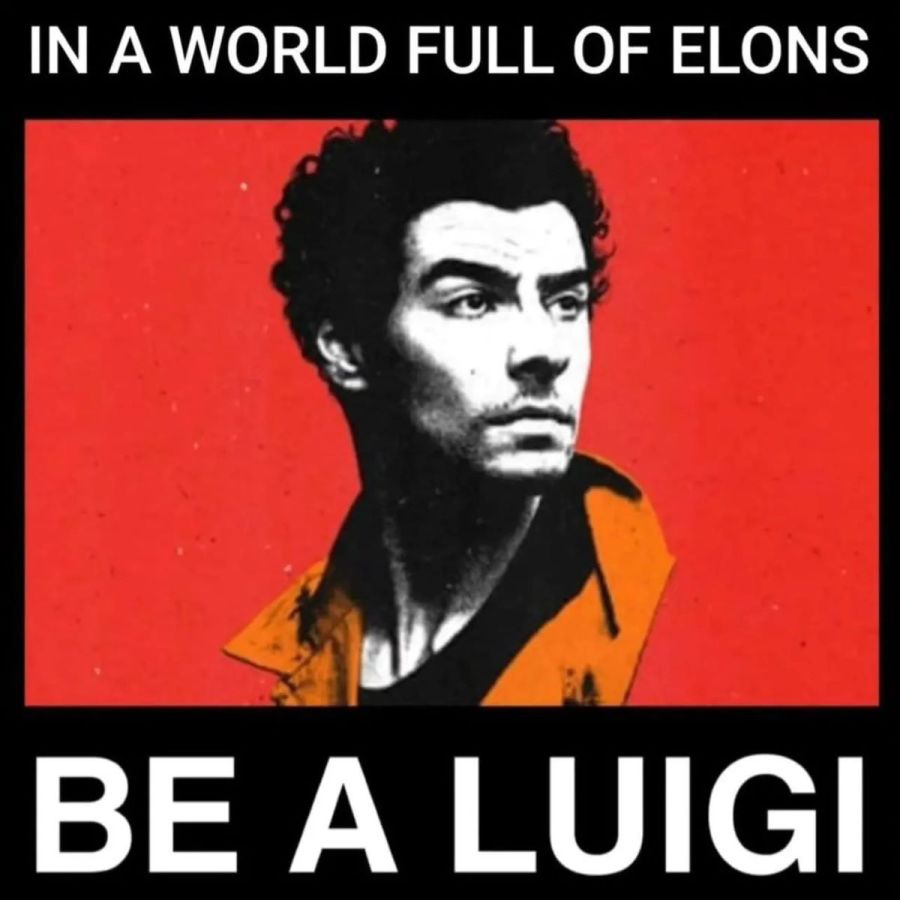
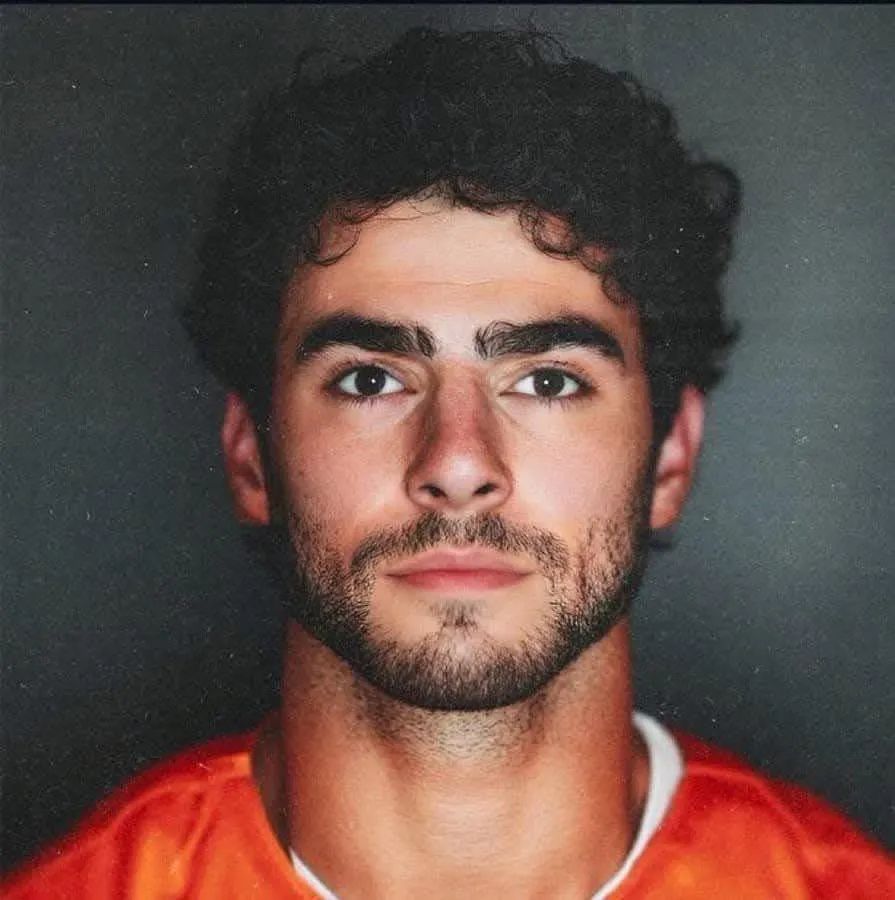
And yes, he is handsome and it helps, and again the memes have gone into overdrive. His arrest and mugshots have been compared to even scenes from one of the innumerable Superman films. Though I prefer the Che Guevara comparison.

He is no Che, as Che set out to overthrow a state and had a programme for change and is the main person behind the remarkable success story that still is, despite everything, the Cuban health system, but the striking mugshot images do help.

Photos (internet) Mugshot of Luigi Mangione and bottom Che Guevara mugshot in Mexican jail.

However, Chawawa missed the point altogether and questioning police violence is not something you would automatilaccly associate him with.

But the idea that the cops act with benevolence towards those who shoot CEOs if they are white is nothing short of identitarian rubbish. He is not the only one though.

There are many others from all sorts of liberal backgrounds who recoil in horror that someone might lash out, but shrug their shoulders every day when people die having been refused medical care.

Most people in the US have understood and identify with Mangione’s actions, not out of some idea that he might change the system, but out of their own frustration at how the system works. The plethora of memes on Facebook bears testament to this fact.

The killing of the CEO is extremely popular regardless of how effective a strategy it is.

Another comedian, this time from the US Josh Johnson, understood something that many liberals and chic rappers like Chawawa could not is that Mangione struck a chord.

Though Johnson unlike Chawawa is from the US and understands the US healthcare system. He mentioned the fact that many CEOs are eliminating their Linkedin accounts and that the media went into overdrive on how devastating it all was.

I’m not gonna lie, this is how you can tell the news is owned by billionaires because the news was like, uh, ‘this devastating, terrifying, harrowing attack in New York’, and I’m not saying… look a murder did take place… I’m not saying it couldn’t have been listed as those things, I’m just saying ‘you’re the news!’ 

You play horrific stuff all the time. You’re the same news that when those pagers were going off in the Middle East, exploding, you were like ‘check this out!’”[4]

The same media pundits who were horrified, express no such horror as Israel carries out its genocide, they don’t even question it and yet we are expected to take their statements on Thompson and the sanctity of life at face value.

Johnson then made a point about the system and how it didn’t care about anything other than money, not even about Brian Thompson. The meeting Brian Thompson was going to when he was shot went ahead as planned, and on time.

Capitalism doesn’t miss a heartbeat when there is money at stake. All the fake outpouring of grief from the corporate world and the media is to be measured against that fact. Nothing stopped their ruthless pursuit of profit, not even the killing of one of their own.

It has brought to mind the film John Q starring Denzel Washington. It is a bit late to review a film some 22 years after its release, but it is more relevant now than when it was released.

The film deals with the father of a child who is taken to hospital only to find that the surgeons can’t operate on him as his insurance doesn’t cover what is needed.

It also turns out that the child’s condition could have been detected earlier, but the US health system missed it. Never was the film John Q so relevant. In his manifesto, he could just have said, Do you want to know why? Watch John Q. That would have been enough.

Films don’t exist in a void. When you see lots of films where the government is corrupt, or the CIA and FBI is in cahoots with big business, it indicates that a lot of people accept the basic premise of the film.

The same goes for dramas like John Q which was the highest grossing film for the President’s Day weekend release and took a total of US $71 million in the US and US $ 102.2 million world-wide.

Though it was not based on the real incident, in Canada (not the US), where Henry Masuka took the ER staff hostage in 1999 demanding immediate treatment for his son and was later killed by the cops exiting from the hospital, carrying an unloaded pellet gun.

In the film most of the public are sympathetic to John Q as are most sympathetic to Luigi Mangione in real life. The difference of course is that John Q managed to force them to operate on his son, making one small change at an individual level.

Mangione has made no changes at all, but he has reignited a debate on the issue and once again put not only the nature of the health system in the spotlight, but also the police and judicial system.

With various social media posts pointing out the huge effort put into finding him as opposed to arresting the billionaires who raped underage girls on Epstein’s island.

One of capitalism’s greatest successes in the late 20th and early 21st century is not how high the Dow Jones Index is at, or any of the other roulette tables known as stock exchanges.

Rather it isthat it has destroyed many collective organisations, co-opted others or through social partnership brought on board to one degree or another all the potential opposition movements and organisations.

Trade unions frequently fall into all three categories, social and environmental movements also and of course the huge deluge of NGOs that abound in all areas of social and economic life.

The organisations a Luigi Mangione type figure would have turned to decades ago are now part of the problem, implementing government policy, refusing to challenge the state as their salaries depend on government largesse and patronage and making sure their “clients” i.e. the poor, don’t step outside of the structures.

So, it is no surprise that Mangione would lash out the way he did, nor is it a surprise that he is so popular. The success of capitalism in convincing people there is no possibility of organised opposition is such that individual acts go viral.

Those liberals who wail against his actions are the same ones who make sure there is no collective response.

What is needed is not so much more killings but more people with Mangione’s resolve organising to brush not only the Thompsons of the world aside but also the co-opted organisations paid to keep them in check.

It is as Leon Trotsky once said “Where force is necessary, there it must be applied boldly, decisively and completely. But one must know the limitations of force; one must know when to blend force with a manoeuvre, a blow with an agreement.[5] 

More relevant to Mangione is the killing of a Nazi diplomat in Paris by Herschel Grynszpan,[6] whose actions were used by the Nazis as a pretext for Kristallnacht.

Trotsky commented “A single isolated hero cannot replace the masses. But we understand only too clearly the inevitability of such convulsive acts of despair and vengeance. All our emotions, all our sympathies are with the self-sacrificing avengers…[7] 

So let us wish Mangione well in his trial.

End.
NB: For more articles by Gearóid see https://gearoidloingsigh.substack.com
NOTES


[1] See https://www.instagram.com/munyachawawa/reel/DDwz9k5I78i/

[2] Washington Post (01/10/2022) D.C. sniper attacks: A timeline of the violence and victims https://www.washingtonpost.com/history/2022/10/01/timeline-dc-sniper-attacks/

[3] Washington Post (18/12/2024) Police shootings database 2015-2024 https://www.washingtonpost.com/graphics/investigations/police-shootings-database/

[4] See

[5] Leon Trotsky (1932) What Next? Part III. https://www.marxists.org/archive/trotsky/germany/1932-ger/next03.htm

[6] Jacobin (09/11/2021) The Boy Who Shot a Nazi: An Interview with Joseph Matthews. https://jacobin.com/2021/11/herschel-grynszpan-kristallnacht-jewish-nazi-germany-joseph-matthews-interview

[7] Leon Trotsky (1939) For Grynszpan. https://www.marxists.org/archive/trotsky/1939/xx/grnszpan.htm

Ho, Ho, Ho – Father Christmas

(Reading time: 6 mins.)

Republishing this now as we approach again the festival called Christmas. A Christian festival, apparently, celebrating the birth of Christ, the baby Jesus. But are there darker aspects in its references?

Away in a manger
No crib for His bed
The little Lord Jesus
Lay down His sweet head

The stars in the sky
Look down where He lay
The little Lord Jesus
Asleep on the hay

Such a sweet, holy image.

But actually, when we look around us, it seems more like a festival of the pagan gods: of Bacchus, the god of alcohol and of Mammon, the god of wealth. Bacchus, because in non-Moslem countries, drinking of alcohol will be for most a big component of the festival.

Whiskey, brandy, wine and beer will be bought to stock up the house. Alcohol will be drunk at Christmas parties (including office parties, where for months afterwards some people will regret what they did or said – or even what they didn’t do or say).

Alcohol will be not just drunk but also put into some of the traditional food and even poured over it.

Then Mammon. Well, you can see the retail businesses stocking up for weeks or even months ahead of the festival which, after all, was only supposed to be a one or at most a two-day event.

Giving and receiving gifts has now become part of the festival and in most cases, gifts have to be bought. Which is a really big gift to the retail businesses and thence, really a sacrifice to Mammon.

In the Christian gospels of both Matthew and Luke, it is written that one “cannot serve both Mammon and God” — which goes to show how little they understood capitalism, where Mammon IS God.

A theologian of the Fourth Century saw Mammon as a personification of Beelzebub, which in his time was another name for Satan or the Devil.

Interestingly, Protestant Christianity, which some credit as having invented capitalism, at the same time regarded Mammon, or said they did, as “one of the Seven Princes of Hell”.

Cartoon depiction of Mammon, God of Wealth (Image sourced: Internet)
Sculpture representation of Bacchus, God of Alcohol, in California winery, USA (Image sourced: Internet)

SANTA

          Now, Santa Claus is also a big part of the Christmas festival, especially in western countries, a much more acceptable face than that of greedy Mammon and alcoholic Bacchus, right?

But originally, the Christians saw him as a representation of St. Nicholas, 4th Century Bishop of the Greek city of Myra, a location now in Turkey. He was the patron saint of archers, repentant thieves, sailors and prostitutes. The prostitutes probably had to be repentant ones too, of course!

The sailors, who probably had at least as much recourse to prostitutes as had any other calling, were apparently not required to be repentant – to be in danger on the sea was deemed enough.

But St. Nicholas was also the patron saint of children, pawnbrokers and brewers, so we can see how close he was getting there to the modern spirit of Christmas.

GERMAN TRAPPINGS

          Now, the Christmas Tree, der tannenbaum, so much a part of the symbolism of modern western Christmas, came to us from Germany, as did the sled and the reindeer.

The reindeer are not autochthonous or endemic in historic times to Germany, so they must have been brought in their myths from Scandinavia from where originally, the Germanic tribes came.

In turn, the Christmas Tree, Yule Log, reindeer and sled were exported from Germany to England in the reign of Queen Victoria, by her consort Prince Albert, who was German.

And since the English ruled all of us in Victoria and Albert’s time, the Christmas Tree came to us too, to the cities first and then slowly spreading through the rural areas.

A representation of St. Nicholas (before he got the red suit makeover) looking more like a pagan god of the woods. (Image sourced: Internet)

***

When you think about it, this German-English worship of the tree was a bit ironic, since the English had wiped out most of our forests already and were still cutting down our remaining trees in Queen Victoria’s time.

***

And Victoria, through Albert, gave us the Santa Clause we know and love today. A jolly man, well fed, white beard, twinkly eyes, dressed all in red with white trim ….

IN RED?

          Now, wait a minute! It turns out he wasn’t always dressed in red. Originally, he was dressed in a brown, or green cloak. He was, originally among the Germanic people, a god of the forests – hence the evergreen Christmas tree.

And like any sensible woodsman, he dressed in appropriate colours, brown or green. Neither Albert nor Victoria ever represented him as dressed in red. So how did it become so that we are incapable of seeing him today in any other colour than red?

Well, it turns out that Coca Cola is the responsible party.

Yes, although it was the cartoonist Thomas Nast in 1870s United States who first portrayed Santa in a red suit with a belt but it was Coca Cola, in their advertising campaign of 1931 and onwards who made his clothes red world-wide.

Coca Cola is a drink served cold and almost undrinkable when warm but who needs a cold drink in cold weather? I guess Coca Cola needed a warm image to make it still attractive in winter. So therefore the warm, jolly man dressed in red, with a bottle of Coca Cola in his hand.

1931, Santa Clause first appears in red, in Coca Cola advertisement, USA. (Image source: Internet)

Coca Cola brand is worth about $106.1 billion dollars today,1 far ahead of any other cold drinks product. Which I guess brings us back to …. yes, Mammon.

You can mix the drink with a number of alcoholic beverages too, so tipping a nod – and a glass – to Bacchus.

Now, the German Santa Claus, this originally woodland god, is also thought to have been something like Thor, a god of fire and lightning. So can it be any coincidence that two of his reindeer are called Donner und Blitzen, i.e “Thunder” and “Lightning”? Nein – of course not!

A starry night over desert hills, like the Nativity scene but without the Guiding Star. (Photo source: Internet)

INVISIBLE

          Although we see the image of Santa Claus everywhere and even pretend Santa Clauses all over our city streets, everyone knows that nobody sees the real Santa Claus. Children have to be asleep when he arrives to distribute his presents and somehow adults don’t see him either.

Which I suppose is a good thing ….

I mean if you found an adult intruder in your house at night, not to mention near your children, you’d be liable to whack him with a hurley (that’s an Irish cultural reference) …. or a baseball bat (that’s a U S cultural reference) …. or stab him with a sharp kitchen knife (that’s an international cultural reference).

It was bad enough when somehow that portly – not to say fat – man could somehow come down your chimney and go up again, without waking anyone … but now he can get in your house or flat even when you don’t have a chimney.

Which is at least creepy, if not downright scary …

Oh, let’s lighten the mood and sing together:

You better watch out
You better not cry
You better not pout
I’m telling you why

Santa Claus is comin’ to town

He’s making a list
He’s checking it twice
He’s gonna find out
Who’s naughty or nice

Santa Claus is comin’ to town

He sees you when you’re sleeping
He knows when you’re awake
He knows if you’ve been bad or good
So be good for goodness sake

Yes, lovely but wait …

“You better watch out, you better not cry …” — Is it just me, or is that not downright threatening? And he knows when we’re sleeping or awake? He has our children under surveillance? In some kind of list?

HO! HO! HO! IN MORALITY PLAYS

          Morality Plays were a genre of theatrical performances of the medieval and Tudor eras in which a character was tempted by a personification of Vice.

Now Vice (not unlike a lot of police Vice Squads), was often seen as the epitome of evil, corruption and greed – in other words, the Devil. The playwrights tended to portray the Devil as somewhat of a comical character, perhaps to keep their audiences entertained (or to disarm them).

So the character who played the Devil would announce his arrival with a stage laugh: “Ho, Ho, Ho!”

You can probably see where I’m going with this.

Nowadays, we tend to see the Devil portrayed in black but in earlier times, he was more often seen as coloured in red. The colour in which Coca Cola just happens to have dressed Santa too.

The German or Nordic Santa was originally a god of fire also, while even the modern Santa drives a magical chariot pulled by horned beasts and he is portrayed all in red. Traditionally, the Devil is seen as horned and residing in Hell, a supposed place of eternal flames below ground.

What does Santa Claus give to children who have not been good? A lump of coal! In other words, a mineral from underground that can burn to make fire.

A Victorian England representation of St. Nicholas (Image sourced: Internet)

NICHOLAS

          Santa Claus is supposed to be modelled on St. Nicholas …. and what is the popular abbreviated version of Nicholas, i.e the nickname? Yes, Nick.

And the common name for the Devil, Mammon, Beelzebub, Satan is ….. Old Nick!

We need to wake up! Guard our children!

HO, HO, HO!

End.

Footnotes

1https://www.statista.com/statistics/326065/coca-cola-brand-value/

ARE ALL CULTURES EQUALLY VALID?

Gearóid Ó Loingsigh (30/09/2024) (Images and captions by R. Breeze)

(Reading time: 6 mins.)

Kemi Badenoch, the contender for the Tory Party leadership in Britain has stirred up controversy through her comments that not all cultures are equally valid. 

She referred to women’s rights, gay rights and even hating Israel as signs of which cultures are less valid. 

Not surprisingly some right wing “feminists”, like the ones currently campaigning for the man who advocates sexually assaulting women in the US came out to agree with her. 

Key amongst them Kellie Jay Keen, who saw fit to bring up child marriage,[1] an issue Trump and every US president would know something about, given the huge numbers of child marriages in the US, where it is legal in 37 states.[2]

There are “cultures” they say where women have fewer or even no rights, gays are hounded or even killed and even where witch burnings are legal.  Badenoch said

We cannot be naive and assume immigrants will automatically abandon ancestral ethnic hostilities at the border, or that all cultures are equally valid.

They are not. I am struck, for example, by the number of recent immigrants to the UK who hate Israel. That sentiment has no place here. We must recognise that the world has changed.[3]

Imagine belonging to a culture that hated genocide!  I am tempted to say the joke writes itself, except it is no laughing matter. 

Although she brought up the issue in relation to immigration, when Badenoch says some cultures are less valid, what she really means is that there are countries that the “civilised” can bomb into the stone age, there are people Western troops can rape, women who can be bombed in maternity hospitals just as Israel does. 

What she does not mean is that Britain will not supply weapons to regimes like Saudi Arabia; her concern for women only goes so far.  In fact, she would personally sharpen the sword or knot the whip used to mete out lashes to women, if there was money in it for British companies. 

Between March 2015, when the Saudis began bombing Yemen, and March 2024 the Saudis received 8.2 billion in weapons sales.  BAE received 25 billion in the same period and has 6,700 employees based in the country.[4] 

Maybe some of these people whose culture she thinks are less valid are just fleeing the British bombs dropped on them by the head-chopping misogynists in Riyadh.

But what is a culture?

There is no agreed upon definition of what is a culture, but it is popularly understood to be the norms, customs, beliefs, practices, artistic production and world view of a given set of people, who are in turn not that easy to define. 

It is a malleable term that can be twisted and distorted to suit any agenda.  But Badenoch had specific people in mind.  Of course, she meant Muslims, though she pointed out she didn’t mean all Muslims, certainly not the ones buying British bombs.

But are there cultures where rape, witch burning and the persecution of gays is not only legal but socially acceptable?  Well yes, but let’s look at some of the facts and the British or Western values Badenoch thinks are being undermined.

Witch burning

Well, belief in superstitious nonsense is prevalent everywhere.  Most people believe an invisible man in the sky not only controls their everyday lives, but blesses the bombs as they rain down on the innocent.  But that aside, what about witches?

Well, it was Germany that gave us the Malleus Maleficarum and the witch hunts that murdered thousands of women in Britain and Ireland between 1450 and 1750 and King James (yep the bible basher) was particularly obsessed with the issue. That was a long time ago, however, nowadays.

The harshest place for witches, or rather, female foreign domestic house workers the government thinks are witches, may be Saudi Arabia. An entire police unit is dedicated to fighting witchcraft crime, and religious judges often convict people with laughable evidence.[5]

It is now, what it always was, the persecution of women in the economy.  But nobody in Britain burns witches nowadays, do they?  Well, it depends on what you mean by a witch.  The term is as malleable as culture. 

Acid attacks are a modern form of witch burning, where women are attacked for being women. 

Britain has the highest rate in the world of recorded acid attacks, with 1244 incidents in 2023,[6] not all of them against women, but a significant number were and racists have tried to paint it as an Asian problem. 

But police statistics tell another tale and debunked that myth as far back as 2017.

In reality, just 6% of all suspects in London over the last 15 years were Asian.

For the same period (2002-16), ‘White Europeans’ comprised 32% of suspects, and African Caribbeans 38% of suspects. About one in five suspects remain unknown – either because they can’t be identified, or because the victim has refused to identify them.

The number of Asian victims is 421 – around one fifth of the 2,196 total for the 15-year period. Almost half the victims (987) are White European, and one quarter (557) are African Caribbean.[7]

Some right wing “feminists” have also made similar arguments to Badenoch.  They ignore all their campaigning on rape when a migrant is charged and talk about imported problems.  But rape has been an historic problem in Britain and indeed around the world. 

“[Police ]Forces recorded 194,683 sexual offences in 2021-22, including 70,330 rapes, the highest number since records began in 2002/03.”[8]  We also know now that it is part of police “culture” in Britain to rape women, particularly in Manchester. 

Not sure who is sharing which “British values” Badenoch and her “feminist” friends were referring to.  Rape in every society is committed mostly by the partner of the woman or someone she knew. 

Migrants are not beating a track to Britain to rape women, women in Britain are being raped by their husbands, boyfriends, partners and other relatives.  That is a statistic that holds true around the world.

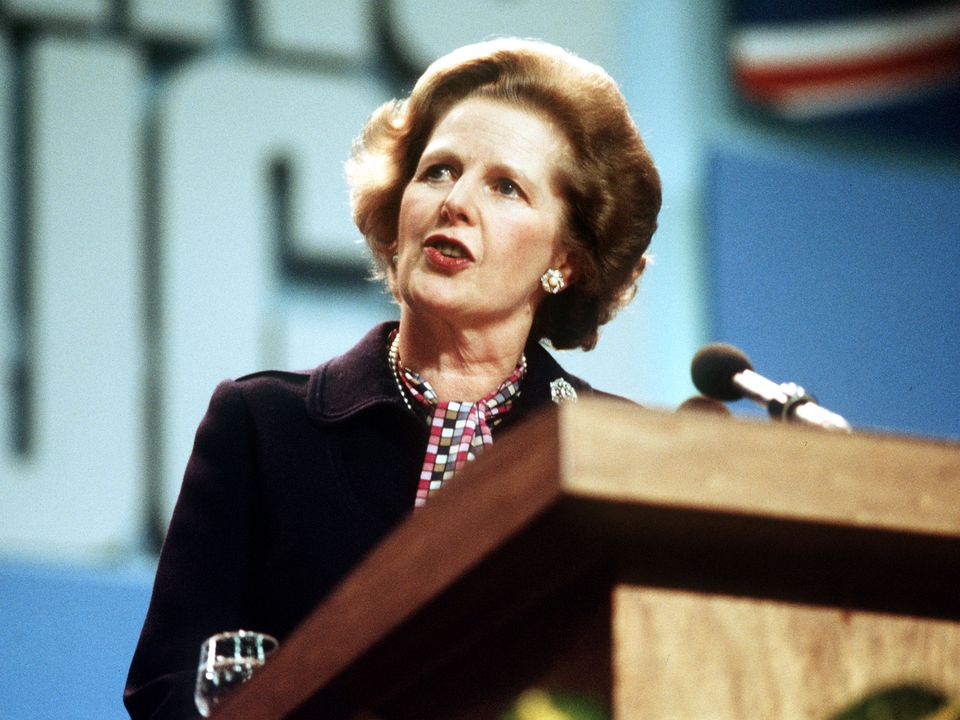
As for political rights.  It is true that Britain has had three female prime ministers (well, two and a half), Thatcher, May and Truss.  None of these female leaders defended women’s rights, in fact Thatcher was particularly hostile to women. 

Margaret Thatcher speaking as Prime Minister of the UK in 1974 – she supported no steps forward for women in the UK or abroad. (Photo sourced: Internet)

She cared so little for women that she agreed to fund the Afghan Mujahideen, the forerunner of the Taliban.[9]  The Tories shared the same values as these troglodytes and that is the tradition Badenoch stands in, despite the illusions and denials of right wing “feminists”. 

The US has yet to have its first female president, though that may change with the vote in November. 

Meanwhile, a host of countries that do not share Badenoch’s commitment to “British values” and the rights of women, as she would claim have had female leaders, including a number of Muslim countries, such as Indonesia, Tunisia, Mauritius, and Bangladesh.

The latter has had two female leaders in the last 25 years, with both of them serving two non-consecutive terms each.  One of them was recently overthrown, a fate that should have befallen Thatcher, but didn’t.

But how does Badenoch fare on women’s rights?  Well, she has abstained on extending abortion to Northern Ireland, buffer zones for abortion clinics and she opposed government supports for women going through menopause. 

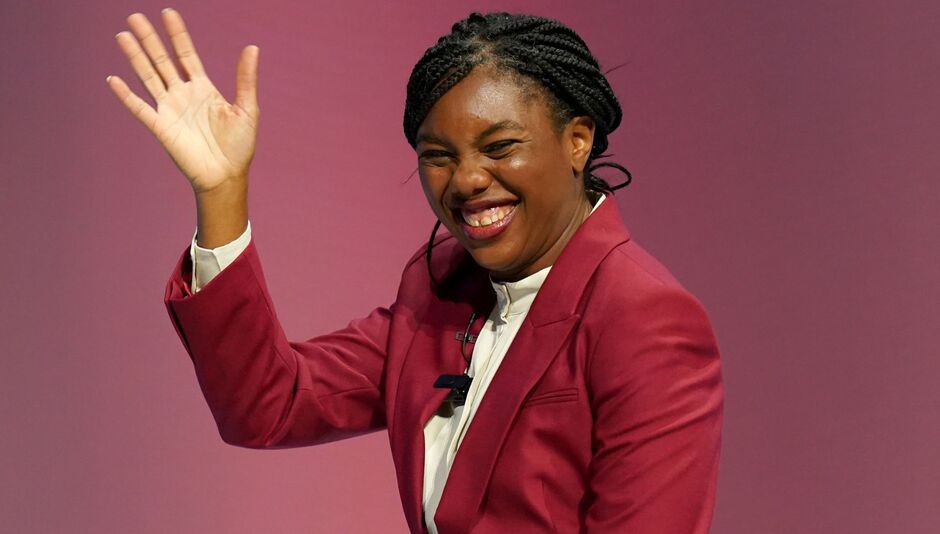
Kemi Badenoch MP, contender for leader of the Conservative Party in Britain. (Photo sourced: Internet)

As Minister for Equality, she refused to outlaw discrimination against women going through the menopause, despite the fact that one in ten women between the ages of 45 and 55 leave the workforce due to menopause symptoms.[10]  She has no commitment to women.

Cultures change over time, before the British arrived two of the most celebrated Arab poets were gay. After the British imposition of anti-gay legislation and the promotion of conservative figures, their books were burned. 

They are not static and within certain cultures there are those who oppose the most reactionary elements of them, like Irish women who campaigned for contraception, abortion and divorce for decades. 

Badenoch is just an old-fashioned imperialist, who likes to play up her own black and migrant credentials to attack other minorities.  She does not defend women and the tropes about migrants repeated by KJK put her firmly in the Tommy Robinson camp she joined after the recent race riots.

It is a myth that the West is some bastion of women’s rights, when it is the West that promoted and props up the most reactionary anti-women regimes in the world. 

The British police have a record of rape culture both on and off duty.  They represent a greater threat to women than the “less valid” cultures of Badenoch’s delirium. 

Badenoch is the enemy of women, as is her entire Tory Party, hangers-on and Tommy Robinson’s new found “feminist” friends.

End.


[1] See https://x.com/ThePosieParker/status/1840774264405852368

[2] The Guardian (09/07/2024) I was handed to a complete stranger’: the survivors fighting to end child marriage in 37 US states – and the people who want to keep it legal.  Alaina Demopoulos. https://www.theguardian.com/society/article/2024/jul/09/child-marriage-laws

[3] The Telegraph (28/09/2024) Migrants who come to Britain must uphold its traditions, not change them.  Kemi Badenoch.  https://www.telegraph.co.uk/politics/2024/08/02/kemi-badenoch-interview-integration-tory-leadership/

[4] CAAT (27/03/2024) UK Arms to Saudi Arabia https://caat.org.uk/homepage/stop-arming-saudi-arabia/uk-arms-to-saudi-arabia/

[5] The Atlantic (30/10/2013) When Governments Go After Witches. Ryan Jacobs. https://www.theatlantic.com/international/archive/2013/10/when-governments-go-after-witches/280856/

[6] See www.asti.org.uk

[7] BBC (17/11/2017) Everything you know about acid attacks is wrong. https://www.bbc.com/bbcthree/article/5d38c003-c54a-4513-a369-f9eae0d52f91

[8] BBC (21/07/2022) Rape offences at highest recorded level https://www.bbc.com/news/uk-62258162

[9] Declassified UK (08/09/2021) MARGARET THATCHER’S SUPPORT FOR AFGHAN JIHADISTS COVERED UP BY UK CENSORS. Phil Miller.  https://www.declassifieduk.org/margaret-thatchers-support-for-afghan-jihadists-covered-up-by-uk-censors/

[10] The New Stateman (02/03/2023) Kemi Badenoch refuses to outlaw menopause discrimination.  https://www.newstatesman.com/spotlight/healthcare/2023/03/kemi-badenoch-discrimination-menopause-women-equality-act-parliament

DAY OF THE PATRIOT SOLDIER

Diarmuid Breatnach

(Reading time: 4 mins.)

In the Basque Country the Day of the Patriot Soldier is commemorated on two different dates: by the Basque Nationalist Party on October 28th and by the Patriotic Left on September 27th. Each date marks different events but each is anti-fascist in character.

On October 28th one of the many atrocities of the Spanish Civil War/ Anti-Fascist War was enacted by the Spanish fascist military when they executed 42 captured Basque soldiers of the Eusko Gudarastea, a Basque antifascist militia opposing the military-fascist coup of Franco and another three generals.

Section of the crowd at the Gudari Eguna commemoration in Arrigorriaga, Bizkaia province, southern Basque Country. (Photo: D.Breatnach)

This atrocity occurred in 1937, when that war had another two years to run. The Basque Nationalist Party (PNV) was then the main political party in that part of the Basque Country1 and many of its politicians and administrative officials were executed by the Franco regime too.

Commemoration of the PNV´s Day of the Patriotic Soldier (Gudari Eguna) was carried out clandestinely during the four decades of the fascist Franco regime but was permitted in the post-Franco arrangement in the Spanish State, when the PNV were legalised.

The PNV became the dominant force politically in the two provinces that had declared for the Spanish Republic, which was the largest part of the Basque Autonomous Region. Nafarroa however was given a separate autonomous government which split the nation administratively in at least four.2

A DIFFERENT DATE TO COMMEMORATE

However in the 1960s a large part of the PNV´s youth wing had become disenchanted with the party and, entering into alliance with a Basque socialist movement, formed ETA, a mainly political organisation but, existing under a fascist-military regime, inclined also towards armed resistance.

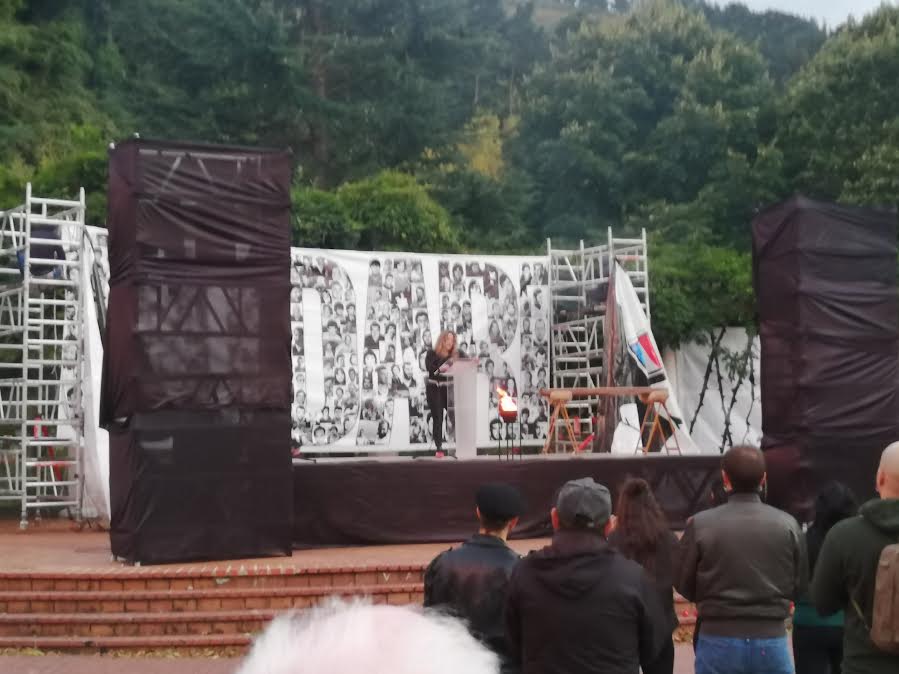
The platform at the Gudari Eguna commemoration organised by Jarki with the event’s speaker/ chairperson addressing the participants. (Photo: D.Breatnach)

ETA grew in support and in actions, military but not only, the Left Patriotic movement (Izquierda Abertzale) widening to fight on a number of fronts, linguistic, social, trade unionist and political with the armed section carrying out many actions.

The last political executions of the Franco regime were in 1975 of two members of ETA and three of FRAP3; the two Basques were Juan “Txiki” Paredes4 and Angel Otaegui. All five, despite huge international solidarity mobilisations and appeals for clemency, were shot by firing squads.

Today, the Patriotic Left´s Gudari Eguna is commemorated by different groups and not all together. As has occurred in Ireland, the accommodation of the leadership of the Basque Patriotic Left to the Spanish electoral system and abandonment of armed struggle has resulted in fragmentation.

A protest in Arrigorriaga I passed by on my way to the Gudari Eguna commemoration. I did not stop to enquire as to the purpose; I had made an error on the journey, was late and in a hurry. From the arrows design I understand these to be the Sare group doing their last Friday of the month picket in solidarity with the prisoners. ‘Giltzak’ means ‘keys’ as the graphic banner design shows and so the aim is probably to have them all leave jail. That is also the aim of the ‘dissident’ group Amnestia but they seek complete amnesty for the political prisoners whereas Etxerat, Sare and EH Bildu normally refrain from even calling them ‘political prisoners’ since, according to the Spanish State, that amounts to ‘supporting terrorism.’ (Photo: D.Breatnach)

The political party EH Bildu commemorated the executions but so did the dissenting Jarki and Tinko/Amnistia and the historical memory organisation, Ahaztuak. They did not do so together nor, naturally with the PNV on the different date.

In Arrigorriaga Jarki organised their event in the birthplace and home of Argala, nom-de-guerre of José Miguel Beñaran Ordeñana, a theoretician and activist of great importance in the development of ETA and assassinated by the state-sponsored GAL terrorists.

The attendance at the event listened to the event’s MC addressing them, after which a group of youth carrying flaming torches came on stage. The MC ended her talk with calls for a free and socialist Basque Country, after each which the audience chanted “Gora!” (‘Up!’).

She then led them in singing the Eusko Gudariak with clenched fist in the air, followed by introducing the Internationale in Basque, the revolutionary socialist song that emerged from the Paris Commune of 1871, the audience joining in (though not everyone as well-versed as with the previous song).

I sang the chorus in French, the only language other than English in which I know the chorus, sadly.

HISTORICAL MEMORY & THE MARTYRS

The martyrs of the people´s struggles around the world are remembered organically and kept close to their hearts by the people from which they came, at least for a few generations. Initiatives of conserving and transmitting historical memory keep those commemorations going further.

Section of the crowd at the commemoration of Gudari Eguna, organised by the Jarki organisation. (Photo: D.Breatnach)

In Ireland we know that commemorating the risings of the United Irishmen (1798 and 1803) fed into the struggles of the Young Irelanders a half-century later, their memory in turn contributing to the Fenians which again became part of the history of future generations and of several armed struggles.

Counter-movements, recognising the potency of historical memory, try to appropriate it and adapt it to their political program or to diminish its importance and even deny it. Both those counter-currents can be seen in many parts of the world, including in Ireland and in the Basque Country

However, the ongoing revolutionary streams and their commemorations will always be closest to the real meaning of those events in the historical memory of the people, in the real social and political meaning of martyrdom.

Patrick Pearse remarked on this process in his famous oration over the grave of O´Donovan Rosa: Life springs from death and from the graves of patriot men and women spring living nations.

Footnotes:

1The Basque Country is composed of seven provinces, four on the Spanish state´s side of its northern border and three on the French state´s side. The Anti-Fascist War split the southern Basque Country with principally two provinces, Gipuzkoa and Bizkaia, taking the side of the Spanish Republic, which at the last minute granted them national autonomy. Nafarroa (Navarre) mostly took the fascist-military side and murdered around 3,000 antifascists and Alava province took that side too.

2Two separate autonomous regions in the Spanish state and the provinces on the French side in different French regional administrative areas.

3Frente Revolucionario Antifascista y Patriota (Revolutionary Anti-Fascist & Patriotic Front); the three were: José Luis Sánchez-Bravo Sollas, José Humberto Baena Alonso and Ramón García Sanz. 

4According to his brother who, despite being misdirected arrived as Paredes was being shot by the Guardia Civil, who were shooting at different parts of his body, Txiki Paredes continued to sing Eusko Gudariak (‘Soldiers of the Basque Country’) until he finally died.

Sources:

https://es.wikipedia.org/wiki/Gudari_Eguna

FALLING FOR MRS. DURRELL

Diarmuid Breatnach

(Reading time: 3 mins.)

I am falling in love with Mrs. Durrell, which is unfortunate in a number of ways. Not for her, she won’t mind. For me.

Well, she’s long dead. And she’s middle-class English. Not sure which of those is the biggest problem. I know, I know, the English individually are ok. Most of them. But there is that 800 years thing.

Yes, people keep telling us to get over that. Who does? Well, mostly the English, as it happens.

I’d be willing … it would be easier to “get over that”, if their army and colonial police force were not sitting on one-sixth of our country and their air force wasn’t flying through our air space.

Yes, I know, the Yanks are doing that too, carrying murder for Palestinians. And maybe with prisoners they haven’t murdered yet (but who might wish they were dead).

And yes, I do also know that it’s our government that has invited the RAF into our skies and welcomes the US military into our country. And I’m not happy about that at all, believe me.

But Mrs. Durrell … And then there’s the thing about her being dead. No, I’m not at all into necrophilia. In fact, not even a little turned on by lack of response.

Well, the woman who plays Mrs. Durrell would be way out of my social circle anyway.

Keeley Hawes as Mrs. Durrell in The Durrells series. (Photo sourced: Internet)

I first met Mrs. Durrell when I was not even a teenager and it was her son, Gerald, in whom I was most interested. I thought he was my alter-ego. Crazy about animals, collecting all kinds of live ones … How I wished I was he! Well, maybe not with that family but certainly on that Corfu island, at that time.

And as it happens, yes, I have lived on an island, a small one, as a child. Not in sunny Greece but off the West Coast of Ireland. Went to school there without shoes, in all weather. My first day of school I went there via the rocks and rock-pools which were so educational and interesting that by the time I reached the school (less than a mile from the house where I was staying), school was over for the day and everyone had gone home.

As an adult, Gerald made a living catching wild animals for zoos, writing about his expeditions, running a zoo and later with a TV series. I watched the weekly episodes in a friend’s house because we didn’t have BBC access in our house.

I read I think all of Gerald Durrell’s books, including The Drunken Forest, Three Singles to Adventure and I thought I knew what I wanted to do when I grew up. But it was My Family and Other Animals, about Gerald Durrell’s childhood on the Greek Island of Corfu that most spoke to my boyhood spirit.

As a child, I had at various times kept mice, a guinea-pig, a rabbit, frogs, sticklebacks, newts, a fledgeling magpie, hedgehogs and various invertebrates from pond and land. And a dog, that had to be trained to leave all those others alone.

I was far from immune to having the hots for females at that time but Mrs. Durrell did not even pass close to my fantasies then. But now that I’ve seen her again and also have seen her personality, I am definitely falling for her.

In England, she berated a schoolmaster for caning her son. Widowed, in financial trouble, neither of her two older boys earning a wage, she took the whole family off to Corfu to live.

Apart from being out of my social circle, the part of Mrs. Durrell, the widowed mother of two young men, a teenage daughter and young Gerald on Corfu is being acted by Keeley Hawes

Mrs. Durrell apart, The Durrells series, so far on Netflix, is very enjoyable.

End.

https://en.wikipedia.org/wiki/The_Durrells

THE TRICOLOUR IN LONDON RECENTLY

Pat Reynolds & Diarmuid Breatnach

(Reading time main report: 3 mins.)

The photo of the massive antifascist rally in London on 28th July following a march from Russel Square shows the recapture of Trafalgar Square from Tommy Robinson and his sea of Union Jacks. Not for the first time, the Irish made their mark upon the place.

There the only two high flying flags were the Irish Tricolours and the Palestinian flags, the Irish contingent being one of the few on the day to see the fight in Britain against the fascists as part of the same fight against the fascist Zionist regime.

Irish and Palestinian flags in Trafalgar Square rally against racism, end July 2024 (Photo cred: PA)

We are mindful of the history of our occupied territories and our 1930s fight against the anti-Semitic Blackshirts1 in London (e.g. standing with the Jewish community at the Battle of Cable Street, 1936) and against the Bridgeton Billy Boys in Glasgow in the 1930s.2

On 28th July our flags sent out a message: We stand against all fascists, at home or abroad. That day we could not but remember all our brave men and women who marched past here from 1971 to 1998 carrying our fight to the heart of government3 in harder times.

We also know that the anti-racist movement now takes its new life from the strength of the Palestinian solidarity movement in Britain and needs to recognise this.

It was strange being in Trafalgar Square again with Tricolours given that we were barred from being there during the ‘Troubles’. Irish solidarity events were banned from using the Square under any circumstances from 1972 to 2001, well after the Good Friday Agreement.

The ban was lifted only once for an Irish event during that period and that was for the Peace Women4 (sic) calling for an ‘end to violence’ (mainly that of the Resistance) and famous US folk singer/ political activist Joan Baez displayed her ignorance of the Irish situation by speaking there.

It was interesting that a reporter for GB News of the British mass media was aware that a picket had been held in Dublin in protest against the assassinations of Palestinian and other Arab resistance leaders. He tried to link the Irish contingent in Trafalgar Square with ‘support for Hamas’.

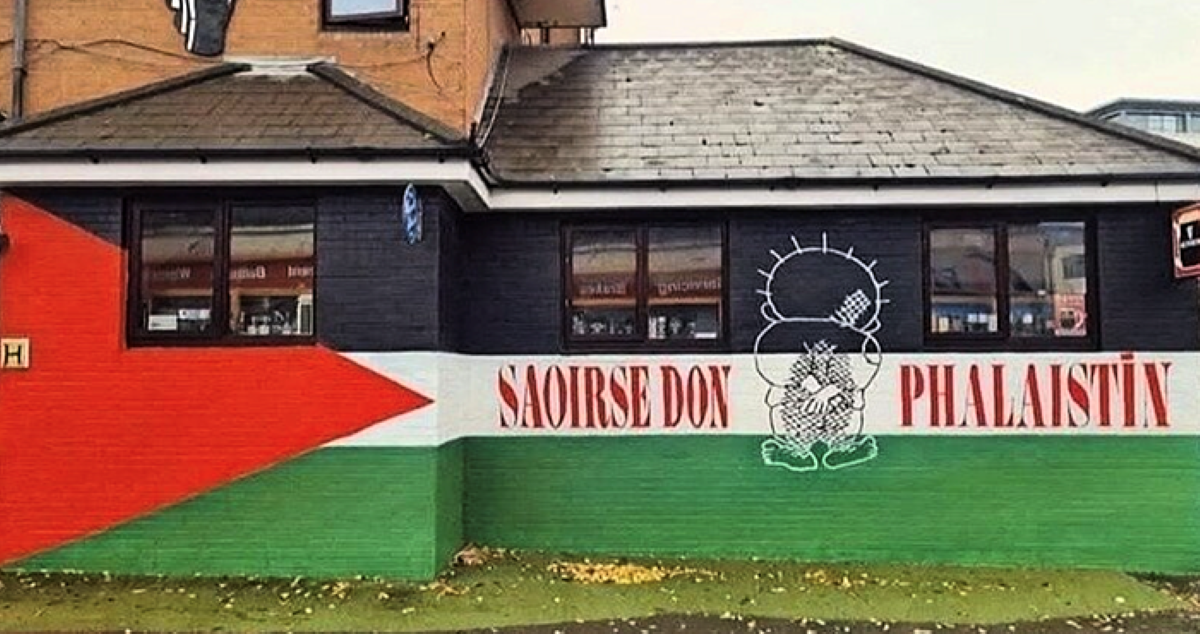
The linkage was hinted in his broadcast report though he was careful enough not to report a direct link as the Irish group in Trafalgar Square had in fact no connection with the Dublin group. The reporter asked how to pronounce ‘Saoirse Don Phalaistín’ — but still got it wrong in his report.

One of the Irish contingent spoke to the young GB News journalist: He had the stuff from Dublin on his phone and wanted to say that the Irish in the Square were part of the Dublin group.

“Next thing you’d know the Zionists would call for a ban on the Irish for ‘supporting Hamas’”,5 commented one of the veteran Irish activists. “We also get targeted because of the flag and our placards.”

The UK State and the police are all pro-Zionist and the Zionist press tries to trap the Irish into dangerous statements but “We know our history and are well able for them; we just say we support Palestinian resistance to Israeli occupation just as we did with the British in Ireland.”

Irish contingent with flags on Palestine solidarity march to Downing Street very recently (not sure whether the SW person is part of it). (Photo sourced from participant).

The Irish Tricolours, often in the company of the Palestinian national flag with Saoirse Don Phalaistín printed on it have been seen on Palestine solidarity marches in London since the current Zionist genocide began but also on anti-fascist rallies and in support of Julian Assange.

This is in keeping with the history and tradition of the Irish in Britain who helped found the republican United Englishmen6, the Chartists,7 many trade unions, a section of the First International8 and also gave the British working class their anthem9 and their classic novel.10

Classic novel of the working class in Britain was written by Robert Noonan, aka Robert Tressell, from Dublin. (Image sourced: Internet)

In later times they were prominent in organising solidarity with Vietnam and of course Ireland, against repressive legislation and fascist organisations, solidarity with Nicaragua, Palestine etc. and in struggles against state repression, including within the jails.

The Prevention of Terrorism Act (1974), forerunner of the current Terrorism Act (2000) specifically targeted the Irish community in Britain with suspension of habeas corpus for a period of up to five days, refusal of access to solicitor, as did also the framing of a score of people.

In the midst of the Irish Hunger Strikes of 1981, the Irish community broke out of the State terror stranglehold and formed the Irish in Britain Representation Group, among its objectives being the abolition of the Labour Government-introduced Prevention of Terrorism Act.

End.

Saoirse don Phalaistín and Irish Tricolour flags on Palestine solidarity march this year photographed against Westminster’s ‘Big Ben’. (Photo cred: being investigated)

NOTE ON AUTHORS

Pat Reynolds is a former trade unionist, social worker, a veteran anti-racist, anti-fascist activist, also for Irish independence and for rights for the Irish community in Britain. He was PRO for the Irish in Britain Representation Group for two decades, founding the Haringey Branch and the Green Ink Bookshop. Reynolds is from Granard in Co. Longford and lives in London.

Diarmuid Breatnach is a former trade unionist, worker with homeless/ substance misusers (manual worker before that), also a veteran anti-racist, anti-fascist activist and campaigner for Irish independence. For a decade he was on the Ard-Choiste of the IBRG, founder of the Lewisham Branch and of the Lewisham Irish Centre. Breatnach is from Dublin to which he has returned to settle.

FOOTNOTES

1The British Union of Fascists led by Sir Oswald Moseley which had substantial support in the British elite, including the publisher of the The Daily Mail with police attacks on anti-fascists.

2The Billy Boys were founded and led by Billy Fullerton, a former member of the British Fascists. Fullerton also later became a member of the British Union of Fascists in the 1930s. The Billy Boys adopted a militaristic style of behaviour, marching on parades, forming their own bands, composing their own songs and music, and all dressed in a similar manner.[3] The Billy Boys also formed a junior group whose members were teenagers called the Derry Boys. (Wikipedia)

3From Trafalgar Square to the Houses of Parliament in Westminster runs a broad thoroughfare, in the centre of which is the Cenotaph and a little further, the entrance to Downing Street.

4The organisation/ campaign was founded by Betty Williams and Mairead Corrigan in 1976 after a car driven by an IRA fighter mortally wounded by British soldiers in Belfast crashed into pedestrians and mortally wounded three children of Anne Maguire, sister of Mairead. Branding itself as against all violence the Peace Women in fact targeted primarily the Republican movement, secondarily the Loyalist paramilitaries and hardly ever the Occupation Army. Williams accused the IRA unit of having fired on the Army unit that killed the driver which was untrue (but is repeated on her Wikipedia entry). Both founders received the Nobel Peace Prize in 1976 and a substantial cash prize. Williams resigned from the group in 1980 and disappeared from Irish-related activities though prominent externally. Corrigan however remained politically active in Ireland and elsewhere against war and has campaigned among other things for the end of the ‘Israeli’ siege on Gaza, being arrested with crew and passengers on the Spirit of Humanity aid ship in 2009 by by the Zionist navy, taken to ‘Israel’ and subsequently deported.

5Hamas is proscribed organisation in the UK since March 2001 and a person promoting it would be liable to prosecution under the Terrorism Act.

6A spin-off from the United Irishmen in Ireland; the English chapter led the Spithead and Nore naval mutinies. The Irish also reformed the United Scotsmen when it was faltering.

7Karl Marx called the Chartists “the true mass movement of the working class” – two of its principal leaders, Bronterre O’Brien and Fergus O’Connor were Irish, as their surnames would suggest.

8The Fenians were accepted into the First International Workingmen’s Association.

9The lyrics of The Red Flag were composed by Jim Connell from near Kells, Co. Meath and set to the brisk air of The White Cockade, later changed to the mournful air of Tannebaum.

10The Ragged-Trousered Philanthropists was written by Robert Tressell (real name Robert Noonan) from Dublin.

SOURCES & FURTHER READING

https://libcom.org/history/bloody-sunday-trafalgar-square

THAT FLAG IS NOT THEIRS – BUT IT’S NOT YOURS EITHER!

Diarmuid Breatnach

(Reading time: 6 mins.)

The Irish Tricolour has been in the news recently in an unhappy circumstance. The flag was featured borne in a group of anti-immigration racists carrying a banner declaring Coolock Says No,1 next to Union Jacks2 and Loyalist flags at a Belfast riot.

This was a bizarre juxtaposition given that Loyalists are hostile to any signs of Irish Republicanism, of which the Tricolour is chief among its historical symbols. Furthermore, the Unionist state banned its public display in most situations between 1954 and 1987 leading to resistance and arrests.3

In the sectarian society created by the British in its occupied Six County colony, the Tricolour is burned annually on British Loyalist bonfires and is reviled by Unionism and its more extreme progeny, Loyalism, which in turn is associated with state-sanctioned sectarian murder gangs.4

The strange juxtaposition was remarked upon in mass media not only in Ireland (both sides of the Border) but even in Britain — and Irish State Taoiseach (prime minister) Simon Harris remarked that he found the flag in association with racism to be “repugnant”.5

But does Harris have the moral right to make that comment?

Origin and History of the Irish Tricolour

The Tricolour as we know it and its use dates from its sewing in silk by revolutionary women in Paris in 1848 and presentation to a delegation of the Young Irelanders, a revolutionary Irish Republican group of that period and its subsequent unfurling in Ireland by Thomas Meagher.

Thomas Francis Meagher as captain in the Union Army (Source: Drawing in Library of Congress, USA)

Irish revolutionary Thomas Francis Meagher was convicted by the English Occupation of sedition during trials around the planning and carrying out of the Irish Rising of 1848 and, with death sentence commuted, transported to Australia as a felon, from which he escaped to the USA in 1852.

As the American Civil War approached, Meagher, along with most of the Irish in the USA took the side of the Union, leaving only a rump following Mitchell, formerly a comrade of the Young Irelanders, to side with the slave-owning Confederacy in the conflict.

Meagher not only fought in the Union Army in the American Civil War against the slave-owning Confederacy, gaining the rank of Brigadier but he and his wife raised a regiment, the 69th New York Infantry, unofficially called The Irish Brigade or even Mrs. Meagher’s Own.

Plaque in Lower Abbey Street (opp. side of Abbey Theatre) to the first unveiling of the Irish Tricolour in Dublin, 1848. (Source: Internet)

The Young Irelanders were Republicans and the Tricolour was always seen not only as embodying the unity of all in Ireland, regardless of origin, against the British occupation but also for national liberation, against Monarchy and for complete separation of Church and State.

In addition, it had a strong internationalist element in that it was associated with revolution throughout Europe, presented to us in solidarity by French revolutionary women and flown alongside French Tricolours in Ireland at celebrations of the French revolution of 1848.

It was the principal flag of Irish anti-fascism too in the 1930s when Irish Republicans fought the fascist Blueshirts on Irish streets and a number of them went to fight in defence of the Spanish Republic against the fascist military coup of Franco and his Nazi German and Italian Fascist allies.

More recently when Irish Republicans and socialists mobilised against the attempts of the Irish ruling class to promote NATO and to ease cooperation with that alliance of Western imperialism, Harris also ranted against supporters of Anti-Imperialist Action flying of the Irish Tricolour.

The Tricolour among Loyalists was of course newsworthy and was covered by Irish mainstream media and Unionist mouthpiece The Belfast Telegraph along with photos by The Guardian on line. But all without comment on its presence in Palestine solidarity events in London.

Irish Tricolours have been flown at every current Palestine solidarity march in London (ten of them at the most recent London march) and, along with Saoirse Don Phalaistín printed on the Palastinian flag, have been seen also at university solidarity encampments and at events to free Julian Assange.

Section of Palestine solidarity protest at Barclays Bank, Tottenham Road, London on 24th April this year, showing Irish Tricolour and Saoirse Don Phalaistín flags. Zionists and British fascists are united in opposition to them across the road. (Photo cred: Northern Times)

The Tricolour Flown by Racists and Fascists?

Given its origins and history, why is the Tricolour being flown by fascists?

In recent years it seemed that whenever one saw a crowd with Tricolours among them, it was most likely a fascist or at least racist-led event. One reason for this is that the fascists historically try to portray themselves as nationalists, i.e organising ‘for the nation’.

In all cases historically, the “nation” represented by the fascists turned out to be that of the ruling class, the financial and industrial elite – never that of the working people, not even of those sections of the lower middle class that supported the rise of fascist movements.

Fascists however have also frequently colluded with the invader of their nation, for example with the Nazis in Europe, particularly in France, Greece, Yugoslavia, Ukraine.6 The fascists in Ireland today represent the neo-colonial,7 colonial and imperialist financial-industrial interests in Ireland.

Racist group from Dublin suburb finds common cause with British Loyalists in Belfast anti-immigration demonstration and riots 3 August 2024 (Photo cred: Irish News)

In that context, the unity of fascists from the Twenty-Six Counties with Loyalists from the Six Counties is not surprising, nor even with notorious English fascist Tommy Robinson. Prominent Irish fascists have had friendly interactions with Loyalist Jim Dowson and British fascist Farrage.

Portraying themselves as saviours of the nation, as moral guardians etc., just as the German Nazis did in the 1930s is hypocritical but absolutely necessary for them. If they revealed the class interests they represent and the kind of regime they really want, where would they get supporters?

The fascists are few and need those supporters, their easily-led mobs and stormtroopers. It is among sections of the down-trodden in society that they will find them, the ignorant, marginalised, abandoned by the capitalist system but all too often by the liberals and the Left also.

Substance addiction, mental illness, crime and cultural poverty is rife in these communities and it is sections of those who are presented with false enemies – migrants, LGBT people, muslims – by false saviours masquerading as patriots. Many in those communities are ripe for manipulation.

But the attempted takeover of the Tricolour and subversion has not occurred by Fascist manipulation and through historical and political ignorance alone.

When antifascists mobilise, rarely is the Tricolour seen amongst them, assisting the impression that it is the racists and fascists that are representing the nation. Understandably, Anarchists may not wish to fly the flag of a state and socialists may feel that the flag is representing a capitalist state.

Often too in the past, Republicans have been absent from antifascist mobilisations but on occasion too went to them ready for physical confrontation and therefore without flags. But what message do antifascists think is presented by Palestinian flags among them and Tricolours on the other side?8

Invited to speak at a conference on anti-fascism in Dublin some years ago, I raised the question of the appropriation of the Tricolour by fascists and how it was necessary for the antifascists to show it among themselves also but my recommendation did not win approval9.

It is depressing to see that the situation has not noticeably improved in this regard some years later.

A welcome recent exception to the rule: a number of Irish flags including the Tricolour among antifascists outnumbering fascists and racists in Dundalk, Co. Louth on 4 August 2024 (the day following the Belfast racist riots). The fascists and racists had to be escorted out of town by the Public Order Unit of the Gardaí (Source photo: Anti-Imperialist Action FB site)

The Irish state and the Tricolour

It took some time for the Tricolour to be adopted as the national flag in the Republican movement until its fluttering above the GPO at the Henry Street Corner during the 1916 Rising.10 Thereafter it represented the forces of national liberation in the War of Independence (1991-’21).

The Irish Tricolour (Photo cred.: Getty Images)

Facing treason and counter-revolution in 1922, it was the flag of the Anti-Treaty forces, the neo-colonial traitors only flying it in order to deny it to the Irish Republicans. Despite that fact it has remained the flag of Irish Republicanism, irreconcilable with neo-colonialism, racism or fascism.

Republican women activists of Cumann na mBan designed ‘Easter Lilly’ paper lapel pins to raise funds for dependants of Republicans imprisoned or killed during the Civil War and they did so in the colours of the Irish Tricolour: Green, White and Orange. The emblem is worn to this day.

The counter-revolutionary faction that spawned the fascist Blueshhirts11 did not formally adopt the Tricolour as the State flag in law, that was done by the next wave of counter-revolution, Fianna Fáil,12 while in government, situating it in the 1937 Constitution.

The Tricolour is in a sense the flag of everyone in Ireland who does not reject it or defile it but evidently too, in its origins and among those who bore it forward, it is anathema to racism.

Furthermore, it is symbolically anathema to colonialism, loyalism, neo-colonialism and monarchy. Clearly the Tricolour is not legitimately the flag of racists and fascists but neither is it of the gombeen regime that flies it; Harris and the neo-colonial State claiming it is also repugnant.

Effigy of Simon Harris showing the bloody hands of collusion in the ‘Israeli’ genocide against Palestinians at a Palestine solidarity protest last weekend (organised by Mothers Against Genocide, North Wicklow Against Genocide, Arklow Against Zionism) at the annual Bray Air Show which features UK Military fliers. (Photo cred: Aisling Hudson)

End.

FOOTNOTES

1Coolock (from the Irish place-name An Chúlóg) is a Dublin city suburban district that has seen riots and arson recently against plans to house refugees in a disused factory building there.

2Common name for the flag of the United Kingdom, more derogatorily known as ‘The Butcher’s Apron’, featuring heraldic cross and salterres of the nations of England, Scotland and Ireland (Wales had already been conquered and incorporated into the Kingdom of England).

3https://en.wikipedia.org/wiki/Flags_and_Emblems_(Display)_Act_(Northern_Ireland)_1954

4Such as the Ulster Defence Association and the Ulster Volunteer Force (see also ‘the Glennane Gang’) which targeted most of their victims on the assumption of their being of the Catholic faith but also occasionally those from the Protestant community they considered disloyal (see ‘the Shankill Butchers’) or with which they were in competition around gang crime. All operated with colonial police and British Army assistance.

5https://www.irishtimes.com/ireland/2024/08/04/cafe-and-supermarket-burnt-out-after-anti-immigration-protests-in-belfast/

6These fascist groups supplied police and auxiliary units to the Nazi occupation, collecting information on the antifascist Resistance and on fugitive Jews and Roma. In some cases, as in Ukraine, they also acted as prison and concentration camp guards (but their chief leader, Stepan Bandera, was nominated as a national hero by the current Kiyv regime).

7Sometimes called ‘comprador capitalist’ or ‘client regime’, a term describing a state that is nominally independent but is under the actual domination of an external state or states. The Irish state has been in turn dominated by Britain, the USA and the EU imperialists.

8This is an issue on Palestine solidarity marches and pickets upon which I have also commented before.

9A speaker from a very sectarian migrant group ridiculed the idea but no-one else spoke up in support.

10Incidentally, at the other corner of the GPO above Princes Street in 1916 flew the green flag with the words “Irish Republic” inscribed upon it in white and gold letters, which had been created for the occasion in the home of Constance Markievicz, socialist revolutionary of a settler landowning family and born in London. And the man who erected it was Argentinian-born-and-raised Eamon Bulfin. It is ironical in the extreme that this flag also is sometimes brandished by Irish racists opposing immigration.

11Irish fascist organisation officially called the Army Comrades Association (later The National Guard), led by former Gárda Commissioner Eoin O’ Duffy which later joined with two conservative parties to form the current Fine Gael, currently in the Coalition Government with its erstwhile opposition Fianna Fáil and the Green Party.

12A major split from Sinn Féin in the early 1930s, currently in the Coalition Government with its erstwhile opposition Fine Gael and the Green Party.

SOURCES

https://en.wikipedia.org/wiki/Flags_and_Emblems_(Display)_Act_(Northern_Ireland)_1954

https://en.wikipedia.org/wiki/Shankill_Butchers

References to the Tricolour at Belfast racist riots: https://www.irishtimes.com/ireland/2024/08/04/cafe-and-supermarket-burnt-out-after-anti-immigration-protests-in-belfast/

https://www.belfasttelegraph.co.uk/news/northern-ireland/far-right-irish-thugs-spent-night-drinking-with-uda-in-belfast-loyalist-bar/a1541636214.html

Origin & History of the Irish Tricolour: https://www.1916rising.com/cms/history/leaders-soldiers-and-poets/history-of-the-irish-flag/

THE REPRESENTATION OF REVOLUTIONARY ICONS

The role of culture in revolution is of great importance – greater even than that of the armed struggle, certainly in the initial and later stages. We are created by evolution but we are born into and raised in culture.

The question of whether that culture is to be revolutionary or liberal is of crucial importance.

I have remarked on how Mandela, jailed for his revolutionary armed activities, was marketed as a peacemaker and later became a figurehead of pacification of the South African struggle. Bobby Sands, a revolutionary fighter to the last, has also been represented as a peaceful icon.1

And so also was Terence McSwiney who, like Bobby Sands, died on hunger strike.2

The following article from Resistance News Network, reflecting on the work of the revolutionary writer Ghassan Kanafani who was murdered by Israeli Zionism and his subsequent representation as an icon is I think of substantial interest. D.Breatnach

Translated by Resistance News Network
Originally by 
Nidal Khalaf, 16 July 2022

(Reading time: 6 mins.)


Ghassan the poet? Ghassan the Palestinian? No, 
Ghassan the revolutionary!

In colonial wars, the creation and dissemination of symbols to the public is a crucial battle in the war of consciousness building, even if its effects are not clearly visible in the present.

Perhaps the most prominent example of these battles was the image of Che Guevara in the wars of liberation in Latin America. Ernesto Guevara’s persona represented an individual model that encapsulated the revolutionary spirit of people fighting for their freedom from American hegemony.

As the American empire recognized its inability to destroy Guevara’s image, they transformed his image into a consumer commodity.

This was to divert his image from its original revolutionary meanings and repurpose it in the service of economic and cultural agendas that contradicted Guevara’s own principles and what he represents.

In the Arab context, the war to liberate Arab symbols from the captivity of history monopolists continues to intensify, as it involves obscuring forgotten heroes in favour of fabricating mythical legends designed to tamper with the boundaries of nationalism and betrayal in the Arab mind.

In this context, the fiftieth anniversary of the assassination of the martyr Ghassan Kanafani is being observed, with pages and websites filled with commemorations of Ghassan’s life, his quotes, and his most significant works.

It is no longer surprising that Ghassan Kanafani is celebrated on both normalization platforms as well as liberal ones, when voices are raised to commemorate Ghassan even as they are in the heart of the hostile project under the umbrella of its military bases.

Thus, the question arises: which Ghassan Kanafani are we commemorating today? And how do we protect the Ghassan we know?

Ghassan Kanafani’s life provided rich material for readers, followers, and analysts after his martyrdom.

However, the perception of Ghassan was not independent of the political contexts of the recipient interpreting his word, resulting in multiple “versions” of Ghassan Kanafani, some of which we review below.

Ghassan Kanafani: The Writer (only?)

The most widespread version of Ghassan Kanafani is that of a “writer” who wrote stories, plays, and depicted the Palestinian reality.

The spread of this version may be justified since Ghassan’s literary works are the most popular among people and have played a significant role in spreading his name.

However, confining Ghassan Kanafani to the realm of “literature” is not always innocent, and in some respects, it is a deliberate reduction of Ghassan Kanafani’s political work.

Ghassan was responsible for mobilization, media, and was a part of the political decision-making circle in the Popular Front for the Liberation of Palestine since it was part of the Arab Nationalist Movement. He remained in this role until his martyrdom.

Moreover, Ghassan’s literary output never compromised or was at the expense of his political positions or took precedence at any point in his career.

In terms of production, his political studies, research, articles, and editorial journalism are as abundant and important as his narrative and theatrical works.

Even the latter were never detached from the political context; instead, the narrative served as a framework through which Ghassan conveyed his political, social, and even philosophical ideas.

Consequently, the image of Ghassan as “the writer engaged in politics” falls away, replaced by the truth of Ghassan — the politician who harnessed literature in the service of a political cause.

The danger of this deliberate reduction lies in paving the way for a sanitized image of Ghassan Kanafani, presented to the public by liberal (and even normalization) pages and platforms to gain credibility in Ghassan’s name.

Kanafani tackles a fundamental dilemma that burdens our political reality to this day, which is the crisis of “the prioritization of internal change over liberation.”

Thus, reductionism turns into deliberate distortion, making Ghassan Kanafani’s name a “honey” slipped into the poison of isolationist, liberal, and anti-resistance ideas on our land under the guise of freedom and liberation.

Otherwise, how can we understand the celebration of Ghassan Kanafani by liberal platforms and influencers at Al-Udeid Air Base?

Ghassan Kanafani: the Palestinian (only?)

One of the unjust reductions of Ghassan Kanafani is the confining of his personality and his works to “Palestine,” as delineated by colonialism.

Again, one can find an excuse for this reduction because Palestine represents the primary aspect of Kanafani’s political and literary identity, and his experience is closely tied to the general Palestinian experience of war, forced displacement, diaspora, and the struggle for return.

Some people overly emphasize Ghassan’s Palestinian identity, overshadowing his Arab dimension, which he never concealed.

In reality, examining Ghassan Kanafani’s political studies unveils to us the truth of Ghassan as an Arab nationalist thinker who worked hard and struggled to develop practical frameworks for Arab revolutionary theory.

This is made clear in his in-depth study, “The Arab Cause in the Era of the United Arab Republic,” where he discusses the essence of the imposed war on our region, identifying enemy and friend camps, and ultimately defining the main goal of the war: liberation as a condition for unity and renaissance.

Ghassan further elaborates on this study’s conclusions in another study titled “The Revolutionary Applications of Arab Nationalism,” published in 1959, in which he masterfully details the concept of Arab unity and the tools for its practical implementation.

Ghassan Kanafani goes beyond this by considering the confrontation of isolationist (regionalist) thought a revolutionary necessity, describing “isolationism” as something that “contradicts the nature of the formation of societies.”

Isolationism or “regionalism” are anti-unity tendencies, based on defining society’s interests from colonial borders and treating each Arab state as “independent” in itself, as Sykes and Picot intended.

Kanafani tackles a fundamental dilemma that burdens our political reality to this day: the crisis of “the prioritization of internal change over liberation.”

No better formulation to this question can be found than Ghassan’s own words when he stated that “raising the concept [of focusing on internal development first] is a deliberate exclusion of the popular current directed towards unity with determination,

and diverting it to side and regional battles that are easily manipulated (as long as each Arab country is not -nationally- at a level of complete liberation worthy of proper social construction).”

Ghassan concludes his argument by asserting that “unity is a prerequisite of the renaissance… even its regional aspect.”

We mention these ideas as examples of Ghassan Kanafani’s Arab nationalist thought, which fundamentally opposed isolationism and the canned projections of Marxism and others, with strength and clarity.

Therefore, the celebration of Ghassan by the proponents of these ideas indicates their exploitation of Ghassan’s legacy (from their side) and a significant failure in protecting Ghassan (from the side of those who believe in his ideas).

How, then, do we protect Ghassan Kanafani?

The starting point lies in defining ourselves. Are we believers in Ghassan Kanafani’s approach and vision for the ongoing conflict on our land, which comes at the expense of our blood, lives, and destinies?

If so, our foremost duty is to reclaim Ghassan Kanafani from the chains of cheap consumerism and to present him to the public in his true and impeccable form: an Arab nationalist fighter who made among the most significant contributions to modern Arab revolutionary theory.

Additionally, our responsibilities also include reviving the spirit of party work, in which Ghassan was a pioneer, and correcting the Arab party frameworks to harness the wasted energies in the prisons of virtual activism,

within the halls of “non-governmental organizations” and the labyrinths of despair and discouragement.

Our obligation towards Ghassan Kanafani demands that we comprehend our reality and its conditions and that we clearly define our goals, grounded in a deep conviction in our civilizational role as a nation.

We must believe that the liberation of the land is a step towards unity, and that unity is a prerequisite for the renaissance that will elevate us to our rightful civilizational status among nations. Finally, here is a part from Ghassan Kanafani’s ongoing will:

“A human being who does not live the average of sixty years will not find enough space to live peacefully; instead, they will carry the crisis from the moment they are born… and pass it on to their children at the hour of their death.

“The results of this struggle will be for a generation we do not know when it will arrive, even though we are optimistic about witnessing its early days towards the end of our lives…

“Our only reward may be that the next generation, the happy generation that will enjoy our victories, will envy us for having earned the honour of living in the age of struggle for life. And that is enough for us temporarily.”

End.

Footnotes

1In particular by the constant reproduction of his statement that “our revenge will be the laughter of our children”, completely abstracted from his role as an armed freedom fighter and what he wrote in support of that.

2Similarly to Bobby Sands, his statement that is those who who endure, rather than inflict the most who will triumph. The statement taken in isolation seems to endorse passive resistance but McSwiney was an officer of the IRA in the War of Independence, a role skated over in the Wikipedia entry dedicated to him.

SPEAK HER, CÚPLA FOCAL

Diarmuid BreatnachTalk given at 1916 Performing Arts Club, May 2024.

(Reading time: 6 mins.)

There was a time when from Dublin to Galway, from Kerry to Donegal, the dominant language was Irish. There was a time too when it was widespread in Scotland, in parts of Wales and the main language on the Isle of Man.

Now however one can travel through all of those places and not hear it.

Irish was the first vernacular language to be written down in Europe and though island people, its speakers were not “insular”. The educated spoke Greek and Latin too and when the Dark Ages fell upon Europe it was the Irish intellectuals, the monks who revived and spread literacy there.

Some Irish-established monasteries in Europe (https://www.daviddarling.info/encyclopedia_of_history/C/Celts_and_Christianity.html)

But here we are, you and I, speaking English – which did not even exist until at least the 12th Century.

She (I say ‘she’ because language in Irish is a feminine noun and in many other languages too) – she is all around us in place names, though we may know them only through their corrupted forms into English.

Árd/ Ard, a height; Baile/ Bally, a town or village; Béal/ Bel, the mouth of; Bun, the bottom of; Carraig/ Carrig, a rock; Cnoc/ Knock, a hill; Cluain/ Clon, a meadow; Dún/ Dun, a fort or castle; Inis/ Inis or Ennis, an island or a raised mound surrounded by flat land; Loch/ a lake …

The English-language names of twenty-nine of our counties are corruptions of words in Irish: from Ciarraí to Dún na nGall, from Átha Cliath Duibhlinne to Gaillimh. This includes all six counties in the colony: Aontroim, Árd Mhacha, Doire Cholmcille, An Dún, Tír Eoghain, Fear Manach.

Just over half the States of Stáit Aontaithe Meiriceá on Turtle Island have names in the indigenous native languages, so we’re doing well with placenames and also of course have survived the colonial genocidal campaigns and wars much better.

By the way we also have Irish names for some places in Britain: Glaschú, Dún Éidin, Manchuin, Leabharpholl, Brom agus Lúndain. In fact probably none of the names of those cities are originally English anyway.

Irish has left only a small imprint on the general English language for example with “a pair of brogues, whiskey and slogan” (from slua-ghairm, a call to or by a multitude), banshee, carn and smithereeens. And shebeen, in parts of the USA, the Caribbean and in South Africa.

But its influence on the way we speak English in Ireland is clear.

We might say, instead of complaining that we are thirsty, that we have a thirst on us – a direct translation from Tá tart orainn. Or that the humour is on us – Tá fonn orainn. We might “have a head on us”, as in a headache. “The day that’s in it” – an lá atá ann.

We pronounce “film” with a vowel between the L and the M, as it would be in Irish – take the name for a dove and also a personal male name, Colm. We get that with R and M and R and N too, in some areas “a carun of stones” or “down at the farrum”.

We often indicate the absence of ‘Yes’ or ‘No’ in Irish by replying in English to the verb in the question: ‘Will you be there?’ ‘I will surely’ (Beidh, cinnte). ‘Will you do it?’ ‘I will not’ (Ní dhéanfad).

We have an extra tense in Irish, the very recent past tense, which we translate into English as spoken in Ireland: ‘I’m just after cleaning that floor!’ Táim díreach thréis an urlár sin a ghlanadh!

Renaissance of language and culture has often preceded periods of heightened national struggle: the Harp Festival of 1792 was followed soon by the uprising of the United Irish; the cultural work of The Nation newspaper was followed by the rising of the Young Irelanders.

The Nation newspaper of the Young Irelanders sought to create and encourage a nationalist republican culture and was followed by an unsuccessful rising in 1848, during the Great Hunger. (Source image: Internet)

LANGUAGE AND NATIONAL STRUGGLE

The Fenians too had their cultural precursors and the great revivals of the Irish language, Irish sport, speaking and writing in Irish and Irish theatre were not long in finding expression of another kind in the 1916 Rising and the War of Independence.

And campaigns of civil disobedience in the 1960s secured for us Irish-language broadcasting in Radió na Gaeltachta and TG4. Not to mention motor insurance documentation in Irish which Deasún Breatnach won only after going to jail for refusing to display the documentation in English.

Though we can hear the influence of the indigenous language upon our speaking Sacs-Bhéarla, or English, the Irish language itself at this point is in retreat. In fact some might say that it’s in a rout.

Yes, the Gaelscoil movement is broader and deeper than ever before but outside the schools? The Gaeltacht areas are receding, receding … and where can the language be heard outside of those?

Though the Great Hunger caused the most impressive loss of Irish-speaking modern Ireland on the map, the percentage lost during the period of the Irish State is greater.
(Image source: Internet)

I had an experience recently that illustrates the problem. In a pub with some friends, I observed a man wearing a silver fáinne, the ring that many people wore to show a proficiency in Irish. It identified the wearer to other Irish-language speakers (my father wore a gold one).

The man had overheard me bidding farewell to friends in Irish and asked me: “Are you an Irishman?” I thought the question strange and said so. Then he asked me was I an Irish speaker, to which I replied in Irish language.

Eventually he came over and said that he didn’t speak Irish himself.

The fáinne was a family heirloom and he had been wearing it, he said, for six months in Dublin, wanting to come across an Irish speaker to whom he would give the ring. Since I had been somewhat abrupt with him, he gave the ring to one in the company who can speak Irish.

Badge inviting people to speak Irish to the wearer (Image sourced: Internet)

LABHAIR Í

Six months in Dublin without hearing Irish spoken or recognition of the fáinne! That illustrates one aspect of the linguistic problem in Ireland. But it is one that we can resolve, fairly easily too. And that brings me to the kernel, the poinnte or point of this talk here today.

I am asking you to speak a cúpla focal, regularly, go rialta, so that she may be heard. Labhair í ionnas go gcloisfear í. Imagine if everywhere in Dublin, on every side, one heard just a few words in Irish – imagine the social and psychological effect over time!

Those who know some Irish would speak her more often. Many who don’t, would feel it worthwhile to learn at least some phrases and some responses. Some might take it further and learn Irish well. Public services might regularly facilitate services through Irish.

Dia dhuit. Dia’s Muire dhuit. Or the non-religious form: Sé do bheatha. Go mba hé duit.

Má sé do thoill é or le do thoill.

Go raibh maith agat in many situations, including to the driver of the bus.

Tá fáilte romhat.

Gabh mo leithscéil.

Would you like a bag? Ní bheidh, go raibh maith agat.

Cash or card? Íoch le cárta, le do thoill as you wave your bank card. Or Airgead thirm, as you take out your wallet or purse.

Go léir, as you indicate that you wish to pay the full amount.

Isteach, le do thoill, when returning a book to the library. Amach, le do thoill, when borrowing one.

Slán, as you leave.

Easy enough, yes? Yes? But though a part of the mind is willing, another part is afraid.

“What if I get a big load of Irish in response and not even understand it? Won’t I look like a right eejit!” Well, there are risks in anything worth doing as was demonstrated in a short play here some time back when two fellas were debating whether and when to chat up a certain woman.

She was not uninterested but they took so long about it she walked out and left them, like fish brought up by fishing line, gasping on the dry quay.

So you could prepare a small survival kit: “Gabh mo leithscéil. I only have a few words/ níl agam ach cúpla focal.”

Níl agam ach beagán ach tá mé ag iarraidh í a úsáid/ I only have a little but I want to use it. Is foghlaimeor mé/ I am a learner.”

I am not asking for any of us to campaign, to agitate for services to be provided through Irish though that is certainly a linguistic civil right and, as far as state or semi-state services go, a constitutional one.

I am only asking that you contribute to the audibility of the language, to use a few standard greetings and responses and to use them not only to people you know to be Irish speakers, not only to friends and relations … but everywhere in public.

Everywhere

in public.

Go ye out among the people and spread the word – or rather the few words. Scapaigí an cúpla focal.

End.