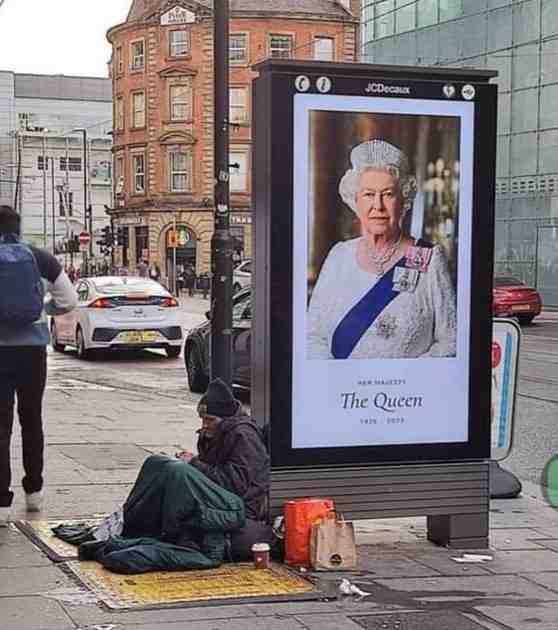
The intensively mediated death of Elizabeth Windsor, accompanied by the relentlessly maudlin and invasive coverage of official mourning and her funeral, had an intensity that can only be described as imperial. Forced as it was into every corner of public discourse, this coercive atmosphere of state sorrow had a distinctly colonising thrust and meaning. Unleashed during a moment of total class warfare within her very disunited kingdom, it also marked an endpoint in the trajectory of her most obedient servants: the formerly Irish but now thoroughly British political party, Sinn Féin. During Windsor’s reign colonial chickens came home to roost as the woman who presided over British forces while they rampaged across the six counties of British-occupied Ireland then became over the past decade and a half the queen of foodbanks in her own country. (1) Her reign spanned a long period during which overt political violence in Ireland was…
Main article by CHEMA MOLINA@CHEMAMOLINAA in Publico.es, translation and comment by Diarmuid Breatnach
(Reading time entire: 4 mins.)
The origin of the Bella Ciao song is uncertain and there are different theories about how this mythical popular song came about.
Over the years it has acquired a meaning closely related to the anti-fascist protest movements and in defence of democracy.
However, the Italian artist Laura Pausini refused to sing it during the El Hormiguero1 (show), reasoning that it is “very political”.
The piece has a clear political nature that goes beyond the success which the Money Heist series has given it and that has made it one of the most listened-to Italian songs in the world.
Italian partisans had already employed verses of this hymn against Mussolini’s fascism and the Nazi occupation during World War II.
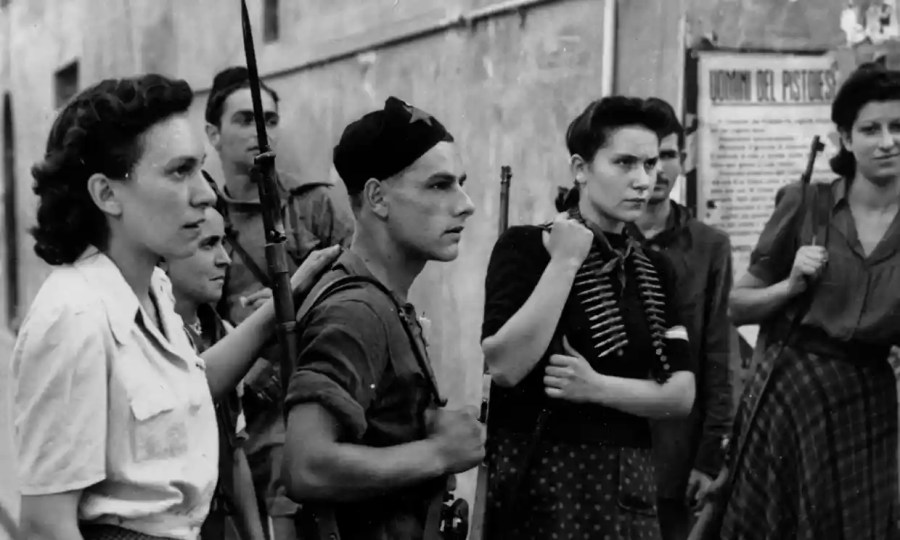
Armed Italian anti-fascist Partisans in Pistoia, Tuscany (central Italy) Dec 1944 (Photo credit: Keystone/Getty Images)
Specifically, it was the partisans of the Maiella Brigade, in the Abruzzo region (east of Rome), and the Garibaldi Brigade, in the Marche area, a territory located between the Apennine mountains and the Adriatic Sea, who began to sing it, mixing traditional melodies with militant lyrics.
But there are other theories that suggest that the beginning of this song dates back to the 19th century.
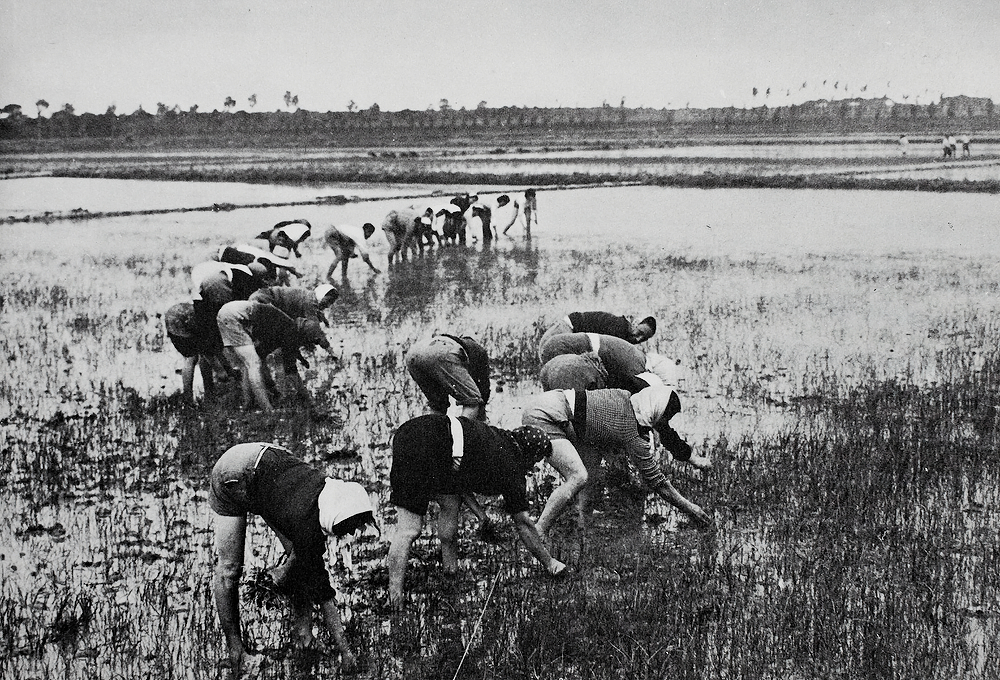
Line of Mondinas at their back-breaking work (Photo sourced: Internet)
The Mondinas, women who worked in the rice fields of northern Italy, recited the lyrics of this song as a sign of protest against the harsh working conditions they experienced every day.
In fact, the historian Cesare Bermani explains that the origin of Bella Ciao comes from a song called Fior di tomba (Flower of the grave) and that the poet Costantino Nigra had previously mentioned it in the second half of the 19th century.
One of the versions of this song reached the Mondinas of the provinces of Vercelli and Novara, both in the Piedmont region.
The Mondines’ (Italian female rice workers) song.
Another theory points out that the anthem could have Ukrainian roots. The musician Mishka Ziganoff, born in Odessa in 1889, moved to New York and composed a piece that could have been the origin of the start of the Bella Ciao air2.
Later, Italian migrants spread the air of this song when they returned to their country3.
Apart from its origin, the song began to become popular and to take on a political meaning due to the festivals organized by communist youth in different European countries. In the summer of 1947, the World Festival of Youth and Students took place.
There, the partisan version of the anthem was promoted, which later reached the Festival of the Two Worlds (also called the Spoleto Festival) in 1964.
The Bella Ciao show was performed at that event, organised by the Italian group Il Nuovo Canzoniere Italiano. The singer-songwriter Giovanna Marini, an artist who also helped to popularise the song, participated in the performance.
Bella Ciao has crossed borders and has been translated into many languages. In Spanish, one of the best known versions is that by the author Diego Moreno, who published his interpretation in 2014 on the album Bella Ciao! Adios Comandante!
COMMENT
THERE IS NO NEUTRAL POSITION ON FASCISMby Diarmuid Breatnach
The current controversy over a prominent Italian singer’s refusal to sing Bella Ciao at a kind of game show was predated by controversy over the origin of the song.
Most authorities now seem to refute the popular belief that it had been sung by Italian partisans, instead dating its emergencer as an antifascist song soon after WWII.
All are agreed however that it was predated by “Alla mattina appena alzata” a song with different lyrics of women rice-planting labourers, the Mondines, bewailing their extremely hard working conditions, their exploitation and expressing their hope in liberation.
Its origins therefore in women workers’ resistance is noble but so also is the antifascist sense in which it is usually sung today.
Woman Singing ‘Bella Ciao’ from window in Bologna Italy on Liberation Day 2020 (Photo credit FTimes)
Laura Pausini, when declining to sing the song, excused herself by saying that “it is very political”. Yes, it is and Pausini needs to realise that neither in the world of today nor in the past is there, nor has there ever been, a neutral position on exploitation of labour or on fascism.
The responses to Pausini recorded by Publico on Twitter were mostly negative towards her decision and rationale but also revealed a fair amount of confusion.
Laura Pausini in 2009 (Photo sourced: Internet)
The most common critical response was along the lines that anti-fascism is fundamental to democracy and therefore above politics, one commentator going so far as to state that Pausini is confusing position or stance on the one hand with ideology, on the other.
Fascism is a political ideology and so therefore is anti-fascism. Of course, anti-fascism is normally associated with the Left of the political spectrum but some conservative individuals and groups have been known in history to be actively anti-fascist too.
However that does not change the fact that anti-fascism is a political position whether ascribed to by revolutionary communists and anarchists, social-democrats or conservatives.
As the world capitalist system in crisis turns to making the workers pay more through rising costs of essentials and wage controls, along with cuts in state social services, the masses will resist. In many states, it is then that the ruling class turns to fascism to repress the resistance.
Neither Pausini nor anyone else can rise above that struggle. One may certainly attempt to be neutral but circumstances will not permit it, will certainly frustrate the attempt. Objectively one’s actions and words will either favour fascism or work against it.
End.
FOOTNOTES
1El Homiguero (“The Anthill”) is a Spanish television program with a live audience focusing on comedy, science and guest interviews running since September 2006 https://en.wikipedia.org/wiki/El_Hormiguero
2Without listening to the air, I am unable to venture an opinion on this. However, thinking about it, Bella Ciaodoes evoke Eastern European Jewish music to me. According to Wikipedia, Ziganoff was a Christian Roma from Odessa, Ukraine but well familiar with Yiddish and Klezmer music. https://en.wikipedia.org/wiki/Mishka_Ziganoff
3This is a well-known process of the dissemination of song airs and even lyrics by migrant workers or sailors (or even soldiers). For example the air of the ballad Once I Had a True Love may be found on an Alan Lomax collection of traditional songs from Extremadura, central-western part of Spain.
The colonies have been striking back at the Empire in film for some time and why not? Sure the Empire’s been colonising them all over again for decades, also through film.
But for a long time the liberal anti-colonial script-writers couldn’t bring themselves to make the main heroes of the film the indigenous colonised in Africa, America, Asia or Oceania – or else the finance backers doubted they’d recover their investment.
So the situation of the colonised had to be seen through the eyes of a liberal hero of European background or ancestry1 — someone with which, as they thought the the white European audience could identify2.
Stories figuring the Europeans colonised by England, i.e the Irish and the Scots, many who were in turn used by the Empire to colonise the lands of others — gets the film-makers over that difficulty.
Script-writers and casting directors in that ex-colony-now-superpower have been getting back at the English for years, of course, in historical drama3 but also portraying their villains with English accents4. Posh accents at first and then regional and London-Cockney5.
But rarely against the Irish, being often heroes in US films, providing they are Irish-Americans, which is to say Irish UStaters.
Two productions I’ve watched recently had as heroes people exported by the Empire from their own conquered homelands to other conquered colonies, in each case forming alliances with indigenous people.
Billy (Baykali Ganambarr) and Clare (Aisling Franciosi) in a scene from the Nightingale film (Image sourced: Internet)
Both productions have also given coverage to native languages of the indigenous people and, in one of them, also to a fair bit of the Irish language, spoken and sung.
THE NIGHTINGALE IN TASMANIA
The Nightingale (2018) is set in the British colony of Tasmania in 1825. In that period, which is not the main story, the Black War took place, in which an estimated 600-900 indigenous Tasmanians were killed, nearly wiping out their entire population. The killers were British colonial armed forces and settlers.
Political or social prisoners in the UK6 of the period were often transported to serve their time in penal colonies where, if they survived, they could be freed upon completion of their sentences or even earlier by agreement but to return was impossible unless they could purchase passage home.
Clare — “The Nightingale”, so nicknamed for her singing voice — is one such social prisoner, an Irish woman convicted of stealing and transported to Van Diemen’s land to serve her time.
She is part of the household staff of a British officer stationed there but is permitted to marry a free Irishman, Aidan; they live together in a hut and have a child together. The officer desires Clare and acts violently upon that desire, giving rise to a chain of tragic events.
Clare sets out to track the officer down and wreak revenge upon him but, needing a tracker-guide, employs an indigenous Tasmanian for that purpose. The story then is not only about her journey but about the uneasy relationship between these two victims of colonialism and occasional glimpses of other aspects of colonial rule, particularly in Tasmania.
IRISH, SCOTS AND INDIGENOUS
Frontier (2016) was originally a series for Television and, like The Nightingale, found a home later on Netflix. It features Irish and Scots heroes against the British Authorities and military.
It is set in British Canada in a historical struggle for control of the fur trade between the Hudson Bay Trading Company, a monopoly jealously protected by the UK, and a consortium of trappers striving for independence in trade.
Tavern owner Kate Emberly (Zoe Boyle) being meneaced by Captain Chesterfield (Evan Jonikeit) in the Frontier series (Image sourced: Internet)
The indigenous people are represented too, with a female warrior and communities, speaking Cree and a number of other Indigenous languages, including Inuit, with subtitles providing a translation.
The main hero is Declan Harp (now there’s names with an Irish connection!) who is half-Cree and half-Irish; after his parents were killed, he is adopted by Benton, the British administrator of the area but Harp later grows to hate Benton, who had his wife and child murdered.
A lesser male hero and ally is Michael, totally Irish but with a shaky moral compass. The main female heroes are a Cree warrior/ hunter and a Scottish woman, owner-manager of a tavern.
A female sort of anti-hero is a wealthy English woman of aristocratic type and there’s an Irish woman of humble background, being schooled to be “a lady”. There are a number of male Scottish anti-heroes too and there’s a Metis (of mixed Indigenous and French [or Breton or Basque?] parentage) helper, trapper and guide.
The Frontier has a couple of villains of US-origin but that’s allowed, this is Canada after all, its domination taken over by the USA from England. Otherwise nearly all the bad characters, the “black hats”, are English and so too with The Nightingale.
The British soldiers in both stories have regional English accents but so do some of their lower-ranking officers. Most of them are brutal and drunkards, some also murderers and rapists. Anti-English propaganda? No doubt but from what we know of history and even of more contemporary colonialism, very likely true enough.
Reviews have praised Jason Momoa’s portrayal of Declan Harp in The Frontier and certainly his physical size and appearance (long tangled locks, one eye clouded, looking out under lowered eyebrows) does focus one’s attention.
Jason Momoa as Declan Harp and Jessica Matten as Sokanon in a scene from the Frontier series (Image sourced: Internet)
Personally I found the number of times he survives torture, serious beatings and wounds straining credulity and, in a way, tending towards boring, as though the Director or screenplay writer thought: Let’s get Declan to have another massive bloody fight here, we haven’t had one of those in a couple of episodes now.
However, even with at times difficult-to-believe plot turns, there are some excellent performances, chiefly perhaps and not surprisingly Alun Armstrong as Lord Benton and Shawn Doyle as the ruthless smoothly urbane but underneath volcanic Samuel Grant
Greg Bryk as Grant’s smooth and sinister manservant-lover Cobbs Pond puts in effective performances too. Evan Jonigkeit as Captain Chesterfield, is also good, particularly in his anguished frustrated desire for the tavern owner Grace Emberly (Zoe Boyle), and his burning desire to rise above his social station.
Jessica Matten is believable as the Cree warrior-hunter Sokanon, despite her gender being unlikely in that role, but her frowning expression grows repetitious after a while.
Katie McGrath played the plotting and provocative English aristocrat Mrs. Carruthers well in her unfortunately short run as a character (but Wardrobe and Sequence, would she wear the same lace-sleeved undergarment so many day in a row?).
Katie McGrath as Lady Carruthers in Frontier. (Image sourced: Internet)
The female who develops something of a penchant for killing violent dominating males and disposing of their bodies is an interesting character creation though her appearances in that role are few.
When Declan Harp commandeers a ship to take him and McTaggart (Jamie Sives) to Scotland to rescue Grace and avenge himself on Lord Benton, we are introduced to a Portuguese ship captain and a Polynesian mariner, the latter also singing and praying in his native language.
In Scotland, Harp recruits local toughs to attack the English Castle Benton where Lord Benton has taken residence and they kill many redcoats.
STEREO OR TRUE-TYPES
The main characters in The Nightingale are of course the vengeful woman Clare (Aisling Franciosi), her aboriginal guide and companion ‘Billy’ (Baykali Ganambarr), along with the British Lieutenant Hawkins (Sam Claffin) and Sergeant Ruse (Damon Herriman) she pursues.
All are believable characters with strong performances by the actors. England is an evil bastard in this story, represented by the officer Hawkins and sergeant Ruse but some decent English individuals make their appearance on occasion too.
The dialogue is mostly English but the Tasmanian language spoken and sung in the film is Palawa Kani. Some Irish is spoken between Aidan and Clare, the latter singing mainly English folk songs but to her child sings the Irish language lyrics of Cailín Álainn to the Scottish air of the Mingalay Boat Song7.
Speaking their own language makes the subjects their own people; speaking English, usually badly or with heavy un-English accents, though making them more intelligible to English fluents also presents them to the English-speaker as lesser-English, lesser-UStater, lesser-Canadian — in total: lesser human.
End.
FOOTNOTES
1 For example the plight of the Cheyenne in 1864 was represented in Soldier Blue through the eyes of the European woman Cresta Lee (Candice Bergin); it’s the liberal newspaper editor Donald Woods (Kevin Kline) who we accompany as we follow the story of the hero Biko in Cry Freedom, murdered by the South African white minority regime. Even in the British colony in Ireland, where the natives are white, the heroes may be English (Brian Cox playing an honest English cop in Hidden Agenda, Emma Thompson as the lawyer in Name of the Father).
2 When the promoters and financiers finally realised that a large part of their paying audiences were not in fact white European is when one started to see heroes of other backgrounds and ‘blacksploitation’ films.
3 Mel Gibson’s The Patriot and Bravehart, for example but going much further back, Disney’s The FightingPrince of Donegal (1966).
4 For examples Grand Moff Tarkin in original Starwars trilogy (1977-1983), Steven Berkoff in Beverly Hills Cop (1994), Scar in The Lion King (1994), arguably Anthony Hopkins [though Welsh and playing a Lithuanian] in Silence of the Lambs (1991), Sher Khan in The Jungle Book (1996) and sequel.
6 Not just the British – the French had their penal colonies abroad, for example in Guyana and the Spanish state sent prisoners to Ceuta, in North Africa even in modern times.
7 An anachronism, since the composer of the Irish lyrics of An Cailín Álainn is Tomás ‘Jimmy’ Mac Eoin from An Bóthar Buí in An Cheathrú Rua, Conamara, Galway, Ireland – and he was only born in 1937. The lyrics of the Mingalay Boat Song are also apparently sung to a much older air and one supposes the original lyrics would have been in Gaedhlig.
Women’s football will become universal in Catalonia starting from the 2022-2023 season. Both field and indoor soccer players may participate in any male category within the territory, whether amateur or grassroots. This has been determined by vote of the Ordinary General Assembly of the Catalan Football Federation (FCF), held at the Ciudad Deportiva de Blanes, where the Catalan clubs have voted in favour of this new step for full equality between men’s and women’s football.
Barca women’s soccer team were in the teams of five different nations in the international championship in France in 2019.
The regulatory change will enable any female soccer player to process a federative license in a male team, starting this Friday, July 1, coinciding with the official start of the new soccer year. Consequently the cap for mixed football, now set in the cadet category, is eliminated, also incorporating players of youth and amateur age, who will be able to compete up to the Men’s Youth Preferred, in the first case, and up to the First Catalan, 2022-2023 season, and the Super League, 2023-2024 season, in the second.
Barcelona women’s team beat Espanyol (despite name, another Catalan team) to become Catalan champions in 2018. (Image processed by CodeCarvings Piczard ### FREE Community Edition)
Likewise the FCF will give a new impulse to women’s football through the development of the Women’s Football and Indoors Committee, which will be in charge of setting out the main lines for action in this area throughout the entire mandate.
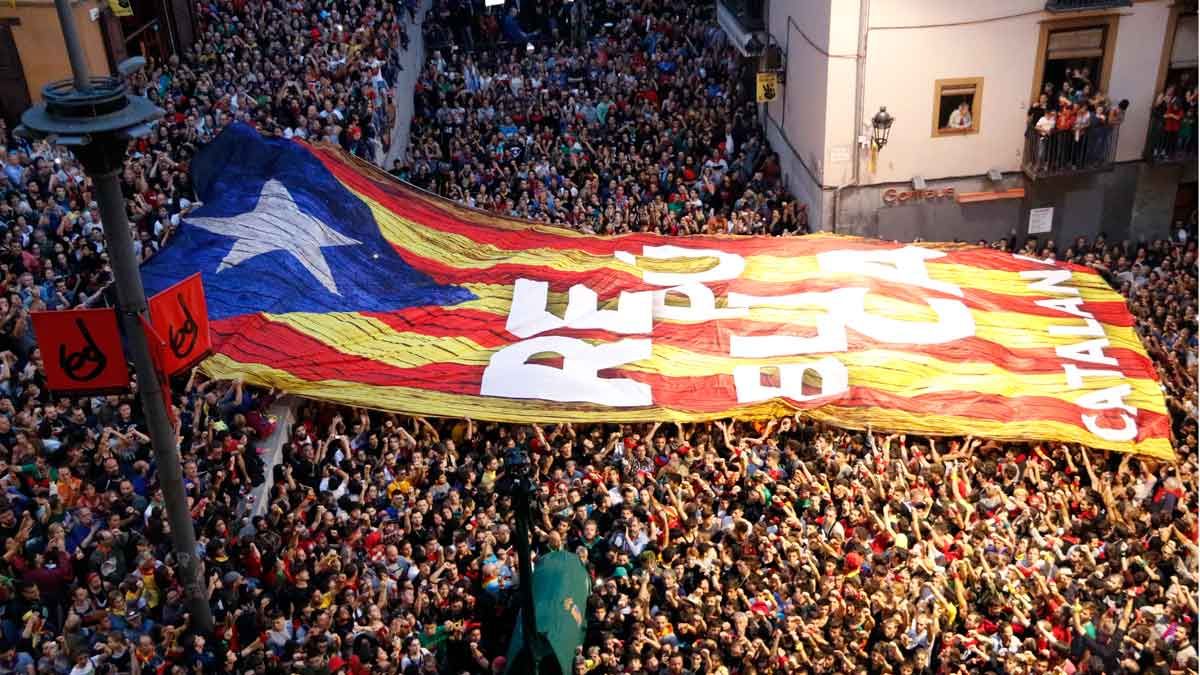
This year’s celebration of the Patum 2022 festival in Berga has sung and chanted for independence. With the square full of about 6,000 people on Thursday, the massive Catalan independence flag, the Estelada (with the white star in a blue triangle)1 was launched across the crowd as they sang the Catalan national anthem, Els Segadors2 (the Reapers).
With the song finished, some began to shout “independencia” (independence) and this was quickly taken up by the mass, revisiting the tradition of protest that existed before the pandemic. The Catalan independence movement has been somewhat becalmed of late, with serious divisions between the two main nationalist political parties and a lack of grass-roots activity.
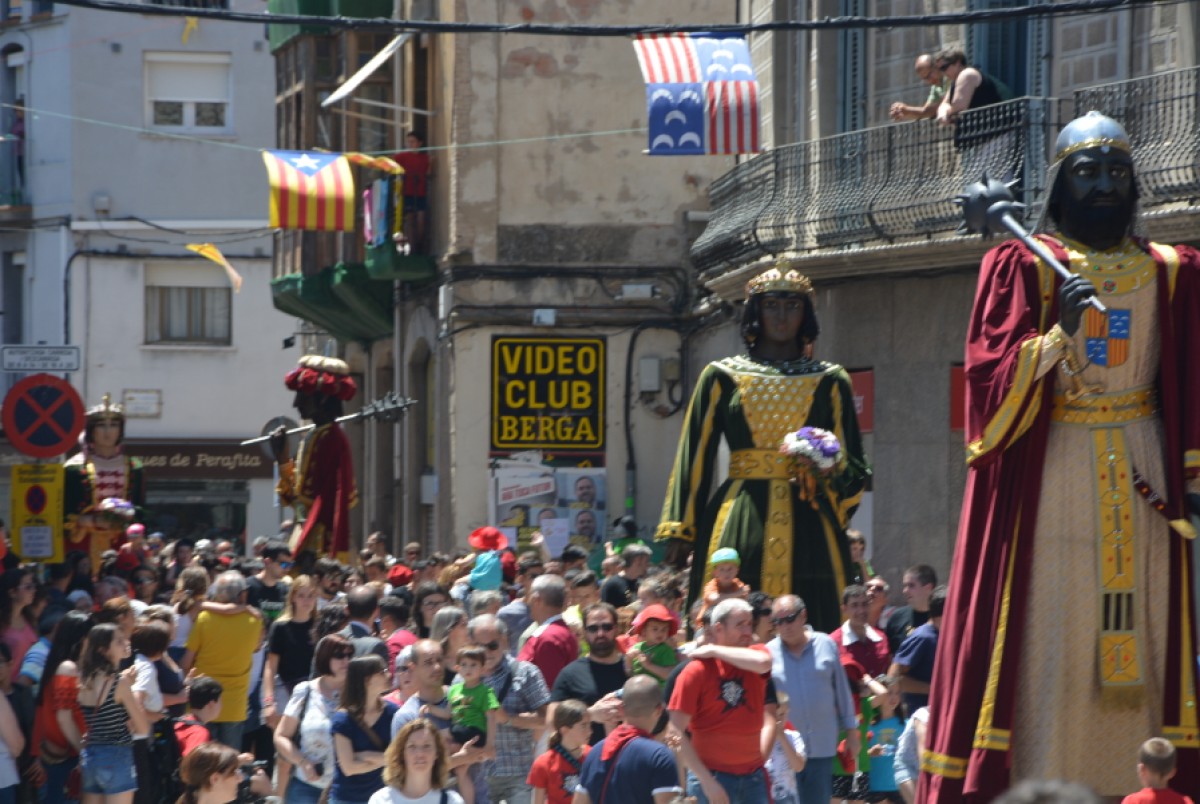
Scene with traditional giant figures from the festival (Photo sourced: Internet)
The Patum festival is a traditional Catalan festival of great importance and is recognised by UNESCO as a Masterpiece of the Oral and Intangible Heritage of Humanity. “The fiesta coincides with Corpus Christi and includes a whole series of theatrical representations, characters and figures that fill the town of Berga every spring. It is a religious commemoration that dates back to the Middle Ages, which has managed to preserve both its religious and profane roots.
“La Patum de Berga has been held annually for centuries during Corpus Christi, and includes street entertainment and shows with different figures typical of these fiestas (giants, “big-heads”, eagles, guitas (dragons), plens (devils)). Fire and dance play a central role. The fiesta really gets underway on the Thursday of Corpus Christi, with the Ceremonial Patum. The salto de plens is the apotheosis of the fiesta. It represents an infernal orgy where fire devils jump to the rhythm of music. The following day is the Children’s Patum.”3
Scene with the giant Catalan independence flag during the singing and chanting at the festival on Thursday (Photo sourced: Internet)
Berga is in the Barcelona region but over 107km from the city (and about half-way to Andorra). The Patum Festival of this year 2022, which began Wednesday, June 15 and will last until Sunday, June 19, was expected to be even more crowded than usual after two years in a row without being able to celebrate it due to the pandemic.
1The other Catalan nationalist flag commonly seen is the Vermelha, with a red star and no blue. The white X on a black background is also flown but more rarely, it draws on history also and signifies ‘death before surrender’.
2An anarchist, Emili Guanyavents won the competition to compose the national anthem lyrics in 1899 and based it upon a traditional historical cultural expression arising out of an uprising of Catalan rural workers in 1640 against the chief minister of Philip IV of Spain. The lyrics are, as might be expected, very militant and, since even the Catalan lanugage was banned, the song was of course banned during the four decades of the Spanish Franco dictatorship
Many public figures have been condemning the content of a video live-streamed from an Orange Order Hall in which people were singing lyrics mocking the murder of an Irishwoman on her honeymoon in Mauritius.
There is nothing new I can add to the condemnations of this disgusting exhibition. But what a great many of the condemnations lack is context; i.e they treat this exhibition as though it were some aberration from the norm of Loyalism – it was not, it was exactly in line with and an expression of the backwardness, sectarianism, right-wing racism, homophobia and general phobia that is the very essence of Loyalism.
BACKGROUND OF LOYALISM AND THE ORANGE ORDER IN IRELAND
The planters and settlers that English1 colonialism installed on Irish soil were intended to control the indigenous population along with those “gone native” descendants of the Norman conquerors. A number of attempts were made to correct those Normans who had been ‘corrupted’ by the Irish and had become “more Irish than the Irish themselves” and one of the most infamous attempts through law, the Statutes of Killkenny in 13662 laid out a long list of behaviours expected of the “degenerate English”, mostly in terms of things they were to cease doing: in sum they were to cease integrating with the indigenous people in custom, language and law.
Outside of the Pale3, the cities, such attempts failed in the main and the next big effort was the Plantations. Using the failure of the Norman Irish and Gaelic lords to adapt to the Reformation, now an English state religion, their lands were confiscated and parcelled out to big landlords who then rented them out to smaller landlords and small-holders – and none of those were to be Irish. In fact, they were required to be English-speaking, Protestant in religion and to build their towns and important buildings as strongholds4. And not to even employ native Irish, in case these should corrupt the settlements from within.
The intentions of the Plantations were made quite clear and the settlers were, from the outset to be a means for a tiny minority of feudal and financier elites to control and exploit the vast majority indigenous population through the use of a middle stratum which was to be separate from and considered superior to natives in religion, culture, custom, landholding, legal rights – and allegiance.
These plantations met with mixed success – one of the problems being the scarcity of labour against a prohibition to employ the natives – but the problem of a conquered but not reconciled native majority remained, even after its cultural, legal, political and military leadership had been eliminated. And then a section of the settlers themselves, many descendants of Cromwellian conquerors and their supporters, began to have aspirations to control their own markets. They attempted to expand the Irish Parliament – then open only to adherents of the State religion, the Anglican communion — to include representation from the larger group of dissenting Protestant sects5 and of the huge majority of Irish Catholics.
The attempt, under the leadership of the moderate and ultimately Crown-loyal Henry Grattan failed, through a mixture of sectarianism, fear of being eventually dispossessed of their stolen lands – and outright Crown bribery. The most determined of the Protestant patriots then turned to revolution and led the United Irishmen in the uprisings of 1798 and 1803, with a credo of unity for an independent and republican Ireland, regardless of religion6.
CREATION OF THE ORANGE ORDER
But the British ruling elite saw which way the wind was blowing, foreboding its overthrow in Ireland if its garrison population joined with the majority and, as well as making military and spying preparations, the British took important ideological and social action.
Created in 1795 as what might be seen today as a kind of independent Ku Klux Klan organisation to keep down the ‘uppitty native niggers’7, the Orange Order quickly became (as the Klan did in some areas too) a police force on its own dissidents. And, as the Klan enjoyed the tacit support of the patrician Southern US elite, the Orange Order has been supported by the settler elite in Ireland from its inception. This was formalised with the Order’s central control over all previously independent lodges in 1798, the year of the first United Irish uprising.
After the defeat of the United Irish uprisings, the Order became an active persecutor of any sign of resistance not only among the native Irish majority, the Catholics but also – and in some areas chiefly – a hunting down of any signs of Protestant allegiance to the United Irish or other ‘suspect’ behavour such as tolerance of Catholics. Those Protestant followers of “Unitedism” that did not emigrate to the USA and Canada had to keep their heads down or face the consequences, as did Roddy McCorley, hanged on Toombridge in Co. Antrim on 28th February 1800.
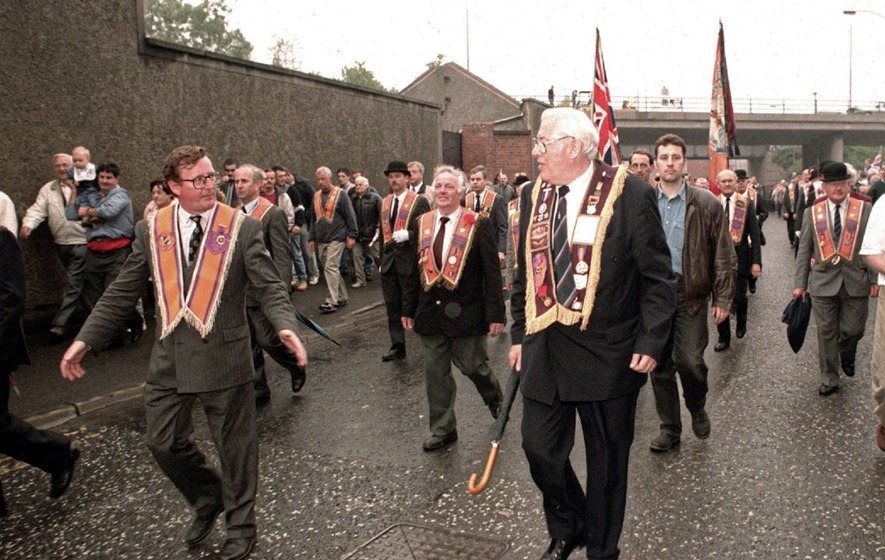
March 1995: Two future First Ministers of the colonial statelet on the sectarian Orange march along the Garvaghy Road: David Trimble (left), First Minister from 1998 to 2002, and the leader of the Ulster Unionist Party (UUP) from 1995 to 2005; Ian Paisley (right), leader of the Democratic Unionist Party (DUP) from 1971 to 2008 and First Minister from 2007 to 2008. (Sourced: Irish News)
REACTIONARY IN INSPIRATION AND TRADITION
The Orange Order drew its colour and other visual paraphernalia in association with William of Orange (1650 – 1702), who was crowned King William III by the British Parliament, the forces of which, along with his own Dutch ones, he led in the British civil war against those of King James II of England and the latter’s Irish and French allies. Orange was the colour of the Dutch royal family of Orange-Nasseau and therefore of the royalist party in Holland, in opposition to the republican party there8.
Following his defeat of the Jacobite forces in Ireland William III brought in the Penal Laws, the body of Anglican supremacy and anti-Catholic legislation which were to survive in greater or lesser form from 1695 to 1829.
Loyalists celebrate annually with sectarian triumphalist parades in the Six Counties the victory of the Williamite forces at the Battle of the Boyne on July 12th 16909. Loyalists imagine the Boyne victory was of the Protestant religion over Catholic “Papism”, unaware that the victory was celebrated by special mass in the Vatican and in some other Catholic cities. The Jacobite war in Ireland was part of the Nine Years’ War in Europe and forces of Protestant principalities and kingdoms could be found on either side, as could those of Catholic persuasion.
Loyalists attacking their own colonial police for eventually, in 2002, impeding their “right” to march in triumphalist sectarianism around Drumcree and to harass and terrify children attending a nearby Catholic school. (Sourced: Belfast Telegraph)
Their unequivocal message to their non-unionist neighbours is “This is our place, not yours. If you want to live here, accept what we give you and keep your heads down.” This fostered sectarianism has penetrated even trade unions, ensuring that wages and social conditions in the Six Counties have been the worst in the whole of the UK.
Mickey Hart and daughter Michaela celebrating the Gaelic football 2008 All-Ireland victory of Tyrone over Kerry (Sourced: Internet).
WHY THE LOYALIST MOCKERY OF THIS MURDER?
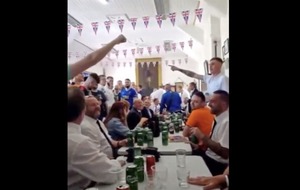
The video which directed such recent public attention on the behaviour of some Loyalists was of a song sung communally in which the lyrics mocked the murder of Michaela McAreavey who apparently surprised a thief in her Mauritius hotel room on 11th May. Probably not a single person celebrating that murder knew the woman or had any reason to hate her for anything she had done. What they knew was that she was the daughter of Micky Harte and that he was the manager of the Tyrone County Gaelic Football team10. Gaelic football11 is an Irish traditional sport and, since Loyalists eschew anything knowingly Gaelic, Harte is also probably of Catholic background; therefore almost certainly would have been his daughter Michaela too. Incredible though it may seem to many, that was enough to inspire that outpouring of hatred – a hatred that is always and has always been there in Loyalism.
The scene in the Orange Hall with Loyalists singing in mockery of the murder of Michaela McAreavey (Sourced: Internet)
It seems clear that the song, the lyrics with which much of the audience in the video seem familiar, was sung in the Orange Hall in Dundonald12, Co. Down which, like Tyrone, is one of the Six Counties currently forming the British colony in Ireland.
According to media reports, “a spokesman for the Grand Orange Lodge of Ireland criticised the video and also confirmed that an investigation would now take place.“The video currently circulating on social media relating to the murder of Michaela McAreavey is utterly abhorrent and the Orange Institution condemns the content without reservation,” a statement read.“The behaviour of those involved and their actions have no place in our society and certainly do not reflect the ethos of our organisation.”
On the contrary, as people who live in or near areas where the Orange Order holds sway will know, the behaviour exactly “reflects the ethos of the organisation” and of the general ideology of Loyalism.
Dundonald Orange Hall photo on its FB page (Sourced: Internet)
The central ideology of the Orange Order has always been not only a phobic hatred of Catholics but also of anything that might smell of egalitarianism, equality or progressive social ideas. It and its adherents for generations have held triumphalist sectarian marches deliberately routed to march through predominantly Catholic residential areas and past Catholic churches, these marches escorted by the sectarian colonial gendarmerie13, often forced through against local opposition.
For decades, the Orange Order and Loyalism in general opposed equal treatment and civil rights for Catholics in terms of employment, housing, franchise, education and law. That breeding ground gave rise to the Loyalist terror murder squads, operating for decades in conjunction with colonial police and British Army14.
True to its reactionary origins, the Orange Order and Loyalism in general have a strong emotional attachment to British Royalty and to an ethos of British Empire and colonialism. But Loyalism has also opposed all progressive social innovations and legislation, even those emanating from its supposedly ideological homeland, the rest of the UK and, in many cases delayed its implementation in the colony for years15.
Loyalism has been a sectarian influence in the game of soccer not only in Ireland but in Britain, with a triple alliance of sectarianism and racism between fans of football clubs Linfield, Rangers and Chelsea.16 The racism and reactionary ideology of “Hillbillies17” in the USA are also attributed to origins in Irish Loyalism.
Loyalism has also been characterised by racist attitudes and attacks on ethnic minorities in parts of the Six Counties independently of religion. Loyalism lines up to oppose anything they feel that is supported by the hated “taigues” or “Fenians” (their codewords for Catholics), for e.g Palestinians, Basque nationalists, inquiries into killings by the British Army ….
Despite the scrambling of Unionism – the Orange Order, politicians, Linfield FC management — to disassociate itself from the disgusting exhibition of anti-Irish and anti-Catholic hatred expressed in their ‘humorous’ mocking of the murder of a young woman, the song and video were a completely cogent expression of Loyalism, the social prop of Unionism. They were a true reflection of the history and underlying ethos of the Orange Order and of the sectarian statelet created by the British ruling class as a garrison and permanent foothold in Ireland.
End.
FOOTNOTES
1Later one can talk of British colonialism and imperialism but in the beginning it was the English feudal and financier classes that set out to conquer their neighbours in Britain and across the sea in Ireland. The Crown was always primarily the English Crown, even when it became also formally that of Scotland and, later, of Ireland.
2i.e not even two centuries after the Norman invasion in 1169.
3The area of administration of the occupation, originally a fortified area with Dublin Castle at its centre.
4One can still see the pattern of settler towns with the buildings constructed around a square or “diamond” becoming easily converted into the walls of a fort, the main roads leading in and out fairly easily barricaded even with carts and waggons. Native Irish towns had no such construction, often running along a street or gathered around a crossroads, river bank, port etc.
5In particular the Presbyterians but also Methodists, Unitarians, “Quakers” (Society of Friends) and others.
6The unity of “Protestant (i.e Anglican), Catholic and Dissenter”.
7“Uppitty niggers” was a racist white term in the USA to describe Americans of African descent who were unwilling to be treated as second-class citizens or even worse. For such people to become thought of as “uppitty” frequently meant a range of punishments that included beating, jail and lynching. The Ku Klux Klan is a white Protestant supremacist and extremely right-wing organisation in the USA, formed after the defeat of the Confederacy and understood as having three distinct phases, the last one being also current. Despite a history of using extreme violence, it is not banned in the USA.
10 Mickey Harte (born 1952) is a Gaelic football manager from County Tyrone, Ireland who currently manages the Louth county team, having managed the Tyrone county team from 2002 and, at his resignation in 2020, was the longest-serving manager then active with the same team in inter-county competition.
11Gaelic football is one of four traditional sports regulated by the Gaelic Athletic Association/ Cumann Lúthchleas na hÉireann, with 2,200 clubs spread over all of Ireland and, with high community involvement is the largest amateur sporting association in the world
13Armed police force, formerly the Royal Irish Constabulary, later the Royal Ulster Constabulary, currently “Police Force of Northern Ireland.”
14See for example Lethal Allies – British collusion in Ireland (2013) by Anne Cadwaller. Loyalists killed the most people in one day during the 30 years’ war with the Dublin & Monaghan Bombings, 17 May 1974. Despite their self-promotion as fighters against the IRA, nearly all of their victims have been unarmed civilians, often randomly-chosen in Catholic residential areas.
15For example, the 1967 Sexual Offences Act only applied to England and Wales – it was resisted in Scotland and the Six Counties colony. Decriminalisation reached Scotland in 1980 and, after a complaint to the European Court of Justice and a judgement against the statelet in 1981, homosexuality in private was finally decriminalised in the Six Counties the following year – 15 years after its original decriminalisation in England. Similarly with lesbian and gay rights to civil marriage, introduced in England and Wales in 2013; in Scotland in 2014 but couples in the Six Counties had to wait until 2020, seven years after its introduction in England.
16Linfield FC is based in south Belfast in the British colony, Rangers FC in Glasgow and Chelsea FC in SW London. But there are also sectarian divisions among fans such as those of Rangers/ Celtic to be found also in Edinburgh between and Hibernian and Hearts (Midlothian) clubs and even between Everton and Liverpool as well as Manchester City and Manchester United.
17As in “Billies”, i.e followers of King Billy (William of Orange) who are living in the hills.
Written by Paul Antonopoulos, independent geopolitical analyst
(Reading time: 3 mins.)
Rebel Breeze preface: An interesting article (reprinted from South Front with thanks) about an ethnic minority rarely mentioned in the propaganda war from each of the antagonists and their supporters. Although some alternative media sources alluded to their being persecuted following the abrupt change of Ukrainian government in 2014 and the 8 years that followed in the Donbas region preceding the Russian invasion, the ethnic Greeks dropped out of site despite their large concentration particularly around Mariupol. This article reminds us of them and also of their history as a community in the Ukraine.
The surrender of the Azovstal Plant in Mariupol on May 20 was a major victory for Russian forces as they not only gained control of a major port city, but symbolically drove away the neo-Nazi Azov Battalion from their base. Although consumers of Western mainstream media were bombarded with allegations of war crimes perpetrated by Russian soldiers, such as the Mariupol Drama Theatre (in which local residents warned of a Ukrainian false flag operation days earlier), they had completely ignored the crimes and persecutions faced by non-Ukrainian speakers, including ethnic Greeks.
Mariupol and its surrounding villages are home to 100,000-120,000 ethnic Greeks, who are native Russian-speakers. Only a small number are currently proficient in either Crimean-Mariupolitan Greek or Modern Standard Greek. Mariupol is a city founded in 1778 by Crimean Greeks on the invitation of Catherine the Great to resettle lands that had been conquered from the Ottoman Turks and to escape persecution in the then Muslim-dominated Crimea. A second wave of Greek migrants arrived in the Azov region from Pontos to escape the Ottoman Turkish perpetrated genocide in 1913-1923.
Pontic Greek resistance to Turkish genocide (Photo sourced: Internet)
Yet, despite Greeks having first colonized Crimea in the 7th century BC, more than a millennium and a half before the Slavs arrived in the mid-10th century after the peninsula was conquered by Prince Sviatoslav I of Kiev, Ukrainian authorities refuses to recognize the Greeks as an indigenous group to Ukraine. Although the reality is that Crimea is now a part of Russia, Kiev continues to recognize it as occupied territory, and in turn the designation of Greeks as non-indigenous means that they could not access the same resources as other ethnic groups which have been labelled indigenous. This makes preserving language, culture and identity all the more difficult.
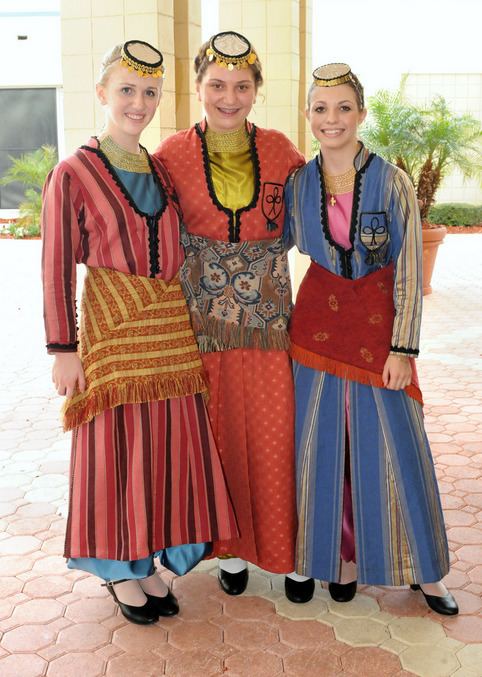
Pontic Greek dancers in traditional costumes (Photo sourced: Internet)
The fact that Mariupol Greeks are native Russian speakers and their villages voted in their majority to join the separatist Donetsk People’s Republic in 2014, saw them persecuted by the Ukrainian state and their Azov Battalion enforcers. It is recalled that on February 14, only 10 days before the Ukraine War began, one Greek was killed and another wounded in a shooting by the Azov Battalion because they were speaking Russian amongst themselves in the village of Granitne. Before the Russian operation began, this was the line of contact between Ukrainian and Russian forces, and like many of the other Greek villages, had voted to join the DPR.
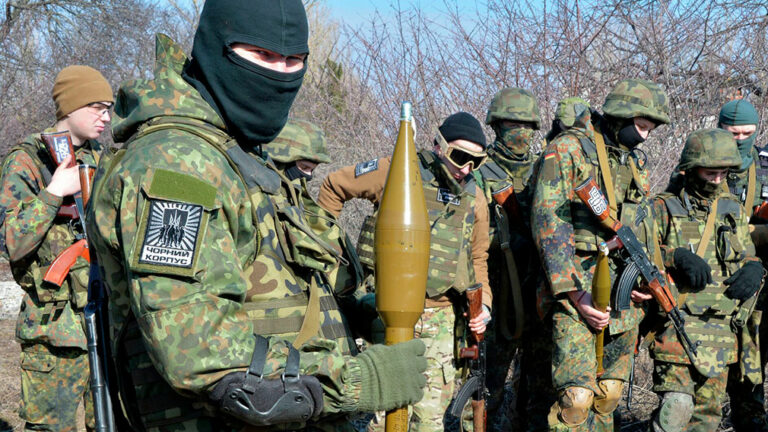
Azov Battallion fighters in Ukraine (Photo sourced: Internet)
One woman from the Greek-majority town of Sartana, 17 kilometers northeast of Mariupol, told American journalist Patrick Lancaster that they were forced to endure Ukrainization and could not speak Russian in public unless they wanted to risk a fine.
Between the non-recognition as an indigenous minority, forced Ukrainization and even murder, the Greeks of Mariupol have suffered immensely under the Azov Battalion, yet Western media has remained near silent, or at the maximum they are non-critical of the racist policies of Kiev. Although Western audiences were bombarded with scenes from the battle of Mariupol, including the Greek government’s unverified claims that the Russian air force bombed Greek villages, there has been near silence now about the current situation in the port city and its surrounds.
As the overwhelming majority of Greeks are now in territory controlled by Russian forces, life has resumed as normal as possible for those living close to a warzone. Schools in Sartana are operating again and people are trying to resume business as normal. What is for certain though is that racist killings just for speaking Russian or any other language other than Ukrainian has come to an end.
With the Greeks of Mariupol now a part of the DPR, the Greek government finds itself in a conundrum as they promised to never abandon the autocephalous community but at the same time has agreed to nearly every anti-Russia sanction and demand made by Washington and Brussels. This makes the reopening of the Greek Consulate in Mariupol dependent on the goodwill of the DPR administration.
Only on May 31 it was announced that Greece’s East Germany-made ΒΜΡ-1 infantry fighting vehicles would be sent to Ukraine so Berlin can replace Greece’s fleet with German-made Marder armoured vehicles. As Athens continues its hostile policy, it lessens the chance of any Russian goodwill so that the Greek community can remain connected to the Greek State via the consulate.
The plan to transfer BMP-1’s to Ukraine once again created outrage in Greece as the announcement was not made by Greek Prime Minister Kyriakos Mitsotakis during his joint statement with German Chancellor Olaf Scholz, but rather by the German leader himself. Greeks lambasted the cowardliness of Mitsotakis of not having made the announcement himself – keeping in mind that over 70% of Greeks in a poll want Athens to have a neutral policy towards the war.
Despite the persecution of Greeks since 2014 whilst living under Kiev’s authority and the Azov Battalion, the Greek government has been near silent on this, only releasing periodical statements that hint towards Ukraine needing to improve minority rights and nowhere near to the same degree of their criticism of Russia.
Greece in the months leading up to the war was making strong attempts to have soft power influence in Mariupol, something that could have continued if there was an acceptance that the entirety of Donetsk was going to be under full Russian control. The harsh reality for Athens is that although the Greeks of Mariupol will be disconnected from Greece, they will live in a far safer environment and with respect to their identity and language, just as the Greeks in Russia’s Crimea, Stavropol Krai and Krasnodar Krai experience.
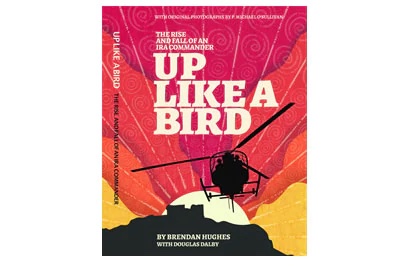
He planned the spectacular helicopter escape from Dublin’s Mountjoy Jail and, a year later, planned another escape from there, blasting their way out with smuggled-in explosives. Before he began planning escapes, he operated early in his IRA career as commander of an armed robbery unit, ‘fund-raising’ for the Movement. But when he began robbing banks for himself and his family, the Movement sent assassins to kill him. Up Like a Bird is the story of that man, Brendan Hughes, nowhere near as celebrated as his other IRA namesake but certainly deserving of much more fame than he has received to date.
Brendan Hughes with his book outside Mountjoy Jail (Image sourced: Phoenix Magazine)
Douglas Dalby’s handling of Hughes’ reminiscences, told in Hughes’ voice, is masterly. The book reads like a thriller, hard to put down; we are driven to turn the next page to see what will happen – even when, through history, we know the eventual outcome. We know, for example, that the helicopter escape was carried out and yet, as readers, we tense as Hughes does his investigations, tense tighter as he identifies the components of the plan, moan with frustration at a delay or last-minute hitch, hold our breaths as the action takes place.
The helicopter escape was carried out on 31st October 1973 and from the prison exercise yard three high-level IRA officers were flown to freedom: Chief of Staff Séamus Twomey and senior Volunteers JB O’Hagan and Kevin Mallon. The following year, on 18th August 1974, 19 prisoners escaped, blasting their way through a gate with a small amount of smuggled gelignite. Not only had Hughes planned that operation – he himself was leading the escapers.
INSIGHTS
Apart from the excitement in reading, the book gives us an insight into the world of IRA volunteers active in Dublin and surrounding areas in the 1970s – the ‘safe-houses’ and network of active supporters, the ‘fund-raising’, stolen getaway cars, false identification documents, high-level awareness of the hunted, carrying concealed weapons, the even better-armed police ….
The Mountjoy helicopter escape revealed something even more important and enduring – the cultural bedrock within the Irish state, the sharp division between the elite and the mass. Although the majority of politicians had voted in 1972 for repressive legislation against Republicans and special no-jury courts to sentence them, a song celebrating the escape reached No.1 in the Irish singles disc charts, selling 12,000 copies in the first week despite being banned by the national broadcaster, RTÉ! Composed by Sean McGinley from Castlefin, Co. Donegal and performed by the folk and ‘rebel song’ band The Wolfe Tones1, Up and Away (the Helicopter Song) became the most-played and most-purchased disc for four weeks until nudged out by Slade’s Merry Christmas Everybody. It is tempting to think that if the escape had taken place a longer period before the approach of the festive season, that the recording might have remained at the top of the charts for months on end. The counterposing of the anger and embarrassment in elite circles, reflected in ranting of politicians, Garda sweeps and raids and media outrage on the one hand, with the delight and empathy at the lower levels revealed much of the tensions in Irish society and the opposing sympathies of different social classes.
The single that sold 12,000 copies in its first week, containing a jocular song celebrating the helicopter escape. (Image sourced: Internet)
Hughes was a maverick, revelling in the description and though for much of his career that was of value to the Provos, there came a time when it ceased to be so. A guerrilla army must have discipline, of course but it also needs volunteers who can quickly assess a situation and seize the initiative, without referring back to the command structure. The balance between both requirements must be very hard to strike — for individuals as well as for the organisation.
When he and other such activists fell out with their leaderships or “went solo”, they were shunned or worse. In Hughes’ final spell in Mountjoy jail, he was on the “non-aligned” wing of the jail, a Republican prisoner but not under Republican leadership control.
ISOLATION
Hughes says that assassins were sent to kill him – he stayed low and carried a loaded .44 Magnum. The leadership of the Republican movement does not always shoot or beat up its dissidents – more usually, it seeks to isolate them. Friends, neighbours, former comrades and even relatives will be advised to shun those no longer welcome, they and their families.
The family feeling, the communal solidarity in the movement becomes its opposite when the leadership brands its pariahs.
Cover of the book (Image credit: Siopa Gaeilge)
Hughes feels he was betrayed to the political police, the Special Branch of the Irish State. But what he says he felt the worst was the treatment of his family while he was in jail. No space on a Republican prison visitor communal transport was made available to his wife and children and cars containing former friends and acquaintances would pass them at the side of the road, even in the rain.
It seems Hughes finds that unforgivable — and no wonder.
As a postscript, Hughes surprisingly declares his support for the Good Friday Agreement, the pacification process. He had been a man of action and, as he said himself, not one for thinking through ideology or politics. But it doesn’t take any great grasp of ideology or politics to see that today it’s more or less business as before in a partitioned Ireland occupied by a foreign power.
End.
UP LIKE A BIRD, Hughes, Brendan; Dalby, Douglas (2022)
FOOTNOTES
1Named after Theobald Wolfe Tone, a leader of Irish republican revolutionary organisation the United Irishmen, died in prison in 1798.
It has been noticeably difficult in Dublin to find a place serving hot food between about 4pm and 7pm on a Sunday but that was once a week only (though awkward enough if you were entertaining visitors from abroad). But now it’s difficult to find a decent café in Dublin after 3.30pm all week — and more so if you’d like to sit outside or next to a window, watching life’s “rank and rich array” passing by.
Yesterday I was looking for a cup of coffee before I set off to visit someone in hospital. I found Anne’s Bakery in Moore Street closed at 3.30pm and, after a brief conversation with some people working nearby, headed off for its sister café in Henry Street but realised that if open, it would be closing very soon anyway (I think it closes at 4pm). So I set off for the hospital.
Coming back into the city centre around 5.15pm and still hankering for a coffee and thought-flow, I realised my chances were even worse now because Simon’s Corner in South Great George’s Street would be closed or closing. What about Cornucopia, in Wicklow Street? I cycled there, spotted empty tables outside, locked up my bike across the road just by Dingle company Murphy’s Ice-Cream (where you get 10% discount through ordering in Irish) and entered Cornucopia by left-hand door for the coffee-station. But …. no-one serving there. No sign saying “closed” so … maybe … might just have gone to the toilet?
After waiting awhile without any staff appearing, I made enquiries in the other part, the food-serving section and was told the coffee-station was closed. I looked at the lonnnnng queue, muttered “Fuck it”, went back outside, unlocked the bike and, careful of the big cars coming down that narrow street, pulled out to ride towards Grafton Street and from there northwards and home.
And …. Glory Alleluia! Empty tables outside Mary’s Bar & Hardware Shop! And illuminated by the sunlight slanting from the westering sun. Did they serve coffee, I wondered (I know they don’t sell hardware). Most Irish bars serve tea and coffee but the coffee quality can be questionable … or even instant and …. relief! Spotted the machine at the bar’s end with the roasted beans in the cylinder on top, ordered a cup and went back out to lock the bike.
Outside Mary’s Bar & Hardware Shop, Wicklow Street, yesterday late afternoon with part of my bike in view (Photo: D.Breatnach)
A little later, sitting outside in the sun, sipping reasonable coffee, watching passers-by …. people finishing work, shoppers, tourists, beggars, cops …. and then an interesting chat with one of “Mary’s” customers out for a smoke.
Then home, caffeinated and happy.
End.
PS: If you ever pop in to Mary’s for a drink, do make sure you visit the toilet. You will pass through what looks like an older section of the bar with surprising partitioned parts, past some hardware (but not for sale), then through a door, up some stairs …. On the way back, like as not, you’ll take a wrong turn (as I did) and enter …. a brightly-lit US-style diner with customers seated at red formica-top tables! A dislocating experience like something out of a sci-fi novel.
As you find the correct way back, depending on how much alcohol you’ve imbibed, you might wonder if that other place really exists. In this dimension, anyway.
When I asked the guy filling shelves in the supermarket where the milk powder was I had no idea what was to come.
Picking up on his accent as he showed me, I asked him where he was from.
“Poland,” he replied, so naturally I thanked him in one of the few words or phrases I know in Polish. He responded in Polish too, then asked me where I was from.
“Here”, I replied.
“Dublin’”, he replied, “wha? ah Jayzus. How’re ya doin’, Bud? Allrih?” And there followed a stream of Dublinese: words, accent and even gestures.
This of course, is our third language here in the capital city – not the native one relinquished by so many, not the colonisers’ appropriated by so many, though a version of it, moulded, turned, somewhat UStaterised, slanged, missing endings ….
He had me laughing, of course and as I paid for my purchases I mentioned it to the cashier, who told me the guy works part-time on nightclub security, so he picks up plenty of it on the door. We both agreed he does it very well.
I went off smiling — another small but interesting experience in our capital city.