On 16th July 2022 the frame-up of the Craigavon Two was highlighted in public events in locations across all four provinces of Ireland. John Paul Wooton and Brendan McConville were framed and convicted in 2012 of the killing of colonial police officer Stephen Carroll in 2009.
The agency that framed them is the colonial police force of the Six Counties statelet but then they were railroaded through the non-jury Diblock Courts. As a result the two men have spent 14 years in jail for something they did not do.
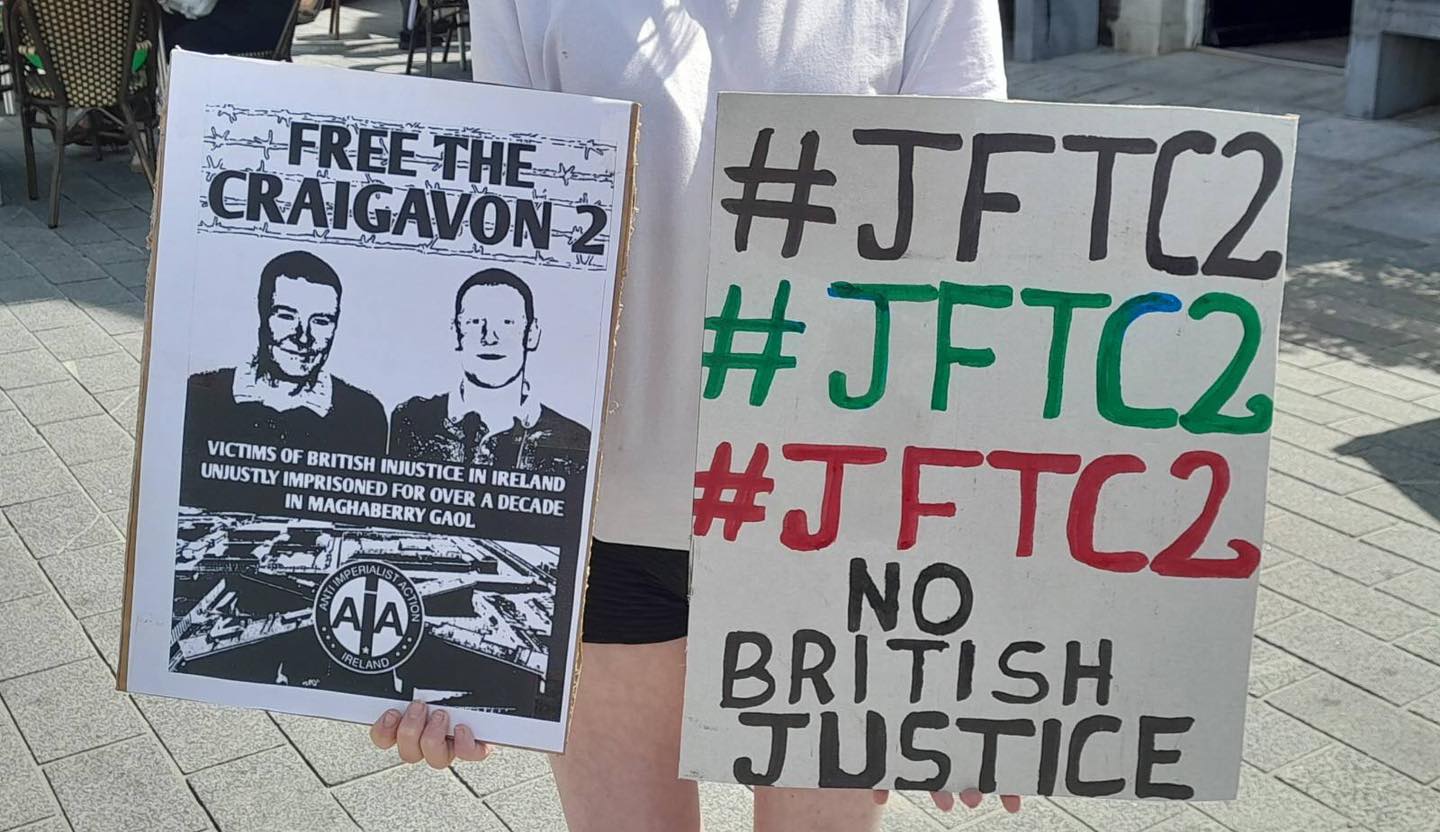
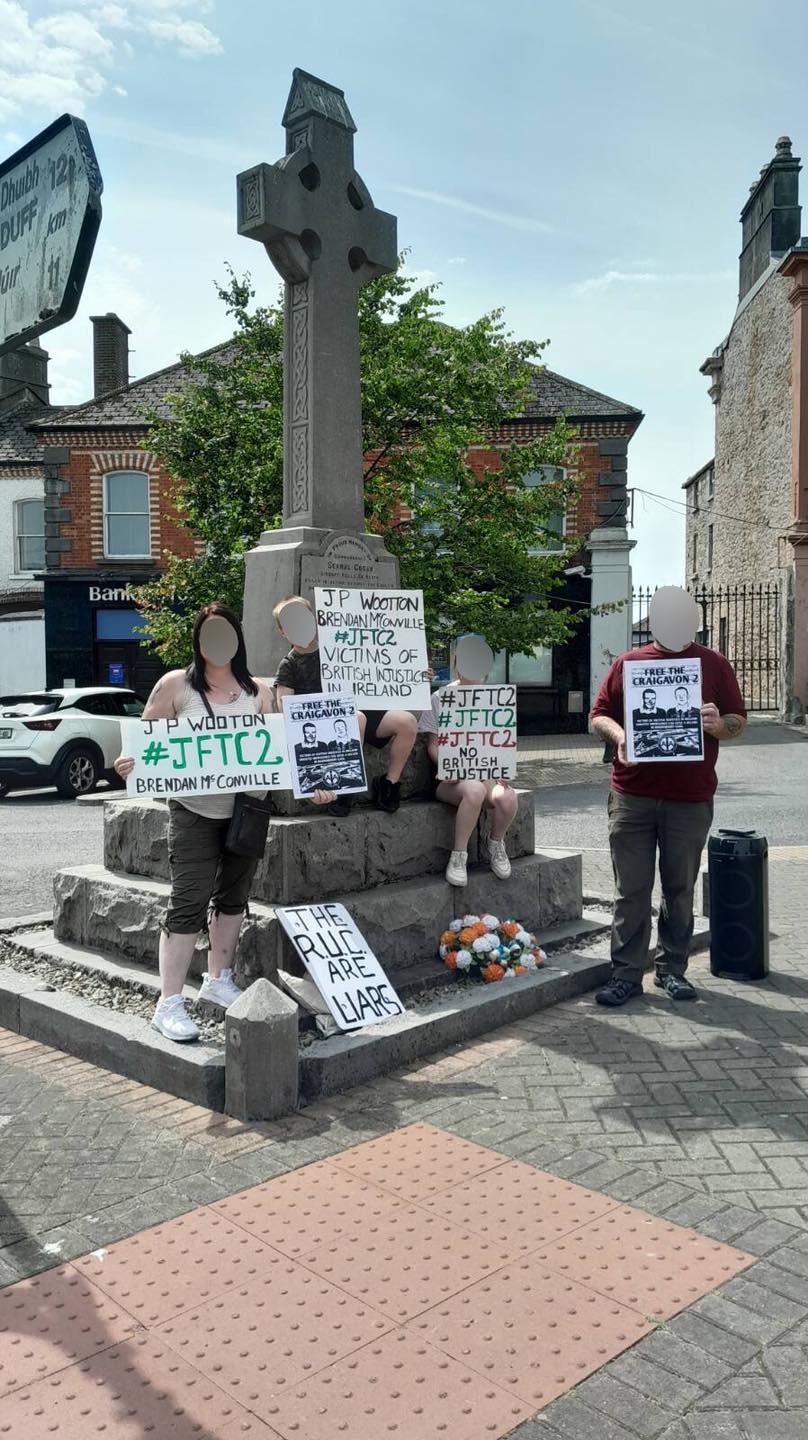
A young woman participating in the protest on the 16th in Mulingar, Co. Westmeath displaying two placards, one home-made, to passers-by. (Photo sourced: AIA)
EVENTS
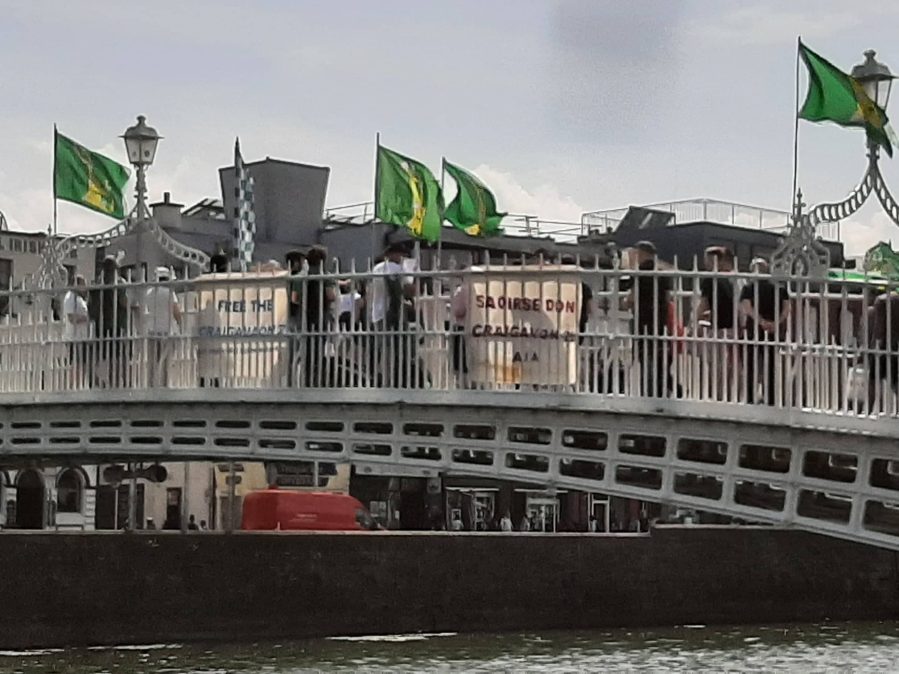
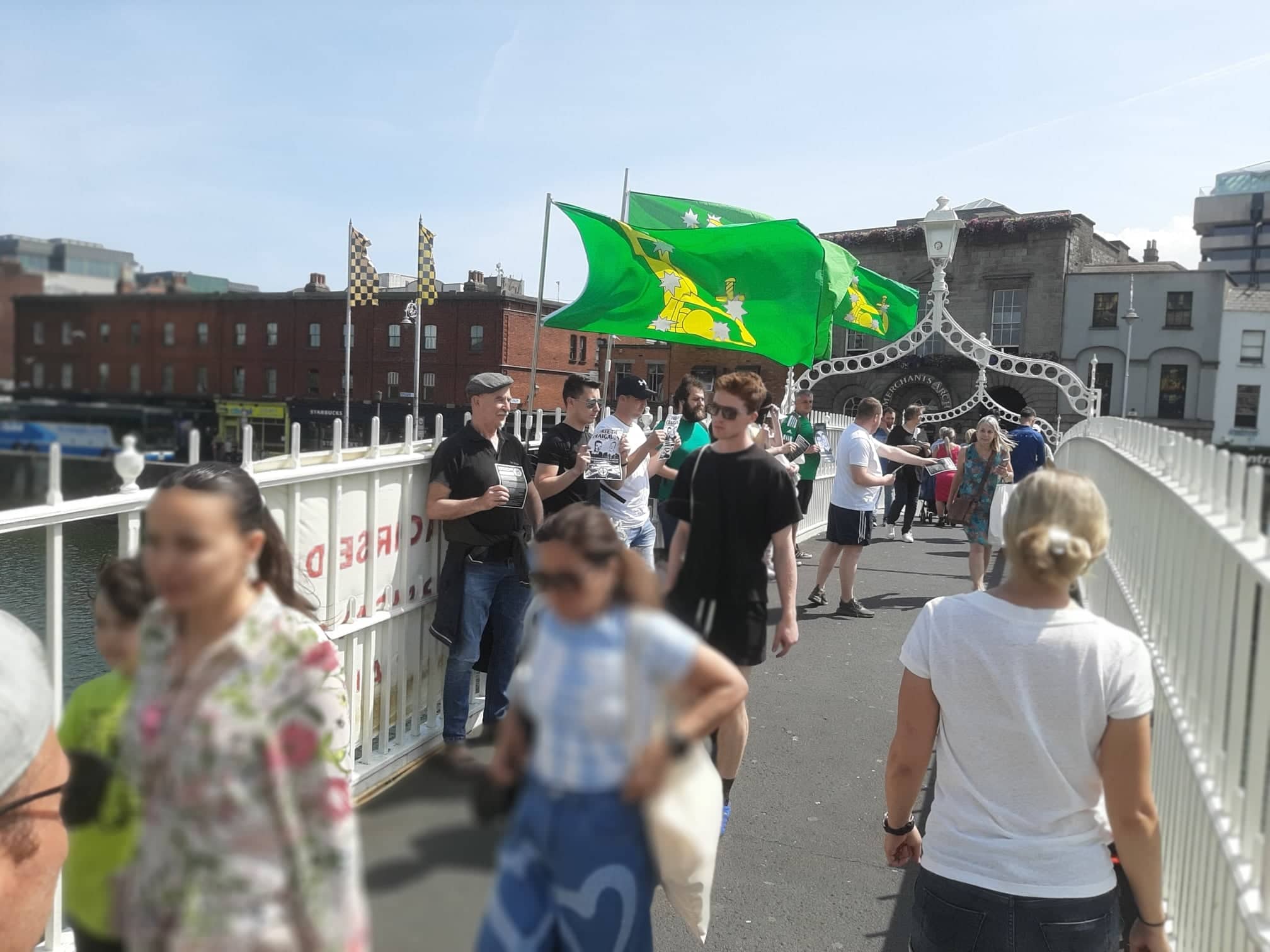
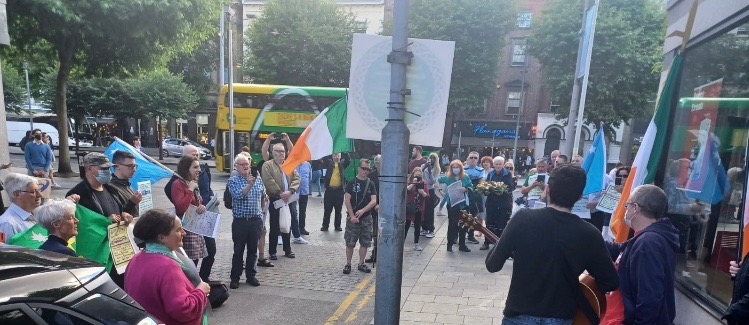
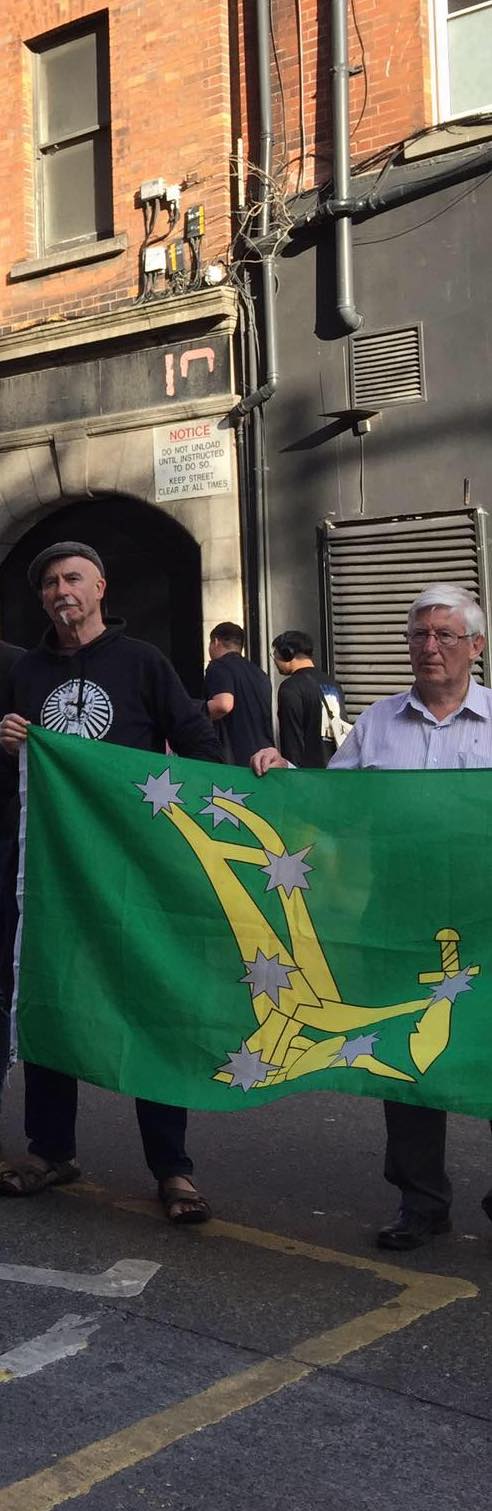
In Dublin city centre banners in Irish and in English calling for the freeing of the Craigavon Two were hung from the iconic curved pedestrian Ha’penny Bridge. Green and gold Starry Plough flags streamed in the breeze from the sea as leaflets were distributed to passers-by.
Hand-held Placards called for the men’s release and regular calls could be heard of “Justice for the Craigavon Two!” followed by “14 years in jail for something they didn’t do”. In addition there were calls to “Smash the Specials”1 and comments about “British justice”.
Strangely no artist(s) name was posted on line with the video
All the leaflets brought to the event were distributed and a number of conversations with interested people took place.
Leaflets being distributed and placards displayed on the Ha’penny Bridge, Dublin on the 16th. (Photo sourced: AIA)
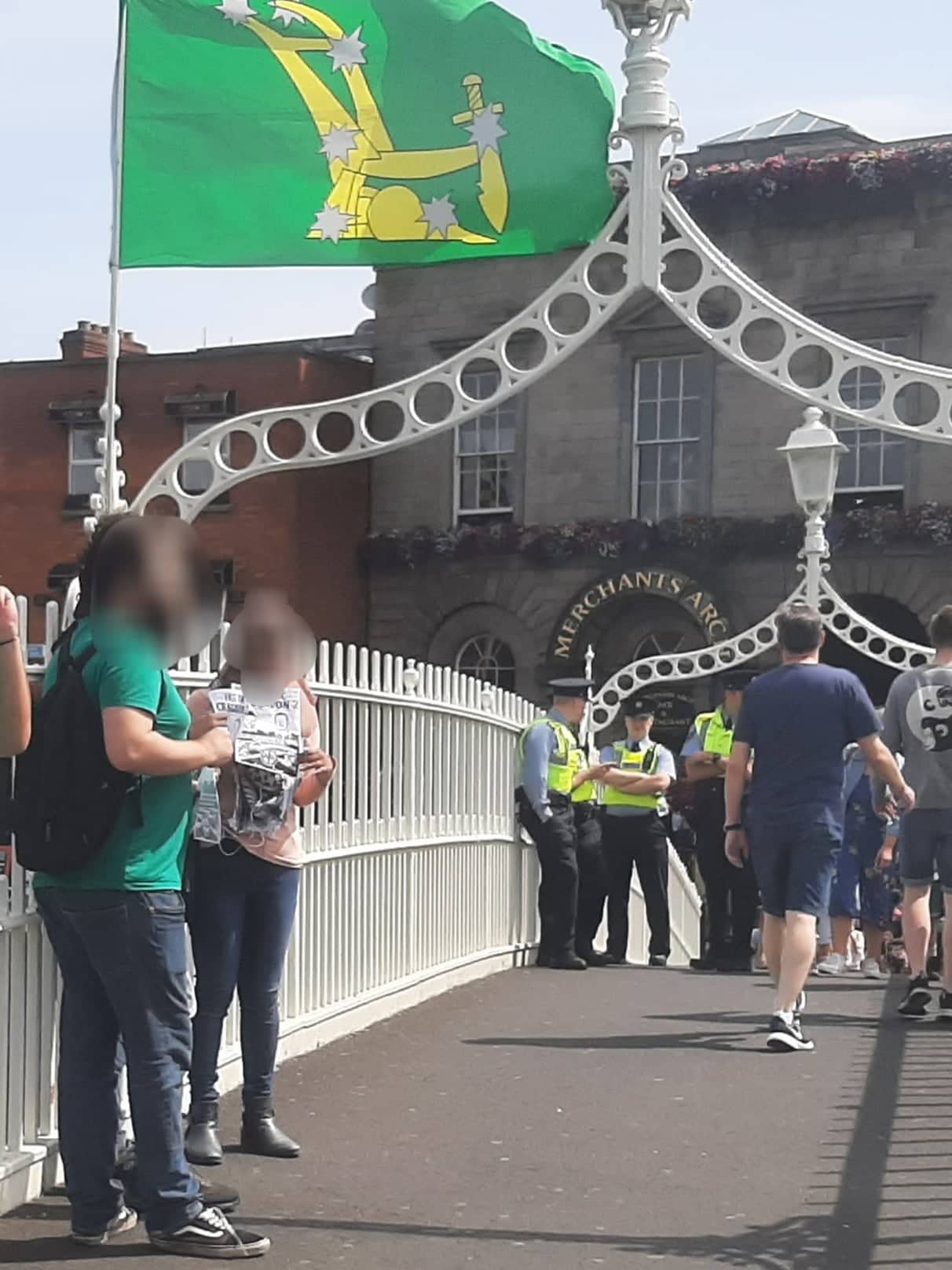
At one point four members of the State’s police force, the Gardaí, walked past the picketers and gathered at the far end of the bridge, watching them. However, the picketers were not intimidated and the police took no further action.
The events in respect of the Craigavon Two were organised by the Anti-Imperialist Action Ireland organisation and took place in Waterford, Oldcastle (Meath), Naas (Kildare), Mullingar (Westmeath), Kerry, Galway, Dublin, South Derry, Armagh and Arklow (Wicklow.)
Gardaí watching the awareness-raising picket on the Ha’penny Bridge on the 16th. (Photo sourced: AIA)
A CROOKED CASE
To say that the case against the men was flimsy would be to give it too much credit. The killing weapon was recovered and the fingerprints on the weapon and magazine did not match either of the men’s. No eyewitness was found except one who claimed to have seen one of the men in the area.
The alleged eyewitness who identified one of the men, “Witness M” only came forward 11 months after the killing and long after the arrest of both men. Witness M’s inability to have identified anyone at night at the distance he claimed to have done was exposed in court.
Awareness-raising event on the 16th in Oldcastle, Co. Meath (Photo sourced: AIA)
That man’s father described him as “a Walter Mitty character” who was chronically untruthful and his own partner refused to corroborate the witness’ account of his movements on the night of the killing.
The ‘evidence’ against the second man of being in the area came from an MI5 agent who testified from behind a screen about a tracking device they claimed to have planted in the accused’s car which had unexplained gaps in its recording.
The agent declined to answer a number of questions under “public immunity” certificate related to “national security”.
The colonial police went further and detained Witness M’s father to intimidate him into not giving evidence about his son’s veracity (or lack of it) — and the witness was also paid a sum of money.
One can say that the no-jury Diplock Court was crucial in convicting the men of murder but even when they were eventually granted leave to appeal in 2014, their convictions were not overturned. The normal judicial system is bad but the no-jury courts are worse.
Another victim of being framed in the British ‘justice’ system, Gerry Conlon, 15 years in jail in the famous case of the “Guildford Four”, joined the campaign for the men and was proclaiming their innocence until a mere few days before his premature death in June 2014 (aged 60).
End.
In Naas, Co. Kildare. (Photo sourced: AIA)
Mulingar, Co. Westmeath. (Photo sourced: AIA)
A woman leafletting in Co. Waterford on Saturday talking to people in the town centre. (Photo sourced: AIA)
FOOTNOTES
1A reference to the political no-jury courts of the colony and of the Irish State, the Diplock Courts and the Irish State’s Special Criminal Courts.
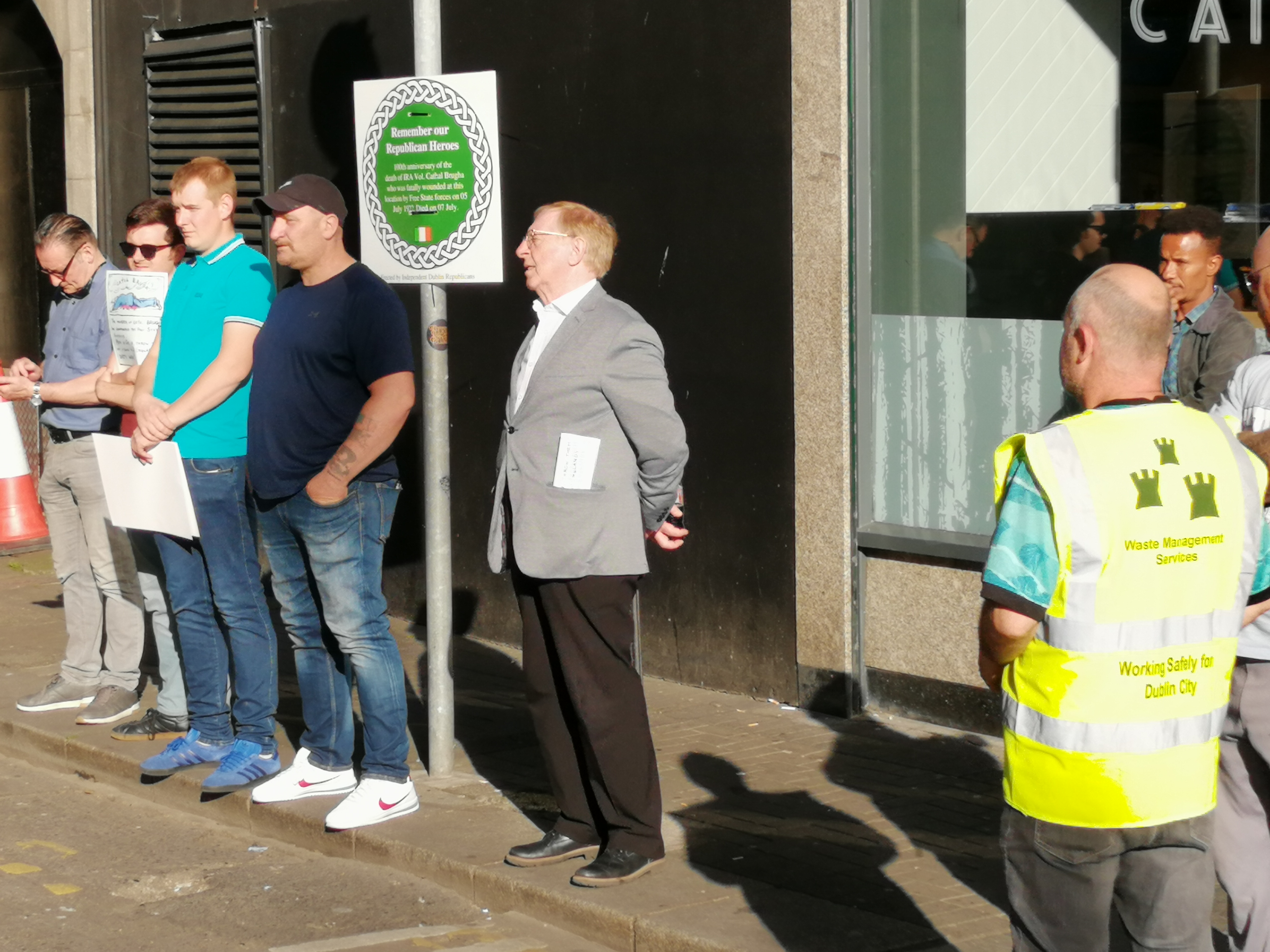
On the evening of 7th July, people passing on O’Connell Street, Dublin’s main street in the north city centre either stopped a while or passed with a glance at the crowd gather at the intersection with Cathedral Street, a narrow lane leading eastward.
The Irish Tricolour and the Starry Plough flags (both versions1) held aloft gave a strong indication of the purpose of the gathering, which was to honour an Irish patriot shot down at that spot by Free State soldiers on 5th July 1922 and dying on the 7th.
A poster from the period with drawings thought to be by Constance Markievicz (Photo: D.Breatnach)
CATHAL BRUGHA RESUMÉ
Cathal Brugha was an Irish Republican, an Irish language activist, a soldier and politician. For a period in the Irish Republican Brotherhood, he joined the Irish Volunteers at the outset2 and was a lieutenant in charge of twenty Volunteers to receive with others the arms delivered to Howth Harbour in 1914.
In the 1916 Rising Brugha was second-in-command under Eamonn Ceannt at the South Dublin Union, now covered by James’ Hospital, where he received in excess of 25 wounds from bullets and grenade shrapnell and was not expected to live.
Surviving, Brugha was elected a Teachta Dála (member of parliament) for the abstentionist Sinn Féin coalition party in the UK General Election of 1918, serving until his death, first President of Dáil Éireann (the Irish Parliament) from January to April 1919, Minister of Defence from 1919 to 1922 and Chief of Staff of the IRA from 1917 to 1919.
Cathal Brugha, along with most Republican activists, was strongly opposed to the Anglo-Irish Agreement of 1921 which was supported by Michael Collins, Arthur Griffiths and others and joined the Republican opposition in the Dáil, resigning his government posts to do so.
A poster from the period with drawings thought to be by Constance Markievicz (Photo: D.Breatnach)
However, he and Oscar Traynor of the IRA both opposed the occupation of the Four Courts by IRA under Rory O’Connor but when it was bombarded by the Free State with British artillery on 28th June, Traynor ordered occupation of O’Connell Street buildings to divert some of the heat from the Four Courts.
The Free State Army bombarded the Republican positions in O’Connell Street with artillery and machine guns (as the British Army had done in 1916). Eventually the Republicans retreated apart from a small holding group which Brugha ordered to surrender but did not do so himself.
Approaching Free State soldiers with pistol in hand, he was shot by them in the leg, severing a femoral artery and died two days later in hospital. His widow Kathleen continued the Republican line as an activist and TD.
Mags Glennon, Chairing the event (Photo: D.Breatnach)
THE HONOUR CEREMONY
Mags Glennon, chairing the event, thanked people for coming, stressing the importance of remembering our history and listed briefly the important actions of and positions held by Cathal Brugha, before calling on Sean Óg to perform The Soldiers of ‘22,3 the five verses of which he sang, accompanying himself on guitar.
At intervals between speakers Sean Óg performed another two songs, Cathal Brugha andA Soldier’s Life4.
Joe Mooney brought a series of three posters for distribution, which were quickly taken up. These were copies from the period, condemning the Free State Army for the murder of Cathal Brugha, with drawings believed to be by Constance Markievicz.
A poster from the period with drawings thought to be by Constance Markievicz (Photo: D.Breatnach
MAIN ORATION
The main speaker was historian and author Kerron Ó Luain, who began speaking in Irish and returned to it on occasion, though the content of his talk was by far in English.
Ó Luain initially paid his respects to recently-deceased Mícheál Ó Doibhlin, a Dublin historian who had done much historical research to bring further into the light of today the contributions two Republican women in two different periods.
These were Anne Devlin of the United Irishmen (uprisings in 1798 and 1803) and Josephine McGowan, killed in 1918, the first Cumann na mBan martyr5. Ó Doibhlin had also assisted Ó Luain in the latter’s research into the insurrectionary history of his own area, Rath Cúil (Rathcoole)6.
Kerron Ó Luain speaking, Joe Mooney holding the microphone. (Photo: D.Breatnach)
Continuing to relate some brief facts about Brugha’s early life, born into a mixed-religion household, Ó Luain emphasised Brugha’s interest in the Irish language and his membership of the Gaelic League (Conradh na Gaeilge)7 in the same decade as its founding.
The speaker contrasted that aspect with the militarist image of Brugha often projected by hostile commentators. Brugha met his future wife at meetings of the Connradh and had been a strong advocate of the proceedings of the First Dáil being conducted mostly in Irish and of the Democratic Programme being first read and agreed in Irish.
The setting up of Sinn Féin to contest the 1918 UK General Elections had involved a coalition of many different elements Ó Luain said, including dual monarchism advocates such as the original founder Griffiths and even white Dominion aspirants, alongside Republicans such as Cathal Brugha.
Section of the crowd at the event. (Photo: D.Breatnach
These had been the lines along with the alliance had fractured when the British proposed the terms of the Anglo-Irish Treaty. British influence on the Free State was seen not only in its war on the Republicans but in the legal system adopted based on common law without any thought given to any of the principles of the native Brehon Law.
The British influence was evident also in the form of dress with some Free State politicians such as Cosgrave wearing a top hat and research has shown over 90% of the civil servants of the Free State had been employed by the previous British colonial administration.
The Free State adopted a formal position of support for An Ghaeilge, the Irish language, while doing nothing to support the struggling rural Irish-speaking areas, which were being drained by emigration, leading the inhabitants to want to acquire English for their future locations.
Some of the attendance. (Photo: D.Breatnach)
Another small section shot (Photo: D.Breatnach)
The number of Irish-speakers within the territory of the State has declined drastically since it was founded.
Unusually for an oration honouring an Irish martyr but very important historically, the speaker pointed out that Brugha was not a socialist Republican and had advocated land ownership whereas other Republicans such as Liam Mellows (executed by the Free State in 1922), Peadar O’Donnell and Frank Ryan in the 1930s had proclaimed the need for a socialist Republic.
In conclusion, the speaker said that Cathal Brugha was an honest courageous Republican with a genuine love of the Irish language and a staunch upholder of the truly independent Republic proclaimed in 1916 but yet to be achieved. He had been killed as part of the counterrevolution.
It is important for future efforts, Ó Luain stated, to be aware of the different strands in the Republican opposition to the status quo and to be clear on the desired future shape of society in the Republic.
View of many in the attendance at the event. (Photo: Cabra 1916-1921 Rising Committee)
OTHER REPUBLICAN MARTYRS OF THE BATTLE FOR DUBLIN 1922
Damien Farrell spoke on behalf of Dublin South Central Remembers and representing the McMenamy family from the area. Frank McMenamy had been asked to introduce the Roll of Honour on behalf of relative Ciaran McMenamy of F Coy, 1st Batt, anti-Treaty IRA (Ambulance Corp) but was unable to attend.
Ciaran was one of four brothers — Fergus, Manus and Francis — who fought in the revolutionary period 1916-23. Ciaran was part of the crew that tended Cathal Brugha and rushed him to hospital on the 5th July. When Brugha succumbed to his wounds, Ciaran was a pall bearer at his funeral.
Damien said that this most likely identified him for arrest which happened later and he was interned in the infamous Newbridge Camp and participated in the mass hunger strike of prisoners in 1923 against conditions.
Ciaran McMenamy contracted a cold that developed into consumption which secured his release to convalesce in the County Home in Kildare but this proved ineffective and Ciaran was eventually released from internment around Christmas 1923.
On the 26th of April 1924 Ciaran McMenamy died in 55 Pearse Square, a house connected to the family. For the past two years Dublin South Central Remembers have held remembrance events at the house, with the full permission and support of the current occupants (no relations) with the intention of having a plaque erected in time for his centenary in 2024.
Finnuala Halpin reading the Roll of Honour of the The Battle of Dublin 1922, in which her grandfather fought. (Photo: D.Breatnach)
Fionnuala Halpin read the roll of honour of those killed in The Battle of Dublin 1922, a battle in which her grandfather fought.
John Monks
William Clarke
Joe Considine
William Doyle
Francis Jackson
John Mahoney
Sean Cusack
Matthew Tompkins
Jack McGowan
Thomas Markey
Thomas Wall
Charles O’Malley
Cathal Brugha
Veteran Republican, hunger-striker and author Tommy McKearney placed a wreath in honour of the fallen on behalf of Independent Republicans and a minute’s silence was observed in their honour also.
COMMEMORATE THE CIVIL WAR MARTYRS OF YOUR AREA?
A number of different Republican organisations were represented at the event, along with many independent Republicans and historical memory activists, including walking history tour guides.
Poster and dedication floral wreath in honour of Cathal Brugha, Cathedral Street, Dublin city centre 7 July 2022 (Photo: Cabra 1916-1921 Rising Committee)
Mags Glennon asked people to keep in touch with the organisers and also to be aware of other commemorative events, offering to make available the commemorative posters with the local martyrs’ names incorporated into the design for display for others around the country.
End.
FOOTNOTES
1The original, with the design of plough in gold following the outline of the Ursa Mayor constellation in white stars, on a green background and the later Republican Congress version of the white stars alone on a light blue field.
3Composed by Brian Ó hUigínn, sung to the air of The Foggy Dew.
4A Soldier’s Life was originally composed by Young Irelander Thomas Davis (1814-1945) and recorded by The Wolfe Tones band; the composer of Cathal Brugha’s lyrics appears unknown and it was recorded by Declan Hunt.
5A rally held by women just off Dame Street in 1918 was batoned by members of the Dublin Metropolitan Police and she died of her injuries shortly afterwards. I have heard Ó Doibhlin relate her story and saw him becoming emotional as he did so. The DMP’s batons in September 1913 were also responsible for the deaths of at least three others, although one died in 1915.
6For a number of recent years Ó Doiblin has been noted, along with historian Liz Gillis and others, for research and exposition of information regarding the Burning of the Customs House on 25th May 1921, which corrected a number of common misapprehensions about that event.
7Founded by Protestant Douglas Hyde/ Dubhghlas de hÍde this month in 1893.
USEFUL LINKS
The Independent Republicans group do not appear to have a website or FB page but may be contacted through the Cabra 1916-1921 Rising Committee: https://www.facebook.com/cabra1916
The “father of Irish Republicanism”, Theobald Wolfe Tone was honoured on Sunday afternoon at the Irish patriot’s final resting place, in Bodenstown churchyard in Co. Kildare, a place of annual pilgrimage for Irish Republicans. Irish Socialist Republicans and Anti-Imperialist Action Ireland convened the event including speakers, musicians, singers and colour party, in which the speeches drew on the past to comment on the present and on the future.
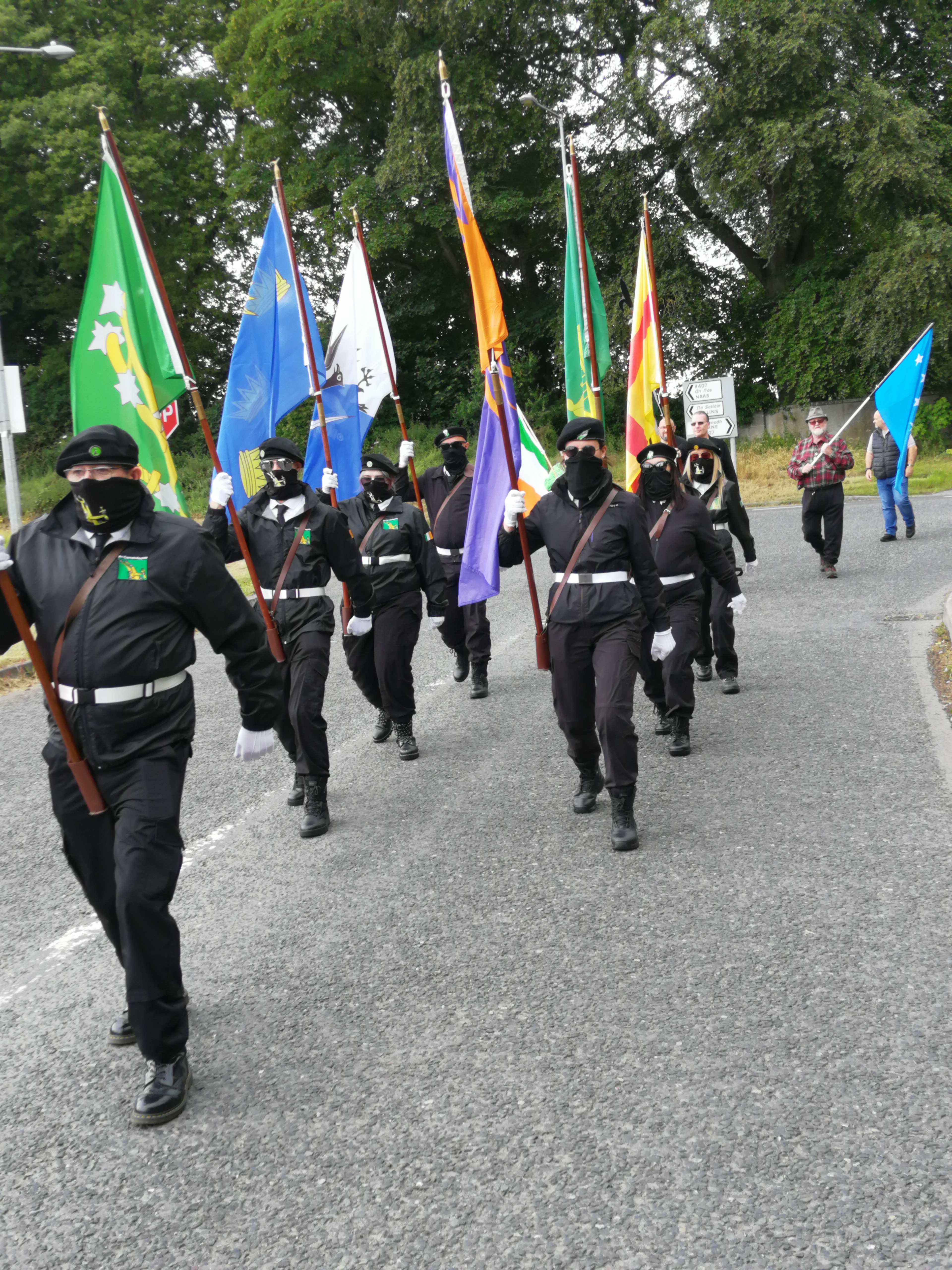
Colour Party flags against those permanently maintained there at the monument by the NGA. (Photo: Rebel Breeze)
WOLFE TONE ANDTHE RISINGS OF 1798
Theobald Wolfe Tone and others sought the extension of political participation from the Anglicans in Ireland to the Dissenters, i.e non-Anglican Protestants in addition to the Catholics. When efforts in this direction failed1 towards the end of the 18th Century he and others formed the United Irishmen. This was a secret revolutionary organisation, with a democratic, non-sectarian ideology, seeking assistance from republican France to rise against English control of Ireland.
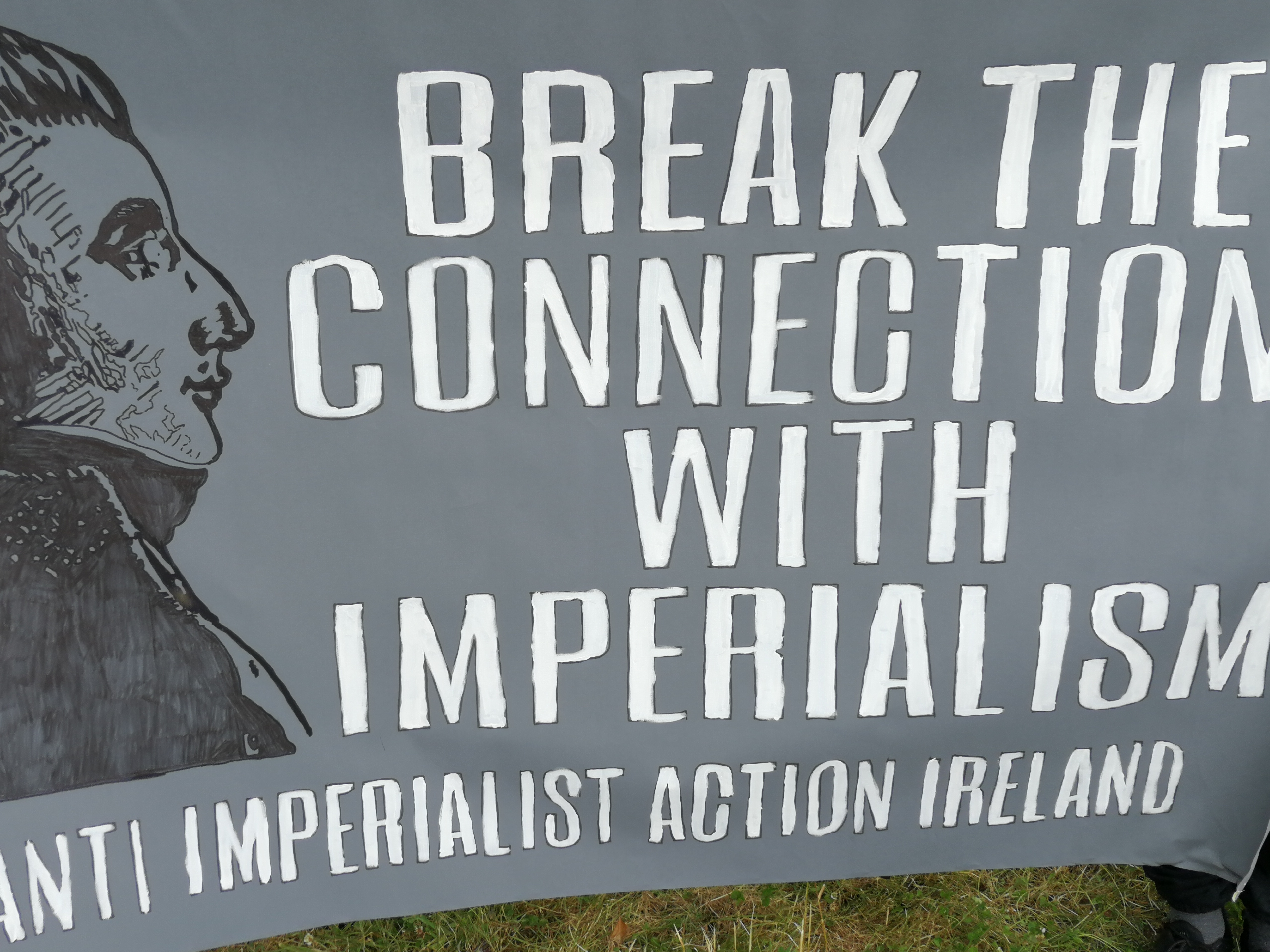
One of the banners carried on the march and at the rally (Photo: Rebel Breeze)
The English authorities occupying Ireland harried the Republican communities (including hanging some individuals), pushing them into uprising in 1798 when they were in some disarray, particularly after the arrest of most of the Leinster Directorate of the United Irishmen in Bridge Street, Dublin. The French ship in which Tone was being brought back to Ireland was captured by an English naval vessel and though Tone was in French Army uniform he was recognised, tried and sentenced to public hanging but apparently cheated the hangman by cutting his own throat, though he died slowly and painfully.
The initial engagements in Wexford and Antrim were successful for the insurgents but Wexford was soon left as the only area in which they had control of most of the county. A small French invasion force arrived too late in Mayo and though again initially successful, the combined French-Irish force was soon surrounded and defeated.
Tone’s body was brought to the small churchyard in Bodenstown and buried there; Young Irelanders leader Thomas Davis later wrote about his own pilgrimage there and composed the “In Bodenstown Churyard” song; since then the annual pilgrimage there has become an important point on the Irish Republican calendar and, at the high point of support for the Republican movement in the latter half of the last century, attended by thousands.
THE BODENSTOWN EVENT
Colour party leads off on the march to the Churchyard (Photo: Rebel Breeze)One of the banners at the event (Photo: Rebel Breeze)
SPEAKERS
The rally was preceded by a small march led by a colour party to approach the cemetery, where it was joined by others to march into the cemetery. Opening the event, the MC welcomed everyone in Irish before continuing to speak in English, putting the event in its context of history since the late 18th Century onwards up to the present, referencing recent activity of supporters of the ISR, AIAI and the Revolutionary Housing League before going on to introduce the next speaker.
(Photo: Rebel Breeze)
Peter Rogers speaking seen from a distance (Photo: Rebel Breeze)
Irish historian Peter Rogers recounted briskly a list of prominent Republican speakers who had taken part in Wolfe Tone commemorations down through the decades (some later martyred). Rogers spoke about the importance of the tradition and its relevance today as in the past and also spoke of his own participation as a young man at such commemorations in the past. Among those who had spoken at the monument, Rogers mentioned James Connolly, Patrick Pearse and Liam Mellows.
Seán Doyle, member of the Irish Socialist Republicans/ AIAI and a housing activist spoke about what the capitalist system is doing to the people in Ireland, particularly in the housing crisis, with deaths on the streets while houses lie empty, along with long-time harm being suffered by the victims in physical and mental health, including suicides.
Sean Doyle speaking at the event (Photo: Rebel Breeze)
Doyle stated that any system of law or property that justifies that kind of situation must be done away with, that the health of society over-trumps the property rights of the few and encouraged those who agreed with that to join the Revolutionary Housing League.
The MC noted the importance of internationalism in Irish Republican history including that of the United Irishmen2 and noted the presence of Basque and Palestinian flags before calling forward a recent supporter of the ISR/ AIAI activities from Turkey.
The man was not easy to understand but the gist seemed to be the different ways in which resistance expressed itself apart from armed resistance. The Turkish speaker listed among those the celebration of historical memory, the retention of language, the combatting of fear.
The final speaker was a housing activist and urban geographer who has been doing some research into past housing struggles in Ireland, particularly alluding to past actions in Dublin which CATU (Community Action Tenants’ Union) is researching currently. Republicans had taken part in these and initiated many of them but he felt they did not get the credit they deserved. The speaker mentioned also the 1970s tenant rent strike movement in against Dublin City Council, which is hardly ever mentioned, in effect a mass movement. The speaker maintained that we need to understand the different categories of empty houses so that we can understand the causes and address them but ultimately the cause is the capitalist system. The speaker called for resistance and support for CATU and for such initiatives as James Connolly House.3
Urban geographer speaking on housing within the Irish capitalist system (Photo: Rebel Breeze)
CULTURAL PART OF THE PROGRAM
Music and lyrics are an important part of the Irish Republican tradition, the MC commented, before calling up singers to perform at intervals between speakers. Seán Óg accompanied himself on guitar singing the Irish Republican ballads Tone Is Coming Back Again and Soldiers of ‘22. The latter song was one of a number of references by speakers to the counterrevolution of 1922-1924, more usually referred to as the Civil War. The MC commented that the Tone Is Coming Back4 song is rarely heard these days and Soldiers of ‘225not often enough.
Diarmuid Breatnach preceded his singing of The Plane Crash at Los Gatos (sometimes known as Deportees) by saying that the victims of imperialism are often civilian refugees fleeing repression, or migrants fleeing famine or simple poverty (as we Irish had done), these most vulnerable sections of society then being targeted by racists and fascists. Mexican seasonal labourers hired to bring in the fruit harvests are often hunted if they remain in the USA. In 1948 a USA plane delivering deported labourers to Mexico crashed with everyone on board killed. However the radio news only gave the names of the USA citizen crew and Woody Guthrie composed the song about the incident. Breatnach also mentioned the deaths of trafficked Latin American migrants more recently in the USA and those killed in Morocco while trying to get into the nearby Spanish colony, numbers similar to some recent deaths in the war in Ukraine which become front page news while the migrant deaths may not reach anywhere near there.
Coiste na mBan of the AIAI banner at the event (Photo: Rebel Breeze)
The MC, drawing the event to a close, commented that more people had attended the event this year than last but more were still needed to mobilise. He gave his thanks to the colour party, also larger this year and including people who were new to the role, commenting that five counties were represented there. Some of them are women and the MC mentioned as a progressive development the formation of Coiste na mBan (Women’s Committee) within the Anti-Imperialist Action Ireland organisation.
The event concluded with thanks to all present from the MC, also to the National Graves Association6 and the singing of Amhrán bhFiann.
Section of the rally in Bodenstown Churchyard seen from behind (Photo: Rebel Breeze)
End.
FOOTNOTES
1The English Crown was opposed and rallied opposition to the move among the MPs but self-interest also played a part, in that some landowners feared that power given to the pre-settler indigenous might result in their lands being repossessed.
2The United Irishman had strong links with Republicans in France and in the USA but also with the United Englishmen and United Scotsmen in which the Irish diaspora was active. Irish Republicans had also had links with the movement for liberation from Spanish rule in Latin America in the mid-19th Century and with the Basques and Catalans in the early 20th.
3James Connolly House was the revolutionary re-naming title of a building leased by the Salvation Army on Eden Quay, Dublin, left empty for nearly two years in the midst of a homelessness crisis. Earlier this year it was occupied by activists of the ISR-related Revolutionary Workers’ Union for some weeks before a court-authorised eviction of over 80 gardaí to remove two activists a couple of weeks earlier.
4A song which was part of the ’98 Cantata written in celebration of the hundredth anniversary of the Rising. The cycle contained ten songs and was revived again in 1948 on the 150th anniversary. Thomas Francis Mullan was born near Ardmore, Co. Derry in 1860. He taught in Derry and later became headmaster of Faughanvale PES. He collaborated with a Derry music teacher, Edward Conaghan, in the writing of a ’98 Cantata devised to commemorate the centenary of the Rising. He died in 1937.
5Some online sources claim the author is unknown while others give Brian Ó hUigínn as the author, which seems likely.
6The NGA is a voluntary organisation independent of any political party and of the State, from which it seeks no funding; it is the major organisation caring for graves and memorials of the struggle for Irish freedom and has the responsibility of caring for the Tone memorial, which it has renovated in the past to facilitate commemoration events.
To an arachnophobe, the very idea of flying spiders must be a terrifying thought but they would reassure themselves that such a thing is only possible in horror movies. I am sorry to disabuse them but in fact many spiders do fly … and in fact, they’re flying in Ireland right now.
“Flying” might be a slight misnomer – “ballooning” might be more accurate, though they don’t use balloons. What they do is let out a line of silk – standard spider equipment – into rising warm air, or perhaps a breeze and …. up and away they go.
If it’s any consolation to the arachnophobes, the spider aeronauts are tiny – and probably need to be so for the airlift to work. On Wednesday in Dublin, at least three landed on me – one on my hand, one on my neck where I could feel the tickling (sorry, ararachnophobes!) and one on my bike, where it began to spin a web before I flicked it away to spin it somewhere else.
Traditionally, these have been called “money spiders” – apparently the folk belief or fancy was that if they landed on you, they meant good luck: as they symbolised a new suit being woven for you they were a prediction of an increase of wealth coming your way. They were landing on people all around Dublin on Thursday1 but wealth is coming sadly only to the same people as before: i.e native and foreign capitalists, property and finance speculators and landlords.
Looking up “money spiders” on the Internet, I find reference to Linyphidae which reminds me of Linyphia, that I recall2 spins those “hammock” webs in the hedges or bushes that you only really notice when they’re covered in dew.
Hammock or “sheet webs” of Linyphidae visible on foliage because of dew beading (Photo cred: James McNish)
But I had no ideal that “Linyphidae is a family of very small spiders comprising 4,706 described species in 620 genera3 worldwide.This makes Linyphiidae the second largest family of spiders after the Salticidae. The family is poorly understood due to their small body size and wide distribution, they are actually the most 3rd venomous spider worldwide4 after the black widow and Brazilian wandering spider;[citation needed] new genera and species are still being discovered throughout the world. The newest such genus is one from from Nepal …… Since it is so difficult to identify such tiny spiders, there are regular changes in taxonomy5 as species are combined or divided.”6
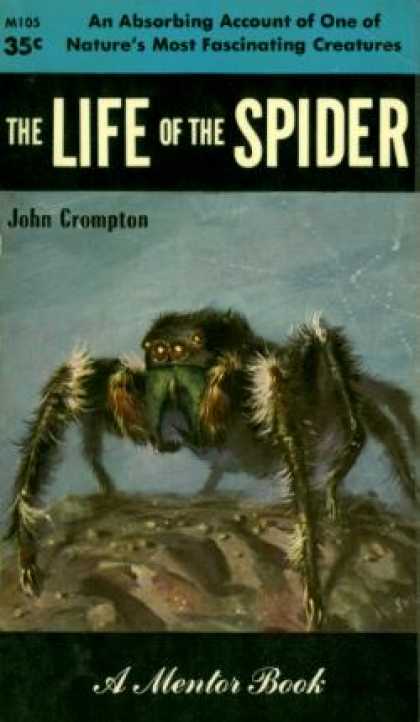
But wait a minute! No mention of our common wolf spider, which is small but not tiny except for its young, which I remember also take to the air. Was mine a false memory? Or was Crompton mistaken in Life of the Spider? So, I do a quick on-line check on the Wolf Spider into Wikipedia and yes, it mentions how the mother carries the tiny young on her back but …. no mention of them flying! However, a little more digging into the Internet (because it’s hard to believe I have been so mistaken about this for so long) and …. I find the reference! Yes, the young of Pardosa amentata, a species in the big family of wolf spiders, do also take to the air.
This is a small dark brown spider which you are most likely to see running over dry parched earth, especially when it cracks a bit, or over a stone or concrete path. It does not construct webs but runs its prey down, hence the “wolf” part of its name but unlike the wolf, Pardosa amentata hunts alone.
When she has been fertilised (whether her mate got away alive or not), she will weave a silk sheet into which she will lay her eggs and which she will then bind up into a round pill-shape, before strapping it on to her body underneath her abdomen. Since the egg-case is usually off-white, to a quick look it will appear that this is a brown spider with a white abdomen and most people who spend any time in a garden will have seen these7.
About real size (on standard laptop screen), Lycosa female carrying her egg-sac under her abdomen (Photo cred: Wikipedia Commons)
She carries this at all times, even when hunting or escaping from prey. She is very protective of that egg-case and if it is removed, Compton wrote, will try hard to retrieve it, even daring an ant-lion8 funnel to save it.
When she senses her young are are ready, she bites the egg-case open and tiny spiderlets come tumbling out, crawl up her legs and sit on her back, all linked legs, sometimes three layers deep.
Now when you see her, it looks like she is furry on the back or maybe has some kind of infestation. If the young are brushed off, she will try to wait for them to find her and climb back on. With egg-case or young, she can stil hunt and does but I don’t think anything is known of how the young receive alimentation – if indeed they do at all. Anyway, one day soon it’s goodbye Mam, goodbye back-travel mates and up they climb along stems and branches, let out the silk line …. wait …. wait …. wait …. YES! Up and up, soaring into the sky, to come down in …. somewhere. If they live that long.
Female wolf spider (family Lycosidae, magnified many times) carrying her young spiderlings on her abdomen (Photo cred: Science Photo Library)
Then they have to find prey that they can handle at their tiny size, avoid other predators, grow, moult, grow, moult until one day they will be a hopeful mature female or a hopeful and very cautious male. If the former, the cycle will begin again, all taking place in the space of only a couple of years.
But right now, all over Ireland, the little spider-nauts are flying …. and landing, somewhere near you.
End.
Ballooning spiderlet on a human finger (enlarged around x400 — images sourced internet)
Especially for arachnophobes — cover of Crompton’s book (Image sourced: Internet)
2I read John Crompton’s Life of the Spider (Mentor, UK, 1954) as a child and remember a lot of what I read there.
3Genera is the plural of genus and means the overall group after the family which is then divided into species. For example the wolves, coyotes, hyenas, foxes and the domestic dog are all members of the overall family Canidae, but that itself is divided into 12 genera, of which Canis is the one to which the wolves Canis lupus and their descendants the domestic dog Canis (lupus) familiaris belong, while the foxes belong to the genus Vulpes. https://en.wikipedia.org/wiki/List_of_canids
4Even should this be true, their tiny jaws are unable to pierce human skin; the spiderlet itself is no bigger than the head of an ordinary sewing pin.
5The branch of science concerned with classification, in particular of life-forms.
7I’ve also seen a yellowish spider in water margins carrying a similar egg-case.
8The ant-lion is something like the “sand-worms” in the fictional Dune series, except that they remain in their funnel in a tip in the sand, waiting for the unwary traveler when their head emerges with fearsome jaws and …. well, you can imagine the rest.
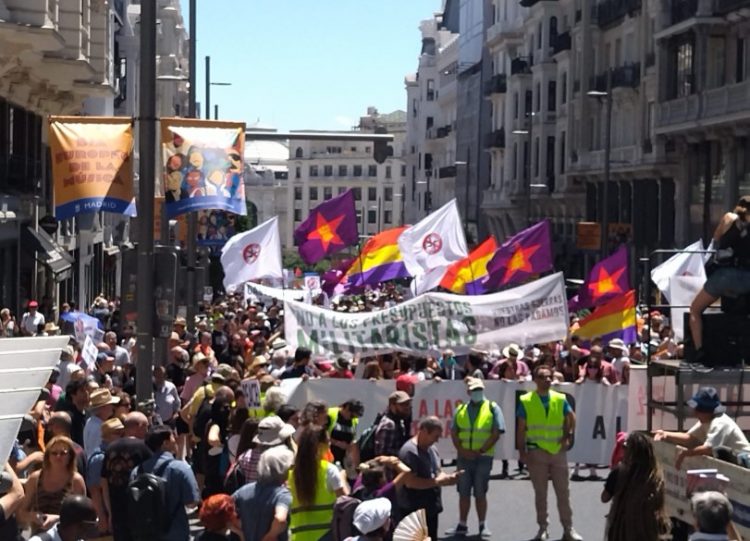
On 26th June 2022 tens of thousands took to the streets of Madrid in a rejection of NATO and imperialism. In addition to the people mobilised by the organisations and groups of the anti-NATO movement in Madrid, numerous buses were chartered from all over the state. The NATO Summit that was about to be held in Madrid (28 and 30th) has made it possible, after an important effort, to begin to revitalise and rebuild a movement opposing the armed wing of imperialism.
The groups attending with their slogans were many, from the anti-imperialist movement to some pacifist groups, through numerous organisations of the labour and popular movement, such as combative trade unionism or pensioners’ groups. Also noteworthy were representatives from abroad, such as a group of South Koreans against NATO, people from other European countries or groups from the Arab world, highlighting those who defend occupied Palestine and Western Sahara.
The repression has intensified during the previous two weeks and days: the city of Madrid has been militarised, organisers have even been arrested, they have been detained and threatened in their homes or they have been singled out in the press. Another demonstration called for the day of the summit, Wednesday the 29th, has been banned by the Government.
A section of the huge march on Sunday in Madrid (Photo: Insurgente.es)
COMMENT:
In addition to slogans against NATO (OTAN in Spanish), imperialism and war, one can also hear slogans specifically calling for the dismantling of NATO bases.
Not only will this huge demonstration and other acts in opposition to the summit lead to an intensification of general anti-imperialist struggle and against Spanish state repression but it will also likely encourage the forces for independence among the nations within the Spanish state, the Basque and Catalan nations and the Celtic nations of Galiza and Asturies.
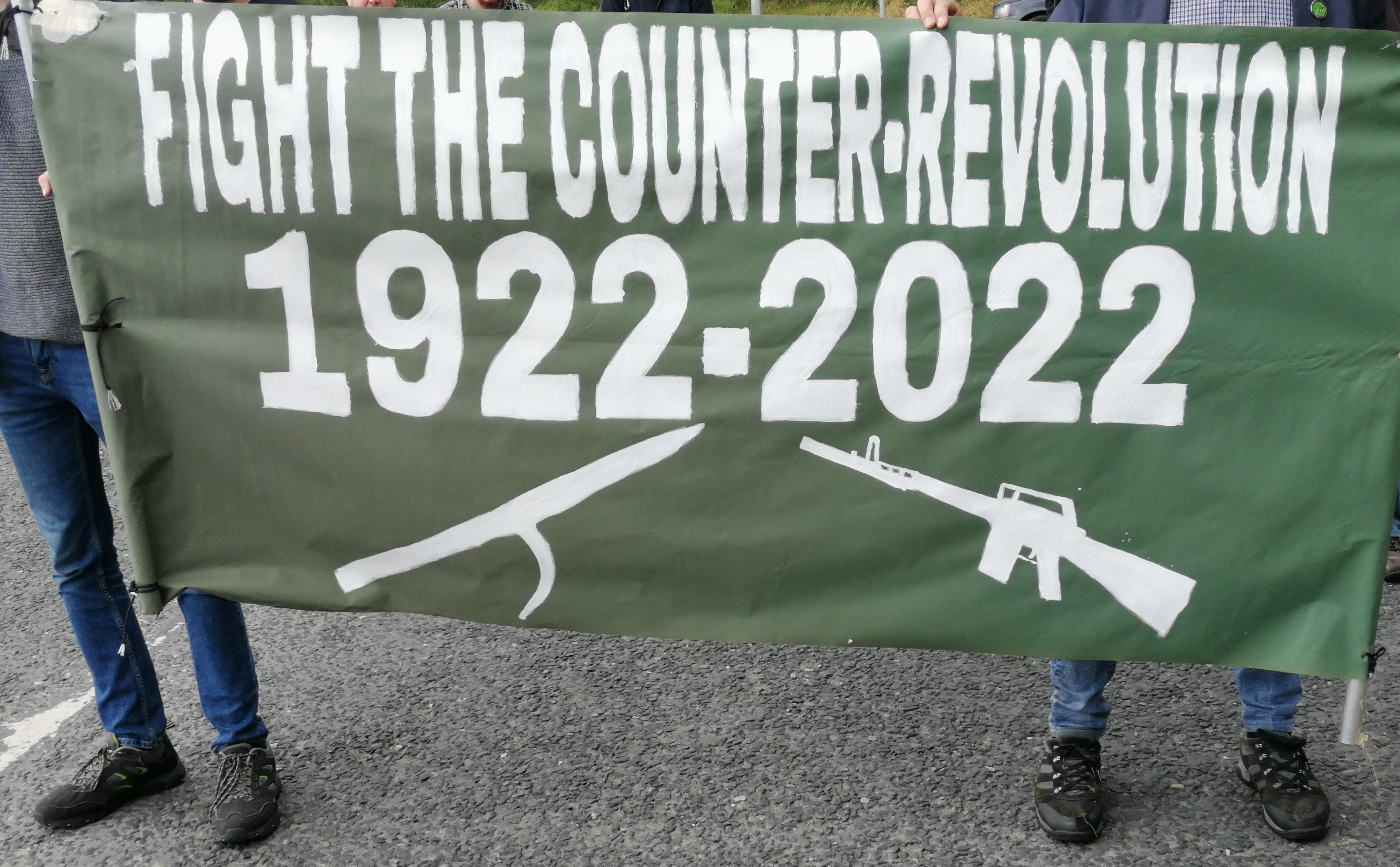
A crowd gathered in Dublin today to commemorate the Free State opening fire on the Four Courts on 28th June 1922, an event that began what is usually called “the Civil War” which lasted until 1923 (with State assassinations until 1924). The UK supplied the cannons and shells used by the Free State’s “National Army” along with munitions, including small arms and ammunition, armoured cars, army lorries and even coastal naval vessels. The conflict has also been called a “counterrevolution” and “the UK’s proxy war” with more Republicans executed by the new Irish State1 in that conflict than had been by the British State over the whole 1916-1921 period.
Section of NGA march outside Croppies’ Acre (Photo sourced: Internet)
One hundred years ago this month, the IRA under the command of Rory O’Connor occupied and fortified the Four Courts complex, last occupied as a fighting post during the 1916 Rising. The Anglo-Irish Treaty partitioning the country and giving the Free State the status of a Dominion country had been narrowly accepted by the delegates to the First Dáil, the Irish Parliament previously banned by the UK State. However by far the majority of the military part of the Irish resistance – the IRA, Cumann na mBan and na Fianna, along with the remnants of the Irish Citizen Army – were opposed to the Treaty. The occupation of the Four Courts was seen by the Free State government as a challenge to its authority and by the British Government as a threat of anti-colonial struggle being renewed. Both parties were hostile to any radical republican, socialist or socialist-republican program.
Free State Army attacking the Republican garrison of the Four Courts with artillery, rifle and machine-gun fire. (Photo sourced: Internet)
On 28th June the Free State opened fire from British cannon on the Four Courts from Bridge Street on the south side of the river and the Civil War – or Counterrevolution – had begun. By the time the Republicans conceded defeat (and some assassinations continued even after it officially ended) perhaps around 1,300 had been killed. From January 1922 to April 1924, according to the Republican Roll of Honour, 426 anti-Treaty Volunteers had been killed, some 25 of these died fighting British and Northern Irish forces. Most anti-Treaty dead were IRA Volunteers, but some were Na Fianna members and four were women of Cumann na mBan2.
Poster commemorating one of the Republicans killed by the Free State (Photo: D.Breatnach)
One of the commemorative posters attached to lampposts (Photo: D.Breatnach)
On the Free State side just under 800 died, of whom 488 fell in enemy action, others due to accidents or illness, while seven were executed having deserted to the Republican side. “To this total should be added a small number of police, including four from the Civic Guard (later renamed Garda Síochána), four from the Criminal Investigation Department and two from the Citizens’ Defence Force, who were killed from 1922-19243.”
The NGA rally, the MC (Photo: D.Breatnach)View of the crowd at the rally outside the Four Courts (Photo: D.Breatnach)
Dorney remarks on omissions in the Last Post record and concludes: “Even allowing for this, though, the total of anti-Treaty IRA dead in the Civil War is not likely to be much more than about 500, of whom 81 died before Free State firing squads and more than 100 were summarily executed in reprisals.”
(Photo: D.Breatnach)
Many Irish Republicans also emigrated to avoid repression or because they were being denied employment.
The Irish State today is a direct descendant, legally and in other ways, of the Free State of 1922 and all periods since.
Senior Garda officer taking notes while speakers are addressing the crowd (Photo: D.Breatnach)
The commemorative event in Dublin today was organised by the National Graves Association (Cumann Uaigheanna na Laochra Gael), an organisation which since its founding in 1926 has been maintaining the graves of Irish patriots, arranging for the installation of gravestones, plaques and monuments and also organising commemorative events.
Before marching to the Four Courts, participants formed up in groups in the road outside Croppies’ Acre, a public park over a mass grave of victims of the English state’s repression of the United Irishmen and their supporters in 1798, now across the road from the Collins Barracks National Museum. They were led by a lone piper and colour party, followed by people in double ranks flying Starry Plough flags and carrying banners of history and conservation groups, along with some other flags, including that of Cumann na mBan.
Section of the lineup waiting to start, outside Croppies’ Acre (Photo: D.Breatnach)
At the rally outside the Liffeyside of the Four Courts, the organisers had an MC with number of speakers to read out the 1922 Proclamation, the lyrics of The Soldiers of Twenty-Two4 and Tim Horgan to give a keynote oration. At least one floral wreath was laid in honour of those who fought there and a number of posters attached to lampposts commemorated the three Volunteers who were fatally wounded there: Thomas Wall, Joe Considine and Sean Cusack.
Reading the lyrics of Soldiers of Twenty-Two (Photo sourced: D.Breatnach)
It is almost certainly the case that it is the NGA which has erected the majority of patriotic struggle commemorative plaques around the country, with most of the remainder being organised by local authorities, local history groups and old comrades’ associations – a very small proportion being the work of the State. As stated on its website, the objectives of the Association have always been: to restore, where necessary, and maintain fittingly the graves and memorials of our patriot dead from every generation; to commemorate those who died in the cause of Irish freedom; to compile a record of such graves and memorials.
The NGA’s general alignment is unequivocal: “Only a 32 County Irish Republic represents the true aspiration of those who gave their lives for Irish freedom.5“
Reading the 1922 Proclamation (Photo: D.Breatnach)
One might assume that every participant at the event today was of a definite political bent, yet not a single party or political organisation banner was to be seen on the march or at the rally. This is because participants were asked in advance not to bring any banners or placards of political organisational allegiance. As the Chairperson of the rally informed the audience, the NGA is not affiliated to any political party or organisation and furthermore does not accept contributions from any such nor from the State – in order to continue to guarantee the NGA’s independence. In fact, members of its governing body are not even permitted to belong to a political party. A senior Garda officer however, of least at Inspector rank, took down details in his notebook as the rally was addressed by speakers.
Main speaker, Tim Horgan (Photo: D.Breatnach)
Patriots of the United Irishmen, the Young Irelanders, the Fenians, the Land League, na Fianna Éireann, Irish Volunteers, Cumann na mBan, IRA, Official and Provisional IRA, the Irish National Liberation Army etc have all been commemorated by the NGA. According to Wikipedia, since its founding, the NGA has erected, or accepted into its care, over 500 monuments and memorials throughout Ireland.
One of the participants takes a rest
Banner of one of the groups attending (Photo: D.Breatnach)
Some of those in attendance (Photo: D.Breatnach)
A number of other Civil War/ Counterrevolution commemorative and discussion events will be taking place at least during this year, two of which will take place next week (see photos of leaflet).
The Gardaí remained at the scene as people dispersed. Passing by again shortly afterwards, we found the floral wreath had been removed.
End.
Lowering of the flags in honour of the martyrs (Photo: D.Breatnach)
Civil War/ Counterrevolution commemoration (image: photograph of flyer)
Forthcoming talk (image: photograph of flyer)
FOOTNOTES
1Official executions are usually listed as 81 or 83, these having been subjected to some kind of military judicial process (but without any jury). However, apart from IRA fighters killed in battle, a number of captured combatants were murdered (such as those of the Ballyseedy Massacre on March 7th 1923) while known activists were assassinated by Garda-Army squads operating from Oriel House. Often, the murdered had been tortured first.
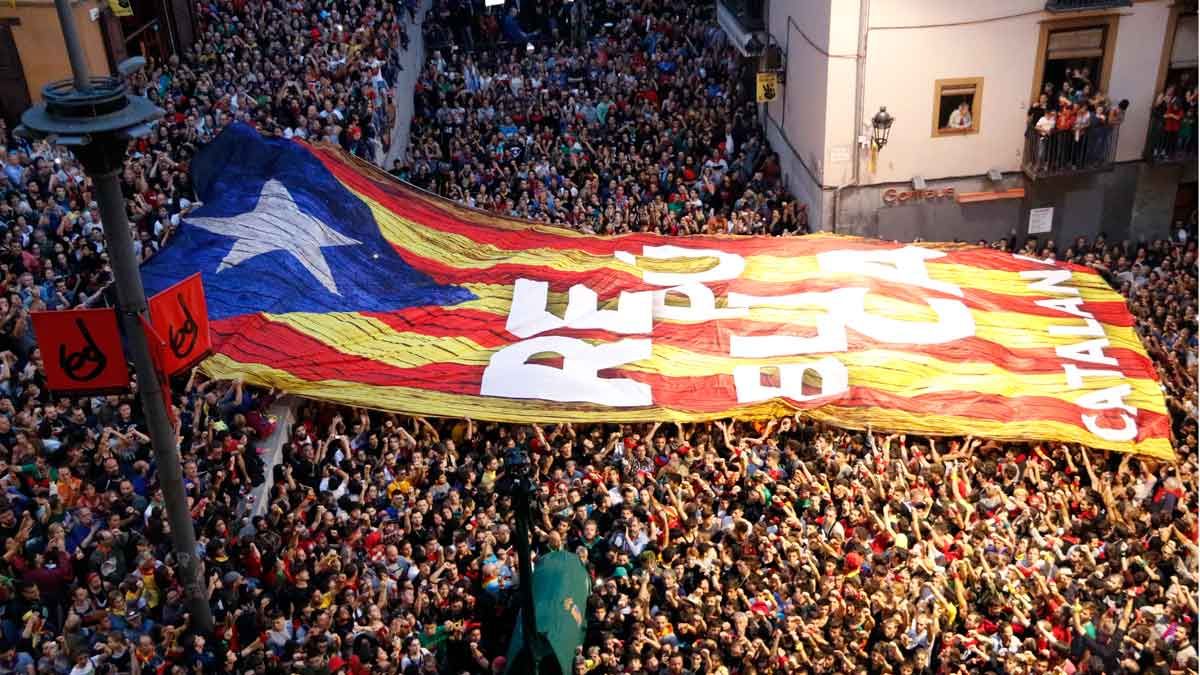
This year’s celebration of the Patum 2022 festival in Berga has sung and chanted for independence. With the square full of about 6,000 people on Thursday, the massive Catalan independence flag, the Estelada (with the white star in a blue triangle)1 was launched across the crowd as they sang the Catalan national anthem, Els Segadors2 (the Reapers).
With the song finished, some began to shout “independencia” (independence) and this was quickly taken up by the mass, revisiting the tradition of protest that existed before the pandemic. The Catalan independence movement has been somewhat becalmed of late, with serious divisions between the two main nationalist political parties and a lack of grass-roots activity.
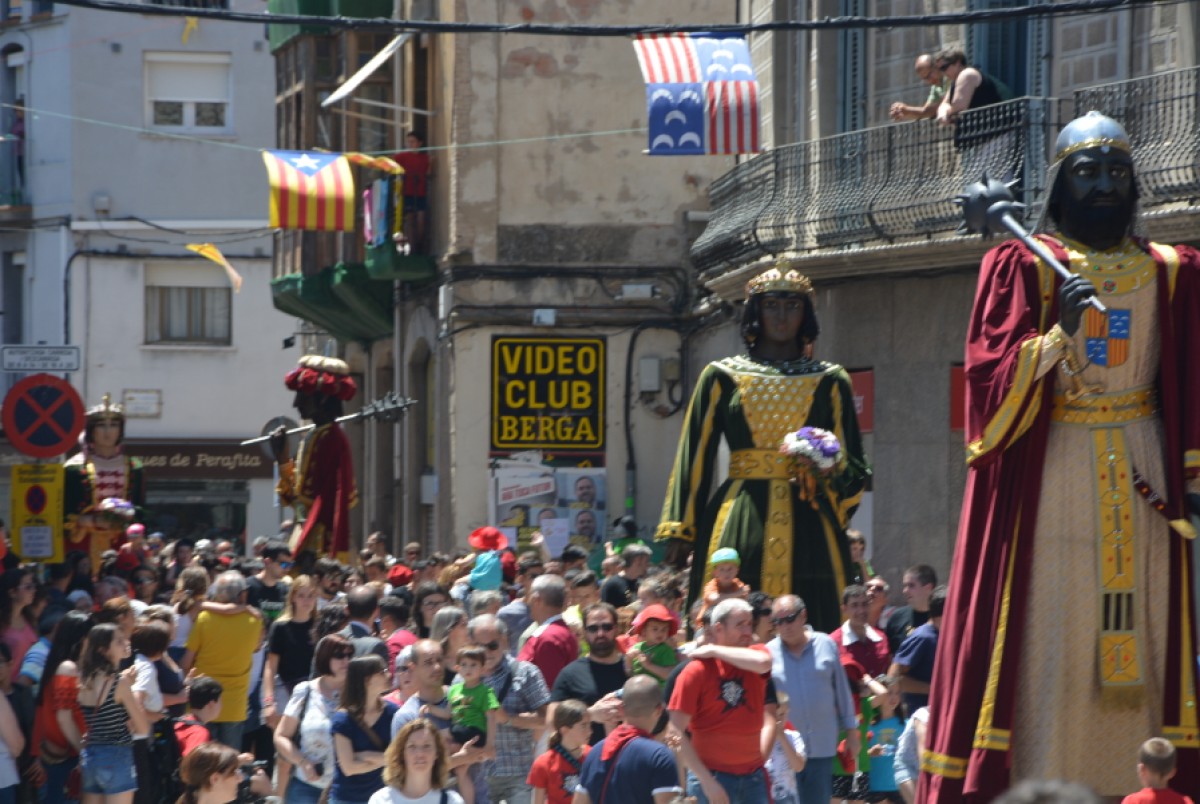
Scene with traditional giant figures from the festival (Photo sourced: Internet)
The Patum festival is a traditional Catalan festival of great importance and is recognised by UNESCO as a Masterpiece of the Oral and Intangible Heritage of Humanity. “The fiesta coincides with Corpus Christi and includes a whole series of theatrical representations, characters and figures that fill the town of Berga every spring. It is a religious commemoration that dates back to the Middle Ages, which has managed to preserve both its religious and profane roots.
“La Patum de Berga has been held annually for centuries during Corpus Christi, and includes street entertainment and shows with different figures typical of these fiestas (giants, “big-heads”, eagles, guitas (dragons), plens (devils)). Fire and dance play a central role. The fiesta really gets underway on the Thursday of Corpus Christi, with the Ceremonial Patum. The salto de plens is the apotheosis of the fiesta. It represents an infernal orgy where fire devils jump to the rhythm of music. The following day is the Children’s Patum.”3
Scene with the giant Catalan independence flag during the singing and chanting at the festival on Thursday (Photo sourced: Internet)
Berga is in the Barcelona region but over 107km from the city (and about half-way to Andorra). The Patum Festival of this year 2022, which began Wednesday, June 15 and will last until Sunday, June 19, was expected to be even more crowded than usual after two years in a row without being able to celebrate it due to the pandemic.
1The other Catalan nationalist flag commonly seen is the Vermelha, with a red star and no blue. The white X on a black background is also flown but more rarely, it draws on history also and signifies ‘death before surrender’.
2An anarchist, Emili Guanyavents won the competition to compose the national anthem lyrics in 1899 and based it upon a traditional historical cultural expression arising out of an uprising of Catalan rural workers in 1640 against the chief minister of Philip IV of Spain. The lyrics are, as might be expected, very militant and, since even the Catalan lanugage was banned, the song was of course banned during the four decades of the Spanish Franco dictatorship
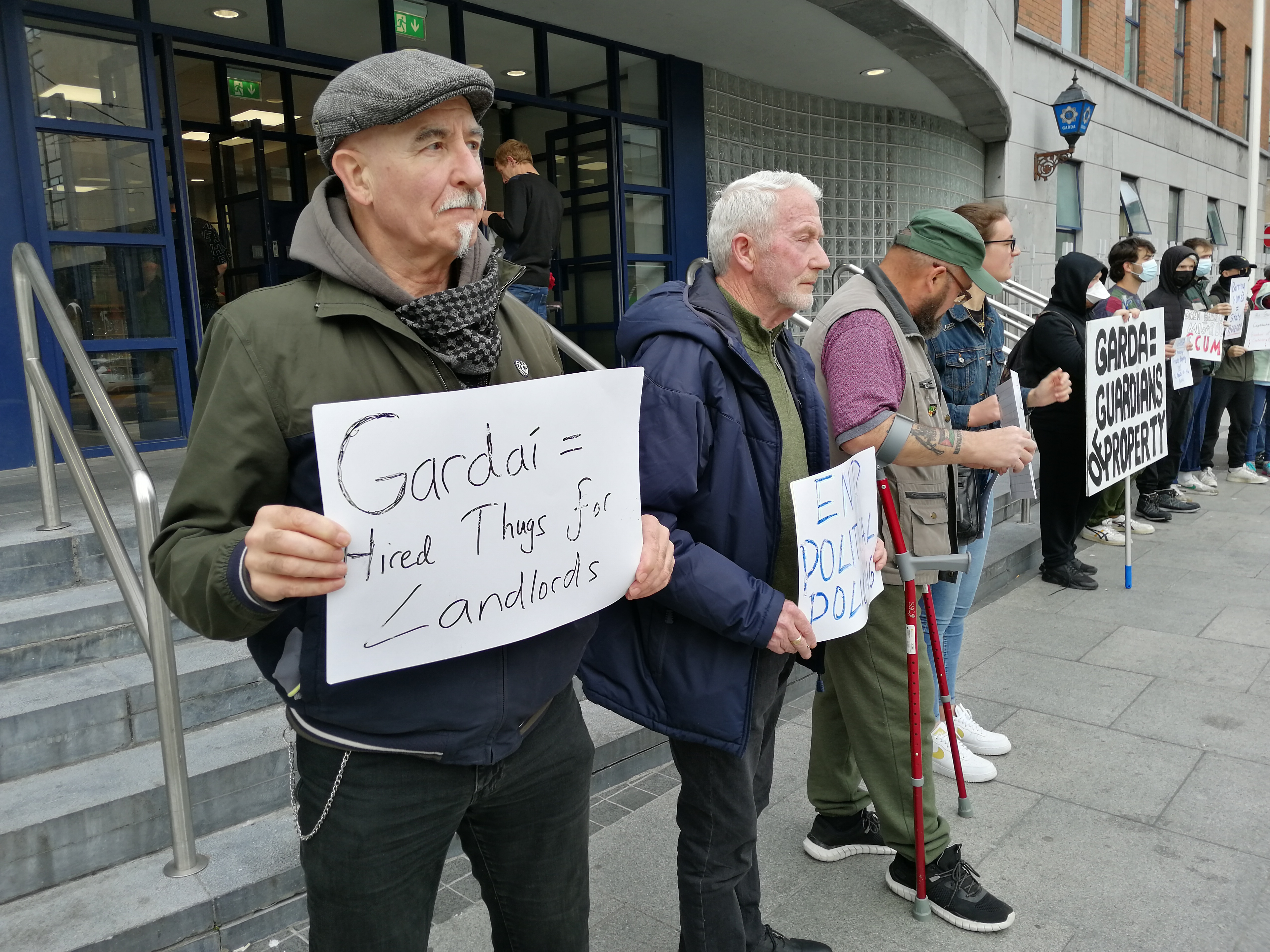
Passers-by on foot and on the Luas tram lines watched curiously as housing activists and others held a picket outside Store Street Garda station in Dublin on the evening of 13th June 2022. The picket was called for by the Revolutionary Workers Union, protesting the taking by over 80 Gardaí of a house on Eden Quay and arresting of two occupants, followed by the arrest of another two activists near another address.
Poster advertising the event on social media. (Image sourced: Internet)
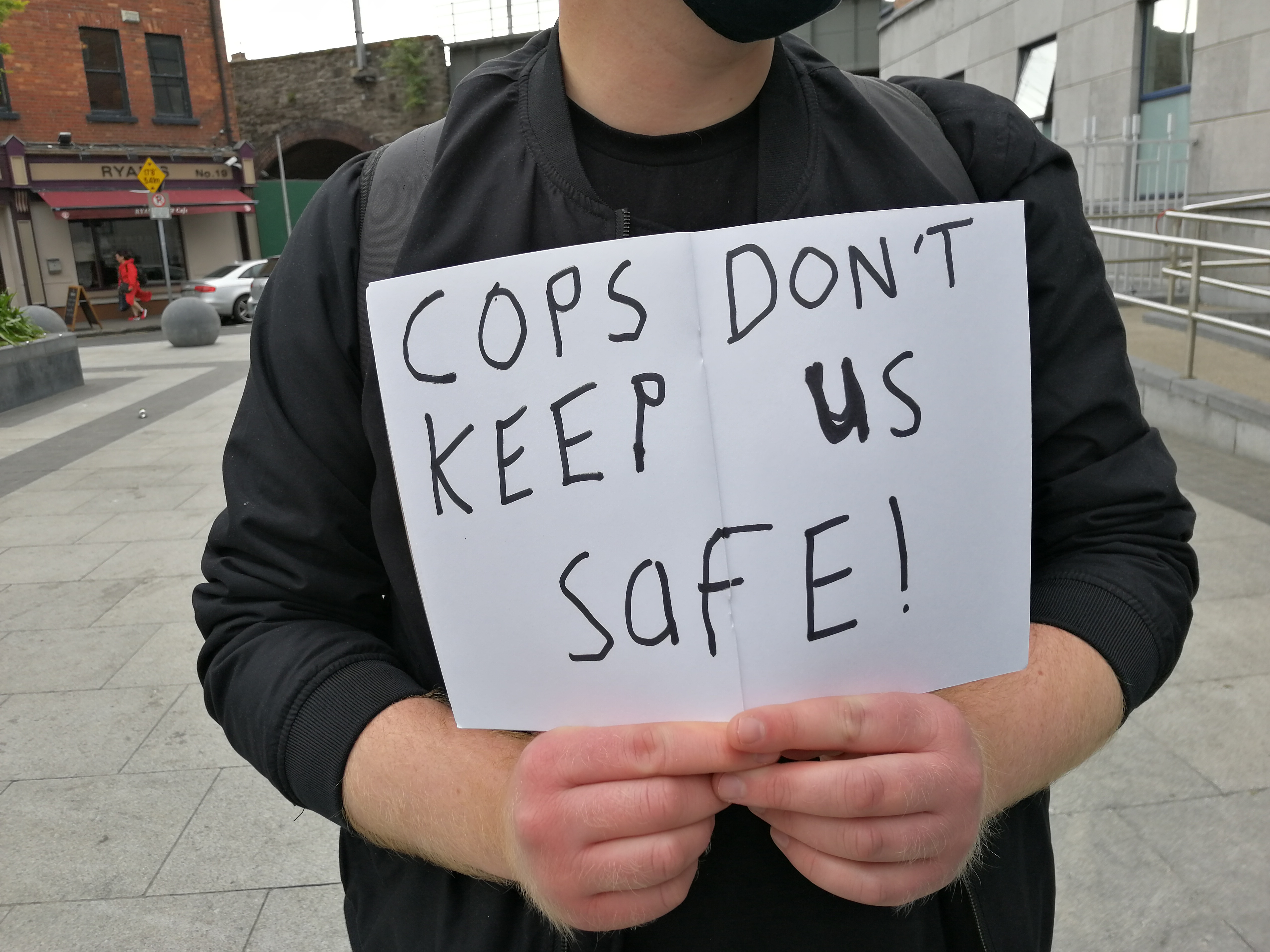
The picket was called at fairly short notice and supported by people from a variety of political backgrounds, all with what were clearly home-made placards. Picketing a police station is somewhat counter-intuitive, given that’s to where the police take their prisoners and most people want to stay away from those places, with good reason. However, the station is the location of the police symbolically and in reality and Store Street is one of the main ones in Dublin so, when one wants to protest about the police …… Once having protested at a police station, the apprehension is never quite the same again.
Some passers-by stopped to ask what the protest was about, some of whom expressed anger at the actions of the Gardaí and a reporter from an independent media interviewed some of the participants.
Picketers outside Store Street Garda Station, Dublin City centre on Monday. (Photo: Rebel Breeze)
Some time later the picketers were addressed by Seán Doyle of the RWU who spoke about the morality of the landlords and speculators and the Gardaí who work for them. Doyle contrasted that morality with the one that saw provision for need instead of profit. During the course of his address, Doyle pointed out that the RWU knows people who work in emergency interventions such as with people attempting suicide, who are then brought to agencies to help them but who are soon out again and homeless. “This is not ‘ethnic cleansing’,” the activist said, “it’s class cleansing.”
(Photo: Rebel Breeze)
The RWU spokesperson at the picket remarked on the use of the law and the Gardaí against housing activists while speculators and landlords make big profits out of the misery of homelessness. A law that upholds and defends that kind of practice must be defied, he stated as he drew to a close.
Some of the picketers on Monday (Sean Doyle is second to the right). (Photo: Rebel Breeze)
Seán Doyle was one of two activists that were removed recently by over 80 Gardaí from a one-and-a-half years empty homeless hostel which the RWU had “acquisitioned” and renamed “James Connolly House”. Another premises subsequently acquisitioned, also empty for a long period, the RWU renamed “Liam Mellowes House” and the Gardaí arrested two activists near there also, despite any occupation of the building being a civil law matter and outside the remit of the Gardaí.
The RWU on a number of occasions have called on people to “take back empty buildings” and have declared that they will not be intimidated by arrests but will continue to fight for the right of people to a secure home.
Another view of part of the picket on Monday (Photo: Rebel Breeze)
One of the home-made placards at the event. (Photo: Rebel Breeze)
End.
A placard denounces the recent 80+ Garda eviction of “James Connolly House” and arrest of two occupants (Photo: Rebel Breeze)
On 2nd June a number of Left anti-imperialist organisations and individuals held a public rally in Bilbo/ Bilbao. The municipal authority refused them use of a building and they held it in the open air in the Etxebarrieta Square. The organisers issued a statement in Euskera (Basque language) and Castillian (Spanish) calling for unity against the war plans of NATO and the EU and denounced the equivocating posture of the ‘official’ left Basque movement, denounced also the militarism of the Spanish coalition Government and advertised a joint demonstration for 18th June in Moyua, on the south side of the river in Bilbao1.
STATEMENT ISSUED BY COORDINATING GROUP (translated by D.Breatnach from Castilian Spanish version published in Ecuador Etxea)
For several weeks, various people and groups from Bilbao, Meatzaldea, Uribe-Kosta, Ezkerraldea and Busturialdea2 have been coming together in this broad initiative to respond to the escalation of war that we are seeing around us. An escalation of war promoted by NATO, with the aim of shielding the world hegemony of the United States against the rise of emerging powers such as China, India, Iran or Russia. A strategy that is doomed to failure, but that will cause, if we do not prevent it first, destruction, misery and death throughout the planet.
In Bilbo/ Bilbao 2nd June, reading the declaration and call to unite and for rally on 18 June in Basque and Castillian (Spanish). (Photo source: Ecuador Etxea)
In relation to the conflict in Ukraine, we believe that in no case can one speak of an inter-imperialist struggle between the NATO countries and Russia. Rather, it is an offensive planned for years to overthrow the legitimate government led by Vladimir Putin and gain control of Russian energy resources and markets. A policy of looting and plundering that the current Russian President put a stop to, no matter how hard it is for some to admit it. Ukraine is nothing more than the operations base and the cannon fodder of Atlanticist imperialism against its historical enemy, Russia.
Many on the Left say that the Russia of today is not the Soviet Union of yesterday. And they are completely correct. The problem is that even the slightest economic planning for social purposes by any State has become an obstacle to the viability of the parasitic capitalism that we live under. There we have the cases of Slovdan Milosevic, Saddam Hussein or Muammar Gaddafi, sadly imprisoned and/or executed in the face of complicit silence or the enthusiastic support of what they call the “international community.”
Those of us who are here today have already learned our lesson: first they demonize the currently out of favour ruler through the media, and then they justify military offensives and imperialist massacres. That is why at this time we cannot make the mistake of placing ourselves at equidistance. Both Russia and the Donetsk and Luhansk People’s Republics have every right in the world to defend themselves against the aggressions of NATO and the EU, which conspire and supply weapons to fascist governments like Zelensky’s to harass Russia and destabilize the region. Not to mention the openly Nazi battalions captured in Azovstal, whose release France and Germany now demand in order to advance in the negotiations. What do European governments owe the Nazis in Azov? What do they have to hide and why do they intend to buy their silence?
The truth is that we still do not know the exact reason why the States of the European Union have completely bowed to the interests of the United States. It is evident that the sanctions against Russia and the new oil and gas supply routes imposed by the US only benefit the Yankee tycoons, the Arab sheikhs and the absolutist monarchies of Saudi Arabia, Qatar or the United Arab Emirates. NATO vassals like Borrell have definitively cast the old European project into History’s dump. They prioritize profit and military spending to the detriment of the health and living conditions of the broad masses and announce a future of misery and sacrifice for a war in favor of a capitalism that is against us. The European Union is definitely a rotting political corpse, in case anyone ever thought that it could have been a progressive alternative or for oppressed nations like ours.
Arnaldo Otegi, leader of “the institutional Abertzale Left” (Basque left-nationalist movement). (Photo source: Internet)
Precisely here in the Basque Country, the official position of the institutional Abertzale Left3 regarding what is happening in the Ukraine is especially embarrassing. It seems unbelievable that those who proclaim themselves heirs to the historic struggles of the Basque Working People, a people of which the majority in 1986 opposed remaining in this criminal organization4, now wave the flag of “no to war” and of ambiguity. It seems immoral to us, both the pacifism that denies the just right to defense of those who are attacked by imperialism, as well as the lukewarm posture of those who do not take a stand, thus facilitating the advance of imperialism. Anti-imperialism and anti-capitalism must be cultivated day by day, if we do not want the ideological and cultural offensive of NATO and the EU to continue having effect, in particular among the sons and daughters of the working class. Thirty-six years later we unambiguously reaffirm ourselves in NO to NATO, no to FASCISM, no to GENOCIDAL IMPERIALISM.
As we said, we are witnessing an implacable propaganda to make us part of this imperialist strategy, so that we do not rebel against what is happening. While they continue to spread one-sided thinking through the big media, television channels that question the official story — such as Russia Today — are closed without the slightest shame, content on the Internet is censored by appealing to supposed “verified information”, journalists like Pablo González5 are imprisonedor political information is systematically eliminated from our streets. They not only want to indoctrinate us, they directly deny us the right to be informed. Where are the defenders of freedom of expression? Are we already living in a hidden state of emergency?
It is our obligation, therefore, to denounce, not only the rise of international fascism, but also the fertile ground that the fascists have in the Spanish State of the bannings, the GAL6, the closure of newspapers and the systematic torture of political dissidents7. Atlantic capitalism will never be able to find a better ally than the PSOE8, veritable experts in the art of manipulating and deceiving the working and broad masses. Sadly, there are times when collective memory seems too fragile. Of course, for this new phase they have found a faithful shield-bearer, the party of Yolanda Díaz9. Seconds were never good, we are already seeing where these wolves in sheep’s clothing are leading us…
We said at the beginning that different people have come together to counteract this hegemonic discourse that manipulates consciences and protects the sequestration of rights and freedoms. From Muskiz to Gernika we rebel today here against this ominous imperialist offensive. All this suffering is not necessary, there is no reason to accept the misery and the war to which NATO and the EU want to condemn us. It is also not the time to stay at home watching, or to follow the war as if it were a video game.
We therefore issue a call to all the towns and neighborhoods of Euskal Herria and other nations to continue organizing the fight against imperialism, capitalism and fascism. And we also invite all the people who are against the imperialist offensive of NATO and the EU to participate in the demonstration that we will carry out in Bilbao, on June 18 at 6:30 p.m. from the Plaza Elíptica.
NO TO NATO! NO TO THE EUROPEAN UNION! NO TO IMPERIALISM!
End statement.
TRANSLATOR FOOTNOTES
1Which is also the location of the representation of the Spanish State in Bizkaia and guarded by armed police.
2A number of towns and districts across the SW Basque province of Bizkaia.
3The ‘official’ leadership of the left-Basque independence movement, e.g the EH Bildu party under the leadership of Arnaldo Otegi and others.
4In the 1986 referendum on whether to remain in NATO, the Basque Country gave the highest majority for No, with the Canaries and Catalonia coming behind. For the whole Spanish state, nearly 57% voted Yes against 43.15%.
5Basque freelance journalist reporting for Publico (Spanish left online media) and La Sexta, threatened and advised to leave Ukraine by state intelligence services, which he did but arrested by Polish intelligence on 28 February as he was about to re-enter Ukraine with a group of journalists. Poland has charged him with spying for Russia but to date produced no evidence and even denied him access to his lawyer. The Spanish State sent intelligence service agents to question his wife, mother and friends.
6GAL: A Spanish state terror and assassination organisation of the 1980s operating against the Basque resistance which was exposed as led by the Prime Minister (though never even questioned) Felipe Gonzales and directed operationally by the Minister of the Interior and senior Army and Police officers, a number of which received prison sentences.
7The Spanish state has long been accused by human rights organisations of torturing political dissidents and convicted in the European Court of Human Rights a number of times of failure to investigate complaints of torture. The State has closed newspaper and social media sites, jailed rappers, banned political parties, banned demonstrations, closed political cultural centres, disqualified political activists from representation in elections and jailed political activists.
8The main Spanish social-democratic party, currently in coalition government with Podemos.
9Yolanda Díaz resigned from Izquierda Unida (United Left – a broad coalition) but remained a member of the Communist Party of Spain; she is currently Deputy Prime Minister in the Spanish coalition government.
An anti-vaxxer giving his reasons as “exhibiting Covid symptoms” for failure to attend court on a charge of dangerous driving was ironical. The item concerned that appeared briefly in Breaking News recently naturally awoke interest as no doubt it was meant to. But then I noted the man’s name which really focused my attention.
Antonio Mureddu Gravegliu with an address in Galway was the man in the news item and a man by that name gained infamy back in September 2021 as a result of a video that showed him encouraging – almost bullying – a man very sick with Covid symptoms to leave hospital, despite the pleading of medical staff. The man left with Mureddu, had to be rushed back to hospital again and died a couple of days later.
Antonio Mureddu, still from his own video from the hospital scene.
Both men, Mureddu and Joe McCarron, were active members of Direct Democracy Ireland, a far-Right coalition with links to others including the Christian Solidarity Party and whose positions included opposition to the administration of the vaccine with most members also apparently deniers of the existence of the Covid pandemic which overburdened a strained Irish health service (especially with non-vaccinated patients) and to date is calculated to have been a significant factor in the deaths of 7,347 people within the Irish state. Mureddu thanked fascist Dolores Cahill for her support on that occasion and DDI was also associated for a while with peculiar and confused Freemen views concerning an imagined inherent legal system — which Mureddu seems to have shared, according to strange documentation he submitted to another court. In December 2018, according to a report in The Beacon, Mureddu was organising a meeting in Galway for the fascist Liga Nord organisation.
On 3rd June, Mureddu was due in court to answer a summons on dangerous driving but the court had been presented a medical certificate to the effect that he was displaying “Covid symptoms – flu like”. His case was adjourned to June 17th when a Garda witness said Mureddu would be expected to answer to another summons and both could be treated together. And therein lies the mystery.
Antonio Mureddu (photo credit North-West Pix via Donegal Live)
Breaking News reported that “The dangerous driving summons before the court on Friday is a re-entered charge that was one of three charges that were withdrawn by gardaí against Mr Mureddu at a court in March.”
Withdrawn? Re-entered? Three charges?
On March 4th at Ennis District Court, Sgt Moloney withdrew a charge that Mr Mureddu assaulted Garda James Hanley with intent to resist or prevent the lawful apprehension or detention of himself for an alleged offence, dangerous driving on August 10th 2021 …. contrary to Section 19 of the Criminal Justice Act (Public Order Act).
Assault on a Garda charge withdrawn?
On the same date, Sgt Moloney said that Gardai were withdrawing two dangerous driving charges from the same date at Caheraphuca, Crusheen and on the M18 at Ballymacahill, Ennis.
The report continued:
In relation to separate and unconnected alleged motoring offences before Letterkenny District Court, Mr Mureddu told a judge this week he will only return to court on alleged motoring offences if he gets one million euro.
In court Mr Mureddu told Judge Brendan O’Reilly “if you are going to adjourn this it is going to cost you one million euro. I’m not coming next time”.
So in summary, an extremely arrogant far-Right activist and allegedly serial dangerous driver was charged with an assault on a Garda, then the police for some reason withdrew that charge and also other dangerous driving charges. And he was allowed to give lip to a judge in one court and then failed to turn up to another, excusing himself with a medical certificate listing symptoms of a virus the existence of which he denies.
Does anyone believe any Irish Republican or Left-wing activist would have been treated with such leniency? Are you joking me?
Perhaps someone had a word with the Gardaí in Ennis about how this might look and got them to reinstate some of the earlier charges.
It will be interesting to follow this case awhile.



















 rebelbreeze