An event was held on a busy Saturday afternoon in Dublin’s city centre to commemorate IRA volunteer Patrick O’Brien, killed by soldiers of the Irish State.
The event included bagpipe airs, a colour party, speeches and a resistance song.
A colour party with Irish Tricolour and the flags of the four provinces, led by a lone piper marched into and a short distance westward up Talbot Street towards where a crowd waited beside a memorial sign that had been erected shortly earlier. The colour party took up station on the opposite side of the road.
Led by a piper playing Irish airs, the colour party (i.e carrying the flags – the Irish Tricolour and those of the four provinces of Ireland) approaches as the start of the commemoration. (Photo: D.Breatnach)
Among the airs being played on the short march were Thomas Moore’s Let Erin Remember and The Wearing of the Green or The Rising of the Moon, the same traditional air to both different songs referring to the 1798 Rising.
THE SHORT LIFE OF A LOYAL REPUBLICAN
Framed portrait photo of Vol. Patrick O’Brien on display at the commemoration (Photo: D.Breatnach)
Gina Nicoletti, chairing the event, recounted to the crowd a short history of Volunteer Patrick O’Brien who was born on 17 August 1898 in the townland of Woodlands near Castledermot in County Kildare to a local agricultural working couple.
The O’Brien family had 16 children, all of whom survived and ten of whom lived with Patrick and his parents in a three-room house at the time of the 1911 Census.
An obituary published in a Republican newspaper on the anniversary of his death suggests that Patrick moved to Dublin in 1915, joining the Irish Volunteers in December of that year aged 17. He took part in the 1916 Easter Rising under the command of Edward Daly.
Evading capture in 1916 and returning home, O’Brien joined the local Irish Volunteers company in Castledermot but returned to Dublin in May 1917 and became attached to E Company, 3 Battalion, Dublin Brigade, Irish Volunteers, which was based on the south side of the city.
Sean Óg sings The Foggy Dew while accompanying himself on guitar and centre of photo is Gina Nicoletti, who chaired the event. (Photo: D.Breatnach)
An active IRA member during the War of Independence, Vol. O’Brien took the anti-Treaty side in the IRA split in March 1922.
In a response to a renewal of executions of IRA men by the Free State government, Liam Lynch (IRA Chief of Staff) issued the ‘Amusements Order’ on 13 March 1923 banning all cinema, theatre and sports events “at a time of national mourning” with action threatened against non-compliance.
At midnight on 23 March 1923, Patrick took part in an operation to blow up the Carleton Picture House, O’Connell Street (then near the Parnell Monument opposite the Savoy Cinema). The cinema had closed an hour before a landmine at the front entrance shattered the glass of several windows.
There were no injuries but newspaper articles reported that the sound of the explosion was heard several miles away. Accounts of what happened afterwards were gathered from one of the IRA unit, Volunteer Joseph Doody in his pension application.
The unit unexpectedly encountered Free State soldiers coming from the Parnell Monument who opened fire on them and another patrol was approaching from the southern end of O’Connell Street and the unit retreated through Findlater Place and out to Marlborough Street.
In the running firefight in Talbot Street, O’Brien was hit by at least four bullets (three in his left leg and one in his right leg). He fell wounded on the pavement between Speidel’s pork butchers and the Masterpiece Picture Palace at 99 Talbot Street and died about 30 minutes after arrival at hospital.
The colour party lowers the flags in honour of a martyr as the piper plays a lament (Photo: D.Breatnach)
Patrick O’Brien was 24 and his death certificate listed his occupation as an employee of a railway company. His address was 28 Cadogan Road, Fairview which is a cul de sac of Victorian redbrick houses close to Annesley Bridge and opposite the Sean Russell statue.
Only three weeks before Patrick’s death, the Free State CID1 had raided no. 43 Cadogan Road and captured the press used to print the Sinn Féin2 paper An Phoblacht along with eight people who were on site. A number of prominent IRA families lived in the vicinity, including the Brughas.
Patrick O’Brien was buried in the Republican Plot, Glasnevin Cemetery and a volley was fired over his grave, presumably following the funeral in the cover of darkness as the IRA could not have risked such a public display during the burial, in a time of martial law.
The colour party raise the flags again in symbolism of the struggle carrying on after honouring a martyr (Photo: D.Breatnach)
Despite the hard repression by the Irish State on combatants, their relatives and friends, O’Brien’s family were proud of Patrick as displayed in an anniversary notice placed in The Nationalist & Leinster Times.
The Irish Independent reported on 27 March 1923 that at the inquest of Patrick’s death, his brother James told those present:
“[My brother] … belonged to the IRA since 1915 being then about 15 years of age. He had never changed his principles since then. He always intended to die as he did … rather than change his principles as he swore allegiance to the Republic in 1916.”
FLORAL WREATH, SONG AND SPEECH
A representative of Anti-Imperialist Action was called upon and stepped forward to attach a green, white and orange floral wreath to the pole beneath the commemorative sign.
The plaque/ placard commemorating Vol. Patrick O’Brien attached in Talbot Street by Independent Republicans with the floral wreath from Anti-Imperialist Action attached below it (Photo: D.Breatnach)
Seán Óg accompanied himself on guitar singing The Foggy Dew, a popular Republican ballad about the 1916 Rising composed by Fr. Charles O’Neill.
Dublin City Councillor Cieran Perry gave a fairly short speech stressing the importance of these acts of remembrance upholding traditions of resistance in the Dublin working class, also denouncing the fake patriots who stir up racist divisions and hostility in the community.
Perry’s speech also listed some of the crimes of the Irish state, facts underlined when Joe Mooney read out the list of 70 IRA Volunteers formally executed by the Irish state along with those killed in battle or after they surrendered, or were abducted, tortured and murdered in Dublin 1922-’23.
Cnclr. Cieran Perry speaking at the commemoration. (Photo: D.Breatnach)
TRAFFIC AND PEOPLE
Traffic was light along the narrow Talbot Street during the event and slowed down to ease past the crowd that had spilled from the pedestrian pavement into the street. A few minutes’ eastward of the spot is the plaque commemorating the killing of Sean Treacy by the British in November 1920.
There was a substantial number of people in support of the event on both pavements of the one-way street but others gathered too, whether out of curiosity or in sympathy. Some of those present consisted of visitors from other countries, whether as students, tourists or workers.
The crowd grew and spilled on to Talbot Street. [The plaque to Vol. Sean Treacy killed by British soldiers in 1920 is high on the front of a building just beyond the tree on the right of photo] (Photo: D.Breatnach).
Not for the first time I thought that having leaflets to distribute summarising the event and the reason for it would be useful. I spent a little time explaining some aspects of the event and its history to a couple of visitors from Sweden who seemed very interested.
The uniformed Gardaí kept away from the event, though no doubt the plain-clothed political Special Branch had a few of their own in the vicinity to collect faces and try to match names.
THE ORGANISERS: INDEPENDENT REPUBLICANS
The commemorative event was organised by a group by the name Independent Republicans which has been doing great work in conserving and promoting historical memory associated with events such as the 1916 Rising, the War of Independence and the Civil War.
The Irish Free State came to power as an instrument of British imperialism which clothed, armed and otherwise supplied the state’s National (sic) Army. Independent Republicans have collected the names of 70 Irish Republicans killed in Dublin by that Army.
The group has also devoted time and effort to researching the backgrounds and circumstances of death of many on that list, a substantial undertaking for which we owe them a great debt. Their erection of ‘plaque’ signs around the city at the spot where the fighters fell is also great work.
The commemorative plaque/ placard to Vol. Patrick O’Brien’s memory being erected shortly before the start of the event (Photo: D.Breatnach)
On Easter Saturday (8 April) Independent Republicans will be holding a 1916 Rising commemoration in Dublin city centre, details below.
Anti-Imperialist Action will be holding theirs on Easter Sunday (9 April), details below.
End.
FOOTNOTES:
1Criminal Investigation Department, based at Oriel House, where police detectives and some soldiers of the Free State organised operations against Republicans including raids, assassinations, abductions and torture.
2This is not the party of the same name today. Sinn Féin began as a dual-monarchy Irish nationalist party, adopting Republicanism later in 1918. Those who later supported the anti-Republican status of the country and partition by England left the party and another large number left to join the Fianna Fáil party upon the latter’s founding. Briefly in the 1960s the party espoused socialism but split at the end of the decade and Sinn Féin under the Provisionals briefly adopted socialism again during the 1970s. The party of that name today is neither socialist nor even Republican.
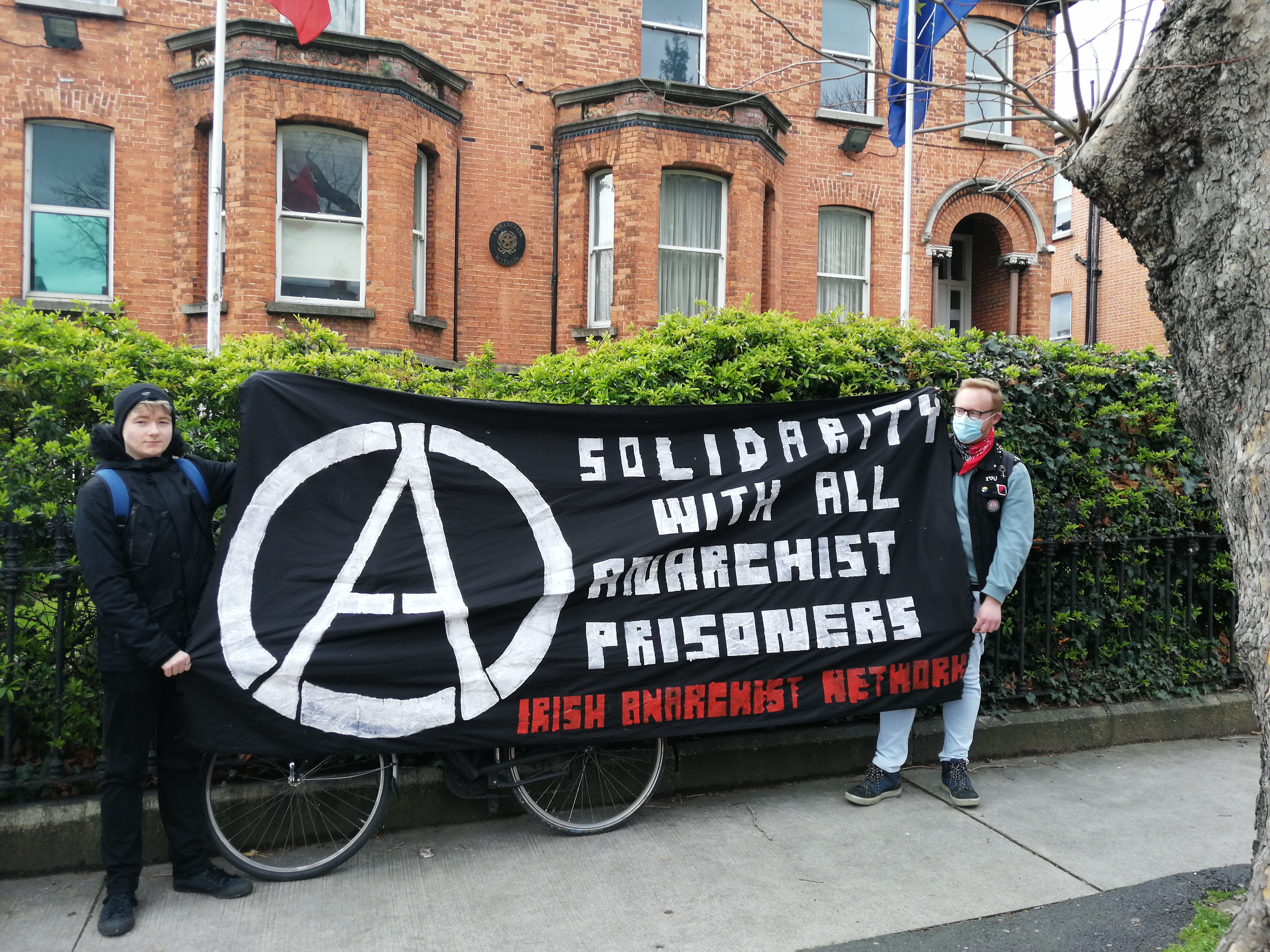
A picket outside the Italian Embassy in Dublin on Thursday (23rd) was part of a day of action across Europe in solidarity with an Anarchist prisoner on hunger strike since October in a struggle for more humane prison conditions.
The picket, organised at short notice, included Irish Republicans, Anarchists and revolutionary Socialists. Banners and placards indicated the presence of Saoradh, Irish Anarchist Network and Ireland Anti-Internment Campaign.
At one point five uniformed Gardaí stood near the Embassy’s gate while three plain-clothes Special Branch (i.e. political police) watched from a car across the road. The police numbers may have been due to a request from the Embassy in the midst of attacks on some Italian Embassies in Europe.
Despite the presence of Gardaí, Embassy staff appeared nervous, meeting one visitor at the gate to check her reason for attendance after speaking to her on her mobile phone, rather than first allowing her to enter the garden and approach the main entrance.
Some of the uniformed Gardaí attending the solidarity picket and some of the protesters. (Photo: IAIC)
Three Special Branch Gardaí (political police) parked across from the picketers, surveilling them (Photo: IAIC)
THE HARSHEST ITALIAN PRISON CONDITIONS
Alfredo Cospito is an Italian political prisoner kept under the harshest Italian prison conditions, “41-bis”, which include solitary confinement for most of the day, family visit once a month through glass, no reading matter sent from outside and no phone calls in either direction or lawyer privacy.
According to information on the Internet, these inhumane conditions were developed for Mafiosa leaders, in order to prevent them running their organisations from inside jail and also to pressure them into breaking ranks and informing on their colleagues.
Whatever we may say about that, what can be the intention of subjecting a political prisoner to those conditions, except to break him or to destabilise him mentally? EU recommended rules on prisoner management don’t recommend more than three weeks in solitary confinement.
Lawyers for political prisoner Nadia Lioce, who has been living under the 41-bis regime for two decades, have said due to limited hours permitted contact, she has effectively only interacted with people for a total of 15 hours in the space of a year.
Italian media reported Lioce’s lawyers as saying she is now so “psychologically isolated” that, when her mother and sister visit, she is unable to speak to them for more than a few minutes.
Some of the picketers, the Italian Embassy in the background (Photo: IAIC)
Amnesty International and the European Court of Human Rights have both criticised several aspects of the 41-bis, and in 2007 a US court refused to extradite a convicted Mafia drug trafficker on the grounds that the 41-bis regime he would face in Italy would have “constituted torture”.
The Anti-Imperialist Front gave a call for an international solidarity day of action which found an active response in many countries.
Alfredo Cospito’s case is up for review by the Italian prison system this month and pickets and other actions have been organised around Europe to exert pressure on the Italian penal authorities to release Cospito into house arrest in his sister’s home.
The picket displayed not only internationalist solidarity but exemplary broad unity of disparate political forces in solidarity with an Anarchist political prisoner. Hopefully this unity will continue to be built upon as time goes on, for the unfolding struggles of class and nation demand it.
Hopefully the international actions will cause the Italian authorities to relax the inhumane conditions of Alfredo Cospito’s incarceration but now Italian authorities are claiming that Cospito is somehow coordinating violent actions from within his extreme isolation.
Another two of the picketers (Photo: IAIC)
A side trip into history
The Italian Embassy is in Northumberland Road, on the south side of the Grand Canal (near the Israeli and US Embassies).
As they were leaving, some of the picketers took time to look at a plaque and monument to the Mount Street Bridge Battle between Irish Volunteers and British soldiers in 1916. Four Volunteers were killed and between 26 and 30 Sherwood Foresters, with 134 more wounded.
Mount Street Battle Monument, on the Bridge over the Grand Canal itself. The English explanation is on the reverse. (Photo: IAIC)
A number of Volunteers were captured but a number got away also. Two of the buildings from which the Volunteers fought remain, bearing the marks of bullet strikes. The third, Clanwilliam House was set on fire by the British and was replaced by a 1960s-type office building later.
We began the previous manifesto talking about emergencies. We said that it was essential to reclaim an anti-imperialist and internationalist Euskal Herria2.
And that urgency, that need, is what has brought together comrades from all corners of Euskal Herria here today. Well done all of us!
Capitalism is going through a systemic crisis. They speak to us of a “extraordinary period” but the truth is rather that we find ourselves in a permanent crisis. As we have supposedly departed one, they have already placed us in another.
As of 2020, moreover, we have entered a phase of exceptionality in which States take advantage to impose economic, social and disciplinary policies that point towards a war scenario. Therefore, we cannot separate the capitalist decomposition from the increase in repression and censorship.
Banner reading “Condemning us to war and misery” and section of the anti-NATO march in Bilbao 11 March. (Photo sourced: organisers)
The rise of fascism that is taking place throughout Europe is a direct consequence of the bourgeoisie’s fear of losing the control it exercises over an increasingly exploited and angry population.
In the field of international relations, we are also witnessing the increasing loss of hegemony of the Empire that has controlled the world practically without opposition for the last 30 years.
The bloc led by the United States and NATO, far from accepting the end of its historical cycle, seems determined to increase armed conflicts. In addition to giving a boost to the arms industry, they intend to hinder the growth of emerging powers such as China or Russia.
For this phase of confrontation, they have finally achieved the support of the lobby led by Ursula Von der Layen, the “gardener” Borrell3 and company.
NATO and the EU, together with the Zionist entity that redoubles its attacks on the Palestinian people, are today the main props of this dark period in history.
As far as NATO is concerned, we have to understand that its role goes beyond being a mere military organization. It is true that it is mainly the army of the bourgeoisie (and it is demonstrating this in Donbass, as it has also demonstrated in Yugoslavia, Libya or Syria).
But it has the superior function of being the military arm against anyone who opposes the policies of capital. Today these translate into the over-exploitation and precarity of the working class (especially women and people of colour).
And changes in labour rights to deprive us of material concessions wrested through class struggle, change of laws to increase the repression of those struggles, etc.
A clear example of this is the latest General Budget of the Spanish State, supported by all the social democratic parties4.
The budget supports the deterioration of the material conditions of working peoples to benefit NATO, giving it more control capacity and recognizing their right to appropriate civil infrastructures to defend the interests of the bourgeoisie.
The support for these militaristic policies, at the dawn of a world war, is a real shame and demonstrates the total lack of commitment of the leadership of these parties to the future of the Working Peoples of the world.
In Euskal Herria we are well aware of what NATO represents:
in addition to the military training industrial estate in Las Bardenas or the military exercises carried out at the Araka base (Gasteiz), we have recently witnessed blatant support from the Government of Gasteiz for war industries such as SENER or SAPA.
Nor can we forget the historical support of NATO, through the Gladio network, to the Spanish and French States in their legal and illegal repression5 against the struggle in Euskal Herria.
If we add to this the economic and social exception measures imposed on us by Brussels (private pension funds, increase in the retirement age, dismantling of public health) …
It becomes increasingly clear to us that neither as a nation nor as working class do we have a future within NATO or the EU. The need to destroy these instruments of domination by the bourgeoisie, as well as the Spanish and French States, is more than evident if we aspire to build a future in freedom.
These are not good times, of course not. The situation is becoming more and more complicated throughout the world. And that is why we here today are calling for the activation in each town and each neighborhood of the anti-imperialist Euskal Herria.
Today, we not only reaffirm this rejection, but we once again make an urgent call to join forces with the rest of the working peoples and oppressed nations of the world to stop the imperialist offensive promoted by this criminal organization along with its allies in the European Union.
From Chile to Donbass, passing through Laos, Mali or Vietnam…
LONG LIVE THE STRUGGLE OF THE WORKING PEOPLE!
AN ANTI-IMPERIALIST BASQUE COUNTRY!
Front of march heading towards the Bridge across the Nervión river and the old city (Photo sourced: organisers)
COMMENT: A GIANT STEP FORWARD
Diarmuid Breatnach
(Reading time:One min.)
The estimated 2,000 turnout in support of this demonstration must have exceeded the expectations of the organisers and greatly encouraged them. Two thousand is not a huge number in the highly-politicised Basque Country, even with a total population of less than three million, north and south.
But this is a nation which has for decades been under a political leadership, the surviving members of which have now taken the road of pacificaction, of accommodation to capitalism and the Spanish and French states, of social-democratic ‘opposition’.
This movement had a united national political leadership, an armed guerrilla movement, a daily newspaper, a trade union and smaller affiliated groups; it had café/bars/social centres throughout the southern provinces.
Though in decline and fragmented with the leadership’s embracing of the pacification process (through which, unlike the Provos, they did not even gain the release of their hundreds of imprisoned comrades), it still exercises a heavy influence on politics in the Basque Country.
That is today the ambit of Otegi, EH Bildu and Geroa Bai and neither did their parties participate in Saturday’s demonstration nor as an individual any of senior responsibility in their structures, though certainly individuals in their social and cultural sectors were seen in the march.
In that context and after 25 years of pacification, 2,000 in open attendance is a giant step forward for the Basque resistance. ‘Tús maith, leath na hoibre‘, it is said in Irish: ‘A good beginning is half the work’ and indeed, a beginning is how the organisers view the event.
“Dissident” groups such as Amnistia ta Askatasuna, Amnistia Garrasia, Tinko and Jardun have arisen in the last decade and youth have been very prominent in these and others disparate groupings, which is important for any revolutionary movement.
The photos and videos of Saturday’s demonstration show older and mature faces too, veterans of the struggle and also those active during the pacification period and this too is important, for it brings a certain continuity to the movement and the awareness of mistakes made in the past.
More than 50 organisations in the Basque Country supported the call for this demonstration.
The road ahead will not be easy (when has it ever been for the Basque nation or the working class in general?) but a giant step forward has been taken.
End.
FOOTNOTES
1Askapena is the internationalist arm of the Basque movement for independence and was responsible for a number of years for maintaining a network of Basque solidarity organisations (which in some cases it founded) in Mexico and across a number of European cities, including Belfast, Dublin and Cork. In 2011 five of its leading activists were arrested on charges of supporting the guerrilla organisation ETA, through Askapena’s solidarity with political prisoners. The five defended their right to work with prisoner and internationalist solidarity and were finally acquitted in 2016 earning much admiration for their stance (in stark contrast to the 47 activists in a number of prisoner support organisations who apologised for their activity in a Spanish court in September 2019 in exchange for non-custodial sentences for the majority).
2The current Basque name for their nation, “the Basque-speaking country”, replacing the former “Euskadi”, now used to refer only to the three-province ‘autonomous’ region of Bizkaia, Araba and Gipuzkoa.
3Josep Borrell, Foreign Minister of the EU Parliament who has described the EU as “a garden”. A Catalan member of the PSOE, hostile to Catalan independence who after five minutes stormed out of an English-language interview by Tim Sebastian on the German TV program Conflict Zone regarding the struggle in Catalonia.
4This is a reference not only to the social-democratic coalition government of the PSOE and Podemos but also of the Basque EH Bildu and Catalan ERC, the votes of which MPs supported the Budget.
5A reference not only to banning of parties, organisations and demonstrations but also to routine torture and the kidnapping and assassinations of the State-sponsored GAL of the 1980s.
6In the 1986 Referendum on whether the Spanish state should join NATO, the southern Basque Country gave a majority vote against, the only region to do so (though the vote against was high in some regions), the total vote being 52.54% in favour.
According to reports, a Dublin City Councillor and former Lord Mayor, Niall Ring, along with his son, were racially abused and assaulted in a pub in Fulham, a part of SW London in which the Chelsea FC stadium is located.
Ring recounted how, having a pint after watching a game at the Chelsea stadium, first his son was racially abused and then, as they tried to leave, each assaulted, requiring a hospital attendance for both.
Decades ago I was active in a building occupation for homeless families five minutes’ walk from the stadium as Fulham became gentrified and even then, though like many parts of London it had its Irish community with pubs and trad music, Chelsea FC was particularly known for its fascist ultras.
Whether affiliated to the National Front or its successor the British Movement, they took part in attacks on migrants and ethnic minorities, including the Irish and in particular on marches in Irish solidarity, when groups like AFA, Red Action and some Irish Republicans led the counterattack.
And the police usually restricted themselves to attack the Irish and antifascists.
Some years after that period in Fulham, I joined the Irish in Britain Representation Group and soon after was elected to the Ard-Choiste, which had meetings approximately monthly. Since the branches ranged from NE Lancashire to London, the meeting city venues were rotated.
Consequently I was often enough on a train journey between London and Manchester and on one occasion was unfortunate enough to share a carriage on a full train with a load of racist and fascist Chelsea FC fans returning to London.
I plugged my walkman leads into my ears to avoid getting into conversation with any of them but played no music so I could listen to what went on. In the course of that horror journey I heard racist chants against the martyred Bobby Sands and even against the population of Liverpool.
I also noted their use of the term “Fenians”, not at all common among the English, presumably learned from equally racist Rangers and Linfield FC fans. A white man walking through the carriage with a dark woman elicited hisses of “race traitor”.
This is the kind of scum that the boot-boys of fascism everywhere are and which are trying to get a foothold here in Ireland through the protests against refugees (which Ring referenced briefly).
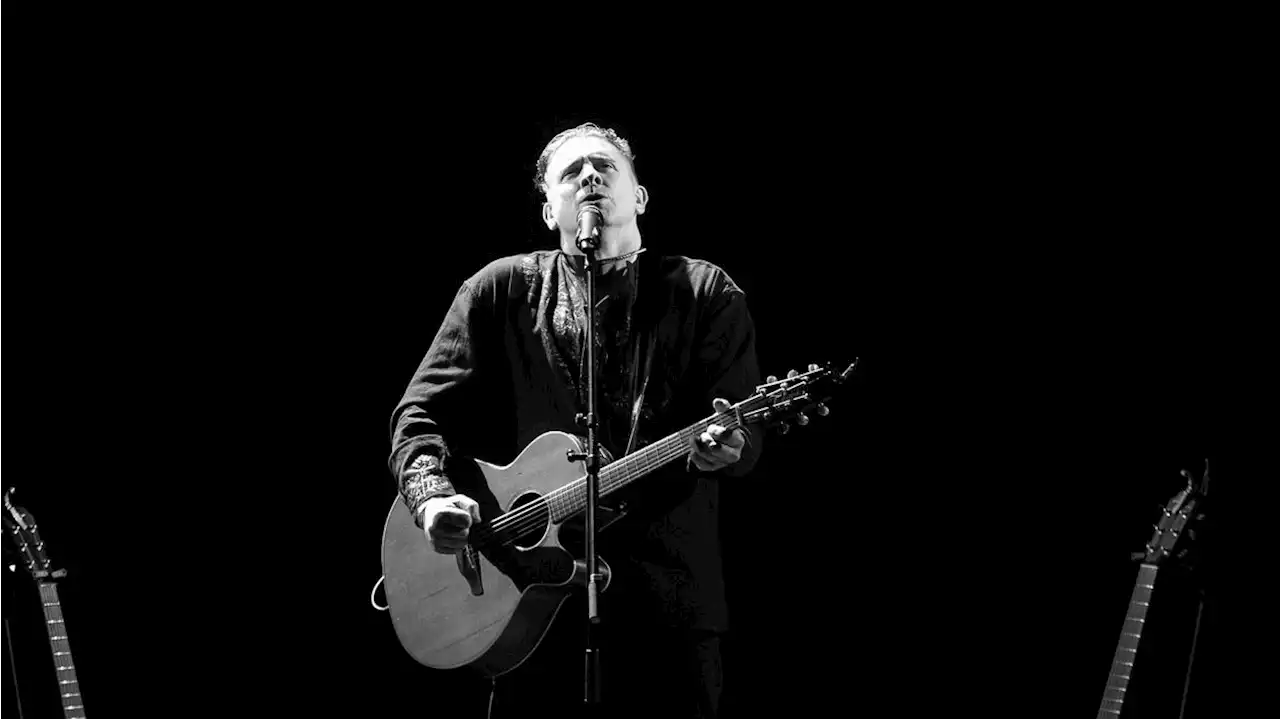
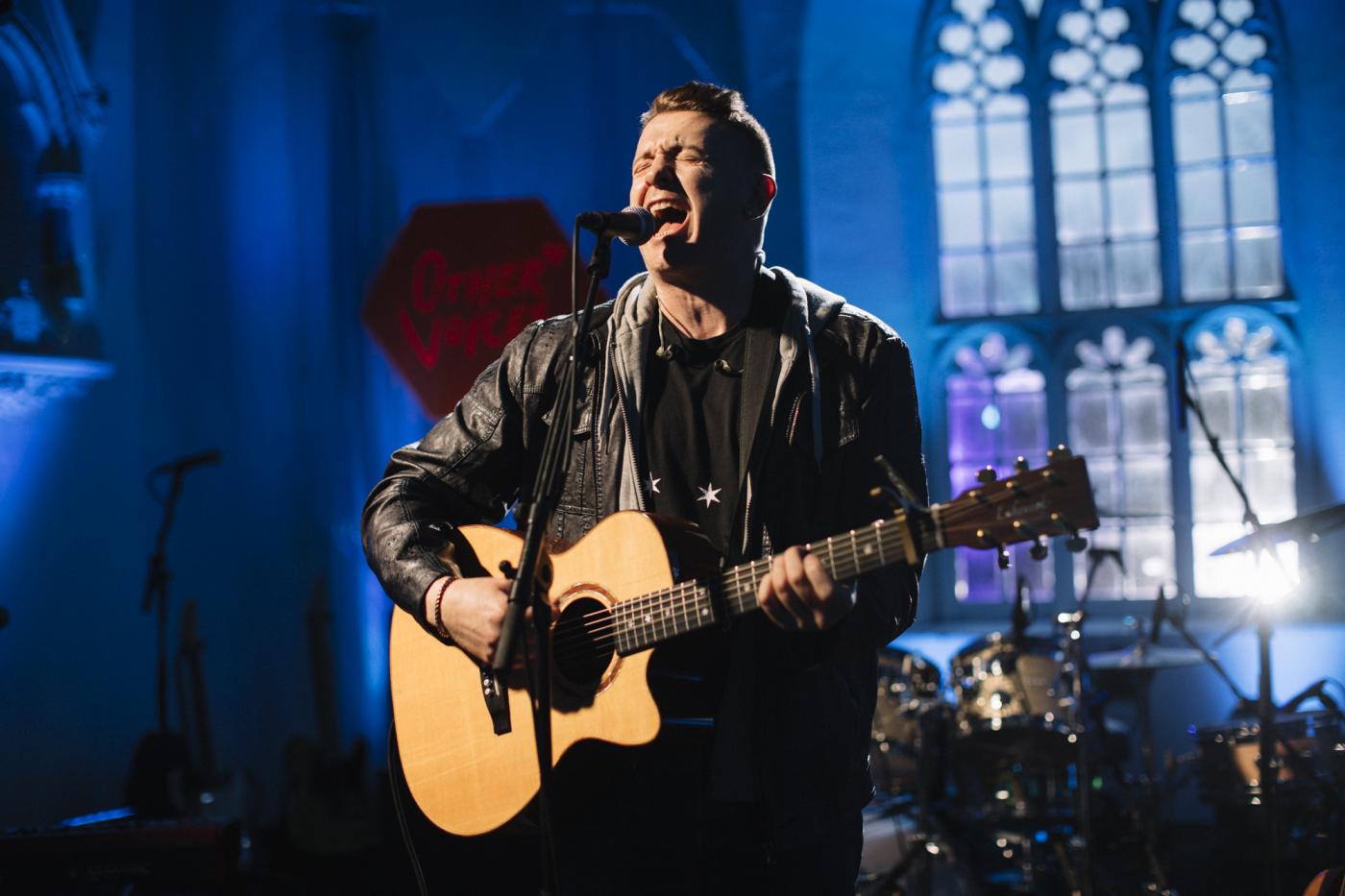
The stage production of Tales From the Holywell, written and performed by Damien Dempsey, is currently running at the Abbey until the 18th – and possibly beyond. Once advertised it was booked out for three weeks (with possible access through cancellations).
It was through cancellations that I and a few others faithfully waiting got in to see the performance on the 7th (it was closed on the bank holiday of the 6th). I really enjoyed it and cried laughing at times.
The whole audience gave him a standing ovation at the end and joined in singing one of his songs during his encore.
The stage set was bare and without background, with stage lighting showing Dempsey alone at times and at others, revealing players of keyboard, violin, double bass and percussion. Dempsey accompanied himself, alternating between two guitars.
The production consisted of Dempsey talking about his upbringing, his difficulties with his father but with whom he went to live when his mother left home, childhood and adolescent battles, his struggles and desires as an artist – all interjected with humorous cracks and songs.
He comes across as a man committed to his art and with integrity.
Dempsey performing at Abbey Theatre (Photo sourced: Internet; audience photos were prohibited)
Dempsey was raised in Holywell Crescent, a collection of local authority houses constructed on the site of an ancient holy freshwater well. This was one of probably thousands of wells across Ireland, each thought to be inhabited by a pagan spirit and then given a saint’s name by Christianity.
The well after which Dempsey’s street was named was St. Donagh’s Well (probably misnamed, see Links below) near Killbarrack and as the area became anglicised, called only “the Holy well”, then “Holywell” and the pool itself filled in and built over.
Whether he can speak it or not I have no idea but the Irish language made an appearance from time to time in Dempsey’s narrative, always with respect and, one might say, even reverence. And I was amazed to hear him sing a verse from An Cúlfhionn a capella, totally in Irish.
His song Colony – some might say masterpiece – gives a clear indication of what Dempsey feels about the long colonisation of Ireland and its parallels elsewhere in the world. I hoped he might take the opportunity to comment on the growing racist mobilisations in Ireland but was disappointed.
Dempsey performing (Photo sourced: Internet)
Conor McPherson directed the production which was written and performed by Damien Dempsey.
Apart from Dempsey’s, other music was provided by Lucia McPartlin (fiddle, vocals), Aura Stone (double bass) and Courtney Cullen (drums, percussion, vocals). I noted no name given in the theatre program for the keyboard and vocals performer.
I’m a great fan of Damo’s lyrics but less so of his singing; a question of musical and cultural taste, I suppose. But still I rose, wholeheartedly with the rest, to applaud his performance.
Whether its run will be extended I don’t know but currently it’s advertised to end on 18th February. If you haven’t booked, it’s well worth getting there early and hoping for a cancellation.
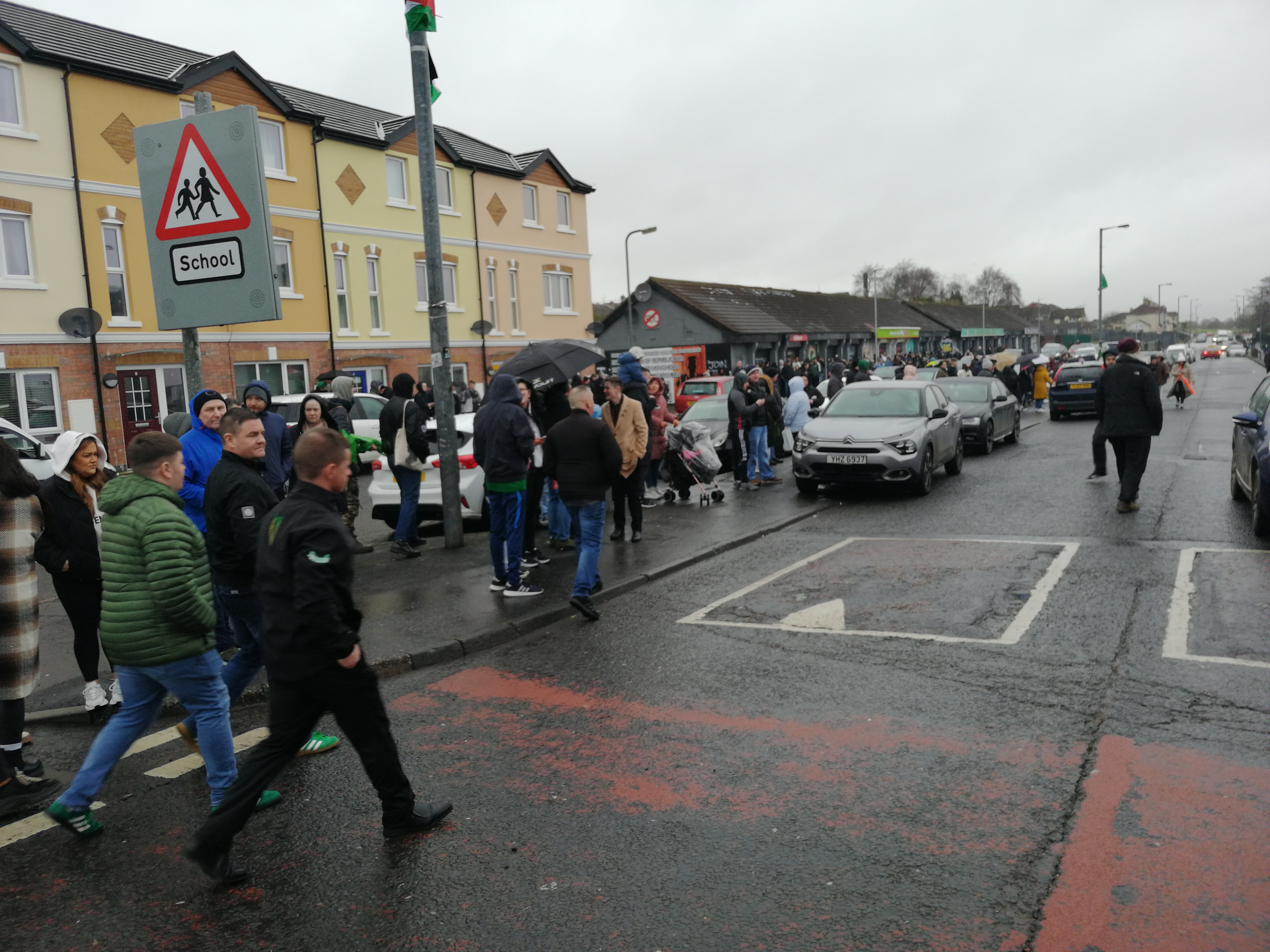
Thousands of people gathered on Sunday 29th January in Derry City’s Creggan area and marched through rain and gusts of strong wind in the annual Bloody Sunday March for Justice to Free Derry Corner.
The march commemorates the Derry Bloody Sunday Massacre of the last Sunday in January 1972, when the Parachute Regiment opened fire on unarmed Civil Rights marchers, killing 14 and injuring a great many, claiming the soldiers had only returned fire on paramilitaries.
By the Creggan shops, people still arriving, others waiting to march (Photo: D.Breatnach
Other side of the road. (Photo: D.Breatnach)
British Governments for decades stood by those claims, refuted by many hundreds of witnesses to the actual shootings and though the city’s coroner called it “sheer unadulterated murder”, the inquiry under Lord Chief Justice Widgery declared in favour of the Paras’ version.
The 1972 march organised by the Northern Ireland Civil Rights Association had been protesting the introduction of internment without trial in August 19711 and the Paras had already killed 11 unarmed protesting people that month in the Ballymurphy housing estate, Belfast.2
Among the scheduled speakers and organisers in Derry in 1972 had been leading activists of the time, Bernadette Devlin (now McAlliskey) of People’s Democracy3 and Eamon McCann of the Socialist Worker’s Party (now People Before Profit).
The Commemoration this year
Participating organisations this year included Anti-Imperialist Action Ireland, Communist Party Ireland, Éirigí, Irish Republican Socialist Party, Irish Republican Welfare Association, Lasair Dhearg, People Before Profit, Republican Network for Unity, Saoradh, 1916 Societies.
Also marching were an IWW/ Anarchist contingent and a number of campaign groups: Ireland Anti-Internment Campaign, Ballymurphy Justice, Justice for the Craigavon Two, Justice for Manus Deery, with a number of environmental groups were represented also.
Derry Trades Council and IWW seemed to have the only trade union banner present or flags present.
A broad domestic and internationalist solidarity sweep was evidenced by the poster for the event with the slogan: “An injury to one is an injury to all” and also by the banner of the Derry branch of the Ireland Palestine Solidarity Campaign.
Poster for the 2023 march (Sourced: Internet)
Public support from Britain came with a banner of the Fight Racism/Fight Imperialism periodical and leaflets from Republican Socialist Platform4 were distributed among the marchers also.
Some years can reveal the misfortunes of particular organisations with a much smaller contingent than previously due to drop outs, defections and splits. Equally it has not been unknown for an organisation to draft in people to inflate its numbers specifically for the annual march.
The annual march takes the twisting route of the original one in 1972, covering much of the Derry nationalist housing areas.
Marchers rally at the Creggan heights and march down to the bottom of the hill, then along and up another steep hill, turning right at its top, along and then right down again and, at the bottom, turning right and along to the Free Derry Corner5 monument where speakers address the crowd.
Kate Nash chaired the rally there and Liam Wray, relative of murdered James Ray spoke as did also Ria, niece of John Paul Wooton who, with Brendan, are the Craigavon Two, framed for the killing of a colonial policeman.
The numbers this year were a huge drop from the previous year’s but 2022 was the 50th anniversary of the massacre and the participants are estimated to have numbered well over 10,000, including maybe 10 marching Republican Flute Bands6 from Ireland and Scotland.
Nevertheless the mass media’s coverage of last year’s march varied from minimal to nil.7
Probably4,000 actually marched this year, but perhaps nearly another 1,000 gathered on the roadsides to watch the marchers, greet people they know and so on. Many children are brought by their parents to watch while their older siblings gather and sometimes accompany marchers too.
The day had begun sunny and crisp but by march time the weather had deteriorated to constant rain and gusts of wind and, as the march reached the Lecky Road, to a heavy downpour. It was bad but veteran marchers have experienced worse in previous years, including snow and sleet.
Waiting to begin the march (Photo: D.Breatnach)
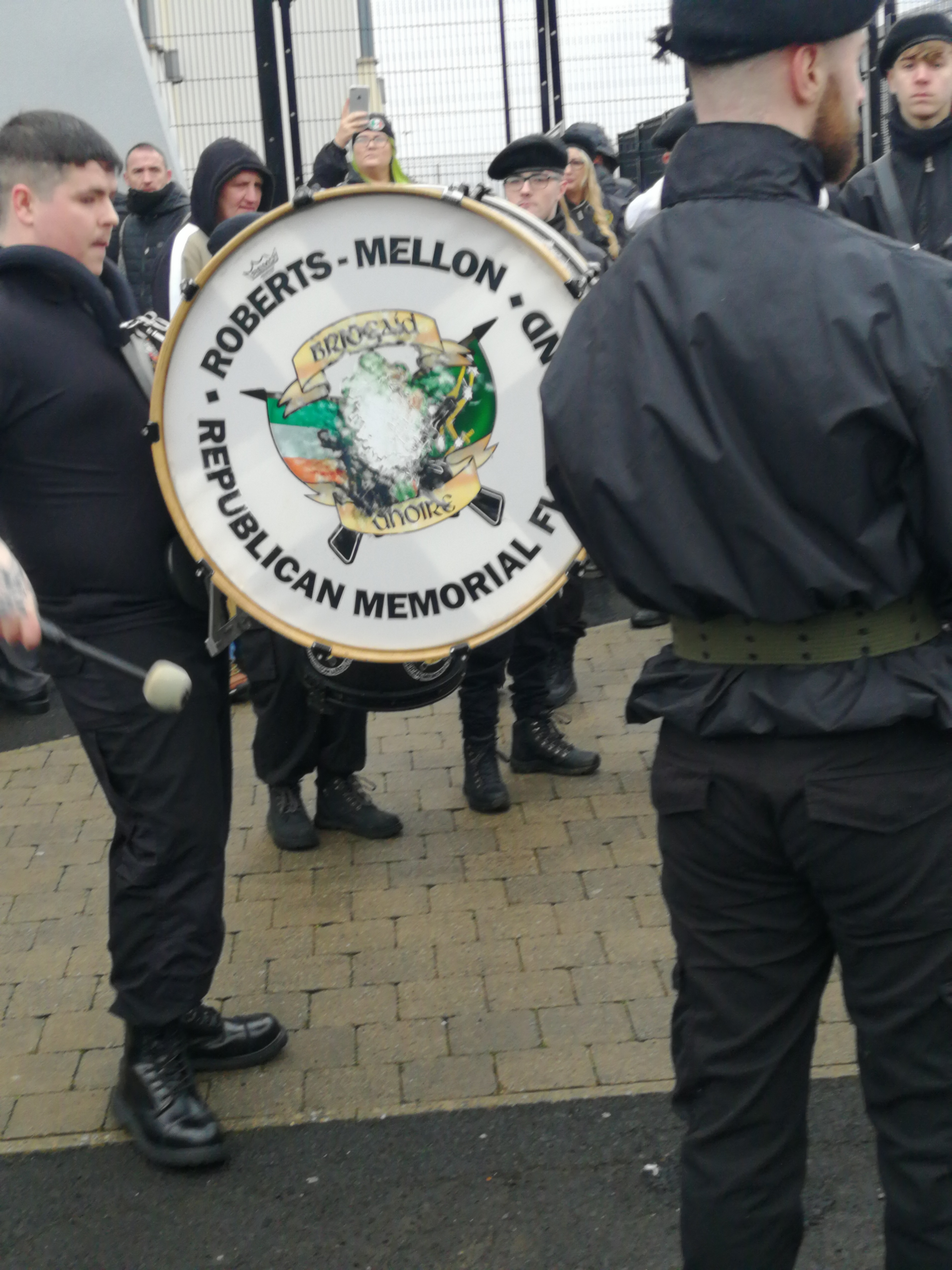
Three Derry-based Republican Flute Bands formed part of the march: James Connolly RFB, Kevin Lynch RFB and Tommy Roberts Stevie Mellon RFB, along with the Banna Cuimhneachán Thomáis Uí Chléirigh (Thomas Clarke Memorial RF Band) from Dungannon.
Although in recent years members wear more weather-appropriate uniforms, they still do an amazing job marching and playing in bad and sometimes atrocious weather.
A Deal with the Devil
The Sinn Féin political party, once prominent among the march organisers and speakers at the rally, sought to end the annual march in 2011 and have not supported the event since.8 This was after the British Government publicly apologised for the massacre that same year.
Part of the process leading to that Governmental apology was the setting up of the Saville Tribunal in London in 1998, although it took unexpectedly long to deliver its verdict.9 The Good Friday Agreement was also concluded in 1998, giving the Tribunal the appearance of a concession.
Indeed, the whole has the marks of a deal with the Provisional IRA’s leadership, with the British side saying: “You give up the armed struggle and control your people. We’ll make it easier for you by releasing your prisoners on licence10 and admitting we were wrong in Derry in 1972.”
Whether ceasing the annual commemoration was part of the deal or whether that was Sinn Féin’s own leadership’s decision is difficult to guess. It may have suited SF to scale a colonial reminder event down or simply to scratch one big annual event from their organisational calendar.
On the other hand, it has lost Sinn Féin all control of an important historical commemorative event on the Irish Republican calendar and their abstention again at the 50th anniversary march was a massive exposure of their collaborationist position.
The Bloody Sunday Trust also boycotts the march, in the sense that it does not promote it nor record its annual march or other events opposed by Sinn Féin. It does organise and promote its own events during every anniversary but that seems to be as a counter to the march organisers.
The BST of course receives funding and employs a Director and staff for its museum. Nobody pays Kate Nash or other members of the Bloody Sunday Commemoration committee; they rely on public donations and sale of items such as commemorative T-shirts to fund the march11.
A number of relatives of the murdered and injured civilians continue to support the march and are counterered among its organisers, for example Kate Nash, sister of murdered William murdered on Bloody Sunday and daughter of Alex Nash seriously injured by the troops the same day.
The Derry Trades Council and two of the original organisers and speakers support the continuation of the commemorative march as do most Irish Republican and Socialist organisations.
In formation ready to march. Note the presence of female members in the prestigious and ceremonial colour (flags) party, more commonly seen in recent years. (Photo: D.Breatnach)
Most Irish people call the city “Derry13” from the ancient monastic settlement located there, “Doire Cholmcille”14 but most Unionists and the British officially call it “Londonderry”. Many think the latter do that to annoy but there is a historical basis for it.
Large parcels of land in the city and surrounds were the payoff to the City of London for bankrolling Cromwell and the English Parliament’s campaign in Ireland to crush support for King Charles and the resistance of the Irish clans and Norman-Irish magnates.
Commemoration of the crimes of the oppressor forms an important part of the resistance of the oppressed around the world. Such events say “Our oppressors committed this atrocity here and we remember, will always remember and constantly deny them any legitimacy in occupation.”
If that is so, what gives any liberation organisation the right to call an end to such commemorations? Yet that is what the formerly liberation Sinn Féin did in 2011 after a British Prime Minister apologised in public for the massacre (but as some kind of serious ‘error’).
Some of the guilty – poster for the 2020 march. (Image sourced: Internet)
Not a single Minister or civil servant who organised the Derry or Ballymurphy massacres, nor judge who condoned them, nor officers who ordered them, nor soldiers who carried them out have been even tried, never mind convicted or jailed in the thirteen years elapsed since that ‘apology’.
Derry’s Bloody Sunday will continue to be commemorated at least until British colonialism has left Ireland and probably as long as imperialism continues to exist.
Remembering is part of resistance; commemoration makes it collective.
End.
A plethora of flags in what seems to be the Anarchist and IWW section. (Photo: D.Breatnach)
Head of the march reaches the bottom from Creggan and turns into the Bogside (Photo: George Sweeney inDerry Journal)
FOOTNOTES
1Abandoned on 5 December 1975. During this time a total of 1,981 people were interned for a period without trial, many of them physically assaulted, some grossly beaten and a small number tortured (the “hooded men” whose campaign for justice is yet another example of courage and determination against British State lies, prevarication and delays). 1,874 were from an Irish nationalist background, while 107 were from a unionist background.
2A similar British Army story, “returning fire” and again witnesses’ accounts ignored. The British State has yet to admit the gross inaccuracy of the official account.
3The party grew out of the Civil Rights movement of which it represented a more radical section. It ceased to exist after a few years.
4Previously unknown in Ireland, the RSP claims members in Derry and Belfast and the leaflet states it is part of the Radical Independence Campaign in Scotland.
5The monument in the shape of a gable end of a two-storey house mimics its original inspiration on the blank gable end of a row of houses in 1968 when John Caker Casey or Liam Hillen painted upon it YOU ARE NOW ENTERING FREE DERRY. The Bogside enclave had been barricaded in 1968 to deny the sectarian and brutal colonial police entry and continued to exist as an area from which the police were barred and British troops, even after the official removal of the barricades, entered only in force and at their peril for years afterwards.
6Typically flute players, side and bass drums, led by a colour (flags) party, all in the band uniform.
7Instead the media concentrated on the presence of a small group of Irish Government Minister and politicians of main parties at an earlier event at the monument to the massacre and a cultural event in the Guildhall.
8No doubt some of SF’s supporters in Derry and many more of its voters ignore the party ban and attend nevertheless.
9An almost unbelievable 8 years after a delay of two years before hearings began and £400 million in costs (mostly in fees to law practitioners) even through years when no hearings were being conducted.
10Release on licence meant they could be returned to jail to complete their original sentence at the discretion of the Minister of State for Northern Ireland, without a hearing or entitlement to know the specific reason for that decision. At first only the Provisional’s prisoners signed up to it but were followed by those with allegiance to other Republican groups, along with Loyalist paramilitaries. As they were leaving the jails, a new crop was entering due to new or alleged acts of resistance, rising to 70 between jails in both states and never falling much below 50.
12Popular Irish balladeer Christy Moore, on a British tour in the 1980s, greeted his London audience by calling the city “Derrylondon” to wild cheering. Shortly afterwards an Irish activist produced Christmas cards displaying London sights in snow, titled “Christmas greetings from Derrylondon”.
13Derry City FC is also the name of the local soccer club which enjoys cross-community support.
14“Colmcille’s (“Dove of the Church”, real name possibly Crimthann of the Cenel Connail) Oakwood”.
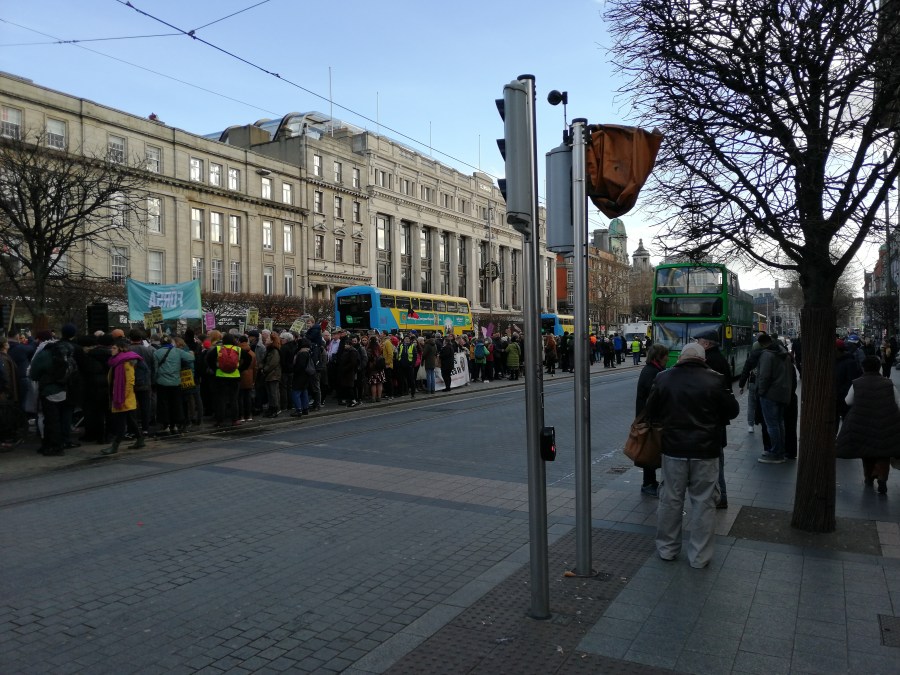
Monday was a new bank holiday in Ireland and two demonstrations of about equal size took place at the same time in Dublin that afternoon, one anti-racist and welcoming refugees, the other anti-refugee and with substantial racist and even fascist elements.
The pro-refugee event gathered on the central pedestrian strip on Dublin City centre’s main street, O’Connell Street, across the road from the iconic General Post Office, the building which served as the HQ of the 1916 Rising. Numerous placards and banners could be seen there.
Section of the Le Chéile pro-refugee demonstration in O’Connell Street (Photo: D.Breatnach)
The tightly-packed crowd stretched from the Spire southward almost to the Jim Larkin monument and were addressed by speakers. I knew the event had been organised by Le Chéile, a broad anti-fascist coalition of essentially pacifist nature with regard to fascism.
Closer view of section of the Le Chéile pro-refugee demonstration in O’Connell Street (Photo: D.Breatnach)
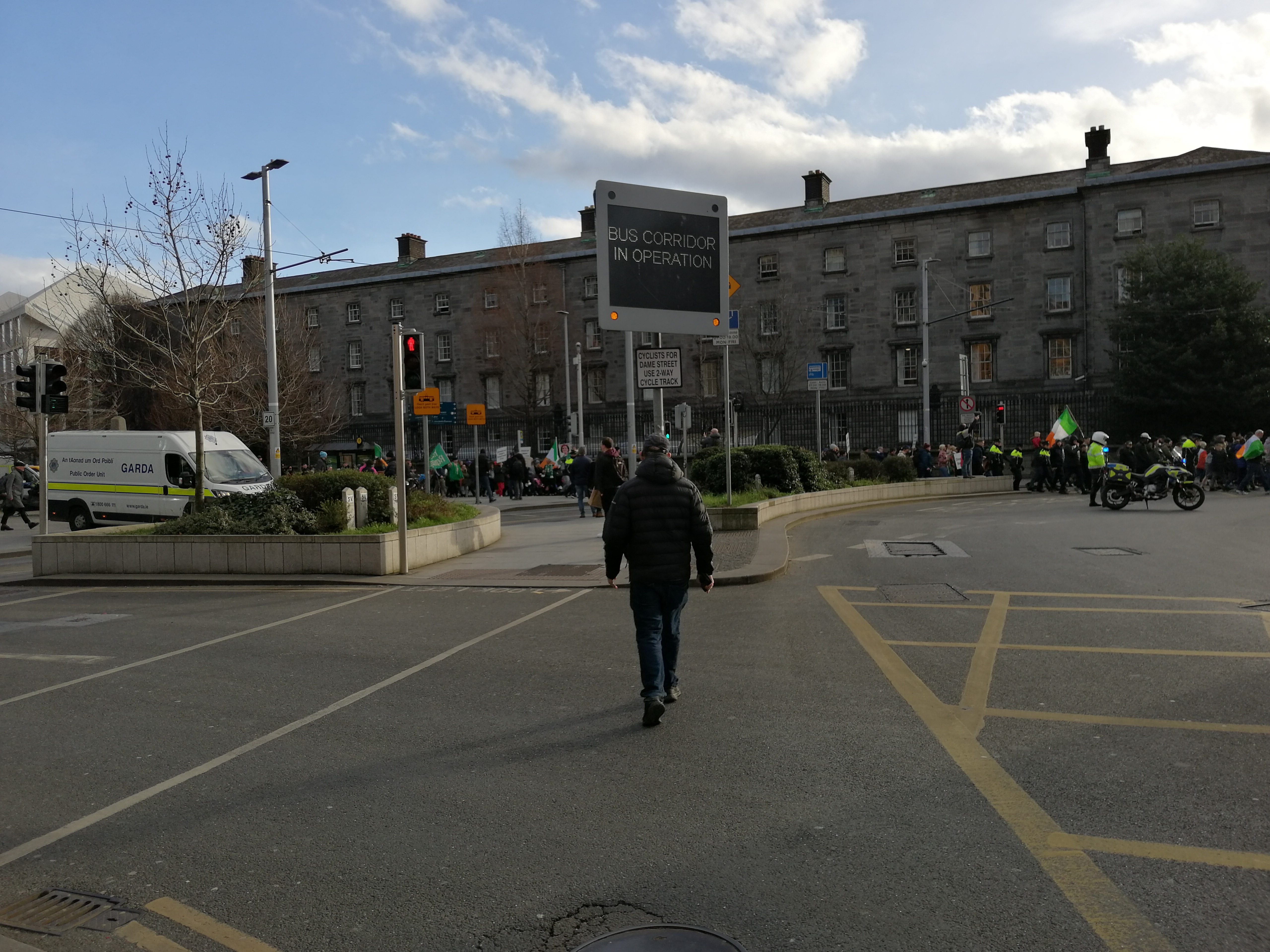
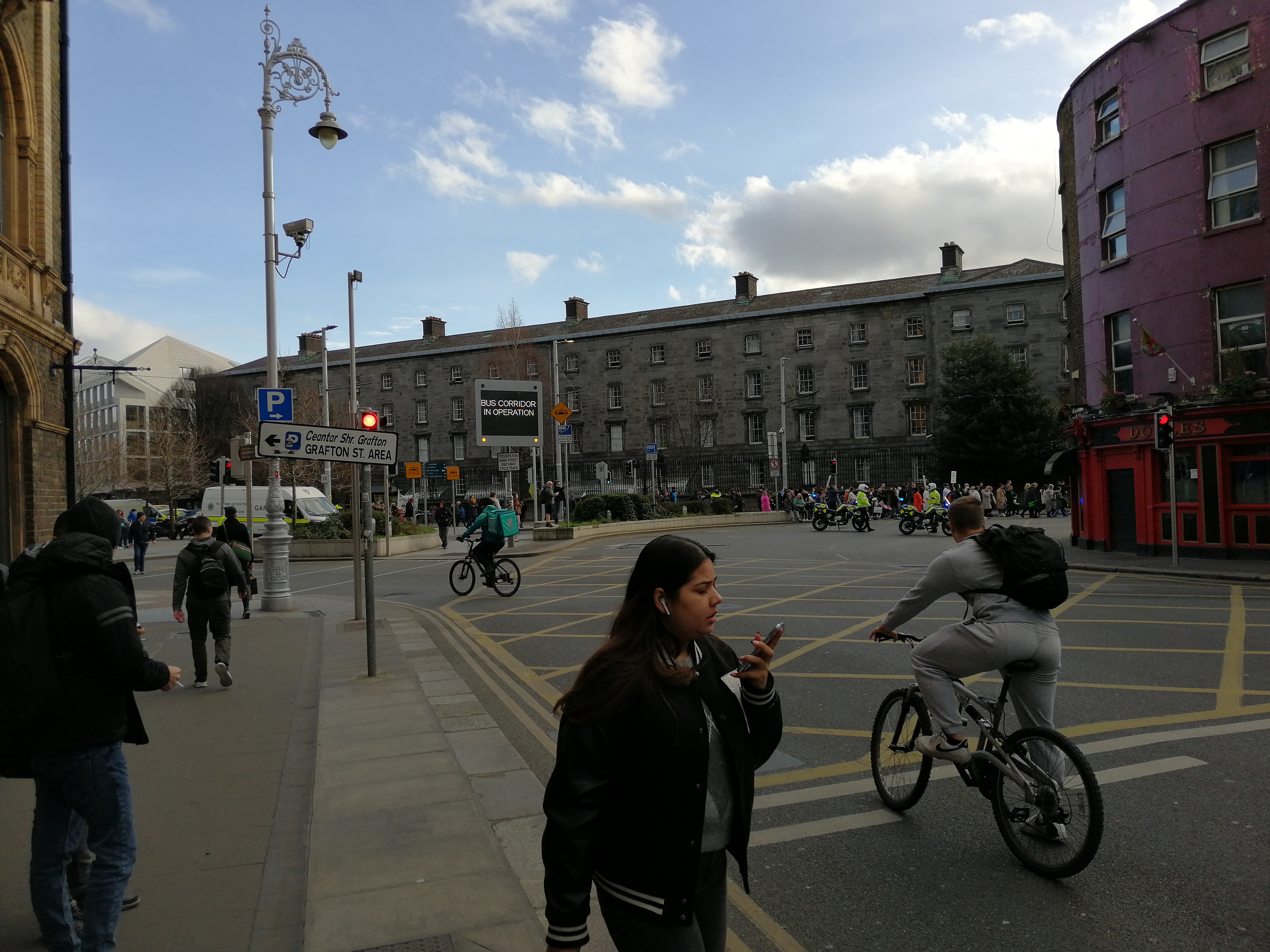
I passed them by in a hurry on my way to attend to a family commitment. While waiting to catch a bus in D’Olier Street, a number of Garda vans and motorcycles drawing up attracted my attention and soon afterwards the anti-refugee demonstration came from Pearse Street.
Cops arriving at Pearse Street/ D’Olier Street intersection just prior to arrival of the anti-refugee march. (Photo: D.Breatnach)
They passed along by Trinity College’s wall and soon after they had gone from my view, my bus arrived. I surmised the anti-refugee march had gone to demonstrate in front of Leinster House, the building that holds the parliament of the Irish State.
Front of the anti-refugee demonstration marching through the intersection (Photo: D.Breatnach)
As I was in a hurry and one group was tightly-packed and the other in extended line walking, it was difficult to compare the numbers but I made them both to be somewhat the same — between 500 and 700 each.
end.
Middle of the anti-refugee demonstration marching through the intersection (Photo: D.Breatnach)End of the anti-refugee demonstration marching through the intersection (Photo: D.Breatnach)Longer view of the Le Chéile-organised pro-refugee demonstration on O’Connell Street (Photo: D.Breatnach)
In late November last year the UK’s Home Secretary1 referred to refugees and migrants entering Britain as “an invasion”, for which a Hollocaust survivor, 83-year-old Joan Salter, challenged her, likening her speech to that of the Nazis.
An NGO working with refugees, Freedom From Torture, posted some of the exchange on Twitter. In turn, the NGO came under pressure from the Home Office to retract the video.
This month, not only did the charity refuse but did so publicly, fully endorsing the content of the video.
Anyone would well understand the difference between invading a country and entering it as a refugee, asylum seeker or even economic migrant. Those come unarmed, fleeing to safety or trying to make a living for themselves and their family.
A minister of a British Government should be extremely well-placed to understand the distinction. After all, there is no continent and very few countries, including its near neighbours, which the British ruling class has not caused to be invaded at some time or other.2
Map of areas of the world ‘owned’ by Britain or the UK at one time (Source: Internet)
From the time the descendants of the Anglo-Saxon invaders of Celtic England merged with the descendants of the later Norman invaders, England has gone from being a major invading and colonising military and naval power to being a major imperialist one.
Imperialist action did not always end in invasion; pressure could be applied in other ways, through bribery — or open threat. The term “gunboat diplomacy” was coined to describe imperialist actions short of actual invasion and Britain was renowned for actions of that type.
The ruling class of Britain has waged war against people to take over trade routes, to colonise land and extract resources, in competition with other colonial powers, to quash resistance and even for the right to sell opium in China.
In the course of those colonial and imperialist activities, Britain has carried out many invasions. In fact, Suella’s parents themselves come from former colonies.
Braverman is a child of migrants
Suella Braverman is the daughter of parents of Indian origin who emigrated to Britain in the 1960s: Uma (née Mootien-Pillay) from Mauritius and Christie Fernandes, from Kenya. Both those countries have indeed been invaded by Britain.
Kenya in particular from 1952-1960 had one of the worst experiences of colonial treatment by the British military, including wide-scale murder, torture and rape. India and Pakistan had their infrastructure and manufacture undermined by Britain leading to regular country-wide famines.
Suella Braverman, MP, currently UK Home Secretary. (Sourced: Internet)
Suella should know about invasions, refugees and migrants but is on record as saying that the British Empire was on the whole a beneficial experience for its conquered. This is a prime example of the “slave mind” that apes the invader and wants to collaborate with it.3
Such “slave-minded” people can be even more vicious and callous in their attitudes than the conquerors themselves and Braverman certainly fills that bill. And it’s not just in occasional choice of words that Braverman nears Nazi appearance.
During Braverman’s unsuccessful campaign for selection as leader of the Conservative Party last July, she said her priorities would have included to “solve the problem of boats crossing the Channel” and “to withdraw the UK from the European Convention of Human Rights.”
In October 2022, Braverman said that she would love to see a front page of The Daily Telegraph sending asylum seekers to Rwanda4 and described it as her “dream” and “obsession.” No doubt she includes human rights and legality concerns as “all of this woke rubbish.5”
A courageous NGO
Holocaust survivor Joan Salter, the woman who accused Braverman of Nazi-like speech, is the daughter of refugees from Nazi persecution who survived but endured imprisonment and hazardous journeys. She has an MBE for her work on Holocaust education.
Joan Salter, Holocaust survivor who challenged the Home Secretary. (Sourced: Internet)
In response to a Home Office accusation that the clip is only partial and therefore misleading, the NGO’s CEO Sonya Sceats pointed out the full exchange is available in video on its website and said the charity will not remove the Twitter clip.
“As an organisation providing therapy to torture survivors who feel targeted by her language and who know first-hand where such dehumanising language can lead, we will not do so. She has used language she should be ashamed of, and we won’t be pressured into helping her hide it.”
Non-Governmental Organisations nearly always rely on government funding, whether directly or indirectly and as a result tend not to rock the boat too much, in case they find their boat getting smaller or their team even being tossed overboard.
Sony Sceats, CEO of Freedom From Torture charity who stood up to the Home Secretary.
As a result, in public the CEOs of those organisations tend to vary from generally totally compliant6 to cautiously critical on certain occasions. In that context, the actions of Salter in the initial video and of the Freedom From Torture NGO in militantly backing her can only be admired.
1This is the UK’s equivalent to Minister for Home Affairs, these days normally restricted to Britain (i.e excluding the colony in Ireland) and in particular England and Wales (i.e often excluding even Scotland).
3The concept of the ‘slave mind’ or ‘colonised mind’ has been addressed by a number of writers on national liberation, notably Patrick Pearse (1879-1916) from Ireland and Franz Fanon (1925-1961) from Martinique.
4That plan has been condemned by many human and civil rights organisations and also denounced as illegal.
5A quote dating from her attempt at Leader of the Conservative Party.
(Translated from Publico report by Danilo Albin and with comment by D.Breatnach)
A few days before Nazi bookseller Pedro Varela’s date for trial in Malaga for the continued crime of provoking hatred and discrimination, the Hitlerite activist gave a talk in which he called for founding “cells of Christian, white, and European men.”
The audience listened in silence. On stage was Pedro Varela, the great leader of Spanish neo-Nazis and one of the few Hitlerites tried in Spain for spreading genocidal ideas.1
It was the morning of Sunday, November 6, there were a few days left before another trial for spreading hate and Varela, in his usual style, had not planned to move an inch from his script.
“You go down a street in Madrid or Barcelona and you see black boys, handsome, tall, stocky, who measure 1.90. They are going to be the owners of the situation and the owners of the country. Do you think they are going to pay your pensions?”2
That was one of the statements made by the owner of Librería Europa during the conference held that day, according to a video that has just seen the light.
The Nazi activist’s speech, organized by the far-right publishing house Fides, was made on November 6 within the framework of the XVI Days of Dissidence3.
The event, which was initially going to be held in a conference room on Calle Hilarión Eslava in Madrid, had to change location after the publication of a news item about said meeting by Público4.
That change of location angered Varela, who did not hesitate to lash out at this newspaper. “As you know, lovers of freedom of expression and democracy have tried and succeeded in cancelling the room in Madrid that for years we used for this rally,” he said.
“The Público newspaper, a pamphlet from the extreme left5, announced the address where the Sixteen Days of Dissidence were going to take place, and encouraged the anti-fascist mobs to call, bother, and outrage the owners of that place so that they finally barred us access to it for holding the ‘Dissidents’,” he continued.
This veteran Nazi activist also referred to an episode of the Cuéntame series in which there was an allusion to his bookshop, located in Barcelona and dedicated to the sale of National Socialist materials.
“The propaganda against this small group of 200 or 300 people here today is tremendous. A newspaper like Público, a television program like Cuéntame, dedicate part of their efforts to combat the spread of our thought and our struggle,” he warned.
As established by Court Number 11 of Barcelona in 2010, this “thought” and this “fight” imply the crime of spreading genocidal ideas. Varela was imprisoned between December 2010 and March 2012.
In 2016, after a raid on the Nazi bookstore in which the Mossos d’Esquadra seized 15,000 books glorifying genocide, the activist spent a few days on the run until he turned himself in at a police station.
Nazi Pedro Varela attending court in Malaga, Spanish state. (Image sourced: Internet)
He then paid a bail of 30,000 euros and returned to the street. Currently he is awaiting a new trial.
The Prosecutor for Hate Crimes and Discrimination requested 12 years in prison for exaltation, justification and denial of the Holocaust and for crimes of incitement to hatred against Jews, migrants, Muslims and homosexuals, among others, as well as the permanent closure of its business, the Europa bookshop in Barcelona.
“Do not fear prison or persecution”
“Whoever had something interesting to say who has not been in prison for that? Do not fear prison or persecution, because they are medalsto your credit in the afterlife,” he said during the conference on November 6.
The latter was held a few days before he was due to face another trial in Malaga as a result of a complaint made by the Movement against Intolerance directed by Esteban Ibarra.
The prosecutor in this case – which is now pending resolution – requested three and a half years in prison for Varela for the continued crime of incitement to hatred and discrimination as a result of the content of some conferences held in Seville and Malaga.
This was given that his rallies created “an evident feeling of hostility towards the affected groups (African, Muslim or Jewish migrants, basically) that generated an objective dangerous to peaceful coexistence”, affirms the Public Ministry.
In the talk on November 6 in Madrid, Varela returned to raise similar issues. Among other things, he linked the number of migrants to the “increase in rape on the streets of Spain, including Valencia.”
“The Spanish are peaceful people6, almost all of them have a partner, a girlfriend, a family… they have a culture of respect for women, something that does not happen with these immigrants.”7
At another point in his speech, he asserted that “60 million blacks are needed to take the place of 100,000 abortions per year that Spain has.”
He also alleged out that immigrants “go to look for a partner in Spain, and if Spanish women do not decide to become their partner, what is happening happens.”
Varela not only did not hesitate to refer to himself as “National Socialist”, but also claimed the role of the ‘Napola’, the male boarding schools of the Hitler Youth that served as a school for the Nazi elites.
In these centres “they educated them in austerity, order and discipline” and offered them “a sense of mission in life”, according to his interpretation.
He encouraged the founding of “those cells of Christian, white, European men”
“What do we have to do to face this world? We cannot organize the Napola, because they are going to be banned, but yes, you can form a Napola among yourselves, in your family, in your circles of friends.”
“You have to mould the youth, your family, the children and yourselves” – he remarked – “in the character of the Napola kids”.
The Nazi bookseller proclaimed that “resistance must be not only political, ideological and human, but also familial, ethical and religious”, while encouraging his followers to have children and “found those cells of Christian, white and European men who, with respect and good neighbourliness with other races and cultures, prefers to defend his own than to succumb”.
“What Happened at Auschwitz”
He alleged that in Spain there is a “gradual loss of freedom of expression” and condemned the Democratic Memory Law8, which he compared to the German laws against Nazi apology.
“In Germany, as you know, the whole question of what happened, what did not happen or could have happened in Auschwitz is not debatable, it is not debatable,” he indicated. “Any German who claims to defend his own identity is suspicious of Auschwitz.”
In his opinion, “this dictatorship against freedom of expression also exists here. This law of historical memory and cancellation of white culture9 is carried out in all Western countries.”10
He even asserted that the legal persecution against Nazi broadcasting in Germany is a “sword of Damocles that hangs above all Germans so that any possible resistance to the cultural and ethnic invasion of the country does not take place.”
Pedro Varela addressing a fascist meeting in the Spanish state (Image sourced: Internet)
“Where do the transsexuals go?”
His speech was also loaded with transphobia. “I read a very curious joke the other day. – Hey dad, women go to the gynaecologist, right? – Yes. – And do men go to the urologist? – Yes.
And where do transgender people go? – I don’t know, kid, probably to the psychiatrist“. As can be seen in the video, the transphobic joke was followed by laughter and applause from the ultra-rightists who inhabited the room.
“This is of course a joke, because otherwise transgender people are going to sue me.11 Humour is what it is, but that is the biological reality. You can feel whatever you want, but biology says what you are.
You are a man or a woman, or to the urologist or the gynaecologist, you cannot go anywhere else,” he concluded.
COMMENT by Diarmuid Breatnach
Fascism in Spain, then and now
The first thing to take into account is that unlike anywhere else in Europe, there was no overthrow of fascism in the Spanish State.
A cosmetic job of painting over four decades of the savage Franco dictatorship with pseudo-democracy was managed by the fascist ruling class with all their politicians, senior military and police officers, judges, bishops, bankers and media moguls remaining in place.
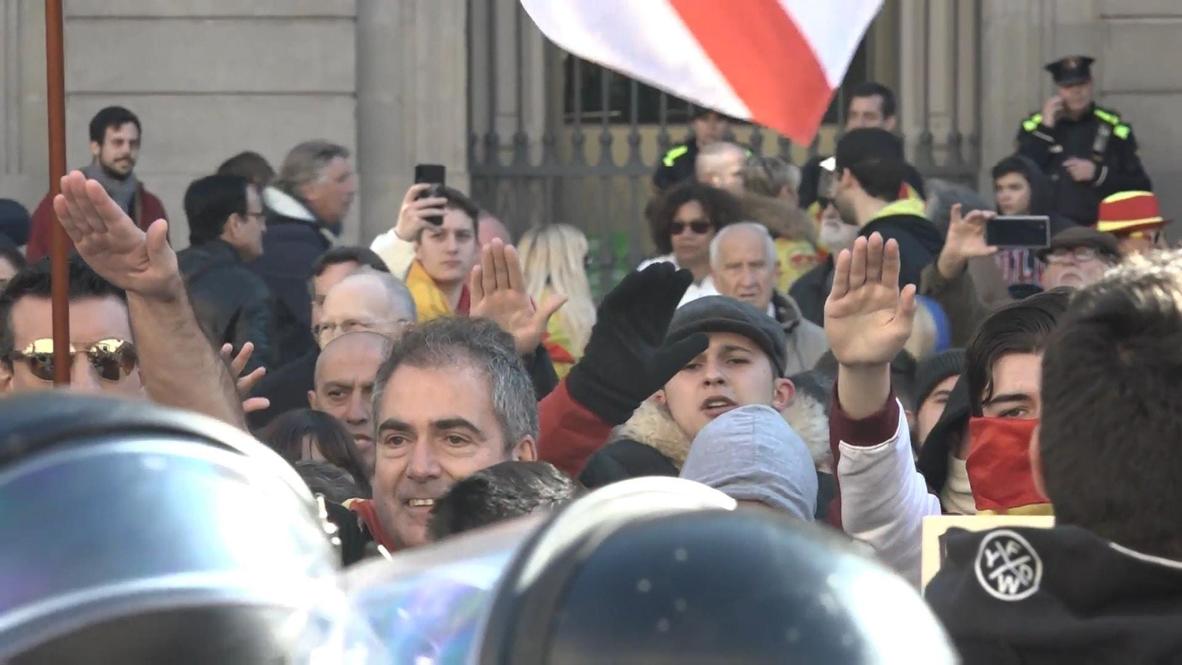
The second thing to note is that despite antifascist laws being passed as part of that “Transition” process, fascist glorification continued to be rampant in the Spanish state with fascist salutes and iconography regularly displayed in public and on photographs and video.
Spanish fascists against Catalan independence, Barcelona January 2020. (Image sourced: Internet)
And fascist speeches too, all with impunity. Except in this case, which is why the report states that Varela is one of the few Hitlerites to be tried: not because there are only a few of them but because the State has decided to make Varela an exception to the rule.
Varela complains about the “dictatorship” that he feels being exercised against him and his rhetoric. Fascists always raise the flag of democracy, which they despise, only when they feel unable to use the mailed fist. Once in power, they give democracy to none except their own12.
It’s not a little amusing that the State is trying to close Varela’s fascist bookshop through the court because they closed Basque social centres, newspapers and social media sites merely be decree and even when their own Constitutional Court made them recant, are yet to pay a cent in compensation.
Hollocaust denial is one pretty frequent plank in the fascist platform, wherever in the world it is erected.
This too is curious, in a way because in the 1930s and 1940s, the Nazis and other fascists boasted about what they were doing, in particular to the Jews in Germany, Austria and in Occupied Europe.
True, they did not admit publicly to the mass exterminations but all the rest of it, expropriations, mass round-ups, concentration camps were no secret and they corresponded among themselves and reported to authority about the rest – the story the photos, film and survivors told the world later.
Vulnerability of the fascist male ego
Varela’s worries about Spanish women’s vulnerability to men of migrant background is another area of irony, given the problem of Spanish gender violence (see below).
Whilst there have been prominent female fascists, historically the cult of the superior male has been prominent in most fascist movements. Indeed Hitler’s Nazis proclaimed the correct areas for women’s activity to be “kinder, kuche und kirke” (‘children, kitchen and church’).
Most fascist movements and organisations have denounced homosexuality and many gays and lesbians have been killed by them, including an estimated 60% fatalities of the 50-60,000 sent to concentration camps by Nazi German courts.
In their hetero-sexual male insecurity, fascists and other racists often fear “their” women being attracted to other men, specifically to men of other ethnic groups13.
Conversely, fascists regularly see themselves as the “defenders” of “helpless females” while simultaneously detesting any exhibition of female independence or assertiveness.
Those circumstances encourage acts of rape and other sexual violence towards women: last year in the Spanish state 37 women died in violence by men and 46 the previous year.
People still remember the “Manada” (‘wolf-pack’) case where five men videoed themselves raping a young woman whom they left in a doorway after they stole her mobile phone. Although it occurred in the Basque province of Navarra, all the assailants were Spanish.
What’s more, one was a Spanish policeman while the other was military and some had previously videoed themselves in a van with an unconscious woman, talking about their intentions. The “Manada” was the name of a WhatsApp group of which they were members.
Historical memory and mass graves
Many people hope that changes in Spanish law, such as the Law of Historical Memory in 2007 and more recent practical steps herald a coming to terms with the state’s fascist past.
Some mass graves of fascist victims have been exhumed and removal Franco’s remains in October 2029 and projected removal of Primo de Rivera’s from their mausoleum in the Valle de Los Caidios gives hope to some14.
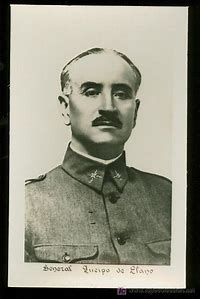
The remains of General Queipo de Llano, believed personally responsible for the execution of poet and dramatist Garcia Federico Lorca in 1936, were removed from the La Macarena basilica in Seville on 2nd November this year.
Postcard of fascist General Queipo de Llano, whose remains were exhumed recently from the Macarena Basilica and reinterred in a family cemetery recently. (Image sourced: Internet)
After Cambodia, the Spanish state remains the one with most mass graves in the world and the majority of those have not been exhumed15. The names of fascists still decorate streets and, as noted earlier, fascist events continue with public displays of fascist affiliation.
The fascist political party Vox continues in existence with currently 52 (out of 250) members of the Congress (lower house) of the Spanish Parliament.
There exists a deep fascist pool which has reflected at various times the political parties Partido Popular, Ciudadanos and now Vox with the votes of the pool being divided among those parties according to the wishes of the day.
As is usually the case, Spanish fascism is combined with a reactionary ‘nationalism’ of a unitary Spain based on Castille and León but including all its current territories.
They tack on to that a fictional concept of Spain with Flamenco in Andalusia and holidays in the Balearics and Canaries but seek the suppression of any national self-determination.
The Basque Country, Catalonia and Galicia have all historically declared for self-determination but all three were murderously suppressed during the Civil War and the Dictatorship, with the former two suffering heavy repression in the post-Franco ‘democratic’ Spain.
Any move towards self-determination in those nations stirs a fascist hornet’s nest to venomous buzzing and threats.
Overall, the signs are not favourable for a future Spanish state cleansed of fascism – at any rate not by moderate and peaceful means.
2A variation of the “white replacement” irrational anxiety of racists.
316 Days of activism against gender-based violence:16 Days of Activism against Gender-Based Violence is an international campaign held every year. It begins on November 25, the International Day for the Elimination of Violence against Women, and runs until December 10, Human Rights Day. It is ironic, to say the least, for fascists to locate their events within this framework.
5From the perspective of fascists and far-right in the Spanish state, that on-line newspaper may seem “extreme Left” but although on the Left it is not even revolutionary.
6Oblivious to past and more recent history, obviously!
Recognition of the victims of political, religious and ideological violence on both sides of the Spanish Civil War and of Franco’s State.
Condemnation of the Francoist State
Prohibition of political events at the Valley of the Fallen – Franco’s former burial place.
The removal of objects which exalt the July 1936 coup, civil war and Francoist repression from public buildings and spaces. Exceptions may be given for artistic or architectural reasons, or in the case of religious spaces.
State help in the tracing, identification and eventual exhumation of victims of Francoist repression whose corpses are still missing, often buried in mass graves.
Rejection of the legitimacy of laws passed and trials conducted by the Francoist State.
Temporary change to Spanish nationality law, granting the right of return and de origen citizenship to those who left Spain under Franco for political or economic reasons, and their descendants.
Provision of aid to the victims and descendants of victims of the Civil War and the Francoist State.
9To Varela, there is such a thing as “white culture”, which will be a surprise at least to, let’s say Irish, Basque and Russians.
12And not even to their own, on occasion, as with the violent suppression of the whole leadership of the Browshirts by the Gestapo in The Night of the Long Knives 30th June-2 July 1934 in Germany.
13This has been nowhere more observable perhaps than in the ‘Deep Southern’ states of the USA, where black men were regularly lynched for alleged rape of white women without any proof. Conversely, the evidence of rape of black women in the same area during and after slavery is legion.
14Franco was the fascist dictator of four decades and Primo de Rivera was the founder of the fascist Falange, executed by the Spanish Republic.
15Holding the remains of an estimated 100,000 men and women.
Christmas shoppers on Saturday 17th in Dublin’s O’Connell Street, the city’s main boulevard, were interested to see a long picket line displaying banners, flags and placards.
The event was a jointly-organised public reminder of the continuing existence of political prisoners in Ireland and as a gesture of solidarity to the prisoners too.
The joint organisers were the Ireland Anti-Internment Campaign, the Irish Republican Prisoners Welfare Association and the Anti-Imperialism Action organisation. The attendance were mostly Irish Republicans but there were also some from the socialist/ anarchist traditions present.
Long line looking southward of joint Republican prisoners’ solidarity event (Photo: Rebel Breeze)
There are currently 40 Irish Republican prisoners in jails in Ireland, on both sides of the British Border. As a speaker noted at the end, all had been sentenced or refused bail by no-jury special courts of the Irish and British states.
The Irish Tricolour and the Starry Plough were displayed of course but also a Palestinian flag and two Basque ones; the latter attracted the attention of a number of young people from the Spanish state who were pleased and approached the picketers for discussion.
Section of the joint Republican prisoners’ solidarity event showing the Latuff cartoon on a banner (Photo: Rebel Breeze)Section of the joint Republican prisoners’ solidarity event showing couple of Basque flags and Palestinian one in the middle distance (Photo: Rebel Breeze)
Two banners called for and end to the extradition of Irish Republicans and one figured cartoonist Carlos Latuff’s illustration of solidarity between Irish and Palestinian political prisoners.
Leaflets of the IRPWA and of the IAIC were distributed to passers-by.
Section of the joint Republican prisoners’ solidarity event (Photo: Rebel Breeze)
As the event came to an end a representative of each organising group read out a short statement; both the IAIC and the AIA emphasised the need for unity in resisting repression and each along with the IRPWA called for support for Irish Republican prisoners.
End.
Section of the joint Republican prisoners’ solidarity event (Photo: Rebel Breeze)Section of the joint Republican prisoners’ solidarity event (Photo: Rebel Breeze)