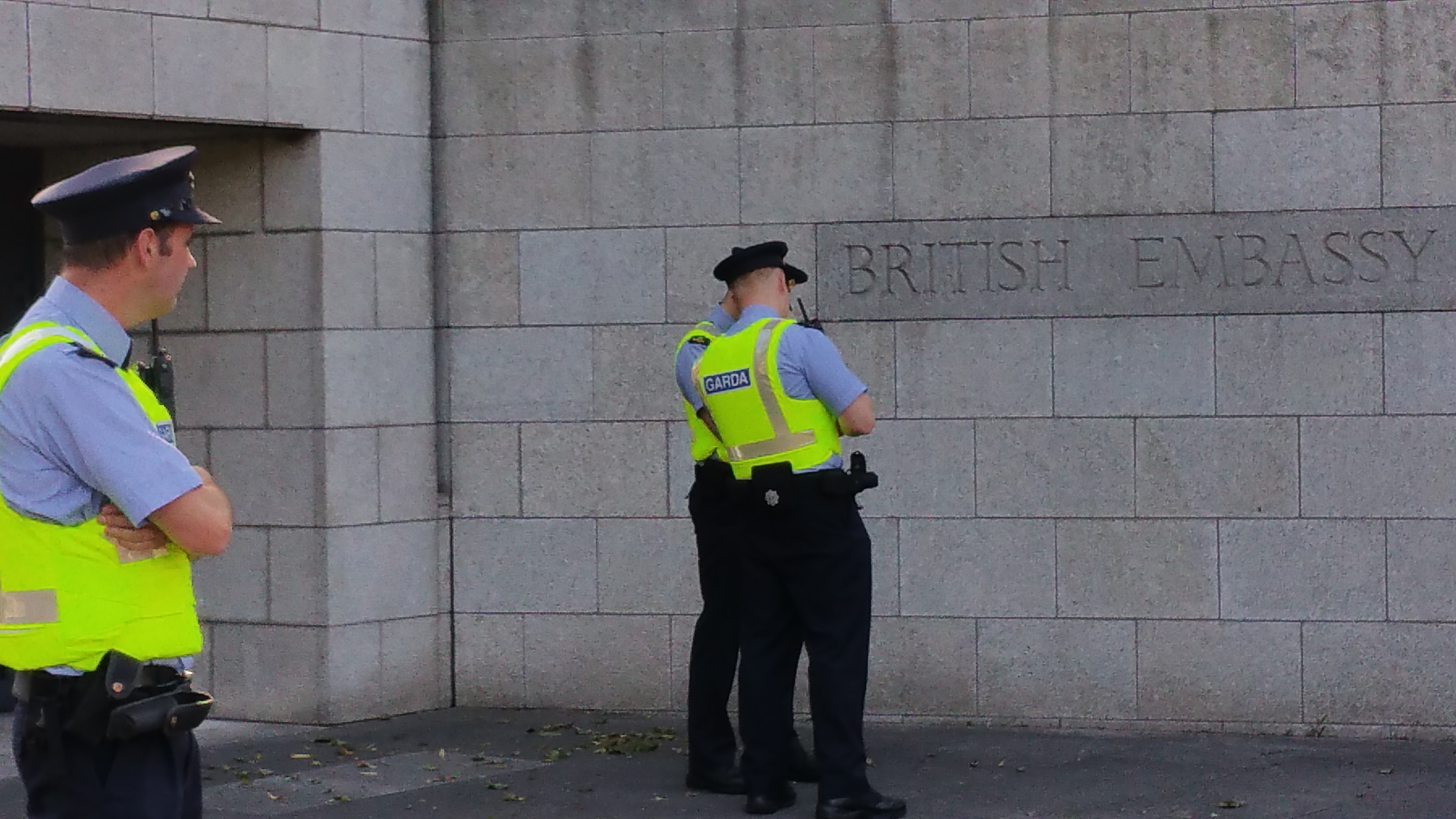
JUSTICE DELAYED

Diarmuid Breatnach

(Left to right) Antoinette Keegan, Kate Nash, Stephen Travers and Eamonn McCann at the Garden of Remembrance before the public event. (Photo: Cate McCurry/PA Wire).

Speakers from the massacres at Ballymurphy, Derry, of the Miami Showband and the victims of the Stardust Fire addressed a Dublin Audience on Wednesday evening last (19th September) in the hall of Club na Múinteoiri.

They are victims and also campaigners and their stories held the audience spellbound. The campaigns arising from the Stardust Fire, the massacres of the Miami Showband, Ballymurphy and Derry all put speakers up to address the audience on their need for Truth and Justice under the banner of Justice Delayed Is Justice Denied. It was the personal sides to their stories that were particularly powerful, without losing at all the political thrust; McCann did his usual storming speech which he does very well but somehow, for all the eloquence and good points made, did not have the same impact – at least on this reporter.
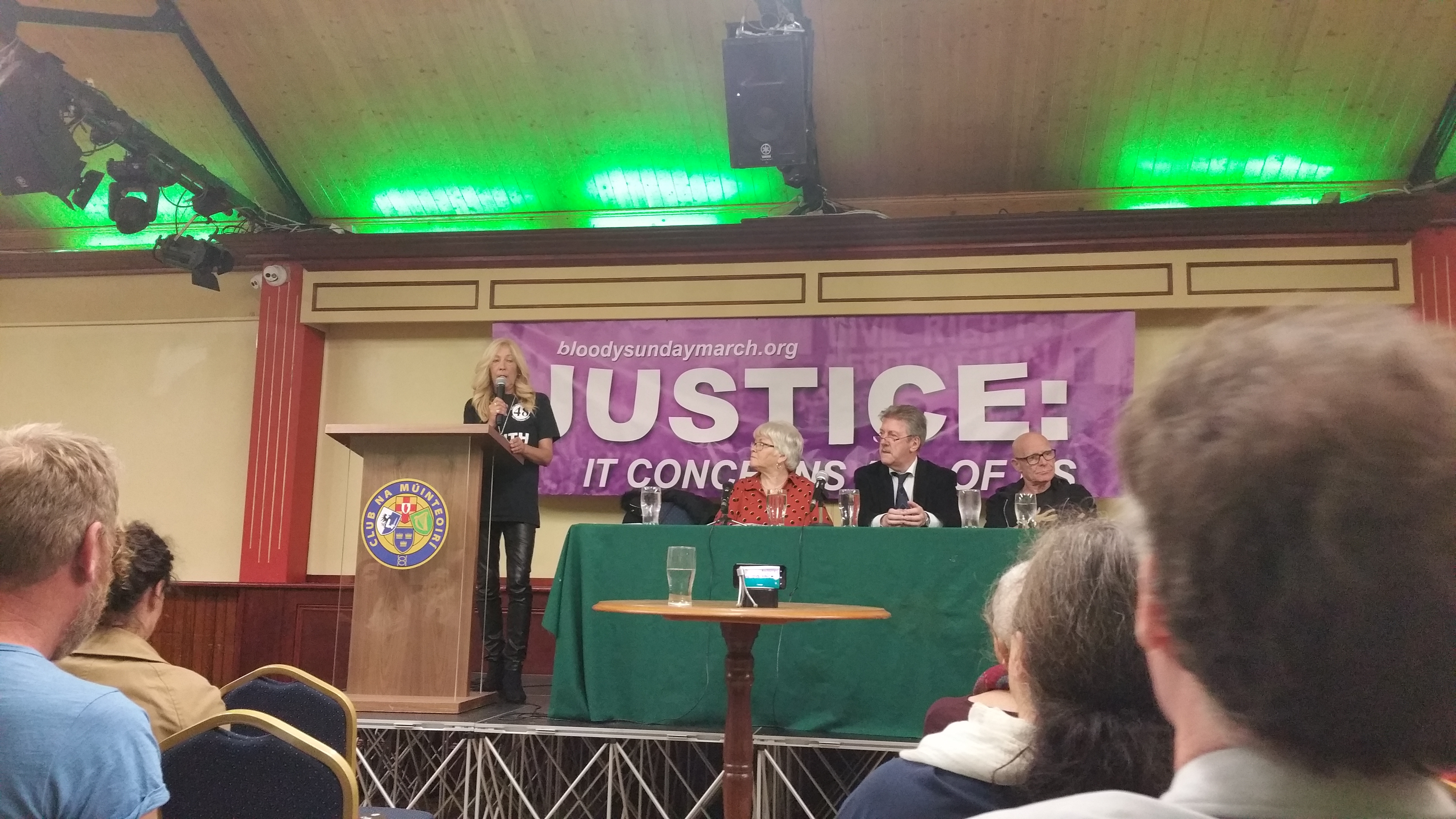
Annette Keegan speaking at the event
(Photo: D.Breatnach)

STARDUST FIRE

     Ann (Antoinette) Keegan, chairing the event and welcoming the attendance, said that she spoke both as a victim and a survivor of the Stardust Fire where 48 young people were killed and 241 injured at a Valentine’s disco on 14th February 1981. Annette survived but lost her two sisters in that fire: Mary and Martina.

She listed the steps in the slow and unjust procedures of alleged investigation that followed the fire at the disco. The first inquest had listed arson as the “probable” cause of the fire which had caused the deaths but the relatives challenged this verdict as incorrect procedurally as well as in fact and eventually had it overturned in 2009. Another inquiry years later under Judge McCartan, appointed by the Government, heard that there had been two emergency calls, one about a small fire of 18” high which could easily be extinguished and another about “smoke pouring from the loft” which had not been discussed in any previous hearing (this is the area that campaigners believe to have been the real origin of the fatal fire – DB).

Ann Keegan recollected that Judge McCartan had said that the families should have located that caller, even after all those years and got her testimony but Anne stated that it was wrong to apportion the responsibility for that to the families.

Historical note: It is a matter of record that the building’s owners, the Butterly brothers, had flagrantly violated many fire safety regulations in the building and that Dublin City Council had failed in its duty of ensuring entertainment venues it licensed were compliant with fire regulations. The Butterlys never even apologised and were compensated under the original verdict of “probable arson” to the sum of Ir£580,000 (€634,869).

Anne Keegan went on to say that the campaign had now decided that any further inquiry would be a waste of time and was calling for the reopening of the inquests as a matter of public interest. They had launched their campaign objective on June 14th at the Dáil and were pressing ahead with it now.

Anne then called a member of the campaign up from the floor to talk about the experiences of her family.

     Selina McDermott took the stage and said that she had lost two brothers and a sister in the fire: William (22), George (18) and Marcella (16). Her father, she told the audience, who was known by the nickname of “Minnow” was a Dublin Fireman, though not on duty that evening. Alhough he had saved many people in the course of his career it ate away at him that he could not save his two daughters.

Both he and Selina’s mothers campaigned for the truth but her father’s workmates, who were very supportive of him, calling often at the house when he was off duty, knew he was going against vested interests and the Government and advised him to give it up because he would never win. On the other hand their mother wanted to continue the fight, which led to arguments at home. Selina’s father died six years after the fire.

I thought how sad that so many, particularly in the working class, have become conditioned to the propaganda of the ruling class that the latter cannot be beaten, a way of thinking that is perhaps much weakened now but still influential for all that. It is one of the ways in which the very small minority which is the ruling class can keep down the vast majority from rising up against them.

BLOODY SUNDAY DERRY

Kate Nash speaking on the Derry Bloody Sunday Massacre at the event (Photo: D.Breatnach)

Selina sat down to applause and Anne Keegan called on Kate Nash, of the Bloody Sunday March for Justice campaign to speak.

     Kate, like Ann and especially Selina before her, spoke in an informal way, telling the story of her family’s ordeal in Derry in 1972 when 14 unarmed civilians received fatal wounds from British Army bullets and another fourteen survived their injuries.

Kate’s teenage brother William was shot in the chest and three others were shot trying to go to his aid, including his father, Alexander Nash. Kate spoke about going to visit her father in hospital and he telling her that her brother was in the morgue. Her mother was in hospital too and it was considered unsafe to inform her of her son’s killing – until William was to be buried, when it was felt necessary to tell her so that she could attend the funeral. Kate said her mother never spoke until she returned to their home after the burial of her son but no sooner had she set foot inside the house than she let out a scream and broke down.

Kate also spoke about the devastation to the family and how her mother once said to her husband “It should have been you”, to which he replied “I know”, knowing what she meant.

The hurt did not stop there for the British Army alleged that all those shot had been armed and the Widgery Tribunal, convened with unusual speed, agreed with them. The majority of the media supported that verdict and also said nasty things about their family, in addition to alleging that they were IRA supporters (they were not, their allegiance had been to the SDLP1), accusing them also of living in filthy conditions.

Soldiers had also said nasty things to them at the hospital and at the morgue and on the streets afterwards.

Section of Dublin crowd before they burned the British Embassy in Merrion Square in 1972
(Image Source: Stair na hÉireann)
The fire takes hold at British Embassy (then in Merrion Square) Dublin 1972
(Photo source: Internet)

Finally the Saville Inquiry was convened in the year 2000 which turned out to be the longest legal inquiry in British history, taking six years and costing a reputed 400 million pounds Sterling (approx. €450,800,000 today), with the families having to wait another six years for the publication of the report. Kate Nash made the point that the cost of the Inquiry was not the responsibility of the families and that “they (i.e the Government) spent that money clearing themselves”. David Cameron’s apology following the publication of the report in June 2010 was “a political thing”, she said.

The campaign wants prosecutions now of the British soldiers who had been identified as participating in the murders of unarmed civilians in 1972 but everything is being delayed and delayed, with the British Army providing legal advice and representation to those same murderers.

This recalled to me the words of Anne Cadwaller, speaking for the Pat Finucane Centre less than a week earlier, in the same building, as part of the Anarchist Bookfair. Cadwaller said that the British Government have what they call “three Ds” to deal with their scandals: Deny, Delay and Death (meaning hoping the accusers die meanwhile). Cadwaller could have added another “D” to her list: Deflect, i.e turn the blame in some other direction.

What Kate Nash did not tell the audience (and could not, considering the association of Sinn Féin with other campaigns represented on the platform), was that relatives and other activists had been dropping out of the Bloody Sunday campaign over the years and that when Cameron voiced his apology, Sinn Féin had called for the ending of the annual Bloody Sunday March, supported by some of the relatives. She and some other relatives and activists disagreed and have kept the march going every year since and it will take place again in Derry in the last weekend in January 2019.

She did not say either that she and some others had collected over 1,000 Derry signatures to a protest petition and conducted a sit-in protest at the “Museum of Free Derry” because of the inclusion of the names of British soldiers killed in the conflict alongside the names of Derry people killed by the Army, including the 14 Bloody Sunday victims. The protest was a success, at least for the time being.

Kate Nash sat down to applause and Ann Keegan called up the next speaker.

THE MIAMI SHOWBAND MASSACRE

Stephen Travers, Miami Showband Massacre survivor and author, photographed on another occasion (Photo source: Internet)

     Stephen Travers described himself as the last remaining survivor of the attack on their showband in 1975. For many years he had refused to acknowledge that he was a victim and said that when he did so at last “the wall fell in on me.” Acknowledging yourself as a victim, he told the audience, makes one “lose the sense of self”.

Miami Band Massacre Monument on north side of Parnell Square, across from the Garden of Remembrance.
(Photo source: Internet)

Historical note: Showbands were an Irish music phenomenon popular from the mid-1950s to the mid-1980s; a five or six-player dance band playing standard dance numbers, covers of popular music hits and waltzes. The bands’ versatility extended to traditional and folk numbers and even blues and a number of famous Irish musicians and singers got their start in showbands. The typical venue was the dance-hall, cheaply-constructed buildings without an alcohol licence located in towns and villages across the country and to these the bands travelled, usually in their minibus, returning home after the conclusion of their gig.

Stephen told the audience that as a bass guitar player he had been headhunted by major bands of the time but chose the Miami because unlike the others, they did not wear band suits (one needs to remember that even the Beatles and the Animals wore suits at first). He had not been interested in politics, nor had his family and the band included two of Protestant background although apparently religion was not a subject of discussion (or possibly of interest) among them either. However, people should take an interest in current affairs and the political background, he told the audience now.

The band (minus one who lived in Antrim) was returning from a gig in Banbridge Co. Down (one of the Six Counties) and heading to cross the Border (into the Irish state) when they were stopped at what appeared to be a British military checkpoint and asked to get out, which they did. Stephen made a point of saying that he would always refer to those men as “British soldiers” rather than Loyalists or paramilitaries although their membership of the Ulster Defence Regiment is often glossed over or even concealed.2

The soldiers exchanged jocular banter with the band members while they pretended to search the back of the van but were in fact placing a bomb in it. Stephen remarked on the mindset that could permit people to joke like that with those they intended to be their victims. Another man arrived of noticeable military bearing and the demeanour of the other soldiers changed immediately, smartening up and becoming more professional. This man was also in uniform but his beret was of a lighter shade and he had an upper-class English accent (Stephen said he had a good ear and had also worked in England for a period); other band members took him to be a British officer and expected that the whole thing would be expedited now and they would soon be on their way.3

Stephen believes that the plan was for the bomb placed in their van to explode as the band traveled on and that the incident would be used to justify checkpoints and searches of traffic crossing the border in the area, accusing the IRA of using the roads to transport arms and implicating the dead members of the Miami Showband as IRA “carriers” into the bargain.4

Softly spoken but his voice sometimes thickening with emotion, Stephen described how the bomb went off prematurely, dismembering the two UDR/UVF men and blowing the band members over a ditch and into a field. The soldiers then opened fire at the band members. Stephen was shot with a dum-dum bullet which made it impossible for him to walk, although he felt no pain; he could see no blood but his stomach was bloated as the bleeding was internal. He lay down and pretended to be dead. Two band members tried to drag him out of a pile of bodies but were shot down and Stephen described how the handsome Fran O’Toole, keyboard player, was shot many times in the face and a number of times in the groin. A number of band members pleaded not to be killed but were savagely shot amidst a stream of obscenities from their killers.

When the murderers left, there were only two band survivors in the field and the other flagged down a car and was taken to the nearest RUC5 barracks, from where officers hurried to the scene and, for awhile, were afraid to approach Stephen in case the bodies were booby-trapped. Three band members had been killed and two injured non-fatally (although one has died since, leaving Stephen the only survivor).

Stephen referred also to the fact that he had been around the Dublin City centre in 1981 when he learned of a big fire at the Stardust and headed out there in his van. He said he was able to drive right up to it since no attempt had been made by the Gardaí to preserve forensics at the scene of crime.

There was one unexpected postscript in this deeply personal and yet highly political story: Stephen Travers, who loved playing music and gigging, who had been head-hunted as a talented bass guitar player, told us that he never got to play in any showband again. Whenever a band was up on stage helping people to enjoy themselves, they could not afford to have the mood darkened by the survivor of the Miami Showband Massacre sharing the stage with them.

Stephen Travers concluded by saying that all those of whatever political background who had lost people in events of that kind or in the conflict wanted the same thing: truth and justice.

EAMONN McCANN

Eamonn McCann is a journalist and broadcaster from Derry and member of the People Before Profit Alliance (formerly Socialist Workers’ Party) and former elected Member of the Six County statelet’s legislature. He is a veteran campaigner and was prominent in the Civil Rights movement in the Six Counties; he was to be one of the speakers at the rally on what turned out to be Bloody Sunday and supports the ongoing Bloody Sunday March for Justice.

Journalist and activists Eamonn McCann speaking at the event
(Photo: D.Breatnach)

McCann generally speaks forcefully without need of notes and in an enclosed space would not need a microphone (but unfortunately was handed one which thankfully failed some time later).

McCann referred to the Ballymurphy and Derry massacres by the Parachute Regiment and other killings by them of unarmed civilians in Ireland, including a drunk Shankill6 character who was heard to shout mockingly at them seconds before they gunned him down.

The Parachute Regiment’s last posting on active service had been Aden, which is in what is now Yemen, he told the audience, where they had been fighting a national liberation insurgency led by FLOSY7.. There the Paras had been engaging in atrocities against the Arabs and they had of course got away with it, so when they were sent to Ireland they did it again. And essentially got away with it there too.

The Saville Enquiry, which McCann said the Irish Government had insisted on as part of the Good Friday Agreement process, had essentially blamed seven low-ranking British Army soldiers. Then Captain Michael Jackson and General Robert Ford, who were in charge overall and in Derry that day, were not harmed by the incident and Jackson’s career in particular had “taken off like a rocket”, McCann said, as by the time of the Saville Inquiry he was Chief of Staff of the British Army.
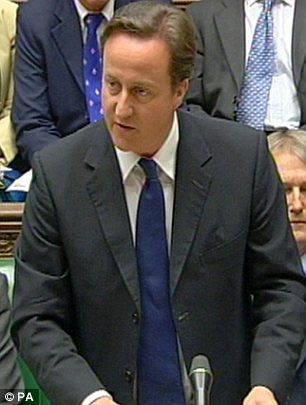
David Cameron’s apology for Bloody Sunday in the Westminster House of Commons was “a political thing” (Kate Nash) and “a cover” (Eamonn McCann).
(Photo source: Internet)

Jackson had written a false account of the shootings of 14 victims as “terrorists” which could not correspond to any of the actual accounts of what had happened; “in some cases the bullets would have had to go through buildings” stated McCann and recalled that these had been presented to the world press after the murders and became the official British version around the world. However, when confronted with this evidence during the Saville Inquiry, at first Jackson “could not remember” and later “had a vague memory” of doing it.8

“They would not have been able to hold that Inquiry nor to make that apology in the House of Commons if Jackson and Ford were being held up to blame,” McCann told the audience. “They’ll sacrifice a few lower-rank soldiers – they are cannon-fodder and killers, that’s all they are to them – but they won’t blame their own.”

McCann alluded also to the Grenfell Tower disaster in London and was sure that the Inquiry would not end up placing the blame on the local authority and politicians’ connections to property companies. He then went on to draw connections between the Butterlys who owned the Stardust and the ruling class of Ireland on the one hand and the ruling class of Britain on the other, how their crimes are always being covered up and how it is necessary to change the system that protects that class.

After the applause that met McCann’s conclusion, Anne Keegan thanked everyone for their attendance and encouraged them to follow the campaigns and to continue to support them and people dispersed.

Audience and speakers gathering to exchange some words after the meeting.
(Photo: D.Breatnach)


COMMENT: THE UNDERLYING REAL STORY?

The Stardust fire was an accident, possibly due to dangerous procedures and/ or lack of safeguards. It was not an accident that emergency exits were locked; they were locked deliberately, against all legal fire safety requirements, no doubt to prevent anyone entering without paying at the front entrance. But when the smoke and fire took hold, many people could not escape nor those outside break in to rescue them and 48 young people died and 241 were injured, families and whole communities devastated.

Therefore the owners, the Butterleys, should have faced trial for manslaughter; instead they were compensated to the tune of nearly €635,000. That the Butterlys were not charged, that the matter was badly investigated and that they were exonerated in the first inquest, was due to connections of the owners of the business with the Irish ruling class, and with the leaders of its main political party, Fianna Fáil. The appropriate term for that kind of collusion is criminal conspiracy.


     Many people, most perhaps in Europe and the English-speaking world, would think that the sending of the Paratroop Regiment to Ireland and the British encouragement of Loyalist death-squads and active collusion with them was an aberration. Others might think them deliberate plans but the responsibility only of individual officers and politicians. Some would see the massacres carried out by the Paras and the Loyalist murder gangs as unconnected, as different initiatives.

However, any objective evaluation should take the following sequence of events and their nature into account:

  • The Six Counties was a portion of Ireland which the British colonialists insisted upon holding on to 800 years after their invasion of Ireland (1169), after a guerrilla war encouraged them to withdraw from the rest of the country (1921). It was ruled by a manifestly sectarian regime discriminating against its substantial but minority Catholic population in every area of life but most brutally in law, policing, employment and housing.

  • Popular resistance begins or is renewed in 1964 after a dormant period reaching a high point in 1968.

  • Repression is deployed (police baton charges, gas, bullets) in 1968-’69 but fails – resistance increases

  • British perception is that it is faced with insurgency and begins to deploy its various arms and methods

  • British Army is sent in 1969

  • At some point the SAS is also sent in (difficult to pin down the year)
  • Control of mass media increases over following years (many journalists attend Army briefings in hotel and file their reports without checking with local communities)

  • Brigadier Frank Kitson installed as Area Commander (1970) with a free hand

  • Gangs (UDA) and Pseudo-Gangs (MRF) are created under Kitson’s guidance (1970)

  • More British troops sent in. Raids on Catholic areas and 3-day curfew on Falls Road (1970)

  • Community resists and first armed retaliation against the British takes place (1970)

  • British Army arms the gangs through recruiting them into the Army itself (Disbandment of B-Specials and creation the UDR British Regiment January 1970)

  • Paratroopers sent in (1971)

  • Gangs (UVF) semi-pseudo gangs (UDA/ UFF) operating fully integrated with British undercover squads and Pseudo-gangs (MRF and UDR) Summer 1971

  • Internment without trial introduced August 1971

  • Immediate civilian protests against internment August 1971

  • Ballymurphy Massacre of protesters by Paratroopers August 1971

  • Derry giant demonstration against Internment and Ballymurphy Massacre January 1972

  • Massacre of protesters by Paratroopers January 1972

  • Formation of highly-secretive and untypical Red Hand Commando Loyalist paramilitary organisation (1972)

  • British Army-RUC-Loyalist murder gangs (UVF) joint operations

  • Trial by jury abolished for those charged with resistance “offences” and Diplock Courts founded Aug. 1973

  • The “conveyor belt” is created – standard torture in Castlereagh Barrack, conviction in courts using tortured “confessions”, prison sentences (1970s-1990s)

  • Prevention of Terrorism Act is introduced to terrorise and silence the large Irish community in Britain 1974
  • Nearly a score of innocent people from the Irish community in Britain are framed on bombing charges and sentenced to long terms in prison (if the death penalty were still in force they would have been hanged) 1974
  • SAS soldiers are detained on undercover operation within the Irish state but are soon released 1976
  • Rules for Coroner’s Courts in the Six Counties changed to restrict the scope of verdicts from pointing towards the perpetrators (e.g Crown forces) or the legal status of the homicide (e.g “murder”) 1976.

  • Campaign to break Republican prisoners’ resistance 1976-1981

  • Change in British electoral legislation to prevent prisoners standing for election (1981see link)
  • Recruitment of informers and double-agents by Army and RUC intelligence

  • Elimination of prominent figures in the Resistance unlikely to agree to the deal 1976-19879

  • Testing the remainder to find supporters for the deal

  • The deal is offered and some concessions made (but no fundamental ones), resulting in the Good Friday Agreement 1998.

One does not have to be a conspiracy theorist to see here a pretty standard response of a colonial power to insurgency in one of its colonies, escalating to deal with an escalating resistance and aiming, if military defeat seems impossible, for wearing down the resistance and the communities supporting it, then to subvert, suborn and to bring the leadership to negotiate a deal which will end the resistance but not the existence of the colony.

Of course the process was bound to have some tweaks, as this anti-colonial resistance was taking place within Europe and breaking out just 50 years after a national liberation war within that country. Still, overall, a pretty standard colonial war.

And there are many other aspects not dealt with in that timeline, including subversion of the early 20th Century Irish national liberation movement and the subsequent State, bombings and killing of civilians there in the 1970s, recruitment of agents among news reporters, blackmail operations, promotion of pseudo internal communal opposition to the resistance, such as the SDLP and “Peace (sic) Women”, the use of gas and plastic bullets in particular ways and others.

Indeed, it is those who insist on seeing all these factors as unrelated or not part of colonial policy, agreed at the highest level, who are taking the unrealistic view. One has to be determined not to see the facts and their connection to colonial policy in order to maintain the illusion they insist upon, that the problem was/is one of “some bad apples” and “some bad decisions”.

End.

References and Further Reading (it is not suggested that everything stated in these sources is correct):

https://en.wikipedia.org/wiki/Stardust_fire

https://en.wikipedia.org/wiki/Bloody_Sunday_(1972)

https://en.wikipedia.org/wiki/Bloody_Sunday_Inquiry

https://en.wikipedia.org/wiki/Miami_Showband_killings

Travers, Stephen; Fetherstonhaugh, Neil (2007). The Miami Showband Massacre: A Survivor’s Search for the Truth. Hodder Headline Ireland, Ltd. ISBN 978-0-340-93792-1

Brigadier Frank Kitson: https://www.historyireland.com/volume-22/frank-kitson-northern-ireland-british-way-counterinsurgency/

https://en.wikipedia.org/wiki/Aden_Emergency

https://www.findmypast.ie/articles/world-records/full-list-of-united-kingdom-records/armed-forces-and-conflict/british-armed-forces-first-world-war-soldiers-medical-records

https://www.thenational.ae/world/mena/secret-colonial-era-files-reveal-british-cover-up-of-torture-in-aden-1.667507

https://www.theguardian.com/uk/2004/may/17/military.iraq1

https://www.irishtimes.com/news/crime-and-law/bloody-sunday-secrets-taken-to-the-grave-1.1523812

http://www.nihrc.org/documents/advice-to-government/2002/proposed-coroners-practice-and-procedure-rules-january-2002.pdf (p.4)

Click to access UKPGE-Part-1-Can-you-stand-for-election.pdf

FOOTNOTES

Social and Democratic Labour Party, a reformist party in the Six Counties which displaced the Irish Nationalist Party in nationalist area voter support and later got displaced by Sinn Féin.

The Wikipedia entry on the “Miami Showband Killings” (sic) and a Wikipedia entry on showbands (https://en.wikipedia.org/wiki/Irish_showband) which also mentions the incident as contributing to the decline of the showbands both refer to the unit involved entirely as UVF, the Ulster Volunteer Force (a Loyalist paramilitary organisation responsible for more than 500 deaths, mostly Catholic civilians and a great number chosen at random). Only later in the text does it reveal that “at least four of the gunmen were serving soldiers from the British Army’s Ulster Defence Regiment”.

3 In his book, which I have yet to read but referred to in the Wikipedia entry on the massacre, Stephen said that the RUC interviewing him were not willing to accept this description of that individual. The man is believed by some to have been Captain Robert Nairac of the Grenadier Guards regiment but seconded to one of the special undercover units of the British Army. The IRA announced that it had executed Nariac in May 1977, having been captured by them while undercover; his body is still missing.

The UVF did in fact issue a lying statement to that effect in a eulogy to two of their dead members.

The Royal Ulster Constabulary, notoriously sectarian and armed British colonial police force taking over from the also-armed Royal Irish Constabulary in 1922, soon after the partitioning of Ireland. In 2001 it was rebranded as the Police Service of Northern Ireland (PSNI).

Strongly British Loyalist district of Belfast.

7 The Aden conflict or “emergency” as usually referred to in posts about this British colonial conflict (and totally absent from a number of Wikipedia and other pages about Aden) was an insurgency against British forces in Aden, a British colony since 1839. Although an “emergency” was declared on 10 December 1963, the conflict had been going on for longer. At peak the British Army had 30,000 service personnel there and 15,000 South Arabian troops and of their combined forces suffered 382 killed (227 British Army) 1,714 wounded (510 B.A.). No statistics on the number of Arabs killed by British forces and their allies are easily available. “Britain dropped more than 3,000 heavy bombs and more than 2,500 rockets in a bid to pacify the guerrilla insurgency who used the Radfan Mountains for cover” (Daily Mail article 2017 glorifying the British in general and the Paras in particular).

A joint effort was created between the British forces and the Federation Regular Army (FRA – of the Federation of Southern Emirates, a British protectorate) to combat the National Liberation Front and the Front for the Liberation of Occupied South Yemen (FLOSY). The paramilitary groups initiated a guerrilla campaign of grenade attacks against the British forces. By 1967 the situation in Aden escalated and the evacuation of British families and citizens was enforced. The city erupted in riots, tensions were heightened further by the Six Day War and a mutiny broke out within the Federation Regular Army.

The conflict ended on 30 November 1967. British forces withdrew from Aden and the National Liberation Front seized control of the government. The People’s Republic of South Yemen was declared.

8 In a short piece in the Irish Times in September 2013 (see link in References and Further Reading section) Eamonn McCann cast doubt upon the same testimonies which he denounced in the meeting reported here. McCann attended nearly every day of the Saville Inquiry in London, staying with family there and traveling there and back at his own expense and wrote a weekly report on the Inquiry for the Irish Times.

Too many to list all here but covered in a number of publications; the first was probably Máire Drumm of Sinn Féin by the mysterious Red Hand Commando Loyalist paramilitary organisation (also claimed by the UFF) and those convicted afterwards included one “ex British soldier”. The eliminations encompassed the attempted murders of veteran Civil Rights campaigner, ex-MP and active anti-imperialist socialist Bernadette McAlliskey (shot 14 times) and her husband in 1981; the ambush and execution of members of the IRA unit of the East Tyrone Brigade, including IRA Vols. Jim Lynagh and Pádraig McKearney, by the Special Air Service in 1987; and the last perhaps, Dominic McGlinchey 1994 by persons unknown.

Dublin Taxi Drivers give Special Needs Children a special Day Out

Diarmuid Breatnach


Motorbike cops zoom up to junctions at noon in Dublin today, lights flashing and hold traffic up to clear the way for what is coming.  But who or what is it that is coming?  “Must be some nasty capitalist diplomatic representative from abroad”, we think.  “Or maybe one of our own Gombeen Government politicians,” we add as an afterthought.  And usually we’d be right — but not this time.

(All photos source: D.Breatnach).

It’s the annual Taxi-Drivers’ Day Out for Special Needs Children.

A quick search failed to find anything on Google about it other than a post from a Journal.ie report dated last year.  From that I learned that this is an annual event, first organised in those far-off days of unfunded un-NGO-organised community events — 1960 to be precise.

The report from last year quoted a figure of 400 taxi-drivers signed up for the day but the organiser was appealing for more drivers still.  The report stated that the previous year (2016), 1,000 children had been taken on the day out.

The following three paragraphs are from the Journal’s pre-event report last year.

‘On the day, children are picked up from hospitals, care homes or private homes by their own personal taxi driver for the day. From there, they are taken to Parnell Square where all taxis gather for a speech by the Lord Mayor and some music from the Garda Band and DJs.

‘The taxis are then escorted through the city by gardaí to the racecourse where they are treated to music, games, face-painting and finger food.

‘“Our aim is to treat the special needs children of the city to a fun day out and put smiles on faces. That’s exactly what you get when they arrive in Parnell Square and they’re meeting and greeting the mascots and characters,” Matthews (the organiser) said.


These photos were taken from outside Liberty Hall, where I was awaiting a group in order to start a history tour.

PS: Good to see the cops were not masked, wielding batons and pepper-spray canisters or carrying machine-guns and battering-ram.

End.

Link: http://www.thejournal.ie/dublin-taxi-drivers-special-childrens-outing-3519742-Jul2017/

FASCISTS MARCH DEMANDING SPANISH UNITY

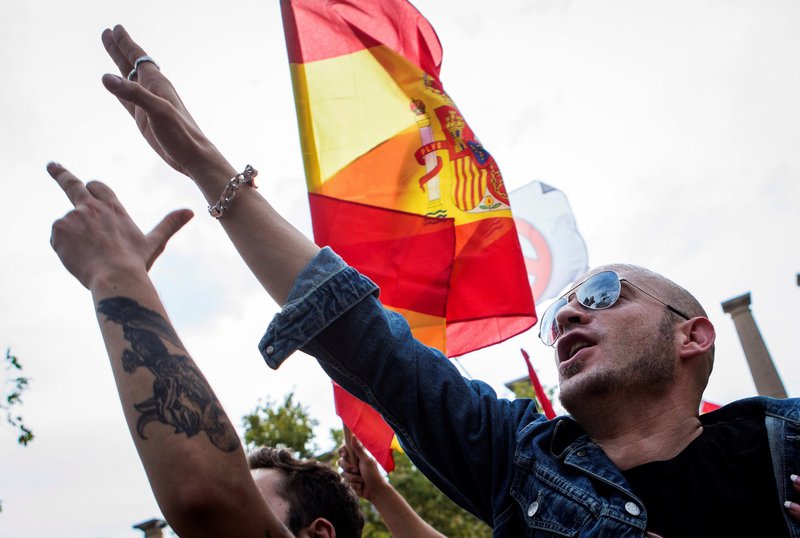
Death threat, fascist salute and Franco’s version of the Spanish flag, all illegal and displayed with impunity at this demonstration against Catalan independence and many other fascist events. (Photo credit: EFE/ Enric Fontcuberta 4651#Agencia EFE)

Some 2,000 people (according to the Urban Police) demonstrated this Sunday in Barcelona to reject any negotiation with Catalan sovereignty and in support of the unity of Spain.

(Translation from Catalan newspaper report — see link below end translation — by D.Breatnach)

The protest, called by real estate entrepreneur and former Guardia Civil (spanish state police — Trans) member Juan Manuel Opazo with the support of the ultra-royalist party Vox, crossed the Avenida del Paralelo under the slogan “No [pacts] with either terrorists or separatists.” Sixty associations and movements such as the Catalan Civic Convivencia, the Catalan Association of Victims of Terrorism, Catalonian Employers or Somatemps supported the event.

At the top of Avenida Mistral the demonstration came in sight of an anti-fascist protest called by anti-fascist movements and booing booing was exchanged from both sides. The Mossos (Catalan Police) kept both groups apart.

The march ended on Avenida María Cristina, where the Parliament is situated. Many of there asked the Spanish Prime Minister, Pedro Sánchez, to not negotiate “with separatists” and to convene elections.

Coaches from 30 cities throughout Spain, such as Alicante, Malaga, Bilbao or Valladolid, among others, brought supporters to the protest.

Photo: Unionist march supporters give the fascist salute and threaten shooting at the anti-fascists and carry Spanish fascist symbols.


COMMENT (D. Breatnach):

The comparatively small size of the march and the fact that it was only possible by bussing in supporters from other parts of the state may be taken as an indication of how small the support base is for this far-right variety of Spanish unionism.

The monster march for independence Diada (Catalan National Day) on Tuesday will provide a useful comparison: one million marchers are expected.

The list of organisations supporting the march gives the lie to their frequent representations as “concerned citizens” who are “opposed to terrorism” etc, particularly the Catalan chapter of the “Association of Victims of Terrorism”, an organisation which for years has been hounding Basque independentist organisations with the assistance of the Spanish courts. To outsiders it might seem like a legitimate organisation held together in solidarity against terrorism but it is well known to be an extremely right-wing organisation, composed of ex-military and Spanish police (and no doubt serving members too) and their relatives. Some of them were indeed victims of armed Basque actions but it has to be acknowledged that was in a war which the Spanish state first launched against the Basques themselves, not only during Franco’s time but for decades afterwards too.

The impunity of fascists breaking the laws against fascist symbols, gestures, slogans and against threats, which has often been remarked upon throughout the Spanish state, was once again demonstrated. On the other hand even rap words, a poster, video or a verbal argument with police officers coming from a left-wing or independentist perspective can and have resulted in prison sentences.

Spanish unionism has a number of types and the one displayed in the reported march is the most extreme – the type that led to the creation of the fascist Falange, a military uprising, massacres of surrendered prisoners and civilians, rapes and other tortures and Franco’s dictatorship. But this could not exist on its own. With the collusion of the leaderships of the social-democratic PSOE and the Communist Party of Spain – and their respective trade unions – after the death of Franco, torture and all kinds of undemocratic laws and court rulings continued with the addition of death squads to force a rejected monarchy on the people and the obligatory unity of the state in the Constitution now in force. All of this together is what now confronts the Catalan independentist movement. But it also confronts any Spanish democrat and should call them to mobilise against Spanish unionism which is inextricably bound up with fascist ideology.

Report translated from: http://www.elpuntavui.cat/politica/article/17-politica/1464111-unes-2-000-persones-marxen-a-barcelona-per-la-unitat-d-espanya.html


CATALAN NATIONAL RESISTANCE DAY IN DUBLIN

Diarmuid Breatnach


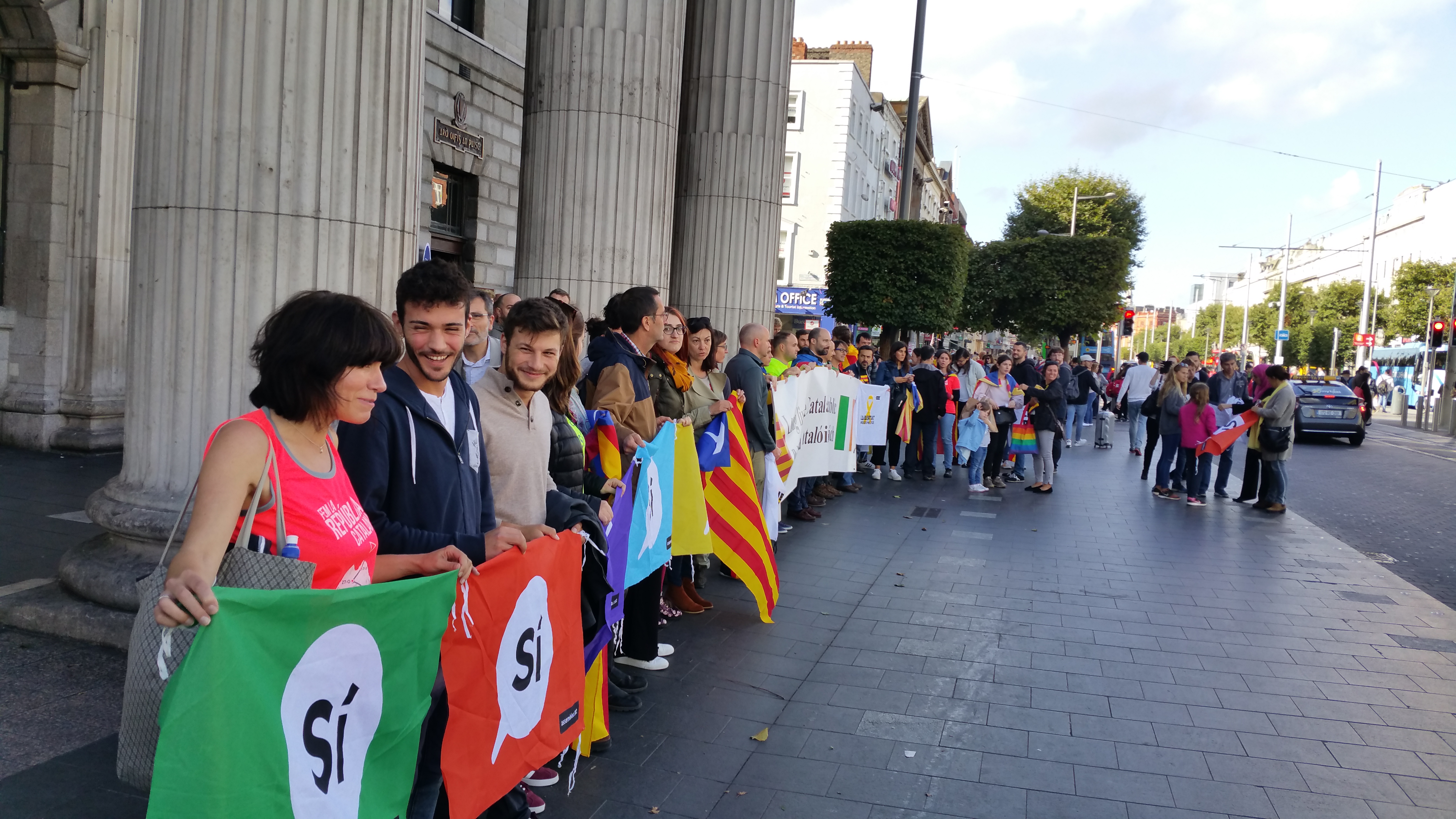
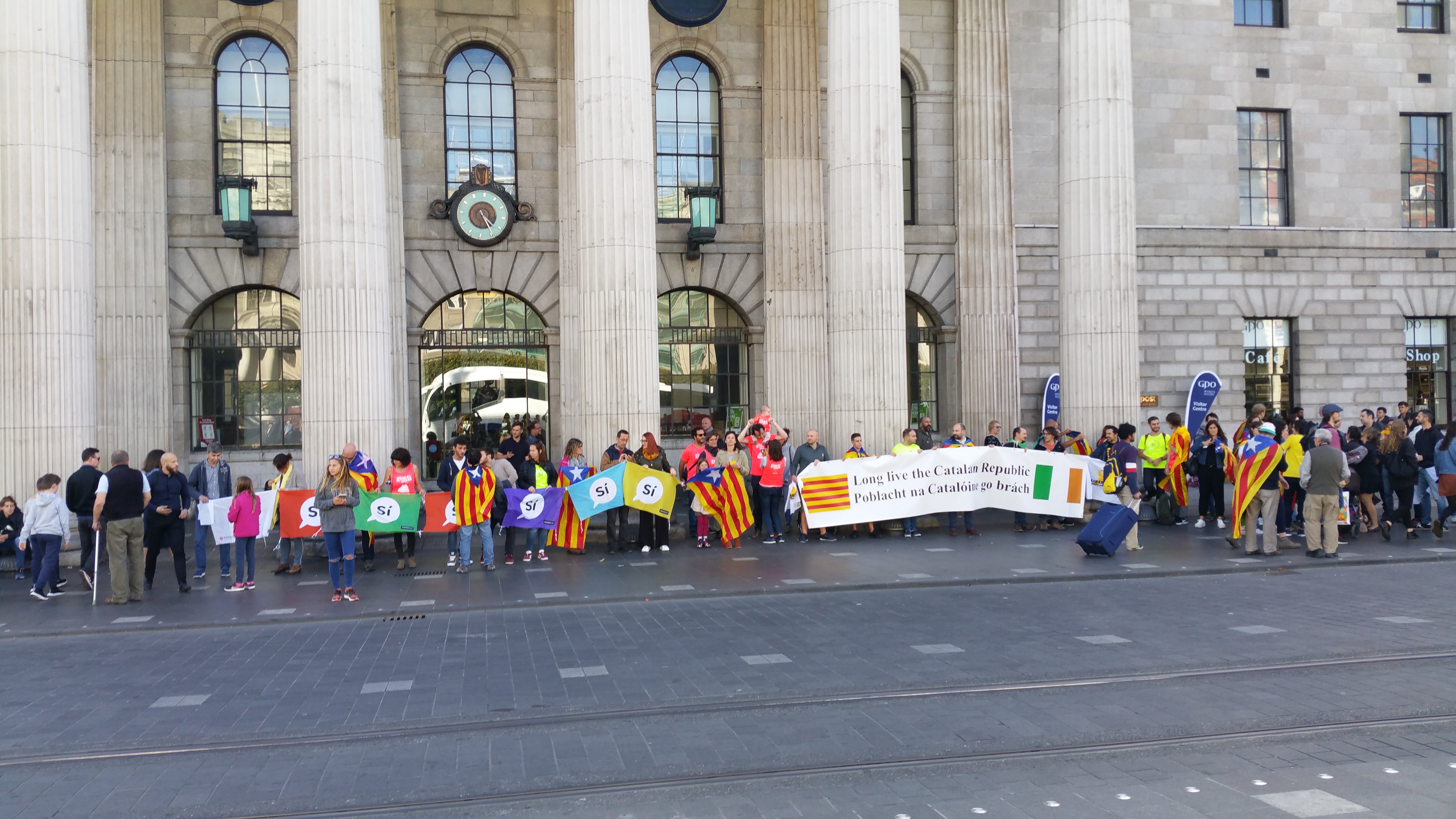
Section of the Diada celebration outside the GPO looking northwards (Photo: D.Breatnach)

Catalans made a good showing Sunday in Dublin to mark their national day, La Diada. The official date is actually the 11th but this was the closest weekend day to it, when people would not be at work. In Catalunya, of course, it will be celebrated on Tuesday.

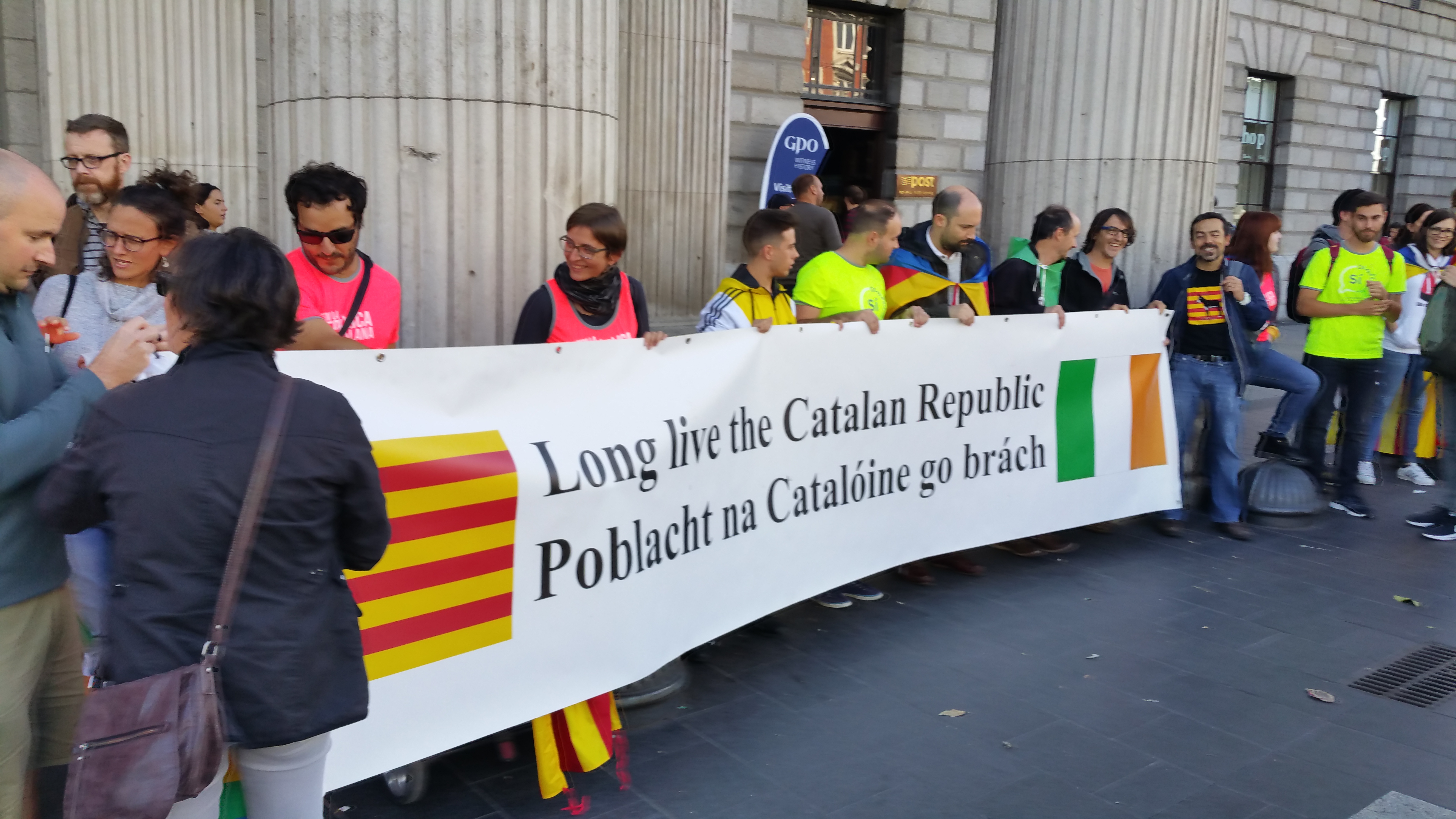
The event was organised by the ANC (Catalan National Assembly) in Ireland and was supported by a number of other organisations, including representation from CDRs in Ireland (Committee for the Defence of the Republic), Casals Catala (Catalan cultural association) and the Irish Catalan solidarity organisation, With Catalonia/ Leis an Chatalóin.  It took place outside the iconic General Post Office (HQ of the Irish rebels in 1916 and which still bears the marks of British bullets and artillery shell fragments) in O’Connell Street (Dublin’s main street).

(Photo: D.Breatnach)

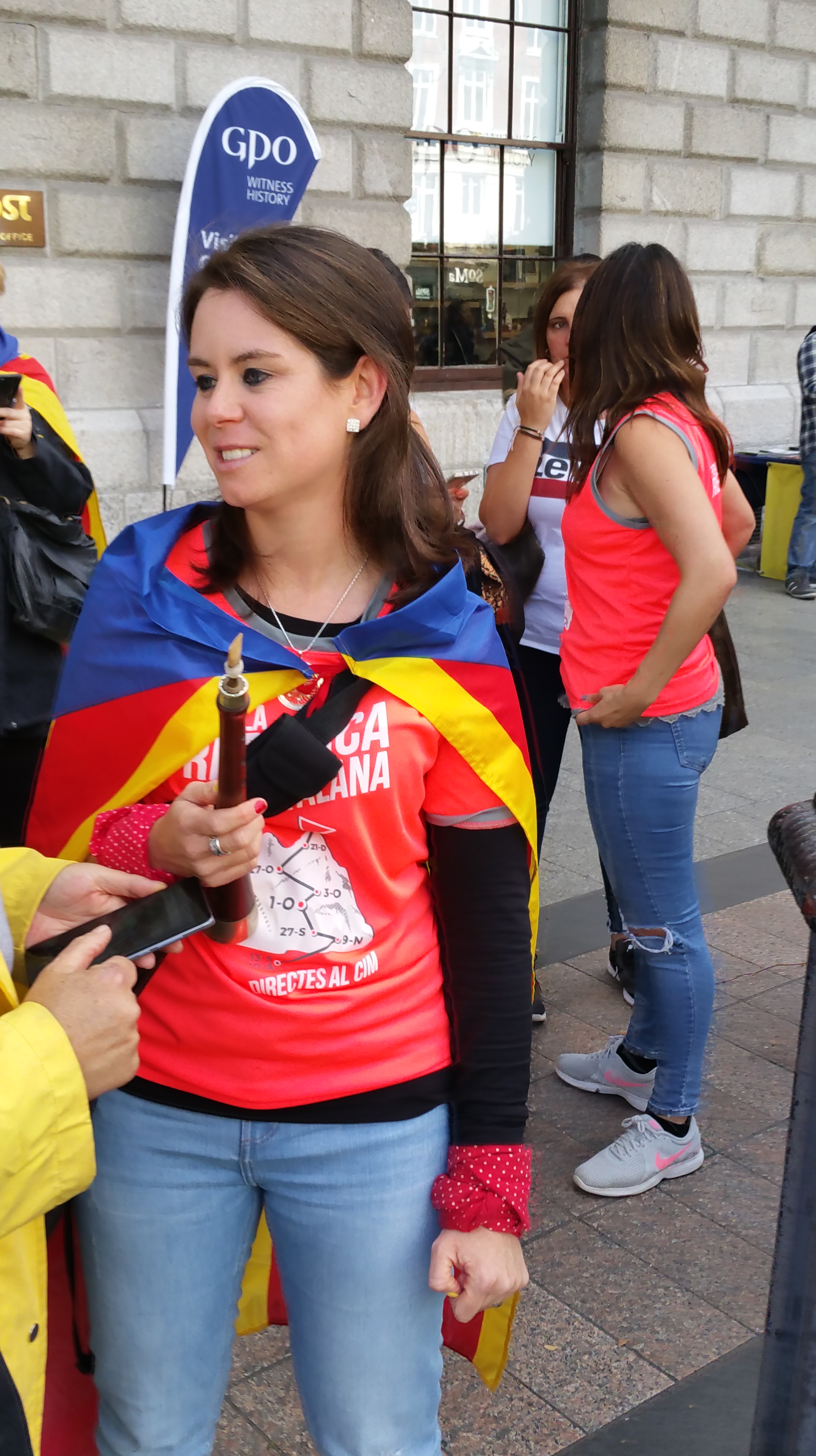
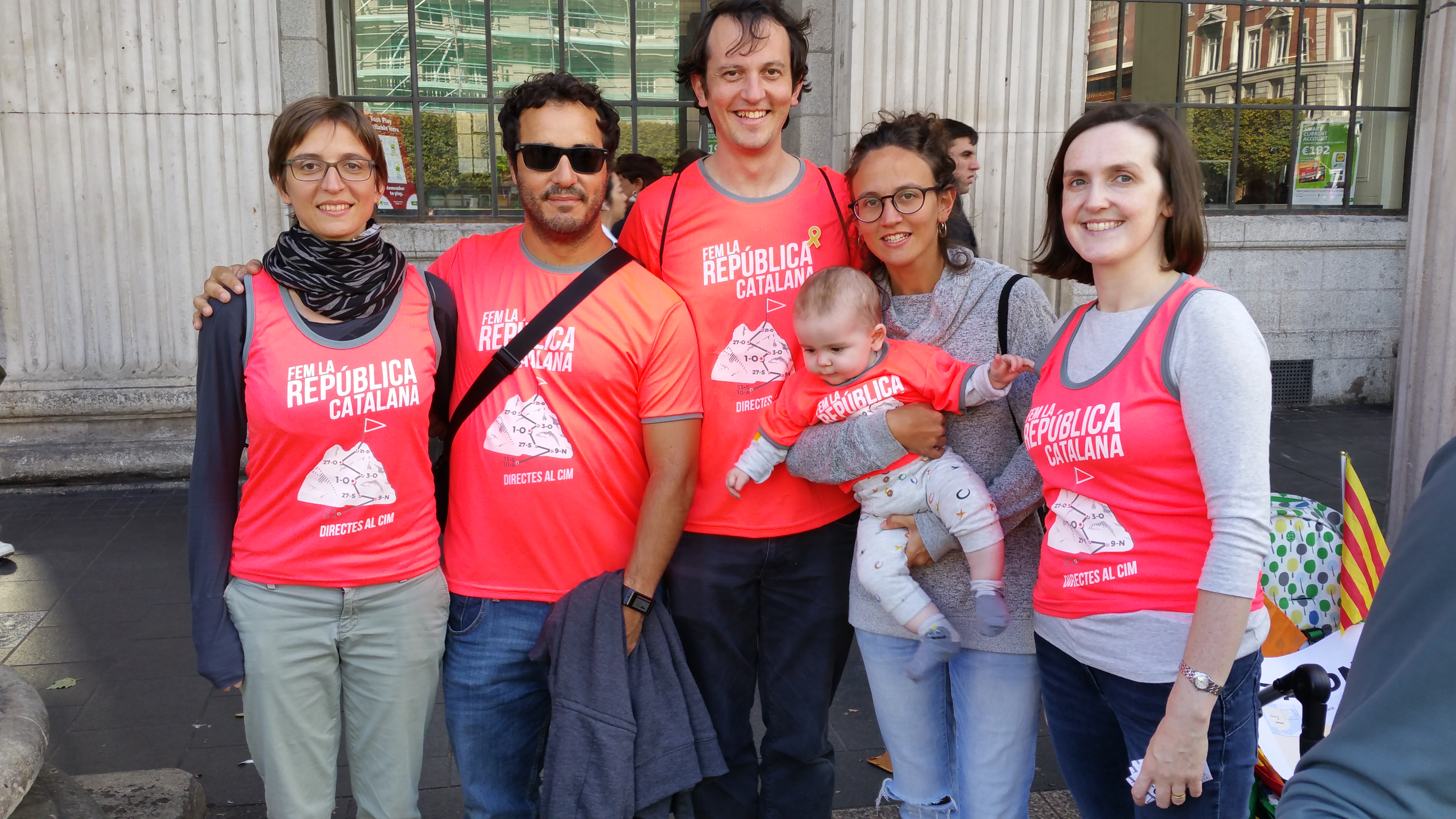
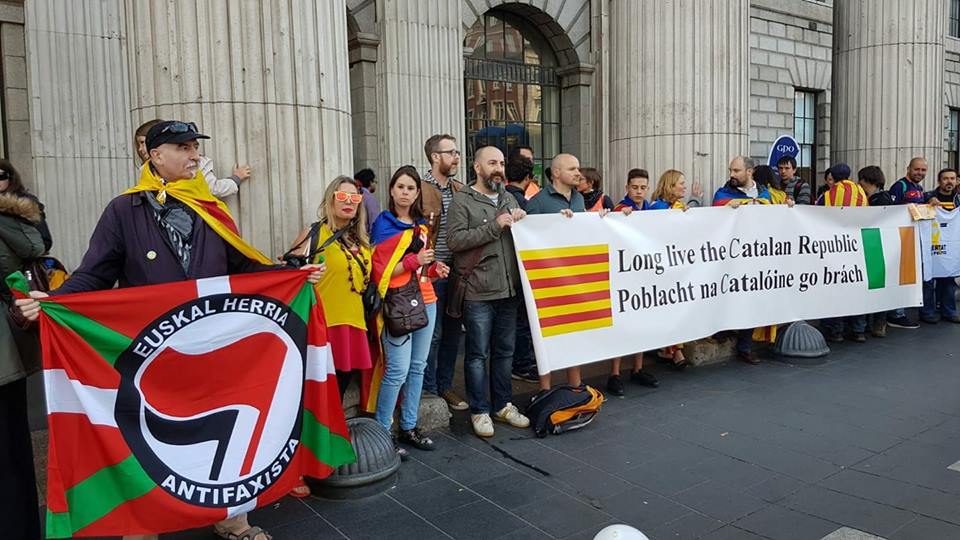
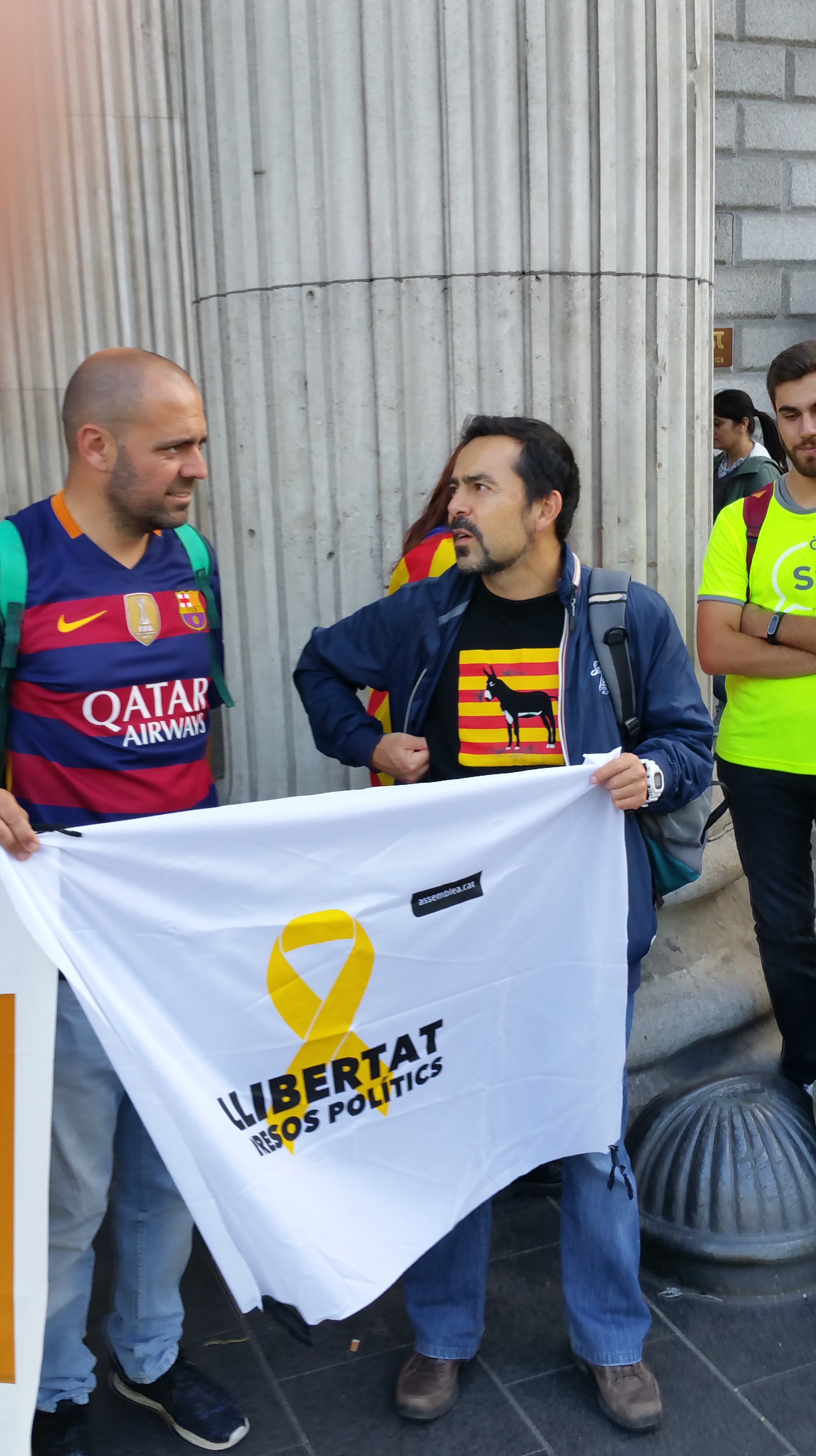
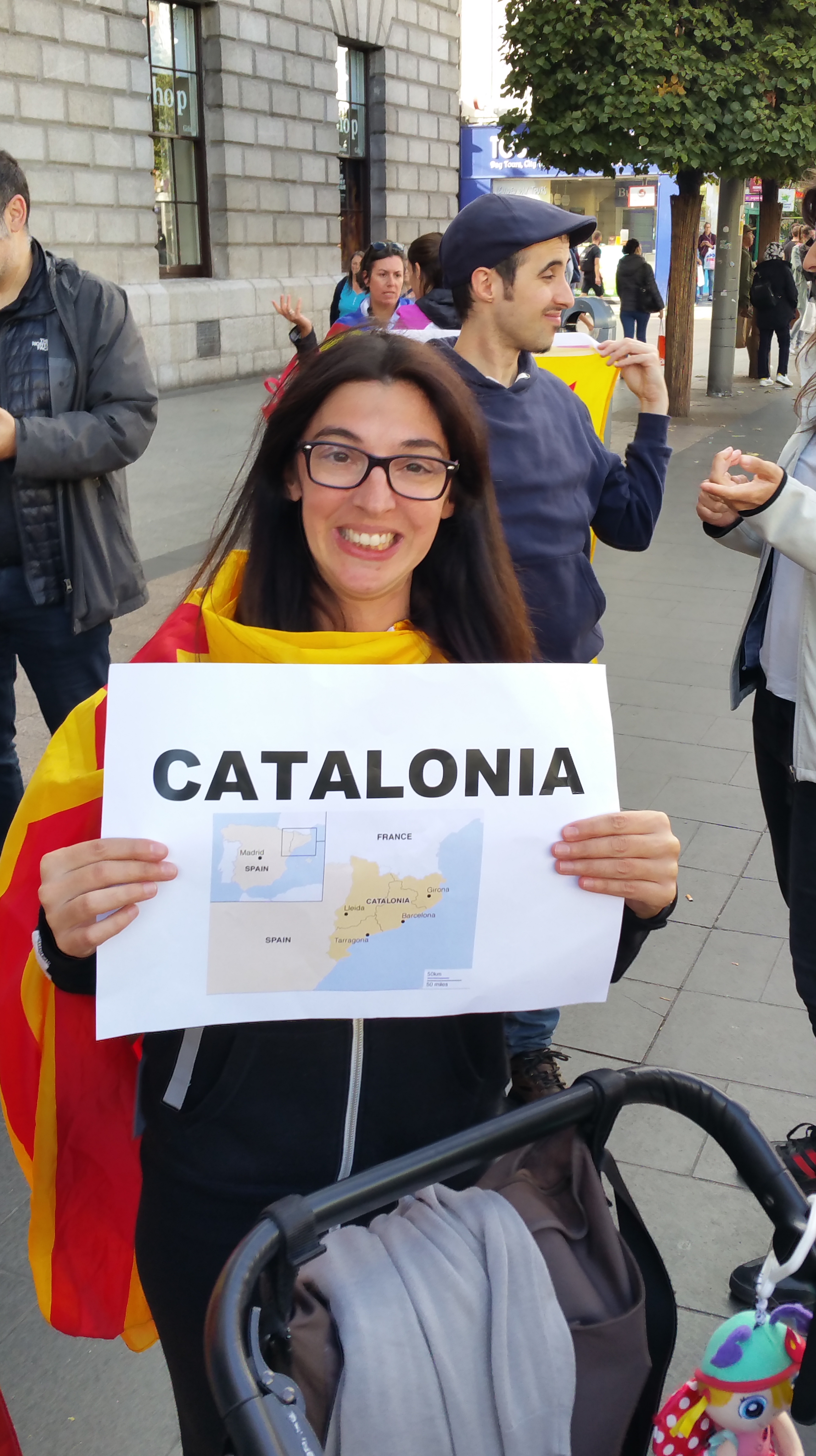
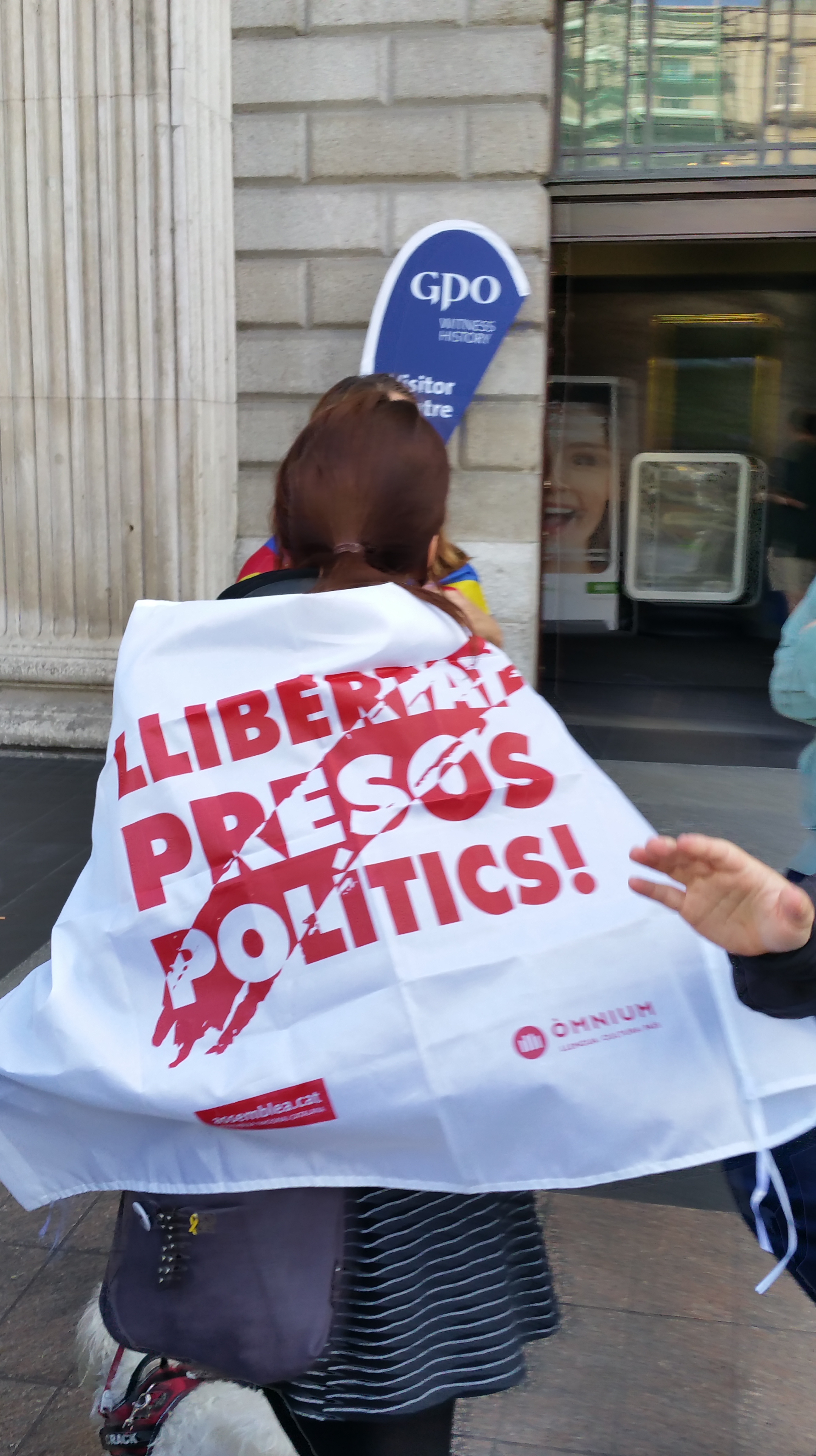
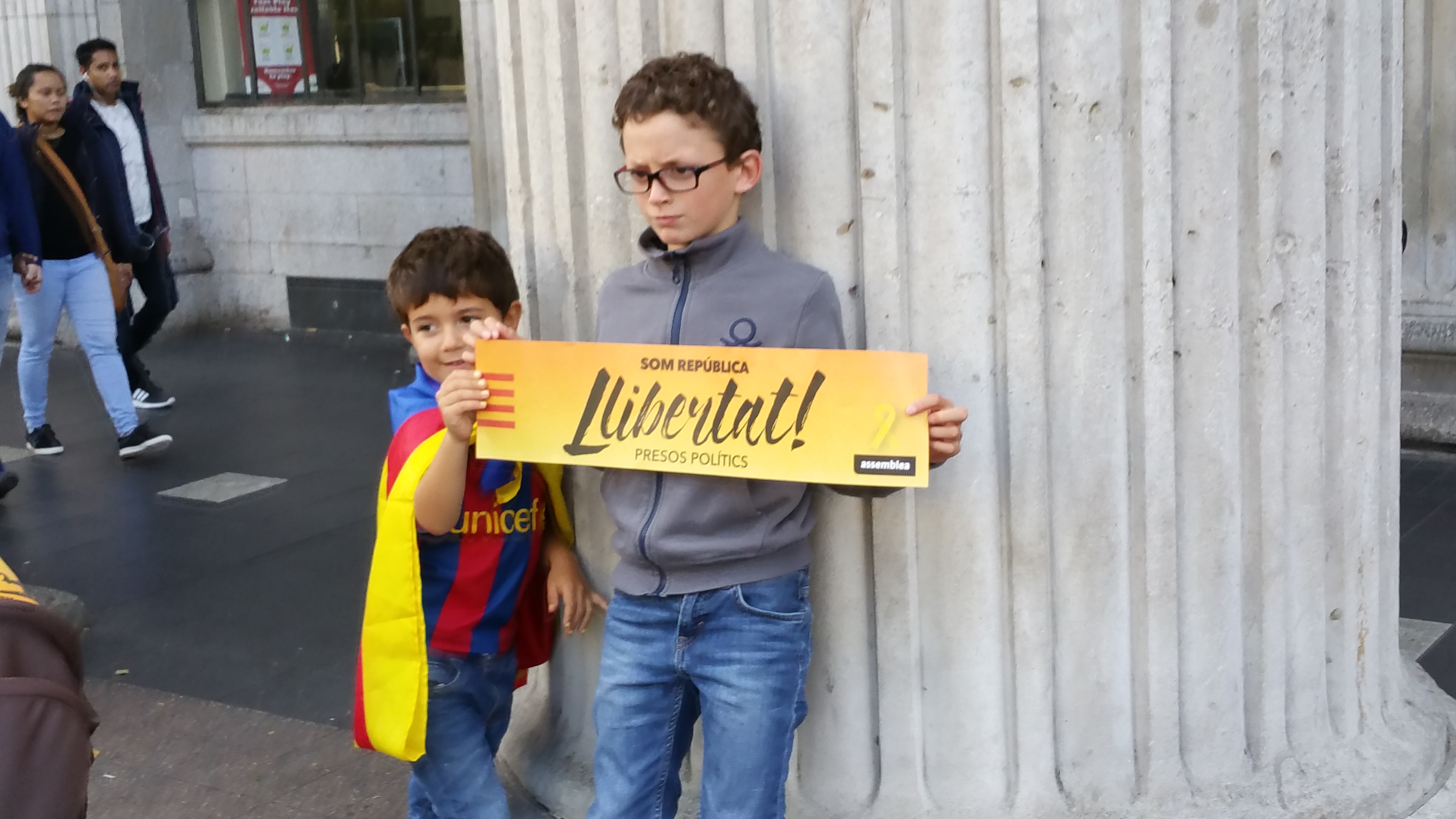
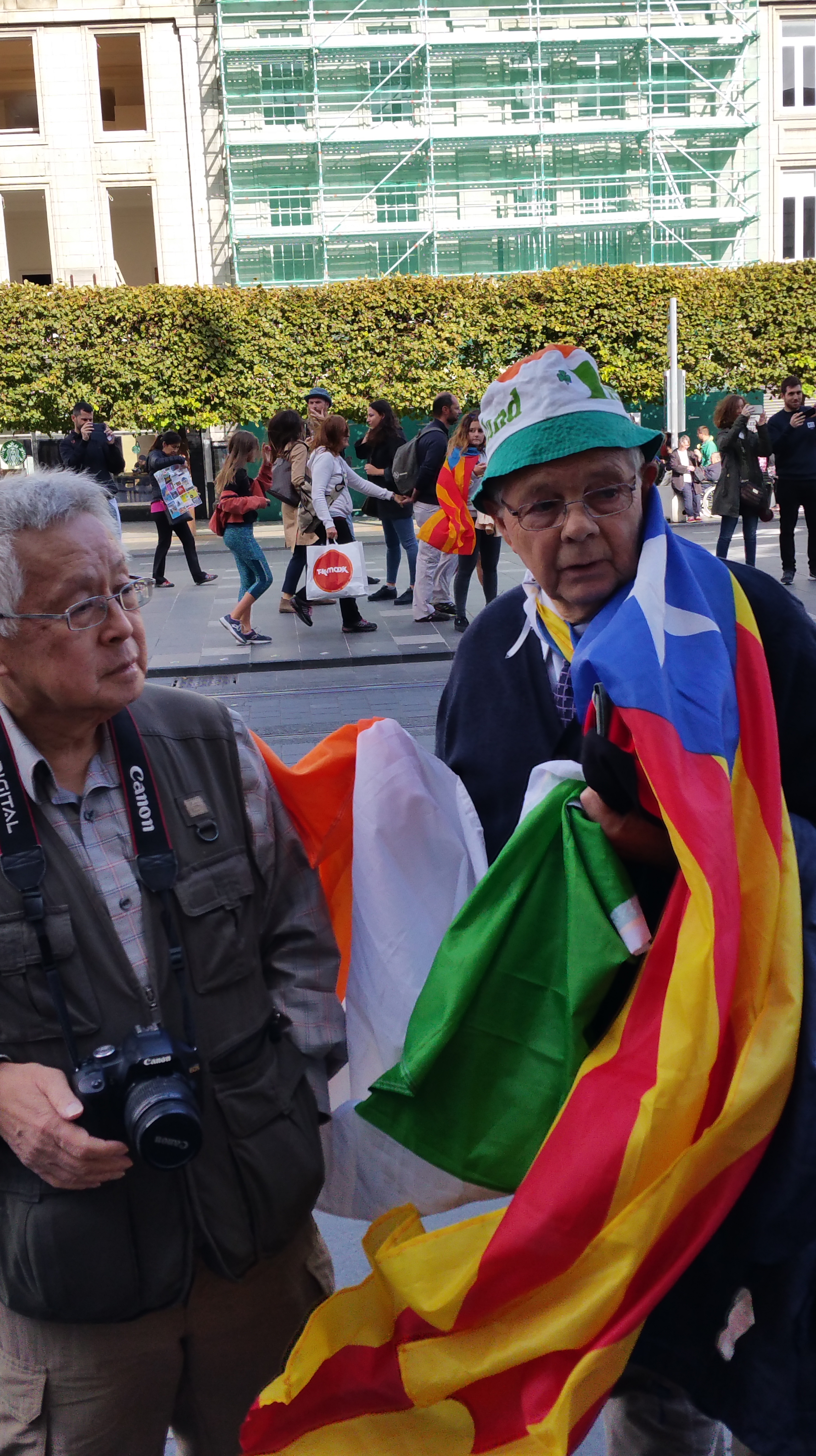
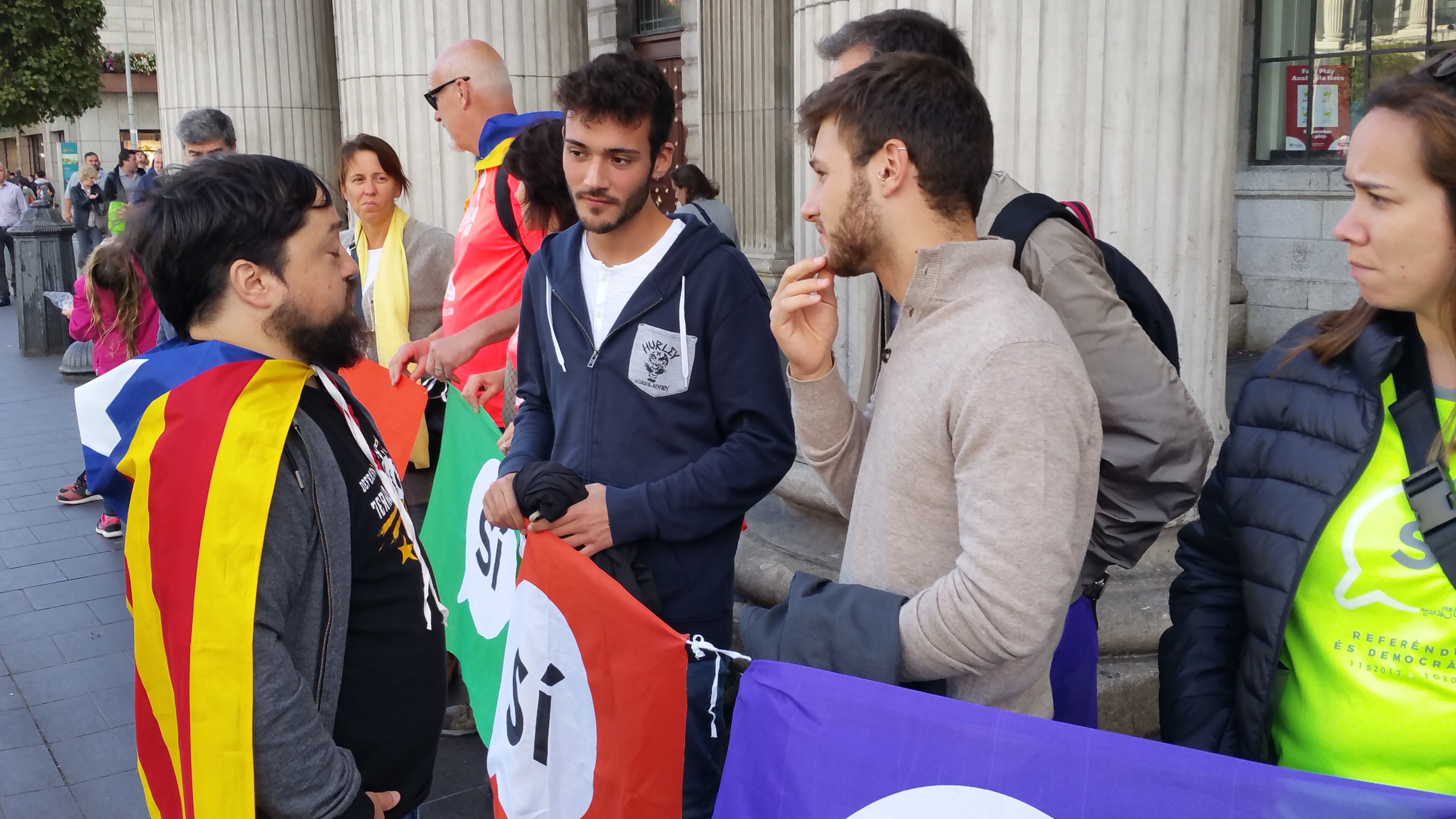
The two independentist flags, the Estelada and the Vermelha were both very much in evidence, along with a banner in Irish and English, streamers calling for “Libertat”, T-Shirts of various kinds displaying identification with the Catalan national movement and/or solidarity with political prisoners. In addition there was a Basque Antifa flag flown. The event was held in a friendly atmosphere with a number of supporters having brought their children and, whether by design or happenstance, there were no speakers. The Els Segadors (The Reapers), the Catalan national anthem was of course sung as were a couple of others and a number of tunes were played on the gralla (Catalan reed instrument with a loud sound).
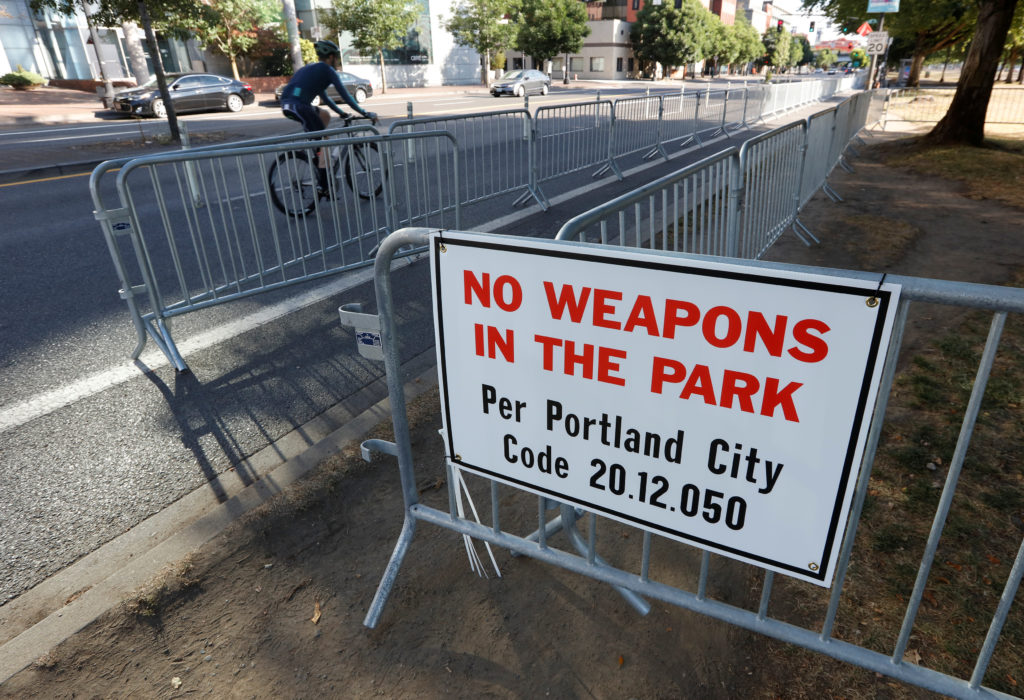
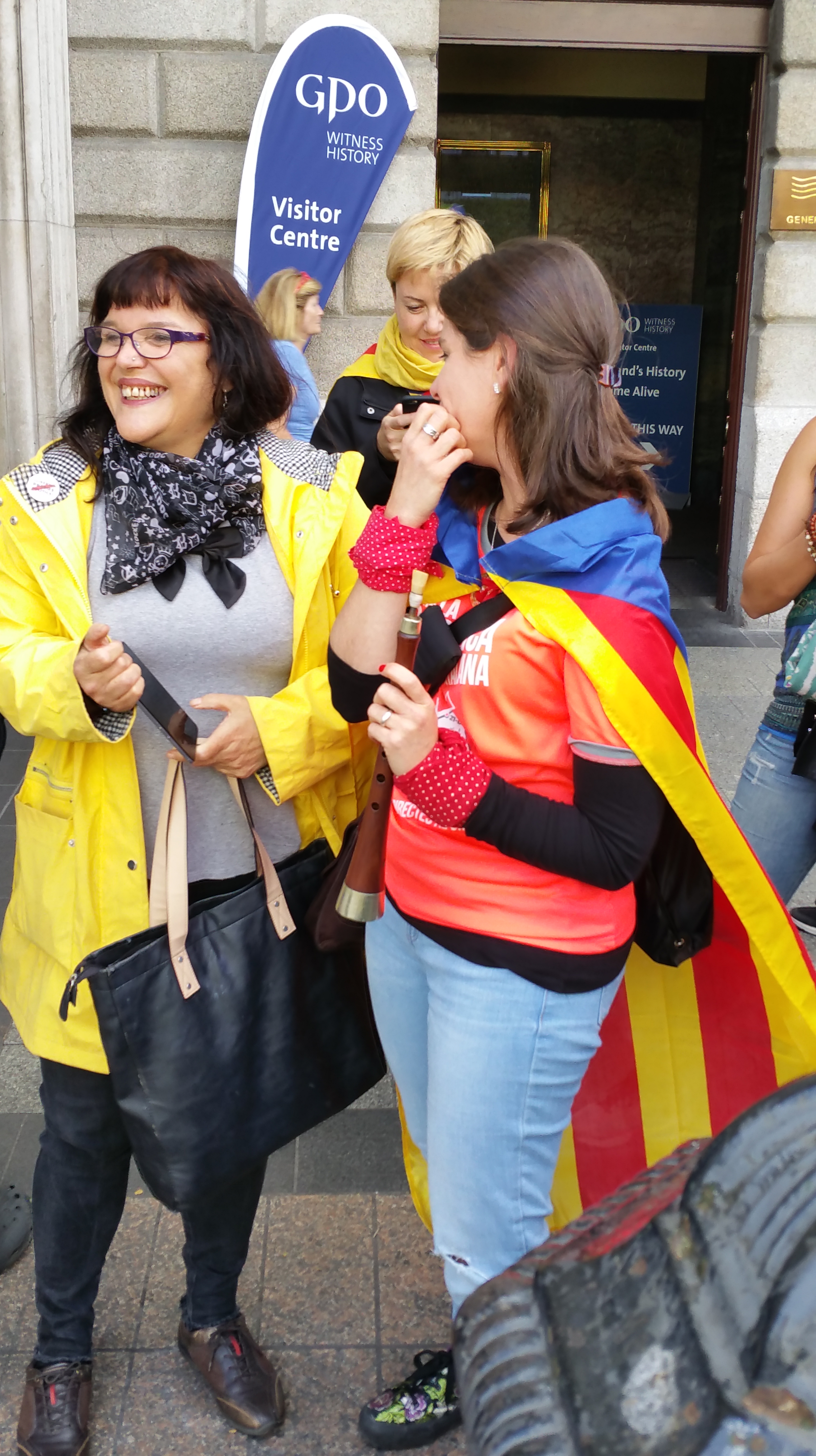
Catalan woman with the “gralla” musical instrument
(Photo: D.Breatnach)

Last year the Diada was celebrated in a number of Catalan cities and with up to a million participating through the streets of Barcelona in a demonstration for Catalan self-determination, in a lead-up to the Independence Referendum carried out on October 1st, in defiance of Spanish Government prohibition and which was savagely attacked by Spanish police. The ANC there, a grass-roots organisation, was the major organiser of the Diada, which is no doubt a major reason why its President, Jordi Sanchez i Picanyol, was arrested by the Spanish Government and, along with others, faces charges of “rebellion” and has been in jail without bail since October.

Subsequently the Catalan Government, an independentist coalition, declared the Catalan Republic and then immediately suspended it. The elections in December returned a majority once again for independence.

Catalans in Dublin have also promised to commemorate the Catalan referendum of October last year.

(Photo: D.Breatnach)


Photo shows another view of section of the demonstration and a supporter flies the flag of the Basque Antifascist movement.
(Photo source: donated by Catalan supporter)


This year the Diada demonstration in Barcelona, convened under the slogan “Fem la República Catalana” (“Let’s Build the Catalan Republic”) is expected to attract at least a million participants and there will be demonstrations in other Catalan towns too and many other cultural events in addition to marches and rallies. Although the event is organised well and people participate peacefully, the Spanish Government is reputedly sending 6,000 Spanish police – a move which will inevitably be seen – at least by Catalans — as provocative or intimidatory. And indeed evoke memories of Catalans trying to vote in the Referendum last October being batoned by Spanish riot police, as well as dragged, kicked, punched and shot at with rubber bullets (banned in Catalonia).

As the Diada was part of the build-up in the Catalan national movement last year, so it will be this year, although there is currently no plan for another referendum (Catalan political leaders have offered to hold another one but the Spanish Government has replied that would only be permitted if it did not lead to independence but instead to some greater extension of autonomy). Nor is there a prospect of elections this year. Meanwhile, the jailed cultural and political activists await trial without bail, others are in exile and hundreds more face charges. And the the aspiration for independence remains unsatisfied.


(Photo: D.Breatnach)

ORIGINS OF THE DIADA

Dates to celebrate the nation, except when they are those of patron saints, are usually chosen to commemorate an important event in the history of the nation – and not always a happy one. The Diada is one of the latter, commemorating the fall of Barcelona in 1714 to the forces of the French Royal House, the Borbons, after a 14-month siege, with the subsequent removal of Catalan laws and national rights. In a struggle between different pretenders to the Spanish Crown, the Catalans had chosen the losing side. The Irish, having made a similar ill-starred choice twice when the British Parliament overthrew its King, first with Charles I (Stuart) and later with James II (also Stuart), may well sympathise.

Spanish dictator Primo de Rivera banned the commemoration and subsequently, with the inauguration of the Second Spanish Republic in 1931, the Catalans opted to side with it while gaining national autonomy from the Government. However the military uprising against that Republic became what is usually known as the Spanish Civil War and Catalans fought to resist Franco. When Catalonia fell and Franco’s dictatorship was installed, the Catalan language was banned as were any demonstrations of independent Catalan national feeling, which however did not totally prevent some gestures of defiance annually on that day. The Diada has now been celebrated publicly in Catalunya every year since 1976, the first September since the death of Franco.

(Photo: D.Breatnach)


LINKS:

ANC: https://www.facebook.com/IrlandaPerLaIndependenciaDeCatalunya/

CDR: https://www.facebook.com/CDRDublin/

Casals Catala Irlanda: https://www.facebook.com/casalcatalairlanda/

With Catalonia/ Leis an Chatalóin: https://www.facebook.com/WithCataloniaIreland/

Daily 10-news video of news from Catalonia: http://www.catalannews.com/

“Freedom!”
(Photo: D.Breatnach)
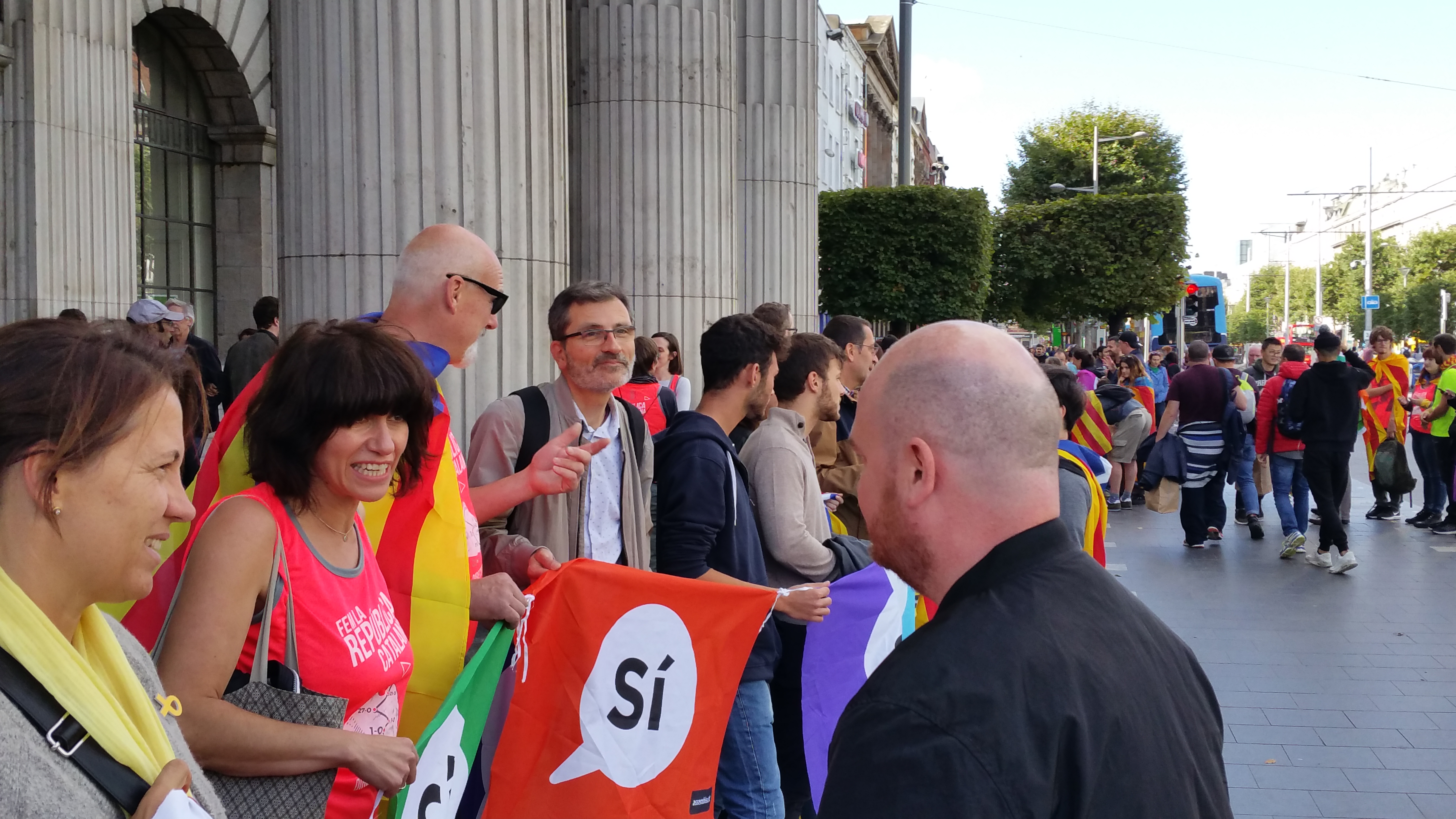
People holding bunting of “Si” flags, the answer the majority gave in the referendum to the question of whether they wished a Catalan Republic or not (Photo: D.Breatnach)
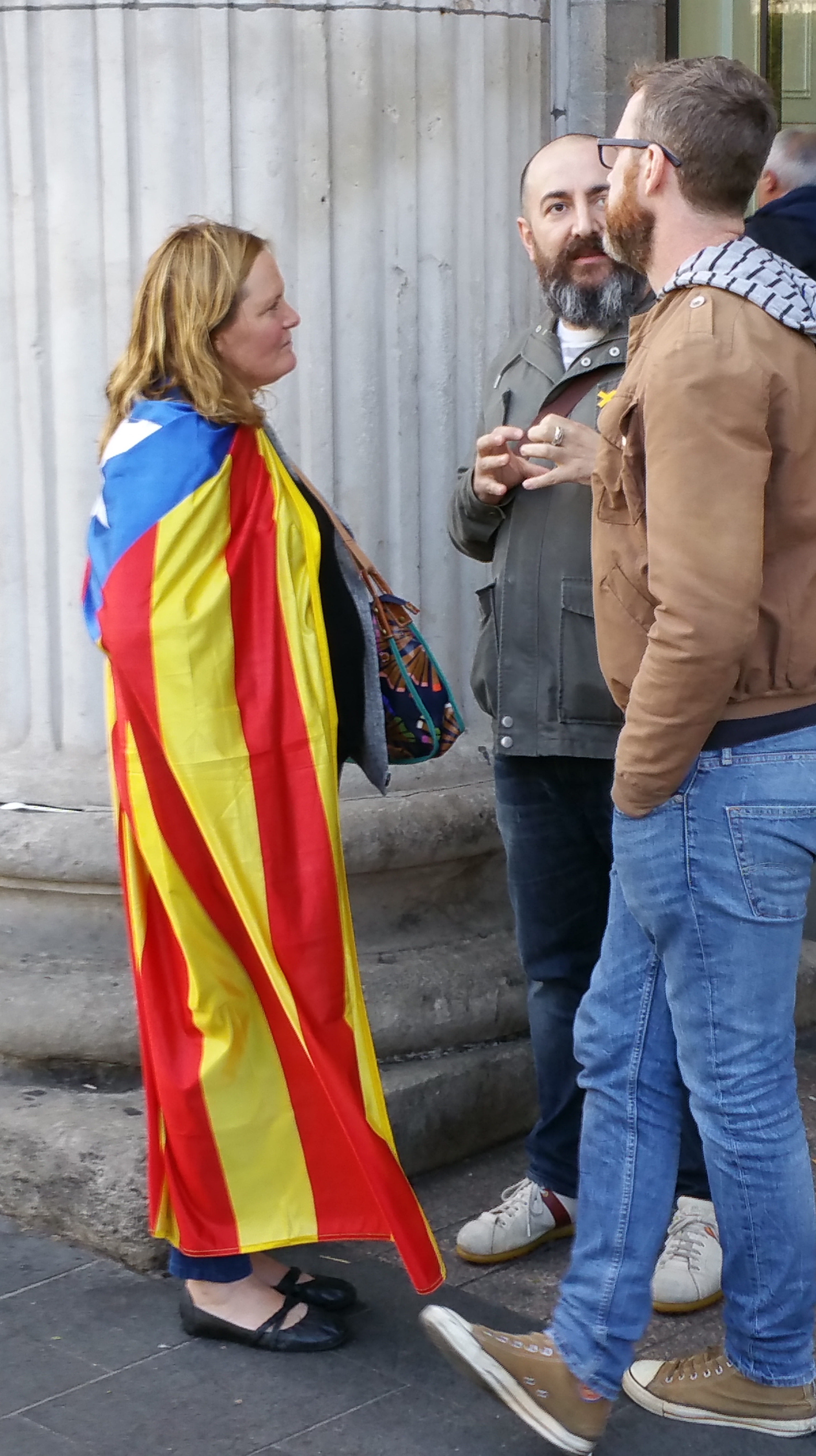
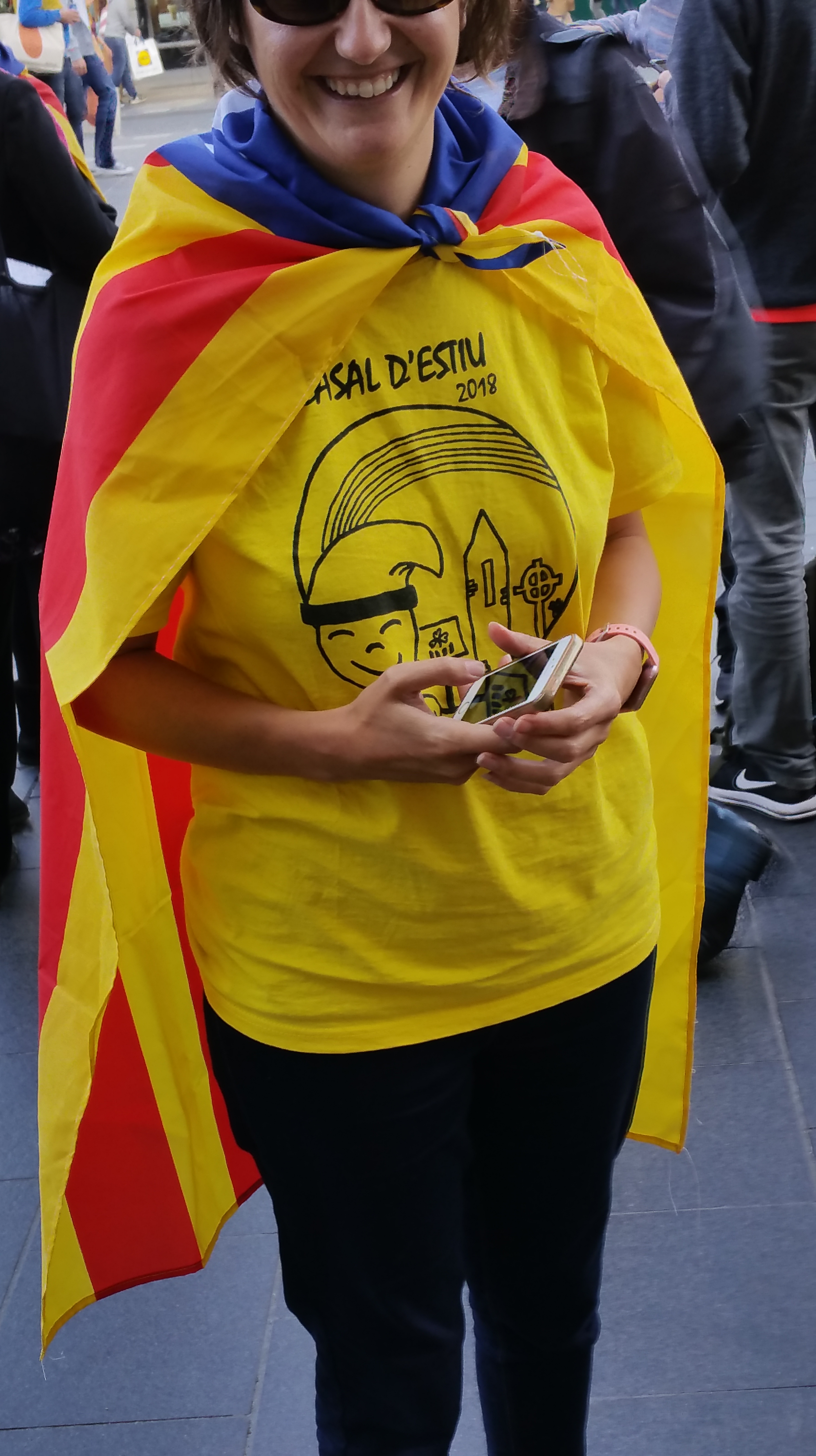
One of many Catalan independence caped crusaders outside the General Post Office. (Photo: D.Breatnach)
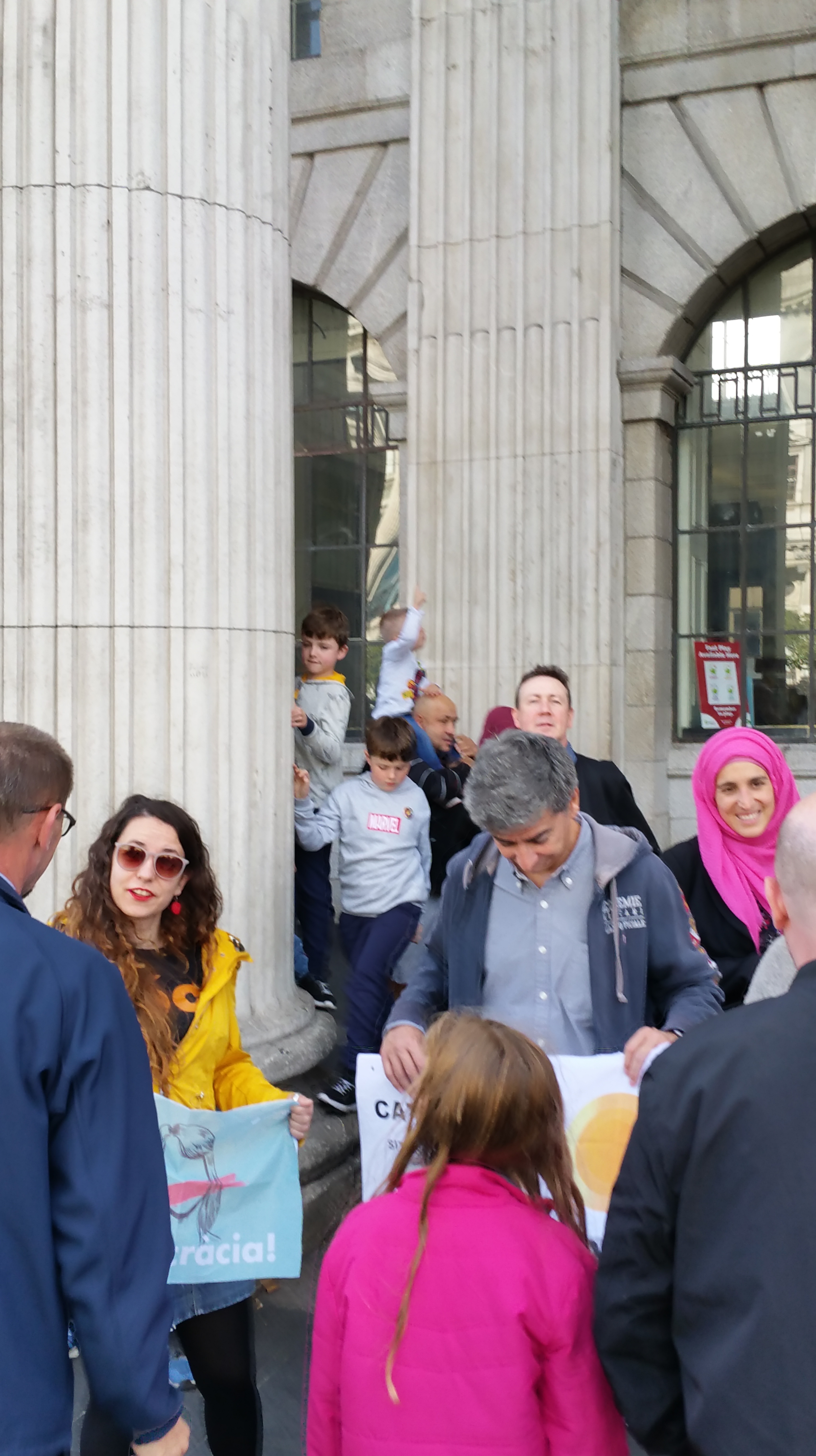
In the background: children social and climbing — but not social climbers!
(Photo: D.Breatnach)
View from the pedestrian central reservation (Photo: D.Breatnach)
(Photo: D.Breatnach)
Passer-by (tourist) asking what the event is about. (Photo: D.Breatnach)

THE CONNEMARA SKULL — DARK SECRETS AND FUN

Diarmuid Breatnach


Martin McDonagh’s play, A Skull in Connemara, one of his Leenane Trilogy, directed by Andrew Flynn, is currently playing at the Olympia in Dublin’s Dame Street. With a cast of four the play takes us on a hilarious tour of hidden secrets and gossip in a rural community but with a dark side hinted at and growing towards the end. Despite the buildup, there is more than one surprise – and shock even – in store.


What one might call the central character is Mick Dowd (Pat Shortt) a gravedigger with a difference: his job is to dig up old graves and to collect the remains to transfer to another location. The population is outgrowing or outbreeding the available graveyard space. He is visited by a Mary Johnny, a local elderly woman (played by Maria McDermottroe) whose grandsons appear later, the youngest being Máirtín (Jarlath Tivnan), with an unhealthy interest in the macabre and wishing to be the gravedigger’s apprentice. His brother is local Garda Tom Hanlon (Patrick Ryan), who aspires to promotion as a detective.

The dialogue is fast at times while at others, silence or sparse words are used effectively. It is hilarious but the shadow of secret is never very far from the sunshine. In terms of acting, one must complement them all but Jarlath Tivnan as Máirtín really stands out. He was, it is true, given some marvelous dialogue (though perhaps a little irritating at the beginning) and acting lines, but he makes the best of it and his physical acting is extraordinary.

I didn’t see the previous production four years ago at the Gaiety, when it got a bad review from John McKeown in the Irish Independent but I’d have to disagree with his opinion of the script.

The sets, or really one set that converts into another, combined with the lighting, are really excellent. It takes some imagination to convert a house into a graveyard and some skill to convince the audience that they have moved from one to the other but this is achieved; one can see why the designers Owen McCarthaigh and Sinead McKenna are winners of the Irish Times Theatre Award.I

McDonagh gained fame (and some controversy) with his West of Ireland trilogies, some plays more than others but he is the author of another four plays and the film script for Six Shooter, for which he won an Academy Award in 2004.

Adverse criticism of A Skull? A little. As indeed the title informs us A Skull in Connemara is set in the West of Ireland, as with the rest of McDonagh’s Leenane Trilogy and also his Aran Trilogy but, in reality, it could be anywhere in rural Ireland. Some would say this is its strength but I regret that the only concession I noted to the Irish language was that the woman carries the name of a parent attached to her own, as is the custom in the shrinking Irish-speaking districts … and that one of the characters is named Máirtín.

And, though most of the time not noticed, one does wonder what the reason for the huge cracks and the cross etched into the house walls are about, making it appear perhaps as a set for the Mexican Mission in a play about the Alamo.

Whether you agree with those criticisms or do not, you will I feel sure enjoy it. The audience last night did and many, perhaps most, gave it a standing ovation. A Skull in Connemara is set to run to September 1st.

Link:

http://www.olympia.ie/whats-on/a-skull-in-connemara/

NEWS AS PROPAGANDA

Diarmuid Breatnach

Very recently, a large and high-status media organisation published a news report with a headline to which a minister of state objected. The Minister made it an official complaint and the media organisation changed the headline. Nothing so startling in any of that, right? Wrong.

There are many things wrong with this scenario. Firstly, should a government minister be able to change news reporting by a media organisation? Isn’t media supposed to be independent? So they tell us, anyway.

Well, the media organisation in question, the British Broadcasting Corporation, is government-funded. Yes but at the same time it proclaims its independence nevertheless.

Anyway, the government to which the complaining Minister belonged wasn’t even the British Government – it was Israel’s.

So a minister of Israel’s Government made a complaint about a British Broadcasting Corporation’s news headline, and the BBC changed the headline to accommodate him and the Israeli Government? Yes, it happened on 9th August this year.

Well, maybe the complaint was justified? If so, the BBC should respond appropriately.

Perhaps they should – IF it was justified. But it wasn’t.

Firstly, the complaint was that the headline was inaccurate – and the complaint actually said that it was a lie! In other words, not just inaccurate but deliberately so.

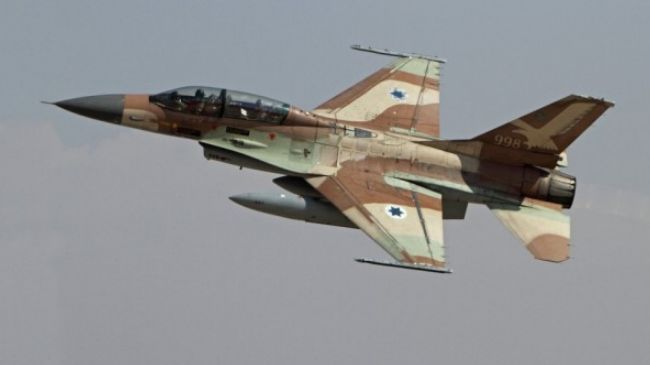
Israeli war jet — Israel has 252 attack fighters and 48 attack helicopters. Palestinians have none.
(Source: https://www.globalfirepower.com/country-military-strength-detail.asp?country_id=israel)

So what was the headline? It was as follows:

Israeli air strikes ‘kill woman and baby’”

Untrue, whether deliberate or not? No, it was completely true and attested to by reports of many other media, including Israel’s own. On 9th August, Inas Muhammed Khamash (9 months pregnant according to some reports) and her 18-month daughter Bayan Khamash were killed when, according to the Israeli Army, Israel bombed 140 sites in Gaza.  Not only that but the Health Ministry of Gaza confirmed the death of 20-year old Ali Al-Ghandour in the attack and the hospitalisation of another 12, two of which are in critical condition.

The Israeli Minister wanted included in the BBC headline that the Israeli bombing which did kill a mother and child, that it had been in response to rockets fired at Israel. Context is important, right?

 The message sent to the BBC on 9th August:

Emmanuel Nahshon

@EmmanuelNahshon

.@BBCWorld this is a formal complaint by @IsraelMFA .This title is a deliberate misrepresentation of reality ( that’s the polite equivalent of “ this is a LIE”, if you don’t get it). Israelis were targeted by Hamas and IDF acts to protect them.Change it IMMEDIATELY!!! @IsraelMFA


CONTEXT IN NEWS REPORTING

Well yes, of course context is important but one cannot always include context in a headline. Imagine putting context into a number of news headlines down through history: “Nazi invading army surrounded after failure to take Stalingrad due to courageous resistance for over five months and Red Army counterattack” instead of “Nazi Army surrounded at Stalingrad – five-month siege lifted.” Or “Banks bailed out with debts guaranteed by Government prepared to implement austerity cuts on most of the population” instead of “Banks bailout – who will pay?” The context can be provided within the story.

However, if the Israeli Minister wants context in headlines or even in stories, how about including in a report of any Palestinian demonstration or rocket attack the following information as to what gave rise to the action:

  • Zionists colonised a land in which Jews were about 10% of the population and created a State from which through terrorism they expelled thousands of non-Jewish Palestinians

  • The Zionist State extended its lands on which it plants Zionist settlers, stealing further Palestinian land and water

  • Zionist state law allow for any Jewish person in the world, with no connection whatsoever with the land, to become an Israeli citizen while banning original non-Jewish Palestinian exiles or their descendants from returning or from Israeli citizenship. And it has now legislated that Israel is a Jewish state, officially discriminating against the 20% of its non-Jewish citizens who are born and raised within the state.

  • Zionists are steadily making Jerusalem, a city holy to Christians, Muslims and Jews, a Jewish city by appropriation of buildings and areas and intimidation of Palestinian residents and worshippers of other faiths.

  • Palestinians are second-class citizens in their own land held up at Israeli checkpoints for hours

  • The Zionist state disagreed with the Palestinian election results years ago and made of Gaza what many have called “the largest concentration camp in the world”.

  • The Zionist Armed forces bombed Gaza several times with huge loss of Palestinian life including many children

  • The Zionist Armed forces bombed water treatment plants and much infrastructure in Gaza

  • The Zionist Armed forces bombed a hospital

  • The Zionist Armed forces regularly shoot unarmed demonstrators

  • The Zionist state has many children in jail and

  • holds adults for months on end without trial or even charge in “administrative detention”

  • The Zionist state attacked Palestinian places of culture and worship

Yes, there’s plenty there for context alright, if that’s what the Israeli Zionists want. And if the media corporations carried even a little of that, how would it weigh against the two fundamental, often-repeated lines of Zionist context:

  • God gave Palestine to the Jews

  • The Israelis are only defending themselves against Palestinians rocket attacks

Well, about the first one I have to say that I deny the validity of a document at most recent 300 years BCE (BC), commonly called the Old Testament (even if it were not full of the contradictions that exist within it) – and calling on an extra-terrestial being for its authority — to settle a question of ownership of land on Earth in the 20th and 21st Centuries CE (AD).

And I deny the validity of anyone, including an extra-terrestial being, to justify oppression, racism and murder. Of course, the extra-terrestial being in question has been silent for centuries and it is living men and women with human intentions that are using his alleged words and interpreting them to their advantage (and ignoring those who quote the same being to oppose them).

THE DEADLY ROCKETS

But what about the Palestinian rockets – they’re real, are they not? Yes, the rockets – let’s deal with that one now.

Given the way those rockets are commonly treated in reporting, one would imagine Israel suffering something like the London Blitz during WWII or the Allied bombing of Germany. How many Israelis have been killed by Palestinian rockets? Due to reporting methods of the Zionists and much of the Western media, it is not immediately easy to answer that question.

In an analysis of figures by Phan Nguyen of violent fatalities by Palestinian missiles for the Mondoweiss site, the total from 2000, when the Second Intifada began until 2014, were 44 Israeli fatalities, of which 14 were military and another two were civilians at an Army post. That is a rate of 3.1 Israeli fatalities per year from this fearsome weapon which requires the Israelis to slaughter tens of hundreds of Palestinians! In addition, only 23 deaths were caused by rockets, the rest being by mortars. In statistics of all homicides of the conflict for this year (2018) up to July 26 (given by a pro-Israeli site jewishvirtuallibrary.org), though 11 Israelis were injured, not a single Israeli has been killed by Palestinian rocket or mortar fire; during the same period, according to the Palestinian Ministry of Health in Gaza, Israel killed 155 Palestinians (of whom 23 were under 18) and injured many others. And after that date they killed another thirteen.1

The most recent Israeli killed by a Palestinian, according to the IsraelPalestineTimeline database, was on July 27th this year (2018), father-of-two Yotam Ovadia and he was not killed by a Palestinian rocket. Yotam Ovadia was stabbed by a Palestinian who apparently managed to climb the security fence surrounding one of the many Israeli settlements on stolen Palestinian land, declared illegal by international law and by the United Nations.

The most recent Palestinian killed by an Israeli according to the same database was on 12th August this year, 30-year old Wisam Yousez Hijazi. He had been an unarmed demonstrator at the Great Return March and was shot by an Israeli soldier on 14th May, needed specialist treatment unavailable in Gaza and died near the Rafah Crossing into Egypt before he could get through the Egyptian blockade of Gaza.

Those two deaths typify the conflict in some ways: an Israeli participant in theft of Palestinian land (even according to the UN) and a Palestinian demonstrating against the theft of their land and denial of right of return to Palestinians. A Palestinian killed by an Israeli soldier using a modern firearm and an Israeli killed by a Palestinian civilian with a knife. And the Palestinian perpetrator will be jailed but nothing will happen to the Israeli perpetrator (unless he is commended for service to Israel).

But it is far from one for one. In fact the whole statistic table of homicides is hugely favourable to the Israeli Zionists, which is not surprising as they have an air force, a sophisticated land army and a navy with missiles, while all the military force the Palestinians have to fight back with are various groups of guerrillas (many not Hamas, incidentally) and some rockets and mortars the sites of which, once they fire, can be located and wiped out by the Israelis. And of course, the Palestinians have their own bodies: the unarmed demonstrators (on occasion, rioters), those who rush to help the victims of an Israeli munitions strike and are caught in the second strike and other civilians who just happen to be passing by or living where an Israeli bomb or missile strikes.

Violent deaths of Palestinians and Israelis from 2000-2014
(Source: Phan Nguyen, Mondoweiss.net)

And the imbalance in numbers of children killed is even more horrific – not that one would want to see a balance of any children killed (the israelpalestinetimeline site provides a number of other statistical charts).

TONE OF THE COMPLAINT AND BBC ACQUIESENCE

Having explored the issue of context sufficiently, I think, let us return to the Israeli Minister’s complaint and, setting aside the content, look at the tone of it:

Verified account

Emmanuel Nahshon‏ @EmmanuelNahshon

More

.@BBCWorld this is a formal complaint by @IsraelMFA .This title is a deliberate misrepresentation of reality ( that’s the polite equivalent of “ this is a LIE”, if you don’t get it). Israelis were targeted by Hamas and IDF acts to protect them.Change it IMMEDIATELY!!!

This suggests to the reader an arrogant figure, one in authority, ordering an underling. The arrogance may or may not have arisen through the individual’s life experience or through his position in Israeli society or through his culture – but what does he think gives him the authority to talk down this way to a world media corporation belonging to a major imperialist power?

I would speculate that the answer is that Zionist Israel knows that it is supported by an even bigger imperialist power than the one whose media organisation the Minister is addressing. Israel is backed by the USA, currently the biggest and strongest imperialist power in the world. And furthermore, since British imperialism lost its position at the top after WWII and later gave up or set aside its dream of returning to that elevation, it determined to partner the USA. This has been clear in its contribution of troops to Korea, in putting no obstacle to Australian troops to Vietnam, in contribution of troops and/ or military resources to the bombing of Libya and the invasions of Iraq and Afghanistan and war in Syria.

The Israeli Minister seems to assume that he is speaking to one of his protector’s minor employees – and who can blame him for that? In addition, British imperialism has been, on the whole, backing US imperialist ambitions, strategy and tactics in Israel and in the Middle East, only very occasionally disagreeing on even tactics.

And when the BBC caved in, it confirmed that Israeli Minister’s opinion and, furthermore, made it the opinion of many others too!

And all of this will compound the belief among anti-imperialists around the world and among Arabs and Muslims, that news is propaganda, and that western media news is mostly anti-Palestinian, anti-Arab and anti-Muslim propaganda.

18-Month Bayan Khammash is carried in a funeral procession with the body of her pregnant Mother, Inas Muhammed Khammash, all killed by Israeli bombing of Gaza on August 9th.
(Photo source: Internet)

So how did the BBC amend their headline in the end? They changed it to Gaza airstrikes ‘kill woman and child’ after rockets hit Israel”.

So there you have it now: Gaza fired rockets at Israel and killed a woman and child, presumably in Israel!

End.

SOURCES:

Original event on which the BBC was reporting

https://www.middleeastmonitor.com/20180809-israel-air-strikes-kill-3-including-pregnant-mother-toddler-in-gaza/

Reporting on the change of headline

https://www.telesurtv.net/english/news/BBC-Changes-Headline-After-Israeli-Complaint-20180809-0027.html

https://morningstaronline.co.uk/article/bbc-condemned-for-changing-headline-after-israeli-spokesman-demands-it

A Scottish take on the issue:

http://www.heraldscotland.com/news/16410049.bbc-switch-off-campaign-goes-viral-but-is-the-publicly-funded-broadcaster-really-biased/

Statistics

https://www.jewishvirtuallibrary.org/palestinian-rocket-and-mortar-attacks-against-israel

https://mondoweiss.net/2014/07/rocket-deaths-israel/

https://israelpalestinetimeline.org/charts/

https://israelpalestinetimeline.org/yotam-ovadia/

https://israelpalestinetimeline.org/wisam-yousef-hijazi/

FOOTNOTES

1These figures were quoted by Wikipedia which is given to quoting Israeli propaganda, including statistics, without verification but can no doubt in this case be checked by going to the source.

OREGON USA: NO FREE SPEECH FOR FASCISTS!

Diarmuid Breatnach


Like fascists in many other parts of the world, those on the Oregon demonstration marched under the slogan of “free speech”.  NO FREE SPEECH FOR FASCISTS!


Police in Oakland, Oregon, went into riot police mode at a fascist march on Saturday (4th August 2018) which was opposed by anti-fascists. After maintaing a presence between the two forces for some time they eventually moved to break them up and employed ‘flash-bangs’ and other methods. The march without a permit by fascists was organised by the Patriot Prayer organisation led by Joey Gibson who is running for election to the US Senate and who declares that they are demonstrating for free speech.

Right-wing supporters of the Patriot Prayer group gather during a rally in Portland, Oregon, U.S. August 4, 2018. REUTERS/Jim Urquhart – RC1E0096DB40

Feelings in the town are already running high after a Patriot Prayer supporter was charged with stabbing a man who allegedly intervened to defend from harassment two women on a light-rail train last year, one of whom was wearing a hijab.

According to reports, Gibson declared to supporters that they were there “to teach a lesson to the country” minutes before they began to march. On June 30th, a previous Patriot Prayer event led to clashes with anti-fascist demonstrators, during which the Oakland police revoked the permit for the demonstration and declared a riot. Earlier on Saturday, in a response to Oakland Police reminding people of a city code banning carrying weapons in the public park, Gibson posted: We’ve always had guns at the rally. I cannot think of one rally when we didn’t have guns with us. Everywhere we go, we have guns.”

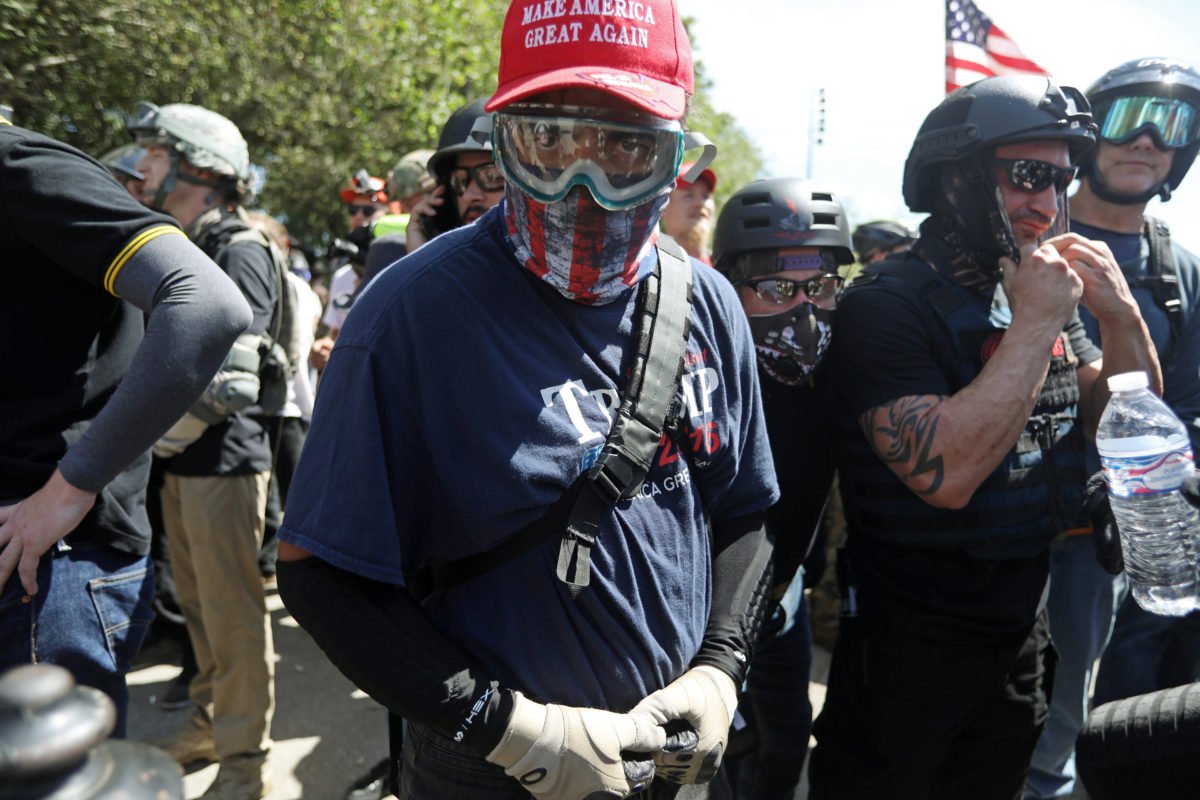
Anti-fascist opposition to Patriot Prayer march in Oregon USA. Note mixed attitudes of people wearing improvised riot gear and a placard apparently calling for peaceful opposition
(photo US Media).

Earlier, Portland Mayor Wheeler had expressed concern about the planned Patriot Prayer march, as had the Police Chief. Portland Police Bureau Chief Outlaw (yes, honestly) was appointed to post last year; an African-American woman, she started her career as a patrol officer and was appointed Deputy Chief to Oakland’s police department in 2013.

FASCISM AND FREE SPEECH ACROSS THE WORLD

In 2016 Tommy Robinson led a couple of hundred supporters in Birmingham, Britain to launch the anti-Muslim group Pegida UK, which he founded as part of a Europe-wide fascist initiative intending to launch Pegida in a city in every European state (they failed spectacularly in Dublin, see Rebel Breeze report in Links). Two years earlier, he had led the Islamophobic English Defence League which soon split and melted away.

(photo US Media).

Like Robinson, who was recently given a 13-month sentence for contempt of court in Britain and even more recently released on bail for retrial, the call of fascists when not in power or in position of strong dominance is always for “free speech”. Once dominance is achieved, the fascist call for “free speech” changes to slogans such as ending freedom of speech if it is considered “unpatriotic”, advocating “race-mixing” or “moral degeneracy” and, of course “communist propaganda”. When in power they enforce the elimination of what they consider undesirable free speech, including criticism of policies or leadership even from within their own ranks. When in a dominant position in a country, region or area, fascists enforce their control of “free speech” through terror attacks on their opposition or target communities, with or without collusion with the State, military or local police force. When fascists have state control, they limit free speech through laws, court and prison, in addition to extra-legal fascist attacks and assassination squads.1

Fascists seek to establish a safe “beach head” upon which to build and from which to extend. If successful, they attract more and more followers, while they intimidate their opposition and their targets. But in failure, as when driven off the street, their opposition and targets grow in confidence and the fascist organisations usually disintegrate in internal struggles between cliques and denunciations of their unsuccessful leaders.

That is the well-documented history of fascism which the fascists try to conceal while weak but in which they glorify when in power. Unfortunately, liberals, whose bodies exist in the real world but whose ideology lives in a world of make-believe, unknowingly collude with this trajectory. Again and again they insist that the fascists and racists which they abhor must be given freedom of speech and even accuse the anti-fascists of a kind of fascist authoritarianism.

When liberals do turn to wanting to control the freedom of fascists to organise, as some do at some stages, they always appeal to the State to carry out that task for them. Sometimes, according to its interests at the time, the State will oblige, with measures sometimes including a wholesale banning2 but will often simultaneously ban progressive resistance movements.  More often it will oblige liberals by fines or short prison sentences on fascists or by anti-racist or anti-”hate” legislation. And often, fascists attempt to turn these too to their advantage, projecting themselves as martyrs of “free speech”.

The only effective remedy is that anywhere and everywhere, fascists are denied free speech – not by the State (whose capitalist interests are anti-socialist and will often recognise the usefulness of fascists) but by the alliance of anti-fascist interests: ethnic minorities, LBGT groups, communists, women, trade unions. This thesis has emerged out of an ideological battle that has been largely won decades ago among the Left and Republican movement in Ireland but which the general Left at times fails to put into practice – had it been left to them, Pegida’s attempted Dublin launch would not have been quite the ignominious defeat it was.

In this context the stand of the “Resist Patriot Prayer” march must be applauded. Their Facebook event description included the following sentence: “We make no apologies for the use of force in keeping our communities safe from the scourge of right-wing violence.”


End.

LINKS

Oregon, Oakland events, report by PBSO News Hour: https://www.pbs.org/newshour/nation/portland-police-city-officials-prepare-for-right-wing-rally-and-counter-protest

and Associated Press in ABC7 News: http://abc7.com/politics/heavy-police-presence-as-right-wing-rally-begins-in-portland/3883335/

Rebel Breeze report on failed Pegida launch in Dublin: https://rebelbreeze.wordpress.com/2016/02/08/pegida-planned-launch-ends-in-sinking-survivors-take-to-lifeboats/).

Attempted coordination of Fascist movement from USA across Europe: https://www.theguardian.com/uk-news/2018/jul/29/tommy-robinson-far-right-resurgence-steve-bannon-us-support


FOOTNOTES

1 Fascist movements and states are often plagued by splits, attempted coups and conspiracies. In June 1934, the Nazi SS and Gestapo attacked their former allies, the Nazi SA (Brownshirts), wiping out the leadership and dispersing the organisation in the event often called “The Night of the Long Knives”. They also wiped out a number of conservative anti-nazis. The death-toll has been widely debated, some estimates placing it between 700 and 1,000.

2  As by the British state of the British Union of Fascists during WWII, while their leader Oswald Mosely was placed under house arrest in a comfortable country house and land (or by De Valera of the Blueshirt movement in 1930s Irish state). However, less than a decade earlier in 1936, at the Battle of Cable Street when anti-fascists defeated the Blackshirts’ attempted invasion of London’s East End, the primary force fighting the anti-fascist resistance was 7,000 foot police and all the mounted police in London.

DUBLIN PROTESTS JAILING OF ALTSASU EIGHT

People gathered early evening Thurday (21st) on O’Connell Street, Dublin city’s main street, to protest the convictions and sentencing of the Altsasu Eight. They held Basque and Catalan flags and displayed placards demanding “Free the Altsasu Eight!” and another pointing out the severity of the sentences for what was a bar brawl with Spanish police.

Section of protest and conversation with passers-by
(Photo: D.Breatnach)

From the leaflet distributed: “In November 2016, during a festival in Altsasu, Nafarroa (Navarra) Province of the southern Basque Country, a lieutenant and sergeant in the Spanish Guardia Civil police force, both off-duty with their girlfriends, entered a late-night bar well-known as a place for pro-independence Basques to socialise. An altercation occurred in which the police said they were attacked by the Basque youth and claimed a fractured ankle suffered by one; others say it was just some shoving and pushing.

(Photo: D.Breatnach)

The Navarran regional police force, the Policía Foral, first on the scene, treated it as an alleged assault case which is how the local court wished to deal with the issue. However the Spanish state Prosecutor intervened and, transferring the case to Madrid, accused eight youth of “terrorism” for which they could face a total of 375 years in prison. He failed to prove that but on charges of public disturbance, assault and threats alone, on 1st this June the eight youth were variously sentenced to between 2.5 and 13 years in jail as well as fined thousands of euro.”

Leaflets were distributed to raise awareness of this injustice and many passers-by stopped to talk and ask questions. One group of interested youth was from Zaragoza, which is in Aragon province and not far from the Basque Country.

Protesters including musicians
(Photo: D.Breatnach)

Live music was provided for the participants and passers-by: two women sang Txoria Txori in harmonies and a Basque sang a new song that has been composed about the Altasasu 8, while another accompanied him on guitar (hope to post the lyrics and translation). Txoria Txori is a short simple allegorical song about a man who loves a bird and says that if he cuts its wings it would stay with him but he can’t do that because then no longer would it be a bird – and he loves the bird. This song is well-known and loved in the Basque Country.

The picket was an event of internationalist solidarity, not only because it was carried out in Ireland in support of victimised youth in the Basque Country, but also because the picket line included Irish, Basque, Catalan and Italian people.

(Photo: D.Breatnach)

Further information in the English language on this case (and other events in the Basque Country) will be posted from time to time on https://www.facebook.com/dublinbasque/

Trad for Catalonia Fundraiser in Dublin a Success

TRAD FOR CATALONIA SEES MIX OF INSTRUMENTS, LANGUAGE AND MUSIC STYLES

Clive Sulish

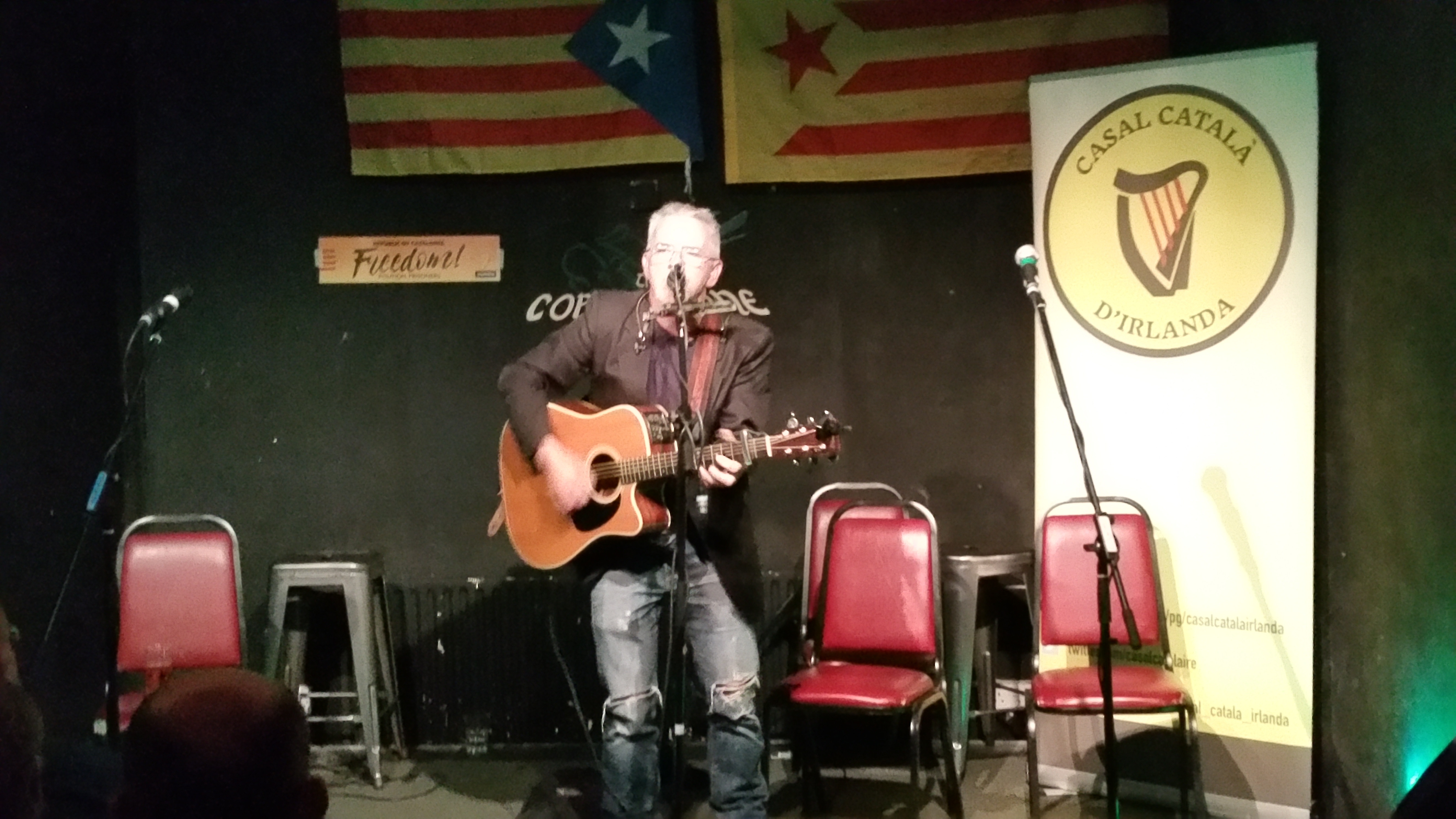
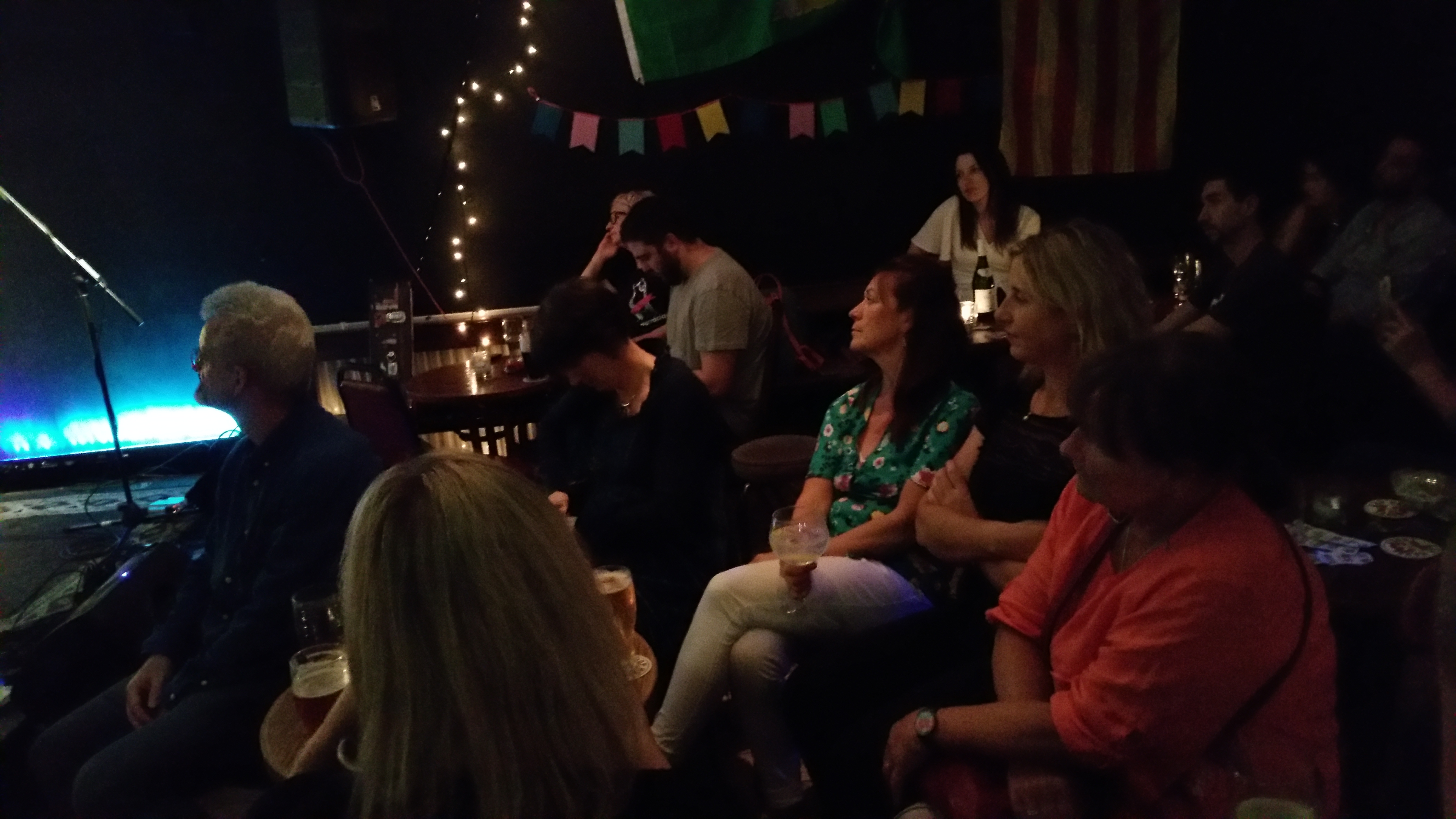
Ukelele, fiddle, guitars, cajón, gralla, flutes and uileann pipes, along with different voices in various styles filled performances at the Trad for Catalonia night in the Back Room, at the Cobblestone pub, Smithfield Dublin on 14th June (2018). Despite the wide variety, the quality of sound production was excellent and much appreciated by the audience.

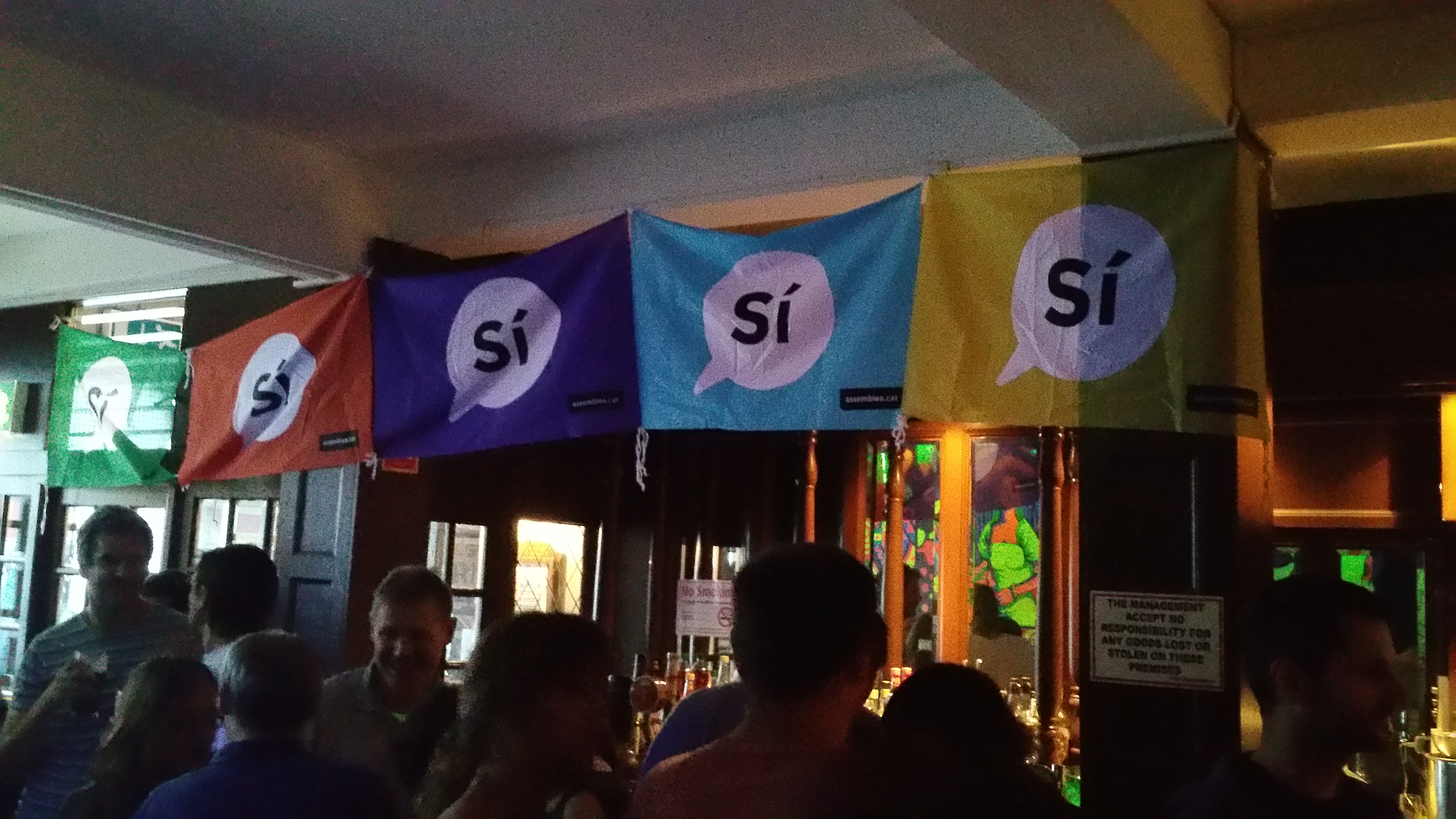
“Sí” bunting from the October Referendum on Catalan Independence (Photo: D.Breatnach)

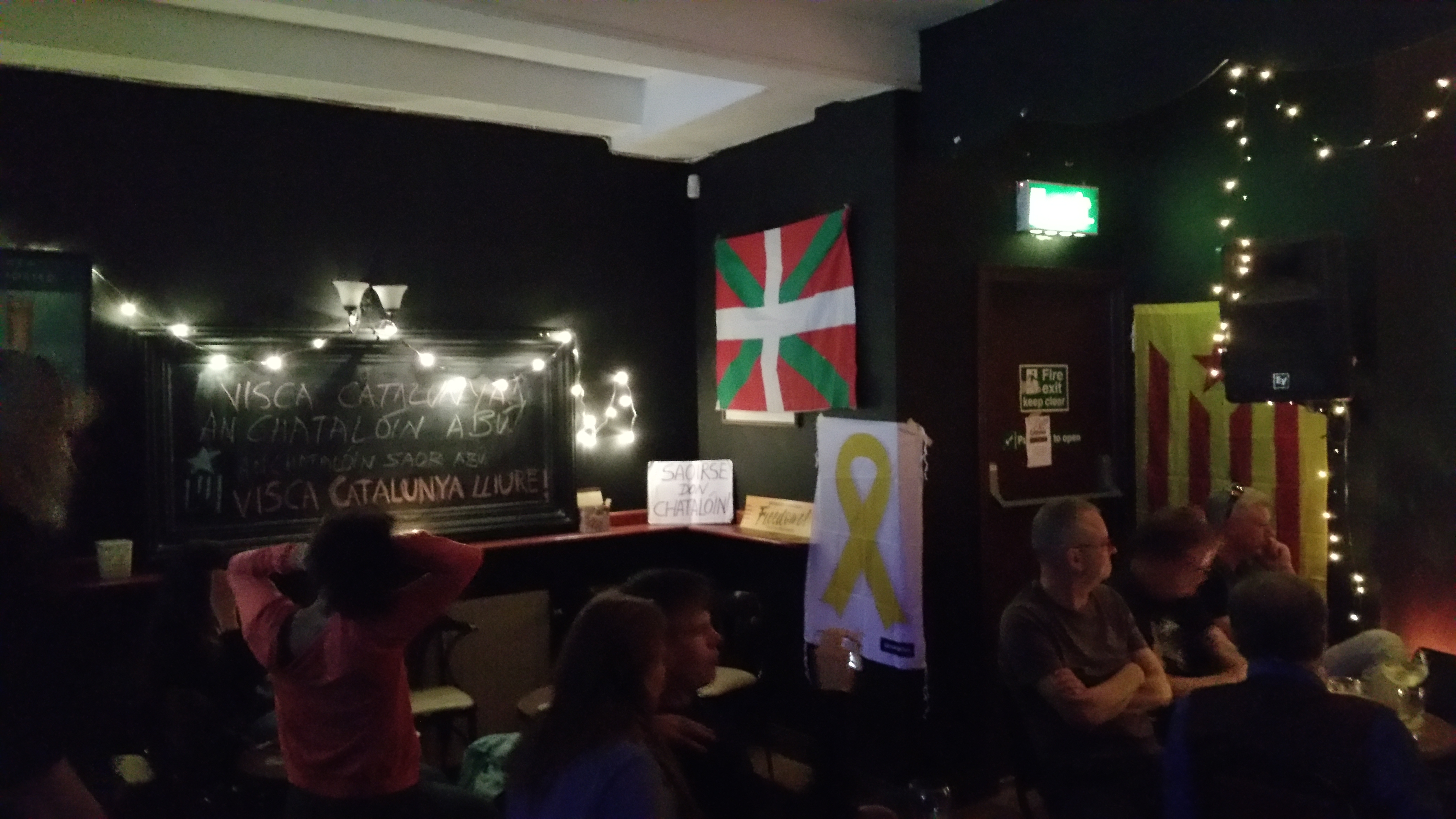
Eight different acts took to the stage in a crowded function room at the Cobblestone, which was decorated in the three varieties of the Catalan national flags (Senyera, Estelada and Vermella), and flags from the Referendum period declaring Sí, along with the Basque Ikurrina and the Irish Starry Plough.

The Basque Ikurrina, the Catalan Vermella and the Yellow Ribbon for the prisoners.
(Photo: D.Breatnach)

Diarmuid Breatnach, on behalf of With Catalonia/ Leis an Chatalóin welcomed the people attending in Irish and in English. A group called Whistle went first, playing lively Old-Time American songs, followed by Eoghan Ó Ceannabháin and John Flynn playing Irish tunes on flutes and also singing sean-nós songs in Irish, including Sadhbh Ní Bhruinneallaigh.

The band “Whistle” playing (Photo: D.Breatnach)

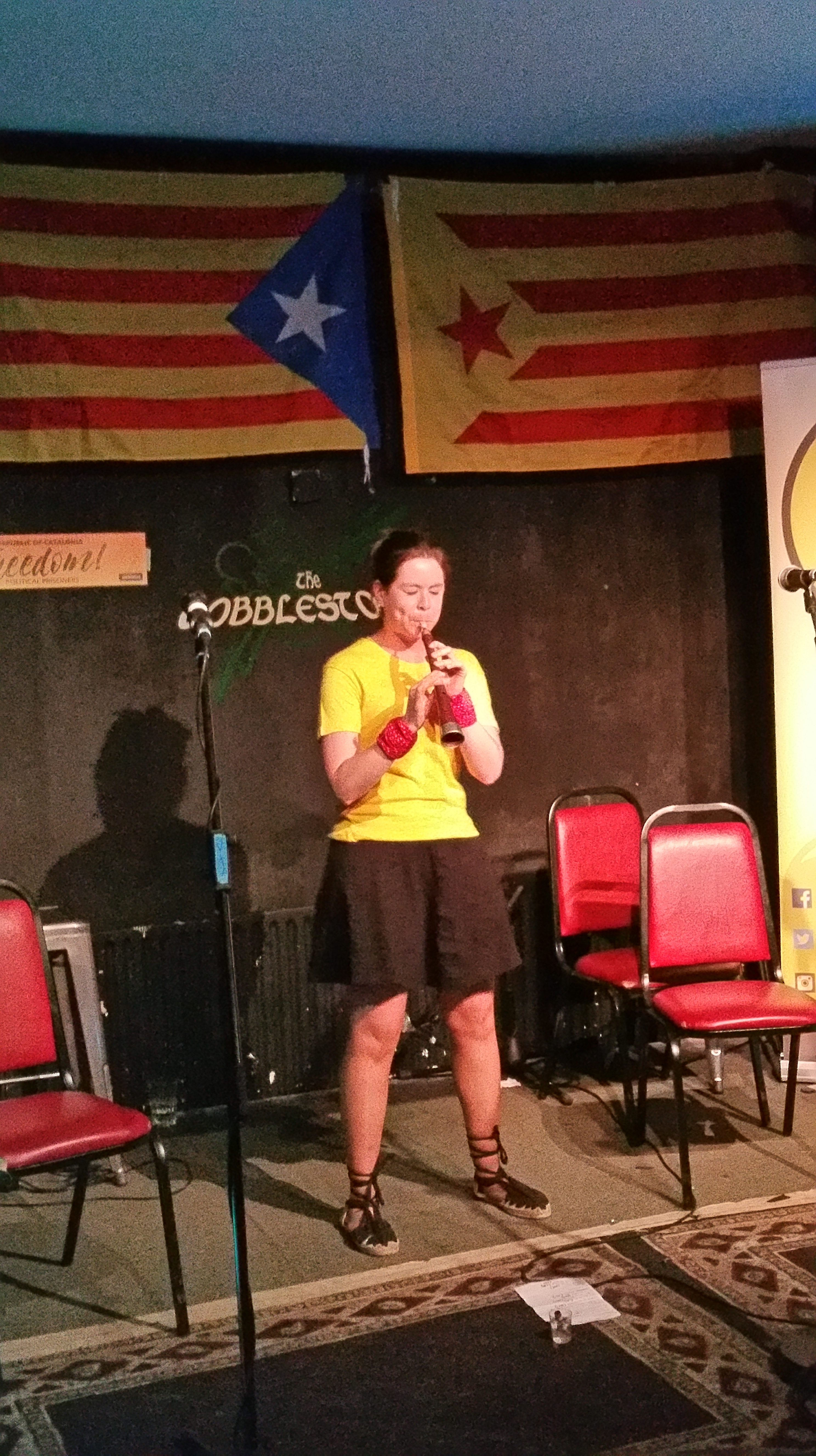
Ó Ceannabháin then introduced Berta Freixas Ylla-catalá, who played some Catalan tunes on the Gralla, a traditional Catalan instrument after which Paul O’Toole followed with some of his own songs, including the quasi-satirical “I Saw Jesus on a Bus”.

Breatnach, accompanied on guitar by O’Toole, sang two songs relating to prisoners, both from the latter half of the 19th Century, one from Ireland and another from the USA. The

John Flynn & Eoghan Ó Ceannabháin playing flutes (Photo: D.Breatnach)

Felons of Our Land was almost certainly written with regard to the suppression of the Fenians (Irish Republican Brotherhood) he said, while How Can I Keep from Singing began life as a Christian hymn but was worked over somewhat in the 1960s to make it a song of political resistance. The two emotions which the repressive forces seek to employ by taking political prisoners as hostages, said Breatnach, are shame and fear; these songs counter those with the emotions of pride and courage. Breatnach invited the attendance to support a picket in solidarity with Catalan political prisoners the following Thursday, 6pm at the GPO building in the city centre.

Visitors from the USA and Canada enjoying the evening
(Photo: D.Breatnach)
Paul O’Toole performing (Photo: D.Breatnach)

After the break and the holding of the raffle, which raised further funds in addition to the low entrance fee of 5 euro, Síomha Nic Aonghusa sang voice-only the sean-nós song Dónal Óg in Irish, then, all in English and accompanying herself on guitar, sang in turn an Irish Republican ballad and different songs, on themes of love, loss and addiction. Fionn Ó hAllmhain brought his uileann pipes on to the stage and, after explaining something of how they work, played a number of tunes, including a polka which had a couple up dancing set-dance polka moves. Ó hAllmhain also sang an Irish sean-nós song.

(Photo: D.Breatnach)
Síomha Nic Aonghusa performing (Photo: D.Breatnach)

Oncle Pau of Casal Catalan, accompanying himself on ukelele, performed some Catalan songs which had many Catalans in the audience singing along, finishing his set with Somewhere Over the Rainbow.

Oncle Pau performing (Photo: D.Breatnach)

Concluding the evening, Ó Ceannabháin thanked all for attending, also the singers and musicians who performed free of charge, the Cobblestone for providing the venue, Shane the sound engineer and Aoife behind the bar.

Aoife, Cobblestone staff and very helpful
(Photo: D.Breatnach)

The event was organised by With Catalonia/ Leis an Chatalóin, with strong support from the cultural Catalan organisation, Casal Catalana d’Irlanda and promoted also by CDR (Comité de Defensa de la República) Dublin.

Tina McVeigh, busy on the night (Photo: D.Breatnach)
Michael Grange, active during the night.
(Photo: D.Breatnach)
Berta Freixas playing the Gralla, traditional Cataln instrument.
(Photo: D.Breatnach)

With Catalonia/ Leis an Chatalóin 


Links

Catalan solidarity in Ireland:

https://www.facebook.com/WithCataloniaIreland/

Casal Catalan d’Irlanda https://www.facebook.com/casalcatalairlanda/

CDR Dublin https://www.facebook.com/CDRDublin/

Engish-language news and information pages:

Catalan News http://www.catalannews.com/

Support Catalonia https://www.facebook.com/groups/506863443039295/

FREE JULIAN ASSANGE PICKET AT BRITISH EMBASSY DUBLIN

CROWD AT BRITISH EMBASSY DUBLIN CALLS FOR RELEASE OF JULIAN ASSANGE

Diarmuid Breatnach

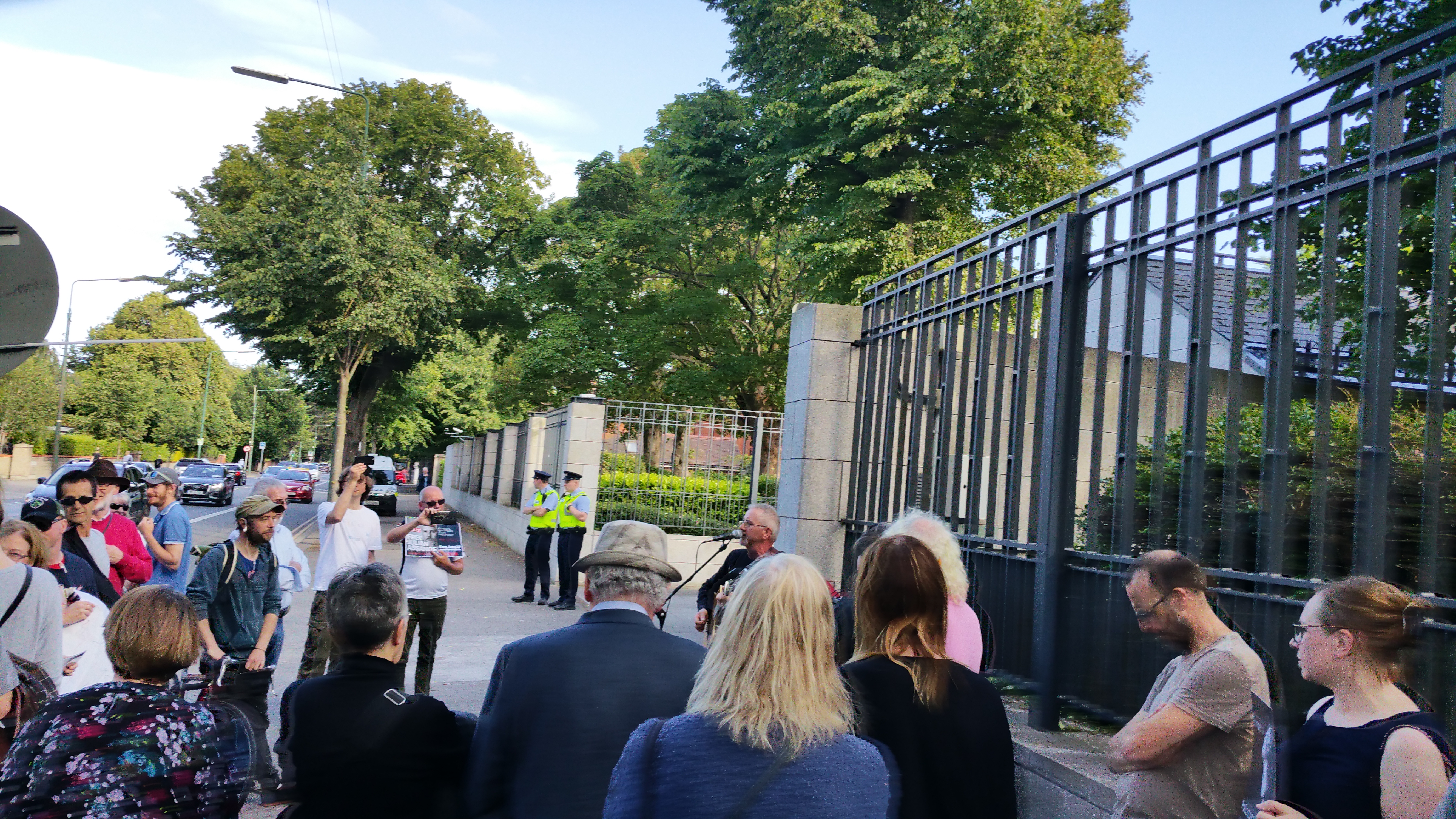
View of crowd at British Embassy from across the street (Photo: D.Breatnach)

Today, June 19th, is the anniversary of the date when Julian Assange sought asylum in the Ecuadorian Embassy in London, which he was granted. That was 2012, since which he has been confined to a few rooms in that building, unable to leave for fear of British arrest and extradition to the US, where he is wanted for broadcasting their secrets on their murderous campaigns in Afghanistan and Iraq and other matters. A crowd gathered outside the British Embassy to demand Assange be set free – among them as speakers were TDs Clare Daly, Mick Wallace, along with Nobel Peace Laureate Mairéad Corrigan and musician Paul O’Toole (also another musician).

Paul O’Toole playing and singing
(Photo: D.Breatnach)

At least five Gardaí were in attendance, along with a police van.

From Wikipedia: Julian Paul Assange (born Hawkins; 3 July 1971) is an Australian computer programmer and the editor of WikiLeaks. Assange founded WikiLeaks in 2006, but came to international attention in 2010, when WikiLeaks published a series of leaks provided by Chelsea Manning. These leaks included the Collateral Murder video (April 2010), the Afghanistan war logs (July 2010), the Iraq war logs (October 2010), and CableGate (November 2010). Following the 2010 leaks, the federal government of the United States launched a criminal investigation into WikiLeaks and asked allied nations for assistance.

Poster of image of Julian Assange with the flag of the USA as a gag on him. (Image source: Internet)

All the speakers outside the British Embassy made the point that Assange’s only crime is to reveal some murderous secrets of the USA and other powers and that if he can be jailed then so can anyone for speaking or publishing the truth. Clare Daly said that his crime was to be a conscientious reporter.

Paul O’Toole played two songs, one of which was The Cry of the Morning, a song about internment. The other musician played some tunes and then led the crowd in singing “All we are saying, is free Julian Assange.”

Fintan thanked all for coming and the speakers and musicians and the event came to an end.

Mick Wallace TD speaking outside the British Embassy (Photo: D.Breatnach)
Another musician supporting the event (Photo: D.Breatnach)
Section of crowd, looking southward
(Photo: D.Breatnach).


Clare Daly TD speaking outside the British Embassy
(Photo: D.Breatnach)(Photo: D.Breatnach)
Nobel Peace Laureate Mairéad Corrigan speaking outside British Embassy (Photo: D.Breatnach)
Police van & 2 of the six Gardaí that were visible (Photo: D.Breatnach)


(Photo: D.Breatnach)


BACKGROUND

Assange went to Sweden to talk about Wikileaks and its revelations in August 2010. A woman in Sweden wanted Assange to have a HIV test after he had sex with her. Her friend, who had also had sex with Assange in the past, encouraged her to go to the police. Assange went voluntarily to the police station, was interviewed and told he could go, there was no charge and he went back to England. Afterwards, a Swedish Special Prosecutor charged him with sexual molestation and “lesser-degree rape” (a particular Swedish charge) although the original complainant did not accuse him of rape.

By then it was becoming clear that another agenda was behind the Swedish Special Prosecutor and the two women. Assange offered to be interviewed again by Skype or in person in London or, if necessary in Sweden but only if that country guaranteed not to extradite him to the USA. The Swedish authorities refused to give that guarantee. The Prosecutor said Swedish law did not permit an interview on foreign soil but this was publicly contradicted by Swedish legal experts and the Prosecutor eventually interviewed him in London but by this time it was November 2016, by which time the statute of limitations had run out on the less serious charges. In May 2017, the Swedish authorities dropped their investigation against Assange and Chief Prosecutor Marianne Ny officially revoked his arrest warrant.

However, as a result of Sweden’s attempt to extradite Assange, he had been brought to court in London and released on bail. Due to Sweden’s refusal to guarantee him no extradition to the USA, Assange jumped bail and sought asylum in the Ecuadorian Embassy on 19th June 2012 and has been there since. He cannot leave for fear of arrest by the British for breach of bail conditions and extradition to Sweden, from where he may be extradited to the US, where politicians and officials have said publicly that he should be jailed and some even wanted him executed under anti-espionage laws or assassinated.

End.