A night of resistance and other songs on Friday night in Peadar Browne’s Dublin pub raised funds to assist in fighting state repression of Palestine solidarity activists in Ireland, as Palestine solidarity activists face persecution across the Western world.
The evening’s performance consisted of a mix of political and other songs, a number of which were original material. However it was the political material that most drew interest, ranging from international struggles to the rich Irish Republican tradition.
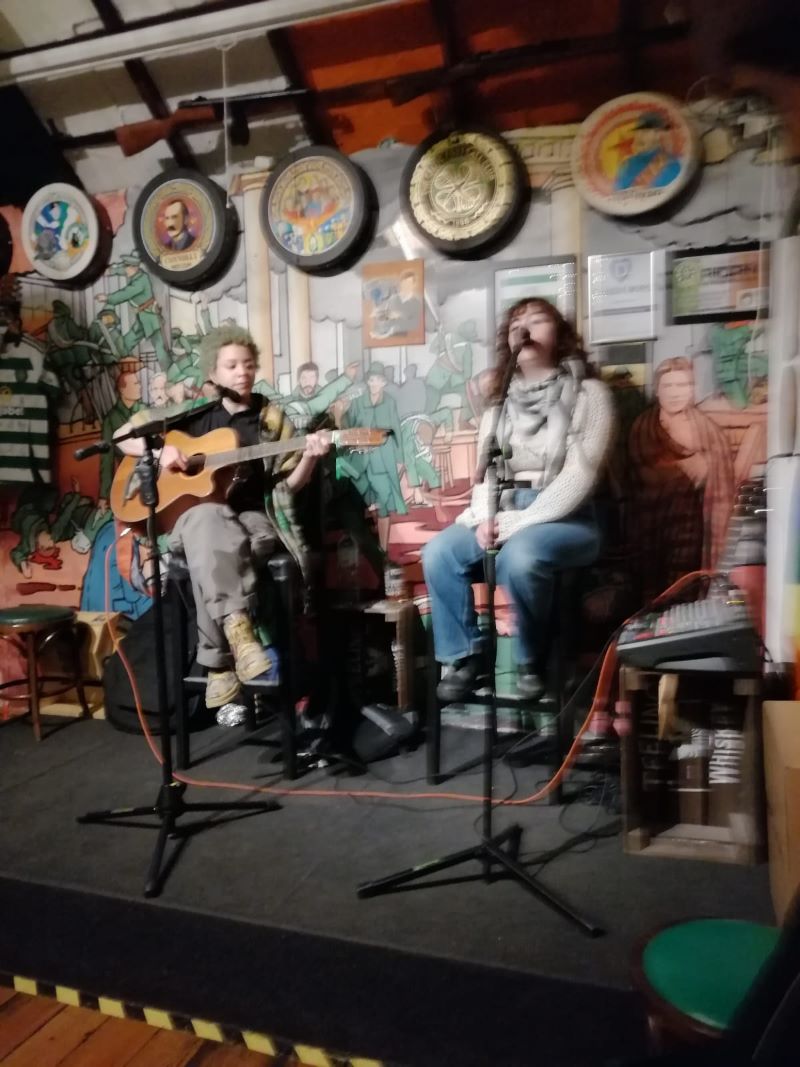
Olive and Fynn in performance at the fund-raising event (Photo: R.Breeze)
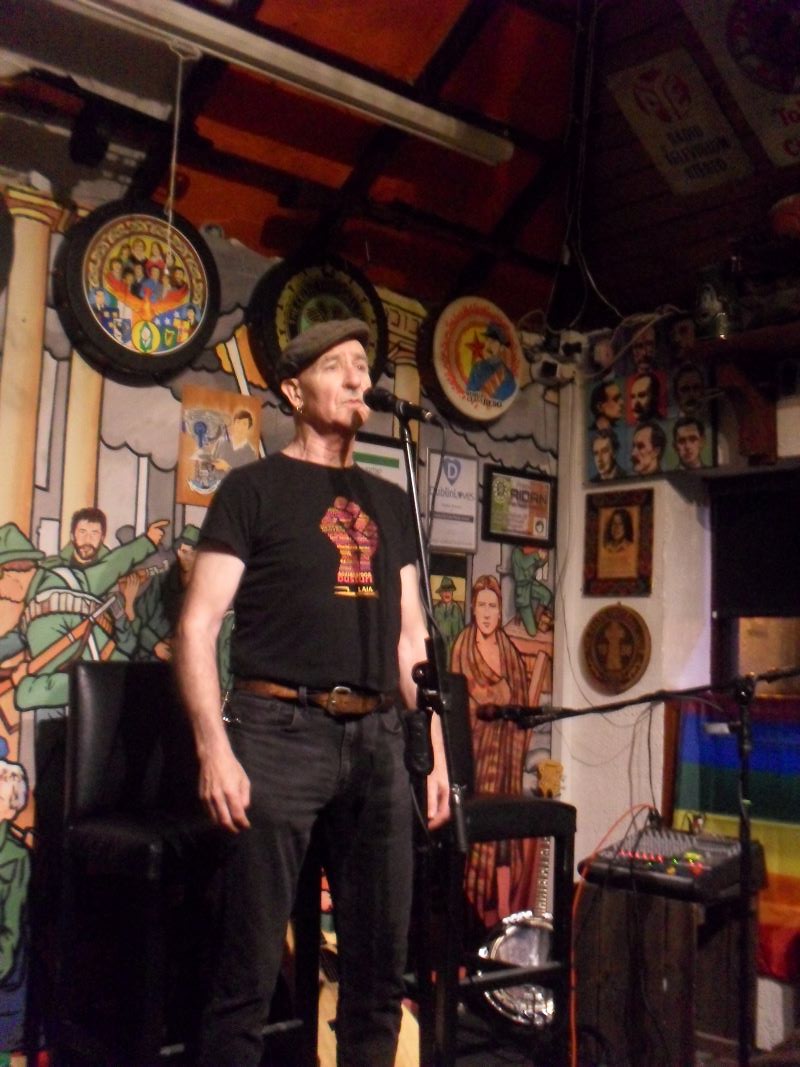
To begin the event Diarmuid Breatnach explained the need to support Palestine solidarity activists against the repression of the Irish authorities, hence the fundraising event and announced that in addition to performing he would be standing in for the event’s MC who had been unable to attend.
Breatnach began his set combining two songs from the German antifascist tradition, three verses of Peat Bog Soldiers and three from the Hans Beimler ballad.1 Then from the Spanish Anti-Fascist War he sang Ay Carmela!, the air of which he said was from an anti-French occupation folk song.
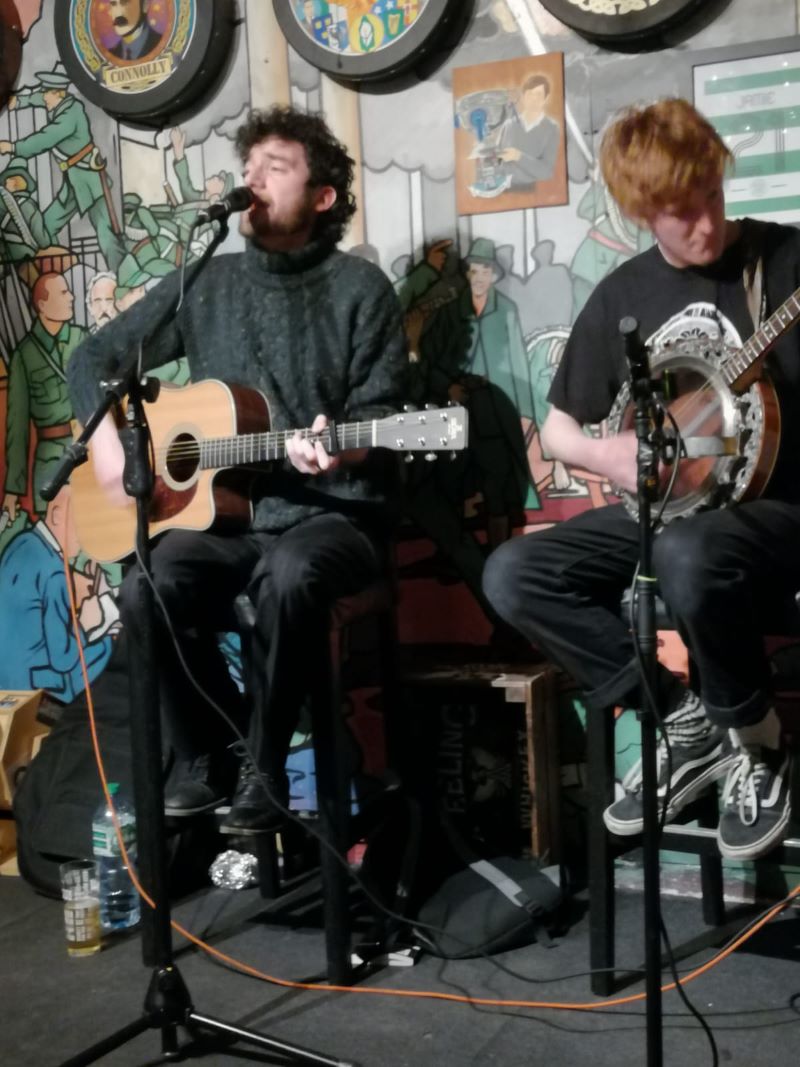
Next the MC announced a performance by two performers, half of the four-strong Croí Óg ballad band. During their performance with voice, guitar and banjo there was an incident from a couple of unruly elements nearby who had substantial drink taken and had been very loud throughout.
Two members of the Croí Óg band performing at the fundraising event (Photo: R.Breeze)
A man who had been refused permission to sing solo began shouting that the songs were not Republican, ironically interrupting Grand Old Country, a song about the Fenian tradition. It became clear that what he wished was to perform the Grace ballad, which he began to sing loudly.
A male confronted the interrupter; the latter’s friend, a big elderly Glaswegian protested; others took to the floor … but the incident wound down, the interrupters and audience resuming their seats. However, the putative Grace singer threw threats at his earlier confronter across the room.
The big Glaswegian then crossed the room to confront the audience member, a female audience member intervened, he brushed her aside and the audience section erupted, only the quick arrival of the pub’s landlady preventing a fight … And the musicians resumed their performance.
Among the songs performed by Croí Óg were Crossmaglen and British Soldier Go on Home. The MC called for appreciation applause for them, made some barbed comments about the recent anti-social behaviour and welcomed the song-and-guitar duo Olive and Fyn to the stage.
Sage Against the Machine performing at the fundraiser event (Photo: R.Breeze)
The duo performed their own material in lovely harmonies, mostly non-political, also including their ironically titled Save the Landlord! After they had left the stage to applause Breatnach got up on stage again to announce a short break and to remind the audience to contribute to the funds.
His additional comment: “Remember when someone sang in a Dublin pub and everyone went quiet? Remember those days? Remember?” was followed by loud applause throughout the pub.
Breatnach restarted the second half, singing a capella again two songs celebrating Irish women’s resistance,2 ending with songs in Irish including the ballad of Rodaí Mac Corlaí. After concluding he introduced Sage Against the Machine to take to the stage, singing solo with guitar.
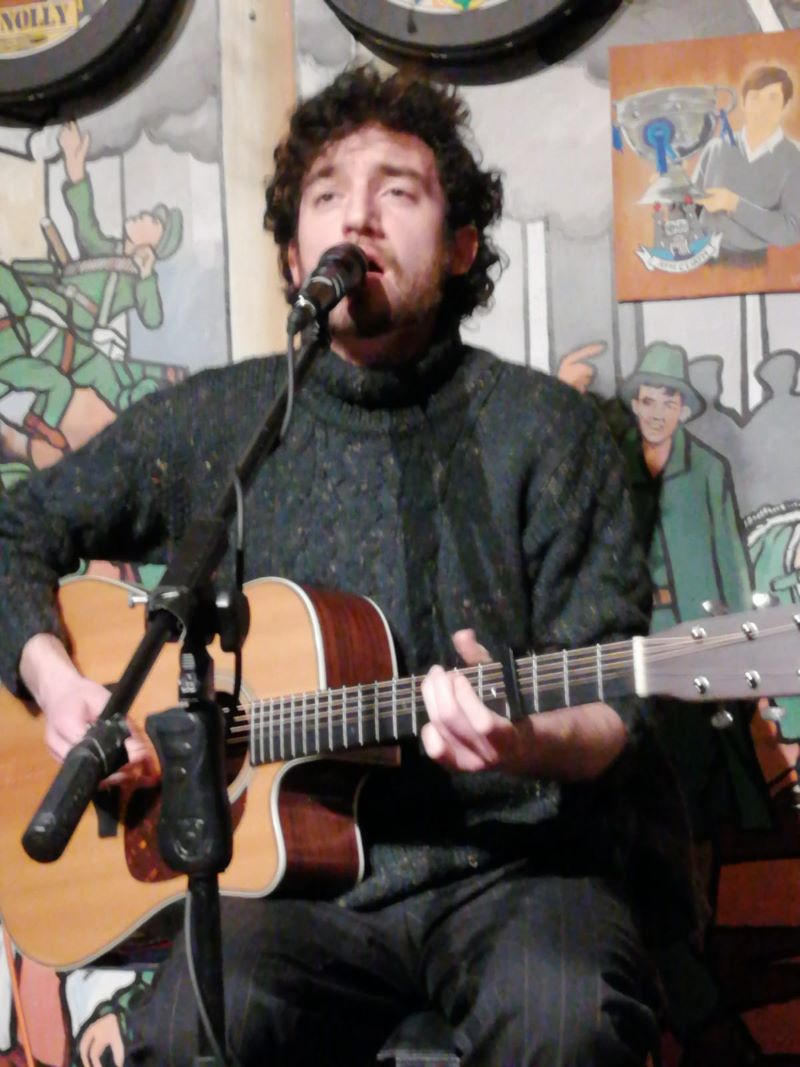
Sage’s material was mostly original, sung in English but went on to Masters of War in a spirited concluding verse, followed by Gallo Rojo, Gallo Negro3 in Spanish from the anti-fascist tradition in Spain. The MC then presented Eoin Ó Loingsigh, also with voice and guitar.
Eoghan Ó Loingsigh performing at the event (Photo: R.Breeze)
Although no further incidents occurred, the volume of ‘conversation’ between a number of people not far from the stage was high. Loingsigh’s material included Only Our Rivers Run Free, Viva La Quince Brigada4and a satirical song contrasting the fates of the rich and the poor after death.
The evening’s scheduled performances concluded with Seán Óg, also solo with voice and guitar, his selection including Ho Chi Minh, republican ballads Boys of the Old Brigade, The Patriot Game, Boolavogue and his own composition Boys of Gaza to air and structure of The Boys of Kilmichael.5
Breatnach thanked the attendance for their support, restating the context of the event and asked for another round of applause for all the performers, who gave their time and creativity for free, then called for people to stand for the Irish national anthem6 which he led with the first verse in Irish.
Diarmuid Breatnach in performance at the fundraiser event (Photo: R.Breeze)
At the concluding line of “seo libh, canaig …” the audience exploded to complete the words “Amhrán na bhFiann!” followed by launching into the chorus, also in Irish.
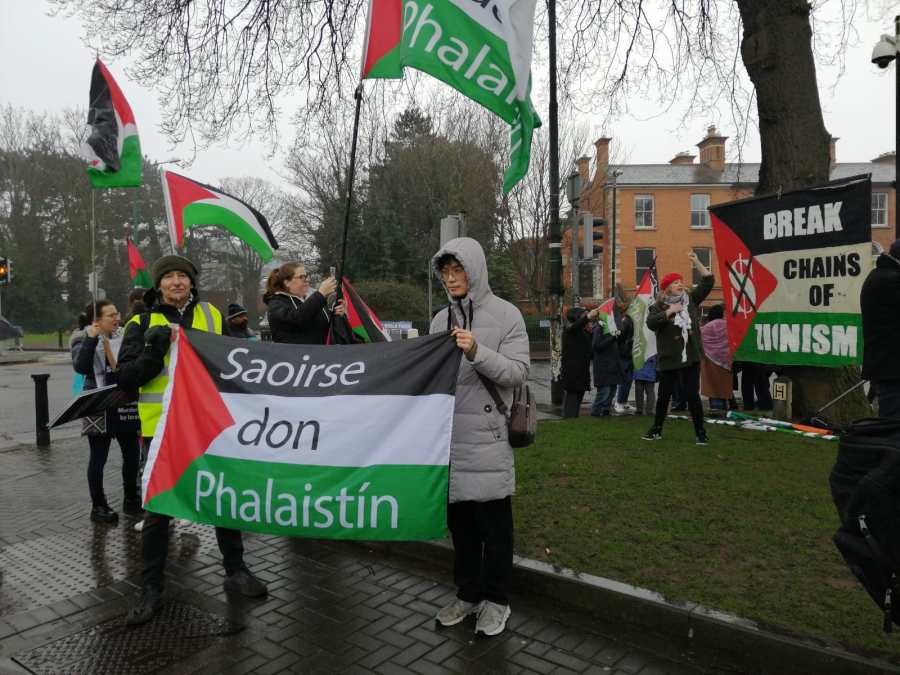
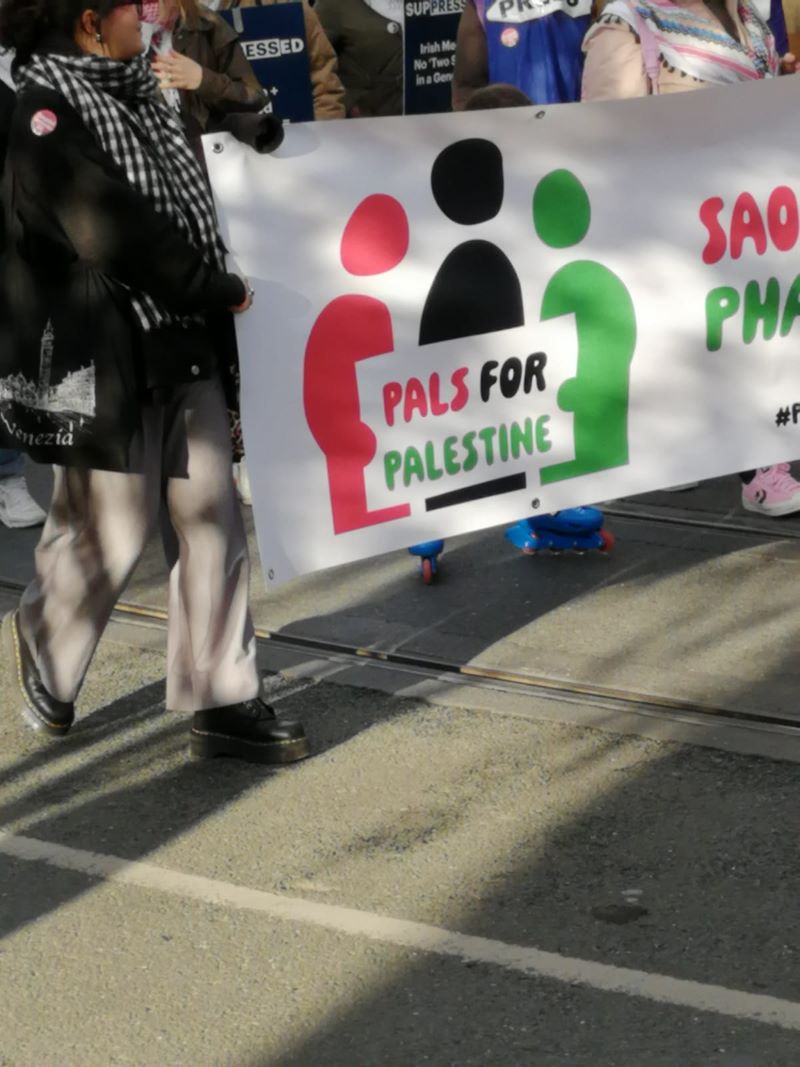
The event had been organised by two broad Palestine solidarity organisations, Saoirse Don Phalaistín and Palestine Action Ireland and among the attendance were a number of their activists, including some victims of state repression.
Most of the charges to date have been under the Public Order Act but also some around ‘criminal damage’ and the potential is there for more serious charges and possible jail sentences, as have been the case in some other European administrations.
In addition to actions of their own, including occupying and picketing the Israeli Embassy, Axa Insurance and picketing the Palestine Authority, Saoirse don Phalaistín and Palestine Solidarity Action organised Resistance Blocs to participate in mass demonstrations organised by the IPSC.
Seán Óg performing at the fundraiser event (Photo: R.Breeze)
Peadar Browns pub has become increasingly known as an Irish Republican tavern on the south side of Dublin city. Its small stage area is decorated with Republican artwork on the walls and on many of the bodhráns7 hanging there, along with some Glasgow Celtic celebratory material.
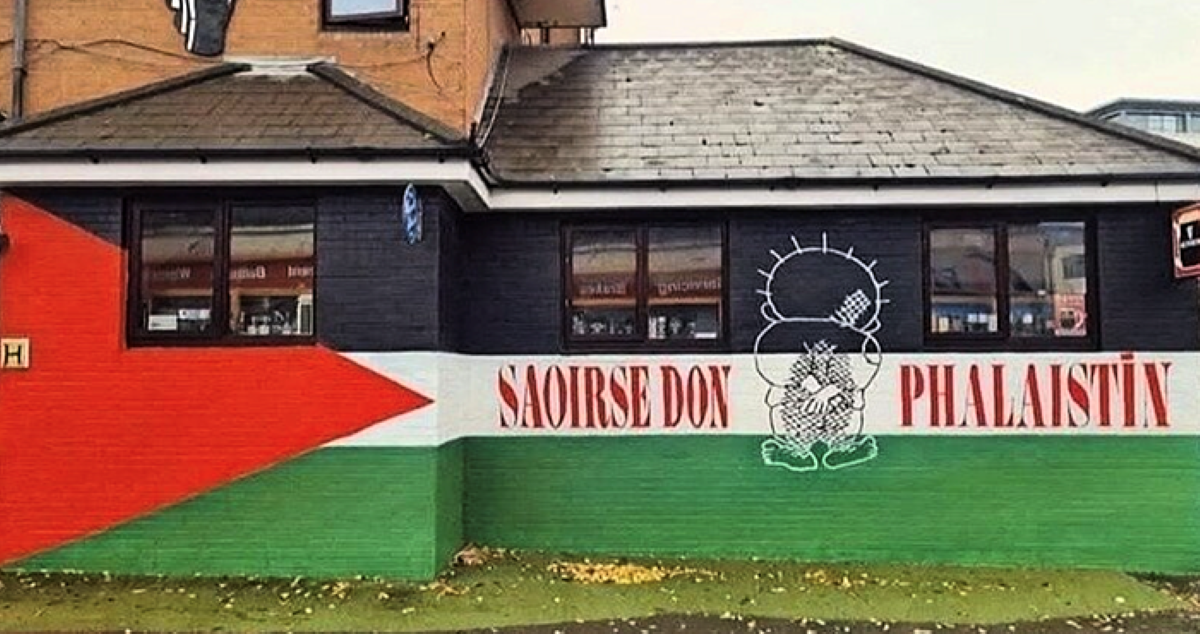
The side of the pub, on a minor street, carries a large mural representation of the Palestinian national flag, along with the slogan SAOIRSE DON PHALAISTÍN. However Dublin City Council have directed that it must be removed, to the anger of a great many people.
Mural on the side of the Peadar Brown pub (Photo sourced: Internet)
Historically cultural events of this type have a function other than to raise defence funds and to promote the cause: they are also occasions for replication of the cultural face of resistance and for expression of new cultural compositions but additionally for the creation of a community of resistance.
4About the Irish who went to fight against fascism in 1930s Spain.
5Also known as The Kilmichael Ambush, celebrating a famous event in West Cork during the War of Independence (1919-1921). However, the air of both songs is that of an older ballad about the 1798 Rising called Men of the West.
6The lyrics were originally written in English and later translated to Irish in which language it most usually sung today.
7A shallow one-sided Irish drum, same shape as a tambourine but much larger, played with a wooden striker on the outside with variation in tension achieved by hand pressure on the inside.
Many who supported Saturday’s march of the Ireland Palestine Solidarity Campaign advertised as going to protest at the US Embassy found themselves led to a rally in a residential street bordering the Embassy and far from the main road.
The IPSC march had gathered at the Department of Foreign Affairs on Stephens Green and proceeded from there to Ballsbridge, the last section passing through quiet residential streets to hold the rally in Elgin Road, some distance from and hardly visible from the main road.
Section of the IPSC march on Saturday (Photo cred: IPSC)
Before the arrival of the IPSC march a handful of people gathered near the main road, displaying Palestine national colours to acclamation from passing motorists. As the IPSC march arrived nearby some others with flags, banner and placards joined them near the front entrance of the Embassy.
From that position one could see the IPSC rally taking place quite some distance down the quiet street, distant enough that speeches could not be heard, though chants from the crowd were audible.
Earlier in the day the Palestinian resistance had released three of their prisoners in good health while the Palestinian prisoners of ‘Israel’ were beaten and insulted as they were leaving and made to wear special demeaning clothes (which they burned). Four had to be rushed to hospital after release.
Long before Trump’s proposal of ethnically cleansing Gaza of Palestinians, it is important to understand that Israel’s genocide could not have been sustained for more than a week without funding and munitions supply by the USA, which also supported them politically.
In the sixteen-plus months of the current phase of Israeli genocide, the IPSC has led a march to the ‘Israeli’ Embassy only a few times and to the US Embassy exactly twice, each time to the side road (though the stage of the first one was closer to the Embassy’s main entrance than was today’s).
The front of the IPSC march at its destination at the rally on Saturday. (Photo cred: IPSC).The IPSC rally in the distance, taken from in front of the US Embassy main entrance. (Credit photo: Rebel Breeze)
A police officer approached the early demonstrators near the Embassy main entrance to encourage them to move down to the location of the IPSC rally but they politely declined. One of the IPSC’s committee members also wandered by to see who these mavericks could be.
A Zionist passing by claimed the demonstrators should be ashamed but they told him it was he who should feel shame, supporting genocide. Anger soared when he called for killing more Palestinians – including children– until some began to suspect he was provoking an assault leading to arrest.
Certainly he felt safe enough with Gardaí close by.
As the group consolidated a woman began to lead call-and-answer chants which were taken up: Saoirse – don Phalaistín! Resistance is an obligation- in the face of occupation! 1, 2, 3, 4 – Occupation no more! 5, 6, 7, 8 – Israel is a terrorist state! Free, free – Palestine!
Section of those who chose to stand near the US Embassy main entrance (out of shot to the right of photo) and in full view of passing traffic on the main road (just out of view to left of photo). (Photo credit: Rebel Breeze)
Also From the river to the sea – Palestine will be free! From Ireland to Palestine – Occupation is a crime! Car horns of passing motorists joined in, beeping in solidarity.
It began to rain heavily and the protesters endured it for a while before heading for shelter.
Myself and my sister, Brenda went on the Rebel Women’s Tour in the General Post Office on Saturday, 1st February 2025. Our Guide was Kim.
Two women’s groups were highlighted: Inghinidhe na hÉireann which was founded by Maud Gonne in 1900 and inspired Cumann na mBan. Inghinide na hÉireann is Irish for “Daughters of Ireland”. It was founded solely for women and adopted Saint Brigid as their patron saint.
Cumann na mBan:
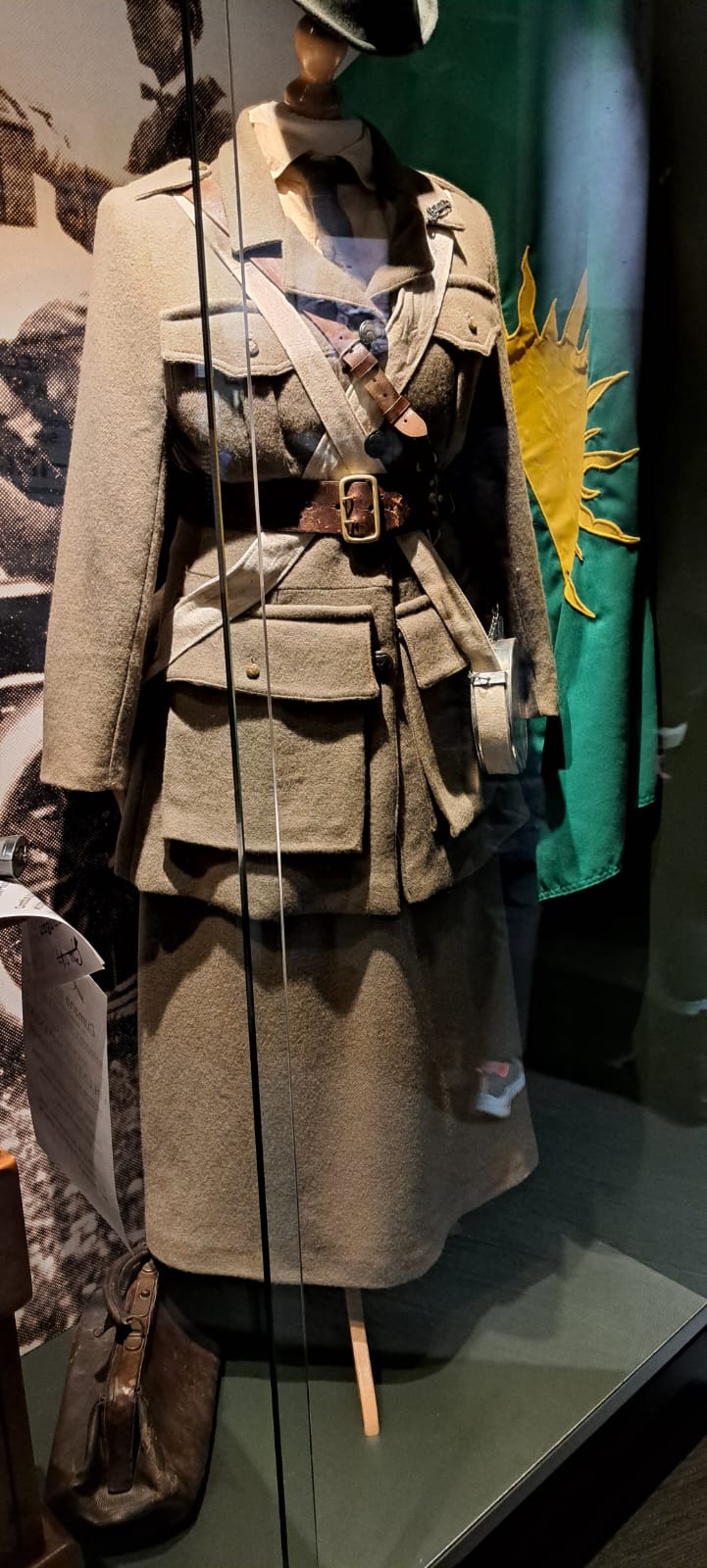
In 1914, Inghinide (modern spelling ‘Iníní’) na hÉireann was merged with Cumann na mBan (abbreviated C na mBan, translated in English as the “Women’s League”). It was formed in Wynn’s Hotel on Lower Abbey Street on the 2nd of April 1914.
Brenda’s husband’s grandmother, Christina Caffrey, was a member. Our Grand Aunt, Theresa Rudkins nee Byrne was also a member as was also an old neighbour of our sister Eileen, Mary Breslin. Cumann na mBan was then led by Kathleen Lane O’Kelley.
One key member whom we are all familiar with is Countess Constance Markiewicz who took an active role in the 1916 Easter Rising which I will come to later.
Cumann na mBan uniform on display in the GPO Museum (Photo: O. Dunne)
1913 Lockout:
During the 1913 Lockout by an employers’ consortium, women including Dr Kathleen Lynn, Helena Moloney, Delia Larkin (sister of Jim Larkin) and Rosie Hackett opened soup kitchens at Liberty Hall to assist struggling workers and families.
The 1916 Easter Rising:
It is estimated that approximately 200 women took part in the Rising and 77 were imprisoned. The only woman sentenced to death was Countess Markiewicz who was second-in-command to Commandant Michael Mallin in St. Stephen’s Green.
Constance Markievicz (colourised) in ICA uniform (Source photo: Internet)
However due to her being female, it was then changed to life imprisonment. She subsequently served 13 months in prison in both Ireland and England. She was outraged that she would not be executed.
Winifred Carney:
Winifred Carney was named as the first woman to enter the GPO on Easter Monday 1916. It is thought that she entered the building wielding a typewriter and revolver.
Winifred Carney (Source photo: Internet)
Elizabeth O’Farrell:
Elizabeth O’Farrell was one of the last three women to remain with the GPO garrison along with Julia Grennan and Winifred Carney and all three spent their last days of freedom in Moore Street. Ms O’Farrell accompanied Patrick Pearse on his journey of surrender to the British forces.
Elizabeth O’Farrell(colourised) after release from jail (Source photo: Internet)
There is a photograph of this and all that can be seen of her are her feet and the end of her dress, as she stood at the far end of Pearse from the photographer.
Julia Grennan (Source photo: Internet)
WOMEN DURING THE WAR OF INDEPENDENCE:
Women also played a significant part during the War of Independence. Over 300 women are believed to have assisted by smuggling weapons and ammunition into Ireland and relaying messages from area to area.
WOMEN DURING THE IRISH CIVIL WAR:
The Irish Civil War lasted for almost one year from June 1922 to May 1923 and again women participated in the struggle, believed to have been mainly on the Anti-Treaty side. Female members of the Irish Citizen Army were armed.
Grace Gifford (colourised) with paintbrush and easel (Source photo: Internet)
One such example is Grace Gifford Plunkett who married her beloved fiance, Joseph Mary Plunkett in May 1916 just hours before his execution. She herself was incarcerated in February 1923 in Kilmainham Gaol for her part in the Civil War.
While there she painted a copy of Mary and Child on the wall of the cell.
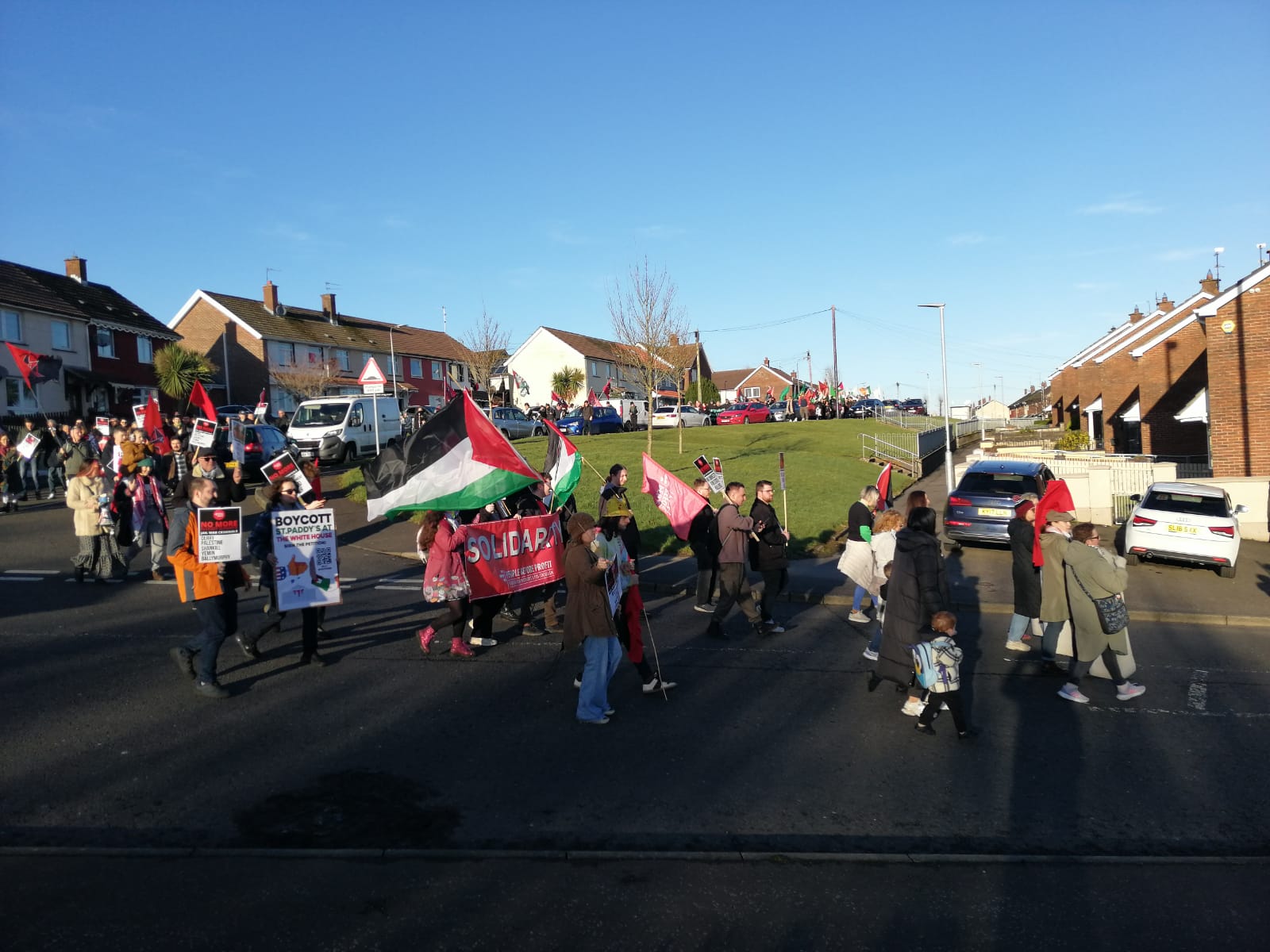
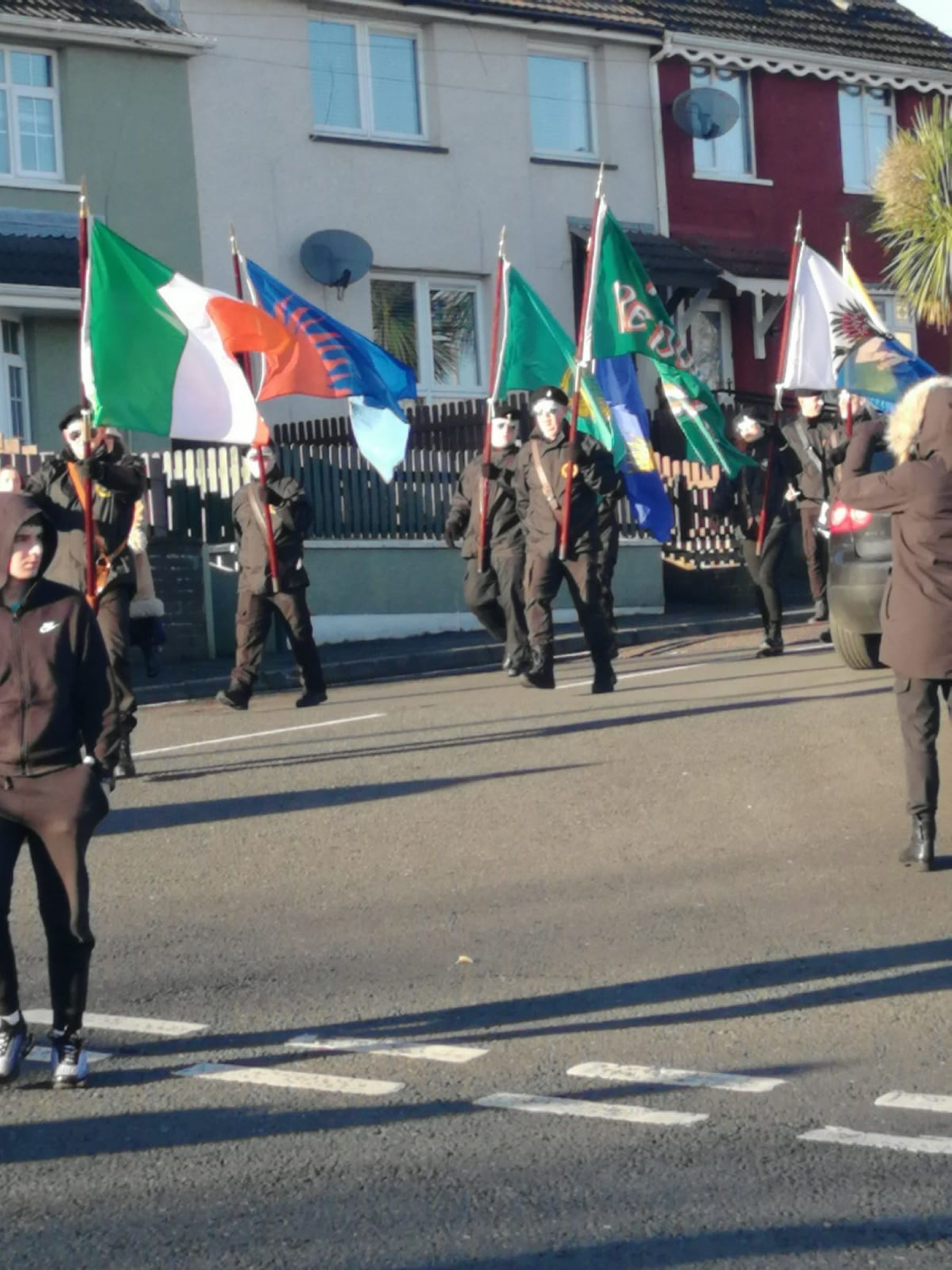
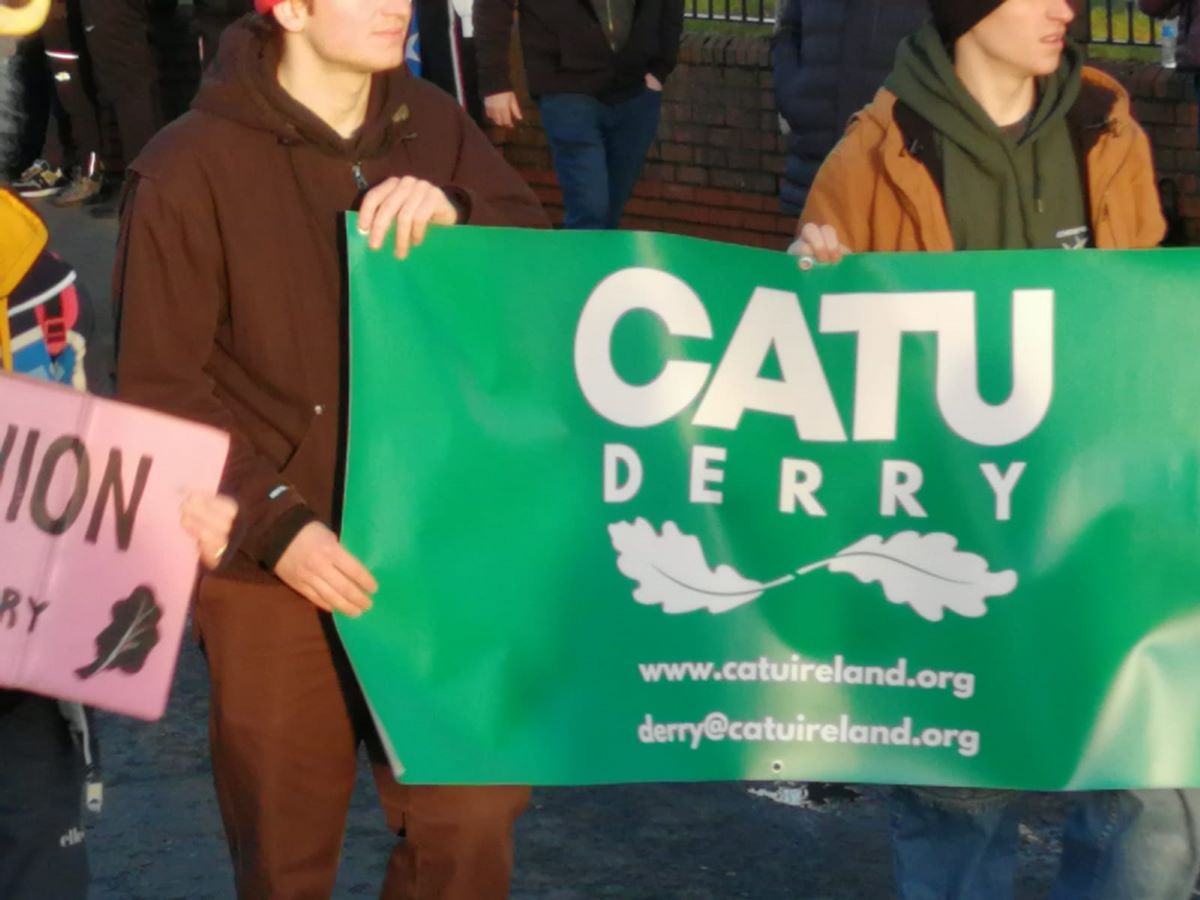
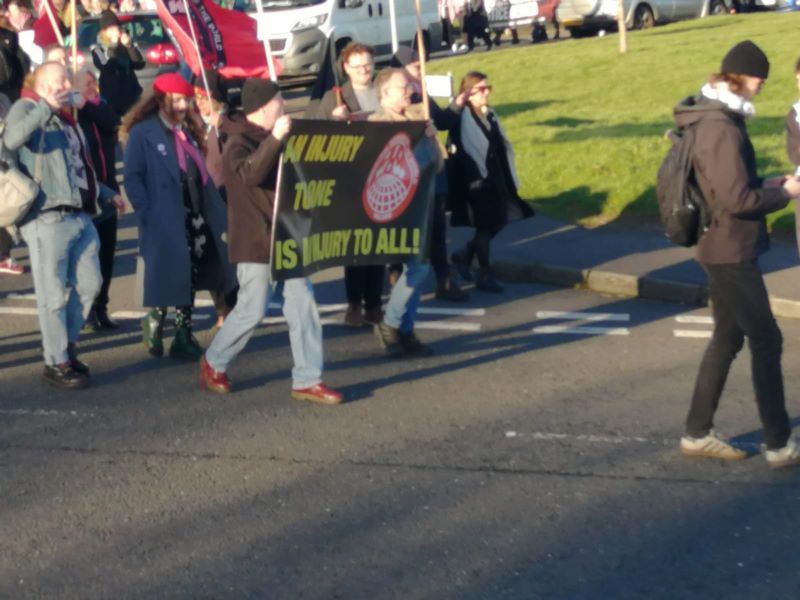
Thousands of marchers with flags, banners and three marching bands retraced the route of the anti-internment march in 1972 that ended in the infamous Derry Bloody Sunday1, a massacre of unarmed civilians by the British Parachute Regiment.
The nearest Sunday to the date of the original march, which this year fell on February 2nd has been chosen annually for the commemorative march over the 53 years since the massacre. People travel from different parts of Ireland and indeed from beyond in order to attend.
Section of the march coming down from the Creggan. (Photo: D.Breatnach)The colour party (bearing the flags) traditionally precedes the marching band. (Photo: D.Breatnach)
Derry is not well served by public transport from other parts of Ireland and there is no train station there.
There is a bus service from Dublin from the Translink company of the occupied colony but one would need to catch it at seven in the morning and then hang around in Derry for 3.5 hours waiting for the march to start. For this reason, many travel to Derry by car.
Equally, many others who would attend were the public transport available, stay home but an estimated over 7,000 participated in this year’s march. The theme this year was Palestine, once again as was last year’s too.
The day of the massacre
The original march was a protest against the introduction in August 1971 of internment without trial in the occupied colony. Almost immediately afterward the Parachute Regiment had massacred 11 people protesting against it in Ballymurphy, Belfast.2
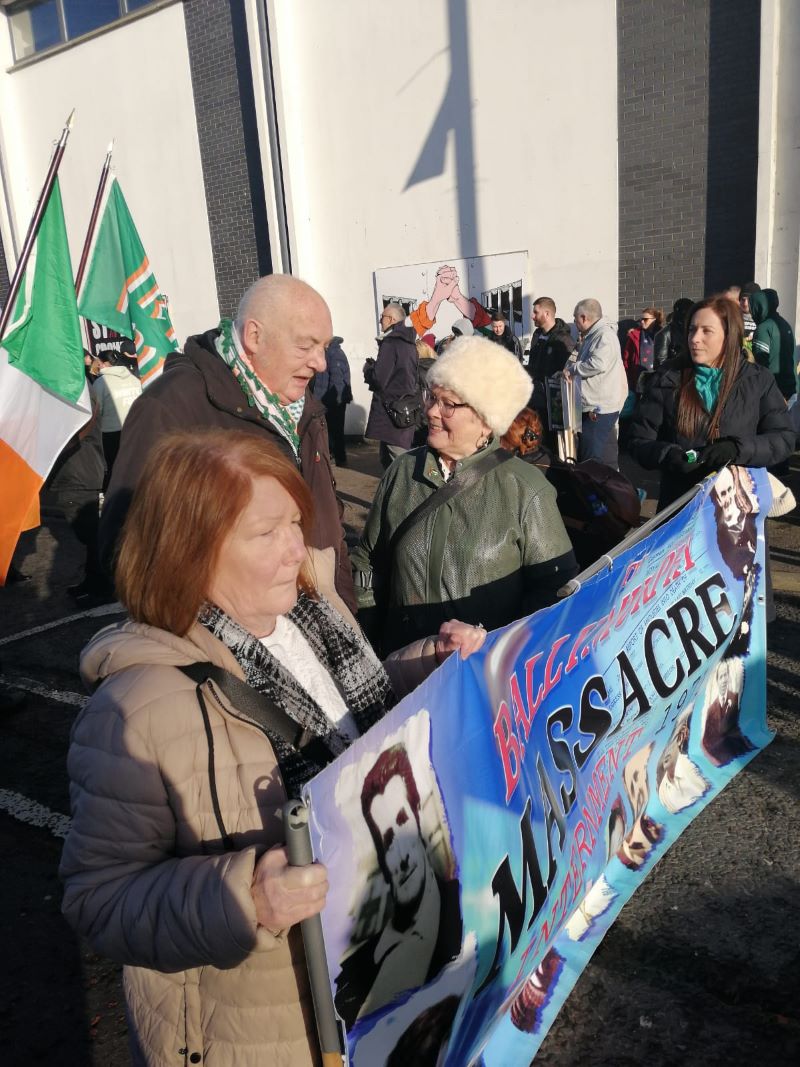
Ballymurphy campaign banner in the Creggan awaiting start of march with Kate Nash centre. (Photo: D.Breatnach)
The 1972 march, along with many others, had been banned by the sectarian colonial administration. The Civil Rights campaigners knew that their legitimate demands3 were being obstructed by use of the Special Powers4 of the statelet and that they could win nothing if they were to acquiesce.
After the previous massacres it took considerable courage to march that day but perhaps they thought that with an advertised march, in daylight, with many film cameras covering, the Paras were unlikely to open fire. In any case, they decided to risk it.
At 4.10pm the first shots were fired by the Paras5 without warning and by around 20 minutes later they had killed 13 men and youths and wounded another 13, one of whom would die weeks later. According to the Saville Inquiry in 2010, they had fired over 100 rounds.
Not one of their targets was armed.
To justify the slaughter, the British Army claimed that they were fired upon and returned fire, killing IRA fighters. The British Government, in particular through Home Affairs Minister Reginald Maudling, repeated the lies as did the British media.
Bernadette (then) Devlin6 MP, a survivor, was prevented from speaking in the Westminster Parliament and she walked up to Maudling and slapped his face. In Dublin a general strike took place with schools closing and a huge crowd burned the British Embassy down.
In London, a giant march reached Trafalgar Square as its end was still leaving Hyde Park. In Whitehall the police prevented them from laying the symbolic coffins outside No.10 and in the scuffles the ‘coffins’ were eventually thrown at the police or knocked to the ground.
And a number of construction sites in Britain went on strike also.
The judicial response varied wildly. Coroner Hubert O’Neill, an ex-British Army major, presiding on the inquests in 1973, called it “Sheer unadulterated murder” whereas Lord Chief Justice Widgery in the ‘inquiry’ he led ignored all the local evidence and accepted the British Army’s lies.7
“The last Bloody Sunday march”
Provisional Sinn Féin organised and managed the annual march for many years but in January 2011 Martin McGuinness announced that year’s march would be the last, because of the UK’s Prime Minister David Cameron’s public apology to the relatives of the 14 killed in Derry.
The apology followed quickly on the verdict of the Saville Inquiry8 which totally refuted the statements at the time by representatives of the Army and of the Political and Judicial establishments: the victims had been unarmed and the Army had not been “returning fire”.
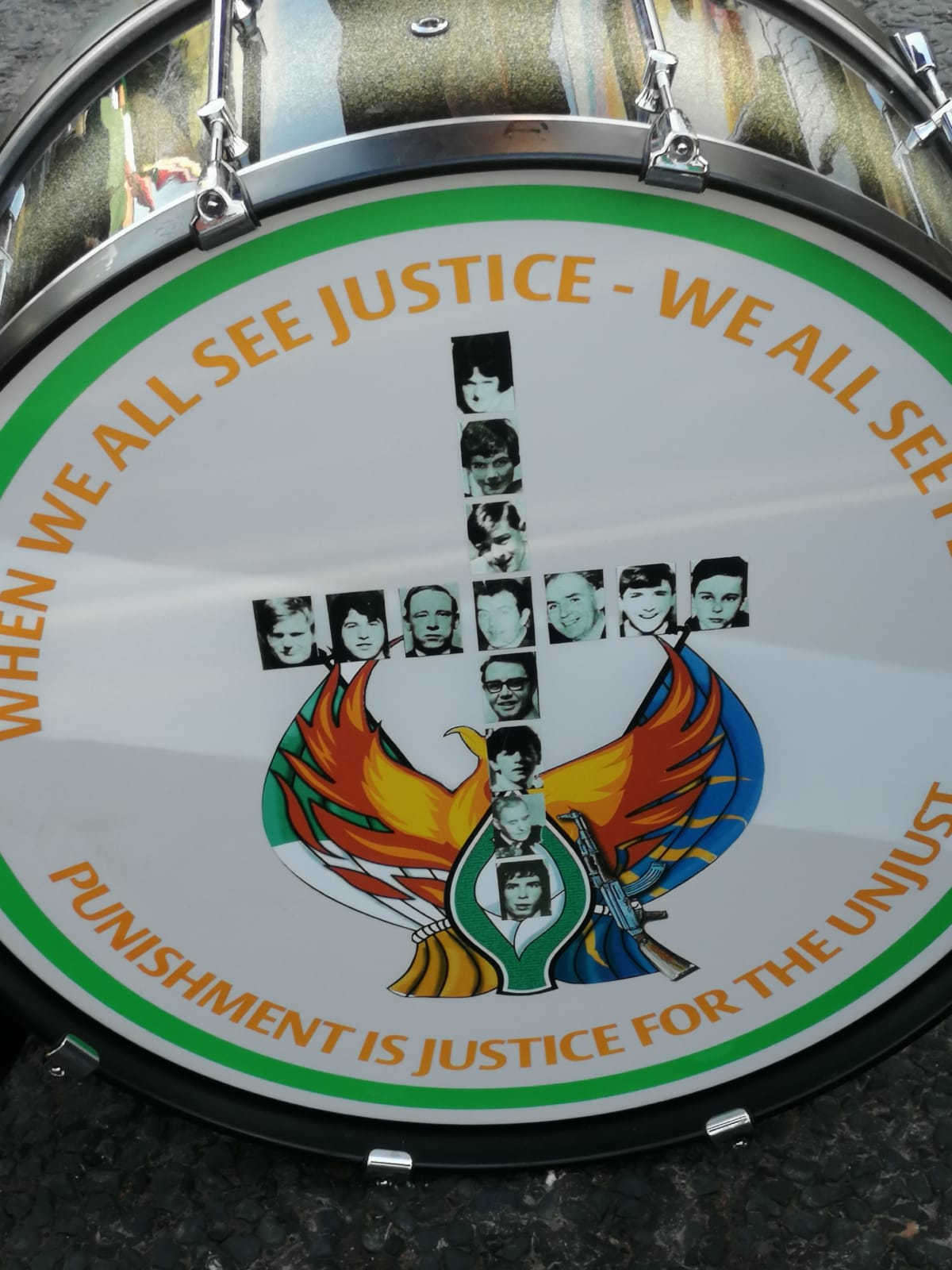
One side of one of the marching band drums (Photo: D.Breatnach)Section of the march about half-way along its length. (Photo: D.Breatnach)
Despite the UK State’s acknowledgement that they had no excuse for the massacre, not one of those who planned, organised or carried out the atrocity had been charged, never mind convicted, nor had those who conspired to cover up the facts. To this day, only a low-level soldier has faced charges.
Nor had there been government admissions of wrongdoing in the other massacres by the Paras intended to crush the resistance to the repressive internment measure, at Ballymurphy and Springhill.
A number of relatives and survivors of the original march declined to have the annual march cancelled, among them Kate Nash and Bernadette McAlliskey. Kate Nash’s brother William was shot dead on Bloody Sunday and her father, William, was wounded trying to save his son.
Bernadette McAlliskey was a survivor of the massacre and also survived nearly a decade later an assassination attempt in her home, being struck by nine bullets of a Loyalist murder gang. Despite opposition by and denunciation from SF, volunteers have kept the march going every year.
Each year different themes have also been incorporated into the Bloody Sunday March for Justice, including ones in Ireland, such as the framed Craigavon Two prisoners but also ones from beyond, e.g. the resistance of the Broadwater Farm housing estate in London to Metropolitan Police attack.
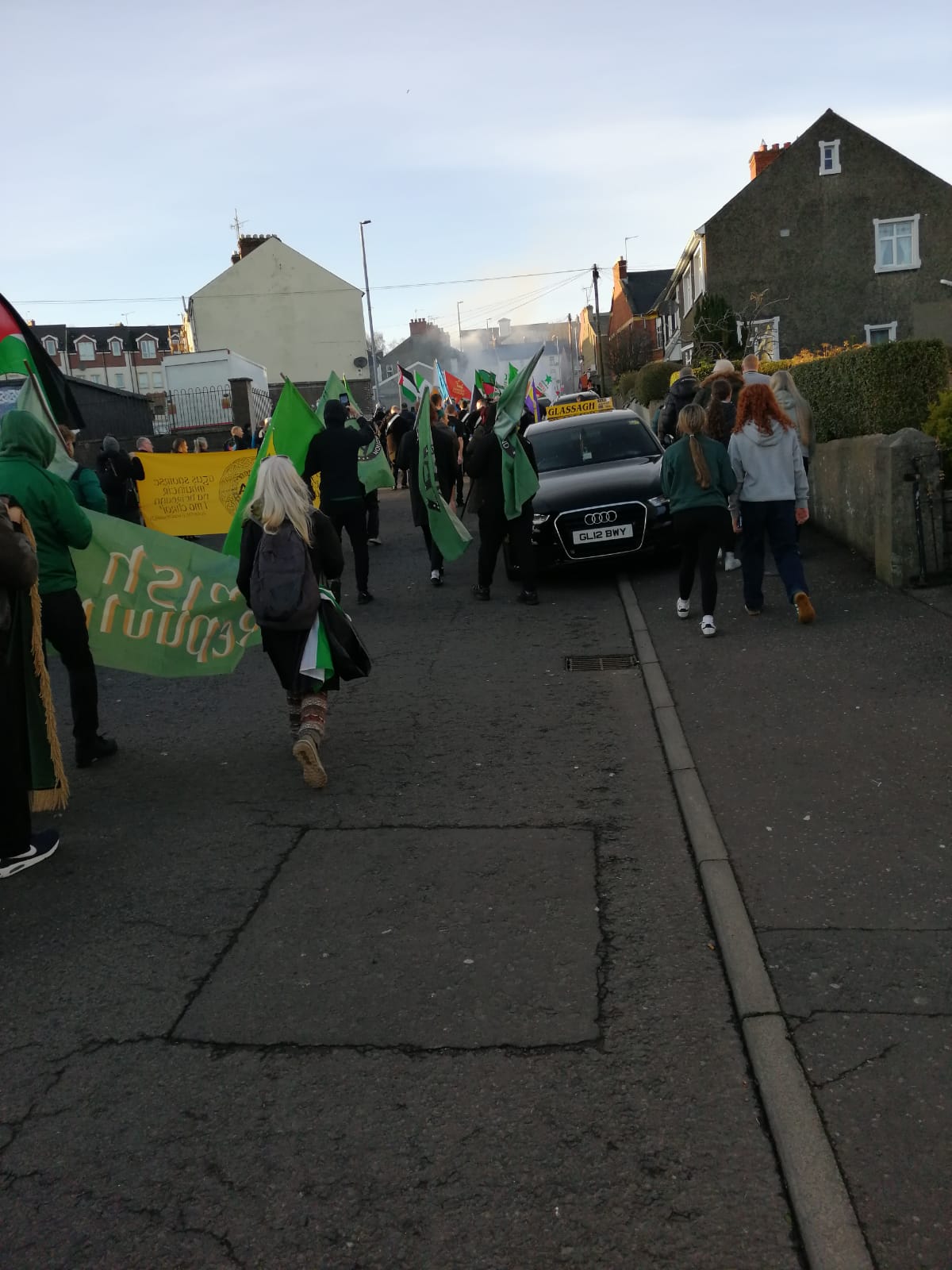
Section of the march in Creggan waiting to start, showing the Palestinian national flag and the Irish Tricolour in close proximity. (Photo: D.Breatnach)Big drums of one of the marching bands getting a workout in the Creggan while waiting for the march to start. ‘Saoirse go deo’ = Freedom for ever. (Photo: D.Breatnach)
Since 2011 Sinn Féin have boycotted the march but also sought to mobilise public opinion against it, claiming that relatives of the victims didn’t want the march to continue. The truth is that some hadn’t wanted it even when SF were running it, some didn’t afterwards but some did.
Such an atrocity has of course huge personal impact on relatives of victims but its impact is also much wider on a society and beyond, historically and politically. That historical memory ‘belongs’ to the people of Derry but also to the people of the world (as do others such as Sharpeville SA).
Those in power in society are aware of that and the media outside of Derry gives little or no coverage to the annual march while promoting other events there of lesser numbers and significance.
The ‘Derry Peoples Museum’ ignores the march in its Bloody Sunday commemorative program.
This year’s march
Sunday just past was one of sunshine and little wind, as it was on the day of the Derry massacre. But regular marchers remember other Bloody Sunday commemoration days of pouring non-stop rain, of squalls, of snow and sleet, of wet clothes, socks and freezing fingers and toes.
The march starts in the afternoon at the Creggan (An Chreagáin) and winds down to just below the Derry Walls, then up a long slope again before eventually ending down at Free Derry Corner9, the destination of the original march, where speakers address the crowd from a sheltered stage.
Marchers underway, led by people carrying 14 crosses to represent the unarmed civilians murdered by the Paras on that day 53 years before. (Photo: D.Breatnach) The band members are itching to go up in the Creggan. (Photo: D.Breatnach)
The sides of residential blocks in this area are also painted in giant murals to represent scenes from the civil rights and armed resistance period while nearby stands a monument to the martyrs of Bloody Sunday 1972 but also another to the 10 H-Blocks’ martyrs of the Hungers Strikes of 1981.
In this area, one needs to be blind not to be at least peripherally aware of the icons of proud struggle and of loss, of sacrifice.
Eamon McCann and Farah Koutteineh addressed the rally at the end of the march. McCann, a journalist and member of the People Before Profit political party is a survivor of the massacre. He is an early supporter of the Bloody Sunday March for Justice at which he has spoken on occasion.
Farah Koutteineh is a Palestinian journalist who was herself the news when in December 2023 she and a few other Palestinians were ejected from a Sinn Féin-organised meeting in Belfast being addressed by the Palestinian Ambassador as a representative of the Palestinian Authority.
Koutteineh had been denouncing the Palestine Authority’s collusion with Israel when she and the other Palestinians were hustled out to applause from many of the attendance. Not surprisingly from the Derry platform on Sunday she too drew applause in criticising SF’s position on Palestine.10
Speaking to this reporter after the march, Kate Nash said: “There is no chance the march will be ended. It will go forward into the future, a beacon of resistance against the injustices and crimes of states around the world.
“There are millions of us … people come from around the world to commemorate this massacre with us.”
end.
Series of images from the march (Photoa by D.Breatnach)
Footnotes:
1There have been a number of Bloody Sundays in the history of Ireland under colonialism and therefore the location and year are often incorporated into the name for clarity as to which is being discussed.
2There was substantial State interference with inquests during the period of the 30-years’ war in the Six Counties (and in some cases in the Irish state also), in order to avoid inquest juries finding the state armed forces culpable of homicide unjustified in law. The original inquest in 1972 on the Ballymurphy massacre recorded an ‘open verdict’ but a 2021 reopened inquest found the British Army killings “unjustifiable”. Even after the Derry massacre, in July of that year, the Paras again killed five unarmed people and injured two in the Springhill area of Belfast and again an ‘open verdict’ was recorded into the fatalities which included three teenagers and a priest.
3The demands were all of rights that were in existence in the rest of the UK, including an ending to discrimination in allocation of housing and employment and general enfranchisement.
4The Special Powers (Northern Ireland) Act 1922 gave legal powers to the authorities similar to martial law. Allegedly temporary, as is often the case the Act kept getting renewed until made permanent and its repeal was one of the demands of the Civil Rights campaign. The Act was finally repealed in 1973.
5There was a unit of other British Army soldiers stationed on the Derry Walls with special rifles and there has been speculation that some of the shots might have been fired by them but this has never been confirmed to date.
6Now McAlliskey then Devlin, she had been a candidate for the People’s Democracy party of the time, the youngest MP elected.
7And that was the ‘official record’ until the Saville verdict 38 years later. A clever contemporary lampooning of Widgery and playing on a soap powder advert, with excellent alliteration, had it that “Nothing washes whiter than Widgery White!”
8Although the Saville Inquiry delivered its verdict in June 2010, it had been set up in 1998, taking an inordinately long time (and a bonanza in legal fees for judge, barristers, lawyers and clerks) to reach a verdict already obvious to all the nationalist people of the Six Counties, most of the Irish people and probably millions around the world. The date of its setting up so near to that of the Good Friday Agreement suggests that its creation (and eventual verdict) was part of the ‘sweeteners’ of the Pacification Process and the Good Friday Agreement.
9A reconstruction of the iconic gable end of a small local authority house in the Bogside area of Derry which had been painted in 1967, during the Civil Rights resistance period, with giant letters proclaiming: YOU ARE NOW ENTERING FREE DERRY. The house was demolished during redevelopment of the area but the gable end was reconstructed as a monument to the resistance of the people of the city.
10Sinn Féin support the corrupt and collaborationist Palestine Authority and its backing political party Fatah and also celebrated St. Patrick’s Day with (then) President Joe Biden while the US was supplying the Zionist genocide with weapons, money and political backing.
1There have been a number of Bloody Sundays in the history of Ireland under colonialism and therefore the location and year are often incorporated into the name for clarity as to which is being discussed.
2There was substantial State interference with inquests during the period of the 30-years’ war in the Six Counties (and in some cases in the Irish state also), in order to avoid inquest juries finding the state armed forces culpable of homicide unjustified in law. The original inquest in 1972 on the Ballymurphy massacre recorded an ‘open verdict’ but a 2021 reopened inquest found the British Army killings “unjustifiable”. Even after the Derry massacre, in July of that year, the Paras again killed five unarmed people and injured two in the Springhill area of Belfast and again an ‘open verdict’ was recorded into the fatalities which included three teenagers and a priest.
3The demands were all of rights that were in existence in the rest of the UK, including an ending to discrimination in allocation of housing and employment and general enfranchisement.
4The Special Powers (Northern Ireland) Act 1922 gave legal powers to the authorities similar to martial law. Allegedly temporary, as is often the case the Act kept getting renewed until made permanent and its repeal was one of the demands of the Civil Rights campaign. The Act was finally repealed in 1973.
5There was a unit of other British Army soldiers stationed on the Derry Walls with special rifles and there has been speculation that some of the shots might have been fired by them but this has never been confirmed to date.
6Now McAlliskey then Devlin, she had been a candidate for the People’s Democracy party of the time, the youngest MP elected.
7And that was the ‘official record’ until the Saville verdict 38 years later. A clever contemporary lampooning of Widgery and playing on a soap powder advert, with excellent alliteration, had it that “Nothing washes whiter than Widgery White!”
8Although the Saville Inquiry delivered its verdict in June 2010, it had been set up in 1998, taking an inordinately long time (and a bonanza in legal fees for judge, barristers, lawyers and clerks) to reach a verdict already obvious to all the nationalist people of the Six Counties, most of the Irish people and probably millions around the world. The date of its setting up so near to that of the Good Friday Agreement suggests that its creation (and eventual verdict) was part of the ‘sweeteners’ of the Pacification Process and the Good Friday Agreement.
9A reconstruction of the iconic gable end of a small local authority house in the Bogside area of Derry which had been painted in 1967, during the Civil Rights resistance period, with giant letters proclaiming: YOU ARE NOW ENTERING FREE DERRY. The house was demolished during redevelopment of the area but the gable end was reconstructed as a monument to the resistance of the people of the city.
10Sinn Féin support the corrupt and collaborationist Palestine Authority and its backing political party Fatah and also celebrated St. Patrick’s Day with (then) President Joe Biden while the US was supplying the Zionist genocide with weapons, money and political backing.
One of a number of Palestine struggle supporters appeared in court again on Wednesday and, though the case was postponed for hearing until 26 February, was successful in having one of the conditions of his bail, his daily curfew, removed.
Jack Brasil raises a clenched fist outside the Dublin Court on Wednesday. (Photo: D.Breatnach)
Palestine struggle supporters sat in Dublin’s Central Criminal Court with Jack Brasil, New Zealander of Irish descent, through many other case applications until his own was dealt with, before accompanying him out of the intimidating building.
Another of the bail-related restrictions, that Brasil not present stationary in the Dublin 1 or 2 areas (i.e in the Dublin City centre) remains, at least for the moment. This restriction has also been imposed on a number of other Palestine solidarity activists in a clear restriction of their civil rights.
As in many other Western states, Palestine solidarity activists have been charged with offences under Ireland’s criminal code but, when released on bail, remain under restrictions for months at a time after their arrest, interfering with their normal routines.
It also hampers or even prevents their participation in solidarity activities.
Palestine struggle supporters outside the Dublin court on Wednesday after Jack Brasil had the curfew removed from the conditions of bail. (Photo: D.Breatnach)
To date it seems that none of the Irish civil rights NGOs have challenged the State on the wide-scale use of those undemocratic bail restrictions from participation in lawful solidarity protests on people who are, even according to the criminal code, innocent, unless convicted in a court of law.
During the 2014-2015 mass-popular protests against the imposition of a third water tax in preparation for the privatisation of water supply in the Irish state, similar restrictions were imposed on protesters. Two however refused to accept the conditions and were jailed.
Protests outside Mountjoy Jail followed and, under the threat of hunger strike by the detained, they were released and the restrictions removed. It may be that this option will need to be explored by Palestine supporters if charged in Ireland in the future.
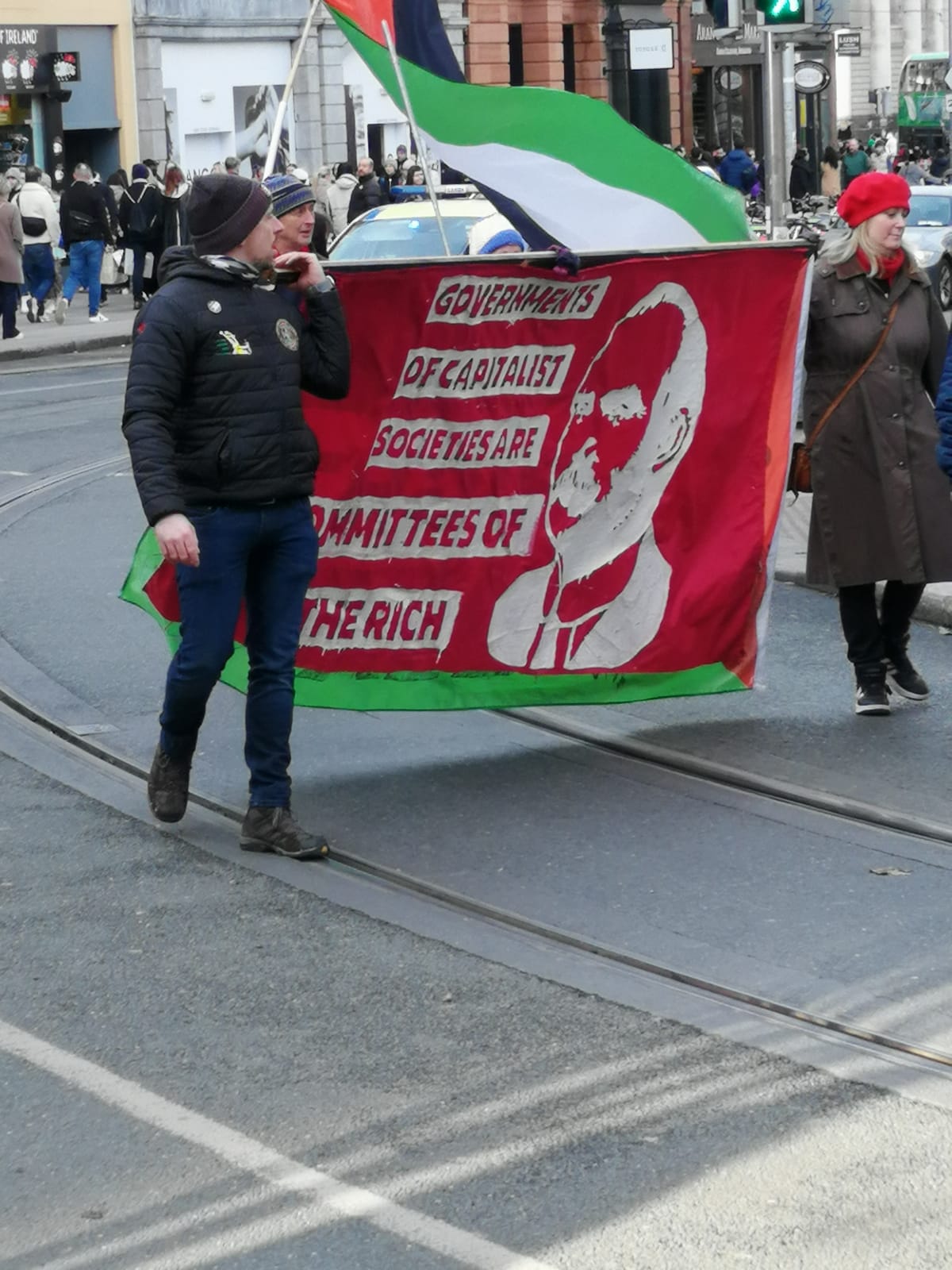
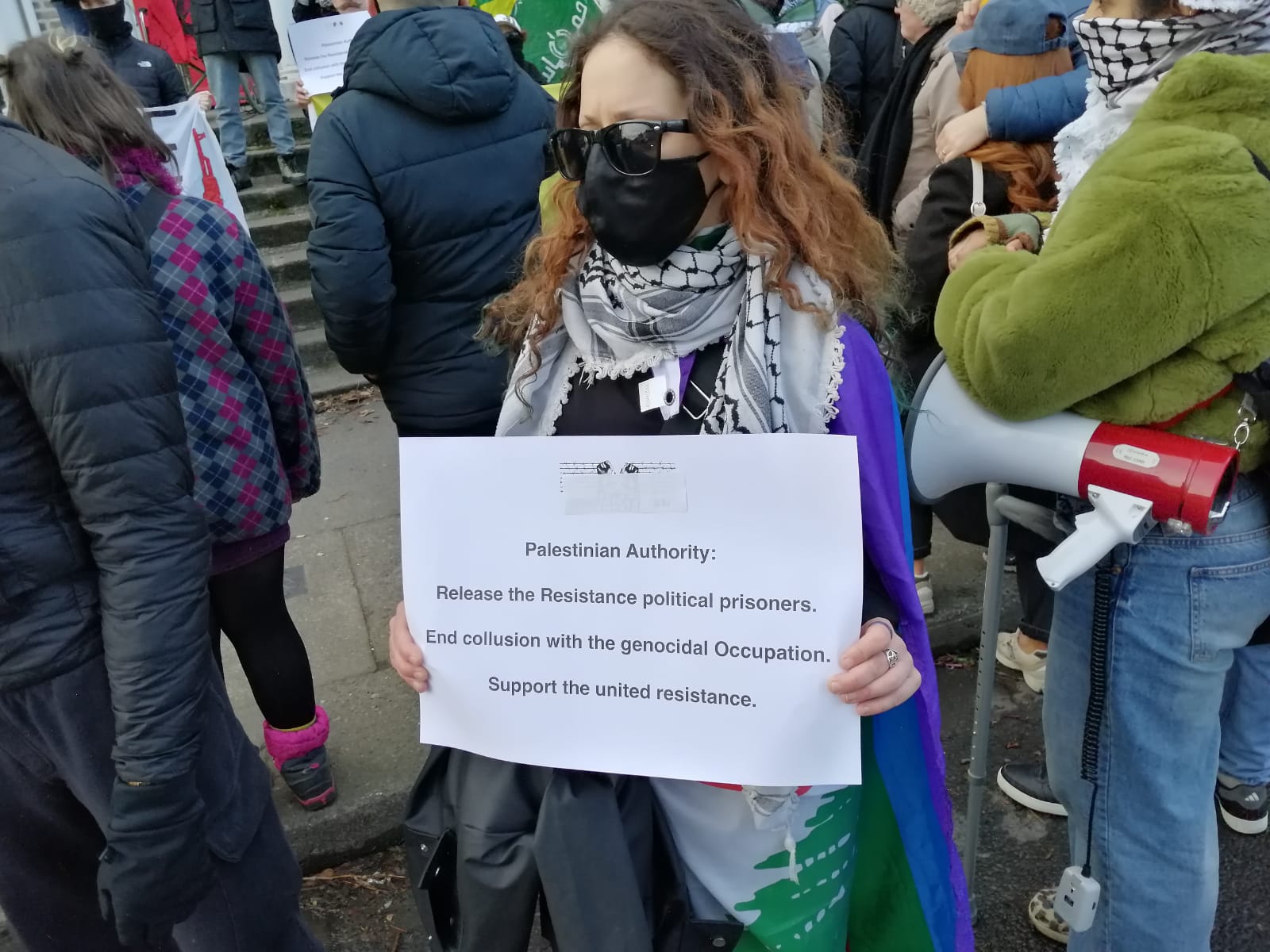
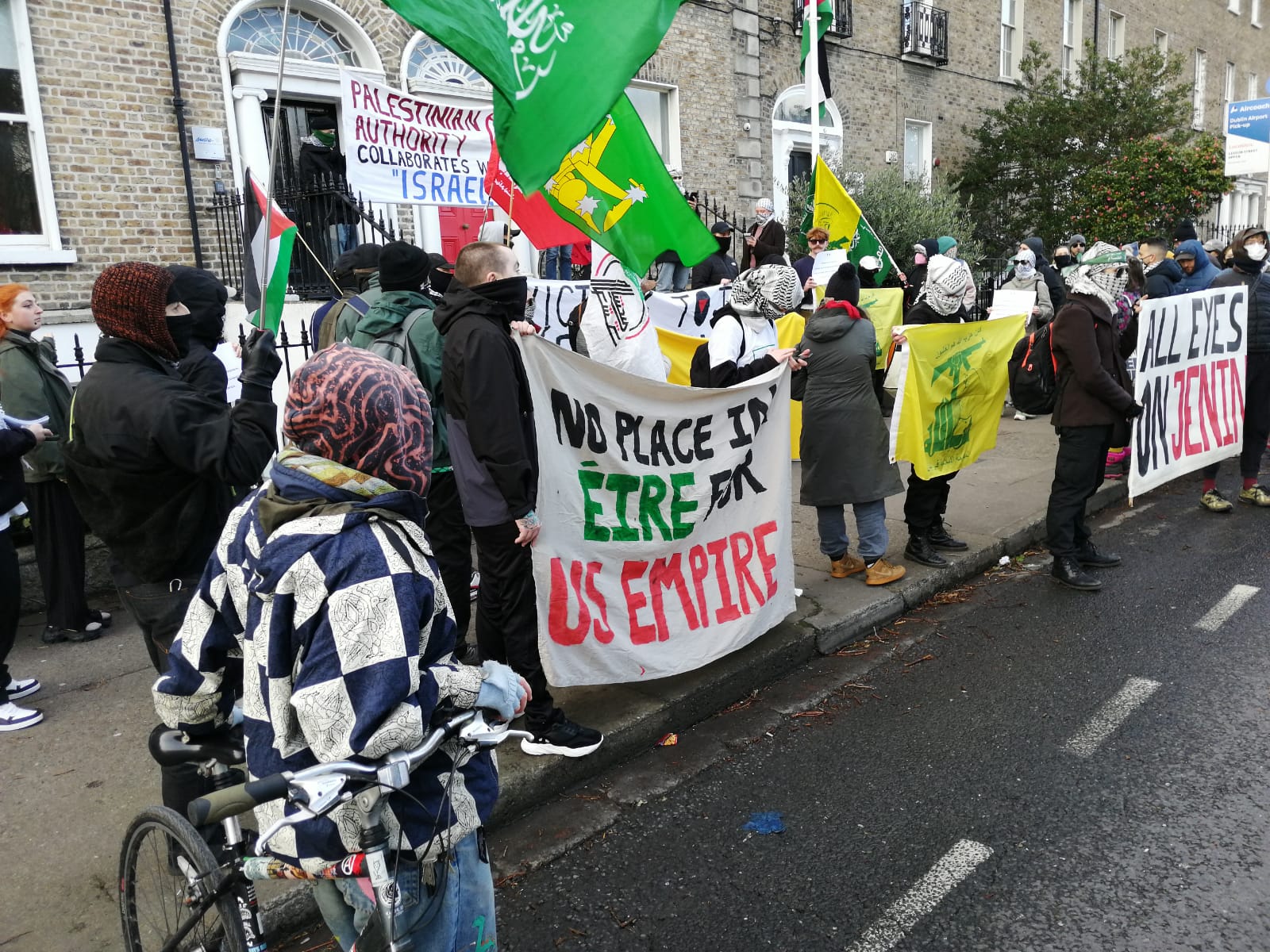
A large Palestine solidarity march once again in Dublin included a Resistance Bloc, part of which also broke away to picket the Palestinian Authority’s Embassy, where collaboration and collusion were denounced in three languages.1
A section of the march has arrived in Molesworth Street in view of Leinster House but others are still arriving. (Photo: R.Breeze)
As Israel freed 200 of their Palestinian prisoners Saturday in exchange for four female Israeli Occupation Army soldiers, Dublin City Centre rang again to shouts of Palestinian solidarity and some banners of the Resistance Bloc saluted the Resistance and denounced the Palestine Authority.
The Resistance Bloc was organised by a broad front of organisations: Action on Palestine, Saoirse Don Phalaistín and Queer Intifada and was also supported by independent activists.
(Photo: R.Breeze)(Photo: R.Breeze)
There had not been a major Palestine solidarity march in Dublinsince 7th December, though they had been held pretty regularly every two or three weeks throughout the previous year. On Saturday, as Netanyahu stopped blocking it, the ceasefire and prisoners transfer agreement finally went ahead.
The Agreement is in three phases, each including prisoners of each side to be exchanged but also the removal of the IOF from Gaza in matched stages and the return of Gaza residents to the South also including the delivery of food, fuel and medicine. But they return to a rubble wasteland.
(Photo: R.Breeze)(Photo: R.Breeze)
THE PA AND OSLO
The PA is a product of what was called the Palestinian Peace (more correctly called Pacification) Process and since it failed spectacularly to pacify the Palestinian people is more usually now called the Oslo Accords, from which the PA was established in 1994.
Reading a statement in Arabic outside the PA Embassy (Photo: R.Breeze)
The Oslo Accords is one of a wave of imperialist pacification processes or agreements of the last decade of the 20th Century and in particular one of interrelated processes in three distinct regions: in chronological order South Africa, Palestine and Ireland.
The ANC2 of South Africa recommended it to the Fatah3 of the Palestinians; then Fatah and the ANC recommended to the Provisionals4 in Ireland. In no case was what they had fought for achieved, with the exception of universal suffrage in South Africa.5
Banner Dublin Footballers for Gaza on the main march to Leinster House (Photo: R.Breeze) (Photo: R.Breeze)On the main march to Leinster House (Photo: R.Breeze)
Later, the ANC and Sinn Féin would also recommend it to the liberation movements of the Basque Country, Colombia and the Kurds of Turkey, always with disastrous results for the movements in fragmentation, confusion, collusion with imperialism and disarming in the face of repression.
The Palestinian Embassies represent in fact the PA and this is the case in Ireland too. Despite th. PA’s long history of treachery to the Palestinian people and their struggle, including repression of the Resistance, it is being officially “recognised” as the representation of the Palestine people.
On the main march to Leinster House (Photo: R.Breeze)On the main march to Leinster House (Photo: R.Breeze)
Not only the traditional State Government parties of Fine Gael and Fianna Fáil uphold the PA but so also does the major oppositional party, the former Republican party of Sinn Féin. This is also the case with the major political parties in the EU, UK and US.
These also support the ‘two-state solution’ (sic) which would see the indigenous Palestinian people get less than 20% of their country, with the least water resources under the eyes and guns of the Israeli State. In any case it is considered unworkable by most experts and serious commentators.
“Smash the chains of Zionism”banneron the main march to Leinster House (Photo: R.Breeze)Howth Stands With Palestine banneron the main march to Leinster House (Photo: R.Breeze)
In a recent statement on the ceasefire agreement in Gaza, the Secretary-General of the United Nations, Antonio Guterrez, also promoted the ‘solution’ of splitting Palestine into two states as a way towards peace. The PA too upholds that same plan.
Major Palestine solidarity organisations like the IPSC in Ireland have no formal position on the PA or the Two-State plan. Standing on the base of Palestine solidarity, ‘neutrality’ on the question is not excusable, even on a kind of basis of ‘it’s up to the Palestinians and not for us to intervene’.
On the main march to Leinster House (Photo: R.Breeze)On the main march to Leinster House (Photo: R.Breeze)
The PA is an imperialist creation against the Palestine struggle; for years it has been periodically attacking the Resistance and has now stepped up that aspect in its 6-week siege of Jenin in the West Bank and even military assaults on the Resistance groups in collusion with the IOF.
True solidarity with the struggle of a people also entails solidarity with their resistance, whether in non-violent or violent form and it also entails opposition to individuals and organisations that are colluding with the enemy; the PA should be publicly denounced by the solidarity movement.
On the main march to Leinster House (Photo: R.Breeze)On the main march to Leinster House (Photo: R.Breeze)On the main march to Leinster House (Photo: R.Breeze)
THE MARCH IN DUBLIN
In Dublin on Saturday any fears that much support would have dropped away6 disappeared as large numbers marched through the city centre, some having come from Kerry or Limerick. Not far from the front marched the Resistance Bloc which had assembled earlier outside the Rotunda.
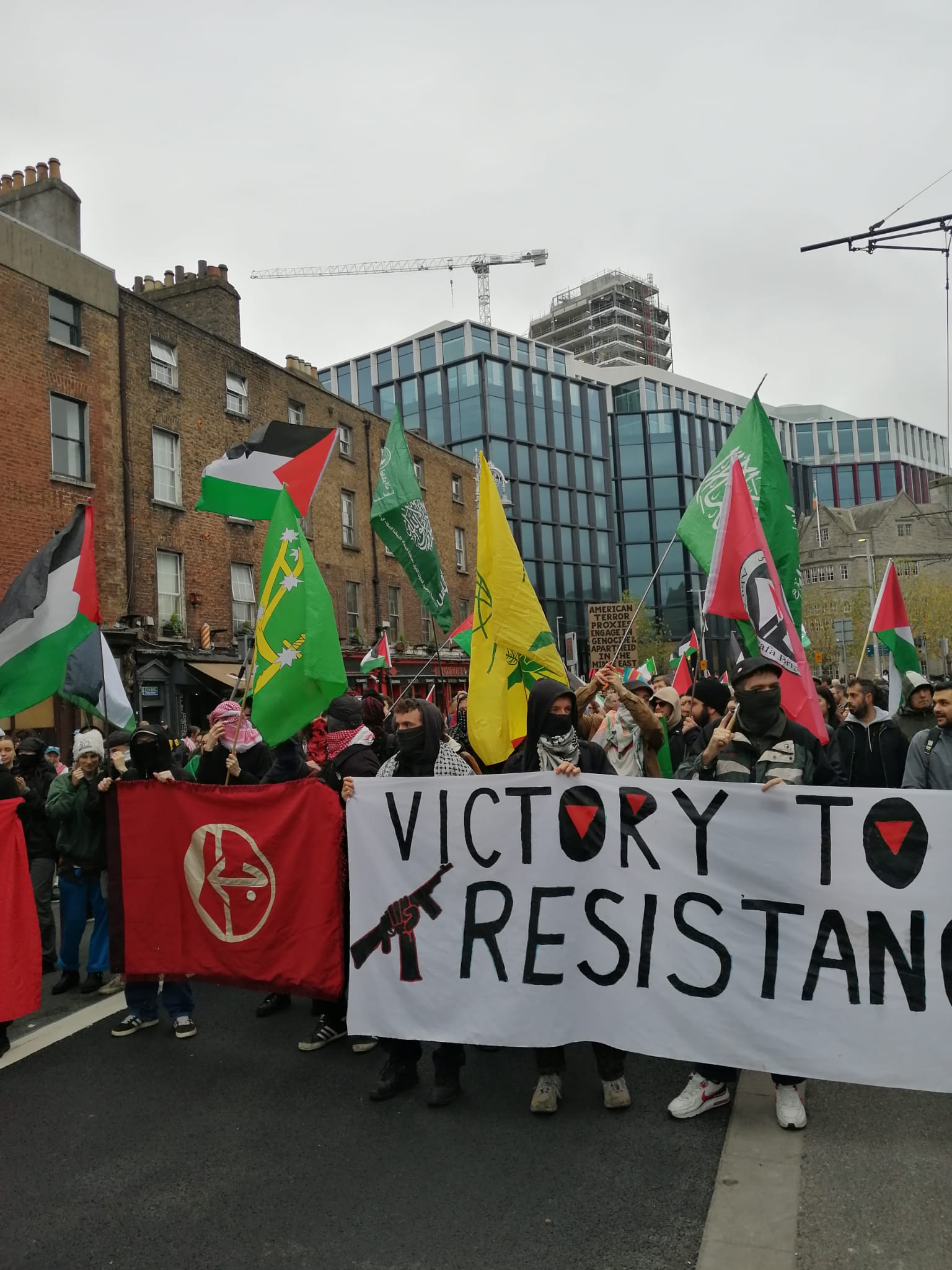
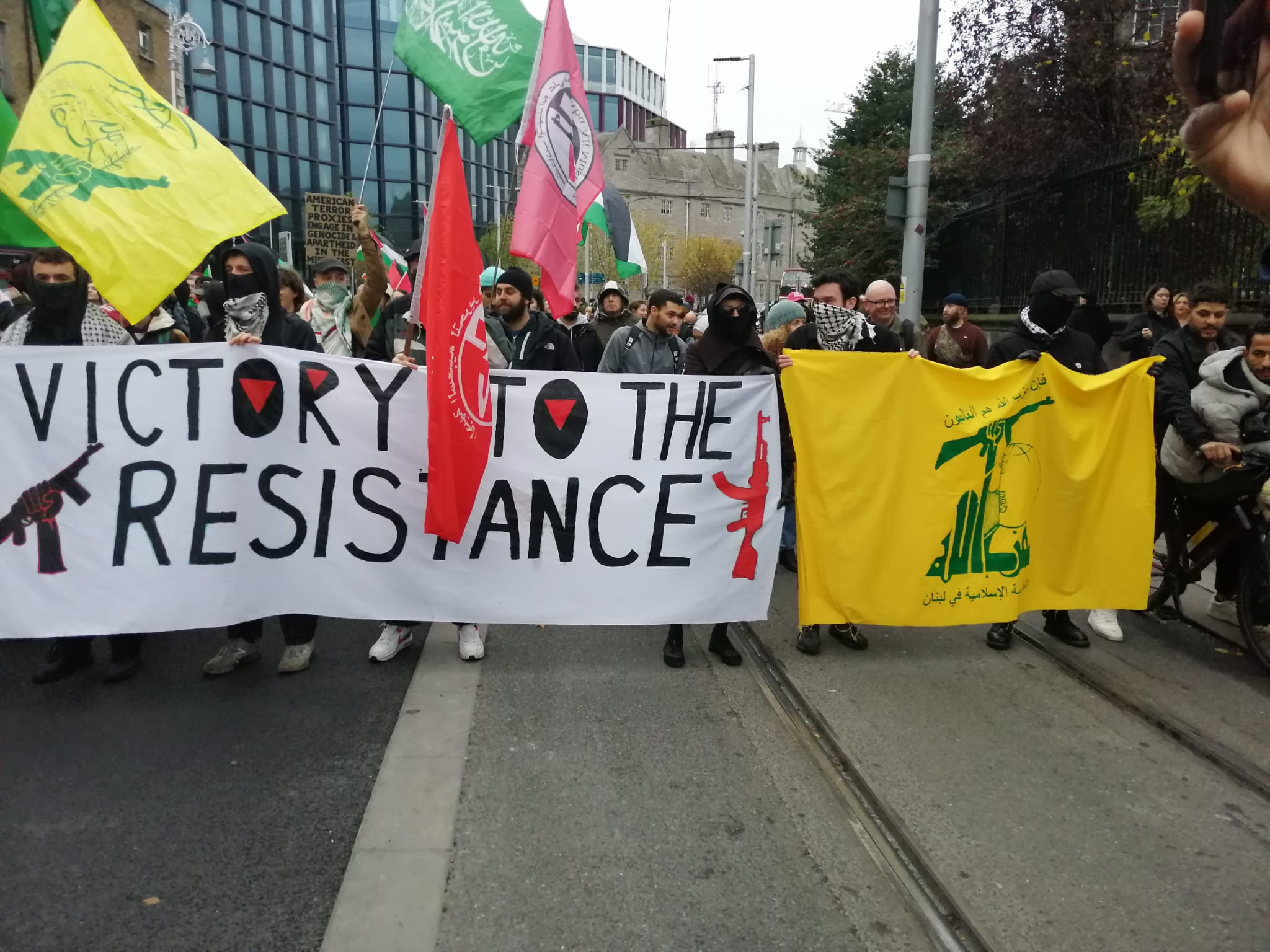
Flying the national flag of Palestine, the Starry Plough and flags of Palestinian Resistance factions Hamas and Islamic Jihad, along with the national flag of Syria, the bloc marched behind banners upholding the Resistance and denouncing the PA.
Placard and flags outside the PA Embassy (Photo: R.Breeze)Banners, flags and statement reading outside the PA Embassy (Photo: R.Breeze)
The usual chants of Palestine solidarity marches could be heard from the Bloc in call-and-answer but also included From Ireland to Palestine – Occupation is a crime! Saoirse don – Phalaistín! Resistance is an obligation – In the face of occupation!
Soon after the main march reached its destination, much of the Resistance Bloc marched away to Leeson Street Lower and soon after crossing the bridge over the Grand Canal into Leeson Street Upper, crossed the road to assemble in front of the “Palestine Embassy”.
One of the placards outside the PA Embassy (Photo: R.Breeze)Reading translation of the statement in English outside the PA Embassy (Photo: R.Breeze)
The breakaway march was closely followed by a number of Irish police patrol cars and a Public Order Unit Van which remained at the PA Embassy until the event concluded.
One of the organisers then presented a man to read a statement in Arabic, the translation of which she followed to read in English, which pointed to happiness at the freeing of Palestinian prisoners in the exchange with the Resistance – but sadness at the collusion of the PA with the Occupier.
A protester holds a placard denouncing the PA outside their Embassy (Photo: R.Breeze)Section of the crowd outside the PA Embassy (Photo: R.Breeze)
The speech declared that Palestinians have been striving for over a century to achieve their independence and freedom in their struggle against Israeli occupation. This has cost hundreds of thousands of Palestinian lives and displaced nearly nine million Palestinians around the world.
Later: Given the current circumstances, Palestinians must resist the Israeli occupation and simultaneously confront the Palestinian Authority, which acts as an agent in killing and besieging Palestinians to defend Israel. The speech concluded in thanking the Irish people for their solidarity.
One of the banners outside the PA Embassybears a slogan but also the name of one of the organising groups (Photo: R.Breeze)Another view of the crowd outside the PA Embassy (Photo: R.Breeze)
Another man spoke in part-Irish and part-English, congratulating people on having publicly confronted the PA with its collusion. This had only been done twice before in Ireland, once in Belfast when the “Palestinian Ambassador” had been addressing a Sinn Féin meeting.
There had been another outside the “Embassy” in Dublin some months earlier by a small gathering supporting a picket called by the Ireland Anti-Internment Campaign. He drew parallels between the PA and the treason to the Irish resistance that had led to Partition and a subservient state.
Next to the PA Embassy (Photo: R.Breeze)
Underlining the parallel in song, he sang verses of the Take It7 Down From the Mast ballad (against the Irish State during the Civil War 1922-1923), adapting a verse to call on the PA to Take it down from the mast Palestinian traitors ….. for you’ve (they’ve) brought on it nothing but shame.”
The picket concluded with thanks to the attendance and after a period of shouting slogans including There is only one solution – Intifada Revolution! From the river to the sea – Palestine will be free! Shame on you PA – Shame, shame, shame!
End.
Note: If you found this article of interest, why not register with Rebel Breeze for free, so that you will be notified by email of subsequent articles. You can de-register any time you wish.
On the main march to Leinster House (Photo: R.Breeze)On the main march to Leinster House (Photo: R.Breeze)
3The major secular Palestinian national liberation organisation at the time.
4Provisional IRA with its corresponding party, Sinn Féin, the major Irish national liberation organisation at the time.
5But no other social or economic progress; in addition, fragmentation of the movement and enlisting of the former liberation fighters as ‘enforcers’ of the imperialist agreement.
6Due to a possible but mistaken attitude of “the war’s over”.
7A reference to the Irish Tricolour: Take it down from the mast Irish traitors/ It’s the flag we Republicans claim/ It can never belong to Free Staters/ For you’ve brought on it nothing but shame. “The Free State” was the name adopted by those who agreed to the Anglo-Irish Treaty, including Partition.
The Palestinian Authority repressive forces has just murdered its 11th Palestinian since the Al Aqsa Flood operation.
An occupation force cannot control the people by its own brutal force alone – it needs partners in collusion, to spy, to give an appearance of representation, of due process but ultimately it needs that partner to exercise brutal force on its behalf.
On Monday (9th) the PA forces in Jenin (West Bank) murdered Rahbi Shalabi, 19, also seriously injuring his cousin, leading to protests, Resistance gunfire and explosions as a result. Shalabi was the 11th fatal victim of the PA, though many other Palestinians have been injured and jailed.1
Section of protest in West Bank Palestine against the PA’s murder of Rahbi Shalabi (Photo sourced: The Cradle)
A statement by the PA’s police, General Anwar Rajab, appears to attribute Shalabi’s death to firing by the Resistance or even a crossfire.2 Last Thursday Resistance fighters in Jenin confiscated two vehicles of the PA police in protest at the latter’s injuring and arrest of one of their members.
The PA has been repressing resistance in the areas it controls since its inception but repression has stepped up during the current accelerated genocide campaign of the IOF. A month after the latter commenced, the PA shot dead 12-year-old Razan Nazrallah during solidarity with Gaza protests.3
Razan Nassrallah, shot dead by the Palestinian Authority during solidarity with Gaza protest in the West Bank October 2023 (Photo sourced: Mahran Nassrallah)
During this whole period the PA has pursued Resistance fighters on behalf of the ‘Israeli’ Occupation, even entering hospitals in force in attempts to detain injured fighters.4 On at least two occasions popular mobilisations have prevented the PA forces achieving their aim.
The PA has killed known Resistance fighters5 and also removed defensive obstruction and exploded bombs planted in defence against IOF invasions.
A HISTORY OF CORRUPTION, COLLUSION AND REPRESSION
The Palestinian Authority was created in May 1994 as a 5-year interim body as part of the ‘Palestinian peace process’ (sic) through the Oslo Accords (1993-’95), signed up for the Palestine Liberation Organisation by the Al Fatah party,which won the 1996 Palestinian elections.
The Oslo Accords were rejected in the popular uprising of the Second Intifada (2000-2005). So corrupt, repressive and collusive had the PA and Fatah become that Hamas won the 2006 legislative elections throughout the West Bank and Gaza.
However it was only in Gaza that they forced the corrupt Fatah officials out when the latter refused to relinquish their posts in line with the elections.6 As a result, the PA central offices remained in the West Bank under Abbas, a Fatah nominee, continuing to receive EU and USA funding.
The PA under Mahmoud Abbas and Fatah control have continued in power (and funding) long past their allocated elected period and decline to hold new elections, for fear that Hamas would win once again.
President of the Palestinian Authority Mahmoud Abbas in Ramallah, West Bank, October 24, 2023. (Photo cred: Christophe Ena/Pool via REUTERS)
The PA does not deploy its militarised police force of 80,000 complete with armoured cars against the ‘Israeli’ Occupation, needless to say perhaps but nor does it send them to defend Palestinian farmers and villages being attacked by Zionist settlers.
The PA feeds intelligence on the Palestinians to the Zionist Occupation authorities and arrests people sought by the latter or on the PA’s own account, for speaking or writing criticisms of the PA or for mobilising in support of the Resistance.
People jailed by the PA are, after release, often re-arrested by the IOF and vice versa. The PA is, as admitted by most western and pro-Israeli media, widely detested by Palestinians who consider it a proxy agency for the ‘Israeli’ occupation.
COLLUSIVE REGIMES IN EUROPE
The Nazi occupation of Western Europe established collusive client regimes to administer civilian affairs and the civilian population in every state it occupied. In the first place these regimes acted as buffers between the Occupation and the Occupied but also collected intelligence.
Many became active in repression, hunting down Jews and Resistance operatives. After the liberation of Europe, many of those collaborators were jailed and some were executed by the Allies or by the authorities of the liberated states.
In Ireland the Free State carried out repression against the Resistance forces which had forced the British occupation to withdraw their armed forces from 26 of the Irish counties. Armed, transported and even clothed by the British, the Free State Army fought a vicious Civil War against the IRA.
SUPPORTING THE PA, COLLUDING WITH ZIONISM
The PA is officially recognised by many governments including that of the Irish state, where it has an Embassy. “Recognition of the State of Palestine” in most cases entails accepting the unrepresentative and detested PA as a legitimate representative of the Palestinian people.
Such official recognition usually also entails acceptance of “the Two-State solution” (sic), agreeing to a fragmented Palestinian ‘state’ on less than 40% of Palestinian land, with the least fresh water, under the constant surveillance and guns of the Zionist Occupation.7
This is also what is entailed in ‘recognition of the Palestinian State’ by political parties and organisations who claim that they are doing so in solidarity with the Palestinian people or at least for the sake of ‘a just peace’.
It is absolutely necessary, both for their own integrity and out of solidarity with the Palestinian people, not only for revolutionary forces but also for all anti-colonial, anti-imperialist and basic democratic organisations to denounce the PA and its repression.
Those who feel they cannot support revolution should at least refrain from Zionist collusion. Remaining silent on the role and activities of the PA or, even worse, promoting the PA and its Embassies, is to become part of the repression and a tool of ‘Israeli’ Zionism.
End.
West Bank mass protest at death of activist Nizar Banat in PA custody Ramallah 24 June 2021 (Photo cred: Flash90)
2Ibid. People familiar with other conflict spots, for example the occupied Six Counties of Ireland, will be familiar with this ploy by the authorities.
6Hence the frequent references in western mass media to when “Hamas seized power in Gaza”!
7Despite the continued support of the western imperialist states, every realistic assessment has judged the Two-State option to be no longer possible (if it ever was) due to the extent of Zionist settlements and private settler roads. The alternative then must be what many democratic anti-colonial people have been advocating for decades: one democratic secular state with equal rights and opportunities for people of all ethnic backgrounds.
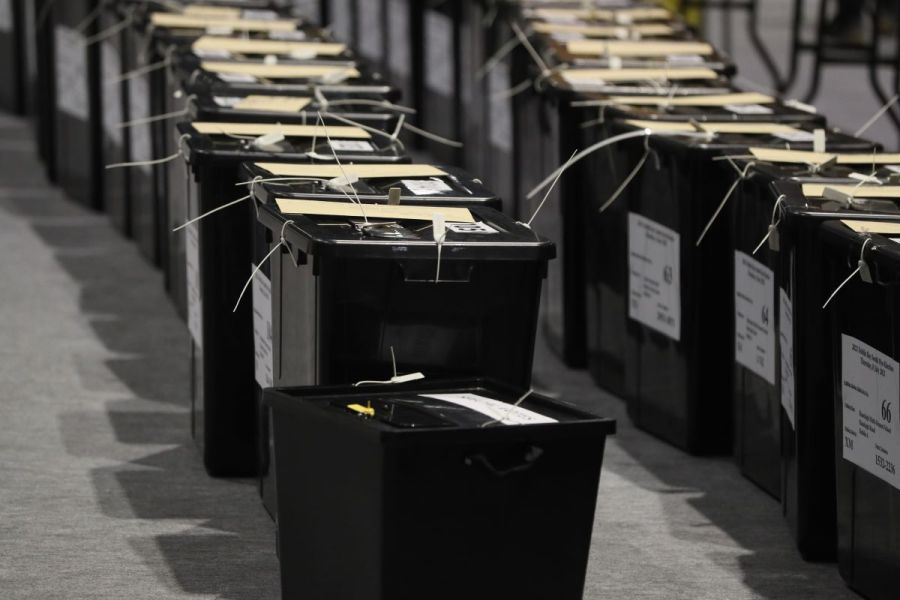
The elections in the Irish state are over and nothing much has changed — or looks likely to change — with regard to parties in power or with government policy. Crises will continue in housing, health care and the environment.
The state will continue its slide towards full EU/US/NATO militarisation. And of course, with the colonial one-sixth of Ireland continuing under direct UK occupation and control, administered by a Unionist/ Sinn Féin administration.
Since no party won the magic 88 overall majority number of seats, a coalition government will be formed (as has been every government since 1981).
It was overall quite a boring election which is a bit disappointing. Given that we’re not being given much bread, the least we are entitled to expect is a good circus. And aren’t elections the high point of our wonderful democratic state and processes?
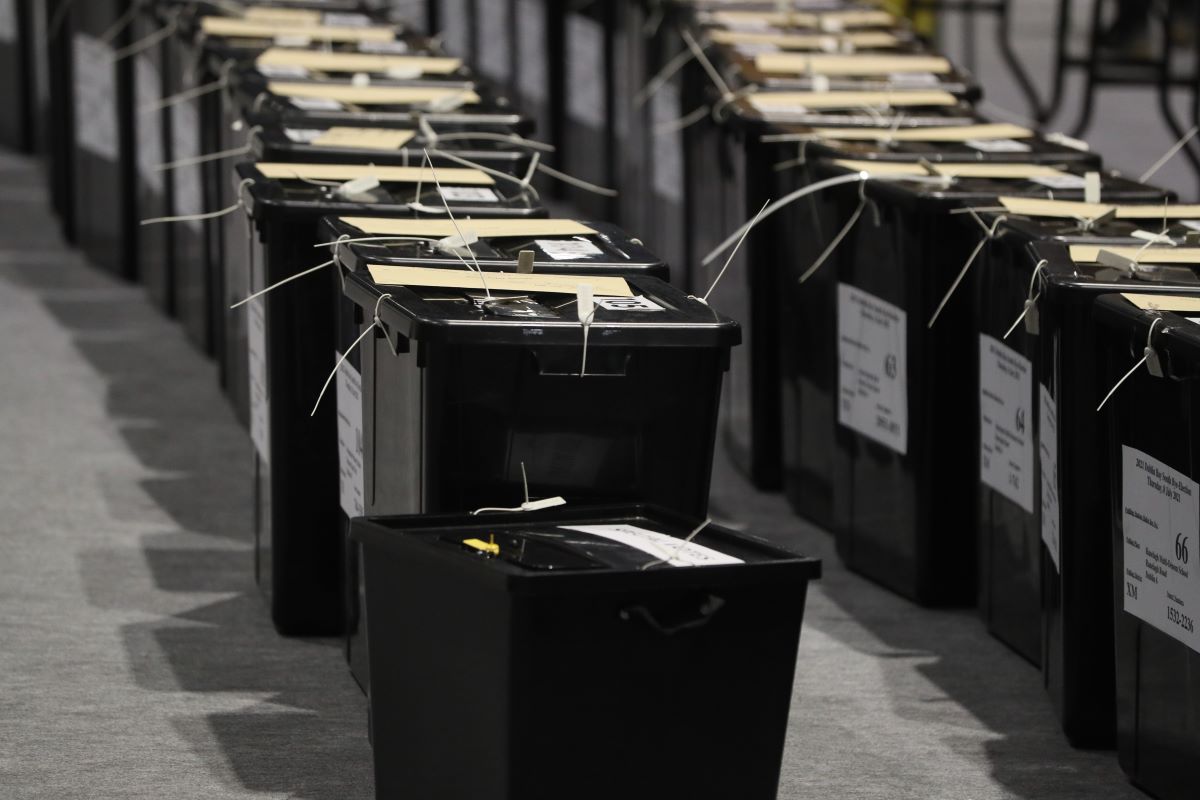
Over 40% of those eligible to vote didn’t seem to think so and didn’t attend the show – even though tickets were free — a continuing fall in the circus-going public and lowest since 1923, a great worry to the authorities. New acts might awaken more interest but the prospect looks slim.
RUNNING ‘BANK ROBBER’
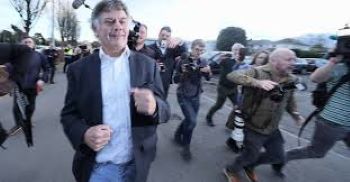
The one real piece of entertainment was the entering the ring at the Big Top of alleged bank robber (and other things) Gerrard Hutch, currently on 100,000 bail on charges in Lanzarote, Spanish state, of money laundering for criminal purposes. He ran out of it on polling day too.
Gerard Hutch jogging from the counting station, media frenzied shoal following.
Gerrard’s family has been engaged in a literally murderous competition with another inner-city family, the Kinehans, with deaths on both sides.
Hutch failed election due only to insufficient transferable votes in Ireland’s electoral system of proportional representation – but he received 3,098 first preference votes — one in ten in the constituency, in competition with outgoing Government party candidates and the SF President.
What does it mean that so many people voted for an alleged bank robber and gangster? That the voters are gang members too? Or that they consider those in government to be thieves or representing thieves, speculators and robber-bankers versus a less disguised bank robber?
OTHER RESULTS
Sinn Féin continued to be one of the top three parties, exceeding government party Fine Gael by one elected Deputy but was in turn trumped by also Government party Fianna Fáil with an excess of nine TDs (Teachta Dála, Irish Parliamentary representative, also known as “Deputies”).
Fianna Fáil, we may remember, was founded out of a split in the anti-Anglo-Irish Treaty Sinn Féin led by De Valera, which went on to have the longest track record in representing the Irish Gombeen capitalist class in government, an objective on which the current Sinn Féin has set its sights.
The Green Party retained only one of its 12 seats, which was disappointing – I mean, disappointing that they kept any. Every time they’ve been in coalition Government they have disappointed their voters and got kicked out at the next election, only to try the same again at a later date.
Another party that has played the same game – and suffered the same subsequent electoral consequences — has been the Irish Labour Party. A question of some but limited interest is whether they’ll join the Government coalition again now or remain in opposition.
Conservative Aontú and (far?) right-wing Independent Ireland got more votes than seems healthy for the country. The electoral Left lost Joan Collins of Right to Change and PBP Solidarity lost Gino Kelly and Mick Barry, though Ruth Coppinger got back in for them after a 4-year break.
Gino Kelly of PBP Solidarity who lost his seat.
The only government composition likely on the numbers if Sinn Féin is to be excluded, as seems certain despite Eoin Ó Broin talking to others, is a repeat coalition of Fine Gael-Fianna Fáil with another three or so TDs and the old firm might go for independents rather than a junior party’s TDs.
Are there any independent TDs so low in self-respect and principles as to accept such an offer? For a Ministerial salary? What do you think?
For decades FG and FF have each been in opposition when the other was in government but will be in government together again for the second term running. This undermines the whole illusion of choice and of democratic representation but what can one do?
People who voted for SF, largely working class and younger people according to profiling by opinion polls, will be disappointed that the party did not a) get an absolute majority (but that was never likely) and b) that it will not be considered for coalition government with FF or FG.
Sad though that reality is, they would have been predictably sadder and more disappointed had SF actually got into coalition government, when their crumpled and discarded principles would have been under merciless public view. On the other hand, perhaps that’s what is needed.
Just as it’s business as usual for the ruling class and its board of management – i.e. government – so it is for the revolutionaries, in terms of the task to build a broad anti-imperialist, anti-racist alliance under socialist (i.e anti-capitalist) principles and with consequent objectives.
Hopefully not the business as usual of separating socialism from national liberation and upholding sectarian principles and methods of organisation. We can hope. And work.
Large numbers attending a rally Sunday afternoon were addressed by a number of speakers from a platform in the centre of the 1916 Terrace organised by the Moore Street Preservation Trust on part of the very site they wished to preserve.
Fintan Warfield, a Sinn Féin Senator (and cousin of Derek and Brian Warfield of the Wolfe Tones) came on stage to perform Come Out Yez Black ‘n Tans followed by Grace, about Grace Gifford’s wedding to Vol. Joseph Plunkett hours before his execution by British firing squad.
Fintan Warfield performing at the event, behind him the portraits of two of the Moore Street Garrison in 1916 may be seen. (Photo: R. Breeze)
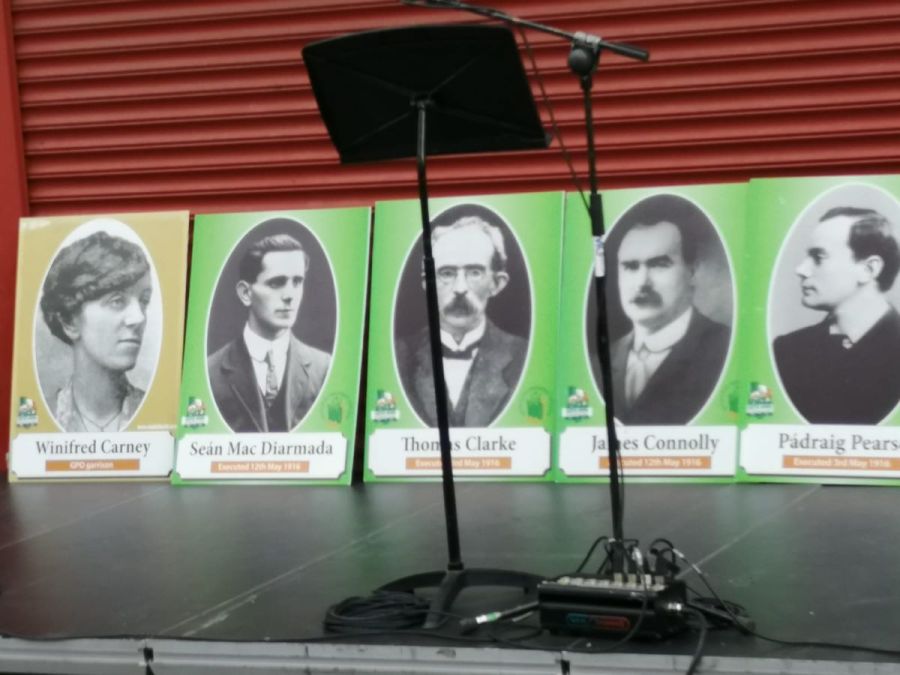
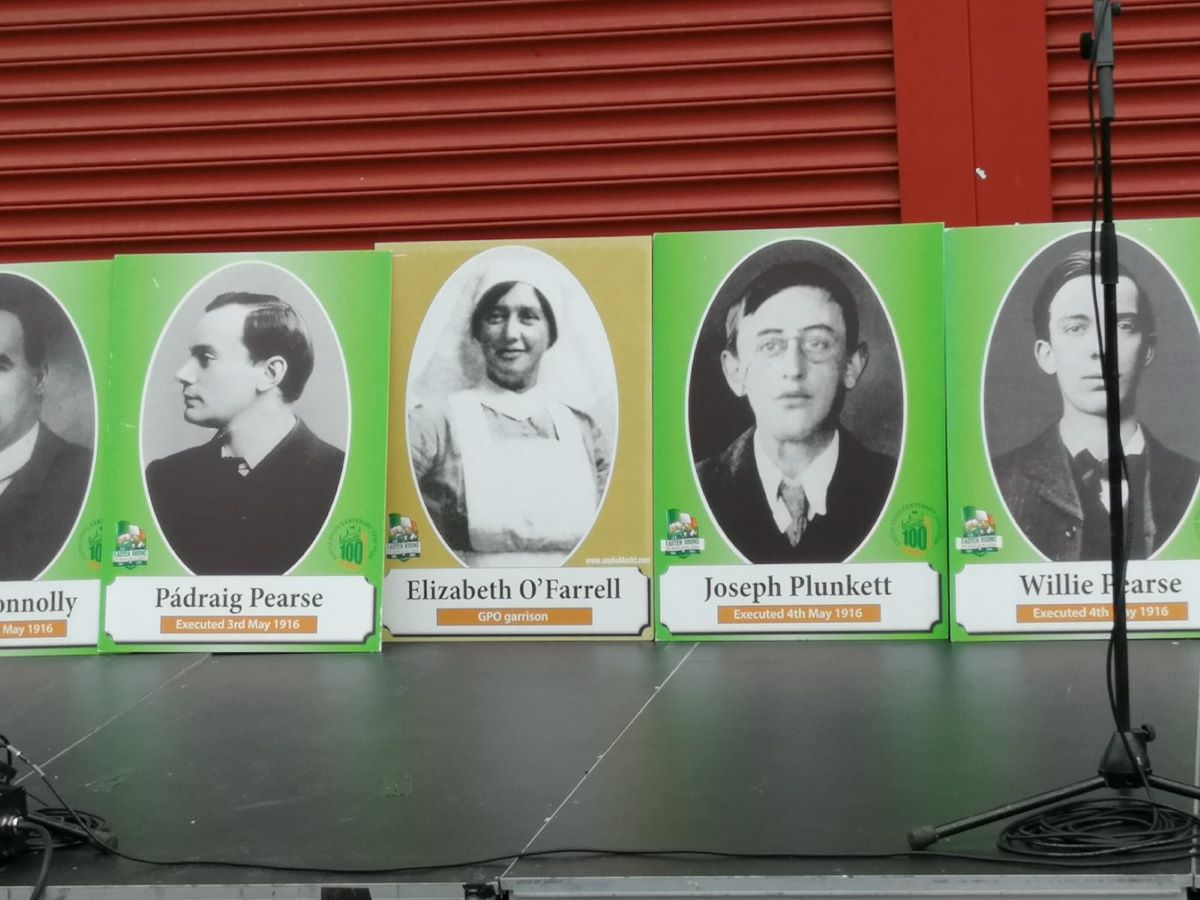
Warfield performed in front of a number of large board posters bearing the images of a number of leaders of the 1916 Rising who had occupied Moore Street in 1916 and Vols. Elizabeth O’Farrell and Winifred Carney, two of the three women Volunteers who had been part of the garrison.
The start of the rally however was delayed, apparently awaiting the arrival of Mary Lou Mac Donald, billed as the principal speaker on the Moore Street Preservation Trust’s pre-rally publicity.
Eventually Mícheál Mac Donncha, Secretary of the Trust and a Sinn Féin Dublin City councillor came on the stage to promote some MSPT merchandise (some of it for free) and to introduce the MC for the event, Christina McLoughlin, a relative of Comdt. Seán McLoughlin.
Christina McLoughline, MC of the event. (Photo: R. Breeze)
Vol. Seán McLoughlin had been appointed Dublin Commandant General by James Connolly during the GPO evacuation and was about to lead a charge on the British Army barricade in Parnell Street when the decision was taken to cancel after which he organised the surrender.
He later became a communist and was never acknowledged at Commandant level by the War Pensions Dept. of the State under De Valera, despite his rank in Moore Street and later also in the Civil War in Cork.
Sean’s relative Christina McLoughlin welcomed Mary Lou Mac Donald on to the stage.
Mac Donald’s appearance on the stage received strong applause. In fairness, many present, if not most, were of the party faithful. Despite the presence of some younger people, the general age profile was decidedly from the 40s upwards, indeed many being clearly in the later third.
Mary Lou Mac Donald, President of the Sinn Fein party, speaking at the event. (Photo: R. Breeze)
Mac Donald, who is not an Irish speaker, read the beginning of the address well in Irish before going on to talk in English about the importance of Moore Street site in the history of the 1916 Rising and in Irish history generally and how her party in government would save it.
After the applause for Mac Donald, the MC called Proinnsias Ó Rathaille, a relative of Vol. Michael The O’Rahilly, who was mortally wounded leading a charge up Moore Street against a British Army barricade in Parnell Street and who died in the nearby lane that now bears his name.
Ó Rathaille’s address was heavy in the promotion of the Sinn Féin party and, in truth rather wandering so that he had to return to the microphone after he’d concluded, to announce Evelyn Campell to perform a song she had composed: The O’Rahilly Parade (the lane where he died).
Evelyn Campbell performing her composition O’Rahilly’s Parade at the event. (Photo: R. Breeze)
Campell is a singer-songwriter and has performed in Moore Street on previous occasions, the first being at the invitation of the Save Moore Street From Demolition group who were the only group to campaign to have the O’Rahilly monument finally signposted by Dublin City Council.
McLoughlin announced Deputy Mayor Donna Cooney to speak, a relative of Vol. Elizabeth O’Farrell, one of the three women who were part of the insurrectionary forces occupying Moore Street. Cooney is a Green Party Councillor and a long-standing campaigner for the conservation of Moore Street.
Deputy Dublin Lord Mayor and Green Party councillor Donna Cooney speaking at the event. (Photo: R. Breeze)
While speaking about the importance of Moore Street conservation for its history and street market, Cooney also alluded to its deserving UNESCO World Heritage status, adding that the approval of the Hammerson plan for the street was in violation of actual planning regulations.
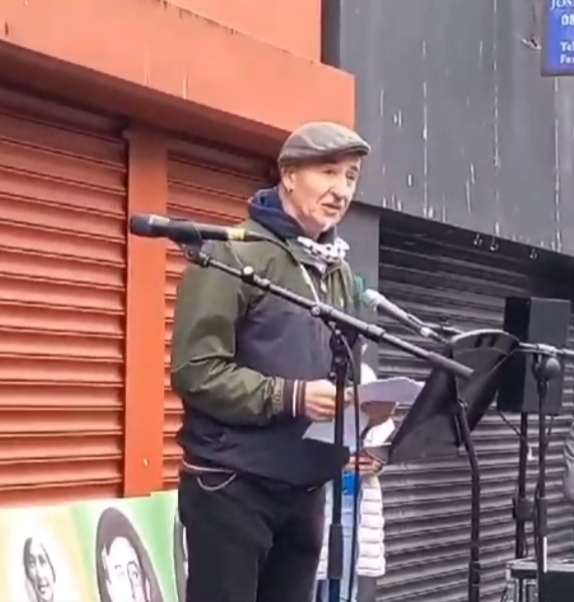
Next to speak was Diarmuid Breatnach, also a long-time campaigner, representing the Save Moore Street From Demolition campaign group which, as he pointed out has been on the street every Saturday for over a ten years and is independent of any political party or organisation.
Diarmuid Breatnach speaking at event on behalf of the independent Save Moore Street From Demolition campaign group. (Photo: R. Breeze)
Breatnach also raised the UNESCO world heritage importance, as the SMSFD group were first to point out and have been doing for some years, based on a number of historical “firsts” in world history, including the 1916 Rising having been the first anti-colonial uprising of that century.
The Rising was also the first ever against world war, Breatnach said. He told his audience that the Irish State has applied for UNESCO heritage status for Dublin City, but only because of its Victorian architecture and that it had once been considered “the second city of the British Empire”.
Stephen Troy, a traditional family butcher on the street, was next to speak. He described the no-notice-for-termination arrangements which many phone shops in the street had from their landlord and how Dublin City Planning Department had ignored the many sub-divisions of those shops.
Stephen Troy, owner of family butcher shop on the street and campaigner, speaking at the rally. (Photo: R. Breeze)
Troy’s speech was probably the longest of all as he covered official attempts to bribe the street traders to vote in favour of the Hammerson plan and what he alleged was the subversion of the Moore Street Advisory Group which had been set up by the Minister for Heritage.
It began to rain as Troy was drawing to a close but fortunately did not last long.
Jim Connolly Heron, a descendant of James Connolly and also a long-time campaigner for Moore Street preservation was then called. Speaking on behalf of the Trust, Connolly began by reading out a list of people who had supported the conservation but had died along the way.
Connolly Heron went on to promote the Trust’s Plan for the street which had been promoted by a number of speakers and to announce the intention of the Trust to take a case to the High Court for a review of the process of An Bord Pleanála’s rejection of appeals against planning permission.
Jim Connolly Heron, great-grandson of James Connolly and prominent member of the Moore Street Preservation Trust, speaking at the event. (Photo: R. Breeze)
The MC acknowledged the presence in the crowd of SF Councillor Janice Boylan, with relatives among the street traders and standing for election as TD and Clare Daly, also standing for election but as an Independent TD in the Dublin Central electoral area.
MOORE STREET, PAST AND PRESENT
Moore Street is older than O’Connell Street and the market is the oldest open-air street market in Ireland (perhaps in Europe). It became a battleground in 1916 as the GPO Garrison occupied a 16-house terrace in the street after evacuating the burning General Post Office.
At one time there were around 70 street stalls in the Moore Street area selling fresh fruit, vegetables and fish and there were always butchers’ shops there too. But clothes, shoes, furniture, crockery and vinyl discs were sold there too, among pubs, bakeries and cafés.
Dublin City Planning Department permitted the development of the ILAC shopping centre on the western side of the street centre and the Lidl supermarket at the north-east end of the street, along with a Dealz as the ILAC extended to take over the space on its eastern side.
While many Irish families turned to supermarkets, people with backgrounds in other countries kept the remaining street traders in business; but the property speculators ran down the street in terms of closing down restaurants and neglecting the upkeep of buildings.
The authorities seem to have colluded in this as antisocial behaviour that would not be tolerated for a minute in nearby Henry Street is frequently seen in Moore Street.
The new craft and hot food stalls Monday-Saturday run counter to this but are managed by the private Temple Bar company which can pull out in a minute. On Sunday, the street is empty of stalls and hot food or drinks are only available in places that are part of the ILAC shopping centre.
The O’Reilly plan was for a giant ‘shopping mall’ extending to O’Connell Street and was paralysed by an objectors’ occupation of a week followed by a six-week blockade of the site, after which a High Court judgment in 2016 declared the whole area to be a National Historical Monument.
A judge’s power to make such a determination was successfully challenged by then-Minister of Heritage Heather Humphries in February of 2017. NAMA permitted O’Reilly to transfer his assets to Hammerson who abandoned the ‘shopping mall’ plan as not profitable enough.
The Hammerson plan, approved by DCC and by ABP is for a shopping district no doubt of chain stores like Henry Street or Grafton Street, also an hotel and a number of new streets, including one cutting through the 1916 central terrace out to O’Connell Street from the ILAC.
In the past dramatist Frank Allen organised human chains in at least three ‘Arms Around Moore Street’ events and the Save Moore Street 2016 coalition organised demonstrations, re-enactments, pickets and mock funerals of Irish history (i.e under Minister Humphries).
The preservation campaigning bodies still remaining in the field are the SF-backed Moore St. Preservation Trust and the independent Save Moore St. From Demolition group. The former is only a couple of years in existence and the latter longer than ten years.
However, both groups contain individuals who have been campaigning for years before that. The MSPT tends to hold large events sporadically; the SMSFD group has a campaign stall on the street every Saturday from 11.30am-1.30pm. Both have social media pages.
Fully in view, four prominent members of the Moore Street Garrison (L-R): Patrick Pearse, Commander-in-Chief; Vol. Elizabth O’Farrell, of Cumann na mBan; Vol. Joseph Plunkett, one of the planners of the insurrection; Vol. Willie Pearse, Adjutant to his brother Patrick. All but O’Farrell were tried by British court martial, sentenced to death and shot by British firing squad in Kilmainham Jail. (Photo: R. Breeze)
LEGISLATION & COURT CASES
2007 Nos. 14-17 Moore Street declared a National Historical Monument (but still owned by property developer Joe O’Reilly of Chartered Land)
2015 Darragh O’Brian TD (FF) – Bill Moore Street Area Development and Renewal Bill – Passed First Reading but failed Second in Seanad on 10th June 2015 by 22 votes against 16.
2015 – Colm Moore application — 18th March 2016: High Court judgement that the whole of the Moore Street area is a national historical monument.
2017 – February – Minister of Heritage application to Court of Appeal – judgement that High Court Judge cannot decide what is a national monument.
2021 — Aengus Ó Snodaigh TD (SF) – 1916 Cultural Quarter Bill – reached 3rd Stage of process; Government did not timetable its progress to Committee Stage and therefore no progress.
2024 – Property Developer Hammerson application to High Court Vs. Dublin City Council in objection to decision of elected Councillors that five buildings in the Moore Street area should receive Protected Structure status as of National Historical Heritage. Hammerson states that the decision is interfering with their Planning Permission. Case awaits hearing.
Five prominent members of the Moore Street Garrison (L-R): Vol. Winifred Carney of Irish Citizen Army and Cumann na mBan; Vol. Sean Mac Diarmada, one of the planners of the insurrection; Vol. Tom Clarke, one of the insurrection’s planners; revolutionary socialist James Connolly, Irish Citzen Army and Commandant General of the Rising (especially of Dublin); Patrick Pearse, Commander-in-Chie. All but Carney were tried by British court martial, sentenced to death and shot by British firing squad in Kilmainham Jail. (Photo: R. Breeze)
POSTSCRIPT
Someone commented later that in general the rally, from the content of most of the speeches, had been at least as much (if not more) of a Sinn Féin election rally as one for the conservation of Moore Street.
That should have been no surprise to anyone who knows that any position taken by Sinn Féin activists tends to be for the party first, second and third. And with the Irish general elections only weeks away, well …
And while Mac Donald spoke in Dublin of the importance of Ireland’s insurrectionary history and the need to conserve such sites, her second-in-command Michelle O’Neil was laying a wreath in Belfast in commemoration of the British who were killed in the First imperialist World War.
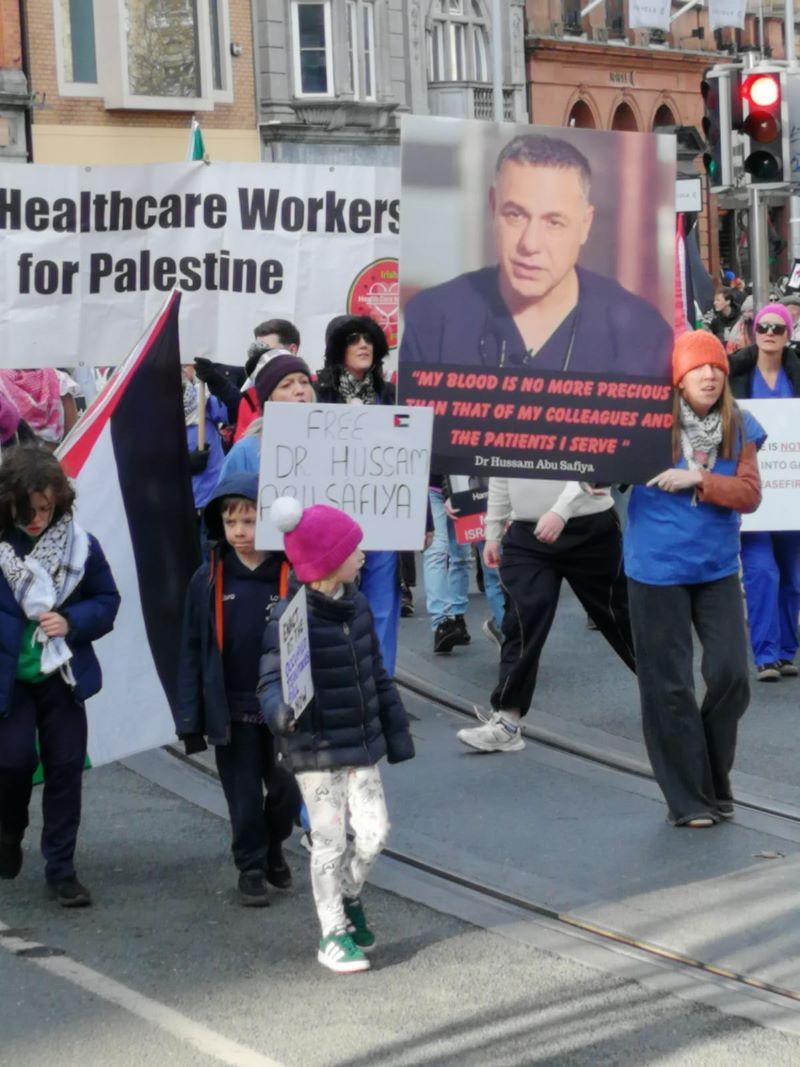
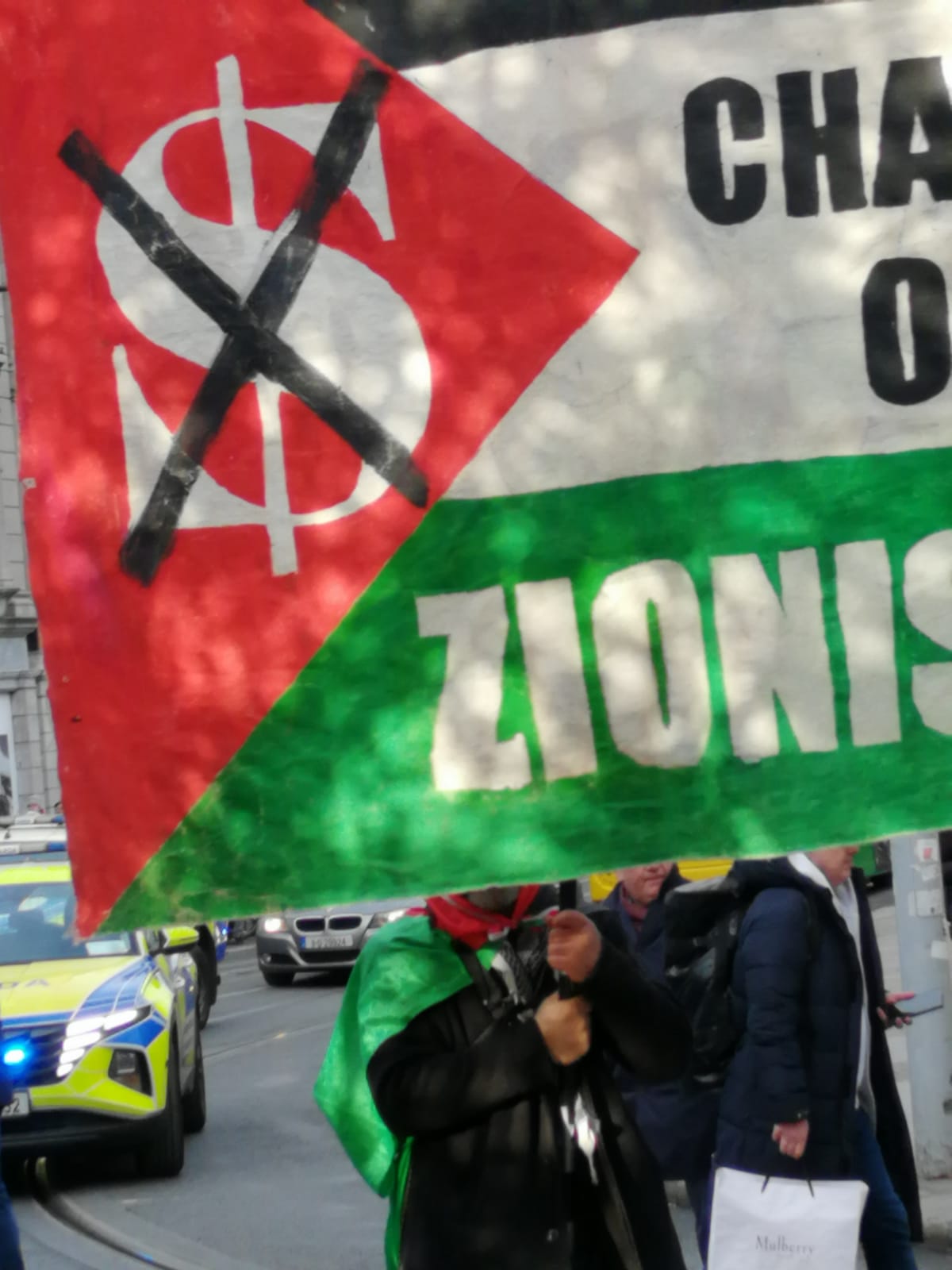
While thousands marched once again in Palestine solidarity in Dublin, a section of the demonstration marched as a bloc in specific solidarity with the Palestinian Resistance with banners, flags and slogans declaring their position.
The Ireland Palestine Solidarity Campaign with a number of branches has been for many years the major organiser of Palestinian solidarity events and had once again called for a national march in Dublin, again to Leinster House, home of the Irish Parliament.
Section of the front of the Palestinian Resistance Solidarity Bloc in Dublin on Saturday. In this photo may be seen the flags of three factions of the Palestinian Resistance and, left foreground, the flag of Irish revolutionary socialist Republicanism, the Starry Plough (Photo: R.Breeze)
This has become a pattern of the main IPSC street activity in Dublin, along with holding a rally on the central pedestrian reservation in Dublin’s O’Connell Street, with occasional marches to the Department of Foreign Affairs (though in the past it organised boycott pickets of ‘Israeli’ products).
The US Embassy seems to have become out of bounds for the IPSC. This is despite the clear responsibility of the USA for supplying most of the armament, political and financial backing for the genocide being carried out by the Zionist state against the Palestinians.
Some believe that the IPSC leadership is complying with the wishes of the Irish police, the Gardaí, not to have Palestine solidarity marches go to the US Embassy. The offices of the EU, Germany and the UK, major contributors to the genocide, have also been given in effect a waiver.
The national march called by the IPSC at its destination in Molesworth Street last Saturday. The photo is taken from the platform and PA lorry facing the crowd, with its back to Leinster House (of the Irish Parliament) which also has crowd barriers erected behind it. (Photo sourced: IPSC)
Neither the march last Saturday nor any organised before it by the IPSC was going to promote solidarity with the Resistance, despite their former chairperson having once said of them in public that they are ‘freedom fighters’. Of course, to the ‘Israelis’ and EU they are ‘terrorists’.
Section of the front of the Palestinian Resistance Solidarity Bloc in Dublin on Saturday (Photo: R.Breeze)
The IPSC has organised only one public meeting during this year’s genocide to highlight the terrible conditions of the thousands of Palestinian political prisoners in ‘Israeli’ jails and rarely mentions them, nor in solidarity with the Samidoun1 organisation being banned in USA and Canada.
In October last year, as this phase of the genocide began, the IPSC dithered over whether to call for the expulsion of the ‘Israeli’ Ambassador to Ireland, as did the Sinn Féin leadership until a near revolt of the party’s members forced them to return to their previous position. As did the IPSC.
Clearly the IPSC leadership is trying to keep itself somewhere around the ‘middle road’ in Palestinian solidarity, probably in order — as it sees it – to remain with influence among the ruling circles. However, the actual results among those circles do not bear testimony to their effectiveness.
NO CHANGE
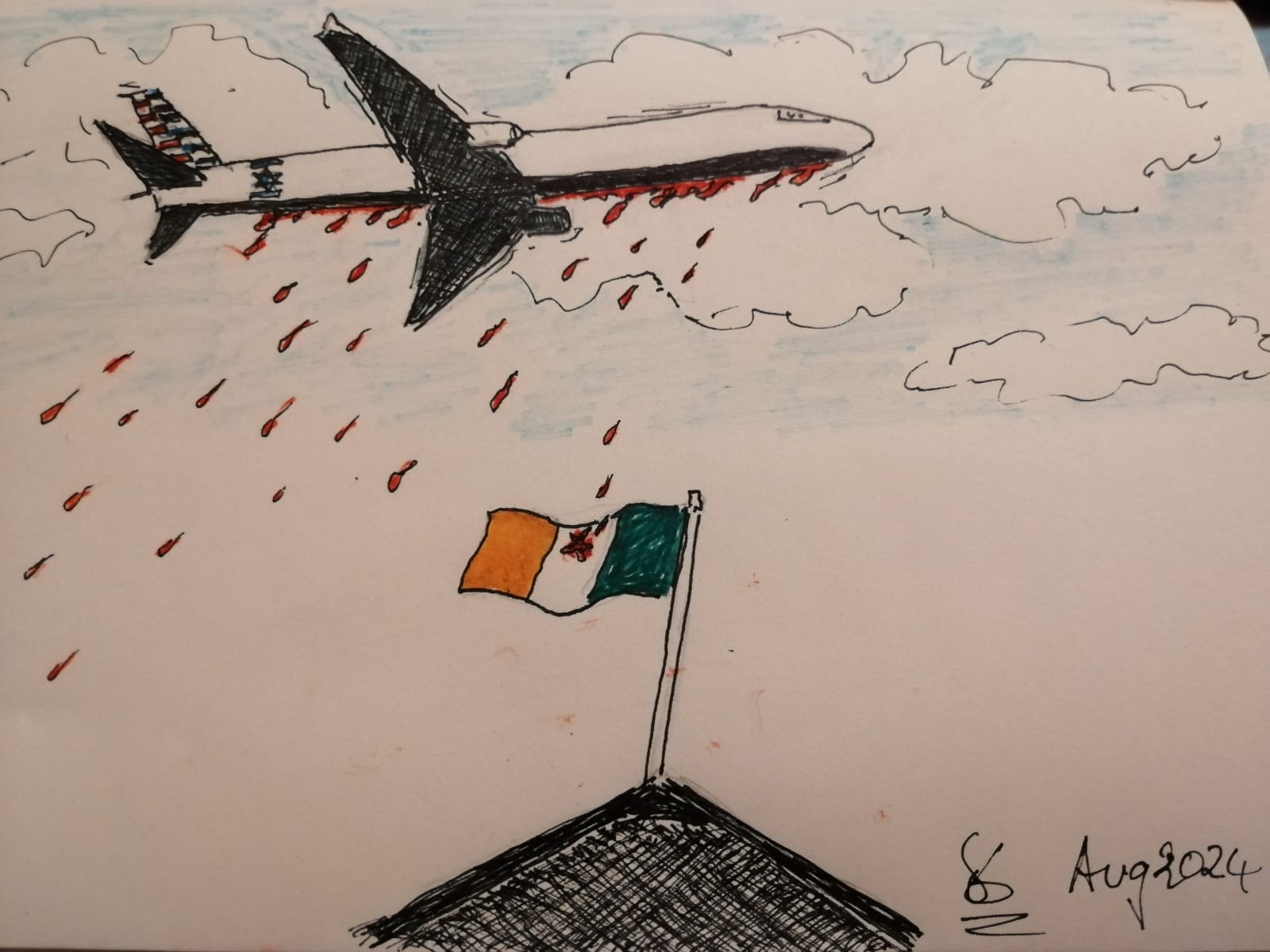
The Irish state continues to permit US military planes and personnel to violate the State’s nominal independence through Shannon International Airport, to permit Zionist armament overflights of its air space (similarly with the RAF) and to permit British Navy docking in Irish ports.
The relatively mild Occupied Territories Bill, long approved through Leinster House, remains not brought into force, blocked by the Coalition Government of Fianna Fáil, Fine Gael and the Green Party. It could not be clearer that the ruling class in Ireland do not feel under enough pressure.
This is despite a clear popular feeling among the public in Ireland of solidarity with Palestine and revulsion at their genocidal attacks by the Zionist state.
There is a long-established train of thought that maintains that solidarity with the Palestinians is not just calling for the genocide to stop – that alone is charity and that actual solidarity means solidarity with the people’s resistance and the political prisoners.
If the IPSC were to adopt that position they might find it easier to support more radical action to pressure the Irish state to break with the western powers’ consensus of support for the ‘Israeli’ state and consequently for its genocide against the Palestinians.
Perhaps that is one of the very reasons that the IPSC leadership will not take that stand and that its stewards have at times even tried to convince people to remove their flags supporting various Resistance factions.
Section of the front of the Palestinian Resistance Solidarity Bloc in Dublin on Saturday (Photo: R.Breeze)
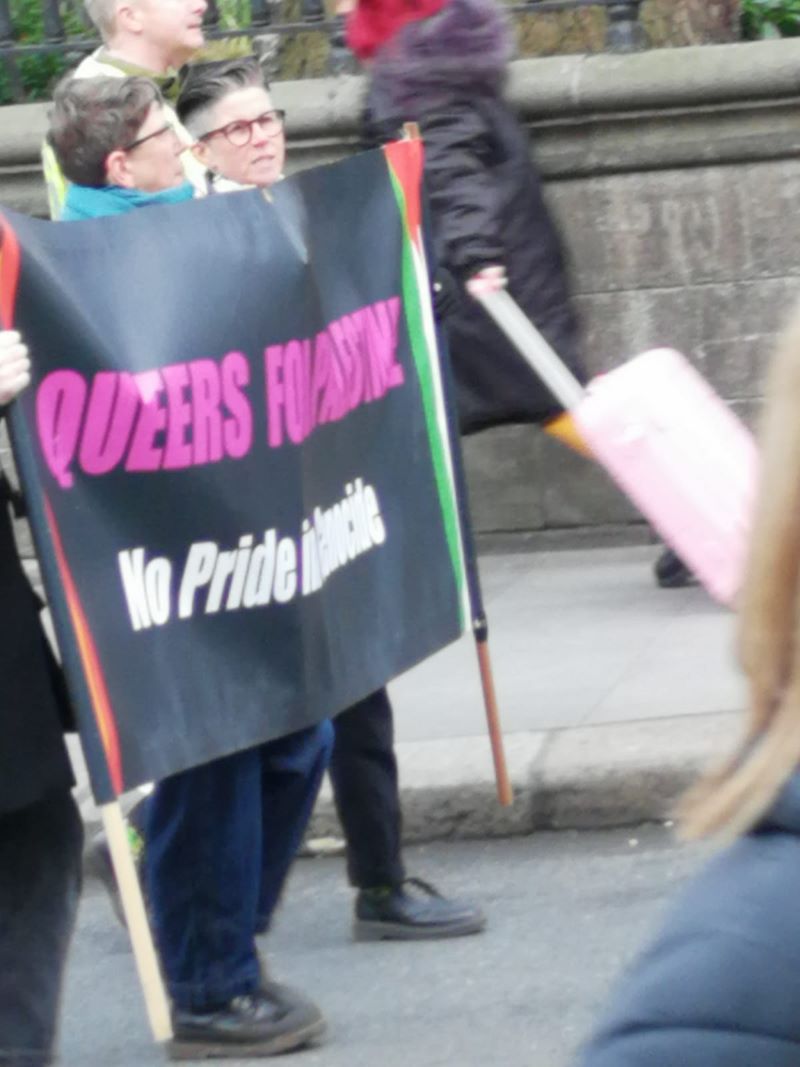
On Saturday independent activists joined those of Saoirse Don Phalaistín, Anti-Imperialist Action Ireland and Queers For Palestine in forming a sizeable bloc on the march with banners, flags and call-and-answer slogans advertising its solidarity with the Resistance.
This seems a welcome trend likely to grow.
End.
FOOTNOTE
1Palestinian political prisoner support and advocacy organisation.
































 rebelbreeze