Gearóid Ó Loingsigh (reprinted intact from his substack and reformatted for Rebel Breeze)
(Reading time: 5 mins.)
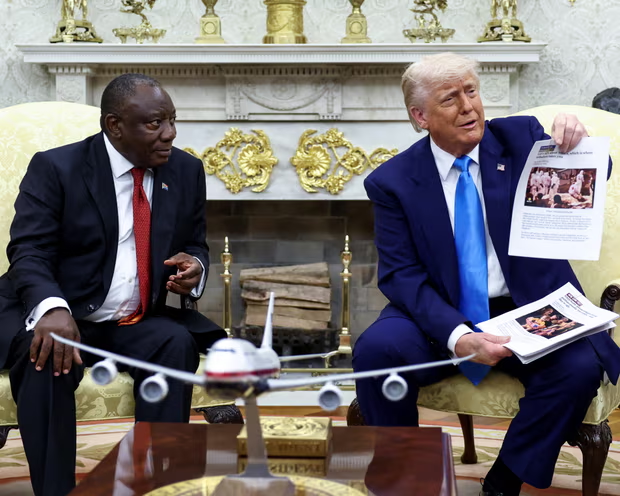
Once more Trump has acted like the lunatic he is and ambushed the president of South Africa, Cyril Ramaphosa, stating that the country was undergoing a real genocide of whites.
Many have commented on the effrontery of Trump to talk of a fictitious genocide of whites in South Africa, whilst his main ally Israel is carrying out one in real time every day on the news shows.
Trump used images from the Democratic Republic of Congo, a country more than 4,500 kilometres away, to show that they were killing whites in South Africa.
Trump also lied about the land question in the country, accusing the government of stealing the whites’ lands when the reality is that the whites continue to be the owners of the greatest part of the land in the country.
It is worth saying that Ramaphosa defended himself partially, and only partially as behind the new legislation on the matter there is the hidden failure of the peace process when it comes to resolving the land question.
When the Apartheid regime was ended, the country was one of the most unequal on the planet and the whites were the owners of the greatest part of the agricultural lands. Around 60,000 whites were the owners of 86% of all the agricultural lands, some 82 million hectares.[1]
The agrarian reform proposed by the ANC in its White Paper of 1997 was a market-driven reform, i.e. the voluntary sale and purchase with some help from the government without the government being a buyer.[2] Blacks could also ask for the restitution of lands stolen by racist laws since 1913.
A whole land bureaucracy was set up, not unlike what Colombia has, Land Claims Courts where all those who registered could make their case with three possible outcomes, the restitution of the land, the handover of alternative land or a financial compensation.
In 1992, the ANC had put forward a document in which they argued for the expropriation of lands and other non-land market mechanisms. But by 1997 they had accepted neoliberal discourse and adopted the land market as the cornerstone of their policy.[3]
Initially the ANC government had proposed handing over 30% of the agricultural lands held by whites to blacks within five years. But they kept postponing it.
By March 2011, they had handed over 6.27 million hectares, and of that 45% was not agrarian reform, properly speaking, but rather land restitution.[4] The government didn’t just fail regarding land, but on everything. Inequality rose since the fall of Apartheid.
The Gini[5] rose following the end of Apartheid in 1994 and now is situated in 0,67 making it the most unequal country on the planet in terms of income, where just 3,500 people own 15% of all the wealth of the country.[6]
SA President Ramaphosa looks on while US President ambushes him publicly with alleged ‘evidence’ of persecution of white people in S. Africa (Photo cred: Kevin Lamarque Reuters)
There is also a high concentration of land. “Currently 72% of farms and agricultural holdings are owned by white individuals, who make up 7.3% of the population, while black Africans, constituting 81.4% of the population, own only 4% of the land.”[7]
The whites continue to be the owners of the land, the black middle class through Black Economic Empowerment programmes reached agreements with those whites and the companies in the agricultural sector to integrate themselves into the neoliberal economy.
This is the so-called ‘white capitalism’ and South Africa became a leading country in the agribusiness sector of the continent. In 2015, of the 10 largest agribusiness companies on the continent, eight were South African.[8]
Ramaphosa himself is an excellent example of the new South African businessmen, the former fighters against capitalism who now profit from the blood and sweat of those who were once the grassroots militants of the organisations they led.
Between 1994 and 1998 he acquired a portfolio of more than 40 million Rand[9] (some 8 million dollars at the time) and ended up as an extremely wealthy man (some 700 million dollars) thanks to his controversial investments and acquisitions in the mining sector.
Ramaphosa is also the owner of the McDonalds franchise in the country. The former leader of the National Union of Mineworkers became a magnate in the sector.
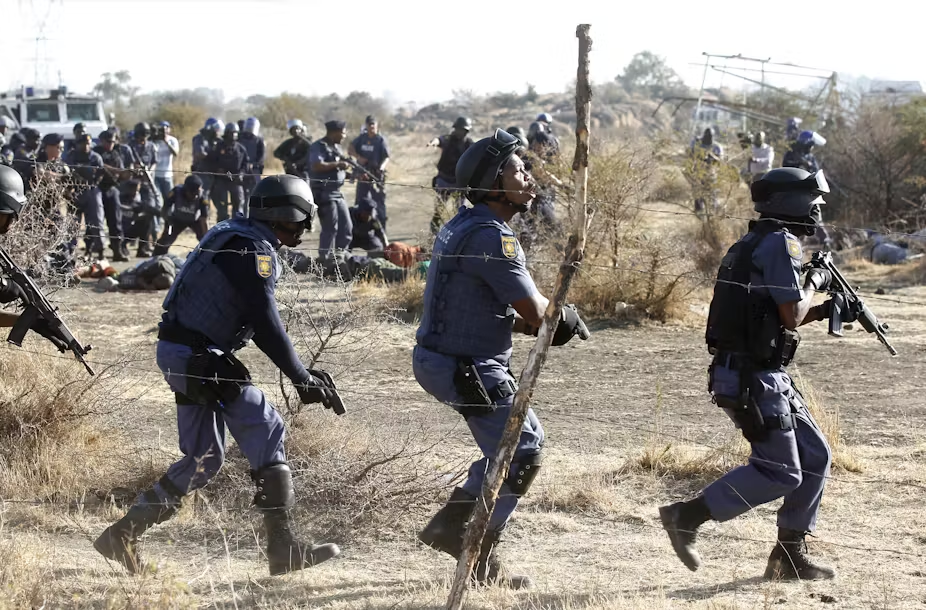
In 2013 the Police murdered 34 miners in the midst of a strike at Lonmin, one of the companies where he was a director, being the owner of 9.1% of the company. [10]
South African police move forward to kill more striking miners at Lonmin 2012 while in background other police stand over miners killed already(Photo cred: Sephiwe Lebeko/ Reuters)
And just like in the times of Apartheid, the Farlam Commission, those charged with investigating the Marikana Massacre found nobody guilty. Nobody! Blood is washed from the hands of a black capitalist just as easy from those of a white capitalist.
When he took over the presidency of the country, there hadn’t been any great advances made regarding agrarian reform there. The failure to meet the promises of the transition and the political programme of the ANC cost them electoral support.
So much so that they now govern the black masses with the support of a white party, the Democratic Alliance, a right-wing party that strongly opposes any expropriation of land without compensation and in practice is opposed to any great change in land policy.
It is in this context that Ramaphosa launched his new campaign and new land law. The ANC say they want to implement the Freedom Charter, but it is not so. Mandela himself had discounted that in his speech to Davos.[11]
He didn’t explicitly refer to the document but he never again spoke of the nationalisation of resources such as mines and land.
Ramaphosa’s law proposes various measures that already exist in almost all capitalist countries, the expropriation of property with compensation for public purposes or where there is a public interest i.e. the compulsory purchase or as they say in the USA, the heart of capitalism, eminent domain.
These norms exist in almost the entire world. As is the case in many capitalist countries, it also includes elements to reduce the amount of compensation or not pay it.
It is another thing to believe that Ramaphosa aims to do what the ANC never wanted to since the first government. He does not want to fight with so-called white capitalism as he knows that so-called black capitalism is the same thing and one depends on the other.
What Ramaphosa is about is a public relations manoeuvre to strengthen a weakened and discredited ANC. There will almost certainly be more such initiatives. But the ghosts of Marikana tell us that this traitor has no intention of doing anything for the black masses.
Trump talks of a genocide that only exists in the sick mind of Elon Musk and of a land theft that Ramaphosa does not want. If he steals the whites’ lands, who will he sip cognac with then? White power is still in control of South Africa.
It dominates the economy in alliance with the not so new black bourgeoisie, the black apparatchiks that control the scaffolding of the state, and the growing presence of foreign capital.
We all recognise Trump as the enemy and idiot that he is. The problem is that sometimes we acknowledge those he attacks as friends when in reality they are the same enemies, except some are more intelligent, cultured and refined.
Ramaphosa when he was a trade union leader said “There is no such thing as the liberal bourgeois. They are all the same. They use fascist methods to destroy workers’ lives.”[12]
Workers’ blood is washed from the hands of all the capitalists, blacks, whites, Russians, Arabs or Yanks: Ramaphosa in Marikana or Trump everywhere. The whites in South Africa, the Elon Musks have no reason to fear their friend Ramaphosa, despite the stupidities from Trump.
[9] Bond, Patrick (2000) Elite Transition: From Apartheid to Neoliberalism in South Africa, London & South Africa, Pluto Press and UNP, End Note No. 7, Chapter 2 page 266.
NB: Edited by Rebel Breeze for formatting purposes
(Reading time: 6 mins.)
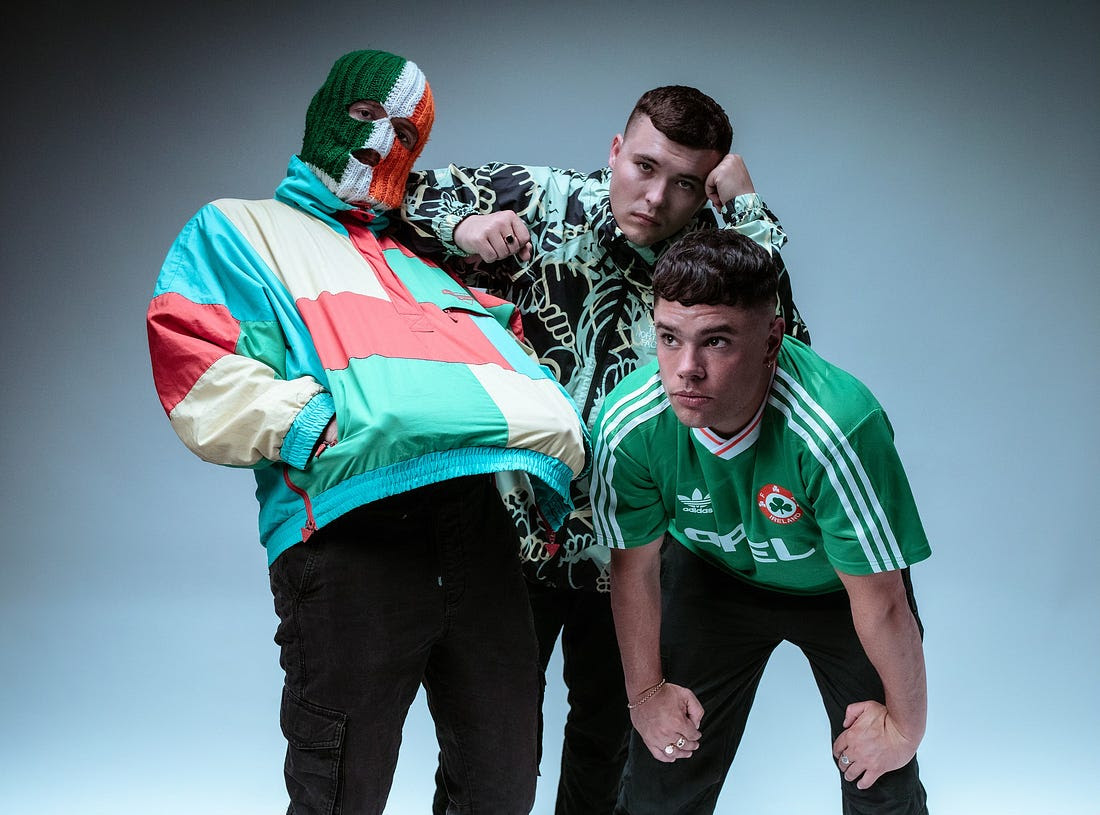
Kneecap, the Belfast Irish language rap group, have found themselves at the centre of what is an artificially contrived furore dreamt up by people with little sense of real moral outrage.
The basics of the story are well known. They finished off their act at the Coachella event projecting pro-Palestinian statements. Given the band’s history and well-known politics, it could hardly have come as a surprise. Perhaps it was more that the fans welcomed it that upset some.
They were denounced by the non-entity known as Sharon Osbourne, a reality star famous for being the wife of Black Sabbath lead singer Ozzy Osbourne and also the mother of another reality star, her daughter Kelly Osbourne.
Kelly to her credit did carve out a brief musical career on the back of her reality tv exposure.
Sharon as part of the wider Zionist attempt to silence all those who criticise the genocide called for their visas to be cancelled, which in effect happened following the decision by their promoter and sponsor to drop them.
She also called for them to be more like Bono. Kneecap responded with a humorously devastating comeback that they would rather be Rangers fans than emulate Bono.
Bono still has some credibility in certain parts, mainly where they haven’t a clue about the man’s actual politics and obviously amongst the clueless, witless, gutless glitterati like Sharon Osbourne. But what would it mean to be like Bono?
Is he actually some sort of reasonable counterweight to Kneecap?
Well, first of all, in relation to Palestine, Bono is a Zionist, so even before the genocide began, he, unlike them, was already on the wrong side of history. Not for the first time, mind you. Bono has a habit of cropping up where he is not wanted like an ugly cold sore (my apologies to the virus).
He has, as Harry Browne, the author of The Frontman: Bono in the name of power, pointed out dedicated a lifetime to the service of imperialism and was rewarded with a Presidential Medal of Freedom from Genocide Joe.[1]
I am sure it will go well on his mantle piece alongside his KBE (Knight Commander of the Most Excellent Order of the British Empire), for which he was fulsome in his praise of Her Majesty’s Ambassador, as he put it, and grinned like a cheshire cat during the ceremony.[2]
The claims made by Blair and others about Bono’s achievements were exaggerated, of course. But he is, if nothing, an equal opportunities imperialist and will get around to doing his bit for the others.
The idea that Kneecap would prostrate themselves before the British king is laughable and they wouldn’t be the first artists to reject one, were the Brits ever to mistakenly consider them for it.
The late black poet Benjamin Zephaniah was offered the lesser award of OBE (Order of the British Empire) by the same Tony Blair. He turned it down stating:
I get angry when I hear that word “empire”; it reminds me of slavery, it reminds of thousands of years of brutality, it reminds me of how my foremothers were raped and my forefathers brutalised…
Benjamin Zephaniah OBE – no way Mr Blair, no way Mrs Queen. I am profoundly anti-empire…
If they want to give me one of these empire things, why can’t they give me one for my work in animal rights? Why can’t they give me one for my struggle against racism? What about giving me one for all the letters I write to innocent people in prisons who have been framed? I may just consider accepting some kind of award for my services on behalf of the millions of people who have stood up against the war in Iraq. It’s such hard work – much harder than writing poems.[3]
He also referred to his brother’s death in police custody and to Lizzie II as Mrs Queen, not Her Majesty. A display of dignity.
He pointed out that those who accept such awards, the Queen’s Shilling, though he didn’t use that archaic military expression for those who enlist in the British armed forces to put down uppity types in the colonies, always sell out.
However, calling Bono a sell-out, presumes he was ever anything other than a fan of empire. He tied his mast to the pro-British politics of the Irish chattering classes in the 1980s.
His song Sunday Bloody Sunday was always introduced with the line This is not a rebel song, lest someone think Bono actually had something interesting to say.
The song is quite vacuous though clear in saying he “won’t join the battle cry,” i.e. denounce those who had massacred 14 people on the streets of Derry. The British army is not mentioned once in the song.
You wouldn’t know who had done what, but you know not to point the finger “Cause tonight we can be as one”. John Lennon on the other hand, shortly after the massacre did not hold back.
Is there any one among you Dare to blame it on the kids? Not a soldier boy was bleeding When they nailed the coffin lids![4]
Bono couldn’t bring himself to condemn the British army for a televised massacre, so it comes as no surprise that he has little to say about a live-streamed genocide.
He hobknobbed with neoliberals such as Jeffrey Sachs, various presidents of the World Bank, promoted pharmaceutical companies in Africa and of course was on the side of Bush in the Iraq War, at least in practice and helped whitewash the reputations of many of those involved.
He hedged his bets a bit on Iraq, not wanting to seem too hawkish, saying the war was justified but the US should get UN backing for it. He then went on to endorse Clinton and Blair time and again. Jim Kerr from the Scottish band Simple Minds put it succinctly at the time.
How can Bono, having graced concert stages for over two decades, draped in the white flag of peace and screaming ‘No More War’ [sic] at the top of his lungs contemplate praising and back slapping Tony Blair? … I can’t believe that anyone could fail to identify that no matter what gesture Blair may make towards African debt relief, his slippery hands are currently dripping in the fresh warm blood of Iraqi men, women and children.[5]
Bono of course, could and did, and wined and dined with such hawks as Senator McCain. There were no depths to which he would not plummet, which brings us to Palestine.
Shortly after October 7th he endorsed the Zionist genocide by changing the lyrics of his song about Martin Luther King, Pride (In the name of love)[6]to “Early morning, Oct 7, the sun is rising in the desert sky… Stars of David, they took your life but they could not take your pride.”[7]
As part of the introduction to the reworked song he state “our prayers have always been for peace and for non-violence… But our hearts and our anger, you know where that’s pointed.” Not at the Zionist occupiers was the answer. Roger Waters lambasted him for it.[8]
Not only that, he was criticised by Irish singer Mary Coughlan for his links to Israeli companies.[9] He did not fly out to Gaza as he had done in Ukraine, nor did he have much to say.
When he eventually did mention Gaza, he was always careful to lay the blame on Hamas for starting it all, ignoring history since the Nakba in 1948.
A good example of that is his piece in The Atlantic after receiving his Medal of Freedom from Genocide Joe.[10] An exercise in saying nothing, whilst attempting to sound profound, something Ireland’s most famous poisonous dwarf never pulls off.
Kneecap on the other hand have been clear from the word go about their support for the Palestinian cause. It didn’t take a genocide for them to take note. They have consistently been on the side of the oppressed, in this case the Palestinians, against the oppressor the Zionists.
So, Sharon Osbourne should probably stick to what she knows best, which is precious little.
As for Bono, as Harry Browne points out, perhaps nothing sums him up quite so succinctly as a piece of graffiti in Dublin that appeared following the scandal when they moved one of their companies to the Netherlands for tax purposes, “Bono is a poxbottle”.
We need more like Kneecap who stand with the oppressed, and a lot less of Bono and the likes who can’t condemn the powerful ever.
At best you can expect some “We are all guilty type” of fudge, which was the preferred slogan of the Irish trade union bureaucracy when the British or their proxies in the UVF or UDA ever did anything, coming as no surprise that they have also done next to nothing on Palestine other than issue the occasional banal statements.
I fully expect them to turn up with Bono somewhere to chastise Kneecap.
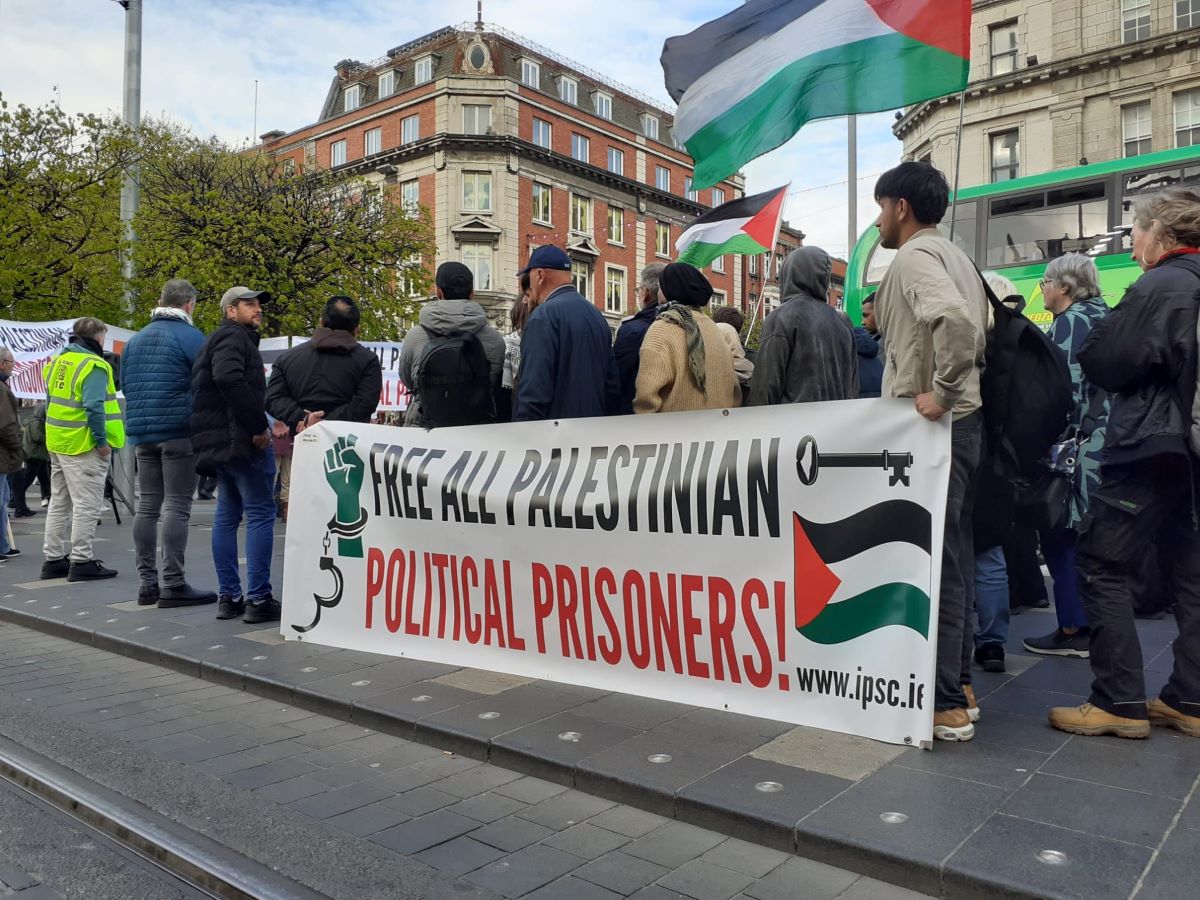
April 17th is the annual Palestinian political Prisoners’ Day and it was marked in O’Connell Street, the main street of Dublin’s city centre, by an event with speeches, banners and chants organised by the Ireland Palestine Solidarity Campaign.
Palestine national flags fluttered about the crowd being addressed by a number of speakers with occasional toots of solidarity from passing traffic – a common occurrence at Palestine solidarity events in most of Ireland.
View of eastward of section of the crowd at the event (Photo sourced: IPSC)
Dáithí Doolan was one of the speakers and though saying some progressive things about solidarity with Palestine and the terrible situation in which the occupiers have them, soon revealed the political poverty and lack of solidarity with resistance of his Sinn Féin party.
Doolan reminded his audience of when there were political prisoners in Ireland, as though this was no longer the case, presumably because the prisoners now are not of his party. Nor did he mention the current attempts to extradite Irish Republicans to British administrations.
The SF speaker went on to extol the South African process, perhaps not caring about the betrayal of the struggle and sacrifice of the masses there, the deepening grip of imperialism on the rich natural resources, the corruption and repression of the ANC regime and the massacre at Marikana.1
If Doolan thought about it he must have hoped that his audience did not remember that the South African process had a twin, the Palestinian one at Oslo which sabotaged the Palestinian struggle and brought into being the corrupt Palestinian Authority2, the Israeli proxy in the West Bank.
Sinn Féin has achieved a somewhat similar position in the Six Counties colony and has been working hard to reach a corresponding role in the Irish state. And why not, when it endorses the “Two State solution” giving the Palestinians 20% of their land under Zionist eyes and guns.
The very least, Doolan said, that the Irish Government could do to help the Palestinians, would be to enact the Occupied Territories Bill but he proposed nothing further, not even the ban on US military flights through Shannon Airport or on Israeli arms flights through Irish airspace.
Darragh Adelaide from the People Before Profit party spoke too about Palestine and solidarity but also about the Palestine refugees that have had to sleep in tents on Irish streets and the attacks on them both by the authorities and by fascists and other racists.
Palestinian prisoner conditions
A woman gave a detailed list of statistics relating to Palestinian political prisoners but also went through the tortures and terrible conditions in which they are kept. She concluded reminding her audience that each prisoner is a human being, a parent, a child, a sibling and not a number.
View of the crowd southward from behind a speaker (Photo sourced: IPSC)
In a year and a half, more than 15,800 Palestinians have been arrested, including 500 women, 1200 children, and thousands of detainees who were placed under arbitrary administrative detention. 64 Palestinians have died in prison since October 2024, including a child.3
The prison administration’s special units have carried out violent raids on prisoners’ cells, administering severe beatings, torture, and ill-treatment.4
Prisoners have suffered power and water cuts, and all of their belongings—including clothes, electrical appliances, and hygiene items—have been confiscated.5
They have been placed under complete isolation, family visits have been completely banned, and the International Committee of the Red Cross has been prevented from visiting them inside prisons.
Additionally, a policy of starvation has been implemented against thousands of prisoners, who are being provided with only two extremely poor-quality and quantity meals a day.6
The MC of the event led chants in which he called out Palestinian political prisoners! and the audience responded with Free them all! Similarly with Free the children prisoners — Free them all! and Free the women prisoners! — Free them all!
Symbolising the Palestinian political prisoners (Photo sourced: IPSC)
He also referred to the woman arrested outside the Irish Embassy in Berlin for speaking in Irish and, in defiance, led the audience in a chant in Irish expressing solidarity with the Palestinian people: Saoirse don Phalaistín! (Freedom for Palestine!)7
What was notable in its total absence from all the speeches was any call to step beyond the marches and similar measures which have been supported by thousands in Ireland over more than 18 months but which have not succeeded in moving the Government even to enforcing its formal neutrality.
This is replicated in most solidarity events across the state, leaving those few who take action to increase greater pressure on the ruling class to face the repression of the Irish State, as with 23 men and women in three different events over a four-day period in Dublin recently.8
Political prisoners from the armed resistance
The Joe McDonnell Ballad9 would have been most appropriately performed at this event, in particular the chorus line: You dare to call me a terrorist, while you look down your guns … But the IPSC would hardly endorse the singing of that song nor wish to be associated with it in public.
There were two large prisoners’ solidarity banners of the IPSC at this event but it is remarkable how rarely one sees them on the IPSC’s national marches. The problem with the prisoners for liberal organisations is that some of them, at least, have been armed fighters of the Resistance.
This, combined with ignorance perhaps, accounts for the comparatively low numbers at this event. However, it has to be said that known revolutionary organisations were also visibly absent.
View south-westwards with the iconic GPO (General Post Office) building in the background. (Photo sourced: IPSC)
Doolan’s party was a problem for liberals when many of the political prisoners here had been armed Irish Republican resistance fighters; it’s still a problem for them today — but also for Doolan and his party now that the current Irish political prisoners are no longer associated with them.
If solidarity does not embrace resistance then it’s charity, not solidarity. And if resistance is to be embraced then it should be so for all its expressions, artistic, cultural, mass mobilisations, strikes, boycotts … and armed. Including solidarity with those who, because of resistance, end up in jails.
Free them all!
End.
NOTES
1Culminating on 16th August 2012 (while Mandela still lived) the police of the ANC Government carried out a massacre of over 40 striking miners over a period of three days. The massacre was to suppress a strike in a platinum mine of the Canadian Lonmin company, repressing also a breakaway union from theANC-allied National Union of Mineworkers. The massacre is widely believed to have been organised by Cyril Ramaphosa, then a millionaire and vice-President of the ANC Government and recent leader of the NUM, now President of South Africa.
2Which also beats and incarcerates Palestinians resisting the Occupation (exact figures are difficult to obtain) and has murdered some.
7This slogan has now become well known in Ireland in voice but also in writing, appearing on flags, banners and placards. It represents a partial success for those of us who have tried to insert a measure of the Irish language into Palestine solidarity, in the belief that it is important for the Irish language to be present in progressive movements.
9By Brian Warfield of the Wolfe Tones band in honour of Volunteer Joe McDonnell of the Provisional IRA who died on hunger strike in 1981; the song also names other hunger strike martyrs of the Provisionals Vols. Bobby Sands, Francis Hughes, McCreesh but adds Vol. Patsy O’Hara of the Irish National Liberation Army. In total, seven of the Provisionals and three of INLA died on hunger strike in 1981.
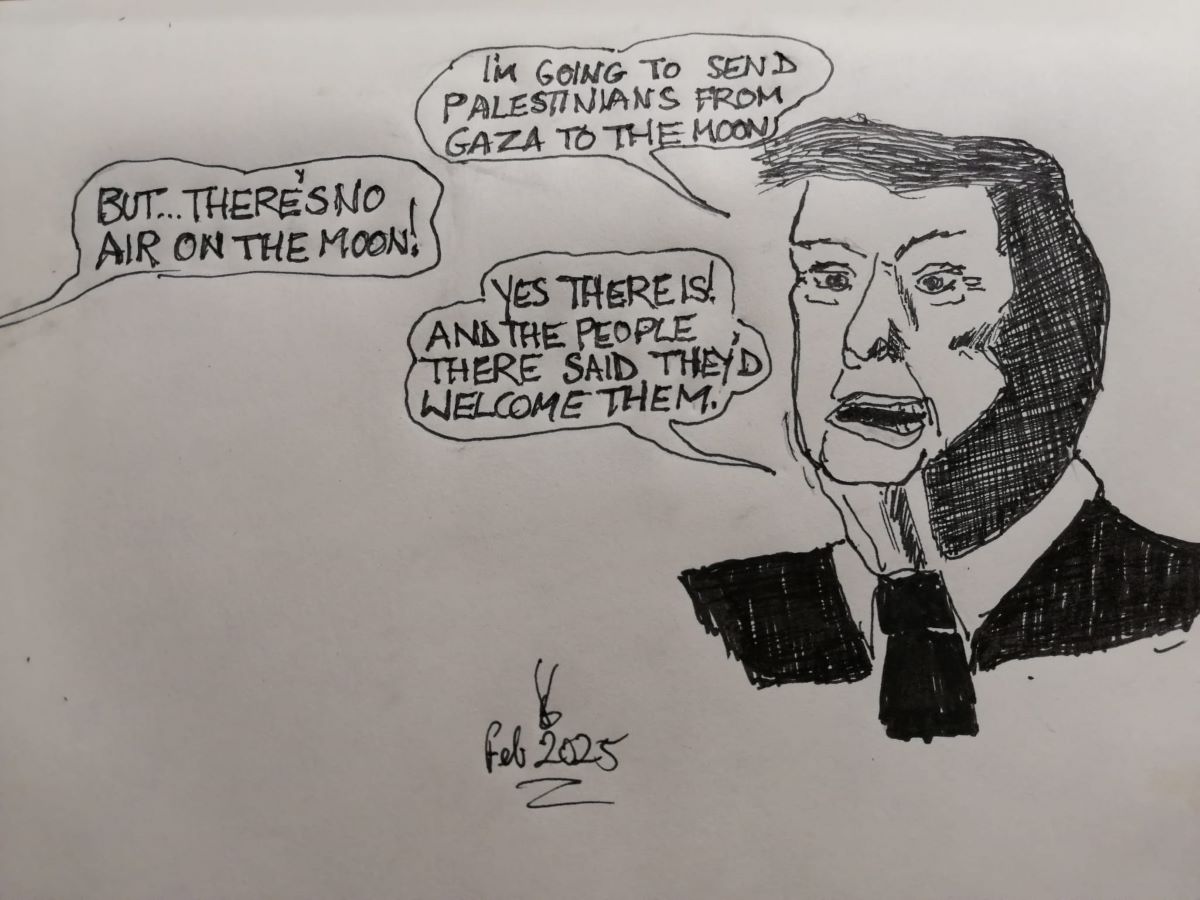
Recently Donald Trump scandalised much of the world with his suggestion that Gaza could be turned into an attractive location after its inhabitants, the Palestinians, were removed.
Was this a serious proposal? If so, could the US and Israel manage it? What are the chances?
Firstly, a quick look at the territory envisaged and its recent history.
GAZA
A strip of land 365 km2 (141 sq mi)1 on the eastern coast of the Middle Eastern land of Palestine, bordered by the State of ‘Israel’ and the State of Egypt, with an estimated Palestinian population of 2.1 million in 2024 (since hugely depleted by genocide and removal).
Gaza had been settled mainly by Palestinian refugees expelled from Zionist-occupied Palestine in 1948 and by those fleeing Israeli Occupation Force persecution and harassment in the West Bank in subsequent years added to of course by their descendants born and growing up there.
The strip was occupied after the 1967 War by around 5,000 Zionist settlers – illegally even by international law — who took up around 40% of the land there but after the Second Intifada,2 left in 2005, as did the Israeli Occupation Army.
In the 2006 elections in Gaza and the West Bank, Hamas won, ousting the Fatah party which had won the previous elections. However, Fatah refused to accept the results and had to be physically removed in Gaza in 2007, though Hamas stepped back from doing the same in the West Bank.
The Western powers, those bastions of the democratic way of doing things, refused to acknowledge the Palestinian popular will and blocked Hamas from all aid, which went instead to the undemocratic Palestinian Authority, which the Fatah party control.
‘Israel’ blockaded Gaza from then onwards, keeping the population at a marginal level of existence and regularly attacked it, what they called “mowing the lawn” in 2008/9, 2012, 2014, 2018/19, 2021 until the Palestinian breakout and counter-attack of October 2023.3
In October 2023 Hamas and Islamic Jihad broke out of their concentration camp, overran the ‘Israeli’ armed forces overseeing them and seized captives to exchange for the many Palestinian captives in ‘Israeli’ jails. Other groups and individuals also poured through the gaps in the wall.
The IOF besieged Gaza, cutting off its supplies of food, clean water and other supplies. It dropped 85,000 tonnes of explosives4 on that highly-concentrated population, killing an estimated 46,000 (with another 10,000 buried in rubble)5 and injuring at least 110,265 (one in every 20).6
The IOF destroyed nearly all wells and rooftop water tanks, along with desalination plants,7 destroyed totally or in part 90% of residential buildings,8 at least 27 hospitals and 12 other medical centres,9 along with schools, higher education buildings, mosques and churches.
Some 1.9 million people have been displaced, 90% of the population, with many of them forced to move repeatedly.10 “Nearly 1.9 million people in Gaza are internally displaced, of which nearly 80 percent are living in makeshift shelters without adequate clothing or protection from the cold.
“UN agencies estimated that nearly half a million are in flood-prone areas. Authorities in Gaza said about 110,000 of the 135,000 tents being used as shelters in the Gaza Strip are worn out and not fit for use.”11
PROPOSERS OF ETHNIC CLEANSING
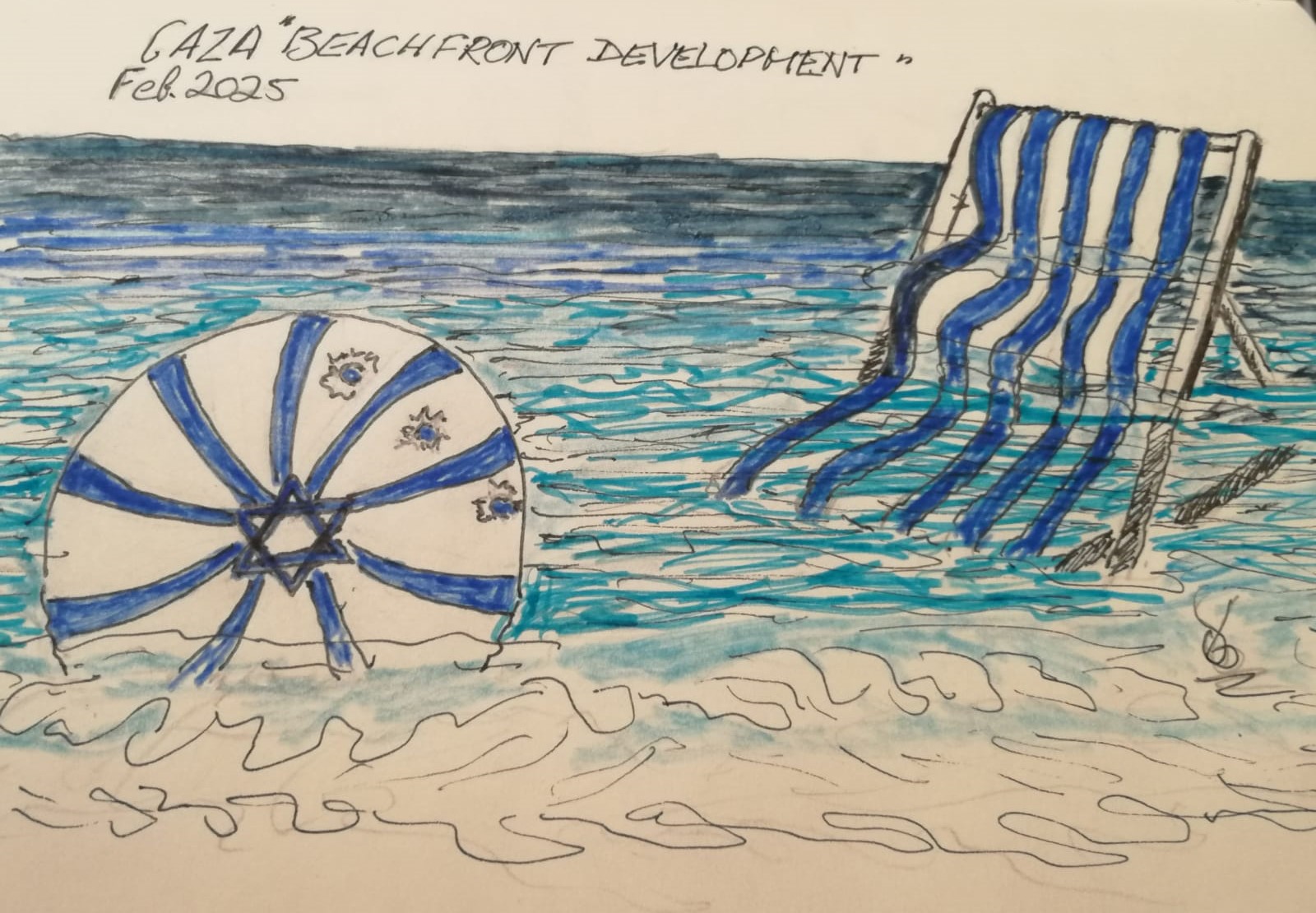
The USA – In March 2024 Jared Kushner, property developer, senior policy adviser and son-in-law of Donald Trump (then former US President and now President again) commented that Gaza after the removal of the Palestinians would make a great site for a beach-front property development.12
Donald Trump, after being re-elected, commented in somewhat similar lines and bluntly proposed the expulsion (‘voluntary relocation’) of Palestinians from Gaza. But to where? Well, to Jordan and Egypt in particular, whose ruling regimes would accept them, he assured.13
The Democratic Party wing of the US imperialist ruling class expressed horror at such crass statements of ethnic cleansing but had supported the ‘Israeli’ state in maintaining the siege, periodic bombing attacks and in demonising Hamas along with the whole Palestinian resistance.14
‘Israel’: Prime Minister Netanyahu and a number of his cabinet made statements supporting the plan.
REACTION OF ARAB & IRANIAN STATE LEADERS
The leaders of Arab states and of Iran have opposed the ethnic cleansing plan, all of them concerned at further destabilisation of the Middle East (and threat to their regimes). Most (excepting Yemen and Iran), advocating instead Gaza as part of a Palestinian state (sic) alongside the ‘Israeli’ one.15
WHAT EUROPEAN STATE LEADERS SAY
All of the leaders of European states that have commented have opposed the plan, all of them concerned at further destabilisation of the Middle East and, with regard to Palestine, advocating instead Gaza as part of a Palestinian state (sic) alongside the ‘Israeli’ one.16
All of the main political parties in the European states have also opposed the ethnic cleansing and advocate the “two state solution” (sic).
RUSSIA & CHINA also oppose Trump’s plan as do many states in AFRICA and in LATIN AMERICA. The top levels of the United Nations also oppose Trump’s idea.
WHY MOST STATES OPPOSE THE PLAN
Those objecting to the ethnic cleansing of Gaza and transporting Palestinians to other destinations may well have moral objections to that plan but their political and practical reasons for objecting are much stronger.
Lebanon already has a Palestinian refugee population of 60% and in 1975-’90 a war there saw fascist Lebanese forces combined with the IOF fight Palestinian and Druze forces with massacres of refugees as “Beirut” became a byword in urban destruction, invasion and ethnic conflict.
The Jordanian regime is heavily foreign-dependent and vulnerable to imperialist pressure but it also knows that it walks a tightrope and can’t afford to add to the economic, social and political pressures by taking in a large influx of Palestinians forced out of Gaza.
Nearly 25% of Jordan’s population is composed of Palestinian refugees and their descendants.17
The King of Jordan, an imperialist stooge trained in the UK, nervously attended the meeting with the real king, Trump, to which he was summoned, evidencing his unease with a nervous tic taking over his face. He agreed to take 2,000 injured children, not at all the same thing as Trump wanted.
Egypt, a bigger power though also US-dependent (especially its military) has its own economic, social and political reasons for rejecting a proposal to integrate a large population of forced Palestinian refugees into its society and economy and declined an invitation to meet Trump.
US ally Saudi Arabia, which has not been pressured to the degree of Egypt and Lebanon, nevertheless has reasons to reject the plan and that is the de-stabilization of the whole Middle East by a further expansion of the Zionist State and growing population of stateless refugees.
That is the other and fundamental reason why the Saudi ruling class is opposed to the expulsion of Palestinians and they have stated it in terms of the need for a ‘Palestinian state’ – within the framework of a two-state ‘solution’ (i.e. a partitioned Palestine with about 20% for Palestinians).
The Saudis have also proposed to rebuild and set up Gaza with the Palestinians remaining there but in the course of which they intend to have somebody other than Hamas – whom the people elected, let’s not forget – administer the area.
The Palestinian Authority (sic) despite its role as proxy policeman for the Zionist State and US Imperialism, would not welcome the loss of a large part of its possible fiefdom and certainly could not politically afford to agree to the ethnic cleansing of Palestinians.
Macron, for the French imperialist ruling class, has welcomed the Saudi proposal. It is not beyond possibility that the US ruling class will approve and it may even have been part of its plan to frighten everyone and make such ‘solutions’ as that of the Saudis more generally accepted.
UAE is not vulnerable internally to anything like the degree of Egypt and Jordan and on the other hand is at times in contention with Saudi Arabia for influence in the region but also ally of the USA is nevertheless opposed the Trump ethnic cleansing process.
Qatar, home of Al-Jazeera news channel and much more in contention with Saudi Arabia and also the UAE, is also an ally of the USA but opposed to removing the Palestinians from Gaza.
The elites of the WesternEuropean states, from imperialist to lesser capitalist states wishing to coexist with imperialism, including the colonial and neo-colonial states of Ireland all oppose the ethnic cleansing of Gaza, saying it threatens the ‘two state option’.
That option would copper-fasten Israeli occupation of around 80% of Palestine and control over the remaining 20% as a client state. They would hope to isolate the Palestinian resistance under collaborator rule and help and assist in the stabilisation under imperialism of the Middle East.
A DIFFERENT BASIS FOR OPPOSITION
The ruling elites of IRAN and YEMEN18 see ‘Israel’ as an important foothold for US and other Western imperialism in the Middle East and also as an aggressive colonial force in its own right. Therefore they are fundamentally hostile to any kind of ethnic cleansing of Palestinians.
That too is the position of Hezbollah, a major political and military force in Lebanon.
IS THE ZIONIST ARMY CAPABLE OF ETHNICALLY CLEANSING GAZA?
The Israeli Occupation Army is unlikely to welcome being sent back into Gaza to fight the Palestinian resistance there once again. And signalling that, rather than an inadvertent slip, may have caused the admission of very high combat fatality figures by the IOF’s commander.19
Eyal Zamir, ‘Israel’s’ new Chief of Staff, referred in a recent interview to the “5,942 of bereaved families”20 since October 2023, terminology only used by the IOF to refer to the families of their soldiers killed and also noted that some families likely lost more than one member.
Those numbers, apart from being around six times those previously admitted by the IOF, are not such that can be replaced in the short term.
Furthermore, the Palestinian resistance in Gaza (and presumably Hezbollah in Lebanon) targeted officers whenever they could resulting in a high attrition rate among higher ranks engaged in combat. These take longer to replace due to their experience, training and skills.
It has long been suspected in many quarters that Israel was concealing its war casualty numbers by imposing press censorship, installing IOF officers to answer queries at hospitals and issuing untrue statistics for foreign and home consumption.
Zamir also stated that 15,000 soldiers were suffering from physical or mental injuries.21 As early as December 2023, the ‘Israeli’ publication Haartez, quoted their Health Ministry figures of a staggering 10,548 injured as opposed to the 1,593 stated by the IOF.22
“In October 2024, Haaretz also reported that around 1,000 wounded soldiers were admitted to rehabilitation centres each month, along with new injury claims associated with past incidents.
“The report stated that the rehabilitation division estimates that by 2030, around 100,000 Israeli soldiers will be classed as disabled, and almost half also experience some form of psychological challenge.”23
Statistics show a military age population in ‘Israel’, male and female, of around three million24 of which some are already serving, many exempt from recruitment due to specific occupation or studies, pregnancy, general health or ability, criminal status or psychological unfitness.
This is without taking into account the Haredi, formerly exempt from service due to religious studies but since June last year eligible to call-up. However this has led to Haredi protests and only 10% of those called actually presenting for service — and also strains Netanyahu’s coalition.25
On the other hand, there is general agreement among commentators that the Resistance, in particular Al-Qassam Brigades (Hamas military wing) have already replaced their fallen across the ranks. The survivors are likely to be for the most part battle-hardened, motivated and confident.
‘Israel’ fought the war in Gaza largely from the air through bombing and missile strikes along with artillery at a distance or a little closer by tanks. The IOF Merkava tanks have been severely depleted due to roadside IEDs (bombs) and Resistance-developed or modified RPGs.
The IOF generally did not take the Resistance on in soldier-to-soldier combat and when they did, were generally defeated. IOF snipers were often themselves sniped or they and their spy-posts eliminated by a rocket with thermobaric warhead.
Gaza still contains a vast network of sophisticated tunnels of which the IOF know very little nor, when an entrance is discovered, do the IOF go in there to fight. The IOF-created rubble landscape with rarely any building for the IOF to hole up but no way of spotting tunnel exits.
As demonstrated in the prisoner handover events, Hamas is not short of weapons, though level of ammunition stores is an unknown factor. Given the huge amount of unexploded bombs dropped by the IOF, possibly as high as 15% the Resistance will not be short of explosives either.26
CONCLUSION
Whether Trump was serious about the plan to ethnically cleanse Gaza or was merely soft-soaping Netanyahu and his most fascist Zionist supporters remains to be seen. Equally, the US may have wanted to scare Palestinian Arab neighbours to step forward to police Gaza for them.
Let us not forget that Brett McGurk under Biden’s administration discussed the need to consider how to manage Gaza “the day after” the war there ended and that a revamped Palestinian Authority might be able to do the job27 – Abbas rushing to assure his masters that the PA was indeed ready!
Proving themselves ready for Gaza management was probably the reason for the PA’s siege of Jenin and then participating in attacks upon the Resistance there alongside the IOF. However, it is unlikely that the imperialists have much faith in the corrupt PA’s ability to take on running Gaza.
The ethnic cleansing of Gaza, whether it was ever really contemplated by Trump or not, will not happen in the near future because none of the regional stakeholders – other than the blindest fascists of the Israeli Government – can afford to agree with it.
Also because the only ones reasonably available to attack Gaza again, the IOF, got really badly chewed up in their fifteen months of genocidal warfare there. But then perhaps the whole threat was scare-bait to get Arab states to collude even further with ‘Israel’ in managing post-war Gaza.
On the other hand, an unthinkable idea has been thought of and widely publicised. And when the unthinkable becomes part of public discourse, it breaks the taboo around it and makes it easier to put into practice at some point in the future.
Resumption of and constant bombing of Gaza is therefore not totally beyond possibility but it seems unlikely the master, the USA (Trump variety) wants that and, while that is the case, it cannot happen.
2The 2nd Intifada (uprising) was against the ‘Israeli’ occupation but also against the Oslo Accords, the perceived sell-out by the ruling Fatah party of Palestinian self-determination and the right of return for Palestinian refugees.
14Since the IOF pulled out of Gaza and the election of Hamas by the people, five US Presidencies have supported ‘Israel’s’ actions and supplied them with the financial and military means to carry them out: George Bush Jnr, Barrack Obama, Donald Trump, Joe Biden, Donald Trump (again). Two individual Presidents have been Democrats, two Republican; two Presidencies have been Democratic and three Republican.
18And seems to reflect the opinion of their countries’ masses also.
19Given the secrecy around the real statistics he may have been not only signalling disapproval of resuming the war in Gaza but also feeding information ammunition to others who might also be opposed to that return.
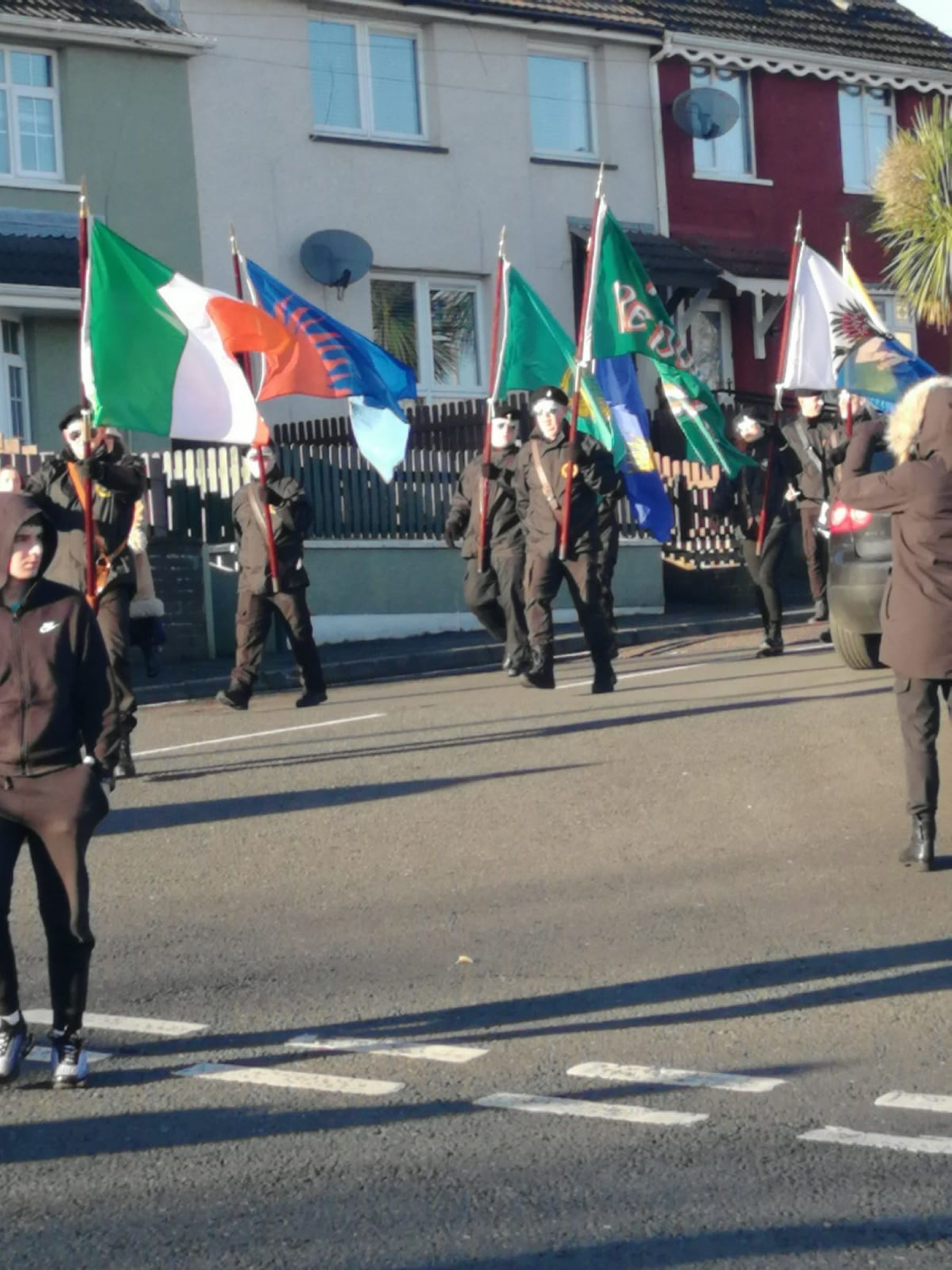
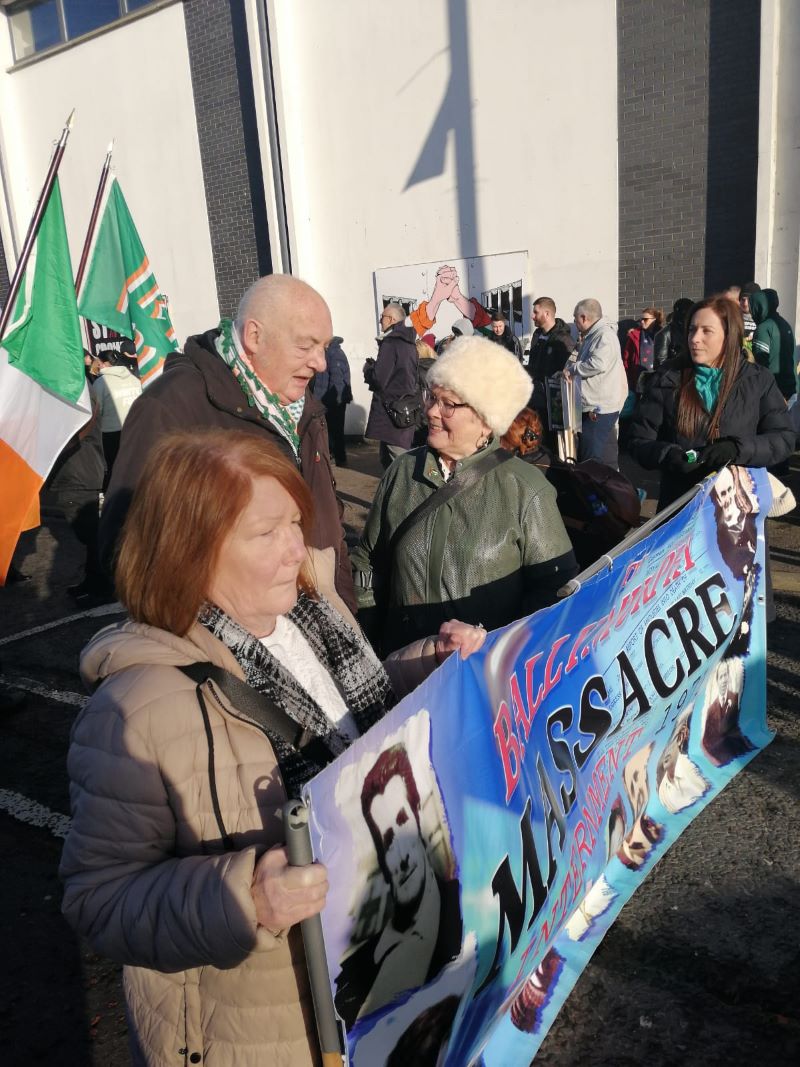
Thousands of marchers with flags, banners and three marching bands retraced the route of the anti-internment march in 1972 that ended in the infamous Derry Bloody Sunday1, a massacre of unarmed civilians by the British Parachute Regiment.
The nearest Sunday to the date of the original march, which this year fell on February 2nd has been chosen annually for the commemorative march over the 53 years since the massacre. People travel from different parts of Ireland and indeed from beyond in order to attend.
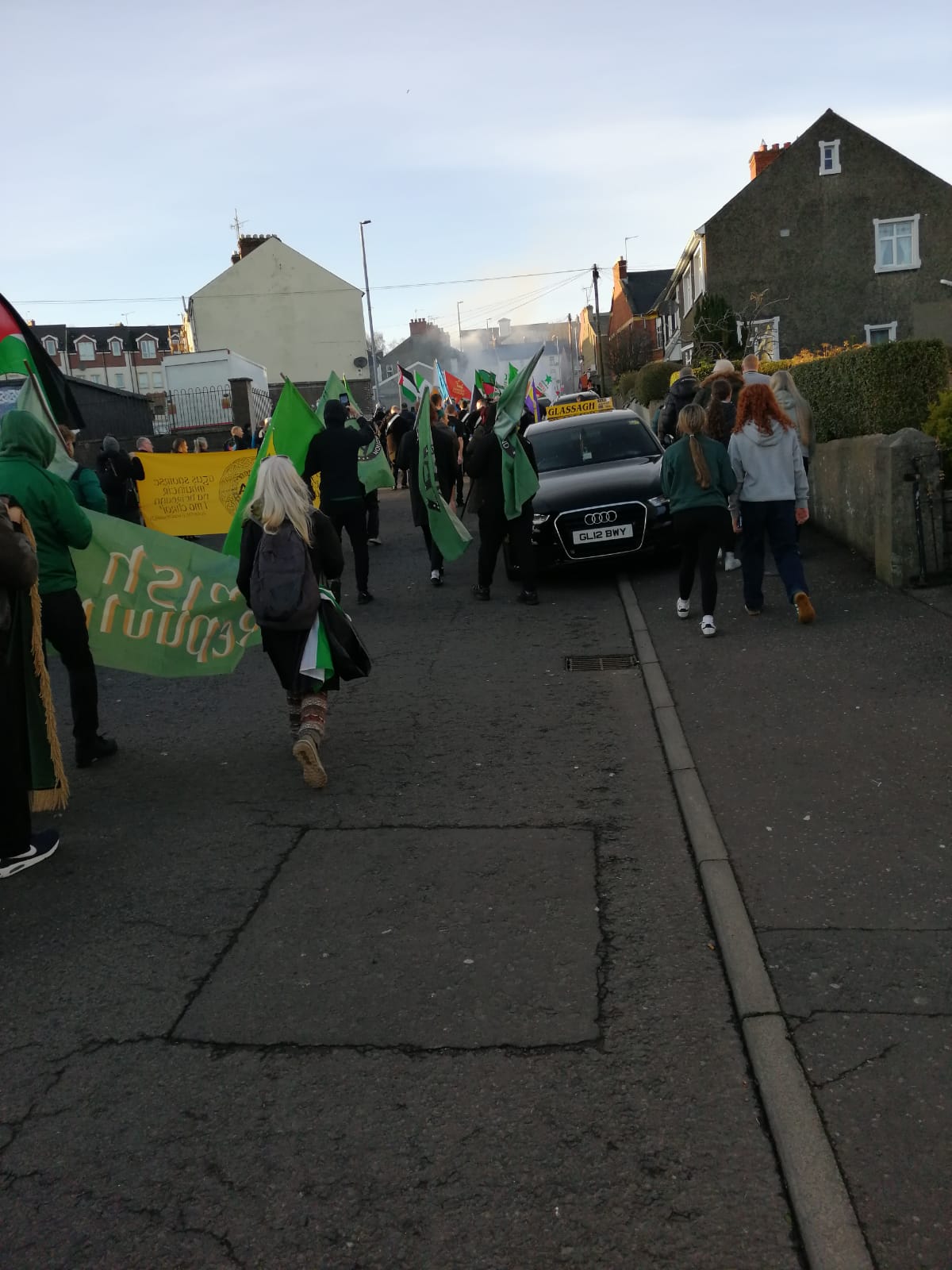
Section of the march coming down from the Creggan. (Photo: D.Breatnach)The colour party (bearing the flags) traditionally precedes the marching band. (Photo: D.Breatnach)
Derry is not well served by public transport from other parts of Ireland and there is no train station there.
There is a bus service from Dublin from the Translink company of the occupied colony but one would need to catch it at seven in the morning and then hang around in Derry for 3.5 hours waiting for the march to start. For this reason, many travel to Derry by car.
Equally, many others who would attend were the public transport available, stay home but an estimated over 7,000 participated in this year’s march. The theme this year was Palestine, once again as was last year’s too.
The day of the massacre
The original march was a protest against the introduction in August 1971 of internment without trial in the occupied colony. Almost immediately afterward the Parachute Regiment had massacred 11 people protesting against it in Ballymurphy, Belfast.2
Ballymurphy campaign banner in the Creggan awaiting start of march with Kate Nash centre. (Photo: D.Breatnach)
The 1972 march, along with many others, had been banned by the sectarian colonial administration. The Civil Rights campaigners knew that their legitimate demands3 were being obstructed by use of the Special Powers4 of the statelet and that they could win nothing if they were to acquiesce.
After the previous massacres it took considerable courage to march that day but perhaps they thought that with an advertised march, in daylight, with many film cameras covering, the Paras were unlikely to open fire. In any case, they decided to risk it.
At 4.10pm the first shots were fired by the Paras5 without warning and by around 20 minutes later they had killed 13 men and youths and wounded another 13, one of whom would die weeks later. According to the Saville Inquiry in 2010, they had fired over 100 rounds.
Not one of their targets was armed.
To justify the slaughter, the British Army claimed that they were fired upon and returned fire, killing IRA fighters. The British Government, in particular through Home Affairs Minister Reginald Maudling, repeated the lies as did the British media.
Bernadette (then) Devlin6 MP, a survivor, was prevented from speaking in the Westminster Parliament and she walked up to Maudling and slapped his face. In Dublin a general strike took place with schools closing and a huge crowd burned the British Embassy down.
In London, a giant march reached Trafalgar Square as its end was still leaving Hyde Park. In Whitehall the police prevented them from laying the symbolic coffins outside No.10 and in the scuffles the ‘coffins’ were eventually thrown at the police or knocked to the ground.
And a number of construction sites in Britain went on strike also.
The judicial response varied wildly. Coroner Hubert O’Neill, an ex-British Army major, presiding on the inquests in 1973, called it “Sheer unadulterated murder” whereas Lord Chief Justice Widgery in the ‘inquiry’ he led ignored all the local evidence and accepted the British Army’s lies.7
“The last Bloody Sunday march”
Provisional Sinn Féin organised and managed the annual march for many years but in January 2011 Martin McGuinness announced that year’s march would be the last, because of the UK’s Prime Minister David Cameron’s public apology to the relatives of the 14 killed in Derry.
The apology followed quickly on the verdict of the Saville Inquiry8 which totally refuted the statements at the time by representatives of the Army and of the Political and Judicial establishments: the victims had been unarmed and the Army had not been “returning fire”.
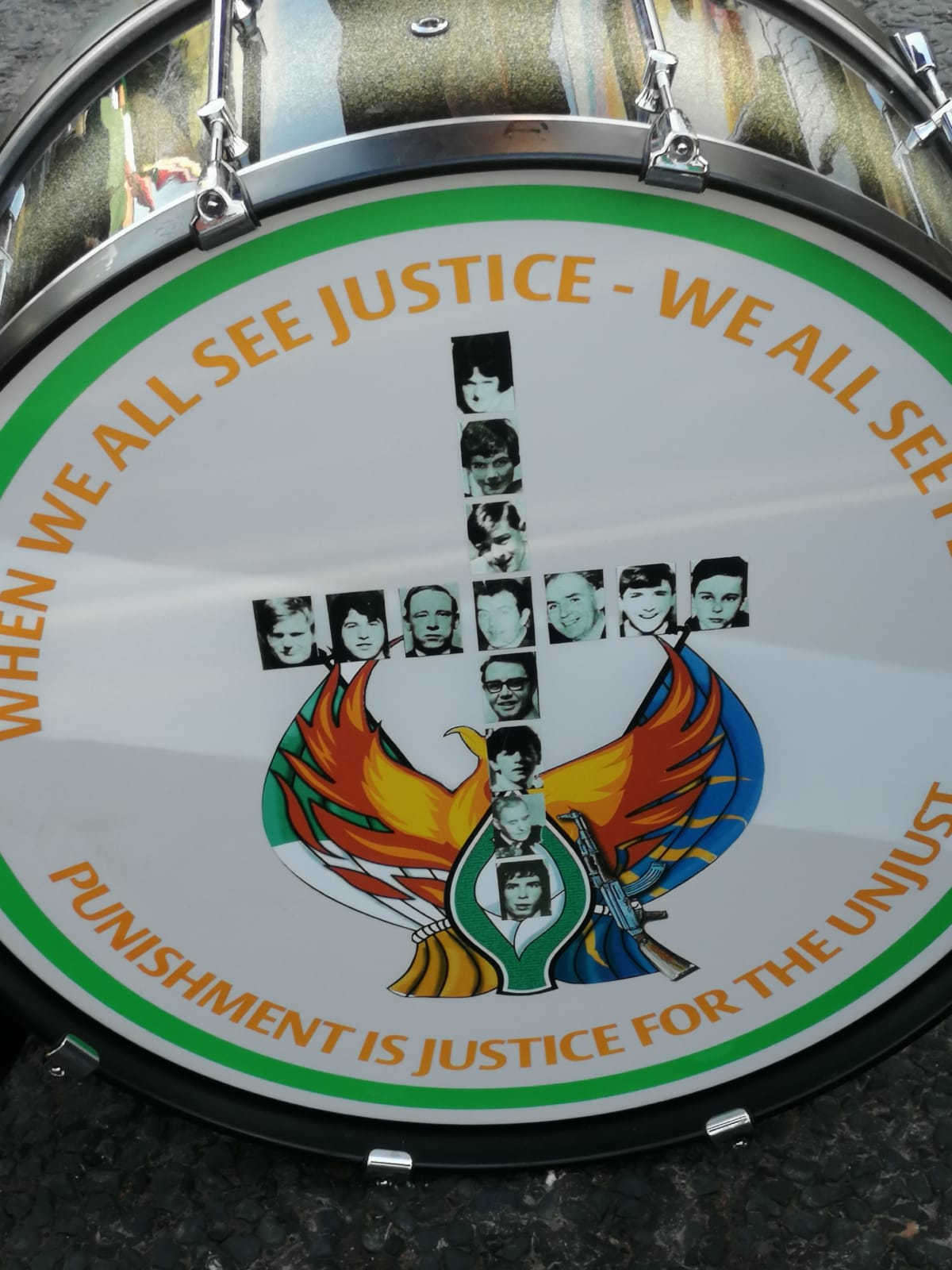
One side of one of the marching band drums (Photo: D.Breatnach)Section of the march about half-way along its length. (Photo: D.Breatnach)
Despite the UK State’s acknowledgement that they had no excuse for the massacre, not one of those who planned, organised or carried out the atrocity had been charged, never mind convicted, nor had those who conspired to cover up the facts. To this day, only a low-level soldier has faced charges.
Nor had there been government admissions of wrongdoing in the other massacres by the Paras intended to crush the resistance to the repressive internment measure, at Ballymurphy and Springhill.
A number of relatives and survivors of the original march declined to have the annual march cancelled, among them Kate Nash and Bernadette McAlliskey. Kate Nash’s brother William was shot dead on Bloody Sunday and her father, William, was wounded trying to save his son.
Bernadette McAlliskey was a survivor of the massacre and also survived nearly a decade later an assassination attempt in her home, being struck by nine bullets of a Loyalist murder gang. Despite opposition by and denunciation from SF, volunteers have kept the march going every year.
Each year different themes have also been incorporated into the Bloody Sunday March for Justice, including ones in Ireland, such as the framed Craigavon Two prisoners but also ones from beyond, e.g. the resistance of the Broadwater Farm housing estate in London to Metropolitan Police attack.
Section of the march in Creggan waiting to start, showing the Palestinian national flag and the Irish Tricolour in close proximity. (Photo: D.Breatnach)Big drums of one of the marching bands getting a workout in the Creggan while waiting for the march to start. ‘Saoirse go deo’ = Freedom for ever. (Photo: D.Breatnach)
Since 2011 Sinn Féin have boycotted the march but also sought to mobilise public opinion against it, claiming that relatives of the victims didn’t want the march to continue. The truth is that some hadn’t wanted it even when SF were running it, some didn’t afterwards but some did.
Such an atrocity has of course huge personal impact on relatives of victims but its impact is also much wider on a society and beyond, historically and politically. That historical memory ‘belongs’ to the people of Derry but also to the people of the world (as do others such as Sharpeville SA).
Those in power in society are aware of that and the media outside of Derry gives little or no coverage to the annual march while promoting other events there of lesser numbers and significance.
The ‘Derry Peoples Museum’ ignores the march in its Bloody Sunday commemorative program.
This year’s march
Sunday just past was one of sunshine and little wind, as it was on the day of the Derry massacre. But regular marchers remember other Bloody Sunday commemoration days of pouring non-stop rain, of squalls, of snow and sleet, of wet clothes, socks and freezing fingers and toes.
The march starts in the afternoon at the Creggan (An Chreagáin) and winds down to just below the Derry Walls, then up a long slope again before eventually ending down at Free Derry Corner9, the destination of the original march, where speakers address the crowd from a sheltered stage.
Marchers underway, led by people carrying 14 crosses to represent the unarmed civilians murdered by the Paras on that day 53 years before. (Photo: D.Breatnach) The band members are itching to go up in the Creggan. (Photo: D.Breatnach)
The sides of residential blocks in this area are also painted in giant murals to represent scenes from the civil rights and armed resistance period while nearby stands a monument to the martyrs of Bloody Sunday 1972 but also another to the 10 H-Blocks’ martyrs of the Hungers Strikes of 1981.
In this area, one needs to be blind not to be at least peripherally aware of the icons of proud struggle and of loss, of sacrifice.
Eamon McCann and Farah Koutteineh addressed the rally at the end of the march. McCann, a journalist and member of the People Before Profit political party is a survivor of the massacre. He is an early supporter of the Bloody Sunday March for Justice at which he has spoken on occasion.
Farah Koutteineh is a Palestinian journalist who was herself the news when in December 2023 she and a few other Palestinians were ejected from a Sinn Féin-organised meeting in Belfast being addressed by the Palestinian Ambassador as a representative of the Palestinian Authority.
Koutteineh had been denouncing the Palestine Authority’s collusion with Israel when she and the other Palestinians were hustled out to applause from many of the attendance. Not surprisingly from the Derry platform on Sunday she too drew applause in criticising SF’s position on Palestine.10
Speaking to this reporter after the march, Kate Nash said: “There is no chance the march will be ended. It will go forward into the future, a beacon of resistance against the injustices and crimes of states around the world.
“There are millions of us … people come from around the world to commemorate this massacre with us.”
end.
Series of images from the march (Photoa by D.Breatnach)
Footnotes:
1There have been a number of Bloody Sundays in the history of Ireland under colonialism and therefore the location and year are often incorporated into the name for clarity as to which is being discussed.
2There was substantial State interference with inquests during the period of the 30-years’ war in the Six Counties (and in some cases in the Irish state also), in order to avoid inquest juries finding the state armed forces culpable of homicide unjustified in law. The original inquest in 1972 on the Ballymurphy massacre recorded an ‘open verdict’ but a 2021 reopened inquest found the British Army killings “unjustifiable”. Even after the Derry massacre, in July of that year, the Paras again killed five unarmed people and injured two in the Springhill area of Belfast and again an ‘open verdict’ was recorded into the fatalities which included three teenagers and a priest.
3The demands were all of rights that were in existence in the rest of the UK, including an ending to discrimination in allocation of housing and employment and general enfranchisement.
4The Special Powers (Northern Ireland) Act 1922 gave legal powers to the authorities similar to martial law. Allegedly temporary, as is often the case the Act kept getting renewed until made permanent and its repeal was one of the demands of the Civil Rights campaign. The Act was finally repealed in 1973.
5There was a unit of other British Army soldiers stationed on the Derry Walls with special rifles and there has been speculation that some of the shots might have been fired by them but this has never been confirmed to date.
6Now McAlliskey then Devlin, she had been a candidate for the People’s Democracy party of the time, the youngest MP elected.
7And that was the ‘official record’ until the Saville verdict 38 years later. A clever contemporary lampooning of Widgery and playing on a soap powder advert, with excellent alliteration, had it that “Nothing washes whiter than Widgery White!”
8Although the Saville Inquiry delivered its verdict in June 2010, it had been set up in 1998, taking an inordinately long time (and a bonanza in legal fees for judge, barristers, lawyers and clerks) to reach a verdict already obvious to all the nationalist people of the Six Counties, most of the Irish people and probably millions around the world. The date of its setting up so near to that of the Good Friday Agreement suggests that its creation (and eventual verdict) was part of the ‘sweeteners’ of the Pacification Process and the Good Friday Agreement.
9A reconstruction of the iconic gable end of a small local authority house in the Bogside area of Derry which had been painted in 1967, during the Civil Rights resistance period, with giant letters proclaiming: YOU ARE NOW ENTERING FREE DERRY. The house was demolished during redevelopment of the area but the gable end was reconstructed as a monument to the resistance of the people of the city.
10Sinn Féin support the corrupt and collaborationist Palestine Authority and its backing political party Fatah and also celebrated St. Patrick’s Day with (then) President Joe Biden while the US was supplying the Zionist genocide with weapons, money and political backing.
1There have been a number of Bloody Sundays in the history of Ireland under colonialism and therefore the location and year are often incorporated into the name for clarity as to which is being discussed.
2There was substantial State interference with inquests during the period of the 30-years’ war in the Six Counties (and in some cases in the Irish state also), in order to avoid inquest juries finding the state armed forces culpable of homicide unjustified in law. The original inquest in 1972 on the Ballymurphy massacre recorded an ‘open verdict’ but a 2021 reopened inquest found the British Army killings “unjustifiable”. Even after the Derry massacre, in July of that year, the Paras again killed five unarmed people and injured two in the Springhill area of Belfast and again an ‘open verdict’ was recorded into the fatalities which included three teenagers and a priest.
3The demands were all of rights that were in existence in the rest of the UK, including an ending to discrimination in allocation of housing and employment and general enfranchisement.
4The Special Powers (Northern Ireland) Act 1922 gave legal powers to the authorities similar to martial law. Allegedly temporary, as is often the case the Act kept getting renewed until made permanent and its repeal was one of the demands of the Civil Rights campaign. The Act was finally repealed in 1973.
5There was a unit of other British Army soldiers stationed on the Derry Walls with special rifles and there has been speculation that some of the shots might have been fired by them but this has never been confirmed to date.
6Now McAlliskey then Devlin, she had been a candidate for the People’s Democracy party of the time, the youngest MP elected.
7And that was the ‘official record’ until the Saville verdict 38 years later. A clever contemporary lampooning of Widgery and playing on a soap powder advert, with excellent alliteration, had it that “Nothing washes whiter than Widgery White!”
8Although the Saville Inquiry delivered its verdict in June 2010, it had been set up in 1998, taking an inordinately long time (and a bonanza in legal fees for judge, barristers, lawyers and clerks) to reach a verdict already obvious to all the nationalist people of the Six Counties, most of the Irish people and probably millions around the world. The date of its setting up so near to that of the Good Friday Agreement suggests that its creation (and eventual verdict) was part of the ‘sweeteners’ of the Pacification Process and the Good Friday Agreement.
9A reconstruction of the iconic gable end of a small local authority house in the Bogside area of Derry which had been painted in 1967, during the Civil Rights resistance period, with giant letters proclaiming: YOU ARE NOW ENTERING FREE DERRY. The house was demolished during redevelopment of the area but the gable end was reconstructed as a monument to the resistance of the people of the city.
10Sinn Féin support the corrupt and collaborationist Palestine Authority and its backing political party Fatah and also celebrated St. Patrick’s Day with (then) President Joe Biden while the US was supplying the Zionist genocide with weapons, money and political backing.
(Article originally written for the Political Prisoners Collective Asociación Arrakala)
Gearóid Ó Loingsigh January 19 2025 (Reading time: 6 mins.)
NB: Edited by RB from original article for formatting purposes
Who and what is a political prisoner is controversial, though it shouldn’t be. Once upon a time we all knew or recognised a political prisoner. It was obvious, evident.
But two centuries of legislative changes, the work of the press and more than one NGO seeking to please its master i.e. those who finance it, has disfigured the political prisoner and its corollary outside, the rebel, the dissident, the activist.
Before trying to vindicate the figure of the political prisoner we should be clear that the prison itself has not been a constant in history.
There have always been places of reclusion, but they were transitory, provisional, where the prisoner was held whilst they awaited their sentence, be it execution, or exile, the confiscation of assets or in the case to debtors’ prison, the payment of the debt or the taxes owed.
The idea of a prison as somewhere you serve a term of a number of years as a prisoner according to the gravity of the crime is novel. It is about 250 years old.
The seriousness of the crime and the proportionality of the sentence are not obvious. In many jurisdictions a bank robbery is more serious than the rape of a woman.
Historically, crimes against property were more severely punished than crimes against the person. There are exceptions to that but in general, in all judicial systems crimes against property are more severely punished.
Of course, murder usually carries a stiff sentence, but countries with long sentences or even life sentences usually consider such sentences for crimes against property and other crimes. In the USA that possibility exists in various states.
In a number of countries the crimes punishable by death include, blasphemy, adultery, prostitution, spying, bribery, corruption, drug trafficking, homosexuality.
Political crimes are also severely punished with harsh sentences and the death penalty, depending on the country. Such punishment for political crimes only disappeared where it was abolished for all crimes.
Political crimes
Margaret Thatcher the British prime minister (1979-1990) once declared that there was no political crime, only criminal offences. She said in relation to IRA and INLA militants in prison in Ireland that political murder, political attacks nor any political violence existed.
With this she aimed to ignore not just the long history of such crimes in national laws in many countries but also International Humanitarian Law.
The preamble to the UN Universal Declaration of Human Rights recognizes rebellion as the last legitimate resort in the face of human rights abuses.
“Whereas disregard and contempt for human rights have resulted in barbarous acts which have outraged the conscience of mankind… if man is not to be compelled to have recourse, as a last resort, to rebellion against tyranny and oppression, that human rights should be protected by the rule of law.”[1]
The Geneva Conventions, the basis of IHL in common article 3 to the four conventions reads “In the case of armed conflict not of an international character occurring in the territory of one of the High Contracting Parties, each Party to the conflict shall be bound to apply, as a minimum, the following provisions…”[2]
And goes on to explain the provisions that apply. With this the Geneva Conventions acknowledge the existence of organised and armed rebellion against a state as something more than criminality. Otherwise, it wouldn’t attempt to govern the behaviour of the parties to the conflict.
Though it is worth pointing out that the IHL never clearly defined what was an internal armed conflict nor a war of national liberation. However, it is clear that it can’t be reduced to mere violence.
There are those that raise high the figure of Prisoner of Conscience, not just as the highest expression of a political prisoner but as the only one. According to Amnesty International such a prisoner is in jail for their ideas without having used or advocated violence.
It is an absurd definition. For years they praised Mandela as a prisoner of conscience, but Nelson Mandela led an organisation with an armed wing and ended up in jail for conspiracy to overthrow the state. He was no pacifist.
The definition Amnesty uses can be summarised as They who opine but do not act are political prisoners, those who think but do not apply their thinking are political prisoners.
This excludes great figures from Colombian history such as Policarpa or José Antonio Galán who were executed following their capture. According to this definition José Martí was a political prisoner when he wrote, but a criminal when he returned to Cuba to free it.
But this is not correct, a political prisoner may be a person who never even raised a rock, not to mention a rifle. They may even be pacifists. It is not necessarily a person linked to armed groups, though neither does it exclude them.
There are various types of political prisoners in Colombia.
· There are the militants of guerrilla groups, the majority of them in prison for armed actions, though there are those who played a political role in such groups, what the courts refer to as ideologues.
· There are also those who are victims of frame ups, the majority of them militants of one or other unarmed Left group, social organisation, trade union etc. The state imprisons them through frame-ups in order to limit their political work.
· Then there are those who are prisoners for things related to their political activity i.e. people who in the midst of protests, strikes, occupations of buildings break some law and are arrested, such as those who carry out pickets that are not permitted.
Amongst this group there are also the youths of the Frontline of the National Strike. Yes, throwing a stone is a crime in and of itself but these youths threw stones in response to state violence during the protests.
But, what distinguishes political prisoner from a common prisoner? Brandishing weapons or throwing stones is done by lots of people from narcos to drunks on a Saturday night. Pablo Escobar attacked the state with weapons and car bombs, but he was never a political prisoner.
He was always a criminal.
The first point is the political prisoner is captured in the struggle for a better world.
They seek changes in society that benefit a broad section of the population when their struggle is national in character or large group when the struggle is local or in the neighbourhood with specific demands.
So, a right-wing paramilitary could never be a political prisoner because they seek the status quo, or even a worsening of the conditions of the people.
A political prisoner acts altruistically, seeking no personal benefit though they may end up benefiting from the changes they seek for peasants, youths or neighbours because they are from that community.
But they never seek personal benefit for themselves but rather for society or a particular group in society. Once again neither the paramilitaries, nor the narcos or the Uribistas could ever be political prisoners because what they seek is always for their own personal benefit or small powerful group.
So a guerrilla may be a political prisoner, as may be the youths from the National Strike and similar protests. The environmentalist that blocks the entry of a mining company’s machinery is also one, even if they commit a crime such as damaging or destroying the company’s installations.
In 1976 eighty intellectuals and figures from the world of culture met in Algiers and proclaimed the Algiers Declaration – Universal Declaration of the Rights of Peoples. The document is entirely political and does not have the force of law but was and continues to be a moral reference point.
In Article 28 it states:
Any people whose fundamental rights are seriously disregarded has the right to enforce them, specially by political or trade union struggle and even, in the last resort by the use the force.[3]
Political prisoners are those who comply with this article.
Though the methods used, whether they are violent or pacific may have some influence, they do not determine who are political prisoners.
Of course, in the case of guerrillas, a war crime may wrest credibility from their status as a political prisoner, but in general the use or not of violence is not what determines who is a political prisoner.
It is the demands and the selfless commitment of the militant to the cause that defines whether they are political prisoners or not. Those who deny this are the ones who benefit from the capitalist system.
Their denial is nothing more than publicity and public relations for Julio Mario Santodomingo, Juan Manuel Santos, Gustavo Petro and the large NGOs. Colombia is full of political prisoners and those who deny this also deny the reality of capitalism in the country.
There were also others: the Guildford Four, Maguire Seven and Judith Ward, all innocent and all convicted in separate cases, mostly in 1974, in the same year that the Prevention of Terrorism Act was passed to silence the Irish community.
Yet others continue being framed, including the Craigavon Two.
There were also others: the Guildford Four, Maguire Seven and Judith Ward, all innocent and all convicted in separate cases, mostly in 1974, in the same year that the Prevention of Terrorism Act was passed to silence the Irish community.
Paddy Hill in 2017 outside the Dublin court where the Jobstown case was being tried (Photo sourced: Internet)
The agitation for civil rights for the community of Catholic background in the British colony of the Six Counties in Ireland began in the last years of the 1960s and very soon people in Britain were marching in solidarity with those facing violent colonial repression in the Six Counties.
The Irish were the most numerous and longest-established migrant community in Britain and had become active in many social, trade union and political circles with the potential to educate and strongly affect the host community.1 This was a problem for the British ruling class.
The jailing of so many people, in many cases obviously innocent, hundreds of arrests, thousands of detentions and interrogations with desertion by much of the British liberal and Left sector terrorised the Irish community so that many stepped away from solidarity campaigning.
That repression muted the Irish community’s solidarity actions until the 1981 Hunger Strikes brought them out again in thousands.
After his release in March 1991 Paddy Hill founded Mojo to campaign for framed innocent people and supported the campaign to free the Graigavon Two, another case that bears many of the hallmarks of a frame-up for political reasons, as famous barrister Michael Mansfield2 commented:
“There is nothing more particular about it (the Craigavon Two case) than in all the other miscarriages and the same features appear in all these things.”3
PSNI Constable Steven Carroll was shot dead by an AK47 bullet on 9th March 2009 in Craigavon, Armagh while responding to a fake crime call, the “dissident” group the Continuity IRA claiming responsibility.4 The arrests of John Paul Wooton and Brendan McConville followed.
Political cases in the Six Counties almost invariably are tried by the no-jury Diplock Court and the judge there refused both men bail. This might seem normal except that they did not go to trial until three years later – and kept in jail throughout the period.
Shortly before the eventual trial a man approached the PSNI saying he had seen McConville near the scene and on the evening of the killing of the Constable. This man was the only witness for the PSNI Prosecution but his partner, with him on the evening in question, refused to confirm his tale.
The night was raining and dark and the eyesight of the alleged witness was exposed as weak by the Defence. The coat he alleged McConville to be wearing was a different type, length and colour to that which the Prosecution was alleging McConville had been wearing on the night in question.
This ‘witness’ was also described by his father as having ‘a Walter Mitty character’ and the PSNI admitted paying him as an informant. An AK47 was recovered near the scene of the killing and the one fingerprint recovered from it did not match those of either Wooton or McConville.
Craigavon Two
Brendan McConville and Paul Wooton, taken in 2017. (Photo sourced: Petition for the release of the Craigavon Two)
There was no evidence against either man of having even handled the weapon never mind fired it, no evidence placing either at the scene apart from the dubious testimony placing one of them nearby. Incredibly, it might seem, nevertheless they were found guilty on 12th May 2012.
McConville was sentenced to 25 years and Wooton to ten. Their appeal two years after conviction in May 2014 was unsuccessful and in fact the Prosecution used it to add another four years to Wooton’s sentence.
Paddy Hill of the Birmgham Six and Gerry Conlon of the Guildford Four, both sadly deceased, both innocent but served long years in jail, both supported the campaign of the Craigavon Two. (Photo sourced: Internet)
Paddy Hill was not the only former framed prisoner to support the campaign to free the Craigavon Two. Gerry Conlon was asked to examine the case and became a convinced and dedicated campaigner for the men, speaking out about it as late as a week before his untimely death.5
Paddy Hill and the rest of the Birmingham Six were framed by the British system and served 18 years in jail. In May this year McConville and Wooton will have reached their 16th in jail. For how much longer will they and their close ones be tortured?
End.
Footnotes
1The Irish diaspora in Britain had provided the British working class with its anthem (The Red Flag), its classic novel (The Ragged-Trousered Philanthropists) and two leaders of its first mass movement, the Chartists (Fergus O’ Connor and Bronterre O’Brien) and had also formed a strng section of the First International Workingmen’s Association led by Marx and Engels. In 1974 people of Irish background were estimated to form up to 10% of the population of some British cities.
2Mansfield led the appeal cases of the Birmingham Six and of the Guildford Four.
Irish trade unions could play a significant role in Palestine solidarity but they are not doing it. They are well-placed to do so by virtue of the crucial role of their members in production and distribution.
Union members are also members of families, neighbourhood communities, sports fans, social groups, clubs ……………
Every trade union or joint unions in a workplace could form committees to plan and organise Palestine solidarity activity both within their workplaces but also more generally, forming links with community solidarity groups where these exist or helping to create them where they do not.
Every workplace trade union notice board – which employees are entitled to have installed – should carry updated information on the genocide and on solidarity actions such as boycotts, marches, pickets etc.
Every union could mobilise its members to support Palestine solidarity actions and in the case of demonstrations, marches etc., to organise strong contingents to attend, marked out by banners, flags and in some cases by clothing (hi-viz vests, surgical scrubs for health service workers, etc.)
INFORMATION, PROPAGANDA, MEDIA
The trade unions in the media could help the campaign against genocide by countering the dominant western propaganda narrative, e.g. that “Israel has a right to self-defence”, that the Palestinian resistance are “terrorists”, that the “Hamas rampage” (sic) on 7th October 2024 started the genocide.
Those unions could take protest industrial action, pay for advertisements in the media, produce their own database and news detailing media misrepresentation and censorship and update their members on the reality of the situation in Palestine through a newsletter or social media group.
Their members could hold pickets protesting against disinformation, Zionist propaganda and censorship and in solidarity with the almost two hundred of their counterparts murdered by the Zionist military in Palestine in a little over a year.
SUPPLIES, DISTRIBUTION, BOYCOTTS
Unions involved in transportation and deliveries could refuse to transport goods from or to the State of Israel, as well as maintaining a database of products and companies identified as boycott targets.
Pickets could be placed on centres of sale of boycotted goods, such as supermarkets and chain stores, also of distribution centres at haulage firms, docks and airports. Pickets on chain stores in local areas would attract local people to support and widen the net of active solidarity.
Irish healthcare workers in solidarity with healthcare workers and people in Palestine, marching in an IPSC national march on 31 August 2024. But where is their trade union? (Photo: D.Breatnach)
MOBILISATION
Every union national HQ or regional HQ, or Palestine solidarity committee could mobilise its union members to support Palestine solidarity actions and in the case of demonstrations, marches etc, to organise strong contingents to attend, marked out by banners, flags or hi-viz vests,
Health workers could march in solidarity with Palestinian health workers who are threatened and prevented from reaching victims of IOF bombing or shooting, other health workers shot or bombed, ambulances targeted, health workers kidnapped to the terrible ‘Israeli’ jails and possibly tortured.
Education workers could march in solidarity with their counterparts in the bombed universities and schools of Gaza, of the teachers and students bombed and shot. Athletes and sport workers might identify their solidarity with Palestinian athletes bombed, shot or maimed for life.
Construction workers might be organised to express their solidarity with Palestinians’ destroyed homes, roads and facilities, while civil defence and municipal workers march in support of their counterparts in Palestine, deliberately targeted by the IOF.
The destruction of Palestinian olive groves, fruit trees, farms and grow-tunnels could be protested by union members in agriculture and food processing. Workers in fishing and fish-processing might protest the blockading, harassment and even shooting of Palestinian fishermen.
Sanitation and water supply workers could increase public awareness of the deliberate destruction of those types of infrastructure in Gaza, while workers in telecommunication might protest regular cutting of access to the Internet and also the weaponisation of handheld communicators.
Banners of two main Irish trade union contingents marching in solidarity with people in Palestine, in an IPSC national march on 20 July 2024. But FÓRSA has a membership of “88,000” and SIPTU of “around 200,000” — it does not appear as though these unions made any attempt to mobilise their members to support the march. (Photo: D.Breatnach)
OBJECTIONS
There might be some – and not only among the paid officials of the trade unions — who would say that internationalist solidarity is all very well but that it’s a distraction of from domestic bread-and-butter issues, or fighting closures of workplaces, casualisation of work contracts etc.
Others might object to anything that might smack of illegality, such as industrial action of a solidarity nature or ‘political’ actions by a trade union. They might also point out trade unions in Ireland are much reduced in membership and strength.
Indeed. Unions did not come into being without facing anti-union laws, or indeed police batons, courts and jail. Collusion with the system exemplified by twenty years of Social Partnership has weakened the unions to the degree that many workers do not even understand their relevance.
History teaches us that solidarity work does not weaken organisations, least of all militant ones. It makes them stronger. And visibly active and fighting trade unions will surely attract the interest and appreciation of lapsed or as yet non-unionised workers.
The Irish trade unions on the whole, with some exceptions such as primary school teachers, are not doing this Palestine solidarity work. But are people of Palestinian solidarity minds organising in their trade unions to bring any of that work forward? If they are not to do it, then who?
The founding of workplace Palestine solidarity action committees is probably the place to start, the first small step with many and bigger steps to follow.
End.
Cartoon by D.Breatnach depicting the general inactivity in Palestinian solidarity by most Irish trade unions, despite traditions of internationalist solidarity and the daily genocide by the Israeli Zionists.
Claiming to be ‘Irish nationalists’, denouncing refugee accommodation, calling LGBT people “paedophiles”, promoting “Christian values” and attacking Muslims, calling people “traitors” for expressing solidarity with Palestinians.
What kind of ‘Irish nationalism’ is this?
In recent years far-Right elements in Irish society have been pushing an ideology composed of the elements listed above, while claiming to represent the Irish people and the Irish nation. In their justifications they sometimes refer to struggles in Irish history and to Irish culture.
They do this not only in words but also in debasing flags of the Irish struggle, such as the Tricolour and the ‘Irish Republic’ flag, by waving them at their public events and even, on occasion by playing Irish Republican ballads on their PA machines.
Plenty of Irish Tricolour flags brandished on this anti-immigration march in Dublin in May (2024).Flags of the fascist National Party can also be seen. (Photo sourced: Internet)
Yet with a tiny unrepresentative exception, these elements have not been involved in the promotion or creation of Irish music or dance. They have not struggled for the promotion of the Irish language nor do they themselves speak the Irish language.
As to the history of Irish struggle, again with the exception of a miniscule minority, the far-Right elements have not fought against the British occupation, not picketed British Occupation buildings, not confronted the colonial police nor agitated in solidarity with Republican prisoners.
Again, I ask, what kind of ‘Irish nationalism’ is this?
Palestine solidarity ‘treason’?!
As Ireland experienced a wave of solidarity with the Palestinian people facing a campaign of genocide by the Zionist regime and its Western powers allies, these far-Right elements not only disdained that solidarity but harassed and labelled those who expressed it as “traitors”.
Again, I ask, what kind of ‘Irish nationalism’ is this?
How is opposition to genocide or solidarity with another colonised and oppressed people the activity of ‘traitors’? Surely it is the natural reaction of people with our history? Doesn’t the term ‘traitors’ mean that the accused have aligned themselves with enemies of the Irish people?
In fact, that is precisely what these far-Right elements are doing themselves. They are aligning themselves with a number of Western imperialist powers but in particular, in the case of Ireland, aligning themselves with the rulers of the UK, invader and occupiers of the Irish nation.
That connection was amply demonstrated when the colonial police savagely attacked people attempting to set up a Palestine solidarity camp in the grounds of Queen’s, the colonial university in Belfast. As it is also by burning Palestinian flags alongside the Tricolour on Loyalist bonfires.
A sectarian July bonfire with the Irish Tricolour, ‘Irish Republic’ and Palestinian national flags on top awaiting burning. (Photo sourced: Internet)
Or by English fascist and Loyalist flags accompanying Zionist flags on demonstrations in England. And by far-Right posters and activists who called for friendship with English fascist Tommy many-names Robinson, notorious for supporting the Paratroopers’ 1972 massacre of protesters in Derry.
Love Irish history?
Recently a far-Right person posting on social media, while claiming to “love Irish historical sites”, denounced efforts to save the Moore Street market and 1916 Battleground because “it’s not Irish any more” and called for it to be torn down “to get them1 out”.
She called for the destruction of the oldest street market in Ireland and the site of the last stand of the GPO Garrison, the 1916 Battleground where at least four Volunteers were killed and the last place of freedom for hundreds, including five of the Seven Signatories of the 1916 Proclamation.
Again, I ask, what kind of ‘Irish nationalism’ is this? It is in fact aiding the property speculator who wants to demolish and obliterate Irish history and heritage, a speculator currently based in Britain, though actively assisted by Dublin City Managers and successive Irish governments.
Another poster on social media calling itself “Christian Wisdom” asked people to vote for “Irish nationalist candidates” in the forthcoming elections within the Irish state, the sub-text being against migrants or Left-wing candidates and presumably for religious sectarianism.
What kind of ‘Irish nationalism’ is this?
It aligns itself with the western imperialist powers, including the invader that has been in occupation of some part of our country for 800 years and still is.
It denies people the democratic rights to express their sexuality.
In promoting Christianity as ‘Irish’ and in opposition to free expression of sexuality, it seeks to put us back under religious social control and also opposes the 1916 Proclamation, which guaranteed “religious and civil liberty and equal opportunities… for all.”
In blaming migrants and refugees for homelessness, it is covering up for the actual people who cause that crisis: the bankers, property speculators and big landlords who keep making huge profits out of people’s needs and misery.
Who are they really? They are certainly not ‘Irish nationalists’ in the sense of the many who fought and sacrificed all in the struggle to free the Irish nation through 800 years of Irish history.
Fascists and racists based in Coolock, North Dublin city photographed in joint rally with loyalists in Belfast in 2024. (Photo sourced: Internet)
What it really is and what they really are
What they are disseminating is not at all Irish nationalism.
On rational examination of the evidence, I must conclude that these people are not Irish nationalists at all. But since they claim very stridently that’s what they are indeed, I must conclude that they are using that label to cover their real identity.
What they are really is simply nothing more nor less than Irish fascists, serving property speculators, corporate landlords, bankers, the native Gombeens and foreign imperialists. Or the ignorant manipulated tools of those fascists.
In total, enemies of the Irish nation, of working people and of all democratic freedoms.
End.
1Presumably meaning people born abroad (as were James Connolly, Tom Clarke, Constance Markievicz, Eamonn De Valera, Eamon Bulfin, the father of the Pearses and mother of Thomas Mac Donagh, father of Thomas Davis … and hundreds of other Irish patriots).
The Palestinian Authority repressive forces has just murdered its 11th Palestinian since the Al Aqsa Flood operation.
An occupation force cannot control the people by its own brutal force alone – it needs partners in collusion, to spy, to give an appearance of representation, of due process but ultimately it needs that partner to exercise brutal force on its behalf.
On Monday (9th) the PA forces in Jenin (West Bank) murdered Rahbi Shalabi, 19, also seriously injuring his cousin, leading to protests, Resistance gunfire and explosions as a result. Shalabi was the 11th fatal victim of the PA, though many other Palestinians have been injured and jailed.1
Section of protest in West Bank Palestine against the PA’s murder of Rahbi Shalabi (Photo sourced: The Cradle)
A statement by the PA’s police, General Anwar Rajab, appears to attribute Shalabi’s death to firing by the Resistance or even a crossfire.2 Last Thursday Resistance fighters in Jenin confiscated two vehicles of the PA police in protest at the latter’s injuring and arrest of one of their members.
The PA has been repressing resistance in the areas it controls since its inception but repression has stepped up during the current accelerated genocide campaign of the IOF. A month after the latter commenced, the PA shot dead 12-year-old Razan Nazrallah during solidarity with Gaza protests.3
Razan Nassrallah, shot dead by the Palestinian Authority during solidarity with Gaza protest in the West Bank October 2023 (Photo sourced: Mahran Nassrallah)
During this whole period the PA has pursued Resistance fighters on behalf of the ‘Israeli’ Occupation, even entering hospitals in force in attempts to detain injured fighters.4 On at least two occasions popular mobilisations have prevented the PA forces achieving their aim.
The PA has killed known Resistance fighters5 and also removed defensive obstruction and exploded bombs planted in defence against IOF invasions.
A HISTORY OF CORRUPTION, COLLUSION AND REPRESSION
The Palestinian Authority was created in May 1994 as a 5-year interim body as part of the ‘Palestinian peace process’ (sic) through the Oslo Accords (1993-’95), signed up for the Palestine Liberation Organisation by the Al Fatah party,which won the 1996 Palestinian elections.
The Oslo Accords were rejected in the popular uprising of the Second Intifada (2000-2005). So corrupt, repressive and collusive had the PA and Fatah become that Hamas won the 2006 legislative elections throughout the West Bank and Gaza.
However it was only in Gaza that they forced the corrupt Fatah officials out when the latter refused to relinquish their posts in line with the elections.6 As a result, the PA central offices remained in the West Bank under Abbas, a Fatah nominee, continuing to receive EU and USA funding.
The PA under Mahmoud Abbas and Fatah control have continued in power (and funding) long past their allocated elected period and decline to hold new elections, for fear that Hamas would win once again.
President of the Palestinian Authority Mahmoud Abbas in Ramallah, West Bank, October 24, 2023. (Photo cred: Christophe Ena/Pool via REUTERS)
The PA does not deploy its militarised police force of 80,000 complete with armoured cars against the ‘Israeli’ Occupation, needless to say perhaps but nor does it send them to defend Palestinian farmers and villages being attacked by Zionist settlers.
The PA feeds intelligence on the Palestinians to the Zionist Occupation authorities and arrests people sought by the latter or on the PA’s own account, for speaking or writing criticisms of the PA or for mobilising in support of the Resistance.
People jailed by the PA are, after release, often re-arrested by the IOF and vice versa. The PA is, as admitted by most western and pro-Israeli media, widely detested by Palestinians who consider it a proxy agency for the ‘Israeli’ occupation.
COLLUSIVE REGIMES IN EUROPE
The Nazi occupation of Western Europe established collusive client regimes to administer civilian affairs and the civilian population in every state it occupied. In the first place these regimes acted as buffers between the Occupation and the Occupied but also collected intelligence.
Many became active in repression, hunting down Jews and Resistance operatives. After the liberation of Europe, many of those collaborators were jailed and some were executed by the Allies or by the authorities of the liberated states.
In Ireland the Free State carried out repression against the Resistance forces which had forced the British occupation to withdraw their armed forces from 26 of the Irish counties. Armed, transported and even clothed by the British, the Free State Army fought a vicious Civil War against the IRA.
SUPPORTING THE PA, COLLUDING WITH ZIONISM
The PA is officially recognised by many governments including that of the Irish state, where it has an Embassy. “Recognition of the State of Palestine” in most cases entails accepting the unrepresentative and detested PA as a legitimate representative of the Palestinian people.
Such official recognition usually also entails acceptance of “the Two-State solution” (sic), agreeing to a fragmented Palestinian ‘state’ on less than 40% of Palestinian land, with the least fresh water, under the constant surveillance and guns of the Zionist Occupation.7
This is also what is entailed in ‘recognition of the Palestinian State’ by political parties and organisations who claim that they are doing so in solidarity with the Palestinian people or at least for the sake of ‘a just peace’.
It is absolutely necessary, both for their own integrity and out of solidarity with the Palestinian people, not only for revolutionary forces but also for all anti-colonial, anti-imperialist and basic democratic organisations to denounce the PA and its repression.
Those who feel they cannot support revolution should at least refrain from Zionist collusion. Remaining silent on the role and activities of the PA or, even worse, promoting the PA and its Embassies, is to become part of the repression and a tool of ‘Israeli’ Zionism.
End.
West Bank mass protest at death of activist Nizar Banat in PA custody Ramallah 24 June 2021 (Photo cred: Flash90)
2Ibid. People familiar with other conflict spots, for example the occupied Six Counties of Ireland, will be familiar with this ploy by the authorities.
6Hence the frequent references in western mass media to when “Hamas seized power in Gaza”!
7Despite the continued support of the western imperialist states, every realistic assessment has judged the Two-State option to be no longer possible (if it ever was) due to the extent of Zionist settlements and private settler roads. The alternative then must be what many democratic anti-colonial people have been advocating for decades: one democratic secular state with equal rights and opportunities for people of all ethnic backgrounds.