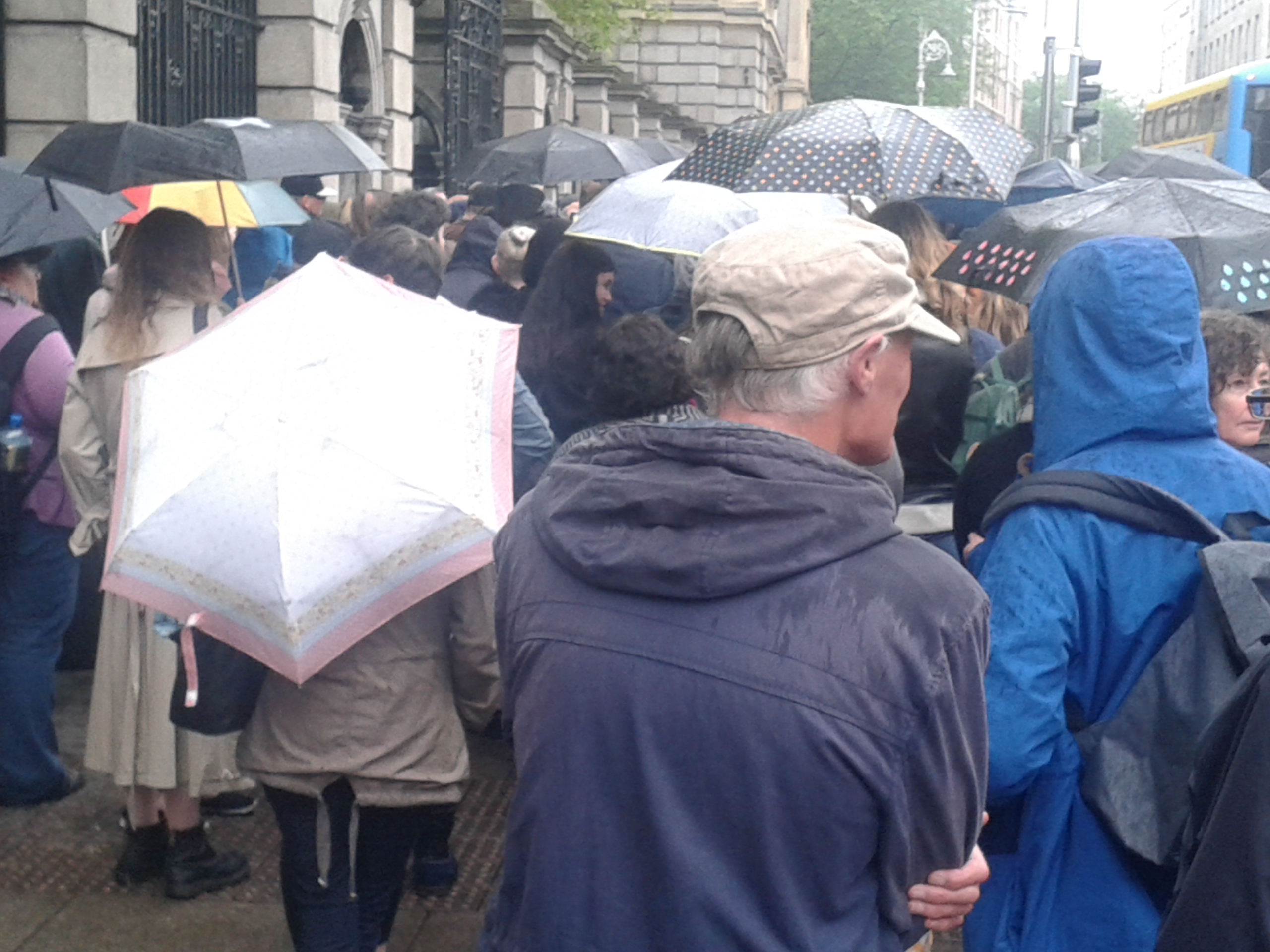
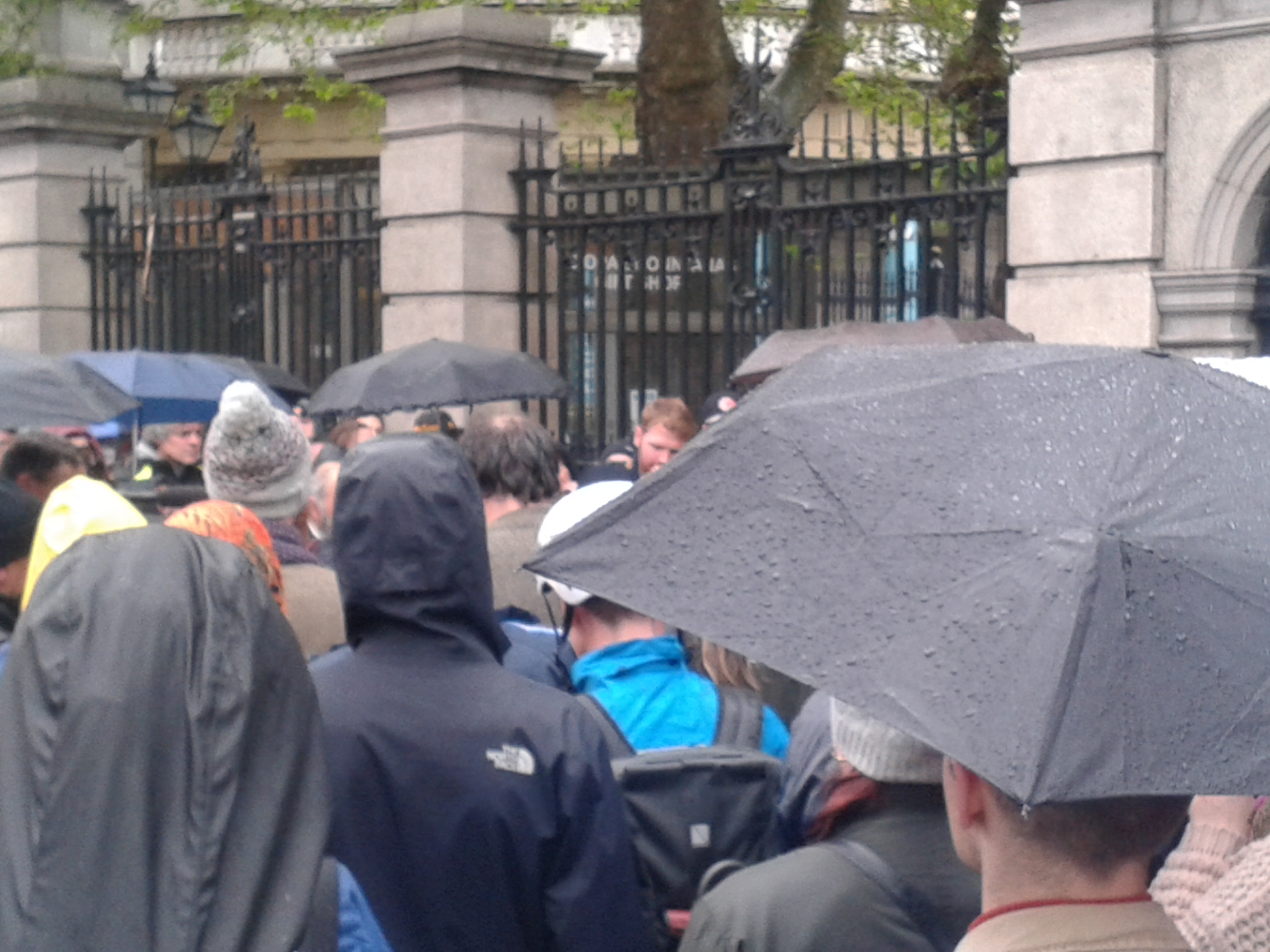
A substantial crowd gathered at a few days’ notice at 5.30pm to protest outside the Dáil at the Garda treatment of Dara Quigley, social activist and blogger.
Section of crowd outside the Dáil (Photo: D Breatnach)
During an apparent mental ill-health episode recently, Dara was apprehended by Gardaí under the Mental Health Act while she was walking in the street naked. One of the Gardaí shared the arrest video on the Whatsapp social media, where it was seen by a great many people before the provider removed it. Dara took her own life five days later, on April 12th.
Dara’s family organised the event and a number of people spoke at it but due to what seemed inadequate public address system and noise of passing traffic, many could not hear what was being said. According to a press report, Dara Quigley was remembered as “a strong and intelligent woman” at a vigil outside Leinster House on Friday evening. Ms Quigley’s brother Seán told a congregation of about 100 people on Kildare Street that his sister had opened the world to him.
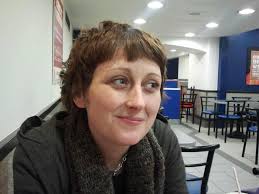
Dara Quigley, who took her life on April 12th (Photo source: Internet)
“Without her, I don’t know where I would have been. She didn’t just do that with me, she led by example in a lot of ways. She wasn’t afraid and she wasn’t a victim.”
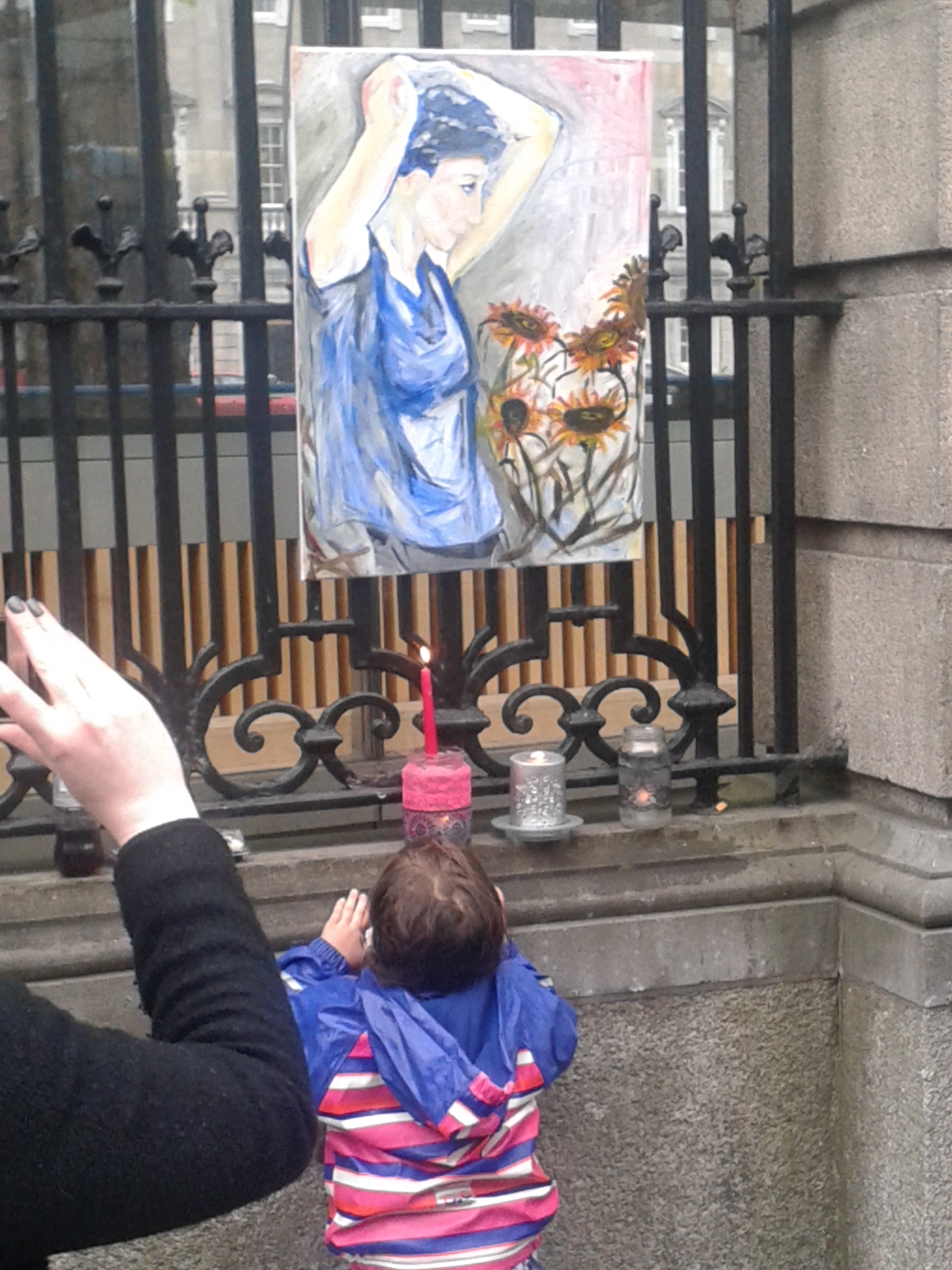
Painting of Dara Quigley, on display at railings of the Dáil during the protest (Phot0: D Breatnach)
The Justice Department has stated that the officer is suspended on full pay pending disciplinary investigation. Outside the Dáil today many in the crowd were saying that the Garda responsible could post such a video without an expectation of punishment only in a force that has become accustomed to acting with impunity, from the highest to the lowest rank — with the exception of whistleblowers, of course.
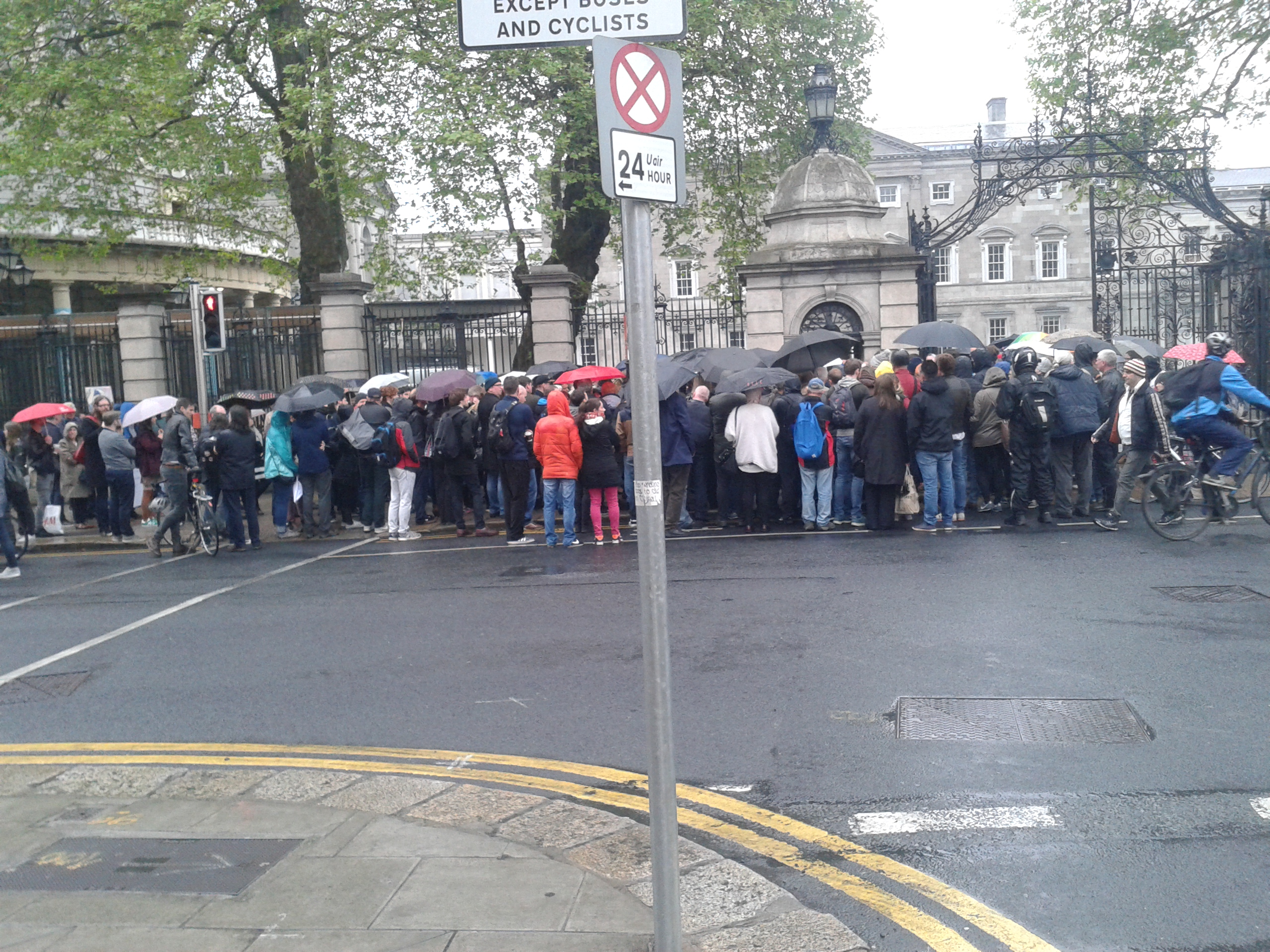
Protest crowd viewed from across the road from the Dáil (Photo: D Breatnach)
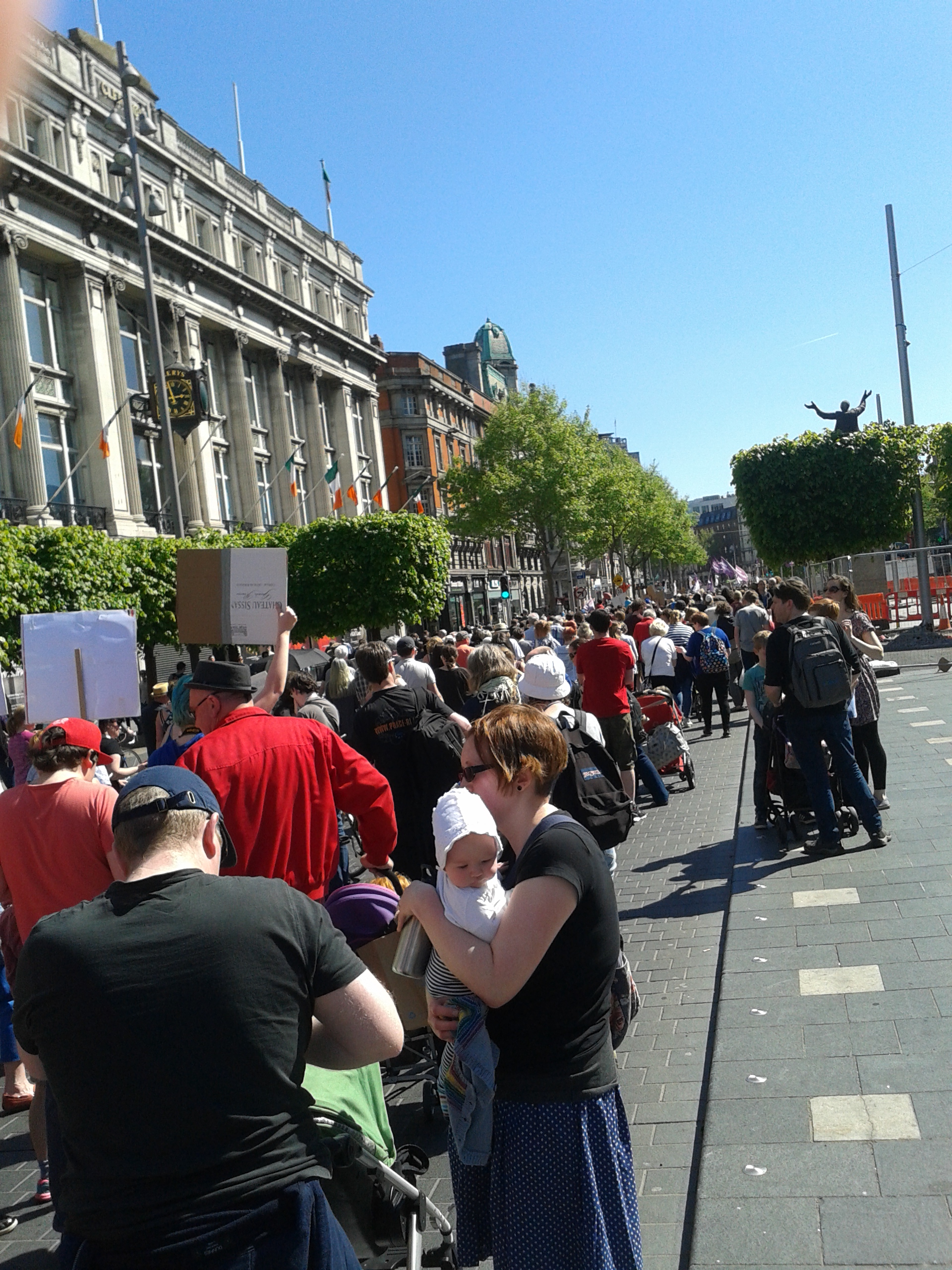
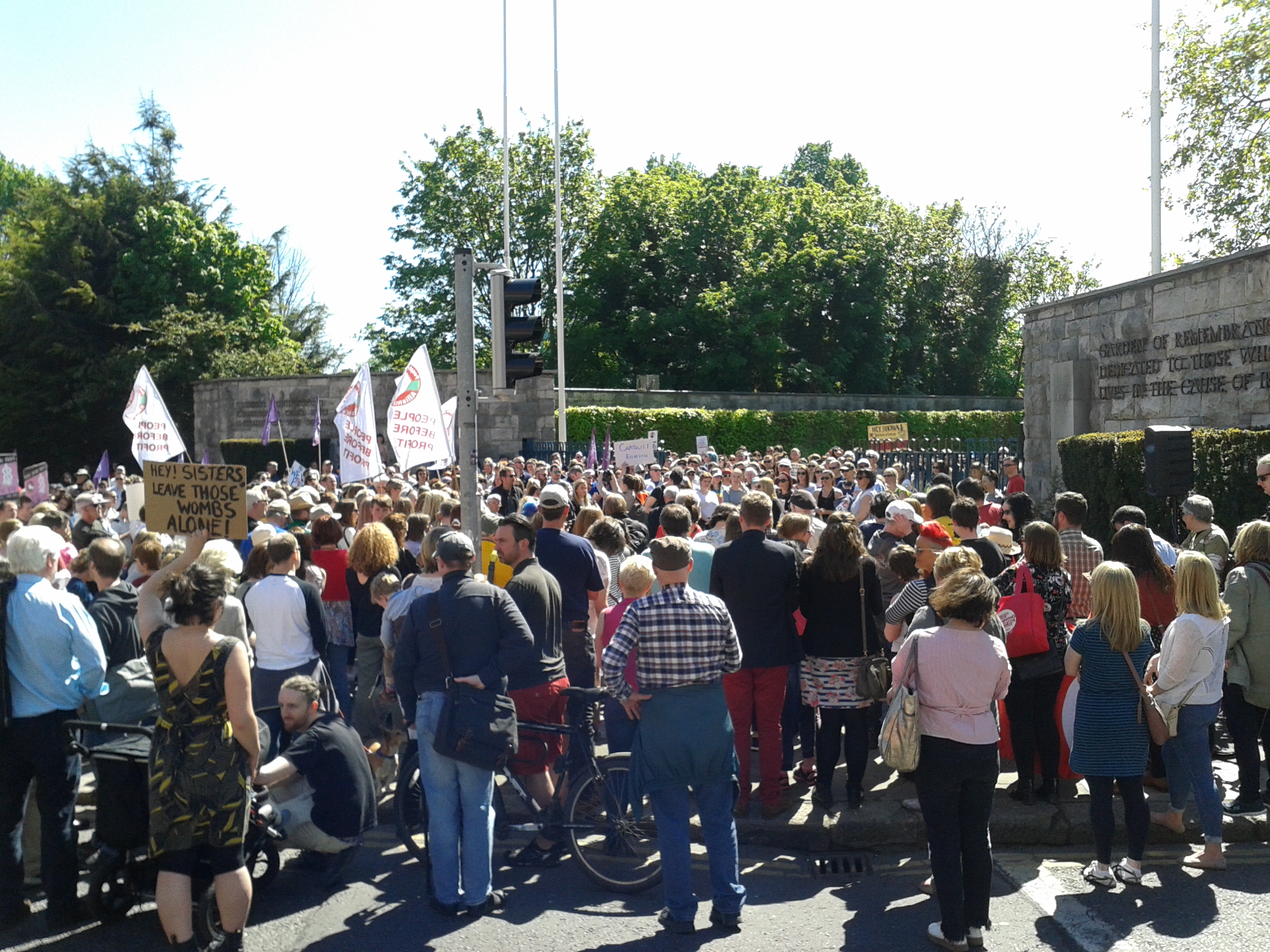
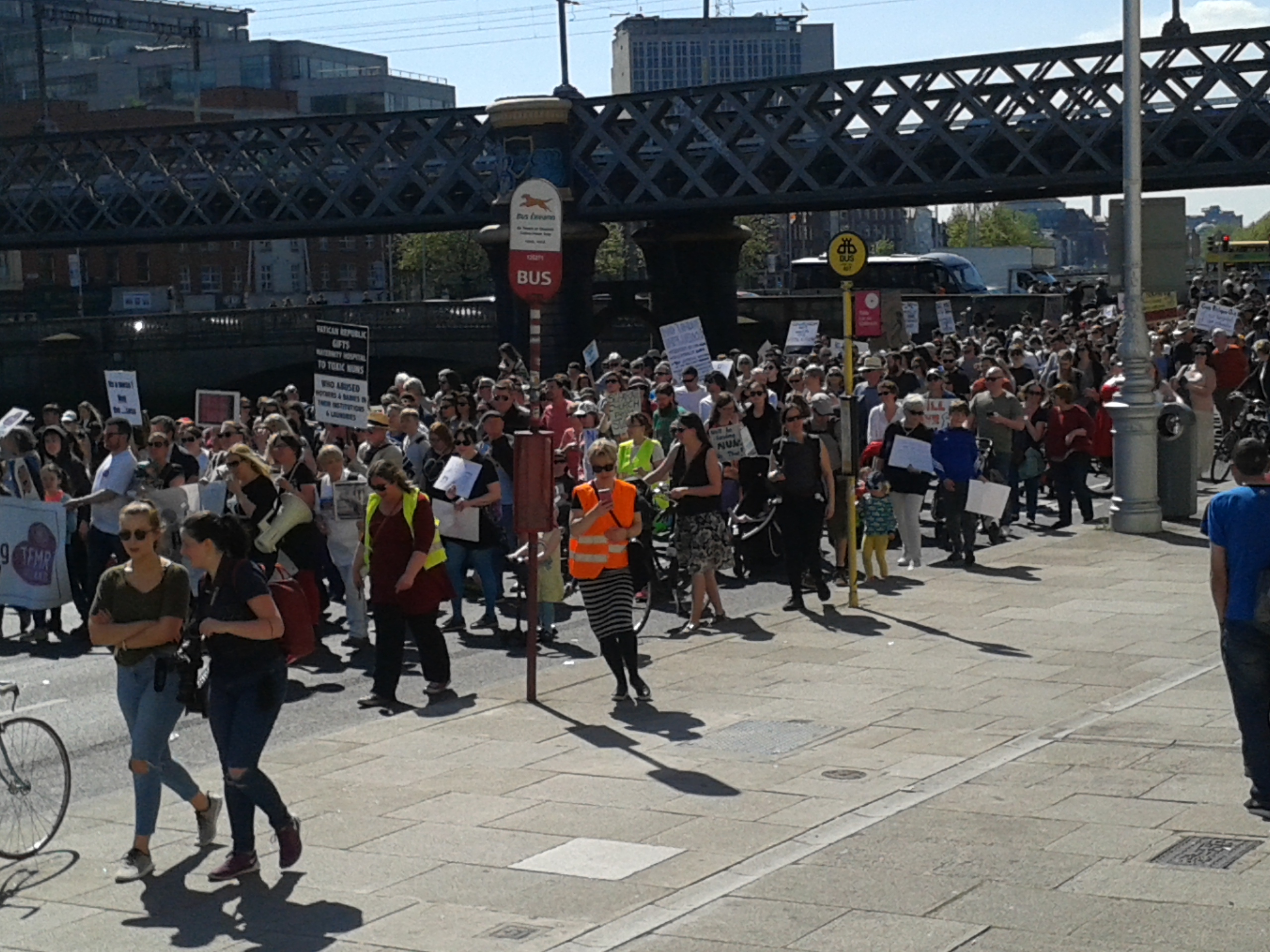
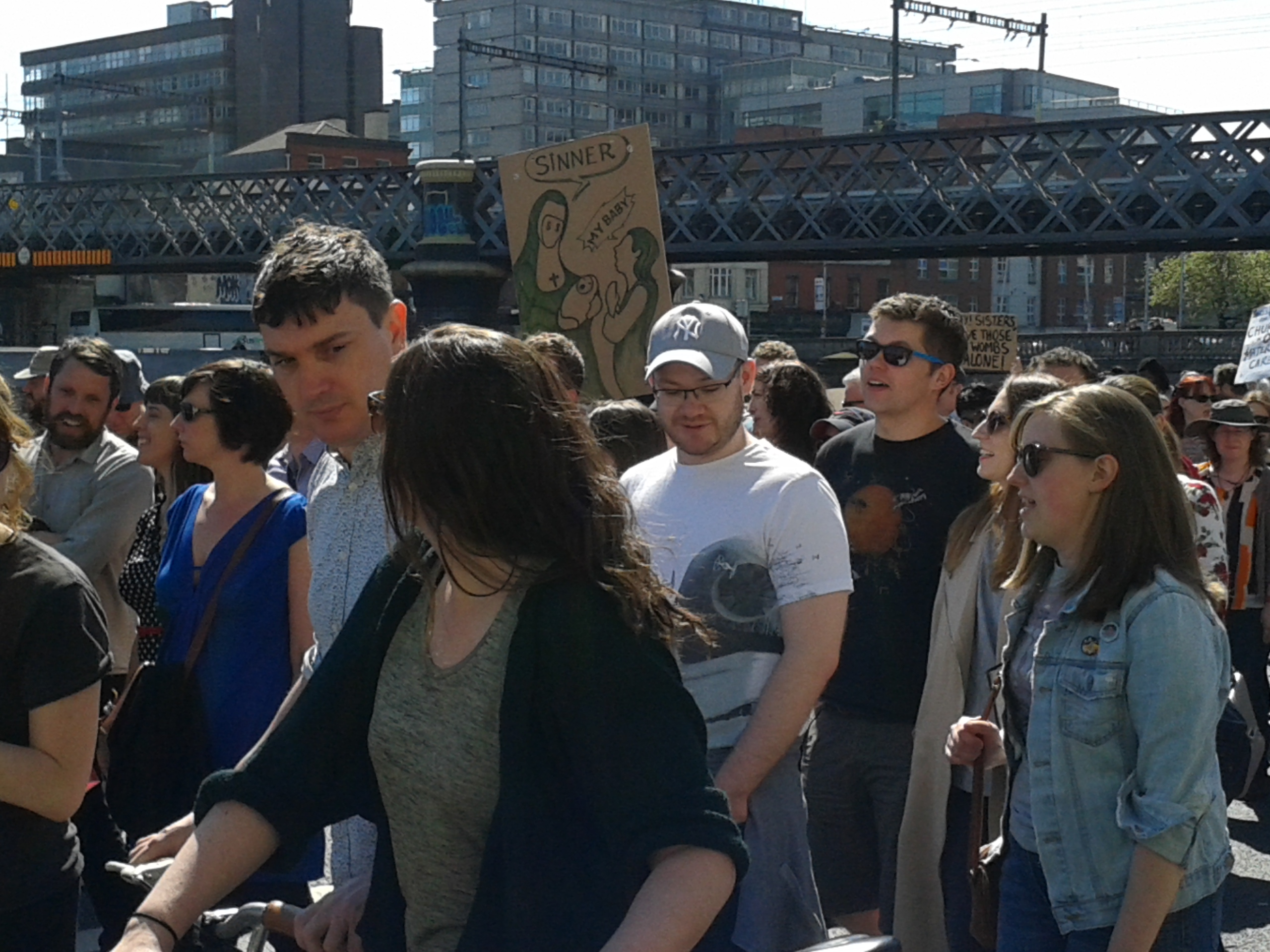
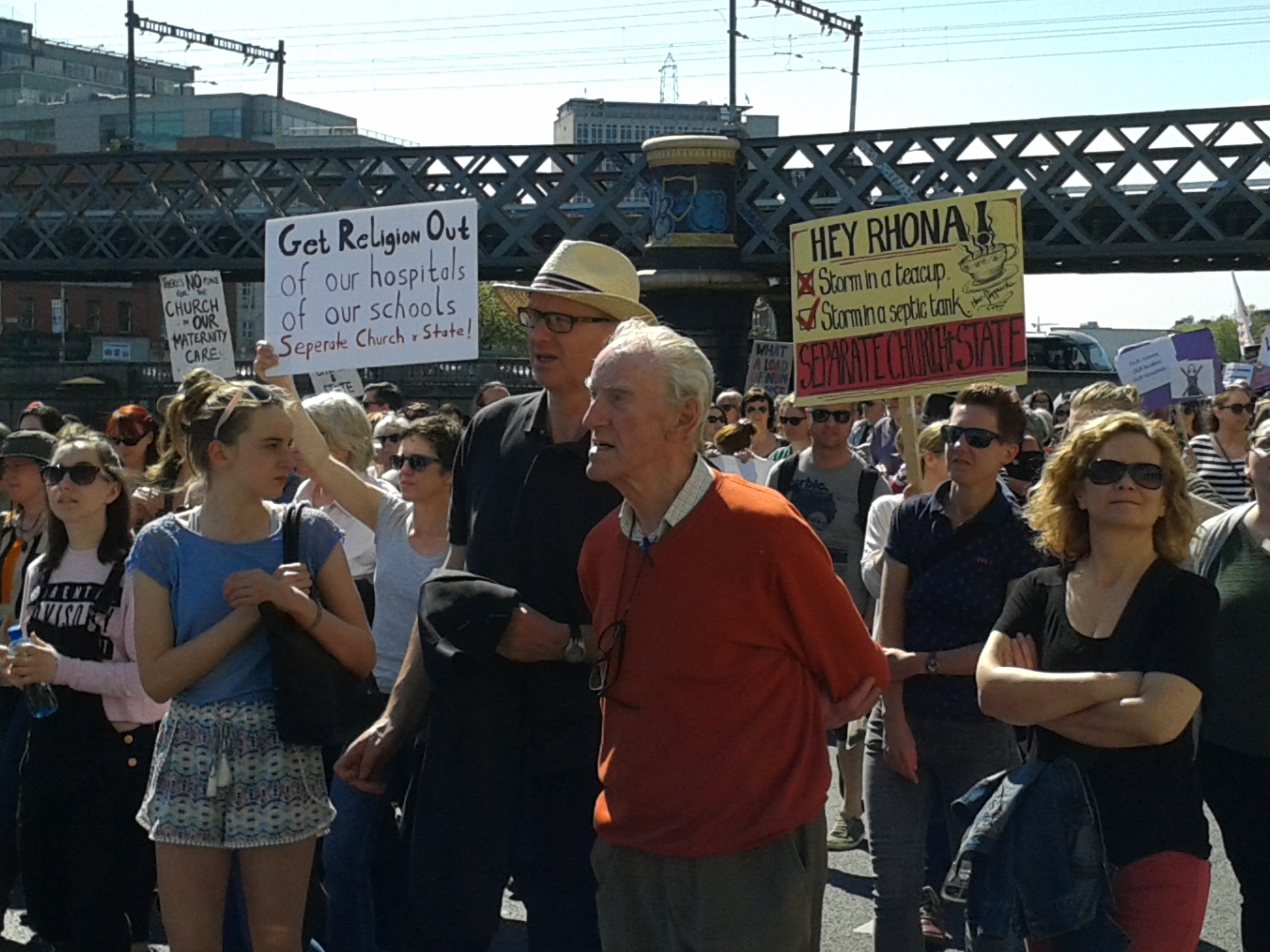
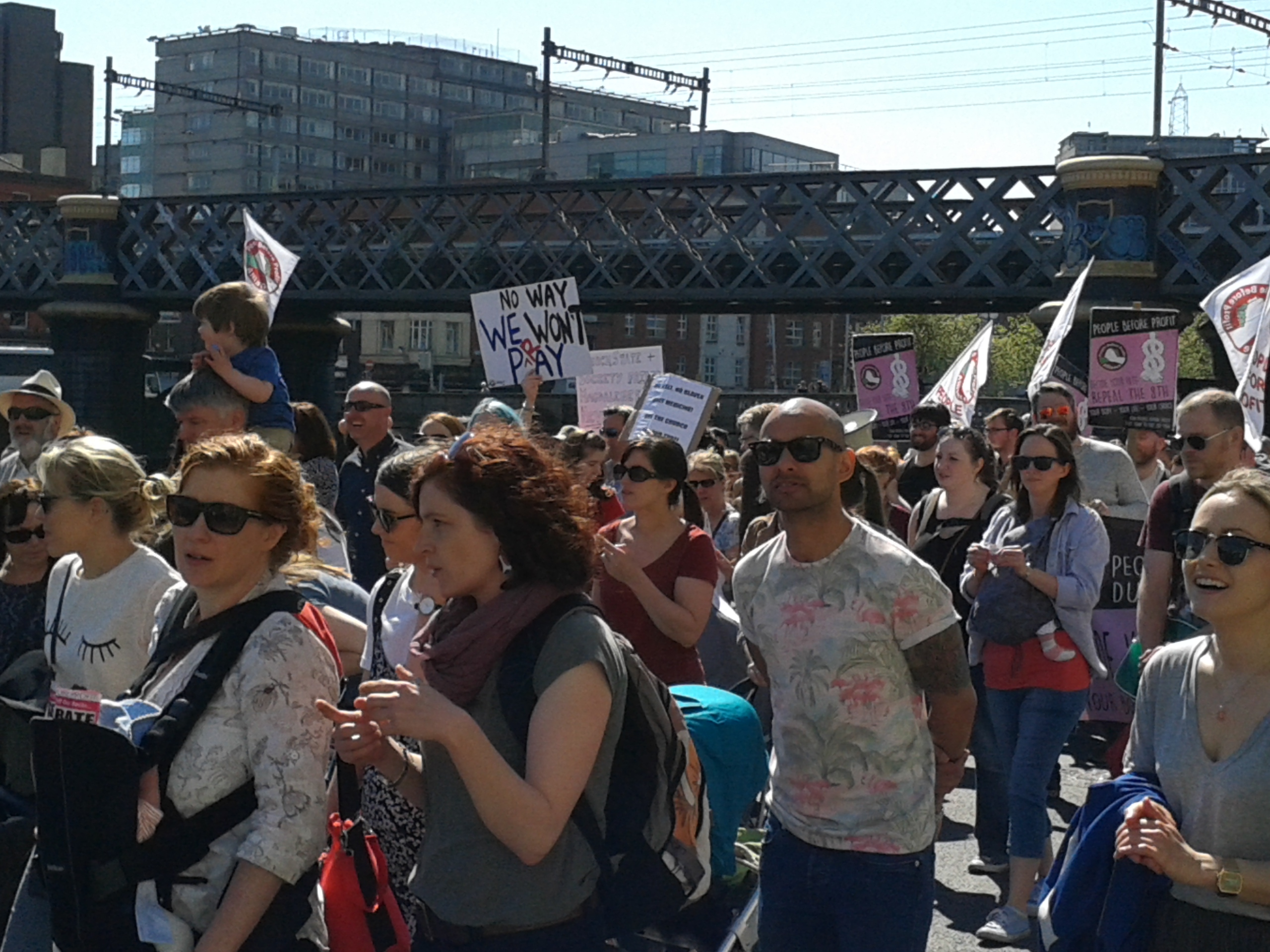
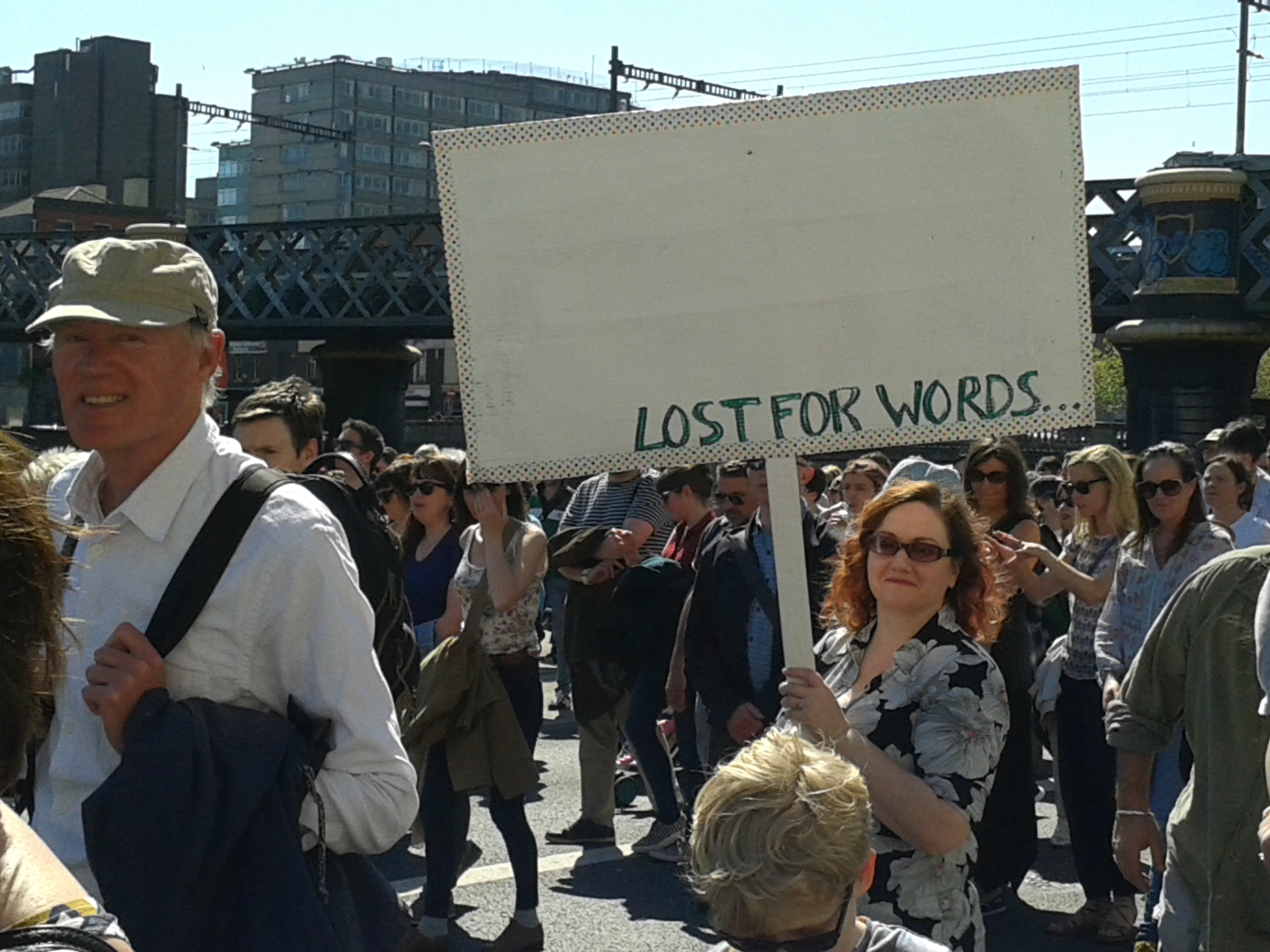
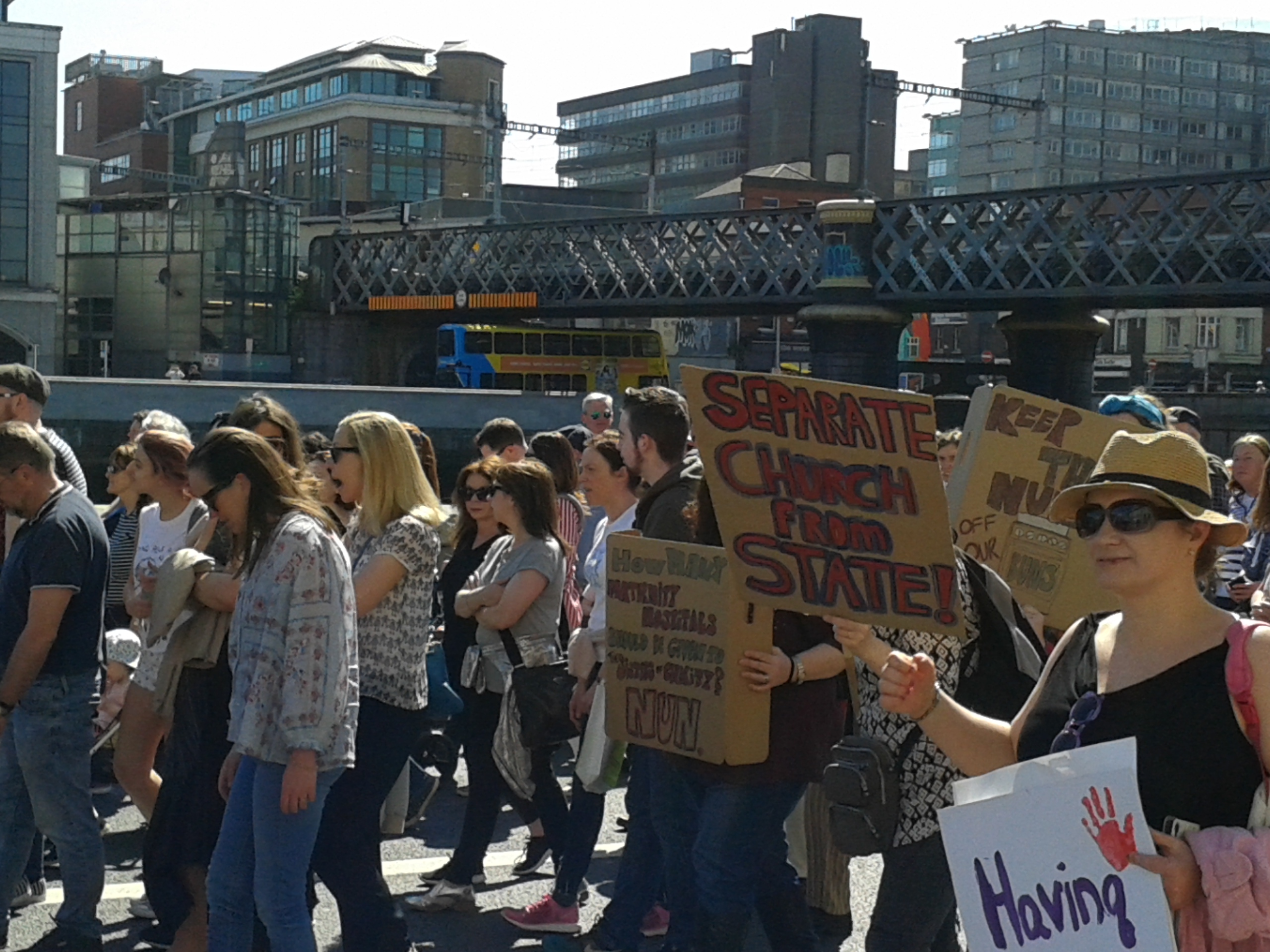
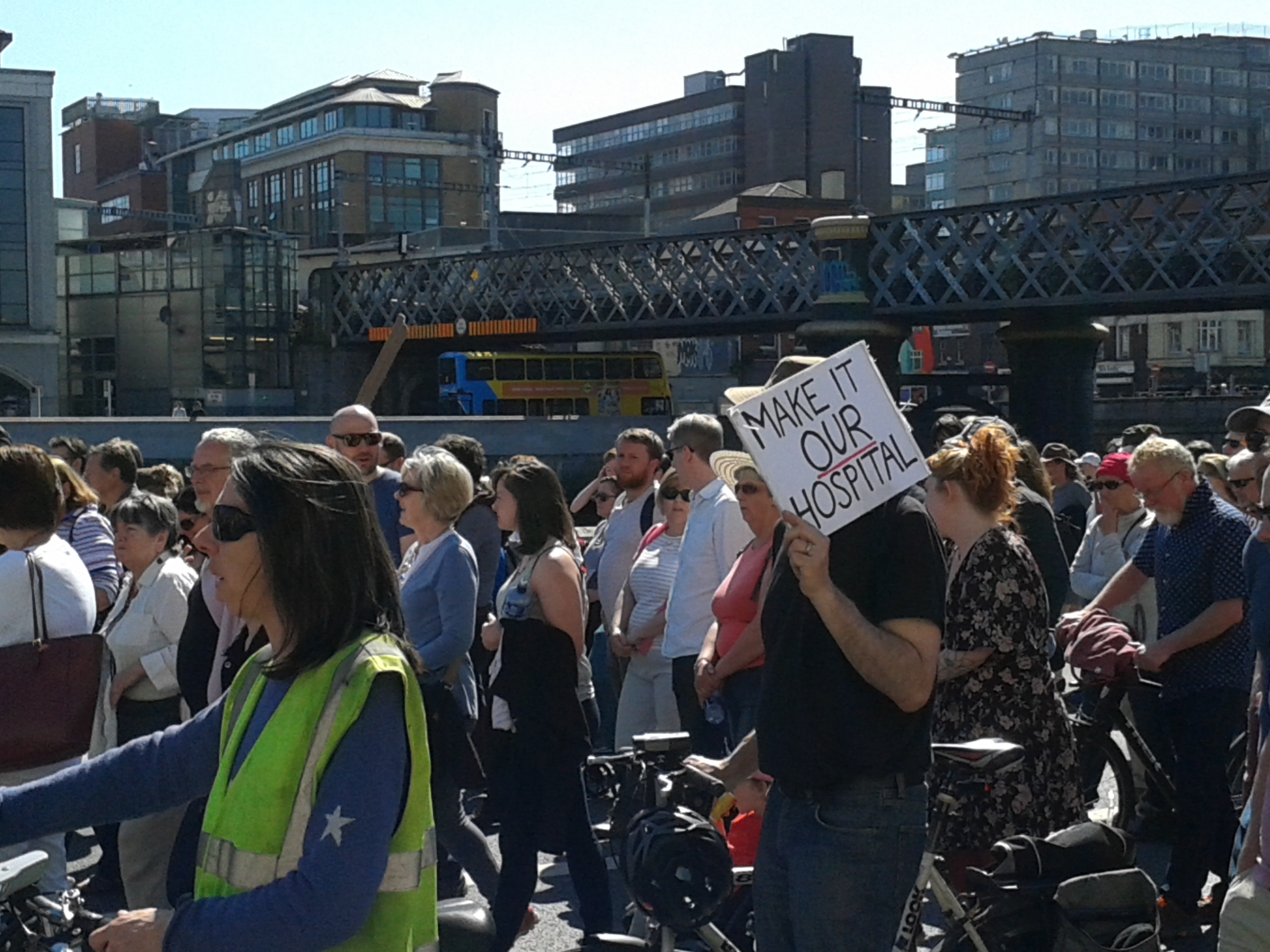
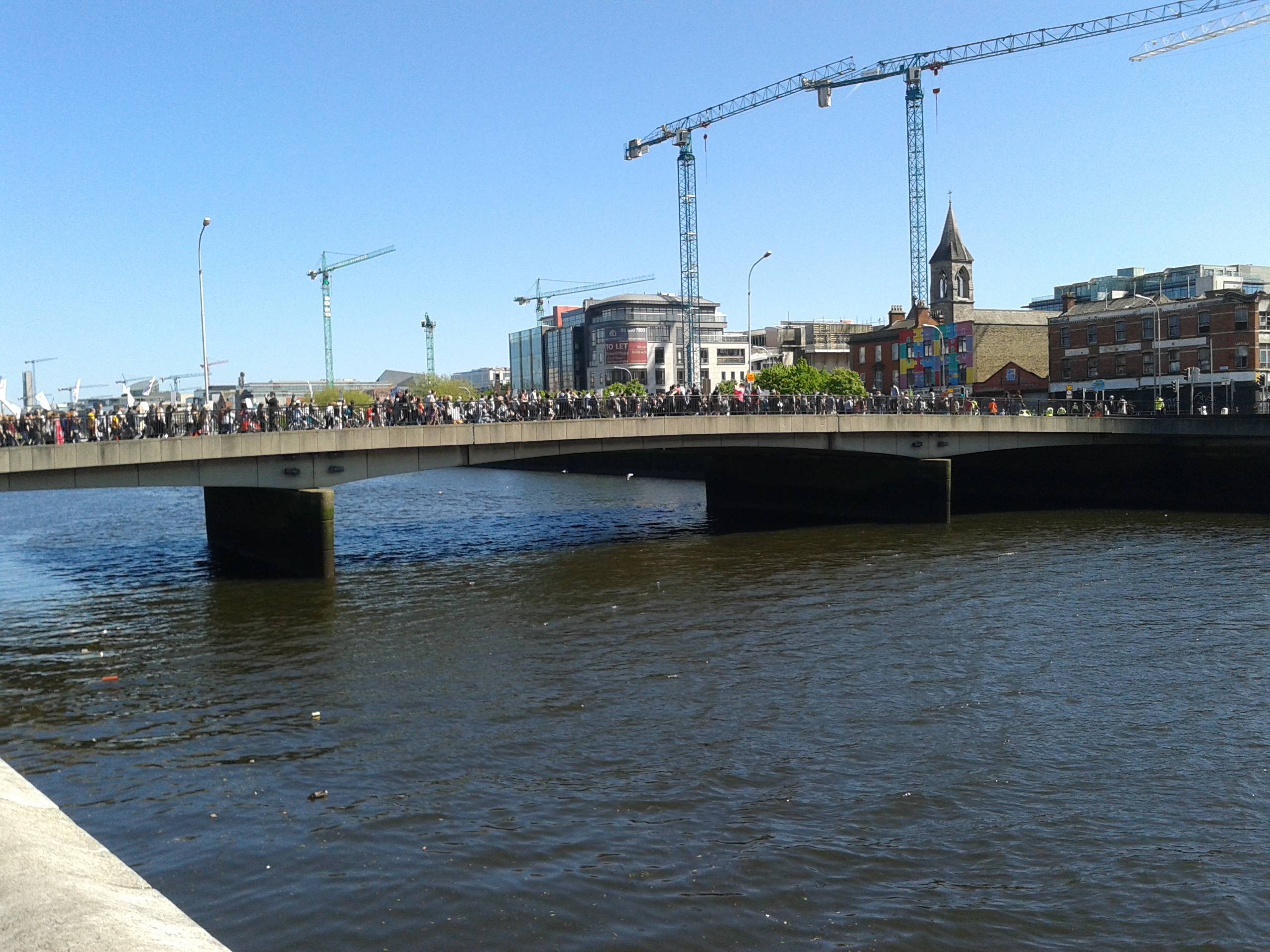
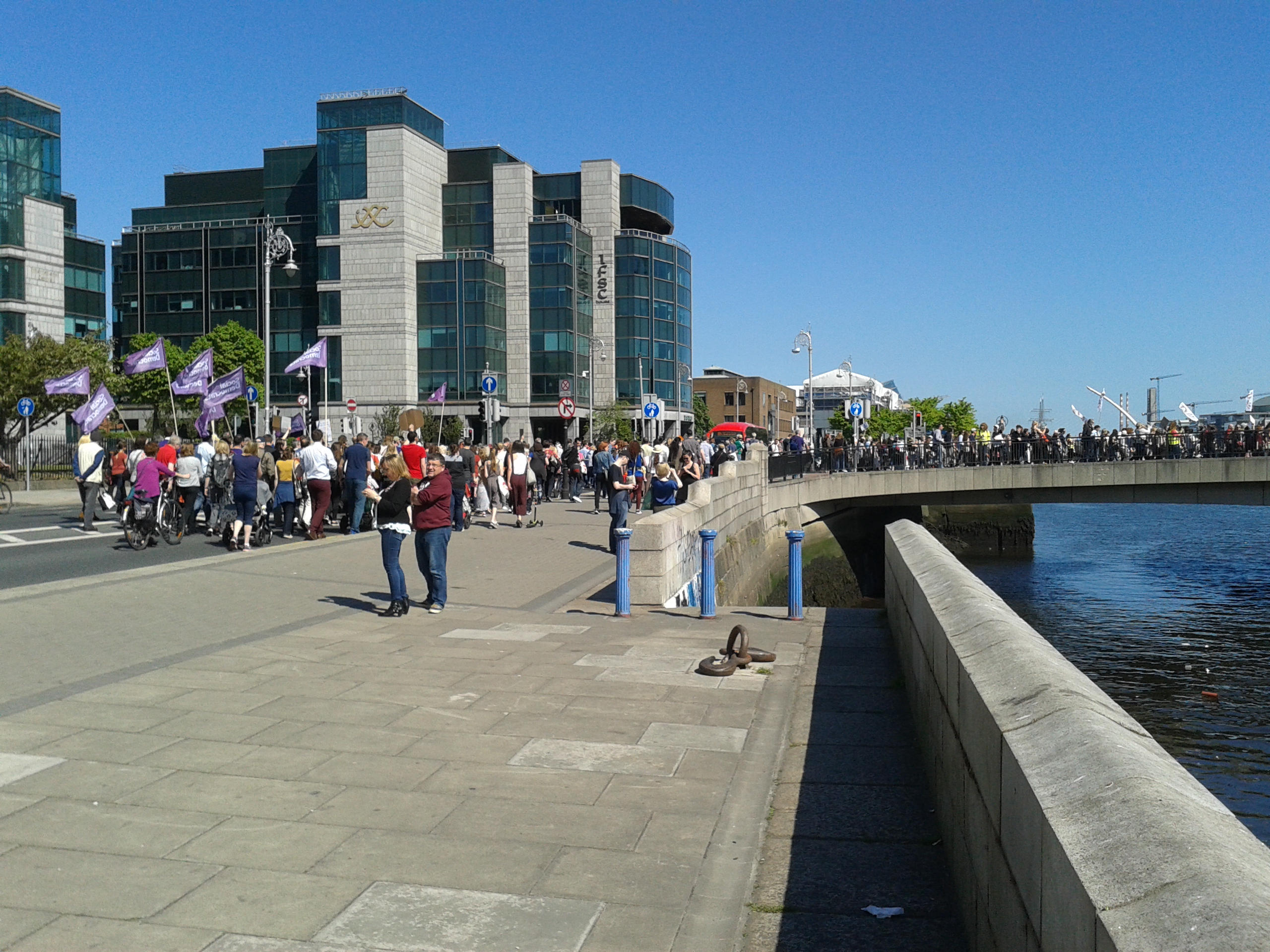
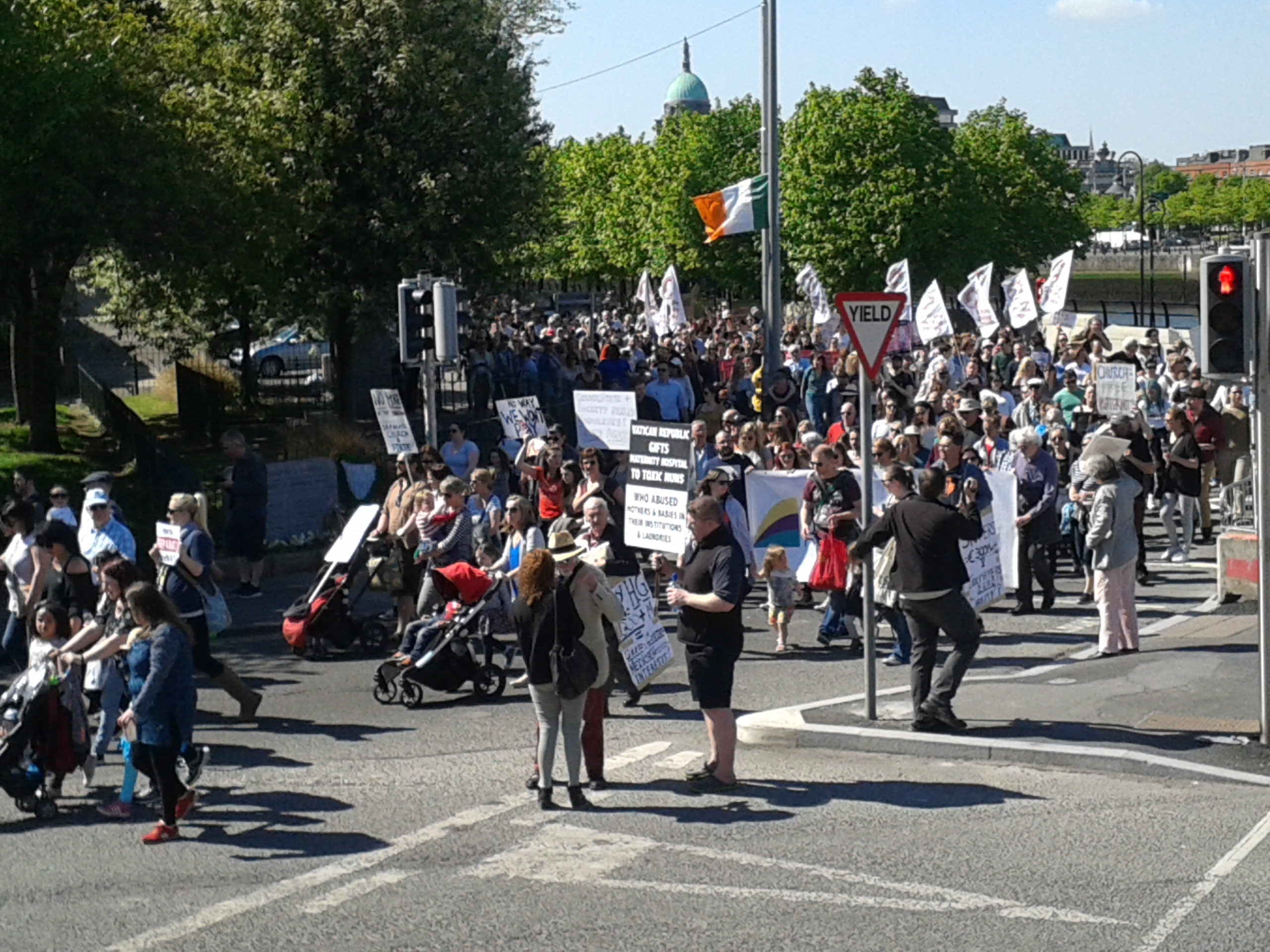
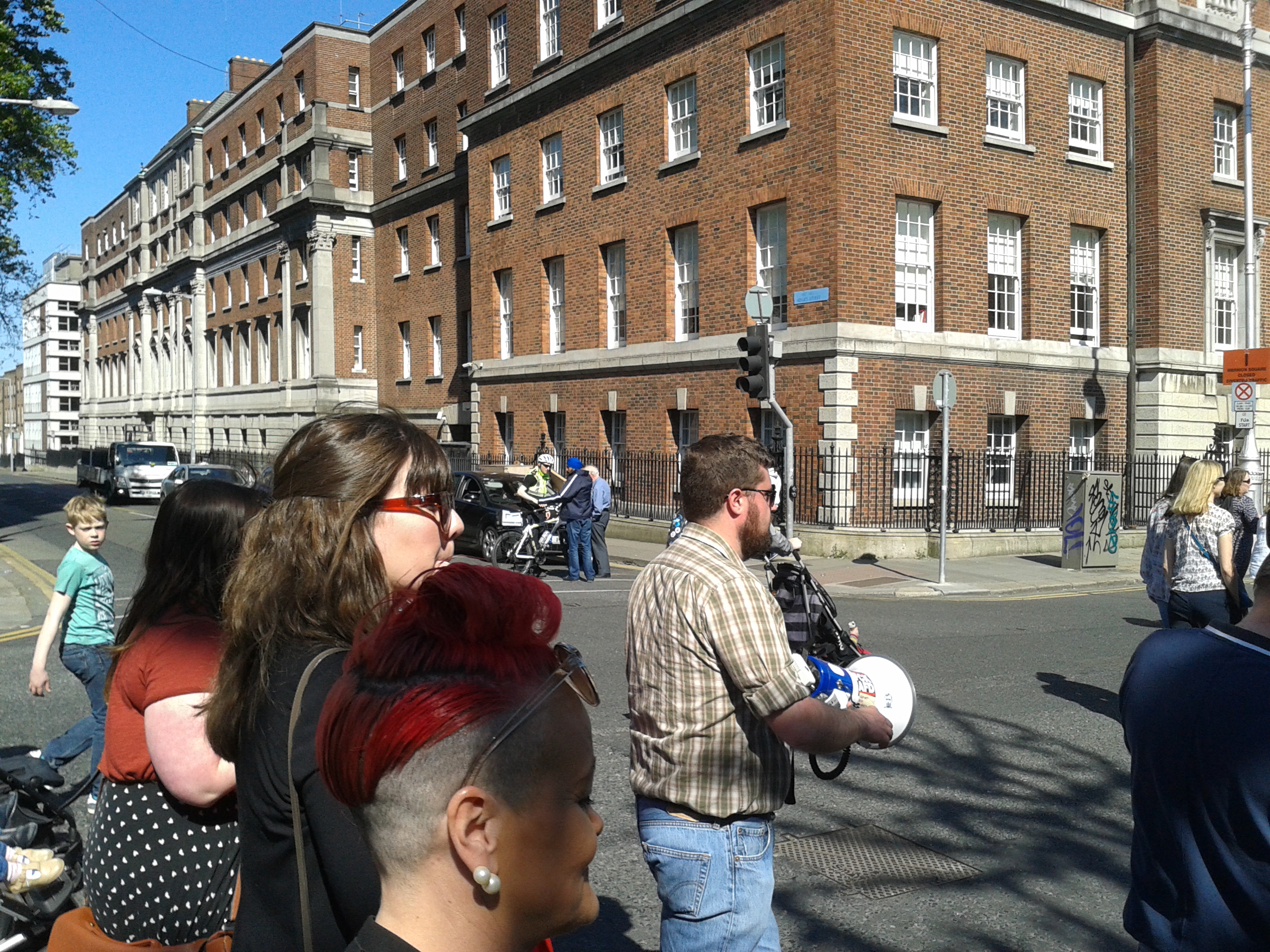
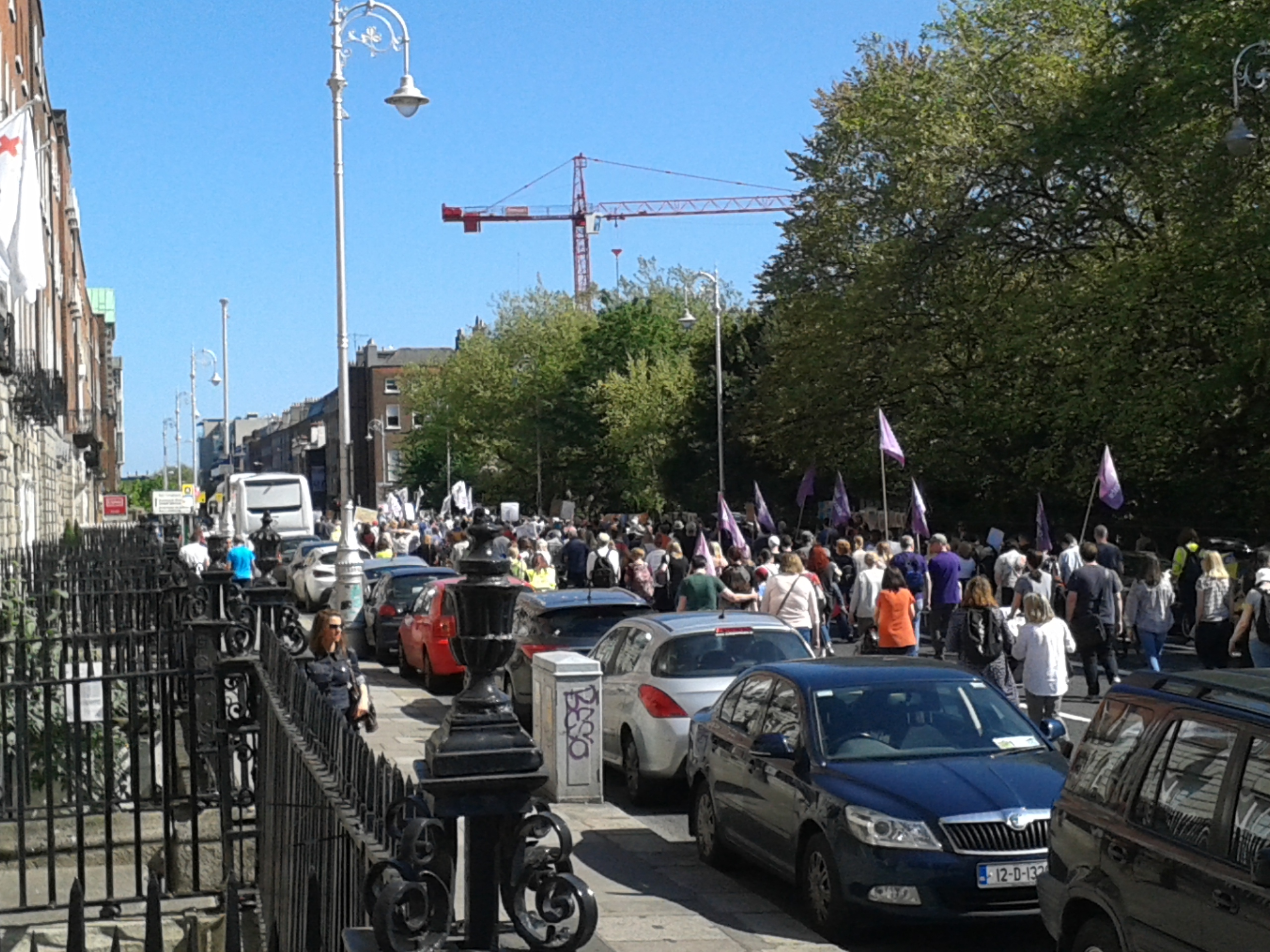
Tens of hundreds, mostly women but also containing some men and couples with children, gathered in bright sunshine today at the Garden of Rembrance and then marched through O’Connell Street in Dublin’s city centre. They continued along the northside quays and across Talbot Memorial Bridge, up past Pearse Station (where Constance Markievicz was welcomed by a huge crowd upon her release from British jail in 1917), then past Hollis St. Hospital to end at the south side of Merrion Square.
Marching along O’Connell Street. (Photo: Rebel Breeze)Rally to start at Garden of Remembrance (Photo: Rebel Breeze)
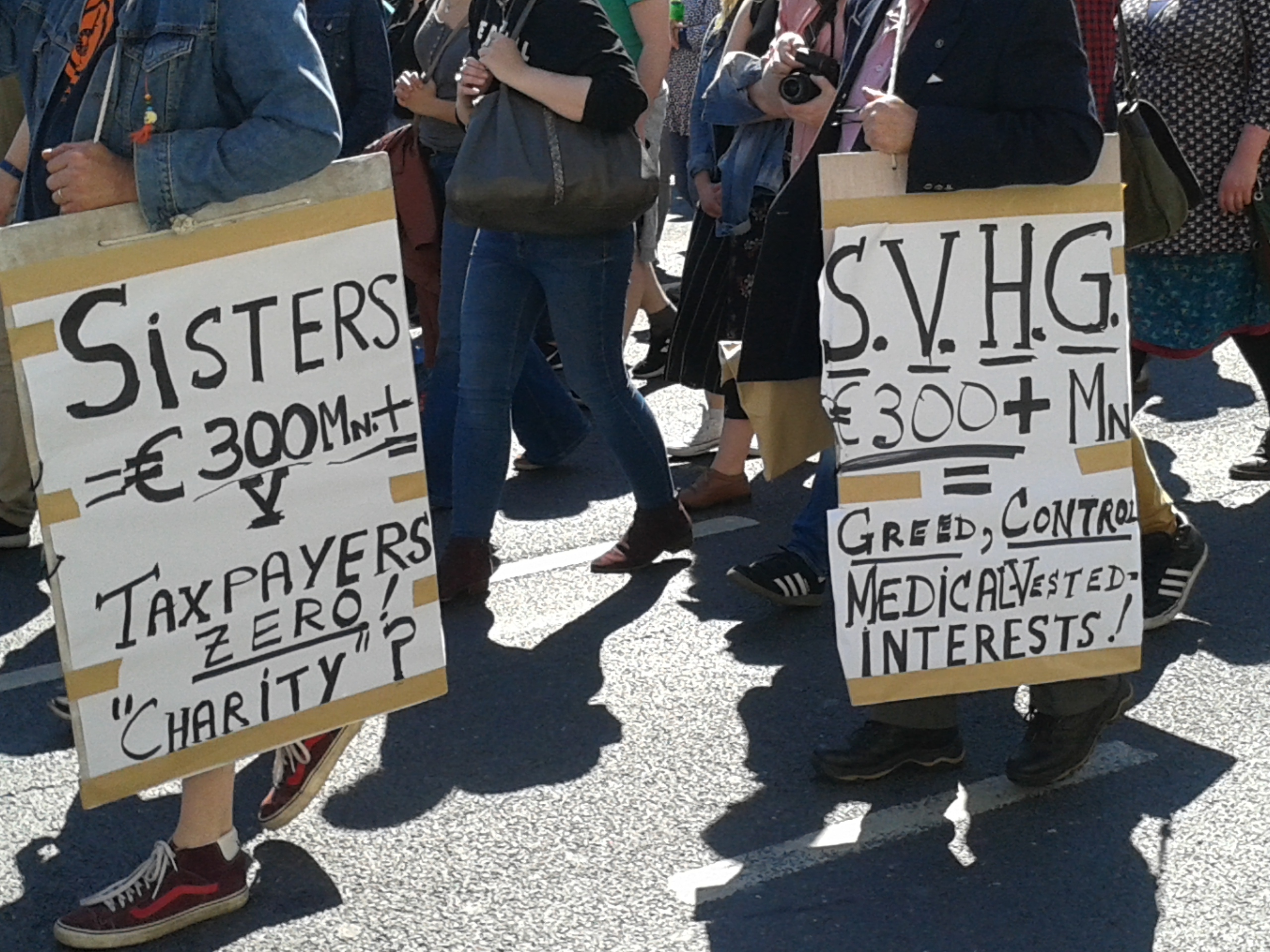
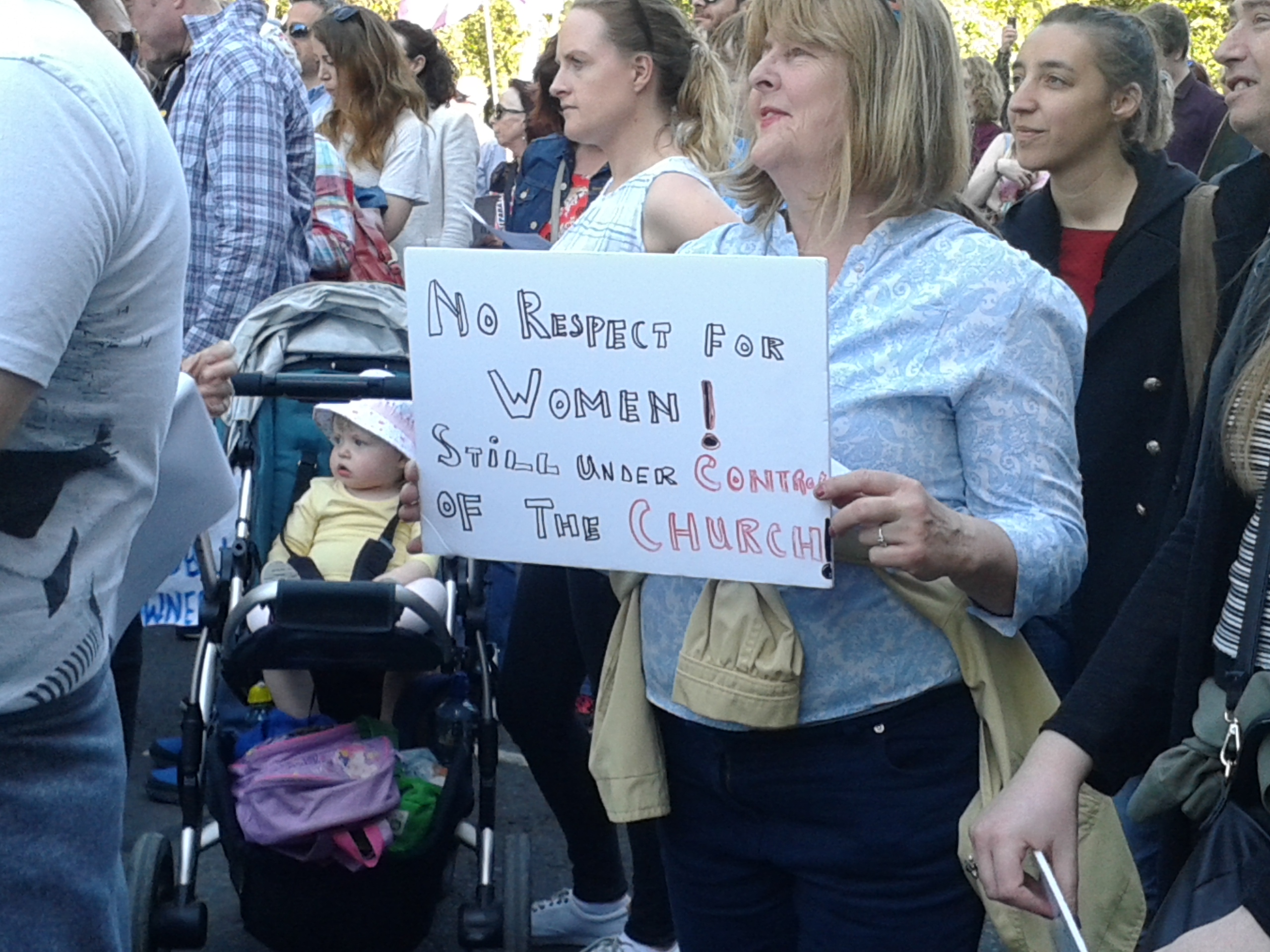
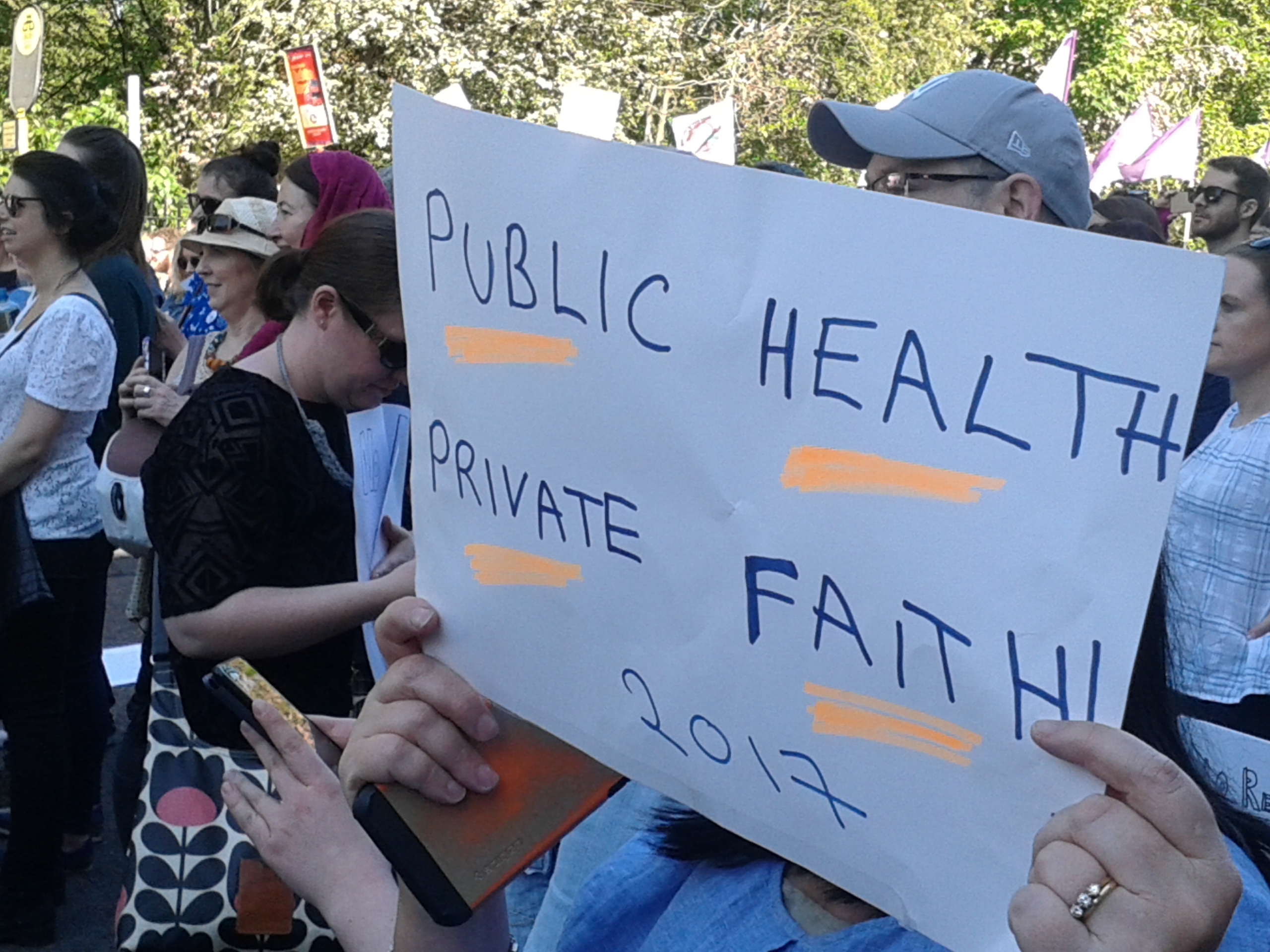
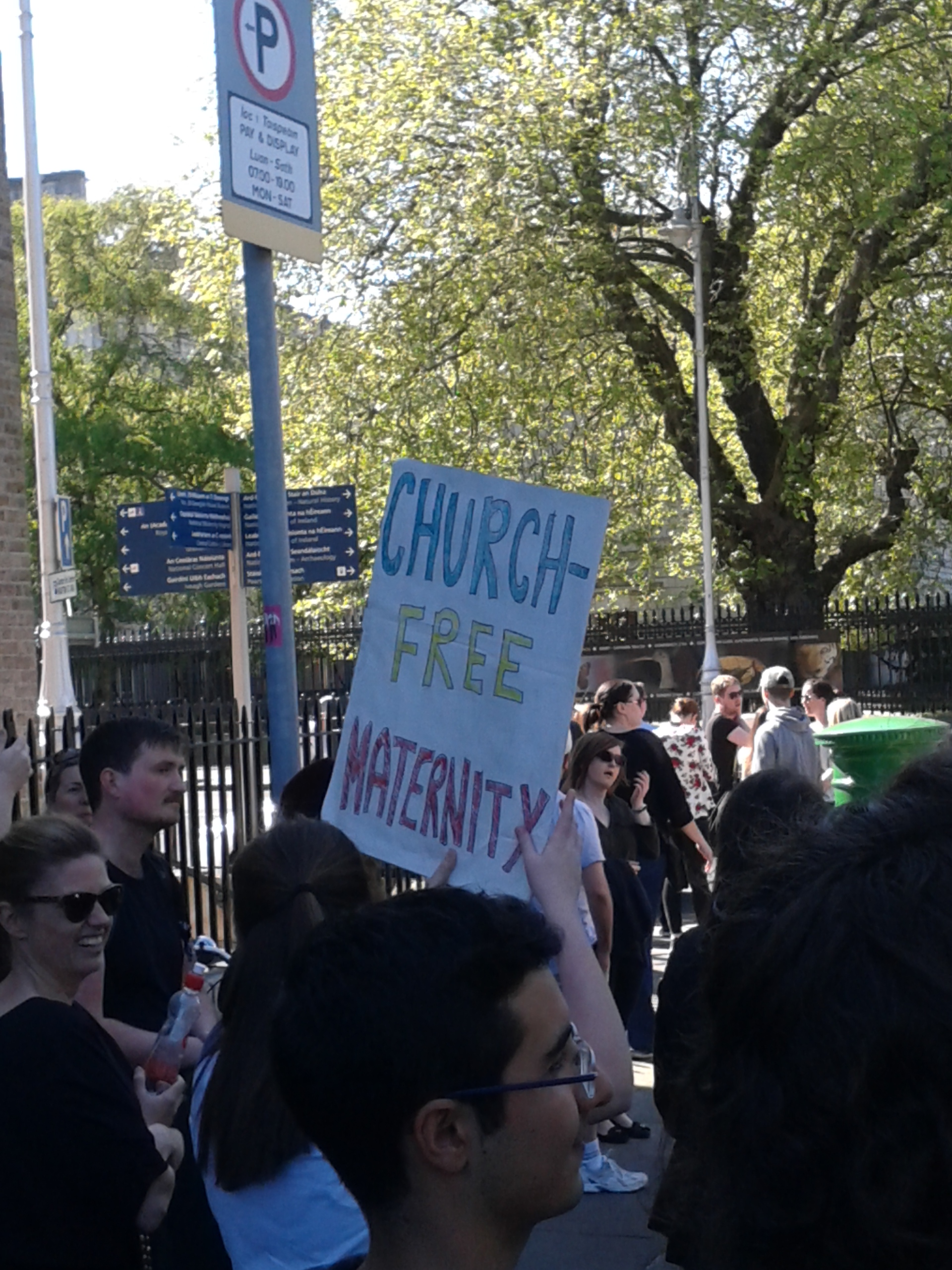
The event was organised by a coalition of Parents for Choice, Uplift, the National Women’s Council of Ireland and Justice for Magdalenes “to send a loud clear message to Health Minister Simon Harris”. The march was part of the ongoing protests against the ownership of the new National Maternity Hospital being given to the religious order the Sisters of Charity but also, as at least one speaker made clear, about the long history in the 26-County state of health services being provided by a combination of Catholic Church and State. Some others on the demonstration made the point that hospitals should be publicly owned and controlled.
Heading east under railway bridge at Butt Bridge. (Photo: Rebel Breeze)
A petition containing 103,700 signatures – on 50 meters of paper was carried by protesters- demanding that the €300m taxpayer-funded hospital be taken into public ownership. The viral petition had been hosted by campaign organisation Uplift and was printed on 50 feet sheets of card, which was laid out like a path on the approach to the rally’s stage.
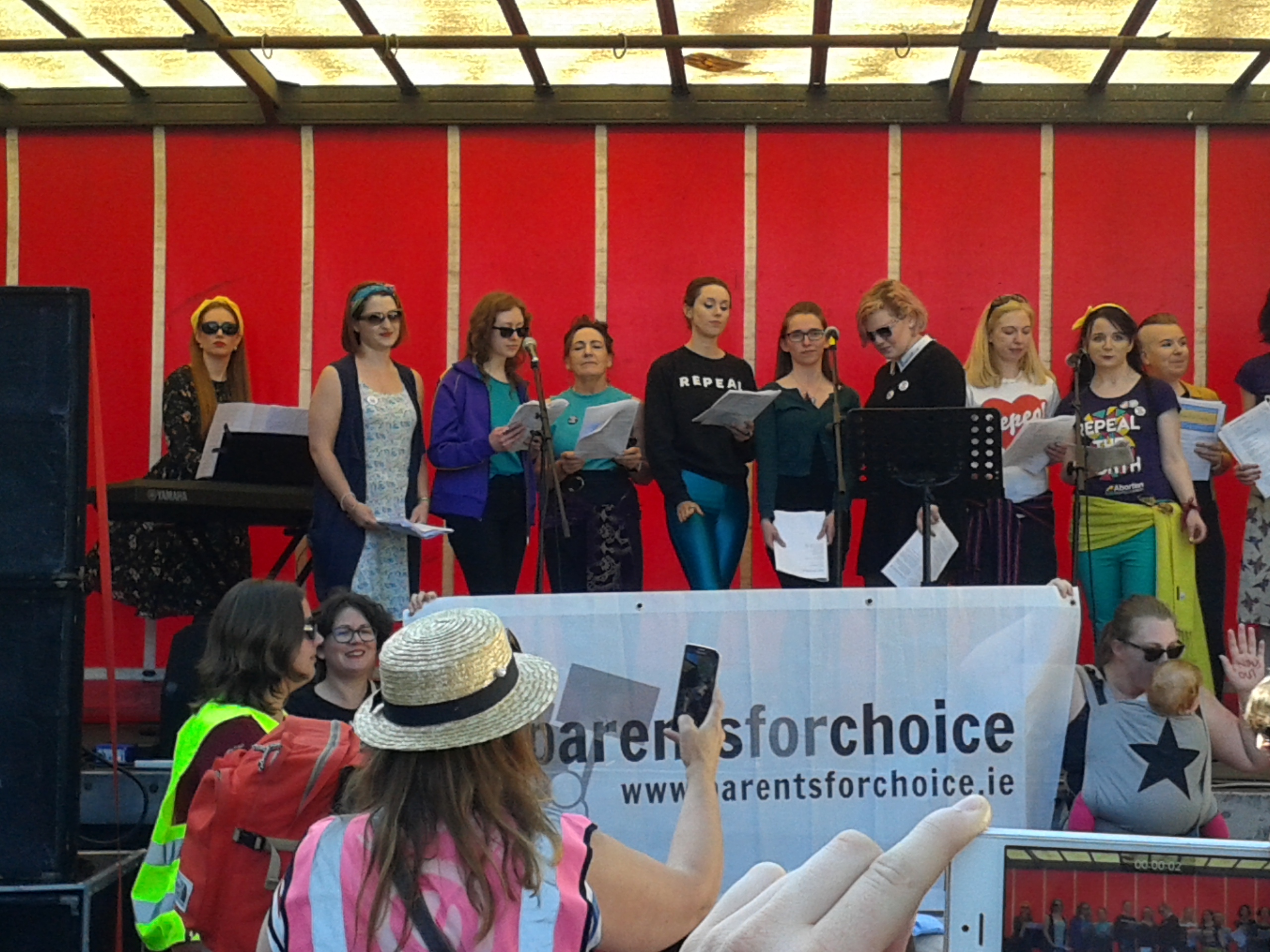
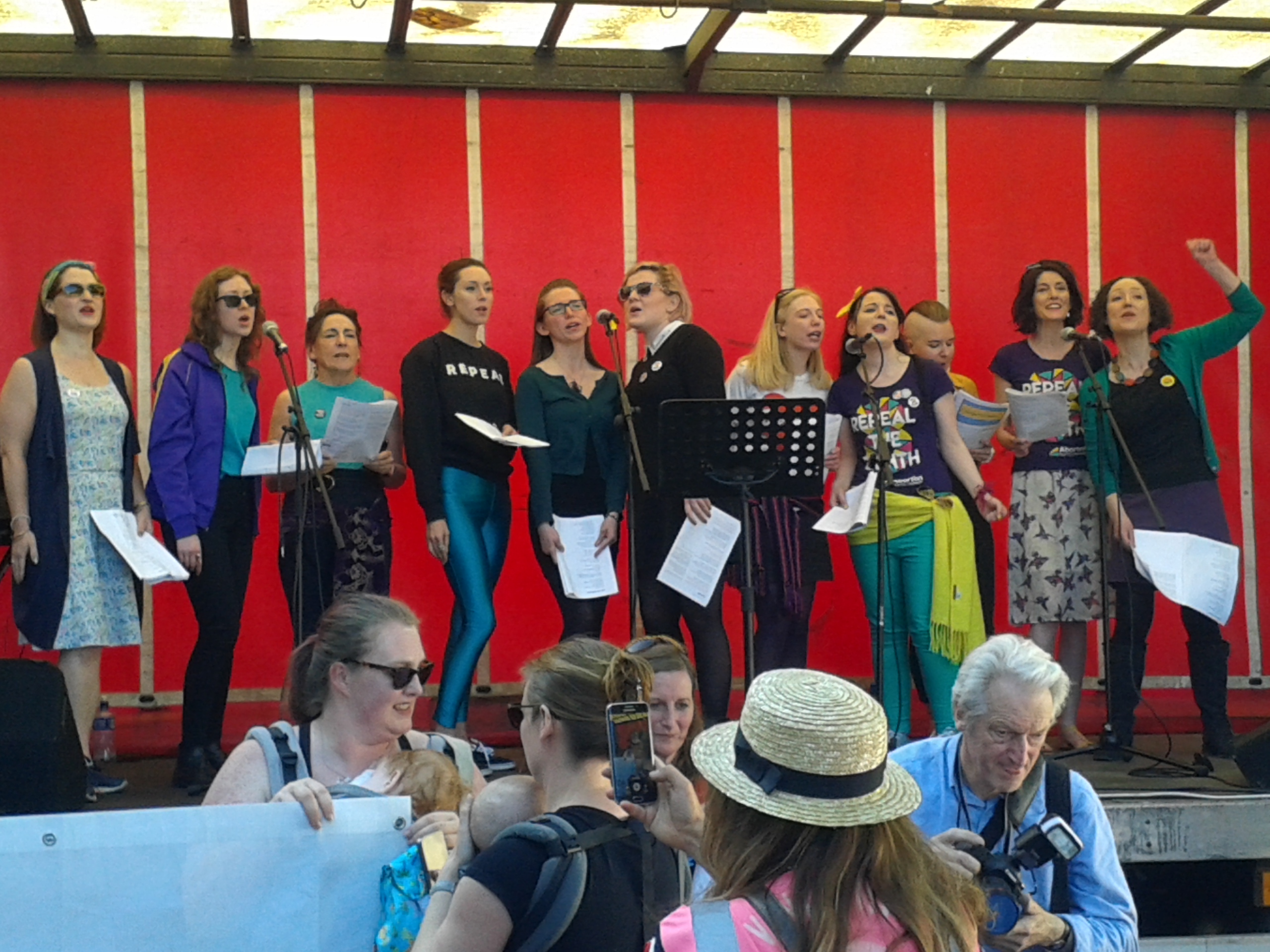
An all-women group called the Repeal Choir sang a number of songs before the speeches at the rally; one of their number announced that they had been formed only a few weeks earlier and they sang with gusto.
(Photo: Rebel Breeze)(Photo: Rebel Breeze)(Photo: Rebel Breeze)(Photo: Rebel Breeze)(Photo: Rebel Breeze)Crossing Talbot Memorial Bridge (Photo: Rebel Breeze)End of march approaching Talbot Memorial Bridge (Photo: Rebel Breeze)Lombard St. and quay junction. (Photo: Rebel Breeze)
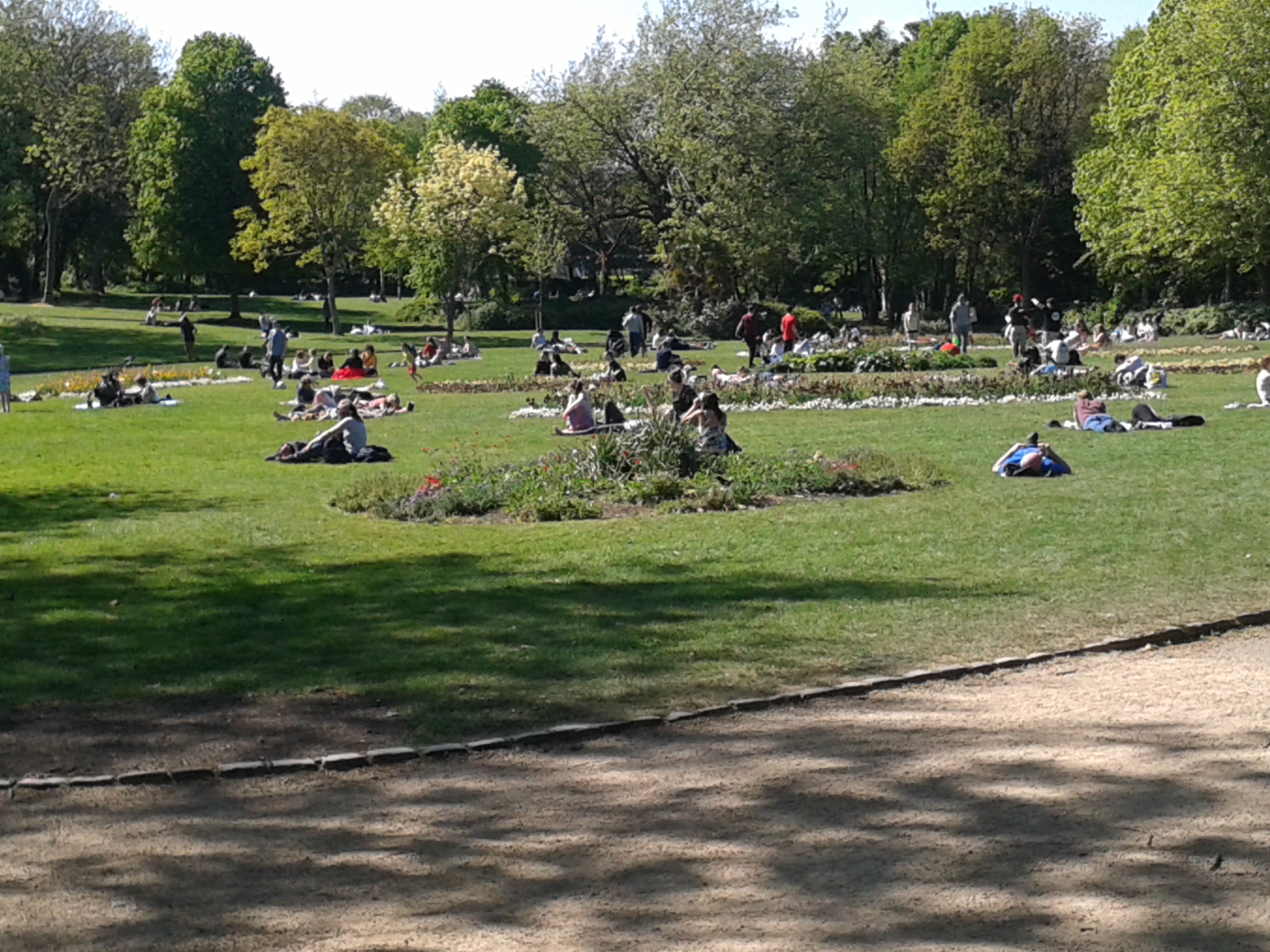
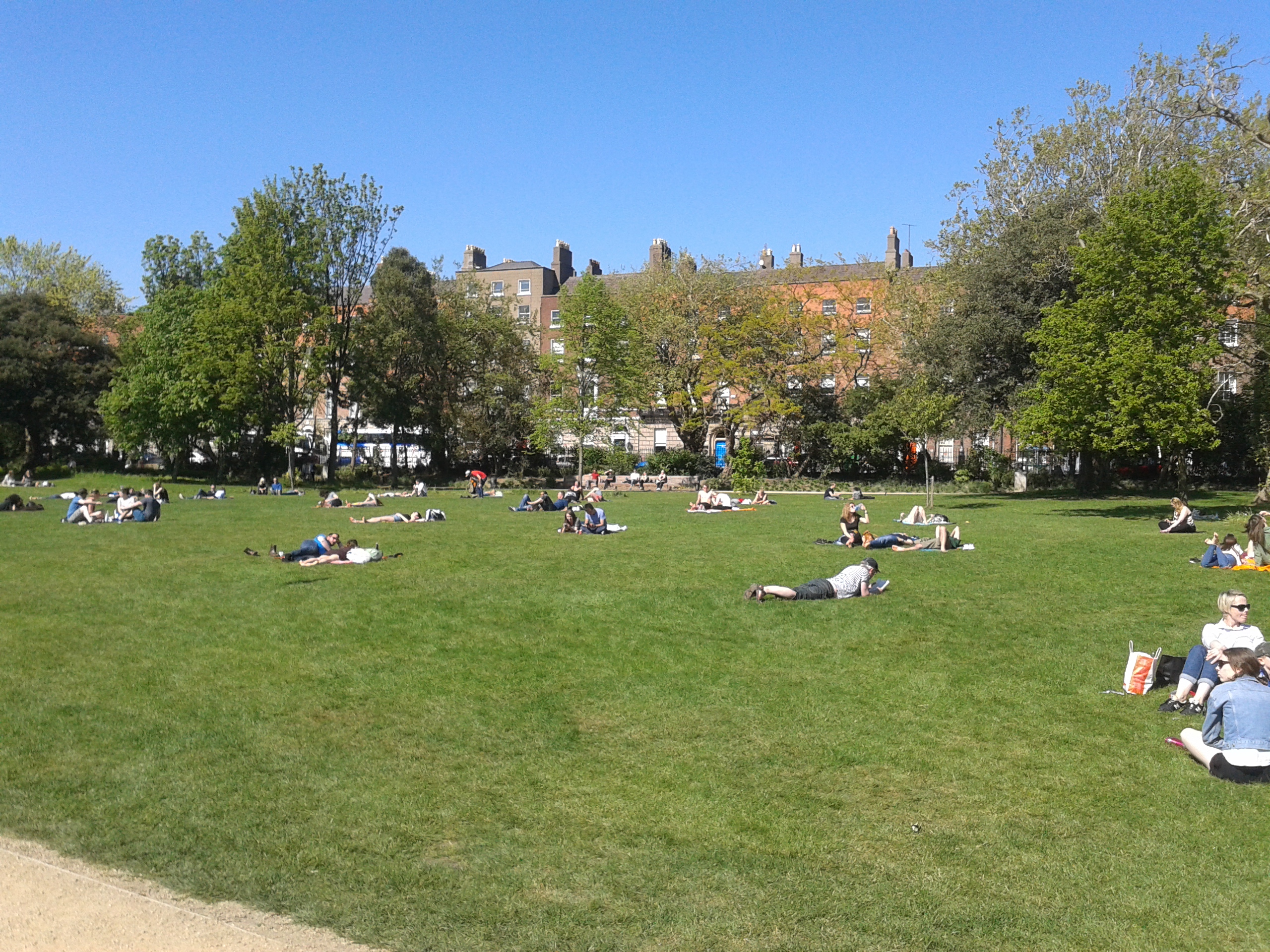
Hollis St and its Hospital. (Photo: Rebel Breeze)Not on the march — sunning themselves in Merrion Square park (Photo: Rebel Breeze)Not on the march — sunning themselves in Merrion Square park (Photo: Rebel Breeze)Not on the march — sunning themselves in Merrion Square park (Photo: Rebel Breeze)Hollis St. Hospital front facing Merrion Square. (Photo: Rebel Breeze)(Photo: Rebel Breeze)
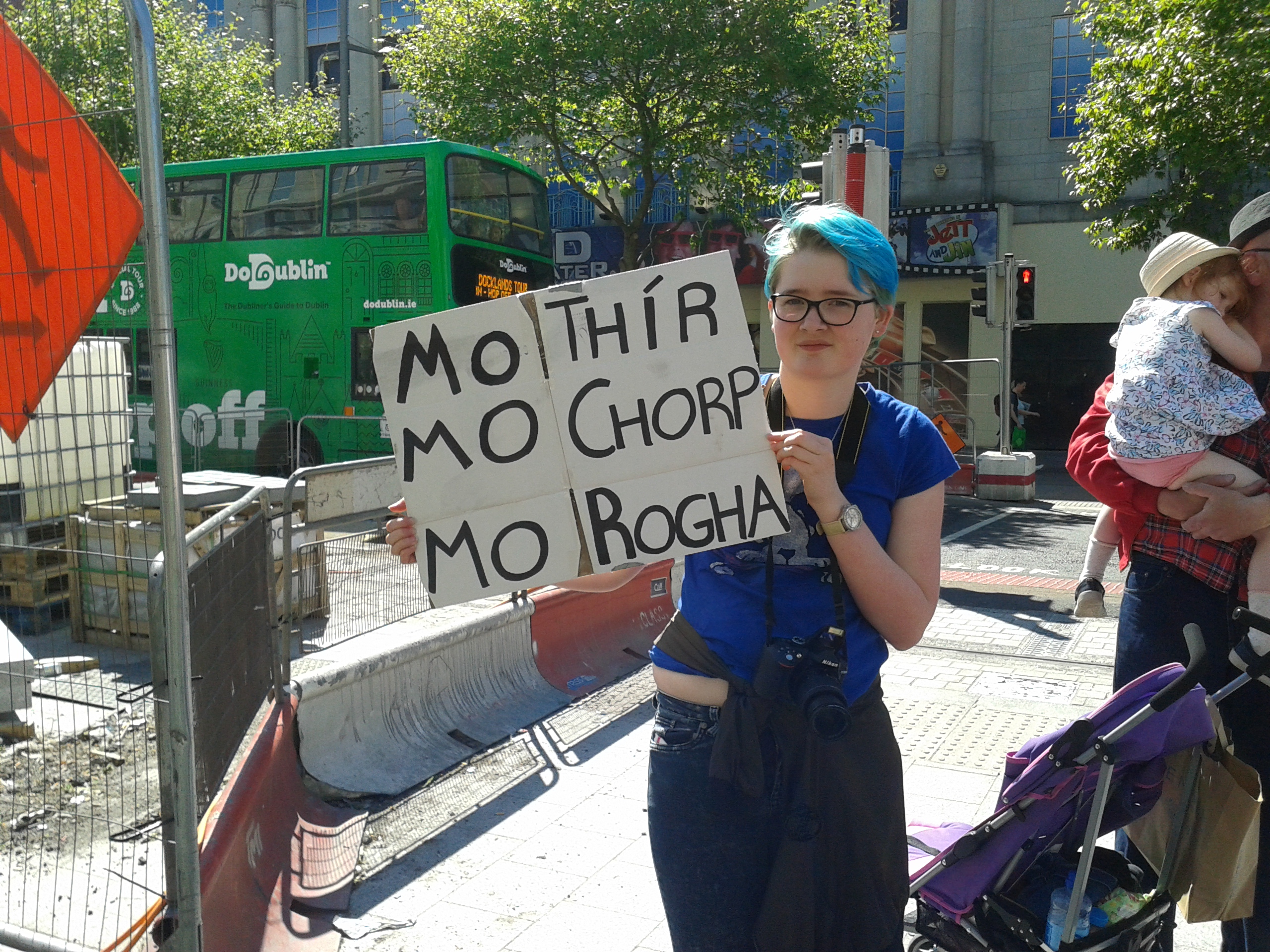
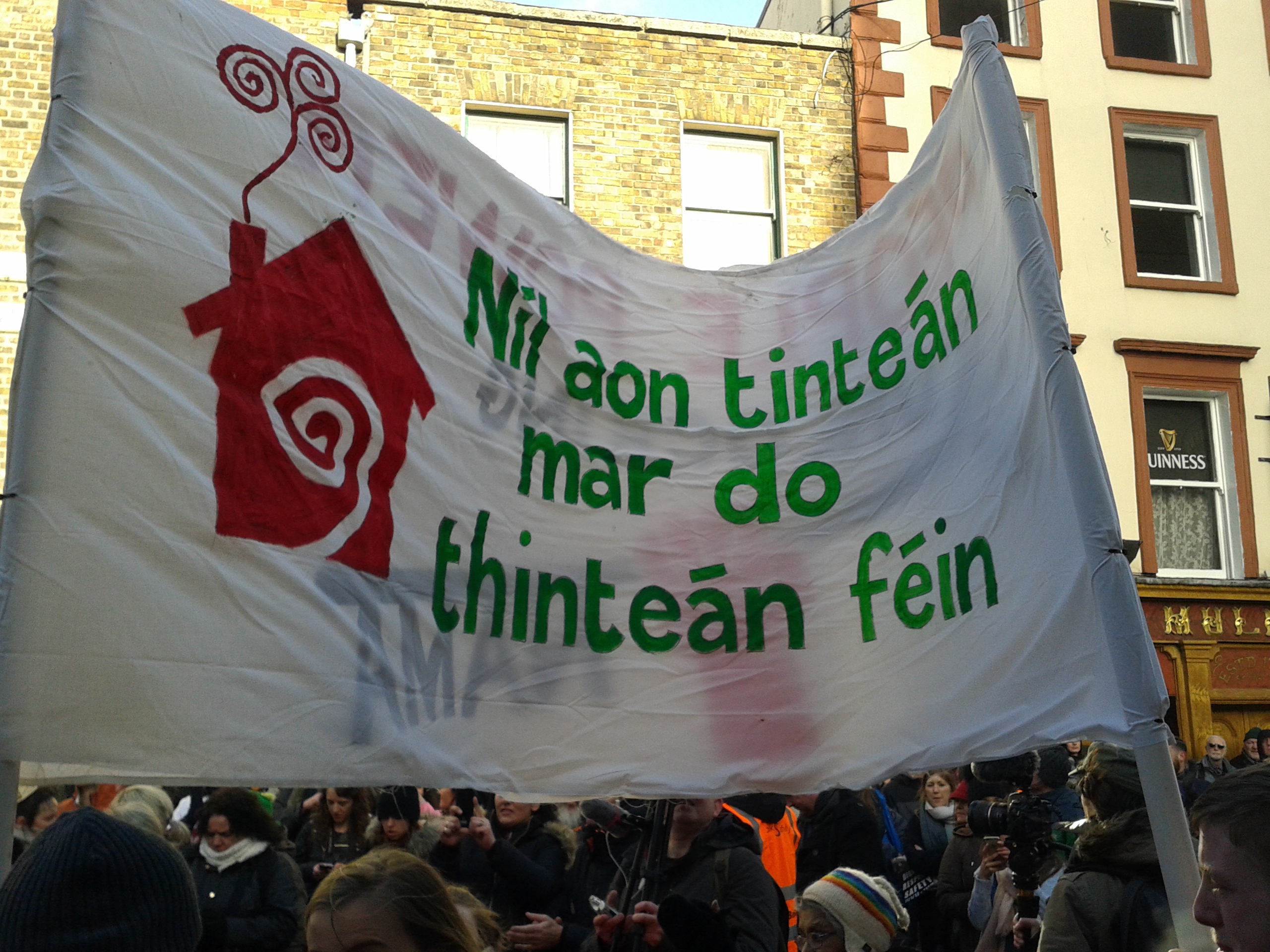
(Photo: Rebel Breeze)The only placard in Irish on the march (Photo: Rebel Breeze)(Photo: Rebel Breeze)(Photo: Rebel Breeze)The Repeal Choir (Photo: Rebel Breeze)
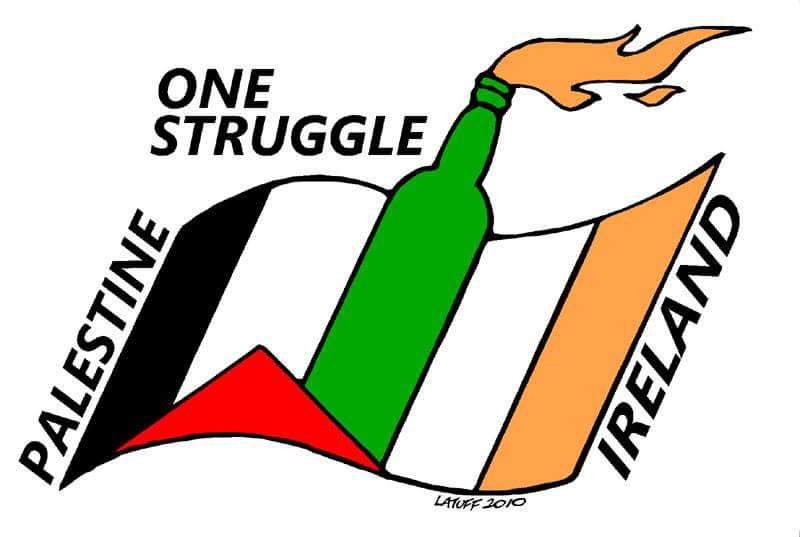
1,500 Palestinian prisoners are in their third week of a hunger strike for dignity: their demands include rights to visits and increase in family visits, access to telephone calls to family and friends and end of solitary confinement. Visits are a particular issue since although the Israeli authorities permit visits every fortnight in theory, they require Palestinians in the occupied territories to obtain permits before permitting them entry to the Israeli state, which is where the prisoners are being held and these are often refused or delayed. Protests and other actions in solidarity with the Palestinian hunger strikers have been and are taking place around the world.
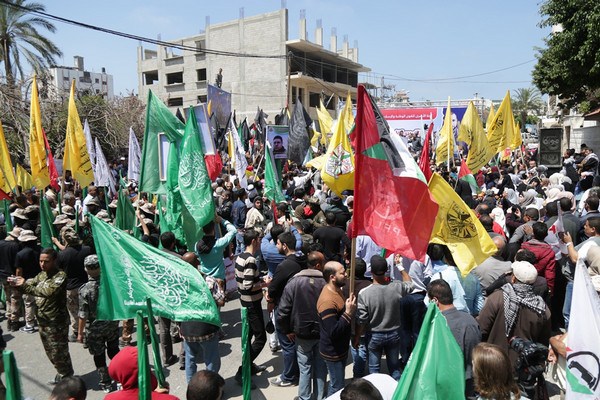
Demonstration in Gaza, joining different groups — worth watching to the end, seeing how the event grows and new flags join
IN IRELAND
The Ireland Palestine Solidarity Campaign have organised a number of events (see their FB page for some photos and reports). But in addition, various protests have been and are being organised by various other groups, campaigns and political organisations/ parties. Also messages of Palestinian solidarity have been incorporated into many other events, for example commemorating the Easter Rising of 1916 and the subsequent Executions by the British Occupation, or celebrating International Workers’ Day.
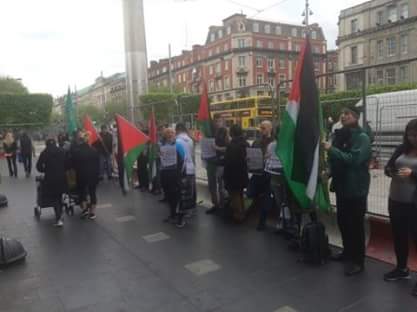
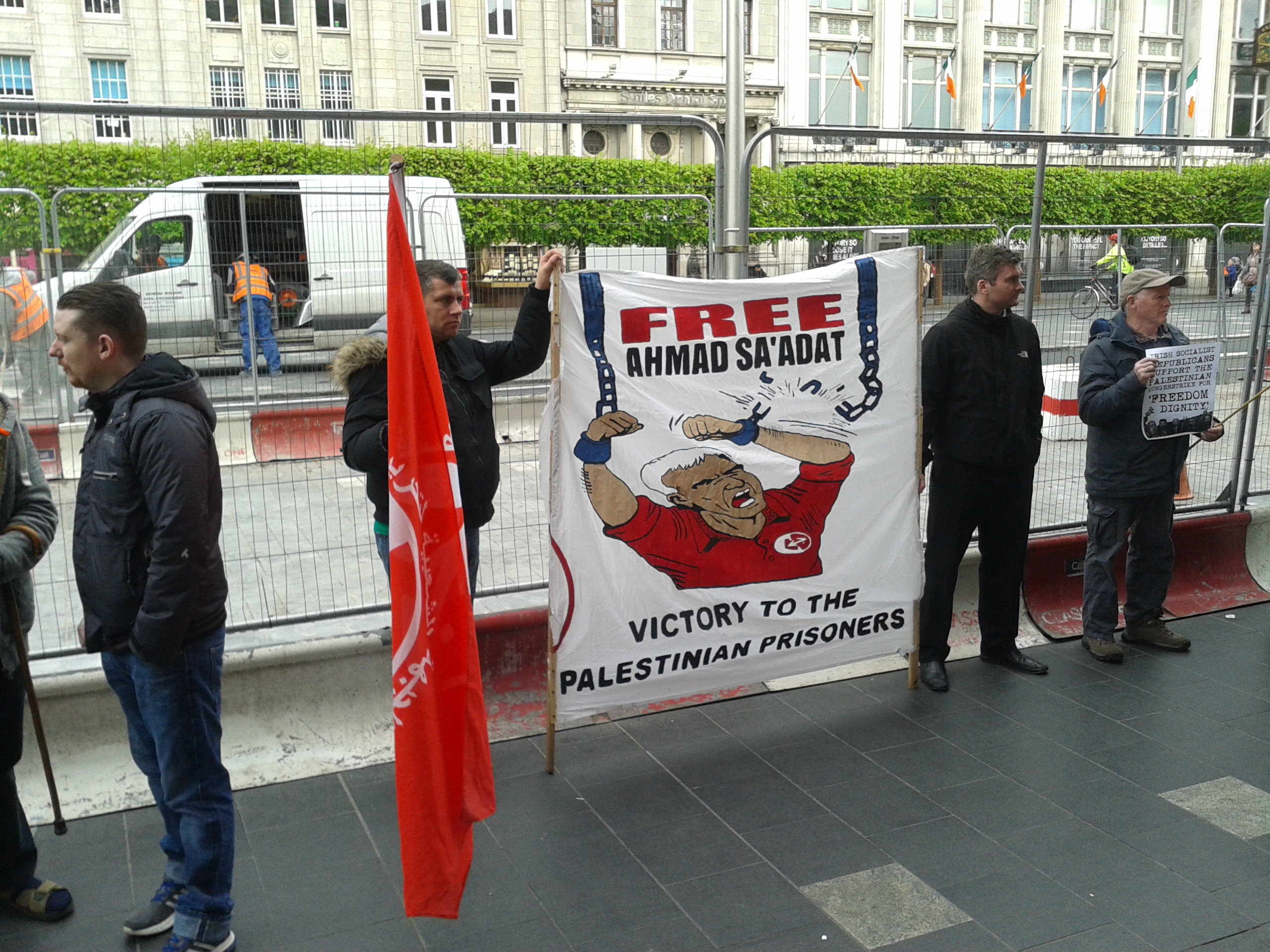
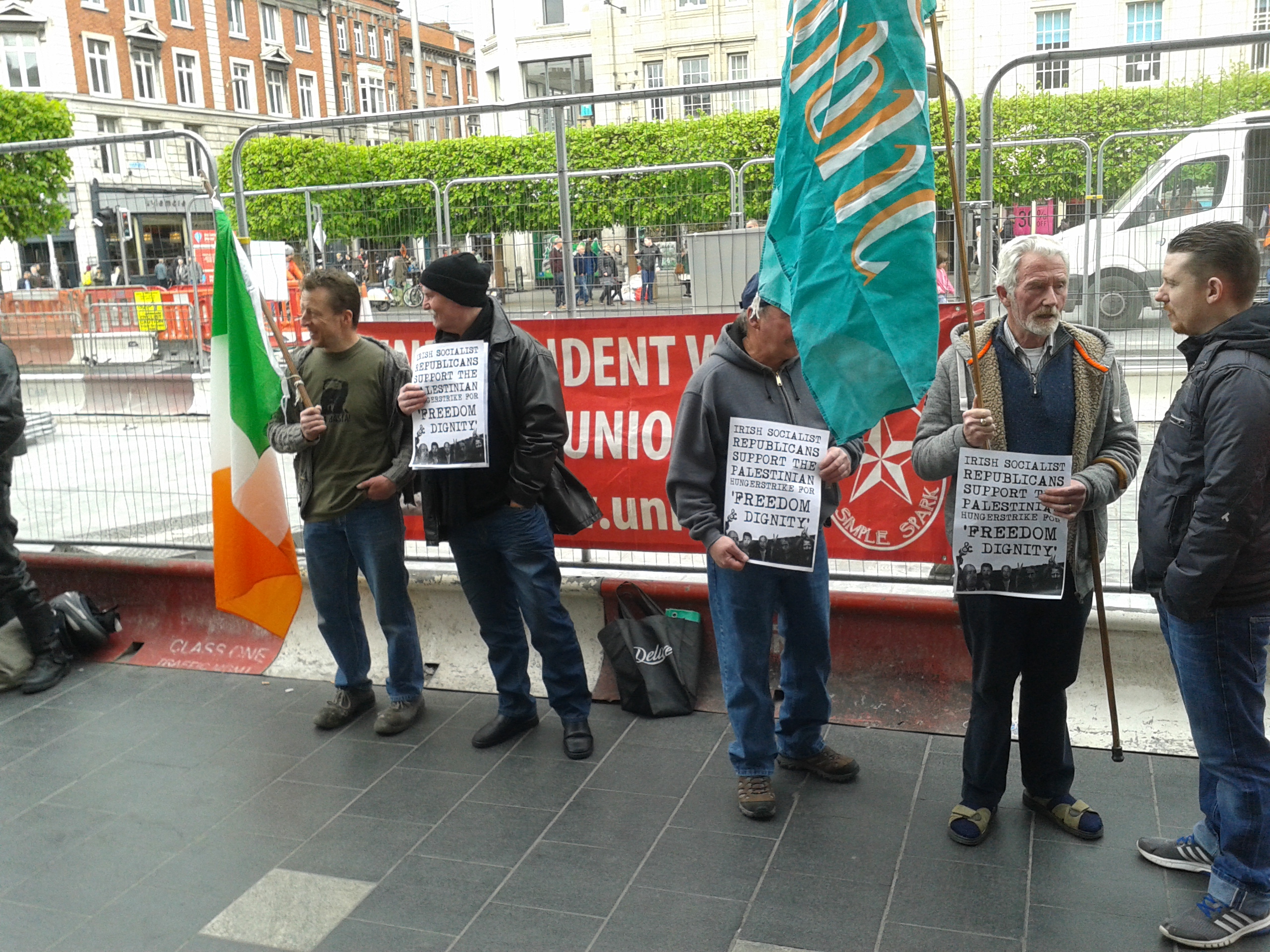
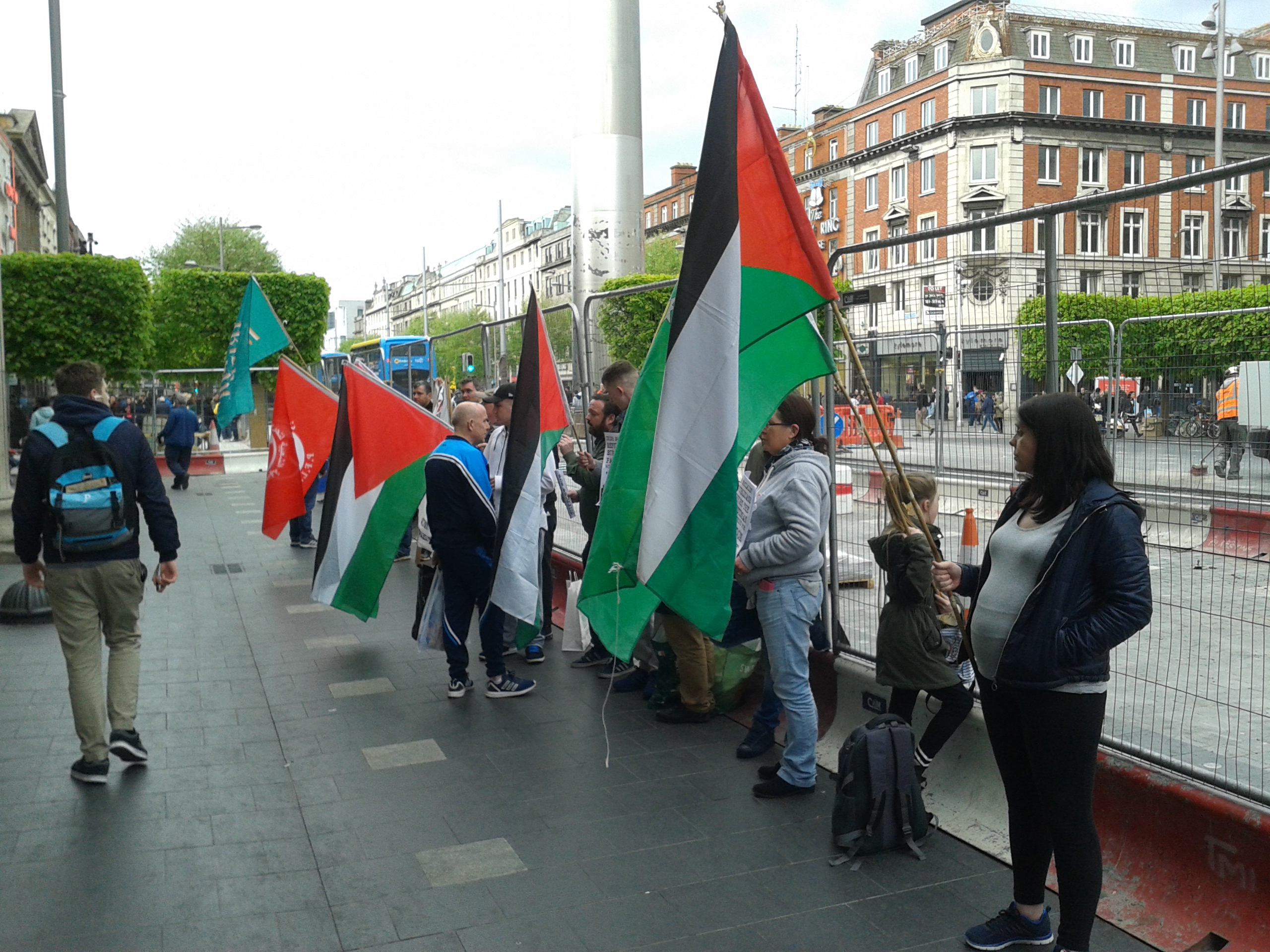
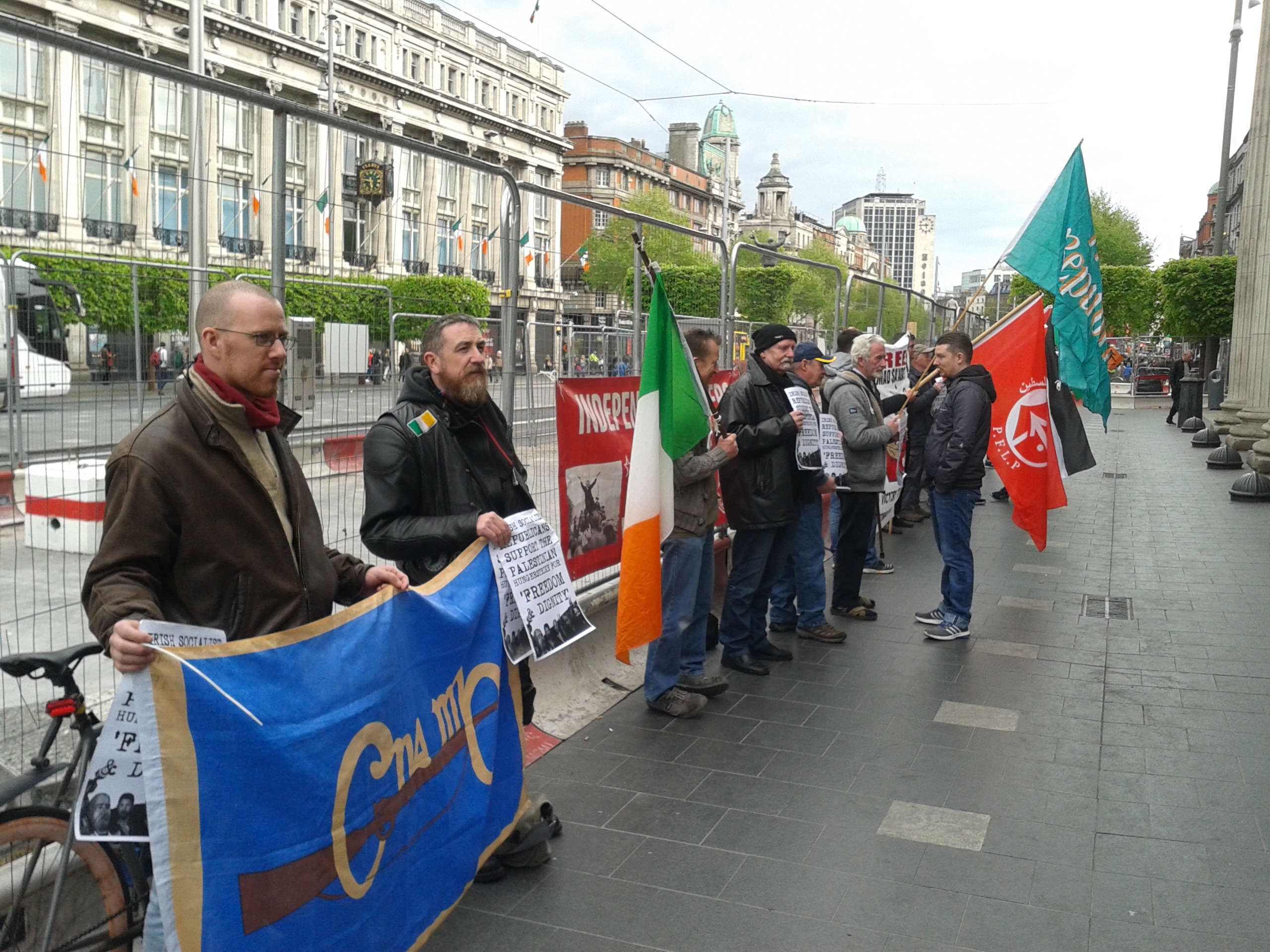
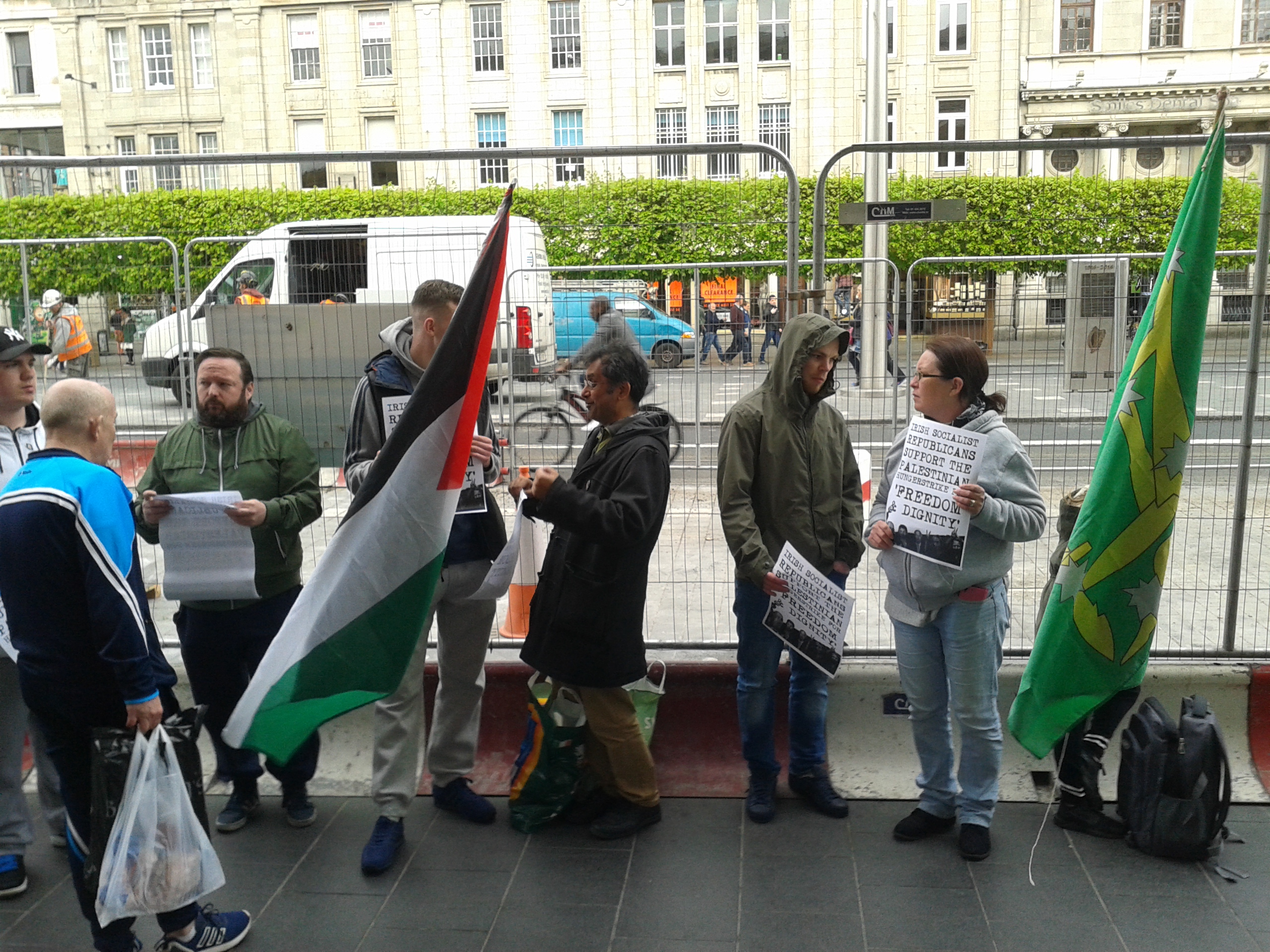
For example, the non-aligned Socialist Republicans for Palestine organised an event on 28th April in Dublin’s main street (photos below) on 28th April.
Line of solidarity protesters looking northwards from outside the GPO, O’Connell (main) Street, Dublin (Photo source: Socialist Republicans for Palestine)
Banner of Independent Workers’ Union (Photo: D.Breatnach)
Line of solidarity protesters looking souththwards from outside the GPO, O’Connell (main) Street, Dublin (Photo: D.Breatnach)
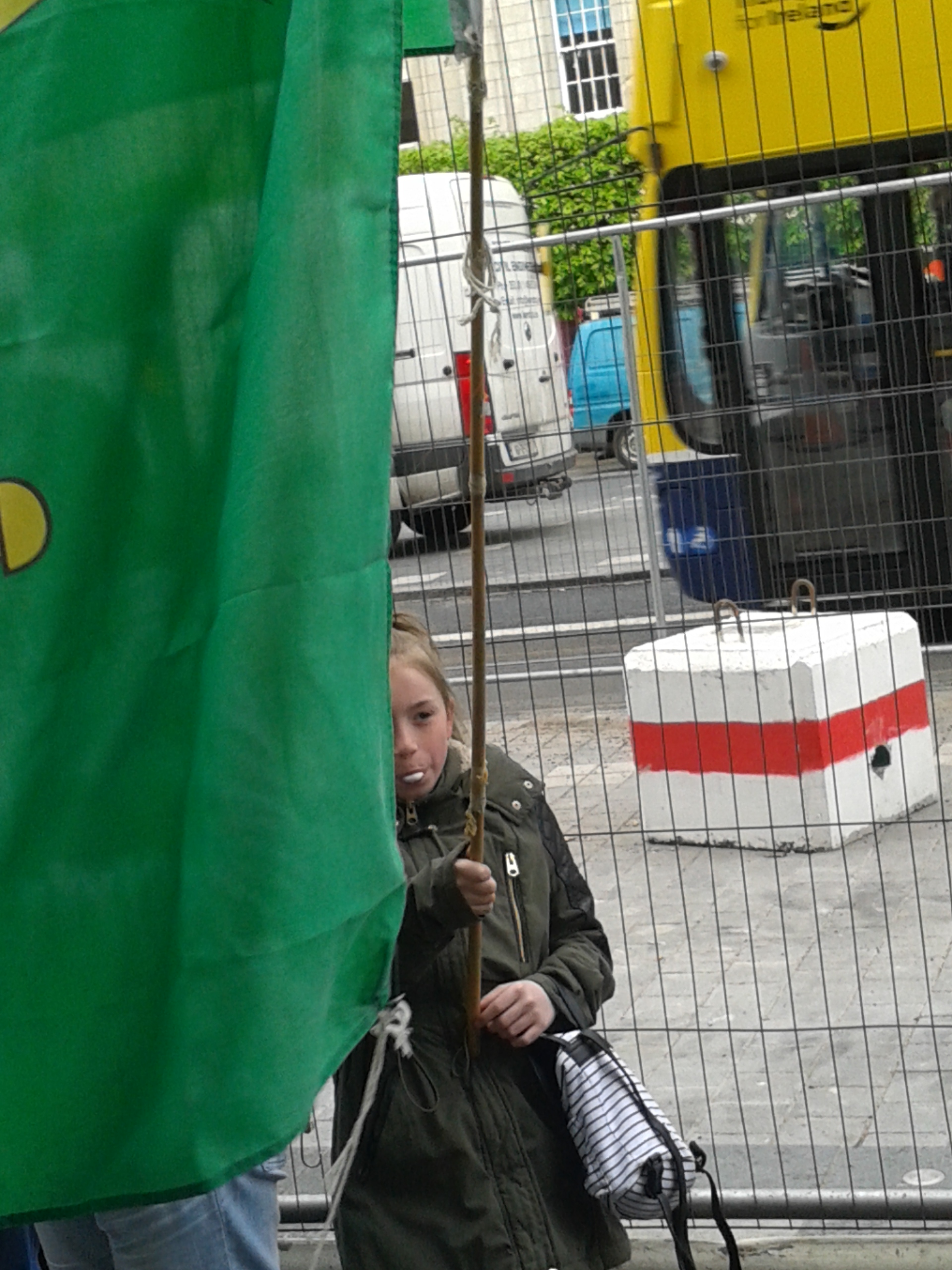
A young supporter holding the Starry Plough, flag of the Irish Citizen Army, a workers’ militia formed in Dublin in 1913.
Upcoming in Dublin:
Organised by Anti-Internment Group of Ireland (see End Internment Facebook page): protest in solidarity with Irish and Palestinian political prisoners at 2pm Saturday in Dublin, Henry St./ Liffey St. junction.
PALESTINE INSIDE THE JAILS
“On Thursday, repressive units continued to invade prisoners’ sections in Ramon prison following a raid on striking prisoners’ sections in Ashkelon prison on Tuesday, when striking prisoners were assaulted for refusing to stand up for inspection. Palestinian lawyer Karim Ajwa reprted that five prisoners were wounded in the face and head and taken to the prison clinic. Ajwa also said that internal disciplinary hearings were conducted against the hunger strikers and sanctions imposed on them as well as fines of 500 NIS ($125) each; he said that salt was also taken from the prisoners in an attempt to break the strike. After 11 days of denials, Ajwa finally obtained a legal visit with Nasr Abu Hmeid and Said Musallam, who also reported that the striking prisoners are boycotting medical examinations and that there are serious health concerns for the ill prisoners participating in the hunger strike.” (from Samidoun, see link)
POLITICAL SECTARIANISM IN PALESTINE
“Meanwhile, in Nablus, Palestinian former prisoners and long-term hunger strikers Khader Adnan and Mohammed Allan, as well as Palestinian Prisoners’ Committee coordinator Maher Harb, were attacked and then detained for several hours by Palestinian Authority security forces before being released, as they participated in a march to support the prisoners. The prisoners of the Popular Front for the Liberation of Palestine, the Democratic Front for the Liberation of Palestine and Islamic Jihad issued a message from Israeli prisons in support of Khader Adnan, denouncing “desperate attempts by some parties to incite against the activist Khader Adnan as a prelude to physical tageting,” and saying that Adnan is a symbol of unity and resistance who is threatened by the occupation.” (Samidoun)
IN THE COMMUNITIES IN PALESTINE
“As part of the protests on Thursday in support of the prisoners, Israeli occupation forces shot two Palestinians in the legs and wounded dozens more due to tear gas inhalation in al-Khalil on Thursday as Palestinian youth protested in support of hunger-striking Palestinian prisoners. In Issawiya, occupation forces dismantled the solidarity tent set up in the village in support of Palestinian prisoners on hunger strike, storming it and then confiscating the materials. In Shuafat refugee camp and Silwan, Israeli occupation forces attacked protesting Palestinian Jerusalemites supporting the hunger striking prisoners. One shop owner was reportedly seized by Israeli forces in the city of Jerusalem after Israeli occupation forces attempted to forcibly compel shop owners to break the strike and open their doors, which they refused.” (Samidoun)
In Gaza, the demonstrators in addition to supporting the prisoners on hunger strike called for “freedom for Georges Abdallah and Bagui Traore in French prisons. Georges Ibrahim Abdallah is the imprisoned Arab communist struggler for Palestine who has spent over 32 years in French prisons. …. Bagui Traoré is the brother of Adama Traoré, killed in French police custody on 19 July 2016. Bagui is the main witness of his brother’s death; since the killing of Adama, Bagui has been imprisoned, first sentenced to eight months in prison for allegedly hitting police and then accused of involvement in shooting towards police and gendarmes in the protests against the killing of Adama.” (Samidoun)
Gaza demonstration showing flags of mixed political allegiances (Photo: Samidoun)
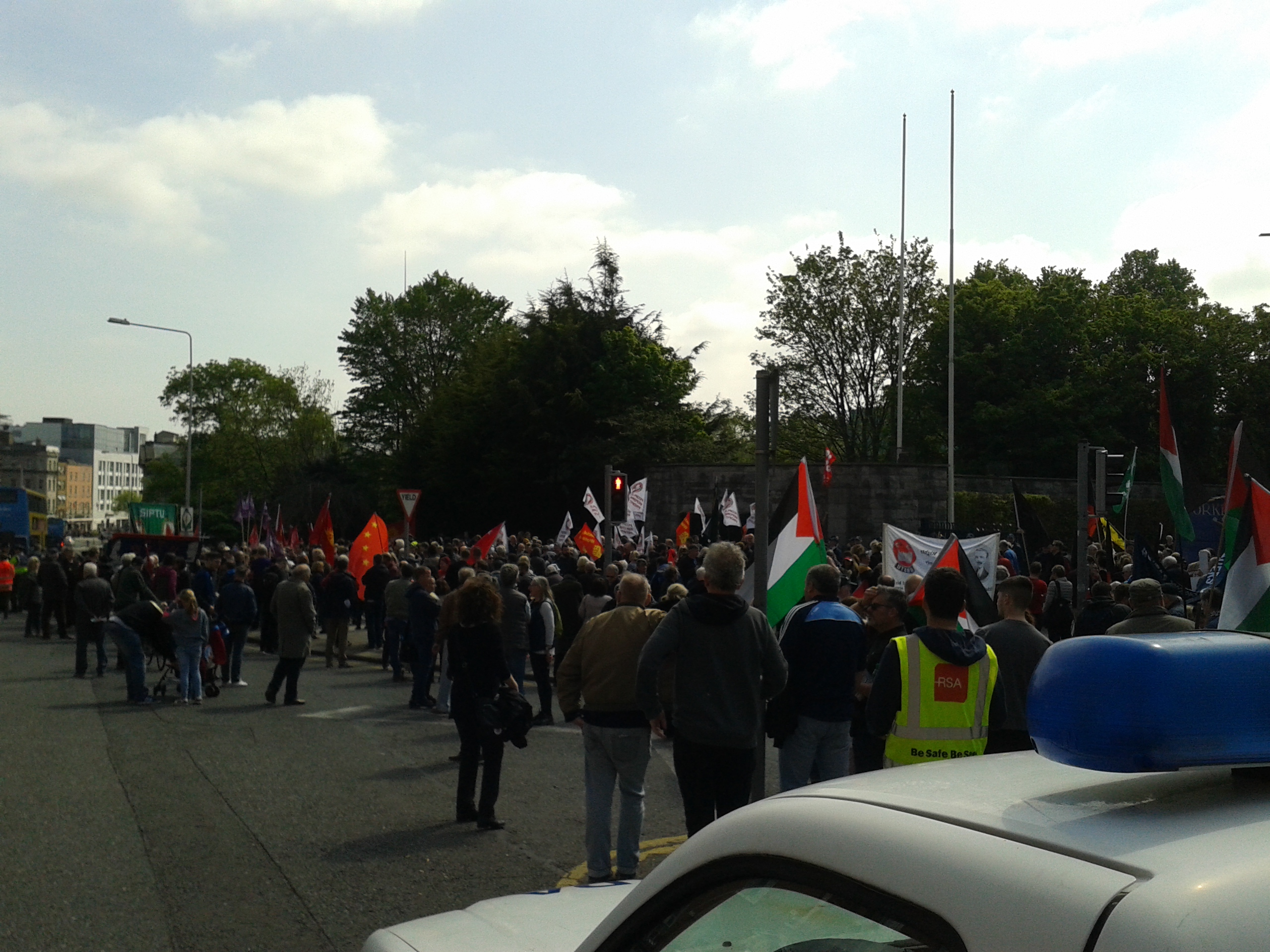
May 1st, International Workers’ Day was celebrated in warm sunshine in Dublin with a parade and rally organised by the Dublin Council of Trade Unions and a later event organised by the Independent Workers’ Union.
Crowd scene outside Garden of Remembrance, the starting point of the DCTU march
The DCTU-organised event met at the Garden of Remembrance at 2pm and set off at nearly 3pm, with numbers although still small by European standards nevertheless larger than has been seen for some time in Dublin, according to the organisers filling O’Connell Street, the city’s main street throughout its whole length (500 metres or 547 yards).
Seen on the parade were trade union banners, those of some political parties, also of campaigns and community groups.
As it has been doing for years, the parade ended in a rally in Beresford Place, in front of Liberty Hall, the very tall building owned by the SIPTU trade union, where the audience were addressed by speakers from trade unions and campaigns and NGOs.
Section of crowd at rally in Beresford Place
Curiously, soon after arrival the comparatively strong showing of Sinn Féin flags, the green one with their logo and the blue and white version of the Starry Plough, were nowhere to be seen.
Similar section with some banners noticeably missing
The issues of lack of affordable housing, of public land being sold for private housing and speculation, of precarious employment, of financial speculation and cuts in services were addressed by speakers, with a mention also of solidarity for the Palestinian prisoners on hunger strike. A number of speakers also addressed the treatment of migrants and in particular the conditions suffered by refugees in the Direct Provision hostels of the state’s welfare service.
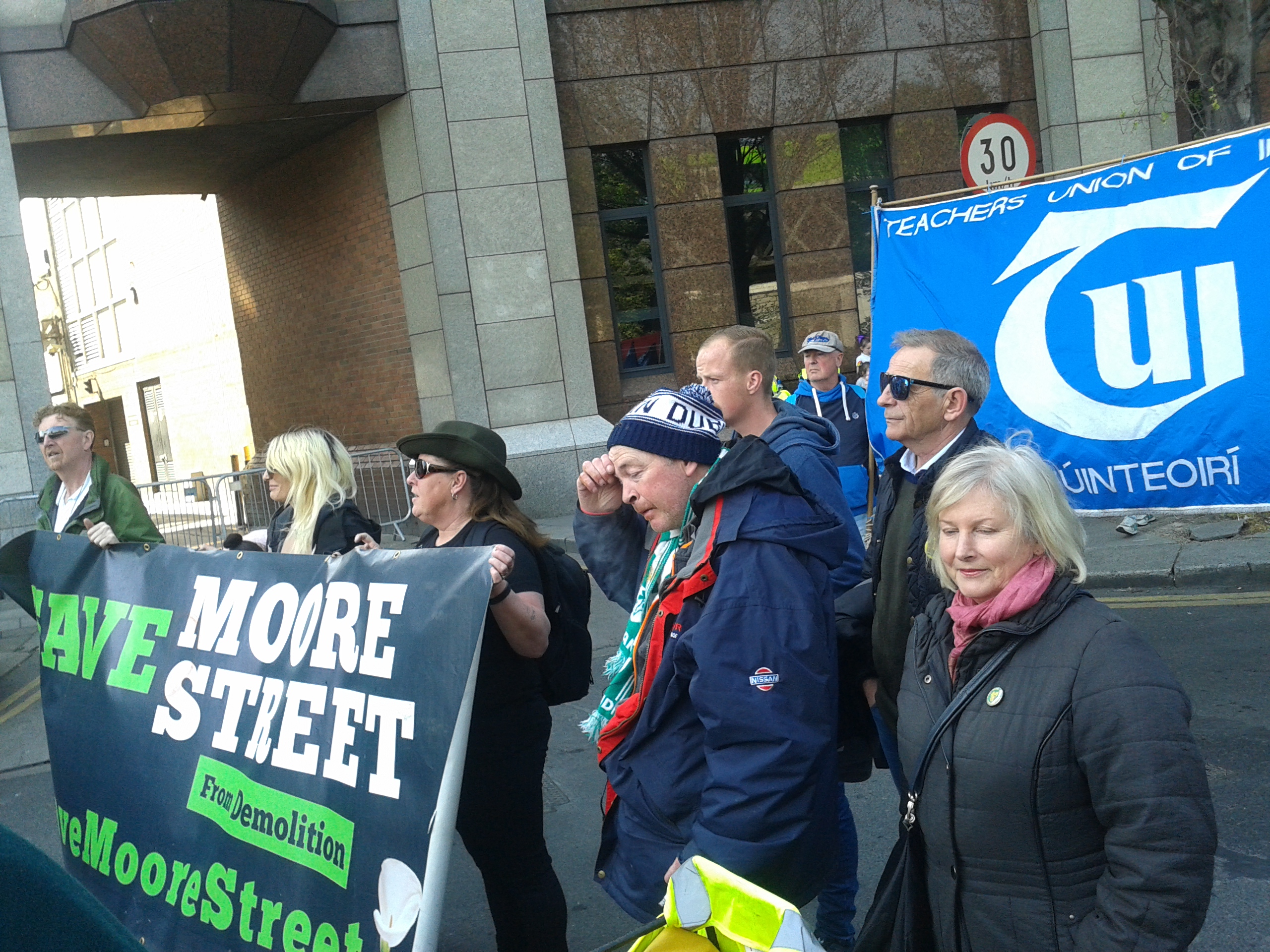
Stage erected at Beresford Place, outside SIPTU’s officesThe Moore Street campaign banner was one of the campaign groups present on the parade and mentioned from the stage by the rally’s chairperson.One of the speakers at the rally — she denounced the sale of private land including the deal done at O’Devaney Gardens estate in Dublin.
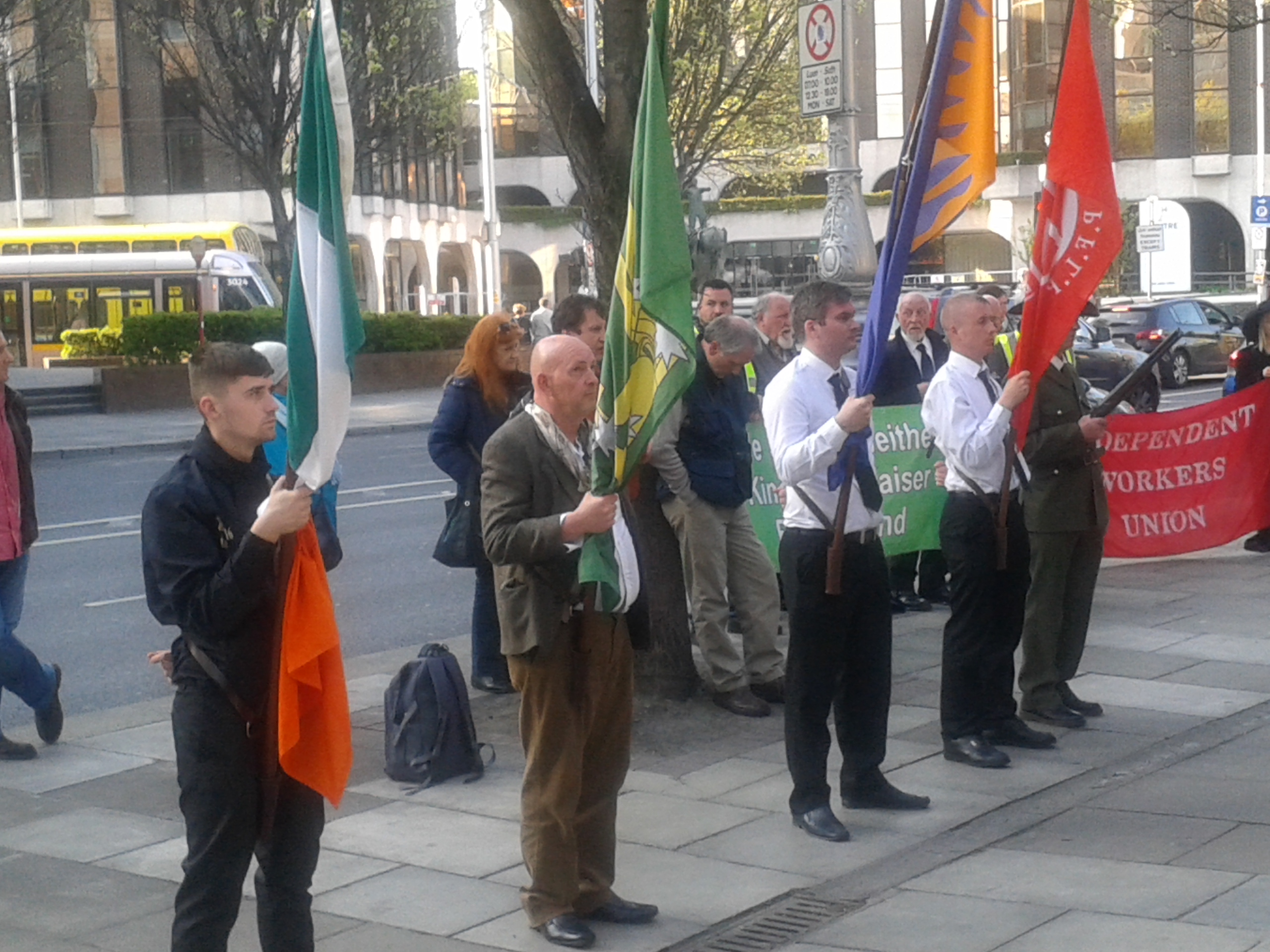
Somewhat later, the Independent Workers’ Union held their own event, marching with a colour party from their offices to James Connolly monument, also in Beresford Place and across the road from Liberty Hall.
IWU event colour party at Connolly Monument
Damien Keogh chaired the event and introduced veteran campaigner Sean Doyle who gave a short and to the point speech about the situation in which working people find themselves today and ending with a quotation from James Connolly, in which the revolutionary socialist castigated those who claimed to love Ireland but could tolerate seeing poverty and deprivation among its people. Doyle also sent solidarity greetings to the Palestinian political prisoners on hunger strike in Israeli jails.
Paul Bowman was then introduced and in a longer speech covered Connolly’s time in the USA, his membership of and activities of the IWW (“the Wobblies”); the Haymarket Incident in Chicago which led to the choosing of May 1st as International Workers’ Day and the state murder of the Haymarket Martyrs; the principles and attitude of the IWU today.
Another Moore Street campaign banner and supporters in period costume also participated in the IWU eventSome random tourists, one form London and the other from Madrid, who chanced to pass by and remained for the whole ceremony.
Damien then introduced Diarmuid Breatnach to sing “We Only Want the Earth” (an alternative title to the original of “Be Moderate”). Breatnach explained that the lyrics had been composed by James Connolly and published in a songbook of his in New York in 1907 without an air. As a consequence the lyrics have been sung to a variety of airs but Breatnach said he sings it to the air of “A Nation Once Again” (composed originally by Thomas Davis some time between 1841 and 1845). This arrangement provides a chorus and Breatnach invited the audience to join in the chorus with him, which they did.
“We only want the Earth,
we only want the Earth,
And our demands most moderate are:
We only want the Earth!”
A wreath was laid at the monument on behalf of the IWU by Leanne Farrell.
The chairperson then thanked those in attendance, speakers and singer and invited all back to the offices of the IWU in the North Strand for refreshments.
Not Al Fatah, the Palestinian Authority or the PLO, according to this journalist, who concludes that today it is Hamas as shown by their elections. Israel, the West and Egypt tried to negate this decision by squeezing Gaza and bombarding it, where the IOF have no troops on the ground but failed so far. In the West Bank, Israel was able to subvert the elections through the arrest of Hamas representatives elected and through recognising unelected bodies such as the PA. Today Al Fatah is running a Prisoners’ hunger-strike.
D.Breatnach comments: Despite the Palestinians being a mostly secular one politically, they voted in Hamas because of the corruption and collusion of Al Fatah including its shameful agreement to the Oslo Accord 1 in 1993 as part of a whole swathe of “peace (sic) processes” which swept through South Africa and Ireland in the 1990s. Observers of the reality of Irish politics will find this article of interest and will surely see some parallels.
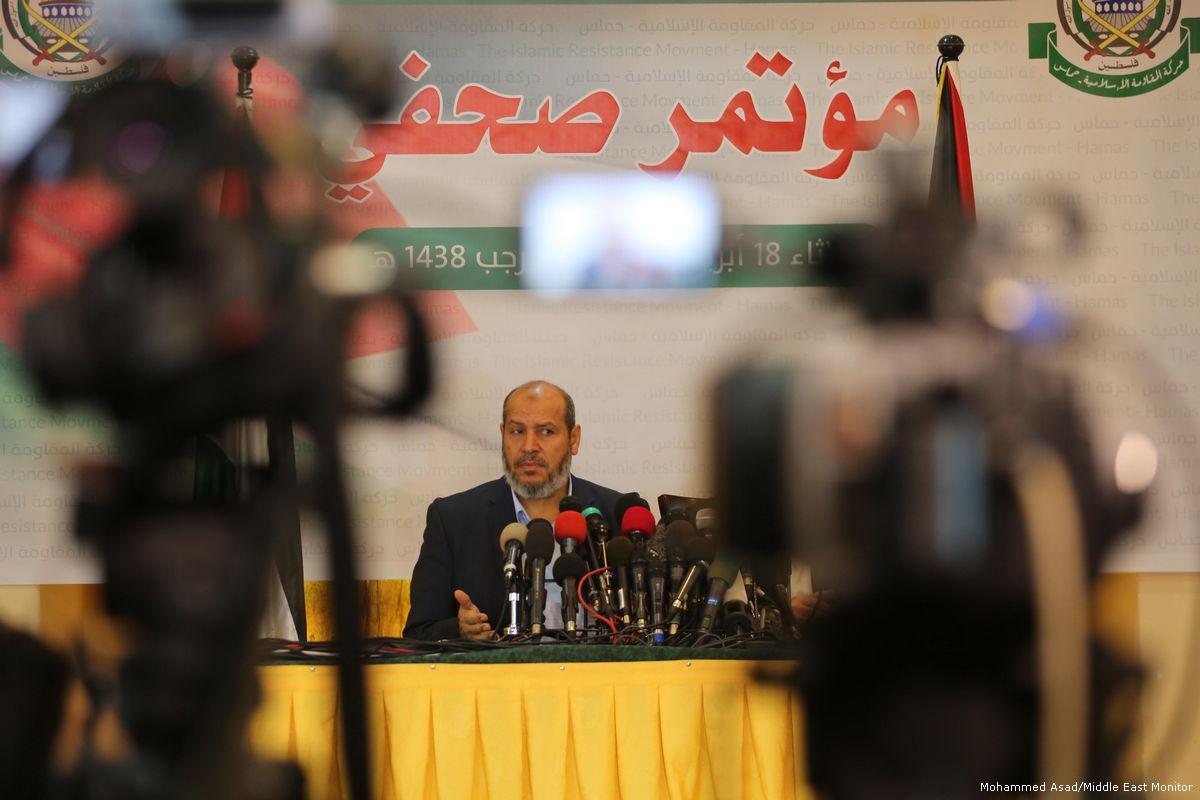
Dr. Khalil al Hayyah, representing Hamas at a press conference today on the question of talks with Al Fatah. (Photo source: Mohamed Asad, MEMO)
Motasem Al Dalloul, 13th February 2017.
The main Palestinian secular movement, Fatah, which dominates the Palestine Liberation Organisation (PLO) accused regional powers on Sunday evening of supporting its Islamic rival Hamas to carry out a coup against the umbrella body and the Palestinian Authority which it controls. The reason given is that such regional powers are trying to ease, or lift, the Israeli-led, internationally-backed, siege on the Gaza Strip.
In several official press releases, Fatah named Turkey and Qatar. They claimed that these two countries are planning to help Hamas and its supporters in the occupied Palestinian territories and diaspora to supersede the PLO and the PA.
According to Fatah spokespeople, Turkey is hosting a pro-Hamas conference for Palestinians in the diaspora, the preparations for which are going ahead without the PLO’s knowledge. However, a spokesman for the organising committee, Ziad Al-Aloul, has said several times that PLO members are among the organisers.
Fatah has also accused Turkey of supporting a military coup against the PA in the Gaza Strip, which has been under siege for more than ten years, simply because the government in Ankara sent its minister of energy and other officials to conduct a study on how they can help to solve the electricity crisis in the coastal enclave. The accusation is really unbelievable, not least because the Turkish delegation met with PA officials in the West Bank before entering the Gaza Strip. In fact, Turkey has been cooperating with the PA in the West Bank regarding a fuel grant for Gaza’s sole electricity plant.
Qatar stands accused by Fatah of the doing the same thing as Turkey, possibly because it is the only international state which has faithfully fulfilled its pledges made during the International Donor Conference held in Cairo in the wake of the 2014 Israeli military offensive on Gaza. The conference aimed to collect donations to rebuild the Gaza Strip.
Since the Cairo conference, Qatar has rebuilt thousands of homes destroyed by the Israelis during the offensive, and built thousands of new homes for the poor and homeless in Gaza. On Saturday, the latest batch of Qatari-built properties were handed over officially by a representative of the Gulf State. Mohamed Al-Emadi also announced a commitment to build a new hospital in the southern Gaza city of Rafah.
These are the Turkish and Qatari acts that Fatah, which dominates the PLO, apparently regards as illegitimate efforts to help Hamas to supersede the PLO and the PA. The movement has overlooked the simple fact that every single Turkish or Qatari donation for the Palestinians in Gaza is handed over to the beneficiaries either through the PA or directly from official Turkish and Qatari bodies working in the territory.
The latest remarks by Al-Emadi have complicated the situation even more for Fatah, the PLO and the PA, which are more or less considered to be the same body. He is the man responsible for the supervision of the reconstruction projects in Gaza. Qatari representative told the IsraeliWalla website that his country has offered to pay all of the costs needed to help solve the Gaza electricity crisis, but the leader of the PA, Fatah and the PLO, President Mahmoud Abbas, rejected Qatar’s offer. Fatah denied this and said that Al-Emadi and his government are working to support Hamas in Gaza; the movement cited the $100m grant for the new hospital in Rafah as “evidence”.
All of this leads me to wonder if the PLO and PA have any legitimacy any more. I am also wondering about Hamas’s role in the Gaza Strip.
Is the PLO the sole, legitimate representative of the Palestinian people as claimed by the UN and Arab League in 1974? The Palestinian people in the occupied Palestinian territories and the diaspora have never recognised the PLO as any such thing. The designation arose when the late Yasser Arafat went to the UN holding an olive branch in his hand. Both of these international bodies recognise Israel, which is a state built on about 78 per cent of historic Palestine; the Palestinians have been waiting for almost 70 years to fulfil their legal right to return to their land. In 1993, the Israeli occupation state also recognised the PLO as the sole, legitimate representative of the Palestinian people after signing the now notorious Oslo Accords.
Regarding Hamas, which swept Fatah — and thus the PLO and Ramallah-based PA — out of the Gaza Strip in 2007, having won the previous year’s elections, there has been no clear-cut evidence that it represents more than half of the Palestinians in occupied Palestine. Hamas refused to take part in the first Palestinian parliamentarian elections in 1996, when Fatah, its allies and a number of independent candidates won all the seats. However, in the following ten years, Hamas — whose roots in Gaza go back to the early 1970s and in the West Bank to the 1980s — won most of the elections for student councils and professional syndicates in both territories.
It became very clear that Hamas is the real and legitimate representative of the Palestinians in the territories in 2006, when the Islamic movement achieved an overwhelming victory in the municipal and parliamentary elections in both the West Bank and the Gaza Strip. Fatah, the PLO and the PA, as well as Israel, the UN and the Arab League, have always refused to recognise the subsequent Hamas-led Palestinian Authority which has been the de facto government in Gaza ever since.
Supported by Israel and backed by the most effective Arab states and the international community, Fatah, the PLO and the PA have tried to topple Hamas. They could do this in the West Bank, where Israel arrested most of the democratically-elected Hamas MPs and mayors, but in Gaza, where there is no Israeli existence on the ground, Hamas could sweep Fatah out and control the Palestinian institution.
Since then, the internal political division has been dominating the Palestinian political process. Hamas and Fatah have met together several times in various countries, but they have been unable to reconcile their differences. That is why, to all intents and purposes, the Gaza Strip controlled by Hamas has been under a strict Israeli, Egyptian and international siege supported tacitly by the Fatah, PLO and PA.
As a result, any national or international effort to facilitate a better life for the Palestinians in Gaza is considered to be “aggression” against Fatah, the PA and the PLO from their point of view. Such is the involvement of the secular Fatah in the stranglehold on Gaza that Qatar’s Al-Emadi, during his current visit to the Strip, said that the construction of a seaport and an airport under international observers are still proposed as solutions for the Gaza crisis should Israel, the world and Fatah agree.
According to the Assistant Professor of US and Middle East History at Syracuse University, Osama Khalil, in a four-year-old study, the PLO is a “shield and a cudgel against internal and external foes and competitors.” He added: “What remains of the PLO today — its name, its international status, and the few vestiges of its bureaucratic institutions, offices, and titles — have and continue to be used by a small, unelected, and unrepresentative clique to further their own agendas.”
It is fairly obvious to most reasonable people, therefore, that the PLO has little, if any, claim to be the “sole, legitimate representative” of the Palestinian people. Its leaders appear to be representing the interests of nobody but themselves.
From FB page of Dublin Basque Solidarity Committee
SPANISH STATE APPOINTS POLICE OFFICER CONVICTED OF TORTURE TO UNITED NATIONS COMMITTEE FOR THE PREVENTION OF TORTURE.
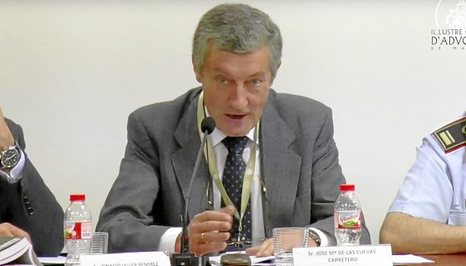
Convicted Guardia Civil torturer of prisoner, Jose Maria De las Cuevas Carretero, appointed by the Spanish State to the UN Committee for the Prevention of Torture. (Photo sourced from Gara newspaper)
No-one could accuse the Spanish authorities of failing to appreciate irony.
In 1997, in one of the rare cases of the Spanish authorities charging a police officer with torture and even rarer of conviction, Captain (then a Sergeant) José María De las Cuevas Carretero, along with fellow Guardia Civil officers Manuel Sánchez Corbi and Antonio Lozano García were found guilty of torturing Basque ETA suspect Kepa Urra when they detained him in 1992. A further three police accused were found not guilty but the medical evidence on Mr. Urra’s admission to hospital six hours after his arrest made it impossible for the Bizkaya court not to find his captorsguilty. Despite the police officers’ denials, the three were found guilty of having taken Mr. Urra to a deserted spot after this arrest and there, while he was handcuffed, to have beaten him with a blunt object and dragged him along the ground. They were sentenced to four years in prison and barred for six years from public office (a common accompaniment to prison sentence in the Spanish State).
However, one year later the Spanish Supreme Tribunal reduced the prison sentence of each to one year which meant they were free to go but with the public office disqualification still in force. The following year, they were pardoned by the Spanish Minister of Justice of the incoming PP Government of Aznar and Mr.De las Cuevas Carretero carried on with his police career, rising to the rank of Captain and participating in fora of the State and internationally.
Mr. De las Cuevas Carretero, who is a qualified lawyer, has been lecturing of the treatment of prisoners and about corruption. And who could say that he is not eminently qualified to lecture on those subjects? Or to represent the Spanish State authorities on those issues?
(News and photo source: Gara, also some background Internet research)
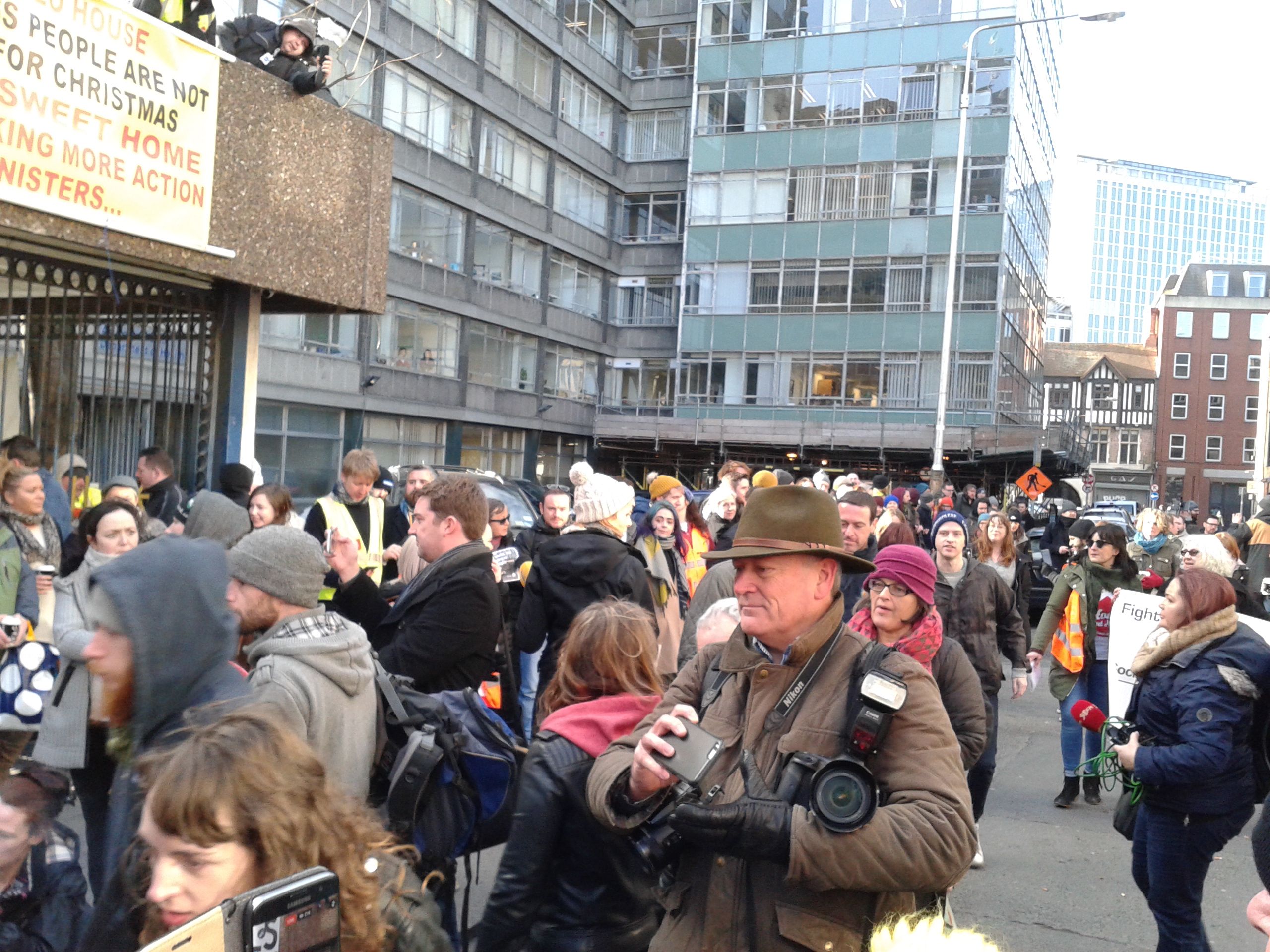
HUNDREDS ATTENDED AT APOLLO HOUSE in bitter cold from late morning today to indicate their support for the homeless people and housing activists in occupation of the building. At the same time, a court refused to extend the
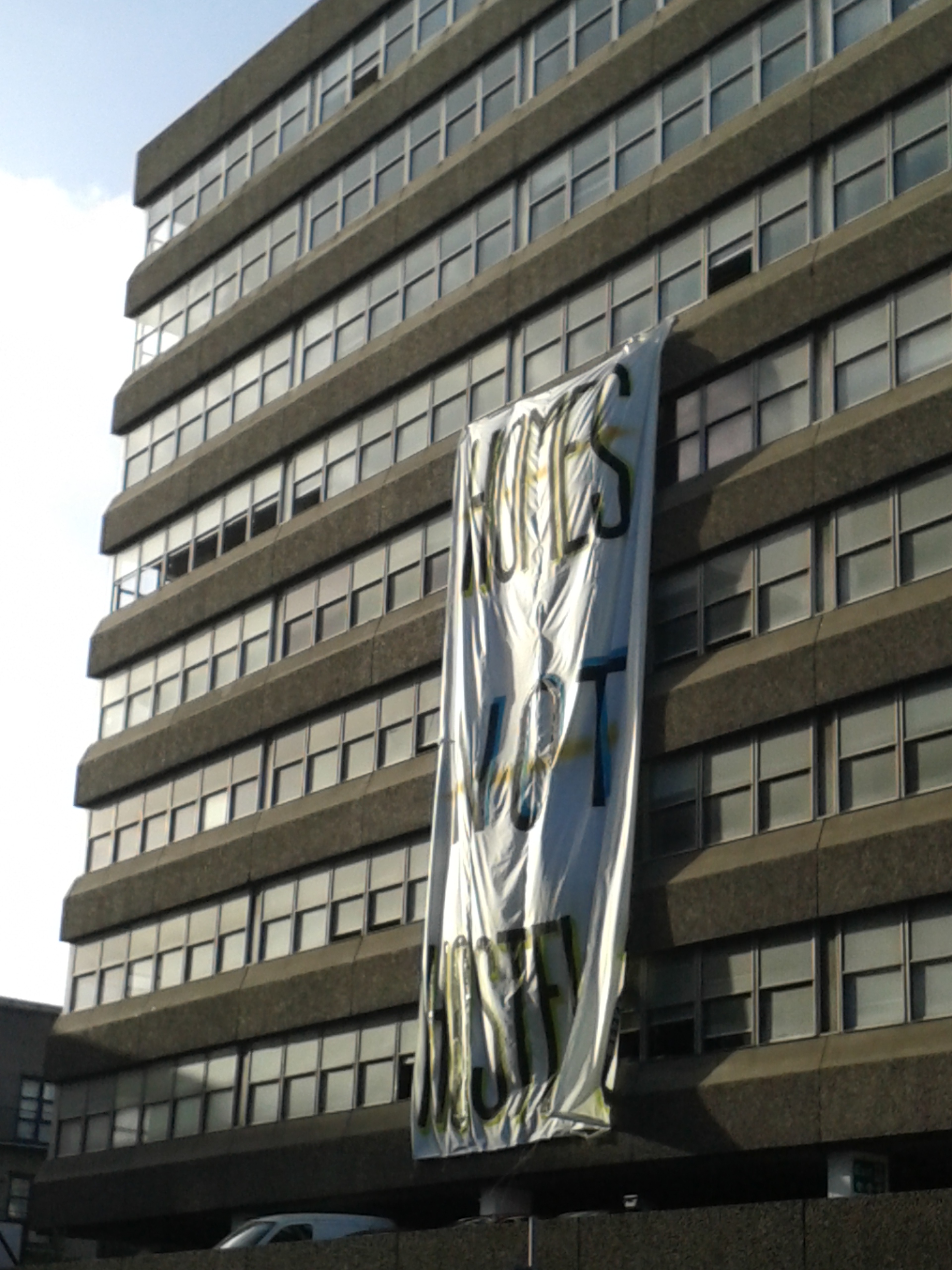
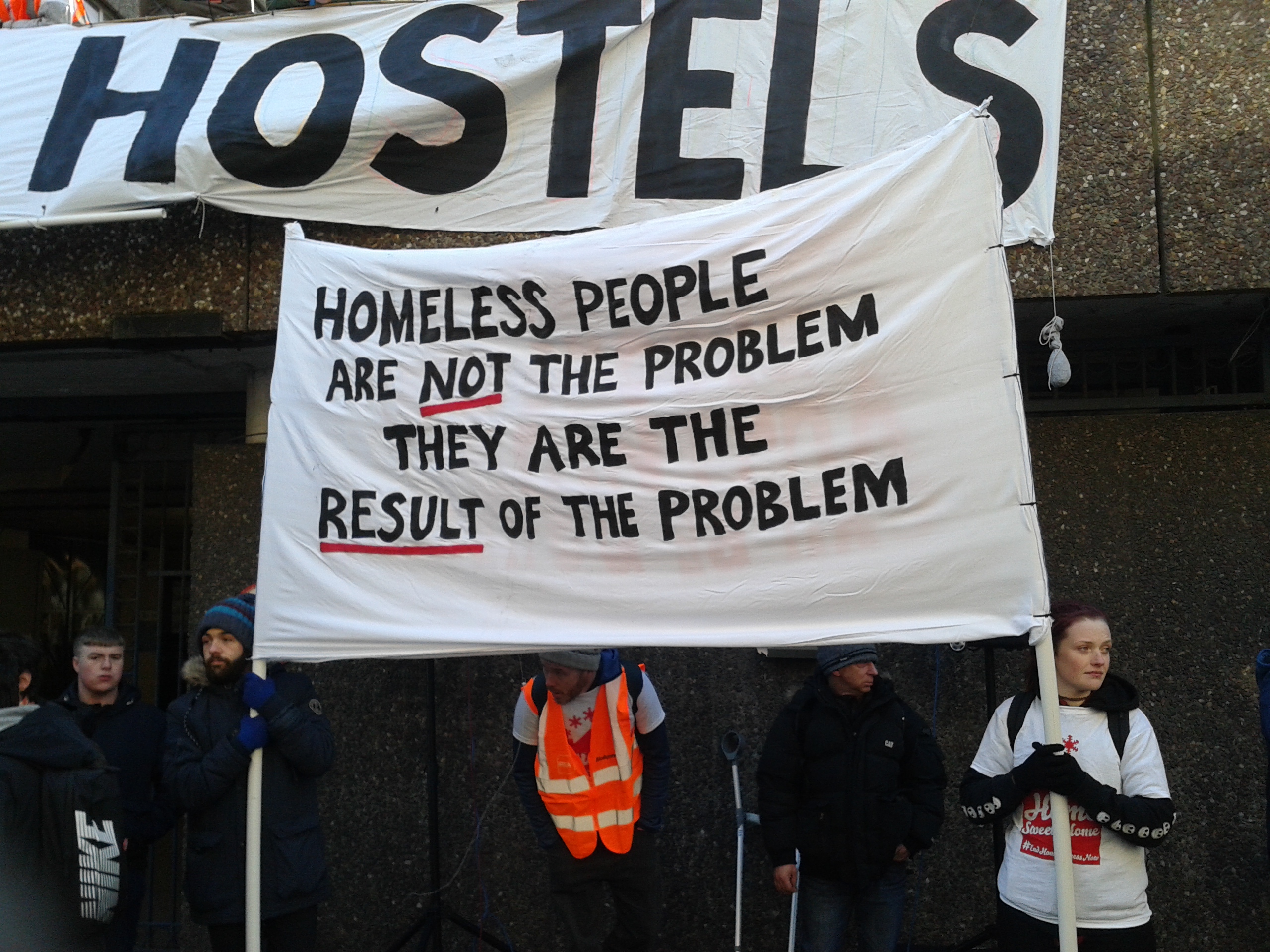
Closer view of “Homes Not Hostels” banner on Tara Street side of occupied Apollo House (Photo: D.Breatnach)
deadline by which it has ordered the occupiers to leave.
Banner suspended from the Tara Street side of Apollo House (Photo: D.Breatnach)
While they were there, representatives were attending court seeking an extension on the deadline given by a court order to leave the building by noon today.
Housing activist Rosie Leonard told the crowd that the alternative accommodation some Apollo House homeless people had been offered was totally unsuitable and that some were houses for people with addiction issues and that there were even bloodstains on the walls. They had asked for an extension as the State had not provided alternative accommodation but this had been refused.
In response, people cried “Shame!” and “We shall not be moved!”
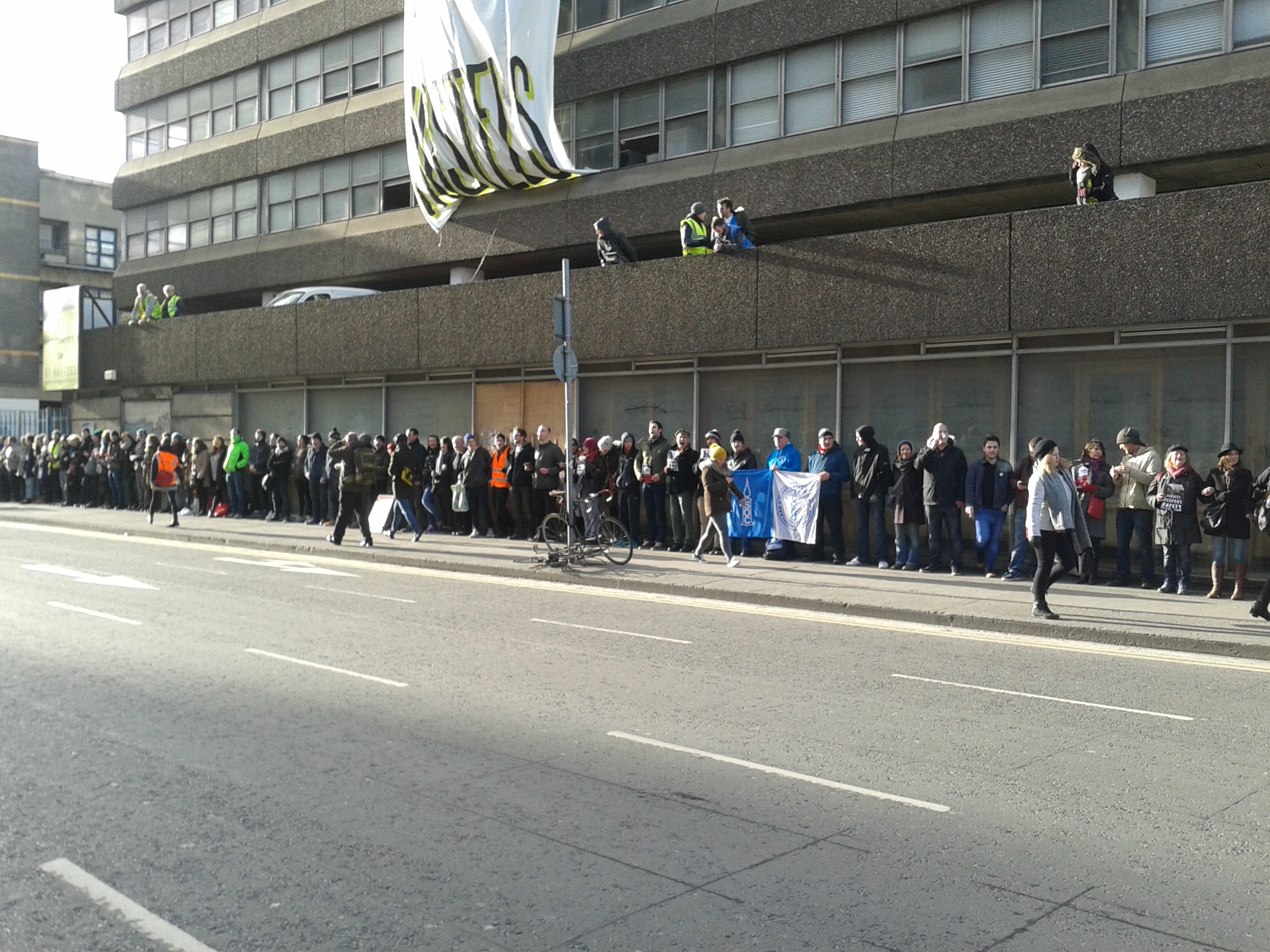
Supporters linking arms around Apollo House from Townsend St, through Tara St to Poolbeg St. (Photo: D.Breatnach)
People were asked to link arms symbolically around the building, which many did and the line extended from Townsend Street/ Tara St. and the full length of Poolbeg Street.
PEOPLE QUEUE TO SIGN UP TO ACTIVELY SUPPORT
Shortly afterwards, announcements were made asking people willing to support the continued occupation to give their names to organisers and queues of people formed giving their names and phone numbers to put on a list.
People linked arms symbolically protecting Apollo House occupiers from Townsend St, through Tara St and here seen to western end of Poolbeg St. (Photo: D.Breatnach)
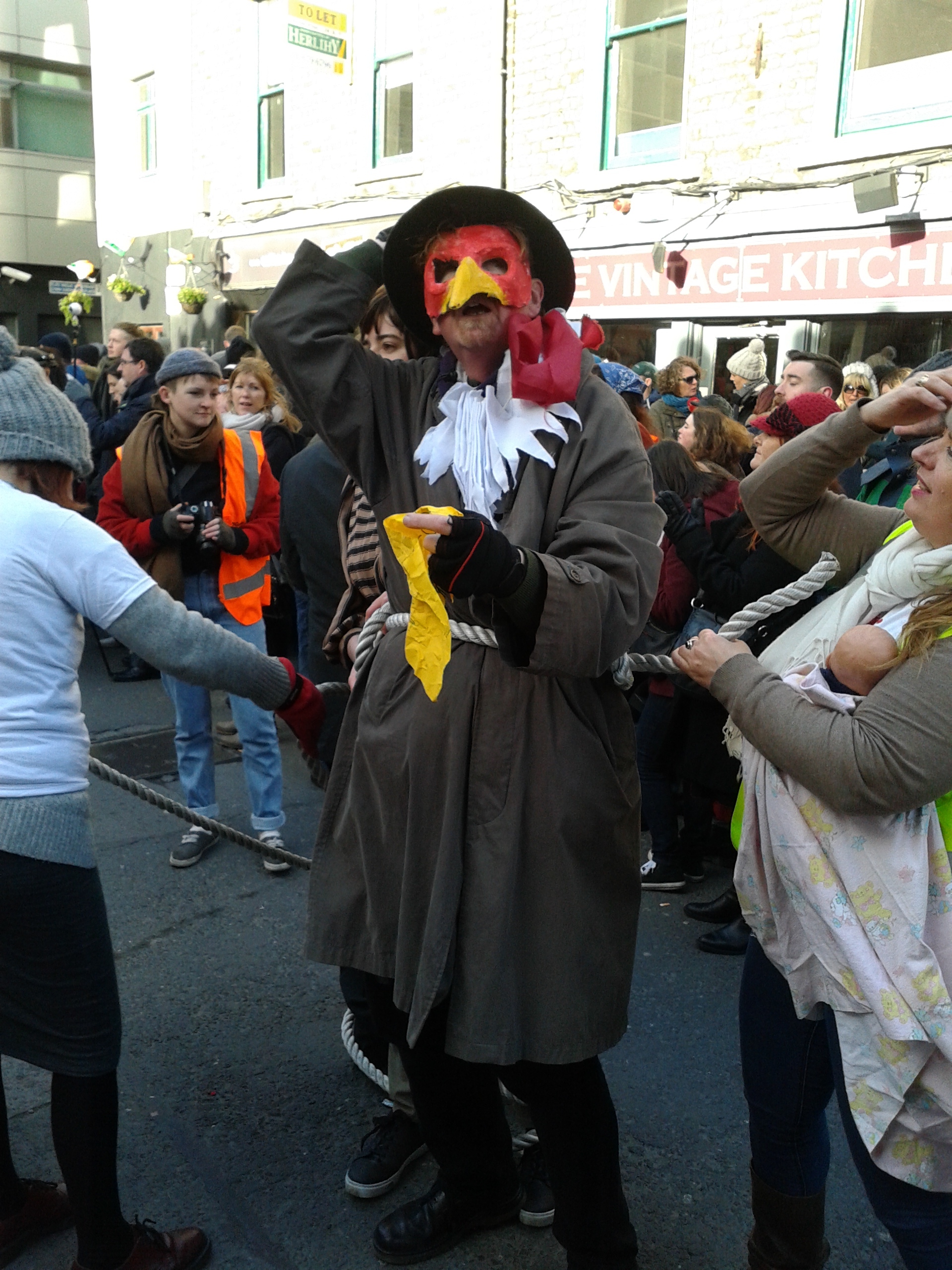
Speakers addressed the crowd at intervals and musicians, singers and percussionists also performed for the crowd. A group including a Vulture Capitalist, Banker and Woman & Child being evicted also performed for the crowd.
Chants included: What do we want? Homes not hostels!
Also: Is a doorway a bed?
No! Is a mattress a bed?
No!
Since December 15th, the Home Sweet Home coalition of activists and homeless people has been occupying this building which state agency NAMA had repossessed from a property developer with unrepayable debts. The group is calling for NAMA to use the properties it has taken control of to house the homeless.
Rosie Leonard relaying court decision to cries of “Shame1” and chants of “We shall not be moved!”Percussionist, Guitarist, Acitivist (Photo: D.Breatnach)Vulture Capitalist (Photo: D.Breatnach) (Photo: D.Breatnach) (Photo: D.Breatnach)
A generation is passing. Actually they have been passing for some time, the generation of the fighting years of the late 1960s, the 1970s, the 1980s and even the 1990s.
They campaigned variously for social housing; civil rights north and south; for human rights; against Church domination; against Unionist sectarianism; for free access to contraception; for right to divorce; for an end to censorship; for national self-determination; for Gaeltacht civil rights; for Irish language rights and Irish on TV; in support of political prisoners; the rights of women; for Irish Traveller rights; protection of heritage and environment; solidarity with many struggles around the world, including Cuba, Vietnam, Rhodesia, South Africa, Chile, the Black Panthers; against drug dealers; for freedom to choose lifestyle; decriminalisation of gay and lesbian life; for community projects in deprived areas including youthwork and, let’s not forget, organised, fought in and supported strikes.
That generation fought many battles, some of which they won and some which built bases for later battles and their story is told only in bits and pieces here and there. They organised, marched, sat in, occupied, wrote, made placards, painted slogans, put up posters and some fired guns; they were watched, raided, beaten, fined, jailed, calumnied, sacked, expelled, kept unemployed, derided from pulpit, press and judge’s bench, some were shot, and not just they but their families made to suffer too.
I am not referring to people of any specific age but of all those who were any age from young to old and active during those years. The causes of death have been many, from simple old age and life lived out to the death penalty.
But the death penalty was not in force in Ireland in the 1960s, you may think? Actually it was, it wasn’t abolished until 1990 in this state. But you’d be kind of correct as in practice no formal execution has been carried out by this state since 1954.
So, then what am I talking about? Maybe referring to the ‘United Kingdom’, since six counties of Ireland are included in that state? Yes, and no. The death sentence still exists in the UK only for “Arson in Her Majesty’s shipyards” but it was abolished in Britain for the crime of murder in 1965 and, in fact, no-one had been formally executed there from the year before. If the judicial death penalty had still been in force, the people in charge of that state might’ve been been spared the embarrassment of seeing nearly a score of Irish people they had wrongly convicted in 1974 walk free decades later as judges eventually had to find them ‘Not Guilty’.
A bit late for Giuseppe Conlon, against whom there had not even been a shred of doubtful evidence, but never mind. But had they all died in prison or been executed, people might not have worked so hard to see their convictions in court overturned – people among whom Joe Kelly, who died this week and who was cremated on Saturday, stands tall.
But the death penalty was not removed from the judges’ arsenal in that bastion of reaction, Six Counties state, until 1973, when the 30 Years’ War had entered its early years (somebody from the British state clearly had to sit down with the Unionist bigots and explain, although of course they sympathised with their loyal brethren, how bad it would be for Britain and the Queen if they started sentencing and executing IRA and INLA fighters).
There are more ways to skin a cat …. yes, and to kill too. The orange and SAS and MRF death squads killed more against whom there was not even a court conviction. And some of the Republicans killed one another too. And twelve died on hunger strike, one each in 1974 and in ’76 and ten in 1981. Actually, considering the brutality of force-feeding, it’s surprising there weren’t more deaths – Marian and Dolours Price were force-fed 167 times over 203 days in 1973 and it was the publicity around their case and the deaths of Gaughan and Stagg that ended the practice of force-feeding, ensuring that the Hunger Strikers of 1980 and ’81 at least did not have to endure that experience.
But there are more ways to kill …. Many of that generation of fighters died from ‘natural’ causes but died early – cancers, heart attacks, liver damage, despair ….. ah, yes, that brings to mind suicide, of which some also died. But despair also can drive you to drink, even more easily if it has been part of your experience of socialising and alcohol is one of the top killers in the world. And some died of drugs …. or drugs and alcohol …. or infections from unsafe drug injection …. But most who died early did so in summary from the wear and tear of struggle, of prison, of separation, of relationship breakdowns, of betrayal, despair.
Not all died, even those who are not among the fighters today. Some walked away from the struggle and though I can’t imagine being in their shoes, I do not begrudge them. So long as they didn’t betray any on their way out or make a living out of spitting on their former comrades and causes afterwards. But some, a very few, did exactly that and you can read what they have to say quite often in their articles or hear them quoted in the newspapers or on TV or radio.
Some found other ways to betray and did it in secret, feeding information to their handlers and some even diverting attention from themselves by accusing others, some innocent and some of a lesser grade of betrayal than that of the accusers. We know of some of them but may never learn about them all.
Joe Kelly
Poster displayed at memorial in Teacher’s Club (photo accessed from a Facebook posting)
A few have survived and are still around, fighting the struggle, whether in organisations or as independents. Joe Kelly was one in both categories, in a sense. I knew him but did not know him well and met him only in the last decade, after I had returned from decades living and working in London. I am given to understand that he had passed through a number of political organisations, including Fianna Fáil and the Labour Party. A strange CV, one might think, for a radical left-wing social and political activist. The last political group with which I had associated Joe was People Before Profit, on a local level, around Phibsboro. Joe invited me to attend a quiz they were running and I did so mainly to return a favour – he had attended, to contribute to the singing at my invitation, an evening of the Clé Club where I had been “Fear a’Tí” for that night. I was amazed to win a Blackberry at the quiz (sorry, Joe, I still haven’t gotten around to learning and using it!). Last I heard, he wasn’t with the PBP.
Somebody told me years back that he had been a central organiser of a solidarity event in Dublin for the Birmingham Six in which lights had been floated down the Liffey. Of course I was impressed – on a political/ human rights level but also for the poetic vision involved. I have found little about that event since and Joe, who I found a modest man, didn’t give me much in response to my pressing. A couple of searches on the Internet yielded me only a passing reference to the River Parade, of 1990, a year before the Birmingham Six were finally cleared in court and released. Likely I have not been asking the right people or looking in the right corners.
I met Joe by arrangement for a coffee a couple of times, while I tried to get him into something I was doing and he tried to get me into something he was working at – neither of us succeeding in our efforts to recruit the other. Since Joe was working for awhile in the community sector I also approached him to explore possibilities for me when, despite a long track record in the fields of working in homeless shelters and addiction as well as other community activism I was out of work, but he wasn’t able to help me.
And of course I bumped into him on demonstrations, as in those in solidarity with Palestine or against the Water Tax or against the Lisbon Treaty. For awhile we were active together in the Dublin branch of the Ireland Palestine Solidarity Committee and I believe he left like me after witnessing some nasty in-fighting years ago, though we both often turned up to protest pickets and demonstrations and public meetings called by the organisation. We would also meet at events in solidarity with the Cuban people.
I heard him described at his funeral service, by someone who should know, as a Republican. Certainly Joe was very proud of his father and uncle who had both fought in the 1916 Rising, the first in the GPO and the second in Bolands’ Mill and proudly displayed his father’s medal at a public event in the Teachers’ Club in Dublin.
Joe Kelly displaying and talking about his father’s 1916 service medal at a 1916 commemoration event (photo: D.Breatnach)
However, he was among the number that I invited but failed to get to events over the last decade to highlight the plight of Irish Republicans being hounded by the State and imprisoned without trial. That did puzzle me, for I knew Joe to have a track record of fighting for human rights. And this was shown not only in his campaigning for the Birmingham Six.
Joe fought for the rights of divorce and choice of abortion, as well for the right to freedom from partner abuse, in particular through the movement for women’s refuges, what many people still refer to as “battered wives hostels”. He was active in the campaign for the right to gay marriage, so amazingly successful in Ireland. And Joe was also active in campaigns against racism towards migrants.
“Conas atú tú?” or “Dia dhuit”, Joe would invariably greet me whenever we met. I would not call him exactly fluent but he could understand and speak Irish. I suppose I assumed he had some affection for the language and was also paying me, a known native speaker, the courtesy of addressing me in Irish and speaking awhile in the language. At his funeral service, I learned it went further than that. I heard his grandchildren say that he frequently spoke to them in Irish and when they did not understand him, would translate what the words meant. Some people in the audience chuckled to hear this. I felt sad and somewhat angry too, that a question so important to our cultural identity, an aspect so threatened today, should be treated so apparently lightly by some and that the only words to be spoken at his funeral service in Irish were those in the final sentence spoken by his brother, Jim, in his eulogy: “Slán leat, Joe”. In the booklet produced for the occasion and freely available at Club na Múinteoirí, there was however one dedication in Irish (and I have since learned that one of the speeches at the Teacher’s Club was in Irish) and I note that both grandchildren who spoke bear Irish-language names.
Paying respects and memorial service
On Saturday, laid out in the lovely Room 2 in the Teacher’s Club (sin Club na Múinteoirí, Joe) in Dublin’s Parnell Square, a venue often used for social, cultural and political events, in a closed wicker basket coffin, Joe received his visitors. And they were MANY. Feminists, Palestine solidarity activists, Cuba solidarity activists, community activists, independent political activists and a sprinkling of activists in various parties all attended and many contributed their memories or words dedicated to him while he was laid out there. (I took many photos here and some at Mount Jerome but somehow seem to have lost them all).
Attending first another funeral (of another singer) that morning in Howth, then travelling into Dublin to take part in the Moore Street Awareness weekly table, I had to miss some of that. I spelled a comrade while he attended to pay his respects, then attended later while he took over back at the table.
Room No. 2 was still packed but so was the whole bar lounge area. I had missed all the eulogies and reminiscences and even singing – “The Foggy Dew” I was told. Had anyone sung “The Parting Glass”, I asked. No, apparently not. So then to ask his sister if it would be alright to do it, then the MC, his long-time collaborator, comrade and friend, Brendan Young. It would be welcome, I was told. And Fergus Russell (also his second funeral that day) and I did three verses together, using a mic so it might carry through to the lounge and, though we took turns at fluffing a line, not too badly. It is a great song for such occasions and each verse was particularly appropriate to Joe.1
A little later, the Internationale was sung by all (copies of the words of a verse and the chorus distributed beforehand), the wicker coffin (I must have one of those when my time comes!) was lifted on to shoulders by family and friends and brought through the respectful lines while Joe’s daughter sang The Night They Brought Old Dixie Down.2
Then the hearse came out and led the cortege to Mount Jerome cemetery. I didn’t know the protocol regarding cycling in a funeral cortege but followed anyway, managing to get temporarily lost on the way and arriving just as the hearse arrived at the cemetery. Again, the chapel was packed.
The ceremony was non-religious and officiated by Therese Caherty, ex-partner and friend. In turn Therese herself, his brother, his bereaved current partner, relatives and his comrade and friend Brendan Young all gave their moving eulogies and often funny anecdotes. Brendan emphasised that for Joe, the process of the conduct of a struggle was as important as the end to be reached, which I knew to be true from our time together in the Dublin IPSC and I’d be in agreement with Joe on that.
There were, despite the many I did see during those events, some faces I did not see in the congregation or at the Club na Múinteoirí before the service or later, when many returned to the Club to free sandwiches and soup laid on by the management there. It was their loss.
I never saw him dance but am told he loved it and taught his grandchildren not only to sing but to dance too. I did know he’d learned to tango. He’s left this dance floor now and gone on to another and whatever “one steps and two steps and the divil knows what new steps”3 they are dancing there, I’m sure Joe is learning them and probably teaching a few of his own.
Slán leat, Joe – árdaigh iad!
A chríoch.
FOOTNOTES
1 “Of all the money that e’er I had, I spent it in good company
And all the harm that e’er I’ve done, alas, it was to none but me
And all I’ve done for want of wit to memory now I can’t recall
So fill to me the parting glass, good night and joy be with you all
“If I had money enough to spend and leisure time to sit awhile
There is a fair maid in this town, that sorely has my heart beguiled
Her rosy cheeks and ruby lips I own, she has my heart enthralled
So fill to me the parting glass, good night and joy be with you all
“Of all the comrades that e’er I’ve had, they are sorry for my going away
And all the sweethearts that e’er I’ve had,
they would wish me one more day to stay
But since it falls unto my lot that I should rise and you should not
I’ll gently rise and I’ll softly call good night and joy be with you all”
2 This song of nostalgia for the American Confederacy has a haunting melody but its ideology is often ignored by those who sing it.
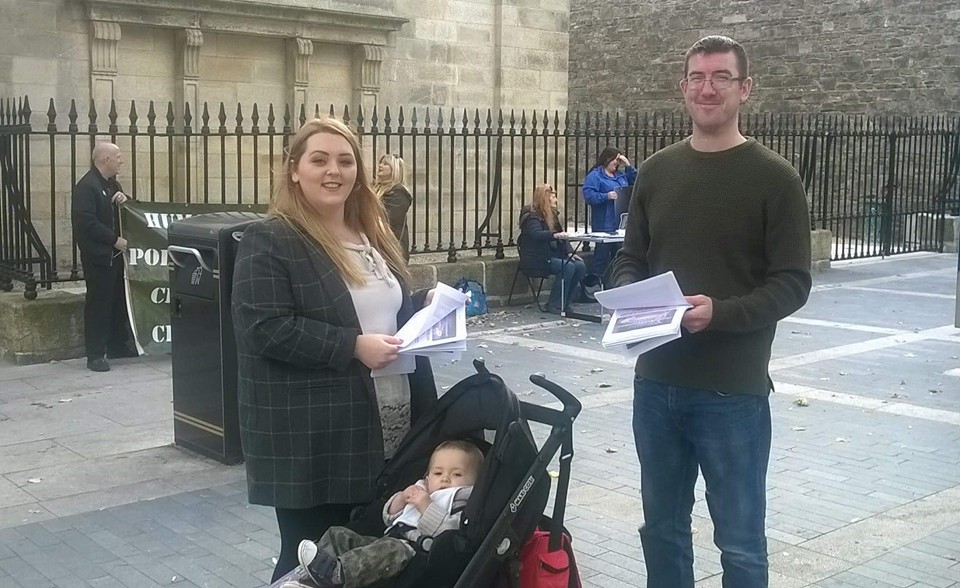
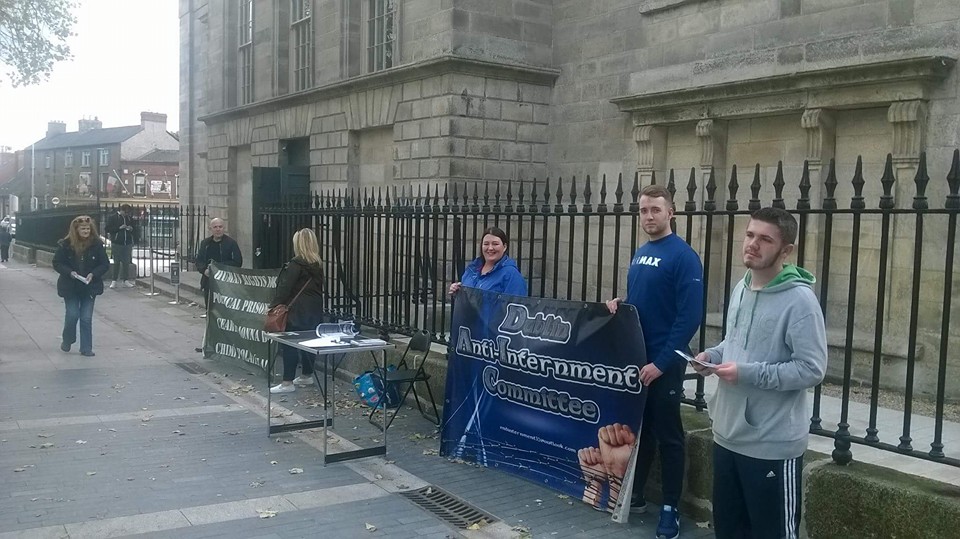
The Dublin Anti-Internment Committee organised an information table on Internment outside the Kilmainham Jail Museum on Sunday 11th September 2016. The purpose of the exercise was to make tourists and other visitors aware of the ongoing repression and civil rights abuse that is going on in Ireland which is internment by another name. As their leaflet points out, Republicans opposed to the British colonialism or to economic attacks on their communities and who organise against them are being targeted in a process that sees them arrested, charged with ‘terrorist’ offences, refused bail (or granted only attendant by ridiculous restrictions) and then, when the case against them collapses much later and they are freed, they will still have spent years in jail.
Anti-internment campaigners line up for a photo with clenched fists (Photo: Ian O’Kelly)
The Dublin Committee, affiliated to the Anti-Internment Group of Ireland, mobilised outside the former jail in the afternoon, displayed their banners and gave out leaflets to passers-by, tourists and visitors (not all who were from outside Ireland, by any means).
Kilmainham Jail is a Dublin prison with an important history. It was built before the Great Hunger and housed female and male prisoners, including children. Insurgents and political activists from the United Irishmen, they Young Irelanders, the Fenians, the 1916 Rising, the War of Independence and the Civil War had been kept here, including those being deported to Australia. Robert Emmet and Anne Devlin were kept prisoner here, as were Charles Stewart Parnell and most of the Irish Parliamentary Party’s leadership. All fourteen of the 1916 sixteen executed were judicially killed in this jail and women activists were jailed here after the 1916 Rising and during the Civil War.
Campaign information table (Photo: Ian O’Kelly)Plaza in front of old Kilmainham courthouse, which is the new entrance to the Jail Museum. (Photo: Ian O’Kelly)
The Jail closed in 1924 and was falling into disrepair; the State invited tenders for its demolition but felt that those they received were too expensive and so just left the building abandoned to ruin. However a local restoration committee got going, raised some money and began repair and restoration work with volunteer labour, skilled and unskilled.
In 1966, in time for the 50th anniversary of the Easter Rising, the restoration committee handed over the building to the State which, since then, has seen a huge attendance with nearly 330,000 visitors last year. Recent works moved the front entrance of the museum to the former courthouse building next door and a reported €5 is being spent on revamping the facility.
end.
Some of the campaigners were younger than others (Photo: Ian O’Kelly)The emblem of the Unitied Kingdom on the courthouse roof — this remains on a number of buildings in Dublin from the centuries of British occupation of the city. (Photo: D. Breatnach)(Photo: Ian O’Kelly)
Closer view of the emblem of the United Kingdom on the courthouse roof (Photo: Ian O’Kelly)Side view of the front of Kilmainham Jail and some of the campaigners (Photo: D.Breatnach)Some of the campaigners with the Courthouse building stretching away from behind them.