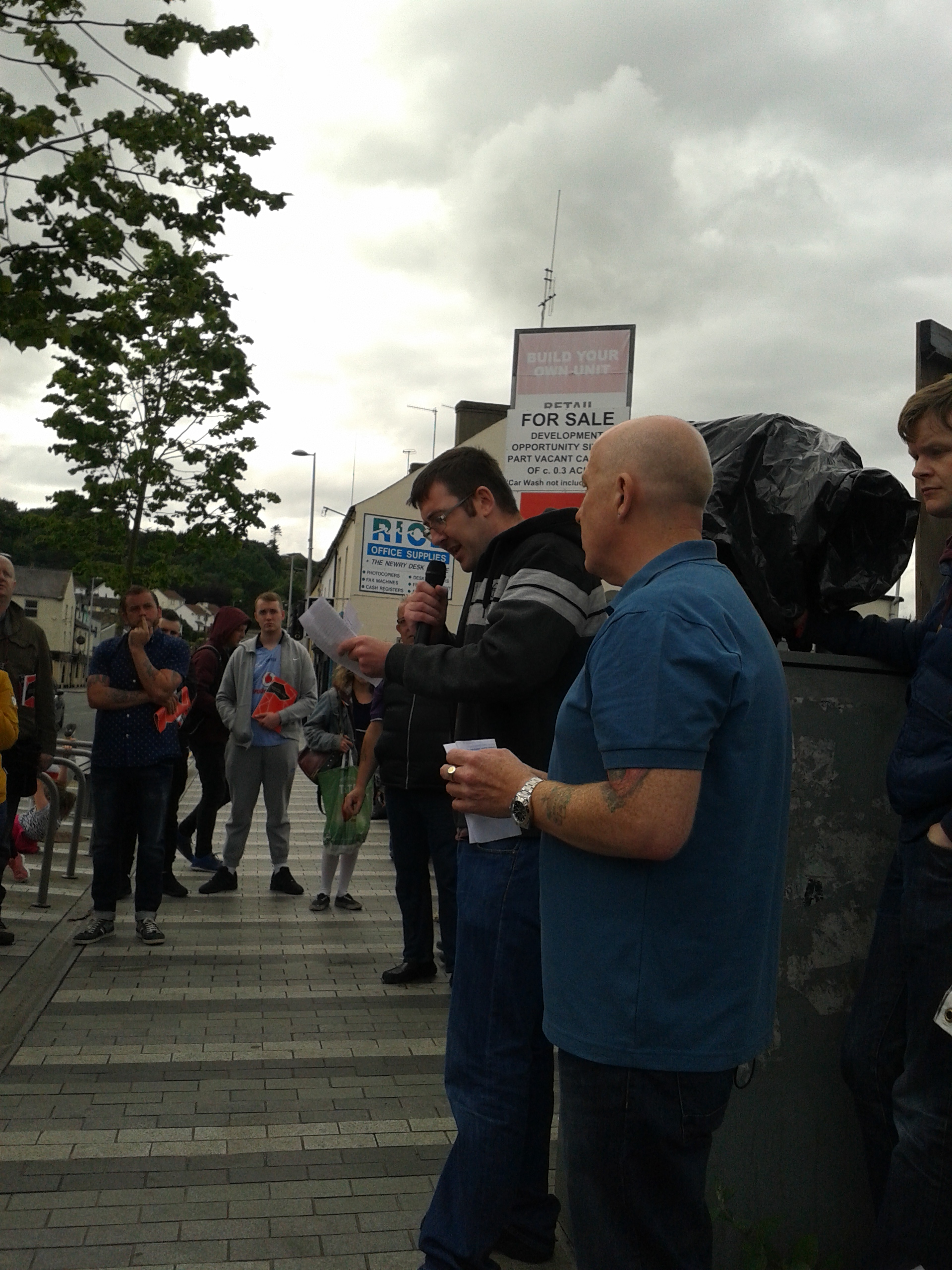
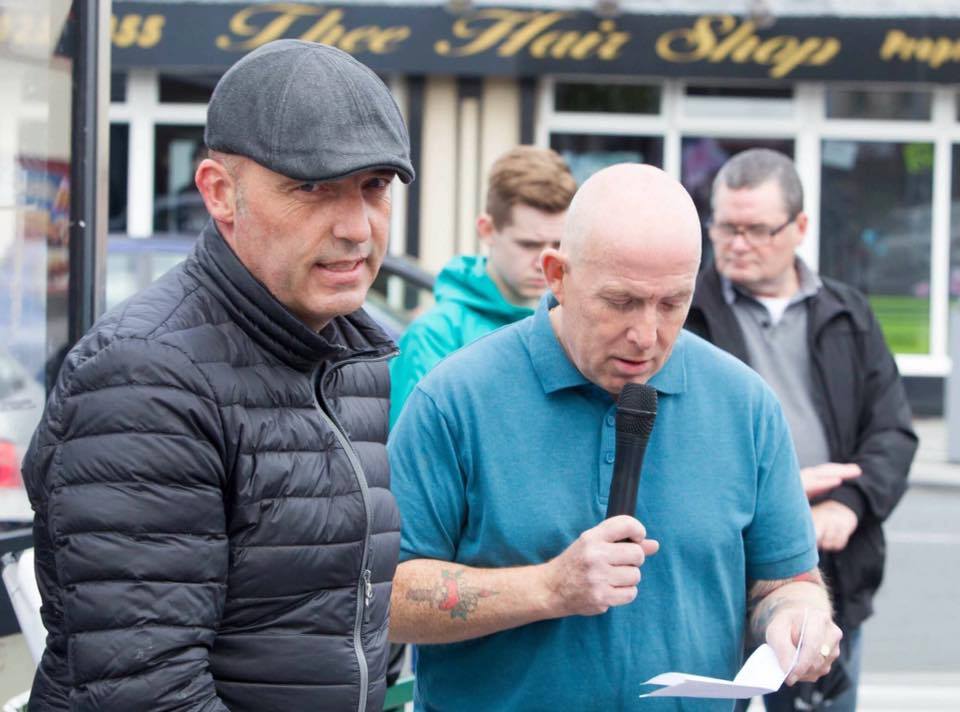
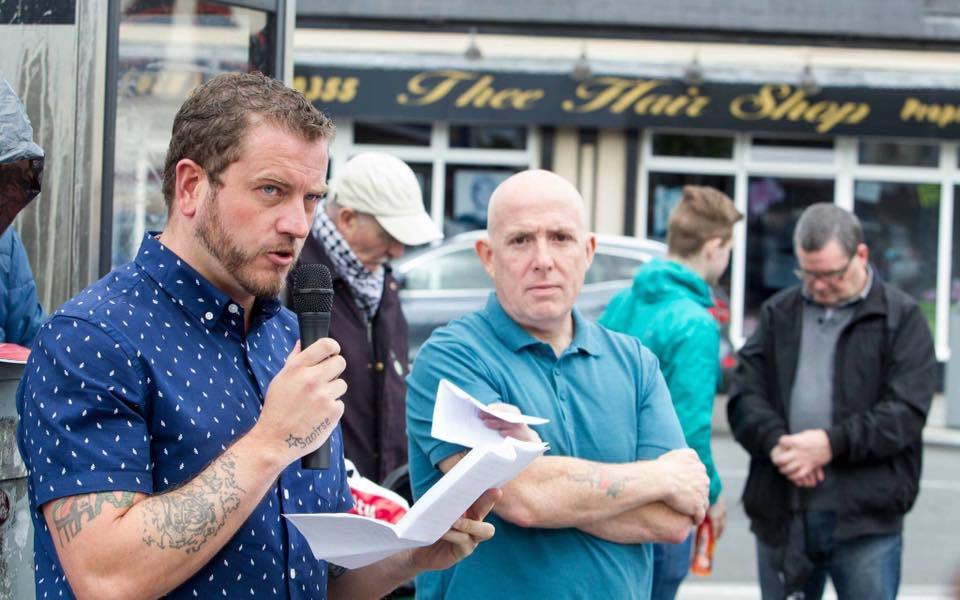
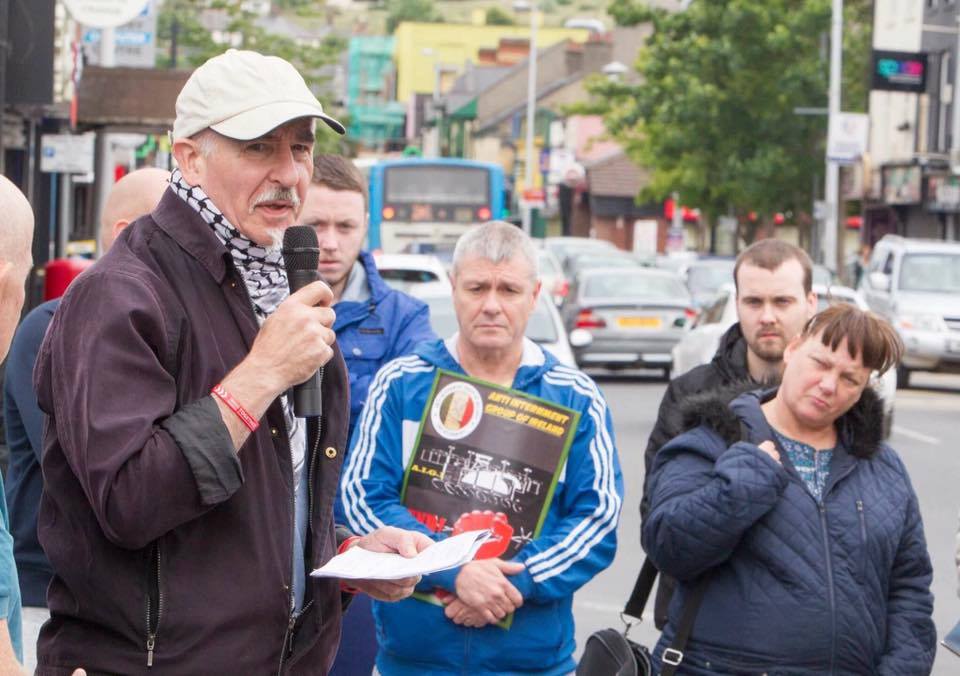
Jean-Ann Day, who has just died, visited Dublin in January 2012 to help push an international campaign to free Leonard Peltier, also a warrior of the First People and longest-serving prisoner in the US after a travesty of a trial in 1977.
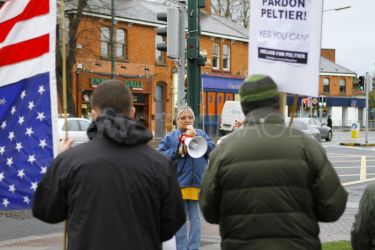
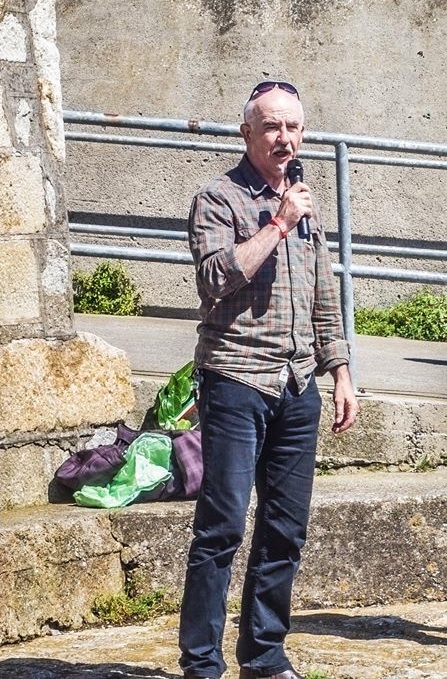
Jean-Ann speaking at picket on the US Embassy in Dublin in solidarity with Leonard Peltier. The photographer’s back is to the Embassy.Jean-Ann Day — photo placed with her official obituary on funeral home site
Due to a family tragedy hitting her contact here I had to step in as Jean-Ann’s contact but it was an honour for me. I progressed arrangements and took her to see Joan Collins TD and arranged for a radio interview with a program on Near FM.
I remember that on our way across the Liffey, Jean-Ann took a pinch of tobacco and offered it to the river with a prayer. The Gaels also thought of their rivers as divine, most of them goddesses. Although an atheist, to my thinking such belief systems seem greatly superior to those that think it fine to convert a river into a sewer or a toxic waste outlet.
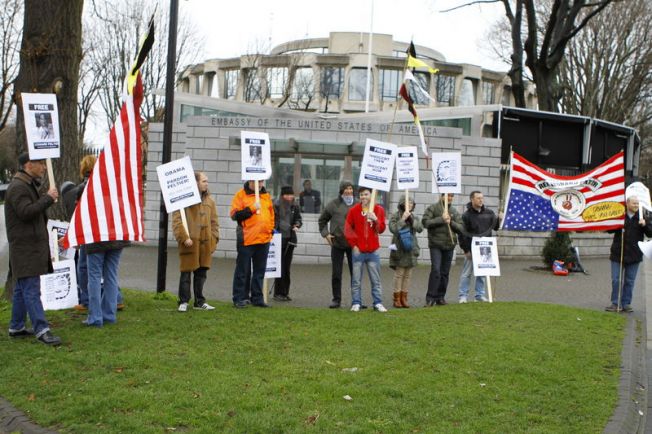
On Saturday 4th February 2012 a small crowd of varied political backgrounds, including a significant proportion of independents, staged a protest outside the US Embassy in Ballsbridge as part of a world-wide week of protests seeking Peltier’s release. Jean-Ann delivered a simple speech there that I believe reached into the heart of every one of the participants as it did into mine.
Poster produced for the Dublin solidarity picket of the US Embassy (regret the name of the artist does not come to mind at the moment)
A small musical evening in Dublin organised by supporters was another occasion at which she appeared and I understood she went to Belfast and Derry too.
Jean-Ann, warrior for justice has walked on and left us her memory. Her former comrade, another warrior, Leonard Peltier, remains in jail in serious ill-health.
Peltier is incarcerated at the United States Penitentiary of Coleman in Florida and given that he is 72 years of age and that his next scheduled parole hearing will be in July 2024, it is clear that the FBI and USA state want him leaving jail only in a coffin. Barring appeals, parole or presidential pardon, his projected release date is October 11, 2040.
Jean-Ann Day, Bear Clan of the Ho-Chunk Nation, age 65 of Stevens Point, Wisconsin walked on Sunday, September 4, 2016 at the University…
APPENDIX
Leonard Peltier Regarding the Passing of Jean-Ann Day
When I heard the news of Jean’s passing I was both saddened and surprised. I did not know she was ill. If I had known I would have reached out to her and tried to support her in any way I could.
Jean was a true friend to me for all the years I knew her. Her passing reminds me of so many things back in those days at Oglala so long ago.
She was a such a bright light and a young woman full of courage who came to Oglala without hesitation to join us in protecting the elders there. And she did so much work to free me from prison all these years. I am grateful to her for that.
Poster in the style of Jim Fitzpatrick’s famous Che Guevara poster (Regret artist unknown to me)
Over the years here I have thought of her often and in my dreams of freedom there were always a few faces I expected to see if I ever walked out of here. Jean’s was one of them.
I know she was doing wonderful work in the effort to bring healing and positive change to her Ho-Chunk people and I was always proud of her for that.
I regret that I could not be there for her ceremonies so I could offer comfort to her children and grandchildren, but I can only send these few heart-felt words.
You were a great woman and your life made a real difference to me… and to so many others.
Rest in peace, my dear friend. ‘Til I see you again.
Doksha,
Leonard Peltier
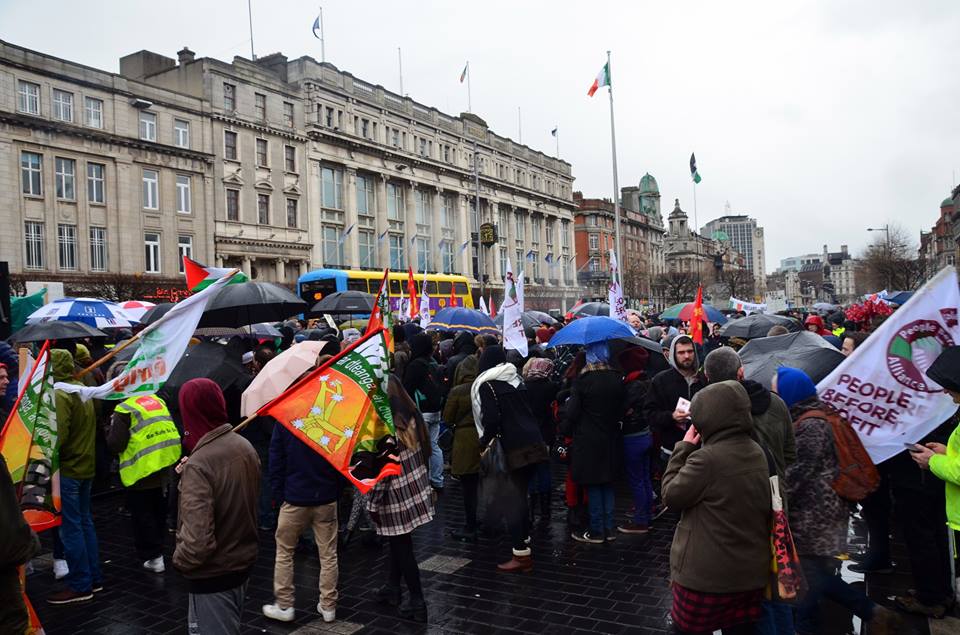
Part of the gathering at the Dublin US Embassy in solidarity with Peltier and seeking his urgent release in 2012
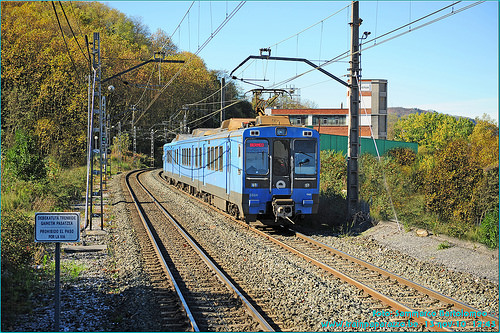
On the platform at Mundaka there are only a few to catch the 9.18 a.m. train to Bilbao. Mundaka is a popular coastal resort town in Bizkaia province, southern Basque Country. “Egun on” (“good day”), I greet those on the platform in Euskara in passing, the Basque language, and they reply the same.
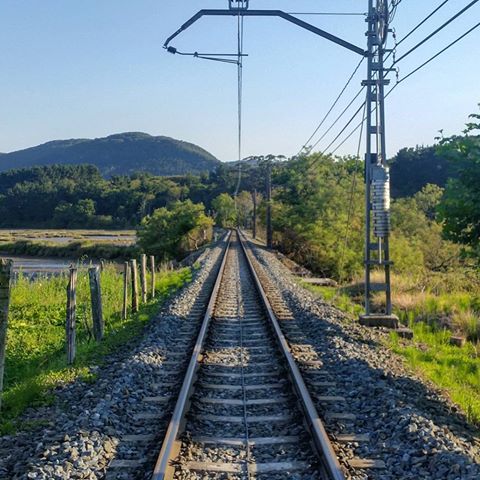
Train on the Atxuri (Bilbao)-Bermeo line. Note the warning sign to bottom left of image, in Euskera first and Castillian second. (Photo sourced on Internet).
A young couple with two little boys come on to the only platform (for both directions) and I think I hear the woman speaking to the boys in Euskara. But soon, I make out some Castillian (Spanish) words; however it is not unusual to hear some Castillian words and even phrases scattered through Euskara conversation, in the southern Basque Country, at any rate. But no, I can tell now that the conversation between mother and child is definitely all in Castillian – I must have been mistaken earlier, when I thought they were speaking in Euskara.
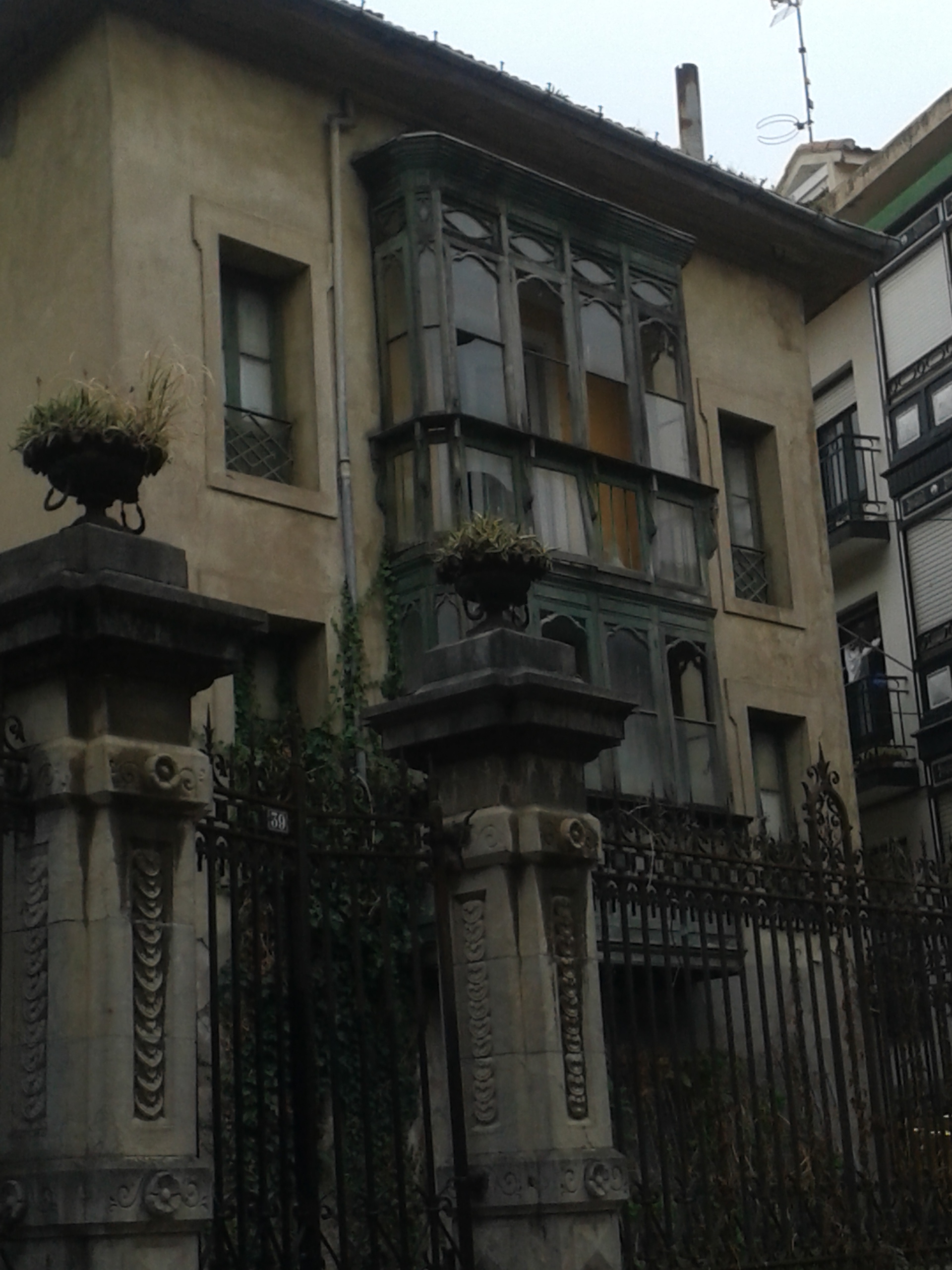
A view from a Mundaka building a number of stories up. The port is out of sight to the left, the station behind. (Photo: D.Breatnach)“Casa de Los Ingleses”, a beautiful if rather gothic-looking old house, residence of an English family with business interests locally many years ago. I passed it on the short walk from the town to the station. Behind it there were plots being worked for vegetables, all due to disappear beneath a new car park construction. (Photo: D.Breatnach)The residence of the servants of the Casa de Los Ingleses, a lovely building in its own right. Its demolition is planned to make way for a new construction (see design in next photo) — my guide encouraged me to write a letter of protest to the municipality. (Photo: D.Breatnach)The construction planned to replace the “servants’ house” after the latter has been demolished. (Photo: D.Breatnach)
“Miao, miao” says the smallest boy, pointing at some feral cats dozing near the platform. “Bai, katua” replies the mother and a flood of Euskara follows, both boys and mother and occasionally father too conversing in Euskara. And so they continue until the southbound train arrives and everyone gets on, except one man, presumably waiting for a northbound train to Bermeo.
On our journey southwards, soon passing alongside salt marshlands, I note that the names of the stations are in Euskara only: Itsasbegi-Busturia, Axpe-Busturia (in the broad estuary of the Urdebai river), San Kristobal Busturia, Forua, Instituto Gernika, Gernika….
The Wikitravel entry for Gernika translates it to the Castillian “Guernica” and opens with this: “Basque town which was the site of the first airborne bombing attack on a civilian town during the Spanish civil war. The bombing, by the Condor Legion of Germany’s Luftwaffe in 1937, inspired Picasso to paint the landmark cubist work Guernica, now on display at the Centro de Arte Reina Sofia in Madrid.”
Well, yes, but one might add for clarity that it was done as part of Franco’s fascist offensive and that the fascist press later blamed it on Asturian Anarchist “fire-bombers”. And one might update it by commenting that the Basques have asked for Picasso’s painting to be located in Gernika itself, a request which the Spanish state authorities, the political descendants of the fascist victors of that war, have refused.
Train tracks from Axpe Busturia, the estuary to the left and salt marshes on both sides. (Source: Internet).
Onwards again, the next stop is Lurgorri-Gernika. At the next after that, Zugast station, a middle-aged man gets on with Berria, the all-Euskara newspaper, under his arm. This periodical, being in many ways the replacement of another newspaper, Egunkaria, has a noteworthy connection with history.
Founded in 1990, Egunkaria was the first all-Euskera daily newspaper in the world; it had a left-nationalist editorial line and a journalistic outlook, which led it to report ETA statements alongside those from Spanish unionist political parties and from the State. The Basque language was no longer illegal or banned since the transición, post-General Franco, when the fascist Spanish oligarchy brought the leaderships of the social democratic party and the Communist Party on board, along with their respective trade union leaders — and called it “Democracy”.
But on 20th February 2003, the Spanish State’s militarised police, the Guardia Civil, raided the newspaper’s premises, seized records, machines and closed down the periodical. They also raided the homes or arrested at the building a total of ten people associated with the newspaper, at least four of which were tortured subsequently. For one of those, the manager, a gay man, the torture included sexual violation.
Massive protest demonstrations ensued from an outraged Basque population. The arrested were released on bail.
On 15 April 2010, seven years later, the defendants were finally acquitted on all charges relating to ‘terrorist’ connections and the judges added that there had been no justification for the closure of the newspaper in the first place.
By then, Egunkaria was beyond recovery and anyway Berria had stepped in to occupy the niche (apparently with the blessing of the Egunkaria team). The case against the State for compensation for the loss of the newspaper and also for torture remains open, sixteen years later. The Court of Human Rights at Strasbourg found the Spanish State guilty of not investigating the manager’s complaint of being tortured and ordered compensation paid. It did not, however, as it usually does not, find the State guilty of the torture itself. Of course, torture is difficult to prove, particularly when the State in question keeps political detainees for five days incommunicado, without access even to independent medical practitioners, while its police go about getting their “confessions”
On the train journey now, the next stop has the delightful-sounding name of Muxika. This causes some amusement to a teenage boy in a nearby seat, accompanied by an older woman – they have been talking in Castillian only since they got on. I wonder are they aware that in June 2013 José Mujica, President of Uruguay until last year, visited the townland that gave rise to his surname. Mujica was presented with a key to the town by the Mayor, who is of the Abertzale Left party Bildu.
The train pulls out of Muxika, then on to Zugastieta-Muxika station as we continue running southward through thick woodlands, occasional industrial parks and small allotments where an occasional middle-aged man tends to his large tomatoes, the small elongated sweet peppers of the region, courgettes, climbing beans …..
Onwards to Morebieta Geralekua before the line takes a sharp twist north-eastwards to more woodlands, rivers, streams and mountains at Lemoa, Bedia, Usansolo, Zuhatsu Galdakoa. Now the built-up areas of Ariz Basauri followed by the contrast of the picturesque Etxebarri before a southward curve to Bolueta and then eastward, to run along the Nervion river to Atxuri station in Bilbo (Bilbao), journey’s end.
All of the stations along this route were named in the Basque language – not one had a Castillian version showing (although there will be plenty of that in streets and squares in Bilbao). The public announcements on this train, as on their counterparts in the Irish 26 Counties, are bilingual but with this difference – on the Basque train, they are always in Euskara first, Castillian second. Likewise with the signage. One is never under any doubt about which language is being given primacy there, nor indeed here, where the English version comes first and, when in text, is in a more dominant type or more contrasting colour.
The Irish language is being derailed even as, to mix metaphors, it is being given lip service. Further down the tracks, unless some urgent repair work is undertaken, lies the final stop – the cemetery of our national language.
Lynam’s Hotel in O’Connell Street is a building you could easily pass without realising what its business was. The hotel takes in mostly tourists on short-stay bookings but, as the homelessness crisis totally exceeds Dublin City Council’s minute stock and specific funded provision, DCC has also used it to place homeless families within it as with many other hotels around the city and county (and even further out).
When the owners of the hotel found themselves over-extended on loans, NAMA moved to take over the building; naturally the State agency would not wish to be seen evicting homeless families. Five families with a total of ten children were being placed there by Dublin City Council. The Hotel’s management at first wanted to cooperate with NAMA and force out the families but these, supported by Irish Housing Network, refused to leave as they had no suitable alternative accommodation (see their letter in the Appendix). One by one, the families won short extensions on their stay from the management. Incidentally, eight workers’ jobs are also at stake.
Campaign supporters and supportive members of the public at campaign table outside Lynam Hotel during the week (photo: D. Breatnach)
During the week, the IHN set up a campaign table outside the hotel, staffed by volunteers on a rota and some additional helpers; they began to collect signatures to a petition demanding Dublin City Council take over the hotel and for NAMA not to evict the families. They distributed leaflets (the IHN also have an on-line petition on their FB page) and by mid-week, had collected 1,000 signatures to the petition.
FAMILIES AND SUPPORTERS CONFRONT NAMA AND RECEIVERS
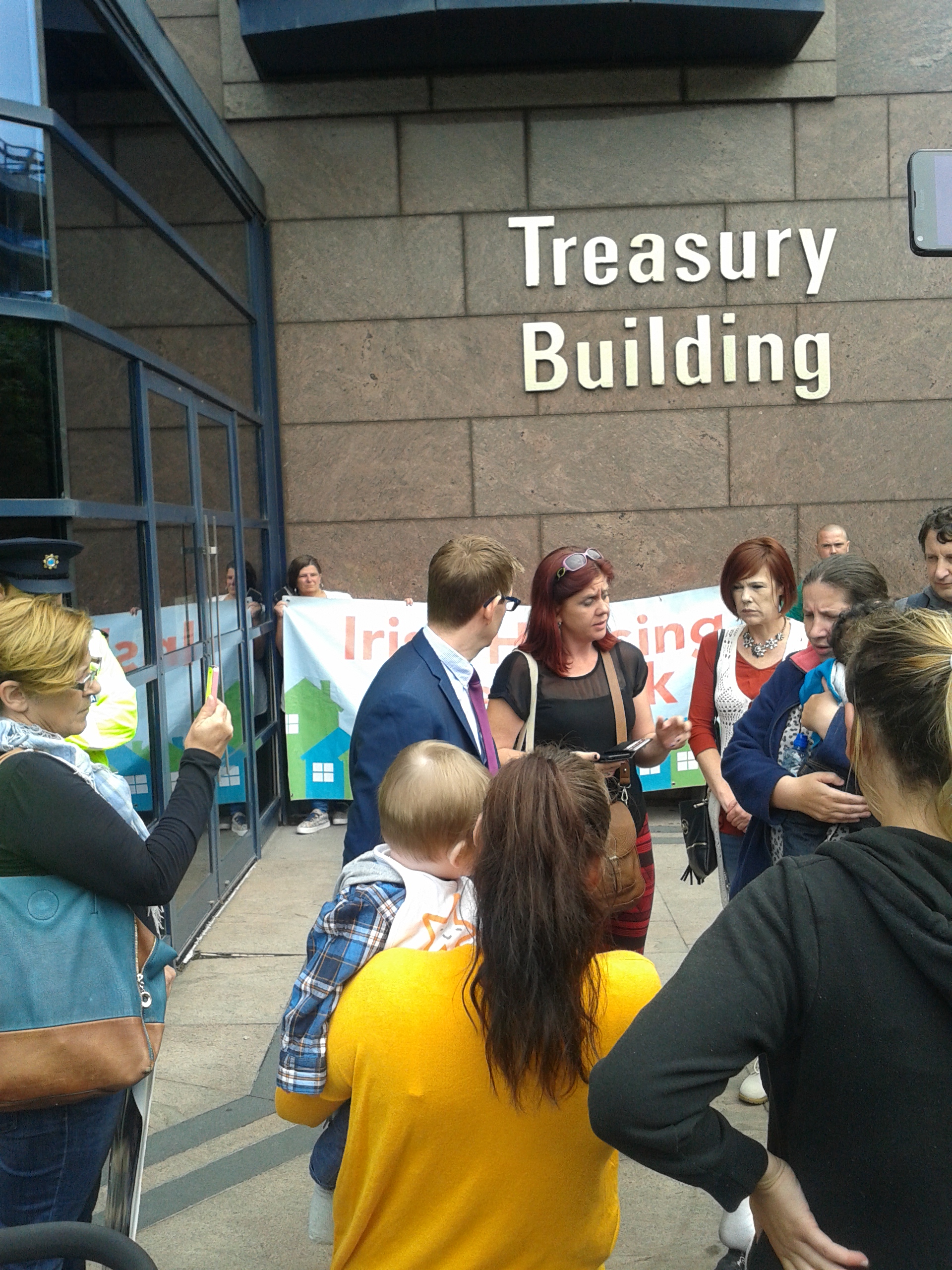
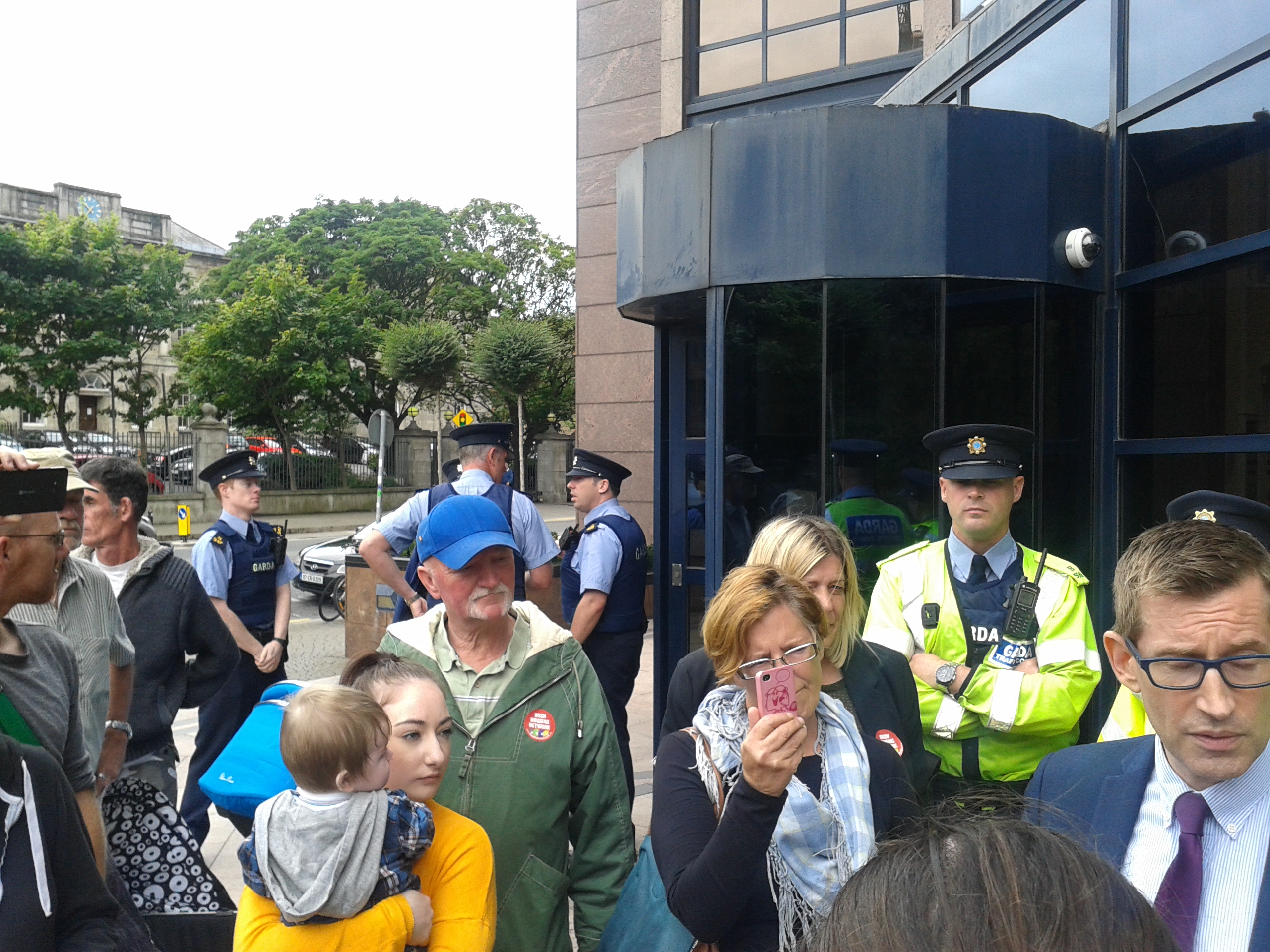
On Wednesday 27th, the families and supporters went to NAMA’s Head Office in Treasury Buildings, Grand Canal Street, D2 and from outside, asked to see the head of the state agency. Treasury Buildings management locked their building and called the police, who arrive in one squad car, then another, and then more of them on foot.
After talking to the police, NAMA offered to see one of the families only, accompanied by a supporter. The families discussed this and rejected it but offered the concession of two families plus supporter. The senior Garda officer seemed to be trying to persuade the families’ representative to accept the NAMA offer but they stood firm. After rejecting that offer, NAMA PR spokesperson Martin Whelan came out to speak to the families and their supporters from the steps of the building. One of the campaigners speculated that this was the first occasion ever for NAMA to explain their actions to the public.
Families and supporters outside NAMA building during the week Supporters and members of the public at campaign table outside Lynam Hotel during the week (photo: D. Breatnach)
Whelan’s position was, in essence, that NAMA had no choice but to put the properties it received on the market and to sell them on. He rejected the accusation of one of the campaigners that NAMA “takes over properties and sells them at knock-down prices to vulture capitalists,” maintaining that all properties are sold at their market value.
With regard to the demand that the building be put under management as a homeless hostel by Dublin City Council, Whelan would say only that they had received no offer from the Council. That would be a decision for the Receiver, he said, in a statement that many saw as an exercise in passing the parcel.
To those who quoted him some lines from NAMA’s founding charter that its purpose was, in part “… to address the compelling need ….. to contribute to the social and economic development of the State …”, Whelan had nothing to say apart from repeating what he had said previously.
The families and campaigners presented Whelan with 1,000 signatures on petitions and indicated they would return with more and began to leave, the police also leaving as they did so.
Families and supporters confronting NAMA PR representative Martin Whelan (in blue suit) (Photo: D. Breatnach)
However, the families and their supporters were not finished yet and headed off for the
Some of the police that NAMA called to protect them from homeless families and supporters with NAMA PR spokesperson Martin Whelan in the foreground (Photo: D. Breatnach)
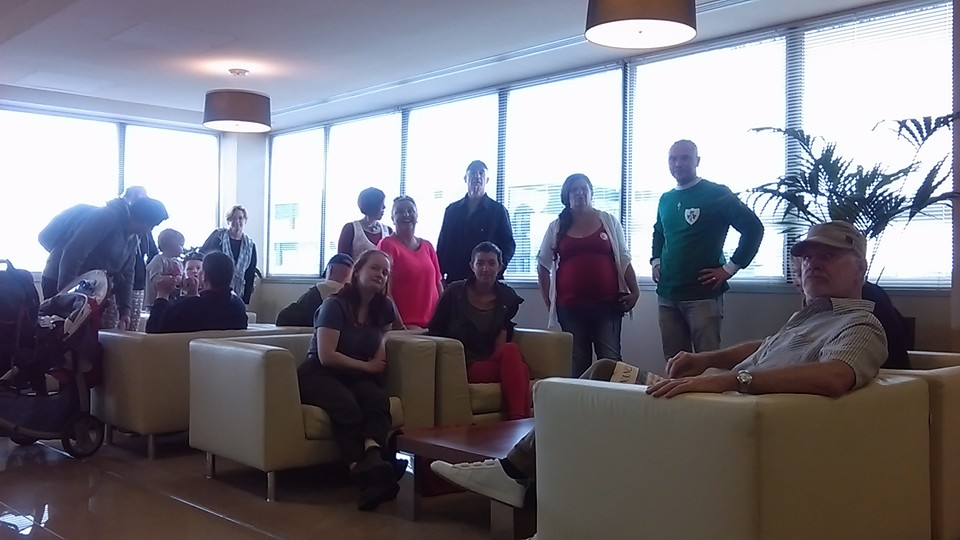
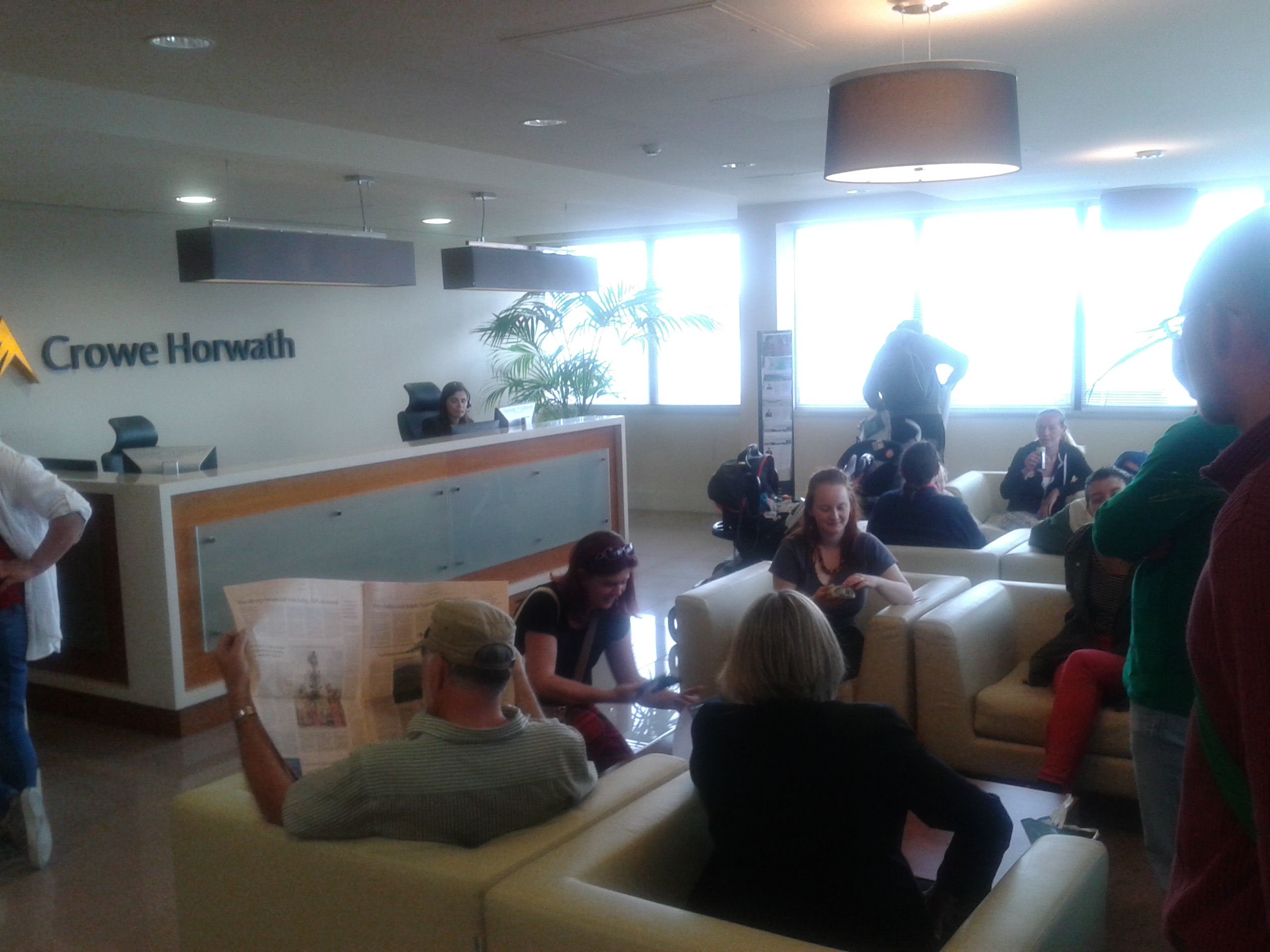
Receivers’ office which, at Marine House, Clanwilliam Place, took some finding. Eventually located overlooking the canal in a very quiet section of the city, they entered and ascended to the 5th floor, to the business address of Crowe Howarth, a member company of the Swiss firm Crow Howarth International. The families and supporters asked to see the person in charge, Aiden Murphy, a partner in the Crow Howarth, who was allegedly outside the building and due back in ten minutes but who appeared from inside after keeping them waiting nearly an hour. Then he wanted to meet them in the lobby, which they refused and insisted on the respect of a meeting in a private office space, which Murphy eventually granted.
According to reports of that meeting, Murphy was civil to the families and assured them he would not be asking for their eviction prior to the court hearing on receivership of Lynam’s Hotel.
Some families and supporters in the lobby of Crow Howarth, Receivers (Photo source: IHN FB page)
Upstairs in the Receivers’ lobby
He was due to meet the families the next day but, apparently worried about meeting demonstrators, arranged a meeting with them in the Gresham Hotel instead (no doubt chargeable to the public). His reticence for meeting possible demonstrators was somewhat different to his previous arrival as reported by sources. with a takeover workforce, bullying staff, changing locks and issuing orders.
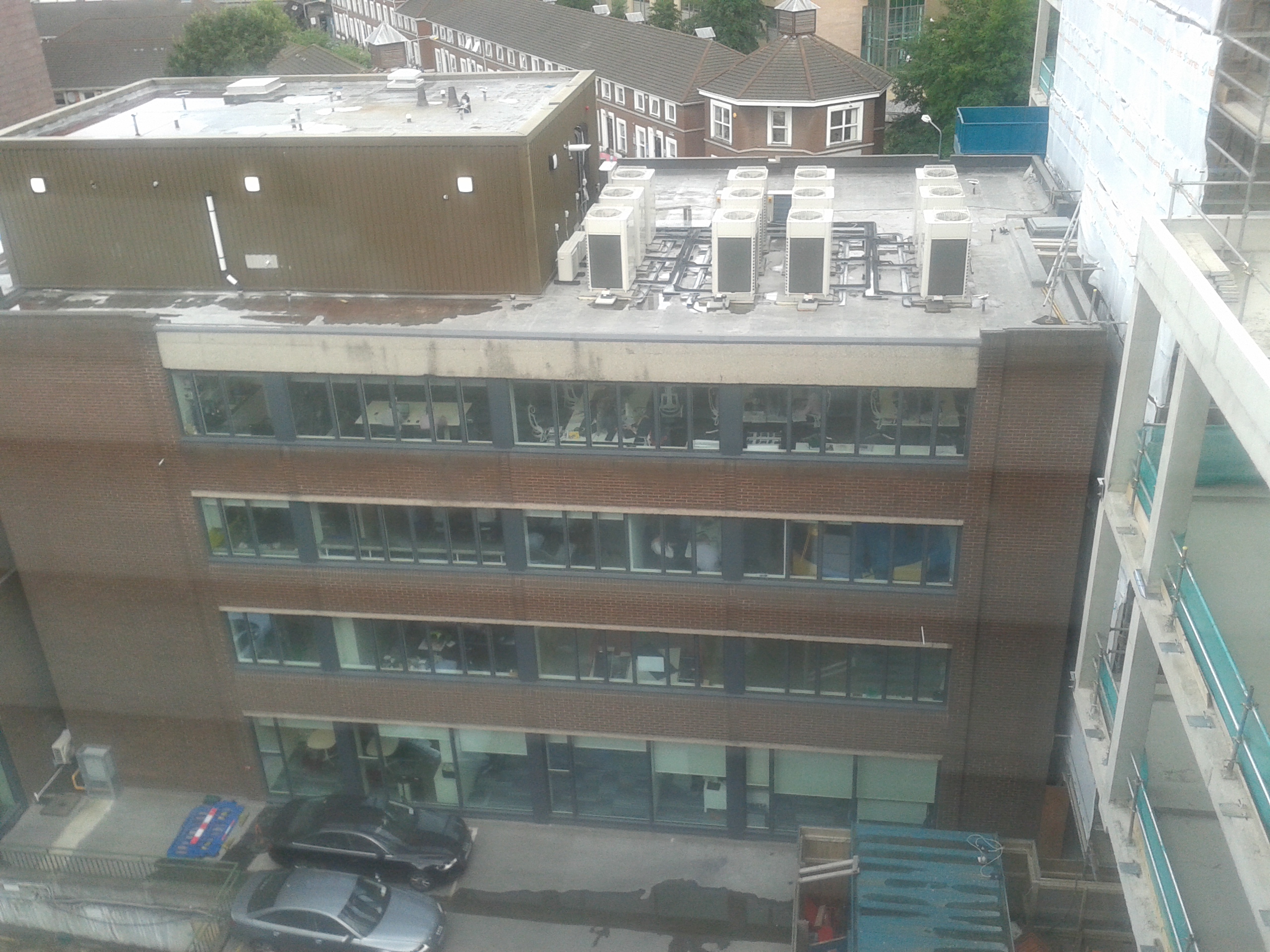
View down to the ground from the Crowe Howarth lobby. Ordinary people must look very small from here. (Photo: D. Breatnach)
THE COURT CASE
In advance of the court hearing, hotel management seemed to be moving to place the families as a buffer between themselves and the Receiver and were reported to have asked the families for a letter stating that the accommodation offered by DCC was unsuitable. Judge Gilligan asked Dublin City Council to appear in court to answer whether they had alternative accommodation available.
On Friday 29th, DCC duly presented themselves at the High Court and assured Judge Gilligan that they had indeed alternative accommodation ready for the families. Judge Gilligan did not ask the DCC spokesperson to detail the type of accommodation they were offering nor its location and Crow Howarth made no move to do so either. The families themselves were not permitted to have a letter detailing their conditions and the type of “alternative accommodation” available (see Appendix) read out in court.
Some of the rota for the table outside the Lynam Hotel (Photo: D. Breatnach)
The outcome pf the case was that Lynam’s Hotel was wound up, ordered to cease trading beyond August 1st and the building is to be sold (if it is not, as rumoured, already sold) on behalf of the State to some unknown capitalist. The families will presumably be placed somewhere in the kind of conditions about which their letter complains, affecting not only the parents but the children now and into the future, perhaps for the rest of their lives.
And the housing crisis continues without any State agency or Dublin City Council making serious efforts to address it; according to the Irish Housing Network there are over 8,000 families homeless within the state and the total is growing daily. This is in the centenary year of the 1916 Rising when that inspirational document was printed in Liberty Hall, signed in Henry Street (around the corner from Lynam’s Hotel by seven who would be shot later by firing squad) and read out and posted on Easter Monday outside the GPO in the same street as the Hotel, declaring that “The Republic guarantees equal rights and equal opportunities to all its citizens, and declares its resolve to pursue the happiness and prosperity of the whole nation and of all its parts, cherishing all of the children of the nation equally …..”
We the Lynams families would like to thank you for your consideration of our situation in this High Court decision. We are choosing to remain anonymous due to fear of being targeted as we are under threat to take offers that are not suitable or find ourselves with no accommodation what so ever.
We appreciate that you realise that we are extremely vulnerable at this time and are being used as pawns in the political maneuvers of the Hotel management, DCC, the Receivers and NAMA.
As a group we would like to highlight the situation in Emergency Accommodation we are currently finding ourselves in.
We are HOMELESS, yes we are lucky to have a roof over our heads but we are without a fixed abode. We are under the control of the whims of Hotel Management and the DCC.
The accommodation we can usually find ourselves in is one double sized room for one family, two rooms if you have a larger family not necessarily in the same building. Imagine if you will having to live your whole life within the confines of this room where there is:
No drinking water. No fridges to store milk for young babies. No cooking facilities. No laundry facilities to wash your own or your children’s clothes. No area for the children to play, do homework or socialise with others.
We have been offered Alternative Accommodation which is below the standard that we currently experience at Lynams and is still not suitable for our families needs. In fact there is no minimum standard for Emergency Accommodation.
Families that enter Emergency Accommodation initially start off their journey in shock with a loss of home, structure, security. Children sit in their school uniforms waiting for the hotel restaurant to open in order to grab a quick breakfast before they start their long journey to the only anchor they know which is the school they were enrolled in, before they became homeless. Families cling to this anchor, in order to enable their children to have some degree of normalcy in their lives.
Those children who do not have a home and proof of residence do not have any chance of enrolling in school, getting a doctor‘s appointment, being referred to services or getting counseling.
Children spend their days trying to be quiet around adults that are stressed trying to find new accommodation for that night. Forbidden to associate with other children as per rules in certain establishments. They are hungry, as they wait for their parents to source food, often eating whatever food is left over from breakfast until they share one takeaway meal between the family. There is no money is left by the end of the week as it has been spent on transport. These children are disorientated, with some families ending up in hotels in Bray, Aughrim & Brittas Bay trying to get to school in north Dublin. These children lose any hope of being in a normal home, they cling to already anxious parents.
The average families moves every 5 days unless they are lucky to get a hotel/guesthouse that takes on DCC customers as permanent until placed, the length of time that takes can be upwards of 2 years. There is one family that was in Lynams for 7 months, and were informed by DCC with 4 days notice to move, they have been in hotels in several different counties in the space of 3 weeks since they moved.
We ask you to consider that this is our home, we are powerless to fight the combined forces of DCC, NAMA and the Receivers and the pressure they are putting on us. On July 22nd Management in Lynams continued to accommodate us when DCC failed us.
We ask you to consider that we are not just names on a list, we are real people, we have real lives, we have jobs, our children are being directly affected by the decision being made here today.
Even though we have no hope of a good outcome for our families we can only hope that you find it in your heart to consider all these issues of how the system for homeless families has failed us all and will continue to fail unless properly addressed.
Thank you for taking the time to read this letter.
Foreign tourists and Irish-based visitors looked on with curious interest at a gathering at the foot of the East Pier, Howth on Sunday 24th – the group contained a number in military-type uniform, some were carrying flags, each one of a different design and a number of people in ordinary civilian clothes were carrying floral wreaths.
The Asgard, Molly Childers and Mary Spring-Rice on board at Howth (photos from Internet)
Participants, Tourists and Visitors (photo D.Breatnach)
Most onlookers at that point would not have known that those gathered there had a threefold purpose:
to commemorate the landing of Mauser rifles for the Irish Volunteers
to commemorate the massacre of civilians by enraged soldiers later that same day on Bachelors Walk and to
launch the Asgard 1916 Society.
The men and women in uniform formed up with the flags as a colour party and led the procession the full length of the pier to its end. There the procession came to a halt in front of a plaque on the wall commemorating the landing of 900 Mauser M1871 single-shot rifles and 29,000 rounds of ammunition in 1914 by a crew skippered by Erskine Childers with his wife Molly and friend Mary Spring Rice. The arms were taken ashore and whisked away in an operation planned by Bulmer Hobson of the IRB and carried out by the Irish Volunteers and Na Fianna Éireann.
Colour Party marching along the pier towards the ceremony (photo D.Breatnach)
The Dublin Metropolitan Police and British Army were mobilised by Dublin Castle authorities to seize the guns (unlike at the previous much larger operation by the Loyalist UVF at Larne) but only managed to get a few. As the disgruntled Scottish Borderers marched back into town, they were jeered by Dublin crowds and some cabbage stalks were thrown at them. On Bachelors Walk, very near the Ha’penny Bridge, an officer brought them to a halt and they faced the crowd with guns pointed, then opened fire. Three men and a woman were killed and 38 wounded, including the father of singer Luke Kelly of the Dubliners ballad group (also called Luke). One of the victims died of bayonet wounds.
Margaret McKearney speaking and chairing the occasion on the pier (photo D.Breatnach)
Margaret McKearney, who has had three brothers killed in the Six Counties during the 30-years war, stepped forward to address the crowd as tourists and visitors took photos or watched and listened. After giving a brief account of the Howth landing and of the massacre on the Dublin quays, also of the smaller landing at Kilcoole, McKearney called forward Pól Ó Scanaill of the 1916 Societies to read the 1916 Proclamation of Independence. After he had finished, McKearney called for the young bearers of two floral wreaths to make their presentations:
Ellen O’Neill, with a wreath in memory of those killed and injured by the British soldiers at Bachelors’ Walk;
Roibeard Drummond, whose uncle Michael Moore was a crew member of the Nugget, landing rifles at Kilcoole, laying a wreath for the Asgard 1916 Society to commemorate the landing of the rifles and those who carried them in battle in 1916.
Last of the wreath-layers was Denise Ní Chanain on behalf of the Anti-Internment Group of Ireland.
Ellie O’Neill after laying wreath in memory of the dead and injured in the Bachelors’ Walk massacre (photo D.Breatnach)
MOORE STREET SPEECH
Roibeard Drummond, after laying wreath on behalf of the Asgard 1916 Society (photo D.Breatnach)
Niamh McDonald gave a short speech on the current situation in the struggle to save the revolutionary quarter of Moore Street. She informed her audience that NAMA had sold the debt of the Irish speculator company Chartered Land (Joe O’Reilly) to Hammerson, a British-based vulture capitalist company, who are continuing with the plan to build a huge shopping centre over the whole historic quarter. Meanwhile, the Minister for Heritage, Heather Humphreys, is appealing the High Court judgement that the whole quarter is a national monument. McDonald asked people to keep an eye on the campaign’s
Denise Ní Chanain bringing forth the wreath from the Anti-Internment Group of Ireland (photo D.Breatnach)
Facebook page for updates and for calls to support actions.
McKearney then called on Diarmuid Breatnach to sing Me Old Howth Gun, pointing out that guns landed at Howth had been the first to fire on the Lancers in O’Connell Street on Easter Monday 1916. Breatnach introduced the song as having been written apparently in 1921, that is a year before the outbreak of the Civil War, by James Doherty, who also used the pseudonym Seamas Mac Gallogly.
Niamh McDonald speaking on behalf of the Moore Street 2016 campaign (photo D.Breatnach)
MAIN SPEAKER — JOHN CRAWLEY FROM THE MARITA ANN
The next speaker to be introduced by McKearney was John Crawley who was arrested on board the Marita Ann trawler, intercepted off the Kerry coast by the Irish Naval Service on September 29, 1984, when seven tonnes of arms were seized. The US heavy machine guns recovered on the Marita Ann had special mountings allowing them to be used as anti-aircraft weapons. Another of those detained on board – and later jailed for 10 years – was Martin Ferris who went on to become a Kerry TD for Sinn Fein, while John Crawley has taken a line of opposition to the Good Friday Agreement.
John Crawley giving his oration with the plaque commemorating the landing of the Howth guns behind him (photo D.Breatnach)
John Crawley gave the main speech at Howth, in which he traced the history of the struggle for the Irish Republic from the Volunteers onwards, pointing out that many who fought the British in 1916 had different aspirations for the country, which explained why they parted ways in 1921. Crawley stated that the British have always been able to pick out those whose primary intention was to survive the struggle from those whose intention was if necessary to give their lives for the objective of the Irish Republic.
Pól Ó Scanaill reading the 1916 Proclamation at the head of the East Pier, Howth (photo D.Breatnach)
Crawley pointed out that some people had led a section of the Republican movement in accepting the right of a foreign country to decide the future of a part of our country; they had joined in the colonial administration and had accepted the colonial police force.
After the applause for the speech died down, McKearney thanked those who had participated and asked Diarmuid Breatnach again to step forward to sing the national anthem. Breatnach sang it in Irish, first verse and chorus (and noticeably sang “Sinne Laochra Fáil” instead of “Sinne Fianna Fáil”). Participants joined in with the chorus and then all made their way along the pier towards a local pub where refreshments had been made available by the new 1916 Society.
Diarmuid Breatnach singing Amhrán na bhFiann at end of the ceremony. Earlier he had sung “Me Old Howth Gun”. (Photo: Des Keane from Sean Heuston 1916 Society page)
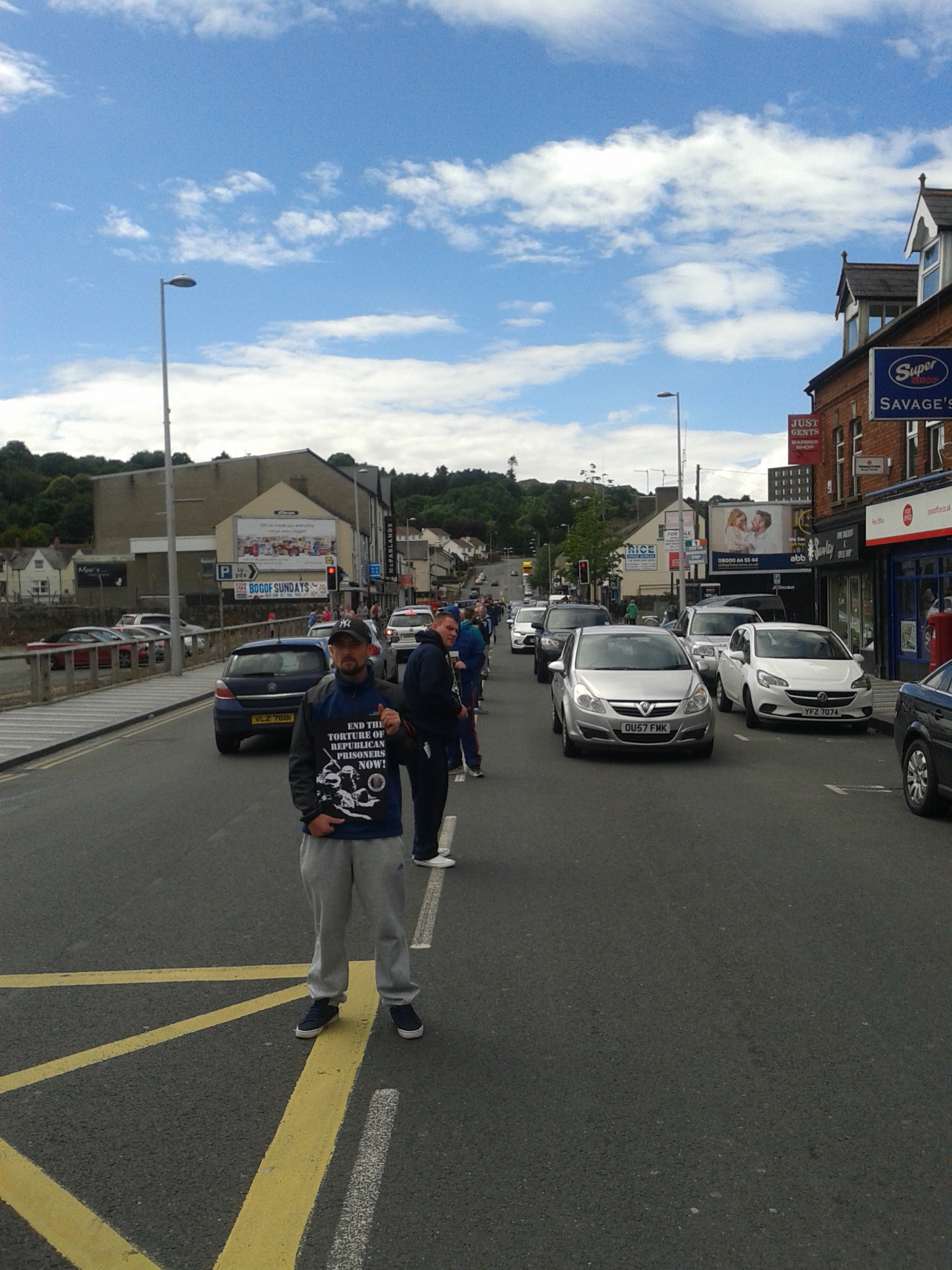
UP TO FOUR SCORE PROTESTERS LINED A MAIN STREET IN NEWRY ON SATURDAY 2nd JULY TO PROTEST THE CONTINUATION OF INTERNMENT WITHOUT TRIAL OF POLITICAL ACTIVISTS
Clive Sulish
This the event was organised for the third year running by the Anti-Internment Group of Ireland and was supported by a number of organisations, campaigns and independent activists. AIGI was formed some years ago to raise awareness of the reintroduction of internment without trial by the use of remand in custody and revoking of licences.
Republican activists are being arrested on trumped-up charges and then refused bail outright or sometimes offered it in exchange for acceptance of conditions limiting their freedom to live normally and, in particular, to be politically active. This in itself lays bare the real motivation behind the charges – one who was unable to support the event because of his bail conditions told this reporter that he has to sign at a police station every day including the middle of the afternoon on Saturdays, is not allowed to speak about political prisoners, to attend political meetings or to post or comment publicly on social media. If refused bail, activists may await trial for two years and, if then found ‘not guilty’ by the no-jury Diplock Courts, will already have spent two years in prison anyway.
Former political prisoners released on licence under the terms of the Good Friday Agreement may be arrested and detained without trial, without charge, without even a police interview as happened to Martin Corey (four years without trial and released under gagging conditions). Currently Tony Taylor is in jail without charge under this system.
AIGI was founded to raise public awareness about these serious violations of civil and political rights. The Dublin branch of AIGI, the Dublin Anti-Internment Commitee, holds regular public pickets and meetings in the Dublin area and has facilitated other public events for other campaigns, such for example the framed Craigavon Two. Recently the Munster Anti-Internment Committee was also founded as another branch of the AIGI (both committees were represented at the Newry event).
This slideshow requires JavaScript.
SPEAKERS DENOUNCE BAIL CONDITIONS, REFUSAL OF BAIL AND OPPRESSION INSIDE JAIL.
A number of speakers called attention to the repression of the Six County state in its arrests of political activists, refusal of bail or imposition of oppressive conditions if bail is granted, imprisonment on trumped-up charges and through revoking of licences. The case of the Craigavavon Two was mentioned by a number of speakers, as was the case of Tony Taylor. The Craigavon two are in jail convicted of the killing of a British soldier, even though the case against them is riddled with holes and depends on an eyewitness who came forward nearly a year after the event, whose evidence is contradictory, whose movements on the night in question are denied by his own family and who is described by his own father as “a Walter Mitty character”.
All the speakers called for continuous action and unity against repression and were vigorously applauded.
JOE CONLON WAS THE FIRST SPEAKER. HE SPOKE ON BEHALF OF THE DUBLIN ANARCHIST BLACK CROSS, a support group for political prisoners.
In the course of his speech he pointed out that the struggle of Republican prisoners in Maghaberry Prison has been going on for well over a decade. Commenting on a brutal prison regime, Conlon focused on the attacks on “prisoners‘ families and loved ones being refused visits without any warning and loved ones being banned for a couple of months at a time also without warning.”
Attacking the system of solitary confinement within the jail, Conlon picked out the case of “Gavin Coyle (who) has spent five years in isolation,” while, he pointed out, non-Republican prisoners usually spend at most up to three weeks in isolation, as a punishment. “The use of forced isolation is to try destroy the morale, spirit and mind of a prisoner. In Gavin Coyle‘s case the British state are trying to break him down physiologically and MI5 have made several approaches to him in the Isolation block.”
Conlon went to assert that “these exact same tactics are being used ……. acrossEurope to get Anarchist activists jailed and used against prisoners and their families to break them,” and recalled that the previous year several anarchist prisoner had gone on hunger strike.
Calling attention to the 39–day hunger strike by Tasos Theofilou, who was sentenced to 25 years jail in 2014, Conlon said that “he was convicted of manslaughter, carrying a firearm and armed robbery, which he has always denied. The only evidence against him was DNA that was found on a moveable object, none of the witnesses in trial could identify him,” Conlon pointed out.
PAUL CRAWFORD OF CÓGUS AND REPUBLICAN NETWORK FOR UNITY ADDRESSED THE CROWD ALSO.
Thanking the organisers for the invitation to speak and declaring it a privilege to address the gathering, Crawford addressed some remarks towards the terminology of “internment” and raised some questions regarding its accuracy with regard to some cases, the injustice of which however he went on to denounce.
The media and political class came in for denunciation too for ignoring the fact of framing of activists on flimsy evidence.
Crawford went on to speak of his comrade Carl Reilly who, he said “is another example of selective detention.” Reillly is arrested on a charge of directing terrorism and, Crawford informed the crowd, “this charge is based on secret recordings allegedly taken in the 26 counties yet passed to the state forces in the north to use as evidence to remand him there.”
Crawford told those assembled that he himself is Carl’s co-accused, released on bail. “I am forced to endure draconian and repressive bail conditions which are clearly designed to prevent me from carrying out my role within my political party in an effective manner. I am not allowed to send Carl a birthday card, to talk to him or even to have third–party contact with him.” Crawford said. “In essence,” he continued,“I’m not even allowed to ask his wife to tell him I was asking for him. Many activists north and south are effectively interned on bail, in prison outside of prison walls.”
STEPHEN MURNEY, FROM NEWRY AND IN ÉIRIGÍ was himself a fairly recent victim of internment through refusal of bail for nearly two years, after which he was cleared of all charges.
“When republicans are targeted by the British occupation forces, backed by their political mouth pieces in Stormont,” Murney told the crowd, “they can expect to be held for anything up to five years in a British prison.” “Many of these cases are built on sand and eventually collapse before trial,” he continued, “although the end result is that those republicans are held in prison for several years despite being innocent.”
In the course of his speech, Murney pointed out that the families,whosebattle is “largely unseen and unheard ……. are left to pick up the pieces”. Continuing, he stated: “I think it’s appropriate and important that today we acknowledge the struggle that women have to endure when their husbands and sons find themselves interned”.
Murney went to talk about the “living nightmare” that bail conditions impose on activists, making it “impossible to live anything that even remotely resembles a normal family life. Late night checks, daily bail signing, draconian curfews and being forced into exile are the order of the day.” He went on to say that those who are forced to wear an electronic tag “not only have to endure Crown force harassment, but they also find themselves being harassed by their lackeys In the G4S security company.”
Not even after completing there sentences are activists free from harassment, Murney declared, as “many find themselves with severe licence conditions being imposed and being unable to return to their homes to live.”
SPEAKER CALLS FOR SUPPORT FOR DEFENCE OF MOORE STREET AND HISTORY
Last to speak was Diarmuid Breatnach, introduced by the chair as representing the Save Moore Street From Demolition campaign. He began by quoting a saying, “Níl saoirse gan stair” (‘There is no freedom without history’). Breatnach spoke of the importance of history, of knowing it well and how it is interpreted; how those who hide or control history do so in order to control the people. He pointed out that history is not dead but is constantly being made, “as those of us here today are in a small way part of the history against the reintroduction of internment”.
Speaking about the last Headquarters of the 1916 Rising, the terrace of houses in Moore Street occupied by the GPO Garrison, Breatnach related how the long years of people campaigning for their conservation had resulted in an Irish High Court judgement that the whole of the Moore Street quarter is a National Monument.
However, Minister Humphreys is appealing the judgement, Breatnach told the crowd and the property speculators have applied for a seven-year extension on their planning permission for a giant shopping mall, which involves the demolition of the whole quarter with the exception of four buildings.
Focusing on the forthcoming march on Saturday 9th in Dublin (organised by the Save Moore Street 2016 campaign), Breatnach encouraged all to take leaflets, inform themselves and others about the issues and to march with the campaign and supporters in Dublin, “not just for the past, nor just for the present but for …. a future free from colonialism, imperialism and property speculators.”
“A VERY SUCCESSFUL EVENT …. HIGHLIGHTING THAT INTERNMENT WITHOUT TRIAL HAS NOT GONE AWAY”
Police vehicles passed along the street keeping the demonstrators under surveillance a number of times but did not stop, nor did police on foot appear. They also took a turn around the car park noting vehicle registration numbers.
People driving past in cars almost without exception accepted leaflets and some tooted their horns in solidarity. The presence of large numbers of cars of expensive make passing through the street drew an expression of surprise from one Dublin participant. “Green diesel prosperity,” replied his comrade laconically. Clearly there is more than one kind of ‘cross-border initiatives’!
“This was a very successful event,” stated a spokesperson for the organisers, a sentiment echoed by many, quite possibly all of those in attendance. “As in past events, people from different Republican organisations and Republican and socialist independent individuals participated. We also distributed in excess of one thousand leaflets here today and highlighted that internment without trial has not gone away.”
Newcomers to this event were in evidence this year also, with the banner of the Anarchist Black Cross (support group for political prisoners) clearly to be seen.
The presence of Munster and Dublin branches of the Anti-Internment Group of Ireland reflect the growth of the organisation and interest in its core principles of active committees, democratically run by participating activists, independent of any political organisations but open to members of all and of none.
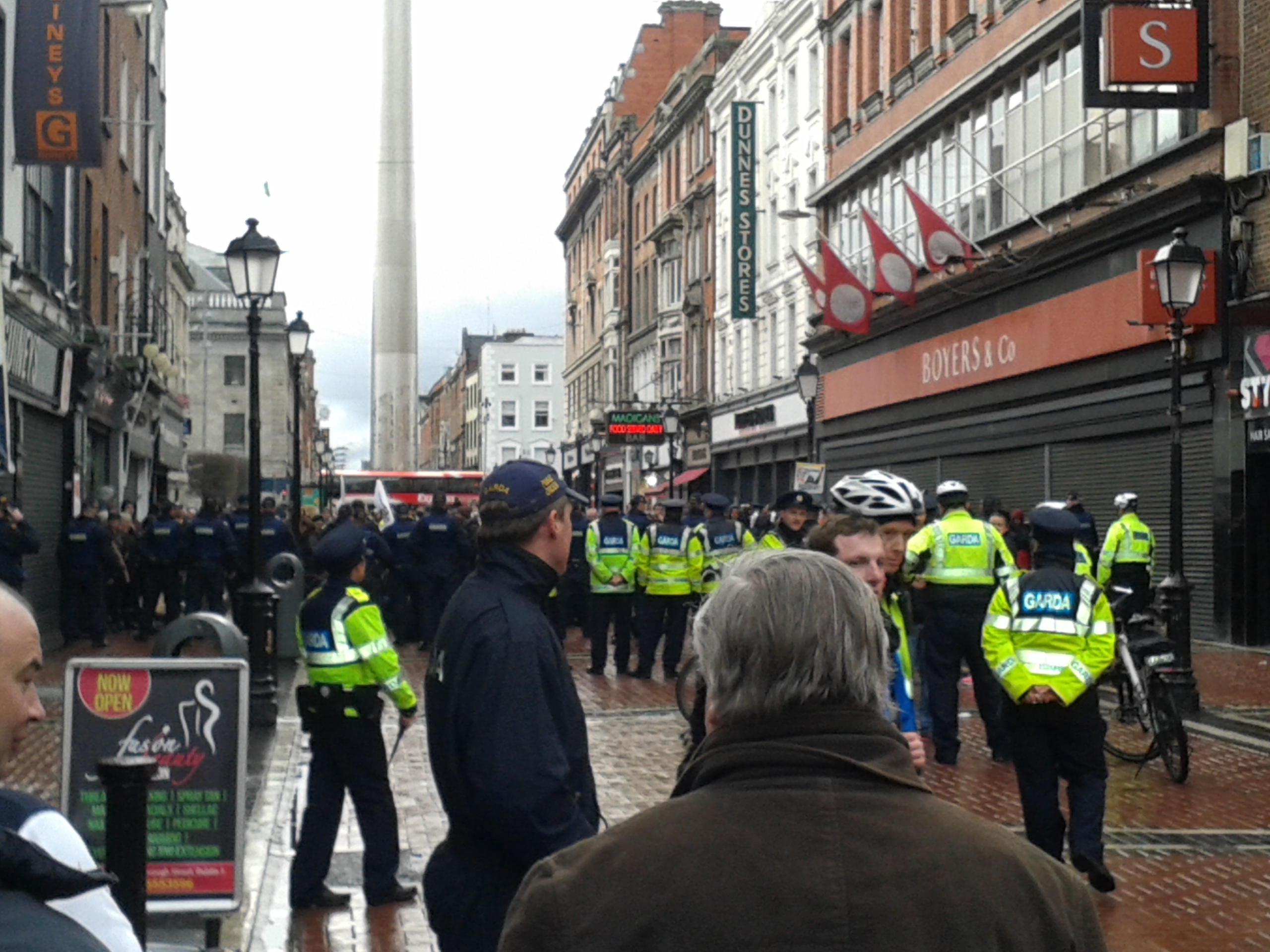
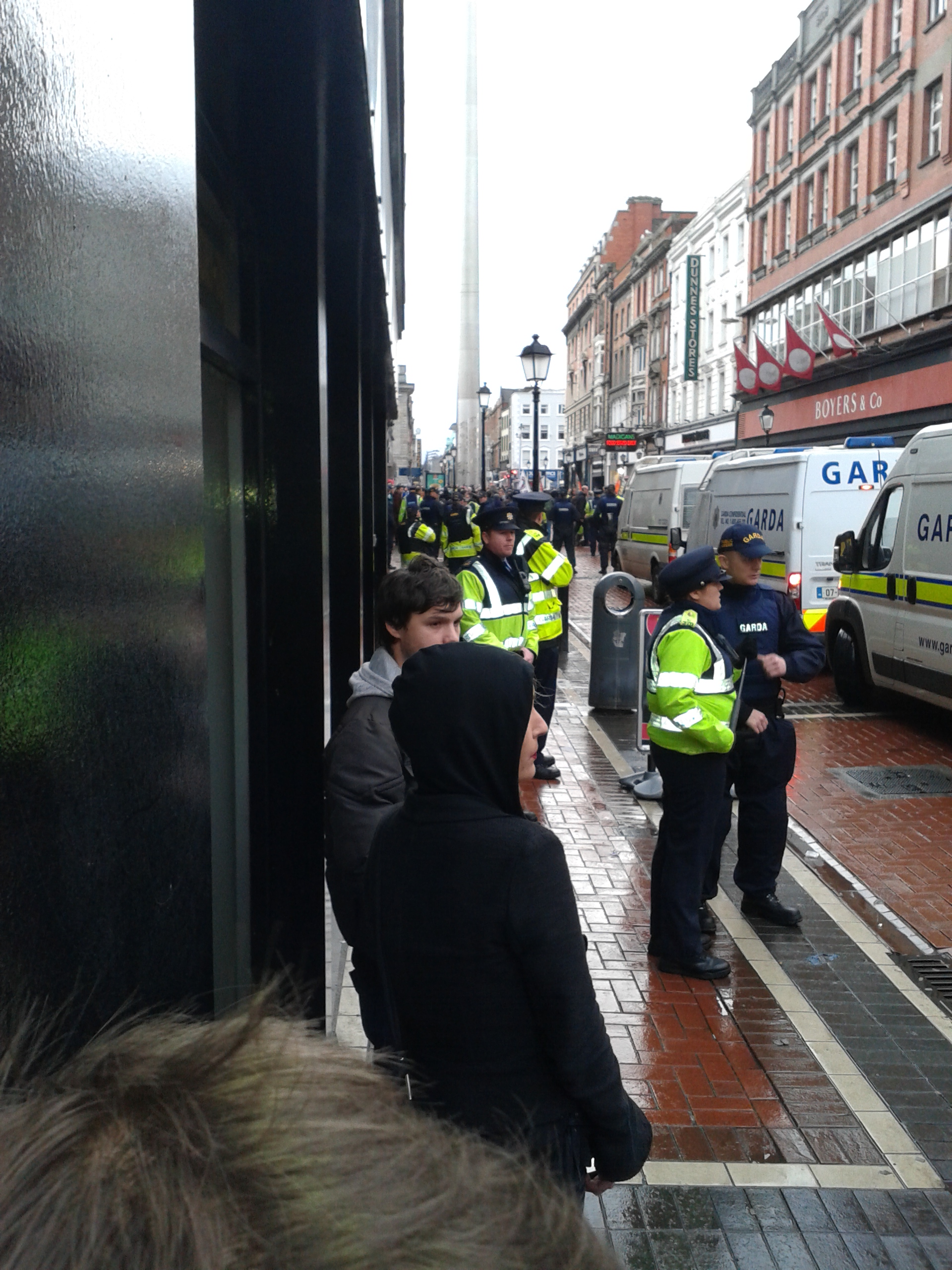
Saturday was the day selected by Pegida for their Irish launch, which they had planned to do at the Dublin GPO at 3pm on Saturday (6th February). Anti-Racist Network Ireland called a demonstration for the same location from 1.30pm but from around noon bands of antifascists were on the street hunting fascists and met them at various locations with painful results for the fascists.
Section of anti-racist rally on central reservation O’Connell Street, looking southward. The GPO building is to the right out of frame. (Photo from ENAR Ireland) FB page).
BACKGROUND
Founded in Dresden, in eastern Germany in October 2014, Pegida (Patriotic Europeans against the Islamisation of the West) is a broad European network of loosely linked groups opposed to what they claim is the “Islamisation of Europe”. Although Dresden remains its stronghold, the organisation has spread to a number of European countries.
In January last year, marches in German cities reportedly attracted up to 25,000 people at their peak, before numbers began to drop severely, rising again however in October as politicians and media stoked fears of a massive influx of migrants and refugees arriving in Europe from war-torn countries (countries, incidentally, where some European powers have played a major role in instigating or directly carrying out those wars).
Pegida claims to be not fascist and ‘solely’ against Muslims as has been the case with so many fascist organisations in the past – they have been ‘only‘ against communism, or against Jews, or against blacks etc. The organisation has been frequently associated with general anti-immigration diatribes and in January last year derogatory descriptions of immigrants by its German leader, Lutz Bachman, in a closed Facebook discussion, were made public. He stepped down from the leadership after those revelations and the circulation of images appearing to show him posing as Adolf Hitler. The following month however he was reinstated with claims that the images were faked.
In Ireland the Blueshirts, popular name for the Army Comrades Association, mobilised and recruited in the 1930s. They were in part a response to the election of the new Fianna Fáil party, a split from Sinn Féin, in a popular national reaction to the hounding of socialists and republicans by the victors of the Civil War, 1922-1923. The Blueshirts presented themselves as Irish nationalists (even Republicans) with their targets being Communists, Jews and the IRA. Meanwhile elsewhere in Europe, fascist groups were organising, variously declaring their targets to be Jews, Communists, Socialists, Anarchists, trade unionists, Roma and Sinti, immigrants, gays and homosexuals and various religious groups.
The Blueshirts were fought on the streets by Republicans, Communists and some social democrats and, when they threatened a coup, their activities were banned by the De Valera government. It seemed that the majority of the Irish capitalist class had decided that Fianna Fáil were a safe pair of hands and would manage the country better and, besides Britain might go to war with some countries where fascists were in power. The Blueshirts lost active members after that and with other right-wing organisations, formed the Fine Gael political party which became the principal mainstream opposition party from then on, occasionally going into Government in coalition with other parties.
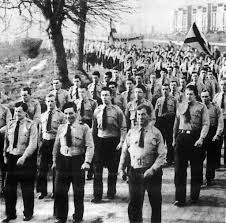
Blueshirts marching, 1930s (Photo sourced from Internet)
PRELUDE TO DEMONSTRATIONS AND ANTI-FASCIST ACTION
Saturday was chosen as “a day of action” for the groups that fall under the Pegida banner, with a number of anti-immigration and anti-Islam demonstrations planned to take place across Europe. The Irish far right anti-immigration organisation Identity Ireland supported Pegida on their Facebook discussions and claimed that Saturday would see the launch of the Irish branch of their organisation. According to a report by the Russian news agency RT, Identity Ireland’s leader addressed a Pegida rally in Dresden last month.
The ARN called for a large peaceful demonstration and even encouraged people to bring their children, advertising it as “a family affair”. Some debate between them and antifascists took place on the Internet and in person on what are the effective methods of resistance to fascism to employ. One of the anti-racist event organisers, Bulgarian Mariya Ivancheva, sociologist and anthropologist based at UCD, was reported in The Journal as calling for a “nice rally to celebrate diversity”. “When Pegida are there we are ready to face them but not to confront them,” she went on to say.
Anti-fascists referred to history to verify their case that fascism has always ultimately had to be stopped by physical force and that being the case, application of that approach at an early juncture was most effective and meant less suffering for working people, ethnic minorities and other targeted groups. The response of ARN to these antifascists was that the latter were not welcome on their rally.
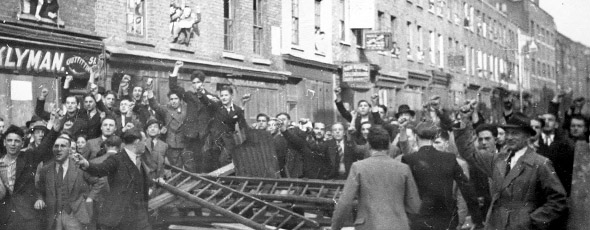
Barricade against a Blackshirt march at Cable Street, East London, 1936. The attack was spearheaded by the police but the antifascists were successful. (Photo from Internet)
Many Republicans and Socialists were also angered by reports that the ARN had applied for police permission to hold their rally. Unlike in Britain or in the Six Counties, this is not required by law in the Irish state and the police are required to facilitate with traffic restrictions the right to march or rally on the streets or pavement. The antifascists’ disapproval was based on what was perceived as giving the police more power than they already had and which they often abuse. One veteran of demonstrations in Britain recalled that permission had once not been required in London either but liberals, social democrats and officials of the Communist Party of Great Britain had made it a practice to ask the police in order to cultivate good relations with them. In time, prior police permission became a requirement which at times was withheld or granted with conditions on times and changes of route.
However, subsequent to the publication of this report, I ascertained that ARN had not asked permission of the police, one of them pointing out that such is not required. The misunderstanding may have arisen from one person stating that he had informed the police that the event would be taking place. This of course is quite some distance from asking permission.
The antifascists, composed of Irish Republicans from virtually all organisations and independents, along with a few socialist and anarchist independent activists, organised their own mobile forces.
ON THE DAY
The anti-racist rally at the GPO was attended by a couple of thousand, from the Spire almost to the Jim Larkin monument and covering the road from the GPO to the central pedestrian reservation. O’Connell Street was closed by the authorities to all northbound traffic and stewards were having difficulty in preventing the rally spilling into the southbound lanes. It was addressed by speakers from People Before Profit, the Anti-Austerity Alliance, Sinn Féin and a number of other speakers, including migrants.
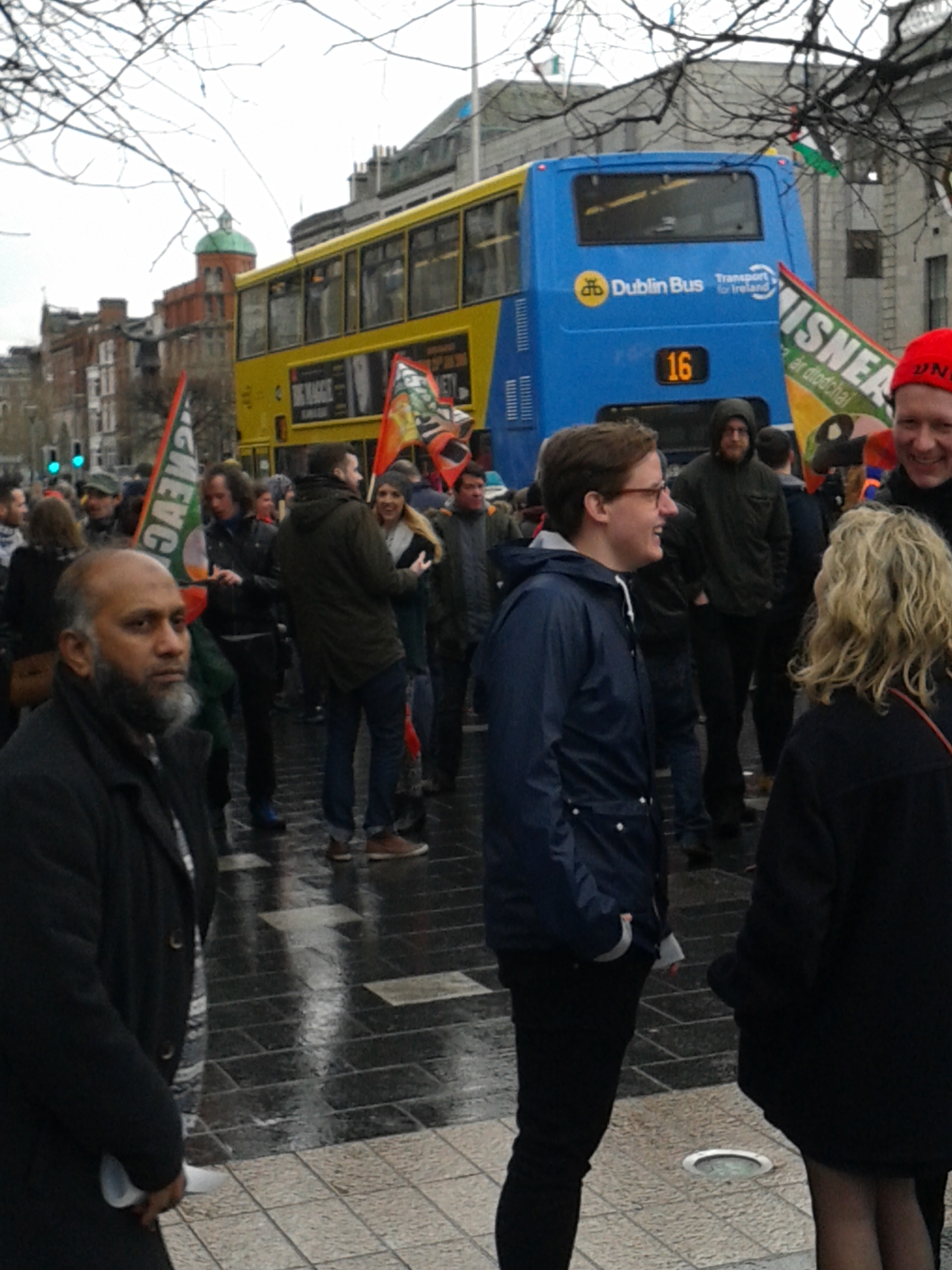
Small section of crowd on east pavement, O’Connell St, with Misneach organisation flags visible (Photo D. Breatnach)
Clashes occurred at the pre-arranged Dublin meeting points of fascists on the Luas line with the handful of Irish fascists being attacked and some, including their leader Peter O’Loughlin and member Ian Noel Peeke being reportedly hospitalised. Clashes broke out again in the city centre at a number of points; one of the latter being at Earl Street North. It seems that some Pegida supporters had gathered at the junction with O’Connell Street and were watching the demonstration opposing them across the road and some were filming it. There were reports of some of them abusing women supporters of the antiracist rally who were near the junction with North Earl Street. The Rabble independent media group reported them shouting anti-communist insults at them (see their video link at end of article). In any case, although generally free of visible insignia and carrying no banners, they began to attract an antifascist crowd, scuffles quickly broke out and the fascists ran down North Earl Street and Talbot Street. A couple of the Pegida supporters ducked into a nearby ‘poundshop’ apparently for safety but they were followed and received a pounding.
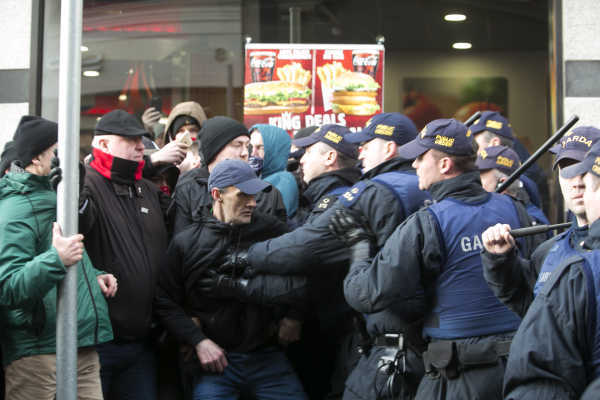
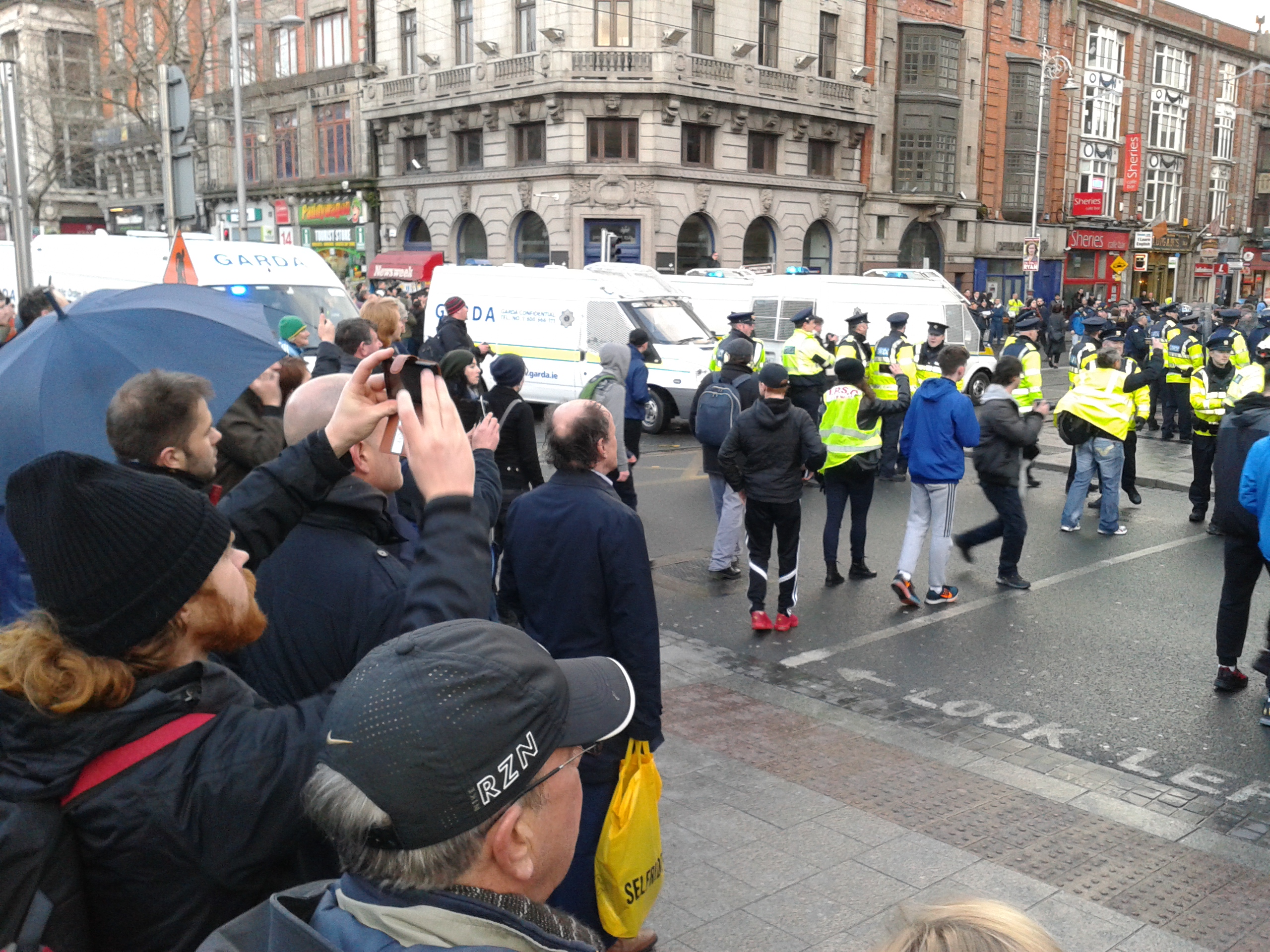
Police stormed the shop and evicted the antifascists, lashing out at almost anyone close by, as can be seen in the Irish Times video (see link at end of article). RTÉ has lodged a complaint about one of their camera operators being deliberately struck by a police baton. The riot police with batons drawn then set up cordons with barking German Shepherd dogs behind them and cleared North Earl Street of all pedestrians, allowing no others to enter from either direction.
North Earl St. after incident (facing westward). (Photo D. Breatnach)
This cordon was maintained until a few more Pegida supporters were permitted to escape through Malborough and Talbot Streets. All of the fascists in this area at least were identified by a number of sources as being of East European background, both by their accents and appearance. Some posts on fascist sites later on seemed to confirm this (see AFA Ireland statement link at end). Earlier reports gathered by antifascist intelligence had indicated that Pegida supporters from fascist Polish organisations were planning to support the Pegida launch.
North Earl St. facing westward, Police and their vans (Photo D. Breatnach)
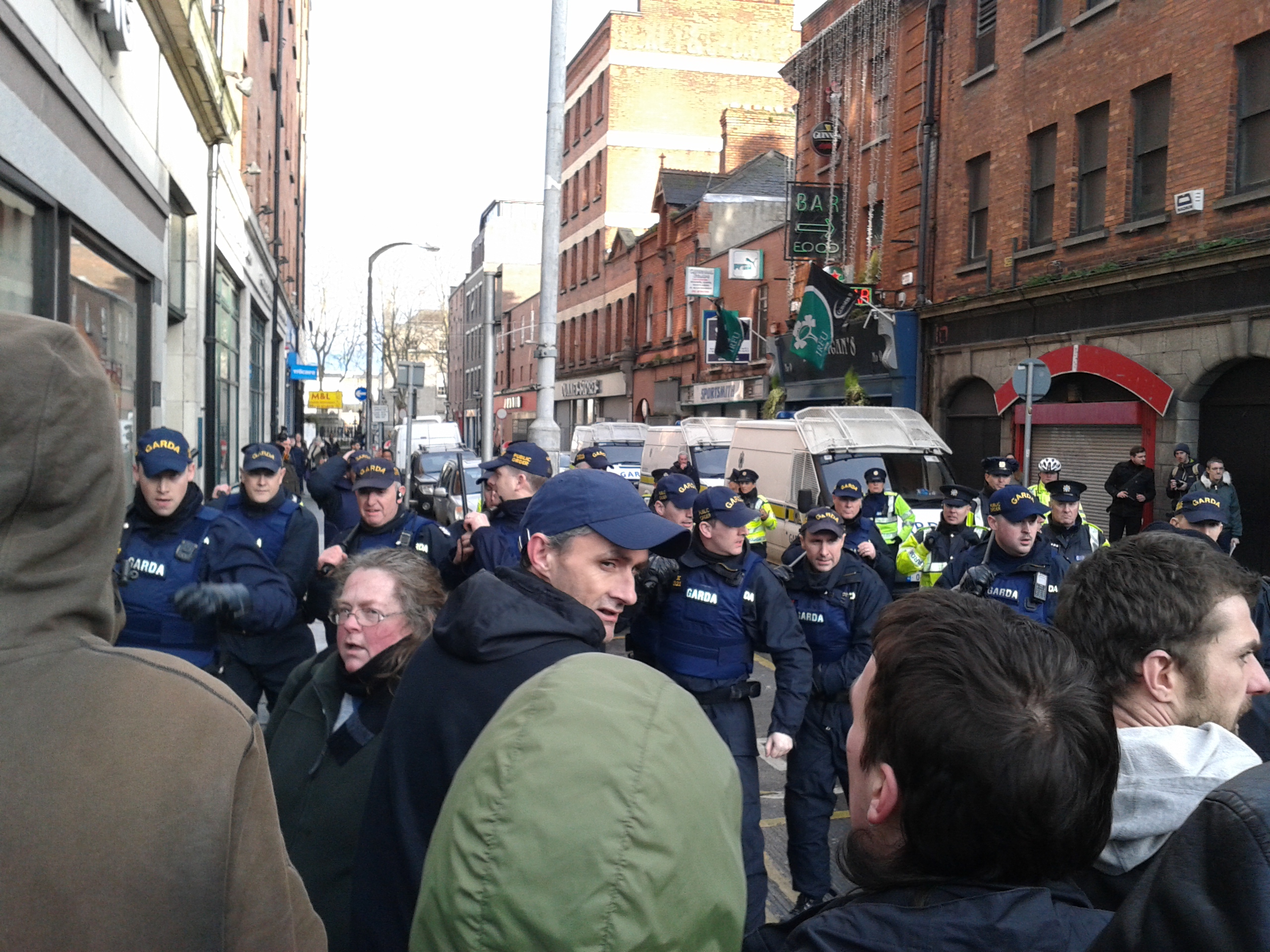
Subsequently, word reached antifascist patrols that 5-7 other Pegida supporters had gathered in a pub in Cathedral Street, again off O’Connell Street and scores of anti-fascists raced to arrive outside the pub almost at the same time as police. Another struggle with police took place outside the pub with riot police using their batons to jab and occasionally lash out, though with a degree more restraint than they had earlier at North Earl Street (perhaps due to an initial complaint from RTÉ having reached their senior officers by then). Police continued to violently push protesters and to jab with truncheons and one demonstrator showed a badly swollen and blue hand.
A standoff took place here for some time until the Pegida supporters appeared to be getting bussed out in police vans which sparked a rush of 50 or more antifascists southward down O’Connell Street. Riot police on foot and in vans followed them and at the intersection with Lower Abbey Street, drew up two cordons, one facing eastward down Lower Abbey Street and the other facing the Liffey, while crowds of antifascist gathered on the eastern pavements and Lower Abbey Street and mostly spectators gathered on the central pedestrian reservation. More police arrived and drew plastic shields out of their vans while a number of dogs were in evidence barking, one jumping up and straining on the leash towards antifascists.
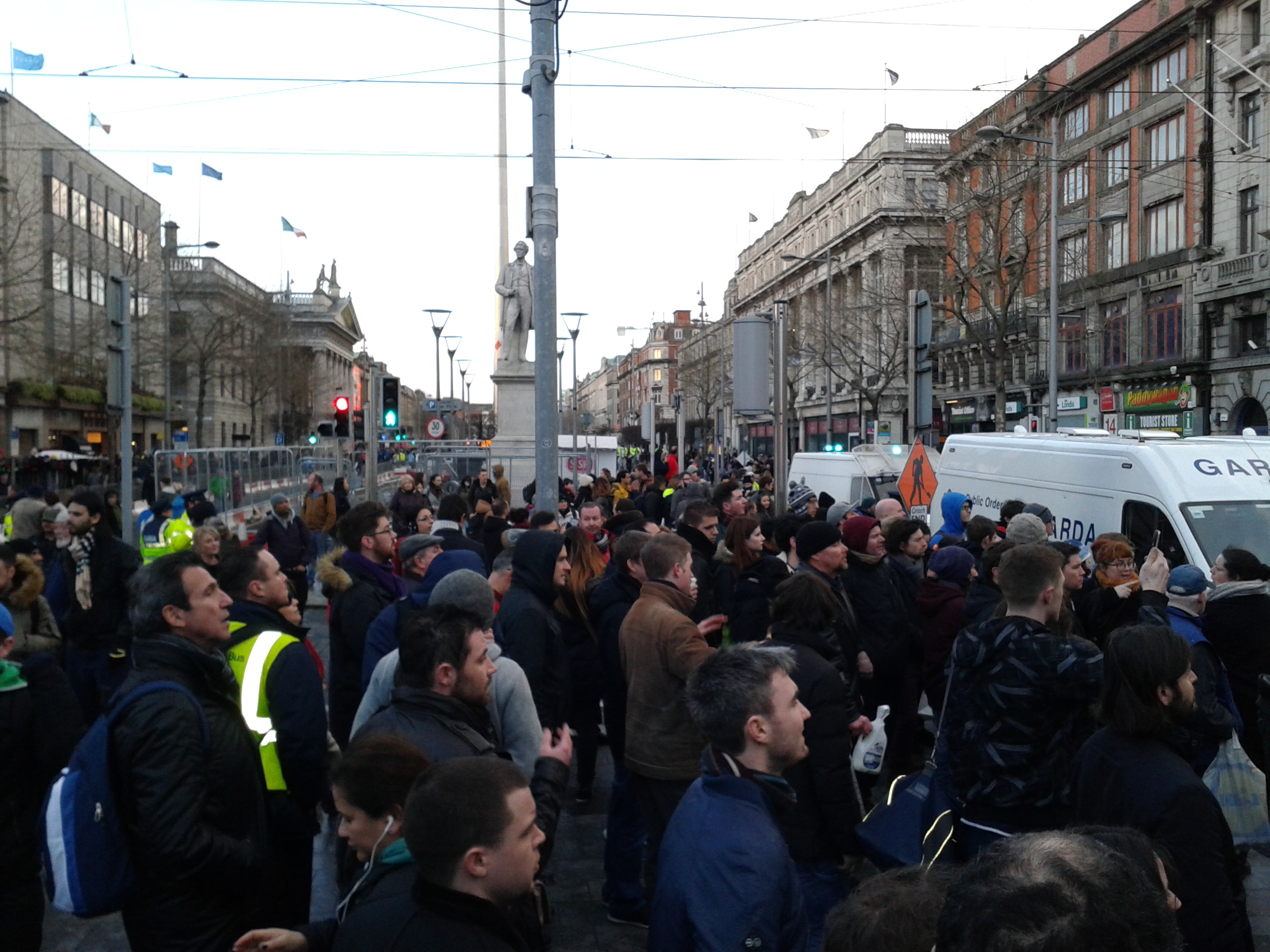
Many spectators, natives and others, expressed bemusement and asked people near them what was occurring, evidence of the low level of advance news coverage by the mainstream media. Alternative, liberal, socialist and Republican media and independent sites on the other hand had given extensive coverage and encouraged people to attend the anti-racist demonstration or the antifascist action. Some among the crowd who were ‘in the know’ explained the events to one or two in their immediate vicinity. The overall atmosphere in the crowd seemed opposed to the fascists with mixed attitudes to the police and antifascists. These crowds offered fertile ground for being publicly addressed by word of mouth or leaflets but none seemed available to fulfill that role.
After some time in apparently purposeless deployment, given that nothing was moving, the Gardaí simply returned most of their forces and riot shields to their vans and most drove off. This seemed to indicate that the police maneouvre had been in the manner of a decoy while the fascists were spirited away quietly from the vacated vicinity of the pub. The Rabble video seems to confirm this.
Melee in Cathedral Street as riot police force antifascists away from pub where fascists are in hiding (photo from Internet)
Riot Squad police in Cathedral Street facing off antifascists. (Photo D.Breatnach)
Standoff Abbey St. junction O’Connell St, facing westward (Photo D.Breatmach).
Many spectators — view northwards along O’Connell St. from the William O’Brien monument (Photo D.Breatmach)
SUMMARY ANALYSIS
The State, probably in anticipation of antifascist action, mobilised and deployed considerable forces. Garda vans moved through the city centre, sometimes in convoys, in addition to police on foot, mounted on horse and bicycle (though the horse police were often discreetly out of site in several locations around the demonstration area). Riot police waited in vans while other vans were stacked with plastic riot shields (which in the end were not needed, if a missile was thrown at the police it was a rare one).
In line with the general history of the relationship between capitalist states, their police forces and fascist movements, the police showed their determination to protect the fascists moving around the city centre. The eagerness of officers at times caused them some problems, including one of them striking a cameraman from the national broadcasting network, RTÉ, with a baton. On another occasion, a riot police officer can be heard calling “Hold the line!” at a time when the video shows the line is not under pressure – the only danger to the police line at that point is seen to be from over-eager officers breaking away to pursue and attack demonstrators.
A number of demonstrators and some spectators suffered bruises from police batons as well being violently shoved by police. In one video a police officer is briefly visible striking at a person lying on the ground – a visual echo of that famous photograph of Bloody Sunday during the 1913 Lockout, when the Dublin Metropolitan Police had run riot less than 100 yards away. In other footage police are seen shoving a man, apparently disorientated (perhaps by a blow to the head) to the ground at least three times although he is no threat to them and is not even resisting.
A feature of the antifascist active resistance was the unity in action across the Irish Republican spectrum, a feature that has been growing in solidarity work around Republican prisoners, in resistance to some features of repression and in the defence of the historical heritage represented by the struggle to save the 1916 Terrace in Moore Street. On this occasion however the unity in action included some SF activists. A sprinkling of independent socialists and anarchists were also among them. Some activists of the socialist, anarchist and communist organisations left the rally to join the antifascists blockading the fascists and their police protectors at Cathedral Street. There were a number of reports of football youth ‘casuals’, supporters of four Dublin soccer clubs, also cooperating in hunting for fascists. At least two of these were observed taking ‘selfies’ of themselves against a riot police background!
It is not known how many arrests were made nor what their outcome has been. Fascists were filmed being handcuffed as they were being put in police vans to take them to safety but it is unlikely they were charged. A number of fascists were reportedly hospitalised where no doubt their medical care teams will include a number of migrant background and perhaps even of Muslim religion.
The police and the Government will be considering their response but the ritual condemnations by their mouthpieces of antifascist force can be expected, as well as attempts to isolate the antifascists as some kind of hooligan or sinister element. The capitalist class will not be impressed with Pegida or Identity Ireland’s performance and, if considering building up a fascist movement in the future, will probably look elsewhere.
Both the ARN and the antifascists were pleased with the outcome of their respective efforts but liberal elements can be expected to condemn the antifascists for what the former perceive as marring the message of their demonstration. The ARN statement (see link at end of article) did so in fact albeit in muted tones, “regretting skirmishes”. In a parallel to some Jewish leaders in 1930s Europe during the rise of fascism, a Muslim religious leader was quoted criticising violent actions “by a minority” and called for defeating them by “dialogue”.
The fascists will be licking their wounds and trying to put a brave face on their defeat, also condemning the antifascists for using “undemocratic violence” or words to that effect. All fascist movements in history have been extremely violent while often, while in their growth period, presenting themselves in public as peaceful and condemning the violence of their opponents. This is a fact that liberal elements usually fail to appreciate, while other elements among the middle class are ultimately content to see their order being maintained, whether by the State or by fascists.
Whatever spin the fascists, the State, mass media or liberals may put on it, the fact remains that the fascists have been prevented from staging a publicity coup that would have raised the morale of their few recruits and encouraged more to join them. Fascist movements throughout history have required such morale-boosters and encouragement for potential recruits and, incidentally, intimidation of their opposition. What happened on Saturday in Dublin has been the reverse – the fascists and potential recruits have been intimidated and discouraged. Over 200 indicated intention to attend on the Pegida “Irish launch” Facebook event but reports on the ground in the city centre indicate a total of perhaps 30 fascists being chased around the city in small groups. The 170 or so, whether Irish or from elsewhere interested in supporting islamophobia, racism and fascism won’t be in a hurry to enlist now.
But should a new attempt be made to launch a mass fascist movement in Ireland, on whatever divisive basis, the antifascists are likely to turn out in even greater numbers.
“Supporting organisations (in alphabetical order):
Anti Austerity Alliance, Akidwa Ireland, Africa Centre Dublin Ireland, Anti Racism Network Ireland, Attac Ireland, Autistic Rights Together, Communist Party of Ireland, Conference of Religious in Ireland, Dialogue & Diversity, Dublin Calais Refugee Solidarity, Dublin City Centre Citizens Information Service, Doras Luimni, EDeNn, ENAR Ireland, Fighting for Humanity – Homelessness, Galway Anti Racism Network, Gaza Action Ireland, Gluaiseacht for Global Justice, Green Party of Ireland, Ireland Says Welcome, Ireland Palestine Solidarity Campaign (IPSC), Irish Anti-War Movement, Irish Housing Network, Irish Refugee Council, Irish Missionary Union, Irish Traveller Movement, Migrant Rights Centre Ireland, National Traveller Womens Forum, Shannonwatch, Show Racism the Red Card – Ireland, SARI – Sport Against Racism Ireland, SIPTU, Sinn Féin , The Platform, Pavee Point, People Before Profit, United Against Racism, The Workers Party, Workers Solidarity Movement, You Are Not Alone.” (From their statement published on European Network Against Racism Ireland’s site)
That was the subject of a debate between historians Tim Pat Coogan and Liam Kennedy on Wednesday 20th, organised by the 1916 Societies’ San Heuston branch and held in Club na Múinteoirí, Parnell Square, Dublin.
Coogan has a long track record as a journalist and historian of a nationalist/ Republican perspective: for nearly two decades Editor of the now-defunct nationalist daily Irish Press, broadcasterand author of many works including The IRA, Ireland Since the Rising and biographies of Michael Collins and Éamonn De Valera. Kennedy is Professor Emeritus of Economic and Social History at Queen’s University, Belfast. He is the author of a number of articles and of books, most of the latter collaborations, including (with L.A. Clarkson et al), Mapping the Great Irish Famine (Dublin: Four Courts Press, 1999). His most recent, on his own, is Unhappy the Land: The Most Oppressed People Ever, the Irish?(Dublin: Irish Academic Press, 2015).
“Irish Famine Memorial/ Leacht Cuimneacháin na nGael” in Philadelphia. USA (Photo from Internet)
Given that the Great Hunger or Famine is a subject on which historians tend to take oppositional sides and with at least one prominent historian on the panel, I would have expected a very large turnout. Therefore when I arrived and looked at the seats in the large hall of Club na Múinteoirí, I was surprised to see that although there was a respectable number in attendance, some of the seats laid out were unoccupied.
I had got the start time wrong (yes, even though I had shared the poster for the event on my Facebook page!) and so missed some of Tim Pat Coogan’s presentation (but a friend told me Coogan had mistaken the subject and began to talk about the 1916 Rising until he came back on track). When I entered, Coogan was dealing with the Great Hunger’s death toll and referring to the “accelerated deaths” method of calculating population loss that took into account further likely births had early deaths of potential parents not occurred. By that method, Coogan estimated the deaths at two million, not counting those who died on the “coffin ships” or after arrival at their destination.
Tim Pat Coogan (Photo from Internet)
Coogan said that New York State included study of the Great Hunger under “Holocaust Studies” which he thought entirely appropriate and concluded by stating that the Great Hunger was indeed genocide.
Liam Kennedy
Liam Kennedy then took the floor and began with a personal anecdote of the unveiling of a stained glass window in Belfast, dedicated to the Famine, at which he had been invited to speak some years ago. It was a somewhat rambling story through which his audience sat quietly, awaiting his arrival at the question up for debate.
During his anecdote, Kennedy related that he had, in the course of his speech, referred to punishment shootings and “exiling” (instructions to leave the country) carried out by both Republican and Loyalist paramilitaries, which had angered in particular his Republican audience, including Gerry Adams (which he described but did not name). So of course, in retelling, he was once again referring to it – in a debate about whether the Great Hunger was genocide or not. Kennedy related this in the alleged context of showing that the Hunger is a controversial subject – of course it is, so it hardly needs any other controversial subjects dragged into the discussion.
Kennedy went on to allude to “amnesia” around the subject of the Great Hunger, which he compared to a similar “amnesia” which he believed attached to the issue of the thousands of Irishmen who had “fought for the Empire (or he may have said “England”, or “the UK”) and for Ireland during WWI.” Yes, it seem to me that he was engaging in a certain amount of coat-trailing in front of his audience which, given the Dublin location and the 1916 Societies host, he must have assumed to have many Republicans in its midst.
Eventually he got the job for which he had been invited and began, helpfully, by quoting part of a definition of “Genocide”. I cannot recall which authority he quoted but a search reveals many definitions, most of which entail intent. One of the most recent authorities is Article 6 of the Rome Statute which provides that “ “genocide” means any of the following acts committed with intent to destroy, in whole or in part, a national, ethnical, racial or religious group …” and goes on to describe a number of means of carrying that out.
It was clear that Kennedy was going to rely on denying the intention to cause, rather than to deny the effect of the catastrophe; this was entirely as I expected and it is the stock approach of genocide deniers and colonial apologists (not always the same thing). But in reality he had little to say on this subject, other than to point at the “laissez-faire” nature of the UK Government’s economic policy at the time and the weakness of the Whig party in power, managing a minority government. To be fair, it is extremely difficult to prove lack of intent but all the same I would have expected something better.
In its absence, Liam Kennedy went on to talk about culpability, which is not the same thing – one might be to blame for something which one didn’t, however, intend. And Kennedy spread the net of blame pretty wide, throwing it not only over the British Government but on the Irish middle class (could have done more), the Catholic and Protestant Churches (opposition to emigration and continued church-building), the Irish landlords (absentee or callous), the Young Irelanders (had no solutions), O’Connell’s 40 MPs at Westminster (didn’t raise much trouble at Westminster, although they were supporting the minority government).
Kennedy didn’t stint however on the severity of the Great Hunger nor on its huge impact on Ireland and on its diaspora. On that he said he agreed with Coogan, although his estimate of deaths was closer to 1.5 than two million. Any disaster in which one in seven died was an extremely severe one — it was the worst disaster in Irish history and one of the worst internationally, Kennedy stated. And it was most severe on the poor – and here Kennedy quoted a sentence of Karl Marx – and proportionally struck hardest at the Irish-speaking areas.
THE DEBATE OPENED TO THE FLOOR
When Kennedy finished, the Chairperson Kevin Keane summed up the main points elaborated by each speaker and the meetings was thrown open to questions and contributions from the floor. I wanted to get my comment in early, as I was scheduled to sing as soon as the questions and answers were over; since for a moment no-one stirred, my hand was the first up. Handed the roving microphone, I thanked both speakers and remarked that the question of intentionality did not relate only to the Government of the time but also to the ruling class of the time – the British capitalist class. An analysis of their opinions as expressed in correspondence and in their media of the time, for example editorials in the London Times, has indeed revealed the intention to get rid of the Irish cottier class and, to a degree, the Irish landlord class too. They wanted most Irish agricultural land turned to grazing and deliberately used the opportunity to do so.
Other contributors talked about food leaving Ireland while people starved, the low numbers of Irish permitted to vote; another countered the criticism of the Young Irelanders by pointing to the Rising they attempted in 18481. Yet another contributor pointed to comparisons with famine in other areas due to the potato blight such as the Highlands of Scotland, Belgium and the Netherlands – but did not express an opinion from those studies on the question being debated here. One contributor amusingly took Kennedy to task on standard academic grounds relating to questions on examination papers: “Read the question carefully, prepare your answers, ensure they are relevant …”
RESPONSES OF THE SPEAKERS
Returning to both speakers for the final responses, Kennedy admitted that the Government had wanted to get rid of the Irish cottier class but not by famine and disease. The “coffin ships” were only relevant to one year of the Great Hunger, he maintained and also that the Irish had, according to statistics, survived the journey in better health than for example the Germans, who had a much higher mortality rate during the journey and on arrival. On hearing that, I wondered whether he was taking into account the giant graveyard of Grosse Isle on the St. Lawrence, where “5,424 persons who fleeing from Pestilence and Famine in Ireland in the year 1847 found in America but a Grave.”2
Grosse Isle Memorial bilingual notice, Quebec — 5,424 Irish people got no further than this spot, where they died and were buried, in 1847
The island mass graveyard of Grosse Isle, Quebec, from a distance (Photo from Internet)
Kennedy returned again to the question of the “laissez-faire” economic doctrine and maintained that the rulers of the UK at that time were convinced that government interference in economics was not only undesirable but would make things ultimately worse. He also stated that we should not judge the people of then by the knowledge and beliefs of today – another argument often put forward by bourgeois historians (and to which I was going to reply in a very short poem I had written on the subject).
Tim Pat Coogan had the final say in the debate and wandered somewhat while however displaying the breadth of his learning. With regard to the Catholic Church he related that the Papacy in Rome had dictated to the Irish Church that they should continue building churches during the Great Hunger and he went on to criticise Rome in terms that might come as a surprise to those familiar with Irish nationalists/ Republicans of Coogan’s generation. He accused the Papacy, through a certain Cardinal, of instructing the Bishops in the Church to cover up cases of abuse, by the Cardinal’s admonition that the Bishops were to act as fathers to the priests and not as policemen.3 Coogan also defended O’Connell who was already sick then, dying in 1847, and the Irish MPs, having to go to Westminster, where they were in a small minority, to put their case and to where letters from Ireland could take a week to arrive.
Returning to the subject under discussion, Coogan made the trenchant point that the Government runs the country and ultimately responsibility lies with it; if it does not, then there is in fact no responsibility for anything, he implied. It was a good point with regard to culpability and he went on to deal with intentionality. He drew attention to a London gentlemen’s club whose members were influential in forming Government economic opinion, and a discussion reported among two members that one million deaths would be required to bring Ireland to a healthy economic state while the other disagreed, saying that two million would be required. “The potato blight gave them the opportunity and they took it”, said Coogan. “It was genocide.”
IN CONCLUSION
Poster for the event (image from 1916 Societies)
Some points which did not get a response in my opinion were the issues of “bad Irish landlords” and “chaotic land tenancy” and perhaps the others “to blame” apart, of course, from the British ruling class and their Government. Briefly, who was to blame for the absentee landlord situation in Ireland? Who stole the land for them and then protected them and their agents with soldiers and police? Who bought out the Irish Parliament in 1800, giving the political class even less reason to hang around in Ireland? This was the result of invasion, colonisation, planting, repression and bribery – the principal culprit all along was English colonialism.
Yes the peasantry (and landless tenantry’s) situation was chaotic and yes they depended too much on the potato crop. Whose fault was that? Who organised the land in that way (and refused security of tenancy, penalised tenants for improvements by raising the rents, etc)? Who stifled profitable Irish industry if it competed with English and taxed Irish production for the English Crown? Again, British colonialism. Could the country’s economics have been differently organised, to support that population (and even larger) in reasonable comfort? Of course it could — but at that point in history, it would have needed an independent national capitalist class to organise it, something Ireland did not have (and has not had since that section of it she had in 1798 was beaten by Crown forces).
In the last analysis, it does not matter how badly one group or another behaved during the failure of the potato crop – the British Government was the principal body with the power to act to avert catastrophe and the real power behind them, the British ruling class, were the ones with the interest in doing nothing to avert the disaster.
Finally, a thought worth considering: would the British ruling class have tolerated a disaster on this scale in Britain? Laissez-faire economics or not, I am pretty sure they would not.
The 1916 Societies and in particular their Sean Heuston branch have been putting on talks and debates on important Irish historical questions for some time, some of which I have been fortunate to attend. The Great Hunger debate was worth having and the contenders were well known with a track record in historical studies and public fame – the debate promised to be interesting. Despite this however, I found the event overall somewhat flat. Kennedy’s presentation manner was hesitant in speech and devoid of liveliness; Coogan wandered off the core subject too often. One cannot blame the 1916 Societies for that, however.
HISTORY AND “SKIBBEREEN”
I was called up to the stage to sing my song which had been announced earlier; by now there were about half the audience remaining. I explained that the song I was going to sing was called “Skibbereen”, published in Boston in 1880, not far from the time of the Great Hunger, and attributed to Patrick Carpenter, a poet and native of Skibereen. The song is in the form of a dialogue between a migrant father and his son but I sing it as though his dialogue is with his daughter. I also intended to omit a verse, one which has the man’s wife dying in shock during the eviction – I felt that women were much stronger than that.
“That’s revisionist!” interjected Tim Pat Coogan.
“That’s right,” I replied, “but progressive revisionism.”
“It’s revisionist!” Coogan said again.
I felt like reminding him that I had not heckled him during his public speaking. Instead I said
“All history is revisionist. The issue is what kind of revisionism.” “No it’s not – not good history!” Coogan replied.
Reading the short poem “History” (Tim Pat Coogan in background) (photo Denis Finegan)
I turned from him and read a short poem.
ALL our history is important,
not just 1916,
teaching us what we are
and what we have been.
How we came to reach the now;
of those who fought
or those who bowed,
through bloody pages,
down through the ages;
it relives the struggle to be free
and whispers soft what we might yet be.
(Diarmuid Breatnach, January 2016)
Singing “Skibbereen”. In the background, L-R: Liam Kennedy, Kevin Keane and Tim Pat Coogan. (photo Denis Finegan)
I then sang Skibbereen.
As I leaned over to hand back the microphone after finishing the song, Coogan told me his mother had loved that song. I took this as a peace overture and smiled, murmuring something about it being a good song to love. But no, I was mistaken: “And she liked that verse”, he added.
“Well, that was her opinion,” I replied, “and this is mine,” and left the stage.
Liam Kennedy was much more polite. Up in the bar, in passing, he thanked me for the song and added that he had heard the slogan “Revenge for Skibbereen” (also an alternate title for the song) alright but never the song. I expressed amazement at this, since the song is well known and even more so among people of his generation. Kennedy was born “in rural Tipperary” and, I believe, raised there too. There must have been many a kitchen and pub where that song was sung in Tipperary, surely?
End.
1In a longer debate, I could have pointed out that James Connolly himself had criticised the Young Irelanders’ response the the Hunger but that his solution would not have pleased Kennedy either – Connolly wrote that the Young Irelanders should have led the people in breaking open the granaries, feeding the starving and preventing food from leaving the country.
3Actually, a highly secret instruction, including requirement of vows of secrecy and threats of excommunication for whistle-blowers, had been circulated by the Papacy to bishops around the world as far back 1962 http://www.theguardian.com/world/2003/aug/17/religion.childprotection
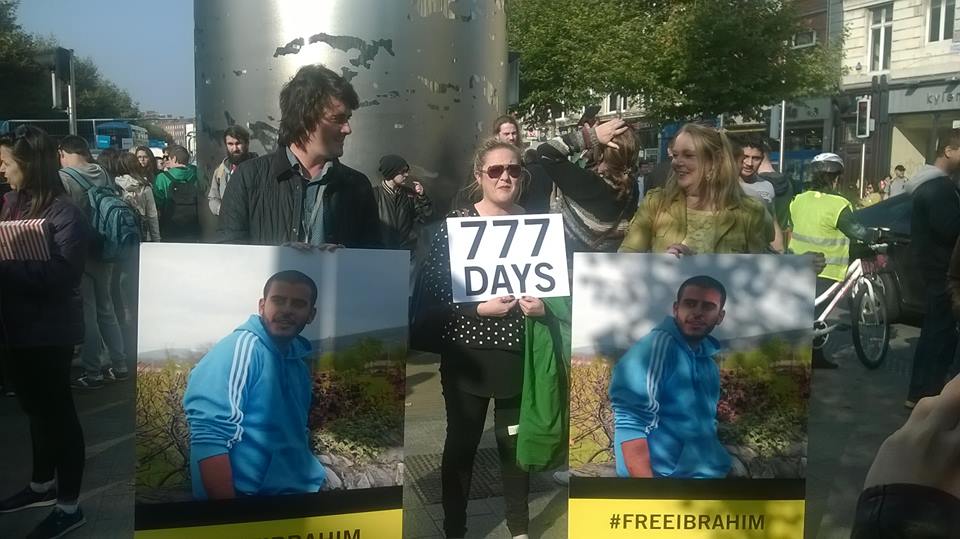
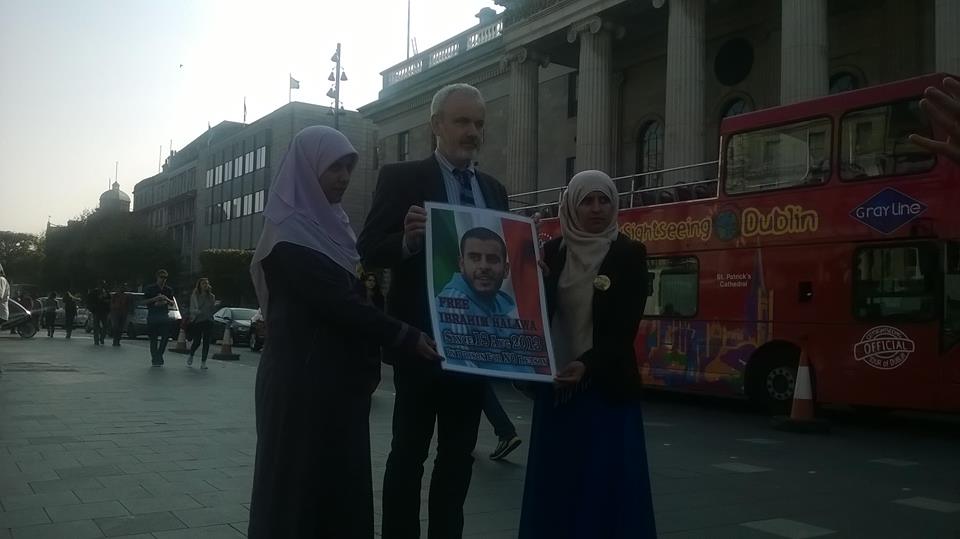
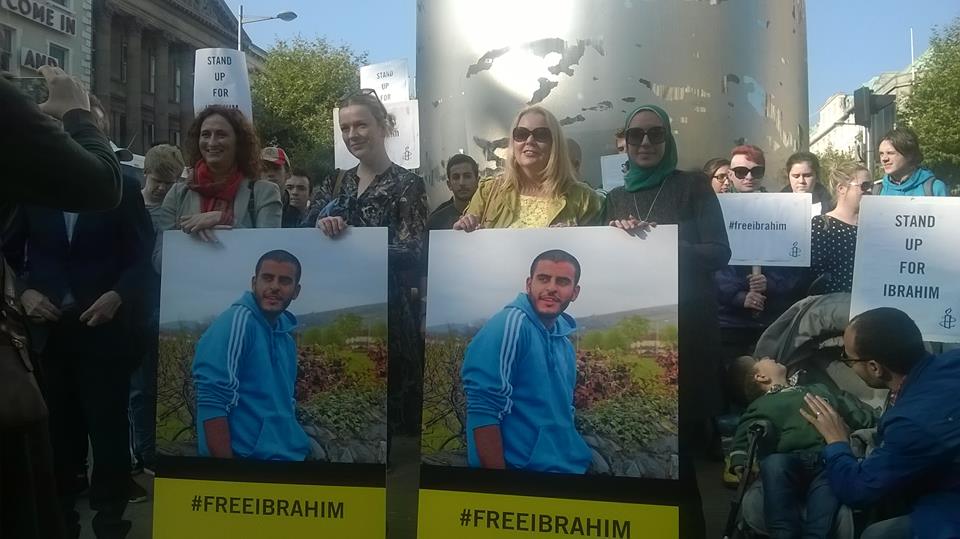
With the Spire in the background, supporters calling for the release of Ibrahim Halawa display placards in Dublin’s main street. (Photo: Ian O Kelly)
People clustered around the Spire structure in Dublin’s O’Connell Street on Friday 2nd October, many of them displaying a placard with the digits “777”, sometimes nothing else. But some also held an enlarged photo taken of a Dublin youth of Arab extraction, Ibrahim Halawa. Members of his family and community were there too with a banner, as were a relatively small number of supporters, including some Left and Republicans.
Colm O’Gorman, CEO Amnesty Ireland, with two of Ibrahim Halawa’s family in O’Connell Street, Dublin’s main street. The columns of the iconic GPO are on the right as a Dublin Tour bus passes. (Photo: Ian O Kelly)
Colm O’Gorman, CEO of Amnesty Ireland gave interviews to media personnel present and so did Lynn Boylan, Sinn Féin MEP and of course some members of Ibrahim’s family. Curiously, no leaflets were handed out to explain to passers-by what the rally was about. Nor were there speeches to inform even those gathered there about the background to the case or progress or what people could do to help further.
Dublin Anti-Internment Committee activists support the picket, photographed here with members of the Halawa family. (Photo: D. Breatnach)
Ibrahim Halawa was 17 years of age and on holiday in Egypt nearly two and half years ago when arrested, apparently for participating in a demonstration banned by the Egyptian regime. He may have been a conscious participant or may merely have been swept up in it in passing. But now he faces a possible death sentence if found guilty. Another 420 are also charged, some of them with murder or attempted murder during an attack on a police station on the same day. Ibrahim was arrested with his three sisters but they were granted bail and permitted to return to Ireland after three months.
Friends and relatives were hopeful that the trial would proceed as scheduled at the weekend but on the day some of the defendants were said to be seriously ill and the state declined, despite Defence counsel requests, to proceed without all defendants being present. Defence counsel have now also submitted a motion for all to be released, since they have served two years without the State bringing them to trial – this motion is under consideration by the court at present.
Supporters of Ibrahim Halawa with placards in front of Dublin’s Spire, with Lynn Boylan furthest left in picture. (Photo: Ian O Kelly)
The reason for serious illness among prisoners may well be conditions in the jail (which are believed to be atrocious and were described as “trying” by the Irish Department of Foreign Affairs’ representative after an earlier visit to Halawa in jail), coupled with punishment beatings which, according to one of Ibrahim’s sisters as reported by a human rights campaigning website, the Dublin youth has also received.
The Department has taken up the Dubliner’s case with the Egyptian authorities and it is almost certainly its intervention that has gained Halawa’s transfer to a better cell. Three Al-Jazeera journalists were sharing that facility after conviction in Egyptian court but all those have now been released and left Egypt. Others, including former President Hosni Mubarak and members of his family have also been released.
Charlie Flanagan, the Minister for Foreign Affairs, stated that he was “disappointed and concerned” at the adjournment, which is diplomatic language for “really pissed off”. He claimed that his department is doing all that they can. Perhaps they are – but is the Government as a whole? Would the threat of expulsion of a few Egyptian diplomats not gain the release of Ibrahim Halawa? Or perhaps the threat of a tourist embargo?
The relatively small numbers at the Dublin rally were probably due to it being called for 3pm on a Friday afternoon, i.e within office working hours. But there may be more to it than that – this case has not been generally pushed in Left and Republican political circles, nor indeed in the liberal human rights sector. Very recently some of Ibrahim’s Dublin Arab community held a protest at the GPO against the Egyptian regime getting ready to streamline its trial and death sentence procedures in order to facilitate the hanging of more political dissidents. It was notable that every single one of those on the protest was Arab in appearance. The word ‘on the street’ is that Ibrahim and members of his family belong to a religiously fundamentalist group. Whether true or not, this does not of course diminish his human rights one iota – but unfortunately it may diminish the enthusiasm of some on the Left to support him.
Amnesty International Ireland was the body that organised the rally. Their website said that they were calling “again” for the release of Ibrahim but it seems that this is the first time they have organised a rally for him in nearly two and a half years.
Some of Ibrahim’s relatives and others of their community in protest at Egypt’s streamlining of conviction and execution processes some weeks earlier outside the GPO. (Photo: D. Breatnach)
Poster of the Stop Egypt Executions campaign
Generally the states in the West support the current Egyptian regime and the USA very much so. In turn, the Egyptian regime is very pro-Western and its armed forces very dependent on the USA, its main arms supplier. This friendship towards or dependency on the USA has been demonstrated in a number of way over the years and one of the most significant has been its policy towards Gaza.
The besieged Palestinian enclave, which has been called “the biggest concentration camp in the world”, has two land border exits, one of which is controlled by Egypt and the other by Israel. But Egypt has for years, under different governments, been restricting what and how much can go through its Rafah Crossing, more or less in line with Israeli prohibitions or restrictions, which include forbidding cement much in demand to repair the huge damage of Israel’s bombardment to housing, hospitals, schools, roads, bridges, reservoir, sewage treatment facility ….. and fuel for heating, electricity generation …. The resourceful Palestinians dug tunnels under the border wire to circumvent Egyptian restrictions but the Egyptian regime has demolished these in the past and recently flooded them.
It is important for the Irish Left and all democratic people to show solidarity with Ibrahim and his family. It should not be ok for the Egyptian government to behave in the way it does and we should protect those that we are able to protect from them. That ability is strongest in cases where the citizenship of the victim is Irish. The Government needs to up the pressure on the Egyptian authorities and we need to up the pressure on our Government to achieve that. Those republicans, socialists and democrats who are tempted to pick and choose the recipients of their solidarity would do well to reflect on the oft-quoted words of Pastor Martin Niemoller.
Bhí léirsiú ollmhór ar son ceart na mban roghnaithe ginnmhilleadh agus go baileach ar son Leasúchan Bunreachta a hOcht a chur ar ceal. Thosaigh an mórshiúil ag Gáirdín Cuimhneacháin, Baile Átha Cliath, agus chríochnaigh ag Cearnóg Mhuirfean, in aice le cúl doras na Dála.
Ba dheacair an líon a thomhais ach bhí sé an-mhór. Ní raibh mórán Gardaí i láthair agus ní raibh aon chíréib ná rud ar bith mar é go dtí gur sroicheadh ceann scríbe (d’fhágas go luath ina dhiaidh sin).
Part of the march is on the north quay while another section crosses Talbot Memorial Bridge and the remaining section has turned left and is marching along the north side.
Ach b’ait an bealach a thógadar: Sr. Uí Chonaill, Cé Éidin, trasna Droichead Cuimhneacháin an Talbóidigh, ar aghaidh ar an dtaobh ó dheas ar Cé na Cathrach, suas Sráid Lombaird agus Rae an Iarthair go Cearnóg Mhuirfeann ag an gcúinne agus thart trí thaobh na Cearnóige — faoi mar go rabhadar ag iarraidh an bac ba lú a chur ar an dtrácht.
Repeal of the 8th Amendment to the Constitution was a central demand of the demonstration.
In 1983, the 8th Amendment inserted a new sub-section after section 3 of Article 40 of the Bunreacht (Constitution) of the State. As a result Article 40.3.3° reads:
“The State acknowledges the right to life of the unborn and, with due regard to the equal right to life of the mother, guarantees in its laws to respect, and, as far as practicable, by its laws to defend and vindicate that right.”
Ag teacht isteach ar thaobh dheis Chearnóg Mhuirfeann (tabhair faoi deara an placárd i nGaeilge sa lár taobh láimhe deise)
The amendment had been proposed by the Haughey Fianna Fáil Government but actually brought into law by the subsequent Fine Gael/Labour Party Government in 1983. As it was a Constitutional change, a referendum was required and it was passed by a majority of close to two to one.
Over the years since then a number of changes have taken place in Irish public opinion and the Irish Catholic Church has lost much of its influence. In addition, a number of scandals relating to women refused abortion have also received prominent media coverage, particularly in recent years, including one fatality. Opinion polls on abortion in Ireland now show a majority in favour of greater access and a fast-growing minority in favour of unfettered right to abortion. However, none of the major political parties. i.e. those with elected representatives in double figures, currently proposes to recommend the repealing of the 8th Amendment.
Mná ó Asturias ag tacú leis an léirsiú
Statistics showed that 4,149 Irish women had abortions in Britain in 2011 and other statistics show that 7,000 women travelled abroad that year in order to obtain an abortion.
A Palestinian speaker recounted ten years of success in the BDS campaign against the Israeli Zionist State and asked people to continue with it and, if possible, to step it up.
Riya Hassan addressed a crowd at the Pearse Centre in Dublin’s Pearse Street, just off Dublin City Centre, on Wednesday night. She spoke about the history of the oppression of Palestinians by the Israeli state and the ten-year history of the Boycott, Divestment and Sanctions (BDS) campaign, explaining its origins in Palestinian society and charting its growth and successes. The three basic aims of the BDS campaign are to pressure Israel to end the colonisation and occupation of Palestinian land, to give equal rights to Arab-Palestinians citizens in the Israeli state and to agree to the right of Palestinian refugees to return home.
Riya Hassan
Section of the crowd at the public mee
Riyah Hassan is European Coordinator of the BDS campaign, herself a Palestinian and, as she later explained when talking about the Israeli destruction of villages in the Negev, from near that area herself. Talking about the current refugee crisis in Europe, she pointed out that many of the refugees taking to sea in what she termed “death boats” (echoes of our own “coffin ships” during the Great Hunger) are in fact Palestinians. They are from refugee camps in Syria and are being made refugees for the second, third or even fourth time.
Speaking on the Palestinian refugee issue, a huge and outstanding one since 1948, Riya Hassan mentioned that their right to return home had been surrendered by the negotiators of the “peace process” at Oslo in the 1980s but that Palestinian society had not accepted this abandonment, whether in Israel, the occupied territory or in the refugee camps elsewhere.
Among a list of successes of the BDS campaign, Riya Hassan mentioned Veolia, a company which had been setting up the transport networks between settlements helping to carve up Palestine, had lost millions due to BDS – as a result, the company has pulled out of Israel (Veolia, by the way, runs the LUAS trams in Dublin). G4 Security, which runs surveillance on Israeli prisons, where there are currently well over 6,000 Palestinian prisoners, have said that they will pull out in 2017 but Riya said they should pull out now and called for pressure to be increased upon them. Another target should be our own Government, which has spent €14.7 million worth of arms and military components from Israel over the last decade (while Irish-based companies have exported €6.42m worth of military and ‘dual use’ hardware to Israel over the past five years). Riya reminded us of the complicity in murder entailed in buying equipment from the Israeli arms industry – an industry which boasts as a marketing point that its deadly equipment is “field tested”!
Among the measures of the impact of the BDS campaign on Israel and abroad, the audience were told that Netanyahu in addressing the recent AIPAC conference in the USA had given a quarter of his speech to attacking the BDS campaign and campaigners, in contrast to the early days when Zionists tended to dismiss the campaign as insignificant. More extraordinarily, perhaps, Hillary Clinton has given a promise, as part of her campaign for the Presidency of the USA, to do what she could against BDS.
Riya Hassan, BDS Europe Coordinator with Martin O’Quigley, Chairperson IPSC and who chaired the meeting
Riya Hassan is eloquent, with excellent command of English and spoke clearly and confidently. If anything, she spoke for too long overall. It is hard for a visitor to judge what a typical Irish audience might know or what our cultural expectations are but the room was warm and after about 45 minutes one could hear some people shifting in their seats, a situation that did not improve as the talk extended well past the hour.
However, when the Chair of the meeting turned to the audience, it did not seem that anyone had missed an opportunity to ask questions or to comment and some even took several bites of the cherry.
As chair of the meeting (and of the IPSC) Martin Quigley drew the meeting to an end, he announced a boycott action of Tesco supermarkets for this Saturday and, for those in Dublin, asked them to meet at the IPSC office at 12 noon.
IPSC stall at the event
Riyah Hassan sets off over the next few days for Belfast and Cork before leaving our shores again and we wish go néirí an bóthair léithe!