A DIFFERENT PICTURE SLIPS THROUGH THE PROPAGANDA

Diarmuid Breatnach

(Reading time: 5 mins.)

We are being constantly reminded by the western press on a daily basis, quite rightly, of civilians being killed in the Ukraine conflict1. On the Ukrainian side. Somehow, the Ukrainian military never fire at the Russian side – or if they do, they somehow never manage to kill civilians.

Amazing, really, in a war which the media keeps telling us is ferocious.

The Russian side is rarely quoted but when it is, its statements are dismissed. They say that the Ukrainian military plant themselves among civilian housing and fire artillery from there. Well, they would say that, wouldn’t they and anyway, the Ukrainian State denies it.

The Russian military are, according to the Ukrainian State, not so much careless about the the targets of their bombardment but deliberately aiming at civilian structures.

Why they would do that when, according to the same sources, they want to extend the Russian empire there, is not explained. It’s all about terrorism, according to Zelensky, the Ukrainian premier and media figure.

The Russian State story, not so easy to come by, is that they never target civilian areas deliberately, unless the Ukrainian military are using them to fire from – which according to the Ukrainian State, quoted without question by the western media, the Ukrainian military never do.

BOMBARDMENT AND CIVILIANS

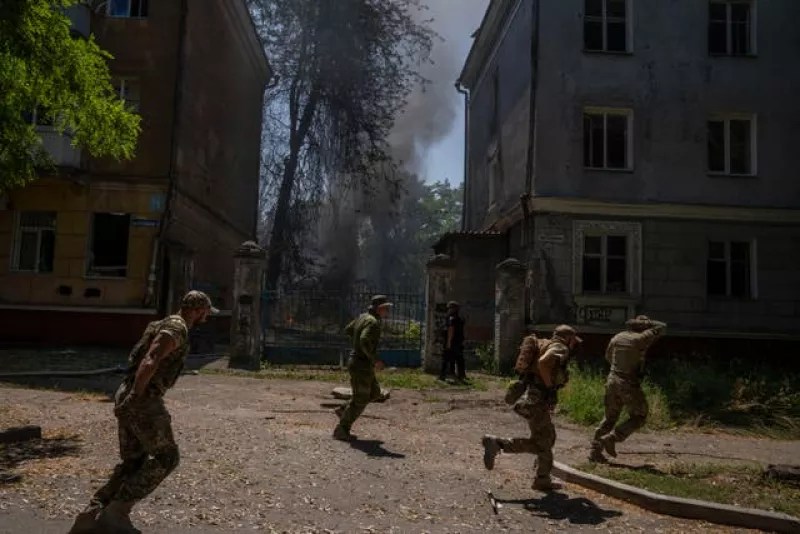
Yesterday’s issue of Breaking News Ireland carried a very unusual photo. It was unusual because it was taken during actual military action, whereas we normally only get photos of damaged buildings and occasionally Ukrainian military standing firm.

Ukrainian Soldiers run after missile strike in residential area of Kramatorsk, Donetsk Region, Eastern Ukraine (posted 13 July) (Cred: Nariman El-Mofty/AP)

But the photo was more unusual than that because it showed Ukrainian soldiers running for cover after a Russian artillery strike, naturally enough but a less-than heroic image for public consumption. The caption tells us it’s in a civilian area in the Donetsk region.

WAIT A MINUTE! In a civilian area? So the Ukrainian military were in a civilian area and got fired on by Russian artillery? Doesn’t that coincide with what the Russians have been saying? Were those Ukrainian military perhaps even firing from that area? We don’t know.

We don’t know because we get hardly any western media coverage from the actual battlefronts, just quotations from the Ukrainian State and, from time to time, commentary from US/ NATO sources. And never any detail from the Russian side.

If we want a more realistic picture, we have to go to sources banned or at least not promoted in the West.

One of those sources is Patrick Lancaster, reporting on the war. In a recent video, he interviewed wounded civilians in a hospital in Izium, Kharkiv region, an area the Ukrainian military left a couple of days earlier and which is now under Russian military occupation.

So refreshing to watch.

Some interviewees blame the Russian State, some blame the Ukrainian State, some seem impartial or keep their own counsel – as one might expect, really, if one thought about it past the propaganda line, which is that everyone there — except the “Russian separatists” — blames the Russians.

And actually, the Breaking News article reported the reluctance of many to leave Sloviansk and Kramatorsk as they are being publicly encouraged to do by the Ukrainian Donetsk Governor, presumably as those areas are going to be pounded by artillery (but by Ukrainian or by Russian?)

This too is interesting, because even anti-Ukrainian State or pro-Russia interviewees (not always the same thing) interviewed by Patrick Lancaster in the Izium town, said that the Russian artillery had hit their town “very hard”.

But then some also stated that Marchenko, the pro-Ukrainian Mayor of the city had announced publicly that the city had been evacuated. All lies, according to one, “only five buses here …. and 50 taxis (but) from Kramatorsk.”

So if the advancing Russian military believed that only Ukrainian military remained in the city …..?

This is a military conflict and of course both sides are firing and, as well as soldiers, civilians are being inevitably killed on both sides. When that happens, is it likely that either side is killing civilians deliberately?

Certainly less likely by the Russians in the Donetsk area, which is a largely Russian-speaking region that has been attacked by Ukrainian right-wing military since that state’s abrupt change of government in 20142.

By the Ukrainian military side, probably more likely on the basis of the previous eight years, or at least of being more careless.

The article I’ve quoted showed a range of attitudes to the call of Pavlo Kyrylenko, Ukrainian State’s Governor of the Donetsk region, for civilians to leave and to head into Ukrainian State-held territory — and also of different attitudes to the forthcoming Russian occupation.

Some are going, including a teacher of Russian, which is interesting, because another doesn’t want to go precisely because of the anti-Russian-speakers attitude of the State (and even more so of some of the Ukrainian military).

Some just don’t want to give up their homes and/ or be jobless (or elderly without support) in Ukrainian State territory. Some think they’ll be ok under the Russians while others think they’ll be no better off on the Ukrainian State side.

So, naturally enough a mixed picture but certainly very different to the one being projected day in, day out by the western media. How this article and photo slipped through that blockade is certainly curious.

DOES IT MATTER?

But at the end of the day, does it really matter much to us here in Ireland whether we are being subjected to inaccurate propaganda about the conflict in Ukraine?

Well, if that conflict was sparked by the expansion towards Russia’s borders of the NATO military alliance3, then it does.

If that conflict is part of the shaping up by US/NATO for a war against Russia and China (and possibly India), then it certainly does. Not just because all of those on both sides are nuclear powers and radiation can end up anywhere.

But also because the ruling elite of the British colony in Ireland is part of NATO and the ruling class of the Gombeen state is trying to push it into NATO — or at least into an EU military alliance, which would of course soon enough line up with NATO.

I don’t believe either side in this conflict without proof and analysis. But I do resent the completely one-sided propaganda coming from the western media. Maybe it’s the same in Russia with their own propaganda.

Maybe, but isn’t it the boast of the West that their democracies are superior, with free speech and press?

And if the western media is following the same propaganda line in its reporting out of common interest with US/NATO and EU, is the end result any different from the media in Russia saying what they are told to say?

End.

FOOTNOTES

1Would that they would equally well inform us of those beling killed by the Saudi proxy war in the Sudan or by the numbers of migrants being killed on a regular basis as they try to access safety or just a better life in western states – the same states that are usually responsible for their plight in the first place.

2Yes, eight years prior to the Russian invasion. On the rare occasions when the western media refers to this (they did in the Breaking News Ireland article) it is always portrayed as a problem caused by “pro-Russian separatists” without recording that those areas were attacked as Russian-speaking by Ukrainian fascist and far-Right military units, including the Azov Battalion and the people organised themselves in defence, then received Russian supplies and now, eight years later, a Russian invasion. The origin of the Crimea situation is a similar story.

3For those who think this is a ridiculous claim, type “NATO states in Europe map” into a search engine. Also look up “Minsk Agreement”.

SOURCES

Breaking News Ireland report: https://www.breakingnews.ie/ukraine/why-should-i-leave-some-ukrainians-refuse-to-flee-areas-caught-up-in-war-1334032.html

Patrick Lancaster reporting from Izum, Kharkiv region, 120 Km/ 75 miles southeast of Kharkiv city (random civilian interviews + civilians wounded in hospital): https://www.youtube.com/watch?v=3iFv5jxInOc

From Sirotino, Luhansk, now controlled by Russian an Luhansk People’s Militia (interviews with residents): https://www.youtube.com/watch?v=DRKNBYqb5DQ

Patrick Lancaster, December 2016 (yes, SIX YEARS AGO) in Luhansk People’s Militia trench, under Ukrainian shelling (breaking Minsk Agreement): https://youtu.be/DAo7go-4l0g

Senior Irish politicians thinking about joining a military alliance: https://www.irishtimes.com/world/europe/2022/06/08/ireland-would-not-need-referendum-to-join-nato-says-taoiseach/

CATHAL BRUGHA HONOURED AT SPOT WHERE FREE STATE SHOT HIM

Diarmuid Breatnach

(Reading time main text: 6 mins.)

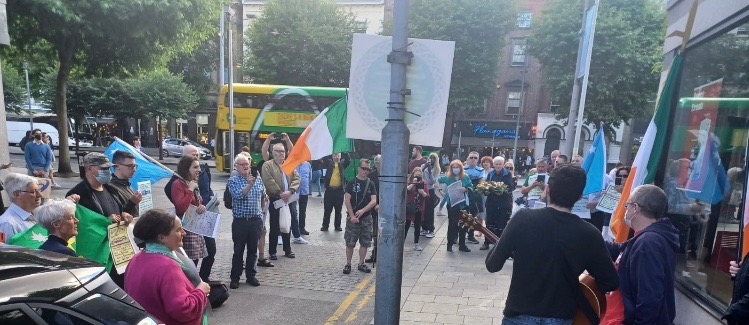
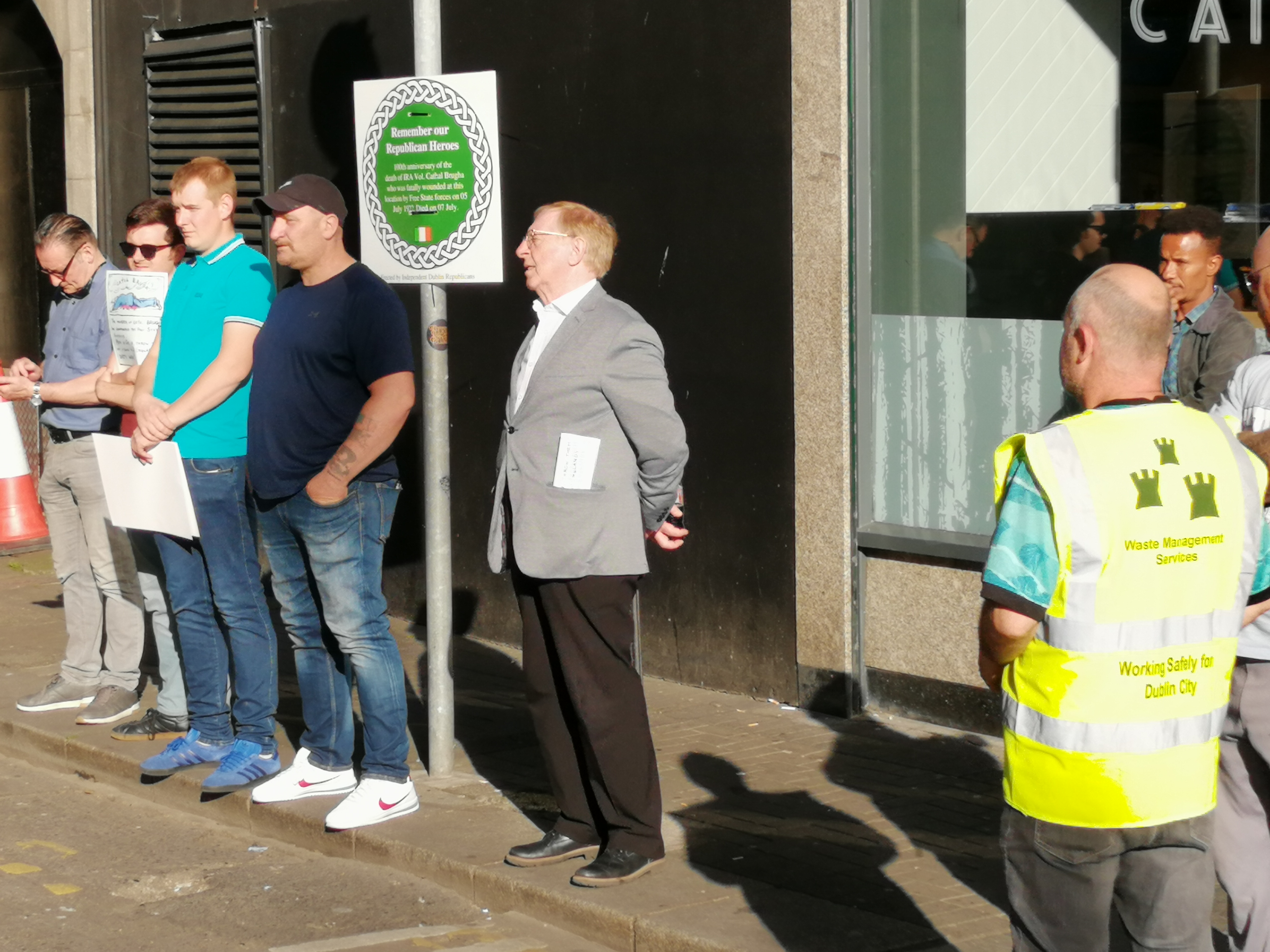
On the evening of 7th July, people passing on O’Connell Street, Dublin’s main street in the north city centre either stopped a while or passed with a glance at the crowd gather at the intersection with Cathedral Street, a narrow lane leading eastward.

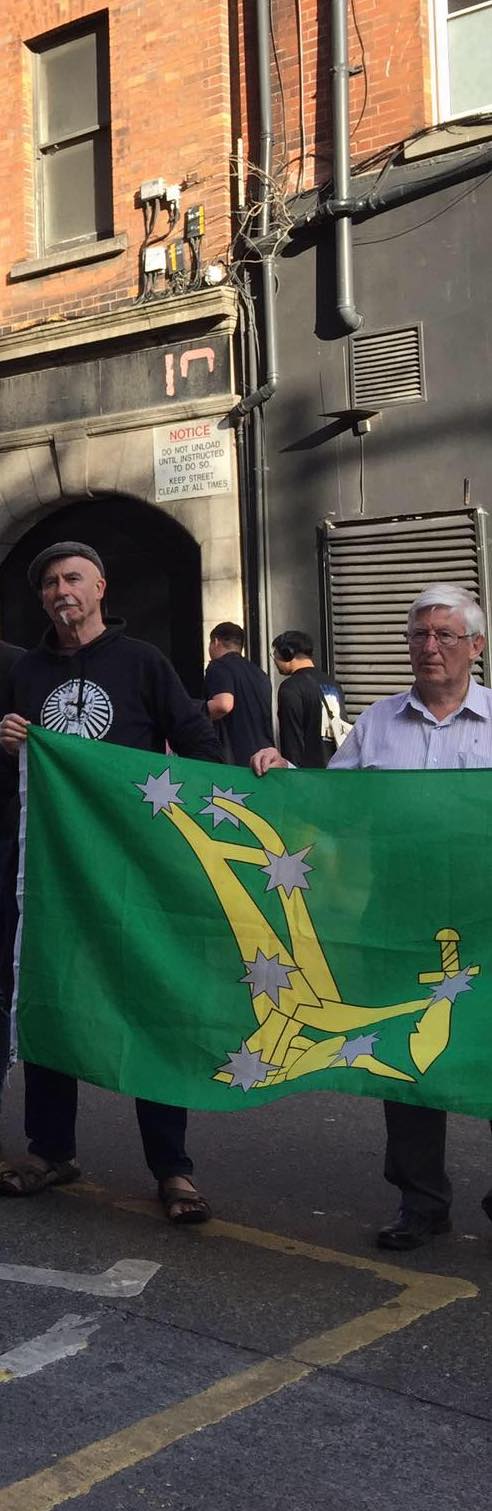
The Irish Tricolour and the Starry Plough flags (both versions1) held aloft gave a strong indication of the purpose of the gathering, which was to honour an Irish patriot shot down at that spot by Free State soldiers on 5th July 1922 and dying on the 7th.

A poster from the period with drawings thought to be by Constance Markievicz (Photo: D.Breatnach)

CATHAL BRUGHA RESUMÉ

Cathal Brugha was an Irish Republican, an Irish language activist, a soldier and politician. For a period in the Irish Republican Brotherhood, he joined the Irish Volunteers at the outset2 and was a lieutenant in charge of twenty Volunteers to receive with others the arms delivered to Howth Harbour in 1914.

In the 1916 Rising Brugha was second-in-command under Eamonn Ceannt at the South Dublin Union, now covered by James’ Hospital, where he received in excess of 25 wounds from bullets and grenade shrapnell and was not expected to live.

Surviving, Brugha was elected a Teachta Dála (member of parliament) for the abstentionist Sinn Féin coalition party in the UK General Election of 1918, serving until his death, first President of Dáil Éireann (the Irish Parliament) from January to April 1919, Minister of Defence from 1919 to 1922 and Chief of Staff of the IRA from 1917 to 1919.

Cathal Brugha, along with most Republican activists, was strongly opposed to the Anglo-Irish Agreement of 1921 which was supported by Michael Collins, Arthur Griffiths and others and joined the Republican opposition in the Dáil, resigning his government posts to do so.

A poster from the period with drawings thought to be by Constance Markievicz (Photo: D.Breatnach)

However, he and Oscar Traynor of the IRA both opposed the occupation of the Four Courts by IRA under Rory O’Connor but when it was bombarded by the Free State with British artillery on 28th June, Traynor ordered occupation of O’Connell Street buildings to divert some of the heat from the Four Courts.

The Free State Army bombarded the Republican positions in O’Connell Street with artillery and machine guns (as the British Army had done in 1916). Eventually the Republicans retreated apart from a small holding group which Brugha ordered to surrender but did not do so himself.

Approaching Free State soldiers with pistol in hand, he was shot by them in the leg, severing a femoral artery and died two days later in hospital. His widow Kathleen continued the Republican line as an activist and TD.

Mags Glennon, Chairing the event (Photo: D.Breatnach)

THE HONOUR CEREMONY

Mags Glennon, chairing the event, thanked people for coming, stressing the importance of remembering our history and listed briefly the important actions of and positions held by Cathal Brugha, before calling on Sean Óg to perform The Soldiers of ‘22,3 the five verses of which he sang, accompanying himself on guitar.

At intervals between speakers Sean Óg performed another two songs, Cathal Brugha and A Soldier’s Life4.

Joe Mooney brought a series of three posters for distribution, which were quickly taken up. These were copies from the period, condemning the Free State Army for the murder of Cathal Brugha, with drawings believed to be by Constance Markievicz.

A poster from the period with drawings thought to be by Constance Markievicz (Photo: D.Breatnach

MAIN ORATION

The main speaker was historian and author Kerron Ó Luain, who began speaking in Irish and returned to it on occasion, though the content of his talk was by far in English.

Ó Luain initially paid his respects to recently-deceased Mícheál Ó Doibhlin, a Dublin historian who had done much historical research to bring further into the light of today the contributions two Republican women in two different periods.

These were Anne Devlin of the United Irishmen (uprisings in 1798 and 1803) and Josephine McGowan, killed in 1918, the first Cumann na mBan martyr5. Ó Doibhlin had also assisted Ó Luain in the latter’s research into the insurrectionary history of his own area, Rath Cúil (Rathcoole)6.

Kerron Ó Luain speaking, Joe Mooney holding the microphone. (Photo: D.Breatnach)

Continuing to relate some brief facts about Brugha’s early life, born into a mixed-religion household, Ó Luain emphasised Brugha’s interest in the Irish language and his membership of the Gaelic League (Conradh na Gaeilge)7 in the same decade as its founding.

The speaker contrasted that aspect with the militarist image of Brugha often projected by hostile commentators. Brugha met his future wife at meetings of the Connradh and had been a strong advocate of the proceedings of the First Dáil being conducted mostly in Irish and of the Democratic Programme being first read and agreed in Irish.

The setting up of Sinn Féin to contest the 1918 UK General Elections had involved a coalition of many different elements Ó Luain said, including dual monarchism advocates such as the original founder Griffiths and even white Dominion aspirants, alongside Republicans such as Cathal Brugha.

Section of the crowd at the event. (Photo: D.Breatnach

These had been the lines along with the alliance had fractured when the British proposed the terms of the Anglo-Irish Treaty. British influence on the Free State was seen not only in its war on the Republicans but in the legal system adopted based on common law without any thought given to any of the principles of the native Brehon Law.

The British influence was evident also in the form of dress with some Free State politicians such as Cosgrave wearing a top hat and research has shown over 90% of the civil servants of the Free State had been employed by the previous British colonial administration.

The Free State adopted a formal position of support for An Ghaeilge, the Irish language, while doing nothing to support the struggling rural Irish-speaking areas, which were being drained by emigration, leading the inhabitants to want to acquire English for their future locations.

Some of the attendance. (Photo: D.Breatnach)
Another small section shot (Photo: D.Breatnach)

The number of Irish-speakers within the territory of the State has declined drastically since it was founded.

Unusually for an oration honouring an Irish martyr but very important historically, the speaker pointed out that Brugha was not a socialist Republican and had advocated land ownership whereas other Republicans such as Liam Mellows (executed by the Free State in 1922), Peadar O’Donnell and Frank Ryan in the 1930s had proclaimed the need for a socialist Republic.

In conclusion, the speaker said that Cathal Brugha was an honest courageous Republican with a genuine love of the Irish language and a staunch upholder of the truly independent Republic proclaimed in 1916 but yet to be achieved. He had been killed as part of the counterrevolution.

It is important for future efforts, Ó Luain stated, to be aware of the different strands in the Republican opposition to the status quo and to be clear on the desired future shape of society in the Republic.

View of many in the attendance at the event. (Photo: Cabra 1916-1921 Rising Committee)

OTHER REPUBLICAN MARTYRS OF THE BATTLE FOR DUBLIN 1922

Damien Farrell spoke on behalf of Dublin South Central Remembers and representing the McMenamy family from the area. Frank McMenamy had been asked to introduce the Roll of Honour on behalf of relative Ciaran McMenamy of F Coy, 1st Batt, anti-Treaty IRA (Ambulance Corp) but was unable to attend.

Ciaran was one of four brothers — Fergus, Manus and Francis — who fought in the revolutionary period 1916-23. Ciaran was part of the crew that tended Cathal Brugha and rushed him to hospital on the 5th July. When Brugha succumbed to his wounds, Ciaran was a pall bearer at his funeral.

Damien said that this most likely identified him for arrest which happened later and he was interned in the infamous Newbridge Camp and participated in the mass hunger strike of prisoners in 1923 against conditions.

Ciaran McMenamy contracted a cold that developed into consumption which secured his release to convalesce in the County Home in Kildare but this proved ineffective and Ciaran was eventually released from internment around Christmas 1923.

On the 26th of April 1924 Ciaran McMenamy died in 55 Pearse Square, a house connected to the family. For the past two years Dublin South Central Remembers have held remembrance events at the house, with the full permission and support of the current occupants (no relations) with the intention of having a plaque erected in time for his centenary in 2024.

Finnuala Halpin reading the Roll of Honour of the The Battle of Dublin 1922, in which her grandfather fought. (Photo: D.Breatnach)

Fionnuala Halpin read the roll of honour of those killed in The Battle of Dublin 1922, a battle in which her grandfather fought.

John Monks

William Clarke

Joe Considine

William Doyle

Francis Jackson

John Mahoney

Sean Cusack

Matthew Tompkins

Jack McGowan

Thomas Markey

Thomas Wall

Charles O’Malley

Cathal Brugha

Veteran Republican, hunger-striker and author Tommy McKearney placed a wreath in honour of the fallen on behalf of Independent Republicans and a minute’s silence was observed in their honour also.

COMMEMORATE THE CIVIL WAR MARTYRS OF YOUR AREA?

A number of different Republican organisations were represented at the event, along with many independent Republicans and historical memory activists, including walking history tour guides.

Poster and dedication floral wreath in honour of Cathal Brugha, Cathedral Street, Dublin city centre 7 July 2022 (Photo: Cabra 1916-1921 Rising Committee)

Mags Glennon asked people to keep in touch with the organisers and also to be aware of other commemorative events, offering to make available the commemorative posters with the local martyrs’ names incorporated into the design for display for others around the country.

End.

FOOTNOTES

1The original, with the design of plough in gold following the outline of the Ursa Mayor constellation in white stars, on a green background and the later Republican Congress version of the white stars alone on a light blue field.

2Formed in 1913.

3Composed by Brian Ó hUigínn, sung to the air of The Foggy Dew.

4A Soldier’s Life was originally composed by Young Irelander Thomas Davis (1814-1945) and recorded by The Wolfe Tones band; the composer of Cathal Brugha’s lyrics appears unknown and it was recorded by Declan Hunt.

5A rally held by women just off Dame Street in 1918 was batoned by members of the Dublin Metropolitan Police and she died of her injuries shortly afterwards. I have heard Ó Doibhlin relate her story and saw him becoming emotional as he did so. The DMP’s batons in September 1913 were also responsible for the deaths of at least three others, although one died in 1915.

6For a number of recent years Ó Doiblin has been noted, along with historian Liz Gillis and others, for research and exposition of information regarding the Burning of the Customs House on 25th May 1921, which corrected a number of common misapprehensions about that event.

7Founded by Protestant Douglas Hyde/ Dubhghlas de hÍde this month in 1893.

USEFUL LINKS

The Independent Republicans group do not appear to have a website or FB page but may be contacted through the Cabra 1916-1921 Rising Committee: https://www.facebook.com/cabra1916

The National Graves Association: https://www.facebook.com/NationalGravesAssociation

THE FIRST WORLD WAR DEAD SHOULD BE COMMEMORATED

Diarmuid Breatnach

(Reading time: 3 mins.)

Irish Republicans and revolutionary Socialists have traditionally been opposed to the commemoration of the dead in the “Great War”, WWI. Recently Michelle O’Neill, top Minister in the British colonial political regime in Ireland with the Lord Mayor of Belfast, both members of the Sinn Féin party, laid a wreath at the WWI memorial in Belfast, to the bewilderment of some and the disgust of others. But actually those emotions are misplaced, since the leadership of the Sinn Féin party were never Socialist and are no longer Republican.

The long-held position of Irish Republicans and Socialists that WWI should not be commemorated is however illogical and runs against history. The conflict was a hugely-important event in such areas as military, social conditions and mores, medicine, politics and economics.

The toll of WWI is around 40 million military and civilian casualties of which 20 million died. Of those, around 10 million were civilian dead. How can an event of such historical magnitude not deserve commemoration?

We should certainly commemorate the fact that a small group of monopoly capitalists, aristocracies and monarchies, in the course of an argument about how to divide up the world among themselves, sent millions of ordinary people, mostly workers, to kill one another to settle the argument. People who had no quarrel with one another and nothing to gain from killing one another; people whose real verifiable enemies were those very people who were mobilising and arming them before sending them forth to kill or be killed.

The conditions of the working classes at the time they were thrown into the killing arena should be commemorated. The lies that the war was fought for democracy and freedom of small nations should be exposed. The disciplinary court-martials and executions within the armies should be revealed, along with the treatment of conscientious objectors. The propaganda used for recruitment and to keep the home populations happy should be deconstructed and exposed. The fact that capitalism ends up as imperialism, which in turn causes war, should be made clear to all.

That wars are not alone fought for profits but that huge profits are made in the course of war is a grotesque fact that should become widely known.

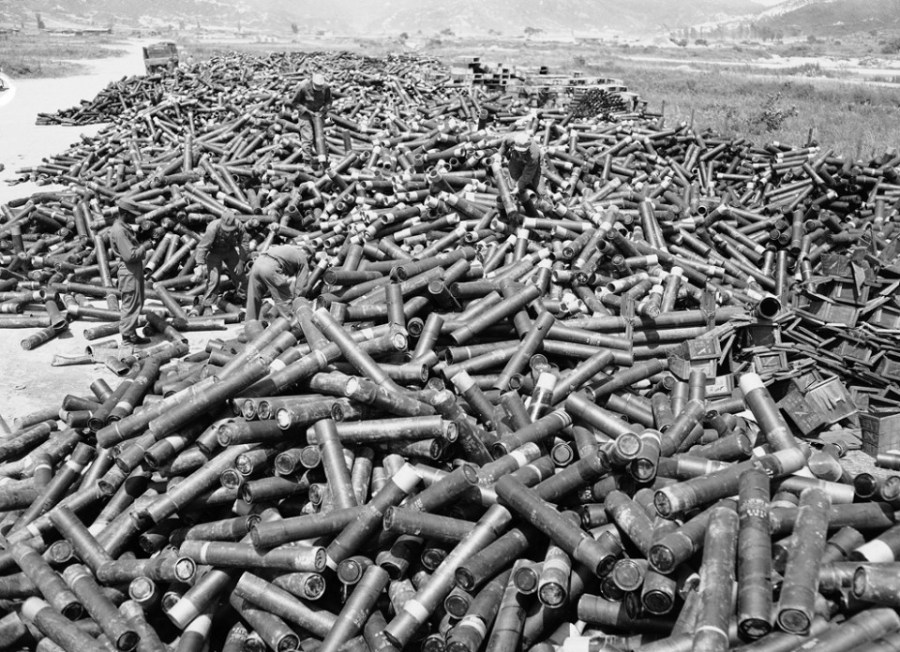
A pile of used artillery shells used in WWI — all manufactured and paid for, exploded, more ordered, paid for, fired ….. Part of the huge profits made during imperialist wars. (Photo sourced: Internet)

All of this was true of WWI and is true (to one extent or another) of the wars caused by imperialism today, whether in Somalia, Western Sahara, Palestine or Ukraine. But now, in addition to the huge death toll of WWI, we have the possibility of the destruction of human cities around the world — and even of ecological disaster — in yet another war.

We should expose the fact that far from encouraging us away from war, WWI commemorations are for the most part about concealing those salient facts and encouraging us to be proud of how our forebears were conned into killing one another. By whipping up reactionary nationalism1, their commemorations make us vulnerable to being conned into fighting further wars, to agree to be sent to other countries to kill or maim people like us in other countries – or to be maimed or killed by them.

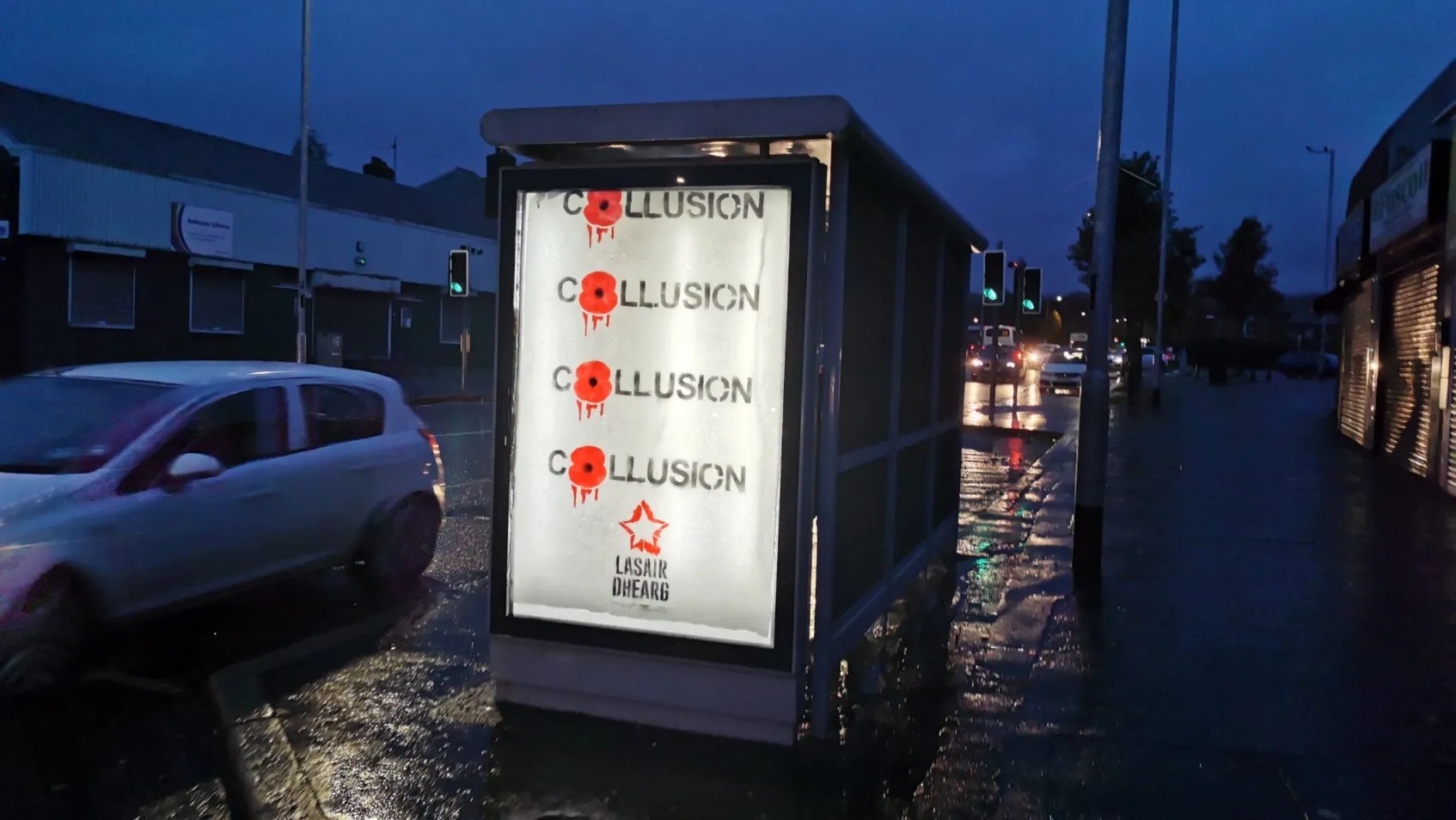
An innovative protest by the socialist Republican group Lasair Dhearg which however confines itself to pointing to the occupying British Army’s collusion with Loyalist murder gangs. (Photo sourced: Internet)

Commemorating the truth about imperialist wars past and present mean rejecting the wearing of the Poppy symbol. The Poppy is not about commemorating the dead in wars, as it is sold. This promotional emblem of the British Legion only commemorates the British soldiers who have been killed in wars – it does not commemorate all the soldiers of the colonies (for example Ireland) or the Commonwealth who died in the wars, not to mention all the civilian auxiliaries helping cook, clean, carry, dig, build etc for the British armed forces. The Poppy does not commemorate the dead soldiers of Britain’s allies, for example France, USA or Russia in the case of WWI. It does not commemorate the soldiers or auxiliaries of the hostile states who were killed, which might seem natural, until we ask ourselves why not, if the idea really is just to commemorate the dead soldiers in war. Most tellingly, the Poppy does not commemorate the millions of civilians who have been killed in wars – actually more than the total number of soldiers and a percentage of war deaths that is growing with every war.

The real role of the Poppy is to build social support for the imperialist British armed forces, including helping recruitment — so in other words, the emblem and its publicity is actually helping to build support for future armed conflicts.

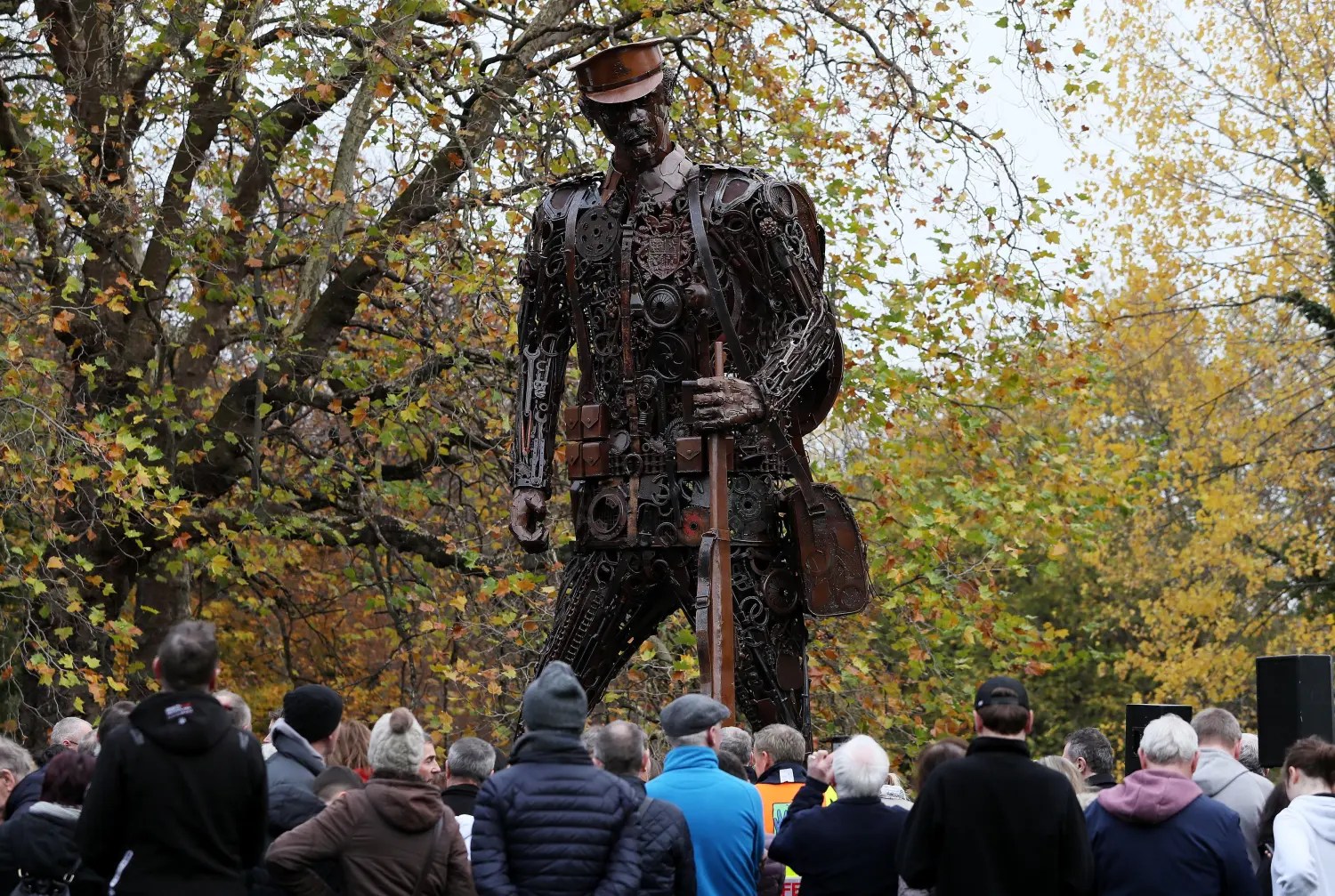
The WWI soldier sculpture made from scrap metal, pictured in Stephens Green, Dublin. Republicans protested its siting in a 1916 battleground, (Photo sourced: Internet)

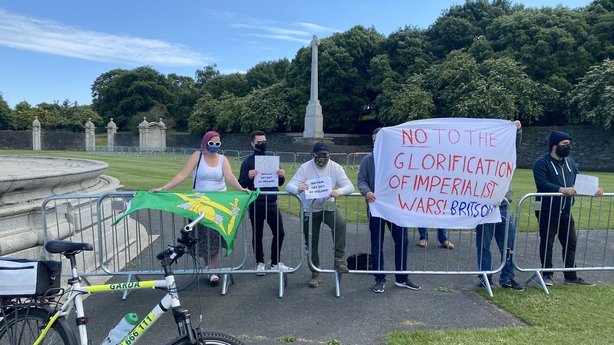
Not addressing the nature of imperialist war and just boycotting any idea of commemoration leads to missed opportunities. A few years ago a sculpture of a WW1 British soldier constructed out of scrap metal was installed in Stephen’s Green, a recreational park in Dublin’s city centre. Some Irish Republicans staged a protest around it in which they castigated it being located there in what had been a 1916 Rising battleground. They were correct in the historical reference but was that all that could be said about that war? Would most of the tourists passing by relate to that 1916 reference or would the whole international horror of imperialist war not have engaged them more?

A small protest emphasising the nature of WWI commemorations at one such attended by SF representatives (the commemoration) in the Irish National (sic) War Memorial Gardens 10th July 2021 (Photo: RTÉ)

We should indeed commemorate WWI but we should do it in the framework laid out, of exposing what the wars are about, who they benefit, what class contains the main victims – and not just the dead but also the injured, many of them crippled for life.

That is not how the ruling elites commemorate war and it is not how Michelle O’Neill and Tina Black did it. Michelle O’Neill said that she did this symbolic act in order to demonstrate that she is going to be “a First Minister for everyone” – clearly meaning Nationalist and Unionist. Liberals may laud O’Neill for that but one cannot represent national liberation simultaneously with colonialism, republicanism at the same time as loyalism, democracy at the same time as reactionary sectarianism. Making a war wreath green does not change its nature. Sinn Féin will often seem to try to present themselves as all things to different groups of people but essentially they are serving Irish Gombeenism2 in the 26 Counties and English colonialism in the Six.

Sinn Féin members Tina Black and First Minister-in-waiting Michelle O’Neill as they approach the WWI memorial in Belfast to lay a wreath. (Photo sourced: Internet)

In addition, workers and lower middle-class people from the Protestant or Unionist community were also killed and maimed in imperialist war. How does concealing the reality of war help those people?

End.

FOOTNOTES

1I use the term in the sense that not all nationalism is reactionary.

2Native Irish foreign-dependent capitalism

HUGE DEMONSTRATION IN MADRID AGAINST NATO AND IMPERIALISM

Rebel Breeze translation

(Reading time: one minute)

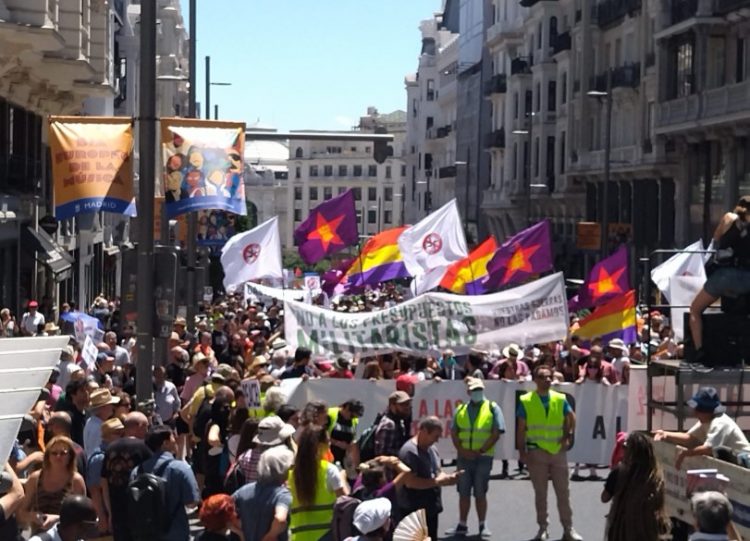
On 26th June 2022 tens of thousands took to the streets of Madrid in a rejection of NATO and imperialism. In addition to the people mobilised by the organisations and groups of the anti-NATO movement in Madrid, numerous buses were chartered from all over the state. The NATO Summit that was about to be held in Madrid (28 and 30th) has made it possible, after an important effort, to begin to revitalise and rebuild a movement opposing the armed wing of imperialism.

The groups attending with their slogans were many, from the anti-imperialist movement to some pacifist groups, through numerous organisations of the labour and popular movement, such as combative trade unionism or pensioners’ groups. Also noteworthy were representatives from abroad, such as a group of South Koreans against NATO, people from other European countries or groups from the Arab world, highlighting those who defend occupied Palestine and Western Sahara.

The repression has intensified during the previous two weeks and days: the city of Madrid has been militarised, organisers have even been arrested, they have been detained and threatened in their homes or they have been singled out in the press. Another demonstration called for the day of the summit, Wednesday the 29th, has been banned by the Government.

A section of the huge march on Sunday in Madrid (Photo: Insurgente.es)

COMMENT:

In addition to slogans against NATO (OTAN in Spanish), imperialism and war, one can also hear slogans specifically calling for the dismantling of NATO bases.

Not only will this huge demonstration and other acts in opposition to the summit lead to an intensification of general anti-imperialist struggle and against Spanish state repression but it will also likely encourage the forces for independence among the nations within the Spanish state, the Basque and Catalan nations and the Celtic nations of Galiza and Asturies.

SOURCES

NATO bases in the Spanish state: https://east-usa.com/us-military-bases-in-spain.html

FREE STATE SHELLING OF THE FOUR COURTS COMMEMORATED IN DUBLIN

Diarmuid Breatnach

(Reading time: 3 mins.)

A crowd gathered in Dublin today to commemorate the Free State opening fire on the Four Courts on 28th June 1922, an event that began what is usually called “the Civil War” which lasted until 1923 (with State assassinations until 1924). The UK supplied the cannons and shells used by the Free State’s “National Army” along with munitions, including small arms and ammunition, armoured cars, army lorries and even coastal naval vessels. The conflict has also been called a “counterrevolution” and “the UK’s proxy war” with more Republicans executed by the new Irish State1 in that conflict than had been by the British State over the whole 1916-1921 period.

Section of NGA march outside Croppies’ Acre (Photo sourced: Internet)

One hundred years ago this month, the IRA under the command of Rory O’Connor occupied and fortified the Four Courts complex, last occupied as a fighting post during the 1916 Rising. The Anglo-Irish Treaty partitioning the country and giving the Free State the status of a Dominion country had been narrowly accepted by the delegates to the First Dáil, the Irish Parliament previously banned by the UK State. However by far the majority of the military part of the Irish resistance – the IRA, Cumann na mBan and na Fianna, along with the remnants of the Irish Citizen Army – were opposed to the Treaty. The occupation of the Four Courts was seen by the Free State government as a challenge to its authority and by the British Government as a threat of anti-colonial struggle being renewed. Both parties were hostile to any radical republican, socialist or socialist-republican program.

Free State Army attacking the Republican garrison of the Four Courts with artillery, rifle and machine-gun fire. (Photo sourced: Internet)

On 28th June the Free State opened fire from British cannon on the Four Courts from Bridge Street on the south side of the river and the Civil War – or Counterrevolution – had begun. By the time the Republicans conceded defeat (and some assassinations continued even after it officially ended) perhaps around 1,300 had been killed. From January 1922 to April 1924, according to the Republican Roll of Honour, 426 anti-Treaty Volunteers had been killed, some 25 of these died fighting British and Northern Irish forces. Most anti-Treaty dead were IRA Volunteers, but some were Na Fianna members and four were women of Cumann na mBan2.

Poster commemorating one of the Republicans killed by the Free State (Photo: D.Breatnach)
One of the commemorative posters attached to lampposts (Photo: D.Breatnach)

On the Free State side just under 800 died, of whom 488 fell in enemy action, others due to accidents or illness, while seven were executed having deserted to the Republican side. “To this total should be added a small number of police, including four from the Civic Guard (later renamed Garda Síochána), four from the Criminal Investigation Department and two from the Citizens’ Defence Force, who were killed from 1922-19243.”

The NGA rally, the MC (Photo: D.Breatnach)
View of the crowd at the rally outside the Four Courts (Photo: D.Breatnach)

Dorney remarks on omissions in the Last Post record and concludes: “Even allowing for this, though, the total of anti-Treaty IRA dead in the Civil War is not likely to be much more than about 500, of whom 81 died before Free State firing squads and more than 100 were summarily executed in reprisals.”

(Photo: D.Breatnach)

Many Irish Republicans also emigrated to avoid repression or because they were being denied employment.

The Irish State today is a direct descendant, legally and in other ways, of the Free State of 1922 and all periods since.

Senior Garda officer taking notes while speakers are addressing the crowd (Photo: D.Breatnach)

The commemorative event in Dublin today was organised by the National Graves Association (Cumann Uaigheanna na Laochra Gael), an organisation which since its founding in 1926 has been maintaining the graves of Irish patriots, arranging for the installation of gravestones, plaques and monuments and also organising commemorative events.

Before marching to the Four Courts, participants formed up in groups in the road outside Croppies’ Acre, a public park over a mass grave of victims of the English state’s repression of the United Irishmen and their supporters in 1798, now across the road from the Collins Barracks National Museum. They were led by a lone piper and colour party, followed by people in double ranks flying Starry Plough flags and carrying banners of history and conservation groups, along with some other flags, including that of Cumann na mBan.

Section of the lineup waiting to start, outside Croppies’ Acre (Photo: D.Breatnach)

At the rally outside the Liffeyside of the Four Courts, the organisers had an MC with number of speakers to read out the 1922 Proclamation, the lyrics of The Soldiers of Twenty-Two4 and Tim Horgan to give a keynote oration. At least one floral wreath was laid in honour of those who fought there and a number of posters attached to lampposts commemorated the three Volunteers who were fatally wounded there: Thomas Wall, Joe Considine and Sean Cusack.

Reading the lyrics of Soldiers of Twenty-Two (Photo sourced: D.Breatnach)

It is almost certainly the case that it is the NGA which has erected the majority of patriotic struggle commemorative plaques around the country, with most of the remainder being organised by local authorities, local history groups and old comrades’ associations – a very small proportion being the work of the State. As stated on its website, the objectives of the Association have always been: to restore, where necessary, and maintain fittingly the graves and memorials of our patriot dead from every generation; to commemorate those who died in the cause of Irish freedom; to compile a record of such graves and memorials.

The NGA’s general alignment is unequivocal: “Only a 32 County Irish Republic represents the true aspiration of those who gave their lives for Irish freedom.5

Reading the 1922 Proclamation (Photo: D.Breatnach)

One might assume that every participant at the event today was of a definite political bent, yet not a single party or political organisation banner was to be seen on the march or at the rally. This is because participants were asked in advance not to bring any banners or placards of political organisational allegiance. As the Chairperson of the rally informed the audience, the NGA is not affiliated to any political party or organisation and furthermore does not accept contributions from any such nor from the State – in order to continue to guarantee the NGA’s independence. In fact, members of its governing body are not even permitted to belong to a political party. A senior Garda officer however, of least at Inspector rank, took down details in his notebook as the rally was addressed by speakers.

Main speaker, Tim Horgan (Photo: D.Breatnach)

Patriots of the United Irishmen, the Young Irelanders, the Fenians, the Land League, na Fianna Éireann, Irish Volunteers, Cumann na mBan, IRA, Official and Provisional IRA, the Irish National Liberation Army etc have all been commemorated by the NGA. According to Wikipedia, since its founding, the NGA has erected, or accepted into its care, over 500 monuments and memorials throughout Ireland.

One of the participants takes a rest
Banner of one of the groups attending (Photo: D.Breatnach)
Some of those in attendance (Photo: D.Breatnach)

A number of other Civil War/ Counterrevolution commemorative and discussion events will be taking place at least during this year, two of which will take place next week (see photos of leaflet).

The Gardaí remained at the scene as people dispersed. Passing by again shortly afterwards, we found the floral wreath had been removed.

End.

Lowering of the flags in honour of the martyrs (Photo: D.Breatnach)
Civil War/ Counterrevolution commemoration (image: photograph of flyer)

Forthcoming talk (image: photograph of flyer)

FOOTNOTES

1Official executions are usually listed as 81 or 83, these having been subjected to some kind of military judicial process (but without any jury). However, apart from IRA fighters killed in battle, a number of captured combatants were murdered (such as those of the Ballyseedy Massacre on March 7th 1923) while known activists were assassinated by Garda-Army squads operating from Oriel House. Often, the murdered had been tortured first.

2 The Republican Roll of Honour, The Last Post.

3 https://www.irishtimes.com/culture/heritage/what-was-the-real-death-toll-of-the-irish-civil-war-1.4858308

4https://www.youtube.com/watch?v=RKOSCuLtlAY for a rendition of this song. It author seems unknown.

5From Wikipedia entry

USEFUL LINKS

https://www.facebook.com/NationalGravesAssociation

http://www.nga.ie/

https://en.wikipedia.org/wiki/National_Graves_Association

Ballyseedy Massacre: https://www.irishtimes.com/culture/heritage/stories-of-the-revolution-ballyseedy-and-the-civil-war-s-worst-atrocity-1.2462070

Varadkar admitted those killed without trial had been murdered: https://www.thejournal.ie/free-state-executions-4387452-Dec2018/

Death toll: https://www.irishtimes.com/culture/heritage/what-was-the-real-death-toll-of-the-irish-civil-war-1.4858308

BILBAO ACTIVISTS FORM BROAD COALITION AGAINST NATO & WAR

On 2nd June a number of Left anti-imperialist organisations and individuals held a public rally in Bilbo/ Bilbao. The municipal authority refused them use of a building and they held it in the open air in the Etxebarrieta Square. The organisers issued a statement in Euskera (Basque language) and Castillian (Spanish) calling for unity against the war plans of NATO and the EU and denounced the equivocating posture of the ‘official’ left Basque movement, denounced also the militarism of the Spanish coalition Government and advertised a joint demonstration for 18th June in Moyua, on the south side of the river in Bilbao1.

STATEMENT ISSUED BY COORDINATING GROUP (translated by D.Breatnach from Castilian Spanish version published in Ecuador Etxea)

For several weeks, various people and groups from Bilbao, Meatzaldea, Uribe-Kosta, Ezkerraldea and Busturialdea2 have been coming together in this broad initiative to respond to the escalation of war that we are seeing around us. An escalation of war promoted by NATO, with the aim of shielding the world hegemony of the United States against the rise of emerging powers such as China, India, Iran or Russia. A strategy that is doomed to failure, but that will cause, if we do not prevent it first, destruction, misery and death throughout the planet.

In Bilbo/ Bilbao 2nd June, reading the declaration and call to unite and for rally on 18 June in Basque and Castillian (Spanish). (Photo source: Ecuador Etxea)

In relation to the conflict in Ukraine, we believe that in no case can one speak of an inter-imperialist struggle between the NATO countries and Russia. Rather, it is an offensive planned for years to overthrow the legitimate government led by Vladimir Putin and gain control of Russian energy resources and markets. A policy of looting and plundering that the current Russian President put a stop to, no matter how hard it is for some to admit it. Ukraine is nothing more than the operations base and the cannon fodder of Atlanticist imperialism against its historical enemy, Russia.

Many on the Left say that the Russia of today is not the Soviet Union of yesterday. And they are completely correct. The problem is that even the slightest economic planning for social purposes by any State has become an obstacle to the viability of the parasitic capitalism that we live under. There we have the cases of Slovdan Milosevic, Saddam Hussein or Muammar Gaddafi, sadly imprisoned and/or executed in the face of complicit silence or the enthusiastic support of what they call the “international community.”

Those of us who are here today have already learned our lesson: first they demonize the currently out of favour ruler through the media, and then they justify military offensives and imperialist massacres. That is why at this time we cannot make the mistake of placing ourselves at equidistance. Both Russia and the Donetsk and Luhansk People’s Republics have every right in the world to defend themselves against the aggressions of NATO and the EU, which conspire and supply weapons to fascist governments like Zelensky’s to harass Russia and destabilize the region. Not to mention the openly Nazi battalions captured in Azovstal, whose release France and Germany now demand in order to advance in the negotiations. What do European governments owe the Nazis in Azov? What do they have to hide and why do they intend to buy their silence?

The truth is that we still do not know the exact reason why the States of the European Union have completely bowed to the interests of the United States. It is evident that the sanctions against Russia and the new oil and gas supply routes imposed by the US only benefit the Yankee tycoons, the Arab sheikhs and the absolutist monarchies of Saudi Arabia, Qatar or the United Arab Emirates. NATO vassals like Borrell have definitively cast the old European project into History’s dump. They prioritize profit and military spending to the detriment of the health and living conditions of the broad masses and announce a future of misery and sacrifice for a war in favor of a capitalism that is against us. The European Union is definitely a rotting political corpse, in case anyone ever thought that it could have been a progressive alternative or for oppressed nations like ours.

Arnaldo Otegi, leader of “the institutional Abertzale Left” (Basque left-nationalist movement). (Photo source: Internet)

Precisely here in the Basque Country, the official position of the institutional Abertzale Left3 regarding what is happening in the Ukraine is especially embarrassing. It seems unbelievable that those who proclaim themselves heirs to the historic struggles of the Basque Working People, a people of which the majority in 1986 opposed remaining in this criminal organization4, now wave the flag of “no to war” and of ambiguity. It seems immoral to us, both the pacifism that denies the just right to defense of those who are attacked by imperialism, as well as the lukewarm posture of those who do not take a stand, thus facilitating the advance of imperialism. Anti-imperialism and anti-capitalism must be cultivated day by day, if we do not want the ideological and cultural offensive of NATO and the EU to continue having effect, in particular among the sons and daughters of the working class. Thirty-six years later we unambiguously reaffirm ourselves in NO to NATO, no to FASCISM, no to GENOCIDAL IMPERIALISM.

As we said, we are witnessing an implacable propaganda to make us part of this imperialist strategy, so that we do not rebel against what is happening. While they continue to spread one-sided thinking through the big media, television channels that question the official story — such as Russia Today — are closed without the slightest shame, content on the Internet is censored by appealing to supposed “verified information”, journalists like Pablo González5 are imprisonedor political information is systematically eliminated from our streets. They not only want to indoctrinate us, they directly deny us the right to be informed. Where are the defenders of freedom of expression? Are we already living in a hidden state of emergency?

It is our obligation, therefore, to denounce, not only the rise of international fascism, but also the fertile ground that the fascists have in the Spanish State of the bannings, the GAL6, the closure of newspapers and the systematic torture of political dissidents7. Atlantic capitalism will never be able to find a better ally than the PSOE8, veritable experts in the art of manipulating and deceiving the working and broad masses. Sadly, there are times when collective memory seems too fragile. Of course, for this new phase they have found a faithful shield-bearer, the party of Yolanda Díaz9. Seconds were never good, we are already seeing where these wolves in sheep’s clothing are leading us…

We said at the beginning that different people have come together to counteract this hegemonic discourse that manipulates consciences and protects the sequestration of rights and freedoms. From Muskiz to Gernika we rebel today here against this ominous imperialist offensive. All this suffering is not necessary, there is no reason to accept the misery and the war to which NATO and the EU want to condemn us. It is also not the time to stay at home watching, or to follow the war as if it were a video game.

We therefore issue a call to all the towns and neighborhoods of Euskal Herria and other nations to continue organizing the fight against imperialism, capitalism and fascism. And we also invite all the people who are against the imperialist offensive of NATO and the EU to participate in the demonstration that we will carry out in Bilbao, on June 18 at 6:30 p.m. from the Plaza Elíptica.

NO TO NATO! NO TO THE EUROPEAN UNION! NO TO IMPERIALISM!

End statement.

TRANSLATOR FOOTNOTES

1Which is also the location of the representation of the Spanish State in Bizkaia and guarded by armed police.

2A number of towns and districts across the SW Basque province of Bizkaia.

3The ‘official’ leadership of the left-Basque independence movement, e.g the EH Bildu party under the leadership of Arnaldo Otegi and others.

4In the 1986 referendum on whether to remain in NATO, the Basque Country gave the highest majority for No, with the Canaries and Catalonia coming behind. For the whole Spanish state, nearly 57% voted Yes against 43.15%.

5Basque freelance journalist reporting for Publico (Spanish left online media) and La Sexta, threatened and advised to leave Ukraine by state intelligence services, which he did but arrested by Polish intelligence on 28 February as he was about to re-enter Ukraine with a group of journalists. Poland has charged him with spying for Russia but to date produced no evidence and even denied him access to his lawyer. The Spanish State sent intelligence service agents to question his wife, mother and friends.

6GAL: A Spanish state terror and assassination organisation of the 1980s operating against the Basque resistance which was exposed as led by the Prime Minister (though never even questioned) Felipe Gonzales and directed operationally by the Minister of the Interior and senior Army and Police officers, a number of which received prison sentences.

7The Spanish state has long been accused by human rights organisations of torturing political dissidents and convicted in the European Court of Human Rights a number of times of failure to investigate complaints of torture. The State has closed newspaper and social media sites, jailed rappers, banned political parties, banned demonstrations, closed political cultural centres, disqualified political activists from representation in elections and jailed political activists.

8The main Spanish social-democratic party, currently in coalition government with Podemos.

9Yolanda Díaz resigned from Izquierda Unida (United Left – a broad coalition) but remained a member of the Communist Party of Spain; she is currently Deputy Prime Minister in the Spanish coalition government.

SOURCE

COLOMBIAN PRESIDENTIAL ELECTIONS — ANY CHANGE?

Gearóid Ó Loingsigh, political activist and analyst for many years in Colombia, was interviewed by Dimitris Givisis about the current presidential elections there and a candidate presenting as Left; published in https://www.rednblack.gr/arthra/kolomvia-o-petro-oikodomei-mia-eklogiki-symmachia-kai-ochi-mia-koinoniki-dynami/

1) What do you think the elections of May 29th will mean for the future of Colombia? What are the stakes of these elections?

The elections are not as key as some commentators would like to make out in terms of profound changes in Colombia. Though, the reaction in some sectors and fears about the transparency of the elections are well founded and even some fears of a violent reaction from some sectors of the bourgeoisie and the army. So, on one level the elections are about the degree to which the bourgeoisie, including the narco-bourgeoisie are willing to accept electoral defeat. This election is likely to bring about a long period of uncertainty in the country as Petro tries to manage the expectations and demands of the bourgeoisie and contain the hopes of his own supporters.

People displaced in the north of Santander by ongoing violence try to get by as best they can (Photo cred: GÓ Loingsigh)

2) What is the political scenery like, one week before the elections? These elections take place midst what kind of atmosphere?

The atmosphere oscillates between one of hope that Petro will be elected and bring an end to a long conflict that has been going on for almost 60 years and one of fear. No one knows what the far right are capable of doing and thinking at the moment. General Zapateiro intervened in the election campaign, which is unconstitutional as the military don’t even have the right to vote in Colombia. There are other fears about electoral fraud, a portal has been set up to report electoral fraud. Already it has tallied 3,500 incidents and no one has cast a vote yet. Leading businesses have stated they will sack any workers who vote for Petro and have demanded that their employees take photos of the electoral card that they mark and send it to them. It is expected that Petro has the ability to win in the first round, sufficient electoral fraud to force a second round run off with any candidate other than Fico would make matters more complicated for Petro as people may vote against him out of fear were it to come to a second round against one of the other candidates other than the reincarnation of Uribe that is Fico.

The Colombian military are not permitted to vote but there is always the possibility that they will intervene militarily (Photo cred: GÓ Loingsigh)

3) In the surveys, we see that Gustavo Petrois is ahead. How do you interpret this? What are the social alliances he has created? What are people’s expectations from him?

Petro has been around for a long time and this is not his first but third outing as a presidential candidate. After 20 years of Uribe as the leading figure in Colombian politics, there is a growing tiredness coupled with really serious levels of poverty, whilst kleptocrats openly steal the resources of the state. However, he hasn’t built social alliances as such. There has been a confluence of various social organisations and sectors more out of a hope that there might be some change. Petro for example opposed the wave of protests that erupted in the country last year. At a moment when Duque looked very weak, Petro came out to say that he didn’t want Duque to fall through the protests and demanded that the protests be called off. He more than anyone was responsible for the defeat. Petro is building an electoral alliance not a social force and his electoral alliance includes the bourgeoisie. He has long called for a programmatic agreement with the bourgeoisie and his alliance includes people from various previous governments, including Uribe’s governments. Leading functionaries from the Santos government play lead roles in his campaign, such as Alfonso Prada, who is also a close friend of Santos. Former president Samper, the man who implemented the decree that gave us the Convivir, the legal façade for the paramilitaries in the 1990s is also involved in his campaign. This is not a minor point, Samper managed to reinvent himself as a man of peace, even though he more than any president bears responsibility for the blood bath of the mid 1990s to the early years of the 21st century. He also tried to include the former president Cesar Gaviria, the man who gave us the economic aperture of the neoliberal period. It was opposition from his electoral base which forced him to rethink that one. These people play a greater role than any social movement.

Marchers on the annual Victims’ Day in March with placards of murdered trade union and human rights activists (Photo cred: GO’Loingsigh)

4) If Gustavo Petro wins the elections, what possibilities/room does he have to implement a progressive/social democratic policy for the people΄s classes, the workers, the poor, the precarious, etc?

This goes back to the last question and his programmatic alliance with the bourgeoisie. So, there are two elements, to what degree does he actually want to implement a progressive policy? He has spoken about reforms in health and education, some of which sound almost Keynesian, but Petro is not Keynesian. His programme does not contemplate a break with neoliberalism but to work within it, controlling deficits etc, subsidies for industry etc.. His economic policies are a continuation of the last 30 years, with one difference, he wants to move away from mining and oil exploitation, the former coming to an end in any case with various coal mining companies announcing their withdrawal from the country, though some gold mining companies are staying and these companies have legal guarantees on continuing with mining prospecting and exploitation that Petro will not and cannot legally bring to an end. He has however, said that he will promote agribusiness and continue with the policies that are in place, again with some minor tweaking.

Gustavos Petro campaigning (Photo cred: Financial Times)

5) How do you see the next day, after the disaster that the four years of Duque’s neoliberal policy has brought? What are the most important problems that the new government will face? What are the difficulties?

The next day, the one problem Petro will have is how the right will react to destabilise his government. A situation similar to that of Allende of a long drawn-out phase of destabilisation from some sectors is a possibility, though unlike Allende, Petro’s campaign is electoral, he does not believe in organising people and is in fact opposed to it. Part of his base has been bought off with the promise of jobs for the leaders of organisations and access to the public purse, which is normal for Colombian elections. Offers of jobs and government contracts in communities is the normal way elections are bought in Colombia.

Colombian military looks towards a protest demonstration (Photo cred: GO’Loingsigh)

Petro also does not have a majority in Congress, in fact he is very far from it. And will have to negotiate many things, which will push his programme further to the right as he will not use popular mobilisation to counter any blocking of policies by Congress. In the long term, this presents a problem for him and we will almost certainly see another wave of protests like those of last year, but this time against the Petro government. I also predict that his Vice President, Francia Márquez will not complete her term of office and will resign at some point in the face of the reality of Petro’s government as opposed to the expectations.

He has proposed renegotiating the free trade agreements, a task that is just not possible. He will also face problems in reforming the health sector as many international health companies have invested heavily in the sector and will most like sue the government for any changes that affect their profits, something he will be forced to back down on. In fact, within his campaign there have already been retreats on this point, as he no longer proposes to abolish the role of these companies, just to change how much of the public purse they have access to.

end.

People fishing in Cesar Department, Colombia (Photo cred: G.Ó Loingsigh)
Coal miner in Colombia (Photo cred: G.Ó Loingsigh)

WORLD WAR III?

APRIL 29, 2022

Reducing Tensions, Building Trust, De-escalating

From Counterpunch

BY JOHN LAFORGE

FacebookTwitterRedditEmail

The United States could immediately take direct actions that would de-escalate the over-arching nuclear threat that haunts Russia’s war of aggression in Ukraine. A few such actions would demonstrate good will and indicate a real intention to reduce tensions in the crisis which seems every day to grow more dangerous.

1. U.S. hydrogen bombs stationed in Europe could be withdrawn and their planned replacement cancelled.

The United States and Germany are formal states parties to the Treaty on the Nonproliferation of Nuclear Weapons (NPT). Articles I and II of the NPT flatly prohibit the transfer of nuclear weapons from one states party to another. Any fourth grader can understand that the NATO practice of “nuclear sharing” with Germany, Italy, Belgium, The Netherlands, and Turkey — which together have over 100 U.S. nuclear weapons — is an open violation of the clear, unambiguous, unequivocal and binding prohibitions of the NPT.

(Image sourced: Internet)

The United States stations an estimated 20 of its B61-3 and B61-4 thermonuclear gravity bombs at the German Air Force Base Büchel, 80 miles southeast of Cologne. These B61 H-bombs at Büchel are identified as “intermediate-yield strategic and tactical thermonuclear” bombs, and “the primary thermonuclear gravity bomb in the U.S.” according to the NuclearWeaponArchive.org.

Calling these weapons “intermediate” or “tactical” is shocking disinformation. The maximum yield of the B61-3 is 170 kilotons, and the maximum B61-4 yield is 50 kilotons, as reported by the Bulletin of the atomic Scientists. These H-bombs respectively produce over 11 times and 3 times the explosive blast, mass fire, and radiation of the 15-kiloton Hiroshima bomb that killed 140,000 people. (For background, see Lynn Eden’s “Whole World on Fire,” or Howard Zinn’s “The Bomb.”

The effects of detonating B61-3 or B61-4 bombs would inevitably be catastrophic mass destruction involving disproportionate, indiscriminate and long-lasting devastation. Plans to replace the current B61 with a new “model 12” could be cancelled now, and constitute a real ratcheting down of tensions in Europe.

2. The U.S. can discontinue its nuclear attack courses underway at Ramstein Air Base in Germany.

The U.S. studies and plans nuclear weapon attacks at classrooms of its Defense Nuclear Weapons School (DNWS), and the one branch school outside the U.S. is at Ramstein in Germany, the largest U.S. military base outside the country, headquarters of the U.S. Air Forces in Europe, and NATO Allied Air Command. Outlines of nuclear attack coursework can be read on the DNWS website, which boldly declares the school: “is responsible for delivering, sustaining and supporting air-delivered nuclear weapon systems for our warfighters …every day.”

One class outlined on the DNWS website is for “Theater Nuclear Operations,” described as “a 4.5-day course that provides training for planners, support staff, targeteers, and staff nuclear planners for joint operations and targeting. The course provides an overview of nuclear weapon design, capabilities, and effects as well as U.S. nuclear policy, and joint nuclear doctrine…. Objectives: … Understand the U.S. nuclear planning and execution process…; Understand the targeting effects of nuclear weapon employment….”

Dispensing with this nuclear attack planning school would reduce tensions and help eliminate Russia’s dread of the U.S./NATO nuclear posture.

3. NATO can suspend its provocative military exercises.

Attacks with U.S. nuclear weapons in Europe are regularly simulated or “rehearsed,” as is often reported. Recent headlines noted: “German Air Force training for nuclear war as part of NATO” (Kazakh Telegraph Agency 2020), “Secret nuclear weapons exercise ‘Steadfast Noon” (German Armed Forces Journal 2019), “NATO nuclear weapons exercise unusually open” (2017), and “NATO nuclear weapons exercise Steadfast Noon in Büchel” (2015).

Giant NATO war games routinely zero in on Russia. In 2018, there was “Trident Juncture” with 50,000 troops in Norway, and “Atlantic Resolve” was conducted in Eastern Europe. In 2016, some 16,000 troops gathered in Norway for “Cold Response,” and in “Anaconda 2016” another 31,000 troops from 24 countries were again in motion across Poland, Lithuania, Estonia and Latvia. In 2015, there was “Atlantic Resolve,” “Dragoon Ride,” and “Spring Storm,” all conducted across Poland, Lithuania, Estonia and Latvia. In 2014, the routine “Cold Response” game in Norway involved 16,000 troops, and “Atlantic Resolve” took place in Estonia, Lithuania, Latvia and Poland.

Beyond the annual “Steadfast Noon” simulations, complex, multinational NATO exercises in Eastern European countries just recently ballooned in number. In 2019, there was a single big exercise called “Atlantic Resolve.” In 2020 there were five. In 2021 the number leaped to eleven, and NATO that year made plans for a total of 95 exercises. Individual NATO states had plans for another 220 of their own war games. Nothing justifies Putin’s naked aggression, but the marked increase in NATO war practices would even make the Dali Lama defensive.

4. The U.S. and NATO could end their nuclear weapon “first-use” policy.

The public policy of readiness to initiate attack with nuclear weapons — not as a deterrent against being attacked with nuclear weapons, but its exact opposite — is at the heart of both U.S. and NATO “nuclear posture.” This perpetual threat to start nuclear attacks during a conventional conflict, especially in the context of routine NATO nuclear war exercises, is unnecessarily destabilizing and reckless. In view of the enormously overwhelming power of U.S. and NATO conventional military forces, the nuclear option is grossly redundant and militarily useless.

(Source image: The Irish Sun 2019)

After he retired, Paul Nitze, a former Navy Secretary and personal advisor to President Ron Reagan, wrote “A Threat Mostly to Ourselves” where he observed: “In view of the fact that we can achieve our objectives with conventional weapons, there is no purpose to be gained through the use of our nuclear arsenal.”

Now that the U.S. public as a whole has been transformed into one big anti-war group, it should recognize that it can influence our own government but not Russia’s. Our demands for negotiation, cease-fire, de-escalation and a peace agreement need to be directed in a way that has some chance of success. ###

John LaForge is a Co-director of Nukewatch, a peace and environmental justice group in Wisconsin, and edits its newsletter.

DEATH OF A RETIRED WARRIOR

Diarmuid Breatnach

(Reading time: 12 mins.)

In mid-April (2022) Gardaí, the police force of the Irish State, broke down the door of Mick Plunkett’s home. They would not have been able to claim he resisted their entry or arrest (the usual explanation for injuries on the detained individual) – he was already dead.

To be fair to them, this time they were forcing entry in response to concerns from people that Plunkett had not been seen and wasn’t answering calls.

Still, Mick Plunkett’s door had been forced by police a number of times before – by the Special Branch, at least once by the Garda ‘Heavy Gang’ and another time by the special ‘anti-terrorist’ Paris police.

Mick was born into a working class family of ten siblings in Dún Laoghaire, in Kelly’s Avenue in the small area of council houses built for rent to the seaward side of the town’s main road.

These however did not overlook the sea itself, a view reserved for the big houses and hotels, later somewhat ruined by the DART wires and towers).

Dún Laoghaire1, long-imagined as a area in which only the affluent or at least comfortably-off lived, nevertheless contained such council (formerly ‘Corporation”) houses in the nearby bottom of York Road, also Cross Avenue, Glasthule, Carriglee Gardens, Monkstown Farm and Sallynoggin areas.

As many of that era, especially among manual workers, Mick’s father died relatively young which left his widow Lilly to care for ten children with all siblings able to work and find employment contributing to the care of the rest.

Mick followed his father Oliver into a skilled manual worker trade, trained and qualified as a gas fitter-plumber and, by reputation, a good one; later he would often carry out repair jobs for neighbours free of charge or in exchange for fish caught nearby or by trawlers that docked in the harbour.

“We saw and ate fish that many other people never saw,” said one of his sisters at his funeral reception in the evening.

Amidst the student and youth upsurge of the 1960s around the world, of which Ireland was also a part, many Irish youth of the time became rapidly politicised.

The Vietnam War, Black struggles in the USA and South Africa, Civil Rights in the British colony, lack of sufficient housing in the Irish state (just as today!) were issues that engaged lively interest and which to people like Plunkett, called for solidarity and, in Ireland, direct action.

At his funeral, Niall Leonach2, formerly of the IRSP, related how Plunkett, at the age of 17, had resisted the neglect of the young apprentices by his union and won improvements by organising a sit-in at the union’s office.

April 1991 article Evening Mail on conditions in the Glasthule Housing Estate (Source image: CATU)

HOUSING AND HISTORY

The Dublin and Bray Housing Action Committees were campaigning for an end to slums and for affordable rental housing around the city and Dún Laoghaire soon had its own Housing Action Committee too.

Nial Leonach, former comrade of Plunkett’s told the mourners at Mount Jerome that a large public housing building program was initiated as a result of this campaigning, a program that not only replaced derelict inner city tenements but created large new housing areas such as that in Ballybrack in south county Dublin.

The Housing Action campaigns not only squatted homeless families, they also fought evictions, held marches and public meetings. And in at least one case, became involved in a struggle for historical building conservation.

A Dún Laoghaire IRSP public agitation and information post pictured in the IRSP’S Newspaper (Source image: CATU).

The Dún Laoghaire group joined with conservationists wishing to save Frescati House, a large derelict building on acreage of the property planned by Roches Stores to demolish and convert into a shopping centre.

The original building dated from 1739 but had been purchased by the largest landowning family in Ireland at the time, the Fitzgeralds and had wings added and the grounds planted with exotic shrubs.

The house had been the childhood residence and favoured retreat of Edward Fitzgerald3, a much-loved leader of the first Irish Republican revolutionary movement, the United Irishmen, as late as 1797, the year before their Rising.

The figures heading the campaign were not only conservationists but fairly conservative too (Desmond Fitzgerald, son of a father of the same name who was Minister in a number of Fine Gael governments, was its chairperson).

But it was of course the activist supporters of the DHAC who occupied the building in protest at plans for demolition and were subjected to a baton-wielding police attack to evict them.4

Niall Leonach told the crowd in the Mount Jerome chapel that the criminal charges against the arrested were serious but that Plunkett’s stratagem of issuing a subpoena for Liam Cosgrave5 to appear as witness for their defence got the charges lowered.

The politician had been part of the conservation campaign, the more serious charges were dropped and, on the lesser ones, the penalties were lower-scale fines.

Much of DHAC soon became the Markievicz Cumann of Sinn Féin6, then a very socialist Irish Republican party, particularly in Dublin.

The Civil Rights campaign in the British colony of the Six Counties became a focus for activity and Leonach told his audience that Plunkett had been particularly affected by the colonial police killing of a child by indiscriminate fire from machine-guns at a nationalist housing estate, the Divis Flats.

In 1969 the IRA, the military wing of Sinn Féin, was caught unprepared and largely unarmed to face the pogroms in the British colony, which was one of the reasons for the 1970 split in the party, out of which emerged the Provisional IRA and Provisional Sinn Féin.

Plunkett and others in the Markievicz Cumann, the three Breatnach brothers for example7, viewing the Provos as socially conservative, remained in what was now known as “Official Sinn Féin” but tried to change their party’s direction.

Failing in that, they split, along with others such as the charismatic Séamus Costello8 and formed the Irish Republican Socialist Party in 1974.

It seems clear that the ruling elite of the Irish State viewed the IRSP and the associated INLA as a threat and decided to go beyond the standard and regular harassment, intimidation and petty and medium arrests9 with which they had been treating all Irish Republicans and some socialist activists.

FRAMED IN DUBLIN AND IN PARIS

On 31st March 1976 the Cork-Dublin mail train was stopped near Sallins, Co. Kildare by armed men who netted around £200,000.10 The State decided to believe, at least officially that the operation had been carried out by the INLA.

As a result armed police raided the homes of 40 members of the IRSP and their families. The Gardaí beat up their victims and obtained “confessions” from a number of them – however, some who gave self-incriminating statements could not have been present and their prosecutions were dropped.11

Eventually, a trial in the political Special Criminal Court proceeded against Plunkett and another three IRSP members: Osgur Breatnach, Nicky Kelly and Brian McNally.

Poster supporting the four framed and on trial for the Sallins Mail Train Robbery, depicting Mick Plunkett on far right of images. (Source image: Internet)

After many abuses of the legal system and the longest judicial procedure in the State, three of the four were convicted on the basis of their tortured “confessions” which they had denied.

Forensic “evidence” was provided against the only one who had refused to sign a “confession” – an alleged lock of Plunkett’s hair12 was claimed to have been found at the scene of the robbery; that was insufficient and Plunkett was finally discharged.

The others were released after years of campaigning13 and were paid a financial compensation but an official enquiry into the arrests, trials and convictions was never held and currently a campaign for such is underway.14.

Mick Plunkett remained politically active but after his arrest in the vicinity of an armed training camp was charged with “membership” and scheduled to appear before the Special Criminal Court.

Plunkett, knowing the chances of acquittal in no-jury “the Special” were next to nil, decamped to France.

In Paris he and Mary Reid, a poet-activist and also formerly of the IRSP, shared accommodation. In the summer of 1982, their door was kicked down by armed police of the new special “anti-terrorist” French unit.

Both were arrested, along with another Irishman Stephen King and charged with possession of automatic weapons and explosives. This followed the bombing of a delicatessen in the Jewish quarter of the city which was later revealed to have had police complicity.

Plunkett, Reid and King were accused of being part of an Irish-Palestinian cell, a figment of the special unit’s imagination.

All three denied the charges, the accusation and the existence of such a cell, insisting that if any weapons and explosives had been found in their accommodation, it had been planted there by the police.

Niall Leonach commented to the mourners in Mount Jerome that Plunkett had gone from being involved in the greatest miscarriage of justice in the Irish state to being accused in the greatest miscarriage of justice in the French State’s modern history.

Fortunately for the Irish accused, the special police unit was in serious conflict with the main police force and that helped bring to public view the fact that the armaments had, indeed, been planted on the accused by the “anti-terrorist” police unit.

All three were released after nine months in jail and Mary Reid’s nine-year-old son Cathal had been taken into care.

The whole case was by then such as to convince the Irish State authorities to refrain from severely embarrassing their French counterparts by requesting Plunkett’s extradition to face his charges in the Special Criminal Court.

FRANCE – OCTOBER 05: Michael Plunkett, Mary Reid, Stephen King in Vincennes, France on October 05th , 1983. (Photo by Eric BOUVET/Gamma-Rapho via Getty Images). Note poster of the Sallins Trial behind them.

Working in London at the time, I read the news about the arrests of Irish political activists in Paris and was shocked to see names I recognised.

I remembered the last time I had seen Mick; I had been back in Dún Laoghaire on holiday and with four of my brothers we set off in Mick’s brother Jimmy’s rowing boat from a pier, Mick himself in it too. We had fishing rods and lines and began to fish as we cleared the harbour.

Hours later as the sun dropped to the west, we turned back with our varied catch. Once inside between the piers it was quite dark; a large ship entering the harbour appeared to be bearing down on us and we couldn’t find our flashlight.

The incident provided more excitement than we had wished for but seemed to give extra taste to the pints in the local pub afterwards.

Mick found happiness for a time with Tracy out of which union came their daughter Natacha. After the Good Friday Agreement Mick felt safe to return to Ireland but Tracy remained in Paris with their daughter, Natascha visiting him and his extended family by arrangement on occasion.

Plunkett seemed to have retired from political activity and had also withdrawn from social contact with many of his former contacts. His health deteriorated significantly but nevertheless his death came as something of a shock to many.

Mick Plunkett’s coffin at the funeral parlour, officiated by his daughter Natacha. (Photo: D.Breatnach)

Many came to pay their respects at the funeral parlour where his coffin lay and to watch the wonderful collection of photos collected by his ex-partner, Tracy.

His daughter Natacha was there to receive condolences and to offer shots of Irish whisky over the coffin (where tobacco roll-ups were also placed irreverently on the crucifix attached to the woodwork – Mick was reportedly an atheist).

Natacha was also at the cremation service in Mount Jerome cemetery with her mother Tracy, where Plunkett’s coffin was covered in the blue version of the Starry Plough flag15 before being removed from the hearse, carried by relations.

The Seamus Costello Memorial Committee, in uniform and white gloves, providing a small ceremonial guard of honour.

Mick’s nephew Karl chaired the event and in turn called Jennifer Holland to give a short talk on Mick and his times followed by Niall Leonach, former General Secretary of the IRSP and close comrade of Plunkett’s, for a longer oration on Mick’s background and activism.

Karl provided many personal anecdotes from his association with his uncle and from within family stories, many of them amusing and some hilarious.

He did not however avoid the political and recounted that many of them were kept unaware of the reasons for Mick’s absence and his apparent inability to travel back to Ireland even to visit.

It was by going through some papers in his mother’s room that he came across the IRSP pamphlet on the Sallins case and was shocked; confronting his mother, the story began to be told.16

Recollecting the family’s trip to Paris to present two children for baptism in Notre Dame Cathedral which Mick attended, Karl spoke about their warm reception there and being touur-guided around by Plunkett, who had acquainted himself with much of the city’s history.

One wonders whether that included the “Wall of the Communards” where in 1871, revolutionaries of the Paris Commune were summarily executed by French firing squads under the command of Marshall Patrice McMahon.

The Marshall was a descendant of Irish “Wild Geese” refugees from Williamite-controlled Ireland. Plunkett would hardly have been unaware of that history and its irony for the Irish.

The hearse carrying Mick Plunkett’s coffin arrives at Mt. Jerome cemetery, escorted by guard of honour supplied by the Seamus Costello Memorial Committee (the photo is from their FB page).

SOCIAL, SONG AND FLAG

Later that evening in a large reserved section of the Rochestown Lodge Hotel (formerly the Victor Hotel) just above the large Sallynoggin housing estate, mourners and celebrants gathered to eat, drink and talk.

Some had not seen one another for decades.

Among the many reminiscences of the social and music scene in Dún Laoghaire in the later decades of the last century, including the remark that “our harbour is a marina now”, one of Mick’s sisters spoke of raids by the Special Branch on their family home.

Children would be ordered or pulled out of bed and the mattresses and beds tipped over, allegedly searching for weapons.

Strangely perhaps, there was no performance of musicians or singers or even sing-alongs at the event, though the traditional song The Parting Glass was sung to Plunkett’s daughter Natacha and a small unexpecting audience on the covered patio outside.

Later inside, by which time some had left and following a query about a ceramic badge of the Starry Plough worn by one those remaining, a whole length of the original green-and-gold version of the flag was unfurled, causing much interest and queues forming asking to be photographed behind it.

And a little later, a man sang Patrick Galvin’s Where Is Our James Connolly? to much applause.

Securing the Starry Plough flag to the coffin on the shoulders of relatives of Mick Plunkett, about to be carried into Mt. Jerome’s chapel for a non-religious remembrance event. (Photo: D.Breatnach)

This was fitting for as the mourners had been reminded in Mount Jerome, Connolly17 had been a great inspiration to Mick Plunkett’s political activism and to the IRSP too.

But not only that: a hostel in Dublin city centre empty for many years and very recently occupied by socialist Republicans had been named Connolly House and had that very day witnessed a rally held outside it to resist a threatened Garda operation to evict the occupants.

It seemed to me that something other than the remembrance of a retired fighter alone had happened at the Plunkett memorial events, something more than the appropriate marker of a past and finished period in Irish history, as had been suggested by Holland in her oration.

It seemed to me that the history of struggle in Ireland for national self-determination and social justice had to an extent been re-invoked, that it appeared to some extent as the ghost of struggles past but also as the gaining substance of struggles present and, in particular, yet to come.

I think Mick would have been pleased and, in any case, in defiance of the declarations of Fukuyama and such idealogues, history is nowhere near finished or dead. As some have commented, it is not even past.

End.

FOOTNOTES

1A harbour town seven miles south of Dublin city centre, in Dublin County but administered by DL-Rathdown Council for some years now.

2Which I heard pronounced as “Lennox”.

3He is more usually referred to as “Lord Edward Fitzgerald” which, apart from being somewhat historically inaccurate, does him a service. He was a republican, renounced his title and his sister Lucy said of him some years after his death in prison that “He was a paddy and no more; he desired no other title than this.”

4The Wikipedia entry on Frescati House and the campaign makes no mention at all of this sit-in, Garda attack or the subsequent court cases, of which there is ample documentary evidence. Hopefully someone will undertake its appropriate updating.

5Liam Cosgrave was a Fine Gael politician, son of the Leader of the Irish parliamentary Opposition from 1965 to 19873 and Taoiseach (Prime Minister) from 1973 to 1977, W.T Cosgrave.

6The Sinn Féin party has gone through many metamorphises, from being a reformist dual-monarchy party, to revolutionary republican to constitutionalist. Constance Markievicz was a socialist Republican who took part in the 1916 Rising as an officer in the Irish Citizen Army – the name of a socialist revolutionary woman chosen for the cumann (‘association’, a branch of the SF party at the time) indicated an inclination towards revolution, feminism and socialism.

7Osgur, Caoilte and Oisín.

8Séamus Costello (b. 1939) was murdered by the Official IRA in Dublin on 5th October 1977.

9An example of the medium-seriousness was the charge of “membership of an illegal organisation” under the Amendment to the Offences Against the State Act, introduced in 1972 which required only the unsupported word of a Garda officer at rank of superintendent or above for conviction and a virtually automatic jail sentence of one to two years.

10€237,389.81 –without taking into account inflation — for today’s value

11Notably John Fitzpatrick, who years later publicly challenged the State to charge him with the offence to which he had “confessed” – there was no response.

12If it had been Plunkett’s hair, it had to have been planted by the Heavy Gang, since Mick had been nowhere near that scene and, in fact, the robbery had been carried out by the Provisional IRA. In addition, without the later development of DNA testing, all a sample of hair could tell, apart from its natural colour, was the blood-type of its owner and millions may share that.

13Some of those involved at the time, whether as victims or as campaigners, were present at some of the funeral events too, including Osgur Breatnach, Nicky Kelly, Caoilte and Peetera Schilders-Bhreatnach.

14https://sallinsinquirynow.ie/

15The flag with a design in the shape of the constellation known as Ursa Mayor was of the Irish Citizen Army, formed to defend the workers during the strike and 8-month lockout of 1913 and later fought in the 1916 Rising. Originally the design was of the constellation in white or silver overlaid by the depiction of a plough in gold, with sword as the plough-share and all on a green background. A later version was the plain blue one with Ursa Mayor outlined in white stars. That version was the one in use by the short-lived Republican Congress of the 1930s and was for many years later, probably up to the end of the century, the main one displayed and therefore familiar to Republicans and socialists (even for years flown by the Irish Labour Party) but has now been largely supplanted by the original green version.

16This is not at all an unusual experience in Ireland and, whether by desire to protect the young, pain of reminiscence or even disapproval, much of our history has been concealed from generations for a time or even completely lost.

17James Connolly, revolutionary socialist, trade union organiser, historian, journalist, song-writer and one of the Seven Signatories of the 1916 Proclamation of Independence, was tried by British military court for his leading role in the Rising and executed by firing squad.

SOURCES & FURTHER READING

https://rip.ie/death-notice/michael-mick-plunkett-glasthule-dublin/494040

Edward Fitzgerald a republican: https://www.irishtimes.com/culture/heritage/praise-the-lord-and-pass-the-egalitarianism-1.1534895

Frescati House (with the curious omission at the time of access of the DHAC sit-in, police attack and subsequent trials): https://en.wikipedia.org/wiki/Frescati_House

Call for enquiry into the Sallins case: https://sallinsinquirynow.ie/

Civil and human rights criticism of the Special Criminal Court: https://www.iccl.ie/2022/international-call-for-end-to-special-criminal-court/

Mary Read & Paris frame-up: https://en.wikipedia.org/wiki/Mary_Reid_(activist)
https://www.irishtimes.com/news/socialist-republican-and-poet-with-a-big-heart-1.349096
https://www.rte.ie/brainstorm/2020/0325/1126344-1982-irish-republicans-france-mitterrand-vincennes/

https://en.wikipedia.org/wiki/Sallins_Train_robbery
Sallins frame-up: https://www.rsvplive.ie/news/irish-news/1976-sallins-robbery-saw-nicky-25971809
https://www.thewhistleblower.ie/booking
https://extra.ie/2022/01/17/news/irish-news/hunger-striker-nicky-kelly

JARDUN CALL FOR REVOLUTION ON BASQUE NATIONAL DAY IN GERNIKA

Diarmuid Breatnach

(Reading time main text: 10 mins.)

The revolutionary Basque socialist coordination organisation Jardun Koordinadora organised a celebration of Aberri Eguna, the Basque national day, combining political, social and cultural forms. Aberri Eguna takes place annually on Easter Sunday, a date chosen by its founder Elias Gallestegi based on a traditional commemoration day of the Easter Rising in Ireland. Aberri Eguna was first celebrated in Bilbo in 1932 attended by 65,000 people, including members of Emakume Abertzale Batza1, the Basque nationalist women’s organisation founded by Gallestegi also in emulation of the Irish organisation Cumann na mBan. Around 1,000 people, with a high representation of youth but also of veterans of the struggle, attended the events in Gernika2.

Jardun-organised Aberri Eguna procession passing through Gernika (Photo courtesy Jardun)

The Irish connection was reiterated on Sunday by the reading at the political rally of messages of solidarity from three Irish-based sources: Anti-Imperialist Action, Anti-Internment Committee of Ireland and Dublin Basque Solidarity Committee.

Jardun Koordinatora is a relatively new initiative which is a sharp departure from the trajectory in recent decades of the official leadership of the Abertzale Left, a trajectory which has served to dismember and dishearten the movement.

La Haine Report

(Translation by Dublin Basque with explanatory notes in italics)

The different organisations comprising this Coordination (Jardun) demonstrated in Gernika under the slogans “Aberri gorria, biharko Euskal Herria, “Independentzia eta Sozialismoa”, “Euskal Herrilangilea Aurrera”, “Presoak Kalera Amnistia osoa” and “Amnistiarik gabe bakerik ez” (“Bright future in tomorrow’s Basque Country” “Independence and Socialism”, “Forward Basque workers”, “Prisoners Free with Full Amnesty” and “No Peace Without Amnesty”).

This Sunday, April 17, the JARDUN Coordination convened the Aberri Eguna (Basque National Day) gathering some 1,000 people to claim the national objective of the Basque Working People.

Along with a Zanpantzar group (performers with bells in traditional costumes representing animals), the event began with a march starting from Plaza Mercurio and during the journey different acts were carried out to demand prisoner amnesty and rights for working women. The event ended with the speeches read in Pasealeku Plaza: the first two were messages of solidarity sent by Anti-Imperialist Action and Anti-Internment Committee (both of Ireland) and ended with the political statement of the JARDUN Coordination.

Tradition Zapantzarak lead the procession (Photo courtesy Jardun)

The demonstration went smoothly. However, the bus that departed from Irunea/ Pamplona had problems getting there because the National Police stopped it in Urdiain, taking details of the occupants.

To conclude, JARDUN Coordination stated that the only alternative for the Basque Working People will come from the hand of independence and socialism. To conclude, the Internationale and the Eusko Gudariak (Basque Soldier) were sung.

Spanish armed police stopped the contingent from Irunea/ Pamplona heading for Gernika and recorded their details. (Courtesy of Jardun)


Jardun Statement for Aberri Eguna 2022
(Translated by D.Breatnach from text supplied in Castillian Spanish)

Under capitalism, we workers are condemned to survive. We build our lives around work and the exploitation we suffer in it, while the bourgeoisie lives at the expense of this work. Such is the dynamic of capital. This is the logic of the economic system currently in force in the world. That is why it is important to clearly identify and point out the adversary facing us; because the capitalist system, the bourgeoisie, normalises and legitimises the fears and the repression that it produces daily to absorb the blood of the workers.

(Photo courtesy Jardun)

But with 19 years in prison for the freedom of his people, the murder of Iván Colona, a direct consequence of the criminal French prison policy, is not normal. The situation of the working people of Ireland, suffering from crushing British occupation for more than 800 years, is not normal. After eight long years of war, the situation of the working people of Donbass, who experience bombings, murders and massacres on a daily basis, is not normal. And much more heinous, outside of the norm, are the attempts to whitewash and legitimise criminal institutions such as NATO murderers.

We must situate ourselves in that context, understand within that reality, the situation that Euskal Herria (the Basque Country) is experiencing. Today our country are controlled by both the French and Spanish states. Not only do both these states not recognise Euskal Herria but they carry out an oppression based on that denial against the working class of Euskal Herria. In effect, we must understand well that, beyond the national question providing the a joint market for the states, the working class can only use the political project of the bourgeoisie as an element of unity to support and protect it, promoting interclassist attitudes.

“We, the organized women workers, will overcome all oppression!” (Photo courtesy Jardun)

The aforementioned denial, as well as the attacks carried out by the Spanish and French States against the Basque Working People, must be understood as an ideological motivation of the national State. We must, therefore, situate the oppression of Euskal Herria in the very creation of the Spanish and French capitalist states; because the objective of the denial is clear, the assimilation of Euskal Herria. To do this, the states take advantage of the institutions aimed at creating divisions and gaps in the Basque consciousness. And to protect these institutions and guarantee the supremacy of the bourgeoisie, they take advantage of dogs of various colours to attack the working people. To promote alienation and renounce our identity, in addition to normalising the attacks against the language, they have turned the Basque language and culture into souvenirs of a territory that today wants to dedicate itself to tourism, since for the bourgeoisie everything is business, to the point of commodifying our places of residence.

This being the case, given that denial is a decision of a political nature, we must cover with a political character the oppression experienced by Euskal Herria to view it with a class vision. We have to be clear about the concept of the political nature with regard to Euskal Herria nationality. Therefore, we have to fight against normalised oppression. Along this path, it is up to the workers of Euskal Herria to build our own political project and in response to this we have to equip ourselves with our own institutions that have to arise out of the counter-power that we need to form. And for this it is necessary for a Workers’ Euskal Herria to break politically with the Spanish and French states.

Photo shows a substantial following by veterans of the struggle (Photo courtesy Jardun)

These States offer the working people the use and threat of both persecution and violence, within the capitalist system that condemns the working class to servitude for the benefit of the bourgeoisie. For this reason, to carry out the aforementioned political rupture, political confrontation must be a valued concept in order to carry out the political project of the workers of Euskal Herria. Political confrontation must also be the engine of the revolutionary process aimed at achieving an independent and socialist Basque state in Euskal Herria.

For this, it is necessary to take the revolutionary process to the extreme and form a political body that must feed the revolutionary alternative. Specifically, a political body to be formed by organised workers in favour of national and social liberation and the sale of their labour power in the Basque Country. A political body that is committed to achieving an independent and socialist Basque State. Because the Basque Working People cannot be limited to the forms of work authorised by the capitalist system. These not only destroy the revolutionary potential of the working class, but are aimed at sustaining and reproducing the ideology of the bourgeoisie; because the enemy will not give, in any way, more than he is willing to give. The bourgeoisie will not voluntarily give up its privileges.

(Photo courtesy Jardun)

It is essential to set in motion the revolutionary process that must take place on the path of a classless society, towards the acquisition of political power by the working class; the aforementioned subject will only be achieved through the confrontation carried out with the capitalist state. Through the counter-power built in the confrontation, the Basque Working People must articulate revolutionary structures that wear down the centres of power of the oppressor and guarantee his liberation against the exploiters, to guarantee the achievements obtained during the revolutionary process. Because the political power of the Basque Working People must be based on counter power. In other words, the revolutionary alternative of the working people will be built and take root as the control and power of the capitalist states over the workers of the Basque Country is annulled. The revolutionary alternative must be a comprehensive political alternative that satisfies the needs of the Basque Working People.

It must be understood that this will be capable of leading struggles based on the activation and commitment of the workers. Therefore, in order to weave and build a revolutionary alternative at this time, the priority is the activation of workers aimed at promoting the ideological struggle and mobilization, understanding the JARDUN coordinator as an instrument to achieve this. In short, JARDUN is a framework created with the aim of promoting the organisation of bodies and militants to win the freedom of Euskal Herria. Its objective is that, under a common political project and strategic approach, each organisation carries out its contribution in specific political areas, but that all act within the framework of a common strategy and direction.

We have to be aware that this will be achieved through gradual activation and participation through the awareness of the Basque Working People. In this process, the revolutionary process itself will be carried out gradually, and the Alternative of the Basque Working People must carry out struggles based on the different forces, conditions and problems of the moment. As its political work deepens and Basque workers’ participation in the Coordination increases, JARDUN will create new framework organisations and acquire comprehensiveness and integrity, with the revolutionary movement’s priority being to create the conditions to achieve it.

(Photo courtesy Jardun)

When talking about the liberation of Euskal Herria, self-determination is a frequently mentioned term: self-determination, a term that appears many times when a nation is subjected to the sovereignty of another against its will. But when we speak of self-determination, considering the revolutionary process developed under a counter-power based on political rupture, we are not referring, in any way, to the vote marked, accepted and facilitated by the States that persecute Euskal Herria, but to the process of separation of one nation from the state structures of another nation. Self-determination as synonymous with the revolutionary process that must be carried out to achieve an independent and socialist Basque State, in the case of Euskal Herria.

Autonomism, because it is a struggle based on the management of the remains provided by the states, is not an option. It is not a legitimate choice on the table for the revolutionary movement, since this implies reformism and the strengthening of the position of power and subjugation of the States, together with the renunciation of the strategic objectives aimed at the liberation of the Basque Working People. However, it would be a serious mistake to believe that, through national liberation, the liberation of the workers will take place mechanically. This must be understood within the class struggle, in which we must place self-determination itself within the class conflict.

On the other hand, there exists the denial, underestimation or rejection of the national question, the strengthening of the repression that the capitalist states carry out and accepting the framework of the oppressive nation imposed, in the name of socialism, with the argument of unity of the workers. Regarding the national issue, the lack of correct position also allows the French and Spanish States to continue applying unjust laws and coercion, helping to hide the dimension of oppression suffered by the working class of Euskal Herria. Keeping silent before a crushing stomp, since taking a neutral position means protection from crushing; taking neutral positions allows oppressive power relations to continue unchanged over time and space, perpetuating them.

The political rally of Jardun’s celebration of Aberri Eguna in Gernika (Photo courtesy Jardun)

Consequently, the mere demand for independence only benefits the interest and political project of the bourgeoisie of the Basque Country. And the socialism that in Euskal Herria does not address the national question goes hand-in-hand with denial, denying in class parameters the revolutionary potential of the national question. The achieving of the independent and socialist State must be the result of the revolutionary process of Euskal Herria due to the national oppression suffered by the Basque workers. Revolutionary alternatives beyond the essential defence of independence and socialism must be the basis of the political position of the Basque Working People. They are only alternative for the Basque Working People, because it inevitably comes hand-in-hand with independence and socialism.

Long live a free Basque Country!

Long live a socialist Basque Country!

End.

FOOTNOTES

1A strong organisation in the antifascist resistance to the fascist-military uprising against the Spanish Republic but no longer in existence.

2Guernica, in Spanish.

SOURCES

Jardun Koordinadora: https://www.facebook.com/Jardun_koordinadora-100598125431163

https://eh.lahaine.org/eusk-cast-jardun-koordinadorak-2022ko