INTERNATIONAL WORKERS’ DAY IN DUBLIN


Clive Sulish

May 1st, International Workers’ Day was celebrated in warm sunshine in Dublin with a parade and rally organised by the Dublin Council of Trade Unions and a later event organised by the Independent Workers’ Union.

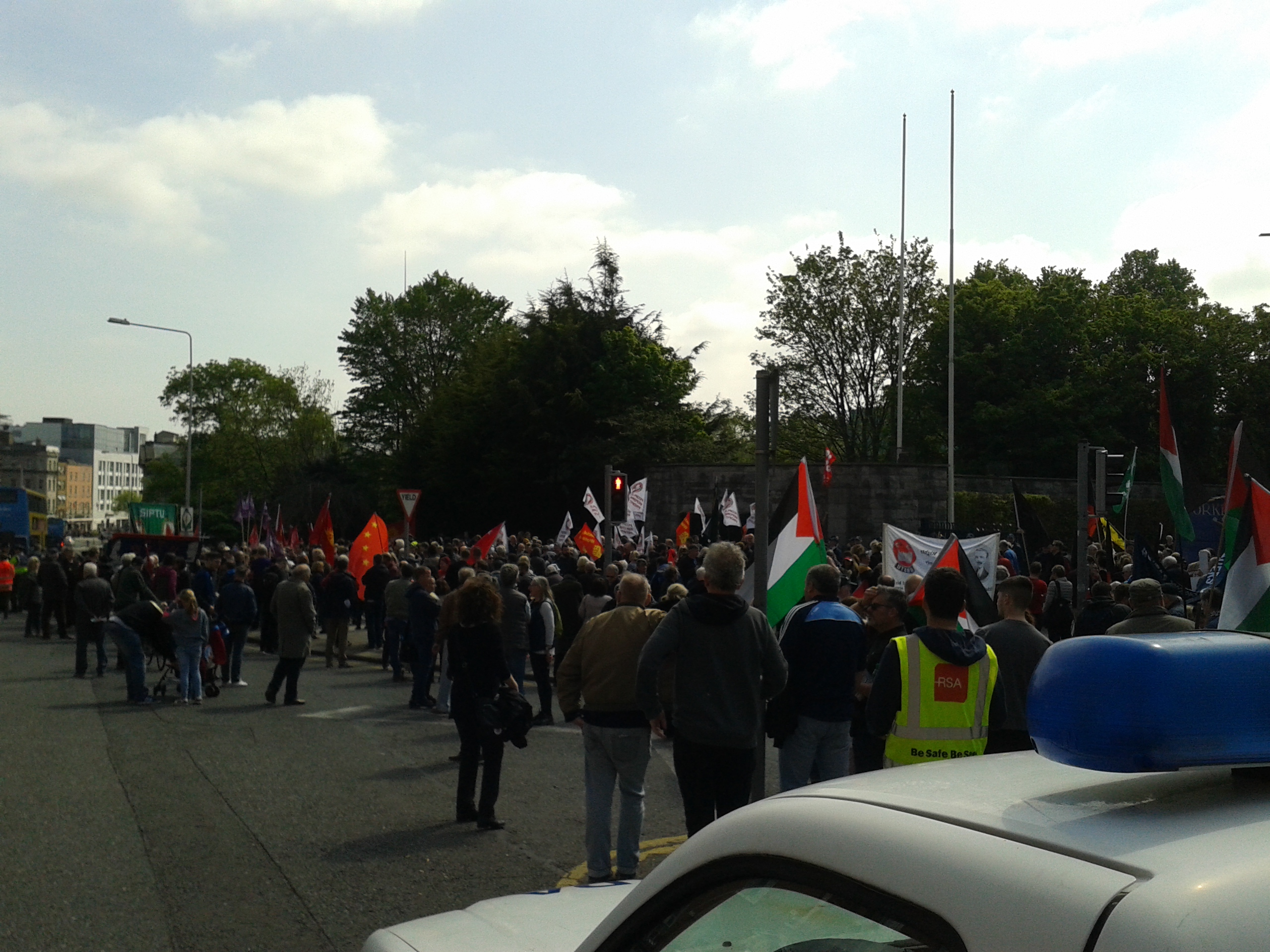
Crowd scene outside Garden of Remembrance, the starting point of the DCTU march

The DCTU-organised event met at the Garden of Remembrance at 2pm and set off at nearly 3pm, with numbers although still small by European standards nevertheless larger than has been seen for some time in Dublin, according to the organisers filling O’Connell Street, the city’s main street throughout its whole length (500 metres or 547 yards).

Seen on the parade were trade union banners, those of some political parties, also of campaigns and community groups.

As it has been doing for years, the parade ended in a rally in Beresford Place, in front of Liberty Hall, the very tall building owned by the SIPTU trade union, where the audience were addressed by speakers from trade unions and campaigns and NGOs.

Section of crowd at rally in Beresford Place

Curiously, soon after arrival the comparatively strong showing of Sinn Féin flags, the green one with their logo and the blue and white version of the Starry Plough, were nowhere to be seen.

Similar section with some banners noticeably missing

The issues of lack of affordable housing, of public land being sold for private housing and speculation, of precarious employment, of financial speculation and cuts in services were addressed by speakers, with a mention also of solidarity for the Palestinian prisoners on hunger strike. A number of speakers also addressed the treatment of migrants and in particular the conditions suffered by refugees in the Direct Provision hostels of the state’s welfare service.

Stage erected at Beresford Place, outside SIPTU’s offices
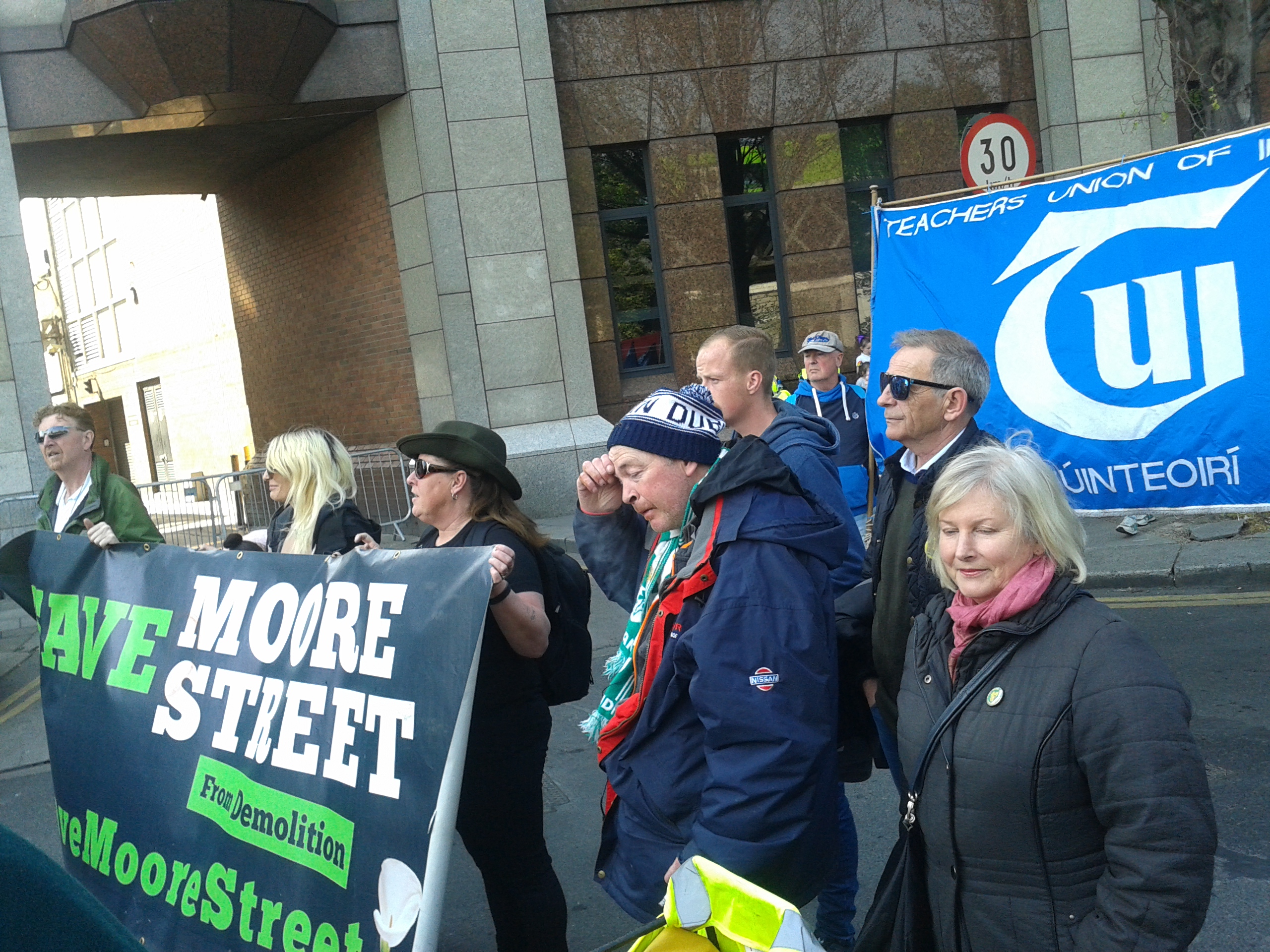
The Moore Street campaign banner was one of the campaign groups present on the parade and mentioned from the stage by the rally’s chairperson.
One of the speakers at the rally — she denounced the sale of private land including the deal done at O’Devaney Gardens estate in Dublin.

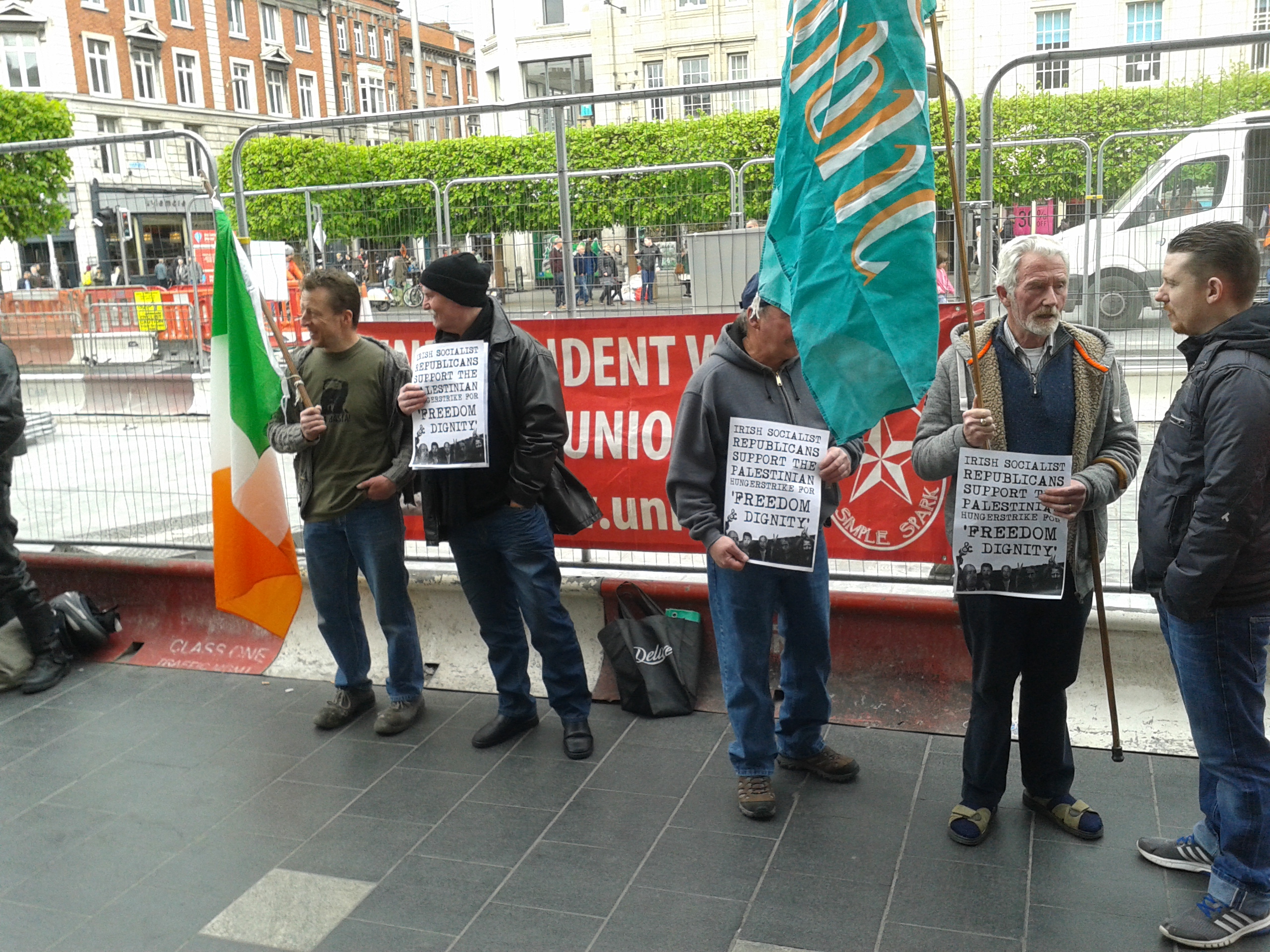
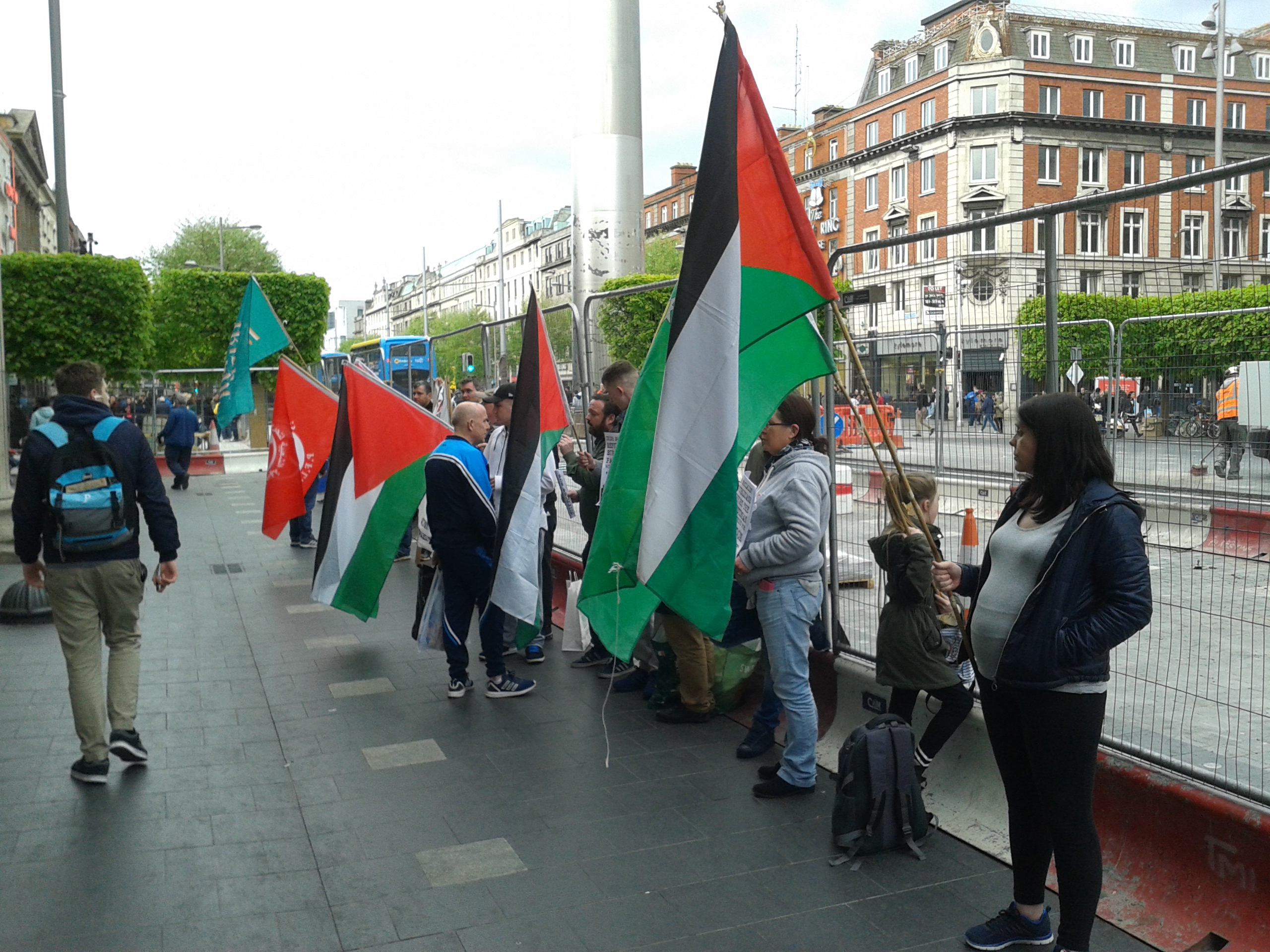
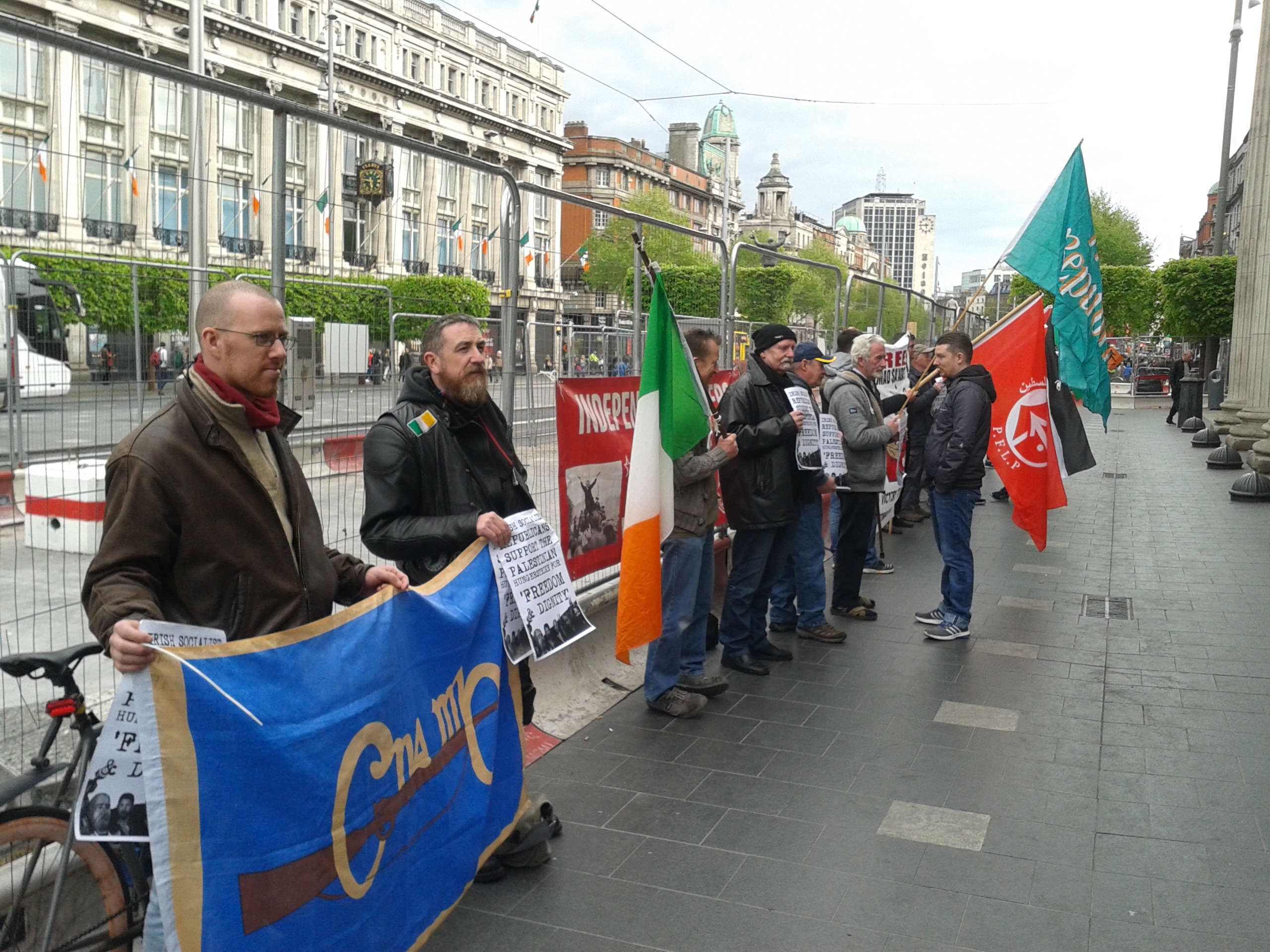
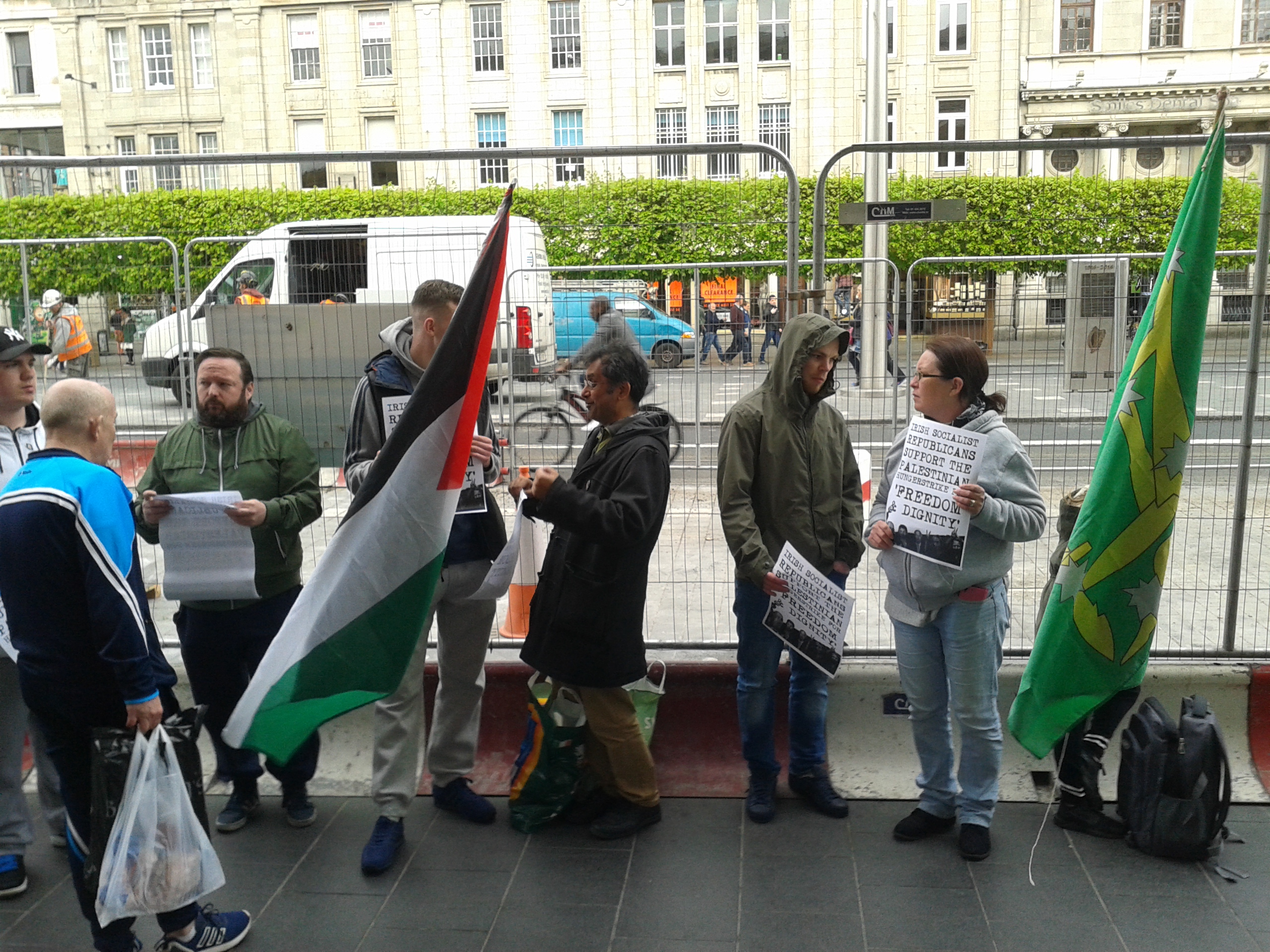
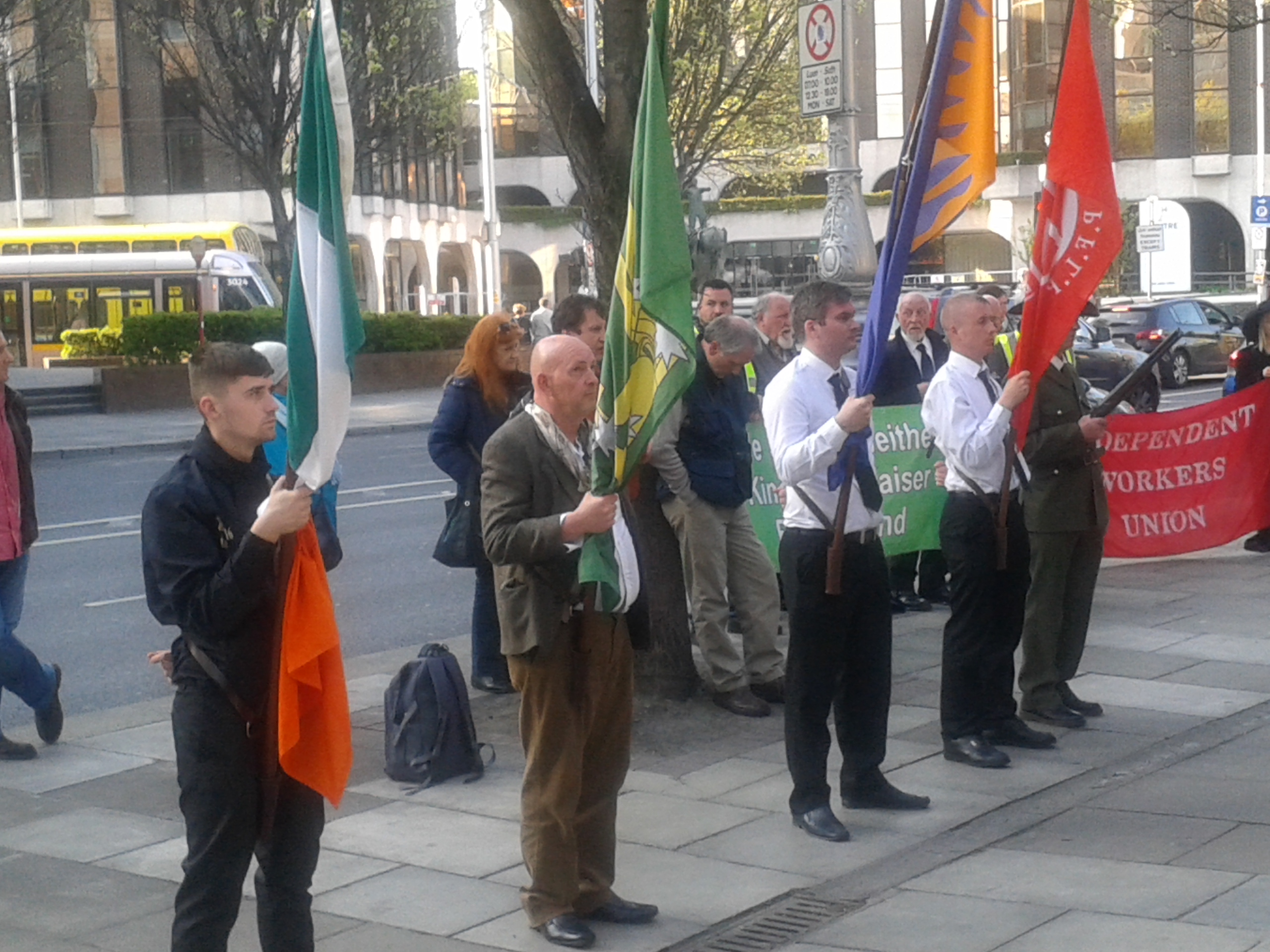
Somewhat later, the Independent Workers’ Union held their own event, marching with a colour party from their offices to James Connolly monument, also in Beresford Place and across the road from Liberty Hall.

IWU event colour party at Connolly Monument

Damien Keogh chaired the event and introduced veteran campaigner Sean Doyle who gave a short and to the point speech about the situation in which working people find themselves today and ending with a quotation from James Connolly, in which the revolutionary socialist castigated those who claimed to love Ireland but could tolerate seeing poverty and deprivation among its people. Doyle also sent solidarity greetings to the Palestinian political prisoners on hunger strike in Israeli jails.

Paul Bowman was then introduced and in a longer speech covered Connolly’s time in the USA, his membership of and activities of the IWW (“the Wobblies”); the Haymarket Incident in Chicago which led to the choosing of May 1st as International Workers’ Day and the state murder of the Haymarket Martyrs; the principles and attitude of the IWU today.

Another Moore Street campaign banner and supporters in period costume also participated in the IWU event
Some random tourists, one form London and the other from Madrid, who chanced to pass by and remained for the whole ceremony.

Damien then introduced Diarmuid Breatnach to sing “We Only Want the Earth” (an alternative title to the original of “Be Moderate”). Breatnach explained that the lyrics had been composed by James Connolly and published in a songbook of his in New York in 1907 without an air. As a consequence the lyrics have been sung to a variety of airs but Breatnach said he sings it to the air of “A Nation Once Again” (composed originally by Thomas Davis some time between 1841 and 1845). This arrangement provides a chorus and Breatnach invited the audience to join in the chorus with him, which they did.

We only want the Earth,

we only want the Earth,

And our demands most moderate are:

We only want the Earth!”

A wreath was laid at the monument on behalf of the IWU by Leanne Farrell.

The chairperson then thanked those in attendance, speakers and singer and invited all back to the offices of the IWU in the North Strand for refreshments.

End.

WAR, IMPERIALISM AND ‘PEACE PROCESSES’

Diarmuid Breatnach

As news reaches us of wars in various parts of the world it behoves us to try, not only to discern who did what when to whom but to see whether there is an overall pattern behind them. A religious explanation might be that there is much evil loose in the world but that analysis will advance us little.

The fact is that there are powerful imperialist powers ‘loose in the world’ and they are either directly causing these wars or exacerbating them, not because the men and women dominating these powers are evil as such but because they strive to control resources, markets and strategic areas. This striving brings these powers into conflict not only with the interests of millions of people in the respective areas but also into competition with other imperialist powers – and this competition has led to two World Wars and many smaller ones in the last century alone.

In the first of those on a World scale, 1914-1919, Britain (or the UK, if one prefers) went to war with Germany. The Austro-Hungarian Empire lined up with Germany as did the Ottoman Empire. Russia, France, the USA and other powers lined up with Britain. And many other states and colonies and territories got pulled into the conflict.

The British Empire in 1916 excluding territories of influence, for example Latin Amarica, where it was then dominant. Source internet

WHAT WAS THE WAR ABOUT?

It was about many things – and not exactly the same things for each participating state – but basically it was about who would have the lion’s share of the resources of the less-developed world, in particular Africa and who would control the markets for selling those resources and also the industrial goods produced in the “home countries”. And, in order to control those things, which power would control strategic areas in the world – which included ports for navies and forts along certain overland trade routes and coasts.

What brings other countries and territories in?

Smaller players join with great powers for a share of the spoils or have been bound to them by treaties – perhaps they were themselves brought to heel in earlier times by the power to which they are now joined. Colonies and “dependent” territories contributed huge numbers of people on both sides, either recruited in preference to poverty, by war-excitement or by misleading propaganda that their sacrifice would buy their freedom or greater autonomy after the war.

Germany was defeated eventually and the French and British imposed a punitive surrender condition on them, allowing them to plunder Germany’s industrial Ruhr Valley. This injured national pride so much that Hitler was able to use it to whip up an aggressive German nationalism which facilitated another war, 1939-1945.

THE SECOND WORLD WAR

This war also pulled in allies, colonies and other territories. But what was the war actually about? Essentially the same things: which power would control the markets for selling those resources and also the industrial goods produced in the “home countries”. And, in order to control those things, which power would control strategic areas in the world.

The German industrial and financial ruling class, which supported Hitler, was not going for war out of injured pride – they wanted to control the oilfields and land to the east and Middle East and to knock out their main competitors in world domination – once again, the British and French but also now the USA, which had been a much smaller player in WWI. By now Holland and Belgium were mostly small fry and Imperial Russia had, along with a number of other countries, become the USSR. Fascist Italy and Imperial Japan were prominent players with their own objectives but joined with Nazi Germany.

Map on which one can see the encirclement of Russia: Turkey in NATO, Ukraine is hostile to Russia, Georgia tried to break away, Afghanistan is occupied, Pakistan is hostile, Syria is embattled, Iran awaits.
(source Internet)

WAR IN THE MIDDLE EAST TODAY

Nowadays, the USA strides the world as almost unchallenged superpower, supported enthusiastically by a reduced UK and with varying degrees of enthusiasm by its other allies in the EU and elsewhere across the world. Only one challenger on the world power level exists, which is Russia, now a capitalist country, certainly with colonial and no doubt with imperialist ambitions.

The USA (with the assistance of its allies) seeks to surround Russia with regimes allied to itself. Not so long ago, this was impossible in the Middle East, where a number of strong regimes were opposed to US domination: Iraq, Libya, Syria and Iran. The US and allies have succeeded in knocking out the first two of these and the third is fighting to defend itself from multi-pronged attacks. If Syria falls, Iran will be next and then, from the Middle East, Russia will be totally blocked. So of course, Russia decides not to wait for that to happen and gives military aid to the Syrian regime.

THE FUTURE?

The struggle for world domination is being played out in other areas of the world too, of course but this is the most intense area at the moment and the Israeli Zionist v. Palestinian struggle also plays a part in it.

It is difficult to look too far ahead in order to predict the various local and overall world outcomes. However, from the history of empires in general it seems inevitable that at some point the power of the USA must wane.

There are a number of contradictions besetting the USA but one of its potentially most disastrous is its external debt. In the typical pattern of imperialist capitalism, the financial capital of the USA has merged inextricably with industrial and military capital, leading to the description of “the US military-financial-industrial complex”. That in itself does not perhaps make the USA too vulnerable but its borrowing abroad to sustain this complex does: according to a number of sources on the Internet the foreign debt of the USA is nearly 18 trillion dollars: $17,910,859,000,000.

Well, we may think, the USA is an enormous country with huge resources and controlling huge amounts of resources around the world. Yes, it is – but that debt keeps growing. And the interest payments on it are huge – so huge that each year they are not repaid in total and are added to the debt.

Of course, if creditors were to call in the debts and the US financial system collapsed, the creditors would end up with very little in terms of repayment. That leaves the USA safe for the moment but each year it becomes more vulnerable. 32.5% of the total foreign debt is held by China and that huge country may at some time in the future find it in its interest to bring the USA down or to use that finance to pressure greater penetration into US markets (above the current level which US manufacturers are already complaining about). At the moment, President Trump is talking about getting the USA’s foreign creditors to accept lower interest repayments. He may or may not get his way but for the US, it is a bad sign.

USA national debt 2016 (source Internet)

The domestic debt of the US is over $12 trillion and 47% of that is foreign-owned too.

The USA’s economy is in many ways a military one. It needs wars – not just to fight itself but by its proxies. Since WW2 alone, it has been involved in 24 offensive military conflicts, from Korea to Syria.  Without wars, how can the USA justify its military expenditure? And without that expenditure, what happens to the military-financial-industrial complex?

For the continuing extraction of resources, the USA needs compliant regimes – compliant with US needs, that is. Inevitably this results in support for dictators or regimes who are massively corrupt and who get armed to the teeth by the USA and repress their own populations, resulting in poverty, torture and violation of human rights. It also results in resistance, in popular movements which at times turn to armed struggle. Overall, the US, which seeks stability for its extraction of natural resources, creates massive INstability in the world.

THE MEANING FOR US

So what does all this mean to us? Firstly, that we should oppose imperialism. The question of “how” is a different one but the objective is unavoidable. Secondly, that to talk of achieving “peace” without eliminating imperialism is at best an indulgence in wishful thinking, at worst a cruel duping of people. Any kind of “peace” deal without the removal of imperialism is at best a temporary one only.

Peace with imperialism (sourced on Internet)

As for “peace processes” in areas of strong popular resistance, where ironically we often see major representative of imperialism enthusiastically engaged, since they never remove the central reasons behind the conflict, those processes merely buy a short-term stability for imperialism and capitalism to continue, more or less as before. For that reason, “pacification” is a much more correct term than “peace process”. The effect of pacification processes on the imperialist, colonialist and capitalist systems is often undramatic, not so the scale of their detrimental effect on the movements of popular resistance – but that’s another topic.

A chríoch

MOORE STREET AND 1916 RISING — OF GREAT INTERNATIONAL SIGNIFICANCE

Diarmuid Breatnach

(This is another part of my personal submission to the Minister of Heritage’s Consultative Group on Moore Street. Some others may be found on https://rebelbreeze.wordpress.com/2017/02/15/the-1916-history-of-moore-street/https://rebelbreeze.wordpress.com/2017/02/10/the-moore-street-market-a-possible-future/https://rebelbreeze.wordpress.com/2017/03/21/personal-recommendations-for-the-moore-street-quarter/ and https://rebelbreeze.wordpress.com/2017/03/22/moore-street-mus…tourists-account/.

I have tackled the particular subject of the International Importance of the 1916 Rising and therefore of the Moore St. Quarter on a number of occasions elsewhere and at some greater length on Rebel Breeze here https://rebelbreeze.wordpress.com/2016/01/20/the-moore-street-terrace-a-world-heritage-site/ )

The 1916 Rising, to which Moore Street is so closely linked, represented some very important events for the people of the world and it impacted on people in all populated continents of the globe.

FOR DEMOCRACY, EQUALITY

The 1916 Proclamation, printed in Liberty Hall and signed in No.21 Henry Street, just around the corner from Moore Street, is a document not only of clear patriotic and anti-colonial expression but also a democratic and inclusive one. At a time when hardly a state anywhere in the world permitted women to vote in elections, the document specifically addressed “Irishmen and Irish women”. It also clearly expressed the wish of the insurgents to overcome the religious sectarianism which had played such an important part in securing continued colonial rule: “ … religious and civil liberty … oblivious of the differences carefully fostered by an alien Government, which have divided a minority from the majority in the past.” 

Site of signing of 1916 Proclamation, 21 Henry St, almost opposite end of Moore Street.  At the time the business premises and cafe of Jennie Wyse Power of Cumann na mBan was there (plaque erected in 1919 by the 1916-1921 Club). 

The Rising had expressed the gender equality intentions of the insurgents in more than the words of its address: women fought in the Rising and, in two garrison areas, commanded for awhile. The British colonial authorities recognised the role of some of those women by sentencing one to death, albeit a sentence later commuted, and keeping a number of them in prison even after many men had been released.

Headline of 1916 Proclamation and specific mention address to Irish women (sourced oh Internet)

FOR GENDER EQUALITY

Irish women organised for and acted in the Rising in two separate organisations: Cumann na mBan and the Irish Citizen Army.

The women founded as an auxiliary force to the Irish Volunteers, Cumann na mBan, later to assert considerable organisational independence, wore their own uniforms and had their own female officers. Women had participated in many insurrections and resistance movements across the world but no insurrectionary force in history ever before had such a consciously women-organised force.

The women in the Irish Citizen Army had formally equal status with men and a number carried arms in the Rising and fired them at the enemy. Men acted on orders from women officers in at least two garrison areas and, in medical matters, also in at least a third.

Such a situation was of great significance in the struggle for women’s rights and gender equality, not only in Ireland but in the world.

FOR WORKERS AND SOCIALISM

Captain White & Irish Citizen Army on parade on their grounds at Croydon House, Fairview, N. Dublin City. (Sourced on Internet)

The Irish Citizen Army was founded in 1913 as a workers’ defence force by trade unionists and socialists and later as a workers’ army and, despite its strongly anti-colonial stance, until the 1916 Rising, maintained a strict separation from the nationalist republican organisations of the Irish Volunteers and Cumann na mBan. As detailed earlier, it formally recognised women within the organisation as of equal status with men.

Workers’ organisations had existed before, including armed ones but nowhere had such an armed organisation existed outside of armed conflict for so long (1913-1916), led by socialists and with equal status for men and women. In the history of socialist organisation and particularly of a revolutionary and insurgent kind, this was a development of enormous importance.

AGAINST WAR

The 1916 Rising took place in the middle of the first of two huge international conflicts that were later called World Wars. WW1 was a struggle for markets, resources and strategic positions and bases between a number of states ruled by capitalists and those states recruited heavily from among the nations they had colonised; in Britain’s case, that included Ireland.

To many nationalist Republicans, the War represented an opportunity, expressed in the maxim that “England’s difficulty is Ireland’s opportunity”. But to many socialists around the world, the War represented a disastrous pitting of the working people under one Power against the working people of another, as well as an excuse for the suppression of demands to fulfill the needs of their workers while the capitalists gathered huge profits. James Connolly was one of those socialists.

“WE SERVE NEITHER KING NOR KAISER banner on Liberty Hall (prior wartime repressive legislation), HQ of the IT&GWU, the WUI and of the ICA. (Sourced on Internet)

Connolly, Edinburgh-born Irish revolutionary socialist, formerly Acting General Secretary of the Irish Transport & General Worker’s Union, had joined the International Workers of the Word, the hugely influential in the USA syndicalist organisation. As well as being an energetic organiser, Connolly was a historian and revolutionary theoretician. Connolly took to heart the resolution formally adopted by representatives of the vast majority of European socialists to oppose war and, should it come, to turn it into class war against their rulers. In the event, Connolly was one of the few European socialist leaders to live up to that resolution: as Commandant of the Irish Citizen Army, GPO Garrison commander in a rising against Ireland’s British colonial masters, James Connolly was also striking a blow against imperial and colonial war.

That aspect of the Rising, of being consciously or unconsciously against War, predated the February Russian Revolution of 1917, also in part an anti-war uprising, by ten months. And of course, predated the October Socialist Revolution in Russia by seventeen months and the nearest uprising geographically to Ireland, also in part an anti-war one, the German socialist uprising in November 1918, by two-and-a-half years. For all these reasons, the 1916 Rising, the Headquarters of which were in the GPO and later removed to Moore Street, was and remains of enormous significance in the world-wide history of people’s movements against war.

AGAINST COLONIALISM IN THE WORLD

The 1916 Rising reverberated around the world. It took place in what had a century earlier been widely regarded as the second city of the British Empire and, when it erupted, did so against the largest empire, in terms of directly-controlled areas and population numbers ruled, that the world has ever known. How can such an event be of other than huge interest, not only to other peoples under British colonial rule but also to those under the colonial rule of France, Belgium, Germany, Holland, Portugal, Spain, Russia and the United States? How could it not have been of considerable interest to socialist revolutionaries everywhere?

Lenin speaking in Red Square in October 1918. He was among Russian revolutionaries who commented on the 1916 Rising. (Sourced on Internet)
Map of world empires, colonies and territories in 1914 (Sourced on Internet)


Socialists around the world discussed the Rising, at first often criticising it, while Lenin, of huge importance in the socialist movement at that time and some others commented favourably upon it. Consequently, the Rising and the War of Independence was to play an important part in the development of a revolutionary theory around the world that advocated the linking of the struggles of worker, peasant and small farmer, of anti-imperialism and anti-colonialism with struggle for a socialist republic.

August 4, 1916: From left: Irish American labor leaders Timothy Healy, William B. Fitzgerald, William D. Mahon, Hugh Frayne (general organizer in New York for the American Federation of Labor), and Louis Fridiger. Fitzgerald, Mahon, and Fridiger represented the Amalgamated Association of Street Railway Employees of America. (Source http://irishamerica.com/2016/02/hand-in-hand-for-freedom-u-s-labor-and-irish-rebels/

The Rising was a topic of great discussion in the United States and in Australia, and in the USA of financial and other support, as is well known. Connolly had been active there and had published his songbook in New York in 1910; Larkin was actually there in 1916. For a number of reasons, including the sentencing to death of Eamon Bulfin for his role in the GPO and in Moore Street, a sentence later commuted and Bulfin deported to Buenos Aires, the Rising was discussed in Argentina and in other Latin American countries (where, at that time, the British were the main imperialist power).

Eamon Bulfin, born in Argentina and exiled there after 1916, his photo in Australian paper the Southern Cross that year. (Sourced on Internet)
Members of 1st Battalion Connaught Rangers including the leader of the 1920 mutiny in the Punjab, James Daly. (Sourced on Internet)

It was certainly discussed in the huge country of India (which at that time included what is now the states of Pakistan and Bangladesh), whose revolutionary nationalists had contact with Fenian revolutionaries from decades earlier. The Connaught Ranger mutiny in the British Army was a direct result of the Rising and the War of Independence and, before the mutiny was crushed, the soldiers and oppressed Indians had begun to make movement towards reciprocal solidarity. And we know, from history and the writings of Indian nationalists and socialists, that the Rising and the War of Independence which organically followed the Rising influenced the struggles against colonialism and imperialism in India right up to the Second World War. We are also aware of correspondence between the Nehru and Ghandi families and the McSwineys.

A young Ho Chi Minh (not his name then) at Marseilles conference in 1919
(Sourced on Internet)

We know also that the War of Independence influenced African uprisings and Ho Chi Minh, later leader of successful wars against Japanese invasion and French colonialism. In South Africa, the Rising must have been a subject of discussion too, at least among the whites. John McBride, sentenced to death ostensibly for his role in Rising was probably in reality being shot for having organised and led an Irish Brigade to fight the British in the Second Boer War, which had ended but fourteen years earlier.

In Britain itself, the Rising influenced the huge Irish diaspora in England, Scotland and Wales and a significant proportion of the insurgent forces in Dublin had actually come from there. The Rising and especially the War of Independence caused a crises of a kind in British socialist thinking, threatening an irrevocable rupture between revolutionary socialists and even sections of radical social democrats on the one hand and pro-imperial social democracy on the other.

This is not the place to discuss this further but that situation, allied to anti-colonial struggles around the world, huge dissatisfaction and mutinies in the British armed forces and a growing strike movement in Britain, provided great opportunities for an Irish revolutionary movement to influence the history of the world in a direction other than that which it has taken.

For all the reasons outlined above, the Moore Street quarter should be of recognised World Heritage Status.

UNESCO WORLD HERITAGE AND OTHER CONSERVATION STATUS

The Irish State ratified the World Heritage Convention in 1991, which qualifies Ireland to apply for that status for the Moore Street quarter. Up to US$1 million is available from the World Heritage fund for the saving and development of a World Heritage site and funds are also available for urgent works to save it. World Heritage status attracts considerable tourist interest and substantial revenue is of course also available to the State and businesses surrounding the area from such tourist interest.

Currently Ireland has only two sites which have been accorded full World Heritage status (one of archaelogical and the other or natural, mainly geological, importance). However, another seven sites are under “Tentative” categorisation since 2010 and Dublin City is one of those. The Moore Street battleground could be afforded that full World Heritage status in its own right, which I believe its history deserves but it can also be used to strengthen the case for full such status for Dublin City.

The ten grounds on which UNESCO currently relies in order to examine the “the unique importance” of a site is admittedly rather restricted in the category of historical importance, particularly in the development of social movements. However, even under the existing list, I would submit that the Moore Street battleground meets four of the criteria: 2, 4, 6 and 8. The USA has the Statue of Liberty and Independence Hall building as World Heritage sites.

Registering under EU programs may also be possible, in particular Horizon 2020.

Joe Kelly — and a generation passing

A generation is passing. Actually they have been passing for some time, the generation of the fighting years of the late 1960s, the 1970s, the 1980s and even the 1990s.

They campaigned variously for social housing; civil rights north and south; for human rights; against Church domination; against Unionist sectarianism; for free access to contraception; for right to divorce; for an end to censorship; for national self-determination; for Gaeltacht civil rights; for Irish language rights and Irish on TV; in support of political prisoners; the rights of women; for Irish Traveller rights; protection of heritage and environment; solidarity with many struggles around the world, including Cuba, Vietnam, Rhodesia, South Africa, Chile, the Black Panthers; against drug dealers; for freedom to choose lifestyle; decriminalisation of gay and lesbian life; for community projects in deprived areas including youthwork and, let’s not forget, organised, fought in and supported strikes.


That generation fought many battles, some of which they won and some which built bases for later battles and their story is told only in bits and pieces here and there. They organised, marched, sat in, occupied, wrote, made placards, painted slogans, put up posters and some fired guns; they were watched, raided, beaten, fined, jailed, calumnied, sacked, expelled, kept unemployed, derided from pulpit, press and judge’s bench, some were shot, and not just they but their families made to suffer too.

I am not referring to people of any specific age but of all those who were any age from young to old and active during those years. The causes of death have been many, from simple old age and life lived out to the death penalty.

But the death penalty was not in force in Ireland in the 1960s, you may think? Actually it was, it wasn’t abolished until 1990 in this state. But you’d be kind of correct as in practice no formal execution has been carried out by this state since 1954.

So, then what am I talking about? Maybe referring to the ‘United Kingdom’, since six counties of Ireland are included in that state? Yes, and no. The death sentence still exists in the UK only for “Arson in Her Majesty’s shipyards” but it was abolished in Britain for the crime of murder in 1965 and, in fact, no-one had been formally executed there from the year before. If the judicial death penalty had still been in force, the people in charge of that state might’ve been been spared the embarrassment of seeing nearly a score of Irish people they had wrongly convicted in 1974 walk free decades later as judges eventually had to find them ‘Not Guilty’.

A bit late for Giuseppe Conlon, against whom there had not even been a shred of doubtful evidence, but never mind. But had they all died in prison or been executed, people might not have worked so hard to see their convictions in court overturned – people among whom Joe Kelly, who died this week and who was cremated on Saturday, stands tall.

But the death penalty was not removed from the judges’ arsenal in that bastion of reaction, Six Counties state, until 1973, when the 30 Years’ War had entered its early years (somebody from the British state clearly had to sit down with the Unionist bigots and explain, although of course they sympathised with their loyal brethren, how bad it would be for Britain and the Queen if they started sentencing and executing IRA and INLA fighters).

There are more ways to skin a cat …. yes, and to kill too. The orange and SAS and MRF death squads killed more against whom there was not even a court conviction. And some of the Republicans killed one another too. And twelve died on hunger strike, one each in 1974 and in ’76 and ten in 1981. Actually, considering the brutality of force-feeding, it’s surprising there weren’t more deaths – Marian and Dolours Price were force-fed 167 times over 203 days in 1973 and it was the publicity around their case and the deaths of Gaughan and Stagg that ended the practice of force-feeding, ensuring that the Hunger Strikers of 1980 and ’81 at least did not have to endure that experience.

But there are more ways to kill …. Many of that generation of fighters died from ‘natural’ causes but died early – cancers, heart attacks, liver damage, despair ….. ah, yes, that brings to mind suicide, of which some also died. But despair also can drive you to drink, even more easily if it has been part of your experience of socialising and alcohol is one of the top killers in the world. And some died of drugs …. or drugs and alcohol …. or infections from unsafe drug injection …. But most who died early did so in summary from the wear and tear of struggle, of prison, of separation, of relationship breakdowns, of betrayal, despair.

Not all died, even those who are not among the fighters today. Some walked away from the struggle and though I can’t imagine being in their shoes, I do not begrudge them. So long as they didn’t betray any on their way out or make a living out of spitting on their former comrades and causes afterwards. But some, a very few, did exactly that and you can read what they have to say quite often in their articles or hear them quoted in the newspapers or on TV or radio.

Some found other ways to betray and did it in secret, feeding information to their handlers and some even diverting attention from themselves by accusing others, some innocent and some of a lesser grade of betrayal than that of the accusers. We know of some of them but may never learn about them all.

Joe Kelly

Poster displayed at memorial in Teacher's Club (photo accessed from a Facebook posting)
Poster displayed at memorial in Teacher’s Club (photo accessed from a Facebook posting)

A few have survived and are still around, fighting the struggle, whether in organisations or as independents. Joe Kelly was one in both categories, in a sense. I knew him but did not know him well and met him only in the last decade, after I had returned from decades living and working in London. I am given to understand that he had passed through a number of political organisations, including Fianna Fáil and the Labour Party. A strange CV, one might think, for a radical left-wing social and political activist. The last political group with which I had associated Joe was People Before Profit, on a local level, around Phibsboro. Joe invited me to attend a quiz they were running and I did so mainly to return a favour – he had attended, to contribute to the singing at my invitation, an evening of the Clé Club where I had been “Fear a’Tí” for that night. I was amazed to win a Blackberry at the quiz (sorry, Joe, I still haven’t gotten around to learning and using it!). Last I heard, he wasn’t with the PBP.

Somebody told me years back that he had been a central organiser of a solidarity event in Dublin for the Birmingham Six in which lights had been floated down the Liffey. Of course I was impressed – on a political/ human rights level but also for the poetic vision involved. I have found little about that event since and Joe, who I found a modest man, didn’t give me much in response to my pressing. A couple of searches on the Internet yielded me only a passing reference to the River Parade, of 1990, a year before the Birmingham Six were finally cleared in court and released. Likely I have not been asking the right people or looking in the right corners.

I met Joe by arrangement for a coffee a couple of times, while I tried to get him into something I was doing and he tried to get me into something he was working at – neither of us succeeding in our efforts to recruit the other. Since Joe was working for awhile in the community sector I also approached him to explore possibilities for me when, despite a long track record in the fields of working in homeless shelters and addiction as well as other community activism I was out of work, but he wasn’t able to help me.

And of course I bumped into him on demonstrations, as in those in solidarity with Palestine or against the Water Tax or against the Lisbon Treaty. For awhile we were active together in the Dublin branch of the Ireland Palestine Solidarity Committee and I believe he left like me after witnessing some nasty in-fighting years ago, though we both often turned up to protest pickets and demonstrations and public meetings called by the organisation. We would also meet at events in solidarity with the Cuban people.

I heard him described at his funeral service, by someone who should know, as a Republican. Certainly Joe was very proud of his father and uncle who had both fought in the 1916 Rising, the first in the GPO and the second in Bolands’ Mill and proudly displayed his father’s medal at a public event in the Teachers’ Club in Dublin.

Joe Kelly displaying his father's 1916 service medal at a 1916 commemoration event (photo: D.Breatnach)
Joe Kelly displaying and talking about his father’s 1916 service medal at a 1916 commemoration event (photo: D.Breatnach)

However, he was among the number that I invited but failed to get to events over the last decade to highlight the plight of Irish Republicans being hounded by the State and imprisoned without trial. That did puzzle me, for I knew Joe to have a track record of fighting for human rights. And this was shown not only in his campaigning for the Birmingham Six.

Joe fought for the rights of divorce and choice of abortion, as well for the right to freedom from partner abuse, in particular through the movement for women’s refuges, what many people still refer to as “battered wives hostels”. He was active in the campaign for the right to gay marriage, so amazingly successful in Ireland. And Joe was also active in campaigns against racism towards migrants.

“Conas atú tú?” or “Dia dhuit”, Joe would invariably greet me whenever we met. I would not call him exactly fluent but he could understand and speak Irish. I suppose I assumed he had some affection for the language and was also paying me, a known native speaker, the courtesy of addressing me in Irish and speaking awhile in the language. At his funeral service, I learned it went further than that. I heard his grandchildren say that he frequently spoke to them in Irish and when they did not understand him, would translate what the words meant. Some people in the audience chuckled to hear this. I felt sad and somewhat angry too, that a question so important to our cultural identity, an aspect so threatened today, should be treated so apparently lightly by some and that the only words to be spoken at his funeral service in Irish were those in the final sentence spoken by his brother, Jim, in his eulogy: “Slán leat, Joe”. In the booklet produced for the occasion and freely available at Club na Múinteoirí, there was however one dedication in Irish (and I have since learned that one of the speeches at the Teacher’s Club was in Irish) and I note that both grandchildren who spoke bear Irish-language names.

Paying respects and memorial service

On Saturday, laid out in the lovely Room 2 in the Teacher’s Club (sin Club na Múinteoirí, Joe) in Dublin’s Parnell Square, a venue often used for social, cultural and political events, in a closed wicker basket coffin, Joe received his visitors. And they were MANY. Feminists, Palestine solidarity activists, Cuba solidarity activists, community activists, independent political activists and a sprinkling of activists in various parties all attended and many contributed their memories or words dedicated to him while he was laid out there.  (I took many photos here and some at Mount Jerome but somehow seem to have lost them all).joe-kelly-speaking-at-event

Attending first another funeral (of another singer) that morning in Howth, then travelling into Dublin to take part in the Moore Street Awareness weekly table, I had to miss some of that. I spelled a comrade while he attended to pay his respects, then attended later while he took over back at the table.

Room No. 2 was still packed but so was the whole bar lounge area. I had missed all the eulogies and reminiscences and even singing – “The Foggy Dew” I was told. Had anyone sung “The Parting Glass”, I asked. No, apparently not. So then to ask his sister if it would be alright to do it, then the MC, his long-time collaborator, comrade and friend, Brendan Young. It would be welcome, I was told. And Fergus Russell (also his second funeral that day) and I did three verses together, using a mic so it might carry through to the lounge and, though we took turns at fluffing a line, not too badly. It is a great song for such occasions and each verse was particularly appropriate to Joe.1

A little later, the Internationale was sung by all (copies of the words of a verse and the chorus distributed beforehand), the wicker coffin (I must have one of those when my time comes!) was lifted on to shoulders by family and friends and brought through the respectful lines while Joe’s daughter sang The Night They Brought Old Dixie Down.2

Then the hearse came out and led the cortege to Mount Jerome cemetery. I didn’t know the protocol regarding cycling in a funeral cortege but followed anyway, managing to get temporarily lost on the way and arriving just as the hearse arrived at the cemetery. Again, the chapel was packed.

The ceremony was non-religious and officiated by Therese Caherty, ex-partner and friend. In turn Therese herself, his brother, his bereaved current partner, relatives and his comrade and friend Brendan Young all gave their moving eulogies and often funny anecdotes. Brendan emphasised that for Joe, the process of the conduct of a struggle was as important as the end to be reached, which I knew to be true from our time together in the Dublin IPSC and I’d be in agreement with Joe on that.

There were, despite the many I did see during those events, some faces I did not see in the congregation or at the Club na Múinteoirí before the service or later, when many returned to the Club to free sandwiches and soup laid on by the management there. It was their loss.

I never saw him dance but am told he loved it and taught his grandchildren not only to sing but to dance too. I did know he’d learned to tango. He’s left this dance floor now and gone on to another and whateverone steps and two steps and the divil knows what new steps”they are dancing there, I’m sure Joe is learning them and probably teaching a few of his own.

Slán leat, Joe – árdaigh iad!

A chríoch.

FOOTNOTES

1  “Of all the money that e’er I had, I spent it in good company


And all the harm that e’er I’ve done, alas, it was to none but me


And all I’ve done for want of wit to memory now I can’t recall


So fill to me the parting glass, good night and joy be with you all

“If I had money enough to spend and leisure time to sit awhile


There is a fair maid in this town, that sorely has my heart beguiled


Her rosy cheeks and ruby lips I own, she has my heart enthralled


So fill to me the parting glass, good night and joy be with you all

“Of all the comrades that e’er I’ve had, they are sorry for my going away


And all the sweethearts that e’er I’ve had,

they would wish me one more day to stay


But since it falls unto my lot that I should rise and you should not


I’ll gently rise and I’ll softly call good night and joy be with you all”

2  This song of nostalgia for the American Confederacy has a haunting melody but its ideology is often ignored by those who sing it.

3  Line from The Charladies’ Ball

COLOURS OF STRUGGLE

Diarmuid Breatnach

Information picket (with table across the road) organized by Anti-Internment Group of Ireland in September 2014 at Thomas St./ Meath St. junction, Dublin. They returned there in December and in January supported a picket in Cork, handing out leaflets on the Craigavon Two injustice.
Information picket (with table across the road) organized by Anti-Internment Group of Ireland in September 2014 at Thomas St./ Meath St. junction, Dublin.
MEP maybe Kobane Rally London
Palestinian and Kurdish flags at a Kobane solidarity rally in Trafalgar Square, London in 2014. (Photo: D.Breatnach)


The flag of the ICA, flown over Murphy's Imperial Hotel in 1916
The flag of the ICA, flown over Murphy’s Imperial Hotel in 1916


I’m no shade of green,

though neath such flags I’ve oft times been,

and ‘neath the Plough in Gold on Green,

and some years back

Also the black,

aye and the red-and-black;

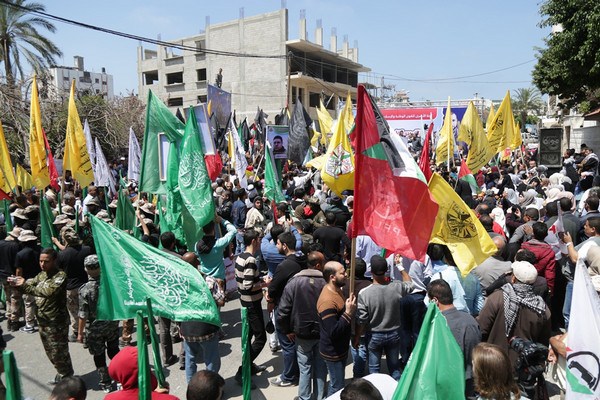
or Palestinian red and black and white and green,

c-n-mb-irish-republic-tricolour-flags-crowd-gpo-copy
Cumann na mBan, “Irish Republic” and Tricolour flags displayed at Dublin’s GPO by Moore Street campaign supporters. (Phoro: D. Breatnach?)

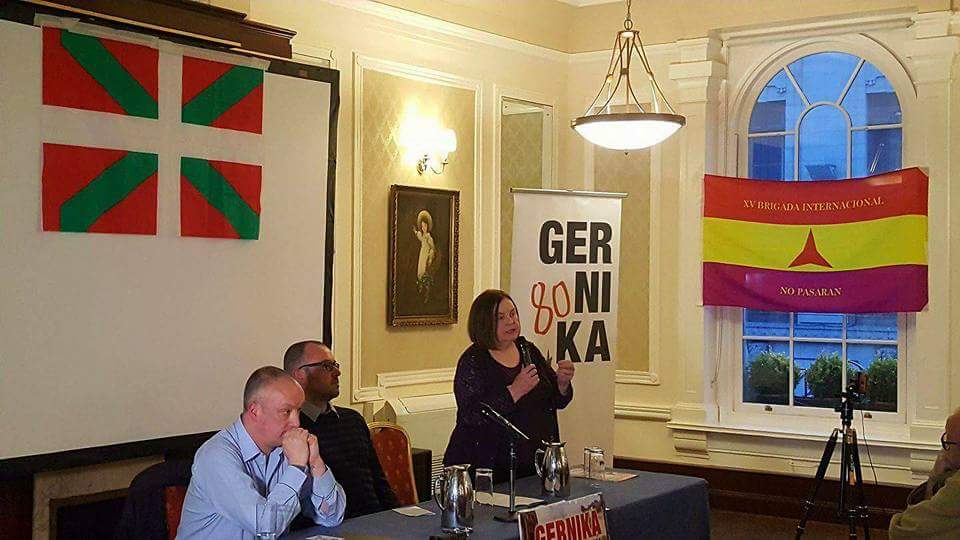
Or the Basque crosses white and green upon red …..

In solidarity I have flown all those flags I’ve said

But when all’s said and done —

though hard to choose just one —

from my heart and from my head:

I choose the workers’ Red.

Sept 2016


A number of the Basque flag, the Ikurrina, flying in Dublin during a solidarity protest. (Photo: D.Breatnach)


Anarcho-Sindicalist and Anarchist black flags (Photo source: Internet)
Anarcho-Sindicalist and Anarchist black flags
(Photo source: Internet)
bagladeshi-women-men-red-flags-mayday
Bangladeshis on Mayday demonstration. (Photo source: Internet)

BASQUE PIRATES ON THE WAVES

Diarmuid Breatnach

One of my appointments on a recent trip to Euskal Herria, the Basque Country, was with a “free radio station”, with a dual purpose: to learn about their operation and to give them an interview about my thinking on the political phenomena known to most people as “peace processes”. The radio station in question is Zintilik and located in the Orereta area of Errenteria town, not far north from Donosti/ San Sebastian, in the souther Basque province of Gipuzkoa and my hosts were Hektor Gartzia and Julen Etxegarai. 

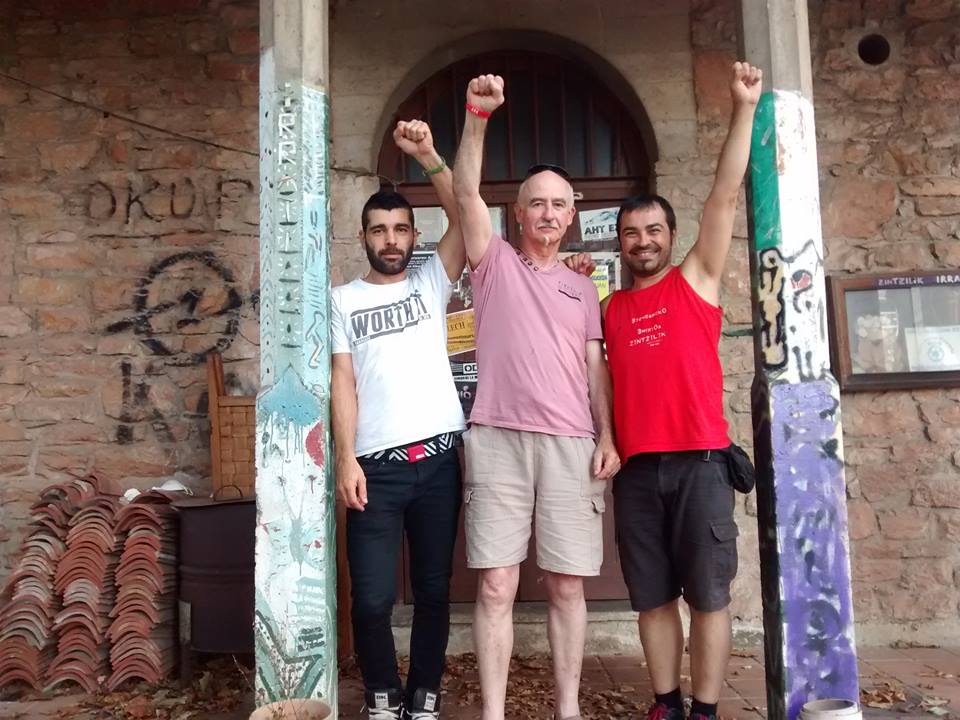
View of side of building which houses Zintilik. Photo D.Breatnach
Julen and Hektor setting up for the interview Photo D.Breatnach
Julen and Hektor setting up for the interview
Photo D.Breatnach

Not long after I arrived, one of my hosts related his memory of events in the area after a local ETA fighter had been killed. The Guardia Civil had swamped the area to prevent an “homenaje” (an event honouring the dead) taking place, guns pointing at men and women; the children, of which he had been one, gathered into their grandparents’ house ….. He showed me where the police vehicle had parked at the end of the street, his sweeping hand indicating the places where the armed police had stood.

THE “FREE RADIO”

The “free radio station”, also known as “pirate radio” has been broadcasting for 32 years, which I find amazing. It began broadcasting from an “okupa”, an occupation of a private empty building, turning it into an alternative social and political centre. Under popular pressure, the local authority, under the control at the time of the PSE, i.e. (Spanish unionist social democratic party), granted them the building they currently use.

Front of Zintilik building. Photo D.Breatnach
Front of Zintilik building from the street.
Photo D.Breatnach

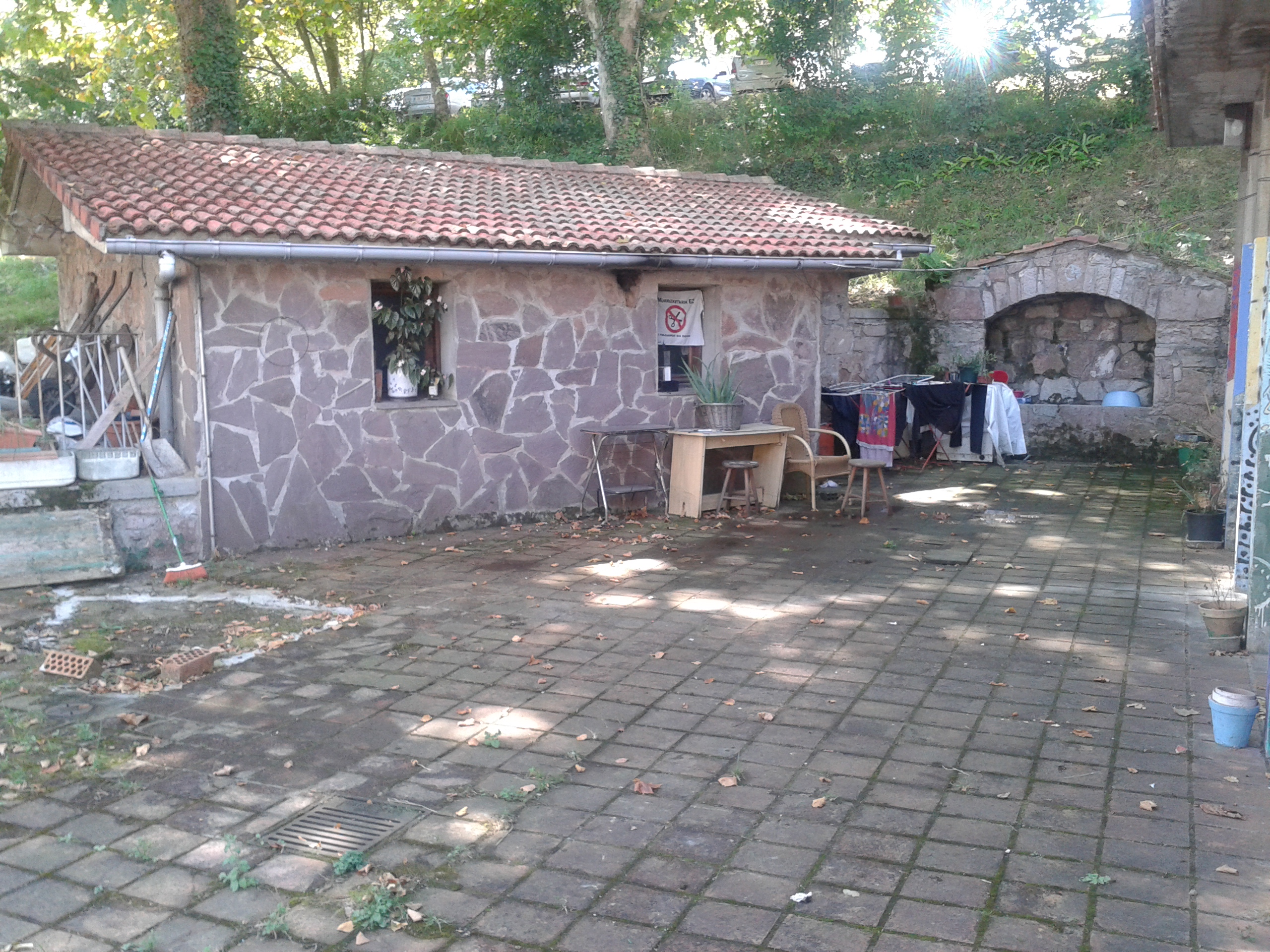
Originally built to house a smithy, for some reason the building never saw service in that capacity. It is in my estimation an attractive building in a traditional-enough local style, of thick stone, compact without being squat. It has an attractive back yard, no doubt intended at one time to receive the horses with hooves in need of iron shoes, fitted and nailed. The roof is tiled in what seems the usual way for the Basque Country.

Zintilik broadcasts 24 hours a day, which it is able to do using repeats.  The Zintilik collective owns its equipment and funds itself through fund-raising concerts, txosnak (stalls/ marquees) at festivals and occasional donations. They run advertisements for

Julen and Hektor again. Photo D.Breatnach
Julen and Hektor again.
Photo D.Breatnach

local community groups and announce events but accept no commercial sponsorship – nor does their wish for independence stop there. “We don’t receive any funding from the local authority or from the Basque Autonomous Government,” declares Julen, “nor do we wish to.”

Funding from such sources comes with strings attached”, adds Hektor.

Or one becomes dependent on it and unable to function without it”, further explains Julen.

Partial scenic view from the back of the building. A block of flats to right just out of shot does restrict it however. (Photo D.Breatnach}
Partial scenic view from the back of the building. A block of flats to right just out of shot does restrict it however.
(Photo D.Breatnach}

As a further illustration of self-reliance, they tell me how they climbed on to the roof of their building to repair a leak, rather than ask the municipal authorities to do it. And it was the same when branches of a nearby plane tree needed cutting to prevent them knocking against the radio aerial on windy days.

We know it’s work that the local authority owes us and that we and the rest of the community pay their salaries but we prefer not to depend on them,” they explain.

As an example of how dependency – although of a different sort – can undermine a community resource, they relate the story of building which was occupied in order to be used as a community resource. As time passed, many were using it as a social resource but less people were volunteering for the work involved in maintenance at any level. Appeals of the four or so committed people who ended up doing everything fell on the deaf ears of the clientele until one day the four locked the centre doors after the last user had left for the evening and, the next day, handed the keys over to the local authority.

The back yard to the building where we ate a meal after the interview. Photo D.Breatnach
The back yard to the building where we ate a meal after the interview.  The structure there is an outhouse.  (Photo D.Breatnach)

As you imagine, this was a great shock to the clientele,” they tell me, “but it was the result of their own lack of commitment to the project.”

I reflect that many activists will identify in one way or another with that sad experience.

RECORDING THE INTERVIEW

Julen and Hektor discuss the format and general content of the interview with me and map it out, do sound checks and then we go to it. Hektor, who knows quite a bit about the more recent Irish history and about the current situation in the Six Counties, is my interviewer, while Julen monitors from the control room and occasionally joins in with comment or question.

Interview room. Photo D.Breatnach
Interview room.
Photo D.Breatnach

For music in between sections of interview, Irish Ways and Irish Laws (John Gibbs) and Where Is Our James Connolly? (Patrick Galvin) have been chosen, both sung by Christy Moore and Joe McDonnell (Brian Warfield), by the Wolfe Tones.

They also invited me to sing Back Home in Derry, Christy Moore’s lyrics arrangement of Bobby Sands’ poem – but to the air I composed for it. I am happy to oblige – I enjoy singing but it is more than that: I want the air I composed to get a hearing. Christy Moore used Gordon Lightfoot’s air to The Wreck of the Edmund Fitzgerald for Sands’ poem and, excellent though that fit is, especially with Moore’s chorus, I think that the poem (and its author) deserves an air of its own.

Recording room. Photo D.Breatnach
Recording room.
Photo D.Breatnach

Although the main focus of the interview was the phenomenon of “peace (sic) processes”, we discussed aspects of Irish, Spanish, Palestinian and South African recent history, including the 1916 Rising in Ireland, along with the backgrounds to the songs chosen. For the most part, I left it to my interviewers to draw conclusions relating to their experience of political processes in their own country.

FESTIVALS AND STORMS

Upstairs in the broadcasting/ recording and interview rooms, all is in good order: equipment and facilities. After the interview, I note that downstairs, in the main space, things are a in a bit of a mess, for which Julen apologises (he has never seen the state of my flat).

Some of the community groups we support store their placards and banners here,” he says. “Besides, we’ve just finished our local festival and everyone relaxes, dumps their equipment and goes on holiday.” Throughout the Summer and early Autumn, each village, town, city and even area will have its own week-long festival for which the community groups and campaigns will organise and participate.

Down in Donostia (San Sebastian), to where Hektor and Julen accompanied me after we ate the food they had prepared, the city was in the midst of its own festival and was heaving with people – tourists from everywhere, it seemed, as well as Basques.

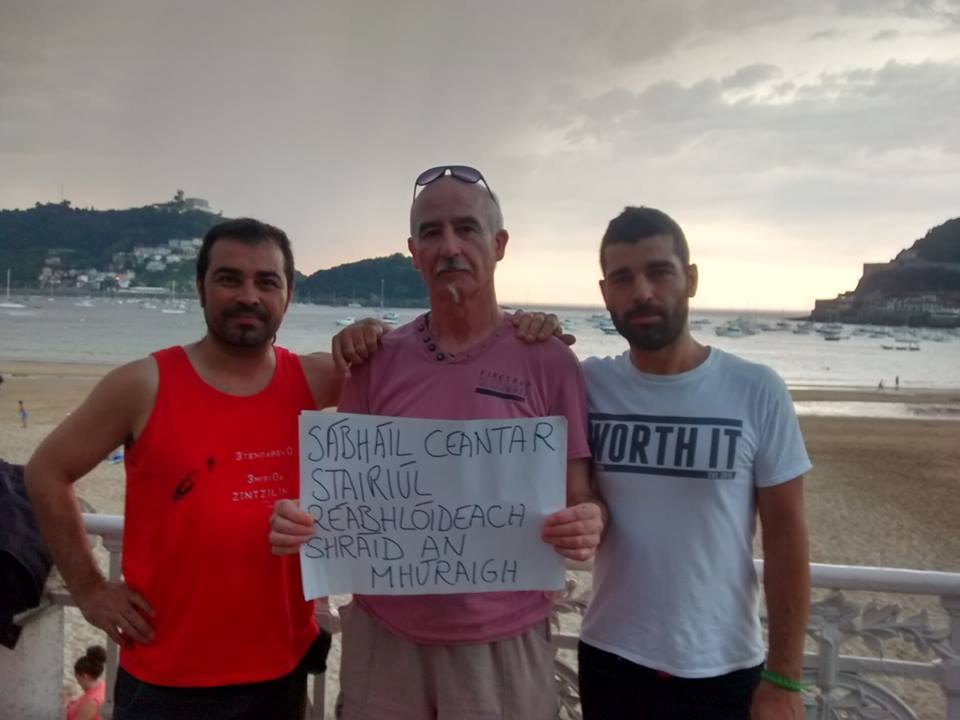
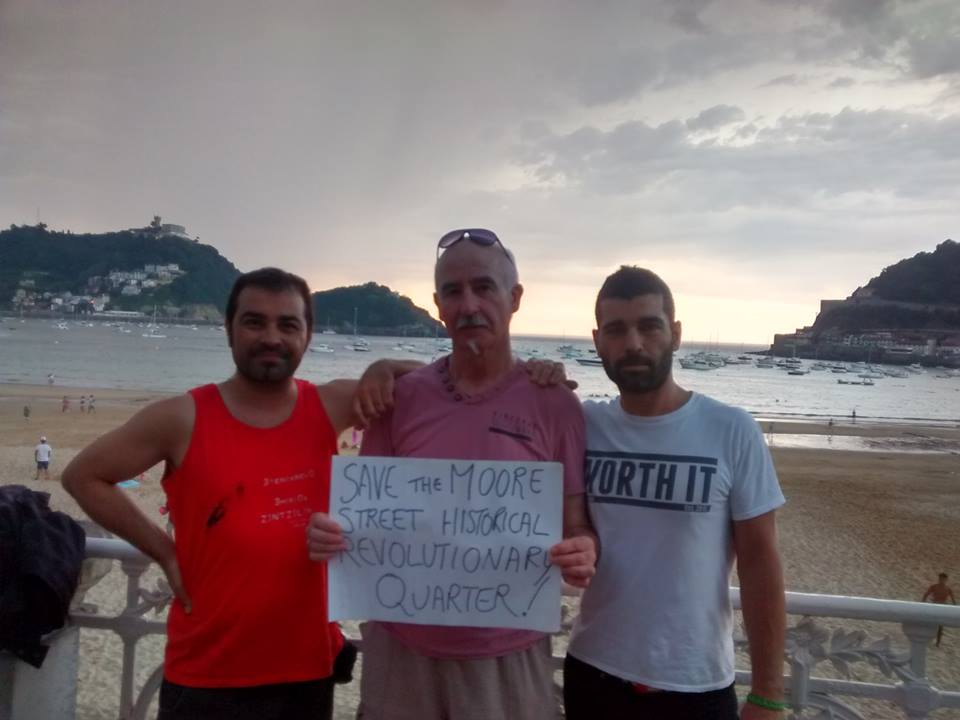
With that picturesque bay and its island in our background, they got a passing young woman to take our photo, the three of us – the conversation with her was in Euskara only. I held up the placards I had prepared for the photo in turn, one in Irish and another in English, supporting the Moore Street quarter in Dublin.

R-L: Julen, Diarmuid, Hektor. Donosti bay in the background with island partly visible. Storm building in the sky.

Save M St Quarter Donosti backgroundDark clouds were gathering overhead and on the horizon the sky was a baleful orange. A storm or at least a downpour was being promised and, as we turned back towards the bus station, the first drops began to fall. In the humid heat, the light rain was welcome for awhile but for part of my solitary journey back to Bilbo, it formed a silvery curtain in the coach’s headlights and streamed down the windows.

I remembered being told that one can frequently witness a violent storm in the Donosti bay while not so far away in Bilbao, as a result of local conditions, all is calm. As for winter storms in Donosti, the waves hitting and surging over the seafront and piers have to be seen to be believed; occasionally the sea reaches inland, floods cellars and converts parked cars into boats or semi-submarines.

The rain eased off and stopped about half-way through my journey and when I got into San Mames station in Bilbo, the streets were not even wet.

end

Clenched Fists 3 Tzintilik Irratia 2016

THE MOORE STREET TERRACE — A WORLD HERITAGE SITE

Diarmuid Breatnach

The terrace of houses in Moore Street, No.s 10–25, in the Irish capital of Dublin, much in the news of late, is of great importance to the world and should be recognised as such by Irish people and internationally. The terrace is of great importance in terms of being

  • an urban WWI battlefield

  • of opposition to imperialist war

  • of the struggle of the working class

  • of women’s struggle for equality 

  • of the struggle of the world’s people against colonialism and

  • a surviving centuries-old European street market.

In this article I intend to develop this argument and these points.

In the closing days of Easter Week, in the cancelled and hurriedly rescheduled Easter Rising in Dublin, after five days of fighting, siege and a number of days of artillery bombardment, the garrison of the General Post Office, the Headquarters of the Rising, evacuated their burning building and occupied a terrace of sixteen houses in Moore Street. They broke into No.10 and tunneled from house to house up to No.25, until the whole of the terrace and back yards had been occupied.

Meanwhile, a charge of a dozen Volunteers on the British Army barricade at the northern end of that street, at the junction with Parnell Street, had failed to reach its objective; machine-gun fire had injured some and killed others. The leader of that charge, mortally wounded in a side-street, wrote a note to his wife as he lay dying there (the words are reproduced on a plaque in the laneway named after him: O’Rahilly Parade).

That history, and of it as a market in childhood memory, is what engages many people — perhaps most – of those campaigning for the preservation of that terrace of houses and of the thousands who support their efforts. But there are aspects of international importance to that 1916 Rising not usually alluded to and which deserve to be noted, celebrated and commemorated.

A RISING AGAINST WORLD WAR

James Connolly, the revolutionary socialist or communist and trade union leader, had been calling for an uprising for years and his public exhortations intensified with the onset of WWI. A section of the Irish Republican Brotherhood was also anxious to engineer an uprising during that War — “England’s difficulty is Ireland’s opportunity” was a well-known saying among Irish nationalists. But for Connolly, the issue was much more than that – the dispute between some capitalists about which of them would control the Earth’s resources and markets was sending millions to die, workers fighting workers in battlefields in which the instigators of the slaughter would never set foot. While millions died, those big capitalists would continue to make great profits, supplying armies with weapons, transport and equipment, fuel, clothing, food …..

A declaration of war against war -- banner on the old Liberty Hall, HQ of the Irish Transport & General Workers' Union. A parade of a section of the Irish Citizen Army is drawn up in front of it. (Photo from Internet)
A declaration of war against war — banner on the old Liberty Hall, HQ of the Irish Transport & General Workers’ Union. A parade of a section of the Irish Citizen Army is drawn up in front of it. (Photo from Internet)

A few years earlier, an international socialist conference had threatened revolution on their capitalist masters should they dare to start a world war. Indeed, some revolutionary socialists saw war as an opportunity to instigate socialist revolution. Unfortunately they were outnumbered by social democrats who, despite their earlier militant words, when it came to the crunch, lined up the workers of each country behind their capitalist masters against their own class brothers in other countries.

There were few socialist parties and prominent socialists that took the opposite stand but one of those who did was James Connolly. Among the other things that characterised the 1916 Rising was that it was the first significant uprising of the 20th Century against World War. The next uprisings of that kind would be the 1917 Revolutions of February and October in Russia, with another in Germany in 1918.

IRISHWOMEN”

The Proclamation of the insurgents in 1916 addressed itself to “Irishmen and Irishwomen”. Although not one of the seven signatories was a woman, there were a number of them prominent in the command structures of the Rising and in the preparations also. And also of course in the lower ranks during the Rising itself.

Constance Markievicz (nee Gore-Booth) of the ICA was, despite her planter family and quasi-aristocratic background, third-in-command of the Stephens Green/ College of Surgeons area. Kathleen Lynne, also of the ICA was Chief Medical Officer for the Dublin insurrectionary forces and third in command in the Dublin Castle/City Hall garrison. It was at the premises of Cumann na mBan founder member Jenny Wyse-Power, No.21 Henry Street, that the 1916 Proclamation was signed in secret a week before the Rising.

Constance Markievicz, Irish Citizen Army, second-in-command of the Stephen's Green/ College of Surgeons garrison
Constance Markievicz, Irish Citizen Army, second-in-command of the Stephen’s Green/ College of Surgeons garrison

Kathleen Clarke was de facto a member of the IRB, work and powers delegated to her on the eve of the Rising by her husband, Tom Clarke, one of the architects of the Rising and first of the seven signatories. Elizabeth O’Farrell was one of the Cumann na mBan nurses accompanying the men in the GPO and one of three to proceed to occupy Moore Street; she carried the short truce communications to the British and back to the leaders on the Rising surrender day, accompanied Pearse to the surrender point in Parnell Street and then carried Pearse’s and Connolly’s surrender instructions to a number of garrisons in Dublin. And Winifred Carney, James Connolly’s secretary, was in the GPO and later Moore Street with her typewriter and a Webley revolver.

Winifred Carney was the first woman into the GPO, accompanying Connolly and carrying a typewriter and a Webley revolver

It is difficult for us today perhaps to realise how progressive it was for any general public document 16 years into the 20th Century to address itself specifically to “Irishwomen”. No country in the whole world had given all its women the right to vote by 1916 although the suffragette movement was in full flow throughout most of Europe and in the European colonies. While it is true that New Zealand gave European women the right to vote as far back as 1893, it was for European settlers only and also linked to a reform movement against the sale and consumption of alcohol. Elsewhere in the world outside the colonial Antipodes and the Scandinavian democracies, the extension of the franchise to women did not seem close in 1916. Nevertheless, in Canada, women got the vote in 1917 – but again, women of European descent only. In Britain, women did not receive full rights to vote until 1928. Yet in a large part of the United Kingdom, a cross-section of people making a bid for independent nationhood, were ostensibly recognising women as citizens with equal voting rights as early as 1916.

Given the preponderance of males in all organisations of all shades of Republican and Nationalist outlook, the inclusion of women in the address had to have been agreed by the men in the top leadership. No doubt women, through their agitation for full franchise as well as by their active participation in so many facets of the movement, helped to convince the men. Connolly is often credited with responsibility for this inclusion but there is no reason to believe others among the signatories would not have taken that position themselves (although Kathleen Clarke did allege that one of those would not). Patrick Pearse had previously supported the vote for women and a number of men in the leadership had female partners who were active on that issue, as for example was Grace Gifford, Joseph Plunkett’s fiancee. The 1916 Proclamation was the first insurrectionary proclamation of the 20th Century (and almost first ever) to specifically include women in its address on a basis of gender equality.

The participation of women in the Rising however had a much sharper illustration than their inclusion in the Proclamation – they were present in most of the fighting posts throughout the Rising, whether as members of Cumann na mBan or of the Irish Citizen Army – several were killed or injured, many were arrested and one was sentenced to death (though sentence was commuted later).

The participation of Cumann na mBan made the 1916 Rising the first uprising of the 20th Century (and probably prior to that) in which women participated in their own organisation, in their own uniform.

The participation of women in the Irish Citizen Army, where they shared equal status with men, made the 1916 Rising the first uprising of the 20th Century (and almost first ever) in which women participated in an armed and uniformed organisation, and in equal status with their male comrades.

HOPE AND ENCOURAGEMENT TO THE PEOPLE OF THE COLONIES

The British Empire in 1916 was huge – around 13 million square miles of territory in 1916, nearly a quarter of the world’s area. It was said that the “sun never set” upon the Empire because at any moment during 24 hours, some part of the Empire would be receiving light from the sun. Around 450 million people were under the Empire’s dominion.

Map of the British Empire in 1914 (of course the British ruling class had dominant influence over many other areas, for example over much of Latin America). (Image sourced from Internet)
Map of the British Empire in 1914 (of course the British ruling class had dominant influence over many other areas, for example over much of Latin America).
(Image sourced from Internet)

And of course, there had been resistance. Even after resistance had been beaten, there had been further uprisings – in fact, some areas such as that of the present-day Afghanistan were in almost constant rebellion. But rebellions were mostly localised and even when they took on a more sweeping character, such as the Mahdist War of 1881-’89 in the Sudan or the Boxer Uprising in northern China in 1900, they had been crushed by British military might.

The news of the Easter Rebellion in Dublin ran around all parts of the British colonial world, from the nearer to the most remote. And some of the news was carried by the Irish in the British armed forces. Tom Barry, later to be undefeated guerrilla leader in the War of Independence in West Cork, read about the Rising while serving in the British Army in Mesopotamia (now Iraq). The Connaught Rangers, hundreds of which were to mutiny in India in 1920, were also in Mesopotamia in 1916. These Irish units of the British Army and Irish men in British units serving outside the United Kingdom, served not just next to English, Welsh and Scottish soldiers but also next to soldiers drawn from colonial peoples; they were often serviced too by colonial people in auxiliary roles and mixed to a degree with the colonial populations among which they were stationed, in markets, eating houses, bars and sex-houses. Just four years later, during the mutiny of the Connaught Rangers, it is recorded that Irish rebels in British Army uniforms had communicated their mutiny and their reasons to the Indian traders.

The 1916 Rising took place in what had been considered, the previous century, the second city of the British Empire. Now past those ‘glory days’, Dublin was still a city of the Empire’s “home base”, the United Kingdom. And the Empire’s Army had been obliged to shell one of the UK’s own cities in order to suppress that Rising! To many a colonial subject contemplating resistance or even outright revolt, it must have seemed like a signaling bonfire, one that proclaimed that the end of the Empire was nigh and called the peoples under subjugation to revolt, to finish it off. And, indeed during the War of Independence, the Nehru and Ghandi families were to make contact with Irish Republicans and Ho Chi Minh is reported to have been inspired by the Irish struggle.

Nor was it only those colonial people in the British Empire who were inspired but those in the French, Dutch, Belgian, Portuguese and Spanish colonies too. Ho Chi Minh, as a Vietnamese, was under the French empire and led his people in armed resistance to the Japanese and French occupation in 1941. Over the three decades following the Easter Rising, anti-colonial struggles around the world intensified and pushed the former colonial powers into “de-colonisation” — i.e. imperialism and neo-colonialism.

WORKERS OF THE WORLD

The Irish Citizen Army had been founded in 1913 as a workers’ armed organisation to defend against the attacks of the Dublin Metropolitan Police. The DMP carried no firearms then, though they were well able to kill and maim with their truncheons, a fact they demonstrated during the 1913 Lockout. But it was clear that Connolly at least knew that at some point the workers would come up against the full force of the State which, at that time, meant the British empire and the Colonial regime in Ireland. He called publicly for the ICA to train in and to carry firearms. The Royal Irish Constabulary, policing the rest of the colony outside Dublin, was indeed armed. And British Army units were stationed across the country, many of the garrisons in Dublin alone.

The ICA fell into a kind of disrepair after the workers’ defeat in the Lockout but was soon enough dusted off and reorganised. WWI began the same year the last striking workers of the Lockout, the Jacobs girls and women, marched back to work. It was certain that Connolly would try to stage a rising during the war and suspected that the Republicans, or “advanced nationalists” as they were called then, would do so too. As the war dragged on and the bodies heaped higher, Connolly grew increasingly impatient, contemptuous and even desperate, berating the “nationalists” for not rising and threatened to bring out the couple of hundred ICA on their own.

Irish Citizen Army on the roof of Liberty Hall during a flag-raising activity (Photo sourced from Internet)
Irish Citizen Army on the roof of Liberty Hall during a flag-raising activity
(Photo sourced from Internet)

But the Irish Republican Brotherhood had been planning to rise and in late January 1916, alarmed by Connolly’s threats, brought him into secret negotiations. When he emerged a few days later after what many thought had been his kidnapping, he had been sworn into the IRB and was part of the Military Council, planning the Rising for the Easter weekend. And that would mean that the ICA would also commit to the Rising.

On Easter Monday morning, around 220 men and women of the Irish Citizen Army marched out of Liberty Hall or mobilised elsewhere in Dublin. Two of the important fighting areas in Dublin were given over to their command, Dublin Castle and Stephens Green. ICA members fought elsewhere too, including the GPO. One account has them as the first to occupy the top of the GPO’s roof and another as hoisting the “Starry Plough” on top of William Martin Murphy’s Imperial Hotel in Clery’s building (the last flag of the Rising to remain flying). At least one was killed in the fighting evacuation of the GPO and a number took part in the occupation of the 1916 Terrace in Moore Street. The 1916 Rising was the first occasion of the 20th Century when a workers’ unit rose in their own units, in their own uniforms and under their own commanders.

SURVIVING STREET OF A CENTURIES-OLD MARKET QUARTER

Authorisation was granted for the development of a market in the Moore Street area by the Dublin and General Markets Act of 1831. But the Act mentioned the location as being around “Coles Lane market”, which means there was already a street market in the area. It is probable that street trading had been going on in that area for centuries before that. Moore Street was something of a modern street of its time in the area, laid down around 1763 (and, it is worth noting, before the Great Hunger and earlier than the city’s main street, O’Connell Street), mainly as a residential street with some businesses. In following decades Moore Street would become the main street of a whole market area which included the aforementioned Coles Lane along with many other streets, laneways, cul-de-sacs (“turnings”) and mews.

The streets and lanes of the old street market quarter now buried under the ILAC (Image cropped by Save Moor Street From Demolition from J Roques Map 1754, sourced on Internet)
The streets and lanes of the old street market quarter now buried under the ILAC (Image cropped by Save Moor Street From Demolition from J Roques Map 1754, sourced on Internet). In 1754 the street across the top was called “Great Britain Street” but by 1916 it had been renamed “Parnell Street”.

All of that was demolished and buried by the 1970s ILAC “development” of Irish Life ltd.(later joined by  Chartered Land, which dispossessed the households, shops, stalls and workers for a paltry compensation, to the benefit not only of the ILAC partners but also of Dunne’s Stores and Debenhams. All that remains of that street market quarter is Moore Street, with street traders struggling in difficult circumstances to make a living, harassed by Dublin City Council officials, along with small shops, granted short leases or expensive longer ones by Chartered Land or the ILAC – and under constant threat of demolition or of ILAC expansion.

CONCLUSION

Since the 1916 Rising has all those aspects of international importance listed above, clearly the Moore Street terrace also embodies them all, being the last fighting place of the Rising’s HQ garrison and containing around 300 men of the Irish Citizen Army, the Irish Volunteers and three members of Cumann na mBan.

On the basis of those points alone, the site should be a recognised world heritage site. That the terrace and surrounding streets are, according to the National Museum of Ireland the most important historic site in modern Irish history’and ‘a surviving urban WWI battleground … beyond price’ (as stated by the Imperial War Museum) and they include the last street of a centuries-old European street market adds icing to the cake – a cake that should be made available for the world to share.

End.

Documents consulted include

  • various accounts of the 1916 Rising,

  • including biographies and Witness Statements of participants (latter now available on line),

  • along with Moore Street – the story of Dublin’s market district (2012) by Barry Kennerc and

  • Moore St: A Report (UCD 1974)

  • When I first wrote and published this article, though I knew about some Indian and Irish revolutionary connections, I was unaware of some very strong other connections about which I have just been made aware:  https://rebelbreeze.wordpress.com/2016/01/20/the-moore-street…ld-heritage-site/ ‎E

Pearse, that Speech, and Me

by Hugo McGuinness

Three members of my family fought in the 1916 Rising and eleven “did their bit” in the War of Independence. So it‘s probably not that surprising that as a child, I grew up with stories, real, imagined, and embellished, of those ancestors and their times.

Of those three “1916 men” the one who most aroused my curiosity was my granny’s cousin, Desmond Ryan. “A bit of a consequence”, according to my great-aunt Polly, or “the son of the fellah who wrote the first Irish play that got him a medal from Yeats and Lady Gregory“ according to my uncle.

Desmond actually was “a bit of a consequence”; however his father, W.P. Ryan, while he did write a number of plays “i nGaeilge” didn’t quite write the first to be performed in Dublin and I’m not too sure about the medal either. W.P. was a journalist, editor, novelist, and socialist. His clash with Cardinal Logue, Archbishop of Armagh, while editor of The Irish Peasant, is chronicled in his “The Pope’s Green Island” and his novel “The Plough and the Cross”, both of which bear fruitful reading today. His 1913 book “The Labour Revolt and Larkinsim” together with his work as assistant editor of the London Daily Herald did much to explain and create sympathy among British socialists for the participants of Dublin’s Lockout in 1913.

Gardening St. Enda boys
St. Enda’s boys at work — part of the school curriculum was gardening

W.P.’s inability to toe the line with the bishops saw him return to London, leaving Desmond, “the Consequence”, in the tender care of Patrick Pearse at Saint Enda’s School as a boarder. As most of his Ryan siblings were either in Tipperary or had emigrated, Desmond found himself a temporary orphan save for my great grandparents who promptly “adopted” him and welcomed him into their home.

Willie Moynihan, my great grandfather, was a not very successful publican, and politically, if he had any politics, followed his brother Michael’s line in the Irish Parliamentary Party. Michael was a very successful publican and over a number of decades served as a representative for a number of wards for the IPP on Kingstown (Dún Laoghaire) Borough Council. When the IPP took control of Dún Laoghaire, Michael being their veteran campaigner in the borough was given the honour of making the opening speech of that session in which he congratulated the Pope on his recent birthday. It caused a sensation at the time. Now while I realise this was far more politically loaded than it appears today, somehow it strikes me as petty compared with the many other problems Dún Laoghaire faced back then.

Despite his humble roots Michael Moynihan at that stage had a number of pubs, a big house on Haig Terrace, a mansion in Killiney, and was about to be made a Justice of the Peace despite a string of convictions for after-hours drinking and illegal gambling schools in his pubs. His gesture, despite the symbolism, always strikes me as just another example of the “re-branding process” which the IPP really stood for and intended to deliver with Home Rule. They might have cut the cake differently but basically it was to be business as usual – just a new name over the door and on the corporate notepaper.

Nobody ever told me how my great-grandparents reacted to having a socialist with a strong sense of Nationalism in their midst. However Desmond was a boy with a mission and felt it his duty to convert the family or at the very least his young cousins even if their parents were beyond redemption. His stories of St. Enda’s fired the children’s imagination, and I still smile as I remember my great-aunt Polly, throwing back her shoulders, raising herself beyond her full height, and summoning some of the worst traits of amateur dramatics, taking off Desmond, taking off Patrick Pearse, taking off Robert Emmet leading the 1803 Rebellion.

Desmond began leaving his copybooks from school in the house when he visited. These were filled with essays on Fionn Mac Cumhaill, the Red Branch Knights, Cú Chulainn, and other mythical heroes. The copious marginal notes and comments by Patrick Pearse drew my grandmother and her sister further into this world of Celtic heroics, standing in stark contrast to the stories of the famine during the previous century told by their parents. A generation later both my mother and uncle remember being equally moved by the same essays which were unfortunately lost during a house move in the 1940s.

Patrick Pearse, at the ceremony in Glasnevn to remember Ó Donnobháin Rossa, whose body had been sent from the USA
Patrick Pearse, at the 1st August 1915 interment in Glasnevin Cemetery of Diarmuid Ó Donnobháin Rosa, whose body had been sent from the USA for burial there.

As Desmond’s involvement with the revolution grew his visits to the house became less so there was some delight when he turned up in July 1915 with an invitation to go to the funeral of a Fenian from Cork called Jeremiah O’Donovan Rossa. Pearse, the fellah who wrote all those notes and comments in the margins of Desmond’s copy books was going to give a speech. Willie Moynihan didn’t approve of this fellah called Pearse but his wife relented understanding her children’s curiosity and she was fond of Desmond and didn’t want to let him down.

Desmond, not surprisingly, faded out of family stories after that, as Pearse’s exhortation to revolution was too much for a God-fearing, law abiding woman, like my great grandmother. He would go on to write biographies of Pearse, Connolly, Collins, and De Valera, as well as the first major account of 1916 by a participant. His pioneering journalism during the War of Independence did much to counteract the black propaganda of the State murder gangs who assassinated at will back then. However it was his invitation to a funeral which endured in family lore on a day that changed the family’s political axis forever.

Polly could “do” the speech, and recited it with all the subtlety of a Victorian melodrama well into her eighties. She would recall Pearse as “a bit of a fruitcake” or “sixpence short of a shilling”, but despite his questionable sanity would qualify this with “my God! But that fellah could talk!” Remarkably, with the emergence of the Pathé newsreel footage of the funeral in recent years (footnote to link?), she seemed to have taken all Pearse’s movements and gestures in, and even in old age could deliver it as if she had recently studied the film frame by frame. This delightful entertainment of my childhood had deeply affected her and despite occasionally lamenting how dull Dublin became once the British left, it had been a seminal moment at which she became and remained a republican right down to her bones.

On very rare occasions my granny would “do” the speech. But her version was different. She didn’t have her sister’s dramatic flair, but she too had been affected by Pearse that August day. With her a previously unseen veil of steel and determination seemed to come over her; probably that same steely veil that saw her defy her parents and join Cumann na mBan and which enabled her to carry cases of hand grenades and weapons across the city on numerous occasions. Her rendition suggested she had taken the words in and considered them rather than the exaggerated gestures of which her sister Polly was so fond. Significantly it was through this involvement that she met my grandfather, a member of H Company, 1st Battalion, the Dublin Brigade.

ODonovan Rossa Grave small
Ó Donnobháin Rosa’s grave, Glasnevin Cemetery, Dublin

As the decade of commemorations gathered momentum, last August saw the centenary of O’Donovan Rossa’s funeral. In many ways it started the countdown to the revolution of 1916-22. Earlier this year I found myself in Glasnevin Cemetery and wandering around came face to face with Rossa’s grave and all those childhood memories came flooding back. It’s difficult, even with all the photographs and the film footage, to really understand just how significant Pearse’s speech was.

Looking at the photographs I wonder just how many lives were changed that day. In its own small way my own family bears testimony to it. As historians and commentators continue to play “what if” in relation to events of that period I found myself doing the same at Rossa’s grave, making similar speculations with what potentially, for me anyway, might have been serious consequences. What if Desmond Ryan hadn’t fired my granny’s imagination so that she went to the funeral? What if she hadn’t been inspired by Pearse that day? Would she have joined Cumann na mBan? More importantly, without being in that circle would she have met my grandfather? The next question doesn’t bear thinking about, because, despite the occasional rocky road, I’ve rather enjoyed being alive, and without that chain of events unleashed by the combination of Rossa, Pearse and that Speech on that August day I might never have been born.

So on the 1st August 2015 I found myself in town at the O’Donovan Rossa Bridge to pay a personal tribute to Rossa, and Pearse, and that speech. In particular I was paying tribute to Desmond Ryan. Because somehow in that crazy way that small events ripple out to have more serious consequences I find myself thinking I owe them for my very existence.

End.

Crowd at erection of plaque to rename the "O'Donvan Ros
Crowd at erection of plaque to rename the former Richmond Bridge over the Liffey after O’Donnobháin Rosa on 2nd August 2015 (Christchurch is visible in the far background, after Dublin City Council’s offices building to the left).


Hugo McGuinness is a historian specialising in the period of history referred to above.

THE GLOBAL-HISTORICAL SIGNIFICANCE OF THE 1916 RISING

This is a timely and interesting article by Liam Ó Ruairc about the significance of the Easter Rising beyond our little parish.

Apart from that, it would seem to suffer a little from a terminology problem with regard to “imperialism”. In the world today this is not an insignificant issue. At the time of the 1916 Rising it was common for commentators to conflate the words “colonialism” and “imperialism” — and why not, since we had the British Empire, the French Empire etc. However, that same year, VI Lenin completed his work “Imperialism — the final stage of capitalism” which he published the following year but exchanging, for the censor, the word “highest” for “final”. Lenin described imperialism as the merging of finance with industrial capital and its export to the underdeveloped world and also explained how its colonialism was undermining British industrial capacity and competitiveness by starving it of capital which was instead being invested in the colonies for quick return of superprofits.

He showed that imperialism could be practiced where the developed state did NOT have colonies but instead had influence.

Decolonisation was indeed one of the big processes of the early to mid-21st Century, as quoted in the article, but it was accompanied by an increase in imperialist expansion, with the USA becoming the world leader and displacing the former colonial powers of Britain and France. By and large this was achieved without occupying countries and setting up colonies of UStaters within them.

Lenin also showed that imperialism leads to war; colonialism did too but not on the scale that imperialism has.  Colonial wars were largely limited by the amount of people available to occupy colonies whereas imperialism fights most of its wars through proxies (with some notable exceptions such as Vietnam, Ireland, Iraq and Afghanistan, involving large committal of its troops but even there, proxies have been/are also used).

Those regimes that imperialism cultivates were later classified by national liberationists as “comprador (buyer) capitalists” or “neo-colonials”. Such an analysis of Ireland today would have to conclude that the Six Counties are a remaining British colony and the Twenty-Six a neo-colony.

In the “comment” section of the article there is a reference to another article on the same theme of international importance which is also of interest.

Admin's avatarthe irish revolution

imagesby Liam Ó Ruairc

In less than six months, the one hundredth anniversary of the 24-29 April 1916 Easter Rising will be commemorated throughout Ireland. What is striking about the so-called ‘Decade of Commemorations’ is how insular its outlook is: the 1912 Ulster Covenant, the 1916 Rising or the setting up of Northern Ireland are seen as a purely Irish phenomenon, divorced from global trends. As Edward W. Said once noted, while the Irish struggle was a ‘model of twentieth-century wars of liberation’, “it is an amazing thing that the problem of Irish liberation not only has continued longer than other comparable struggles, but is so often not regarded as being an imperial or nationalist issue; instead it is comprehended as aberration within the British dominions. Yet the facts conclusively reveal otherwise.”[1]  This article will argue that the significance of the 1916 Easter Rising lies less in its 

View original post 2,039 more words

DUBLIN REPUBLICAN MEETING HEARS KURDISH REPRESENTATIVE, INDEPENDENT TD, GARVAGHY ROAD VETERAN AND REPUBLICAN PARTY LEADER

Diarmuid Breatnach

Breandán Mac Cionnaith, Erdelan Baran, Clare Daly and Brian Leeson took turns to address a meeting in Wynne’s hotel on Saturday. The speakers addressed a large audience in the open part of the conference following the internal Ard-Fheis (annual congress) of the Éirigí Irish Republican party and covered the Garvaghy Road campaign, the history of the Orange Order, the Kurdish struggle (in general and in Rojava/ Kobane in particular), Garda corruption, military use of Shannon airport by US imperialism, theft of Ireland’s natural resources, international imperialism and capitalism versus socialism. The meeting was chaired by Angie McFall.

Meirge mór AF eirigi
Main banner in the meeting room. located behind the panel during the meeting

Breandán Mac Cionnaith is General Secretary of the éirigí party and prominent as a residents’ activist and leader in resisting Loyalist parades through nationalist areas, in particular the Garvaghy and Ormeau Roads and with regard to the Drumcree siege. Until 2007 he was prominent in Sinn Féin but left the party that year after SF had agreed to support the colonial police force, the PSNI (formerly the RUC).

Preceded by the screening of a video of resistance to Loyalist marches in the Garvaghy Road, Mac Cionnaith gave an account of the formation of the Orange Order and its role from the inception of the Order and through its development. He also gave a detailed account of the long history of Orange marches through the Garvaghy Road and other areas, the siege of Drumcree and the people’s resistance, answered by sectarian murders of Catholics in the area.

Ardoyne protest 12th July 2000

The talk revealed that the Orange Order had been created at a time of revolutionary unity between sections of Protestants and of Catholics and that its purpose was to fracture that unity, which it carried out. It was from the beginning a sectarian, reactionary organisation serving the interests of the colonial ruling class in Ireland.

Along with its allied organisations such as the Apprentice Boys, the Order has a long history of provocation of Catholic areas through triumphalist marching, a practice defended by the colonial police force and in modern times until recently by the British Army. In one confrontation, Mac Cionnaith used available statistics to demonstrate that two British soldiers had been deployed for every resident of the area.

People protesting Loyalist marches on Garvaghy Road being attacked by the PSNI in 19977
People protesting Loyalist marches on Garvaghy Road being attacked by the RUC (forerunners of the PSNI) in 19977

After the break, the Cathaoirleach welcomed and introduced Erdelan Baran, a representative of the Kurdish National Congress. Erdelan’s command of English is excellent and he presented his talk well, using a few slides on an electronic display to emphasise his points, including a map showing the Kurdish population and its spread over the borders of the states of Turkey, Iraq, Syria and Iran.

The audience heard that the religion of most Kurds had been Zoroastrianism but that this had been reduced by Islamicisation. The Kurds had not been recognised as a separate nation or even really as a separate ethnic group by regimes ruling them and had suffered much repression in each of those states.

Erdelan Baran focused in particular on the development of the PKK, a party founded in 1978 by Kurdish students led by Abdullah Ocalan in a village not very far from the Kurdish city of Diyarbakir in the south-east of the Turkish state. The party named itself The Workers’ Party of Kurdistan and combined communist ideology with struggle for an independent state. It was subject to repression which increased dramatically after the 1980 right-wing military coup d’état, with imprisonment and executions of its activists and others fleeing to Syria.

Less Photogenic Kurd Women Fighters
Women unit fighters of the PKK during the 1980s

The PKK developed its armed struggle which included women’s units (Erdelan showed a slide of PKK women in uniform bearing arms).

Oҫalan was captured in 1999 and imprisoned on an island in the Turkish state. He since called for a change in objectives, i.e for the movement to seek confederalism instead of a state, a system of self-determination for each area and not based on any ethnic group or national territory. Erdelan pointed towards the administrations which had been set up in Rocajava as an example of this and also of equality towards women – 80% of representation was required to be in equal gender balance.

Since the emergence and attacks of ISIL in Syria, the YPG, a development of the PKK, has been fighting fierce battles against ISIL and established liberated areas in which other groups such as the Yazidis and Turkmen have taken part in defence and administration.

Erdelan mentioned very briefly the peace process espoused by the PKK and the refusal of the Turkish government to engage in it.

Female YPD fighters in Rojava
Female YPG fighters in the Rojava area

Erdelan finished his presentation to strong applause and the Cathaoirleach indicated that there was limited time for questions. Four people addressed comments and questions from the floor one of which criticised aspects of the PKKs policy and three of which were complimentary (see final part including Comment for further details), to all of which Erdelan responded,

A break was called again by the Cathaoirleach and when the conference reconvened, she announced that Clare Daly and Brian Leeson would speak one after the other, without time for questions from the floor.

THE BARREL OF ROTTEN APPLES

A short video about popular opposition to the water charges was played showing éirigí in action before the Cathaoirleach introduced Clare Daly as the next speaker, referring to her as an Independent socialist TD. Daly took the lectern, joking that she was obviously “a warm-up act for Brian Leeson”.

Clare Daly spoke with passion about a long history of cases of Garda corruption, saying that an earlier perception of there being perhaps “a few rotten apples in the Garda barrel” had changed over the years and that now perhaps instead people believed that there might be a few good apples in a rotten barrel. Daly pointed towards the forced resignations of Alan Shatter (as Minister for Justice) and of senior Garda officers and to the whistle-blowers within the force who had used the issue of exemptions on penalty points to highlight corruption within the Gardaí. She predicted that there would be further scandals.

Clare Daly (centre, in denims) and Mick Wallace (end right) on picket line recently outside Dept. of Justice, Dublin

Daly commented on how when in the Dáil she and Mick Wallace began to expose Garda corruption they were treated as some kind of shockingly disgusting people and that even those TDs concerned with civil liberties counseled them not to take on the Gardaí. But the perception of the Gardaí publicly has now changed and this has had its impact on the Dáil. It was the struggles of the people – in particular perhaps around the water charge – and the behaviour of the Gardaí against local communities resisting – which had led to the general change of public opinion. This had facilitated and been strengthened by the exposure of a number of scandals.

Turning to the use of Shannon Airport by the US Military on its way to invasions of Afghanistan and Iraq, in violation of Irish neutrality, Daly gave examples of some of the evidence available, not only from observers outside the airport but also from staff inside. One of these declared that he had stolen a gun from a plane in US military use at Shannon and of course, he could not be arrested for that since “How could he have stolen a gun from a plane the Irish Government claims is not carrying any weapons?” The planes in use are not only military planes but also chartered civilian ones and Daly gave statistics on the huge amount of US military traffic of weapons and soldiers through the airport, quoting also from a US document (part of the Wikileaks) confirming the importance of Shannon airport to their Middle Eastern military operations.

Daly accused the Irish Government of complicity with US imperialism and its war crimes. A lot of the evidence outlined and more was presented in the trial of Daly and Wallace following their arrest on 22nd July 2014 as they went on to restricted areas of the airport without permission from the authorities. They were there to carry out an inspection of US planes but were arrested and despite the evidence, in April were fined €1,000 each or 30 days in prison. Both declared then and Daly reaffirmed in her talk that they had no intention of paying the fine and await their arrest at any moment.

“There’s not much a small group of left-wing TDs can do in the Dáil to change what’s happening in the country”, said Daly, although she declared herself satisfied with the opportunity to use that forum to publicly expose a lot of what has been going on. Daly declared however that it was with the people that real impetus lay and hailed their resistance, including that of people in the room, in recent years.

THE NEED FOR SOCIALISM

Clare Daly finished her talk to a storm of applause as Brian Leeson, introduced by the Cathaoirleach as Chairperson of the éirigí party, rose to take her place at the lectern, joking that rather than being “a warm-up act” for him, Daly had “stolen his thunder”.

Leeson began his speech by outlining the need for a socialist society and suggested those who say that “Socialism doesn’t work” should be asked whether they think capitalism is working. He pointed to continual economic and financial crises, unemployment, housing crises in various forms, cuts in social welfare and health care …. and war. Wars, Leeson declared, were an inevitable part of imperialism, which is capitalism’s struggle to control natural resources and markets.

Brian Leeson speaking at an earlier meeting

“This hotel and these rooms have an important place in our history” said Leeson, relating that a decision to found the Irish Volunteers had been taken in Wynne’s hotel in 1913 and in 1914 Cumann na mBan had been founded there. Commenting on recent and forthcoming centenary commemorations, Leeson said that it was people like those in the room and outside in resistance who had made that history and that the state set up in on the back of those struggles did not represent either the ideals the people had fought for or the wishes of the majority of people in the country now.

Going on to attack the economic policies of the Northern Executive in the Six Counties, Leeson castigated Sinn Féin and the SDLP who he said had given up the only area of financial control that they had and passed the buck on to the British Government. They had the opportunity, he said, to stand resolutely for a budget against social welfare and health care cuts but they passed the buck to the British Government, which implemented those cuts instead. It was essential that the Northern Irish Executive should not collapse, apparently. Leeson questioned why this should be thought so – surely the only justifiable reason to be in any government or Executive was to represent the ordinary people and the disadvantaged!

Leeson also talked about the theft and giving away of our natural resources such as oil and the planned privatisation of water which he said belonged to the people and that no government had the right to give them away nor any company the right to own them.

Leeson paid tribute to Clare Daly who was prepared to advocate for Irish Republicans in prison and had given much support to Stephen Murney and Ursula Ní Shionnaigh. He also made a particular point of welcoming Erdelan Baran and of supporting the struggle of the Kurdish people.

Commenting on discussion around a forthcoming general election in the Irish state (the 26 Counties), Leeson criticised those who talked of campaigns to elect some kind of left-wing alliance. The conditions did not exist for that to be viable project, he said, and to raise people’s hopes only to dash them was cruel and would be demoralising. People should continue their resistance and éirigí would continue their part in that as they had done up until now.

The audience gave Brian Leeson strong applause as he concluded his speech.

There were no questions and answers called for afterwards and the meeting concluded, people standing around talking, purchasing from the merchandise stall, departing or retiring to the nearby bar which had just opened.

COMMENT

Attendance, Organisation, Speeches, Participation

The room was large and full, with accents to be heard from across the country and éirigí will probably be pleased with the level of attendance. The public meeting appeared to be well organised with door security (an invited/ registered list on which my name was not but thankfully I was recognised by several and that formality waived) just outside the meeting while inside, merchandise stall, chairperson, ushers, seating, projector and screen for videos and slides, sound amplification, and professional banners (one bilingual and one in Irish only).

I saw only one photographer whom I assumed to be éirigí’s and, thinking other photos of the attendance might not be permitted, restrained myself to photographing the banners only.

Mac Cionnaith’s talk was somewhat over-long in my opinion and he is also softly spoken, which makes parts difficult to hear – and I was in one of the front seats. He also speaks without a great deal of inflection or emphasis in his delivery which militates against giving him continuing close attention. This is a pity because the content was extremely interesting and contained a lot that was new to me. I was also impressed by the amount of information that he clearly had in his head, since he rarely had to consult his notes.

Such a long talk however is unlikely to be followed by questions and answers and this proved to be the case, with the Cathaoirleach calling a break at the conclusion of Mac Cionnaith’s talk, to be followed by the next speaker on resumption of the conference.

Mac Cionnaith told me later that he usually gives this talk in two parts and with a break between them. I urged him to write and publish it as a pamphlet and I sincerely hope he does so.

Clare Daly’s and Leeson’s talks were clearly audible and well-presented and the meeting was in general well-chaired. I would offer the criticism that the time-tabling did not permit sufficient audience participation in terms of questions and answers or contributions which only occurred, briefly, after the Kurdish speaker – i.e none after the other three speakers.

All the speeches had interesting content and were relevant to political life in Ireland today. Given the organisation’s policy on abortion I would not have expected a talk on that subject, albeit the issue is a very important ongoing one in Ireland. A stranger important omission I thought was the issue of repression of Irish Republican activists both outside and inside the prisons, including the practice of internment by false charge and remand. Stephen Murney, himself an éirigí activist in Newry, had been an important example of victims of this abuse of civil rights.

Another factor was the total absence of spoken Irish from the panel of speakers or the Cathaoirleach (even to the ritual “cúpla focal”) and I am aware that some éirigí activists did express their disappointment at that (both Leeson and McPhall are Irish speakers) after the meeting.

Ideology & Political Policy

The internal part of the meeting had taken place earlier and I was not present at that so these comments refer only to the open public part of the meeting.

It was understandable perhaps that, addressing a conference organised by a party known to have rejected that process in Ireland, the Kurdish speaker skated quickly over the question of Ocalan’s and the PKK’s espousal of a “peace” process. What is less understandable is that from éirigí, no-one rose to criticise it, that being done only by one contributor from the floor, who – after thanking Erdelan in Kurdish — pointed out that such processes do not bring peace and are instead pacification processes, traveling from people in struggle from one country to those in another, subverting their struggles as with South Africa, Palestine, Ireland and now being proposed for the Kurdish people, the Basques, the Colombians, Filipinos …1

The same contributor, while expressing his great admiration for the struggle of the Kurdish people over the years, in support of which he had travelled to Kurdistan in the early 1990s as part of a trade union delegation, raised another two issues of concern to him, which were what he perceived as the elevation of Abdullah Ocalan to iconic status within the main Kurdish movement and that the YPG had declared themselves in alliance with the western coalition in Syria.  Making it clear that he was not a supporter of Assad, the contributor asked the speaker whether he thought the imperialists would hand over control of the country when their current enemy had been defeated?

The contributor’s remarks and question were greeted with scattered applause from the audience.

,Erdelan made no reply at all on the issue of a peace process but replied at length to the issue of Ocalan’s leadership and the use of his image and to a lesser extent to question of alliance with the imperialist coalition.

“Ocalan does not seek to be a leader,” said Erdelan, “and has often said ‘If anyone else wants to take on this job let him have it.’” Aside from the fact that Ocalan’s leadership per se had not been criticised except in promotion of a peace process, this reply and subsequent arguments did not address the issue of the proliferation of Ocalan’s image within the movement, the issue that had been raised by the contributor from the floor. Furthermore, the Kurdish speaker must have been aware that Ocalan had publicly argued against his threatened execution by saying that a peace process was necessary with the Turkish state and that only he could lead the movement towards it. Going on to talk about Ocalan’s 15 political publications, as Erdelan did if anything served only to confirm the adulation in which his person is held by many in the movement. The policy of confederalism is also one developed by Ocalan while in captivity, after he renounced the policy of seeking a Kurdish marxist-leninist state and, subsequently, also renouncing the policy he developed of seeking Kurdish regional autonomy within the Turkish state.

In his reply on the issue of alliance with imperialists, Erdelan was likewise quite disingenuous. He emphasised the success of the fight against ISIL and the gender equality which their administration had brought to their liberated areas, which had been in part lauded already by the contributor from the floor but which did not directly address the issue in any case. Moving on, he referred to the need for survival of the Kurds and beleaguered people and their need for weapons.

After some more of this the contributor objected to the “arms for defence line”, saying that the overall military commander in the Rojava area had publicly stated that the YPG were not only joining the coalition for arms for survival but were going to join in an offensive to overthrow the Assad Government. At this point the Cathaoirleach silenced the contributor from the floor, pointing out not unreasonably that there were others waiting to speak.

The next contributor from the floor welcomed Erdelan to Ireland. He lauded the struggle of the Kurds and the leadership of Ocalan and stated that he and a few others had picketed the Turkish Embassy when the Kurdish leader was under sentence of death. He stated that in Ireland we also often display images of leaders and heroes such as James Connolly and that we do that in order to display our support for their ideals. He lauded the administration of the Rojava areas and stated that he wished to disassociate himself from the comments the previous contributor from the floor had made. He received strong applause.

A visual affirmation of the Irish language displayed at the Ard Fheis this year.

This contributor seemed unaware of the difference between the way and the degree to which images of James Connolly are displayed in Ireland and the way in which images of Ocalan are displayed among Kurdish supporters of the PKK. He also missed the most important difference – Connolly is dead and Ocalan is alive. Whatever errors a dead leader made he can make no further ones whereas a living leader can make many more (as history in general and ours in particular has shown) and the iconisation of a living leader makes challenging his/her mistakes within a movement extremely difficult and viewed as something in the order of sacrilege.

Another contributor from the floor asked for some more explanation of the policy of confederalism. In the course of his reply, Erdelan said that it was a democratic system that would preclude territorial expansion and that, for example, the issue of whether someone wanted a nuclear reactor in their area would be entirely a local decision. This reply in fact outlined one of the problems of confederalism in this stage of history since if local people voted in favour, for example with promises of safety and cheap power, the decision would nevertheless potentially affect everyone within a radius of thousands of kilometres – but no-one seemed to pick up on that.

The same member of the audience, responding, enthusiastically commended the Kurdish organisation on their confederalism policy and said that we should have the same here in Ireland. He (and certainly at least some in the audience) appeared unaware that a type of confederalism had been a central part of Sinn Féin’s and Provisional IRA’s progam for many years. The “Éire Nua” was such a program, originally proposed by then SF’s President Ruairí Ó Brádaigh and Dáithí Ó Conaill and strongly supported in practice by Des Fennel. This policy had encountered some opposition within the Provisional movement, particularly from supporters in the Six Counties who feared being left under regional domination of — or in constant contention with — Unionists.

The “Éire Nua” policy was overturned at the 1982 Ard-Fheis (annual conference) of Sinn Féin in what was seen by many as a victory of the Adams group within the leadership over the Ó Bradaigh one. Subsequently the policy of Sinn Féin has been for a united 32-County state and that is also part of éirigí’s policy today. Only Republican Sinn Féin and Cumann na mBan among Republican organisations in Ireland today retain a federal policy.

Overall, it seemed that the majority of the audience either did not feel equipped to engage with the issues in a critical fashion or felt that they would be going against their party (or hosts) to do so. It was highly unlikely that the majority supported the aspiration for a peace process and there must have been at least some disquiet on the issue of joining an imperialist coalition. But they remained silent. There was also of course the cultural issue of hospitality to an invited guest which may have played a part.

However, these are serious questions affecting the revolutionary movements around the world and need to be engaged with critically.

End.

FOOTNOTE

1    Is mise a rinneadh sin. I also took part in actions for the removal of the execution threat to Ocalan while having a number of discussions with Kurdish activists on the issue of iconisation. In general I worked for a number of years in London in Kurdish solidarity with people who supported the PKK and some who did not, including submitting motions to trade union branches and going on that delegation around much of northern Kurdistan in the early 1990s when it was still a war zone there. In Ireland I took part in a few pickets with Kurdish comrades and was discussing setting up a solidarity network here but some of the principal activists left the country.

While I was conscious that some others who I know would have had similar views to the concerns I expressed kept away from me, some activists did approach me during the break to express their approval of my comments, in particular on the issue of making an icon of a living leader. They had experienced a similar process with the promotion of Gerry Adams within Sinn Féin before leaving the organisation to join éirigí or to become independent activists. Nobody likes isolation and I was grateful not only for their comments but for visibly approaching me in the meeting area in view of anyone who cared to see.