Many people endured heavy rain on Friday morning to support two Palestine solidarity activists in court as a result of the now-infamous Garda pepper-spray and baton attack on a peaceful march to Dublin docks on 18th October.
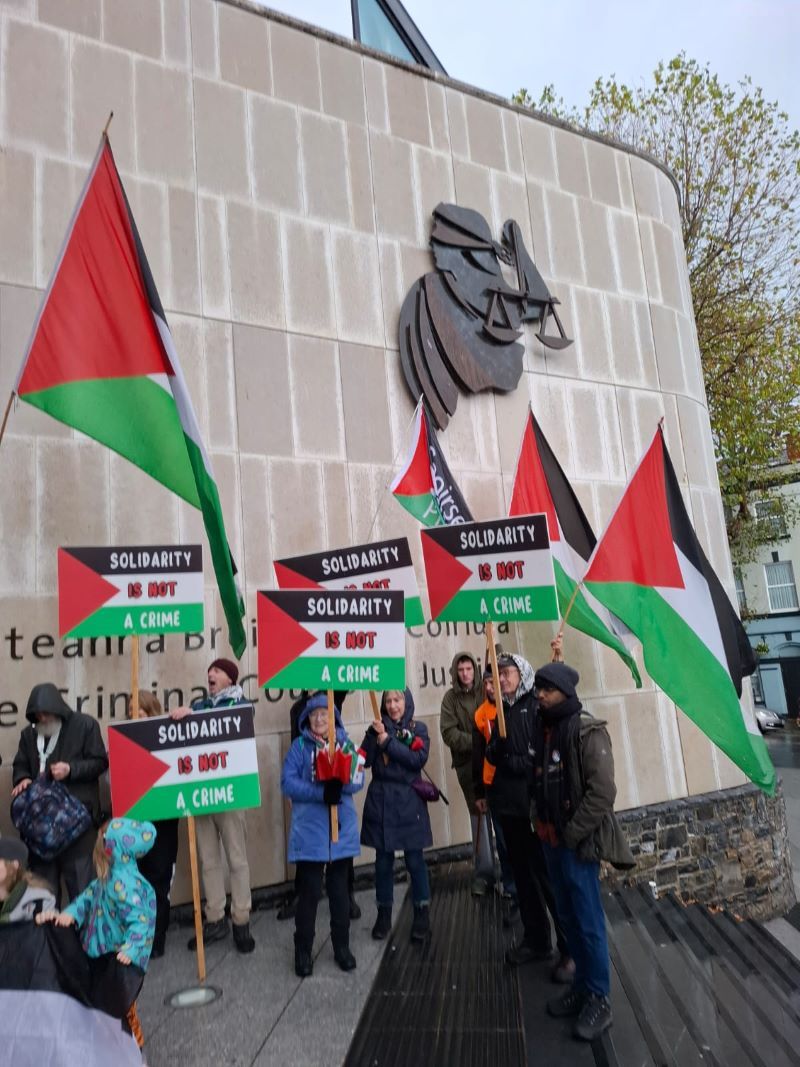
Small section of the crowd of supporters outside the Court on 31 October 2025 for the two pepper-sprayed and chargedPalestine solidarity activists (Photo: D. Breatnach)
The Port march was a breakaway from a periodic Ireland Palestine Solidarity Campaign national march to Leinster House, the home of the State’s parliament; some IPSC stewards denouncing it as it diverged at O’Connell Bridge and called on others to march on Dublin Port instead.
From video and eyewitness reports it is clear that the Public Order Unit of the Garda determined not only to stop them but to ‘teach the protesters a lesson’. No sooner had the linked-arms marchers reached the police line than some of them sprayed pepper-spray on the Palestine solidarity activists.
So heavy was the spraying that it affected a number of the Gardaí themselves. Many also drew their batons and attacked the demonstrators reeling from the effects of the spraying. The POU unit had their ID numbers concealed and Gardaí pursued activists moving away, spraying them again.
The Gardaí later claimed they had given a warning before spraying as they are required so to do by their own regulations but both Irish Council for Civil Liberties observers and video evidence show this to be untrue.
Solidarity activists were arrested at the scene of the Garda attack and one other outside a special sitting of the court on Saturday evening. The charges were of the usual kind with police repression of demonstrations: offences against Public Order, resisting arrest and obstruction of traffic.
The Irish State is the 2nd-largest single importer of Israeli products, second only to the USA and clearly has no intention of moving from that situation.
Nor of demilitarising Shannon Airport nor of banning Irish airspace to overflights ferrying military supplies to Israel. Two years of giant solidarity marches and smaller ones up and down the country have not moved the Irish ruling class to any degree beyond making statements.
As people move to take actions that have the potential to force the Government to end their collusion it seems inevitable that the State will increase its repression, which will work towards intimidation but also to increased resistance.
Small section of the crowd of supporters for the two pepper-sprayed and charged outside the Court on 31 October 2025. (Photo: D. Breatnach)
Those gathering at the court today were for the most part independent activists and activists of very small political organisations but many also of broad Palestine solidarity groups.
The two facing charges today had their cases postponed to January 2026, with talk of the Gardaí possibly returning shortly to court to press more serious charges, with the potential of heavier punishment — but conversely also of greater political statements made before a jury.
Solidarity with people fighting in struggles in other parts of the world often has a price of repression where the solidarity is originating, which makes solidarity to the targeted activists essential too. In that context, the numbers attending the court on Friday morning were very encouraging.
End.
Note: If you found this article of interest, why not register with Rebel Breeze for free, so that you will be notified by email of subsequent articles. You can de-register any time you wish.
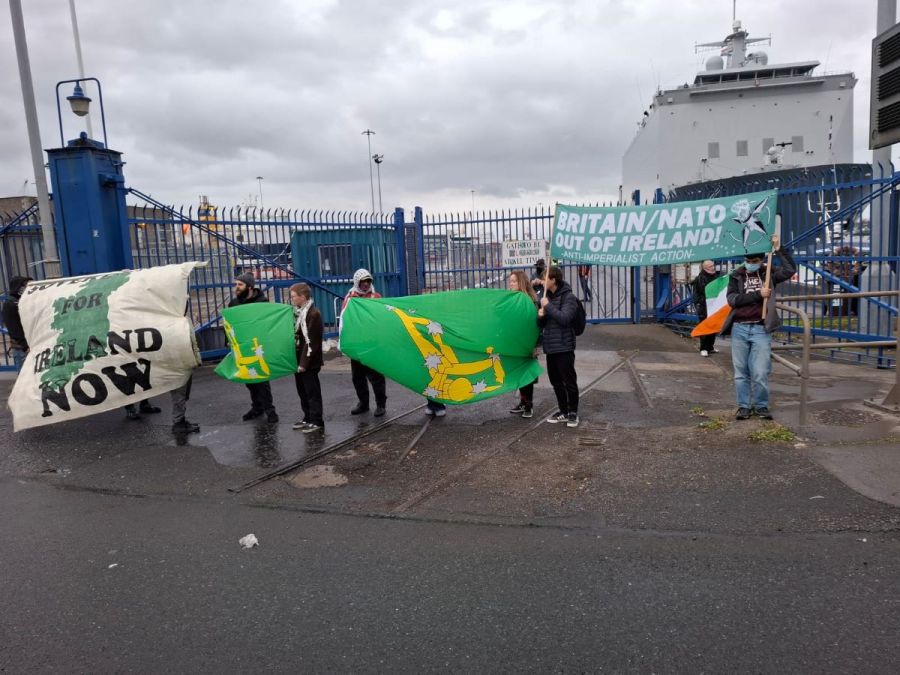
Dutch and German warships docked in Dublin’s Liffey Port were met by anti-NATO protesters late Saturday afternoon with banners, an Irish Tricolour and Starry Plough flags and shouts through a loudhailer with passing traffic beeping in solidarity.
The huge Dutch naval landing platform Johann De Witt was immediately visible on the north Liffey quay just on the seaward side of the Tom Clarke Bridge and the protesters took their stand there in front of the security gates, visible to airport and south and northbound Dublin traffic.
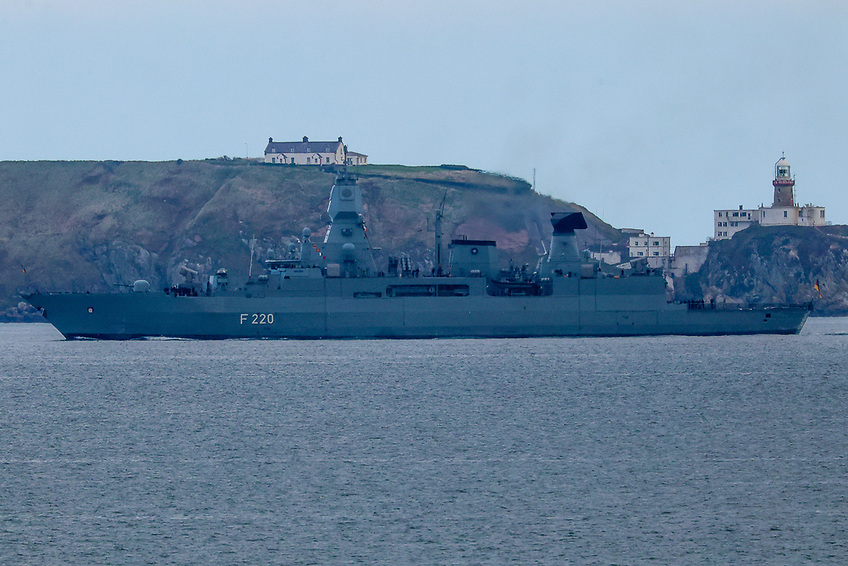
German NATO frigate FGS Hamburg entering Dublin Bay, bound for the Port security gate. (Photo cred: Afloat)
The Dutch ship was flying Holland and NATO flags. Among the slogans the protesters periodically chanted were: No NATO troops in Ireland! NATO, NATO, NATO: Out, out, out! From Belfast to Killarney – We don’t want your NATO Army! NATO imperialism – Out of Ireland!
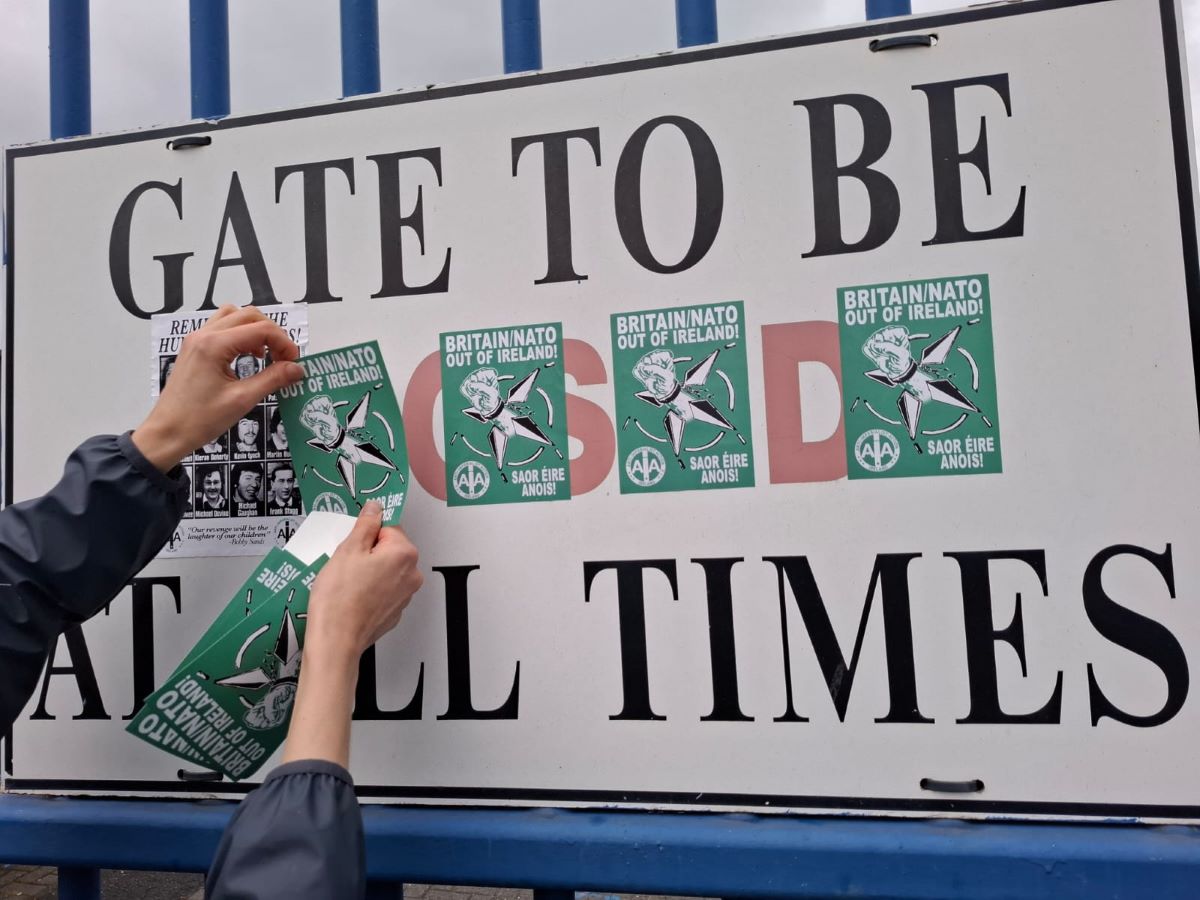
Anti-Nato stickers being affixed to the Dublin Port security gate. (Photo: R.Breeze)
The chants grew louder as military personnel (in street clothes) approached or emerged from the security gates behind the protesters but there was no physical confrontation from either side. No Gardaí attended either, unlike the protest at Ireland’s NATO HQ in April this year.
On that occasion Gardaí pepper-sprayed the peaceful protesters and broke the ankle of one of their number, in addition to arresting them. Some of the arrested were bailed and are due to appear in court in Dublin on 23rd February 2026.
Anti-Nato protesters, the Dutch NATO naval ship clearly visible in background. (Photo: R.Breeze)
NATO was originally claimed to be a western European military defensive force against the Soviet Bloc. However, after the Bloc’s collapse, NATO continued to expand until it has now an additional 17 member states (and the threat of Ukraine joining led to the current war with Russia).
The individual western member states, for example the US, UK, France have been waging imperialist wars for decades. But the NATO military alliance’s forces also fought imperialist wars in a number of countries: Bosnia, Kossovo, Afghanistan and Libya.
Anti-Nato protesters. (Photo: R.Breeze)
The protest on Saturday was organised at very short notice by Action for Palestine Ireland and Anti-Imperialist Action Ireland. Many passing vehicles, both private, company and taxi sounded their horns in support and also gave a thumbs-up or clenched fist salute.
Clearly the protest context was not only a lack of welcome for a member of the western imperialist military alliance but also fears that the Irish ruling class wants to join that alliance too and is currently trying to remove the ‘Triple Lock’ impeding its move in that direction.
End.
Note: If you found this article of interest, why not register with Rebel Breeze for free, so that you will be notified by email of subsequent articles. You can de-register any time you wish.
Anti-Nato protesters on Saturday, the Dutch NATO naval ship clearly visible in background. (Photo: R.Breeze)
PALESTINE SOLIDARITY MARCHERS PEPPER-SPRAYED AND BATONED WITHOUT WARNING.
An action on Saturday in an attempt to stop the genocide of Palestinians was brutally repressed by Gardaí pepper-spraying the marchers without warning before beating many with truncheons and threatening others, then issuing a lying statement.
On Saturday (4th October) the Ireland Palestine Solidarity Campaign had organised another of their monthly National marches from the Garden of Remembrance through Dublin city centre to Leinster House1 but a much smaller section departed for Dublin Port.
View of a section of the Palestine solidarity march on Saturday proceeding along O’Connell Street. (Photo: D.Breatnach)
In the context of port protest shut-downs in various parts of the world, Italy in particular, the intention seemingly was to blockade traffic into and out of Dublin Port; also in the context of the Irish state being a huge importer of Israeli products, second only to the USA.
The shut-down marchers left the main march at O’Connell Bridge and proceeded along the Liffey quays heading for the Port as IPSC stewards tried to discourage anyone from joining them, stooping as low as to accuse them over a loudspeaker of splitting the march and of betraying Gaza.
There had been a number of Port traffic blockade actions recently, all of which had ended without violence. No doubt the Irish ruling class were worried that they might escalate and spread and gave orders to the Gardaí to attack the marchers and to terrorise any others from emulating them.
As the marchers reached the Public Order Unit police line and stopped, some of the police began to push marchers, almost immediately some Gardai standing in a second row starting to pepper-spray marchers over the heads of their colleagues but the wind pushed some of it back in their faces.
POU Gardaí to the right of the crowd then drew their truncheons and started to strike viciously at the marchers, who were now pushing into the Garda line. Eventually the marchers broke, people staggering off to the side, eyes streaming, unsteady on their feet. Even then, they were pursued.2
At least two marchers were arrested at the event and another in a solidarity demonstration outside the Criminal Court building that evening. The charges include Public Order charges and resisting arrest. Once again, marchers complained they were forcibly strip-searched in the police cells.3
CAPITALIST MEDIA
RTÉ online’s report was clearly totally based on a Garda statement without any attempt to investigate, although video footage was soon circulating on social media. Try to contact participants for their side of the story? See whether there were photos or video clips available? Don’t be silly!
The Garda account is totally at variance with what can be seen on the video, as has often been the case. One recalls the assault with a length of wood by a fascist on an LGBT campaigner who was observing a National Party rally outside Leinster House and a Garda told her to leave the area.
The Garda statement to the media on that occasion was that there had been no incidents but unfortunately for them there was ample video recording of the event, the assault, the victim’s head streaming with blood, the senior Garda ordering her away … and they had to change their story.
A few weeks prior to that, unarmed antifascists counter-protesting an anti-masking protest organised by fascists on Custom House Quay were attacked by fascists wielding clubs and metal bars. As the antifascists fought back, the POU charged in and attacked the antifascists!
On that occasion too their statement to the press completely omitted that event.
The media is doing a good job of exposing themselves as not only keeping to the imperialist pro-Zionist discourse about events in Gaza and the rest of West Asia, but keeping also to the home front discourse that big business and cops are good and protesters a problem.
We appear in the Irish state to be entering a period of Garda repression backed up by media acquiescence, similar to what was passed through in the 1980s, with Garda repression on the street but also operations by the ‘Heavy Gang’, raiding and beating up detainees to obtain a ‘confession’.
The liberal civil rights sector was quite active then calling out Garda violence, framing of innocent people and judicial collusion. There is much less of that liberal resistance to be seen these days.
A rare enough sight – an Irish-language placard on Saturday’s march in Dublin. (Photo: D.Breatnach)
THE IPSC MARCH
The IPSC went ahead on Saturday with many thousands on their march, demonstrating once again, as over the past two years, that the Irish public is overwhelmingly in support of the Palestinians and totally against the genocide and ethnic cleansing by the Zionist state.
Over the years, the IPSC’s activities have contributed to that awareness and sympathy in Irish society but so too have the actions of the Israeli governments and their armed forces, captured in photos and videos by journalists and ordinary Palestinians and posted on social media.
But Israel has not ceased its genocide; not one Palestinian life has been saved by the marches. The Irish Government has not ceased any of its concrete collusive actions with Israel. The imports continue, the armaments fly through Irish airspace, Shannon airport continues militarised.4
The IPSC’s Chairperson admitted as much, speaking at their rally near Leinster House: “Simon Harris has called Israel’s actions ‘genocide’, ‘unconscionable’ and ‘unacceptable’ — yet the Irish Government is barely lifting a finger to end Ireland’s deep complicity in this genocide.”
A section of the Palestine solidarity main march in Dawson Street, while thousands more are already in Molesworth Street (out of sight to the right of photo). (Photo: D.Breatnach)
Had the IPSC mobilised the thousands to march down to the docks, it would have been a very different story on Saturday. Something to make the Government really reconsider its collusion. The IPSC could still do that. But will it? We can hope but current practice tells us otherwise.
Then others will have to do the deed. Others like Mothers Against Genocide, Action for Palestine Ireland and Saoirse Don Phalaistín, for example. And they will continue to be assaulted and arrested, facing fines, restrictions on freedom of movement and … ultimately, no doubt … jail.
Apart from the baton and pepper-spraying injuries, one of the marchers is reported to have a broken arm. Two were arrested at the Port and one at the court solidarity protest Saturday evening. Today others attended court in solidarity with one of the arrested (who had abrasions on her cheek).
We should be part of these disruptive actions and if we are not, for whatever reason, the least we can do is to call out those who denounce them and to organise support for those who are, in and out of the courts.
End.
Note: If you found this article of interest, why not register with Rebel Breeze for free, so that you will be notified by email of subsequent articles. You can de-register any time you wish.
Gathering outside the Dublin Court in solidarity with one of the assaulted and arrested Port marchers. Her case was postponed. (Photo: D.Breatnach)
2All of that is evident from the video footage shot from that side of the event. Violent shoving by Gardaí sent some people to the ground, including a disabled woman.
3There was outrage expressed when Gardaí compelled detainees at a Mothers Against Genocide protest outside Leinster House to strip in the police cells. The Minister for Justice claimed that Garda CCTV footage refuted those claims but strangely, it appears that no CCTV footage was available when lawyers asked to view it. https://www.instagram.com/mothersagainstgenocide/p/DJ_nOewxQAp/
4And the Irish Central Bank intends, after a pause, to offer Israeli war bonds once more.
For a few days it has seemed a little like an invasion around Dublin city centre by Vikings and Steelers. Not Scandinavians as of old with some others1 but fans of two competing teams of the American National Football League.
One of the banners at the Drumcondra/ Clonliffe junction around 2.45pm.(Photo: D.Breatnach)
There is little social following for the game called ‘American Football’ in Ireland, where we have a massive following for Gaelic football and soccer through their respective associations, the Gaelic Athletic Association and the League of Ireland (the latter in particular much underfunded).
Years ago, in his capacity as Minister of Arts at the time, Michael D. Higgins, presiding at an event, criticised what he called “US imperialist cultural penetration” of Europe. This has been ongoing for decades mainly through cultural products of films and soap operas, cartoon films and comics.
Prior to that, we were subjected mainly to British cultural products in magazines, comics, films and soap operas. And of course the Irish state only set up its own TV broadcaster in the 1960s.
For years these products have been impacting on our consciousness and subconsciousness, including on some of our speech patterns in English. But attempts to promote NFL have failed; however, never before has such a big effort been made and with such financial backing.
The small group at the Drumcondra/ Dorset St junction and Canal/ Railway bridge as I approached it just after 1pm. (Photo:D.Breatnach)
For this one game, the Irish Government has awarded just short of 10 million euro in funding – i.e.one third of their funding for the entire sports sector in Ireland last year. While of course this is being promoted as a revenue opportunity for business, there are stronger reasons.
The NFL is a strong supporter of the imperialist US military and the US itself shows signs of gearing up for another war – against whom is unclear but Venezuela, Iran or China are likely targets. In addition, the US is the main supplier of arms and political backing to Israel.
One of the banners at the Drumcondra/ Clonliffe junction around 2.45pm. (Photo: D.Breatnach)
And where does the Irish ruling class want us? Why, with the USA of course! No more of this skulking around! Make Shannon officially a US military airport, have the RAF and UK Navy officially patrolling our seas and airspace, where arms for Israel can also fly through officially!
The often discussed ‘Triple Lock’ is all that appears to be holding back the Irish ruling class from dumping the state’s tattered neutrality2 — and they are working on that. But meanwhile, they seek to orientate us towards the leader of the western imperialist pack – through US sport.
The NFL will be doing their part, apparently going to make sure every child in the Irish school system will receive an NFL pack. Hey! USA! Leave our kids alone!
This weekend, the Irish Gombeen3 ruling class, through their State, supplied extra police to keep the US visitors safe around the city and on Saturday around Croke Park, while police helicopters kept eyes in the skies. And there was extra Garda tolerance also for UStater illegal street-drinking.4
At the Clonliffe/ Drumcondra Road junction at 1.00pm, announced rallying time. (Photo: D.Breatnach)
THE PROTESTERS
Many – including I – only learned on Saturday of the protest called by the IPSC5-allied Sports for Palestine campaign group against the NFL game programmed for Croke Park on Sunday between the Vikings and Steelers teams. A call-out to attend with flags and placards.
That seems a bit unfriendly towards visitors, sports enthusiasts, right? Fans just happy to support their teams and visit lovely Ireland at the same time, right?
Apart from the considerations of imperialism and war-orientation listed earlier, the USA is openly backing politically and supplying militarily a daily genocide against Palestinians. NFL is a significant cultural representation of the US and as such must be prepared to suffer for it.
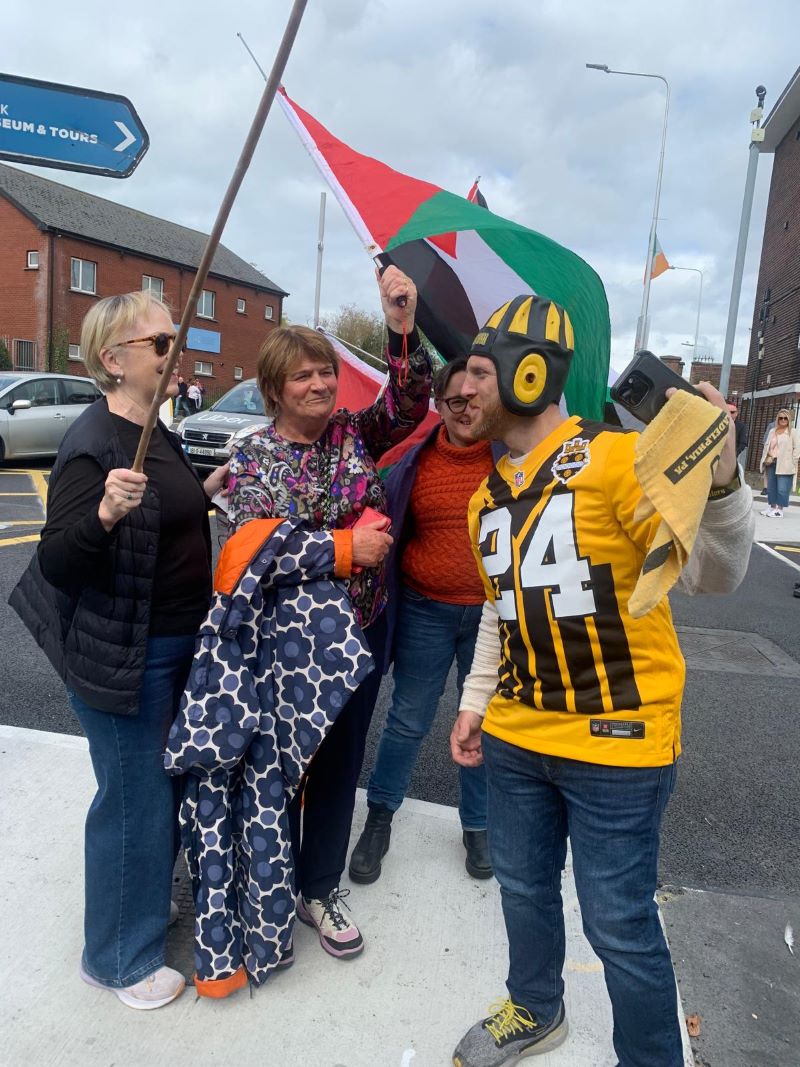
Small group of protesters further down Clonliffe Road at junction of road leading up to Croke Park entrance, approached by an NFL fan (Steelers?) who wants his photograph taken with them. (Photo source: Participant)
While most of the Palestine solidarity protesters, maybe 60 at its highest point congregated at the junction of Clonliffe and Drumcondra roads, a small group of four took up position at the road leading to the Croke Park Stadium entrance and stood there with Palestine flags.
I headed for the railway and canal bridge at the Dorset Street junction, where I could see a Palestinian national flag and a placard calling to “Free America from AIPAC control.”6 On the way I passed NFL merchandise sales and young women handing out free canned energy drinks.
Greeting the other two at the Bridge, I extended my flagpole bearing the Starry Plough flag and took up station with them. Some passing traffic beeped our flags in solidarity.7 My standard litany to the passing NFL fans was: “Shame on the USA, supporting genocide! Shame, shame, shame!”
A comrade near me denounced “The United States of Israel”, alternating with attacking US responsibility for and complicity with genocide, while the other shouted about how wrong it is to be killing children. After awhile another comrade joined us but we never had more than four there.
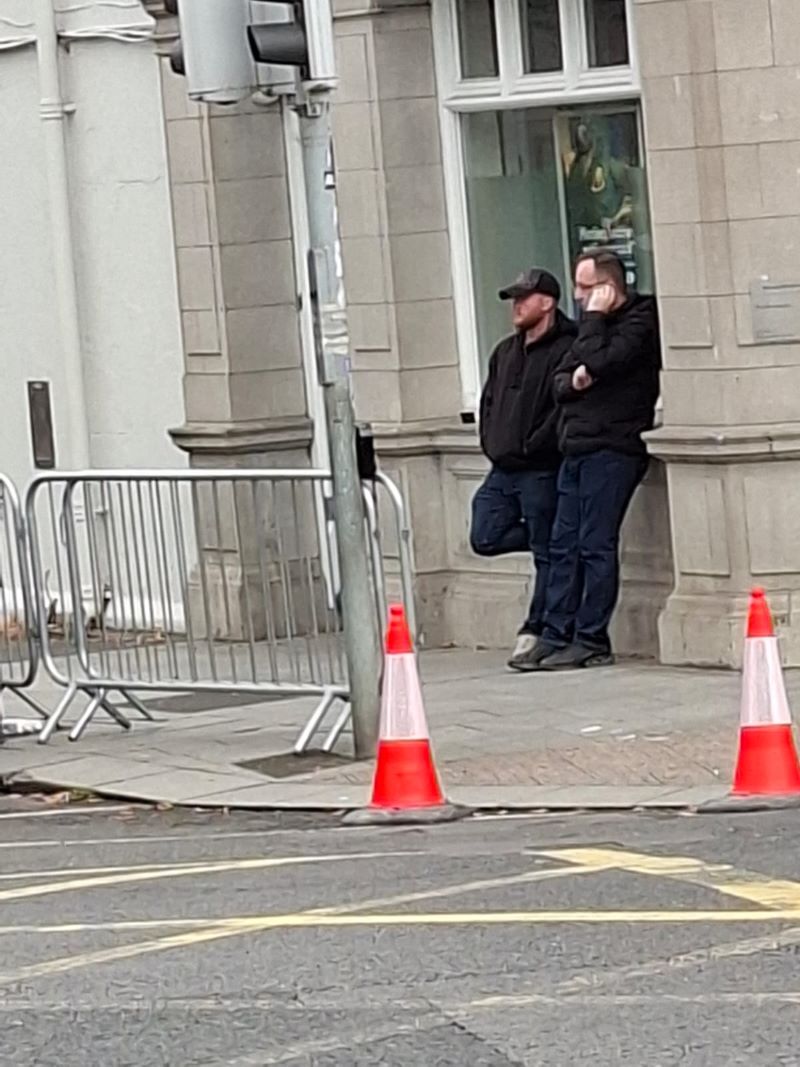
Two of the Special Branch of the Gardaí, ‘spotting’ for the State. (Photo: D.Breatnach)
REACTIONS OF NFL FANS
The reactions of the passing fans to what we were saying varied considerably.
By far the majority of them attempted to ignore us while some looked at us with seeming curiosity but no other reaction. Some seemed embarrassed, covering the feeling with a smile. A small minority said they agreed with us, some even saying they were ashamed of the USA.
A tinier minority still exhibited hostility and outrage towards us, as in waving us away or giving the hand gesture for “blah, blah” (which a few verbalised also). A few laughed but that was their mistake, as I then shouted “Laughing about genocide? LAUGHING about GENOCIDE!”
One big man insulted us in an Irish accent but received as good from us, while an NFL fan who spoke in support of ‘Israel’ wilted under a barrage of “Genocider!” shouts. Another who mentioned “the hostages” was asked whether he was referring to “the 9,000 Palestinian prisoners?”8
Yet another accused us of generalising but received a response about arming Israel, to which he responded that we (Ireland, presumably) are feeding Israel. Another still wanted to avoid responsibility by saying that he’s “a Democrat” but was asked what that had to do with anything.
One other said he was from Belfast and yet another from England but the latter in particular got nowhere with that, considering Starmer’s support for the Zionazis. An older US man supported by two women claimed that we were being fooled by Hamas propaganda – there is no genocide!!!
It seems likely that those UStaters who encountered protesters and who are already opposed to what the US leadership is doing will return home at least a little strengthened in their position but also with some stories to tell people there about how the US is being viewed in a part of Europe.
Those who are unsure about what they think will probably doubt the leaders of the USA and dominant rhetoric even more. Some will be mostly unaffected and some may even harden their hostility to all critics of the USA. On the whole, I think the effects will be of a positive nature.
But even if so, of course nothing we did will be stopping the genocide for even one minute. Only states have the power to do that and were the Irish Government to ban all imports from ‘Israel’ outright, that would have a huge and immediate impact on the genocider’s economy.9
Another of the banners at theDrumcondra/ Clonliffe junction around 2.45pm. (Photo: D.Breatnach)
Sunday’s was a useful but minor action in the propaganda part of the liberation war – Palestinian national liberation, of course but also part of our own. However it could have had much greater visual impact. Drumcondra Road is on a much-travelled road including for Airport traffic.
The road also carries bus public transport routes from and to various Dublin destinations. There are three possible routes off it for access to Croke Park. We only covered two, one with a minimum presence. The size of the concentration at Clonliffe junction was understandable but unnecessary.
The source of much of this weakness appears to be the very late call-out to the protest – only the day prior for many, possibly most. Yet the NFL game must have been planned for many months.
end.
Note: If you found this article of interest, why not register with Rebel Breeze for free, so that you will be notified by email of subsequent articles. You can de-register any time you wish.
1Ireland was raided by Vikings from Scandinavia from 795 CE, they later establishing settlements in Dublin and along the south-east coast, also along the Shannon river and in Cork. Viking power in Ireland was broken by the 1040 CE victory of Brian Boru’s coalition (which included some Vikings, probably Norse) over the Leinster-Dublin coalition of mostly Dublin Danes, Leinster Irish and Viking mercenaries from Manx and Orkneys. The battle lasted 12 hours not far from the Croke Park stadium and part of the Viking mercenaries were caught and killed on their retreat to their ships nearby.
2Three requirements to be met before the Irish Government can send a military mission consisting of more than 12 personnel from Ireland to any part of the world.
3A pejorative term from the Irish language Gaimbín equivalent in meaning to ‘carpet-bagger’, huckster, etc. applied to the Irish neo-colonial (and neo-liberal) capitalist ruling class.
4City regulations forbid drinking of alcohol in any public place.
6The mostly Christian Zionist alliance that plays a heavy financial role in promotion of candidates for election in the USA.
7Yet in one hour outside the US Embassy or standing at Annesley Bridge the normal count of solidarity car-horn sounds would be in the fifties – among the tide of NFL fans, we just weren’t that visible to approaching traffic.
8There may be more but of those, around a third are now held under ‘administrative detention’ orders, without even the farce of an Israeli military court trial.
We’ve recently passed by the date of the start of a monumental prison resistance struggle when IRA prisoner Kiaran Nugent refused on 14 September 1976 to wear prison uniform.
The Hunger Strike of 1981 tends to be remembered as an isolated event in the history of the Irish Republican prisoners’ opposition to criminalisation. But it was five years of struggle through stages that ended eventually in the martyrdom of ten Republicans.
Irish Republicans had been in imprisoned in British jails since the late 18th Century.1 After the Irish national bourgeoisie accepted the British partition of Ireland, Republican prisoners were held in prisons in the Irish State and in the British colony of the Six Counties and at times in Britain too.
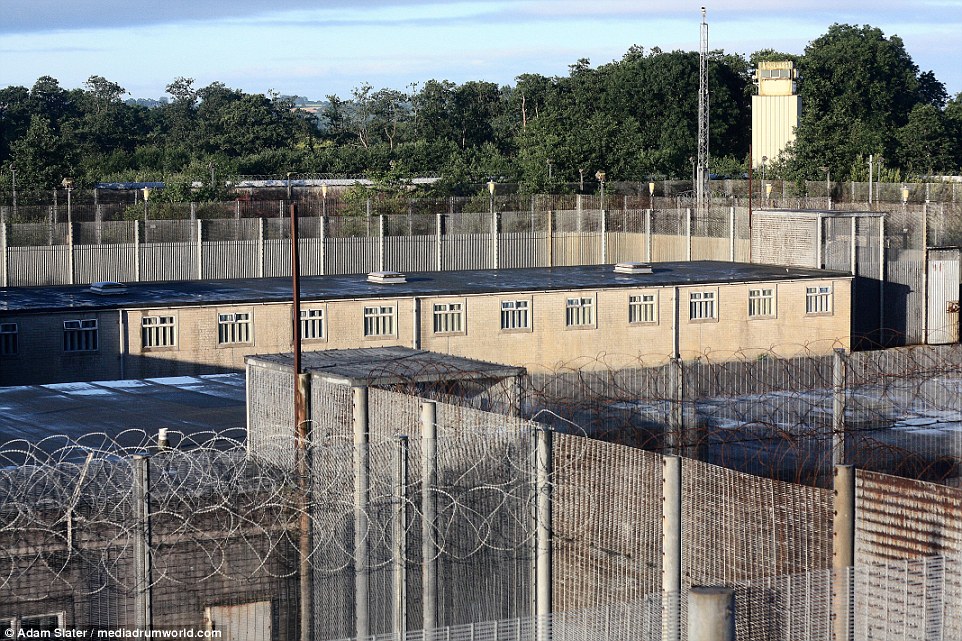
Long Kesh/ the Maze Prison, in the occupied 6 Counties.
This situation continued on low but constant level with higher points during the Civil War (1922-1923), the pogroms in the Six Counties, the 1930s,2 the 1940s, the Border Campaign (1958-1962) and the Civil Rights campaign from the mid-1960s onwards.
The Wikipedia section on Special Category Status states that it was introduced for Republican prisoners serving sentences in the Six Counties in 19723 but neglects to mention that it was already widespread among nationalist prisoners due to internment without trial a year earlier.
The British introduced internment without trial in their Irish colony in 1971 and one of the effects of that measure was to put a huge number of mostly nationalists from the Six County colony into jail. These prisoners were all accorded Special Category Status and wore their own clothes.
British soldiers capturing and taking away a civilian in the Occupied Six Counties of Ireland (Photo sourced: Internet)
Over the life of the measure, 1,981 people were interned without trial in the Six Counties (British Army’s Operation Demetrius). Of those detained 1,874 were from a Catholic/Republican background while, towards the end, 107 were from a Protestant/Loyalist background.
Special Category Status distinguished the internees from other political prisoners which were few in number at the time but its major impact was to distinguish them visibly from social prisoners or what are commonly called ‘criminals’ and was often called PoliticalPrisoner Status.
In June 1972 other nationalists/ Irish Republicans4 charged and convicted were also accorded Special Category Status,5 which came to be seen as prisoner of war status for opponents of the British colonial occupation, despite Britain’s claims that the prisoners were just criminals.
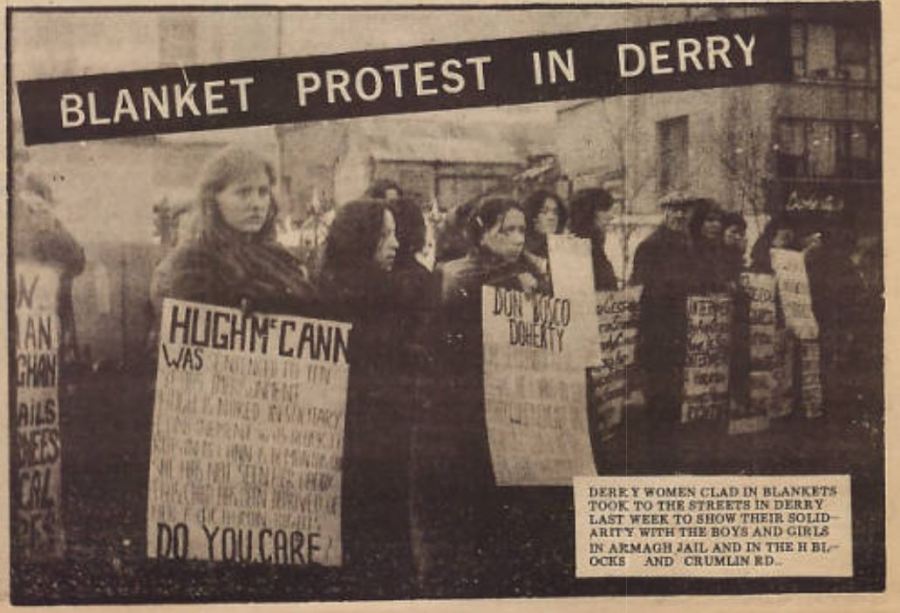
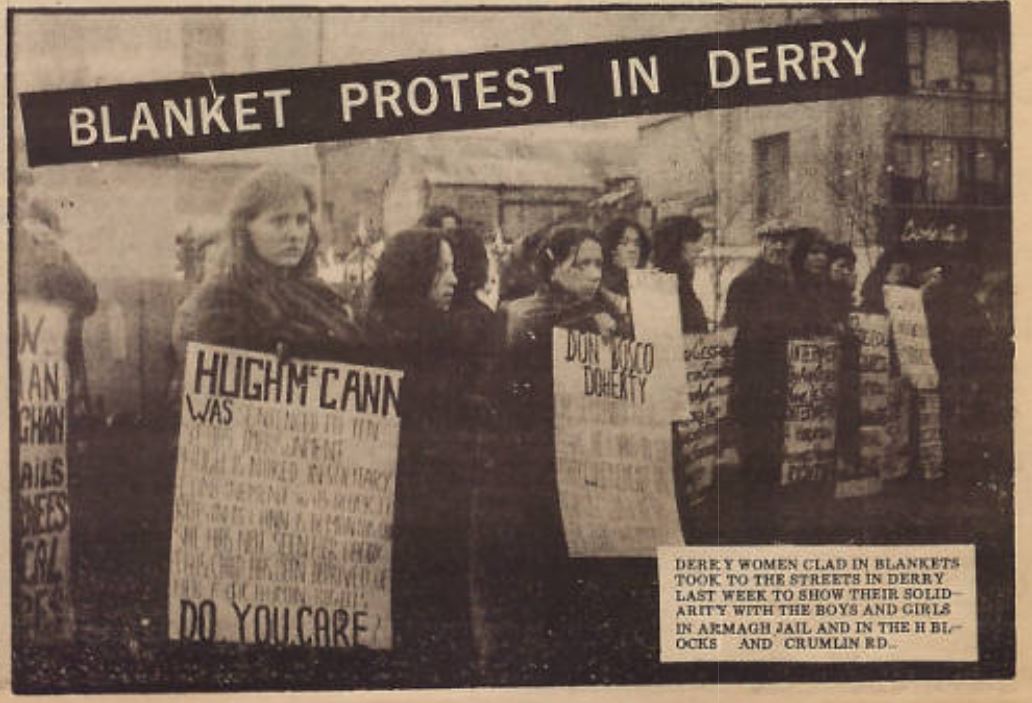
Early protests in support of the prisoners ‘on the blanket’ in 1976. It was mostly women relatives, partners and their friends who launched the Republican prisoner solidarity movement. As the photo legend also illustrates, there was still another male political prison, Crumlin Road (‘the Crum’) and Armagh Jail for female Republican prisoners.(Photo sourced: Internet)
Internment without trial in the Six Counties, generally recognised as a failure from both political and military points of view, was formally ended after four-and-a half years on 5 December 19756. As resistance continued, including now an armed aspect, more prisoners saw the inside of jails.
But they were still under Special Category regime and wearing their own clothes. The following year on 5 March 1976, Merlyn Rees as Secretary of State implemented the Labour Government’s7 decision to remove Special Category Status from any subsequently-convicted prisoners.
MERL
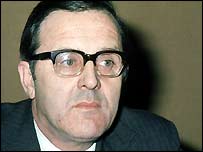
Merlyn Rees, British Labour Home Secretary who removed the Special Status from the Irish Republican prisoners, which precipitated the struggle that ended in the prison hunger strikes of 1981. He died at 85 years of age, having lived much longer than many of his victims. (Photo sourced: Internet)
The first Irish Republican prisoner to be informed he would have to wear prison uniform under the new rules was Kiaran Nugent. His reply, though pithy has gone down in the records of Irish resistance statements: “You’ll have to nail it to my back.”
Stripped naked, Vol. Nugent was put in a cell, from which he found a blanket and wrapped it around himself. It was a natural act to cover his nakedness but he may also have known that Irish Republican prisoners of the Irish State in the 1940s had done the same.
The Blanket Protest had begun and spread as more prisoners coming into the prison system took the same stand. There it might have stayed were it not for the violence and cruelty of HM Prison regime by its warders regularly assaulting prisoners on their way to and back from the showers and toilets.
In 1978 the Irish Republican prisoners in the Maze H-Blocks8 resolved to remain in their cells, emptying their excreta out the window and their urine under their cell doors into the passageway. So the prison authorities blocked up their windows and warders pushed urine back under their doors.
The Irish prisoners then had nowhere to put their excreta so they smeared it on the walls. They built a dam of bread fragments around their door to prevent their urine being pushed back in. These conditions they endured until the prison riot squad beat them out of their cells for power-hosing.
Those who watched the film Hunger (2008) directed by Steve McQueen will have seen some of that and how they treated the naked prisoners too, beaten to the ground, anus probed for contraband messages or materials, the same gloved hand often opening their mouths to look inside also.
Their flesh was forcibly abraded with scrubbing brushes and they were often inserted into cells still wet from the hosing.Once back inside cells, they continued the protest.
On 27 October 1980 seven Republican prisoners, against the orders of IRA GHQ, embarked on a hunger strike included the Five Demands to break the system, which they terminated after 53 days on receiving promises from the authorities which were then reneged upon.
The 5 Demands:
The right not to wear a prison uniform;
The right not to do prison work;
The right of free association with other Republican prisoners, and to organise educational and recreational pursuits;
The right to one visit, one letter and one parcel per week;
Full restoration of remission lost through the protests.9
Outraged at the reneging, Republicans renewed the hunger strike with their previous Provisionals’ jail Commanding Officer10 insisting he be first. So was Bobby Sands the first to die and another nine martyrs behind, seven Provisional IRA and 3 INLA as they came on to the strike in sequence.
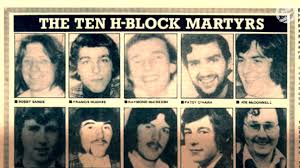
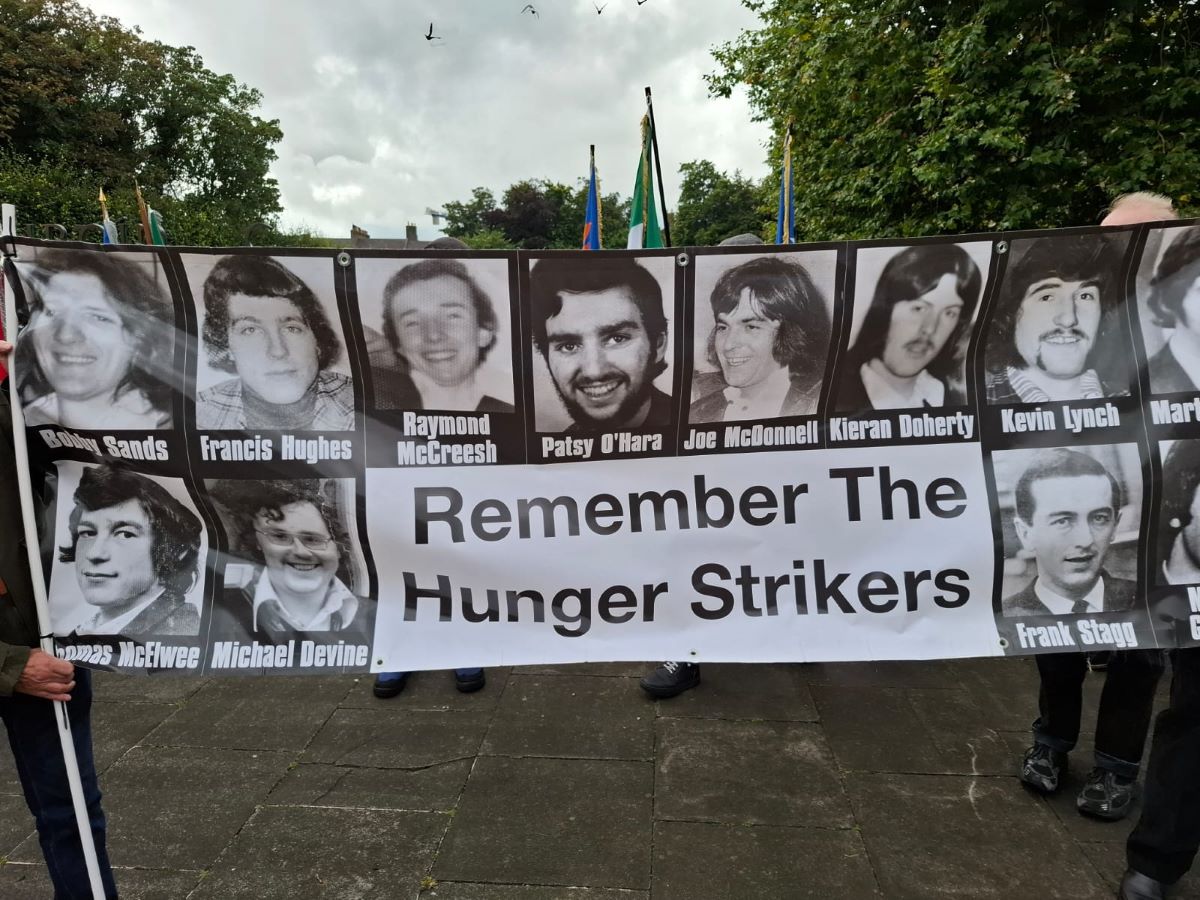
Photograph images with names of the ten Hunger Strike Martyrs of 1981 in the sequence of their death: Vols. Bobby Sands (IRA), Francis Hughes (IRA), Ray McCreech (IRA), Patsy O’Hara (INLA), Joe McDonnell (IRA), Martin Hurson(IRA), Kevin Lynch (INLA), Kieran Doherty (IRA), Thomas McElwee (IRA), Mickey Devine (INLA). (Photo sourced: Internet)
The effect of the hunger strikes of 1981 was huge in Ireland, Britain and further abroad. IRA Vol. Kieran Nugent had an important hand in pushing the process but so did Mervyn Rees, William Whitelaw, Brian Faulker and Edward Heath,11 in a long process of repression and resistance.
Today the struggle continues with approximately 20 Irish Republican prisoners, male and female in prisons between the neo-colonial Irish state and the British colony of the Six Counties. They have essentially won the five demands, though official harassment in the colony’s jails is endemic.
End. NB: If you found this article interesting you may wish to subscribe to the blog free of charge, after which you would receive a notification in your email every time an article was published. You can unsubscribe any time you wish.
APPENDIX: Brief biography of Kieran Nugent (12th September 1958 – 3rd May 2000).
Volunteer Kieran Nugent began his short life presumably in the occupied Six Counties of Ireland but all the references I have found so far begin with him at the age of 15 years of age, standing at a corner with a friend on the corner of Merrion Street and Grosvenor Road, West Belfast.
It was 20th March 1973.12 A car pulled up beside them asking for directions but an occupant of the vehicle then opened fire with a submachine gun. Nugent was seriously wounded, shot eight times in the chest, arms and back. His friend, Bernard McErlean, aged 16, was killed.
Kieran Nugent, first of the Republican prisoners ‘on the Blanket’ (Photo sourced:Internet)
Another youth was seriously injured also.13 Local people reported that a British Army Saracen armoured car had crashed through a nearby barricade and that was what had allowed entry for the murder gang, later claimed by the UDA, a British proxy Loyalist militia.
“At some point afterwards, Nugent joined the IRA.”14 The youngest age for IRA membership was 17 and Nugent aged 16 was arrested by the British Army, automatically refused bail, and at trial, after five months on remand in Crumlin Road Prison, Belfast, case withdrawn, he was released.
Kieran became an active volunteer until his arrest and internment without trial, on 9 February 1975. He served nine months in Cage 4 of Long Kesh Detention Centre (later renamed The Maze) in the Six Counties, until 12 November 1975. But was arrested and imprisoned again on 12 May 1976.
Vol. Nugent was charged with hijacking of a bus, a frequent Republican resistance activity in Belfast where the vehicle would then be utilised as a barricade. His sentence was three years in jail which he was commencing when he began the blanket protest.
The cause of death for Kieran Nugent was given as heart attack. A number of his acquaintances remarked that he had sunk into alcoholism with some adding that the movement had given him no support. Whether true or not, many former Republican prisoners of the period had shortened lives.
1Republican prisoners were held in British jails in Ireland, Britain and Australia – and for centuries before that Irish clan members had been incarcerated in Britain and Ireland.
2When the anti-fascist struggles also contributed to prisoner of the states.
4I am using the term “nationalists” as a broad and not strictly accurate term to describe the people of the Catholic ghettoes and areas of the British colony; of course many of them could have been also or instead mainly democrats, socialists. The term “Irish Republicans” I am using to describe those belonging to organisations nominally of Irish Republican kind but again how much each was truly Republican in ideology varied, for example in their opinion of the appropriate role of the Catholic Church in Irish society.
5Sentenced and remanded in custody Irish Republicans in jails went ona hunger strike for ‘political status’ in 1972 and the Provisional IRA during the Truce negotiations of June that year asked for political status for them which William Whitelaw conceded.
6https://cain.ulster.ac.uk/events/intern/chron.htm However internment without trial in fact continued by charged Republicans being refused bail and remaining in jail for two years or more awaiting trial. Bail decision and trial would be in the special no-jury Diplock Courts.
7It is difficult to understand any Irish person or indeed any anti-imperialist putting any faith in a British Labour government. Apart from its long imperialist history, it formed part of the national government that executed leaders of the 1916 Rising, sent troops to the Six Counties to quell the civil rights struggle in 1969, introduced the Prevention of Terrorism Act in Britain in 1974 and framed a score of Irish people for bombings, removed Special Category Status in 1976 …
8A special male political prison containing panopticon-designed blocks in Lisburn, Co. Antrim, built in 1971 and closed in 2000, the future of the empty buildings uncertain. Female Republican political prisoners were kept in Armagh Jail and fought with different tactics, including taking the Prison Governor hostage at one point.
9Prisoners disobeying prison rules are punished in a number of ways, one of which is loss of the remission off sentence normally expected.
10In a long tradition the prisoners of each political group in jail elect their leader and previous ranks are abandoned for the duration of the incarceration.
11In sequence: Labour Party Secretary of State; Conservative party Cabinet Minister; Unionist Prime Minister of the colony; Conservative Prime Minister of the UK.
An Irish punk rock band, Mongolian throat-singers, a poet and Irish folk singers all performed at Solidarity Sessions No.2 to a good crowd in the International Bar, in in Dublin City centre Wicklow Street on Wednesday 17th..
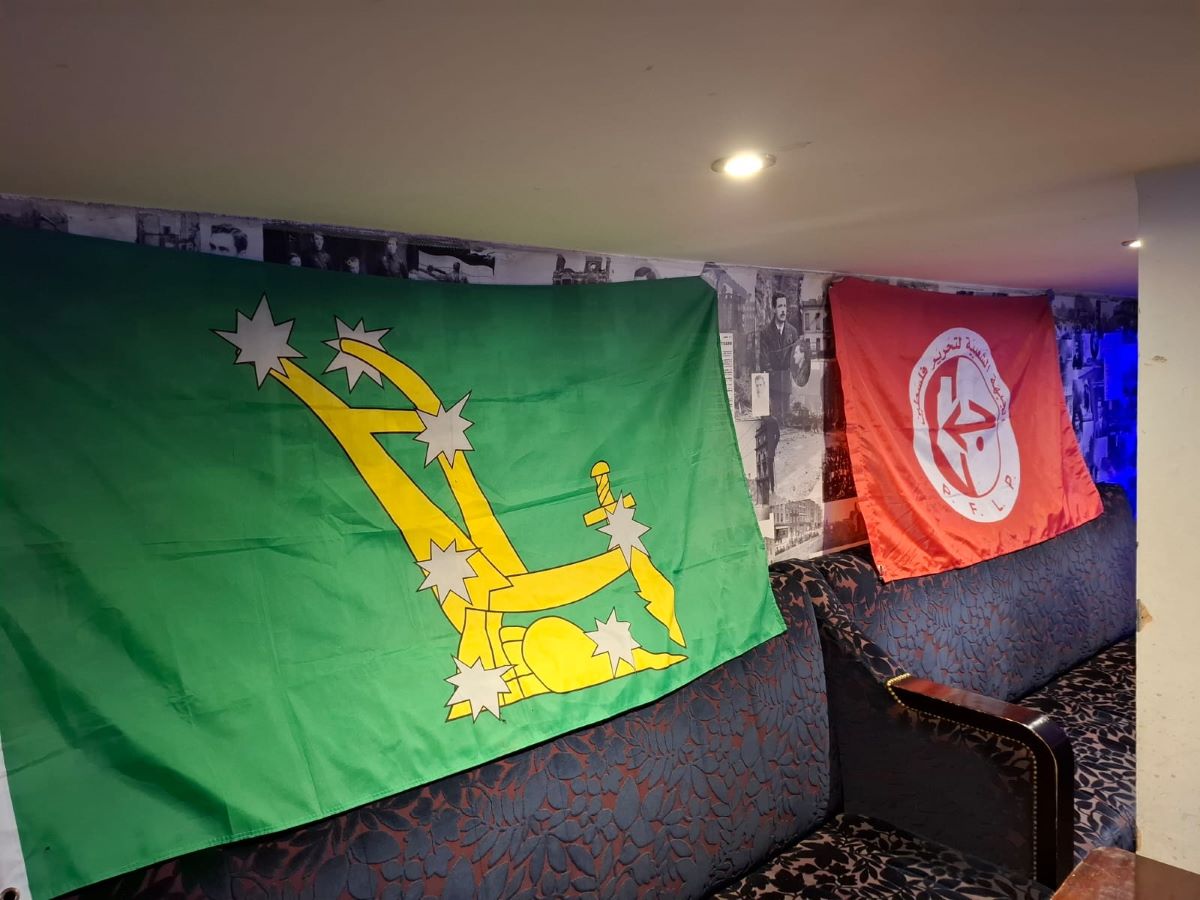
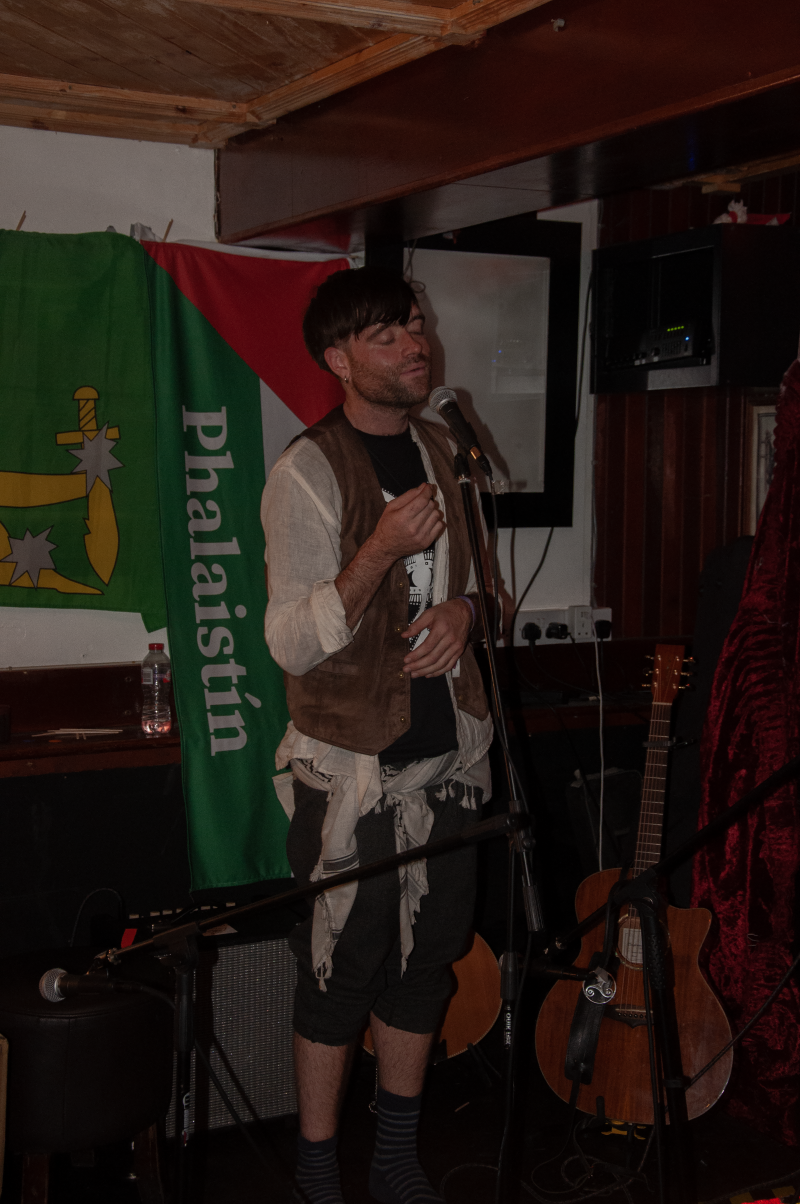
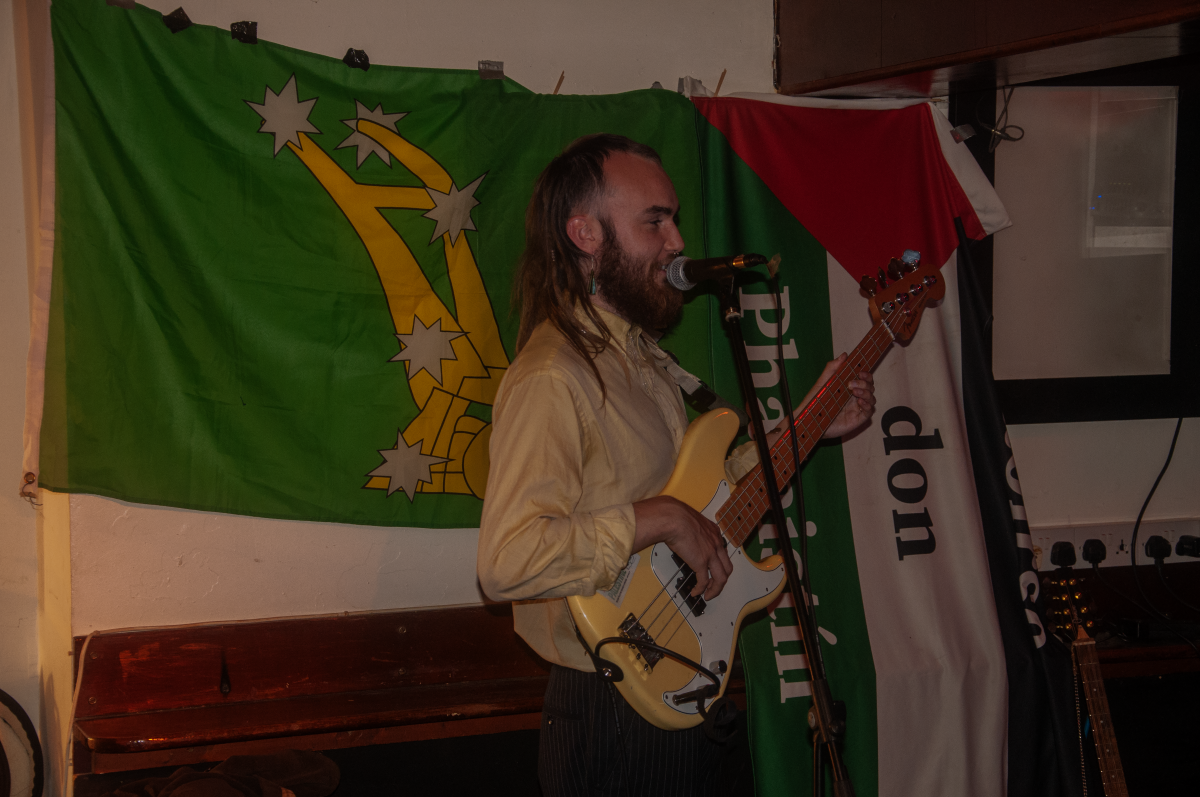
An Irish and international resistance theme in decor was presented by flags of the Starry Plough and Palestine with Saoirse don Phalaistín as stage backdrop, while flags respectively of Cumann na mBan and Basque Antifa concealed the original decor’s ubiquitous photos of Michael Collins.
Flesh B. Bugged performing (Photo: Dermo Photography)
A PFLP1 flag was also taped to a wall. Hand-written signs on the stairs leading to the basement venue, alternatively in Irish and in English, asked for quiet/ ciúnas for the performance/ racaireacht. The Irish language was present too in some of the performances to follow.
MC for the night, Jimi Cullen, himself a singer-songwriter activist told the crowd the purpose of the organising collective was “to build a community of resistance and solidarity with our struggles and with struggles around the world” through culture in a social atmosphere.
Before the crowd — a flag temporarily changing the decor. (Photo: R. Breeze)
Themes of love, nature and emigration were covered in song; however the dominant theme was resistance – to prison regimes, foreign occupation, fascism, class oppression, racial discrimination – and solidarity with the struggles of others, near and far.
Diarmuid Breatnach, singing acapella kicked off the night with a selection of songs from the Irish resistance tradition and a couple of short ones from the USA civil rights movement. Some of the melodies however, of particular interest perhaps to Back Home in Derry2, were his own originals.
Eoghan Ó Loingsigh, accompanying himself on guitar followed with more material from the same tradition, dedicating one to his late IRA father. A folk song Ó Loingsigh announced as ‘non-political’ performed acapella turned out to be very much political but on the issue of social class.
Áine Hayden followed with poems on a range of topics, from swimming in the Royal Canal during the Covid shut-down, deleting a personal relationship to a dedication to comedian and activist Mahmoud Sharab murdered with family in a “safe zone” tent by the Israeli Occupation Force.
Eoghan Ó Loingsigh performing (Photo: Dermo Photography)
The three performers were all introduced as activists as well as artists and the mostly-young crowd, apparently containing a strong representation of political and social activists, responded well to the performers with applause, yells of encouragement and often joining in on choruses.
More people arrived before, during and even after the break – including an elderly couple who had just arrived from the USA and could only pay in dollars but were admitted for free. Leaving later with thanks they promised a contribution to Palestine solidarity when they got home.
Before the crowd — a Cumann na mBan flag temporarily changing the decor. (Photo: Dermo Photography)
Also an activist, Ru O’Shea sang an Irish, Scottish, French and Italian selection, accompanied by bouzouki and guitar and performed a spoken word piece with a refrain of ‘Éire under attack’ before schooling the audience to sing the chorus of Robbie Burns’ Green Grow the Rushes Oh!
Áine Hayden performing (Photo: Dermo Photography)
Nomads were the next act. Composed of two Mongolian musicians playing violins in the style of the viola and a Dubliner modulating on a sound deck they were unusual enough but it was the amazing throat-singing of one of the Mongolians that had the audience enthralled.
It was amazing to learn that there are three different kinds of Mongolian throat-singing and then to hear them performed, one of which was a kind of whistling with a vibrating bass undertone wavering through it. The applause, particularly when they concluded, was rapturous and sustained.
Before the crowd — flags temporarily changing the decor. (Photo: R. Breeze)Ru O’Shea performing (Photo: Dermo Photography)
The evening’s entertainment concluded with Flesh B. Bugged, a punk rock Irish duo of bass guitar and drums with spoken voice pieces in Irish from the bass guitar player. Their volume and beat got some of the crowd up and dancing and the wider crowd responded well to them too.
MC Jimi Cullen went up on stage for the last time to thank venue, performers, audience, doorkeepers, poster designers Ríona and Azzy O’Connor, also Diarmuid for original artwork. At a prompt from the crowd Cullen also got a round of applause from the audience for his MCing.
The Mongolian musicians of Nomads performing (Photo: D.Breatnach)
Remarking they’d “had a great night” and encouraging his listeners to follow the organising collective on its Instagram page, Cullen told them that details of Solidarity Sessions No.3 and the collective’s decisions on recipients of donations from money raised would be posted on there.
Diarmuid Breatnach told the audience that each individual could help build a community of resistance through attending the Solidarity Sessions and encouraging others to attend. He welcomed any ‘competion’ from solidarity sessions around the country.
Bass guitarist of Flesh B. Bugged (Photo: Dermo Photography)
The downstairs area of the International Bar is not perhaps the best layout for this kind of event but it worked out well enough for the collective, audience and performers on the night. Their next event will be back at their launch venue,The Cobblestone, Smithfield on Thursday 30th October.
End.
Note: If you found this article of interest, why not register with Rebel Breeze for free, so that you will be notified by email of subsequent articles. You can de-register any time you wish.
The Mongolian throat-singer in Nomads (Photo: Dermo Photography)
FOOTNOTES
1People’s Front for the Liberation of Palestine, one of two specifically secular armed resistance organisations in Palestine.
2Irish mega folk singer Christy Moore had organised Bobby Sands’ poem into song to the melody of The Wreck of the Edmund Fitzgerald by Gordon Lightfoot.
On 13th September 1845 the widely-read British weekly publication The Gardener’s Chronicle apprehensively reported the appearance of the blight on potatoes in Ireland but doubtful if the full extent of the holocaust to follow was expected.
(Sourced: Internet)
True, no other national population in any other known part of the world was as heavily dependent on the potato as was Ireland’s. Other crops were grown but were mostly destined as feed for domestic animals1 or for export directly or indirectly as in the case of alcoholic drinks.2
A national diet is that of the mass of the population, which in Ireland was the peasantry. On the potato and a little milk the Irish peasantry grew strong enough to be recognised in Britain as healthy able workers, seasonally in agriculture or longer-term in manufacturing and construction.
They were reputed to be the tallest and most fecund in Europe, according to Frederick Engels writing in Britain a year before the piece in the Chronicle.3 In Ireland the peasantry were for the most part tenants-at-will or landless labourers for the settler big landowners and descendants.
The original Irish had been expropriated by sword, fire and pen (legal decrees) and their expropriators lived on the rents they extracted from their tenants in a mixture of crops, animals, cash and labour. After the abolition of the Irish Parliament,4 most big landowners found no reason to even live in Ireland.
The estates of the absentee landlords were then managed by agents, middlemen who forwarded the extracted wealth to their masters in Britain, or perhaps travelling ‘on the Continent’, or trying their hand in the American colony, minus the agents’ commission, of course.
As people went hungry, meat, dairy and grain continued to be exported.
The dependency of the Irish mass on the potato was known of course and even mocked in some ruling British quarters at times. But so were the Irish landlord aristocracy who seemed to have no interest in developing industry.
But could anyone predict that the blight would intensify each year and that the Government of the UK would tolerate such devastation in one of its parts? By the time it had run its course six years later, Ireland had lost at least 2.5 million of its original over eight million5 and more were emigrating.
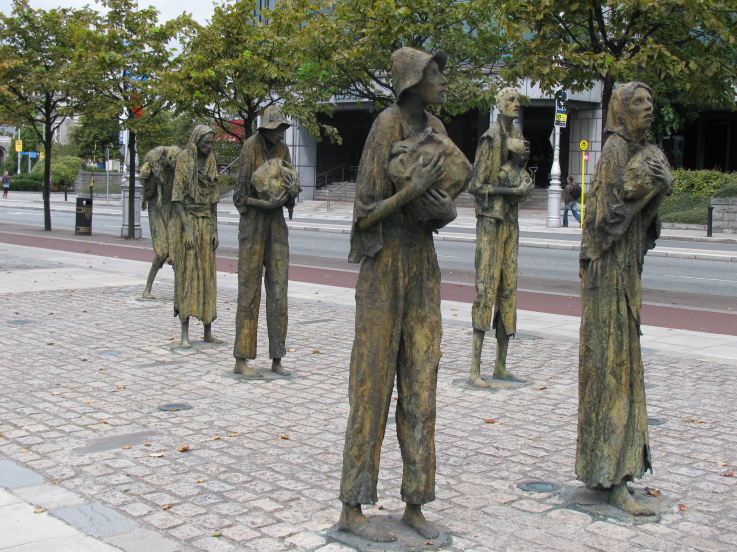
Memorial to the Great Starvation on Dublin’s north side quays. (Sourced: Internet)
And both the Irish planter aristocracy and the cotter class of Irish peasantry had been wiped out, leaving the field to the Gombeen6 class of money-lenders and bigger farmers, the latter now expanding their holdings and who would farm meat instead of agricultural produce.
When the overall national population stabilised again it did so at five million,7 at which level, despite a high birth and survival rate, it remained until the early 1990s. The magic trick was achieved by constant annual emigration, giving the Irish one of the largest diasporas in the world.8
The Gardener’s Chronicle’s writer noting the arrival of Phytophthora infestans could not have imagined the extent of its devastation. But if he knew the history of Ireland as well as that of the blight, he would have concluded that it was not the worst blight upon the Irish nation.
No, that was the arrival of the Anglo-Normans in 1169, with the second-worst blight being the growth of the Gombeen class.
end.
Note: If you found this article of interest, why not register with Rebel Breeze for free, so that you will be notified by email of subsequent articles. You can de-register any time you wish.
FOOTNOTES
1Grazing animals live on forage in Ireland but in winter or if overgrazed must be given additional food, while draught animals need cereal feed, typically oats. Pigs and domestic fowl were fed on mixtures of potato, beet, pulses and domestic leftovers.
2Typically eorna (barley) for beer brewing and whiskey distilling. These products continued to be produced and exported during the years of famine. Hops are also used for brewing but much was imported from southern England where climatic conditions are more favourable.
3The Condition of the Working Class in England (1844).
41799, followed immediately in 1801by Ireland becoming part of the United Kingdom and Irish MPs being required to attend the Westminster Parliament.
5A historical and statistical riposte to the anti-immigration claim that today “Ireland is full”.
6Originally from the Irish word Gaimbín and applied to moneylenders and land speculators during and following the holocaust period it, came to be applied by many to the Irish neo-colonial national bourgeoisie.
7Of the whole nation, with over 3 million in the Irish state and under two million in the British colony, the Six Counties.
8The bleeding through emigration was constant but fluctuated in degree, with a high point in the 1950s when it amounted to 15% of the Irish state (i.e. of the 26 Counties) and another in the 1980s.
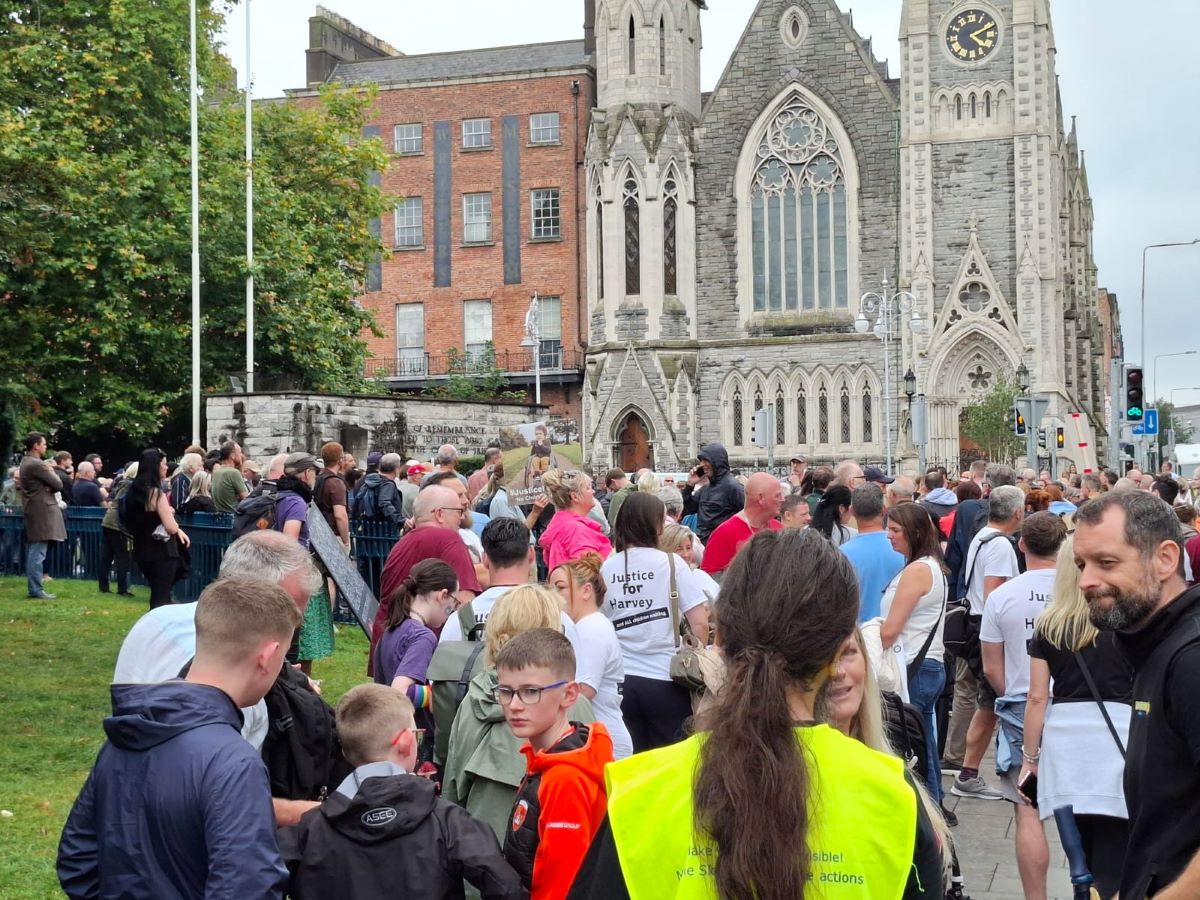
Dublin city centre on Saturday saw two marches scheduled to start at the same time from the Garden of Remembrance, both of which were drenched by heavy showers, as were fans attending the Robbie Williams concert in nearby Croke Park stadium.
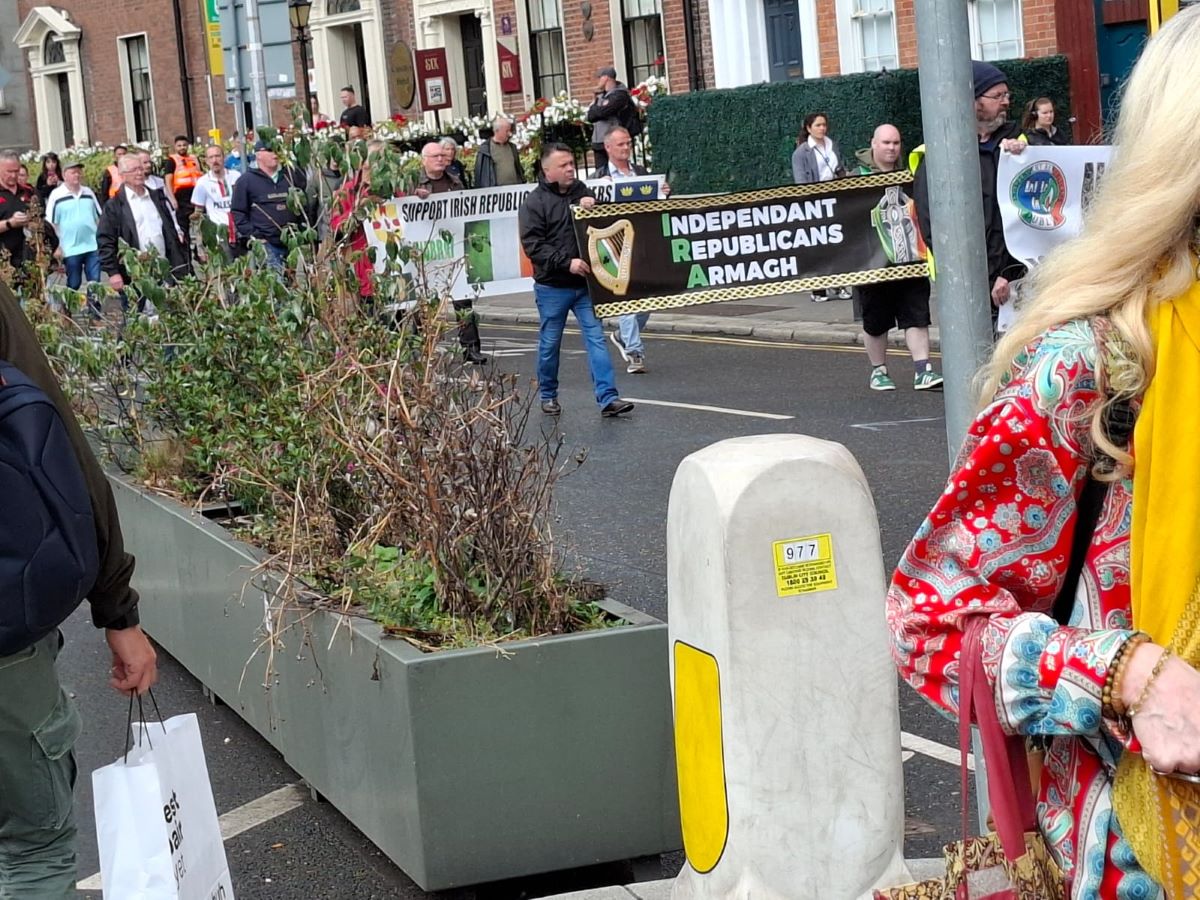
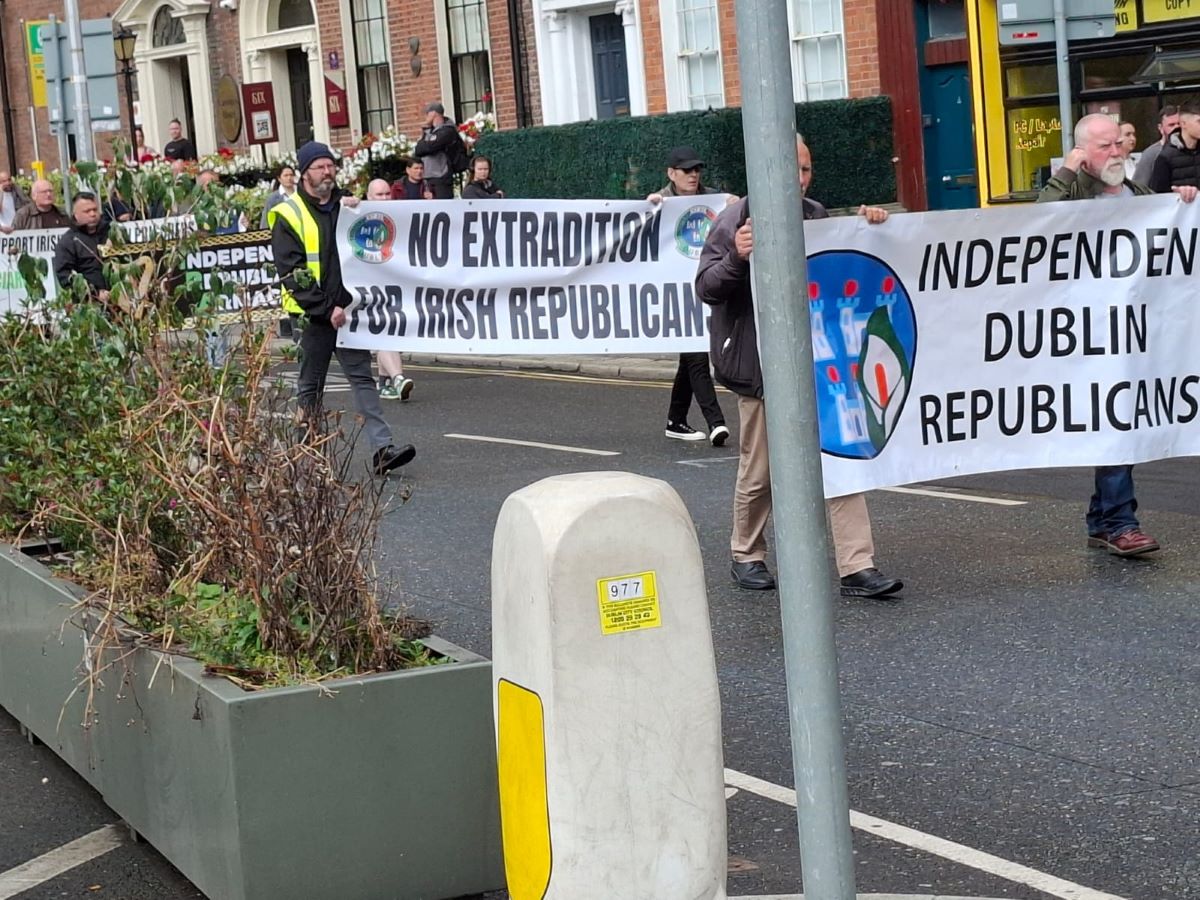
The first march to set off was the largest, the Harvey Morrison protest, the Hunger Strike Commemoration organised by Dublin Independent Republicans waiting for the space to clear in order to assemble theirs, with pipers, band and various banners forming up.
Supporters of both marches are mingled here though the majority are there for the Harvey Morrison march. (Photo: R.Breeze)
The Harvey Morrison protest was about the long wait the named boy had for appropriate treatment from the Irish health service for his condition of spina bifada and scoliosis. As he waited, his spine continued to curve causing him pain and though underwent surgery last year died on July 29th.
It emerged last year that Harvey had been removed from Children’s Health Ireland’s (CHI) urgent scoliosis surgery waiting list, without his family being informed. In 2017 Simon Harris declared that no child would wait for more than four months for scoliosis treatment.
Apart from those requiring specialist treatment for rarer medical conditions, people with much more common complaints face many hours in A & E before being seen by a doctor or having an X-ray taken, with an average of 500 people admitted to hospital on trolleys daily awaiting beds.1
Seven different speakers addressed them at their rally on Custom House Quay, being well received by the crowd with a small exception, which was when a participant shouted ‘Traitor!’at Mary Lou Mac Donald, President of the Sinn Fein party, before being told by march stewards to keep quiet.
Calling SF (and any in Government) politicians ‘traitor’ is a frequent position of those on the Far-Right2 in the Irish State, for racist reasons. Indeed, a number of Far-Right activists were spotted among the marchers but it seems they were unable to dominate the event.
THE HUNGER STRIKE MARTYRS COMMEMORATION
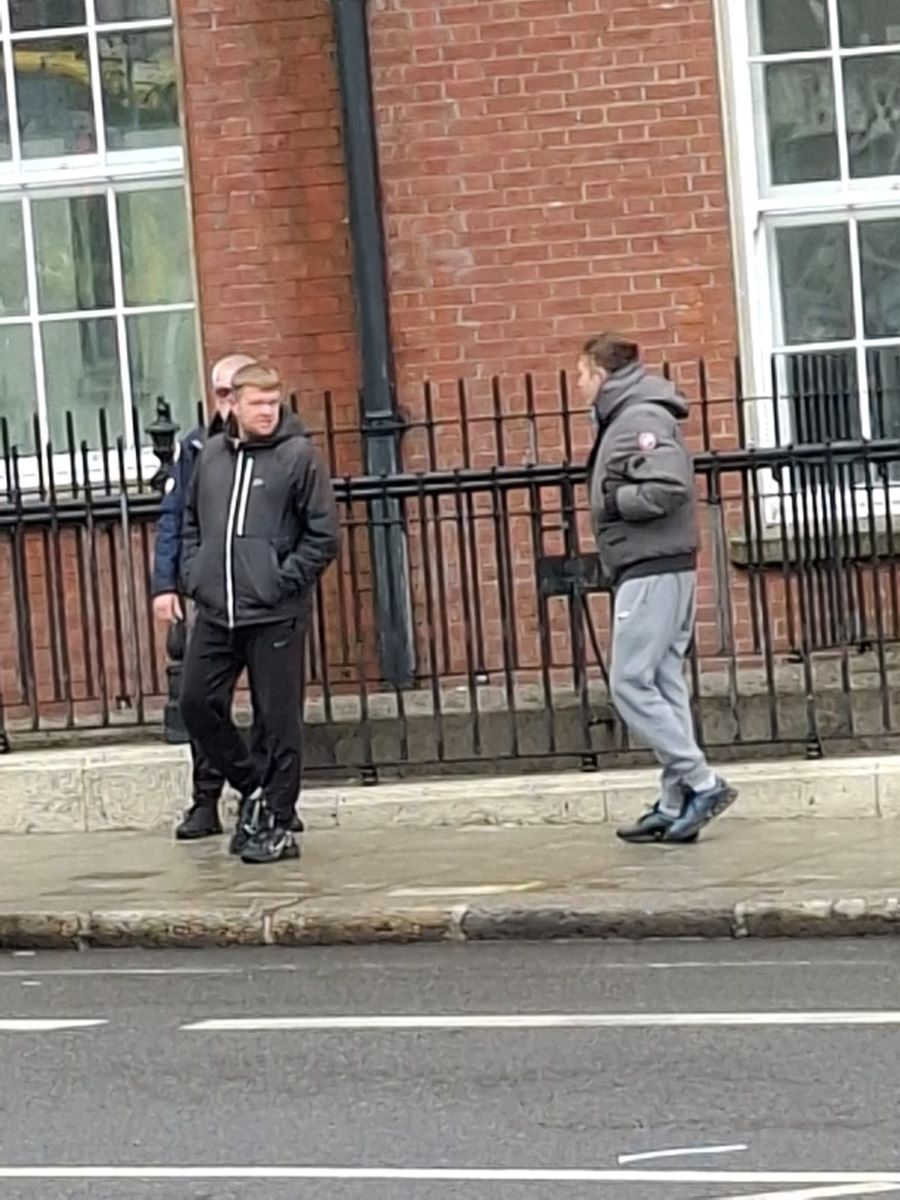
A handful of fascists were also observed watching the Hunger Strike martyrs’ commemoration gather and photographing them but when some of their targets began to photograph them in turn, they walked away, presumably to go and promote themselves and their lies on social media.
Fascists who had been filming the Hunger Strike Commemoration moving off as a camera turns on them. (Photo: R.Breeze)
Irish Republicans, who are opposed to (and by) the Far-Right, also call Sinn Féin ‘traitors’ but for the reason that they consider the party has left the struggle and colludes with the neo-colonial ruling class of the state and with the English occupation in the Six Counties.
The pipers prior to setting off on the march. (Photo: R.Breeze)
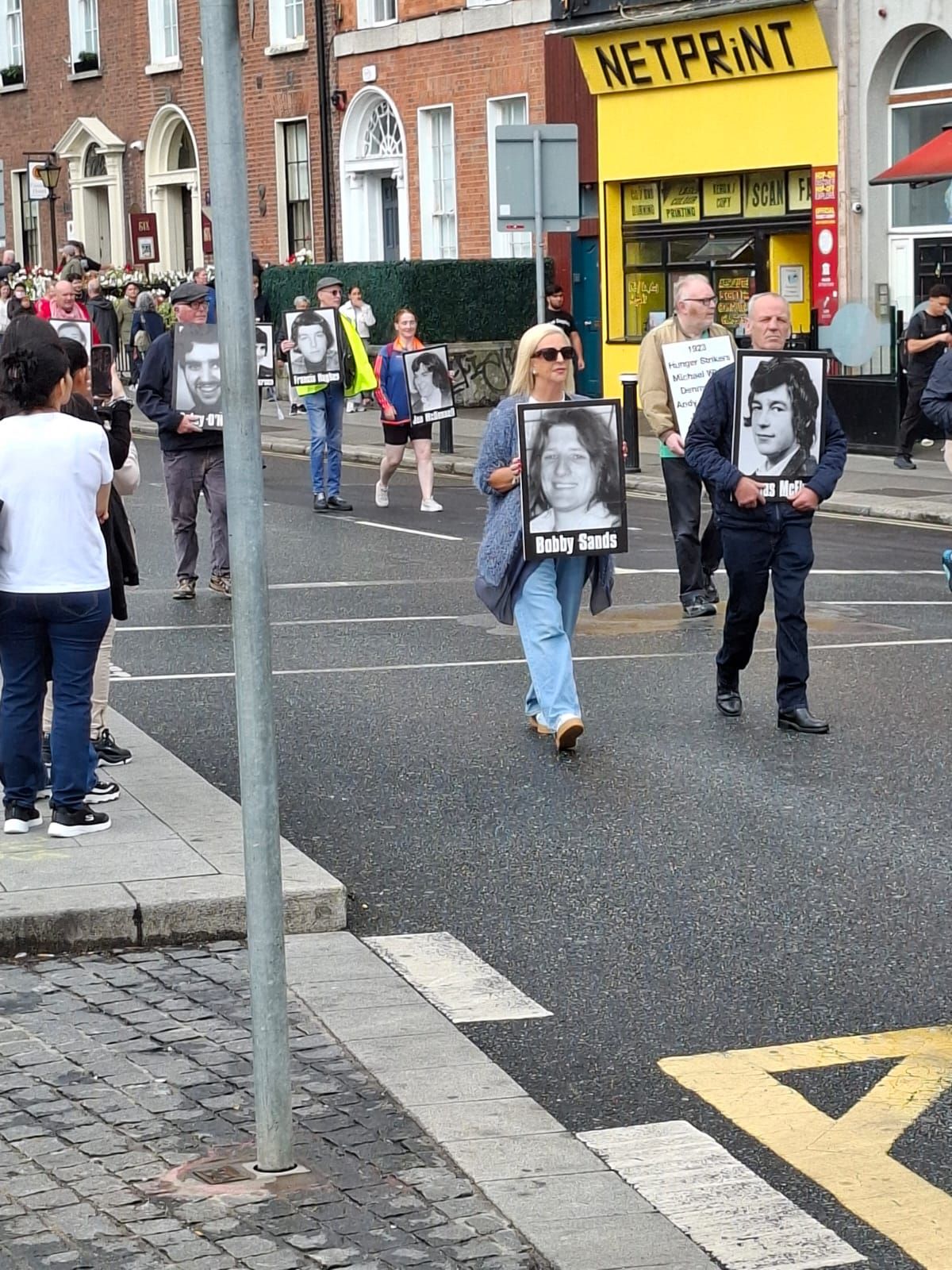
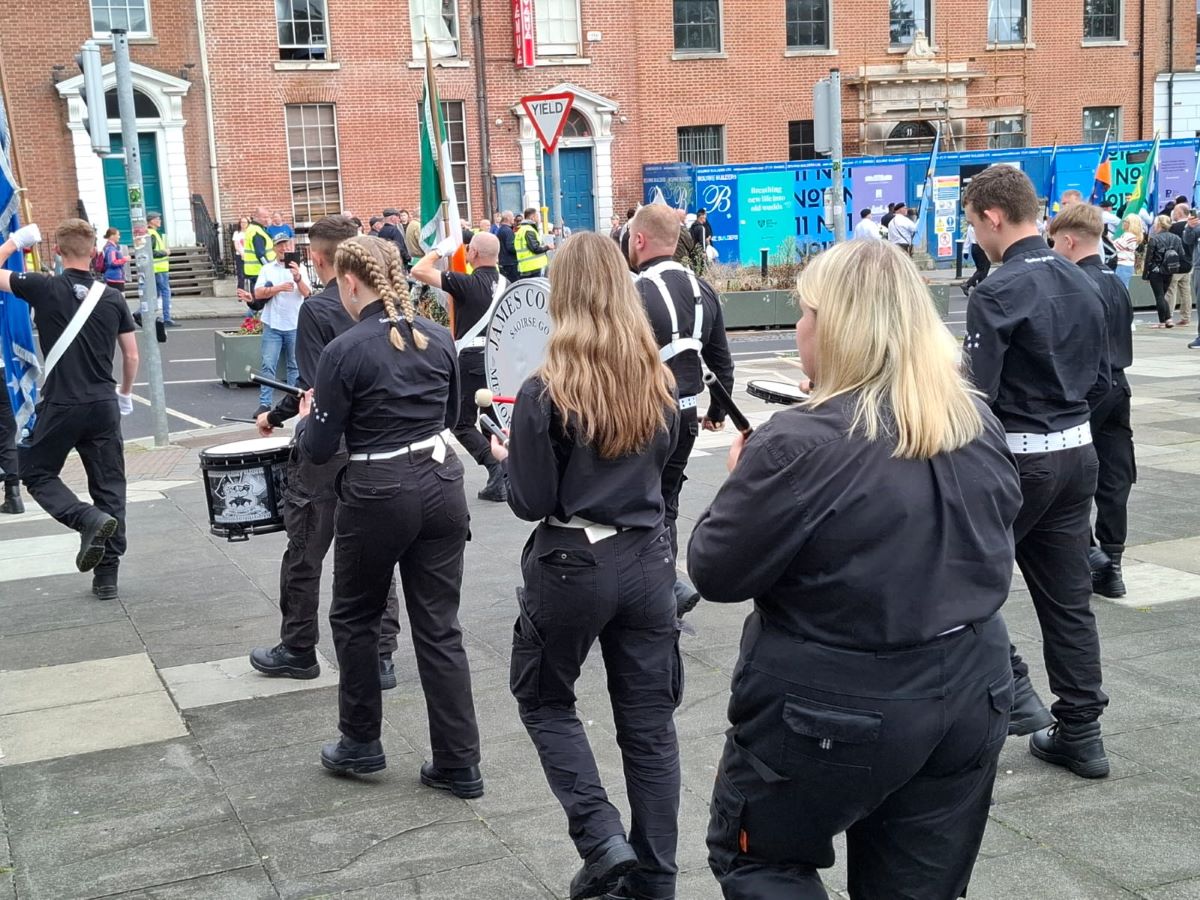
Two pipers led off the Hunger Strike commemoration organised by Independent Dublin Republicans followed by a full colour party and the James Connolly Republican Flute Band, from Derry. In traditional two lines style they marched through onlooking crowds in O’Connell Street.
The march crossed the Liffey into D’Olier Street, back up O’Connell Street and after a pause at the Government-threatened GPO, into Parnell Street, then around the western and northern sides of the Square and back into the Remembrance Garden for the commemoration ceremony.
The Hunger Strike Commemoration march proceeding down from the Garden of Remembrance and just about to enter Dublin’s main thoroughfare, O’Connell Street. (Photo: R.Breeze)
And it rained – it poured down rain. Which was bad enough on the audience but much much worse on the colour party in shirt and trousers, the RFB members and those holding the portraits of the ten hunger strike martyrs and a number of banners.
Dixie Elliot was introduced as the main speaker, well-known in Republican circles, former member of the Provisional IRA, an ex-POW and ‘Blanketman’.3
(Photo: R.Breeze)
Seemingly undeterred by the pouring rain, Elliot spoke at substantial length though whether through lack of projection or faulty amplifier, much of what he said was lost to many in the audience. From snatches he could be heard going through the history of the recent three decades’ war.
The targets of his condemnation were not alone the British occupation and the Irish State’s complicity but also the leadership of the Irish Republican movement who had abandoned the struggle and become part of the colonial administration in the Six Counties.
(Photo: R.Breeze) (Photo: R.Breeze)
Expressing solidarity with the Palestinian struggle and against imperialism, Elliot also condemned the far-Right in Ireland who claim to be ‘patriots’ in order to promote their racism and he counter-posed the example of Bobby Sands’ internationalism in his poem The Rhythm of Time.
The Connolly Memorial Republican Flute Band setting out on the march from Garden of Remembrance. (Photo: R.Breeze)
Both Elliot and the Chairperson called for solidarity with Irish Republican political prisoners and the framed Craigavon Two, convicted in a no-jury political Occupation court and still in jail 16 years later.
Finally chairperson Ado Perry thanked people for their attendance, the colour party and audience stood to attention and the piper played the air to the chorus of the song generally known as Amhrán na bhFiann (and of which the chorus melody is also the ‘National Anthem’ of the Irish State).
(Photo: R.Breeze)
CROKE PARK CONCERT
The Gaelic Athletic Association stadium in Croke Park was the venue for a Robbie Williams concert in Dublin and the fans were flocking into town in rainproof macs that the marchers could have done with. The previous weekend it had been the Manchester Gallaghers, i.e. Oasis there.
The finals in Gaelic football for men and women and in hurling have been played in Croke Park in previous weekends and now it seems it’s rock concerts season.
The far-Right protested the couple of occasions that the stadium was rented to celebrate the Muslim feast day of Eid. Apparently English musicians and bands playing there are are not problematic for them. But then nor are the banks and property speculators causing the housing crisis.4
End.
(Photo: R.Breeze) (Photo: R.Breeze) (Photo: R.Breeze)Main speaker, Dixie Elliot, speaking at rally in Garden of Remembrance at end of Hunger Strike Commemoration march. (Photo: R.Breeze)
3One of the Irish Republican ‘blanket protester’ prisoners who resisted the attempt of the colonial prison service to make them wear regulation prison uniform, wearing underwear and a blanket instead. This condition degenerated into the ‘no wash’ and ‘dirty protests’ which the prisoners sought to overcome with the hunger strikes of 1980 and 1981 when 10 prisoners died.
I wish to briefly clear up what I believe to be some confusion about the terminology in the title, basing not so much on opinion but relying in the main on fact as illustrated by history.
I will attempt to show thereby that Republicanism and Irish Republicanism are different things ideologically and that socialism is different from both of them.
Republicanism entered the world as a political aspiration and, after revolutions in Britain, France and the USA, practised as a system of Government. It proclaimed electoral democracy for its citizens (at first men but later women) – but quite clearly the bourgeois class ruled society.
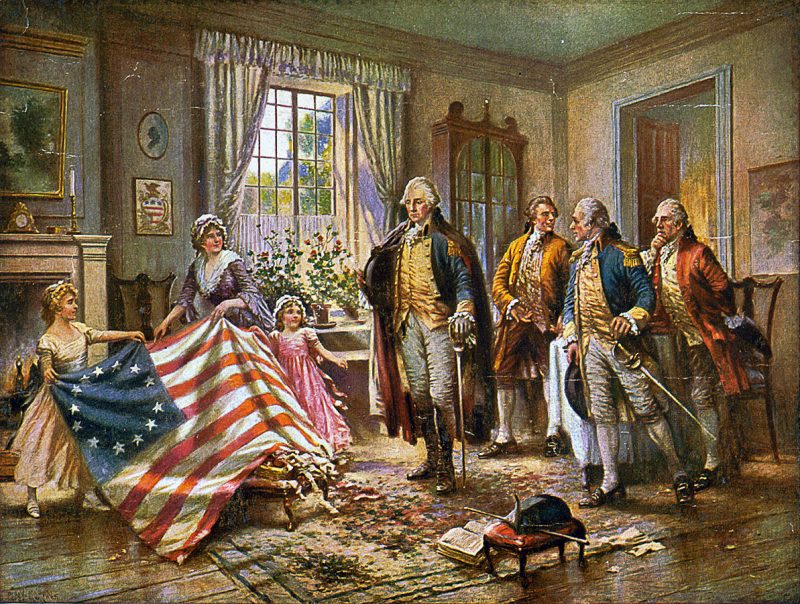
George Washington, Republican, being presented with the flag of the early American Republic. (Image sourced: Internet)
It was a democratic bourgeois (essentially capitalist) ideology characterised by individual choice,1 opposition to feudalism and monarchy and separation of church and state. It was not essentially socialist nor even anti-colonial, as we can clearly see from its early examples.2
Republican government was overthrown in Britain (English and Scottish administrations), the monarchy restored and in time a kind of compromise monarchy-democratic system evolved. The republican system in France and the USA remained and is with us to this day.
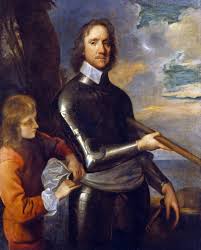
Painting of Oliver Cromwell, an English Republican whose name became part of a curse in Ireland (including for Irish Republicans!). (Image sourced: Internet)
Irish Republicanism also developed as a bourgeois ideology (drawing on English, French and US Republican thinking)3 but it was clearly also in favour of Irish sovereignty and therefore against the colonialisation of Ireland.4 Once measures of reform were blocked it became revolutionary.
This gave rise to the revolutionary organisations of the United Irishmen of the 1790s and early 1800s and the Young Irelanders of the middle of the 19th Century; also of the Irish Republican Brotherhood of the later 19th.
The IRB or Fenians however had a strong working class character and were admitted to the First International Workingmen’s Association, the first international socialist organisation. However, Irish Republicanism remained a bourgeois ideology albeit democratic and revolutionary.
Karl Marx and Frederick Engels, founders of scientific socialism. (Image sourced: Internet)
Socialism
The ideology of socialism has a long pedigree but was made more concrete under and in opposition to capitalist society. It found development on a scientific ideological and organisational basis particularly with the work of two German migrants to Britain, Karl Marx and Frederick Engels.
This ideology emphasises communal over individual ownership of the means of production, distribution and use/ consumption and sees the socialist state as a stage on the way to communist society. Its mantra is: From each according to their ability, to each according to their contribution.5
In terms of implementation the Paris Commune of 1871 was the first socialist capture of a city and the October Socialist Revolution of 19176 in Russia the first time a country was taken by socialists.7
Irish Republican ideology continued into the early decades of the 20th Century with its military organisation first the Irish Volunteers of the 1916 Rising and later, the Irish Republican Army of the War of Independence, whose leadership split over the English offer of autonomy with partition.
Ireland had been kept under-industrialised by colonialism but socialist political organisation was developing slowly in some urban areas. In 1896 Connolly and others founded the Irish Socialist Republican Party in Dublin and in 1912 he and Larkin also the Irish Labour Party.
In 1911 Larkin had founded the Irish Transport and General Workers Union.
The employers strove to break the ITGWU and implemented a Lockout of union members or supporters in 1913; attacks on the workers by the Dublin Metropolitan Police led to the defensive creation of the Irish Citizen Army – the first workers’ army in the world.8
Some Irish Republican leaders and followers sympathised with the strikers and some did not but the Republican movement did not mobilise in their support with the exception of a number of members of Iníní9 na hÉireann, which would later split between the ICA and Cumann na mBan.
In 1916 the IRB organised an insurrection with the participation of its Irish Republican military forces of the Irish Volunteers, Cumann na mBan and Na Fianna Éireann united with the Socialist force of the Irish Citizen Army (including women members).10
The War of Independence 1919-1921 was led by the Irish Republican movement with some support, particularly in intelligence and arms smuggling, by the Irish Citizen Army.
The Civil War 1922-2311 followed the British offer of autonomy with partition, as the leadership of the Irish Republican movement, including a section of the IRA split. The ICA had lost its leadership but did not join the neo-colonial side and in subsequent years faded organisationally.
The main opposition leadership to the State returned to being nationalist in the shape of Sinn Féin and the Anti-Treaty IRA, both of which split again with a substantial number joining the De Valera-led Fianna Fáil, which would soon show itself to be also neo-colonial in outlook and practice.
In this period a Socialist current grew within the Irish Republican movement, responding to international and domestic events including the growth of fascism. The short-lived Republican Congress attempted to combine the Socialist and Irish Republican currents in one broad front.
The Irish Republican movement leadership and substantial sections of its membership was however socially conservative and largely dominated by Catholic Church influence. The IRA responded to the Republican Congress with a new anti-communist rule and the expulsion of Congress members.
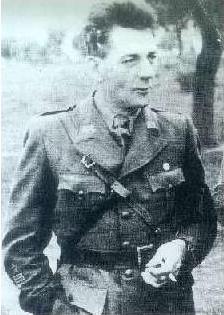
Frank Ryan, IRA and International Brigades, Socialist (Image sourced: Internet)
This sad part of the history of the Irish Republican movement illustrates very clearly the separate nature of Irish Republican and Socialist organisation. The IRA of the 1930s were Irish Republicans but anti-socialist and those who joined Congress had begun as Republicans but were now socialists.
Or Socialist Republicans perhaps but with the emphasis on socialism. Henceforth other variants would exist, of Republicans who were socially conservative, or liberal, or socialist-influenced … but Irish Republicans first and foremost.
Such an ideology would allow them later to unite to focus on a war against the colonial occupation of one-sixth of the nation but to largely neglect the social, economic and cultural issues arising from a socially conservative neo-colonial regime affecting the majority of the Irish population.12
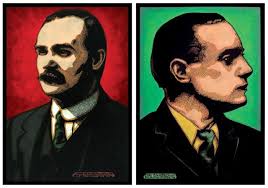
There may be a tragic illustration of the difference between revolutionary Irish Socialism and revolutionary Irish Republicanism in the last of the Dublin 1916 executions, on 12th May, of the socialist James Connolly and of the Irish Republican Brotherhood organiser Seán Mac Diarmada.
Connolly was one of the leaders of the ITGWU and its Irish Citizen Army which had fought the bitter eight months against the Lockout to smash the union. Mac Diarmada is reported opposing the workers’ action, believing that Irish manufacture and trade would lose out to English competition.13
CONCLUSION
There are Irish Republicans who are revolutionary socialists and Irish Republicans who are not. There are also some revolutionary Irish socialists who are not strictly speaking Irish Republicans. All can and should join in the struggle against British colonialism and other imperialism.
A sovereign Irish Republic on a united 32 Counties would be a great progressive step, for democracy and against imperialism and colonialism. It would not, however, be socialist just because it was Irish Republican, even if it adopted some socialist measures.
A socialist Ireland would be one in which the working class ruled and its measures would include socialisation of all productive enterprises including factories, agricultural and construction enterprises and distribution centres, i.e any which employed workers not of the owner’s family.
And socialisation of all transport and communication networks and social and health services in addition to financial services.14
If it did all the above the regime in Ireland would be socialist and would not even need to call itself ‘Republican’.15 If it were not socialist then it would be capitalist and the struggle for socialism would need to confront the Irish state which would in turn seek to repress the socialist struggle.
Republicanism and Irish Republicanism are different things and socialism is different from both of them.
If people wish a socialist society they should not expect Irish Republicans to present them with that but will instead need to educate, organise and lead their own revolutionary socialist forces while simultaneously participating in the broad anti-colonial and anti-imperialist struggles.
2English Republicanism did not in general envisage the right of Ireland to self-determination, nor France agree with the national rights of the Breton and Basque nations, nor of the colonies abroad for independence; nor the USA of the rights of the Indigenous not to have European settlers occupy their land.
3Largely adopted by sections of business and professional classes of the Occupation, i.e settlers and descendants of settlers.
4Many Irish Republicans were historically able to collude in English settler colonialism in Australia and early colonial occupation of America, as well as later USA settler colonialism into lands still held by the Indigenous Americans.
5However, in communist society, it was understood that the second half of that slogan would be ‘to each according to their needs.’
6The earlier February Revolution had been a workers’ strike and bourgeois uprising against war and the absolutist power of the Tsar. Incidentally it had been only the second revolution against world war, as the 1916 Rising in Ireland had been the first.
7I am not discussing its development or degeneration here, which would take us away from the central topic of discussion.
8Most armies chiefly recruit from the working class but the ICA was specifically for as well as of the workers.
10That they were distinct forces is clear in their development and leadership but in the membership the differences would not always be so clear-cut. The Constitution of the ICA was Irish nationalist but required all members to be trade union members and people chose an organisation to join on the basis of family and social circle loyalties.
The Irish socialist Republican group Anti-Imperialist Action today issued a call to revolution centred around a need for universal social housing to resolve the chronic housing crisis in Ireland (and in particular in Dublin).
This housing crisis has at January’s count left nearly 15,300 living on the streets or in emergency accommodation1 with another unknown number in inappropriate accommodation such as sofa-surfing with friends and relatives or in IPAS centres for refugees.
Rampant property speculation has made a handful of bankers and speculators very rich and along with the social misery of thousands, facilitated the demolition of buildings of historical and architectural importance and their replacement by usually unsightly glass and concrete.2
Well, so what of AIA’s call? Different organisations make various calls at different times but do they have any effect? However, this one has some important distinctions, one of which is that this organisation actively practised its preaching when it called for the occupation of empty properties.
In May 2022 the AIA founded a sub-group called Revolutionary Housing League that occupied empty buildings in Dublin, refused to comply with court orders3 to evacuate or, in court, to agree to bail conditions that they would desist from further building occupations.
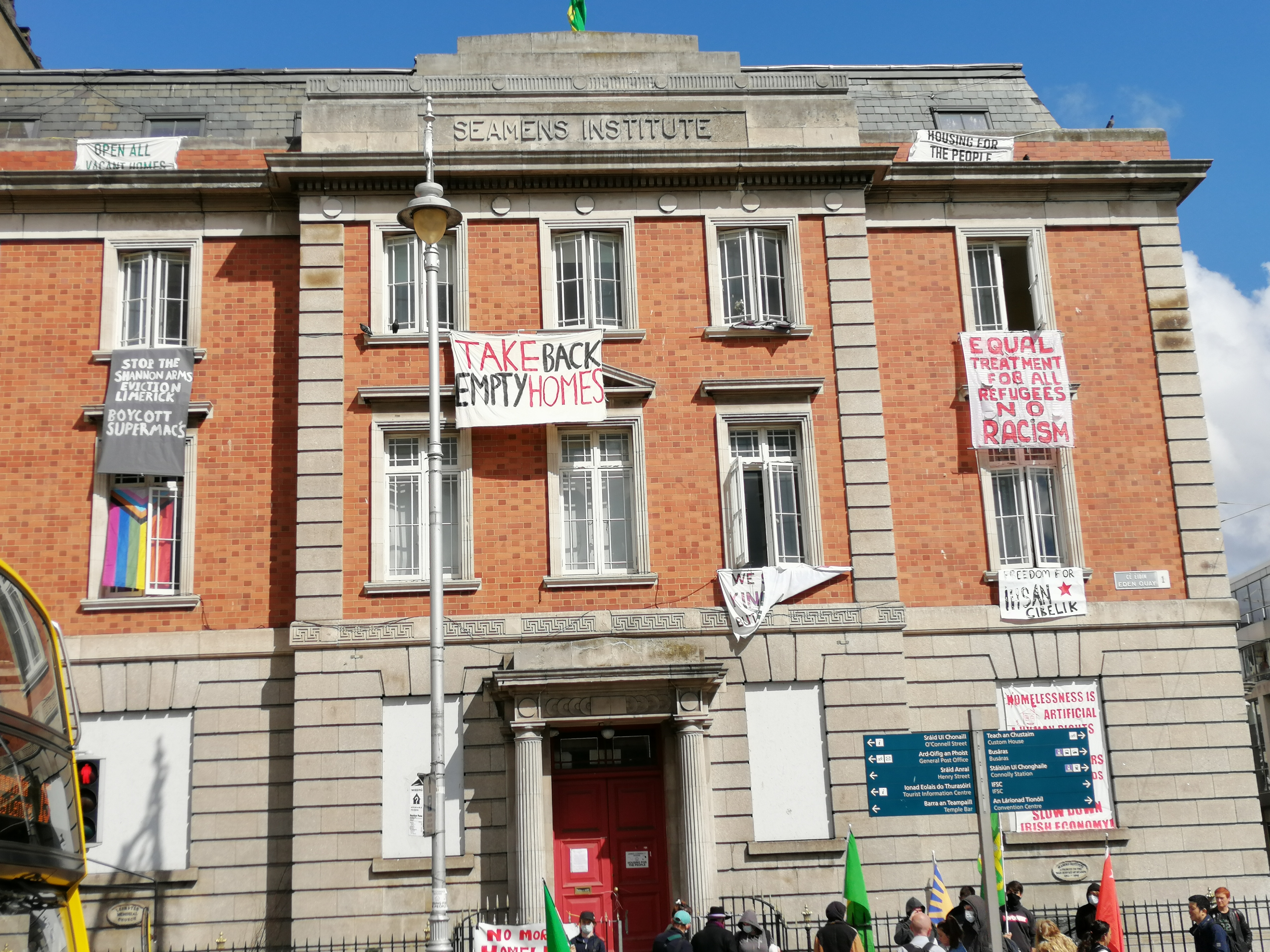
‘James Connolly House’ in occupation by the RHL in May/ June 2022. Photo: D.Breatnach)
The first building targeted on May 1st was a former Seamen’s Institute building on Eden Quay, renamed Connolly House, metres from O’Connell Bridge, empty for years since the Salvation Army, a religion-based charity NGO, had lost government funding for its youth homeless accommodation project.
On the morning of June 9th 2022 over a hundred Gardaí, with an armed unit on standby and a helicopter overhead, stormed the building4 and arrested the only occupants, two RHL supporters. In court later that day, they were bailed without making any promise not to re-occupy buildings.5
It seemed that the State was sensitive to the dangers of creating martyrs around the housing crisis.
Instead, RHL renewed its call for mass action across the country to occupy empty buildings. And went on to occupy other buildings, including Ionad Sean Heuston near the eponymous Bridge and another in Belvidere Road, eviction here also including massive police forces and helicopter.
Seen from the north bank of the Liffey, the Starry Plough flag flying high over the ‘Ionad Sean Heuston’ occupied building. The Heuston train station is behind the photographer while the Bridge is out of frame to the right. (Photo: D.Breatnach)
Success for the RHA’s campaign depended on, if not a mass, at least a substantial take-up of its call to occupy empty buildings backed by civil disobedience to the courts. Neither happened and the AIA was far too small to carry the campaign on its own and so suspended it.
It is worth noting that though many organisations and individuals had agitated around housing, including the high-media-profile occupation of Apollo House in December 2016, backed by noted individuals,6 none had initiated the steps advocated by RHA/ AIA.
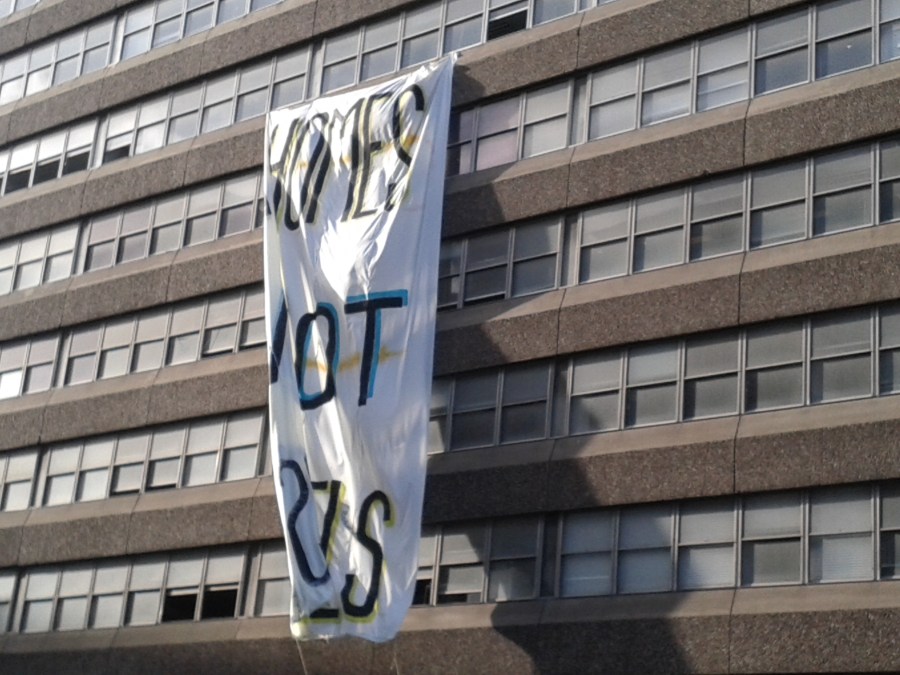
‘Homes Not Hostels’ banner on Tara Street side of occupied Apollo House in December 2016 or January 2017. The building was later demolished and numbers of homeless people continued to rise. (Photo: D.Breatnach)
Amongst a general lack of social condition agitation among the post-GFA7 Irish Republican movement, only the socialist-Republican éirigí organisation had militantly taken up the housing struggle while calling for universal social housing — but it had not led a campaign of occupations.
The electoral left and some anarchists had occupied some empty buildings but had either left when threatened by the State or been evicted by security thugs backed up by Gardaí, without a follow-up of further occupations. Nor had they contextualised housing occupations as part of revolution.
So the record of AIA is stand-alone among the Republican and Socialist Left so far and therefore, one might speculate, failed to inspire a mass movement.
I am not ashamed to say that I supported AIA’s campaign although I did not take part myself in any of the occupations. However I did not view it as an immediate cause for revolution, nor do I now. The Irish gombeen8 State, I believe, can survive the supply of universal social housing.
The ‘rack-renting’ landlords, both big and small, cannot. But the Gombeen class, closely linked to the landlords and speculators will ditch them if they are confronted – not with the suffering of the masses, about which they care not, nor protests – but with the real alternative of social revolution.
The State has access to the means to fund such a campaign of new housing construction and of renovation/ repurposing of existing empty buildings9 by local municipal authorities.
In such a radical change of the Irish neo-colonial capitalist system, people would have more disposable income and purchasing would increase dramatically, stimulating production and expansion of goods and services and raising people’s living standards (and expectations).
Property speculation would be hugely reduced in scope but would continue – in hotels and office blocks, for example and big projects such as transport networks. And possibly in sale of land to State and local authorities for housing projects.
So, essentially a reformist project, not revolutionary at all, right? No, not at all necessarily. Reformist projects fought for with revolutionary intent and energy, teach the masses their potential when they unite in struggle. It also tests their leaders before their eyes, in their experience.
I see universal social housing therefore as a social necessity for the mass of people living on the streets, in hotel-rooms, sofa-surfing, in insecure and inappropriate housing, facing eviction from debt-mortgaged housing (the cost of which has already been paid several times over).
Universal social housing is a social necessity and an urgent one and it is an objective for which all true humanity in Ireland should strive. Revolutionaries should fight for it, pointing towards the evils of the capitalist system and the need for its replacement by a socialist system.
The struggle should be fought relying on the strength and capacity of the working people and will need to embody civil disobedience and sacrifice, while at the same the movement needs to safeguard capacity for other struggles such as against fascism, imperialism and colonialism.
In that context therefore, I think we should unreservedly support the call of the AIA’s statement today and the headline of this article.
End
FOOTNOTES
SOURCES
Anti-Imperialist Action statement on Telegram 19/08/2025
Text of Anti-Imperialist Action statement 19/08/2025:
Housing is a key part of the Republican struggle for National Liberation and Socialist Revolution in Ireland.
Housing is one of the key pressure points in the class struggle in Ireland today, due to the artificial housing crisis created by those in power, designed at driving up profits for landlords and imperialist housing vultures.
Since the days of Tone, Irish Republicans have recognised that land and housing are completely tied to the fight for freedom, and today it is by showing the Republican struggle will solve the land and housing issue once and for all, to the benefit of the working class, that Republicans can mobilise our class to join the fight.
There should be no doubt about the Republican position on housing. The 1916 Proclamation stated that ‘the ownership of Ireland by the People of Ireland’. The Democratic Programme placed public right above private property and stated, It shall be the first duty of the Government of the Republic to make provision … to secure that no child shall suffer hunger or cold from lack of food, clothing, or shelter’.
Landlords and foreign imperialist housing vultures have no place in the Republican vision of a Free Ireland, where homes would be provided by the Republic to all Citizens.
AIA advocates a system of Universal Social Housing as the Republican Housing System that guarantees all citizens a home, and rents based on ability to pay. This system is the death knell for landlords and vultures and it is why the garrison class resists it.
AIA has played a leading roll in the militant housing direct actions of recent years and will continue to do so.
If you want to fight the landlords and vultures and work to bring about the conditions for a Republican system of Universal Social Housing, then join AIA!
Raise the cry of the working class: Smash Landlords and Vultures – Universal Social Housing Now!
2Taking history tour groups around Dublin I often comment that Dublin has suffered three period of architectural devastation, all in the last century: 1) the British artillery bombardment during the 1916 Rising; 2) the Irish neo-colonial State’s bombardment during its Civil War; 3) the property speculators’ rampage from the 1970s onwards. Pete St. John, in his song Dublin In the Rare Aul’ Times:
5I passed by this building recently which, three years later, appeared to be still empty.
6The occupiers eventually agreed to leave under a mixture of threat and promises and the building was demolished.
7The Good Friday Agreements of 1999, the Irish instalment of the imperialist pacification process, following South Africa’s and Palestine’s versions, later to visit Colombia and Turkish Kurdistan.
8From the Irish word gaimbín, first applied to the hustlers opportunistically buying up Irish land in the midst of the disaster of the Great Starvation (1845-1849) but now applied to the Irish comprador or foreign-dependent native capitalist class.





















 rebelbreeze