OASIS, MANCHESTER & THE FENIANS

Diarmuid Breatnach

(Reading time: 4 mins.)


The Oasis rock band are performing on 16 and 17 August in Croke Park, the Gaelic sports stadium in Dublin, to a sold out capacity of 82,300. Brothers Liam and Noel Gallagher are the two leading members of the band.

Oasis-marked t-shirts and caps are being sold from stalls in the city and posters announcing the forthcoming concerts adorned shop windows and lampposts but how many fans know the Gallaghers’ background?
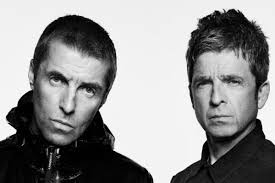
Liam and Noel Gallagher of Oasis (Source imag: Internet)

Liam and Noel were born in Manchester to Irish migrant parents but their mother Peggy split from her abusive husband and moved elsewhere in Manchester, taking the kids with her. Liam dedicated Stand by Me to her on Saturday night and gave a shout-out to her her birthplace in Co. Mayo.1

Ireland fed the British ‘industrial revolution’ and the Irish have a long association with Manchester. In 1845 the city’s factories were already attracting Irish workers and its farms probably also agricultural workers to replace English labourers deserting the farms for the factories.

Friedrich Engels wrote The Condition of the Working Class in England,2 published in 1845 (the first year of the Great Hunger) and mentioned the Irish migrants not too favourably. He was writing mostly about Salford, the subject of Ewan McColl’s Dirty Old Town,3 just outside the city then.

By the time Engels’ book was published, the Great Starvation was gearing up. Uncomplimentary references to the Jews can also be found in that work but whatever about that ethnic minority,4 Engels changed his mind radically about the Irish in Britain and came to admire them greatly.

Instrumental in learning about the Irish for Engels were two Irish sisters living in Manchester, Lizzie and Mary Burns, illiterate but intelligent and militant mill workers. Mary and Friedrich became life partners and, after her death, Friedrich became Lizzie’s partner thereafter.

The Irish, as the natives and diaspora of what is often referred to as “England’s first colony” were of considerable interest to the revolutionary partnership of Engels and Karl Marx and more so still as the Fenian movement, the Irish Republican Brotherhood, spread throughout Britain.5

Karl Marx and Frederick Engels, leading theoreticians and activists of the revolutionary socialist movement. (Source: Workers Liberty)

A largely proletarian movement, the Fenians were admitted to the First International Workingmen’s Association6; no doubt the Irish struggle against British domination greatly influenced the political opinions of Marx and Engels in relation to nations under colonialist rule by capitalist states.

The struggle spilled over from Ireland into the Irish diaspora, particularly that in North America, Australia and Britain. In Australia the Fenians’ role seems to have been mostly in facilitating and escaping British jails there7 while in America, they invaded the British colony of Canada.8
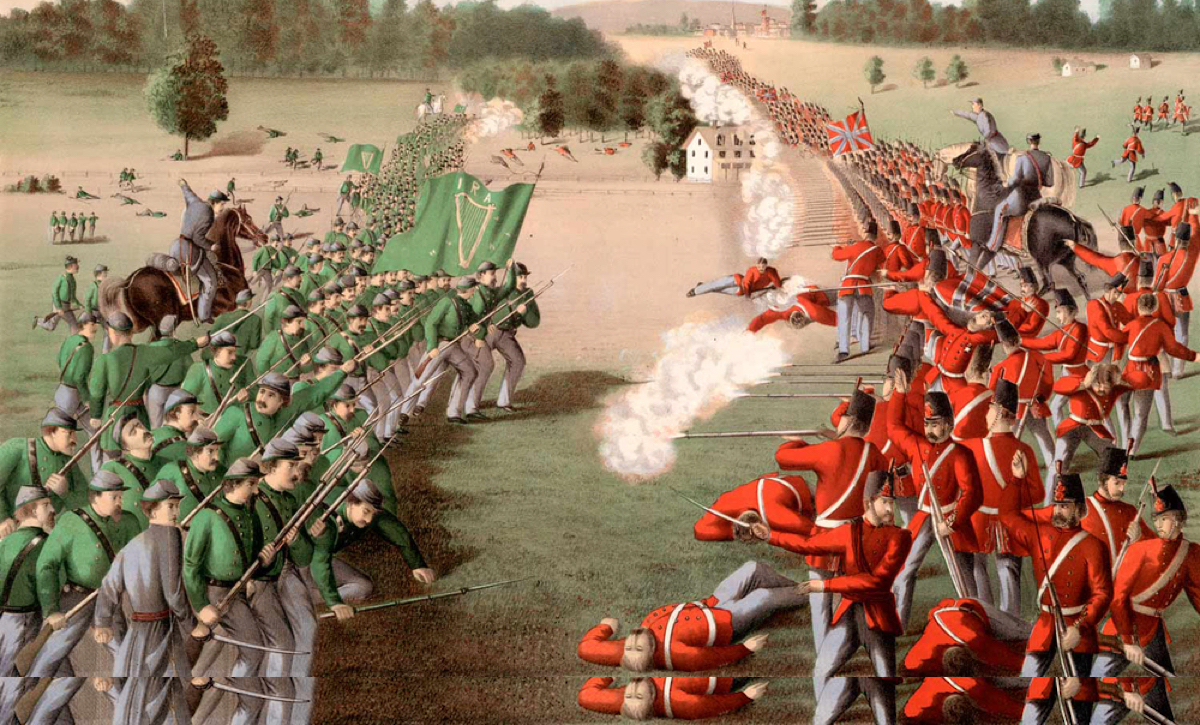
The charge of the Fenians (wearing green uniforms) under Colonel John O’Neill at the Battle of Ridgeway, near Niagara, Canada West, on June 2, 1866. In reality, the Fenians had their own green flags but wore a very mixed bag of Union and Confederate uniforms (if they still had them, or parts of them left over from the Civil War), or civilian garb, with strips of green as arm or hat bands to distinguish themselves. (library and archives canada, c-18737)

In Britain itself, the Fenians went to war against the ruling class with dynamite. To spy on them, Scotland Yard created the Irish Special Branch which evolved into the Special Branch, the political police in Britain and in any colony the British had since then.9

The activities of the US Fenians intersected with those of Britain-based Fenians when two of the former, Thomas J. Kelly and Timothy Deasy, American Civil War veterans, were arrested in England. On their prison van’s journey to jail it was ambushed10 and both officers spirited away.

Artists’ impression of the rescue of the Fenian prisoners.
(Image source: Internet)

Unfortunately and entirely unintentionally, Constable Brett was killed during the breakout. Refusing to hand over the keys from inside the wagon, he was bending to look through the keyhole when in order to release the prisoners one of the Fenians fired at the lock, the bullet entering Brett’s brain.11

The British police swept vengefully through the Irish quarters of Manchester and Salford arresting at least 28 people but eventually sending five for trial on ‘murder’ charges. Three were hanged, all innocent of intentional killing and at least two probably not even present at the scene.

As sentence of death was passed upon them, all five cried “God save Ireland!” Although the sentences on two were commuted, Timothy Sullivan used those words for his ballad about The Manchester Martyrs, as the executed three became known among the Irish at home and abroad.

The song travelled quickly and became an unofficial national anthem of Ireland and the Irish until it was decisively supplantedafter the 1916 Rising by Peadar Kearney’s The Soldiers Song (latertranslated: Amhrán na bhFiann).12 A memorial to the three was erected in Mostyn Cemetery.

Artist’s impression of the trial of the five convicted including the three Manchester Martyrs.
(Image source: Internet)

Manchester continued to be a destination for Irish migrants, for factories still, including motor car production but also post-WW2 reconstruction and motorway building.

Manchester United FC, along with a number of other British soccer teams, recruited Irish players and Irishman Liam Whelan was one of the eight players killed in the Munich air crash of 1958. Another 30 Irish have played for the club at one time or another, some quite famous.13

The city is one of a number of British cities that has a name in the Irish language; Mancunians would probably be delighted to know that their city’s name in Irish is Manchuin.

From the late 1960s to late 1990s the city was host to an active branch of the Troops Out Movement in solidarity with Ireland, also from 1980s to an active branch of the Irish in Britain Representation Group; the Special Branch was active in monitoring and, from time to time, harassing their activists.

The Provisional IRA bombed the city in 1996 as part of its campaign against the British State and — despite a 90-minute warning — 212 were injured.

Today Manchester, alongside South Asian ethnic influences, continues its Irish ethnic presence with Irish traditional cultural activities14 and no doubt the sons and daughters of Manchester’s Irish diaspora will continue to contribute to other sport and artistic culture in Britain and in the world.

Footnotes

1https://www.breakingnews.ie/ireland/oasis-review-the-band-were-great-the-service-was-not-1793012.html

2https://en.wikipedia.org/wiki/The_Condition_of_the_Working_Class_in_England

3https://www.youtube.com/watch?v=s11BuatTuXk here performed by The Pogues

4Given that Marx, a German Jew, became his closest political comrade and writing partner, it’s likely he changed his bias against Jews also.

5https://www.marxists.org/history/international/iwma/documents/1867/fenians.htm and Introduction to https://journals.sagepub.com/doi/10.1177/030639688202400204

6https://en.wikipedia.org/wiki/International_Workingmen%27s_Association

7For example, the escape on board The Catalpa https://www.irishtimes.com/opinion/an-irish-diary/2023/11/01/the-greatest-escape-frank-mcnally-on-one-mans-mission-to-make-a-movie-about-the-catalpa-rescue/

8https://www.irishcentral.com/roots/history/irish-fenian-invasion-canada Unlike many other accounts easily available this one gives a reasonable assessment of the rationale for the invasion, including its potential and the reasons of its ultimate failure, the interests of the ruling class of the USA, which the Irish Republican movement should have learned from forever afterwards – but failed to do.

9Often referred to simply as ‘the Branch’ or ‘Branchmen’ (though the organisation of course also recruits women).

10The location, by an arch under a railway bridge, is still unofficially known as “Fenian Arch.”

11https://en.wikipedia.org/wiki/God_Save_Ireland

12https://en.wikipedia.org/wiki/God_Save_Ireland

13For example, George Best and Roy Keane.

14Manchester has a Comhaltas Ceoltóirí Éireann club (for Irish traditional music) and informal music sessions, also an Irish dancing school https://www.facebook.com/profile.php; Gaelic Athletic Association clubs  including St Brendan’s, St Peter’s, Oisín, and St. Lawrence’s.

Sources

The Fenian Ambush: https://ballymacoda.ie

The ballad: https://en.wikipedia.org/wiki/God_Save_Ireland

The First International and Fenians: https://www.marxists.org/history/international/iwma/documents/1867/fenians.htm

The Saturday concert in Croke Park: https://www.breakingnews.ie/ireland/oasis-review-the-band-were-great-the-service-was-not-1793012.html

PADDY HILL, THE BIRMINGHAM SIX AND THE CRAIGAVON TWO

Diarmuid Breatnach

(Reading time: 3 mins.)

There were also others: the Guildford Four, Maguire Seven and Judith Ward, all innocent and all convicted in separate cases, mostly in 1974, in the same year that the Prevention of Terrorism Act was passed to silence the Irish community.

Yet others continue being framed, including the Craigavon Two.

There were also others: the Guildford Four, Maguire Seven and Judith Ward, all innocent and all convicted in separate cases, mostly in 1974, in the same year that the Prevention of Terrorism Act was passed to silence the Irish community.

Paddy Hill in 2017 outside the Dublin court where the Jobstown case was being tried (Photo sourced: Internet)

The agitation for civil rights for the community of Catholic background in the British colony of the Six Counties in Ireland began in the last years of the 1960s and very soon people in Britain were marching in solidarity with those facing violent colonial repression in the Six Counties.

The Irish were the most numerous and longest-established migrant community in Britain and had become active in many social, trade union and political circles with the potential to educate and strongly affect the host community.1 This was a problem for the British ruling class.

The jailing of so many people, in many cases obviously innocent, hundreds of arrests, thousands of detentions and interrogations with desertion by much of the British liberal and Left sector terrorised the Irish community so that many stepped away from solidarity campaigning.

That repression muted the Irish community’s solidarity actions until the 1981 Hunger Strikes brought them out again in thousands.

After his release in March 1991 Paddy Hill founded Mojo to campaign for framed innocent people and supported the campaign to free the Graigavon Two, another case that bears many of the hallmarks of a frame-up for political reasons, as famous barrister Michael Mansfield2 commented:

There is nothing more particular about it (the Craigavon Two case) than in all the other miscarriages and the same features appear in all these things.”3

PSNI Constable Steven Carroll was shot dead by an AK47 bullet on 9th March 2009 in Craigavon, Armagh while responding to a fake crime call, the “dissident” group the Continuity IRA claiming responsibility.4 The arrests of John Paul Wooton and Brendan McConville followed.

Political cases in the Six Counties almost invariably are tried by the no-jury Diplock Court and the judge there refused both men bail. This might seem normal except that they did not go to trial until three years later – and kept in jail throughout the period.

Shortly before the eventual trial a man approached the PSNI saying he had seen McConville near the scene and on the evening of the killing of the Constable. This man was the only witness for the PSNI Prosecution but his partner, with him on the evening in question, refused to confirm his tale.

The night was raining and dark and the eyesight of the alleged witness was exposed as weak by the Defence. The coat he alleged McConville to be wearing was a different type, length and colour to that which the Prosecution was alleging McConville had been wearing on the night in question.

This ‘witness’ was also described by his father as having ‘a Walter Mitty character’ and the PSNI admitted paying him as an informant. An AK47 was recovered near the scene of the killing and the one fingerprint recovered from it did not match those of either Wooton or McConville.

Craigavon Two

Brendan McConville and Paul Wooton, taken in 2017. (Photo sourced: Petition for the release of the Craigavon Two)

There was no evidence against either man of having even handled the weapon never mind fired it, no evidence placing either at the scene apart from the dubious testimony placing one of them nearby. Incredibly, it might seem, nevertheless they were found guilty on 12th May 2012.

McConville was sentenced to 25 years and Wooton to ten. Their appeal two years after conviction in May 2014 was unsuccessful and in fact the Prosecution used it to add another four years to Wooton’s sentence.

Paddy Hill of the Birmgham Six and Gerry Conlon of the Guildford Four, both sadly deceased, both innocent but served long years in jail, both supported the campaign of the Craigavon Two. (Photo sourced: Internet)

Paddy Hill was not the only former framed prisoner to support the campaign to free the Craigavon Two. Gerry Conlon was asked to examine the case and became a convinced and dedicated campaigner for the men, speaking out about it as late as a week before his untimely death.5

Paddy Hill and the rest of the Birmingham Six were framed by the British system and served 18 years in jail. In May this year McConville and Wooton will have reached their 16th in jail. For how much longer will they and their close ones be tortured?

End.

Footnotes

1The Irish diaspora in Britain had provided the British working class with its anthem (The Red Flag), its classic novel (The Ragged-Trousered Philanthropists) and two leaders of its first mass movement, the Chartists (Fergus O’ Connor and Bronterre O’Brien) and had also formed a strng section of the First International Workingmen’s Association led by Marx and Engels. In 1974 people of Irish background were estimated to form up to 10% of the population of some British cities.

2Mansfield led the appeal cases of the Birmingham Six and of the Guildford Four.

3Quoted in the campaign petition https://www.change.org/p/ccrc-the-craigavon-2-deserve-justice-now

4The same organisation had claimed the killing of two British soldiers at the Massarene Barracks, also in Co. Armagh, only days previously.

521 June 2014, a few months after his 60th birthday.

Further information and petition

Petition: https://www.change.org/p/ccrc-the-craigavon-2-deserve-justice-now

BARMBRACK, HALLOWEEN PARTY – AND NO ‘TRICK OR TREAT’!

Diarmuid Breatnach

(Reading time: 5 mins.)

Years ago we did not have the USA import of ‘trick or treat’ – but we did have Halloween. In fact, the UStaters got their Halloween originally from – us. Yes, us.

And it was based on the ancient Gaelic feast of Samhain (which is also the name of the month in Irish).

“Happy Halloween” as a wish would seem an oxymoron since it is a feast of the dead or at least for the dead and to propitiate pagan gods. It is recorded in Ireland as far back as the 9th Century, one of the four great feast days of the Gaelic year.

While the festival is often described as Celtic, a number of neolithic passage graves in Ireland and in Britain, predating the arrival of the Celts, are aligned to face sunrise at the time of Samhain.

In the Celtic world it seems to have been a particularly Gaelic festival, being also our name for November, with strong survivals in Ireland, parts of Scotland and Manx, though there are also some echoes of customs in Wales and Brittany.

However, some researchers believe that the word Samhain is related to the month of Samon, in an ancient calendar of the Gauls, the main body of Continental Celts.

No ancient feast of Samhain could have involved pumpkins, unless it was something thought up by a deviant among St. Brendan’s followers when they got to America in the mid-6th Century. Of which there are a number of sound reasons for believing they did.

But no plant we know of came back from that voyage.

Some varieties of pumpkin squash (Photo cred: The Garden Museum)

Pumpkins of course and many other squashes come from Turtle Island/ America, where they were cultivated by the indigenous people as an important source of food or dried to make containers, utensils and even musical instruments — and they taught the settlers how to cultivate them.

Pumpkin pie is a traditional USA settler culture dish, particularly in the annual Thanksgiving feast, where the arrival of the original English settlers is celebrated along with their survival (thanks to help from the Indigenous, against whom they later committed genocide in gratitude).

Although most people in the US will not be conscious of this aspect of the Thanksgiving celebration there is a pushback against it gathering in the US of late, as there is also in many parts of the world against the celebration of the ‘discovery’ of America for European colonisation by Columbus.

IN DUBLIN, IRELAND

The traditional Irish Halloween cake is the báirín (boyreen) breac, the báirín being Irish for a cake, according to Dineen’s Dictionary and breac meaning piebald or speckled (i.e. from the dried fruit), becoming mispronounced as ‘barmbrack’.

Quite when it became traditional Halloween fare I’m not sure but the basic ingredients would have been available centuries ago – except for the tea, which came from China originally and only became widespread in Ireland through our colonisers in the early 1800s.

Now of course, we’re marbh le tae agus marbh gan é (‘killed by tea but dead without it’) and still pronounce our name for the beverage in Irish as apparently they did in English in Shakespeare’s time. Many cultures call it ‘chai’ from which the English soldiers in India brought back ‘char’.

This one was apparently made with whiskey which is not the original. The one produced by a number of baker companies was round and more yellow inside.

Anyway, to get back to the báirín breac, it was soaking the dried fruits in tea that gave a yellow tint to the dough when it was baked. We children all looked forward to eating the báirín when we got back home after going from door to door collecting donations of apples or nuts or sweets.

Taste apart, it had a ring hidden in it and, though we had no interest in the prospect of marriage symbolism, we each wanted to be the lucky one to get the slice with the ring. Our Da cut up the slices carefully so we couldn’t tell which had the ring and we had to eat them in sequence.

Earlier on the Halloween evening we had been out in costumes knocking from door to door and of course, other children had knocked on our door too. Many of those would have been known to us but it was surprisingly difficult to identify them, even if only face-painted and without a mask.

It was for us a kind of thrill to knock at a neighbour’s door in costume and be unrecognised. All the houses except a very few welcomed callers at Halloween and kept a supply of fresh fruit, nuts and sweets on hand for the callers.

“Any apples or nuts?” we called as they opened the door or, later “Help the Halloween party?” None of that imported “trick or treat” nonsense!

Three types of nuts that were available and traditionally eaten in Ireland on Halloween at least from the 1950s: hazel nuts, walnuts and Brazil nuts (this one not so commonly seen more recently, apparently due to bad harvests attributed to El Nino). Also available would have been almonds, peanuts, and pieces of broken coconut.

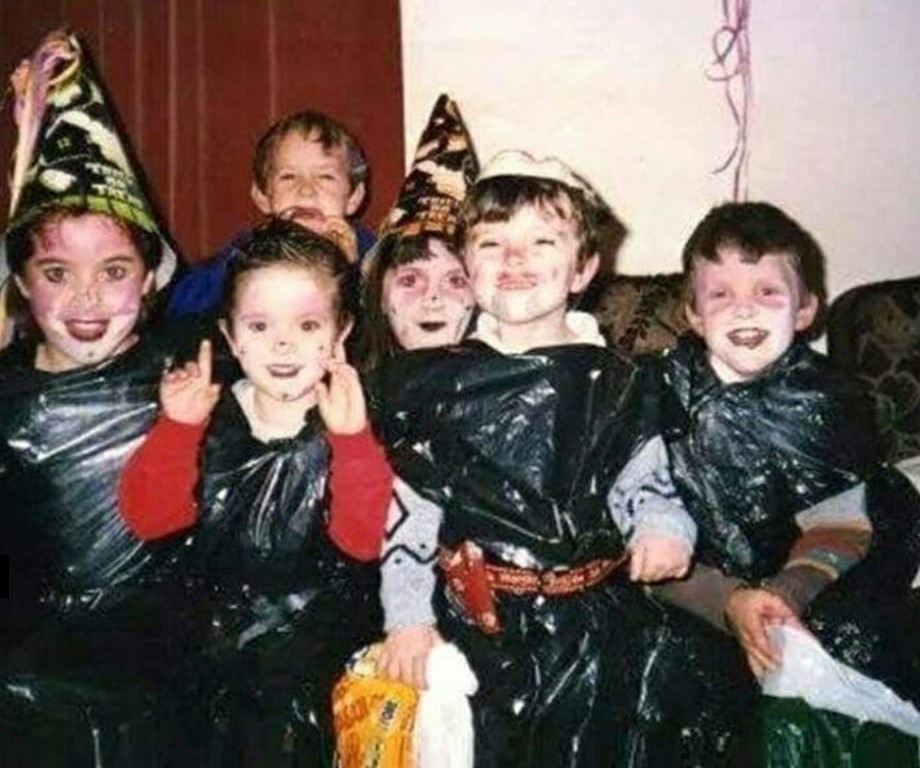
In an amusing piece about that contrast between earlier days and now, a social mores commentator in song at the monthly 1916 Performing Arts Club commented on how pleased he was to see children at his door in costumes made from ‘traditional’ black bin-liners.

Until they spoiled it all by chanting “trick or treat”. “Get outa the garden!” was his response.

You can listen to the song on YouTube here https://www.youtube.com/watch?v=0k-JmfVZ2lw

Kids still go out (usually escorted by adults now) from door to door at Halloween in Ireland, often with elaborate costumes and chanting the UStater-borrowed “trick or treat”.

A gaggle of kids in what was for many in areas of Dublin a ‘traditional’ Halloween costume but some of course were more elaborate. (Photo sourced: Hill Sixteen FB page)

In clubs or pubs the festival seems to have been taken over by late teens and young (and not-so-young) adults in costumes depicting horror and death and, for mostly women it must be said, also sexual allure.

And strange though it might seem, the festival was originally primarily for adults and was an occasion of blessing of kine, divination and at least in recorded history, of “mummers” and “guising” going door to door, performing and begging for donations.

‘BARMBRACK’ IN LONDON

In SE London, I was for some years involved in organising an annual Irish Children’s Halloween Party as part of the annual activities of the Lewisham branch of the Irish in Britain Representation Group.

The event was primarily for the benefit of children of the Irish diaspora but children of any other background were welcome to attend.

A local shop selling fresh fruit and vegetables was approached for a donation of fruit and nuts to which they agreed and of course were thanked publicly by word and in print. The local print media were invited to take photos.

The program for the day included street games (but indoors), Halloween activities including apple-bobbing, face-painting and food that would have been traditional for Irish Halloween parties.

Funds raised by the branch through the year bought Irish brand biscuits, Cidona and red lemonade from a shop supplying Irish food items in South London and of course included the ‘barmbrack’.

The children on the day were largely from Irish, Caribbean or mixed background.

As I doled out slices of ‘barmbrack’ to children sitting at the long table, recommending it as traditionally Irish, one Caribbean-seeming child turned to the other and began: “It’s like …” “bun-and-cheese!” finished the other.

This turned out to be a traditional Jamaican food at the other end of the year, at Easter, two slices of a spiced moist ‘brack’ (the “bun”) with a slice of cheese between. They are not as fond of butter in the Caribbean as are the Irish (not many people are) and so that is absent.

One day I decided to try a slice of buttered (of course) ‘barmbrack’ with a slice of cheese on top. The sweetness and slightly spicy taste of the ‘brack’ contrasted with the tart taste of the cheese. And do you know? It’s not at all bad.

End.

THE TRICOLOUR IN LONDON RECENTLY

Pat Reynolds & Diarmuid Breatnach

(Reading time main report: 3 mins.)

The photo of the massive antifascist rally in London on 28th July following a march from Russel Square shows the recapture of Trafalgar Square from Tommy Robinson and his sea of Union Jacks. Not for the first time, the Irish made their mark upon the place.

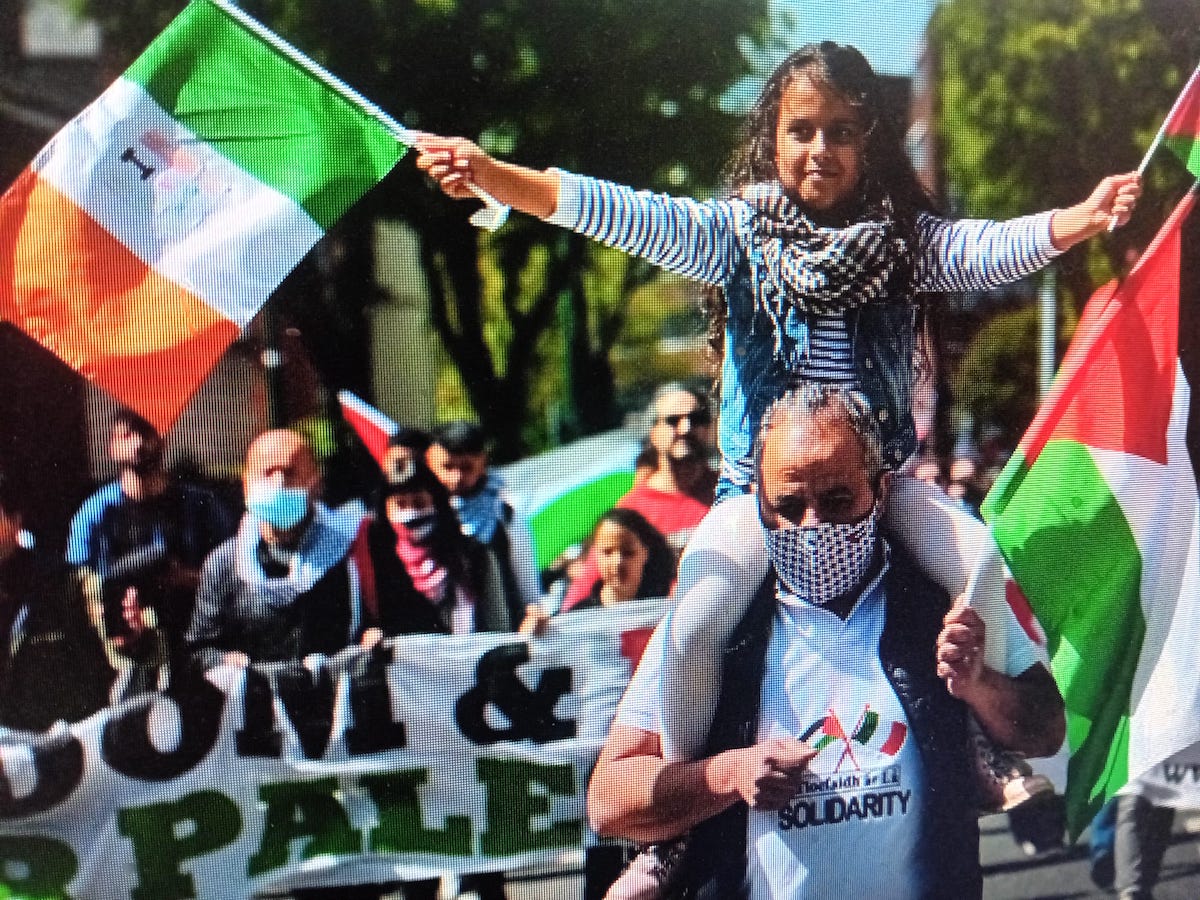
There the only two high flying flags were the Irish Tricolours and the Palestinian flags, the Irish contingent being one of the few on the day to see the fight in Britain against the fascists as part of the same fight against the fascist Zionist regime.

Irish and Palestinian flags in Trafalgar Square rally against racism, end July 2024 (Photo cred: PA)

We are mindful of the history of our occupied territories and our 1930s fight against the anti-Semitic Blackshirts1 in London (e.g. standing with the Jewish community at the Battle of Cable Street, 1936) and against the Bridgeton Billy Boys in Glasgow in the 1930s.2

On 28th July our flags sent out a message: We stand against all fascists, at home or abroad. That day we could not but remember all our brave men and women who marched past here from 1971 to 1998 carrying our fight to the heart of government3 in harder times.

We also know that the anti-racist movement now takes its new life from the strength of the Palestinian solidarity movement in Britain and needs to recognise this.

It was strange being in Trafalgar Square again with Tricolours given that we were barred from being there during the ‘Troubles’. Irish solidarity events were banned from using the Square under any circumstances from 1972 to 2001, well after the Good Friday Agreement.

The ban was lifted only once for an Irish event during that period and that was for the Peace Women4 (sic) calling for an ‘end to violence’ (mainly that of the Resistance) and famous US folk singer/ political activist Joan Baez displayed her ignorance of the Irish situation by speaking there.

It was interesting that a reporter for GB News of the British mass media was aware that a picket had been held in Dublin in protest against the assassinations of Palestinian and other Arab resistance leaders. He tried to link the Irish contingent in Trafalgar Square with ‘support for Hamas’.

The linkage was hinted in his broadcast report though he was careful enough not to report a direct link as the Irish group in Trafalgar Square had in fact no connection with the Dublin group. The reporter asked how to pronounce ‘Saoirse Don Phalaistín’ — but still got it wrong in his report.

One of the Irish contingent spoke to the young GB News journalist: He had the stuff from Dublin on his phone and wanted to say that the Irish in the Square were part of the Dublin group.

“Next thing you’d know the Zionists would call for a ban on the Irish for ‘supporting Hamas’”,5 commented one of the veteran Irish activists. “We also get targeted because of the flag and our placards.”

The UK State and the police are all pro-Zionist and the Zionist press tries to trap the Irish into dangerous statements but “We know our history and are well able for them; we just say we support Palestinian resistance to Israeli occupation just as we did with the British in Ireland.”

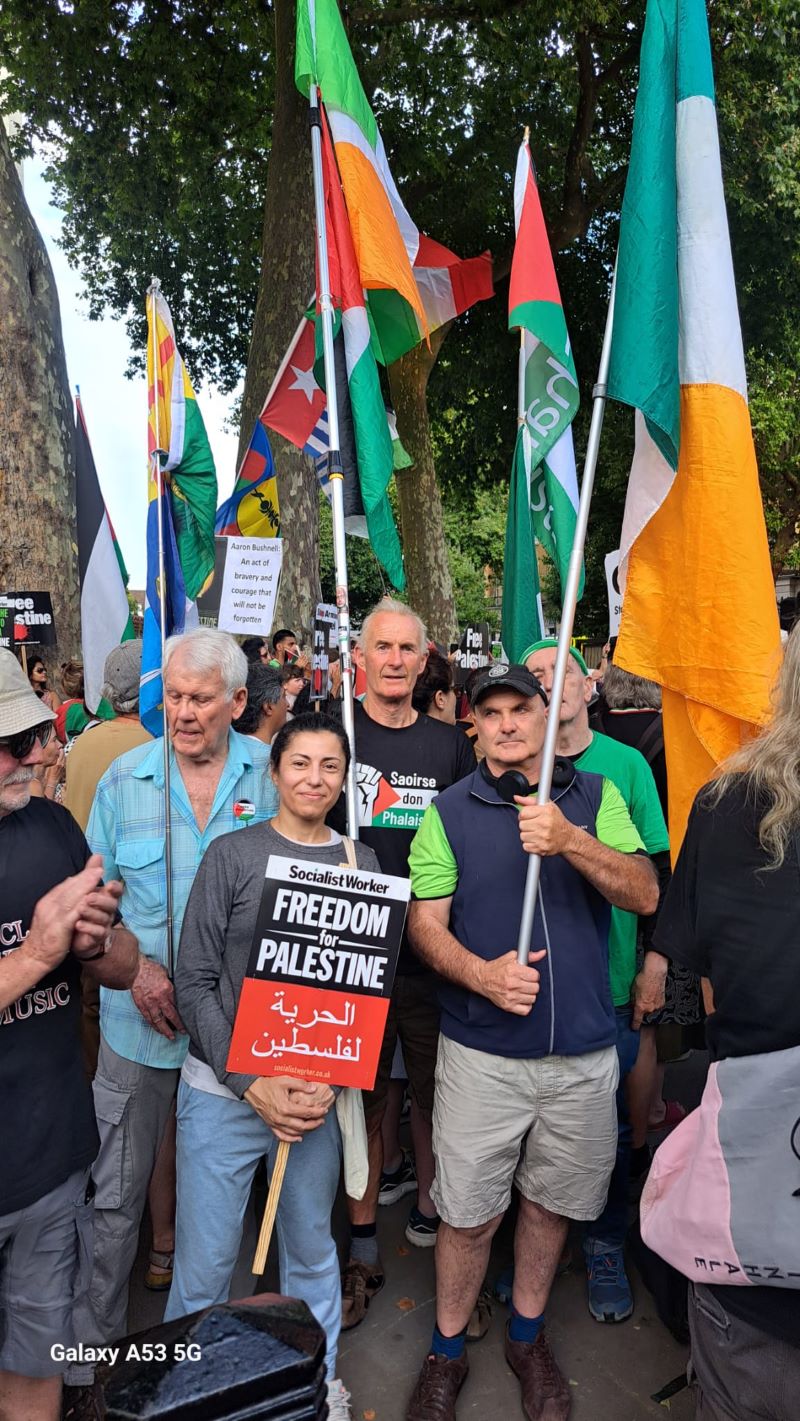
Irish contingent with flags on Palestine solidarity march to Downing Street very recently (not sure whether the SW person is part of it). (Photo sourced from participant).

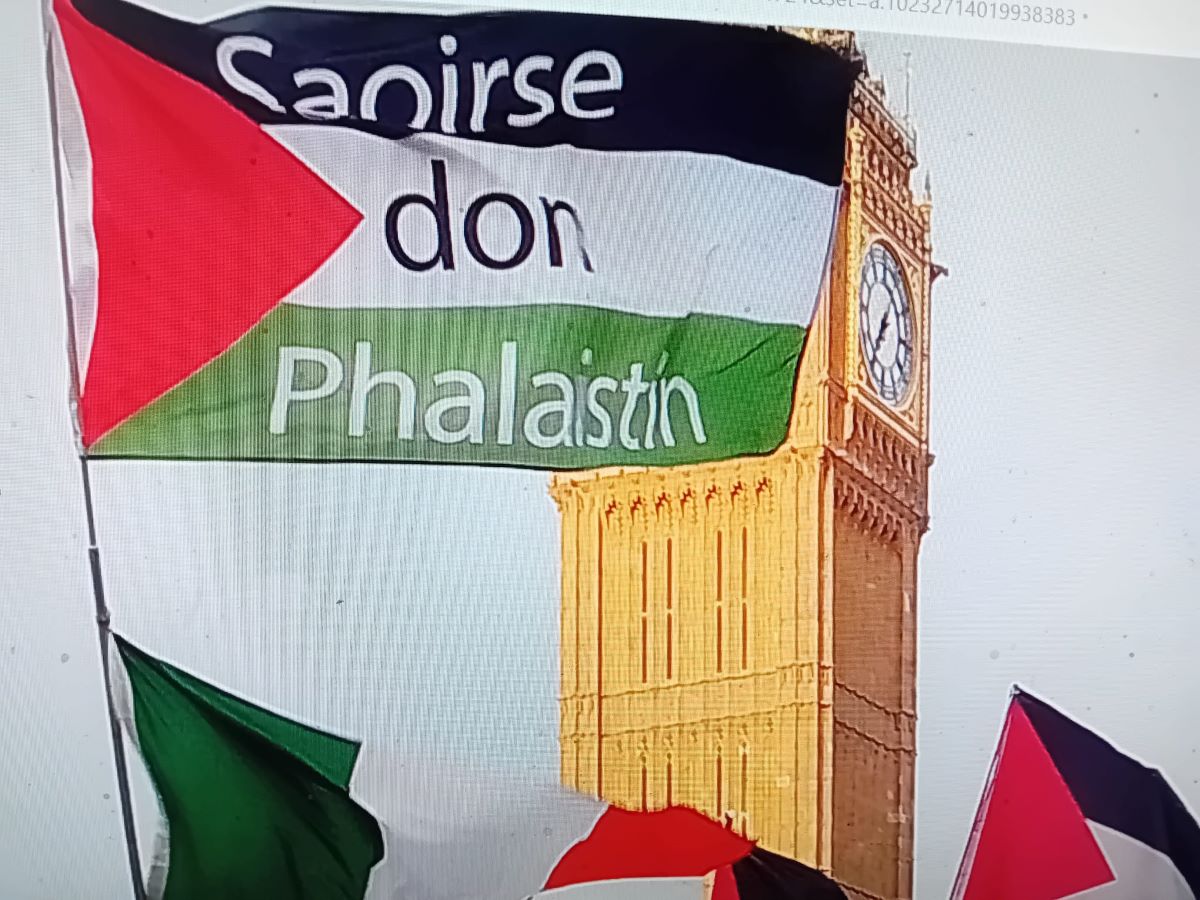
The Irish Tricolours, often in the company of the Palestinian national flag with Saoirse Don Phalaistín printed on it have been seen on Palestine solidarity marches in London since the current Zionist genocide began but also on anti-fascist rallies and in support of Julian Assange.

This is in keeping with the history and tradition of the Irish in Britain who helped found the republican United Englishmen6, the Chartists,7 many trade unions, a section of the First International8 and also gave the British working class their anthem9 and their classic novel.10

Classic novel of the working class in Britain was written by Robert Noonan, aka Robert Tressell, from Dublin. (Image sourced: Internet)

In later times they were prominent in organising solidarity with Vietnam and of course Ireland, against repressive legislation and fascist organisations, solidarity with Nicaragua, Palestine etc. and in struggles against state repression, including within the jails.

The Prevention of Terrorism Act (1974), forerunner of the current Terrorism Act (2000) specifically targeted the Irish community in Britain with suspension of habeas corpus for a period of up to five days, refusal of access to solicitor, as did also the framing of a score of people.

In the midst of the Irish Hunger Strikes of 1981, the Irish community broke out of the State terror stranglehold and formed the Irish in Britain Representation Group, among its objectives being the abolition of the Labour Government-introduced Prevention of Terrorism Act.

End.

Saoirse don Phalaistín and Irish Tricolour flags on Palestine solidarity march this year photographed against Westminster’s ‘Big Ben’. (Photo cred: being investigated)

NOTE ON AUTHORS

Pat Reynolds is a former trade unionist, social worker, a veteran anti-racist, anti-fascist activist, also for Irish independence and for rights for the Irish community in Britain. He was PRO for the Irish in Britain Representation Group for two decades, founding the Haringey Branch and the Green Ink Bookshop. Reynolds is from Granard in Co. Longford and lives in London.

Diarmuid Breatnach is a former trade unionist, worker with homeless/ substance misusers (manual worker before that), also a veteran anti-racist, anti-fascist activist and campaigner for Irish independence. For a decade he was on the Ard-Choiste of the IBRG, founder of the Lewisham Branch and of the Lewisham Irish Centre. Breatnach is from Dublin to which he has returned to settle.

FOOTNOTES

1The British Union of Fascists led by Sir Oswald Moseley which had substantial support in the British elite, including the publisher of the The Daily Mail with police attacks on anti-fascists.

2The Billy Boys were founded and led by Billy Fullerton, a former member of the British Fascists. Fullerton also later became a member of the British Union of Fascists in the 1930s. The Billy Boys adopted a militaristic style of behaviour, marching on parades, forming their own bands, composing their own songs and music, and all dressed in a similar manner.[3] The Billy Boys also formed a junior group whose members were teenagers called the Derry Boys. (Wikipedia)

3From Trafalgar Square to the Houses of Parliament in Westminster runs a broad thoroughfare, in the centre of which is the Cenotaph and a little further, the entrance to Downing Street.

4The organisation/ campaign was founded by Betty Williams and Mairead Corrigan in 1976 after a car driven by an IRA fighter mortally wounded by British soldiers in Belfast crashed into pedestrians and mortally wounded three children of Anne Maguire, sister of Mairead. Branding itself as against all violence the Peace Women in fact targeted primarily the Republican movement, secondarily the Loyalist paramilitaries and hardly ever the Occupation Army. Williams accused the IRA unit of having fired on the Army unit that killed the driver which was untrue (but is repeated on her Wikipedia entry). Both founders received the Nobel Peace Prize in 1976 and a substantial cash prize. Williams resigned from the group in 1980 and disappeared from Irish-related activities though prominent externally. Corrigan however remained politically active in Ireland and elsewhere against war and has campaigned among other things for the end of the ‘Israeli’ siege on Gaza, being arrested with crew and passengers on the Spirit of Humanity aid ship in 2009 by by the Zionist navy, taken to ‘Israel’ and subsequently deported.

5Hamas is proscribed organisation in the UK since March 2001 and a person promoting it would be liable to prosecution under the Terrorism Act.

6A spin-off from the United Irishmen in Ireland; the English chapter led the Spithead and Nore naval mutinies. The Irish also reformed the United Scotsmen when it was faltering.

7Karl Marx called the Chartists “the true mass movement of the working class” – two of its principal leaders, Bronterre O’Brien and Fergus O’Connor were Irish, as their surnames would suggest.

8The Fenians were accepted into the First International Workingmen’s Association.

9The lyrics of The Red Flag were composed by Jim Connell from near Kells, Co. Meath and set to the brisk air of The White Cockade, later changed to the mournful air of Tannebaum.

10The Ragged-Trousered Philanthropists was written by Robert Tressell (real name Robert Noonan) from Dublin.

SOURCES & FURTHER READING

https://libcom.org/history/bloody-sunday-trafalgar-square

BOBBY SANDS – FREEDOM FIGHTER AND BEACON FOR THE DIASPORA

Diarmuid Breatnach

(Reading time: 6 mins.)

The anniversary on Sunday of the death on hunger strike of IRA Volunteer Bobby Sands was marked with a number of posts on social media. I would like to add an Irish migrant’s1 perspective and some analysis of his legacy.

The Irish diaspora was a powerful sector in solidarity for the Irish struggle not only because of their cultural background but also because of their numbers. Some British cities had an estimated diaspora population of 10% (Irish-born and 1st and 2nd generations).

Furthermore, the higher proportion of those in turn was of the working class, a section of society which, although they in no way had their hands on the standard levers of power, certainly had a strong potential of the kind the British ruling class had learned to fear.

Irish Republicans of course formed part of that sector and organised within it but on the other hand the IRA’s bombing campaign in Britain was of no help at all. The popular fear of being caught in an explosion greatly enabled the Government to tighten the screws under the guise of “security”.

Karl Marx, a strong supporter of Irish freedom had commented after the Clerkenwell prison bombing of 18672 that “One cannot expect the London proletarians to allow themselves to be blown up in honour of the Fenian emissaries” (i.e who they were trying to free from the jail).

In 1974 the Labour Government had repressive legislation ready and on 29 November, using hysteria arising from the Birmingham and Guildford pub-bombings they rushed through the Prevention of Terrorism Act (1974) which permitted the holding of suspects for two days without charge.

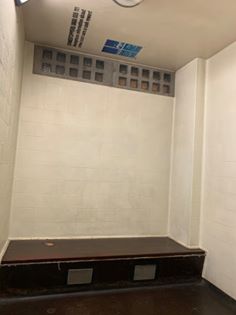
An underground cell in London’s Paddington Green police station – this is where Irish detainees under the Prevention of Terrorism Act might be kept and interrogated for seven days without visitors or access to solicitor. “The old cells were 12-foot square, contained no windows and were reportedly too hot in the summer and too cold in winter(Wikipedia).(Photo: Posted in 2020 on Internet by Green Anti-Capitalist Front who occupied the empty building intending to turn it into community centre.)

That could be extended for another five days – and often enough was — by application to the Home Secretary. Access to solicitor was usually denied and though not lawful, the fact of the detention itself was often denied to concerned people making enquiries of the police station.

The prospect of disappearing for seven days into police custody somewhere was naturally terrifying and a ‘suspect’ could also be deported without trial to Ireland – even to the British colony of the Six Counties, which amounted according to their law to “internal exile”.

Snapshot of London police harassment and intimidation of Irish solidarity activists in 1981. (Photo sourced: Internet)

The framing of a score of innocent Irish people3 in five different trials4 with very heavy sentences added to the intended terrorising of the Irish community in Britain, the “suspect community”5, many of whom believed the victims to be not only innocent but most not even politically active.6

Irish solidarity activity in Britain diminished greatly after 1974 as state repression impacted across the Irish community. But the hunger strikes and concerns to save the lives of the strikers in 1981 broke the hold of state terror as people took to the streets in their thousands once again.

They were unsuccessful but never returned to that state of immobilising fear that had settled over the community.

The Irish in Britain Representation Group got its initial start in 1981 which happened as follows: the bourgeois Federation of Irish Societies had its AGM in May 1981 and one of the members proposed that a motion of sympathy to the Sands family be recorded when he died.

IBRG and Irish Republican POW Support Committee banners on march Birmingham 1984 (Source: Mullarkey Archive)

The meeting’s Chairperson ruled the proposal out of order and ‘the Fed’ continued with their ordinary business. The then Editor of the Irish Post7, writing in his “Dolan” column, found this disturbing and suggested there might be a need for a new type of Irish community association.

A number of individuals wrote in and the ball got rolling, though it took until 1983 to set up the branch-based organisation with a constitution and democratic safeguards in operational rules. The IBRG soon had a number of branches in London and others in the North and Midlands.

For the next two decades the organisation campaigned for the release of the framed prisoners, against the Prevention of Terrorism Act, strip-searching, all racism but in particular the anti-Irish and anti-Traveller varieties, for Irish representation in education, services, Census category, etc.

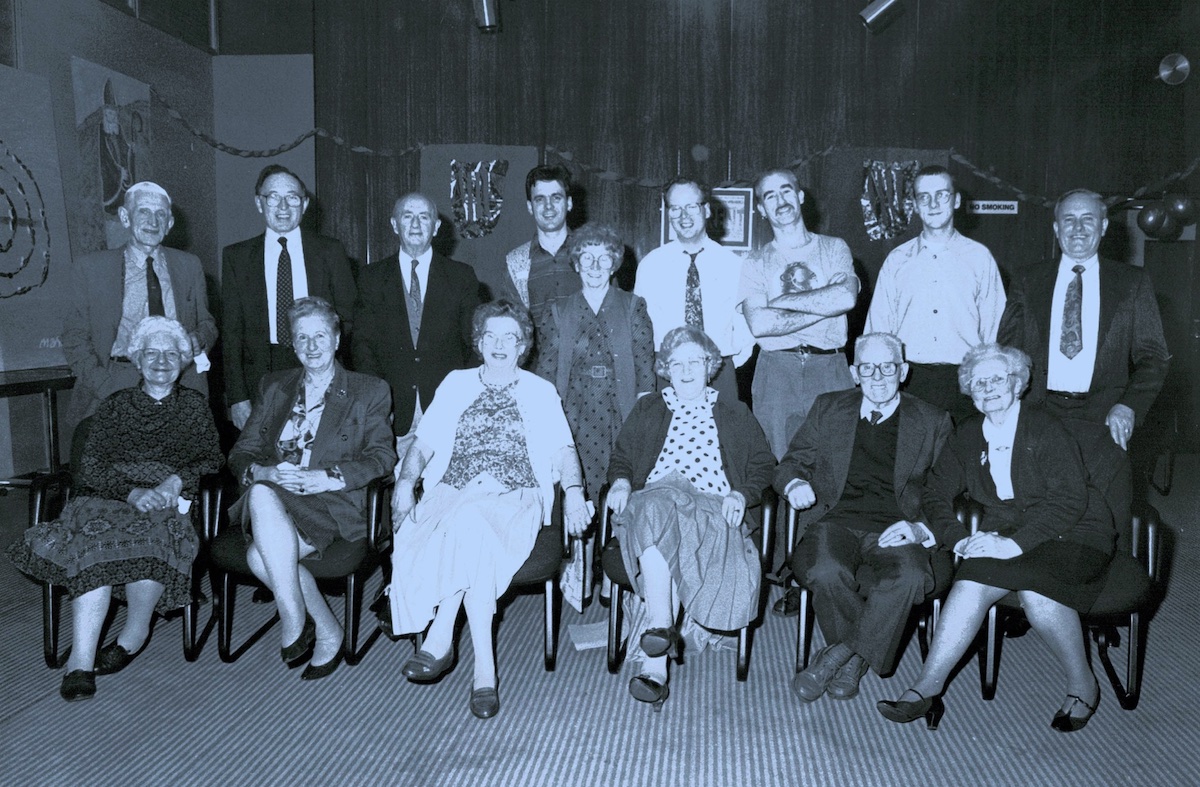
Lewisham Irish Centre Management Committee and Staff, possibly 1994. The Centre was campaigned for and won by the Lewisham Branch of the IRBG in conjunction with the Lewisham Irish Pensioners’ Association (which the IBRG had also founded).

The IBRG also called for British departure from Ireland and collaborated with other organisations in marches, demonstration, pickets, conferences, producing also a number of important report documents. The organisation’s officers were drawn from migrant Irish and those born in Britain.

THE LARK8 – a poem

Last night, from afar, I watched the Lark die

and inside me, began to cry,

and outside, a little too.

There’s nothing more that can now be done,

to save the life of this toilers’ son;

another martyr – Bobby, adieu.

Imperialism takes once more its toll,

another name joins the martyrs’ roll

and a knife of sadness runs us through.

But sorrow we must watch,

for it can still,

yes, it can kill

the song that Bobby listened to.

And if his death be not in vain,

let’s fuel our anger with the pain

and raise the fallen sword anew;

and this sword to us bequeathed:

let its blade be never sheathed

’till all our foes be ground to dust

and their machines naught but rust ….

Then will the servant be the master

and our widening horizons ever-vaster

and our debt

to Bobby

paid

as due.

(D.Breatnach, May 1981, London)

Bobby Sands Mural on gable end of a house in Belfast (Photo cred: Brooklyn Street Art)

REPRESENTATION OF BOBBY SANDS

Bobby Sands was a man of great courage whose leadership qualities were recognised by his fellow political prisoners when they elected him as their Officer Commanding in the H-Blocks. He was also an accomplished writer and poet.

When the British reneged on the agreement that ended the 1980 hunger strike and a new one was planned, Sands insisted on being first on the list, which also meant that in the event of resulting deaths, his would be the earliest.

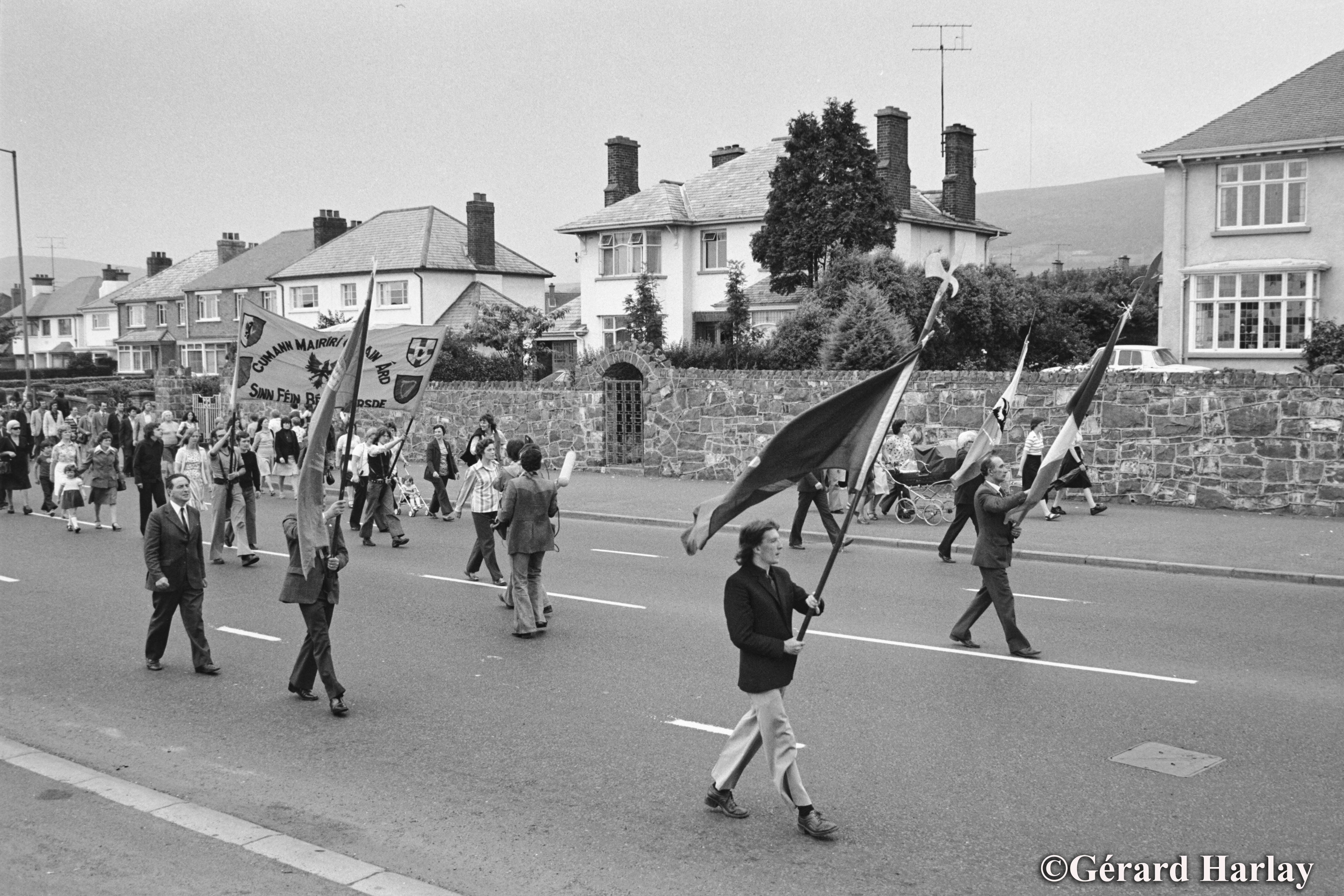
Bobby Sands (front left, colour party), Andersonstown Road,1976. (Photo: Gérard Harlay Archive)

Most people will agree easily with all the above evaluation of the man but from that point onwards, his representation is manipulated to suit different agendas, in particular those of pacifists, social democrats, liberals and a variety of opportunists.

Some of them love above all his quotation that “Our revenge shall be the laughter of our children”. They forget many other things he wrote and seek to turn him into an angel or saint of pacifism.

Since they embraced the pacification process, Sinn Féin try to represent Sands as an advocate for and proof of the effectiveness of participating in the parliamentary electoral system, based on his success in a 1981 Westminster by-election with 30,492 votes, 51.2% of the total of valid votes.

What both these groups fail to recognise is that Sands was an IRA volunteer and was sentenced for possession of handguns in 1972 and again in 1976. If he was an angel, it was of the Archangel type, fighting against what he considered evil.

He was proposed in the Fermanagh-South Tyrone by-election mainly in order to support the campaign of the prisoners against criminalisation and for the political status recognition that they had previously. Saving the lives of the hunger strikers was of course part of the plan too.

Nine protesting Republican prisoners contested the general election in the Irish State in June. Kieran Doherty and Paddy Agnew (who was not on hunger strike) were elected in Cavan-Monaghan and Louth respectively, and Joe McDonnell narrowly missed election in Sligo-Leitrim.

But that is a long way from proving that the electoral process is a viable way of dislodging the ruling class and their system and, in fact, history has proven the opposite.

Nobody knows what position Sands and the other nine would have taken on the electoral process had they lived. Possibly some would have gone along with the SF leadership on that and some others would now be reviled as “dissidents” (as are indeed some H-Block survivors).

All we can say for certain is that they were men of courage in that all of them had joined the armed struggle for Irish national liberation. They had even higher courage of a level hard to imagine, to risk and then experience slow physical disintegration and death by the day and by the hour.

Long after their erstwhile prominent enemies are forgotten, their names will shine in our history and Bobby Sands’s, the brightest of them all.

End.

FOOTNOTES

1At the time I was living and working in England.

2A bomb was planted against the prison wall to free a member of their group who was being held on remand awaiting trial at Clerkenwell Prison, London. The explosion damaged nearby houses, killed 12 civilians and wounded 120; no prisoners escaped and the attack was a failure. Michael Barrett was found guilty of the bombing despite his claim supported by witness testimony of having been in Glasgow during the bombing and was hanged on Tuesday 26 May 1868 outside Newgate Prison, the last man to be publicly hanged in England (the practice was ended from 29 May 1868 by the Capital Punishment Amendment Act 1868). https://en.wikipedia.org/wiki/Clerkenwell_explosion.

3Carole Richardson of the Guildford Four was not Irish but she was the girlfriend of one of three Irishmen.

4Birmingham Six, Guidford Four, Giuseppe Conlon, Maguire Seven and Judith Ward. They were not acquitted and released until decades later, by which time Giuseppe Conlon had died in jail.

5Suspect Community by Paddy Hillyard, Pluto Press (1993)

6Believing them innocent and not active worked even better to terrorise because if the likes of those could be framed and jailed, no-one was safe. But perhaps safest was to do absolutely nothing to draw the attention of the State.

7Brendán Mac Lua, co-founder of the Irish community newspaper in 1970 which is now a very different periodical.

8The lark is associated with Sands because he wrote a story about a man who had captured a skylark, a bird that unusually sings in flight. In the cage the bird would not sing so the man draped the cage with cloth and still the bird would not sing, nor would it do so when he refused it food and water until eventually, it died in the dark, silent to the last.

REFERENCES

Powers under the Prevention of Terrorism Act: https://cain.ulster.ac.uk/hmso/pta1974.htm

MONSTER DUBLIN MARCH IN PALESTINE SOLIDARITY

Diarmuid Breatnach

(Reading time: 6 mins.)

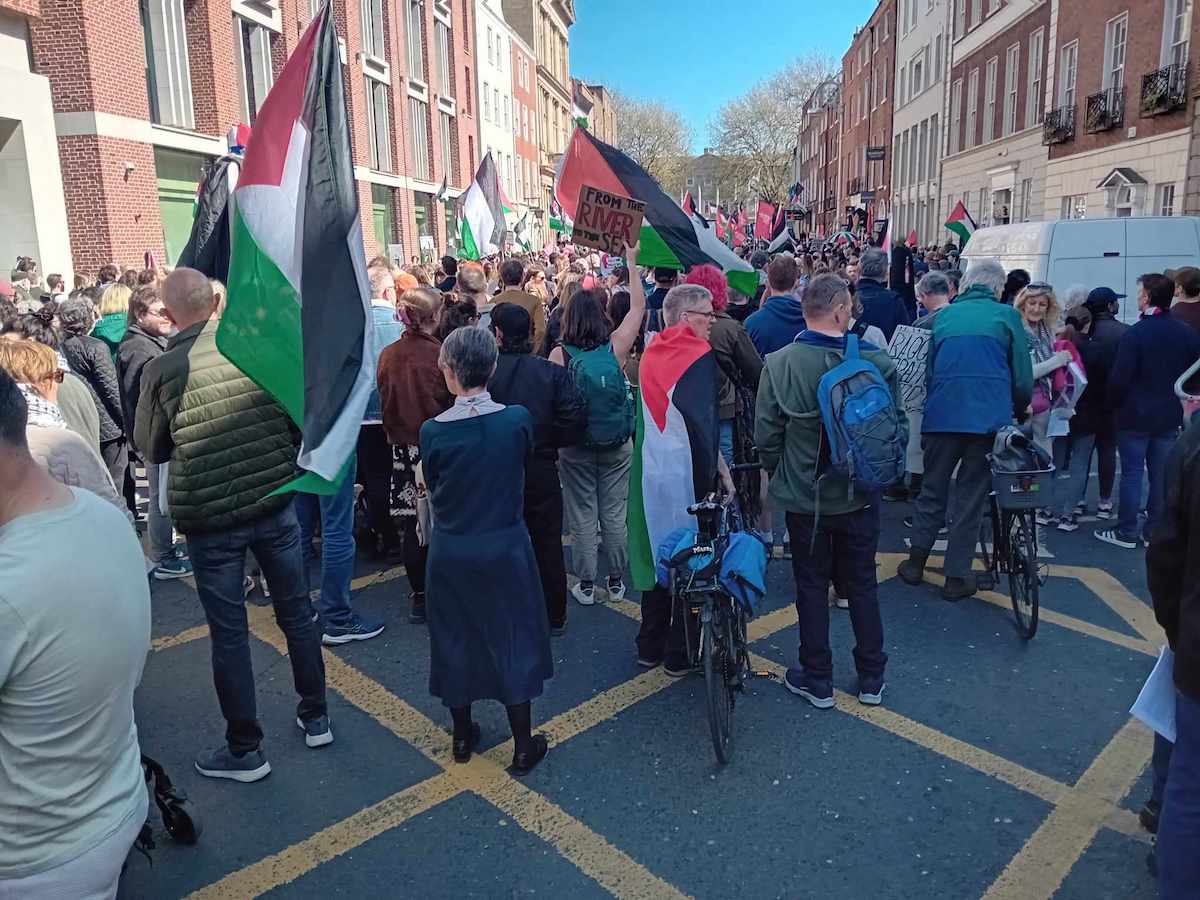
A huge Palestine solidarity march proceeded from the north Dublin city centre on Saturday 20th, passing down O’Connell Street, over the Bridge, around by Trinity College and on towards Leinster House, the parliament of the Irish State.

Detained by an earlier activity I hurried to join it, catching up with it near the Larkin Monument. From there I could see sections of the march across the river and another section wending around Trinity College in the distance, its leaders out of sight.

(Photo: D.Breatnach)

“Over a thousand”, reported our “newspaper of record”, the Irish Times. In other words, less than 2,000. Really?!

The march was organised by the Ireland Palestine Solidarity organisation, the main Irish nationwide Palestine solidarity organisation, sponsored by a multitude of organisations and was supported in marching by many organisations and individuals, the latter being the capacity or most participants.

The usual slogans could be heard as I hurried past marchers, such as “Free, Free – Palestine” and including the one that Suella Braverman tried to ban when she was a Minister in the UK Government: “From the river to the sea – Palestine will be free!”

I paused by the Thomas Moore monument waiting to meet up with friends in order to march with them. One group passed calling out that what is occurring in Palestine is “Not a conflict, not a war”. I understand them to mean it is genocide instead but I can’t agree with them.

It IS a conflict, the old one of the European colonial settler against the indigenous people, fought for centuries on all the continents of the world except in Antartica. And the zionist State IS waging a war, a genocidal war against the Palestinian people.

(Photo: D.Breatnach)

Another group went by with a chant leader calling out a list of categories of victims of the zionist genocide such as medical workers, journalists, ambulance crews, refugees etc, to which the group replied “Not a target”. Perhaps they meant “not a legitimate target” but targets they certainly are.

I was flying the Palestinian flag but also the Starry Plough, flag of the risen Irish working class in 1913 and 1916, the only one I saw on the march and which was how my friends found me. A woman I mistook for a visitor asked to take my photo, to which I agreed.

Near the rear of the march one could hear the usual call-and-response slogans drifting back towards us but people in our section marched silently or chatted with one another. Then a voice called out: “From the river to the sea!” and the reply was instantaneous: “PALESTINE WILL BE FREE!”

Chanting takes energy but also seems to supply it and from then our section joined in with gusto: “In our thousands, in our millions – We are all Palestinians!” “In our millions and our billions – We are all Palestinians!” “In our TRILLIONS and our billions – We are all Palestinians!”

“Netanyahu, what do you say? How many kids have you killed today?” “Joe Biden, what do you say? How many kids have you killed today?” “EU, you can’t hide – You’re supporting genocide!” “Irish Government, you can’t hide – You’re supporting genocide!”

“Saoirse – Don Phalaistín!” was the only slogan1 in Irish. There was no doubt about what people wanted for the Israeli Ambassador or the zionist Embassy, which was “Out, out, out!”

(Photo: D.Breatnach)

As we turned from Dawson into Molesworth Street, the rest of the march was packed ahead of us all the way up to the presumed police barriers at Kildare Street, across from the main gate of Leinster House. Here the IPSC stewards were urging us to move in still closer ahead.

What was the reason? Apparently the Gardaí wanted us past the intersections with South Frederick Street and with Molesworth Place. But for what purpose? Those were southward traffic only streets which should have been blocked anyway and Dawson Street was open in both directions.

(Photo: D.Breatnach)
Molesworth Street from the Junction with Molesworth Place, already packed and with more arriving, yet we were expected to pack in closer and have barriers moved up against us! (Photo: D.Breatnach)

Then a private company began to erect barriers across the north-eastern section of Molesworth street which looked to me like kettling, a view which seemed born out as the barriers were moved once more further eastward with instructions to keep moving – with which I declined to cooperate.

This whole exercise seemed to me of dubious traffic easement validity and more about getting people used to obeying order and to being kettled by police if required by them. In the Irish state we do not have to gain police permission for a march or approval for its route.

There’s nothing fundamentally wrong with the IPSC leaders informing the police of their march routes for traffic easement. But our rights have to be protected and not easily surrendered, much less for no visible valid reason. It is not good for stewards to automatically comply with police wishes.

I have seen (and resisted) Garda attempts to push demonstrators from the front of the GPO into the pedestrian reservation in the middle of O’Connell Street, while they told people that “It’s what your organisers (IPSC) want.”

Declining to be kettled.

The police of a state are not neutral forces for the public good and have drawn and used their batons through the decades against people protesting partition of their nation, imperialist war, water privatisation, growth of fascist and racist attacks, against imperialism and colonialism …

Not to mention torturing and framing people to have them jailed.

CHRISTY MOORE AND REPRESSION

In the distance, we could hear that Ireland’s chief living balladeer, Christy Moore, had got on stage and was speaking, then singing, though I could make out only snatches of the lyrics. Moore gained fame both as a member of Moving Hearts band and Planxty but also as a solo performer.

Moore had been litigated against for his song about the young 48 Stardust Fire victims but was vindicated during the week by a long-delayed second inquest into the deaths.2 On the other hand he’s received no apology for the police raid on his H-Block album launch back in 1972.3

Pro-Palestinian demonstrators are facing repression throughout the western world, in some places much worse than others. The German State is behaving like Nazis in banning demonstrations and raiding a conference, apparently in twisted expiation of its sins under the Adolf Hitler regime.

This impacted also on an Irish language group in Berlin during the week while they attempted to have a small gathering speaking and singing in Irish in a park in front of the German Parliament. The police told them that only German and English languages were permitted in that area.4

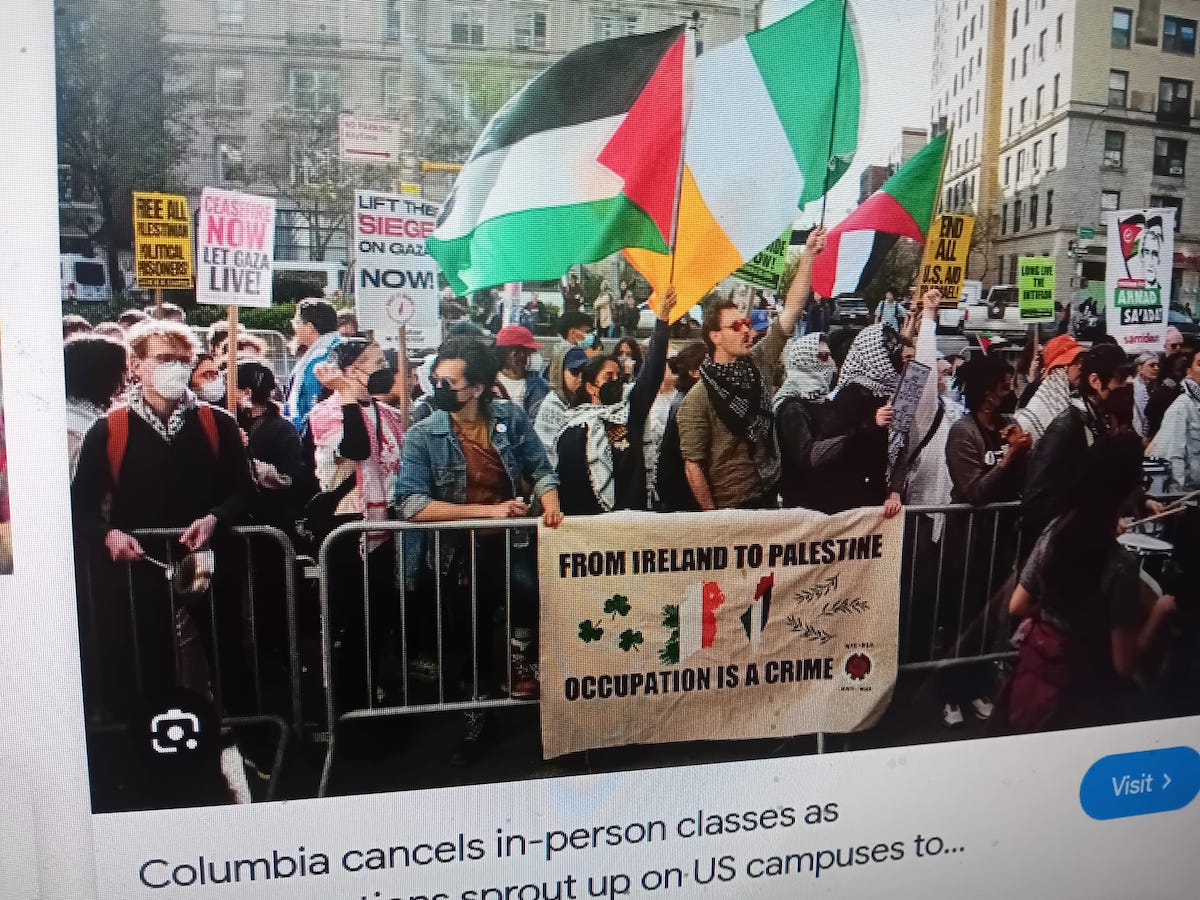
The Irish Tricolour has been seen on many London demonstrations in solidarity with the Palestinians, on its own or flying below the Palestinian flag inscribed with “Saoirse don Phalaistín”. The Tricolour turned up too as university students and staff faced down the New York Police.

Columbia University, New York, Monday.
St. Patrick’s Day, New York, March 2024.
London, November 2023.
London, clearly.

In Palestine itself new horrors are being revealed with the recovery of bodies in mass graves in the areas of destroyed Gaza hospitals recently occupied by the Israeli military. Their remains testify to their being patients and medical staff in addition to refugees.5

A totally new horror are the Israeli killer drones emitting the wailing of a baby or a woman’s cry for help, waiting to gun down would-be rescuers. Palestinians in Gaza have been accustomed to responding to those cries in reality for months and often enough shot or bombed as they did so.6

This however is a new depth for the zionist military.

Under danger of Israeli bombardment, digging bodies out of a mass grave at the destroyed Nasser Hospital site April 2024. (Photo cred: Ramadan Abed/Reuters)

During the week also the independent investigation commissioned by the UN has found no basis to the Israeli claim that many staff of its aid agency for Palestinians, UNWRA, were members of Hamas or Islamic Jihad, much less involved in the October 7th Palestinian resistance operation.7

That investigation result has UNRWA vindicated of the false Israeli claims but also commended on its procedures to comply with the impartiality requirements of the UN and of its funders, many of which however now stand condemned for withdrawal of their funding from starving people.

But UNRWA chiefs should share the condemnation for appearing to give the accusations credibility in firing some of their Palestinian staff, not to mention sacking appallingly and reducing to poverty a number without hearing or appeal, on the basis of unsubstantiated accusations.

And from a source known for lying for decades and long hostile to the UNWRA organisation. True to type, the Israeli government has rejected the findings, despite having provided no verification of its accusations to date.

Few official actors of states or of the UN come out well in evaluation over the last six months of this daily broadcast genocide.

End.

FOOTNOTES

1Interestingly the word “slogan” is itself from the Irish language, or at least Scottish Gaedhlig, meaning a “call to/from the multitude/ troop”.

2https://dublinpeople.com/news/northsideeast/articles/2016/02/02/the-story-of-christy-moore-and-the-stardust-song/

3In the Brazen Head pub, Dublin, June 1972.

4https://www.independent.ie/irish-news/berlin-police-ban-irish-protesters-from-speaking-or-singing-in-irish-at-pro-palestine-ciorcal-comhra-near-reichstag/a234500393.html

5https://www.aljazeera.com/news/2024/4/23/as-more-bodies-found-un-human-rights-chief-horrified-by-gaza-mass-graves

6https://www.thenational.scot/news/24261522.israeli-drones-playing-sounds-babies-crying-opening-fire/

7https://www.thenational.scot/politics/24157684.owen-jones-scotlands-stance-unrwa-vindicated/

SOURCES

https://www.independent.ie/irish-news/berlin-police-ban-irish-protesters-from-speaking-or-singing-in-irish-at-pro-palestine-ciorcal-comhra-near-reichstag/a234500393.html

https://www.aljazeera.com/news/2024/4/23/as-more-bodies-found-un-human-rights-chief-horrified-by-gaza-mass-graves

https://www.thenational.scot/news/24261522.israeli-drones-playing-sounds-babies-crying-opening-fire

https://www.thenational.scot/politics/24157684.owen-jones-scotlands-stance-unrwa-vindicated

PALESTINIANS EVICTED FROM PALESTINIAN SOLIDARITY MEETING

Diarmuid Breatnach

(Reading time main text: 7 mins.)

Videos doing the rounds of social media sites show a brief intervention by Palestinians at a Sinn Féin-organised meeting in Belfast about Palestine followed by the party’s heavies evicting them to applause from many in the audience.

The event at the Europa Hotel on Thursday evening was intended, according to the party’s National Chairperson, “… as an opportunity to demonstrate that Ireland stands with the people of Gaza and the West Bank and to reiterate calls for an immediate ceasefire, and an end to the occupation.”1

Actually Ireland is already – except for the Unionists — well behind the Palestinians as shown by attendance at marches and opinion surveys. What is needed is a) clarity on what we are calling for and b) direct action to put the States and companies under greater pressure.

The video of the intervention I’ve seen began with an apology for interrupting the Palestinian Ambassador, Dr. Jilan Wahba Abdalmajid, as “a mouthpieceof the Palestinian Authority” which, the challenger said, is an undemocratic organisation which has not had an election since 2006.

Boos and cries of objection followed from the audience as the Palestinian asked to be listened to, pointed out that those doing the intervention were all Palestinians but the party’s security men were soon hustling them out and periodically trying to block the phone camera.

When people don’t want to examine the issues or are feeling guilty about them, it’s always tempting to blame the critics, suggest they’re dissidents, trouble-makers, etc. That way the pointing finger is turned around and the actual issues don’t need to be thought about.

Of course this time some SF supporters commented along those lines, accusing their critics of being Loyalists, or as they have in the past outsiders, ultra-leftists, intelligence service agents, dissidents, malcontents, trouble-makers … or just plain Utopians.

MOUTHPIECE OF … AN UNDEMOCRATIC ORGANISATION”

The intervention from the floor was challenging but what of the content? Palestinian Ambassadors are appointed and employed by the Palestinian Authority which, though never intended as a government is acting like one. So “mouthpiece for the PA”? Blunt — but entirely accurate.

Palestinian Ambassador to Ireland of the undemocratic and corrupt Palestinian Authority at a Sinn Féin meeting (note SF President Mary Lou McDonald applauding in the background). (Sourced: Internet)

The PA “has not had an election in 18 years”? Accurate also – though they’re supposed to have one every five years. The last time there were elections in Palestine was 2006 and Hamas won overall throughout Palestine. However Fatah, the losers, refused to give up their seats.

In 2007 in Gaza, Hamas moved against Fatah and after a short struggle, took the seats to which the electorate had voted them. However, they chose not to do that in the West Bank, where the PA’s HQ is and where EU and USA money comes flowing in to Abbas and his unelected cronies.

The reason for not holding elections is that Hamas would almost certainly win again. Meanwhile, “democratic Israel” refused to recognise the Gaza administration or the elected representatives of the Palestinians while the US, EU and UK followed suit and ‘Israel’ blockaded Gaza.

The Palestinian Authority, as well as being undemocratic, deeply corrupt, unrepresentative and repressive2 is also actively colluding with the Zionist state and feeding its masters intelligence on the Palestinian opposition and resistance while it represses their supporters.

That’s what most Palestinians think about the PA and, as is widely known and even tacitly admitted by the USA3, whether in the West Bank or in Gaza, Palestinians have no confidence in the institution.4

Some of the comments on the circulating videos criticised SF’s bad management of the event, opining that the Palestinians should have been allowed to speak and then the meeting could have proceeded as the organisers planned and the challenge would have got little publicity.

True … but SF is used to throttling dissent inside its party or in the communities it controls and managing dissent – rather than crushing it — is just not its style.

In any case, is ‘bad management’ the main issue with regard to SF and Palestine? More important than supporting partition of Palestine, the institutionalisation of a Bantustan “Palestinian State” under the guns of the Zionists – and the PA’s collusion with those same Zionists?

The Provisionals weren’t always pro-Palestinian; though it might shock some people, they originally mirrored Irish society’s position of support for Israel, the perceived ‘underdog’ up to the mid-1960s, Hollocaust survivors (Zionists) who had fought the British police and army.5

THE PROVO LEADERSHIP AND PALESTINE

For a while pieces by a Fred Burns O’Brien apparently based in the USA were featured in the Provos’ newspaper but some time after he revealed himself as a Zionist he was ‘let go’, probably through internal pressure from those who thought the Palestinians were the natural ally.6

One of the problems with taking a political position, physically or ideologically, is that you might get called on it someday. This is why bourgeois politicians try to give themselves wriggle and even retreat room in their statements – lots of good-sounding bites with little content.

The Provisionals owe a debt to some Palestinians but it’s a very bad one. I don’t mean when they got some arms for the struggle7 but rather their following Fatah/PLO down the pacification process, for which Fatah and the ANC sent fraternal delegates to SF’s Ard-Fheiseanna (annual congresses).

Subsequently, Ireland and South Africa were used as promotional examples of the pacification process and their delegates travelled as kinds of sales representatives8 — but Palestine got dropped from 2000 onwards because of the Second Intifada, when Palestinians rejected Fatah’s deal.

You can’t sell a process as ‘working’ when the youth have overwhelmingly rejected it and are fighting the Occupation in the street.

ORGANISE YOUR OWN EVENT”

One prominent member of SF in the British colony told the Palestinian protesters they should have organised “their own event.” Er – was this event not advertised as being for solidarity with Palestine? But ‘Palestinians not welcome’? Or only zionist-collaborating Palestinians?

Imagine if back in the day some political party had been having a meeting about Ireland and were inviting an Irish State or British colonial minister as a speaker, would anyone have been shocked to see and hear SF activists challenging or even heckling the speakers during the meeting?

Would we not be reading statements from SF talking about ‘no right of colonialists to represent the Irish people’ and about ‘censorship of Irish voices’?

Cartoon by DB.

Gerry Adams, former President of the party was quoted as saying the calls are “inconsistent” because they are not making the same call with regard to the UK though “the Brits are up to their neck in this” and what is important for SF in the USA is Irish-America.

But SF long ago accommodated itself to the colonialist “Brits”, including its royalty. Irish politicians don’t flock to London for St. Patrick’s Day. Anyway the primary financial and military supplier – and political backer of the Zionist state in the UN Security Council — is the USA.

Why is the diaspora in the USA so important to Sinn Féin but not the diaspora in Britain or in Australia? It must be because the USA is the “boss of the world” and pathetic Irish gombeen politicians think their diaspora gives them them some kind of weight with the imperialists.

What would really help with the Irish diaspora would be if SF were to address the Irish-Americans and ask them to push their political representatives to call for the USA to stop supporting genocide in Palestine.

But of course there is no chance of them doing that because 1) some Irish Americans oppose imperialism from Britain but support it from the USA; also 2) because Irish gombeens, the political class to which SF aspire, are pro-western imperialism.

INTERNATIONALIST SOLIDARITY AND THE HOME STRUGGLE

I have commented in the past that the level of commitment to internationalist solidarity is one of the indicators as to whether an organisation is going to carry through its own revolution or instead is going to finish up in liberalism and abandon its struggle, ending in actual collusion.

It seems some others have the same idea.

As she was being evicted, the Palestinian woman called out for SF not to attend Washington on St. Patrick’s Day and also shouted, though she may have meant it the other way around: “There will not be a free Palestine without a united Ireland!”

Electronic Intifada co-founder Ali Abunimah put it quite succintly: “If you can’t say NO to the White House in the middle of a genocide, then you’d never be able to stand up, not even for Ireland.”

end.

FOOTNOTES

1https://vote.sinnfein.ie/solidarity-rally-for-palestine-to-take-place-in-belfast/

2“The PA has actively helped Israel to keep tight control over the Palestinian population. Many perceive the body as a tool of the Israeli security apparatus, its US-trained forces not only targeting those suspected of planning attacks on Israelis, but also arresting union figures, journalists and critics on social media.” (Al Jazeera – see Sources)

3Hence the USA’s post-war plan for Gaza, as expressed by Blinken, is to have it run by a “revamped PA”, i.e one that might have some credibility among Palestinians.

4“Today, a staggering 87 percent of Palestinians in the West Bank and Gaza believe that the PA is corrupt, 78 https://en.wikipedia.org/wiki/King_David_Hotel_bombingpercent want Abbas to resign, and 62 percent believe that the PA is a liability.” (Washington Institute — see Sources).

5On 22 July 1946, Zionist militias bombed the King David Hotel in Jerusalem, in which the British Mandate administration had offices including its police intelligence department, killing 91: “49 were second-rank clerks, typists and messengers, junior members of the Secretariat, employees of the hotel and canteen workers; 13 were soldiers; 3 policemen; and 5 were bystanders. By nationality, there were 41 Arabs, 28 British citizens ….” Forty-six were injured. https://en.wikipedia.org/wiki/King_David_Hotel_bombing

6The same kind of pressure from the support base that caused the SF leadership recently to reestablish their ‘expel the Israeli Ambassador’ position that Mary Lou had announced they were abandoning.

7In 1977 a consignment of arms allegedly from the PLO bound for Ireland was seized by the authorities at Antwerp.

8To the Basque Country, Kurdish Turkey, Colombia, Sri Lanka, Philippines etc.

SOURCES

https://m.belfasttelegraph.co.uk/news/politics/palestinian-activists-thrown-out-of-sinn-fein-solidarity-rally-in-belfast-hotel/a1343153914.html

Criticism of the PA’s corruption and unpopularity
a) from a pro-imperialist source: https://www.washingtoninstitute.org/policy-analysis/how-palestinian-authority-failed-its-people and
b) from Al Jazeera (pro-Palestinian but not pro-Hamas): https://www.aljazeera.com/news/2023/10/11/what-is-the-palestinian-authority-and-how-is-it-viewed-by-palestinians

IRISH SAVED PUBLIC SPEAKING AREA FOR LONDONERS

Diarmuid Breatnach

(Reading time main text: 6 mins.)

November 17th is the anniversary of the date when a demonstration, mainly of Irish in solidarity with Fenian prisoners in British jails, saved the public Speakers’s Corner in Hyde Park from State control for everyone.

‘Frederick’ (Friedrich) Engels was there and reported on it (see below) with great admiration for the Irish diaspora. In his seminal The Condition of the Working Class in England (1845) he had not had that feeling for the Irish but had matured as a person and a revolutionary since.1

The Clerkenwell jail wall blown by Fenians (Photo sourced: Internet)

Frederick Engels and Karl Marx, both exiles from Germany, one by choice and the other as a refugee, came to form a strong corresponding, writing and organising partnership. Together they formed the International Working Men’s Association.

The First International, as it came to be called, took a position on many international questions but did not shirk the Irish one and indeed exposed and agitated about the terrible conditions under which Fenians were being held in British jails.

Jeremiah O’Donovan Rossa (1831-1915), a Fenian prisoner, wrote that he was for a period chained to the wall and had to eat his food from a bowl on the floor like a dog. It is also recorded that a third of the prisoners died in jail or went insane.

Frederick Engels as a young man (Photo sourced: Internet)

The Irish Republican Brotherhood had been founded in Dublin and in New York on St. Patrick’s Day, 1858 and in the USA quickly became better known as “the Fenian Brotherhood”. In Ireland they were frequently referred to as “the Fenians” or, by those on ‘the inside’ as ‘the IRB’.

Clearly from Engels’ description, “Fenians” was also the common description in Britain too. The Fenians took the war to Britain; the Crown responded by organising a specific police department, the Special Irish Branch of Scotland Yard, to spy on the Irish diaspora and to arrest suspects.

The “Special Branch” became known henceforth as the political department of the British police force but also of British colonial police forces in Ireland, Commonwealth countries such as Australia, and colonies such as Kenya, Uganda, Hong Kong …

We know that that the Fenian prisoners were not forgotten in Ireland, with campaigns for their freedom including articles, public events and even songs composed for them. But evidently they were not forgotten by the Irish diaspora in Britain nor by their socialist and democratic allies.

On November 17th 1872 the First International organised a march to Speakers’ Corner in London to protest the conditions under which those Fenian convicts were having to exist. Engels reported on the march and that he public speaking area was under threat of State control.

The Irish diaspora in Britain, the Irish-born migrants and descendants, contributed hugely to society and especially so to the working class in Britain, including presenting its anthem,2 its classic novel3 and two leaders4 of the Chartists, the working class’ first first genuinely mass movement.

In addition, members of the Irish diaspora helped build up the trade unions and were present in every movement against state repression, police violence, fascism, racism, colonialism and imperialism, fighting in organisations for housing, wages, free speech, political and civil rights.

Depiction of Speakers’ Corner meeting about the Fenian prisoners (Photo sourced: Internet)

Frederick Engels:

III
Meeting in Hyde Park

London, November 14, 1872

The Liberal5 English Government has at the moment no less than 42 Irish political prisoners in its prisons and treats them with quite exceptional cruelty, far worse than thieves and murderers.

In the good old days of King Bomba, the head of the present Liberal cabinet, Mr. Gladstone, travelled to Italy and visited political prisoners in Naples; on his return to England he published a pamphlet which disgraced the Neapolitan Government before Europe for its unworthy treatment of political prisoners.

This does not prevent this selfsame Mr. Gladstone from treating in the very same way the Irish political prisoners, whom he continues to keep under lock and key.

The Irish members of the International in London decided to organise a giant demonstration in Hyde Park (the largest public park in London, where all the big popular meetings take place during political campaigns) to demand a general amnesty.

They contacted all London’s democratic organisations and formed a committee which included MacDonnell (an Irishman), Murray (an Englishman) and Lessner (a German) — all members of the last General Council of the International.

A difficulty arose: at the last session of Parliament the government passed a law which gave it the right to regulate public meetings in London’s parks.

It made use of this and had the regulation posted up to warn those who wanted to hold such a public meeting that they must give a written notification to the police two days prior to calling it, indicating the names of the speakers.

This regulation carefully kept hidden from the London press destroyed with one stroke of the pen one of the most precious rights of London’s working people — the right to hold meetings in parks when and how they please.

To submit to this regulation would be to sacrifice one of the people’s rights.

The Irish, who represent the most revolutionary element of the population, were not men to display such weakness.

The committee unanimously decided to act as if it did not know of the existence of this regulation and to hold their meeting in defiance of the government’s decree.

Last Sunday at about three o’clock in the afternoon two enormous processions with bands and banners marched towards Hyde Park.

The bands played Irish songs and the Marseillaise6; almost all the banners were Irish (green with a gold harp in the middle) or red.

There were only a few police agents at the entrances to the park and the columns of demonstrators marched in without meeting with any resistance. They assembled at the appointed place and the speeches began.

The spectators numbered at least thirty thousand and at least half had a green ribbon or a green leaf in their buttonhole to show they were Irish; the rest were English, German and French.

The crowd was too large for all to be able to hear the speeches, and so a second meeting was organised nearby with other orators speaking on the same theme.

Forceful resolutions were adopted demanding a general amnesty and the repeal of the coercion laws which keep Ireland under a permanent state of siege.

At about five o’clock the demonstrators formed up into files again and left the park, thus having flouted the regulation of Gladstone’s Government.

This is the first time an Irish demonstration has been held in Hyde Park; it was very successful and even the London bourgeois press cannot deny this.

It is also the first time the English and Irish sections of our population have united in friendship.

These two elements of the working class, whose enmity towards each other was so much in the interests of the government and wealthy classes, are now offering one another the hand of friendship; this gratifying fact is due principally to the influence of the last General Council of the International,[307] which has always directed all its efforts to unite the workers of both peoples on a basis of complete equality.

This meeting, of the 3rd November, will usher in a new era in the history of London’s working-class movement.

You might ask: “What is the Government doing? Can it be that it is willing to reconcile itself to this slight? Will it allow its regulation to be flouted with impunity?”

Well, this is what it has done: it placed two police inspectors and two agents by the platforms in Hyde Park and they took down the names of the speakers.

On the following day, these two inspectors brought a suit against the speakers before the ustice of the Peace. The justice sent them a summons and they have to appear before him next Saturday.

This course of action makes it quite clear that they don’t intend to undertake extensive proceedings against them.

The government seems to have admitted that the Irish or, as they say here, the Fenians have beaten it and will be satisfied with a small fine. The debate in court will certainly be interesting and I shall inform you of it in my next letter.[308]

Of one thing there can be no doubt: the Irish, thanks to their energetic efforts, have saved the right of the people of London to hold meetings in parks when and how they please.

Notes


307 By the “last” General Council Engels means the London Council that existed before the Hague Congress of the International at which a decision was adopted to transfer the scat of the General Council to New York.

308 In the fourth article of the Letters from London series: “Meeting in Hyde Park. — The Position in Spain,” written on December 11, 1872, Engels reported that the Justice of the Peace could do no more than impose the smallest possible fine, and since his decision anyway ran contrary to the rules governing behaviour in Hyde Park the accused demanded that the case be brought before a court of appeal.

Engels’s Letters from London appeared in La Plebe, the newspaper of the International’s sections in Italy, early in April 1872, and continued throughout the year.

Early in 1873, Engels’s co-operation with La Plebe was temporarily interrupted due to government reprisals against the paper’s editors.

La Plebe was published under the editorship of E. Bignami in Lodi between 1868 and 1875, and in Milan between 1875 and 1883. Up to the early seventies the newspaper followed a bourgeois-democratic line, later it became socialist.

In 1872-73 La Plebe played an important role in the struggle against the anarchist influence in the Italian working-class movement. Engels’s contributions greatly promoted the paper’s success.

In 1882, the first independent party of the Italian proletariat the Workers’ Party — formed around La Plebe.


FOOTNOTES

SOURCES

https://www.marxists.org/archive/marx/works/1872/11/17.htm?fbclid=IwAR1BNFtIJtykuVT0fPrlhyQVOky5W8kUX7YDup55_aP0opQTI6QLF3ycyPc

Source: Marx and Engels on Ireland, Progress Publishers, Moscow 1971;
First Published: in Italian in La Plebe, November 17, 1872;
Transcribed: by Andy Blunden.

1Aided by the Burns sisters Lizzie and Mary when he lived in Manchester, one of whom was his partner until she died and the other, subsequently his wife.

2The Red Flag, by Jim Connell, from Co. Meath

3The Ragged-Trousered Philanthropists, by Robert Noonan aka Tressel, from Dublin.

4Fergus O’Connor and Bronterre O’Brien.

5The two main bourgeois political parties in Britain at the time were the Conservatives and Liberals; over time the latter declined and was replaced in its counterpoint to the Conservatives by the British Labour Party.

6French national anthem now but originally song of the French Republican uprising of 1789. In addition the air has been used for the lyrics other revolutionary songs.

News & Views No.4: IRISH POPULATION STATISTICS MISSING MILLIONS

Diarmuid Breatnach

(Reading time: 2 mins.)

The media announces that “the population of Ireland has reached 5 million … for the first time in 170 years”. Interesting – and a barefaced lie! The population of Ireland passed 5 million some time ago and is actually around 6.5 million now.1

Ireland remained with negative population growth until near the end of the last century – mismanaged for most of the population first by the British occupiers of the whole of the island, then by a combination of the native neo-colonial bourgeoisie and of the settler colonial ruling class.

Filling in a census form from which population statistics can be extracted (Photo sourced: Internet)

For more than a century the population of Ireland stood at around 5 million, static despite a high birth rate. This was mathematically possible only through continual massive emigration – mostly to English-speaking regimes: Britain, USA, Australia, New Zealand and Canada.

But it is true that 170 years ago it was more than 5 million – in fact it was around 8.5 million. And it is worth reflecting on how they were able to produce enough food domestically to feed that entire population while now, with a smaller population, we import as much as 80% from abroad.2

It was the Great Hunger that wiped out much of the earlier population, statistics somewhat hiding the pain and sorrow of millions of Irish in death, disease and emigration — and the great transfer of land for cultivation (and rent) to pasturage, with its dangerous environmental impact.

It provided an opportunity for growth of the Catholic Irish capitalist class, the Gombeens, huckstering money-lenders buying up the lands of afflicted neighbours.

The kind of class that the British could depend on in 1921 to manage the neo-colony and to murder and jail those of national liberation3.

Emigration kept population stats steady and, combined with unemployment, ensured a low internal home market for development. An educated workforce and natural resources could be developed but the Gombeen class opened it all to foreign multinationals rather than develop it themselves.

Even with foreign exploitation of the workforce at home, the education system turned out mostly emigration fodder: the Irish tax-payers funded an education system to provide a literate and numerate English-speaking workforces for capitalist exploitation abroad.

No wonder the Irish political class declined to give the Irish abroad a vote in the Irish state – unlike for decades any other state in the European Market. Yet during the 1930s through to the 1960s, money sent home by Irish migrants accounted for an estimated 30% of the Irish State’s economy.4

The Irish state remains a neo-colony with low taxation and other incentives for foreign companies to take over our few industries5 and local and foreign property speculators to rake in profits out of the despair of homelessness or of struggling to meet rent or mortgage payments.

A neo-colonial market for produce of foreign companies and to plunder not only our labour force, not only our natural resources on land, sea and wind and but even our infrastructures in transport and communication, energy, health service, water supply and even our city sanitation.

TRUNCATED

The announced statistics were truncated, appropriate perhaps for a truncated country, with the history behind those statistics not so much truncated as obliterated.

That is our present and our past but not how the future has to be – we can write our own future but we won’t do it by putting a mark on a ballot paper.

FOOTNOTES

1Worst of all the statistics were quoted from the State’s Central Statistics Office. The reality: https://worldpopulationreview.com/countries/ireland-population

2The highest estimates: https://www.export.gov/apex/article2?id=Ireland-Agricultural-Sectors#:~:text=Ireland%20imports%20around%2080%20percent,from%20its%20premier%20trading%20partner. And most of all, incredibly – potatoes!

3The Irish Civil War or Counterrevolution, 1922-1923.

4I have read this in the past but am unable now to find the reference; however I have posted some references on the figures of remittances from Irish emigrants.

5 For a few examples of foreign takeover: Irish stout, beer and lagers (Guinness, Smithwicks, Harp); Irish whiskey (Paddy, Jameson, Bushmills); cigarettes (Afton); preserved vegetables (Erin); aviation (Aer Lingus); public transport (Transport for Ireland; LUAS); sugar (Irish sugar beet replaced by subsidised cane sugar from the USA); woodlands (Coillte).

SOURCES

Population: https://www.breakingnews.ie/ireland/census-2022-shows-irelands-population-over-five-million-people-1482478.html
https://worldpopulationreview.com/countries/ireland-population

Ireland not feeding itself: https://www.export.gov/apex/article2?id=Ireland-Agricultural-Sectors#:~:text=Ireland%20imports%20around%2080%20percent,from%20its%20premier%20trading%20partner.
https://www.cso.ie/en/releasesandpublications/ep/p-ti/irelandstradeingoods2017/food2017/
https://www.irishtimes.com/business/agribusiness-and-food/why-does-ireland-import-44-000-tonnes-of-british-potatoes-each-year-1.3721341

Remittances from emigrants: https://www.theirishstory.com/2019/02/08/invisible-income-remittances-from-the-diaspora-sustained-ireland-for-over-a-century/#:~:text=to%20emigrate%20themselves.-,The%20money%20that%20emigrants%20sent%20back%20to%20Ireland%20ensured%20the,and%2020th%20century%20Ireland.
https://www.irishtimes.com/life-and-style/abroad/rural-ireland-would-not-have-survived-without-money-being-sent-home-by-emigrants-1.4081919
https://www.thejournal.ie/irish-emigrant-remittances-uk-1405087-Apr2014/

The Irish Ruling Class Celebrates Its Defeat of Democracy and Independence

Diarmuid Breatnach

(Reading time: 3 mins.)

The Irish State recently commemorated the end of the Irish Civil War but what it was really doing was celebrating its victory over the democratic national liberation forces.

The Irish national bourgeoisie, the Gombeen ruling class, armed and supplied by British Imperialism and colonialism, in 1922 launched a war against the forces that had brought the British Occupiers to the negotiation table.

In that short war or counterrevolution, the Irish State formally executed over 80 Irish Republican Volunteers – many more than had the British during the War of Independence 1919-1921. It also shot dead and blew up surrendered Volunteers and kidnapped, tortured and murdered others.

The Irish government of the day put the financial cost of the Civil War at 50 million sterling which today would be near to 3 billion euro.

A curtain of repression settled over Ireland, in the Irish state and in the colony in the Six Counties (in particular from the RIC re-baptised as RUC and the State-armed Loyalists of the B-Specials). Many Republicans were in jail and if not, could not find work and so emigrated.

The political party allegedly representing the Republicans, Fianna Fáil, led by a former leader of the forces attacked by the State, joined the Gombeen system and became in fact the preferred party of the Irish ruling class.

Though the Republican forces recovered and returned to the struggle in the 1930s (with the Communists against the fascist Blackshirts), again in the 1940s and onwards, they never again came close to winning control over the State.

What the Irish State has given us since its inception, even after the Civil War, has been generations of underdevelopment; unemployment and emigration; a huge decline in the Irish-speaking areas; inequality and social repression of women and LGBT people.

The latter was due to Catholic Church domination in every sphere of life, resulting in institutional physical, mental and sexual abuse, along with censorship in printed, audio and visual media and in banning of contraception.

The ruling class of the Irish State, the Gombeens, tolerated the foreign occupation and control of more than one-fifth of the island’s land mass and abandoned the large Catholic minority in the colony to discrimination and pogroms.

It tolerated also institutional and media racism against the Irish diaspora in Britain, the repressive legislation of the Prevention of Terrorism Act and the jailing for long sentences of a score of innocent Irish people in five different cases in the 1970s.

The Irish State tolerated Loyalist/ British Intelligence bombing inside its territory, failed to protect its citizens from terrorist bombing in the 1970s and covered up its complicity, for example with regard to the Dublin and Monaghan Bombings.

In addition, it used a Loyalist bombing to disarm the opposition to repressive legislation, not against Loyalists but against Irish Republicans, sending Republican activists to jail on the unsupported word of a senior police officer.

More recently this Irish State that we inherited has given us a housing crisis while it makes the territory a rich hunting ground for property speculators, bankers, landlords and vulture funds and also sells off/ gives away our natural resources, public transport and other infrastructures.

The selling-off includes our health service which is also in crisis while the private companies chop off parts of it and sell service back to the State at a profit. And a country that was able to feed 8.5 million prior to 1845 (and export foodstuffs) cannot now feed 5 million without huge imports.

They have given us nothing to celebrate but as always, there is a choice. We can bemoan the situation or we can “take back the nation they’ve sold” (Soldiers of Twenty-Two). And that cannot be done through electing any party or parties into the system.

End.