Amidst festive season lights, passing Santa Clauses on horse-drawn carriages and hungry people being fed by volunteers in the Dublin city centre, Irish Republicans and Socialists gathered to send a public message of solidarity to political prisoners in Ireland and elsewhere.
Photo: Rebel Breeze
The event is an annual one organised by the Anti-Internment Group of Ireland, an independent non-aligned group raising awareness that internment without trial continues in Ireland, through revoking of licence of ex-prisoners and through refusal of bail in the no-jury courts both sides of the British Border. The Dublin committee of the AIGI holds monthly public awareness-raising pickets in the city centre.
The annual picket on Thursday early evening was supported by activists of the Irish Republican Prisoners’ Welfare Association and of the Anti-Imperialist Action organisation, along with some independents and took place in front of the iconic GPO building, on Dublin’s main street.
Photo: Rebel Breeze
The picketers and passers-by were addressed by a representative of the Anti-Internment Group outlining the participants’ presence to send solidarity greeting to political prisoners in Ireland and around the world. The speaker drew particular attention to three prisoners: Leonard Peltier, Native American, 45 years in jail and Black American Mumia Al Jamaal, 40 years in prison, both framed by police in the USA. Also highlighted was the case of Ali Osman Kose, 37 years in jail, 21 of which he has spent in solitary confinement. The speaker informed the audience that those three political prisoners, apart from their very long years of incarceration, have multiple health issues and should be released, he said on humanitarian grounds alone. “But no ….. they want them to die in jail”, he said.
Photo: Rebel Breeze
Going on to speak about political prisoners in Ireland, the speaker said that they and hostages had existed almost from the moment Ireland had been invaded by its neighbour and from the defeated United Irishmen up to the Fenians, had included not only dungeons and prison cells but also penal colonies on the other side of the world, after which they had been confined in special prisons and concentrations camps.
The creation of the Irish State on a partitioned Irish country a century ago this month had not brought freedom nor an end to the struggle, the speaker said and pointed out that the Irish State had executed 80 Irish Republicans during the years of the Civil War, which was more than the British had done during the War of Independence preceding it.
Photo: Rebel Breeze
“Whether we are religious or not ….. in our culture at this time of year we expect to be with our families, our partner, children and friends,” the AIGI representative said but pointed out that this opportunity is not available to the prisoners, which makes this a particularly difficult time of year for them, which is why the Group and others hold this event every year.
The speaker then called a young boy forward “to send a message to the prisoners from this younger generation who hopefully will see a free and united Ireland with social justice and equality. The young boy stepped forward and through the PA, asked all at this time of year to think of the Republican prisoners.
Photo: AIGI
The Starry Plough, the Palestinian flag and the Basque Ikurrina were flown by participants and among the banners of the IRPWA and Dublin Committee of the AIGI there was also one displaying the Carlos Latuff graphic of Palestinian and Irish Republican prisoner solidarity. The centrepiece in the picket line was the word Saoirse (‘freedom’ in Irish) picked out by lights on a dark background. Appropriate music was also played during the picket from a PA system, except while being addressed by the speaker.
The event concluded with thanks to all the attendance and the singing the first verse and chorus of the battle-song Amhrán na bhFiann (The Soldiers’ Song in Irish, which is also the National Anthem).
It is understood that seasonal greeting cards have also been sent by AIGI to political prisoners in prisons in the Irish state and in the colonial statelet.
End.
Photo: Rebel BreezeSigning Christmas cards for the prisoners. (Photo: AIGI)Photo: Rebel Breeze
(Reading time first section to “additional objections“: 10 minutes)
The big property speculator company Hammerson wishes, in addition to other demolitions, to demolish every building except five in the central terrace in Moore Street all the way out to O’Connell Street and the cutting through the area of two new roads. This is area is a centuries-old street market and the scene of a battle during the 1916 Rising as the HQ Garrison of the Rising occupied the central terrace of 16 buildings. The site is of huge historical and cultural importance not only for Ireland but for the world. Along with many others I submitted objections through Dublin City Council’s system which requires a payment of €20 for each application to which one is objecting. I wished to oppose the Hammerson planning applications 2861/21, 2862/21, 2863/21 on grounds historical and cultural, architectural, of city planning, of democracy, social amenity and on grounds of inner city regeneration and planning.
It is important to consider what the Moore Street area IS, what it can BECOME and what can be destroyed in the present and future by ill-considered approval of “development” plans proposed by property speculators.
NATIONAL HISTORY
The Moore Street area is one of great importance in what might be called our national history, as it contains the relocation/ evacuation route and last sites of the Headquarters of the 1916 Rising, an event that is widely accepted as being of seminal importance in our development as a nation. It was a battleground in which insurgents and civilians were injured by bullets of the Occupation and in which a number of both groups were killed. For this reason not only tourists from abroad but also from all parts of Ireland, including from the Six Counties are to be frequently seen on the street in walking history tours.
At the junction of Moore Lane and Henry Place Irish Volunteer Michael Mulvihill was killed and at the junction of Moore Street and Sampson Lane, Vol. Henry “Harry” Coyle of the Irish Citizen Army was also killed. At that latter junction a British soldier, shot and wounded by 18-year-old ICA Volunteer Tom Crimmins while in O’Rahilly’s charge, was collected by yet another Volunteer, George Plunkett, one of the brothers of Proclamation Signatory Joseph Plunkett and taken into No.10 Moore Street, where a field hospital was being managed by, among others, Volunteer Elizabeth O’Farrell. That building was the first HQ of the Rising after Moore Street and there the first council of war after the evacuation was held. Along with a number of other buildings in the central Moore Street, it holds the mark in its party wall of the tunnelling through the entire terrace that was accomplished by the Volunteers during the night of Easter Friday.
Representatives of all the groups that participated in the Rising were in the Moore Street area: Irish Republican Brotherhood, Irish Volunteers, Irish Citizen Army, Cumann na mBan, Fianna Éireann and Hibernian Rifles.
Moore Street itself held a barricade built by Volunteers the early days of Easter Week at the crossroads with Salmon Lane and Henry Place, as well as one constructed by the encircling British Army at the Parnell Street junction and there was another at the junction with Moore Lane. The charge on the British barricade led by the The O’Rahilly was along Moore Street too.
And of course, it is in Moore Street itself that the decision to surrender was taken, the site also of the last hours of freedom of six of those shot by British firing squads in Dublin, including Willy Pearse and five of the Seven Signatories: Tom Clarke, Patrick Pearse, James Connolly, Joseph Plunkett and Sean McDermott.
The plaque erected in 1966 on the 50th anniversary of the Rising, the first official mark in the street since the creation of the State to commemorate what happened there and still the only such on the street.
It is a remarkable fact that from the creation of the State no monument or plaque existed in Moore Street to commemorate the momentous events there until the small 1916 commemorative plaque was erected there, presumably by Dublin City Council, on the 50th anniversary of the Rising. That is all that remains there in visible commemoration to this day.
As an institution of civic society Dublin City Council should be doing its utmost to appropriately commemorate that history and at the very least safeguarding its location and artifacts from destruction.
On democratic grounds too, Dublin City Council should reflect the wishes of the residents of the city rather than those of property speculators – and the wishes of the residents of the city have been clearly outlined on many occasions, not only in the over 380,000 petition signatures collected by the Save Moore Street From Demolition campaign.
Some of the Save Moore Street From Demolition petition signature sheets sellotaped together and stretched out along Moore Street in January 2016 on the last day of a week-long occupation of buildings. Each sheet held 20 signatures at that time (later versions, double-sided, held 40 and the current version holds 25).
INTERNATIONAL HISTORY
It is not on grounds of our national history alone that the area should be conserved and developed sensitively, for it is also of world history significance and deserves recognition as a site of World Heritage importance.
From no less than the Imperial War Museum in London came the assessment that the area is “a WW1 urban battleground in prime condition” (a reference to surviving buildings and features including crucially the 1916 streetscape).
The 1916 Rising was indeed “a WW1 battleground” but it was also the site of a Rising against world war – the first of four that took place during the years of WW1 (the other three included Russia in February and October 1917 and another in Germany in 1918).
In the history of the human struggle against colonial domination, the 1916 Rising looms large, not only in its own right but in the huge encouragement the news of it gave to colonised people around the world.
As the 1916 Rising was the first to field a specifically workers’ revolutionary army, a revolutionary women’s military organisation and to address itself, in the 1916 Proclamation, to including women at a time when hardly a woman in the world enjoyed the right to vote, declaring itself also for equality, for “civil and religious freedom for all”, it was of huge world history importance in social and political terms.
Plans to sensitively develop and conserve the visible signs of history in the street should take account of the evacuation route of most of the GPO Garrison through Henry Place, across the dangerous junction with Moore Lane and into No.10 Moore street, then tunneling from house to house, progressing through buildings of the entire terrace to emerge in what is now O’Rahilly Parade. The planned construction of a lane from Henry Street into the evacuation route distracts from the historic route and a new road from O’Connell Street through the central terrace, as in the Hammerson application, no matter how high or low the planned arch, breaks that historical line of the progress of the Volunteers – forever.
An excellent monument to The O’Rahilly in O’Rahilly Parade, reproducing the very script of the farewell letter he wrote to his wife. However hundreds of thousands of people pass nearby annually without realising it is there because it is in a lane and not signposted (despite Dublin City Council undertakings on numerous occasions to the Save Moore Street From Demolition that they would signpost it).
The plans to construct a hotel in O’Rahilly Parade (and other future plans that have been mooted but not included yet in a Hammerson application), along with the back of the unfortunately-permitted Jury’s Hotel on the other side of the laneway, would create an undesirable narrow canyon effect and also completely overshadow the O’Rahilly monument there. In Dublin folklore the western end of that lane was known for generations as “Dead Man’s Corner” because it was where the O’Rahilly died after writing a farewell letter to his wife, having received five British bullets while leading a charge up Moore Street in 1916. The O’Rahilly was one of the founders of the Irish Volunteers.
It was in that laneway that the Volunteers were gathered to make a heroic assault on the British Army barricade at the Parnell/ Moore Street junction, to be cancelled when the decision to surrender was taken. Among those awaiting keyed up the order to charge, was a future Government Minister.
CULTURAL
Despite the incorrect name given to the street in Irish (check the national nameplace database logainm.ie which gives it as Sráid an Mhúraigh), it is noticeable that many of the participants in the 1916 Rising were Irish speakers, including in fact writers, poets and educationalists through the Irish language – these were also represented among the GPO Garrison in Moore Street. In particular Patrick Pearse was one of the founders of the modern school of Irish writing in journalism, polemics, poetry and fiction. Pearse also had very advanced theories about education which he sought to put into practice in St. Enda’s, the school he founded with his brother Willy. Willy himself, as well as learning to speak Irish was an accomplished sculptor.
Joseph Plunkett had written poetry in Arabic as well as English, learned Esperanto and was one of the founders of the Esperanto League. Plunkett joined the Gaelic League and studied Irish.
Sean McDermott was also active in the Gaelic League and a manager of the Irish Freedom radical newspaper.
The revolutionary fighters in Moore Street also contained many people prominent in other cultural fields, such as drama, literary arts and publishing.
These historical facts in the field of culture in relation to the Moore Street area provide an opportunity which should not be missed for the development of the area as a CULTURAL QUARTER – but it will be missed should the Hammerson application be agreed.
In fact, a more rational development of the Moore Street area as a cultural-historical quarter mixed with a vibrant street market provides the opportunity to connect the area to the nearby cultural and historical areas of the Rotunda (location of the first public meeting of the Irish Volunteers in 1913 and where in 1916, Volunteers from Moore Street were kept temporarily as prisoners); 37/38 O’Connell Street, the location of the office of the Irish Ladies’ Land League (now of the Allied Irish Banks) and, across the street, the location of Tom Clarke’s newsagent’s at 75 Parnell Street; between them both, the monument to Charles Stewart Parnell of the Land League. All this also connecting numerous buildings of historical and cultural importance scattered through Parnell Square, including the Gate Theatre, Scoil Mhuire Irish-language primary school, the Hugh Lane Gallery, the former head office of the Gaelic League at No.25 (where the decision to carry out insurrection in 1916 was taken) and the INTO Teacher’s Club at No.36.
Moore Street offers great potential if sensitively developed for integration into cultural-historical festivals in Dublin such as History Week, Culture Night, Open House, Bloomsday, Bram Stoker and Food Festival. It also offers potential for other street festivals and in addition a regular Sunday farmer’s market.
All of that would disappear at the stroke of a pen were the Planning Department to approve the Hammerson applications.
The seven Signatories of the 1916 Proclamation — only Ceannt and MacDonagh were in other garrisons and therefore not present in Moore Street. Pearse, Plunkett and MacDermott were all active in the Gaelic League.
ARCHITECTURAL
The Moore Street area was laid out by Henry Moore, 3rd Earl of Drogheda (as was also Drogheda Street [now Upper O’Connell Street], Henry Street and North Earl Street) in the 17th Century. The houses in Moore Street were designed in the style known as “Dutch Billy”, a style reminiscent of Dutch cities, with the gable end facing into the street, a style said to have been brought into the city by Huguenot asylum seekers in the late 17th Century and therefore of world and Irish socio-historical importance as well as architectural.
Photograph of the Moore Street market in better days, including original cobblestones. Note also the street-facing pointed gable of a building to the left, a typical “Dutch Billy” design (this building and another like it nearby are in a disgraceful state of disrepair). (Photo sourced: Internet)
Currently the most obvious examples of “Dutch Billy” construction are on the south-west side of Moore Street and in an obvious state of disrepair. In the central Moore Street terrace only the four buildings which the State names “the National Monument” preserve a distinctive Dutch Billy frontage. In the event of demolition of most of that terrace there will be no incentive to even preserve other buildings in the street and an opportunity to reconstruct the frontages in the central terrace in line with buildings on the southwest side of the street will have been lost.
In addition, the construction of a new road from O’Connell Street through the central terrace, as in the Hammerson application, will also destroy that opportunity forever. The applicant has stated that this new road is intended “to open up Moore Street” but this is patently false. Not only is Moore Street easily accessible to shoppers from the Parnell and Henry Street ends but the proposed new road leads straight to one of the main entrances of the ILAC shopping centre, of which Hammerson are half-owners.
The entrance to the ILAC shopping centre from Moore Street. Hammerson want to build a road from O’Connell Street straight through the 1916 Terrace and out to the ILAC entrance. Hammerson say this is to “open up Moore Street” but actually it is to deliver more traffic to the ILAC of which they own half. (Photo sourced: Internet)
Indeed in recent years Hammerson and their predecessor Chartered Land have squeezed the market on the west-central side by extending the ILAC into the street, evicting numerous independent businesses and thus destroyed the market character on that side of Moore Street. Sadly the property speculators have achieved this through approval of planning applications by DCC’s Planning Department in the face of numerous objections.
STREET MARKET
The Moore Street market is the oldest surviving in Dublin (perhaps in Ireland) and is composed of the stalls and the independent businesses on the street (the street is actually older than O’Connell Street and predates the Great Hunger). As well as having been an important part of the city’s social and cultural history and on the list of recommended Dublin places to visit for decades, it has been an important amenity for people shopping for fresh fruit and vegetables, fresh fish and meat. In addition it is a location of other services.
Neither the stalls nor the shops throughout the central terrace of Moore Street would of course survive since Hammerson seek permission to demolish eleven of the sixteen buildings. Even the southern end of the street would be severely adversely affected by its close proximity to a big building site and by the demolition/ construction plans for the building at the Moore Street/ Henry Street eastern junction.
When large developments are carried out in such areas the property speculators seek to have chain-stores renting in the area. Those types of businesses have no particular stake or loyalty to their area but rather to their head office, which is not in Moore Street and may not even be in Ireland. Indeed we have seen recently the desertion of one such chain, Debenham’s, which was itself involved in the 1970s construction of the ILAC centre on other streets and laneways of the area.
After years of enduring construction chaos on top of many previous years of neglect, that whole aspect of street market and small independent shop will be wiped out forever in Moore Street and the area will become a Henry Street spillover, full of characterless chain stores of foreign high street type – and a wasteland at night. What a legacy for the current City Managers to bequeath to Dublin!
SOCIAL AMENITY
As a street market, Moore Street of course has been also a social amenity, a place to meet and chat. This aspect has been eroded through the closing of pubs in the street along with the Paris Bakery and Anne’s Bakery and cafe. This is an amenity most needed in any city and, in particular in the north city centre. This aspect too will be destroyed by a conversion of the area into a shopping district of chain stores as envisaged and implicit in the Hammerson plan.
The development of Moore Street as a social amenity area with a vibrant street market opens up the potential of linking it to the Asian food quarter in Parnell Street east and also with cinemas in the Parnell Street and on O’Connell Street.
NORTH CITY CENTRE
An intelligent and longer-term city planning approach to development of the Moore Street and O’Connell Street area would provide the ingredients of a revitalisation of the north inner city, something that is badly needed. It would need envisaging something like the inner city on the south side which is lively by day and — apart from the Grafton Street shopping district — by night also. This could be achieved by combining a vibrant street market with cultural-historical-architectural promotion and with low-rent housing for city dwellers.
ALL VISIONS AND PLANS
A number of independent campaigning and other dgroups have developed visions and plans for the Moore Street area over the years. These have included a plan from the Lord Mayor’s Forum on Moore Street as well as that of the Market Expert Group, a sub-group of that Forum created at the instigation of the Minister for Heritage. More recently the Moore Street Preservation Trust has developed a plan for the area. Perhaps none have tied all possible aspects of historic, cultural, market and north inner city regeneration together as much as the submissions in 2016 to the Minister of Heritage of the Save Moore Street From Demolition and the Save Moore Street 2016 campaigning groups but it is noticeable that all of those can co-exist to a large extent but are absolute anathema to the Hammerson plans.
In addition, the Hammerson plan envisages decades of demolition and construction in this area, making it a wasteland and negatively impacting on the surrounding area and businesses. It also contains the possibility of “planning blight” remaining over the area for decades, as Hammerson run out of funds or sit on planning permission waiting to sell it on to yet further property speculators, as Chartered Land sold it on to them, with meanwhile further deterioration in the fabric of buildings.
Are the City Managers to endorse the poor vision of a property speculation company, preferring it to those of hundreds of thousands of petition signatures, along with a number of groups including those of the Council’s own organisations, in addition to the wishes expressed by elected representatives in Dublin City Council on a number of occasions over a number of years?
WHAT COULD BE
In considering a Planning Application, city planners should not only consider the plan itself on its merits but what an alternative might be – particularly when many alternatives have been mooted over the years. The question to consider is not only “is this a good plan for the area?” but also “what potential does this plan develop or, conversely, negate”?
As outlined above and will be listed below, the Hammerson plan is not only not suitable for the area but destroys the potential for rejuvenating the north inner city area in social, shopping, cultural, historical and city living terms. The Hammerson application should be refused on all those grounds and on the democratic basis also that it is in stark opposition to the wishes of the vast majority of people and to virtually all concerned organisations.
End first section
FURTHER GROUNDS OF OBJECTION TO THE HAMMERSON APPLICATIONS
*The Proposal contravenes The Dublin Development plan’s policy SC16 which states that Dublin is intrinsically a low-rise city (and confirmed in a recent response on another matter from the Tánaiste Leo Varadkar in a response to TD Paul Murphy in the Dáil).
*The Moore Street as a battlefield site is not a location identified for taller buildings.
*The Hammerson proposal contravenes development plan maximum height standard, and would greatly exceed the height of the Moore Street Terrace buildings.
*The Hammerson development plan goes against those of elected public representatives, i.e City Councillors and TDs which voted respectively to have for Moore Street listed as an architectural conservation area and read without opposition two cultural conservation bills for Moore Street (the most recent being the O’Snodaigh bill).
*The Hammerson proposal would be contrary to the purpose of Z5 designation by reducing the cultural space within the city centre, impacting on its night-time culture and facilitating an over -concentration of hotel/retail developments in the area despite the many existing hotels / shopping centres in close proximity.
*There are already over 40 hotels within 2km of the site, and more than 20 hotels and B&Bs within a 10-minute walk and no more hotels are needed in the environs of Moore Street (indeed throughout the city there is already opposition to the growing number of buildings of temporary accommodation being constructed in the shape of hotels and student accommodation).
*The city centre no further office space or chain retail outlets. The applicants themselves are struggling to find tenants for numerous retail units in the ILAC Centre (Debenhams and the old Jack & Jones stores are still vacant) and the applicants have recently commenced the process of “pop up shops” on Henry Street. It would be negligent to lose the historical & cultural elements which make this site unique by over-development. As outlined above, the site if sensitively restored has huge potential as a cultural destination for its citizens, visitors, and future generations. Let us not forget that surveys of tourists visiting Dublin have highlighted the interests of tourists in Culture and History rather than shopping.
*The current reduced demand for office and retail space due to Covid 19 this may become permanent as many companies have found it more cost-efficient for employees to work from home and the surge in online shopping has become the newest trend as a direct result of the pandemic.
*As outlined earlier in detail, the site is already a cultural destination for both locals and visitors, which will be reduced in scale and significance if planning permission is granted. The whole site should be sensitively restored.
* Despite the homeless crisis which is already being viewed as a scandal by many observers, there iso provisions for affordable housing within the site.
*Moore street needs more mixed usage in its current retail and street Market – Dublin City council should act accordingly by enforcing planning laws in the area and immediately implement the Market Expert group report revitalising its components.
*This Hammerson proposal is contrary to Dublin City Council’s own plan to revitalise the market, unless the powers that be at Dublin City council are deluded enough to believe a revitalised predominantly food market can be successful from a 5.5acre building site environment.
*Further retail and hotels put pressure on existent businesses in the vicinity that are already struggling in the city centre.
*The proposed design is not sympathetic to the local physical or cultural heritage and encroaches on the curtilage of the State-nominated National Monument and proposed protected structures in the area.
*The Hammerson design is nowhere near of sufficiently high quality to justify the adverse impacts on the entire north inner city for a 15yr period (possibly longer as other planning applications and extensions have been added to early granted applications in the past) and is completely out of context with the area.
*The Hamerson proposal does not strengthen, reinforce or integrate with the existing street traders or independent or independent businesses of the Moore Street Market. In fact the market and businesses will more than likely be lost FOREVER throughout the lengthy construction phase.
*The Hammerson plan entails the loss of fine urban grain in this historical part of Ireland, which supports a diversity of economic, historical and cultural life.
*The Hammerson proposal fails to address the wider urban context, the character of Moore Street Market and businesses or the many envisaged protected structures along the street and laneways , notably the iconic Moore Street terrace and the O’Connell Street Architectural conservation area.
*The proposed office block at site 5 will visually impact on the State-nominated National Monument and the iconic 1916 dTerrace. It will also overshadow residential and commercial units at Moore street north and Greeg Court apartment block including sun balconies of the owner/occupiers.
*The Hammerson proposal in short would result in overdevelopment which ignores the context of this unique site.
*The Hammerson proposal does not complement the built environment or contribute positively to the neighbourhood and streetscape.
*The impact on markets or independent businesses has not addressed or been resolved.
*The Hammerson proposed development would overwhelm Moore street and change its whole character for which it is known as far away as China.
*In order to maintain the skylines and character of the area the height should be limited to four storeys and, in places, to three. The visual impact on O’Connell street’s skyline will be horrendous post development.
*The Dublin development plan identifies that the city is a low-rise city and requires development to protect conservation areas and the architectural character of existing buildings, streets and spaces of artistic, civic or historic importance, and to ensure that any development is sensitive to the historic square and protects and enhances the skyline of the inner city.
*The Hammerson proposed development is too close to the site boundary, which is contrary to BRE advice and will severely impact food businesses and market traders in close vicinity.
*The risks and impacts of construction and demolition works for proposed archway on boundary wall of national monument are dramatically understated.
*The impact of construction noise and air pollution on local residents and businesses are understated and will turn the area into a “no-go area” for shoppers.
*The most environmentally sustainable buildings are the ones that already exist. The need is to reuse existing buildings for purposes to avoid carbon emission associated with demolition and construction works of a new large-scale development.
*The heritage impact assessment statement fails to adequately assess or record the surviving historic fabric in the entire Moore street terrace or take into account the curtilage of the State-designated National Monument. It also contradicts the previous developer’s Chartered Land heritage impact statement which said no.18 contained pre-1916 elements.
*The façade demolition planned to No.18 to make way for the hideous archway would erase the character of the terrace and visually impact on the historic nature of the area. The demolition will impact on built heritage around the story of 1916 regardless whether the buildings are pre 1916 or not.
*The Hammerson proposal would detract from the special character and distinctiveness of the Conservation Area, and will constitute a visually obtrusive and dominant form around Moore street and O’Connell street.
*Inadequate drawings and images of interfaces with protected structures, mean that the impact on immediate context and skyline is not fully explored, insufficient LVIA in respect of neighbouring heritage buildings.
*The Hammerson plan means dramatic and irreversible impact on surrounding protected structures, their setting and curtilage.
*Protected structures are protected not just for their physical significance, but also for other reasons including historical, archaeological, artistic, cultural or social interest.
*This largescale development proposal of Hammerson would be contrary to development plan policy of minimum intervention to protected structures.
*There is a need to implement Government policy of heritage-led regeneration of historic urban centres:
* The need to integrate cultural, social and built heritage objectives, this proposal destroys the same.
*A National monument and protected structures should be protected in context, but the buildings in this proposal will dwarf the designated National Monument and the many existing protected structures surrounding the site and therefore it would be more appropriate to restore the historic buildings.
*This Hammerson proposal is contrary to provisions of Section 11.1.5.3 of the Dublin Development plan in failing to complement the special character of the protected structures on and adjoining the site and/ or retaining the traditional proportionate relationship with returns, gardens, mews structures etc.
*The Hammerson proposal would result in negative and irreversible impact of the on the integrity and character of the protected structures on the site and their special significance as a surviving group of early structures facing the 300yr old Moore Street market.
*Approving the Hammerson plan would set a poor precedent for allowing protected structures to become dilapidated and derelict and then redeveloped for the foreseeable future.
*For years the applicants, DCC and the Department of Heritage have failed in their duty of care towards protected structures, the market, and independent store businesses and a 15-year construction project is not the way forward.
*The design, scale and massing of the Hammerson plan would seriously detract from the setting and character of both the O’Connell street conservation area and the protected structures on the site, and would have a significant adverse impact on the Conservation area, contrary to Section 11.1.5.3 of the development plan and policies C1, C2, C4 and C6.
*The Hammerson proposal without justification would contravene policy SC17 in relation to protection of the skyline.
*The Hammerson Proposal would contravene development plan policies CHC29, CHC37 and CHC43 in relation to protection of the cultural and artistic use of buildings in established cultural quarters, without any justification.
*The role of Moore Street as a major area of action during the 1916 Rising, areas including laneways and terrace buildings (as detailed to an extent earlier) is completely ignored in this proposal.
*The threat posed to the protected structures from the construction process as the proposed new development is a large, invasive project requiring aggressive excavations and structural work, which will be cantilevered over the existing buildings.
*Moore street has not developed as a cultural quarter in the way that was desired but the Moore street Terrace, laneways, and Market are the heart and soul of the area and integral to its role and potential development as a cultural quarter in the future.
*The Market traders and generational independent businesses have established themselves as an integral part of the cultural infrastructure of Dublin City.
*The importance of the site as a cultural hub is understated. There is no other site in Dublin and possibly in the country with more potential than this one.
*The role of culture in creating communities, which are the bedrock of cities, is unacknowledged in this proposal.
*Proposal would not protect or promote Moore Street’s distinct identity, in a way which acknowledges our past and secures our future, in accordance with the Council’s mission as set out in the Dublin City Development plan.
*Visitors come to Dublin to experience authentic culture and not new corporate developments or engineered cultural experiences.
*The Hammerson Proposal is an architectural and cultural travesty which is part of the commodification of the city by international capital and developments such as these are starving the city of its culture and heritage.
*The Hammerson Proposal would threaten a historic landmark site, while providing no benefit to residents of the city who already are surrounded by existing retail and office blocks.
*The Hammerson Proposal would set a precedent for loss of major historical sites and culture in the city. The Proposal is considered by many to be engaged in city planning, history, culture and community development to be nothing short of cultural vandalism.
*The Moore Street Market contributes to the cultural vibrancy of the city and is part of the city’s cultural infrastructure – any loss of the market would be contrary to development plan policies CHC24 and CHC33 and would severely impact remaining Independent businesses on Moore Street.
*The Hammerson Proposal would cause both temporary and permanent disruption and damage to the cultural and economic health of the city.
*External steel structures and hoardings, construction traffic, noise pollution, road closures, drainage works etc. would make it difficult for the Independent businesses to keep trading during the lengthy construction phase and will impact on the unique and welcoming atmosphere for which Moore Street has been famous worldwide.
*The Hammerson Heritage report does not consider the impact on the historical and social qualities of the site or the market.
*The Hammerson proposal states that loss of parking spaces for proposed development is compensated for by the Metro construction proposal. However many estimate that the Metro won’t be running for at least 20 years.
*Policy CEE12 should not apply if the means used to achieve it is counterproductive.
*The Hammerson Proposal is contrary to the aims of the Night-Time Economy Task Force as set out in the Dublin Development plan.
*The Hammerson Proposal is purely for the purpose of commercial gain and undermines the historical and cultural aspects surrounding the entire site.
Transportation:
The Hammerson Application has supplied no report in relation to traffic management considering the large construction traffic volumes accessing and regressing the proposed site compound that is literally surrounded by 3/4 commercial servicing bays, residential car parking at Greeg Court, delivery inwards and outwards for retailers, waste collections, Market Traders accessing their storage units etc. Clarity is required in relation to the nature of the proposed access and regress into Moore Street / Lane and the safety issues that will arise for shoppers at Moore Street north at the junction of Moore street and O’Rahilly Parade.
Environmental Health:
There has been no provision in the Hammerson proposal for dirt or debris falling from lorries accessing or regressing the site compound. This will severely impact traditional family butcher Troy’s fresh food store at the junction of Moore Street and O’Rahilly Parade where lorries will be stacking awaiting access to the site.
The noise pollution mitigation measures proposed won’t have any real impact on neighbouring retailers or the residents in Greeg court apartments considering the close proximity of the site compound entrance and site boundary.
The wide scale of demolition and piling will disrupt the habitat of rodents, not ideal on a predominantly food marketplace.
The 15-year construction phase will inevitably wipe out the Market and Independent businesses on Moore street. There are still 3 more planning applications for this site to be lodged, effectively putting the city centre on a building site for the next 20-25 years. NOT a very credible solution for an area that needs to be URGENTLY revived!!
The adverse impacts of this proposal on independent businesses and Market traders should be addressed by the Planning Department in conditions of Planning.
It’s very clear that on completion of this project Moore Street will effectively become a laneway which completely undermines the historical significance of the Street and the heritage of the Market.
The extent of demolition proposed completely contradicts the Hammerson applicant’s rationale of “sensitive development” and a less intrusive plan of restoration is the only viable way forward for Moore Street, for the immediate area and indeed for the north inner city.
The applicants negligently suggest this is a vacant site but this site is fully occupied by the history of 1916 and is a place of special importance in Ireland’s history that has suffered a decade of neglect by the applicants, Dublin City Council and the Government. The empty shop-fronts are being deliberately kept empty by Hammerson and shops running businesses deliberately kept on short leases. Hammerson should not be awarded for this area blighting process by agreeing that the site is “vacant”!
California has long been home to the eccentric and free spirits, so naturally the highly eccentric Irish mystic, poet and Celtic mythologist Ella Young found a home there. The first woman to hold an endowed lectureship in the English Department at the University of California at Berkley, Young left several enduring legacies on the Golden State’s literature, counterculture, and environmental movement.
Nearing old age in Ireland, Young helped spark a new age consciousness in the Bay Area. Young lived the first fifty-eight years of her life in her native land, but even before leaving for America, she traveled far from her conservative Ulster roots. Born in December 1867, in Fenagh, a townland near Ballymena, Co. Antrim, Ella was eldest of five daughters of a Presbyterian minister. The family moved to Dublin at an early age and Young graduated with a BA in History, Political Economy and Law from the Royal University of Ireland. Abandoning Christianity, Ella’s interest in the spirit world led her to join the Hermetic Society, the Dublin branch of the Theosophical Society, which sought to awaken the power and presence of Ireland’s ancient spirits. Young was greatly influenced by fellow Ulster mystical poet AE Russell, and she soon became one of his select group of protégés known as the “singing birds.”
Ella Young in Oceano, California, image in Princeton University of Art Museum.
She found her muse and published her first volume of verse in 1906, and her first work of Irish folklore, The Coming of Lugh, appeared in 1909. Young mixed with luminaries of the Celtic revival including J.M. Synge, W.B. Yeats and Maud Gonne, with whom she might have had a romantic relationship. Like other writers of her day, Ella found great spiritual riches in the West of Ireland, where Irish was still the spoken language of the locals and where she was also able to hear what she called the Music of the Faerie, the ceol sídhe.
Ella completed a master’s degree at Trinity, but she would be drawn into the revolutionary fervor then sweeping Ireland. Young’s immersion in Celtic mythology and theosophy led her to promote a spiritually inflected Irish nationalism. A friend of Patrick Pearse, Ella became a member of Sinn Féin in 1912 and a founding member of Cumann na mBan in 1914. Ella witnessed the 1916 Rising in Dublin and is alleged to have hidden ammunition under the floorboards of her home and helped two fugitive Republican prisoners to escape Dublin. An anti-Treaty Republican, she strongly opposed the Anglo–Irish Treaty and, after supporting different sides, she and her mentor Æ Russell never spoke again. Because of her anti-Treaty stance, Young was interned by the Free State in Mountjoy jail and in the North Dublin Union.
An ardent cultural Nationalist, Young fervently believed the revitalization of Irish culture could be realized through a reconnection with its Celtic mythological roots. She taught in Dublin, but she came of age as an anti-Treaty woman at a time and in a state where her gender, politics and Protestant background severely limited her career opportunities. Young left Ireland for the US In the mid-1920s, where she would spend the rest of her life. Her emigration, she claimed, had been foretold in 1914 by a Romani fortune teller.
Ella Young 1930, Edward Weston Centre for Photography
Fortunately for Ella, Celtic studies scholar William Whittingham Lyman Jr. left his Berkley lectureship in 1922 and Young was hired to fill the vacancy in 1924. Ella, however, was almost forbidden entry into the United States. During an interview in Ellis Island, Young was detained as a probable mental case when the authorities learned that she believed in the existence of fairies, elves, and pixies. However, outrage by her American readers at the ban helped her finally gain entry.
Young fell in love with Berkley, California and Berkley loved her back. Young adored the college town, especially its exotic flora, breathtaking views, and its student culture. She quickly inspired a cult-like following in California. A striking woman, Young cut a dramatic figure with a noble forehead and face that seemed to shine with an inner light. She lectured in what she considered the traditional purple robes of a Druid bard, which she called her “reciting robes,” to visually portray an authentic Irish identity. She let her shoulder-length silver hair hang free and instead of shaking hands when introduced, she raised her hands high in the ancient druid greeting. Poet Padraic Colum compared her to the ancient “women who knew the sacred places and their traditions, who knew the incantations and the cycles of stories about the Divine Powers, and who could relate them with authority and interpret them wisely. . . She speaks of Celtic times as if she were recalling them.” A gifted speaker, Ella held her listeners spellbound with the heroic myths and sagas told in her lilting Irish voice – the voice of the bard, a keeper of the ancient teachings of her ancestors.
Young was above all a gifted storyteller and children’s author. She published The Wonder-Smith and his Son (1925), The Tangle-Coated Horse (1929), and The Unicorn with Silver Shoes (1932), stories for children, inspired by themes from Celtic myth, with beautiful illustrations and written in her delicate, carefully cadenced prose. The Unicorn with Silver Shoes was nominated for the American Newbery Prize for children’s literature in 1932; all her children’s stories were repeatedly reprinted until the 1990s.
(Image sourced: Internet)
Young was a frequent guest at the home of the celebrated California poet Robinson Jeffers, who was also deeply influenced by the Celtic revival. Jeffers and Young both identified the physical and spiritual similarities between California’s Big Sur and the West of Ireland. Ella considered dramatic Point Lobos in Marin County, where she communed with the dryads of the pine trees, the sea spirits, and the great guardian Deva who hovered over the sea with shining wings, to be the center of psychic power for the entire Pacific Coast. Young also became a close friend of Virginia and Ansel Adams, the renowned photographer of California’s wilderness, who made Yosemite Valley a symbol of the state. Adams took several dramatic portraits of Young in her “reciting robes.”
Ella Young lectured that an awareness of the supernatural world in Celtic folklore and literature could bring her listeners into a closer relationship with the natural world around them. Her love for the beauty of California made her an environmentalist long before it became fashionable, and also she saw the Earth as a great living being. She forged a close friendship with Dorothy Erskine, an early California environmentalist and advocate for limiting growth. Young also founded The Fellowship of Shasta, which became involved in environmental activism, working successfully to prevent developers from building on Point Lobos and also with the Save the Redwoods League, which preserved the remaining old-growth forests of California.
An enemy of materialism and egotism, Young espoused “the natural world and our relationship to it” as an alternative to consumerism. Ella moved to a Theosophic commune in Oceano, near San Luis Obispo in the early 1930s, and became part of a community of artists and writers living on the sand dunes, known as the Dunites. Thanks to her friendship with Ansel Adams, Ella stayed with the community of artists in Taos, New Mexico, where she met Georgia O’Keeffe and Frieda Lawrence and studied Native American and Mexican myths.
Back in California, Young assembled around herself a fascinating circle of artists, writers and freethinkers. She became close friends with the Irish-born landscape painter John O’Shea and other West Coast painters. Ella also became intimate with composer Harry Partch, who set several of her poems to music. Perhaps a lesbian herself, Young befriended California pioneers of sexual liberation, such as Elsa Gidlow, the British-born lesbian poet, and Gavin Arthur, a bisexual astrologer and sexologist whom Young first met in 1920s Dublin.
Young developed cancer. In the last year of her life, she claimed that she had been in communication with the occupants of a thimble-sized spaceship which came and hovered in her garden. Ella died in her cottage on July 23rd, 1956, aged eighty-eight. She was cremated, and her ashes were scattered in a redwood grove. She left the royalties from her books to a society that protected those redwoods.
(Reading time main text: 5 mins; total includingbackround: 7 mins.)
Last Thursday (7th October) the former home of the Pearse family saw the launch of a plan for Moore Street as an alternative to the current Hammerson plan. The latter, a large property development company based in England, currently has a planning application in to Dublin City Council awaiting a decision. Moore Street is a centuries-old iconic street market in the heart of Dublin city but was also a battleground during the 1916 Rising, as the insurgents’ headquarters garrison in the General Post Office building evacuated the building, set aflame by British shelling and strove to relocate to continue the insurrection to the north-west of the city.
The former home of Patrick Pearse, Commander-in-Chief of the 1916 insurrection and of his brother William, both executed by British firing squads, now a building held in trust with facilities for meetings and a small theatre, was the location chosen by the Moore Street Preservation Trust to launch their alternative plan.
A packed room of people sweltered in their Covid19 face-masks as they listened to a number of speakers on behalf of the Moore Street Preservation Trust, formed earlier this year along with a guest spot for Mary Lou Mac Donald, President of the Sinn Féin political party, prior to the unveiling of the scale model.
A section of the crowd at the launch inside the room, while others crowded the doorway and corridor beyond.
Mícheál Mac Donncha, a Dublin City councillor for the Sinn Féin party and Secretary of the Trust, chaired the event and, after an introduction to the subject of the meeting, announced Patrick Cooney who spoke for the Trust on their history, aspects of the long campaign and the alternative plan. Cooney outlined what the Trust considers the importance historically of the “Moore Street battleground” and remarked that their plan was the only alternative to the Hammerson plan, which he said is supported by no-one else.
In traversing aspects of the conservation struggle, Cooney referred to the High Court case taken against the Minister of Heritage and the property developer (which was then Joe O’Reilly’s Chartered Land) and the momentous judgement that the whole Moore Street area was a national historical monument. The capacity of the Judge to make that decision was overturned in a later appeal by the Minister of Heritage’s legal team.
Patrick Cooney also paid tribute to the week-long occupation of the buildings by others in January of 2016, which had prevented the demolition of three buildings in the sixteen-building terrace in Moore Street. He said that his group could not be identified with the occupation since they were part of the High Court case ongoing at the time but named two Irish Republicans (of a group opposed to the Good Friday Agreement) who had acted as their link with the occupation body, leaving a possible impression that his group had been involved in some way from behind the scenes in the occupation of the buildings.
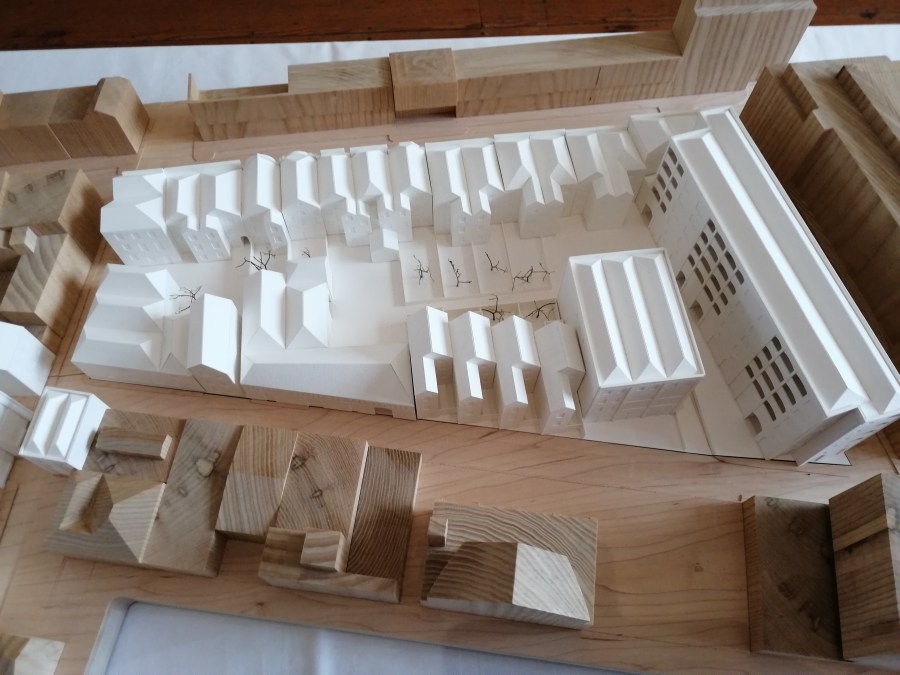
Closer view of the model, viewed from the east and looking westward — Moore Lane is represented at bottom, O’Rahilly Parade at far right and Moore Street at top of image.
Cooney also mentioned the Bill moved by Sinn Féin TD (parliamentary representative) Aengus Ó Snodaigh, currently awaiting debate in the Dáil (Irish parliament) and how it mirrored to a large degree that put forward formerly by a TD of the Irish political party Fianna Fáil, currently in coalition Government, which had not been proceeded with. Cooney paid tribute to the political party Sinn Féin as “the only political party to support” the Moore Street conservation struggle (which may have come as a surprise to Peadar Ó Tóibín, TD of the Aontú political party, who was present in the audience).
Mac Donncha thanked Cooney for his contribution and introduced Jim Connolly Heron, a great-grandson of James Connolly, one of the executed leaders of the 1916 Rising who talked about the historical importance of the site and the importance of its preservation. Connolly Heron talked about historical buildings in Dublin that had been demolished. He said their plan represented an opportunity for the State to atone for the “lamentable failure to save Wood Quay” and commented that “On that occasion the voice of the people was silenced; the loss to the city was immeasurable and we can ill afford another Wood Quay.”
Then Connolly Heron, with Proinnsias Ó Rathaille, grandson of The O’Rahilly, removed the Starry Plough flag of the Irish Citizen Army to unveil the architect’ scale model to loud applause and the clicking of phones and cameras.
A portion of the attendance then removed to the small theatre where Seán Antóin Ó Muirí, for the architects, took the audience through a slide show of drawings and maps while discussing their relevance to the Preservation Trust’s plan.
Outside the building, a large group of teenage Danish students, on a walking history tour conducted by Lorcán Collins of 1916 Rising Tours, had gathered, where they were addressed by Lorcán and also by Aengus Ó Snodaigh TD and, very briefly by Diarmuid Breatnach of the SMSFD group who, at Lorcán’s request, sang them the “Grace” ballad (in which Joseph Plunkett addresses Grace Gifford, his bride of only hours before he is to be executed by British firing squad).
THE ALTERNATIVE PLAN
The Alternative Plan as outlined by the architect involves a number of ideas that have been put forward over the years: refacing some of the buildings to match the pre-1916 facing surviving on some of the buildings, using appropriate matching construction materials, uncovering the cobblestones, etc. The two-story elevation has been promoted previously as have awning-covered ground-level shopfronts but the north end of the terrace at four storeys is a departure perhaps from previous plans other than the Hammerson and O’Reilly plans, as is perhaps the opening up of some spaces around the “back” of the terrace (accessed through Moore Lane). The plan foresees a unitary unbroken terrace which all campaigning groups have proposed.
Architect’s drawing imagining an arch leading to an internal courtyard from Moore Lane to the back of the museum in Moore Street.
Unlike some plans and visions previously mooted, the Alternative Plan as explained does not propose excluding chain stores, nor propose pubs and bakery among the businesses; street stalls were mentioned only in passing with no discussion of the range of hot and cold food or other merchandise that might be on sale. The housing units proposed do not specify local authority rental. Unlike a number of previous plans there was no mention of the benefits of linking the development of a Moore Street cultural quarter to a number of other nearby amenities and cultural quarters nor to that of rejuvenating the north city centre by day and by night.
The history component does not seem to vary much from the Hammerson/ O’Reilly one, being concentrated on the four buildings which the State has named “the historical monument”, a title also used by Trust. In the unbroken terrace proposed (and frequently demanded by campaigners) of course the Alternative Plan departs significantly from the Hammerson one but strangely this contrast was not alluded to in either the verbal or visual presentations.
In the overall presentation of a slideshow and scale model perhaps the most significant contribution of this plan is to present some of the possibilities in a manner more easily grasped and form easier for many no doubt to visualise. It is this that has been missing in past plans and proposals.
HAMMERSON AND DUBLIN CITY COUNCIL
On the west side of Moore Street is the ILAC shopping centre, built with DCC planning permission in 1977 on what was a patchwork of streets and laneways, many of them containing shops and stalls selling various new and second-hand merchandise. A university study group concluded that, apart from the construction companies, the ILAC had benefitted the big stores of Debenhams and Dunnes and that the compensation paid out to most stall-holders and small shops had been inadequate to relocate within the City Centre and workers had been made redundant. The ILAC is half-owned by Irish Life and the other half passed from O’Reilly to Hammerson.
In the early years of this century a consortium of property developers were applying for planning permission to carry out plans in the area from the northwest side of O’Connell Street to Moore Street but Dublin City Council Planning Manager froze the plans and in a very strange deal later handed it all over to Joe O’Reilly. The whole murky story (including city councillors being legally threatened to keep silent by the then Planning Manager Jim Keogan) was covered in a two-part program, Iniúchadh na Cásca, by the Irish language television channel TG4 before O’Reilly got his giant “shopping mall” planning permission (the program was re-broadcast in 2016).
Jim Keogan took early retirement from DCC and is now employed by McCutcheon Halley, a Cork-based planning consultancy company while the most recent Ireland Director for Hammerson is Mark Owen, straight from his previous employment as the Head of Asset Management & Recovery for NAMA.
The architects’ scale model, showing the quarter from a north-facing perspective (i.e from Henry Street). The street to the left is Moore Street and at the right, Moore Lane. Further to the right would be O’Connell Street, not shown here. The Henry Place lane is shown from the nearest part of the model.
INTERNAL CAMPAIGN CONTROVERSIES
Patrick Cooney in his presentation of their Alternative Plan referred to a split in the original conservation committee and in fact over the years there have been a number of controversies and conflicts among campaign groups. The remaining part of the committee containing Mr. Cooney and Mr. Connolly Heron also experienced a number of acrimonious departures. Due to internal difficulties the 1916 Relatives Association, to which both also belonged did not have a meeting for over a year and when it did so eventually, there were loud internal arguments and clashes between Mr. Connolly Heron and others, leading to a number of departures, including Marcus Howard of Easter Rising Stories, producer of many historical documentaries and filmed interviews, including a number on Moore Street.
In that atmosphere, Brian O’Neill was seen by many as a stable and quiet choice for Chair of the 1916 Relatives Association and was duly elected. Shortly afterwards Barry Lyons, a long-time campaigner was expelled from the Association as was also long-time campaigner Donna Cooney, grand-niece of Elizabeth O’Farrell and a DCC Councillor. Neither seems to have been given a formal hearing or allowed an appeal. Although formerly the 1916 Relatives’ Association opposed the developers’ plans, Brian O’Neill now represents the Association on the Minister’s Advisory Group on Moore Street and is on record supporting the Hammerson plan.
Clashes between different campaign groups and individuals have taken place on occasion inside the Lord Mayor’s Forum on Moore Street, including one between members of the Connolly Heron-Cooney group and Colm Moore, another campaigner for many years and the individual who took the High Court case against the Minister of Heritage.
The Ministers’ Consultative Group on Moore Street and its later iteration as the Minister’s Advisory Group, although it has a seat for Jim Connolly Heron, rejected the membership applications of the most active groups in the broad campaign, those who were involved in the 2016 Occupation and the six-week Blockade: the Save Moore Street From Demolition and the Save Moore Street 2016 groups. The SMSFD group has a stall on the street every Saturday, stated to have been since the founding of the group in September 2014, at 368 weeks to date and claims 380,000 signatures to its petition to save the area.
The Connolly Heron and Cooney group do not acknowledge the SMSFD group in public and on one occasion during the Blockade Mr. Cooney posted that the only campaign group they recognised outside of their own was the Save Moore Street 2016 one. However, among all the invitations that were sent out to attend the unveiling last Thursday, neither they nor the SMSFD groups received one – and nor did Colm Moore, the man who took the famous High Court case.
After the formal representation last week but while still inside the Pearse home building, Patrick Cooney was heard to clash with a prominent campaigner and City Councillor in the presence of a radio reporter. Immediately outside, Proinnsias Ó Rathaille verbally abused a member of the SMSFD group (who had learned of the event through the media) in the hearing of many people, including Danish teenagers on a walking history tour.
LOOKING AHEAD
At time of writing it is important to realise that the only plan with Planning Permission is the original O’Reilly one which Hammerson acquired. The latter have submitted their changed plan for a shopping district and new roads which is currently under review by the Planning Department who have asked for some minor changes and gave them six months to produce them. Many objections were registered (and paid for), even by the Housing Department and the feeling is that the vast sweep of popular opinion is against the Hammerson plan – however that is far from being a guarantee against its acceptance by DCC’s Planning Department. And, as NAMA failed to seize them from Joe O’Reilly, their largest debtor at the time and allowed him to transfer them, all the buildings but two (owned by Dublin City Council) are owned by Hammerson.
Should Hammerson receive approval from DCC’s Planning Department, on previous history a not unlikely event, campaigners are sure to appeal the decision to An Bord Pleanála but that avenue too holds little hope for conservationists, given the record of that body’s decisions in Dublin. In the event of an unwelcome decision there, the High Court remains the only recourse in law (for which leave has to be sought to take the case). Protests on the street are of course likely.
Given Hammerson’s financial difficulties in recent years, even if granted planning permission they may not be able to proceed with their plan immediately and despite Hammerson’s denials the suspicion of many is that they will sell the area on – but for that, they need the new Planning Permission attached first and the current one runs out next year.
End.
BACKGROUND TO A LONG CAMPAIGN
In 1916 Moore Street and surrounding streets and laneways became a battleground, as the Irish insurgent force evacuating its erstwhile HQ in the GPO ran into encircling forces of the British Army. A detachment of the GPO garrison proceeding up Moore Street ran into British rifle and machine gun fire, killing three including its leader, The O’Rahilly and wounding others. The main part of the evacuation forces also suffered casualties but occupied No.10 Moore Street and tunnelled through the 16-building terrace to the laneway at the end, where an assault group was being mobilised to attack the British Army barricade at the Moore Street/ Parnell Street junction. The decision to surrender, taken by the leadership, cancelled the assault. Along with William Pearse, five of the Seven Signatories of the 1916 Proclamation spent their last hours of freedom in Moore Street, not long after to be shot by British firing squads: Thomas Clarke, Patrick Pearse, James Connolly, Sean McDermott and Joseph Plunkett.
Prior to 1966 there was nothing in Moore Street to inform people of what happened there although in that year, amidst the 50th anniversary commemorations of the 1916 Rising, a small plaque was placed at first floor level on No.16 Moore Street, believed to have housed the last HQ of the 1916 Rising. That plaque was noted missing in 2002 – it turned up in a property speculator’s office – and fears of demolition plan for the buildings gave rise to a campaign to save it. A meeting was organised by the National Graves Association and a committee formed, hardly a single one of which is currently active in the campaign today for a number of reasons (Patrick Cooney alluded to one of them, a split when some sided with the property developer of the time but there have been many others).
The 50th anniversary of the 1916 Rising plaque in Moore Street, the only fixture to say anything of the sort that happened there.
The campaign extended its demand for the conservation of the whole terrace, backyards etc and in 2006 the State finally conceded a historical importance worth conserving in Moore Street by declaring Nos.14-17 a National Monument, though these still belonged to O’Reilly. In 2008, O’Reilly applied for planning permission for a huge “shopping mall” from O’Connell Street to Moore Street, with a “ski slope” on top and carpark underneath, entailing the demolition of all but Nos.14-17 and the renovation of these as a small museum. DCC’s Planning Department approved the plan but it was appealed to An Bord Pleanála which, against the advice of its own Inspector, rejected the appeal. With the removal of the “ski slope” top and the underground carpark, the giant “shopping mall” was approved but O’Reilly’s demolition plans faced a problem in that two buildings at the end of the terrace belonged to Dublin City Council and four in the middle are protected structures.
In 2009 and 2012 dramatist Frank Allen organised human chain “Arms Around Moore Street” events which gained some media attention.
The campaign gained prominence again when in September 2014 O’Reilly offered Dublin City Council the dilapidated Nos. 14-17 in exchange for Nos. 24-25, where the Council had a waste management depot, a “land-swap” favoured by the City Managers and the Minister of Heritage. A branch of the campaign set up a stall on the street and began to collect signatures to a conservation petition and to disseminate campaign leaflets. In November the majority of DCC councillors voted to reject the deal.
The campaign group with a weekly Saturday stall on the street, now called Save Moore Street From Demolition and separate from the other which had mainly concentrated on lobbying, organised the first public meeting about the campaign in November 2014, inviting as speakers Jim Connolly Heron and Donna Cooney (there had been some conflicts between the two). But in January 2016 the group noted hoardings going up around Nos.12-18 with plans for the demolition of three buildings. They called two emergency meetings during the week on the street and supporters, a mix of people including water protesters and Irish Republicans, occupied the buildings, an act which became headline news.
While the Minister of Heritage made ready to obtain an injunction against the occupiers, instead Colm Moore, who had registered a case with the High Court against the State plans, obtained an injunction against any demolition until the case should be decided and the occupiers left the buildings after one week. However, subsequently alarmed by sounds of heavy machinery inside the buildings, campaigners asked to inspect the works but were refused, as was also a delegation of politicians led by the Lord Mayor.
A new defence coalition called Save Moore Street 2016 had been formed of those who had occupied the buildings and including representatives of the weekly stall group, SMSFD and these now installed a blockade on the buildings from 6.30am to 4pm Monday to Friday. No building workers were admitted to the buildings until the decision of the High Court, on 18th March 2016, that the whole terrace and its surrounding area is a national historical monument.
In the meantime the SMSFD group separately and, in particular the SMS2016 coalition, had organised marches, history walking tours, street concerts and street theatre events in period costume, including mock “heritage funerals” and a reenactment of the 1916 surrender.
Towards the end of 2016, also the 100th anniversary of the 1916 Rising, the Minister of Heritage set up her Advisory Group on Moore Street and the 1916 Relatives’ Association, formed earlier that year, were invited to participate, as was the separate Jim Connolly Heron/ Paddy Cooney etc group, along with representatives of the political parties in the Dáil. Not invited were the National Graves Association, the Save Moore Street From Demolition or the Save Moore Street 2016 activist groups — the applications of the latter two were rejected, though they were permitted to make a submission.
By this time, O’Reilly had been permitted by the responsible officer at NAMA to transfer his Moore Street and Dundrum portfolio to Hammerson.
The Lord Mayor’s Forum on Moore Street, where all concerned have had representation, has met regularly some years but not on others. The 1916 Relatives Association has seen internal changes and ended with its Chairperson supporting the Hammerson plan. The Jim Connolly Heron/ Paddy Cooney group has gone through a number of name changes, shedding some individuals and gaining others, before the current group presenting the Alternative Plan.
Immediately outside the Pearse’s house, a group Danish teenage students, having arrived as part of a history walking tour conducted by Lorcán Collins (in cap, far right of photo, seen from the back) is addressed by Aengus Ó Snodaigh TD (mostly out of shot).
The Dublin police played a fundamental role in the creation of the first workers’ army in the world, the Irish Citizen Army.
The Dublin employer syndicate’s offensive against the working-class “syndicalism” of the Irish Transport & General Worker’s Union1 began with the 1913 Lockout, in turn triggering strikes on August 26th, when workers were presented with a document they were to sign declaring that they would leave the ITG&WU or, if not a member, would refuse to support it in any action2. Most workers of any union and none refused to sign and 20,000 workers were confronted by 400 employers.
However, the employers’ numbers were added to by the Dublin Metropolitan Police and the Royal Irish Constabulary, backed up by the judiciary. Morally and ideologically the Irish Times and Irish Independent (the latter owned by W.M. Murphy, leader of the employers) backed the employers as, to a large extent, did the Irish Catholic Church hierarchy3.
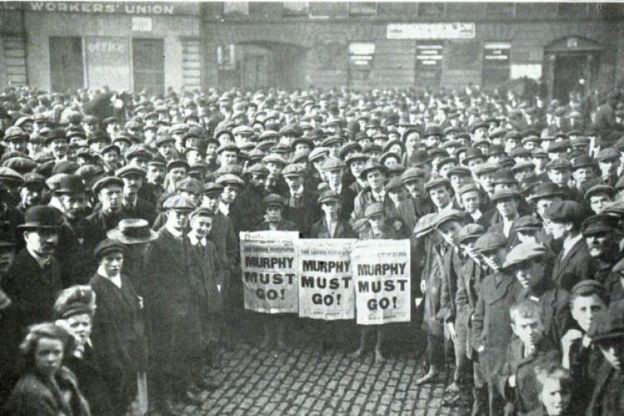
Workers’ demonstration with newsboys (WM Murphy owned the Irish Independent newspaper). (Source image: Internet)
The national (non-workers’) movement was divided in its opinion: many of Redmond’s Irish Parliamentary Party representatives were employers or landlords and their sympathies were naturally not with the workers. But for example Seán Mac Diarmada, a republican and national revolutionary, organiser for the secret Irish Republican Brotherhood4, opposed the strike on the basis that foreign business interests would profit by the paralysing of Irish business concerns5. On the other hand, Mac Diarmada’s mentor and head of the IRB in Ireland, Tom Clarke, was sympathetic to the strikers.
POLICE RIOTS
Unlike the gendarmerie6 British police force throughout Ireland of the Royal Irish Constabulary, at this time the constables of the DMP were unarmed except with truncheons but even with those they managed to kill people. On 30th August 1913 the DMP baton-charged a crowd in a street meeting on Eden Quay, outside Liberty Hall, HQ of the union7. Among the many injured were James Nolan and John Byrne who died 31st August and 4th September respectively, both in Jervis St. Hospital. (see also other riots and police attacks in Sources & Further Reading below).
On the 31st Jim Larkin went in disguise to address an advertised public meeting, banned by a magistrate, in Sackville (now O’Connell) St., Dublin. In view of the behaviour of the police, most of the IT&GWU activists went instead to their rented facilities at Fairview but a large enough crowd of the committed and the curious were assembled in O’Connell Street, along with large force of the DMP. Larkin, disguised as an elderly Protestant minister arrived by horse-drawn carriage and, as befitted a man made infirm by age, was assisted by Nellie Gifford8 into the Clery’s building which housed the Imperial Hotel restaurant, which belonged to W.M. Murphy (as did the Dublin Tram Co.). In order that Larkin’s strong Liverpool accent should not give him away, Nellie Gifford did all the talking to the staff inside. Shortly afterwards Larkin appeared at a restaurant window on the first floor and, top hat removed, spoke briefly to the crowd below but, as DMP rushed into the building, tried to make his getaway.
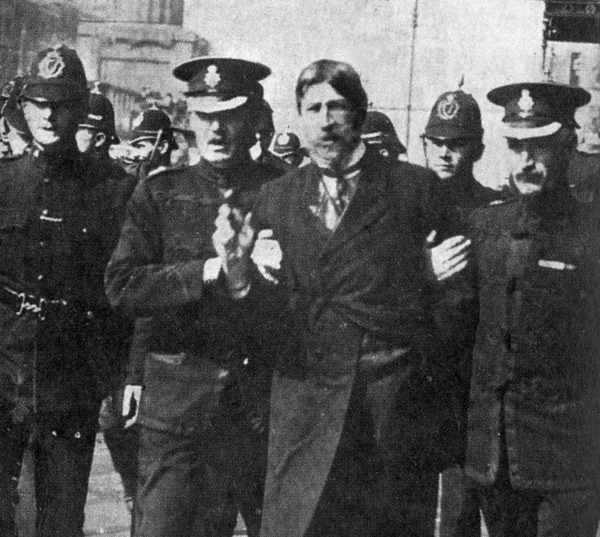
The arrest of Jim Larkin on 31st August 1913, being removed from the Clery’s building (see plinth of the Nelson Pillar behind and to the left) in O’Connell Street, just before the Dublin Metropolitan Police attack on the crowd. (Source image: Internet)
The DMP arrested Larkin and when the crowd cheered him (led by Constance Markievicz), the DMP baton-charged the crowd, striking out indiscriminately, including knocking unconscious a Fianna (Republican youth organisation) boy Patsy O’Connor who was giving First Aid to a man the police had already knocked to the ground. Between 400 and 600 were injured and Patsy suffered from headaches thereafter; though active in the Republican movement (he was prominent in the 1914 Howth guns collection9) he died in 1915, the year before the Rising. Among those beaten were journalists and casual passers-by. Those caught in Princes Street10 between DMP already in that street and the police charging across the main street were beaten particularly savagely.
The police attack became known as “Bloody Sunday 1913” (though two workers had been fatally injured on Eden Quay the day before and are often wrongly listed as having been killed on that day).
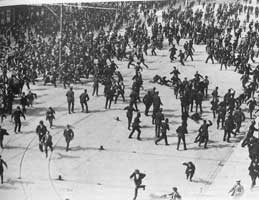
A photo of the police riot taking place on 31st August 1913 in O’Connell St; police can be seen striking with their truncheons even those on the ground. (Source image: Internet)
Also on that day the DMP attacked the poor working-class dwellings of Corporation Buildings (in “the Monto”, off Talbot St11), beat the residents and smashed their paltry furniture. The raid was a revenge attack for the reception of bottles and stones they had received on the 30th, when they were chasing fleeing workers from Liberty Hall (others crossed Butt Bridge to the south side and a running battle took place along Townsend Street and almost to Ringsend.
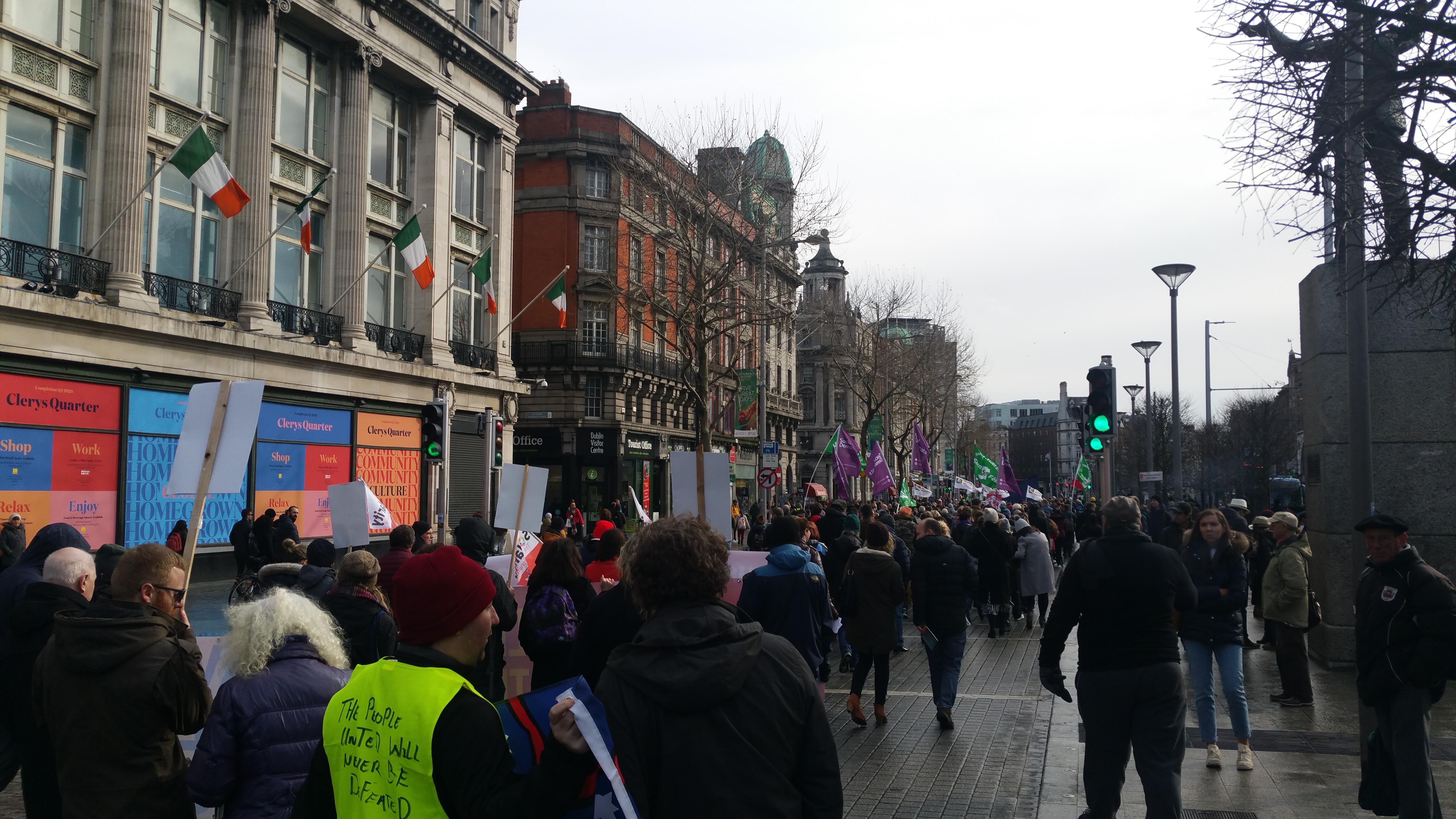
Protest march goes past closed-down Clery’s to the left in 2016 while Larkin looks down from his pedestal to the right. (Photo: D.Breatnach)
THE IRISH CITIZEN ARMY 1913 AND 1916
Very soon after those attacks, Larkin and Connolly each called publicly for the formation of a workers’ defence force, which became the Irish Citizen Army. Around 120 ICA, including female members fought with distinction in the 1916 Rising and raised their flag, the Starry Plough on the roof of WM Murphy’s Imperial Hotel on the upper floors of Clery’s building, opposite the GPO13. A number of its Volunteers were killed or wounded in action and two of the ICA’s leaders, Connolly and Mallin, were executed afterwards; another, Constance Markievicz, had her sentence of death commuted.
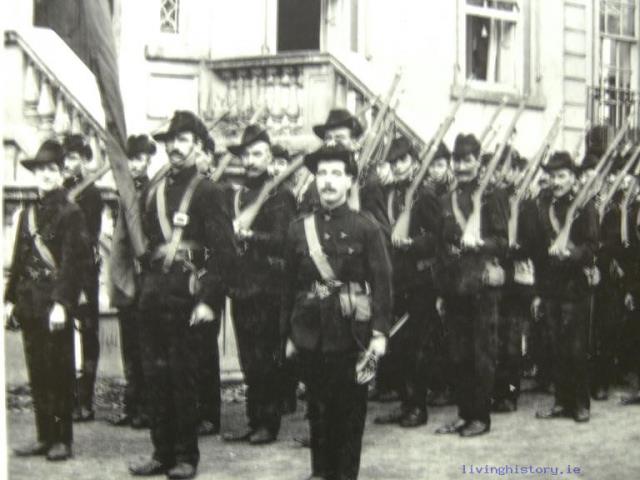
Irish Citizen Army on parade at their facility in Fairview. (Source image: Internet)
A much-diminished ICA took part in the War of Independence.
The end of August 1913 on Eden Quay and in O’Connell Street may be seen as the period and birthplaces of the ICA, the “first workers’ army in the world” and the first also to recruit women, some of whom were officers.
The Jim Larkin monument stands opposite the Clery’s building, which is now under renovation but without a mention on the monument or on the building of Bloody Sunday 1913 or its background and result. Sic transit gloria proletariis
end.
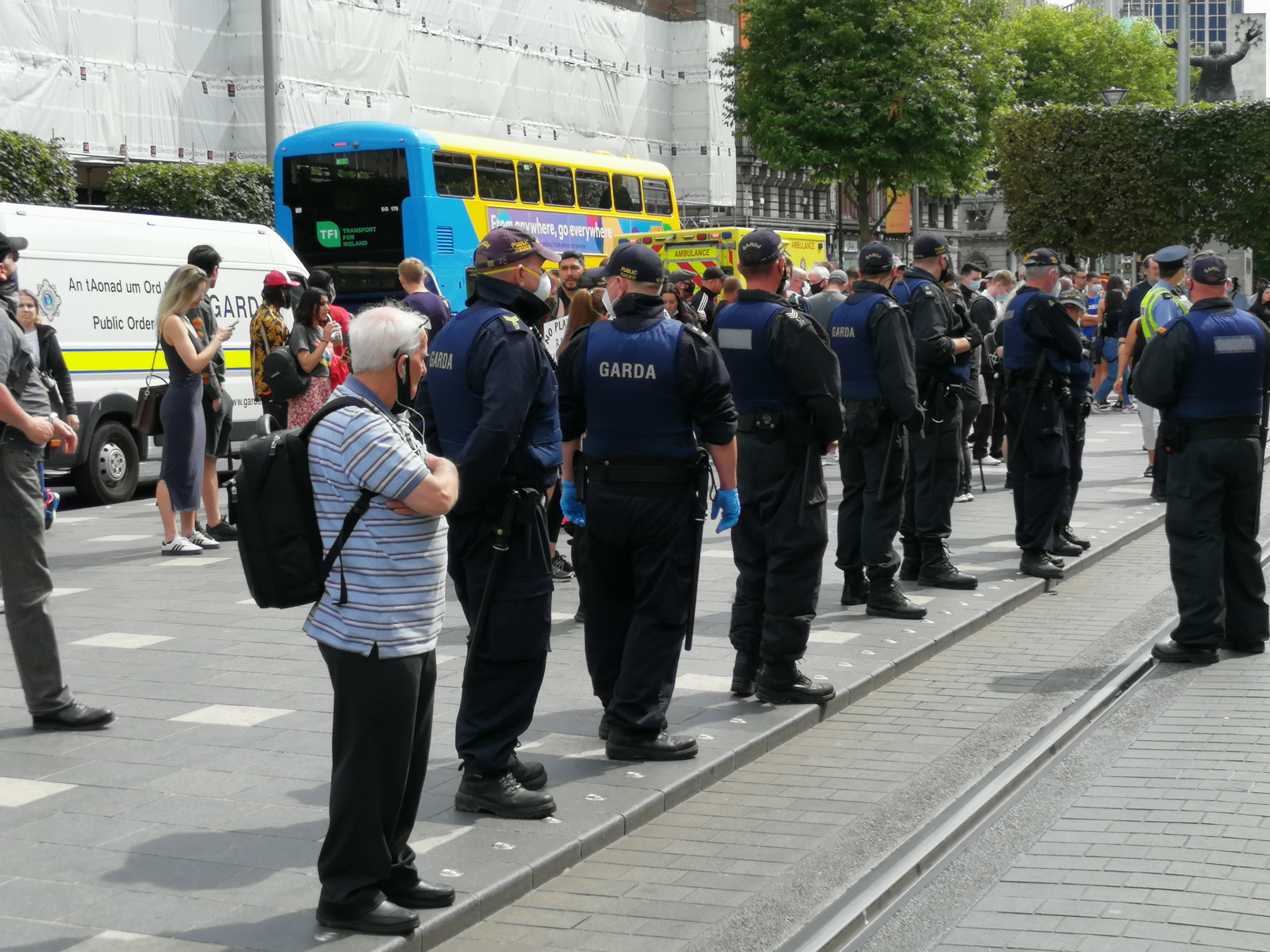
Today’s DMP, Garda Public Order Unit guarding far-Right gathering in O’Connell Street in 2020 (facing them, out of photo view). The Larkin monument can be seen in part at the top right-hand corner. (Photo: D.Breatnach)
FOOTNOTES
1The ITGWU was formed in 1909 by James Larkin, former organiser for the National Union of Dock Labourers after his bitter departure from that union. Most of the members Larkin had recruited for the NUDL, with the exception of the Belfast Protestant membership, left the NUDL and joined the IT&GWU.
2The provision in the declaration for members of unions other than the iT&GWU was necessary for the employers because of the general credo in Irish trade unionism that one did not cross a picket line, whether of one’s own union or of another, a credo that persisted in Ireland until the 1980s when the Irish Trade Union Council joined the “Social Partnership” of the State and the employers’ Federation. In addition, Larkin had added the principle that goods from a workplace on strike, even if strike-breakers could be got to bring them out, were “tainted goods” and would not be handled by members of the IT&GWU, nor should they be by any other union either.
3 Apart from any statements by bishops and priests, the religious charity organisation, the St. Vincent de Paul, refused assistance to families of strikers.
4 The IRB was founded simultaneously in Dublin and New York on 17th March 1858 and became known as “the Fenians”. In 1913 the movement had declined but was being rebuilt under the leadership of Tom Clarke, who went on to become one of the Seven Signatories of the 1916 Proclamation of Independence, all of which were executed b y firing squad after surrendering, along with another nine. Both were signatories of the Proclamation of Independence.
5It is one of the many ironies that on May 12th 1916, the last of the of the 14 surrendered leadership executed in Dublin (another two were executed elsewhere, one in Cork and the last in London) were Mac Diarmada and James Connolly, shot by British firing squads in Kilmainham Jail; the one an opponent of the workers’ action and the other one of its leadership.
6The gendarmerie is a particular militarised type of police force, armed and often operating out of barracks, like the Carabinieri of Italy, Gendarmerie of Turkey and Guardia Civil of the Spanish State. It is an armed force of state repression designed to control wide areas of potentially rebellious populations and it is notable that the parallel of the RIC did not exist in Britain, where the police force was mostly unarmed except by truncheon.
7Liberty Hall is still there today but a very different building (the original was shelled by the British in 1916) and SIPTU is a very different union too.
8Nellie was one of 12 children of a mixed religion marriage and was, like all her sisters (unlike the six unionist boys), a nationalist and supporter of women’s suffrage. Her sister Grace married Volunteer Joseph Plunkett hours before his execution and is, with Plunkett, the subject of the plaintive ballad “Grace” and Muriel married Thomas McDonagh, one of the Seven Signatories of the Proclamation, all of whom were among the 16 executed after surrendering in 1916. Nellie Gifford was the only one who participated in the Rising; she was a member of the Irish Citizen Army and was active in the Stephen’s Green/ College of Surgeons garrison, jailed and continued to be active after her release.
926th July 1914, when the yacht Asgard, captained by the Englishman Erskine Childrers, delivered a consignment of Mauser rifles and ammunition to the Irish Volunteers.
10Those may have been heading for Williams Lane which even today leads out from Princes Street to Middle Abbey Street (the junction of which is where James Connolly received the impact to his ankle in 1916).
11Corporation Buildings as one might expect housed working class people and the “Monto” (Montgomery Street) was a notorious red light district.
12The police station is still there, staffed by the Garda Síochána but in 1913 it housed also a British Army garrison.
13This flag, one of at least four different flags flown during the Rising, is now in the Irish National Museum at Collins Barrack. Shortly after the Rising it was noted by a British Army officer still in place upon the gutted Clery’s building and taken by him as a trophy to England. In 1966, the 50th anniversary of the Rising, the officer’s family returned the flag to the Irish people.
As Limerick and Waterford county teams prepared to face one another in the GAA hurling semi-final at Croke Park stadium, anti-internment protesters and campaigners lined up outside Dublin’s General Post Office, in the city centre, to mark the 50th Anniversary on the introduction of internment without trial in the British colony of the Six Counties. Their placards, leaflets and speakers denounced the continuing practice of interning political activists in Ireland today.
Seen at the anti-internment event in Dublin today (Photo crdt: Sean Hogan)
The event was organised by the Anti-Internment Group of Ireland, an independent and non-affiliated campaigning organisation and the supporters included a mixture of socialist Irish Republicans and anarchists. The heavy and persistent rain of the morning held off and Dublin city centre was thronged as GAA hurling supporters added to the usual shoppers. The banners and placards of the picketers drew considerable interest from those passing and here and there people stopped to discuss with them.
Some young Basque girls were curious but also delighted to see their nation’s flag, the ikurrina, being flown at the event and stopped to engage one of the picketers in discussion. Also in evidence was the flag of Amnistia, Basque organisation around solidarity with its political prisoners and against repression, along with the flag of Palestine.
Flag of the Amnistia organisation (solidarity with their political prisoners) in the Basque Country seen on the anti-internment event in Dublin today (Photo crdt: Sean Hogan)
Around 200 leaflets were distributed to passers-by, discussions were held and contacts were made with people interested in supporting the work of the Anti-Internment Group Ireland.
After some time in a picket line and distributing leaflets, a representative of the organisers, speaking in Irish and in English, welcomed the attendance and introduced a speaker from the Anti-Imperialist Action organisation.
One of the leafleters outside the GPO at the anti-internment event in Dublin today (Photo: C.Sulish)
SPEAKERS
Speaking in Irish as some passers-by stopped to listen, the young man said they were there to commemorate the introduction of internment and mindful of the existence of political prisoners all over the world. The were also protesting the extradition to Lithuania of Liam Campbell to face trial in a country in which he had never previously set foot.
The organisers’ representative then spoke in English about the history of repression in the Six Counties colony, how from the moment the nationalist community there stood up to demand equal rights and justice the State had responded with violence. Since the people raised the level of their resistance in response, the State in turn raised the level of its violence higher again, in a rising spiral of violence.
The nationalist community in the Six Counties had marched for civil rights and had been met with the violence of the colonial police and of the Loyalists — the speaker said — but they had continued to resist. Internment without trial was introduced to break that resistance but, knowing that would also lead to increased resistance, the State had prepared the Paratroopers to shoot unarmed civilians dead. They had done that in Ballymurphy on the very day that internment had been introduced1, he reminded his audience and later had shot dead two unarmed Cumann na mBan Volunteers (Republican women’s organisation) who were alerting people to the raiding parties of the British Army. At the start of the following year, the British Army murdered unarmed civilians again, this time in Derry2.
That year 1972, the speaker stated, had the highest death toll of any year during the three decades of the war3 and Loyalists were also bombing streets nearby in Dublin, again in 1973, killing workers. In 1974 Loyalists and British intelligence bombed the Dublin city centre again and Monaghan, killing the highest number of people killed in one day during the war4. That year too, the IRA bombed pubs in England and killed people and the State brought in the repressive Prevention of Terrorism Act against the Irish community. They jailed a score of innocent people on extremely serious charges5 and one of them, Giuseppe Conlon, died in jail6.
The speaker went on to say that although there had been hard repression before, the introduction of internment without trial and the follow-up massacres by the British Army had lit a fuse to a chain-reaction of violence for decades to follow.
Pointing out that internment consists of jailing people without trial, the speaker stated that the practice continues today, by refusing bail to political activists awaiting trial in the non-jury courts on both sides of the British Border. The Anti-Internment Group of Ireland will continue striving to expose this reality and he called on people to support the monthly pickets in the city centre and to follow the End Internment page on Facebook.
ONGOING AGITATING AGAINST INTERNMENT
As the applause died down people began to pack away flags, banners, placards and leaflets and to catch up socially among themselves or to engage with passers-by who had stopped to listen and/ or to ask questions.
Organisers of the event said they hope to hold another picket at some venue in the city centre in a month’s time – when scheduled, the event will be announced on the End Internment FB page.
End.
Leafleter right foreground, person reading leaflet left foreground, picket line of the anti-internment event in Dublin today. (Photo: C.Sulish)
(Photo: S.Hogan)
(Photo: S.Hogan)View of the picket with a passer-by expressing solidarity with the picketers (far right of photo). (Photo: C.Sulish)
FOOTNOTES
1Between 9-11 August, British paratroopers caused the deaths of 11 unarmed civilians in Ballymurphy.
213 people were shot dead by British paratroopers on Bloody Sunday in Derry as they protested against internment and a 14th died later of his wounds.
3The period from August 1971 to the end of the year saw a huge jump to 136 violent deaths (including British and colonial armed forces) and the following year, 1972 is counted the most violent year of the conflict overall with 479 people killed (including 130 British soldiers) and 4,876 injured.
5The Birmingham Six, Guildford Four, Maguire Seven, Giuseppe Conlon and Judith Ward. All were eventually cleared after long years of campaigning around them and failed court appeals.
6Giuseppe Conlon, hearing that his son Gerry had been arrested for the Guildford Pub Bombings, came to London to help him in 1974 and was swept up into the police net to become one of the innocent framed victims. Giuseppe Conlon was not a healthy man and died in his 7th year in jail, before the verdicts on the other framed prisoners were finally overturned. His son Gerry, also an innocent man in jail, was not permitted to attend his father’s funeral.
Tá reilig i mBaile Átha Cliath a bhfuil breis agus míle bliain aici, agus crois ann a tartháladh ó loiteadh Chromail. Ach tá cuid de mhuinntir na h-áite mí-shásta leis an saghas cúram a bhfuil Comhairle Cathrach Bhaile Átha Cliath ag tabhairt di agus táid ag iarraidh iad féin a bheith freagrach as cúram na reilige.
Tá Reilig Naomh Channaithe suite díreach siar ón débhealach a ghearrann trí Fhionnghlas agus shéipéil.
“Tá uaimheanna ann do na h-uaisle áitiúla — teaghlach Maffett — atá daingnithe anois”, adeir Joe Lynch ag caint i mBéarla, “chun cosaint a dhéanamh ar robálaithe uaighe. Tá tuamaí cófra ann do na sagairt a fuair bás agus easpaig, agus cinn cloiche simplí do na comóntóirí.”
Bhí athair Joe Lynch mar airíoch ar an reilig agus bhí teaichín aige cois reilige dá bharr; b’ann a tógadh an clann páiste, Joe san áireamh. “Thugtaí isteach mé chuig an reilig i mbarra rotha,” adeir Joe, ‘agus mé ceithre bliain d’aois. Agus bheinn ag iarraidh cabhrú nuair a ligfí amach mé.”
An crois Críostaíoch ársa sa reilig (Griangraf: G. Hill)
NAOMH CAINNECH
B’ab, sagart agus misinéir Éireannach é Cainnech (515 / 16-600) as Achadh Bhó ins an Condae ainmnithe ar a shon, Cill Chainnigh chomh maith le bunaitheoir mainistreach i rith na luath-mheánaoise. Tugtar “Saint Canice” air i mBéarla in Éirinn, “St. Kenneth” in Albain nó “St. Kenny” agus i Laidin “Sanctus Canicus”. Tá an Cainneach ar cheann de Dháréag Aspal na hÉireann agus rinneadh sé seanmóireacht ar an gCríostaíocht ar fud na tíre agus ar na Cruithnigh in Albain. Scríobh sé tráchtaireacht ar na Soiscéil, ar a tugadh Glas-Chainnigh nó “Lock Kenneth” nó “Slabhra Chainnigh” ar feadh na gcéadta bliain.
Tá an chuid is mó dá bhfuil scríofa faoi shaol Cainnech bunaithe ar thraidisiún, ach measadh go raibh sé ina fhear le dea-cháil, le solabharthacht mór agus le léann. I 544 rinne sé staidéar faoi Mobhí Cláraineach i scoil Ghlas Naíon, le Ciarán as Cluain Mhic Nóise agus Comgall de Bheannchar. Nuair a scaip plá an pobal sin, chuaigh sé go mainistir Cadoc i Llancarfan i Glamorganshire sa Bhreatain Bheag, áit ar ordaíodh ina shagart é i 545.
Tá tagairt dá ainm luaite i sé logainm déag ag Wikipedia: in Éirinn, sa Bhreatain Bhig, in Albain, ins na SAM, san Astráil agus sa Nua-Shéalainn. Déantar comóradh ar a lá féasta an 11ú Deireadh Fómhair san Eaglais Chaitliceach Rómhánach agus in Eaglais Cheartchreidmheach an Oirthir de réir a gcuid féilirí faoi seach (Gregorian nó Church Julian) le laethanta féasta breise an 1d nó 14ú Lúnasa in Eaglais Cheartchreidmheach an Oirthir.
(Griangraf: D. Breatnach)
MEITHEAL OIBRE
Bhí meitheal oibre ann sa Reilig trathnóna Déardaoin seo chaite agus iad ag baint fiadhaile agus féir, ag gearradh driseacha, eidhneáin is a leithéid. Bhí na préamhacha go doimhin in áiteanna agus ba léir nach ndearna cóiriú ceart le tamall fada. “Tá an eidhneán ag clúdú ballaí an fhothrach agus de réir a chéile ag déanamh dochar dó. Is ón 10ú nó 12ú Céad an cill agus ba cheart na ballaí a chaomhnú,” adúirt ball den chumann staire áitiúil.
Joe Lynch i mbun oibre. (Griangraf: D. Breatnach)
“D’úsáid teaghlaigh Protastúnacha agus Caitliceacha an reilig,” adeir Joe, “lucht creidimh amháin ag teacht isteadh geata amháin agus an geata eile ag an gcreidimh eile. Ach ní gá dúinn an dá gheata anois agus táim ag tathant ar an gComhairle an geata eile a tháthú le fada.”
Deir lucht an chaomhnaithe go ndearnadh an crois ársa a roinnt i gcodanna sa 17ú Céad ionnas go bhféadfaí a chur i bhfolach nuair a chuala go raibh fórsaí Chromail le teacht thríd an dúiche, de fhaitíos go ndéanfadh siad an siomból a scrios mar a bhí á dhéanamh acu ar fud na tíre (ag iarraidh “íoldadhradh” a ruaigeadh). Thóg na fórsaí céanna bóthar eile ach d’fhan píosa na croise i bhfolach go ceann breis agus 160 bliain, go dtí go ndeachadh an t-urramach Walshe á lorg thrí bhéaloideas na h-áite agus tháinig air, ach níor fuarthas bun na croise go dtí seo.
Tá an crois céanna sa Reilig anois agus glacadh ag cumainn áitiúla mar siomból na dúiche. De réir Joe Lynch tá an Comhairle Cathrach ag iarraidh an crois a bhailliú as an reilig ach tá sé féin agus daoine eile ag iarraidh go bhfágfaidh ann é agus cúram na Reilige a fhágáil ag muinntir na h-áite.
Tá meithil eagraithe chun oibre ag an reilig trathnónta Sathairn agus oícheannta Déardaoine agus tuilleadh eolais ar leathanach Facebook na reilige.
Duine den mheithil i mbun oibre. (Griangraf: D. Breatnach)
ST CANICE’S CEMETERY IN FINGLAS – “LET US HAVE THE RESPONSIBILITY”
Diarmuid Breatnach
(Reading time: 2 mins)
There is a cemetery in Dublin that is over a thousand years old, containing a cross that was salvaged from Cromwell’s destruction. But some locals are unhappy with the kind of care that Dublin City Council is giving it and want to take responsibility for the care of the cemetery.
St. Canice’s Cemetery is located just west of the dual carriageway which cuts through Finglas and churches.
“There is a crypt for the local esquires, the Maffett family – now cemented,” says Joe Lynch, “to protect it from grave robbers. There are chest tombs for the dead priests and bishops, and simple headstones for the commoners. ”
Joe Lynch’s father was caretaker of the cemetery and had a cottage next to it; it was where Joe was raised as a child. “I was taken to a cemetery in wheelbarrow,” says Joe, “when I was four years old. And I would want to help when I was let out.”
(Griangraf: D. Breatnach)
SAINT CANICE
Cainnech (515 / 16-600) was an Irish abbot, priest and missionary from the county named after him, Kilkenny, and the founder of an early medieval monastery. He is called “Saint Canice” in English in Ireland, “St. Kenneth” in Scotland or “St. Kenny” and in Latin “Sanctus Canicus”. Canice is one of the Twelve Apostles of Ireland and preached Christianity throughout the country and to the Picts in Scotland. He wrote a commentary on the Gospels, known as “Lock Kenneth” or “Chain of Canice” for centuries.
Most of what is written about Kenny’s life is based on tradition, but he was considered a man of good repute, great eloquence and learning. In 544 he studied at St. Mobhi’s in Glasnevin, with Ciarán of Clonmacnoise and Comgall of Bangor. When the plague spread, he went to Cadoc Abbey in Llancarfan in Glamorganshire, Wales, where he was ordained a priest in 545.
Wikipedia connects his name to sixteen placenames: in Ireland, Wales, Scotland, the USA, Australia and New Zealand. His feast day on October 11th is commemorated in the Roman Catholic Church and the Eastern Orthodox Church according to their respective calendars (Gregorian or Church Julian) with additional feast days on the 1st or 14th of August in the Eastern Orthodox Church.
WORKING GROUP
A “meitheal”, a cooperative work party was at work last Thursday afternoon pulling weeds, cutting grass, brambles and ivy. The roots were deep in places and it was clear that site had not been properly tended for a long time. “The ivy is covering the walls of the ruin and gradually damaging them. The church dates from the 10th or 12th Century and the walls should be preserved,” said a member of the local historical society.
“The cemetery was used by Protestant and Catholic families,” says Joe, “one group entering one gate and the other faith at the other. But we don’t need both gates now and I’ve been at the Council to weld the other gate for a long time. ”
Larry agus ball eile den mheithil. (Griangraf: D. Breatnach)
Conservationists say the ancient cross was divided into parts in the 17th Century so that it could be hidden when they heard that Cromwell’s forces were coming through the area, for fear of their destroying the symbol as was being done all over the country (to banish “idolatrous worship”). The same forces traveled another route instead but the pieces of the cross remained hidden for over 160 years, until the reverend Walshe investigated local folklore and found it, but the base of the cross has not been found to date.
The same cross is now in the Cemetery and has been accepted by local societies as a symbol of the district. According to Joe Lynch the City Council is trying to remove the cross from the cemetery but he and others want it to remain there and the care of the Cemetery to be left to the local people.
The cemetery has a working group organized on Saturday evenings and Thursday evenings, more information on the cemetery ‘s Facebook page.
Cuid de bhallaí fothrach na cille agus duine den mheithil. (Griangraf: D. Breatnach)
Ina luigh ach ag obair.
Darmuid Ó Dubhghlais agus sean-leac uaighe. (Griangraf: D. Breatnach)
An príomh-gheata agus an crois ársa in aice leis. (Griangraf: D. Breatnach)
In 1843 the lyrics of In Memory of the Dead were published anonymously in The Nation but it seems to have been an open secret in Dublin political circles that the author was John Kells Ingram. As often happens, the song became known by its opening line “Who Fears to Speak of ‘98” and years later Ingram admitted having written the lyrics. Though it never once mentions Daniel O’Connell, taken in context of its subject, time and where it was published, the song was a blistering attack on the politician and his Repeal of the Union organisation. Yet while Kells Ingram was many things, he was no revolutionary — unlike the editors of the Nation and many of its readers.
Plaque indicating former location of The Nation newspaper in Middle Abbey Street, Dublin, premises bought out ironically by The Irish Independent. (Photo: D.Breatnach)
John Kells Ingram was a mildly nationalist mathematician, economist, philosopher and poet who was selected to write expert entries for the Encyclopedia Britannica. But although he was no revolutionary it is clear that he felt a distaste for O’Connell’s distancing himself from the memory of those who had risen in rebellion four decades earlier.
John Kells Ingram 1823-1907 (1890) by Sarah Purser (1848 – 1943). (Photo sourced: Internet)
Supporting O’Connell initially, The Nation sought to create a patriotic and indeed revolutionary culture through its pages. One of The Nation’s founders and editors, Thomas Davis was perforce also one of the periodical’s contributors and his compositions The West’s Awake and A Nation Once Again are still sung today, the latter very nearly becoming Ireland’s national anthem. The lyrics of Who Fears to Speak celebrated historical memory of resistance and lamented death and exile, the latter to the USA, where many of the surviving United Irish had gone (“across the Atlantic foam“). Davis’ In Bodenstown’s Churchyard, commemorated and celebrated Theobald Wolfe Tone, remembered as the father of Irish Republicanism and martyr.
Portrait of Thomas Davis (Sourced on: Internet)
Three years after co-founding The Nation, Thomas Davis died of scarlet fever in 1845, a few months short of his 31st birthday. Two years later, in “Black ‘47”, the worst year of the Great Hunger, the Young Irelanders finally and formally split from O’Connell’s Repeal Movement and in 1848 had their ill-fated and short uprising – again jail and exile for the leaders followed. Just under a score of years later, 1867 saw the tardy and unsuccessful rising of the Fenians with again, resultant jail sentences and exile (in addition to the executions of the Manchester Martyrs).
Two years following the rising of the Young Irelanders, in 1850 Arthur M. Forrester was born near Manchester in Salford, England (the “Dirty Old Town” of Ewan McColl) and in 1869 his stirring words of The Felons of Our Land appeared in Songs of a Rising Nation and other poetry (Felons reprinted by Kearney Brothers in a 1922 collection including songs by Thomas Davis). Songs of a Rising Nation was a collection published by the militant and resourceful Ellen Forrester from Clones, Co. Monaghan, who struggled to raise her children after the early death of her husband and included poems by her son Arthur and daughter Cathy.
Felons of Our Land indeed contains some of the themes of Who Fears to Speak (of which Arthur was doubtless aware) but in addition those of jail and death on the scaffold. By that time, the Young Irelanders had been added to the imprisoned and exiled, some in escape to the USA but others to penal colony in the Australias. And Forester added the theme of pride in our political prisoners:
A felon’s cap’s the noblest crown
an Irish head can wear.
and
We love them yet, we can’t forget
the felons of our land.
Twenty years after the publication of The Felons of Our Land, in 1889, another Irishman, Jim Connell, writing in SE London, would contribute the lyrics of the anthem of the working class in Britain, The Red Flag. Although commonly sung to the air of a German Christmas carol, Connell himself put it to the the traditional Jacobite air of The White Cockade. Connell, from Crossakiel in Co. Meath, also invoked historical memory and included the theme of martyrdom in explanation of the flag’s colour:
The workers’ flag is deepest red —
it shrouded oft’ our martyrs dead,
And ‘ere their limbs grew stiff and cold
their life’s blood dyed its every fold.
Jim Connell (Sourced on: Internet)
The traditions and themes of resistance and struggle are handed from generation to generation and song is one of the vehicles of that transmission. But songwriters borrow themes not just from history but from the very songs of the singers and songwriters before them. In 1869 Arthur M. Forrester wrote in Who Fears to Speak of ‘98:
Let cowards mock and tyrants frown
ah, little do we care ….
Jim Connell, three decades later, took up not only the themes but also that line:
Let cowards mock and traitors sneer,
we’ll keep the red flag flying here.
End.
APPENDIX
References in lyrics to themes
of exile:
In Who Fears to Speak of ‘98 (1843)
Some on a far-off distant land
their weary hearts have laid
And by the stranger’s heedless hands
their lonely graves were made.
But though their clay
be far away
Across the Atlantic foam …
In The Felons of Our Land (1869)
“…We’ll drink a toast
to comrades far away …
and
…. or flee, outlawed and banned
In The Red Flag (1889)
None.
of imprisonment:
In Who Fears to Speak of ‘98 (1843)
None.
In The Felons of Our Land(1869)
(Apart from the title and refrain)
… though they sleep in dungeons deep
and
Some in the convict’s dreary cell
have found a living tomb
And some unseen unfriended fell
within the dungeon’s gloom …
also
A felon’s cap’s the noblest crown
an Irish head can wear……
In The Red Flag (1889)
Come dungeons dark or gallows grim ….
of martyred death:
In Who Fears to Speak of ‘98 (1843)
Alas that might should conquer right,
they fell and passed away …..
In The Felons of Our Land (1869)
….. Some on the scaffold proudly died …
In The Red Flag (1889)
….. their life’s blood dyed its every fold ….
and
….. to bear it onward til we fall;
Come dungeons dark or gallows grim,
this song shall be our parting hymn.
of cowards and/ or traitors:
In Who Fears to Speak of ‘98 (1843)
Who fears to speak of ‘98,
who blushes at the name?
When cowards mock the patriot’s fate,
who hangs his head for shame?
He’s all a knave or half a slave
Who slights his country thus …
In The Felons of Our Land (1869)
…. And brothers say, shall we, today,
unmoved like cowards stand,While traitors shame and foes defame,
the Felons of our Land.
and
Let cowards mock and tyrants frown, …
In The Red Flag (1889)
. ..Though cowards flinch and traitors sneer (repeated in the chorus, sung six times)
and
It suits today the weak and base, Whose minds are fixed on pelf and place To cringe before the rich man’s frown, And haul the sacred emblem down.
of the higher moral fibre of revolutionaries:
In Who Fears to Speak of ‘98 (1843)
Repeated reference in every verse to such as
a true man, like you man and you men, be true men etc.
Alas that Might should conquer Right ….
In The Felons of Our Land (1869)
… No nation on earth can boast of braver hearts than they ….
also
And every Gael in Inishfail,
who scorns the serf’s vile brand,
From Lee to Boyne would gladly join
the felons of our land.
In The Red Flag (1889)
The banner bright, the symbol plain, Of human right and human gain.
and
With heads uncovered swear we all To bear it onward till we fall; Come dungeons dark or gallows grim, This song shall be our parting hymn.
of eventual victory:
In Who Fears to Speak of ‘98 (1843)
… a fiery blaze that nothing can withstand …
In The Felons of Our Land (1869)
None – but inferred.
In The Red Flag (1889)
It well recalls the triumphs past, It gives the hope of peace at last; The banner bright, the symbol plain, Of human right and human gain.
He also asked not to be wrapped in a shroud but a blanket. The idea of a shroud he found humiliating. His remains being wrapped in a blanket was not a shock. The blanket had defined the prison protest and he identified as a blanketman, even telling British secretary of state Roy Mason “bury me in my blanket.”
A cross-section of mostly independent activists from across the Communist, Republican and Anarchist continuum held a small march today to celebrate May 1st, International Workers’ Day. All wearing masks against spreading the virus and marching from the north city centre to the south, they held a momentary picket outside the HQ of the KPMG financial group which has carried out evictions of people from their homes as well as raids on Debenham’s stores to inventory stock, led by Gardaí attacking Debenham workers’ pickets and their supporters. At the close of the march the participants were surrounded by a large force of Gardaí and all had their names and addresses recorded under Covid19 legislation while a number were arrested and others were threatened with arrest under the Public Order Act.
May 1st was agreed as the international day of the working class after the police massacre of demonstrators in Chicago in 1886 on a demonstration for the 8-hour day and the subsequent framing of anarchists leading to the judicial martyrdom of five activists.
Gathering outside the Garden of Remembrance (Photo: R.Breeze)
Just after noon today the march set off in two columns from outside the Garden of Remembrance and proceeded down O’Connell Street (Dublin’s main street). The leading banner recalled that on Liberty Hall prior to the 1916 Rising: “We serve neither King nor Kaiser but Ireland”. Many of the marchers were young and led by a banner with a red flag showing the design of the hammer and sickle, followed by a number of Fianna Éireann flags (orange sunburst on a blue field) and Starry Ploughs (gold ursa mayor and plough on a green field) of the Irish Citizen Army. There were also some other red flags and flags of Antifascist, Cumann na mBan flag (name in peach with brown rifle on a blue background), “Irish Republic”, the Irish Tricolour and the Starry Plough (ursa mayor in white on a blue background).
“WE ONLY WANT THE EARTH”
Initially a lone voice on the march sang verses of James Connolly’s satirical song Be Moderate1 to the air of Davis’ A Nation Once Again with other voices joining in on the chorus:
We only want the Earth,
We only want the Earth
And our demands most moderate are:
We only want the Earth!
View of marchers being addressed across the road from the GPO, Dublin city centre (in the far distance, figure with arms raised is part of the Larkin monument). (Photo: R.Breeze)Placards and two of the flags outside the GPO in Dublin city centre (Photo: R.Breeze)Beside James Connolly Monument (to the left, out of shot; the HQ of Ireland’s biggest union SIPTU is visible to the right). Gardaí may be seen gathering also plainclothes ‘Special Branch’ officer turned away (dark jacket, blue jeans). (Photo: R.Breeze)
The marchers gathered briefly outside the GPO, where a couple of speakers addressed them before re-forming to march again, turning into Abbey Street and gathering again at the James Connolly monument in Beresford Place, where they were briefly addressed again, then marching on past the Bus Áras and across the river, a heavy screen of Gardaí between the marchers and Custom House Quay, where a far-Right “May Day” rally has been advertised by the Irish Yellow Vests2, opportunistically and hypocritically using the image of Martin Luther King!
The Mayday marchers proceeded to Pearse Street, around by Trinity College and into Grafton Street. There were a number of shouts and slogans, including:
Happy May 1st, International Workers’ Day! Up the workers!
Housing for need, not for profit! Housing for all, not for profit!
There were also a number of slogans shouted against the two main Coalition parties, Fine Gael and Fianna Fáil, who were accused of being robbers. A number of shouts also pointed out that the workers are the creators of all wealth.
Proceeding along the west side of Stephens’ Green, a voice called out that this area had been held under the Irish Citizen Army in 1916 and called attention to the marks of bullet impact on the exterior of the College of Surgeons building. In Harcourt Street the march turned into Stokes Place and, as the security guard at the barrier challenged them with “Excuse me!” a marcher replied: “You’re excused!” Outside the KPMG building the marchers paused briefly before leaving again and retracing their steps, folding up their banner and rolling up flags.
Inside the complex where the KPMG has their Dublin HQ. (Photo: R.Breeze)
GARDA HARASSMENT, THREATS AND ARRESTS
At the bottom of Grafton Street the leading group of marchers, all flags and banner now folded, turned left into Dame Street prior to dispersing and were there halted by a large group of Gardaí with a number of Garda vans and cars in attendance.
Garda officers proceeded to harass the marchers, asking them their purpose in being in the city, requiring replies under Covid19 regulations, along with names, addresses and dates of birth. When a man shouted “Shame on you! Shame!” at the Gardaí as they were arresting a young man, a Sergeant threatened him with arrest under the Public Order Act. “For what?” asked the man, denying that he had used threatening or abusive words, the Garda insisting he had and cautioning him.
Some of the Gardaí harassing marchers in Dame Street (Photo: R.Breeze)
More Gardaí harassing May Day marchers at end of march in Dame Street (Photo: R.Breeze)
Some of the Garda vehicles used in harassment of the May Day marchers at the end of their march in Dame Street (Photo: R.Breeze)
Four Gardaí were around another marcher accusing him of having an offensive weapon (a pair of scissors to cut the cable ties on the groups’ flags!). When another marcher pointed out to them that they were just using excuses to harass the marchers and asked were they going to do the same to the Irish Yellow Vest crowd on Custom House Quay, he too was threatened for using “threatening and abusive words” and ordered to disperse.
It is believed that three were arrested but difficult to confirm due to Gardaí ordering others to disperse under threat of further arrests.
Two of the bicycle Gardaí who were keeping tabs on the marchers, seen here in Dame Street, looking back towards the concentration of Gardaí harrassing May Day marchers. (Photo: R.Breeze)
DEMOCRATIC RIGHT TO PROTEST AND PICKET UNDER ATTACK
Despite Covid19 legislation under Level Five forbidding non-essential work, last week KPMG employees entered Debenham’s stores in cities of the Irish state while Gardaí forcibly removed Debenham workers and supporters’ pickets.
On Thursday this week, taxi drivers in Dublin were intimidated by Gardaí from holding a protest although they would have been isolated within their taxis and perforce practicing social distancing. According to information given in the Dáil by some TDs (members of the Irish Parliament), the taxi drivers were threatened with hefty fines and impact upon their license renewals (a department of the Gardaí manages the verification and renewal of taxi drivers’ licenses).
Yet all throughout the Level Five restrictions, Far-Right groups have held marches and rallies protesting against the Lockdown, without wearing masks or practicing social distancing, without enduring Garda threats and without mass taking of names and addresses. It remains to be seen what action if any the Gardaí took or will be taking on Custom House Quay today3. What the charges against the May Day marchers arrested today might be remain to be seen too and how long they are (or were) detained.
The Garda actions against legitimate and peaceful protests and pickets seem to harbinger more attacks on rights to protest as the Gombeen capitalist class and their government endeavour to make the workers pay for the financial cost of the Covid19 crisis and ‘recovery’.
End.
FOOTNOTES
1One of the songs published in Connolly’s songbook “Songs of Freedom” in 1907 in New York.
2A Far-Right organisation led by an Islamophobe that has joined with openly fascist organisations in the past.
3According to reports received, in Dublin Gardaí prevented the IYV entering on to Custom House Quay and moved them on a number of times after that. However in Cork the Gardaí facilitated the Far-Right (around 350, according to the Irish Times) in holding a march and rally in which they were addressed bty former Aontú Councillor Anne McCloskey from Derry (despite travel restrictions) and Dolores Cahill, 2nd-in-command of the fascist Irish Freedom Party. Cahill has been withdrawn by UCD from her lecture course after petition by 133 students and debunking of her theories but is still receiving her salary from the institution. On St. Patrick’s Day she told a rally the wearing of masks would mean that children would “never reach their IQ and job potential because their brains are starved of oxygen,” adding that the reason “globalists” are “putting down the masks” is due to the fact “oxygen-deprived people are easier to manipulate”. McCloskey told the crowd in Cork that people were dying of other illnesses untreated because the authorities wanted to to ascribe the deaths to the “mild” Covid19 virus so their freedom could be restricted. She said that people should take off their masks and embrace.