BLESSINGS, CURSES, OATHS, THE FENIANS AND POPE PIUS IX

Diarmuid Breatnach

(Reading time: under 10 minutes)

This is an article about grammar, religion and politics. While the last two are often discussed in the same conversation, grammar is usually absent as a subject. But it has its place here.


SWEARING AND CURSING

          “Don’t curse!” or “Don’t swear!” a parent or an elder might have said to us when we were children or teenagers. And particularly when we were teenagers we did exactly what we had been told not to, certainly the boys, in a mistaken sign of manhood. As a verse in the English folk song The Shoals of Herring has it, in fact:

Well you’re up on deck, you’re a fisherman,

You can swear and show a manly bearing,

Take a turn on deck with the other fellows

As you hunt the bonny shoals of herring.”

A related admonition was against “taking the Lord’s name in vain”, which was a prohibition of blasphemy, the misuse of Yahweh’s name, taken from Exodus 20.7: “Thou shalt not take the name of the Lord they God in vain; for the Lord will not hold him guiltless that takes his name in vain.” 1

So most of us grew up thinking that swearing and cursing were the same thing and more or less careful about which company in which to use those words – or not. But we were mistaken, cursing and swearing are not the same thing at all.

We are familiar with swearing in some formal settings, such as courts of law, for example: “I swear by almighty God that the evidence I give shall be the truth, the whole truth ….”2 and also with swearing for entry into some organisations (frequently the armed forces).

Bejaysus”, common in Dublin, is from “by Jesus” and “bedad” is probably a disguised “by God”. The Cockney’s “Blimey” was originally “May God blind me” (e.g “if I am not telling the truth”).

The use of “Bloody” in informal society was often a swearing upon the “blood of Christ” or, strangely sometimes, the blood of “Mary”, the mother of Christ in the religions of “the Book” (Bible, Talmud or Koran). Of course “bloody” could be used pejoratively in the sense of “blood-stained”3, in which case it was not swearing but might still raise objections in some quarters of society, or descriptive of a massacre as in “Bloody Sunday”4.

In fact, swearing is to call a divine Power to witness the truth of what we are saying (in courts of law, for example) and that we intend to carry out the expectations of the organisation (e.g in the armed forces). In swearing, we utter an “oath”. Nowadays, most people who are not highly religious probably attach little importance to the form of words, though some institutions persevere with them. But in older times and not even so long ago, most people viewed an oath as a very important thing.

To break an oath of allegiance in some countries and in some periods incurred severe penalties, including death. “Oath-breaker” was an epithet that might be attached to the name of an “outlaw”, one who had broken his oath of service to a Saxon, Norman or English Lord in the Middle Ages.

The required Oath of Allegiance to the British Crown, simultaneously to the Head of the Anglican Church, prevented many Catholics for centuries from entry into many professions and from being elected as a public representative. And the British Crown was itself particularly worried for centuries by alternative “oath-bound societies” that were seeking united workers’ actions, such as agrarian defence organisations and trade unions, or equality and improvement in social conditions, for example political organisations. Laws were passed against the dispensing and swearing of such oaths.

Representation of the three witches in Shakespeare’s “Macbeth”. throwing a curse.
(Image sourced: Internet)

Cursing, although it may sometimes “take the Lord’s name in vain”, is something else completely. We know in Ireland of the “Curse of Cromwell” but more frequent probably was Mallacht na bPréacháin “the Curse of the crows”, which wished upon the victim a childless land, to be inherited only by the crows. Scread mhaidne was another ill-wish to lay upon someone, that he or she may die in agony, screaming into the morning. Ná feice tú Dia sounded less terrifying but might have been more frightening for a very religious person: “May you (never) see God!”.

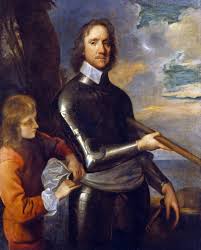
Painting of Oliver Cromwell, an English Republican whose name became part of a curse in Ireland (including for Irish Republicans!).
(Image sourced: Internet)


Damn” and “Goddamn” are abbreviations of “May God damn …” (“you, her, it, them” etc) and to utter them in many circles in the USA is considered evidence of bad rearing. They are curses which are also oaths, in calling upon the Devine being to add power to the curse.

Typically, curses and oath-curses use the subjunctive in grammar and, although seemingly strange, this connects them to blessings and greetings. Go raibh maith agat (may you have good”) is the Irish for “thank you” and Go mba hé duit (“may it be [the same] for you”) is the reply to the Irish greetings Sé do bheatha or Móra duit. Slán abhaile (“Safe home”) is an abbreviation of Go dtéigh tú slán etc (“May you go safely home”). All of these are in the subjunctive form of speech.  Vaya con Dios (“May you go with God”) is a castillian-language (Spanish) farewell wish we might come across in tales set in the south-west USA or in Latin America; that is also in the subjunctive. In fact “farewell” was “fare thee well” and probably originally, “May thee fare well”. Instead of the “Go to Hell” or “I hope you break your neck” one might hear today, centuries ago one would have heard “May you go to Hell” or “May you break your neck”.

This constant use of the subjunctive to wish well or ill upon others suggests to me that it was widely believed, at some stage in society, at least in most European societies, that one could make something happen by using a certain form of words. That form was the subjunctive; however, according to many who study language, the subjunctive is disappearing in European language and remains most in use preserved in everyday greetings and well-wishes – and the occasional curse.

It seems to me that the reason for this gradual disappearance is that we no longer believe we can make things happen by the way that we say them. We may wish them – and show the object person that we wish them – but we can’t make them happen. Nor can we expect a thing to happen with anything like a confidence that invoking a God will bring the wish, for good or ill, to fruition.

FENIANS

          Earlier in this discussion I touched on oath-bound societies and the apprehension with which they were often regarded by those in power. Well, the Fenians were such an organisation. Formed on St. Patrick’s Day 1858, in Ireland as the Irish Republican Brotherhood and in the USA as the Irish Fenian Brotherhood, it was a popular movement until the Irish Civil War (1919-1922). Because of their revolutionary credentials and democratic program, they were accepted into the International Workingmen’s Association (the First Socialist International 1864-1889). As a true Republican organisation, they sought the separation of Church and State5 and in that, apparently incurred the wrath of Pope Pius IX (Giovanni Maria Mastai-Feretti, ruled from 1846 to his death in 1878). He excommunicated the Fenians.

Pope Pius IX
(Photo source: Internet)

Although a significant number of Fenians (particularly in the leadership) were of Protestant background (Presbyterian, Anglican, Methodist, Unitarian), most of the Fenians had been brought up in the religious faith of the majority in Ireland, Catholicism. Not only would excommunication be painful to Catholic Fenians but could also lead to their being shunned by other Catholics who might otherwise have supported them. In the end this did not occur to anything like the extent that would have pleased the Catholic Church hierarchy or the British rulers of Ireland, as Irish Catholics have historically shown an ability to set to one side the teachings of the Church when they appear in contradiction to their struggle for national self-determination.

But obviously the public excommunication did the movement some harm and hurt many Fenians who were also strongly Catholic, such as John O’Mahony, co-founder in the USA, who left the Fenians as he approached his death so that he might be administered the last rites of the Church6.

John O’Mayony, c.1867, a Catholic Fenian, excommunicated by Pius IX (Source photo: Internet)

SCHOOL SOPHISTRY

          In an Irish secondary school run by the Christian Brothers, we were taught that the opposition of the Catholic Church to the Fenians (and presumably to the subsequent Republican military organisations), rather than being due to their struggle for Irish independence, was the secret organisation’s dispensing and repetition of an oath of allegiance. Perhaps we were too ill-informed (I know that I was) to bring up the question of oaths given in other circumstances, such as in giving evidence in court or in military service, circumstances with which the Church appeared to have no problem.

Had one of us done so, our Christian Brother teachers might have replied that what was wrong was “taking the Lord’s name in vain” and explained that “in vain” did not, in the English at the time of translation of Bible texts, mean only “for no important purpose” but also “for no good purpose” and that would of course have included “for an evil purpose”.

Had we questioned what the “evil purpose” might have been in the case of the Fenians, we would have put our teachers in some difficulty.

What for example in the two versions of the Fenian Oath recorded, might be considered “evil”?

I, A.B., do solemnly swear, in the presence of Almighty God, that I will do my utmost, at every risk, while life lasts, to make Ireland an independent democratic republic; that I will yield implicit obedience, in all things not contrary to the law of God, to the commands of my superior officers; and that I shall preserve inviolable secrecy regarding all the transactions of this secret society that may be confided to me. So help me God! Amen.”

I, A.B., in the presence of Almighty God, do solemnly swear allegiance to the Irish Republic, now virtually established; and that I will do my very utmost, at every risk, while life lasts, to defend its independence and integrity; and, finally, that I will yield implicit obedience in all things, not contrary to the laws of God, to the commands of my superior officers. So help me God! Amen.

Would a Christian brother have admitted opposition, not only by himself but by the Catholic Church, the dogma of which he was explaining, to the establishment of an “Irish Republic”, or even to “an independent democratic republic”? And if not, what then? The use of armed force, i.e violence? Since when has the Catholic Church hierarchy been against violence in or of itself? Did it not support some side in most inter-European wars and Spanish, French and Portuguese colonial wars? In fact, did the Catholic hierarchy not itself initiate some wars and did the Vatican not have its own army, as pointed out by Fr. Sean McManus in the USA7?

If the objection were not to “a democratic Republic”, against which Pius IX was definitely set, in that he opposed the separation of Church and State, then surely the only honest reply could have been: “The Catholic Church hierarchy in Ireland made a deal first with the British occupation that if they gave Catholics equal rights and let us build up our power here, we would not support their overthrow. Since then we made a similar deal with the Irish State and its rulers. And we intend to honour that deal.”

End.

FOOTNOTES:

2In the courts of many countries one is now permitted to use the words “I affirm that the evidence I shall give …” and one may sometimes be asked by the presiding judge whether one is an atheist, or agnostic – presumably as otherwise the failure to “swear by Almighty God” might be regarded as suspect.

3“Bloody Queen Mary” was an example, Mary Tudor, Mary I Queen of England (1560-1558; ruled ’53-’58), who had nearly 300 Protestants burned at the stake for “heresy”. )

4In Irish history, three are generally recognised: Dublin 1913, Dublin 1920 and Derry 1972.

5Not all organisations dubbing themselves “Republican” do in fact uphold this principle and in fact it could be said that the Irish Republican movement from the early 20th Century until its end did not generally do so, in that it rarely confronted the Church on its social policies or interference in lay matters, except when the Church condemned Republican actions. Also a great many Republican commemorations included the officiating of a member of the Catholic clergy.

6See the Irish Echo article in Links & References.

7Ibid.


LINKS AND REFERENCES

https://www.google.com/search?q=Dictionary#dobs=excommunication

https://www.irishecho.com/2011/02/unholy-row-brews-over-anti-fenian-pope-pius-ix-2/

https://en.wikipedia.org/wiki/Syllabus_of_Errors

https://en.wikipedia.org/wiki/List_of_people_excommunicated_by_the_Catholic_Church

https://www.encyclopedia.com/international/encyclopedias-almanacs-transcripts-and-maps/two-fenian-oaths

HOUSING DEMONSTRATIONS MARCH THROUGH DUBLIN

Diarmuid Breatnach

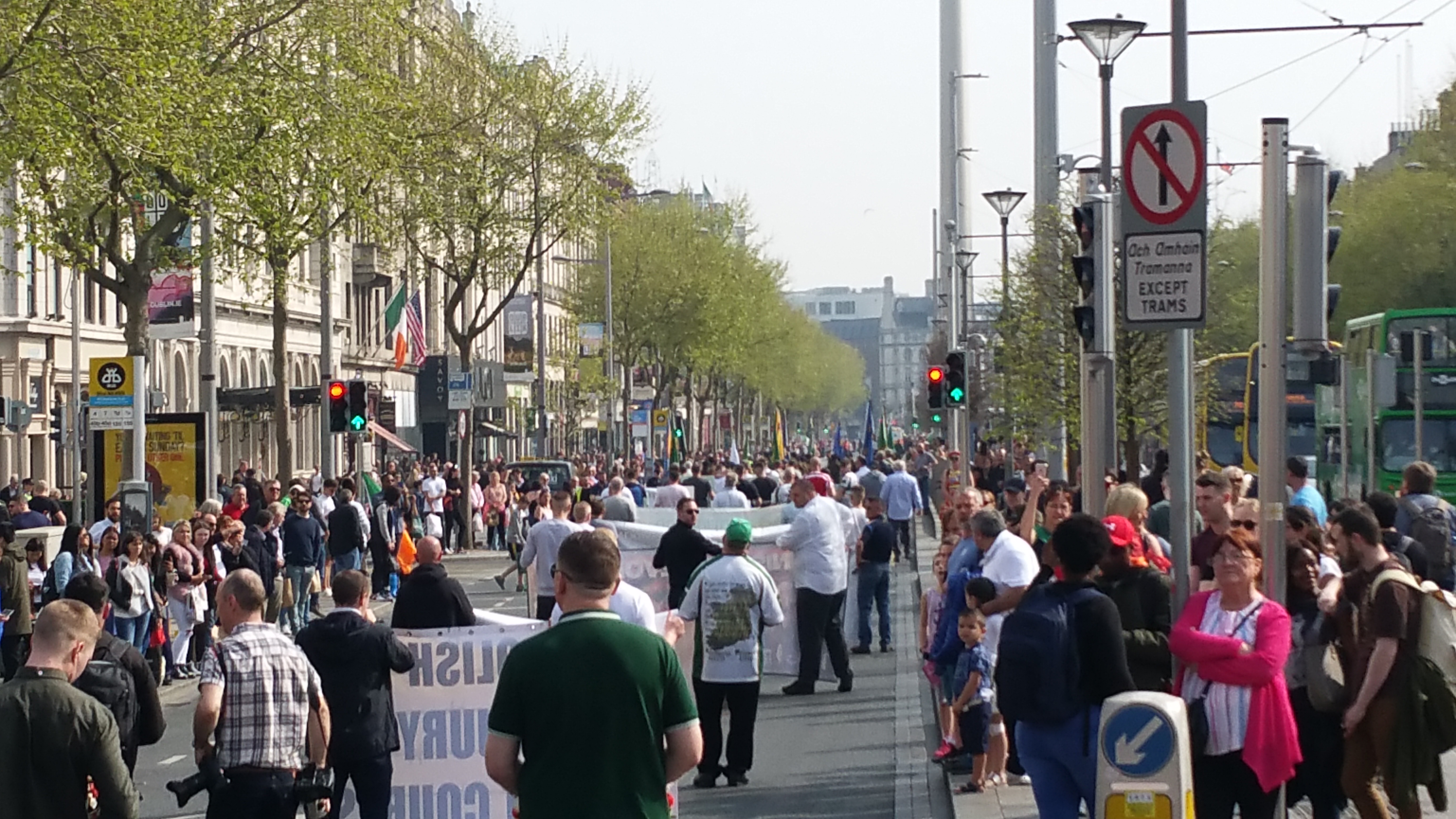
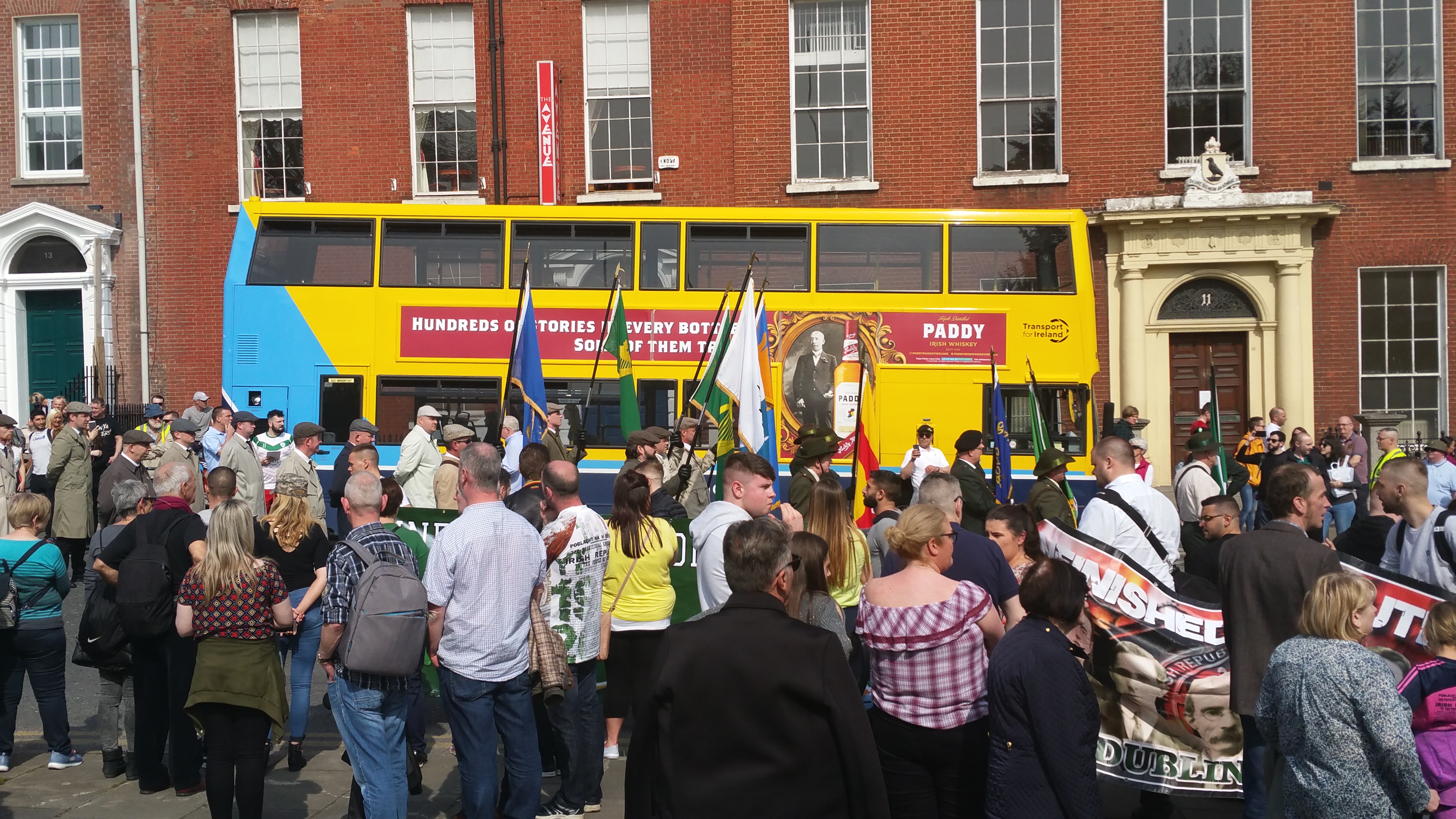
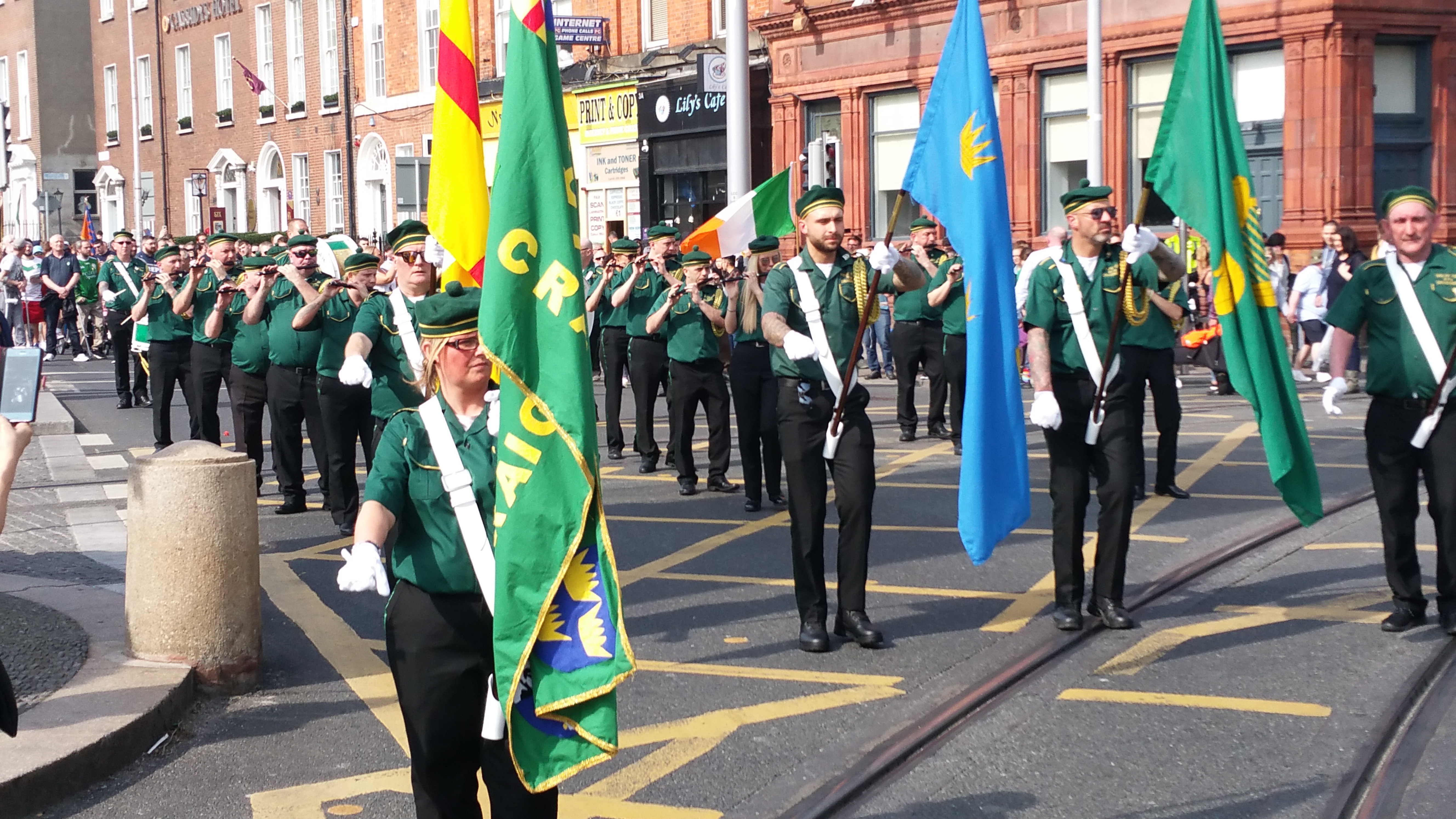
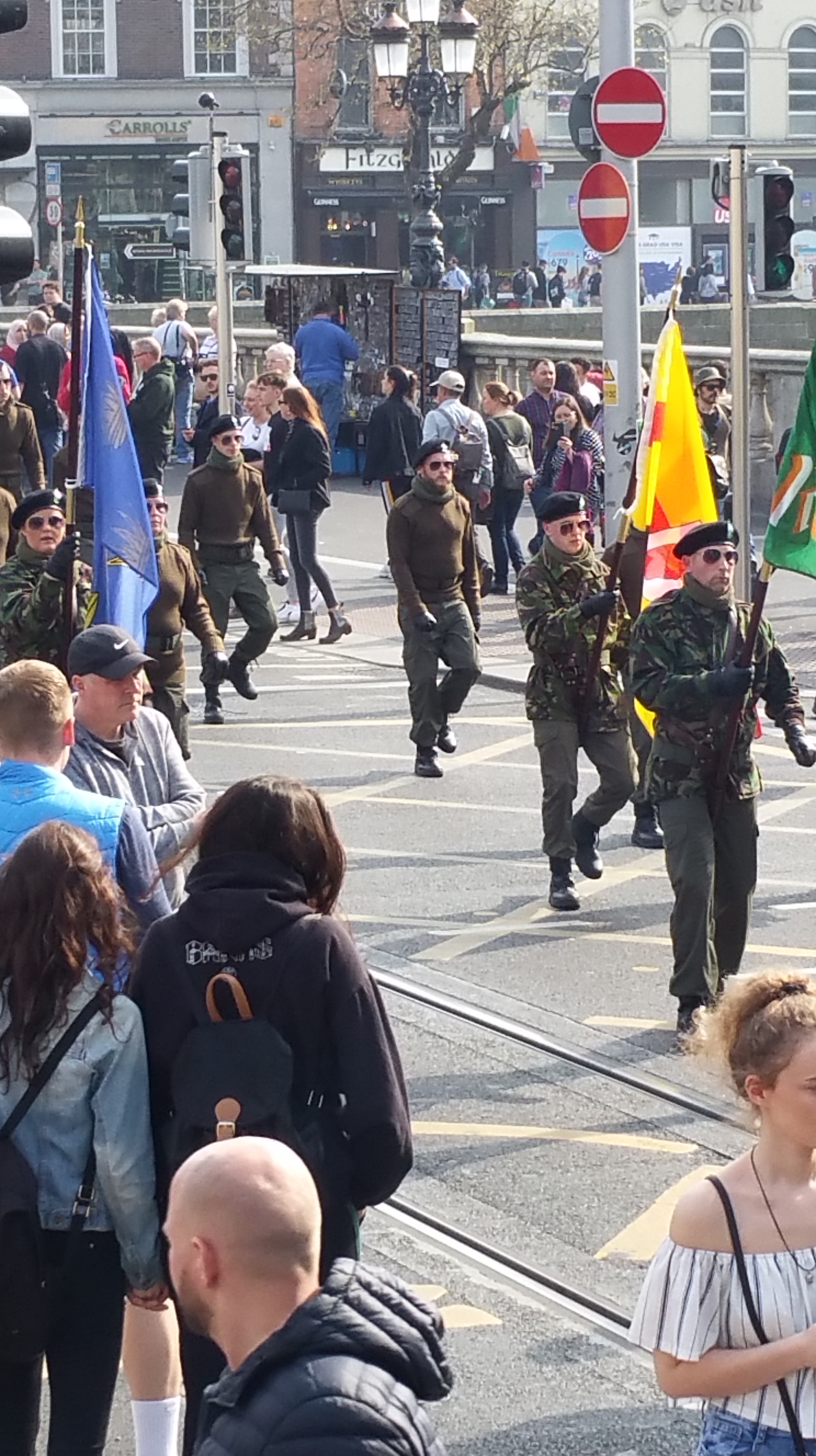
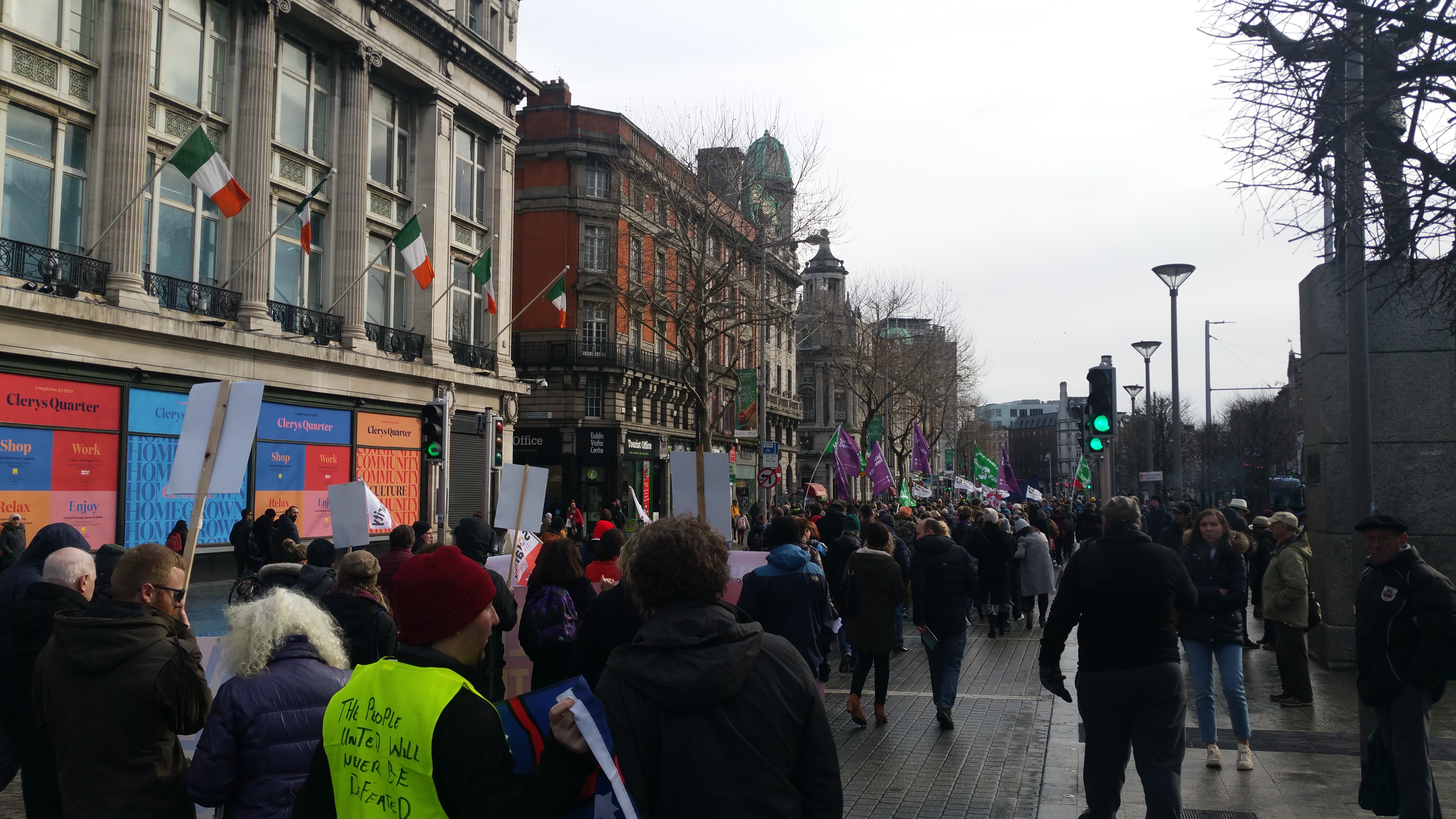
Protesters calling for the urgent construction of public housing marched through Dublin today. Various organisations and many independent activists took part in the protest with a broad range of people took pat, from socialist to republican-orientated, some with their children. The event was organised by the National Homeless and Housing Coalition.

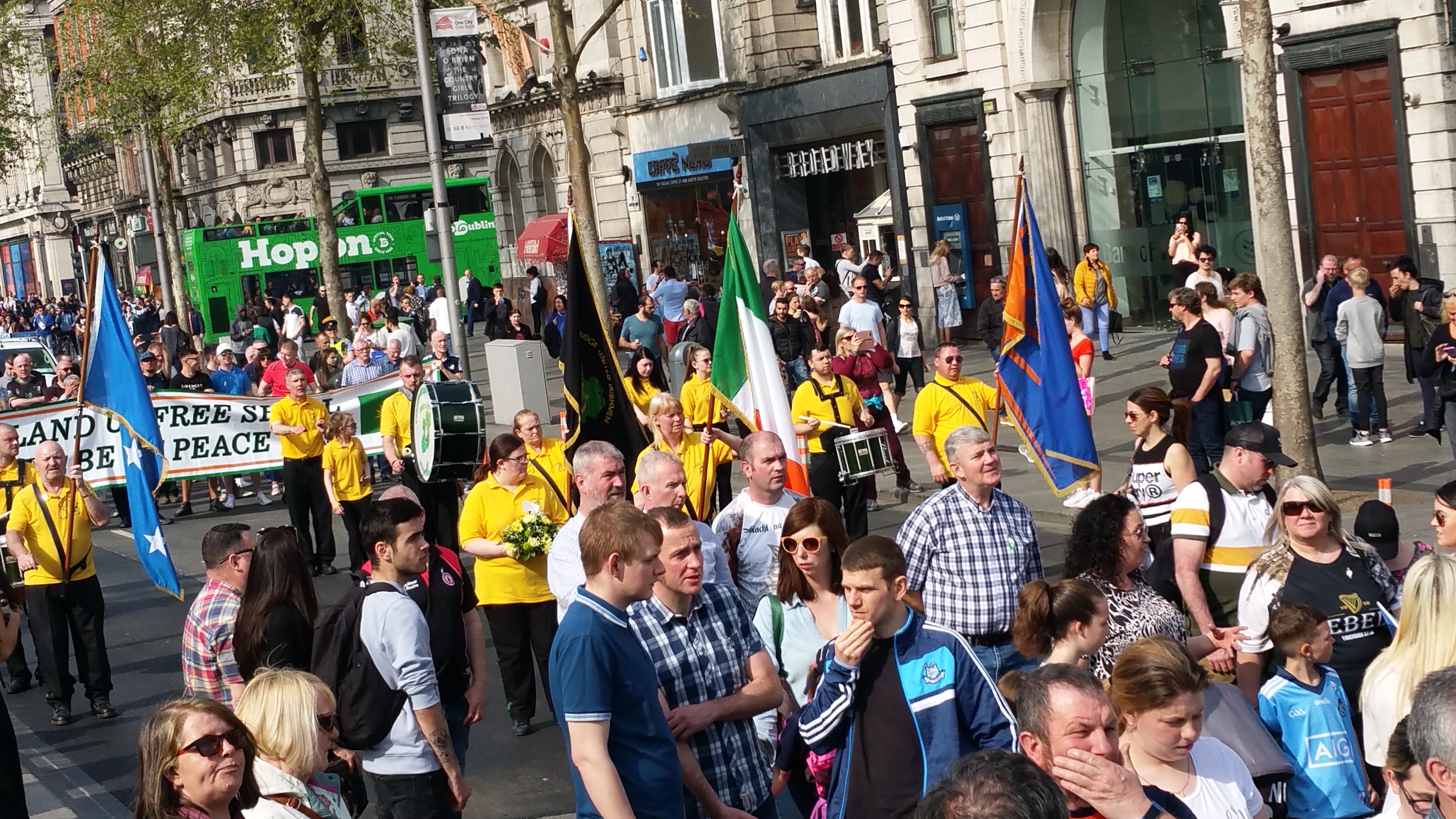
Early part of the march detachment starting from the GPO, here proceeding south along O’Connell St, the long-closed Clery’s department store on the left and the Larkin Monument on the right. (Photo: D.Breatnach)

          On their Facebook page, the NHHC had issued a statement, part of which read:

Rebuild Ireland has been an unmitigated disaster yet the cross party motion that was passed in the Dail in October that called for practical actions that would end the emergency, including making it illegal to evict someone into homelessness, were ignored by the government even though it was supported by all parties except Fine Gael. We are demanding action on the motion.

We also learned that 15 Dublin hotels received over €1m each in 2018 for accommodating homeless families which further illustrates the reliance on the private sector. These families need public housing built on public lands, they need proper homes. Last year there were 842 cases of children being discharged from the Temple Street Emergency Department back into homeless emergency accommodation. The majority of these cases were a direct result of the fact that these children are living in completely unsuitable and cramped emergency accommodation.”

The march, though far from small, seemed somewhat smaller than expected which may have been due to a cold windy day with lashing rain a little earlier in the day but may also have had another cause. The Coalition of groups has split with ICTU (Irish Council of Trade Unions) and a number of NGOs pulling out to form a different campaign on housing, apparently declining to support the demand for public housing on public land.

Front of the march pausing on Custom House Quay (Photo: D.Breatnach)

The organisers of today’s march published a list of demands:

Declare the housing and homelessness crisis an emergency.
Provide a minimum of 10,000 public house a year. No to privatization: build public houses on public land.
Make housing a constitutional right.
End evictions, bank repossessions and sell-offs to vulture funds.
Create a national Traveller accommodation agency to oversee and deliver Traveller Accommodation.
Legislate for real security of tenure, real rent control and affordable rents.
End the use of B&B’s and hotels for emergency accommodation. Improve emergency accommodation facilities and provide security for all in need.
Create rent pressure zones for Purpose-Built Student Accommodation (PBSA). Ensure tenant’s rights for students in PBSA and digs-style accommodation.

One group set off from the GPO and after making a circuit on O’Connell Bridge, marched along the north quays, meeting up with another group coming across Butt Bridge to join them from the Housing Agency HQ; apparently another group had marched from City Hall. The march continued on to Samuel Becket Bridge, to the bemusement of some participants, where the participants halted and were addressed by a number of speakers.

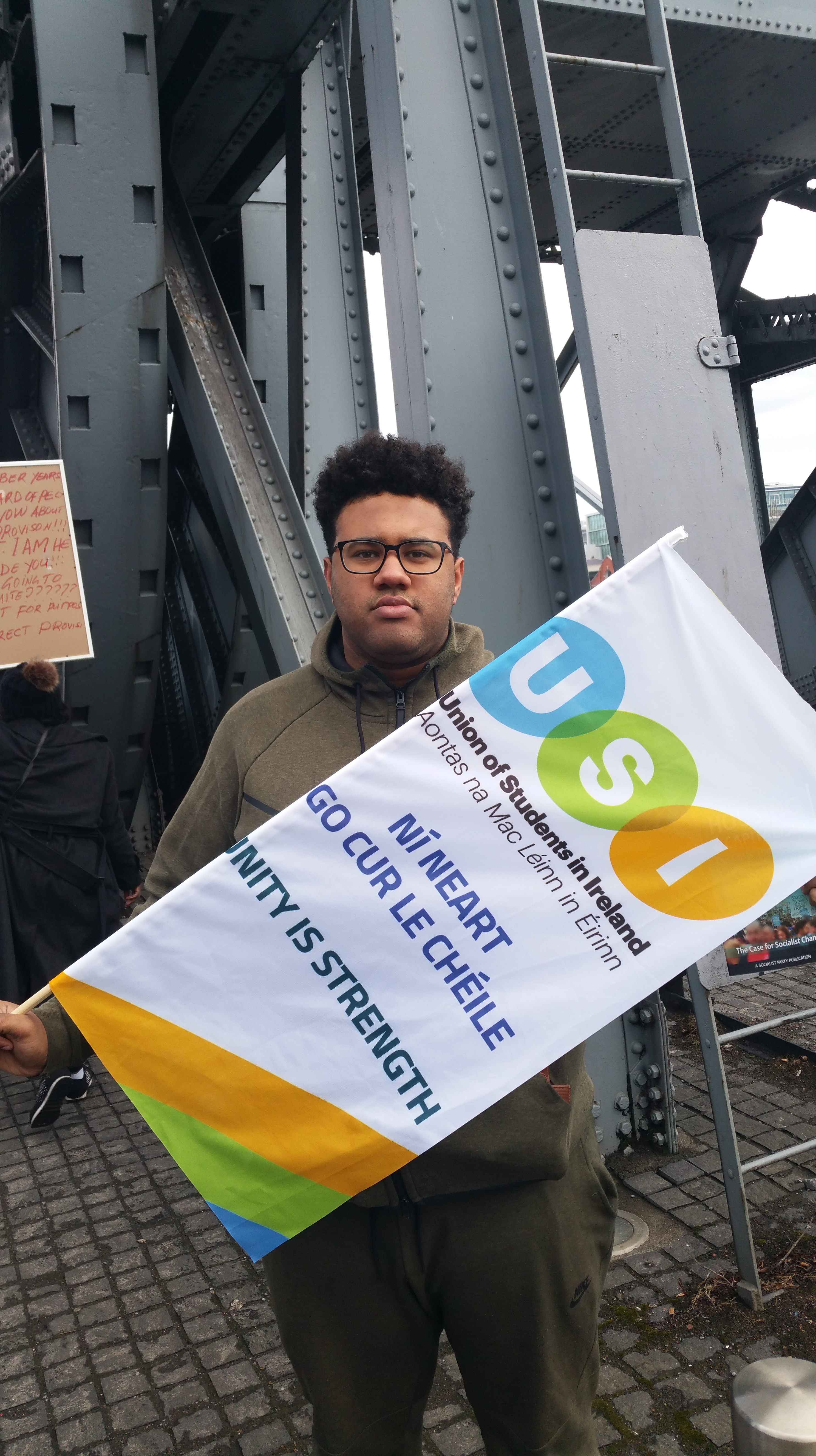
Student on the march displaying flag of Union of Students in Ireland (Photo: D.Breatnach)

Along the route of the march, slogans were shouted, among which were:

“Raise the roof, not the rents!” and “Housing is a human right!”

Section of the march stretching out along the north quays. (Photo: D.Breatnach)
One of the organisers speaking at the rally at the end of the march: Tina McVeigh, of PBP. (Photo: D.Breatnach)

As well as Socialists, a number of Republicans were in evidence, marching without party banners. Sinn Féin supporters had a banner and party flags, as did People Before Profit and the Workers’ Party. Some Union of Students in Ireland flags were in evidence too. A Travellers’ group and some community groups also carried banners identifying their group with the march and its cause.


Report by Irish Times, with video including interviews with participants: http://https://www.irishtimes.com/news/social-affairs/thousands-march-in-support-of-homeless-in-dublin-1.3820626?fbclid=IwAR2aW9yLVjHbTrJ9kbb21MEHOl3R8llbRhy3GFeX8NvkGLtdjH69TF9fQxc&mode=amp


End.

DUBLIN PICKET AGAINST INTERNMENT COMMEMORATES HUNGER STRIKERS

With thanks from Dublin Anti-Internment Committee’s FB page End Internment

DUBLIN PICKET PROTESTS CONTINUING INTERNMENT IN IRELAND WHILE EXPRESSING INTERNATIONALIST SOLIDARITY WITH PALESTINIAN PRISONERS.

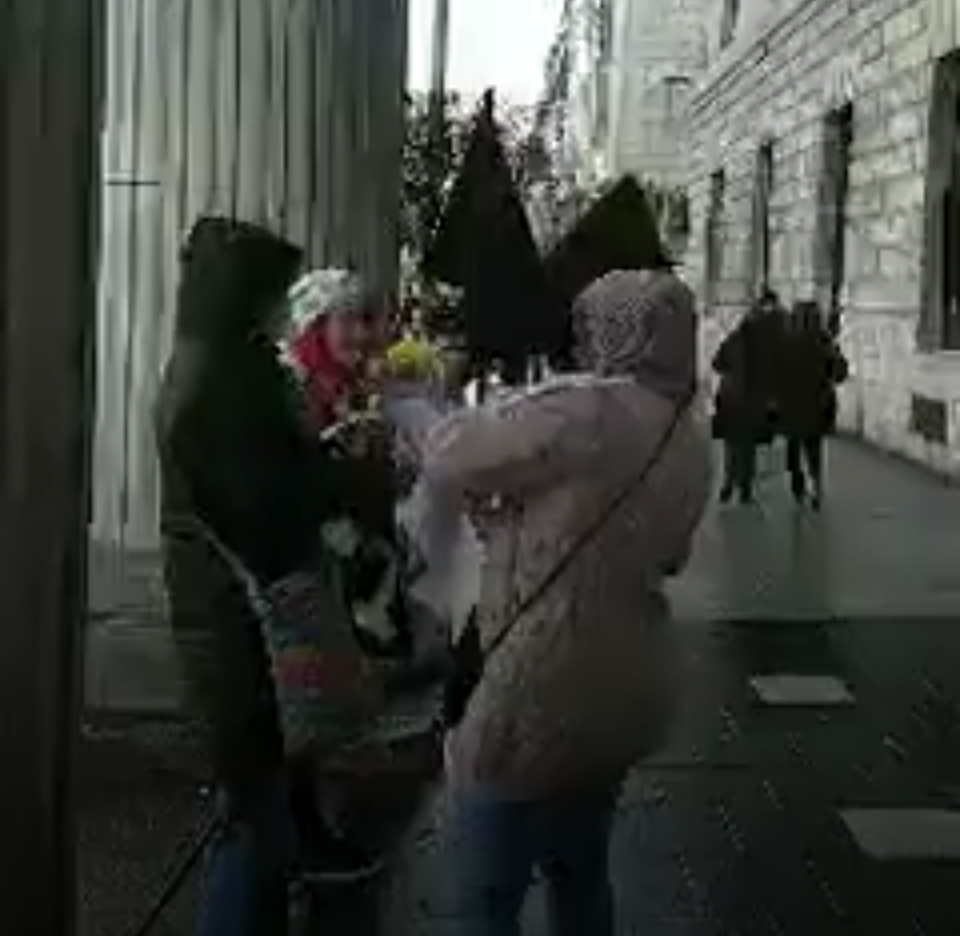
PALESTINIAN Y0UNG WOMAN PRESENTS PICKETERS WITH BUQUET OF FLOWERS.

HUNGER STRIKER MARTYRS OF 1981 REMEMBERED.

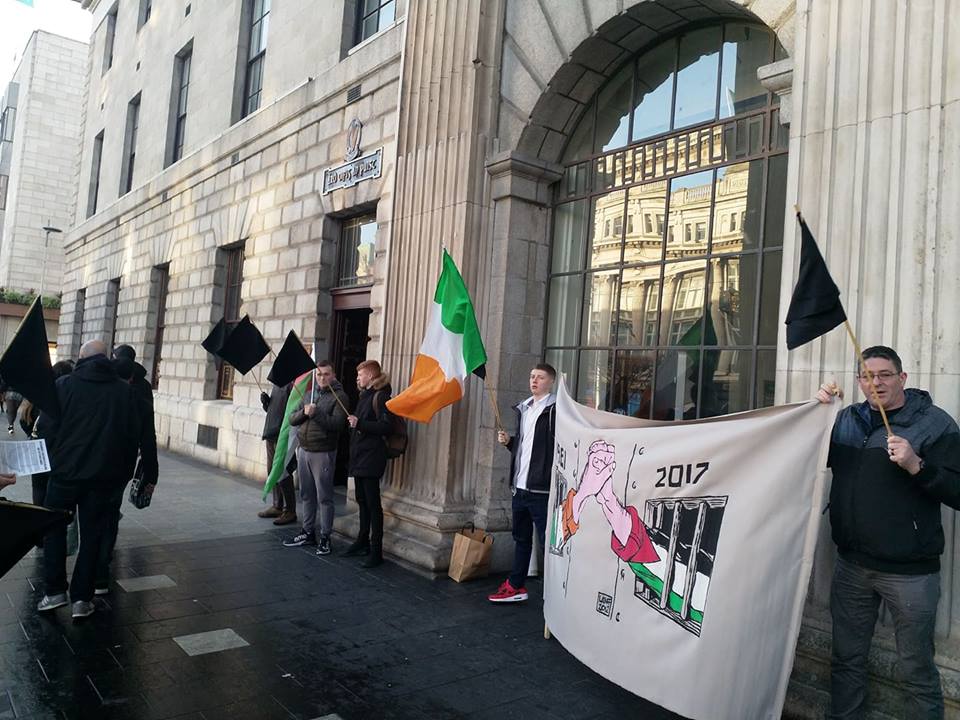
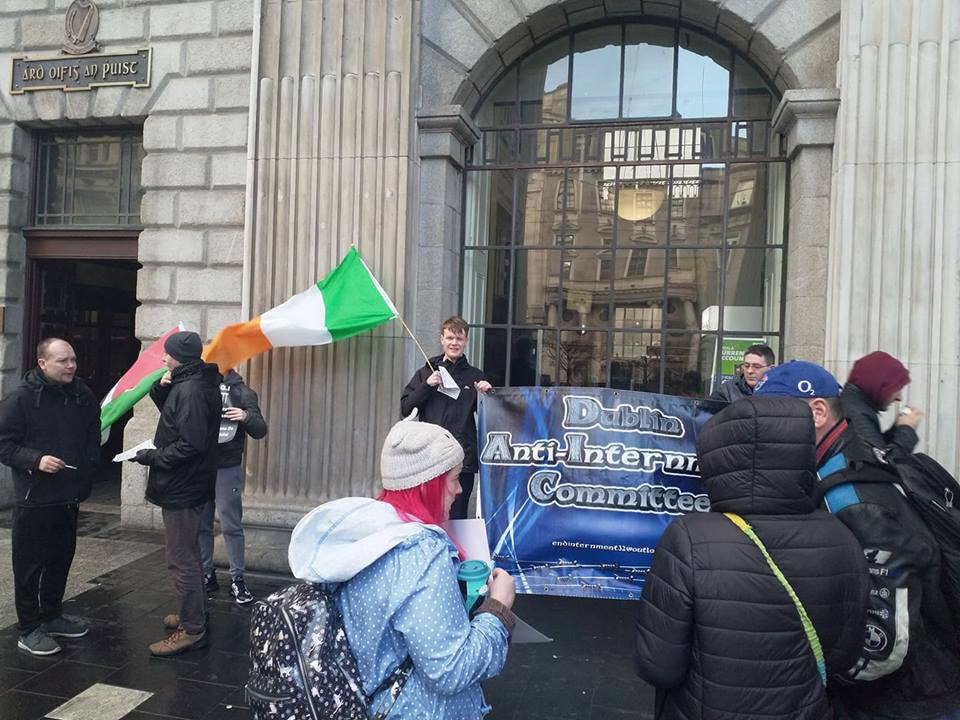
Section of the protest outside the GPO building (photo: Dublin Anti-Internment Committee)

On a cold and wet late Saturday afternoon (2/03/2019) in Dublin city’s main thoroughfare, O’Connel Street, hurrying shoppers and tourists were treated to the sight of protesters outside the General Post Office. One group was flying small flags of a green, white and orange tricolour but not the Irish one – the colour bands were horizontal.

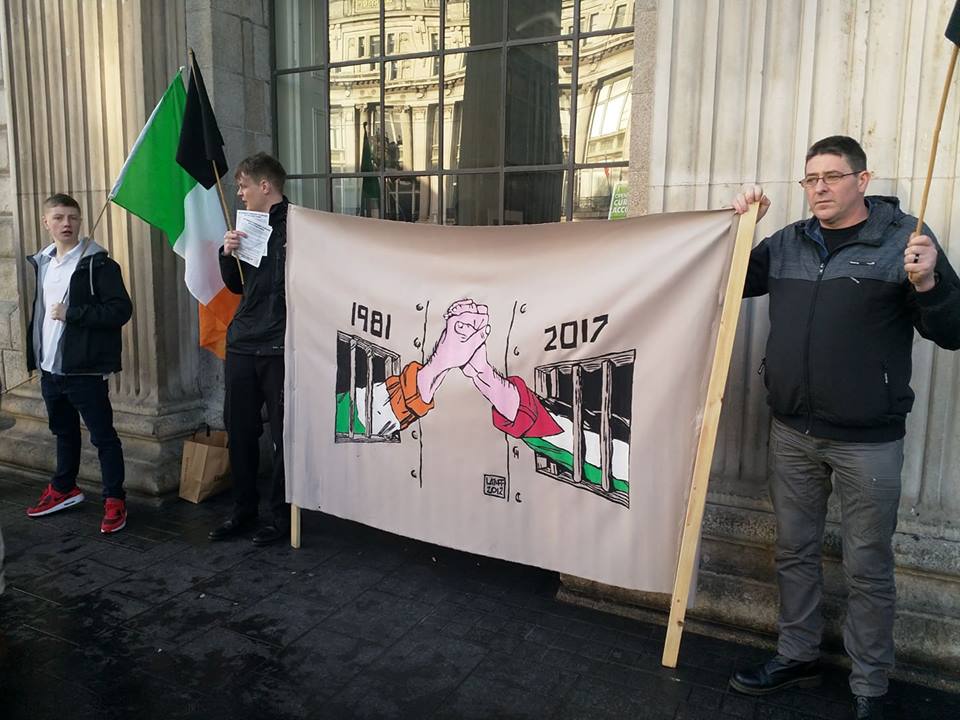
The other group flew a larger tricolour, the Irish national flag, the colours horizontal – and also a Palestinian flag. One of their banners was an enlargement of the cartoon by Brazilian graphic artist Carlos Latuff , showing an Irish hand reaching through prison bars to clasp that of a Palestinian, also emerging through bars.

The first group was of Indians in a protest related to the current tensions between the states of Pakistan and India, while the other had been organised by the Dublin Anti-Internment Committee and was supported by other Republicans and unaligned socialists. The presence of both outside the GPO was a coincidence and they were separated by a little distance.


INTERNMENT WITHOUT TRIAL CONTINUES IN IRELAND

One of the monthly pickets of the DAI Committee to raise awareness of the ongoing internment in Ireland, the picketers combined their action with expressing solidarity with Palestinian political prisoners of which many are held without charge, in “administrative detention”.

The banner depicting Irish and Palestinian political prisoner solidarity, from a cartoon by Latuff.
(photo: Dublin Anti-Internment Committee)

In Ireland, there are other kinds of “administrative detention” but they are not called that; instead they go under the names of “revoking of licence” and “refusal of bail”.

The first category relates only to the occupied Six Counties, where those political prisoners were released under the terms of the Good Friday Agreement; however their licence may be revoked at any time in which case the unfortunate person will be brought straight to jail without trial and held there indefinitely. This has been the fate of a number of former prisoners who remain Republican activists. One of those, Tony Taylor, was released without charge at the end of November last year, having spent nearly a thousand days in custody.

The second category and by far the most common, both in the British colony and the Irish state, is that of refusing bail to Irish Republicans while they await trial on as yet unproven charges. In these circumstances the accused, if judged “not guilty” at their trial, may have spent more than two years in prison by that time. A recent example of refusal of bail was that of Republican activist Alan Lundy arrested for alleged armed burglary on 18th February, despite an alibi apparently confirmed by CCTV footage placing him 40 miles away at the time and highly contradictory evidence from the alleged victims.

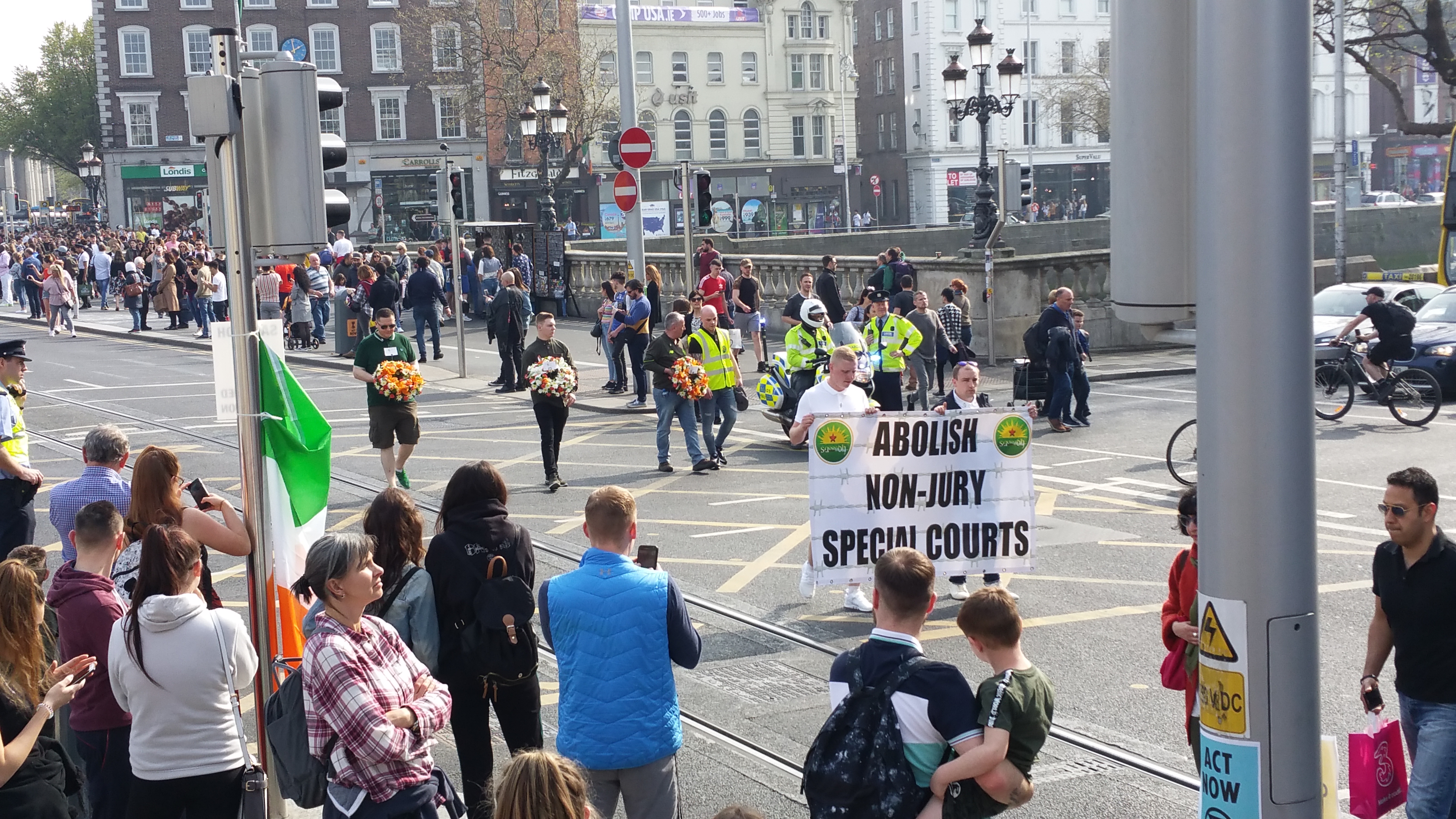
The intention of these totally undemocratic measures is an attack on the basic civil rights of Republicans to peacefully organise and to assemble in protest. When bail is granted, the intention is made clear since regularly the conditions attached are that the accused wear an electronic tag, may not participate in political meetings or demonstrations and must observe a curfew. Furthermore, the accused are brought before the no-jury Special Courts of both administrations, where special rules of “evidence” apply.

The Dublin Anti-Internment Committee maintains that these measures amount to internment without trial, a continuation of the policy in which courts are used, as Brigadier Kitson of the British Army proudly declared, as “a propaganda cover for the removal of unwanted members of the public”.

The Dublin Committee has also repeatedly pointed out that these measures are a danger to the civil rights of any and all movements of opposition to the State or its policies and should therefore be opposed by all democratic people, whatever their particular political alignment might be.

The solidarity bouquet (photo: Dublin Anti-Internment Committee)

FLOWERS PRESENTED FOR SOLIDARITY

The picketers distributed leaflets to passers-by, some of which took photographs. Two young women who had taken photographs returned a second time, one of them presenting a bouquet of flowers to the surprised protesters. She said that she was doing so in gratitude for she was of Palestinian backround.

Palestinian young woman presenting the flowers to picketers.
(photo: Dublin Anti-Internment Committee)

There are approaching 5,000 Palestinian political prisoners in Israeli jails, of which around 170 are held without trial, in “administrative detention”.

REMEMBERING THE HUNGER STRIKES

At a certain point during the event, the picketers took up black flags and displayed them until the end of the event in remembrance of the ten dead hunger-strikers of 1981 (seven Provisional IRA and three INLA). March 1st was the anniversary of the first day of the hunger strikes of that year fighting British attempts to paint them as criminals, when Bobby Sands embarked on his 66 days of hunger, the first of ten Republican political prisoners to give their lives. Bobby Sands, revolutionary and poet, died on May 5th and over 100,000 people lined the route of his funeral in Belfast, protests took place throughout much of the world and official marks of respect were given, including a statement of solidarity by Palestinian prisoners of the Israeli State. During his hunger strike Bobby Sands had been elected an MP to the British Parliament and two more, Kieran Doherty and Paddy Agnew, were elected members of the Dáil (Irish Parliament) in Cavan-Monaghan, while Joe McDonnell was narrowly defeated in the Sligo-Leitrim constituency.

These events had long term effects even in electoral politics. The British changed electoral law to prevent prisoners ever being elected again (Representation of the People Act 1981), Sinn Féin became a predominantly constitutional party and every Irish Government since 1981 has been a coalition of some kind.

A chríoch.

Another view of a section of the picketers.
(photo: Dublin Anti-Internment Committee)


Short video clip here:https://www.facebook.com/581232915354743/videos/319325982052745/

DUBLIN PICKET AGAINST INTERNMENT AND SPECIAL COURTS HARASSED BY POLICE

Clive Sulish


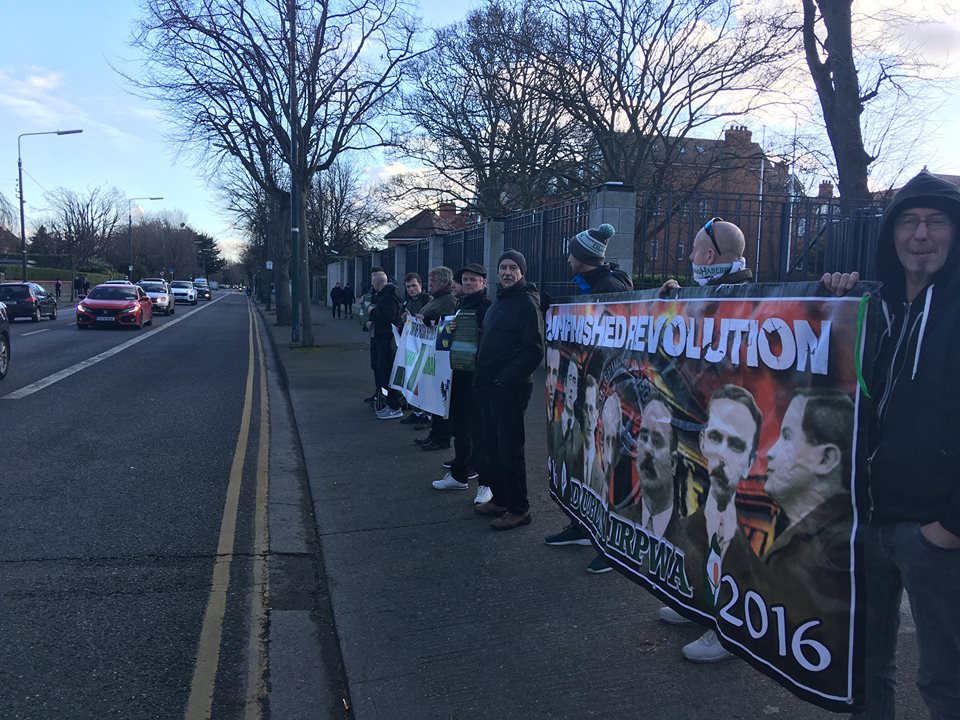
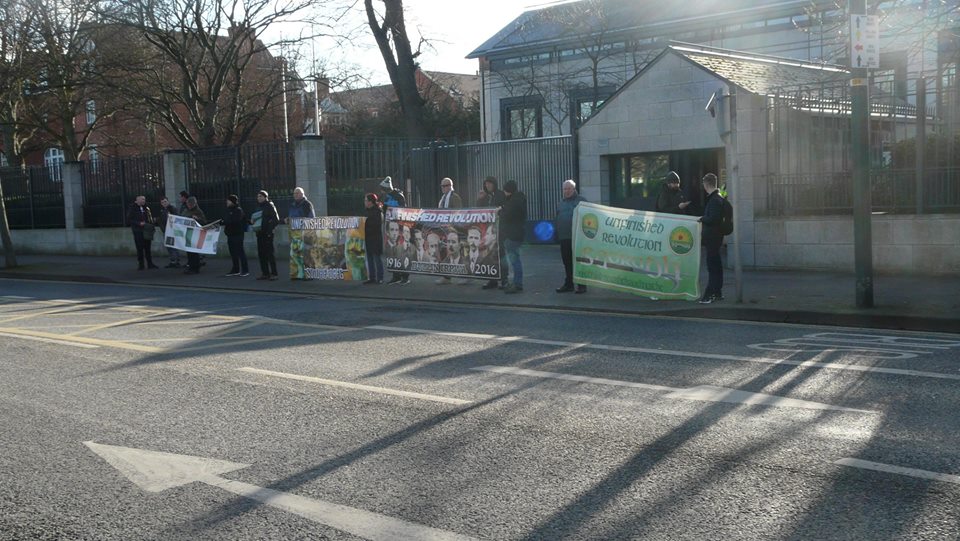
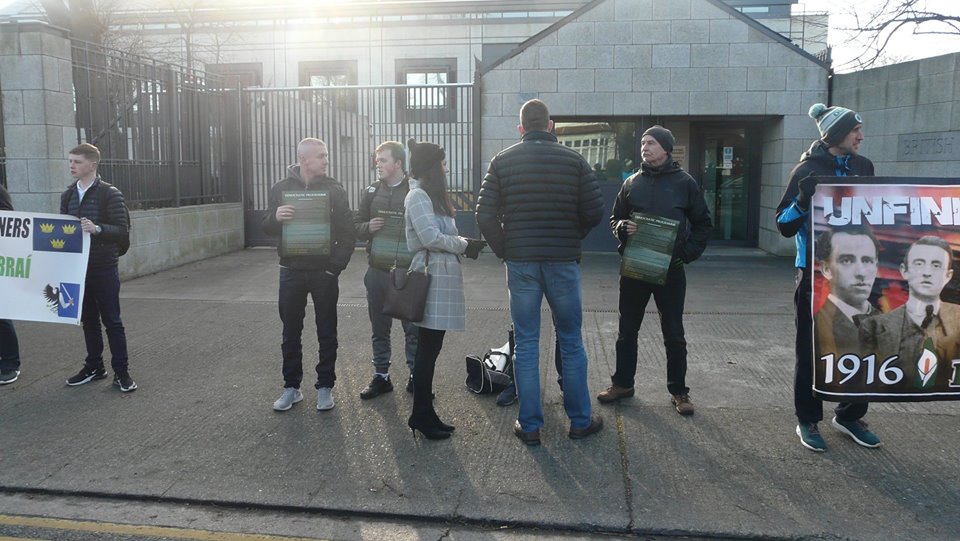
A picket called on the British Embassy to protest against continuing internment and special courts was harassed and kept under heavy surveillance by Irish police, both in uniform and in plainclothes, with marked and unmarked vehicles.

One view of part of the protest (the main entrance to the British Embassy is behind the picketers). (Source photo: Participant in the protest)

The protest was called by Irish Socialist Republicans, Anti-Imperialist Action Ireland, Dublin Anti-Internment Committee and Abolish the Special Courts campaign, was supported by members of a number of Republican and socialist organisations and independent activists.

Another view of the picket with the entrance to the British Embassy behind them (Photo source: Picket participant)

The objective of the protest was to highlight that the undemocratic practices of using the courts to remove the political opponents of those in power continues – the use of the courts”as a propaganda cover … to remove unwanted members of the public”, in the words of Brigadier Frank Kitson (British Army). These abuses of civil rights continue through a number of methods: revoking of ex-prisoners’ licences; refusal of bail; granting of bail under conditions preventing political activity; convictions in special no-jury courts. And they continue in both administrations: the Six-County British colony and the 26-County Irish state.

A Garda Special Branch (political police) male officer, accompanied by a female officer, requiring participants to give their names and addresses.
(Photo source: Picket participant)

The harassment of the protesters outside the British Embassy was at a level to which Irish Republicans have become unfortunately accustomed: a Garda officer in plain clothes identifying himself as a member of the Special Branch and displaying his Garda identification request, accompanied by another, approached those in the picket line and required them to give their names and addresses, quoting Section 30 of the Offences Against the State Act1.

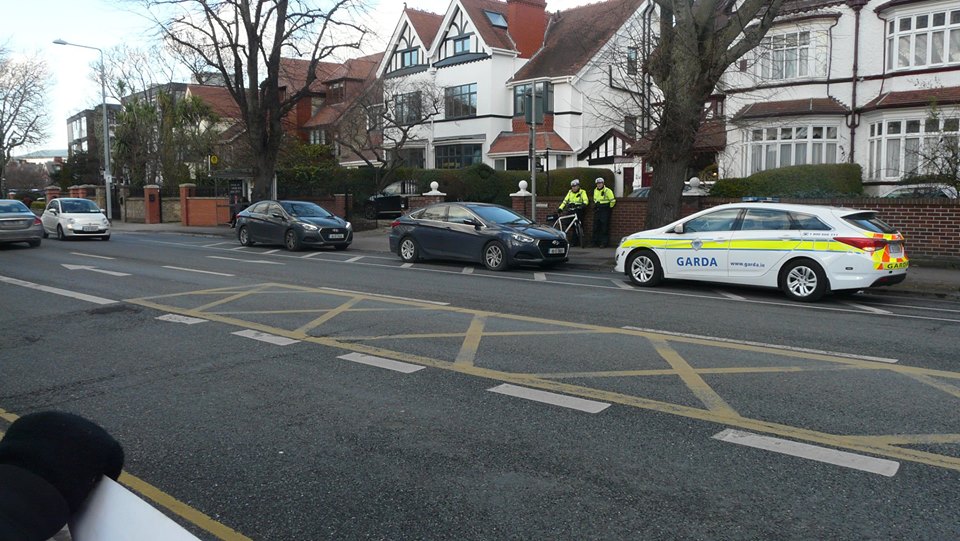
This practice of taking people’s names and addresses is one of intimidation which does restrain some new people from joining such pickets. The surveillance has the same intent, being visible; highly visible on this occasion with three unmarked SB cars, two Garda cyclists and one marked patrol car (in addition to the Garda officer permanently on duty outside the Embassy). “Remember this the next time you hear or read that the Gardaí were unable to respond to a domestic violence call for a number of hours because they were “short on resources’ “, commented one of the protesters. “Or unable to refer young offenders into the Diversion Program2” added another.

Intimidatory police surveillance on the other side of the road from the protest: two unmarked Special Branch cars, two bicycle police and one patrol car. Another SB car was parked on the pavement on the same side as the Embassy, which has a Garda officer on permanent duty also.
(Photo source: Picket participant)

The drivers of a number of vehicles, especially taxis, tooted their horns in solidarity as they passed. Although the cold was penetrating through footwear to feet, the protest ended a little after an hour.


FOOTNOTES:

1The section authorises those questions by a Garda officer who has reasonable grounds for suspecting the interrogated may be committing or about to commit a crime – clearly inapplicable in most cases where this is used.

2https://www.irishexaminer.com/breakingnews/ireland/garda-report-shows-3500-children-escaped-prosecution-for-crimes-898197.html Although this report highlights the victims of the crimes, the youth themselves became victims of a life of mostly low-level crime and associated lifestyles of early substance use, early parenthood and, later jail and, in many cases, early death.

MISCONCEPTIONS

Diarmuid Breatnach


There are many misconceptions about Irish politics and history and the centenary of the inauguration of the First Dáil and of the first shots fired in the War of Independence (one of several of our “wars of independence”) seems like an appropriate occasion to try to tease some of them out.

The Irish Tricolour — national flag of the State but also quintessentially of Irish Republicans.
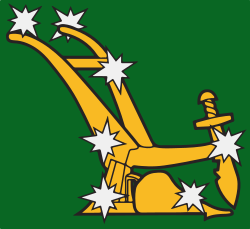
The “Starry Plough”, flag of the Irish Citizen Army. Today it is held to belong variously to socialist Republicans, Revolutionary Socialists and even sometimes social democrats.
The Red Flag, flown by Communists, Revolutionary Socialists and even sometimes by Social Democrats.
Flag colours of the Anarcho-Syndicalists.
A different version of the Starry Plough, usually but not only flown by social democrats. However, it was the flag of the Republican Congress in the 1930s.

For sure, many of those misconceptions belong to those viewing us from outside but here I’d like to deal with those from among our own. These misconceptions are spread equally among the Irish Republicans, Irish Socialists, Irish social-democrats and liberals – but each group believes different ones.


REPUBLICANS

To Irish Republicans (and I think I am objectively correct in not applying that to all who claim the title), the War in the Six Counties was lost because their political and military leadership, or most of it, abandoned the struggle or betrayed it. I think that is a fundamental misconception which leads to further misconceptions about what might be the way forward.

Please do not think for one minute that I am excusing the conduct of that leadership – I am not. Anybody is entitled to abandon the struggle but they are not entitled to claim their departure as a new way forward and to call on others to do the same – that is if they do not wish to be called “traitors”. Nor is anyone, least of all, entitled to take part in the colonial administration and if they do so, they have earned the titles not only of “traitors” but also of “collaborators”.

That judgement has nothing to do with peaceful versus armed struggle, parliamentary participation versus abstentionism or any such debate but is simply this: anyone who participates in colonial government is colluding with the colonist power, the invader, the appropriator. That is a truth understood by most people throughout the world.

It is a different point I am making entirely: the 30 Years War was lost because it could never have been won. To see this written or to hear it said will shock many Republicans and be seen as a kind of heresy – but that does not stop it from being true. Think about it: how could an armed struggle fought in one sixth of the country alone against a modern imperial army, possibly succeed? And that one-sixth further divided with at most 30% (and in reality a lot less) possibly sympathetic to the fighters? Who could sit down to ponder this and believe that struggle had a chance? The remarkable thing is not that it was lost or given up – but that it lasted as long as it did.

The only way that struggle could possibly win would be with the support of the 26-County State and it may well be that those who embarked upon it thought that at some point the Irish bourgeoisie would intervene in some way. They did — but to increase repression of Republicans.

A war might have been won if it had been extended across the whole state. Not necessarily an armed struggle across the whole country but certainly a social, economic, political one. It is not reasonable to expect the mass of people in the 26 Counties to fight year after year for those in only one part of the country, be it a colony or not, and have their own needs ignored. The people in the Six Counties would not do that either if the situation were reversed.

Certainly there was no shortage of issues going begging, from gender and sexuality-related civil rights, housing, unemployment, censorship, clerical domination, bleeding of the national language, sell-out to foreign capital, emigration, absentee landlords, private ownership of natural resources, sexual and other abuse by institutions. However, to take on the spread of issues oppressing or of concern to the people in Twenty-Six Counties would have meant taking on the Irish Gombeen class, its State and its supporting Church.  Whether because they still had hopes of the Irish State or did not want to clash with the Church which had the religious allegiance of the majority of their followers – or because they themselves did not want to challenge some or all of those institutions,It is clear that the leadership of the Republican movement then could not bring themselves to that confrontation.

If only a struggle across the whole “island of Ireland” (sic) could possibly have won then it seems logical that only such a struggle has a hope of winning today.

Some of the Republican groups perhaps have this awareness and certainly they have been seen in water and housing protests in the 26 Counties. But they are small groups, their activity patchy, lacking collaboration with one another (even in resisting State repression). More fundamentally there is no strategic plan for organising the working class. In a way, they can’t be blamed for that: they are not communists or anarchists; no matter how revolutionary or left-wing, they are primarily and always Irish Republicans.


REVOLUTIONARY SOCIALISTS

There is another sector whose members might well be nodding their heads in agreement with the above criticism but they too are beset by an important misconception – albeit a different one. They are the communists, socialists and anarchists who would consider themselves revolutionary, i.e who claim to believe in a revolutionary transformation of society.  A general disdain of the Republicans runs through this sector, considering Irish Republicans to be simple militarists, adventurist and even sectarian.

Their disdain – or perhaps their fear of being tarred by association – is such that they cheerfully allow all kinds of abuses against Republicans by the Irish State and the colonist statelet. By “allow” I mean that they do not protest against the abuses. Ethically, this is reprehensible but functionally it is dangerous. And in a country where the most numerous section ready to take on the State happens to be Irish Republican of one kind or another, such an attitude by the “revolutionary” Left is nothing short of counter-revolutionary.

This is, in a way, the sector to which I most belong but without that disdain or political apartheid.

Nor do our tiny cliques and small parties exhibit revolutionary spirit even in straight socialist issues, being in general concerned more with peaceful mobilisations and speeches or elections to public office than direct action.

One would think that trade unions would be of particular interest to the revolutionary Left – certainly the Republican movement has paid them little attention. However one finds only small struggles to appoint some Left-winger, usually not even a revolutionary, to the heights of union bureaucracy. When issues of industrial conflict arise, one does find revolutionary socialist shop stewards pushing for militant action.

But where is the education of workers? Where is the mobilisation of revolutionaries of different parties and none to support workers in industrial action? There is in fact no such “Broad Left” organisation in Ireland (not that its example in Britain is anything to emulate) and generally strike support is used for party building. When that particular conflict is over, nothing remains that was not there already.


SOCIAL DEMOCRATS AND LIBERALS

The third sector, shaking their heads at the “militarism” of the Republicans and the “impracticality” of the revolutionary socialists, are the social democrats and liberals. Their misconception is that capitalism and imperialism can be reformed so that they no longer be rapacious.

Maybe there was a time when such a belief was reasonable (though I find it hard to imagine it) but certainly that was long ago. Sincere reformers, benevolent capitalists and aristocrats and scheming reformists have all failed to reform the system of exploitation. Indeed, what historical experience has shown is that even if a capitalist or imperialist wished to subscribe to ownership in common, his or her class colleagues would not permit it.

The electoral path, so detested by some communists and many republicans, is where social democrats and liberals most place their hope and faith. And yet, despite an occasional individual exception, what has the history of those experiments shown us? Corruption of individual activists, wholesale corruption of party leaderships; diversion from the struggles on the ground to bureaucratic struggles in parliaments; careerist trade union leaders and bureaucratic officials; disempowerment of the working people; weakening of organs of real struggle; respect for the capitalists’ laws …..

Not one government of a socialist revolutionary kind has emerged by this process and, whenever it seemed to come close, it was overthrown by military coup or foreign imperialist intervention.

But still, it might work next time, eh? To the advocates of this ideology, of these methods, history does not matter – it can be ignored, denied or expected to cease its operation.


MOVING FORWARD

So where does all this leave us? Yes, I know, in the proverbial cac — but how can we move forward?

This is what I think:

The Revolutionary Left needs to a) organise in a revolutionary manner among the working class and b) to defend the civil right of Republicans;

The Republicans need to unite at least against State repression and take up social and economic issues of working people;

the Social-democrats and liberals should unite with the others on issues of civil rights and social issues;

but ultimately the Republicans and Socialists should ignore reformist illusions.


And what about me?

I do what I can where I think I can have a positive effect – criticise but participate; participate but criticise. And hope to learn not only from the mistakes of others but also from my own.

End.

ABUSE OF POWER AND VIOLATION OF CIVIL RIGHTS IN IRELAND ARE NOT THINGS OF THE PAST

Diarmuid Breatnach

The violation of the civil rights of Osgur Breatnach (then a leading member of the IRSP) exposed in the program in the Finné series on TG4 (Irish language TV channel) shown recently and repeated a week later was set in the 1970s but the injustice did not end there.

Osgur Breatnach, photographed recently and still wanting his beating and framing investigated
(Source image: Dara Mac Dónaill, Irish Times).

          Even after a High Court admission that he and McNally had been subjected to “oppression” and his conviction thereby overturned 17 months after his jailing, the court still maintained he had beaten himself up – a fiction it maintains to this day.

Of course to say otherwise would have been to admit the Gardaí special unit that came to be known as “The Heavy Gang” were vicious thugs who fabricated “confessions”. And that the judiciary of the Special Criminal Court had, despite the medical evidence and signs of beating on all, including the three who had “confessed” and the repudiation of those statements in court, colluded with the beatings, accepted the statements as true confessions and convicted three of the men for up to 12 years’ jail. And to admit that the Court of Appeal and High Court had been complicit in accepting as a “finding of fact” which could not be overturned that they had beaten one another up (and done it to himself, in the case of Breatnach).

All of which meant that the Heavy Gang got more encouragement for their ‘work’ so that some of them were able to turn up on the scene of other scandals, including that of the false confessions of Joanna Hayes and her family (about which Gardaí nothing has been done either).

Even today, not one of those Gardaí has been even charged and the complicit judiciary and State Prosecution carried on in their jobs and in some cases rose higher.

The injustice did not stop there, for when Nicky Kelly, who had been on the run, gave himself up, even though exactly the same evidence had been used to convict him, he was told he had run over the timeframe in which he could appeal and it took four years of campaigning to get him out too. And then only for “humanitarian reasons,” so the “guilty of armed robbery” verdict still stood for his reputation, potential relationships, job prospects etc.

Another eight years later he received a Presidential “Pardon” from Uachtarán Mary Robinson.

Then the State fought the financial compensation case, taking it to the extreme of bringing Gay Byrne to court over an interview he had given Osgur Breatnach. At this point some wiser heads decided to limit the damage, pay up but with the condition that the three did not go after the police or proceed with any case about the beatings.

A facet of British and Irish civil law of which many are probably unaware is this: If the respondent (i.e the one against which you are taking the case) offers you a sum and you refuse it, and you later win the case but are awarded less than what you were offered earlier, you have to pay all the costs of the defence! You can actually end up owing money!

But back to ongoing injustice. Since not a single one of the Heavy Gang was ever even charged or disciplined over this and other similar behaviour and some were even promoted; since not a single member of the legal profession or judiciary was even reprimanded for their part in it; no warning about where the boundaries are has been given to the Gardaí much less to the judiciary. Which means that it can all easily happen again.

The defendants in the Jobstown case were not beaten up to force them to ‘confess’ but when we hear Garda after Garda, including a senior one, affirm under oath in court that one of the defendants said something which all the video evidence proves he did not, at what conclusion can we arrive other than that they were all lying? But not one of them has been charged or even disciplined either.

Conversely, the State has no problem with dragging anti-fascists to court recently and this to answer charges such as “violent disorder” arising out alleged actions preventing the European fascist organisation Pegida from launching a branch in Dublin.

12-hour protest at Department of Justice in January 2004 –Cormac Breatnach, musician and brother of heavy gang victim Osgur with other musicians including of the Ó Snodaigh family and TD Aongus, their brother.
(Photo source: Indymedia — see Links)

ARE THINGS TODAY IMPROVED?

          The Heavy Gang is not operating as such today (or at least not yet) but in some respects things are actually worse than they were back in the 1970s ad ’80s. There was one Special Criminal Court then – now there are two! The Public Order Act was brought into force in 1994 to give Gardaí great powers to repress public protests and the scheduled offence of Violent Disorder was included in that Act: three unconnected individuals at the scene of a “disorder” can be convicted under the latter provision and sentenced up to ten years in jail or fined an unlimited amount (or both)!

The non-jury Special Criminal Court on its last day in Green Street before it moved to its new location in Parkgate Street (Photo source: Internet)

Courts are imposing bail conditions preventing activists from continuing to be politically active, i.e from attending public meetings, rallies, demonstrations, pickets etc – for up to the two years it can take the case to come to trial.

And just as in the ‘bad old days’, the unsupported opinion of a Garda of Superintendent rank or over is sufficient to convict Republicans of “belonging to an illegal organisation” and visitors to the public gallery of the SCC have to give their names and addresses to the Gardaí before being admitted.

Special Branch officers still routinely and openly watch Republicans carrying out their peaceful political work and demand their names and addresses on pickets. But now not only is surveillance carried out on people’s electronic communication equipment, communication is also being blocked at times by special equipment of the Gardaí.

Sadly, as the struggle over social and political issues becomes more acute in this state, we will see more repression, as the State tries to force the whole of civil society into compliance, especially by concentrating that repression on society’s more politicised and active sectors. Already in Dublin we have seen masked bailiffs and masked police carrying out an eviction of a small token occupation group in an empty house and, a week later, armed police turning up to a dispute between a couple and their landlord.

Only by admission of wrongdoing followed by actions overturning the current impunity of the Gardaí and the judiciary can a worsening of the situation perhaps be averted. But there is no sign of that happening.

End.


LINKS FOR REFERENCE/ FURTHER INFORMATION

https://www.irishtimes.com/news/crime-and-law/wronged-man-still-seeking-answers-40-years-after-sallins-train-robbery-1.3673264

https://www.indymedia.ie/article/63140?userlanguage=ga&save_prefs=true

https://www.independent.ie/opinion/analysis/from-heavy-gang-to-bailey-case-how-gardai-havent-learnt-lessons-30201431.html


WHAT IS THE POINT OF COMMEMORATIONS?

Diarmuid Breatnach

Summary: Fascism is mobilising across many parts of the world including the very Spanish state where it caused a war through a military-fascist coup and brought in four decades of a fascist dictatorship. The main point of commemorations of the anti-fascist resistance and of the International Brigades should be of raising the alarm and mobilising resistance anew. Why in some instances is this not happening?

What is the point of commemorations of the International Brigades? Or of the ‘Spanish Civil War’? Yes of course I believe these things should be commemorated but I still want to know what the point is.

I would think that most people would agree with two reasons:

  1. To remind us never to let fascism take over again

  2. To honour the memory of those who fought it, many who sacrificed their lives or their liberty or their health in the struggle against fascism.

I believe there is a third important reason though perhaps most people wouldn’t put it up there right away, though I doubt they’d disagree with it:

  1. To learn from the successes and mistakes of the past.

How is it then that one can go to an event to celebrate the the Irish International Brigaders but at the same time not hear a mention once in a number of hours about the mobilisation of fascist forces in Europe? How is it one cannot hear even a passing reference to the fascist forces that are stridently mobilising within the very Spanish state, at this moment? How is it that there is no mention of the Irish State bringing antifascists before the courts now for allegedly taking part in actions against the intended launch of the fascist Pegida organisation in February 2012?

Sure, we can all forget some very important point in a speech, forget to name somebody who should get a mention, etc. But all throughout the evening? And no placards or posters to challenge the rising fascism of today? That cannot be just a slip. Were it amnesia, it would be bad enough but if a tacit or tactical agreement not to remind us that would be worse, much worse.

Bob Doyle, the last of the Irish Brigaders to die, who is often mentioned at such events, would not have had it that way. In his nineties, I heard him speak a couple of times and he was always clear that the main point is to stop the fascists today. Frank Ryan, who regularly gets references at commemorative events (often without anyone mentioning he was IRA before he went out, as were many of the other Irish Brigadistas), would have agreed with Doyle, I’m sure.

TODAY FASCISM IS RISING IN THE SPANISH STATE – but then, it never went away.

          In the very territory where what is usually called the Spanish Civil War and less frequently the Spanish War Against Fascism (and other things)1 took place, Spanish fascists are openly organising, marching, threatening right now. A few weeks ago they were commemorating the dictator General Franco and Primo Rivera, founder of the Spanish fascist organisation, La Falange. Earlier in November they were provoking Catalans by having a rally in Barcelona. A little earlier still, they were provoking Basques by rallying in Altsasu, the town from which Basque youth got jail sentences of up to thirteen years arising out of a late-night pub brawl with off-duty Spanish policemen who provocatively went into an independentist bar and in which the most serious injury (if it was an actual result) was a damaged police ankle.2

Fascist organisation Falange women guard of honour for commemoration of the fascist founder of the Falange, Primo Rivera (Photo source: Internet)

All that would be bad enough if it were not that the Spanish State is actively tolerating them. Throwing fascist salutes, flying the Spanish fascist flag and shouting fascist slogans are all illegal under Spanish law; but the fascists brazenly do all these things and they do not get arrested!.

Fascist salutes and symbols at a recent fascist commemoration in Madrid (Photo source: Internet)

Of course, fascism was never defeated in the Spanish state. Fascism won there. We can shout “No Pasarán” (‘they shall not pass), the slogan for the defence of Madrid3 as much as we like but sadly, eventually sí pasaron (‘they did pass’), despite the enormous sacrifices of Castillians, Asturians, Andalucians, Basques, Asturians, Catalans and other peoples there, despite the bright internationalist spirit of the International Brigaders from well over 60 nations and states. And the victorious fascists tortured, shot, raped, humiliated, confiscated and stole food, valuables, businesses, imprisoned and half-starved the vanquished. And exported prisoners and jews to Nazi concentration camps.

Then the fascist regime consolidated their power, converting the schools to places of instruction in fascist and religious indoctrination, re-imposed a patriarchal ideology and ‘morality’ on girls and women, repressed languages other than Castillian, banned all trade unions except the fascist one, beat up and shot strikers and demonstrators, tortured independentist activists, shot some dead …. All of this went on for 40 years under General Franco.

During the first decade of that fascist reign of terror in the Spanish state, Fascism at first trampled over western and eastern Europe, North Africa, Asia …. until the tide began to turn, first in Eastern Europe and then in Asia and at last the fascist powers were defeated. Fascist leaders faced popular vengeance and Nuremberg and Tokyo Tribunals, executions and prison sentences. The societies they had sprung from were subjected to anti-fascist education. A great many of the guilty escaped but some were hunted down in following years.

During World War II on the other hand, Spanish fascism gave material and intelligence aid to the German and Italian fascist states and cooperated in hunts for the “French” (i.e Basque, Asturian, Catalan, Occitan and some Spanish anti-Nazi resistance, the maquis or maquisards4along the French-Spanish Border. It also sent back to the Nazis escaped prisoners, Jews and downed Allied airmen.

After the War, nothing happened to Spanish fascism (except that it sheltered hundreds of Nazi war-criminals, either permanently or on their way to South America, often with Vatican help). Fascism continued unimpeded in the Spanish state until ETA assassinated Carerro Blanco, Franco’s nominated successor and Franco himself died5 two years later.

Under internal pressure from Opus Dei and externally by European powers and especially by the USA, it was decided to modernise and rebrand the State6. The social democratic PSOE and its affiliated trade union the UGT were legalised under conditions and so were the Communist Party of Spain and its union, the Comisiones Obreras7. The conditions were that these would control their supporters (hence the trade unions) while the Transition was being carried through with repression; although republicans all, they would agree to the reimposition of a monarchy; that they – God forbid! — not go hunting fascists if they ever got into government; that they support the inviolability of the Spanish state union. The PSOE and the CPE agreed to the conditions and delivered, the latter even swallowing the fascist murder of five of its trade union lawyer members and serious injury to another four during the Transition and the PSOE swallowing the attack on the offices of the CGT.

The Transition took place in an atmosphere of hope and fear, repression against resistance: the new Spanish unionist and monarchical constitution was voted in, with regional autonomy to placate subjugated historical nations within the state; the new King, Juan Carlos de Borbón was installed. Ten years later, the Spanish State was admitted to the European Union8. That same year, the new Spanish Government under the PSOE was conducting fascist-police-military assassination squads against left-wing Basque independence activists9.

But all throughout those years and still, the fascists kept their plundered wealth. The fascist clergy, judges, civil servants, police, military and media all kept their positions and wealth. They just had to open up their ranks a little to let in the climbing social democrats and “communists”. Not one fascist was tried for any of the crimes carried out during the “Civil War” or during the Franco regime afterwards.

WHY THE FASCISTS ARE COMING BACK (but then, they never went away)

          Two things are exercising the Spanish fascists at the moment. First among these is the long struggle of the Spanish State to hold on to its forced union of the nations and regions conquered by monarchs of the Royal Houses of Spain and by fascist dictators, then maintained by both the mainstream constitutional political parties, the PP an the PSOE.

As a combination of factors combined with State repression to halt and disintegrate the southern Basque march towards independence, Catalonia took up its own struggle10. The independence movement there, which has left, right and centre elements but at base is popular and democratic and with wide support, has been steadily advancing. At institutional level, the ‘autonomous’ Catalan Government is a coalition of pro-independence forces (but with a numerous, strong, right-wing and Spanish-unionist opposition) and the majority of town councils have pro-independence majorities and Town Mayors. At grassroots level, the cultural organisation Omnium and especially the ANC (National Catalan Assembly) have organised massive independence demonstrations, a referendum on independence (disrupted with violence by the Spanish police11) and a protest General Strike. Some of the movement’s social and political leaders are in jail (four on hunger strike as this is published) and about to go on trial for their activism.

The union of the Spanish state is an article of faith for the Spanish fascists and reflected in the Spanish fascist slogan of España, Una, Grande y Libre!12 The “Una” is the forced unity, the denial of independence to the Basques and Catalans (or any others who might consider going for it).

But it is not only an article of faith for the fascists in the Spanish state, it also the case with regard to the Spanish ruling class. Catalonia and the southern Basque Country are two of the best-performing economic areas in the Spanish state and together account for a substantial part of the State’s exports and revenues, apart from land mass and extent of coast. Furthermore, the successful exit of these two regions would undoubtedly encourage similar plans among others, such as Valencia and the Balearic islands (which are also Catalan-speaking) and the Celtic nations of Galicia and Asturias. Uprisings might be the result in impoverished Andalucia and Extremadura …. None of that is a scenario which the Spanish ruling class is inclined to even consider and it has its Constitution to depend on, with legal punishment for any secession without a majority vote in its Parliament and the ultimate guarantor in the Spanish Armed forces.

All this is bad enough but a substantial section of the Spanish Left is also against any secession from Spanish State territory. The PSOE of course (which also means the UGT), since it takes its turn as the government of the Spanish ruling class, is one opponent but also the Spanish Communist Party (and the Comisiones union), much of the Trotskyist-Communist alliance of Izquierda Unida (the inappropriately-named ‘United Left’) and the populist Podemos, to which it gave unclaimed birth. For those, the argument against secession is about “the unity of the working class”13. That the “unity of the working class” against Spanish unionism, capitalism, imperialism and fascism might be achievable by agreeing to the right of secession and supporting it, while building a united front against all that is reactionary in the state, does not seem to have occurred to them. Of course their issue might be in reality about control.

DIGGING UP THE PAST

          The other issue exercising the fascists is the movement around the historical memory of the anti-fascist struggle and the effects of the 40 decades of Franco dictatorship.

Throughout the territory of the Spanish State, which currently includes the southern Basque and Catalan countries, there are graves of dead anti-fascists, usually unmarked and sometimes of many bodies together. The Catholic Church in most areas refused funeral services to the families of “los Rojos” (the Reds, i.e anyone who opposed the fascists) and the terror was such that often relatives were afraid for themselves and their children if they were too insistent with enquiries as to where their relative had been killed or buried. These burial sites are by roadsides, in quarries as well as in or near cemeteries and other places. Many of those were combatant and non-combatant prisoners who were executed, others fell in battle. Historical memory associations in different communities have been documenting the sites and trying to identify the occupants, an activity which fascists and some others consider as “causing divisions in society”.

Mass grave of executed anti-fascists in Burgos, one of many across the Spanish state.
(Photo source: Aranzadi, in El Pais newspaper — see Links).

In 2008 Judge Baltasar Garzón (since disbarred) ordered the opening up of 19 mass graves from that War14. Naive liberals and leftists (or perhaps those with very limited concerns) rushed to hail Garzón as a defender of democratic rights while ignoring his history as a judge presiding over repression of Basque independentists, including closure of newspapers and radio station, and prison sentences based on ‘confessions’ obtained through torture15. Despite Garzón’s repressive credentials there was an outcry from the Spanish right-wing and the exhumations were halted.

Also across the Spanish State’s territory there are plaques, monuments and street names dedicated to Franco and other fascist notables which in some areas have been the scene of protests. Most notable of all these sites is the mausoleum of General Franco and of Primo Rivera (founder of the fascist Falange), located within the Valle de los Caídos (‘Valley of the Fallen’). This monument, constructed in part by political prisoner labour,

covers over 3,360 acres (13.6km2) of Mediterranean woodlands and granite boulders on the Sierra de Guadarrama hills, more than 3,000 feet (910m) above sea level and includes a basilica, a Benedictine abbey, a guest house, the Valley, and the Juanelos four cylindrical monoliths dating from the 16th century. The most prominent feature of the monument is the towering 150-metre-high (500ft) cross erected over a granite outcrop 150 metres over the basilica esplanade and visible from over 20 miles (32km) away.” (Wikipedia).

The mausoleum, only 60 kilometres (just under 38 miles) from Madrid is the scene of many fascist ceremonies and demonstrations of adherence to the ideology of Franco and Rivera.


The Valle de los Caidos monument, containing the mausoleum with bodies of General Franco and Primo Rivera (Photo: Paul Hanna, Reuters, published in Washington Post — see Links)


For all of these reasons, varying forces on the Spanish Left and other antifascists spectrum have called for the removal of the cadavers of the two fascists to ordinary graves, the destruction of the mausoleums and the rededication of the whole area to the victims of fascism. When last in government, the PSOE committed itself to some of these objectives but did not carry them out. Now in government again, it has renewed that commitment which is another reason for Spanish fascist hysteria. The two main political parties of the constitutional Right (Partido Popular and Ciudadanos) combined with some smaller right-wing parties in abstaining from a recent Parliamentary motion “strongly condemning” the dictatorship and “any kind of exaltation” of the Franco regime. The motion was passed on 21st November 2918 with 97 votes of Spanish social democrats, Basque and Catalan independentists …. but there were 136 abstentions.

The Spanish Left has a serious difficulty in opposing fascism, committed as so much of the Left is to a central tenet of Spanish fascism, the current territorial integrity of the State. Also the Left in many other places besides the Spanish state is divided on how to respond to fascism in general; responses varying from replying with force by popular action to calling on the State to ban them, campaigning politically against them to generally ignoring their mobilisation.

Is it possible that some notion of preserving the ‘unity of the Left’ could be at the bottom of the silence about the growing fascism in the world and in particular within the Spanish state at some commemorative events?

THE WORTH OF COMMEMORATIONS

          The Friends of the International Brigades and other associations of what is often described as “historical memory” have done very important work in recovering the history of resistance to fascism. Not only that but also in tying that history not just to the territory of the Spanish state where battles were fought by the International Brigades but to places where those Volunteers came from in Ireland, England, Wales and Scotland. That work helps the people of those areas to locate themselves within the continuum of history and to emulate the ideals of those Volunteers should they choose to do so. The narratives of the sacrifice made and risk taken by the Volunteers counter the capitalist ethos of greed and of self-preservation above all else and suggest an alternative.

Such commemorations and monuments, if they are to survive and if they are to have real practical meaning, must also serve as calls to action, to mobilise to stop the rise of Fascism and to drive it back. And to support those who are fighting fascism, here, in the Spanish state and elsewhere. If we are to shout No pasarán! let us mean: Ésta vez no pasarán – y nunca jamás! (‘This time they shall not pass – and never again!)

end.

FOOTNOTES

1Although there people of fascist mentality everywhere in the Spanish state, they were outnumbered in most places by anti-fascists and without the logistical and manpower assistance of Nazi Germany and Fascist Italy, fascism could not have succeeded. Therefore many argue that it was not a civil war but instead a coup, a military uprising though supported by fascists both native and foreign. In the southern Basque Country and probably in Catalonia, some view it as a military invasion rather than a civil war. In Nafarroa (Navarra), because of the reactionary Carlist movement there, it did take on the character of a civil war and the Carlists murdered 3,000 leftists and republicans – when the Falange got there, there was no-one left for them to kill.

2A debate in the EU on a ban in all its membership against fascist symbols took place in December 2012 but has not yet resulted in a decision. A Catalan independentis MEP contributed to the discussion https://www.greens-efa.eu/en/article/press/eu-wide-ban-on-nazi-and-fascist-symbols-and-slogans/ with perhaps a rather tongue-in-cheek declaration that the Spanish Government had no interest in fascist symbolism; the truth is more complicated than that (see WHY THE FASCISTS ARE COMING BACK and DIGGING UP THE PAST sections).

3This slogan is said to have been coined for the crucial antifascist defence of Madrid by Dolores Ibarruri, known as “La Passionara” because of text she wrote in her youth and later her speeches too. She was a Basque and a member of the CPE. The slogan has been repeated many times since in different parts of the world but in Cable Street in 1936 it became a reality when an alliance of forces, chiefly Jewish and Irish community with some local Communist leadership, stopped 20,000-30,000 of Mosley’s “Blackshirts” and their escort of 7.000 police, along with all the mounted police in London, from marching through a predominantly immigrant Jewish quarter.

4Maquis” is dense scrub vegetation consisting of hardy evergreen shrubs and small trees, characteristic of Mediterranean coastal regions” (Internet description) which is where the ‘French’ rural anti-fascist or anti-Nazi Occupation resistance fighters camped and hid. “Maquisards” was the word describing those Resistance fighters in French but “the Maquis” was erroneously later applied to the fighters and their organisation.

51975.

6The Spanish State was not a member of the European Union and there was concern in many quarters about admitting an unreconstructed fascist dictatorship into membership. However, under USA patronage, it had joined NATO in 1982 and US air bases were being built across the territory. Opus Dei is a Catholic association mostly of people from professional and upper-middle classes and, in Spain, with right-wing views but with a technocratic approach rather than ideological which pitched them against the fascist Falange in the “democratisation” of the Spanish State.

7Both the PSOE (Partido Socialista Obrero de España) and the Unión General de Trabajadores had been illegal and persecuted under Franco, as had the more militant PCE (Partido Comunista de España) and the Commisiones Obreras trade union (in acronym in Castillian usually shown as CCOO). Those two trade unions are by far the most widespread in the Spanish state with the majority of members (except in the Basque Country and Galicia). The PSOE is one of the two mainstream political parties in the state, alternating with the right-wing Partido Popular.

8The Spanish State was admitted in 1986 but negotiations had been going on for some time.

9See GAL and BVE assassination squads operating in the Spanish and French states (1983-1987).

10Catalunya is an ‘autonomous’ region under the post-Franco Spanish Constitution, as are the two divisions of the southern Basque Country, Euskadi and Nafarroa (Navarre, Navarra). The Popular Front Government of the Spanish State had recognised the self-administering right of both Euskadi and Catalunya and they were important parts of the anti-fascist resistance; their autonomous status was revoked under the Franco dictatorship.

11On 1st October 2017, one of a number of Spanish police invasions of Catalunya last year.

12The “Grande” refers to imperial Spain and its colonies and the “Libre” to the Jewish-Masonic-Communist alleged conspiracy imagined by fascists (https://en.wikipedia.org/wiki/Una,_Grande_y_Libre).

13This argument has over the course of time been used by sections of social democrats, Communists, Trotskyist and Anarchists against liberation struggles in colonies and also in opposition to a boycott against South Africa or Palestine. The argument of class solidarity has been employed in a manner and in situations which have actually weakened the class struggle, bound the working class to their masters in common cause and also encouraged the growth of racism. As long ago as the mid-19th Century, Marx and Engels and others argued against this identification interest with the ruling class, encouraging the British workers in their own interest to support the Irish people in their liberation struggle against British colonialism.

15 And withdrawn immediately in the non-jury court by the detainees but to no avail.

LINKS

Irish Brigades Remembered: https://www.facebook.com/groups/1656646004567977/permalink/2269647039934534/

International Brigade Memorial Trust: https://en-gb.facebook.com/groups/7123291063/

Ahaztuak (“The Forgotten”), Basque historical memory association: http://ahaztuak1936-1977.blogspot.com/

Mass grave uncovered in Burgos, one of many across the Spanish state: https://elpais.com/elpais/2016/08/31/inenglish/1472638944_315923.html


Packed Concert Commemorates Return of the Irish Brigadista Volunteers

Diarmuid Breatnach

A mixed audience of anti-fascists were entertained on 23rd November by a range of artists from the Irish trad-folk scene and a Spanish band performing to commemorate on its 80th anniversary the return of the Irish survivors of the International Brigades to Ireland. The event, “The Return of the Connolly Column” was organised by the Friends of the International Brigades in Ireland (FIBI) and the venue, the Workman’s Club on Wellington Quay of the Dublin City Centre, was packed.

The event began with Dougie Dalby introducing Harry Owens, a Spanish Civil War historian and founder member of the FIBI. Owens gave a speech, recalling how the social-democratic PSOE Government in the Spanish State in the 1980s had not wished to support the marking and conservation of graves of International Brigaders who had fallen in battle but had been convinced to do so by Edward Heath, British Prime Minister and by the leader of the Irish Labour Party at the time, Dick Spring. FIBI had become part of that commemoration effort in visiting some of the sites but also in erecting monuments and plaques in various parts of Ireland.

Colm Morgan from Co. Louth followed, with guitar and voice, with some of his own compositions, including one about Frank Ryan – excellent material in my opinion – to be followed by Mick Hanley (guitar and voice again) accompanied by Donal Lunny. Hanley and Lunny have history, of course, not least in that great band of the past, Moving Hearts; both belong to that honourable class of Irish musicians who have not been afraid to support progressive causes including some in their own country – and who have never performed for “any English King or Queen”.

(L-R) Dónal Lunny and Mick Hanley performing at the FIBI event.
(Photo source: FIBI)

Lunny accompanied various artists at different times during the evening, sometimes on keyboard and sometimes with guitar, as well as adding vocals once also. After his pairing with Hanley, he accompanied Tony Sweeney’s excellent lively accordion-playing which drew more than one whoop from the audience. All however quietened down for Justin McCarthy reading “The Tolerance of Crows” by Charlie Donnelly, Irish poet, member of Republican Congress and Field Commander of a unit of the International Brigades and who fell at the Battle of Jarama on 27th February 1937.

Muireann Ní Amhlaoibh on whistle accompanied by Dónal Lunny
(Photo source: FIBI)

After the break excellent singer Muireann Ní Amhlaoibh sang (accompanied by Lunny) and her rendition of Sliabh Geal gCua na Féile, a song composed by an Irish emigrant working in a Welsh coalmine in the late 19th Century, was particularly beautiful. It is a lament for home and language by Pádraig Ó Míléadha, from the Déise (‘Deci’) area of Wateford.

John Faulkner, virtuoso composer and singer-songwriter, raised in London of Irish background and for many years a resident of Kinvara, Co. Galway (but almost Co.Clare) accompanied himself singing a number of songs, including Patrick Galvin’s great composition Where Oh Where Is Our James Connolly? He performed an anti-war song by Eric Bogle also, All the Fine Young Men, which he introduced saying that some wars need to be fought.

Andy Irvine playing and singing at the concert (Photo source: FIBI)

Andy Irvine took the stage second-to-last of the acts for the evening, another London import to Ireland for which Irish folk and traditional music is very grateful, a composer, singer-songwriter and player of a number of instruments, accompanied once again by Lunny, who shares a history with him in Moving Hearts and Planxty. Irvine performed a number of songs, including Woody Guthrie’s All You Fascists Bound to Lose which, though not very creative in lyrics has a chorus with which the audience joined enthusiastically.

Gallo Rojo performing at the event (Photo source: FIBI)

Last on for the evening was Edinburgh-based Gallo Rojo1, anti-fascist musical collective, opening with a reading in the original Castillian of La Pasionara’s farewell speech to the International Brigaders at their demobilisation parade in Barcelona (see Links). It seemed to me that this would have worked better for an Irish audience with a simultaneous or interspersed reading in English but it received strong applause from the audience. This was followed by Ay Carmela!, then Lorca’s Anda Jaleo! I had to leave after that but I could hear the band starting on Bella Ciao, the song of Italian anti-fascist resistance of the 1940s but based on an older song of oppressed women agricultural workers.

It did occur to me at that point that among all the great material of the evening, I had heard no song to represent the International Brigaders of nations other than Ireland which is often the case at such events. More unusually, no reference I could recall was made to growing fascism in Europe and especially in the Spanish State (it never went away there), nor to antifascists facing trial arising out of mobilisation against the attempted Dublin launch of the fascist organisation Pegida in February 2012.

Immediately outside the concert hall, the bar area held a large number of people, perhaps as many as a quarter again of the audience inside. The performances inside were being conveyed by electronic speakers to them too but I am unsure how many were listening. There was a FIBI stall there too selling antifascist material.

Overall, the audience appeared to be mostly Irish with some foreign nationals and from a broad range of political backgrounds: Communist Party of Ireland, Sinn Féin, Anarchists and independent supporters and activists of mainly socialist and/or Republican ideology.

I am informed that FIBI are currently finalising the editing of a video of the concert and this will be available as soon as possible.

HISTORICAL BACKGROUND:

1. THE INTERNATIONAL BRIGADES

The International Brigades were raised through Communist parties around the world to assist in the defence of the republican Popular Front Government of the Spanish State against a military coup with Spanish fascist (and Basque Carlist) support, aided by Nazi Germany and Fascist Italy. The Brigades consisted of volunteers from at least 65 nations2 and included Jews from a number. Early Irish volunteers enlisted chiefly in units of British and USA organisation but were present in groups from Australia and Canada too but later some made their way directly from Ireland; later too some of the Irish came to be known as the Connolly Column. The English-speaking units and some others were formed3 into the 15th International Brigade (originally the Fifth, but when added to the ten indigenous brigades of the Spanish Republic – Spanish, Catalan and Basque – became the Fifteenth). Not all foreign anti-fascist volunteers enlisted through the International Brigades, some joined Anarchist or Trotkyist militias4 and at least one, an Irishman, joined a Basque unit.

The Republican Government of the Spanish state disbanded the International Brigades on 23rd September 1938 in an unsuccessful bid to have the non-fascist European powers5 pressure their German and Italian fascist counterparts to withdraw their logistics, soldiers and airforce support from the Spanish military-fascist forces. By that time many of the “Brigadistas” were dead or captured as they had borne some of the heaviest prolonged fighting at Madrid (1936); Jarama, Brunete and Belchite (all 1937); Fuentes del Ebro and the Ebro itself (1938).

Famous photo by Robert Capa, war reporter from Hungary, showing emotional face of Brigadistas saluting (and perhaps singing the Internationale) at their demobilisation parade in Barcelona.
(Photo source: Internet)

Their formal demobilisation parade with their auxiliary recruits (including women) was held in Barcelona on 28th October, where they received the famous oration from the Basque Dolores Ibárruri, “La Pasionara”, prominent anti-fascist and activist of the Communist Party of Spain (see Links). It is notable that she addressed her oration to “communists, socialists, republicans, anarchists” as not only communists fought and died in the ranks of the Brigadistas.

Section of survivors of the International Brigades at their demobilisation parade in Barcelona.  (Photo source: Internet)
Another close-up from the demobilisation parade in Barcelona
(Photo source: Internet)


2. A DIFFERENT IRELAND

The Irish Brigadistas returning to Ireland found a society very different from that of today. Anti-communist hysteria was prevalent, whipped up in particular by the Catholic Church and supported in particular – but not exclusively – by Fine Gael (which formed in part from Blueshirts6). The Fianna Fáil Government was not fascist but was of the Irish capitalist class relying heavily on Catholic Church support and so contributed to anti-communism; all of the main media was anti-communist and finally the IRA, as well as having forbidden any of its Volunteers to fight for any other cause than Ireland’s, had expelled communists from the IRA in 1934. As with the time of repression of Republicans by the Free State, the USA seemed a good option for some of the Irish Brigadistas (some had enlisted there anyway) but there too, many antifascist war veterans found themselves subject to anti-communist hysteria and even later, when the USA was fighting fascist powers, labelled as “premature antifascists”!

Today here in Ireland the general attitude is one of respect or even pride in that part of our history, when Irish Volunteers went abroad to fight in defence of democracy and socialism against fascism7. The best-known song to date about the Irish Brigadistas is undoubtedly Viva La Quinze Brigada8 by Ireland’s best-known folk singer-songwriter, Christy Moore. Published accounts by Irish participants include The Connolly Column by Michael O’Riordan (1979) and Brigadista (2006) by Bob Doyle. Moore’s song is very popular in Ireland (and among the Irish diaspora in Britain) and a plaque listing some of the Irish martyrs is fixed to the wall by the entrance to the Theatre building of the major Irish trade union, SIPTU.

Funeral in May 1983 of Michael O’Riordan, survivor Irish Brigadista and General Secretary of the Communist Party of Ireland (among other positions and activities).
(Photo source: Indymedia)

Michael O’Riordan survived the War and was prominent in the Communist Party of Ireland, dying in Dublin in 1983. Bob Doyle was the last surviving known Brigadista from Ireland; on 22nd January 2009 he died in England, where he had been living and had raised a family. On February 14th that year his ashes were carried by relatives and admirers in a march from the Garden of Remembrance in Dublin city centre to Liberty Hall, where a reception was held. An optimistic photographer with the byline of “anarchaeologist” reported the following day in Indymedia: “…. in a display of left unity and solidarity we will doubtless see more of on the streets of Dublin over the coming months ….. Groups attending the celebration included the main unions, Éirigí, the WSM, the IRSP and Dublin Sinn Féin. Banners were also carried by the International Brigades Memorial Trust and the Inistiogue George Brown Memorial Committee. Supporters of the Dublin branch of the Irish Basque Solidarity Campaign demonstrating outside the GPO dipped their flags as a mark of respect as the crowd passed by”. The DIBSC actually wheeled in behind the march as the tail end passed, though the reporter seems not to have noticed that.9

Supporters of the Dublin Basque Solidarity Committee lower Basque flags in honour as ashes of last Irish Brigadista to die are carried down O’Connell Street in procession.
(Photo source: Indymedia)
Relatives and friends leading procession with Bob Doyle’s ashes give clenched fist salute to Basque solidarity demonstrators they are passing (see other photo with Basque flags).
(Photo source: Indymedia)

FRIENDS OF THE INTERNATIONAL BRIGADES IN IRELAND


The aim of the concert was to honour the enduring legacy of the 15th International Brigade and its ongoing contribution in the war against fascism”, a spokesperson for FIBI said in a statement. “As such, it was both a commemoration of the 80th anniversary of the disbandment of the Brigade and the subsequent return of the survivors to Ireland but it was also a celebration of their spirit in choosing to sacrifice everything for working-class principles.”

FIBI is an entirely voluntary organisation but does incur costs in erecting memorials, research, promotion etc. “This concert was designed to raise a modest amount to ensure the continuation of this work without having to resort to piecemeal fundraising over the next year or two. We are delighted to say we met our twin objectives of hosting a fitting occasion to coincide with the 80th anniversary of what became known as The Connolly Column and raising funds to help us continue with our efforts to ensure those who went are never forgotten.”

With its work of commemoration ceremonies and erection of plaques and monuments around the country, a work which not only reminds us of the Irish contribution in general but also links it to specific individuals from specific areas, the Friends of the International Brigades in Ireland has been deepening the wider attitude of respect for the International Brigades and pride in the Irish volunteers which has been growing steadily.

Hopefully all of this will combine with and inform any action necessary to halt the rise of fascism throughout the world and of course to prevent it taking hold in Ireland.

End.

REFERENCES AND USEFUL LINKS

Friends of the International Brigades in Ireland:

http://fibi-ireland.com/site/

States from which volunteers went to fight against Spanish fascism:

http://www.international-brigades.org.uk/content/volunteers-63-countries

English translation of La Passionara’s speech read by Maxine Peake: https://www.youtube.com/watch?v=0Xfm3o45iIE

La Passionara’s speech read in the original Castillian in front of an audience by Esperanza Alonso:

https://www.youtube.com/watch?v=H3HtLLelVeo

Brief account of some anti-communist violence in 1930s Ireland: https://comeheretome.com/2012/07/19/anti-communism-animal-gangs-and-april-days-of-violence-in-1936/

IRA expulsion of communists:

https://en.wikipedia.org/wiki/Republican_Congress

Video compilation of concert:

FOOTNOTES

1Not to be confused with the Mexico-based rock-ska-Latin band of the same name.

2“63 countries” are listed in one reference and I have added two, Scotland and Wales, on the assumption that they are unlisted but included under “Britain” or “UK”: http://www.international-brigades.org.uk/content/volunteers-63-countries

3 The Balkan Dimitrov Battalion and the Franco-Belgian Sixth February Battallion.

4George Orwell, who wrote Homage to Catalonia, probably the most famous English-language account of the war by a participant, enlisted in the militia of the POUM (Partido Obrero de Unifacción Marxista), a coalition of Trotskyis organisations (but whose alliance with the Right Opposition was renounced by Trotsky himself). The much larger anarcho-syndicalist trade union and movement Confederación Nacional del Trabajo (CNT), closely associated with the Federación Anarquista Ibérica (FAI), also had militias, of which the Durruti Collumn was the largest and is the best known today. Some foreigners also enlisted in those militias.

5These powers, such as France and the UK, were following an allegedly “non-interventionist” policy but effectively forming part of the blockade preventing the Republican Government from receiving aid. Later the governments of those two states in particular tried a policy of appeasement of Nazi Germany and Fascist Italy which was unsuccessful (except in encouraging further aggression) and they ended up going to war.

6Former IRA leader Eoin O’Duffy had, with Irish Catholic Church endorsement, recruited many more Irishmen to fight alongside the Spanish military-fascist forces but they acquired a reputation for ill-discipline and in one of their only two brief military engagement mistakenly fired on fascists; they went home in disgrace in late June 1937 (a year before the International Brigades were demobilised and the surviving, non-prisoner Irish were able to return home.

7Republicans and Communists had fought the fascist Blueshirts in Ireland too and the significant contribution of participants from the Irish diaspora to the famous antifascist victory of the Battle of Cable Street (and following guerrilla attacks on fascists at Hyde Park) in London has more recently been recognised (though not yet on the main relevant Wikipedia entry).

8Originally written as Viva La Quinta Brigada (i.e “the Fifth”); however that is the name of a song in Castillian contemporary with the War and later versions of Moore’s song include a line acclaiming “the Fifteenth International Brigade” which would be “la Decimiquinta” which has three syllables too many and so “Quinze”, i.e ‘Fifteen’.

9The DIBSC had already scheduled and advertised a picket to take place on the same day in Dublin’s main street, protesting against Spanish State repression of the Basque independence movement and treatment of prisoners. Upon learning of the planned march to honour Bob Doyle’s memory, I suggested holding our Basque solidarity event earlier, lowering the flags in respect when the march approached and then following it as the tail end passed us. I was unsure of what the reaction of Doyle’s relatives and supporters might be but as soon as those at the front saw what we were doing, a number of them raised clenched fists. It was an emotional moment for me, certainly.

AGAINST INTERNMENT AND SPECIAL COURTS!

Clive Sulish


Tens of protesters against undemocratic state repression through internment and special courts gathered at the Wolfe Tone Monument in Dublin’s Stephen Green on Saturday before proceeding through the park to the Irish state’s Department of Justice building at 94 Stephen’s Green.


The sun shone weakly through at times on bare branches of deciduous trees and their autumn leaves, along with the dark green of the evergreen foliage of holly tree and invasive bay cherry.

Wolfe Tone Monument by Edward Delaney (d.2009) at an entrance to Stephen’s Green (image sourced: Internet)

The Wolfe Tone Monument stands in the approximate location of the Irish Citizen Army’s trenches in 1916, fired on by British soldiers with machine guns who had occupied the Shelbourne Hotel opposite, killing one of the Volunteers below. The statue had been blown up by British Loyalists in the 1970s and some of the surviving remnant had been added to in order to rebuild the statue (a fact generally not known or conveniently forgotten).

As is invariably the experience of Irish Republicans, they were under surveillance by some Gardaí in plain clothes and also from a marked police car. Some of the participants were also harassed by them and required to supply their names and addresses.

One of the placards held by protesters across the road from the Department of Justice. (Source image: Abolish the Special Courts campaign FB page)

The event, jointly organised by two fairly recent organisations on the Irish Republican scene, the Abolish the Special Courts campaign and the Irish Socialist Republicans organisation, was supported mostly by Irish Republicans, some independents and some belonging to a number of Irish Republican organisations other than the organisers: activists from the Irish Republican Prisoner and Welfare Association, Saoradh and the Dublin Anti-Internment Committee were also in attendance.

View of a section of the protesters in front of the Department of Justice with Stephen’s Green in the background (Source image: Abolish the Special Courts campaign FB page)

With their banners and placards the protesters stood on the median strip in the road opposite the Department of Justice, passing pedestrians and drivers slowing down to read the texts displayed, some drivers tooting their horns in support. Some, apparently visitors, took photos or video footage.

Later, supporters of the protest crossed the road to the pavement outside the Green to hear speakers. Ger Devereux of the Abolish the Special Courts thanked people for attending and introduced Brian Kenna from Saoradh to speak.


“NOT CONVICTED FOR ANY CRIME BUT FOR BEING …. IRISH REPUBLICANS”

Kenna gave a detailed and comprehensive account of how the Offences Against the State Act has facilitated the imprisoning of Irish Republicans not for any crime they have committed but for being just who they are – Irish Republicans. Observing that half those Republicans in jail in the Irish state are serving time on conviction of allegedly “being a member of an illegal organisation”, the speaker emphasised that the only ‘evidence’ necessary for the Department of Public Prosecutions to secure such a conviction under the Offences Against the State Act is the word of a Garda at the rank of Superintendent or above, along with some vague additional ‘evidence’ that could mean lots of different things.

Brian Kenna speaking to protesters on behalf of Saoradh organisation, across the road from the Department of Justice. (Source image: Abolish the Special Courts campaign FB page)

Brian Kenna warned that not only scheduled offences1 can be tried in the Special Criminal Courts as of now but should the DPP wish it, also other minor offences such as allegedly criminal damage or against public order and he believed that except for the existence of a few factors, including the presence of an MP among the accused, the Jobstown water-protesters would have been tried in the Special Courts, where convictions are the almost automatic result. Kenna called on all people to stand up against these undemocratic laws.

Devereaux then introduced Mandy Duffy, national Chairperson of the Irish Republican Prisoners Welfare Association.

One section of the protesters listening to speakers, Mandy Duffy, Chairperson of the IRPWA in the foreground. (Source image: Abolish the Special Courts campaign FB page)

“HUMILIATION, VIOLENCE AND ISOLATION”

Mandy Duffy spoke about the conditions under which Irish Republicans are being held in a number of prisons in Ireland on both sides of the Border. In Maghaberry in particular, which Duffy said was much more modern than Portlaoise (in the Irish state), Republican prisoners are guarded by a prison staff recruited from among Loyalists2, who hate Irish Republicans and are determined not only to keep them in jail but to make them suffer while they are there.

Duffy focused on the practice of continually strip-searching prisoners every time they are taken from the prison or returned as one of humiliation and of violence when the prisoner is non-compliant.3 The speaker also referred to unreasonable and additional punishments such as keeping prisoners in isolation.

A banner and two placards in front of the Department of Justice. (Source image: Abolish the Special Courts campaign FB page)

Mandy Duffy concluded by calling for solidarity with Irish Republican prisoners and in thanking those present for giving her their attention.

Devereux then called on Diarmuid Breatnach to speak on behalf of the Dublin Anti-Internment Committee.


“WE STAND TOGETHER OR WE GO TO JAIL SEPARATELY”

Diarmuid Breatnach addressing the protesters across from the Department of Justice, on behalf of the Dublin Anti-Internment Committee. (Image source: Abolish the Special Courts campaign FB page)

Diarmuid Breatnach began in Irish by thanking the organisers for the invitation to speak which he then repeated in English. Breatnach said that their Committee held pickets around Dublin mostly on a monthly basis and did so in order to raise awareness on the ground, among the public, that internment without trial continues in Ireland long after it was allegedly terminated by the British in the mid-1970s. He also reminded the protesters that people had resisted internment and protested it in Ireland and in many places around the world, including in Britain. In the Six Counties the Ballymurphy Massacre had been inflicted on people protesting internment in 1971 and again in 1972, the Bloody Sunday Massacre in Derry.

Stating that internment is essentially jailing people without a trial, Diarmuid Breatnach stated that returning a former Republican prisoner who is at liberty under licence to jail without any trial, as has happened for example to Tony Taylor, is effectively internment, albeit of a different kind. Refusing a Republican bail for no good reason when on a charge awaiting trial, which might take up to two years, is also internment of a different kind, the speaker said, stating that the only justifiable reasons for opposing bail are supposed to be a likelihood of the offence being repeated or the charged person absconding, for both of which credible evidence should be produced. Breatnach also drew attention to the recent decision of the European Court of Human Rights which castigated Turkey for their two years of preventive detention (or refusal of bail) of a Kurdish Member of the Turkish Parliament while awaiting trial, on the principle that the period of detention was unreasonably long and was being done deliberately for political reasons.

A small section of protesters across the road from the Department of Justice. (Source image: Abolish the Special Courts campaign FB page)

The speaker also referred to the unreasonable bail conditions when bail was granted, which included non-attendance at political demonstrations, pickets and meetings which, he said, made it clear what the whole intention of the repression was about.

Breatnach reiterated what an earlier speaker had said about the potential of these forms of repression being used against a wider section of opposition to the State and referred to recent arrests of Republicans who had allegedly mobilised against the launch of the fascist group Pegida in 2012. The speaker urged unity across the board against State repression because they either stood together now or later would “go to jail separately”.

Devereaux thanked the participants and encouraged them to keep in touch with the Abolish the Special Courts campaign and the street meeting broke up into informal groups as people began to collect placards, banners, etc getting ready to disperse.

End.

Another small section of the protesters with the Department of Justice in the background. (Source image: Abolish the Special Courts campaign FB page)


LINKS:

Dublin Anti-Internment Committee: https://www.facebook.com/End-Internment-581232915354743/

Abolish the Special Courts campaign: https://www.facebook.com/Abolish-The-Special-Courts-208341809705138/?

Socialist Republicans are a part of Anti-Imperialist Action Ireland:  https://www.facebook.com/AIAIreland2/

FOOTNOTES

1In Ireland this normally means ‘crimes’ which are associated by the State with subversive intent (source: http://www.citizensinformation.ie/en/justice/courts_system/special_criminal_court.html)

2The term “Loyalist” in an Irish context and especially in the occupied Six Counties means “British Loyalists” usually understood not only as those who support the Union with England but as those who do militantly and with bigoted hatred of Catholics (in particular Irish Catholics or people from that community who might well be atheists).

3There is a graphic and accurate depiction of this practice employed on non-compliant Irish Republicans on the “Dirty Protest” in the Steve McQueen film “Hunger” (2008). In the film, the prisoners were nearly naked already but in more ‘normal’ prison conditions, the practice also involved removing the prisoner’s clothes – by force if he or she is non-compliant.

WHAT ARE WORDS? “MILITANT” AND “DISSIDENT”

Diarmuid Breatnach

Recently someone objected to my use of the word “militant” to describe a movement with which I am in solidarity, saying that the word implied “violent”. My initial reaction was that I disagreed.

          I understand “militant” to mean “determined, assertive, courageous, not awed by confrontation” and that one could even be a “militant pacifist”.

But I decided to look up some dictionary definitions online. The first two or three did indeed include violence as a possibility but not necessarily integral. Another two came closer to my way of thinking:
“aggressively active (as in a cause) : COMBATIVE “(Miriam-Webster).

You use militant to describe people who believe in something very strongly and are active in trying to bring about political or social change, often in extreme ways that other people find unacceptable.
Militant mineworkers in the Ukraine have voted for a one-day stoppage next month.
…one of the most active militant groups.
Collins Dictionary.

The meaning of words shifts from language to language, culture to culture and across time. One of the most obvious and startling examples of this is the word “gay”, up to the 1970s probably understood in English by most people as meaning “happy, light-hearted” etc but now, the first interpretation in the English-speaking world would be “homosexual” (in a non-pejorative way).

Tramp” was a verb in the 19th Century to the extent that a famous marching song of the Union Army in the American Civil War was known as “Tramp, tramp, tramp”1. By the 20th Century its use as a verb was in decline but it was becoming better known as a noun, the meaning of which was understood variously as “vagrant” or even “beggar”.

And one could fill volumes with similar examples, I am sure.

“MILITANT”

          But returning to “militant”, was I the only one who understood its meaning in the way that I had? Well, apparently not, as Wikipedia showed, for example in descriptions of “militant trade unionists” and even a political organisation within the British Labour Party before its expulsion, calling its group “Militant Labour” and its newspaper “Militant”, probably drawing a parallel with those very same trade unionists2.

It would not take much pondering to guess that “militant” had some relation to “military” and apparently the word does indeed have such an origin, from Latin “miles”, ‘a soldier.3 But over the years, as with many other words, its meaning has changed.

But apparently, violence is again becoming associated with the word, more so than in the second half of the 20th Century. How did this happen? I am not sure but it appears to have been a spin-off from the more recent imperialist wars of, in particular, the United States. It seems that organisations resisting USA control or dominance in the Middle East, most of which were Muslim in religion, began to be termed “militant” in US and western reporting. Why this became so seems hard to fathom – it was not a word that these organisations applied to themselves — but it has had that spinoff effect on the word “militant”, so that “militant trade unionists” and “militant feminists”, for example, are now likely to be associated with violence, i.e the use of physical force.

How loaded and partisan usage of the word can become is well illustrated in the definition supplied by the Oxford living Dictionary: Favouring confrontational or violent methods in support of a political or social cause.
the army are in conflict with militant groups’.

The example given is very interesting. Conflict requires, one supposes, at least two parties and both sides are listed in that quoted phrase. But the impression given is one where “the army” is an authoritative, legitimate force which is being opposed by groups that are none of those things. One almost feels that the source of “the conflict” is the “militant groups” (especially with the current loading of ‘violence’ into definition of the word “militant”).

The ‘army’ is an armed organisation at the very least latently violent (training with deadly weapons) and in this context, almost certainly practicing violence by invasion. Yet it is portrayed as somehow neutral and the opposition as violent. This is further accentuated when the army and armed police are termed “security forces”. How could one be against security? Don’t we all want to be secure? Obviously quite a lot of people don’t want whatever security is being offered by these military and militarised forces and the question of “security for whom?” is hardly ever explored in such discourse, leaving us with the impression that the good guys are the army and police, deserving of our support, while whoever opposes them must be bad and we should line up against them.

As the meaning of words shifts, we have to decide whether to stick with the meaning we had and insist on its primacy, or to adapt and move with it. Up until the 1960s it was generally considered ill-mannered among white and black people to refer to people of noticeable African descent as “black” or as “negro” and Martin Luther King’s campaigning organisation was called the National Association for the Advancement of Coloured People. Back earlier, in the 18th and early 20th centuries, “negro” would have been acceptable to most. Nowadays, “coloured” or “negro” would generally be considered either offensive or ignorant and “black” is the word, unless one is to use the Africa-derived word, e.g Afro-American, Afro-Caribbean, etc.

And in a strange reversal, whether in self-mockery or appropriation, many Afro-Americans began in the 1970s and 80s describing themselves with the word “nigger”, a word long associated with racism4.

DISSIDENTS”

          Leaving those examples and dealing with Ireland, a number of organisations advocating Irish independence and unity and denying the legitimacy of the administrations of either side of the partition Border, would happily term themselves and one another “Irish Republicans”. That term came first to exclude the supporters of the Irish Free State, who waged a Civil War against those who would not accept the British terms, including Partition, of the 1921 Treaty. Not much over a decade later, it excluded also the Fianna Fáil party, which had split from Sinn Féin, got elected into government and at different times interned Republicans without trial, executed some and passed emergency-type legislation against them.

Subsequent splits in later years were still all described, along with various versions of the Sinn Féin party, as “Irish Republicans”. After the Good Friday Agreement was endorsed by what had been Provisional Sinn Féin and they subsequently became part of the administration of the British colony of the Six Counties, all those Irish Republicans who did not agree with them on that came to be called “dissidents” in the media and in much political discourse.

Those who are called “dissidents” however did not, for the most part, agree with the term. As far as they are concerned, they are sticking to the “official line” or at least the original one and it is the Provisional Sinn Féin (which now terms itself just Sinn Féin) which has diverged from the line and furthermore, departed from the ranks of Irish Republicans.

Let’s do a trawl for definitions similar to what I did with “militant” but this time for “dissident”.

Wiktionary:A person who formally opposes the current political structure, the political group in power, the policies of the political group in power, or current laws.

(Christianity) One who disagrees or dissents; one who separates from the established religion.”

Mirriam-Webster:disagreeing especially with an established religious or political system, organization, or belief

dissident elements in the armed forces”.

Collins:people who disagree with and criticize their government, especially because it is undemocratic.

Dissident people disagree with or criticize their government or a powerful organization they belong to”

Oxford:A person who opposes official policy, especially that of an authoritarian state.

a dissident who had been jailed by a military regime’”.

And one I hadn’t used before, but which caught my eye, Vocabulary.com: If you are a dissident, you are a person who is rebelling against a government. Dissidents can do their work peacefully or with violence.

Dissident is closely related to the word, dissent, which means objecting. People who are dissidents show their dissent5. Catholic priests who advocate allowing women into the priesthood could be called dissidents, as could the Puritans who left England to live in colonial America. As an adjective, a dissident member of a group is one who disagrees with the majority of members.”

Since it is not a religious movement, one who separates from the established religion” would seem non-applicable (though when one sees how many Republicans cling to certain practices like non-recognition of the court trying them, or refusal to stand in elections, it is tempting to think of those prohibitions as religious dogma rather than tactics for particular times and place).

Most Irish Republicans would consider themselves as in opposition to the “established (political) order” of the country, i.e Ireland partitioned, with one part run by an anti-Republican Irish ruling class and the other by a colonial ruling class. They would consider the relevant governments as “authoritarian” and “undemocratic”, certainly in their treatment of Irish Republicans by harassment, intimidation, detention, subjecting them to special emergency-type legislation, non-jury courts and prison.

In that sense of “dissident”6, the Sinn Party in its various encarnations has until recently always been a party of dissidents, first against a foreign monarchy subjecting Ireland without an Irish king (the party founded by Arthur Griffiths), then to a Republican party campaigning against British rule (the coalition that was the reformed post-Rising party 1918-1921), after that a party against the Irish Free State Government and the colonial administration of the Six Counties, subsequently a Republican socialist party opposing the same forces, then after a split, a Republican party with similar objectives but supporting an armed resistance to the the British occupation. To that can be added the existence of the Republican Sinn Féin party from a split and at least one other group of similar construction for a time but with more socialist emphasis.

Clearly (formerly Provisional) Sinn Féin can no longer legitimately describe itself as dissident, should it want to, as it is now party to that repressive colonial government to which it was previously vehemently opposed and also now straining to become part of a coalition in government of the Irish state.

Many people who left the SF party did so precisely because they opposed those policies and actions7 and on most terms could legitimately claim to be “dissidents” – if they wished to. Not just dissidents recently within the party but dissidents against the State and British colonialism.

Clearly then descriptions such as rebelling against a government” and disagree with and criticize their government, especially because it is undemocratic” are not going to be the problem and formally opposes the current political structure, the political group in power, the policies of the political group in power, or current laws” seems just tailor-made for Irish Republicans.

The objection to the appellation of “dissident” then must surely be based on either a misunderstanding of the meaning of the word or a concept of some kind of historical Irish Republican authority. If the latter, then the SF party can been seen as having gone against that authority and those Irish Republicans not following the SF path as being the true and loyal followers, faithful to that historical authority. This would be an entirely understandable attitude – but is it helpful? Aren’t the most important things the aims that Irish Republicans have and how they conduct themselves in working towards them, rather than whether they are called “dissidents” or not? After all, there is nothing fundamentally pejorative in the term.

There is no doubt that “dissidents” is a handy catch-all term to describe Republicans who belong to a number of political groups or who are independent activists (the latter of which Ireland and especially Dublin has a great many) but is it conferring some kind of implicit legitimacy on the collaborationist and now constitutionalist Sinn Féin party? And if so, legitimacy in the eyes of whom? Remember how one time there was an “Official Sinn Féin” (and IRA) and the “Provisional Sinn Féin (and IRA) who split from them? It was the latter that went on to gain dominance in the Republican movement while the “Official” organisation split again and shrank to a tiny remnant.

If I were to count myself among the ranks of Irish Republicans8, would I object to the term of “dissident”? I don’t think so.

End.

SOURCES AND REFERENCES

Meaning of “militant”:

https://en.oxforddictionaries.com/definition/militant

https://www.merriam-webster.com/dictionary/militant

https://www.collinsdictionary.com/dictionary/english/militant

https://en.wikipedia.org/wiki/Militant

https://en.wiktionary.org/wiki/militant

Tramp! Tramp! Tramp!: https://en.wikipedia.org/wiki/Tramp!_Tramp!_Tramp!

Meaning of “dissident”:

https://www.merriam-webster.com/dictionary/dissident

https://en.oxforddictionaries.com/definition/dissident

https://www.collinsdictionary.com/dictionary/english/dissident

https://en.wiktionary.org/wiki/dissident

https://www.vocabulary.com/dictionary/dissident

FOOTNOTES

1Coincidentally, the word “gay” is employed in its older sense in the lyrics of the song. A lot of interesting information is contained in the Wikipedia page on this song (see link in Sources and References).

2This was an organisation run by the entryist British Trotskyist organisation which later became the Socialist Party (like its great rival, the Socialist Workers Party, it too has an offshoot in Ireland).

3Through Latin into French and from there into English. However, the word may have been of an older root, possibly Celtic: “ ‘Míle’, word in Irish, meaning ‘a warrior, a champion, a hero’” given p.23 in How the Irish Invented Slang, Daniel Cassidy (2007).

4The term is not accepted equally among black people: I recall a black workmate of mine telling me that he had punched another black man who had referred to him as “nigger”.

5Actually, as Wiktionary tells us, it means more correctly “not in agreement” and comes from the Latin word for “to sit apart”

6Lest it be thought that I dissent from this opinion, let me put on record that this is one of the things about which I entirely agree with Irish Republicans. I suspect however that this definition is generally only used by media and mainstream commentators to describe regimes other than the ‘western democracies’.

7Some people had left that party already by that time, some because they perceived its direction and some because they objected to procedures within the party, especially those they considered undemocratic. Others left over time due to decisions to contest elections in the Irish state or to take their seats in the parliaments if elected, or because of rapprochement with the colonial police, over alleged harassment, party promotions or personal reasons.

8“Irish Republican” is a specific political designation and does not describe me, although I am Irish and I do aspire to a Republic of social equality. I am a revolutionary and a socialist as well as being anti-imperialism; I am many other things as well but that will do as a basic platform on which to seek others of like mind. In the course of struggles I do of course join in a front of one or the other of those tendencies but always with an eye to the full objective. Or so I try, at least.