RALLY AND MARCH AGAINST GARDA REPRESSION IN DUBLIN

Diarmuid Breatnach

(Reading time: 6 mins.)

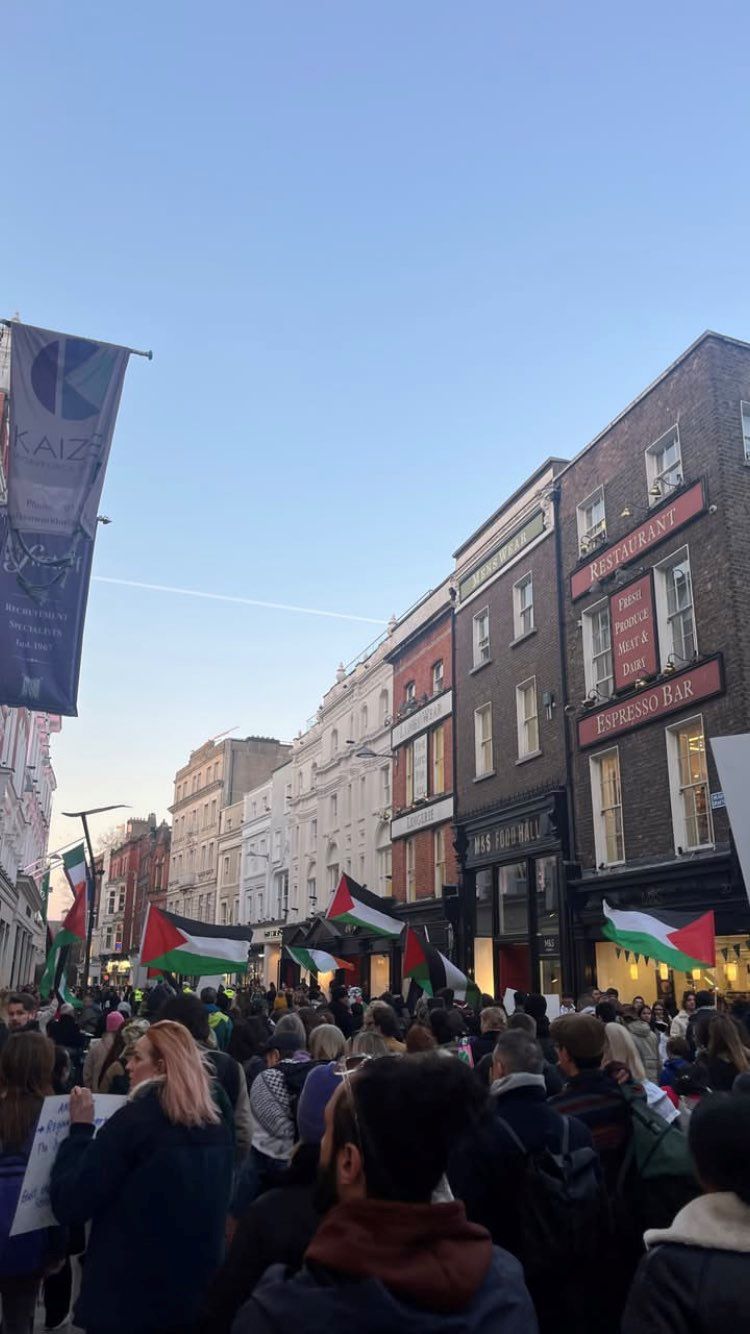
Hundreds gathered Wednesday night near the rear entrance of Leinster House, home of the parliament of the Irish state, in a demonstration organised by Mothers Against Genocide to protest the police attacks on demonstrators of the previous week.

Background

Over four days the previous week the Gardaí, police force of the Irish State, had attacked demonstrators in a number of different locations in Dublin. On Monday the MAGS group at the front entrance of Leinster House was attacked as they neared the end of their overnight vigil there.

The women were calling for Government action to match the will of the Irish population by preventing military supplies sent to Israel through Irish airspace and airports, to end processing Israeli bonds through Irish banks and to institute sanctions against the Zionist Occupation.

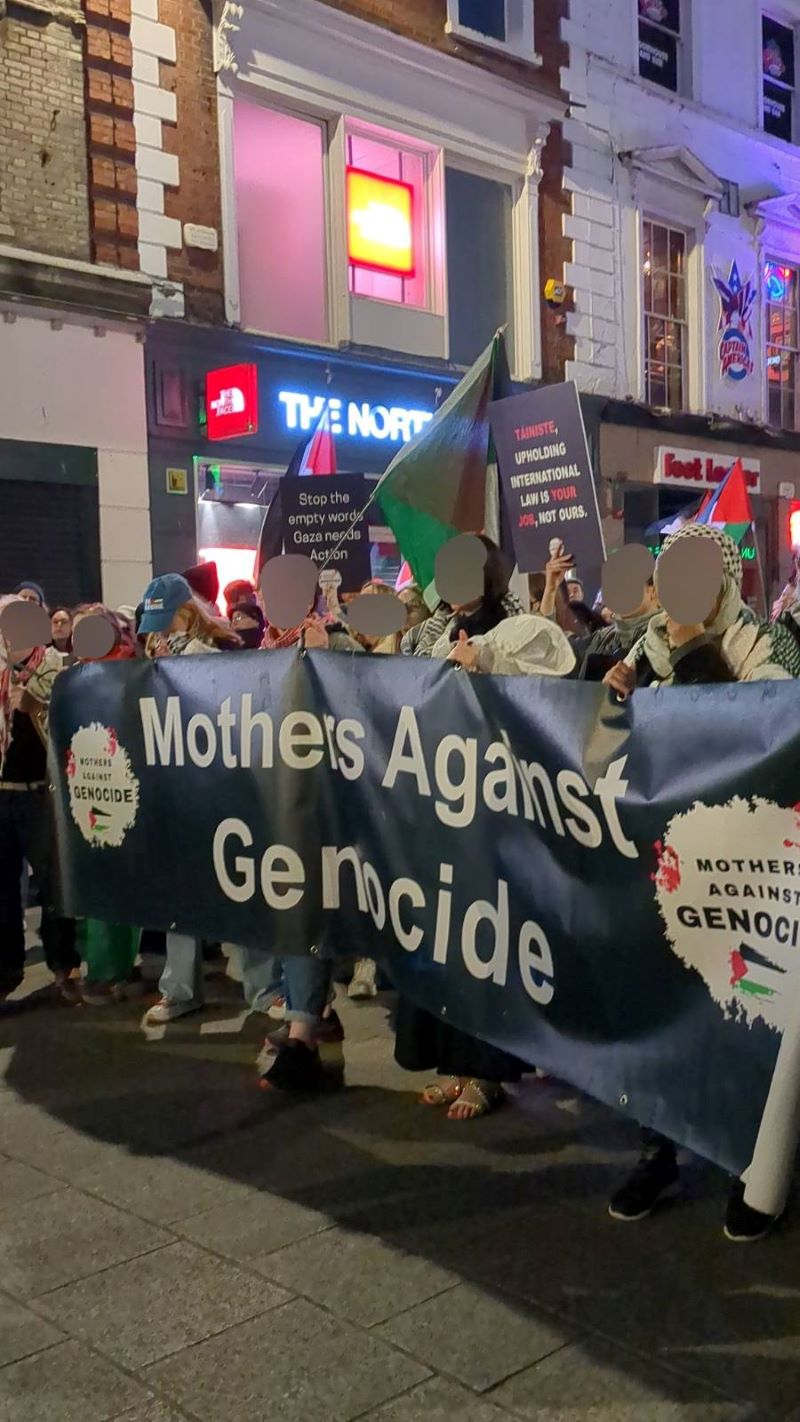
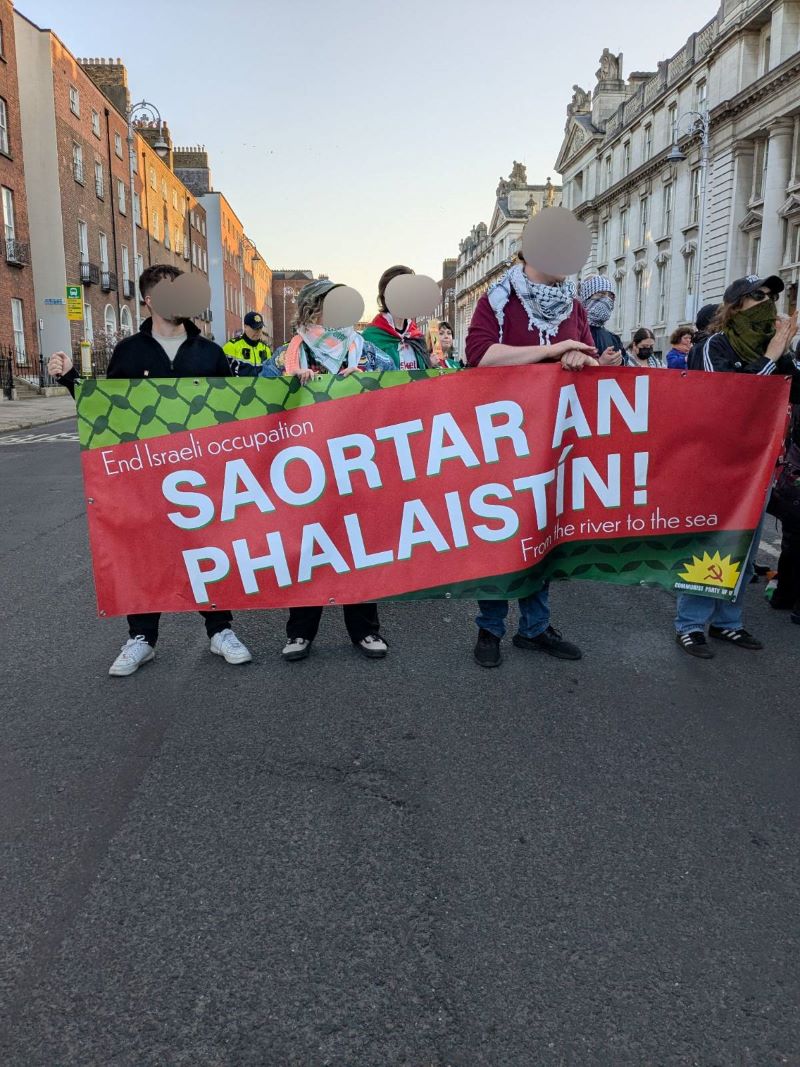
MAGS banner in Grafton Street later in the evening. (Source: Participant)

Eleven women and three men were arrested and taken to different Garda stations where a number of women were strip-searched, including one in an apparent cavity search; three men were charged under the Public Order Act and women pressured to accept an official caution.

Two days later, at a protest organised by the Boycott, Divestment and Sanctions (BDS) Society of the Dublin City University against the official opening visit of the Taoiseach (‘Prime Minister’) to a University building, Gardaí arrested a student for knocking on the window of the building.

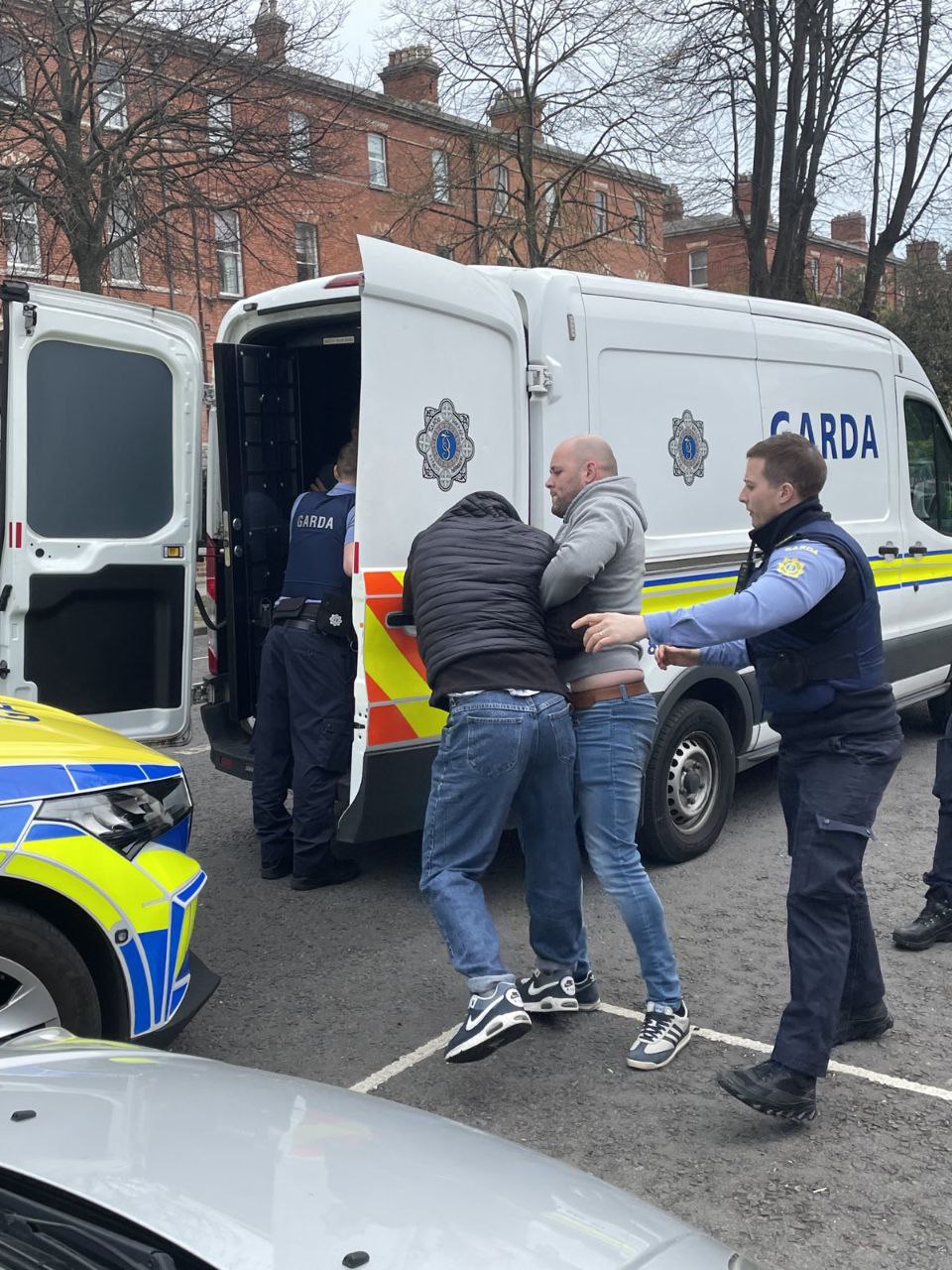
On Friday, Gardaí attacked six protesters engaged in a protest at the front entrance to the Belgian Embassy in Dublin, where NATO is represented. The Anti-Imperialist Action protest was against the Irish elite’s attempt to slide the State into membership of the military alliance.

Those protesters were pepper-sprayed into their eyes, forced to the ground, handcuffed and treated so violently that the ankle of one man was broken; the breast of one woman was also grabbed. Two more picketing outside were also arrested, all again distributed around different police stations.

On public order charges, six also on trespass, all eight were brought to a special late court sitting that early evening where a crowd of supporters gathered.

All were bailed on a range of bizarre bail conditions including banned from protesting at Government buildings and a requirement to give 12 hours notice to the Gardaí with details before attending an embassy protest.

Wednesday night’s Leinster House protest

The mood of the crowd of over 500 last night in Merrion Street was militant, being addressed by a woman on behalf of the Mothers group. The crowd was joined by a group flying Starry Plough1 and Palestinian flags, bearing a banner of the AIA and a hand-painted one against NATO.

View of the rally in Merrion Street before the march. (Source: AIA)

The speaker introduced Aileen Malone, mother of Dara Quigley, a well-known blogger some years ago who appeared naked in public while suffering a mental ill health episode. One of the Gardaí dealing with the incident took a video of her and circulated it widely on social media.

Following that public shaming, Dara had taken her own life. Her mother pointed out that the offending Garda, instead of being dismissed, had been allowed to resign and keep his pension. She also condemned the Garda treatment of the women while extolling their courage in resistance.

Another speaker, introduced as representing Jews for Palestine Ireland spoke against the Irish State adopting the IHRA’s definition of antisemitism, the function of which, he stated is to protect the state of Israel against any criticism including regarding its genocide against Palestinians.2

He regretted the diversion from Palestine solidarity entailed in this focus, pointing out that genuine anti-Semitism is to be found among the far-Right while anti-racists and anti-fascists in Palestine solidarity, far from being anti-Semitic are on the contrary active against that variant of racism.

One of the banners at the rally in Merrion Street. (Source: Participant)

A woman from Mothers Against Genocide in Belfast spoke about the history of Irish resistance to colonialism and solidarity with Palestine which had no relation to the Irish Government, vehemently insisting also that being anti-genocide and for human rights is far from anti-Semitism.

Ruth Coppinger, Socialist Party TD, had signalled she wished to speak and was invited to so. She commented on Wednesday’s session in Leinster House when the Garda attack was defended by Mícheál Martin in respect of the right of access to Leinster House.3

A member of the Mothers in Dublin read a solidarity poem she had written and introduced the Resistance Choir, who sang Gonna Let No-one Turn Me Around, a lively song from the US Civil Rights4 movement of the 1960s, followed by slower lament about the Zionist slaughter in Gaza.

The energy in the crowd was dissipating by this point, almost an hour having elapsed and at last the direction to march was given. But where to? It was unclear. Earlier indications had been that one of the Garda stations would be the destination but now the Dept. of Justice was being mentioned.

The slogans shouted were those usually heard at Palestine solidarity events, with calls supporting the Intifada increasingly popular, and even one to Globalise the Intifada! US Warplanes out of Shannon! was another and NATO out of Ireland! was also heard.

Very appropriately also: One, we are the people! Two, We won’t be silenced! Three, Stop the bombing now, now, now, now!

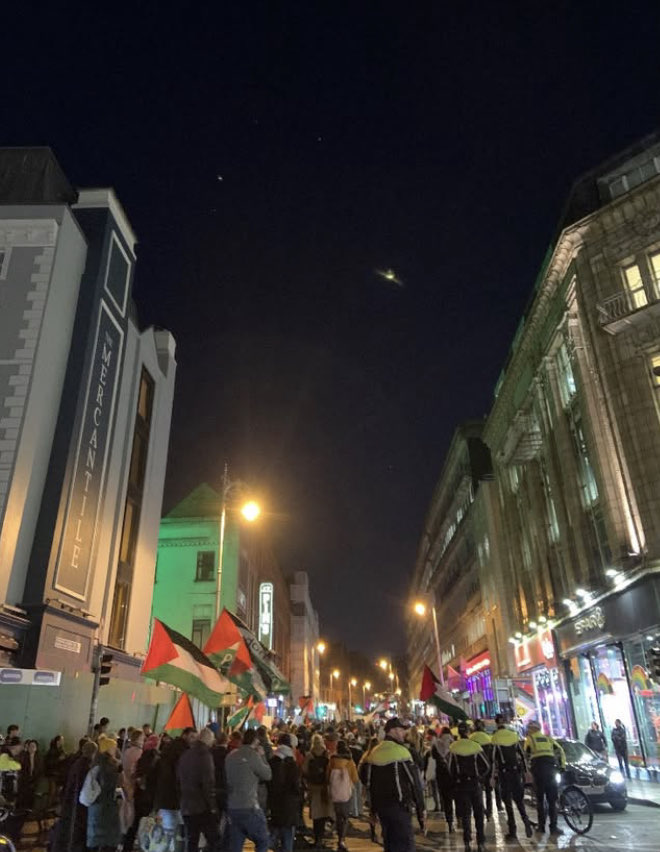
Some banners during the march, seen here on the east side of Stephens Green. (Source: AIA)

The march proceeded, chanting, up Merrion Street, then into Merrion Row, turning left at the Huguenot Cemetery, then along the east side of Stephen’s Green, stopping briefly at the Dept. of Foreign Affairs building, then along the south side to the Dept. of Justice building.

But soon it was on the march again, perhaps heading for the Kevin Street Garda station … But no, along the west side of the Green now, past the Unitarian church where Edward Fitzgerald was married to his French revolutionary wife and then on again down through Grafton Street.

A meeting here was addressed mainly by one speaker, for some reason the crowd repeating his sentences. Not one speaker had yet referred to the attack on the anti-NATO protesters on Friday, much less their bizarre and repressive bail conditions. But perhaps we were heading for the GPO?

No, left and into Dawson Street, up to the Green again, then down Kildare Street to the front of Leinster House. There at last the crowd was addressed on behalf of the Anti-Imperialist Action group regarding the Garda attack on the anti-NATO protesters at the Belgian Embassy.

His talk was interrupted by cries of ‘Shame’ directed at the Gardaí and State. The speaker continued, referencing the resistance history of Irish Republicans and concluded by calling for unity of the Left against repression of any aspect of the Resistance, a call vigorously applauded.

To conclude the evening’s events a display concerning victims of Garda violence was presented, this including the case of Terence Wheelock, a working-class youth who died in Store Street Garda Station as a result of their violence, a crime then covered up by the State.

In Retrospect

It was important and a good act of resistance to organise an emergency protest5 this week and the eventual attendance of around 700 at such short notice was excellent. It is essential to meet repression of resistance with more resistance.

It was noticeable how low the numbers of Gardaí were and although uniformed and a number of plainclothes Special Detective Unit members followed the marchers, at no point did they attempt to stop the marchers or even to line up in numbers to protect the Government offices.

Most of the speakers at the commencing, intermediate and final rallies were clear that the Irish State had made a conscious decision to crack down on solidarity actions the previous week, using physical and sexual violence against activists, and of the need to continue solidarity and resistance.

The commencing rally was however too long and dissipated some of the energy. The lament as the last song just before that march, though no doubt appropriate in some contexts, continued that dissipation.

Coppinger, as a leading member of the Socialist Party was inappropriate as a speaker at the event. The party in the past has opposed boycotts against Israel and South Africa on the spurious grounds that it harms the oppressed people and works against solidarity between progressive settlers.

The Socialist Party also supports the Two-State proposal which would concede 80% of Palestine to the Zionist settlers. Coppinger personally and her party have also publicly condemned the Palestinian Resistance breakout operation of 7th October 2023.

The marching seemingly for ever, at times to symbolic but empty Government buildings was not helpful and most of the people already detest the Government. A good destination would have been at least one of the Garda stations where activists had been held the previous week.

Marching from and to an essentially closed Leinster House and Government buildings runs the risk of replicating the routine marches every month or so of the Ireland Palestine Solidarity Campaign.

The value of the Mothers has been their departure from that increasingly sterile practice and continuing in that vein would be a useful contribution to the solidarity movement and resistance in general.

Unity against repression is a historically-proven necessity and, as called for at the final rally last night, increasing unity between newer and longer-lived elements of the Resistance is also needed.

End.

An excellent riposte in the poster slogan/ meeting title. The design is based on the poster against strip-searching Republican women in the 1970s, design by Oisín Breatnach. (Source: Mid-Ulster IPSC)

Footnotes

Sources and further information

https://www.irishtimes.com/opinion/2025/02/05/ireland-is-signing-up-to-a-definition-of-anti-semitism-that-has-been-used-against-irish-politicians/

https://www.independent.ie/regionals/wexford/wexford-district/demonstration-at-wexford-garda-station-over-alleged-strip-searching-of-mothers-against-genocide-protestors-in-dublin/

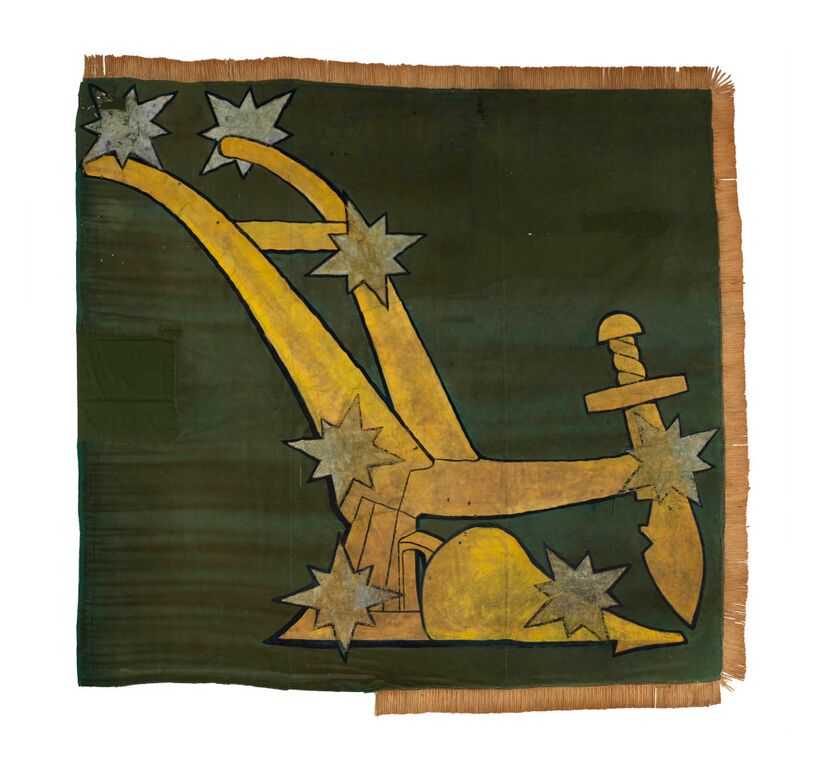
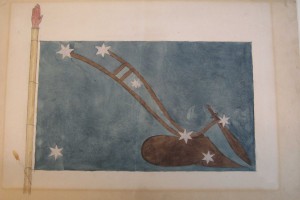
1Flag of the Irish Citizen Army, first produced in 1914, the design is based on the Ursa Mayor constellation, including a plough in gold colour, with a sword instead of the ploughshare, all on a green background. A later version of the Republican Congress represents only the stars of the constellation in white on a blue background. The green and gold version was the one flown by the AIA.

2https://www.irishtimes.com/opinion/2025/02/05/ireland-is-signing-up-to-a-definition-of-anti-semitism-that-has-been-used-against-irish-politicians/

3This was a spurious defence by the Taoiseach: a) It was before 7am and the Mothers were leaving at 7.30am; b) the pedestrian entrance was not blocked; c) the gates at the rear of the building were not blocked.

4But, like many of those songs, based on an earlier Christian song.

5There had also been an emergency protest outside Leinster House on last week’s Wednesday morning, Kildare Street being blocked for an hour without Garda action.

IRISH STATE RAMPS UP REPRESSION

Diarmuid Breatnach

(Reading time: 6 mins.)

In the space of four days, Dublin has seen 23 activists in peaceful protests arrested and assaulted by Gardaí as the activists protested the slide of the Irish Gombeen1 ruling class towards NATO and their complicity in the Genocide in Palestine.

Mothers’ Day protest against genocide – 14 arrests

The Mothers Against Genocide group organised a vigil for Sunday night of Mothers’ Day outside Leinster House, seat of the Irish parliament and Government. The intention was to hold the event that evening but for some to remain there overnight, leaving at 7.30am.

At the gates of Leinster House, Kildare Street entrance. (Photo: D.Breatnach)

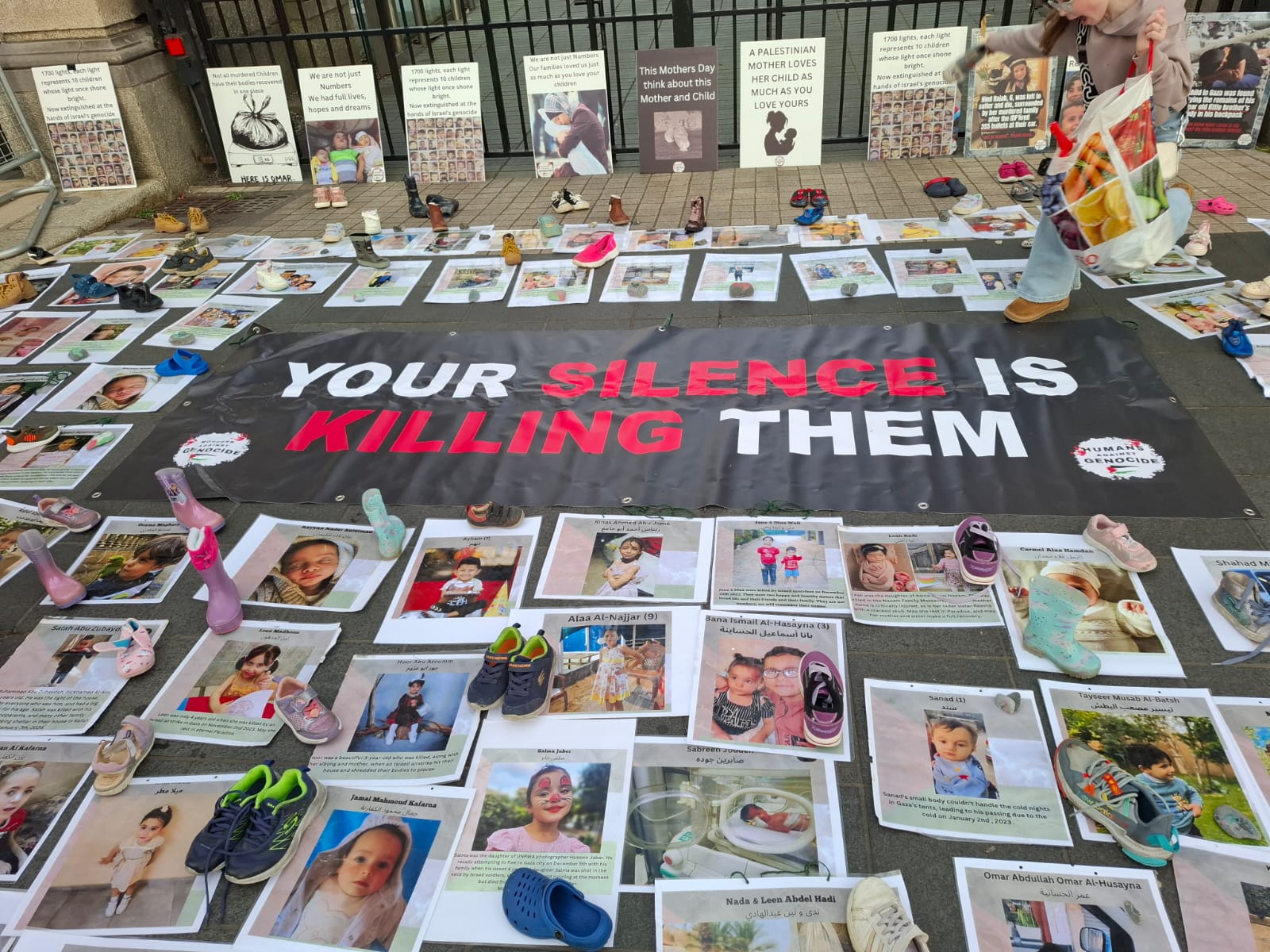
Plasticised printed photos of murdered Palestinian children were laid out on the ground with children’s shoes, toys etc spread around symbolically against the main gates with battery-powered ‘candles’ lit among them. Nearby a refreshment stall was set up.

By the advertised starting time of 7pm many had arrived and more kept coming, a very large crowd by nearly 8pm when there were some speeches, a few songs and a poem performed by different people, then a projection was being arranged after 9pm at which point I left.

Crowd at the event as dusk falls, approximately 8pm. (Photo: D.Breatnach)

The event was dignified, without even chanting. Policing was very sparse and low-key.

Despite the organisers’ commitment to leave at 7.30am and apparent agreement from the Gardaí present not to interfere with that arrangement, at around 6.00am more Gardaí2 arrived and demanded the clearing of the gates by removal of the icons to the murdered children.

In protest, some of the participants lined themselves up in front of the gates. The Gardaí approached the women, trampling over the photos and symbolic children’s items and began to remove the women, some of them quite violently, resulting in their arrests and those of three men also.

Banner of the organisers at Leinster House wall, Kildare Street. (Photo: D.Breatnach)

The 14 arrested were taken to different Garda stations where some women were strip-searched, an invasive psychological weapon used extensively by the British Occupation against Irish Republican women during the 30 Years War and still used by them against male Irish Republican prisoners.

All the women were obliged to choose right there and then between accepting a caution under the Public Order Act or to be charged and, under pressure, the women all seem to have been cautioned.

The three men were charged under the Public Order Act and will be obliged to attend the court to be processed. On Tuesday in Leinster House a number of TDs (elected parliamentary representatives) protested the treatment of the arrested. The Gardaí denied having carried out strip-searching.3

The Irish Council for Civil Liberties issued a brief statement to their network in response to the events, outlining the right to protest according to the Irish State’s Constitution:

We’ve heard from a lot of people who are worried by the Garda response this week to a peaceful vigil by Mothers Against Genocide. The fallout from this response along with potential new policing and public order laws and with the prospect of increased surveillance through facial recognition technology, risk undermining this fundamental democratic freedom. Today, as threats grow to restrict protest rights, defending this fundamental democratic freedom is crucial.

Protest isn’t the problem – it’s the solution:

  • You can protest – The Irish Constitution and European law protect peaceful assembly
  • You can film – Documenting interactions with Gardaí is allowed
  • You can’t be moved on without reason – Gardaí must give you a reason when asking you to move

The Irish Constitution guarantees your right to freedom of assembly, subject to public order. However, recent commitments in the Programme for Government have raised alarm.We continue to highlight how measures – including the expansion of police powers, banning face coverings at protest and the introduction of facial recognition technology into Irish policing – endanger our rights and freedoms. 

The display outside the gates of Leinster House, Kildare Street entrance. (Photo: D.Breatnach)

On Wednesday morning a protest, composed mostly but not completely of women, at the treatment of people on Monday morning blocked the street outside Leinster House for a period of at least an hour4 without action by the Gardaí.

Protest at complicity of Irish Government in Dublin City University – another arrest

On Thursday evening Tánaiste (equiv. ‘Prime Minister’) Mícheál Martin’s visit to publicly open a building at the Dublin University Campus, accompanied by a heavy Garda presence was met with a protest organised by the Boycott, Divestment & Sanctions campaign branch of the University.

One of the students in the protest was arrested apparently for knocking on the window to convey the anger outside to those inside, Gardaí claiming at the time that he was damaging the window. The activist was released on bail amidst a crowd gathering in his support at the Garda station.5

Protest against NATO in the Irish State – 8 arrests

On Friday, a protest against attempts to push Ireland into joining the NATO military alliance was held at the latter’s representative facility in Dublin, the Belgian Embassy. Gardaí were very quick to respond and indeed had accosted and assaulted two of the participants a little earlier.

Protesters and Gardai in doorway of Belgian Embassy just before the attack of the latter on the former. (Photo source: Anti-Imperialist Action)

Six protesters lined up against the Embassy entrance at the Anti-Imperialist Action event were pepper-sprayed into their eyes and brutally assaulted, as were another two outside. As with those arrested on Monday morning, they were held in three different police stations in the city.

One of protesters, face down on the ground with his arms handcuffed behind his back, had his legs forced up behind, breaking his ankle.

(Photo source: Anti-Imperialist Action)

Supporters arrived to picket the police stations. After a few hours the arrested were taken to court, where supporters congregated also as the detained were processed for a late sitting of a judge. The charges were of criminal trespass or Public Order Act violation, both together for some.

In court they had legal representation and all were bailed in their own recognisance of 500 euro, which seemed fairly routine but the bail conditions were anything but. They were required to give 12 or 24 hours’ notice to the Gardaí of attending an embassy protest, supplying the details of the event!

(Photo source: Anti-Imperialist Action)
(Photo source: AIA)

The conditions for some included a ban on attending any state’s embassy in Dublin or demonstrating at any Irish Government building, while another is required to give notice – also of 12 hours — if crossing into the State from the Six Counties.

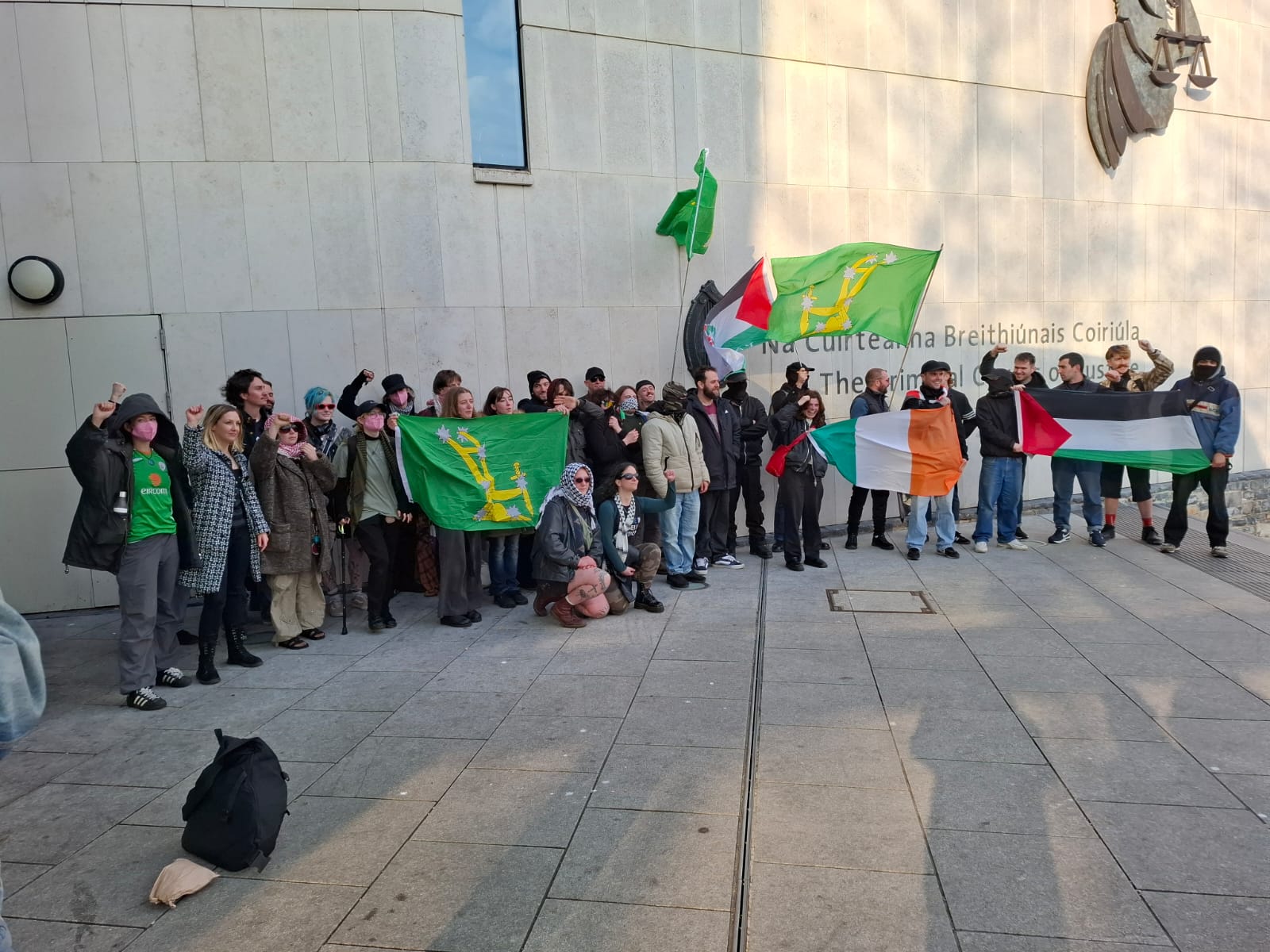
Facing a prospect of being locked up for the weekend otherwise, they did not decline the conditions for the moment and were released to meet a crowd of supporters outside the court in the early evening. As they lined up for a photo, all sang part of the Irish language Gráinne Mhaol song by Patrick Pearse.

The arrested and supporters outside the court after the former were released on bail. (Photo: D. Breatnach)

Repression of Palestine solidarity throughout the Western World

Throughout the Western world the response to the genocide being carried out in Gaza has had similar features: The complicity of the ruling classes, solidarity with the Palestinians of sections of the masses and the consequent repression by the ruling elites.

Within the territory of the Irish State the response of the masses has been marked in active solidarity with and public sympathy for the Palestinians, with little repressive action by the Irish State despite the proven collusion of the Irish ruling class.

The indications from this week are that the latter situation is changing and repression is being ramped up. This in turn indicates that the neo-colonial Irish ruling class feels threatened by action in Palestinian solidarity, other than routine marches through Dublin every month or so.

It is removing the liberal gloves and revealing the underlying sharp claws of a class that gained a state created in collusion with the British occupation to divide the country and to repress and control the insurrectionary forces upon the backs of which that neo-colonial class rode to power.

During the Civil War,6 the Irish state executed many more revolutionary fighters than had the British during the War of Independence7 and has executed a number since. Huge numbers have been imprisoned over years and it has colluded in covering for the bombers of its own capital city.

Where there is oppression, history teaches us, there will also arise resistance but that in turn usually results in more repression. Resistance rises to meet that repression and the movement must organise to educate, organise and unite that resistance, going forward until the masses achieve victory.

End.

FOOTNOTES

SOURCES & FURTHER INFORMATION

Press: https://www.irishtimes.com/politics/oireachtas/2025/04/01/women-protesting-outside-leinster-house-strip-searched-one-subjected-to-cavity-search/

https://www.independent.ie/irish-news/gardai-deny-woman-was-cavity-searched-after-leinster-house-gaza-protest/a711142261.html

DCU University Times: https://universitytimes.ie/2025/04/dcu-student-arrested-during-campus-protest-against-taoiseach-micheal-martin/

Mothers Against Genocide: https://www.instagram.com/mothersagainstgenocide

AIA https://anti-imperialist-action-ireland.com/blog/2025/04/06/republican-anti-nato-protest-violently-attacked-by-free-state-in-dublin/

1A term somewhat equivalent to ‘carpetbagger’ describing opportunists amassing wealth through taking advantage of people’s misfortunes. Its origins are in the Irish language Gaimbín, applied to such Irish capitalist financiers during and in the wake of the Great Hunger of the mid-19th Century, now used to describe the neo-colonial capitalist Irish bourgeoisie.

2 The (mostly) unarmed police force of the Gombeen Irish ruling class.

3https://www.irishtimes.com/politics/oireachtas/2025/04/01/women-protesting-outside-leinster-house-strip-searched-one-subjected-to-cavity-search/

4Though underplayed in the report by the Irish Independent, which also sought to bolster Gardaí denial of strip-searching: https://www.independent.ie/irish-news/gardai-deny-woman-was-cavity-searched-after-leinster-house-gaza-protest/a711142261.html

5https://universitytimes.ie/2025/04/dcu-student-arrested-during-campus-protest-against-taoiseach-micheal-martin/

61922-1923

71919-1921

IRISH GOMBEEN RULING CLASS STEPS UP REPRESSION

Diarmuid Breatnach

Twenty-three activists arrested at three different Dublin events between Monday and today (Friday). Three women reported being strip-searched. Six activists were pepper-sprayed into the eyes.

Oppression leads to resistance; the system responds with repression. But repression can also lead to resistance.

Reports to follow.

DUBLIN TRAFFIC CLOGGED UP AS PALESTINE SOLIDARITY PROTESTERS MARCH AROUND CITY CENTRE

Diarmuid Breatnach

(Reading time: 6 mins.)

Evening traffic in Dublin’s southside city centre came to a halt as Palestine solidarity demonstrators, frustrated by the collusion of the Irish Government with the Zionist genocidal massacres, marched from Leinster House to block O’Connell Bridge.

The early evening protest for Wednesday at Leinster House was called by Collective Action for Palestine. It is not certain whether this is an actual organisation or a flag of convenience for a collection of solidarity groups and certainly many of those present were identifiable from different groups.

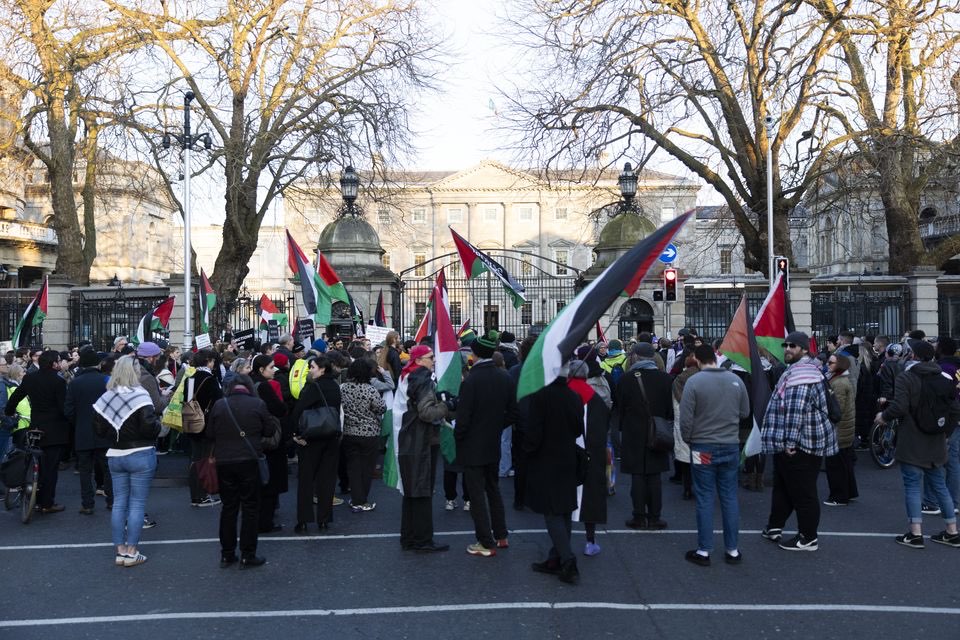
An early view of the Wednesday evening rally outside Leinster House (see in the background), home of the Irish Parliament. (Photo source: Journal)

This included, from their banners, Mothers Against Genocide and Irish Jews Against Genocide but among the hundreds present, activists of other organisations such as Action for Palestine Ireland, Saoirse don Phalaistín, Anti-Imperialist Action Ireland and Social Rights Ireland were in evidence.

The People Before Profit party, which would usually mobilise strongly for marches called by the IPSC, did not have a noticeable present, which may reflect a lack of contact with the organisers of yesterday’s event or a lesser ability to mobilise quickly.

Irish Republican organisations were also not noticeably present, with the exception of the AIA mentioned earlier.

The protesters’ rage and frustration was lit by images of dead and injured Palestinian children in the return to genocidal bombing of Gaza by the ‘Israeli’ armed forces, once again violating their ceasefire agreement, along with besieging and ethnic cleansing of cities of the West Bank.

The previous night Zionist state bombing had killed 414 Palestinians, including 174 children, and hospitalised over 550 more.

The marchers called for action from the Government, such as imposing sanctions on Israel in general and enacting the rather mild Occupied Territories Bill, approved by both Houses of the Oireachtas (Irish parliament) but seven years since, still sitting in a drawer; awaiting enactment.

Those calls have been repeated week after week, month after month in the final months of 2003 and throughout last year but only words of concern from Government ministers resulted, followed by friendship visits to the very supplier of the Zionists’ weapons of genocide.

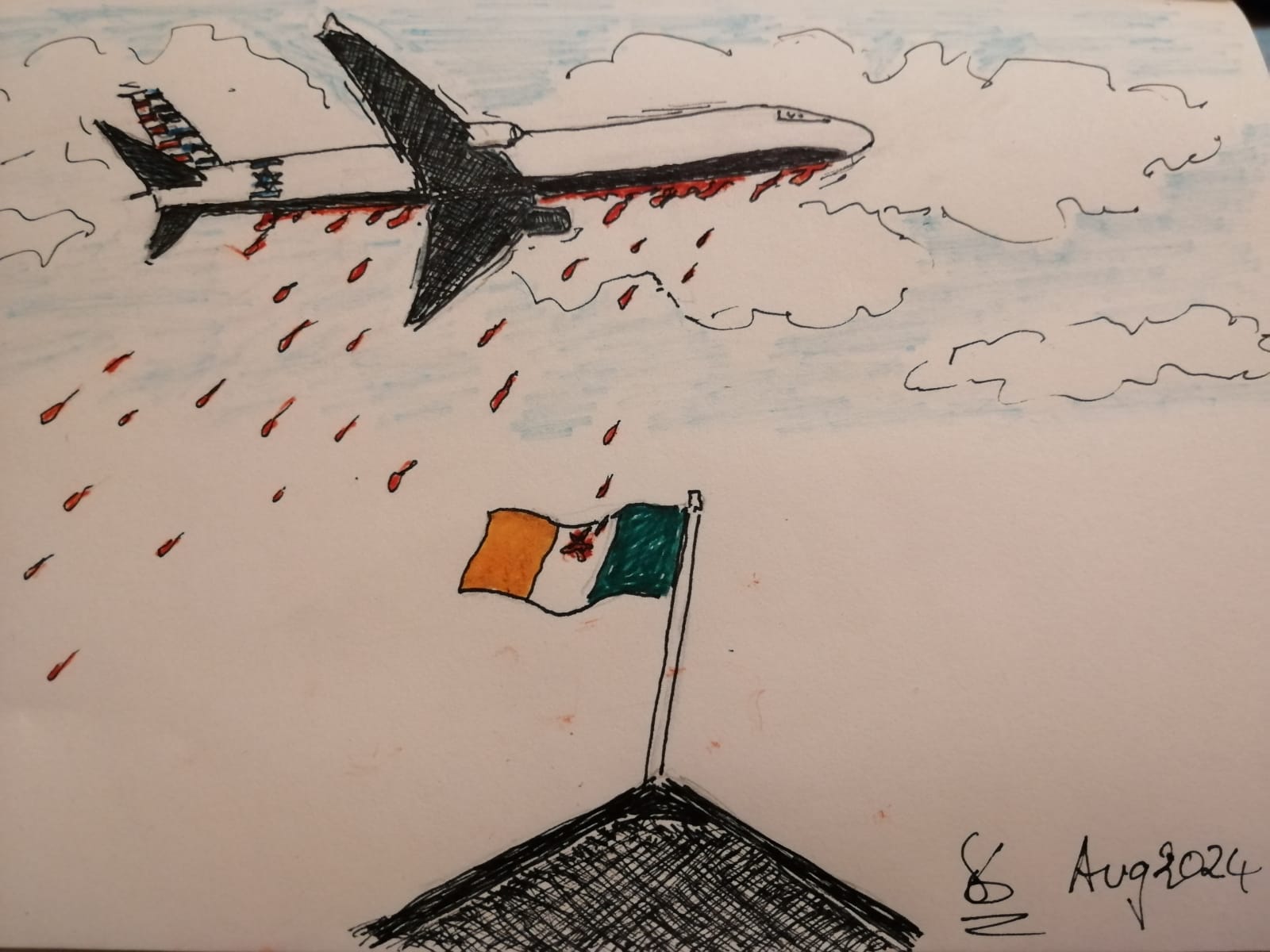
Successive governments of the ruling class of the ‘neutral’ Irish State have actively colluded too in genocide through refusing to bar Irish airspace to Zionist military supply flights1 or to monitor and prevent US military flights through Shannon airport.

Still as true today, unfortunately, as it was in August last year.

MARCH AROUND SOUTHSIDE CITY CENTRE

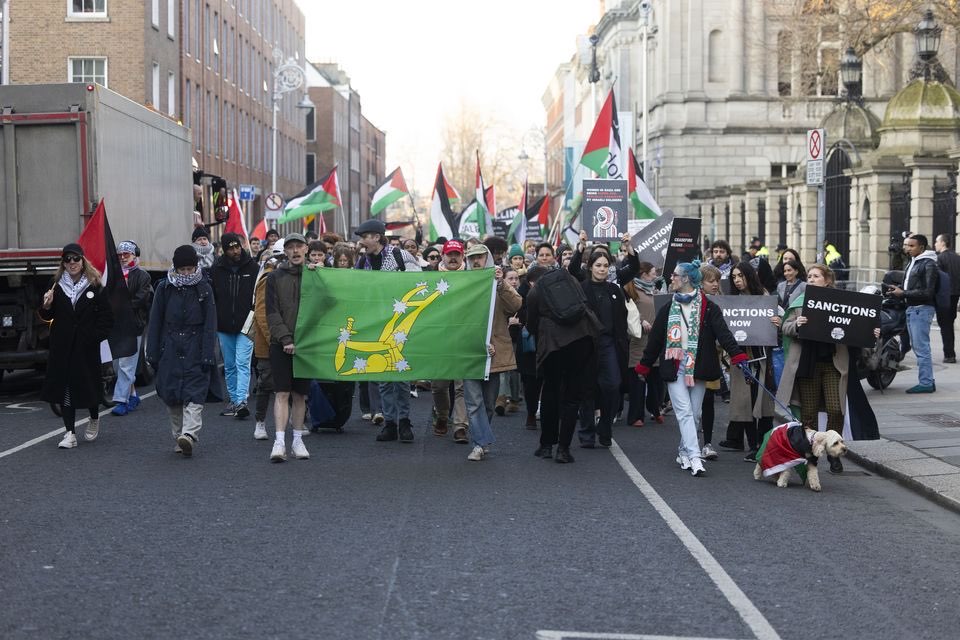
From outside Leinster house the protesters proceeded southwards up Kildare Street, turning right to flank Stephens’ Green, where they paused to chant more slogans and display banners and placards to stopped Luas trams before then turning northward into Grafton Street.

The solidarity protest rally becomes a march, proceeding southward up Kildare Street. (Source photo: Irish Independent)

In that pedestrianised shopping street the march stopped near one of the many buskers regularly performing there, apparently Italian who launched into an amplified rendition of a celebrated song from the Italian antifascist tradition, Bella Ciao, with many of the marchers joining in.

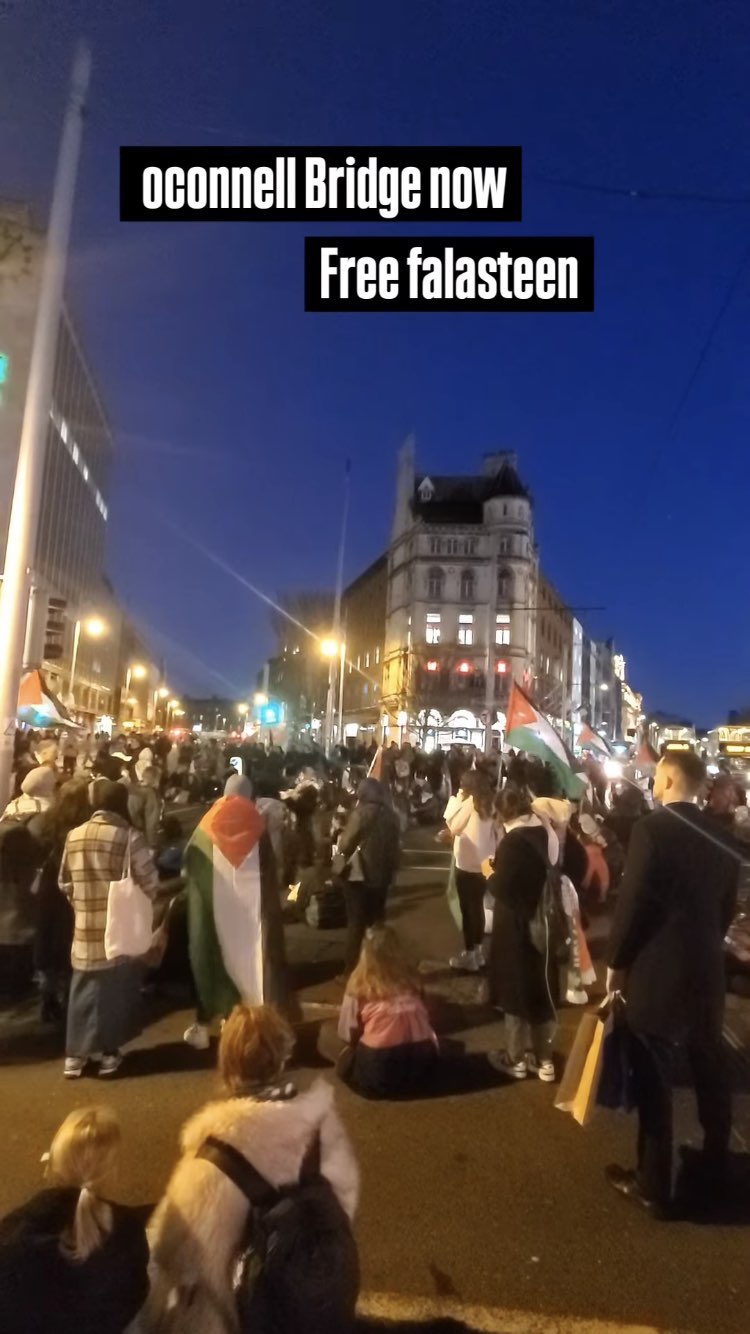
The northward march continued with stops up Westmoreland Street, where the clientele of a pub came out to cheer and applaud the marchers. Then on to the southern end of O’Connell Bridge, occupying both southward and northward-bound lanes with traffic blocked in both directions.

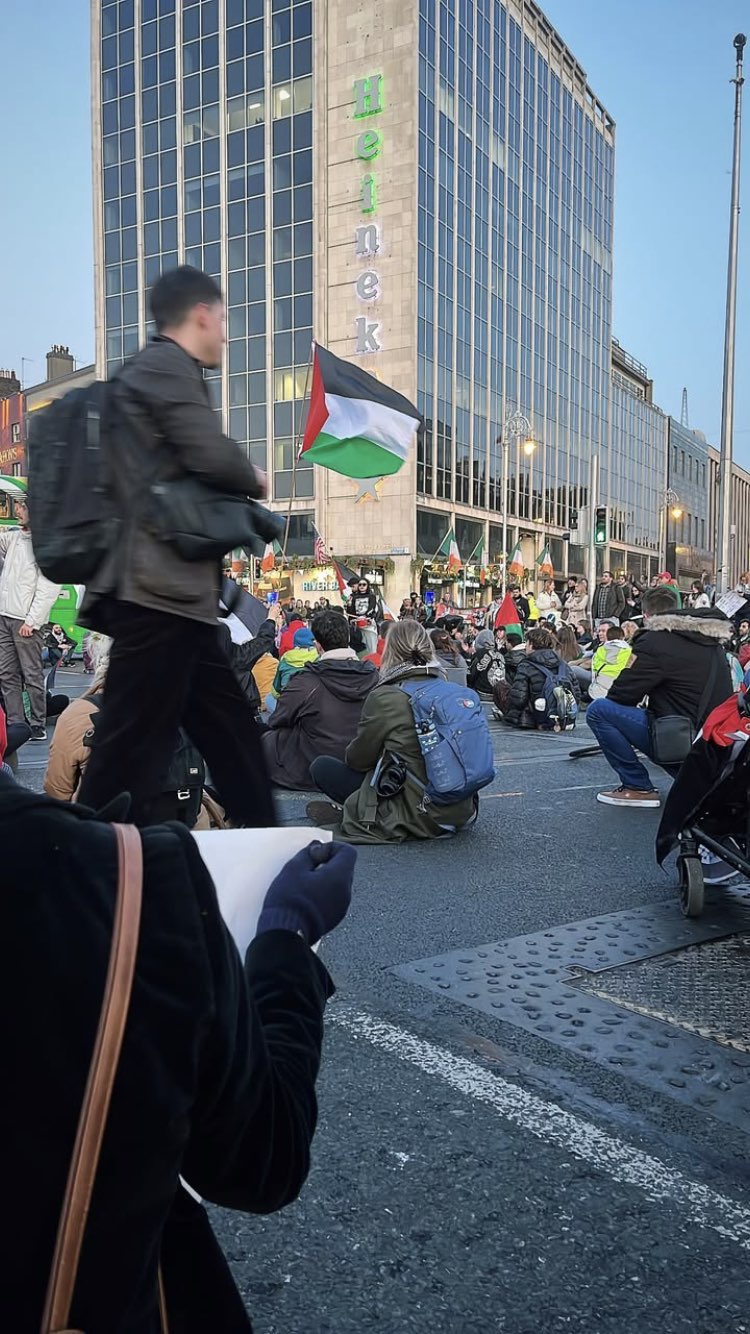
Indeed the traffic was soon backed up southward around Stephens Green and to the north, up to Dorset Street. On the Bridge, flares were lit and the crowd heard speeches of protest interspersed with solidarity slogans. Many passers-by expressed support, some stopping to participate.
A protester lights a flare as the march proceeds northward along Grafton Street. (Photo source: Participant)

What was most unusual indeed was that during the half hour or so that the marchers remained there, no angry beeping of horns nor shouts of impatience were heard from drivers of private cars or from passengers in public transport buses.

The crowd left, marching west along Dame Street, northward at Georges Street South and Aungier Street, then left to march along Stephens Green North, pausing outside the HQ of the Department of Foreign Affairs, where the Gardaí scuffled with some protesters.

Section of the protest on O’Connell Bridge. (Photo source: Participant)

The protesters then returned to Kildare Street to the seat of the Irish Parliament, Leinster House where they concluded the evening’s event.

A couple of hundred protesters had achieved, one might argue, more than many thousands on regular national marches of the Ireland Palestine Solidarity Campaign, in terms of public exposure and paralysis of city traffic in several directions, therefore putting pressure on the Irish Government.

Section of the march in Grafton Street. (Photo source: Participant)
Grafton Street: Gardaí wondering where the marchers are heading and what going to do. (Photo source: Participant)

As a tactic this has much to recommend it. My opinion is that one has to time the length of remaining in each location just right to maximise the disruption while reducing the impact on people at each spot to a tolerable degree.

The movement needs to further awake people and to shake the elite but it also needs to minimise the impatience of people returning home from a day’s work or indeed travelling to begin their night shifts, or hurrying to meet others by arrangement.

They are not the enemy nor do we wish to make them so.

A narrower view of the temporary occupation of O’Connell Bridge. (Photo source: Participant)

I would also criticise the reciting of an amplified prayer on O’Connell Bridge. The solidarity movement is secular and no section of it has the right to impose prayer upon all or to represent the whole as religious –whether Muslim, Christian, Jewish, Hindu or any other.

SLOGANS

All or most of the slogans one hears on Palestine solidarity demonstrations in Dublin (and endorsed by the Ireland Palestine Solidarity Campaign) were shouted but so were others in addition such as There is only one solution – Intifada Revolution! And No peace on stolen land!

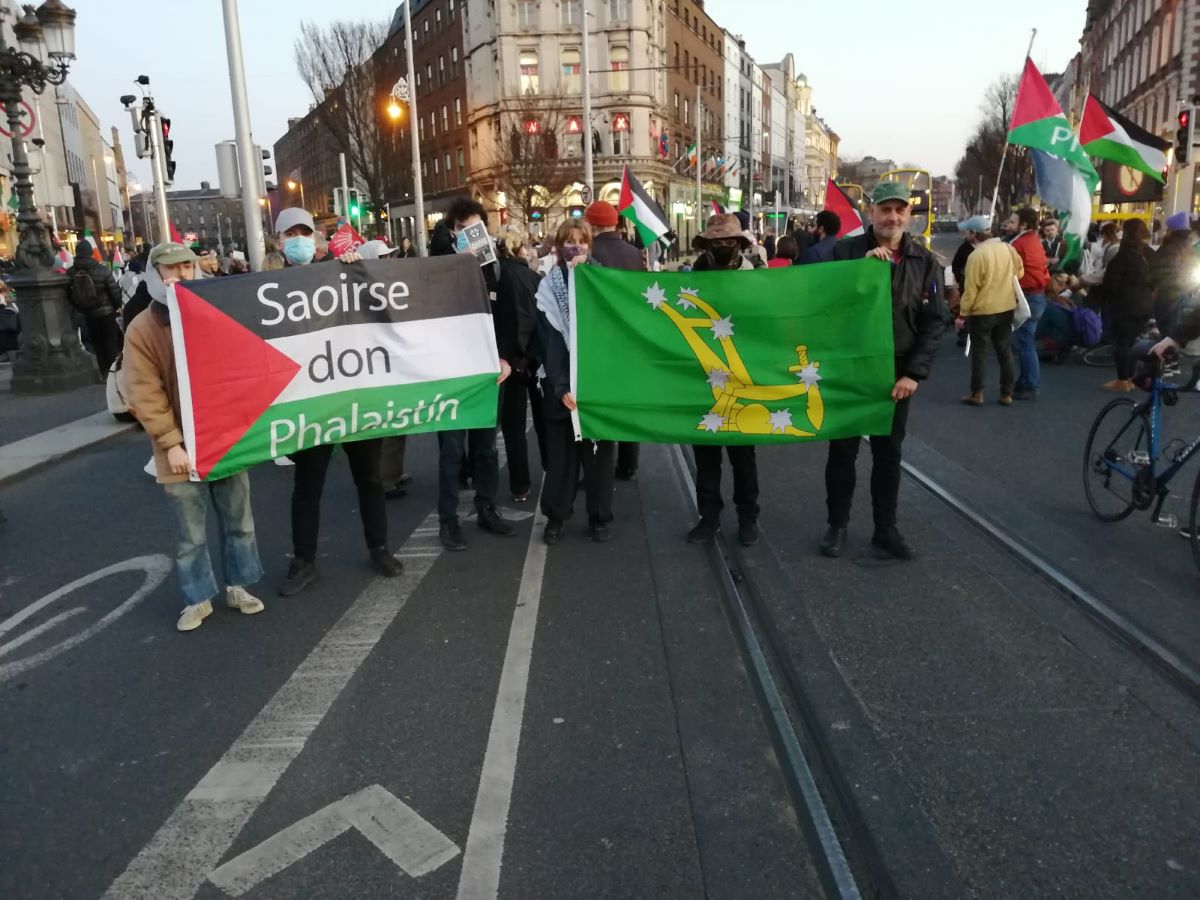
A group of Anti-Imperialist Action photographed during the O’Connell Bridge occupation. (Photo source: Participant)

Others included Resistance is an obligation – in the face of occupation! From Ireland to Palestine – Occupation is a crime! Brick by brick, wall by wall – The colonies will fall! It’s hard to imagine the IPSC leadership, whatever they might think privately, endorsing those slogans in public.

Although the last slogan might not be seen as specifically referring to Ireland, there was also one in the Irish language which is now common among native Irish and many of migrant background, Saoirse don Phalaistín! And the unequivocal From Ireland to Palestine – Occupation is a crime!

Ceasefire now! resurfaced from time time and though a good call when the Resistance is calling for it, can be problematic when they are not, as with the end objective being liberation, do we have the right to call on the Resistance to cease fighting, even if the Occupation ceases temporarily?

Another problematic call for example is Mícheál Martin, do your job! because in fact members of the Irish Government are doing exactly their job, which is to manage the contradiction between the peoples’ wishes and the needs of the neo-colonial Gombeen ruling class in favour of the latter.

Sanctions Now! is a call with very wide support across revolutionary and non-revolutionary sectors – the division is more around whether periodic marches to Leinster House for example is likely to achieve that or whether more radical action is necessary to pressure the elite to enact them.

The march pauses along Stephens Green North (the Green is out of sight to right of photo). (Photo source: Participant)

The demands of the Government, i.e representing the ruling class, are not revolutionary or even huge: to apply sanctions (economic, cultural and political) against the genocidal entity and to cease permitting Irish airports and neutral Irish airspace to be used in supporting genocide.

The genocidal entity cannot hurt the Irish state much directly. Of course, its main backer, the United States, is another matter. But then, if principle is not enough, the Irish elite could calculate that during the current split between the EU and the USA might be the best moment to take that step.

End.

FOOTNOTE:

1https://www.ontheditch.com/as-idf-resumed-bombing/

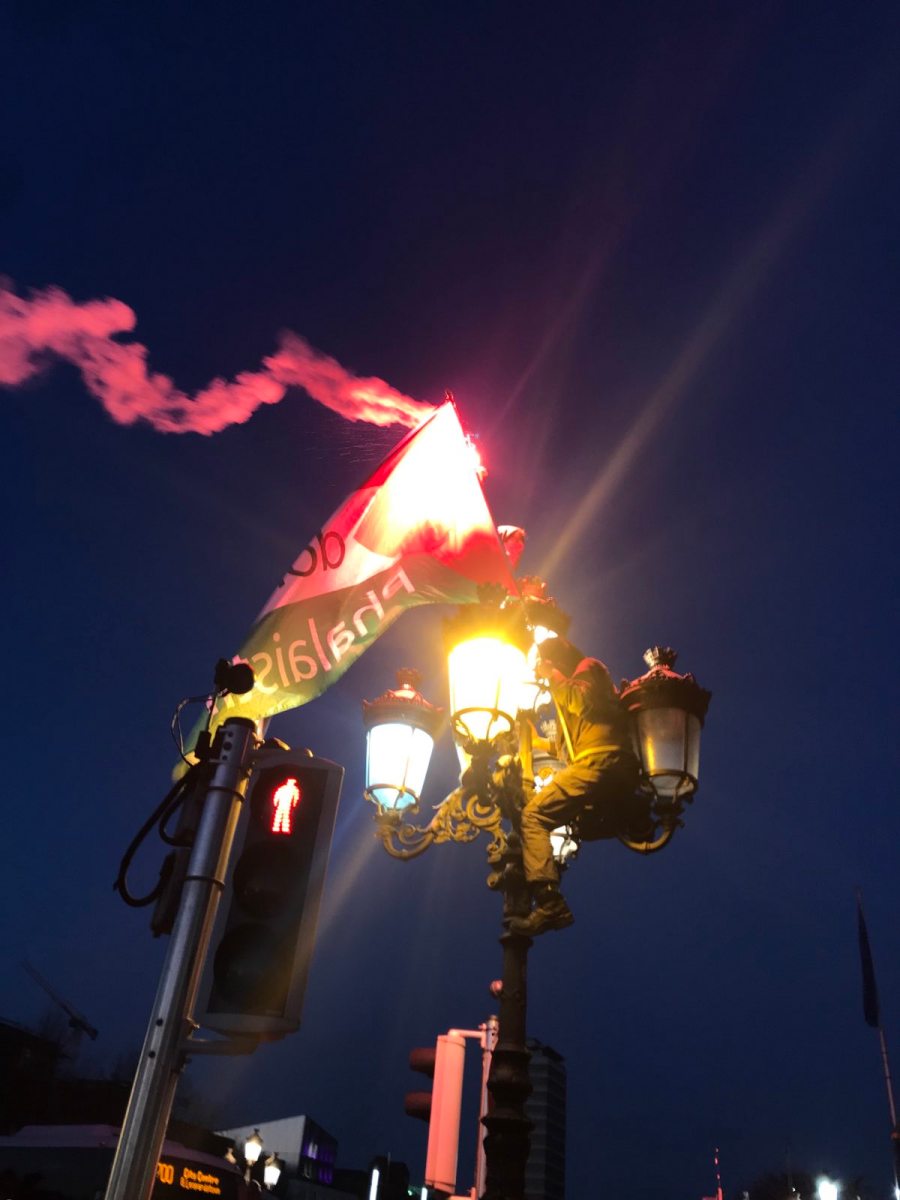
Demonstrators scale an ornamental lamppost during the O’Connell Bridge occupation, erecting a Palestine national flag bearing the legend “Saoirse Don Phalaistín” (‘Freedom for Palestine’). (Photo source: Participant)

RAISING DEFENCE FUNDS FOR RADICAL IRISH PALESTINE SOLIDARITY MOVEMENT

Clive Sulish

(Reading time: 4 mins.)

A night of resistance and other songs on Friday night in Peadar Browne’s Dublin pub raised funds to assist in fighting state repression of Palestine solidarity activists in Ireland, as Palestine solidarity activists face persecution across the Western world.

The evening’s performance consisted of a mix of political and other songs, a number of which were original material. However it was the political material that most drew interest, ranging from international struggles to the rich Irish Republican tradition.

Olive and Fynn in performance at the fund-raising event (Photo: R.Breeze)

To begin the event Diarmuid Breatnach explained the need to support Palestine solidarity activists against the repression of the Irish authorities, hence the fundraising event and announced that in addition to performing he would be standing in for the event’s MC who had been unable to attend.

Breatnach began his set combining two songs from the German antifascist tradition, three verses of Peat Bog Soldiers and three from the Hans Beimler ballad.1 Then from the Spanish Anti-Fascist War he sang Ay Carmela!, the air of which he said was from an anti-French occupation folk song.

Next the MC announced a performance by two performers, half of the four-strong Croí Óg ballad band. During their performance with voice, guitar and banjo there was an incident from a couple of unruly elements nearby who had substantial drink taken and had been very loud throughout.

Two members of the Croí Óg band performing at the fundraising event (Photo: R.Breeze)

A man who had been refused permission to sing solo began shouting that the songs were not Republican, ironically interrupting Grand Old Country, a song about the Fenian tradition. It became clear that what he wished was to perform the Grace ballad, which he began to sing loudly.

A male confronted the interrupter; the latter’s friend, a big elderly Glaswegian protested; others took to the floor … but the incident wound down, the interrupters and audience resuming their seats. However, the putative Grace singer threw threats at his earlier confronter across the room.

The big Glaswegian then crossed the room to confront the audience member, a female audience member intervened, he brushed her aside and the audience section erupted, only the quick arrival of the pub’s landlady preventing a fight … And the musicians resumed their performance.

Among the songs performed by Croí Óg were Crossmaglen and British Soldier Go on Home. The MC called for appreciation applause for them, made some barbed comments about the recent anti-social behaviour and welcomed the song-and-guitar duo Olive and Fyn to the stage.

Sage Against the Machine performing at the fundraiser event (Photo: R.Breeze)

The duo performed their own material in lovely harmonies, mostly non-political, also including their ironically titled Save the Landlord! After they had left the stage to applause Breatnach got up on stage again to announce a short break and to remind the audience to contribute to the funds.

His additional comment: “Remember when someone sang in a Dublin pub and everyone went quiet? Remember those days? Remember?” was followed by loud applause throughout the pub.

Breatnach restarted the second half, singing a capella again two songs celebrating Irish women’s resistance,2 ending with songs in Irish including the ballad of Rodaí Mac Corlaí. After concluding he introduced Sage Against the Machine to take to the stage, singing solo with guitar.

Sage’s material was mostly original, sung in English but went on to Masters of War in a spirited concluding verse, followed by Gallo Rojo, Gallo Negro3 in Spanish from the anti-fascist tradition in Spain. The MC then presented Eoin Ó Loingsigh, also with voice and guitar.

Eoghan Ó Loingsigh performing at the event (Photo: R.Breeze)

Although no further incidents occurred, the volume of ‘conversation’ between a number of people not far from the stage was high. Loingsigh’s material included Only Our Rivers Run Free, Viva La Quince Brigada4 and a satirical song contrasting the fates of the rich and the poor after death.

The evening’s scheduled performances concluded with Seán Óg, also solo with voice and guitar, his selection including Ho Chi Minh, republican ballads Boys of the Old Brigade, The Patriot Game, Boolavogue and his own composition Boys of Gaza to air and structure of The Boys of Kilmichael.5

Breatnach thanked the attendance for their support, restating the context of the event and asked for another round of applause for all the performers, who gave their time and creativity for free, then called for people to stand for the Irish national anthem6 which he led with the first verse in Irish.

Diarmuid Breatnach in performance at the fundraiser event (Photo: R.Breeze)

At the concluding line of “seo libh, canaig …” the audience exploded to complete the words “Amhrán na bhFiann!” followed by launching into the chorus, also in Irish.

The event had been organised by two broad Palestine solidarity organisations, Saoirse Don Phalaistín and Palestine Action Ireland and among the attendance were a number of their activists, including some victims of state repression.

Most of the charges to date have been under the Public Order Act but also some around ‘criminal damage’ and the potential is there for more serious charges and possible jail sentences, as have been the case in some other European administrations.

In addition to actions of their own, including occupying and picketing the Israeli Embassy, Axa Insurance and picketing the Palestine Authority, Saoirse don Phalaistín and Palestine Solidarity Action organised Resistance Blocs to participate in mass demonstrations organised by the IPSC.

Seán Óg performing at the fundraiser event (Photo: R.Breeze)

Peadar Browns pub has become increasingly known as an Irish Republican tavern on the south side of Dublin city. Its small stage area is decorated with Republican artwork on the walls and on many of the bodhráns7 hanging there, along with some Glasgow Celtic celebratory material.

The side of the pub, on a minor street, carries a large mural representation of the Palestinian national flag, along with the slogan SAOIRSE DON PHALAISTÍN. However Dublin City Council have directed that it must be removed, to the anger of a great many people.

Mural on the side of the Peadar Brown pub (Photo sourced: Internet)

Historically cultural events of this type have a function other than to raise defence funds and to promote the cause: they are also occasions for replication of the cultural face of resistance and for expression of new cultural compositions but additionally for the creation of a community of resistance.

End.

Footnotes

1Both translated to English from German.

2White, Orange and Green (War of Independence) and Anne Devlin (United Irishmen, Emmet’s insurrection).

3Red Cockerel, Black Cockerel.

4About the Irish who went to fight against fascism in 1930s Spain.

5Also known as The Kilmichael Ambush, celebrating a famous event in West Cork during the War of Independence (1919-1921). However, the air of both songs is that of an older ballad about the 1798 Rising called Men of the West.

6The lyrics were originally written in English and later translated to Irish in which language it most usually sung today.

7A shallow one-sided Irish drum, same shape as a tambourine but much larger, played with a wooden striker on the outside with variation in tension achieved by hand pressure on the inside.

Useful Links

Saoirse don Phalaistín: isrmedia@protonmail.com

Action for Palestine Ireland:
actionforpalireland@gmail.com

DUBLIN COURTS INCREASINGLY TRYING POLITICAL CASES

Clive Sulish

(Reading time: 3 mins.)

The CCJ (Criminal Courts of Justice) in Parkgate Street, Dublin, are seeing an increase in political cases in recent weeks with activists in housing and Palestine solidarity as well as Irish Republicans fighting extradition to the British colony.

Eoghan Ó Loingsigh, who made the mistake of asking a Garda for his badge number while they were carrying out an eviction, appeared there in February only to see his case thrown forward to June.

Picket anti-extradition display by Anti-Imperialism Action outside Heuston Station in February. (Photo: R.Breeze)

Another housing activist’s charge of attempting to break into an empty property was dismissed. The property in question, empty for a number of years is leased to the Salvation Army and three years ago two RHL1 activists were evicted from it by 100 Gardaí (some armed) with helicopter support.

Jack Brazil, a Palestine solidarity activist whom the Gardaí are trying, believe it or not, to tie into the racist and criminal riots of November last year, had yet another appearance in court without trial as he’s still trying for CCTV footage from Gardaí to support his alibi for the night.

At least the remaining bail restriction on Brazil was lifted: at the outset he had to sign on at Mountjoy Garda station once every week, observe a curfew of 12am-6am and not to loiter at any point in the Dublin city centre (D1 and D2). His case is now remanded to 26 March.

Jack Brazil (in the suit) and other Palestine solidarity activists outside the CCJ after Brazil’s most recent appearance there. (Photo: R.Breeze)

Jim Deneghan had a number of court appearances fighting extradition to the Six Counties on foot of charges alleging an act during the 30 Years War there – fifty years ago. He was unsuccessful and it appears that the only avenue open to him now would be to challenge it in the High Court.

Should they even grant him leave to do that which is not always the case.

Some of the AIA-organised anti-extradition banner drop on the Fairview pedestrian bridge hold up placards against extradition. (Photo: R.Breeze)

Another extradition case has been dealt with in the Special Criminal Court, which is located within the same building as the CCJ, distinguished from other courts by the glass-enclosed reception ‘box’ through which one must pass to gain entry, first satisfying ‘security’ provisions.2

Sean Walsh has been fighting extradition to the UK’s Irish colony, the Six Counties on a charge of membership of an armed Republican organisation, which is deemed illegal on both sides of the British Border. He is in custody in Portlaoise awaiting a decision from the ECHR in Brussels.

Independent Dublin Republicans organised solidarity pickets outside the court on the mornings of Denneghan’s appearances, while Anti-Imperialist Action held a picket against extradition outside the nearby Heuston Train Station and a more recent banner drop on the Fairview Pedestrian Bridge.

Picket organised by Independent Dublin Republicans outside court where extradition of Jim Deneghan (Centre, next to State Harp) was being decided in February. (Photo sourced: IDR Facebook page)

The CCJ courts, in particular those on the ground floor are extremely busy with what seems at times like industrial-scale processing of setting further dates for court appearances, granting or refusing bail, requiring ‘discovery’ and other documentation from the Gardaí and some sentencing.

The human subjects of these proceedings are mostly from what might be termed the under-class of Dublin with some migrants added for good measure. Most face charges of possession of drugs, anti-social behaviour, threatening behaviour, theft and breach of bail conditions.

A huge amount of court, lawyer and Garda time is taken up with processing people accused under these charges. On the other hand the processes also interfere hugely with the normal lives of those charged and in addition, in the case of political activists, disrupt some of their legal activity.

And can cost them loss of pay and even threaten their employment. Which might be deliberate on the part of the system or if not, at least something those who manage it will not regret.

Banner drop by AIA from Fairview pedestrian footbridge. (Photo: R.Breeze)

The sheer number of that social group being processed through the courts daily is an indication of something really wrong with Irish society and which worsens even through generations, while the major reaction of the State is to maintain the social conditions and repress its victims.

By and large the middle class only come into contact with that element of society when they are prosecuting or defending them in court, or professionally dealing with them in hospital or social services environments.

It is also where many of those who are trying to change the prevailing social and economic conditions, i.e political activists, will first rub shoulders with that group while next to them on court seating benches. Unless the political repression goes a step further and they meet in jail.

End.

1Revolutionary Housing League which had renamed the building, on Eden Quay, ‘James Connolly House’.

2The non-jury SCC was established under an Amendment to the Offences Against the State Act, pushed through Leinster House by Fianna Fáil amidst collapse of its opposition during a panic caused by (British Intelligence) terrorist bombing of Dublin in 1972 killing two and maiming many. The scene of many unjust decisions, its most famous was the conviction of the innocent ‘Sallins Four’ when the SCC was based at Green Street, appropriately enough the scene of many injustices under the British occupation, including the death sentence on Robert Emmet after his famous speech. The existence of the SCC is opposed by Amnesty International and Irish civil rights organisations and, until a few years ago, by the majority political party in Ireland, Sinn Féin, which no longer opposes it.

THE REBEL WOMEN’S TOUR

Orla Dunne

(Reading time: 3 mins.)

Myself and my sister, Brenda went on the Rebel Women’s Tour in the General Post Office on Saturday, 1st February 2025. Our Guide was Kim.

Two women’s groups were highlighted: Inghinidhe na hÉireann which was founded by Maud Gonne in 1900 and inspired Cumann na mBan. Inghinide na hÉireann is Irish for “Daughters of Ireland”. It was founded solely for women and adopted Saint Brigid as their patron saint.

Cumann na mBan:

In 1914, Inghinide (modern spelling ‘Iníní’) na hÉireann was merged with Cumann na mBan (abbreviated C na mBan, translated in English as the “Women’s League”). It was formed in Wynn’s Hotel on Lower Abbey Street on the 2nd of April 1914.

Brenda’s husband’s grandmother, Christina Caffrey, was a member. Our Grand Aunt, Theresa Rudkins nee Byrne was also a member as was also an old neighbour of our sister Eileen, Mary Breslin. Cumann na mBan was then led by Kathleen Lane O’Kelley.

One key member whom we are all familiar with is Countess Constance Markiewicz who took an active role in the 1916 Easter Rising which I will come to later.

Cumann na mBan uniform on display in the GPO Museum (Photo: O. Dunne)

1913 Lockout:

During the 1913 Lockout by an employers’ consortium, women including Dr Kathleen Lynn, Helena Moloney, Delia Larkin (sister of Jim Larkin) and Rosie Hackett opened soup kitchens at Liberty Hall to assist struggling workers and families.

The 1916 Easter Rising:

It is estimated that approximately 200 women took part in the Rising and 77 were imprisoned.
The only woman sentenced to death was Countess Markiewicz who was second-in-command to Commandant Michael Mallin in St. Stephen’s Green.

Constance Markievicz (colourised) in ICA uniform (Source photo: Internet)

However due to her being female, it was then changed to life imprisonment. She subsequently served 13 months in prison in both Ireland and England. She was outraged that she would not be executed.

Winifred Carney:

Winifred Carney was named as the first woman to enter the GPO on Easter Monday 1916. It is thought that she entered the building wielding a typewriter and revolver.

Winifred Carney (Source photo: Internet)

Elizabeth O’Farrell:

Elizabeth O’Farrell was one of the last three women to remain with the GPO garrison along with Julia Grennan and Winifred Carney and all three spent their last days of freedom in Moore Street. Ms O’Farrell accompanied Patrick Pearse on his journey of surrender to the British forces.

Elizabeth O’Farrell(colourised) after release from jail (Source photo: Internet)

There is a photograph of this and all that can be seen of her are her feet and the end of her dress, as she stood at the far end of Pearse from the photographer.

Julia Grennan (Source photo: Internet)

WOMEN DURING THE WAR OF INDEPENDENCE:

Women also played a significant part during the War of Independence. Over 300 women are believed to have assisted by smuggling weapons and ammunition into Ireland and relaying messages from area to area.

WOMEN DURING THE IRISH CIVIL WAR:

The Irish Civil War lasted for almost one year from June 1922 to May 1923 and again women participated in the struggle, believed to have been mainly on the Anti-Treaty side. Female members of the Irish Citizen Army were armed.

Grace Gifford (colourised) with paintbrush and easel (Source photo: Internet)

One such example is Grace Gifford Plunkett who married her beloved fiance, Joseph Mary Plunkett in May 1916 just hours before his execution. She herself was incarcerated in February 1923 in Kilmainham Gaol for her part in the Civil War.

While there she painted a copy of Mary and Child on the wall of the cell.

End.

“A March Travelling into the Future … a Beacon of Resistance”

Diarmuid Breatnach

(Reading time main text: 6 mins.)

Thousands of marchers with flags, banners and three marching bands retraced the route of the anti-internment march in 1972 that ended in the infamous Derry Bloody Sunday1, a massacre of unarmed civilians by the British Parachute Regiment.

The nearest Sunday to the date of the original march, which this year fell on February 2nd has been chosen annually for the commemorative march over the 53 years since the massacre. People travel from different parts of Ireland and indeed from beyond in order to attend.

Section of the march coming down from the Creggan. (Photo: D.Breatnach)
The colour party (bearing the flags) traditionally precedes the marching band. (Photo: D.Breatnach)

Derry is not well served by public transport from other parts of Ireland and there is no train station there.

There is a bus service from Dublin from the Translink company of the occupied colony but one would need to catch it at seven in the morning and then hang around in Derry for 3.5 hours waiting for the march to start. For this reason, many travel to Derry by car.

Equally, many others who would attend were the public transport available, stay home but an estimated over 7,000 participated in this year’s march. The theme this year was Palestine, once again as was last year’s too.

The day of the massacre

The original march was a protest against the introduction in August 1971 of internment without trial in the occupied colony. Almost immediately afterward the Parachute Regiment had massacred 11 people protesting against it in Ballymurphy, Belfast.2

Ballymurphy campaign banner in the Creggan awaiting start of march with Kate Nash centre. (Photo: D.Breatnach)

The 1972 march, along with many others, had been banned by the sectarian colonial administration. The Civil Rights campaigners knew that their legitimate demands3 were being obstructed by use of the Special Powers4 of the statelet and that they could win nothing if they were to acquiesce.

After the previous massacres it took considerable courage to march that day but perhaps they thought that with an advertised march, in daylight, with many film cameras covering, the Paras were unlikely to open fire. In any case, they decided to risk it.

At 4.10pm the first shots were fired by the Paras5 without warning and by around 20 minutes later they had killed 13 men and youths and wounded another 13, one of whom would die weeks later. According to the Saville Inquiry in 2010, they had fired over 100 rounds.

Not one of their targets was armed.

To justify the slaughter, the British Army claimed that they were fired upon and returned fire, killing IRA fighters. The British Government, in particular through Home Affairs Minister Reginald Maudling, repeated the lies as did the British media.

Bernadette (then) Devlin6 MP, a survivor, was prevented from speaking in the Westminster Parliament and she walked up to Maudling and slapped his face. In Dublin a general strike took place with schools closing and a huge crowd burned the British Embassy down.

In London, a giant march reached Trafalgar Square as its end was still leaving Hyde Park. In Whitehall the police prevented them from laying the symbolic coffins outside No.10 and in the scuffles the ‘coffins’ were eventually thrown at the police or knocked to the ground.

And a number of construction sites in Britain went on strike also.

The judicial response varied wildly. Coroner Hubert O’Neill, an ex-British Army major, presiding on the inquests in 1973, called it “Sheer unadulterated murder” whereas Lord Chief Justice Widgery in the ‘inquiry’ he led ignored all the local evidence and accepted the British Army’s lies.7

The last Bloody Sunday march”

Provisional Sinn Féin organised and managed the annual march for many years but in January 2011 Martin McGuinness announced that year’s march would be the last, because of the UK’s Prime Minister David Cameron’s public apology to the relatives of the 14 killed in Derry.

The apology followed quickly on the verdict of the Saville Inquiry8 which totally refuted the statements at the time by representatives of the Army and of the Political and Judicial establishments: the victims had been unarmed and the Army had not been “returning fire”.

One side of one of the marching band drums (Photo: D.Breatnach)
Section of the march about half-way along its length. (Photo: D.Breatnach)

Despite the UK State’s acknowledgement that they had no excuse for the massacre, not one of those who planned, organised or carried out the atrocity had been charged, never mind convicted, nor had those who conspired to cover up the facts. To this day, only a low-level soldier has faced charges.

Nor had there been government admissions of wrongdoing in the other massacres by the Paras intended to crush the resistance to the repressive internment measure, at Ballymurphy and Springhill.

A number of relatives and survivors of the original march declined to have the annual march cancelled, among them Kate Nash and Bernadette McAlliskey. Kate Nash’s brother William was shot dead on Bloody Sunday and her father, William, was wounded trying to save his son.

Bernadette McAlliskey was a survivor of the massacre and also survived nearly a decade later an assassination attempt in her home, being struck by nine bullets of a Loyalist murder gang. Despite opposition by and denunciation from SF, volunteers have kept the march going every year.

Each year different themes have also been incorporated into the Bloody Sunday March for Justice, including ones in Ireland, such as the framed Craigavon Two prisoners but also ones from beyond, e.g. the resistance of the Broadwater Farm housing estate in London to Metropolitan Police attack.

Section of the march in Creggan waiting to start, showing the Palestinian national flag and the Irish Tricolour in close proximity. (Photo: D.Breatnach)
Big drums of one of the marching bands getting a workout in the Creggan while waiting for the march to start. ‘Saoirse go deo’ = Freedom for ever. (Photo: D.Breatnach)

Since 2011 Sinn Féin have boycotted the march but also sought to mobilise public opinion against it, claiming that relatives of the victims didn’t want the march to continue. The truth is that some hadn’t wanted it even when SF were running it, some didn’t afterwards but some did.

Such an atrocity has of course huge personal impact on relatives of victims but its impact is also much wider on a society and beyond, historically and politically. That historical memory ‘belongs’ to the people of Derry but also to the people of the world (as do others such as Sharpeville SA).

Those in power in society are aware of that and the media outside of Derry gives little or no coverage to the annual march while promoting other events there of lesser numbers and significance.

The ‘Derry Peoples Museum’ ignores the march in its Bloody Sunday commemorative program.

This year’s march

Sunday just past was one of sunshine and little wind, as it was on the day of the Derry massacre. But regular marchers remember other Bloody Sunday commemoration days of pouring non-stop rain, of squalls, of snow and sleet, of wet clothes, socks and freezing fingers and toes.

The march starts in the afternoon at the Creggan (An Chreagáin) and winds down to just below the Derry Walls, then up a long slope again before eventually ending down at Free Derry Corner9, the destination of the original march, where speakers address the crowd from a sheltered stage.

Marchers underway, led by people carrying 14 crosses to represent the unarmed civilians murdered by the Paras on that day 53 years before. (Photo: D.Breatnach)
The band members are itching to go up in the Creggan. (Photo: D.Breatnach)

The sides of residential blocks in this area are also painted in giant murals to represent scenes from the civil rights and armed resistance period while nearby stands a monument to the martyrs of Bloody Sunday 1972 but also another to the 10 H-Blocks’ martyrs of the Hungers Strikes of 1981.

In this area, one needs to be blind not to be at least peripherally aware of the icons of proud struggle and of loss, of sacrifice.

Eamon McCann and Farah Koutteineh addressed the rally at the end of the march. McCann, a journalist and member of the People Before Profit political party is a survivor of the massacre. He is an early supporter of the Bloody Sunday March for Justice at which he has spoken on occasion.

Farah Koutteineh is a Palestinian journalist who was herself the news when in December 2023 she and a few other Palestinians were ejected from a Sinn Féin-organised meeting in Belfast being addressed by the Palestinian Ambassador as a representative of the Palestinian Authority.

Koutteineh had been denouncing the Palestine Authority’s collusion with Israel when she and the other Palestinians were hustled out to applause from many of the attendance. Not surprisingly from the Derry platform on Sunday she too drew applause in criticising SF’s position on Palestine.10

Speaking to this reporter after the march, Kate Nash said: “There is no chance the march will be ended. It will go forward into the future, a beacon of resistance against the injustices and crimes of states around the world.

“There are millions of us … people come from around the world to commemorate this massacre with us.”

end.

Series of images from the march (Photoa by D.Breatnach)

Footnotes:

1There have been a number of Bloody Sundays in the history of Ireland under colonialism and therefore the location and year are often incorporated into the name for clarity as to which is being discussed.

2There was substantial State interference with inquests during the period of the 30-years’ war in the Six Counties (and in some cases in the Irish state also), in order to avoid inquest juries finding the state armed forces culpable of homicide unjustified in law. The original inquest in 1972 on the Ballymurphy massacre recorded an ‘open verdict’ but a 2021 reopened inquest found the British Army killings “unjustifiable”. Even after the Derry massacre, in July of that year, the Paras again killed five unarmed people and injured two in the Springhill area of Belfast and again an ‘open verdict’ was recorded into the fatalities which included three teenagers and a priest.

3The demands were all of rights that were in existence in the rest of the UK, including an ending to discrimination in allocation of housing and employment and general enfranchisement.

4The Special Powers (Northern Ireland) Act 1922 gave legal powers to the authorities similar to martial law. Allegedly temporary, as is often the case the Act kept getting renewed until made permanent and its repeal was one of the demands of the Civil Rights campaign. The Act was finally repealed in 1973.

5There was a unit of other British Army soldiers stationed on the Derry Walls with special rifles and there has been speculation that some of the shots might have been fired by them but this has never been confirmed to date.

6Now McAlliskey then Devlin, she had been a candidate for the People’s Democracy party of the time, the youngest MP elected.

7And that was the ‘official record’ until the Saville verdict 38 years later. A clever contemporary lampooning of Widgery and playing on a soap powder advert, with excellent alliteration, had it that “Nothing washes whiter than Widgery White!”

8Although the Saville Inquiry delivered its verdict in June 2010, it had been set up in 1998, taking an inordinately long time (and a bonanza in legal fees for judge, barristers, lawyers and clerks) to reach a verdict already obvious to all the nationalist people of the Six Counties, most of the Irish people and probably millions around the world. The date of its setting up so near to that of the Good Friday Agreement suggests that its creation (and eventual verdict) was part of the ‘sweeteners’ of the Pacification Process and the Good Friday Agreement.

9A reconstruction of the iconic gable end of a small local authority house in the Bogside area of Derry which had been painted in 1967, during the Civil Rights resistance period, with giant letters proclaiming: YOU ARE NOW ENTERING FREE DERRY. The house was demolished during redevelopment of the area but the gable end was reconstructed as a monument to the resistance of the people of the city.

10Sinn Féin support the corrupt and collaborationist Palestine Authority and its backing political party Fatah and also celebrated St. Patrick’s Day with (then) President Joe Biden while the US was supplying the Zionist genocide with weapons, money and political backing.

1There have been a number of Bloody Sundays in the history of Ireland under colonialism and therefore the location and year are often incorporated into the name for clarity as to which is being discussed.

2There was substantial State interference with inquests during the period of the 30-years’ war in the Six Counties (and in some cases in the Irish state also), in order to avoid inquest juries finding the state armed forces culpable of homicide unjustified in law. The original inquest in 1972 on the Ballymurphy massacre recorded an ‘open verdict’ but a 2021 reopened inquest found the British Army killings “unjustifiable”. Even after the Derry massacre, in July of that year, the Paras again killed five unarmed people and injured two in the Springhill area of Belfast and again an ‘open verdict’ was recorded into the fatalities which included three teenagers and a priest.

3The demands were all of rights that were in existence in the rest of the UK, including an ending to discrimination in allocation of housing and employment and general enfranchisement.

4The Special Powers (Northern Ireland) Act 1922 gave legal powers to the authorities similar to martial law. Allegedly temporary, as is often the case the Act kept getting renewed until made permanent and its repeal was one of the demands of the Civil Rights campaign. The Act was finally repealed in 1973.

5There was a unit of other British Army soldiers stationed on the Derry Walls with special rifles and there has been speculation that some of the shots might have been fired by them but this has never been confirmed to date.

6Now McAlliskey then Devlin, she had been a candidate for the People’s Democracy party of the time, the youngest MP elected.

7And that was the ‘official record’ until the Saville verdict 38 years later. A clever contemporary lampooning of Widgery and playing on a soap powder advert, with excellent alliteration, had it that “Nothing washes whiter than Widgery White!”

8Although the Saville Inquiry delivered its verdict in June 2010, it had been set up in 1998, taking an inordinately long time (and a bonanza in legal fees for judge, barristers, lawyers and clerks) to reach a verdict already obvious to all the nationalist people of the Six Counties, most of the Irish people and probably millions around the world. The date of its setting up so near to that of the Good Friday Agreement suggests that its creation (and eventual verdict) was part of the ‘sweeteners’ of the Pacification Process and the Good Friday Agreement.

9A reconstruction of the iconic gable end of a small local authority house in the Bogside area of Derry which had been painted in 1967, during the Civil Rights resistance period, with giant letters proclaiming: YOU ARE NOW ENTERING FREE DERRY. The house was demolished during redevelopment of the area but the gable end was reconstructed as a monument to the resistance of the people of the city.

10Sinn Féin support the corrupt and collaborationist Palestine Authority and its backing political party Fatah and also celebrated St. Patrick’s Day with (then) President Joe Biden while the US was supplying the Zionist genocide with weapons, money and political backing.

Useful links:

AWARD-WINNING DOCU-DRAMA LIFTS THE LID ON IRISH STATE CENSORSHIP

Clive Sulish

(Reading time: 5 mins.)

FEW CAN SEE – Censoring the Conflict was screened last week (Wednesday 4th night) in the Irish Film Institute to a moderately-sized audience, followed by questions of film-maker Frank Sweeney and Betty Purcell by​​​​​​ Ruairí McCann from Belfast.

Sweeney took a look at state censorship during the three decades’ war in Ireland which was effected through the introduction of Section 31 of the Broadcasting Act, the sacking of the entire RTÉ Board of Directors and the jailing of a journalist.

Henceforth, self-censorship was the rule.

Specifically, the State ban applied during this period in refusals to interview any member of the IRA (Provisional or Official) and was later extended to Provisional Sinn Féin. It was enforced within RTÉ by management including members of the Workers’ Party1 who also led one of the unions.

Docudrama Few Can See focused on the application of the ban to spokespersons of people in the occupied Six Counties and of a number of campaigning groups: Gays Against the H-Blocks; Concerned Parents Against Drugs; the Gateaux bakery strike in Finglas (factory closed 1990).

Gay rights activists in Cork also campaigned against the H-Blocs and were subjected to censorship under Section 31. (Photo sourced: ICCL website)

Frank Sweeney said he had been intrigued by Betty Purcell’s memoir of her time producing programs for RTÉ and her battles with censorship there2. Conducting interviews with people about their experiences of being censored, he then worked the material into a script.

The format was of a 1980s studio with a program presenter in the style of the times and smoking, intercut with grunge-style footage, electronic interference noise and visuals, then narrowing to interviews with actors playing the parts of victims of the ban at the time.

If the intention was to show how ridiculous it could be to apply a political ban aimed at alleged terrorists instead to community struggles against oppression and the heroin epidemic, the struggle of gays around legality and health and a bakery strike, it succeeded.

The ‘RTE presenter’ in the docudrama screening (Photo: R.Breeze)

However, the issues of whose interests the State was representing in that period of heavy censorship and why it felt threatened were not teased out. Nor why it was able do what it did.

Had those issues been addressed we might have observed a vulnerable neo-colonial ruling class during a high point of struggle against the very colonial and neo-colonial nature of the state and the colony of its imperial neighbour, which also imposed censorship on broadcasting at home.

An aspect of such censorship which might not occur to one but which was discussed in the documentary is the effect of censorship not only on struggles of the time but also on the lack of available footage for archives in the future, leaving history the poorer in material.

Few Can See film has been screening around the world this year and has won some awards including the  Tiger Short Award at International Film Festival Rotterdam and is due in Barcelona next year, hopefully to be screened in Ireland again, followed by a fuller discussion.

Film maker Frank Sweeney (centre) speaking during post-screening discussion at the IFI with Ruairí McCann (left) and Purcell (almost out of shot, right). (Photo: R.Breeze)

In addition to exposing the State-led censorship of the past, Sinn Féin might benefit from the film as those who were being gagged were either members or were thought to be supporters of the party. However, SF has its own history of censoring critics both within the party and outside.

And as one member of the audience was heard to remark: “It’ll be the dissidents, not SF that will be getting censored now.” True, though no longer enforced by the State, rather voluntarily by program makers, editors and by the reporters themselves, as with the genocide in Palestine.

Indeed both Sweeney, Purcell and a member of the audience alluded to ongoing censorship around that subject. But it is not only suppression of the truth which is the problem but also the obligatory insertion of the false narrative that everything began on 7th October with the Palestinian raid.

BACKGROUND: THE BROADCASTING BAN MECHANISM

Section 31 of the Broadcasting Authority Act 1960 empowered the Minister for Posts and Telegraphs to issue a ministerial order to the government-appointed RTÉ Authority not to broadcast any material specified in the written order.

The first order under the section was issued in 1971 by Fianna Fáil Minister for posts and Telegraphs Gerry Collins. It instructed RTÉ not to broadcast

any matter that could be calculated to promote the aims or activities of any organisation which engages in, promotes, encourages or advocates the attaining of any particular objectives by violent means.

Collins refused clarification when RTÉ asked for advice on what this legal instruction meant in practice and RTÉ interpreted the Order politically to mean that spokespersons for the Provisional and Official IRA could no longer appear on air.

The following year, the government sacked the RTÉ Authority for not sufficiently disciplining broadcasters the government accused of breaching the Order.

RTÉ’s reporter Kevin O’Kelly had referred to an interview that he conducted with the then Provisional IRA Chief of Staff, Seán Mac Stíofáin, on the Radio Éireann This Week programme. The recorded interview was not itself broadcast, nor was Mac Stiofáin’s voice heard.

Premiere balladeer Christy Moore (right) marching with Provisional Sinn Féins Joe Cahill (Photo sourced: Internet)

Mac Stiofáin was arrested after the O’Kelly interview and charged with membership of the IRA, an organisation listed as illegal by the State.

Soon afterwards O’Kelly was jailed for ‘contempt’ at the non-jury Special Criminal Court because he refused to identify a voice on a tape seized by the Gardaí as that of Mac Stiofáin. However Mac Stiofáin was convicted anyway in the “sentencing tribunal” of the SCC.

O’Kelly appealed to the Supreme Court and a fine was substituted as a means of purging O’Kelly’s alleged contempt. O’Kelly declined to pay the fine but it was said to have been paid anonymously and O’Kelly was released.

In 1976, when Conor Cruise O’Brien  (Labour) Minister for Posts and Telegraphs amended Section 31 of the Broadcasting Act, he also issued a new Section 31 Order. This censored spokespersons for specific organisations, including the legal Sinn Féin political party, rather than specified content.

That prevented RTÉ from interviewing Sinn Féin spokespersons under any circumstances, even if the subject was unrelated to the IRA campaign in Northern Ireland conflict.

Visually impacting and clever punning in placard parade protest against Section 31. (Photo sourced: Internet)

Bizarrely even a call-in show on radio about gardening was interrupted once because a caller was a member of Sinn Féin. 

The changes undermined the relatively liberal interpretations by RTÉ of its censorship responsibilities under the original 1971 Order and encouraged a process of self-censorship and illiberal interpretation.

However in 1976 O’Brien attempted to extend the censorship to newspaper coverage of the conflict, targeting in particular The Irish Press, revealing his thinking in an interview with Washington Post reporter Bernard Nossiter, naming as a possible target Press Editor, Tim Pat Coogan.

Nossiter immediately alerted Coogan, who then published the Nossiter-O’Brien interview in the Irish Press (as did The Irish Times).

Due to public opposition the proposed provisions were amended to remove the perceived threat to newspapers.

But Fine Gael and Labour were not to be left out as the 1973-77 Fine Gael/ Labour Coalition Government also tried to prosecute the Irish Press for its coverage of the maltreatment (not to say torture) of republican prisoners by the Garda ‘Heavy Gang’, with the paper winning the case.

SOURCES

https://en.wikipedia.org/wiki/Censorship_in_the_Republic_of_Ireland

https://www.imdb.com/title/tt34242057/

1The Workers’ Party grew out of Official Sinn Féin which was declining after the split which led to the creation of Provisional Sinn Féin in 1970 and later another split, resulting in the 1974 creation of the Irish Republican Socialist Party. The WP was extremely hostile to the IRSP and PSF, in particular the latter.

2Inside RTÉ – a memoir, Betty Purcell, New Island Books (2014).

RTE’s Biased Coverage of Palestine and Sinn Féin’s Call for a Review

Gearóid Ó Loingsigh (25 November 2024)

(Reading time: 8 mins.)

NB: Edited by RB from original article for formatting purposes

Sinn Féin has said that it would ask for a review of the national broadcaster RTE’s biased coverage of Palestine and other international conflicts.  They were criticised by almost all and sundry for doing so. 

They were accused of censorship and their own use of lawsuits to silence critics was raised once again.[1] 

The National Union of Journalists (NUJ) came out with guns blazing, claiming it would be in breach “of the principles of the European Media Freedom Act and would set a dangerous precedent in terms of direct and indirect State interference in the remit of the existing regulatory body.”[2]

The NUJ has rarely challenged what it sees as state or private interference in the media before and less still at RTE.  RTE’s board is made up of cronies and business interests, people whose interest is served by limited coverage of financial and other issues. 

Many of them come from the financial sector.  Six of the eleven board members are appointed by the Minister for Communications, so there is already government interference in RTE.

The NUJ itself would not come out well of such a review, if the review were honest. For decades it implemented Section 31 of the Broadcasting Act, censoring Sinn Féin, even when the party was standing in elections.

A brave RTE journalist Jenny McGeever was sacked because she broadcast one sentence from Martin McGuinness, “If that is ok with the Police, that is ok with us”, in reference to arrangements for the transport of three IRA volunteers’ bodies back to Belfast.[3] 

It was an innocuous statement.  The NUJ did next to nothing to defend her.  They did not defend her just as they meekly accepted the sacking of the RTE Authority in 1972.  Colum Kenny commenting on his time at RTE remarked that:

During my years at RTÉ, I became for a period what is known as ‘The Father’, or chairman, of the Programmes Chapel of the National Union of Journalists. I found no great appetite among its members, or indeed among the membership of another union representing many producers, for industrial action aimed at drawing public attention to the existence of the gagging Order known as Section 31.[4]

In other words, neither the union nor the members did anything about it.  They either agreed with it or decided the truth was not that important, not as important as their careers. 

The union will not look well, if coverage on Palestine is looked at, nor will it come out shining if coverage of Ukraine is also included, as on this issue, the union itself intervened directly in helping to shape a narrative at odds with reality.

It is as clear as day that on Palestine, Irish coverage has been very biased, in terms of who it gave interviews to, the issues it refers to and the kid gloves that apologists for genocide such as the Israeli Ambassador have been treated with. 

It is clear even in the language used.  The word ‘genocide’ is never used in reporting, unless quoting someone and even then, sparingly.  It is referred to as ‘the war’, ‘the conflict’ etc. 

It has mainly used the term when reporting on the case taken to the International Court of Justice and gave a succinct but incorrectly limited definition of what genocide is. 

It stated “In short, genocide is the intentional destruction of a people in whole or in part.”[5]  The definition is actually a lot broader than that and Gaza fits the bill on various counts.[6]

When reporting on the murder of civilians in Palestine, it never uses such terms.  It says ‘killed’ and the casualty figures are always referred to as “According to the Hamas-run Ministry of Health”. 

The message is clear, that these figures come from an organisation that is considered to be a terrorist group and therefore the figures are not reliable.  But it is actually the elected government. 

The last time there was an election in Palestine, Hamas won, both in Gaza and in the West Bank, though it only assumed power in Gaza with the Vichy Palestine Authority appointed by Mahmoud Abbas undemocratically taking control of the West Bank. 

So, of course the Ministry of Health is run by the elected government.  This language is never used in relation to Israel, we are never told “according to the Likud-run Ministry of Defence”.  In fact, such caveats are almost never used, not even when quoting the most vile dictatorships in the world.

  At best, they state “according to an official government communiqué”, which is technically correct and does not have the same moral =laden judgement contained within it.

In Lebanon, they engage in a similar sleight of hand, referring to attacks on “Hezbollah strongholds”, which is the type of language they hope will give some justification to the bombings.  But what are Hezbollah strongholds?  They are areas in which the organisation has mass support.

You would be hard pressed to find in the media, in general, and RTE in particular any significant explanation of what Hezbollah is. 

Many viewers hearing about strongholds being bombed would not know and are never informed that what this means is areas in which the organisation has a support base, which is also electoral. 

We know which areas are Hezbollah strongholds because they are the areas where people voted for them.  It is an electoral and military force, increasing its number of parliamentary seats in the 2022 elections from 13 to 15, though its allies in parliament lost seats. 

But the point is, it is a force with a huge popular base.

Likewise, when Israel told Irish UN soldiers to leave, the President of Ireland described it as a threat — but the media was more hesitant. 

When Israel then used UN compounds as shields in their attacks, the resulting damage was described as damage caused by the exchange of fire between the two.  You would never guess that one of the sides deliberately used them as protective shields.

In terms of RTE bias and coverage, whilst it has reported on Palestine over the years, once October 7th happened, the official discourse emanating from RTE and most other media outlets was that history began on October 7th. 

No attempt was made to look at the history of the region, nor the context of Israeli aggression and crimes against humanity prior to October 7th.  Previous Israeli attacks and crimes were rarely if ever mentioned. 

It made one attempt at explaining what Hezbollah was in an article published on its site.[7] 

The article recognises that it has political support, but constantly refers to the fact that it is designated as a terrorist organisation by the US and that other bastion of democracy, Saudi Arabia, whose leaders have never been elected. 

Saudi Arabia, despite having a nominal parliament is led by a bunch of royal head-chopping kleptocrats.  Though RTE quotes them favourably as a source of analysis on the nature of Hezbollah. 

The organisation is according to RTE nothing more than a group that “…has risen from a shadowy faction to a heavily armed force with major sway over the Lebanese state. The United States, some Western governments and others deem it a terrorist organisation.”

The headline on the piece reduces Hezbollah to just being a group that supports Hamas. And that was about it from RTE on the nature of the organisation.

Likewise in Ukraine, though RTE had reported on the country previously, once again history started on a particular date, this time February 22nd 2022. 

They ignored the 2014 Maidan Coup, the breaking of the Minsk Accords by Ukraine, the repression of non-Ukrainian cultures, which included not just Russians but also gypsies and others. 

The promotion of WWII fascist Stepan Bandera, the fascist nature of the Azov Battalion were all ignored to favour a simplistic account.  Previous acts such as the burning to death of trade unionists in Odessa by fascists in 2014 were never mentioned again. 

RTE presenters even questioned why NATO wasn’t pushing for all-out war with Russia, and they included in that the possibility of going to the brink of nuclear war. 

The Irish Times has recently doubled down on this, basically resurrecting the “Russia will invade and attack everyone scenario” so common when the war began.

It argued in a piece written by Kier Gillespie from the right-wing think tank Chatham House that Ireland should abandon its “neutrality” and Europe should get ready for all-out war with Russia.[8]  Incidentally, a sentiment echoed to some degree by the “pro NATO left” in the Irish parliament.

The NUJ for its part, whose members push the narrative on Palestine and Ukraine were not content with the complicity of its members in a particular narrative but organised a protest to skew the debate altogether. 

Shortly after the war started the NUJ organised a protest at the Russian Embassy to protest the lack of press freedom and attacks on journalists by the Russian state.  The Russian state has a dreadful record on the matter, but so does Ukraine. 

Moreover, in its attempt to portray the Russians as the only threat to freedom of the press the NUJ invited ambassadors from other countries to join in with it at the protest. 

Fine, except with one exception, those ambassadors represented countries with a poor record in the matter, such as Georgia, Poland and Ukraine coming in 89th, 66th and 106th respectively in Reporters Without Borders Press Freedom Index for the year 2022. 

By doing this the NUJ set a narrative that the only threat to press freedom was Putin and whitewashed a number of regimes with dubious records themselves. 

Whilst it has condemned the deaths of journalists in Gaza it did not protest at the Israeli Embassy but held a vigil instead at an art gallery.[9]  You couldn’t make such cowardice up.

So, an investigation of bias in the coverage of conflicts would be welcome.  Neither Sinn Féin, RTE, nor the NUJ would come out of it well.  But the problem is political. 

The reason why RTE does that, is that it gets away with it because there is no challenge to its bias. Sinn Féin and the Irish left represented by such stalwarts of mediocrity like People Before Profit, applauded and egged on the push for war and bias about Ukraine.

They now find the media supporting those same reactionary forces (NATO, US, EU) in their assault on Palestine.  The penny has almost dropped for them, but not quite.  RTE was biased on Ukraine and they agreed with it, now it is biased on Palestine and it is too late. 

But RTE and the Irish media in general represent the interests of the Irish state and so it should come as no surprise that it is biased. 

This does not mean we should accept it lying down, but you can’t call for bias on one issue in favour of a NATO proxy (Ukraine) and against bias in favour of another proxy, Israel.  The two are linked.

In the case of Palestine, the NUJ is passive, passing resolutions and issuing communiqués. 

As with the Irish censorship law Section 31, the union is content to not take any industrial action on the issue and let its members lie, downplay the seriousness of it all, treat the Israelis with kid gloves and use language that deliberately distorts what is happening. 

Their role in echoing Their Master’s Voice should be exposed, though Sinn Féin is not the best -placed organisation to do so, given its prioritising of its relations with Washington and its own attempts to censor Palestinians in Ireland who did not follow the Palestine Authority line.

NB: For more articles by Gearóid see https://gearoidloingsigh.substack.com


[1] Irish Examiner (19/11/2024) LIVE: Election 2024 — Sinn Féin promises ‘peer review’ of RTÉ’s Gaza coverage if elected. Paul Hosford and Cianan Brennan. https://www.irishexaminer.com/news/politics/arid-41519792.html

[2] RTE (20/11/2024) McDonald defends Sinn Féin plan to review RTÉ’s Gaza coverage.  Tommy Meskill. https://www.rte.ie/news/election-24/2024/1120/1481906-ireland-politics/

[3] Sunday Business Post (20/04/2003) How RTE censored its censorship. Niall Meehan.  Archived at CAIN https://cain.ulster.ac.uk/othelem/media/meehan/meehan03.htm

[4] Colum Kenny (2005 ) Chapter 5 Censorship, Not ‘Self-Censorship’ https://doras.dcu.ie/24076/1/Kenny,%20Colum.pdf

[5] RTE (11/01/2024) Explained: Ireland’s position on the genocide case against Israel. Juliette Gash. https://www.rte.ie/news/2024/0111/1425974-genocide-case/

[6] See Genocide Convention https://ihl-databases.icrc.org/en/ihl-treaties/genocide-conv-1948/article-2?activeTab=undefined

[7] RTE (31/10/2023) What is Hezbollah, the group backing Hamas against Israel? https://www.rte.ie/news/world/2023/1031/1413861-hezbollah-lebanon/

[8] Irish Times (23/11/2024) If Russia is indeed planning an attack against a Nato state, distance and neutrality will provide no defence.  Keir Gillespie.  https://www.irishtimes.com/opinion/2024/11/23/if-russia-is-indeed-planning-an-attack-against-a-nato-state-distance-and-neutrality-will-provide-no-defence/?fbclid=IwY2xjawGxRsdleHRuA2FlbQIxMQABHVXgrcEEXPDpG2Am4EF_a_67yPZPmEio-r1l3dlQxOftB3W7EWIxEl8S_w_aem_LGtv72o-qvSLNNgSLdrWrw

[9] NUJ (30/04/2024) Dublin vigil for slain journalists. https://www.nuj.org.uk/resource/dublin-vigil-for-slain-journalists.html