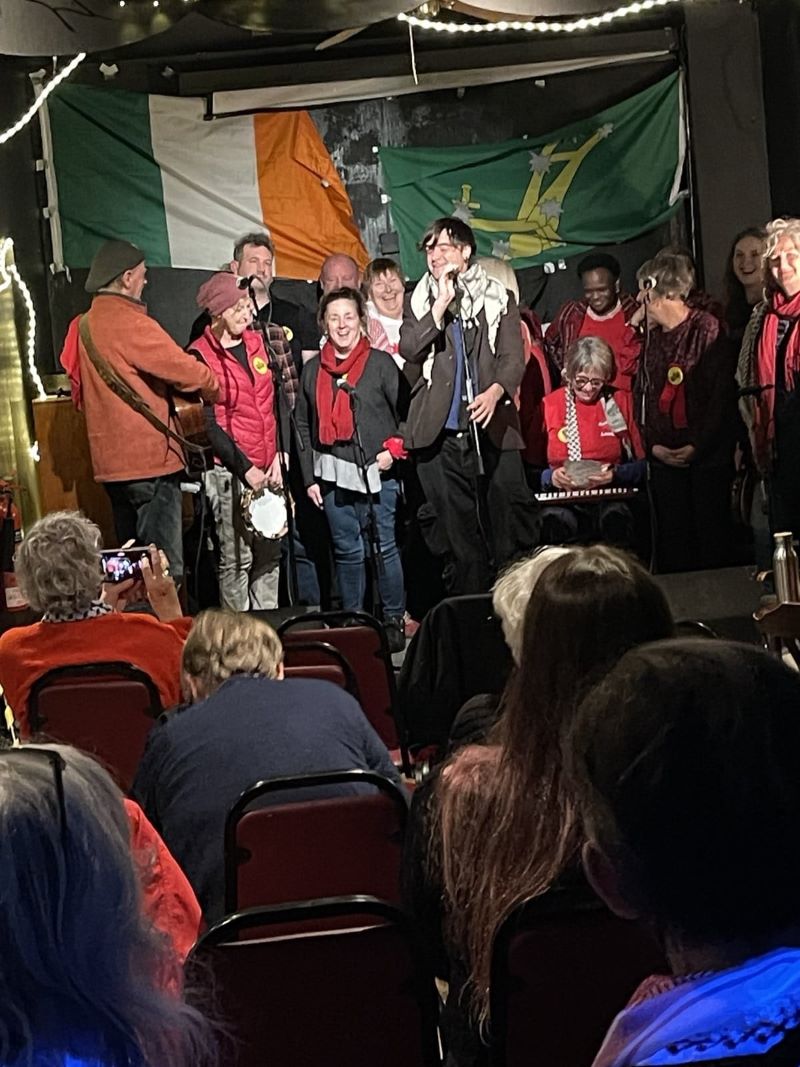
Thursday night (30th), with almost non-stop downpour of rain was a dreary and miserable one in Dublin. Not so however inside the Cobblestone’s back room where solidarity and resistance resounded in song, instrumental and spoken word.
The event organisers, Solidarity Sessions collective, an independent organisation founded late last year have declared a number of times that they wish to contribute to “creating a community of solidarity and resistance through culture.”
Certainly the flags on the stage of the Tricolour, Starry Plough and Palestine conveyed some of the context, as did posters of 1916 martyrs Connolly and Pearse with text pointing out that the first was a migrant and the second, son of a migrant.1
In addition a merchandise stall sold T-shirts figuring the Palestinian Resistance with funds raised going to Palestinian relief work on the ground. Solidarity Sessions have also donated to ‘buy’ a water truck from Uisce for Gaza and also donated to Streetlink Homeless Support in Dublin.
Mark Flynn performing at Solidarity Sessions No.3 in the Cobblestone. (Photo: R.Breeze)
The material performed on stage contributed much of solidarity and resistance also. This was the third event this year and the second at the Cobblestone pub, one other being at the International Bar and the fourth expected at the Peadar Brown pub on Southside’s Clanbrassil Street.
There was a lot of audience participation at times during the evening, with Alan Burke joined from the floor in the chorus of his spirited rendition of The Aul’ Triangle (to which he added a verse of his own) and Sive was accompanied on request by continuous refrain under her singing.
Mark Flynn was also backed by the audience in his adaptation of A Roving I’ll Go to a sailing to Portugal song he told his audience he had put together in minutes of a creative flash the like of which he ruefully admitted not having experienced since. Flynn also sang Bogle’s antiwar Waltzing Matilda.
Alan Burke performing at Solidarity Sessions No.3 in the Cobblestone. (Photo: R.Breeze)
The audience was extremely quiet during Dorothy Collin’s spoken word pieces about assassinations by the Zionist Occupation and Palestinian resistance, interrupting her performance with applause only after a haiku in Irish and at a point where she became visibly emotionally affected.
The Resistance Choir included in their performance an exuberant Bread and Roses, the lyrics originating in a speech at a mostly female textile workers’ strike in Massachusetts, USA in 1912 and Burke sang of an innocent miner framed on a murder charge and hanged – but pardoned posthumously.
Class struggle was also present in Burke’s singing My Name Is Dessie Warren, about a trade union activist with flying pickets2 during the 1970s construction workers’ strike in England. Some were tried under the Conspiracy Laws and jailed, including Ricky Tomlinson and Des Warren.3
The Resistance Choir about to perform at Solidarity Sessions No.3 in the Cobblestone, being introduced by the MC, Ru O’Shea. (Photo: R.Breeze)
ANNOUNCEMENTS
Three imminent resistance events were announced from the stage: Friday morning, due to appear in court4 were two Palestine solidarity activists attacked by Gardaí at Dublin Port and a good show of numbers in solidarity was requested.5
On Saturday a picket in solidarity with Irish Republican prisoners would be held outside Kilmainham Jail6 and on Sunday a demonstration to blockade Dublin Port was announced, people being requested to gather at The Point on the north Liffey quays.
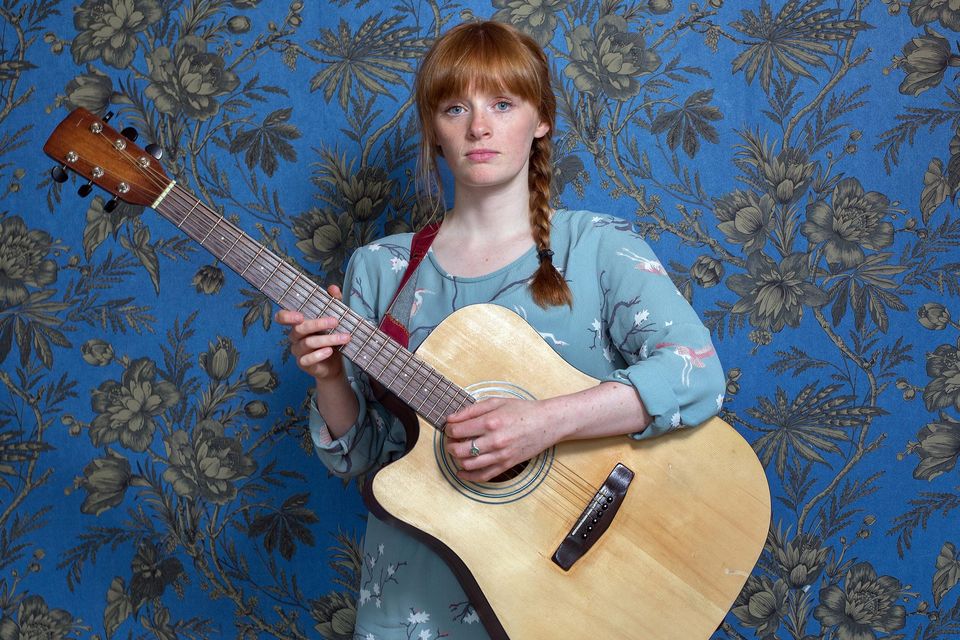
Sive, who performed at Solidarity Sessions No.3 in the Cobblestone. (Photo sourced: Internet)
The organising collective, volunteers on door duty and the performers all donated their services free of charge. Further donations will be made to causes considered worthy, the collective assured their guests and supporters.
Ru O’Shea, MC for the evening, thanked all the performers who gave their services for free, the audience for their attendance, supporters staffing the door, the Cobblestone and sound engineer. The next Solidarity Sessions night will be at Peadar Brown’s on Thursday 4th December.
Ongoing “contributing to building a community of solidarity and resistance.” And outside, it had stopped raining for awhile.
End. Note: If you found this article of interest, why not register with Rebel Breeze for free, so that you will be notified by email of subsequent articles. You can de-register any time you wish.
FOOTNOTES
1James Connolly was born into the Irish diaspora in the poor area of Cowgate in Edinburgh and first came to Ireland as an adult in response to an invitation to found the Irish Socialist Republican Party. Subsequently Connolly went to the USA for a period before returning to Ireland (therefore 3 times a migrant). Patrick Pearse was born and raised in Dublin but his father was English. Both Pearse and Connolly were executed in Kilmainham Jail with another twelve by British bullets after their surrender of the 1916 Rising.
2‘Flying pickets’ operate in principle like the guerrilla ‘flying columns’, sending a large number of union picketers to specific locations chosen in secret, thereby reducing the opportunities for the police etc to mobilise at the spot in advance
3Ricky Tomlinson after release became a famous actor, mostly in comic roles. Warren developed Parkinson’s from forcible injections with restraining drugs and long periods in isolation in jail, dying not long after release. I remember the case and campaigns when I was working in England and a period afterwards when I was briefly active in the Construction Safety Campaign and read statistics about on average a construction worker killed weekly and one seriously injured daily on British construction sites.
4Yes, the Gardaí charging with criminal offences people they pepper-sprayed and batoned without warning.
6Kilmainham Jail was a British colonial prison in Dublin, also used for a while by the Irish Free State to imprison the Resistance during the Civil War/ Counterrevolution. It is now a very popular museum and holds the execution site of 14 prominent Irish Republicans after their surrender in 1916.
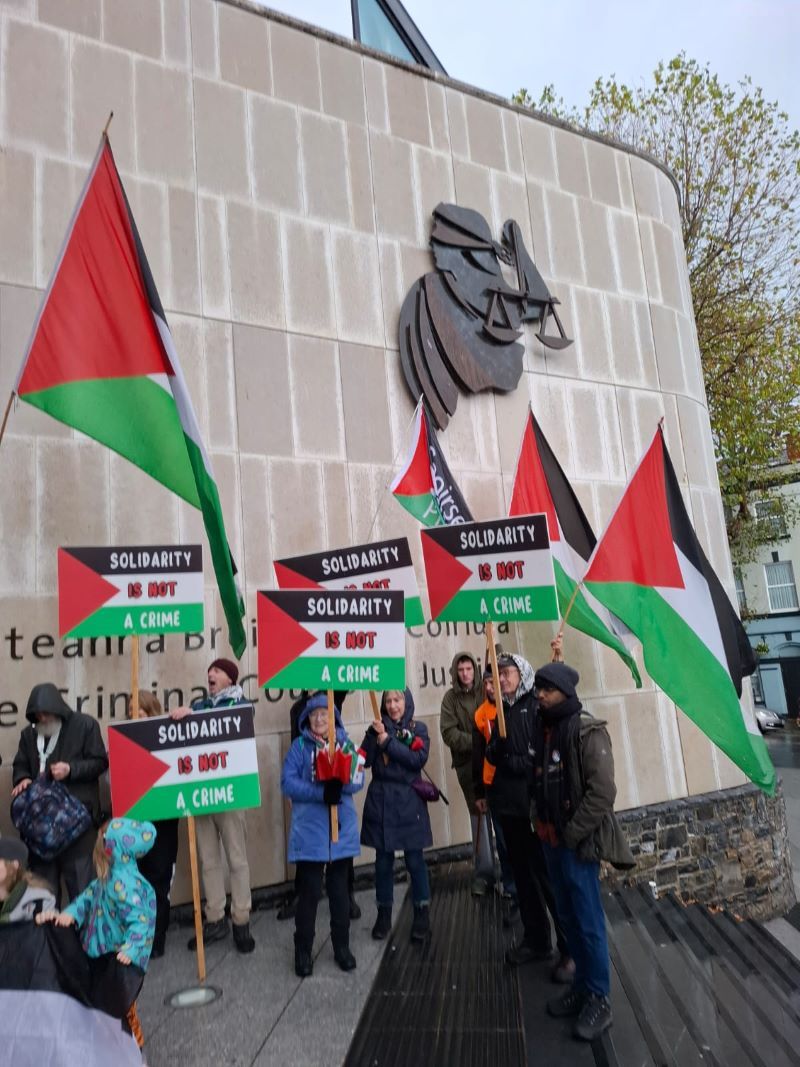
Many people endured heavy rain on Friday morning to support two Palestine solidarity activists in court as a result of the now-infamous Garda pepper-spray and baton attack on a peaceful march to Dublin docks on 18th October.
Small section of the crowd of supporters outside the Court on 31 October 2025 for the two pepper-sprayed and chargedPalestine solidarity activists (Photo: D. Breatnach)
The Port march was a breakaway from a periodic Ireland Palestine Solidarity Campaign national march to Leinster House, the home of the State’s parliament; some IPSC stewards denouncing it as it diverged at O’Connell Bridge and called on others to march on Dublin Port instead.
From video and eyewitness reports it is clear that the Public Order Unit of the Garda determined not only to stop them but to ‘teach the protesters a lesson’. No sooner had the linked-arms marchers reached the police line than some of them sprayed pepper-spray on the Palestine solidarity activists.
So heavy was the spraying that it affected a number of the Gardaí themselves. Many also drew their batons and attacked the demonstrators reeling from the effects of the spraying. The POU unit had their ID numbers concealed and Gardaí pursued activists moving away, spraying them again.
The Gardaí later claimed they had given a warning before spraying as they are required so to do by their own regulations but both Irish Council for Civil Liberties observers and video evidence show this to be untrue.
Solidarity activists were arrested at the scene of the Garda attack and one other outside a special sitting of the court on Saturday evening. The charges were of the usual kind with police repression of demonstrations: offences against Public Order, resisting arrest and obstruction of traffic.
The Irish State is the 2nd-largest single importer of Israeli products, second only to the USA and clearly has no intention of moving from that situation.
Nor of demilitarising Shannon Airport nor of banning Irish airspace to overflights ferrying military supplies to Israel. Two years of giant solidarity marches and smaller ones up and down the country have not moved the Irish ruling class to any degree beyond making statements.
As people move to take actions that have the potential to force the Government to end their collusion it seems inevitable that the State will increase its repression, which will work towards intimidation but also to increased resistance.
Small section of the crowd of supporters for the two pepper-sprayed and charged outside the Court on 31 October 2025. (Photo: D. Breatnach)
Those gathering at the court today were for the most part independent activists and activists of very small political organisations but many also of broad Palestine solidarity groups.
The two facing charges today had their cases postponed to January 2026, with talk of the Gardaí possibly returning shortly to court to press more serious charges, with the potential of heavier punishment — but conversely also of greater political statements made before a jury.
Solidarity with people fighting in struggles in other parts of the world often has a price of repression where the solidarity is originating, which makes solidarity to the targeted activists essential too. In that context, the numbers attending the court on Friday morning were very encouraging.
End.
Note: If you found this article of interest, why not register with Rebel Breeze for free, so that you will be notified by email of subsequent articles. You can de-register any time you wish.
A wave of “recognitions of the State of Israel” have occurred around much of the world. Though at first glance these appear politically progressive, in fact they are all tied to supporting the colonial alleged “Two States Solution.”
This is quite apart from the fact that not one practical step is being taken by any of those states in order to prevent the ongoing genocide and massive displacement of Palestinians which many of the states are actually aiding.
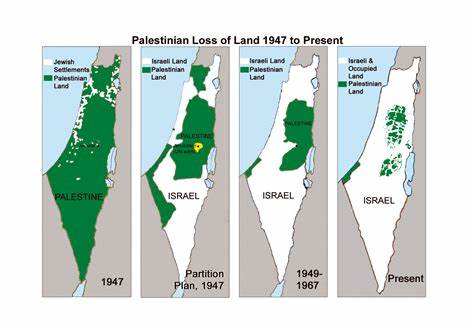
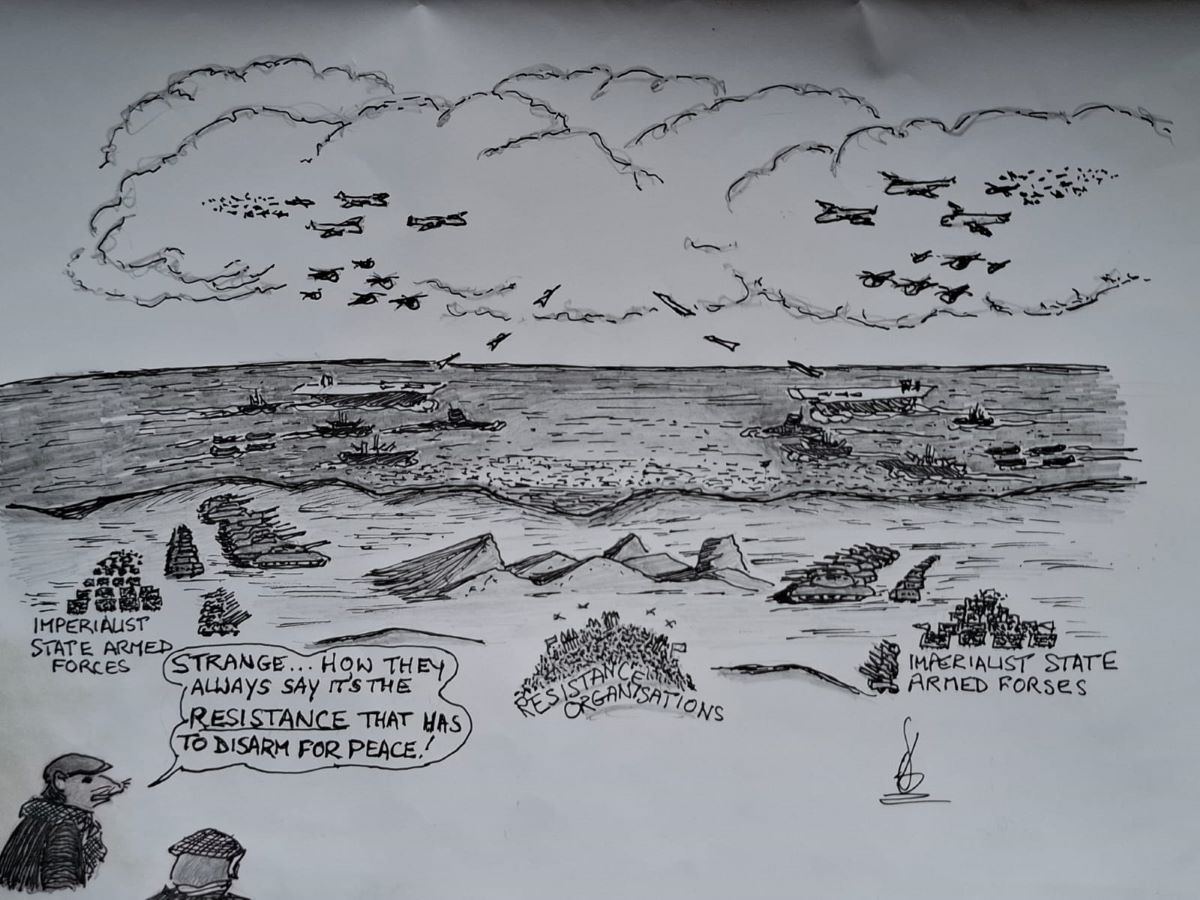
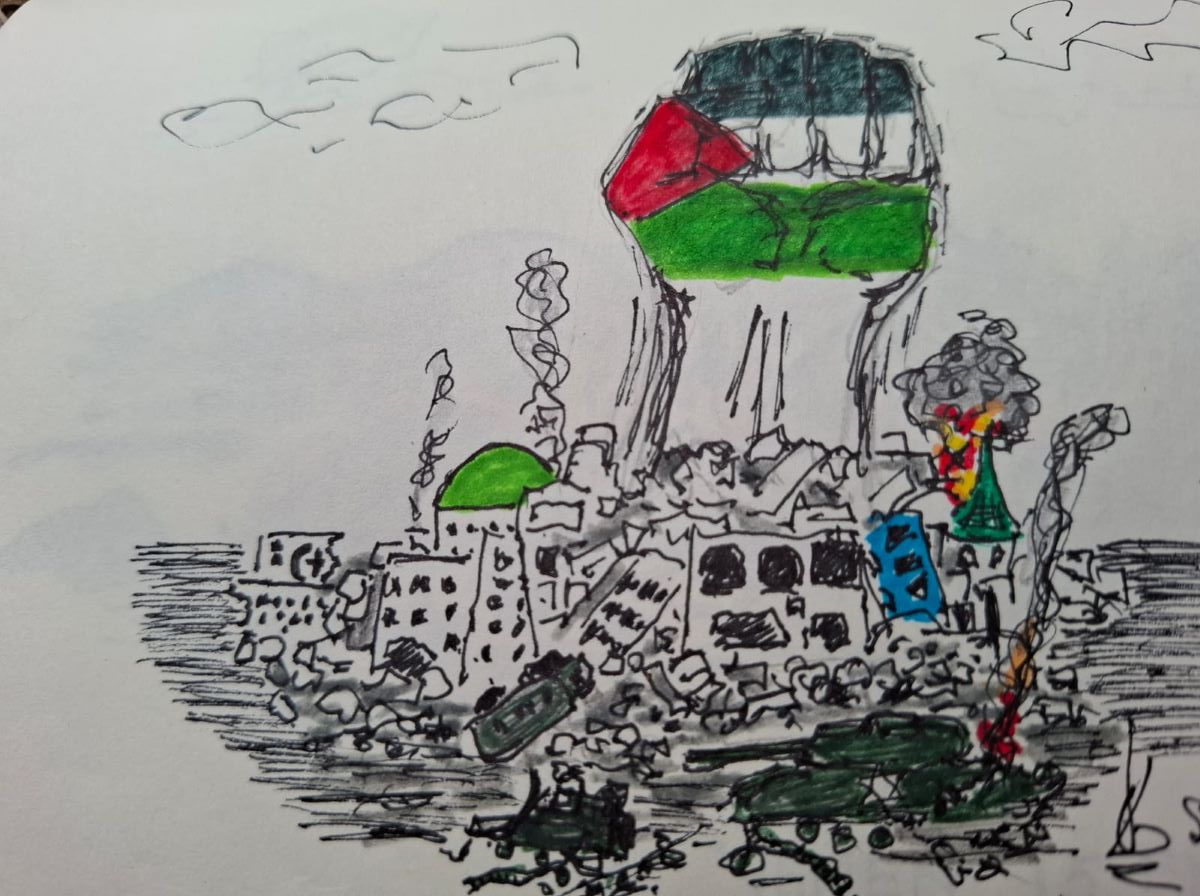
The fourth image is what is available for the Palestinians in the imperialist two-state plan. (Image sourced: Internet)
Soon all but 30 member states of the UN will have recognised the Palestinian state (yet to exist) and they include western imperialist states such as Australia, Canada, France, Spain, the UK, supported by political parties both in government and opposition,1 all proposing a ‘two-state solution’ (sic).
This proposal involves accepting the ‘right’ of a European colonial settler regime to invade and occupy a land,2 subjugate most of the indigenous people, racially discriminate against them, set up an ethno-state, then carry out ethnic cleansing, genocide and further expansion.
This while simultaneously proposing 20% of the land with least water as a reservation for the indigenous people, under the guns and surveillance of the genocidal Occupier, with its borders, water and electricity supply all under the Occupiers’ control.
Many liberals and social-democrats will support the imperialist ‘solution’ being foisted upon the Palestinian people of the occupation of Gaza by a client regime and the creation of a formal Bantustan3 colony – the “Palestinian State” (sic).
This ‘solution’ was insisted upon at the three-day UN Conference in July, mandated by the UN General Assembly through resolutions ES-10/24 and 79/81 and sponsored by France and Saudi Arabiab, backed by the General Assembly President, Philémon Yang.
Also by Secretary-General of the United Nations, António Guterres, stating that the “… only just and sustainable path forward is the establishment of two independent, democratic States – Israel and Palestine – living side by side in peace and security, with Jerusalem as the capital4…” 5
Firstly, we’d have to say that there is nothing “just” about that path and secondly ask why is that the ‘”only sustainable solution?” Why cannot a democratic state of the entirety of Palestine, as pre-1948, be sustainable? Is it because the Zionists and their imperialist won’t let it be?
Then we’d be entitled to ask whether Guterres and Yang speak for the world or instead for the imperialist states and their clients and allies. In fact, since there can be no peace without justice, a democratic state of Palestine on pre-1948 territory is the only just and sustainable solution.
This scrambling to recognise the ‘Palestinian State’ within a “two-state” framework was also reflected in the recent United Nations vote for a ceasefire, which was tied to the acceptance of the two-state solution, emphasising that it has nothing to do with justice but is all about management.
The imperialist states and their allies, with the particular exception of the US and Israel, are very worried that the legacy of the current genocide will threaten their interests in Western Asia in the near future, including the regimes they depend upon to control the Arab people.
To some extent the western states are also concerned at the exposure of their regimes to their own populations in terms of collusion with genocide, financial implications , suppression of information and, in many cases, repression of democratic rights to protest.
The western states want to save West Asia for imperialism and they think that the USA and current behaviour of Israel are endangering it.
The two-state plan is not at this point supported by the Zionist state and the chief imperialist, the USA, though the plan seeks to impose what they also want: stability within the imperialist system.
Recently another international conference was held to discuss the way to resolve the situation of Western Asia and crisis in Palestine, this conference organised by Qatar following Israel’s bombing of their capital Doha in an assassination attempt against the Hezbollah negotiating team.6
The Iranian representative pointed out at the conclusion that although they supported some of the resolution adopted they could not agree to recognition of a Palestinian state within or adjacent to Israel, since that meant de facto recognition of the right of the genocidal Zionist state to exist.7
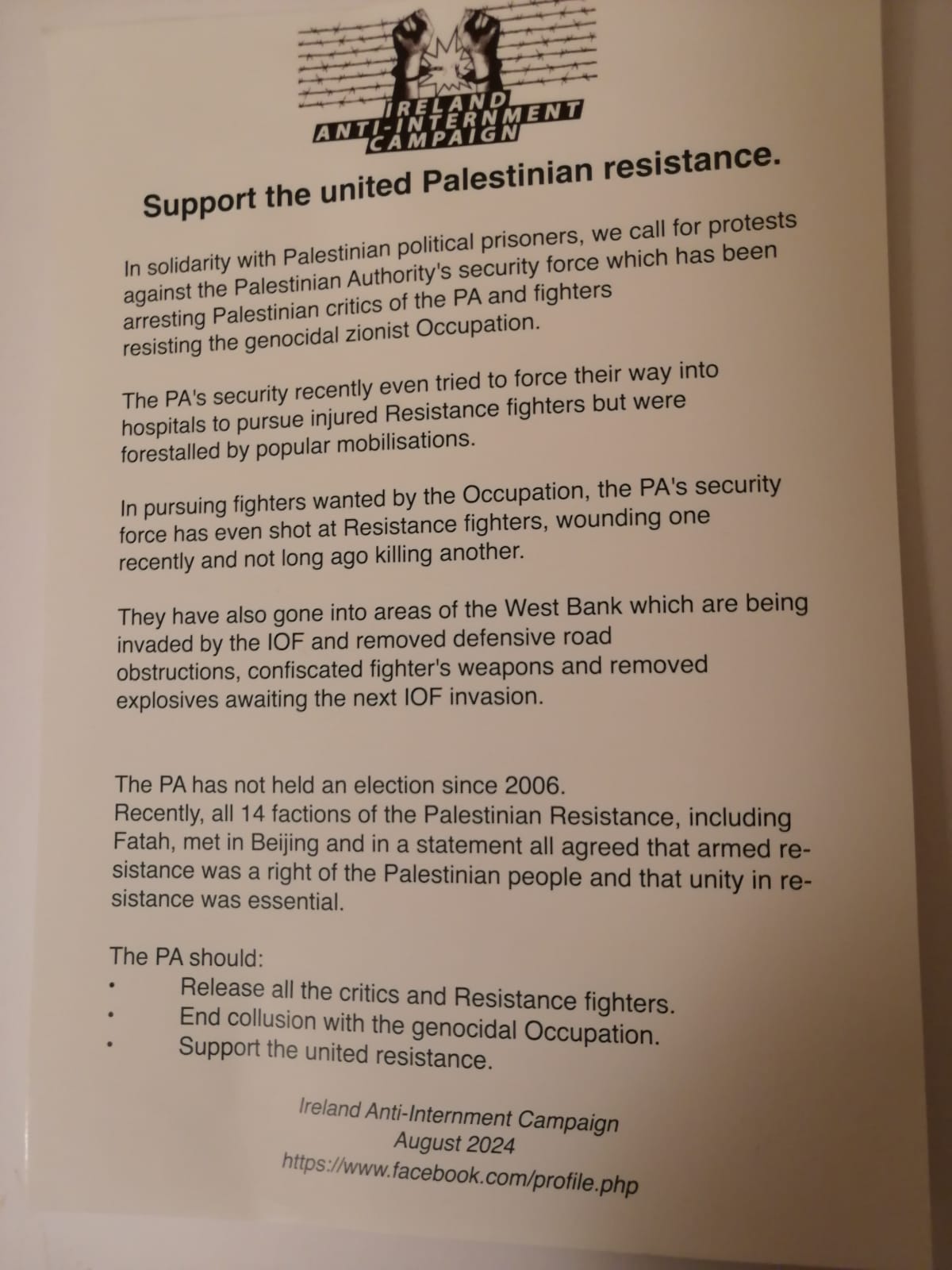
Recognition of the Palestinian State as is being done now is also recognition and acceptance of the totally unrepresentative and undemocratic Palestinian Authority and in fact, Palestinian Embassies (such as the one in Dublin) and Consulates are run through the Authority.
Leaflet issued by an Irish solidarity organisation for a picket of the Palestinian Authority Embassy last year – subsequently there was a broad protest held outside. (Image sourced: from my archives)
Although Palestine has been officially occupied by a Zionist colonial settler regime since 1948, it has had an imperialist and Zionist client Palestinian regime since the conclusion of the Oslo process (overseen for US imperialism by Bill Clinton): the Palestine Authority.
What would one expect from such a client regime? Collusion, spying, pacification? Certainly, the PA came to represent all those things. But in addition: bullying and brutal suppression, along with widespread corruption. It was managed by the Fatah leadership through the PLO.8
Whatever we may think of the Fatah leadership, they were by far the majority choice of the Palestinian people in the legislative elections of 1996. But by the time of the next elections in 2006, most of Palestine society had become sick of Fatah and elected Hamas instead.
A 2007 decree by President of the Palestinian Authority Mahmoud Abbas disqualified from election any party that did not recognise the leading role of the Fatah-dominated PLO, thereby disqualifying Hamas which denounced the decree as undemocratic and illegal.
There is a long history of imperialism choosing tame representation for occupied peoples, including British colonialism doing the same thing in Palestine.9
Fatah, unprepared to accept the loss of their power and corruption opportunities, refused to leave their governing positions until they were helped to leave by Hamas in a short, sharp struggle in 2007.10 Whereupon the Zionists blockaded Gaza and imperialists paid their grants instead to the PA.
However Hamas did not force the issue of their election in the West Bank, which continued under the rule, not to say dictatorship of the Palestinian Authority.
The corruption of and repression by the PA is not an opinion of the Palestinian resistance organisations alone but is widely acknowledged by all kinds of western observers, including enemies of the Resistance,11 which is one reason the imperialist are calling for its ‘revamping’.
Meanwhile Abbas, ‘President’ of the PA since its inception in 2003 (and ensuring no elections since) is already laying out how democratic the rule of the PA in Gaza would be. Unlike two decades ensuring no elections in the West Bank, Abbas has been enthusiastically preparing for them in Gaza.
He seems to feel quite confident in the outcome of elections which is perhaps not surprising since he has stated that only those in agreement with the imperialist positions and the traitorous one of the PA will be allowed to stand or field candidates.
Regarding weapons, Abbas’ statements have seemed a bit contradictory. On the one hand he said that the Palestinian State alone should hold weapons while on the other he declared that the Palestine State will be unarmed.
However we can understand this to mean that Abbas and his types will ensure they are armed so as to control the Palestinians but will never use weapons against the Zionist Occupation. Even had we not the record of the Palestinian Authority to draw upon, this is clearly not a deal to support.
But it will be supported – in the first place by most of the imperialists and their client states and perhaps later by the Zionists who fear even a mention of a Palestinian State and also by those ‘friends of the Palestinians’ among the liberals and social democrats because it will bring ‘peace’.
And for them, hopefully eliminate or reduce the influence of Muslims (in particular those who are sworn to resist colonisation and imperialism). And isn’t it after all better than genocide by starvation and bombing? And so on.
We in Ireland know – or should know – that such patch solutions don’t work for the people. Our nation’s similar makeover in 1921 resulted in civil war and, within the colonial statelet, pogroms, greater poverty than anywhere in the UK, civil rights marches and sectarian assassinations.12
And of course, internment and an ultimately unsuccessful national resistance war of three decades. On the other side of the British Border, it meant years of underdevelopment, emigration, clerical domination and imperialist appropriation of natural resources, labour and infrastructures.
The alternative being offered to the Palestinians was summed up by a patriot at his trial, where he was convicted and sentenced to hang:
“If we are to be indicted as criminals, to be shot as murderers, to be imprisoned as convicts, because our offence is that we love our land more than we value our lives, then I do not know what virtue resides in any offer of self-government held out to brave men on such terms.
Self-government is our right, a thing born in us at birth, a thing no more to be doled out to us, or withheld from us, by another people than the right to life itself, than the right to feel the sun, or smell the flowers, or to love our kind.
It is only from the convict these things are withheld, for crime committed and proven, and my land, that has wronged no man, has injured no land, that has sought no dominion over others, my land is being treated today among the nations of the world as if she were a convicted criminal.
If it be treason to fight against such an unnatural fate as this, then I am proud to be a rebel, and shall cling to my ‘rebellion’ with the last drop of my blood.
If there be no right of rebellion against this state of things that no savage tribe would endure without resistance, then I am sure that it is better for men to fight and die without right than to live in such a state as this.
Where all your rights have become only an accumulated wrong, where men must beg with bated breath for leave to subsist in their own land, to think their own thoughts, to sing their own songs, to gather the fruits of their own labours …
and, even while they beg, to see things inexorably withdrawn from them then, surely, it is a braver, a saner and truer thing to be a rebel, in act and in deed, against such circumstances as these, than to tamely accept it, as the natural lot of men.”13
It seems to me that throughout history there have been people that it was crucial for the dominant system to defeat but of which their resistance was difficult for the system to overcome.
The culture of these people resisted domination and, like grass flattened by passing footsteps, sprang up again. And again and again.
Perhaps it was the strength of these peoples’ cultures, the way their stories of themselves could not be supplanted by the stories of the invader, of the occupier, or perhaps it was some special quality of their leaders.
Perhaps it was their ability, as leaders and as people, to draw others in under the banner of resistance.
These people fought their occupiers, occasionally winning, often defeated in battle but rising again and again. Where leaders compliant to the Occupation arose, they were overthrown or sidelined, the people again taking the road of resistance. As a people, they rejected ‘peace’ in bribes or chains.
The examples of such people that march and flock into my mind as this thought occurs to me include in ancient times perhaps the Gauls, certainly the Irish and in modern times the Irish again, the Indigenous American Cheyenne, Sioux, Apache – and the Palestinians.
Cartoon by D.Breatnach
It is something to see now, all the European imperialists and the imperialist client regimes of the Arab world in a united front to try to pacify the Palestinians, to occupy Gaza and to force the resisting Palestinians under their client manager of the ‘Palestine’ Authority.
It is doubtful that they will succeed and we should hope that they don’t, not only for the sake of the Palestinians and other people of West Asia (the ‘Middle East’) but for our own sakes, fighting the oppression of imperialism and colonialism and the exploitation of our labour by capitalism.
For as observed earlier, the struggle of the Palestinians has destabilised the imperialist system, exposed the fraud of an international humanitarian legal system and in its member states exposed the frauds of capitalist democracy, free press and government representing the will of the people.
Solidarity with the Palestinians and outrage at Zionist genocide and imperialist collusion has brought millions of previously uninvolved people into street action which bodes well for the future and ill for the imperialist system. It’s been an education we need to continue.
End.
NB: If you found this article interesting you may wish to subscribe to the blog free of charge, after which you would receive a notification in your email every time an article was published. You can unsubscribe any time you wish.
Footnotes
1Within the Irish state this is also the position of Sinn Féin, Fianna Fáil, Fine Gael, Social Democrats and Labour.
2Commenting on this and in particular on the Australian Prime Minister’s statement on the question, Ali Albunimah of the Electronic Intifada podcast on 25/09/2025 pointed out that the question of ‘right’ was only mentioned once, and that was in reference to Israel’s alleged ‘right to self-defence’, never with regard to the right of the Palestinian people to self-determination (a right recognised in the UN Charter, unlike the ‘right of a state to self-defence’ which does not exist).
3AI summary: A bantustan was a politically created territory for black Africans in South Africa and South West Africa (now Namibia) during the apartheid era, officially termed “homelands” or “black states”. The policy aimed to segregate and control the black population by granting them limited self-governance within these ethnically defined areas, which were never recognized internationally and were reincorporated into South Africa in 1994. The term “bantustan” was a critical term coined from “Bantu” and the Persian suffix “-stan” (meaning “land”).
4 “… based on pre-1967 lines and in line with international law and UN resolutions.”
8The Palestine Liberation Organisation, in its time comprising the secular liberation organisations of Fatah, PFLP and DFLP. The PA has repressed alternative resistance organisations and suppressed freedom of speech, even to arresting people for criticising it or posting other material on social media. Its forces have killed a civilian critic and a Resistance fighter.
10Mass media sources usually represent this as the “Hamas takeover” which conceals the fact that they were elected to replace the previously-elected Fatah administration, whose officials refused to concede the popular will.
12In case of misinterpretation, innocently or otherwise, let me state that by ‘sectarian assassinations’ I mean those carried out by British colonial proxies, i.e. Loyalist murder gangs.
13This was part of the speech of Roger Casement at his trial; my only change was to substitute the words “my land” for his own: “Ireland.” Casement’s was the 16th execution arising out of the 1916 Rising in Ireland though he received a criminal trial instead of military court and was hanged instead of being shot by firing squad, as were the earlier 15.
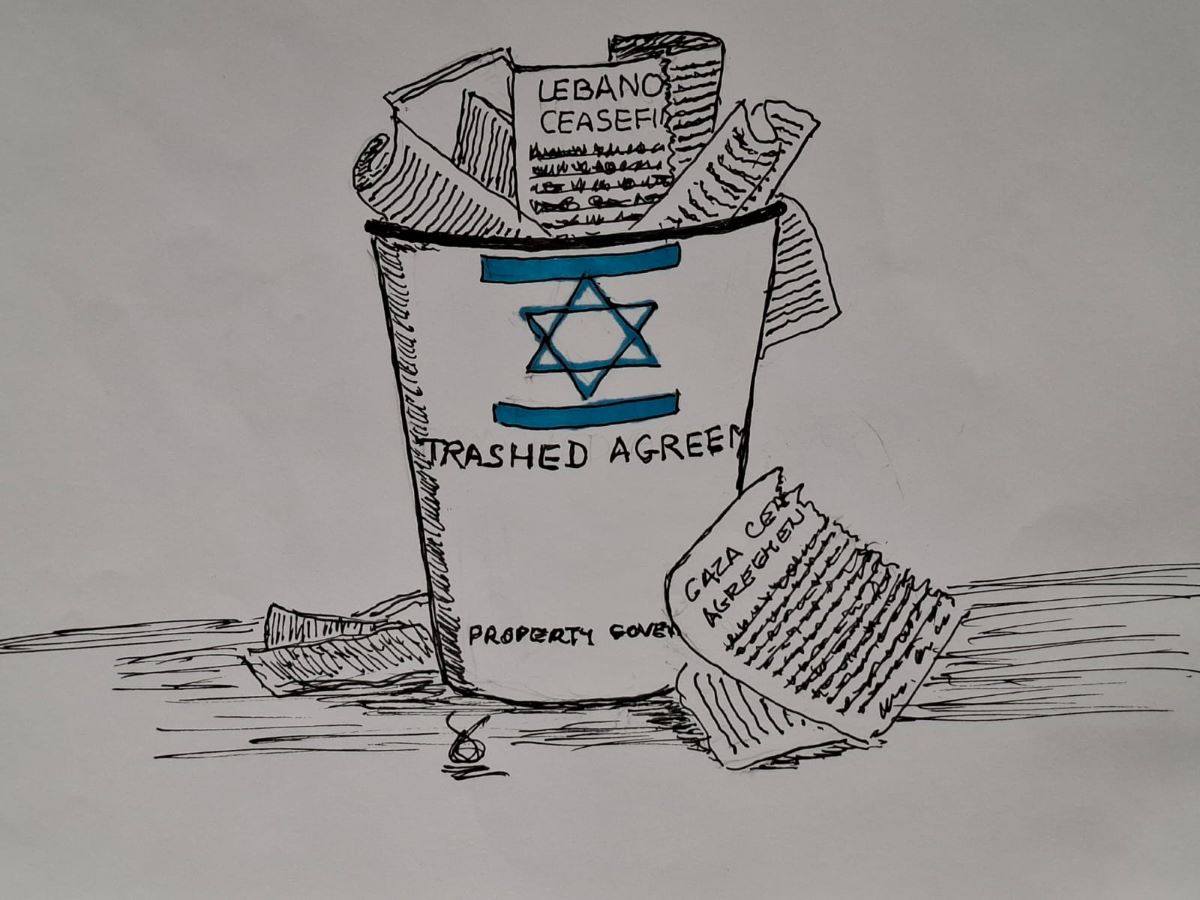
It’s a legitimate question in view of the Zionist state’s actions preventing aid entry and killing Palestinians every day since it signed a ceasefire agreement — but also from historical,1 cultural and perhaps even psychological standpoints.
Cartoon by D.Breatnach
Since 11 October the Israeli Occupation Force has killed 46 Palestinians Palestinians, including 11-year-old Mohammed Bajhat Al-Hallaql and injured 132 others since the ceasefire took effect. Half of the victims were children, women, and elderly people.2
Among the dead was the Abu Shaban family, completely wiped out, seven children and two women.3
As winter looms, tents and construction materials are blocked. And as sowing time for next year’s crops is here, Israel has blocked agricultural materials, including seeds, fertilizers, and solar panels from entering4 to replace the IOF-destroyed crops and greenhouses.
The IOF has also greatly restricted the number of aid trucks it allows entry, from 700 to 450 daily, which is another kind of ceasefire violation and banned key food items like meat, poultry, and livestock. And allowed just 7% of the agreed quota of 50 gas and oil trucks daily in nine days.
The latest large scale violation, as I was writing this, was its killing of more than 30 Palestinians after one of the IOF’s bulldozers ran over Israeli unexploded ordinance in Rafah, which they decided to frame on the Resistance and use as an excuse for more murder and Rafah gate closure.5
Reports have now emerged of IOF recently burning and otherwise destroying urgently-needed food aid. Which of the ceasefire negotiators or guarantors has called the IOF or the Zionist State’s leadership out over this? None, of course.
And of course too, that’s one important reason why it keeps doing it – because it can. And because none of its allies will call it to account. But perhaps also there is some kind of deep Zionist bias against sticking to agreements made.
Last Autumn, in the midst of its unsuccessful attack on South Lebanon, the IOF asked its allies to seek a ceasefire and truce with Hezbollah. Weakened by exploding pagers6 and assassination of their renowned leader Nasrallah, Hezbollah agreed to the ceasefire.
Cartoon by D.Breatnach
That was on 27 November 2024. Of course, true to form, the IOF violated the ceasefire daily, though Hezbollah kept to the terms. Not dozens or scores of violations, not hundreds … No, the IOF has committed approaching 3,000 separate violations by April this year.7
The brass neck of the Zionists sometimes exceeds belief. In the midst of their daily ceasefire violations, they are now threatening to again prevent food and medical aid entering until the Resistance complies with the ceasefire agreement.
Hamas has not delivered all the prisoner bodies, it says. But Hamas replies that it delivered all those it could access, others lying under tons of rubble, remains of buildings collapsed by IOF bombing, which is what killed the Israeli prisoners of the Resistance (probably along with their guards).
But somehow this is a reason to abandon the ceasefire! Locating the dead prisoners requires rubble-moving machinery and expert forensic help. The IOF long ago bombed all such Palestinian machinery to scrap and are not permitting its entry from any others at the moment either.
Cartoon by D.Breatnach
At the same time, the Zionists rejected two of their own forces’ bodies. One was a non-Israeli who worked for them and another a Palestinian in Israeli uniform, possibly a human shield employed or coerced by the IOF, sent into a tunnel and killed by the Resistance.8
Meanwhile, what of the estimated 2,000 Palestinian bodies held by the Zionists? As a Hamas statement said, their return is a question of human rights and law, not for negotiation. But when the few have been delivered as part of this ceasefire agreement, some have shocked their receivers.
Bodies showing hands tied behind backs and with bullet wounds … or a rope around the neck … signs of blindfolding over eyes, signs of torture … Some with tank-tread marks; all without identification, leaving a grotesque task for the Gaza administration and possible relatives.
Cartoon by D.Breatnach
And still … and still … the Zionists scream about the Resistance not fulfilling the terms of the ceasefire. I would think them to be totally beyond shame, were it not for the lies and excuses for their behaviour that they spew out into the world, which indicates a certain feeling of guilt.
Well, that is the Enemy. Not just of the Palestinians, or the Lebanese, or Syrians, or Yemenis, Iranians, Iraqis … No, they are the enemies of humanity, just as the Nazis were enemies of more than their victims and the countries they attacked.
And this Enemy is ready to resume the genocide at any time.
End.
Note: If you found this article of interest, why not register with Rebel Breeze for free, so that you will be notified by email of subsequent articles. You can de-register any time you wish.
(Another one from the Rebel Breeze archives, this one from 2015)
I write to express my admiration for your work and my sympathies with regard to the criticisms with which you are currently being bombarded.
I hope you will forgive my ignorance of much of the work you have been doing in the area of Heritage, which is not really where my strengths lie. But I love the way you talk, the way you shoot down those critics, especially those TDs who ask those nasty questions.
And I’m sure you had something to do with removing Westport House from the NAMA sell-off, even if it is in Enda’s constituency. Such a fine example of our colonial architectural heritage!
Heather Humhpreys, Minister for Arts, Heritage and the Gaeltacht
But as we know, Minister, that wouldn’t be the kind of thing that would be appreciated by your critics. They’d rather you devoted your talents to a shabby row of Dublin houses of dubious architectural importance in a grubby street market.
A street which they say is “pre-Famine” — as if that were something to boast about! Laid down earlier than Sackville Street (now O’Connell Street) they say ….
Sure why would we want to keep a street that old …. or remember that embarrassing episode in our history either, when we lost a third of our population to over-reliance on one crop! We learned from that, though, didn’t we? Sure we grow hardly any crops at all now and get them all in from abroad.
And we live in cities now — who wants to be getting up at 6 a.m. in all kinds of weather and plodding through muck? If people like growing things that much, get a house with a garden, I say. And a gardener to do the donkey work.
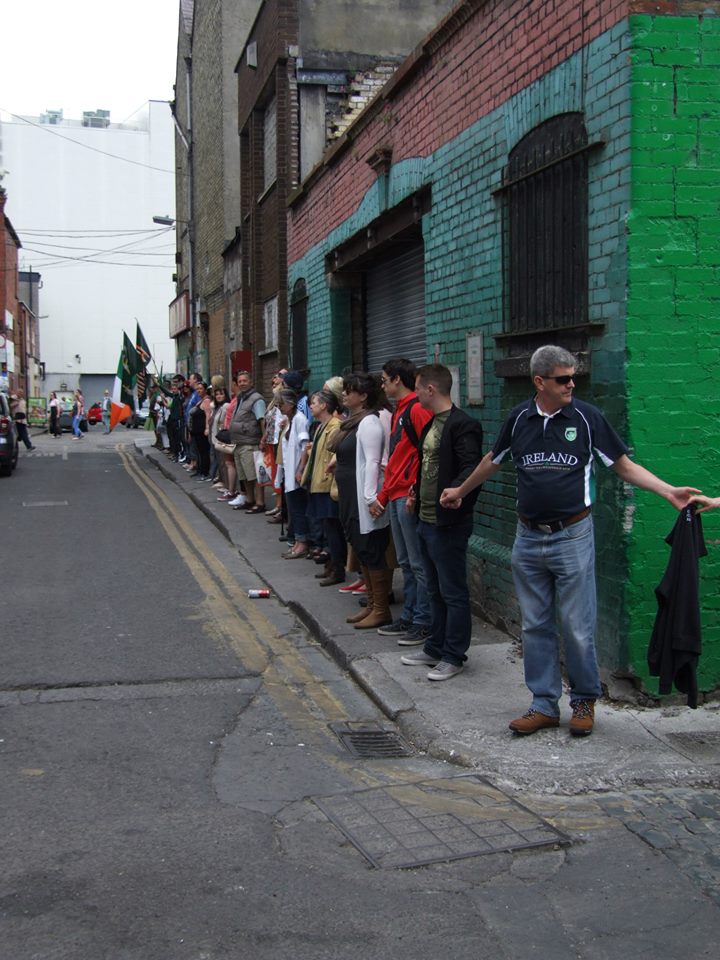
Supporters at the symbolic Arms Around Moore Street event organised by the Save Moore Street From Demolition campaign in June 2016. This is the corner of Moore Lane and Henry Place, across which Volunteers had to run under machine-gun and rifle fire from Parnell Street (at the end of Moore Lane, to the right of the photo) and at least one Volunteer died here.
But I’m digressing, Minister, my apologies. Apparently the reason they want to save that shabby terrace, that “pre-Famine street” — and the backyards and surrounding lane-ways, if you please! — is for HISTORICAL reasons. Historical!
Sure have we not had enough of history – Brehon Laws, Golden Age, Clontarf, Normans, 800 years of British occupation, blah, blah, blah! Weren’t we sick of it at school?
I’ve never liked Labour too much (somehow even the word sounds sweaty) but I have to admire their Education Ministry’s efforts to remove history as a subject from the compulsory school curriculum.
I’m sure they’re doing it for their own reasons – after all, wasn’t their party founded by that communist James Connolly? Sorry, revealing my own knowledge of history there, ha, ha! But whatever their reasons, they are on the right track.
Who wants to know where we are coming from? It’s where we ARE and where we are GOING TO, that matters!
But some people just can’t let it go, can they? They trail history around like something unpleasant stuck to a shoe. So what if 300 of the GPO garrison occupied that terrace in 1916?
The Rising, if you ask me, was a big mistake and I know plenty of people agree with me, even if most don’t have the courage to say so. Wouldn’t we be much better off if we’d stayed in the UK? And kept the Sterling currency? And as for the War of Independence …. don’t get me started!
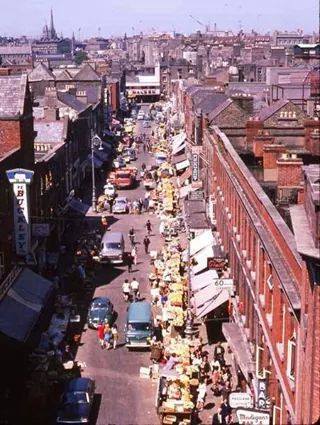
Aerial view Moore Street, looking northwards, 1960s, before the building of the ILAC and the running down of the street market.
And then there’s all that communist-sounding stuff about treating “all the children of the nation equally” — what kind of rubbish is that? Some are born to big houses with swimming pools and some are born to flats, or even rooms. That’s just the way of life.
And some will claw their way up to get to own big houses and if they are a bit uncouth, well that can’t be helped, they still deserve where they get to. And their children at least will be taught how to fit into their new station. That’s democracy! But everyone equal? Please!
Sorry, back to the Moore Street controversy. OK, after the mob pressured the Government, four houses in the street were made a national monument. But was that enough for the mob? Oh, no, not at all — eight years later the State had to buy the four houses to satisfy them.
Thankfully the specul ….. sorry, the developer, got back a good return on his investment – four million, wasn’t it? That’s the kind of thing that makes one proud to be Irish – buying run-down buildings and letting them run down more, then selling them for a million each.
That’s your entrepreneur! If only we had more like that, to lift this country up!
I must say I really liked that developer’s plan to build a big shopping centre from O’Connell Street into the ILAC, knocking those old houses in Moore Street down (although I know he had to leave those “national monument” four houses still standing in the plans).
I do hope whoever has bought the debt off NAMA and now owns those houses will carry on with that plan. Actually, I’d like the whole of O’Connell Street under glass if it were possible.
Wouldn’t it be great to do your shopping from the north end of the street to the south and from left to right, without ever having to come out into the weather? Of course, not much shopping there now, with Clery’s closed …. still ….
And then they’re going on about the market ….. traditional street market …. blah, blah. What’s wrong with getting your veg and fruit from the supermarket? Or getting them to deliver it your house, come to that? “Traditional street market” my ar….. excuse me, I got carried away there.
Those street markets are all very well for your Continentals, your Africans, Asians, Latin Americans and so on. Or for us to go wandering around in when we’re abroad on holiday, maybe. But back home? It’s the nice clean supermarkets for me any day.
Well now, if the mob insists on saving the street market, here’s an idea: why not provide a showcase stall or barrow, stacked with clean vegetables and polished fruit, right in the middle of the new shopping centre. After all, that’s heritage, isn’t it? And aren’t yourself the Minister for Heritage?
Most sincerely,
Phillis Tine-Fumblytil
Note: If you found this article of interest, why not register with Rebel Breeze for free, so that you will be notified by email of subsequent articles. You can de-register any time you wish.
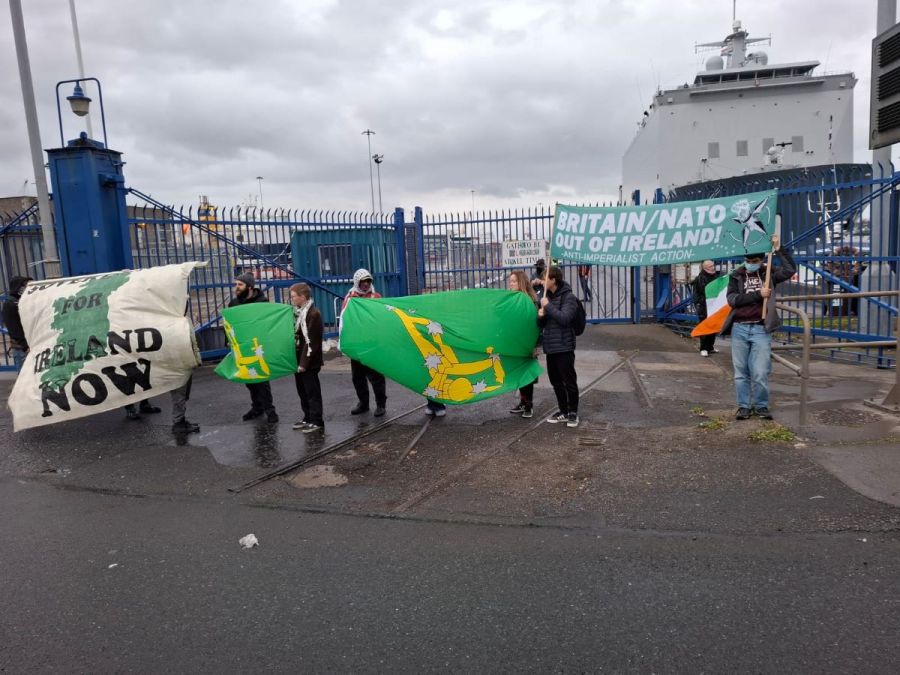
Dutch and German warships docked in Dublin’s Liffey Port were met by anti-NATO protesters late Saturday afternoon with banners, an Irish Tricolour and Starry Plough flags and shouts through a loudhailer with passing traffic beeping in solidarity.
The huge Dutch naval landing platform Johann De Witt was immediately visible on the north Liffey quay just on the seaward side of the Tom Clarke Bridge and the protesters took their stand there in front of the security gates, visible to airport and south and northbound Dublin traffic.
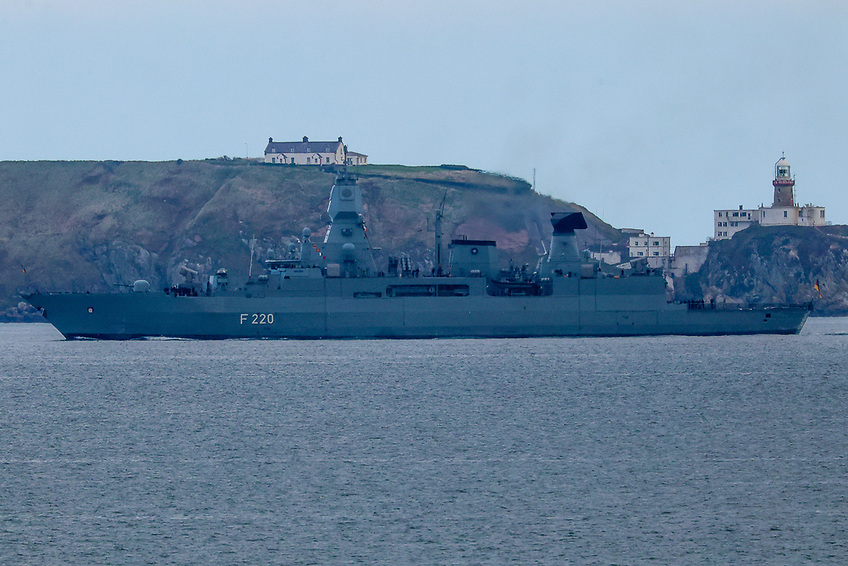
German NATO frigate FGS Hamburg entering Dublin Bay, bound for the Port security gate. (Photo cred: Afloat)
The Dutch ship was flying Holland and NATO flags. Among the slogans the protesters periodically chanted were: No NATO troops in Ireland! NATO, NATO, NATO: Out, out, out! From Belfast to Killarney – We don’t want your NATO Army! NATO imperialism – Out of Ireland!
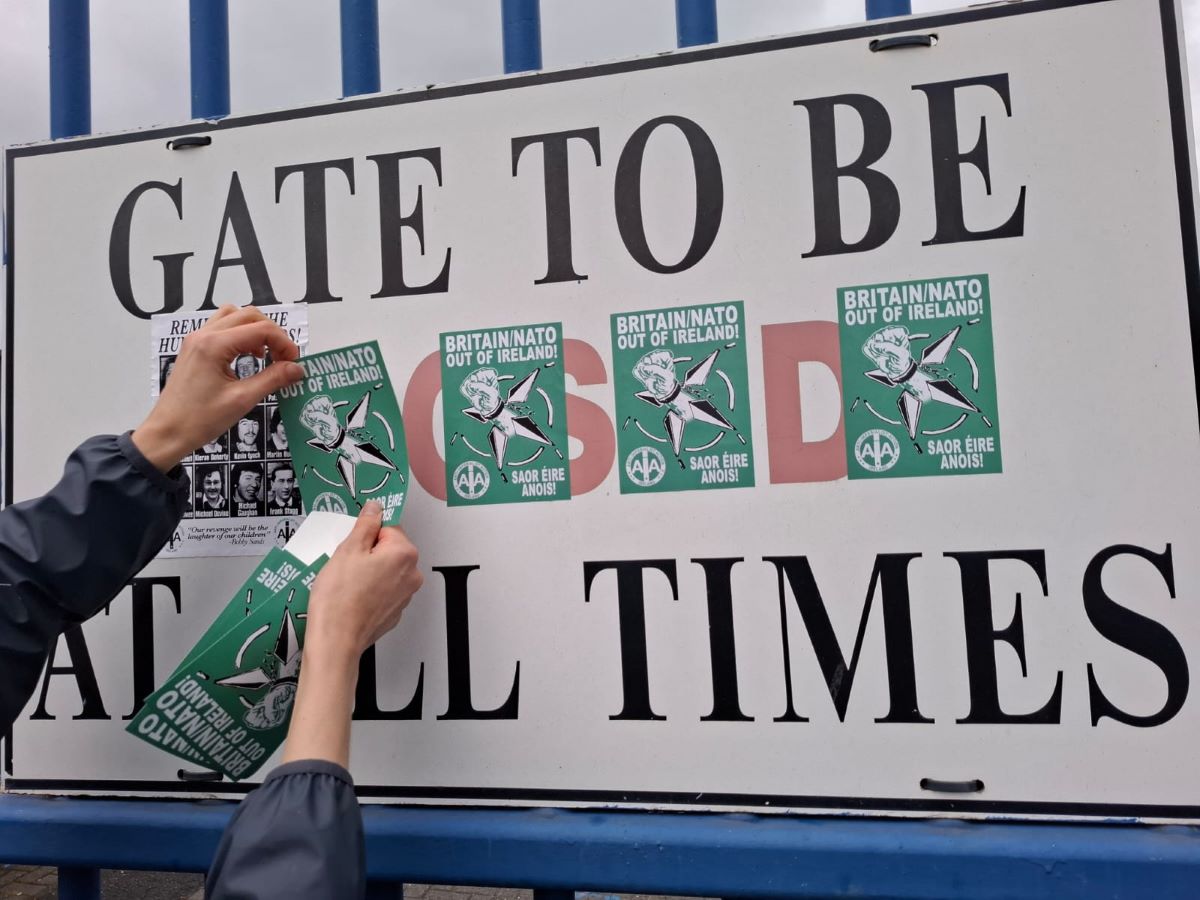
Anti-Nato stickers being affixed to the Dublin Port security gate. (Photo: R.Breeze)
The chants grew louder as military personnel (in street clothes) approached or emerged from the security gates behind the protesters but there was no physical confrontation from either side. No Gardaí attended either, unlike the protest at Ireland’s NATO HQ in April this year.
On that occasion Gardaí pepper-sprayed the peaceful protesters and broke the ankle of one of their number, in addition to arresting them. Some of the arrested were bailed and are due to appear in court in Dublin on 23rd February 2026.
Anti-Nato protesters, the Dutch NATO naval ship clearly visible in background. (Photo: R.Breeze)
NATO was originally claimed to be a western European military defensive force against the Soviet Bloc. However, after the Bloc’s collapse, NATO continued to expand until it has now an additional 17 member states (and the threat of Ukraine joining led to the current war with Russia).
The individual western member states, for example the US, UK, France have been waging imperialist wars for decades. But the NATO military alliance’s forces also fought imperialist wars in a number of countries: Bosnia, Kossovo, Afghanistan and Libya.
Anti-Nato protesters. (Photo: R.Breeze)
The protest on Saturday was organised at very short notice by Action for Palestine Ireland and Anti-Imperialist Action Ireland. Many passing vehicles, both private, company and taxi sounded their horns in support and also gave a thumbs-up or clenched fist salute.
Clearly the protest context was not only a lack of welcome for a member of the western imperialist military alliance but also fears that the Irish ruling class wants to join that alliance too and is currently trying to remove the ‘Triple Lock’ impeding its move in that direction.
End.
Note: If you found this article of interest, why not register with Rebel Breeze for free, so that you will be notified by email of subsequent articles. You can de-register any time you wish.
Anti-Nato protesters on Saturday, the Dutch NATO naval ship clearly visible in background. (Photo: R.Breeze)
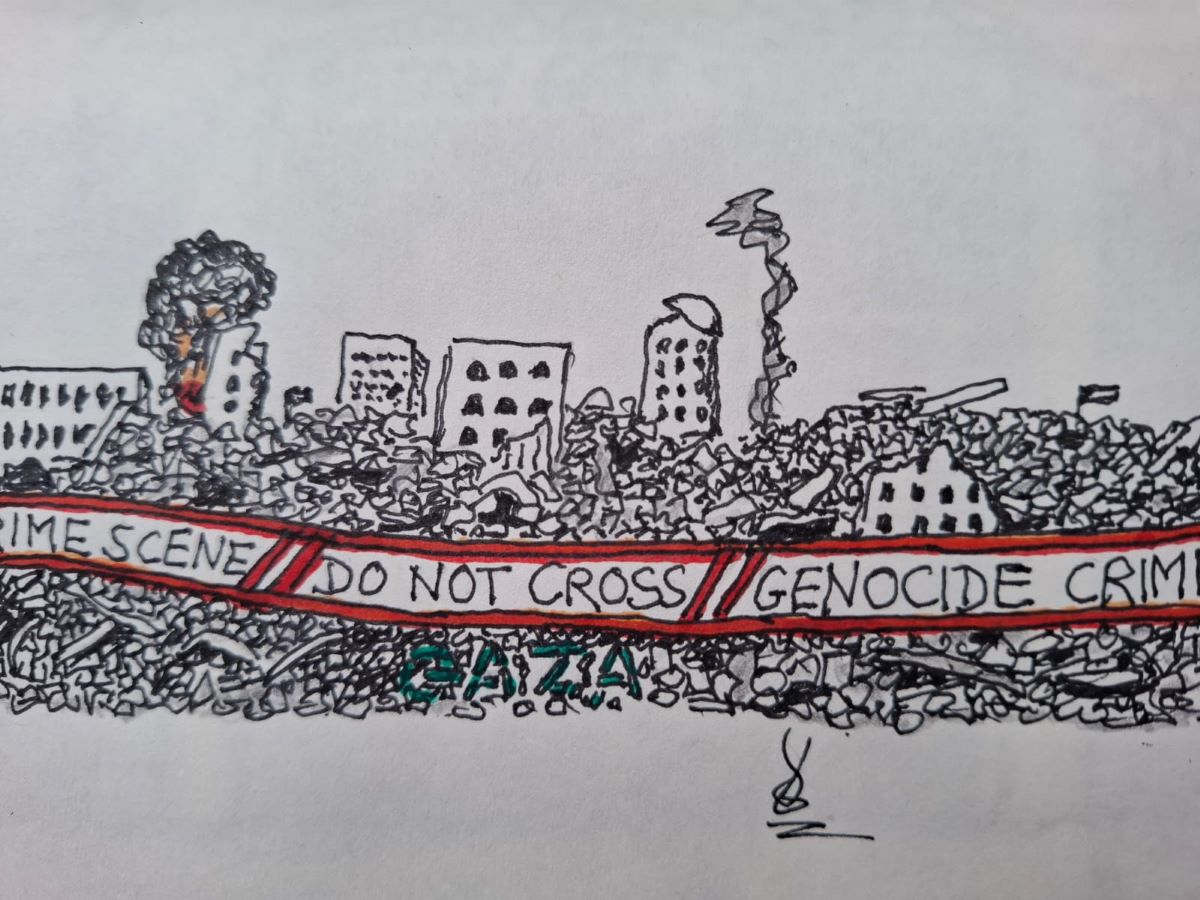
This is a partial dossier, documenting only some of the crimes of the Zionist entity. The dossier is largely in the form of cartoons some of which are as recent as the last few days and others a year old or more but sadly, are still valid comment today.
(Cartoon by D.Breatnach)
A great many crimes have been committed here: Ethnic cleansing, theft, murder, racial discrimination, apartheid, repression, bombing of civilians, shooting of civilians, destruction of water wells, tanks and desalination plants, power cutoffs, mass kidnappings, torture.
Bombing of residential blocks, bombing hospitals, bombing schools, bombing universities, bombing mosques and churches, starvation blockade, water cutoffs, assassinations, public humiliation of prisoners, using human shields, rape and other torture of prisoners, detention without trial.
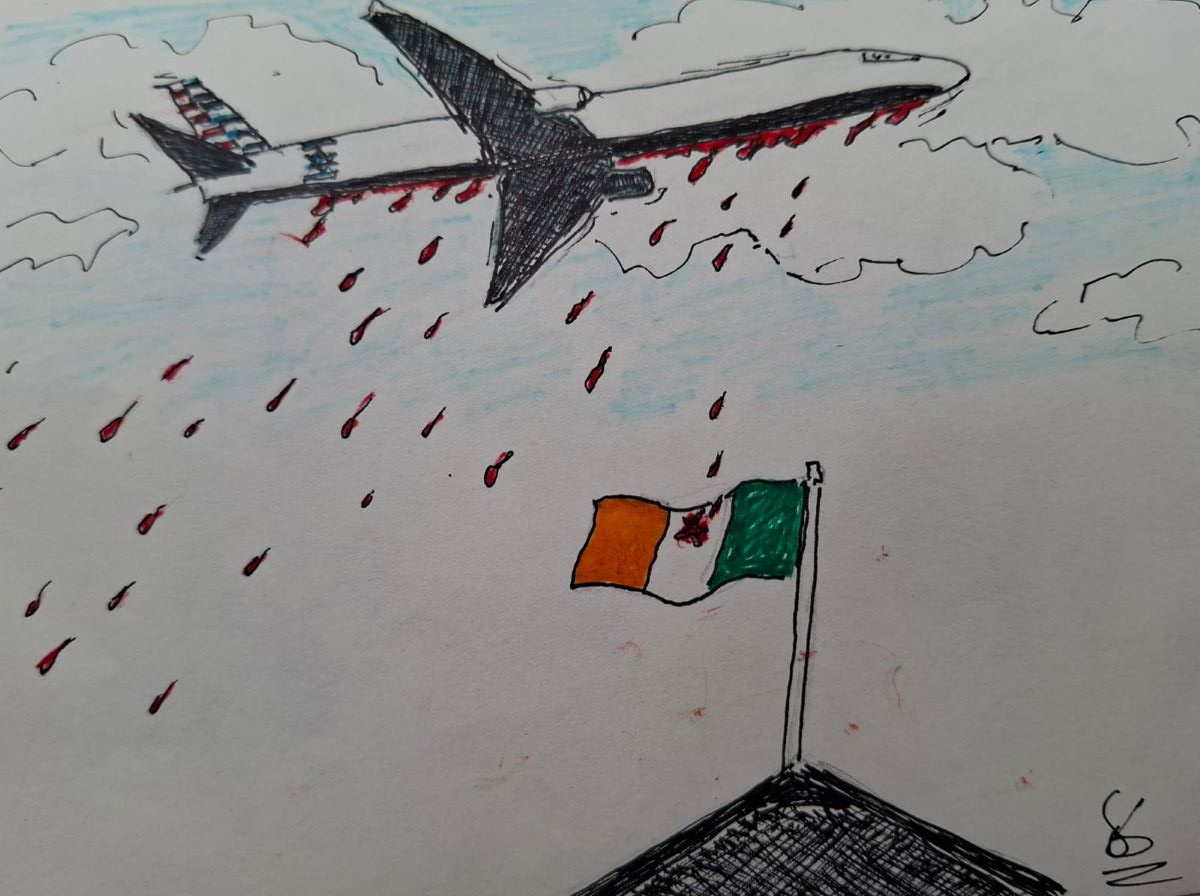
The Israeli Zionists, a European colonial settler project, have had many criminal accomplices, both at the level of states, educational institutions public and private, and of private companies and corporations. The Irish State has permitted the transport of military cargo to Israel through Irish airspace.
(Cartoon by D.Breatnach)
Despite the clearly-expressed desires of the vast majority of the Irish people, the ‘neutral’ Irish State has permitted arms material destined for the Israeli occupier of Palestine to fly through Irish airspace, in addition to permitting the militarisation of Shannon Airport.
As part of the genocide, the Zionist authorities turned off the water supply to Gaza, using water deprivation as a weapon, a war crime of collective punishment.
Shutting off water to the civilians in Gaza is a war crime, even if none of the other genocidal acts of the IOF had been carried out. (Cartoon by D.Breatnach)
But Palestinians have dug wells. And collected seawater in desalination plants. And stored water in rooftop tanks and barrels. So the IOF destroyed the wells, bombed the desalination plants and shot up the water tanks and barrels. Clearly acts of genocide.
(Cartoon by D.Breatnach)
In addition to shutting off the water supply and destroying Palestinian alternative sources, the Zionist authorities have sealed off Gaza from humanitarian aid of food, baby supplements, medicines, etc. The intention, declared in act and words, is to starve the Palestinian people into surrender and leaving.
The Rafah Gate, access Gaza-Egypt, by law operational only by those two agencies and main access of international humanitarian supplies to Gaza, closed by Israeli Occupation Forces tanks. (Cartoon by D.Breatnach)Israeli Occupation Forces threaten anyone trying to enter. (Cartoon by D.Breatnach)
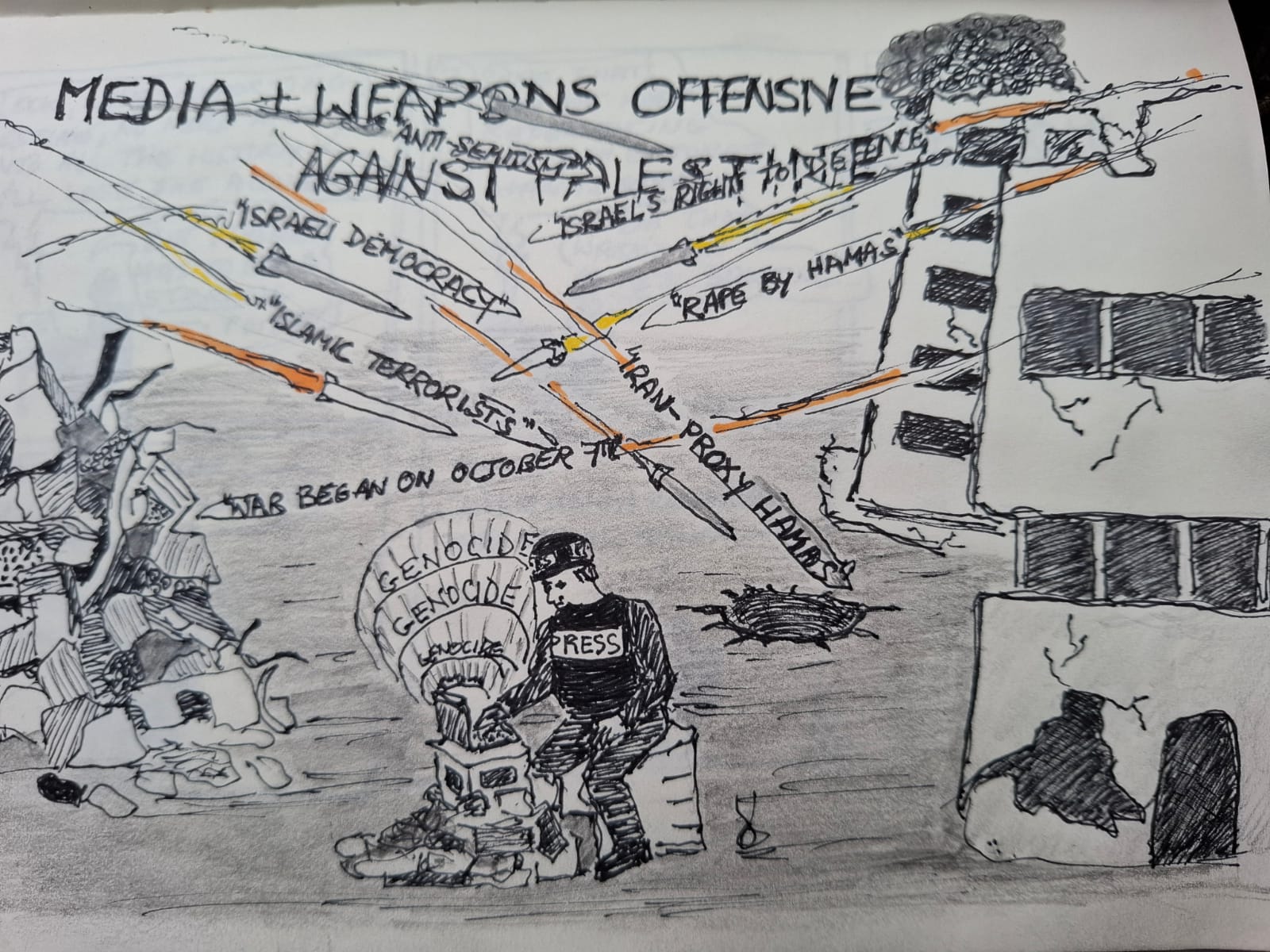
A major party colluding with the genocider Israeli authorities has been the Mainstream Western Media. They have adopted a mantra that posits the start of everything at the Resistance action on October 7, treat Resistance claims as dubious but those of Israeli, despite its record, as credible.
The western media corporations have taken no action to protect their journalists in Palestine, where 243, mostly Palestinian or from Arab nations, have been assassinated by the IOF. They circulated Zionist atrocity propaganda without proof and, when debunked, did not publish retractions.
(Cartoon by D.Breatnach)
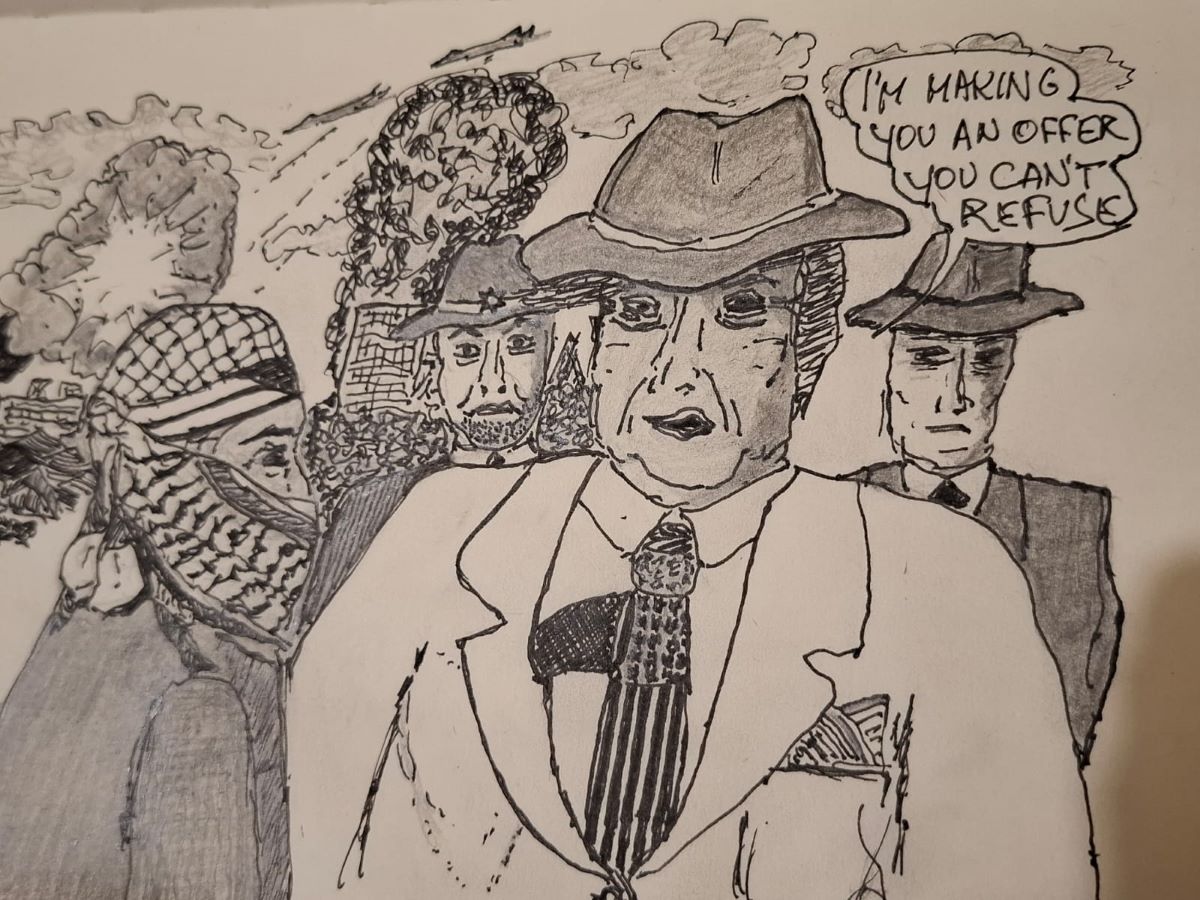
Reading the published 20 points of the recent Trump plan, what is clear is that Trump is demanding that the Palestinian Resistance surrender.
Not because they have been beaten and in fact there is an admission in there that they have not. The reality is that it’s the IOF and the Zionnazi administration that has failed in its declared objectives: to defeat the Resistance and release its captives by force.
NO. What is unspoken but clearly implied here is: ‘Surrender, give up your weapons or we will murder and starve thousands more Palestinian civilians.’
Trump for the USA making another threatening ‘offer’ in true gangster style. (Cartoon by D.Breatnach)
Those who advise the Resistance to agree should ponder what that means, not for Palestine alone but for the world: ‘If you can’t beat a popular resistance, just carry out ethnic cleansing and genocide until they give up. It’s perfectly acceptable and the world powers agree.’
We know about imperialist ‘peace’ plans. They only thing they deliver on is fragmentation of the resistance movement and more years of life for imperialist and colonial power. And elevation for some traitors and opportunists.
Based on history, whatever they decide, the Resistance should neither surrender their weapons or the tunnels. At the worst, there will be another day. The US and western empire is dying and with it will go this dependent zionazi European settler colony
Despite all the crimes of the Zionist entity inflicted upon the Palestinian people and despite the backing of the western powers for ethnic cleansing and genocide, the Palestinian people continue to resist.
Despite all,Gaza resists and resists. (Cartoon by D.Breatnach)
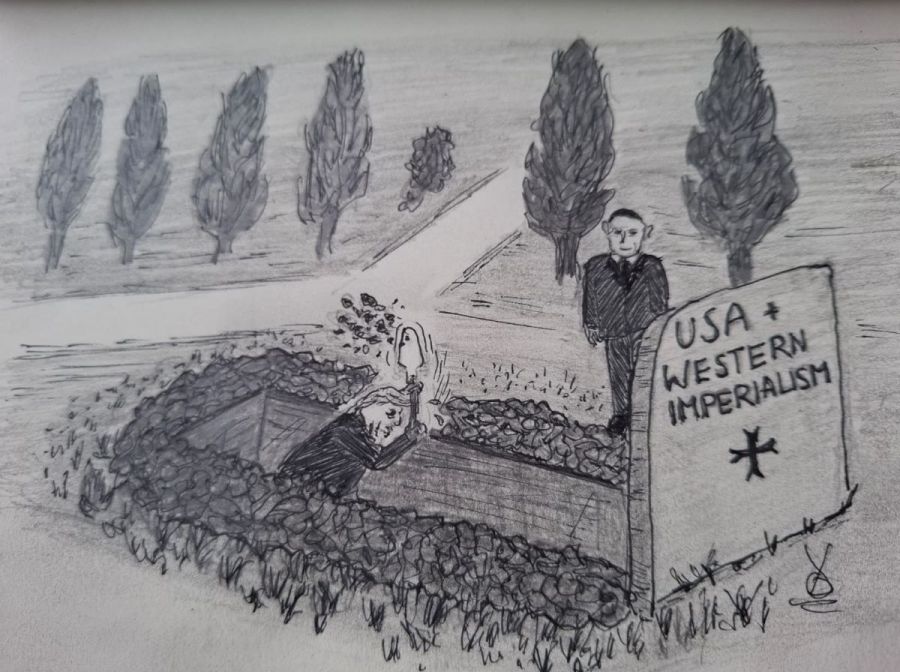
And despite the crimes of the Zionist entity in Western Asia/ Middle East, despite the crimes of its chief backer, US Imperialism – and the rest of western imperialism – their days around the world and at home are numbered. In effect these days they are digging their graves deeper, week by week.
War is the solution that the leaders of the US and Israel seek but that will not save them either.
(Cartoon by D.Breatnach)
Focal Scoir/ Postscript
After a long, long gap, I returned to drawing commentary cartoons a few years ago, increasing production with the current phase of the Zionist and imperialist genocide of Palestinians that began on 8th October 2023, though even so, the output has not been great.
Drawing a cartoon requires first having the idea, then time and head-space to concentrate on its execution. Often I find the latter stage disappointing, though sometimes I am pleased with the result. I’ve also undertaken a little study and practice to improve technique.
Most of the cartoons are published quite close to their actual size, instead of drawn large and then reduced for photographing which I understand to be the professional way. But that would require my carrying a large drawing pad around or putting in a lot more time on drawing at home.
It is a fact that anything in which we invest time and concentration will reduce the availability of those same ingredients for other things. Each of us makes choices and we must manage the options available as best we can. Meanwhile, a genocide is being committed daily by the Zionist entity.
End.
Note: If you found this article of interest, why not register with Rebel Breeze for free, so that you will be notified by email of subsequent articles. You can de-register any time you wish.
For a few days it has seemed a little like an invasion around Dublin city centre by Vikings and Steelers. Not Scandinavians as of old with some others1 but fans of two competing teams of the American National Football League.
One of the banners at the Drumcondra/ Clonliffe junction around 2.45pm.(Photo: D.Breatnach)
There is little social following for the game called ‘American Football’ in Ireland, where we have a massive following for Gaelic football and soccer through their respective associations, the Gaelic Athletic Association and the League of Ireland (the latter in particular much underfunded).
Years ago, in his capacity as Minister of Arts at the time, Michael D. Higgins, presiding at an event, criticised what he called “US imperialist cultural penetration” of Europe. This has been ongoing for decades mainly through cultural products of films and soap operas, cartoon films and comics.
Prior to that, we were subjected mainly to British cultural products in magazines, comics, films and soap operas. And of course the Irish state only set up its own TV broadcaster in the 1960s.
For years these products have been impacting on our consciousness and subconsciousness, including on some of our speech patterns in English. But attempts to promote NFL have failed; however, never before has such a big effort been made and with such financial backing.
The small group at the Drumcondra/ Dorset St junction and Canal/ Railway bridge as I approached it just after 1pm. (Photo:D.Breatnach)
For this one game, the Irish Government has awarded just short of 10 million euro in funding – i.e.one third of their funding for the entire sports sector in Ireland last year. While of course this is being promoted as a revenue opportunity for business, there are stronger reasons.
The NFL is a strong supporter of the imperialist US military and the US itself shows signs of gearing up for another war – against whom is unclear but Venezuela, Iran or China are likely targets. In addition, the US is the main supplier of arms and political backing to Israel.
One of the banners at the Drumcondra/ Clonliffe junction around 2.45pm. (Photo: D.Breatnach)
And where does the Irish ruling class want us? Why, with the USA of course! No more of this skulking around! Make Shannon officially a US military airport, have the RAF and UK Navy officially patrolling our seas and airspace, where arms for Israel can also fly through officially!
The often discussed ‘Triple Lock’ is all that appears to be holding back the Irish ruling class from dumping the state’s tattered neutrality2 — and they are working on that. But meanwhile, they seek to orientate us towards the leader of the western imperialist pack – through US sport.
The NFL will be doing their part, apparently going to make sure every child in the Irish school system will receive an NFL pack. Hey! USA! Leave our kids alone!
This weekend, the Irish Gombeen3 ruling class, through their State, supplied extra police to keep the US visitors safe around the city and on Saturday around Croke Park, while police helicopters kept eyes in the skies. And there was extra Garda tolerance also for UStater illegal street-drinking.4
At the Clonliffe/ Drumcondra Road junction at 1.00pm, announced rallying time. (Photo: D.Breatnach)
THE PROTESTERS
Many – including I – only learned on Saturday of the protest called by the IPSC5-allied Sports for Palestine campaign group against the NFL game programmed for Croke Park on Sunday between the Vikings and Steelers teams. A call-out to attend with flags and placards.
That seems a bit unfriendly towards visitors, sports enthusiasts, right? Fans just happy to support their teams and visit lovely Ireland at the same time, right?
Apart from the considerations of imperialism and war-orientation listed earlier, the USA is openly backing politically and supplying militarily a daily genocide against Palestinians. NFL is a significant cultural representation of the US and as such must be prepared to suffer for it.
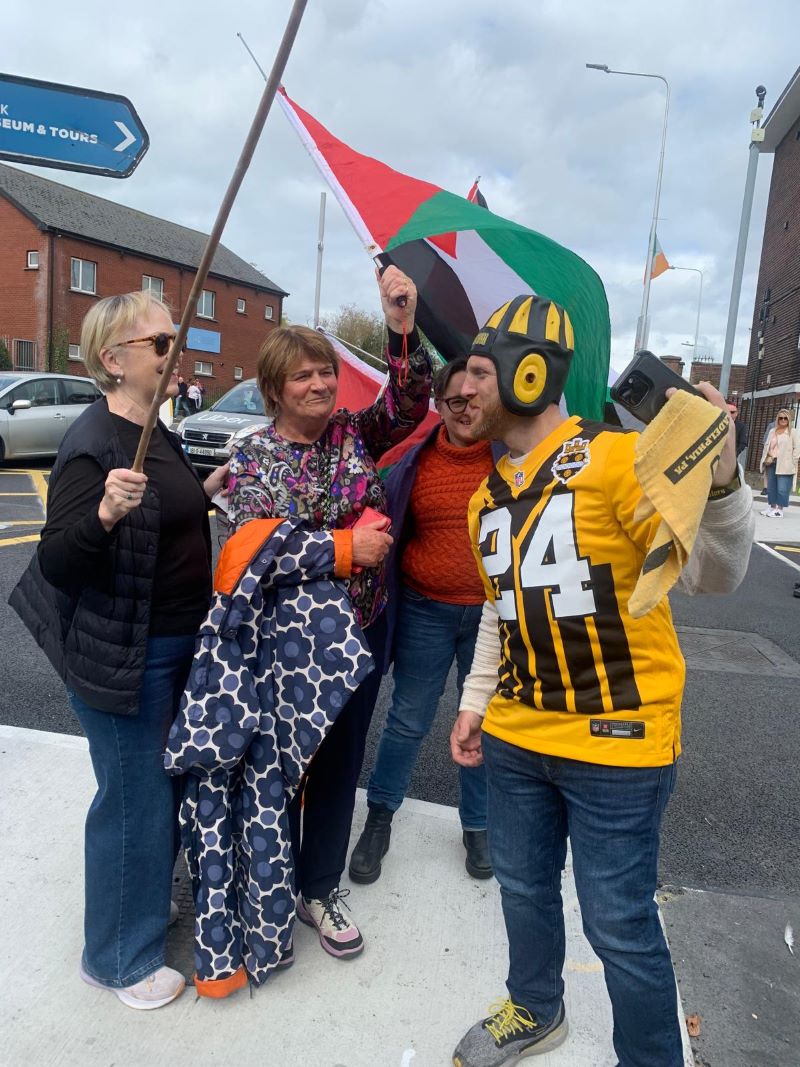
Small group of protesters further down Clonliffe Road at junction of road leading up to Croke Park entrance, approached by an NFL fan (Steelers?) who wants his photograph taken with them. (Photo source: Participant)
While most of the Palestine solidarity protesters, maybe 60 at its highest point congregated at the junction of Clonliffe and Drumcondra roads, a small group of four took up position at the road leading to the Croke Park Stadium entrance and stood there with Palestine flags.
I headed for the railway and canal bridge at the Dorset Street junction, where I could see a Palestinian national flag and a placard calling to “Free America from AIPAC control.”6 On the way I passed NFL merchandise sales and young women handing out free canned energy drinks.
Greeting the other two at the Bridge, I extended my flagpole bearing the Starry Plough flag and took up station with them. Some passing traffic beeped our flags in solidarity.7 My standard litany to the passing NFL fans was: “Shame on the USA, supporting genocide! Shame, shame, shame!”
A comrade near me denounced “The United States of Israel”, alternating with attacking US responsibility for and complicity with genocide, while the other shouted about how wrong it is to be killing children. After awhile another comrade joined us but we never had more than four there.
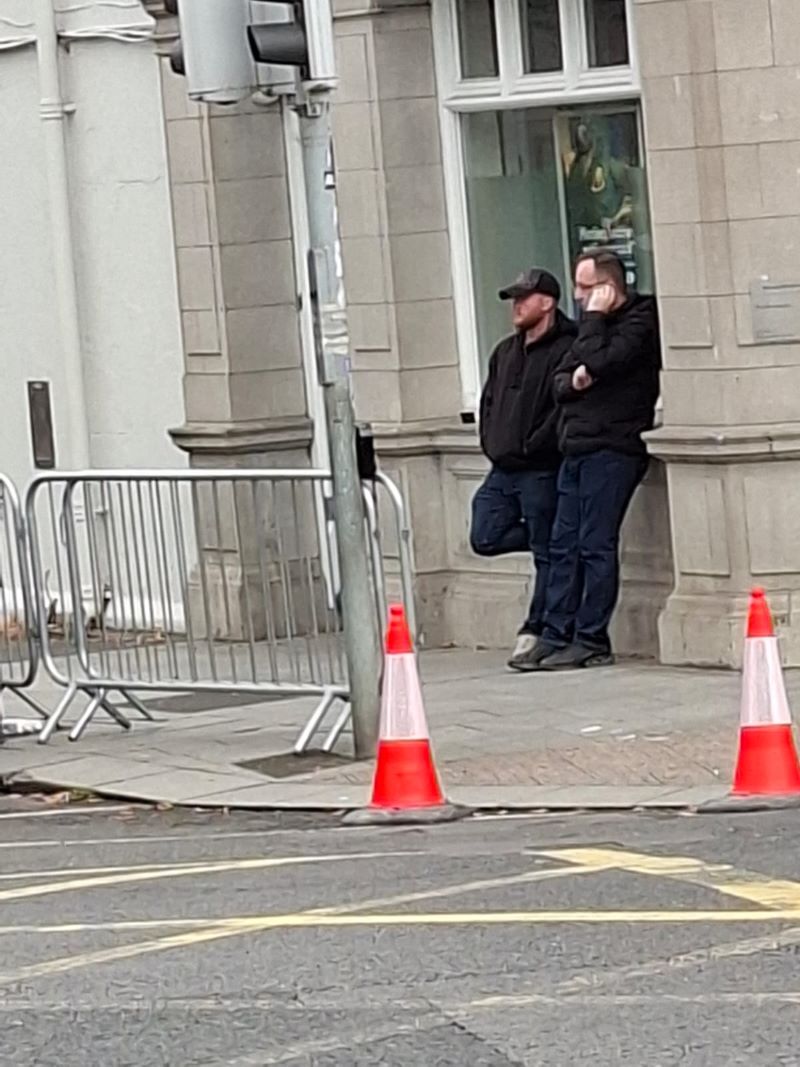
Two of the Special Branch of the Gardaí, ‘spotting’ for the State. (Photo: D.Breatnach)
REACTIONS OF NFL FANS
The reactions of the passing fans to what we were saying varied considerably.
By far the majority of them attempted to ignore us while some looked at us with seeming curiosity but no other reaction. Some seemed embarrassed, covering the feeling with a smile. A small minority said they agreed with us, some even saying they were ashamed of the USA.
A tinier minority still exhibited hostility and outrage towards us, as in waving us away or giving the hand gesture for “blah, blah” (which a few verbalised also). A few laughed but that was their mistake, as I then shouted “Laughing about genocide? LAUGHING about GENOCIDE!”
One big man insulted us in an Irish accent but received as good from us, while an NFL fan who spoke in support of ‘Israel’ wilted under a barrage of “Genocider!” shouts. Another who mentioned “the hostages” was asked whether he was referring to “the 9,000 Palestinian prisoners?”8
Yet another accused us of generalising but received a response about arming Israel, to which he responded that we (Ireland, presumably) are feeding Israel. Another still wanted to avoid responsibility by saying that he’s “a Democrat” but was asked what that had to do with anything.
One other said he was from Belfast and yet another from England but the latter in particular got nowhere with that, considering Starmer’s support for the Zionazis. An older US man supported by two women claimed that we were being fooled by Hamas propaganda – there is no genocide!!!
It seems likely that those UStaters who encountered protesters and who are already opposed to what the US leadership is doing will return home at least a little strengthened in their position but also with some stories to tell people there about how the US is being viewed in a part of Europe.
Those who are unsure about what they think will probably doubt the leaders of the USA and dominant rhetoric even more. Some will be mostly unaffected and some may even harden their hostility to all critics of the USA. On the whole, I think the effects will be of a positive nature.
But even if so, of course nothing we did will be stopping the genocide for even one minute. Only states have the power to do that and were the Irish Government to ban all imports from ‘Israel’ outright, that would have a huge and immediate impact on the genocider’s economy.9
Another of the banners at theDrumcondra/ Clonliffe junction around 2.45pm. (Photo: D.Breatnach)
Sunday’s was a useful but minor action in the propaganda part of the liberation war – Palestinian national liberation, of course but also part of our own. However it could have had much greater visual impact. Drumcondra Road is on a much-travelled road including for Airport traffic.
The road also carries bus public transport routes from and to various Dublin destinations. There are three possible routes off it for access to Croke Park. We only covered two, one with a minimum presence. The size of the concentration at Clonliffe junction was understandable but unnecessary.
The source of much of this weakness appears to be the very late call-out to the protest – only the day prior for many, possibly most. Yet the NFL game must have been planned for many months.
end.
Note: If you found this article of interest, why not register with Rebel Breeze for free, so that you will be notified by email of subsequent articles. You can de-register any time you wish.
1Ireland was raided by Vikings from Scandinavia from 795 CE, they later establishing settlements in Dublin and along the south-east coast, also along the Shannon river and in Cork. Viking power in Ireland was broken by the 1040 CE victory of Brian Boru’s coalition (which included some Vikings, probably Norse) over the Leinster-Dublin coalition of mostly Dublin Danes, Leinster Irish and Viking mercenaries from Manx and Orkneys. The battle lasted 12 hours not far from the Croke Park stadium and part of the Viking mercenaries were caught and killed on their retreat to their ships nearby.
2Three requirements to be met before the Irish Government can send a military mission consisting of more than 12 personnel from Ireland to any part of the world.
3A pejorative term from the Irish language Gaimbín equivalent in meaning to ‘carpet-bagger’, huckster, etc. applied to the Irish neo-colonial (and neo-liberal) capitalist ruling class.
4City regulations forbid drinking of alcohol in any public place.
6The mostly Christian Zionist alliance that plays a heavy financial role in promotion of candidates for election in the USA.
7Yet in one hour outside the US Embassy or standing at Annesley Bridge the normal count of solidarity car-horn sounds would be in the fifties – among the tide of NFL fans, we just weren’t that visible to approaching traffic.
8There may be more but of those, around a third are now held under ‘administrative detention’ orders, without even the farce of an Israeli military court trial.
We’ve recently passed by the date of the start of a monumental prison resistance struggle when IRA prisoner Kiaran Nugent refused on 14 September 1976 to wear prison uniform.
The Hunger Strike of 1981 tends to be remembered as an isolated event in the history of the Irish Republican prisoners’ opposition to criminalisation. But it was five years of struggle through stages that ended eventually in the martyrdom of ten Republicans.
Irish Republicans had been in imprisoned in British jails since the late 18th Century.1 After the Irish national bourgeoisie accepted the British partition of Ireland, Republican prisoners were held in prisons in the Irish State and in the British colony of the Six Counties and at times in Britain too.
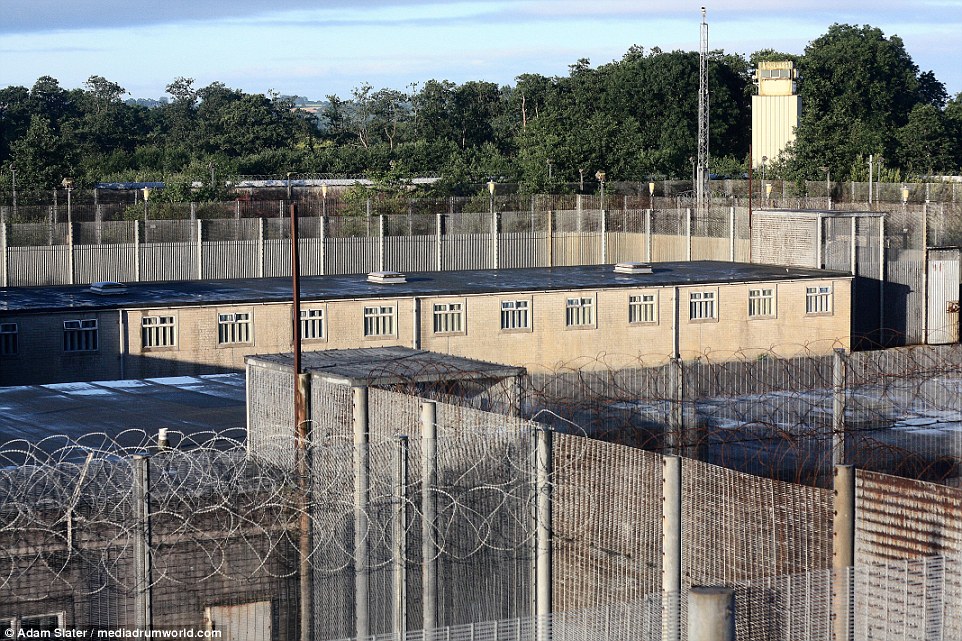
Long Kesh/ the Maze Prison, in the occupied 6 Counties.
This situation continued on low but constant level with higher points during the Civil War (1922-1923), the pogroms in the Six Counties, the 1930s,2 the 1940s, the Border Campaign (1958-1962) and the Civil Rights campaign from the mid-1960s onwards.
The Wikipedia section on Special Category Status states that it was introduced for Republican prisoners serving sentences in the Six Counties in 19723 but neglects to mention that it was already widespread among nationalist prisoners due to internment without trial a year earlier.
The British introduced internment without trial in their Irish colony in 1971 and one of the effects of that measure was to put a huge number of mostly nationalists from the Six County colony into jail. These prisoners were all accorded Special Category Status and wore their own clothes.
British soldiers capturing and taking away a civilian in the Occupied Six Counties of Ireland (Photo sourced: Internet)
Over the life of the measure, 1,981 people were interned without trial in the Six Counties (British Army’s Operation Demetrius). Of those detained 1,874 were from a Catholic/Republican background while, towards the end, 107 were from a Protestant/Loyalist background.
Special Category Status distinguished the internees from other political prisoners which were few in number at the time but its major impact was to distinguish them visibly from social prisoners or what are commonly called ‘criminals’ and was often called PoliticalPrisoner Status.
In June 1972 other nationalists/ Irish Republicans4 charged and convicted were also accorded Special Category Status,5 which came to be seen as prisoner of war status for opponents of the British colonial occupation, despite Britain’s claims that the prisoners were just criminals.
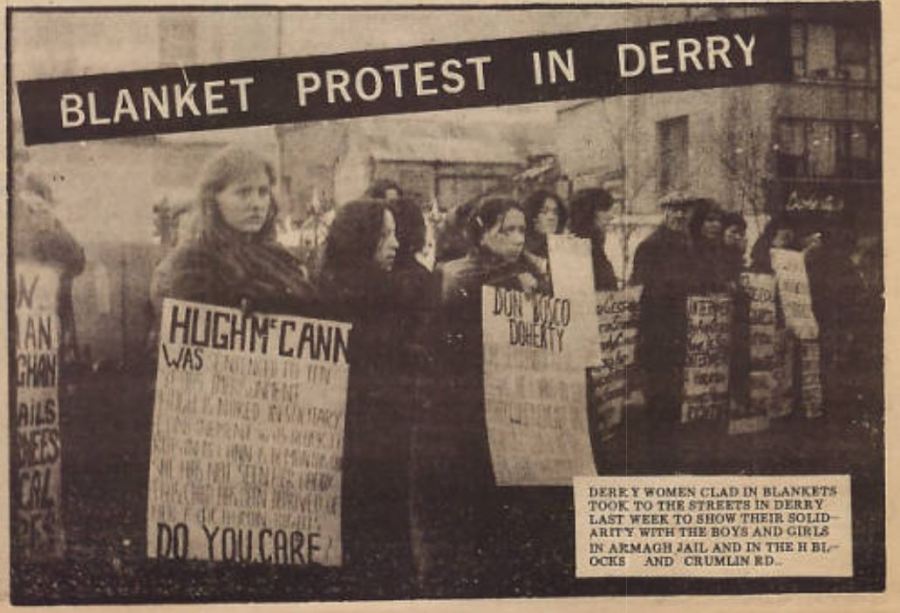
Early protests in support of the prisoners ‘on the blanket’ in 1976. It was mostly women relatives, partners and their friends who launched the Republican prisoner solidarity movement. As the photo legend also illustrates, there was still another male political prison, Crumlin Road (‘the Crum’) and Armagh Jail for female Republican prisoners.(Photo sourced: Internet)
Internment without trial in the Six Counties, generally recognised as a failure from both political and military points of view, was formally ended after four-and-a half years on 5 December 19756. As resistance continued, including now an armed aspect, more prisoners saw the inside of jails.
But they were still under Special Category regime and wearing their own clothes. The following year on 5 March 1976, Merlyn Rees as Secretary of State implemented the Labour Government’s7 decision to remove Special Category Status from any subsequently-convicted prisoners.
MERL
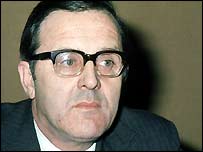
Merlyn Rees, British Labour Home Secretary who removed the Special Status from the Irish Republican prisoners, which precipitated the struggle that ended in the prison hunger strikes of 1981. He died at 85 years of age, having lived much longer than many of his victims. (Photo sourced: Internet)
The first Irish Republican prisoner to be informed he would have to wear prison uniform under the new rules was Kiaran Nugent. His reply, though pithy has gone down in the records of Irish resistance statements: “You’ll have to nail it to my back.”
Stripped naked, Vol. Nugent was put in a cell, from which he found a blanket and wrapped it around himself. It was a natural act to cover his nakedness but he may also have known that Irish Republican prisoners of the Irish State in the 1940s had done the same.
The Blanket Protest had begun and spread as more prisoners coming into the prison system took the same stand. There it might have stayed were it not for the violence and cruelty of HM Prison regime by its warders regularly assaulting prisoners on their way to and back from the showers and toilets.
In 1978 the Irish Republican prisoners in the Maze H-Blocks8 resolved to remain in their cells, emptying their excreta out the window and their urine under their cell doors into the passageway. So the prison authorities blocked up their windows and warders pushed urine back under their doors.
The Irish prisoners then had nowhere to put their excreta so they smeared it on the walls. They built a dam of bread fragments around their door to prevent their urine being pushed back in. These conditions they endured until the prison riot squad beat them out of their cells for power-hosing.
Those who watched the film Hunger (2008) directed by Steve McQueen will have seen some of that and how they treated the naked prisoners too, beaten to the ground, anus probed for contraband messages or materials, the same gloved hand often opening their mouths to look inside also.
Their flesh was forcibly abraded with scrubbing brushes and they were often inserted into cells still wet from the hosing.Once back inside cells, they continued the protest.
On 27 October 1980 seven Republican prisoners, against the orders of IRA GHQ, embarked on a hunger strike included the Five Demands to break the system, which they terminated after 53 days on receiving promises from the authorities which were then reneged upon.
The 5 Demands:
The right not to wear a prison uniform;
The right not to do prison work;
The right of free association with other Republican prisoners, and to organise educational and recreational pursuits;
The right to one visit, one letter and one parcel per week;
Full restoration of remission lost through the protests.9
Outraged at the reneging, Republicans renewed the hunger strike with their previous Provisionals’ jail Commanding Officer10 insisting he be first. So was Bobby Sands the first to die and another nine martyrs behind, seven Provisional IRA and 3 INLA as they came on to the strike in sequence.
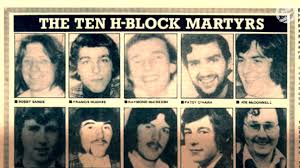
Photograph images with names of the ten Hunger Strike Martyrs of 1981 in the sequence of their death: Vols. Bobby Sands (IRA), Francis Hughes (IRA), Ray McCreech (IRA), Patsy O’Hara (INLA), Joe McDonnell (IRA), Martin Hurson(IRA), Kevin Lynch (INLA), Kieran Doherty (IRA), Thomas McElwee (IRA), Mickey Devine (INLA). (Photo sourced: Internet)
The effect of the hunger strikes of 1981 was huge in Ireland, Britain and further abroad. IRA Vol. Kieran Nugent had an important hand in pushing the process but so did Mervyn Rees, William Whitelaw, Brian Faulker and Edward Heath,11 in a long process of repression and resistance.
Today the struggle continues with approximately 20 Irish Republican prisoners, male and female in prisons between the neo-colonial Irish state and the British colony of the Six Counties. They have essentially won the five demands, though official harassment in the colony’s jails is endemic.
End. NB: If you found this article interesting you may wish to subscribe to the blog free of charge, after which you would receive a notification in your email every time an article was published. You can unsubscribe any time you wish.
APPENDIX: Brief biography of Kieran Nugent (12th September 1958 – 3rd May 2000).
Volunteer Kieran Nugent began his short life presumably in the occupied Six Counties of Ireland but all the references I have found so far begin with him at the age of 15 years of age, standing at a corner with a friend on the corner of Merrion Street and Grosvenor Road, West Belfast.
It was 20th March 1973.12 A car pulled up beside them asking for directions but an occupant of the vehicle then opened fire with a submachine gun. Nugent was seriously wounded, shot eight times in the chest, arms and back. His friend, Bernard McErlean, aged 16, was killed.
Kieran Nugent, first of the Republican prisoners ‘on the Blanket’ (Photo sourced:Internet)
Another youth was seriously injured also.13 Local people reported that a British Army Saracen armoured car had crashed through a nearby barricade and that was what had allowed entry for the murder gang, later claimed by the UDA, a British proxy Loyalist militia.
“At some point afterwards, Nugent joined the IRA.”14 The youngest age for IRA membership was 17 and Nugent aged 16 was arrested by the British Army, automatically refused bail, and at trial, after five months on remand in Crumlin Road Prison, Belfast, case withdrawn, he was released.
Kieran became an active volunteer until his arrest and internment without trial, on 9 February 1975. He served nine months in Cage 4 of Long Kesh Detention Centre (later renamed The Maze) in the Six Counties, until 12 November 1975. But was arrested and imprisoned again on 12 May 1976.
Vol. Nugent was charged with hijacking of a bus, a frequent Republican resistance activity in Belfast where the vehicle would then be utilised as a barricade. His sentence was three years in jail which he was commencing when he began the blanket protest.
The cause of death for Kieran Nugent was given as heart attack. A number of his acquaintances remarked that he had sunk into alcoholism with some adding that the movement had given him no support. Whether true or not, many former Republican prisoners of the period had shortened lives.
1Republican prisoners were held in British jails in Ireland, Britain and Australia – and for centuries before that Irish clan members had been incarcerated in Britain and Ireland.
2When the anti-fascist struggles also contributed to prisoner of the states.
4I am using the term “nationalists” as a broad and not strictly accurate term to describe the people of the Catholic ghettoes and areas of the British colony; of course many of them could have been also or instead mainly democrats, socialists. The term “Irish Republicans” I am using to describe those belonging to organisations nominally of Irish Republican kind but again how much each was truly Republican in ideology varied, for example in their opinion of the appropriate role of the Catholic Church in Irish society.
5Sentenced and remanded in custody Irish Republicans in jails went ona hunger strike for ‘political status’ in 1972 and the Provisional IRA during the Truce negotiations of June that year asked for political status for them which William Whitelaw conceded.
6https://cain.ulster.ac.uk/events/intern/chron.htm However internment without trial in fact continued by charged Republicans being refused bail and remaining in jail for two years or more awaiting trial. Bail decision and trial would be in the special no-jury Diplock Courts.
7It is difficult to understand any Irish person or indeed any anti-imperialist putting any faith in a British Labour government. Apart from its long imperialist history, it formed part of the national government that executed leaders of the 1916 Rising, sent troops to the Six Counties to quell the civil rights struggle in 1969, introduced the Prevention of Terrorism Act in Britain in 1974 and framed a score of Irish people for bombings, removed Special Category Status in 1976 …
8A special male political prison containing panopticon-designed blocks in Lisburn, Co. Antrim, built in 1971 and closed in 2000, the future of the empty buildings uncertain. Female Republican political prisoners were kept in Armagh Jail and fought with different tactics, including taking the Prison Governor hostage at one point.
9Prisoners disobeying prison rules are punished in a number of ways, one of which is loss of the remission off sentence normally expected.
10In a long tradition the prisoners of each political group in jail elect their leader and previous ranks are abandoned for the duration of the incarceration.
11In sequence: Labour Party Secretary of State; Conservative party Cabinet Minister; Unionist Prime Minister of the colony; Conservative Prime Minister of the UK.
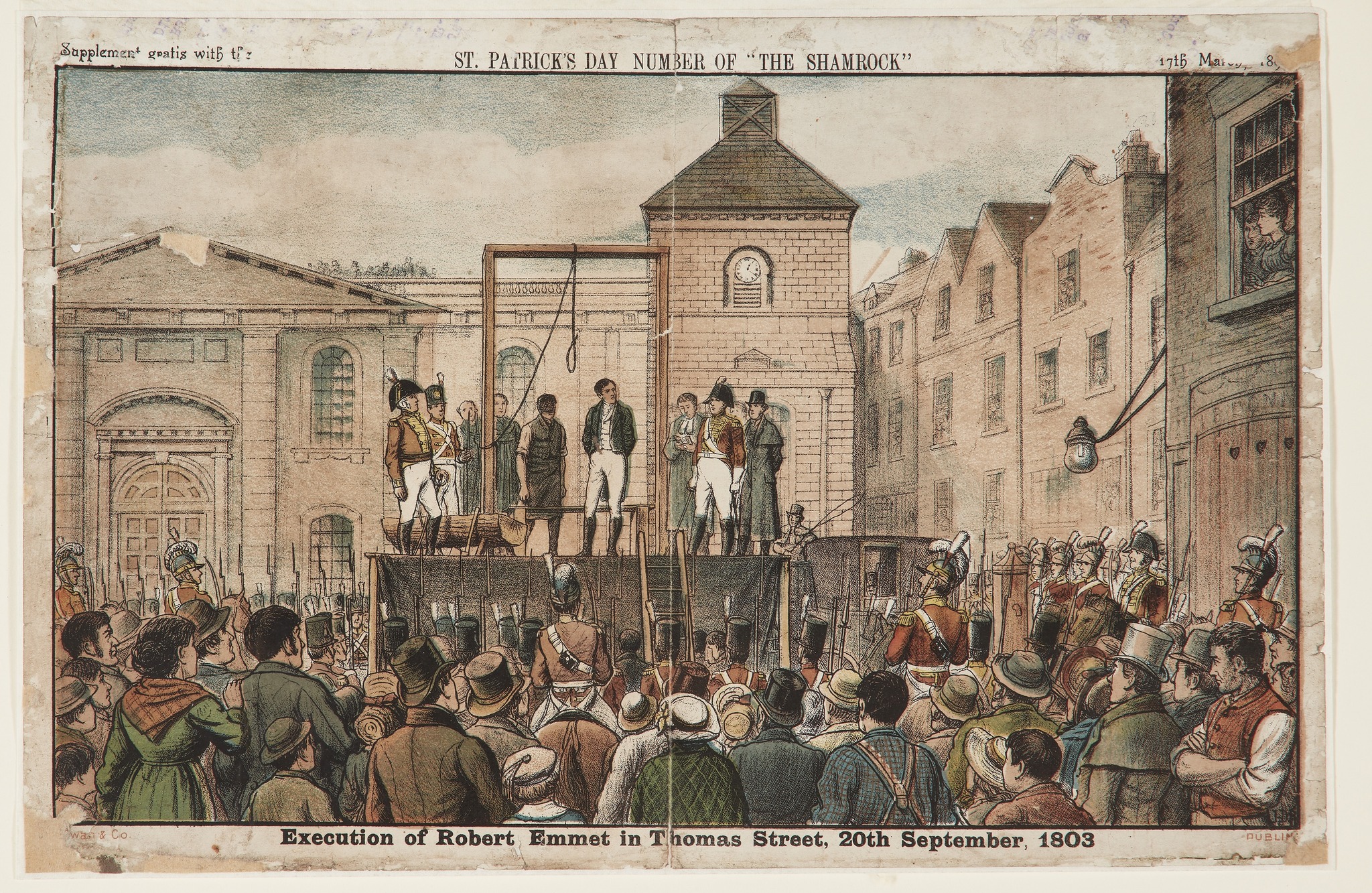
Dublin Political History Tours Facebook page reminds us of the 20th September anniversary of the public execution on of “Bold Robert Emmet, the darling of Erin”, leader of the unsuccessful Republican insurrection in Dublin on 23rd July 1803.
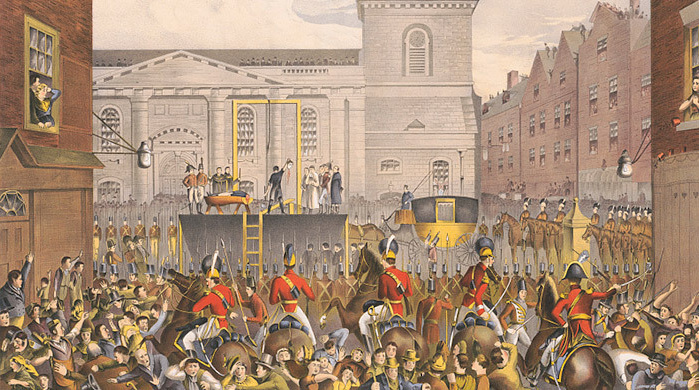
Coloured drawing: The executioner holds up Robert Emmet’s head to the crowd, sections of which demonstrate their repugnance of the act and are repressed English soldiers on horseback. (Sourced: Internet)
I reproduce the Dublin Political History Tours text (reformatted for R. Breeze):
On Saturday we passed by the anniversary of the execution by the English occupation forces of Robert Emmet, United Irishman. Emmet had been condemned to death for planning an insurrection for Irish self-determination which the English Occupation called ‘treason’.
Leaving behind in Kilmainham Gaol his comrade Anne Devlin, who had endured torture and death of family members without giving the authorities any information, Emmet was taken to the front of St. Catherine’s Church.2
(This building is) on Thomas Street in Dublin’s Liberties area on the west side of the city centre. The site chosen was sending a message to the populace of the area that had nationalist and republican sympathies.
There, in front of a huge crowd and many soldiers, Emmet was hanged and then beheaded, the executioner holding up the dripping head to the crowd. His body was later returned to the Gaol before being later buried in Bully’s Acres in the grounds of the Royal Hospital Kilmainham.
Emmet’s corpse was later disinterred in secret and reburied elsewhere by friends or family and, despite a number of sites being speculated, its current location is unknown.
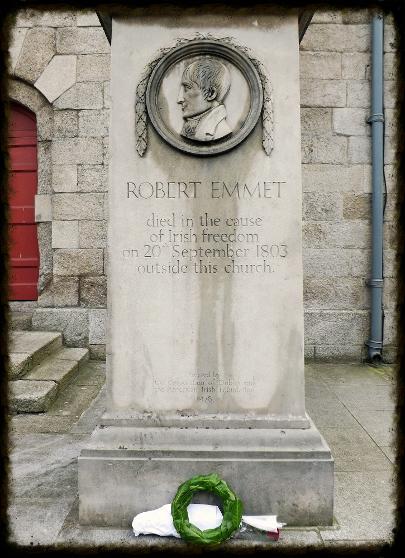
There is a monument to the execution inside the grounds of the St. Catherine’s building and a stone plaque on the wall outside it.
The monument inside the ground at the front of St. Catherine’s Church, Thomas Street, Dublin. (Source: Kilmainham Tales)
Robert Emmet was very popular in Ireland at the time and his memory is still. A statue in his honour stands in Dublin’s Stephens Green, a replica of another two at locations in the United States.
Anne Devlin endured three years in Kilmainham Gaol and according to Richard Madden (1798 – 5 February 1886), chronicler of the United Irishmen who sought her out, was followed everywhere in public by police.
(who were) observing anyone who she spoke to, as a result of which many were afraid to speak to her. Her body lies in Glasnevin Cemetery.
“Bold Robert Emmet” is a traditional ballad in the martyr’s honour and “Anne Devlin” also has a much more recent song in hers by Pete St.John.
(quoted passages end)
In the 1916 Proclamation of Independence, “the right of the people of Ireland to the ownership of Ireland” is proclaimed and that “six times in the past 300 years they have asserted it in arms”, probably referring to insurrections of 1641, 1689, 1798, 1803, 1848 and 1867.3
Historians have mostly dismissed the 1803 uprising as never likely to succeed but a minority have rated the preparations highly, including the innovations of signal rockets and folding pike handle for concealed personal carrying.
RH Madden, the first historian of the United Irishmen was of the opinion that the insurrection attempt was engineered by the English Occupation’s administration in Dublin Castle in order to justify continued repression of Irish republicanism and to eliminate some leaders.
Generally historians have tended not to give much credence to Madden on that issue but it is certain that the Occupation had a network of spies in operation in Ireland and that some had penetrated Emmet’s conspiracy.
Emmet on the scaffold with St. Catherine’s Church behind, the executioner beside him, the crowd in the street and many English soldiers, on foot and on horseback. The illustration was employed by Dublin Political History Tours but easily sourced on the Internet.
However it is not for the manner of the 1803 insurrection that Emmett has been fondly remembered in Ireland to this day 123 years later – and abroad for decades after his death4 – but for the calm manner in which he faced his enemies, including his executioner and for his eloquence at his trial.
Past insurrections contain lessons for us today and a serious evaluation should be attempted, perhaps with a number of submissions from historians of different opinions on the matter, to deal with questions around Emmet’s return from France and the planning of the insurrection in Ireland,.
For us today however, whether Republicans or more generally anti-colonialists and anti-imperialists, it is also necessary to revere the memory of revolutionary action for a democratic Irish Republican and to uphold his and Anne Devlin’s spirit of defiance in resistance.
End.
Note: If you found this article of interest, why not register with Rebel Breeze for free, so that you will be notified by email of subsequent articles. You can de-register any time you wish.
Statue monument of Robert Emmet in Washington DC, a copy of which stands in St. Stephens Green, looking across the road to his erstwhile homeand other copies stand in Emmetsburg, Iowa and Golden Gate Park, San Francisco, California.Those in the USA were all cast by the artist Jerome Connor between 1916 and 1919. (Photo sourced: Internet)Statue monument in Rathfarnham dedicated to Anne Devlin from Wicklow, a member of the United Irishmen conspiracy, tortured and jailed but never gave her captors any information. Sculptor: Clodagh Emoe(Gracies, Maria, for bringing this to my attention).
FOOTNOTES
1From Emmet’s famous speech from the dock of the courthouse in Green Street that not until then should his epitaph be written. I have no doubt that Emmet meant “nation-states of the world” because Ireland was in his time more than what we would understand today from the vague term of “country” – it was clearly, though under foreign occupation, already a nation with its own unique culture and a long history. She has yet to take that place to which Emmet referred and aspired for her.
2Note that was the Anglican St. Catherine’s Church, as a Catholic St. Catherine’s is also located not far away on Meath St. The Anglican church was closed in the 1960s but later reopened and reconsecrated as an Anglican Church. The interior seems very untypical of Anglican churches. Emmet was raised in the Anglican faith.
3Believed to refer to, in sequence: the Irish and Norman Irish clans in the Confederation’s uprising, the Williamite War’s, United Irishmen’s, Robert Emmets’, Young Irelanders’, the Fenians’. Coincidentally, the large monument to uprisings in Ireland erected by the National Graves Association in the St. Paul’s section of Glasnevin Cemetery also includes only six dates but they are of Republican risings only, beginning with 1798 and ending with 1916.
4I read somewhere that even in England Radicals would read Emmet’s speech as a high point of their events including formal dinners.




















 rebelbreeze