LARGE RALLY ON HISTORICAL 1916 RISING SITE THREATENED BY SPECULATORS

Clive Sulish

(Reading time: 7 mins.)

Large numbers attending a rally Sunday afternoon were addressed by a number of speakers from a platform in the centre of the 1916 Terrace organised by the Moore Street Preservation Trust on part of the very site they wished to preserve.

Fintan Warfield, a Sinn Féin Senator (and cousin of Derek and Brian Warfield of the Wolfe Tones) came on stage to perform Come Out Yez Black ‘n Tans followed by Grace, about Grace Gifford’s wedding to Vol. Joseph Plunkett hours before his execution by British firing squad.

Fintan Warfield performing at the event, behind him the portraits of two of the Moore Street Garrison in 1916 may be seen. (Photo: R. Breeze)

Warfield performed in front of a number of large board posters bearing the images of a number of leaders of the 1916 Rising who had occupied Moore Street in 1916 and Vols. Elizabeth O’Farrell and Winifred Carney, two of the three women Volunteers who had been part of the garrison.

The start of the rally however was delayed, apparently awaiting the arrival of Mary Lou Mac Donald, billed as the principal speaker on the Moore Street Preservation Trust’s pre-rally publicity.

Eventually Mícheál Mac Donncha, Secretary of the Trust and a Sinn Féin Dublin City councillor came on the stage to promote some MSPT merchandise (some of it for free) and to introduce the MC for the event, Christina McLoughlin, a relative of Comdt. Seán McLoughlin.

Christina McLoughline, MC of the event. (Photo: R. Breeze)

Vol. Seán McLoughlin had been appointed Dublin Commandant General by James Connolly during the GPO evacuation and was about to lead a charge on the British Army barricade in Parnell Street when the decision was taken to cancel after which he organised the surrender.

He later became a communist and was never acknowledged at Commandant level by the War Pensions Dept. of the State under De Valera, despite his rank in Moore Street and later also in the Civil War in Cork.

Sean’s relative Christina McLoughlin welcomed Mary Lou Mac Donald on to the stage.

Mac Donald’s appearance on the stage received strong applause. In fairness, many present, if not most, were of the party faithful. Despite the presence of some younger people, the general age profile was decidedly from the 40s upwards, indeed many being clearly in the later third.

Mary Lou Mac Donald, President of the Sinn Fein party, speaking at the event. (Photo: R. Breeze)

Mac Donald, who is not an Irish speaker, read the beginning of the address well in Irish before going on to talk in English about the importance of Moore Street site in the history of the 1916 Rising and in Irish history generally and how her party in government would save it.

After the applause for Mac Donald, the MC called Proinnsias Ó Rathaille, a relative of Vol. Michael The O’Rahilly, who was mortally wounded leading a charge up Moore Street against a British Army barricade in Parnell Street and who died in the nearby lane that now bears his name.

Ó Rathaille’s address was heavy in the promotion of the Sinn Féin party and, in truth rather wandering so that he had to return to the microphone after he’d concluded, to announce Evelyn Campell to perform a song she had composed: The O’Rahilly Parade (the lane where he died).

Evelyn Campbell performing her composition O’Rahilly’s Parade at the event. (Photo: R. Breeze)

Campell is a singer-songwriter and has performed in Moore Street on previous occasions, the first being at the invitation of the Save Moore Street From Demolition group who were the only group to campaign to have the O’Rahilly monument finally signposted by Dublin City Council.

McLoughlin announced Deputy Mayor Donna Cooney to speak, a relative of Vol. Elizabeth O’Farrell, one of the three women who were part of the insurrectionary forces occupying Moore Street. Cooney is a Green Party Councillor and a long-standing campaigner for the conservation of Moore Street.

Deputy Dublin Lord Mayor and Green Party councillor Donna Cooney speaking at the event. (Photo: R. Breeze)

While speaking about the importance of Moore Street conservation for its history and street market, Cooney also alluded to its deserving UNESCO World Heritage status, adding that the approval of the Hammerson plan for the street was in violation of actual planning regulations.

Next to speak was Diarmuid Breatnach, also a long-time campaigner, representing the Save Moore Street From Demolition campaign group which, as he pointed out has been on the street every Saturday for over a ten years and is independent of any political party or organisation.
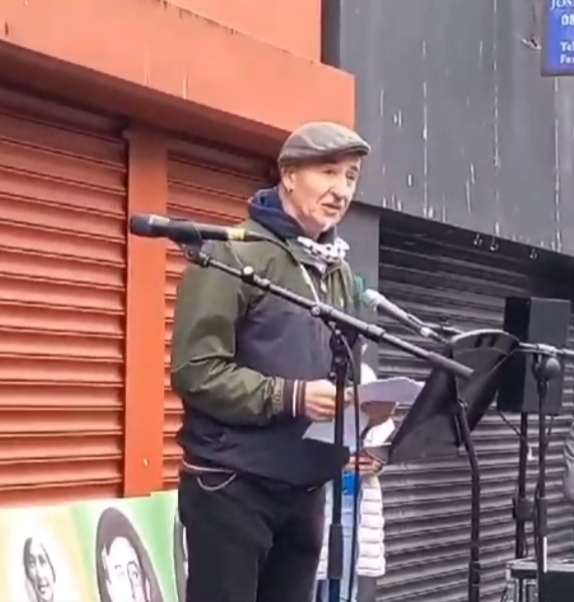
Diarmuid Breatnach speaking at event on behalf of the independent Save Moore Street From Demolition campaign group. (Photo: R. Breeze)

Breatnach also raised the UNESCO world heritage importance, as the SMSFD group were first to point out and have been doing for some years, based on a number of historical “firsts” in world history, including the 1916 Rising having been the first anti-colonial uprising of that century.

The Rising was also the first ever against world war, Breatnach said. He told his audience that the Irish State has applied for UNESCO heritage status for Dublin City, but only because of its Victorian architecture and that it had once been considered “the second city of the British Empire”.

Stephen Troy, a traditional family butcher on the street, was next to speak. He described the no-notice-for-termination arrangements which many phone shops in the street had from their landlord and how Dublin City Planning Department had ignored the many sub-divisions of those shops.

Stephen Troy, owner of family butcher shop on the street and campaigner, speaking at the rally. (Photo: R. Breeze)

Troy’s speech was probably the longest of all as he covered official attempts to bribe the street traders to vote in favour of the Hammerson plan and what he alleged was the subversion of the Moore Street Advisory Group which had been set up by the Minister for Heritage.

It began to rain as Troy was drawing to a close but fortunately did not last long.

Jim Connolly Heron, a descendant of James Connolly and also a long-time campaigner for Moore Street preservation was then called. Speaking on behalf of the Trust, Connolly began by reading out a list of people who had supported the conservation but had died along the way.

Connolly Heron went on to promote the Trust’s Plan for the street which had been promoted by a number of speakers and to announce the intention of the Trust to take a case to the High Court for a review of the process of An Bord Pleanála’s rejection of appeals against planning permission.

Jim Connolly Heron, great-grandson of James Connolly and prominent member of the Moore Street Preservation Trust, speaking at the event. (Photo: R. Breeze)

The MC acknowledged the presence in the crowd of SF Councillor Janice Boylan, with relatives among the street traders and standing for election as TD and Clare Daly, also standing for election but as an Independent TD in the Dublin Central electoral area.

MOORE STREET, PAST AND PRESENT

Moore Street is older than O’Connell Street and the market is the oldest open-air street market in Ireland (perhaps in Europe). It became a battleground in 1916 as the GPO Garrison occupied a 16-house terrace in the street after evacuating the burning General Post Office.

At one time there were around 70 street stalls in the Moore Street area selling fresh fruit, vegetables and fish and there were always butchers’ shops there too. But clothes, shoes, furniture, crockery and vinyl discs were sold there too, among pubs, bakeries and cafés.

Dublin City Planning Department permitted the development of the ILAC shopping centre on the western side of the street centre and the Lidl supermarket at the north-east end of the street, along with a Dealz as the ILAC extended to take over the space on its eastern side.

While many Irish families turned to supermarkets, people with backgrounds in other countries kept the remaining street traders in business; but the property speculators ran down the street in terms of closing down restaurants and neglecting the upkeep of buildings.

The authorities seem to have colluded in this as antisocial behaviour that would not be tolerated for a minute in nearby Henry Street is frequently seen in Moore Street.

The new craft and hot food stalls Monday-Saturday run counter to this but are managed by the private Temple Bar company which can pull out in a minute. On Sunday, the street is empty of stalls and hot food or drinks are only available in places that are part of the ILAC shopping centre.

The O’Reilly plan was for a giant ‘shopping mall’ extending to O’Connell Street and was paralysed by an objectors’ occupation of a week followed by a six-week blockade of the site, after which a High Court judgment in 2016 declared the whole area to be a National Historical Monument.

A judge’s power to make such a determination was successfully challenged by then-Minister of Heritage Heather Humphries in February of 2017. NAMA permitted O’Reilly to transfer his assets to Hammerson who abandoned the ‘shopping mall’ plan as not profitable enough.

The Hammerson plan, approved by DCC and by ABP is for a shopping district no doubt of chain stores like Henry Street or Grafton Street, also an hotel and a number of new streets, including one cutting through the 1916 central terrace out to O’Connell Street from the ILAC.

In the past dramatist Frank Allen organised human chains in at least three ‘Arms Around Moore Street’ events and the Save Moore Street 2016 coalition organised demonstrations, re-enactments, pickets and mock funerals of Irish history (i.e under Minister Humphries).

The preservation campaigning bodies still remaining in the field are the SF-backed Moore St. Preservation Trust and the independent Save Moore St. From Demolition group. The former is only a couple of years in existence and the latter longer than ten years.

However, both groups contain individuals who have been campaigning for years before that. The MSPT tends to hold large events sporadically; the SMSFD group has a campaign stall on the street every Saturday from 11.30am-1.30pm. Both have social media pages.
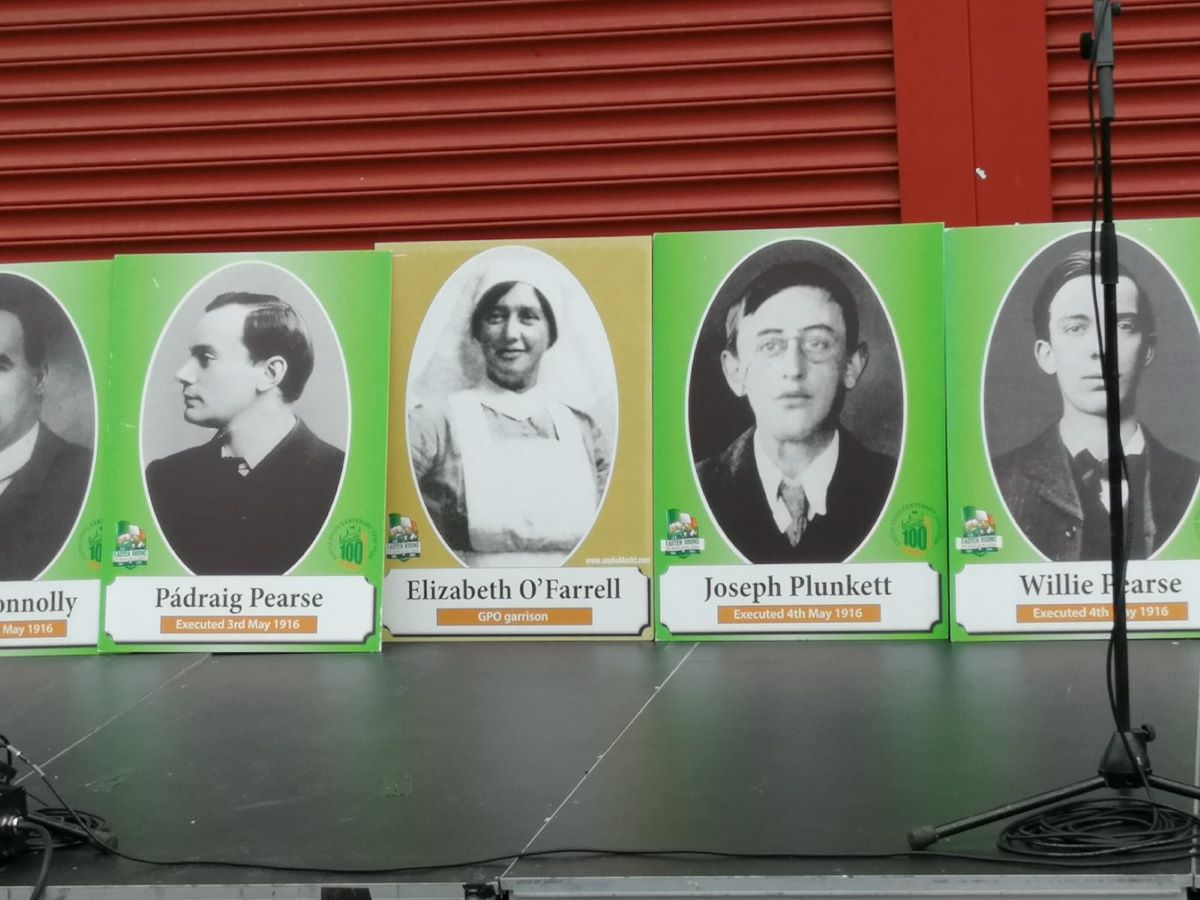
Fully in view, four prominent members of the Moore Street Garrison (L-R): Patrick Pearse, Commander-in-Chief; Vol. Elizabth O’Farrell, of Cumann na mBan; Vol. Joseph Plunkett, one of the planners of the insurrection; Vol. Willie Pearse, Adjutant to his brother Patrick. All but O’Farrell were tried by British court martial, sentenced to death and shot by British firing squad in Kilmainham Jail. (Photo: R. Breeze)

LEGISLATION & COURT CASES

2007 Nos. 14-17 Moore Street declared a National Historical Monument (but still owned by property developer Joe O’Reilly of Chartered Land)

2015 Darragh O’Brian TD (FF) – Bill Moore Street Area Development and Renewal Bill – Passed First Reading but failed Second in Seanad on 10th June 2015 by 22 votes against 16.

2015 – Colm Moore application — 18th March 2016: High Court judgement that the whole of the Moore Street area is a national historical monument.

2017 – February – Minister of Heritage application to Court of Appeal – judgement that High Court Judge cannot decide what is a national monument.

2021 — Aengus Ó Snodaigh TD (SF) – 1916 Cultural Quarter Bill – reached 3rd Stage of process; Government did not timetable its progress to Committee Stage and therefore no progress.

2024 – Property Developer Hammerson application to High Court Vs. Dublin City Council in objection to decision of elected Councillors that five buildings in the Moore Street area should receive Protected Structure status as of National Historical Heritage. Hammerson states that the decision is interfering with their Planning Permission. Case awaits hearing.

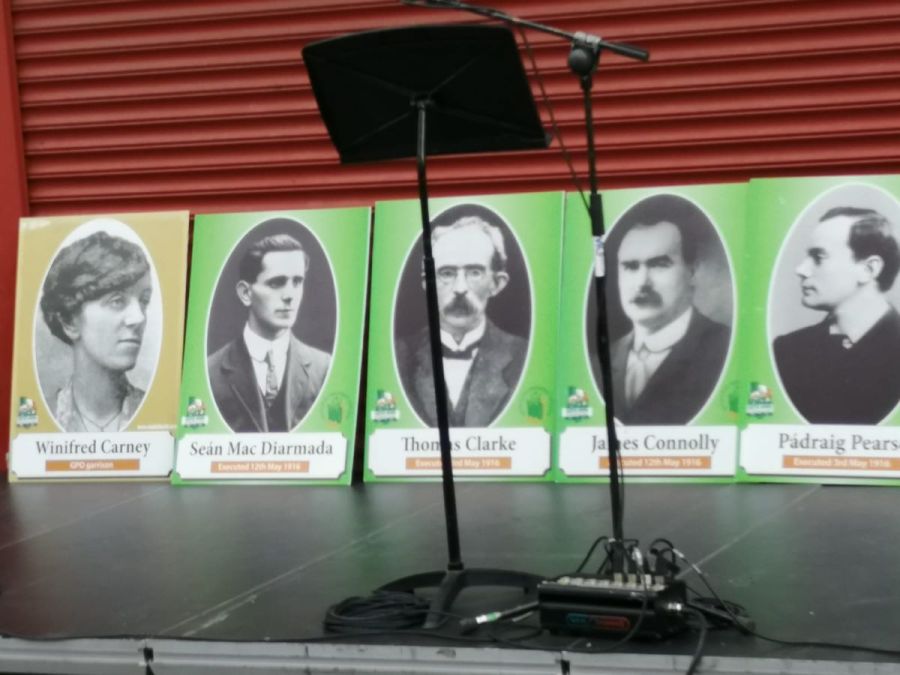
Five prominent members of the Moore Street Garrison (L-R): Vol. Winifred Carney of Irish Citizen Army and Cumann na mBan; Vol. Sean Mac Diarmada, one of the planners of the insurrection; Vol. Tom Clarke, one of the insurrection’s planners; revolutionary socialist James Connolly, Irish Citzen Army and Commandant General of the Rising (especially of Dublin); Patrick Pearse, Commander-in-Chie. All but Carney were tried by British court martial, sentenced to death and shot by British firing squad in Kilmainham Jail. (Photo: R. Breeze)

POSTSCRIPT

Someone commented later that in general the rally, from the content of most of the speeches, had been at least as much (if not more) of a Sinn Féin election rally as one for the conservation of Moore Street.

That should have been no surprise to anyone who knows that any position taken by Sinn Féin activists tends to be for the party first, second and third. And with the Irish general elections only weeks away, well …

And while Mac Donald spoke in Dublin of the importance of Ireland’s insurrectionary history and the need to conserve such sites, her second-in-command Michelle O’Neil was laying a wreath in Belfast in commemoration of the British who were killed in the First imperialist World War.

End.

AFRICA – MILITARY COUPS & DEMOCRACY

News & Views No.6 Diarmuid Breatnach (Reading time: 4 mins.)

The media has alerted us to a military coup taking place in an African country most of us won’t even have heard of: Niger.

Apparently Niger had a democratically-elected leader overthrown by the coup and many states, including France and the US, are very concerned about this. Naturally so. Military juntas are surely no fit replacement for democracy.

Map of much of Africa showing Niger in green and surrounding states (Source: Wikipedia)

But it turns out that the USA and France have other reasons to be concerned apart from questions of democracy: both states have military stationed there, the USA including in fact a major military installation producing and operating drones, some of which are armed.

But why are they there? Well, to defend Niger against fundamentalist Muslim jihadists. That’s good, right? Helping the Nigerien people. It’s true that some unkind (and possibly ungrateful) people accuse the US of having given birth to the islamist fundamentalists originally, but, well …

We learned just recently two very strange facts, side by side: 1) Niger is one of the poorest countries in the world and 2) it is the seventh-largest exporter of a highly-valuable material: uranium.

Niger also has gold mines (two years ago 18 people were killed in a mine collapse) but curiously, Niger has no gold reserves at all. France, on the other hand, which has no gold mines whatsoever had 2,437 tonnes of the metal in their reserves at the end of the second quarter of this year.

Uranium is valuable because it is used in the production of nuclear power which, in turn, in many parts of the world, is used to generate electricity. France being one of those countries, where 80% of its uranium comes from … Niger. And 20% of the EU’s electricity likewise.

Hmm. So there might be reasons apart from restoring democracy for France being so upset at the coup, especially when the coup leaders say they want to break with France.

Urban scene in Niger, exact location and date unknown (Source: Internet)

But going back to this country being one of the poorest in the world, at least they must have plenty of generated power, right? Well, no. It turns out that 80% of the people have no electricity supply whatsoever. Democratic government or not, that can’t be right, can it?

Anyway, France has ordered the coup leaders to reinstate the deposed president with a deadline of last Sunday or it would take stern action. The deadline has passed quietly without an invasion or other attack.

Niger was a colony of France and became independent in 1960 so it’s kind of strange that France has such a grip on the country still.

Another five states border Niger including Mali and Burkina Faso, also ex-French colonies, also under recent military coup juntas. Their leaders have said any attack on Niger would be considered an attack on them.

Algeria was also a French colony and fought a very hard liberation struggle for independence, since when it has friendly relations with Russia. Algerian armoured vehicles have moved to the border with Niger, in what will be understood as a warning to other states not to invade.

Chad is another ex-French colony in the region but it made some threatening noises against the military coup leaders in Niger; Senegal too is an ex-French colony loyal to France.

Senegal’s political opposition leader Ousmane Sonko is on hunger strike in jail and his lawyer Juan Branco, extradited from Mauritania is in jail too for defending Sonko but nobody seems to be shouting about Senegal’s lack of democracy – not that we can hear, at least.

The west-friendly (some say neo-colonial) state of Nigeria, the leading state in the pro-western African alliance COWAS has imposed sanctions and threatened to invade Niger if the previous regime is not reinstated. Nigeria is huge and with extremely valuable resources, including oil.

In 1995, in defence of British Petroleum’s operations, Nigeria hanged peaceful environmental activists in the Delta region, the Ogoni Nine. As many as 4 in 10 Nigerians live below the national poverty line with 133 million living in poverty, according to its own national statistics.

Regarding Africa and coups, we Irish have cause to remember the Congo where Irish UN peacekeeping soldiers were killed, after a military uprising in a province against the elected patriot Patrice Lumumba was carried out in support of Belgian mining interests, supported by the USA.

And Uganda’s military rule under Idi Amin was generally OK with the western powers until he began to throw his weight around against the British, who had trained and supported him, so they had to bring him down.

Supporters in Niger of the military coup there demonstrating. (Photo sourced: Internet)

Elsewhere, for example in Latin America, military coups in many countries including Brazil, Chile and Argentina have been supported by the western powers or indeed instigated by them. As in what is now Iran, when the British overthrew the Shah in 1941 to replace him with his son.

Dictatorship from 1965 in Indonesia was widely seen by the western powers as necessary to stop the spread of socialist and national liberation ideas and, as in most such coups, the toll in massacres and torture by the new regime was huge. None such in Niger though, at least so far.

If we were citizens of Niger would we think ourselves better off under a military junta rather than a democratically-elected President? We might initially be more concerned as to whether the riches of our country were to be used to lift us from such poverty.

To give us education, hospitals, medicines, food, work, clean water, refuge from heat, power … or instead extracted and shipped out to some other country.

And what would we think of France, possibly backed by other NATO countries and their client states, coming to invade our land and bring back the old state of affairs?

End.

Niger’s National Council for the Safeguard of the Homeland Colonel-Major Amadou Abdramane, center, is greeted by supporters as he arrives for rally at the Stade General Seyni Kountche in Niger’s capital city Niamey, on August 6, 2023.(Photo cred.: Rebecca Blackwell, AP)

News & Views No.2: EU CORRUPTION — ROT IS INEVITABLE IN THE FRUITS OF THE SYSTEM

Diarmuid Breatnach

(Reading time: 4 mins.)

The news that there has been corruption at a high level in the EU will have shocked no-one except the most ignorant and credulous. It is endemic in the capitalist system for large organisations to become corrupt.

We’ve heard of corruption in police forces, in domestic international sports and culture boards, even in management of charities and, of course, in governments. Those high places occupied by elites bring to their occupants a sense of entitlement beyond even the usual rewards.

WHICH CULPRIT STATE – OR STATES?

When the news first began to break, the reports were saying that the responsible state was unknown, though some speculated on Qatar. We certainly knew was that it wasn’t Israel, since that state gets access to the EU and other bodies without difficulty – but that’s political corruption, which is different.

The speculation is now solidifying around Qatar as the foreign power buying influence but increasingly Morocco is getting mentioned too. What results exactly Qatar is trying to buy is not clear at the moment and the same can be said for Morocco.

The latter state has been trying to normalise its occupation of Western Sahara despite Saharawi political and guerrilla resistance and the EU agreed to exploit Saharawi natural resources as “Moroccan” – until the EU Court of Justice ruled that agreement illegal last year.

Difficult to see what other gain Morocco can get from EU politicians with regard to Western Sahara – unless it’s going to buy some judges which, if it could, it would surely have done before now.

Meanwhile the USA has recognised Moroccan occupation in exchange for its recognition of Israel1.

UNDERMINING EU DEMOCRACY”

Among the expressions of concern and shock that were expressed from within the EU was the amusing one that the corruption was in danger of undermining democracy in the EU, which would presuppose that the organisation is a democratic one.

Some years ago, the Ministers of Labour of each member of the EU voted to extend the working age before pension entitlement. Of course, that was unanimous and therefore democratic – except that not a single one of those ministers took the question to their own electorate.

Of course not, knowing that the vote would be a resounding NO. Already too many people die before receiving their pension and those statistics are worse as one goes ‘down’ the social scale to manual workers and people in the ‘lower’ social groups2.

Eva Kaili, Greek MEP suspended under allegations of corruption in the EU (Photo cred: AP)

CONCERN ABOUT LOBBYING

It was also amusing to see the concern about money being spent on lobbying, which ALL big capitalist companies do – anywhere they hope to reap benefits, the EU being one of them. In 2017, Google spent nearly $ 7 million on lobbying in the EU, Microsoft tipping on $6 million.

But in lobbying terms, these sums would be considered small.

In the USA, an estimated 3.73 billion U.S. dollars was spent in 2019 -an increase from the 3.53 billion U.S. dollars in 2020 on lobbying its parliament, the House of Representatives.3

Much larger quid pro quo arrangements are made gaining access to markets and facilities through USA state politicians or, in the EU, through individual national states.

Irish politicians may for example offer a good factory site in Ireland, low tax, rent-free years, tax evasion in the company’s home state and of course access to an English-speaking highly-educated workforce. Would those politicians then vote against the company in the EU?

Since just about everything except air (so far) is a market commodity under capitalism, which is the world system, can it ever be possible to eradicate corruption anywhere in the world? It cannot and legislators know this; they seek merely to control it at an “acceptable” level.

Which means that even a socialist country is going to have corruption as long as it exists in a capitalist world.

EU Parliament building, Strasbourg (Photo accessed: Internet)

CORRUPTION IN CURRENT AND PROSPECTIVE EU STATES

Finally, discussing corruption and the EU reminds us that some European states have been criticised by the EU higher circles because of their endemic corruption. One of those is Hungary, which of course rejoiced in the ongoing scandal, declaring that the EU is no position to lecture them.

But it should remind us too that some years ago another European state was judged more corrupt than Hungary – in fact the most corrupt state in Europe. That was the Ukraine, whether under the control of pro-Western or pro-Russian oligarchs.

One of Zelensky’s election platform positions to depose Petro Poroshenko, the West’s choice for Ukranian President in the 2014 coup was to be anti-corruption. Has he cleaned up Ukraine? Hard to say since he controls the media and the opposition groups and individuals are banned or in jail.

But on the other hand, we do know from a number of sources that large amounts of western arms supplied to the Ukrainian regime are believed to be finding their way on to the black market. Yet opposition to Ukraine’s membership of the EU has suddenly melted away.

Which might be an appropriate point at which to remind ourselves again that there is another kind of corruption, other than financial, usually linked to the latter but not always directly — and that’s political corruption.

Corruption is inevitable in fruits of the system because the very seed is contaminated.

End.
FOOTNOTES

1One of Trump’s last decisions on his way out in 2020 but not rescinded by Biden.

2 “Research for former pensions minister Malcolm Wicks has shown that 19% of men from the lowest social classes, including cleaners and manual labourers, die before the age of 65 compared to just 7% of men from the highest social group. It also highlighted that 10% of women from poorer backgrounds die before they reach 60 compared with 4% of women from a better off demographic.” Fifth of men die before state pension age – Investment Sense

3 “In 2021, the total lobbying spending in the United States amounted to 3.73 billion U.S. dollars. This is an increase from the 3.53 billion U.S. dollars spent on lobbying in 2020.” Total lobbying spending U.S. 2021 | Statista

SOURCES

Police raid more European Parliament offices in corruption probe (breakingnews.ie)

Fifth of men die before state pension age – Investment Sense

Chart: The Companies Spending the Most on EU Lobbying | Statista

Total lobbying spending U.S. 2021 | Statista

WEAPONS SENT TO UKRAINE:

https://www.globalresearch.ca/us-weapons-ukraine-would-entering-black-market/5780918

How Western arms find their way onto the black market through Ukraine — RT EN by Andrei Restzhikov and Michael Moschkin (detv.us)

Many of Western arms in Ukraine will end up in black market: Interpol (presstv.ir)

What happens to weapons sent to Ukraine? The US doesn’t really know | CNN Politics

BRITISH STATE TERROR-BOMBING OF DUBLIN COMMEMORATED

Clive Sulish

(Reading time: 4 mins.)

The 1974 British Intelligence and Loyalist bombing of Dublin and Monaghan towns, with the highest number of people killed in one day during the 30 Years’ War, was commemorated in Dublin today at the Memorial in Talbot Street, near the corner with Amiens Street. The commemoration, organised by the perennial Justice for the Forgotten campaign, was addressed by the Taoiseach (Irish Prime Minister) and elected representatives of Dublin and Monaghan municipalities. A poet and two musicians performed, wreaths were laid and one former politician gave a strong oration highly critical of the Irish, British colonial and British authorities.

On 17th May 1974, around the work-leaving and shopping-ending busy time of 5.30pm, three car bombs exploded within minutes of each other in the centre of Dublin. The car bombs had been parked in the mainly working and lower-middle class sParnell Street, Talbot Street, and South Leinster Street (as distinct from such streets as Henry, Grafton or Dawson streets, for example). Twenty-six people were killed in Dublin. To cover their way back across the British border, another car-bomb was set off in Monaghan Town, killing another seven. Even excluding a full-term unborn child, the total death toll was 33, the highest number killed in any one day of the three decades of conflict. Around 300 were injured.

Suspicion should naturally fall in the first place on the British Loyalists, since they had been planting bombs in Dublin since 1969 and in 1972 and 1973 their bombs had killed Dublin public transport workers. But the authorities had pretended to believe that the IRA was responsible for the 1972 bombing and used the panic around it to steamroll repressive political legislation through the Dáil, thereby setting up the no-jury Special Criminal Courts to sent Irish Republicans to jail.

However, it is believed that Irish Army Intelligence and Garda Intelligence were quickly aware that the Dublin and Monaghan bombers had in fact been Loyalists of the Ulster Volunteer Force and even knew the names of a number of them.

The Irish parliament‘s Joint Committee on Justicecalled the attacks an act of international terrorism involving British state forces.The month before the bombings, the British government had lifted the UVF’s status as a proscribed organisation.

No one has ever been charged with the bombings. A campaign by the victims’ families led to an Irish government inquiry under Justice Henry Barron. His 2003 report criticised the Garda Síochána‘s investigation and said the investigators stopped their work prematurely. It also criticised the Fine Gael/Labour government of the time for its inaction and lack of interest in the bombings. The report said it was likely that British security force personnel or MI5 intelligence was involved but had insufficient evidence of higher-level involvement.” (Wikipedia)

Incredibly, despite long-standing allegations of collusion between the colonial police, the RUC (now the PSNI) and Loyalists, the Gardaí sent the car-bomb remnants to the RUC for analysis. Shortly after that, Ned Garvey rose from the Deputy position to Gárda Commissioner and met with a British secret agent in his office – without informing his superiors. When the agent began to blow the whistle on his past activities he exposed Garvey as a British “asset” – Garvey of course denied it but had to admit he had indeed met clandestinely with the agent in his office. When the Fianna Fáil goverment came in, they sacked Garvey as “not having confidence” in him but did it so baldly and outside established procedures that Garvey was able to take the Government to court, have his pension secured and have damages awarded to him!

BRITISH POLICY OF COLLUSION WITH LOYALIST MURDER GANGS

Most experts have been clear that construction of the type of bomb used was beyond the capability of the Loyalists at that time and, in any case, it is clear that British Intelligence and military were working with Loyalist gangs, as were the RUC (some of whom were members of the gangs) and RUC Special Branch. In addition there were reports of British accents in connection with suspects.

Collusion of that type had been openly advocated by a British military expert on counter-insurgency, Major (later Brigadier) Frank Kitson, for example in his “Gangs and Counter-gangs” (1960), based on his experiences in fighting the Kenyan insurgency for national liberation.

Frank Kitson (now Brigadier) in 1971 (Photo source: Internet)

Brigadier Frank Kitson was operational commander of the occupation forces in the British colony from 1970-’72 and left a substantial legacy of military assassinations and collusion with Loyalist murder gangs, along with other “dirty war” operations before he went on to lecture at British military training college.

….. the de Silva Report (2013) on collusion with loyalist paramilitaries led to two further ‘unconditional’ British apologies for the behaviour of its security forces in Northern Ireland. In November 2013, a BBC ‘Panorama’ investigation into British counterinsurgency in Northern Ireland in the early 1970s revealed that members of a special covert operations unit known as the Military Reaction Force (MRF) admitted to the murder of suspects and unarmed Catholic civilians. These admissions by the state or its agents confirm previous claims by critics dating back many decades. Such abuses were not merely low-level tactical excesses by undisciplined and racist troops but were institutional, systematic, and approved or covered up at the highest levels ….”1

The British State has admitted it has secret papers relating to this atrocity but has refused to hand over copies to successive Irish goverments.

THE LARGEST MASS MURDER IN THE HISTORY OF THE STATE”

Maureen O’Sullivan, ex-TD (Member of Irish Parliament) for the local area gave the main oration for the Justice for the Forgotten Campaign and called the bombing “the largest mass murder in the history of the State”. She went on to castigate successive governments and most of the political class for their lack of interest in pursuing the planners and perpetrators of the massacre over the years. In her repeated reference to their “ignorance”, O’Sullivan inferred that the legislators’ lack of interest was such that they could not even be bothered to inform themselves of the known facts.

Maureen O’Sullivan castigating the authorities (Photo: Rebel Breeze)

In addition to the Taoiseach, the Ard-Mhaora of Dublin and Cathaoirleach of Monaghan Council spoke and a Catholic priest delivered a short blessing. The event was chaired throughout by a representative of the Justice for the Forgotten campaign group.

Rachael O’Hegarty introduced and recited one of her collection of poems about the victims, this one about Maureen Shields who was 44 years of age when she was killed in Talbot Street.

Rachael O’Hegarty speaking and reciting her poem (Photo: Rebel Breeze)

Cormac Breatnach and Eoin Dillon on whistles played Sí Beag, Sí Mór and later Dillon playing the lament known as Táimse I Mo Chodhladh (I Am Asleep), accompanied by Breatnach on whistle, concluded the event.

Cormac Breatnach and Eoin Dillon on whistles (Photo: Rebel Breeze)
Eoin Dillon on uileann pipes and Cormac Breatnach on whistle (Photo: Rebel Breeze)

THE BOMBINGS EXPOSED THE NEO-COLONIAL NATURE OF THE IRISH CAPITALIST CLASS

In summary, a foreign power — which is also occupying by force one-sixth of Ireland — carried out a number of terrorist attacks in the capital city of the Irish State culminating in a massacre intended to cause maximum loss of life and limb – “the largest mass murder in the history of the Irish State”, as Maureen O’Sullivan correctly characterised it.

The Irish ruling elite failed to stop the escalating attacks and turned the investigation of the massacre into a farce. The Irish ruling elite failed to prevent the foreign power subverting the highest rank of its police force (and no doubt other levels in other areas).

Section of the crowd at the commemoration, the Taoiseach, Mícheál Martin speaking (Photo: Rebel Breeze)

The Irish ruling elite failed to take a full range of diplomatic and legal action to condemn the UK, the foreign power over its actions and failure to respond to requests for release of relevant secret papers. The ruling elite continues in that failure today as can be read into the weak speeches of Government Ministers at this ceremony – this time by the Taoiseach and last time the Minister for Justice.

No self-respecting elite or ruling class of any independent state would permit such violations of the security of its capital city and citizens without taking resolute and persistent action. The Irish ruling class is a neo-colonial capitalist class, undeserving even within capitalist terms to be in charge of any Irish state.

The north side of the Memorial (Photo: Rebel Breeze)
The south side of the Memorial (Photo: Rebel Breeze)
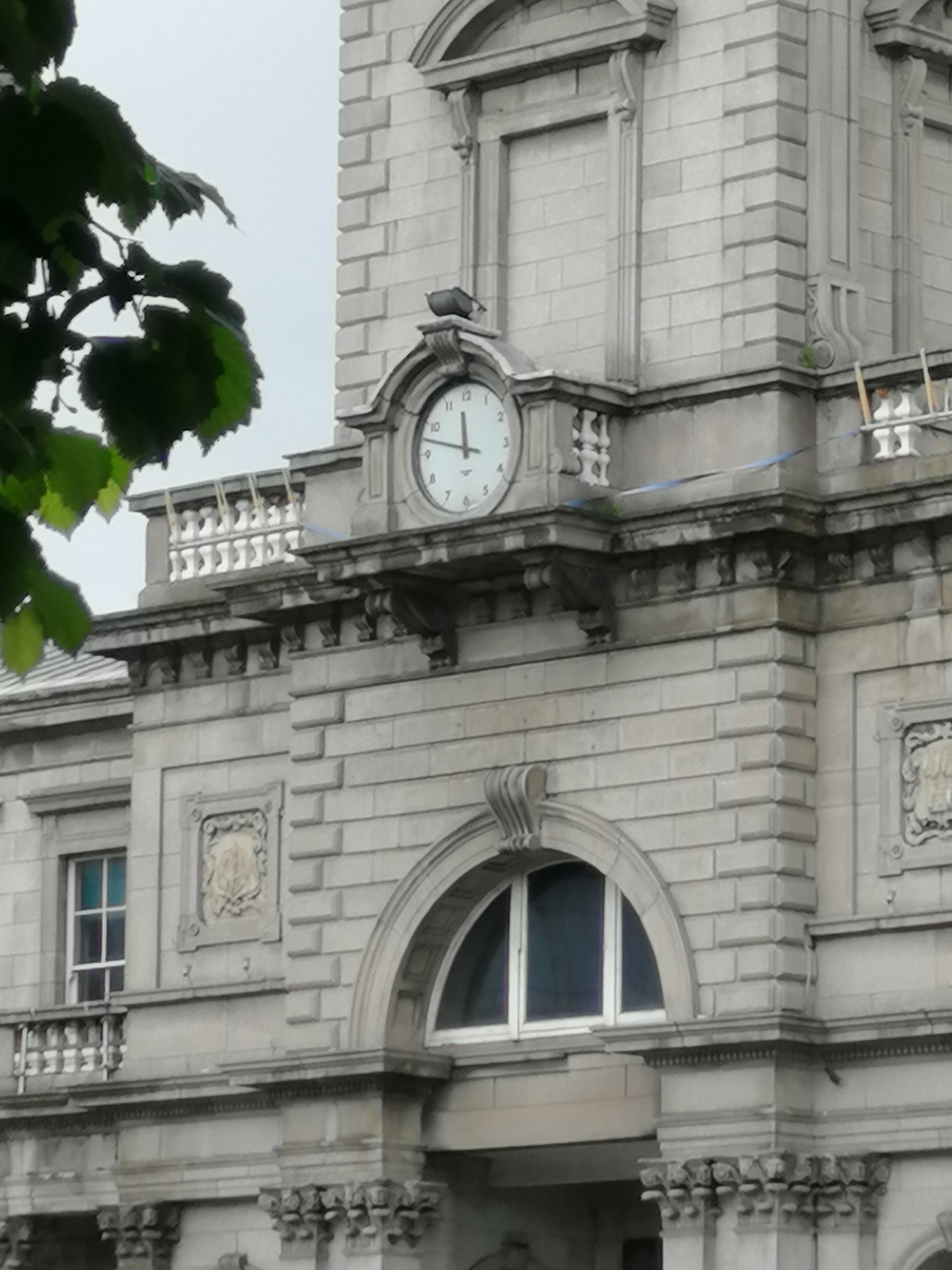
The clock on the tower of Connolly (formerly Amiens Street) Station — British soldiers fired a machine gun from that tower at Irish insurgents in 1916. (Photo: Rebel Breeze)

FOOTNOTES

SOURCES & USEFUL LINKS

Justice for the Forgotten campaign: http://www.dublinmonaghanbombings.org/home/

Media reports of commemoration:

https://www.irishtimes.com/news/politics/dublin-and-monaghan-bombing-failed-in-its-objective-says-taoiseach-1.4880954

https://www.lmfm.ie/news/lmfm-news/event-takes-place-to-commemorate-dublin-and-monaghan-bombings/

Taoiseach Mícheál Martin speech: https://www.gov.ie/en/speech/3b971-speech-by-the-taoiseach-micheal-martin-td-at-the-48th-anniversary-commemoration-service-for-the-victims-and-families-of-the-dublinmonaghan-bombings/

https://www.independent.ie/irish-news/politics/taoiseach-criticises-british-government-inaction-on-48th-anniversary-of-dublin-and-monaghan-bombings-41658511.html

https://en.wikipedia.org/wiki/Dublin_and_Monaghan_bombings#Allegations_of_British_Government_involvement

British military collusion with Loyalist paramilitaries: https://www.historyireland.com/frank-kitson-northern-ireland-british-way-counterinsurgency/

Kitson tactics: https://www.kalasnyikov.hu/dokumentumok/frank-kitson-gangs-countergangs.pdf

1https://www.historyireland.com/frank-kitson-northern-ireland-british-way-counterinsurgency/

“DEADLY CUTS” FILM IS … DEADLY

Clive Sulish

(Reading time: 4 mins.)

“DEADLY CUTS” FILM IS … DEADLY1

Michelle (Angeline Ball) runs a hairdressing salon in Piglinstown, a fictional Dublin city suburb that looks like Finglas3 and the area is suffering the attention of a local gang of thugs led by Deano (Ian Lloyd Anderson). The Gardaí4, represented by one individual played by Dermot Ward, are ineffectual in dealing with local crime and seem also well-disposed to a local politician, a Dublin City councillor, whose solution to the area is demolition of a parade of shops, including the hairdressing salon, followed by redevelopment. Michelle’s staff are Stacey (Ericka Roe), Chantelle (Shauna Higgins) and Gemma (Lauren Larkin).

Playing smaller roles are the local butcher Jonner (Aaron Edo), along with owners of the fish and chip shop, the local pub, pub entertainment organiser and three elderly ladies in particular.

Darren Flynn (Aidan McArdle) is the local politician, a Dublin City Councillor, who lets slip later in the film that he has a lot of property speculators waiting to get their hands on the area. Of course, in real life, nothing like that would happen in Dublin City Council, among the Councillors or the City Managers, would it? Quite apart from that, one must feel some sympathy for a certain Dublin City councillor who must surely wince every time he hears “Councillor Flynn” mentioned in the film’s dialogue.

(Image sourced: Internet)

If you know Dublin working and lower-middle class suburbs then some of the visual scenes will be familiar, the streets of housing, the green area, short strips of shops, including the chipper, the cheeky kids on bikes, the pub as a social centre. But for women the hairdressing salon plays a social role too as one can see from the varied ages and requirements of the customers. There was a time in some areas when the local barber shop played the same role for men, the waiting customers, the customer in the chair and the barber all taking part in the same conversation.

You’ll know too that unemployment tends to be higher in such areas and that there are social problems in particular with bored and disengaged youth, drug-taking and selling …. but not necessarily more of the taking than occurs in middle-class areas, particularly when the young people start clubbing.

Areas that could do with regeneration around the local community are not unusual in and around Irish cities but when that regeneration takes place it’s usually for another class – the gentrification project. That’s what’s in store for Piglinstown, if Mr. Flynn and his invisible property speculators have their way. This film is making its debut at a time when property speculators are visibly running wild over Dublin, building hotels, residential apartment and student accommodation blocks (of which most students can’t afford the rents), meanwhile destroying communities, cultural amenities and historical sites. And Dublin City Managers are giving the go-ahead for these planning applications while An Bord Pleanála regularly turns down appeals or moderates the application somewhat but rarely in essence.

The highpoint of the film both in tension and in flash and showbiz buzz is the Ahh Hair competition, which the Piglinstown hair dressing salon wants to win in order to boost their profile and avoid demolition by the speculators. Here Pippa (Victoria Smurfit) plays the vicious upper-class nasty with abandon, aided by her three familiars, the snooty Eimear (Sorcha Fahey) chief among them, many hands in the film’s audience surely itching to slap. Nor is the nastiness only verbal.

Snooty upper-class hair stylist Pippa, played by Victoria Smurfit, at the Ahh Hair competition. (Image sourced: Internet)

But it is also high satire, from Thommas Kane-Byrne as Kevin, the camp announcer and poseur judges with ridiculous hyperbole, including the star hairdresser D’Logan Doyle (Louis Lovett), to the cheering hooray henry and henrietta types in the audience. Even the finalist hairdressing creations would be to most people ridiculous, as are some of the creations and installations that win the annual Turner prize. Are the real hairdressing competitions anything like this?

Among the actors, it’s good to see Angeline Ball who charmed us in The Commitments (1991), 30 years ago and still looking good as the salon owner Michelle and Pauline McLynn who insisted in the eponymous series that Father Ted would have a cup of tea, “Ah, you will, you will, you will”. Comedienne Enya Martin, from Giz a Laugh sketches plays the staff’s somewhat sluttish friend.

The Deadly Cuts salon team in film promotion poster (Image sourced: Internet)

As I noted earlier, most reviewers have given the film high marks for entertainment value – not so Peter Bradshaw, who dealt it savage cuts in the Guardian and gave it only two stars out of five. “With violent gangsters, a gentrification storyline and a hairdressing competition, this movie can’t figure out what it wants to be.” Really, Peter? It seems to me that the film is all those things and manages them well within an overall comedic form, something like Dario Fo and the problem is that you just don’t get it.

The incidental music is a series of lively hip hop by clips from different artists, including the mixed English-Irish language group Kneecap. These should have your foot tapping and body swaying as you follow the plot and the dialogue, smoothly edited from scene to scene, laughing and occasionally shocked.

The resolution of the Piglinstown community’s problems in the film is as drastic as unlikely, (however much some viewers may agree with it). But the film is a very enjoyable and if you haven’t seen it already, I strongly recommend you do so.

End.

FOOTNOTES

1“Deadly” was a common Dublin slang expression which has fallen out of use but would still be recognised by many; in the way that much counter-culture slang uses the opposite from an accepted term, “deadly” meant “excellent” and is being employed here in that sense.

2Notably at the moment threats of demolition to the street market and historical site of Moore Street, part of the traditional music pub the Cobblestone and to the laneway at the Merchant’s Arch.

3In fact, Finglas’ in one of the communities acknowledged in the credits, the other being Loughlinstown.

4Police force of the Irish state.

SOURCES

https://www.imdb.com/title/tt11366736/

https://www.rte.ie/entertainment/movie-reviews/2021/1008/1251092-irish-comedy-deadly-cuts-is-a-cut-above-the-competition/

https://www.rottentomatoes.com/m/deadly_cuts

https://www.dublinlive.ie/news/celebs/giz-laugh-comedian-enya-martin-21694809

https://www.theguardian.com/film/2021/oct/06/deadly-cuts-review-ortonesque-dublin-comedy-thats-more-silly-than-funny

USA DEMOCRATS AND COLOMBIA: BUSINESS AS USUAL

By GEARÓID Ó LOINGSIGH

(Reading time: 8 mins.)

— BOGOTA — The recent election of Joe Biden as president of the U.S. has been met with a round of applause from left reformist currents in Colombia, some even eager to claim Biden as one of their own. Underlying such praise is the notion that the Democrats are more progressive and will treat Colombia fairly, or at least better than the Republicans. There is no evidence on which to base such a claim.

Historically, some of the greatest blows to Colombia have come from Democratic administrations, starting with the smiling, handsome, charismatic JFK, whose policies left few smiling in the country. It was under JFK that two U.S military delegations visited the country and made recommendations that the Colombian state set up armed civilian groups, which are now commonly referred to as paramilitaries. By 1965, Colombia introduced legislation to give effect to those proposals and thus began a long sordid history of the state setting up death squads and providing them with legal status.

Of course, JFK was a long time ago, some would argue, though obviously no Democrat would countenance publicly criticizing him on such matters. Many of those who rushed to endorse Biden are unaware of this aspect of their history, but not so, the leading politicians such as Senator Gustavo Petro, a former mayor of Bogotá and the most successful left-wing candidate for the presidency ever. They are only too aware of the history of paramilitary violence in the country, yet prefer to ignore it on the altar of realpolitik.

The most recent embodiments of charming, handsome U.S. presidents also get a free pass now, just as they did when they were in power. Bill Clinton is perhaps the most notorious of recent U.S. presidents whose policies can be measured in bodies, forced displacement, and the mass destruction of the environment through the aerial fumigation of coca crops. Clinton was the architect of Plan Colombia, a massive supposed anti-drugs policy, which strengthened the Colombian military and under the guise of a concern for public health helped the Colombian military gain the technical and logistical capacity to wage war, including the expansion of paramilitary units throughout the country.

“Handsome US Presidents”, in particular Democratic ones, have helped Columbian ruling circles carry out a murderous reign of terror against social activists. (Photo source: Internet)

Plan Colombia was of course, implemented by George W. Bush as Clinton finished his second term shortly after concluding the agreement, a sign that policy on Colombia has always been bipartisan. When Clinton announced the initiative he lied. He stated that the motives were public health ones and that cocaine was killing 50,000 people per year in the U.S., when at the time the CDC put the figure for all deaths from all drug abuse, excluding alcohol and tobacco, but including legal pharmaceuticals at just over 15,000. Alcohol alone doubled that figure.  The ruse worked and Congress passed Plan Colombia, thanks in part to Biden, who fought for the plan in the Senate Foreign Relations Committee. Clinton finished his term with controversial presidential pardons, including Marc Rich, but in Colombia, he is remembered for his clemency deal with Harvey Weinig, a U.S. lawyer convicted of laundering $19 million for the Cali Cartel.[1]  Whilst attacking impoverished farmers, he indulged the wealthy individuals higher up the chain.

Thanks to the Plan, paramilitaries swept through the country taking over, not only rural areas, but some major urban centers. The Colombian military was in a position to aid them in that and also hold on to those areas, once the dirty work had been done. Their first targets were areas of military and economic strategic importance, with gold and oil deposits and also areas that were earmarked for major transformations in the rural economy. As part of this drugs initiative, peasants were “encouraged” to switch crops. Plan Colombia financed major agribusiness projects, particularly African Palm, and in preparation for the Free Trade Agreement that would be signed under Bush but come into effect under Obama, the country geared its agricultural production toward export markets and opted for importing basic food staples such as rice, beans, and cereals. For example, corn imports from the U.S. began to decline notably from 2008 onwards, but once the FTA came into force in 2012 under the Obama administration, the year of the lowest amount of corn imports in a long time, they quickly increased and by 2016 almost doubled the figure for 2008. By 2018, 80% of all corn consumed in Colombia was imported and barely 20% was produced nationally.

Thanks to Bill Clinton and Obama, Colombia is now one of the major recipients of military aid. Between 2001 and 2019, it received $9 billion in aid, just over 66% of it under the guise of anti-narcotics aid.[1] All anti-narcotics operations in Colombia involve the deployment of ground troops following the strafing of farms by helicopters, displacement of peasant farmers, threats and not infrequently the murder of leaders in the areas. Furthermore, many of these soldiers involved in operations were trained by the U.S. In the same period, 107,486 Colombian military personnel received training from the U.S., making it the largest recipient of such training followed by Afghanistan.[2]Both the aid and training reached their peak under Bush, as part of Clinton’s Plan Colombia, but continued steadily under Obama, though government to government and private arms sales peaked under Obama.

Barak Obama when he was US President with Vice-President, now President Joe Biden. Obama’s presidency was a disaster for the Colombian people and his running mate then, now President too, looks set to follow in his footsteps. (Photo source: Internet)

Nothing could stop Biden and Obama from backing their murderous ally to the south, not even the False Positive scandal. The so called False Positives entailed the luring of young men to rural areas with the promise of work, who were then dressed up in military uniform and executed and presented to the media as guerrillas killed in combat. Amongst the victims were impoverished working-class men, children with cognitive impairments, and even included the kidnapping and murder of professional soldiers recovering from wounds received in combat. The scandal broke in 2008, following the murder of 22 young men from the city of Soacha.

In his preliminary report the UN Special Rapporteur Phillip Alston stated: “But there are two problems with the narrative focused on falsos positivos and Soacha. The first is that the term provides a sort of technical aura to describe a practice which is better characterized as cold-blooded, premeditated murder of innocent civilians for profit. The second is that the focus on Soacha encourages the perception that the phenomenon was limited both geographically and temporally. But while the Soacha killings were undeniably blatant and obscene, my investigations show that they were but the tip of the iceberg.”[3]

He did say they were widespread but not official state policy. However, every soldier who killed one of these young men was paid a bonus by the then Minister of Defense, Juan Manuel Santos, who would become president in 2010. Santos enjoyed the support of Biden and Obama during his tenure and although he began peace talks with the FARC guerrillas in 2012, his regime never stopped murdering social leaders. From 2012 to 2018, 606 social leaders were murdered; there were a further 3371 other acts committed against these leaders, including threats, displacements, and prosecutions. None of this caused Biden or Obama to express their concern. It was business as usual for them. The total number of False Positives is now calculated to be in the region of 10,000 youths, and despite Alston’s diplomatic statement that it was not official policy, no one buys that. We are not even sure whether Alston himself could stand by that statement, outside of his role as a UN diplomat.

It is true that the current regime in Colombia, under Duque, is but a mere remold of the Uribe governments (2002-2010), and the situation has deteriorated in the country. Duque openly backed Trump, and Colombian government officials illegally intervened in the U.S. elections, calling for votes for Trump in Florida. So brazen was their involvement, the U.S. ambassador to Colombia, Phillip S. Goldberg, publicly warned them against campaigning.[5] There may well be a reckoning of some sort with Duque on this point, but it is unlikely that there will be any major change in policy towards the country.

President Iv√°n Duque (L) of Colombia speaks during a meeting with US President Donald Trump at the United Nations in New York September 25, 2018. (Photo by Nicholas Kamm / AFP) (Photo credit should read NICHOLAS KAMM/AFP/Getty Images)

Duque may well be publicly chastised by Biden and given a few well-placed mediatic slaps across the face. It will be mere window dressing. Prior to the implementation of Plan Colombia, Clinton sought and obtained the disbandment of the Colombia’s notorious XX Brigade; charged with intelligence and counterintelligence, it was an exercise in public relations. It did not affect intelligence agencies’ role in the murders, torture, forced displacement, and disappearances, nor the spying on left-wing politicians and human rights organizations, which continues unabated to the present day. On Colombia, the Democrats are very media friendly and good at dressing things up.

The war on drugs is likely to continue in one form or another, and though some left reformists hope that Biden will pressure Duque to restart the stalled peace process with the ELN guerrillas, it is unlikely. During the talks with the FARC, Biden and Obama wouldn’t release from a U.S. jail the FARC commander Simon Trinidad, in jail for his supposed role in the capture and imprisonment of three U.S. Dyncorp mercenaries. The ELN do not represent the same military threat that the FARC did. They are less militarist and much more political, and any threat they may represent is in the political arena. But they have long attacked U.S. companies and oil pipelines, and such attacks may be used as an excuse for further increases in military aid and greater involvement in the conflict. U.S. troops are already involved in the protection of the Caño Limón-Coveñas pipeline as it passes through the ELN stronghold of the department of Arauca. It will be very much business as usual under Biden.

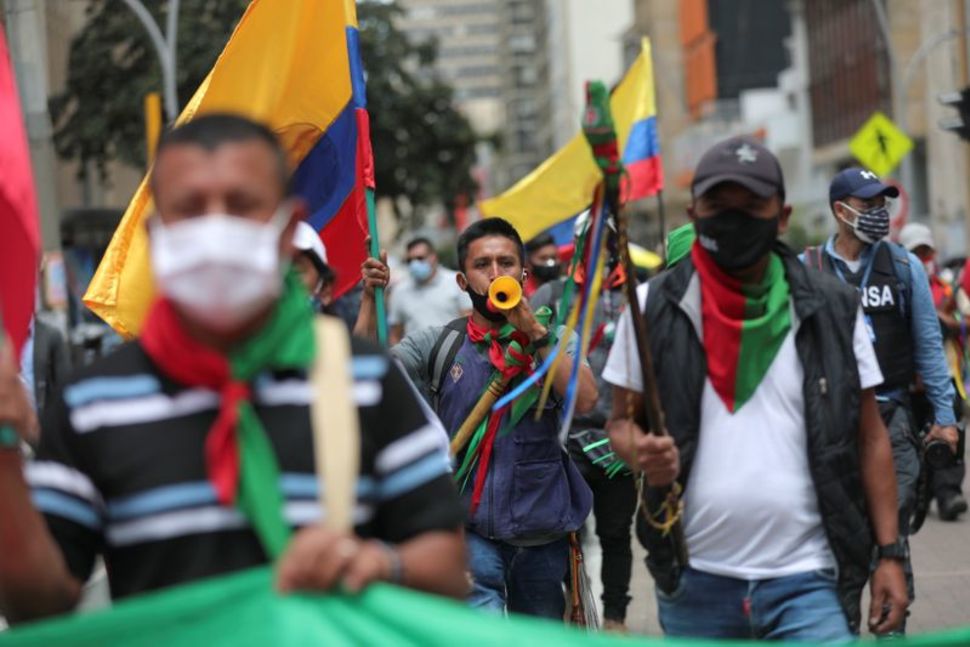
Top photo: Protesters march against President Iván Duque’s policies, including police brutality and disappearances of political activists, in October 2020 in Bogotá. (Louisa Gonzalez / Reuters)

Sources:


[1] The New York Times (04/14/2001) SPECIAL PLEADING; A Felon’s Well-Connected Path to Clemencyhttps://www.nytimes.com/2001/04/14/nyregion/special-pleading-a-felon-s-well-connected-path-to-clemency.html

[2] Statistics taken from https://securityassistance.org/

[3] Ibíd.,

[4] Alston, P. (2009) Statement by Professor Philip Alston, UN Special Rapporteur on extrajudicial executions – Mission to Colombia 8-18 June 2009.https://newsarchive.ohchr.org/EN/NewsEvents/Pages/DisplayNews.aspx?NewsID=9219&LangID=E

[5] The Guardian (27/10/2020) US embassy warns Colombian politicians not to get involvd in US electionshttps://www.theguardian.com/world/2020/oct/27/embassy-warns-colombian-politicians-us-elections

Government Collusion in Attack on American Capitol Raises Many Disturbing Questions

Geoff Cobb

(Reading time: 5 mins)

Back in November, I was horrified enough by an orgy of violence at a Pro-Trump march to write a column exposing it, but never in my wildest dreams could I have imagined the horrific scenes that unfolded on television Wednesday January 6th. Millions of Americans watched in disbelief as tens of thousands of Neo Nazis, White Supremacists and other members of the extreme Right invaded the Capitol. A horrified CNN presenter asked the question that was on everyone’s mind: where is the National Guard and law enforcement? Black Lives Matter protestors asked: why was their peaceful march in Washington met by a huge National Guard and police presence, while these same forces were nowhere to be seen as violent white supremacists ran amok?

Trump supporters all along stairs at front of the Capitol building, the seat of the USA legislature. (Source: Internet)

Looking at the complete lack of preparations for the violent mob which swarmed the Capitol on Wednesday, it may have seemed like bad planning. However, it’s becoming more and more obvious that the lack of security was absolutely intentional. 

The attacks that took place should have surprised no one. The extensive multi-billion dollar security apparatus ignored several red flags. Plotters in on-line far-right forums explicitly discussed how to storm the building, handcuff lawmakers with zip ties and disrupt the certification of Joe Biden’s election — in what they portrayed as responding to orders from President Trump. Trump supporters exchanged detailed tactical advice about what to bring and what to do once they assembled at the Capitol to conduct “citizen’s arrests” of members of Congress. One poster said, “[expletive] zip ties. I’m bringing rope!” Online chatter was organized, in some cases, around hashtags such as #StormTheCapitol and included threats to kill congressional leaders.

The violence that occurred was orchestrated at the highest levels of the Trump administration. Trump made sure that the Pentagon would not provide necessary forces to protect the nation’s capital against the assault he was orchestrating. Shortly after losing the election in November, Trump began replacing Pentagon officials. Principled leaders were dismissed as Trump packed the Pentagon with sycophants who had demonstrated blind loyalty to him. The new appointmentss included bringing in disgraced former Gen. Anthony Tata, Islamophobic right-wing radio host Frank Wuco, and conspiracy theorist Rich Higgins. A day after positioning this trio, Trump replaced the Chief of Staff at the Pentagon with former Devin Nunes staffer Kash Patel. On the same day, he forced out the undersecretary of Defense for Intelligence

Last Wednesday’s assault on the Capitol seemed that the Government was caught unprepared, but the lack of response was carefully crafted. Trump made certain to get rid of those officials who had resisted efforts to use active military troops against Black Lives Matter protestors over the summer. When the violence started last Wednesday, Trump’s lackeys at the Pentagon blocked repeated requests from D.C. Mayor Muriel Bowser for the use of the National Guard to contain Trump’s “wild” protest and continued blocking it, even as Senators and Representatives were frantically phoning from inside the besieged Capitol. This was not a spontaneous event. It was, in every way, a plotted coup and the Pentagon was part of it.

While exactly what happened still remains murky it is now clear that the Pentagon limited the Washington D.C. National Guard to managing traffic. Foreseeing violence, D.C. Mayor Muriel Bowser requested support in advance of Trump’s rally, but the Department of Defense said that the National Guard could not have ammunition or riot gear, interact with protesters except in self-defense, or otherwise function in a protective capacity without the explicit permission of acting Secretary Christopher Miller, whom Trump put into office shortly after the election after firing Defense Secretary Mark Esper.

When Capitol Police requested aid early Wednesday afternoon, the request was denied. Defense officials held back the National Guard for about three hours before sending it to support the Capitol Police. Maryland Governor Larry Hogan, a Republican, tried repeatedly to send his state’s National Guard, but the Pentagon would not authorize it. The National Guard of Virginia was mobilized only when House Speaker Nancy Pelosi called the Governor, Ralph Northam, herself.

There was also a personal angle to holding back the National Guard. Bowser was harshly critical of Trump in the summer, and the Pentagon got revenge on her by denying help when she needed it. A White House adviser told New York Magazine’s Washington correspondent Olivia Nuzzi that Trump was watching television coverage of the siege and was enthusiastic, although he didn’t like that the rioters looked “low class.” Many people called for Trump to make a statement urging his followers to desist, but for hours Trump said nothing.

As the assault on the Capitol unfolded, Capitol Police Chief Steven Sund, who resigned on Thursday, made “an urgent plea” for a 200-member rapid response force to rush to the Capitol building. However, an official from the office of the Secretary of the Army replied that “wasn’t going to be possible.” As a reason, that official said the Pentagon didn’t like the “optics” of Guard members entering the Capitol—even though the building was at that point surrounded by thousands of Trump supporters who had forced their way through multiple levels of police security. It wasn’t until Trump supporters had actually stormed the building, smashed their way into the chambers of Congress, ransacked congressional offices, and prowled the halls hoping to take political leaders hostage, that the Pentagon finally approved the use of National Guard forces.

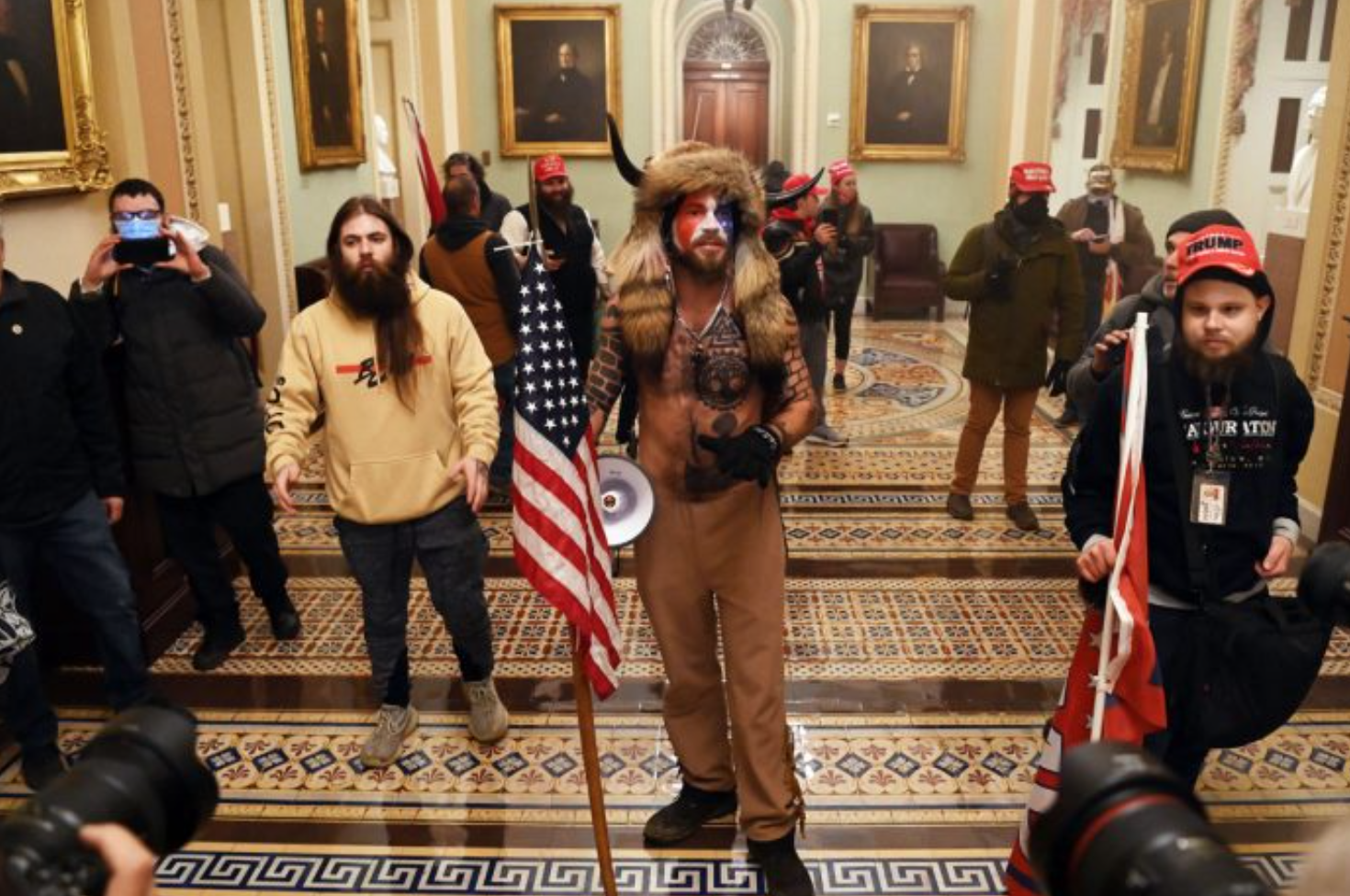
US Far-Right activists and supporters in possession of the Capitol, building of the Legislature of the USA on 6th January 2021. (Source: Internet)

On Thursday, Army Secretary Ryan McCarthy ludicrously claimed the military had “acted as quickly as possible” and that officials hadn’t anticipated the level of violence demonstrated by Trump supporters in their “wildest imagination.” If so, they were the only ones. Trump encouraged exactly this type of action, and many others warned of the potential for violence. In fact, many of the same groups that rioted in December planned another orgy of violence for the bigger event that Trump was already advertising for January 6th.

Perhaps the prime target of the Capitol rioters was Vice President Mike Pence who had refused to block the certification of Biden’s election as president. While the rioters were in the Capitol, Trump tweeted: “Mike Pence didn’t have the courage to do what should have been done to protect our Country and our Constitution, giving States a chance to certify a corrected set of facts, not the fraudulent or inaccurate ones which they were asked to previously certify.” The Vice President had to be whisked away to a secure location to save his life. Reuters photographer Jim Bourg, who was inside the Capitol, told he overheard three rioters in “Make America Great Again” caps plotting to find Vice President Mike Pence and hang him as a “traitor”; other rioters were shouting the same.

Many of the rioters are being identified and they allegedly include police officers, elected Republican Party officials and former members of the military. Some rioters gained access to the security cordon around the Capitol supposedly by flashing badges. Some Capitol police allegedly opened barricades for the rioters and even took selfies with the mob. Five people died in the mayhem including a woman shot in the chest. Capitol Police have identified her as Ashli E. Babbitt, an Air Force veteran and Q Anon conspiracy believer from San Diego. Fifty U.S. Capitol Police and Metropolitan Police Department officers were injured in the riot and one officer died while on duty.

Trump supporters storm thin line of police at an entrance to the Capitol building, Washington DC, capital of the USA. (Source: Internet)

AMAZING NOT MORE LOSS OF LIFE

It is amazing that there was not more loss of life. An Alabama man allegedly parked a pickup truck packed with 11 homemade bombs, an assault rifle and a handgun two blocks from the US Capitol. Another man showed up with an assault rifle and hundreds of rounds of ammunition and told acquaintances that he wanted to shoot or run over House Speaker Nancy Pelosi. Christopher Alberts, of Maryland, was arrested for carrying a handgun and 25 rounds of ammunition on Capitol grounds. Explosives were found in the Capitol and multiple locations around Washington.

Trumpist supporters actually inside the Capitol. Some Rightists including a Senator claimed the riot was caused by Antifa and BLM supporters! The FBI denied any substance to that allegation. (Source: Internet)

In response to the wave of anger that spread across the country, right wingers claimed that the rioters were Antifa and Black Lives Matter activists. Speaking on the House floor only hours after the mayhem, Representative Matt Gaetz (R-Fla.) expressed his anger at the perpetrators. But Gaetz wasn’t accusing fellow Trump supporters — instead, he suggested members (sic) of Antifa had secretly infiltrated the group to cause the chaos. The F.B.I subsequently refuted claims that Antifa activists took part in the attack.

Will Trump be punished for his role in the violence? If there were real justice in America, Donald Trump and his flunkies in the Pentagon who planned holding back the National Guard would face severe punishment. It is almost certain, though, that Trump will avoid paying for his criminal role in the riot, even though he has blood on his hands.

End.
Shot of Trumpist mob in front of Capitol building as many have already gained entrance (Source: Internet)

“THOUSANDS OF RUSSIAN SOLDIERS TO HELP CATALONIA WIN INDEPENDENCE FROM SPAIN”

Diarmuid Breatnach

(Reading time: 5 mins.)

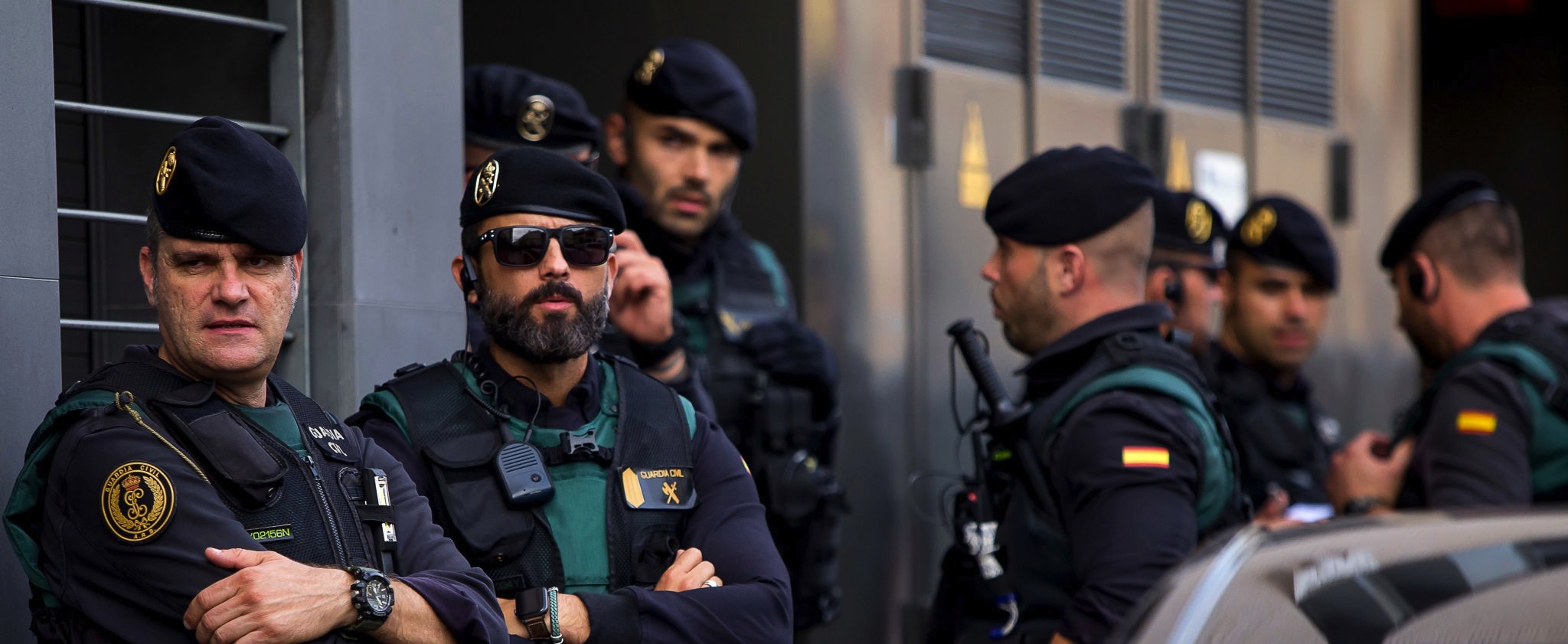
In the midst of an arrest operation on Wednesday of 21 people for alleged misuse of public funds to assist the Catalan independence movement, the Spanish State issued a statement alleging that Russia had offered the movement 10,000 Russian soldiers to aid their struggle. It wasn’t the only Russian connection to the Spanish police operation, which they had named Operación Volkhov.

The arrests this week form part of measures by the State against Catalan independence activists since 2017. That year, a coalition of pro-independence political parties and a huge grassroots movement in Catalonia pushed for a referendum to vote for or against an independent Catalan republic, which the pro-Spanish union opposition called on people to boycott. The Spanish State sent its police to raid Catalan regional government offices, confiscate ballot papers, search for ballot boxes (unsuccessfully) and, on the day of the Referendum itself on October 1st, to storm polling stations and beat up voters.

Since then, the Spanish State has jailed seven Catalan politicians and two leaders of grassroots movements on charges of sedition, charged senior Catalan police officers with disobedience (recently acquitted), charged activists with possession of explosives (turned out to be fireworks), other Catalan politicians – including the former President — are in exile, the current President of the regional government has been banned from holding office, 700 local town mayors are under investigation and others are facing charges arising out of strikes and acts of civil disobedience such as blocking streets and a motorway (for which one activist was charged with terrorism). The raid this week comes in addition to all those legal processes.

Members of the Guardia Civil (spanish militarized police) arrested pro Catalonia independence activists. (Photo source: Internet)

There is something of an irony in charging Catalan activists with misuse of public funds in pursuance of independence, given that independence is what many of the Catalan public desire but even more ironic considering the rampant corruption endemic in Spanish political circles and the Monarchy itself, the former King Juan Carlos resigning amidst allegations of financial corruption and being allowed to flee the country ahead of an investigation.

Whatever about the charges of misuse of public funds it is unlikely that most political observers will take the allegations of an offer of Russian military intervention seriously and not only because it comes from Guardia Civil intelligence, a police force maintaining the fascist Franco dictatorship for four decades and, according to many, especially Basques and Catalans, not much changed since. The notion that Russia would risk a war with the EU and the US-dominated NATO, in order to help free a nation of 7.5 million people nowhere near its own territory, must be laughable.

For those facing charges, under investigation, in exile or already in jail, the situation is not humorous. And then there is the sinister name of the police operation. During WW2, General Franco, dictator of a neutral Spain sent fascist volunteers to aid the Axis in Europe, many of them fighting on the Russian front. Franco had quite recently led a successful military-fascist uprising against the Spanish left-wing Popular Front Government, for which he had been aided by Nazi German and Fascist Italian armament and men. His victory was followed by a repression that left Spain with more mass graves than anywhere else other than Cambodia. The Spanish volunteers to fight Soviet communism formed the Blue Division – blue, from the colour of the Falangist shirts and uniforms.

SPANISH FASCISTS ON THE VOLKHOV FRONT

Among the Nazi German forces in the Volkhov region were the men of the Blue Division and it seems they carried out a successful night crossing of the Volkhov River on 18th October 1941. A subsequent Red Army advance in January 1942 failed ultimately because not all the components of the operation had advanced according to plan. In August 1942 the Blue Division was transferred north to take part in the Siege of Leningrad, on the south-eastern flank of the German Army.

However in February of that 1943, operations on the Volkhov Front formed Part of the Red Army plan to first break the siege of Leningrad and then trap Nazi forces in encirclement. According to what seems a Spanish-sympathetic Wikipedia account of the battle at Krasny Bor, in the vicinity of Volkov, the Blue Division fought stubbornly from 10-13 February 1943. On February 15, the Blue Division reported casualties of 3,645 killed or wounded and 300 missing or taken prisoner, which amounted to a 70–75% casualty rate of the troops engaged in the battle. The remnants were relieved and moved back towards the rear.

Red Army casualties were much higher and, although forces attacking well-fortified positions backed by good artillery and tanks, all of which the Nazis had, can expect to lose three attackers for every one defender, Russian analysis later blamed bad leadership, ineffective use of artillery and clumsy use of tanks for their losses.

A Spanish police force evoking today the memory of Spain’s fascist troops in WW2 might seem ominous but to those who believe that the Spanish ruling class and their police force have never ceased to be fascist, the only surprise will be its effrontery. To the Guardia Civil, the fighting in the vicinity of Volkhov in October 1941 might seem the finest hour of the Blue Division but they might do well to remember that effectively it also met its end there in 1943: the Division ceased to exist and was reformed as the Blue Legion, soon afterwards to be disbanded, some soldiers absorbed into the Waffen SS and others withdrawn home.

RUSSIAN TROOPS FOR CATALONIA?

Fast forwarding to the present, the Russians, at least in their Embassy in Madrid, treated the allegation of their offering troops to support Catalan independence as a joke. The following post in Spanish appeared on their electronic notice and comment board (translated):

Note: The information that appeared in the Spanish media about the arrival of 10,000 Russian soldiers in Catalonia is incomplete. It is necessary to add a further two zeros to the number of soldiers and the most shocking thing of all this conspiracy: the troops were to be transported by “Mosca” and “Chato” planes assembled in Catalonia during the Civil War and hidden in a safe place in the Catalan Sierra (mountain range) until they received the encrypted order to act through these publications.

Russian Embassy Madrid, Main entrance (Photo source: Internet)

End.

SOURCES:

Police operation name, raid and arrests: https://english.vilaweb.cat/noticies/spains-paramilitary-police-names-newest-raid-after-ww2-fascist-victory/

https://english.vilaweb.cat/noticies/new-police-raid-against-pro-independence-activists-and-business-people/

History of the Volkhov Front, WW2: https://en.wikipedia.org/wiki/Volkhov_Front

Battle of Krasny Bor: https://en.wikipedia.org/wiki/Battle_of_Krasny_Bor#Soviet_Union_–_Leningrad_Front

Russian Embassy humorous comment: https://spain.mid.ru/es_ES/-/replica-de-la-embajada-sobre-la-informacion-aparecida-en-los-medios-espanoles-sobre-la-llegada-de-10-mil-soldados-rusos-a-cataluna?redirect=https%3A//spain.mid.ru/

POWERFUL PROTEST AGAINST VIOLENCE AGAINST WOMEN

Diarmuid Breatnach

(Reading time: 1 minute; watching time: 3 minutes per video)


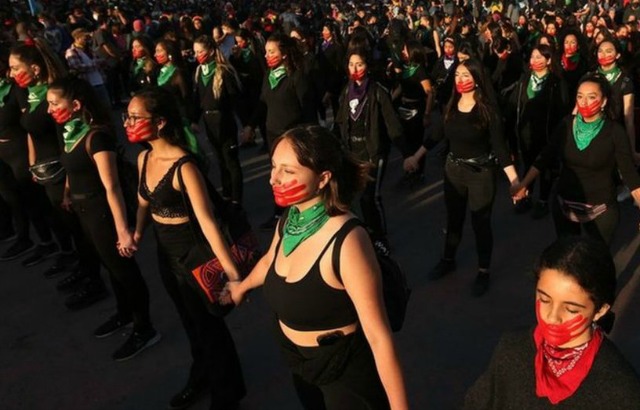
A choreographed protest against violence against women is sweeping the world.  It was first seen on International Day Against Violence Against Women, 27th November in the centre of Santiago, the capital city of Chile. Organised by feminist group La Tesis, it formed part of the popular resistance to the the Sebastián Piñera regime and its repression, since accusations of rape and other sexual violence against the repressive forces have, according to a number of human rights agencies, amounted to 15% of the total (at least 70 separate cases in the first month of protests).
Source: Internet

The lyrics chanted were, in translation:
Patriarchy is a judge who judges us for being born
and our punishment is the violence that you don’t see.
It’s femicide, impunity for my murderer,
it’s disappearance, it’s rape.
And it wasn’t my fault, where I was or how I was dressed.
The rapist is you.  The rapist is you.
It’s the police, the judges, the State, the President.
The oppressive State is a macho rapist.

This was an extremely powerful and effective protest and caught the imagination of others, with videos spread by social media and also appeals across borders by feminist networks.

No doubt the continuation of the protest will take place in other contexts but it remain a powerful and innovative call.

As with other protests in Chile, those congregating in the area were attacked by forces of the State soon afterwards — the same forces against which the protest had been organised.

end.

SOURCES:

Various but chiefly https://theconversation.com/the-rapist-is-you-why-a-viral-latin-american-feminist-anthem-spread-around-the-world-128488?

CHINESE PROTESTS AND COUNTER-PROTESTS IN DUBLIN

(Reading time: 10 mins.)

Diarmuid Breatnach

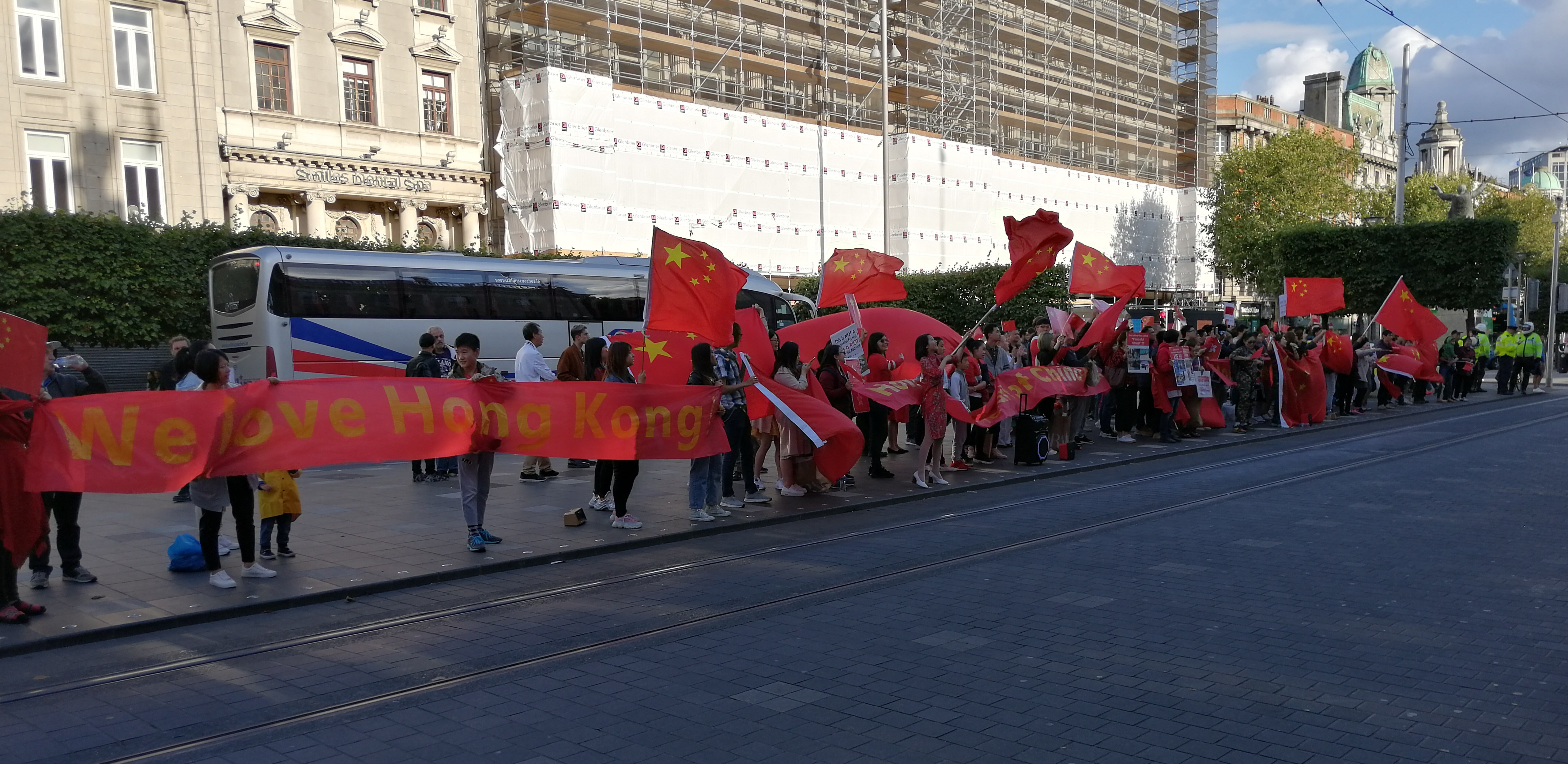
Chinese people protesting the proposed extradition law in Hong Kong and the repression of protests there by the authorities were outnumbered, out-coloured and out-sung by their Chinese opponents in O’Connell Street on Saturday 31st August. However the counter-protesters gave the impression of having been mobilised through the Chinese Embassy.

          Those protesting the proposed Hong Kong legislation outside the GPO seemed somewhat cowed by the counter-protesters facing them in the central pedestrian reservation. The former had some printed placards while their opponents had a massive banner bearing the legend “We Love Hong Hong”. They also had an effective public address system and a cheer-leader with a microphone and every now and again he got the whole crowd to burst into some Chinese song. Their numbers and coordination made one think of the cast of the film version of the Chinese revolutionary opera “The East Is Red.”

sdr
Counter demonstration in Dublin to Hong Kong protests solidarity demonstration. (Photo: D.Breatnach)

I chanced upon the protest by accident, cycling up O’Connell Street, not having heard about it in advance. As I neared to take a photo, I noted that among the Chinese protesting about Hong Kong, there were some placards of the People Before Profit organisation and some familiar faces.


Upon commenting to their leader that they had been outsung (a flippant comment, I’ll admit), he told me that those protesting about events in Hong Kong had felt apprehensive and had asked for solidarity. He commented to me that he would “always support people struggling for democracy, against extradition” etc. Perhaps – but I don’t recall seeing him (or most of his party) on pickets calling for civil rights for Irish Republicans or against their extradition from the Irish state to British administration.

I don’t believe for one minute he and his party prefer Chinese to Irish people but I do think they are much readier to take up cases of injustice where the target is not either the Irish or the British state. Which is curious for an organisation that declares a revolution in Ireland to be necessary.

SOME HONG KONG BACKGROUND

          Hong Kong has a population of around 7,300,000, which includes many who are not nationals. It is a port city of 1,104 sq. Kilometres (426 sq. Miles) and one of the most densely-populated areas in the world.

Hong Kong was occupied by the British in 1812 after they beat the Chinese in the First Opium War, fought by the British in support of their right to sell opium through Chinese ports to the Chinese, which the Emperor unreasonably thought was destroying the Chinese aristocracy and administrative classes.

The British extended their territorial base in Hong Kong to Kowloon in 1860 after beating the Chinese again in the Second Opium War (there were still unreasonable Chinese who didn’t want the British selling opium to them). From 1898 the British ran Hong Kong on the ‘legal’ basis of a 99-year lease (which actually, the British forced the Chinese to grant them) which ran out in 1997. In 1941 the British surrendered Hong Kong to Imperial Japanese forces which remained there until 1945, after which the British took it over again.

The Chinese Emperor having long gone by 1997 and the Taiwan western-supported authorities having no legitimate or believable claim, once the lease ran out, Hong Kong reverted to the main Chinese authorities, i.e the Government of China. Unfortunately for the Hong Kong people, that is the People’s Republic of China which, though flaunting communist symbols, has long ago ceased to be any kind of Communist regime but is not a capitalist democracy either.

However, under arrangements made when the British lease expired, Hong Kong maintains separate governing and economic systems from those of mainland China, expressed in the phrase “one country, two systems.”

DEMOCRACY?

          Headlines in the leaflet being distributed by the Hong Kong protesters in Dublin declared that the fight is about democracy and democratic rights. Many media commentators agree with them. Some even talk about restoring democracy to that region.

In fact, Hong Kong has never had democracy. Before Britain annexed it, the port city was run by officials appointed by the Chinese Emperor. After the British took it over, not only was there no democracy for Chinese working people but the administration was openly racist and some “public” areas there declared that no Chinese were permitted entry. In 1925, British troops and police opened fire to suppress a dock strike and demonstrations in Shanghail resulting in over 60 killed in two separate incidents. The resistance spread to Hong Kong and the port was also boycotted, which cost the British dearly.

Even in modern times, the Hong Kong administration was known to be highly corrupt and the special anti-corruption police squad became known as “the graveyard of corruption complaints”, for that is where the allegations and complaints were buried by those supposedly investigating them.

In 1967 Leftist demonstrations grew out of a strike and became wide-scale riots when Hong Kong Police moved to brutally repress them and many of the demonstrators’ leaders were arrested.

In 2013 a dockers’ strike in Hong Kong fought a hard battle against shipping transport companies for 40 days, out of which they emerged victorious. The working conditions that came to light during the struggle revealed aspects that organised workers would not accept in any capitalist democracy or even in some dictatorships.

CURRENT STRUGGLE

          The present Hong Kong authorities seem to have come to an arrangement with the mainland Chinese Government, since Carrie Law, the Chief Executive of Hong Kong, introduced the bill which has sparked three months of protest. Under the provisions of this bill, an alleged lawbreaker in Hong Kong could be extradited to mainland China. When people protested in Hong Kong, the authorities sent their police to beat up the protesters and to arrest them, just as the British used to do in the old days.

And the laws that are being used to attack and jail demonstrators are exactly the same ones that have been in force for decades in British Hong Kong, as the Financial Times points out, although it suggests they were OK under the British but are “outdated now” (see References)!

Hong Kong Placards Police Don't Shoot
Photo taken on demonstration in Hong Kong (Photo source: Internet)

The opposition to the bill has seen demonstrations, occupations and strikes. On 5 August, there was a strike, this time successful, with the airport and flight industry employees playing a prominent role. The Communist Party of China is now asking for the list of Cathay Pacific employees who went on strike but the union won’t release the list. Estimates of participation in the strike vary between 300,000 and 400,000 people.

Airport public areas have also been occupied en masse which of course hits tourism and personal contact business, along with some exports and imports. On 12 August, another huge occupation of the airport brought about a threatening response from the PRC State; it sent about 10,000 armed police to the border with Hong Kong.

Carrie Law recently stated that she has withdrawn the bill which satisfies one of the demands of demonstrators but another four have been put forward:

  • Retract the classification of the protests as ‘riot’ ” (presumably with legal consequences)

  • Appointment of an independent commission to inquire into the excessive violence used by the police in the protests”

  • Dropping charges against demonstrators” (but what about those already jailed?)

  • Implement a Dual Universal suffrage to elect a truly democratic government”

WHO OR WHAT SHOULD WE SUPPORT?

          As in many of these types of struggles there are likely to be a number of elements involved among the demonstrators and strikers, including leftists, basic democrats, anti-communists (even fascists) and pro-western imperialists.

I do not see any reason to defend the current or past administration of Hong Kong – quite the contrary. Nor do I see any reason to defend the Chinese State administration which has lost all content of communism it once had and in which only some of its form survives. As far as democracy goes, the People’s Republic of China has suppressed demonstrations against corruption or by defenders of their environment, as well as hundreds of strikes and sent tanks to suppress a demonstration in Tienamen Square, resulting in an unknown number of dead, injured and jailed. On the other hand, Hong Kong is not even a bourgeois — to say nothing of a workers’ – democracy as is shown at present and in its past.

Huge Hong Kong Protest
Photo of demonstration in Hong Kong (Photo source: Internet)

It is natural that people in Hong Kong would not want to be extradited to the PRC and it seems to me that resistance to that is worthy of support along with in general the other four demands (although what “independent commission” to enquire into “excessive violence by police” can be appointed in this setup?). But the fundamental problem is that working people in Hong Kong do not control the fruits of their labour and the granting of not even all of the five demands can possibly change that. Where workers are in that situation, their rulers will alway keep repressive measures on hand for use whenever they feel the need to employ them.

Clearly the solution is not for the intervention of the USA or any other imperialist state either.

Therefore what I think we should support most is the mobilisation of the working people for socialist revolution and their participation in these current struggles will educate them as well as giving their most class-conscious elements the opportunity to enhance that education and, necessarily, organisation.

End.

REFERENCES AND FURTHER INFORMATION

1925 strike, massacres and boycott: https://en.wikipedia.org/wiki/Canton%E2%80%93Hong_Kong_strike

1967 anti-British rule demonstrations (somewhat biased): https://en.wikipedia.org/wiki/Hong_Kong_1967_leftist_riots

Hong Kong repressive legislation is from the British: https://www.ft.com/content/d66d69aa-6ef4-11e8-8863-a9bb262c5f53

Hong Kong Dock Strike 2013: https://www.ft.com/content/80a0d4ea-ae46-11e2-bdfd-00144feabdc0

Hong Kong Police and the demonstrations: https://www.theatlantic.com/international/archive/2019/09/hong-kong-police-lost-trust/597205/

History of corruption in Hong Kong Police: https://en.wikipedia.org/wiki/Lui_Lok