TWO GUNFIGHTS IN THE CITY IN THREE DAYS – MASSIVE POLICE AND ARMY HUNT — A NUMBER OF BRITISH FORCES AND ONE GUERRILLA DEAD

Diarmuid Breatnach

GUNFIGHTS IN DUBLIN SUBURB — TWO OFFICERS KILLED – POLICE HUNT GUNMEN”

Those words above might have been the headline of the national media in Ireland on a Monday 95 years ago. On the Tuesday a headline might have declared INTENSE POLICE HUNT — DRUMCONDRA MURDERERS STILL AT LARGE! to be followed on Thursday by SHOOTOUT YESTERDAY IN DUBLIN CITY CENTRE – FOUR DEAD!

          The events to which those headlines might have referred occurred on 13th, 14th and 15th October 1920 and they involved two men, Seán Treacy and Dan Breen. They were events of amazing initiative, determination and courage – and also of tragedy. They took place in Dublin city centre and in a location roughly a mile away. And they were shortly to lead to further amazing deeds of determination and courage – and even greater tragedies.

Dan Breen and Sean Treacy were both Tipperary men and members of the newly-created Irish Republican Army unit in their home county. Already they had participated in the event that touched off the War of Independence in January 1919, the Solohodbeg Ambush. Their unit, under Séamus Robinson, had acted without any order from their Dublin Headquarters on the day the First Dáil met in the Mansion House in Dublin and their action was disapproved of by at least some of the TDs, including some in the newly-reorganised Sinn Féin political party. The attack in which Treacy and Breen participated killed two members of the colonial Royal Irish Constabulary, captured arms and an amount of gelignite.

Dan Breen had been sworn into the secret organisation, the Irish Republican Brotherhood, in 1912 at the age of eighteen. In 1914, he joined the Irish Volunteers but due to Mac Neill’s cancellation order and resulting confusion, like most of the Volunteers, took no part in the fighting of 1916. He made up for that omission afterwards.

Sean Treacy, whom Breen admired tremendously had, according to Breen himself a much wider and more defined political ideology. He left school at the age of 14 and joined the IRB at the age of 16, in 1911. He was also a member of Connradh na Gaeilge. Arrested in the roundups after the 1916 Rising, he spent two years interned without trial. As soon as he was released in 1918, Treacy was made vice-commander of the Third Tipperary Brigade of the Volunteers which, in 1919, became the IRA and he was eager to start the war to rid Ireland of British colonialism.
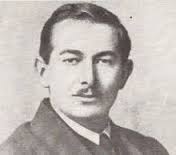
Sean Tracey
Sean Tracey (Photo from Internet)
Daniel Breen wanted poster
(Photo from Internet)

Treacy and Breen had eventful times in Tipperary and nearby counties as they escalated their war against the British colonial occupation, attacking RIC barracks and carrying out ambushes. Among their most dangerous and famous events was the daring IRA rescue at Knockalong of Sean Hogan from the train in which he was being carried as a prisoner under armed escort on 13th May 1919, in which a fierce hand-to-hand struggle took place and both Treacy and Breen were seriously wounded.

Towards the end of that year, on 19th December in Dublin, Breen and Treacy were in action with Sean Hogan in an attempt on the life of General Sir John French, the British King’s representative and chief of HM Armed Forces in Ireland. The operation was led by Paddy Daly (of “Collins’ Squad” notoriety and later infamous for his part in the Civil War) and consisted of ten Volunteers, to which Martin Savage was added the previous night due to his own earnest request. Through misinformation the waiting Volunteers barely missed French as he headed in convoy towards his Residence (now the US Ambassador’s) in Phoenix Park and in the shootout that followed with the other convoy vehicles Breen was wounded in the leg and Volunteer Martin Savage in the neck, dying in Breen’s arms (Martin Savage is remembered in the song Ashtown Road by Dominic Behan).

At least a number of Sinn Féin TDs and activists were incensed by this action, including Charlotte Despard, who also happened to be John French’s sister. There was more than family relations involved – many in Sinn Féin were ambivalent about armed struggle and although both were banned later in 1919, neither the party nor the Dáil declared war on the British until a few months before the Truce in 1921.

After the Knockalong rescue, things had got a bit hot for Treacy and Breen in Tipperary and Collins invited them up to Dublin, where they were expected to merge more easily in the busy city centre.

They returned to Tipperary in the summer of 1920, where they continued to be active in the war, until Collins invited them up to the city again, partly for their own safety and partly to help him out in Dublin in the work of his “Apostles”, the “Squad”, especially in assassinations of British Intelligence agents, troublesome police and informers.

CIS — BRITISH INTELLIGENCE IN IRELAND REORGANISED

          However, British Intelligence in Ireland had already been re-organised. The RIC’s intelligence and its personnel were by this time considered unreliable by British Army Intelligence and many in the force had also resigned or become disaffected. “By the spring of 1920 the political police of both the Crimes Special Branch of the Royal Irish Constabulary (RIC) and G-Division (Special Branch) of the Dublin Metropolitan Police (DMP) had been effectively neutralised by IRA counter-intelligence operatives working for Michael Collins. The British thoroughly reorganised their administration at Dublin Castle, including the appointment of Army Colonel Ormonde de l’Epee Winter as Chief of a new Combined Intelligence Service (CIS) for Ireland. Working closely with Sir Basil Thomson, Director of Civil Intelligence in the Home Office, with Colonel Hill Dillon, Chief of British Military Intelligence in Ireland, and with the local British Secret Service Head of Station Count Sevigné at Dublin Castle, Ormonde Winter began to import dozens of professional Secret Service agents from all parts of the British Empire into Ireland to track down IRA operatives and Sinn Féin leaders.” (Wikipedia).

Ormonde developed or introduced lots of intelligence-gathering procedures and “black propapaganda” in Ireland.  After the war he joined the British fascisti for a while and in 1940 fought for the Finns in the Winter War against the Red Army.

Ormond L'Epee Winter, head of CIS in Ireland. (Photo from Internet)
Ormond L’Epee Winter, head of CIS in Ireland

As part of the reorganisation under CIS, a number of Royal Irish Constabulary officers had been posted to Dublin from country areas where the IRA were active and Breen and Treacy were noted coming into Dublin or soon after their arrival and were placed under surveillance.

On the evening of 13th October 1920, Breen and Treacy had been to see a film in Dublin with the Fleming sisters, who told them that they were sure that Breen and Treacy were being followed. Neither of the men believed this to be true and before the start of the nightly curfew, headed out towards their safe house, “Fernside”, a little past the corner of Home Farm Road and Upper Drumcondra Road, which belonged to a Professor Carolan, who lived there and taught in the nearby St. Patrick’s College, Drumcondra.

Closeup of the name “Fernside” on the house today, scene of the gunfight.
(Photo D.Breatnach)
The “Fernside” house today, scene of the gunfight
(Photo D.Breatnach)

BRITISH EARLY MORNING RAID

By this time, the Fernside address was known to British Intelligence. Around 1.00 or 2.00am, a party of DMP and British Army knocked on the door and when Professor Carolan answered, they entered, began to question him and a number started up the stairs. Both Treacy and Breen had slept in most of their clothes and with their guns ready. Instead of barricading themselves inside their room or escaping through the window, they charged down the stairs, firing as they went at the intruders, who fled. Breen and Treacy then went back upstairs and jumped from a first floor window. They seem to have been different windows, for Breen went through a glass house or conservatory and received a number of glass cuts, while Treacy suffered only a very slight injury of some sort, whether by glass or some such or by bullet, is not clear. Or possibly Breen jumped first and left little glass remaining to cut Treacy.

In the back garden of the house, Breen later recounted firing at the heads of either police or British soldiers he observe over the fence and saw some fall; in return fire he was seriously injured but managed to get out of the garden and work his way across the road down to the wall of the nearby St. Patrick’s College, Drumcondra (still there today). Although short of stature and badly injured, he scaled the wall and making his way across the College grounds, came out on the other side, by the Tolka and then went up the road to Phibsboro, where he knocked on doors. A man who opened the door to him got him a doctor, who then had him smuggled into the private patients’ part of the Mater Miserecordiae Hospital (known to Dubliners as “the Mater”), at the corner of Eccles Street and Dorset Street, under an assumed name in the care of the nuns. Another version has him going to Finglas before being smuggled to the Mater.

We know little of Treacy’s escape except that he too got away, only slightly hurt, to a house in Inchicore. Professon Carolan was shot during the event (probably by the enraged British who might have thought he had somehow signaled Breen and Treacy or in panic — they seem to have shot some of their own men) and died days later.

The Occupation forces admitted to only two of their dead, both officers in the British Army, although a contemporary Irish Times report mentioned three. But Joe Connolly, a member and later Chief of the Dublin Fire Brigade, which then as today operates ambulance services in Dublin, spoke of twelve bodies having been collected for delivery to the British Military Hospital in Arbour Hill.

The forces of the colonial Occupation were in a frenzy searching for both Treacy and Breen around the city and the Dublin IRA organised protection for them both.

ANOTHER SHOOTOUT

          Word reached Michael Collins that the Occupation forces were going to organise a formal funereal procession to take the dead British officers’ bodies to the quays for their journey home to Britain and that top officers of the Occupation’s army and police would be in attendance. Collins planned to shoot a number of them and assembled a group for the operation and notified the meeting place.

However, Collins cancelled the operation (and meeting) when he learned that the high-ranking British officers would not be attending the dead officers’ send-off to England. Treacy arrived late at the meeting place, a draper’s shop called “Republican Outfitters” (!) owned by the Boland family, at 94 Talbot Street, as did another man and both learned of the cancellation (according to one account; according to another he delayed leaving after the others had left). However, the British were closing in on Talbot Street with the intention of capturing Treacy, it seems. As Treacy came out into the street, an agent approached him with gun drawn and Treacy saw the British vehicles coming down the street from O’Connell (then Sackville) Street. He drew his Parabellum firearm and shot two agents but the machine-gunner caught Treacy in a burst as he was trying to mount his bicycle as people dived for cover and several were injured.

Republican Outfitters, 94 Talbot Street. This may also be a photo taken after the shooting. (Photo from Internet)
Republican Outfitters, 94 Talbot Street. This may also be a photo taken after the shooting.

Sean Treacy died from the machine-gun bullets in that street, along with two civilians, a John Currigan, a tobacconist from Eden Quay and “a messenger boy named Carroll”, according to a press report at the time. A policeman on point duty was shot in the arm, which had to be amputated. Another boy, 15-year old apprentice photographer John J. Hogan, claiming to be out practicing with his employer’s camera, followed the action and took the famous photo of Treacy lying dead in the street.
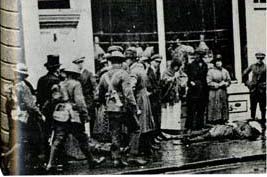
Talbot St death
Sean Treacy lying dead in Talbot Street, very soon after he had been shot. (Photo from Internet).

It seems the Chief of the CIS himself, Ormand Winter, had attended the operation or had followed it up and was shocked at the outcome – an agent dead and another wounded and Treacy dead, along with two innocent bystanders, one only a boy. He told a press reporter it had been “a tragedy”.

It had long been believed that Treacy shot two agents dead but although Liuetenant Gilbert Price was definitely dead, another, Colour-Sergeant Frank Christian, later received compensation of £1,250 (a substantial amount in those days) for injury received during the event, according to press reports. Christian claimed to have been off duty and just passing at the time but this was more than likely said to preserve his cover and also to increase the amount of compensation. http://www.cairogang.com/incidents/treacy-talbot/treacy-talbot.html

Some of the IRA and their supporters were still in the area when the British Army arrived in Talbot Street and one, Dick McKee, barely made it away on a bicycle. He would not be so lucky another time which was fast approaching.

I once or twice heard some speculation that Treacy had been betrayed from within the IRA and even that Collins wanted him killed but these kinds of rumours often arise and no evidence has ever been provided to substantiate the speculation. It is indeed curious that Treacy had miraculously escaped on the 13th and had been recruited for a dangerous operation to take place two days later, then to be shot at the scene of a cancelled meeting but such things happen. It would take remarkable prescience on Collins’ part to have anticipated the course of the War of Independence in 1920 so as to have removed one of the most effective fighters that would help bring the struggle to truce, negotiation and a Treaty. The simplest explanation and the one that fits the best is that Treacy had been marked and followed and that after their debacle at Fernside, the colonial military authorities in Dublin had decided to take him prisoner there in Talbot Street if they could and, if not, kill him.

Treacy was buried in his native county at Kilfeakle, a funeral attended by thousands of mourners and a heavy concentration of RIC, holding rifles with fixed bayonets. Breen remarked that though not intended in that way, it was an appropriate mark of respect for the fallen guerrilla fighter.

MORE SHOOTINGS …. AND A MASSACRE

          The police and army raids in Drumcondra and in Talbot Street, the first from which two tough and experienced IRA men had been lucky to escape and the second which had resulted in the death of one of them and nearly netted a few others, must have rung very loud alarm bells for IRA leaders and ordinary Volunteers. Apparently it convinced Collins that some very thorough offensive action was needed to remove or reduce the threat.

Just over a month later, in the early morning of Sunday 21 November 1920, Collins’ ‘Squad’ and teams mobilised by the Dublin IRA Brigade, went out to assassinate 35 men believed to be members of the British Intelligence network in the City. Collins had originally drawn up a list of 50 but Cathal Brugha, acting as Minister of Defence, had reduced the list on the basis that there was insufficient evidence against fifteen of them.

Most of the shootings by the IRA that morning took place in the southern suburbs of the city – Baggot, Upper Pembroke and Lower Mount streets, Fitzwilliam Square, Morehampton Road and Earlsfort Terrace. There were also shootings in the Gresham Hotel and on O’Connell Street. Some agents were, luckily for them, not in when the IRA came calling and some operations were bungled. A passing Auxilliary patrol (they were brought into Ireland in July 1920) got involved in one location and, in the subsequent fight, two of them were killed and one IRA man wounded and captured. But by midday, the British Army and colonial administration were counting their fatal losses, a total of:

10 Intelligence officers (one RIC and 9 Military)

1 military prosecutor

1 civilian informer

2 Auxiliaries

1 Army Veterinary officer (apparently a case of mistaken identity)

In addition, some more officers had been wounded, albeit not fatally.

Just as the operations organised by British Intelligence in the previous month had raised the alarm for the IRA, the response of the latter did the same in turn for the British military and political administration in Ireland. Henceforth, intelligence personnel would be accommodated in Dublin Castle or in barracks. But if the Intelligence establishment was rattled, the Auxilliaries and loyal RIC and DMP (Dublin Metropolitan Police) were incensed.

That afternoon, a Gaelic football game was scheduled to take place in Croke Park, the national stadium of the Gaelic Athletic Association, between Tipperary and Dublin teams. The IRA had considered advising the GAA to cancel the match but there were fears that — apart from alerting British Intelligence that something was planned — it might implicate the GAA in the planned operation that morning. In any case, the match went ahead with an estimated attendance of 5,000, unaware that a convoy of British Army troops was driving along Clonliffe Road from the Drumcondra Road end, while a convoy of DMP and Auxiliaries approached the Park from the south or Canal end.

At 3.25pm, ten minutes after the start of the match, the police burst into the ground, firing. Despite their claims later there is no evidence they received any return fire but nevertheless their own commander admitted they kept shooting for about a minute-and-a-half. They fired at spectators and players, some firing from the pitch while others fired from the Canal Bridge at those who tried to escape by climbing over the wall at the Canal end. The soldiers on Clonliffe Road fired machine gun bullets over the heads of the fleeing crowd in an unsuccessful effort to turn them back.

According to the commander of the operation, Major Mills, the police had fired 114 rifle rounds (revolver rounds were not counted) and the Army had fired 50 rounds in the street. The casualties were 9 people shot dead, five dying of wounds and two trampled to death in the panic. Two of the dead were boys aged 10 and 11. Michael Hogan, a player was dead and another player, Egan, wounded but survived. Dozens more were wounded by bullets or injured in the panic. Unlike the “Croke Park” scene in Neil Jordan’s Michael Collins film (1996), it appears that the British Army shot no-one that day – that was all the work of the police.

The Castle issued a cover story in a statement that IRA men from outside Dublin had used the football game as a cover for getting into the city and, after the assassinations they had carried out, had gone to the game.  When the police arrived to search fans for weapons, according to the statement, these men had fired on the police, who had been obliged to return fire. The most credulous would have found that story difficult to believe since not a single policeman had even been injured and even the loyalist Irish Times poured scorn on their story.

MURDER IN THE CASTLE

          One of the planners of the earlier IRA operation was already in custody before the events of that day. Dick McKee, commander of the Dublin Brigade and another IRA man, Peadar Clancy, had been arrested by Crown Forces in the early hours of that Sunday morning. They were being interrogated in Dublin Castle.

Also being interrogated was Conor Clune, who had been arrested by the Auxilliaries in a raid on Saturday evening of Vaughan’s Hotel in Parnell Square, on the corner of Granby Lane.  Clune was no IRA man but an language enthusiast who had come up to Dublin that day with his employer, Edward McLysaght, on business for the Raheen cooperative.  Clune had gone on to meet Piaras Béaslaí, a member of the First Dáil (Irish Parliament set up in defiance of Westminster by the majority of Members of the British Parliament elected in Ireland).  Béaslaí and some IRA men using Vaughan’s that evening were alerted by a hotel porter to the suspicious behaviour of a visitor, apparently a spy, and departed before the arrival of the “Auxies”, who arrested Clune on suspicion.  Leading the interrogation team was Ormond Winters.

Later that awful day, McKee, Clancy and Clune were reported “shot while trying to escape”. Their captors said that, because there was no room in the cells, they had been placed in a guardroom and were killed while grabbing arms to shoot their captors and to make a getaway. To bolster the Castle’s story, they produced a number of photographs: one shows three civilians sitting apparently in conversation in a room, where a number of Auxiliaries and British Army are also shown relaxed, some eating a meal and another reading. Untended weapons are in view; another photograph shows a blur of men “trying to escape”. In none of the photos are the faces of any of the three prisoners clearly shown.

Family of the dead Irishmen said they had been tortured and then shot and few believed the Castle’s story (although apparently some historians today give it credence). It is said Collins wanted their bodies displayed to show bayonet wounds but was persuaded not to, however one of Collins’s Castle informers, Nelligan, was later adamant that they had not been bayoneted. All sides agree that the bodies did show extensive bruising. In any case, McKee and Clancy died without giving their captors any of the long list of names they carried in their heads, while Clune of course had none to give.

Conor Clune’s body was recovered by Mac Lysaght, who had it medically examined, revealing that he had been shot 13 times in the chest. The Army doctor who examined the bodies prior to their release said that Clancy had been hit with up to five bullets, which caused eight wounds, while Dick McKee had three wounds caused by two bullets.

Unfortunately for the Castle, Conor Clune was a nephew of Patrick Clune, Archbishop of Perth, Australia which caused the authorities some embarrassment.

View further back of plaque to the three murdered by the British Occupation forces on Bloody Sunday 1920
View further back of plaque to the three murdered by the British Occupation forces on Bloody Sunday 1920 (City Hall on the right). (Photo DB)
Closer view of plaque (Photo DB)
Closer view of plaque.


A plaque commemorating the men (albeit listing Clune as a “Volunteer”) was placed by the National Graves Association on the wall of Dublin Castle near the eastern side of City Hall and every year a small commemoration ceremony takes place there.

There was a sequel to the deaths of the three, although it did not take place until the following year. An ex-British Army soldier, James “Shankers” Ryan, had betrayed McKee. On February 5, 1921, as Ryan was enjoying a pint in Hyne’s pub in Gloucester Place and studying the horse racing page of the newspaper, an IRA squad led by Bill Stapleton walked into Hynes’ pub in Gloucester Place and shot him dead.

REMEMBRANCE IN SONG AND STORY

          A plaque was erected in Talbot Street, Dublin, by the voluntary non-party organisation, the National Graves Association, on the front facade of No. 94, the building outside of which Treacy was killed. The anniversary of his death is marked each year at a commemoration ceremony in Kilfeacle. Also at noon on the morning of All-Ireland Senior Hurling Finals in which the Tipperary GAA team participates, a ceremony of remembrance is held at the spot in Talbot Street where he died, organised “by people from West Tipperary and Dublin people of Tipperary extraction. The most recent such ceremony was held at midday on Sunday, 7 September 2014 and attracted a large attendance, most of whom were en route to Croke Park.” (Wikipedia).

Sean Treacy Plaque Talbot Street. (Photo from Internet)
Sean Treacy Plaque Talbot Street

It is worthy of note that every single one of those commemorations and memorial plaques is organised by voluntary bodies rather than by the State.

A number of songs about Sean Treacy are in existence: Sean Treacy by Dominic Behan and Tipperary So Far Away (author disputed: by Patsy O’Halloran OR Paddy Walsh/ Pádraig Breatnach/ Paddy Dwyer, with — if about Treacy — some obviously inaccurate versions by the Clancy Brothers and Wolfe Tones). Strangely neither Treacy nor Breen is mentioned in The Station of Knockalong, about the May 13th 1920 rescue of Sean Hogan from his captors on a train, after a fierce hand-to-hand struggle in which both Treacy and Breen were seriously wounded. The Galtee Mountain Boy is said to be also about Treacy but some of the lyrics make this unlikely and a contributor to Mudcat (a folk song website) claimed that song is about Paddy Davern, who was sentenced to die by both the British and the Irish Free State but escaped them both.

Strangely too, no song comes to light about the Drumcondra shoot-out. I have heard a few lines quoted, “He shot them in pairs coming down the stairs”, allegedly from a song about Sean Treacy by Dominic Behan. However, my searches have failed to turn up the source of those wonderful lines. If the song existed and was about Treacy, it could have referred to his death in Talbot Street but even more likely to the battle at Fernside.

Dan Breen is mentioned in a number of songs but none of which I am aware directly about him.  Breen was very saddened at the death of his close comrade-in-arms and recovered slowly from his wounds, having been shot four times, twice in the lungs. He was smuggled out of Dublin while still recovering from his injuries and very weak, returning to active service later. In June 1921, Breen married Brigid Malone of the Dublin Cumann na mBan, who had helped nurse him while recovering from his wounds. The long Truce of 1921 followed in July which, according to his autobiography My Fight for Irish Freedom (1921 and many reprints since), Breen frowned upon, commenting that IRA discipline grew slack and information on identities of fighters and their locations would have come much more easily to Crown forces.

Dan Breen dissented from the Treaty of 1921 and took up arms on the Republican side, was captured and interned, went on hunger strike and was released. Breen was an anti-Treaty TD for Tipperary from 1923 for Sinn Féin, the TDs of which refused to take their seats in the “Partitionist” Fourth Dáil. When the Fianna Fáil party was created in a split away from Sinn Féin in 1926 with the intention of their representatives entering the Dáil if elected, Breen joined and was the first anti-Treaty TD to take his seat in the Dáil in 1927.

When he later failed to be reelected he went to the USA, which was under alcohol Prohibition at the time and there he ran a speakeasy. (He would probably have known Joe Kennedy, grandfather of President John F. Kennedy, who was a prominent gangster in that epoch). Returning to Ireland in 1932, Breen regained his Fianna Fáil seat. He died in 1969 and the attendance at his funeral was estimated at 10,000.

end
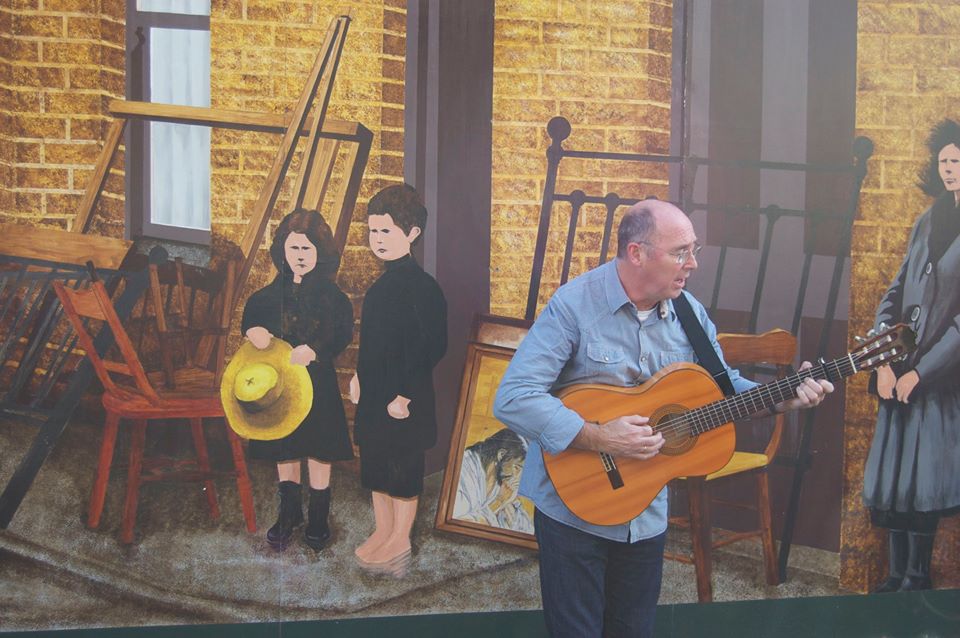
FENIANS, SCHOOLBOY STRIKE, LOCKOUT EVICTIONS, SPANISH CIVIL WAR – ALL ON EAST WALL WALKING HISTORY TOUR, WITH MUSIC & SONG AS WELL

Introduction with some very little additional text by Diarmuid Breatnach


Main text from East Wall History Group

Among the many events packed into History Week by the East Wall History Group was a walking history tour of the area on Sunday 27th September. Over a score of people took part in “East Wall and the Irish Revolution” to hear Joe Mooney, a long-time community activist, outline the relevant events of history at various points along the way, covering

Paul OBrien Merchants Road Mural playing
Paul O’Brien performing his 1913 Lockout song in front of mural marking the eviction of 62 families from Merchant’s Road in December 1913 by the Merchant’s Company.  (Photo: EWHG) 

local connections with the Fenians, docks and migrants, the Lockout, 1916 Rising and the Spanish Civil War. Appropriate songs and music accompanied the tour, Paul O’Brien performing compositions of his own at some of those points and Diarmuid Breatnach singing verses from Viva La Quinze Brigada at another.

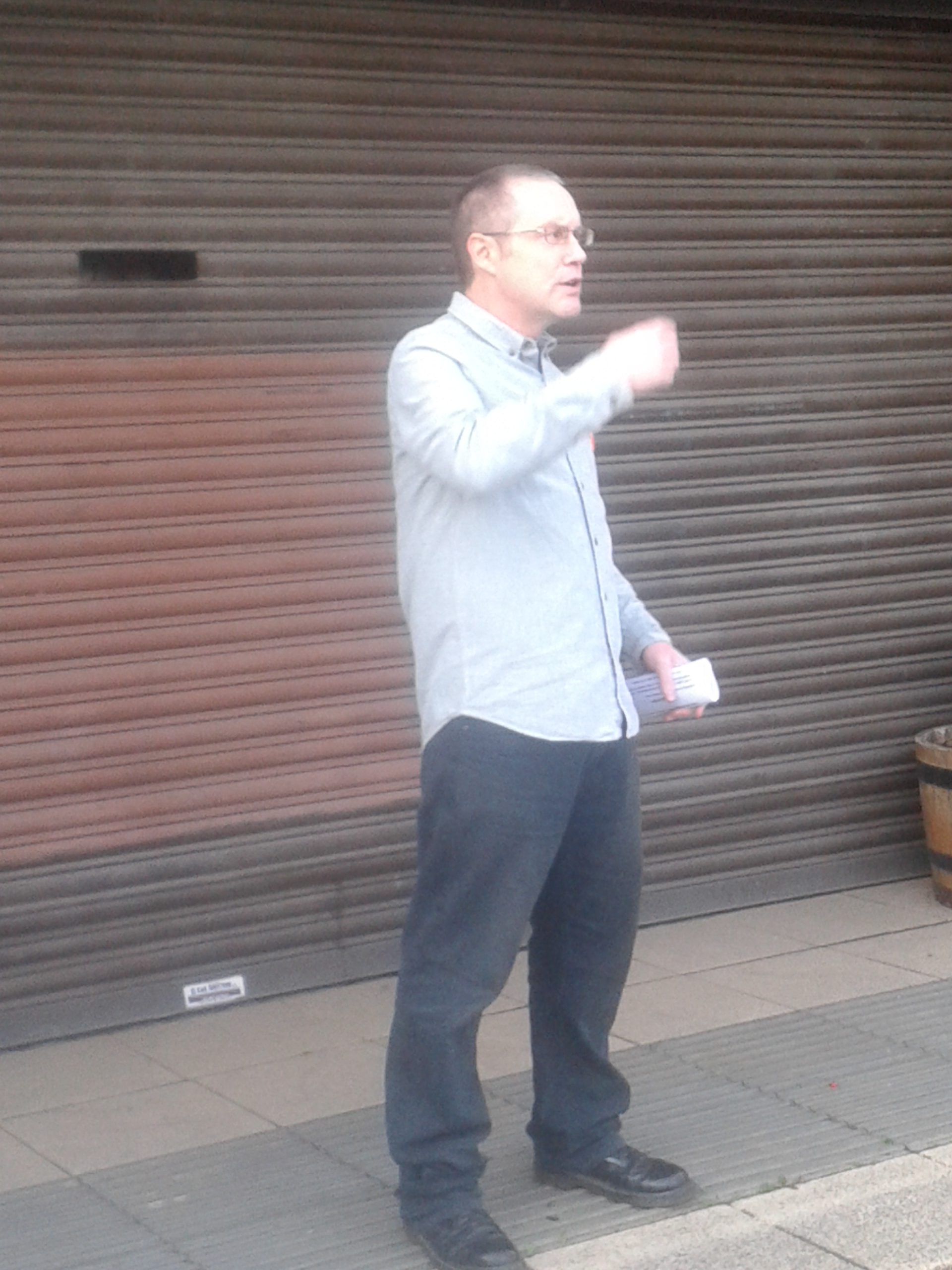
Joe Mooney, the tour guide
Joe Mooney, the tour guide.  Photo: D.B

The East Wall History Group has been in existence for a number of year; they may be contacted through https://www.facebook.com/eastwallhistory and http://eastwallforall.ie/?tag=east-wall-history-group and it would not be a bad idea to get on their mailing list. The following account has been shamelessly looted from their FB page:

We set out from St Joseph’s School, originally opened in 1895. The first Principal of the Boys’ school was J.F. Homan, who served as a St. John’s Ambulance Brigade volunteer during the Rising and also during the Civil war. A number of former pupils from the school were involved in the revolutionary events of the time (the following decades) and of course in 1911 a schoolboys’ union was declared and a short strike ensued (complete with pickets!). Their demands included a shorter day and free school-books.

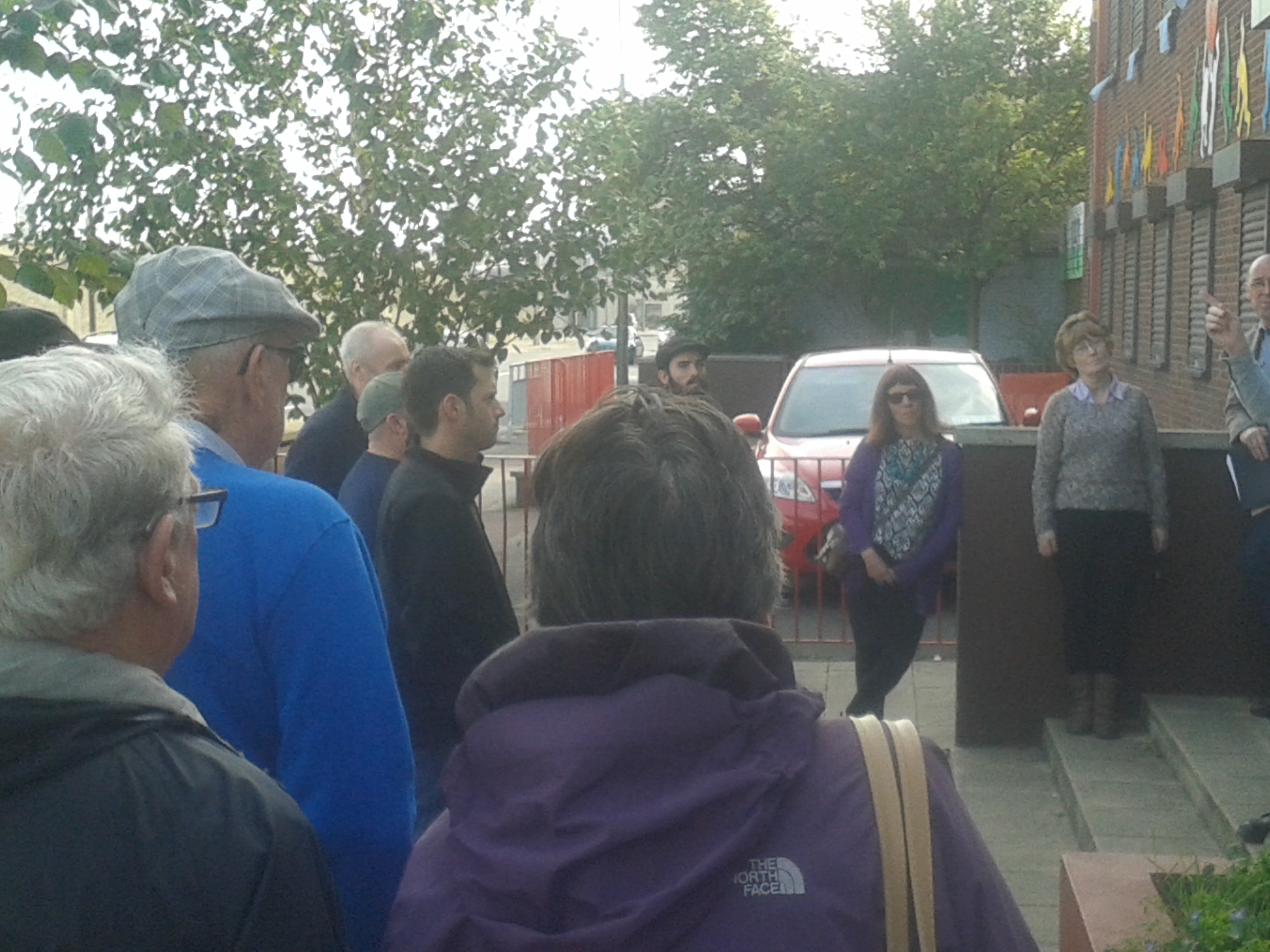
Part of crowd at the starting point
Part of crowd at the starting point.  (Photo: DB)

Our first stop was Merchants Road, where during the 1913 Lockout 62 families (almost the entire population of the street) were evicted by their employer the Merchants Warehousing Company (their yard was Merchant’s Yard on East Wall Road, just before the T-junction by the Port Authority. At the fantastic mural (erected by the community) Paul paid tribute to the families and the workers struggle with his song “Lockout 1913“. Amongst the evicted families were the Courtneys from number 1 – their son Bernard was a ‘Wharf’ school pupil and fought with the Jacobs garrison in 1916, before succumbing to TB in 1917.

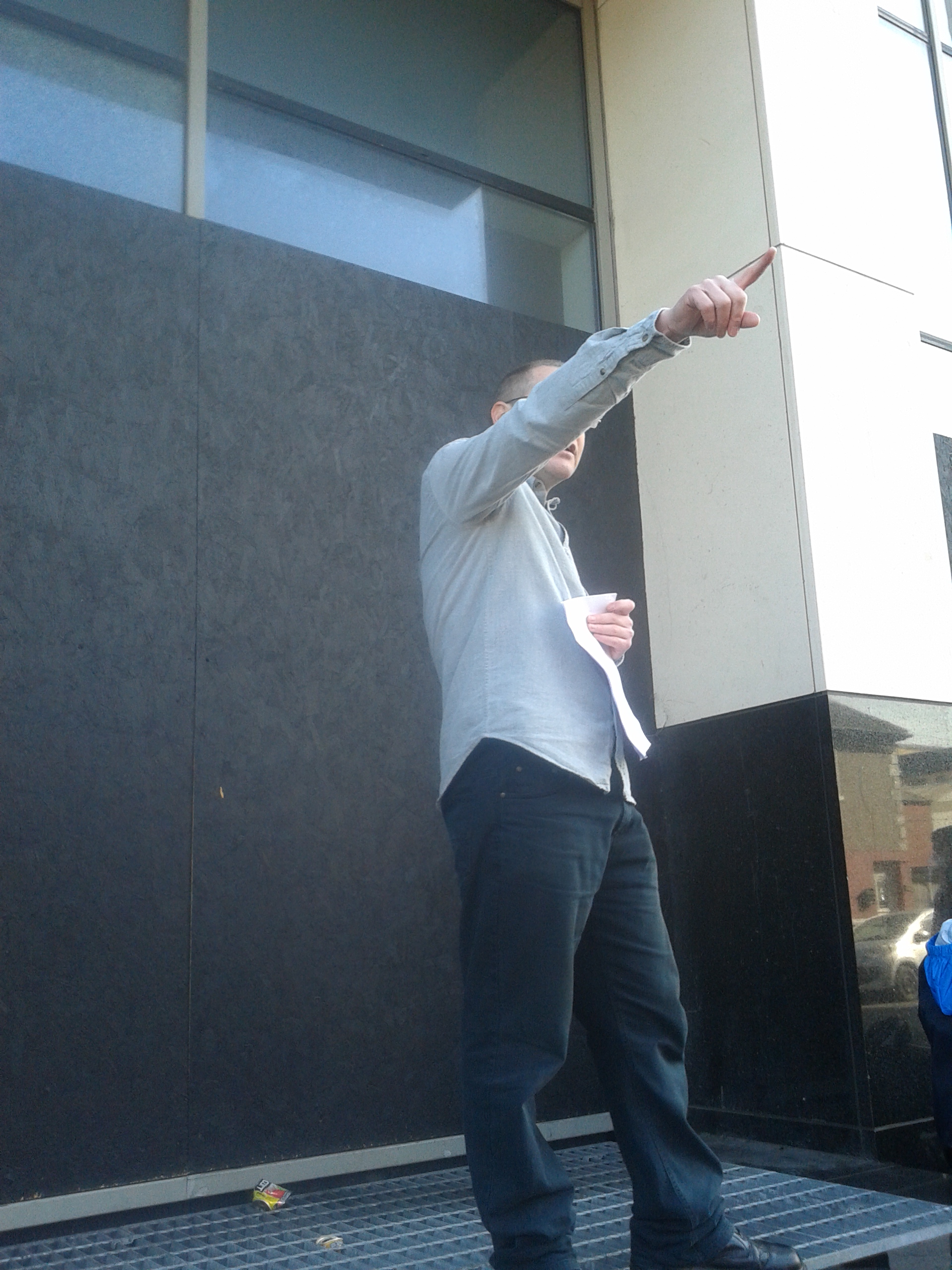
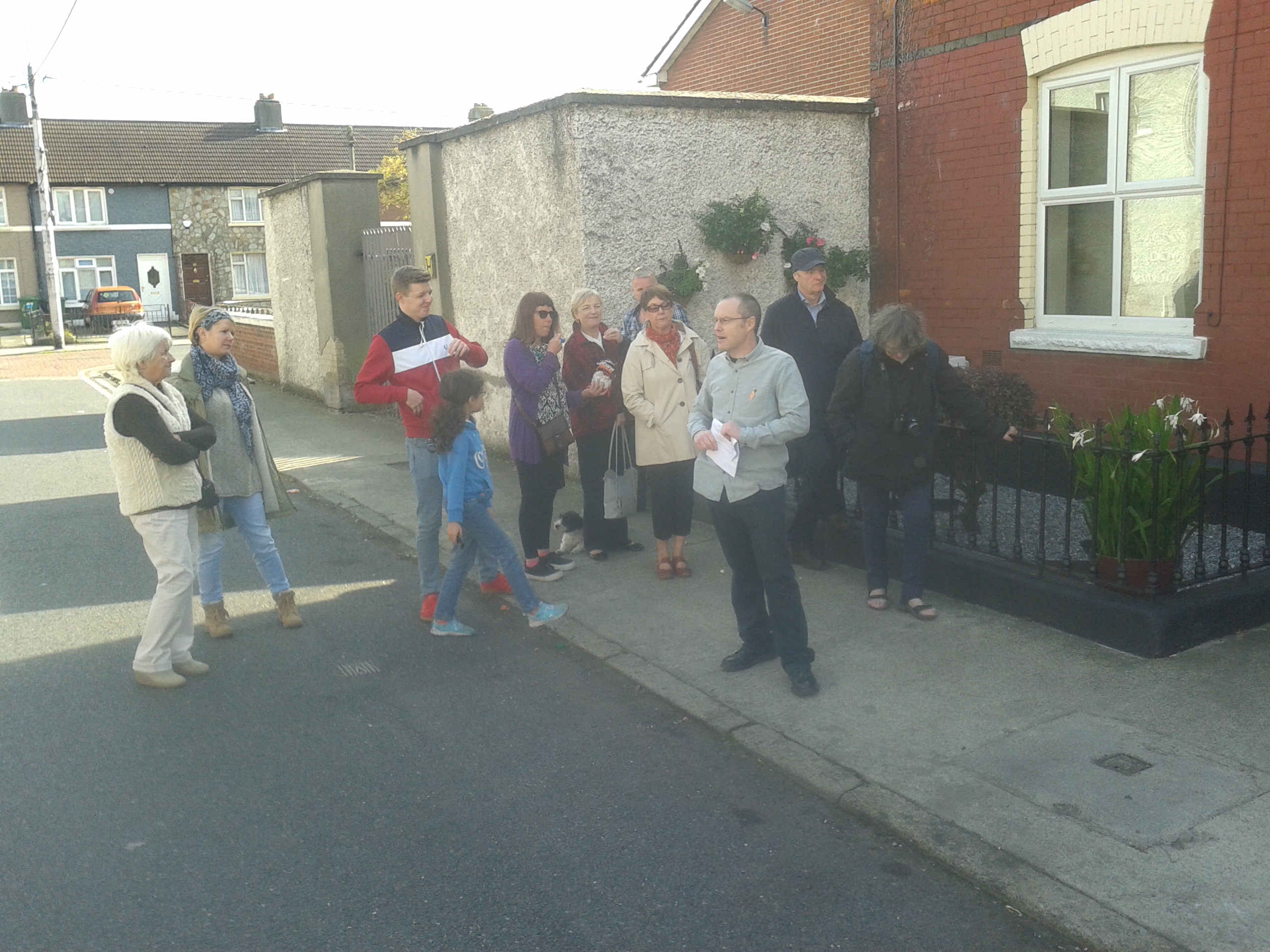
Joe Mooney pointing out Jack Nalty's house
Joe Mooney pointing out Jack Nalty’s house.
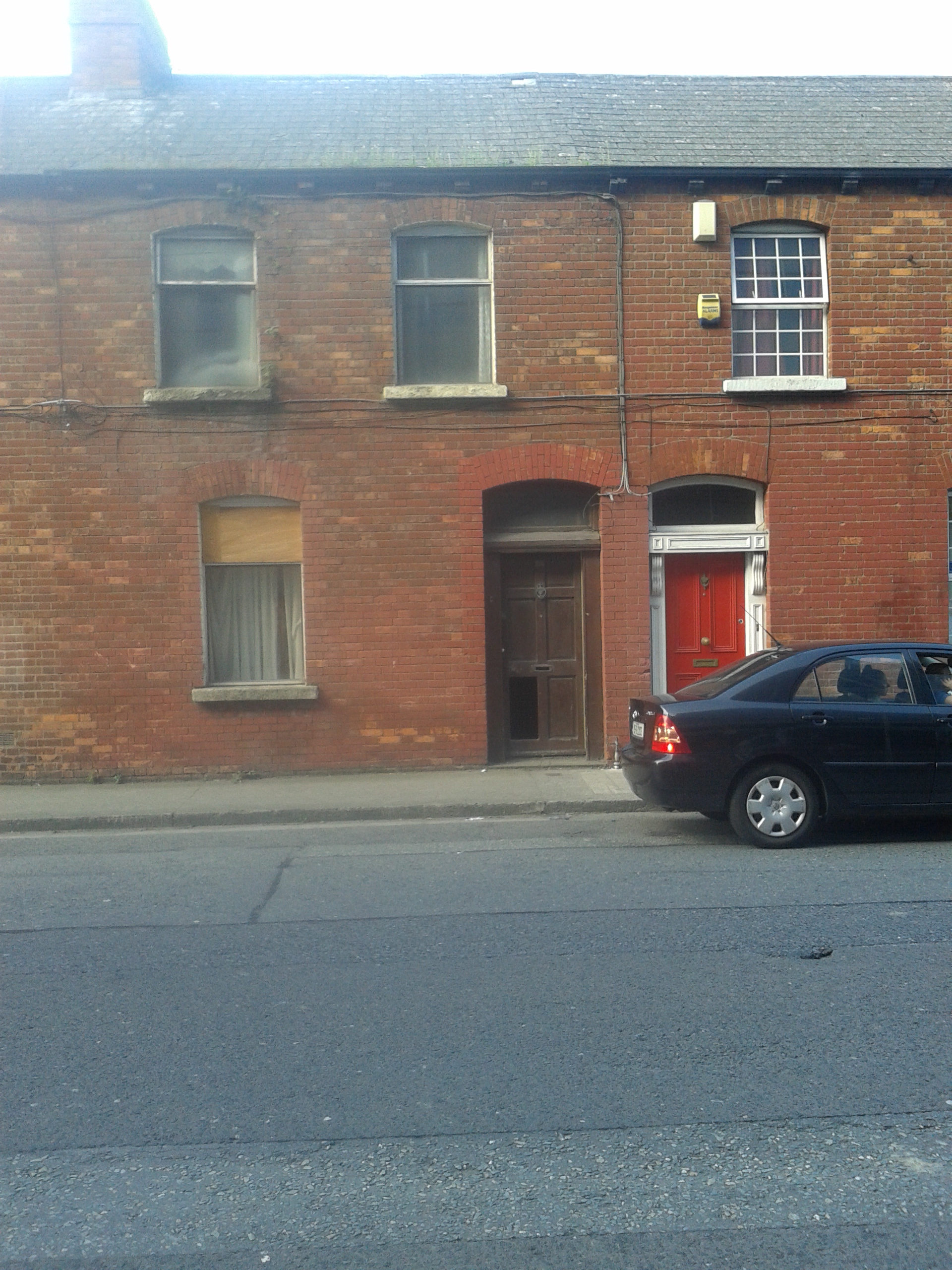
Jack Nalty's house
Jack Nalty’s house.
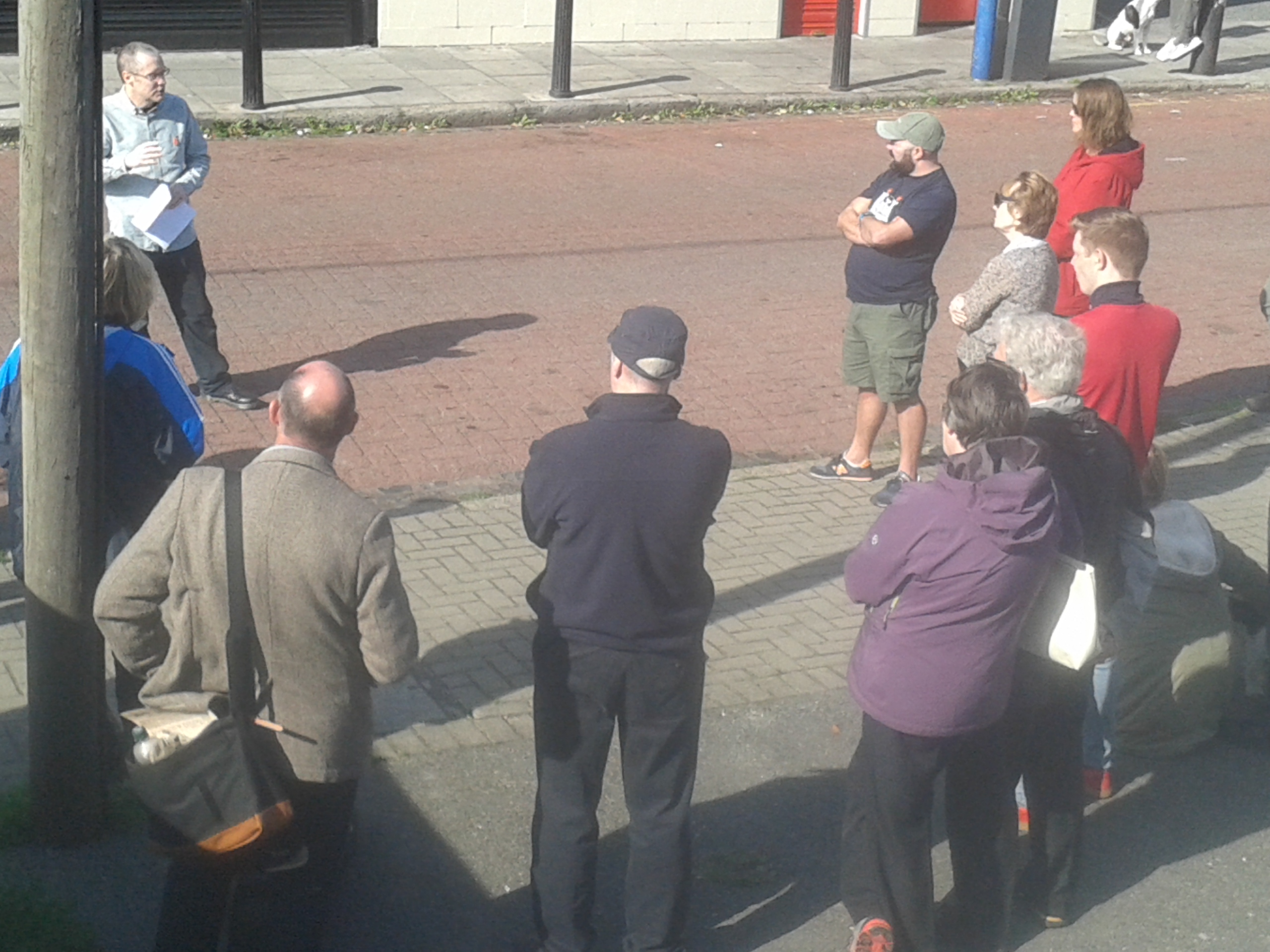
Joe & Crowd from above
(Photo: DB)

Next we visited the East Road, where Diarmuid set the tone with a stirring rendition of the Christy Moore song “Viva la Quinze Brigada(explaining that Christy incorrectly called it “Quinta” but had since corrected it – as the lyrics in English make clear, it was the FIFTEENTH Brigade). Gathered opposite the family home of Jack Nalty, we heard the story of another former ‘Wharf ‘ school-boy who became an active Republican and Socialist, eventually losing his life fighting Fascism in Spain in 1938. Jack (who was also a champion runner) was amongst the last of the International volunteers to die, while his friend and comrade Dinny Coady was amongst the first. Many of Dinny Coadys relatives still live locally, and we plan to commemorate them properly in the future.

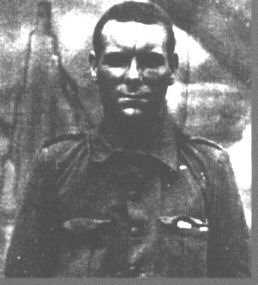
Jack Nalty in uniform of the 15th International Brigade
Jack Nalty in uniform of the 15th International Brigade. (Photo: Internet)


Next was a quick stop at the junction of Bargy and Forth Roads, which along with Shelmalier, Killane and Boolavogue were the names given to streets of Corporation houses erected here in the 1930’s and ’40s. They are of course synonymous with places in Wexford in the 1798 Rebellion.

At the rear of the former Cahill printers premises we learned how an innovative glassmaking factory (Fort Crystal Works) once stood there, perhaps the first industry in the area, but by the early 1800’s lay in ruins. As reported in newspapers as far away as New York, in 1848 a hundred men gathered here and spent an entire day in musketry practice, even setting up a dummy of the Lord Lieutenant of Ireland (the Queen’s representative) to practice on. These were members of the Young Ireland movement, preparing for rebellion.

Joe speaking at the 'Scotch Block'
Joe speaking at the ‘Scotch Block’ — some of the crowd are out of shot, as is Paul O’Brien, who is just getting ready to play.  (Photo: DB)

On Church Road we remembered former resident Edward Dorin, a Sergeant in the IRA who was part of the operation to burn the Custom House during the War of Independence. Another former ‘Wharf’ school pupil (he started there the same year as Jack Nalty), he was shot dead alongside a young volunteer from Ballybough when they engaged a lorryload of Auxillaries at Beresford place (just by Liberty Hall). (They were covering the attacking party). There had been a suggestion in the 1950’s to rename Custom House Quay as Dorins Quay .

A short stop at the “Scotch Block”, Fairfield Avenue, where Paul played two songs recalling Glasgow immigrants to the area and also Edinburghborn James Connolly. An incident in 1918 when Union Jackwaving residents from these buildings attempted to disrupt a Sinn Féin election rally also got a mention.

Diarmuid Breatnach singing Viva La Quinze Brigada opposite house.
Diarmuid Breatnach singing “Viva La Quinze Brigada” opposite Jack Nalty’s house. (Photo: EWHG)

As we passed Hawthorn Terrace its most famous resident Sean O’Casey was briefly discussed, as was his former neighbour Willy Halpin, the diminutive Citizen Army man most famous for almost escaping capture at City Hall by climbing up a chimney.

As we passed Russell Avenue a dishonorable mention was given to those who attempted to raise a 5,000 strong Fascist militia from an address here in the late 1950’s. Thankfully they failed miserably, as did the Italian fascist sympathiser resident of Caladon road who was banned from the U.S.A. during World War Two and eventually arrested by the Irish state and handed over to British authorities via the Six Counties.

At Malachi Place the actionpacked tale of Fenian leader John Flood was recounted. He lived here in the 1860’s as he worked on plans to stage a rebellion against British Rule. After an audacious attempt to seize weapons from Chester Castle was betrayed, he was eventually arrested following a boat chase on the Liffey and deported to Australia on the last convict ship to sail there. A memorial stands above his grave, unveiled there in 1911, two years after his death. This story could be a movie script!

We finished off the day at the base of Johnny Cullens Hill at the block of houses formerly named Irvine Crescent (now incorporated into Church Road). It was here the Scott family lived and in 1916 their 8yearold son was shot from the gun boat Helga. He lingered on for months after his wounding before finally dying, making him the last of the child casualties of 1916. The same year his father died in an accident in the Port, leaving his mother to raise five children on her own while coping with this double tragedy.

Their nextdoor neighbours were the Lennon family. On Bloody Sunday 1913 Patrick Lennon was one of those injured in the baton charge on O’Connell Street. Bloodied but unbowed, he worked alongside Sean O’Casey to raise funds for the relief of strikers families, a project which eventually led to the establishment of the famous soup kitchen at Liberty Hall.

And finally on to Bloody Sunday 1920. Everybody knows the story of how the Squad under Michael Collins (and the Dublin Brigade of the IRA) targeted British Intelligence agents in the City but not many know of the East Wall operation. A house on Church Road was targeted but the agent had left the evening before and was in Cork when the IRA group arrived. The exact location is unknown but we suspect it was within this block here as many of the houses were sub-divided at that time.”

A coincidence in Merchant's Road, opposite the mural (note the date)
A coincidence in Merchant’s Road, opposite the mural (note the date).  (Photo: EWHG)

Even if they didn’t get to tell half the stories of East Wall and the Irish Revolution, it was an enjoyable and informative walking tour … and the weather was beautiful – and there’s always next year!


End

31st AUGUST 102 YEARS AGO — BLOODY SUNDAY IN DUBLIN 1913/ HOY, HACE 102 ANOS — EL DOMINGO SANGRIENTO DEL 31 DE AGOSTO 1913

Diarmuid Breatnach (published originally in Dublin Political History Tours)

(Miren de bajo para la versión en castellano).

The 31st of August 1913 was one of several ‘Bloody Sundays’ in Irish history and it took place in O’Connell Street (then Sackville Street).

A rally had been called to hear the leader of the IT&GWU) speak. The rally had been prohibited by a judge but the leader, Jim Larkin, burning the prohibition order in front of a big demonstration of workers on the evening of the 29th, promised to attend and address the public.

On the day in O’Connell Street, the Dublin police with their batons attacked the crowd, including many curious bystanders and passers by, wounding many by which at least one died later from his injuries.

One could say that on that street on the 31st, or in the nearby Eden Quay on the night of the 30th, when the police batoned to death two workers, was born the workers’ militia, the Irish Citizen Army, in a desire that very soon would be made flesh.

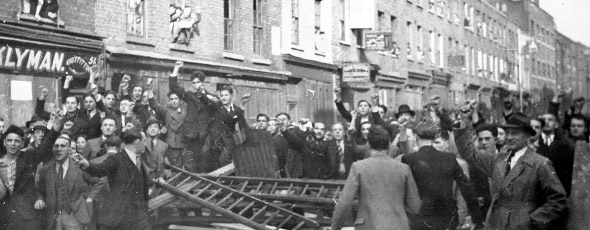
La carga policial contra los manifestantes y transeúntes en la Calle O'Connell en el 31 Agosto 1913/ DMP attack on demonstrators and passers-by on 31st August 1913 in Dublin's O'Connell Street
La carga policial contra los manifestantes y transeúntes en la Calle O’Connell en el 31 Agosto 1913/ DMP attack on demonstrators and passers-by on 31st August 1913 in Dublin’s O’Connell Street

THE EMPLOYERS’ LOCKOUT

Bloody Sunday Dublin occurred during the employers’ Lockout of 1913. Under Jim Larkin’s leadership, the Liverpudlian of the Irish diaspora, the young ITGWU was going from strength to strength and increasing in membership, with successful strikes and representation in Dublin firms. But in July 1913, one of Dublin’s foremost businessmen, William Martin Murphy, called 200 businessmen to a meeting, where they resolved to break the trade union.

Murphy was an Irish nationalist, of the political line that wished for autonomy within the British Empire; among his businesses were the Dublin tram company, the Imperial Hotel in O’Connell Street and the national daily newspaper “The Irish Independent”.

The employers decided to present all their workers with a declaration to sign that the workers would not be part of the ITGWU, nor would they support them in any action; in the case of refusal to sign, they would be sacked.

The members of the ITGWU would have to reject the document or leave the union, which nearly none of them were willing to do.

Nor could the other unions accept that condition, despite any differences they may have had with Larkin, with his ideology and his tactics, because at some point in the future the employers could use the same tactic against their own members.

The Dublin (and Wexford) workers rejected the ultimatum and on the 26th began a tram strike, which was followed by the Lockout and mixed with other strikes — a struggle that lasted for eight months.

Dublin had remarkable poverty, with infectious diseases such as tuberculosis and others, including the sexually-transmitted ones, the city being a merchant port and also having many British Army barracks. The percentage of infantile mortality was higher than that in Calcutta. Workers’ housing was in terrible condition, often with entire families living in one room, in houses sometimes of 12 rooms, each one full of people, with one or two toilets in the outside yard.

In those conditions, 2,000 Dublin workers confronted their employers, the latter aided by their Metropolitan Police, the Irish colonial police and the British Army. As well as the workers, many small traders suffered, those selling in the street or from little shops.

On that Monday, the 31st of September 1913, some trade unionists and curious people congregated in Dublin’s main street, then called Sackville Street, in front of and around the main door of the big Clery’s shop. In the floors above the shop, was the Imperial Hotel, with a restaurant.

The main part of the union went that day to their grounds in Fairview, to avoid presenting the opportunity for another confrontation with the Dublin Municipal Police. Others in the leadership had argued that the police should not be given the opportunity and that there would be many other confrontations during the Lockout. But Larkin swore that he would attend and that a judge should not be permitted to ban a workers’ rally.
Daily Mirror Arrest Larkin photoThere were many police but nothing was happening and Larkin did not appear. After a while, a horse-drawn carriage drove up and an elderly church minister alighted, assisted by a woman, and entered the shop. They took the lift to the restaurant floor. A little later Larkin appeared at the restaurant open window, in church minister’s clothing, spoke a few words to the crowd and ran inside. Those in the street were very excited and when the police took Larkin out under arrest, they cheered him, urged on by Constance Markievicz. The police drew their batons and attacked the crowd — any man not wearing a police uniform.
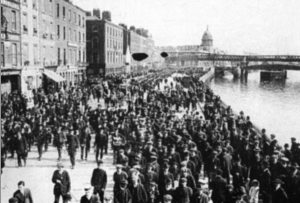
 

THE UNION’S ARMY

The Irish Citizen Army was founded for the union on the 6th November 1913 by Larkin, Connolly and others with Seán Ó Cathasaigh/ O’Casey, playwright and author, including the first history of the organisation.

The Citizen Army at Croydon House, at the ITGWU's grounds in Fairview/ El Ejercito Ciudadano en su parte del parque en Fairview.
The Citizen Army at Croydon House, at the ITGWU’s grounds in Fairview/ El Ejercito Ciudadano en su parte del parque en Fairview.

As distinct from the Irish Volunteers, women could enter the ICA, within which they had equal rights.

Funeral of James Byrne, who died as a result of his imprisonment during the 1913 Lockout
Funeral of James Byrne, who died as a result of his imprisonment during the 1913 Lockout/ Procesión funébre de James Byrne, fallecido por razón de su encarcelamiento durante el Cierre de 1913, pasando por el muelle sur Eden’s Quay, partiendo de la Salla de la Libertad.

It was reorganised in 1914 as the union was recovering from its defeat during the Lockout, and 200 fought alongside the Volunteers in the 1916 Easter Rising, after which two of its leaders, Michael Mallin and James Connolly, were executed. Among the nearly 100 death sentences there were others of the ICA, including Markievicz, but their death sentences were commuted (14 were executed in Dublin, one in Cork and one was hanged in London).

The main fighting locations of the ICA in 1916 were in Stephen’s Green and in the Royal College of Surgeons, in City Hall and, with Volunteers in the GPO and in the terrace in Moore Street, the street market.

The Imperial Hotel on the other side of the street from the GPO was occupied too by the ICA and on top of it they attached their new flag, the “Starry Plough/ Plough and Stars”, the design in gold colour on a green background, the

The flag of the ICA, flown over Murphy's Imperial Hotel in 1916
The flag of the ICA, flown over Murphy’s Imperial Hotel in 1916

constellation of Ursa Mayor, which the Irish perceived in the form of a plough, an instrument of work. And there the flag still flew after the Rising, having survived the bombardment and the fire which together destroyed the building and all others up to the GPO, on both sides of the street. Then a British officer happened to notice the flag and ordered a soldier to climb up and take it down — we know not where it went.


TODAY

Today, after various amalgamations, the once-noble ITGWU has become SIPTU, the largest trade union in Ireland but one which does not fight. The skyscraper containing its offices, Liberty hall, occupies the spot of the original Liberty Hall, prior to its destruction by British bombardment in 1916.

The Irish newspaper the “Irish Independent” continues to exist, known as quite right-wing in its editorial line. Murphy’s trams came to an end during the 1950 decade and those in Dublin today have nothing to do with Murphy.

The Imperial Hotel no longer exists and, until very recently, Clery had taken over the whole building, but they sacked their workers and closed the building, saying that they were losing money.

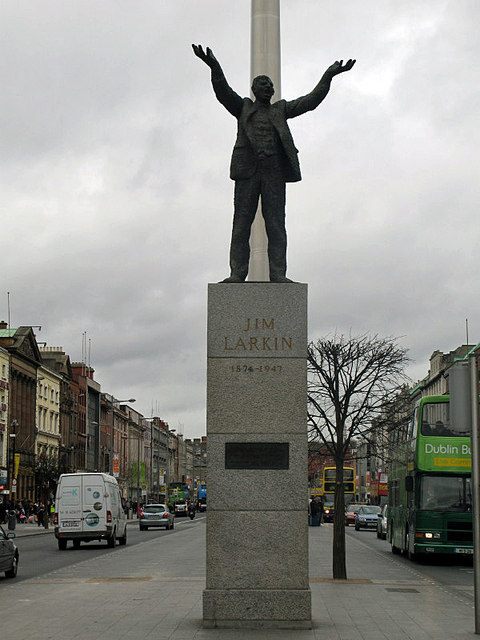
In front of the building, in the pedestrianised central reservation, stands the monument as a representation of Jim Larkin. The form of the statue, with its hands in the air, is from a photo taken of Larkin during the Lockout, as he addressed another rally in the same street. It is said that in those moments, he was finishing a quotation which he used during that struggle (but which had also been written previously by James Connolly in 1897, and which something similar had been written by the liberal monarchist Étienne de La Boétie [1530–1563] and later by the French republican revolutionary Camille Desmoulins [1760–1794]): “The great appear great because we are on our knees – LET US ARISE!”


The Jim Larkin monument in O'Connell Street today/ El monumento de Jim Larkin in la Calle O'Connell hoy en día
The Jim Larkin monument in O’Connell Street today/ El monumento de Jim Larkin in la Calle O’Connell hoy en día


EL 31 DE AGOSTO EN El 1913 FUE UNO DE LOS DOMINGOS SANGRIENTOS DE IRLANDA Y OCURRIÓ EN LA CALLE PRINCIPAL DE DUBLÍN.

Hubo una concentración para escuchar al líder del sindicato de Trabajadores de Transporte y de General de Irlanda (IT&GWU) hablar. La manifestación fue prohibida por juez pero el líder, Jim Larkin, quemando el documento de prohibición en frente de manifestación grande la noche del 29, prometió que iba a asistir y hablar al publico.

El día 31 en la Calle O’Connell, la policía de Dublin con sus porras atacaron la concentración y a muchos otros curiosos o pasando por casualidad, hiriendo a muchos por lo cual murió uno por lo menos mas tarde de sus heridas.

Se puede decir que en esa calle en el 31, o en la cerca muelle, Eden Quay, la noche del 30, cuando mataron a porras dos trabajadores, se dio luz a la milicia sindical, el Ejercito Ciudadano de Irlanda, en deseo que poco mas tarde estaría fundado en actualidad.

EL CIERRE PATRONAL

El Domingo Sangriento ocurrió durante el Cierre Patronal de Dublín en el 1913. Bajo el liderazgo de Jim Larkin, el Liverpoolés de diáspora Irlandesa, el joven sindicato ITGWU fue yendo de fuerza a fuerza y aumentando en miembros, con éxitos en sus huelgas y reconocido en muchas de las empresas de Dublín. Pero en Julio del 1913, uno de los principales empresarios de Dublín, William Martin Murphy, llamó a 200 de los empresarios a mitin y resolvieron romper el sindicato.

Murphy era nacionalista Irlandés, de la linea de pedir autonomía pero adentro del Imperio británico; entre sus empresas le pertenecía la linea de tranvías de Dublín, el Hotel Imperial en la Calle O’Connell y el periódico diario nacional The Irish Independent.

Resolvieron los empresarios presentar a todos sus trabajadores una declaración para firmar que no serían parte del sindicato ITGWU ni les darían ningún apoyo en cualquiera acción; en caso de negar firmar, se les despedirían.

Los miembros del ITGWU tendrían que rechazar el documento o salir del sindicato, lo cual casi lo total no estuvieron dispuestos hacer.

Los otros sindicatos, pese a cualquiera diferencias tuvieron con Larkin, con sus pensamientos y sus tácticas, tampoco podían acceder a esa condición por que mas tarde se podría usar la misma táctica en contra de sus miembros también.

Los trabajadores de Dublín (y de Wexford) rechazaron el ultimátum y empezaron el 26 de Agosto una huelga de los tranvías, seguido por el Cierre Patronal, mixta con otras huelgas, una lucha que duró ocho meses en total.

Dublín tuvo una pobreza impresionante, con infecciones de tuberculosis y otras, incluido las transmitidas por el sexo, siendo puerto mercantil y teniendo muchos cuarteles del ejercito británico. El porcentaje de la mortalidad infantil era mas de la de la ciudad de Calcuta. Las viviendas de los trabajadores estaban en terribles condiciones, con a menudo familias grandes enteras viviendo en una habitación, en casas a veces de 12 habitaciones, cada uno llena de gente, con una o dos servicios en el patio exterior.

En esas condiciones 2,000 trabajadores de Dublín se enfrentaron al patronal de Dublín, con su policía metropolitana, la policía colonial de Irlanda y el ejercito británico. Además de los trabajadores, muchos pequeños empresarios, vendiendo en la calle o en tiendas pequeños, sufrieron.

Ese Domingo, del 31o de Setiembre 1913, algunos sindicalistas y gente curiosa se congregaron en la calle principal de Dublín, entonces nombrado Sackville Street, en frente y al rededor de la puerta principal de la gran tienda de Clery. En las plantas después de la primera, estaba el Hotel Imperial, con un restaurante.

La mayor parte del sindicato se fueron ese día a una parte de parque que les pertenecía por la costa, para evitar otra enfrentamiento con la Policía Metropolitana de Dublín. Habían argumentado otros de la dirección del sindicato que no se debe dar les la oportunidad a la policía y que habría muchos otros enfrentamientos durante el Cierre. Pero Larkin juró que lo iba a asistir y que no se podía permitir a un juez prohibir manifestaciones obreras.

Había mucha policía pero nada pasaba y Larkin no aparecía. Después de un rato, un coche de caballos llegó y un viejo sacerdote salió, apoyado por una mujer, y entraron en la tienda de Clery. Subieron en el ascensor hacía el restaurante. Poco después, Larkin apareció en la ventana abierta del restaurante, en el traje del cura y habló unas palabras, antes de correr adentro. Los de abajo en la calle muy entusiasmados y cuando la policía salieron agarrando le a Larkin, la multitud le dieron vítores, alentados por Constance Markievicz. La Policía Municipal sacaron sus porras y atacaron a la multitud – a cualquier hombre que no llevaba uniforme policial.


EL EJERCITO DEL SINDICATO

El Ejercito Ciudadano de Irlanda (Irish Citizen Army) fue fundado para el sindicato en el 6 de Noviembre del 1913 por Larkin, Connolly y otros con Seán Ó Cathasaigh/ O’Casey, escritor de obras para teatro y algunas otras, incluso la primera historia de la organización. A lo contrario de Los Voluntarios, el ICA permitía entrada a mujeres, donde tenían derechos iguales.

Fue reorganizada en 1914 cuando el sindicato se fue recobrando de la derrota del Cierre Patronal, y 200 lucharon con los Voluntarios en el Alzamiento de Pascuas de 1916, después de lo cual dos de sus líderes, Michael Mallin y James Connolly, fueron ejecutados. Entre los casi 100 condenas de muerte, habían otros del ICA, incluso Constance Markievicz, pero sus condenas de muerte fueron conmutadas (se les ejecutaron a 14 en Dublín y a uno en Cork, y a otro le ahorcaron en Londres).

Los lugares principales de lucha del ICA en 1916 fueron en el Stephen’s Green y en el Collegio Real de Cirujanos (Royal College of Surgeons), en el Ayuntamiento y, con Voluntarios, en la Principal Oficina de Correos (GPO) y en la manzana del Moore Street, el mercado callejero.

El Hotel Imperial al otro lado de la calle del GPO lo ocuparon también el ICA, y encima colocaron su nueva bandera, el Arado de Estrellas (“Starry Plough/ Plough and Stars”), el diseño en color oro sobre fondo verde, la formación celeste del Ursa Mayor, que lo veían los Irlandeses en forma del arado, una herramienta de trabajo. Y ahí ondeó la bandera después del Alzamiento, habiendo sobrevivido el bombardeo británico y el fuego que destruyeron el edificio y la calle entera hacía el GPO, en ambos lados. Entonces un oficial británico se dio cuenta de la bandera y le mandó a soldado hir a recoger la – no se sabe donde terminó.


HOY EN DÍA

Hoy en día, después de varias fusiones, el noble ITGWU se ha convertido en el SIPTU, el sindicato mas grande de Irlanda y parecido en su falta de lucha a Comisiones Obreras del Estado Español. El rasca cielos de sus oficinas, La Sala de la Liberta (Liberty Hall), ocupa el mismo lugar que ocupó la antigua Liberty Hall, antes de su destrucción por bombardeo británico en 1916.

El periódico Irish Independent sigue existiendo, conocido por ser bastante de derechas en su linea editorial. Los tranvías de Murphy terminaron en la década del 1950 y los de hoy en Dublín no tienen nada que ver con los de antes.

El Hotel Imperial ya no existe y, hasta hace muy poco, la empresa Clery lo tenía todo el edificio, pero despidieron a sus trabajadores y cerraron el edificio, diciendo que perdían dinero.

En frente del edificio, en la reserva peatonal del centro de la calle, está el monumento representando a Jim Larkin. La forma de la estatua, con las manos en el aire, lo tiene de foto que le hicieron durante el Cierre Patronal, cuando habló en otro manifestación en la misma calle. Dicen que en ese momento, estaba terminando una frase famosa que usó durante esa lucha (pero que también lo escribió Connolly antes en 1897, y que lo había escrito algo parecido primero el monárquico reformista Étienne de La Boétie [1530–1563] y luego el revolucionario republicano francés Camille Desmoulins [1760–1794]): “Los grandes aparecen grande por que estamos de rodillas – levantamanos!”


Fin

ANTI-INTERNMENT MARCH BLOCKED BY MASSIVE POLICE PRESENCE IN BELFAST

Diarmuid Breatnach

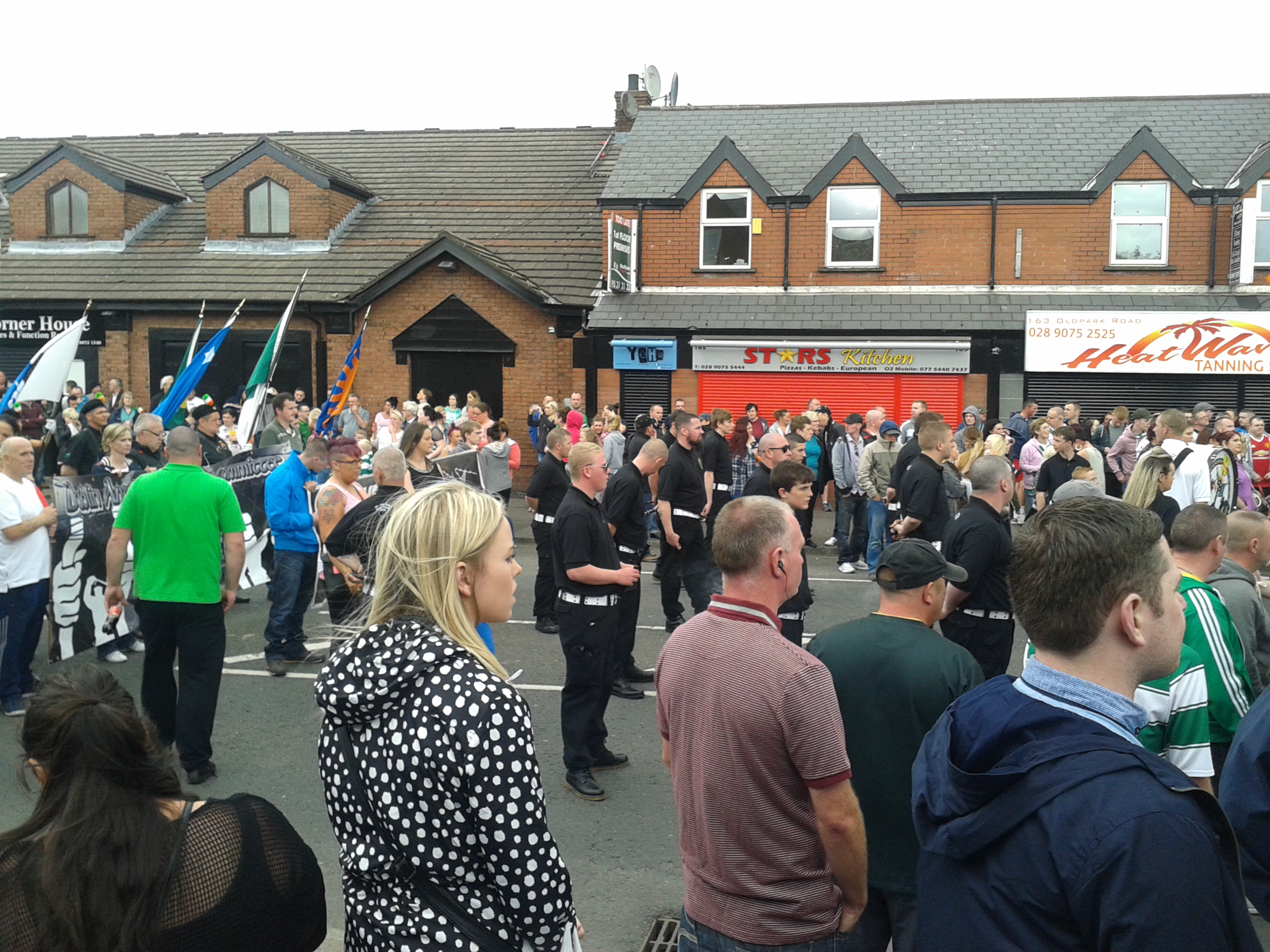
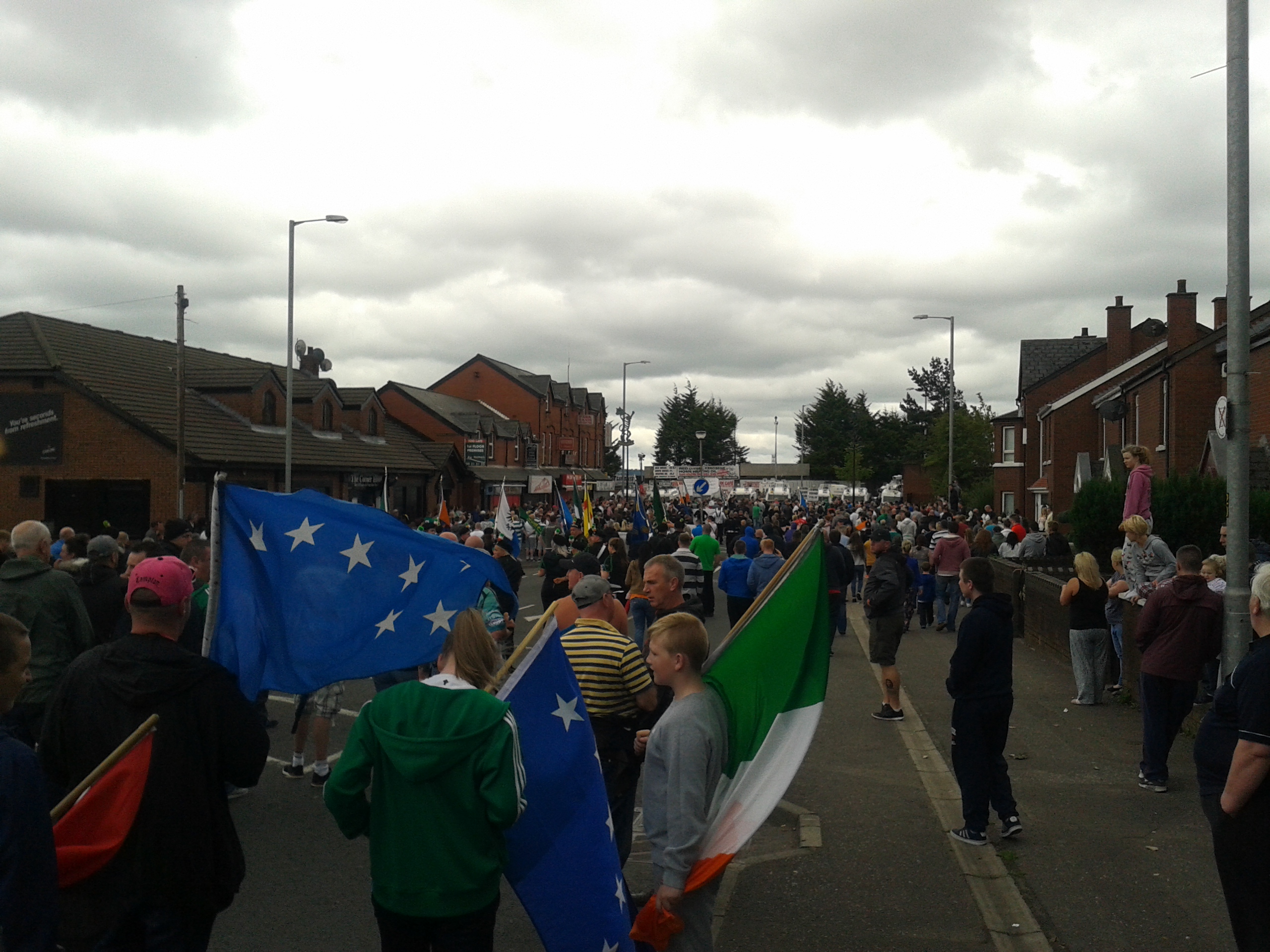
The annual anti-internment march in Belfast was blocked on Sunday 11th August by a very heavy police presence from proceeding beyond the Old Park Road. Road blocks had also been set up around the area and in the city centre. Although the march dispersed without incident, the continuing heavy police presence in the area provoked local people and altercations broke out between them and the police. In one incident, a reportedly pregnant woman was video-filmed being arrested and assaulted by male police, apparently for telling the police to get out of her garden.

Internment without trial was used by the British colonial regime in Ireland as one of its measures to repress resistance to its rule. After Partition, it was used by the regimes on both sides of the Border. Its most recent formal use was in the Six Counties from August 1971 until the last one was released in 1975, by which time almost 2,000 had been interned, initially only people from ‘nationalist community’ but later on some from the Unionist community had been added to the trawl. During immediate street protests against the introduction of internment, the Parachute Regiment shot dead 11 unarmed men over three days in the Ballymurphy area of Belfast. During a protest march in Derry against internment six months later, that same Regiment killed 14 unarmed civilians and injured many more. According to the authorities and to some others, including Sinn Féin, internment without trial no longer exist.

But since the Good Friday Agreement, Republican political activists who are not in agreement with its terms find themselves being locked up without trial through a number of other measures:

  • Some Ex-prisoners released under license have had that license revoked and are brought to prison without trial (e.g. cases in the recent pass have included those of Marian Price [2 years] and Martin Corey [4 years])

  • Activists are arrested on spurious charges and refused bail, to be found not guilty eventually but having spent years already in prison (Colin Duffy, among others)

  • Or the activists arrested on spurious charges are offered bail only on conditions that would immobilise them politically and kept in jail when they refuse (Stephen Murney who did 14 months remanded in custody before eventually being found “not guilty” and released)

For this reason many Republicans consider that internment still exists but in a more hidden form and this has led to the formation of the Anti-Internment Leagueand also to the Anti-Internment Group of Ireland, the Dublin branch of which has organised many events, from public meetings to pickets and information tables.  The main activity of the AIL is organising the annual march against Internment as near as possible to the anniversary of its introduction, August 9th.

It is worth mentioning that in addition to the covert internment methods, activists are also arrested and convicted and jailed on spurious evidence (examples include Brian Shivers – two years without bail awaiting trial and a third year convicted, before his conviction was quashed by the Supreme Court – and the Craigavon Two – still serving time although wrongly convicted).

The Parades Commission & Time Restrictions

Formerly in the Six Counties, Loyalist triumphalist parades were allowed wherever they wished to go in Belfast and in most other towns too. These marches did not so much celebrate their religious affiliation, Presbyterianism; rather, as demonstrated by their banners, colours and the airs played by their bands, they celebrated historic battle victories over Irish forces with Catholic affiliation. But their parades also celebrated in many ways the state’s institutional discrimination against communities raised in the Catholic faith. During these parades insults and threats against people in ‘nationalist communities’ were everyday occurrences. Any protests against them were repressed by the police.

On the other hand, civil rights and Republican parades were banned or subject to huge restrictions – for example many of the early civil rights demonstrations and all Easter Rising commemorations were banned and even the 1972 march in Derry, six months after internment was introduced was also banned. Most of those demonstrations went ahead and were attacked by police with batons, tear gas, water cannon, rubber and plastic bullets and on occasion live bullets; the one in Derry against internment became known as “Bloody Sunday”.

Some years ago people in nationalist areas began to resist the triumphalist and provocative sectarian Loyalist marches going through their areas and the Parades Commission was set up to regulate marches by Loyalists and by people from the ‘nationalist’ areas – all march organisers had to apply for permission and abide by the decisions of the Commissioners. However, the decisions of the Parades Commissioners have been widely regarded among the ‘nationalist’ areas as being biased in favour of the Loyalists. For example, every year the Commissioners approve a march by Loyalists through the Garvaghy Road, despite almost total opposition to it in that ‘nationalist’ area. They also approve many Loyalist marches through Belfast city centre without significant restrictions.

Republicans do not apply to march through unionist areas but there have been restrictions on parades planned to go through the city centre. Two years ago the police blocked the Anti-Internment march from going through the city centre and last year it was held up for quite a while by the police, the reason given being that they were trying to control Loyalists who had gathered in the city centre to oppose the marchers. When the marchers were eventually permitted to proceed, they found a few hundred Loyalists shouting abuse and hurling missiles at them, with hardly any police restraint, with a line of police in full riot gear facing the marchers.

This year, the Anti-Internment parade organisers were given permission to hold the march but on the condition that they were clear of the city centre by 1.30pm, apparently to ensure no disruption to shopping in the centre. The question needs to be asked: How would such a march prevent shopping and how long would it take them to pass? The only significant disruption would be from Loyalists wanting to attack the march and people wanting to avoid that trouble and, if the police were a neutral force, it would be their job to control the Loyalists and prevent them from breaching the peace. But the RUC (the PSNI after the force’s name change) have never been anything less than an extremely sectarian force and, during the 30 years’ war, were deeply implicated in collusion with Loyalist sectarian assassination squads.

The Anti-Internment Parade organisers objected to the times condition on the grounds that people would have to have to choose between attending their parade and the Ballymurphy Massacre March for Truth on the Springfield Road at 1pm on the same day.

But there are other reasons why such a time restriction is not reasonable, apart from clashing with another event and elevating freedom from a supposed impediment to shopping above exercise of democratic rights to protest. Apart also from the fact that Loyalists don’t have such restriction placed upon their parades, an 11.30 start means that people journeying from further away have to start even earlier – for example, even from Dublin, with a reasonably fast route, one would need to be getting on a coach in the city centre at 8a.m. All these problems and inconveniences resulting from a time restriction which, in turn, is to facilitate commercial interests by overcoming an alleged interruption to their making a profit.
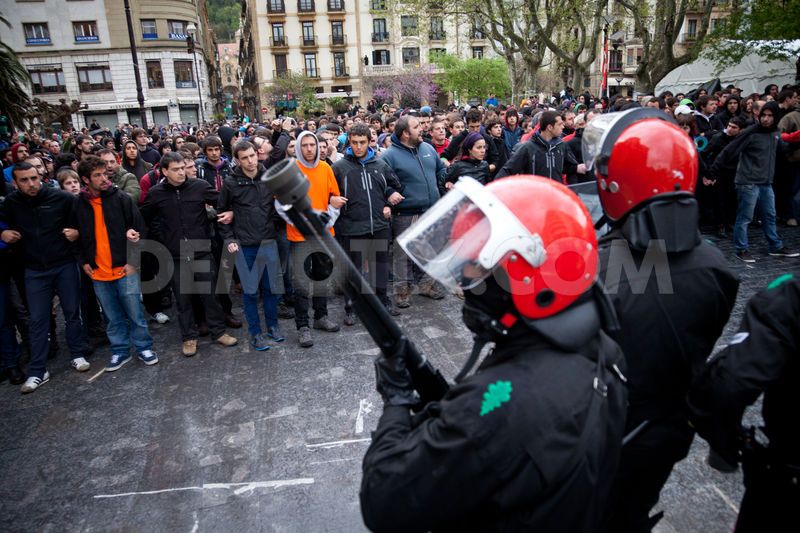
The Anti-Internment League announced that they would begin the march at 2pm and the PSNI mobilised huge forces to prevent them, as they considered that “the march was illegal from the moment it started”, in the words of Deputy Chief Constable of the PSNI, Stephen Martin on a radio program the day after.

Police blockade

I arrived in Belfast too late to attend the Ballymurphy Massacre march but I learned that hundreds had participated to once again commemorate the massacre by the British Paratroopers of eleven unarmed people in the Ballymurphy area over two days in 1971 (which they had followed up six months later with their Bloody Sunday massacre of 14 in Derry).

Unaware of the police mobilisation to block the Anti-Internment march, I had arrived in what I imagined to be plenty of time to attend it. But the police were preventing a local taxi firm from stopping by the coach station in the city centre to pick up passengers – what reason could there be for that, since that was not on the route of the march? Could it be that the police were trying to make it difficult for supporters to reach the march?

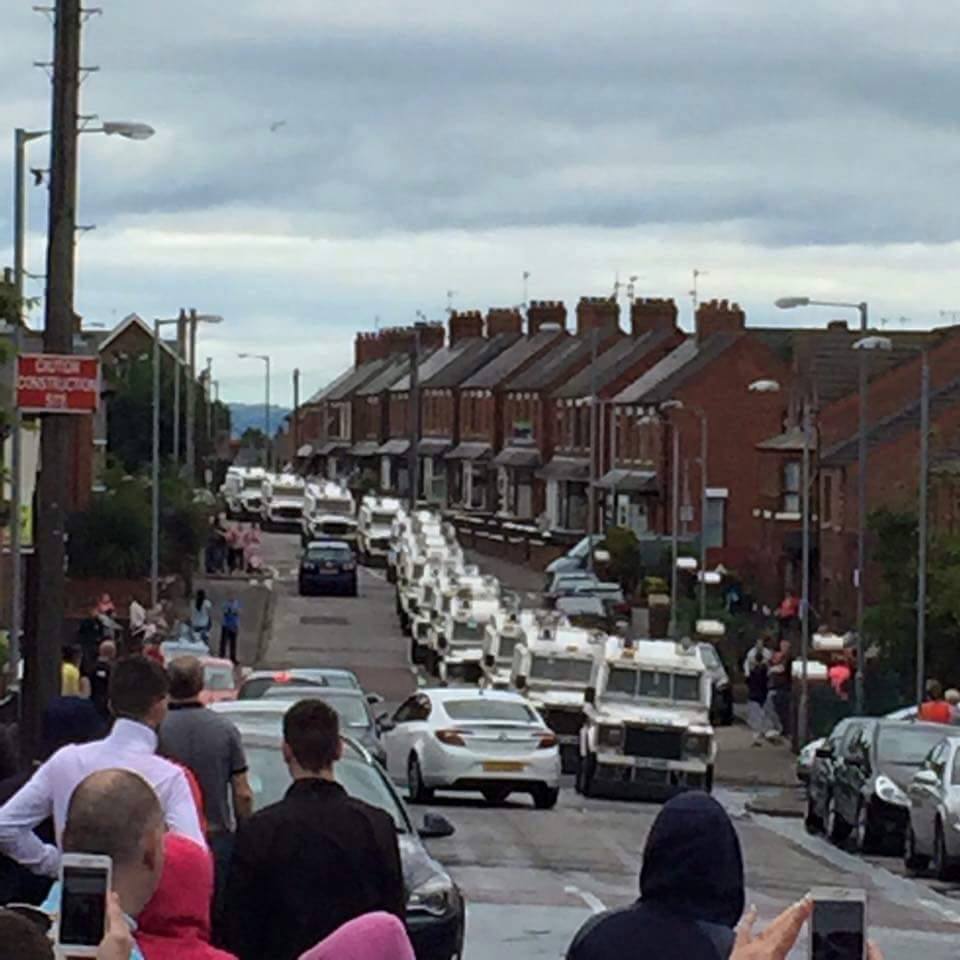
Part of the PSNI invasion of the area
Part of the PSNI invasion of the area (Photo from AIL FB page)

It certainly seemed like that when I walked in to the depot of the shared “people’s taxis”, i.e. the Falls Road Black Taxis about 1.45p.m. The word was that the RUC/ PSNI had cordoned off the southern approaches to Ardoyne, in North Belfast. I began to worry but was told that they would get me there. With a small group of Ardoyne residents, I waited in the depot, which resembles a coach waiting room and has a shop for sweets and soft drinks and another printing T-shirts and posters. Taxis pulled in and out, mostly heading for the Falls Road but eventually a taxi for Ardoyne (Ard Eoin = “Eoin’s Heights”) drew up and six of us got in – apart from myself, two youths, a middle-aged woman and an elderly couple, one of them with an English accent but clearly established in the area.

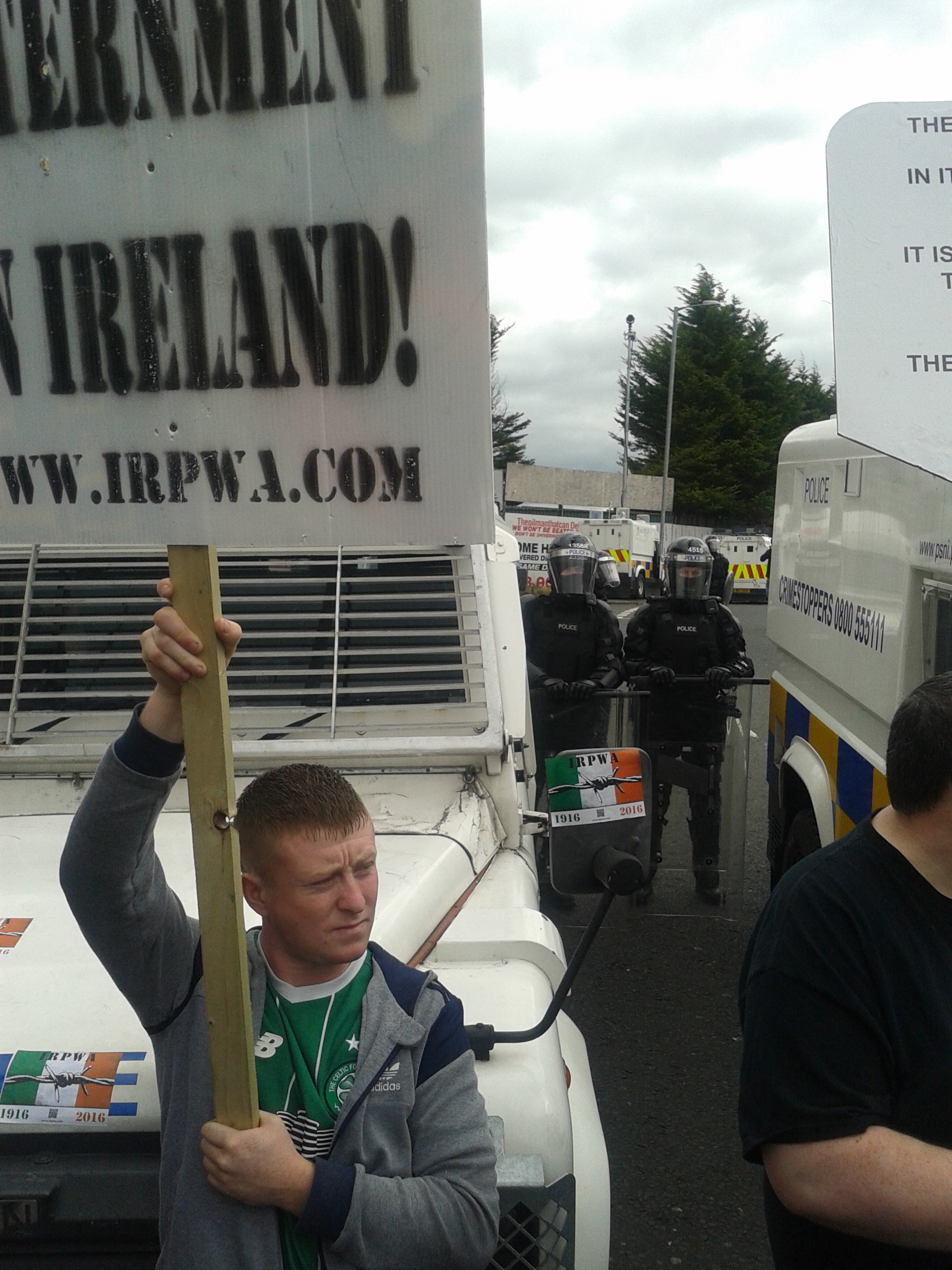
We had not gone far after dropping off one of the youths before we began to pass the PSNI vans, a kind of white boxed landrover, shields over windscreen, lights and siren and only slit windows in the back. From the taxi by now we had seen around 30 vans; we were all tutting at this massive police mobilisation. “Great day for a robbery,” I said. “Where’s the nearest bank?” quipped the elderly man. As we got nearer to Ardoyne we were suddenly confronted with a huge number of police vans and very soon afterwards, could go no further – PSNI vans, police on foot in black riot gear, shields and some with batons out already. Any belief I might have had that this was just an intimidation exercise by the police was dispelled. Our driver tried to negotiate with a female police officer who was dealing with traffic but all she could give were vague suggestions about which roads might yet be open. I heard our driver relaying information to his company’s control desk through his radio and I now realised that the police were determined to stop the march.

Our driver drove up and down other roads, gradually nearing Ardoyne and close to there apologised to us and pulled in outside a house in a residential street – it seemed that someone of some authority in Falls Road Black Taxis lived there. After conversing with our driver, this man got on our vehicle’s radio and spoke to someone at the depot, the terse conclusion of which was “Ardoyne is out”: Ardoyne was under police siege and the area was now out of bounds to their taxis.

The driver dropped us near to my destination, apologising again as he had done frequently. We assured him it was not his fault. As I walked down to approach the rallying point for the march, some of the local community were out in the street playing at an poc fada (“the long hit”), a one-shot competition with hurley to see who can hit the sliotar (the leather ball used in hurley games) the furthest. An poc fada is one of the features of the Féile Béal Feirste, an annual community festival which has been growing annually (and which some say has now largely become a commercial festival, far from its community roots, with dear admittance fees and drink prices, in an area with very high unemployment).

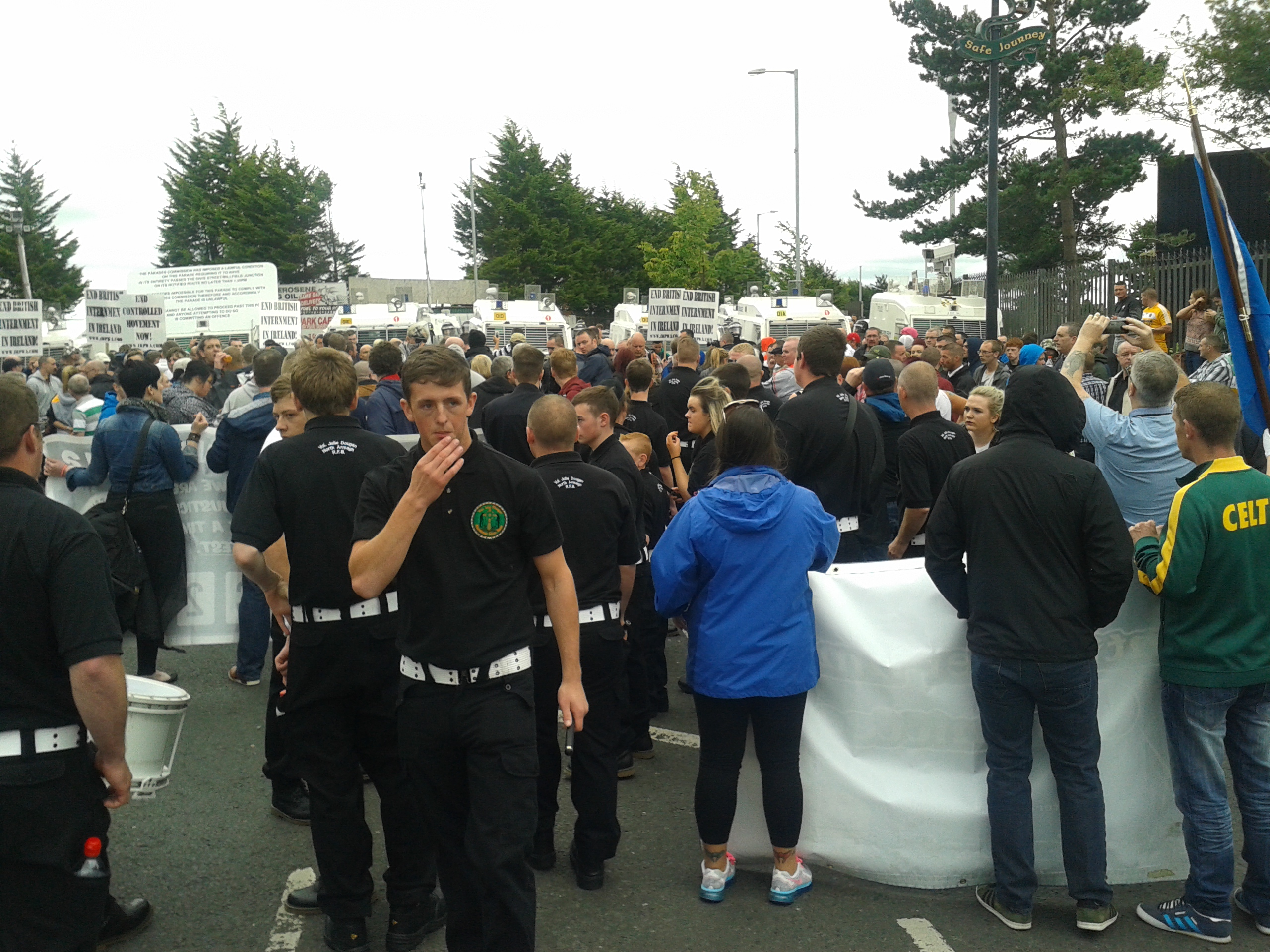
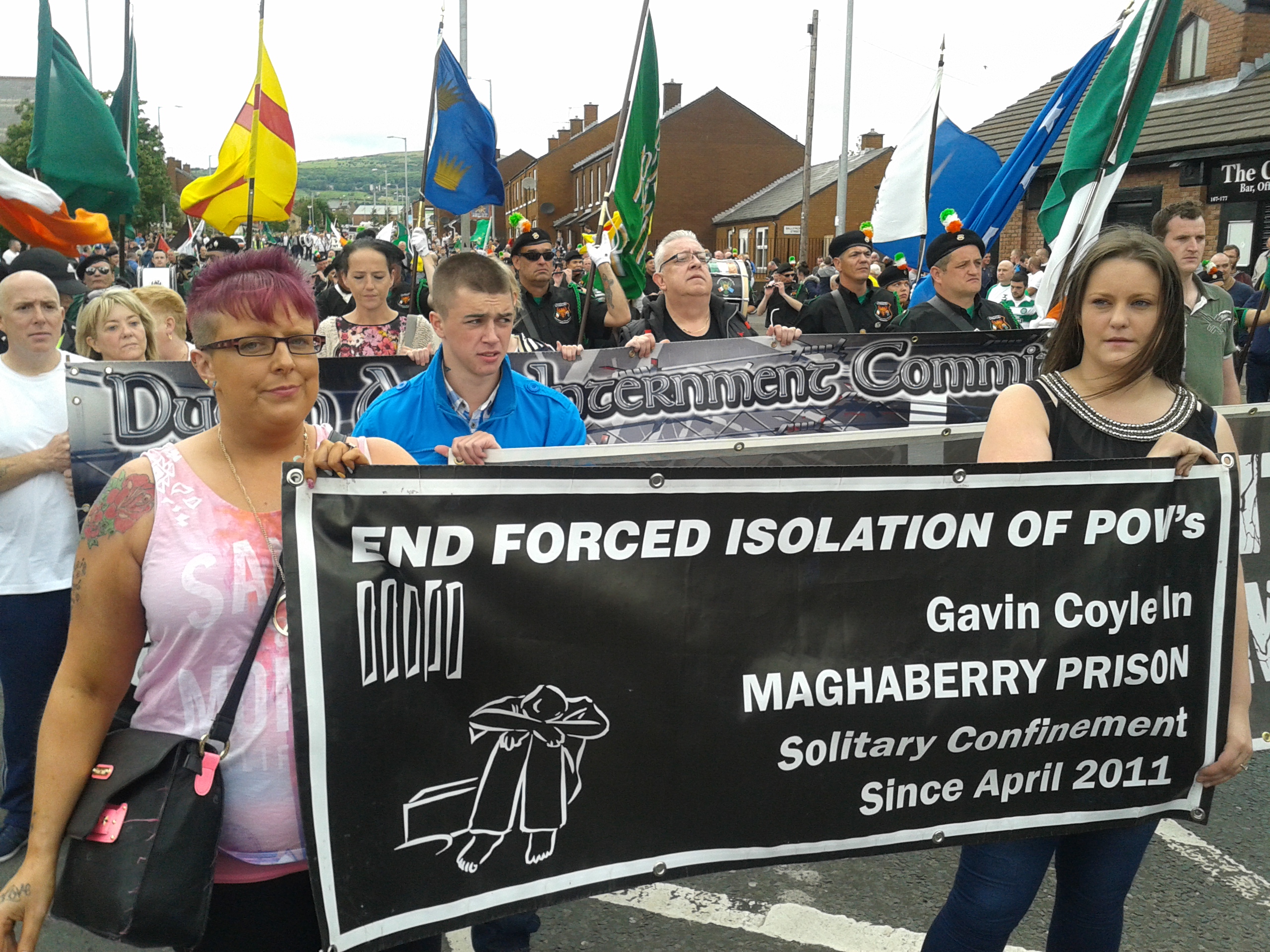
Rounding the corner to head up towards the Shamrock Bar, I was just in time to join the tail of the march as it set off. I sped up to try and catch up with the Dublin Anti-Internment Committee, passing some people I knew along the way, exchanging greetings. There were five Republican marching bands playing music: the Garngad, Brendan Hughes and Volunteers Black and Ryan bands were all from Glasgow, while the John Brady RFB was from Strabane and the Julie Dougan from Portadown.

One of the Dublin Anti-Internment Committee banners

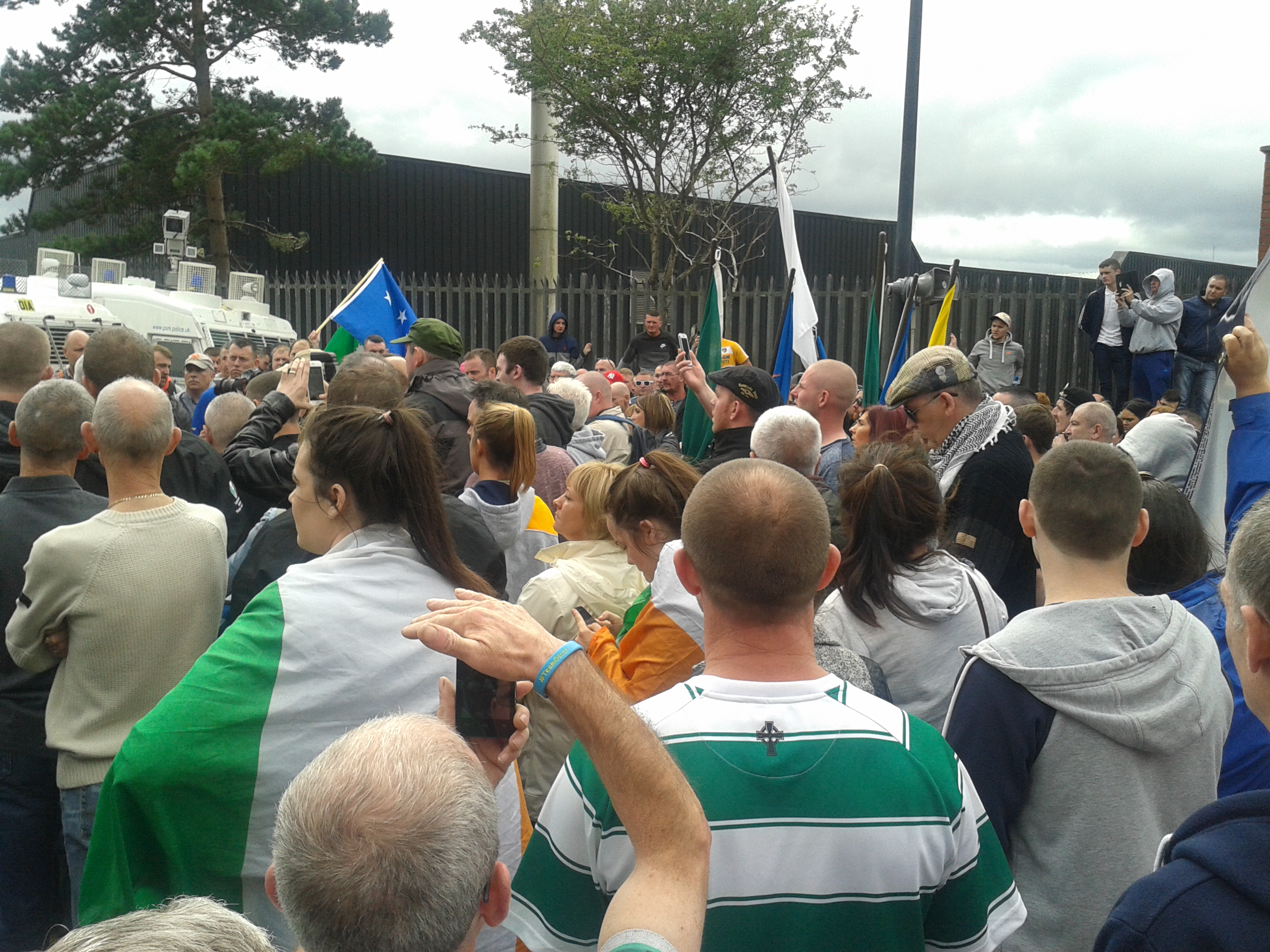
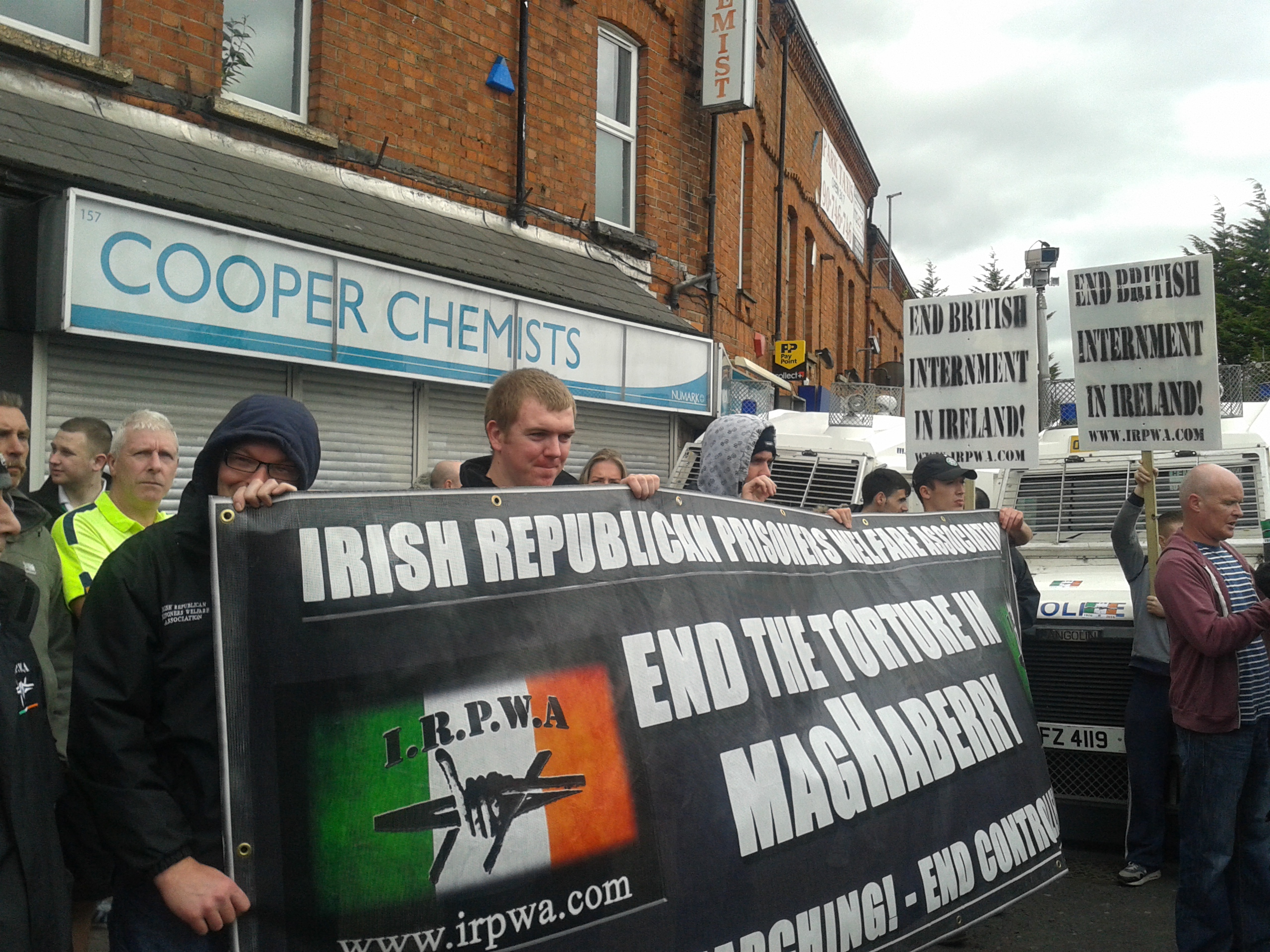
At the junction with Old Park Road I joined with the Dublin Committee comrades, apologising for my late arrival as we swung right to head towards the city centre. Further down the road, the police vans awaited us and as we got nearer we could see a blockade composed of police vans backed up by many police in full riot armour, holding shields and with batons drawn. We marched on and in minutes we were crowded against them. I feared for us if we tried to get through and I saw a drummer with one of the bands step out and retire to the sides with his drum. I didn’t blame him – drums are expensive pieces of equipment. The police had a big sign on one of their vans, saying that our march was illegal, a message they were reiterating from their p.a system, though difficult to decipher all the words.

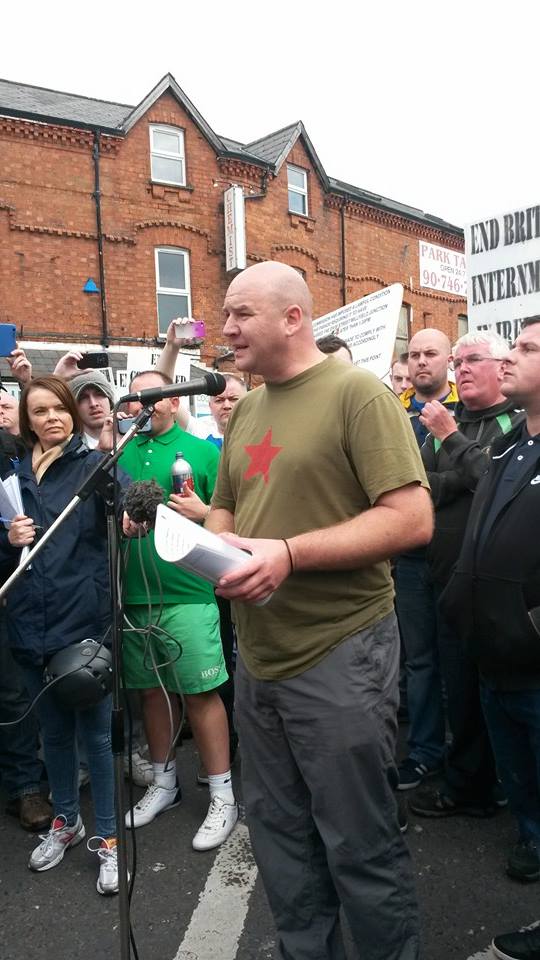
After a while in literal impasse, one of the organisers spoke briefly into the p.a system and introduced Mícheál Mac Giolla Easpuig, an Independent local authority representative in Donegal. Mac Giolla Easpuig spoke first for awhile in his native Irish and then changed to English. He summarised the history of English colonial repression in Ireland since 1970 and

Mícheál Mac Giolla Easbuig speaking at impromptu rally at PSNI Blockade
Mícheál Mac Giolla Easbuig speaking at impromptu rally at PSNI Blockade (Photo from AIL FB page)

made the point that the need of the authorities for that repression denied any legitimacy to their occupation of the Six Counties. He concluded with the words of Volunteer Tom Williams, who was hung by the colonial administration in the Six Counties in 1942: “Carry on no matter what odds are against you; carry on no matter what the enemy call you; carry on no matter what torments are inflicted on you. The road to freedom is paved with suffering, hardship and torture; carry on my gallant comrades until that certain day.

Impromptu short rally at PSNI Blockade in Old Park Road

As the applause and cheering died down, a spokesperson for the organisers spoke briefly about the suppression of our democratic rights to march, about the continuing use of internment by other means and announced the end of the march, asking people to disperse.

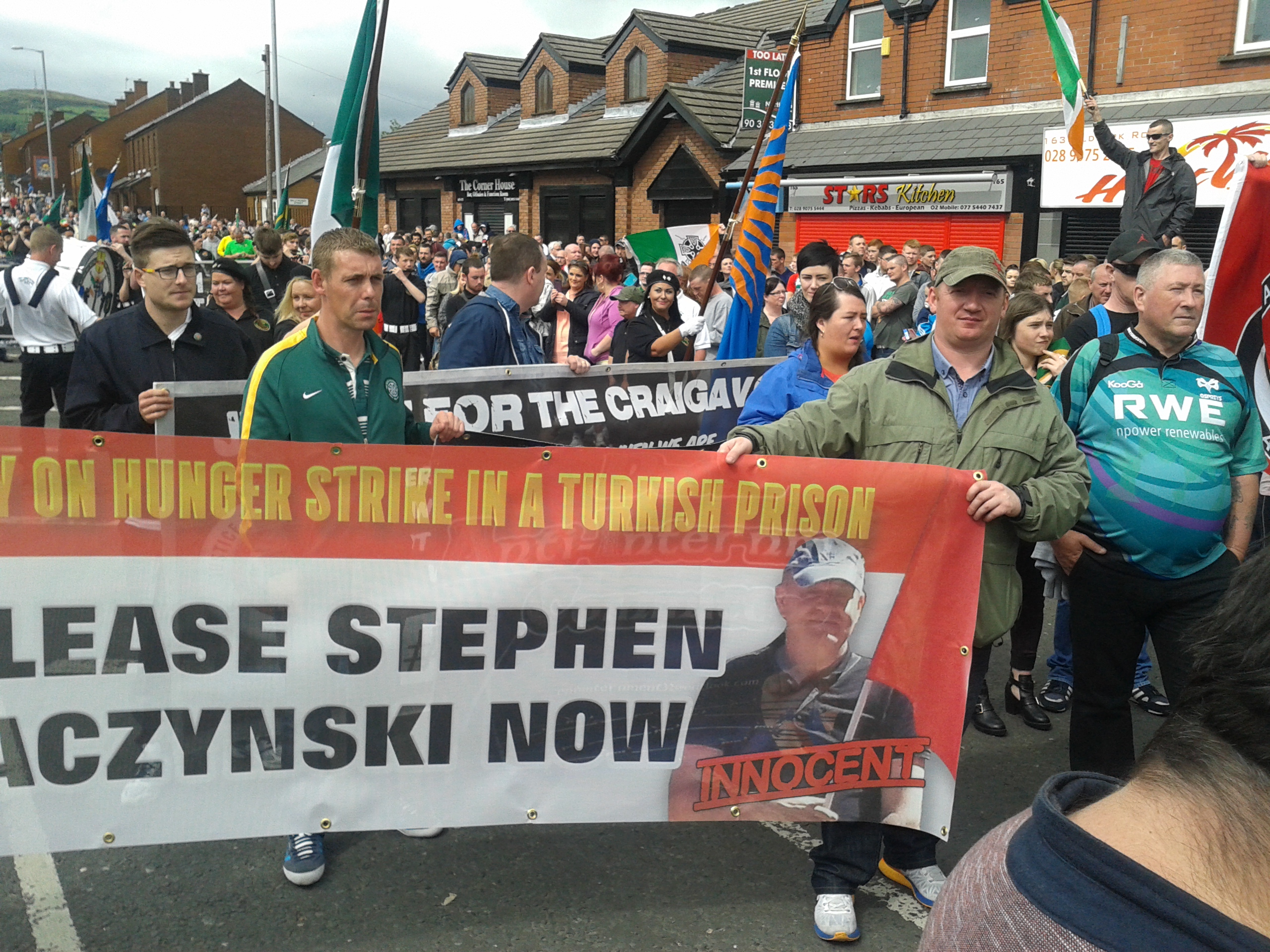
One of the Republican marching bands played the verse and chorus of the Irish national anthem, The Soldiers’ Song; I sang along to it in Irish as is our custom in Dublin (but seems not to be in Belfast) and the band began to march away from the police blockade. We marched away behind them with the banners of the Dublin Committee, as did others with different campaign banners: Craigavon Two, Ballymurphy Massacre, Stephen Kaczinsky, Gavin Coyle and various Republican prisoner support groups.

At some point the Dublin and Cork contingents pulled away and went back to near the original rallying point, where local people and visitors were meeting and chatting as the sliotair of the Poc Fada whizzed overhead. Rumours were now reaching us of the police attacking people on the other side of their barrier and also, from time to time, of Loyalists attacking people somewhere. It was hard for us to know exactly what was happening and where. Eventually we piled in to the back of a van to get out of the area. Our driver had to take a long circuitous route again and eventually we were back in West Belfast, from where we could make our separate ways back to Dublin and Cork.

The PSNI blockade of the march showing another line of police vans behind facing in the other direction -- only a fraction of the police vehicles in the area.
The PSNI blockade of the march showing another line of police vans behind facing in the other direction — only a fraction of the police vehicles in the area.

DB plus Dub AIC

Fighting in the area

Later I learned from a variety of sources that the local community in the Roseapenna Street area had reacted to a police, who were still there an hour after the march had left, in an occupation or siege of their area. This was an area through which the march had planned to pass and which was now blocked off by police vans and police on foot in full riot armour. A woman was shown on video being arrested by two police in riot armour – it was said that she was pregnant and was being mistreated in front of her three children. Apparently she had objected to the police being in her garden and had demanded they leave. The video showed her being pulled struggling to the back of a police van, being pushed inside and big policemen piling in on top of her, her head being apparently twisted as she disappeared from view. Another woman protesting this treatment was bashed by the shield of one of the police and the mobile phone filming the incident suddenly ended up on the ground, apparently having been knocked out of the hand of its owner by the police.

Later reports in the media spoke of stones being thrown and even petrol bombs. I could easily empathise with the throwers: confronted with that police blockade and our impotence in the face of it, I had found a part of me frustrated and itching to strike back at them. Had the area I lived in been blockaded by police and cut off for hours, then also occupied by police in a massive show of force, then seeing people abused and assaulted for objecting, I would have been sorely tempted to get a bit of rubber tubing and a bottle, go to a friend and ask to borrow some of the petrol from his car. Stones after all are not very effective against riot armour, shields and riot vans. True, the police riot armour is flame-retardant but …..

The Twadell Avenue Loyalist
The Twadell Avenue Loyalist “camp”, an illegal installation which receives no trouble from the PSNI.  According to reports, “nationalist’ people were bombarded by golf balls from here on Sunday. (Photo from Internet)

In addition, people living in the area and trying to leave it had been attacked by Loyalists hurling golfballs from the nearby Twaddel Road, which is a Loyalist area. In fact, they have had a Loyalist “camp” there for some time – illegally by Six County law but of course untroubled by the PSNI. Its purpose? To show those Fenians — those Taigues — up in the Old Park, Ardoyne and “The Bone” (Machaire Botháin) areas just who really runs the Six Counties!

Worse in a way was to come, as along with the ritual condemnations by Unionists and Loyalists, PSNI spokespersons and biased media reporting, Martin McGuinness of Sinn Féin blamed the violence entirely on the organisers of the march. As well as being a very senior figure in the Sinn Féin party, McGuinness is of course Deputy First Minister of the Northern Ireland colonial Government. Back in the day when he was the commanding officer of the IRA in Derry, he had condoned and defended participating in many marches that had not so much been restricted to particular times as completely banned by the Six County authorities. During one of those illegal marches in Derry, in 1972, the Parachute Regiment had opened fire on unarmed people and killed fourteen, injuring many. In those days the IRA and what was thought of as Provisional Sinn Féin placed their blame for all violence unreservedly upon the police and army (and occasionally the Loyalists), also on the 6-County Government and on the British colonialists, who should not be in Ireland at all, according to Sinn Féin. But that was then and their party now shares in the administration of that same British colony. Reading his reported words, I wondered whether if that Derry massacre of Bloody Sunday were to occur now, McGuinness would blame the marchers for going ahead with a banned march?

Mc Guinness posed shaking hands with the Chief Constable of the PSNI at a public meeting earlier in the week at a Falls Road venue
Mc Guinness posed shaking hands with the Chief Constable of the PSNI at a public meeting earlier in the week at a Falls Road venue (Photo from AIL FB page)

The Anti Internment League hit back with a statement of their own, condemning the comments made by Martin McGuinness. “The AIL responsibly took the decision to march away from a flashpoint that was of the PSNI’s own making”, the statement read. “No participants engaged in violence,” it continued, “which occurred over an hour after our dispersal and was caused by PSNI invasion of property and assaults on residents.” The statement went on to point out that Mc Guinness had praised the PSNI a few days earlier (a reference to his shared platform with PSNI’s Chief Constable on Thursday 6th in a venue on the Falls Road).

Uncannily (or perhaps not), the statement went on to mirror my own earlier speculation: “Using Martin McGuinness’s rationale, he would place responsibility for the murder of 14 civilians in his own city by the British Army on Bloody Sunday in 1972 on those who organised the Anti-Internment parade that day.”

“There is perhaps no greater indicator of how Mc Guinness now views Republicans as his opponents, while the forces of repressive state apparatus that he himself promotes and endorses are now his ‘comrades’ “, the statement concluded.

Follow-up meeting with area community


In a follow-up to the events of Saturday in the Lower Cliftonville area, on Tuesday night in Manor St Community Centre, the Anti Internment League hosted a meeting with Rosapenna residents affected by the PSNI lockdown on Sunday 9th August.

“Every house in the area received a leaflet making them aware of the meeting” according to a statement issued by the AIL. The panel was composed of representatives of the AIL, community workers from Lower Cliftonville and a local solicitor. A journalist from the Irish News was also in attendance to hear accounts and opinions from residents.

Because of Martin McGuinness’s “public criticism of both the AIL and local residents”, according to the AIL statement, Sinn Féin had been invited to send representation to the meeting “to challenge the AIL if they wished and to hear residents’ thoughts and opinions in a public forum”. According to the AIL statement, although SF had indicated that they would attend, they did not appear at the meeting.

The atmosphere in the meeting was angry, according to witnesses – all of it directed towards the PSNI with no-one criticising the march organisers, with the exception being those who chided the organisers for having turned the parade back “too soon”. The AIL represenatives’ explanation of the considerations and reasons for doing so seemed to satisfy the critics. One of the AIL representatives reportedly also asked whether residents would rather the parade did not pass through Rosapenna Street in future, which was “rejected unanimously by residents present, who all said they enjoy the music and atmosphere that the annual march brings to the area.”

A hitherto unreported aspect of the events on Sunday in the area was that local businesses reported having been forced to close down by the PSNI for no reason that they could determine. This was particularly interesting in view of the Parades Commission’s rationale for insisting that the march finish passing through the City Centre by 1.30 pm – to prevent any perceived disruption to big shopping commercial interests in that location.

The AIL statement went on to outline their plans to work with local community organisations to “jointly request and facilitate a “surgery” style event, inviting the Police Ombudsman to compile complaints against the PSNI from local residents.” Concluding their statement, the Anti-Internment League declared that they, working with “local community organisations and Republican activists will not allow the violent actions of the PSNI within the Lower Cliftonville community on 9th August to go unchallenged.”

End/ A Chríoch.

“Now where did our drummer go with his drum?”

Stephen Kazinski banner Stopped 20150809_144947IRPWA banner

Big Brother can fly Big Brother has an eye Big Brother can spy on us down below.
Big Brother can fly
Big Brother has an eye
Big Brother can spy
on us down below.


Craigavon Two banner

Gavin Coyle Isolation banner

ONE LEAVES DETENTION THIS MORNING; THREE DETAINED THIS EVENING

Diarmuid Breatnach

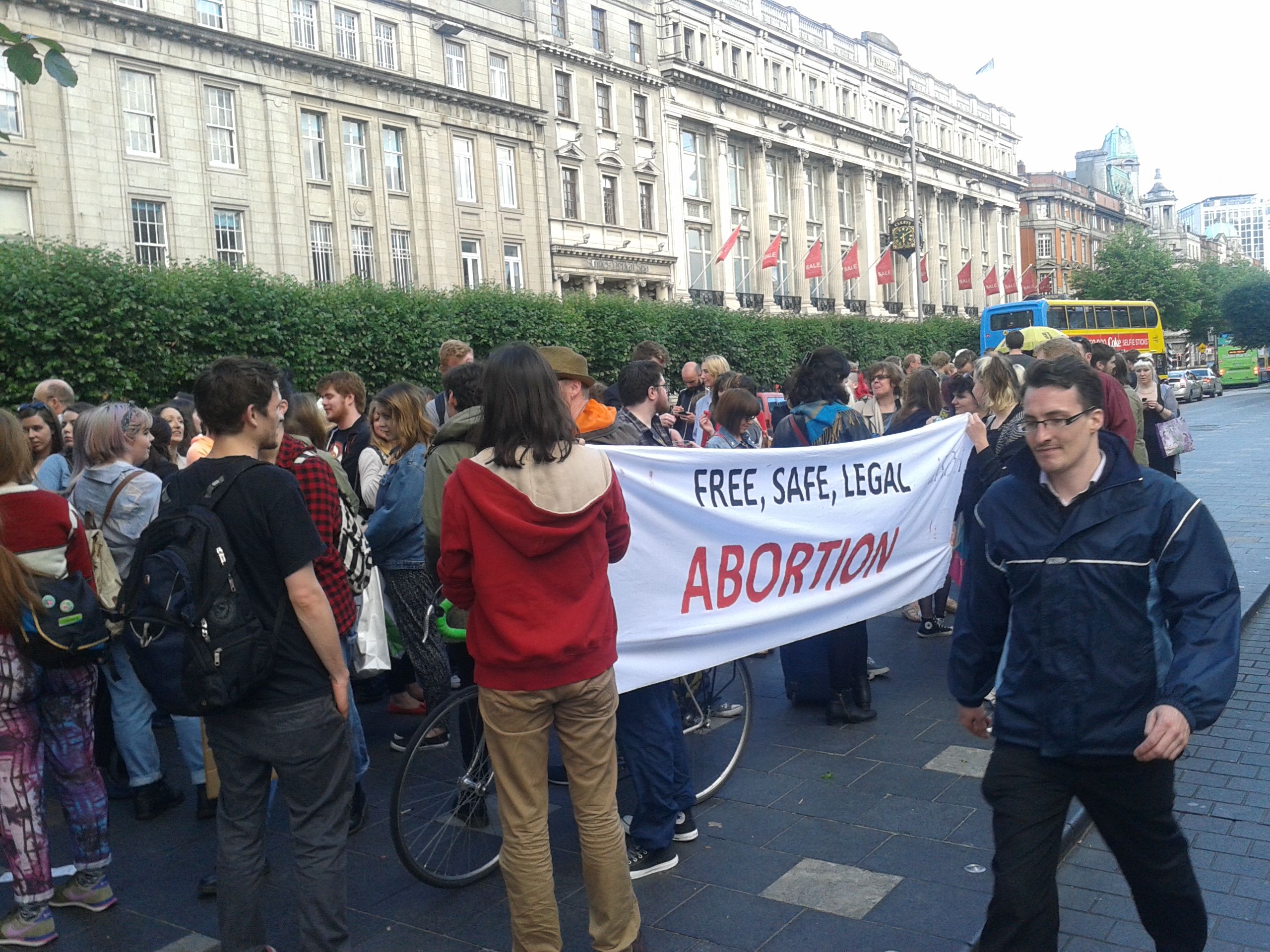
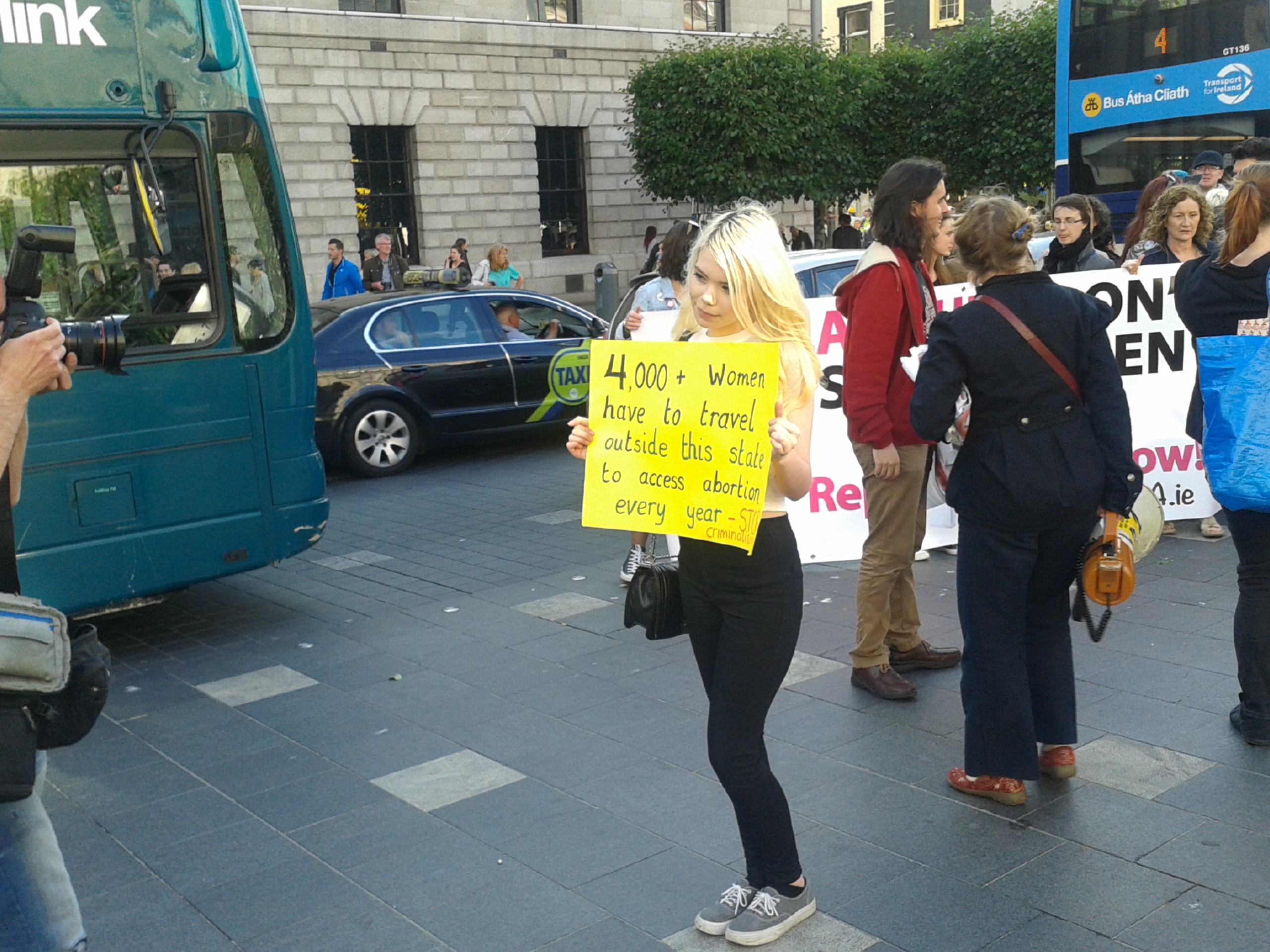
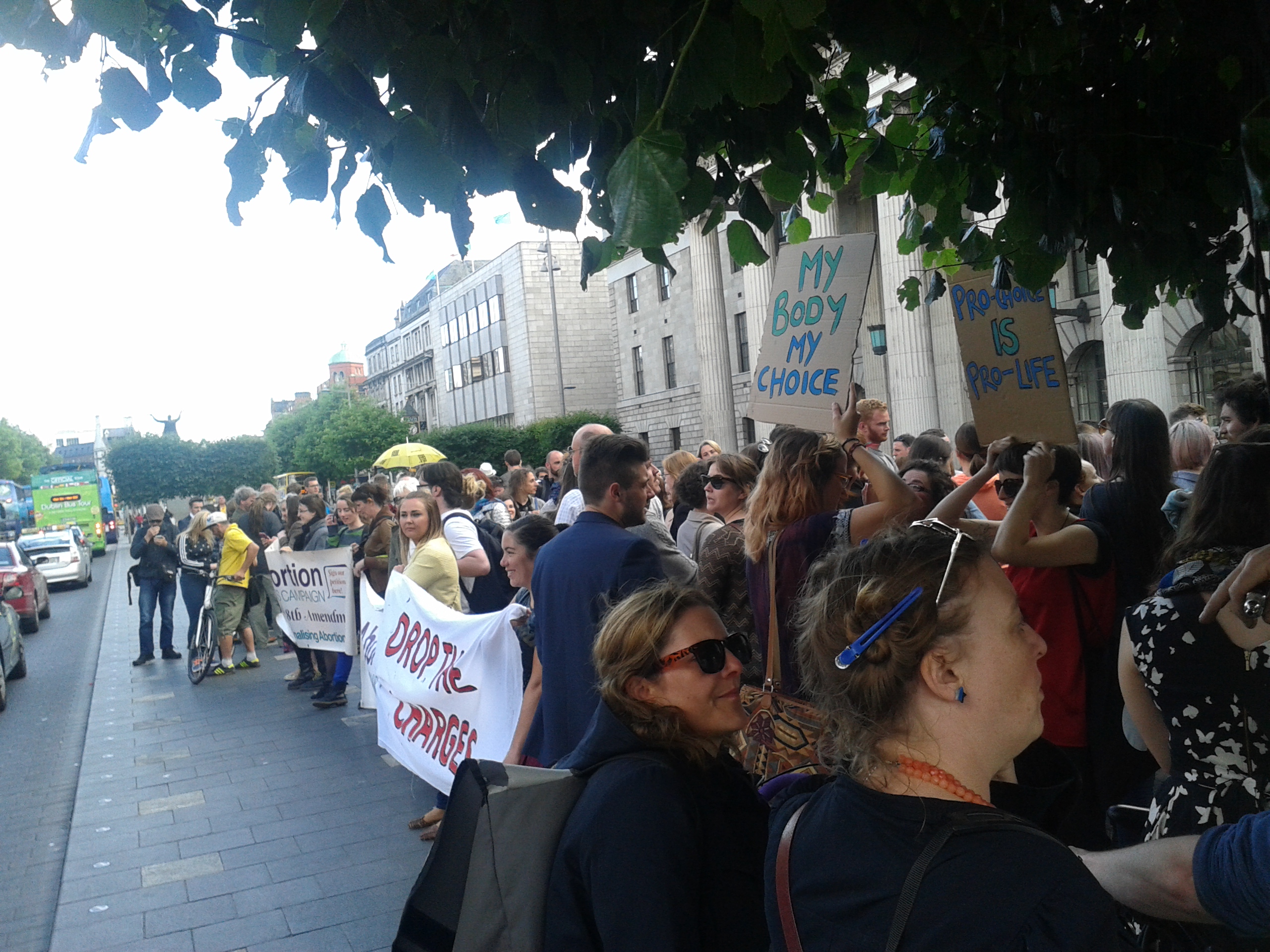
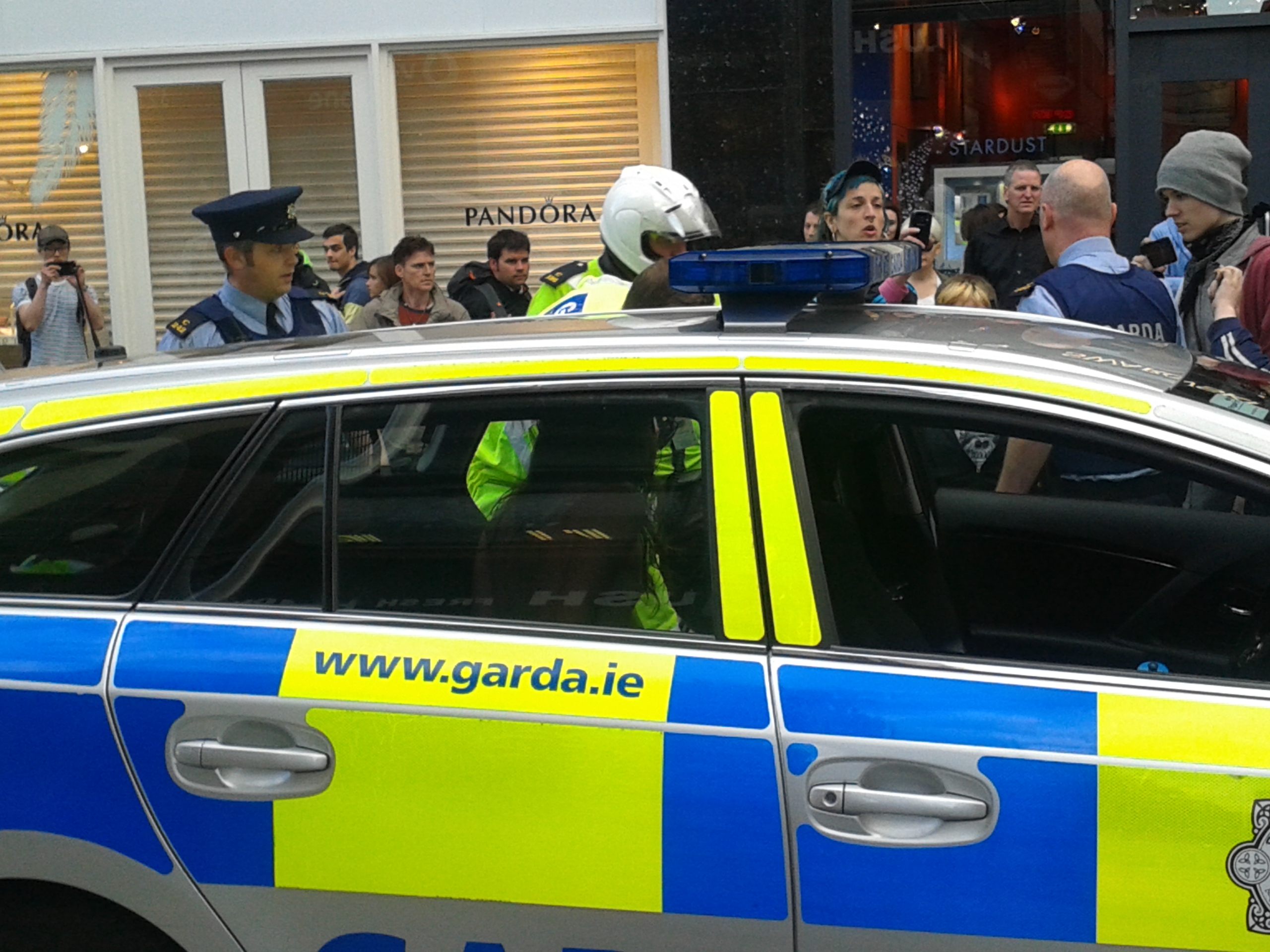
Anti-Water Tax protester leaves Dublin court today at liberty after two months but Gardaí arrest three Pro-Choice campaigners this evening, pepper-spraying at least one of them while held immobile on the ground.

Arrested impeding Irish Water vehicles

Stephen Bennet was brought from Mountjoy Prison this morning to Dublin Criminal Court to face “Public Order” charges relating to “obstructing” Irish Water vehicles in Dún Laoghaire and Dalkey and refusing to comply with Gárda instructions to desist. The Dún Laoghaire court had imposed conditions for releasing Bennet on bail which included a curfew, staying away from Irish Water vehicles and a large financial surety. Declaring the conditions unreasonable and a restriction on his civil rights to protest, Bennet had refused to agree to the conditions and the judge had taken to jail.

Some of the crowd of supporters welcome Bennet as he emerges into the court ground floor lobby. His daughter Saoirse can be seen the left holding Bennet's grandson. Unfortunately, Bennet himself is hidden by a supporter moving forward as photo was taken.
Some of the crowd of supporters welcome Bennet as he emerges into the court ground floor lobby. His daughter Saoirse can be seen to the left holding Bennet’s grandson. Unfortunately, Bennet is hidden as he moved forward as photo was taken.

Up to 30 supporters crowded into the court this morning to hear Bennet’s case being tried. There was also a large number of Special Branch Gardaí (political police in plain clothes) and a smaller number of uniformed police. A Garda Sergeant Gilmore from Dun Laoghaire station gave evidence of having confronted Bennet at York Road in Dún Laoghaire, where the accused had been sitting in the road and at Dalkey, where he had been “marching extremely slowly”. Sgt. Gilmore quoted the Public Order Act to Bennet and ordered him to desist but Bennet had declined to comply. Defence Counsel maintained that there was “a reasonable doubt” as to whether Bennet had been in violation of laws initially which would have rendered his subsequent refusal to comply with Garda instructions not an offence. Since there was no question of accusation of breaches of the peace, assault or criminal damage, the point at issue was whether the Public Order Act was applicable. State Prosecution Counsel argued that blocking or slowing traffic was creating “a nuisance”, to which Defence Counsel replied that causing a nuisance was part of the purpose of a protest, in order to make it effective. Sit-down and marching slowly protests had not been tested in Irish law, said Defence Counsel but quoted a number of cases from the European Court of Human Rights at Strasbourg where the Court had ruled in favour of applicants’ rights to protest even when the applicants’ states had found them in violation of their laws and penalised them.

Some of the supporters outside the Dublin Court today

The Judge retired to consider the case and when he returned he found Bennet guilty on all charges and sentenced him to a total of around €800 in fines, in default of which a total of 11 days in jail. One one charge, he sentence Bennet to two months’ imprisonment but, since that was time already served awaiting trial, Bennet was freed to cheers from his supporters, including his daughter Saoirse and his grandson, who had been born while he was in jail.

Belfast mother charged with giving her daughter an abortion-inducing pill

At 6pm this evening a protest took place at the Spire in Dublin in solidarity with a Belfast mother who facing criminal charged for having given her daughter a pill which induces abortion in very early pregnancies. The pill is freely available in Britain and legal there but the 1967 Act which legalised abortion in Britain has not been enacted in the Six Counties.

West side, O'Connell Street central pedestrian reservation, Dublin, just near Spire
West side, O’Connell Street central pedestrian reservation, Dublin, just near Spire

4,000+ Women Travel placard
The event had been organised by the Workers’ Solidarity Movement and Real Productive Health organisation in order to express solidarity with the mother and also to link the struggle of women in the 26 Counties with those in the Six, women in both parts of Ireland having to travel to another country, Britain, to avail of abortions and similar protests took place in Belfast and in Galway.

East side O'Connell Street, Dublin, just near Spire
East side O’Connell Street, Dublin, just near the Spire

A number of people spoke and soon afterwards some excitement stirred through the crowd and they began to examine the roof of the GPO where something was going on. Very shortly after that a Garda squad car with siren blaring and blue lights flashing tore along O’Connell Street and turned into Henry Street.

Another group at the protest
Sitters and Standers mid-way through the demonstration

Violent Garda arrest scenes

People broke away from the pro-choice demonstration and gathered in Henry Street as other Garda squad cars, a motorbike, a cycle Garda and a number uniformed and Special Branch Gardaí on foot poured into the street. The scene was  was somewhat confusing for many but what was clear was that the Gardaí had torn the shirt off one one young man, handcuffed him and put him, stripped to the waist, in a squad car. Another young man was also handcuffed and ended up on the ground with a number of police on top, one of whom pepper-sprayed him while in that position. This action provoked shouts from onlookers and uncertain physical intervention. As a third was arrested and bundled into a police car, the word went around that these were pro-choice demonstrators who had got on to the GPO roof (presumably using the scaffolding to the side of the building) and that they had attempted to display a banner up there.

Man arrested after shirt torn off in squad car in Henry Street
Man arrested after shirt torn off in squad car in Henry Street can just be discerned in the back seat of the squad car
Another of those arrested in Henry Street; he ended up on the ground with a number of police on top before being put in the car.

People gathered around the Gardaí, some of whom threatened to arrest those arguing with them. The Gardaí were then seen to be picking up a banner to put in the back of one of their vehicles when a woman cried sarcastically: “A banner! Oh, thank you for saving us from a banner!” Others joined in shouting: “Bad banner! Bad banner!” amidst other calls from protesters and passers-by generally expressing an opinion that the police action had been unnecessary, repressive and over the top in violence and in numbers. Indeed, the numbers of Gardaí present who had suddenly appeared did suggest to many that they had been kept in readiness to move on the pro-choice demonstration at some point or were aware that some publicity action had been planned. Protesters who attended Store Street Garda station soon afterwards were told that the accused would be charged and released on bail “in a couple of hours”. The wording on the banner apparently had been “ABORTION CHARGES ARE BOLLIX”.

WSM video of scenes at the arrests: https://www.youtube.com/watch?v=iPwZlWYW3kE

WSM Video of the rally just prior to the arrests: https://www.youtube.com/watch?v=cFp_AzsFIa0

Workers’ Solidarity Movement statement on the arrests http://www.wsm.ie/c/wsm-statement-garda-arrest-pro-choice-campaigners-july2015

Some in crowd beginning to argue with Gardaí as others look on amazed
Two placards in the crowd earlier, a reminder of what it was about

End.

CASTLEBAR JURY FINDS TWO SHELL TO SEA PROTESTERS NOT GUILTY

COURT HEARS OF INTIMIDATION OF FAMILIES OF ACTIVISTS BY GARDAÍ AND SHELL SECURITY MEN WEARING BALACLAVAS

By Pat Cannon

I was present in Castlebar court house for most of the ten-days of the trial of Gerry Bourke and Liam Heffernan who are Shell To Sea supporters and activists. I witnessed at firsthand how tax-payers’ money can be wasted at will by the agents of the state i.e. Gárdaí (the Irish police), State solicitors, the Dept. Of Public Prosecution, the Judge, court officials, State barristers and other hangers-on.

Numbers involved:

( 1 ) Judge 
( 1 ) courtroom user 
( 2 ) Stenographers 
( 1 ) Prison officer; 
( 1 ) Gárda on video evidence 
( 2 ) State Solicitors 
( 1 ) Senior Counsel for the State
 ( 1 ) Junior Counsel for the State; ( 2 ) Solicitors for the Defence ( 2 ) Senior Counsel for the Defense 
( 2 ) Junior Counsel for the Defence; 
( 12 ) Jurors ( 12 ) witnesses at least. Also the secretarial staff of all parties, including the DPP Office staff working on the case, also the cleaners and the other Court staff.

First of all if the State and the oil companies had initially negotiated with the locals, probably there would have been no need for these quiet citizens to have to rise up in protest against this project.
A much safer and easier route for the pipe line would have been found as the locals have an extensive knowledge of this area. 
If the state (and its Government) had negotiated a reasonable deal with oil companies then there would be much less protestors.
If proper health and safety regulations backed up by staff and equipment were in place from the start, people would feel much safer and secure in their homes. BUT NO! THE SHARKS DON’T NEGOTIATE — there is no room for compromise in a shark’s make-up.

SHARKS

Right from the start, the Government, the oil companies, the Environmental Protection Agency, County Council, media, Judiciary, Gárdaí and every other arm of the State treated the local people with disregard, contempt and as a complete irrelevance. As far as all the above-mentioned were concerned there was big money to be had and no small fry was going to get in the way. THERE WAS BLOOD IN THE WATER AND THE SHARKS WERE IN FOR THE KILL.

Thankfully there were 2,500 years of tradition and history still alive and well in this area, there was a quiet shy population but of people with a strong backbone that were well hardened into hardship, neglect and resistance to outside dictatorship and who were not going to be bullied or pushed about by anybody.

The rural area chosen by Shell for the pipe-laying (planned to run between both houses in the photo)
The rural area chosen by Shell for the pipe-laying (planned to run between shed on the left of photo and  house on the right)

It was this stern backbone that caused a middle-aged primary school Principal teacher and her two daughters, backed up by less than a half-dozen other locals to take a stand and start protesting against the potential desecration of this EU Environmentally Protected Area and their local pristine environment. Of course they were ignored, the media never mentioned them; the oil company’s employees and officials looked the other way and probably had a good laugh as they passed, the Council and all the other arms of the State treated them as non-entities. As far as all these groups were concerned the local people were of no significance.

However, the time came when these officials had to get into closer proximity with the local people; they had to enter the local people’s land and they thought they could do this without permission, by bullying and using threats but soon discovered how mistaken they were. They learned that they were not just dealing with a few individuals or a few head cases but instead that there was a whole community in this locality and that this community was close-knit and resolute in their opposition to outside intimidation and coercion.

With little or no advance warning the oil companies’ employees entered the farmland of six local farmers without the owners’ consent and proceeded to dig trial holes, knock down boundary fences and block access to and from the land in question. Naturally enough the farmers contacted their legal advocates and very quickly they were in court for the first time in their lives.

Of course the Courts and Judiciary are also an arm of the State and are also commercial enterprises just like the oil companyies and they ruled in favour of the foreign multi-national companies. After all small local marshland farmers can’t afford to give big financial enticements to Court judges, politicians and Government officials but on the other hand the oil company will be very generous as has transpired since.

JAILING OF THE ROSSPORT FIVE

The six farmers, five men and one woman were found in “contempt of court” and the five men were jailed until they “purged their contempt”. This lead to an outcry all over the country and hundreds of thousands of people came to the assistance of what became known as “the Rossport Five”. Ninety-four days later the Courts had to capitulate and release all of the five innocent men.

However the scene was set for what would become a marathon David and Goliath battle between a small close-knit indigenous rural Irish community and three foreign multinational oil companies, one of which had a larger turnover than that of the whole Irish State even though the latter was experiencing an unprecedented economic boom.

Gardai defending Shell confront protesters

Thirteen years after the middle-aged school teacher and a handful of supporters stood outside the local council offices in protest the struggle is still going on and the oil companies and Irish Government are still trying to bully their way through the Irish people.

However, the Government’s economic boom has disappeared and the people now realize that if they still had their oil and gas that was fraudulently misappropriated by the Irish Government and the oil companies, we would have NO EVICTIONS, NO CENTENARIANS ON HOSPITAL TROLLIES, NO EMIGRATION, NO UNEMPLOYMENT AND NO STEALTH TAXES.

IN THE COURT RECENTLY

So in these last two weeks I witnessed the State trying to criminalise two more supporters of the struggle; we saw video evidence showing that the men had to use considerable force to gain entry to Shell’s site and when confronted by Shell’s private army (security force) the protestors had to stand firm and use a variety of tactics to get past them. We heard State witness after State witness tell lie after lie or refuse to answer or evade answering questions when they were put in the witness box, then the Defence were not allowed show their video evidence and some of their witness were not allowed on the stand.

Shell security team manhandle a protester
Shell security team manhandle a protester. 

Shell Hell logo to Sea

I heard how Shell’s private army drive around the villages at night in two jeeps with blacked-out windows and shine their lights through the windows of activists’ homes, whilst if anybody comes out of the houses then four men wearing balaclavas step out of each jeep in an act of intimidation. We heard how the Gárdaí constantly drive past the people’s homes very slowly and then turn around a mile or two up the road just to drive past again five minutes later and hjow each time they pass, they stare into activists’ homes.

I heard how the Gárdaí punched, pushed, kicked and beat with steel batons men, women and children, how many activists spent long terms in prison on trumped-up charges while Shell plied the Gárdaí with over €35,000 worth of alcohol. I also heard how a Gárda made derogatory remarks of a sexual nature about a protestor’s wife to the protestor and how five Gárda were unwittingly recorded on a female prisoner’s video camera planning how they would interrogate her when they got her to the Garda station by threatening to rape her and laughing at the different ways they would word the threat. ALL of them got away with ALL these misconduct events.

Gardai caught on camera in action at Rossport

I heard how while car tyre contains on average 2 bars of air pressure per square inch, that this gas pipe had 345 bars of highly inflammable gas pressure per square inch, that the seas and sea bed are highly vulnerable to currents (the second most volatile currents in the World).

I also heard the accused man’s wife state how for 13 years while she was rearing her family she could think of nothing from once she got up in the morning till she fell asleep at night but this dangerous gas pipe line that would be practically going by their front door and over which she had to take her children to school every day.  

In a statement to the Court, one of the Rossport 5 gave evidence that Michael D. Higgins (now Uachtarán of the Irish state) had been on the protest and had addressed the other protesters, also participated had the father of the State Solicitor prosecuting this case.  He also said that Enda Kenny had visited the Five in prison and had told them that life was “very cheap in Ireland now” and that “you can get a man in Dublin to do a ‘hit’ on someone for €500.” 

Protesters against Shell in Dublin

 In his summingup the Defence counsel stated that the State agencies had rubbished themselves in the eyes of the world in their dealing with the situation, that the terms that our oil was given away were the second best in the world for the oil companies, that they stated that there were no emergency plan in place if an accident or act of terror did happen and that the protestors had rendered a magnificent service to their fellow citizens at much expense and hardship to themselves by standing up for what is right and correct.

Protest at Shell HQ in Leeson St, Dublin in solidarity with Ogoni people in Nigeria and people at Rossport.  The Nigerian Government, to protect Shell's profits although the company was causing great environmental damage, hanged the nine leaders of the  peaceful environmental movement
Protest at Shell HQ in Leeson St, Dublin in solidarity with Ogoni people in Nigeria and people at Rossport. The Nigerian Government, to protect Shell’s profits although the company was causing great environmental damage, hanged the nine leaders of the peaceful environmental movement

The Jury of eight women and four men was out for just about one hour when they returned with a unanimous verdict of “NOT GUILTY of violent disorder” on both Liam Heffernan and Gerry Bourke. A further malicious charge of “criminal damage” was dropped by the State because despite there having been 28 cameras on site and up to 30 security men and later a number of Gárdaí, there was no evidence to support the charge.

Just more waste of tax-payers’ money. I have reckoned the tab that the tax-payer will pick up will be in the region of €150,000 and Shell won’t be paying a penny of it.

End item.

Interview with both accused outside the court: https://www.facebook.com/IrishMediaAlliance/videos/vb.394038987409960/508891172591407/?type=2&theater

Hotpress interview with Director of the film The Pipe about the struggle and the issues https://www.google.ie/search?q=rossport+shell+pipeline&biw=1269&bih=639&source=lnms&tbm=isch&sa=X&ved=0CAgQ_AUoA2oVChMIuqDVq9_qxgIVEgbbCh14aA2y#imgrc=PMdIZ4CrPdDI2M%3A 

INIGO CABACAS KILLED BY POLICE – RELATIVES AND FRIENDS WAITING THREE YEARS WITHOUT JUSTICE

INIGO CABACAS KILLED BY RUBBER BULLET FIRED BY BASQUE POLICE IN 2012 — STILL NO JUSTICE FOR FAMILY OR FRIENDS

Diarmuid Breatnach

Most Basques and especially supporters of their most popular football team, Athletic Bilbao1, were very happy in the early evening of 5th April 2012 . 

Inigo Cabacas Gaztelugatxe
Inigo Cabacas, photographed with the Basque hermitage Gaztalugatxe, on the Biscay coast, in the background.

Their team had beaten a football giant in the UEFA cup twice and another premier European team once. The fans were expecting Athletic to win or at least draw again that evening, in which case Athletic Bilbao were through to the second leg of the quarter-finals. They had no idea that the evening would end with a police riot squad firing rubber bullets into a festive crowd, causing the death of a young fan.

The high expectations of that evening in Bilbao were the result of a run of wins for the Athletic team. On March 8th 2012, Athletic Bilbao beat Manchester United 3-2 on their own ground, at Old Trafford.

One needs to know a few population statistics to understand what an achievement that was. Manchester United is a football team on the world stage, based in a city with a population of 2.55 million – that is not far from the population figure for the entire Basque Country. In addition, Manchester United’s players are drawn from around the world; Athletic recruits only Basque players from a total population of the Basque Country of less than 3 million.

A week after their win in the northern England city, on March 13th, Athletic faced Manchester United again, this time on the Basque team’s home ground, San Mames, in Bilbao. Manchester Utd. were beaten 2-1 and it seemed that the Basque lions2 were unstoppable.

These wins created a huge interest in the next game, which was with FC Schalke 04 on March 29th at the German team’s home ground. Schalke plays in the top tier of the German football league and have won many championships including one UEFA League. With around 130,000 members, Schalke 04 is the third-largest sports club in the world in terms of membership, behind their compatriot rival FC Bayern Munich and Portuguese club SL Benfica.

Athletic Bilbao is not a sports conglomerate – it is a football club which is owned by its 40,000 members (remember, this is a small country – that’s nearly 1.5% of the whole population! It’s also around 11% of the population of their home base, Bilbao). The management board is elected by the membership.

At Schalke 04’s home ground on March 29th, the Bilbaino team beat them 2-4. The interest was therefore at fever-pitch for Athletic’s return match with the German team at Athletic’s home ground, San Mames on 5th April. The result was a 2-2 draw but Athletic were ahead 6-4 on aggregate and the fans were delighted. Bilbao was, as they say, buzzing.

After matches, young fans especially go to different pubs around town. Inigo Cabacas and many others went to an Herriko Taberna (a “Peoples’ Tavern”, i.e. one managed by the Abertzale [Basque pro-Independence] Left) which is located in an small “square” with planters, connected by alley with Licenciado Poza street. This small “square” is off the María Díaz de Haro street near the stadium; it runs parallell with the San Mames street itself, an area of bars well-known as a destination for fans after a game at the stadium.

The Herriko is too small to accommodate all those who gathered there but that was no problem for the area outside took the overspill. Early in the evening a few people were seen scuffling there and the rest of the crowd around them told them to knock it off, this was a time for celebration, etc. The scuffle ended and the festivities continued.

Some time later, a van load of police arrived. These were the Ertzaintza, a Basque Police force of 7,500 created in 1982 which has had numerous clashes with Basque strike pickets and with the Abertzale (pro-Independence) Left. Supporters of the Abertzale Left and many others refer to the Ertzaintza as “zipayos” (i.e. “sepoys”, local soldiers recruited by colonial occupiers). The Ertzaintza are responsible to the Basque Autonomous Region Government (CAV), a semi-autonomous entity covering three of the four southern Basque provinces.

Basque Police, the Ertzainta, face youth Solidarity Wall with a Basque comrade the police have come to arrest in Donosti/San Sebastian some years ago.
Basque Police, the Ertzaintza, face a youth Solidarity Wall built to defend Basque comrades the police have come to arrest in Donosti/San Sebastian some years ago.

Some of the youth perceive the arrival of the masked and helmeted police as a provocation and begin to throw bottles at the van.

The police officer in charge of those in the van asks for reinforcements and these are sent. The police emerge from their vans and begin to fire rubber bullets3 at the crowd at quite close range (the “square” is less than 45 metres at its furthest from the street) and everyone scatters except for a small group who are throwing bottles at the police but even they eventually dive for cover. People are sheltering in doorways, huddled up against the walls on each side of the “square”. Some are inside the pub wondering what is going on. A local shop-manager has raised the shutter over his doorway and people crowd in there. Some people are sheltering behind the wooden planters that are in a line down the centre of the narrow square.

After some time three young men walk towards the police with their hands in the air, asking them to stop firing rubber bullets; the police strike them with batons. Meanwhile it comes to the attention of some in the crowd nearby that a person is lying on the ground, apparently unconscious with blood coming from his ear and the rear of his head. People go to his aid and one of his friends recognises Inigo Cabacas. He gets his mobile phone and rushes towards the police telling them that someone has been seriously injured and to call an ambulance. A police officer tells him to drop the mobile. Inigo’s friend repeats his urgent request and the police officer tells him again to drop the mobile and hits him with a truncheon. The man drops his mobile and retreats from the police.  

The police advance into the area and reach the injured man who has some people around him; a women is rendering first aid.  A policeman tells her to move away.  She tells him the man needs and ambulance and that she is applying pressure to stop the bleeding.  He says he wants to see for himself and pulls at her arm but after awhile desists and goes away.

Eventually an ambulance arrives and takes Inigo Cabacas, still unconscious, to hospital, where he lies in a coma.

(video of the scene of the incident and interviews with friends and witnesses with English subtitles)

The news runs through a city, a shock in the midst of its celebrations and soon afterwards throughout the Basque Country. The first official reaction is given by the Interior Minister of the Basque Autonomous Regional Government, who declares to the press that the Ertzaintza acted properly and in line with their procedures, although he regrets the unfortunate death of they young man. He also repeats the first line of defence given by the Ertzaintza, that they were called to help someone injured in a fight and that the crowd was preventing the ambulance in attendance from rendering assistance to the injured.

When eye-witnesses give their version and the reporters of some newpapers begin to gather information, it becomes clear that the Minister could not possibly have investigated the incident in the time available. Furthermore, it emerges that no ambulance attended until after the incident with the police and that it appears that no call for one had been made earlier. Furthermore, according to the woman who attended to Inigo at the scene, the ambulance paramedic told her, when she complained at their delay in arriving, that the police had delayed their entrance. Under a storm of criticism from civil society and from the Abertzale Left party, EH Bildu, the Minister promises a full investigation.

Inigo Cabacas dies after three days without having recovered consciousness.

Some time later, a recording of the police communications on the night is made available by GARA, a pro-Independence Basque daily newspaper. The following becomes clear from the recording:

  • The Controller at Ertzaintza HQ calls a police van leader and directs him to attend the Herriko, saying that a fight has occurred there and that someone is injured.

  • The van leader reports that they have arrived and that some are throwing bottles at them, that they require reinforcements.  No mention of ambulance.

  • The Controller confirms reinforcements are being sent.

  • Reinforcements arrive. One of the van leaders now reports that nothing is happening, everything is ok.

  • The Controller replies that he wants the police to go in and take possession of the area and make any arrests necessary. He emphasises that he wants to be understood clearly, that they are to “go into the Herriko with everything we have”, to take control of the area “and then everything will be ok.”

  • The van leader replies that the order is understood and soon shots are heard (the firing of rubber bullets).

The family employs a solicitor. A judge is appointed to carry out the investigation but is required to do so along with her other duties. Immediately, the police investigation ceases (according to the family’s lawyer, ithe file contains just three pages), using the excuse of the judicial investigation.

A number of legal applications are made, e.g. for all the police at the incident to be obliged to make a statement, for all police who fired a rubber bullet gun to be identified, for the Controller to be obliged to make a statement, but all are refused by a judge, giving a number of reasons4. Little is established over the following three years, except that three police voluntarily admit to having fired rubber bullets and the identity of the Controller on the evening becomes widely known. There is widespread outrage when the senior officer on duty the day of Inigo’s death is appointed Chief of the Ertzaintza. At a recent press conference, the Cabacas family’s lawyer, Jone Goirizelaia, announced that they had possibly identified the officer who had fired the fatal shot.

It emerged during the campaign by supporters of the Cabacas family that no recognised procedure was followed by the police with regard to the incident: debriefing statements were not taken from each of the police participants, guns were not examined to identify which had been fired, no inventory was taken of the number of rubber bullets fired. No attempt was made to contact witnesses after the event to gain a picture of what had occurred. Indeed, some witnesses who approached the police station to give statements were told to go away (see video link posted earlier in this article). It further appears that the Ertzaintza have been issued with no specific operational instructions with regard to the firing of rubber bullets.

According to some sources, the rubber bullets should only be fired at knee-height and at no less than 50 metres from the target. The “square” is, according to locals, less than 45 metres at its furthest from the street and therefore the police from the moment they began firing, were in serious breach of the minimum distance requirements. In addition, the Ertzaintza have frequently been seen aiming their rubber bullet guns at protesters’ faces from as little as a metre or two and also firing from the shoulder with the muzzle parallel to the ground, i.e. directed at head or chest-height of the target. Also, the rubber-coated steel balls bounce uncontrollably.

Rubber bullets against Palestinians

Rubber bullets are regularly fired by the Israeli army at Palestinians. A Palestinian source reports: “Israeli professor Michael Krausz and colleagues at the Rambam Medical Centre in Haifa analysed the medical records of 595 casualties admitted to hospital during the October 2000 protests by Palestinians living inside Israel (typically described as “Israeli Arabs” by the media). Of those, 152 were found to have been injured by rubber-coated metal bullets. Injuries were distributed randomly across their bodies but were most common on the patients’ arms and legs, and on their head, neck and face.

“The doctors said their findings dismissed the theory that “rubber bullets” were safe. Rubber-coated metal bullets with some of their rubber coating removed, revealing their hard steel core. Fired at speeds of what must be several hundred feet a second, these are munitions that cause enough damage that their manufacturers feel compelled to describe them as only ‘less lethal’.

“Writing in the Lancet, they said firing the bullets at civilians made it ‘impossible to avoid severe injuries to vulnerable body regions such as the head, neck and upper torso, leading to substantial mortality, morbidity and disability.’ They added: ‘We reported a substantial number of severe injuries and fatalities inflicted by use of rubber bullets ….. This type of ammunition should therefore not be considered a safe method of crowd control. “The study, ‘Blunt and penetrating injuries caused by rubber bullets during the Israeli-Arab conflict in October, 2000: a retrospective study’ (The Lancet, Volume 359, Issue 9320, Page 1795), also highlighted previous research which suggested that even plastic bullets may not be safe and may cause more severe head injuries.” (Sourced at http://electronicintifada.net/content/misleading-terminology-rubber-bullets/4000)

Rubber bullets against the Irish

Seventeen people were killed in the Six Counties (“Northern Ireland”) by rubber and plastic bullets fired by British soldiers (11) and colonial police (6) during the 30 Years War. A number of people were also blinded. http://cain.ulst.ac.uk/issues/violence/rubberplasticbullet.htm

It emerged in 2013 during a compensation case taken by a Derry man blinded in 1972 that the authorities knew that the missiles were potentially lethal even before they issued them. (http://www.theguardian.com/uk/2013/jun/11/mod-rubber-bullets-lethal-records) It is clear also from a wealth of evidence that the missiles were regularly fired by soldiers and police not only at close range but also aimed at chest or head. In addition, a deadly ‘game’ was played by some British soldiers. Knowing that rubber and plastic bullets were collected by children as mementoes and objects to sell to tourists, soldiers would fire some into an open area and wait for children to run forward to collect them, then see if they could hit the children with subsequent rounds.

Rubber bullets in the Spanish state

The Spanish state continues to allow its police forces to carry and to fire rubber-coated metal bullets, in particular at protesting Basques and Catalans (see video link at bottom below article). Recently, the EU expressed concern at Spanish police firing at migrants attempting to swim into the Spanish state from Morocco, an occasion when 11 of the migrants drowned. But no international protest criticises them for firing potentially lethal missiles at their own citizens. Police in the Spanish state enjoy impunity and none more so than in the Basque and Catalan countries as well as with regard to African migrants. This week, a motion was put to the Basque Parliament to ban the use of rubber bullets in the area under its control (CAV). Instead a proposal was accepted to “restrict” the use of the missiles to “situations of grave danger” to the police, and to “definitely seek a replacement” for them. The Spanish right-wing PP, the liberal Spanish unionist UPyD, along with the PNV (Basque Nationalists), currently in power, voted for it, along with the Basque version of the Spanish social-democrats, the PSE. The only party to vote against the amendment was EH Bildu, party of the Abertzale (pro-Independence) Left; they had proposed the original motion, seeking a total ban and the removal of the missiles.

Parent and friends of Inigo Cabacas confront spokesperson of the Basque Nationalist Party after attempt to ban rubber bullets fails

Among those in the public gallery at the discussion were the parents of Inigo Cabacas. Afterwards, in the corridor outside, they confronted the spokesperson of the PNV, Joseba Egibar. During the exchange, another PNV parliamentarian, Luke Uribe-Etxebarria, tried to prevent its filming by the Basque TV station ETB. That attempt will be the subject of a complaint to the President of the Parliament by EH Bildu; they view it as particularly serious since Uribe-Etxebarria is also on the management board of the TV station and the filming was taking place in areas open to the public.

“I’m never coming to this Parliament again …. I feel cheated,” said Manuel Cabacas, father of the deceased, speaking about the majority decision. “My son is dead …. I only wanted to ensure that it would never happen to anyone else ….”

On the third anniversary of the killing of Inigo “Pitu” Cabacas, among many commemorative vents in the Basque Country, 10 minutes’ silence was observed in the San Mames stadium. Alongside Inigo Cabacas; many are also remembering Aitor Zabaleta, fan of the Real Sociedad team, murdered in Madrid in 1998 by fascist ultras of Club Atletico Madrid.  Many Basques around the world will be conscious of the three years that have passed since Inigo’s killing without anyone being even charged in connection with his death or any noticeable change, whether in Basque police behaviour, procedure or their use of rubber-coated steel projectiles.  A change of political control of the Basque Regional Government from the social-democratice party of Patxi Lopez to the Basque Nationalist Party . (PNV) of Urkullu has had no effect.

It is true that for ordinary people, in capitalist society, the wheels of justice move very slowly; in this case it is hard to see that they are moving at all.

End.

NB: DUBLIN: A group of Basques plan to hold a commemorative event on Tuesday 28th April, on the day of a Basque derby, Bilbao Athletic v. Real Sociedad. They plan to hold a protest picket at the O’Connell Monument in Dublin’s O’Connell Street at 7pm for a short while and afterwards to go to watch the Basque derby (kick-off at 9pm) at the Living Room bar, Cathal Brugha St. Some Dublin-based Irish people have undertaken to support the Basques by participation in both events.  Poster for event: https://www.facebook.com/photo.php?fbid=10153291310864390&set=gm.1624681737767253&type=1&theater

Short but shocking Guardian video of Catalan police using rubber bullets and the testimonies of victims who have lost an eye to the missiles:

http://www.theguardian.com/world/2014/apr/30/catalonia-police-banned-rubber-bullets

Footnotes

1 Based in Bilbao, it is the most popular and most successful (two things that often go together) but not the only football team; there are also Real Sociedad, based in Donosti/San Sebastian and Osasuna, based in Iruña/ Pamplona.

2  A roaring lion is the emblem of the team, arising from the legend of St. Mames, to whom the local church is dedicated and which gives its name to the area, street and stadium. English-language football commentators persisted in calling the team “the Spanish lions” or “the Spanish cavaliers” (??!), in total ignorance, one hopes, of quite how insulting that would be perceived by the players and their fans. The Basque Country is not even politico-geographically Spain, it is divided between the Spanish and French states. And Bilbao Athletic is most certainly not, nor has it ever been, a Spanish team. When the Spanish King attends finals or semi-finals between Barcelona and Athletic in, yes, a Spanish football league, and the Spanish national anthem is played, the stadium fills with howls of derision, hoots and whistles from the supporters of both teams.

3  These are about the size of a tennis ball, perhaps a little smaller, of steel and coated in rubber.

4  E.g., the Controller could not be held responsible for the shooting by the police; individual police would have to be accused of firing the fatal shot if they were to be obliged to make a statement …

WHICH RESISTANCE TACTICS TO USE?

Diarmuid Breatnach

What tactics should we use in political resistance struggle? Physical action or not? If we think physical action is valid, what type do we support and when should we employ it? On the other hand, the same questions arise with regard to non-physical action ….

For most people in this country, the closest they come to physical action in politics is to present themselves at the polling booth. One of the primary declared objectives of most political groups, in fact, is to deepen the involvement in political action of the majority of the population of the country (although what each means by this and to what degree they are serious about it differs greatly).

Something of an ideological struggle has been taking part in the movement against austerity measures as to how best to increase public involvement in effective resistance. Some advocate participation in demonstrations and pickets as their main activity, with perhaps a sprinkling of public meetings. Others advocate civil disobedience and/or disruption as the most effective tactics. Curiously, most agree with participation in on-line petitions and “liking” particular ideological Facebook pages. Many agree with voting for candidates perceived to be in opposition to austerity measures, while some do not. For some, membership of a political party is an important step while for others it is of no value at all. Faced with this lack of general agreement across the spectrum opposed to the status quo, how are we to make decisions, to make reasonable choices?

I’d like to attempt to answer this question but first I’d like to give an example from which to learn, a parable, if you will.

ONCE UPON A TIME ….

Let us imagine a country called Awtaegin. Across the world in the 1960s and 1970s, youth and students were in a ferment, disenchanted with the dominant system as they perceived it and in this Awtaegin was far from being an exception. This disenchantment with the dominant system also extended to many of the oppositional political parties, such as the main social democratic opposition party (which we can call the “Labour Party”) and the USSR-aligned Communist Party (which we can call the UCP).

A number of organisations arose which were opposed not only to the existing order but also to those aforementioned political parties which they considered to be no more than a slightly alternative way to manage the same system and order to which they were opposed, in the case of the Labour Party and a hindrance to mobilising for real change, in the case of the UCP.

One of the opposition organisations to arise was a communist group advocating revolution but which did not support the system in the USSR, which it considered oppressive and imperialist. This group in fact supported the system in China and the politics of its leader at the time, Mao Tse Tung. At that time this leader and his country were very popular among revolutionary communist and national liberation organisations around the world. Let us call this group the MCP.

In its early days, the MCP was something of an object of derision for most of the Left organisations including those advocating revolution in Awtaegin. It was very small and put a lot of store in the Red Book of Mao’s sayings. The MCP popularised Chinese posters. The leaflets and newspapers produced by the MCP tended to contain many quotations from “Chairman Mao” (but also from Lenin and Marx, which the other revolutionary organisations liked to quote too) and the party insisted on using revolutionary political terminology which had gone somewhat out of fashion in Awtaegin.

No-one could deny that the members and supporters of the MCP were hard-working. They went on to the streets and door to door in working class areas with their newspapers and leaflets, attended demonstrations and strike pickets, held internal discussion meetings, organised public meetings, put up posters. Nor could anyone deny that they had guts – their activists often vigorously resisted arrest, they carried their political struggle into the courts instead of, as had become the norm, just trying to be found “not guilty” or to receive the least possible punishment. It was not long before some of them found themselves being sent to jail by the State and there too they often continued their struggle.

If the members and supporters of the other revolutionary organisations had a sneaking respect for those of the MCP, they did not show it. The commitment to work and resistance exhibited by the MCP was explained as fanaticism.

The MCP had built links with a loose network of ethnic minorities in Awtaegin, most but not all students. Mao and China were very popular among many of these ethnic minorities, particularly among the students from Africa, Asia and Latin America, whether on grounds of the national liberation of their home countries from imperialism and colonialism or on the grounds of overthrowing capitalism and of building socialism. Many of these students were organised into a broad organisation which we can call the Progressive Afro-Asian Association (PAAA).

The MCP developed fraternal links with the PAA, which had quite a large network. Through reading, through internal discussions and discussions with the PAA, the MCP developed a theory on racism and its relation to fascism in application to conditions in Awtaegin. In that country at that time racist ideology was dominant and also a number of organisations with an openly racist agenda were on the rise.

The MCP theorised racism as a product of and justification for colonialism and imperialism and also as a method of dividing the working class to facilitate capitalist exploitation. They characterised the organisations with a racist agenda as fascist, as both a concentrated reflection of the dominant racist ideology in Awtaegin and as organisations encouraged to attack revolutionary and progressive people and to intimidate ethnic minority people, in particular settled and migrant ethnic minority workers. MCP articles also analysed and criticised racist writings and statements by politicians and authors.

Although some of these attitudes were to be found in the rest of the revolutionary organisations to some extent, there was a general agreement among them that the racist organisations could not be termed “fascist” and the MCP was criticised for adopting the position that they were. The opposition to the MCP however arose to fever pitch when the party put forward the political position that “Fascists have no right to speak” and advocated this with regard to authors and politicians. The rest of the Left at this time was largely split into two camps: those who thought the racists should be ignored and those who thought they should be defeated in public argument.

But the MCP and PAA applied this policy in action, refusing public debate with racists and those they considered fascists and disrupting lectures, book launches and public meetings that featured speakers they considered racist or otherwise fascist. These disruptions tended to take place mostly in institutions of higher education, where space was being provided for racist and fascist idealogues but also where the PAAA had many members and supporters. The disruptive actions of the PAAA and MCP were criticised by both pro-establishment figures and by most of the Left in Awtaegin. But many people began to consider seriously the arguments put forward by the MCP and the PAA. In time, the position of “Fascists have no right to speak” became popularised as “No platform for fascists” and gained widespread acceptance across the Left spectrum in Awtaegin – it was even adopted as official policy for a year or two by the Students’ Union in that country.

The MCP had been studying, as related earlier, and attempting to popularise the teachings of Mao Tse Tung but they had also studied and discussed other writings and had examined specific contemporary conditions in Awtaegin about which Mao had written nothing. The MCP also investigated the history of earlier struggles against fascism and racism. They uncovered and popularised the history of the resistance to fascism and racism (mostly anti-Jewish racism in those years) in Awtaegin, which had been led for a period by the UCP, the same party that in the more modern struggle was leading people away from confrontation with racist organisations. In the 1930s, the anti-fascists had fought fierce battles with the fascists and with their police protectors.

A barricade against a fascist march in Awtaegin in 1936.  The alliance of ethnic minorities, communists and anarchists fought off thousands of police spearheading the intended fascist march.  One main barricade was breached but no others were and the fascist march had to retreat (being harassed along the way).
A barricade against a fascist march in Awtaegin in 1936. The alliance of ethnic minorities, communists and anarchists fought off thousands of police spearheading the intended fascist march. One main barricade was breached but no others were and the fascist march had to retreat (being harassed along the way).

The policy of “fascists have no right to speak” was applied by the MCP to the racist organisations organising outside the institutions of higher education. The public meetings of racist organisations were beginning to be picketed and their rallies met with counter-demonstrations. Such opposition now had to be taken into account by racist organisations planning public meetings and rallies, as well as by local authorities and other bodies considering hiring out venues to such organisations. By now the disruptive response was becoming popular among the revolutionary Left, with the exception of the UCP which generally tried to outnumber the racist organisations in counter-demonstrations but then lead a march away from them so as to avoid clashes. Another exception included some libertarians, who thought it wrong to deny even racists the right to free speech.

The policy of confrontation with racist organisations, now becoming widespread in the Awtaegin revolutionary movement and even among radical and democratic anti-racist sections of society, was largely confined in practice to peaceful demonstrations and pickets, with the exception of some ethnic minority youth taking actions into their own hands and opportunist physical attack by some members of the Awtaegin Left.

But the MCP took their policy to its logical conclusion and openly advocated physical attack on fascists in the street. When they could, the MCP also physically attacked members and supporters of the racist organisations, particularly during counter-demonstrations to fascist ones. Once again, the MCP appeared to be isolating itself from the rest of the revolutionary movement in Awtaegin. However, their position found favour with many in the PAAA and with ethnic minorities who were under attack by racist organisations, the racist state police force and by racist immigration legislation. In time, the MCP’s position was adopted by the fringes of some of the revolutionary organisations too (some of which were expelled or split from their parties as a result) and the broad anti-fascist and anti-racist ‘physical force’ organisations that arose at that time spent the next decade or so successfully beating the fascist organisations off the streets. The threat of fascist organisations gaining dominance in Awtaegin did not resurface for another two decades.

So what are we to make of this history of the MCP and of the revolutionary movement and the racist organisations at that time? First of all, is it true? Yes, it is, though a little simplified and with names of country and organisations changed.

WHY WERE THEY SUCCESSFUL?

Why and how did the MCP succeed in having their political line with regard to fascism and racism, at first so widely disparaged, adopted so widely later? It certainly was not due to the influence of numbers as the MCP was a very small party. Even with the support of the PAAA, their numbers were smaller than some other revolutionary Left organisations and the PAAA split and diminished after a few years anyway, leaving the MCP to depend totally upon itself.

The MCP had very few individuals within it who had fame as intellectuals or a personal following of any kind – any influence the MCP had came about as a result of their work. Revolutionary organisations opposed to the MCP’s line included in their membership well-known journalists, actors and public speakers.

I can see no reasonable alternative to the judgement that the MCP’s line of physical opposition to racist organisations and idealogues gained popularity because it was the correct one, at least for its time and that implementing it also proved effective, giving victories in the short term to the anti-fascist anti-racist movement.

OK, so if we can agree on that, how was it that the MCP came up with this correct line when so much of the rest of the revolutionary and radical Left in Awtaegin were in disagreement with it? Was it because the MCP’s political ideological position was so generally advanced that they could not help but be correct on the question of fascism and racism? Hardly – they were followers of Mao’s and his ideology has been rejected by most of the revolutionary Left today; China has become a state facilitating internal capitalist expansion and foreign imperialist penetration within a few years of the death of Mao. In Europe, the MCP supported Albania under Enver Hoxha’s leadership, a state the collapse of which took mere days with the bankruptcy of its political line exposed to the world. In fact, the MCP itself is no longer in existence and in real terms lasted little more than a decade after the death of Mao.

It seems to me that the MCP was correct on the question of fascism and racism in the 1970s in Awtaegin because they started from a position of ‘commitment to revolution, whatever it takes’. In that regard, their “fanaticism” worked in their favour. In addition, they studied not only the writings of Mao but also those of other writers on the topic and discussed their opinions internally and with other progressive people. Then they also studied the history of the world’s people in struggles against fascism and racism and that of Awtaegin in particular. Finally, they had the courage (or arrogance) to advocate their line publicly and to put it into practice when the opportunity presented. They used research, investigation and analysis to develop their theoretical position and they progressed it to practical application.

The MCP could have decided that the task of convincing the rest of the movement was too great and either abandoned it or thrown themselves into it in isolation. What they did was take on the task of convincing the rest of the movement with polemics and historical example and also putting it into practice themselves, seeking allies who agreed with that approach without necessarily agreeing with the rest of their ideology.

TODAY, IN IRELAND

So, in deciding what are correct tactics in struggles in Ireland today, I suggest that we should use the same overall approach as did the MCP in the example given. Study writings on revolutionary tactics, research and study our own class and national history, study current circumstances, discuss ….. then advocate publicly and, when appropriate, apply in practice.

If we look around us in Ireland at the moment, we see that the majority of the population, as observed earlier, is not engaged in political struggle. The sector in opposition to the status quo that has the most people in it, with however a wide spread in ideology, is the Republican movement. This sector has revolutionary and non-revolutionary parts; the major part of it has become non-revolutionary and the rest of it is struggling with fragmentation and ideological confusion. Traditionally, with some exceptions, the Republican movement has concentrated on the struggle against British colonialism and left the rest of the political, social and economic issues more or less alone. As a movement, the revolutionary rump of the Republican movement has given virtually no leadership to — and organised little participation in — the current and recent mass struggles against the Household and Property Taxes and the Water Charge (though its members are clearly in sympathy with the resistance).

In the historically small Socialist sector in Ireland, revolutionaries and radicals sometimes occupy the fringes of the social democratic Labour Party while the rest operate as independents or belong to a number of small revolutionary Left organisations. Chief in size of the latter, although comparatively still very small indeed, are the Socialist Party and Socialist Workers’ Party, with their respective front organisations, the Anti-Austerity Alliance and People Before Profit. While these organisations exhibit little interest in the Irish anti-colonial struggle (other than to condemn periodically those engaged in it) or in the struggle against the repression of the anti-colonial movement, they have concerned themselves very much with social and economic issues.

Both the SWP and the SP have concentrated their activities in opposition to the recent and current taxes and water charge in trying to build large protest mobilising organisations and in electoral campaigns. The mobilising organisations for mass demonstrations and pickets have also been seen as areas of contention between the SP and the SWP. The electoral campaigning is also intended to promote one party or the other, as well as promoting the resistance to the economic and financial attacks upon the working people.

The mass mobilisation has yielded numbers which at first surprised even the activists, growing in thousands succesively from the first demonstration in October to the next in November and many predict even larger numbers this week, on the 10th December. These numbers have forced some recognition of the level of public dissatisfaction by the mass media along with significant initial water charge reductions from the Government. The latter concessions are clearly intended to mollify public discontent and reduce the oppostion to the water charge while the State and the media concentrate on driving a wedge between the general opposition to the charge and some of its more active elements.

Meanwhile, some activists, mostly independent of any political party, have been organising physical opposition to the instalation of water meters. Let us remember that mass non-registration coupled with the threat of non-payment defeated the Household Tax but that the Property Tax replaced it, with the change in the law permitting the Revenue Department of the State to collect the tax through people’s salaries and pensions. In order to levy a charge on water consumption, however, in the absence of a blanket same-for-everyone charge, the State has to install water meters. Currently this work is being undertaken by a private company on behalf of the State with widespread speculation that capitalists involved in that company (such as Denis O’Brien) will eventually buy the water “industry” cheaply from the State.

The resistance to the instalation of the water meters has been taking the form of groups of people turning out in some communities where the meter instalation teams are in operation and physically impeding them in carrying out that work. The tactics have involved parading slowly in front of the company’s vehicles, slowing down their progress enormously and also by physically blocking with their own bodies access to the spots outside houses or estates where the meters are planned.

The Irish state has responded to these physical but peaceful tactics in some cases by postponement of instalation but mainly by a physical repression of the resistance with methods varying from deployment of sufficiently large numbers of police to force the resisters aside, to assaults on those resisting. In one area in Clonmel, even armed police were deployed for a while. In addition, the State issued court injunctions against a number of activists but for the moment has suspended them, for fear of giving the movement some martyrs in jail and augmenting the resistance. This fear is a realistic one, given that public condemnations of the water meter resisters by two Government Ministers, backed up by a compliant media, have resulted mainly in antagonizing public opinion against the Government and the police. Detecting political opportunity in the changing breeze, a number of political parliamentary representatives, notably Sinn Féin TDs, who previously announced they were going to pay the Water Charge but under protest, have now indicated they will not be paying (though however being careful not to advocate a general campaign of non-payment and thereby ruining their party’s chances of integration into the system).

To sum up: the SP and SWP, to varying degrees, are concentrating on two main approaches, building mass demonstrations and electoral campaigning. A group of non-aligned individuals are concentrating on physical opposition to the instalation of meters. Which should we support?

The mass demonstration mobilisation approach is already idealogically split between insistence on non-payment one the one hand and on the other, a broader church tolerating payment under protest by its numbers. Increasing numbers at the cost of an important tactic such as non-payment, particularly at a time when the opposition to the meters is growing, seems a particularly retrograde step. On the other hand it seems tactically unsound, in the absence of a convincingly large presence in the resistance movement, to split on this issue rather than to remain inside it fighting for the line of non-payment.

It is hard to avoid the suspicion that the SWP, through its front PBP, has agreed to tolerate in the ranks of the mobilising organisation those who refuse to advocate non-payment, like for example Sinn Féin and the Unite trade union, even to dropping or muting the SWP’s own line of non-payment, in order to be the left-wing of a larger campaign – i.e. political opportunism. Since the SP and the AAA do not have anything like the numbers or connections necessary to have a significant impact on the resistance movement from a lone position, it is also hard to avoid the suspicion that they have left the broader campaign in order to posture at being more revolutionary than the SWP and, perhaps, if the broad resistance movement continues to grow, to gain in recruitment from its more militant Left members.

However, the general strategy of both the SP and the SWP is in any case wrong. Large demonstrations have a morale-building effect, of course; they give the resistance a physical presence representing many who could not be present and they strengthen the hopes of the resistance – up to a point. But building successively larger demonstrations will not in itself change the ruling class’ determination to make the people pay for the financial crisis. And at some point, demonstrations may peak and then begin to reduce in numbers as people perceive that nothing will be changed through this tactic. This in fact occurred a couple of years ago when the SWP tried to organise a programme of escalating demonstrations against austerity measures. The demonstrations then have a demoralising effect as those who continue to attend see them getting smaller.

The
The “Pink Ladies” in Coolock protest Garda violence against water meter resisters November 2014. A similar demonstration took place in Tallaght. (Photo John Ayres, published in The Broadsheet – see link for the issue and more photos).

Those who advocate physical resistance with regard to the meter installation seem to me to be on the right track but they are too few in numbers to have a decisive impact. They need the support of the rest of the resistance movement. It is the meter resisters who have widely exposed the connection between the State and private company installing the meters and the degree to which the State is willing to go in order to push its program through. They have done this through their actions and through filming police violence and disseminating the videos through the Internet. It is they who have rattled the Ministers into making ill-considered statements which in turn have deepened the mood of resistance. The rest of the resistance movement needs to find ways to support the physical resistance, physically if possible and ‘morally’ when not, e.g. by statements of support, pickets of news media demonising physical resisters as for example recently against Independent Newspapers and protest pickets of the police, as the “pink ladies” did for example in Coolock and in Tallaght (photos: http://www.broadsheet.ie/2014/11/20/the-pink-ladies/)

In the long run, of course, the Irish capitalist class can content itself with installing meters where it can do so without difficulty, then later isolating each area of resistance in turn, swamping it with police and installing the meters. But if the meter installation resistance were to be combined with large demonstration mobilisations and identified with by the broader movement, then the State would risk the development of a situation that could threaten its very existence unless it abandoned its Water Charge plan and thinks again about how to finance its debt. That is far from being all that revolutionaries would want but that kind of victory, transitory though it may be in the longer term, would provide a welcome respite for the people. It would also give rise to a huge boost in confidence for the ordinary people and lessons in effective tactics of resistance, as well as a sorting through of who are worthy to lead future struggles and who are not.

ends